Post Syndicated from The Atlantic original https://www.youtube.com/watch?v=7xRm5jLp5m4
Yearly Archives: 2024
[$] LWN.net Weekly Edition for May 9, 2024
Post Syndicated from corbet original https://lwn.net/Articles/972160/
The LWN.net Weekly Edition for May 9, 2024 is available.
Instead of being a disruption, Pocky joins the video
Post Syndicated from The History Guy: History Deserves to Be Remembered original https://www.youtube.com/watch?v=3LhHgPTXSY4
Creating an organizational multi-Region failover strategy
Post Syndicated from Michael Haken original https://aws.amazon.com/blogs/architecture/creating-an-organizational-multi-region-failover-strategy/
AWS Regions provide fault isolation boundaries that prevent correlated failure and contain the impact from AWS service impairments to a single Region when they occur. You can use these fault boundaries to build multi-Region applications that consist of independent, fault-isolated replicas in each Region that limit shared fate scenarios. This allows you to build multi-Region applications and leverage a spectrum of approaches from backup and restore to pilot light to active/active to implement your multi-Region architecture. However, applications typically don’t operate in isolation; consider both the components you will use and their dependencies as part of your failover strategy. Generally, multiple applications make up what we refer to as a user story, a specific capability offered to an end user, like “posting a picture and caption on a social media app” or “checking out on an e-commerce site”. Because of this, you should develop an organizational multi-Region failover strategy that provides the necessary coordination and consistency to make your approach successful.
Overview
There are four high-level strategies that organizations can pick from to guide a multi-Region approach:
- Component-level failover
- Individual application failover
- Dependency graph failover
- Entire application portfolio failover
These strategies move from the most granular to the coarsest approach. Each strategy has tradeoffs and addresses different challenges, including flexibility of failover decision making, testability of the failover combinations, presence of modal behavior, and organizational investment in planning and implementation. By the end of this post, you will be able to identify the pros and cons of each strategy so you can make intentional choices about which you select for your multi-Region failover solution.
Component-level failover
Applications are made up of multiple components, including their infrastructure, code and config, data stores, and dependencies. The component-level failover strategy helps you recover from individual component impairments. This means that when a single component is impaired, the application will fail over to a component hosted in a different Region. Consider the application in Figure 1. When the Amazon Simple Storage Service (Amazon S3) resources used by the application experience elevated error rates or higher latency, the application fails over to use data from an S3 bucket in its secondary Region.

Figure 1. When the application experiences an impairment using S3 resources in the primary Region, it fails over to use an S3 bucket in the secondary Region.
This strategy gives the most autonomy and flexibility to individual applications, but has four main tradeoffs:
- It adds latency by using resources in a second Region because they are physically further away. This gives the application multiple modes of behavior, lower latency when all components are in one Region, and higher latency when the components are split between Regions. Modal behavior can produce unexpected and undesirable results.
- It introduces the possibility for inconsistent data if asynchronous replication is used in the data store.
- It typically requires a runtime update of the application’s configuration to switch a component to a different Region, which can be unreliable during a failure scenario.
- There are 2N-1 possible configurations (where N is the number of components in the application) of the application, which can make every possible combination in an application difficult to test.
Individual application failover
The next strategy allows individual applications to make an autonomous decision to fail over all of its components together, shown in Figure 2. This removes the latency tradeoff from the previous strategy by keeping all of the application components in the same Region. It also significantly reduces the complexity by only having two possible configurations per application. Additionally, applications can be failed over to another Region without updating their configuration by using approaches like Amazon Route 53 DNS failover, removing the unreliability of runtime configuration updates.

Figure 2. Application 3 experiences an impairment and fails over to the secondary Region
However, allowing individual applications to make their own failover decision can introduce the same modal behavior we saw with component-level failover, just in a different dimension. In the worst case, 50% of the applications in a user story could fail over while 50% don’t, meaning every application interaction could be a cross-Region request, shown in Figure 3.

Figure 3. The worst-case scenario of allowing applications to make failover decisions independently
Additionally, while this approach removes the complexity of the component failover approach, it still exhibits a level of similar complexity, albeit smaller, by having 2N-1 combinations of application locations across Regions, also making this approach difficult to test and coordinate.
Dependency graph failover
To solve the complexity of the previous strategy, you might decide to coordinate failover of all applications that support a user story as a single unit. We call this a dependency graph and it ensures that all applications that interact with each other will always be in the same Region, as shown in Figure 4.

Figure 4. A dependency graph of applications that all support user story “A”
While this solves the previous latency, modal behavior, and complexity tradeoffs, it comes with its own challenges. In a portfolio with multiple user stories and applications, this graph can be very large and discovering each dependency, especially infrequently used ones, can be difficult. In fact, seemingly unrelated dependency graphs can be connected by a single vertex that is shared between them, as shown in Figure 5.

Figure 5. Two unrelated user stories share a dependency on Application 4, requiring both dependency graphs to failover if either experience an impairment
For example, if every user story you provide depends on a single authentication and authorization system, when one graph of applications needs to failover, then so does the entire authorization system. In turn, every other user story that depends on that authorization system needs to fail over as well. To mitigate this, you might implement independent replicas of these types of applications in each Region, if possible, to remove edges from the dependency graph.
Entire portfolio failover
The final strategy is failing over an entire application portfolio, whether or not applications are impacted or have any interaction with those that are, as shown in Figure 6. This strategy helps remove the operational burden of creating and maintaining dependency graphs for every user story your business supports.

Figure 6. Every user story fails over together regardless of observed impact from a failure
The major tradeoff is the organizational investment to create multi-Region capabilities for every application – you might not have made that broad investment in the other strategies. You can make this strategy slightly more granular by implementing it for specific application tiers, for example, failing over all tier-1 applications together, as long as you know there aren’t dependencies across applications of different criticality.
You can also combine this approach with the second strategy. Let individual applications make failover decisions until you see broad enough impact, or impact from the modal behavior, that you decide to make all applications failover to your secondary Region to mitigate the effects.
Conclusion
This blog post has looked at four different high-level approaches for creating an organizational multi-Region failover strategy.
Each strategy optimizes for different outcomes. Component-level failover gives you the highest degree of flexibility without organizational capabilities or coordination, but introduces the most complexity and bimodal behavior. Individual application failover optimizes for less complexity in failover combinations than component-level while still maintaining decentralized flexibility in failover decision making. Dependency graph failover optimizes for only needing to failover the minimum set of applications to support a capability, which removes the presence of modal behavior while requiring more organizational investment to do so. Finally, portfolio failover optimizes for not needing to maintain dependency graphs, but requires significant additional investment to build a multi-Region capability for every application.
Creating the strategy can be an iterative journey. You might start with allowing individual applications to make failover decisions while you build toward a future state of managing failover of independent dependency graphs. For more information on creating multi-Region architectures, see AWS Multi-Region Fundamentals and Disaster Recovery of Workloads on AWS.
Accelerate your Software Development Lifecycle with Amazon Q
Post Syndicated from Chetan Makvana original https://aws.amazon.com/blogs/devops/accelerate-your-software-development-lifecycle-with-amazon-q/
Software development teams are constantly looking for ways to accelerate their software development lifecycle (SDLC) to release quality software faster. Amazon Q, a generative AI–powered assistant, can help software development teams work more efficiently throughout the SDLC—from research to maintenance.
Software development teams spend significant time on undifferentiated tasks while analyzing requirements, building, testing, and operating applications. Trained on 17 years’ worth of AWS expertise, Amazon Q can transform how you build, deploy, and operate applications and workloads on AWS. By automating mundane tasks, Amazon Q enables development teams to spend more innovating and building. Amazon Q can speed up on-boarding, reduce context switching, and accelerate development of applications on AWS.
This blog post explores how Amazon Q can accelerate development tasks across the SDLC using an example To-Do API project. Throughout this blog, we will navigate through the various phases of the SDLC while implementing To-Do API by leveraging Amazon Q Business and Amazon Q Developer. We will walk through common use cases for Amazon Q Business in the planning and research phases, and Amazon Q Developer in the research, design, development, testing, and maintenance phases.
Planning
As a product owner, you spend significant time on requirements analysis and user story development. You research internal documents like functional specifications and business requirements to understand the desired functionalities and objectives. Manually sifting through documentation is time consuming. You can leverage Amazon Q Business to quickly extract relevant information from your internal documents or wikis, such as Confluence. Amazon Q Business quickly connects to your business data, information, and systems so that you can have tailored conversations, solve problems, generate content, and take actions relevant to your business. Amazon Q Business offers over 40 built-in connectors to popular enterprise applications and document repositories, including Amazon Simple Storage Service (Amazon S3), Confluence, Salesforce and more, enabling you to create a generative AI solution with minimal configuration. Amazon Q Business also provides plugins to interact with third-party applications. These plugins support read and write actions that can help boost end user productivity.
So, instead of digging through the internal documentations, you can simply ask Amazon Q Business about requirements using natural language and it will provide immediate and relevant information to the users, and helps streamline tasks and accelerate problem solving.
For our To-Do API example, let’s consider the business requirements are documented in Confluence, and Jira is utilized for issue management. You can configure Amazon Q Business with Confluence and Jira through the Confluence connector and Jira plugin, respectively. To understand requirements, you may ask Amazon Q Business for an overview of the use case, business drivers, non-functional requirements, and other related questions. Amazon Q Business then pulls the relevant details from the Confluence documents and presents them to you in a clear and concise manner. This allows you to save time gathering requirements and focus more on developing user stories.

Once you have a good understanding of the requirements, you can ask Amazon Q Business to write a user story and even create a Jira issue for you. For the To-Do API use case, Amazon Q Business generates the user stories tailored to the requirements and creates the corresponding Jira ticket ready for your team, saving you time and ensuring efficiency in the project workflow.

Research and Design
Let’s consider a scenario where the above mentioned user story is assigned to you and you have to implement it based on the technology stacks described in the confluence page.
First, you ask Amazon Q Business to gain insights into the technology stacks aligning with the organization’s development guidelines. Amazon Q Business promptly provides you with details sourced from the internal development guidelines document hosted on Confluence along with references and citations.

As a developer, you can use Amazon Q Developer in your integrated development environment (IDE) to get software development assistance, including code explanation, code generation, and code improvements such as debugging and optimization. Amazon Q Developer can help by analyzing the requirements, assessing different approaches, and creating an implementation plan and sample code. It can investigate options, weigh tradeoffs, recommend best practices, and even brainstorm with you to optimize the design.
Let’s see how Amazon Q Developer can help analyze the user story, design, and brainstorm with you arrive at an implementation plan.

Let us further refine the design with adding non-functional requirements such as security and performance.

Develop and Test
Amazon Q Developer can generate code snippets that meet your specified business and technical needs. You can review the auto-generated code, manually copy, and paste it into your editor, or use the Insert at cursor option to directly incorporate it into your source code. This allows you to rapidly prototype and iterate on new capabilities for your application. Amazon Q Developer uses the context of your conversation to inform future responses for the duration of your conversation. This makes it easy to help you focus on building applications because you don’t have to leave your IDE to get answers and context-specific coding guidance.
Amazon Q Developer is particularly useful for answering questions related to the following areas:
- Building on AWS, including AWS service selection, limits, and best practices.
- General software development concepts, including programming language syntax and application development.
- Writing code, including explaining code, debugging code, and writing unit tests.
- Upgrading and modernizing existing application code using Amazon Q Developer Agent for Code Transformation.
Expanding on the same user story design generated by Amazon Q Developer, you can ask Amazon Q Developer to implement the API and refine based on additional requirements and parameters. Let’s collaborate with Amazon Q Developer, to expand our design to implementation. You can leverage Amazon Q Developer’s expertise to ideate, evaluate options, and arrive at an optimal solution. Amazon Q Developer can have an intelligent discussion to brainstorm creative new test cases based on the requirements. It can then help construct an implementation plan, suggesting ways to efficiently add robust, comprehensive tests that cover edge cases.
Let’s ask Amazon Q Developer to generate code based on the design.

Now, let’s ask Amazon Q Developer to implement the AWS Lambda function.

Amazon Q Developer can provide code examples and snippets that show how to implement the design. You can review the code, get Amazon Q Developer’s feedback, and seamlessly integrate it into the project. Collaborating with Amazon Q Developer allows you to amplify your productivity by leveraging its knowledge to quickly iterate and enrich our application capabilities.
Amazon Q Developer can also review the code and find opportunities for improvements, optimization based on performance and other parameters. Let us ask Amazon Q Developer to find any opportunities for improvements on the code for our To-do API.

Debugging and Troubleshooting
Amazon Q Developer can assist you with troubleshooting and debugging your code. For unfamiliar error codes or exception types, you can ask Amazon Q Developer to research their meaning and common resolutions. Amazon Q Developer can also help by analyzing your applications’ debug logs, highlighting any anomalies, errors, or warnings that could indicate potential issues.
Amazon Q Developer can troubleshoot network connectivity issues caused by misconfiguration, providing concise problem analysis and resolution suggestions. Amazon Q Developer can also research AWS best practices to identify areas not aligned with recommendations. For code issues, it can answer questions and debug problems within supported IDEs. Leveraging its knowledge of AWS services and their interactions, Amazon Q Developer can provide service-specific guidance. In the AWS Management Console, Amazon Q Developer can troubleshoot errors you receive while working with AWS services such as insufficient permissions, incorrect configuration, and exceeding service limits.
Let’s test our To-Do API by hitting the Amazon API Gateway endpoint using cURL.

The API Gateway endpoint invokes the Lambda function to insert records in the Amazon DynamoDB table. Since it throws Internal Server Error, let’s go to the Lambda console to troubleshoot this further and test the function directly by creating a test event for the POST method. You can troubleshoot different console errors with Amazon Q Developer, directly in the AWS Management Console. For the above error, Amazon Q analyzes the issue and helps find the resolution. Amazon Q explains how to fix this error directly on the console by adding an environment variable for DynamoDB table name.

Now, let’s ask Amazon Q Developer in IDE to generate code to fix this error. Amazon Q Developer then generates a code snippet to set the desired environment variable in the AWS Cloud Development Kit (AWS CDK) code for Lambda function.

Conclusion
In this post, you learned how to leverage Amazon Q Business and Amazon Q Developer to streamline SDLC and accelerate time-to-market. With its deep understanding of code and AWS resources, Amazon Q Developer enables development teams to work efficiently throughout the research, design, development, testing, and review phases. By automating mundane tasks, offering expert guidance, generating code snippets, optimizing implementations, and troubleshooting issues, Amazon Q Developer allows developers to redirect their focus towards higher-value activities that drive innovation. Moreover, through Amazon Q Business, teams can leverage the power of generative AI to expedite the requirements planning and research phases.
Nifty Neon
Post Syndicated from The History Guy: History Deserves to Be Remembered original https://www.youtube.com/watch?v=hMPgkqhoDDA
[$] Securing Git repositories with gittuf
Post Syndicated from jzb original https://lwn.net/Articles/972467/
The so-called software supply chain starts with source code. But most security measures and tooling
don’t kick in until source is turned into an artifact—a source
tarball, binary build, container image, or other method of delivering a
release to users. The gittuf project
is an attempt to provide a security layer for Git that can handle key management,
enforce security policies for repositories, and guard against attacks
at the version-control layer. At Open Source Summit North America (OSSNA), Aditya Sirish A
Yelgundhalli and Billy Lynch presented
an introduction to gittuf with an overview of its goals and
status.
Fedora Asahi Remix 40 is now available
Post Syndicated from jzb original https://lwn.net/Articles/972874/
Fedora Magazine reports
that the Fedora Asahi
Remix for Apple Arm hardware, based on Fedora
40, is now available:
Fedora Asahi Remix offers KDE Plasma 6 as our flagship desktop
experience. It also features a custom Calamares-based initial setup
wizard. A GNOME variant is also available, featuring GNOME 46, with
both desktop variants matching what Fedora Linux offers. Fedora Asahi
Remix also provides a Fedora Server variant for server workloads and
other types of headless deployments. Finally, we offer a Minimal image
for users that wish to build their own experience from the ground up.
See the installation
guide to get started with the Asahi Remix.
Security updates for Wednesday
Post Syndicated from jzb original https://lwn.net/Articles/972861/
Security updates have been issued by Debian (glib2.0 and php7.3), Gentoo (Commons-BeanUtils, Epiphany, glibc, MariaDB, Node.js, NVIDIA Drivers, qtsvg, rsync, U-Boot tools, and ytnef), Oracle (kernel), Red Hat (git-lfs and kernel), SUSE (flatpak, less, python311, rpm, and sssd), and Ubuntu (libde265, libvirt, linux, linux-aws, linux-aws-5.4, linux-azure, linux-azure-5.4, linux-gcp,
linux-gcp-5.4, linux-gkeop, linux-hwe-5.4, linux-ibm, linux-ibm-5.4,
linux-iot, linux-kvm, linux-oracle, linux-oracle-5.4, linux-raspi,
linux-raspi-5.4, linux-xilinx-zynqmp, linux, linux-azure, linux-azure-5.15, linux-azure-fde,
linux-azure-fde-5.15, linux-gcp, linux-gcp-5.15, linux-gke, linux-gkeop,
linux-gkeop-5.15, linux-ibm, linux-ibm-5.15, linux-kvm, linux-lowlatency,
linux-lowlatency-hwe-5.15, linux-nvidia, linux-oracle, linux-oracle-5.15, linux-oem-6.5, and nghttp2).
Rapid7 Signs 100% Talent Compact with Boston Women’s Workforce Council
Post Syndicated from Rapid7 original https://blog.rapid7.com/2024/05/08/rapid7-signs-100-talent-compact-with-boston-womens-workforce-council/
The effort aims to help close gender and racial pay gaps

Rapid7 is proud to announce their signing of the 100% Talent Compact through the Boston Women’s Workforce Council (BWWC). The Talent Compact is a collective effort among the Boston Mayor and local employers to close the gender and racial wage gaps in Greater Boston. Compact Signers are actively committed to examining their salary data, contributing that data anonymously to the BWWC’s biennial wage-gap measurement, and participating in quarterly briefing sessions.
As an organization, the BWWC works alongside the City of Boston’s Mayor as well as local employers. Their programs and initiatives reflect their core beliefs surrounding the positive impact women have on businesses and communities, the importance of addressing gender and racial pay inequities, and the systemic impact gender and racial pay disparities can have in Greater Boston.
As stated by Christina Luconi, Chief People Officer, “At Rapid7, we are committed to fostering an environment where all of our people are doing impactful work in a way that is meaningful to them. Ensuring that we have equitable salary practices is just one way we can ensure everyone has the opportunity to thrive in their career.”
In the United States, women earn 84 cents for every dollar earned by a man. In Boston, data collected by participants of the Talent Compact shows consistency with this number, with a wage gap of $0.21 for women and a gap of $0.27 for employees of color.
According to Lauren Noonan, Engagement Manager with the BWWC, “These numbers are disappointing to see, but measuring this data and understanding the work that needs to be done is the first critical step to creating necessary change. The companies that have signed on to our Talent Compact are committed to taking active roles in identifying gaps within their own organizations and actively participating in the panel discussions, sharing ideas, and putting corrective plans into action to address them.”
When it comes to diversity, equity and inclusion (DEI), Rapid7 has consistently demonstrated a commitment to focus efforts on driving impact; whether it’s through similar strategic partnerships with organizations like Hack.Diversity, Cyversity, and the University of South Florida or developing in-house resources and programs. Addressing systemic hurdles and supporting historically marginalized communities have become an integral part of our business strategy.
In addition to having programs and partnerships in place, Rapid7’s Director of Diversity, Equity and Inclusion, Sophia Dozier stresses how transparency is critical for creating impact and success. “Transparency is a key pillar in fostering spaces that are not only diverse and inclusive, but truly equitable. Levers of transparency should be embedded into every DEI strategy, as it helps ensure that decisions continue to reflect commitments made in support of building and maintaining impactful, high-performing, multi-dimensional teams and organizations.”
At Rapid7, we believe we are truly #NeverDone in our efforts to build an inclusive and equitable workplace where our employees can develop the career experience of a lifetime. This partnership furthers our commitment to continuously examining and enhancing our practices and programs so that all people can thrive, while being part of a greater discussion that impacts our industry and local community.
Best of: Forgotten Missions of World War II
Post Syndicated from The History Guy: History Deserves to Be Remembered original https://www.youtube.com/watch?v=VHAiOlK6GlA
Case Study: Zabbix at the European Space Agency
Post Syndicated from Arturs Lontons original https://blog.zabbix.com/case-study-zabbix-at-the-european-space-agency/28024/
The European Space Agency (ESA) is a 22-member intergovernmental body devoted to space exploration. Headquartered in Paris and with a global staff of around 2,200, the ESA was founded in 1975. Its annual budget was €7.08 billion in 2023.
Table of Contents
The challenge
The Columbus laboratory is the European module of the International Space Station and the cornerstone of Europe’s participation. Positioned on the starboard side of the Station’s leading edge, it is designed to provide an environment for pursuing research and development in a wide variety of fields. Its characteristics include:
- Payload complement flexibility, provided by a modular design and serviced by a regular logistics, maintenance, and upgrade capability
- A permanent crew presence for servicing payload support systems and interacting with payloads
- A continuously available ground infrastructure for monitoring and controlling onboard activities
Columbus provides internal payload accommodation for multidisciplinary research into material science, fluid physics, and life sciences, while the External Payload Facility (EPF) hosts space science and Earth observation payloads.
Academics on Earth perform their tests on Columbus remotely – programming them and getting the results. The infrastructure required for these tests and the payloads that get sent back and forth require a flexible and dependable monitoring solution, and that’s where Zabbix enters the picture.
The solution
Zabbix proxy was deployed in the Columbus module alongside other software required for research, operations, and connectivity. The Zabbix server and frontend are deployed in the ground data center, and this is what the proxy communicates with.
In addition to proxies, we have a Zabbix sender and Agent 2 that are used on this infrastructure, which is made of VMS and containers running different kinds of services. Data is collected in a very ordinary fashion – Zabbix Agent 2 performs native checks because there is still server hardware running with operating systems and OS level resources that need to be monitored by the Agent.
We mix these native checks with user parameters which execute custom checks based on scripts or commands for commercial off-the-shelf components. The agent is extended depending on the requirements of the components. It then collects those metrics and sends them to the proxy. Scripting is used for custom components, and because Zabbix is language agnostic, any type of programming or scripting language works. It gets wrapped together with Zabbix sender, which then sends data to the proxy, which then sends data to the server.
Because there are so many custom services and metrics that need to be monitored (the number of high priority files in the transfer queue for a particular payload, for example) and because metrics, services, and payloads can change over time, the ESA needed to automate a way of automatically discovering these, displaying them, and collecting data for them. We used low-level discovery together with some scripting to discover and automatically start monitoring new payloads.
The results
Thanks to Zabbix’s visualization capabilities, the ESA’s team has found it easy to observe their dashboards and react to alerts in real time.
The ESA has also found Zabbix proxy to be an ideal solution for their needs, because if a link between the ground data center and the Columbus module goes down, the proxy keeps collecting local metrics, stores them in its own database, and then sends them back to the ground once the connection is restored. No such situation has arisen yet, but Zabbix has performed flawlessly in all test scenarios.
Monitoring is a never-ending process and there’s always room for improvement, but it’s reasonable to expect that the ESA will continue working on Zabbix and finding new metrics and new ways of improving monitoring.
In conclusion
Part of the beauty of Zabbix has always been its adaptability – it can be as simple or as complex as any user needs it to be. The simplicity of the Zabbix setup in this scenario (as opposed to a more modular setup with 4 or 5 pieces of software) is what makes it ideal for deployment by the ESA on the International Space Station.
To learn more about what we do for customers across multiple industries, visit our website or request a demo.
The post Case Study: Zabbix at the European Space Agency appeared first on Zabbix Blog.
Gaining skills and confidence: The impact of Code Club and CoderDojo
Post Syndicated from Vicky Fisher original https://www.raspberrypi.org/blog/the-impact-of-code-club-and-coderdojo-annual-clubs-survey/
Through Code Club and CoderDojo we support the world’s largest network of free informal computing clubs for young people.
- Code Club is a global network of after-school coding clubs for learners aged 9 to 13, where educators and other volunteers help young people learn about coding and digital making
- CoderDojo is a worldwide network of free, open, and community-based programming clubs for young people aged 7 to 17, where they get the opportunity to learn how to create fantastic new things with technology
The clubs network reaches young people in 126 countries across the globe, and we estimate that the 4,557 Code Clubs and 771 CoderDojos are attended by more than 200,000 young people globally.

All these clubs are run by incredible volunteers and educators who help young people to learn computing and coding. Every year, we ask the volunteers to tell us about their experiences in our annual clubs survey. Below we share some highlights from this year’s survey results.
About the survey
We want to know more about volunteers in the network, how they run their clubs, and what impact the club sessions have for young people. Understanding this better helps us to improve the support we give to volunteers and young people around the world. This year we received over 300 responses, which has given us valuable insights and feedback.
What are the clubs like?
Improving gender balance in computing is part of our work to ensure equitable learning opportunities for all young people. Girls’ participation in the CodeDojo community has risen from 30% to 35% between 2023 and 2024, while 40% of Code Club attendees are girls.

Clubs are using a wide variety of technologies and tools to support young people with their coding. According to the survey, the most popular coding tool was Scratch, which nearly all of the volunteers said they used in their club. Over 60% of volunteers reported using micro:bits, and over 50% mentioned Python.
What impact is the clubs network having?
We asked volunteers to tell us what changes they had seen in young people as a result of being part of a club. Volunteers fed back to us about the positive community created by clubs where young people felt safe and included. This was evidenced by the way young people felt able to share their ideas and support other young people:

“The more experienced members are both capable and competent to demonstrate their skills to less experienced children. For example, they recently ran a full-day session for the whole school to complete the Astro Pi Mission Zero project.” – Code Club volunteer
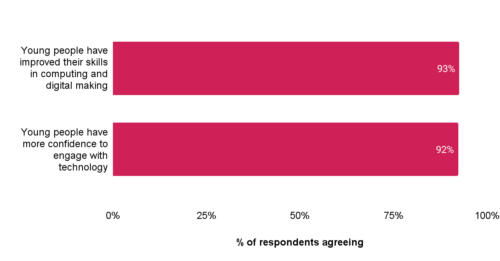
Volunteers reported increases in young people’s skills and confidence in digital making and engaging with technology (see graph below). They also agreed that young people developed other skills, with nearly 90% noting improvements in problem solving, personal confidence, and creative thinking.
How are we supporting volunteers?
These positive outcomes are the result of the hard work and dedication of the club volunteers. Based on the survey, we estimate that at the time of the survey, there were over 6000 Code Club leaders and almost 3000 CoderDojo champions around the world. Many of the volunteers are motivated to volunteer by a love of teaching and a desire to pass on their skills.

These volunteers are part of a global network, and 80% of volunteers said that belonging to this global community of clubs was motivating for them. Volunteers particularly valued the access to resources and information being part of a global community offered, as well as opportunities to share ideas and problem solve.
The majority of Code Clubs are mostly or always using our digital making pathways and projects as part of their clubs. Volunteers value the projects’ step-by-step structure and how easy they are to follow.
“Great structure to allow the kids to self-learn whilst keeping a good amount of creativity for them.” – Code Club volunteer
We plan to do more to ensure that clubs around the world find these projects and pathways accessible and useful for their sessions with young people.
What’s next
The survey has helped us to identify a number of areas where we can support club volunteers even better. Volunteers identified help getting equipment and funding as the main things they needed support with, as well as recruitment of volunteers and young people. We are looking at the best ways we can lend a hand to the clubs network in these areas.
You can read the survey report to dive deeper into the findings.
We take impact seriously and are always looking to understand how we can improve and increase the impact we have on the lives of children and young people. To find out more about our approach to impact, you can read about our recently updated theory of change, which supports how we evaluate what we do.
The post Gaining skills and confidence: The impact of Code Club and CoderDojo appeared first on Raspberry Pi Foundation.
Не сте пристрастени към дрога? Помислете пак
Post Syndicated from Светла Енчева original https://www.toest.bg/ne-ste-pristrasteni-kum-droga-pomislete-pak/

Идеята за тази необичайна (в сравнение с повечето ми публикации в „Тоест“) статия се породи като следствие от предишната – за т.нар. борба с дрогата в България. За една тема, която възнамерявах да засегна накратко, накрая не се намери място. След това с редакцията преценихме, че тя заслужава самостоятелно внимание. Темата е: какво разбираме под „наркотици“. Както и под „зависимост“ изобщо. И тъй като вникването в проблема е свързано с поставянето на всекидневни очевидности под въпрос, избрах да пиша в първо лице и да споделя личен опит, вместо да застана на привидно неутрална анализаторска позиция.
Къде съм в картинката
Не пуша и никога не съм пробвала – нито тютюн, нито нещо друго. Не пия и нищо по-алкохолно от боза (не от убеждение, просто вкусът ми е гаден), така че съм нямала възможност да разбера какво е да се напиеш. И наркотици не съм вземала. Освен може би веднъж, когато ми дадоха едно кексче и ми казаха, че от него ще ми стане хубаво. Чак след като го глътнах, схванах какво всъщност са ми казали. Е, никаква промяна не усетих.
От тийнейджърка обаче всекидневно пия чай. Нямаше да мога да напиша никоя от статиите си, без да се подкрепя със силен черен чай. А понякога, когато чаят не е достатъчен, за да влезе мозъкът ми в работен режим, си помагам и с хрупане на какаови зърна. Така направих и днес.
Много хора ми се смеят, когато кажа, че да, не пуша, не пия, не се друсам, но съм зависима от чая. Мой приятел с дългогодишен опит в злоупотребяването с различни наркотици прие твърдението ми сериозно и рече: „Ами чаят е спийд“. „Спийд“ е жаргонно название за наркотиците, които действат стимулиращо – като амфетамините например.
Две понятия за дрога
Когато говорим за дрога, обикновено имаме предвид наркотични вещества, които в повечето случаи законът признава за такива и които са под строга регулация, често са и забранени. Наркотици в този смисъл са например – при всички разлики във въздействието и рисковаността на употребата им – марихуаната, хероинът, кокаинът, амфетамините, LSD-то, разни модерни „дизайнерски“ дроги и пр.
Някои наркотици се промъкват покрай законовите регулации. Като балоните с райски газ, чиято продажба накрая уж беше забранена за непълнолетни, но забраната е широко нарушавана. Или в миналото дишането на лепило „Кале“ заради ацетона в него.
Други наркотици са допустими за използване в медицината, но не се продават свободно – например упойките и лекарствата, изписвани с жълта и зелена рецепта.
В широкия смисъл на думата обаче дрога са всички психоактивни вещества, тоест веществата, които по един или друг начин влияят на съзнанието. От тази гледна точка и алкохолът, и тютюнът са дрога. Но също и кафето, чаят (растението чай, а не отвари от други билки, някои от които впрочем също съдържат психоактивни вещества), захарта, кока-колата, да не говорим за енергийните напитки. И още много съвсем легални храни и напитки.
Наркотици и зависимост
Как се решава кой продукт, водещ до промяна в съзнанието, да се обяви за наркотик и кой – не? Дали критерият е зависимостта, която може да се развие при употребата? Надали – далеч не всички наркотици предизвикват зависимост като хероина. От друга страна, алкохолът и тютюнът могат да доведат до тежка зависимост. Човек се пристрастява и към кафето, чая, захарта и пр.
Освен това зависимостта може да бъде чисто психическа, без да е свързана с физическата консумация на вещество или продукт. Добре известно е например, че човек може да се пристрасти към хазарта. Въпреки това безогледната реклама на хазарт в България беше ограничена едва наскоро. И още е рано да се каже дали и доколко ограниченията ще работят.
Зависимост може да се развие и към неща, смятани за безвредни, а някои дори за необходими и полезни. Свикнали сме да се говори за пристрастяване към компютърни игри, интернет и мобилни телефони или към телевизия. Но зависимостта може да бъде и към работата, секса, спорта и какво ли още не, дори към четенето.
Склонни сме обаче да забелязваме едни форми на зависимост повече от други. Ако някой си гледа само в телефона, това може да се интерпретира като пристрастяване, все едно каква дейност извършва този човек с помощта на телефона. Но ако някой чете книга (стига да не я чете от телефона си), това се смята за достойно за душата. Независимо че и в двата случая става въпрос за еднакво дълбока погълнатост от дейността, принудителното изваждане от която би предизвикало аналогичен дискомфорт.
Антисоциални ли са зависимостите?
Широко разпространено е схващането, че дрогирането, алкохолизмът и изобщо зависимостите са нещо антисоциално. Понякога действително става въпрос за контракултурно бунтарство. В много случаи обаче причината е тъкмо обратната – човек стига до зависимост поради усилията си да се впише в обществото и/или да функционира пълноценно в него.
Това, че не пропуших, беше един от факторите да съм сред аутсайдерите в училище. А понеже и не пия, многократно съм била под социален натиск. „Ама само една чашка няма ли да пийнеш?“ „Няма да чукна наздравица с теб, защото си на безалкохолно!“ Понякога дори съм нямала възможност да откажа да ми сипят алкохол. В един период си бях решила проблема с наздравиците, като лъжех, че в кока-колата ми има водка.
Един бивш колега, който пък не пиеше поради алкохолизъм, от срам да не се разкрие зависимостта му тайно даваше питието си на друг колега, който поради това поглъщаше двойно количество и се напиваше. Друг познат, уволняван заради проблемите си с алкохола, реторично питаше: „Как да ходя на служебни купони, като там се пие?“.
Някои вземат наркотици, за да се справят по-добре с работата си. Не става дума само за представители на творческите професии, като музикантите. Амфетамините могат да допринесат например за по-добра концентрация и работоспособност при хора, на които кафето и чаят не са им достатъчни.
Може би дрогата, свързана с най-голяма стигма, е хероинът. Но няма да забравя разговора си с един здравен медиатор в ромски квартал, който ми разказваше за хероинозависимите мъже от махалата. Попитах го кое ги кара да посегнат към този наркотик. Отговори, че те работят тежък физически труд. Идва някой и им казва, че ако си бият една инжекция, ще имат сили и няма да се уморяват. Първите пъти наистина усещат прилив на сили. После вече става късно.
Изобщо, дрогирането в името на социалното функциониране е нож с две остриета, независимо дали говорим за „сериозни“ наркотици, алкохол, или за кафе и т.н. Черният чай и какаовите зърна може да ми помагат да работя, но не питайте как ще заспя след това. Има хора, които не могат да заспят без алкохол или приспивателно (в което се съдържат наркотични вещества), след като през деня са изпили сума ти кафета, за да са в състояние да работят.
Разнообразното отношение към дрогите
Причините едни психоактивни продукти и вещества да са легални дори за деца, ползването на други да е възможно при определени условия, а трети да са абсолютно забранени, не са в самите продукти или вещества. Те са културни, политически, религиозни, географски, икономически.
Марихуаната може би нямаше да бъде толкова „демонизирана“, ако от растението коноп не се произвеждаха толкова много продукти, между които плат, хартия, биогориво, строителни и изолационни материали. Съответно криминализирането на конопа е от полза за производителите на „конкурентни“ стоки – памук, за петролната индустрия, дървопреработването и още доста бизнеси. Колкото и абсурдно да е това, защото индустриалният коноп е нещо различно от видовете на растението, които се използват като наркотик.
В САЩ консумацията на алкохол е забранена до 21-годишна възраст, а на открити места е възможна само ако бутилката е скрита в плик. Същевременно лекарите масово предписват лекарства, към които пациентите лесно се пристрастяват. В Германия отношението към алкохола е далеч по-либерално, но до медикаменти, предизвикващи зависимост, се прибягва само ако няма други варианти. Дори след операция на пациента може да се даде само ибупрофен. И да му се обясни, че не е толкова страшно да се научи да понася някаква болка.
В Чили масово се пие чай от кока, а ако сте на голяма надморска височина в Андите, без този чай трудно ще останете в съзнание. В случай че решите да си донесете такъв чай в България обаче, се излагате на сериозен риск. Затова пък тук маковото семе го продават в магазините, но ако си занесете някое пакетче в Сингапур, може да си имате големи неприятности.
За разлика от исляма, християнството разрешава алкохола, а при вземането на причастие консумацията му дори е задължителна. Най-последователни по отношение на психоактивните вещества са мормоните, които забраняват не само алкохола, а и кафето и чая.
Необходимост или конвенция?
Като се замислим, някой, изпил десет кафета, може да представлява сериозен риск за пътното движение поради нервността и прилива на енергия от многото кофеин. Но от законова гледна точка не е извършил нарушение, „надрусвайки се“ с кафе. Друг човек, който страда от епилепсия, не получава припадъци само ако всекидневно приема бензодиазепинови лекарства. Но употребата им ще даде положителен тест за наркотици. Трети може да пие амфетамини, които са му предписани, за да се справя с дефицита си на внимание, който му пречи да шофира безопасно. Четвърти може да причини катастрофа именно защото не си е пил лекарствата от страх да не даде положителен тест.
Подобни парадокси виждаме и в останалите сфери от живота. Злоупотребата с алкохол например може да направи някого много по-агресивен от напушването с трева, но алкохолът се продава свободно в магазините, докато марихуаната е на специален режим дори в страните, в които е легализирана.
Накратко, отношението към едни или други психоактивни вещества, както и правното им регулиране не са пряка функция от тяхното въздействие. Има ред други причини – от културни специфики до корпоративни войни. Без да пренебрегваме корупцията и огромния черен пазар, свързан с производството и разпространението на нелегални субстанции.
Затова, преди да сочим с пръст „дрогираните“, „наркоманите“, „пияните“ или „алкохолиците“, е добре да се опитаме да си дадем сметка за собствените си зависимости. Разделянето на „ние“ и „другите“ е изпитан популистки трик. Но в повечето случаи просто не е честно. И говори за други зависимости.
What did people do before ice??
Post Syndicated from The History Guy: History Deserves to Be Remembered original https://www.youtube.com/watch?v=N2XHBRK9MOI
Mercy Dogs
Post Syndicated from The History Guy: History Deserves to Be Remembered original https://www.youtube.com/watch?v=39A1rcE84dw
Google Solar Cycle
Post Syndicated from xkcd.com original https://xkcd.com/2930/

[$] A proposal to switch Fedora Workstation’s desktop
Post Syndicated from jake original https://lwn.net/Articles/970929/
A proposal to switch the default desktop for Fedora Workstation from GNOME
to KDE Plasma largely went over like the proverbial lead balloon—unsurprisingly.
But the
conversation about the proposal did surface some areas where the
distribution could
perhaps be more inclusive with regard to the other desktop choices
available. The project believes that it
benefits from being opinionated and not requiring users to make
multiple decisions before they can even install the distribution, but there
is a balance
to be found.
Build RAG and agent-based generative AI applications with new Amazon Titan Text Premier model, available in Amazon Bedrock
Post Syndicated from Antje Barth original https://aws.amazon.com/blogs/aws/build-rag-and-agent-based-generative-ai-applications-with-new-amazon-titan-text-premier-model-available-in-amazon-bedrock/
Today, we’re happy to welcome a new member of the Amazon Titan family of models: Amazon Titan Text Premier, now available in Amazon Bedrock.
Following Amazon Titan Text Lite and Titan Text Express, Titan Text Premier is the latest large language model (LLM) in the Amazon Titan family of models, further increasing your model choice within Amazon Bedrock. You can now choose between the following Titan Text models in Bedrock:
- Titan Text Premier is the most advanced Titan LLM for text-based enterprise applications. With a maximum context length of 32K tokens, it has been specifically optimized for enterprise use cases, such as building Retrieval Augmented Generation (RAG) and agent-based applications with Knowledge Bases and Agents for Amazon Bedrock. As with all Titan LLMs, Titan Text Premier has been pre-trained on multilingual text data but is best suited for English-language tasks. You can further custom fine-tune (preview) Titan Text Premier with your own data in Amazon Bedrock to build applications that are specific to your domain, organization, brand style, and use case. I’ll dive deeper into model highlights and performance in the following sections of this post.
- Titan Text Express is ideal for a wide range of tasks, such as open-ended text generation and conversational chat. The model has a maximum context length of 8K tokens.
- Titan Text Lite is optimized for speed, is highly customizable, and is ideal to be fine-tuned for tasks such as article summarization and copywriting. The model has a maximum context length of 4K tokens.
Now, let’s discuss Titan Text Premier in more detail.
Amazon Titan Text Premier model highlights
Titan Text Premier has been optimized for high-quality RAG and agent-based applications and customization through fine-tuning while incorporating responsible artificial intelligence (AI) practices.
Optimized for RAG and agent-based applications – Titan Text Premier has been specifically optimized for RAG and agent-based applications in response to customer feedback, where respondents named RAG as one of their key components in building generative AI applications. The model training data includes examples for tasks like summarization, Q&A, and conversational chat and has been optimized for integration with Knowledge Bases and Agents for Amazon Bedrock. The optimization includes training the model to handle the nuances of these features, such as their specific prompt formats.
- High-quality RAG through integration with Knowledge Bases for Amazon Bedrock – With a knowledge base, you can securely connect foundation models (FMs) in Amazon Bedrock to your company data for RAG. You can now choose Titan Text Premier with Knowledge Bases to implement question-answering and summarization tasks over your company’s proprietary data.

- Automating tasks through integration with Agents for Amazon Bedrock – You can also create custom agents that can perform multistep tasks across different company systems and data sources using Titan Text Premier with Agents for Amazon Bedrock. Using agents, you can automate tasks for your internal or external customers, such as managing retail orders or processing insurance claims.


We already see customers exploring Titan Text Premier to implement interactive AI assistants that create summaries from unstructured data such as emails. They’re also exploring the model to extract relevant information across company systems and data sources to create more meaningful product summaries.
Here’s a demo video created by my colleague Brooke Jamieson that shows an example of how you can put Titan Text Premier to work for your business.
Custom fine-tuning of Amazon Titan Text Premier (preview) – You can fine-tune Titan Text Premier with your own data in Amazon Bedrock to increase model accuracy by providing your own task-specific labeled training dataset. Customizing Titan Text Premier helps to further specialize your model and create unique user experiences that reflect your company’s brand, style, voice, and services.
Built responsibly – Amazon Titan Text Premier incorporates safe, secure, and trustworthy practices. The AWS AI Service Card for Amazon Titan Text Premier documents the model’s performance across key responsible AI benchmarks from safety and fairness to veracity and robustness. The model also integrates with Guardrails for Amazon Bedrock so you can implement additional safeguards customized to your application requirements and responsible AI policies. Amazon indemnifies customers who responsibly use Amazon Titan models against claims that generally available Amazon Titan models or their outputs infringe on third-party copyrights.
Amazon Titan Text Premier model performance
Titan Text Premier has been built to deliver broad intelligence and utility relevant for enterprises. The following table shows evaluation results on public benchmarks that assess critical capabilities, such as instruction following, reading comprehension, and multistep reasoning against price-comparable models. The strong performance across these diverse and challenging benchmarks highlights that Titan Text Premier is built to handle a wide range of use cases in enterprise applications, offering great price performance. For all benchmarks listed below, a higher score is a better score.
| Capability | Benchmark | Description | Amazon | OpenAI | |
|---|---|---|---|---|---|
| Titan Text Premier | Gemini Pro 1.0 | GPT-3.5 | |||
| General | MMLU (Paper) |
Representation of questions in 57 subjects | 70.4% (5-shot) |
71.8% (5-shot) |
70.0% (5-shot) |
| Instruction following | IFEval (Paper) |
Instruction-following evaluation for large language models | 64.6% (0-shot) |
not published | not published |
| Reading comprehension | RACE-H (Paper) |
Large-scale reading comprehension | 89.7% (5-shot) |
not published | not published |
| Reasoning | HellaSwag (Paper) |
Common-sense reasoning | 92.6% (10-shot) |
84.7% (10-shot) |
85.5% (10-shot) |
| DROP, F1 score (Paper) |
Reasoning over text | 77.9 (3-shot) |
74.1 (Variable Shots) |
64.1 (3-shot) |
|
| BIG-Bench Hard (Paper) |
Challenging tasks requiring multistep reasoning | 73.7% (3-shot CoT) |
75.0% (3-shot CoT) |
not published | |
| ARC-Challenge (Paper) |
Common-sense reasoning | 85.8% (5-shot) |
not published | 85.2% (25-shot) |
Note: Benchmarks evaluate model performance using a variation of few-shot and zero-shot prompting. With few-shot prompting, you provide the model with a number of concrete examples (three for 3-shot, five for 5-shot, etc.) of how to solve a specific task. This demonstrates the model’s ability to learn from example, called in-context learning. With zero-shot prompting on the other hand, you evaluate a model’s ability to perform tasks by relying only on its preexisting knowledge and general language understanding without providing any examples.
Get started with Amazon Titan Text Premier
To enable access to Amazon Titan Text Premier, navigate to the Amazon Bedrock console and choose Model access on the bottom left pane. On the Model access overview page, choose the Manage model access button in the upper right corner and enable access to Amazon Titan Text Premier.

To use Amazon Titan Text Premier in the Bedrock console, choose Text or Chat under Playgrounds in the left menu pane. Then choose Select model and select Amazon as the category and Titan Text Premier as the model. To explore the model, you can load examples. The following screenshot shows one of those examples that demonstrates the model’s chain of thought (CoT) and reasoning capabilities.

By choosing View API request, you can get a code example of how to invoke the model using the AWS Command Line Interface (AWS CLI) with the current example prompt. You can also access Amazon Bedrock and available models using the AWS SDKs. In the following example, I will use the AWS SDK for Python (Boto3).
Amazon Titan Text Premier in action
For this demo, I ask Amazon Titan Text Premier to summarize one of my previous AWS News Blog posts that announced the availability of Amazon Titan Image Generator and the watermark detection feature.
For summarization tasks, a recommended prompt template looks like this:
The following is text from a {{Text Category}}:
{{Text}}
Summarize the {{Text Category}} in {{length of summary}}
For more prompting best practices, check out the Amazon Titan Text Prompt Engineering Guidelines.
I adapt this template to my example and define the prompt. In preparation, I saved my News Blog post as a text file and read it into the post string variable.
prompt = """
The following is text from a AWS News Blog post:

<text>
%s
</text>

Summarize the above AWS News Blog post in a short paragraph.
""" % post
Similar to previous Amazon Titan Text models, Amazon Titan Text Premier supports temperature and topP inference parameters to control the randomness and diversity of the response, as well as maxTokenCount and stopSequences to control the length of the response.
import boto3
import json

bedrock_runtime = boto3.client(service_name="bedrock-runtime")

body = json.dumps({
    "inputText": prompt,
    "textGenerationConfig":{
        "maxTokenCount":256,
        "stopSequences":[],
        "temperature":0,
        "topP":0.9
    }
})
Then, I use the InvokeModel API to send the inference request.
response = bedrock_runtime.invoke_model(
    body=body,
	modelId="amazon.titan-text-premier-v1:0",
    accept="application/json",
    contentType="application/json"
)

response_body = json.loads(response.get('body').read())
print(response_body.get('results')[0].get('outputText'))
And here’s the response:
Amazon Titan Image Generator is now generally available in Amazon Bedrock, giving you an easy way to build and scale generative AI applications with new image generation and image editing capabilities, including instant customization of images. Watermark detection for Titan Image Generator is now generally available in the Amazon Bedrock console. Today, we’re also introducing a new DetectGeneratedContent API (preview) in Amazon Bedrock that checks for the existence of this watermark and helps you confirm whether an image was generated by Titan Image Generator.
For more examples in different programming languages, check out the code examples section in the Amazon Bedrock User Guide.
More resources
Here are some additional resources that you might find helpful:
Intended use cases and more — Check out the AWS AI Service Card for Amazon Titan Text Premier to learn more about the models’ intended use cases, design, and deployment, as well as performance optimization best practices.
AWS Generative AI CDK Constructs — Amazon Titan Text Premier is supported by the AWS Generative AI CDK Constructs, an open source extension of the AWS Cloud Development Kit (AWS CDK), providing sample implementations of AWS CDK for common generative AI patterns.
Amazon Titan models — If you’re curious to learn more about Amazon Titan models in general, check out the following video. Dr. Sherry Marcus, Director of Applied Science for Amazon Bedrock, shares how the Amazon Titan family of models incorporates the 25 years of experience Amazon has innovating with AI and machine learning (ML) across its business.
Now available
Amazon Titan Text Premier is available today in the AWS US East (N. Virginia) Region. Custom fine-tuning for Amazon Titan Text Premier is available today in preview in the AWS US East (N. Virginia) Region. Check the full Region list for future updates. To learn more about the Amazon Titan family of models, visit the Amazon Titan product page. For pricing details, review the Amazon Bedrock pricing page.
Give Amazon Titan Text Premier a try in the Amazon Bedrock console today, send feedback to AWS re:Post for Amazon Bedrock or through your usual AWS contacts, and engage with the generative AI builder community at community.aws.
— Antje
benny blanco | Open Wide: A Cookbook for Friends | Talks at Google
Post Syndicated from Talks at Google original https://www.youtube.com/watch?v=o18vAZWxMQM