Post Syndicated from The Atlantic original https://www.youtube.com/watch?v=OxTum6WNrjo
The Future of War
Post Syndicated from The Atlantic original https://www.youtube.com/watch?v=db_Q-Y5gT78
[$] Julia 1.13 brings REPL improvements and more
Post Syndicated from jake original https://lwn.net/Articles/1108153/
Version 1.13 of Julia was released
on September 10, 2026. Julia is a general-purpose language especially well
suited to high-performance numerical computing. Its expressiveness, speed, and composability have made it increasingly popular with scientists and mathematicians.
We last looked at Julia one year ago, in a
review of the 1.12 release. The newest version features an enhanced
read-eval-print loop (REPL), a GUI for installation, a smoother developer experience, and an assortment of performance improvements.
A Conversation With Senator-Elect Abdul El-Sayed
Post Syndicated from The Atlantic original https://www.youtube.com/watch?v=LpKzbmbUo6Y
Paige Cognetti Says Voters’ Main Issue Was ‘Change’ in 2026
Post Syndicated from The Atlantic original https://www.youtube.com/shorts/LHI-fGhYVV4
Hello World #31 out now: Physical computing and robotics
Post Syndicated from Meg Wang original https://www.raspberrypi.org/blog/hello-world-31-out-now-physical-computing-and-robotics/
As we scramble to stay informed and ahead of AI’s place in education, is physical computing still important in computer science? According to the educators in our latest issue of Hello World, the answer is a resounding, “Yes!”
Educators from all over the world shared how they use physical computing to make abstract concepts concrete. From unplugged to AI-integrated approaches, in urban to rural settings, educators are using physical computing to build confidence and creativity in their learners.

Many teachers have shared that building their own confidence was key. In this brand-new issue of Hello World, there are lots of practical tips on how to start, including an article from James Robinson on overcoming the common barriers to including physical computing in your practice.
“Whenever I have run physical computing workshops with teachers or students, there is usually a literal light bulb moment: when learners discover that they can control a simple light bulb LED with a piece of code they have written, and it works, they are thrilled. Finding ways for you and your students to have quick wins breeds success and confidence.” — James Robinson, Hello World issue 31
We hope this issue inspires you to try physical computing and have your own lightbulb moment, and that the thrilling feeling radiates to your learners.
Physical computing and robotics
There are so many creative ways educators are using physical computing in their classroom. This issue includes articles on how physical computing can be used to teach:
- Machine learning through movement
- Environmental data science
- Secondary-level programming and cybersecurity
Our feature articles also include advice on how to survive the AI pressure cooker, an exploration of the PICRAT framework, and a conversation on the future of studying computer science.
Download Hello World issue 31 for free
Beyond the tangible importance of physical computing, some of our writers have shared how they are integrating physical computing with AI. We’ve seen how self-driving cars and human-like robots require AI to function, but they also require physical computing. Together, these technologies bridge the digital and physical worlds to bring innovative ideas to life.
Also in issue 31:
- Cyberdecks
- Disability in the makerspace
- Playful computing
And much, much more.
Whether you’re already mentoring robotics champions or just starting out with paper circuits, I hope this edition of Hello World encourages you to explore something new in physical computing. Above all, I hope you have fun!
The post Hello World #31 out now: Physical computing and robotics appeared first on Raspberry Pi Foundation.
How Cloudflare WAF helps protect against Java4Shell (CVE-2026-114938)
Post Syndicated from Denzil Correa original https://blog.cloudflare.com/java4shell-waf-protection/
On November 17, 2026, the security research company Calif disclosed Java4Shell (CVE-2026-114938), a memory-corruption vulnerability in the Base64 decoder of OpenJDK, the most widely used Java runtime. Under the Common Vulnerability Scoring System (CVSS) 4.0, it scores 9.2 out of 10 (Critical). The flaw affects Java. OpenJDK published a security advisory and Oracle released patched builds in its November 2026 Critical Patch Update the same day, at 21:00 UTC.
The vulnerability lets a remote attacker with no credentials send malformed Base64 data to a Java application and overwrite memory next to the decoded output. Calif turned that overwrite into a leak of heap memory, similar to Heartbleed, and into remote code execution. Calif demonstrated pre-authentication remote code execution against Keycloak, Atlassian Jira, Atlassian Confluence, JFrog Artifactory, Jenkins and PingFederate in their default configurations, and post-authentication remote code execution against Apache Kafka, Apache Solr, Elasticsearch, Gerrit, and Spinnaker.
Cloudflare has released a new set of rules in the Cloudflare Managed Ruleset designed to detect malformed Base64 input patterns associated with this vulnerability. The rules are available on Pro, Business and Enterprise plans and are enabled by default with the Log action because malformed input and some benign application-specific token formats can resemble exploitation attempts. Blocking by default could therefore disrupt legitimate traffic. Customers can review matching requests in Security Events now and change the rules action to Block once they confirm it does not affect legitimate traffic.
The WAF is an additional layer of defense, not a replacement for the patch. Java4Shell can be reached through paths a WAF does not see, like outbound TLS responses, and the only complete fix is to update the Java runtime. Our analysts continue to monitor attack activity and will update the rules as new techniques and variations appear. You can track rule changes in the WAF changelog and get more information on how the vulnerability develops on the dedicated Cloudflare Zero Wire briefing.
We have seen no indication so far that Java4Shell was exploited on Cloudflare infrastructure.
What we know about the vulnerability
Base64 is a common way to represent binary data as text. Java applications decode Base64 when they process authentication headers, tokens, file uploads and many network messages. To decode it faster, OpenJDK replaces frequently used code with specialized machine code, called intrinsics. On supported x86-64 processors, the Base64 intrinsic uses AVX-512 instructions to process 64 bytes at a time.
The bug sits in the handwritten assembly that handles the final characters of the input. When the tail of the input contains padding characters (=) in a position where valid Base64 never places them, the routine calculates a negative output length. That invalid length turns into a full 64-byte write. For a 65-character input, made of 64 characters followed by a single =, OpenJDK allocates a 50-byte output array and then writes 62 bytes past its end.
Java eventually rejects the input as invalid and throws an exception. By then, the neighboring memory has already been overwritten. An application's own input validation does not help, because the corruption happens inside the decoder before the application can reject the data.
The simplest trigger is 64 A characters followed by =. On OpenJDK 17, the trigger needs 128 characters followed by =, because the threshold for the fast code path is higher.
Exploitation is not point-and-shoot. The overwritten bytes are mostly fixed values, and the attacker controls only where the write lands. To build a working exploit, Calif arranged the Java heap so that the overflow enlarged neighboring arrays, which gave them first a way to read heap memory and then a way to write chosen bytes. Each target application requires its own exploit chain. Calif reported developing its first working local exploit in about three hours with the help of AI agents, so we expect other attackers to build exploit chains quickly.
Who is affected
Java4Shell affects a system only when all the following conditions are true:
|
Condition |
Details |
|
Java runtime |
OpenJDK 17.0.6 or newer, including distributions built from OpenJDK: Amazon Corretto, Eclipse Temurin, Microsoft Build of OpenJDK, Azul Zulu, BellSoft Liberica, SAP SapMachine, Red Hat OpenJDK, Oracle OpenJDK, Oracle Java SE and Oracle GraalVM for JDK. Check Oracle's advisory for the exact list of affected Oracle builds. |
|
Processor |
x86-64 with AVX-512 VBMI support, such as Intel Xeon Ice Lake, Sapphire Rapids, Emerald Rapids and Granite Rapids, or AMD EPYC and Ryzen Zen 4 or newer. ARM64 processors are not affected. |
|
Input |
The application decodes attacker-controlled Base64 data with the standard Java decoder. |
Many applications bundle their own Java runtime, and container images ship with a fixed Java Development Kit (JDK). Upgrading the system Java package does not update those copies, and it does not replace a Java virtual machine (JVM) that is already running. Every updated service needs a restart.
Mitigate if you cannot patch right away
If you cannot update immediately, Calif documents two JVM startup flags that remove the vulnerable code path:
-XX:-UseBASE64Intrinsicsdisables hardware-accelerated Base64 encoding and decoding.-XX:UseAVX=2disables AVX-512. Apply this flag only on x86-64 hosts. OpenJDK on ARM does not recognize it and will fail to start.
Both flags require a restart and may reduce performance for workloads that decode large amounts of Base64. They buy time while you patch. They do not replace the update.
Protect your infrastructure while you patch
Patching every Java runtime takes time, especially when JDKs are bundled inside applications and container images. Cloudflare WAF can reduce your exposure while you patch. A new managed rule, available on paid plans and enabled in Log mode by default, detects the malformed Base64 input that triggers Java4Shell. For Business and Enterprise customers, WAF attack score adds a machine learning layer that scores each request for remote code execution payloads, which helps catch variations and bypass attempts that signature-based rules can miss.
New managed rules
Protection for paid plans has been released as part of the Cloudflare Managed Ruleset (Ruleset ID efb7b8c949ac4650a09736fc376e9aee). The rule is enabled by default with the Log action, because blocking by default could cause false positives on legitimate Base64 traffic. To review its matches, go to Security > Security Analytics > Events and filter by the rule ID. If the matches are not legitimate traffic, change the rule action to Block: go to Security > Settings, edit the Cloudflare Managed Ruleset, search for CVE-2026-114938 and set the rule action to Block. Alternatively, you can follow the link to review your configuration on the Zero Wire briefing.
|
Rule description |
Rule ID |
|
Java4Shell – Malformed Base64 Header – CVE-2026-114938 |
5de9b20a45ea45d3841919ab4d718bf4 |
|
Java4Shell – Malformed Base64 Query Value – CVE-2026-114938 |
46bb4172813e471ea62d31c02337b51d |
|
Java4Shell – Malformed Base64 Body Value – CVE-2026-114938 |
d4dc3f71f1bc44a0811ae570e5e5836c |
|
Java4Shell – Malformed Base64 Path Segment – CVE-2026-114938 |
0dceaf0684b54fd0b085fcfb6fd6f152 |
|
Java4Shell – Malformed Base64url JWT Component – CVE-2026-114938 |
0ddd0eb664a040779f2f19065a25d991 |
|
Java4Shell – Malformed Base64 WebAuthn Value – CVE-2026-114938 |
4fce1ea79a614c07a27348d167d74ebb |
We are working on a rule for the Cloudflare Free Managed Ruleset and will update this post when it is available.
A WAF can block the exploit when the malformed Base64 arrives in an HTTP request that passes through Cloudflare. It cannot block every path to the vulnerable decoder, including:
- Encoded or nested data. The Base64 value may be wrapped inside another encoding or compressed format that the application unpacks before decoding.
- Non-HTTP protocols. Some affected products, such as the Apache Kafka broker, accept traffic over their own protocols.
- Outbound connections. Calif also shared a client-side exploit: a Java program that opens a TLS connection to a malicious server can be compromised, even if it exposes no service of its own.
- Traffic that bypasses Cloudflare. This includes internal traffic between services.
Adding defense-in-depth with WAF attack score
While the managed rule is the primary way to block malformed Base64 triggers at the edge, Cloudflare WAF Attack Score (and specifically its remote code execution sub-score cf.waf.score.rce available on Enterprise plans) can offer an additional, complementary layer of protection.
Because CVE-2026-114938 (Java4Shell) is a binary heap-corruption vulnerability, an attacker rarely achieves full, reliable remote code execution with a single 65-byte (or 129-byte) trigger string alone. On the wire, that initial trigger looks like an opaque, malformed Base64 string containing heap-corruption bytes rather than traditional web-layer injection syntax. As a result, machine learning models trained on application-layer injection patterns will not flag the raw Base64 trigger in isolation.
Instead, turning a bounded JVM heap overflow into remote code execution over HTTP almost always requires a multi-stage or multi-parameter exploit chain, which creates more fingerprints that WAF Attack Score can inspect and flag, including:
- Heap Grooming and Triggering: To corrupt a predictable adjacent object on the JVM heap (such as a String or byte[] length header), attackers often send repetitive parameters or headers alongside the malformed Base64 payload to shape memory layout before triggering the out-of-bounds write.
- Second-Stage Payloads: Once heap corruption gives the attacker control over execution flow or object references, the exploit still needs commands, scripts, or Java gadgets to run. If an exploit chain pairs the initial heap-corruption trigger with a second-stage payload such as shell execution primitives (/bin/sh -c, cmd.exe, reverse-shell strings) or Java class-loading gadgets (java.lang.Runtime, ProcessBuilder, serialized object streams) tucked into another header, query parameter, or request body, cf.waf.score.rce can detect and score that secondary payload as malicious.
- Post-Exploitation Activity: Even if an initial heap-read or corruption request slips past edge filters, subsequent HTTP requests attempting to interact with an in-memory webshell or pass OS commands to the compromised JVM remain directly visible to WAF Attack Score.
Deploy protections and patch
Because sophisticated in-memory exploits can still execute raw shellcode or manipulate bytecode without ever sending plaintext shell commands over HTTP, WAF Attack Score should be used alongside explicit Base64 rules and JVM patching.
You can find more information on how to deploy Managed rules and attack score in our WAF guide, but in a nutshell:
1. Set the CVE-2026-114938 rule in the Cloudflare Managed Ruleset (Pro plan and above) to Block. It is enabled in Log mode by default, so review its matches in Security Events first. Use the links on the Cloudflare Zero Wire page to review your rules status.
2. Layer Attack Score to get ML-based remote code execution (RCE) detection: create a custom rule blocking or challenging requests with a low RCE attack score (for example, cf.waf.score.rce le 20 on Enterprise plans, or cf.waf.score.class eq "attack" on Business plans) to catch multi-stage exploit chains and post-exploitation command traffic.
3. Remediate at runtime: Upgrade to patched OpenJDK builds (or set -XX:+UnlockDiagnosticVMOptions -XX:-UseBASE64Intrinsics as a temporary workaround) to eliminate the vulnerable AVX-512 code path entirely. Follow the OpenJDK advisory and Oracle's Critical Patch Update and install your Java vendor's fixed release as soon as possible. For a prompt you can give an AI agent to inventory your Java runtimes, see the Java4Shell page on Cloudflare Zero Wire.
Impact on Cloudflare infrastructure
Cloudflare also runs Java, so when Java4Shell was disclosed we checked our own systems. The vulnerability can only be triggered in specific hardware configurations, namely a x86-64 processor that supports AVX-512 VBMI, so a system is exposed only when both are true. Our investigation found that the majority of our Java workloads are not scheduled on vulnerable systems; we took immediate action to protect the remainder.
About an hour after the patches were published, we began rolling out a JVM startup option that turns off the accelerated Base64 routine containing the bug on all Java workloads, so decoding falls back to the standard implementation. To be safe, we are rolling out our patched configuration to all machines, regardless of hardware as a precaution. We have seen no indication so far that Java4Shell was exploited on Cloudflare infrastructure.
Update every Java runtime now
Java4Shell turns a performance optimization in the Java runtime into a path to remote code execution, and with technical details now public, we expect exploit attempts to follow quickly. The fix is to update every Java runtime and restart the services that use it. While you patch, review the new managed rule's matches and switch it to Block if you are on a paid plan and use attack score to catch remote code execution payloads that signatures may miss.
Our WAF analysts will continue to update protections as new techniques emerge. Follow the WAF changelog for rule updates and the Java4Shell page on Cloudflare Zero Wire for the latest on this vulnerability.
Open by Default, Already Occupied: Threat Actors are Renting your Compute
Post Syndicated from Christiaan Beek original https://www.rapid7.com/blog/post/tr-self-hosted-ai-renting-compute-exposed-servers
John Bolton on How Cyber Warfare Can Intrude on Civilian Life
Post Syndicated from The Atlantic original https://www.youtube.com/shorts/_tnrEkW4btA
Security updates for Wednesday
Post Syndicated from jzb original https://lwn.net/Articles/1108354/
Security updates have been issued by AlmaLinux (.NET 11.0, .NET 8.0, .NET 9.0, bind, buildah, cockpit, containernetworking-plugins, delve, firefox, freerdp, gcc, gcc-toolset-15-gcc, gcc-toolset-16-gcc, go-fdo-client, go-fdo-server, gstreamer1-plugins-base, kernel, oci-seccomp-bpf-hook, podman, sssd, webkit2gtk3, and yggdrasil), Debian (ghostscript, librest, openexr, and roundcube), Fedora (dash, gpsd, java-25-openjdk, java-latest-openjdk, mingw-gstreamer1, mingw-gstreamer1-plugins-bad-free, mingw-gstreamer1-plugins-base, mingw-gstreamer1-plugins-good, p11-kit, and sgx-pccs), Mageia (apache, drakx-installer-images, kernel, kmod-xtables-addons, kmod-virtualbox, kmod-nvidia-current-wopengpu, roundcubemail, and zbar), Red Hat (yggdrasil), SUSE (amazon-cloudwatch-agent, buildah, ctdb, dpdk, govulncheck-vulndb, ignition, keylime-ima-policy, kubevirt1.8, libsolv-demo, libspeex1, libxi, open-iscsi, parted, perl-DBI, phodav, python-dulwich, python-m2crypto, skupper, sssd, tcpreplay, thrift, thunderbird, watchexec, and xen), and Ubuntu (apng2gif, astropy, binwalk, codemirror-js, elog, flightgear, fontforge, fop, freedombox, iwd, jackrabbit, jekyll, joblib, ldm, libapache-session-browseable-perl, libjackson-json-java, libkf5ksieve, libmojolicious-perl, libxml-security-java, lighttpd, lilypond, minetest, mumble, mxml, needrestart, ngircd, node-sqlite3, oar, openjdk-25, privoxy, pysha3, python-mechanize, pywps, renderdoc, ruby-mechanize, ruby-mini-magick, ssvnc, swupdate, tmpreaper, and urwid).
Sam Forstag on Why Corruption Is Important to Voters
Post Syndicated from The Atlantic original https://www.youtube.com/shorts/ICJbqaybsFw
CVE-2026-123007: Critical NGINX HTTP/2 Integer Underflow Leads to RCE (FIXED)
Post Syndicated from Stephen Fewer original https://www.rapid7.com/blog/post/ve-cve-2026-123007-critical-nginx-http-2-integer-underflow-leads-to-rce-fixed
Overview
Today, both Rapid7 and F5 are disclosing CVE-2026-123007, a critical integer underflow vulnerability affecting nginx HTTP/2, which can allow for unauthenticated remote code execution (RCE) against affected servers under certain conditions.
|
CVE ID |
Description |
CWE |
CVSSv4 |
|
CVE-2026-123007 |
HTTP/2 flow-control memory corruption permitting worker-context RCE |
nginx can miscalculate how much response data an HTTP/2 client has allowed it to send. A remote, unauthenticated client can exploit this error by cancelling queued response data, then make nginx use an invalid length when copying a later response. The resulting memory corruption can disclose data, interrupt service, and execute code with the nginx worker process’s permissions.
Impact
Rapid7 has developed a proof-of-concept to demonstrate leveraging CVE-2026-123007 for unauthenticated RCE against a vulnerable linux/amd64 Docker image running nginx version 1.31.8, as shown below in Figure 1. The target nginx server’s configuration had http2 on and TLS enabled. Note that for brevity, video playback is at 8x speed.
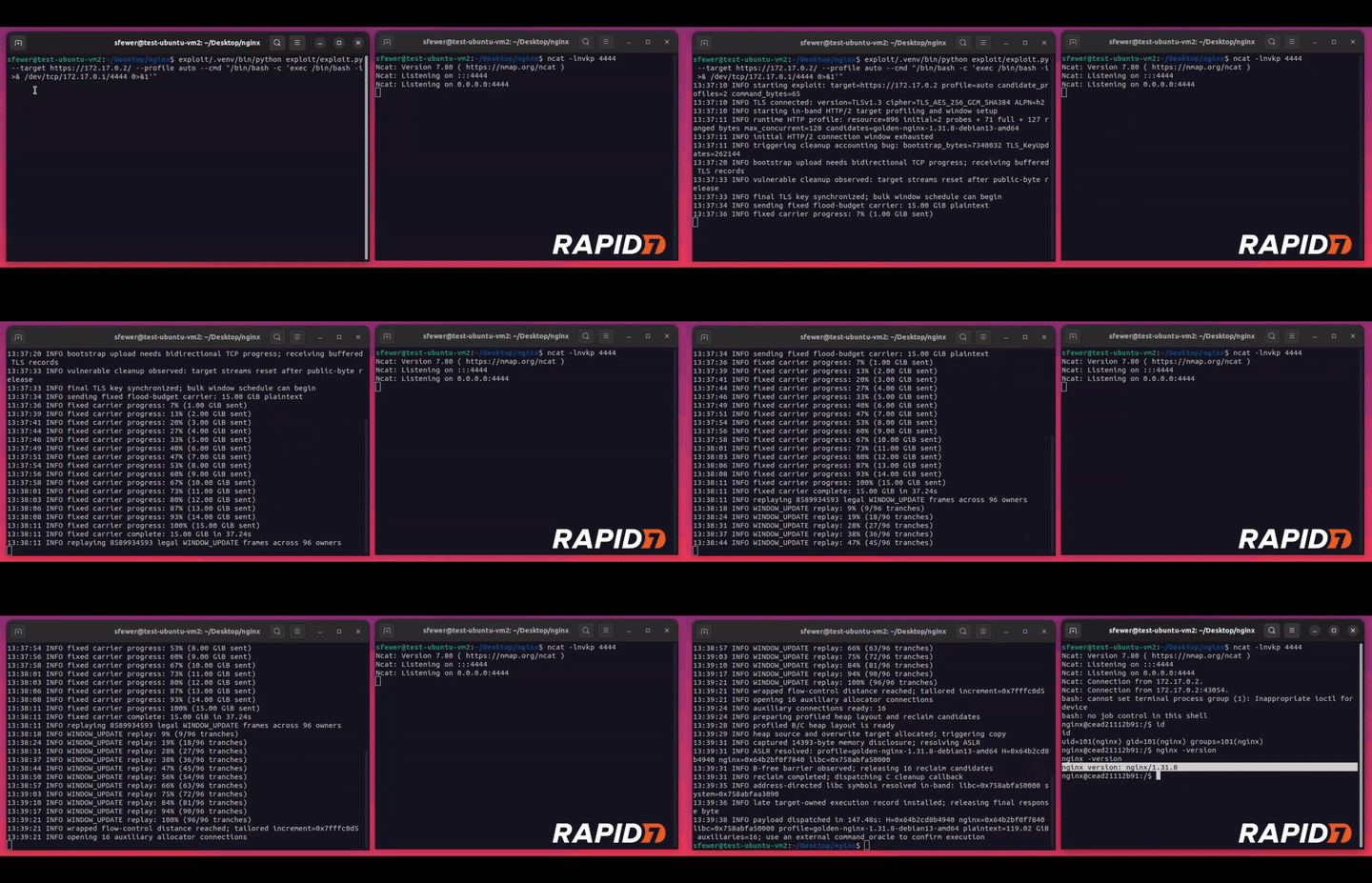
Figure 1: Video demonstrating unauthenticated RCE against NGINX 1.31.8 via CVE-2026-123007
Leveraging CVE-2026-123007 for RCE requires a significant amount of network traffic to be transmitted, approximately 128 GB of HTTP/2 data. Both available network bandwidth and connection timeouts will place practical limitations on Internet exploitation. In the above example shown in Figure 1, exploitation takes two and a half minutes. The approximate timings to transmit the required network data over a 10 Gbit/s network is two minutes, while on a 1 Gbit/s network it is seventeen minutes. Due to nginx’s default one hour connection lifetime, a network slower than approximately 300 Mbit/s will take over the one hour connection limit threshold and will not be able to succeed. Additionally, should an HTTP/2 connection be proxied, the precise attacker-controlled HTTP/2 frames being transmitted will likely not be retransmitted in a way that satisfies exploiting the vulnerability.
Finally, the exploitation strategy developed depends on a specific x86-64 glibc EVEX/YMM memcpy implementation selected at runtime, based on the avx512f and avx512vl CPU features. Alternative RCE exploitation strategies may be viable, but none are currently known.
Credit
This vulnerability was discovered by Stephen Fewer, Senior Principal Security Researcher at Rapid7, and is being disclosed in accordance with Rapid7’s vulnerability disclosure policy.
Technical analysis
The version of nginx tested was a linux/amd64 Docker image for nginx version 1.31.8 (nginx@sha256:5ab5b0b01097420873a3f3330f44248e34a3c2a3e8d5ee30658aeae8cb7435da), and ran with an exposed HTTPS service and http2 enabled.
How a client controls HTTP/2 response data
HTTP/2 carries messages called frames over a connection. Each request and response belongs to a numbered stream, so one connection can carry several exchanges at once. Response-body bytes are carried in DATA frames.
For this vulnerability, nginx is the sender and the remote client is the receiver. The client grants nginx permission, or flow-control credit, to send a certain number of DATA bytes. nginx tracks the remaining credit in two counters: one for each stream and one shared by the connection. Sending DATA must be permitted by both counters. These HTTP/2 counters are separate from TCP’s receive window.
The client grants more credit by sending a WINDOW_UPDATE frame containing a positive increment. A stream identifier of zero increases the connection’s send credit. A nonzero stream identifier increases the send credit for the stream with that specific nonzero identifier. HTTP/2 limits the increment and the resulting window to 2^31-1 bytes, or 2,147,483,647 (0x7FFFFFFF). This report calls that maximum MAX.
The client can also send a SETTINGS frame containing a SETTINGS_INITIAL_WINDOW_SIZE parameter. This changes the starting credit for new streams. nginx must also adjust each active stream’s remaining credit by the difference between the old and new setting values. It does not change the connection’s credit. A reduction can therefore leave an active stream with negative credit until the client grants more. The connection window has no equivalent reduction: it must remain between zero and MAX. RFC 9113, section 6.9 defines these limits and the required errors.
nginx stores the connection counter in h2c->send_window, where h2c is the HTTP/2 connection record. Its size_t type is an unsigned integer: on the verified 64-bit build it can hold values from zero to 2^64-1. The size_t type can therefore hold values above HTTP/2’s maximum connection window of 2^31-1 bytes (MAX). nginx must enforce that protocol limit in its own logic.
// src/http/v2/ngx_http_v2.h
#define NGX_HTTP_V2_MAX_WINDOW ((1U << 31) - 1) // <--- [1]
struct ngx_http_v2_connection_s {
    // ...
    size_t send_window;                         // <--- [2]
    // ...
};
struct ngx_http_v2_stream_s {
    // ...
    ssize_t send_window;
    // ...
};
The rule that the connection counter at [2] must never exceed MAX at [1] is the connection-window invariant. The separate stream counter, stream->send_window, is explicitly declared as ssize_t, a signed 64-bit integer on the verified build. That allows SETTINGS_INITIAL_WINDOW_SIZE to make a stream’s credit temporarily negative. The connection counter remains unsigned. The later unsafe conversion occurs when the output filter treats excessive connection credit as a signed 64-bit off_t response length.
Leveraging vulnerability has four main stages:
-
By slowing its reading of server output, the client keeps selected DATA frames queued and unstarted. It raises the connection’s credit to MAX and the selected streams’ credit to just below MAX. A SETTINGS frame that increases SETTINGS_INITIAL_WINDOW_SIZE enough to exceed the stream limit makes nginx close those streams while leaving the connection usable. Request cleanup then restores the reserved credit above MAX.
-
An unsigned subtraction in the next connection WINDOW_UPDATE check underflows. Repeated accepted WINDOW_UPDATE frames can then raise the counter into the upper half of its 64-bit range without requiring the addition to wrap.
-
On the verified 64-bit build, nginx interprets that excessive counter as a negative response length and creates an invalid buffer. Buffered TLS output then passes a huge unsigned byte count to the memory-copy function memcpy, causing out-of-bounds reads and writes.
-
These constrained memory accesses depend on the build and selected copy routine. With a suitable memory layout, an attacker can use disclosed addresses and controlled overwrites to execute code with the nginx worker process’s permissions.
Cancelling queued DATA restores too much credit
When nginx queues a DATA frame at [3], it subtracts the frame’s DATA length from the connection’s credit counter at [4] and then from the stream’s credit counter. This reserves the credit before the bytes reach the client and prevents other streams from spending the same connection credit:
// src/http/v2/ngx_http_v2_filter_module.c
// ngx_http_v2_send_chain()
// ...
ngx_http_v2_queue_frame(h2c, frame);       // <--- [3]

h2c->send_window -= frame_size;            // <--- [4]
stream->send_window -= frame_size;
stream->queued++;
An attacker can keep a later response queued by slowing or stopping its reading of earlier server output. Once the transport cannot accept more output, nginx must wait. This condition is transport backpressure. The attacker needs enough of it to keep the selected DATA frame unstarted: none of that frame’s bytes have yet entered TLS output or the socket. Stopping response reads does not prevent the client from sending control frames in the other direction.
While the DATA remains queued, the client sends a connection WINDOW_UPDATE that raises nginx’s reduced counter to MAX. The problem appears when the request that owns the queued DATA then closes. Its request-cleanup handler removes the unstarted DATA and returns the reserved credit:
// src/http/v2/ngx_http_v2_filter_module.c
// ngx_http_v2_filter_cleanup()
// ...
for ( ;; ) {
    frame = *fn;
    if (frame == NULL) {
        break;
    }
    if (frame->stream == stream && !frame->blocked) { // <--- [5]
        *fn = frame->next;
        window += frame->length;                      // <--- [6]
        if (--stream->queued == 0) {
            break;
        }
        continue;
    }
    fn = &frame->next;
}
// ...
h2c->send_window += window;                           // <--- [7]
The test at [5] selects removable, unstarted frames for that request. The local variable window totals their DATA lengths at [6]. The addition at [7] does not check whether restoring those bytes takes the connection counter above MAX.
For example, restoring 1,393 bytes after the counter has reached 2,147,483,647 (0x7FFFFFFF) produces 2,147,485,040 (0x80000570). This value is invalid under HTTP/2 as it exceeds MAX, although it still fits in a 64-bit size_t; the addition has not yet wrapped around. The unchecked restoration at [7] is the first invalid state in the vulnerability. The attacker still needs a way to close the selected requests while preserving the connection, so the excessive counter can be used again.
A SETTINGS error closes the stream but leaves the connection usable
When a SETTINGS frame increases SETTINGS_INITIAL_WINDOW_SIZE enough that an active stream’s credit would exceed MAX, nginx terminates that stream but leaves the HTTP/2 connection usable. A client can create this condition by first sending a stream WINDOW_UPDATE to put the selected stream just below MAX. It then sends a SETTINGS frame that increases the initial stream-window setting. For example, changing the setting from 65,535 to 65,537 adds two bytes to every active stream. A stream already at MAX-1 would become MAX+1, even though the new setting value itself is allowed.
RFC 9113 requires this condition to end the connection with FLOW_CONTROL_ERROR. nginx instead calls ngx_http_v2_terminate_stream() for each affected stream. That function sends RST_STREAM, which ends an individual stream, and causes the request to be cleaned up. The loop then continues using the same connection:
// src/http/v2/ngx_http_v2.c
// ngx_http_v2_adjust_windows()
// ...
if (delta > 0
    && stream->send_window
          > (ssize_t) (NGX_HTTP_V2_MAX_WINDOW - delta))
{
    if (ngx_http_v2_terminate_stream(h2c, stream,
                                     NGX_HTTP_V2_FLOW_CTRL_ERROR)
        == NGX_ERROR)
    {
        return NGX_ERROR;
    }
    continue;                                      // <--- [8]
}
Here, delta is the difference between the new and old setting values. Request cleanup performs [5] through [7], while continue at [8] leaves the HTTP/2 connection open. The attacker can now send further frames on the connection whose credit has exceeded MAX.
The next WINDOW_UPDATE causes an integer underflow
When another connection WINDOW_UPDATE arrives, nginx tries to calculate how much additional credit is still allowed:
// src/http/v2/ngx_http_v2.c
// ngx_http_v2_state_window_update()
// ...
if (window > NGX_HTTP_V2_MAX_WINDOW - h2c->send_window) { // <--- [9]
    // ...
    return ngx_http_v2_connection_error(h2c,
                                        NGX_HTTP_V2_FLOW_CTRL_ERROR);
}
h2c->send_window += window;                            // <--- [10]
In this function, window is the increment received from the client. The subtraction at [9] is safe only while the stored counter is no greater than MAX. If cleanup has restored R excess bytes, the intended allowance is MAX – (MAX + R), or -R. Unsigned arithmetic cannot represent that negative result. On the verified 64-bit build it wraps to 2^64 – R, a very large positive number. This is the integer underflow identified by CWE-191.
The incorrect allowance lets further client increments pass the check. By sending many increments, each no greater than MAX, the client can raise the counter to 2^63 or above without wrapping the addition itself, shown at [10] above. Such a value has the top bit of its 64-bit representation set. It is still an unsigned value, but it no longer fits in a signed 64-bit integer. That distinction matters when nginx prepares the next response.
This amplification accounts for the large traffic requirement. A connection WINDOW_UPDATE occupies 13 HTTP/2 bytes: a nine-byte frame header and a four-byte payload. The credit granted by that frame is not data actually transmitted. Starting from the small over-credit state described above, reaching 2^63 by maximum-size increments takes about 2^32 frames, or 52 GiB. Reaching the near-2^64 values used for the confirmed read/write path takes about 2^33 increments, or 104 GiB. nginx also limits control-frame traffic relative to other received data. The current code-execution reproduction sends about 15 GiB of additional request-header traffic to stay within that limit, bringing its reported plaintext total to about 119.02 GiB. TLS and network overhead increase the actual wire traffic. These figures describe this 64-bit amplification route, not a universal minimum for every possible exploit.
Excessive credit becomes a negative response length
The client can make an active stream with available credit process an ordinary response body. nginx’s HTTP/2 output filter decides how many body bytes to include in a DATA frame. Before following that calculation, it is useful to define the buffer it will create.
An in-memory nginx buffer is described by a ngx_buf_t record. Its pos pointer is the memory address of the next byte to send. Its last pointer is the address immediately after the available data. For four available bytes, last must be four bytes after pos; subtracting pos from last gives the length, four. A valid buffer therefore cannot have last before pos. nginx links these buffer records together into an output chain, which is a list of data waiting to be sent.
In ngx_http_v2_send_chain(), the byte limit is an off_t, a signed 64-bit integer on the verified build. The excessive unsigned connection counter is converted to that signed type at [11]. On this build, a value of 2^64 – d, where d is a small positive byte count, becomes -d:
// src/http/v2/ngx_http_v2_filter_module.c
// ngx_http_v2_send_chain()
// ...
if (limit == 0 || limit > (off_t) h2c->send_window) {
    limit = h2c->send_window;                         // <--- [11]
}
if (limit > stream->send_window) {
    limit = (stream->send_window > 0) ? stream->send_window : 0;
}
// ...
if ((off_t) frame_size > limit) {
    frame_size = (size_t) limit;                      // <--- [12]
}
// ...
rest = frame_size;
while ((off_t) rest >= size) {                        // <--- [13]
    // ...
}
if (rest) {
    cl = ngx_http_v2_filter_get_shadow(stream, in->buf,
                                       offset, rest); // <--- [14]
    // ...
}
The stream-window check does not reject a negative limit: it only reduces a limit that is too large. At [12], the negative limit becomes a huge unsigned frame_size. Casting the same value back to off_t makes it negative again, so [13] skips the loop that would normally consume and bound the available body bytes. At [14], nginx passes the invalid length to a helper whose size parameter is also a signed off_t.
That helper creates a shadow buffer: a new metadata record referring to part of the existing response data, without copying the response body itself. It sets the new end pointer using the supplied length:
// src/http/v2/ngx_http_v2_filter_module.c
// ngx_http_v2_filter_get_shadow()
static ngx_chain_t *
ngx_http_v2_filter_get_shadow(ngx_http_v2_stream_t *stream, ngx_buf_t *buf,
    off_t offset, off_t size)
{
    // ...
    ngx_memcpy(chunk, buf, sizeof(ngx_buf_t));
    // ...
    if (ngx_buf_in_memory(chunk)) {
        chunk->pos += offset;
        chunk->last = chunk->pos + size;              // <--- [15]
    }
    // ...
}
Because size is negative, [15] places last before pos. The response body has not become larger; its buffer metadata is now invalid. The next output stage trusts that metadata.
Buffered TLS output copies beyond the buffers
For buffered TLS output, ngx_ssl_send_chain() gathers bytes from the output chain into a temporary staging buffer before encryption. It calculates each input buffer’s length using last – pos. The invalid buffer produces a negative signed length at [16]:
// src/event/ngx_event_openssl.c
// ngx_ssl_send_chain()
// ...
ssize_t send, size, file_size;
// ...
size = in->buf->last - in->buf->pos;                  // <--- [16]
if (size > buf->end - buf->last) {
    size = buf->end - buf->last;
}
if (send + size > limit) {
    size = (ssize_t) (limit - send);
}
// ...
ngx_memcpy(buf->last, in->buf->pos, size);            // <--- [17]
buf->last += size;
in->buf->pos += size;
Both checks only reduce lengths that are too large. Neither rejects a negative length. memcpy takes an unsigned size_t byte count, so [17] converts -d back into the huge value 2^64-d. The actual source and destination buffers are far smaller. This is where the invalid connection credit first reaches an out-of-bounds native memory access.
A copy that actually traversed such an enormous range would normally encounter inaccessible memory and crash the worker. In the tested x86-64 glibc implementation, however, certain lengths just below 2^64 cause the machine-level end-address calculations to wrap (Please see Addendum A below for more details on this unexpected behavior). For a length of 2^64-d, adding the length to a start address can produce an address d bytes before it. The optimized copy uses these end addresses in its loop conditions, so it can finish after a limited number of reads and writes that reach outside the intended buffers. The copy can return if all locations it actually accesses are accessible; other lengths, memory layouts, or copy implementations can fault immediately. If it returns, nginx also moves both buffer positions backward by the negative signed length.
Exploitation
The invalid copy can both read and overwrite worker memory. It does not give the client an HTTP/2 field in which it can simply choose any memory address. The useful addresses depend on where nginx allocated the response and TLS buffers, how much output is already buffered, and which copy routine the C library selected. These are constrained read and write capabilities, not an unconditional arbitrary read or write.
After creating the invalid DATA buffer, ngx_http_v2_send_chain() updates its position in the original response and records the bytes that remain to be sent:
// src/http/v2/ngx_http_v2_filter_module.c
// ngx_http_v2_send_chain()
// ...
offset += rest;                                       // <--- [18]
size -= rest;
// ...
if (offset) {
    cl = ngx_http_v2_filter_get_shadow(stream, in->buf,
                                       offset, size); // <--- [19]
    // ...
    in->buf = cl->buf;
    // ...
}
Here, offset is the position within the original body and size is its remaining length. Starting at offset zero, the same unsigned value representing -d makes [18] move the offset backward by d and increase the remaining length by d on the verified build. The shadow buffer created at [19] therefore has a positive length, but starts d bytes before the original response and ends at its original end. If the oversized copy and connection survive, later ordinary DATA frames can carry those preceding bytes to the client through TLS. They can include pointers into the heap, where nginx dynamically allocates request data, or into loaded libraries. Those pointers disclose addresses that address-space layout randomization (ASLR) would otherwise hide.
On the write side, nginx stores client-supplied request data in heap allocations. With a suitable allocation layout, the oversized copy can pick up those attacker-selected bytes and replace fields in a nearby live heap object. One useful field is a callback: a stored function pointer that nginx intends to call later. An attacker who knows the relevant process addresses and can overwrite that field may redirect normal nginx processing to existing executable code. The overwrite need not contain new machine code. This explains the general route from disclosed addresses and controlled bytes to code execution; it does not claim that every build exposes the same object or callback. Execution has the worker’s permissions; execution as the master process or root has not been established.
The proof-of-concept first recovers heap addresses and pointers into nginx and the GNU C Library (glibc) from memory preceding the original response body. It uses those addresses and the overwrite to forge nginx request and response-buffer objects that return selected parts of glibc’s loaded image over HTTP/2. The returned ELF metadata is parsed to resolve system() despite ASLR, then a request-pool cleanup callback is redirected to invoke an attacker-chosen command.
Addendum A: Why an oversized memcpy can return
The TLS copy via ngx_memcpy (shown at [17] above) receives a byte count of 2^64-d, where d is a small positive distance. A routine that actually traversed that entire range would normally fault. This addendum explains why one optimized glibc implementation can instead finish after a limited number of out-of-bounds accesses.
glibc chooses among optimized copy routines according to the CPU’s capabilities. The tested x86-64 routine uses EVEX/YMM instructions, which can move 32 bytes at a time. In the corresponding glibc 2.41 source, the EVEX wrapper includes a shared memcpy/memmove implementation, and its vector configuration sets VEC_SIZE to 32. A vector is the block of bytes handled by one such instruction.
The following excerpt uses AT&T assembly syntax, in which the source operand comes first. The CPU register %rdi holds the original destination address, called D below; %rsi holds the source address, Q; and %rdx holds the byte count, n. One route enters this backward-copy branch when D and Q are different and the unsigned difference D-Q is smaller than n. This includes the ordinary case where D is above Q and n is close to the unsigned 64-bit maximum.
// glibc 2.41: sysdeps/x86_64/multiarch/memmove-vec-unaligned-erms.S
// Function: CPU-selected memcpy implementation, backward-copy branch
// ...
L(more_8x_vec_backward):
    // ...
    leaq (VEC_SIZE * -4 + -1)(%rdi, %rdx), %rcx // <--- [20]
    // ...
    andq $-(VEC_SIZE), %rcx                     // <--- [21]
    // ...
L(loop_4x_vec_backward):
    // ... load and store four 32-byte vectors
    addq $(VEC_SIZE * -4), %rcx                 // <--- [22]
    cmpq %rcx, %rdi                             // <--- [23]
    jb L(loop_4x_vec_backward)
    // ... store the previously loaded leading and trailing vectors
    VZEROUPPER_RETURN                           // <--- [24]
The full glibc assembly source shows the omitted loads and stores. At [20], leaq calculates an address without reading memory. Its 64-bit result keeps only the low 64 bits. At [21], andq rounds that address down to a 32-byte boundary. Calling the resulting destination address cursor, the calculation is:
cursor = align_down_32((D + n - 129) modulo 2^64)
       = align_down_32(D - d - 129), when n = 2^64-d
Here, align_down_32 means rounding down to the nearest address divisible by 32; it is explanatory notation, not a glibc function. For an ordinary heap address and a small d, the calculated cursor is already below D.
The loop starts by copying one 128-byte block. Instruction [22] then moves the cursor backward by another 128 bytes. The comparison and unsigned jump at [23] repeat the loop only while D < cursor. Because the cursor is already below D, the jump is not taken. The routine writes its remaining leading and trailing vectors, then returns at [24]. It has not copied the enormous requested range: the wrapped address has made the loop stop after a small set of accesses. Those accesses can still read and overwrite memory outside the actual buffers.
Remediation
The following vendor supplied fixes are available.
|
Product |
Vulnerable Versions |
Fixed Version |
|
NGINX Plus |
37.1.0 – 37.2.0.1 |
37.3.0.1 |
|
NGINX Plus |
37.0.0 – 37.0.7.1 |
37.0.8.1 |
|
NGINX Plus |
R34 – R36 |
None |
|
NGINX Open Source |
1.31.0 – 1.31.8 |
1.31.9 |
|
NGINX Open Source |
1.9.5 – 1.30.6 |
1.30.7 |
For the latest remediation information, please see the vendor advisory.
Disclosure timeline
-
November 11, 2026: Rapid7 makes initial outreach to F5.
-
November 12, 2026: F5 confirms outreach and Rapid7 discloses the vulnerability. F5 confirms receipt of the disclosure.
-
November 16, 2026: F5 confirms validation of the vulnerability, CVE assignment, and a disclosure date of November 18, 2026.
-
November 18, 2026: This disclosure.
Balloonatics! The 1819 Philadelphia Balloon Riot
Post Syndicated from The History Guy: History Deserves to Be Remembered original https://www.youtube.com/watch?v=0qhveTONoRM
France Is Blaming Iran for the Fridge Cyberattack
Post Syndicated from Bruce Schneier original https://www.schneier.com/blog/archives/2026/11/france-is-blaming-iran-for-the-fridge-cyberattack.html
U.S. intelligence agencies have recently reached a “”ow confidence” assessment that Iran was responsible for the attacks in France, according to three U.S. officials who spoke on the condition of anonymity to discuss sensitive intelligence. A “low confidence” assessment generally means that there is some intelligence that points in a certain direction but is fragmented, and that the assessment could change as more information is collected.
The agencies’ judgment on the French incidents linked those attacks to Iran generally and not to a specific group such as the Revolutionary Guards, two of the officials said. They added that Iran was also seen as probably responsible for other similar attacks around Europe, but that those investigations were in their early stages.
Alternate link.
Студио „Комплект“: Дизайнът е човешка дисциплина
Post Syndicated from Ина Иванова original https://www.toest.bg/studio-komplekt-dizaynut-e-choveshka-distsiplina/

Преди години тяхна позната казва, че двете винаги се движат в комплект. Тази почти случайна реплика дава името на Студио „Комплект“ – агенцията за културен мениджмънт, създадена и сърцато ръководена от Адриана Андреева и Бояна Гяурова през 2015 г. През 2026 г. за девети път те организират Международния фестивал за дизайн „Мелба“.
Иновации, свързани с новите технологии, мода, архитектура, интериор и продуктов дизайн – „Мелба“ дава възможност на публиката да види директното приложение на идеите във всекидневието. Когато измислят концепцията на фестивала, важни за тях са духът на взаимопроницаемост на идеите и смесването на дисциплините. А възможността за тесни специалисти да слушат лекции в сфери, които са различни от тяхната, е извор на вдъхновение.
Искаме да срещаме нашата публика със смислени примери от света на дизайна и да даваме възможност за изява на български дизайнери, които развиват дисциплината у нас,
казва Адриана. Тазгодишното издание предлага и достатъчно изложби със свободен достъп на различни места в София.
А Бояна допълва:
За нас е особено ценен международният симпозиум, който стартирахме още с първото издание на фестивала. Каним лектори от Европа, които са представители на различни дисциплини, тъй като разглеждаме дизайна като съвкупност от теми – графичен, социален, продуктов, мода, илюстрация и т.н. Тази година тук са Хавиер Хаен, Йохана Ясковска, Дейвид Джойс (Language), Ани Зелигман (Studio MUT), Телониус Гупил и Йохан Мурман.
Другата ни важна мисия е да работим в посока образование, да провеждаме различни класове. Например тази година имаме работилница, която акцентира върху това как хора, които се занимават с активизъм и социални каузи, работят с дизайна.
Вкусът, разбира се, се възпитава.
Бояна е завършила Немската гимназия, нейната класна я запалва по писането. Заминава да следва в Германия и се насочва към кинознание и история на изкуствата – точно там открива, че иска да се занимава със съвременно кино и дизайн.
Малко беше стряскащо, че имаш пълната свобода да избираш лекциите и курсовете, които да посещаваш. Но така разширяваш много общата си култура и откриваш какво наистина те интересува.
Книгите и разговорите съпътстват израстването на Адриана. Висшето си образование тя получава в Американския университет в Благоевград и поглеждайки ретроспективно, високо оценява либералния подход, свободата и богатата база с материали в областта на журналистиката. Още в университета води рубрика в радиото и пише за списанието, което ѝ дава базови практически умения. Освен че натрупва безценен опит, Адриана смята, че именно в онези години се е научила на гъвкавост и смелост.

Адриана и Бояна се срещат в списание „Едно“, което наричат истинска школа – а покрай работата им започва едно приятелство, което впоследствие ще се превърне и в разпознаваемото Студио „Комплект“.
Допреди десетилетие в България професията културен мениджър не беше позната. В известен смисъл интердисциплинарният подход на Бояна Гяурова и Адриана Андреева е пионерски и те смятат, че се учат заедно с всички свои колеги, които работят в сферата – един от друг и стоейки нащрек заради огромната отговорност. Но за тях продължава да е предизвикателство да работят в сферата на културата и дизайна, което смятат за своя кауза.
Ние знаем как да работим с артисти, без да сме такива. Нашата работа е да показваме тяхната, да ги предизвикваме. Ясното разпределение кой е артистът и кой – организаторът, продуцентът, е от помощ,
казва Бояна.
Според Адриана не е без значение и фактът, че
дизайнерите са дисциплинирани хора, защото трябва да произведат нещо – конкретен продукт, а този процес има начало и край.
Бояна и Адриана винаги са се интересували от екологично отговорния начин на живот, с него обвързват още първото издание на фестивала „Мелба“. Световна тенденция е дизайнът да се оптимизира при използването на ресурси и материали.
Животът е изчерпаем ресурс – вече не можем да си затваряме очите пред чутовното замърсяване. От години се работи в посока на това да се рециклира, да се пречистват океаните, да се възвърне някаква форма на отговорност към природата.
Но от друга страна, дизайнът носи и удоволствие, не просто решава проблеми. Керамичната чаша или столът трябва не само да са ти удобни, а и да искаш да ги ползваш, да ги виждаш всеки ден, години наред,
подчертава Адриана. Освен че дава практични решения обаче, дизайнът е неизменна част и от разпознаваемия облик на всяка организация, събитие или фестивал. Визуалната идентичност на „Мелба“ всяка година е различна, но неизменно следва зелената линия на екологичната устойчивост. Ето какво разказва Бояна:
Стараем се да помогнем на нашите посетители да не използват еднократни чашки. Имаме винаги вода и ги приканваме да носят свои бутилки. Произвеждаме минимално количество печатни материали за събитията ни. Опитваме се да допринесем с личен пример за тази обща кауза, която трябва да бъде кауза на цялото общество.
Концепцията на фестивала „Мелба“ е да предложи дизайнерско съдържание, без то настойчиво да изглежда елитарно. Увереността, че предметите и примерите от ежедневието ни могат да бъдат едновременно красиви и функционални, е водеща – заедно с отстояваната през годините мисия да показват продукти с културна стойност. Затова и във фестивалните дни успяват да достигнат до широк кръг от хора и публиката им всяка година става все по-разнообразна.
Амбицията на Студио „Комплект“ още от самото начало е да работим, от една страна, с творческата индустрия, но от друга – да привличаме институции и бизнеси, тъй като дизайнът дава решения на проблеми,
напомня Бояна. Освен това дизайнът е навсякъде. Както с горчива ирония подсказват и двете – от домакинските уреди до оръжията.
Има една книга на Паола Антонели и Алис Ростхорн – Design Emergency, в която се говори, че в кризисни ситуации, в каквато е в момента светът, се раждат различни дизайн решения. Някои от тях са добри, други се използват за военни цели – авторките дават пример с газовите камери от Втората световна война. Но от друга страна, имаме много евтини и просто гениални решения, които спасяват човешки живот, да речем, сламка, която моментално пречиства водата. Например в Африка, където ресурсът вода е най-ценното нещо.
Адриана твърди, че дизайнът е човешка дисциплина, но докато ги слушам, осъзнавам, че е утилитарна форма на вдъхновението. Опит да бъде променен светът в по-добра посока.
Формата като усилие. За дизайна в полите на Витоша и в Европа
Лина Кривошиева посети фестивала European Design Awards, който тази година се проведе в София. И толкова се вдъхнови, че реши да ни разкаже кое най-силно я е впечатлило в експозициите и лекциите, и да сподели размислите, които е предизвикал фестивалът у нея, за да се вдъхновим и замислим и ние.
Разбира се, всички, занимаващи се с дизайн професионално, са наясно, че големите икономики се развиват по различни закони. Че устойчивостта на стоките не допринася за ръста на продажбите. Все пак обаче остава възможността подобни форуми и платформи да въздействат по-глобално върху начина на мислене.
Ето защо и Адриана, и Бояна намират за житейски важни културата, изкуството, природата. С годините са се научили да балансират работните и семейните си ангажименти.
Оценявам, че в София има много възможности за културни разходки,
споделя Адриана.
Аз съм оптимист, но наистина на моменти се тревожа какъв свят оставяме за нашите деца – с навлизането на изкуствения интелект и промяната на работната среда и етика настъпва огромна промяна в професиите. Това, на което вкъщи залагаме, е богата обща култура, езици, доброта и емпатия. И дъщеря ми (14) да вижда максимално много и различни неща,
казва Бояна.
Адриана е майка на две деца и също се старае да им дава многопосочна информация.
Според мен критическото мислене е изключително важно. Има изследване, продължило няколко години, което установява, че хората, които четат по-малко от две книги годишно, независимо от семейната среда, социалния статус или образованието, са лесни жертви на манипулация.
Освен читателка Адриана е и авторка на стихосбирката „Събираме лъвиците“ (изд. „Кота 0“), излязла впрочем с нарочния жест да предложи на изкушените едно съдържание в две корици – червена и синя.
Признателна съм, ако на някого му харесва това, което съм споделила. Аз съм непреднамерен пишещ. За мен поезията е подреждане на мисли, повик.
Бояна и Адриана всъщност са в непрестанно общуване, в един несвършващ разговор, подреждащ задачите – на живо и в чат. Диалог, в който коментират концепции, решават работни казуси или споделят лични моменти. И това носи успокоителната доза увереност, че ежедневието може да бъде структурирано, подредено, смислено. Като кауза, в която вярваш и на която позволяваш да се развива по своите закони.
Хората, които тихо и кротко променят средата, формират общности и задават посоки, в които има смисъл да тръгнем заедно. Тук ви срещаме с тях. Това са „Тези хора“.
Abdul El-Sayed on the “Incredible Gift” Barack Obama Gave Him
Post Syndicated from The Atlantic original https://www.youtube.com/shorts/MiCuGMvT_CA
Abdul El-Sayed Warns Against Reading Democratic Wins as a ‘Mandate’
Post Syndicated from The Atlantic original https://www.youtube.com/shorts/46A14hdhjgs
How a shared merchant data service can degrade gracefully
Post Syndicated from Grab Tech original https://engineering.grab.com/shared-merchant-data-service
Introduction
When a cache becomes unreliable, a shared read service can struggle in ways that spread to the systems that depend on it. We saw this pattern in our merchant data service (MDS). Cache reads began timing out, fallback requests increased database pressure, and service availability degraded.
The trigger was localized; the broader impact came from how each layer responded, passing more work downstream instead of containing the failure.
That amplification follows a predictable pattern, and a few design changes help MDS degrade instead of collapse. The central lesson is simple: a fallback is not a safety net unless its work is bounded.
The merchant data service and its cache
MDS is a shared read service for merchant information. Many client applications use it for questions such as “Is this outlet open?”, “Does this merchant accept orders manually?”, and “What are this merchant’s settings?”. It supports a range of product and operational workflows and handles high-volume, read-heavy traffic. Because merchant data generally changes less frequently than it is read, MDS uses a cache-aside design:
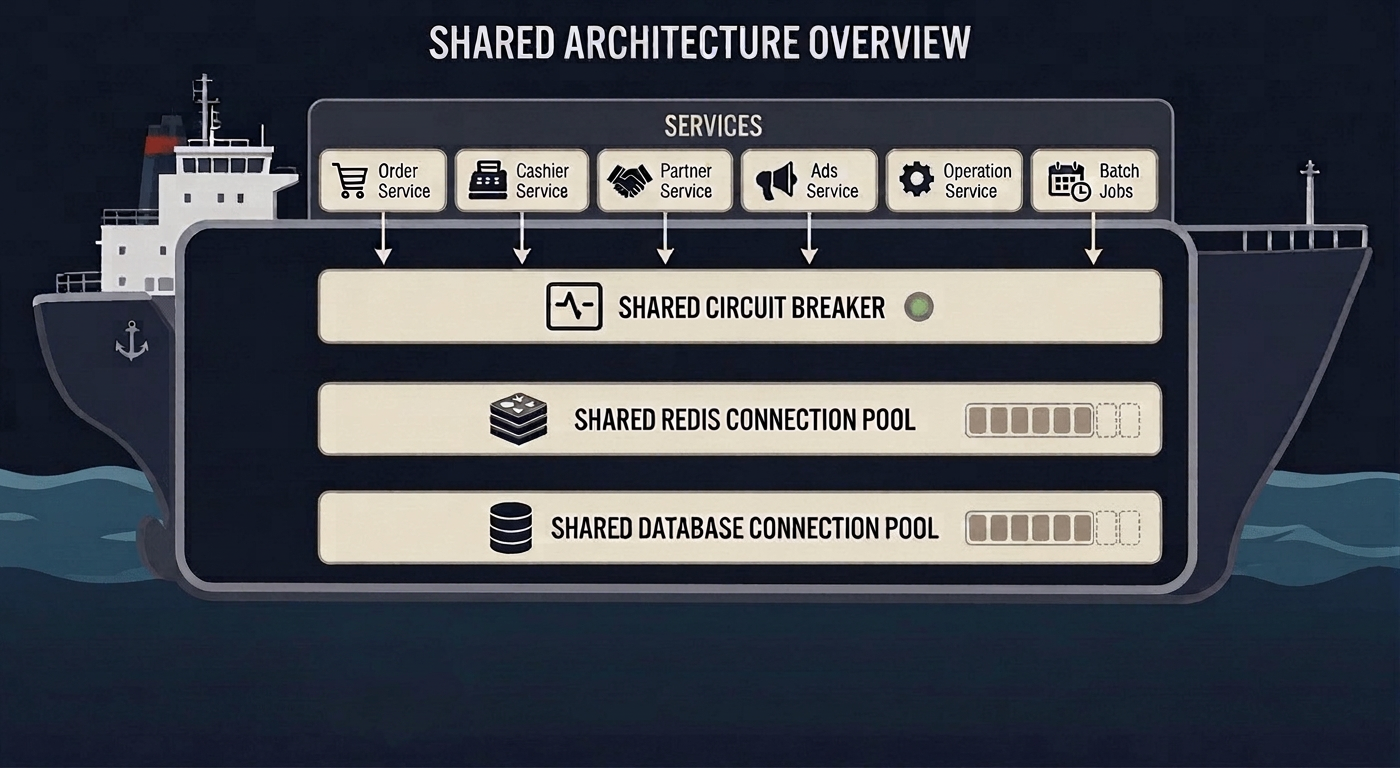
In normal operation, this works well. The database sees only cache misses, which are a small fraction of traffic. The design depends on one assumption that is rarely written down: that cache failures look like cache misses only occasionally. Without bulkheads, the service is like an undivided ship where a small hull breach (a minor cache glitch) lets water flood unchecked into every compartment, quickly sinking the whole vessel under a sudden wave of database requests it was never built to carry.
Anatomy of a cascading failure
A cache disruption caused reads to time out and fall back to the database. As fallback demand rose, database errors and connection pressure increased; callers then saw more failures, and service availability dropped.
This followed a sequence that the Google SRE book describes as a cascading failure: a local fault triggers a response that increases load, which causes more faults. When cache reads slow or fail, each miss adds database work. As the database slows, callers time out. Retries then add more load to the already degraded path, turning a local cache problem into a feedback loop.
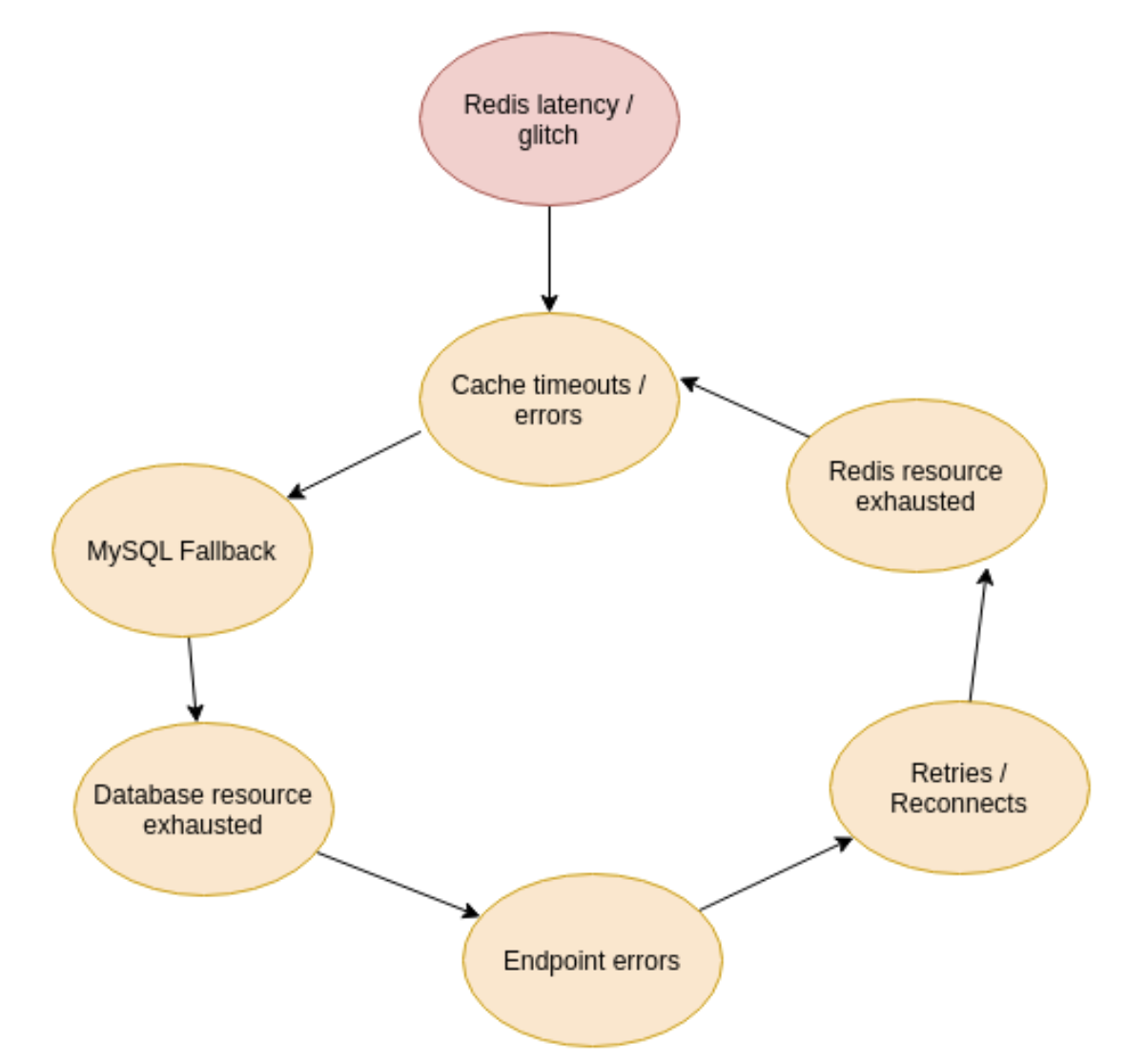
Recovery took longer because retries and connection pressure kept adding load while the cache and database tiers were constrained. Temporary mitigations reduced symptoms, but the system needed restored headroom and lower incoming pressure before it could recover. Those actions addressed the immediate disruption, not the underlying risk: a cache failure could still send excessive, unprioritized work to shared dependencies.
Short-term client and request-path changes reduced exposure to the immediate trigger. The core vulnerability remained: a dependency failure could still flood shared resources with unbounded, unprioritized work.
The questions the redesign had to answer
The cascade exposed three gaps: cache errors followed the same path as normal misses; fallback work had no firm admission bound; and callers with different business impact competed for shared capacity. Those gaps left the redesign with five questions.
- Which requests should survive when capacity is scarce?
- How much cache-fallback traffic may reach each database?
- How do we stop one workload class from exhausting resources used by another?
- Do all clients need real-time data, or can their use cases tolerate a bounded delay in seeing updates?
- Can callers use a recently observed value when fresh data is temporarily unavailable?
These five questions point to a clear objective: preserve interactive reads while shedding work that can wait. Our core design principles include:
- Keep interactive reads available for as long as capacity allows.
- Shed background and batch work before user-facing work.
- Bound database work caused by cache failures.
- Fail fast when a dependency is saturated instead of building an unbounded queue.
- Serve stale data only on approved read paths with explicit freshness limits.
- Give on-call engineers scoped controls that do not require a deployment.
Five mechanisms put these principles into practice, starting at the database boundary and working outward to the client application.
Step 1: Know who is calling and how much it matters
Prioritizing work requires knowing a request’s relative impact. Instead of relying on caller-supplied labels, MDS derives a request class from authentication. The table below shows the categorization of incoming traffic by operational criticality.
| Class | Meaning |
|---|---|
| P0 (Critical) | Interactive reads with direct user impact, such as the consumer app’s API |
| P1 (Standard) | Routine production reads |
| P2 (Deferrable) | Background, batch, and unclassified work that can wait |
Clients without an explicit policy receive the lowest-priority class by default. The default stops new or unclassified callers from claiming scarce capacity; promotion requires a reviewed policy change, not a code change. Downstream controls use the same class so the database limiter, circuit breakers, cache connections, and traffic controls make consistent decisions.
Step 2: Put a budget in front of the database
The key change is an admission controller immediately before the database on the cache-fallback path. Each fallback query must acquire capacity from a shared token budget before running. If capacity is unavailable, the request is rejected promptly instead of joining a queue for an already saturated database.
Separate budgets for distinct workload roles. Independent limits protect different database workloads so that pressure in one area does not consume all capacity available to another. The overall budget is coordinated across service instances and managed through runtime configuration.
Cost reflects query shape and priority. Each fallback consumes capacity according to the work it is expected to perform. Lower-priority work carries a higher relative cost than interactive point lookups. The cost relationship is illustrative, not a production setting. The table below displays illustrative token costs. In production, these values are set through runtime configuration.
| Query type | Base cost | P0 total | P1 total | P2 total |
|---|---|---|---|---|
| Point lookup by ID | 1 | 1 | 2 | 3 |
| Indexed find or range seek | 3 | 3 | 4 | 5 |
Under contention, a more expensive lower-priority query uses its share faster than a point lookup from an interactive caller. Weighting gives higher-impact work a better chance to proceed, but it does not reserve capacity. If interactive demand itself exceeds the shared limit, some interactive requests may be rejected too. A shared weighted budget avoids leaving capacity idle when one class has less demand.
P2 (deferrable) requests do not use the fallback during cache errors. When a cache read fails because of a dependency error, not an ordinary miss or invalid data, the P2 class is rejected before reaching the database limiter. Rejecting P2 early preserves more database budget for interactive and routine work during a broad cache disruption.
Step 3: Bulkheads for connections and failure signals
Admission control limits how much work reaches the database. Bulkheads limit who can starve whom along the way. The name comes from the watertight compartments in a ship’s hull: a breach floods one compartment, not the ship.
Separate cache connection pools by request class. MDS routes requests through independent pools based on their relative impact. Slow background reads can exhaust their own pool without consuming connections needed by interactive traffic. Separate pools help most when slow operations hold connections longer and pool exhaustion could turn slowness into failure.
Separate circuit breakers by request class. Failures in lower-priority traffic do not automatically block interactive work; each class is evaluated against its own observed errors. A shared dependency failure can still affect every class.
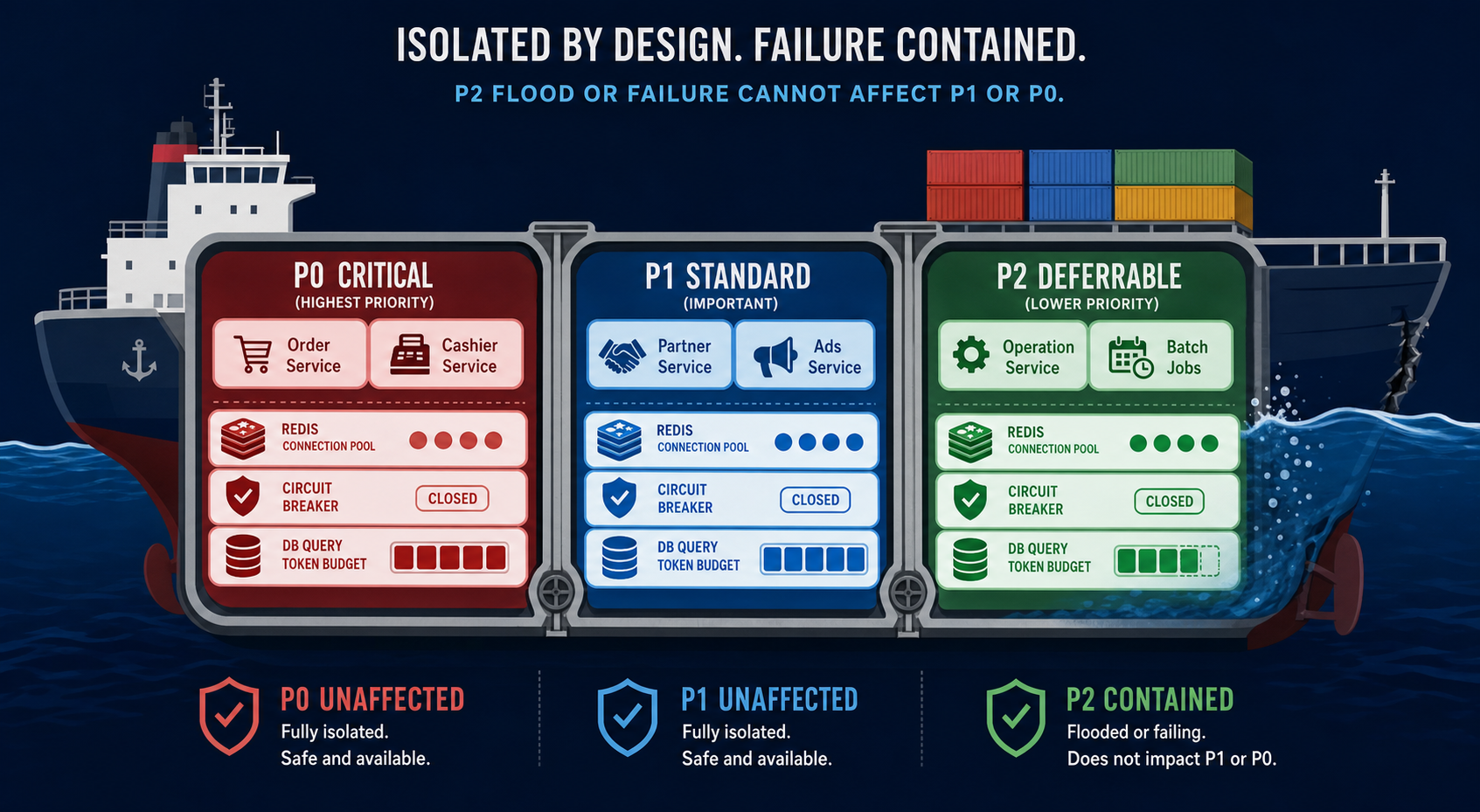
Together, these controls help contain localized cache faults and noisy workloads. Bulkheads reduce interference while capacity remains; they cannot preserve service if the underlying database is unavailable.
Step 4: Give responders a scoped control
Automatic controls address anticipated failure modes, but incidents can reveal new scenarios. A useful response is the ability to reduce traffic from a particular client or workload without waiting for a code release.
MDS supports scoped traffic controls managed through centrally controlled runtime configuration. Rules can target progressively broader scopes. The patterns below are illustrative:
| Scope pattern | Targeted request group |
|---|---|
| client:endpoint | A particular client and operation |
| criticality:endpoint | A request class accessing a particular operation |
| criticality: | An entire request class |
Matching policies can be applied gradually by percentage instead of as an all-or-nothing block. Throttled requests receive a standard unavailable response. Health checks remain exempt so health-based routing can continue. Responders can adjust the scope and level of protection during an incident without a code deployment.
Step 5: Move safe degradation closer to callers
Everything so far protects MDS from load. Callers can also amplify failures: retries and synchronized cache expiry may add pressure while MDS is recovering. Server-side shedding can turn excess traffic away, but a rejected request is still a failed request for the user behind it.
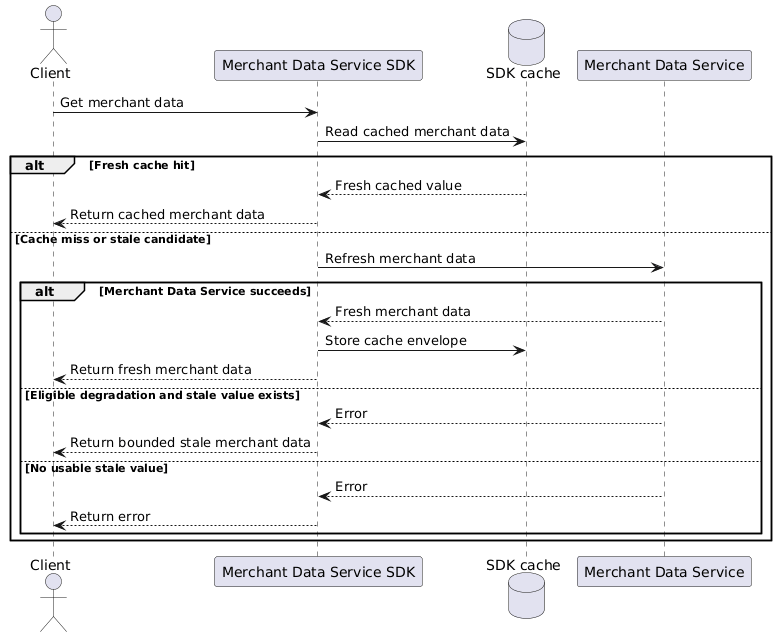
For some relatively stable fields, a recent value may be preferable to an error. More time-sensitive data may require stricter freshness limits or must always be read fresh. The MDS client software development kit (SDK) now includes an opt-in cache that lets approved read paths make this trade explicitly, with a bounded freshness policy.
Every cached value carries its own freshness window. The SDK stores freshness metadata alongside each value, including when it was stored and the boundaries for fresh and approved-stale use. Cache retention covers only that bounded window, while the SDK decides whether the value may be served. Keeping the metadata with the value makes the same policy work across supported cache backends.
What the tests and production data showed
Admission control limits database fallback
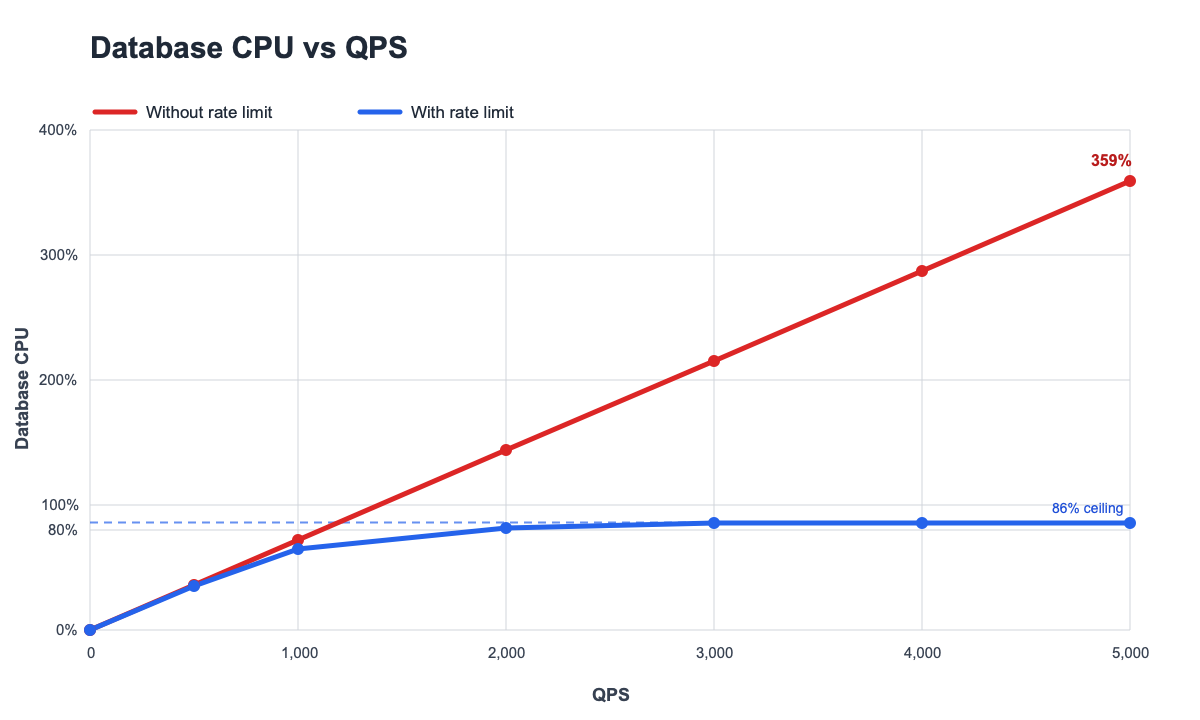
In controlled load tests, admission control rejected excess fallback work before it reached the database. The limiter kept database work within its configured budget as offered load increased, trading some request success for lower database saturation.
Under heavy offered load in these tests, average database central processing unit (CPU) use was lower with the limiter than without it.
Priority controls shed lower-priority work first
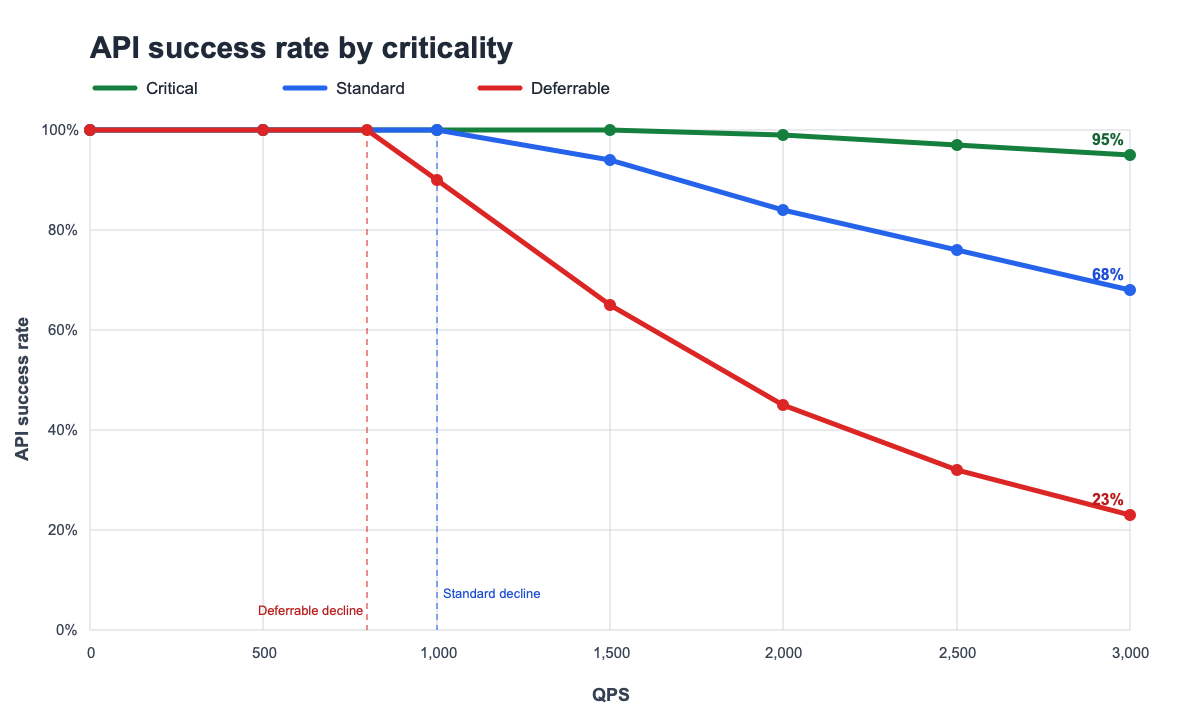
Tests showed that the controls shed work by priority rather than rejecting all callers equally.
Isolated circuits. Lower-priority work gave way first, while interactive reads remained subject to their own limits.
Database admission control. A shared weighted budget can give higher-impact work more opportunity to proceed, but it does not reserve capacity. Interactive requests can still fail when the shared dependency is exhausted.
The SDK cache reduced repeated reads
In the read paths that adopted it, client-side caching reduced the number of requests reaching MDS at peak. Reads served from the cache returned faster than those that needed a network call, and caching eased load on the cache tier and the application. When fresh reads were temporarily unavailable, clients could fall back to approved stale values instead of failing.
What we learned
- Every fallback needs a bound. The cache-to-database fallback was designed as a safety net and behaved like an amplifier. A fallback without a budget spreads failure instead of containing it. The same applies to stale data: it is safe only inside an approved freshness window.
- Isolation must follow impact, not topology. Physical separation alone was insufficient when callers still shared the same controls. Isolating by workload impact lets the service choose which work is most likely to survive.
- Latency and queues are failure signals. Incidents can begin with rising latency before visible errors emerge. Timed-out work still consumes capacity, and a retry against a saturated dependency is extra load, not recovery.
- Test the controls together. Circuit breakers, limiters, retries, cache expiry, and stale serving interact, and failures often come from how they combine. Testing them together under realistic overload reveals interactions that testing one at a time can miss.
What comes next
These controls currently focus on MDS and its client SDK. Looking ahead, we are exploring ways to improve coordination across layers, align admission decisions with current capacity, manage retry budgets end to end, and carry server-validated request priority to downstream dependencies.
Closing thoughts
A shared service cannot make its dependencies infallible. Cache systems can fail, and databases can run out of headroom. What the service controls is how much work it sends toward a failing dependency, whose work goes first, and what callers do when an answer is delayed. By bounding fallback work, isolating callers by impact, rejecting excess demand early, and serving stale data only on approved paths, MDS is better able to contain cache disruptions without turning them into broader service unavailability.
Join us
Grab is Southeast Asia’s leading superapp, serving over 900 cities across eight countries (Cambodia, Indonesia, Malaysia, Myanmar, the Philippines, Singapore, Thailand, and Vietnam). Through a single platform, millions of users access mobility, delivery, and digital financial services, including ride-hailing, food delivery, payments, lending, and digital banking via GXS Bank and GXBank. Founded in 2012, Grab’s mission is to drive Southeast Asia forward by creating economic empowerment for everyone while delivering sustainable financial performance and positive social impact.
Powered by technology and driven by heart, our mission is to drive Southeast Asia forward by creating economic empowerment for everyone. If this mission speaks to you, join our team today!
Part 1: Simulation-first AI experimentation for ads at Grab
Post Syndicated from Grab Tech original https://engineering.grab.com/part-1-ads-simulation-blogpost
Introduction
Ads delivery at Grab is increasingly an artificial intelligence (AI) decisioning problem. Every ad opportunity requires the system to infer user intent, predict engagement, balance advertiser returns, platform revenue, and user engagement, respect campaign budgets, and decide which ads should appear in a highly constrained product surface. As our ads systems become more complex, the range of bidding, ranking, and pacing strategies we need to evaluate grows with them. To continue improving quickly and safely, our approach to experimentation had to evolve: test more hypotheses offline, filter them against business and user guardrails, and reserve live traffic for the most promising ideas.
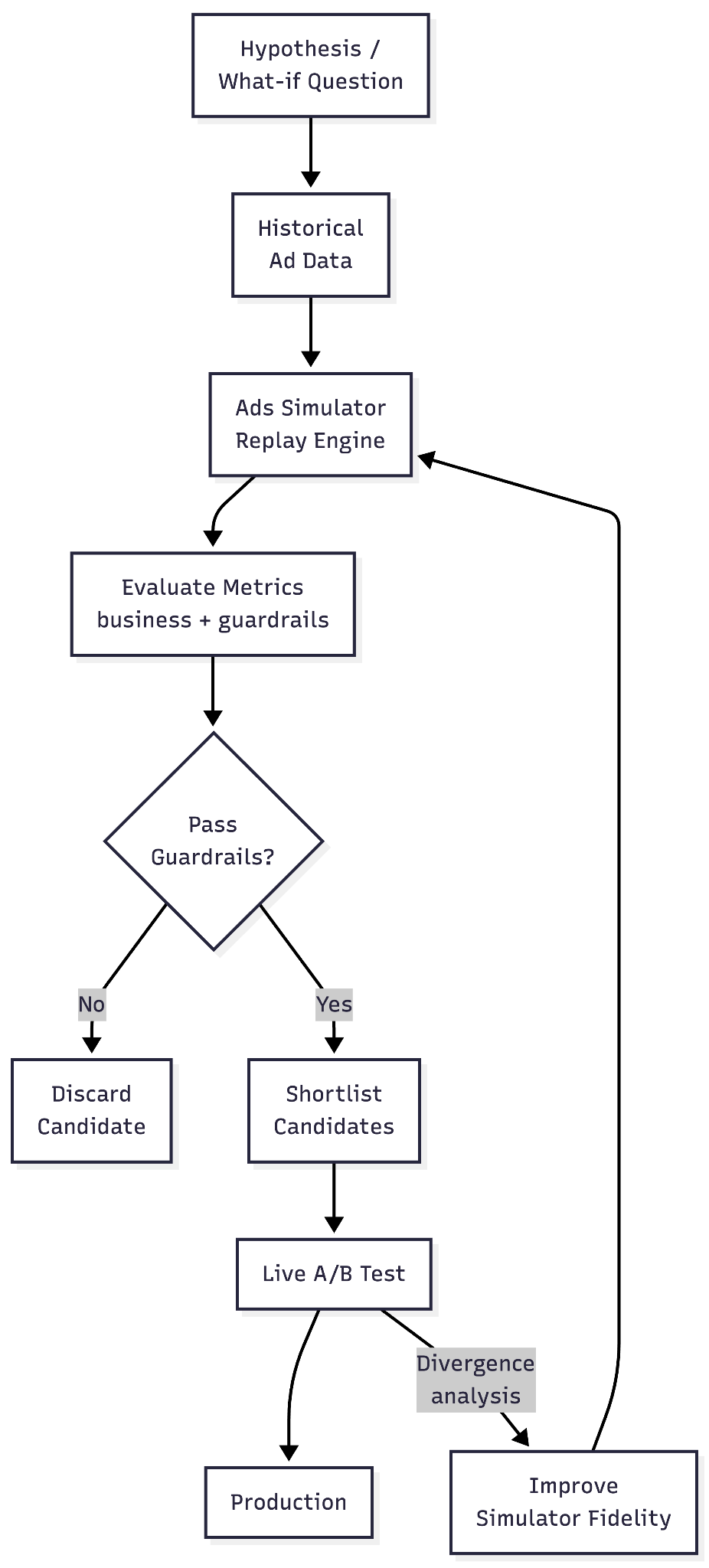
Live A/B tests remain the gold standard for testing changes, but they consume real traffic, take time to gather clear signals, and expose users and advertisers’ budgets to unproven ideas. At Grab, we built an offline ads simulator to evaluate AI-driven bidding, ranking, and pacing strategies before they reach production. The simulator lets us replay historical ad opportunities, test alternative decision logic, measure business and user guardrails, and send a smaller, better-vetted set of configurations into live experiments, so each live test starts from an informed position rather than an open search.
This is a two-post series. A second post covers how we extended this environment to train and validate generative bidders.
How an ad auction works
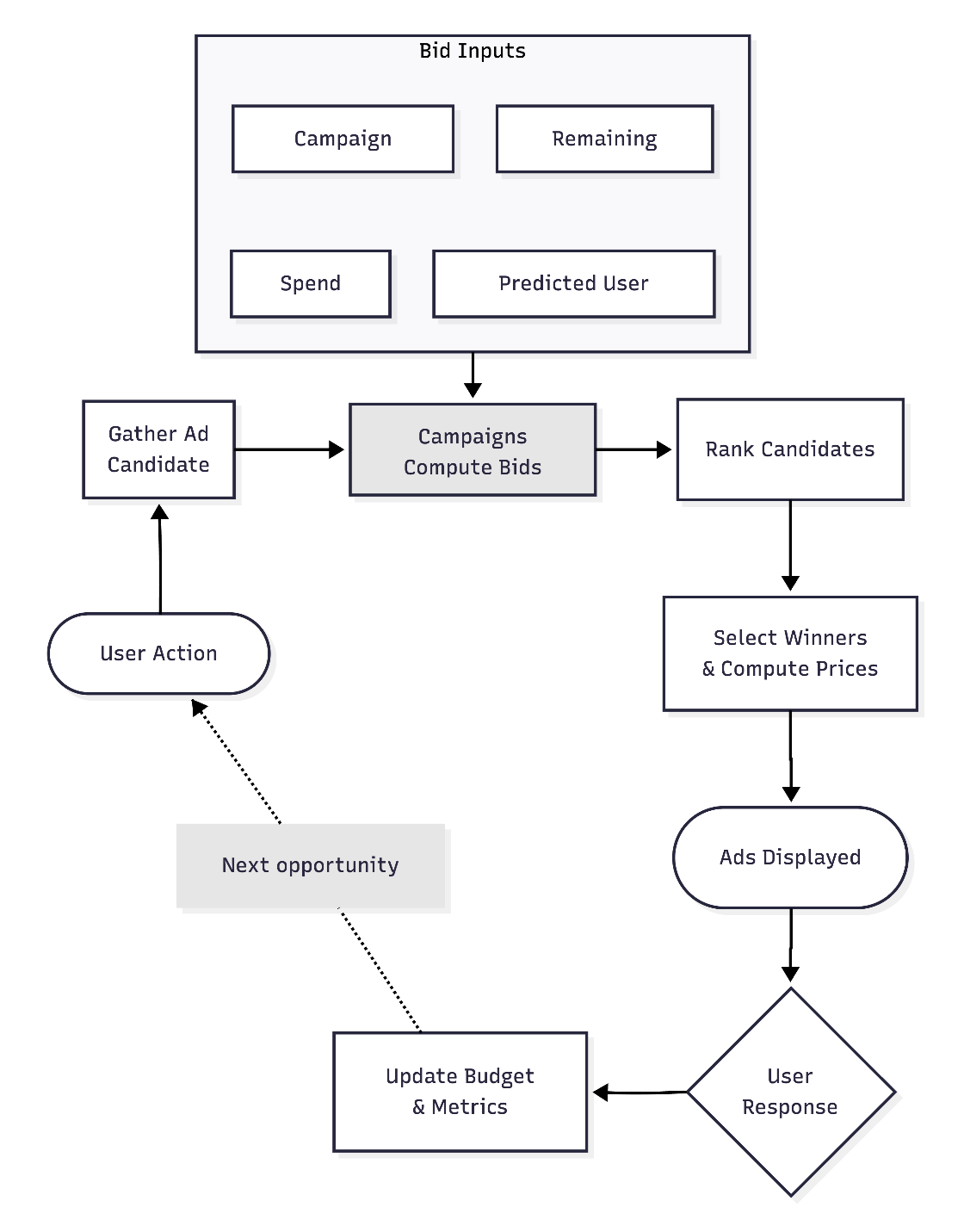
A simplified ad auction begins when a consumer action creates an ad opportunity: a user opens a food listing page or searches for a cuisine. The system gathers eligible ad candidates from merchant campaigns and evaluates them against the current context.
Each campaign decides how much to bid, drawing on its own configuration, its delivery state, and an estimate of how the user is likely to respond. The auction then ranks candidates, selects winners, and displays them. After the user sees or interacts with the ad, the campaign budget and performance metrics are updated.
This is a sequential decision-making problem. A decision made at noon can affect how much budget remains in the evening. For example, bidding too aggressively early in the day may exhaust a campaign’s budget and prevent it from competing for better opportunities later. A simulator is therefore useful because it evaluates how decisions compound over time, rather than assessing each auction in isolation.
The simulation-first experimentation workflow
Why we built an ads simulator
When improving our ads system, we often begin with several candidate changes (hypotheses). A candidate is a proposed version of the system that we want to evaluate. There could be different parameter configurations for the current setup, a change to an existing component such as ranking or pacing, or an entirely new component such as a bidder.
Each candidate represents a “what if” question:
- What would happen to Return on Ad Spend (ROAS) if we paced campaigns more aggressively throughout the day?
- What would happen to conversions if we change the balance between ads and organic content?
- What would happen to ad spend if we use a new type of bidder for our ad campaigns?
Historically, we answered such questions using offline analysis, domain intuition, and A/B tests. These approaches work well for incremental changes, but become limiting when the search space grows. A single parameter can require many possible values. A policy can vary by time of day, city, campaign type, or other contextual features. A machine learning (ML) model can propose strategies that have never appeared in historical logs.
Live experimentation can also be noisy when metrics are strongly affected by daily traffic conditions. The same parameter configuration could look better or worse depending on the day on which it is tested. Testing a large candidate space in production would consume substantial traffic, take considerable time, and expose users and advertisers’ budgets to unproven changes. These changes expose the business to risks, and can be mitigated by the use of our simulator.
The simulator allows us to evaluate these candidates first by replaying them across historical days, placements, and traffic conditions. Candidates that perform well only in a narrow slice can be filtered out, while those that remain stable and satisfy business and user guardrails can be shortlisted for live testing. The corresponding configuration or system change can progress to a focused A/B test.
The simulator does not replace live A/B tests. It improves the hypotheses that go into them, so each live experiment starts from a more informed position.
What the simulator replays
The simulator replays historical opportunities using the campaign, traffic, and contextual data observed in production. A data preparation step transforms these records into a consistent replay dataset.
For each opportunity, the simulation engine applies the candidate bidding and ranking strategy, determines which ads would be shown, and probabilistically generates downstream user responses from calibrated engagement models. It then updates campaign state before processing the next opportunity. This sequential replay captures how each decision affects later auctions and records the resulting campaign, advertiser, and platform metrics.
The system is modular by design. Each component (sampling, bidding, ranking, pricing, and metrics) is independently configurable. A team can swap out a bidding strategy without touching the ranking logic, or test a new metric without rerunning the pipeline from scratch. This makes it straightforward to keep the simulator in step with production as new features are built and existing ones evolve.
Making the simulator trustworthy as an AI evaluation system
For AI-driven ads systems, a simulator is useful only if teams can trust its signals enough to make experimentation decisions. We treat simulator fidelity as an engineering requirement, not an assumption. The goal is not to predict every live outcome precisely, but to make offline comparisons meaningful enough to decide which model, policy, or strategy should move into live testing.
We validate this through regular fidelity checks across two levels. The first is mechanism level: each deterministic component is validated against production logic to ensure the simulator applies the same rules in the same order. The second is outcome level: we aggregate metrics from production against simulator outputs with production configurations. Key metrics are compared across equivalent traffic slices to confirm distributions align. Where gaps appear, they are investigated and the relevant component is updated before the simulator is used to evaluate new candidates.
These checks run regularly, not just at setup. As production systems evolve, they reveal where the simulator has diverged and which components need updating. This continuous validation keeps offline comparisons representative of current production behavior.
Use case 1: Evaluating ranking and relevance tradeoffs with mix-ranking
When ads and organic candidates are ranked together, position affects user engagement, campaign spend, and advertiser outcomes. Organic candidates are non-paid results ranked by relevance, shown in the same placement as ads. Mix-ranking controls this tradeoff by deciding the final order shown to the user.
In this use case, the simulator replays historical requests with both ad and organic candidates available in the same placement context. The main parameter we evaluate, referred to here as alpha, adjusts the balance between ad and organic candidates in the final ordering. By running the same historical traffic across different alpha values, we can compare how the ranking changes before testing any candidate in production.
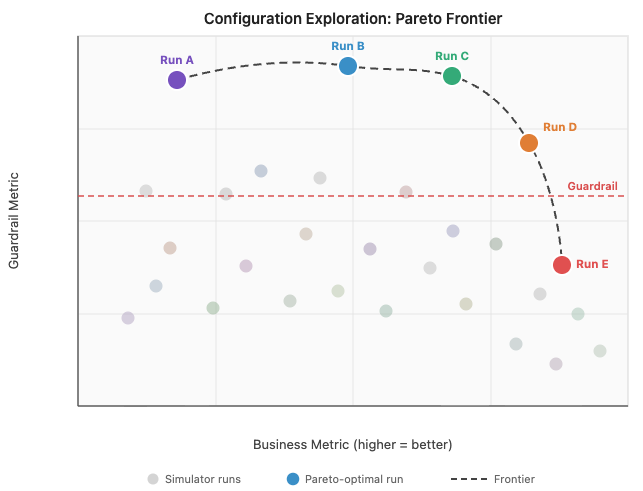
Ad and organic candidates are scored through their respective production scoring paths, which the simulator reproduces. Candidates are evaluated against guardrail criteria with business and engagement outcomes validated in downstream A/B experiments.
The simulator records the ad and organic winner mix by minute and placement, which helps explain whether a candidate improves ranking outcomes through better signal blending or simply by shifting surface area away from organic content. The output is a smaller set of alpha values for live A/B testing. Simulation narrowed the alpha parameter search space to a handful of values that held up across traffic conditions; these became the inputs to a more focused live A/B test, reducing experimentation iteration and increasing the velocity of improvement of our ads ecosystem.
Use case 2: Evaluating sequential decision policies with budget pacing
Budget pacing is a sequential decision problem. A campaign that spends too quickly may exhaust its budget before later opportunities arrive. A campaign that spends too slowly may miss useful demand and finish underdelivered. The pacing policy has to manage this over the full day while preserving advertiser returns and avoiding unnecessary spend degradation.
The baseline pacing policy in production is a Proportional-Integral-Derivative (PID) controller, a standard feedback approach. It modulates how aggressively a campaign competes based on its delivery and how it is tracking against its target over the course of the day. PID controllers are well-suited to auction environments because they react continuously to feedback without requiring a model of the underlying system. In practice, however, they are difficult to tune: the controller exposes several parameters governing how strongly and how quickly it responds to deviations, and the right values are workload dependent. A misconfigured controller can overshoot, oscillate, or converge too slowly to be useful.
We used the simulator to evaluate an alternative based on Primal-Dual Adaptive Pacing (PDAP). PDAP is an optimization-based approach that treats the campaign budget as a constrained resource and continuously adjusts bid pressure to track the target spend curve. In practice, it tracks a single internal pressure signal and translates it into an adjustment on how aggressively the campaign competes, tightening when the campaign runs ahead of plan and loosening when it falls behind. PDAP has fewer free parameters than PID, which makes it a practical candidate to evaluate: if it can match or improve on PID’s tracking behavior, it would reduce the tuning burden without sacrificing control quality.
The simulator lets us compare PID and PDAP under the same historical campaign conditions before either change touches live traffic. For each replay, the simulator advances campaign state over time, applies the active pacing policy, resolves resulting auctions, simulates downstream user response, and records campaign and platform metrics.
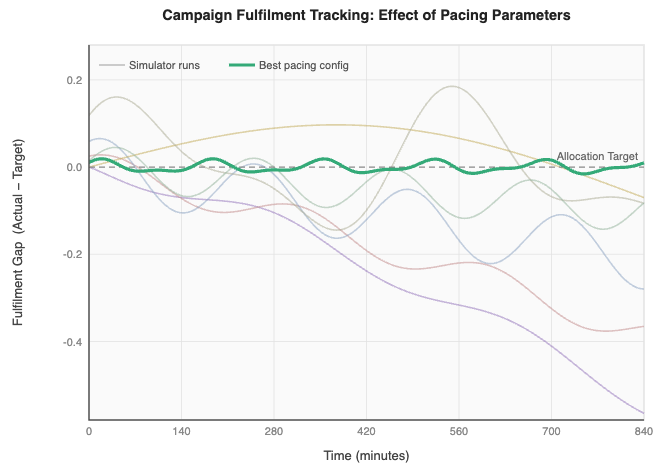
Candidates are evaluated on business and engagement outcomes, and filtered by guardrails covering delivery, engagement, and how well it utilizes planned budget targets over the day. The simulator records fine-grained delivery and engagement traces, which makes it easier to inspect why a candidate behaves differently from the PID baseline. To mitigate risk, we filter out candidates exhibiting performance regressions on any guardrail, as well as unrealistic parameter configurations. Given the absence of a production baseline for this bidder, this pre-filtering step is essential to ensure operational stability before live testing. The candidates that remained showed comparable spend tracking to PID with fewer parameters to tune, reducing configuration burden, and moved into a focused live A/B test against the PID baseline.
What we learned
Building the simulator taught us that it needs to be treated as a product, not a one-off analysis tool. A useful simulator needs reliable data preparation, clear configuration, repeatable runs, comparable metrics, and easy ways to inspect results. Without those, teams can run simulations but struggle to trust or act on them.
Fidelity is a moving target. A simulator can reproduce known auction mechanics faithfully and still be wrong when tested in a new regime. Mix-ranking required improvements to how organic candidates are modeled; without accurate organic behavior, the simulated blend between ads and organic results diverged from production. Budget pacing exposed how sensitive the pacing controller is to spend-signal timing. In the simulation, the controller used idealized, timely spend signals, while real-world deployments may involve variations in data freshness and availability. A controller tuned against perfect information can over-correct on stale numbers, and the feedback loop that looks stable offline can drift or spike live. Each new use case is likely to surface a different gap.
The most important lesson is that simulation and live experimentation are complements, not substitutes. Offline replay is fast, repeatable, and safe. Live experiments provide ground truth. When live results diverge from simulated ones, the gap is informative: it points to exactly where the simulator needs to improve. Over time, that feedback loop is what makes the simulator more useful, not just more used. Those lessons shaped what the team focused on next.
Where we are heading
From the start, the goal was not just to replicate auction mechanics, but to build an environment where AI systems can be evaluated, compared, and improved before they touch live traffic. The use cases here, mix-ranking and budget pacing, represent the first layer of that: establishing a reliable baseline for offline evaluation.
The near-term focus is making the simulator easier to use: better tooling for parameter sweeps, clearer observability into why a simulation produced a given result, and support for a wider range of auction modes and pacing strategies.
The next layer is applying this environment to more complex AI systems. A follow-up post covers how we extended the simulator to train and validate generative bidders, where the model does not just react to the current state but proposes future pacing actions. That work builds directly on the evaluation infrastructure described here.
Simulation does not replace live tests. It reduces the candidate space, filters unsafe configurations, and gives live experiments better starting points. The shift is as much about process as it is about technology: moving simulation earlier in the workflow changes how teams approach risk and iteration. The use cases here show that the pattern works. The next step is extending it.
We gratefully acknowledge Allen Lin and Jianning Zhang from Grab’s DNA Data Science team for sharing valuable insights into Grab’s advertising systems and data, and for helping validate the simulator’s fidelity. We also thank Ruike Zhang, Richard Ryu, Padarn George Wilson, and Weilun Wu for their support and guidance throughout this work.
Join us
Grab is Southeast Asia’s leading superapp, serving over 900 cities across eight countries (Cambodia, Indonesia, Malaysia, Myanmar, the Philippines, Singapore, Thailand, and Vietnam). Through a single platform, millions of users access mobility, delivery, and digital financial services, including ride-hailing, food delivery, payments, lending, and digital banking via GXS Bank and GXBank. Founded in 2012, Grab’s mission is to drive Southeast Asia forward by creating economic empowerment for everyone while delivering sustainable financial performance and positive social impact.
Powered by technology and driven by heart, our mission is to drive Southeast Asia forward by creating economic empowerment for everyone. If this mission speaks to you, join our team today!
Voyager Crash
Post Syndicated from xkcd.com original https://xkcd.com/3326/