Introducing Clef: our open-source decision models, and new RL fine-tuning platform

Post Syndicated from Michelle Chen original https://blog.cloudflare.com/clef-decision-models/

Over the last few weeks, there has been lots of buzz around decision models such as Typesafe AI’s Jev System One model. While classifier models have been around for some time, Jev introduces a new decision model concept into the world of AI — a model that produces bounded structured outputs cheaply, quickly and consistently that can be added into a workflow when a decision is required. These models are capable enough to work over any set of inputs without constantly retraining the model to incorporate new classification categories. This contrasts with the world of Large Language Models (LLMs), which are largely non-deterministic, but are open-ended enough to reason and generate text and tool calls for agentic workloads. 

Today, we’re releasing two Cloudflare-trained decision models, Clef and Clef-flash, hosted on Workers AI. Clef is currently the leader when evaluated against the Jev Decision Index, you can view full results on the live benchmark demo site. These models are smarter, faster, and fully Jev-API compatible, so you can experiment with these hosted models easily. We’re fully open-sourcing these models on Hugging Face under an Apache 2.0 license for you to run locally and experiment with yourselves. 

Lastly, we’re excited to debut our new reinforcement learning (RL) product, which allows customers to fine-tune Clef to suit their use cases as well.

What is a decision model?

A decision model makes classifications to help agents decide how to act, based on certain probabilities. For example, you can pass in a customer support message (inputs) and ask if it is urgent and which team should handle it. A decision model will return typed answers with probabilities (outputs), which your code can use to route the ticket, trigger an escalation, or defer to a human. This means that a human does not necessarily need to be in the loop for agentic decisions anymore — agents can programmatically gather context, make decisions, and take actions on tasks, or defer to a human when needed.

Specifically at Cloudflare, we’ve been testing our new Clef model on our Threat Intelligence team to help us classify website domains. By giving a domain to Clef (with Browser Run) it can quickly identify categories that the domain falls under — for example, it might classify a domain with a 95% chance it is a fashion website, 85% ecommerce, <1% phishing, etc. This classification took our Clef model 2.2s to fetch, render, and classify the website. In contrast, our fastest general LLM gpt-oss-120b took 4.7s in the same workflow, and only returned two classifications. As a user, you can imagine how a 2x savings in latency and results can help us improve our threat intelligence workflows and be faster in identifying malicious or legitimate domains. Generalize this to any use case where you need to make quick programmatic decisions, and you unlock powerful agentic workflows that are able to autonomously decide, reason, and execute.

In music theory, a clef is a symbol placed at the beginning of a musical staff that assigns specific pitch names to the lines and spaces. A decision model is analogous to a music clef because it helps define the domain of the context and the subsequent notes (actions) that follow it. We chose Clef as the name of our family of decision models, as it serves similar purposes, and the CF hearkens to Cloudflare.

How is Clef different from other decision models?

Although the market is getting increasingly saturated with decision models, Clef has some unique properties that make us excited to release it to the public. First, it has a vision encoder so it’s able to take in images and classify visual content. This is different from Jev, which only does text classification today. Secondly, our model has a 64k context window (compared to Jev’s 32k), which allows users to squeeze more input state for the model to classify against.

Third, our model is accurate and powerful, scoring competitively against other decision models on the market across various quality benchmarks. We shortlisted some evaluations below that are important for decision-making as defined by the Jev Decision Index and scored some of the more popular models on the market for it. Check out the table below for benchmarks, or view the scores on our live decision index demo site:

Benchmark

Clef

Clef-flash

Jev

DiffusionGemma Jev

Kev 9B

Laya

BFCL · case exact

98.47

98.76

95.75

96.52

94.51

38.13

ToolRet · nDCG@10

69.19

66.43

65.28

61.21

64.26

12.69

API-Bank · accuracy

91.93

93.11

88.19

83.66

56.30

11.41

Home appliances · case exact

82.95

97.73

52.27

42.05

25.00

0.00

When2Call · accuracy

72.37

65.58

80.97

75.44

49.62

11.94

BANKING77 · macro-F1

94.20

90.93

79.74

74.28

84.83

14.29

CLINC150+OOS · macro-F1

97.43

66.77

89.27

83.49

79.03

3.19

BRIGHT · nDCG@10

45.91

39.26

47.52

42.94

38.53

19.90

Amazon ESCI · macro-F1

57.48

57.39

55.21

53.37

49.22

24.40

PhishNChips · accuracy

79.60

75.05

62.55

85.35

50.75

50.15

We also ran benchmarks across Typesafe’s own eval suite and our Clef models fared well, beating Jev in 3 out of 4 areas. Notably, our Clef-flash performs exceptionally well, given how much faster it is.

Workflow

Clef

Clef-flash

Jev

Invoice processing

64.7

57.1

61.8

Customer service

76.3

77

76.0

Security incidents

62.9

61.7

61.7

Agent trace observability

68.5

69.8

71.6

Across the 43 eval benchmarks that we ran, our Clef models beat the decision models on latency (except for Laya which is very fast but trades off quality in the benchmarks above):

Benchmark

Clef

Clef-flash

Jev

DiffusionGemma Jev

Kev-9B

Laya

Median latency  · ms

209.3

38.8

524.1

84.4

51.4

5.8

p95 latency · ms

238.6

122.4

536.0

211.2

187.9

222.5

On top of the latency benefits from the model itself, our Clef models are hosted on Workers AI. Because they are hosted on Cloudflare’s infrastructure, we’re able to take advantage of our GPUs at the edge, leading to low network latency and faster decisions. This means that you could put Clef into the hot path for agents to make decisions and combine that with one of our LLMs on Workers AI to take action. 

Clef also produces strictly typed outputs similar to Jev and is fully API-compatible, so you can make the swap extremely easily. The larger Clef model is your more powerful precision model, while the Clef-Flash model is great for latency-critical decisions. The models are enterprise-ready with our guarantee that we don’t read, store, or train on your requests or responses (unless you want to use our fine-tuning product, which we go into below). You can get started with the Clef models today, starting with our developer documentation or play around with the open-source model on the Hugging Face repo.

If you’d like help tuning Clef for a specific workload, we are also offering fine-tuning services — first as a hands-on partner with our forward-deployed engineer (FDE) team, and then later as a self-serve fine-tuning platform for customers to train and redeploy the model onto Cloudflare.

How we trained Clef

In the same week that Jev came out, we posted about some experiments we had with our own homegrown decision model. Our demo goes into how we adapted the DiffusionGemma model to output deterministic probabilities by exposing the logprobs that are generated by a large language model. Our initial approach built upon independent research by Matt Mastracci, who has been active in the machine learning (ML) community with sharing new ideas and pull requests to vLLM inference engine to make DiffusionGemma support stronger.

Clef builds upon this concept, but uses a different base model as the backbone. We currently use Qwen as the base model and post-trained it to suit decision model use cases. During inference, Clef uses Qwen for a prefill-only pass, then scores the valid schema choices in parallel. The decision step is non-autoregressive, so there’s no intermediate text to generate token by token, making Clef significantly faster than autoregressive LLMs. Rather than generating intermediate text to produce structured answers, Clef and Clef-flash derive schema choices directly from internal backbone representations. This approach relies on a specialized two-stage attention routing process: every valid choice extracts context relevant to the prompt, allowing individual field parameters to cross-attend with other fields and back to the original payload prior to scoring. By leveraging a lexical prior, the model preserves semantic intent across options. Ultimately, the architecture unites option-specific evidence routing, joint cross-field attention, and schema-bound scoring.

By freezing Qwen3.8-27B for Clef and Qwen3.5-9B for Clef-flash, we jointly optimized the routing head alongside rank-256 low-rank adapters. Our post-training utilizes label-smoothed cross-entropy for valid schema outputs paired with a Brier loss to refine probability calibration. This training leverages our own internal synthetic datasets permutating field orders, prompts, and schema structures. We also developed Reinforcement Learning for Calibrated Decisions (RLCD) to serve as a secondary optimization target, granting partial credit to adjacent ordinal choices, rewarding fully precise record outputs, and applying a reference penalty to prevent distribution shift, giving us better accuracy and generalization.

This means that we were able to achieve a few novel things with Clef: we improved accuracy of the model in classification, constrained it to output only probabilities instead of text generation, and made it faster than Jev and the base Qwen models.

How fine-tuning can extend the capabilities of Clef

We heard a lot of internal use cases that required fine-tuning our Clef model to be built into our agentic workflows at Cloudflare. For example, internal teams want a classifier model to be able to evaluate Trust & Safety submissions, help us triage Cloudflare Support requests, or even to be built-in to our Bot products to decide if a crawler is a good bot or bad bot.

These use cases are incredibly specific and we have had many years of labelled decisions that we could use to train a specific classifier. When you fine-tune a model, you may give up some general purpose performance in exchange for higher accuracy in a specific domain.. Because Cloudflare has more than 15 years of network data across different domains, we can fine-tune a model to fit these specific use cases which is more accurate and faster than our generic Clef model. We’re working with internal teams already to figure out how we can post-train Clef to create powerful ML models that boost our impact and improve workflows across Cloudflare. These internal teams and use cases are the next remit of our new FDE fine-tuning team and basis for our reinforcement learning (RL) product.

Our new RL service

We are offering a service to help customers fine-tune Clef to suit their workloads with our hands-on FDE team. From that, we’ll learn from our hands-on experiences to build a self-serve platform that customers can use to capture data, fine-tune, and redeploy the model, all on Cloudflare.

This has actually been a long time coming — we’ve been building our AI platform to have the right primitives where we could be building a custom RL product. The interest in Jev shows the need for a fast, small, specific, classifier model, and we chose this to be our niche to start experimenting with RL environments.

To do this, we leverage the primitives that we already have built on our Cloudflare platform:

  • Cloudflare AI Gateway – pass all your AI traffic through AI Gateway and automatically create a dataset of requests for your use case
  • Cloudflare Workers AI – generate rollouts against the base Clef model
  • Cloudflare Containers – RL sandbox for scoring and replaying agent actions
  • [NEW] Trainer – update weights of fine-tuned Clef model
  • Cloudflare Workers AI + BYO Model – redeploy the fine-tuned model on Workers AI

This combines a few work-in-progress pieces of the AI Platform that we’ve been working on, including AI Gateway that captures your AI traffic so you can leverage your own request/response data, Containers for RL Sandboxes, and Workers AI’s Bring Your Own Model (Cog) work that has been progressing since our acquisition of Replicate. 

Try it out today

We’re excited to launch our first Cloudflare-trained ML model from the Workers AI team today. We’re still early here and have a lot more improvements in store, but it is a wonderful first showcase of the hard work we’ve been doing on the AI Platform team. We believe that Clef has the ability to disrupt the way we use agents, which fits naturally into Cloudflare’s mission of being the agent cloud.

If you have specific use cases and are already customers of these products — we’d love to chat with you and be design partners as we experiment in this space.

Try out the Clef models hosted on Workers AI, download the weights on Hugging Face if you’d like to explore for yourself, and reach out if you have fine-tuning use cases you’d like us to help with.

Our ML team has been growing in impact, from model optimizations to model training research. If you’re interested in joining our mission, check out our open roles. 

[$] Coping with the onslaught of kernel security bugs

Post Syndicated from corbet original https://lwn.net/Articles/1096908/

By now it is no secret that large language models (LLMs) have made it easy
for people to identify security bugs, and that has resulted in a flood of
bug reports to almost every free-software project, including the kernel.
At the 2026 edition of Kernel
Recipes
, Greg Kroah-Hartman took the stage to talk about how the
kernel’s security team is handling this deluge. His core message was
“don’t panic“.

How Mirelo AI brought sound design to the IDE with MCP and Kiro powers

Post Syndicated from Florian Breton original https://aws.amazon.com/blogs/devops/how-mirelo-ai-brought-sound-design-to-the-ide-with-mcp-and-kiro-powers/

Mirelo AI set out to fix how sound design works in the integrated development environment (IDE). For most developers, sound design has always meant leaving the IDE: opening a browser, digging through stock libraries, and trimming and syncing clips by hand. Sound is the last creative layer most developers reach, and the one they most often get wrong without specialist help. For teams building games, apps, and interactive products, digital audio workstations (DAWs) live outside the development workflow, so most ship with placeholder audio or nothing at all.

Mirelo AI, a Europe-based generative AI lab, builds models that turn a text prompt or a video clip into production-ready sound effects, synced to the picture when video is provided. Feed a video clip to the model and it returns audio matched to the action on screen. Mirelo built a hosted server on the Model Context Protocol (MCP), the open standard that lets AI assistants discover and call external tools. With Mirelo’s hosted MCP server, developers can reach those models from the tools they already use.

In this post, we describe how that MCP server became a power in Kiro, the agentic development environment from AWS. We also cover how Mirelo’s AWS Enterprise Support account team helped bring it to the Kiro powers marketplace. The result: Developers using Kiro can generate sound design from a natural-language prompt without leaving their editor.

Solution overview

With a Kiro power, you get Mirelo’s hosted MCP server bundled with Agent Skills that tell the AI assistant when and how to use it. When a developer’s prompt mentions sound, audio, or effects, Kiro activates the power, connects to Mirelo’s server, and loads its tools into the conversation. The developer describes the sound they want. Kiro calls Mirelo’s models and returns a finished audio file into the project.

The design has three parts:

  • Mirelo’s audio models, exposed through their existing HTTP API.
  • The hosted MCP server (https://mcp.mirelo.ai/mcp), which wraps that API as callable tools.
  • The Kiro power, which bundles the MCP configuration with an Agent Skill and publishes it to the marketplace for one-action install.

The problem: Sound is the last mile of creative development

Visual assets have mature tooling inside IDEs and design systems. Audio does not. A game developer prototyping a level generates textures, writes shaders, and tests physics in the editor. But the moment they need a matching footstep sound, the flow breaks. They open a browser, search a stock library, download candidates, trim them to length, and manually sync timing.

Content creators working with generative video hit the same wall from the other side. AI models now produce visual content in seconds, but each clip ships silent, so adding sound means switching tools, breaking flow, and spending more time on audio than the video itself took to create.

Mirelo’s thesis: Sound generation should live where developers already work, not in a separate application.

From API to agent tool: The Mirelo MCP server

Mirelo already had an API powering their Studio product. The question was how to make those capabilities reachable inside AI-powered development environments without asking developers to write integration code.

MCP answers that. By wrapping their API as an MCP server, Mirelo exposed their full audio generation pipeline to any compatible AI assistant. The Mirelo MCP is hosted and remote: developers add a single URL, authenticate through their browser, and start generating audio from conversation. There’s no local install and no API key to manage.

The server covers the full sound design loop:

  • Generate from text: describe a sound effect in natural language and receive a finished audio file.
  • Generate from video: pass a video clip and get synced sound effects for every action.
  • Extend: lengthen an audio clip that is too short for the scene.
  • Inpaint: replace a selected region of a clip while leaving the rest untouched.

A preflight tool estimates credits and runtime before generation runs, which matters when an agent works through a batch of files rather than a single effect.

Comparing direct API access with a Kiro power

Without the power, a developer who wants a sound effect works against the API directly. For anything longer than a short clip, that means the asynchronous path: submit the job, get a job ID back, poll for status, then download the result once it completes. A minimal version looks like this:

# 1. Submit the job
# The code samples in this post are provided for demonstration and educational purposes only and
# are not intended for production use without additional security review and testing. In
# particular, store API keys in a secrets manager rather than inline, and add error handling and
# retry limits before deploying.
JOB=$(curl -s https://api.mirelo.ai/v2/text-to-sfx/v1.6/jobs \
  --request POST \
  --header 'Authorization: Bearer sk-<your-api-key>' \
  --header 'Content-Type: application/json' \
  --data '{
    "prompt": "Heavy rain on a metal roof with distant thunder",
    "duration_ms": 45000,
    "output_format": "mp3"
  }' | jq -r '.job_id')

# 2. Poll until the job leaves the "processing" state
while true; do
  STATUS=$(curl -s "https://api.mirelo.ai/v2/text-to-sfx/v1.6/jobs/$JOB" \
    --header 'Authorization: Bearer sk-<your-api-key>' | jq -r '.status')
  [ "$STATUS" = "succeeded" ] && break
  [ "$STATUS" = "failed" ] && echo "generation failed" && exit 1
  sleep 3
done

# 3. Fetch the result URL and download the clip
curl -s "https://api.mirelo.ai/v2/text-to-sfx/v1.6/jobs/$JOB" \
  --header 'Authorization: Bearer sk-<your-api-key>' \
  | jq -r '.result_urls[0]' \
  | xargs curl -o rain.mp3

This works, but the developer owns every step. They store the API key, choose the sync endpoint for short clips and the async endpoint for longer ones, and call preflight to estimate credits. They also run the poll loop with sensible backoff, handle the failure state, download the result, and retry on transient errors. Each surface, whether a web app, a game editor, or a batch script, reimplements the same glue.

With the power, the developer describes the sound and the agent assembles that same request. Kiro authenticates through browser sign-in and reads the tool schema Mirelo published. It fills in prompt, duration_ms, and output_format from the conversation, runs the preflight tool when the job is large, and waits on the async job when generation runs long. The developer writes:

Generate 45 seconds of heavy rain on a metal roof with distant thunder, as an mp3.

The file is added to the project. The underlying API call is the same. What changes is who assembles and operates it.

The following table compares the two paths:

Concern Direct API Kiro power/MCP tool call
Authentication Store and send Bearer sk-… on every call Browser sign-in, managed by Kiro
Cost check Call /preflight yourself Agent calls the preflight tool when the job warrants it
Sync compared to async You choose the endpoint and implement polling Agent selects based on job size
Response handling Parse result_urls and download Agent returns the file into the project
Reuse across tools Reimplement the glue per surface One power, available in any Kiro session

Why package it as a Kiro power

Mirelo’s MCP server already worked in several AI assistants. With a Kiro power, you get discoverability, so you find the integration while browsing the marketplace, and automatic activation, so there is no URL to paste or configuration to write.

A power bundles an MCP server with Agent Skills, the structured instructions that guide an AI assistant through a specific workflow. The AI assistant learns what tools exist and when to reach for them. Just as important is how a power loads. A traditional MCP setup registers every tool definition upfront. Connecting a handful of servers can burn tens of thousands of tokens, a large share of the context window, before your first prompt. Kiro powers load dynamically instead. Installed powers sit dormant until your conversation mentions relevant keywords, at which point Kiro activates only that power’s tools and skills and deactivates them when you move on. Skills load the same way, on-demand, so the AI assistant pulls in a specific workflow’s instructions only when it’s working on that task. The result is near-zero baseline context cost and a Mirelo integration that surfaces its sound-design tools exactly when they’re needed, without crowding out the rest of your work.

The structure of a power is small. The following layout shows the three files that define it:

example-power/
|-- plugin.json          # Manifest: name, keywords, and metadata
|-- mcp.json             # Remote MCP server configuration
+-- skills/
    +-- sound-design/
        +-- SKILL.md     # Guides the agent through audio workflows

The plugin.json manifest declares the keywords that trigger activation. The mcp.json file points to the provider’s hosted server. The skill teaches the agent the difference between generating a one-shot effect and sound-designing an entire sequence.

The path from idea to marketplace

The Kiro powers connection came from Mirelo’s AWS Enterprise Support account team. The team spotted the fit between Mirelo’s MCP server and the powers marketplace. They built a proof-of-concept power to show how the integration would work and connected Mirelo with the submission process. Mirelo then packaged their official hosted server as the published power.

From the first conversation to a live power took about two weeks, most of it marketplace review. The engineering itself fit into a single afternoon. The impact is easiest to see in the developer’s workflow. Finding a single sound effect that matches the video is slow, manual work. That includes searching a stock library, auditioning candidates, trimming, and syncing. With the power, a single prompt returns a usable, synced clip, replacing a lengthy manual workflow with one step.

What developers can do with it

After the Mirelo power is active, sound design becomes part of the conversation. A developer polishing a web app might ask:

Generate a soft, satisfying click for this submit button. Short, no metallic ring.

On a game prototype, the request could be:

Here’s my gameplay clip. Generate footstep and impact sounds that match the character’s movement.

For a video project that needs a longer bed:

Extend this forest ambience to forty-five seconds so it covers the full scene transition.

And to fix a single moment:

The glass-break sound at 0:03 is too harsh. Inpaint that region with something more subtle, like thin crystal.

Each request calls Mirelo’s models and returns audio ready to use, without the developer leaving the editor.

A distribution channel for AI model companies

For Mirelo, the Kiro powers marketplace is a new kind of distribution. API businesses have historically reached developers through documentation sites, SDKs, and marketing. A power puts the capability inside the tool developers already use. Developers reach it by intent rather than by integration work.

The model fits AI services that augment creative workflows. Developers don’t plan to use a sound API the way they plan to use a database. They need sound the moment they realize their project is silent. A power meets them at that point of intent.

Conclusion

In this post, we described how Mirelo AI turned a hosted MCP server into a Kiro power, and how AWS Enterprise Support helped move it into the marketplace. For developers, sound design is now a prompt away inside Kiro. For AI model companies, the same path turns an existing MCP server into a distribution channel that reaches developers at the point of intent.

To get started:


About the authors

Florian Breton

Florian Breton

Florian is a Technical Account Manager (TAM) at AWS Enterprise Support based in EMEA, where he helps generative AI startups run and scale their workloads on AWS. Outside of direct customer work, he builds internal AWS tooling and contributes to open source projects that improve the AWS customer experience.

David Kernert

David Kernert

David is a former engineer at AWS, now working at Mirelo AI to scale the training and serving infrastructure behind Mirelo’s generative audio models.

Tofig Hasanov

Tofig Hasanov

Tofig is former Amazon software engineer, now working at Mirelo AI where he is working on building user facing products that expose Mirelo model capabilities, including the MCP.

Not all explanations are equal: Social Explainable AI and Critical Computational Literacy

Post Syndicated from Katharine Childs original https://www.raspberrypi.org/blog/not-all-explanations-are-equal-social-explainable-ai-and-critical-computational-literacy/

AI technologies, such as smart speakers or streaming recommendations, are becoming part of everyday life for children and teenagers. It’s therefore increasingly important to help young people understand not just how these systems work, but how to question them.

When AI systems generate outputs such as a recommendation, these outputs are often accompanied by an explanation. In our latest research seminar, Professor Dr. Dan Verständig (Goethe University Frankfurt, Center for Critical Computational Studies) spoke about how explanations are shaped by the people who write them, and only become meaningful when someone else makes sense of them. Dan introduced us to Social Explainable AI (Social XAI) and Critical Computational Literacy (CCL), and asked us to consider not just what an AI system explains, but for whom, why, and who benefits.

Why do we need explanations?

Dan opened with a deceptively simple question: why do we need explanations in the first place? His answer was that explanations provide orientation. They reduce uncertainty, and in doing so, they make our shared social world liveable. Explanations have evolved from Socratic dialogue, to the printed book, to the classroom, to today’s digital interfaces, and now to AI-generated explanations. But explanations have never been neutral conveyors of information. Dan illustrated this with a simple demonstration: he showed the seminar participants an aerial photo of a beach and asked what they noticed.

The aerial photo Dan shared during his seminar. What do you notice about this picture?

The aerial photo Dan shared during his seminar. What do you notice about this picture?

Seminar participants pointed to the coastline, the sandy beach, and a tiny figure in the frame. Dan then revealed that the photo was taken by him, using a drone at Montara State Beach in California on a specific afternoon in April 2024. He asked how a climate researcher, a surfer, or an artist might each describe the very same image differently.

This demonstration highlighted that an explanation is always for someone, for some purpose, in some context. That framing carries straight through into how we should think about AI explanations too. An explanation that satisfies a data scientist debugging a model is not the same as one that satisfies a patient asking why an algorithm flagged their scan, or a citizen asking why they were denied a loan. In other words, explanations are never technical.

From delivering explanations to co-constructing them

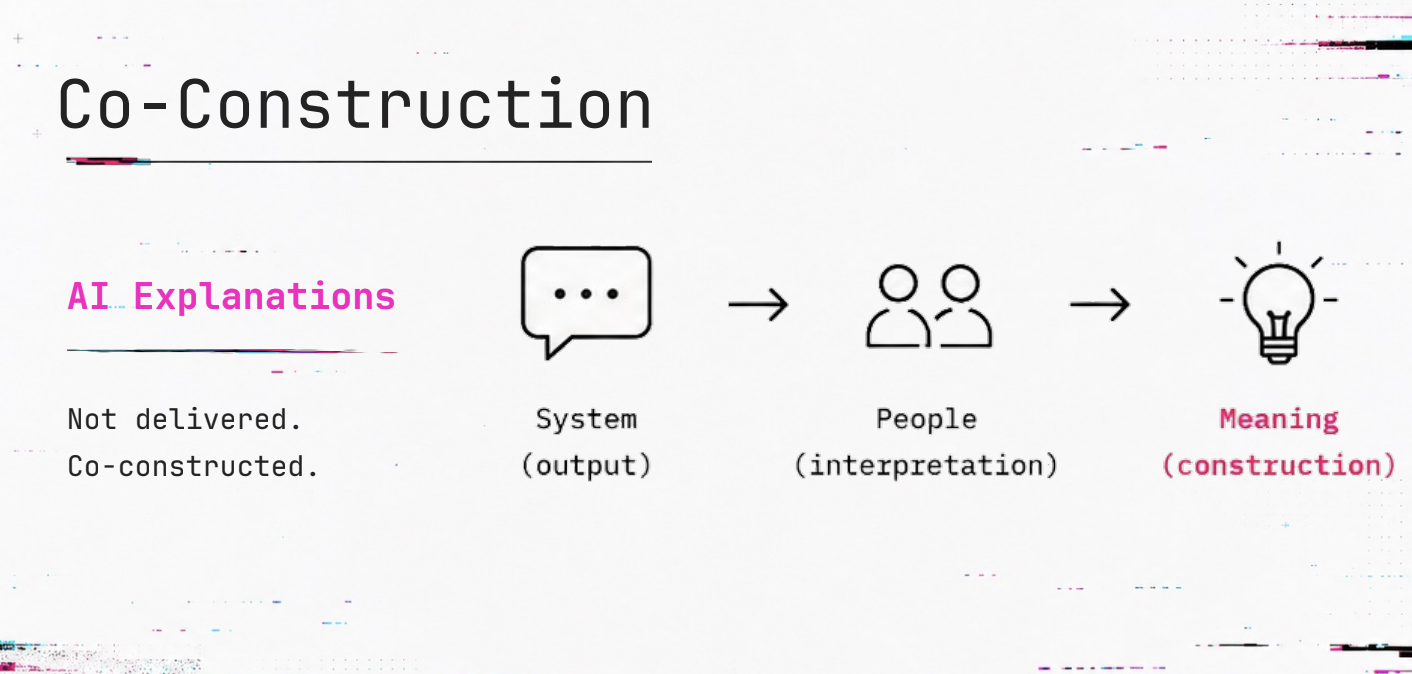
Drawing on Rohlfing and Lim’s 2026 work, Dan described Social XAI as an approach that puts interaction, rather than output, at the centre of explainability. Dan illustrated this with a simple but effective diagram: an AI explanation starts as a system output, is filtered through a person’s interpretation, and only then becomes meaning through construction. A one-size-fits-all output, however technically accurate, isn’t yet an explanation until someone has made sense of it in their own terms.

AI explanations are never just delivered as outputs; meaning is constructed by an individual’s interpretation. 

To explore this further, Dan’s research group has developed co-construction workshops, bringing people together to interrogate AI explanations collaboratively rather than receive them passively. In these workshops, participants are asked questions such as: “What counts as evidence? What is missing? What are the alternatives? Who benefits from this? Do we agree?”

To answer these questions, participants do not examine an AI model to find out how it generates a decision. Instead, participants scrutinise its outputs in the same way that they would critically evaluate a politician’s promise or a newspaper’s headline. 

Dimensions for engaging critically with explanations

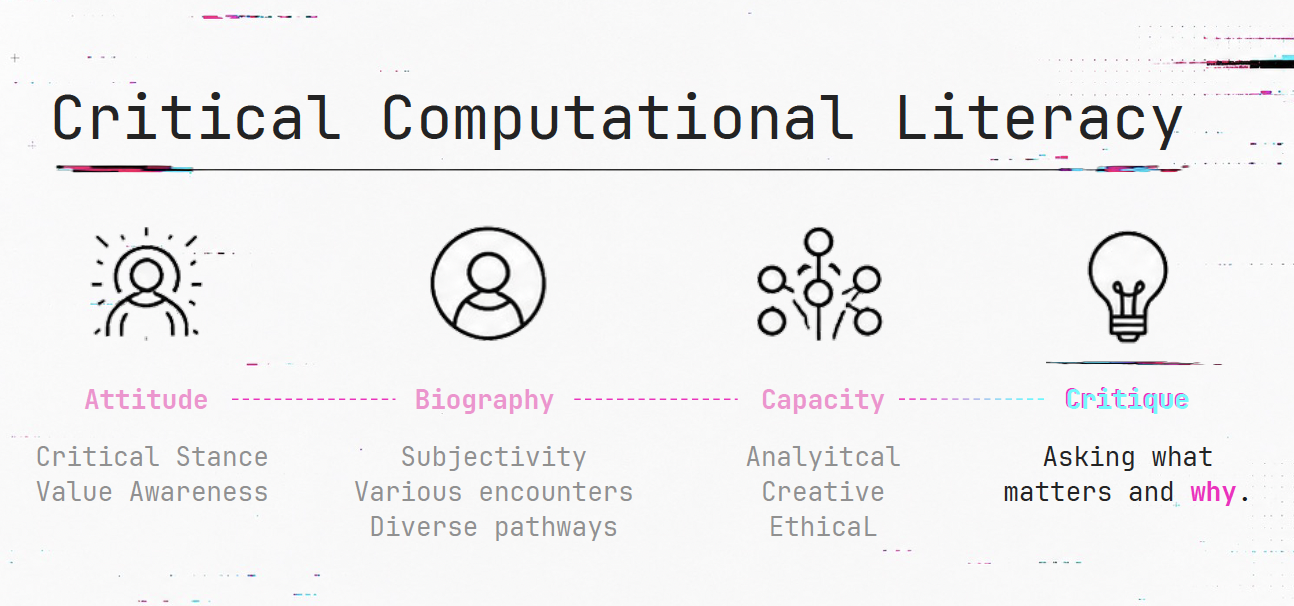
Critical Computational Literacy (CCL) is a framework that describes what people need to engage with AI explanations critically. Dan presented CCL as consisting of four interlocking dimensions:

  • Attitude — a critical stance and value awareness: approaching computational systems not as neutral tools but as artefacts that embed particular values and assumptions
  • Biography — recognising that people’s relationships with technology are shaped by subjectivity, by the varied encounters they’ve had with computational systems, and by the diverse pathways that brought them to this point
  • Capacity — the analytical, creative, and ethical skills needed to actually work with and through computational systems, not just talk about them
  • Critique — the capacity that ties the other three dimensions together: asking what matters, and why
Critical Computational Literacy consists of four dimensions

Taken together, these dimensions push back against a narrow, purely technical notion of ‘AI literacy’ as knowing how a model works. Instead, CCL treats literacy as something biographical and value-laden. Dan explained that individuals bring their own history and stance to any encounter with computational systems, and genuine literacy means being able to interrogate these systems’ explanations rather than simply accept or operate them.

Using these ideas in your classroom

Although Dan’s research took place with adult participants, Social XAI and Critical Computational Literacy are ideas that could also be used in the K-12 classroom. For example, if students interact with AI explanations through smart speakers or streaming recommendations in their everyday lives, this presents an opportunity to teach them how to engage critically with AI outputs. Students might explore why a smart speaker suggested a particular recipe, or investigate the explanation for why a streaming service recommended a particular show. 

Explainability is also a key part of our own Experience AI resources. When training a model, students write their own model cards to document who built a model, what training data was used, how accurate the model’s predictions were, and any known limitations. In this activity, explainability is traceable, and students use their analytical skills to create transparent, fair, and accountable model cards.

Social XAI suggests an extension to this activity. Students could ask what matters about the explanation they have written and why this is important. Through this critique, students can consider who will read these model cards and how the cards might be interpreted. In this way, AI explanations become more than a technical output, and become artefacts whose meaning is co-constructed by the author and the reader. 

This seminar was part of our ongoing series on teaching about AI in the arts, humanities, and sciences. You can watch the full recording of Dan’s talk, including the Q&A discussion, here:

Join our next seminar

Our research seminar series continues to explore how AI is taught across the curriculum. In our next seminar on Tuesday, 6 October at 19:00–20:30 BST, we welcome Eleni Petraki and Damith Herath (University of Canberra) who will present an engineering and robotics curriculum aimed at equipping future engineers with the diverse skills demanded by a growing workforce. To take part in the seminar, click the button below to register. We hope to see you there.

The schedule of our upcoming seminars is available online. You can catch up on past seminars on the blog and on the previous seminars and recordings page.

The post Not all explanations are equal: Social Explainable AI and Critical Computational Literacy appeared first on Raspberry Pi Foundation.

Security updates for Thursday

Post Syndicated from jzb original https://lwn.net/Articles/1098067/

Security updates have been issued by AlmaLinux (corosync, gawk, gdb, nodejs24, and thunderbird), Debian (expat, firefox-esr, libsmpp34, mkvtoolnix, network-manager-l2tp, pgextwlist, python-django, ruby-oj, and tor), Fedora (apptainer, ckermit, ffmpeg, freerdp, librabbitmq, openbao, php, python-cssselect2, python-uv-build, ruff, rust-libcst, rust-libcst_derive, rust-salsa, rust-salsa-macro-rules, rust-salsa-macros, sos, ty, uv, weasyprint, and xdg-dbus-proxy), Mageia (python-pillow), Red Hat (acl, glib2, go-toolset:rhel8, golang, libxml2, mingw-sqlite, nodejs-nodemon, nodejs22, nodejs24, nodejs:22, nodejs:24, sqlite, tesseract, and vim), Slackware (libpng and mozilla-thunderbird), SUSE (alloy, chromedriver, emacs, gdb, gimp, gpsd, jawn, libpoppler-cpp3, libtesseract5, multipath-tools, netty, ntfs-3g_ntfsprogs, pcapplusplus-devel, pi-coding-agent, python-PyYAML, python-tornado, python-tornado6, python311, python313, and wicked2nm), and Ubuntu (designate, gst-plugins-bad1.0, gvfs, imagemagick, kdenlive, mlt, keystone, libauthen-sasl-perl, linux-aws, linux-aws-6.8, linux-nvidia-tegra, linux-nvidia-tegra-igx, linux-oracle-7.0, opensbi, openvpn, and python-django).

One year later: Sovereign AI and the fight for choice

Post Syndicated from Carly Ramsey original https://blog.cloudflare.com/sovereign-ai-choice-one-year-later/

It's Birthday Week, when we traditionally ship presents to the Internet. This year, two of them come from Europe: EuroLLM, which covers all 24 official EU languages, and Apertus, Switzerland's fully open model, trained on more than 1,500 languages. Both were built by public universities and research institutions. Both are coming to Workers AI, and you can request access today.

We're also launching hands-on workshops that help government cyber agencies and critical infrastructure operators build AI defenses that work with any model. The first runs in Singapore in October.

Today's announcements follow from an argument we made a year ago, when questions about AI access and sovereignty were swirling in national capitals. Our answer was choice: the freedom to pick the right tools for the job, and to switch when you need to.

Since then, those conversations have hardened. Attackers have used frontier models to run cyber attacks. Access to some frontier models now depends on where you are. Calls to restrict open models are getting louder. Put it all together and it's easy to conclude that AI sovereignty is zero-sum: every model another country controls is one you can't count on, so the safe move is to build walls.

We think the past year can point the other way. India, Japan and Singapore focused on open-sourced models, and people across Asia-Pacific built tools on them for rural citizens, elderly patients and the nurses who care for them. Our own security team built AI defenses that work with any model, so losing access to one doesn't mean losing your defenses.

Helping build a better Internet has always meant more options, not fewer. That's why we work on open standards that prevent vendor lock-in, why so much of what we build is free to start with, and why our network runs in more than 335 cities across 125+ countries, with GPUs for AI inference in more than 230 of them. We don't think any country should have to depend on one company for its AI. That includes us.

Two European open models on Workers AI

In February, Matthew Prince told the India AI Impact Summit 2026 in New Delhi that decentralized, affordable access to AI is a matter of national resilience. The models from India, Japan and Singapore we'd added a few months earlier were our first proof. The summit series moves to Geneva in June 2027, with a mission of "prosperity and progress for all."

EuroLLM supports 35 languages, including all 24 official EU languages, many of which are underserved by existing open models. It was developed with support from Horizon Europe, the European Research Council and EuroHPC by a consortium that includes Instituto Superior Técnico, the University of Edinburgh, Instituto de Telecomunicações, Université Paris-Saclay, Unbabel, Sorbonne University, Naver Labs and the University of Amsterdam. It was trained on the MareNostrum 5 supercomputer and, according to the consortium, outperforms similar-sized models on EU multilingual benchmarks and machine translation.

You can request access to EuroLLM on Workers AI here.

Apertus (Latin for "open") is Switzerland's first large-scale, fully open, multilingual language model. It was trained on more than 15 trillion tokens across more than 1,500 languages, with 40% of training data in languages other than English. It was developed by ETH Zurich, EPFL and the Swiss National Supercomputing Centre (CSCS) as part of the Swiss AI Initiative: built by public institutions, for the public good. Its architecture, weights, training data and methods are all published. It was designed with Swiss and European rules such as the EU AI Act and GDPR in mind, which means respecting training opt-outs, removing personal data and preventing memorization. It was trained on CSCS's Alps supercomputer (more than 10,000 GH200 GPUs), and its developers report that it significantly outperforms leading closed and open models on rare and regional languages, from Romansh and Swiss German to low-resource languages across Asia and Africa.

You can request access to Apertus on Workers AI here.

What people built last year

Last year's national models didn't sit on a shelf. Since we added them to Workers AI, hundreds of students, startups, small businesses and public servants across Asia-Pacific have built on them, many at buildathons we ran with local partners. Three of them:

  • Government forms, no reading required – Form Mitra (India): Benefit forms written in dense English shut out many of the rural, low-literacy and visually impaired citizens they're meant for. Students at the Indian Institute of Technology Delhi built Form Mitra at a buildathon we ran with CyberPeace: a voice-guided assistant that walks people through the form in any of 22 Indian languages, using AI4Bharat's IndicTrans2 model.
  • Care in the patient's own dialect – MedBridge (Singapore): Many of the nurses caring for Singapore's elderly patients come from across Southeast Asia and don't speak the local dialects, so critical clinical information can get lost in translation. MedBridge guides patients through health conversations in 14 languages, including Hokkien and Cantonese.
  • The right public service, in one tap – Anshin Concierge (Japan): For elderly residents, people with disabilities and anyone less comfortable with digital tools, working out which public service to call in a moment of need can be overwhelming. Built as a hackathon prototype, Anshin Concierge lets people describe the problem in their own words ("my knees hurt", "a strange screen appeared on my phone") and connects them to the right Tokyo Metropolitan Government support desk, by phone or web page, in one tap. 

AI defenses that don't depend on one model

Governments want to use AI to defend essential services and national infrastructure. The frontier models that can find vulnerabilities at scale can find them for defenders too. But a defense built on one model is only as dependable as your access to that model, and governments have watched access to critical models get constrained with little warning.

We had the same problem, and in security we are always our own first customer. Over the past year, our Security team, working with teams across the company, set out to build AI defenses that don't depend on any one model. We built a harness: an orchestration layer that coordinates multiple AI models working in parallel to hunt for vulnerabilities, verify findings and prioritize threats. We published what we learned about using frontier and open models together, open-sourced the harness so any organization can run it with the models of its choice, and laid out the layered architecture we use to stop attackers armed with frontier models from finding vulnerabilities in the first place.

Because the harness works with any model, closed or open, losing access to one provider doesn't switch your defenses off. When we walked governments through it, the most common reaction was relief. Then came the practical questions: how to stand it up in their own environments, under their own rules. Briefings quickly turned into requests for hands-on training.

So today we're launching a program of hands-on workshops for government cybersecurity agencies and critical infrastructure operators. Participants build their own AI security harness and layered defenses, and leave knowing how to adapt both to their organization. The modules are plug-and-play, designed to slot into national AI skilling and cyber resilience programs. The first workshop runs in Singapore this October, at Singapore International Cyber Week.

Come build with us

None of this happened alone. Partners like CyberPeace in India and Code for Japan helped turn open models into working tools. If you run a national AI program, a cyber agency or critical infrastructure, and you'd like more options than you have today, write to us at [email protected]. Request access to EuroLLM and Apertus, or start with the harness.

A year ago, we said choice is the path to AI sovereignty. This year showed it's the path to AI security, too.

Cloudflare OS: your company’s agent workspace, managed for you

Post Syndicated from Phillip Jones original https://blog.cloudflare.com/managed-cloudflare-os/

Cloudflare OS gives everyone in your organization an agent workspace that knows how your company works and connects to its data and systems. Today, we're opening the waitlist for fully managed Cloudflare OS deployments.

If I asked you to prepare for an important customer meeting later today, what would you do? You might learn how your company typically runs customer meetings, review the account in your CRM, check recent support tickets and product usage, then turn it into a short presentation to review with the group. Now imagine doing that another 100 times this month.

Every team has work like this. With Cloudflare OS, you can ask your agent to handle the work for you, build a tool for your team, or move between the two as the work evolves.

Last month, we announced Cloudflare OS and shared the open source repository. Since then, thousands of organizations have started using it to work with company data, produce docs and slides, build tools for their teams, and automate work with agents.

With a few clicks in the Cloudflare dashboard, you’ll be able to launch your organization’s own agent workspace. Just tell us what custom domain you want to use, what Cloudflare Access policies apply, and which AI Gateway to connect. We’ll handle the rest.

Cloudflare OS, managed for you

Every company has its own terminology, procedures, systems, and requirements. We made Cloudflare OS open source so you can customize it around how your company works.

You can already deploy Cloudflare OS into your own Cloudflare account from the open-source repository. That gives you full control, but it also means someone has to configure the deployment, operate it, and keep it up to date.

With the fully managed option, you decide who can access Cloudflare OS, which organizational skills and context are available, and which systems it can reach. You can leave the rest to us.

If you want Cloudflare OS fully managed for your organization, join the waitlist and we’ll reach out.

What’s new in Cloudflare OS

We’ve also spent the last month expanding what people and agents can do in Cloudflare OS. Here are a few highlights.

Mount Git repos and work with code

When we launched Cloudflare OS, we focused first on work outside software development: creating documents and slides, automating tasks, and building collaborative tools. Agents could write code for an app, but they could not work with code in an existing Git repository.

You can now connect an existing GitHub repository to Cloudflare OS. Ask your agent to explore the codebase, fix a bug, add a feature, or open a pull request. It can search and edit files, review its changes, create commits, and push them to GitHub.

Work across Google Workspace

For many organizations, work starts and ends in Google Workspace. Decisions live in email threads, context lives in Google Drive, analysis happens in Sheets, and teams coordinate through Calendar. Agents need to do work across those systems too.

We’ve made significant improvements to the Google Workspace Gatekeeper (a service-specific Worker that sits between Cloudflare OS and an external service). Cloudflare OS can now read and research Gmail threads, create drafts, and send emails. You can also connect your entire Google Drive, a specific folder, or an individual doc or sheet.

Export work in the formats your team uses

Work often needs to move into the formats your team already uses. Finance may need an Excel spreadsheet, and a report may need to become a PDF before sending to a customer.

The built-in document, presentation, and spreadsheet experiences can now export work to familiar formats. Depending on what you create, you can export to Microsoft Excel (.xlsx), CSV, PDF, Markdown, or HTML. Microsoft Word (.docx) and PowerPoint (.pptx) export is coming soon.

Tools you build can also define their own export formats. Tell the agent what you need, like “let me download this schedule as a calendar file (.ics)”, and it’ll add the option to the tool’s export menu.

Sign up for the waitlist

Cloudflare OS is open source and available today. You can check out the source code or deploy it into your own Cloudflare account.

If you want Cloudflare OS fully managed for your organization, join the waitlist and we’ll reach out with more information.

Announcing Cloudflare K2: serverless event streams

Post Syndicated from Micah Wylde original https://blog.cloudflare.com/cloudflare-k2-streams/

With traditional Remote Procedure Call (RPC) architectures, there exists a core challenge: producers and consumers must align in scale and in time. If your producers send too much data for your consumers to handle or if your consumers or downstream services become unavailable, events are dropped. This problem is compounded with multiple consumers that need to independently process the data. For example, an ecommerce backend may emit events when transactions are completed, which need to be read by an analytics system and a fraud detection service.

We can solve this by decoupling our producers and consumers — inserting a service in the middle that absorbs writes while allowing independent readers to consume at their own pace.

Today we are launching Cloudflare K2 in public beta to solve this problem. K2 is a durable event streaming primitive on the Developer Platform. You send events to a K2 stream, which stores them as an ordered log. Consumers can read them in a variety of ways, for example by splitting up reads across a set of consumers, or delivering all messages to all consumers. It's fully serverless, scales to vast quantities of data, and supports long-term retention, so even long periods of consumer downtime do not lose data.

Under the hood, K2 implements a partitioned, durable log on top of R2 object storage, which allows it to scale to huge volumes of storage.

If you’re ready to get started, you can create your first stream in seconds by following the guide here.

Streams on the edge

We first built K2 because we needed a durable buffer on the edge, initially to serve as the ingestion layer for Basin Pipelines. Pipelines is powered by a stream processing engine that operates on a pull-based model, which means some other system has to store events before they are read, transformed, and written to R2. And because we commit to never dropping events once they’re accepted into the Pipelines Stream, that storage has to be durable — meaning it can’t lose data — over potentially long periods of time.

This is where most companies would deploy Apache Kafka. However, Pipelines runs on the Cloudflare edge, which spans a huge number of servers across over 335 cities. Our unique architecture means we often cannot run traditional distributed systems software like Kafka, and need to rethink how these systems are built and operated.

For stateful services, in particular, Cloudflare’s global infrastructure presents some challenges: we get relatively small slices of machines, those machines are relatively ephemeral, and networking is often over the public Internet. But our infrastructure also has a few superpowers: it’s close to users wherever they are in the world and has an incredible capacity to scale horizontally.

In designing the durable buffering system that became K2, we decided to rely on the powerful state primitive we already have: R2. Object storage systems like R2 combine extremely durable storage (11 9s!) with strongly consistent APIs. Offloading replication and consensus to the storage layer allows us to make the application layer (K2 in this case) radically simpler, cheaper, and higher performance. A secondary benefit is that it separates compute and storage, meaning each can be scaled independently. This allows us to store vast quantities of historical data at low cost.

How do we build a log on top of object storage? An immediate issue is that R2 — like other object stores — does not support appends, the standard operation on a log. Instead, we must write complete files, or segments, that are large enough to overcome the cost of writing and reading each one. We do this by first accumulating writes in-memory on an edge service. After waiting a short period for data to arrive, we write all events as a segment file. We achieve ordering and strictly incrementing offsets using R2’s atomic operations without needing a separate coordination service.

While building on R2 has many advantages, there is one downside: higher produce latencies. Writing to object storage is slower than a local disk, and we have to wait for the local batch to accumulate before starting the write. In our initial release of K2, this adds up to about 1 second of produce latency at the 99th percentile of response times.

We will be sharing more details on the design of K2 in an upcoming technical deep dive.

Streams, Queues, or Pipelines?

Cloudflare has several existing asynchronous delivery primitives, including Queues and Basin Pipelines. When should you reach for K2 instead of these existing products?

There are some superficial similarities between Queues and K2 Streams: both receive events, durably store them, and deliver them to consumers. Queues are designed around tracking individual items of expensive or time consuming work that need to be asynchronously completed. For example, an image processing application may enqueue a user request to be handled by the actual image processing service. They support complex logic on the grain of a particular work item, like retries, delays, and dead-letter queues for failed attempts.

K2, by contrast, is designed for high-scale data movement, long-term retention, and fan-out consumption. Messages are produced and consumed as batches — enabling efficient processing at the expense of message-level retries. This batching also drives higher producer latency than for queues.

Basin Pipelines is a serverless ingestion service. You can send your Pipeline JSON events, which can be transformed and written to R2 or a Basin Catalog. We recommend Pipelines when the end result is writing your events to object storage or Iceberg tables, and K2 when doing custom processing or writing to other destinations.

Getting started

Using K2 involves first creating a stream. You can have many streams across your account for different use cases or types of events. Streams can be created via cf, Wrangler, the dashboard, or API.

Let's take the example of collecting and processing product analytics. First, we'll create a stream with cf:

Once we have a stream, we can start producing to it, via an HTTP API or Worker binding. For example, from a Worker:

K2 represents data as bytes, so you can use whatever format or encoding makes sense for your application.

Now that we have events in a stream, we can create a subscription. Subscriptions divide up work between consumers, enabling read parallelism — scaling out to multiple readers to handle more load than a single server can manage.

We can create a subscription via the HTTP API.

With the subscription created, we can then poll it from each of our consumers:

When a client calls consume, they receive a lease for that particular batch of events for 5 minutes. The client can do one of three things:

  • ack the batch, which marks it as processed and ensures it will not be redelivered
  • nack (negative ack) it, meaning we’ve failed to process it and would like it to be redelivered
  • extend its lease, in case it needs more time to complete processing

This is one way to consume from K2: splitting work amongst multiple consumers such that each consumer gets a portion of the data. Another way to read is with a separate subscription for each consumer — the pub/sub pattern — in which case each consumer sees all of the messages. Or you can mix-and-match between these two approaches, having multiple independent consumer pools.

See the K2 docs for full details on the APIs.

Pricing and Availability

K2 is available today in public beta for accounts with Workers Paid subscriptions, within these limits:

  • Maximum of 10GB of storage used
  • 30 MB/s produce per stream

If you need higher limits, please reach out to the team on Discord or fill out the limit increase form.

Usage of K2 will not be billed during the beta period. Once we begin billing, we anticipate this pricing:

Pricing

Data Produced

$0.04 / GB

Data Consumed

$0.04 / GB

Data Retained

$0.02 / GB / month

What’s next

We have an exciting roadmap for K2 over the coming months, including:

  • Higher write parallelism, up to multi-GB/s streams
  • Message keys and key-based ordering guarantees
  • Push-based worker consumers
  • Express tier with lower produce and end-to-end latencies
  • Drop-in support for Apache Kafka clients

We’re excited to see what you build on K2! Share your feedback on the Cloudflare Discord.

We want you to build the next Git platform on Cloudflare

Post Syndicated from Dina Kozlov original https://blog.cloudflare.com/next-git-platform-on-cloudflare/

GitHub was built for a world where humans write code, organize it into repositories, and collaborate through branches, commits, issues, and pull requests.

But the next generation of software is going to be built differently because it is going to be built by a different kind of developer: agents.

Agents are already writing more code than ever before — they’re fixing bugs, building features, writing tests, reviewing changes, updating dependencies, and doing the routine maintenance required to keep an application running.

So in this new world where you have hundreds, or even thousands, of agents working on the same codebase at the same time, what does the foundation look like?

How do agents know what other agents are working on? What happens when they make conflicting changes? How do you review everything they produce? How do you keep track of not just what changed, but why a change was made?

And so the burning question is: What does the next GitHub look like?

We want you to help us answer it, by building it out.

Earlier this year, we launched Artifacts, a versioned filesystem that speaks Git and can scale to millions of repositories. From the start, we designed Artifacts as a set of programmable primitives that developers could use to build their own products, workflows, and abstractions.

Artifacts provides the foundation: repositories that can be created and forked programmatically, versioned storage for code and agent context, and the Git operations agents already know how to use.

With that foundation in place, you can focus on the layer above it: how agents coordinate their work, how changes are reviewed and merged, and what the developer experience should look like when hundreds or thousands of agents are working on the same codebase.

That is the layer we want you to build.

Now that Artifacts is in open beta, we’re holding a competition to see who can build the next Git platform on Cloudflare using Workers and Artifacts.

Artifacts is in open beta. Here’s why you should build on it

When we launched Artifacts, our goal was to make it possible to create a repository for every agent, session, task, or user — and to do that at the scale agents require.

Since then, we’ve seen developers use Artifacts in a range of ways: Vibe-coding platforms are using it to store the projects their users create. Developers are using it to persist the code and context from agent sessions. Others are creating isolated repositories, so multiple agents can safely work from the same starting point and compare or merge the results later.

Here are some new capabilities we’ve added since the initial launch.

Deploy Artifacts repos to Workers

You can now connect an Artifacts repository to a Worker through Workers Builds. When you or an agent pushes code to the Artifacts repository, Cloudflare will build the project and, for the production branch, deploy the updated Worker. Pushes to other branches automatically create or update Workers Previews, giving you an isolated, shareable version of your Worker where you can test changes before they go live.

You can connect an existing Worker to an Artifacts repository or start a new project and automatically store it in Artifacts.

Manage Artifacts directly from Workers

You can interact with Artifacts repositories directly from a Worker using an Artifacts binding to create or fork repos, inspect files and commits, and issue repo-scoped Git tokens. This makes your Git workflow programmable. When a new task arrives, a Worker can fork the project for an agent, read the files it needs for context, and give it a repository to work in. When the agent pushes a change, your automation can inspect the result and start a review. You define those steps in code to fit how your agents work.

For example, here’s how to fork a project for a new agent task and read its AGENTS.md for instructions:

React to every change with event subscriptions

Artifacts publishes events whenever a repository is created, imported, forked, deleted, pushed to, cloned, or fetched. You can subscribe to these events to decide what happens next: run CI, kick off a code review agent, or deploy a change.

For example, you can subscribe to Artifacts push events and have a Worker start a code review workflow for each push. The Worker passes the repository, branch, and new commit to the Workflow, giving a review agent the context it needs to inspect the change:

Data jurisdiction for Artifacts repos

You can now choose where Artifacts stores and processes your repository data. Set a U.S. or EU jurisdiction when you create a namespace, and every repository created in that namespace will automatically follow the same restriction.

View Artifacts metrics

You can now see metrics for your Artifacts repositories in the Cloudflare dashboard. For each repository, you can now see total operations, pulls, pushes, errors, and error rate, helping you understand how the repository is being used and spot failures. You can also query Artifacts metrics directly to build your own dashboards or monitoring.

Pricing

Artifacts pricing is based on repository operations and the amount of data stored. We will begin billing for Artifacts usage on October 15, 2026.

Competition: Build the next Git platform on Cloudflare

We want you to build your vision for the Git platform of the agentic era using Cloudflare Workers and Artifacts.

You could rethink repositories, branches, pull requests, worktrees, code review, and merge conflicts — or build new ways to preserve agent context, compare multiple changes at the same time, and decide which one should ship.

We aren’t looking for GitHub as it exists today with agents added on top. At a minimum, we want to see multiple agents working on changes concurrently. Beyond that, we want you to get creative — what you think comes next.

How to enter

Submit:

  • A 5-10 minute video demonstrating what you built, what it enables agents and developers to do, and how it works
  • A link to the source code, which must be provided under a permissive open source license (MIT, Apache, BSD)
  • Instructions for running or trying the project

Deadline

Submissions are open until October 14, 2026.

Why should you participate?

We’ll select the top three projects and fly up to two members from each team to San Francisco to attend Cloudflare Connect and show what they built.

The first-place team will also receive $25,000 in Cloudflare credits, along with invitations to the VIP speaker dinner on Monday night at Connect.

Get started

Artifacts is available in open beta to customers on the Workers Paid plan.

Get started with your coding agent: copy the prompt below to set up your first Artifacts repository and start pushing code to it.

You can view or create the Artifacts repositories in the dashboard or if you’re looking to learn more, check out the documentation.

AI Search is now generally available

Post Syndicated from Gabriel Massadas original https://blog.cloudflare.com/ai-search-ga/

Cloudflare’s AI Search combines Workers AI, Vectorize, R2, and Browser Run into a fully managed index and retrieval pipeline. Since we launched AI Search over a year ago, we’ve seen developers use it to power a wide range of search use cases, from searching internal documentation to powering search for their websites. We use AI Search ourselves to power search on our own blog and developer docs.

Starting today, AI Search is generally available. And as part of it, we've expanded and improved our support for multimodal formats beyond text, adding native image embeddings, optical character recognition (OCR) for PDFs, and support for larger files.

As part of general availability, we’ll start billing for AI Search on November 1, 2026, and continue to offer a generous free tier on all Workers plans.

New: multimodal embedding and retrieval

An image is more than the sentence used to describe it. Product texture, screenshot state, chart relationships, document layout, and fine visual detail can all disappear when pixels are compressed into a caption.

AI Search now preserves both signals: it embeds image pixels directly for visual retrieval while retaining captions for textual understanding. To keep these richer representations efficient, AI Search leverages Matryoshka Representation Learning (MRL), allowing smaller embeddings to retain useful information while keeping storage manageable and search fast.

Although we originally supported retrieval over images, the implementation was naive: we would perform object detection, generate a caption, and then embed that text. This made images searchable, but only through the details captured in the caption. Now, we do both — caption-based understanding and native image retrieval.

Native multimodal retrieval is available today with the Qwen3-VL-Embedding model. At query time, AI Search checks whether your instance’s embedding model supports images. If it does, a query image is embedded directly by that model, landing in the same vector space as your indexed images and text.

If your embedding model is text-only, you can still query with an image. AI Search converts the query image to text with ToMarkdown and searches using the resulting caption. This gives every model basic multimodal support, while models with native image support get the full visual signal.

Caption-based understanding

A small bird with black-and-white markings perched among golden fruit and green leaves

Native Image Retrieval

Can match details omitted from the caption: the geometry of the bird’s white eyebrow stripe, its yellow-green plumage, the mixture of smooth and weathered fruit, the leaves’ deeply ribbed texture, and the image’s warm palette and shallow-focus composition.

The caption is a compressed interpretation of the image. Capturing every potentially useful detail requires long or specialized captions, written with the eventual search query in mind. Native image embeddings preserve visual characteristics without requiring the caption to anticipate which details matter.

This enables searches that are difficult to express precisely with words. You can describe an image you want to find, provide another image to locate visually similar results, or combine both, such as “a bird with similar markings” or “a bird perched on a leafy branch with plums.” It is useful for product discovery, screenshot matching, charts, diagrams, scanned documents, and other collections where color, texture, composition, or spatial relationships matter.

Here’s how a query moves through AI Search. First, the query is optionally rewritten, then embedded (image queries are embedded directly by multimodal models, or captioned first by text-only models). Vector and keyword search run in parallel, and results are fused and optionally reranked. The top chunks are returned, or passed to a generation model to write an answer.

Bigger files and OCR for scanned documents

AI Search now accepts your text files (Markdown, HTML, CSV, JSON and similar) and PDFs up to 10 MiB, up from 4 MiB. Many PDFs are really scanned images with no extractable text. For those, turn on OCR and AI Search reads the text from each page before chunking and embedding it. OCR is available to every account and is billed under the new AI Search pricing as image processing ingestion tokens.

Now in GA: billing and pricing for AI Search

During our August 2026 Agents Week, we announced preview pricing for AI Search. With the product going GA today, we’re announcing billing for AI Search that is going live on November 1, 2026. We’ll send a reminder email before billing is enabled.

AI Search pricing is designed, so you can estimate your bill before you index a single file. You pay for three things: the content you ingest, the data you store, and the queries you run. The work in between (parsing, chunking, embedding with Workers AI models, keyword indexing, and reranking) is included. There are no instance hours, capacity units, or monthly minimums to size up front, and small projects fit inside the free monthly allotment.

Ingestion pricing is based on one rate per token with whichever Workers AI embedding model you pick, and tokens are counted the same way for every model. Switching from a text-only embedding model to a multimodal one doesn't change what you pay to ingest, unless you are also processing images (add-on fee). Storage is priced on the size of data in your indices. Querying is priced based on the type of query (semantic vs. full-text) and how many queries you send.

Estimating your cost comes down to how much content you index, how much you store, and how many queries you expect. Here's the pricing we announced in preview, with one tweak that we’re making: on the free monthly allotment, you will receive 1,000 semantic queries and 1,000 full-text queries (instead of a shared pool of 2,000 queries).

Pricing

Free monthly allotment (all Workers plans)

Ingestion

Base Ingestion

$0.75 / 1M tokens

5M tokens †

Image processing (add-on)

+$0.50 / 1M tokens

5M tokens †

Storage

Stored data

$2.00 / GB-month

10 GB

Query

Semantic (hybrid and vector search)

$0.75 / 1k queries

1,000 queries

Full-text

$0.10 / 1k queries

1,000 queries

Embedding and Reranking

Ingestion and query

Free with select Workers AI models; third-party billed separately

N/A

† A single pool of 5M ingestion tokens per month, covering any file type currently supported (e.g., text, images).

What’s next

Multimodal embedding support is just the first step; we’re building an ingestion pipeline to support full video and audio processing to allow our customers to search their rich media assets.

We’re also refactoring the keyword search engine so that it scales better with your content requirements, particularly for when you have big data stores where the current implementation has limits.

Finally, we’re developing better and simpler ways to enable AI Search and create indexes for websites already running on Cloudflare. This ensures AI agents can discover, explore, and consume content more easily and efficiently.

Stay tuned for these follow-up announcements and more.

AI Search is now generally available to enable and use today. Get started with our new multimodal embeddings, bigger files, OCR features, and our new managed instance pricing. Check out the AI Search developer docs for more information.

Support for modern cryptographic algorithms in Workers

Post Syndicated from Thibault Meunier original https://blog.cloudflare.com/workers-ml-kem-ml-dsa-support/

Today, Cloudflare Workers is adding support for post-quantum-resistant algorithms within Web Crypto. These are defined in Modern Algorithms in the Web Cryptography API draft community group report, and include:

  • ML-KEM-768 and ML-KEM-1024 for key encapsulation
  • ML-DSA-44, ML-DSA-65, and ML-DSA-87 for signatures
  • encapsulateBits(), decapsulateBits(), encapsulateKey(), and decapsulateKey()
  • getPublicKey()
  • SubtleCrypto.supports()
  • JWK import and export for these algorithms

For developers preparing for the post-quantum transition, these opt-in Web Crypto APIs make it easier to experiment with ML-KEM and ML-DSA without bundling a separate cryptographic implementation. They do not provide a full migration path, but rather building blocks that can be used to validate your integration.

This support is available behind the webcrypto_modern_algorithms compatibility flag while the specification is still moving.

Background

Web Crypto is one of those APIs you only notice when it lacks the primitive you need. If you want to experiment with newer post-quantum algorithms in a JavaScript environment, it’s hard. You either cannot build the protocol directly on top of Web Crypto, or you bring your own cryptography implementation in JavaScript or WebAssembly.

Neither option is ideal. They put the burden of selecting and maintaining cryptographic implementations on implementers, who see their applications get larger as they bundle cryptographic code. And this is work that needs to be reproduced for all downstream libraries. As the ecosystem needs to transition to post-quantum-resistant algorithms sooner than expected, we cannot wait for better post-quantum algorithms. Developers need access to these primitives now so they can test, evaluate, and improve post-quantum integrations.

In this post, we’ll explain how you can implement these primitives today, and start to prepare your applications for the post-quantum era.

The short version

Here is what ML-KEM looks like in Workers. One side has a public key. The other side encapsulates a shared secret to that public key. The holder of the private key decapsulates it and gets the same secret.

There is no encryption in that snippet yet. ML-KEM gives both sides shared key material. Protocols such as Hybrid Public Key Encryption (HPKE) then feed that material into a key schedule and an AEAD such as the AES-GCM algorithm.

ML-DSA is closer to what most developers have already seen with Ed25519 or ECDSA: generate a key pair, sign bytes, verify bytes.

These examples are deliberately small. They are not protocols. They are the JavaScript hooks for cryptographic primitives that protocols need.

Why this matters

Post-quantum migration is not one switch. It is a lot of protocols, libraries, services, and deployment environments learning how to use different primitives.

Some of that work is already visible in TLS and SSH. OpenSSH added support for mlkem768x25519 in 2024. HPKE has a draft for post-quantum and hybrid KEMs ongoing at the IETF. The IETF published RFC 9964 for ML-DSA in JOSE, as well as an adopted draft for JWE using PQ & PQ/T HPKE. HTTP Message Signatures can use different signature algorithms, as long as the signer and verifier agree on how to produce and verify the signature.

To support all these on Cloudflare Workers, developers needed support for the underlying cryptographic primitives within Web Crypto.

Without it, a Workers developer could still experiment with post-quantum code, but they had to bundle a separate implementation. That is useful for portability and for early experiments, but it is not where we want every production application to end up.

Signing JWTs with ML-DSA

Signed JSON Web Tokens (JWTs) are a familiar example that protect using JSON Web Signatures (JWS). With a panva/jose library that maps ML-DSA-* algorithms to Web Crypto, the application code is as follows:

JWTs are only one example. The larger point is that libraries can delegate ML-DSA operations to the runtime instead of carrying their own implementation for every environment. With Workers supporting ML-DSA natively, libraries can delegate signing to the runtime rather than shipping their own implementation.

HPKE and OHTTP

ML-KEM is a key encapsulation mechanism. On its own, it gives two parties shared key material. HPKE turns that into a complete encryption construction by adding a key schedule and an AEAD.

Libraries such as panva/hpke are already structured around Web Crypto and runtime support. With the Workers runtime exposing ML-KEM, HPKE implementations can use the native primitive where available.

This is the shape we want for protocols such as OHTTP as well (which we’ve discussed before). OHTTP uses HPKE. If HPKE can use a post-quantum KEM through Web Crypto, then that peer can start discussing migrating to a ciphersuite that supports these primitives.

Libraries may require runtime-specific integration changes. Here, HPKE.CipherSuite selects implementations according to the algorithms available in the runtime.

Getting a public key from a private key

Several protocols need to publish or derive a public key after loading a private key. Previously, this often meant keeping both around or doing format-specific work.

The new getPublicKey() helper does the direct thing:

For ML-KEM, the usage is different because public keys encapsulate and private keys decapsulate:

This is a small API that aims to remove code used a lot across libraries that deal with public key cryptography.

Checking support

Because the API is not yet supported across runtimes, libraries should check for it instead of assuming it exists everywhere.

Libraries that run across Workers, Node.js, Deno, browsers, and other Web-interoperable runtimes need this kind of check. It also helps when only part of the modern algorithms proposal is implemented.

What is supported today

The initial Workers implementation supports ML-KEM-768 as a KEM and ML-DSA-44 as a signature algorithm. All require the webcrypto_modern_algorithms flag to be set.

For completeness, we also support ML-KEM-1024, ML-DSA-65, and ML-DSA-87. ML-KEM-512 is not supported because the BoringSSL version used by Workers does not expose it. Rather than add a separate implementation just for that variant, we are starting with the algorithms available through the native crypto library.

The most recent list of supported algorithms can always be found on our developer documentation.

How it’s been implemented

Workers run on workerd. It’s an open-source runtime built on V8. The implementation adds ML-KEM and ML-DSA support to workerd's Web Crypto layer, backed by BoringSSL primitives.

This change also adds Web Platform Tests for the modern algorithms API surface, Workers-specific tests for compatibility flag behavior, and TypeScript definitions under the new Workers types.

We split this out from a larger proposal from panva. The change discussed in this blog, which is the first part of the modern Web Crypto algorithm specification, focuses on ML-KEM, ML-DSA, helper APIs, and JWK support. Other algorithms from the W3C Web Incubator Community Group (WICG) proposal, such as SHA-3, cSHAKE, TurboSHAKE, and ChaCha20-Poly1305, are not part of this initial change.

That smaller scope makes review easier. It also gives library authors something concrete to test before the whole modern algorithms proposal is implemented.

Note that ML-DSA public keys and signatures are substantially larger than RSA or Ed25519. The integration of these algorithms in the runtime improves performance and reduces the need for bundling. However, it does not change the reality that the size of keys, signatures, or ciphertext is increasing, on the wire or when stored.

What may come next

The WICG proposal covers more than ML-KEM and ML-DSA. We have not implemented the following from the original contribution by Filip Skokan in cloudflare/workerd#6403, which will need further review. This includes the SHA-3 hash function, ChaCha20-Poly1305 AEAD (discussion about XChaCha20-Poly1305 in wicg/webcrypto-modern-algos#1), cSHAKE, TurboSHAKE, and HPKE (discussed in wicg/webcrypto-modern-algos#2). An implementation has already been tested against panva/hpke and panva/jose test suites to verify the implementation.

There is also a practical question about when this should become default, rather than opt-in. For now, all these algorithms are gated behind a compatibility flag. The API is based on a draft, and we want feedback from library authors before treating it as stable.

Start experimenting today

This change does not make every protocol post-quantum by itself. It gives Workers developers and library authors the primitives they were missing: ML-KEM for key encapsulation, ML-DSA for signatures, and helper APIs that make those primitives usable through Web Crypto.

If you maintain a library that currently bundles its own post-quantum implementation, this is a good time to try the native API and tell us what does not fit. The fastest way to find the rough edges is to put real protocol code on top of it. All the details are in our changelog.

We would like to thank Filip Skokan for the original contribution and iterations, Felix Hanau, James Snell, Bas Westerbaan, and Peter Wu for reviewing the code, and Daniel Huigens for co-authoring the specification work this implementation follows.

Introducing Workers KV Instant — powered by Quicksilver

Post Syndicated from Rob Sutter original https://blog.cloudflare.com/workers-kv-instant/

Today, we’re introducing Workers KV Instant, a new mode for Workers KV that pushes your changes globally for instant availability without cold read penalties.

Workers KV has been one of our most popular services on the Developer Platform since launching during Birthday Week in 2018. It’s great for quickly accessing data like static assets and user configuration that is written occasionally but read frequently. We use it ourselves across many Cloudflare products.

We also have another key-value store, Quicksilver, which we’ve blogged about many times since introducing it in 2020. We designed Quicksilver for incredibly fast global replication and low-latency access, and nearly every request to Cloudflare looks up at least one key in Quicksilver. People have asked us for years, but we’ve never made Quicksilver available to our customers.

We’re changing that today with Workers KV Instant. KV Instant mode provides the same API as Workers KV, but powers it using Quicksilver. KV Instant offers 100 times faster p99 reads and immediate updates, with no need to wait for a TTL to expire. It’s not for every type of data, but, for infrequently updated application configuration data — the same thing we use Quicksilver for ourselves — KV Instant shines. 

100x faster reads than Workers KV

KV Instant offers read latency that is over 100 times faster than classic mode, with reads resolving in under two milliseconds even at the 99th percentile of response time (p99), and 95th percentile (p95) times measured in microseconds. Writes are pushed to the edge over 20 times faster, with 99% of all writes replicating in around 250ms.

These high-performance characteristics of KV Instant make it ideal for reading data in the hot path of your applications, especially flags and settings that should be available globally nearly instantly after they’ve been written.

Mode

p99 reads (cached)

p99 reads (all)

median write replication

p95 write replication

p99 write replication 

Instant

N/A

1.62 ms

107 ms (1)

181ms (1)

256 ms (1)

Classic

160 ms

287 ms

< 1 s (2, 3)

< 1 s (2, 3)

4.38 s (2)

Table notes:

  1. Time to replicate to all edge locations (over 300 as of publication)
  2. Time to replicate across all required storage backends
  3. We do not have sub-second fidelity for replication lag in classic mode

KV Instant is powered by Quicksilver v2, a key-value store developed internally by Cloudflare to enable fast global replication and low-latency access on a planet scale.

The same simple API as Workers KV — get(), put() list(), delete()

KV Instant uses the familiar Workers KV API you build with today.

For example, let’s say you’re working on a big product launch, and need to be able to switch what’s on the homepage right at 10:13 AM when the product is introduced at the keynote on stage. You need some key that you can read, that introduces near zero latency, you can read on every request no matter the scale, and updates instantly when you change it.

Most binding operations are compatible with the Workers KV classic equivalents. There are three key differences when working with KV Instant:

  • You must specify KV Instant mode when creating a KV namespace. (pass the ”mode”: “instant” attribute)
  • Metadata is not supported, so getWithMetadata calls always return null and there is no support for passing metadata in put.
  • list operations in KV Instant return all matching keys in a namespace; there is no pagination.

For additional API examples, see the Workers KV docs.

Pricing — reads cost 60% less than classic Workers KV

KV Instant is priced to fit the read-heavy, small data workloads it excels at serving. Because we propagate data to every Cloudflare location, using the same Quicksilver key-value store we’ve spent years learning how to operate at scale on the hot path of every request, we can offer pricing for reads that is 60% less than Workers KV, and much less than other global configuration products.

Conversely, storage and Class A operations are significantly more expensive than Workers KV. If you need to store large amounts of data, or update it frequently, Workers KV continues to be a great fit. Each mode is designed for a very different type of data and access pattern.

KV Instant namespaces are priced in three dimensions: data storage, class A operations, and class B operations.

Class B operations (reads)

Class A operations (put, delete, list)

Storage

Workers KV Instant

$0.20 per million

$0.10 per operation

$100 per MB, per month

Workers KV

$0.50 per million

$5.00 per million

$0.50 per GB, per month

Storage

Storage is billed at $100 per MB, per month. Each key can be up to 300 bytes, and values can be any size that does not cause the namespace to exceed one megabyte in total size. KV Instant namespaces can contain up to 10,000 key value pairs of any type.

Class A operations

Class A operations  (put, delete, and list) are charged at $0.10 per operation. Each key written or deleted counts as one Class A operation. Each list request counts as one Class A operation, regardless of how many keys are returned in the response. A single list operation can return all the key value pairs in a namespace in a single page.

Because writes must pass through a single system of record, KV Instant also restricts write frequency to one write per namespace per second. This is similar to classic Workers KV’s restriction of one write per key per second, and makes it easier for you to reason about update order in your application.

Class B operations

Class B operations (get) are charged at $0.20 per million keys requested, 60% cheaper than Workers KV default mode. When requesting multiple keys in a single get operation, each requested key is billed as one class B operation. For example, the following approaches both incur three class B operations and are equivalent from a billing perspective.

Workers KV Instant is in private beta

KV Instant is launching today in private beta. We’re excited to start working with customers who want to try it, then open it up more widely, and would love to hear from you. You can sign up for the private beta here. Tell us what you’re building!

How AI Is Changing the Roles Required in the Security Operations Center

Post Syndicated from Rapid7 original https://www.rapid7.com/blog/post/ai-changing-security-operations-center-roles-soc

As AI takes on more of the enrichment, correlation, and initial assessment inside the SOC, roles, skills, and KPIs still require deliberate redesign. Security leaders need to decide where automation is dependable, where human judgment should remain decisive, and how teams should be measured when alert handling is no longer the center of the operating model

The Gartner® report, The Roles Required for the AI-Enabled Security Operations Center (SOC), examines the roles and capabilities Gartner expects the SOC to require as AI becomes embedded in security operations. Rapid7 is offering complimentary access to the research, which we believe can help leaders plan their future workforce, operating model, and investment priorities.

How will AI change the role of SOC analysts?

Many analyst roles and performance measures remain closely tied to handling individual alerts. As organizations introduce AI SOC agents to support enrichment, correlation, and initial assessment, leaders may need to reconsider where human expertise creates the greatest operational value.

Gartner states, “Human analysts must transition from alert triage roles to end-to-end case ownership and effective response option communication.” At Rapid7, we believe this shift creates an opportunity for analysts to focus their judgment on validating context, coordinating response, and communicating decisions clearly.

Gartner also recommends, “Stop recording alert metrics and run the SOC on cases and decisions.” Robert Willis, VP of Managed Detection and Response at Rapid7, puts it plainly: “Alert volume is a distraction. The real measure of SOC value is decision quality, did you get the right answer, fast enough to act on it? MDR is built to deliver exactly that: answers, not alerts, so your team can focus on ownership and response rather than triage.” MDR can help manage alert volume while adding investigation and response capacity, giving internal teams more space to focus on the cases that require their context and ownership.

Where does human judgment remain essential?

Rapid7’s experience applying agentic AI within our MDR SOC shows how this division of work can operate in practice. Our agentic workflows have saved more than 200 analyst hours each week and achieved 99.93% benign-disposition accuracy, reducing the repetitive work involved in initial triage and giving analysts more time for complex, ambiguous, and higher-stakes investigations.

We believe human judgment remains essential when a decision carries operational consequences. AI can gather evidence, correlate activity, and present a structured rationale, while analysts validate the conclusion, consider the organization’s priorities, and determine the appropriate response. This human-led, AI-driven model combines machine-speed investigation with accountable decision-making.

Why are SOC engineering roles expected to expand?

As AI-enabled workflows expand, engineering discipline is likely to become increasingly important within security operations. Reliable processes require people who understand threats and security data, can test automated workflows, and can establish appropriate controls around AI-supported decisions.

The report includes the strategic planning assumption, “By 2028 there will be 50% more engineers in security operations teams than analysts.” Gartner also advises organizations, “Redefine detection engineering role descriptions and hiring requirements. Expand them beyond rule writing to include prompt design, workflow testing, and AI output validation.”

From Rapid7’s perspective, detection engineering is developing into a broader operational discipline. Data quality, testing, version control, rollback procedures, documentation, and human approval paths all contribute to dependable AI-enabled workflows. Investing in these capabilities can help teams use automation confidently while keeping people central to consequential security decisions.

Why should Exposure Management be a continuous SOC function?

The report also considers how security operations can identify and validate weaknesses before they contribute to an incident. Gartner states, “Exposure management is the emerging SOC capability to invest in before anything else.”

At Rapid7, we believe exposure management should become a standing operational discipline that connects discovery, validation, prioritization, and remediation with detection and response. Exposure Command can help teams understand which exposures present the greatest risk and direct remediation accordingly, while MDR provides additional expertise and capacity to investigate and respond when threats emerge.

Together, these capabilities support a human-led, AI-driven operating model focused on informed decisions, continuous exposure reduction, and effective response. Access the complimentary Gartner report, The Roles Required for the AI-Enabled Security Operations Center (SOC), to explore how Gartner expects SOC roles and responsibilities to evolve.

Download the full Gartner® report →

Introducing Cloudflare Basin: an open, serverless data platform, now generally available

Post Syndicated from Marc Selwan original https://blog.cloudflare.com/cloudflare-basin/

During Birthday Week 2025, we announced the Cloudflare Data Platform, a suite of products that ingest, store, and query your analytical data. Today, we’re announcing that the platform is generally available, and we’re giving it a new name: Cloudflare Basin.

Basin is a serverless data analytics platform built on Apache Iceberg, the open standard for data lakes, and R2 Object Storage. The Basin family includes:

  • Basin Pipelines, formerly Cloudflare Pipelines, receives events from Workers, HTTP, or Cloudflare Logpush, transforms them with SQL, and writes them as Apache Iceberg tables or files in R2.
  • Basin Catalog, formerly R2 Data Catalog, manages Iceberg metadata and automatically maintains tables to keep them fast and cost-efficient.
  • Basin SQL, formerly R2 SQL, is our serverless, distributed SQL engine for querying Apache Iceberg tables directly on Cloudflare.

Basin brings an end-to-end analytics platform to the Developer Platform, enabling you to collect data from a variety of sources, such as apps, infrastructure, devices, and other Cloudflare services, then query it to answer analytical questions.

We set out to build a data platform last year when we saw two fundamental developments that changed how modern data applications were being built. First, Apache Iceberg emerged as the standard open table format, making data portable across nearly every major query engine. Second, we started seeing developers bring their analytics data to R2 where the lack of egress charges made it practical and cost-efficient to actually access their data from different tools, teams, regions, and cloud providers.

So, when we launched Basin in open beta, developers — including our billing and infrastructure teams at Cloudflare — immediately started adopting these services for a variety of use cases including using real-time data to optimize e-commerce sites, long-term storage and reporting of billing metrics, and ingesting and querying telemetry from Cloudflare’s infrastructure to measure and improve utilization and efficiency.

“We moved our entire company's data pipeline to Basin Pipelines, Catalog, and SQL, replacing a complex AWS S3 and Athena setup with a cleaner, serverless architecture that reliably handles all of our event data. -Dax Raad, Co-Founder, Anomaly

Our early adopters taught us a great deal about what it means to run an analytics platform on the edge. We spent the past year improving Basin around three specific areas that hone in on what makes analytics in Developer Platform unique: speed, openness, and cost efficiency.

Basin is built for speed — whether it’s about getting started or executing large queries. You can create a Basin Catalog, set up a Pipeline to ingest data, and query it with Basin SQL in seconds. This matters as we see more data applications being built from prompts to coding agents, which would otherwise have to wait and poll for resources or data. As datasets grow, Basin Catalog compacts metadata and data files to reduce I/O and generates statistics for query planning. Basin SQL uses those statistics to split queries into smaller tasks and distribute them across Workers, keeping queries fast and consistent as datasets scale.

A large driving force in the development and adoption of Basin is the continued growth we are seeing in the open Apache Iceberg ecosystem. Developers have been rallying around the radical idea that you should own and be in control of your own data — separating the storage layer from the compute layer and allowing you to use the right query engine for the job. With Basin, you can read and write your data using any Iceberg-compatible engine, including PyIceberg, DuckDB, Snowflake, and Apache Spark. That kind of data portability is only possible with free egress, which allows developers to access their data in Cloudflare from the wide variety of tools in the ecosystem, regardless of region or cloud.

“Bobsled is a data product platform that the world's most advanced data teams use to build and distribute AI-ready data to partners, vendors and customers," said Julien Grobbelaar, Head of Platform at Bobsled. "Basin allows us to build data products that can be made accessible in any region of every major data and AI platform, all at production-grade reliability and a fraction of the cost thanks to zero egress fees.” 

In addition to free egress, our serverless architecture allows us to offer further cost efficiencies to our customers with usage-based pricing. You are only billed when Basin ingests, processes, or queries your data. Developers can build out analytics for hobby projects at little to no cost, while our pricing scales economically for larger enterprise use cases. There are no hourly charges or separate infrastructure costs to worry about.

If you are ready to get started, refer to the Basin tutorial for a step-by-step guide on how to use Basin Pipelines to deliver events to an Apache Iceberg table managed by Basin Catalog, and query them with Basin SQL. Read on to learn more about Basin and where we are going next.

Why Basin?

We launched these products last year as the Cloudflare Data Platform, which has served us well for the first year of availability. For our GA launch, we decided we needed a new name that encompasses our ambitions for the platform, links together all the products, and is a bit punchier.

A basin is where rivers from many sources come together to a single point. We felt that Basin perfectly captures how the platform is used: Pipelines brings data into Basin Catalog while Basin SQL makes it instantly queryable. A fun fact: roughly 20% of Earth’s land drains into endorheic basins, much like over 20% of the web sits behind Cloudflare’s network. 

Today, Basin is made up of three products: Pipelines, Catalog, and SQL, covering ingestion, storage, and querying, and will expand over time with more products managing the rest of the analytical data lifecycle.

Basin Pipelines

Before you can query your data, your events need to be ingested, structured to a schema, and written to object storage. This is the role of Basin Pipelines. It accepts events through HTTP endpoints or Workers bindings, processes them according to a SQL query, and delivers them to Basin Catalog as Apache Iceberg tables or R2 as JSON or Parquet files.

Since our beta launch, users have created tens of thousands of Pipelines for a wide variety of use cases. For example, a common pattern we see is using Pipelines to transform Cloudflare HTTP logs before storing them:

Doing this work during ingestion can significantly reduce the storage footprint, reduce noise from dynamic data sources, and can help prevent sensitive or unnecessary values from being written.

Since the beta, we have greatly expanded the scalability of Pipelines: we now support ingesting up to 3GB/s per stream. We’ve also expanded the feature set and integration with other Cloudflare systems:

  • Cloudflare Logpush integration: you can transform Cloudflare logs with SQL and store them as compressed Parquet files or Iceberg tables, ready to query with Basin SQL or another engine.
  • Worker bindings are schema-aware. Running wrangler types generates TypeScript types from a stream's schema, catching missing fields and type mismatches before deployment.
  • Data quality errors are visible. The dashboard and GraphQL API surface dropped events and distinguish missing fields, type mismatches, parse failures, and null values.
  • The entire ingestion path can be infrastructure as code. Terraform resources cover the catalog, stream, sink, and the SQL that connects them.

Next we plan to expand Pipelines capabilities even further, including:

  • Custom partitioning when writing to Basin Catalog
  • Schema migrations, and updatable configuration and Pipelines SQL
  • Support for Iceberg V3, including the Variant type for efficient querying of semi-structured data
  • Stateful processing to support workloads such as streaming aggregations, joins, and incrementally updated materialized views

Basin Catalog

Basin Catalog was the first product we launched in the family last year. Since then, we’ve seen thousands of developers use Basin Catalog for simple use cases such as giving DuckDB a structured way to access analytics data in R2, all the way to developers building complete enterprise data sharing platforms, fully taking advantage of zero egress fees and easy-to-use APIs.

Basin Catalog is the easiest way to get started with Apache Iceberg. Just run:

You instantly get a fully managed Apache Iceberg REST catalog that automatically performs routine maintenance required to keep those tables performant and healthy.

When we announced the Data Platform, Basin Catalog had just added automatic compaction. Since then, it has evolved to maintain healthy tables as your data scales:

  • Per-table compaction policies let you choose target file sizes based on each table's access pattern.
  • Automatic snapshot expiration removes old Iceberg snapshots according to a retention policy, while preserving a minimum number of recent snapshots.
  • Unreferenced data-file cleanup reclaims storage when snapshots expire, without requiring a separate Spark maintenance job.
  • Manifest optimization consolidates and clusters fragmented manifests by partition before compaction, reducing metadata I/O during query planning.

We have some exciting features in the works for Basin Catalog including:

  • A new way for compaction to efficiently sort and cluster data for improved query performance
  • More granular auth controls for namespaces and tables
  • Jurisdiction support to adhere to data sovereignty and compliance requirements

Basin SQL

Basin SQL is our serverless, distributed query engine for Apache Iceberg tables stored in Basin Catalog. It’s designed for reading large datasets and automatically scales across Cloudflare's global network. There are no clusters or resources to provision, just a readily available API for you and your agents to immediately start querying your data.

At beta launch, Basin SQL was great at filtering and exploring large event and time-series tables. Over the last year, Basin SQL has evolved to support hundreds of functions including:

  • Standard and approximate aggregations, GROUP BY, HAVING, and schema-discovery commands
  • More than 190 scalar and aggregate functions across strings, timestamps, regular expressions, cryptography, statistics, arrays, maps, and structs
  • CASE expressions, common table expressions, casting, arithmetic, and EXPLAIN
  • Inner, outer, semi, and anti joins; subqueries; self-joins; and multi-table queries
  • DISTINCT, UNION, INTERSECT, and EXCEPT
  • Window functions, QUALIFY, grouping sets, rollups, and cubes
  • A suite of JSON functions

Suppose your Pipeline delivers application events into one table and account data into another. You can now join those tables, aggregate activity by customer, rank the results with a window function, and filter the ranking in one query:

You can run Basin SQL from Wrangler or the API, or open the built-in editor in the Cloudflare dashboard. The editor provides syntax highlighting and autocomplete, a browser for namespaces and tables, query statistics and plans, and exportable results. It makes the path from a new table to a useful answer a matter of seconds.

The team isn’t stopping here and is currently working on:

  • Advanced statistics and adaptive scheduling to improve performance and efficiency of queries
  • Full data definition language (DDL) support directly from Basin SQL
  • Iceberg V3 support including support for the VARIANT and geospatial types

What comes next

Our future vision is that data infrastructure is completely abstracted away. Storage formats, products, and resources are just implementation details — important ones that help enable the important outcomes — but tend to get in the way. We’re building towards a platform where developers start with questions rather than CREATE statements or CLI commands. We’ve laid the foundation for that vision, and now we’re building towards that vision including:

  • Support for the latest Apache Iceberg spec across the entire platform, unlocking more flexible ways to use your data
  • Push-button ingestion sources and destinations, with zero-configuration connections across Cloudflare's developer and observability products
  • Advanced adaptive table-maintenance strategies in Basin Catalog that automatically organize data around real query patterns
  • Continued expansion of SQL compatibility, performance, and observability for increasingly complex analytical workloads
  • More ways to continuously process data in real-time and trigger actions based on the signals within the data
  • Tools for adhering to data compliance and sovereignty rules across the platform

We will continue to build with open standards: using open formats and protocols, contributing improvements to the projects we depend on, and making sure your data remains available to the broader ecosystem.

Get started

Basin Pipelines, Basin Catalog, and Basin SQL are generally available today. You can use them together as an end-to-end platform or adopt the parts that fit your existing architecture.

Follow the getting started tutorial to ingest events, create an Apache Iceberg table in Basin Catalog, and query it with Basin SQL. Visit the Basin documentation for product guides, pricing, limits, and integrations.

Existing Cloudflare Pipelines, R2 Data Catalog, and R2 SQL configurations will continue to work.

We are excited to see what you build. Share your feedback with us in the Cloudflare Developer Discord.

Connected Cars Are a Surveillance Platform

Post Syndicated from Bruce Schneier original https://www.schneier.com/blog/archives/2026/10/connected-cars-are-a-surveillance-platform.html

Researchers at Northeastern University, in collaboration with Consumer Reports, evaluated how much modern cars spy in their drivers:

To determine this, CR dug through thousands of pages of automakers’ privacy policies and asked questions of 15 different automakers­BMW, Ford, General Motors, Honda, Hyundai, Kia, Mazda, Mercedes-Benz, Mitsubishi, Nissan, Stellantis, Subaru, Tesla, Toyota, and Volkswagen. We also reviewed corporate, regulatory, and legal filings from data brokers operating in the “insurtech” industry­the technology companies and data brokers that help insurance companies set their rates. And we spoke to several car privacy experts, who, at industry conferences and in market reports, have described the profit potential of individual driving data as the “new oil.”

We found that while some automakers may obtain your “permission” to collect your driving data, you may agree without knowing you’ve done so. For example, after buying a new car, when you first turn on the infotainment system­the onboard display that can allow you to control heat and AC, GPS navigation, music, and more­you are usually shown a series of consent forms, including ones about privacy policies. Those forms can also pop up on a connected mobile app. Many of us simply accept their terms without reading through them.

Basically, your car’s manufacturer has you under constant surveillance, and they use that data against you.

The companies on the receiving end of your data, our investigation has found, include car insurers and lenders that are partners in “telematics data exchanges,” which compile driving data on millions of drivers, thousands of data brokers that create personalized risk scores, companies selling infotainment and WiFi hotspot products, and even local and state government agencies working on planning, traffic, and safety initiatives.

Remember the adage “If you’re not the customer, then you’re the product”? (The sentiment is older than you think.) Turns out that with modern internet-connected everything, you’re the product even if you are the customer.

Училище за радикализация под носа на държавата

Post Syndicated from Светла Енчева original https://www.toest.bg/uchilishte-za-radikalizatsiya-pod-nosa-na-durzhavata/

Училище за радикализация под носа на държавата

Децата да прекарват по-малко време в социалните мрежи и да четат повече книги. Свикнали сме да чуваме съвети в този дух, особено на фона на ежегодните статистики колко малко книги се четат в България. Ала по-важно от количеството прочетени книги е какви са самите те. Има много, които няма да допринесат за развитието на личността на читателите си. А някои книги е по-добре изобщо да не са били написани.

На бюрото ми е отворена книгата на Ален Симеонов „Училище за ловци на педофили“.

Поръчах си я от онлайн книжарница веднага след като научих за петицията за изтеглянето ѝ от пазара. Макар в петицията да са се подписали по-малко от 600 души, книгата бързо престана да се предлага и към днешна дата може да се поръча (срещу 16 евро) само от личния сайт на автора ѝ (не слагам линк към него от етични съображения, но той лесно може да се намери).

Тази скоростна реакция, предполагам, се дължи по-скоро на чувството за самосъхранение у търговците, отколкото на вслушване в аргументите в петицията. След убийството на Георги Кузев от непълнолетни „ловци на педофили“ предлагането на книгата нямаше как да направи добро впечатление.

Издавам тази книга и заради юридическата ми защита и покриването на отсъдените ми глоби,

пише Ален Симеонов в увода. След смъртта на Кузев обаче онова, което е трябвало да послужи като юридическа защита, заприличва на самопризнания, макар и за непряка вина. Разбира се, ако има кой да ги потърси. Група непълнолетни, гаврили се с човек до смърт и снимали се с него, правейки специфичния знак с прегънат палец, който Симеонов е възприел от покойния руски „ловец на педофили“ Максим Марцинкевич, известен с прозвището Тесак. И този знак е не само на корицата на книгата и не само подробно е разяснен в нея, а и заема цялата страница 5.

Отговорност от Ален Симеонов на този етап обаче не изглежда да се търси.

Той самият побърза да се разграничи от тийнейджърите, убили Кузев. Не защото според него животът на мъртвия има ценност, а защото е „безполезно“ да се убива – „педофилите ще се превърнат в жертва“, а извършителите ще влязат в затвора.

Кой още има принос, за да се стигне до убийството на Георги Кузев?

Светла Енчева проследява нишката от хора, събития и обстоятелства, довели до убийството на Георги Кузев – от нормализирането на омразата и самоуправството до ролята на медиите, институциите и политиците. „Обичайните заподозрени“ – родителите и социалните мрежи, са само част от картината.

Общественото внимание бързо беше изместено първо към пловдивския клон на неонацистката организация „Кръв и чест“ (срещу чийто лидер вече са повдигнати две обвинения – за подбуждане към омраза и дискриминация и за ръководене на група, целяща престъпления на такава основа). И към други скандали, били те нови или претоплени. Ето защо е важно за „Училище за лов на педофили“ да се говори, преди темата съвсем да е потънала.

Какво представлява книгата

Зад „Училище за ловци на педофили“ не стои издателство, но книжното тяло е луксозно. То е с твърди корици, качествена хартия и множество цветни снимки. Съдържа 288 страници с размер 156 на 230 мм. Липсва информация за тиража, така че е трудно да се прецени колко е струвало издаването на книгата. Но тъй като за нея очевидно не са пестени средства, изглежда странно твърдението на автора, че парите от продажбите ѝ ще отиват за покриване на глоба от 5000 лв., която е осъден да плати. Защото който може да си позволи подобно издание, вероятно може да отдели и 2556,45 евро за глоба. По-скоро с този аргумент се сугестират последователите на автора да си купят книгата на своя вдъхновител, смятайки, че така му помагат.

Кой има принос за книгата

На отделна страница авторът изразява признателност „към проф. д-р Йоаким Каламарис, с чието съдействие тази книга се издава“.

Йоаким Каламарис не е професор, макар да се представя за такъв и медиите да го титулуват по този начин. През 2017 г. е избран за доцент във Висшето училище по сигурност и икономика в Пловдив (което от 2025 г. се нарича Академия по национална и информационна сигурност). Той е дошъл от Гърция в България още като студент, останал е в страната и притежава бизнес с недвижими имоти. От 2014 г., макар да е гръцки гражданин, е почетен консул на Уругвай в България. Притежава и фондация.

За Каламарис се знае, че е осъдил прокуратурата заради рекет, на който е бил подложен от покойния Мартин Божанов – Нотариуса. Понякога се изказва по теми, свързани с международното положение (например тук и тук), позициите му по които може да се обобщят така: Путин и Тръмп са големите и силните, а Европа, либералите и Байдън – не.

Редактор на книгата е Еленко Ангелов. Той определя себе си като „психолог, терапевт, писател и отстранител на проблеми“. Спектърът на занятията, с които си вади хляба, е широк – от бодибилдинг и бокс, през психотерапия, та до ораторско майсторство. Всичко това омесено със солидна доза окултизъм и неканонични възгледи за Библията (например че има тайни евангелия за Христос).

Юридически консултант на „Училище за ловци на педофили“ е Станислав Трендафилов, който е и адвокат на Симеонов (про боно, както се споменава в книгата). Той е бил адвокат и на ЦСКА – София, но и след като е престанал да е такъв, проявява ангажираност по теми, свързани клуба.

Макар корицата да прилича на правена с изкуствен интелект, книгата си има и дизайнер – Мила Иванова.

Какво (не) знаем за сексуалните злоупотреби с деца

Какво знаят институциите за сексуалните злоупотреби с деца в България и какви мерки предприемат? Теодора Станимирова се сдоби с информация от ВСС, МВР, АСП, ДАЗД и МЗ, разговаря с експерти и ни разказва какво е научила.

Структура

288 страници звучат впечатляващо, но трябва да се има предвид, че значителна част от тях заемат транскрипти и преразкази на чатове и видеозаписи – както на множество случаи на „лов на педофили“, записи от които са качени и на сайта на автора, така и на интервюта с участието на Симеонов. Доста място заемат и снимките, както и фотокопия от медийни публикации и документи (заповеди за задържане, съдебни решения и пр.). Между тях са коментарите и интерпретациите на автора, разказите му за различни събития, примерно за делата срещу него, и възгледите му по различни теми, юридически анализи и психологически размишления.

Повествованието е като цяло хронологично, с изключение на уводните глави за Джефри Епстийн и Тесак, както и заключението, но на места има разхвърлян вид. Това се дължи както на размислите и теорията, накъсващи разказа, така и на това, че някои теми се засягат по няколко пъти (например за наркотиците), а други остават недоизказани (например за отношението на автора към ЛГБТИ+ хората).

Сексуалните престъпления срещу деца. Институционална и обществена слепота

В предишната си статия Теодора Станимирова представи данни, разкриващи системното безсилие на институциите спрямо сексуалните злоупотреби с деца. В продължението на темата Теодора разговаря с експерти, за да разбере каква е реалната ангажираност на обществото и институциите – отвъд популизма.

По същество

Въпреки структурните си проблеми книгата като цяло е увлекателно четиво, написано с интелигентност и чувство за хумор. Интелигентността обаче не трябва да се бърка с коректност по отношение на фактите, нито с обща култура. Характерно за мисленето на Ален Симеонов е идентифицирането на фактите със собствената му представа за тях. Като почнем от убедеността му (на което е посветена цяла глава) в недоказаната хипотеза, че Епстийн не се е самоубил, и се стигне до твърдението, че „смятаме“ Южна Корея (тук потребителите на Samsung и феновете на кей-поп музиката повдигат вежди) и Нигерия за „тоталитарни и изостанали“.

Култ към личността

Ален Симеонов създава систематично и последователно култ към собствената си личност. Подобно на религиозен харизматичен водач, той разполага с конкретен разказ за полагането на основите на движението си, започващ така:

Един ден през лятото на 2020 г., разхождайки се с приятели из Банската градина в София, им разказах за социалния проект, който се зараждаше в главата ми.

За изграждането на култа към себе си Симеонов има образец и не го крие – Максим Марцинкевич – Тесак, починал в затвора официално при самоубийство (авторът не поставя под съмнение, че е убит). Дори прилича на някои от снимките на идола си. Той предава без критична оценка факта, че в името на организацията на Тесак „Формат 18“ се съдържат кодираните инициали на името на Адолф Хитлер (А – първата буква от латинската азбука, H – осмата). Самият Ален Симеонов впрочем се е снимал с „Моята борба“ в свое видео с „лов на педофили“. Той пише:

От Тесак осъзнах важността на разпознаваемите символи за една идея: лого, жест, цветова комбинация, посрещане, здрависване. Така се родиха и моите символи – пречупеният палец, който показвам в почти всяко видео, и репликата „Здравейте, скъпи любители на учтивия натиск“.

Пречупеният палец се превърна в същинска енигма за гледалите мои разследвания, а с него ме поздравяват стотици тийнейджъри и хора по улиците […] Този символ идва от Тесак […] Превръща този палец в знак на лова – символ, който заимствах, за да продължа посланието му в един нов контекст.

Важни аспекти на култа, който Ален Симеонов създава към себе си, са, че той по дефиниция винаги е прав и че трябва да е най-отгоре. На едно място в книгата не скрива разочарованието си, че арестът на Бойко Борисов „ще засенчи“ (!) делото срещу 21 „извратеняци“, арестувани благодарение на дейността му. Като че единственият човек, към когото отношението в книгата е почти като към равен, е влогърът Станислав Цанов, топло наричан от него Стан.

Педофилията, срещу която се протестира, и педофилията, за която се мълчи

Гражданският гняв, изразяващ се в протести срещу насилието над деца и срещу неработещата държава, е абсолютно оправдан. Но е важно, когато си отваряме очите за едно, да не ги затваряме за друго. От Светла Енчева.

С други някогашни съратници отношенията му се развалят. Един от тях е учителят по история Александър Александров от националистическата организация „Общностъ с идеалъ“, когото упреква, че се е опитвал да го въвлече в политическа дейност, а Симеонов държи на партийната си необвързаност. Друг е Васил Димитров от „Младите срещу системата“, който според автора е започнал да събира пари за каузата („лов на педофили“) без негово знание и съгласие.

Отношение към хората

Ален Симеонов раздава оценки на хората от позицията на върховна инстанция. Принципът на оценяването впрочем е доста прост – които го харесват и споделят каузата му, са добри. Които са критични към него и/или каузата, дори ако са добронамерени, са лоши.

Например Радослав Стоянов от БХК и журналистката Пролет Велкова са наречени „безсрамни продажници“, Мария Йотова от NOVA е упрекната за „самочувствието“ си, понеже го е посъветвала да прекрати каузата си, защото заради него „можело някой някъде да убие гей, смятайки го за педофил“. На други, които не са съгласни с него, се подиграва на външния вид или говори за тях снизходително („женица“, „хорица“ и пр.).

Одобряващите Симеонов и каузата му пък са „достойни“ и носители на куп положителни качества.

Що се отнася до отношението към „обектите на лов“, то не е като към хора.

И речникът, който използва по техен адрес, е дехуманизиращ – не само квалификации като „извратеняк“ и „дегенерат“, а и отричащи човешкото у тях определения като „човекоподобно“, „хищник“ и пр. Да не забравяме името на каузата на Ален Симеонов (което впрочем не присъства в книгата, освен в един медиен материал, намерил място в нея) – „Педофилските животи нямат значение“.

Освен това на всеки „уловен“ се измисля някакво унизително прозвище – „невинен лизач“, „любопитно лайно“, „напикан кросдресър“, „миришещия Митко“ и т.н. Всичко звучи много забавно за последователите, повечето от които са деца. И които се формират като личности с убеждението, че има хора, които не са хора, и затова е не само нормално, а и необходимо да се саморазправяме с тях.

Наистина ли им пука за децата?

Светла Енчева с паралел между два нашумели случая, в които са намесени деца. В единия ги намесиха от „голяма загриженост“, но без реална нужда, институциите и политиците, а в другия пак институциите и политиците си затварят очите за истинския проблем – насилие над малко дете от учителката му.

Същевременно Ален Симеонов отрича обвиненията, които някои от уловените са повдигнали срещу него – за телесни повреди или за откраднати вещи. Но да не забравяме, че една от целите на книгата е да послужи за защитата му. Склонен е обаче да омаловажава други форми на насилие, например шамари, бръснене на глава и пр. – според него „педофилите“ по дефиниция заслужават подобно отношение и е проява на наглост, ако решат да си търсят правата.

Възгледи

Ален Симеонов избягва да се идентифицира с определена политическа идеология, макар между другото да споделя, че като 16-годишен е бил разпитван в СДВР, защото посещавал „родолюбиви мероприятия“ (за да станат тези мероприятия интересни на МВР, „родолюбивостта“ им ще да е била доста екстремна). Това не е случайно – той смята, че ако каузата му не е ограничена в рамките на национализма, тя ще е по-привлекателна за хора с различни разбирания.

Възгледите му не могат да се определят и като проруски – за „Възраждане“ презрително се изказва, че е смятал привържениците на тази партия за „комунисти и соцносталгици“. Макар да нарича „делото“ си „полезно, патриотично и родолюбиво“ и да цитира политзатворника антикомунист Илия Минев („Ти какво пожертва, за да има и утре България?“), той по-често представя действията си като форма на активност на гражданското общество. А към края на книгата заявява, че „ловът е наднационална кауза на цялото общество“. Твърди, че дейността му не е против институциите, а напротив – целта е „да ги накараме да работят“.

Свеждането на „борбата с педофилията“ до „лов“ обаче изхожда от доста ограничена представа за сексуалните злоупотреби с деца. Тя е насочена само срещу търсещите интимни контакти по интернет с полово зрели малолетни и непълнолетни. Но от вниманието на „ловците на педофили“ напълно са изпаднали теми като сексуалното насилие над малки деца (помните ли случая с учителката в детска градина в Каблешково?), в семейството, в институции. Последните се явяват тема в книгата само веднъж, когато авторът преразказва думи на друг човек, директор на център за настаняване на деца от семеен тип (ЦНСТ), според когото „множество неправителствени организации получават милиони, като се възползват от тези изоставени деца, създавайки подобни ЦНСТ-та“. Тоест за ситуацията на децата в домовете са виновни лошите НПО-та.

Симеонов категорично се противопоставя на предложенията да стане част от „Възраждане“. Твърди, че на организирани от партията протести, на които е присъствал, е имало и „нерези“, които са му признавали за свои сексуални контакти с „малки момичета и тийнейджърки“. Един вид, и във „Възраждане“ има педофили. И въпреки приемането на закона за регистъра на педофилите той е недоволен, че от „Възраждане“ са политизирали темата и че вносителят му в парламента Петър Петров „приписва заслуги на партията си“. Според Ален Симеонов реалните заслуги са си негови и на съратниците му, внесли становища в НС. Изразява разочарование, че регистърът не е публичен (при завършването на книгата той, изглежда, още не е станал такъв).

На позорния стълб

Темата „педофилия“ е достатъчно токсична, за да накара политиците да изглеждат единодушни. Така без особени колебания парламентът направи част от „регистъра на педофилите“ публична. Но предпазва ли това децата, или просто превръща страха в удобен политически инструмент? От Светла Енчева.

Като изключим акциите за „лов на педофили“, една от най-разпознаваемите публични прояви на Симеонов е участието му в протеста срещу белгийския филм „Близо“. В книгата си обаче той изразява съжаление за ролята си в събитието, от което са се възползвали от „Възраждане“. И добавя:

Да не говорим, че подобно псевдопротестиране срещу филми поначало не се различава от цензурните и заглушителни практики върху киното в Съветския съюз.

Симеонов не се вписва в националистическите клишета и с възгледа си, че най-добре ще е наркотиците да се легализират. Той смята така:

Дилърите и наркоупотребяващите не са престъпниците, за които законът ги представя, а по-скоро самият закон ги прави престъпници.

Колко сме Ален Симеонов?

Важно място в книгата „Училище за ловци на педофили“ заемат отношенията на автора с институции и техни представители. Той е водил разговори с членове на всички парламентарни групи и ги изброява поименно. Особено внимание заслужават описанията на контактите му с полицията и прокуратурата, които хем го задържат и повдигат обвинения срещу него, хем го хвалят и потупват по рамото (тогавашната ръководителка на Софийската районна прокуратура Невена Зартова например публично изказва благодарност за видеозаписите, в резултат на които са арестувани 21 души). А понякога тези действия вършат едни и същи хора.

Симеонов твърди, че служител на полицията „с отличаваща се националистическа позиция“ и негови колеги са го вербували да лови дилъри на наркотици и да им предава информация за тях, и че се е занимавал и с това известно време.

Но Ален Симеонов се радва на симпатия и подкрепа не само от представители на институции, а и от деца и възрастни с разнообразни ценности и политически убеждения.

Често пъти децата, играещи ролята на „примамка“ в „лова“, правят това със съгласието на родителите си, които са убедени, че по този начин допринасят за борбата срещу сексуалната злоупотреба с малолетни и непълнолетни. Каузата „да хващаме лошите и да караме институциите да си вършат работата“ действително звучи достойно за душата.

За одобрението на „лова на педофили“ допринася и фактът, че е трудно залавяните мъже да не предизвикат антипатия, ако не и по-остри негативни емоции. Съдържанието на чатовете им с представящите се за 13-годишни деца е възмутително и често пъти откровено гнусно. Мнозина биха поискали „такива да си получат заслуженото“.

Новите тимуровчета

Статията на Светла Енчева е провокирана от няколко случая на самоинициативи, при които деца раздават „правосъдие“ по собствена преценка. Особено тревожни са медийното им героизиране и подкрепата от…

В България разбирането за ценността на човешкия живот и човешкото достойнство не е широко разпространено.

В училище се набива в главите на децата колко е важна саможертвата за родината, но не и че всички хора са еднакво хора. Тук дори не става дума за емпатия (която също е дефицитна по нашите ширини), а за базисен рефлекс за основите на съвременната демокрация. Заради същия този рефлекс например Норвегия не предприе популистки мерки срещу масовия убиец Андеш Брайвик.

Ако смятаме, че дадени човешки същества са изроди, нехора, защото правят лоши неща и/или притежават отблъскващи характеристики, тогава Ален Симеонов е прав. Което пък отваря широко вратата за саморазправа с „нехората“. А тя лесно може да стигне до линч и до физическо унищожение. Това е радикализация, маскирана като гражданска активност.

Но ако сме отворили кутията на Пандора и с лека ръка обявяваме някои хора за изроди, чийто живот и достойнство нямат значение, в следващия момент „изродите“ може да се окажем ние, както вече са разбрали от собствен опит децата, били Кузев до смърт.

А може би го е разбрал дори и самият Ален Симеонов.

[$] LWN.net Weekly Edition for October 1, 2026

Post Syndicated from jzb original https://lwn.net/Articles/1096293/

Inside this week’s LWN.net Weekly Edition:

  • Front: PostgreSQL and the kernel; Rust on the GPU; KDE Plasma; C and memory safety; Rust radio; KDE funding; Chromium development.
  • Briefs: File-notification attacks; Kernel report; TAB election; F-Droid 2.0; Firefox 157.0; GDB 18.1; Git v2.56.0; Quotes; …
  • Announcements: Newsletters, conferences, security updates, patches, and more.

The collective thoughts of the interwebz