Post Syndicated from The Atlantic original https://www.youtube.com/shorts/-Hsx1nZf-3Q
Intel Q3 2026 Earnings Data Center Soars While PC Faces Memory Pressure
Post Syndicated from Cliff Robinson original https://www.servethehome.com/intel-q3-2026-earnings-data-center-foundry-client/
Intel’s Q3 2026 earnings highlighted how well the data center segment is doing and how rough the client segment is due to DRAM and NAND pricing
The post Intel Q3 2026 Earnings Data Center Soars While PC Faces Memory Pressure appeared first on ServeTheHome.
Седмицата (26-31 октомври)
Post Syndicated from Светла Енчева original https://www.toest.bg/sedmitsata-26-31-oktomvri/

Размишлявате ли, скъпи читатели на „Тоест“? Или вече сте решили дали и за кого да гласувате? Иска ми се в неделя всички да сме будни. Не само защото е Денят на народните будители, а защото от избора, който направим в този ден, зависи в каква посока ще върви България. А ако на първия тур по изключение нямаше контролиран вот, сега залозите са вдигнати и може да очакваме гласуване по команда на някои места. Арестуваните кметове от ДПС на Белица и Сунгурларе бяха пуснати под домашен арест в четвъртък. Положението е – сделка или да.
В четвъртък беше и дългоочакваният дебат между Илияна Йотова и Андрей Гюров. За всички, за които истината има значение, екипи на „Дойче Веле“, „Клуб Z“ и Factckeck.bg (може да пропускам някоя медия) са си направили труда да извършат проверка на фактите. С естествените си интелекти, не с ИИ. А от „Дойче Веле“ дори са посочили кой е авторът и кой – редакторът на текста за всяко от проверените твърдения. Сред авторите е и Емилия Милчева.
Но ако Емилия, на чиято енергия се възхищавам неблагородно, е проверявала факти в четвъртък до късна доба, това не означава, че е оставила „Тоест“ без обичайната си петъчна статия. Напротив. Покрай всичките си ангажименти тя е успяла дори да създаде и запише документалната поредица в Storytel „Без име“, посветена на темата за насилствената асимилация на мюсюлманите в България. Ето новия ѝ коментар за „Тоест“ „Властта отвори три фронта за победа“. Ала ако отсега издам кои са тези три фронта, може и да не прочетете статията, така че ще мълча като партизанка.
Властта отвори три фронта за една победа
Може нито един от двамата кандидати да не ни кара да тичаме към урните в неделя. Но гласуването не е въпрос на вдъхновение, а на усилието да не подариш избора си на някой друг. Емилия Милчева пише за залога на този избор и за трите фронта, на които властта работи за победата на Йотова.
Като казах „партизанка“, ей такива асоциации от времето на социализма се завръщат в съзнанието ми, като наблюдавам новата власт. След като последната ми статия беше готова, в Mediapool излезе публикация, която, за съжаление, вече нямаше как да включа в текста си. В нея се проследява как от началото на войната на Русия срещу Украйна до септември 2026 г. БТА (чийто директор днес е кандидат-вицепрезидент) около 700 пъти цитира руската държавна информационна агенция ТАСС, както и „РИА Новости“, която е под санкциите на ЕС. БТА се позовава на ТАСС дори когато става дума за събития в ЕС и САЩ, отразени от информационните агенции на съответните държави. Няма да се учудя, ако прогресивните ни управляващи възстановят и практиката отпреди 10 ноември всеки петък централната информационна емисия да е съветската (пардон – руската), а след нея да ни се пуска руски филм.
Кой иска какѝ форевър*?
Между двата тура на президентските избори залогът е по-голям от това кой ще влезе на „Дондуков“ 2. „Прогресивна България“ вече има пълната власт, а през последните месеци показва и как я използва. Светла Енчева коментира сливането на партия и държава, в което някои от нас вече са живели.
Не че американците са цъфнали и вързали. Но следващата седмица са междинните избори, резултатите от които може да доведат до известно ограничаване на безконтролната власт на Тръмп. Лично аз съм любопитна да разбера как ще се представи кандидатът за сенатор на демократите в Тексас Джеймс Таларико. Ако спечели, това ще е знак, че е възможно връзката между християнството и политиката и да не е за сметка на демократичните ценности.
В новия брой на бюлетина си „Гласовете на Америка“ Йоанна Елми прави разбор на ситуацията в САЩ в навечерието на междинните избори. Управлението на Тръмп е затънало в корупция и недоверие, рейтингът му пада, но пък опозицията в лицето на демократите няма единна идея за какво се бори, тоест каква е алтернативата.
Гласовете на Америка – брой 19
Америка отива на междинни избори със скъп живот, републиканци с пълни каси и демократи, които още се чудят каква партия искат да имат. В новия брой на бюлетина ни за САЩ Йоанна Елми гледа отвъд изборната аритметика – към залозите за следващите две години.
Изводът е: да внимаваме какво си пожелаваме. Тодор Колев пееше „Как ще ги стигнем американците“, но стана така, че май те ни стигнаха. И то не в хубавото.
Този път, по който е поела България, не изглежда добре, погледнат от Брюксел, става ясно от статията на Анахит Хачикян „За София, Брюксел и трептенето на пеперудите“. Както потрепването на крилата на пеперуда в Китай може да е свързано с ураган на другия край на света, така България не е изолирана от света. И действията и бездействията на управляващите имат последствия и отвъд страната. А те не са приятни.
За София, Брюксел и трептенето на пеперудите
Афинитетът на Румен Радев към „мултивекторна политика“ води дотам, че България пада от два воюващи стола на земята. Поне така изглеждат нещата в Европейския парламент, разказва ни Анахит Хачикян. Румен Радев е недоволен от ЕП, но познава ли изобщо механизмите на европейските институции?
Изобщо, страх да го хване човек. С което директно скачаме в стихотворението на месеца. Този път то е на Ина Иванова. Може би някои от вас я познават само като говорещата с тези хора, но Ина е преди всичко майстор на думите.
*** Така се е свил в черупката си моят мъничък страх
Така се е свил в черупката си моят мъничък страх, така подло кове отвътре с неточните удари на наточените си юмручета, да не останеш на себе си-в себе си да не влезеш твърде навътре-насаме гледай никога да не оставаш-никъде, особено там, където като шипки просветват, като капчица
Докато Ина дефилира при нас с поезията си, Роси Михова, която също разговаря с интересни хора, призовавайки призраците на други интересни хора, този път ни дарява с интервю с Мариус Куркински със специалното съдействие на Елизабет Лойд и Оскар Уайлд. Бихте ли пропуснали такъв балсам за душата?
Мариус Куркински: Любовта ни е такава – театрална и трагична
Този път Роси Михова разтваря пред очите ни не просто анкета, а същински викториански „албум за признания“. Въпросите ги задават Елизабет Лойд и Оскар Уайлд. Отговаря Мариус Куркински. Роси изящно медиира този (почти) спиритичен сеанс.
А където призраци, там и вампири. В навечерието на Хелоуин Екатерина Петрова ни разкрива не дневниците, а речниците на вампира. Етимологии пътуват през векове, държави и езици като едни неуловими вампири, на които не можеш им хвана спатиите.
Речниците на вампира
Езикът не е херметически затворен съд, защото в противен случай лесно би се превърнал в тенджера под налягане. За пореден път Екатерина Петрова го доказва с историята на думи, свързани с празника Вси светии. Излиза, че преди да „внесем“ Хелоуин, сме „изнесли“ ключови негови съставки.
Настана време и за обичайната ми препоръка. Този път тя е простичка – да гласувате. Да изберете себе си – бъдещето, което желаете за себе си и за обичните си хора, средата, в която искате да живеете.
Разбира се, винаги препоръчвам да подкрепите и нас, ако искате да има „Тоест“. В „Тоест“ трудът – авторски, редакторски, коректорски – се заплаща по достойнство. Но в резултат не сме на червено само в месеците, през които сме работили по-малко или изобщо не сме работили, както може да се уверите и от финансовия ни отчет. А не искаме да е така. Надявам се, че и вие не искате.
За финал ще почеша любопитството ви. Очаква се възраждането на нещо, на което аудиторията на „Тоест“ много ще се зарадва. Но няма пък да ви кажа какво е то. Ще ви държа в напрежение.
Friday Squid Blogging: Bigfin Squid Off California Coast
Post Syndicated from Bruce Schneier original https://www.schneier.com/blog/archives/2026/10/friday-squid-blogging-bigfin-squid-off-california-coast.html
Neat video:
The sighting, announced September 2, marks the first time anyone has spotted a live bigfin squid, which belongs to the Magnapinna genus, in the northeastern Pacific Ocean.
As usual, you can also use this squid post to talk about the security stories in the news that I haven’t covered.
[$] Removing binder.c
Post Syndicated from daroc original https://lwn.net/Articles/1102982/
The final talk at Kangrejos 2026 was about the removal of the C implementation
of Android’s
Binder driver, the primary interprocess communication mechanism
used on Android devices. Carlos Llamas announced that he had deleted the C
code to general applause, and then shared some insights about what went into
replacing the C implementation. Alice Ryhl, who has worked on the Rust
implementation for some years, added her own thoughts about what the most
difficult and interesting parts of the transition were.
4 real? Tracking exploitation and patching of eMudhra’s weak keys
Post Syndicated from Maxime Guerreiro original https://blog.cloudflare.com/emudhra-patching/
On October 19, 2026, we learned about eMudhra’s eight shockingly weak keys: where eMudhra was trusted to pick a 115-digit number for their virtual combination lock protecting the Internet, they picked the number 4. Not even four digits, just the number 4. The other seven keys were similarly weak: 56, 66, 115, 155, 156, 230 and 237.
The next day, we wrote a blog post on the immediate action we took to mitigate this leak, and what customers needed to do on their end to stay secure. Now, we are sharing a more in-depth follow up on the evidence we’ve seen of exploitation, and the progress seen on visitors patching their systems.
Let's start with the scale of the problem. A certificate authority (CA) with weak keys this serious is unprecedented, and the potential consequences are significant. While there have been plenty of compromised certification authorities in the past (such as DigiNotar, TÜRKTRUST, and TrustWave), access to their keys has always been contained to a degree; these incidents gave a limited set of attackers or organizations the ability to issue fraudulent certificates. The eMudhra incident is fundamentally different; the affected intermediate private keys could be recovered almost instantly by anyone from the public certificates themselves. Anyone can independently recover these same signing keys and create certificates for any domain that an unpatched client not enforcing Certificate Transparency would accept.
eMudhra announced they’re exiting the public CA business and have claimed a mistake in a key generation script, but have not yet shared the script. They signed a certificate revocation list (CRL) with what might’ve been a correctly generated key, and subsequently corrected it to be signed with the weak key.
How did that come to be and why didn’t that set off alarms? Much has to be cleared up, including the role of the auditors and cross signers. This blog proposes the fixes and next steps for organizations to ensure they are secure.
Patching Cloudflare
Our primary concern remains the security impact on Cloudflare, our customers, and the Internet as a whole. At the time of writing, all high priority Cloudflare systems have been patched. A small number of confirmed low impact tickets is being worked on.
We started patching high-impact systems immediately on October 19. These included customer origin-facing proxies using Pingora, responsible for most of our outbound connections. These were patched in hours to reject the vulnerable eMudhra keys. At the same time, we started an AI-assisted analysis of our source code to find all other systems that trust these weak keys. Within four hours we had a full analysis. We assigned a ticket with preliminary analysis for each system, and asked the team to confirm and/or adjust the analysis before the end of the day. Where high impact was identified, we asked to patch immediately, and for the lower impact, remediation was due at the end of last week.
Has Cloudflare seen exploitation across its network?
To track whenever a customer’s server (or attacker) presents a certificate signed by eMudhra’s weak keys, we added logging to Pingora. As this outbound service accounts for the vast majority of outgoing TLS connections from a Cloudflare machine, any attacker attempting to snoop using the eMudhra keys would trigger this logging. The logging finished rolling out October 21.
At the time of writing, a week later, we’ve seen about 22,000 attempted handshakes with the weak eMudhra keys. Two-thirds of the attempts were fetches of test sites such as emudhra.we-have-a-problem.com (which we mentioned in the developer guidance in our earlier post). Almost all of the remaining third went to origins who appeared to set up a certificate for themselves using the weak intermediate. Every handshake configured to verify the certificate was refused, as we already patched.
About 160 of these handshakes stood out: the certificates’ Subject Alternative Names (SANs) were naming other organizations’ domains, unrelated to the Server Name Indication (SNI) requested in the handshake. Some of those names were domains related to consumer IoT devices. We noticed as well that those forged certificates were made after the keys leaked and some were valid for over two years, longer than any public CA may issue. However, these certificates looked like the servers' own default certificates rather than part of an attempt to intercept our connections. They named domains other than the ones being connected to, so they would have failed hostname verification anyway. And in several cases, a server presented the same certificate to connections from many of our locations, which means it came from the server itself rather than from something on a single network path.
Thus while there is no evidence of the weak keys being used to intercept Cloudflare's connections so far, these keys appear to have been used to forge certificates within hours of the weakness becoming public: one of the forged certificates we saw was dated October 20 at 18:19 UTC, less than an hour after Mozilla's bug report was made public. This does not exclude carefully targeted interception. For that we have to rely on the usual indirect signals of system compromise — and so far, we have not seen any such signals.
How many visitors are still vulnerable?
So much about patching Cloudflare, but what about our visitors? We cannot directly test whether a visitor still trusts the weak keys without breaking connections, so we have to do something more indirect. For that we used our challenge pages:
We rolled out an update to send out two probe connections on a fraction of challenge pages: one probe to ca1.cloudflarecaptcha.com and one to ca2.cloudflarecaptcha.com. Initially we installed an eMudhra signed certificate on ca1.cloudflarecaptcha.com and a regularly signed certificate on ca2.cloudflarecaptcha.com as control. Then we record whether these probes succeeded. This allows us to see if visitors that are served a challenge page still trust the weak eMudhra keys.
What did we find? With 50 million probes over the last week, we see this:
Big caveat upfront: by design the traffic to these challenge pages is highly skewed. There are many (unconfirmed) bots in there. Also, only clients that execute JavaScript (like browsers) will send probes.
The jump in the data is due to the following changes—all times are UTC:
- October 23 15:30, we changed our control endpoint to also serve an eMudhra certificate, but this time without signed certificate timestamps (SCTs). There were some differences in acceptance, but not large. We could’ve added a new endpoint, but that would’ve required a slow release of our challenge platform. Changing the endpoint was easier.
- October 23 16:30, our challenge platform rolled back to a previous version because of an unrelated issue. The probes returned October 27 at 10:00.
- October 27 16:37, we noticed we did not send the G3 cross-sign, which not all clients knew about, and added it to both endpoints. We removed SCTs from both.
- October 27 16:49, we switched ca2 to chain up to the AAA Certificate Services root.
- October 27 18:18, we ramped up probes to be included from 1% to 10% of all challenge pages served on non-paying customer zones.
With those caveats out of the way: what do we notice? Up-to-date modern browsers are mostly patched, but bots and old browsers are not. Also embedded browsers, like Android WebView, lag behind patching with 30–40% still accepting. Over the first weekend (with the monitoring gap), we see clear evidence of patching, but afterwards we see little movement.
On October 29 around 18:00 UTC, we released a detection that caught a large influx of bot traffic identifying as Chrome 150-154 on macOS. This can look like patching in the top graph, but it is actually a change in traffic classification: the same user agents show a corresponding increase in acceptance among traffic with bot signals detected in the bottom graph.
Chrome 150-154 on Linux is the notable exception: its acceptance continues to decline, consistent with further patching in that cohort. Given the bot-heavy and changing traffic mix, that evidence is suggestive rather than conclusive. Otherwise, we still see little movement.
Breaking down by network (ASN) we see:
Across the large networks, more than half of probes still accept the compromised chain, both among traffic with no bot signals detected (top graph) and traffic with bot signals detected (bottom graph). Over the weekend we saw some patching, but afterwards the trend has been flat.
The big caveat still holds: traffic is skewed by (unconfirmed) bots. But bots are also just software that need security updates. And if they’re in any way representative of overall software updates, then the picture is quite dire indeed.
What can you do?
Patch! Dennis Jackson has a great crowdsourced website with instructions. Especially if you’re a developer on macOS, you want to follow these instructions. If you’re a Cloudflare customer, check out last week’s blog post on what needs to be done on your end when using certain products like WARP or Tunnel.
Looking ahead
At Cloudflare, we have a quick-revocation mechanism in place in some products. To bring it to more systems at Cloudflare and industry, we’re excited about projects like upki that understand a trust store can’t be a static list of root certificate authorities, but needs the ability to be quickly updated with information like revocation and certificate transparency keys. As vulnerabilities are discovered at a faster pace than ever, it is vital that they can be addressed quickly and effectively.
Implement least-privilege access with designations in Amazon SageMaker Unified Studio
Post Syndicated from Priyanka Chaudhary original https://aws.amazon.com/blogs/big-data/implement-least-privilege-access-with-designations-in-amazon-sagemaker-unified-studio/
When teams move data and AI work to production in a shared environment, one question quickly becomes unavoidable: who can do what? Amazon SageMaker Unified Studio now answers it with designations, which are named permission sets that give administrators granular control over the actions each member can perform within a project. Administrators define a designation once, then assign it to project members. A member might sign in through an AWS Identity and Access Management (IAM) role, an IAM user, or an AWS IAM Identity Center user or group. In each case, designations help you give each persona only the access its responsibilities require. Effective access also depends on identity and resource policies, service control policies, permissions boundaries, group memberships, and how the customer configures permission sets and assignments. Designations integrate with AWS CloudFormation, and there is no additional charge to use them beyond Amazon SageMaker Unified Studio itself.
In this post, we walk through why differentiated permissions matter, how designations work, and how to create and assign your first designation using the console and the AWS Command Line Interface (AWS CLI).
The challenge: One project, many roles
A single SageMaker Unified Studio project often brings together data engineers, data stewards, analysts, and machine learning (ML) engineers, each needing very different access. Consider a financial services team running its Lakehouse and ML workflows in one project. Engineers build and schedule extract, transform, and load (ETL) pipelines, and a steward approves subscription requests to keep sensitive data governed. Analysts query curated tables for dashboards, and ML engineers iterate on models in notebooks. They all work on the same data, but their access needs differ. The steward shouldn’t alter production pipelines, analysts shouldn’t launch expensive compute, and the scheduled ETL service account shouldn’t share permissions with someone running exploratory experiments. In the past, common approaches included giving everyone the same broad project role or splitting the work across separate projects.
“We automated everything about how teams get set up in SageMaker Unified Studio. Projects are created, members are synced from our directory daily, and data sources are registered without anyone clicking a button. The one thing we couldn’t automate was controlling what each person could do once they were inside. Solution teams, data scientists, and business analysts all arrived with the same access. With designations, we now define each user type’s permissions as part of the same automation that creates the project, so the right access is enforced from day one.”
— Tim Kopacz, Cloud Platform Architect, Swiss Life Germany
Without a purpose-built mechanism to scope permissions within a project, organizations face operational risk. A user might accidentally delete a connection that disrupts a production workload or modify catalog settings outside their area of responsibility. Teams often work around this by creating a separate project for each persona to isolate access. That approach fragments data across project boundaries and adds provisioning and member-management overhead. As more teams onboard, these workarounds compound to slow adoption and increase the governance burden.
Designations address several common scenarios:
- Controlling access to Notebooks: Grant members full access, read-only access, or no access to notebooks within a project, so compute-intensive interactive work is available only to the roles responsible for it. This helps control costs by limiting who can run notebook workloads.
- Separating exploration from production: Grant exploratory users read and explore access while production service accounts run scheduled workflows, all within the same project.
- Supporting governance workflows: Assign specific personas responsibility for data stewardship, subscription approval, and metadata management, which helps prevent other members from bypassing your review process.
How designations work
Designations separate policy definition from member assignment, which is what makes them reusable across projects.
- Define once: A domain administrator creates a designation by selecting granular permissions. For example, publish an asset, create data products, or approve subscriptions. Permissions are grouped into categories such as Catalog, Project, Subscriptions, Connections, and Notebooks, and are backed by the Cedar policy language.
- Assign per project: Within a project, the project owner assigns one designation to each member. When a member performs an action through the portal or the API, SageMaker Unified Studio evaluates the assigned designation. It permits or denies the action based on the permissions the designation contains. Additionally, a member can also inherit designations through single sign-on (SSO) group membership. If a user is directly assigned one designation and also belongs to a group assigned to another, the user receives the union of both permission sets. Because effective permissions are the union of direct and group-inherited designations, review SSO group assignments regularly so members don’t receive more access than intended.
Because a designation is defined once and assigned per project, you get consistent permissions across every project without recreating policies each time. Data engineers, stewards, analysts, and automated pipelines can work within the same project with different permissions, which keeps data unified in one place rather than fragmented across duplicate projects.
Designations complement your existing IAM controls rather than replace them, and they provide one consistent authorization layer across every user type that SageMaker Unified Studio supports. This matters because SageMaker Unified Studio supports IAM roles, IAM users, SSO users, and SSO groups. You can’t attach IAM policies directly to SSO users or groups within SageMaker Unified Studio. Designations apply uniformly to all of these principals, so every user type is governed by the same permission model within a project.
Authorization happens in two layers. First, IAM evaluates whether a principal can invoke an API at the AWS API boundary. If IAM allows the call, the designation then evaluates whether the assigned permission set grants the specific action within the project. You don’t need to modify your existing IAM policies to adopt designations, but we still recommend that you continue to scope IAM roles to least privilege.
For example, the AmazonSageMakerDomainExecution role might hold the IAM permission to perform an API action such as datazone:CreateListingChangeSet, the permission to publish a data asset. The next layer is the designation: the action succeeds only if the project member’s designation includes the Manage Asset Publishing permission to publish assets in that project. Both layers must allow the action, and an IAM Deny blocks the call regardless of what the designation permits.
The following diagram shows how a project member’s request to publish a data set passes through both authorization layers.
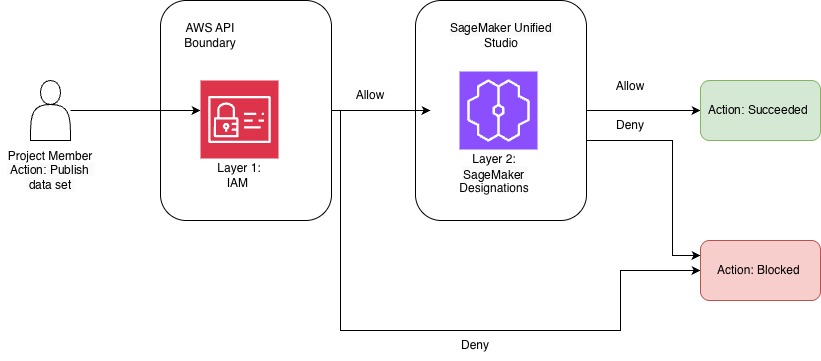
Figure 1: How a request to publish a data set passes through the IAM and designation authorization layers
The request first reaches the AWS API boundary, where IAM (layer 1) evaluates whether the principal can call the API. If IAM denies the call, the action is blocked. If IAM allows it, SageMaker Unified Studio (layer 2) evaluates the member’s designation. The action succeeds only when the designation also allows it. Otherwise, the action is blocked.
Managed designations
Every domain includes two AWS managed designations at the project level so you can start immediately:
- Owner – Full control over all project resources, including project member management.
- Contributor – Full access except for project member management and project deletion. Because Contributor is broad, we recommend custom designations for personas that don’t need full access.
You can view the permissions for these managed designations, but you can’t edit or delete them. To create your own permission sets, you build custom designations for the personas your organization needs.
Create a designation on the console
Designations are created and managed from the domain management portal. Only users whose profile is a domain administrator can access it. The domain management portal is separate from the Amazon SageMaker Unified Studio portal where members do their day-to-day work. In this example, we create an ML Engineer designation for members who build workloads through notebooks.
- Sign in to the SageMaker Unified Studio domain management portal.
- In the navigation pane, choose Designations. The Managed tab shows the AWS managed Owner and Contributor designations.
- Choose Create designation.
- For Name, enter
ML Engineer, and add a Description. - In the visual permission selector, expand the Notebook category and select only the permissions this persona requires, for example, Read-only actions for reviewers, or All Actions only for members who author notebooks.
- Choose Create.
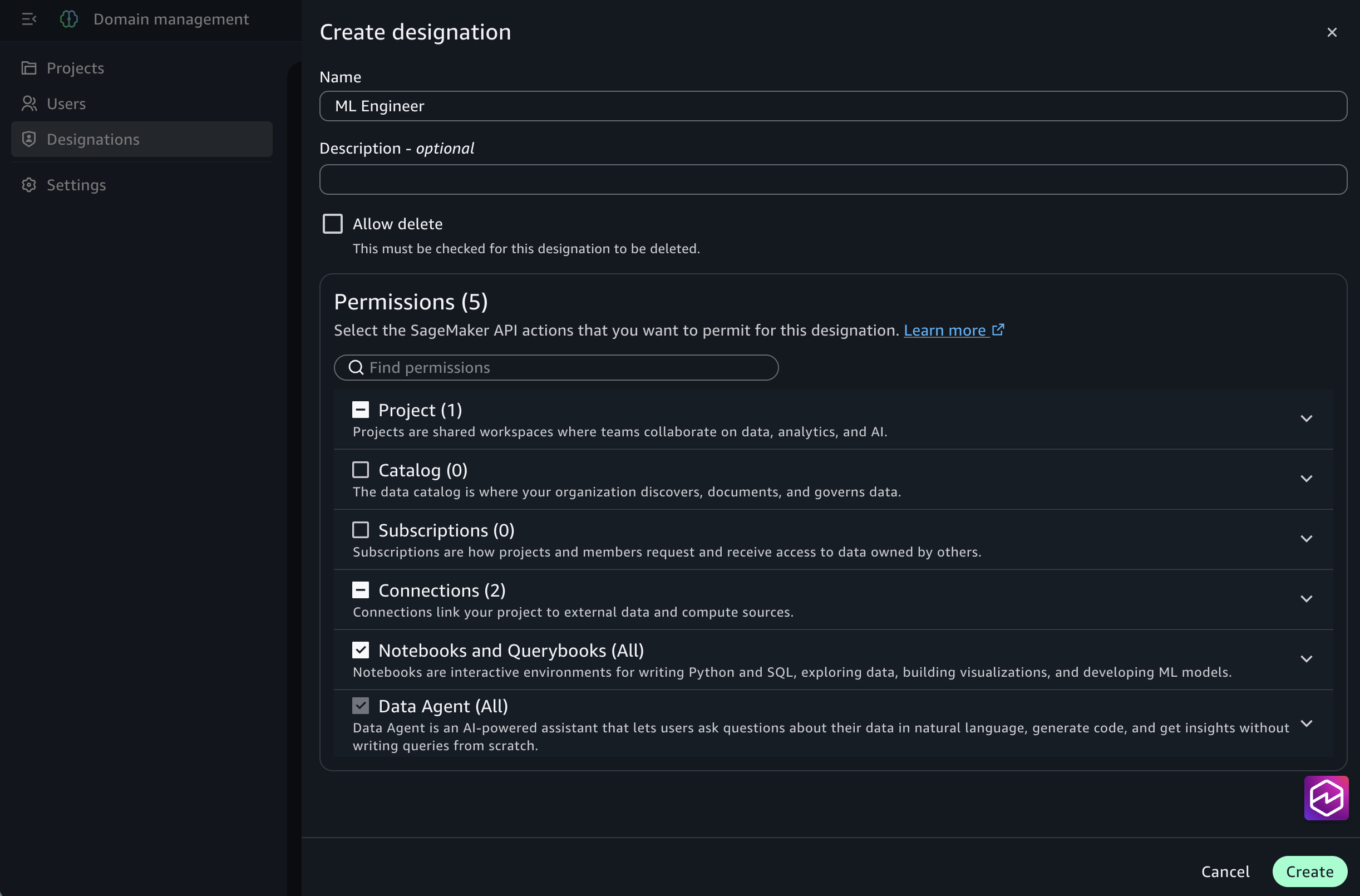
Figure 2: Creating a designation in the Amazon SageMaker Unified Studio domain management portal, using the visual permission selector to choose the actions to include
The ML Engineer designation is now available to every project in the domain. You can also create a designation by duplicating an existing one, which pre-selects a set of permissions for you to customize. Review the pre-selected permissions and remove any that the new persona doesn’t need.
Assign a designation to a project member
After creation, a designation is available to every project in the domain. You can assign it from two places, depending on your domain type.
From the SageMaker Unified Studio portal (Identity Center-based domains), assign the designation from a project where you are an owner, or if your designation has the Manage Membership permission. Grant Manage Membership only to trusted project members. A member who has the Manage Membership permission can assign designations with more permissions than their own.
- Navigate to the project in the SageMaker Unified Studio portal.
- Choose the Members tab.
- To update an existing member, choose a designation from the Designation column for that user. To add a new member, choose Add member and select the member.
- For Designation, choose ML Engineer.
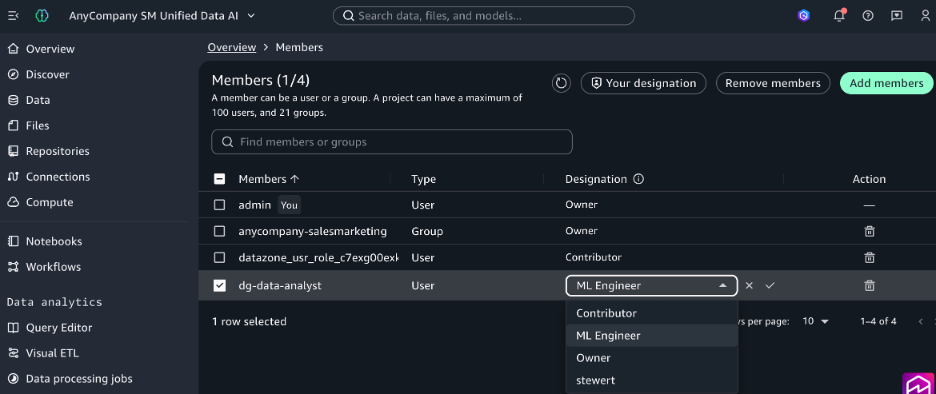
Figure 3: Assigning a designation to a project member from the Amazon SageMaker Unified Studio portal (Identity Center-based domains) using the Role list on the Members tab
From the domain management portal (both IAM and Identity Center-based domains):
- Sign in to the domain management portal and choose Projects in the navigation pane.
- Select the project, then choose the Members tab.
- To update an existing member, choose a designation from the Project designation column. To add a new member, choose Add members and select the type and member.
- For Designation, choose the designation to assign, then choose Save.
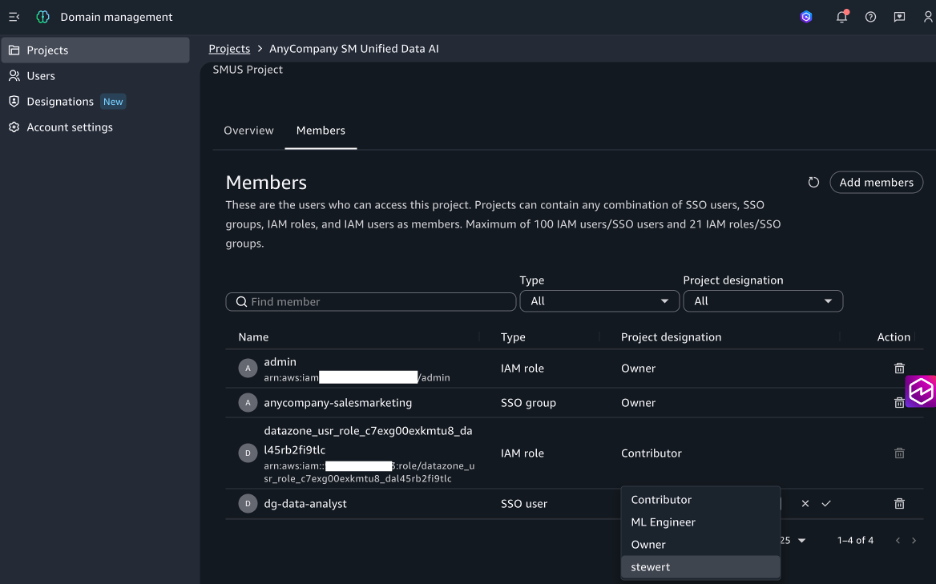
Figure 4: Assigning a designation from the domain management portal (both IAM and Identity Center-based domains) using the Project designation column on the Members tab
When the assigned user logs in to the project, they are permitted to create notebooks. Every project member is assigned a designation. Members without a valid designation have no permissions in the project.
Automate the full lifecycle with the AWS CLI and infrastructure as code (IaC)
You can manage the entire lifecycle, from creating a designation to assigning it, programmatically. This is useful for codifying governance and rolling it out at scale.
Prerequisites:
The IAM principal that runs these commands needs permissions (scoped to the domain) such as datazone:CreateDesignation, datazone:UpdateDesignation, and datazone:DeleteDesignation to manage designations. They need datazone:CreateProjectMembership to assign the designation to project members. Grant only the actions you need.
Create a designation with the AWS CLI:
Assign the designation when you add a member to a project:
Because designations are supported as resources in AWS CloudFormation, you can define them in your templates, version them in source control, and deploy them across domains through your existing infrastructure-as-code pipelines. You can also manage assignments with the CreateProjectMembership and UpdateProjectMembership API operations, so the full workflow can be automated without using the console.
Update designations as your needs evolve
When you update a designation’s permissions, the change takes effect immediately for all members assigned that designation across all projects, with no reassignment required. This means you can start with the minimum permissions each persona needs, and add permissions as requirements or new capabilities emerge. Because updates apply immediately across all projects, review designation changes through your change-management process and use AWS CloudTrail to audit them.
Delete a designation
Designations include an Allow delete property that is turned off by default, so a designation can’t be deleted until you explicitly allow it. When you create or edit a designation, set Allow delete to make the designation eligible for deletion. Once allowed, you can delete the designation even if project members are still assigned to it.
When you delete a designation that is still in use, those members remain in the project, but their assigned designation becomes invalid. They have no permissions in the project until the project owner reassigns them a valid designation. Plan deletions accordingly so members are not left without access.
You can also set this property programmatically. The CreateDesignation API and AWS CLI accept a deletion protection parameter, so you can codify the setting in your infrastructure as code templates.
To create the designation without delete protection, use the --no-deletion-protection flag.
Conclusion
Designations give administrators control over who can do what within each Amazon SageMaker Unified Studio project. Define named permission sets once and assign them per project to help enforce separation of duties across data engineers, stewards, analysts, ML engineers, and automated pipelines. You don’t need to duplicate projects or build a permission system outside SageMaker Unified Studio. Designations require no additional infrastructure or cost, integrate with AWS CloudFormation, and layer cleanly on top of your existing IAM controls.
To get started, open the domain management portal for your Amazon SageMaker Unified Studio domain, choose Designations, and create your first permission set. To learn more, see the Amazon SageMaker Unified Studio documentation.
About the authors
Haas: Postgres 19 is late, and it’s AI’s fault
Post Syndicated from corbet original https://lwn.net/Articles/1104210/
PostgreSQL developer Robert Haas writes
about the struggles the project has encountered in putting together its
next release.
In the end, I don’t think that the delay in shipping PostgreSQL 19
is particularly concerning. It is not a long delay in the grand
scheme of things, and it emerges directly from the project’s
concern for quality.The long-term picture is less clear and in some ways more
troubling: given that we have forty years of bugs that humans were
unable to find but LLMs are quite capable of discovering, how are
we ever going to catch up, and how will PostgreSQL continue to
innovate? Right now, I’m not sure. What I do know is that I, and
many others, are working really hard to figure it out.
LWN looked at the PostgreSQL 19 release
and its challenges in September.
Turn Your Google Home Mini Into a Home Assistant Voice Assistant!
Post Syndicated from BeardedTinker original https://www.youtube.com/shorts/_F9bAkSh3YY
R.L. Stine | Goosebumps & Beyond | Talks at Google
Post Syndicated from Talks at Google original https://www.youtube.com/watch?v=50TiXjkXdAY
Remote code execution on Linux systems with multipath TCP
Post Syndicated from daroc original https://lwn.net/Articles/1104192/
On October 27, LLM provider Anthropic
reported
on a
remotely exploitable use-after-free bug affecting systems with
multipath TCP listeners open. The bug works by triggering a response to a
retransmitted SYN packet at the same moment that the TCP connection is
established in another thread, causing the first thread to access the
connection’s options structure after the second thread has freed it. The first
thread can then disclose kernel memory or cause a buffer overflow, writing an
attacker-controlled payload. The fix was
to only free the structure after an RCU grace period.
On October 29, the Go security team
advised
that all programs written in Go use multipath TCP by default, so many
systems may be unknowingly vulnerable. And, of course, there is always the
possibility of related bugs in other sections of the TCP stack. Users may be
wise to update to a patched kernel as soon as one becomes available for their
distribution.
Bloatware in Aftermarket Auto Parts
Post Syndicated from Bruce Schneier original https://www.schneier.com/blog/archives/2026/10/bloatware-in-aftermarket-auto-parts.html
This story is interesting:
One Civic owner purchased a cheap aftermarket head unit off Amazon, and decided to have Claude work its magic on it, like it would a smart TV. What was reportedly discovered isn’t surprising, but is worth knowing about.
Among the pre-installed bloatware—or spyware, if you’re being less charitable—was a voice assistant equipped with WebView, an Android system component that lets apps display content off the web. This apparently always used about a third of processing power, even while idle, which isn’t great. There were also Baidu location services, a call recorder (!), a DAB radio client that is pretty much useless in the U.S., and Adobe Acrobat, presumably so your passenger can entertain themselves with PDFs on the go.
It’s interesting because it exposes all the insecurities in this piece of IoT software. But I think the real story is that a random person was able to do this reverse-engineering with the help of AI. Expect a lot more stories like this in the future.
[$] System-call wrappers for glibc
Post Syndicated from jake original https://lwn.net/Articles/1101647/
In a followup to his
session at the
2025 Linux Plumbers Conference (LPC), Carlos O’Donell returned to the topic
of system-call
wrappers for the GNU C library (glibc) at this year’s event. This time
around, he was joined by Florian Weimer, who is another glibc maintainer.
The idea was to give an update on what has happened over the last year with
regard to Linux system calls that lack a glibc wrapper, thus are only
accessible via
syscall(). In addition, they wanted to hear from attendees about their
needs in this area.
The Entire Internet is Breaking
Post Syndicated from The Atlantic original https://www.youtube.com/watch?v=OhsRmVFo6Go
Cloudflare services for private origins is now generally available
Post Syndicated from Enrique Somoza original https://blog.cloudflare.com/private-origins-public-to-private/
Today, Cloudflare services for private origins is generally available. Point a proxied DNS record at a private IP, and Cloudflare reaches the origin over your existing Cloudflare One connection. Your origin stays private, while web application firewall (WAF), caching, bot management, and Workers work just as they do for public origins.
In June, we launched this capability in closed beta to address a problem we kept hearing from customers: Their internal APIs, AI agent backends, MCP servers, and operational tools weren’t built to face the Internet, but those services still need to accept requests from partners, customers, or agents over the Internet. Before the beta, putting Cloudflare in front of these services meant exposing a public IP, opening a firewall port, or running cloudflared alongside the origin.
Those requirements often left private applications without the same protections and controls they used for public applications, including WAF, bot management, rate limiting, caching, traffic acceleration, rewrites, and Workers.
What is generally available today
During the closed beta, eligible customers requested access through their account team. Today, we’re opening access beyond that beta group.
Point a proxied A or AAAA record at a private IP, and Cloudflare’s application services work as they do for public origins:
- WAF and managed rules
- Bot management
- Rate limiting
- Caching
- Transform and rewrite rules
- Workers
Some limitations remain. Argo Smart Routing and Dedicated CDN Egress IPs aren’t supported, and origin health checks require Load Balancing. See the developer documentation for the full list of current limitations.
Your origin keeps its private IP, with no inbound firewall exception required. With Cloudflare WAN, no connector software on the origin is required. With Cloudflare Mesh, a connector runs within your private network and can serve multiple origins.
How it works
Create a proxied A or AAAA record pointing to your origin. For supported private IP ranges, use private network routing is enabled automatically. If your origin uses a public IP that’s reachable only through your private network, you can enable the setting manually.
The rest of the request flow stays the same: TLS termination, WAF, rules, and caching continue to run on Cloudflare’s network.
The setting turns on automatically for RFC 1918 private IPv4 addresses, RFC 6598 CGNAT addresses (100.64.0.0/10), and RFC 4193 unique local IPv6 addresses (fc00::/7). It can’t be turned off for these ranges; attempts to disable it through the API return an error.
What the API looks like
For customers automating deployments through the API, private routing is simply an additional attribute on a standard DNS record.
POST /zones/{zone_id}/dns_records
{
 "type": "A",
 "name": "app.example.com",
 "content": "10.0.0.50",
 "ttl": 300,
 "proxied": true,
 "private_routing": true
}
Behind the scenes, Cloudflare's proxy platform determines where to send traffic for app.example.com by querying Cloudflare's Origin API. The response includes metadata indicating that the destination should be reached through a private network path:
{
 "zone_name": "example.com",
 "ipv4_addresses": ["10.0.0.50"],
 "private_routing": true
}
The private_routing flag is the key signal. When our proxy sees it, instead of attempting to connect directly to the private IP address over the public Internet, it hands the request to our private networking layer, which then routes the connection across the customer's existing private network connectivity, whether that's IPsec, GRE, Cloudflare Tunnel, CNI, or Cloudflare Mesh.
The beta post covers the routing layer in more detail.
Get started
Before you begin, you’ll need:
- The Private Origins entitlement on your account. Ask your account team to turn it on.
- Cloudflare One connectivity using IPsec, GRE, CNI, Cloudflare Tunnel, or Cloudflare Mesh.
- Unified Routing enabled on your account, unless you connect over Cloudflare Tunnel (Tunnel doesn't need it). New and existing accounts can upgrade through their account team.
- If you connect over Cloudflare WAN or Cloudflare Mesh, configure a return route for Cloudflare’s source ranges: 100.64.0.0/12 for IPv4 and 2606:4700:cf1:5000::/64 for IPv6. Then, create a proxied A or AAAA record for the private IP and confirm that Use private network routing is enabled. Your existing WAF, cache, and bot management configuration applies to that hostname without further changes.
Then, create a proxied A or AAAA record for the private IP and confirm that Use private network routing is enabled. Your existing WAF, cache, and bot management configuration applies to that hostname without further changes.
One note from the beta: if requests time out and nothing arrives at the origin, check the return route first. A missing route for Cloudflare’s source range was the most common setup failure we saw.
Once enabled, follow our developer documentation, which walks through the full setup.
What comes next
Today’s release covers public traffic reaching private origins. Next, we’re working on private-to-private traffic: users, services, and AI agents on private networks reaching applications on other private networks through Cloudflare’s application services.
Engineering work is underway, and we’re targeting a closed beta in early 2027. If you’d like to participate, talk to your account team.
The goal is to give private applications the same protections and controls as public applications. An employee opening wiki.company.internal, for example, could benefit from WAF, rate limiting, and bot management. Service-to-service traffic between clouds and data centers could use those controls too, even when neither side touches the public Internet.
For now, today’s release brings the WAF, caching, bot management, and Workers you use for public applications to private origins over connectivity you already operate.
Questions or feedback? Join the conversation in our community forums or reach out to your account team.
Eight more stable kernel updates
Post Syndicated from daroc original https://lwn.net/Articles/1104177/
Greg Kroah-Hartman has announced the release of the 7.3.1,
7.2.14,
6.18.60,
6.12.115,
6.6.161,
6.1.191,
5.15.224, and
5.10.273 stable kernels. As usual, he advises
all users to update—advice that seems especially wise given the
increased number of security-relevant bug fixes that the kernel is seeing these days.
[Edit: the 7.2.15 stable release is already in review as well.]
Security updates for Friday
Post Syndicated from daroc original https://lwn.net/Articles/1104174/
Security updates have been issued by AlmaLinux (aspell, cjose, curl, gcc-toolset-15-gcc, httpd:2.4, ignition, java-21-openjdk, libX11, libXi, libXrender, libXtst, mariadb:10.11, nodejs:24, python-pillow, python3.12-urllib3, and webkit2gtk3), Debian (imagemagick, libdatetime-timezone-perl, python-git, tor, tzdata, vlc, and wordpress), Fedora (accessibility-inspector, akonadi-calendar, akonadi-calendar-tools, akonadi-contacts, akonadi-import-wizard, akonadi-mime, akonadi-search, akonadi-server, akonadiconsole, akregator, alligator, analitza, angelfish, applet-window-buttons, arianna, ark, artikulate, audex, audiocd-kio, audiotube, aurorae, baloo-widgets, blinken, bluedevil, bomber, bovo, breeze-gtk, brotli, bup, calendarsupport, calindori, calligra, cantor, colord-kde, cxx-rust-cssparser, dolphin, dolphin-plugins, dragon, elisa-player, eventviews, falkon, fcitx-configtool, ffmpegthumbs, filelight, firefox, flatpak-kcm, francis, ghostwriter, granatier, grantlee-editor, grantleetheme, grub2-breeze-theme, gwenview, incidenceeditor, isoimagewriter, itinerary, juk, k3b, kaccounts-integration, kaccounts-providers, kactivitymanagerd, kaddressbook, kajongg, kalarm, kalgebra, kalk, kalm, kalzium, kamera, kamoso, kanagram, kapman, kapptemplate, kasts, kate, katomic, kbackup, kblackbox, kblocks, kbounce, kbruch, kcachegrind, kcalc, kcalutils, kcharselect, kclock, kcolorchooser, kcron, kde-cli-tools, kde-connect, kde-dev-scripts, kde-dev-utils, kde-gtk-config, kde-inotify-survey, kde-partitionmanager, kdebugsettings, kdecoration, kdeedu-data, kdegraphics-mobipocket, kdegraphics-thumbnailers, kdenetwork-filesharing, kdenlive, kdepim-addons, kdepim-runtime, kdeplasma-addons, kdesdk-kioslaves, kdesdk-thumbnailers, kdevelop, kdevelop-php, kdevelop-python, kdf, kdialog, kdiamond, kdnssd, kdominate, keditbookmarks, keepsecret, keysmith, kf6-baloo, kfind, kfourinline, kgeography, kget, kglobalacceld, kgoldrunner, kgpg, kgraphviewer, khangman, khealthcertificate, khelpcenter, kidentitymanagement, kig, kigo, killbots, kimagemapeditor, kimap, kinfocenter, kio-admin, kio-extras, kio-gdrive, kirigami-gallery, kiriki, kiten, kitinerary, kjournald, kjumpingcube, kldap, kleopatra, klettres, klickety, klines, kmag, kmahjongg, kmail, kmail-account-wizard, kmailtransport, kmbox, kmenuedit, kmines, kmix, kmousetool, kmouth, kmplot, knavalbattle, knetwalk, knights, knighttime, knot, koko, kolf, kollision, kolourpaint, kompare, kongress, konqueror, konquest, konsole, kontact, kontactinterface, kontrast, konversation, kopeninghours, korganizer, kosmindoormap, kpat, kpimtextedit, kpipewire, kpkpass, kpmcore, kpublictransport, kqtquickcharts, krdc, krdp, krecorder, kreversi, krfb, kruler, ksanecore, kscreen, kscreenlocker, kshisen, ksirk, ksmtp, ksnakeduel, kspaceduel, ksquares, ksshaskpass, ksudoku, ksystemlog, ksystemstats, kteatime, ktimer, ktnef, ktorrent, ktouch, ktrip, ktuberling, kturtle, kubrick, kunifiedpush, kup-backup, kwalletmanager5, kwave, kwayland, kwayland-integration, kweather, kweathercore, kwin, kwin-zones, kwordquiz, kwrited, layer-shell-qt, libgravatar, libkcddb, libkdcraw, libkdegames, libkdepim, libkeduvocdocument, libkexiv2, libkgapi, libkleo, libkmahjongg, libkomparediff2, libksane, libkscreen, libksieve, libksysguard, libktorrent, libplasma, libquotient, lokalize, lskat, mailcommon, mailimporter, marble, markdownpart, massif-visualizer, mbox-importer, merkuro, messagelib, mimetreeparser, mingw-python-certifi, minuet, neochat, ocean-sound-theme, okular, oxygen-sounds, palapeli, pam-kwallet, parley, perl-Alien-Brotli, picmi, pim-data-exporter, pim-sieve-editor, pimcommon, plasma-activities, plasma-activities-stats, plasma-bigscreen, plasma-breeze, plasma-browser-integration, plasma-camera, plasma-desktop, plasma-dialer, plasma-discover, plasma-disks, plasma-drkonqi, plasma-firewall, plasma-integration, plasma-keyboard, plasma-login-manager, plasma-milou, plasma-mobile, plasma-nano, plasma-nm, plasma-oxygen, plasma-pa, plasma-phonebook, plasma-print-manager, plasma-sdk, plasma-settings, plasma-setup, plasma-systemmonitor, plasma-systemsettings, plasma-thunderbolt, plasma-union, plasma-vault, plasma-wayland-protocols, plasma-welcome, plasma-workspace, plasma-workspace-wallpapers, plasma5support, plasmatube, plymouth-kcm, plymouth-theme-breeze, polkit-kde, powerdevil, poxml, qmlkonsole, qqc2-breeze-style, qrca, rocs, sddm-kcm, signon-kwallet-extension, skanlite, skanpage, skladnik, spacebar, spectacle, step, svgpart, sweeper, tokodon, trafficserver, umbrello, xdg-desktop-portal-kde, yakuake, and zanshin), Mageia (cfitsio, libsolv, tomcat, and xrdp), Oracle (bind, cjose, curl, dogtag-pki, expat, gcc-toolset-15-gcc, ignition, kernel, libX11, libXrender, libXtst, php, python3.12-urllib3, and webkit2gtk3), SUSE (389-ds, aws-nitro-enclaves-binaryblobs-upstream, brotli, chromium, firefox, flatpak, gnutls, google-osconfig-agent, haproxy, hawk2, kernel, libapr1, libtcnative-1-0, tomcat, liboath-devel, libpcre2-16-0, librecad, libXi-devel, libXtst-devel, python311, python313, python313-markdown2, python313-xhtml2pdf, rabbitmq-server, roundcubemail, rust-keylime, and xen), and Ubuntu (dotnet8, dotnet10, dotnet11).
Гласовете на Америка – брой 19
Post Syndicated from Йоанна Елми original https://www.toest.bg/glasovete-na-amerika-broy-19/

Ако руски олигарх плати за сватбата ти, а после баща ти каже, че си обещал да върнеш парите, сюжетът може да мине за балкански. Ако олигархът е начело на Международната асоциация по бокс (International Boxing Association, IBA) – организация в центъра на множество скандали, финансирана от руския енергиен гигант „Газпром“, а плащанията идват през свързана дубайска фирма, балканският сюжет е част от съвременния капитализъм. Ако обаче дни по-късно самият президент на Съединените американски щати казва, че ще върнеш парите, то ти сигурно си Доналд Тръмп-младши, а сюжетът е по-скоро бележка под линия в изобилното откъм скандали президентство на баща ти.
Ако само няколко седмици по-късно пък същият президент Доналд Тръмп свали санкциите върху износа на руски дизел (в опит да осигури поевтиняване на горивата у дома преди междинните избори в контекста на продължаващата война с Иран и растящите цени) и обяви спиране на огъня по енергийната инфраструктура между Русия и Украйна, то няма кой да отрече, че в XXI век финансовият интерес отдавна е изместил националния и какво значат там някакви си ценности. Тъй като корелацията между вярата в конспиративни твърдения и склонността да се подкрепя президентът Тръмп е добре известна, може би просто не са останали конспиратори, които да се поинтересуват от близките връзки на президента с руската олигархия; или може би просто конспирацията престава да бъде интересна, когато е твърде близо до истината.
Корупция и недоверие
Една трета от гласувалите за президента Тръмп през 2024 г. не одобряват как той изпълнява задълженията си. Мащабно проучване на Pew Research около месец преди междинните избори, които са на 3 ноември, показва, че едва трима от десет американци оценяват положително мандата на Тръмп дотук, а 69% не смятат, че президентът полага особени усилия да разделя бизнес интересите си от управлението на държавата.
Независимата американска медия Tangle следи всяка история, свързана с администрацията на Тръмп и корупция или конфликт на интереси. Там се обобщават фактите само от последните три седмици: завоите на Тръмп около войната с Иран подозрително съвпадат със залози за спад в цените на горивата; донори за новата бална зала, която Тръмп строи в Белия дом, са се възползвали от регулаторни решения в тяхна полза, от правителствени договори и дори от помилване на роднина на един от донорите; компании, които са пожънали ползи от отмяната на различни федерални законови действия, са обещали 210,5 млн. долара в дарения за републикански „комитети за независими разходи“, които набират и изразходват неограничени суми от физически лица, корпорации, синдикати и други организации и могат да ги харчат в подкрепа или срещу кандидати, стига разходите да не са координирани с кандидатите или с кампаниите им.
Има и още: имотният магнат и специален пратеник на президента Стив Уиткоф и зетят на президента Джаред Къшнър все още се мъчат да прекратят войната в Украйна чрез сделки с Путин, които биха били от полза на две близкоизточни групи, работещи с Къшнър, Уиткоф и финансовия поддръжник на Тръмп Тод Боели. Хубавото на подобни схеми е, че са твърде сложни за разбиране и са скучни за широката публика. Пълния списък (десет описани случая само за последните няколко седмици) може да намерите тук.
The corruption is still the story.
I spent five months tracking every Trump corruption story. Here’s what I found.
Вярата в президента остава най-силна сред твърдия му електорат, но доверието в администрацията относно икономиката, външната политика и имиграцията спада дори сред републиканците. С твърдението, че президентът взема добри решения относно имиграцията, са съгласни 77% от републиканците, с 11 пункта по-малко от началото на мандата. Ако през ноември 2024 г. 92% от републиканците са смятали, че президентът взема адекватни решения за икономиката, то към октомври 2026 г. съгласните с това твърдение са 67%.
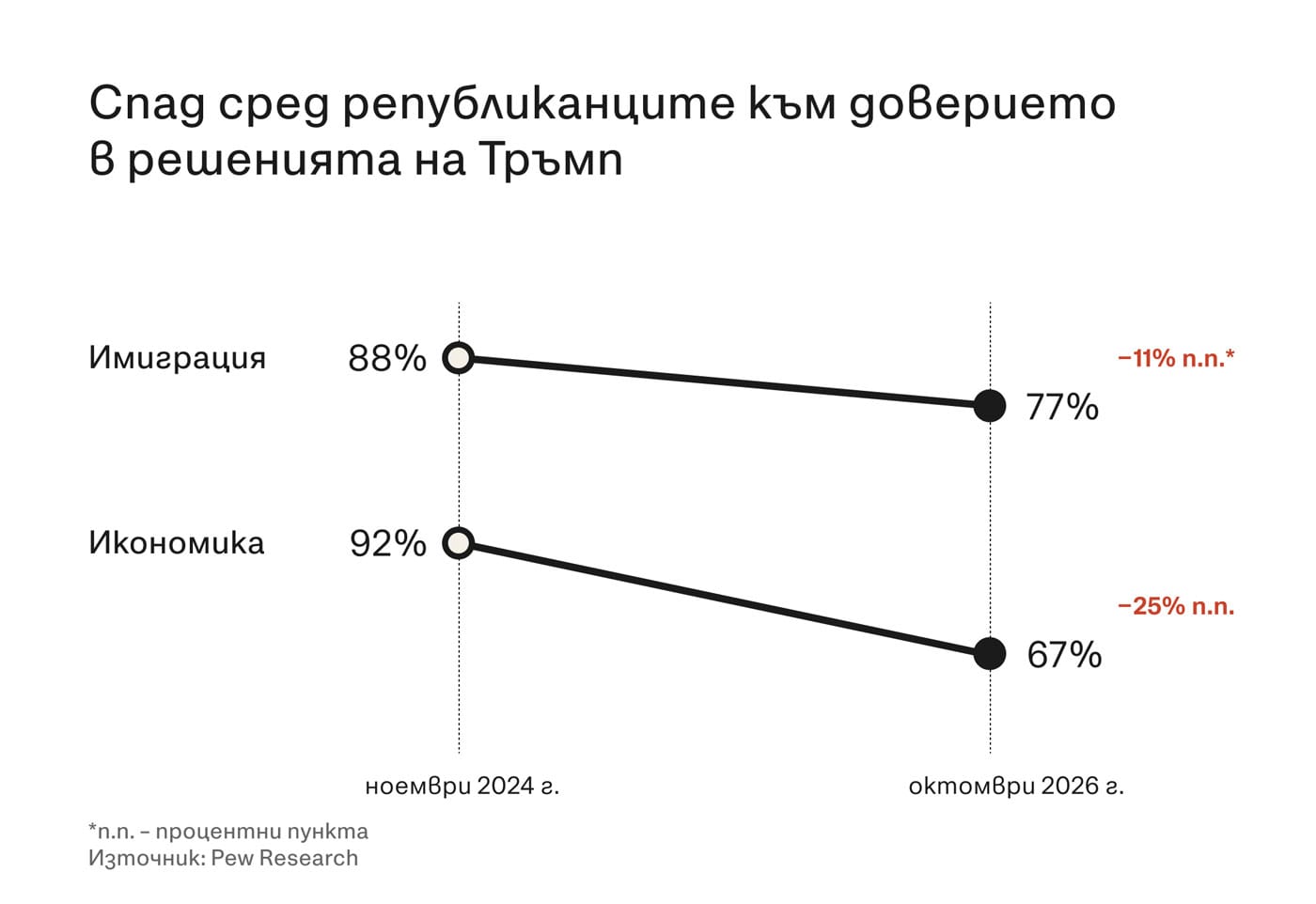
Тенденциите са подобни и при оценката на външната политика. Оценката на демократите по трите параграфа е традиционно ниска, но дори там се наблюдава спад.
Какво ще стане на междинните избори?
Рейтингът на одобрение на президента Тръмп е нисък – 37%. На този етап в предходния му мандат беше 43%, а на Джо Байдън – 40%. Понастоящем републиканците имат много слабо мнозинство в Камарата на представителите – долната камара на американския парламент – с 218 представители, точно толкова, колкото трябват, за да се приема законодателство, плюс един независим депутат, който често гласува с републиканското мнозинство.
Около 81 от местата, които трябва да се запълнят след тези избори, са т.нар. toss-up, или с равен шанс да бъдат заети и от едната, и от другата партия. Според прогнозите 34 от тях сигурно ще отидат за демократите, за 17 е трудно да се правят прогнози, а 30 вероятно ще бъдат заети от републиканците. От 17-те в „сивата зона“ 12 в момента са заети от републиканци а 5 – от демократи. Но дори демократите да не спечелят нито едно от тях, те пак ще имат мнозинство в Камарата на представителите, ако спечелят всичките 34, които се прогнозират като най-вероятни.
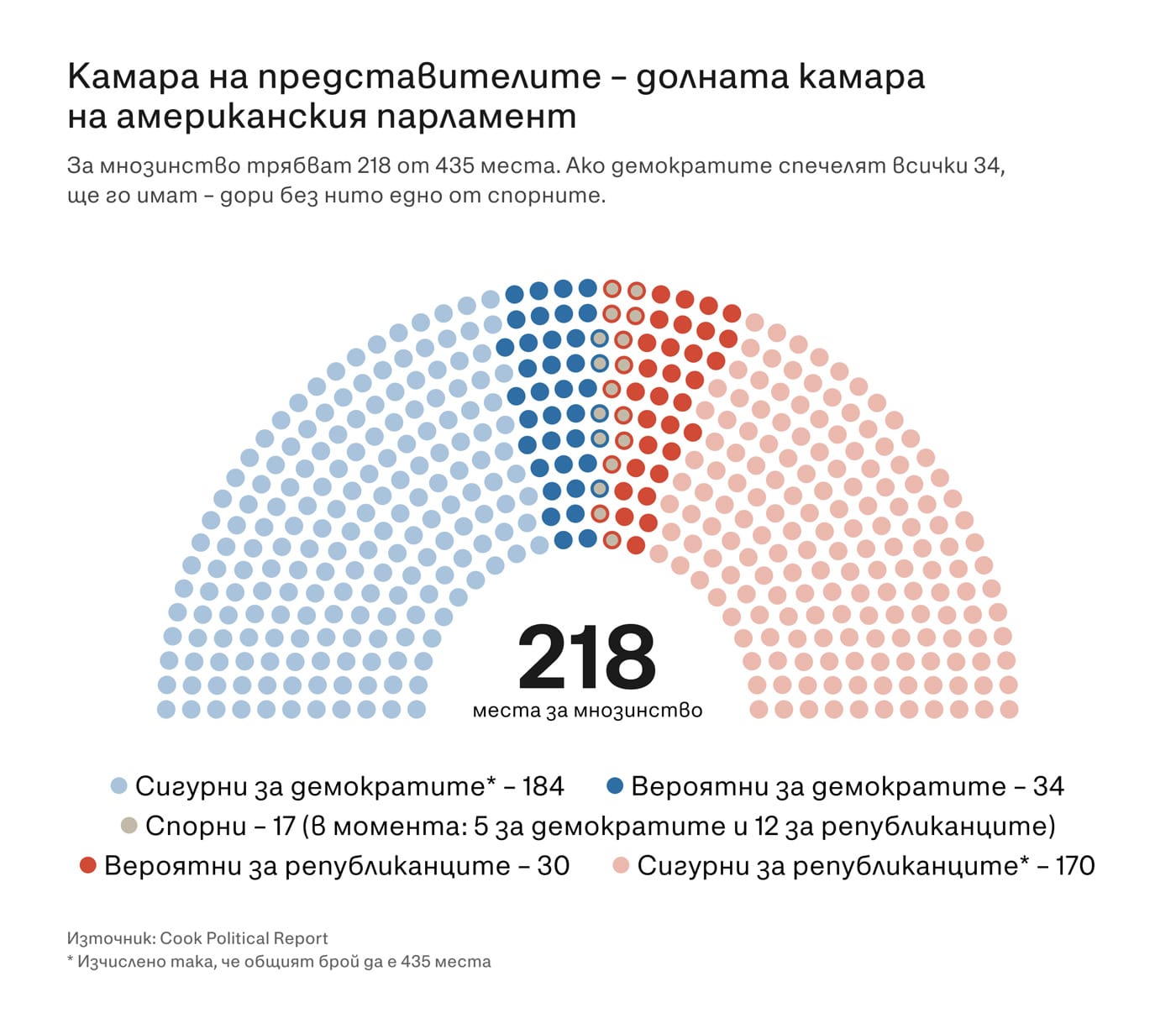
Както казахме и миналия месец, междинните избори често са наказание за управляващата партия и изпълняват ролята на коректив и баланс на властите. Ако демократите успеят да вземат мнозинство и в Сената – горната камара на парламента, това ще е особено сериозна оценка на избирателите за политиката на републиканците от последните години.
Гласовете на Америка. Междинните избори – брой 18
Междинните избори наближават, а американците са все по-недоволни от икономиката, изкуствения интелект, естествения интелект (на политиците) и въобще… Какво може да размести силите през ноември и къде партийните разделения отстъпват пред общите проблеми – в месечния бюлетин за САЩ на Йоанна Елми.
Сред 14-те места в Сената, които са във фокуса на надпреварата, 7 са с практически равни шансове за двете партии. Ако искат мнозинство, демократите ще трябва да спечелят четири от тях плюс четирите, за които се прогнозира, че е по-вероятно да отидат при тях. Това са места в Аляска, Айова, Канзас, Мейн, Мичиган, Охайо и Тексас.
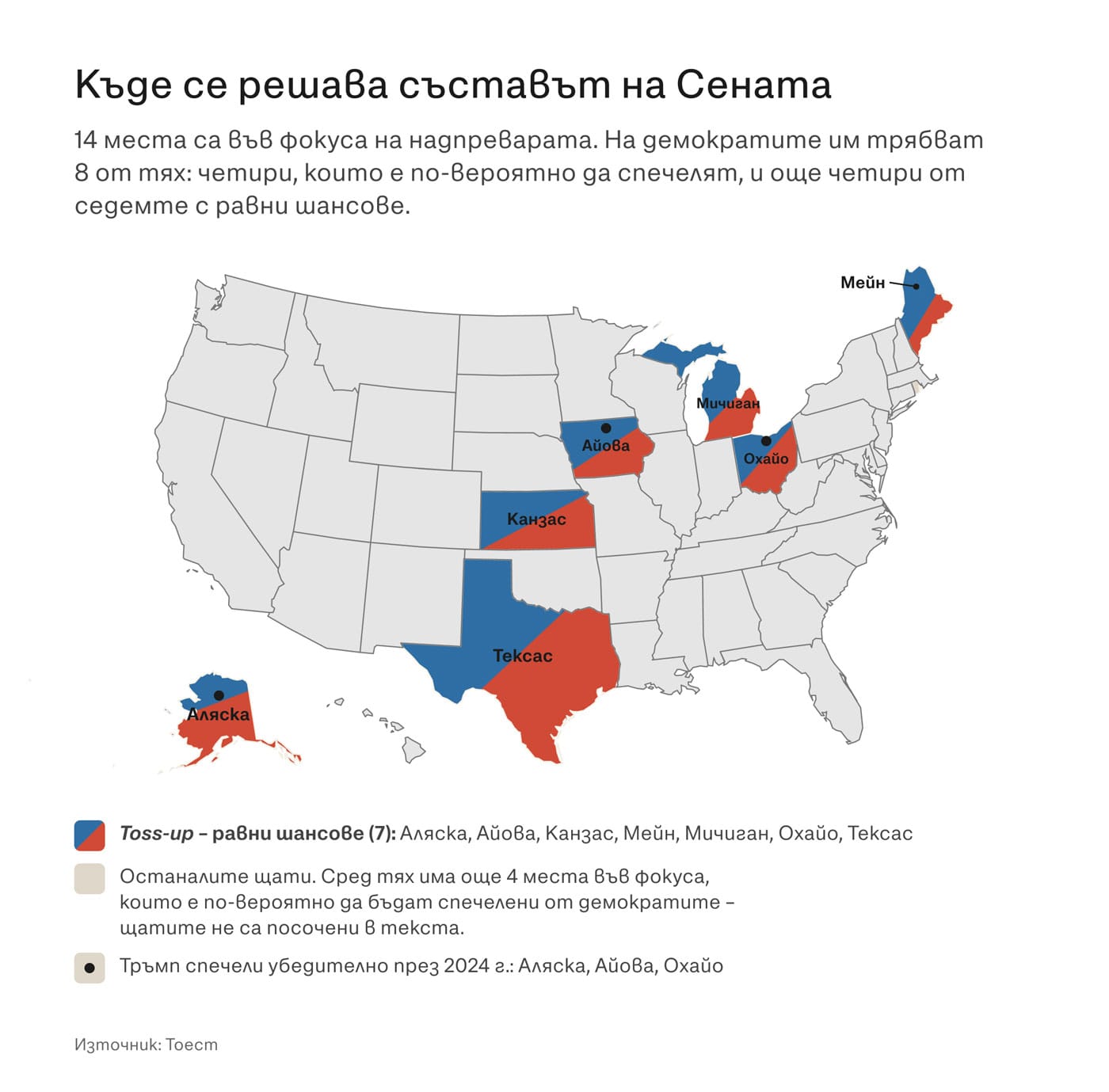
Някои от изброените щати са традиционно червени и преминаването им към демократите би било сериозно събитие. През 2024 г. Тръмп спечели особено убедително в Аляска, Айова и Охайо. Затова дори републиканците да запазят тези щати, резултатите ще покажат дали подкрепата за партията се задържа на сходни нива, или преднината ѝ се свива и част от избирателите се отдръпват от нея.
Социологическите проучвания дават шанс на кандидати като Джеймс Таларико в Тексас, който може да е първият сенатор демократ от щата от 1988 г. насам.
В крайна сметка става въпрос за пари
През 2024 г. Тръмп обеща да сложи край на инфлацията и да направи Америка финансово достъпна отново. В началото на 2026 г. президентът обаче започна война с Иран, чиито последствия се усетиха особено силно от потребителите. Горивата стигнаха до средни стойности от 4 долара за галон (1 галон = 3,785 л), което е съществено увеличение спрямо началото на годината и надвишава средните цени от последните няколко години.
Американците се тревожат също за достъпа до здравеопазване и високите му цени, както и за цялостното поскъпване на живота. Това обаче не означава задължително, че гласуващите за републиканците ще се отметнат от избора си.
И ако някъде няма пари, то за политическите кампании нещата не стоят така. Към средата на октомври републиканците са събрали средства в размер на 320 млн. долара, а демократите – „едва“ 230 млн. Към тази сума се прибавят и 160 млн. от групата MAGA Inc, която извършва фондонабиране в рамките на движението „Да направим Америка велика отново“ (Make America Great Again – MAGA) на президента Тръмп. Финансовото предимство се използва основно за купуване на реклами;
реклами за над един милиард долара са излъчени в САЩ до септември.
Ако въпреки тези средства републиканците все пак изгубят надпреварата, това също ще е сериозна индикация – включително за донорите, които „инвестират“ в своите политически представители.
За какво се бори опозицията, а не срещу какво
Минат ли междинните избори, започва разговорът за президентските. И на тези междинни избори можем да се ориентираме не само срещу какво стоят демократите, но и за какво ще се борят оттук нататък. Поне засега президентът Тръмп не може да се кандидатира за трети мандат (засега, защото самият той нееднократно се е заканвал, че ще го направи, което защитниците му определят като невинна шегичка, а критиците му – като заплаха за демократичния ред). През последните години Демократическата партия е слаба, разкъсвана от вътрешни противоречия и в търсене на идентичността си – между демократичния социализъм на политици като Александрия Окасио-Кортес и по-традиционните крила на партията.
Може би кандидати като Сам Форстаг са бъдещето. Роденият през 1994 г. Форстаг е бил начело на синдикат и е работил като пожарникар към горската служба. Във видео за кампанията си, публикувано в социалните мрежи, той разказва, че когато Илон Мъск и инициативата му за масови съкращения DOGE орязват работните места на него и на колегите му, решава да заеме работното място на политиците, които подкрепят подобни съкращения. Така става кандидат за Камарата на представителите от първи окръг в щата Монтана.
Кампанията му се фокусира върху защитата на държавните земи, както и върху икономически въпроси, като достъпа до жилища и здравеопазване. Форстаг е „човек от народа“, работил, за да плати образованието си в университета, и е част от общността, за която иска да се грижи. Освен това е млад. Ако подобни кандидати станат мнозинство, лицето на партията може да се обнови, както стана с Републиканската партия след популистката вълна през последното десетилетие.
Светът със сигурност има нужда от положителен популизъм – идеи и вяра в бъдещето вместо катастрофални прогнози; закърпване на институциите вместо използване на пукнатините в тях за финалното им изцеждане; доза идеализъм и наивност вместо цинизъм; баланс и алтернатива на властта вместо лобизъм и шуробаджанащина. Ако междинните избори покажат, че Америка тръгва в тази посока, може би има шанс и за всички останали. Предстои да разберем.
History and The Opera’s Phantom
Post Syndicated from The History Guy: History Deserves to Be Remembered original https://www.youtube.com/watch?v=YirhwAgaWiw
Властта отвори три фронта за една победа
Post Syndicated from Емилия Милчева original https://www.toest.bg/vlastta-otvori-tri-fronta-za-edna-pobeda/
В седмицата преди президентския балотаж правителството на Румен Радев действа на три фронта, за да осигури победата на действащата президентка Илияна Йотова на 1 ноември. Обединява ги една дума –
сигурност.
Кабинетът обеща по-социален бюджет за 2027 г. и непроменени цени на тока и парното до следващото лято. Премиерът се включи открито в предизборната агитация с предупреждението, че победа на Андрей Гюров може да въвлече България във война. От сметките на домакинствата до националната сигурност – управляващите предлагат бонус пакeт „Защита“.
Причината е оспорваният резултат от първия тур. Йотова изпревари Гюров само с 42 719 гласа, или 2,8 процентни пункта, въпреки прогнозите за двуцифрена преднина. Затова и голямо значение придобиват онези малко над 190 000 гласа за двойката Костадин Костадинов – Петър Волгин, чийто резултат надхвърли този на „Възраждане“ на парламентарните избори през април. Тогава изгряващата „Прогресивна България“ (ПБ) привлече гласове от много партии и „Възраждане“ беше особено ощетена. Сега ПБ ще направи опит да си върне част от тях.
Залогът за Радев е голям. Със собствено парламентарно мнозинство и правителство той се стреми да запази и президентската институция в политическата си орбита. Така ще е сигурен в утвърждаването на „тримата големи“ – главен прокурор и председателите на ВАС и ВКС, които бъдещият Висш съдебен съвет, доминиран от негови членове, ще избере. (Тук е редно да се направи уговорката, че възможността Йотова да се еманципира от Радев, ако бъде избрана, не е за подценяване.)
Какъв национален хоризонт чакаме от президента?
Какво всъщност избираме, когато избираме президент – лице на държавата, коректив на властта или посока за бъдещето? Емилия Милчева проследява как различните президенти на България са разбирали ролята си, и пита какъв национален хоризонт предлагат днешните кандидати отвъд политическото позициониране.
Мирът като предизборно оръжие
Тази седмица управляващите решиха да хванат страха за рогата. На 26 октомври Радев обяви, че българите ще избират „между мира и войната“ и „между демокрацията и корупционния модел на сглобката“. Той свърза Гюров със споразумението за сътрудничество с Украйна, подписано при служебното му управление. Макар че собственото правителство на Радев не го прекрати, но няма и да го изпълнява.
Андрей Гюров беше представен като олицетворение на двойна заплаха – за мира и за демокрацията.
Изявлението предизвика и скандал за използването на държавен ресурс в предизборната кампания. Радев не само призова „Нека да гласуваме за Илияна Йотова“, но думите му бяха разпространени чрез официалния сайт и информационните канали на Министерския съвет. Инициативният комитет на Гюров и Кандев сезира ЦИК, а впоследствие постъпиха 104 сигнала за предполагаемо нарушение на Изборния кодекс.
След близо осемчасово заседание Комисията не установи административно нарушение с минимално мнозинство от 8 срещу 7 гласа – решение, което „Демократична България“ ще обжалва.
Надмощието осигуриха седемте членове на ПБ заедно с представителя на „Възраждане“. Така управляващите получиха подкрепа от националистическата партия, за да не бъде санкционирана предизборната агитация на премиера чрез правителствените канали.
На 28 октомври при посещение в Пазарджик самата Йотова нарича политическите си опоненти „войнолюбци“. Така предизборният спор вече не е между различни политики за сигурност, а между самопровъзгласилите се защитници на мира и противниците им, на които се приписва желание за война.
За доказателства никой не пита – достатъчно е да се посочи врагът.
Страхът е стар политически инструмент. Когато изборите бъдат представени като спасение от война, разговорът за правомощията и качествата на бъдещия президент отстъпва пред въпроса кой ще предпази страната от заплахата. А когато властта посочва едновременно опасността и спасителя, задава условията на самия избор.
В кампанията за парламентарните избори през април 2026 г. Виктор Орбан представи вота в Унгария като избор между война и мир, внушавайки, че победа на опозиционната „Тиса“ ще въвлече страната в конфликта в Украйна. Две години по-рано в Словакия Петер Пелегрини, подкрепен от премиера Роберт Фицо, спечели президентските избори срещу Иван Корчок, представян в кампанията като „кандидат на войната“. И в двата случая страхът от въвличане във военен конфликт беше използван като предизборен аргумент.
Гюров отхвърли обвиненията в интервю за bTV на 28 октомври. Той заяви, че никога не е предлагал изпращане на български войници в Украйна, настоя за прекратяване на бойните действия с гаранции за сигурността и обвини Радев, че е поел кампанията на Йотова на „ръчно управление“.
Нищо ново в дебата по БНТ
В единствения телевизионен дебат Йотова трябваше да защити не само собствената си кандидатура, но и тезата на Радев, че на 1 ноември българите избират между мира и войната. Тя повтори обвиненията за 10-годишното споразумение с Киев, подписано от служебния кабинет на Гюров, заедно с фалшивите внушения за изпращане на български войници в Украйна като част от мироопазващи сили в рамките на т.нар. Коалиция на желаещите. Защити и 13-годишния контракт с „Боташ“, сключен от правителство, назначено от Радев.
Така един документ за сътрудничество в областта на сигурността беше представен като опасност, докато договорът, който обвързва България с дългосрочни финансови задължения, получи политическа защита.
Гюров обясни, че става въпрос за рамково споразумение и при изпълнение всяка клауза от него ще се одобрява от парламента.
По-същественото противоречие обаче беше другаде: Йотова настояваше за мир чрез преговори с Русия, но отхвърляше временното прекратяване на огъня, защото Москва нямало да се съгласи. Така волята на агресора се превърна в отправна точка на предложението за мир.
Гюров оспори противопоставянето „мир или война“, назова Русия като агресор и настоя, че прекратяването на бойните действия без надеждни гаранции за сигурността не означава траен мир. Той защити необходимостта България да действа заедно със съюзниците си, вместо да превръща подкрепата за Украйна в заплаха за българските граждани.
Различията проличаха особено силно и в поведението им. Йотова беше самоуверена, на моменти назидателна, с категоричността на политик, свикнал да има последната дума. Гюров изглеждаше непринуден, но и непохватен и на моменти с накъсана мисъл, но не прие да бъде поставен в ролята на кандидат на войната.
Никой от двамата не призна за преговори с партийни лидери. Йотова обаче използва темата, за да упрекне Гюров за „сглобката“ и да постави въпроса за евентуална подкрепа от ДПС и Пеевски. Тази опорна точка е в употреба и от премиера, и от политици и други говорители на ПБ.
Гласове „на склад“
Предизборната реторика е нагнетявана и от примамката „как да приберем избирателите на отпадналите кандидати“. Костадинов–Волгин получиха близо 191 000 гласа, а Ивелин Михайлов – почти 58 000. Общият им резултат е почти шест пъти по-голям от разликата между Йотова и Гюров. Тези гласове не могат да се прехвърлят по партийна команда, но обясняват вниманието към националистическия и евроскептичен електорат, който се явява и резервоарът от гласове за Йотова.
Седмият президент и сделките за властта
Как Борисов и Пеевски губят влияние, Радев се стреми да го разшири, а балотажът ще покаже дали страната върви към ново противопоставяне, или към концентрация на властта. Коментар от Емилия Милчева.
Костадинов отхвърли подкрепа за Гюров, без да призове да се гласува за Йотова. Според него симпатизантите на „Възраждане“ ще избират между нея, негласуването и „Не подкрепям никого“. Любопитното е, че той оспори и противопоставянето между мир и война, като припомни, че правителството на Радев е продължило действието на споразумението с Украйна, подписано при Гюров.
За част от избирателите на „Възраждане“ Йотова е твърде „европейска“. Някои от тях вероятно помнят как на 24 февруари, на четвъртата годишнина от руското нахлуване в Украйна, тя заяви:
Още от първия момент нашата позиция беше категорично ясна – ние говорим за агресия и за агресор.
По-късно смени тази категоричност с избягването да назове Русия като агресор след атаките с дронове в Черно море.
Страхът от война – част от политическия арсенал в Европа, е и целенасочено използван инструмент в руските операции по дезинформация. Разследване на The Insider, публикувано на 21 октомври, разкрива документи от операцията „Допелгенгер“ (букв. „Двойник“), от които става ясно, че сред задачите на кремълската пропаганда е създаването на „ядрена психоза и внушения, че подкрепата за Украйна приближава Европа до война“. За различни европейски държави са разработвани послания като „чужда война“ и „Европа се нуждае от мир“. Това показва колко близо до вече готови пропагандни внушения може да се окаже предизборната реторика, която представя подкрепата за Украйна като заплаха за мира. Да си спомним и колко често Румен Радев отбелязваше ядрената мощ на Русия.
По-ясна позиция от Костадинов зае Ивелин Михайлов, който призова симпатизантите си да подкрепят Йотова заради предпочитанието си към по-балансирана външна политика и опасенията от възстановяване на „сглобката“. Той обаче уточни, че това е лична позиция, а не решение на цялата партия „Величие“.
На другия полюс подкрепа за Гюров заявиха бившият министър на отбраната Николай Ненчев и Румен Христов, заместник-председател на СДС и коалиционен партньор на ГЕРБ, макар и в лично качество. „Синя България“ призова за отпор срещу Йотова, без изрично да назове Гюров. По-неочаквана е позицията на лидера на МЕЧ Радостин Василев, който предложи на избирателите си да подкрепят Гюров или изобщо да не гласуват въпреки острото му противопоставяне срещу ПП–ДБ, които стоят зад кандидатурата. Общото между тези позиции е противопоставяне на управленския модел на Радев, а не непременно политическа близост с Гюров.
ГЕРБ обаче запазва мълчание за балотажа, въпреки че гласовете на избирателите ѝ могат да се окажат решаващи за изхода му. След първия тур социолози установиха, че от партията на Бойко Борисов двойно повече са подкрепилите Гюров, а не Йотова, но те са твърде малко на фона на негласния бойкот. ДПС спря своя електорат от участие в първия тур, а поведението на избирателите на втория ще покаже постигната ли е договорка между Пеевски и Радев. На този фон броени дни преди балотажа задържаните кметове на Пеевски – Радослав Ревански на община Белица и Димитър Гавазов на Сунгурларе, бяха докарани с белезници в Апелативния съд в Бургас. Разследват ги за обществена поръчка за 7 млн. евро за строителство на дом за хора с увреждания в Сунгурларе.
Оферта „Гаранция за зимата“
Обещанията за по-високи доходи идват преди балотажа, но бюджетът ще е след него. Радев обяви, че проектобюджетът за 2027 г. ще бъде представен следващата седмица, въпреки че срокът по закон е краят на октомври. Още на 15 октомври обаче Министерството на финансите е изпратило на Европейската комисия (ЕК) и Еврогрупата бюджетния план с прогнозен дефицит от 4,3% от БВП и увеличения на пенсиите и публичните възнаграждения.
На 28 октомври премиерът заговори за спорни въпроси с ЕК, които трябвало да бъдат изчистени, за да не пострадат доходите. Опозицията обвини управляващите, че задържат бюджета до приключването на изборите, за да скрият непопулярни мерки. Така гражданите получават обещания за по-високи доходи, но без да видят сметката за тях.
Показателно е заиграването с пенсиите – тема, която засяга над 2 млн. души, приблизително една трета от избирателите. Радев представя обещаното увеличение с около 8% като една от „червените линии пред Брюксел“. В действителност осъвременяването по швейцарското правило е законово предвидено, а окончателният процент за 2027 г. още не е определен.
Отива ли България там, откъдето Унгария се връща?
Унгария затваря цикъл, а България сякаш е на прага на нов. Между фигурата на „спасителя“, руското влияние и отслабващите институции стои въпросът „Накъде завиваме ние?“. Коментар на Светла Енчева.
За да е ясно кой е „добрият“ и кой – „лошият“, премиерът заяви, че кабинетът ще защити увеличението на пенсиите и майчинските „въпреки препоръките на ЕК“. Комисията обаче не препоръчва конкретно съкращения на пенсии, а ограничаване на дефицита, тъй като България е в процедура по свръхдефицит. Изборът откъде да се спести, е решение на правителството.
Другата гаранция дойде от енергетиката. Четири дни преди балотажа Радев обяви, че токът за домакинствата и парното няма да поскъпват до 1 юли 2027 г.
Замразяването на цените не означава замразяване на разходите. Компенсациите ще се плащат от фонд „Сигурност на електроенергийната система“. Ако той изпадне в дефицит, както се е случвало и преди, недостигът отново ще се покрие от данъкоплатците. И това няма да е последната им платена сметка за популизма.
При определянето на цените на парното до юни 2027 г. КЕВР е заложила средна прогнозна цена на газа 37,90 евро за мегаватчас. През октомври регулираната цена вече достигна 44,09 евро, а за ноември „Булгаргаз“ поиска увеличение с 34%. Междувременно на европейската борса TTF газът доближи 100 евро за мегаватчас (към редакционното приключване на материала е и над 100 евро – б.р.). Макар борсовата и регулираната цена да не са пряко съпоставими, поскъпването поставя под въпрос разчетите на КЕВР.
Някой чу ли Иван Костов?
Емилия Милчева поглежда към кандидата за президент на т.нар. демократична общност. От неговия успех би могла да зависи изцяло геополитическата ориентация на страната. Но докъде всъщност се простира демократичната общност и има ли политическа зрялост за преместването на някои червени линии?
На 28 октомври председателят на регулатора Пламен Младеновски обеща да не допусне пълното увеличение на газа и да запази цените на парното от 1 януари. Но газът формира над 70% от цената на отоплението, а експерти предупреждават за потенциално поскъпване на парното с 20–30%. Като възможност за ограничаване на увеличението се обсъжда използването на по-евтин газ от „Чирен“, макар да се чуват мнения, че запасите не са достатъчни, а част от тях са купувани на високи цени.
Трите фронта на властта се събират в едно обещание: властта ще ви предпази – от войната, от обедняването, от скъпото отопление. После гражданите ще платят цената без промоциите от предизборната кампания.
На 1 ноември ще се избира президент. Йотова обещава приемственост с Радев, а в кампанията все по-отчетливо възпроизвежда неговата реторика. Но след като той вече е в Министерския съвет, какъв е смисълът избирателите да получат още един Радев на „Дондуков“ 2?