How FanDuel adopted a modern Amazon Redshift architecture to serve critical business workloads

Post Syndicated from Sreenivasa Munagala original https://aws.amazon.com/blogs/big-data/how-fanduel-adopted-a-modern-amazon-redshift-architecture-to-serve-critical-business-workloads/

This post is co-written with Sreenivasa Mungala and Matt Grimm from FanDuel.

In this post, we share how FanDuel moved from a DC2 nodes architecture to a modern Amazon Redshift architecture, which includes Redshift provisioned clusters using RA3 instances, Amazon Redshift data sharing, and Amazon Redshift Serverless.

About FanDuel

Part of Flutter Entertainment, FanDuel Group is a gaming company that offers sportsbooks, daily fantasy sports, horse racing, and online casinos. The company operates sportsbooks in a number of US and Canadian states. Fanduel first carved out a niche in the US through daily fantasy sports, such as their most popular fantasy sport: NFL football.

As FanDuel’s business footprint grew, so too did the complexity of their analytical needs. More and more of FanDuel’s community of analysts and business users looked for comprehensive data solutions that centralized the data across the various arms of their business. Their individual, product-specific, and often on-premises data warehouses soon became obsolete. FanDuel’s data team solved the problem of creating a new massive data store for centralizing the data in one place, with one version of the truth. At the heart of this new Global Data Platform was Amazon Redshift, which fast became the trusted data store from which all analysis was derived. Users could now assess risk, profitability, and cross-sell opportunities not only for piecemeal divisions or products, but also globally for the business as a whole.

FanDuel’s journey on Amazon Redshift

FanDuel’s first Redshift cluster was launched using Dense Compute (DC2) nodes. This was chosen over Dense Storage (DS2) nodes in order to take advantage of the greater compute power for the complex queries in their organization. As FanDuel grew, so did their data workloads. This meant that there was a constant challenge to scale and overcome contention while providing the performance their user community needed for day-to-day decision-making. FanDuel met this challenge initially by continuously adding nodes and experimenting with workload management (WLM), but it became abundantly obvious that they needed to take a more significant step to meet the needs of their users.

In 2021, FanDuel’s workloads almost tripled since they first started using Amazon Redshift in 2018, and they started evaluating Redshift RA3 nodes vs. DC2 nodes to take advantage of the storage and compute separation and deliver better performance at lower costs. FanDuel wanted to make the move primarily to separate storage and compute, and evaluate data sharing in the hopes of bringing different compute to the data to alleviate user contention on their primary cluster. FanDuel decided to launch a new RA3 cluster when they were satisfied that the performance matched that of their existing DC2 architecture, providing them the ability to scale storage and compute independently.

In 2022, FanDuel shifted their focus to using data sharing. Data sharing allows you to share live data securely across Redshift data warehouses for read and write (in preview) purposes. This means that workloads can be isolated to individual clusters, allowing for a more streamlined schema design, WLM configuration, and right-sizing for cost optimization. The following diagram illustrates this architecture.

To achieve a data sharing architecture, the plan was to first spin up consumer clusters for development and testing environments for their data engineers that were moving key legacy code to dbt. FanDuel wanted their engineers to have access to production datasets to test their new models and match the results from their legacy SQL-based code sets. They also wanted to ensure that they had adequate compute to run many jobs concurrently. After they saw the benefits of data sharing, they spun up their first production consumer cluster in the spring of 2022 to handle other analytics use cases. This was sharing most of the schemas and their tables from the main producer cluster.

Benefits of moving to a data sharing architecture

FanDuel saw a lot of benefits from the data sharing architecture, where data engineers had access to real production data to test their jobs without impacting the producer’s performance. Since splitting the workloads through a data sharing architecture, FanDuel has doubled their query concurrency and reduced the query queuing, resulting in a better end-to-end query time. FanDuel received positive feedback on the new environment and soon reaped the rewards of increased engineering velocity and reduced performance issues in production after deployments. Their initial venture into the world of data sharing was definitely considered a success.

Given the successful rollout of their first consumer in a data sharing architecture, they looked for opportunities to meet other users’ needs with new targeted consumers. With the assistance of AWS, FanDuel initiated the development of a comprehensive strategy aimed at safeguarding their extract, load, and transform (ELT) jobs. This approach involved implementing workload isolation and allocating dedicated clusters for these workloads, designated as the producer cluster within the data sharing architecture. Simultaneously, they planned to migrate all other activities onto one or more consumer clusters, apart from the existing cluster utilized by their data engineering team.

They spun up a second consumer in the summer of 2022 with the hopes of moving some of their more resource-intensive analytical processes off the main cluster. In order to empower their analysts over time, they had allowed a pattern in which users other than data engineers could create and share their own objects.

As the calendar flipped from 2022 to 2023, several developments changed the landscape of architecture at FanDuel. For one, FanDuel launched their initial event-based streaming work for their sportsbook data, which allowed them to micro-batch data into Amazon Redshift at a much lower latency than their previous legacy batch approach. This allowed them to generate C-Suite revenue reports at a much earlier SLA, which was a big win for the data team, because this was never achieved before the Super Bowl.

FanDuel introduced a new internal KPI called Query Efficiency, a measure to capture the amount of time users spent waiting for their queries to run. As the workload started increasing exponentially, FanDuel also noticed an increase in this KPI, specifically for risk and trading workloads.

Working with AWS Enterprise Support and the Amazon Redshift service team, FanDuel soon realized that the risk and trading use case was a perfect opportunity to move it to Amazon Redshift Serverless. Redshift Serverless offers scalability across dimensions such a data volume changes, concurrent users and query complexity, enabling you to automatically scale compute up or down to manage demanding and unpredictable workloads. Because billing is only accrued while queries are run, it also means that you no longer need to cover costs for compute you’re not utilizing. Redshift Serverless also manages workload management (WLM) entirely, allowing you to focus only on the query monitoring rules (QMRs) you want and usage limits, further limiting the need for you to manage your data warehouses. This adoption also complimented data sharing, where Redshift Serverless endpoints can read and write (in preview) from provisioned clusters during peak hours, offering flexible compute scalability and workload isolation and avoiding the impact on other mission-critical workloads. Seeing the benefits of what Redshift Serverless offers for their risk and trading workloads, they also moved some of their other workloads like business intelligence (BI) dashboards and risk and trading (RT) to a Redshift Serverless environment.

Benefits of introducing Redshift Serverless in a data sharing architecture

Through a combination of data sharing and a serverless architecture, FanDuel could elastically scale their most critical workloads on demand. Redshift Serverless Automatic WLM allowed users to get started without the need to configure WLM. With the intelligent and automated scaling capabilities of Redshift Serverless, FanDuel could focus on their business objectives without worrying about the data warehouse capacity. This architecture alleviated the constraints of a single predefined Redshift provisioned cluster and reduced the need for FanDuel to manage data warehouse capacity and any WLM configuration.

In terms of cost, Redshift Serverless enabled FanDuel to elegantly handle the most demanding workloads with a pay-as-you-go model, paying only when the data warehouse is in use, along with complete separation of compute and storage.

Having now introduced workload isolation and Redshift Serverless, FanDuel is able to achieve a more granular understanding of each team’s compute requirements without the noise of ELT and contending workloads all in the same environment. This allowed comprehensive analytics workloads to be conducted on consumers with vastly minimized contention while also being serviced with the most cost-efficient configuration possible.

The following diagram illustrates the updated architecture.

Results

FanDuel’s re-architecting efforts for workload isolation with risk and trading (RT) workloads using Redshift data sharing and Redshift Serverless resulted in the most critical business SLAs finishing three times faster, along with an increase in average query efficiency of 55% for overall workloads. These SLA improvements have resulted into an overall saving of tenfold in business cost, and they have been able to deliver business insights to other verticals such as product, commercial, and marketing much faster.

Conclusion

By harnessing the power of Redshift provisioned clusters and serverless endpoints with data sharing, FanDuel has been able to better scale and run analytical workloads without having to manage any data warehouse infrastructure. FanDuel is looking forward to future Amazon partnerships and is excited to embark on a journey of new innovation with Redshift Serverless and continued enhancements such as machine learning optimization and auto scaling.

If you’re new to Amazon Redshift, you can explore demos, other customer stories, and the latest features at Amazon Redshift. If you’re already using Amazon Redshift, reach out to your AWS account team for support, and learn more about what’s new with Amazon Redshift.


About the authors

Sreenivasa Munagala is a Principal Data Architect at FanDuel Group. He defines their Amazon Redshift optimization strategy and works with the data analytics team to provide solutions to their key business problems.

Matt Grimm is a Principal Data Architect at FanDuel Group, moving the company to an event-based, data-driven architecture using the integration of both streaming and batch data, while also supporting their Machine Learning Platform and development teams.

Luke Shearer is a Cloud Support Engineer at Amazon Web Services for the Data Insight Analytics profile, where he is engaged with AWS customers every day and is always working to identify the best solution for each customer.

Dhaval Shah is Senior Customer Success Engineer at AWS and specializes in bringing the most complex and demanding data analytics workloads to Amazon Redshift. He has more then 20 years of experiences in different databases and data warehousing technologies. He is passionate about efficient and scalable data analytics cloud solutions that drive business value for customers.

Ranjan Burman is an Sr. Analytics Specialist Solutions Architect at AWS. He specializes in Amazon Redshift and helps customers build scalable analytical solutions. He has more than 17 years of experience in different database and data warehousing technologies. He is passionate about automating and solving customer problems with cloud solutions.

Sidhanth Muralidhar is a Principal Technical Account Manager at AWS. He works with large enterprise customers who run their workloads on AWS. He is passionate about working with customers and helping them architect workloads for cost, reliability, performance, and operational excellence at scale in their cloud journey. He has a keen interest in data analytics as well.

Security updates for Friday

Post Syndicated from jake original https://lwn.net/Articles/954092/

Security updates have been issued by Fedora (chromium), Mageia (firefox, thunderbird, and vim), SUSE (kubevirt, virt-api-container, virt-controller-container, virt-handler-container, virt-launcher-container, virt-libguestfs-tools- container, virt-operator-container), and Ubuntu (freerdp2, glibc, and tinyxml).

New Bluetooth Attack

Post Syndicated from Bruce Schneier original https://www.schneier.com/blog/archives/2023/12/new-bluetooth-attack.html

New attack breaks forward secrecy in Bluetooth.

Three news articles:

BLUFFS is a series of exploits targeting Bluetooth, aiming to break Bluetooth sessions’ forward and future secrecy, compromising the confidentiality of past and future communications between devices.

This is achieved by exploiting four flaws in the session key derivation process, two of which are new, to force the derivation of a short, thus weak and predictable session key (SKC).

Next, the attacker brute-forces the key, enabling them to decrypt past communication and decrypt or manipulate future communications.

The vulnerability has been around for at least a decade.

Златните ябълки, партиите стомаси и триъгълникът на властта

Post Syndicated from Емилия Милчева original https://www.toest.bg/zlatnite-yabulki-partiite-stomasi-i-triugulnikut-na-vlastta/

Златните ябълки, партиите стомаси и триъгълникът на властта

Обидно за демокрацията, срамно за държавата, печелившо за управляващата коалиция, която си е съвсем истинска сглобка. Така изглежда политическата ситуация в България, вместена в малко думи. В дългия вариант за всяко от тези съждения има куп аргументи.

Пари и власт и тяхното разпределение между трите политически сили ПП–ДБ, ГЕРБ–СДС и ДПС – това са ябълките на раздора в последните седмици на 2023 г. За първи път, откакто ГЕРБ падна от власт през 2021 г., партиите на Бойко Борисов и на Ахмед Доган (пак) се включват в разпределението на разходите в бюджета – като част от конституционноТО, евроатлантическоТО и изобщо управляващоТО мнозинство. А тези партии стомаси са известни с апетитите си – „хранят“ доста бизнеси. Значително по-обиграни са в политически план от ПП–ДБ, а разполагат и с друго тактическо предимство – „играли“ са заедно и преди, сглобката им е смазана от години. 

За ПП–ДБ правителството е безалтернативно и затова се налага да го подкрепят съвместно с ГЕРБ. Присъствието на ДПС също обясняват с крайна необходимост, но не и с партньорство – нужни са 160 гласа за конституционните промени. Какво тогава търсят ДПС и председателят на парламентарната му група Делян Пеевски при вземането на всички решения от управляващото мнозинство?!

Квоти за регулаторите

Освен за бюджетните разходи, неминуеми са кавгите за назначенията в регулаторите и кадровиците на съдебната система, които ще се състоят след конституционните промени, насрочени за гласуване през декември. Дотогава се очаква да е готов и регламент за назначенията, за какъвто се договориха ПП–ДБ, ГЕРБ и ДПС, но не пречи да има назначени и преди приемането му. Как ще се поделят позициите в регулаторите, изглежда най-парливият въпрос, след като всички вече приехме, че най-нормалното нещо на света е това да стане в рамките на новия триъгълник на властта. 

Допреди няколко месеца върли политически противници, днес „добрите“ и „лошите“ управляват заедно, заедно ще реформират съдебната система и най-големият проблем, изглежда, са квотите в регулаторите. Назначените в тях ще укрепят всяка политическа сила, тъй като са с мандати от по няколко години, които надхвърлят средната продължителност на живот на правителствата, и контролират пазари за милиарди, както и информационни масиви. 

Оказа се, че в тази категория са и шефовете на спецслужбите. Но без реформата им, заложена в приоритетите, върху които стъпи правителството на Денков–Габриел. За отсъствието ѝ мълчаливо се съгласиха и трите политически сили. 

Пред bTV тази седмица председателят на ПГ на ГЕРБ Десислава Атанасова обяви, че членовете на регулаторите ще се назначават с мнозинство от 160 гласа – и ДПС ще участва в процеса, получавайки 1/3 тежест. От ПП–ДБ са уклончиви дали това е така, след като процесът още не е започнал. Но всъщност е – с избора на ръководство на БНБ, където ГЕРБ си запази гуверньора, избран още при управлението на Бойко Борисов, а ПП–ДБ и ДПС получиха по един подуправител. Публично потвърждение на думите на Атанасова обаче няма да донесе позитиви на ПП–ДБ, които бездруго понасят негативите от управлението.

Отговорът на най-съществения за общественото благо въпрос – как това кадруване ще повлияе на зле изградените и поради това неработещи демократични институции, ще дойде много по-късно. 

Блокадата за бюджета падна

Бюджетът за 2023 г. се прие в средата на годината и нямаше как да предизвика особени крамоли поради крайно належащата необходимост да го има. Предишният за 2022 г. също закъсня, макар и с по-малко. Гласуваха го в края на февруари и също не вдигна по-голям от обичайния шум, въпреки че правителството беше излъчено от широка коалиция между „Продължаваме промяната“, БСП, „Има такъв народ“ и „Демократична България“. 

Освобождаването на директора на „Пирогов“ от здравния министър д-р Христо Хинков блокира за кратко обсъждането на проектобюджета за 2024 г. От ГЕРБ обявиха, че са имали уговорка да не се пипа д-р Валентин Димитров – шефът на най-голямото лечебно заведение за спешна помощ в България, „ако няма доклади, които да показват обратното“. 

Преди това обаче с гласовете не само на ГЕРБ и ДПС, но и на други политически сили (без ПП–ДБ), бяха окастрени всички предложения на ръководеното от Асен Василев Министерство на финансите. Отпадна идеята за бонус, ако бъде подаден сигнал до данъчните за укрити данъци и осигуровки, стига да бъдат събрани поне 100 000 лева. Отпадна и предложението ресторантьорите да плащат заплати по банков път, в това число и за работодатели с под 100 работници. Отпаднаха и данък „бакшиш“ и превръщането на гражданските договори в трудови по преценка на НАП. Депутатите обаче одобриха предложение на Десислава Танева от ГЕРБ, макар да не беше подкрепено от бюджетната комисия. Става въпрос за данъчно облекчение за земеделските стопани – субсидии до 100 000 лв. няма да бъдат облагаеми, с тази сума ще се намалява данъчната основа преди облагане.  

Но странното е, че Василев не се ядоса на тeзи промени, а на бавенето на бюджета, и заяви, че: 

Ако един министър не може да си осигури подкрепа за политиката, която провежда, най-правилно е да си подаде оставката, вместо да прави циркове и да блокира държавата.

Де факто искането му за оставка на проф. Хинков беше подкрепено от лидера на ГЕРБ и разгневи ДБ – здравният министър е от тяхната квота (номинация на ДСБ). 

Но бюджетът все пак ще влезе в пленарна зала, след като парламентарната здравна комисия, чийто председател е Костадин Ангелов от ГЕРБ, предложи на министъра да оттегли протокола за отстраняването на шефа на „Пирогов“ до приключване на проверки от външни одити и останалите органи, които го проверяват. Остава въпросът дали Хинков ще се съобрази с тази… препоръка.

Напрежението около отстраняването на д-р Димитров извади наяве и вътрешни конфликти в коалицията ПП–ДБ, тъй като депутати от „Продължаваме промяната“ застанаха (не за първи път) срещу Хинков – било поради лични амбиции за постове или с други мотиви.

Конституционните промени – в галоп

Бързината, с която е програмирано да се приемат конституционните промени – на три четения през декември, изненада мнозина юристи. „Нямам обяснение за бързането с гласуването на промените в Конституцията“, каза тази седмица по БНР проф. Екатерина Михайлова, преподавател по конституционно право в НБУ и зам.-председател на 40-тото и 41-вото Народно събрание. Тя припомни и призива на правосъдния министър Атанас Славов: 

Депутатите да не пришпорват процеса, а по-скоро да се търси качество и сигурност в предлагането на окончателните текстове. 

Но вече стана ясно, че проектът ще претърпи доста промени, част от които свързани с правомощията на президента при назначаване на служебно правителство. Изглежда, че те няма да са така радикални, както беше обявено, а ще се търси възможност за колаборация между двете институции – президент и парламент, при подбора на фигурите в кабинета.

Други основни промени са свързани със съдебната реформа – най-съществената част от проекта, от която зависи дали Висшият съдебен съвет ще бъде разделен на прокурорска и съдийска колегия, в която съдиите да имат мнозинство, и дали прокуратурата ще има по-голяма отчетност и по-малко правомощия. По третата промяна – отпадане на изискването министрите и депутатите да са само български граждани, просто се мълчи.

Тази седмица по bTV депутатът от ПП–ДБ Ивайло Мирчев каза:

Ако Конституцията не бъде приета под тази форма, ключовите министри подават оставка. До момента такива индикации по отношение на Конституцията няма. 

Значи няма да има оставки, но най-вероятно ще се чака произнасяне на Конституционния съд.

„Лукойл“ се изтегля от България

Игрите с премахване на дерогацията за „Лукойл“, което ГЕРБ и ДПС уж все се опитват да изтеглят за 1 януари 2024 г. вместо за март, както се договориха трите политически сили, показват, че развръзката е близо. Предстоящата продажба на бургаската рафинерия очевидно е навлязла в крайна фаза и изостря апетитите на местните (политически) играчи. След като ГЕРБ и ДПС сменяха позиции на 180 градуса буквално за часове, в крайна сметка се разбраха с ПП–ДБ, че дерогацията се прекратява на 1 март 2024 г. – тоест от тази дата рафинерията трябва да преработва само неруски петрол. Това е 7 месеца по-рано от крайния срок, отпуснат от Европейската комисия миналото лято. 

Няма потвърждение с кой инвеститор преговаря частната руска компания – с азерската държавна петролна и газова компания SOCAR, която вече осигурява 30% от газа за България, с инвеститор от Дубай или с американска компания. Появиха се слухове за полския енергиен концерн Orlen и дори за купувачи от Украйна. Едно е сигурно – български политици играят за интересите на някои от потенциалните купувачи. Само така може да бъде обяснена настойчивостта на ГЕРБ и ДПС да бъде отменено изключението за внос на руски суров петрол по море колкото се може по-бързо. Но не и с евроатлантизма на „Д2“, както бяха наречени Делян Добрев от ГЕРБ и Делян Пеевски, които в продължение на дни размахваха пръст, че продажбите на „Лукойл“ финансират войната на Путин в Украйна.

Според енергийния експерт Мартин Владимиров към „Лукойл“ има интерес и от Азербайджан, и от Турция. Пред „Фрогнюз“ експертът от Центъра за изследване на демокрацията отбелязва, че в съседна Турция SOCAR оперира най-голямата рафинерия, като внася основно руски, а не азерски петрол. „В замяна е получила огромен заем от „Литаско“, която е собственик на бургаската рафинерия“, казва Владимиров. Ако тази сделката с азерския купувач се състои, България ще намали зависимостта си от руския петрол само на хартия, прогнозира той.

След като премине през всички тези плитчини, сглобката ще се закали още повече и догодина може и да не е така паянтова, както я нарича Бойко Борисов. Но на политически трусове тези постройки са по-издръжливи от монолитните – защото са си безалтернативни.

Светът на финтех. Разговор с Георги Пенев – директор на Българската финтех асоциация

Post Syndicated from Александър Нуцов original https://www.toest.bg/svetut-na-fintech-razgovor-s-georgi-penev/

Светът на финтех. Разговор с Георги Пенев – директор на Българската финтех асоциация

В четвъртата част от поредицата ни за бизнеса ще разгледаме една не съвсем позната, но все по-важна част от българската икономика – финтех. Какво значи финтех, какви проблеми решават финтех компаниите и с какви предизвикателства се сблъскват? Отговорите ще потърсим с директора на Българската финтех асоциация – Георги Пенев. 

Светът на финтех. Разговор с Георги Пенев – директор на Българската финтех асоциация
Георги Пенев започва работа в ИТ сектора преди 8 години, след което бързо преминава към водеща роля в бизнес развитието на печелеща награди българска финтех компания. Има бакалавърска степен по политически науки от УНСС и магистърска степен по публична политика и мениджмънт от Университета в Глазгоу.

Георги, може ли да обясните накратко какво стои зад понятието финтех? 

Терминът е съчетание от думите финанси и технологии. Финтех се отнася за компаниите, които прилагат технологии за улесняване, дигитализиране и автоматизиране на финансовите услуги. Може би най-известният пример за технологии във финансите е банкоматът. В най-общ смисъл обаче финтех обхваща иновациите във финансовия сектор, които конкурират традиционните финансови процеси и институции, като банките например.

Как се развива секторът у нас през годините?

Историята всъщност е много интересна. Ровейки се из различни източници, открих, че през 1968 г. Българската народна банка (БНБ) започва да използва компютър – колкото стая, за изчисляване на сметки. Затова може да приемем тази година за отправна точка. Финтех всъщност започва от банките. Първата финтех компания след падането на тоталитарния режим у нас е добре познатата на всички „Борика“, в която участие има и държавата. 

С технологичния бум обаче тежестта постепенно се измества към услуги, сходни на банковите и предлагани от малки и средни предприятия, но с по-високо качество от гледна точка на бързина, достъпност и цена. Днес финансите на всеки от нас са на само няколко клика разстояние през телефона. А разплащанията, кредитите и застраховките например са само част от широката гама от услуги и продукти, които обхваща финтех индустрията. 

Имате ли данни колко голяма всъщност е финтех индустрията в България и какъв дял представлява от икономиката ни?

В България оперират 156 финтех компании, без да броим банките, а заетите наброяват приблизително 12 000 души. По данни на годишните ни отчети приблизително 44% от служителите в сектора са жени. За сравнение, заетите във Великобритания жени в нашата сфера са едва 30%. Средната брутна заплата на работещите пък надхвърля 3000 лв. Редно е да отбележим, че извадката за данните е от 22 компании. Над 80% от финтех компаниите в България са малки и средни предприятия. И не са само български – на нашия пазар оперират около 60 чуждестранни компании с българските си дружества или с офиси у нас.

Бихте ли ни разказал как технологиите променят финансовия свят? 

С развитието на компютърните и информационните технологии финансовият свят става все по-достъпен за все повече хора. Процесът на financial inclusion, или включването на повече хора във финансовия свят, се ускори драстично през последните години. Необходимостта да посещаваме физически банкови офиси например става все по-малка. С едно обаждане можем да решаваме финансови въпроси, а с електронна идентификация през телефона можем да изпълним административни задачи бързо и лесно.

Всяка страна върви по този път, адаптирайки се към собствените си особености и развитие. Страните от Африка също търсят креативни решения и модернизация на финансовия сектор въпреки лошата си инфраструктура и условия. Хората в Кения например имат възможност за банкиране чрез SMS система, известна като M-PESA, която улеснява трансфера на средства, предоставяйки значителна сигурност на потребителите. 

С какво финтех е ценен за българската икономика? 

Компаниите в сектора са предимно малки и средни предприятия, които играят ключова роля във финансовия сектор, без да имат банков лиценз. Тоест те не оперират като банки, но предлагат сходни услуги и продукти по много по-лесен и удобен начин. В същото време финтех компаниите не подлежат на всички тежки финансови регулации като банките, което ги прави много по-гъвкави. 

Финтех практически съществува, защото финансовите иновации, технологии и дигитализацията изпреварват съществуващото законодателство, което трябва да ги регулира. А това води до няколко важни предимства за пазара.

Четири от пет компании в сектора са с реализиран висок експортен потенциал и са около четири пъти по-добре позиционирани на чуждестранните пазари от средното за българските фирми. 

Българската финтех асоциация работи за най-добро позициониране на страната ни на европейско и световно ниво. Добрият имидж и подготвените ИТ кадри у нас носят изключителна добавена стойност на страната ни, защото привличат ключови чуждестранни инвестиции и предприемачи. Немската Commerzbank например разкри отдела си за дигитална трансформация от около 300 души именно в България. 

Сама по себе си финтех индустрията произведе малко над 1,5 млрд. лв. приходи за 2021 г. И макар да е все още малка като дял от брутния вътрешен продукт, финтех нишата придобива все по-ключово значение за българската икономика заради високата конкурентоспособност на компаниите на европейските и глобалните пазари.

А с какви предизвикателства се сблъсква развитието на финтех средата?

Освен финтех компаниите, екосистемата обхваща множество други компании и хора с подпомагащи функции, например специалисти по киберсигурност, адвокати и кантори, специализирани в сферата, и др. За да продължи да се развива финтех екосистемата, е нужно засилено взаимодействие както с държавата, така и с академичните среди. 

Предизвикателствата пред сектора са свързани най-вече със създаването на устойчиви връзки между бизнеса и институциите. Преди всичко е нужно да се обясни важността на сектора както от икономическа, така и от чисто практическа перспектива за потребителите. БНБ като висш надзорен орган и Комисията за финансов надзор (КФН) като регулатор все още не третират финтех компаниите с нужното внимание. Липсата на надзор обаче крие рискове и създава условия за злоупотреби. 

Същевременно БНБ няма дългосрочна стратегия за развитието на финансовия сектор у нас, което води до липса на сигурност и предвидимост за компаниите. Затова е нужно спешно осъвременяване на работата на надзорните органи и регулаторите, за да посрещат изискванията на динамичната финансова среда.

Какви са конкретните стъпки за осъвременяването им?

Преди всичко трябва да се подобри комуникационната инфраструктура между институциите и бизнеса. Това може да стане чрез въвеждане на т.нар. иновационни фасилитатори. Те представляват единна централизирана точка за комуникация между БНБ, регулаторите и бизнеса. Може да звучи сложно, но всъщност става въпрос за създаване на обикновени канали за комуникация, като телефонна връзка и имейл, чрез които компаниите да имат постоянен достъп до експертност от БНБ, КФН и Комисията за защита на личните данни. 

Идеята е финтех компаниите и предприемачите в сектора да могат да предоставят своите идеи и план за развитие (pitch deck), да разберат дали са приложими спрямо местното законодателство, да научат на какви регулации трябва да отговарят, за да установят бизнеса си, трябва ли им определен лиценз и т.н. Въпреки че информацията, предоставена от органите, няма как да е законово обвързваща – тоест не можеш да се позоваваш на нея в съда например, – тя би била изключително ценна за компаниите, защото идва от най-висша инстанция. Такива иновационни фасилитатори действат успешно в прибалтийските държави. Само за миналата година в Естония са постъпили близо 300 запитвания към финансовия регулатор относно правенето на финтех бизнес в страната, 70% от които на английски език. Това свидетелства за огромния интерес към разгръщане на чужди бизнеси на територията на страната.

С какво могат да допринесат политиците? 

Липсата на адекватно законодателство към момента крие както рискове, така и възможности. Политиците могат да отключат солиден потенциал за развитие с правилните промени, от което да спечелим всички ние като граждани. Ето и един важен пример. Всеки от нас плаща данъци. Това става дигитално с карта или на установените физически локации. Законът досега не позволява транзакциите да се извършват през финтех платформи.

Проблемът тук е, че при всяко картово разплащане държавата плаща на съответната банка такса под формата на процент от сумата. Финтех компаниите могат да предоставят същата услуга, но на много по-ниска цена – таксите могат да бъдат намалени с поне 50%, което по наши изчисления би спестило на държавата и данъкоплатеца десетки милиони левове годишно. 

В по-глобален мащаб политиците ни трябва да издигнат развитието на финансовия сектор и иновациите като приоритет. Друга постсоциалистическа страна, като Литва, вече има над 200 финтех компании. Това в голяма степен е резултат от обявената през 2016 г. национална цел страната да се превърне в стартъп нация. Точно заради държавната подкрепа една от най-популярните финтех компании – Revolut, получи банков лиценз точно от Литва. Лиценз, който използва из целия Европейски съюз.

Ако погледнем към образованието, Финтех асоциацията е известна и с тясното си сътрудничество с академичните среди. Как си взаимодействате с учебните заведения? 

В колаборация със Стопанския факултет на Софийския университет „Св. Климент Охридски“ подкрепяме магистърската програма по финанси, инвестиции и финтех с преподаватели и практици от частния сектор. Заедно провеждаме ежегодно и финтех хакатон – From Zero to Fintech, с идеята да дадем възможност на студентите да създадат собствена финтех компания. В рамките на семинарите и уъркшопите участниците имат възможност да развият бизнес модела си, да тестват продукта си и да предоставят решение на реален финтех казус.

Освен на ниво висше образование подкрепяме въвеждането на образователни програми за финансова грамотност сред учениците. Целта е да се запознаят с функционирането на финансовия свят и да придобият чисто практически знания за традиционните и алтернативните финансови услуги и продукти, за положителните им страни и рисковете, които крият. 

Upgrading GitHub.com to MySQL 8.0

Post Syndicated from Jiaqi Liu original https://github.blog/engineering/infrastructure/upgrading-github-com-to-mysql-8-0/


Over 15 years ago, GitHub started as a Ruby on Rails application with a single MySQL database. Since then, GitHub has evolved its MySQL architecture to meet the scaling and resiliency needs of the platform—including building for high availability, implementing testing automation, and partitioning the data. Today, MySQL remains a core part of GitHub’s infrastructure and our relational database of choice.

This is the story of how we upgraded our fleet of 1200+ MySQL hosts to 8.0. Upgrading the fleet with no impact to our Service Level Objectives (SLO) was no small feat–planning, testing and the upgrade itself took over a year and collaboration across multiple teams within GitHub.

Motivation for upgrading

Why upgrade to MySQL 8.0? With MySQL 5.7 nearing end of life, we upgraded our fleet to the next major version, MySQL 8.0. We also wanted to be on a version of MySQL that gets the latest security patches, bug fixes, and performance enhancements. There are also new features in 8.0 that we want to test and benefit from, including Instant DDLs, invisible indexes, and compressed bin logs, among others.

GitHub’s MySQL infrastructure

Before we dive into how we did the upgrade, let’s take a 10,000-foot view of our MySQL infrastructure:

  • Our fleet consists of 1200+ hosts. It’s a combination of Azure Virtual Machines and bare metal hosts in our data center.
  • We store 300+ TB of data and serve 5.5 million queries per second across 50+ database clusters.
  • Each cluster is configured for high availability with a primary plus replicas cluster setup.
  • Our data is partitioned. We leverage both horizontal and vertical sharding to scale our MySQL clusters. We have MySQL clusters that store data for specific product-domain areas. We also have horizontally sharded Vitess clusters for large-domain areas that outgrew the single-primary MySQL cluster.
  • We have a large ecosystem of tools consisting of Percona Toolkit, gh-ost, orchestrator, freno, and in-house automation used to operate the fleet.

All this sums up to a diverse and complex deployment that needs to be upgraded while maintaining our SLOs.

Preparing the journey

As the primary data store for GitHub, we hold ourselves to a high standard for availability. Due to the size of our fleet and the criticality of MySQL infrastructure, we had a few requirements for the upgrade process:

  • We must be able to upgrade each MySQL database while adhering to our Service Level Objectives (SLOs) and Service Level Agreements (SLAs).
  • We are unable to account for all failure modes in our testing and validation stages. So, in order to remain within SLO, we needed to be able to roll back to the prior version of MySQL 5.7 without a disruption of service.
  • We have a very diverse workload across our MySQL fleet. To reduce risk, we needed to upgrade each database cluster atomically and schedule around other major changes. This meant the upgrade process would be a long one. Therefore, we knew from the start we needed to be able to sustain operating a mixed-version environment.

Preparation for the upgrade started in July 2022 and we had several milestones to reach even before upgrading a single production database.

Prepare infrastructure for upgrade

We needed to determine appropriate default values for MySQL 8.0 and perform some baseline performance benchmarking. Since we needed to operate two versions of MySQL, our tooling and automation needed to be able to handle mixed versions and be aware of new, different, or deprecated syntax between 5.7 and 8.0.

Ensure application compatibility

We added MySQL 8.0 to Continuous Integration (CI) for all applications using MySQL. We ran MySQL 5.7 and 8.0 side-by-side in CI to ensure that there wouldn’t be regressions during the prolonged upgrade process. We detected a variety of bugs and incompatibilities in CI, helping us remove any unsupported configurations or features and escape any new reserved keywords.

To help application developers transition towards MySQL 8.0, we also enabled an option to select a MySQL 8.0 prebuilt container in GitHub Codespaces for debugging and provided MySQL 8.0 development clusters for additional pre-prod testing.

Communication and transparency

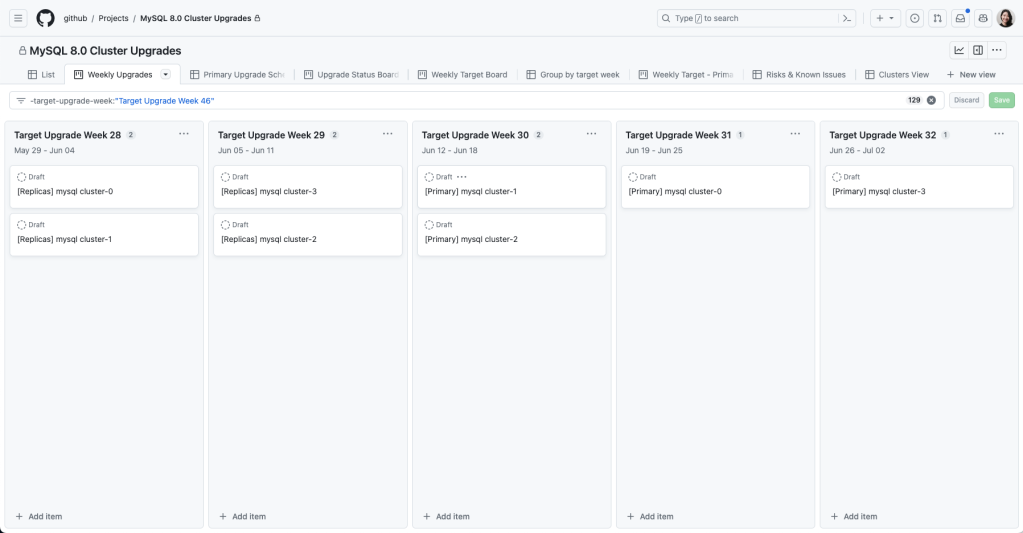
We used GitHub Projects to create a rolling calendar to communicate and track our upgrade schedule internally. We created issue templates that tracked the checklist for both application teams and the database team to coordinate an upgrade.

Project Board for tracking the MySQL 8.0 upgrade schedule

Upgrade plan

To meet our availability standards, we had a gradual upgrade strategy that allowed for checkpoints and rollbacks throughout the process.

Step 1: Rolling replica upgrades

We started with upgrading a single replica and monitoring while it was still offline to ensure basic functionality was stable. Then, we enabled production traffic and continued to monitor for query latency, system metrics, and application metrics. We gradually brought 8.0 replicas online until we upgraded an entire data center and then iterated through other data centers. We left enough 5.7 replicas online in order to rollback, but we disabled production traffic to start serving all read traffic through 8.0 servers.

The replica upgrade strategy involved gradual rollouts in each data center (DC).

Step 2: Update replication topology

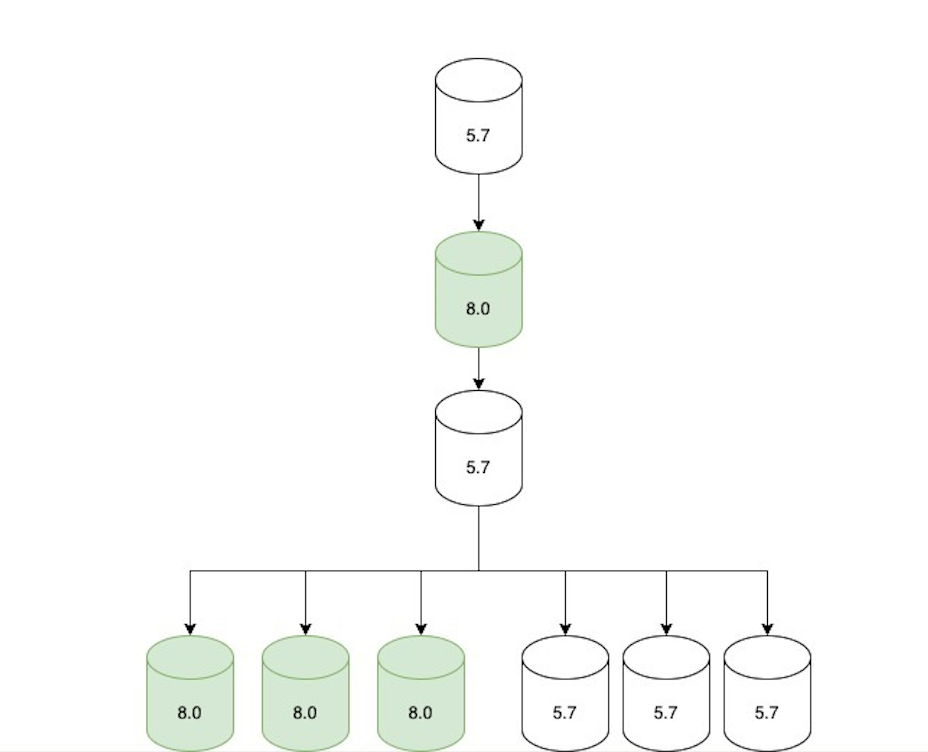
Once all the read-only traffic was being served via 8.0 replicas, we adjusted the replication topology as follows:

  • An 8.0 primary candidate was configured to replicate directly under the current 5.7 primary.
  • Two replication chains were created downstream of that 8.0 replica:
  • A set of only 5.7 replicas (not serving traffic, but ready in case of rollback).
  • A set of only 8.0 replicas (serving traffic).
  • The topology was only in this state for a short period of time (hours at most) until we moved to the next step.
To facilitate the upgrade, the topology was updated to have two replication chains.

Step 3: Promote MySQL 8.0 host to primary

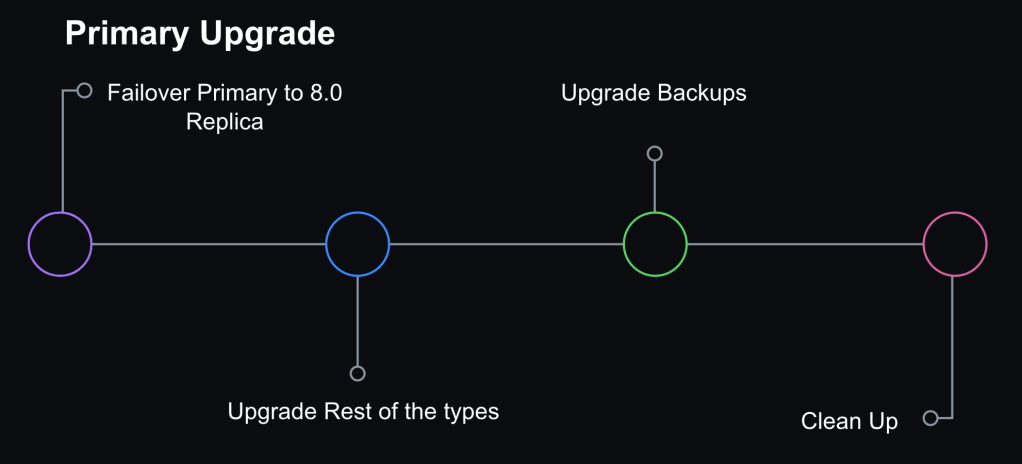
We opted not to do direct upgrades on the primary database host. Instead, we would promote a MySQL 8.0 replica to primary through a graceful failover performed with Orchestrator. At that point, the replication topology consisted of an 8.0 primary with two replication chains attached to it: an offline set of 5.7 replicas in case of rollback and a serving set of 8.0 replicas.

Orchestrator was also configured to blacklist 5.7 hosts as potential failover candidates to prevent an accidental rollback in case of an unplanned failover.

Primary failover and additional steps to finalize MySQL 8.0 upgrade for a database

Step 4: Internal facing instance types upgraded

We also have ancillary servers for backups or non-production workloads. Those were subsequently upgraded for consistency.

Step 5: Cleanup

Once we confirmed that the cluster didn’t need to rollback and was successfully upgraded to 8.0, we removed the 5.7 servers. Validation consisted of at least one complete 24 hour traffic cycle to ensure there were no issues during peak traffic.

Ability to Rollback

A core part of keeping our upgrade strategy safe was maintaining the ability to rollback to the prior version of MySQL 5.7. For read-replicas, we ensured enough 5.7 replicas remained online to serve production traffic load, and rollback was initiated by disabling the 8.0 replicas if they weren’t performing well. For the primary, in order to roll back without data loss or service disruption, we needed to be able to maintain backwards data replication between 8.0 and 5.7.

MySQL supports replication from one release to the next higher release but does not explicitly support the reverse (MySQL Replication compatibility). When we tested promoting an 8.0 host to primary on our staging cluster, we saw replication break on all 5.7 replicas. There were a couple of problems we needed to overcome:

  1. In MySQL 8.0, utf8mb4 is the default character set and uses a more modern utf8mb4_0900_ai_ci collation as the default. The prior version of MySQL 5.7 supported the utf8mb4_unicode_520_ci collation but not the latest version of Unicode utf8mb4_0900_ai_ci.
  2. MySQL 8.0 introduces roles for managing privileges but this feature did not exist in MySQL 5.7. When an 8.0 instance was promoted to be a primary in a cluster, we encountered problems. Our configuration management was expanding certain permission sets to include role statements and executing them, which broke downstream replication in 5.7 replicas. We solved this problem by temporarily adjusting defined permissions for affected users during the upgrade window.

To address the character collation incompatibility, we had to set the default character encoding to utf8 and collation to utf8_unicode_ci.

For the GitHub.com monolith, our Rails configuration ensured that character collation was consistent and made it easier to standardize client configurations to the database. As a result, we had high confidence that we could maintain backward replication for our most critical applications.

Challenges

Throughout our testing, preparation and upgrades, we encountered some technical challenges.

What about Vitess?

We use Vitess for horizontally sharding relational data. For the most part, upgrading our Vitess clusters was not too different from upgrading the MySQL clusters. We were already running Vitess in CI, so we were able to validate query compatibility. In our upgrade strategy for sharded clusters, we upgraded one shard at a time. VTgate, the Vitess proxy layer, advertises the version of MySQL and some client behavior depends on this version information. For example, one application used a Java client that disabled the query cache for 5.7 servers—since the query cache was removed in 8.0, it generated blocking errors for them. So, once a single MySQL host was upgraded for a given keyspace, we had to make sure we also updated the VTgate setting to advertise 8.0.

Replication delay

We use read-replicas to scale our read availability. GitHub.com requires low replication delay in order to serve up-to-date data.

Earlier on in our testing, we encountered a replication bug in MySQL that was patched on 8.0.28:

Replication: If a replica server with the system variable replica_preserve_commit_order = 1 set was used under intensive load for a long period, the instance could run out of commit order sequence tickets. Incorrect behavior after the maximum value was exceeded caused the applier to hang and the applier worker threads to wait indefinitely on the commit order queue. The commit order sequence ticket generator now wraps around correctly. Thanks to Zhai Weixiang for the contribution. (Bug #32891221, Bug #103636)

We happen to meet all the criteria for hitting this bug.

  • We use replica_preserve_commit_order because we use GTID based replication.
  • We have intensive load for long periods of time on many of our clusters and certainly for all of our most critical ones. Most of our clusters are very write-heavy.

Since this bug was already patched upstream, we just needed to ensure we are deploying a version of MySQL higher than 8.0.28.

We also observed that the heavy writes that drove replication delay were exacerbated in MySQL 8.0. This made it even more important that we avoid heavy bursts in writes. At GitHub, we use freno to throttle write workloads based on replication lag.

Queries would pass CI but fail on production

We knew we would inevitably see problems for the first time in production environments—hence our gradual rollout strategy with upgrading replicas. We encountered queries that passed CI but would fail on production when encountering real-world workloads. Most notably, we encountered a problem where queries with large WHERE IN clauses would crash MySQL. We had large WHERE IN queries containing over tens of thousands of values. In those cases, we needed to rewrite the queries prior to continuing the upgrade process. Query sampling helped to track and detect these problems. At GitHub, we use Solarwinds DPM (VividCortex), a SaaS database performance monitor, for query observability.

Learnings and takeaways

Between testing, performance tuning, and resolving identified issues, the overall upgrade process took over a year and involved engineers from multiple teams at GitHub. We upgraded our entire fleet to MySQL 8.0 – including staging clusters, production clusters in support of GitHub.com, and instances in support of internal tools. This upgrade highlighted the importance of our observability platform, testing plan, and rollback capabilities. The testing and gradual rollout strategy allowed us to identify problems early and reduce the likelihood for encountering new failure modes for the primary upgrade.

While there was a gradual rollout strategy, we still needed the ability to rollback at every step and we needed the observability to identify signals to indicate when a rollback was needed. The most challenging aspect of enabling rollbacks was holding onto the backward replication from the new 8.0 primary to 5.7 replicas. We learned that consistency in the Trilogy client library gave us more predictability in connection behavior and allowed us to have confidence that connections from the main Rails monolith would not break backward replication.

However, for some of our MySQL clusters with connections from multiple different clients in different frameworks/languages, we saw backwards replication break in a matter of hours which shortened the window of opportunity for rollback. Luckily, those cases were few and we didn’t have an instance where the replication broke before we needed to rollback. But for us this was a lesson that there are benefits to having known and well-understood client-side connection configurations. It emphasized the value of developing guidelines and frameworks to ensure consistency in such configurations.

Prior efforts to partition our data paid off—it allowed us to have more targeted upgrades for the different data domains. This was important as one failing query would block the upgrade for an entire cluster and having different workloads partitioned allowed us to upgrade piecemeal and reduce the blast radius of unknown risks encountered during the process. The tradeoff here is that this also means that our MySQL fleet has grown.

The last time GitHub upgraded MySQL versions, we had five database clusters and now we have 50+ clusters. In order to successfully upgrade, we had to invest in observability, tooling, and processes for managing the fleet.

Conclusion

A MySQL upgrade is just one type of routine maintenance that we have to perform – it’s critical for us to have an upgrade path for any software we run on our fleet. As part of the upgrade project, we developed new processes and operational capabilities to successfully complete the MySQL version upgrade. Yet, we still had too many steps in the upgrade process that required manual intervention and we want to reduce the effort and time it takes to complete future MySQL upgrades.

We anticipate that our fleet will continue to grow as GitHub.com grows and we have goals to partition our data further which will increase our number of MySQL clusters over time. Building in automation for operational tasks and self-healing capabilities can help us scale MySQL operations in the future. We believe that investing in reliable fleet management and automation will allow us to scale github and keep up with required maintenance, providing a more predictable and resilient system.

The lessons from this project provided the foundations for our MySQL automation and will pave the way for future upgrades to be done more efficiently, but still with the same level of care and safety.

The post Upgrading GitHub.com to MySQL 8.0 appeared first on The GitHub Blog.

Storage Tech of the Future: Ceramics, DNA, and More

Post Syndicated from Molly Clancy original https://www.backblaze.com/blog/storage-tech-of-the-future-ceramics-dna-and-more/

A decorative image showing a data drive with a health monitor indicator running through and behind it.

Two announcements had the Backblaze #social Slack channel blowing up this week, both related to “Storage Technologies of the Future.” The first reported “Video of Ceramic Storage System Surfaces Online” like some kind of UFO sighting. The second, somewhat more restrained announcement heralded the release of DNA storage cards available to the general public. Yep, you heard that right—coming to a Best Buy near you. (Not really. You absolutely have to special order these babies, but they ARE going to be for sale.)

We talked about DNA storage way back in 2015. It’s been nine years, so we thought it was high time to revisit the tech and dig into ceramics as well. (Pun intended.) 

What Is DNA Storage?

The idea is elegant, really. What is DNA if not an organic, naturally occuring form of code? 

DNA consists of four nucleotide bases: adenine (A), thymine (T), cytosine (C), and guanine (G). 

In DNA storage, information is encoded into sequences of these nucleotide bases. For example, A and C might represent 0, while T and G represent 1. This encoding allows digital data, such as text, images, or other types of information, to be translated into DNA sequences. Cool!

The appeal of DNA as a storage medium lies in its density and stability, as well as its ability to store vast amounts of information in a very compact space. It also boasts remarkable durability, with the ability to preserve information for thousands of years under suitable conditions. I mean, leave it to Mother Nature to put our silly little hard drives to shame.

Back in 2015, we shared that the storage density of DNA was about 2.2 petabytes per gram. In 2017, a study out of Columbia University and the New York Genome Center put it at an incredible 215 petabytes per gram. For comparison’s sake, a WDC 22TB drive (WDC WUH722222ALE6L4) that we currently use in our data centers is 1.5 pounds or 680 grams, which nets out at 0.032TB/gram or 0.000032PB/gram.

Another major advantage is its sustainability. Estimated global data center electricity consumption in 2022 was 240–340 TWh1, or around 1–1.3% of global final electricity demand. Current data storage technology uses rare earth metals which are environmentally damaging to mine. Drives take up space, and they also create e-waste at the end of their lifecycle. It’s a challenge anyone who works in the data storage industry thinks about a lot. 

DNA storage, on the other hand, requires less energy. A 2023 study found that data writing can be achieved in the DNA movable-type storage system under normal operating temperatures ranging from about 60–113°F and can be stored at room temperature. DNA molecules are also biodegradable and can be broken down naturally. 

The DNA data-writing process is chemical-based, and actually not the most environmentally friendly, but the DNA storage cards developed by Biomemory use a proprietary biosourced writing process, which they call “a significant advancement over existing chemical or enzymatic synthesis technologies.” So, there might be some trade-offs, but we’ll know more as the technology evolves. 

What’s the Catch?

Density? Check. Durability? Wow, yeah. Sustainability? You got it. But DNA storage is still a long way from sitting on your desk, storing your duplicate selfies. First, and we said this back in 2015 too, DNA takes a long time to read and write—DNA synthesis writes at a few hundred bytes per second. An average iPhone photo would take several hours to write to DNA. And to read it, you have to sequence the DNA—a time-intensive process. Both of those processes require specialized scientific equipment.

It’s also still too expensive. In 2015, we found a study that put 83 kilobytes of DNA storage at £1000 (about $1,500 U.S. dollars). In 2021, MIT estimated it would cost about $1 trillion to store one petabyte of data on DNA. For comparison, it costs $6,000 per month to store one petabyte in Backblaze B2 Cloud Storage ($6/TB/month). You could store that petabyte for a little over 13 million years before you’d hit $1 trillion.

Today, Biomemory’s DNA storage cards ring in at a cool €1000 (about $1,080 U.S. dollars). And they can hold a whopping one kilobyte of data or the equivalent of a short email. So, yeah …it’s ahh, gotten even more expensive for the commercial product. 

The discrepancy between the MIT theoretical estimate and the cost of the Biomemory cards really speaks to the expense of bringing a technology like this to market. The theoretical cost per byte is a lot different than the operational cost, and the Biomemory cards are really meant to serve as proof of concept.  All that said, as the technology improves, one can only hope that it becomes more cost-effective in the future. Folks are experimenting with different encoding schemes to make writing and reading more efficient, as one example of an advance that could start to tip the balance.  

Finally, there’s just something a bit spooky about using synthetic DNA to store data. There’s a Black Mirror episode in there somewhere. Maybe one day we can upload kung fu skills directly into our brain domes and that would be cool, but for now, it’s still somewhat unsettling.

What Is Ceramic Storage?

Ceramic storage makes an old school approach new again, if you consider that the first stone tablets were kind of the precursor to today’s hard drives. Who’s up for storing some cuneiform?

Cerabyte, the company behind the “video that surfaced online,” is working on storage technology that uses ceramic and glass substrates in devices the size of a typical HDD that can store 10 petabytes of data. They use a glass base similar to Gorilla Glass by Corning topped with a layer of ceramic 300 micrometers thick that’s essentially etched with lasers. (Glass is used in many larger hard drives today, for what it’s worth. Hoya makes them, for example.) The startup debuted a fully operational prototype system using only commercial off-the-shelf equipment—pretty impressive. 

The prototype consists of a single read-write rack and several library racks. When you want to write data, it moves one of the cartridges from the library to the read-write rack where it is opened to expose and stage the ceramic substrate. Two million laser beamlets then punch nanoscale ones and zeros into the surface. Once the data is written, the read-write arm verifies it on the return motion to its original position. 

Cerabyte isn’t the only player in the game. Others like MDisc use similar technology. Currently, MDisc stores data on DVD-sized disks using a “rock-like” substrate. Several DVD player manufacturers have included the technology in players. 

Similar to DNA storage, ceramic storage boasts much higher density than current data storage tech—terabytes per square centimeter versus an HDD’s 0.02TB per square centimeter. Also like DNA storage, it’s more environmentally friendly. Ceramic and glass can be stored within a wide temperature range between -460°F–570°F, and it’s a natural material that will last millennia and eventually decompose. It’s also incredibly durable: Cerabyte claims it will last 5000+ years, and with tons of clay pots still laying around from ancient times, that makes sense. 

One advantage it has on DNA storage though is speed. One laser pulse writes up to 2,000,000 bits, so data can be written at GBps speeds. 

What’s the Catch?

Ceramic also has density, sustainability, and speed to boot, but our biggest question is: who’s going to need that speed? There are only a handful of applications, like AI, that require that speed now. AI is certainly having a big moment, and it can only get bigger. So, presumably there’s a market, but only a small one that can justify the cost. 

One other biggie, at least for a cloud storage provider like us, though not necessarily for consumers or other enterprise users: it’s a write-once model. Once it’s on there, it’s on there. 

Finally, much like DNA tech, it’s probably (?) still too expensive to make it feasible for most data center applications. Cerabyte hasn’t released pricing yet. According to Blocks & Files, “The cost roadmap is expected to offer cost structures below projections of current commercial storage technologies.” But it’s still a big question mark.

Our Hot Take

Both of these technologies are really cool. They definitely got our storage geek brains fired up. But until they become scalable, operationally feasible, and cost-effective, you won’t see them in production—they’re still far enough out that they’re on the fiction end of the science fiction to science fact spectrum. And there are a couple roadblocks we see before they reach the ubiquity of your trusty hard drive. 

The first is making both technologies operational, not just theoretical in a lab. We’ll know more about both Biomemory’s and Cerabyte’s technologies as they roll out these initial proof of concept cards and prototype machines. And both have plans, naturally, for scaling the technologies to the data center. Whether they can or not remains to be seen. Lots of technologies have come and gone, falling victim to the challenges of production, scaling, and cost. 

The second is the attendant infrastructure needs. Getting 100x speed is great, if the device is right next to you. But we’ll need similar leaps in physical networking infrastructure to transfer the data anywhere else. Until that catches up, the tech remains lab-bound. 

All that said, I still remember using floppy disks that held mere megabytes of data, and now you can put 20TB on a hard disk. So, I guess the question is, how long will it be before I can plug into the Matrix?

The post Storage Tech of the Future: Ceramics, DNA, and More appeared first on Backblaze Blog | Cloud Storage & Cloud Backup.

AWS Clean Rooms proof of concept scoping part 1: media measurement

Post Syndicated from Shaila Mathias original https://aws.amazon.com/blogs/big-data/aws-clean-rooms-proof-of-concept-scoping-part-1-media-measurement/

Companies are increasingly seeking ways to complement their data with external business partners’ data to build, maintain, and enrich their holistic view of their business at the consumer level. AWS Clean Rooms helps companies more easily and securely analyze and collaborate on their collective datasets—without sharing or copying each other’s underlying data. With AWS Clean Rooms, you can create a secure data clean room in minutes and collaborate with any other company on Amazon Web Services (AWS) to generate unique insights.

One way to quickly get started with AWS Clean Rooms is with a proof of concept (POC) between you and a priority partner. AWS Clean Rooms supports multiple industries and use cases, and this blog is the first of a series on types of proof of concepts that can be conducted with AWS Clean Rooms.

In this post, we outline planning a POC to measure media effectiveness in a paid advertising campaign. The collaborators are a media owner (“CTV.Co,” a connected TV provider) and brand advertiser (“Coffee.Co,” a quick service restaurant company), that are analyzing their collective data to understand the impact on sales as a result of an advertising campaign. We chose to start this series with media measurement because “Results & Measurement” was the top ranked use case for data collaboration by customers in a recent survey the AWS Clean Rooms team conducted.

Important to keep in mind

  • AWS Clean Rooms is generally available so any AWS customer can sign in to the AWS Management Console and start using the service today without additional paperwork.
  • With AWS Clean Rooms, you can perform two types of analyses: SQL queries and machine learning. For the purpose of this blog, we will be focusing only on SQL queries. You can learn more about both types of analyses and their cost structures on the AWS Clean Rooms Features and Pricing webpages. The AWS Clean Rooms team can help you estimate the cost of a POC and can be reached at [email protected].
  • While AWS Clean Rooms supports multiparty collaboration, we assume two members in the AWS Clean Rooms POC collaboration in this blog post.

Overview

Setting up a POC helps define an existing problem of a specific use case for using AWS Clean Rooms with your partners. After you’ve determined who you want to collaborate with, we recommend three steps to set up your POC:

  • Defining the business context and success criteria – Determine which partner, which use case should be tested, and what the success criteria are for the AWS Clean Rooms collaboration.
  • Aligning on the technical choices for this test – Make the technical decisions of who sets up the clean room, who is analyzing the data, which data sets are being used, join keys and what analysis is being run.
  • Outlining the workflow and timing – Create a workback plan, decide on synthetic data testing, and align on production data testing.

In this post, we walk through an example of how a quick service restaurant (QSR) coffee company (Coffee.Co) would set up a POC with a connected TV provider (CTV.Co) to determine the success of an advertising campaign.

Business context and success criteria for the POC

Define the use case to be tested

The first step in setting up the POC is defining the use case being tested with your partner in AWS Clean Rooms. For example, Coffee.Co wants to run a measurement analysis to determine the media exposure on CTV.Co that led to sign up for Coffee.Co’s loyalty program. AWS Clean Rooms allows for Coffee.Co and CTV.Co to collaborate and analyze their collective datasets without copying each other’s underlying data.

Success criteria

It’s important to determine metrics of success and acceptance criteria to move the POC to production upfront. For example, Coffee.Co’s goal is to achieve a sufficient match rate between their data set and CTV.Co’s data set to ensure the efficacy of the measurement analysis. Additionally, Coffee.Co wants ease-of-use for existing Coffee.Co team members to set up the collaboration and action on the insights driven from the collaboration to optimize future media spend to tactics on CTV.Co that will drive more loyalty members.

Technical choices for the POC

Determine the collaboration creator, AWS account IDs, query runner, payor and results receiver

Each AWS Clean Rooms collaboration is created by a single AWS account inviting other AWS accounts. The collaboration creator specifies which accounts are invited to the collaboration, who can run queries, who pays for the compute, who can receive the results, and the optional query logging and cryptographic computing settings. The creator is also able to remove members from a collaboration. In this POC, Coffee.Co initiates the collaboration by inviting CTV.Co. Additionally, Coffee.Co runs the queries and receives the results, but CTV.Co pays for the compute.

Query logging setting

If logging is enabled in the collaboration, AWS Clean Rooms allows each collaboration member to receive query logs. The collaborator running the queries, Coffee.Co, gets logs for all data tables while the other collaborator, CTV.Co, only sees the logs if their data tables are referenced in the query.

Decide the AWS region

The underlying Amazon Simple Storage Service (Amazon S3) and AWS Glue resources for the data tables used in the collaboration must be in the same AWS Region as the AWS Clean Rooms collaboration. For example, Coffee.Co and CTV.Co agree on the US East (Ohio) Region for their collaboration.

Join keys

To join data sets in an AWS Clean Rooms query, each side of the join must share a common key. Key join comparison with the equal to operator (=) must evaluate to True. AND or OR logical operators can be used in the inner join for matching on multiple join columns. Keys such as email address, phone number, or UID2 are often considered. Third party identifiers from LiveRamp, Experian, or Neustar can be used in the join through AWS Clean Rooms specific work flows with each partner.

If sensitive data is being used as join keys, it’s recommended to use an obfuscation technique to mitigate the risk of exposing sensitive data if the data is mishandled. Both parties must use a technique that produces the same obfuscated join key values such as hashing. Cryptographic Computing for Clean Rooms can be used for this propose.

In this POC, Coffee.Co and CTV.Co are joining on hashed email or hashed mobile. Both collaborators are using the SHA256 hash on their plaintext email and phone number when preparing their data sets for the collaboration.

Data schema

The exact data schema must be determined by collaborators to support the agreed upon analysis. In this POC, Coffee.Co is running a conversion analysis to measure media exposures on CTV.Co that led to sign-up for Coffee.Co’s loyalty program. Coffee.Co’s schema includes hashed email, hashed mobile, loyalty sign up date, loyalty membership type, and birthday of member. CTV.Co’s schema includes hashed email, hashed mobile, impressions, clicks, timestamp, ad placement, and ad placement type.

Analysis rule applied to each configured table associated to the collaboration

An AWS Clean Rooms configured table is a reference to an existing table in the AWS Glue Data Catalog that’s used in the collaboration. It contains an analysis rule that determines how the data can be queried in AWS Clean Rooms. Configured tables can be associated to one or more collaborations.

AWS Clean Rooms offers three types of analysis rules: aggregation, list, and custom.

  • Aggregation allows you to run queries that generate an aggregate statistic within the privacy guardrails set by each data owner. For example, how large the intersection of two datasets is.
  • List allows you to run queries that extract the row level list of the intersection of multiple data sets. For example, the overlapped records on two datasets.
  • Custom allows you to create custom queries and reusable templates using most industry standard SQL, as well as review and approve queries prior to your collaborator running them. For example, authoring an incremental lift query that’s the only query permitted to run on your data tables. You can also use AWS Clean Rooms Differential Privacy by selecting a custom analysis rule and then configuring your differential privacy parameters.

In this POC, CTV.Co uses the custom analysis rule and authors the conversion query. Coffee.Co adds this custom analysis rule to their data table, configuring the table for association to the collaboration. Coffee.Co is running the query, and can only run queries that CTV.Co authors on the collective datasets in this collaboration.

Planned query

Collaborators should define the query that will be run by the collaborator determined to run the queries. In this POC, Coffe.Co runs the custom analysis rule query CTV.Co authored to understand who signed up for their loyalty program after being exposed to an ad on CTV.Co. Coffee.Co can specify their desired time window parameter to analyze when the membership sign-up took place within a specific date range, because that parameter has been enabled in the custom analysis rule query.

Workflow and timeline

To determine the workflow and timeline for setting up the POC, the collaborators should set dates for the following activities.

  1. Coffee.Co and CTV.Co align on business context, success criteria, technical details, and prepare their data tables.
    • Example deadline: January 10.
  2. [Optional] Collaborators work to generate representative synthetic datasets for non-production testing prior to production data testing.
    • Example deadline: January 15
  3. [Optional] Each collaborator uses synthetic datasets to create an AWS Clean Rooms collaboration between two of their owned AWS non-production accounts and finalizes analysis rules and queries they want to run in production.
    • Example deadline: January 30
  4. [Optional] Coffee.Co and CTV.Co create an AWS Clean Rooms collaboration between non-production accounts and tests the analysis rules and queries with the synthetic datasets.
    • Example deadline: February 15
  5. Coffee.Co and CTV.Co create a production AWS Clean Rooms collaboration and run the POC queries on production data.
    • Example deadline: Feb 28
  6. Evaluate POC results against success criteria to determine when to move to production.
    • Example deadline March 15

Conclusion

After you’ve defined the business context and success criteria for the POC, aligned on the technical details, and outlined the workflow and timing, the goal of the POC is to run a successful collaboration using AWS Clean Rooms to validate moving to production. After you’ve validated that the collaboration is ready to move to production, AWS can help you identify and implement automation mechanisms to programmatically run AWS Clean Rooms for your production use cases. Watch this video to learn more about privacy-enhanced collaboration and contact an AWS Representative to learn more about AWS Clean Rooms.

About AWS Clean Rooms

AWS Clean Rooms helps companies and their partners more easily and securely analyze and collaborate on their collective datasets—without sharing or copying one another’s underlying data. With AWS Clean Rooms, customers can create a secure data clean room in minutes, and collaborate with any other company on AWS to generate unique insights about advertising campaigns, investment decisions, and research and development.

Additional resources


About the authors

Shaila Mathias  is a Business Development lead for AWS Clean Rooms at Amazon Web Services.

Allison Milone is a Product Marketer for the Advertising & Marketing Industry at Amazon Web Services.

Ryan Malecky is a Senior Solutions Architect at Amazon Web Services. He is focused on helping customers build gain insights from their data, especially with AWS Clean Rooms.

[$] Controlling shadow-stack allocation in clone3()

Post Syndicated from corbet original https://lwn.net/Articles/953794/

User-space shadow stacks are a relatively new feature in Linux; support was
only added for 6.6, and is limited to the x86
architecture
. As support for other architectures (including arm64 and RISC-V) approaches readiness,
though, more thought is going into the API for this feature. As a recent
discussion on the integration of shadow stacks with the clone3() system call shows, there are
still some details to be worked out.

Simplify workforce identity management using IAM Identity Center and trusted token issuers

Post Syndicated from Roberto Migli original https://aws.amazon.com/blogs/security/simplify-workforce-identity-management-using-iam-identity-center-and-trusted-token-issuers/

AWS Identity and Access Management (IAM) roles are a powerful way to manage permissions to resources in the Amazon Web Services (AWS) Cloud. IAM roles are useful when granting permissions to users whose workloads are static. However, for users whose access patterns are more dynamic, relying on roles can add complexity for administrators who are faced with provisioning roles and making sure the right people have the right access to the right roles.

The typical solution to handle dynamic workforce access is the OAuth 2.0 framework, which you can use to propagate an authenticated user’s identity to resource services. Resource services can then manage permissions based on the user—their attributes or permissions—rather than building a complex role management system. AWS IAM Identity Center recently introduced trusted identity propagation based on OAuth 2.0 to support dynamic access patterns.

With trusted identity propagation, your requesting application obtains OAuth tokens from IAM Identity Center and passes them to an AWS resource service. The AWS resource service trusts tokens that Identity Center generates and grants permissions based on the Identity Center tokens.

What happens if the application you want to deploy uses an external OAuth authorization server, such as Okta Universal Directory or Microsoft Entra ID, but the AWS service uses IAM Identity Center? How can you use the tokens from those applications with your applications that AWS hosts?

In this blog post, we show you how you can use IAM Identity Center trusted token issuers to help address these challenges. You also review the basics of Identity Center and OAuth and how Identity Center enables the use of external OAuth authorization servers.

IAM Identity Center and OAuth

IAM Identity Center acts as a central identity service for your AWS Cloud environment. You can bring your workforce users to AWS and authenticate them from an identity provider (IdP) that’s external to AWS (such as Okta or Microsoft Entra), or you can create and authenticate the users on AWS.

Trusted identity propagation in IAM Identity Center lets AWS workforce identities use OAuth 2.0, helping applications that need to share who’s using them with AWS services. In OAuth, a client application and a resource service both trust the same authorization server. The client application gets an OAuth token for the user and sends it to the resource service. Because both services trust the OAuth server, the resource service can identify the user from the token and set permissions based on their identity.

AWS supports two OAuth patterns:

  • AWS applications authenticate directly with IAM Identity Center: Identity Center redirects authentication to your identity source, which generates OAuth tokens that the AWS managed application uses to access AWS services. This is the default pattern because the AWS services that support trusted identity propagation use Identity Center as their OAuth authorization server.
  • Third-party, non-AWS applications authenticate outside of AWS (typically to your IdP) and access AWS resources: During authentication, these third-party applications obtain an OAuth token from an OAuth authorization server outside of AWS. In this pattern, the AWS services aren’t connected to the same OAuth authorization server as the client application. To enable this pattern, AWS introduced a model called the trusted token issuer.

Trusted token issuer

When AWS services use IAM Identity Center as their authentication service, directory, and OAuth authorization server, the AWS services that use OAuth tokens require that Identity Center issues the tokens. However, most third-party applications federate with an external IdP and obtain OAuth tokens from an external authorization server. Although the identities in Identity Center and the external authorization server might be for the same person, the identities exist in separate domains, one in Identity Center, the other in the external authorization server. This is required to manage authorization of workforce identities with AWS services.

The trusted token issuer (TTI) feature provides a way to securely associate one identity from the external IdP with the other identity in IAM Identity Center.

When using third-party applications to access AWS services, there’s an external OAuth authorization server for the third-party application, and IAM Identity Center is the OAuth authorization server for AWS services; each has its own domain of users. The Identity Center TTI feature connects these two systems so that tokens from the external OAuth authorization server can be exchanged for tokens from Identity Center that AWS services can use to identify the user in the AWS domain of users. A TTI is the external OAuth authorization server that Identity Center trusts to provide tokens that third-party applications use to call AWS services, as shown in Figure 1.

Figure 1: Conceptual model using a trusted token issuer and token exchange

Figure 1: Conceptual model using a trusted token issuer and token exchange

How the trust model and token exchange work

There are two levels of trust involved with TTIs. First, the IAM Identity Center administrator must add the TTI, which makes it possible to exchange tokens. This involves connecting Identity Center to the Open ID Connect (OIDC) discovery URL of the external OAuth authorization server and defining an attribute-based mapping between the user from the external OAuth authorization server and a corresponding user in Identity Center. Second, the applications that exchange externally generated tokens must be configured to use the TTI. There are two models for how tokens are exchanged:

  • Managed AWS service-driven token exchange: A third-party application uses an AWS driver or API to access a managed AWS service, such as accessing Amazon Redshift by using Amazon Redshift drivers. This works only if the managed AWS service has been designed to accept and exchange tokens. The application passes the external token to the AWS service through an API call. The AWS service then makes a call to IAM Identity Center to exchange the external token for an Identity Center token. The service uses the Identity Center token to determine who the corresponding Identity Center user is and authorizes resource access based on that identity.
  • Third-party application-driven token exchange: A third-party application not managed by AWS exchanges the external token for an IAM Identity Center token before calling AWS services. This is different from the first model, where the application that exchanges the token is the managed AWS service. An example is a third-party application that uses Amazon Simple Storage Service (Amazon S3) Access Grants to access S3. In this model, the third-party application obtains a token from the external OAuth authorization server and then calls Identity Center to exchange the external token for an Identity Center token. The application can then use the Identity Center token to call AWS services that use Identity Center as their OAuth authorization server. In this case, the Identity Center administrator must register the third-party application and authorize it to exchange tokens from the TTI.

TTI trust details

When using a TTI, IAM Identity Center trusts that the TTI authenticated the user and authorized them to use the AWS service. This is expressed in an identity token or access token from the external OAuth authorization server (the TTI).

These are the requirements for the external OAuth authorization server (the TTI) and the token it creates:

  • The token must be a signed JSON Web Token (JWT). The JWT must contain a subject (sub) claim, an audience (aud) claim, an issuer (iss), a user attribute claim, and a JWT ID (JTI) claim.
    • The subject in the JWT is the authenticated user and the audience is a value that represents the AWS service that the application will use.
    • The audience claim value must match the value that is configured in the application that exchanges the token.
    • The issuer claim value must match the value configured in the issuer URL in the TTI.
    • There must be a claim in the token that specifies a user attribute that IAM Identity Center can use to find the corresponding user in the Identity Center directory.
    • The JWT token must contain the JWT ID claim. This claim is used to help prevent replay attacks. If a new token exchange is attempted after the initial exchange is complete, IAM Identity Center rejects the new exchange request.
  • The TTI must have an OIDC discovery URL that IAM Identity Center can use to obtain keys that it can use to verify the signature on JWTs created by your TTI. Identity Center appends the suffix /.well-known/openid-configuration to the provider URL that you configure to identify where to fetch the signature keys.

Note: Typically, the IdP that you use as your identity source for IAM Identity Center is your TTI. However, your TTI doesn’t have to be the IdP that Identity Center uses as an identity source. If the users from a TTI can be mapped to users in Identity Center, the tokens can be exchanged. You can have as many as 10 TTIs configured for a single Identity Center instance.

Details for applications that exchange tokens

Your OAuth authorization server service (the TTI) provides a way to authorize a user to access an AWS service. When a user signs in to the client application, the OAuth authorization server generates an ID token or an access token that contains the subject (the user) and an audience (the AWS services the user can access). When a third-party application accesses an AWS service, the audience must include an identifier of the AWS service. The third-party client application then passes this token to an AWS driver or an AWS service.

To use IAM Identity Center and exchange an external token from the TTI for an Identity Center token, you must configure the application that will exchange the token with Identity Center to use one or more of the TTIs. Additionally, as part of the configuration process, you specify the audience values that are expected to be used with the external OAuth token.

  • If the applications are managed AWS services, AWS performs most of the configuration process. For example, the Amazon Redshift administrator connects Amazon Redshift to IAM Identity Center, and then connects a specific Amazon Redshift cluster to Identity Center. The Amazon Redshift cluster exchanges the token and must be configured to do so, which is done through the Amazon Redshift administrative console or APIs and doesn’t require additional configuration.
  • If the applications are third-party and not managed by AWS, your IAM Identity Center administrator must register the application and configure it for token exchange. For example, suppose you create an application that obtains an OAuth token from Okta Universal Directory and calls S3 Access Grants. The Identity Center administrator must add this application as a customer managed application and must grant the application permissions to exchange tokens.

How to set up TTIs

To create new TTIs, open the IAM Identity Center console, choose Settings, and then choose Create trusted token issuer, as shown in Figure 2. In this section, I show an example of how to use the console to create a new TTI to exchange tokens with my Okta IdP, where I already created my OIDC application to use with my new IAM Identity Center application.

Figure 2: Configure the TTI in the IAM Identity Center console

Figure 2: Configure the TTI in the IAM Identity Center console

TTI uses the issuer URL to discover the OpenID configuration. Because I use Okta, I can verify that my IdP discovery URL is accessible at https://{my-okta-domain}.okta.com/.well-known/openid-configuration. I can also verify that the OpenID configuration URL responds with a JSON that contains the jwks_uri attribute, which contains a URL that lists the keys that are used by my IdP to sign the JWT tokens. Trusted token issuer requires that both URLs are publicly accessible.

I then configure the attributes I want to use to map the identity of the Okta user with the user in IAM Identity Center in the Map attributes section. I can get the attributes from an OIDC identity token issued by Okta:

{
    "sub": "00u22603n2TgCxTgs5d7",
    "email": "<masked>",
    "ver": 1,
    "iss": "https://<masked>.okta.com",
    "aud": "123456nqqVBTdtk7890",
    "iat": 1699550469,
    "exp": 1699554069,
    "jti": "ID.MojsBne1SlND7tCMtZPbpiei9p-goJsOmCiHkyEhUj8",
    "amr": [
        "pwd"
    ],
    "idp": "<masked>",
    "auth_time": 1699527801,
    "at_hash": "ZFteB9l4MXc9virpYaul9A"
}

I’m requesting a token with an additional email scope, because I want to use this attribute to match against the email of my IAM Identity Center users. In most cases, your Identity Center users are synchronized with your central identity provider by using automatic provisioning with the SCIM protocol. In this case, you can use the Identity Center external ID attribute to match with oid or sub attributes. The only requirement for TTI is that those attributes create a one-to-one mapping between the two IdPs.

Now that I have created my TTI, I can associate it with my IAM Identity Center applications. As explained previously, there are two use cases. For the managed AWS service-driven token exchange use case, use the service-specific interface to do so. For example, I can use my TTI with Amazon Redshift, as shown in Figure 3:

Figure 3: Configure the TTI with Amazon Redshift

Figure 3: Configure the TTI with Amazon Redshift

I selected Okta as the TTI to use for this integration, and I now need to configure the audclaim value that the application will use to accept the token. I can find it when creating the application from the IdP side–in this example, the value is 123456nqqVBTdtk7890, and I can obtain it by using the preceding example OIDC identity token.

I can also use the AWS Command Line Interface (AWS CLI) to configure the IAM Identity Center application with the appropriate application grants:

aws sso put-application-grant \
    --application-arn "<my-application-arn>" \
    --grant-type "urn:ietf:params:oauth:grant-type:jwt-bearer" \
    --grant '
    {
        "JwtBearer": { 
            "AuthorizedTokenIssuers": [
                {
                    "TrustedTokenIssuerArn": "<my-tti-arn>", 
                    "AuthorizedAudiences": [
                        "123456nqqVBTdtk7890"
                    ]
                 }
            ]
       }
    }'

Perform a token exchange

For AWS service-driven use cases, the token exchange between your IdP and IAM Identity Center is performed automatically by the service itself. For third-party application-driven token exchange, such as when building your own Identity Center application with S3 Access Grants, your application performs the token exchange by using the Identity Center OIDC API action CreateTokenWithIAM:

aws sso-oidc create-token-with-iam \  
    --client-id "<my-application-arn>" \ 
    --grant-type "urn:ietf:params:oauth:grant-type:jwt-bearer" \
    --assertion "<jwt-from-idp>"

This action is performed by an IAM principal, which then uses the result to interact with AWS services.

If successful, the result looks like the following:

{
    "accessToken": "<idc-access-token>",
    "tokenType": "Bearer",
    "expiresIn": 3600,
    "idToken": "<jwt-idc-identity-token>",
    "issuedTokenType": "urn:ietf:params:oauth:token-type:access_token",
    "scope": [
        "sts:identity_context",
        "openid",
        "aws"
    ]
}

The value of the scope attribute varies depending on the IAM Identity Center application that you’re interacting with, because it defines the permissions associated with the application.

You can also inspect the idToken attribute because it’s JWT-encoded:

{
    "aws:identity_store_id": "d-123456789",
    "sub": "93445892-f001-7078-8c38-7f2b978f686f",
    "aws:instance_account": "12345678912",
    "iss": "https://identitycenter.amazonaws.com/ssoins-69870e74abba8440",
    "sts:audit_context": "<sts-token>",
    "aws:identity_store_arn": "arn:aws:identitystore::12345678912:identitystore/d-996701d649",
    "aud": "20bSatbAF2kiR7lxX5Vdp2V1LWNlbnRyYWwtMQ",
    "aws:instance_arn": "arn:aws:sso:::instance/ssoins-69870e74abba8440",
    "aws:credential_id": "<masked>",
    "act": {
      "sub": "arn:aws:sso::12345678912:trustedTokenIssuer/ssoins-69870e74abba8440/c38448c2-e030-7092-0f0a-b594f83fcf82"
    },
    "aws:application_arn": "arn:aws:sso::12345678912:application/ssoins-69870e74abba8440/apl-0ed2bf0be396a325",
    "auth_time": "2023-11-10T08:00:08Z",
    "exp": 1699606808,
    "iat": 1699603208
  }

The token contains:

  • The AWS account and the IAM Identity Center instance and application that accepted the token exchange
  • The unique user ID of the user that was matched in IAM Identity Center (attribute sub)

AWS services can now use the STS Audit Context token (found in the attribute sts:audit_context) to create identity-aware sessions with the STS API. You can audit the API calls performed by the identity-aware sessions in AWS CloudTrail, by inspecting the attribute onBehalfOf within the field userIdentity. In this example, you can see an API call that was performed with an identity-aware session:

"userIdentity": {
    ...
    "onBehalfOf": {
        "userId": "93445892-f001-7078-8c38-7f2b978f686f",
        "identityStoreArn": "arn:aws:identitystore::425341151473:identitystore/d-996701d649"
    }
}

You can thus quickly filter actions that an AWS principal performs on behalf of your IAM Identity Center user.

Troubleshooting TTI

You can troubleshoot token exchange errors by verifying that:

  • The OpenID discovery URL is publicly accessible.
  • The OpenID discovery URL response conforms with the OpenID standard.
  • The OpenID keys URL referenced in the discovery response is publicly accessible.
  • The issuer URL that you configure in the TTI exactly matches the value of the iss scope that your IdP returns.
  • The user attribute that you configure in the TTI exists in the JWT that your IdP returns.
  • The user attribute value that you configure in the TTI matches exactly one existing IAM Identity Center user on the target attribute.
  • The aud scope exists in the token returned from your IdP and exactly matches what is configured in the requested IAM Identity Center application.
  • The jti claim exists in the token returned from your IdP.
  • If you use an IAM Identity Center application that requires user or group assignments, the matched Identity Center user is already assigned to the application or belongs to a group assigned to the application.

Note: When an IAM Identity Center application doesn’t require user or group assignments, the token exchange will succeed if the preceding conditions are met. This configuration implies that the connected AWS service requires additional security assignments. For example, Amazon Redshift administrators need to configure access to the data within Amazon Redshift. The token exchange doesn’t grant implicit access to the AWS services.

Conclusion

In this blog post, we introduced the trust token issuer feature of IAM Identity Center and what it offers, how it’s configured, and how you can use it to integrate your IdP with AWS services. You learned how to use TTI with AWS-managed applications and third-party applications by configuring the appropriate parameters. You also learned how to troubleshoot token-exchange issues and audit access through CloudTrail.

If you have feedback about this post, submit comments in the Comments section below. If you have questions about this post, start a new thread on the AWS IAM Identity Center re:Post or contact AWS Support.

Roberto Migli

Roberto Migli

Roberto is a Principal Solutions Architect at AWS. Roberto supports global financial services customers, focusing on security and identity and access management. In his free time, he enjoys building electronic gadgets, learning about space, and spending time with his family.

Ron Cully

Ron Cully

Ron is a Principal Product Manager at AWS where he leads feature and roadmap planning for workforce identity products at AWS. Ron has over 20 years of industry experience in product and program management in networking and directory related products. He is passionate about delivering secure, reliable solutions that help make it simple for customers to migrate directory-aware applications and workloads to the cloud.

Rafael Koike

Rafael Koike

Rafael is a Principal Solutions Architect supporting enterprise customers in the Southeast and is a Storage SME. Rafael has a passion to build, and his expertise in security, storage, networking, and application development has been instrumental in helping customers move to the cloud quickly and securely.

Just about every Windows and Linux device vulnerable to new LogoFAIL firmware attack (ars technica)

Post Syndicated from corbet original https://lwn.net/Articles/953985/

This
ars technica article
describes how secure-boot firmware on a huge range
of systems can be subverted with a malicious image file:

As its name suggests, LogoFAIL involves logos, specifically those
of the hardware seller that are displayed on the device screen
early in the boot process, while the UEFI is still running. Image
parsers in UEFIs from all three major IBVs [independent BIOS
vendors] are riddled with roughly a dozen critical vulnerabilities
that have gone unnoticed until now. By replacing the legitimate
logo images with identical-looking ones that have been specially
crafted to exploit these bugs, LogoFAIL makes it possible to
execute malicious code at the most sensitive stage of the boot
process.

Security updates for Thursday

Post Syndicated from jake original https://lwn.net/Articles/953977/

Security updates have been issued by Debian (tzdata), Fedora (gmailctl), Oracle (kernel), Red Hat (linux-firmware, postgresql:12, postgresql:13, and squid:4), SUSE (cdi-apiserver-container, cdi-cloner-container, cdi- controller-container, cdi-importer-container, cdi-operator-container, cdi- uploadproxy-container, cdi-uploadserver-container, cont, frr, libtorrent-rasterbar, qbittorrent, openssl-3, openvswitch, openvswitch3, and suse-build-key), and Ubuntu (bluez, curl, linux, linux-aws, linux-azure, linux-laptop, linux-lowlatency,
linux-oem-6.5, linux-oracle, linux-raspi, linux-starfive, linux-gcp, open-vm-tools, postgresql-12, postgresql-14, postgresql-15, and python-cryptography).

The collective thoughts of the interwebz