Ever since the (public) invention of cryptography based on mathematical trap-doors by Whitfield Diffie, Martin Hellman, and Ralph Merkle, the world has had key agreement and signature schemes based on discrete logarithms. Rivest, Shamir, and Adleman invented integer factorization-based signature and encryption schemes a few years later. The core idea, that has perhaps changed the world in ways that are hard to comprehend, is that of public key cryptography. We can give you a piece of information that is completely public (the public key), known to all our adversaries, and yet we can still securely communicate as long as we do not reveal our piece of extra information (the private key). With the private key, we can then efficiently solve mathematical problems that, without the secret information, would be practically unsolvable.
In later decades, there were advancements in our understanding of integer factorization that required us to bump up the key sizes for finite-field based schemes. The cryptographic community largely solved that problem by figuring out how to base the same schemes on elliptic curves. The world has since then grown accustomed to having algorithms where public keys, secret keys, and signatures are just a handful of bytes and the speed is measured in the tens of microseconds. This allowed cryptography to be bolted onto previously insecure protocols such as HTTP or DNS without much overhead in either time or the data transmitted. We previously wrote about how TLS loves small signatures; similar things can probably be said for a lot of present-day protocols.
But this blog has “post-quantum” in the title; quantum computers are likely to make our cryptographic lives significantly harder by undermining many of the assurances we previously took for granted. The old schemes are no longer secure because new algorithms can efficiently solve their particular mathematical trapdoors. We, together with everyone on the Internet, will need to swap them out. There are whole suites of quantum-resistant replacement algorithms; however, right now it seems that we need to choose between “fast” and “small”. The new alternatives also do not always have the same properties that we have based some protocols on.
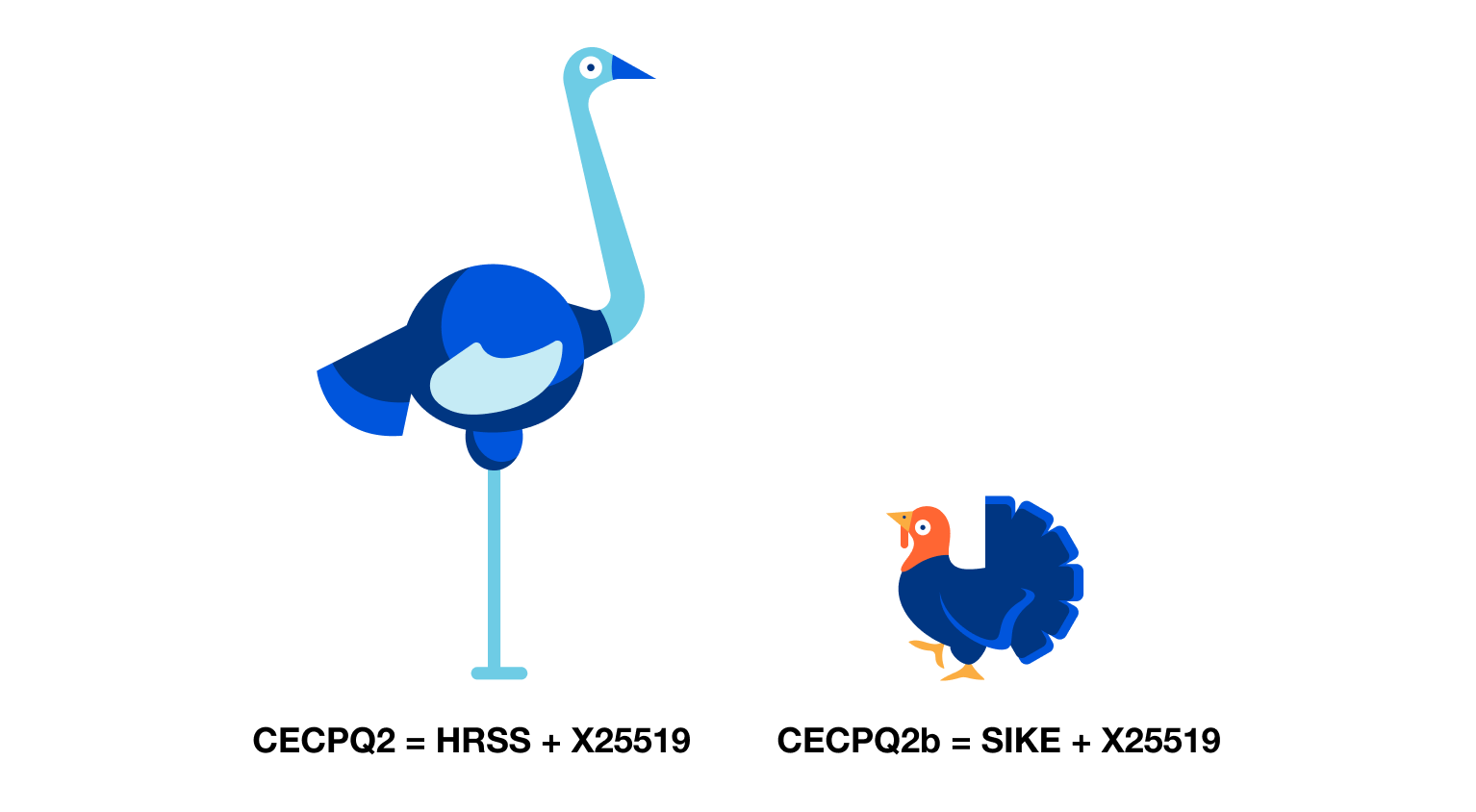
Fast or small: Cloudflare previously experimented with NTRU-HRSS (a fast key exchange scheme with large public keys and ciphertexts) and SIKE (a scheme with very small public keys and ciphertexts, but much slower algorithm operations).
In this blog post, we will discuss how one might upgrade cryptographic protocols to make them secure against quantum computers. We will focus on the cryptography that they use and see what the challenges are in making them secure against quantum computers. We will show how trade-offs might motivate completely new protocols for some applications. We will use TLS here as a stand-in for other protocols, as it is one of the most deployed protocols.
Making TLS post-quantum
TLS, from SSL and HTTPS fame, gets discussed a lot. We keep it brief here. TLS 1.3 consists of an Ephemeral Elliptic curve Diffie-Hellman (ECDH) key exchange which is authenticated by a digital signature that’s verified by using a public key that’s provided by the server in a certificate. We know that this public key is the right one because the certificate contains another signature by the issuer of the certificate and our client has a repository of valid issuer (“certificate authority”) public keys that it can use to verify the authenticity of the server’s certificate.
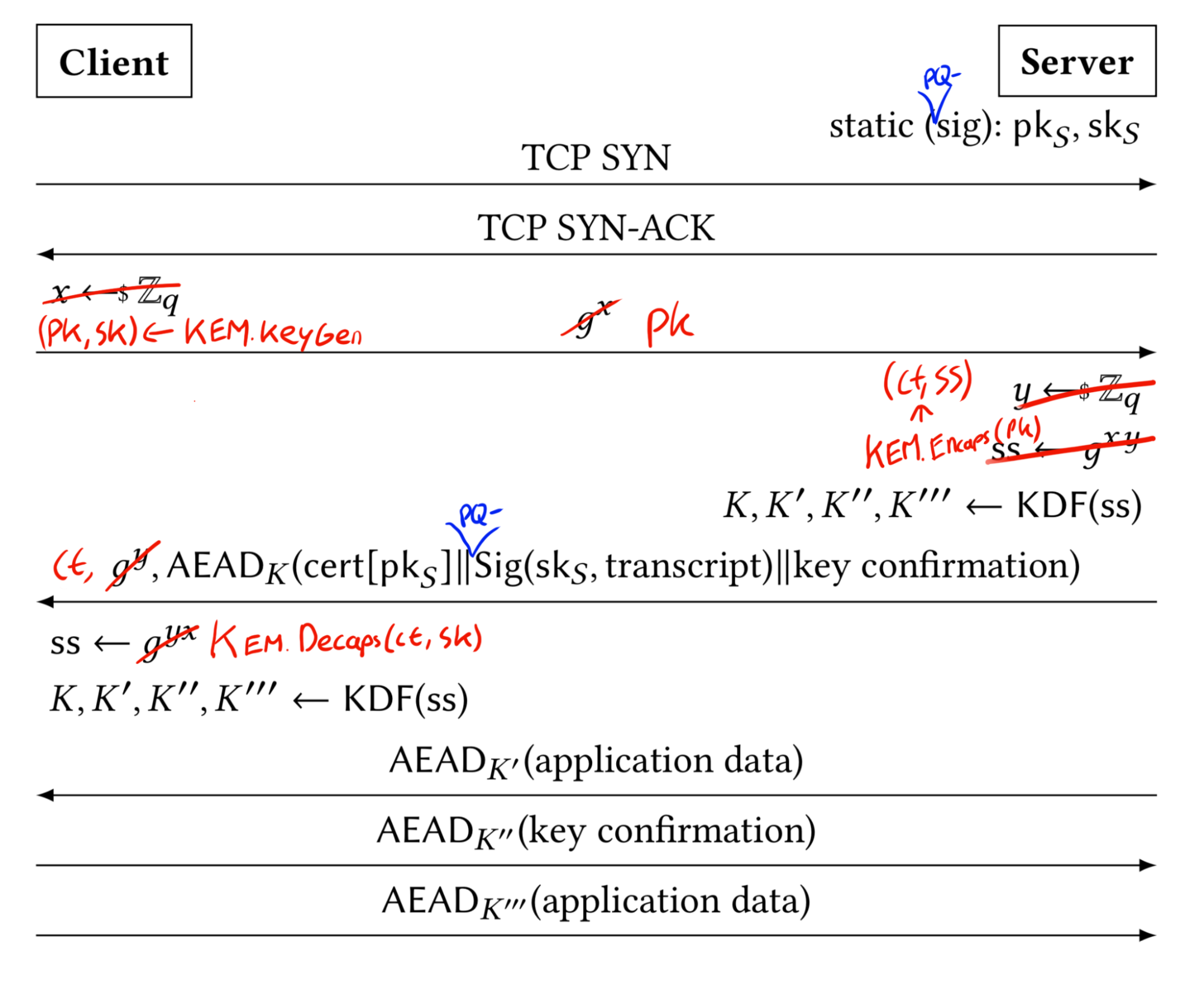
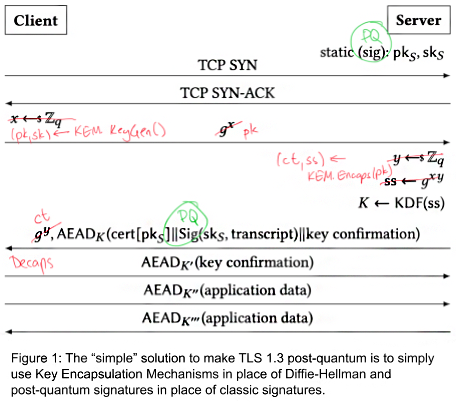
In principle, TLS can become post-quantum straightforwardly: we just write “PQ” in front of the algorithms. We replace ECDH key exchange by post-quantum (PQ) key exchange provided by a post-quantum Key Encapsulation Mechanism (KEM). For the signatures on the handshake, we just use a post-quantum signature scheme instead of an elliptic curve or RSA signature scheme. No big changes to the actual “arrows” of the protocol necessary, which is super convenient because we don’t need to revisit our security proofs. Mission accomplished, cake for everyone, right?
Upgrading the cryptography in TLS seems as easy as scribbling in “PQ-”.
Key exchange
Of course, it’s not so simple. There are nine different suites of post-quantum key exchange algorithms still in the running in round three of the NIST Post-Quantum standardization project: Kyber, SABER, NTRU, and Classic McEliece (the “finalists”); and SIKE, BIKE, FrodoKEM, HQC, and NTRU Prime (“alternates”). These schemes have wildly different characteristics. This means that for step one, replacing the key exchange by post-quantum key exchange, we need to understand the differences between these schemes and decide which one fits best in TLS. Because we’re doing ephemeral key exchange, we consider the size of the public key and the ciphertext since they need to be transmitted for every handshake. We also consider the “speed” of the key generation, encapsulation, and decapsulation operations, because these will affect how many servers we will need to handle these connections.
Table 1: Post-Quantum KEMs at security level comparable with AES128. Sizes in bytes.
Scheme
Transmission size (pk+ct)
Speed of operations
Finalists
Kyber512
1,632
Very fast
NTRU-HPS-2048-509
1,398
Very fast
SABER (LightSABER)
1,408
Very fast
Classic McEliece
261,248
Very slow
Alternate candidates
SIKEp434
676
Slow
NTRU Prime (ntrulpr)
1,922
Very fast
NTRU Prime (sntru)
1,891
Fast
BIKE
5,892
Slow
HQC
6,730
Reasonable
FrodoKEM
19,336
Reasonable
Fortunately, once we make this table the landscape for KEMs that are suitable for use in TLS quickly becomes clear. We will have to sacrifice an additional 1,400 – 2,000 bytes, assuming SIKE’s slow runtime is a bigger penalty to the connection establishment (see our previous work here). So we can choose one of the lattice-based finalists (Kyber, SABER or NTRU) and call it a day.1
Signature schemes
For our post-quantum signature scheme, we can draw a similar table. In TLS, we generally care about the sizes of public keys and signatures. In terms of runtime, we care about signing and verification times, as key generation is only done once for each certificate, offline. The round three candidates for signature schemes are: Dilithium, Falcon, Rainbow (the three finalists), and SPHINCS+, Picnic, and GeMSS.
Table 2: Post-Quantum signature schemes at security level comparable with AES128 (or smallest parameter set). Sizes in bytes.
Scheme
Public key size
Signature size
Speed of operations
Finalists
Dilithium2
1,312
2,420
Very fast
Falcon-512
897
690
Fast if you have the right hardware
Rainbow-I-CZ
103,648
66
Fast
Alternate Candidates
SPHINCS+-128f
32
17,088
Slow
SPHINCS+-128s
32
7,856
Very slow
GeMSS-128
352,188
33
Very slow
Picnic3
35
14,612
Very slow
There are many signatures in a TLS handshake. Aside from the handshake signature that the server creates to authenticate the handshake (with public key in the server certificate), there are signatures on the certificate chain (with public keys for intermediate certificates), as well as OCSP Stapling (1) and Certificate Transparency (2) signatures (without public keys).
This means that if we used Dilithium for all of these, we require 17KB of public keys and signatures. Falcon is looking very attractive here, only requiring 6KB, but it might not run fast enough on embedded devices that don’t have special hardware to accelerate 64-bit floating point computations in constant time. SPHINCS+, GeMSS, or Rainbow each have significant deployment challenges, so it seems that there is no one-scheme-fits-all solution.
Picking and choosing specific algorithms for particular use cases, such as using a scheme with short signatures for root certificates, OCSP Stapling, and CT might help to alleviate the problems a bit. We might use Rainbow for the CA root, OCSP staples, and CT logs, which would mean we only need 66 bytes for each signature. It is very nice that Rainbow signatures are only very slightly larger than 64-byte ed25519 elliptic curve signatures, and they are significantly smaller than 256-byte RSA-2048 signatures. This gives us a lot of space to absorb the impact of the larger handshake signatures required. For intermediate certificates, where both the public key and the signature are transmitted, we might use Falcon because it’s nice and small, and the client only needs to do signature verification.
Using KEMs for authentication
In the pre-quantum world, key exchange and signature schemes used to be roughly equivalent in terms of work required or bytes transmitted. As we saw in the previous section, this doesn’t hold up in the post-quantum world. This means that this might be a good opportunity to also investigate alternatives to the classic “signed key exchange” model. Deploying significant changes to an existing protocol might be harder than just swapping out primitives, but we might gain better characteristics. We will look at such a proposed redesign for TLS here.
The idea is to use key exchange not just for confidentiality, but also for authentication. This uses the following idea: what a signature in a protocol like TLS is actually proving is that the person signing has possession of the secret key that corresponds to the public key that’s in the certificate. But we can also do this with a key exchange key by showing you can derive the same shared secret (if you want to prove this explicitly, you might do so by computing a Message Authentication Code using the established shared secret).
This isn’t new; many modern cryptographic protocols, such as the Signal messaging protocol, have used such mechanisms. They offer privacy benefits like (offline) deniability. But now we might also use this to obtain a faster or “smaller” protocol.
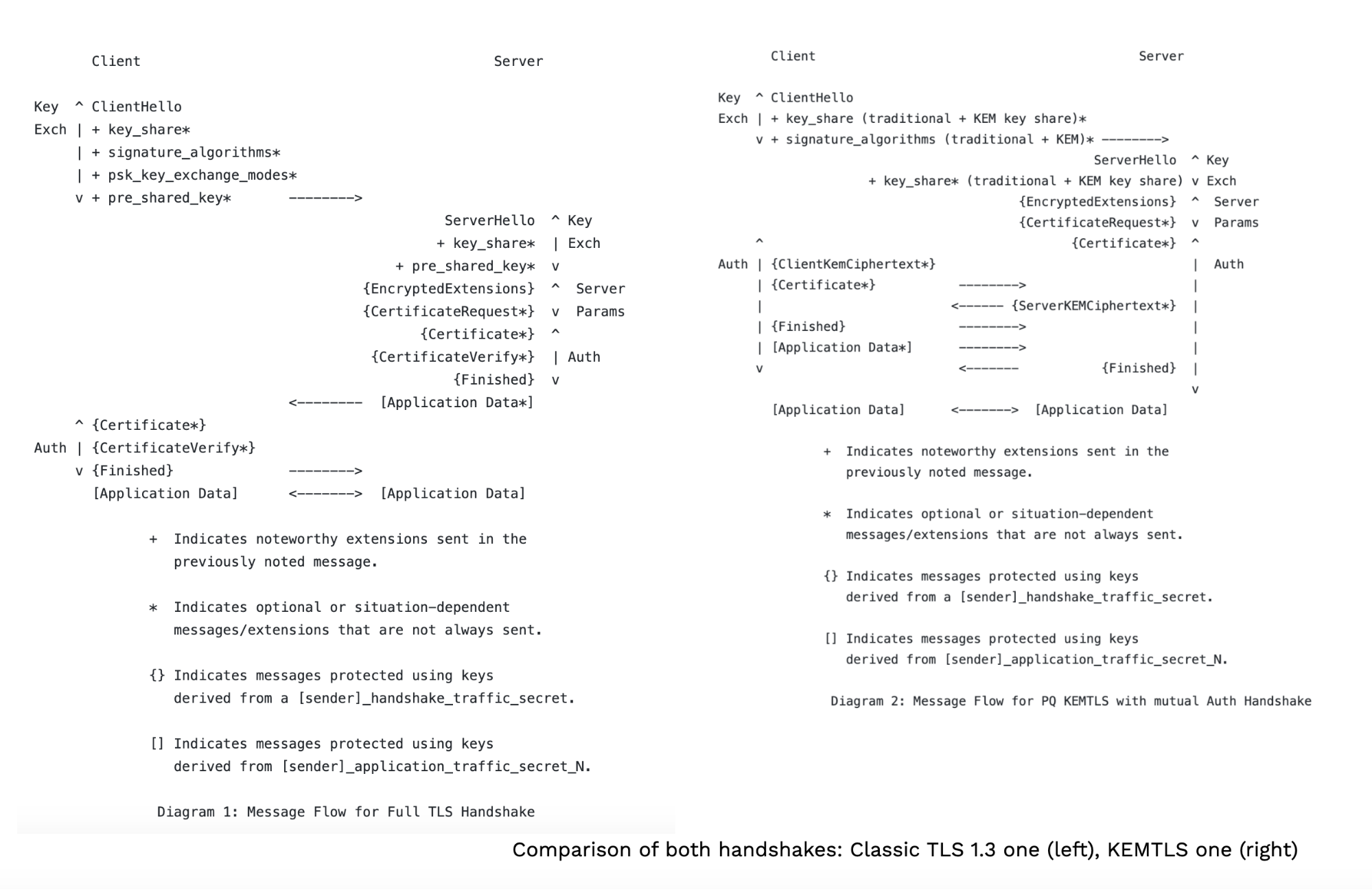
However, this does not come for free. Because authentication via key exchange (via KEM at least) inherently requires two participants to exchange keys, we need to send more messages. In TLS, this means that the server that wants to authenticate first needs to give the client their public key. The client obviously can not encapsulate a shared secret to a key he does not know.
We also still need to verify signatures on the certificate chain and the signatures for OCSP stapling and Certificate Transparency are still necessary. Because we need to do “offline” verification for those elements of the handshake, it is hard to get rid of those signatures. So we will still need to carefully look at those signatures and pick an algorithm that fits there.
   Client                                  Server
 ClientHello         -------->
                     <--------         ServerHello
                                             <...>
                     <--------       <Certificate>  ^
 <KEMEncapsulation>                                 | Auth
 {Finished}          -------->                      |
 [Application Data]  -------->                      |
                     <--------          {Finished}  v
 [Application Data]  <------->  [Application Data]

<msg>: encrypted w/ keys derived from ephemeral KEX (HS)
{msg}: encrypted w/ keys derived from HS+KEM (AHS)
[msg]: encrypted w/ traffic keys derived from AHS (MS)

Authentication via KEM in TLS from the AuthKEM proposal
Authentication via KEM in TLS from the AuthKEM proposal
If we put the necessary arrows to authenticate via KEM into TLS it looks something like Figure 2. This is actually a fully-fledged proposal for an alternative to the usual TLS handshake. The academic proposal KEMTLS was published at the ACM CCS conference in 2020; a proposal to integrate this into TLS 1.3 is described in the draft-celi-wiggers-tls-authkem draft RFC.
What this proposal illustrates is that the transition to post-quantum cryptography might motivate, or even require, us to have a brand-new look at what the desired characteristics of our protocol are and what properties we need, like what budget we have for round-trips versus the budget for data transmitted. We might even pick up some properties, like deniability, along the way. For some protocols this is somewhat easy, like TLS; in other protocols there isn’t even a clear idea of where to start (DNSSEC has very tight limits).
Conclusions
We should not wait until NIST has finished standardizing post-quantum key exchange and signature schemes before thinking about whether our protocols are ready for the post-quantum world. For our current protocols, we should investigate how the proposed post-quantum key exchange and signature schemes can be fitted in. At the same time, we might use this opportunity for careful protocol redesigns, especially if the constraints are so tight that it is not easy to fit in post-quantum cryptography. Cloudflare is participating in the IETF and working with partners in both academia and the industry to investigate the impact of post-quantum cryptography and make the transition as easy as possible.
If you want to be a part of the future of cryptography on the Internet, either as an academic or an engineer, be sure to check out our academic outreach or jobs pages.
1Of course, it’s not so simple. The performance measurements were done on a beefy Macbook, using AVX2 intrinsics. For stuff like IoT (yes, your smart washing machine will also need to go post-quantum) or a smart card you probably want to add another few columns to this table before making a choice, such as code size, side channel considerations, power consumption, and execution time on your platform.
The Internet is accustomed to the fact that any two parties can exchange information securely without ever having to meet in advance. This magic is made possible by key exchange algorithms, which are core to certain protocols, such as the Transport Layer Security (TLS) protocol, that are used widely across the Internet.
Key exchange algorithms are an elegant solution to a vexing, seemingly impossible problem. Imagine a scenario where keys are transmitted in person: if Persephone wishes to send her mother Demeter a secret message, she can first generate a key, write it on a piece of paper and hand that paper to her mother, Demeter. Later, she can scramble the message with the key, and send the scrambled result to her mother, knowing that her mother will be able to unscramble the message since she is also in possession of the same key.
But what if Persephone is kidnapped (as the story goes) and cannot deliver this key in person? What if she can no longer write it on a piece of paper because someone (by chance Hades, the kidnapper) might read that paper and use the key to decrypt any messages between them? Key exchange algorithms come to the rescue: Persephone can run a key exchange algorithm with Demeter, giving both Persephone and Demeter a secret value that is known only to them (no one else knows it) even if Hades is eavesdropping. This secret value can be used to encrypt messages that Hades cannot read.
The most widely used key exchange algorithms today are based on hard mathematical problems, such as integer factorization and the discrete logarithm problem. But these problems can be efficiently solved by a quantum computer, as we have previously learned, breaking the secrecy of the communication.
There are other mathematical problems that are hard even for quantum computers to solve, such as those based on lattices or isogenies. These problems can be used to build key exchange algorithms that are secure even in the face of quantum computers. Before we dive into this matter, we have to first look at one algorithm that can be used for Key Exchange: Key Encapsulation Mechanisms (KEMs).
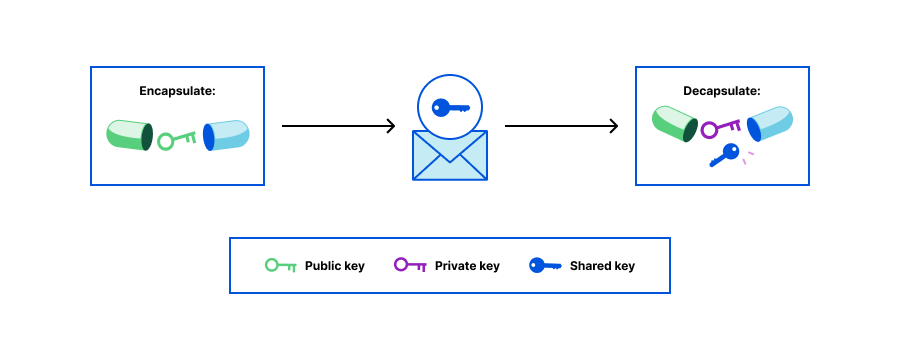
Two people could agree on a secret value if one of them could send the secret in an encrypted form to the other one, such that only the other one could decrypt and use it. This is what a KEM makes possible, through a collection of three algorithms:
A key generation algorithm, Generate, which generates a public key and a private key (a keypair).
An encapsulation algorithm, Encapsulate, which takes as input a public key, and outputs a shared secret value and an “encapsulation” (a ciphertext) of this secret value.
A decapsulation algorithm, Decapsulate, which takes as input the encapsulation and the private key, and outputs the shared secret value.
A KEM can be seen as similar to a Public Key Encryption (PKE) scheme, since both use a combination of public and private keys. In a PKE, one encrypts a message using the public key and decrypts using the private key. In a KEM, one uses the public key to create an “encapsulation” — giving a randomly chosen shared key — and one decrypts this “encapsulation” with the private key. The reason why KEMs exist is that PKE schemes are usually less efficient than symmetric encryption schemes; one can use a KEM to only transmit the shared/symmetric key, and later use it in a symmetric algorithm to efficiently encrypt data.
Nowadays, in most of our connections, we do not use KEMs or PKEs per se. We either use Key Exchanges (KEXs) or Authenticated Key Exchanges (AKE). The reason for this is that a KEX allows us to use public keys (solving the key exchange problem of how to securely transmit keys) in order to generate a shared/symmetric key which, in turn, will be used in a symmetric encryption algorithm to encrypt data efficiently. A famous KEX algorithm is Diffie-Hellman, but classical Diffie-Hellman based mechanisms do not provide security against a quantum adversary; post-quantum KEMs do.
When using a KEM, Persephone would run Generate and publish the public key. Demeter takes this public key, runs Encapsulate, keeps the generated secret to herself, and sends the encapsulation (the ciphertext) to Persephone. Persephone then runs Decapsulate on this encapsulation and, with it, arrives at the same shared secret that Demeter holds. Hades will not be able to guess even a bit of this secret value even if he sees the ciphertext.
In this post, we go over the construction of one particular post-quantum KEM, called FrodoKEM. Its design is simple, which makes it a good choice to illustrate how a KEM can be constructed. We will look at it from two perspectives:
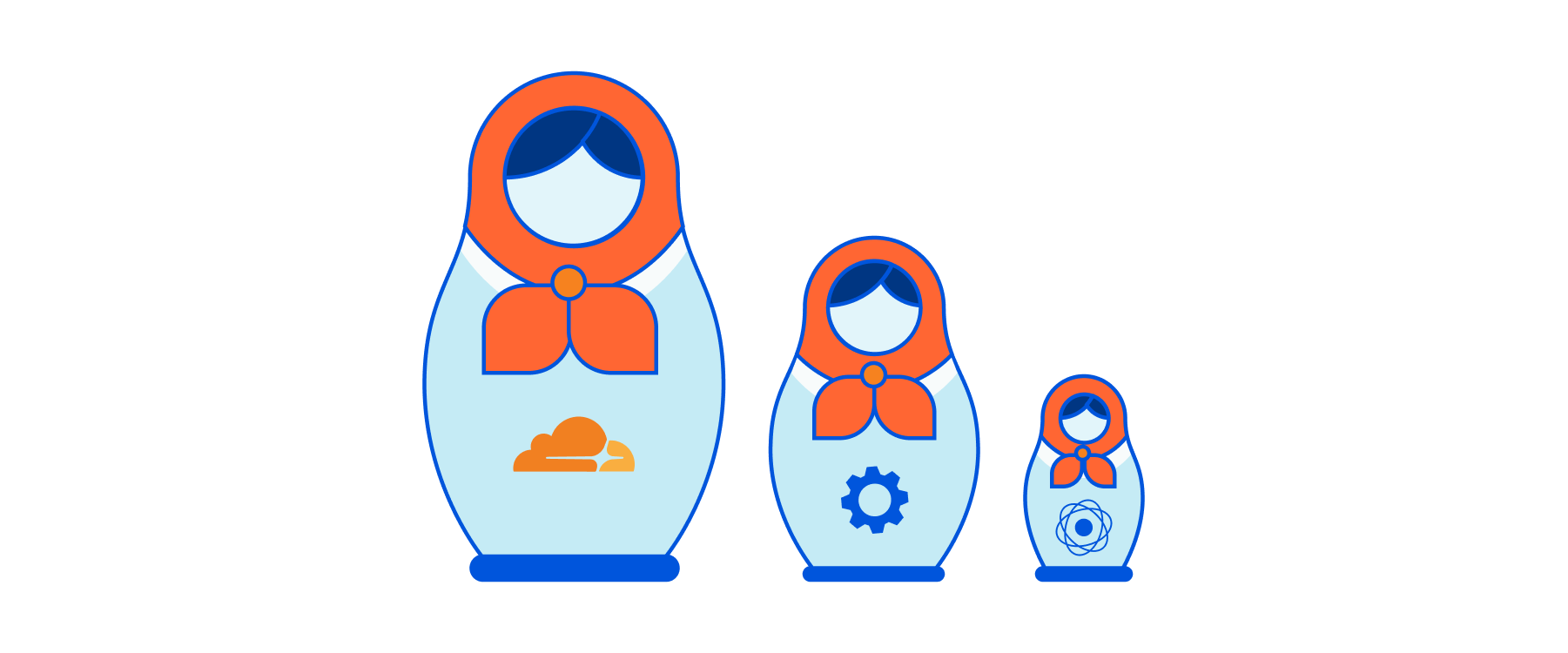
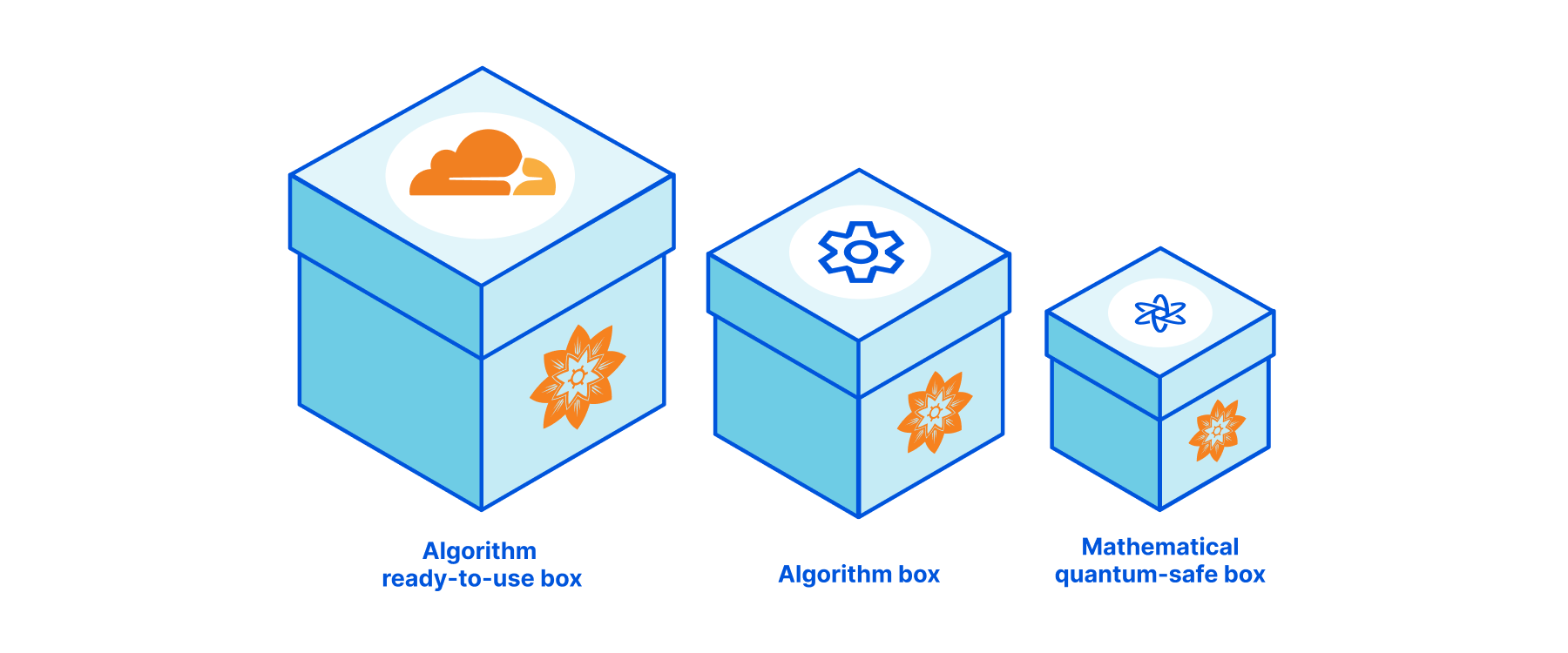
The underlying mathematics: a cryptographic algorithm is built as a Matryoshka doll. The first doll is, most of the time, the mathematical base, which hardness should be strong so that security is maintained. In the post-quantum world, this is usually the hardness of some lattice problems (more on this in the next section).
The algorithmic construction : these are all the subsequent dolls that take the mathematical base and construct an algorithm out of it. In the case of a KEM, first you construct a Public Key Encryption (PKE) scheme and transform it (putting another doll on top) to make a KEM, so better security properties are attained, as we will see.
The core of FrodoKEM is a public-key encryption scheme called FrodoPKE, whose security is based on the hardness of the “Learning with Errors” (LWE) problem over lattices. Let us look now at the first doll of a KEM.
Note to the reader: Some mathematics is coming in the next sections, but do not worry, we will guide you through it.
The Learning With Errors Problem
The security (and mathematical foundation) of FrodoKEM relies on the hardness of the Learning With Errors (LWE) problem, a generalization of the classic Learning Parities with Noise problem, first defined by Regev.
In cryptography, specifically in the mathematics underlying it, we often use sets to define our operations. A set is a collection of any element, in this case, we will refer to collections of numbers. In cryptography textbooks and articles, one can often read:
Let $Z_q$ denote the set of integers $\{0, …, q-1\}$ where $(q > 2)$,
which means that we have a collection of integers from 0 to a number q (which has to be bigger than 2. It is assumed that q, in a cryptographic application, is a prime. In the main theorem, it is an arbitrary integer).
Let $\{Z^n\}_q$ denote a vector $(v1, v2, …, vn)$ of n elements, each of which belongs to $Z_q$.
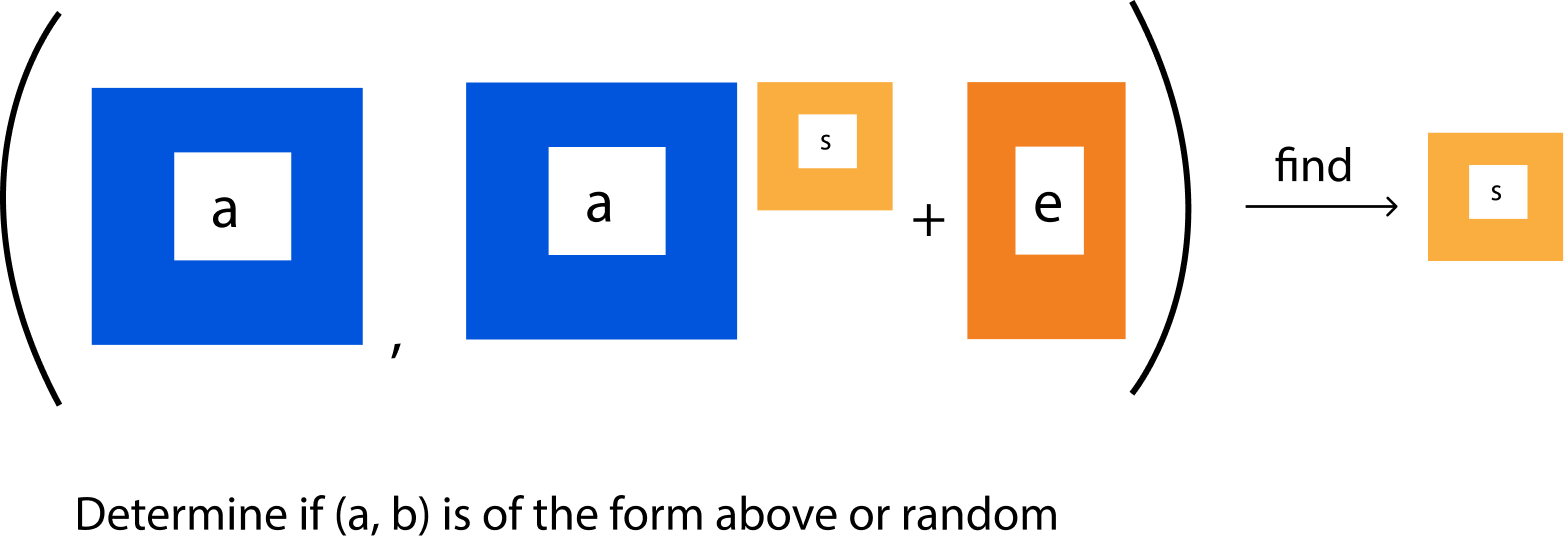
The LWE problem asks to recover a secret vector $s = (s1, s2, …, sn)$ in $\{Z^n\}_q$ given a sequence of random, “approximate” linear equations on s. For instance, if $(q = 23)$ the equations might be:
[s1 + s2 + s3 + s4 ≈ 30 (mod 23)
2s1 + s3 + s5 + … + sn ≈ 40 (mod 23)
10s2 + 13s3 + 1s4 ≈ 50 (mod 23)
…]
We see the left-hand sides of the equations above are not exactly equal to the right-hand side (the equality sign is not used but rather the “≈” sign: approximately equal to); they are off by an introduced slight “error”, (which will be defined as the variable e. In the equations above, the error is, for example, the number 10). If the error was a known, public value, recovering s (the hidden variable) would be easy: after about n equations, we can recover s in a reasonable time using Gaussian elimination. Introducing this unknown error makes the problem difficult to solve (it is difficult with accuracy to find s), even for quantum computers.
An equivalent formulation of the LWE problem is:
There exists a vector s in $\{Z^n\}_q$, called the secret (the hidden variable).
There exists random variables a.
χ is a distribution, e is the integer error introduced from the distribution χ.
You have: (a, ⟨a, s⟩ + e). ⟨a, s⟩ is the inner product modulo q of s and a.
Given ⟨a, s⟩ + e ≈ b, the input to the problem is a and b, the goal is to output a guess for s which is very hard to achieve with accuracy.
There are two main kinds of computational LWE problems that are difficult to solve for quantum computers (given certain choices of both q and χ):
Search, which is to recover the secret/hidden variable s by only being given a certain number of samples drawn from the distribution χ.
Decision, which is to distinguish a certain number of samples drawn from the distribution (a, ⟨a, s⟩ + e) from random samples.
The LWE problem: search and decision.
LWE is just noisy linear algebra, and yet it seems to be a very hard problem to solve. In fact, there are many reasons to believe that the LWE problem is hard: the best algorithms for solving it run in exponential time. It also is closely related to the Learning Parity with Noise (LPN) problem, which is extensively studied in learning theory, and it is believed to be hard to solve (any progress in breaking LPN will potentially lead to a breakthrough in coding theory). How does it relate to building cryptography? LWE is applied to the cryptographic applications of the type of public-key. In this case, the secret value s becomes the private key, and the values bi and ei are the public key.
So, why is this problem related to lattices? In other blog posts, we have seen that certain algorithms of post-quantum cryptography are based on lattices. So, how does LWE relate to them? One can view LWE as the problem of decoding from random linear codes, or reduce it to lattices, in particular to problems such as the Short Vector Problem (SVP) or the Shortest independent vectors problem (SIVP): an efficient solution to LWE implies a quantum algorithm to SVP and SIVP. In other blog posts, we talk about SVP, so, in this one, we will focus on the random bounded distance decoding problem on lattices.
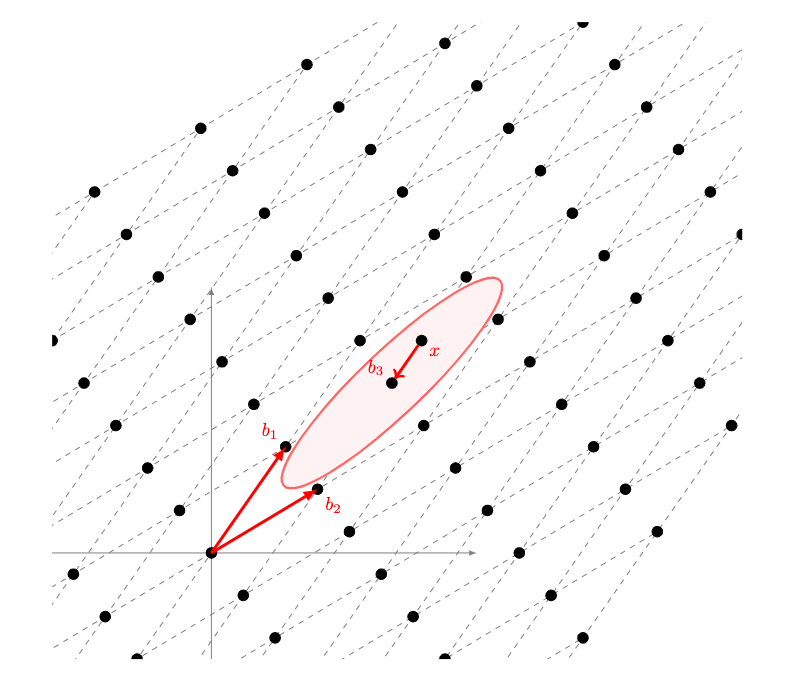
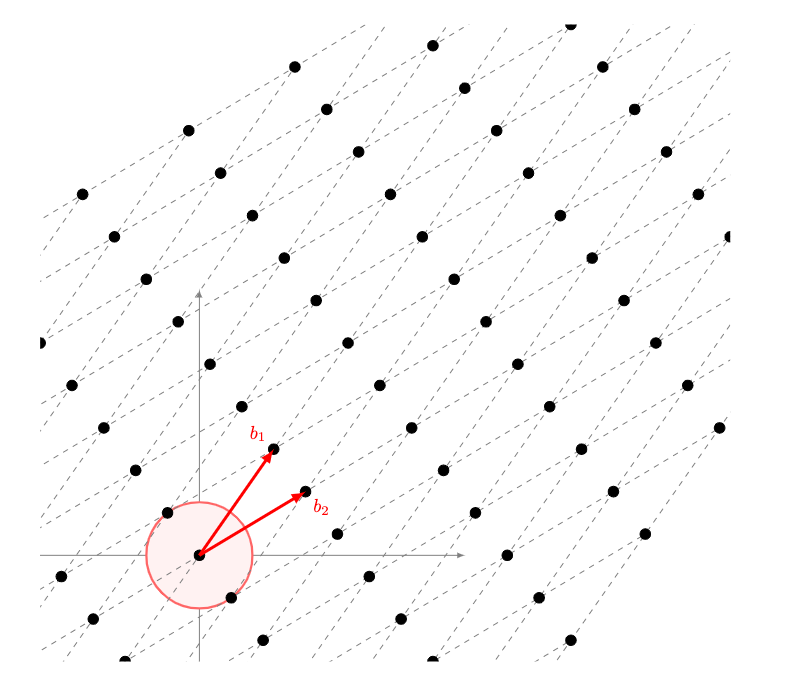
Lattices (as seen in the image), as a regular and periodic arrangement of points in space, have emerged as a foundation of cryptography in the face of quantum adversaries; one modern problem in which they rely on is the Bounded Distance Decoding (BDD) problem. In the BDD problem, you are given a lattice with an arbitrary basis (a basis is a list of vectors that generate all the other points in a lattice. In the case of the image, it is the pair of vectors b1 and b2). You are then given a vector b3 on it. You then perturb the lattice point b3 by adding some noise (or error) to give x. Given x, the goal is to find the nearest lattice point (in this case b3), as seen in the image. In this case, LWE is an average-case form of BDD (Regev also gave a worst-case to average-case reduction from BDD to LWE: the security of a cryptographic system is related to the worst-case complexity of BDD).
The first doll is built. Now, how do we build encryption from this mathematical base? From LWE, we can build a public key encryption algorithm (PKE), as we will see next with FrodoPKE as an example.
Public Key Encryption: FrodoPKE
The second doll of the Matryoshka is using a mathematical base to build a Public Key Encryption algorithm from it. Let’s look at FrodoPKE. FrodoPKE is a public-key encryption scheme which is the building block for FrodoKEM. It is made up of three components: key generation, encryption, and decryption. Let’s say again that Persephone wants to communicate with Demeter. They will run the following operations:
Generation: Generate a key pair by taking a LWE sample (like (A, B = As + e mod q)). The public key is A, B and the private key is s. Persephone sends this public key to Demeter.
Encryption: Demeter receives this public key and wants to send a private message with it, something like “come back”. She generates two secret vectors ((s1, e1) and (e2)). She then:
Makes the sample (b1 = As1 + e1 mod q).
Makes the sample (v1 = Bs1 + e2 mod q).
Adds the message m to the most significant bit of v1.
Sends b1 and v1 to Persephone (this is the ciphertext).
Decryption: Persephone receives the ciphertext and proceeds to:
Calculate m = v1 – b1 * s and is able to recover the message, and she proceeds to leave to meet her mother.
Notice that computing v = v1- b1 * s gives us m + e2 (the message plus the error matrix sampled during encryption). The decryption process performs rounding, which will output the original message m if the error matrix e2 is carefully chosen. If not, notice that there is the potential of decryption failure.
What kind of security does this algorithm give? In cryptography, we design algorithms with security notions in mind, notions they have to attain. This algorithm, FrodoPKE (as with other PKEs), satisfies only IND-CPA (Indistinguishability under chosen-plaintext attack) security. Intuitively, this notion means that a passive eavesdropper listening in can get no information about a message from a ciphertext. Even if the eavesdropper knows that a ciphertext is an encryption of just one of two messages of their choice, looking at the ciphertext should not tell the adversary which one was encrypted. We can also think of it as a game:
A gnome can be sitting inside a box. This box takes a message and produces a ciphertext. All the gnome has to do is record each message and the ciphertext they see generated. An outside-of-the-box adversary, like a troll, wants to beat this game and know what the gnome knows: what ciphertext is produced if a certain message is given. The troll chooses two messages (m1 and m2) of the same length and sends them to the box. The gnome records the box operations and flips a coin. If the coin lands on its face, then they send the ciphertext (c1) corresponding to m1. Otherwise, they send c2 corresponding to m2. The troll, knowing the messages and the ciphertext, has to guess which message was encrypted.
IND-CPA security is not enough for all secure communication on the Internet. Adversaries can not only passively eavesdrop, but also mount chosen-ciphertext attacks (CCA): they can actively modify messages in transit and trick the communicating parties into decrypting these modified messages, thereby obtaining a decryption oracle. They can use this decryption oracle to gain information about a desired ciphertext, and so compromise confidentiality. Such attacks are practical and all that an attacker has to do is, for example, send several million test ciphertexts to a decryption oracle, see Bleichenbacher’s attack and the ROBOT attack, for example.
Without CCA security, in the case of Demeter and Persephone, what this security means is that Hades can generate and send several million test ciphertexts to the decryption oracle and eventually reveal the content of a valid ciphertext that Hades did not generate. Demeter and Persephone then might not want to use this scheme.
Key Encapsulation Mechanisms: FrodoKEM
The last figure of the Matryoshka doll is taking a secure-against-CPA scheme and making it secure against CCA. A secure-against-CCA scheme must not leak information about its private key, even when decrypting arbitrarily chosen ciphertexts. It must also be the case that an adversary cannot craft valid ciphertexts without knowing what the plaintext message is; suppose, again, that the adversary knows the messages encrypted could only be either m0 or m1. If the attacker can craft another valid ciphertext, for example, by flipping a bit of the ciphertext in transit, they can send this modified ciphertext, and see whether a message close to m1 or m0 is returned.
To make a CPA scheme secure against CCA, one can use the Hofheinz, Hovelmanns, and Kiltz (HHK) transformations (see this thesis for more information). The HHK transformation constructs an IND-CCA-secure KEM from both an IND-CPA PKE and three hash functions. In the case of the algorithm we are exploring, FrodoKEM, it uses a slightly tweaked version of the HHK transform. It has, again, three functions (some parts of this description are simplified):
Generation:
We need a hash function G1.
We need a PKE scheme, such as FrodoPKE.
We call the Generation function of FrodoPKE, which returns a public (pk) and private key (sk).
We hash the public key pkh ← G1(pk).
We chose a value s at random.
The public key is pk and the private key sk1 is (sk, s, pk, pkh).
Encapsulate:
We need two hash functions: G2 and F.
We generate a random message u.
We hash the received public key pkh with the random message (r, k) ← G2(pkh || u).
We call the Encryption function of FrodoPKE: ciphertext ← Encrypt(u, pk, r).
We hash: shared secret ← F(c || k).
We send the ciphertext and the shared secret.
Decapsulate:
We need two hash functions (G2 and F) and we have (sk, s, pk, pkh).
We receive the ciphertext and the shared secret.
We call the decryption function of FrodoPKE: message ← Decrypt(shared secret, ciphertext).
We hash: (r , k) ← G2(pkh || message).
We call the Encryption function of FrodoPKE: ciphertext1 ← Encrypt(message, pk, r).
If ciphertext1 == ciphertext, k = k0; else, k = s.
We hash: ss ← F(ciphertext || k).
We return the shared secret ss.
What this algorithm achieves is the generation of a shared secret and ciphertext which can be used to establish a secure channel. It also means that no matter how many ciphertexts Hades sends to the decryption oracle, they will never reveal the content of a valid ciphertext that Hades himself did not generate. This is ensured when we run the encryption process again in Decapsulate to check if the ciphertext was computed correctly, which ensures that an adversary cannot craft valid ciphertexts simply by modifying them.
With this last doll, the algorithm has been created, and it is safe in the face of a quantum adversary.
Other KEMs beyond Frodo
While the ring bearer, Frodo, wanders around and transforms, he was not alone in his journey. FrodoKEM is currently designated as an alternative candidate for standardization as part of the post-quantum NIST process. But, there are others:
Kyber, NTRU, Saber: which are based on variants of the LWE problem over lattices and,
Classic McEliece: which is based on error correcting codes.
The lattice-based variants have the advantage of being fast, while producing relatively small keys and ciphertexts. There are concerns about theirsecurity, which need to be properly verified, however. More confidence is found in the security of the Classic McEliece scheme, as its underlying problem has been studied for longer (It is only one year older than RSA!). It has a disadvantage: it produces extremely large public keys. Classic-McEliece-348864 for example, produces public keys of size 261,120 bytes, whereas Kyber512, which claims comparable security, produces public keys of size 800 bytes.
They are all Matryoshka dolls (including sometimes non-post-quantum ones). They are all algorithms that are placed one inside the other. They all start with a small but powerful idea: a mathematical problem whose solution is hard to find in an efficient time. They then take the algorithm approach and achieve one cryptographic security. And, by the magic of hashes and length preservation, they achieve more cryptographic security. This just goes to show that cryptographic algorithms are not perfect in themselves; they stack on top of each other to get the best of each one. Facing quantum adversaries with them is the same, not a process of isolation but rather a process of stacking and creating the big picture from the smallest one.
“FrodoKEM: Learning With Errors Key Encapsulation Algorithm Specifications and Supporting Documentation” by Erdem Alkim, Joppe W. Bos, Léo Ducas, Patrick Longa, Ilya Mironov, Michael Naehrig, Valeria Nikolaenko, Chris Peikert, Ananth Raghunathan and Douglas Stebila: https://frodokem.org/files/FrodoKEM-specification-20171130.pdf
“A Modular Analysis of the Fujisaki-Okamoto Transformation” by Dennis Hofheinz, Kathrin Hövelmanns and Eike Kiltz: https://eprint.iacr.org/2017/604.pdf
To provide authentication is no more than to assert, to provide proof of, an identity. We can claim who we claim to be but if there is no proof of it (recognition of our face, voice or mannerisms) there is no assurance of that. In fact, we can claim to be someone we are not. We can even claim we are someone that does not exist, as clever Odysseus did once.
The story goes that there was a man named Odysseus who angered the gods and was punished with perpetual wandering. He traveled and traveled the seas meeting people and suffering calamities. On one of his trips, he came across the Cyclops Polyphemus who, in short, wanted to eat him. Clever Odysseus got away (as he usually did) by wounding the cyclops’ eye. As he was wounded, he asked for Odysseus name to which the latter replied:
“Cyclops, you asked for my glorious name, and I will tell it; but do give the stranger’s gift, just as you promised. Nobody I am called. Nobody they called me: by mother, father, and by all my comrades”
(As seen in The Odyssey, book 9. Translation by the authors of the blogpost).
The cyclops believed that was Odysseus’ name (Nobody) and proceeded to tell everyone, which resulted in no one believing him. “How can nobody have wounded you?” they questioned the cyclops. It was a trick, a play of words by Odysseus. Because to give an identity, to tell the world who you are (or who you are pretending to be) is easy. To provide proof of it is very difficult. The cyclops could have asked Odysseus to prove who he was, and the story would have been different. And Odysseus wouldn’t have left the cyclops laughing.
In the digital world, proving your identity is more complex. In face-to-face conversations, we can often attest to the identity of someone by knowing and verifying their face, their voice, or by someone else introducing them to us. From computer to computer, the scenario is a little different. But there are ways. When a user connects to their banking provider on the Internet, they need assurance not only that the information they send is secured; but that they are also sending it to their bank, and not a malicious website masquerading as their provider. The Transport Layer Security (TLS) protocol provides this through digitally signed statements of identity (certificates). Digital signature schemes also play a central role in DNSSEC as well, an extension to the Domain Name System (DNS) that protects applications from accepting forged or manipulated DNS data, which is what happens during DNS cache poisoning, for example.
A digital signature is a demonstration of authorship of a document, conversation, or message sent using digital means. As with “regular” signatures, they can be publicly verified by anyone that knows that it is a signature made by someone.
A digital signature scheme is a collection of three algorithms:
A key generation algorithm, Generate, which generates a public verification key and a private signing key (a keypair).
A signing algorithm, Sign, which takes the private signing key, a message, and outputs a signature of the message.
A verification algorithm, Verify, which takes the public verification key, the signature and the message, and outputs a value stating whether the signature is valid or not.
In the case of the Odysseus’ story, what the cyclops could have done to verify his identity (to verify that he indeed was Nobody) was to ask for a proof of identity: for example, for other people to vouch that he is who he claims to be. Or he could have asked for a digital signature (attested by several people or registered as his own) attesting he was Nobody. Nothing like that happened, so the cyclops was fooled.
In the Transport Layer Security protocol, TLS, authentication needs to be executed at the time a connection or conversation is established (as data sent after this point will be authenticated until that is explicitly disabled), rather than for the full lifetime of the data (as with confidentiality). Because of that, the need to transition to post-quantum signatures is not as urgent as it is for post-quantum key exchange schemes, and we do not believe there are sufficiently powerful quantum computers at the moment that can be used to listen in on connections and forge signatures. At some point, that will no longer be true, and the transition will have to be made.
There are various candidates for authentication schemes (including digital signatures) that are quantum secure: some use cryptographic hash functions, some use problems over lattices, while others use techniques from the field of multi-party computation. It is also possible to use Key Encapsulation Mechanisms (or KEMs) to achieve authentication in cryptographic protocols.
In this post, much like in the one about Key Encapsulation Mechanisms, we will give a bird’s-eye view of the construction of one particular post-quantum signature algorithm. We will discuss CRYSTALS-Dilithium, as an example of how a signature scheme can be constructed. Dilithium is a finalist candidate in the NIST post-quantum cryptography standardization process and provides an example of a standard technique used to construct digital signature schemes. We chose to explain Dilithium here as it is a finalist and its design is straightforward to explain.
We will again build the algorithm up layer-by-layer. We will look at:
Its mathematical underpinnings: as we see in other blog posts, a cryptographic algorithm can be built as a Matryoshka doll or a Chinese box. Let us use the Chinese box analogy here. The first box, in this case, is the mathematical base, whose hardness should be strong so that security is maintained. In the post-quantum world, this is usually the hardness of some lattice or isogeny problems.
Its algorithmic construction: these are all the subsequent boxes that take the mathematical base and construct an algorithm out of it. In the case of a signature, first one constructs an identification scheme, which we will define in the next sections, and then transform it to a signature scheme using the Fiat-Shamir transformation.
The mathematical core of Dilithium is, as with FrodoKEM, based on the hardness of a variant of the Learning with Errors (LWE) problem and the Short Integer Solution (SIS) problem. As we have already talked about LWE, let’s now briefly go over SIS.
Note to the reader: Some mathematics is coming in the next sections; but don’t worry, we will guide you through it.
The Short Integer Solution Problem
In order to properly explain what the SIS problem is, we need to first start by understanding what a lattice is. A lattice is a regular repeated arrangement of objects or elements over a space. In geometry, these objects can be points; in physics, these objects can be atoms. For our purposes, we can think of a lattice as a set of points in n-dimensional space with a periodic (repeated) structure, as we see in the image. It is important to understand the meaning of n-dimensional space here: a two-dimensional space is, for example, the one that we often see represented on planes: a projection of the physical universe into a plane with two dimensions which are length and width. Historically, lattices have been investigated since the late 18th century for various reasons. For a more comprehensive introduction to lattices, you can read this great paper.
Picture of a lattice. They are found in the wild in Portugal.
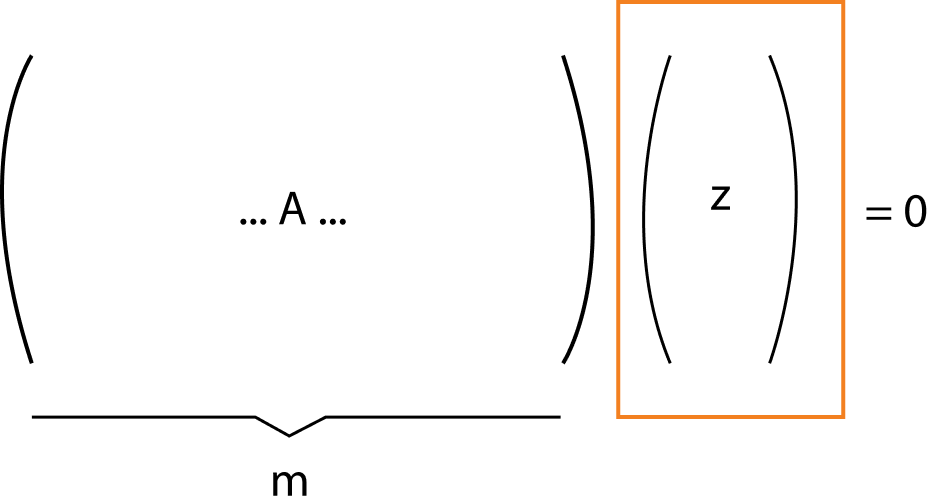
What does SIS pertain to? You are given a positive integer q and a matrix (a rectangular array of numbers) A of dimensions n x m (the number of rows is n and the number of columns is m), whose elements are integers between 0 and a number q. You are then asked to find a vectorr (smaller than a certain amount, called the “norm bound”)such that Ar = 0. The conjecture is that, for a sufficiently large n, finding this solution is hard even for quantum computers. This problem is “dual” to the LWE problem that we explored in another blog post.
We can define this same problem over a lattice. Take a lattice L(A), made up of m different n-dimensional vectors y (the repeated elements). The goal is to find non-zero vectors in the lattice such that Ay = 0 (mod q) (for some q), whose size is less than a certain specified amount. This problem can be seen as trying to find the “short” solutions in the lattice, which makes the problem the Short Vector Problem (SVP) in the average case. Finding this solution is simple to do in two dimensions (as seen in the diagram), but finding the solution in more dimensions is hard.
The SIS problem as the SVP. The goal is to find the “short” vectors in the radius.
The SIS problem is often used in cryptographic constructions such as one-way functions, collision resistant hash functions, digital signature schemes, and identification schemes.
We have now built the first Chinese box: the mathematical base. Let’s take this base now and create schemes from it.
Identification Schemes
From the mathematical base of our Chinese box, we build the first computational algorithm: an identification scheme. An identification scheme consists of a key generation algorithm, which outputs a public and private key, and an interactive protocol between a prover P and a verifier V. The prover has access to the public key and private key, and the verifier only has access to the public key. A series of messages are then exchanged such that the prover can demonstrate to the verifier that they know the private key, without leaking any other information about the private key.
More specifically, a three-move (three rounds of interaction) identification scheme is a collection of algorithms. Let’s think about it in the terms of Odysseus trying to prove to the cyclops that he is Nobody:
Odysseus (the prover) runs a key generation algorithm, Generate, that outputs a public and private keypair.
Odysseus then runs a commitment algorithm, Commit, that uses the private key, and outputs a commitment Y. The commitment is nothing more than a statement that this specific private key is the one that will be used. He sends this to the cyclops.
The cyclops (the verifier) takes the commitment and runs a challenge algorithm, Challenge, and outputs a challenge c. This challenge is a question that asks: are you really the owner of the private key?
Odysseus receives the challenge and runs a response algorithm, Response. This outputs a response z to the challenge. He sends this value to the cyclops.
The cyclops runs the verification algorithm, Verify, which outputs either accept (1) or reject (0) if the answer is correct.
If Odysseus was really the owner of the private key for Nobody, he would have been able to answer the challenge in a positive manner (with a 1). But, as he is not, he runs away (and this is the last time we see him in this blogpost).
The Dilithium Identification Scheme
The basic building blocks of Dilithium are polynomials and rings. This is the second-last box of the Chinese box, and we will explore it now.
A polynomial ring, R, is a ring of all polynomials. A ring is a set in which two operations can exist: addition and multiplication of integers; and a polynomial is an expression of variables and coefficients. The “size” of these polynomials, defined as the size of the largest coefficient, plays a crucial role for these kinds of algorithms.
In the case of Dilithium, the Generation algorithm creates a k x l matrix A. Each entry of this matrix is a polynomial in the defined ring. The generation algorithm also creates random private vectors s1 and s2, whose components are elements of R, the ring. The public key is the matrix A and t = As1 + s2. It is infeasible for a quantum computer to know the secret values given just t and A. This problem is called Module-Learning With Errors (MLWE) problem, and it is a variant of LWE as seen in this blog post.
Armed with the public and private keys, the Dilithium identification scheme proceeds as follows (some details are left out for simplicity, like the rejection sampling):
The prover wants to prove they know the private key. They generate a random secret nonce y whose coefficient is less than a security parameter. They then compute Ay and set a commitment w1 to be the “high-order”1 bits of the coefficients in this vector.
The verifier accepts the commitment and creates a challenge c.
The prover creates the potential signature z = y + cs1 (notice the usage of the random secret nonce and of the private key) and performs checks on the sizes of several parameters which makes the signature secure. This is the answer to the challenge.
The verifier receives the signature and computes w1 to be the “high-order” bits of Az−ct (notice the usage of the public key). They accept this answer if all the coefficients of z are less than the security parameter, and if w1 is equal to w0.
The identity scheme previously mentioned is an interactive protocol that requires participation from both parties. How do we turn this into a non-interactive signature scheme where one party issues signatures and other parties can verify them (the reason for this conversation is that anyone should be able to publicly verify)? Here, we place the last Chinese box.
A three-move identification scheme can be turned into a signature scheme using the Fiat–Shamir transformation: instead of the verifier accepting the commitment and sending a challenge c, the prover computes the challenge as a hash H(M || w1) of the message M and of the value w1 (computed in step 1 of the previous scheme). This is an approach in which the signer has created an instance of a lattice problem, which only the signer knows the solution to.
This in turn means that if a message was signed with a key, it could have only been signed by the person with access to the private key, and it can be verified by anyone with access to the public key.
How is this procedure related to the lattice’s problems we have seen? It is used to prove the security of the scheme: specifically the M-SIS (module SIS) problem and the LWE decisional problem.
The Chinese box is now constructed, and we have a digital signature scheme that can be used safely in the face of quantum computers.
Other Digital Signatures beyond Dilithium
In Star Trek, Dilithium is a rare material that cannot be replicated. Similarly, signatures cannot be replicated or forged: each one is unique. But this does not mean that there are no other algorithms we can use to generate post-quantum signatures. Dilithium is currently designated as a finalist candidate for standardization as part of the post-quantum NIST process. But, there are others:
Falcon, another lattice-based candidate, based on NTRU lattices.
Rainbow, a scheme based on multivariate polynomials.
We have seen examples of KEMs in other blog posts and signatures that are resistant to attacks by quantum computers. Now is the time to step back and take a look at the bigger picture. We have the building blocks, but the problem of actually building post-quantum secure cryptographic protocols with them remains, as well as making existing protocols such as TLS post-quantum secure. This problem is not entirely straightforward, owing to the trade-offs that post-quantum algorithms present. As we have carefully stitched together mathematical problems and cryptographic tools to get algorithms with the properties we desire, so do we have to carefully compose these algorithms to get the secure protocols that we need.
“A Concrete Treatment of Fiat-Shamir Signatures in the Quantum Random-Oracle Model” by Eike Kiltz, Vadim Lyubashevsky and Christian Schaffner: https://eprint.iacr.org/2017/916.pdf
1This “high-order” and “low-order” procedure decomposes a vector, and there is a specific procedure for this for Dilithium. It aims to reduce the size of the public key.
At Cloudflare, we help to build a better Internet. In the face of quantum computers and their threat to cryptography, we want to provide protections for this future challenge. The only way that we can change the future is by analyzing and perusing the past. Only in the present, with the past in mind and the future in sight, can we categorize and unfold events. Predicting, understanding and anticipating quantum computers (with the opportunities and challenges they bring) is a daunting task. We can, though, create a taxonomy of these challenges, so the future can be better unrolled.
This is the first blog post in a post-quantum series, where we talk about our past, present and future “adventures in the Post-Quantum land”. We have written about previous post-quantum efforts at Cloudflare, but we think that here first we need to understand and categorize the problem by looking at what we have done and what lies ahead. So, welcome to our adventures!
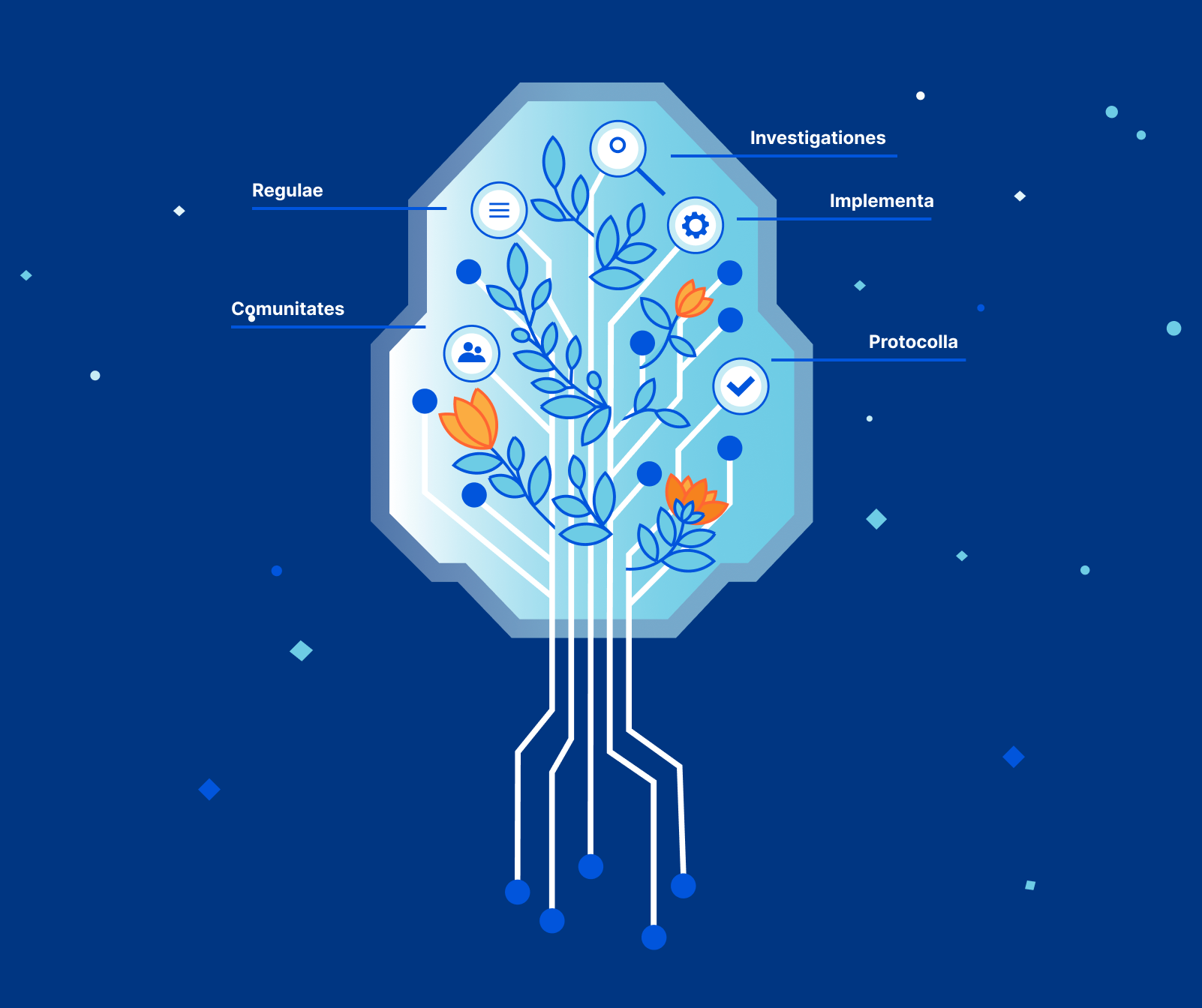
A taxonomy of the challenges ahead that quantum computers and their threat to cryptography bring (for more information about it, read our other blog posts) could be a good way to approach this problem. This taxonomy should not only focus at the technical level, though. Quantum computers fundamentally change the way certain protocols, properties, storage and retrieval systems, and infrastructure need to work. Following the biological tradition, we can see this taxonomy as the idea of grouping together problems into spaces and the arrangement of them into a classification that helps to understand what and who the problems impact. Following the same tradition, we can use the idea of kingdoms to classify those challenges. The kingdoms are (in no particular order):
Challenges at the Protocols level, Protocolla
Challenges at the implementation level, Implementa
Challenges at the standardization level, Regulae
Challenges at the community level: Communitates
Challenges at the research level, Investigationes
Let’s explore them one by one.
The taxonomy tree of the post-quantum challenges.
Challenges at the Protocols level, Protocolla
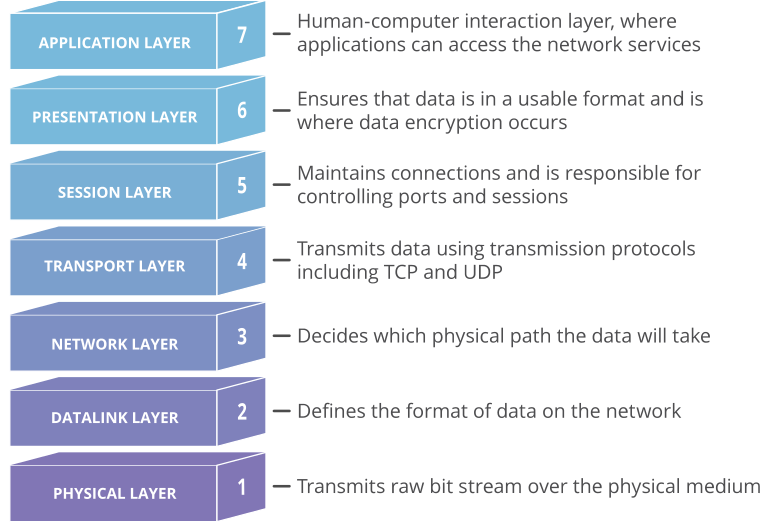
One conceptual model of the Internet is that it is composed of layers that stack on top of each other, as defined by the Open Systems Interconnection (OSI) model. Communication protocols in each layer enable parties to interact with a corresponding one at the same layer. While quantum computers are a threat to the security and privacy of digital connections, they are not a direct threat to communication itself (we will see, though, that one of the consequences of the existence of quantum computers is how new algorithms that are safe to their attacks can impact the communication itself). But, if the protocol used in a layer aims to provide certain security or privacy properties, those properties can be endangered by a quantum computer. The properties that these protocols often aim to provide are confidentiality (no one can read the content of communications), authentication (communication parties are assured who they are talking to) and integrity (the content of the communication is assured to have not been changed in transit).
Well-known examples of protocols that aim to provide security or privacy properties to protect the different layers are:
We know how to provide those properties (and protect the protocols) against the threat of quantum computers: the solution is to use post-quantum cryptography, and, for this reason, the National Institute of Standards and Technology (NIST) has been running an ongoing process to choose the most suitable algorithms. At this protocol level, then, the problem doesn’t seem to be adding these new algorithms, as nothing impedes it from a theoretical perspective. But protocols and our connections often have other requirements or constraints. Requirements or constraints are, for example, that data to be exchanged fits into a specific packet or segment size. In the case of the Transport Control Protocol (TCP), which ensures that data packets are delivered and received in order, for example, the Maximum Segment Size — MSS — sets the largest segment size that a network-connected device can receive and, if a packet exceeds the MSS, it is dropped (certain middleboxes or software desire all data to fit into a single segment). IPv4 hosts are required to handle an MSS of 536 bytes and IPv6 hosts are required to handle an MSS of 1220 bytes. In the case of DNS, it has primarily answered queries over the User Datagram Protocol (UDP), which limits the answer size to 512 bytes unless the extension EDNS is in use. Larger packets are subject to fragmentation or to the request that TCP should be used: this results in added round-trips, which should be avoided.
Another important requirement is that the operations that algorithms execute (such as multiplication or addition) or the resources they consume (which can be time but also space/memory) are fast enough that connection times are not impacted. This is even more pressing when fast, reliable and cheap Internet access is not available, as access to this “type” of Internet is not globally available.
TLS is a protocol that needs to handle heavy HTTPS traffic load and one that gets impacted by the additional cost that cryptographic operations add. Since 2010, TLS has been deemed “not computationally expensive any more” due to the usage of fast cryptography implementations and abbreviated handshakes (by using resumption, for example). But what if we add post-quantum algorithms into the TLS handshake? Some post-quantum algorithms can be suitable, while others might not be.
Many of the schemes that are part of the third round of the NIST post-quantum process, that can be used for confidentiality, seem to have encryption and decryption performance time comparable (or faster) to fast elliptic-curve cryptography. This in turn means that, from this point of view, they can be practically used. But, what about storage or transmission of the public/private keys that they produce (an attack can be mounted, for example, to force a server into constantly storing big public keys, which can lead to a denial-of-service attack or variants of the SYN flood attack)? What about their impacts on bandwidth and latency? Does having larger keys that span multiple packets (or congestion windows) affect performance especially in scenarios with degraded networks or packet loss?
In 2019, we ran a wide-scale post-quantum experiment with Google’s Chrome Browser team to test these ideas. The goal of that experiment was to assess, in a controlled environment, the impact of adding post-quantum algorithms to the Key Exchange phase of TLS handshakes. This investigation gave us some good insight into what kind of post-quantum algorithms can be used in the Key Agreement part of a TLS handshake (mainly lattice-based schemes, or so it seems) and allowed us to test them in a real-world setting. It is worth noting that these algorithms were tested in a “hybrid mode”: a combination of classical cryptographic algorithms with post-quantum ones.
The key exchange of TLS ensures confidentiality: it is the most pressing task to update it as non-post-quantum traffic captured today can be decrypted by a quantum computer in the future. Luckily, many of the post-quantum Key Encapsulation Mechanisms (KEMs) that are under consideration by NIST seem to be well suited with minimal performance impact. Unfortunately, a problem that has arisen before when considering protocol changes is the presence and behavior of old servers and clients, and of “middleboxes” (devices that manipulate traffic —by inspecting— it for purposes other than continuing the communication process). For instance, some middleboxes assume that the first message of a handshake from a browser fits in a single network packet, which is not the case when adding the majority of post-quantum KEMs. Such false assumptions (“protocol ossification”) are not a problem unique to post-quantum cryptography: the TLS 1.3 standard is carefully crafted to work around quirks of older clients, servers and middleboxes.
While all the data seems to suggest that replacing classical cryptography by post-quantum cryptography in the key exchange phase of TLS handshakes is a straightforward exercise, the problem seems to be much harder for handshake authentication (or for any protocol that aims to give authentication, such as DNSSEC or IPsec). The majority of TLS handshakes achieve authentication by using digital signatures generated via advertised public keys in public certificates (what is called “certificate-based” authentication). Most of the post-quantum signature algorithms currently being considered for standardization in the NIST post-quantum process, have signatures or public keys that are much larger than their classical counterparts. Their operations’ computation time, in the majority of cases, is also much bigger. It is unclear how this will affect the TLS handshake latency and round-trip times, though we have a better insight now in respect to which sizes can be used. We still need to know how much slowdown will be acceptable for early adoption.
There seems to be several ways by which we can add post-quantum cryptography to the authentication phase of TLS. We can:
Change the standard to reduce the number of signatures needed.
Use different post-quantum signature schemes that fit.
Or achieve authentication in a novel way.
On the latter, a novel way to achieve certificate-based TLS authentication is to use KEMs, as their post-quantum versions have smaller sizes than post-quantum signatures. This mechanism is called KEMTLS and we ran a controlled experiment showing that it performs well, even when it adds an extra or full round trip to the handshake (KEMTLS adds half a round trip for server-only authentication and a full round-trip for mutual authentication). It is worth noting that we only experimented with replacing the authentication algorithm in the handshake itself and not all the authentication algorithms needed for the certificate chain. We used a mechanism called “delegated credentials” for this: since we can’t change the whole certificate chain to post-quantum cryptography (as it involves other actors beyond ourselves), we use this short-lived credential that advertises new algorithms. More details around this experiment can be found in our paper.
Lastly, on the TLS front, we wanted to test the notion that having bigger signatures (such as the post-quantum ones) noticeably impacts TLS handshake times. Since it is difficult to deploy post-quantum signatures to real-world connections, we found a way to emulate bigger signatures without having to modify clients. This emulation was done by using dummy data. The result of this experiment showed that even if large signatures fit in the TCP congestion window, there will still be a double-digit percentage slowdown due to the relatively low average Internet speed. This slowdown is a hard sell for browser vendors and for content servers to adopt. The ideal situation for early adoption seems to be that the six signatures and two public keys of the TLS handshake fit together within 9kB (the signatures are: two in the certificate chain, one handshake signature, one OCSP staple and two SCTs for certificate transparency).
After this TLS detour, we can now list the challenges at this kingdom, Protocolla, level. The challenges (in no order in particular) seem to be (divided into sections):
Storage of cryptographic parameters used during the protocol’s execution:
How are we going to properly store post-quantum cryptographic parameters, such as keys or certificates, that are generated for/during protocol execution (their sizes are bigger than what we are accustomed to)?
How is post-quantum cryptography going to work with stateless servers, ones that do not store session state and where every client request is treated as a new one, such as NFS, Sun’s Network File System (for an interesting discussion on the matter, see this paper)?
Long-term operations and ephemeral ones:
What are the impacts of using post-quantum cryptography for long-term operations or for ephemeral ones: will bigger parameters make ephemeral connections a problem?
Are security properties assumed in protocols preserved and could we relax others (such as IND-CCA or IND-CPA. For an interesting discussion on the matter, see this paper)?
Managing bigger keys and signatures:
What are the impacts on latency and bandwidth?
Does the usage of post-quantum increase the roundtrips at the Network layer, for example? And, if so, are these increases tolerable?
Will the increased sizes cause dropped or fragmented packets?
Devices can occasionally have settings for packets smaller than expected: a router, for example, along a network path can have a maximum transmission unit, MTU (the MSS plus the TCP and IP headers), value set lower than the typical 1,500 bytes. In these scenarios, will post-quantum cryptography make these settings more difficult (one can apply MSS clamping for some cases)?
Preservation of protocols as we know them:
Can we achieve the same security or privacy properties as we use them today?
Can protocols change: should we change, for example, the way DNSSEC or the PKI work? Can we consider this radical change?
Can we integrate and deploy novel ways to achieve authentication?
Hardware (or novel alternative to hardware) usage during protocol’s execution:
Will middleware, such as middleboxes, be able to handle post-quantum cryptography (as noted in “The Chromium Projects”)?
What will be the impacts on mobile device’s connections?
What will be the impacts on old servers and clients?
Novel attacks:
Will post-quantum cryptography increase the possibility of mounting denial of service attacks?
Challenges at the Implementation level, Implementa
The second kingdom that we are going to look at is the one that deals with the implementation of post-quantum algorithms. The ongoing NIST process is standardizing post-quantum algorithms on two fronts: those that help preserve confidentiality (KEMs) and those that provide authentication (signatures). There are other algorithms not currently part of the process that already can be used in a post-quantum world, such as hash-based signatures (for example, XMSS).
What must happen for algorithms to be widely deployed? What are the steps they need to take in order to be usable by protocols or for data at rest? The usual path that algorithms take is:
Standardization: usually by a standardization body. We will talk about it further in the next section.
Efficiency at an algorithmic level: by finding new ways to speed up operations in an algorithm. In the case of Elliptic Curve Cryptography, for example, it happened with the usage of endomorphisms for faster scalar multiplication.
Efficient software implementations: by identifying the pitfalls that cause increase in time or space consumption (in the case of ECC, this paper can illustrate these efforts), and fixing them. An optimal implementation is always dependent on the target, though: where it will be used.
Avoidance of attacks: by looking at the usual pitfalls of algorithms which, in practice, are side-channel attacks.
Implementation of post-quantum cryptography will follow (and is following) the same path. Lattice-based cryptography for KEMs, for example, has taken many steps in order to be faster than ECC (but, from a protocol level perspective, it is inefficient than them, as their parameters are bigger than ECC ones and might cause extra round-trips). Isogeny-based cryptography, on the other hand, is still too slow (due to long isogenies evaluation), but it is an active area of research.
The challenges at this kingdom, Implementa, (in no particular order) level are:
Efficiency of algorithms: can we make them faster at the software, hardware (by using acceleration or FPGA-based research) or at an algorithmic level (with new data structures or parallelization techniques) to meet the requirements of network protocols and ever-fastest connections?
Can we use new mechanisms to accelerate algorithms (such as, for example, the usage of floating point numbers as in the Falcon signature scheme)? Will this lead to portability issues as it might be dependent on the underlying architecture?
What is the asymptotic complexity of post-quantum algorithms (how they impact time and space)?
How will post-quantum algorithms work on embedded devices due to their limited capacity (see this paper for more explanations)?
How can we avoid attacks, failures in security proofs and misuse of APIs?
Can we provide correct testing of these algorithms?
Can we ensure constant-time needs for the algorithms?
What will happen in a disaster-recovery mode: what happens if an algorithm is found to be weaker than expected or is fully broken? How will we be able to remove or update this algorithm? How can we make sure there are transition paths to recover from a cryptographical weakening?
At Cloudflare, we have also worked on implementation of post-quantum algorithms. We published our own library (CIRCL) that contains high-speed assembly versions of several post-quantum algorithms (like Kyber, Dilithium, SIKE and CSIDH). We believe that providing these implementations for public use will help others with the transition to post-quantum cryptography by giving easy-to-use APIs that developers can integrate into their projects.
Challenges at the Standards level, Regulae
The third kingdom deals with the standardization process as done by different bodies of organizations (such NIST or the Internet Engineering Task Force — IETF). We have talked a little about the matter in the previous section as it involves the standardization of both protocols and algorithms. Standardization can be a long process due to the need for careful discussion, and this discussion will be needed for the standardization of post-quantum algorithms. Post-quantum cryptography is based on mathematical constructions that are not widely known by the engineering community, which can then lead to difficulty levels when standardizing.
The challenges in this kingdom, Regulae, (in no particular order) are:
The mathematical base of post-quantum cryptography is an active area of development and research, and there are some concerns in the security they give (are there new attacks in the confidentiality or authentication they give?). How will standardization bodies approach this problem?
Post-quantum cryptography introduces new models in which to analyze the security of algorithms (for example, the usage of the Quantum Random Oracle Model). Will this mean that new attacks or adversaries will not be noted at the standards level?
What will be the recommendation of migrating to post-quantum cryptography from the standards’ perspective: will we use a hybrid approach?
How can we bridge the academic/research community into the standardization community, so analysis of protocols are executed and attacks are found on time (prior to being widely deployed)1? How can we make sure that standards bodies are informed enough to make the right practical/theoretical trade-offs?
At Cloudflare, we are closely collaborating with standardization bodies to prepare the path for post-quantum cryptography (see, for example, the AuthKEM draft at IETF).
Challenges at the Community level, Comunitates
The Internet is not an isolated system: it is a community of different actors coming together to make protocols and systems work. Migrating to post-quantum cryptography means sitting together as a community to update systems and understand the different needs. This is one of the reasons why, at Cloudflare, we are organizing a second installment of the PQNet workshop (expected to be colocated with Real World Crypto 2022 on April 2022) for experts on post-quantum cryptography to talk about the challenges of putting it into protocols, systems and architectures.
The challenges in this kingdom, Comunitates, are:
What are the needs of different systems? While we know what the needs of different protocols are, we don’t know exactly how all deployed systems and services work. Are there further restrictions?
On certain systems (for example, on the PKI), when will the migration happen, and how will it be coordinated?
How will the migration be communicated to the end-user?
How will we deprecate pre-quantum cryptography?
How will we integrate post-quantum cryptography into systems where algorithms are hardcoded (such as IoT devices)?
Who will maintain implementations of post-quantum algorithms and protocols? Is there incentive and funding for a diverse set of interoperable implementations?
Challenges at the Research level, Investigationes
Post-quantum cryptography is an active area of research. This research is not devoted only to how algorithms interact with protocols, systems and architectures (as we have seen), but it is heavily interested at the foundational level. The open challenges on this front are many. We will list four that are of the most interest to us:
Are there any efficient and secure post-quantum non-interactive key exchange (NIKE) algorithms?
NIKE is a cryptographic algorithm which enables two participants, who know each others’ public keys, to agree on a shared key, without requiring any interaction. An example of a NIKE is the Diffie-Hellman algorithm. There are no efficient and secure post-quantum NIKEs. A candidate seems to be CSIDH, which is rather slow and whose security is debated.
Are there post-quantum alternatives to (V)OPRFs based protocols, such as Privacy Pass or OPAQUE?
Are there post-quantum alternatives to other cryptographic schemes such as threshold signature schemes, credential based signatures and more?
How can post-quantum algorithms be formally verified with new notions such as the QROM?
Post-Quantum Future
The future of Cloudflare is post-quantum.
What is the post-quantum future at Cloudflare? There are many avenues that we explore in this blog series. While all of these experiments have given us some good and reliable information for the post-quantum migration, we further need tests in different network environments and with broader connections. We also need to test how post-quantum cryptography fits into different architectures and systems. We are preparing a bigger, wide-scale post-quantum effort that will give more insight into what can be done for real-world connections.
In this series of blog posts, we will be looking at:
What has been happening in the quantum research world in the last years and how it impacts post-quantum efforts.
What is a post-quantum algorithm: explanations of KEMs and signatures, and their security properties.
How one integrates post-quantum algorithms into protocols.
What is formal verification, analysis and implementation, and how it is needed for the post-quantum transition.
What does it mean to implement post-quantum cryptography: we will look at our efforts making Logfwdr, Cloudflare Tunnel and Gokeyless post-quantum.
What does the future hold for a post-quantum Cloudflare.
See you in the next blogpost and prepare for a better, safer, faster and quantum-protected Internet!
If you are a student enrolled in a PhD or equivalent research program and looking for an internship for 2022, see open opportunities.
You can reach us with questions, comments, and research ideas at [email protected].
…….
1A success scenario of this is the standardization of TLS 1.3 (in comparison to TLS 1.0-1.2) as it involved the formal verification community, which helped bridge the academic-standards communities to good effect. Read the analysis of this novel process.
Not only is the universe stranger than we think, but it is stranger than we can think of — Werner Heisenberg
Even for a physicist as renowned as Heisenberg, the universe was strange. And it was strange because several phenomena could only be explained through the lens of quantum mechanics. This field changed the way we understood the world, challenged our imagination, and, since the Fifth Solvay Conference in 1927, has been integrated into every explanation of the physical world (it is, to this day, our best description of the inner workings of nature). Quantum mechanics created a rift: every physical phenomena (even the most micro and macro ones) stopped being explained only by classical physics and started to be explained by quantum mechanics. There is another world in which quantum mechanics has not yet created this rift: the realm of computers (note, though, that manufacturers have been affected by quantum effects for a long time). That is about to change.
In the 80s, several physicists (including, for example, Richard Feynman and Yuri Manin) asked themselves these questions: are there computers that can, with high accuracy and in a reasonable amount of time, simulate physics? And, specifically, can they simulate quantum mechanics? These two questions started a long field of work that we now call “quantum computing”. Note that you can simulate quantum phenomena with classical computers. But we can simulate in a much faster manner with a quantum computer.
Any computer is already a quantum system, but a quantum computer uses the true computational power that quantum mechanics offers. It solves some problems much faster than a classical computer. Any computational problem solvable by a classical computer is also solvable by a quantum computer, as any physical phenomena (such as operations performed in classical computers) can be described using quantum mechanics. Contrariwise, any problem solvable by a quantum computer is also solvable by a classical computer: quantum computers provide no additional power over classical computers in terms of what they could theoretically compute. Quantum computers cannot solve undecidable problems, and they do not disprove the Church–Turing thesis. But, they are faster for specific problems! Let’s explore now why this is the case.
In a classical computer, data is stored in bits: 0 or 1, current on or current off, true or false. Nature is not that binary: any physical bit (current or not; particle or not; magnetized or not) is in fact a qubit and exists on a spectrum (or rather a sphere) of superpositions between 0 and 1. We have mentioned two terms that might be new to the reader: qubit and superposition. Let’s first define the second term.
A superposition is a normalized linear combination of all the possible configurations of something. What is this something? If we take the Schrödinger equation to explain, “for any isolated region of the universe that you want to consider, that equation describes the evolution in time of the state of that region, which we represent as a normalized linear combination — a superposition — of all the possible configurations of elementary particles in that region”, as Aaronson put it. Something, then, refers to all elementary particles. Does it mean, then, that we all are in a superposition? The answer to that question is open to many interpretations (for a nice introduction on the topic, one can read “Quantum Computing Since Democritus” by Scott Aaronson).
As you see, we are concerned then no longer on matter or energy or waves (as in classical physics), but rather on information and probabilities. In a quantum system, we first initialize information (like a bit) to some “easy” states, like 0 and 1. This information will be in a superposition of both states at the same time rather than just one or the other. If we examine a classical bit, we will either get the states of 1 or 0. Instead, with a qubit (quantum information) we can only get results with some probability. A qubit can exist in a continuum of states between ⟨0 and ⟨1 (using Dirac’s notation) all waiting to happen with some probability until it is observed.
A qubit stores a combination of two or more states.
In day-to-day life, we don’t see this quantum weirdness because we’re looking at huge jittery ensembles of qubits where this weirdness gets lost in noise. However, if we turn the temperature way down and isolate some qubits from noise, we can do some proper quantum computation. For instance, to find a 256-bit decryption key, we can set 256 qubits to a superposition of all possible keys. Then, we can run the decryption algorithm, trying the key in the qubits. We end up with a superposition of many failures and one success. We did 2256 computations in a single go! Unfortunately, we can’t read out this superposition. In fact, if we open up the quantum computer to inspect the qubits inside, the outside noise will collapse the superposition into one outcome, which will most certainly be a failure. The real art of quantum computing is interfering this superposition with itself in a clever way to amplify out the answer we want. For the case we are talking about, Lov Grover figured out how to do it. Unfortunately, it requires about 2128 steps: we have a nice, but not exponential speed-up.
Quantum computers do not provide any additional power over classical computers in terms of computability: they don’t solve unsolvable problems. But they provide efficiency: they find solutions in faster time, even for algorithms that are too “expensive” for a non-quantum (classical) computer. A classical computer can solve any known computational problem if it is given enough time and resources. But, on some occasions, they will need so much time and so many resources that it will be deemed inefficient to try to solve this problem: waiting millions of years with millions of computers working at the same time trying to solve a problem is not something that we consider feasible to do. This idea of efficient and inefficient algorithms was made mathematically precise by the field of computational complexity. Roughly speaking, an efficient algorithm is one which runs in time polynomial in the size of the problem solved.
We can look at this differently. The many quantum states can be potentially observed (even in a classical computer), but states interfere with each other, which prevents the usage of statistical sampling to obtain the state. We, then, have to track every possible configuration that a quantum system can be in. Tracking every possible configuration is theoretically possible by a classical computer, but would exceed the memory capacity of even the most powerful classical computers. So, we need quantum computers to efficiently solve these problems.
Quantum computers are powerful. They can efficiently simulate quantum mechanics experiments, and are able to perform a number of mathematical, optimization, and search problems in a faster manner than classical computers. A sufficiently scaled quantum computer can, for example, factor large integers efficiently, as was shown by Shor. They also have significant advantages when it comes to searching on unstructured databases or solving the discrete logarithm problem. These advances are the solace: they efficiently advance computational problems that seem stalled. But, they are also a spectre, a threat: the problems that they efficiently solve are what is used as the core of much of cryptography as it exists today. They, hence, can break most of the secure connections we use nowadays. For a longer explanation of the matter, see our past blog post.
The realization of large-scale quantum computers will pose a threat to our connections and infrastructure. This threat is urgent and acts as a spectre of the future: an attacker can record and store secured traffic now and decrypt it later when a quantum computer exists. The spectre is ever more present if one recalls that migrating applications, architectures and protocols is a long procedure. Migrating these services to quantum-secure cryptography will take a lot of time.
In our other blog posts, we talk at length about what quantum computers are and what threats they pose. In this one, we want to give an overview of the advances in quantum computing and their threats to cryptography, as well as an update to what is considered quantum-secure cryptography.
Why will it take them (and, generally, anyone) so long to create this quantum computer? Classical mechanisms, like Newtonian physics or classical computers, provide great detail and prediction of events and phenomena at a macroscopic level, which makes them perfect for our everyday computational needs. Quantum mechanics, on the other hand, are better manifested and understood at the microscopic level. Quantum phenomena are, furthermore, very fragile: uncontrolled interaction of quantum phenomena with the environment can make quantum features disappear, a process which is referred to as decoherence. Due to this, measurement of quantum states has to be controlled, properly prepared and isolated from its environment. Furthermore, measuring a quantum phenomenon disturbs its state, so reliable methods of computing information have to be developed.
Creating a computer that achieves computational tasks with these challenges is a daunting one. In fact, it may ultimately be impossible to completely eliminate errors in the computational tasks. It can even be an impossible task at a perfect level, as a certain amount of errors will persist. Reliable computation seems to be only achievable in a quantum computational model by employing error correction.
So, when will we know that a created quantum device is ready for the “quantum” use cases? One can use the idea of “quantum supremacy”, which is defined as the ability for a quantum device to perform a computational task that would be practically impossible (in terms of efficiency and usage of computational power) for classical computers. Nevertheless, this idea can be criticized as classical algorithms improve over time, and there is no clear definition on how to compare quantum computations with their classical counterparts (one must prove that no classical means would allow us to perform the same computational task in a faster time) in order to say that indeed quantum computations of the task are faster.
A molecule can indeed be claimed to be “quantum supreme” if researchers find it computationally prohibitive (unrealistically expensive) to solve the Schrödinger equation and calculate its ground state. That molecule constitutes a “useful quantum computer, for the task of simulating itself.” But, for computer science, this individual instance is not enough: “for any one molecule, the difficulty in simulating it classically might reflect genuine asymptotic hardness, but it might also reflect other issues (e.g., a failure to exploit special structure in the molecule, or the same issues of modeling error, constant-factor overheads, and so forth that arise even in simulations of classical physics)”, as stated by Aaronson and Chen.
By the end of 2019, Google argued they had reached quantum supremacy (with the quantum processor named “Sycamore”) but their claim was debated mainly due to the perceived lack of criteria to properly define when “quantum supremacy” is reached1. Google claimed that “a state-of-the-art supercomputer would require approximately 10,000 years to perform the equivalent task” and it was refuted by IBM by saying that “an ideal simulation of the same task can be performed on a classical system in 2.5 days and with far greater fidelity”. Regardless of this lack of criteria, this result in itself is a remarkable achievement and shows great interest of parties into creating a quantum computer. Last November, it was claimed that the most challenging sampling task performed on Sycamore can be accomplished within one week on the Sunway supercomputer. A crucial point has to be understood on the matter, though: “more like a week still seems to be needed on the supercomputer”, as noted by Aaronson. Quantum supremacy then is still not an irrevocable agreement.
Google’s quantum computer has already been applied to simulating real physical phenomena. Early in 2021, it was used to demonstrate a “time crystal” (a quantum system of particles which move in a regular, repeating motion without burning any energy to the environment). On the other hand, by late 2021, IBM unveiled its 127-qubit chip Eagle, but we don’t yet know how much gate fidelity (how close two operations are to each other) it really attains, as outlined by Aaronson in his blog post.
What do all of these advances mean for cryptography? Does it mean that soon all secure connections will be broken? If not “soon”, when will it be? The answers to all of these questions are complex and unclear. The Quantum Threat Timeline Report of 2020 suggests that the majority of researchers on the subject think that 15 to 40 years2 will be the time frame for when a “cryptography-breaking” quantum computer arrives. It is worth noting that these predictions are more optimistic than compared to the same report of 2019, which suggests that, due to the advances of the quantum computing field, researchers feel more assured of their imminent arrival.
The upcoming decades of breaking cryptography
Quantum computing will shine a light into new areas of development and advances, but it will also expose secret areas: faster mechanisms to solve mathematical problems and break cryptography. The metaphor of the dawn can be used to show how close we are to quantum computers breaking some types of cryptography (how far are we to twilight), which will be catastrophic to the needs of privacy, communication and security we have.
It is worth noting again, though, that the advent of quantum computing is not a bad scenario in itself. Quantum computing will bring much progress in the form of advances to the understanding and mimicking of the fundamental way in which nature interacts. Their inconvenience is that they break most of the cryptography algorithms we use nowadays. They also have their limits: they cannot solve every problem, and in cryptography there are algorithms that will not be broken by them.
Let’s start by defining first what dawn is. Dawn is the arrival of stable quantum computers that break cryptography in a reasonable amount of time and space (explicitly: breaking the mathematical foundation of the p256 algorithm; although some research defines this as breaking RSA2048). It is also the time by which a new day arrives: a day that starts with new advances in medicine, for example, by better mimicking molecules’ nature with a computer.
How close to dawn are we? To answer this question, we have to look at the recent advances in the aim of breaking cryptography with a quantum computer. One of the most interesting advances is that the number 15 was factored in 2001 (it is 20 years already) and number 21 was factored in 2012 by a quantum computer. While this does not seem so exciting for us (as we can factor it in our minds), it is astonishing to see that a quantum computer was stable enough to do so.
Why do we care about computers factoring or not factoring integers? The reason is that they are the mathematical base of certain public key cryptography algorithms (like, RSA) and, if they are factored, the algorithm is broken.
Taking a step further, quantum computers are also able to break encryption algorithms themselves, such as AES, as we can use quantum efficient searching algorithms for the task. This kind of searching algorithm, Grover’s algorithm, solves the task of function inversion, which speeds up collision and preimage attacks (attacks that you don’t want to be sped up in your encryption algorithms). These attacks are related to hash functions: a collision attack is one that tries to find two messages that produce the same hash; a preimage attack is one that tries to find a message given its hash value. A smart evolution of this algorithm, using Hidden Variables as part of a computational model, will theoretically make searching much more efficient.
So what are the tasks needed for a quantum computer to break cryptography? It should:
Be able to factor big integers, or,
Be able to efficiently search for collisions or pre-images, or,
Why do we care about these quantum computers breaking cryptographic algorithms that we rarely hear of? What has it to do with the connections we make? Cryptographic algorithms are the base of the secure protocols that we use today. Every time we visit a website, we are using a broad suite of cryptographic algorithms that preserve the security, privacy and integrity of connections. Without them, we don’t have the properties we are used to when connecting over digital means.
What can we do? Do we now stop using digital means altogether? There are solutions. Of course, the easy answer will be, for example, to increase the size of integers to make them impossible to be factored by a quantum computer. But, is it really a usable algorithm? How slow will our connections be if we have to increase these algorithms exponentially?
As we get closer to twilight, we also get closer to the dawn of new beginnings, the rise of post-quantum cryptography.
The rise and state of post-quantum cryptography
As dawn approaches, researchers everywhere have been busy looking for solutions. If the mathematical underpinnings of an algorithm are what is broken by a quantum computer, can we just change them? Are there mathematical problems that are hard even for quantum computers? The answer is yes and, even more interestingly, we already know how to create algorithms out of them.
The mathematical problems that we use in this new upcoming era, called post-quantum, are of many kinds:
Lattices by using learning with errors (LWE) or ring learning with errors problems (rLWE).
Isogenies, which rely on properties of supersingular elliptic curves and supersingular isogeny graphs.
Multivariate cryptography, which relies on the difficulty of solving systems of multivariate equations.
Code-based cryptography, which relies on the theory of error-correcting codes.
With these mathematical constructions, we can build algorithms that can be used to protect our connections and data. How do we know, nevertheless, that the algorithms are safe? Even if a mathematical construction that an algorithm uses is safe from the quantum spectre, is the interaction with other parts of the system or in regard to adversaries safe? Who decides on this?
Because it is difficult to determine answers to these questions on an isolated level, the National Institute of Standards and Technology of the United States has been running, since 2016, a post-quantum process that will define how these algorithms work, their design, what properties they provide and how they will be used. We now have a set of finalists that are close to being standardized. The competition standardizes on two tracks: algorithms for key encapsulation mechanisms and public-key encryption (or KEMs) and algorithms for the authentication (mainly, digital signatures). The current finalists are:
For the public-key encryption and key-establishment algorithms:
Classic McEliece, a code-based cryptography scheme.
CRYSTALS-KYBER, a lattice based scheme.
NTRU, a lattice based scheme.
SABER, a lattice based scheme.
For the digital signature algorithms:
CRYSTALS-DILITHIUM, a lattice based scheme.
FALCON, a lattice based scheme.
Rainbow, a multivariate cryptography scheme.
What do these finalists show us? It seems that we can rely on the security given by lattice-based schemes (which is no slight to the security of any of the other schemes). It also shows us that in the majority of the cases, we prioritize schemes that can be used in the same way cryptography is used nowadays: with fast operations’ computation time, and with small parameters’ sizes. In the migration to post-quantum cryptography, it is not only about using safe mathematical constructions and secure algorithms but also about how they integrate into the systems, architectures, protocols, and expected speed and space efficiencies we currently depend on. More research seems to be needed in the signatures/authentication front and the inclusion of new innovative signature schemes (like SQISign or MAYO), and that is why NIST will be calling for a fourth round of its competition.
It is worth noting that there exists another flavor of upcoming cryptography called “quantum cryptography”, but its efficient dawn seems to be far away (though, some Quantum Key Distribution — QKD — protocols are being deployed now). Quantum cryptography is one that uses quantum mechanical properties to perform cryptographic tasks. It has mainly focused on QKD), but it seems to be too inefficient to be used in practice outside very limited settings. And even though, in theory, these schemes should be perfectly secure against any eavesdropper; in practice, the physical machines may still fall victim to side-channel attacks.
Is dawn, then, the collapse of cryptography? It can be, on one hand, as it is the collapse of most classical cryptography. But, on the other hand, it is also the dawn of new, post-quantum cryptography and the start of quantum computing for the benefit of the world. Will the process of reaching dawn be simple? Certainly, not. Migrating systems, architectures and protocols to new algorithms is an intimidating task. But we at Cloudflare and as a community are taking the steps, as you will read in other blog posts throughout this week.
……. 1In the original paper, they estimate of 10,000 years is based on the observation that there is not enough Random Access Memory (RAM) to store the full state vector in a Schrödinger-type simulation and, then, it is needed to use a hybrid Schrödinger–Feynman algorithm, which is memory-efficient but exponentially more computationally expensive. In contrast, IBM used a Schrödinger-style classical simulation approach that uses both RAM and hard drive space. 2There is a 50% or more likelihood of “cryptography-breaking” quantum computers arriving. Slightly more than half of the researchers answered that, in the next 15 years, they will arrive. About 86% of the researchers answered that, in the next 20 years, they will arrive. All but one among the researchers answered that, in the next 30 years, they will arrive. 3Although, in practice, this seems difficult to attain.
Researchers have calculated the quantum computer size necessary to break 256-bit elliptic curve public-key cryptography:
Finally, we calculate the number of physical qubits required to break the 256-bit elliptic curve encryption of keys in the Bitcoin network within the small available time frame in which it would actually pose a threat to do so. It would require 317 × 106 physical qubits to break the encryption within one hour using the surface code, a code cycle time of 1 μs, a reaction time of 10 μs, and a physical gate error of 10-3. To instead break the encryption within one day, it would require 13 × 106 physical qubits.
The title may sound as a paper title, rather than a blogpost, because it was originally an idea for such, but I’m unlikely to find the time to put a proper paper about it, so here it is – a blogpost.
Blockchain has been touted as the ultimate integrity guarantee – if you “have blockchain”, nobody can tamper with your data. Of course, reality is more complicated, and even in the most distributed of ledgers, there are known attacks. But most organizations that are experimenting with blockchain, rely on a private network, sometimes having themselves as the sole owner of the infrastructure, and sometimes sharing it with just a few partners.
The point of having the technology in the first place is to guarantee that once collected, data cannot be tampered with. So let’s review how that works in practice.
First, we have two define two terms – “tamper-resistant” (sometimes referred to as tamper-free) and “tamper-evident”. “Tamper-resistant” means nobody can ever tamper with the data and the state of the data structure is always guaranteed to be without any modifications. “Tamper-evident”, on the other hand, means that a data structure can be validated for integrity violations, and it will be known that there have been modifications (alterations, deletions or back-dating of entries). Therefore, with tamper-evident structures you can prove that the data is intact, but if it’s not intact, you can’t know the original state. It’s still a very important property, as the ability to prove that data is not tampered with is crucial for compliance and legal aspects.
Blockchain is usually built ontop of several main cryptographic primitives: cryptographic hashes, hash chains, Merkle trees, cryptographic timestamps and digital signatures. They all play a role in the integrity guarantees, but the most important ones are the Merkle tree (with all of its variations, like a Patricia Merkle tree) and the hash chain. The original bitcoin paper describes a blockchain to be a hash chain, based on the roots of multiple Merkle trees (which form a single block). Some blockchains rely on a single, ever-growing merkle tree, but let’s not get into particular implementation details.
In all cases, blockchains are considered tamper-resistant because their significantly distributed in a way that enough number of members have a copy of the data. If some node modifies that data, e.g. 5 blocks in the past, it has to prove to everyone else that this is the correct merkle root for that block. You have to have more than 50% of the network capacity in order to do that (and it’s more complicated than just having them), but it’s still possible. In a way, tamper resistance = tamper evidence + distributed data.
But many of the practical applications of blockchain rely on private networks, serving one or several entities. They are often based on proof of authority, which means whoever has access to a set of private keys, controls what the network agree on. So let’s review the two cases:
Multiple owners – in case of multiple node owners, several of them can collude to rewrite the chain. The collusion can be based on mutual business interest (e.g. in a supply chain, several members may team up against the producer to report distorted data), or can be based on security compromise (e.g. multiple members are hacked by the same group). In that case, the remaining node owners can have a backup of the original data, but finding out whether the rest were malicious or the changes were legitimate part of the business logic would require a complicated investigation.
Single owner – a single owner can have a nice Merkle tree or hash chain, but an admin with access to the underlying data store can regenerate the whole chain and it will look legitimate, while in reality it will be tampered with. Splitting access between multiple admins is one approach (or giving them access to separate nodes, none of whom has access to a majority), but they often drink beer together and collusion is again possible. But more importantly – you can’t prove to a 3rd party that your own employees haven’t colluded under orders from management in order to cover some tracks to present a better picture to a regulator.
In the case of a single owner, you don’t even have a tamper-evident structure – the chain can be fully rewritten and nobody will understand that. In case of multiple owners, it depends on the implementation. There will be a record of the modification at the non-colluding party, but proving which side “cheated” would be next to impossible. Tamper-evidence is only partially achieved, because you can’t prove whose data was modified and whose data hasn’t (you only know that one of the copies has tampered data).
In order to achieve tamper-evident structure with both scenarios is to use anchoring. Checkpoints of the data need to be anchored externally, so that there is a clear record of what has been the state of the chain at different points in time. Before blockchain, the recommended approach was to print it in newspapers (e.g. as an ad) and because it has a large enough circulation, nobody can collect all newspapers and modify the published checkpoint hash. This published hash would be either a root of the Merkle tree, or the latest hash in a hash chain. An ever-growing Merkle tree would allow consistency and inclusion proofs to be validated.
When we have electronic distribution of data, we can use public blockchains to regularly anchor our internal ones, in order to achieve proper tamper-evident data. We, at LogSentinel, for example, do exactly that – we allow publishing the latest Merkle root and the latest hash chain to Ethereum. Then even if those with access to the underlying datastore manage to modify and regenerate the entire chain/tree, there will be no match with the publicly advertised values.
How to store data on publish blockchains is a separate topic. In case of Ethereum, you can put any payload within a transaction, so you can put that hash in low-value transactions between two own addresses (or self-transactions). You can use smart-contracts as well, but that’s not necessary. For Bitcoin, you can use OP_RETURN. Other implementations may have different approaches to storing data within transactions.
If we want to achieve tamper-resistance, we just need to have several copies of the data, all subject to tamper-evidence guarantees. Just as in a public network. But what a public network gives is is a layer, which we can trust with providing us with the necessary piece for achieving local tamper evidence. Of course, going to hardware, it’s easier to have write-only storage (WORM, write once, ready many). The problem with it, is that it’s expensive and that you can’t reuse it. It’s not so much applicable to use-cases that require short-lived data that requires tamper-resistance.
So in summary, in order to have proper integrity guarantees and the ability to prove that the data in a single-owner or multi-owner private blockchains hasn’t been tampered with, we have to send publicly the latest hash of whatever structure we are using (chain or tree). If not, we are only complicating our lives by integrating a complex piece of technology without getting the real benefit it can bring – proving the integrity of our data.
I have long been annoyed that the word “crypto” has been co-opted by the blockchain people, and no longer refers to “cryptography.” I’m not the only one.
In 2019, we announced the release of CIRCL, an open-source cryptographic library written in Go that provides optimized implementations of several primitives for key exchange and digital signatures. We are pleased to announce a major update of our library: we have included more packages for elliptic curve-based cryptography (ECC), pairing-based cryptography, and quantum-resistant algorithms.
In this blog post we’re going to focus on pairing-based cryptography and give you a brief overview of some properties that make this topic so pleasant. If you are not so familiar with elliptic curves, we recommend this primer on ECC.
Otherwise, let’s get ready, pairings have arrived!
What are pairings?
Elliptic curve cryptography enables an efficient instantiation of several cryptographic applications: public-key encryption, signatures, zero-knowledge proofs, and many other more exotic applications like oblivious transfer and OPRFs. With all of those applications you might wonder what is the additional value that pairings offer? To see that, we need first to understand the basic properties of an elliptic curve system, and from that we can highlight the big gap that pairings have.
Conventional elliptic curve systems work with a single group $\mathbb{G}$: the points of an elliptic curve $E$. In this group, usually denoted additively, we can add the points $P$ and $Q$ and get another point on the curve $R=P+Q$; also, we can multiply a point $P$ by an integer scalar $k$ and by repeatedly doing
$$ kP = \underbrace{P+P+\dots+P}_{k \text{ terms}} $$ This operation is known as scalar multiplication, which resembles exponentiation, and there are efficient algorithms for this operation. But given the point $Q=kP$, and $P$, it is very hard for an adversary that doesn’t know $k$ to find it. This is the Elliptic Curve Discrete Logarithm problem (ECDLP).
Now we show a property of scalar multiplication that can help us to understand the properties of pairings.
Scalar Multiplication is a Linear Map
Note the following equivalences:
$ (a+b)P = aP + bP $
$ b (aP) = a (bP) $.
These are very useful properties for many protocols: for example, the last identity allows Alice and Bob to arrive at the same value when following the Diffie-Hellman key-agreement protocol.
But while point addition and scalar multiplication are nice, it’s also useful to be able to multiply points: if we had a point $P$ and $aP$ and $bP$, getting $abP$ out would be very cool and let us do all sorts of things. Unfortunately Diffie-Hellman would immediately be insecure, so we can’t get what we want.
Guess what? Pairings provide an efficient, useful sort of intermediary point multiplication.
It’s intermediate multiplication because although the operation takes two points as operands, the result of a pairing is not a point, but an element of a different group; thus, in a pairing there are more groups involved and all of them must contain the same number of elements.
Pairing is denoted as $$ e \colon\; \mathbb{G}_1 \times \mathbb{G}_2 \rightarrow \mathbb{G}_T $$ Groups $\mathbb{G}_1$ and $\mathbb{G}_2$ contain points of an elliptic curve $E$. More specifically, they are the $r$-torsion points, for a fixed prime $r$. Some pairing instances fix $\mathbb{G}_1=\mathbb{G}_2$, but it is common to use disjoint sets for efficiency reasons. The third group $\mathbb{G}_T$ has notable differences. First, it is written multiplicatively, unlike the other two groups. $\mathbb{G}_T$ is not the set of points on an elliptic curve. It’s instead a subgroup of the multiplicative group over some larger finite field. It contains the elements that satisfy $x^r=1$, better known as the $r$-roots of unity.
Source: “Pairings are not dead, just resting” by Diego Aranha ECC-2017 (inspired by Avanzi’s talk at SPEED-2009).
While every elliptic curve has a pairing, very few have ones that are efficiently computable. Those that do, we call them pairing-friendly curves.
The Pairing Operation is a Bilinear Map
What makes pairings special is that \(e\) is a bilinear map. Yes, the linear property of the scalar multiplication is present twice, one per group. Let’s see the first linear map.
For points $P, Q, R$ and scalars $a$ and $b$ we have:
$ e(P+Q, R) = e(P, R) * e(Q, R) $
$ e(aP, Q) = e(P, Q)^a $
So, a scalar $a$ acting in the first operand as $aP$, finds its way out and escapes from the input of the pairing and appears in the output of the pairing as an exponent in $\mathbb{G}_T$. The same linear map is observed for the second group:
$ e(P, Q+R) = e(P, Q) * e(P, R) $
$ e(P, bQ) = e(P, Q)^b $
Hence, the pairing is bilinear. We will see below how this property becomes useful.
Can bilinear pairings help solving ECDLP?
The MOV (by Menezes, Okamoto, and Vanstone) attack reduces the discrete logarithm problem on elliptic curves to finite fields. An attacker with knowledge of $kP$ and public points $P$ and $Q$ can recover $k$ by computing:
$ g_k = e(kP, Q) = e(P, Q)^k $,
$ g = e(P, Q) $
$ k = \log_g(g_k) $
Note that the discrete logarithm to be solved was moved from $\mathbb{G}_1$ to $\mathbb{G}_T$. So an attacker must ensure that the discrete logarithm is easier to solve in $\mathbb{G}_T$, and surprisingly, for some curves this is the case.
Fortunately, pairings do not present a threat for standard curves (such as the NIST curves or Curve25519) because these curves are constructed in such a way that $\mathbb{G}_T$ gets very large, which makes the pairing operation not efficient anymore.
This attacking strategy was one of the first applications of pairings in cryptanalysis as a tool to solve the discrete logarithm. Later, more people noticed that the properties of pairings are so useful, and can be used constructively to do cryptography. One of the fascinating truisms of cryptography is that one person’s sledgehammer is another person’s brick: while pairings yield a generic attack strategy for the ECDLP problem, it can also be used as a building block in a ton of useful applications.
Applications of Pairings
In the 2000s decade, a large wave of research works were developed aimed at applying pairings to many practical problems. An iconic pairing-based system was created by Antoine Joux, who constructed a one-round Diffie-Hellman key exchange for three parties.
Let’s see first how a three-party Diffie-Hellman is done without pairings. Alice, Bob and Charlie want to agree on a shared key, so they compute, respectively, $aP$, $bP$ and $cP$ for a public point P. Then, they send to each other the points they computed. So Alice receives $cP$ from Charlie and sends $aP$ to Bob, who can then send $baP$ to Charlie and get $acP$ from Alice and so on. After all this is done, they can all compute $k=abcP$. Can this be performed in a single round trip?
Two round Diffie-Hellman without pairings.One round Diffie-Hellman with pairings.
The 3-party Diffie-Hellman protocol needs two communication rounds (on the top), but with the use of pairings a one-round trip protocol is possible.
Affirmative! Antoine Joux showed how to agree on a shared secret in a single round of communication. Alice announces $aP$, gets $bP$ and $cP$ from Bob and Charlie respectively, and then computes $k= (bP, cP)^a$. Likewise Bob computes $e(aP,cP)^b$ and Charlie does $e(aP,bP)^c$. It’s not difficult to convince yourself that all these values are equivalent, just by looking at the bilinear property.
With pairings we’ve done in one round what would otherwise take two.
Another application in cryptography addresses a problem posed by Shamir in 1984: does there exist an encryption scheme in which the public key is an arbitrary string? Imagine if your public key was your email address. It would be easy to remember and certificate authorities and certificate management would be unnecessary.
A solution to this problem came some years later, in 2001, and is the Identity-based Encryption (IBE) scheme proposed by Boneh and Franklin, which uses bilinear pairings as the main tool.
Nowadays, pairings are used for the zk-SNARKS that make Zcash an anonymous currency, and are also used in drand to generate public-verifiable randomness. Pairings and the compact, aggregatable BLS signatures are used in Ethereum. We have used pairings to build Geo Key Manager: pairings let us implement a compact broadcast and negative broadcast scheme that together make Geo Key Manager work.
In order to make these schemes, we have to implement pairings, and to do that we need to understand the mathematics behind them.
Where do pairings come from?
In order to deeply understand pairings we must understand the interplay of geometry and arithmetic, and the origins of the group’s law. The starting point is the concept of a divisor, a formal combination of points on the curve.
$D = \sum n_i P_i$
The sum of all the coefficients $n_i$ is the degree of the divisor. If we have a function on the curve that has poles and zeros, we can count them with multiplicity to get a principal divisor. Poles are counted as negative, while zeros as positive. For example if we take the projective line, the function $x$ has the divisor $(0)-(\infty)$.
The degree of a divisor is the sum of its coefficients. All principal divisors have degree $0$. The group of degree zero divisors modulo the principal divisors is the Jacobian. This means that we take all the degree zero divisors, and freely add or subtract principle divisors, constructing an abelian variety called the Jacobian.
Until now our constructions have worked for any curve. Elliptic curves have a special property: since a line intersects the curve in three points, it’s always possible to turn an element of the Jacobian into one of the form $(P)-(O)$ for a point $P$. This is where the addition law of elliptic curves comes from.
The relation between addition on an elliptic curve and the geometry of the curve. Source file ECClines.svg
Given a function $f$ we can evaluate it on a divisor $D=\sum n_i P_i$ by taking the product $\prod f(P_i)^{n_i}$. And if two functions $f$ and $g$ have disjoint divisors, we have the Weil duality:
$ f(\text{div}(g)) = g(\text{div}(f)) $,
The existence of Weil duality is what gives us the bilinear map we seek. Given an $r$-torsion point $T$ we have a function $f$ whose divisor is $r(T)-r(O)$. We can write down an auxiliary function $g$ such that $f(rP)=g^r(P)$ for any $P$. We then get a pairing by taking.
$e_r(S,T)=\frac{g(X+S)}{g(X)}$.
The auxiliary point $X$ is any point that makes the numerator and denominator defined.
In practice, the pairing we have defined above, the Weil pairing, is little used. It was historically the first pairing and is extremely important in the mathematics of elliptic curves, but faster alternatives based on more complicated underlying mathematics are used today. These faster pairings have different $\mathbb{G}_1$ and $\mathbb{G}_2$, while the Weil pairing made them the same.
Shift in parameters
As we saw earlier, the discrete logarithm problem can be attacked either on the group of elliptic curve points or on the third group (an extension of a prime field) whichever is weaker. This is why the parameters that define a pairing must balance the security of the three groups.
Before 2015 a good balance between the extension degree, the size of the prime field, and the security of the scheme was achieved by the family of Barreto-Naehrig (BN) curves. For 128 bits of security, BN curves use an extension of degree 12, and have a prime of size 256 bits; as a result they are an efficient choice for implementation.
A breakthrough for pairings occurred in 2015 when Kim and Barbescu published a result that accelerated the attacks in finite fields. This resulted in increasing the size of fields to comply with standard security levels. Just as short hashes like MD5 got depreciated as they became insecure and $2^{64}$ was no longer enough, and RSA-1024 was replaced with RSA-2048, we regularly change parameters to deal with improved attacks.
For pairings this implied the use of larger primes for all the groups. Roughly speaking, the previous 192-bit security level becomes the new 128-bit level after this attack. Also, this shift in parameters brings the family of Barreto-Lynn-Scott (BLS) curves to the stage because pairings on BLS curves are faster than BN in this new setting. Hence, currently BLS curves using an extension of degree 12, and primes of around 384 bits provide the equivalent to 128 bit security.
The IETF draft (currently in preparation) draft-irtf-cfrg-pairing-friendly-curves specifies secure pairing-friendly elliptic curves. It includes parameters for BN and BLS families of curves. It also targets different security levels to provide crypto agility for some applications relying on pairing-based cryptography.
Implementing Pairings in Go
Historically, notable examples of software libraries implementing pairings include PBC by Ben Lynn, Miracl by Michael Scott, and Relic by Diego Aranha. All of them are written in C/C++ and some ports and wrappers to other languages exist.
In the Go standard library we can find the golang.org/x/crypto/bn256 package by Adam Langley, an implementation of a pairing using a BN curve with 256-bit prime. Our colleague Brendan McMillion built github.com/cloudflare/bn256 that dramatically improves the speed of pairing operations for that curve. See the RWC-2018 talk to see our use case of pairing-based cryptography. This time we want to go one step further, and we started looking for alternative pairing implementations.
Although one can find many libraries that implement pairings, our goal is to rely on one that is efficient, includes protection against side channels, and exposes a flexible API oriented towards applications that permit generality, while avoiding common security pitfalls. This motivated us to include pairings in CIRCL. We followed best practices on secure code development and we want to share with you some details about the implementation.
We started by choosing a pairing-friendly curve. Due to the attack previously mentioned, the BN256 curve does not meet the 128-bit security level. Thus there is a need for using stronger curves. Such a stronger curve is the BLS12-381 curve that is widely used in the zk-SNARK protocols and short signature schemes. Using this curve allows us to make our Go pairing implementation interoperable with other implementations available in other programming languages, so other projects can benefit from using CIRCL too.
This code snippet tests the linearity property of pairings and shows how easy it is to use our library.
import (
"crypto/rand""fmt"
e "github.com/cloudflare/circl/ecc/bls12381"
)
func ExamplePairing() {
P, Q := e.G1Generator(), e.G2Generator()
a, b :=new(e.Scalar), new(e.Scalar)
aP, bQ :=new(e.G1), new(e.G2)
ea, eb :=new(e.Gt), new(e.Gt)
a.Random(rand.Reader)
b.Random(rand.Reader)
aP.ScalarMult(a, P)
bQ.ScalarMult(b, Q)
g := e.Pair( P, Q)
ga := e.Pair(aP, Q)
gb := e.Pair( P,bQ)
ea.Exp(g, a)
eb.Exp(g, b)
linearLeft := ea.IsEqual(ga) // e(P,Q)^a == e(aP,Q)
linearRight:= eb.IsEqual(gb) // e(P,Q)^b == e(P,bQ)
fmt.Print(linearLeft && linearRight)
// Output: true
}
We applied several optimizations that allowed us to improve on performance and security of the implementation. In fact, as the parameters of the curve are fixed, some other optimizations become easier to apply; for example, the code for prime field arithmetic and the towering construction for extension fields as we detail next.
Formally-verified arithmetic using fiat-crypto
One of the more difficult parts of a cryptography library to implement correctly is the prime field arithmetic. Typically people specialize it for speed, but there are many tedious constraints on what the inputs to operations can be to ensure correctness. Vulnerabilities have happened when people get it wrong, across many libraries. However, this code is perfect for machines to write and check. One such tool is fiat-crypto.
Using fiat-crypto to generate the prime field arithmetic means that we have a formal verification that the code does what we need. The fiat-crypto tool is invoked in this script, and produces Go code for addition, subtraction, multiplication, and squaring over the 381-bit prime field used in the BLS12-381 curve. Other operations are not covered, but those are much easier to check and analyze by hand.
Another advantage is that it avoids relying on the generic big.Int package, which is slow, frequently spills variables to the heap causing dynamic memory allocations, and most importantly, does not run in constant-time. Instead, the code produced is straight-line code, no branches at all, and relies on the math/bits package for accessing machine-level instructions. Automated code generation also means that it’s easier to apply new techniques to all primitives.
Tower Field Arithmetic
In addition to prime field arithmetic, say integers modulo a prime number p, a pairing also requires high-level arithmetic operations over extension fields.
To better understand what an extension field is, think of the analogous case of going from the reals to the complex numbers: the operations are referred as usual, there exist addition, multiplication and division $(+, -, \times, /)$, however they are computed quite differently.
The complex numbers are a quadratic extension over the reals, so imagine a two-level house. The first floor is where the real numbers live, however, they cannot access the second floor by themselves. On the other hand, the complex numbers can access the entire house through the use of a staircase. The equation $f(x)=x^2+1$ was not solvable over the reals, but is solvable over the complex numbers, since they have the number $i^2=1$. And because they have the number $i$, they also have to have numbers like $3i$ and $5+i$ that solve other equations that weren’t solvable over the reals either. This second story has given the roots of the polynomials a place to live.
Algebraically we can view the complex numbers as $\mathbb{R}[x]/(x^2+1)$, the space of polynomials where we consider $x^2=-1$. Given a polynomial like $x^3+5x+1$, we can turn it into $4x+1$, which is another way of writing $1+4i$. In this new field $x^2+1=0$ holds automatically, and we have added both $x$ as a root of the polynomial we picked. This process of writing down a field extension by adding a root of a polynomial works over any field, including finite fields.
Following this analogy, one can construct not a house but a tower, say a $k=12$ floor building where the ground floor is the prime field $\mathbb{F}_p$. The reason to build such a large tower is because we want to host VIP guests: namely a group called $\mu_r$, the $r$-roots of unity. There are exactly $r$ members and they behave as an (algebraic) group, i.e. for all $x,y \in \mu_r$, it follows $x*y \in \mu_r$ and $x^r = 1$.
One particularity is that making operations on the top-floor can be costly. Assume that whenever an operation is needed in the top-floor, members who live on the main floor are required to provide their assistance. Hence an operation on the top-floor needs to go all the way down to the ground floor. For this reason, our tower needs more than a staircase, it needs an efficient way to move between the levels, something even better than an elevator.
What if we use portals? Imagine anyone on the twelfth floor using a portal to go down immediately to the sixth floor, and then use another one connecting the sixth to the second floor, and finally another portal connecting to the ground floor. Thus, one can get faster to the first floor rather than descending through a long staircase.
The building analogy can be used to understand and construct a tower of finite fields. We use only some extensions to build a twelfth extension from the (ground) prime field $\mathbb{F}_p$.
In fact, the extension of finite fields is as follows:
$\mathbb{F}_{p^2}$ is built as polynomials in $\mathbb{F}_p[u]$ reduced modulo $u^2+1=0$.
$\mathbb{F}_{p^6}$ is built as polynomials in $\mathbb{F}_{p^2}[v]$ reduced modulo $v^2+u+1=0$.
$\mathbb{F}_{p^{12}}$ is built as polynomials in $\mathbb{F}_{p^6}[w]$ reduced modulo $w^2+v=0$, or as polynomials in $\mathbb{F}_{p^4}[w]$ reduced modulo $w^3+v=0$.
The portals here are the polynomials used as modulus, as they allow us to move from one extension to the other.
Different constructions for higher extensions have an impact on the number of operations performed. Thus, we implemented the latter tower field for $\mathbb{F}_{p^{12}}$ as it results in a lower number of operations. The arithmetic operations are quite easy to implement and manually verify, so at this level formal verification is not as effective as in the case of prime field arithmetic. However, having an automated tool that generates code for this arithmetic would be useful for developers not familiar with the internals of field towering. The fiat-crypto tool keeps track of this idea [Issue 904, Issue 851].
Now, we describe more details about the main core operations of a bilinear pairing.
The Miller loop and the final exponentiation
The pairing function we implemented is the optimal r-ate pairing, which is defined as:
$ e(P,Q) = f_Q(P)^{\text{exp}} $
That is the construction of a function $f$ based on $Q$, then evaluated on a point $P$, and the result of that is raised to a specific power. The efficient function evaluation is performed using “the Miller loop”, which is an algorithm devised by Victor Miller and has a similar structure to a double-and-add algorithm for scalar multiplication.
After having computed $f_Q(P)$ this value is an element of $\mathbb{F}_{p^{12}}$, however it is not yet an $r$-root of unity; in order to do so, the final exponentiation accomplishes this task. Since the exponent is constant for each curve, special algorithms can be tuned for it.
One interesting acceleration opportunity presents itself: in the Miller loop the elements of $\mathbb{F}_{p^{12}}$ that we have to multiply by are special — as polynomials, they have no linear term and their constant term lives in $\mathbb{F}_{p^{2}}$. We created a specialized multiplication that avoids multiplications where the input has to be zero. This specialization accelerated the pairing computation by 12%.
So far, we have described how the internal operations of a pairing are performed. There are still some other functions floating around regarding the use of pairings in cryptographic protocols. It is also important to optimize these functions and now we will discuss some of them.
Product of Pairings
Often protocols will want to evaluate a product of pairings, rather than a single pairing. This is the case if we’re evaluating multiple signatures, or if the protocol uses cancellation between different equations to ensure security, as in the dual system encoding approach to designing protocols. If each pairing was evaluated individually, this would require multiple evaluations of the final exponentiation. However, we can evaluate the product first, and then evaluate the final exponentiation once. This requires a different interface that can take vectors of points.
Occasionally, there is a sign or an exponent in the factors of the product. It’s very easy to deal with a sign explicitly by negating one of the input points, almost for free. General exponents are more complicated, especially when considering the need for side channel protection. But since we expose the interface, later work on the library will accelerate it without changing applications.
Regarding API exposure, one of the trickiest and most error prone aspects of software engineering is input validation. So we must check that raw binary inputs decode correctly as the points used for a pairing. Part of this verification includes subgroup membership testing which is the topic we discuss next.
Subgroup Membership Testing
Checking that a point is on the curve is easy, but checking that it has the right order is not: the classical way to do this is an entire expensive scalar multiplication. But implementing pairings involves the use of many clever tricks that help to make things run faster.
One example is twisting: the $\mathbb{G}_2$ group are points with coordinates in $\mathbb{F}_{p^{12}}$, however, one can use a smaller field to reduce the number of operations. The trick here is using an associated curve $E’$, which is a twist of the original curve $E$. This allows us to work on the subfield $\mathbb{F}_{p^{2}}$ that has cheaper operations.
Additionally, twisting the curve over $\mathbb{G}_2$ carries some efficiently computable endomorphisms coming from the field structure. For the cost of two field multiplications, we can compute an additional endomorphism, dramatically decreasing the cost of scalar multiplication.
By searching for the smallest combination of scalars that could zero out the $r$-torsion points, Sean Bowe came up with a much more efficient way to do subgroup checks. We implement his trick, with a big reduction in the complexity of some applications.
As can be seen, implementing a pairing is full of subtleties. We just saw that point validation in the pairing setting is a bit more challenging than in the conventional case of elliptic curve cryptography. This kind of reformulation also applies to other operations that require special care on their implementation. One another example is how to encode binary strings as elements of the group $\mathbb{G}_1$ (or $\mathbb{G}_2$). Although this operation might sound simple, implementing it securely needs to take into consideration several aspects; thus we expand more on this topic.
Hash to Curve
An important piece on the Boneh-Franklin Identity-based Encryption scheme is a special hash function that maps an arbitrary string — the identity, e.g., an email address — to a point on an elliptic curve, and that still behaves as a conventional cryptographic hash function (such as SHA-256) that is hard to invert and collision-resistant. This operation is commonly known as hashing to curve.
Boneh and Franklin found a particular way to perform hashing to curve: apply a conventional hash function to the input bitstring, and interpret the result as the $y$-coordinate of a point, then from the curve equation $y^2=x^3+b$, find the $x$-coordinate as $x=\sqrt[3]{y^2-b}$. The cubic root always exists on fields of characteristic $p\equiv 2 \bmod{3}$. But this algorithm does not apply to other fields in general restricting the parameters to be used.
Another popular algorithm, but since now we need to remark it is an insecure way for performing hash to curve is the following. Let the hash of the input be the $x$-coordinate, and from it find the $y$-coordinate by computing a square root $y= \sqrt{x^3+b}$. Note that not all $x$-coordinates lead that the square root exists, which means the algorithm may fail; thus, it’s a probabilistic algorithm. To make sure it works always, a counter can be added to $x$ and increased everytime the square root is not found. Although this algorithm always finds a point on the curve, this also makes the algorithm run in variable time i.e., it’s a non-constant time algorithm. The lack of this property on implementations of cryptographic algorithms makes them susceptible to timing attacks. The DragonBlood attack is an example of how a non-constant time hashing algorithm resulted in a full key recovery of WPA3 Wi-Fi passwords.
Secure hash to curve algorithms must guarantee several properties. It must be ensured that any input passed to the hash produces a point on the targeted group. That is no special inputs must trigger exceptional cases, and the output point must belong to the correct group. We make emphasis on the correct group since in certain applications the target group is the entire set of points of an elliptic curve, but in other cases, such as in the pairing setting, the target group is a subgroup of the entire curve, recall that $\mathbb{G}_1$ and $\mathbb{G}_2$ are $r$-torsion points. Finally, some cryptographic protocols are proven secure provided that the hash to curve function behaves as a random oracle of points. This requirement adds another level of complexity to the hash to curve function.
Fortunately, several researchers have addressed most of these problems and some other researchers have been involved in efforts to define a concrete specification for secure algorithms for hashing to curves, by extending the sort of geometric trick that worked for the Boneh-Franklin curve. We have participated in the Crypto Forum Research Group (CFRG) at IETF on the work-in-progress Internet draft-irtf-cfrg-hash-to-curve. This document specifies secure algorithms for hashing targeting several elliptic curves including the BLS12-381 curve. At Cloudflare, we are actively collaborating in several working groups of IETF, see Jonathan Hoyland’s post to know more about it.
Our implementation complies with the recommendations given in the hash to curve draft and also includes many implementation techniques and tricks derived from a vast number of academic research articles in pairing-based cryptography. A good compilation of most of these tricks is delightfully explained by Craig Costello.
We hope this post helps you to shed some light and guidance on the development of pairing-based cryptography, as it has become much more relevant these days. We will share with you soon an interesting use case in which the application of pairing-based cryptography helps us to harden the security of our infrastructure.
What’s next?
We invite you to use our CIRCL library, now equipped with bilinear pairings. But there is more: look at other primitives already available such as HPKE, VOPRF, and Post-Quantum algorithms. On our side, we will continue improving the performance and security of our library, and let us know if any of your projects uses CIRCL, we would like to know your use case. Reach us at research.cloudflare.com.
You’ll soon hear more about how we’re using CIRCL across Cloudflare.
Our earlier blog post talked in general terms about how we work with the IETF. In this post we’re going to talk about a particular IETF project we’ve been working on, Exported Authenticators (EAs). Exported Authenticators is a new extension to TLS that we think will prove really exciting. It unlocks all sorts of fancy new authentication possibilities, from TLS connections with multiple certificates attached, to logging in to a website without ever revealing your password.
Now, you might have thought that given the innumerable hours that went into the design of TLS 1.3 that it couldn’t possibly be improved, but it turns out that there are a number of places where the design falls a little short. TLS allows us to establish a secure connection between a client and a server. The TLS connection presents a certificate to the browser, which proves the server is authorised to use the name written on the certificate, for example blog.cloudflare.com. One of the most common things we use that ability for is delivering webpages. In fact, if you’re reading this, your browser has already done this for you. The Cloudflare Blog is delivered over TLS, and by presenting a certificate for blog.cloudflare.com the server proves that it’s allowed to deliver Cloudflare’s blog.
When your browser requests blog.cloudflare.com you receive a big blob of HTML that your browser then starts to render. In the dim and distant past, this might have been the end of the story. Your browser would render the HTML, and display it. Nowadays, the web has become more complex, and the HTML your browser receives often tells it to go and load lots of other resources. For example, when I loaded the Cloudflare blog just now, my browser made 73 subrequests.
As we mentioned in our connection coalescing blog post, sometimes those resources are also served by Cloudflare, but on a different domain. In our connection coalescing experiment, we acquired certificates with a special extension, called a Subject Alternative Name (SAN), that tells the browser that the owner of the certificate can act as two different websites. Along with some further shenanigans that you can read about in our blog post, this lets us serve the resources for both the domains over a single TLS connection.
Cloudflare, however, services millions of domains, and we have millions of certificates. It’s possible to generate certificates that cover lots of domains, and in fact this is what Cloudflare used to do. We used to use so-called “cruise-liner” certificates, with dozens of names on them. But for connection coalescing this quickly becomes impractical, as we would need to know what sub-resources each webpage might request, and acquire certificates to match. We switched away from this model because issues with individual domains could affect other customers.
What we’d like to be able to do is serve as much content as possible down a single connection. When a user requests a resource from a different domain they need to perform a new TLS handshake, costing valuable time and resources. Our connection coalescing experiment showed the benefits when we know in advance what resources are likely to be requested, but most of the time we don’t know what subresources are going to be requested until the requests actually arrive. What we’d rather do is attach extra identities to a connection after it’s been established, and we know what extra domains the client actually wants. Because the TLS connection is just a transport mechanism and doesn’t understand the information being sent across it, it doesn’t actually know what domains might subsequently be requested. This is only available to higher-layer protocols such as HTTP. However, we don’t want any website to be able to impersonate another, so we still need to have strong authentication.
Exported Authenticators
Enter Exported Authenticators. They give us even more than we asked for. They allow us to do application layer authentication that’s just as strong as the authentication you get from TLS, and then tie it to the TLS channel. Now that’s a pretty complicated idea, so let’s break it down.
To understand application layer authentication we first need to explain what the application layer is. The application layer is a reference to the OSI model. The OSI model describes the various layers of abstraction we use, to make things work across the Internet. When you’re developing your latest web application you don’t want to have to worry about how light is flickered down a fibre optic cable, or even how the TLS handshake is encoded (although that’s a fascinating topic in its own right, let’s leave that for another time.)
All you want to care about is having your content delivered to your end-user, and using TLS gives you a guaranteed in-order, reliable, authenticated channel over which you can communicate. You just shove bits in one end of the pipe, and after lots of blinky lights, fancy routing, maybe a touch of congestion control, and a little decoding, *poof*, your data arrives at the end-user.
The application layer is the top of the OSI stack, and contains things like HTTP. Because the TLS handshake is lower in the stack, the application is oblivious to this process. So, what Exported Authenticators give us is the ability for the very top of the stack to reliably authenticate their partner.
The seven-layered OSI model
Now let’s jump back a bit, and discuss what we mean when we say that EAs give us authentication that’s as strong as TLS authentication. TLS, as we know, is used to create a secure connection between two endpoints, but lots of us are hazy when we try and pin down exactly what we mean by “secure”. The TLS standard makes eight specific promises, but rather than get buried in that particular ocean of weeds, let’s just pick out the one guarantee that we care about most: Peer Authentication.
Peer authentication: The client's view of the peer identity should reflect the server's identity. [...]
In other words, if the client thinks that it’s talking to example.com then it should, in fact, be talking to example.com.
What we want from EAs is that if I receive an EA then I have cryptographic proof that the person I’m talking to is the person I think I’m talking to. Now at this point you might be wondering what an EA actually looks like, and what it has to do with certificates. Well, an EA is actually a trio of messages, the first of which is a Certificate. The second is a CertificateVerify, a cryptographic proof that the sender knows the private key for the certificate. Finally there is a Finished message, which acts as a MAC, and proves the first two parts of the message haven’t been tampered with. If this structure sounds familiar to you, it’s because it’s the same structure as used by the server in the TLS handshake to prove it is the owner of the certificate.
The final piece of unpacking we need to do is explaining what we mean by tying the authentication to the TLS channel. Because EAs are an application layer construct they don’t provide any transport mechanism. So, whilst I know that the EA was created by the server I want to talk to, without binding the EA to a TLS connection I can’t be sure that I’m talking directly to the server I want.
Without protection, a malicious server can move Exported Authenticators from one connection to another.
For all I know, the TLS server I’m talking to is creating a new TLS connection to the EA Server, and relaying my request, and then returning the response. This would be very bad, because it would allow a malicious server to impersonate any server that supports EAs.
Because EAs are bound to a single TLS connection, if a malicious server copies an EA from one connection to another it will fail to verify.
EAs therefore have an extra security feature. They use the fact that every TLS connection is guaranteed to produce a unique set of keys. EAs take one of these keys and use it to construct the EA. This means that if some malicious third-party copies an EA from one TLS session to another, the recipient wouldn’t be able to validate it. This technique is called channel binding, and is another fascinating topic, but this post is already getting a bit long, so we’ll have to revisit channel binding in a future blog post.
How the sausage is made
OK, now we know what EAs do, let’s talk about how they were designed and built. EAs are going through the IETF standardisation process. Draft standards move through the IETF process starting as Internet Drafts (I-Ds), and ending up as published Requests For Comment (RFCs). RFCs are voluntary standards that underpin much of the global Internet plumbing, and not just for security protocols like TLS. RFCs define DNS, UDP, TCP, and many, many more.
The first step in producing a new IETF standard is coming up with a proposal. Designing security protocols is a very conservative business, firstly because it’s very easy to introduce really subtle bugs, and secondly, because if you do introduce a security issue, things can go very wrong, very quickly. A flaw in the design of a protocol can be especially problematic as it can be replicated across multiple independent implementations — for example the TLS renegotiation vulnerabilities reported in 2009 and the custom EC(DH) parameters vulnerability from 2012. To minimise the risks of design issues, EAs hew closely to the design of the TLS 1.3 handshake.
Security and Assurance
Before making a big change to how authentication works on the Internet, we want as much assurance as possible that we’re not going to break anything. To give us more confidence that EAs are secure, they reuse parts of the design of TLS 1.3. The TLS 1.3 design was carefully examined by dozens of experts, and underwent multiple rounds of formal analysis — more on that in a moment. Using well understood design patterns is a super important part of security protocols. Making something secure is incredibly difficult, because security issues can be introduced in thousands of ways, and an attacker only needs to find one. By starting from a well understood design we can leverage the years of expertise that went into it.
Another vital step in catching design errors early is baked into the IETF process: achieving rough consensus. Although the ins and outs of the IETF process are worthy of their own blog post, suffice it to say the IETF works to ensure that all technical objections get addressed, and even if they aren’t solved they are given due care and attention. Exported Authenticators were proposed way back in 2016, and after many rounds of comments, feedback, and analysis the TLS Working Group (WG) at the IETF has finally reached consensus on the protocol. All that’s left before the EA I-D becomes an RFC is for a final revision of the text to be submitted and sent to the RFC Editors, leading hopefully to a published standard very soon.
As we just mentioned, the WG has to come to a consensus on the design of the protocol. One thing that can hold up achieving consensus are worries about security. After the Snowden revelations there was a barrageofattacksonTLS 1.2, not to mention some even earlier attacks from academia. Changing how trust works on the Internet can be pretty scary, and the TLS WG didn’t want to be caught flat-footed. Luckily this coincided with the maturation of some tools and techniques we can use to get mathematical guarantees that a protocol is secure. This class of techniques is known as formal methods. To help ensure that people are confident in the security of EAs I performed a formal analysis.
Formal Analysis
Formal analysis is a special technique that can be used to examine security protocols. It creates a mathematical description of the protocol, the security properties we want it to have, and a model attacker. Then, aided by some sophisticated software, we create a proof that the protocol has the properties we want even in the presence of our model attacker. This approach is able to catch incredibly subtle edge cases, which, if not addressed, could lead to attacks, as has happenedbefore. Trotting out a formal analysis gives us strong assurances that we haven’t missed any horrible issues. By sticking as closely as possible to the design of TLS 1.3 we were able to repurpose much of the original analysis for EAs, giving us a big leg up in our ability to prove their security. Our EA model is available in Bitbucket, along with the proofs. You can check it out using Tamarin, a theorem prover for security protocols.
Formal analysis, and formal methods in general, give very strong guarantees that rule out entire classes of attack. However, they are not a panacea. TLS 1.3 was subject to a number of rounds of formal analysis, and yet an attack was still found. However, this attack in many ways confirms our faith in formal methods. The attack was found in a blind spot of the proof, showing that attackers have been pushed to the very edges of the protocol. As our formal analyses get more and more rigorous, attackers will have fewer and fewer places to search for attacks. As formal analysis has become more and more practical, more and more groups at the IETF have been asking to see proofs of security before standardising new protocols. This hopefully will mean that future attacks on protocol design will become rarer and rarer.
Once the EA I-D becomes an RFC, then all sorts of cool stuff gets unlocked — for example OPAQUE-EAs, which will allow us to do password-based login on the web without the server ever seeing the password! Watch this space.
Late last year, the NSA declassified and released a redacted version of Lambros D. Callimahos’s Military Cryptanalytics, Part III. We just got most of the index. It’s hard to believe that there are any real secrets left in this 44-year-old volume.
Early tests show that it can tolerate image resizing and compression, but not cropping or rotations.
We also have the first collision: two images that hash to the same value.
The next step is to generate innocuous images that NeuralHash classifies as prohibited content.
This was a bad idea from the start, and Apple never seemed to consider the adversarial context of the system as a whole, and not just the cryptography.
I have been seeing this paper by cryptographer Peter Schnorr making the rounds: “Fast Factoring Integers by SVP Algorithms.” It describes a new factoring method, and its abstract ends with the provocative sentence: “This destroys the RSA cryptosystem.”
It does not. At best, it’s an improvement in factoring — and I’m not sure it’s even that. The paper is a preprint: it hasn’t been peer reviewed. Be careful taking its claims at face value.
The Transport Layer Security protocol (TLS), which secures most Internet connections, has mainly been a protocol consisting of a key exchange authenticated by digital signatures used to encrypt data at transport[1]. Even though it has undergone major changes since 1994, when SSL 1.0 was introduced by Netscape, its main mechanism has remained the same. The key exchange was first based on RSA, and later on traditional Diffie-Hellman (DH) and Elliptic-curve Diffie-Hellman (ECDH). The signatures used for authentication have almost always been RSA-based, though in recent years other kinds of signatures have been adopted, mainly ECDSA and Ed25519. This recent change to elliptic curve cryptography in both at the key exchange and at the signature level has resulted in considerable speed and bandwidth benefits in comparison to traditional Diffie-Hellman and RSA.
TLS is the main protocol that protects the connections we use everyday. It’s everywhere: we use it when we buy products online, when we register for a newsletter — when we access any kind of website, IoT device, API for mobile apps and more, really. But with the imminent threat of the arrival of quantum computers (a threat that seems to be getting closer and closer), we need to reconsider the future of TLS once again. A wide-scale post-quantum experiment was carried out by Cloudflare and Google: two post-quantum key exchanges were integrated into our TLS stack and deployed at our edge servers as well as in Chrome Canary clients. The goal of that experiment was to evaluate the performance and feasibility of deployment of two post-quantum key exchanges in TLS.
Similar experiments have been proposed for introducing post-quantum algorithms into the TLS handshake itself. Unfortunately, it seems infeasible to replace both the key exchange and signature with post-quantum primitives, because post-quantum cryptographic primitives are bigger, or slower (or both), than their predecessors. The proposed algorithms under consideration in the NIST post-quantum standardization process use mathematical objects that are larger than the ones used for elliptic curves, traditional Diffie-Hellman, or RSA. As a result, the overall size of public keys, signatures and key exchange material is much bigger than those from elliptic curves, Diffie-Hellman, or RSA.
How can we solve this problem? How can we use post-quantum algorithms as part of the TLS handshake without making the material too big to be transmitted? In this blogpost, we will introduce a new mechanism for making this happen. We’ll explain how it can be integrated into the handshake and we’ll cover implementation details. The key observation in this mechanism is that, while post-quantum algorithms have bigger communication size than their predecessors, post-quantum key exchanges have somewhat smaller sizes than post-quantum signatures, so we can try to replace signatures with key exchanges in some places to save space. We will only focus on the TLS 1.3 handshake as it is the TLS version that should be currently used.
Past experiments: making the TLS 1.3 handshake post-quantum
TLS 1.3 was introduced in August 2018, and it brought many security and performance improvements (notably, having only one round-trip to complete the handshake). But TLS 1.3 is designed for a world with classical computers, and some of its functionality will be broken by quantum computers when they do arrive.
The primary goal of TLS 1.3 is to provide authentication (the server side of the channel is always authenticated, the client side is optionally authenticated), confidentiality, and integrity by using a handshake protocol and a record protocol. The handshake protocol, the one of interest for us today, establishes the cryptographic parameters for securing and authenticating a connection. It can be thought of as having three main phases, as defined in RFC8446:
– The Parameter Negotiation phase (referred to as ‘Server Parameters’ in RFC8446), which establishes other handshake parameters (whether the client is authenticated, application-layer protocol support, etc).
– The Key Exchange phase, which establishes shared keying material and selects the cryptographic parameters to be used. Everything after this phase will be encrypted.
– The Authentication phase, which authenticates the server (and, optionally, the client) and provides key confirmation and handshake integrity.
The main idea of past experiments that introduced post-quantum algorithms into the handshake of TLS 1.3 was to use them in place of classical algorithms by advertising them as part of the supported groups[2] and key share[3] extensions, and, therefore, establishing with them the negotiated connection parameters. Key encapsulation mechanisms (KEMs) are an abstraction of the basic key exchange primitive, and were used to generate the shared secrets. When using a pre-shared key, its symmetric algorithms can be easily replaced by post-quantum KEMs as well; and, in the case of password-authenticated TLS, some ideas have been proposed on how to use post-quantum algorithms with them.
Most of the above ideas only provide what is often defined as ‘transitional security’, because its main focus is to provide quantum-resistant confidentiality, and not to take quantum-resistant authentication into account. It is possible to use post-quantum signatures for TLS authentication, but the post-quantum signatures are larger than traditional ones. Furthermore, it is worth noting that using post-quantum signatures is much more expensive than using post-quantum KEMs.
We can estimate the impact of such a replacement on network traffic by simply looking at the sum of the cryptographic objects that are transmitted during the handshake. A typical TLS 1.3 handshake using elliptic curve X25519 and RSA-2048 would transmit 1,376 bytes, which would correspond to the public keys for key exchange, the certificate, the signature of the handshake, and the certificate chain. If we were to replace X25519 by the post-quantum KEM Kyber512 and RSA by the post-quantum signature Dilithium II, two of the more efficient proposals, the size transmitted data would increase to 10,036 bytes[4]. The increase is mostly due to the size of the post-quantum signature algorithm.
The question then is: how can we achieve full post-quantum security and give a handshake that is efficient to be used?
A more efficient proposal: KEMTLS
There is a long history of other mechanisms, besides signatures, being used for authentication. Modern protocols, such as the Signal protocol, the Noise framework, or WireGuard, rely on key exchange mechanisms for authentication; but they are unsuitable for the TLS 1.3 case as they expect the long-term key material to be known in advance by the interested parties.
The OPTLS proposal by Krawczyk and Wee authenticates the TLS handshake without signatures by using a non-interactive key exchange (NIKE). However, the only somewhat efficient construction for a post-quantum NIKE is CSIDH, the security of which is the subject of an ongoing debate. But we can build on this idea, and use KEMs for authentication. KEMTLS, the current proposed experiment, replaces the handshake signature by a post-quantum KEM key exchange. It was designed and introduced by Peter Schwabe, Douglas Stebila and Thom Wiggers in the publication ‘Post-Quantum TLS Without Handshake Signatures’.
KEMTLS, therefore, achieves the same goals as TLS 1.3 (authentication, confidentiality and integrity) in the face of quantum computers. But there’s one small difference compared to the TLS 1.3 handshake. KEMTLS allows the client to send encrypted application data in the second client-to-server TLS message flow when client authentication is not required, and in the third client-to-server TLS message flow when mutual authentication is required. Note that with TLS 1.3, the server is able to send encrypted and authenticated application data in its first response message (although, in most uses of TLS 1.3, this feature is not actually used). With KEMTLS, when client authentication is not required, the client is able to send its first encrypted application data after the same number of handshake round trips as in TLS 1.3.
Intuitively, the handshake signature in TLS 1.3 proves possession of the private key corresponding to the public key certified in the TLS 1.3 server certificate. For these signature schemes, this is the straightforward way to prove possession; another way to prove possession is through key exchanges. By carefully considering the key derivation sequence, a server can decrypt any messages sent by the client only if it holds the private key corresponding to the certified public key. Therefore, implicit authentication is fulfilled. It is worth noting that KEMTLS still relies on signatures by certificate authorities to authenticate the long-term KEM keys.
With KEMTLS, application data transmitted during the handshake is implicitly authenticated rather than explicitly (as in TLS 1.3), and has slightly weaker downgrade resilience and forward secrecy; but full downgrade resilience and forward secrecy are achieved once the KEMTLS handshake completes.
By replacing the handshake signature by a KEM key exchange, we reduce the size of the data transmitted in the example handshake to 8,344 bytes, using Kyber512 and Dilithium II — a significant reduction. We can reduce the handshake size even for algorithms such as the NTRU-assumption based KEM NTRU and signature algorithm Falcon, which have a less-pronounced size gap. Typically, KEM operations are computationally much lighter than signing operations, which makes the reduction even more significant.
KEMTLS was presented at ACM CCS 2020. You can read more about its details in the paper. It was initially implemented in the RustTLS library by Thom Wiggers using optimized C/assembly implementations of the post-quantum algorithms provided by the PQClean and Open Quantum Safe projects.
Cloudflare and KEMTLS: the implementation
As part of our effort to show that TLS can be completely post-quantum safe, we implemented the full KEMTLS handshake in Golang’s TLS 1.3 suite. The implementation was done in several steps:
We first needed to clone our own version of Golang, so we could add different post-quantum algorithms to it. You can find our own version here. This code gets constantly updated with every release of Golang, following these steps.
We needed to implement post-quantum algorithms in Golang, which we did on our own cryptographic library, CIRCL.
As we cannot force certificate authorities to use certificates with long-term post-quantum KEM keys, we decided to use Delegated Credentials. A delegated credential is a short-lasting key that the certificate’s owner has delegated for use in TLS. Therefore, they can be used for post-quantum KEM keys. See its implementation in our Golang code here.
We implemented mutual auth (client and server authentication) KEMTLS by using Delegated Credentials for the authentication process. See its implementation in our Golang code here. You can also check its test for an overview of how it works.
Implementing KEMTLS was a straightforward process, although it did require changes to the way Golang handles a TLS 1.3 handshake and how the key schedule works.
A “regular” TLS 1.3 handshake in Golang (from the server perspective) looks like this:
func (hs *serverHandshakeStateTLS13) handshake() error {
    c := hs.c

    // For an overview of the TLS 1.3 handshake, see RFC 8446, Section 2.
    if err := hs.processClientHello(); err != nil {
   	 return err
    }
    if err := hs.checkForResumption(); err != nil {
   	 return err
    }
    if err := hs.pickCertificate(); err != nil {
   	 return err
    }
    c.buffering = true
    if err := hs.sendServerParameters(); err != nil {
   	 return err
    }
    if err := hs.sendServerCertificate(); err != nil {
   	 return err
    }
    if err := hs.sendServerFinished(); err != nil {
   	 return err
    }
    // Note that at this point we could start sending application data without
    // waiting for the client's second flight, but the application might not
    // expect the lack of replay protection of the ClientHello parameters.
    if _, err := c.flush(); err != nil {
   	 return err
    }
    if err := hs.readClientCertificate(); err != nil {
   	 return err
    }
    if err := hs.readClientFinished(); err != nil {
   	 return err
    }

    atomic.StoreUint32(&c.handshakeStatus, 1)

    return nil
}
We had to interrupt the process when the server sends the Certificate (sendServerCertificate()) in order to send the KEMTLS specific messages. In the same way, we had to add the appropriate KEM TLS messages to the client’s handshake. And, as we didn’t want to change so much the way Golang handles TLS 1.3, we only added one new constant to the configuration that can be used by a server in order to ask for the Client’s Certificate (the constant is serverConfig.ClientAuth = RequestClientKEMCert).
The implementation is easy to work with: if a delegated credential or a certificate has a public key of a supported post-quantum KEM algorithm, the handshake will proceed with KEMTLS. If the server requests a Client KEMTLS Certificate, the handshake will use client KEMTLS authentication.
Running the Experiment
So, what’s next? We’ll take the code we have produced and run it on actual Cloudflare infrastructure to measure how efficiently it works.
Thanks
Many thanks to everyone involved in the project: Chris Wood, Armando Faz-Hernández, Thom Wiggers, Bas Westerbaan, Peter Wu, Peter Schwabe, Goutam Tamvada, Douglas Stebila, Thibault Meunier, and the whole Cloudflare Research team.
1It is worth noting that the RSA key transport in TLS ≤1.2 has the server only authenticated by RSA public key encryption, although the server’s RSA public key is certified using RSA signatures by Certificate Authorities. 2An extension used by the client to indicate which named groups -Elliptic Curve Groups, Finite Field Groups- it supports for key exchange. 3An extension which contains the endpoint’s cryptographic parameters. 4These numbers, as it is noted in the paper, are based on the round-2 submissions.
Amazon Web Services (AWS) recently released Code Signing for AWS Lambda. By using this feature, you can help enforce the integrity of your code artifacts and make sure that only trusted developers can deploy code to your AWS Lambda functions. Today, let’s review a basic use case along with best practices for lambda code signing. Then, let’s dive deep and talk about two advanced patterns—one for centralized signing and one for cross account layer validation. You can use these advanced patterns to use code signing in a distributed ownership model, where you have separate groups for developers writing code and for groups responsible for enforcing specific signing profiles or for publishing layers.
Secure software development lifecycle
For context of what this capability gives you, let’s look at the secure software development lifecycle (SDLC). You need different kinds of security controls for each of your development phases. An overview of the secure SDLC development stages—code, build, test, deploy, and monitor—, along with applicable security controls, can be found in Figure 1. You can use code signing for Lambda to protect the deployment stage and give a cryptographically strong hash verification.
Figure 1: Code signing provides hash verification in the deployment phase of a secure SDLC
Figure 2 shows the basic pattern described in Code signing for AWS Lambda and in the documentation. The basic code signing pattern uses AWS Signer on a ZIP file and calls a create API to install the signed artifact in Lambda.
Figure 2: The basic code signing pattern
The basic pattern illustrated in Figure 2 is as follows:
An administrator creates a signing profile in AWS Signer. A signing profile is analogous to a code signing certificate and represents a publisher identity. Administrators can provide access via AWS Identity and Access Management (IAM) for developers to use the signing profile to sign their artifacts.
Administrators create a code signing configuration (CSC)—a new resource in Lambda that specifies the signing profiles that are allowed to sign code and the signature validation policy that defines whether to warn or reject deployments that fail the signature checks. CSC can be attached to existing or new Lambda functions to enable signature validations on deployment.
Developers use one of the allowed signing profiles to sign the deployment artifact—a ZIP file—in AWS Signer.
Developers deploy the signed deployment artifact to a function using either the CreateFunction API or the UpdateFunctionCode API.
Lambda performs signature checks before accepting the deployment. The deployment fails if the signature checks fail and you have set the signature validation policy in the CSC to reject deployments using ENFORCE mode.
Code signing checks
Code signing for Lambda provides four signature checks. First, the integrity check confirms that the deployment artifact hasn’t been modified after it was signed using AWS Signer. Lambda performs this check by matching the hash of the artifact with the hash from the signature. The second check is the source mismatch check, which detects if a signature isn’t present or if the artifact is signed by a signing profile that isn’t specified in the CSC. The third, expiry check, will fail if a signature is past its point of expiration. The fourth is the revocation check, which is used to see if anyone has explicitly marked the signing profile used for signing or the signing job as invalid by revoking it.
The integrity check must succeed or Lambda will not run the artifact. The other three checks can be configured to either block invocation or generate a warning. These checks are performed in order until one check fails or all checks succeed. As a security leader concerned about the security of code deployments, you can use the Lambda code signing checks to satisfy different security assurances:
Integrity – Provides assurance that code has not been tampered with, by ensuring that the signature on the build artifact is cryptographically valid.
Source mismatch – Provides assurance that only trusted entities or developers can deploy code.
Expiry – Provides assurance that code running in your environment is not stale, by making sure that signatures were created within a certain date and time.
Revocation – Allows security administrators to remove trust by invalidating signatures after the fact so that they cannot be used for code deployment if they have been exposed or are otherwise no longer trusted.
The last three checks are enforced only if you have set the signature validation policy—UntrustedArtifactOnDeployment parameter—in the CSC to ENFORCE. If the policy is set to WARN, then failures in any of the mismatch, expiry, and revocation checks will log a metric called a signature validation error in Amazon CloudWatch. The best practice for this setting is to initially set the policy to WARN. Then, you can monitor the warnings, if any, and update the policy to enforce when you’re confident in the findings in CloudWatch.
Centralized signing enforcement
In this scenario, you have a security administrators team that centrally manages and approves signing profiles. The team centralizes signing profiles in order to enforce that all code running on Lambda is authored by a trusted developer and isn’t tampered with after it’s signed. To do this, the security administrators team wants to enforce that developers—in the same account—can only create Lambda functions with signing profiles that the team has approved. By owning the signing profiles used by developer teams, the security team controls the lifecycle of the signatures and the ability to revoke the signatures. Here are instructions for creating a signing profile and CSC, and then enforcing their use.
Create a signing profile
To create a signing profile, you’ll use the AWS Command Line Interface (AWS CLI). Start by logging in to your account as the central security role. This is an administrative role that is scoped with permissions needed for setting up code signing. You’ll create a signing profile to use for an application named ABC. These example commands are written with prepopulated values for things like profile names, IDs, and descriptions. Change those as appropriate for your application.
Running this command will give you a signing profile version ARN. It will look something like arn:aws:signer:sa-east-1:XXXXXXXXXXXX:/signing-profiles/profile_for_application_ABC/XXXXXXXXXX. Make a note of this value to use in later commands.
As the security administrator, you must grant the developers access to use the profile for signing. You do that by using the add-profile-permission command. Note that in this example, you are explicitly only granting permission for the signer:StartSigningJob action. You might want to grant permissions to other actions, such as signer:GetSigningProfile or signer:RevokeSignature, by making additional calls to add-profile-permission.
Run this command, replacing <role-name> with the principal you’re using:
Running this command will give you a CSCARN that will look something like arn:aws:lambda:sa-east-1:XXXXXXXXXXXX:code-signing-config:approved-csc-XXXXXXXXXXXXXXXXX. Make a note of this value to use later.
Write an IAM policy using the new CSC
Now that the security administrators team has created this CSC, how do they ensure that all the developers use it? Administrators can use IAM to grant access to the CreateFunction API, while using the new lambda:CodeSigningConfig condition key with the CSC ARN you created. This will ensure that developers can create functions only if code signing is enabled.
This IAM policy will allow the developer roles to create Lambda functions, but only when they are using the approved CSC. The additional clauses Deny the developers from creating their own signing profiles or CSCs, so that they are forced to use the ones provided by the central team.
To write an IAM policy
Run the following command. Replace <code-signing-config-arn> with the CSC ARN you created previously.
Now, the developers have permission to create new Lambda functions, but only if the functions are configured with the approved CSC. The approved CSC can specify the settings for Lambda signing policies, and lists exactly what profiles are approved for signing the function code with. This means that developers in that account will only be able to create functions if the functions are signed with a profile approved by the central team and the developer permissions have been added to the signing profile used.
To create a signed Lambda function
Upload any Lambda code file to an Amazon Simple Storage Service (Amazon S3) bucket with the name main-function.zip. Note that your S3 bucket must be version enabled.
Sign the zipped Lambda function using AWS Signer and the following command, replacing <lambda-bucket> and <version-string> with the correct details from your uploaded main-function.zip.
Download the newly created ZIP file from your Lambda bucket. It will be called something like signed-XXXXXXX-XXXX-XXXX-XXXX-XXXXXXXXXXXX.zip.
For convenience, rename it to signed-main-function.zip.
Run the following command, replacing <lambda-role> with the ARN of your Lambda execution role, and replacing <code-signing-config-arn> with the result of the earlier procedure Create a CSC.
This pattern supports the use case where the security administrators and the developers are working in the same account. You might want to implement this across different accounts, which requires creating CSCs in specific accounts where developers need to deploy and update Lambda functions. To do this, you can use AWS CloudFormation StackSets to deploy CSCs. Stack sets allow you to roll out CloudFormation stacks across multiple AWS accounts. Use AWS CloudFormation StackSets for Multiple Accounts in an AWS Organization illustrates how to use an AWS CloudFormation template for deployment to multiple accounts.
The security administrators can detect and react to any changes to the stack set deployed CSCs by using drift detection. Drift detection is an AWS CloudFormation feature that detects unmanaged changes to the resources deployed using StackSets. To complete the solution, Implement automatic drift remediation for AWS CloudFormation using Amazon CloudWatch and AWS Lambda shares a solution for taking automated remediation when drift is detected in a CloudFormation stack.
Cross-account validation for Lambda layers
So far, you have the tools to sign your own Lambda code so that no one can tamper with it, and you’ve reviewed a pattern where one team creates and owns the signing profiles to be used by different developers. Let’s look at one more advanced pattern where you publish code as a signed Lambda layer in one account, and you then use it in a Lambda function in a separate account. A Lambda layer is an archive containing additional code that you can include in a function.
For this, let’s consider how to set up code signing when you’re using layers across two accounts. Layers allow you to use libraries in your function without needing to include them in your deployment package. It’s also possible to publish a layer in one account, and have a different account consume that layer. Let’s act as a publisher of a layer. In this use case, you want to use code signing so that consumers of your layer can have the security assurance that no one has tampered with the layer. Note that if you enable code signing to verify signatures on a layer, Lambda will also verify the signatures on the function code. Therefore, all of your deployment artifacts must be signed, using a profile listed in the CSC attached to the function.
Figure 3 illustrates the cross-account layer pattern, where you sign a layer in a publishing account and a function uses that layer in another consuming account.
Figure 3: This advanced pattern supports cross-account layers
Here are the steps to build this setup. You’ll be logging in to two different accounts, your publishing account and your consuming account.
Make a publisher signing profile
Running this command will give you a profile version ARN. Make a note of the value returned to use in a later step.
To make a publisher signing profile
In the AWS CLI, log in to your publishing account.
Run this command to make a signing profile for your publisher:
Next, you want to sign your layer code with this signing profile. For this example, use the blank layer code from this GitHub project. You can make your own layer by creating a ZIP file with all your code files included in a directory supported by your Lambda runtime. AWS Lambda layers has instructions for creating your own layer.
You can then sign your layer code using the signing profile.
To sign your layer code
Name your Lambda layer code file blank-python.zip and upload it to your S3 bucket.
Sign the zipped Lambda function using AWS Signer with the following command. Replace <lambda-bucket> and <version-string> with the details from your uploaded blank-python.zip.
Now publish the resulting, signed layer. Note that the layers themselves don’t have signature validation on deployment. However, the signatures will be checked when they’re added to a function.
To publish your signed layer
Download your new signed ZIP file from your S3 bucket, and rename it signed-layer.zip.
This command will return information about your newly published layer. Search for the LayerVersionArn and make a note of it for use later.
Grant read access
For the last step in the publisher account, you must grant read access to the layer using the add-layer-version-permission command. In the following command, you’re granting access to an individual account using the principal parameter.
(Optional) You could instead choose to grant access to all accounts in your organization by using “*” as the principal and adding the organization-id parameter.
To grant read access
Run the following command to grant read access to your layer, replacing <consuming-account-id> with the account ID of your second account:
It’s time to switch your AWS CLI to work with the consuming account. This consuming account can create a CSC for their Lambda functions that specifies what signing profiles are allowed.
To create a CSC
In the AWS CLI, log out from your publishing account and into your consuming account.
The consuming account will need a signing profile of its own to sign the main Lambda code. Run the following command to create one:
Run the following command to create a CSC that allows code to be signed either by the publisher or the consumer. Replace <consumer-signing-profile-version-arn> with the profile version ARN you created in the preceding step. Replace <publisher-signing-profile-version-arn> with the signing profile from the Make a publisher signing profile procedure. Make a note of the CSC returned by this command to use in later steps.
When creating the function that uses the signed layer, you can pass in the CSC that you created. Lambda will check the signature on the function code in this step.
To create a Lambda function
Use your own lambda code function, or make a copy of blank-python.zip, and rename it consumer-main-function.zip.) Upload consumer-main-function.zip to a versioned S3 bucket in your consumer account.
Note: If the S3 bucket doesn’t have versioning enabled, the procedure will fail.
Sign the function with the signing profile of the consumer account. Replace <consumers-lambda-bucket> and <version-string> in the following command with the name of the S3 bucket you uploaded the consumer-main-function.zip to and the version.
Download your new file and rename it to signed-consumer-main-function.zip.
Run the following command to create a new Lambda function, replacing <lambda-role> with a valid Lambda execution role and <code-signing-config-arn> with the value returned from the previous procedure: Creating a CSC.
Finally, add the signed layer from the publishing account into the configuration of that function. Run the following command, replacing <lamba-layer-arn> with the result from the preceding step Publish your signed layer.
Lambda will check the signature on the layer code in this step. If the signature of any deployed layer artifact is corrupt, the Lambda function stops you from attaching the layer and deploying your code. This is true regardless of the mode you choose—WARN or ENFORCE. If you have multiple layers to add to your function, you must sign all layers invoked in a Lambda function.
This capability allows layer publishers to share signed layers. A publisher can sign all layers using a specific signing profile and ask all the layer consumers to use that signing profile as one of the allowed profiles in their CSCs. When someone uses the layer, they can trust that the layer comes from that publisher and hasn’t been tampered with.
Conclusion
You’ve learned some best practices and patterns for using code signing for AWS Lambda. You know how code signing fits in the secure SDLC, and what value you get from each of the code signing checks. You also learned two patterns for using code signing for distributed ownership—one for centralized signing and one for cross account layer validation. No matter your role—as a developer, as a central security team, or as a layer publisher—you can use these tools to help enforce the integrity of code artifacts in your organization.
If you have feedback about this post, submit comments in the Comments section below. If you have questions about this post, start a new thread on the AWS Lambda forum or contact AWS Support.
Want more AWS Security how-to content, news, and feature announcements? Follow us on Twitter.
The cloning works by using a hot air gun and a scalpel to remove the plastic key casing and expose the NXP A700X chip, which acts as a secure element that stores the cryptographic secrets. Next, an attacker connects the chip to hardware and software that take measurements as the key is being used to authenticate on an existing account. Once the measurement-taking is finished, the attacker seals the chip in a new casing and returns it to the victim.
Extracting and later resealing the chip takes about four hours. It takes another six hours to take measurements for each account the attacker wants to hack. In other words, the process would take 10 hours to clone the key for a single account, 16 hours to clone a key for two accounts, and 22 hours for three accounts.
By observing the local electromagnetic radiations as the chip generates the digital signatures, the researchers exploit a side channel vulnerability in the NXP chip. The exploit allows an attacker to obtain the long-term elliptic curve digital signal algorithm private key designated for a given account. With the crypto key in hand, the attacker can then create her own key, which will work for each account she targeted.
The attack isn’t free, but it’s not expensive either:
A hacker would first have to steal a target’s account password and also gain covert possession of the physical key for as many as 10 hours. The cloning also requires up to $12,000 worth of equipment and custom software, plus an advanced background in electrical engineering and cryptography. That means the key cloning — were it ever to happen in the wild — would likely be done only by a nation-state pursuing its highest-value targets.
That last line about “nation-state pursuing its highest-value targets” is just not true. There are many other situations where this attack is feasible.
Note that the attack isn’t against the Google system specifically. It exploits a side-channel attack in the NXP chip. Which means that other systems are probably vulnerable:
While the researchers performed their attack on the Google Titan, they believe that other hardware that uses the A700X, or chips based on the A700X, may also be vulnerable. If true, that would include Yubico’s YubiKey NEO and several 2FA keys made by Feitian.
Researchers have been able to find all sorts of personal information within GPT-2. This information was part of the training data, and can be extracted with the right sorts of queries.
Abstract: It has become common to publish large (billion parameter) language models that have been trained on private datasets. This paper demonstrates that in such settings, an adversary can perform a training data extraction attack to recover individual training examples by querying the language model.
We demonstrate our attack on GPT-2, a language model trained on scrapes of the public Internet, and are able to extract hundreds of verbatim text sequences from the model’s training data. These extracted examples include (public) personally identifiable information (names, phone numbers, and email addresses), IRC conversations, code, and 128-bit UUIDs. Our attack is possible even though each of the above sequences are included in just one document in the training data.
We comprehensively evaluate our extraction attack to understand the factors that contribute to its success. For example, we find that larger models are more vulnerable than smaller models. We conclude by drawing lessons and discussing possible safeguards for training large language models.
We generated a total of 600,000 samples by querying GPT-2 with three different sampling strategies. Each sample contains 256 tokens, or roughly 200 words on average. Among these samples, we selected 1,800 samples with abnormally high likelihood for manual inspection. Out of the 1,800 samples, we found 604 that contain text which is reproduced verbatim from the training set.
The rest of the blog post discusses the types of data they found.
In what is surely an unthinking cut-and-paste issue, page 921 of the Brexit deal mandatesthe use of SHA-1 and 1024-bit RSA:
The open standard s/MIME as extension to de facto e-mail standard SMTP will be deployed to encrypt messages containing DNA profile information. The protocol s/MIME (V3) allows signed receipts, security labels, and secure mailing lists… The underlying certificate used by s/MIME mechanism has to be in compliance with X.509 standard…. The processing rules for s/MIME encryption operations… are as follows:
the sequence of the operations is: first encryption and then signing,
the encryption algorithm AES (Advanced Encryption Standard) with 256 bit key length and RSA with 1,024 bit key length shall be applied for symmetric and asymmetric encryption respectively,
the hash algorithm SHA-1 shall be applied.
s/MIME functionality is built into the vast majority of modern e-mail software packages including Outlook, Mozilla Mail as well as Netscape Communicator 4.x and inter-operates among all major e-mail software packages.
Over the last ten years, Cloudflare has become an important part of Internet infrastructure, powering websites, APIs, and web services to help make them more secure and efficient. The Internet is growing in terms of its capacity and the number of people using it and evolving in terms of its design and functionality. As a player in the Internet ecosystem, Cloudflare has a responsibility to help the Internet grow in a way that respects and provides value for its users. Today, we’re making several announcements around improving Internet protocols with respect to something important to our customers and Internet users worldwide: privacy.
Developing a superior protocol forpasswordauthentication, OPAQUE, that makes password breaches less likely to occur
Each of these projects impacts an aspect of the Internet that influences our online lives and digital footprints. Whether we know it or not, there is a lot of private information about us and our lives floating around online. This is something we can help fix.
For over a year, we have been working through standards bodies like the IETF and partnering with the biggest names in Internet technology (including Mozilla, Google, Equinix, and more) to design, deploy, and test these new privacy-preserving protocols at Internet scale. Each of these three protocols touches on a critical aspect of our online lives, and we expect them to help make real improvements to privacy online as they gain adoption.
A continuing tradition at Cloudflare
One of Cloudflare’s core missions is to support and develop technology that helps build a better Internet. As an industry, we’ve made exceptional progress in making the Internet more secure and robust. Cloudflare is proud to have played a part in this progress through multiple initiatives over the years.
Here are a few highlights:
Universal SSL™. We’ve been one of the driving forces for encrypting the web. We launched Universal SSL in 2014 to give website encryption to our customers for free and have actively been working along with certificate authorities like Let’s Encrypt, web browsers, and website operators to help remove mixed content. Before Universal SSL launched to give all Cloudflare customers HTTPS for free, only 30% of connections to websites were encrypted. Through the industry’s efforts, that number is now 80% — and a much more significant proportion of overall Internet traffic. Along with doing our part to encrypt the web, we have supported the Certificate Transparency project via Nimbus and Merkle Town, which has improved accountability for the certificate ecosystem HTTPS relies on for trust.
TLS 1.3 and QUIC. We’ve also been a proponent of upgrading existing security protocols. Take Transport Layer Security (TLS), the underlying protocol that secures HTTPS. Cloudflare engineers helped contribute to the design of TLS 1.3, the latest version of the standard, and in 2016 we launched support for an early version of the protocol. This early deployment helped lead to improvements to the final version of the protocol. TLS 1.3 is now the most widely used encryption protocol on the web and a vital component of the emerging QUIC standard, of which we were also early adopters.
Securing Routing, Naming, and Time. We’ve made major efforts to help secure other critical components of the Internet. Our efforts to help secure Internet routing through our RPKI toolkit, measurement studies, and “Is BGP Safe Yet” tool have significantly improved the Internet’s resilience against disruptive route leaks. Our time service (time.cloudflare.com) has helped keep people’s clocks in sync with more secure protocols like NTS and Roughtime. We’ve also made DNS more secure by supporting DNS-over-HTTPS and DNS-over-TLS in 1.1.1.1 at launch, along with one-click DNSSEC in our authoritative DNS service and registrar.
Continuing to improve the security of the systems of trust online is critical to the Internet’s growth. However, there is a more fundamental principle at play: respect. The infrastructure underlying the Internet should be designed to respect its users.
Building an Internet that respects users
When you sign in to a specific website or service with a privacy policy, you know what that site is expected to do with your data. It’s explicit. There is no such visibility to the users when it comes to the operators of the Internet itself. You may have an agreement with your Internet Service Provider (ISP) and the site you’re visiting, but it’s doubtful that you even know which networks your data is traversing. Most people don’t have a concept of the Internet beyond what they see on their screen, so it’s hard to imagine that people would accept or even understand what a privacy policy from a transit wholesaler or an inspection middlebox would even mean.
Without encryption, Internet browsing information is implicitly shared with countless third parties online as information passes between networks. Without secure routing, users’ traffic can be hijacked and disrupted. Without privacy-preserving protocols, users’ online life is not as private as they would think or expect. The infrastructure of the Internet wasn’t built in a way that reflects their expectations.
Normal network flowNetwork flow with malicious route leak
The good news is that the Internet is continuously evolving. One of the groups that help guide that evolution is the Internet Architecture Board (IAB). The IAB provides architectural oversight to the Internet Engineering Task Force (IETF), the Internet’s main standard-setting body. The IAB recently published RFC 8890, which states that individual end-users should be prioritized when designing Internet protocols. It says that if there’s a conflict between the interests of end-users and the interest of service providers, corporations, or governments, IETF decisions should favor end users. One of the prime interests of end-users is the right to privacy, and the IAB published RFC 6973 to indicate how Internet protocols should take privacy into account.
Today’s technical blog posts are about improvements to the Internet designed to respect user privacy. Privacy is a complex topic that spans multiple disciplines, so it’s essential to clarify what we mean by “improving privacy.” We are specifically talking about changing the protocols that handle privacy-sensitive information exposed “on-the-wire” and modifying them so that this data is exposed to fewer parties. This data continues to exist. It’s just no longer available or visible to third parties without building a mechanism to collect it at a higher layer of the Internet stack, the application layer. These changes go beyond website encryption; they go deep into the design of the systems that are foundational to making the Internet what it is.
The toolbox: cryptography and secure proxies
Two tools for making sure data can be used without being seen are cryptography and secureproxies.
Cryptography allows information to be transformed into a format that a very limited number of people (those with the key) can understand. Some describe cryptography as a tool that transforms data security problems into key management problems. This is a humorous but fair description. Cryptography makes it easier to reason about privacy because only key holders can view data.
Another tool for protecting access to data is isolation/segmentation. By physically limiting which parties have access to information, you effectively build privacy walls. A popular architecture is to rely on policy-aware proxies to pass data from one place to another. Such proxies can be configured to strip sensitive data or block data transfers between parties according to what the privacy policy says.
Both these tools are useful individually, but they can be even more effective if combined. Onion routing (the cryptographic technique underlying Tor) is one example of how proxies and encryption can be used in tandem to enforce strong privacy. Broadly, if party A wants to send data to party B, they can encrypt the data with party B’s key and encrypt the metadata with a proxy’s key and send it to the proxy.
Platforms and services built on top of the Internet can build in consent systems, like privacy policies presented through user interfaces. The infrastructure of the Internet relies on layers of underlying protocols. Because these layers of the Internet are so far below where the user interacts with them, it’s almost impossible to build a concept of user consent. In order to respect users and protect them from privacy issues, the protocols that glue the Internet together should be designed with privacy enabled by default.
Data vs. metadata
The transition from a mostly unencrypted web to an encrypted web has done a lot for end-user privacy. For example, the “coffeeshop stalker” is no longer an issue for most sites. When accessing the majority of sites online, users are no longer broadcasting every aspect of their web browsing experience (search queries, browser versions, authentication cookies, etc.) over the Internet for any participant on the path to see. Suppose a site is configured correctly to use HTTPS. In that case, users can be confident their data is secure from onlookers and reaches only the intended party because their connections are both encrypted and authenticated.
However, HTTPS only protects the content of web requests. Even if you only browse sites over HTTPS, that doesn’t mean that your browsingpatterns are private. This is because HTTPS fails to encrypt a critical aspect of the exchange: the metadata. When you make a phone call, the metadata is the phone number, not the call’s contents. Metadata is the data about the data.
To illustrate the difference and why it matters, here’s a diagram of what happens when you visit a website like an imageboard. Say you’re going to a specific page on that board (https://<imageboard>.com/room101/) that has specific embedded images hosted on <embarassing>.com.
Page load for an imageboard, returning an HTML page with an image from an embarassing siteSubresource fetch for the image from an embarassing site
The space inside the dotted line here represents the part of the Internet that your data needs to transit. They include your local area network or coffee shop, your ISP, an Internet transit provider, and it could be the network portion of the cloud provider that hosts the server. Users often don’t have a relationship with these entities or a contract to prevent these parties from doing anything with the user’s data. And even if those entities don’t look at the data, a well-placed observer intercepting Internet traffic could see anything sent unencrypted. It would be best if they just didn’t see it at all. In this example, the fact that the user visited <imageboard>.com can be seen by an observer, which is expected. However, though page content is encrypted, it’s possible to learn which specific page you’ve visited can be seen since <embarassing>.com is also visible.
It’s a general rule that if data is available to on-path parties on the Internet, some of these on-path parties will use this data. It’s also true that these on-path parties need some metadata in order to facilitate the transport of this data. This balance is explored in RFC 8558, which explains how protocols should be designed thoughtfully with respect to the balance between too much metadata (bad for privacy) and too little metadata (bad for operations).
In an ideal world, Internet protocols would be designed with the principle of least privilege. They would provide the minimum amount of information needed for the on-path parties (the pipes) to do the job of transporting the data to the right place and keep everything else confidential by default. Current protocols, including TLS 1.3 and QUIC, are important steps towards this ideal but fall short with respect to metadata privacy.
Knowing both who you are and what you do online can lead to profiling
Today’s announcements reflect two metadata protection levels: the first involves limiting the amount of metadata available to third-party observers (like ISPs). The second involves restricting the amount of metadata that users share with service providers themselves.
Hostnames are an example of metadata that needs to be protected from third-party observers, which DoH and ECH intend to do. However, it doesn’t make sense to hide the hostname from the site you’re visiting. It also doesn’t make sense to hide it from a directory service like DNS. A DNS server needs to know which hostname you’re resolving to resolve it for you!
A privacy issue arises when a service provider knows about both what sites you’re visiting and who you are. Individual websites do not have this dangerous combination of information (except in the case of third party cookies, which are going away soon in browsers), but DNS providers do. Thankfully, it’s not actually necessary for a DNS resolver to know *both* the hostname of the service you’re going to and which IP you’re coming from. Disentangling the two, which is the goal of ODoH, is good for privacy.
The Internet is part of ‘our’ Infrastructure
Roads should be well-paved, well lit, have accurate signage, and be optimally connected. They aren’t designed to stop a car based on who’s inside it. Nor should they be! Like transportation infrastructure, Internet infrastructure is responsible for getting data where it needs to go, not looking inside packets, and making judgments. But the Internet is made of computers and software, and software tends to be written to make decisions based on the data it has available to it.
Privacy-preserving protocols attempt to eliminate the temptation for infrastructure providers and others to peek inside and make decisions based on personal data. A non-privacy preserving protocol like HTTP keeps data and metadata, like passwords, IP addresses, and hostnames, as explicit parts of the data sent over the wire. The fact that they are explicit means that they are available to any observer to collect and act on. A protocol like HTTPS improves upon this by making some of the data (such as passwords and site content) invisible on the wire using encryption.
The three protocols we are exploring today extend this concept.
ECH takes most of the unencrypted metadata in TLS (including the hostname) and encrypts it with a key that was fetched ahead of time.
ODoH (a new variant of DoH co-designed by Apple, Cloudflare, and Fastly engineers) uses proxies and onion-like encryption to make the source of a DNS query invisible to the DNS resolver. This protects the user’s IP address when resolving hostnames.
OPAQUE uses a new cryptographic technique to keep passwords hidden even from the server. Utilizing a construction called an Oblivious Pseudo-Random Function (as seen in Privacy Pass), the server does not learn the password; it only learns whether or not the user knows the password.
By making sure Internet infrastructure acts more like physical infrastructure, user privacy is more easily protected. The Internet is more private if private data can only be collected where the user has a chance to consent to its collection.
Doing it together
As much as we’re excited about working on new ways to make the Internet more private, innovation at a global scale doesn’t happen in a vacuum. Each of these projects is the output of a collaborative group of individuals working out in the open in organizations like the IETF and the IRTF. Protocols must come about through a consensus process that involves all the parties that make up the interconnected set of systems that power the Internet. From browser builders to cryptographers, from DNS operators to website administrators, this is truly a global team effort.
We also recognize that sweeping technical changes to the Internet will inevitably also impact the technical community. Adopting these new protocols may have legal and policy implications. We are actively working with governments and civil society groups to help educate them about the impact of these potential changes.
We’re looking forward to sharing our work today and hope that more interested parties join in developing these protocols. The projects we are announcing today were designed by experts from academia, industry, and hobbyists together and were built by engineers from Cloudflare Research (including the work of interns, which we will highlight) with everyone’s support Cloudflare.
If you’re interested in this type of work, we’re hiring!
The collective thoughts of the interwebz
Manage Consent
To provide the best experiences, we use technologies like cookies to store and/or access device information. Consenting to these technologies will allow us to process data such as browsing behavior or unique IDs on this site. Not consenting or withdrawing consent, may adversely affect certain features and functions.
Functional
Always active
The technical storage or access is strictly necessary for the legitimate purpose of enabling the use of a specific service explicitly requested by the subscriber or user, or for the sole purpose of carrying out the transmission of a communication over an electronic communications network.
Preferences
The technical storage or access is necessary for the legitimate purpose of storing preferences that are not requested by the subscriber or user.
Statistics
The technical storage or access that is used exclusively for statistical purposes.The technical storage or access that is used exclusively for anonymous statistical purposes. Without a subpoena, voluntary compliance on the part of your Internet Service Provider, or additional records from a third party, information stored or retrieved for this purpose alone cannot usually be used to identify you.
Marketing
The technical storage or access is required to create user profiles to send advertising, or to track the user on a website or across several websites for similar marketing purposes.