Tag Archives: Security Week

Improving the WAF with Machine Learning

Post Syndicated from Daniele Molteni original https://blog.cloudflare.com/waf-ml/

Improving the WAF with Machine Learning

Improving the WAF with Machine Learning

Cloudflare handles 32 million HTTP requests per second and is used by more than 22% of all the websites whose web server is known by W3Techs. Cloudflare is in the unique position of protecting traffic for 1 out of 5 Internet properties which allows it to identify threats as they arise and track how these evolve and mutate.

The Web Application Firewall (WAF) sits at the core of Cloudflare’s security toolbox and  Managed Rules are a key feature of the WAF. They are a collection of rules created by Cloudflare’s analyst team that block requests when they show patterns of known attacks. These managed rules work extremely well for patterns of established attack vectors, as they have been extensively tested to minimize both false negatives (missing an attack) and false positives (finding an attack when there isn’t one). On the downside, managed rules often miss attack variations (also known as bypasses) as static regex-based rules are intrinsically sensitive to signature variations introduced, for example, by fuzzing techniques.

We witnessed this issue when we released protections for log4j. For a few days, after the vulnerability was made public, we had to constantly update the rules to match variations and mutations as attackers tried to bypass the WAF. Moreover, optimizing rules requires significant human intervention, and it usually works only after bypasses have been identified or even exploited, making the protection reactive rather than proactive.

Today we are excited to complement managed rulesets (such as OWASP and Cloudflare Managed) with a new tool aimed at identifying bypasses and malicious payloads without human involvement, and before they are exploited. Customers can now access signals from a machine learning model trained on the good/bad traffic as classified by managed rules and augmented data to provide better protection across a broader range of old and new attacks.

Welcome to our new Machine Learning WAF detection.

The new detection is available in Early Access for Enterprise, Pro and Biz customers. Please join the waitlist if you are interested in trying it out. In the long term, it will be available to the higher tier customers.

Improving the WAF with learning capabilities

The new detection system complements existing managed rulesets by providing three major advantages:

  1. It runs on all of your traffic. Each request is scored based on the likelihood that it contains a SQLi or XSS attack, for example. This enables a new WAF analytics experience that allows you to explore trends and patterns in your overall traffic.
  2. Detection rate improves based on past traffic and feedback. The model is trained on good and bad traffic as categorized by managed rules across all Cloudflare traffic. This allows small sites to get the same level of protection as the largest Internet properties.
  3. A new definition of performance. The machine learning engine identifies bypasses and anomalies before they are exploited or identified by human researchers.

The secret sauce is a combination of innovative machine learning modeling, a vast training dataset built on the attacks we block daily as well as data augmentation techniques, the right evaluation and testing framework based on the behavioral testing principle and cutting-edge engineering that allows us to assess each request with negligible latency.

A new WAF experience

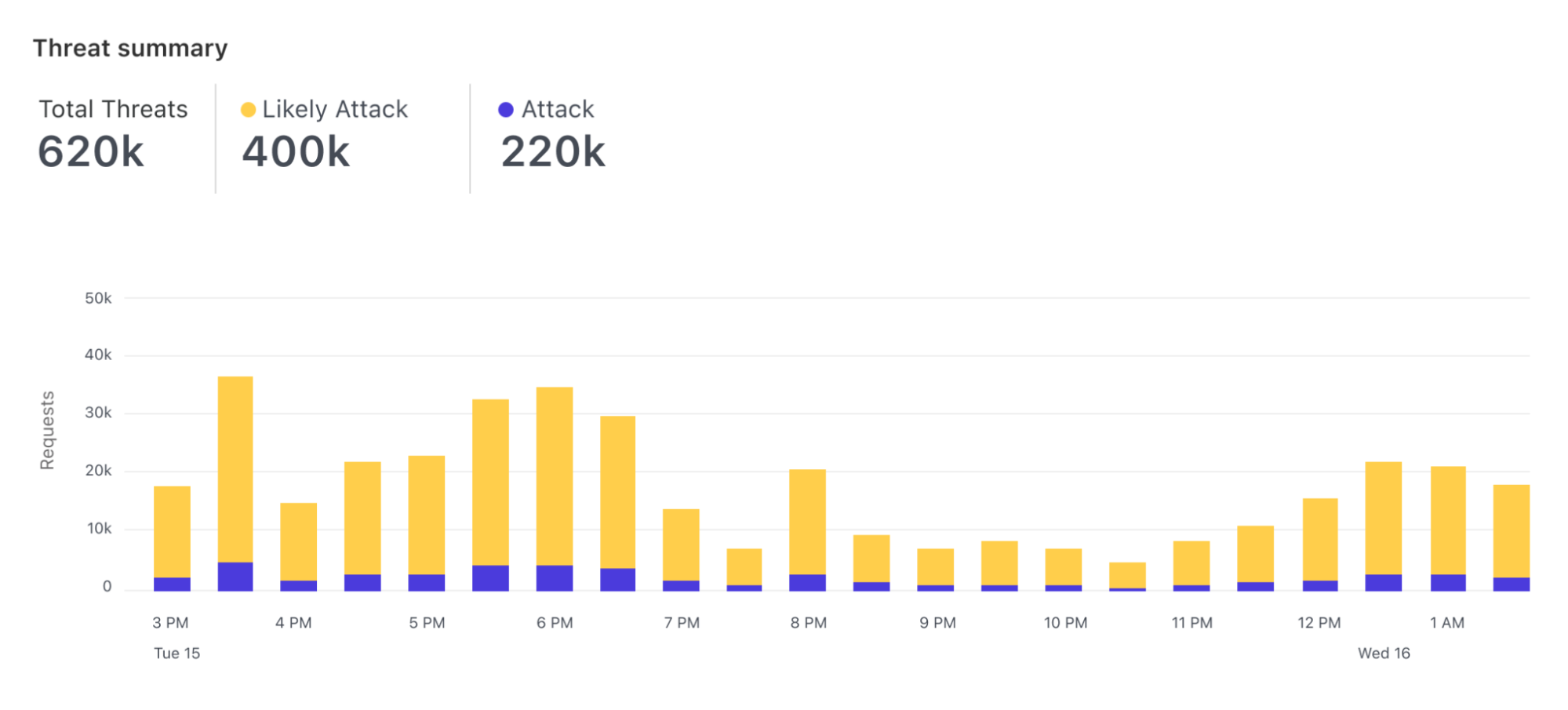
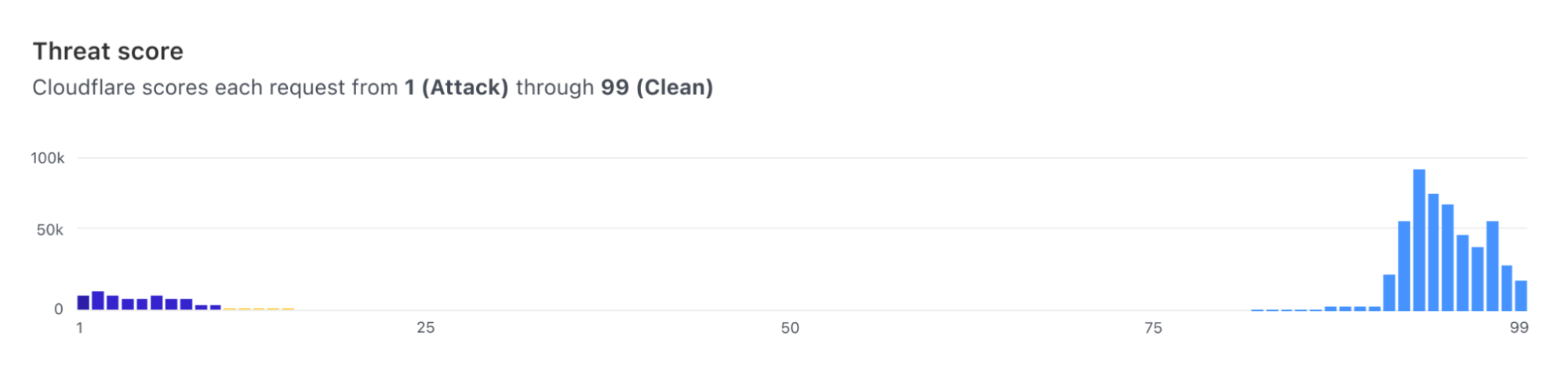
The new detection is based on the paradigm launched with Bot Analytics. Following this approach, each request is evaluated, and a score assigned, regardless of whether we are taking actions on it. Since we score every request, users can visualize how the score evolves over time for the entirety of the traffic directed to their server.

Improving the WAF with Machine Learning

Furthermore, users can visualize the histogram of how requests were scored for a specific attack vector (such as SQLi) and find what score is a good value to separate good from bad traffic.

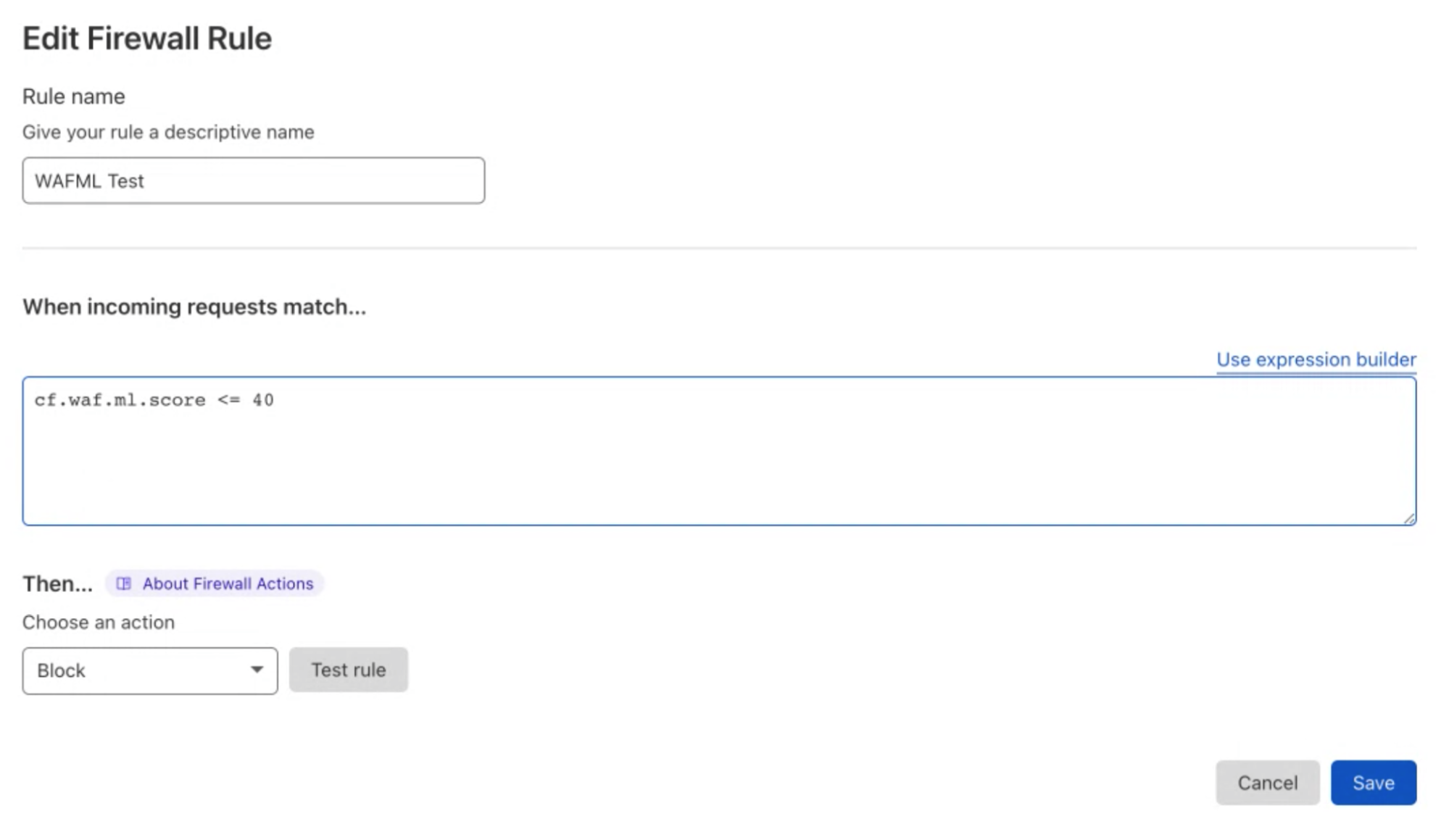
The actual mitigation is performed with custom WAF rules where the score is used to decide which requests should be blocked. This allows customers to create rules whose logic includes any parameter of the HTTP requests, including the dynamic fields populated by Cloudflare, such as bot scores.

Improving the WAF with Machine Learning

We are now looking at extending this approach to work for the managed rules too (OWASP and Cloudflare Managed). Customers will be able to identify trends and create rules based on patterns that are visible when looking at their overall traffic; rather than creating rules based on trial and error, log traffic to validate them and finally enforce protection.

How does it work?

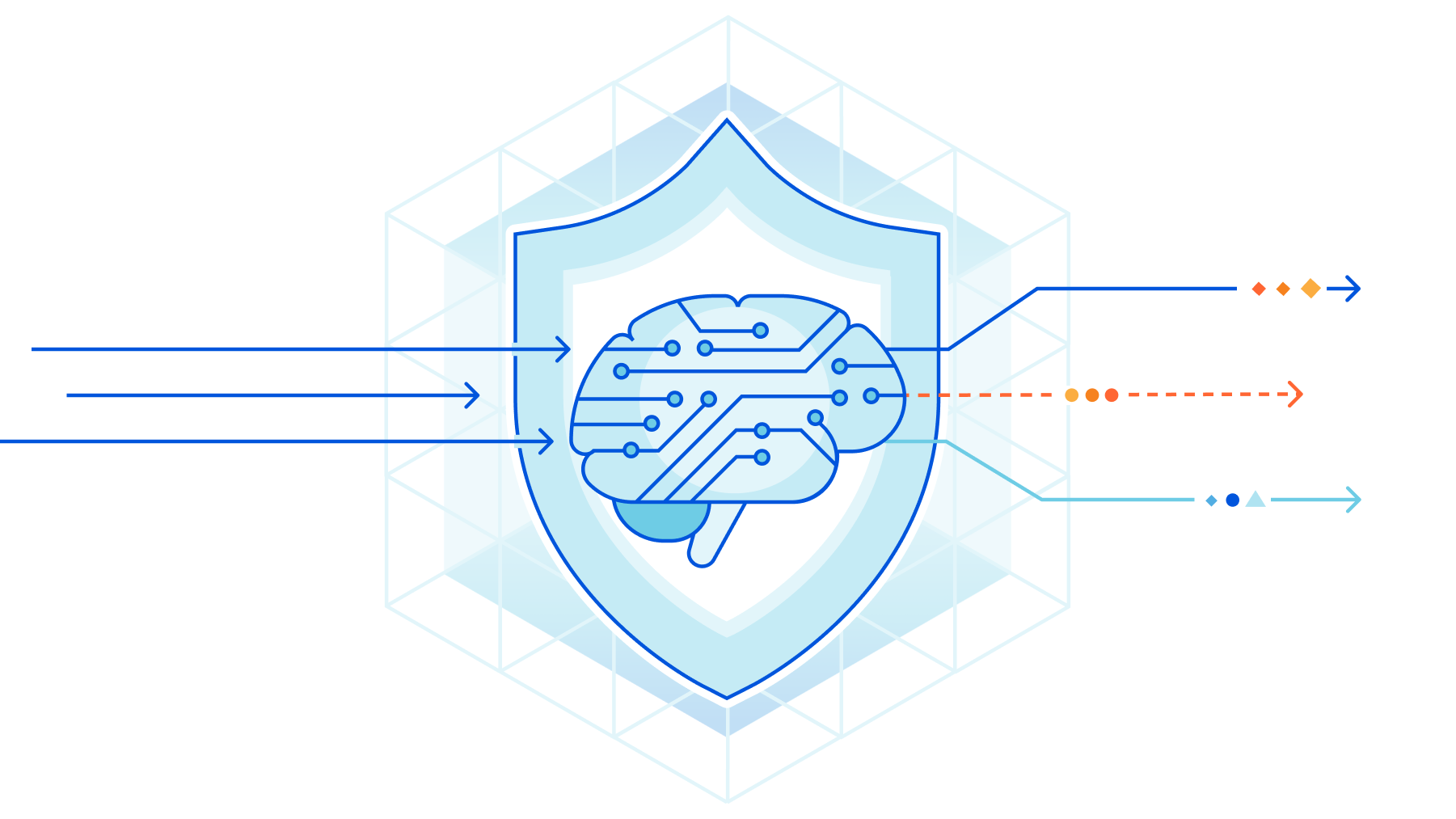
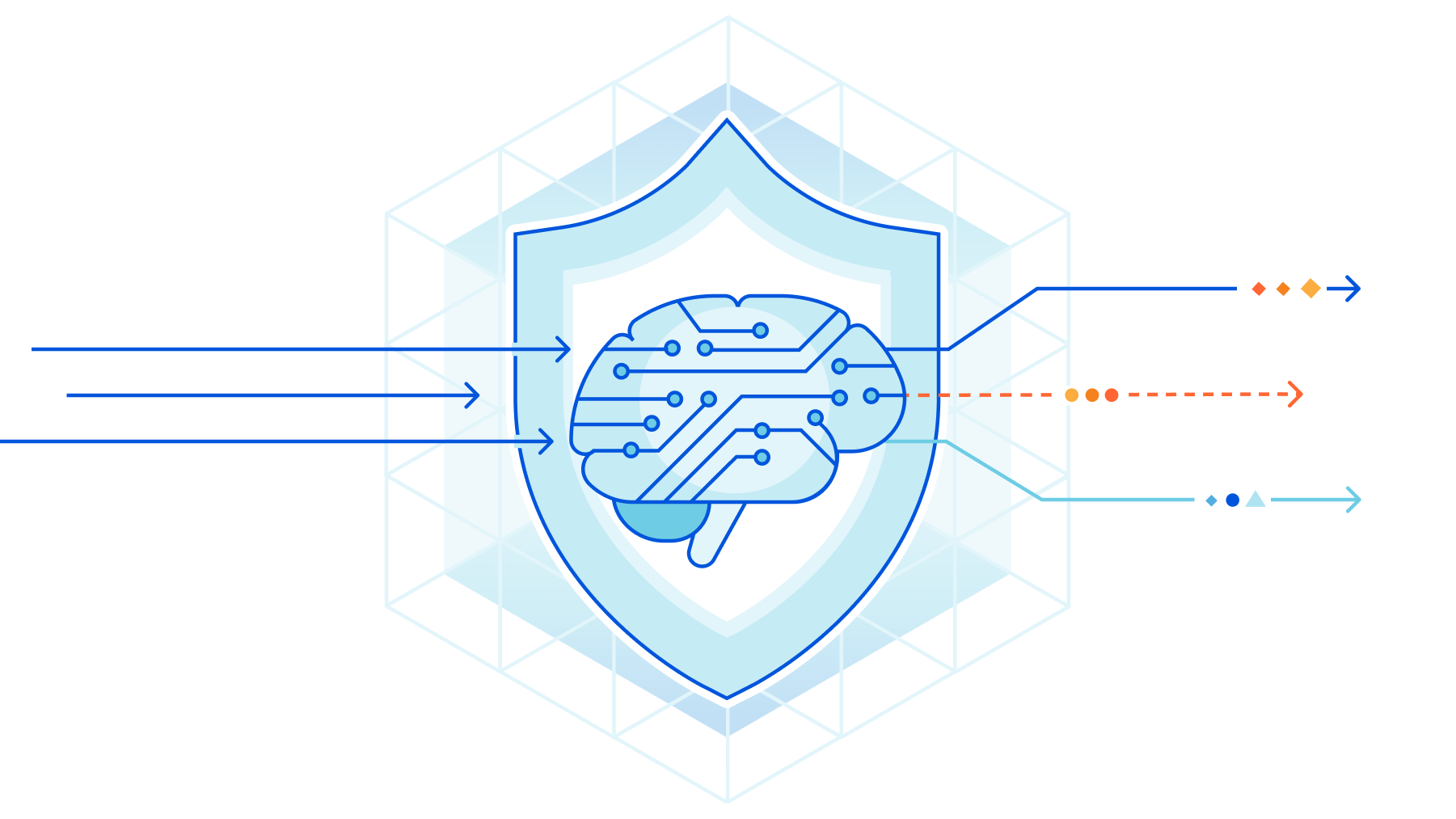
Machine learning–based detections complement the existing managed rulesets, such as OWASP and Cloudflare Managed. The system is based on models designed to identify variations of attack patterns and anomalies without the direct supervision of researchers or the end user.

As of today, we expose scores for two attack vectors: SQL injection and Cross Site Scripting. Users can create custom WAF/Firewall rules using three separate scores: a total score (cf.waf.ml.score), one for SQLi and one for XSS (cf.waf.ml.score.sqli, cf.waf.ml.score.xss, respectively). The scores can have values between 1 and 99, with 1 being definitely malicious and 99 being valid traffic.

Improving the WAF with Machine Learning

The model is then trained based on traffic classified by the existing WAF rules, and it works on a transformed version of the original request, making it easier to identify fingerprints of attacks.

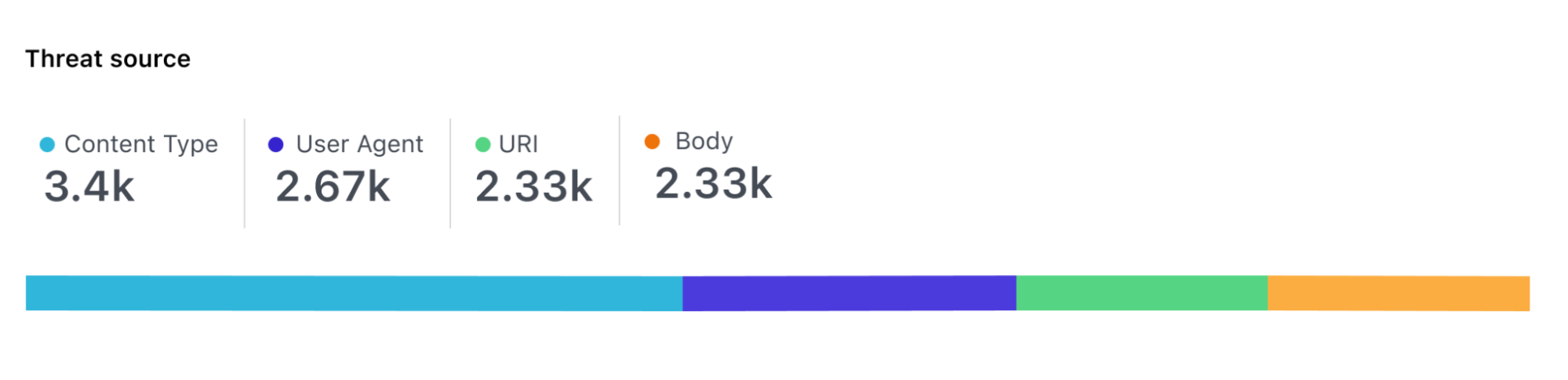
For each request, the model scores each part of the request independently so that it’s possible to identify where malicious payloads were identified, for example, in the body of the request, the URI or headers.

Improving the WAF with Machine Learning

This looks easy on paper, but there are a number of challenges that Cloudflare engineers had to solve to get here. This includes how to build a reliable dataset, scalable data labeling, selecting the right model architecture, and the requirement for executing the categorization on every request processed by Cloudflare’s global network (i.e. 32 million times per seconds).

In the coming weeks, the Engineering team will publish a series of blog posts which will give a better understanding of how the solution works under the hood.

Looking forward

In the next months, we are going to release the new detection engine to customers and collect their feedback on its performance. Long term, we are planning to extend the detection engine to cover all attack vectors already identified by managed rules and use the attacks blocked by the machine learning model to further improve our managed rulesets.

A new WAF experience

Post Syndicated from Zhiyuan Zheng original https://blog.cloudflare.com/new-waf-experience/

A new WAF experience

A new WAF experience

Around three years ago, we brought multiple features into the Firewall tab in our dashboard navigation, with the motivation “to make our products and services intuitive.” With our hard work in expanding capabilities offerings in the past three years, we want to take another opportunity to evaluate the intuitiveness of Cloudflare WAF (Web Application Firewall).

Our customers lead the way to new WAF

The security landscape is moving fast; types of web applications are growing rapidly; and within the industry there are various approaches to what a WAF includes and can offer. Cloudflare not only proxies enterprise applications, but also millions of personal blogs, community sites, and small businesses stores. The diversity of use cases are covered by various products we offer; however, these products are currently scattered and that makes visibility of active protection rules unclear. This pushes us to reflect on how we can best support our customers in getting the most value out of WAF by providing a clearer offering that meets expectations.

A few months ago, we reached out to our customers to answer a simple question: what do you consider to be part of WAF? We employed a range of user research methods including card sorting, tree testing, design evaluation, and surveys to help with this. The results of this research illustrated how our customers think about WAF, what it means to them, and how it supports their use cases. This inspired the product team to expand scope and contemplate what (Web Application) Security means, beyond merely the WAF.

Based on what hundreds of customers told us, our user research and product design teams collaborated with product management to rethink the security experience. We examined our assumptions and assessed the effectiveness of design concepts to create a structure (or information architecture) that reflected our customers’ mental models.

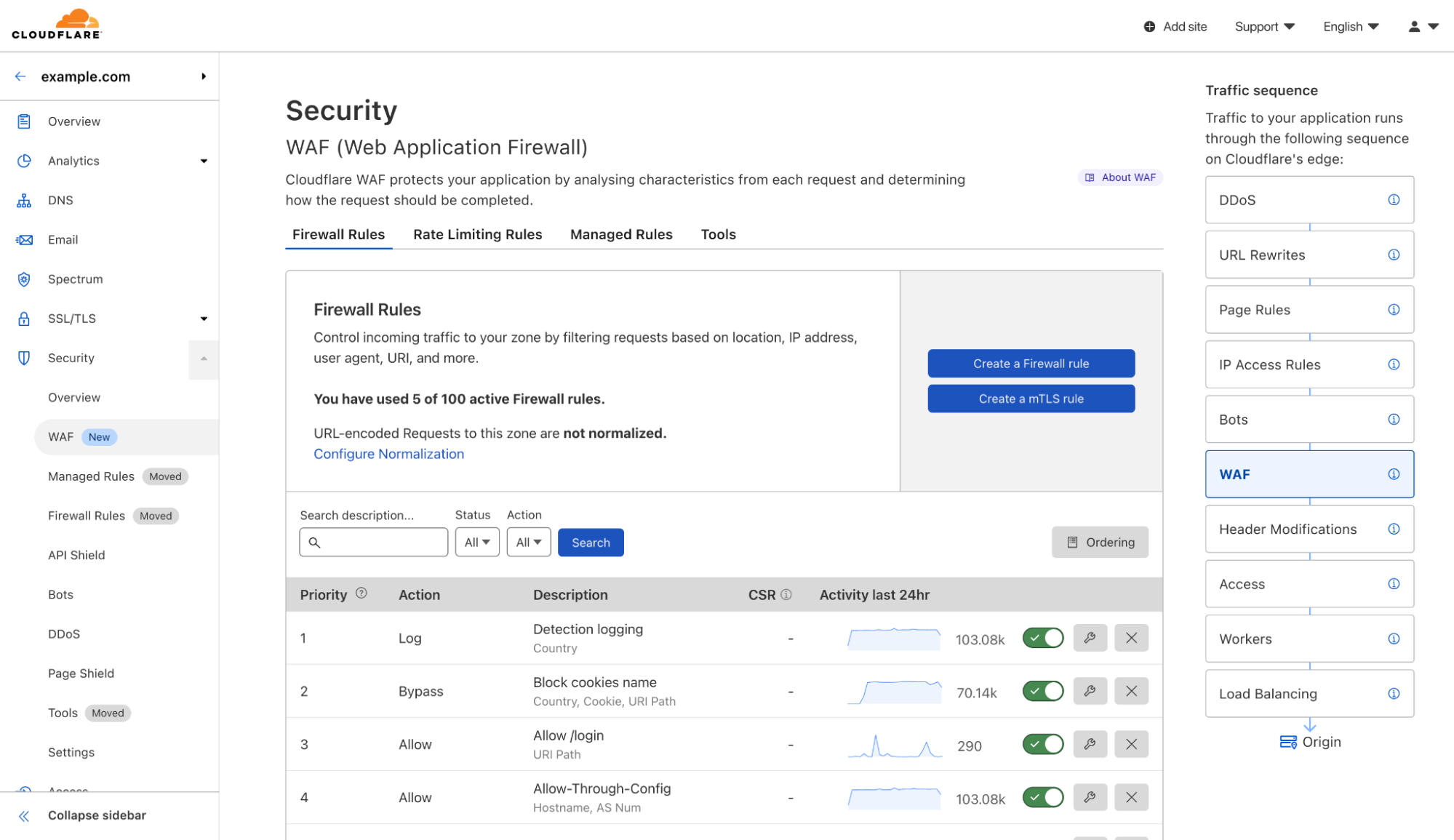
This new structure consolidates firewall rules, managed rules, and rate limiting rules to become a part of WAF. The new WAF strives to be the one-stop shop for web application security as it pertains to differentiating malicious from clean traffic.

As of today, you will see the following changes to our navigation:

  1. Firewall is being renamed to Security.
  2. Under Security, you will now find WAF.
  3. Firewall rules, managed rules, and rate limiting rules will now appear under WAF.

From now on, when we refer to WAF, we will be referring to above three features.

Further, some important updates are coming for these features. Advanced rate limiting rules will be launched as part of Security Week, and every customer will also get a free set of managed rules to protect all traffic from high profile vulnerabilities. And finally, in the next few months, firewall rules will move to the Ruleset Engine, adding more powerful capabilities thanks to the new Ruleset API. Feeling excited?

How customers shaped the future of WAF

Almost 500 customers participated in this user research study that helped us learn about needs and context of use. We employed four research methods, all of which were conducted in an unmoderated manner; this meant people around the world could participate remotely at a time and place of their choosing.

  • Card sorting involved participants grouping navigational elements into categories that made sense to them.
  • Tree testing assessed how well or poorly a proposed navigational structure performed for our target audience.
  • Design evaluation involved a task-based approach to measure effectiveness and utility of design concepts.
  • Survey questions helped us dive deeper into results, as well as painting a picture of our participants.

Results of this four-pronged study informed changes to both WAF and Security that are detailed below.

The new WAF experience

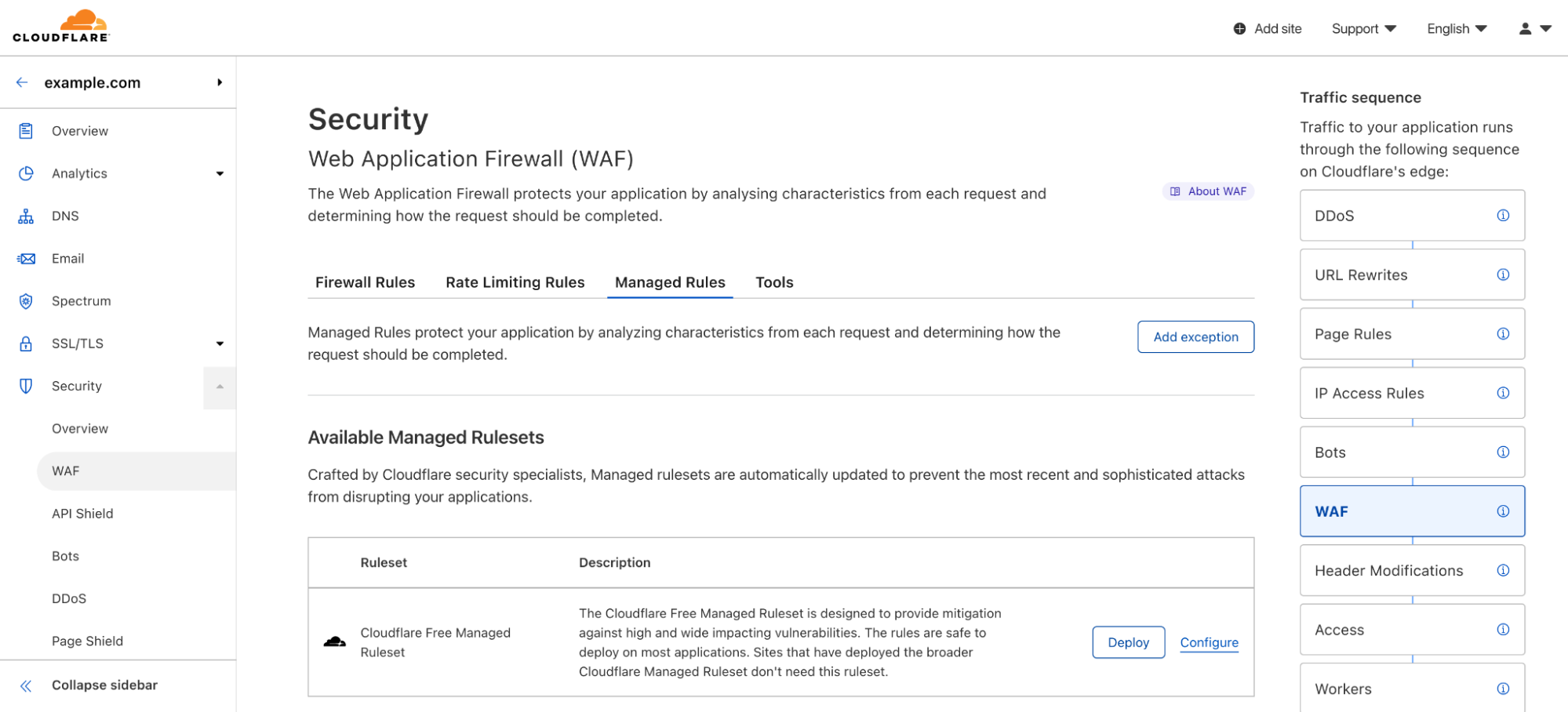
The final result reveals the WAF as part of a broader Security category, which also includes Bots, DDoS, API Shield and Page Shield. This destination enables you to create your rules (a.k.a. firewall rules), deploy Cloudflare managed rules, set rate limit conditions, and includes handy tools to protect your web applications.

All customers across all plans will now see the WAF products organized as below:

A new WAF experience
  1. Firewall rules allow you to create custom, user-defined logic by blocking or allowing traffic that leverages all the components of the HTTP requests and dynamic fields computed by Cloudflare, such as Bot score.
  2. Rate limiting rules include the traditional IP-based product we launched back in 2018 and the newer Advanced Rate Limiting for ENT customers on the Advanced plan (coming soon).
  3. Managed rules allows customers to deploy sets of rules managed by the Cloudflare analyst team. These rulesets include a “Cloudflare Free Managed Ruleset” currently being rolled out for all plans including FREE, as well as Cloudflare Managed, OWASP implementation, and Exposed Credentials Check for all paying plans.
  4. Tools give access to IP Access Rules, Zone Lockdown and User Agent Blocking. Although still actively supported, these products cover specific use cases that can be covered using firewall rules. However, they remain a part of the WAF toolbox for convenience.

Redesigning the WAF experience

Gestalt design principles suggest that “elements which are close in proximity to each other are perceived to share similar functionality or traits.” This principle in addition to the input from our customers informed our design decisions.

After reviewing the responses of the study, we understood the importance of making it easy to find the security products in the Dashboard, and the need to make it clear how particular products were related to or worked together with each other.

Crucially, the page needed to:

  • Display each type of rule we support, i.e. firewall rules, rate limiting rules and managed rules
  • Show the usage amount of each type
  • Give the customer the ability to add a new rule and manage existing rules
  • Allow the customer to reprioritise rules using the existing drag and drop behavior
  • Be flexible enough to accommodate future additions and consolidations of WAF features

We iterated on multiple options, including predominantly vertical page layouts, table based page layouts, and even accordion based page layouts. Each of these options, however, would force us to replicate buttons of similar functionality on the page. With the risk of causing additional confusion, we abandoned these options in favor of a horizontal, tabbed page layout.

How can I get it?

As of today, we are launching this new design of WAF to everyone! In the meantime, we are updating documentation to walk you through how to maximize the power of Cloudflare WAF.

Looking forward

This is a starting point of our journey to make Cloudflare WAF not only powerful but also easy to adapt to your needs. We are evaluating approaches to empower your decision-making process when protecting your web applications. Among growing intel information and more rules creation possibilities, we want to shorten your path from a possible threat detection (such as by security overview) to setting up the right rule to mitigate such threat. Stay tuned!

Democratizing email security: protecting individuals and businesses of all sizes from phishing and malware attacks

Post Syndicated from Patrick R. Donahue original https://blog.cloudflare.com/democratizing-email-security/

Democratizing email security: protecting individuals and businesses of all sizes from phishing and malware attacks

Democratizing email security: protecting individuals and businesses of all sizes from phishing and malware attacks

Since our founding, Cloudflare has been on a mission to take expensive, complex security solutions typically only available to the largest companies and make them easy to use and accessible to everyone. In 2011 and 2015 we did this for the web application firewall and SSL/TLS markets, simplifying the process of protecting websites from application vulnerabilities and encrypting HTTP requests down to single clicks; in 2020, during the start of the COVID-19 pandemic, we made our Zero Trust suite available to everyone; and today—in the face of heightened phishing attacks—we’re doing the same for the email security market.

Once the acquisition of Area 1 closes, as we expect early in the second quarter of 2022, we plan to give all paid self-serve plans access to their email security technology at no additional charge. Control, customization, and visibility via analytics will vary with plan level, and the highest flexibility and support levels will be available to Enterprise customers for purchase.

All self-serve users will also get access to a more feature-packed version of the Zero Trust solution we made available to everyone in 2020. Zero Trust services are incomplete without an email security solution, and CISA’s recent report makes that clearer than ever: over 90% of successful cyber attacks start with a phishing email, so we expect that over time analysts will have no choice but to include email in their definitions of secure access and zero edges.

If you’re interested in reserving your place in line, register your interest by logging into your Cloudflare account at dash.cloudflare.com, selecting your domain, clicking Email, and then “Join Waitlist” at the top of the page; we’ll reach out after the Area 1 acquisition is completed, and the integration is ready, in the order we received your request.

One-click deployment

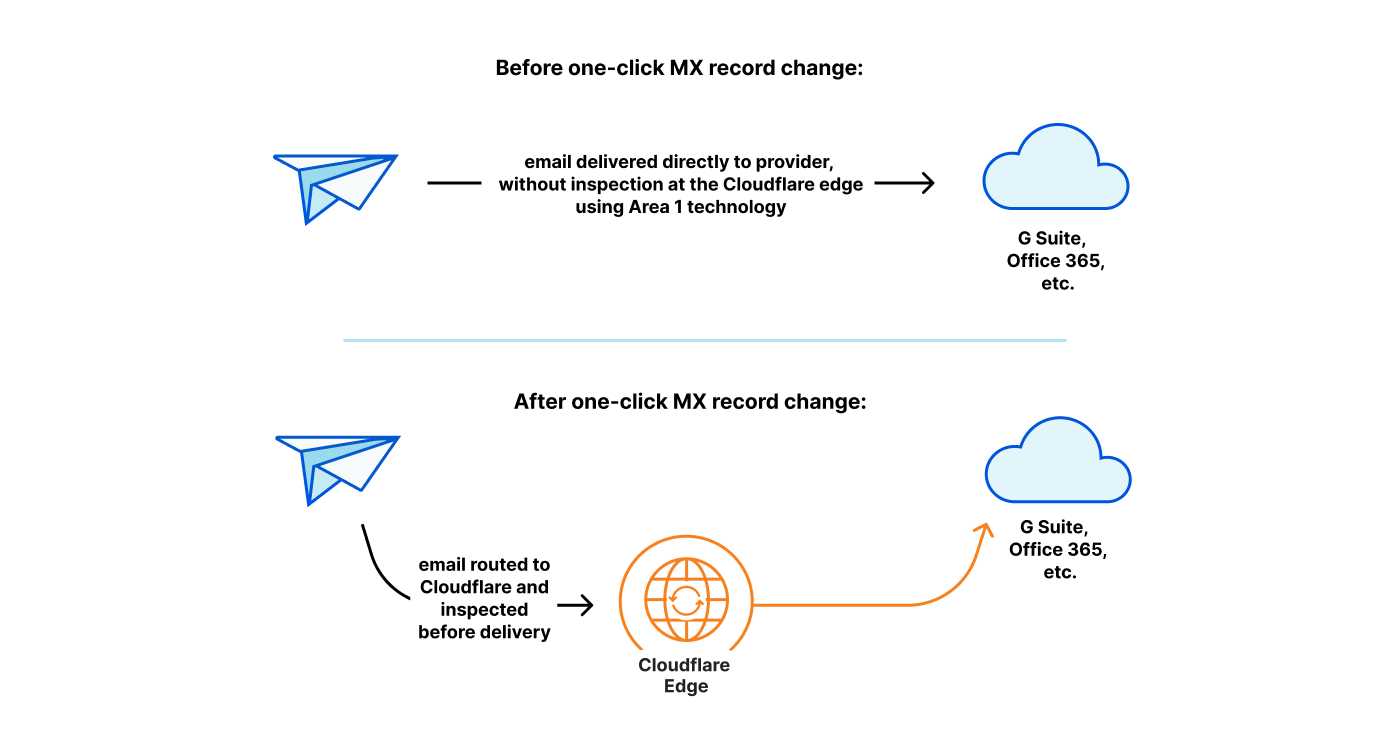
If you’re already managing your authoritative DNS with Cloudflare, as nearly 100% of non-Enterprise plans are, there will just be a single click to get started. Once clicked, we’ll start returning different MX records to anyone trying to send email to your domain. This change will attract all emails destined for your domain, during which they’ll be run through Area 1’s models and potentially be quarantined or flagged. Customers of Microsoft Office 365 will also be able to take advantage of APIs for an even deeper integration and capabilities like post-delivery message redaction.

Democratizing email security: protecting individuals and businesses of all sizes from phishing and malware attacks

In addition to routing and filtering email, we’ll also automagically take care of your DNS email security records such as SPF, DKIM, DMARC, etc. We launched a tool to help with this last year, and soon we’ll be making it even more comprehensive and easier to use.

Integration with other Zero Trust products

As we wrote in the acquisition announcement post on this blog, we’re excited to integrate email security with other products in our Zero Trust suite. For customers of Gateway and Remote Browser Isolation (RBI), we’ll automatically route potentially suspicious domains and links through these protective layers. Our built-in data loss prevention (DLP) technology will also be wired into Area 1’s technology in deployments where visibility into outbound email is available.

Improving threat intelligence with new data sources

In addition to integrating directly with Zero Trust products, we’re excited about connecting threat data sources from Area 1 into existing Cloudflare products and vice versa. For example, phishing infrastructure identified during Area 1’s Internet-wide scans will be displayed within the recently launched Cloudflare Security Center, and 1.1.1.1’s trillions of queries per month will help Area 1 identify new domains that may be threats. Domains that are newly registered, or registered with slight variations of legitimate domains, are often warning signs of an upcoming phishing attack.

Getting started

Cloudflare has been a happy customer of Area 1’s technology for years, and we’re excited to open it up to all of our customers as soon as possible. If you’re excited as we are about being able to use this in your Pro or Business plan, reserve your place in line today within the Email tab for your domain. Or if you’re an Enterprise customer and want to get started immediately, fill out this form or contact your Customer Success Manager.

Investigating threats using the Cloudflare Security Center

Post Syndicated from Patrick R. Donahue original https://blog.cloudflare.com/security-center-investigate/

Investigating threats using the Cloudflare Security Center

Investigating threats using the Cloudflare Security Center

Cloudflare blocks a lot of diverse security threats, with some of the more interesting attacks targeting the “long tail” of the millions of Internet properties we protect. The data we glean from these attacks trains our machine learning models and improves the efficacy of our network and application security products, but historically hasn’t been available to query directly. This week, we’re changing that.

All customers will soon be granted access to our new threat investigations portal, Investigate, in the Cloudflare Security Center (first launched in December 2021). Additionally, we’ll be annotating threats across our analytics platform with this intelligence to streamline security workflows and tighten feedback loops.

What sorts of data might you want to look up here? Let’s say you’re seeing an IP address in your logs and want to learn which hostnames have pointed to it via DNS, or you’re seeing a cluster of attacks come from an autonomous system (AS) you’re not familiar with. Or maybe you want to investigate a domain name to see how it’s been categorized from a threat perspective. Simply enter any of those items into the omni search box, and we’ll tell you everything we know.

IPs and hostnames will be available to query this week, followed by AS details to give you insight into the networks that communicate with your Cloudflare accounts. Next month as we move to general availability we’ll add data types and properties. Integrations with partners will allow you to use your existing license keys to see all your threat data in a single, unified interface. We also plan to show how both your infrastructure and corporate employees are interacting with any objects you look up, e.g., you can see how many times an IP triggers a WAF or API Shield rule, or how many times your employees attempted to resolve a domain that’s known to serve malware.

Annotations in the dashboard: actionable intelligence in context

Looking up threat data on an ad hoc basis is great, but it’s better when that data is annotated directly in logs and analytics. Starting this week, we will begin rolling out intelligence that is available in Investigate in the dashboard where it is relevant to your workflow. We’re starting with the web application firewall analytics for your websites that are behind Cloudflare.

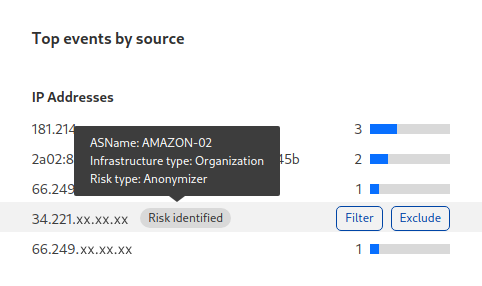
Say you are investigating a security alert for a large number of requests that are blocked by a web application firewall rule. You might see that the alert was caused by an IP address probing your website for commonly exploited software vulnerabilities. If the IP in question were a cloud IP or flagged as an anonymizer, contextual intelligence will show that information directly on the analytics page.

This context can help you see patterns. Are attacks coming from anonymizers or the Tor network? Are they coming from cloud virtual machines? An IP is just an IP. But seeing a credential stuffing attack coming from anonymizers is a pattern that enables a proactive response, “Is my bot management configuration up-to-date?”

Investigating threats using the Cloudflare Security Center

Cloudflare’s network vantage point and how this informs our data

The scale at which each product suite operates at Cloudflare is staggering. At peak, Cloudflare handles 44 million HTTP requests a second, from more than 250 cities in over 100 countries. The Cloudflare network responds to over 1.2 trillion DNS queries per day, and it has 121 Tbps of network capacity to serve traffic and mitigate denial of service attacks across all products. But on top of this immense scale, Cloudflare’s architecture enables refining raw data and combining intelligence from all of our products to paint a holistic picture of the security landscape.

We are able to take signals refined from the raw data generated by each product and combine them with signals from other products and capabilities to enhance our network and threat data capabilities. It is a common paradigm for security products to be built to have positive flywheel effects among users of the products. If one customer sees a new piece of malware, an endpoint protection vendor can deploy an update that will detect and block this malware for all their other customers. If a botnet attacks one customer, this provides information that can be used to find the signature of that botnet and protect other customers. If a device participates in a DDoS (Distributed Denial of Service) attack, that information can be used to make the network able to faster detect and mitigate future DDoS attacks. Cloudflare’s breadth of product offerings means that the flywheel effect benefits to users accumulate not just between users, but between products as well.

Let’s look at some examples:

DNS resolution and certificate transparency

First, Cloudflare operates 1.1.1.1, one of the largest recursive DNS resolvers in the world. We operate it in a privacy-forward manner, so here at Cloudflare we do not know who or what IP performed a query, nor are we able to correlate queries together to distinct anonymous users. However, through the requests the resolver handles, Cloudflare sees newly registered and newly seen domains. Additionally, Cloudflare has one of the most advanced SSL/TLS encryption products on the market, and as part of that is a member organization helping to maintain the Certificate Transparency logs. These are public logs of every TLS certificate issued by a root certificate authority that is trusted by web browsers. Between these two products, Cloudflare has an unmatched view of what domains are out there on the Internet and when they become active. We use this information not only to populate our new and newly seen domains categories for our Gateway product, but we feed these domains into machine learning models that label suspicious or potentially malicious domains early in their lifecycle.

Email security

As another example, with the acquisition of Area 1, Cloudflare will bring a new set of mutually-reinforcing capabilities into its product offering. All the signals we can generate for a domain from our 1.1.1.1 resolver will become available to help identify malicious email, and Area 1’s years of expertise in identifying malicious email will be able to feed back into Cloudflare’s Gateway product and 1.1.1.1 for Families DNS resolver. In the past, data integrations like this would have been performed by IT or security teams. Instead, data will be able to flow seamlessly between the points on your organization’s attack surface, mutually reinforcing the quality of the analysis and classification. The entire Cloudflare Zero Trust toolkit, including request logging, blocking, and remote browser isolation will be available to handle potentially malicious links delivered via email, using the same policies already in place for other security risks.

Over the last few years, Cloudflare has integrated the use of machine learning in many of our product offerings, but today we’ve launched a new tool that puts the data and signals that power our network security into our customer’s hands as well. Whether responding to security incidents, threat hunting, or proactively setting security policies to protect for your organization, you, human, can now be part of the Cloudflare network as well. Cloudflare’s unique position in the network means that your insights can be fed back into the network to protect not just your organization across all Cloudflare products it uses, but also can participate in mutual insight and defense among all Cloudflare customers.

Looking forward

Cloudflare can cover your organization’s whole attack surface: defending websites, protecting devices and SaaS applications with Cloudflare Zero Trust, your locations and offices with Magic Transit, and your email communications. Security Center is here to make sure you have all the information you need to understand the cyber security risks present today, and to help you defend your organization using Cloudflare.

“What is the wiper malware that I hear about on the news, and how do I protect my company from it?” We hear your questions, and we’re going to give you answers. Not just raw information, but what is relevant to you and how you use the Internet. We have big plans for Security Center. A file scanning portal will provide you with information about JavaScript files seen by Page Shield, executable files scanned by Gateway, and the ability to upload and scan files. Indicators of Compromise like IP addresses and domains will link to information about the relevant threat actors, when known, giving you more information about the techniques and tactics you are faced with, and information about how Cloudflare products can be used to defend against them. CVE search will let you find information on software vulnerabilities, along with the same easy-to-understand Cloudflare perspective you are used to reading on this blog to help decode the jargon and technical language. With today’s release, we’re just getting started.

Get full observability into your Cloudflare logs with New Relic

Post Syndicated from Tanushree Sharma original https://blog.cloudflare.com/announcing-the-new-relic-direct-log-integration/

Get full observability into your Cloudflare logs with New Relic

Get full observability into your Cloudflare logs with New Relic

Building a great customer experience is at the heart of any business. Building resilient products is half the battle — teams also need observability into their applications and services that are running across their stack.

Cloudflare provides analytics and logs for our products in order to give our customers visibility to extract insights. Many of our customers use Cloudflare along with other applications and network services and want to be able to correlate data through all of their systems.

Understanding normal traffic patterns, causes of latency and errors can be used to improve performance and ultimately the customer experience. For example, for websites behind Cloudflare, analyzing application logs and origin server logs along with Cloudflare’s HTTP request logs give our customers an end-to-end visibility about the journey of a request.

We’re excited to have partnered with New Relic to create a direct integration that provides this visibility. The direct integration with our logging product, Logpush, means customers no longer need to pay for middleware to get their Cloudflare data into New Relic. The result is a faster log delivery and fewer costs for our mutual customers!

We’ve invited the New Relic team to dig into how New Relic One can be used to provide insights into Cloudflare.

New Relic Log Management

New Relic provides an open, extensible, cloud-based observability platform that gives visibility into your entire stack. Logs, metrics, events, and traces are automatically correlated to help our customers improve user experience, accelerate time to market, and reduce MTTR.

Deploying log management in context and at scale has never been faster, easier, or more attainable. With New Relic One, you can collect, search, and correlate logs and other telemetry data from applications, infrastructure, network devices, and more for faster troubleshooting and investigation.

New Relic correlates events from your applications, infrastructure, serverless environments, along with mobile errors, traces and spans to your logs — so you find exactly what you need with less toil. All your logs are only a click away, so there’s no need to dig through logs in a separate etool to manually correlate them with errors and traces.

See how engineers have used logs in New Relic to better serve their customers in the short video below.

A quickstart for Cloudflare Logpush and New Relic

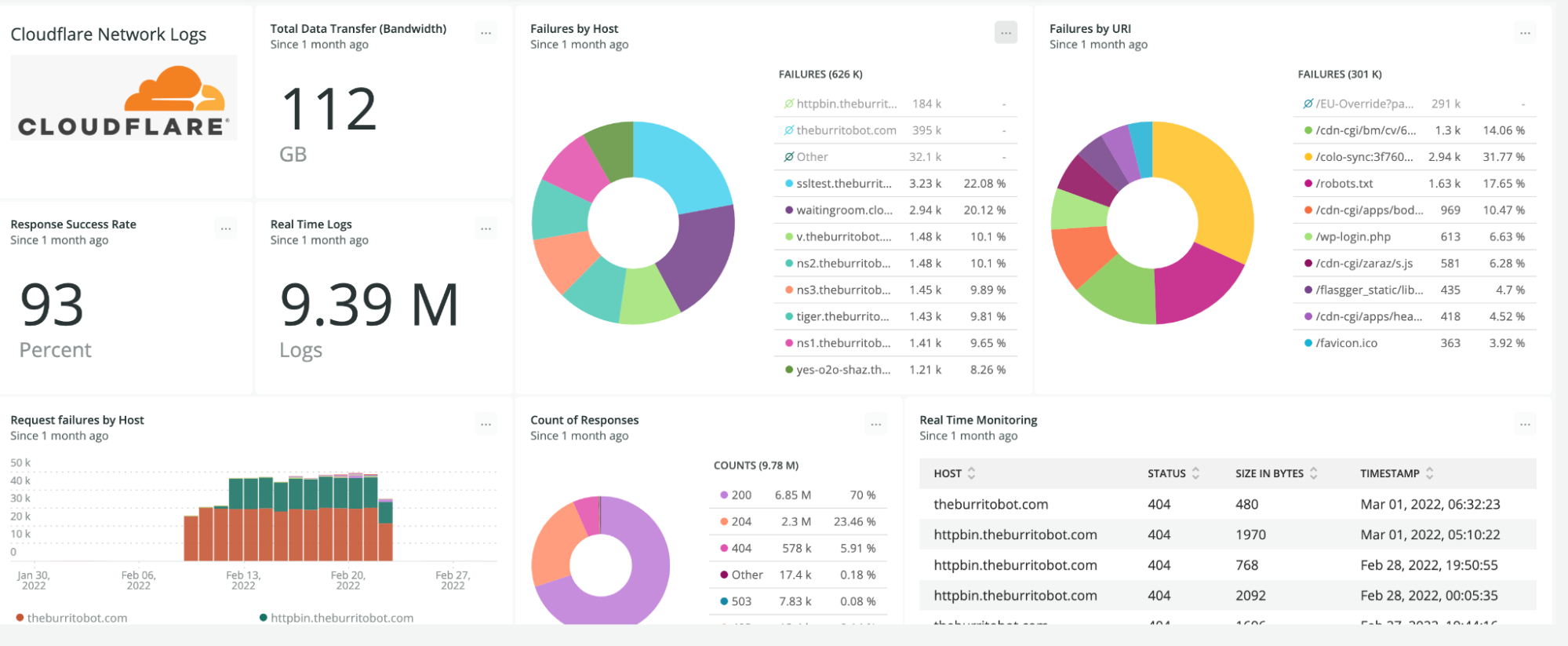
To help you get the most of the new Logpush integration with New Relic, we’ve created the Cloudflare Logpush quickstart for New Relic. The Cloudflare quickstart will enable you to monitor and analyze web traffic metrics on a single pre-built dashboard, integrating with New Relic’s database to provide an at-a-glance overview of the most important logs and metrics from your websites and applications.

Getting started is simple:

  • First, ensure that you have enabled pushing logs directly into New Relic by following the documentation “Enable Logpush to New Relic”.
  • You’ll also need a New Relic account. If you don’t have one yet, get a free-forever account here.
  • Next, visit the Cloudflare quickstart in New Relic, click “Install quickstart”, and follow the guided click-through.

For full instructions to set up the integration and quickstart, read the New Relic blog post.

Get full observability into your Cloudflare logs with New Relic

As a result, you’ll get a rich ready-made dashboard with key metrics about your Cloudflare logs!

Correlating Cloudflare logs across your stack in New Relic One is powerful for monitoring and debugging in order to keep services safe and reliable. Cloudflare customers get access to logs as part of the Enterprise account, if you aren’t using Cloudflare Enterprise, contact us. If you’re not already a New Relic user, sign up for New Relic to get a free account which includes this new experience and all of our product capabilities.

Leverage IBM QRadar SIEM to get insights from Cloudflare logs

Post Syndicated from Tanushree Sharma original https://blog.cloudflare.com/announcing-the-ibm-qradar-direct-log-integration/

Leverage IBM QRadar SIEM to get insights from Cloudflare logs

Leverage IBM QRadar SIEM to get insights from Cloudflare logs

It’s just gone midnight, and you’ve just been notified that there is a malicious IP hitting your servers. You need to triage the situation; find the who, what, where, when, why as fast and in as much detail as possible.

Based on what you find out, your next steps could fall anywhere between classifying the alert as a false positive, to escalating the situation and alerting on-call staff from around your organization with a middle of the night wake up.

For anyone that’s gone through a similar situation, you’re aware that the security tools you have on hand can make the situation infinitely easier. It’s invaluable to have one platform that provides complete visibility of all the endpoints, systems and operations that are running at your company.

Cloudflare protects customers’ applications through application services: DNS, CDN and WAF to name a few. We also have products that protect corporate applications, like our Zero Trust offerings Access and Gateway. Each of these products generates logs that provide customers visibility into what’s happening in their environments. Many of our customers use Cloudflare’s services along with other network or application services, such as endpoint management, containerized systems and their own servers.

We’re excited to announce that Cloudflare customers are now able to push their logs directly to IBM Security QRadar SIEM. This direct integration leads to cost savings and faster log delivery for Cloudflare and QRadar SIEM customers because there is no intermediary cloud storage required.

Cloudflare has invited our partner from the IBM QRadar SIEM team to speak to the capabilities this unlocks for our mutual customers.

IBM QRadar SIEM

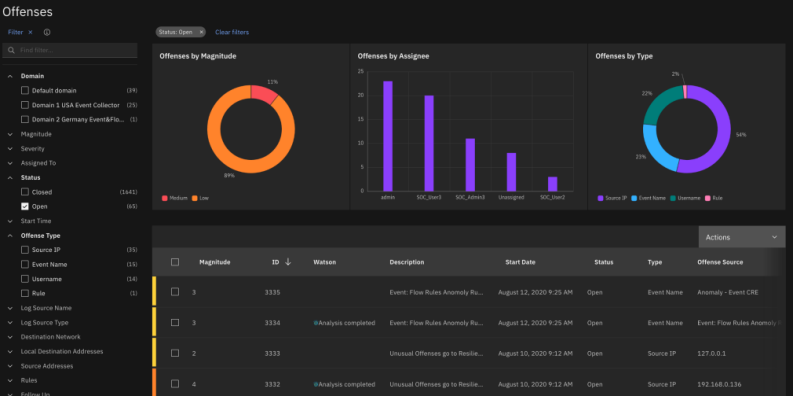
QRadar SIEM provides security teams centralized visibility and insights across users, endpoints, clouds, applications, and networks – helping you detect, investigate, and respond to threats enterprise wide. QRadar SIEM helps security teams work quickly and efficiently by turning thousands to millions of events into a manageable number of prioritized alerts and accelerating investigations with automated, AI-driven enrichment and root cause analysis. With QRadar SIEM, increase the productivity of your team, address critical use cases, and mature your security operation.

Cloudflare’s reverse proxy and enterprise security products are a key part of customer’s environments. Security analysis can gain visibility about logs from these products along with data from tools that span their network to build out detections and response workflows.

Leverage IBM QRadar SIEM to get insights from Cloudflare logs

IBM and Cloudflare have partnered together for years to provide a single pane of glass view for our customers. This new enhanced integration means that QRadar SIEM customers can ingest Cloudflare logs directly from Cloudflare’s Logpush product. QRadar SIEM also continues to support customers who are leveraging existing integration via S3 storage.

For more information about how to use this new integration, refer to the Cloudflare Logs DSM guide. Also, check out the blog post on the QRadar Community blog for more details!

Introducing: Backup Certificates

Post Syndicated from Dina Kozlov original https://blog.cloudflare.com/introducing-backup-certificates/

Introducing: Backup Certificates

At Cloudflare, we pride ourselves in giving every customer the ability to provision a TLS certificate for their Internet application — for free. Today, we are responsible for managing the certificate lifecycle for almost 45 million certificates from issuance to deployment to renewal. As we build out the most resilient, robust platform, we want it to be “future-proof” and resilient against events we can’t predict.

Events that cause us to re-issue certificates for our customers, like key compromises, vulnerabilities, and mass revocations require immediate action. Otherwise, customers can be left insecure or offline. When one of these events happens, we want to be ready to mitigate impact immediately. But how?

By having a backup certificate ready to deploy — wrapped with a different private key and issued from a different Certificate Authority than the primary certificate that we serve.

Introducing: Backup Certificates

Events that lead to certificate re-issuance

Cloudflare re-issues certificates every day — we call this a certificate renewal. Because certificates come with an expiration date, when Cloudflare sees that a certificate is expiring soon, we initiate a new certificate renewal order. This way, by the time the certificate expires, we already have an updated certificate deployed and ready to use for TLS termination.

Unfortunately, not all certificate renewals are initiated by the expiration date. Sometimes, unforeseeable events like key compromises can lead to certificate renewals. This is because a new key needs to be issued, and therefore a corresponding certificate does as well.

Key Compromises

A key compromise is when an unauthorized person or system obtains the private key that is used to encrypt and decrypt secret information — security personnel’s worst nightmare. Key compromises can be the result of a vulnerability, such as Heartbleed, where a bug in a system can cause the private key to be leaked. They can also be the result of malicious actions, such as a rogue employee accessing unauthorized information. In the event of a key compromise, it’s crucial that (1) new private keys are immediately issued, (2) new certificates are deployed, and (3) the old certificates are revoked.

The Heartbleed Vulnerability

In 2014, the Heartbleed vulnerability was exposed. It allowed attackers to extract the TLS certificate private key for any server that was running the affected version of OpenSSL, a popular encryption library. We patched the bug and then as a precaution, quickly reissued private keys and TLS certificates belonging to all of our customers, even though none of our keys were leaked. Cloudflare’s ability to act quickly protected our customers’ data from being exposed.

Heartbleed was a wake-up call. At the time, Cloudflare’s scale was a magnitude smaller. A similar vulnerability at today’s scale would take us weeks, not hours to re-issue all of our customers certificates.

Now, with backup certificates, we don’t need to worry about initiating a mass re-issuance in a small time frame. Instead, customers will already have a certificate that we’ll be able to instantly deploy. Not just that, but the backup certificate will also be wrapped with a different key than the primary certificate, preventing it from being impacted by a key compromise.

Key compromises are one of the main reasons certificates need to be re-issued at scale. But other events can prompt re-issuance as well, including mass revocations by Certificate Authorities.

Mass Revocations from CAs

Today, the Certificate Authority/Browser Forum (CA/B Forum) is the governing body that sets the rules and standards for certificates. One of the Baseline Requirements set by the CA/B Forum states that Certificate Authorities are required to revoke certificates whose keys are at risk of being compromised within 24 hours. For less immediate issues, such as certificate misuse or violation of a CA’s Certificate Policy, certificates need to be revoked within five days. In both scenarios, certificates will be revoked by the CA in a short timeframe and immediate re-issuance of certificates is required.

While mass revocations aren’t commonly initiated by CAs, there have been a few occurrences throughout the last few years. Recently, Let’s Encrypt had to revoke roughly 2.7 million certificates when they found a non-compliance in their implementation of a DCV challenge. In this case, Cloudflare customers were unaffected.

Another time, one of the Certificate Authorities that we use found that they were renewing certificates based on validation tokens that did not comply with the CA/B Forum standards. This caused them to invoke a mass revocation, impacting about five thousand Cloudflare-managed domains. We worked with our customers and the CA to issue new certificates before the revocation, resulting in minimal impact.

We understand that mistakes happen, and we have been lucky enough that as these issues have come up, our engineering teams were able to mitigate quickly so that no customers were impacted. But that’s not enough: our systems need to be future-proof so that a revocation of 45 million certificates will have no impact on our customers. With backup certificates, we’ll be ready for a mass re-issuance, no matter the scale.

To be resilient against mass revocations initiated by our CAs, we are going to issue every backup certificate from a different CA than the primary certificate. This will add a layer of protection if one of our CAs will have to invoke a mass revocation — something that when initiated, is a ticking time bomb.

Challenges when Renewing Certificates

Scale: With great power, comes great responsibility

When the Heartbleed vulnerability was exposed, we had to re-issue about 100,000 certificates. At the time, this wasn’t a challenge for Cloudflare. Now, we are responsible for tens of millions of certificates. Even if our systems are able to handle this scale, we rely on our Certificate Authority partners to be able to handle it as well. In the case of an emergency, we don’t want to rely on systems that we do not control. That’s why it’s important for us to issue the certificates ahead of time, so that during a disaster, all we need to worry about is getting the backup certificates deployed.

Manual intervention for completing DCV

Another challenge that comes with re-issuing certificates is Domain Control Validation (DCV). DCV is a check used to validate the ownership of a domain before a Certificate Authority can issue a certificate for it. When customers onboard to Cloudflare, they can either delegate Cloudflare to be their DNS provider, or they can choose to use Cloudflare as a proxy while maintaining their current DNS provider.

When Cloudflare acts as the DNS provider for a domain, we can add Domain Control Validation (DCV) records on our customer’s behalf. This makes the certificate issuance and renewal process much simpler.

Domains that don’t use Cloudflare as their DNS provider — we call them partial zones — have to rely on other methods for completing DCV. When those domains proxy their traffic through us, we can complete HTTP DCV on their behalf, serving the HTTP DCV token from our Edge. However, customers that want their certificate issued before proxying their traffic need to manually complete DCV. In an event where Cloudflare has to re-issue thousands or millions of certificates, but cannot complete DCV on behalf of the customer, manual intervention will be required. While completing DCV is not an arduous task, it’s not something that we should rely on our customers to do in an emergency, when they have a small time frame, with high risk involved.

This is where backup certificates come into play. From now on, every certificate issuance will fire two orders: one for a certificate from the primary CA and one for the backup certificate. When we can complete the DCV on behalf of the customer, we will do so for both CAs.

Today, we’re only issuing backup certificates for domains that use Cloudflare as an Authoritative DNS provider. In the future, we’ll order backup certificates for partial zones. That means that for backup certificates for which we are unable to complete DCV, we will give customers the corresponding DCV records to get the certificate issued.

Backup Certificates Deployment Plan

We are happy to announce that Cloudflare has started deploying backup certificates on Universal Certificate orders for Free customers that use Cloudflare as an Authoritative DNS provider. We have been slowly ramping up the number of backup certificate orders and in the next few weeks, we expect every new Universal certificate pack order initiated on a Free, Pro, or Biz account to include a backup certificate, wrapped with a different key and issued from a different CA than the primary certificate.

At the end of April we will start issuing backup certificates for our Enterprise customers. If you’re an Enterprise customer and have any questions about backup certificates, please reach out to your Account Team.

Next Up: Backup Certificates for All

Today, Universal certificates make up 72% of the certificates in our pipeline. But we want full coverage! That’s why our team will continue building out our backup certificates pipeline to support Advanced Certificates and SSL for SaaS certificates. In the future, we will also issue backup certificates for certificates that our customers upload themselves, so they can have a backup they can rely on.

In addition, we will continue to improve our pipeline to make the deployment of backup certificates instantaneous — leaving our customers secure and online in an emergency.

At Cloudflare, our mission is to help build a better Internet. With backup certificates, we’re helping build a secure, reliable Internet that’s ready for any disaster. Interested in helping us out? We’re hiring.

Welcome to Security Week 2022!

Post Syndicated from Michael Tremante original https://blog.cloudflare.com/welcome-security-week-2022/

Welcome to Security Week 2022!

Welcome to Security Week 2022!

Recent events are bringing cybersecurity to the forefront of many conversations.

Governments around the world are encouraging businesses to go “shields up” following Ukraine’s invasion. The current threat is significantly higher than before and any organization with Internet-facing infrastructure should put security as a top priority for the year.

To help keep services online, Cloudflare is also participating in the Critical Infrastructure Defense Project ensuring teams can get the best help to secure networks and applications more vulnerable to cyber threats, such as those in the medical, water and energy sectors.

As another example, not too long ago, Log4J, a high-severity vulnerability affecting many Java-based applications, also highlighted how important good security is on the Internet as attackers immediately started scanning for vulnerable applications within hours of the attack vector becoming public.

Unfortunately, these events are almost certainly not going to be our last reminders.

Over the next six days, we intend to tackle the broad topic of cyber security with a simple goal: ensure security is no longer an afterthought.

Security, however, is also hard, and you never know when “you’ve done enough”. The importance of good security practices should never be underestimated. Reliable and secure applications ensure the Internet operates properly: from keeping sites online in order to ensure access to essential information, to protecting user data from being stolen and misused.

But not everyone is a security expert.

To that point, Cloudflare has always been about applying technically sophisticated solutions to tricky problems, and making those solutions generally accessible. During this week, you will also hear about a mix of product enhancements, new offerings, and audacious ideas and partnerships, including some great new features we will be providing to all Cloudflare users, for free.

Before we jump in, the best way to understand where we are headed is to take a step back and revisit our story. And that’s what I hope to do in this post. As you read the story, I will call out which days of the week will have relevant announcements, so you know when you should tune in.

Welcome to Security Week.

Back to the beginning: securing websites

When I first joined Cloudflare seven years ago, our security offerings were mostly targeted at website owners: DNS, DDoS mitigation, Web Application Firewall (WAF) and SSL/TLS. As an HTTP reverse proxy, Cloudflare could secure traffic and keep malicious payloads at bay. At the same time, we immediately started working on making the underlying protocols faster and safer. With one deployment, we could upgrade the TLS version for a large portion of Internet properties, block volumetric DDoS attacks on non-HTTP ports and write rules to protect millions of WordPress admin pages.

Security Week: Protecting websites is still a core part of our business. During the first half of the week (Monday-Wednesday) you will learn about a number of major enhancements to technologies we all use every day when browsing the web, from TLS, to our Web Application Firewall (WAF) and Custom rules. We have some great announcements for everyone, including our free plan users.

Applications > Websites

It became clear pretty quickly that a good portion of Internet traffic was automated. Bots take up 30% or more of total traffic at any given time, with peaks above 40%. This led us to develop more advanced tools on the Cloudflare platform like Bot Management.

Many of those bots are connecting to and consuming data from applications not designed to be accessed by humans, opening up a whole set of new security challenges compared to a standard website. APIs are now commonplace and account for about 54% of all web HTTP requests through the Cloudflare network.

Security Week: Building upon existing products that help our customers manage automated traffic and protect API endpoints, we have some great new advancements to share in this space on Wednesday as we cover a fast-growing set of API security and management use cases Cloudflare can help with.

Covering all protocols

The focus was always to keep expanding the network while improving reliability for our core services. The next clear step was to open up the proxy for other protocols. After all, HTTP is just one of many protocols used on the Internet.


We currently have many customers securing arbitrary TCP/UDP-based applications and endpoints using our Spectrum product. We took it a step further by allowing customers to interconnect with Cloudflare and secure raw IP traffic from the Cloudflare edge.

Game servers, custom IoT protocols, streaming services, and financial applications can now all receive DDoS mitigation and Magic Firewall filtering capabilities that scale infinitely and work seamlessly.

Security Week: Our teams have been working hard on improving these products, so if you are proxying non-HTTP traffic through Cloudflare, Thursday will have some exciting updates for you.

Most of these customers are proxying traffic at layers 3-4 of the OSI model. But we are now also working on going back up the stack. The most effective security solutions need to understand the data at the application layer, and one big gap for Cloudflare has historically been email traffic – the number one vector for compromises.

Security Week: You may have heard about our recent intent to acquire Area 1 – stay tuned on Monday as we have some exciting news to share in this area.

Flipping the proxy, protecting users

The realization that we could flip the Cloudflare proxy on itself and open it up to a forward proxy use case seems obvious in hindsight, but it was far from it. By focusing on a forward proxy security strategy, all of a sudden, we could protect users, not just applications and servers.

Any user connecting to the Internet can now configure Cloudflare as their DNS resolver and forward proxy, allowing them to experience the Internet with an additional safety shield. Enter Cloudflare Zero Trust.

It was at this moment that proxy was no longer a term that clearly identified what we were building. Network was a much better term. In fact, as many things in computing repeat themselves, the network became the computer, again.

The network effects (no pun intended) are not immediately obvious. Think about a user setting up Cloudflare as a DNS resolver accessing an application itself behind Cloudflare: the entire transaction can happen at the closest data center to the end user, starting from DNS to HTTP. That’s also why we are not going to stop expanding our network anytime soon. The benefits are immeasurable and security is baked in at every single step, without compromising performance.

If that user is a team member from the same organization that runs the application, Zero Trust concepts become accessible and easy to deploy for anyone. Old systems like VPNs become obsolete as you no longer need clunky, complex infrastructure to secure your network, bringing us one step closer to democratizing security.

Security Week: If you are using Cloudflare Zero Trust and are trying to secure internal networks, tune in on Friday – we have some great product improvements to share.

Cloudflare is a smart secure network

This brings us to today. Security used to be about creating secure environments — castle and moat. But mobile and the cloud have cracked the paradigm. Nowhere is presumed secure anymore, and even if there was somewhere secure, your users and applications probably wouldn’t stay there for long anyway. They’re working from… home? Across the country? Across the world? Your applications are also constantly moving.

In this paradigm, the logical way to think about security is by not creating a physical enclave. Instead, you need to create a virtual one by focusing on the one fundamental component of the Internet: the network.

In other words, you need to make sure every device, every office, every server that you have is connected to a secure network. At Cloudflare, we are building just that – a network that connects your users to your applications and vice versa, wherever they are, and provides security and privacy as a core fundamental.

To make it better, we also need to lead

Having great technology is not enough. Easy-to-use and innovative ideas come from people. That’s also why we are our first users, by dogfooding all our products. At Cloudflare, one of our most demanding customers is our internal security team. We also can’t do it alone. It is incredibly important for all of us to work together, and we’ve been putting a lot of effort in partnering with other cybersecurity companies to share insights, data and integrate our products for a better experience for our users.

We will end this week sharing best practices, insights gained from securing the Cloudflare network and a number of projects that our security team has been working on. We are also going to make some new partnership announcements with other highly regarded companies in this space.

Security Week: We will end this week on Saturday sharing best practices, insights gained from securing the Cloudflare network and a number of projects that our security team have been working on. We are also going to make some new partnership announcements with other highly regarded companies in this space.

A week is still not enough

We had over 75 announcements put forward for Security Week, and although we have not committed to a fortnight just yet, we definitely could not pack them all in six days. We are optimistic that we are making big steps forward, not only over the next week, but throughout 2022.

Cloudflare Innovation Weeks 2021

Post Syndicated from Reagan Russell original https://blog.cloudflare.com/2021-innovations-weeks/

Cloudflare Innovation Weeks 2021

Cloudflare Innovation Weeks 2021

One of the things that makes Cloudflare unique is our Innovation Weeks. Rather than having one large conference annually, we have multiple Innovation Weeks throughout the year to highlight new product announcements, beta products opening up to general availability, and share how our customers are using Cloudflare to help build a better Internet.

Internally, these weeks generate a lot of energy and excitement as well, as they provide an opportunity for teams from across Cloudflare to work together on product delivery and celebrate company-wide successes. In 2021, we had seven Cloudflare Innovation Weeks. As we start planning our 2022 Innovation Weeks, we are reflecting back on the highlights from each of these weeks.

Cloudflare Innovation Weeks 2021

Security Week March 21-26, 2021

Patrick Donahue

Security Week kicked off Cloudflare’s 2021 Innovation Weeks with a series of foundational security announcements. The Internet wasn’t built with security in mind, but the products and partnerships announced this week continued Cloudflare’s core mission of helping build a better Internet—one that companies of all sizes can plug into and be protected by default from the types of attacks that have historically resulted in loss of data, computing resources, and customer confidence.

At the start of the week, we took on the task of replacing MPLS, the core network technology that many organizations use to connect their offices and data centers, with a more secure and cost-effective alternative. Next, we tackled the biggest risk to everyday users of the web by opening our remote browser isolation technology to teams of all sizes and protecting against malicious code injection. Following those announcements, we inverted the slow, network chokepoint model of data loss prevention by building zero trust controls over data directly into every aspect of the Cloudflare One suite. And to round out the week, we democratized access to bot-fighting technology previously only available to the largest enterprises while also  deepening our solutions for novel threats facing APIs.

View all Security Week 2021 Blog Posts
View all Security Week 2021 Cloudflare TV Series

Cloudflare Innovation Weeks 2021

Developer Week April 11-17, 2021

Alyson Cabral

With Developer Week, we had one focus – to make developers’ lives easier. Our announcements included Cloudflare Pages being made generally available, Introducing Web Socket Support in Workers, Workers Unbound, Free Tunnels, Partnering with Nvidia to bring AI to the Edge and many more announcements throughout the week. In addition to the announcements, we also launched our first ever Developer Challenge series. Each day, a new challenge was announced to encourage developers from across the globe to level up their skills by trying new features and approaches. Solutions were revealed the following day, with the bonus round solution wrapping up the week. To keep up to date on the next round of challenges, join our Cloudflare Developer community.

View all Developer Week 2021 Blog Posts
View all Developer Week 2021 Cloudflare TV Series

Cloudflare Innovation Weeks 2021

Impact Week July 26-31, 2021

Patrick Day

During our first Impact Week, we reflected on how we are achieving Cloudflare’s mission–helping build a better Internet– and why we continue to prioritize projects that give back to the Internet. Impact Week highlighted some of the things we are doing as a company around environmental, social and governance initiatives. We launched Project Pangea, a free program to provide secure, reliable access to the Internet for community networks that support under-served communities. We also shared how we are committed to helping build a green Internet through efficiency, renewable energy, and providing developers a choice to run their workloads in the most energy efficient data centers. In addition, we published our first human rights policy in order to better serve our mission and core values.

View all Impact Week 2021 Blog Posts
View all Impact Week 2021 Cloudflare TV Series

Cloudflare Innovation Weeks 2021

Speed Week Sept 12-17, 2021

Marc Lamik

Helping make the Internet faster is one of Cloudflare’s core priorities. During Speed Week we shared how fast Cloudflare’s Network is as well as the amazing performance of Workers and Pages’ lightning fast speed. We expanded the size of Cloudflare’s network, so it’s closer to more people than ever.

We launched two amazing performance features with Signed Exchanges reducing load times and increasing SEO rankings with one click as well as Early Hints which can reduce loading times by 30%.

As part of  Speed week, we also announced Cloudflare Images which stores, resizes, optimizes and serves images so that all of our customers can build a scalable, affordable image pipeline.

View all Speed Week 2021 Blog Posts
View all Speed Week 2021 Cloudflare TV Series

Cloudflare Innovation Weeks 2021

Cloudflare Birthday Week Sept 26-Oct 1, 2021

Dane Knecht and Jennifer Taylor

This is the week in which we celebrate Cloudflare’s birthday. We launched the company 11 years ago: September 27, 2010. It has been our tradition, since our first birthday, to use this week to launch innovative products that we think of as our gift back to the Internet. In 2021, we announced Cloudflare R2, our object-based storage with no egress fees, tackled solutions to Email Spoofing and Phishing, shared how we are expanding our network into office buildings as well as many more product announcements and Cloudflare TV executive fireside chats and product discussions.

View all Birthday Week Blog Posts
View all Birthday Week Cloudflare TV Series

Cloudflare Innovation Weeks 2021

Full Stack Week Nov 14-19, 2021

Rita Kozlov

During Full Stack Week, we brought the vision of the Network is the Computer to life — allowing developers to build their entire application on our network, soup to nuts. Over the course of the week, we made a series of announcements, each providing another critical piece of the puzzle, necessary to build a full stack application.

We started with the foundation — data, announcing the general availability of Durable Objects, and ability to connect to databases, alongside partnerships with MongoDB and Prisma. Cloudflare Pages, our Jamstack platform also took a step deeper down the stack by introducing support for seamless deployment of functions. We want development on our platform to be an enjoyable experience, so we announced the new version of wrangler, our CLI, and Services, a better way for teams to build applications. And while we want developers to have fun, we also want them to be able to monetize their efforts, which they now can do using the Stripe SDK on Workers.

View all Full Stack Week 2021 Blog Posts
View all Full Stack Week Cloudflare TV Series

Cloudflare Innovation Weeks 2021

CIO Week Dec 5-10, 2021

Annika Garbers

To wrap up the year, we demonstrated how Cloudflare One, our Zero Trust Network-as-a-Service, is helping Chief Information Officers transform their corporate networks. We launched new capabilities in Cloudflare One to help customers replace their hardware firewalls and a chance to win a trip to Oahu in the process, a Log Storage platform built on Cloudflare R2, a new premium DNS offering, and Cloudflare Security Center, which helps customers map their attack surface and mitigate potential security risks with just a few clicks. We also announced our acquisition of Zaraz to boost website speed and security without sacrificing privacy, as well as new partnerships with Microsoft and leading cyber insurance providers, among many other exciting announcements throughout the week.

View all CIO Week 2021 Blog Posts
View all CIO Week 2021 Cloudflare TV Series