Константата Явор Божанков

Post Syndicated from Светла Енчева original https://www.toest.bg/konstantata-yavor-bozhankov/

Константата Явор Божанков

Депутатът Явор Божанков все предизвиква турбуленции. Това е доста интересен феномен, защото поведението му се отличава с рядко срещано в съвременния политически живот в България постоянство. Получава се така, че в която и парламентарна група да отиде Божанков, в някакъв момент последователността му става неудобна. Последно той стана трън в очите на „Продължаваме промяната“. Как се стигна дотам?

Поводът за искането на две оставки

На 28 ноември 2024 г. пропадна и седмият опит за избиране на председател на 51-вото Народно събрание. Без председател парламентът не може да заработи – не може да се сформират парламентарни групи, да се избере правителство, да се гласуват закони.

Блокажът се дължи не само на силната фрагментираност, поради която в Народното събрание трудно може да се постигне мнозинство за каквото и да е. По-сериозният проблем е, че всеки председател на парламента е потенциален служебен премиер. Това е така заради т.нар. домова книга – промените в Конституцията, целящи да ограничат правомощията на президента. Те предвиждат държавният глава да има право да избира служебен премиер от ограничен списък хора, заемащи високи държавни длъжности, една от които е именно председателят на парламента.

След като никой от предложените да застанат начело на Народното събрание не събра необходимото мнозинство, от „Има такъв народ“ лансираха своя депутат Силви Кирилов като „техническо решение“ – той е най-възрастният народен представител. След известно колебание от страна на ДБ коалицията се съгласи да подкрепи кандидатурата на Кирилов с аргумента, че така парламентът най-сетне ще заработи и ще могат да се приемат важни закони.

Като приоритетни от ПП–ДБ посочиха законови промени, с които да се попречи на Висшия съдебен съвет (ВСС), чийто мандат е изтекъл, да избере за главен прокурор Борислав Сарафов, който понастоящем е изпълняващ длъжността.

И така стигаме до заседанието на 28 ноември, на което два гласа не стигнаха на Силви Кирилов, за да бъде избран. Те бяха на Явор Божанков и Даниел Лорер, гласували против.

Последва светкавично заседание на Изпълнителния съвет на ПП, на което се взе решение да се поискат оставките на Божанков и Лорер, а последният беше изключен „от партията и всички нейни органи“.

Константата Явор Божанков

В защита на решението се обявиха в лично качество повечето водещи политици от редиците на ПП – например съпредседателите на партията Кирил Петков и Асен Василев, бившият премиер Николай Денков и Лена Бориславова.

Евродепутатът от ПП Никола Минчев обаче се обяви против това решение с аргумента, че ако партията беше последователна в изключването заради неспазване на партийната дисциплина, отдавна трябваше да се е разделила с Бойко Рашков например. Против бяха и от ДБ. На официалната страница на коалицията във Facebook беше публикувано част от интервю с Ивайло Мирчев от „Да, България“ пред БНТ, в което той казва:

Даниел Лорер и Явор Божанков задължително ще участват в заседанията на парламентарната група. Това, че са имали различно мнение дори за критични гласувания, не значи, че не могат да са част от нас. Защото в нашата общност не правим така.

Аргументите на Лорер и Божанков

В подкрепа на решението си да гласува против кандидатурата на Силви Кирилов Даниел Лорер посочи само един аргумент – по този начин би се създало управленско мнозинство с депутатите от „Възраждане“, които също застанаха зад номинацията на ИТН. А това според него би било „пътят към края на нашата демокрация“. Депутатът, който е от еврейски произход, скицира в свой пост въпросния път така:

Започва се с малки компромиси – само един председател на парламента, само да пратим 800 учители на прокурор, само една алинея в един закон, и после още една, и още една. Накрая идват на власт и всички се чудим как стигнахме дотам. […]
Гласувах така, защото когато някой заговори за лагери и затвори, като партия Възраждане, аз знам, че евреите често сме първи. […]
Чел съм твърде много история, за да се подам на подобна заблуда. Имам твърде много потърпевши в собствения си род, за да забравя.*

Отказът да се легитимира сеещата омраза партия „Възраждане“ като политически субект, с когото може да се участва в общо мнозинство, присъстваше и сред заявените от парламентарната трибуна аргументи на Божанков. Предвид перспективата Силви Кирилов да стане служебен премиер, той припомни и нелицеприятни факти от биографията му. Например съдружието му със служебния премиер от началото на 90-те Любен Беров, чийто кабинет остана в историята като „правителството на „Мултигруп“, връзките на Кирилов с функционери от бившата Държавна сигурност и присъствието му в управителните органи на партията на Христо Ковачки, в които най-възрастният депутат твърди, че не знае как е попаднал.

Божанков припомни и ролята на ИТН за свалянето на правителството на Кирил Петков, което беше единственият редовен кабинет от 15 години без участието нито на ГЕРБ, нито на ДПС. Подчерта и приноса на партията на Слави Трифонов за връщането на хартиената бюлетина. Той определи призивите да се гласува за Кирилов, за да може да се приеме бюджетът и да се направи така, че ВСС да не избере Сарафов за главен прокурор, като „фасада“.

Какво стои зад аргументите

Позицията на ПП спрямо Явор Божанков и Даниел Лорер предизвика реакции сред избирателите на ПП–ДБ. Повечето коментари по отношение на предложението за изключване на Божанков бяха подкрепящи депутата и критични към ПП. Дори имаше призиви Божанков да основе собствена партия и упреци към ПП, че се е простреляла не в крака, а в главата.

Не толкова подкрепящо беше обаче отношението към Лорер, въпреки че той пострада повече – беше изключен от партията, което на Божанков не може да се случи, защото той е от гражданската квота. На какво се дължи тази разлика във възприятието на бунтарското гласуване на двамата депутати?

Ценностните криволичения на Лорер

Позицията на Даниел Лорер за „Възраждане“ е принципна, но тя има и личен контекст. Неотдавна се разбра, че Комисията за защита от дискриминация е осъдила Костадин Костадинов на първа инстанция по жалба на Лорер срещу него. Причината е в многобройните дискриминационни и антисемитски нападки, отправени от председателя на „Възраждане“ към депутата от ПП. Сред тях са „чужденец“, „античовек“, искащ „нас, българите, да ни няма, а държавата ни да изчезне“, призиви да бъде пратен в концлагера в Бухенвалд и изразяване на съжаление, че „Хитлер не е поживял по-дълго“.

Не толкова принципни позиции е заемал обаче Лорер по други въпроси. Преди година например той заяви, че санкционираният от САЩ и Великобритания Делян Пеевски се е променил „за добро“ и е станал „говорител на европейските ценности […] за цяла България“. Въпреки критичните реакции от страна на тогавашни съпартийци той нито беше изключен от структурите на ПП, нито му беше поискана оставката като депутат.

През август 2024 г. пък Лорер се изказа в защита на обвинените в длъжностно присвояване Стоян Мавродиев и Румен Гайтански, известен като Вълка. В същото интервю той изрече невярното твърдение, че „всички в България имат подсъзнателен страх, че говоренето в училище за сексуалната ориентация може да повлияе на децата“. И каза, че той като всеки родител се страхувал „с какво ще се върне детето му от училище и дали няма да се върне по друг начин, защото са му говорили неща за неговите сексуални наклонности“.

Изглежда, дискриминацията, на която е подложен Лорер поради еврейския си произход, не го е направила по-чувствителен към омразата спрямо други малцинствени групи. В родовата му памет са останали жълтите звезди на евреите по времето на нацизма, но не и розовите триъгълници на хомосексуалните. Нито факта, че и едните, и другите са били пращани в концлагери.

Постоянството на Божанков

Както Лорер, така и Божанков е лично пострадал от „Възраждане“, включително е бил нападан и физически от депутати на партията. Той заведе дело срещу „възрожденеца“ Цончо Ганев, след като последният го наплю в парламента, а в телевизионен ефир го определи като „доказан агент“.

За разлика от колегата си обаче, Явор Божанков изразява последователни и непротиворечиви позиции. От една страна, той споделя желанието на колегите си от ПП–ДБ Пеевски да бъде изолиран от властта и не е казвал, че председателят на ДПС – Ново начало е станал добър. От друга страна, Божанков твърдо отстоява идеята, че България трябва да принадлежи към демократичния свят, а не да попадне отново в орбитата на Русия.

Заради тези си позиции преди две години депутатът беше изключен от парламентарната група на БСП, от чиято гражданската квота беше част.

Първоначално се противопостави – противно на волята на БСП – на реабилитирането на хартиената бюлетина, тъй като то би довело (както и стана) до повече изборни манипулации, при това преобладаващо в полза на ГЕРБ и на тогава все още единното ДПС.

По-голямото му „прегрешение“ обаче беше неговата позиция, изразена от парламентарната трибуна, че България трябва да предостави оръжие на Украйна. Тогава Божанков каза:

Аз съм убеден в своята позиция, с ясно съзнание какви последствия може да има за мен, но съм убеден, че ще се носи отговорност и Русия няма да спечели тази война.

Последствията не закъсняха – едва час след изказването си Божанков беше изключен от парламентарната група, стана независим депутат и си татуира черна овца. По-късно прие поканата на ПП да се кандидатира за депутат от тяхната гражданска квота.

Тогава Кирил Петков ми каза, че има нужда от такъв човек в екипа си – със свободна воля, с мнение, човек, който може да го отстоява, каквато и да е цената – разказа депутатът, отново станал черна овца. – Парадоксално, сега заради абсолютно същото нещо ми искат оставката.

И отпред мечка, и отзад мечка – санитарни кордони дебнат отвсякъде

ПП–ДБ се намират в ситуация, която много напомня на тази в стария виц за ловеца, моста и двете мечки:

– Тръгвам по моста и гледам – пред мен се задава мечка. Обръщам се кръгом и що да видя – и зад мен мечка.
– Ау, и какво?
– И отпред мечка, и отзад мечка!
– Да, но какво стана после?
– Ами изядоха ме, какво! – отговорил ловецът, осъзнавайки, че е измислил толкова опашата лъжа, че сам не може да се измъкне от нея.

За разлика от вица обаче, безизходицата на коалицията не е лъжа за привличане на вниманието, а е съвсем наистина. От едната страна са Делян Пеевски и зависимият от него Бойко Борисов, от другата – повече или по-малко открито проруски партии, чиято цел е да отклонят България от демократичния ѝ път. И няма как да се сформира управленско мнозинство, независимо и от едните, и от другите.

Условието на ПП–ДБ за санитарен кордон около Пеевски е неизпълнимо за ГЕРБ. То има по-скоро декларативен характер – да дистанцира коалицията от санкционирания по „Магнитски“ политик, който се беше закачил за управляващото мнозинство по време на кабинета на Николай Денков. Това имаше огромни репутационни щети върху ПП–ДБ.

Алтернативата е коалиране с „Възраждане“, БСП, ИТН и МЕЧ – все евроскептични партии, а първите две от тях – открито проруски. Ала ако от ПП–ДБ се изказват критично за „Възраждане“, то преобладаващо мълчат за останалите, запазвайки си по този начин някаква перспектива за съвместни действия с тях.

Показателно е, че от всички политически сили само „Да, България“ реагира на разследването на „Свободна Европа“ за незаконното консулство на Русия в офиса на БСП във Варна, като подаде сигнал в ДАНС. Скандалът е огромен, но още по-голямо е мълчанието около него – включително от страна на имащите се за проевропейски партии, с изключение на една.

Изобщо, от парламент като настоящия не може да се очаква дори да произведе мнозинство за принципна позиция по каквато и да е важна тема. Какво остава да извършва законодателни промени в посока правосъдна реформа – основния аргумент, заради който ПП низвергна Божанков и Лорер.

Друг е въпросът, че заради тежестта на контролирания вот и данните за многобройни манипулации в избирателните секции 51-вото Народно събрание няма особена публична легитимност. Дори има вероятност вотът да бъде касиран. Така че ПП наказват двама депутати заради принципните им позиции в името на един мъртвороден парламент.

Когато политическият пейзаж се състои от плаващи пясъци и мостове с мечки стръвници от двете страни, придобива актуалност цитатът от „1984“ на Джордж Оруел: „Свобода е свободата да кажеш, че две и две правят четири.“ Явор Божанков е един от много малкото български политици, които постоянно припомнят колко е две и две, каквото и да им струва това. Ако ПП–ДБ не го включат в редиците си в следващия парламент, избирателите на коалицията, които очакват от политическите си представители да защитават базисните демократични ценности и да имат принципни позиции, ще останат още по-малко представени. 


* Оригиналният правопис и пунктуация са запазени.

Amazon EC2 Trn2 Instances and Trn2 UltraServers for AI/ML training and inference are now available

Post Syndicated from Jeff Barr original https://aws.amazon.com/blogs/aws/amazon-ec2-trn2-instances-and-trn2-ultraservers-for-aiml-training-and-inference-is-now-available/

The new Amazon Elastic Compute Cloud (Amazon EC2) Trn2 instances and Trn2 UltraServers are the most powerful EC2 compute options for ML training and inference. Powered by the second generation of AWS Trainium chips (AWS Trainium2), the Trn2 instances are 4x faster, offer 4x more memory bandwidth, and 3x more memory capacity than the first-generation Trn1 instances. Trn2 instances offer 30-40% better price performance than the current generation of GPU-based EC2 P5e and P5en instances.

In addition to the 16 Trainium2 chips, each Trn2 instance features 192 vCPUs, 2 TiB of memory, and 3.2 Tbps of Elastic Fabric Adapter (EFA) v3 network bandwidth, which offers up to 50% lower latency than the previous generation.

The Trn2 UltraServers, which are a completely new compute offering, feature 64x Trainium2 chips connected with a high-bandwidth, low-latency NeuronLink interconnect, for peak inference and training performance on frontier foundation models.

Tens of thousands of Trainium chips are already powering Amazon and AWS services. For example, over 80,000 AWS Inferentia and Trainium1 chips supported the Rufus shopping assistant on the most recent Prime Day. Trainium2 chips are already powering the latency-optimized versions of Llama 3.1 405B and Claude 3.5 Haiku models on Amazon Bedrock.

Up and Out and Up
Sustained growth in the size and complexity of the frontier models is enabled by innovative forms of compute power, assembled into equally innovative architectural forms. In simpler times we could talk about architecting for scalability in two ways: scaling up (using a bigger computer) and scaling out (using more computers). Today, when I look at the Trainium2 chip, the Trn2 instance, and the even larger compute offerings that I will talk about in a minute, it seems like both models apply, but at different levels of the overall hierarchy. Let’s review the Trn2 building blocks, starting at the NeuronCore and scaling to an UltraCluster:

NeuronCores are at the heart of the Trainium2 chip. Each third-generation NeuronCore includes a scalar engine (1 input to 1 output), a vector engine (multiple inputs to multiple outputs), a tensor engine (systolic array multiplication, convolution, and transposition), and a GPSIMD (general purpose single instruction multiple data) core.

Each Trainium2 chip is home to eight NeuronCores and 96 GiB of High Bandwidth Memory (HBM), and supports 2.9 TB/second of HBM bandwidth. The cores can be addressed and used individually, or pairs of physical cores can be grouped into a single logical core. A single Trainium2 chip delivers up to 1.3 petaflops of dense FP8 compute and up to 5.2 petaflops of sparse FP8 compute, and can drive 95% utilization of memory bandwidth thanks to automated reordering of the HBM queue.

Each Trn2 instance is, in turn, home to 16 Trainum2 chips. That’s a total of 128 NeuronCores, 1.5 TiB of HBM, and 46 TB/second of HBM bandwidth. Altogether this multiplies out to up to 20.8 petaflops of dense FP8 compute and up to 83.2 petaflops of sparse FP8 compute. The Trainium2 chips are connected across NeuronLink in a 2D torus for high bandwidth, low latency chip-to-chip communication at 1 GB/second.

An UltraServer is home to four Trn2 instances connected with low-latency, high-bandwidth NeuronLink. That’s 512 NeuronCores, 64 Trainium2 chips, 6 TiB of HBM, and 185 TB/second of HBM bandwidth. Doing the math, this results in up to 83 petaflops of dense FP compute and up to 332 petaflops of sparse FP8 compute. In addition to the 2D torus that connects NeuronCores within an instance, Cores at corresponding XY positions in each of the four instances are connected in a ring. For inference, UltraServers help deliver industry-leading response time to create the best real-time experiences. For training, UltraServers boost model training speed and efficiency with faster collective communication for model parallelism when compared to standalone instances. UltraServers are designed to support training and inference at the trillion parameter level and beyond; they are available in preview form and you can contact us to join the preview.

Trn2 instances and UltraServers are being deployed in EC2 UltraClusters to enable scale-out distributed training across tens of thousands of Trainium chips on a single petabit scale, non-blocking network, with access to Amazon FSx for Lustre high performance storage.

Using Trn2 Instances
Trn2 instances are available today for production use in the US East (Ohio) AWS Region and can be reserved by using Amazon EC2 Capacity Blocks for ML. You can reserve up to 64 instances for up to six months, with reservations accepted up to eight weeks in advance, with instant start times and the ability to extend your reservations if needed. To learn more, read Announcing Amazon EC2 Capacity Blocks for ML to reserve GPU capacity for your machine learning workloads.

On the software side, you can start with the AWS Deep Learning AMIs. These images are preconfigured with the frameworks and tools that you probably already know and use: PyTorch, JAX, and a lot more.

If you used the AWS Neuron SDK to build your apps, you can bring them over and recompile them for use on Trn2 instances. This SDK integrates natively with JAX, PyTorch, and essential libraries like Hugging Face, PyTorch Lightning, and NeMo. Neuron includes out-of-the-box optimizations for distributed training and inference with the open source PyTorch libraries NxD Training and NxD Inference, while providing deep insights for profiling and debugging. Neuron also supports OpenXLA, including stable HLO and GSPMD, enabling PyTorch/XLA and JAX developers to utilize Neuron’s compiler optimizations for Trainium2.

Jeff;

Preparing for take-off: Regulatory perspectives on generative AI adoption within Australian financial services

Post Syndicated from Julian Busic original https://aws.amazon.com/blogs/security/preparing-for-take-off-regulatory-perspectives-on-generative-ai-adoption-within-australian-financial-services/

The Australian financial services regulator, the Australian Prudential Regulation Authority (APRA), has provided its most substantial guidance on generative AI to date in Member Therese McCarthy Hockey’s remarks to the AFIA Risk Summit 2024. The guidance gives a green light for banks, insurance companies, and superannuation funds to accelerate their adoption of this transformative technology, but reminded the financial services industry of the need for adequate guardrails to make sure that the benefits of generative AI don’t come at an unacceptable cost to the community.

Amazon Web Services (AWS) is committed to developing AI responsibly and strongly supports APRA’s message to proceed with generative AI adoption with appropriate guardrails implemented. AWS is at the forefront of generative AI research and innovation, and many of our financial services customers are already harnessing the benefits of our artificial intelligence (AI), machine learning (ML), and generative AI services. AWS is committed to the responsible development and use of AI so that we can help our customers achieve their business goals while meeting—and aiming to exceed—their regulators’ expectations.

A green light for AI, ML, and generative AI

APRA’s guidance, as outlined in APRA Member Therese McCarthy Hockey’s remarks to the AFIA Risk Summit 2024, offers a clear pathway for adoption of AI, ML, and generative AI technologies by APRA-regulated entities. Ms. McCarthy Hockey says that there is “keen support” within APRA and across government for companies to realize the benefits of technology-led innovation, and she highlights the significant advantages that effective use of generative AI can deliver, such as improved productivity, cost efficiencies, more personalized customer experiences, and the ability to divert valuable resources to higher-level areas of need.

“Within APRA and across governments and regulators there is keen support for the realisation of tangible improvements through innovation.” — APRA Member Therese McCarthy Hockey’s remarks to AFIA Risk Summit May 2024

AWS financial services customers are starting to use more advanced AI for a variety of purposes, such as customer service, marketing, application development, fraud detection, and regulatory compliance. Specific use cases cited by APRA were the use of generative AI to rapidly review long documents against criteria such as policy requirements, use of generative AI-powered coding tools to produce better code faster, and creating generative AI bots to simulate customer testing of products and services. This is an extension of less sophisticated forms of AI which have been in operation for some time, with APRA citing internet chat bots and natural language processing as examples where businesses have already realized efficiencies by automating and speeding up manual or time-consuming processes.

APRA and other financial services regulators are experimenting internally with AI themselves. In Ms. McCarthy Hockey’s speech, she noted that APRA itself is using text analysis tools on an ongoing basis to review responses to APRA risk culture surveys, with the results helping APRA risk specialists direct focus to where it’s most required. APRA is also experimenting with natural language processing tools to review incident reporting data from regulated entities and to highlight incidents that are worthy of further investigation. This helps to reduce the human effort required by APRA staff and increase regulatory efficiency. Finally, APRA is collaborating with the Australian Securities and Investments Commission (ASIC) and the Reserve Bank of Australia (RBA) on a proof of concept to reduce the effort required to compare, analyze, and summarize the reams of documentation the three agencies must review as part of their regular entity supervision duties.

Risks must be understood and managed

APRA advocates for a prudent approach to experimentation with these technologies. As was the case with cloud adoption, organizations with more mature risk and data management capabilities will be able to move faster than those without.

“APRA’s message to the entities we regulate is that firm board oversight, robust technology platforms and strong risk management are essential for companies that want to begin experimenting with new ways of harnessing AI.” — APRA Member Therese McCarthy Hockey’s remarks to AFIA Risk Summit May 2024

APRA’s current regulatory framework is fit-for-purpose

APRA also made the specific point that its existing prudential framework remains fit-for-purpose for the increased uptake of AI, ML, and generative AI.

APRA’s primary focus is on governance, citing three key areas:

  1. Do boards have sufficient capability to determine an appropriate AI strategy and make sound risk management decisions? Are they able to effectively challenge management? What sort of learning and development programs are in train, and do the boards have access to external skills and advice if required?
  2. How mature is the risk culture? Is a risk management mindset embedded and functioning effectively across all three lines of defense? What controls and monitoring are in place to help prevent employees making unauthorized use of AI, ML, and generative AI tools?
  3. Is there adequate data quality and reliability? AI outputs depend directly on the quality of the inputs. APRA states that data management is an area where many regulated entities have a long way to go.

APRA also focuses on accountability, reminding regulated entities that as with any form of outsourcing or use of third-party services, the regulated entity retains accountability for the outputs of the AI, ML, and generative AI programs they deploy. There must always be a human in the loop: a person accountable for verifying that AI operates as intended. The level of human involvement can vary—for example, APRA does not suggest that a human should be involved in every AI decision made by a fraud detection service, but there should be a human who is accountable for the algorithm it runs, its operations, and the outcomes it drives.

How AWS is helping customers locally and globally use AI responsibly

From the outset, AWS has prioritized responsible AI innovation by embedding safety, fairness, robustness, security, and privacy into our development processes, and continuously educating our employees. We extend this commitment through to our customers by designing services that help customers derive business value from AI in a safe and responsible way.

AWS collaborates with organizations such as the OECD AI working groups, the Partnership on AI, the Responsible AI Institute, and strategic partnerships with universities worldwide. In Australia, AWS collaborates with key institutions like the National AI Centre, CSIRO, the Australian Information Industry Association, and the Tech Council of Australia to provide insights on responsible AI adoption and to maximize the benefits of AI technology for the country. The recent Voluntary AI Safety Standard developed by the National AI Centre is the start of clear guidance for Australian organizations to follow, and AWS is engaging with Australia and other governments on the responsible use adoption and use of generative AI.

Recently, AWS has supported global financial services customers in critical areas such as risk management, financial crime prevention, and cybersecurity by using generative AI to analyze and respond to large data volumes in real-time. Verafin (a Nasdaq company) used Amazon Bedrock to improve anti-money laundering and fraud prevention processes. This application of AI enhances the effectiveness of financial crime management programs. Mastercard employs AWS AI and machine learning services to detect and prevent fraud while providing the most seamless customer experience possible.

Generative AI’s role in modernizing legacy systems is increasingly recognized, especially among Australian financial services customers who are undertaking transformation programs to reduce technology debt and enhance process resilience. CommBank, PEXA, and National Australia Bank (NAB) employ generative AI technology to improve speed, quality, and security when building and modifying applications.

How to implement responsible AI within your organization

The core dimensions of responsible AI at AWS align to the key regulatory considerations of both APRA and regulators globally:

  • Fairness – Considering impacts on different groups of stakeholders
  • Explainability – Understanding and evaluating system outputs
  • Privacy and security – Appropriately obtaining, using, and protecting data and models
  • Safety – Working to prevent harmful system output and misuse
  • Controllability – Having mechanisms to monitor and steer AI system behaviour
  • Veracity and robustness – Achieving correct system outputs, even with unexpected or adversarial inputs
  • Governance – Incorporating best practices into the AI supply chain, including providers and deployers
  • Transparency – Enabling stakeholders to make informed choices about their engagement with an AI system

Note that responsible AI is a continually evolving field. Customers can keep updated with developments in this area on our Responsible AI webpage.

The Cloud Adoption Framework for Artificial Intelligence, Machine Learning, and Generative AI provides extensive guidance, and serves as both a starting point and a guide to help customers meet, and in many cases exceed, regulatory expectations.

We have integrated features into our generative AI services to facilitate the application of responsible AI policies for organizations. For example, Amazon Bedrock Guardrails can help financial services organizations comply with APRA guidance on AI use in several key ways:

  1. Content filtering – Guardrails allows organizations to configure content filters to block harmful or inappropriate content in AI model inputs and outputs. This helps AI applications to adhere to with APRA’s expectations for responsible AI use.
  2. Topic restrictions – Organizations can define specific topics to be avoided in AI interactions. For example, a banking chatbot could be configured so it won’t provide investment advice, aligning with regulatory restrictions.
  3. Sensitive information protection – Guardrails can detect and redact personally identifiable information (PII) in AI inputs and outputs. This helps protect customer privacy and aids in compliance with data protection requirements.
  4. Custom word filters – Companies can set up lists of words or phrases to block, helping maintain appropriate communication.
  5. Contextual grounding checks – This feature helps detect and filter AI hallucinations in model responses where a reference source and a user query are provided, improving the accuracy and reliability of AI-generated responses. This aligns with APRA’s focus on making sure that AI systems provide accurate and trustworthy information.
  6. Customizable policies – Guardrails allows organizations to tailor AI safeguards to their specific needs and regulatory requirements, helping them align with APRA’s principles-based approach.
  7. Consistent safeguards – Guardrails can be applied across multiple AI models and applications, enabling a standardized approach to responsible AI use across the organization.
  8. Transparency and testing – The ability to test guardrails and iterate on configurations supports APRA’s expectations for due diligence and appropriate monitoring of AI systems.

We have a comprehensive user guide detailing how to implement, configure, and test Amazon Bedrock Guardrails.

AWS AI Service Cards also provide detailed information on AWS AI services, including intended use cases, limitations, and responsible AI design choices. This transparency helps financial institutions understand and responsibly use AI technologies.

APRA’s existing prudential standards do not set specific rules for managing AI/ML and generative AI risks. Instead, APRA outlines desired risk management outcomes, leaving it to each regulated entity to assess AI deployment risks and implement appropriate controls. AWS offers the User Guide to Financial Services Regulations and Guidelines in Australia to help customers meet APRA’s requirements.

Ultimately, the rate of AI, ML, and generative AI adoption amongst APRA-regulated entities will be determined by the risk appetite and risk management capability of individual entities. APRA openly encourages its regulated entities—our financial services customers—who are considering AI, ML, and generative AI experimentation and adoption to reach out to APRA directly and initiate dialogue. APRA is a highly experienced, knowledgeable, and approachable regulator, and will be able to provide valuable insights and guidance to regulated entities.

Conclusion and next steps

APRA’s messaging to industry is a significant milestone for AI, ML, and generative AI adoption in the Australian financial services industry. Boards, executives, and technology decision-makers should review APRA’s Risk Summit speech and consider APRA’s support for the adoption of these technologies when refining their strategies and plans.

AWS, and our AWS Partner Network, are experienced in working with financial services customers, and there are already a number of examples both internationally and locally where generative AI has been implemented to create value for our customers. AWS is ready to help our customers meet and exceed APRA’s risk management expectations.

Contact your AWS representative to discuss how the AWS solution architects, AWS Professional Services teams, AWS Training and Certification, and the AWS Partner Network can assist with your AI, ML, and generative AI adoption journey. If you don’t have an AWS representative, please contact us at https://aws.amazon.com/contact-us.
 

Julian Busic
Julian Busic

Julian is a Security Solutions Architect with a focus on regulatory engagement. He works with our customers, their regulators, and AWS teams to help customers raise the bar on secure cloud adoption and usage. Julian has over 15 years of experience working in risk and technology across the financial services industry in Australia and New Zealand.
Jamie Simon
Jamie Simon

Jamie leads AWS business within the banking and financial services industry across Australia and New Zealand, supporting financial services customers as they make use of the cloud to transform their business for a digital and AI-enabled future.
Warren Cammack
Warren Cammack

Warren supports AWS customers in applying the value of the AWS Cloud at scale, focusing on identifying and overcoming blockers to adoption. Currently he is leading the rollout of generative AI services to enable enterprises to benefit from the new technology in a safe, responsible, and effective manner.
Krish De
Krish De

Krish is a Principal Solutions Architect with a focus on financial services. He works with AWS customers, their regulators, and AWS teams to safely accelerate customers’ cloud adoption, with prescriptive guidance on governance, risk, and compliance. Krish has over 20 years of experience working in governance, risk, and technology across the financial services industry in Australia, New Zealand, and the United States.

Security updates for Tuesday

Post Syndicated from corbet original https://lwn.net/Articles/1000591/

Security updates have been issued by AlmaLinux (container-tools:rhel8, kernel, kernel-rt:4.18.0, kernel:4.18.0, pam, pam:1.5.1, perl-App-cpanminus, perl-App-cpanminus:1.7044, python-tornado, tigervnc, tuned, and webkit2gtk3), Debian (needrestart and webkit2gtk), Mageia (firefox, glib2.0, krb5, and thunderbird), Red Hat (firefox, postgresql, postgresql:12, postgresql:13, postgresql:15, postgresql:16, and thunderbird), SUSE (editorconfig-core-c, kernel, php7, php8, python, python-tornado6, python3-virtualenv, python310, python39, thunderbird, wget, and wireshark), and Ubuntu (firefox and haproxy).

Expanded SOC Coverage Into AWS Environments with Rapid7 MXDR

Post Syndicated from Rapid7 original https://blog.rapid7.com/2024/12/03/expanded-soc-coverage-into-aws-environments-with-rapid7-mxdr/

Co-athored by Mikayla Wyman and Ryan Blanchard

Expanded SOC Coverage Into AWS Environments with Rapid7 MXDR

As organizations increasingly rely on AWS for scalability and innovation, the complexity of securing these environments grows. AWS offers a robust set of native services and a comprehensive ecosystem, but managing security signals and responding to threats across dynamic workloads can overwhelm even the most well-equipped teams.

Rapid7’s Managed Extended Detection and Response (MXDR) service has focused on helping customers bridge this gap, unifying security telemetry from major cloud service providers including AWS and Azure, with expert-driven detection and response. With MXDR, organizations can confidently scale their cloud investments without sacrificing the comprehensive coverage they’re familiar with today.

Tailored to AWS Workloads and Modern Cloud Security Challenges

MXDR delivers the context and coverage needed to handle complex threats in AWS environments, providing a purpose-built service to address the specific challenges of securing modern cloud environments. With the extension of MXDR for AWS, teams can tailor their Rapid7 MXDR support to include triage, investigation, and response for critical GuardDuty alerts directly within their MDR service.

Layering native AWS telemetry with insights from other tools and environments creates a centralized, unified view of your security posture. With this context, our team is able to tailor protections and actions to the unique needs of your environment, safeguarding your assets more effectively against evolving threats. This comprehensive perspective empowers Rapid7 MDR analysts to operate at peak efficiency, ensuring your organization experiences a robust incident response lifecycle, from initial detection and alert triage to containment and response.

Augmenting Your Security Team with a Fleet of CDR Experts

Protecting your AWS environment doesn’t need to be a solo effort. With Rapid7 MXDR, you gain access to our extensive team of seasoned MDR analysts who diligently monitor, triage, and respond to incidents in real time, reducing operational burden. With an expert MDR team on call, teams are ready to contain incidents and limit blast radius. Customized mitigation and response strategies for AWS workloads, aligned with your unique environment and risk tolerance enables our team to provide clear insights, remediation guidance and future mitigation recommendations to improve security and drive executive buy-in for security investments.

By deeply integrating cloud risk context from our industry-leading CNAPP capabilities into the incident response workflow, our MDR analysts are equipped with environmental awareness needed to act more quickly on your behalf to stop attackers in their tracks.

Rapid7 MXDR eliminates the need for piecemeal tools and processes by delivering end-to-end security services that combine AWS-native telemetry with cross-platform intelligence. The result is comprehensive threat detection and mitigation across your AWS environments without the complexity of managing multiple tools, providing:

  • Cloud Attack Surface Visibility and Advanced Threat Detection: Correlating AWS telemetry with global threat intelligence to build a dynamic map of your environment, uncover sophisticated attacks and spot avenues for lateral movement.
  • Continuous Coverage and Proactive Threat Hunting: Lean on our team of seasoned SOC experts who monitor, triage, and respond to incidents in real time, reducing operational burden.
  • Visibility into Cloud Identities, Their Permissions and Privileges: Monitor all cloud accounts and identities and proactively spot anomalous and potentially malicious user behavior, privilege escalations, or unusual API calls.
  • AI-Assisted Triage with Risk-Aware Context: Automatic context enrichment for cloud alerts with the relevant information SOC analysts need to understand the posture of a compromised account or resource and prioritize response.

Take Command of Your AWS Security Today

Whether you’re protecting critical workloads or responding to active threats, Rapid7 MXDR enables organizations to secure their AWS environments with confidence. From continuous monitoring to expert response, Rapid7 ensures your AWS assets remain protected while allowing your team to focus on driving business innovation.

Contact Rapid7 today to see how MXDR can elevate your AWS security posture.

Algorithms Are Coming for Democracy—but It’s Not All Bad

Post Syndicated from Bruce Schneier original https://www.schneier.com/blog/archives/2024/12/algorithms-are-coming-for-democracy-but-its-not-all-bad.html

In 2025, AI is poised to change every aspect of democratic politics—but it won’t necessarily be for the worse.

India’s prime minister, Narendra Modi, has used AI to translate his speeches for his multilingual electorate in real time, demonstrating how AI can help diverse democracies to be more inclusive. AI avatars were used by presidential candidates in South Korea in electioneering, enabling them to provide answers to thousands of voters’ questions simultaneously. We are also starting to see AI tools aid fundraising and get-out-the-vote efforts. AI techniques are starting to augment more traditional polling methods, helping campaigns get cheaper and faster data. And congressional candidates have started using AI robocallers to engage voters on issues. In 2025, these trends will continue. AI doesn’t need to be superior to human experts to augment the labor of an overworked canvasser, or to write ad copy similar to that of a junior campaign staffer or volunteer. Politics is competitive, and any technology that can bestow an advantage, or even just garner attention, will be used.

Most politics is local, and AI tools promise to make democracy more equitable. The typical candidate has few resources, so the choice may be between getting help from AI tools or getting no help at all. In 2024, a US presidential candidate with virtually zero name recognition, Jason Palmer, beat Joe Biden in a very small electorate, the American Samoan primary, by using AI-generated messaging and an online AI avatar.

At the national level, AI tools are more likely to make the already powerful even more powerful. Human + AI generally beats AI only: The more human talent you have, the more you can effectively make use of AI assistance. The richest campaigns will not put AIs in charge, but they will race to exploit AI where it can give them an advantage.

But while the promise of AI assistance will drive adoption, the risks are considerable. When computers get involved in any process, that process changes. Scalable automation, for example, can transform political advertising from one-size-fits-all into personalized demagoguing—candidates can tell each of us what they think we want to hear. Introducing new dependencies can also lead to brittleness: Exploiting gains from automation can mean dropping human oversight, and chaos results when critical computer systems go down.

Politics is adversarial. Any time AI is used by one candidate or party, it invites hacking by those associated with their opponents, perhaps to modify their behavior, eavesdrop on their output, or to simply shut them down. The kinds of disinformation weaponized by entities like Russia on social media will be increasingly targeted toward machines, too.

AI is different from traditional computer systems in that it tries to encode common sense and judgment that goes beyond simple rules; yet humans have no single ethical system, or even a single definition of fairness. We will see AI systems optimized for different parties and ideologies; for one faction not to trust the AIs of a rival faction; for everyone to have a healthy suspicion of corporate for-profit AI systems with hidden biases.

This is just the beginning of a trend that will spread through democracies around the world, and probably accelerate, for years to come. Everyone, especially AI skeptics and those concerned about its potential to exacerbate bias and discrimination, should recognize that AI is coming for every aspect of democracy. The transformations won’t come from the top down; they will come from the bottom up. Politicians and campaigns will start using AI tools when they are useful. So will lawyers, and political advocacy groups. Judges will use AI to help draft their decisions because it will save time. News organizations will use AI because it will justify budget cuts. Bureaucracies and regulators will add AI to their already algorithmic systems for determining all sorts of benefits and penalties.

Whether this results in a better democracy, or a more just world, remains to be seen. Keep watching how those in power uses these tools, and also how they empower the currently powerless. Those of us who are constituents of democracies should advocate tirelessly to ensure that we use AI systems to better democratize democracy, and not to further its worst tendencies.

This essay was written with Nathan E. Sanders, and originally appeared in Wired.

Европа за европейците, България за българите, Америка за американците?

Post Syndicated from Милена Делева original https://www.toest.bg/evropa-za-evropieitsite-bulgaria-za-bulgarite-amierika-za-amerikantsite/

Европа за европейците, България за българите, Америка за американците?

„Европа…“ Това гласи надписът върху снимка, на която жена, покрита с бурка, пътува в европейско метро. Може да бъде в Германия, Белгия, Франция или Испания – няма значение. Тя прави същото, което правят почти всички пътници около нея – гледа си в телефона, докато се вози. 

Но не друг, а тази жена е причината за многоточиeто след името на Стария континент. Вероятно тя също е причината снимката да бъде направена и след това разпространена в социалните медии от привърженици на хомогенна Европа. 

Европа за европейците, или какво ни казват няколко изображения

Изображението попадна в полезрението ми чрез пост в българските социални мрежи и предизвика двойно недоумение. Първо, защото и снимката, и съпровождащият я коментар бяха публикувани от преводач и второ, защото този преводач е от еврейски произход. 

Дотогава смятах, че хората, които превеждат светове, волно или неволно разчупват нормативната гледна точка към другостта. И че евреите разбират вредите, причинени от етноцентризма и всички производни -изми

Зачитам се в коментарите под поста с надеждата да открия критичен отговор, но вместо това попадам на още от същото. 

Българска гражданка, живееща в Израел, коментира: „Ако искате Европа, елате в Тел Авив“. Същата потребителка e споделила и карикатура, изобразяваща бедстващи араби в лодка, които търсят убежище в Европа. След като получават помощ, вместо благодарност, те хвърлят спасителите си във водата и безцеремонно заемат мястото им в лодката. 

Направи ми впечатление начинът, по който е изобразен арабинът – с голям нос, тъмна кожа, брада –

същите черти, които сa били преувеличавани в популярните в края на XIX век карикатури на евреите.

Това е класическа техника за представяне на евреите като „расово различни“ и с тази си различност страшни в очите на западните общества – с цел да се подхрани ксенофобията и да се оправдае антисемитизмът. 

Психологическият ключ, който често се използва за обяснение на подобно парадоксално поведение – междупоколенческата травма и цикълът на насилието (синдромът на насилника жертва), – може би е приложим и тук. Не трябва да пренебрегваме обаче и хипотезата, че основата на това отношение е вкорененото чувство за превъзходство, което много от нас наследяват – било през образованието, било през семейната или социалната среда. Вероятно това е една от причините много хора в България да не възприемат стереотипите за евреите като антисемитизъм.

Но нека се върнем към Facebook потребителката, която ни кани да се преместим в Израел, ако искаме да живеем сред европейци. Думите ѝ представят Израел като възстановка на „цивилизацията“ в сърцето на Близкия изток – обещание за истинска Европа, а не тази от снимката, допуснала имигранти от арабския свят в лоното си. Географски – неевропейска територия, но прочистена от неевропейците. Израел на европейците. Няма значение, че 50% от населението са мизрахи, тоест произходът им е от Близкия изток, Северна Африка или Централна Азия, 2% са етиопски евреи, а 1% – йеменски.

Многоточието в надписа на снимката самоуверено разчита на съмишленици, които се разпознават във взаимното си разочарование от Европа. Неизказаността е безопасно изразен консенсус, че Европа като модел на културна многоликост се е провалила. 

Нека си направим и следния експеримент: да сменим картинката, но да запазим семиотичния формат.

Над снимката все още пише „Европа…“, но под нея поставяме изображение на футболната агитка на „Макаби Тел Авив“, скандираща в европейския град Амстердам: „Нека селото ви изгори“, „Смърт на арабите“ и „Няма училищa в Газа, защото всички деца са мъртви“. 

Първоначално голяма част от световните медии отразиха единствено антисемитския призив за лов на евреи (с малки изключения, като например The Guardian), който, без съмнение, е категорично неприемлив. Ала спестиха уличното напрежение, провокирано от стотиците израелски футболни запалянковци и техните антиарабски действия и възгласи. А оригиналният репортаж на Sky News, уловил последователността и развоя на събитията, беше свален и редактиран. В интервю за Zeteo холандската фотографка Анет де Грааф обвини Sky News, New York Times и BBC, че са използвали материала ѝ манипулативно и са разказали история, точно обратната на случилата се – история, в която агресорът е представен като жертва. 

В Америка, Европа, България, уви, както ислямофобията, така и антисемитизмът са налице. Но като че ли има по-висок праг на търпимост към първото – от опитите да се постави знак на равенство между критиката на Израел и антисемитизма до начина на отразяване на проявите на ислямофобия и от двете страни на Атлантическия океан. Убийството на шестгодишното палестинче в Чикаго например, както и нападението срещу тримата студенти от палестински произход във Върмонт, след което един от тях беше парализиран, останаха маргинални новини. 

Ала нима не става дума за едно и също – расизъм? Нюансът е в йерархията на различието. Близостта до белотата е близост до власт. Това до голяма степен обяснява и двойния стандарт, и селективната емпатия на обществата, към които принадлежа (България и САЩ). 

България за българите, или разходка из социалните медии и до избирателната секция

По време на седмото поредно гласуване за парламент с приятели проведохме информационна кампания пред избирателната секция в Ню Йорк срещу експулсирането на саудитския гражданин Абдулрахман ал-Халиди, неправомерно задържан в Специалния дом за временно настаняване на чужденци в село Бусманци. Една сънародничка съвсем добронамерено ми обясни, че много съжалява за човека, но не иска чужденци в България: 

Ние сме най-старата държава в Европа и трябва да се запазим като чиста нация.

Не е съгласна обаче Америка да е само за американците.

В космополитния град, в който живея, електоратът на „Възраждане“ сред българската диаспора нараства значително с всяко следващо изборно събитие. Без да разполагам с конкретни данни, наблюденията ми са, че се увеличава и българският вот за Тръмп.

Обратно в България, в дните непосредствено след атентата на „Хамас“ срещу Израел на 7 октомври 2023 г. писатели, журналисти и интелектуалци се надпреварваха да подчертават ценността на „цивилизацията“ и да цитират „Сблъсъкът на цивилизациите“ на Хънтингтън. Някои от тях публикуваха, меко казано, расистки илюстрации на еволюцията на арабите, противопоставяйки ги на западния човек.

Познайте къде завършва това състезание: в Космоса.

Западният човек е в Космоса, а арабинът си стои в Античността. Здравей, Илон Мъск! Като бъдещ ръководител на Групата за ефективност на правителството на Доналд Тръмп, моля те, на 20 януари 2025 г. се изстреляй заедно с целия кабинет на бъдещия президент в Космоса. И си пуснете тази песен на Гил-Скот Херън за съпровод.

На годишнината от атентата на 7 октомври някои от българските ми контакти в социалните медии споделиха, че няма да забравят гледката на танцуващите жители на Газа от този ден. Нищо не може да оправдае изблиците на радост по отношение на човешко страдание. В този смисъл призивите за освобождаване на Палестина само ден след трагедията бяха неуместни, защото така се оправдава и инструментализира насилието срещу невинни цивилни граждани на Израел. Също толкова неуместни са обаче танците от другата страна на телената мрежа, разделяща Газа от Израел, в които участват израелски политици, както и незаконно заселили се на Западния бряг евреи, за да отпразнуват обещанието за нови израелски колонии в Газа. 

Два народа, свързани чрез любовта и борбата за едно и също късче земя, утвърдиха радостта си чрез сходна хореография (мъжко подскачане нагоре-надолу).

Иронично, единият танц изразява радостта от обещанието за край на колонизирането, а другият – от обещанието за реколонизиране на Газа, от която Израел изтегля своите граждани през 2005 г. Моралният детектор в моя микрокосмос от индивиди с изразени позиции в социалните медии се възмущава само от единия танц и пренебрегва другия. Също като в манихейски прочит по Франц Фанон, в който колонизаторът, обикновено бял, е добър и цивилизован, а колонизираният, обикновено с друг цвят на кожата – примитивен и зъл. В дуалистичния модел колонизаторът е възвеличен като стандарт на цивилизацията.

Този наложен стандарт поражда у мен повече въпроси, отколкото отговори, и поставя под съмнение схващането, че подкрепата за Израел се основава на истински филосемитизъм. Доколко тази атмосфера на нова студена война и бинарност е автентична грижа за Израел? Като българка се питам: защо това расистко деление на цивилизовани и нецивилизовани народи така бързо и дълбоко се е вкоренило в България? Сякаш България като сравнително нов член на т.нар. цивилизован свят оправдава действията на Израел, използвайки същия понятиен апарат („цивилизация“ и „варварство“), който европейските колониални сили прилагат, за да легитимират подчиняването на други народи.

Доколкото съвременното разбиране за цивилизация включва и базисен хуманизъм по отношение на другия, защо да не го приложим анахронично към европейските народи, които, започвайки от 1492 г. насам, са осъществявали гонения на евреите? Да не говорим за погромите и Холокоста. Нима палестинците не плащат цената за варварския европейски антисемитизъм, в резултат на който значително нараства емиграцията на евреи от Европа в Палестина по време на Британския мандат (1917–1948)?

Америка за американците, или кой се страхува от расово равенство

Денят след изборите за американски президент за мен започна в 4 часа сутринта с плачещото лице на дъщеря ми, която ме събуди с въпроса: „Мами, защо хората в тази държава отказват да изберат черна жена за президент?“ Макар това да не е единствената причина Камала Харис да не бъде избрана, несъмнено е една от тях (56% от белите гласоподаватели подкрепят Тръмп). 

Расистката есемес кампания, която изпрати съобщения от рода на „избрани сте за бране на памук в най-близката плантация“ до черни хора в девет щата в деня след избирането на Тръмп за президент, a седмица по-късно и до латиноамериканци, е предупреждение за бъдещето и симптом на настоящото.

Крехкото движение за равенство, многообразие и приобщаване на исторически маргинализирани групи, възникнало през 60-те години на ХХ век, претърпя няколко удара през последните години. От 2023 г. насам са предложени 86 нови закона за премахване на активни мерки за равенство в университетите, от които 14 са приети и вече се прилагат, а други 14 са току-що одобрени. Според The Chronicle of Higher Education промените вече са оказали въздействие върху 213 кампуса в 33 щата.

Антиимиграционната реторика е в пълна сила и с новия кабинет на Тръмп обещава да се превърне в реалполитика¹ с невиждани масови депортации.

Стивън Милър, радетел за хомогенна Америка, създател на правната фирма „Америка на първо място“, архитект на т.нар. мюсюлманска забрана при първото управление на Тръмп и съветник на „Проект 2025“, е гласен за заместник-началник на отдел „Политика“ на Тръмп. Противоречивият проект, зад който стоят поне петима от спряганите за членове на бъдещия кабинет на Доналд Тръмп, е заплаха за мерките срещу дискриминация въз основа на раса, цвят на кожата, религия, национален произход и пол, приети преди 60 години.

Очаква се бившият директор на американската Имиграционна и митническа полиция Том Хоман (първоначално назначен от Обама) да поеме ресора „Граници и депортации“. Известен с участието си в пронацистки и антисемитски подкастове, той вече се закани да проведе най-мащабната депортация в страната. 

Дейвид Хоровиц е автор на книгата „Врагът отвътре. Как тоталитарното движение разрушава Америка“, от чието заглавие Тръмп явно е почерпил вдъхновение за заканите срещу „врага отвътре“ в предизборната си кампания, и на няколко антиарабски и антимюсюлмански инициативи. Той се закани да забрани приема на бежанци от Газа след започването на втория мандат на Тръмп. Сякаш сега САЩ ги приема с отворени обятия. 

Това е само началото на дълъг списък от представители на белия елит, предимно мъже, паникьосани от демографската картина, която се задава. Очаква се бялото население в САЩ да намалее от малко над 60% през 2020 г. до около 43% през 2060 г. 

На 8 ноември 2024 г. Руха Бенжамин, преподавателка в Университета в Принстън, написа в El Pais

Когато хората се сблъскат с факта, че идеализираният образ, който имат за своята нация или група, е лъжа, насрещната реакция е, че се чувстват удобно в лъжата. Те не искат да приемат истината за расистката история на нашите общества, за продължаващите неравенства и форми на потисничество. Лъжата е удобна за тези, които са били социализирани да се смятат за по-висши от другите, защото превъзходството им е застрашено. И политиците им казват, че лъжата е нормална, че лъжата е истина. Виждаме го в Съединените щати, Европа или в Индия, където съм родена.

Виждаме го и в Израел по отношение на сегрегирането на палестинците, и в България – в отношението към бежанците и ромите. Виждаме го и сред българската диаспора в САЩ, която нерядко оправдава неуспехите си с политиките на идентичността. Да, като малцинство в привилегирована група понякога се озоваваме в неизгодна позиция. Но това е асиметрична и исторически несводима перспектива, която не отчита и не признава преживения опит на афроамериканците или на коренните американци.

Ако не виждаме раса, това не означава, че тя не съществува. В един идеален свят няма да класифицираме хората по расови белези, но дискриминацията на расова основа е била провеждана институционално и систематично (и продължава, макар и неофициално). Затова – защо хората да не бъдат включени на същата основа, на която са били изключени?

Предстои да разберем докъде ще доведe режимът на новата политическа класа и на новия президент на САЩ. Междувременно единствената надежда е в нас самите – въпреки политическите игри, културните войни, социалните балони и идеологическите конструкции.

1 Политика или дипломация, основаваща се не върху идеология, а върху материални фактори и правото на силата. – Б.р.

An Introduction to Browser Monitoring

Post Syndicated from Alexander Petrov-Gavrilov original https://blog.zabbix.com/an-introduction-to-browser-monitoring/29245/

Website and web application monitoring can vary from simple use cases to complex multi-step scenarios. To fully cover the scope of modern website monitoring requirements, Zabbix has introduced Browser item, a new item type that brings with it multiple accompanying improvements for simulating browser behavior and collecting website metrics.

What is browser monitoring?

Browser monitoring allows users to monitor complex websites and web applications using an actual browser. It involves the constant tracking and analysis of the performance, reliability, and functionality of a website or web application from a real user perspective. This process ensures that key pages, features, and user navigation work as expected. By monitoring critical pages and flows specific to different businesses, companies can ensure optimal user experience, resolve potential or ongoing issues, and proactively address any potential problems.

Browser monitoring can be split into two main approaches:

  • Browser real user monitoring – Monitors how your web page or web application is performing, using real user data to analyze overall performance and user experience.
  • Browser synthetic monitoring – Analyzes application availability and performance, using scheduled testing to analyze website availability and emulate real user experience.

Since Zabbix is not a real person (yet) but is fully capable of emulating real user behavior on a website very precisely, we will focus on browser synthetic monitoring.

What business goals can we achieve with browser monitoring?

There are a multitude of goals that can be achieved, depending on what business we are running or expect to monitor, but some examples include:

Improving user experience

Browser monitoring helps ensure that users have a fast, smooth, and reliable experience on a website or web application. A positive user experience leads to higher user satisfaction and a greater likelihood of repeated visits or purchases.

Ensuring cross-browser and cross-device compatibility

Users access websites from a host of browsers and devices. Browser monitoring helps to detect compatibility issues that could affect certain users (e.g., JavaScript errors on specific browsers or layout shifts on mobile). By monitoring these scenarios, we can deliver a consistent experience across platforms, which is essential as multi-device usage continues to grow.

E-commerce checkout monitoring

Retailers can ensure a smooth checkout process by monitoring page load times, form interactions, and payment processing to confirm that users can easily complete purchases.

Form performance

Browser monitoring makes it easy to detect any issues preventing form completion, such as slow response times or broken validation. It also ensures a smooth, error-free experience to improve lead capture and gain more conversions.

Subscription renewal page monitoring

Subscription-based businesses rely on customers regularly renewing or upgrading their plans. Monitoring the subscription renewal page for load speed, usability, and any payment processing issues is essential, as issues on this page can directly the amount of renewals and lead to customer loss. 

Supporting portal uptime

Many businesses provide a customer support portal where users can submit requests or use a knowledge database. Downtime or slow response times can lead to frustrated customers and an increased number of complaints.

How to set up browser monitoring

There are a lot of goals we can reach, but the question remains – how can we reach them with Zabbix?  The answer is that we can use the already mentioned and newly introduced browser item.

Browser item configuration window

Browser items gather information by running custom JavaScript code and fetching data via HTTP or HTTPS protocols. These items can mimic browser activities like clicking buttons, typing text, navigating across webpages, and performing other user interactions within websites or web applications.

Along with the script, users can specify optional parameters (name-value pairs) and set a timeout limit for the actions. But before we can actually use the item, we will need to configure Zabbix server or Zabbix proxy with a WebDriver, so that Zabbix can actually control browser trough scripts.

What is a WebDriver? A WebDriver controls a browser directly, mimicking user interactions through a local machine or on a remote server, enabling full browser automation. The term WebDriver includes both the language-specific bindings and the individual browser control implementations, often simply called WebDriver. WebDriver is designed to offer a straightforward and streamlined programming interface trough an object-oriented API which efficiently manages and drives browser actions.

In this guide, for instance, we’ll use a WebDriver with Chrome within a Docker container and make a script that includes actions like button clicks and text entry.

WebDriver installation

One of the simplest ways to install a WebDriver is to use containers. To install a chrome WebDriver on a local or remote machine, you can use Docker or any other preferred container engines:

# podman run --name webdriver -d \
-p 4444:4444 \
-p 7900:7900 \
--shm-size="2g" \
--restart=always -d docker.io/selenium/standalone-chrome:latest

Port 4444 will be the port on which the WebDriver will be listening and port 7900 will be used by NoVNC, which allows us to observe browser behavior in case a browser with a GUI is used.

Zabbix server/proxy configuration

After WebDriver is installed, we need to set up the communication between Zabbix and the driver. This can be done by editing the Zabbix server/proxy configuration file and updating the following parameters:

### Option: WebDriverURL
#       WebDriver interface HTTP[S] URL. For example http://localhost:4444 used with 
#       Selenium WebDriver standalone server.
#
# WebDriverURL=
WebDriverURL=http://localhost:4444

### Option: StartBrowserPollers
#       Number of pre-forked instances of browser item pollers.
#
# Range: 0-1000
# StartBrowserPollers=1
StartBrowserPollers=5

With the configuration parameters in place, we will now configure our Browser item to collect and monitor the list of upcoming Zabbix trainings from the training schedule page.

Creating a host

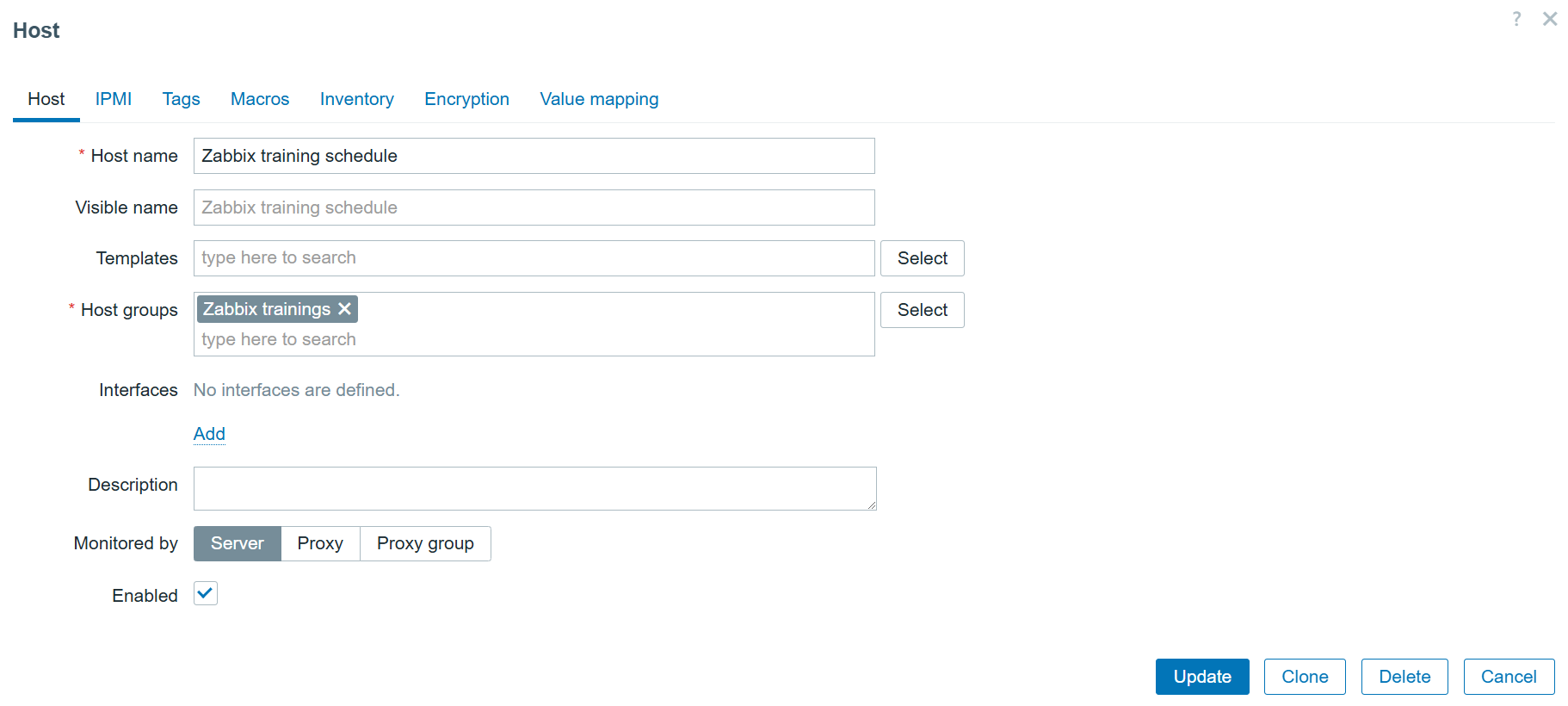
First, we need to navigate to the “Data collection” > “Hosts” section and create a host that represents our web page. This is more than anything – a logical representation. This means we don’t need any specific interfaces or additional configuration. The host in our example will look like this:

Training page monitoring host
Creating a browser item

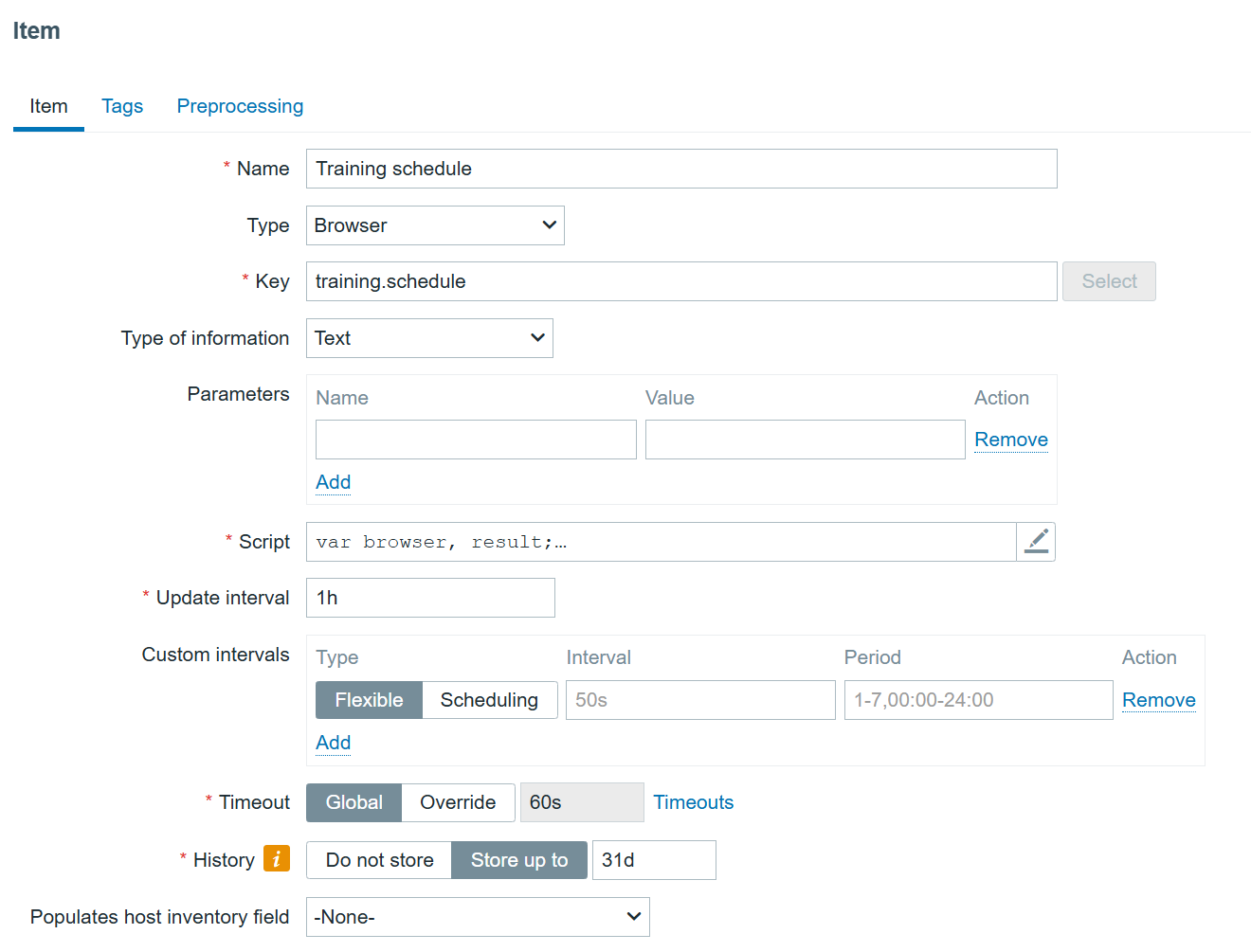
Since the data collection is done by items, we need to navigate to the “Items” section on the “Zabbix training schedule” host and create an item with the type “Browser.” It should look something like this:

Training schedule browser item

Now comes the most important part – creating the script to monitor the schedule. Click on the “Script” field.

First, we will need to define what browser we will use, and any extra options we might want to specify, like screen resolution or whether the browser should run in headless mode or not. This can be done using the Browser object. The Browser object manages WebDriver sessions and initializes a session upon creation, then terminates it upon destruction. A single script can support up to four Browser objects.

var browser, result;
var  opts = Browser.chromeOptions();
opts.capabilities.alwaysMatch['goog:chromeOptions'].args = []
browser = new Browser(opts);
browser.setScreenSize(Number(1980), Number(1020));

In this snippet, we defined that we will use the Chrome browser with a GUI. As you can see, the screen size is set to the pretty common 1980x1020p.

Now we will need to define what the browser will be doing. This can be done by using such Browser object methods as navigate – to point to the correct URL of the web page or application and (for example) findElement/findElements to return some element of the web page.

findElement/findElements methods allow us to define strategies to locate an element and selectors to provide what to look for. Strategies and selectors can be of multiple kinds:
strategy – (string, CSS selector/link text/partial link text/tag name/Xpath)
selector – (string) Element selector using the specified location strategy

Let’s take a look at the next snippet:

try {
    browser.navigate("https://www.zabbix.com/");
    browser.collectPerfEntries("open page");

    el = browser.findElement("xpath", "//span[text()='Training']");
    if (el === null) {
     throw Error("cannot find training");
    }
    el.click();

    el = browser.findElement("link text", "Schedule");
    if (el === null) {
        throw Error("cannot find application form");
    }
    el.click();

In this snippet,

  1. I am using a browser to navigate to the Zabbix page.
  2. I collect a range of performance entries related to opening the page (download speed, response time, etc.).
  3. I look for an element with the text “Training” using the XPath strategy, and the selector “Training.”
  4. I click on it, which is a method to interact with elements.
  5. In the next part, I use the strategy “link text” to find a link with the text selector “Schedule.”
  6. I click on it

A visual description would look like this:

Browser interaction with the zabbix.com website

Now, let’s do some more clicking to filter out all other trainings and leave only trainings in Korean and Dutch:

    el = browser.findElement("link text", "English");
    if (el === null) {
        throw Error("cannot find application form");
    }
    el.click();

    el = browser.findElement("xpath", "//span[text()='English']");
    if (el === null) {
        throw Error("cannot find application form");
    }
    el.click();

    el = browser.findElement("xpath", "//span[text()='Korean']");
    if (el === null) {
        throw Error("cannot find application form");
    }
    el.click();

    el = browser.findElement("xpath", "//span[text()='Dutch']");
    if (el === null) {
        throw Error("cannot find password input field");
    }
    el.click();

    Zabbix.sleep(2000);

English is selected by default, so the script “unclicks” it. Then it selects Korean and Dutch and uses the sleep function to have some extra time for the page to load and make a screenshot of the currently opened page:

List of trainings with language filters applied on it

Now let’s get the list of dates so we can monitor which trainings we have left in 2024:

el = browser.findElements("xpath", "//*[contains(text(), ' 20')]");
var dates = [];
for (var n = 0; n < el.length; n++) { 
    dates.push(el[n].getText('2024')); 
}

// Remove entries that do not contain "2024"
dates = dates.filter(function(date) {
    return date.includes('2024');
});

dates = uniq(dates);

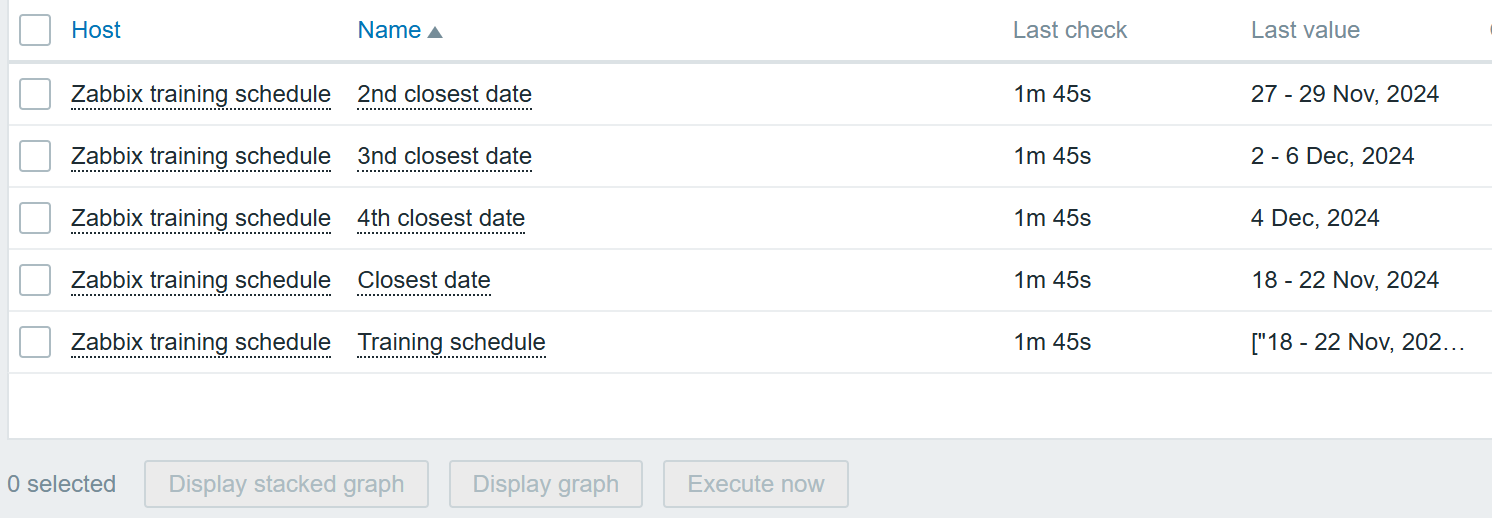
In this case we do a bit of a jump, and now search for all elements that contain text 20 (to include all years), but filter them out by year 2024 specifically, which later can be easily replaced with 2025. The end result contains all the upcoming training dates:

Items containing the upcoming training dates

The full host export with the script snippet can be found by following this link.

An additional example

But what if I want to fill in a form? Maybe to make a purchase, create an order, or just test a contact form? Good news – that’s an even simpler operation! Let’s take a look at this snippet:

// enter name
var el = browser.findElement("xpath", "//label[text()='First Name']/following::input");
if (el === null) {throw Error("cannot find name input field");}
el.sendKeys("Aleksandrs");

// enter last name
var el = browser.findElement("xpath", "//label[text()='Last name']/following::input");
if (el === null) {throw Error("cannot find name input field");}
el.sendKeys("Petrovs-Gavrilovs");

// enter cert number
var el = browser.findElement("xpath", "//label[text()='Certificate number']/following::input");
if (el === null) {throw Error("cannot find name input field");}
el.sendKeys("CT-2404-003");

// select version
var el = browser.findElement("css selector", "form#certificate_validation>fieldset>div:nth-of-type(5)>select");
if (el === null) {throw Error("cannot find name input field");}
el.sendKeys("7.0");

// check certificate
var el = browser.findElement("xpath", "//button[text()='Check Certificate']");
if (el === null) {throw Error("cannot find name input field");}
el.click();

This way, I can validate that my certificate is still valid! 

As you can see, there are multiple ways to make a browser emulate user behavior and allow us to validate whether our pages and businesses are performing the way we expect them to! You can find even more examples in Zabbix documentation and Zabbix Certified Training, which I welcome you to attend!

The post An Introduction to Browser Monitoring appeared first on Zabbix Blog.

New Amazon EC2 P5en instances with NVIDIA H200 Tensor Core GPUs and EFAv3 networking

Post Syndicated from Channy Yun (윤석찬) original https://aws.amazon.com/blogs/aws/new-amazon-ec2-p5en-instances-with-nvidia-h200-tensor-core-gpus-and-efav3-networking/

Today, we’re announcing the general availability of Amazon Elastic Compute Cloud (Amazon EC2) P5en instances, powered by NVIDIA H200 Tensor Core GPUs and custom 4th generation Intel Xeon Scalable processors with an all-core turbo frequency of 3.2 GHz (max core turbo frequency of 3.8 GHz) available only on AWS. These processors offer 50 percent higher memory bandwidth and up to four times throughput between CPU and GPU with PCIe Gen5, which help boost performance for machine learning (ML) training and inference workloads.

P5en, with up to 3200 Gbps of third generation of Elastic Fabric Adapter (EFAv3) using Nitro v5, shows up to 35% improvement in latency compared to P5 that uses the previous generation of EFA and Nitro. This helps improve collective communications performance for distributed training workloads such as deep learning, generative AI, real-time data processing, and high-performance computing (HPC) applications.

Here are the specs for P5en instances:

Instance size vCPUs Memory (GiB) GPUs (H200) Network bandwidth (Gbps) GPU Peer to peer (GB/s) Instance storage (TB) EBS bandwidth (Gbps)
p5en.48xlarge 192 2048 8 3200 900 8 x 3.84 100

On September 9, we introduced Amazon EC2 P5e instances, powered by 8 NVIDIA H200 GPUs with 1128 GB of high bandwidth GPU memory, 3rd Gen AMD EPYC processors, 2 TiB of system memory, and 30 TB of local NVMe storage. These instances provide up to 3,200 Gbps of aggregate network bandwidth with EFAv2 and support GPUDirect RDMA, enabling lower latency and efficient scale-out performance by bypassing the CPU for internode communication.

With P5en instances, you can increase the overall efficiency in a wide range of GPU-accelerated applications by further reducing the inference and network latency. P5en instances increases local storage performance by up to two times and Amazon Elastic Block Store (Amazon EBS) bandwidth by up to 25 percent compared with P5 instances, which will further improve inference latency performance for those of you who are using local storage for caching model weights.

The transfer of data between CPUs and GPUs can be time-consuming, especially for large datasets or workloads that require frequent data exchanges. With PCIe Gen 5 providing up to four times bandwidth between CPU and GPU compared with P5eand P5e instances, you can further improve latency for model training, fine-tuning, and running inference for complex large language models (LLMs) and multimodal foundation models (FMs), and memory-intensive HPC applications such as simulations, pharmaceutical discovery, weather forecasting, and financial modeling.

Getting started with Amazon EC2 P5en instances
You can use EC2 P5en instances available in the US East (Ohio), US West (Oregon), and Asia Pacific (Tokyo) AWS Regions through EC2 Capacity Blocks for ML, On Demand, and Savings Plan purchase options.

I want to introduce how to use P5en instances with Capacity Reservation as an option. To reserve your EC2 Capacity Blocks, choose Capacity Reservations on the Amazon EC2 console in the US East (Ohio) AWS Region.

Select Purchase Capacity Blocks for ML and then choose your total capacity and specify how long you need the EC2 Capacity Block for p5en.48xlarge instances. The total number of days that you can reserve EC2 Capacity Blocks is 1–14, 21, or 28 days. EC2 Capacity Blocks can be purchased up to 8 weeks in advance.

When you select Find Capacity Blocks, AWS returns the lowest-priced offering available that meets your specifications in the date range you have specified. After reviewing EC2 Capacity Blocks details, tags, and total price information, choose Purchase.

Now, your EC2 Capacity Block will be scheduled successfully. The total price of an EC2 Capacity Block is charged up front, and the price does not change after purchase. The payment will be billed to your account within 12 hours after you purchase the EC2 Capacity Blocks. To learn more, visit Capacity Blocks for ML in the Amazon EC2 User Guide.

To run instances within your purchased Capacity Block, you can use AWS Management Console, AWS Command Line Interface (AWS CLI) or AWS SDKs.

Here is a sample AWS CLI command to run 16 P5en instances to maximize EFAv3 benefits. This configuration provides up to 3200 Gbps of EFA networking bandwidth and up to 800 Gbps of IP networking bandwidth with eight private IP address:

$ aws ec2 run-instances --image-id ami-abc12345 \
  --instance-type p5en.48xlarge \
  --count 16 \
  --key-name MyKeyPair \
  --instance-market-options MarketType='capacity-block' \
  --capacity-reservation-specification CapacityReservationTarget={CapacityReservationId=cr-a1234567}
--network-interfaces "NetworkCardIndex=0,DeviceIndex=0,Groups=security_group_id,SubnetId=subnet_id,InterfaceType=efa" \
"NetworkCardIndex=1,DeviceIndex=1,Groups=security_group_id,SubnetId=subnet_id,InterfaceType=efa-only" \
"NetworkCardIndex=2,DeviceIndex=1,Groups=security_group_id,SubnetId=subnet_id,InterfaceType=efa-only" \
"NetworkCardIndex=3,DeviceIndex=1,Groups=security_group_id,SubnetId=subnet_id,InterfaceType=efa-only" \
"NetworkCardIndex=4,DeviceIndex=1,Groups=security_group_id,SubnetId=subnet_id,InterfaceType=efa" \
"NetworkCardIndex=5,DeviceIndex=1,Groups=security_group_id,SubnetId=subnet_id,InterfaceType=efa-only" \
"NetworkCardIndex=6,DeviceIndex=1,Groups=security_group_id,SubnetId=subnet_id,InterfaceType=efa-only" \
"NetworkCardIndex=7,DeviceIndex=1,Groups=security_group_id,SubnetId=subnet_id,InterfaceType=efa-only" \
"NetworkCardIndex=8,DeviceIndex=1,Groups=security_group_id,SubnetId=subnet_id,InterfaceType=efa" \
"NetworkCardIndex=9,DeviceIndex=1,Groups=security_group_id,SubnetId=subnet_id,InterfaceType=efa-only" \
"NetworkCardIndex=10,DeviceIndex=1,Groups=security_group_id,SubnetId=subnet_id,InterfaceType=efa-only" \
"NetworkCardIndex=11,DeviceIndex=1,Groups=security_group_id,SubnetId=subnet_id,InterfaceType=efa-only" \
"NetworkCardIndex=12,DeviceIndex=1,Groups=security_group_id,SubnetId=subnet_id,InterfaceType=efa" \
"NetworkCardIndex=13,DeviceIndex=1,Groups=security_group_id,SubnetId=subnet_id,InterfaceType=efa-only" \
"NetworkCardIndex=14,DeviceIndex=1,Groups=security_group_id,SubnetId=subnet_id,InterfaceType=efa-only" \
"NetworkCardIndex=15,DeviceIndex=1,Groups=security_group_id,SubnetId=subnet_id,InterfaceType=efa-only" \
"NetworkCardIndex=16,DeviceIndex=1,Groups=security_group_id,SubnetId=subnet_id,InterfaceType=efa" \
"NetworkCardIndex=17,DeviceIndex=1,Groups=security_group_id,SubnetId=subnet_id,InterfaceType=efa-only" \
"NetworkCardIndex=18,DeviceIndex=1,Groups=security_group_id,SubnetId=subnet_id,InterfaceType=efa-only" \
"NetworkCardIndex=19,DeviceIndex=1,Groups=security_group_id,SubnetId=subnet_id,InterfaceType=efa-only" \
"NetworkCardIndex=20,DeviceIndex=1,Groups=security_group_id,SubnetId=subnet_id,InterfaceType=efa" \
"NetworkCardIndex=21,DeviceIndex=1,Groups=security_group_id,SubnetId=subnet_id,InterfaceType=efa-only" \
"NetworkCardIndex=22,DeviceIndex=1,Groups=security_group_id,SubnetId=subnet_id,InterfaceType=efa-only" \
"NetworkCardIndex=23,DeviceIndex=1,Groups=security_group_id,SubnetId=subnet_id,InterfaceType=efa-only" \
"NetworkCardIndex=24,DeviceIndex=1,Groups=security_group_id,SubnetId=subnet_id,InterfaceType=efa" \
"NetworkCardIndex=25,DeviceIndex=1,Groups=security_group_id,SubnetId=subnet_id,InterfaceType=efa-only" \
"NetworkCardIndex=26,DeviceIndex=1,Groups=security_group_id,SubnetId=subnet_id,InterfaceType=efa-only" \
"NetworkCardIndex=27,DeviceIndex=1,Groups=security_group_id,SubnetId=subnet_id,InterfaceType=efa-only" \
"NetworkCardIndex=28,DeviceIndex=1,Groups=security_group_id,SubnetId=subnet_id,InterfaceType=efa" \
"NetworkCardIndex=29,DeviceIndex=1,Groups=security_group_id,SubnetId=subnet_id,InterfaceType=efa-only" \
"NetworkCardIndex=30,DeviceIndex=1,Groups=security_group_id,SubnetId=subnet_id,InterfaceType=efa-only" \
"NetworkCardIndex=31,DeviceIndex=1,Groups=security_group_id,SubnetId=subnet_id,InterfaceType=efa-only"
...

When launching P5en instances, you can use AWS Deep Learning AMIs (DLAMI) to support EC2 P5en instances. DLAMI provides ML practitioners and researchers with the infrastructure and tools to quickly build scalable, secure, distributed ML applications in preconfigured environments.

You can run containerized ML applications on P5en instances with AWS Deep Learning Containers using libraries for Amazon Elastic Container Service (Amazon ECS) or Amazon Elastic Kubernetes Service (Amazon EKS).

For fast access to large datasets, you can use up to 30 TB of local NVMe SSD storage or virtually unlimited cost-effective storage with Amazon Simple Storage Service (Amazon S3). You can also use Amazon FSx for Lustre file systems in P5en instances so you can access data at the hundreds of GB/s of throughput and millions of input/output operations per second (IOPS) required for large-scale deep learning and HPC workloads.

Now available
Amazon EC2 P5en instances are available today in the US East (Ohio), US West (Oregon), and Asia Pacific (Tokyo) AWS Regions and US East (Atlanta) Local Zone us-east-1-atl-2a through EC2 Capacity Blocks for ML, On Demand, and Savings Plan purchase options. For more information, visit the Amazon EC2 pricing page.

Give Amazon EC2 P5en instances a try in the Amazon EC2 console. To learn more, see Amazon EC2 P5 instance page and send feedback to AWS re:Post for EC2 or through your usual AWS Support contacts.

Channy

Let’s Architect! Serverless developer experience in AWS

Post Syndicated from Luca Mezzalira original https://aws.amazon.com/blogs/architecture/lets-architect-serverless-developer-experience-in-aws/

Are you a developer approaching serverless for the first time, or even an experienced one looking for a better way to accelerate your feedback loop from code to production? This collection of resources is perfect for you!

There are plenty of developer goodies available on AWS to streamline your code creation and achieve a faster flow in your development lifecycle. Let us share a few examples with you.

What if I told you that you could have an assistant to create your tests? Or that you could review the schema of DynamoDB tables without logging into the AWS Console? Get ready to discover some game-changing tools and techniques that will revolutionize your serverless development process.

And if you want to know more, check out the AWS developer center for more content dedicated to your developer experience on AWS.

Enjoy the journey!

Introducing an enhanced local IDE experience for AWS Lambda developers

We’re excited to announce significant enhancements to the AWS Toolkit, designed to streamline the AWS Lambda development experience. These new features bring the power of Lambda directly to your local development environment, allowing you to work more efficiently within your preferred IDE.

With this update, you can now create, test, and debug Lambda functions locally with unprecedented ease. The toolkit supports local invocation of Lambda functions, enabling real-time testing and debugging without cloud deployment. We’ve also incorporated intelligent code completion and inline documentation for AWS SDK calls, reducing errors and accelerating your coding process.

These improvements offer substantial benefits: faster iteration cycles, deeper insights into Lambda function behavior, and the ability to deliver high-quality serverless applications more rapidly. Whether you’re new to serverless or an experienced Lambda developer, this enhanced local development experience provides a more intuitive and productive environment for building cloud-native solutions.

AWS Toolkit offers the possibility to retrieve real-time the logs of your AWS Lambda functions directly inside your IDE

Figure 1. AWS Toolkit offers the possibility to retrieve real-time the logs of your AWS Lambda functions directly inside your IDE

Take me to this blog

Test Driven Development with Amazon Q Developer

Amazon Q for developers is a versatile AI-powered assistant designed to enhance various aspects of the software development lifecycle. This innovative tool can help streamline numerous tasks, from writing code and documentation to generating unit tests, effectively reducing the time spent on common development activities. By embracing Amazon Q Developer, developers can boost their productivity and focus more on creative problem-solving, with capabilities like test generation serving as just one example of how it can accelerate the development process and improve code quality.

In this example, you will discover how Amazon Q Developer can help out to embrace test-driven development (TDD) in your projects.

Amazon Q developer in action! As you can see you can choose the right recommendation for your code

Figure 2. Amazon Q Developer in action! As you can see you can choose the right recommendation for your code

Take me to this blog

Stop guesstimating the Lambda functions memory size

Optimizing Lambda function performance is crucial for both cost efficiency and user experience, yet many developers still rely on guesswork when setting memory allocations. This approach often leads to suboptimal configurations, resulting in either wasted resources or underperforming functions. Here is where AWS Lambda Power Tuning comes in. By automatically testing your Lambda function with various memory configurations, you can identify the optimal balance between performance and cost. This data-driven approach ensures your functions run at peak efficiency, potentially reducing costs and improving response times. Moreover, as your application evolves, regular power tuning can help you adapt to changing requirements and usage patterns.

The output of running Lambda Power Tuning with your code is a diagram that shows you the best memory size based on your goals. Either optimized for cost or response time or you can choose a more balanced approach

Figure 3. The output of running Lambda Power Tuning with your code is a diagram that shows you the best memory size based on your goals. Either optimized for cost or response time or you can choose a more balanced approach

Take me to this tool

NoSQL Workbench for Amazon DynamoDB

Developers working with Amazon DynamoDB have a powerful ally in their local development toolkit: NoSQL Workbench for Amazon DynamoDB. This intuitive, graphical tool changes the way you interact with DynamoDB tables, offering a fast and efficient feedback loop right on your laptop. With NoSQL Workbench, you can visually design, create, and modify your DynamoDB table structures without the need to constantly access the AWS Console. The tool’s data modeler allows you to experiment with different schemas, ensuring optimal design before deployment. Need to populate your tables for testing? NoSQL Workbench has you covered with its data visualization and manipulation features, enabling quick data insertion and querying. Moreover, its ability to generate sample data and visualize query results in real-time accelerates the development and debugging process.

Visualizing single table design helps you to understand how to structure your serverless applications

Figure 4. Visualizing single table design helps you to understand how to structure your serverless applications

Take me to the documentation

Instrument observability for Lambda functions with Powertools

AWS Lambda Powertools is your go-to open source project when you want to instrument observability and beyond for AWS Lambda functions. Available for multiple programming languages including Python, Node.js, Java, and .NET, Powertools empowers developers to build production-ready Lambda functions with ease. At its core, it provides comprehensive observability features, enabling structured logging, creating custom metrics, and implementing distributed tracing with minimal overhead. But Powertools doesn’t stop there – it also includes utilities for parameter store and secrets management, making it simpler to handle configuration and sensitive data. The suite offers idempotency helpers to ensure reliable execution of your functions, even in the face of retries or duplicates. With its event handler functions, Powertools streamlines the processing of various AWS events, reducing boilerplate code and potential errors. By adopting Powertools, developers can significantly reduce the time spent on implementing best practices, allowing them to focus on building business logic while ensuring their Lambda functions are performant, secure, and easily maintainable.

Powertools for Python goes over and beyond just observability as you can see by the list on the left of this screenshot

Figure 5. Powertools for Python goes over and beyond just observability as you can see by the list on the left of this screenshot

Take me to this tool

AWS Serverless developer experience workshop

The AWS Serverless Developer Experience workshop is an hands-on guide that brings together all the cutting-edge tools and techniques we’ve discussed, offering developers a holistic approach to building serverless applications. This free, self-paced workshop is designed to elevate your serverless development skills, regardless of your experience level. It covers a wide range of topics, from implementing best practices with AWS Lambda Powertools, to optimizing your functions using AWS Lambda Power Tuning. The workshop also delves into CI/CD practices, showing you how to automate your deployment pipeline for faster, more reliable releases.

The serverless developer experience architecture you will work on during the workshop

Figure 6. The serverless developer experience architecture you will work on during the workshop

Take me to the workshop

See you next time!

Thanks for reading! This is the last post of the year, thank you so much for being with us for the 3rd year in a row. To revisit any of our previous posts or explore the entire series, visit the Let’s Architect! page.

NixOS 24.11 released

Post Syndicated from jake original https://lwn.net/Articles/1000469/

The most recent version of NixOS, 24.11,
was released
on November 30. It contains GNOME 47, Plasma 6.2, LLVM 19, and lots more:

The 24.11 release was made possible due to the efforts of 2669 contributors, who authored 49079 commits since the previous release. Our thanks go the contributors who also take care of the continued stability and security of our stable release.

NixOS is already known as the most up to date distribution while also being the distribution with the most packages. This release saw 8141 new packages and 20975 updated packages in Nixpkgs. We also removed 3970 packages in an effort to keep the package set maintainable and secure.

Security updates for Monday

Post Syndicated from jake original https://lwn.net/Articles/1000465/

Security updates have been issued by Debian (dnsmasq, editorconfig-core, lemonldap-ng, proftpd-dfsg, python3.9, simplesamlphp, tgt, and xfpt), Fedora (qbittorrent, webkitgtk, and wireshark), Mageia (libsoup3 & libsoup), Red Hat (buildah, grafana, grafana-pcp, and podman), SUSE (gimp, kernel, postgresql14, python, webkit2gtk3, xen, and zabbix), and Ubuntu (ansible and postgresql-12, postgresql-14, postgresql-16).