Mountpoint for Amazon S3 – Generally Available and Ready for Production Workloads

Post Syndicated from Jeff Barr original https://aws.amazon.com/blogs/aws/mountpoint-for-amazon-s3-generally-available-and-ready-for-production-workloads/

Mountpoint for Amazon S3 is an open source file client that makes it easy for your file-aware Linux applications to connect directly to Amazon Simple Storage Service (Amazon S3) buckets. Announced earlier this year as an alpha release, it is now generally available and ready for production use on your large-scale read-heavy applications: data lakes, machine learning training, image rendering, autonomous vehicle simulation, ETL, and more. It supports file-based workloads that perform sequential and random reads, sequential (append only) writes, and that don’t need full POSIX semantics.

Why Files?
Many AWS customers use the S3 APIs and the AWS SDKs to build applications that can list, access, and process the contents of an S3 bucket. However, many customers have existing applications, commands, tools, and workflows that know how to access files in UNIX style: reading directories, opening & reading existing files, and creating & writing new ones. These customers have asked us for an official, enterprise-ready client that supports performant access to S3 at scale. After speaking with these customers and asking lots of questions, we learned that performance and stability were their primary concerns, and that POSIX compliance was not a necessity.

When I first wrote about Amazon S3 back in 2006 I was very clear that it was intended to be used as an object store, not as a file system. While you would not want use the Mountpoint / S3 combo to store your Git repositories or the like, using it in conjunction with tools that can read and write files, while taking advantage of S3’s scale and durability, makes sense in many situations.

All About Mountpoint
Mountpoint is conceptually very simple. You create a mount point and mount an Amazon S3 bucket (or a path within a bucket) at the mount point, and then access the bucket using shell commands (ls, cat, dd, find, and so forth), library functions (open, close, read, write, creat, opendir, and so forth) or equivalent commands and functions as supported in the tools and languages that you already use.

Under the covers, the Linux Virtual Filesystem (VFS) translates these operations into calls to Mountpoint, which in turns translates them into calls to S3: LIST, GET, PUT, and so forth. Mountpoint strives to make good use of network bandwidth, increasing throughput and allowing you to reduce your compute costs by getting more work done in less time.

Mountpoint can be used from an Amazon Elastic Compute Cloud (Amazon EC2) instance, or within an Amazon Elastic Container Service (Amazon ECS) or Amazon Elastic Kubernetes Service (EKS) container. It can also be installed on your existing on-premises systems, with access to S3 either directly or over an AWS Direct Connect connection via AWS PrivateLink for Amazon S3.

Installing and Using Mountpoint for Amazon S3
Mountpoint is available in RPM format and can easily be installed on an EC2 instance running Amazon Linux. I simply fetch the RPM and install it using yum:

$ wget https://s3.amazonaws.com/mountpoint-s3-release/latest/x86_64/mount-s3.rpm
$ sudo yum install ./mount-s3.rpm

For the last couple of years I have been regularly fetching images from several of the Washington State Ferry webcams and storing them in my wsdot-ferry bucket:

I collect these images in order to track the comings and goings of the ferries, with a goal of analyzing them at some point to find the best times to ride. My goal today is to create a movie that combines an entire day’s worth of images into a nice time lapse. I start by creating a mount point and mounting the bucket:

$ mkdir wsdot-ferry
$  mount-s3 wsdot-ferry wsdot-ferry

I can traverse the mount point and inspect the bucket:

$ cd wsdot-ferry
$ ls -l | head -10
total 0
drwxr-xr-x 2 jeff jeff 0 Aug  7 23:07 2020_12_30
drwxr-xr-x 2 jeff jeff 0 Aug  7 23:07 2020_12_31
drwxr-xr-x 2 jeff jeff 0 Aug  7 23:07 2021_01_01
drwxr-xr-x 2 jeff jeff 0 Aug  7 23:07 2021_01_02
drwxr-xr-x 2 jeff jeff 0 Aug  7 23:07 2021_01_03
drwxr-xr-x 2 jeff jeff 0 Aug  7 23:07 2021_01_04
drwxr-xr-x 2 jeff jeff 0 Aug  7 23:07 2021_01_05
drwxr-xr-x 2 jeff jeff 0 Aug  7 23:07 2021_01_06
drwxr-xr-x 2 jeff jeff 0 Aug  7 23:07 2021_01_07
$
$  cd 2020_12_30
$ ls -l
total 0
drwxr-xr-x 2 jeff jeff 0 Aug  7 23:07 fauntleroy_holding
drwxr-xr-x 2 jeff jeff 0 Aug  7 23:07 fauntleroy_way
drwxr-xr-x 2 jeff jeff 0 Aug  7 23:07 lincoln
drwxr-xr-x 2 jeff jeff 0 Aug  7 23:07 trenton
drwxr-xr-x 2 jeff jeff 0 Aug  7 23:07 vashon_112_north
drwxr-xr-x 2 jeff jeff 0 Aug  7 23:07 vashon_112_south
drwxr-xr-x 2 jeff jeff 0 Aug  7 23:07 vashon_bunker_north
drwxr-xr-x 2 jeff jeff 0 Aug  7 23:07 vashon_bunker_south
drwxr-xr-x 2 jeff jeff 0 Aug  7 23:07 vashon_holding
$
$ cd fauntleroy_holding
$  ls -l | head -10
total 2680
-rw-r--r-- 1 jeff jeff  19337 Feb 10  2021 17-12-01.jpg
-rw-r--r-- 1 jeff jeff  19380 Feb 10  2021 17-15-01.jpg
-rw-r--r-- 1 jeff jeff  19080 Feb 10  2021 17-18-01.jpg
-rw-r--r-- 1 jeff jeff  17700 Feb 10  2021 17-21-01.jpg
-rw-r--r-- 1 jeff jeff  17016 Feb 10  2021 17-24-01.jpg
-rw-r--r-- 1 jeff jeff  16638 Feb 10  2021 17-27-01.jpg
-rw-r--r-- 1 jeff jeff  16713 Feb 10  2021 17-30-01.jpg
-rw-r--r-- 1 jeff jeff  16647 Feb 10  2021 17-33-02.jpg
-rw-r--r-- 1 jeff jeff  16750 Feb 10  2021 17-36-01.jpg
$

I can create my animation with a single command:

$ ffmpeg -framerate 10 -pattern_type glob -i "*.jpg" ferry.gif

And here’s what I get:

As you can see, I used Mountpoint to access the existing image files and to write the newly created animation back to S3. While this is a fairly simple demo, it does show how you can use your existing tools and skills to process objects in an S3 bucket. Given that I have collected several million images over the years, being able to process them without explicitly syncing them to my local file system is a big win.

Mountpoint for Amazon S3 Facts
Here are a couple of things to keep in mind when using Mountpoint:

Pricing – There are no new charges for the use of Mountpoint; you pay only for the underlying S3 operations. You can also use Mountpoint to access requester-pays buckets.

Performance – Mountpoint is able to take advantage of the elastic throughput offered by S3, including data transfer at up to 100 Gb/second between each EC2 instance and S3.

Credentials – Mountpoint accesses your S3 buckets using the AWS credentials that are in effect when you mount the bucket. See the CONFIGURATION doc for more information on credentials, bucket configuration, use of requester pays, some tips for the use of S3 Object Lambda, and more.

Operations & Semantics – Mountpoint supports basic file operations, and can read files up to 5 TB in size. It can list and read existing files, and it can create new ones. It cannot modify existing files or delete directories, and it does not support symbolic links or file locking (if you need POSIX semantics, take a look at Amazon FSx for Lustre). For more information about the supported operations and their interpretation, read the SEMANTICS document.

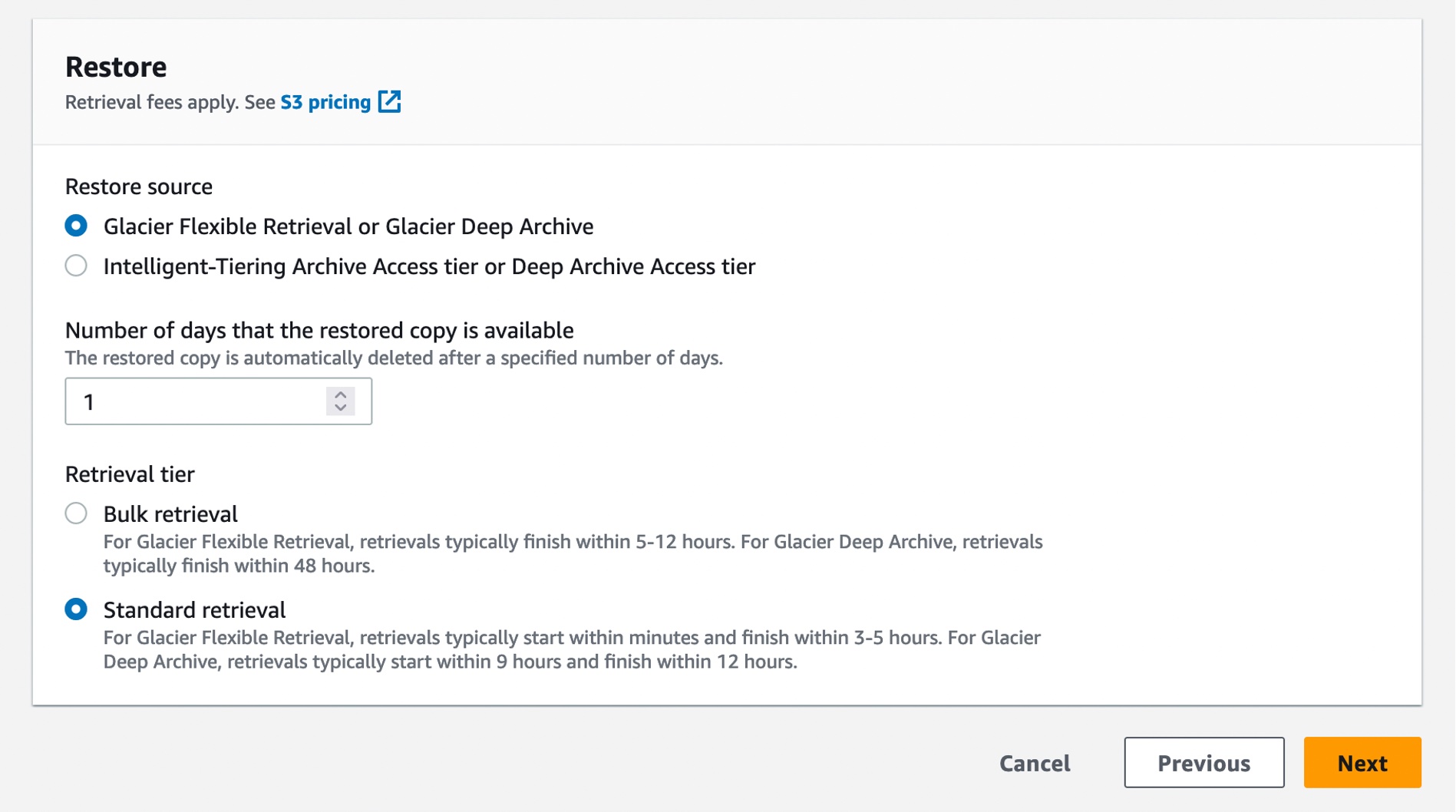
Storage Classes – You can use Mountpoint to access S3 objects in all storage classes except S3 Glacier Flexible Retrieval, S3 Glacier Deep Archive, S3 Intelligent-Tiering Archive Access Tier, and S3 Intelligent-Tiering Deep Archive Access Tier.

Open Source – Mountpoint is open source and has a public roadmap. Your contributions are welcome; be sure to read our Contributing Guidelines and our Code of Conduct first.

Hop On
As you can see, Mountpoint is really cool and I am guessing that you are going to find some awesome ways to put it to use in your applications. Check it out and let me know what you think!

— Jeff;

Building a high-performance Windows workstation on AWS for graphics intensive applications

Post Syndicated from Macey Neff original https://aws.amazon.com/blogs/compute/building-a-high-performance-windows-workstation-on-aws-for-graphics-intensive-applications/

This blog post is written by Mike Lim, Senior Public Sector SA.

Video editing, professional visualization, and video games can be resource demanding applications that require high performance Windows workstations with GPUs. When developing these resource demanding applications, a high-performance remote display protocol is desirable in order to access the instances’ graphical desktops from the internet. Using NICE DCV provides a bandwidth-adaptive streaming protocol that provides near real-time responsiveness without compromising image quality. Customers using NICE DCV can leverage Amazon EC2 G4 and Amazon EC2 G5 GPU instances which support graphic-intensive applications in the cloud using a pay-as-you-go pricing model. By using Amazon Elastic Compute Cloud (Amazon EC2) with NICE DCV, customers can run graphically intensive applications remotely and stream their user interface to simpler client machines, eliminating the need for expensive dedicated workstations.

This post shows how you can provision and manage an Amazon EC2 GPU Windows instance and access it via the high-performance NICE DCV remote display protocol.

Solution overview

The solution is illustrated in the following figure.

Solution overview

Figure 1: Solution overview

We used the AWS CloudFormation Infrastructure-as-Code (IaC) service to provision our solution. Our CloudFormation template provides the following functionality:

1.       Using AWS CloudFormation, you can specify your choice of EC2 instance type, the Amazon Virtual Private Cloud (Amazon VPC), and subnet in which to provision. You also have the option to assign a static IPv4 address. NICE DCV server is installed to provide remote access, and you can specify the choice of graphics driver to install.

2.       A security group is created and associated with the EC2 instance, and it acts as a firewall.

3.       An AWS Identity and Access Management (IAM) role is created and associated with the EC2 instance using an instance profile. It lets your instance access Amazon Simple Storage Service (Amazon S3) buckets for NICE DCV server license validation, and download and install the latest graphics drivers.

4.       The IAM role also makes sure that your EC2 instance can be managed by AWS Systems Manager. This service provides in-browser command line and graphical access to your Windows instance via Session Manager and Fleet Manager from the AWS Management Console.

Walkthrough

The following sections walk through the steps to setup and maintain your graphics workstation. To begin, you need an AWS account. For this walkthrough, we provision a g5.xlarge instance for cloud gaming.

Check instance type availability

For best performance and lowest latency, you will want to provision EC2 in the AWS Region nearest to you. Before proceeding, verify that the g5.xlarge instance type is available in your desired AWS Region, and the Availability Zones (AZs) in which it is available.

Log in to your Amazon EC2 console and select your AWS Region. From the navigation pane, choose Instance Types to view the instance types available. In the search bar, filter instances types to the specific instance type you want, in this case g5.xlarge. Toggle the display preferences (gear) icon to display Availability zones column.

In the following screenshot, the g5.xlarge instance is available in two of the three AZs in eu-west-2 Europe London Region.

Amazon EC2 console instance types

Figure 2: Amazon EC2 console instance types

Check Amazon EC2 running on-demand G instances quota

Your AWS account has a limit on the number and type of EC2 instances types you can run, and you need to make sure you have enough quota to run the g5.xlarge instance.

Go to the Service Quotas console for your AWS Region. Under AWS services in the navigation pane, select Amazon Elastic Compute Cloud (Amazon EC2) and search for Running On-Demand G and VT instances. Verify that the Applied quota value number is equal or more than the number of vCPUs for the instance size you need. In the following screenshot, the applied quota value is 64. It lets us launch instance sizes from 4 vCPUs xlarge up to 64 vCPUs 16xlarge instance size.

Service Quotas console

Figure 3: Service Quotas console

You can request a higher quota value by selecting Request quota increase.

Using CloudFormation template

Download the CloudFormation template file from aws-samples GitHub repository. Go to the CloudFormation console for your AWS Region to create a stack, and upload your downloaded file.

The CloudFormation parameters page is divided into the following sections:

  1. AMI and instance type
  2. EC2 configuration
  3. Allowed inbound source IP prefixes to NICE DCV port 8443
  4. EBS volume configuration

We go through the configuration settings for each section in detail.

AMI and instance type

In this section, we select the Windows Amazon Machine Image (AMI) to use, EC2 instance type to provision, and graphics driver to install. The default AMI is Microsoft Windows Server 2022.

Replace the instanceType value with g5.xlarge.

CloudFormation parameters: AMI and instance type

Figure 4: CloudFormation parameters: AMI and instance type

Select driverType based on your instance type and the following use case:

  1. AMD: select this for instance types with AMD GPU (G4ad instance).
  2. NVIDIA-Gaming: select this to install the NVIDIA gaming driver, which is optimized for gaming (G5 and G4dn instances).
  3. NVIDIA-GRID: select this to install the GRID driver, which is optimized for professional visualization applications that render content such as 3D models or high-resolution videos (G5, G4dn, and G3 instances).
  4. none: select this option for accelerated computing instances, such as P2 and P3 instances where you download and install public NVIDIA drivers manually.
  5. NICE-DCV: this installs the NICE DCV Virtual Display driver and is suitable for all other instance types.

Note that GRID and NVIDIA gaming drivers’ downloads are available to AWS customers only. Upon installation of the software, you are bound by the terms of the NVIDIA GRID Cloud End User License Agreement.

For our walkthrough, select NVIDIA-Gaming for driverType.

Amazon EC2 configuration

In this section, we specify the VPC and subnet in which to provision our EC2 instance. You can select default VPC from the vpcID dropdown. Make sure that the subnetID value you select is in your selected VPC and resides in an AZ that has your instance type offering. You can also change the EC2 instance name.

Select Yes for the assignStaticIP option if you want to associate a static Internet IPv4 address. Note that there is a small hourly charge when the instance is not running.

CloudFormation parameters: Amazon EC2 configuration

Figure 5: CloudFormation parameters: Amazon EC2 configuration

Allowed inbound source IP prefixes to NICE DCV port 8443

Here, we specify the source prefixes allowed to access our instance. The default values allow access from all addresses. To secure access to your instance, you may want to limit the source prefix to your IP address.

To get your IPv4 address, go to https://checkip.amazonaws.com and append /32 to the value for ingressIPv4. The default VPC and subnet is IPv4 only. Therefore, you can enter ::1/128 to explicitly block all IPv6 access for ingressIPv6.

CloudFormation parameters: Allowed inbound source IP prefixes

Figure 6: CloudFormation parameters: Allowed inbound source IP prefixes

Amazon EBS volume configuration

The default Amazon Elastic Block Store (Amazon EBS) volume size is 30 GiB. You can specify a larger size by changing the volumeSize value.

CloudFormation parameters: Amazon EBS volume configuration

Figure 7: CloudFormation parameters: Amazon EBS volume configuration

Continue to provision your stack.

NICE DCV client

NICE DCV provides an HTML5 client for web browser access. For performance and additional features, such as QUIC UDP transport protocol support and USB remotization support, install the native client from the NICE DCV download page. NICE DCV offers native clients for Windows, MacOS for both Intel and Apple M1 processors, and modern Linux distributions including RHEL, SUSE Linux, and Ubuntu.

Cloudformation Outputs

Once provisioning is complete, go to the Outputs section.

CloudFormation Outputs

Figure 8: CloudFormation Outputs

The following URLs are available.

  1. DCVwebConsole
  2. EC2instance
  3. RdpConnect
  4. SSMsessionManager

We go through the purpose of each URL in the following sections.

SSMsessionManager: Change administrator password

To log in, you must specify an administrator password. Open the SSMsessionManager value URL in a new browser tab and run the command net user administrator <YOUR-PASSWORD> where <YOUR-PASSWORD> is the password on which you decided.

Systems Manager session manager

Figure 9: Systems Manager session manager

DCVwebConsole: Connecting to the EC2 instance

Copy DCVWebConsole value, open the NICE DCV client from your local machine and either use the copied value or the IP address to connect. Log in as administrator with the password that you have configured. Alternatively, enter the URL in the format dcv://<EC2-IP-Address> in a browser URL bar to automatically launch and connect a locally installed NICE DCV client to your EC2 instance.

NICE DCV client

Figure 10: NICE DCV client

EC2instance: manage EC2 instance

Use this link to manage your EC2 instance in the Amazon EC2 console. If you did not select the static IP address option, then use this page to get the assigned IP address whenever you stop and start your instance.

RdpConnect: Fleet Manager console access

The RdpConnect link provides in-browser Remote Desktop Protocol (RDP) console access to your Windows instance. Choose User credentials for Authentication Type. Enter administrator for username and the password that you have configured.

Fleet Manager Remote Desktop

Figure 11: Fleet Manager Remote Desktop

Updating NICE DCV server

To update NICE DCV server, log in via Fleet Manager Remote Desktop and run c:\users\administrator\update-DCV.cmd script. In the following screenshot, we successfully upgraded NICE DCV server from version 2022.2-14521 to 2023.0-15065.

Updating NICE DCV server

Figure 12: Updating NICE DCV server

Updating graphics drivers

You can use the download-<DRIVER_TYPE>-driver.cmd batch file to download the latest graphics driver for your instance type GPU. Downloaded files are located in the Downloads\Drivers folder.

Graphics driver download scripts

Figure 13: Graphics driver download scripts

AWS Command Line interface (AWS CLI v2) is installed in the instance. You can use it to view the different versions available on the driver S3 bucket. For example, the command aws s3 ls –recursive s3://nvidia-gaming/windows/ | sort /R lists NVIDIA gaming drivers available for download. NVIDIA GRID and AMD drivers are in the s3://ec2-windows-nvidia-drivers and s3://ec2-amd-windows-drivers S3 buckets respectively.

Listing graphics drivers on S3 bucket

Figure 14: Listing graphics drivers on S3 bucket

Use the command aws s3 cp s3://<S3_BUCKET_PATH>/<FILE-NAME>. to copy a specific driver from the S3 bucket to your local directory.

You can refer to Install NVIDIA drivers on Windows instances and Install AMD drivers on Windows instances for NVIDIA and AMD drivers installation instructions respectively.

Customizing your EC2 instance environment

You may want to customize the instance to your needs. For NVIDIA GPU instances, you can optimize GPU settings to achieve the best performance.

If you are doing video editing, then you can enable high color accuracy, configure multi-channel audio, and enable accurate audio/video sync. For gaming, you may enable gamepad support to use a DualShock 4 or Xbox 360 controller. NICE DCV session storage is enabled. This lets you transfer files using NICE DCV client. More configuration options are available from the NICE DCV User Guide and Administrator Guide.

Terminating your EC2 instance

When you have finished using your EC2 instance, you can release all provisioned resources by going to CloudFormation console to delete your stack.

Conclusion

The Amazon G4 and G5 GPU instance types are suitable for graphics-intensive applications, and NICE DCV provides a responsive and high image quality display protocol for remote access. Using the CloudFormation template from amazon-ec2-nice-dcv-samples GitHub site, you can build and maintain your own high performance Windows graphics workstation in the AWS cloud

New – Improve Amazon S3 Glacier Flexible Restore Time By Up To 85% Using Standard Retrieval Tier and S3 Batch Operations

Post Syndicated from Channy Yun original https://aws.amazon.com/blogs/aws/new-improve-amazon-s3-glacier-flexible-restore-time-by-up-to-85-using-standard-retrieval-tier-and-s3-batch-operations/

Last year, Amazon S3 Glacier celebrated its tenth anniversary. Amazon S3 Glacier is the leader in cloud cold storage, and I wrote about its innovations over the last decade.

The Amazon S3 Glacier storage classes provide you with long-term, secure, and durable storage options to optimally archive your data at the lowest cost. The Amazon S3 Glacier storage classes (Amazon S3 Glacier Instant Retrieval, Amazon S3 Glacier Flexible Retrieval, and Amazon S3 Glacier Deep Archive) are purpose-built for colder data, providing you with retrieval flexibility from milliseconds to days, in addition to the ability to store archive data for as low as $1 per terabyte per month.

Many customers tell us that they are keeping their data for longer periods of time because they recognize its future value potential, and that they are already monetizing subsets of their archival data, or plan to use large sets of their archive data in the future. Modern data archiving is not only about optimizing storage costs for cold data; it’s also about setting up mechanisms so that when you need to put that data to work for your business, you can access it as quickly as your business requirements demand.

In 2022, AWS customers restored over 32 billion objects from Amazon S3 Glacier. Customers need to retrieve archived objects quickly when transcoding media, restoring operational backups, training machine learning (ML) models, or analyzing historical data. While customers using S3 Glacier Instant Retrieval can access their data in just milliseconds, S3 Glacier Flexible Retrieval is lower cost and provides three retrieval options: expedited retrievals in 1–5 minutes, standard retrievals in 3–5 hours, and free bulk retrievals in 5–12 hours. S3 Glacier Deep Archive is our lowest cost storage class and provides data retrieval within 12 hours using the standard retrieval option or 48 hours using the bulk retrieval option.

In November 2022, Amazon S3 Glacier improved restore throughput by up to 10 times at no additional cost when retrieving large volumes of archived data in S3 Glacier Flexible Retrieval and S3 Glacier Deep Archive. With Amazon S3 Batch Operations, you can automatically initiate requests at a faster rate, allowing you to restore billions of objects containing petabytes of data.

To continue the decade-long trend of cold storage innovation, we are announcing today the general availability of faster Standard retrievals from S3 Glacier Flexible Retrieval by up to 85 percent, at no additional cost. Faster data restores automatically apply to the Standard retrieval tier when using S3 Batch Operations.

Using S3 Batch Operations, you can restore archived data at scale by providing a manifest of objects to be retrieved and specifying a retrieval tier. With S3 Batch Operations, restores in the Standard retrieval tier now typically begin to return objects to you within minutes, down from 3–5 hours, so you can easily speed up your data restores from archive.

Additionally, S3 Batch Operations improves overall restore throughput by applying new performance optimizations to your jobs. As a result, you can restore your data faster and process restored objects sooner. Processing restored data in parallel with ongoing restores helps you accelerate data workflows and quickly respond to business needs.

Getting Started with Faster Standard Retrievals from S3 Glacier Flexible Retrieval
To restore archived data with this performance improvement, you can use S3 Batch Operations to perform both large- and small-scale batch operations on S3 objects. S3 Batch Operations can perform a single operation on lists of S3 objects that you specify. You can use S3 Batch Operations through the AWS Management Console, AWS Command Line Interface (AWS CLI), SDKs, or REST API.

To create a batch job, choose Batch Operations on the left navigation pane of the Amazon S3 console and choose Create job. You can select one of the manifest formats, a list of S3 objects that contains object keys that you want to retrieve. If your manifest format is a CSV file, each row in the file must include the bucket name, object key, and, optionally, the object version.

In the next step, choose the operation that you want to perform on all objects listed in the manifest. The Restore operation initiates restore requests for archived objects on a list of S3 objects that you specify. Using a restore operation results in a restore request for every object that is specified in the manifest.

When you restore with the Standard retrieval tier from the S3 Glacier Flexible Retrieval storage class, you automatically get faster retrievals.

You can also create a restore job with S3InitiateRestoreObject job using the AWS CLI:

$aws s3control create-job \
     --region us-east-1 \
     --account-id 123456789012 \
     --operation '{"S3InitiateRestoreObject": { "ExpirationInDays": 1, "GlacierJobTier":"STANDARD"} }' \
     --report '{"Bucket":"arn:aws:s3:::reports-bucket ","Prefix":"batch-op-restore-job", "Format":" S3BatchOperations_CSV_20180820","Enabled":true,"ReportScope":"FailedTasksOnly"}' \
     --manifest '{"Spec":{"Format":"S3BatchOperations_CSV_20180820", "Fields":["Bucket","Key"]},"Location":{"ObjectArn":"arn:aws:s3:::inventory-bucket/inventory_for_restore.csv", "ETag":"<ETag>"}}' \
     --role-arn arn:aws:iam::123456789012:role/s3batch-role

You can then check the status of the job submission of the requests by running the following CLI command:

$ aws s3control describe-job \
     --region us-east-1 \
     --account-id 123456789012 \
     --job-id <JobID> \
     --query 'Job'.'ProgressSummary'

You can view and update the job status, add notifications and logging, track job failures, and generate completion reports. S3 Batch Operations job activity is recorded as events in AWS CloudTrail. For tracking job events, you can create a custom rule in Amazon EventBridge and send these events to the target notification resource of your choice, such as Amazon Simple Notification Service (Amazon SNS).

When you create an S3 Batch Operations job, you can also request a completion report for all tasks or just for failed tasks. The completion report contains additional information for each task, including the object key name and version, status, error codes, and descriptions of any errors.

For more information, see Tracking job status and completion reports in the Amazon S3 User Guide.

Here is the result of a sample retrieval job with 250 objects, each sized 100 MB. As you can see from the Previous restore performance line (blue line at the right), these restores would typically finish in 3–5 hours using Standard retrievals. Now, when you use Standard retrievals with S3 Batch Operations, your job typically starts within minutes, as shown in the Improved restore performance line (orange line at the left), improving data restore time by up to 85 percent.

To learn more, see Restoring archived objects at scale from the Amazon S3 Glacier storage classes on the AWS Storage Blog and Restoring an archived object in the Amazon S3 User Guide.

Now Available
Faster standard retrievals for Amazon S3 Glacier Flexible Retrieval are now available in all AWS Regions, including the AWS GovCloud (US) Regions and China Regions. This performance improvement is available to you at no additional cost. You are charged for S3 Batch Operations and data retrievals. For more information, see the S3 pricing page.

Lastly, we published a new ebook titled “Maximize the value of cold storage with Amazon S3 Glacier“. Read this ebook to learn how Amazon S3 Glacier is helping organizations of all sizes and from all industries transform their data archiving to unlock business value, increase agility, and save on storage costs.

To learn more, visit the S3 Glacier storage classes page and getting started guide, and send feedback to AWS re:Post for S3 Glacier or through your usual AWS Support contacts.

I’m really excited for you to start using this new feature, and I look forward to hearing about even more ways you are reinventing your business with archive data.

— Channy

Security updates for Wednesday

Post Syndicated from corbet original https://lwn.net/Articles/940912/

Security updates have been issued by Debian (cjose, hdf5, and orthanc), Fedora (java-17-openjdk and seamonkey), Red Hat (curl, dbus, iperf3, kernel, kpatch-patch, libcap, libxml2, nodejs:16, nodejs:18, postgresql:10, postgresql:12, postgresql:13, and python-requests), SUSE (bluez, cjose, gstreamer-plugins-bad, gstreamer-plugins-base, gstreamer-plugins-good, gstreamer-plugins-ugly, keylime, openssl-1_1, openssl-3, pipewire, poppler, qemu, rubygem-actionpack-4_2, rubygem-actionpack-5_1, rust1.71, tomcat, webkit2gtk3, and wireshark), and Ubuntu (binutils, dotnet6, dotnet7, openssh, php-dompdf, and unixodbc).

How Thomson Reuters monitors and tracks AWS Health alerts at scale

Post Syndicated from Srinivasa Shaik original https://aws.amazon.com/blogs/architecture/how-thomson-reuters-monitors-and-tracks-aws-health-alerts-at-scale/

Thomson Reuters Corporation is a leading provider of business information services. The company’s products include highly specialized information-enabled software and tools for legal, tax, accounting and compliance professionals combined with the world’s most trusted global news service: Reuters.

Thomson Reuters is committed to a cloud first strategy on AWS, with thousands of applications hosted on AWS that are critical to its customers, with a growing number of AWS accounts that are used by different business units to deploy the applications. Service Management in Thomson Reuters is a centralized team, who needs an efficient way to measure, monitor and track the health of AWS services across the AWS environment. AWS Health provides the required visibility to monitor the performance and availability of AWS services and scheduled changes or maintenance that may impact their applications.

With approximately 16,000 AWS Health events received in 2022 alone due to the scale at which Thomson Reuters is operating on AWS, manually tracking AWS Health events is challenging. This necessitates a solution to provide centralized visibility of Health alerts across the organization, and an efficient way to track and monitor the Health events across the AWS accounts. Thomson Reuters requires retaining AWS Health event history for a minimum of 2 years to derive indicators affecting performance and availability of applications in the AWS environment and thereby ensuring high service levels to customers. Thomson Reuters utilizes ServiceNow for tracking IT operations and Datadog for infrastructure monitoring which is integrated with AWS Health to measure and track all the events and estimate the health performance with key indicators. Before this solution, Thomson Reuters didn’t have an efficient way to track scheduled events, and no metrics to identify the applications impacted by these Health events.

In this post, we will discuss how Thomson Reuters has implemented a solution to track and monitor AWS Health events at scale, automate notifications, and efficiently track AWS scheduled changes. This gives Thomson Reuters visibility into the health of AWS resources using Health events, and allows them to take proactive measures to minimize impact to their applications hosted on AWS.

Solution overview

Thomson Reuters leverages AWS Organizations to centrally govern their AWS environment. AWS Organization helps to centrally manage accounts and resources, optimize the cost, and simplify billing. The AWS environment in Thomson Reuters has a dedicated organizational management account to create Organizational Units (OUs), and policies to manage the organization’s member accounts. Thomson Reuters enabled organizational view within AWS Health, which once activated provides an aggregated view of AWS Health events across all their accounts (Figure 1).

Architecture to track and monitor AWS Health events

Figure 1. Architecture to track and monitor AWS Health events

Let us walk through the architecture of this solution:

  1. Amazon CloudWatch Scheduler invokes AWS Lambda every 10 minutes to fetch AWS Health API data from the Organization Management account.
  2. Lambda leverages execution role permissions to connect to the AWS Health API and send events to Amazon EventBridge. The loosely coupled architecture of Amazon EventBridge allows for storing and routing of the events to various targets based upon the AWS Health Event Type category.
  3. AWS Health Event is matched against the EventBridge rules to identify the event category and route to the target AWS Lambda functions that process specific AWS Health Event types.
  4. The AWS Health events are routed to ServiceNow and Datadog based on the AWS Health Event Type category.
  5. If the Health Event Type category is “Scheduled change“ or ” Issues“ then it is routed to ServiceNow.
    • The event is stored in a DynamoDB table to track the AWS Health events beyond the 90 days history available in AWS Health.
    • If the entity value of the affected AWS resource exists inside the Health Event, then tags associated with that entity value are used to identify the application and resource owner to notify. One of the internal policies mandates the owners to include AWS resource tags for every AWS resource provisioned. The DynamoDB table is updated with additional details captured based on entity value.
    • Events that are not of interest are excluded from tracking.
    • A ServiceNow ticket is created containing the details of the AWS Health event and includes additional details regarding the application and resource owner that are captured in the DynamoDB table. The ServiceNow credentials to connect are stored securely in AWS Secrets Manager. The ServiceNow ticket details are also updated back in DynamoDB table to correlate AWS Health event with a ServiceNow tickets.
  6. If the Health Event Type category is “Account Notification”, then it is routed to Datadog.
    • All account notifications including public notifications are routed to Datadog for tracking.
    • Datadog monitors are created to help derive more meaningful information from the account notifications received from the AWS Health events.

AWS Health Event Type “Account Notification” provides information about the administration or security of AWS accounts and services. These events are mostly informative, but some of them need urgent action, and tracking each of these events within Thomson Reuters incident management is substantial. Thomson Reuters has decided to route these events to Datadog, which is monitored by the Global Command Center from the centralized Service Management team. All other AWS Health Event types are tracked using ServiceNow.

ServiceNow to track scheduled changes and issues

Thomson Reuters leverages ServiceNow for incident management and change management across the organization, including both AWS cloud and on-premises applications. This allows Thomson Reuters to continue using the existing proven process to track scheduled changes in AWS through the ServiceNow change management process and AWS Health issues and investigations by using ServiceNow incident management, notify relevant teams, and monitor until resolution. Any AWS service maintenance or issues reported through AWS Health are tracked in ServiceNow.

One of the challenges while processing thousands of AWS Health events every month is also to identify and track events that has the potential to cause significant impact to the applications. Thomson Reuters decided to exclude events that are not relevant for Thomson Reuters hosted Regions, or specific AWS services. The process of identifying events to include is a continuous iterative effort, relying on the data captured in DynamoDB tables and from experiences of different teams. AWS EventBridge simplifies the process of filtering out events by eliminating the need to develop a custom application.

ServiceNow is used to create various dashboards which are important to Thomson Reuters leadership to view the health of the AWS environment in a glance, and detailed dashboards for individual application, business units and AWS Regions are also curated for specific requirements. This solution allows Thomson Reuters to capture metrics which helps to understand the scheduled changes that AWS performs and identify the underlying resources that are impacted in different AWS accounts. The ServiceNow incidents created from Health events are used to take real-time actions to mitigate any potential issues.

Thomson Reuters has a business requirement to persist AWS Health event history for a minimum of 2 years, and a need for customized dashboards for leadership to view performance and availability metrics across applications. This necessitated the creation of dashboards in ServiceNow. Figures 2, 3, and 4 are examples of dashboards that are created to provide a comprehensive view of AWS Health events across the organization.

ServiceNow dashboard with a consolidated view of AWS Health events

Figure 2. ServiceNow dashboard with a consolidated view of AWS Health events

ServiceNow dashboard with a consolidated view of AWS Health events

Figure 3. ServiceNow dashboard with a consolidated view of AWS Health events

ServiceNow dashboard showing AWS Health events

Figure 4. ServiceNow dashboard showing AWS Health events

Datadog for account notifications

Thomson Reuters leverages Datadog as its strategic platform to observe, monitor, and track the infrastructure, applications and more. Health events with the category type Account Notification are forwarded to Datadog and are monitored by Thomson Reuters Global Command Center part of the Service Management. Account notifications are important to track as they contain information about administration or security of AWS accounts. Like ServiceNow, Datadog is also used to curate separate dashboards with unique Datadog monitors for monitoring and tracking these events (Figure 5). Currently, the Thomson Reuters Service Management team are the main consumers of these Datadog alerts, but in the future the strategy would be to route relevant and important notifications only to the concerned application team by ensuring a mandatory and robust tagging standards on the existing AWS accounts for all AWS resource types.

Datadog dashboard for AWS Health event type account notification

Figure 5. Datadog dashboard for AWS Health event type account notification

What’s next?

Thomson Reuters will continue to enhance the logic for identifying important Health events that require attention, reducing noise by filtering out unimportant ones. Thomson Reuters plan to develop a self-service subscription model, allowing application teams to opt into the Health events related to their applications.

The next key focus will also be to look at automating actions for specific AWS Health scheduled events wherever possible, such as responding to maintenance with AWS System Manager Automation documents.

Conclusion

By using this solution, Thomson Reuters can effectively monitor and track AWS Health events at scale using the preferred internal tools ServiceNow and Datadog. Integration with ServiceNow allowed Thomson Reuters to measure and track all the events and estimate the health performance with key indicators that can be generated from ServiceNow. This architecture provided an efficient way to track the AWS scheduled changes, capture metrics to understand the various schedule changes that AWS is doing and resources that are getting impacted in different AWS accounts. This solution provides actionable insights from the AWS Health events, allowing Thomson Reuters to take real-time actions to mitigate impacts to the applications and thus offer high Service levels to Thomson Reuters customers.

Introducing per hostname TLS settings — security fit to your needs

Post Syndicated from Dina Kozlov original http://blog.cloudflare.com/introducing-per-hostname-tls-settings/

Introducing per hostname TLS settings — security fit to your needs

Introducing per hostname TLS settings — security fit to your needs

One of the goals of Cloudflare is to give our customers the necessary knobs to enable security in a way that fits their needs. In the realm of SSL/TLS, we offer two key controls: setting the minimum TLS version, and restricting the list of supported cipher suites. Previously, these settings applied to the entire domain, resulting in an “all or nothing” effect. While having uniform settings across the entire domain is ideal for some users, it sometimes lacks the necessary granularity for those with diverse requirements across their subdomains.

It is for that reason that we’re excited to announce that as of today, customers will be able to set their TLS settings on a per-hostname basis.

The trade-off with using modern protocols

In an ideal world, every domain could be updated to use the most secure and modern protocols without any setbacks. Unfortunately, that's not the case. New standards and protocols require adoption in order to be effective. TLS 1.3 was standardized by the IETF in April 2018. It removed the vulnerable cryptographic algorithms that TLS 1.2 supported and provided a performance boost by requiring only one roundtrip, as opposed to two. For a user to benefit from TLS 1.3, they need their browser or device to support the new TLS version. For modern browsers and devices, this isn’t a problem – these operating systems are built to dynamically update to support new protocols. But legacy clients and devices were, obviously, not built with the same mindset. Before 2015, new protocols and standards were developed over decades, not months or years, so the clients were shipped out with support for one standard — the one that was used at the time.

If we look at Cloudflare Radar, we can see that about 62.9% of traffic uses TLS 1.3. That’s quite significant for a protocol that was only standardized 5 years ago. But that also means that a significant portion of the Internet continues to use TLS 1.2 or lower.

The same trade-off applies for encryption algorithms. ECDSA was standardized in 2005, about 20 years after RSA. It offers a higher level of security than RSA and uses shorter key lengths, which adds a performance boost for every request. To use ECDSA, a domain owner needs to obtain and serve an ECDSA certificate and the connecting client needs to support cipher suites that use elliptical curve cryptography (ECC). While most publicly trusted certificate authorities now support ECDSA-based certificates, the slow rate of adoption has led many legacy systems to only support RSA, which means that restricting applications to only support ECC-based algorithms could prevent access from those that use older clients and devices.

Balancing the trade-offs

When it comes to security and accessibility, it’s important to find the right middle ground for your business.

To maintain brand, most companies deploy all of their assets under one domain. It’s common for the root domain (e.g. example.com) to be used as a marketing website to provide information about the company, its mission, and the products and services it offers. Then, under the same domain, you might have your company blog (e.g. blog.example.com), your management portal (e.g. dash.example.com), and your API gateway (e.g. api.example.com).

The marketing website and the blog are similar in that they’re static sites that don’t collect information from the accessing users. On the other hand, the management portal and API gateway collect and present sensitive data that needs to be protected.

When you’re thinking about which settings to deploy, you want to consider the data that’s exchanged and the user base. The marketing website and blog should be accessible to all users. You can set them up to support modern protocols for the clients that support them, but you don’t necessarily want to restrict access for users that are accessing these pages from old devices.

The management portal and API gateway should be set up in a manner that provides the best protection for the data exchanged. That means dropping support for less secure standards with known vulnerabilities and requiring new, secure protocols to be used.

To be able to achieve this setup, you need to be able to configure settings for every subdomain within your domain individually.

Per hostname TLS settings – now available!

Customers that use Cloudflare’s Advanced Certificate Manager can configure TLS settings on individual hostnames within a domain. Customers can use this to enable HTTP/2, or to configure the minimum TLS version and the supported ciphers suites on a particular hostname. Any settings that are applied on a specific hostname will supersede the zone level setting. The new capability also allows you to have different settings on a hostname and its wildcard record; which means you can configure example.com to use one setting, and *.example.com to use another.

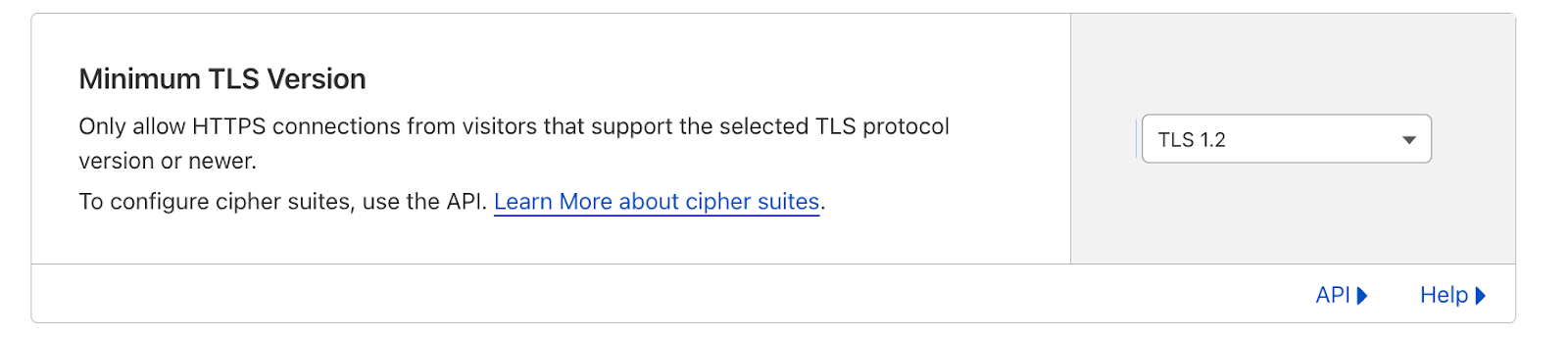
Let’s say that you want the default min TLS version for your domain to be TLS 1.2, but for your dashboard and API subdomains, you want to set the minimum TLS version to be TLS 1.3. In the Cloudflare dashboard, you can set the zone level minimum TLS version to 1.2 as shown below. Then, to make the minimum TLS version for the dashboard and API subdomains TLS 1.3, make a call to the per-hostname TLS settings API endpoint with the specific hostname and setting.

Introducing per hostname TLS settings — security fit to your needs

This is all available, starting today, through the API endpoint! And if you’d like to learn more about how to use our per-hostname TLS settings, please jump on over to our developer documentation.

Using Machine Learning to Detect Keystrokes

Post Syndicated from Bruce Schneier original https://www.schneier.com/blog/archives/2023/08/using-machine-learning-to-detect-keystrokes.html

Researchers have trained a ML model to detect keystrokes by sound with 95% accuracy.

“A Practical Deep Learning-Based Acoustic Side Channel Attack on Keyboards”

Abstract: With recent developments in deep learning, the ubiquity of microphones and the rise in online services via personal devices, acoustic side channel attacks present a greater threat to keyboards than ever. This paper presents a practical implementation of a state-of-the-art deep learning model in order to classify laptop keystrokes, using a smartphone integrated microphone. When trained on keystrokes recorded by a nearby phone, the classifier achieved an accuracy of 95%, the highest accuracy seen without the use of a language model. When trained on keystrokes recorded using the video-conferencing software Zoom, an accuracy of 93% was achieved, a new best for the medium. Our results prove the practicality of these side channel attacks via off-the-shelf equipment and algorithms. We discuss a series of mitigation methods to protect users against these series of attacks.

News article.

Patch Tuesday – August 2023

Post Syndicated from Adam Barnett original https://blog.rapid7.com/2023/08/08/patch-tuesday-august-2023/

Patch Tuesday - August 2023

Microsoft is addressing 86 vulnerabilities this August Patch Tuesday, including one zero-day vulnerability, as well as five critical remote code execution (RCE) vulnerabilities, and 12 browser vulnerabilities. An unpatched zero-day malicious document vulnerability from July also receives Windows OS updates and clarification in August.

ASP.NET: zero-day denial of service in Kestrel web server

The lone zero-day vulnerability patched this month is CVE-2023-38180, a denial of service (DoS) vulnerability in .NET , ASP.NET Core 2.1, and recent versions of Visual Studio. Microsoft is aware of in-the-wild exploitation. While the only impact noted is availability, administrators responsible for web apps built on ASP.NET are well-advised to patch as soon as possible. The cross-platform Kestrel web server is included in ASP.NET Core, and contains protections so that it can detect and disconnect a potentially malicious client. However, Kestrel will sometimes fail to disconnect the client, leading to denial of service. Microsoft notes that mitigating factors may include a reverse proxy or Web Application Firewall (WAF), since these are designed to detect and mitigate HTTP-based attacks.

Teams: critical remote execution vuln via malicious meeting

Potentially of greater concern are a pair of Microsoft Teams critical remote code execution (RCE) vulnerabilities. While the CVSS base score of 8.8 is at the top end of NVD’s High severity, Microsoft assesses both CVE-2023-29328 and CVE-2023-29330 as Critical on its own proprietary severity rating, and the advisories make clear why that is: both vulnerabilities allow an attacker to execute code in the context of anyone who joins a Teams meeting set up by the attacker. This affects Teams on all platforms: Windows Desktop, macOS, iOS, and Android. Given how widely Teams is used not just within organizations, but for collaboration outside of the organization in contexts requiring a level of trust of third parties not known to participants  – pre-sales calls, scoping calls, industry association calls and so on – these vulnerabilities surely deserve immediate remediation attention.

Windows MSMQ: critical RCE

The Windows Message Queuing Service is once again the site of multiple critical RCE vulnerabilities this month. CVE-2023-36910, CVE-2023-36911, and CVE-2023-35385 all come with a CVSSv3 base score of 9.8, reflecting the serious potential impact, lack of privileges required, and low attack complexity. One mitigating factor: the Microsoft Message Queueing Service must be enabled and listening on port 1801 for an asset to be vulnerable, and the Message Queueing Service is not installed by default. As Rapid7 has noted previously, however, a number of applications – including Microsoft Exchange – may quietly introduce MSMQ as part of their own installation routine.

Outlook: critical maldoc arbitrary code execution

Rounding out the August critical RCE vulnerabilities, CVE-2023-36895 describes a flaw in Microsoft Outlook where an attacker who can convince a user to open a specially-crafted malicious file will be able to execute code in the context of the victim. Patch Tuesday watchers will be familiar with Microsoft’s clarification that this type of exploit is sometimes referred to as arbitrary code execution (ACE) since the attack is local – a malicious document opened on the asset – even if the attacker is remote. With no known public disclosure, no known exploitation in the wild, and Microsoft assessing that exploitation is less likely, this is hopefully a case of patch-and-forget.

July unpatched zero-day: revised and patched in August

One month ago, on Patch Tuesday July 2023, Microsoft published a zero-day vulnerability for which they provided no patch, leaving many defenders understandably concerned. Exploitation of CVE-2023-36884 requires that the user opens a malicious document crafted by an attacker, and as Rapid7 noted at the time of publication, Microsoft did provide several mitigation strategies. Happily, the August 2023 Windows updates bring relief from CVE-2023-36884 in the form of patches for every current version of Windows: from Windows 11 and Server 2022 all the way back to Windows Server 2008 for 32-bit Systems Service Pack 2. These patches supersede last month’s mitigation advice, but at least some of those mitigation strategies remain generally applicable.

The advisory for CVE-2023-36884 has been radically updated today with a new title (Windows Search Remote Code Execution Vulnerability) in place of the previous title (Office and Windows HTML Remote Code Execution Vulnerability). Microsoft now states that the vulnerability is in fact a Windows Search security bypass involving a Mark of the Web (MOTW) removal leading to code execution on the victim system. Microsoft has also released a complementary non-CVE advisory ADV230003 with the latest defense-in-depth advice for Microsoft Office administrators; Microsoft claims that following the defense-in-depth advice will stop the attack chain leading to exploitation of CVE-2023-36884, and thus potentially also protect against other as-yet-unknown vulnerabilities. However, defenders should consider that other attack chains may exist which do not involve Office at all.

Exchange: critical elevation of privilege

Exploitation of CVE-2023-21709 allows an attacker to authenticate as a different user. Exchange admins should note that additional remediation actions must be taken after patching. Although the CVSSv3 base score is a Critical-ranked 9.8, Microsoft’s proprietary severity scale assesses this vulnerability as Important rather than Critical, since exploitation involves brute-forcing passwords, and strong passwords are challenging to brute force.

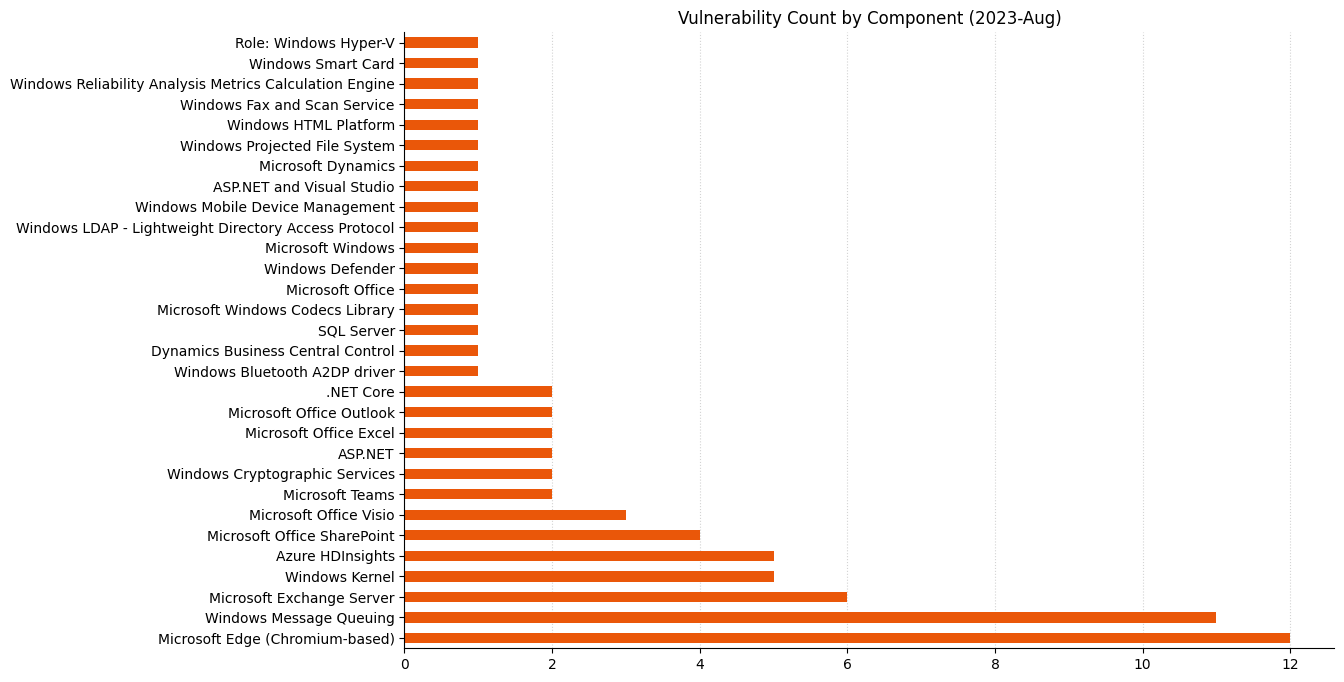
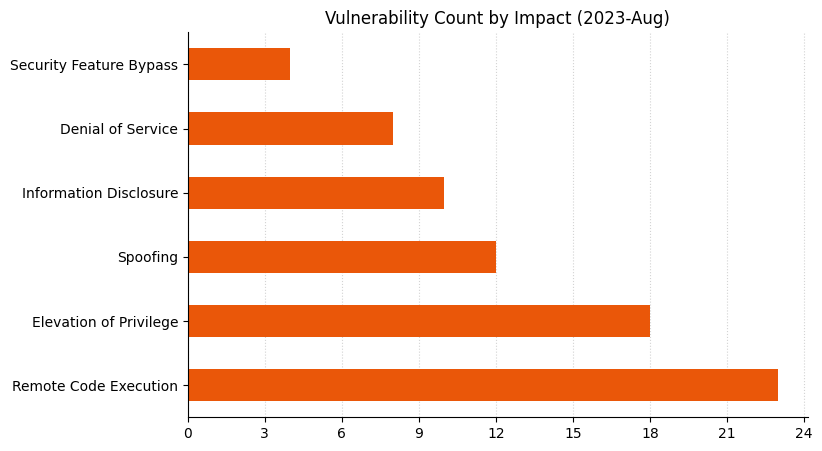
Summary Charts

Patch Tuesday - August 2023
Message Queueing and Exchange again.
Patch Tuesday - August 2023
Remote Code Execution covers a broad range of exploits.
Patch Tuesday - August 2023
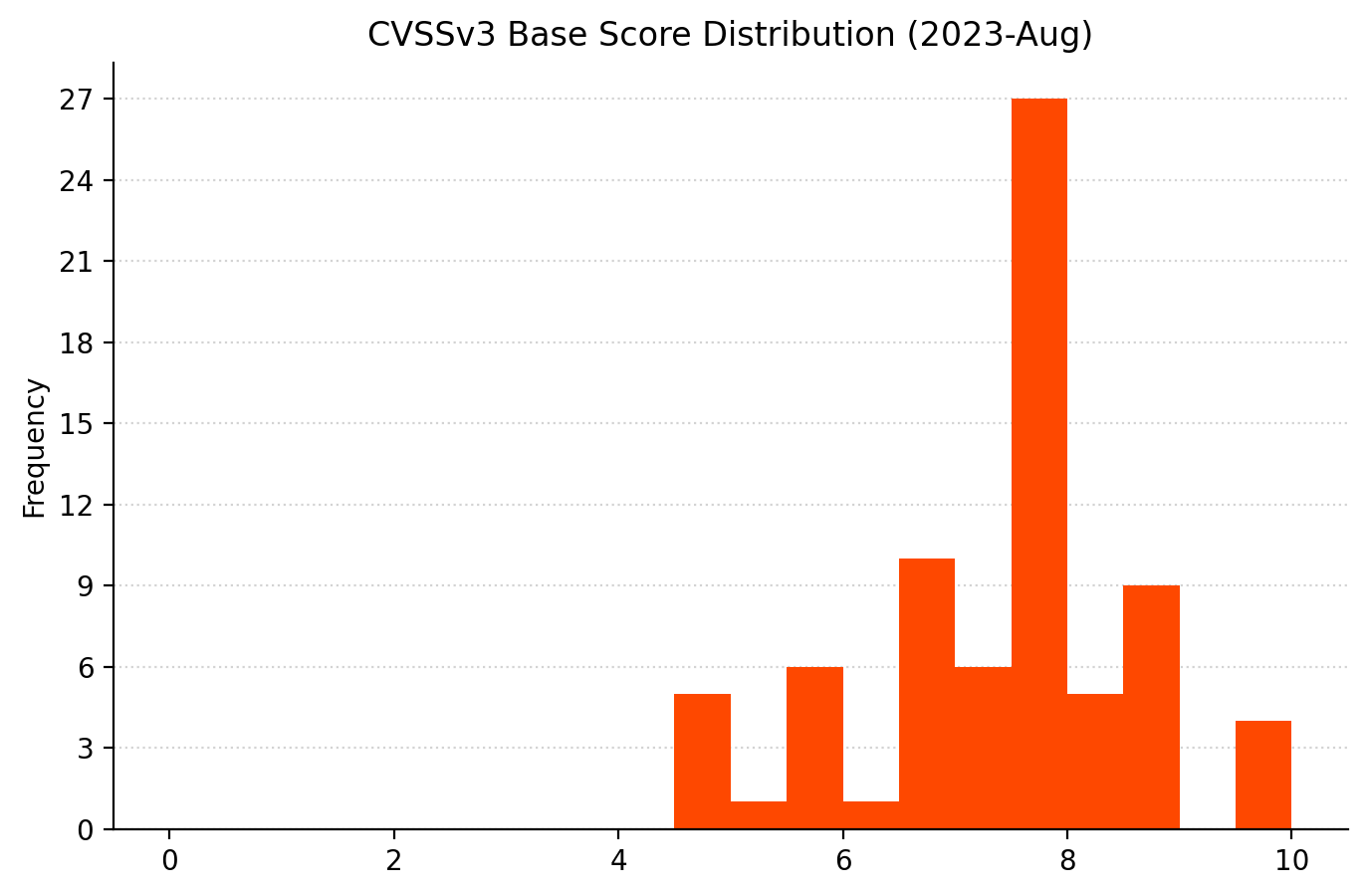
A typical distribution of CVSSv3 base scores.
Patch Tuesday - August 2023
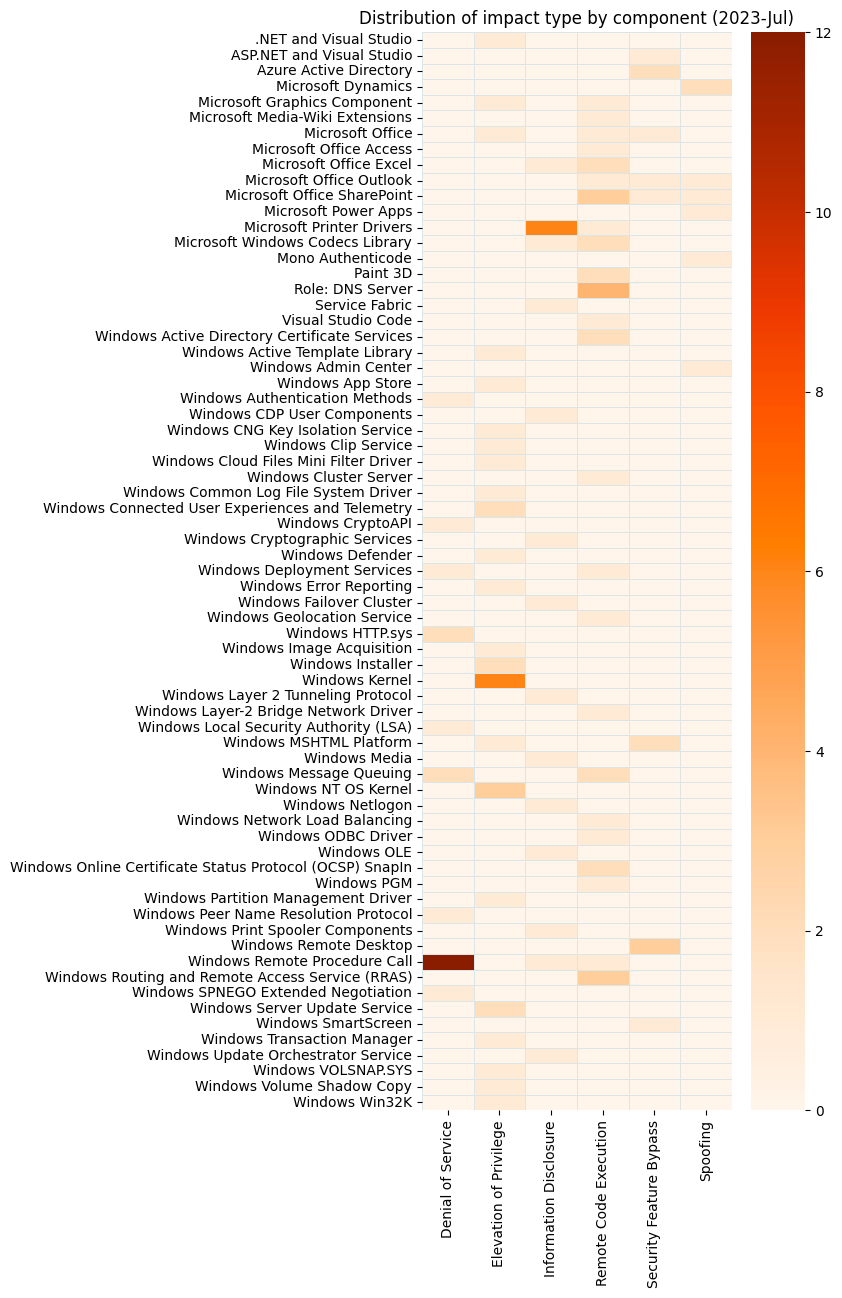
This heatmap shows distribution of vulnerabilities, rather than risk.

Summary Tables

Azure vulnerabilities

CVE Title Exploited? Publicly disclosed? CVSSv3 base score
CVE-2023-38176 Azure Arc-Enabled Servers Elevation of Privilege Vulnerability No No 7
CVE-2023-35394 Azure HDInsight Jupyter Notebook Spoofing Vulnerability No No 4.6
CVE-2023-36877 Azure Apache Oozie Spoofing Vulnerability No No 4.5
CVE-2023-35393 Azure Apache Hive Spoofing Vulnerability No No 4.5
CVE-2023-38188 Azure Apache Hadoop Spoofing Vulnerability No No 4.5
CVE-2023-36881 Azure Apache Ambari Spoofing Vulnerability No No 4.5

Azure Developer Tools vulnerabilities

CVE Title Exploited? Publicly disclosed? CVSSv3 base score
CVE-2023-36869 Azure DevOps Server Spoofing Vulnerability No No 6.3

Browser vulnerabilities

CVE Title Exploited? Publicly disclosed? CVSSv3 base score
CVE-2023-38157 Microsoft Edge (Chromium-based) Security Feature Bypass Vulnerability No No 6.5
CVE-2023-4078 Chromium: CVE-2023-4078 Inappropriate implementation in Extensions No No N/A
CVE-2023-4077 Chromium: CVE-2023-4077 Insufficient data validation in Extensions No No N/A
CVE-2023-4076 Chromium: CVE-2023-4076 Use after free in WebRTC No No N/A
CVE-2023-4075 Chromium: CVE-2023-4075 Use after free in Cast No No N/A
CVE-2023-4074 Chromium: CVE-2023-4074 Use after free in Blink Task Scheduling No No N/A
CVE-2023-4073 Chromium: CVE-2023-4073 Out of bounds memory access in ANGLE No No N/A
CVE-2023-4072 Chromium: CVE-2023-4072 Out of bounds read and write in WebGL No No N/A
CVE-2023-4071 Chromium: CVE-2023-4071 Heap buffer overflow in Visuals No No N/A
CVE-2023-4070 Chromium: CVE-2023-4070 Type Confusion in V8 No No N/A
CVE-2023-4069 Chromium: CVE-2023-4069 Type Confusion in V8 No No N/A
CVE-2023-4068 Chromium: CVE-2023-4068 Type Confusion in V8 No No N/A

Developer Tools vulnerabilities

CVE Title Exploited? Publicly disclosed? CVSSv3 base score
CVE-2023-35390 .NET and Visual Studio Remote Code Execution Vulnerability No No 7.8
CVE-2023-36899 ASP.NET Elevation of Privilege Vulnerability No No 7.5
CVE-2023-38180 .NET and Visual Studio Denial of Service Vulnerability Yes No 7.5
CVE-2023-38178 .NET Core and Visual Studio Denial of Service Vulnerability No No 7.5
CVE-2023-36873 .NET Framework Spoofing Vulnerability No No 7.4
CVE-2023-35391 ASP.NET Core SignalR and Visual Studio Information Disclosure Vulnerability No No 7.1

Developer Tools Microsoft Office vulnerabilities

CVE Title Exploited? Publicly disclosed? CVSSv3 base score
CVE-2023-36897 Visual Studio Tools for Office Runtime Spoofing Vulnerability No No 8.1

ESU vulnerabilities

CVE Title Exploited? Publicly disclosed? CVSSv3 base score
CVE-2023-35379 Reliability Analysis Metrics Calculation Engine (RACEng) Elevation of Privilege Vulnerability No No 7.8
CVE-2023-36876 Reliability Analysis Metrics Calculation (RacTask) Elevation of Privilege Vulnerability No No 7.1

Exchange Server vulnerabilities

CVE Title Exploited? Publicly disclosed? CVSSv3 base score
CVE-2023-21709 Microsoft Exchange Server Elevation of Privilege Vulnerability No No 9.8
CVE-2023-38181 Microsoft Exchange Server Spoofing Vulnerability No No 8.8
CVE-2023-38185 Microsoft Exchange Server Remote Code Execution Vulnerability No No 8.8
CVE-2023-35368 Microsoft Exchange Remote Code Execution Vulnerability No No 8.8
CVE-2023-35388 Microsoft Exchange Server Remote Code Execution Vulnerability No No 8
CVE-2023-38182 Microsoft Exchange Server Remote Code Execution Vulnerability No No 8

Microsoft Dynamics vulnerabilities

CVE Title Exploited? Publicly disclosed? CVSSv3 base score
CVE-2023-38167 Microsoft Dynamics Business Central Elevation Of Privilege Vulnerability No No 7.2
CVE-2023-35389 Microsoft Dynamics 365 On-Premises Remote Code Execution Vulnerability No No 6.5

Microsoft Office vulnerabilities

CVE Title Exploited? Publicly disclosed? CVSSv3 base score
CVE-2023-29328 Microsoft Teams Remote Code Execution Vulnerability No No 8.8
CVE-2023-29330 Microsoft Teams Remote Code Execution Vulnerability No No 8.8
CVE-2023-36891 Microsoft SharePoint Server Spoofing Vulnerability No No 8
CVE-2023-36892 Microsoft SharePoint Server Spoofing Vulnerability No No 8
CVE-2023-36895 Microsoft Outlook Remote Code Execution Vulnerability No No 7.8
CVE-2023-36865 Microsoft Office Visio Remote Code Execution Vulnerability No No 7.8
CVE-2023-36866 Microsoft Office Visio Remote Code Execution Vulnerability No No 7.8
CVE-2023-35372 Microsoft Office Visio Remote Code Execution Vulnerability No No 7.8
CVE-2023-35371 Microsoft Office Remote Code Execution Vulnerability No No 7.8
CVE-2023-36896 Microsoft Excel Remote Code Execution Vulnerability No No 7.8
CVE-2023-36890 Microsoft SharePoint Server Information Disclosure Vulnerability No No 6.5
CVE-2023-36894 Microsoft SharePoint Server Information Disclosure Vulnerability No No 6.5
CVE-2023-36893 Microsoft Outlook Spoofing Vulnerability No No 6.5

SQL Server vulnerabilities

CVE Title Exploited? Publicly disclosed? CVSSv3 base score
CVE-2023-38169 Microsoft OLE DB Remote Code Execution Vulnerability No No 8.8

System Center vulnerabilities

CVE Title Exploited? Publicly disclosed? CVSSv3 base score
CVE-2023-38175 Microsoft Windows Defender Elevation of Privilege Vulnerability No No 7.8

Windows vulnerabilities

CVE Title Exploited? Publicly disclosed? CVSSv3 base score
CVE-2023-35387 Windows Bluetooth A2DP driver Elevation of Privilege Vulnerability No No 8.8
CVE-2023-38186 Windows Mobile Device Management Elevation of Privilege Vulnerability No No 7.8
CVE-2023-35382 Windows Kernel Elevation of Privilege Vulnerability No No 7.8
CVE-2023-35386 Windows Kernel Elevation of Privilege Vulnerability No No 7.8
CVE-2023-38154 Windows Kernel Elevation of Privilege Vulnerability No No 7.8
CVE-2023-36904 Windows Cloud Files Mini Filter Driver Elevation of Privilege Vulnerability No No 7.8
CVE-2023-36898 Tablet Windows User Interface Application Core Remote Code Execution Vulnerability No No 7.8
CVE-2023-38170 HEVC Video Extensions Remote Code Execution Vulnerability No No 7.8
CVE-2023-35378 Windows Projected File System Elevation of Privilege Vulnerability No No 7
CVE-2023-36905 Windows Wireless Wide Area Network Service (WwanSvc) Information Disclosure Vulnerability No No 5.5
CVE-2023-36914 Windows Smart Card Resource Management Server Security Feature Bypass Vulnerability No No 5.5
CVE-2023-35384 Windows HTML Platforms Security Feature Bypass Vulnerability No No 5.4

Windows ESU vulnerabilities

CVE Title Exploited? Publicly disclosed? CVSSv3 base score
CVE-2023-36910 Microsoft Message Queuing Remote Code Execution Vulnerability No No 9.8
CVE-2023-36911 Microsoft Message Queuing Remote Code Execution Vulnerability No No 9.8
CVE-2023-35385 Microsoft Message Queuing Remote Code Execution Vulnerability No No 9.8
CVE-2023-35381 Windows Fax Service Remote Code Execution Vulnerability No No 8.8
CVE-2023-36882 Microsoft WDAC OLE DB provider for SQL Server Remote Code Execution Vulnerability No No 8.8
CVE-2023-36903 Windows System Assessment Tool Elevation of Privilege Vulnerability No No 7.8
CVE-2023-35359 Windows Kernel Elevation of Privilege Vulnerability No No 7.8
CVE-2023-35380 Windows Kernel Elevation of Privilege Vulnerability No No 7.8
CVE-2023-36900 Windows Common Log File System Driver Elevation of Privilege Vulnerability No No 7.8
CVE-2023-38184 Windows Lightweight Directory Access Protocol (LDAP) Remote Code Execution Vulnerability No No 7.5
CVE-2023-35383 Microsoft Message Queuing Information Disclosure Vulnerability No No 7.5
CVE-2023-36912 Microsoft Message Queuing Denial of Service Vulnerability No No 7.5
CVE-2023-38172 Microsoft Message Queuing Denial of Service Vulnerability No No 7.5
CVE-2023-36913 Microsoft Message Queuing Information Disclosure Vulnerability No No 6.5
CVE-2023-36909 Microsoft Message Queuing Denial of Service Vulnerability No No 6.5
CVE-2023-35376 Microsoft Message Queuing Denial of Service Vulnerability No No 6.5
CVE-2023-38254 Microsoft Message Queuing Denial of Service Vulnerability No No 6.5
CVE-2023-35377 Microsoft Message Queuing Denial of Service Vulnerability No No 6.5
CVE-2023-36908 Windows Hyper-V Information Disclosure Vulnerability No No 5.7
CVE-2023-36889 Windows Group Policy Security Feature Bypass Vulnerability No No 5.5
CVE-2023-36906 Windows Cryptographic Services Information Disclosure Vulnerability No No 5.5
CVE-2023-36907 Windows Cryptographic Services Information Disclosure Vulnerability No No 5.5
CVE-2023-20569 AMD: CVE-2023-20569 Return Address Predictor No No N/A

[$] SFrame: fast, low-overhead stack traces

Post Syndicated from jake original https://lwn.net/Articles/940686/

Getting a stack trace of a running program is useful in a variety of
scenarios: tracing, profiling, debugging, performance tuning, and more.
There are existing mechanisms to get stack traces, but there are some
downsides to them; the “Simple Frame” (SFrame) stack-trace format came
about to address the shortcomings in the other techniques. Back in May,
Steve Rostedt and Indu Bhagat gave a talk about
SFrame support in the kernel
as part of LSFMM+BPF; a few days later, Bhagat gave
a more general talk about SFrame
(YouTube video)
at Open
Source Summit North America
in Vancouver. That second talk helped fill
in some other aspects of SFrame and the overall stack-tracing picture.

A Message from Rapid7 CEO, Corey Thomas

Post Syndicated from Corey Thomas original https://blog.rapid7.com/2023/08/08/a-message-from-rapid7-ceo-corey-thomas/

A Message from Rapid7 CEO, Corey Thomas

Earlier today, the following email was shared with Rapid7 employees.

Team,

As we accelerate our delivery of the leading security operations solution and service platform experience to customers, we have determined it is necessary to restructure our operations, including the difficult decision to reduce our team in the near term. We will announce our restructuring publicly this afternoon along with our Q2 earnings results.

While it may be surprising to take this measure when we are meeting performance expectations, making decisions from a place of strength allows us the opportunity to restructure intentionally.

All employees will receive an email shortly with additional detail based on their path forward and local requirements.

I would always prefer to speak to each of you individually. Unfortunately, there is no ideal way to have this conversation with all of our global Moose simultaneously, and I regret that some of you will be reading this after the news is public. I will remain online with you as morning reaches each timezone to host town hall meetings with local teams and leaders.

There are more details on how we are supporting impacted Moose below. First, I will provide additional context on our business that led up to this decision.

Where We Are Today

The security industry is characterized by constantly adapting and learning, which is what thrills and engages many of us—there are always new technologies, attacks, threats, and research. This is true of our company, our customers, and attackers. You do not survive in security without being adaptable and innovative.

Ten years ago security was an afterthought for business leaders, and the role of the security community was to sound the alarm and make in-roads to business conversations. As security has gained attention and budget share, organizations have accumulated stacks of single-purpose security technologies. However, even great security tools are often operated in silos and are not meeting the promise of results customers need.

In today’s complex hybrid environments with highly-capable and innovative attackers, customers demand efficacy and efficiency, and integration across solutions is becoming imperative.

Rapid7 has served customers for more than two decades by meeting shifting demands for the best of vulnerability management, threat detection, and attacker insights. Measured by customer achievement, we have been fortunate to sustain +20% growth for many years.

This is all impact that we have created together, and I am grateful for every bit of effort that got us here today. However, when it comes to consolidation, we—and the industry—have been too slow to adjust:

  1. In an effort to minimize disruption, we have been making incremental changes to meet these emergent needs. However, customers don’t need us to simply move faster on point solutions, they need us to move decisively and strategically toward an integrated experience.
  2. Our rapid growth in the cybersecurity upswing enabled us to add market leading capabilities quickly, however, as we have grown our employee base to meet demand, spun up teams quickly, and expanded to new regions, it has also created unnecessary friction and inefficiencies which hinder our customer experience.

This restructuring and near-term reduction will set up our teams and customers for long term success. It will increase our capacity to invest where customers need it, and give us the flexibility to scale intentionally, foster innovation, and improve processes.

We believe we are the only company in the world that can truly transform security operations by integrating risk, threat, and incident management into a seamless platform that eliminates unnecessary compromises.

At this inflection point, we will be strategically refocusing and realigning our business toward expanding our MDR leadership across all of security operations, accelerating our investments to build the most adoptable cloud capabilities, and continuing our focus on aligning our operations to deliver the best engagement and support for our customers.

It is difficult and heartbreaking to say goodbye to Moose who have been integral to our teams over the years. We would not go forward if we were not confident that this is the best and only way we will be able to deliver the experience that our customers demand, vault over our competition, and remain the best place to work for the most Moose possible.

Restructure and Refocus

Prior to making restructuring decisions, we engaged an external advisor to indicate the most impactful opportunities in our business. They determined that we could reduce the size of our business and improve efficiency, while remaining a growth-oriented company with capacity to make strategic customer investments.

However, our Moose are not simply data. A small group of senior leaders have been working tirelessly to identify the roles and teams not aligned to our tightened strategic priorities. Every organization and location at Rapid7 will be impacted, though some teams, like engineering and sales, will experience more substantial shifts.

Departing Moose

We have taken great care to reflect our vast appreciation of the work each of you have contributed to Rapid7 by offering the most high-touch, supportive transition possible.

All employees will receive an email from [email protected] in the next half hour with additional detail based on your path forward, circumstances, and local requirements. Your notification will also outline your next steps—Moose will have every opportunity to meet with their leaders and people strategy.

To support departing Moose, they will be eligible to receive severance packages, including continued healthcare coverage for the length of the severance period, as well as outplacement services for career support. Outside the U.S., there is a broad range of employment laws, and we’ll take great care to guide our Moose and their managers through these processes, such as required consultation periods. For employees whose immigration status is connected with their employment, People Strategy is working with each impacted individual in concert with our mobility team.

Most importantly, we continue to live our motto of “Once a Moose, Always a Moose.” We hope that, as the dust settles, you are able to look back on your impact here and will continue to nurture the networks and relationships you’ve built with fellow Moose. If you need a recommendation or endorsement, I hope everyone will join me in supporting these valuable team members.

Continuing Moose

For continuing Moose, you will see an immediate focus on our strategic direction to ensure you are not absorbing additional work, renewed processes to drive innovation, and tight collaboration to ensure we don’t repeat past patterns. Right now I would like you to take the time to acknowledge our departing Moose who have contributed to our success, and support customers to avoid any disruption.

You’ll receive a note for a meeting this week with your leadership team. Next week, we will begin follow-up town halls to dig into go-forward plans.

Please keep an eye on the announcements channel for additional materials.

Stable kernels with security fixes

Post Syndicated from corbet original https://lwn.net/Articles/940798/

The
6.4.9,
6.1.44,
5.15.125,
5.10.189,
5.4.252,
4.19.290, and
4.14.321
stable kernel updates have all been released; they are dominated by fixes
for the latest round of
speculative-execution vulnerabilities.

Do note the warning attached to each of these releases:

Note, PLEASE TEST this kernel if you are on the 6.4.y tree before
using it in a real workload. This was a quick release due to the
obvious security fixes in it, and as such, it has not had very much
testing “in the wild”. Please let us know of any problems seen.
Also note that the user/kernel api for the new security mitigations
might be changing over time, so do not get used to them being fixed
in stone just yet.

Another round of speculative-execution vulnerabilities

Post Syndicated from corbet original https://lwn.net/Articles/940783/

There is a newly disclosed set of vulnerabilities in Intel processors that
have been given the name Downfall
attacks
.

Downfall attacks targets a critical weakness found in billions of
modern processors used in personal and cloud computers. This
vulnerability, identified as CVE-2022-40982, enables a user to
access and steal data from other users who share the same
computer. For instance, a malicious app obtained from an app store
could use the Downfall attack to steal sensitive information like
passwords, encryption keys, and private data such as banking
details, personal emails, and messages. Similarly, in cloud
computing environments, a malicious customer could exploit the
Downfall vulnerability to steal data and credentials from other
customers who share the same cloud computer.

A series of patches has landed in the mainline kernel, including one for gather data sampling
mitigation
and one to disable the AVX
extension
on CPUs where microcode mitigation is not available.
“This is a *big* hammer. It is known to break buggy userspace that
uses incomplete, buggy AVX enumeration.
”

Not to be left out, AMD processors suffer from a return-stack overflow
vulnerability, again exploitable via speculative execution; this patch, also just
merged, describes the problem and its mitigation.

How to Send SMS Using Configurations Sets with Amazon Pinpoint

Post Syndicated from Tyler Holmes original https://aws.amazon.com/blogs/messaging-and-targeting/how-to-send-sms-using-configurations-sets-with-amazon-pinpoint/

In a previous blog post we walked through how to manage opt-outs for SMS in Amazon Pinpoint using the V2 SMS and Voice API. The post detailed a scenario where a user needed to manage multiple use-cases such as marketing and One-Time Password (OTP) or Multi-Factor Authentication (MFA). This works great if all of your data can be streamed to a single location, but what if you have multiple business units or you are an Independent Software Vendor (ISV) and need to manage SMS sending for multiple customers? You need a way to not only manage multiple use-cases and opt-out lists, but also sender details and separate event destinations for metrics. Read on to learn how to combine SMS Opt-Out Lists with Configuration Sets to simplify your sending and solve your multi-tenant challenge.

Prerequisites

  • In order to manage Configuration Sets you need to use the V2 API for SMS and voice
  • You must Purchase/Register an Origination Identity (OID) for each use-case in each country you plan to support.
    • Example: If you are sending marketing materials and OTP messages in the US and are using a short code then you will need to purchase at least two short codes (one for each use-case) and register each use-case.
    • If you need help determining what OID you need use this guide.

The Scenario:
For the sake of simplicity our scenario will use two different senders that need to manage two distinct use-cases but these steps can scale as you need.

SMS Sender 1 Details:

  • Sending only in the US
  • Sending OTP via a US Short Code
  • Sending Marketing messages via a 10DLC
    • Send text events to an Amazon Kinesis Data Firehose destination
    • Send text events to an Amazon CloudWatch destination

SMS Sender 2 Details:

  • Sending SMS Globally
  • Sending OTP via multiple country specific originators
    • Send events to an Amazon Kinesis Data Firehose destination
    • Send all events to an Amazon CloudWatch destination

The V2 SMS and Voice API has several helpful actions to configure this scenario above, some of which will expand upon our previous blog post that covered managing SMS opt-outs so make sure to read that one first and have it handy as you review.

What is a Configuration Set for SMS?

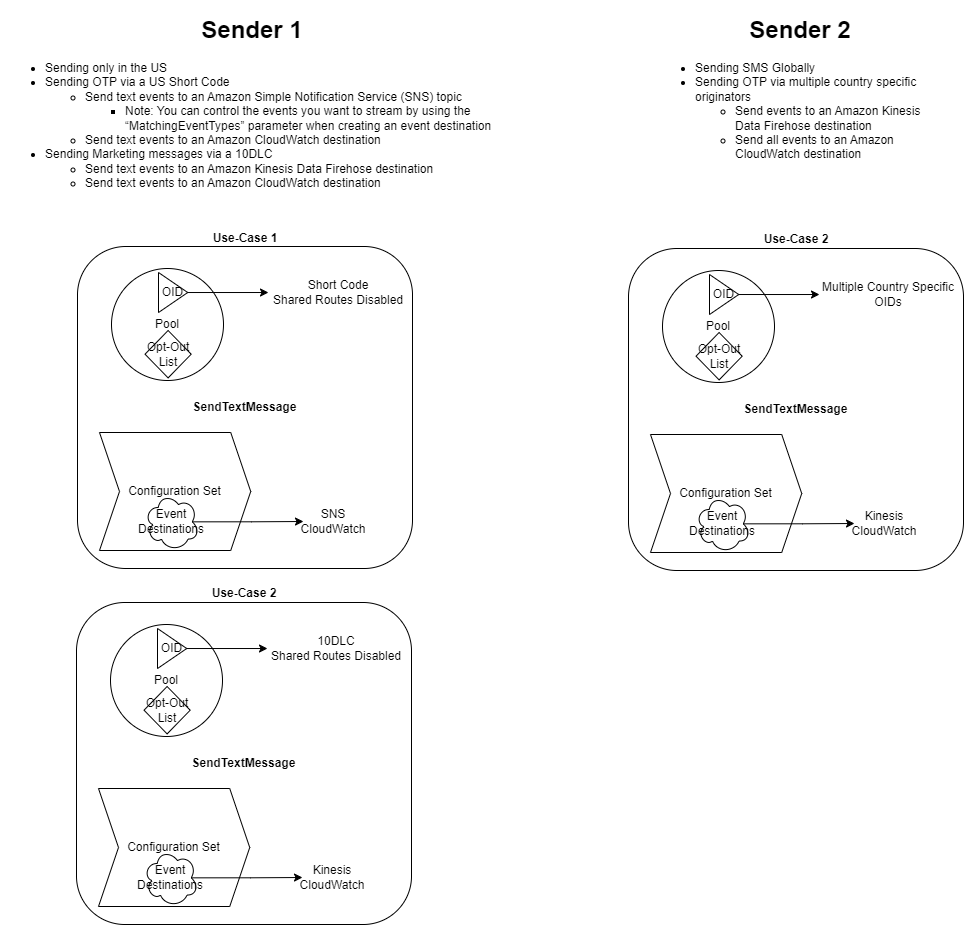
A Configuration Set is a container that is used to hold information about Event Destinations as well as rules that you apply to the SMS messages that you send. Configuration Sets are used when sending messages with the SendTextMessage Action in the V2 API for SMS and voice. When you use SendTextMessage you can specify a Configuration Set that determines how the messages are treated and where the events from that particular send are streamed. The image below explains the concepts we will walk through in this post.


How to Create Configuration Sets and Send SMS
Below we will walk through the steps needed to configure each of the above scenarios. Note that the default quota for Configuration Sets is 25 per account but this can be increased if needed

  • Scenario 1 –
    • Short Code Configuration
      • Create a Pool for the US Short Code delivering OTP messages
        • Associate the short code to that Pool by setting “OriginationIdentity” using the PhoneNumberArn of your US Short Code
          • You can use DescribePhoneNumbers to find the values for PhoneNumberArn
          • Note: You can have multiple OIDs per Pool if necessary
          • Note: Opt-Out Lists of OIDs and Pools must match. If you previously associated an Opt-Out List to any OIDs you may need to update those OIDs to match that of the Pool prior to associating it with the Pool
        • Set the IsoCountryCode to “US”
      • Use the “UpdatePool” action to ensure we only send to US phone numbers as well as to create an Opt-Out List specifically for the OTP use-case
        • Set “SharedRoutesEnabled” to False. This will ensure that only the OIDs in this pool will be used to send messages.
          • Since we will only have a US Shortcode in this pool then only US based phone numbers will be sent messages, other destination phone numbers will generate a ConflictException error
            • An error occurred (ConflictException) when calling the SendTextMessage operation: Conflict Occurred – Reason=”NO_ORIGINATION_IDENTITIES_FOUND”
        • Set an Opt-Out List for the Pool by specifying the “OptOutListName”
      • Use the “PutKeyword” action to create at least one Opt-In Keyword
        • This will allow destination numbers to opt back into your use-case
      • Create a Configuration Set
        • This is a container for your Event Destinations which you will set up next. Each configuration set can contain between 0 and 5 event destinations. Each event destination can contain a reference to a single destination, such as a CloudWatch or Kinesis Data Firehose destination
        • Give your Configuration a descriptive name by setting “ConfigurationSetName”
      • Create an SNS Topic that will receive all of the events. Dependent on your needs you can decide where you want to publish these events. Your options are:
      • Create a CloudWatch Log Group that will receive all of the events you would like to log
      • Create Event Destinations – Each event destination can contain a reference to a single destination, since we are adding two destinations (SNS and CloudWatch) we will need to make this call twice, once for each destination
        • Create the SNS destination.
          • Set the “ConfigurationSetName” to the Configuration Set you just created
          • Set “MatchingEventTypes” to the event types you are wanting to log
          • Set the SNS Event Destination
            • Set the “TopicArn”
        • Create the CloudWatch Destination
          • Set the “ConfigurationSetName” to the Configuration Set you just created
          • Set “MatchingEventTypes” to the event types you are wanting to log
          • Set “IamRoleArn” to the ARN of an Amazon Identity and Access Management (IAM) role that is able to write event data to an Amazon CloudWatch destination
          • Set the “LogGroupArn” to the Log Group in CloudWatch you want the events to stream to
    • 10DLC Configuration
        • Create a Pool for the 10DLC delivering Marketing messages
          • Associate the 10DLC to that Pool by setting “OriginationIdentity” using the PhoneNumberArn of your 10DLC
            • You can use DescribePhoneNumbers to find the values for PhoneNumberArn
            • Note: You can have multiple OIDs per Pool if necessary
            • Note: Opt-Out Lists of OIDs and Pools must match, so if you previously associated an Opt-Out List to any OIDs you may need to update those OIDs to match that of the Pool prior to associating it with the Pool
          • Set the IsoCountryCode to “US”
        • Use the “UpdatePool” action to ensure we only send to US phone numbers as well as to create an Opt-Out List specifically for the Marketing use-case
          • Set “SharedRoutesEnabled” to False. This will ensure that only the OIDs in this pool will be used to send messages.
            • Since we will only have a 10DLC in this pool then only US based phone numbers will be sent messages, other destination phone numbers will generate an error
          • Set an Opt-Out List for the Pool by specifying the “OptOutListName”
        • Use the “PutKeyword” action to create at least one Opt-In Keyword
        • Create a Configuration Set
          • Give your Configuration a descriptive name by setting “ConfigurationSetName”
        • Create a Kinesis Data Firehose Delivery Stream that will receive all of the events.
        • Create a CloudWatch Log Group that will receive all of the events you would like to log
        • Create Event Destinations – Each event destination can contain a reference to a single destination. We are adding two destinations (SNS and CloudWatch) so we need to make this call twice, once for each destination
          • Create the Kinesis destination.
            • Set the “ConfigurationSetName” to the Configuration Set you just created
            • Set “MatchingEventTypes” to the event types you are wanting to log
            • Set the Kinesis Event Destination
              • Set the “DeliveryStreamArn” to the Stream you created earlier
              • Set the “IamRoleArn” to the ARN of an IAM role that is able to write event data to an Amazon Firehose destination
          • Create the CloudWatch Destination
            • Set the “ConfigurationSetName” to the Configuration Set you just created
            • Set “MatchingEventTypes” to the event types you are wanting to log
            • Set “IamRoleArn” to an IAM role that is able to write event data to an Amazon CloudWatch destination
            • Set the “LogGroupArn” to the Log Group in CloudWatch you want the events to stream to
  • Scenario 2
    • Global OTP Configuration
      • Create a Pool for delivering the OTP messages
        • Associate all of your OIDs being used to that Pool
          • You can use DescribePhoneNumbers to find the values for PhoneNumberArn
          • Note: Opt-Out Lists of OIDs and Pools must match, so if you previously associated an Opt-Out List to any OIDs you may need to update those OIDs to match that of the Pool prior to associating it with the Pool
      • Use the “UpdatePool” action to create an Opt-Out List specifically for the OTP use-case.
        • Set an Opt-Out List for the Pool by specifying the “OptOutListName”
      • Use the “PutKeyword” action to create at least one Opt-In Keyword
        • This will allow destination numbers to opt back into your use-case, in this case OTP
      • Create a Configuration Set
        • Give your Configuration a descriptive name by setting “ConfigurationSetName”
      • Create a Kinesis Data Firehose Delivery Stream that will receive all of the events
      • Create a CloudWatch Log Group that will receive all of the events you would like to log
      • Create Event Destinations – Each event destination can contain a reference to a single destination, since we are adding two destinations (SNS and CloudWatch) we will need to make this call twice, once for each destination
        • Create the Kinesis destination.
          • Set the “ConfigurationSetName” to the Configuration Set you just created
          • Set “MatchingEventTypes” to the event types you are wanting to log
          • Set the Kinesis Event Destination
            • Set the “DeliveryStreamArn” to the Stream you created earlier
            • Set the “IamRoleArn” to the ARN of an IAM role that is able to write event data to an Amazon Firehose destination
        • Create the CloudWatch Destination
          • Set the “ConfigurationSetName” to the Configuration Set you just created
          • Set “MatchingEventTypes” to the event types you are wanting to log
          • Set “IamRoleArn” to an IAM role that is able to write event data to an Amazon CloudWatch destination
          • Set the “LogGroupArn” to the Log Group in CloudWatch you want the events to stream to

Your configuration should look like this once you have completed the above steps

How to Send Your Messages

  • Send your SMS with the “SendTextMessage” action
    • Set the “ConfigurationSetName” using either the ConfigurationSetName or ConfigurationSetArn
      • You can find these using the “DescribeConfigurationSets” action
      • This field is used for any country-specific registration requirements. Currently, this setting is only used when you send messages to recipients in India using a sender ID.
    • Use either PoolId, or PoolArn for “OriginationIdentity”

Conclusion

In this post you have learned how to create Configuration Sets that give you more control over how you send SMS. Using Configuration Sets allows you to simplify your sending while maintaining multiple sending configurations and event destinations . The V2 API for SMS and Voice has many more useful actions not possible with the V1 API so we encourage you to explore how it can further help you simplify and automate your applications.

Review the documentation for the V2 SMS and Voice API here
Confirm the origination IDs you will need here
Check out the support tiers comparison here

Resources
https://docs.aws.amazon.com/pinpoint/latest/apireference_smsvoicev2/Welcome.html
https://docs.aws.amazon.com/pinpoint/latest/userguide/channels-sms-originating-identities-choosing.html
https://docs.aws.amazon.com/pinpoint/latest/userguide/channels-sms-limitations-opt-out.html
https://docs.aws.amazon.com/pinpoint/latest/developerguide/sms-voice-v2-pools.html
https://docs.aws.amazon.com/pinpoint/latest/developerguide/sms-voice-v2-configuration-sets.html
https://docs.aws.amazon.com/pinpoint/latest/developerguide/sms-voice-v2-keywords.html

AWS Weekly Roundup – AWS Storage Day, AWS Israel (Tel Aviv) Region, and More – Aug 8, 2023

Post Syndicated from Veliswa Boya original https://aws.amazon.com/blogs/aws/aws-weekly-roundup-aws-storage-day-aws-israel-tel-aviv-region-and-more-aug-8-2023/

(Editor’s note: Today, we are changing the title of this regular weekly post from AWS Week in Review to AWS Weekly Roundup to better reflect the mix of recent top news and announcements as well as upcoming events you won’t want to miss.)


It’s taken me some time to finally be comfortable with being in front of a camera, a strange thing for a Developer Advocate to say I know! Last week I joined a couple of my team-mates at the AWS London Studios to record a series of videos that will be published in our Build On AWS YouTube Channel. Build On AWS is for the hands-on, technical AWS cloud builder who wants to become more agile and innovate faster. In the channel, you’ll find dynamic, high-quality content that’s designed for developers, by developers!

This video tells you more about what you’ll find in the channel. Check it out and consider subscribing to not miss out when we publish new content.

Now on to the AWS updates. There was a lot of news related to AWS last week, and I’ve compiled a few announcements and upcoming events you need to know about. Let’s get started!

Last Week’s Launches
Here are a few launches from last week that you might have missed:

Microsoft 365 Apps for enterprise now available on Amazon WorkSpaces services – Amazon WorkSpaces is a fully managed, secure, and reliable virtual desktop in the AWS Cloud. With Amazon WorkSpaces, you improve IT agility and maximize user experience, while only paying for the infrastructure that you use. We announced the availability of Microsoft 365 Apps for enterprise on Amazon WorkSpaces. You can bring your own Microsoft 365 licenses (if they meet Microsoft’s licensing requirements) and activate the applications at no additional cost to run Microsoft 365 Apps for enterprise on Amazon WorkSpaces services.

AWS Israel (Tel Aviv) Region is Now Open – You can now securely store data in Israel while serving users in the vicinity with even lower latency. This is because last week we launched the Tel Aviv Region to give customers an additional option for running applications and serving users from data centers located in Israel.

Amazon Connect Launches – This is one of my favorite AWS services to write about because of how Amazon Connect is changing our customers’ engagement with their own customers. Last week, Amazon Connect announced automatic activity scheduling based on shift duration, custom flow block titles, and archiving and deleting flows from the UI, to name a few.

Other AWS News
A few more news items and blog posts you might have missed:

Customizable thresholds for health events supported on Amazon CloudWatch Internet Monitor – Until this announcement, the default threshold for overall availability and performance scores to invoke a health event was 95 percent. Now, you can customize the thresholds for when to invoke a health event for internet-facing traffic between your end users and your applications hosted on AWS.

Improved AWS Backup performance for Amazon S3 buckets – Now you can speed up your initial Amazon S3 backup workflow and back up buckets with more than 3 billion objects due to improvements to the speed of backups by up to 10x for buckets with more than 300 million objects. This performance improvement is automatically enabled at no additional cost in all Regions where AWS Backup support for Amazon S3 is available.

For AWS open-source news and updates, check out the latest newsletter curated by my colleague Ricardo Sueiras to bring you the most recent updates on open-source projects, posts, events, and more.

For a full list of AWS announcements, be sure to keep an eye on the What’s New at AWS page.

Upcoming AWS Events
We have the following upcoming events:

AWS Storage Day (August 9) – A one-day virtual event where you’ll learn how to prepare for AI/ML with the storage decisions you make now, how to do more with your budget by optimizing storage costs for on-premises and cloud data, and how to deliver holistic data protection for your organization, including recovery planning to help protect against ransomware. Learn more and register here.

AWS Summit Mexico City (August 30) – Sign up for the Summit to connect and collaborate with other like-minded folks while learning about AWS.

AWS Community Days (August 12, 19) – Join these community-led conferences where event logistics and content are planned, sourced, and delivered by community leaders: Colombia (August 12), and West Africa (August 19).


P.S. We’re focused on improving our content to provide a better customer experience, and we need your feedback to do so. Take this quick survey to share insights on your experience with the AWS Blog. Note that this survey is hosted by an external company, so the link doesn’t lead to our website. AWS handles your information as described in the AWS Privacy Notice.

– Veliswa

Intel DOWNFALL Ultra-Scary AVX2 and AVX-512 Side channel Attack Discovered

Post Syndicated from Patrick Kennedy original https://www.servethehome.com/intel-downfall-ultra-scary-avx2-and-avx-512-side-channel-attack-discovered/

Intel Downfall is a new vulnerability targeting AVX2 and AVX-512 pipelines in modern Intel desktop and server CPUs up to Ice Lake Xeons

The post Intel DOWNFALL Ultra-Scary AVX2 and AVX-512 Side channel Attack Discovered appeared first on ServeTheHome.

The collective thoughts of the interwebz