Building confidence in a decision

Post Syndicated from Netflix Technology Blog original https://netflixtechblog.com/building-confidence-in-a-decision-8705834e6fd8

Martin Tingley with Wenjing Zheng, Simon Ejdemyr, Stephanie Lane, Michael Lindon, and Colin McFarland

This is the fifth post in a multi-part series on how Netflix uses A/B tests to inform decisions and continuously innovate on our products. Need to catch up? Have a look at Part 1 (Decision Making at Netflix), Part 2 (What is an A/B Test?), Part 3 (False positives and statistical significance), and Part 4 (False negatives and power). Subsequent posts will go into more details on experimentation across Netflix, how Netflix has invested in infrastructure to support and scale experimentation, and the importance of developing a culture of experimentation within an organization.

In Parts 3 (False positives and statistical significance) and 4 (False negatives and power), we discussed the core statistical concepts that underpin A/B tests: false positives, statistical significance and p-values, as well as false negatives and power. Here, we’ll get to the hard part: how do we use test results to support decision making in a complex business environment?

The unpleasant reality about A/B testing is that no test result is a certain reflection of the underlying truth. As we discussed in previous posts, good practice involves first setting and understanding the false positive rate, and then designing an experiment that is well powered so it is likely to detect true effects of reasonable and meaningful magnitudes. These concepts from statistics help us reduce and understand error rates and make good decisions in the face of uncertainty. But there is still no way to know whether the result of a specific experiment is a false positive or a false negative.

Figure 1: Inspiration from Voltaire.

In using A/B testing to evolve the Netflix member experience, we’ve found it critical to look beyond just the numbers, including the p-value, and to interpret results with strong and sensible judgment to decide if there’s compelling evidence that a new experience is a “win” for our members. These considerations are aligned with the American Statistical Association’s 2016 Statement on Statistical Significance and P-Values, where the following three direct quotes (bolded) all inform our experimentation practice.

“Proper inference requires full reporting and transparency.” As discussed in Part 3: (False positives and statistical significance), by convention we run experiments at a 5% false positive rate. In practice, then, if we run twenty experiments (say to evaluate if each of twenty colors of jelly beans are linked to acne) we’d expect at least one significant result — even if, in truth, the null hypothesis is true in each case and there is no actual effect. This is the Multiple Comparisons Problem, and there are a number of approaches to controlling the overall false positive rate that we’ll not cover here. Of primary importance, though, is to report and track not only results from tests that yield significant results — but also those that do not.

Figure 2: All you need to know about false positives, in cartoon form.

“A p-value, or statistical significance, does not measure the size of an effect or the importance of a result.” In Part 4 (False negatives and power), we talked about the importance, in the experimental design phase, of powering A/B tests to have a high probability of detecting reasonable and meaningful metric movements. Similar considerations are relevant when interpreting results. Even if results are statistically significant (p-value < 0.05), the estimated metric movements may be so small that they are immaterial to the Netflix member experience, and we are better off investing our innovation efforts in other areas. Or the costs of scaling out a new feature may be so high relative to the benefits that we could better serve our members by not rolling out the feature and investing those funds in improving different areas of the product experience.

“Scientific conclusions and business or policy decisions should not be based only on whether a p-value passes a specific threshold.” The remainder of this post gives insights into practices we use at Netflix to arrive at decisions, focusing on how we holistically evaluate evidence from an A/B test.

Building a data-driven case

One practical way to evaluate the evidence in support of a decision is to think in terms of constructing a legal case in favor of the new product experience: is there enough evidence to “convict” and conclude, beyond that 5% reasonable doubt, that there is a true effect that benefits our members? To help build that case, here are some helpful questions that we ask ourselves in interpreting test results:

  • Do the results align with the hypothesis? If the hypothesis was about optimizing compute resources for back-end infrastructure, and results showed a major and statistically significant increase in user satisfaction, we’d be skeptical. The result may be a false positive — or, more than likely, the result of a bug or error in the execution of the experiment (Twyman’s Law). Sometimes surprising results are correct, but more often than not they are either the result of implementation errors or false positives, motivating us to dig deep into the data to identify root causes.
  • Does the metric story hang together? In Part 2 (What is an A/B Test?), we talked about the importance of describing the causal mechanism through which a change made to the product impacts both secondary metrics and the primary decision metric specified for the test. In evaluating test results, it’s important to look at changes in these secondary metrics, which are often specific to a particular experiment, to assess if any changes in the primary metric follow the hypothesized causal chain. With the Top 10 experiment, for example, we’d check if inclusion in the Top 10 list increases title-level engagement, and if members are finding more of the titles they watch from the home page versus other areas of the product. Increased engagement with the Top 10 titles and more plays coming from the home page would help build our confidence that it is in fact the Top 10 list that is increasing overall member satisfaction. In contrast, if our primary member satisfaction metric was up in the Top 10 treatment group, but analysis of these secondary metrics showed no increase in engagement with titles included in the Top 10 list, we’d be skeptical. Maybe the Top 10 list isn’t a great experience for our members, and its presence drives more members off the home page, increasing engagement with the Netflix search experience — which is so amazing that the result is an increase in overall satisfaction. Or maybe it’s a false positive. In any case, movements in secondary metrics can cast sufficient doubt that, despite movement in the primary decision metric, we are unable to confidently conclude that the treatment is activating the hypothesized causal mechanism.
  • Is there additional supporting or refuting evidence, such as consistent patterns across similar variants of an experience? It’s common to test a number of variants of an idea within a single experiment. For example, with something like the Top 10 experience, we may test a number of design variants and a number of different ways to position the Top 10 row on the homepage. If the Top 10 experience is great for Netflix members, we’d expect to see similar gains in both primary and secondary metrics across many of these variants. Some designs may be better than others, but seeing broadly consistent results across the variants helps build that case in favor of the Top 10 experience. If, on the other hand, we test 20 design and positioning variants and only one yields a significant movement in the primary decision metric, we’d be much more skeptical. After all, with that 5% false positive rate, we expect on average one significant result from random chance alone.
  • Do results repeat? Finally, the surest way to build confidence in a result is to see if results repeat in a follow-up test. If results of an initial A/B test are suggestive but not conclusive, we’ll often run a follow-up test that hones in on the hypothesis based on learnings generated from the first test. With something like the Top 10 test, for example, we might observe that certain design and row positioning choices generally lead to positive metric movements, some of which are statistically significant. We’d then refine these most promising design and positioning variants, and run a new test. With fewer experiences to test, we can also increase the allocation size to gain more power. Another strategy, useful when the product changes are large, is to gradually roll out the winning treatment experience to the entire user or member based to confirm benefits seen in the A/B test, and to ensure there are no unexpected deleterious impacts. In this case, instead of rolling out the new experience to all users at once, we slowly ramp up the fraction of members receiving the new experience, and observe differences with respect to those still receiving the old experience.

Connections with decision theory

In practice, each person has a different framework for interpreting the results of a test and making a decision. Beyond the data, each individual brings, often implicitly, prior information based on their previous experiences with similar A/B tests, as well as a loss or utility function based on their assessment of the potential benefits and consequences of their decision. There are ways to formalize these human judgements about estimated risks and benefits using decision theory, including Bayesian decision theory. These approaches involve formally estimating the utility of making correct or incorrect decisions (e.g., the cost of rolling out a code change that doesn’t improve the member experience). If, at the end of the experiment, we can also estimate the probability of making each type of mistake for each treatment group, we can make a decision that maximizes the expected utility for our members.

Decision theory couples statistical results with decision-making and is therefore a compelling alternative to p-value-based approaches to decision making. However, decision-theoretic approaches can be difficult to generalize across a broad range of experiment applications, due to the nuances of specifying utility functions. Although imperfect, the frequentist approach to hypothesis testing that we’ve outlined in this series, with its focus on p-values and statistical significance, is a broadly and readily applicable framework for interpreting test results.

Another challenge in interpreting A/B test results is rationalizing through the movements of multiple metrics (primary decision metric and secondary metrics). A key challenge is that the metrics themselves are often not independent (i.e. metrics may generally move in the same direction, or in opposite directions). Here again, more advanced concepts from statistical inference and decision theory are applicable, and at Netflix we are engaged in research to bring more quantitative approaches to this multimetric interpretation problem. Our approach is to include in the analysis information about historical metric movements using Bayesian inference — more to follow!

Finally, it’s worth noting that different types of experiments warrant different levels of human judgment in the decision making process. For example, Netflix employs a form of A/B testing to ensure safe deployment of new software versions into production. Prior to releasing the new version to all members, we first set up a small A/B test, with some members receiving the previous code version and some the new, to ensure there are no bugs or unexpected consequences that degrade the member experience or the performance of our infrastructure. For this use case, the goal is to automate the deployment process and, using frameworks like regret minimization, the test-based decision making as well. In success, we save our developers time by automatically passing the new build or flagging metric degradations to the developer.

Summary

Here we’ve described how to build the case for a product innovation through careful analysis of the experimental data, and noted that different types of tests warrant differing levels of human input to the decision process.

Decision making under uncertainty, including acting on results from A/B tests, is difficult, and the tools we’ve described in this series of posts can be hard to apply correctly. But these tools, including the p-value, have withstood the test of time, as reinforced in 2021 by the American Statistical Association president’s task force statement on statistical significance and replicability: “the use of p-values and significance testing, properly applied and interpreted, are important tools that should not be abandoned. . . . [they] increase the rigor of the conclusions drawn from data.”

The notion of publicly sharing and debating results of key product tests is ingrained in the Experimentation Culture at Netflix, which we’ll discuss in the last installment of this series. But up next, we’ll talk about the different areas of experimentation across Netflix, and the different roles that focus on experimentation. Follow the Netflix Tech Blog to stay up to date.


Building confidence in a decision was originally published in Netflix TechBlog on Medium, where people are continuing the conversation by highlighting and responding to this story.

Orchestrate an ETL pipeline using AWS Glue workflows, triggers, and crawlers with custom classifiers

Post Syndicated from Mohit Mehta original https://aws.amazon.com/blogs/big-data/orchestrate-an-etl-pipeline-using-aws-glue-workflows-triggers-and-crawlers-with-custom-classifiers/

Extract, transform, and load (ETL) orchestration is a common mechanism for building big data pipelines. Orchestration for parallel ETL processing requires the use of multiple tools to perform a variety of operations. To simplify the orchestration, you can use AWS Glue workflows. This post demonstrates how to accomplish parallel ETL orchestration using AWS Glue workflows and triggers. We also demonstrate how to use custom classifiers with AWS Glue crawlers to classify fixed width data files.

AWS Glue workflows provide a visual and programmatic tool to author data pipelines by combining AWS Glue crawlers for schema discovery and AWS Glue Spark and Python shell jobs to transform the data. A workflow consists of one of more task nodes arranged as a graph. Relationships can be defined and parameters passed between task nodes to enable you to build pipelines of varying complexity. You can trigger workflows on a schedule or on-demand. You can track the progress of each node independently or the entire workflow, making it easier to troubleshoot your pipelines.

You need to define a custom classifier if you want to automatically create a table definition for data that doesn’t match AWS Glue built-in classifiers. For example, if your data originates from a mainframe system that utilizes a COBOL copybook data structure, you need to define a custom classifier when crawling the data to extract the schema. AWS Glue crawlers enable you to provide a custom classifier to classify your data. You can create a custom classifier using a Grok pattern, an XML tag, JSON, or CSV. When the crawler starts, it calls a custom classifier. If the classifier recognizes the data, it stores the classification and schema of the data in the AWS Glue Data Catalog.

Use case

For this post, we use automated clearing house (ACH) and check payments data ingestion as an example. ACH is a computer-based electronic network for processing transactions, and check payments is a negotiable transaction drawn against deposited funds, to pay the recipient a specific amount of funds on demand. Both ACH and check payments data files, which are in fixed width format, need to be ingested in the data lake incrementally over a time series. As part of the ingestion, these two data types need to be merged to get a consolidated view of all payments. ACH and check payment records are consolidated into a table that is useful for performing business analytics using Amazon Athena.

Solution overview

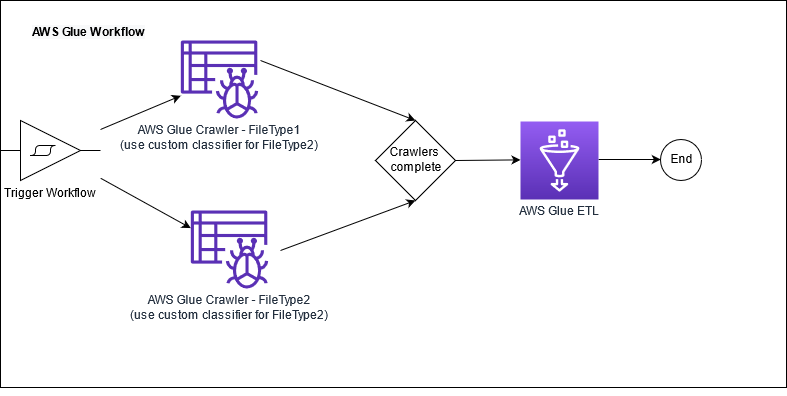
We define an AWS Glue crawler with a custom classifier for each file or data type. We use an AWS Glue workflow to orchestrate the process. The workflow triggers crawlers to run in parallel. When the crawlers are complete, the workflow starts an AWS Glue ETL job to process the input data files. The workflow tracks the completion of the ETL job that performs the data transformation and updates the table metadata in AWS Glue Data Catalog.

The following diagram illustrates a typical workflow for ETL workloads.

This post is accompanied by an AWS CloudFormation template that creates resources described by the AWS Glue workflow architecture. AWS CloudFormation enables you to model, provision, and manage AWS resources by treating infrastructure as code.

The CloudFormation template creates the following resources:

  • An AWS Glue workflow trigger that is started manually. The trigger starts two crawlers simultaneously for processing the data file related to ACH payments and check payments, respectively.
  • Custom classifiers for parsing incoming fixed width files containing ACH and check data.
  • AWS Glue crawlers:
    • A crawler to classify ACH payments in the RAW database. This crawler uses the custom classifier defined for ACH payments raw data. The crawler creates a table named ACH in the Data Catalog’s RAW database.
    • A crawler to classify check payments. This crawler uses the custom classifier defined for check payments raw data. This crawler creates a table named Check in the Data Catalog’s RAW database.
  • An AWS Glue ETL job that runs when both crawlers are complete. The ETL job reads the ACH and check tables, performs transformations using PySpark DataFrames, writes the output to a target Amazon Simple Storage Service (Amazon S3) location, and updates the Data Catalog for the processedpayment table with new hourly partition.
  • S3 buckets designated as RawDataBucket, ProcessedBucket, and ETLBucket. RawDataBucket holds the raw payment data as it is received from the source system, and ProcessedBucket holds the output after AWS Glue transformations have been applied. This data is suitable for consumption by end-users via Athena. ETLBucket contains the AWS Glue ETL code that is used for processing the data as part of the workflow.

Create resources with AWS CloudFormation

To create your resources with the CloudFormation template, complete the following steps:

  1. Choose Launch Stack:
  2. Choose Next.
  3. Choose Next again.
  4. On the Review page, select I acknowledge that AWS CloudFormation might create IAM resources.
  5. Choose Create stack.

Examine custom classifiers for fixed width files

Let’s review the definition of the custom classifier.

  1. On the AWS Glue console, choose Crawlers.
  2. Choose the crawler ach-crawler.
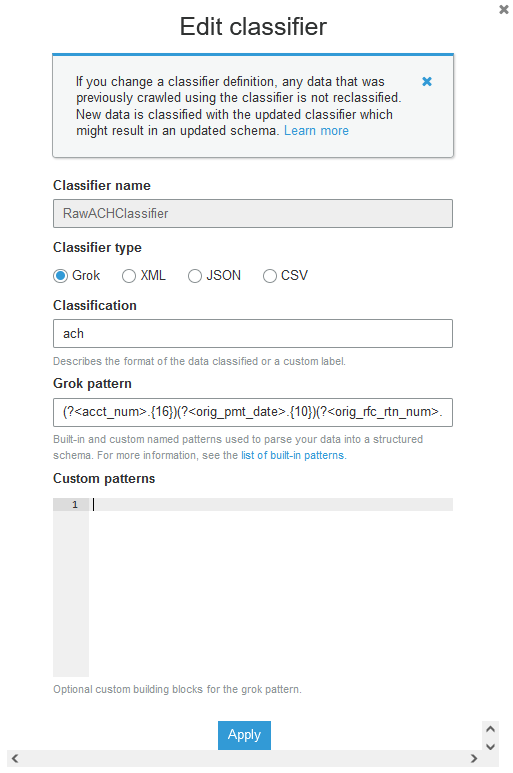
  3. Choose the RawACHClassifier classifier and review the Grok pattern.

This pattern assumes that the first 16 characters in the fixed width file are reserved for acct_num, and the next 10 characters are reserved for orig_pmt_date. When a crawler finds a classifier that matches the data, the classification string and schema are used in the definition of tables that are written to your Data Catalog.

Run the workflow

To run your workflow, complete the following steps:

  1. On the AWS Glue console, select the workflow that the CloudFormation template created.
  2. On the Actions menu, select Run.

This starts the workflow.

  1. When the workflow is complete, on the History tab, choose View run details.

You can review a graph depicting the workflow.

Examine the tables

In the Databases section under AWS Glue console, you can find a database named glue-database-raw, which contains two tables named ach and check. These tables are created by the respective AWS Glue crawler using the custom classification pattern specified.

Query processed data

To query your data, complete the following steps:

  1. On the AWS Glue console, select the database glue-database-processed.
  2. On the Action menu, choose View data.

The Athena console opens. If this is your first time using Athena, you need to set up the S3 bucket to store the query result.

  1. In the query editor, run the following query:
select acct_num,pymt_type,count(pymt_type)
from glue_database_processed.processedpayment 
group by acct_num,pymt_type;

You can see the count of payment type in each account displayed from the processedpayment table.

Clean up

To avoid incurring ongoing charges, clean up your infrastructure by deleting the CloudFormation stack. However, you first need to empty your S3 buckets.

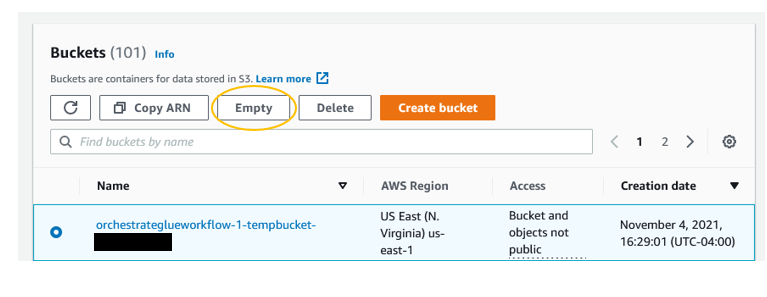
  1. On the Amazon S3 console, select each bucket created by the CloudFormation stack.
  2. Choose Empty.
  3. On the AWS CloudFormation console, select the stack you created.
  4. Choose Delete.

Conclusion

In this post we explored how AWS Glue Workflows enable data engineers to build and orchestrate a data pipeline to discover, classify and process standard and non-standard data files. We also discussed how to leverage AWS Glue Workflow along with AWS Glue Custom Classifier, AWS Glue Crawlers and AWS Glue ETL capabilities to ingest from multiple sources into a data lake. We also walked through how you can use Amazon Athena to perform interactive SQL analysis.

For more details on using AWS Glue Workflows, see Performing Complex ETL Activities Using Blueprints and Workflows in AWS Glue.

For more information on AWS Glue ETL jobs, see Build a serverless event-driven workflow with AWS Glue.

For More information on using Athena, see Getting Started with Amazon Athena.


Appendix: Create a regular expression pattern for a custom classifier

Grok is a tool that you can use to parse textual data given a matching pattern. A Grok pattern is a named set of regular expressions (regex) that are used to match data one line at a time. AWS Glue uses Grok patterns to infer the schema of your data. When a Grok pattern matches your data, AWS Glue uses the pattern to determine the structure of your data and map it into fields. AWS Glue provides many built-in patterns, or you can define your own. When defining you own pattern, it’s a best practice to test the regular expression prior to setting up the AWS Glue classifier.

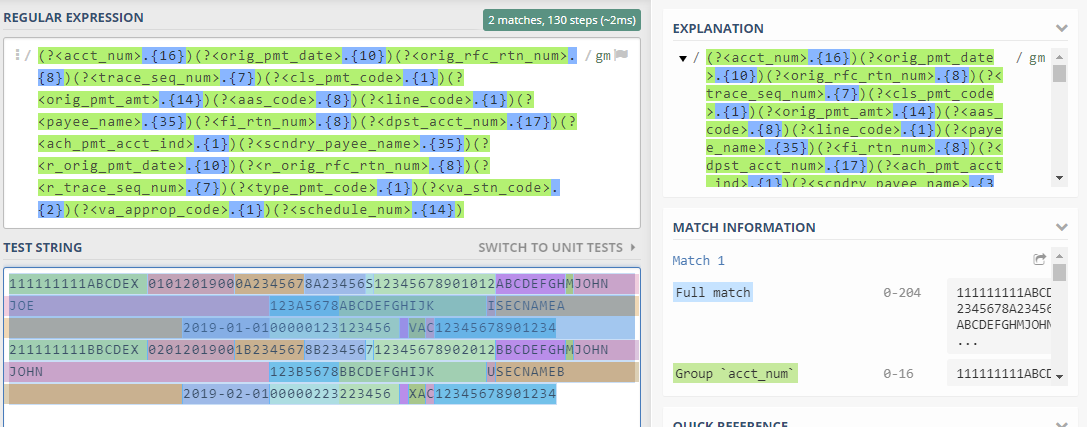
One way to do that is to build and test your regular expression by using https://regex101.com/#PYTHON. For this, you need to take a small sample from your input data. You can visualize the output of your regular expression by completing the following steps:

  1. Copy the following rows from the source file to the test string section.
    111111111ABCDEX 01012019000A2345678A23456S12345678901012ABCDEFGHMJOHN JOE                           123A5678ABCDEFGHIJK      ISECNAMEA                           2019-01-0100000123123456  VAC12345678901234
    211111111BBCDEX 02012019001B2345678B23456712345678902012BBCDEFGHMJOHN JOHN                          123B5678BBCDEFGHIJK      USECNAMEB                           2019-02-0100000223223456  XAC12345678901234

  2. Construct the regex pattern based on the specifications. For example, the first 16 characters represent acct_num followed by orig_pmt_date of 10 characters. You should end up with a pattern as follows:
(?<acct_num>.{16})(?<orig_pmt_date>.{10})(?<orig_rfc_rtn_num>.{8})(?<trace_seq_num>.{7})(?<cls_pmt_code>.{1})(?<orig_pmt_amt>.{14})(?<aas_code>.{8})(?<line_code>.{1})(?<payee_name>.{35})(?<fi_rtn_num>.{8})(?<dpst_acct_num>.{17})(?<ach_pmt_acct_ind>.{1})(?<scndry_payee_name>.{35})(?<r_orig_pmt_date>.{10})(?<r_orig_rfc_rtn_num>.{8})(?<r_trace_seq_num>.{7})(?<type_pmt_code>.{1})(?<va_stn_code>.{2})(?<va_approp_code>.{1})(?<schedule_num>.{14})

After you validate your pattern, you can create a custom classifier and attach it to an AWS Glue crawler.


About the Authors

Mohit Mehta is a leader in the AWS Professional Services Organization with expertise in AI/ML and big data technologies. Prior to joining AWS, Mohit worked as a digital transformation executive at a Fortune 100 financial services organization. Mohit holds an M.S in Computer Science, all AWS certifications, an MBA from College of William and Mary, and a GMP from Michigan Ross School of Business.

Meenakshi Ponn Shankaran is Senior Big Data Consultant in the AWS Professional Services Organization with expertise in big data. Meenakshi is a SME on working with big data use cases at scale and has experience in architecting and optimizing workloads processing petabyte-scale data lakes. When he is not solving big data problems, he likes to coach the game of cricket.

Better Together: XDR, SOAR, Vulnerability Management, and External Threat Intelligence

Post Syndicated from Matthew Gardiner original https://blog.rapid7.com/2021/11/15/better-together-xdr-soar-vulnerability-management-and-external-threat-intelligence/

Better Together: XDR, SOAR, Vulnerability Management, and External Threat Intelligence

One of the biggest challenges with both incident response and vulnerability management is not just the raw number of incidents and vulnerabilities organizations need to triage and manage, but the fact that it’s often difficult to separate the critical incidents and vulnerabilities from the minor ones. If all incidents and vulnerabilities are treated as equal, teams will tend to underprioritize the critical ones and overprioritize those that are less significant. In fact, ZDNet reports that only 5.5% of all vulnerabilities are ever exploited in the wild. Meaning that fixing all vulnerabilities with equal priority is a significant misallocation of resources, as 95% of them will likely never be exploited.

Unjamming incident response and vulnerability management

My experience with organizations over the years shows a similar issue with security incidents. Clearly not all incidents are created equal in terms of risk and potential impact, so if your organization is treating them equally, this also is a sign of misprioritization. And what organization has a surplus of incident response cycles to waste? Without some informed triaging and prioritization, the remediation of both incidents and vulnerabilities can get jammed up, and the security team can be blamed for “crying wolf” by raising the security alarm too often without strong evidence.

How to better prioritize security incidents and vulnerabilities? Fundamentally, it comes down to simultaneously having the right data and intelligence from both inside your IT environment and the world outside. What if you could know with high certainty what you have, what is currently going on inside your IT environment, and how and whether the threat actors’ current tools, tactics, techniques, and procedures are currently active and relevant to you? If this information and analysis was available at the right time, it would go a long way to helping prioritize responses to both detected incidents and discovered vulnerabilities.

Integrating XDR, SOAR, vulnerability management, and external threat intelligence

The key building blocks of this approach require the combination of extended detection and response (XDR) for continuous visibility and threat detection; vulnerability management for vulnerability detection and management; SOAR for security management, integration, and automation; and external threat intelligence to inject information about what threat actors are actually doing and how this relates back to the organization. The intersection of these four security systems and sources of intelligence is where the magic happens.

Separately, XDR, SOAR, vulnerability management, and external threat intelligence are valuable in their own right. But when used closely together, they deliver greater security insights that help guide incident response and vulnerability management. Together, they help security teams focus their limited resources on the risks that matter most.

What Rapid7 is doing about it

Rapid7 is on the forefront of bringing this integrated approach to market. It starts — but does not end — with possessing all the underlying technology and expertise necessary to bring this approach to life through our products in XDR, SOAR, vulnerability management, and external threat intelligence. New and particularly important to this story is how Rapid7’s external threat intelligence offering, brought forward by the recent acquisition of IntSights, is integrated and directly available to assist with incident and vulnerability management prioritization and automation.

The newly released InsightConnect for IntSights Plugin enables, among other capabilities, the enrichment of indicators — IP addresses, domains, URLs, file hashes — with what is known about them in the outside world, such as whether they are part of attackers’ infrastructure, their registration details, when they were first seen, any associations with threat actor groups, severity, and other key aspects. This information, when linked to alerts and vulnerabilities, can help drive the response prioritizations that are incredibly important to improving incident response and vulnerability management effectiveness and efficiency.

This is just the start of integrating IntSights threat intelligence into Rapid7’s broader set of security offerings. Stay tuned for additional integration news as Rapid7 brings best-of-breed solutions further, combining our vulnerability management, detection and response, and threat intelligence products and services to solve more real-world security challenges.

NEVER MISS A BLOG

Get the latest stories, expertise, and news about security today.

Security updates for Monday

Post Syndicated from original https://lwn.net/Articles/876135/rss

Security updates have been issued by Debian (ffmpeg and tomcat9), Fedora (et and kernel), openSUSE (binutils, rubygem-activerecord-5_1, samba, and tinyxml), Oracle (freerdp and httpd:2.4), Red Hat (devtoolset-11-gcc, gcc-toolset-10-binutils, kernel, kernel-rt, and kpatch-patch), and Scientific Linux (freerdp).

Introducing Relational Database Connectors

Post Syndicated from Kabir Sikand original https://blog.cloudflare.com/relational-database-connectors/

Introducing Relational Database Connectors

Introducing Relational Database Connectors

At Cloudflare, we’re building the best compute platform in the world. We want to make it easy, seamless, and obvious to build your applications with us. But simply making the best compute platform is not enough — at the heart of your applications are the data they interact with.

Cloudflare has multiple data storage solutions available today: Workers KV, R2, and Durable Objects. All three follow Cloudflare’s design goals for Workers: global by default, infinitely scalable, and delightful for developers to use. We’ve partnered with third-party storage solutions like Fauna, MongoDB and Prisma, who have built data platforms that align beautifully with our design goals and written tutorials for databases that already support HTTP connections.

The one area that’s been sorely missed: relational databases. Cloudflare itself runs on relational databases, and we’re not alone. In April, we asked which Node libraries you wanted us to support, and four of the top five requests were related to databases. For this Full Stack Week, we asked ourselves: how could we support relational databases in a way that aligned with our design goals?

Today, we’re taking a first step towards that world by announcing support for relational databases, including Postgres and MySQL from Workers.

Connecting to a database is no simple task — if it were as easy as passing a connection string to a database driver, we would have already done it. We’ve had to overcome several hurdles to reach this point, and have several more still to conquer.  

Our goal with this announcement is to work with you, our developers, to solve the unique pain points that come from accessing databases inside Workers. If you’d like to work with us, fill out this form or join us on Discord — this is just the beginning. If you’d just like to grab the code and play around, use this example to get started connecting to your own database, or check out our demo.

Why are Database Connectors so hard to build?

Serverless database connections are challenging to support for several reasons.

Databases are needy — they often require TCP connections, since they assume long-lived connections between an application server and the database. The Workers runtime doesn’t currently support TCP connections, so we’ve only been able to support HTTP-based databases or proxies.

Like a relationship, establishing a connection isn’t quite enough. Developers use client libraries for databases to make submitting queries and managing the responses easy. Since the Workers runtime is not entirely Node.js compatible, we need to either roll our own database library or find one that does not use unsupported built-in libraries.

Finally, databases are sensitive. It often takes external libraries to manage shared connections between an application server and a database, since these connections tend to be expensive to establish.

Moving past these challenges

Our approach today gives us the foundation to address each of these challenges in creative ways going forward.

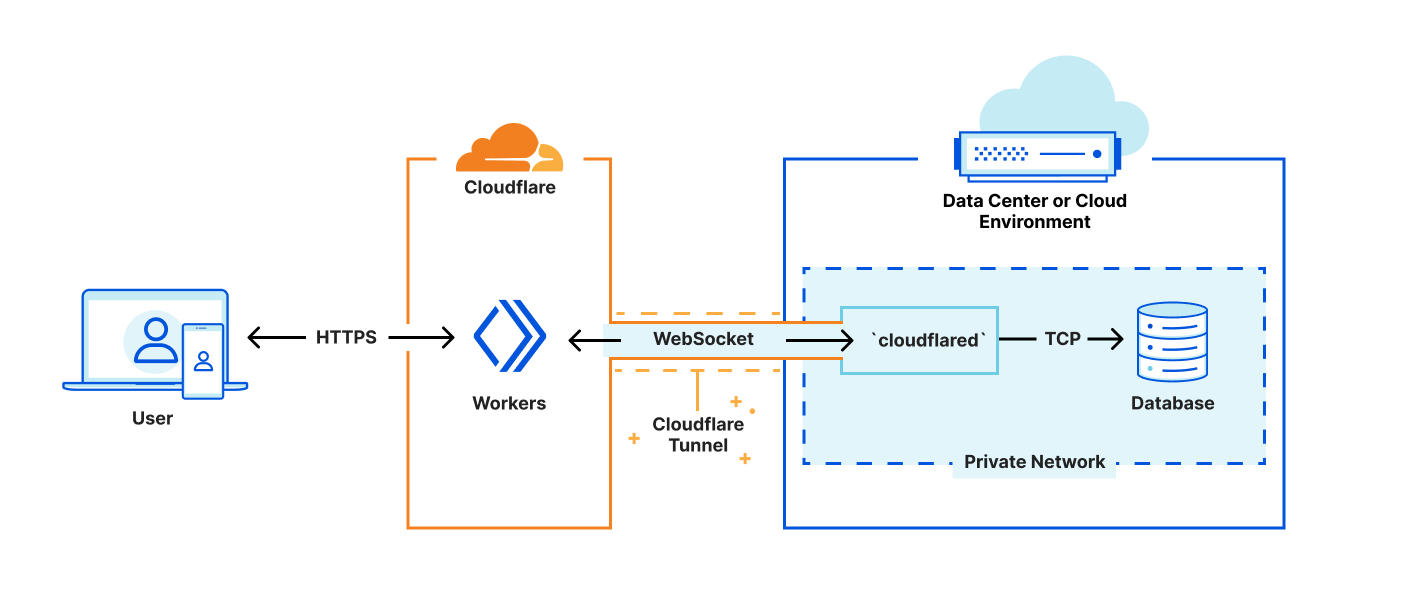
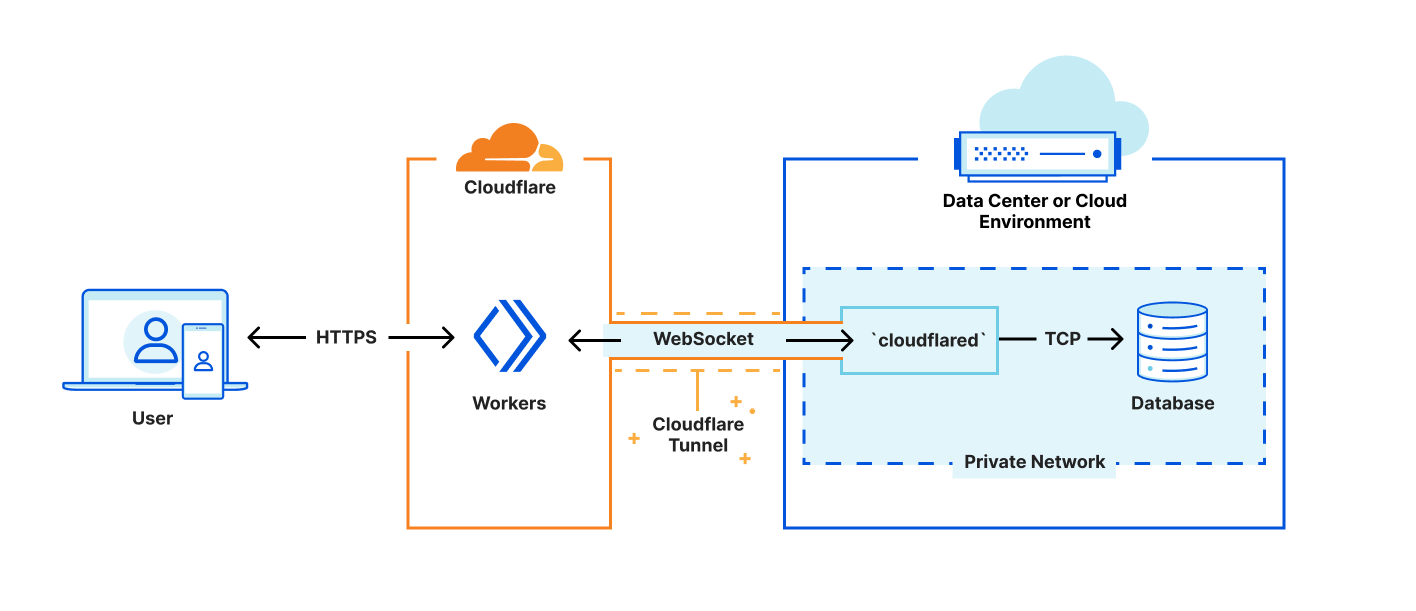
First, we’re leveraging cloudflared to create a secure tunnel between Cloudflare and a private network within your existing infrastructure. Cloudflared already supports proxying HTTP to TCP over WebSockets — Our challenge is providing interfaces that look like the socket interfaces existing libraries expect, while rewiring the implementations to redirect reads and writes to our websocket. This method is fast, safe, and secure; but limiting in that we lack control of where to direct the final connections. This is a problem we will solve soon, but until then our approach is essential to gathering latency and performance data to see where else we need to improve.

Introducing Relational Database Connectors

Next, we’ve created a shim-layer that adapts the socket API from a popular runtime to connect directly to databases using a WebSocket. This allows us to bundle code as-is, without forking or otherwise making significant changes to the database library. As part of this announcement, we’ve published a tutorial on how to connect to and query a Postgres database from your Workers, using existing Cloudflare technology and a driver from the growing community at Deno. We’re excited to work with the upstream maintainers, on expanding support.

Finally, we’re most excited for how this approach will let us begin to manage connection pooling and connection establishment overhead. While our current tech demo requires setting up the Cloudflare Tunnel on your own infrastructure, we’re looking for customers who’d like to pilot a model where Cloudflare hosts the tunnel for you.

Where we’re going

We’re just getting started. Our goal with today’s announcement is to find customers who are looking to build new applications or migrate existing applications to Workers while working with data that’s stored in a relational database.

Just as Cloudflare started by providing security, performance, and reliability for customer’s websites, we’re excited about a future where Cloudflare manages database connections, handles replication of data across cloud providers and provides low-latency access to data globally.

First, we’re looking to add support for TCP into the runtime natively. With native support for TCP we’ll not only have better support for databases, but expand the Workers runtime to work with data infrastructure more broadly.

Our position in the network layer of the stack makes providing performance, security benefits and extremely reduced egress costs to global databases all possible realities. To do so, we’ll repurpose the HTTP to TCP proxy service that we’ve currently built and run it for developers as a connection pooling service, managing connections to their databases on their behalf.

Finally, our network makes caching data and making it accessible globally at low latency possible. Once we have connections back to your data, making it globally accessible in Cloudflare’s network will unlock fundamentally new architectures for distributed data.

Take our connectors for a spin

Want to check things out? There are three main steps to getting up-and-running:

  1. Deploying cloudflared within your infrastructure.
  2. Deploying a database that connects to cloudflared.
  3. Deploying a Worker with the database driver that submits queries.

The Postgres tutorial is available here.

When you’re all done, it’ll look a little something like this:

import { Client } from './driver/postgres/postgres'

export default {
  async fetch(request: Request, env, ctx: ExecutionContext) {
    try {
      const client = new Client({
        user: 'postgres',
        database: 'postgres',
        hostname: 'https://db.example.com',
        password: '',
        port: 5432,
      })
      await client.connect()
      const result = await client.queryArray('SELECT * FROM users WHERE uuid=1;')
      ctx.waitUntil(client.end())
      return new Response(JSON.stringify(result.rows[0]))
    } catch (e) {
      return new Response((e as Error).message)
    }
  },
}

Hit any snags? Fill out this form, join our Discord or shoot us an email and let’s chat!

Developer Spotlight: Winning a Game Jam with Jamstack and Durable Objects

Post Syndicated from Erwin van der Koogh original https://blog.cloudflare.com/developer-spotlight-guido-zuidhof-full-tilt/

Developer Spotlight: Winning a Game Jam with Jamstack and Durable Objects

Developer Spotlight: Winning a Game Jam with Jamstack and Durable Objects

Welcome to a new blog post series called Developer Spotlight. In this series we will be showcasing interesting applications built on top of the Cloudflare Workers Ecosystem.

And to celebrate Durable Objects going GA, what better to kick off the series than with a really cool tech demo of Durable Objects called Full Tilt?

Full Tilt by Guido Zuidhof is a game jam entry for Ludum Dare, one of the biggest and oldest game jams around, where he won first place in the innovation category. A game jam is like a hackathon for games, where you have a very short amount of time (usually 48-72 hours) to create a game from scratch.

We love Full Tilt, not just because Guido used Workers and Durable Objects to build a cool game where you control a game on your computer via your phone, but especially because it shows how powerful Durable Objects are. In less than 48 hours Guido was able to write all the logic to instantly spin up a personal gaming server anywhere in the world, as close to that player as possible. And it is so fast that you feel like you are controlling the computer directly.

But here is Guido, to tell you about his experience developing Full Tilt.

Last October I participated in the Ludum Dare 49 game jam. The thing I love about game jams is that the time constraint forces you to work quickly, iterate often, and most importantly cut scope.

In this game jam I created Full Tilt, a game in which you seamlessly use your phone as a Wiimote-like motion controller for a game that is run on your laptop in a web browser. The secret sauce to making it so smooth was in combining a game jam with Jamstack and mixing in some Durable Objects.

You can try the game right here.

Phone as a controller

Full Tilt is a browser game in which you move the player character by moving your hand around. There are a few different ways we can do that. One idea would be to use your computer’s webcam to track a marker object through 3D space. While that is possible, it is tricky to get it working in any situation (a dark room can be problematic!) and also some players may feel uncomfortable turning on their webcam for a simple web game.

A smartphone has a bunch of sensors built in, including a magnetometer and gyroscope — those sensors are exactly what we need, and we can assume that the majority of our potential players have a smartphone within arm’s reach. When a native mobile application uses these sensors, it adds a lot of friction (users now have to install an app), as well as a bunch of implementation work. Fortunately modern web browsers allow you to read from these sensors through the DeviceMotion API: a small web app will do the job perfectly!

The next challenge is communicating the sensor readings from the phone to the game running on the main computer. For that we will use a combination of Cloudflare Workers and Durable Objects. There needs to be some shared contact (i.e., a game server) that both the main computer and the smartphone talk to. Using a serverless solution makes a lot of sense for a web game. And as we only have 48 hours here, less stuff to worry about is a big selling point too. Workers and Durable Objects also make it easy to keep the game running after the game jam, without having to pay for — and more importantly worry about — keeping servers running.

Setting up a line of communication

There are roughly two ways for browsers to communicate: through a shared connection (a game server somewhere) or a peer to peer connection, so browsers can talk directly to each other without a middleman by leveraging WebRTC DataChannels.

WebRTC can be very challenging to make reliable and may still need a proxy server for some especially problematic network setups behind multiple NATs. Setting up a WebRTC connection may have been the perfect solution for the lowest possible latency, but it was out of scope for such a short game jam.

The game we are creating has low latency requirements, when I tilt my phone the game should respond quickly. We can probably get away with anything under 100ms, although low double digits or less is definitely preferred! If I’m geographically located in one place and the game server is geographically close enough, then this game server will be able to pass messages from my smartphone to my laptop without too much delay. Edge computing is hot nowadays, and for this gaming use case it is not just a nice-to-have but also a necessity.

Enough background, let’s architect the system.

On-demand game rooms

The first thing I needed to set up was game rooms. Something that both the phone and the computer browsers could connect to, so they can pass messages between them.

Durable Objects allow us to create a large amount of small stateful “mini servers” or “rooms” that multiple clients can connect to simultaneously over WebSockets, providing perfect small on-demand game servers. Think of Durable Objects as a single thread of Javascript that runs in a data center close to where the user first asked for it to be created.

After the browser on the computer starts the game, it asks our Cloudflare Worker API to create a room for the current game session. This API request is a simple POST request, the server responds with a four character room code that uniquely identifies the room that was created. The reason we want the room code to be short is because the user may need to copy this code and type it into their smartphone if they are unable to scan a QR code.

Humans are notoriously bad at copying random character strings as different characters look alike, so we use a limited character set that excludes the most commonly confused characters:

const DICTIONARY = "2345679ADEFGHJKLMNPQRSTUVWXYZ"; // 29 chars (no 0, O, I, 1, B, 8)

A four character code will allow us to uniquely point to ~700,000 different rooms, that seems like it would be enough even if our game got quite popular! What’s more: these game sessions don’t last forever. After some period of time (say 24 hours) we can be certain enough that the game session has ended, and we can re-use that room code.

Room code coordination

In your Cloudflare Worker script, there are two ways to create a Durable Object: either we ask for one to be created with an ID generated from a name, or we ask for one to be created with a random unique ID. The naive solution would be to create a Durable Object with an ID generated from the room code. However, that is not a good idea here because a Durable Object gets created in a data center that is geographically close to the end user.

A problematic situation would be if a user in Mumbai requests a room and gets room code ABCD. Initially, they play the game for a bit, and it works great.

The issue comes a week later when that room code is reused for another player based in Los Angeles, The game room Durable Object will be revived in Mumbai and latency will be awful for our Los Angeles player. In the future, Durable Objects may get migrated between data centers, but that’s not yet guaranteed.

Instead, what we can do is create a new Durable Object with a random ID for every new game session and keep a mapping from the four character room code to this random ID. We are introducing some state in our system: we will need a central source of truth which is where Durable Objects can come to the rescue again.

We will solve this by creating a single “Room Hub” Durable Object that keeps track of this mapping from room code to Durable Object ID. This Durable Object will have two endpoints, one to request a new room and another to look up a room’s information.

Here’s our request handler for the Room Request endpoint (the argument is a Sunder Context, Sunder is the web framework I used for this project):

export async function handleRoomRequest(ctx: Context<Env>) {
    const now = Date.now();    
    const reqBody = await ctx.request.json();

    // We make some attempts to find a room that is available..
    const attempts = 5

    let roomCode: string;
    let roomStorageKey: string;

    for (let i = 0; i < attempts; i++) {
        roomCode = generateRoomCode();
        roomStorageKey = ROOM_STATE_PREFIX + roomCode;
        const room = await ctx.state.storage.get<RoomData>(roomStorageKey);
        if (room === undefined) {
            break;
        } else if (now - room.createdAt > MAX_ROOM_AGE) {
            await ctx.state.storage.delete(roomStorageKey);
            break;
        }
        if (i === attempts-1) {
            return ctx.throw("Couldn't find available room code :(");
        }
    }

    const roomData: RoomData = {
        roomCode: roomCode,
        durableObjectId: reqBody.durableObjectId,
        createdAt: now,
    }

    await ctx.state.storage.put<RoomData>(roomStorageKey, roomData);

    ctx.response.body = {
        room: roomData
    };
    ctx.response.status = HttpStatus.Created;
}

In a nutshell, we generate a few room codes until we find one that has never been used or hasn’t been used in a long enough time.

There is a subtle but important nuance in this code: the Durable Object gets created in the Cloudflare Worker that talks to our Room Hub, not in the Room Hub itself. Our Room Hub will run in a single data center somewhere on Cloudflare’s network. If we create the game room from there it may still be far away from our end user!

Looking up a room’s information is simpler, we return either the room data or status 404.

export async function handleRoomLookup(ctx: Context<Env, {roomCode: string}>) {
    const now = Date.now();

    let roomStorageKey = ROOM_STATE_PREFIX + ctx.params.roomCode;
    const roomData = await ctx.state.storage.get<RoomData>(roomStorageKey);

    if (roomData === undefined) {
        ctx.throw(404, "Room not found");
        return;
    }

    if (now - roomData.createdAt > MAX_ROOM_AGE) {
        // About time we cleaned it up.
        await ctx.state.storage.delete(roomStorageKey);
        ctx.response.status = HttpStatus.NotFound;
        return;
    }

    ctx.response.body = {
        room: roomData
    };
}

The smartphone browser needs to connect to that same room. To make things easy for the user we generate a four character room code which points at that specific “Game Room” Durable Object. This way the user can take their smartphone, navigate to the website address https://ld49.pages.dev, and enter the code “ABCD” (or more commonly, they scan a QR code with the link https://ld49.pages.dev?room=ABCD).

Game Room Durable Object

Our game room Durable Object can be pretty simple since it is only responsible for passing along messages from the smartphone to the laptop with the latest sensor readings. I was able to modify the Durable Objects chat room example to do exactly this — a good time saver for a game jam!

When a browser connects, they either connect as a “peer” or as a “host” role. Any messages sent by peers are forwarded to the host, and all messages from the host get forwarded to all peers. In this case, our host is the laptop browser running the game and the peer is the smartphone controller. Implementation-wise this means that we keep two lists of users: the peers and the hosts. Whenever a message comes in, we loop over the list to broadcast it to all connections of the other role. In practice, the code is a bit more involved to deal with users disconnecting.

Full Tilt is a singleplayer game, but adapting it to be a multiplayer game would be easy with this setup. Imagine a Mario Kart-like game that runs in your browser in which multiple friends can join using their smartphones as their steering wheel controller! Unfortunately there was not enough time in this game jam to make a polished game.

Front end

With the backend ready, we still need to create the actual game and the controller web app.

My initial plan was to create a game in which you fly a 3D plane by tilting your phone, collecting stars and completing aerobatic tricks. It would fit the theme “Unstable” as I expected this control method to be pretty flimsy! Since there was no time left to create anything close to that, it was time to cut scope.

I ended up using the Phaser game engine and put the entire system together in a Svelte app.   This was certainly a challenge, as I had only used Phaser once before many years ago and had never used Svelte. Luckily, I was able to put together something simple quickly enough: a snake-like game in which you move a thingy to collect blips that appear randomly on the screen.

In order for a game to be a game there needs to be some goal for the user, usually some game over condition. I changed the game to go faster and faster over time, added a score counter, and added a game over condition where you lose the game if you touch the edge of the screen. I made my “art” in MS Paint, generated some sound effects using the online tool sfxr, and “composed” the music soundtrack in Chrome’s Music Lab Song Maker.

Simultaneously I wrote a small client for my game server and duct-taped together the smartphone controller app which is powered by the browser’s DeviceMotion APIs. To distribute my game I used Cloudflare Pages, which worked like a charm the first time.

All done

And then the deadline was there — I barely made it, but I submitted something I was proud of. A not-so-great game, but with an interesting backend system and a novel input method. Do try the game yourself here, and the source code is available here (warning: it’s pretty hacky code of course!).

The reception of my co-jammers was great. While everybody agreed the game itself and its graphics were awful, it was novel. The game ended up rated first in the *Innovation* category for this game jam, out of hundreds of other games!

Finally, is this the future of game servers? For indie developers and smaller studios, setting up and maintaining a globally distributed fleet of game servers is both a huge distraction and cost. Serverless and in particular Durable Objects can provide an amazing solution.

But not every game is well-suited for a WebSocket-based backend. In some real-time games you are not interested in what happened a second ago and only the latest information matters. This is where the reliable and ordered nature of WebSockets can get in the way.

All in all my first impressions of Durable Objects are very positive, it is a great tool to have in your toolbelt for all kinds of web projects. You can now tackle problems that would otherwise take days in mere minutes. I am very excited to see what other problems will be made easy by Durable Objects, even those I haven’t even thought of yet.

Making connections with TCP and Sockets for Workers

Post Syndicated from James M Snell original https://blog.cloudflare.com/introducing-socket-workers/

Making connections with TCP and Sockets for Workers

Making connections with TCP and Sockets for Workers

Today we are excited to announce that we are developing APIs and infrastructure to support more TCP, UDP, and QUIC-based protocols in Cloudflare Workers. Once released, these new capabilities will make it possible to use non-HTTP socket connections to and from a Worker or Durable Object as easily as one can use HTTP and WebSockets today.

Out of the box, fetch and WebSocket APIs. With just a few internal changes to make it operational in Workers, we’ve developed an example using an off-the-shelf driver (in this example, a Deno-based Postgres client driver) to communicate with a remote Postgres server via WebSocket over a secure Cloudflare Tunnel.

import { Client } from './driver/postgres/postgres'

export default {
  async fetch(request: Request, env, ctx: ExecutionContext) {
    try {
      const client = new Client({
        user: 'postgres',
        database: 'postgres',
        hostname: 'https://db.example.com',
        password: '',
        port: 5432,
      })
      await client.connect()
      const result = await client.queryArray('SELECT * FROM users WHERE uuid=1;')
      ctx.waitUntil(client.end())
      return new Response(JSON.stringify(result.rows[0]))
    } catch (e) {
      return new Response((e as Error).message)
    }
  },
}

The example works by replacing the bits of the Postgres client driver that use the Deno-specific TCP socket APIs with standard fetch and WebSockets APIs. We then establish a WebSocket connection with a remote Cloudflare Tunnel daemon running adjacent to the Postgres server, establishing what is effectively TCP-over-WebSockets.

Making connections with TCP and Sockets for Workers

While the fact we were able to build the example and communicate effectively and efficiently with the Postgres server — without making any changes to the Cloudflare Workers runtime — is impressive, there are limitations to the approach. For one, the solution requires additional infrastructure to establish and maintain the WebSocket tunnel — in this case, the instance of the Cloudflare Tunnel daemon running adjacent to the Postgres server. While we are certainly happy to provide that daemon to customers, it would just be better if that component were not required at all. Second, tunneling TCP over WebSockets, which is itself tunneled via HTTP over TCP is a bit suboptimal. It works, but we can do better.

Making connections from Cloudflare Workers

Currently, there is no standard API for socket connections in JavaScript. We want to change that.

If you’ve used Node.js before, then you’re most likely familiar with the net.Socket and net.TLSSocket objects. If you use Deno, then you might know that they’ve recently introduced the Deno.connect() and Deno.connectTLS() APIs. When you look at those APIs, what should immediately be apparent is how different they are from one another despite doing the exact same thing.

When we decided that we would add the ability to open and use socket connections from within Workers, we also agreed that we really have no interest in developing yet another non-standard, platform-specific API that is unlike the APIs provided by other platforms. Therefore, we are extending an invitation to all JavaScript runtime platforms that need socket capabilities to collaborate on a new (and eventually standardized) API that just works no matter which runtime you choose to develop on.

Here’s a rough example of what we have in mind for opening and reading from a simple TCP client connection:

const socket = new Socket({
  remote: { address: '123.123.123.123', port: 1234 },
})
for await (const chunk of socket.readable)
  console.log(chunk)

Or, this example, sending a simple “hello world” packet using UDP:

const socket = new Socket({
  type: 'udp',
  remote: { address: '123.123.123.123', port: 1234 },
});
const enc = new TextEncoder();
const writer = socket.writable.getWriter();
await writer.write(enc.encode('hello world'));
await writer.close();

The API will be designed generically enough to work both client and server-side; for TCP, UDP, and QUIC; with or without TLS, and will not rely on any mechanism specific to any single JavaScript runtime. It will build on existing broadly supported Web Platform standards such as EventTarget, ReadableStream, WritableStream, AbortSignal, and promises. It will be familiar to developers who are already familiar with the fetch() API, service workers, and promises using async/await.

interface Socket : EventTarget {
  constructor(object SocketInit);

  Promise<undefined> update(object SocketInit);

  readonly attribute ReadableStream readable;
  readonly attribute WritableStream writable;
  
  readonly attribute Promise<undefined> ready;
  readonly attribute Promise<undefined> closed;

  Promise<undefined> abort(optional any reason);
  readonly attribute AbortSignal signal;
 
  readonly attribute SocketStats stats;
  readonly attribute SocketInfo info;
}

This is just a proposal at this point and the details will very likely change from the examples above by the time the capability is delivered in Workers. It is our hope that other platforms will join us in the effort of developing and supporting this new API so that developers have a consistent foundation upon which to build regardless of where they run their code.

Introducing Socket Workers

The ability to open socket client connections is only half of the story.

When we first started talking about adding these capabilities an obvious question was asked: What about using non-HTTP protocols to connect to Workers? What if instead of just having the ability to connect a Worker to some other back-end database, we could implement the entire database itself on the edge, inside Workers, and have non-HTTP clients connect to it? For that matter, what if we could implement an SMTP server in Workers? Or an MQTT message queue? Or a full VoIP platform? Or implement packet filters, transformations, inspectors, or protocol transcoders?

Workers are far too powerful to limit to just HTTP and WebSockets, so we will soon introduce Socket Workers — that is, Workers that can be connected to directly using raw TCP, UDP, or QUIC protocols without using HTTP.

What will this new Workers feature look like? Many of the details are still being worked through, but the idea is to deploy a Worker script that understands and responds to “connect” events in much the same way that “fetch” events work today. Importantly, this would build on the same common socket API being developed for client connections:

addEventListener('connect', (event) => {
  const enc = new TextEncoder();
  const writer = event.socket.writable.getWriter();
  writer.write(enc.encode('Hello World'));
  writer.close();
});

Next Steps (and a call to action)

The new socket API for JavaScript and Socket Workers are under active development, with focus initially on enabling better and more efficient ways for Workers to connect to databases on the backend — you can sign up here to join the waitlist for access to Database Connectors and Socket Workers. We are excited to work with early users, as well as our technology partners to develop, refine, and test these new capabilities.

Once released, we expect Socket Workers to blow the doors wide open on the types of intelligent distributed applications that can be deployed to the Cloudflare network edge, and we are excited to see what you build with them.

Durable Objects — now Generally Available

Post Syndicated from Greg McKeon original https://blog.cloudflare.com/durable-objects-ga/

Durable Objects — now Generally Available

Durable Objects — now Generally Available

Full Stack Week is all about how developers are embracing the power of Cloudflare’s network to build entire applications that are global by default. The promise of Workers isn’t just improved latency — it’s fundamentally different programming paradigms that make developer’s lives easier and applications more resilient.

Last year, we announced Durable Objects — Cloudflare’s approach to coordinating state across Workers running at Cloudflare’s edge. Durable Objects let developers implement previously complex applications, like collaborative whiteboarding, game servers, or global queues, in just a few lines of code.

Today, we’re announcing that Durable Objects are generally available and production-ready for you to use!

What makes Durable Objects so cool?

For many traditional applications, state coordination happens through a database. Applications built on Workers present some unique challenges for a database — namely needing to handle global scale out-of-the-box and heavy concurrency that could lead to frequent transaction rollbacks when coordinating on shared keys. Databases themselves are hard to configure and scale, especially at global scale, so developers would need to tweak their database specifically for Workers’ access patterns.

Durable Objects present a simpler paradigm: write a JavaScript class, and your application can create named instances of that class — which are guaranteed to be unique across Cloudflare’s entire network. That instance is a Durable Object — Workers (and other Durable Objects!) can send messages to it via its ID. The Durable Object processes messages in-order and on a single-thread, allowing for coordination across messages. We also provide a strongly consistent storage API, which can store key-value pairs the object needs to make durable.

Take, for example, an online document editor.  A typical architecture would save the state of the document in a database and have users persist changes there.  This makes collaboration difficult, though — how can multiple users ensure that they all see the latest copy of changes to the document?

With Durable Objects, this is a much simpler problem.  By writing a Document class, you store the state of each document in-memory in a Durable Object.  As users connect, they’ll see the latest copy of the document — and can make their changes in-sync with other users. When users leave the document, the Durable Object will leave memory and stop incurring charges, while its state is persisted durably.  There’s no networking to configure, database to manage, or autoscaling policy to implement — it all just works.

While individual objects are single-threaded, Durable Objects’ design means a collection of objects can scale effectively infinitely. An object’s lifecycle is managed for you, meaning there’s no clean-up tasks to run or systems to scale down — Durable Objects can instantly scale to hundreds of thousands of requests per second, then scale back down with no developer interaction.

What have we been building since announcing Early Access?

First, we’ve kept busy improving reliability and performance. Durable Objects are behind a number of new products being developed at Cloudflare, including powering R2 storage and Cloudflare Waiting Room.

Specifically, Waiting Room uses Durable Objects to provide a strongly consistent view of the current number of users attempting to access a given site globally.  Storing this frequently updated state in a traditional database would be difficult to scale and be significantly harder to run globally.

Our customers have also embraced Durable Objects. We’ve seen a major gaming company build their new backend architecture on Durable Objects — coordinating both individual game state and multiplayer game lobbies.  The ability to dynamically scale without managing servers or databases made Durable Objects an easy choice for them, letting them grow their game with a relatively small team.

Customers have built more applications — from status page monitors to collaborative whiteboard applications.  We’ve seen particular interest in using Durable Objects with WebSockets to create entirely responsive applications and have published a reference architecture to help customers build this out further.

We’ve also gotten better at operating the system, particularly in response to large volumes of requests. Durable Objects can now serve hundreds of thousands of requests per second across objects, and hundreds of requests on a single object, making them production-ready for even the most demanding customers.

We’ve shipped Jurisdictional Restrictions, which bring the simplicity of scaling Durable Objects to compliance by letting developers tag a Durable Object with a region, ensuring it processes and stores data in that region.

We added a cache in front of Durable Object storage requests, making read and write operations blazing fast while also making it easier to write correct concurrent code.

Beyond that, we’ve made a number of smaller improvements that included simplified uploads of new Durable Objects classes, a UI in the dashboard and support for `wrangler dev` and `wrangler tail` for live debugging.

What’s next for Durable Objects?

We’re continuing to work on making Durable Objects the easiest platform for building infinitely-scalable applications.

Today, Durable Objects scale well when objects can be partitioned, but individual objects are limited to a single execution thread. Many workloads could be scaled across multiple threads, providing read-only access to an object’s state and choosing to only synchronize when mutating state. We’re calling this replication for Durable Objects, and we’re working on it now.

We’re also working on adding an API for a guaranteed callback to a Durable Object, letting developers wake a Durable Object at a specified time in the future to run a function. This simplifies lifecycle management, making it easy to build primitives like reliable queues on top of Durable Objects.

We’re also looking into how to better geo-distribute objects, including the vision for automatic migration of objects we talked about in our initial announcement.

Have something you’d like to see us add? Shoot us an email or a tweet!

How do I use Durable Objects?

Head over to the Cloudflare Dashboard to enable Durable Objects and opt in to pricing, then check out our sample chat application and reference architecture here!

Happy building!

Workers adds support for two modern data platforms: MongoDB Atlas and Prisma

Post Syndicated from Greg McKeon original https://blog.cloudflare.com/workers-adds-support-for-two-modern-data-platforms-mongodb-atlas-and-prisma/

Workers adds support for two modern data platforms: MongoDB Atlas and Prisma

Workers adds support for two modern data platforms: MongoDB Atlas and Prisma

We’ve heard a common theme over the past year: developers want to build more of their applications on Workers. With built-in global deployments, insane scalability and the flexibility of JavaScript, more and more applications are choosing to build on our global platform.

To do so, developers need access to data. Our strategy for data on Workers has had three parts:

  • One, to provide first-party solutions that are designed for infinite scale, like Workers KV and Durable Objects.
  • Two, to support a wide array of NoSQL databases that connect over HTTP, and to begin to build connections to data where it already lives today with TCP Database Connectors.
  • Three, to partner with best-of-breed data companies to bring their capabilities to the Workers platform.

Today we’re excited to announce that, in addition to our existing partners Fauna and Macrometa, Cloudflare Workers has added support for Prisma and MongoDB Atlas. These data platforms are heavily demanded by developers — Prisma’s modern ORM brings support for Postgres, SQL Server, MySQL via their Prisma client, while MongoDB topped the ranks of integrations most demanded by our users.

Both clients are available in their respective mainline git repositories, realm-web for MongoDB and prisma for Prisma. You can begin using them right away by importing them into your Workers.

What’s great about MongoDB?

MongoDB is a database loved by developers — its document model makes it easy to start with, while transactions and a scale-out distributed systems architecture let it scale with your application.

MongoDB brings a robust query language, MQL, to developers on the Workers platform, supporting rich aggregations right within the database. MongoDB support is provided via the Realm SDK, which integrates directly with MongoDB Atlas — the easiest way to run MongoDB.

MongoDB Atlas also includes Global Cluster, perfect for creating a low-latency, geo-distributed MongoDB database to back your Workers.

Together with MongoDB, we’ve put together a demo application that you can play with on MongoDB’s blog. Check it out and let us know if you have questions!

What’s great about Prisma?

Prisma is an ORM, or object-relational mapper, which transforms entries in a database into objects in code. What makes Prisma great is its ability to abstract away the complexities of working with the database — Prisma handles type-safety, schema migrations, query optimization and the actual interactions between your code and the database. Like Workers does for compute at the edge, Prisma makes managing your database dead-simple.

Prisma currently supports Postgres, MySQL, SQL Server, SQLite and MongoDB. These databases can be existing on any cloud provider or can be spun up on-demand on Heroku.

Prisma integrates with Workers via the Prisma Data Proxy. After setting up the Proxy, you can import the Prisma client into your Workers script and define a schema to begin using any of the supported databases!

What’s next?

Alongside our existing partnerships with Macrometa and Fauna, we’re excited to add the MongoDB and Prisma integrations to Worker’s growing library. If you have a data platform you’d like to use with Workers, reach out to us, and we’ll make it happen!

Кратък следизборен анализ

Post Syndicated from Bozho original https://blog.bozho.net/blog/3881

Благодаря на всички, гласували за Демократична България и за мен лично.

Да, Демократична България реализира значителен спад в получените гласове. И със сигурност е имало какво да направим по-добре и по-правилно. Но нека обясня причините за това, както ги виждам през многото данни, които минаха през ръцете ми.

ГЕРБ, БСП и ДПС са „изпилени“ до ядрата си – с малки изключения никой не може да вземе глас от тях и те не могат да вземат глас от никого. Остават другите, които искат промяна. Техните гласове два пъти отидоха за ДБ, ИТН и ИБНИ, но поради хаотичните и неадекватни действия на ИТН, това не доведе до резултат. Негативът от това се понесе и от трите партии.

В началото на кампанията ДБ загуби част от избирателите си в посока Продължаваме промяната, най-вече по линията „Радев“. След това започна бавно да си ги „връща“, докато не дойде необяснимата атака на подкрепения от ДБ кандидат за президент. Това, според мен, счупи най-важното – усещането за стабилност и предвидимост в ДБ. Не че самата стабилност и предвидимост ги няма, но тези необясними действия в този електорален терен казаха на част от избирателите „тука има нещо особено, можете да ходите другаде“. Според екзит половете в крайна сметка над 1/3 от гласовете на ДБ през юли са отишли към ПП. Това далеч не е единственият фактор, разбира се. И тези избиратели не принадлежат на никого.

Факторът „новост“ комбиниран с умората от 3-ти поредни избори на останалите партии, комбиниран с неуспеха в предния парламент, комбиниран с одобрението на Радев, комбиниран с добрата им кампания донесе този успех на Продължаваме промяната, които „изсмукаха“ трудно спечелените избиратели от ДБ през тази година.

Можеше ли нещо друго да се направи? Нито можехме да бъдем нов субект след 2 кампании, нито след 2 кампании можехме да сменим рязко посланията, нито имаше откъде да привлечем други избиратели – тези на ГЕРБ, БСП и ДПС са „заключени“, а както беше казал някой – негласуващите имат една характерна особеност – не гласуват.

Нямаше как и да подкрепим Радев – дори само агентите на ДС в инициативния му комитет правят такъв избор почти невъзможен. Дори в момента 50% от избирателите ни гласуваха за Радев. Ако не се бе появила ПП, щяха да са 2/3 (такива бяха данните). И когато Лозан Панов атакува остро Радев (макар и не без причини, както посочих преди малко), допълнително „отпъди“ хора, които биха ни подкрепили, но пък харесват Радев. Получих доста такива коментари в кампанията. Бяхме наясно и с това явление, но поне 1/3 от избирателите ни щяха да са тежко разочаровани от липсата на кандидат. Панов очевидно беше напълно независим, което може би беше тактическа грешка, но много хора от ядрото ни оценяват тази независимост.

Друго важно решение, което взехме – да бъдем партньорски и позитивно настроени спрямо ПП, също имаше, макар и по-малък негативен електорален ефект – много от хората ни считат за естествен партньор след изборите и особено в изборния ден вероятно са взели решение „нека едните наши да бият ГЕРБ, после ще управляват с другите наши“. Споделените ни периферии в областните центрове потвърждават това. В други исторически моменти дясното се е нахвърляло върху всичко ново. И е губило много от това в дългосрочен план.

И последно – нашите ясни послания „за“ ваксинация нямаше как да ни донесат допълнителна подкрепа при тези ниски нива на доверие във ваксините. Но когато умират толкова, това беше отговорната, принципна позиция.

Важните решения, които взехме, на база принципи, бяха с ясен и предвидим електорален резултат – негативен. Първо, че не подкрепихме кабинета на ИТН и отказахме преговори с мандат на БСП беше част от причините за трети избори. Само че просто няма как да дадем такава подкрепа и да се погледнем в огледалото. Изборът да не подкрепим Радев, въпреки, че мнозинството от избирателите ни го подкрепяха, също беше базиран на принципи, макар да носи гарантирани електорални щети.

Цялата тази комбинация от фактори допринесе за по-слабия резултат, а не толкова кампанията ни – тя беше правена от същите хора, които доведоха коалицията от съмнения за влизане до 12% през юли. И, иронично или не, резултатът е следствие от принципните ни решения и на много сложната обстановка. Но в политиката е така.

Представляването на избиратели с разнородни и понякога противопололожни мнения е трудно. Задържането им мотивирани в три поредни кампании, последната от които, съвпадаща с президентската, при поява на нов субект на същия електорален терен, е почти невъзможно. Аз все пак заставам зад всички взети решения – те са такива, защото ние сме такива. Това носи електорални рискове, но носи и увереност, че правим правилните неща за България. И че ще ги правим, когато имаме възможност да управляваме.

Нека не забравяме, че преди година този резултат би бил определян като „успех“. Сега не е, защото екипът ни показа, че може да постига резултати.

И да, Продължаваме промяната преразпределиха гласовете на партиите извън БСП, ДПС и ГЕРБ. Привлякоха малко негласуващи за сметка на 2-та процента „фира“ от ИБНИ. Но смятам, че те са много по-перспективен и позитивен водещ партньор от ИТН и съответно резултатите на тези избори са по-скоро позитивни. Предстоят коалиционни преговори и се надявам скоро да имаме добри новини и ще можем да реализираме идеите, които печелиха доверие.

Материалът Кратък следизборен анализ е публикуван за пръв път на БЛОГодаря.

Kernel prepatch 5.16-rc1

Post Syndicated from original https://lwn.net/Articles/876072/rss

The 5.16-rc1 kernel prepatch is out and the
merge window is closed for this cycle.

Anyway, it’s not a huge release, although it’s also not a
remarkably small one like 5.15 was (ok, “remarkably small” is
relative, when even such small releases have 10k+
commits).. There’s a bit of everything in here, and you can look to
the appended mergelog for some kind of flavor, but I guess the
folio work is worth mentioning, since it’s an unusually core thing
that we don’t tend to see most releases.

Пак търговия с гласове €15 и организиран транспорт срещу глас за ДПС+ГЕРБ в Молдова

Post Syndicated from Николай Марченко original https://bivol.bg/e15-%D0%B8-%D0%BE%D1%80%D0%B3%D0%B0%D0%BD%D0%B8%D0%B7%D0%B8%D1%80%D0%B0%D0%BD-%D1%82%D1%80%D0%B0%D0%BD%D1%81%D0%BF%D0%BE%D1%80%D1%82-%D0%B7%D0%B0-%D0%B3%D0%BB%D0%B0%D1%81-%D0%B7%D0%B0-%D0%B4%D0%BF.html

неделя 14 ноември 2021


300 молдовски леи, което прави 15 евро или около 30 лева плюс на места организиран транспорт – толкова струва гласът на бесарабските българи в Република Молдова (РМ). Гласоподавателите са инструктирани…

The collective thoughts of the interwebz