Post Syndicated from LastWeekTonight original https://www.youtube.com/watch?v=owosAu5aycM
Horizontal Stabilizers
Post Syndicated from xkcd.com original https://xkcd.com/3241/

ASUS ROG Crosshair X870E Hero AMD AM5 Motherboard Quick Look
Post Syndicated from Vic A original https://www.servethehome.com/asus-rog-crosshair-x870e-hero-amd-am5-motherboard-quick-look/
We take a look at the ASUS ROG Crosshair X870E Hero which is an AMD socket AM5 motherboard with lots of neat features
The post ASUS ROG Crosshair X870E Hero AMD AM5 Motherboard Quick Look appeared first on ServeTheHome.
Свлачищата на България
Post Syndicated from Боян Юруков original https://yurukov.net/blog/2026/svlachishta/
Наскоро проведох разговор относно колко се впускам в детайли и условности. Конкретно темата беше статията ми данните за раждаемостта специално на НСИ, но като цяло ответната теза беше малко или много, че всичко може да се сведе до 2-3 числа и няма нужда от много обяснения. Този пример се надявам да покаже защо това не е така.
В петък, когато се активизира свлачището на пътя между Пампорово и Смолян, направих карта на всички известни свлачища в България. Стана бързо. Тръгна от това, че Тома Белев писа, че свлачището го няма в регистъра, от където тръгнах да търся последния, за да потвърдя. Оказа се, че има три – на геозащита Варна, Плевен и Перник, в чиито район е въпросното свлачище. Имат и карти, които показват къде са регистрирани такива заедно със статуса им. Не ги намерих за удобни, а и са три отделни, та реших да направя своя още същия ден.
Причината едва сега да я публикувам е, че като свалих данните открих доста неща, които ме озадачиха. В следващите два дни покрай другото анализирах данните и търсех причини за някои странни неща в тях. Ще представя този път и се надявам да е полезен.
Картата със свлачищата
Картата обединява трите регистъра на Варна (Черноморски район), Перник (южна България) и Плевен (северна България). Данните са актуални към 2-ри май 2026 и показват 2273 свлачища. 40% са активни и още толкова са потенциални. Има възможност да се филтрират свлачищата с различен статус. Статуса е на база последното актуално състояние според картата на съответната служба по геозащита. При натискане на всяко свлачище се показват подробности като местоположение, брой документи, кога е било изследвано и линк към оригиналната страница. Може да фокусирате върху настоящото си местоположение и да сменяте картата със сателични снимки.
Може да видите картата на пълен екран тук. По-удобно е така на мобилен телефон.
Регистрите на трите служби дават доста индикации за свлачището като посока и наклон. За съжаление, показват само една точка, а не очаквания обхват или рисковата зона. Също така документите са показани като списък, но не са достъпни за преглеждане. Липсват и подробности или дори извод или установен статус на свлачището от всяко изследване.
Разбрах, че се готви нова система, която да замени тази и да поправи проблемите от вероятно техническо естество, които ще опиша след малко. Това е добре не само защото сегашната разчита на софтуер, който не е обновяван 10 години и има куп критични уязвимости, но и поради нуждата от по-добра функционалност и проследимост. Надеждата е, че следващият министър на регионалното развитие ще приеме толкова присърце прозрачността и дигитализацията, колкото сегашния служебен.
Важно уточнение тук е, че въпросните органи отговорни за трите части на България са всъщност държавни фирми. ЕООД-та по-специално и работата им е разписана в няколко наредби. Не са обаче агенция или друга структура в изпълнителната власт и не са на пряко подчинение на министъра. Собственост са МРРБ и освен изследване на свлачищата отговарят за становища, проучвания, проектиране, поддръжка на измервателна инфраструктура и друга помощ укрепването. Годишните им доклади ще намерите на страницата на министерството.
Разнопосочни сигнали в данните
Още на пръв поглед ще забележите нещо странно в картата горе. В района на Перник има много по-малко активни свлачища от останалите райони. Не се заблуждавате – по-малко от 11% от тези в Перник са маркирани като активни в сравнение с над 60% от тези в Плевен.

Реших, че това е грешка във въвеждането, различни инструкции или друг проблем с данни. Все пак това, което виждаме в регистъра и на тази карта разчита изцяло от това, което въпросните фирми въвеждат всяка седмица. В анализа ми на данните за лечението на тежко болни деца и работата на НЗОК показах, че именно качеството на данните е голям проблем. Затова в първата версия на картата от петък бях взел най-тежкия статус на всяко свлачище. Т.е. ако някое е обследвано 3 пъти и поне един от тях го показва като активно, то се виждаше на картата в червено. На тази снимка ще видите разликата в изгледа. Вляво е сегашното представяне, а вдясно – „песимистичния“ вариант.

Вижда се ясно разликата, но не ми даваше мира и се задълбах в данните. Изводите ме накараха да върна „актуалния изглед“ според техните карти. Впрочем, би трябвало данните да ги има и в слоя за свлачищата на ГИС картата на Министерството на регионалното развитие и благоустройството. За съжаление, не се зареждат.
Статистика на изследванията
Обичам да казвам, че често данните показват много за работата на тези, които са ги изготвили. Първо, открих няколко грешки в регистрите. Свлачище VAR 06.10135-04-12 регистрирано два пъти във Варна с различни статуси под номер 362 и 392. По-големият е актуалния. Аналогично SLV 24.72165-07 съществува под 408 и 409 отново с различни статуси и отново данните в по-големият номер са актуални. Слачище SHU 19.48773-01 също се среща е два пъти – 328 и 325, но с еднакъв статус. Свлачище RАZ17.47041.01 пък е с буква „А“ на кирилица в номера си. Всички тези грешки са въпрос на попълване и е проблем всъщност на софтуера, че не проверява и поправя.
Първото, което се запитах е кога са откривани тези свлачища. На следващите две графики ще видите брой свлачища откривани по години, както и кумулативно колко са ставали известни по години и райони на съответната служба по геозащита. Тук, разбира се, разчитаме, че всички исторически данни са въведени правилно.


Голяма част особено в северна България са били установени през 70-те и 80-те г. През 2005 и 2006, както и 2014-2015-та са добавени също толкова много и то най-вече в южна България. Може би някой може да подскаже дали е ставало дума за някаква програма.
Следващият ми въпрос беше колко изследвания на свлачища се правят на година. Това виждате на следващата графика. Рекордът е отново 2015-та, след което има значителна активност в южна България. След 2021-ва изглежда обаче намалява значително. Миналата година е имало 91 изследвания, а предходната – 104. С това темпо, обхождането и оценката само на известните свлачища в България ще отнеме повече от 20 години.

Затова следващият ми въпрос беше колко години свлачища в България остават без актуална информация. За Геозащита Варна активните свлачища средно са били проверявани преди 12.6 години, а потенциалните свлачища, т.е. тези с риск да „тръгнат“ – 22 години. При Геозащита Плевен (севена България) активните средно са проверявани преди 26 години, а тези със съмнения – преди 33 години. При Геозащита Перник обаче активните са изследвани средно преди 4.5 години, а тези със съмнения – преди 8. При това службата в Перни далеч няма малко известни свлачища – почти двойно на Варна.
Исках да видя как се е развивало това през времето и това виждате на следващата графика. Показва средният брой години, в които което и да е свлачище не е било изследвано в дадения район. Забелязваме, че през 2015-та доста се е подобрило положението в цяла България, както и през 2005-та в Плевен.

Друг начин да се погледнат тези данни е да попитаме каква част от известните свлачища в даден район са били изследвани в последните пет години. Виждаме, че при Перник положението се е подобрявало значително в последните 10 години и достига 45% сега. При Плевен има известно покачване, но отново е 1 от 8 свлачища. При Варна едва 1 от 13 свлачища са били оценявани в последните 5 години.

Тези числа не съвпадат с провала, който видяхме в петък – огромно свлачище, което нито е било документирано, нито оценено. Дават ми индикация обаче, че може би отчетливо по-малкото свлачища отбелязани като активни в района на Геозащита Перник са причина от по-честите проверки, които виждаме горе.
Отново припомням, че всичко описано се базира на публичната информация, която специалисти и чиновници въвеждат сами. При липса на публичност на документите от изследванията не може да знаем подробности за риска и препоръките на експертите. Има проблем както със софтуера и регистъра, така видимо и с процедурите щом това свлачище е било пропуснато. Но отново както често споменавам, тези данни ни дават възможност да задаваме по-добри въпроси.
Свлачища в градовете
Макар да има доста свлачища в близост до градове и села, няколко ми направиха впечатление. Виждам отбелязани три активни в София. Първото е на бул. Магесник в Редута над магазина на Lidl. Второто е на Околовръсно шосе при Ботаническата градина. Третото на запад от кв. Люлин за магазин Homemax и се вижда с просто око. И трите са изследвани последните три години. В Благоевград виждам няколко потенциални – все по склоновете над Вароша. Във Велико Търново има 10-тина активни и още 5-6 потенциални вътре в града. По морето около Бяла има доста, но особено много има във Варна и на север от града.


Разбира се, има още доста рискови райони и това, че някъде има отбелязано свлачище значи, че не само, че трябва да се укрепи, но и да не се строи нищо. Особено „подпорни хотели“. Ако трябваше да научим нещо от Елените, то е, че с природата шега не бива. Трябва контрол и публична инвестиция за безопасност.
За съжаление, голяма част от четвърт милиард евро, които преди седем години АПИ са похарчили за укрепване на пътища точно като този до Смолян, са изчезнали някъде без реален ефект. Може би е добра идея не само да питаме, но и този път да разберем кой и защо докато примерът от Смолян е още пресен. Иначе също както Елените ще забравим до следващата трагедия.
Comic for 2026.05.03 – Cooking Knife
Post Syndicated from Explosm.net original https://explosm.net/comics/cooking-knife
New Cyanide and Happiness Comic
Разделянето е политическа грешка
Post Syndicated from Bozho original https://blog.bozho.net/blog/4587
Разделението на 2 парламентарни групи е политическа грешка. И е некоректно спрямо избирателите. Особено при предстоящото формиране на еднолична власт, на която трябва да противостои силна опозиция.
За съжаление не успяхме да убедим колегите от ПП в това и тяхното желание за две парламентарни групи се реализира.
Техническите аргументи за места в комисии и време за изказвания, които чета, са неверни, но дори да бяха верни, са анти-политически аргументи.
Аргументите за фундаментални различия също са слаби, поради което се доукрасяват, изпращайки позициита на ДБ в крайности, каквито никога не сме заемали.
Инвестициите в човешки капитал, чрез повишаване на качеството на публичните системи, са важни и за дясното. Неслучайно на всяка среща с бизнеса основна тема е образованието, напр. Неслучайно ключови мерки и реформи в здравеопазването са инициатива на ДБ.
Да, различия има, но ако бяха толкова фундаментални, нямаше да е възможно да сме коалиция и да имаме две съвместни управления, макар и кратки.
И още нещо: завладяната държава още не е разрушена, моделът още не е демонтиран. Изборният резултат е предпоставка, но не гаранция за това.
Като политици имаме задължение да намираме консенсус и да правим компромиси, без да занимаваме избирателите с механиката на това. И като оставим личните си предпочитания и комфорт на заден план.
Общата, силна президентска кандидатура остава задължителна. И ще работим активно за нея.
А Демократична България ще работи по всички приоритети, които сме защитавали и в голямата коалиция в последните години. И ще продължим да сме гарант за модернизацията и европейския път на България.
Материалът Разделянето е политическа грешка е публикуван за пръв път на БЛОГодаря.
The Urge
Post Syndicated from Oglaf! -- Comics. Often dirty. original https://www.oglaf.com/urge/


G.Skill Trident Z5 RGB Neo DDR5-6000 32GB 2x 16GB Kit Quick Look
Post Syndicated from Vic A original https://www.servethehome.com/g-skill-trident-z5-rgb-neo-ddr5-6000-32gb-2x-16gb-kit-quick-look/
We take a quick look at the G.Skill Trident Z5 RGB Neo DDR5-6000 32GB (2x 16GB) kit that we used in a recent review
The post G.Skill Trident Z5 RGB Neo DDR5-6000 32GB 2x 16GB Kit Quick Look appeared first on ServeTheHome.
Why Silicon Valley Is Turning to the Catholic Church
Post Syndicated from The Atlantic original https://www.youtube.com/shorts/FoLiH1qBeRw
What’s in my Hi-Fi?*
Post Syndicated from Techmoan original https://www.youtube.com/watch?v=KqxfxH0A36g
Седмицата (27 април – 2 май)
Post Syndicated from Боряна Телбис original https://www.toest.bg/sedmitsata-27-april-2-may/

Имаме си 52-ри парламент и началото му бе дадено с поредица от речи, писани от изкуствен интелект. Или може би от естествен, който е дотолкова облъчен от постната псевдописмовност, ширеща се свободно и необезпокоявано из социални мрежи и телевизионни студиа, че неговото творчество няма особена разлика със създаденото от чатджипитиподобни платформи.
Единствената реч, която звучеше автентично, беше на Костадин Костадинов. Подозирам, че ако се направи езиков анализ на повечето неща, казани от трибуната в този ден, ще се окаже, че в неговата е имало най-много лексика и най-неклиширан синтаксис.
Но и да не се потвърди подозрението ми, едно е сигурно: омразата е дяволски автентична емоция и звучи по-истинно от добрите намерения, които понякога бият на кухо.
Ако не беше Костадинов за цвят, както и актуалният скандал между ПП и ДБ, откриването на новия парламент щеше да е особено скучно. Нямаше съспенс за нищо. Всички приятели са „винаги заедно, винаги, чааак до мрак“, даже един до друг на депутатските банки.
Самото ПП и самото ДБ и те са едно до друго, но в момента са по-скоро в някакъв своеобразен situationship режим, отколкото в реално коалиционен. Нищо че така го продаваха преди изборите. Всичките им избиратели и бездруго бяха наясно, че са се събрали орел, рак и щука и постоянно се търси четвърти за белот, който все не идва.
Обаче където ДБ, там и ПБ, така че коалиция може и да има, и то със съвсем козметична промяна в някоя буква.
Аз собствено смятам да седна някъде сравнително кротко, да не шавам много, за да не давам голям разход, и да чакам да потекат реките от мед и мляко, обещани от актуалния спасител. Съветвам ви и вие да си намерите спокойни занимания и тихи игри, докато все още можете да си го позволите, защото след време е възможно и да не сме в състояние да извадим я джобни, я психика за нещо друго.
При всички положения нещата ще се случват бързо и яростно, защото да си имаш 131 депутати е много по-добре, отколкото да си нямаш. Питайте Бойко Борисов. Той 131 не успя да ги докара никога, но едни 119 е имал, та сега с под 40 сигурно ще срещне някои неудобства. За част от тях се разказва в материал на „Булевард България“, който обръща внимание, че слабият резултат на изборите изправя ГЕРБ пред някои сериозни вътрешнопартийни сътресения.
В тазседмичния си текст за „Тоест“ Емилия Милчева също оглежда какво се случва в партиите, подредени в парламента след последните избори, и очертава възможните сценарии за посоката, в която ще поеме страната, след като Радев е на път да се преформатира от президент на премиер.
Пирамидата
Абсолютното мнозинство на „Прогресивна България“ пренарежда властовия модел и предлага централизиран контрол с бързи решения и по всяка вероятност слаб отпор. Кой с какви заявки влиза в 52-рия парламент? От Емилия Милчева.
 Емилия Милчева

Пак за избори, само че за междинните в САЩ, е коментарът на Яна Хашъмова, която като човек, живеещ и работещ в Щатите от много години, напълно си дава сметка, че „живее в абсурдна политическа среда“.
„Всеки път, когато се случи нещо невъобразимо, си казвам, че това е дъното, но след това се оказва, че има и друго дъно, още по-дълбоко“, пише Яна и всички клатим глави в знак на разбиране, защото животът е кратък, но дъното – вечно.
Междинни избори, крайни послания и вечният бунт на избирателя
Как демократите броят дарители, републиканците – милиардери, а избирателите – причините си да са гневни. И някои паралели с българските избори. От Яна Хашъмова.
Яна Хашъмова
Междувременно тази седмица крал Чарлз III държа реч пред американския Конгрес (писана от естествен интелект, видно беше), в която по много елегантен начин напомни на конгресмените кои са, къде се намират и защо са пратени в тази сграда, а също така и какво всъщност са Съединените американски щати за собствените си граждани, но и за народите по целия свят. Много му пляскаха, много му ставаха на крака и републиканци, и демократи, дано са разбрали, че им казва каквото им казва…
Какво още си казахме в „Тоест“ тази седмица?
Светла Енчева обръща внимание на сравнително ефективния начин, по който е протекла работата на МВР преди изборите на 19 април, като така за пореден път стана ясно, че „проблемът с купения и контролирания вот не е въпрос на етнос, култура или майчин език, а идва отгоре“. В текста си „Костеливият път към рибената глава“ Светла посочва примери какво се случва, когато показните акции престанат да са в центъра на полицейската работа, а тя се обърне към разследването на мрежите за натиск, оплетени от работодатели, институции и политици.
Костеливият път към рибената глава
Твърдата ръка печели аплодисменти, но реален ефект дават друг тип действия. Какво става, когато вниманието се пренасочи от показните акции към мрежите за натиск, оплетени от работодатели, институции и политици? Някои разсъждения относно работата на МВР преди последните избори. От Светла Енчева.
Светла Енчева
В броя имаме и нов материал от Веселин Златков, посветен на явлението „варненски популизъм“. Как стана така, че Варна даде на света и Костадин Костадинов, и Веселин Марешки, и Ивелин Михайлов?
Докато все още осъзнаваме резултатите от най-новите избори, можем с облекчение да отбележим едно: „варненската“ партия в следващия парламент ще е само една. Защо в кавички? Първо, „Възраждане“ отдавна е надраснала регионалния си произход. И второ, явлението „варненски политик“ надхвърля чисто географския си смисъл, защото предизвиква реакция едва когато се превърне в национален проблем,
пише Веселин в анализа си на политиците и формациите, тръгнали от Варна в опита си да завладеят света, България или поне Ветрино.
Залезът на варненския популизъм
Варна не е монополист в местното производство на популисти, но често им дава първата сцена. Местни конфликти, бизнес интереси, недоверие към центъра и вкус към политическия тарикатлък превръщат „варненското“ в удобен модел за по-големи амбиции. От Веселин Златков.
Веселин Златков
От Варна се преместваме към Бургас, за да изследваме друг феномен – библиотека за хората. След подаването на оставка от ръководството на „Магазин за хората“ ни остава само библиотеката в Бургас като нещо, което действително е за хората и за никой друг. Сравнението ми, разбира се, е напълно неуместно, защото, за разлика от недоразумението с магазините, Регионална библиотека „Пейо Яворов“ работи и е храм на комуникацията, дом на общността на града и съвсем истински културно-образователен център. Абсолютен феномен за нашите ширини. Тя работи без почивен ден, от понеделник до неделя, от 8 до 23 часа, а в летния сезон и 24/7. „Горе-долу по всяко време на денонощието там може да бъде срещната и Яна Кършийска, директорка на институцията“, пише Ина Иванова в новия си материал от рубриката „Тези хора“, в който ни среща тъкмо с Яна.
Яна Кършийска: Библиотеките са храм на комуникацията
Не сте ли си мечтали за огромна библиотека, която няма как да поберете у дома, но където денонощно се чувствате у дома си? Мечтата ви е сбъдната в Бургас от Яна Кършийска, с която се потапяме в увлекателен разговор благодарение на Ина Иванова.
Ина Иванова
Ако имате път към Бургас, непременно се разходете до библиотеката и даже може да си постоите вътре, да си почетете, да си се успокоите от актуалното, което ви е налегнало.
Докато сме все още на книжна вълна, трябва да ви кажа, че този месец разходката на Зорница Христова „по буквите“ е из Международния панаир на детската книга в Болоня, откъдето ни донася три все още непревеждани у нас заглавия. Чудесен и съвсем личен разказ на Зорница за посещението ѝ на панаира, което, макар и традиционно за нея, всеки път всъщност е една съвсем нова среща, от която стават ясни много неща за детското книгоиздаване, но най-вече за света на възрастните.
По буквите в Болоня
Този месец разходката на Зорница Христова „по буквите“ е из Международния панаир на детската книга в Болоня, откъдето ни донася три все още непревеждани у нас заглавия. С майсторската си и деликатна направа те ясно показват защо и като възрастни имаме потребност да разлистваме книги за деца.
Зорница Христова
И за да останем още малко при писането, ви препоръчвам интервюто на Стефан Иванов с ирландския писател Пол Линч, в което си говорят за литературата като търсене на смисъл отвъд политическото, за прозата като преживяване и за съпротивата срещу разсейването и загубата на индивидуалност.
Пол Линч: Да погледнем реалността в очите
Стефан Иванов в един неполитически разговор с ирландския писател Пол Линч: за метафизичното измерение на писането, за човешката ситуация, за усилието и трагиката да узнаем кои сме и да съхраним достойнството си.
Стефан Иванов
Завършвам с първия материал, който публикувахме тази седмица – разговора на Роси Михова с Георги Гочев. Интервюто е част от новата ни поредица, в която Роси разговаря с наши съвременници с помощта на прочути „въпросници“ от културната история на света.
Прекрасен разговор, който в ерата на манифактурната оригиналност, е като луксозен ръчно правен шоколадов бонбон. Вкусът му остава с теб задълго.
Георги Гочев: Животът е усилие да овладеем изкуството на раздялата
В новата ни поредица Роси Михова разговаря с наши съвременници с помощта на прочути „въпросници“ от културната история на света. Първи в тази поредица е Георги Гочев, който поема риска да се изправи срещу няколко класически текста на Древна Индия – „Махабхарата“, Упанишадите и „Милинда Панха“.
Роси Михова
„В робството има поне две „свободи“ или подобия на свободи, които са невидими“, казва Георги Гочев.
Първата е свободата от отговорност да правиш житейски избори. Втората е свободата от идентичност. Като роб ти нямаш грижата да търсиш и да утвърждаваш себе си. Ти си закачен за идентичността на своя господар.
С тези думи на Гочев и с последната работа на Banksy, която си кореспондира разкошно с тях, ви оставям на мира, за да си четете „Тоест“ до насита. Връщаме се с ново съдържание на 11 май.
Ако намирате работата на медията ни за важна и смислена, подкрепете ни. Благодарим, че сте наши читатели и поддръжници!
Does Crosstalk Mobile Actually Work with UniFi 5G Max #5G #tutorial
Post Syndicated from Crosstalk Solutions original https://www.youtube.com/shorts/BMON6Pq7mBE
Will AI-Detection Tools Be Able to Keep Up?
Post Syndicated from The Atlantic original https://www.youtube.com/shorts/AE3Caiccvbk
Code Orange: Fail Small is complete. The result is a stronger Cloudflare network
Post Syndicated from Jeremy Hartman original https://blog.cloudflare.com/code-orange-fail-small-complete/
Over the past two and a bit quarters, we’ve undertaken an intensive engineering effort, internally code-named “Code Orange: Fail Small“, focused on making Cloudflare’s infrastructure more resilient, secure, and reliable for every customer.
Earlier this month, the Cloudflare team finished this work.
While improving resiliency will never be a “job done” and will always be a top priority across our development lifecycle, we have now completed the work that would have avoided the November 18, 2025 and December 5, 2025 global outages.
This work focused on several key areas: safer configuration changes, reducing the impact of failure, and revising our “break glass” procedures and incident management. We also introduced measures to prevent drift and regressions over time, and strengthened the way we communicate to our customers during an outage.
Here we explain in depth what we shipped, and what it means for you.
What it means for you: In most cases, Cloudflare internal configuration changes no longer reach our network instantly and are instead rolled out progressively with real-time health monitoring. This allows our observability tools to catch problems and revert issues before they affect your traffic.
In order to catch potentially dangerous deployments before they reach production, we’ve identified high-risk configuration pipelines, and built new tools to manage configuration changes better.
For products that run on our network processing customer traffic and receive configuration changes, we no longer deploy these changes instantly across the network. Instead, relevant teams have adopted a “health-mediated deployment” methodology, the same we use when releasing software, for all configuration deployments. This includes but is not limited to the product teams that were directly affected by the incidents.
Central to this is a new internal component we call Snapstone, which we built to bring health-mediated deployment to configuration changes. Snapstone is a system that bundles configuration change into a package, and then allows gradual release of the configuration change with health mediation principles. Before Snapstone, applying this methodology to config was possible but difficult. It required significant per-team effort and wasn’t consistently applied across the network. Snapstone closes this gap by providing a unified way to bring progressive rollout, real-time health monitoring, and automated rollback to configuration deployments by default.
What makes Snapstone particularly powerful is its flexibility. Rather than being a fix for specific past failures, Snapstone allows teams to dynamically define any unit of configuration that needs health mediation, whether that’s a data file like the one that caused the November 18 outage, or a control flag in our global configuration system like the one involved in the December 5 outage. Teams create these configuration units on demand, and Snapstone ensures they are deployed safely everywhere they’re used.
This gives us something we didn’t have before: when a risk review or operational experience identifies a dangerous configuration pattern, the fix is straightforward — bring it into Snapstone, and the configuration pattern immediately inherits safe deployment.
What it means for you: In the event an issue is observed on our network, our systems now fail more gracefully. This vastly reduces the potential impact radius, to ensure your traffic is delivered even in worst-case scenarios.
Product teams have carefully reviewed, both in a manual and programmatic fashion, their potential failure modes for products that are critical for serving customer traffic. Teams have removed non-essential runtime dependencies and implemented better failure modes. We will now use the last known good configuration where possible (“fail stale”), and if that isn’t possible we have reviewed each failure case and implemented “fail open” or “fail close” depending on whether serving traffic with reduced functionality is preferable to failing to serve traffic.
Let’s look at an example of how this works. Our November 2025 outage was triggered by a failed rollout of our Bot Management detection machine learning classifier. Under our new procedures, if data were generated again that our system could not read, the system would refuse to use the updated configuration and instead use the old configuration. If the old configuration was not available for some reason, it would fail open to ensure customer production traffic continues to be served, which is a much better outcome than downtime.
As a result, if the same Bot Management change that caused the failure in November were to roll out now, the system would detect the failure in an early stage of the deployment, before it had affected anything more than a small percentage of traffic.
We have also begun further segmenting our system so that independent copies of services run for different cohorts of traffic. Cloudflare already takes advantage of these customer cohorts for blast radius mitigation with traffic management techniques today, and this additional process segmentation work provides a powerful reliability capability for us going forward.
For example, the Workers runtime system is segmented into multiple independent services handling different cohorts of traffic, with one handling only traffic for our free customers. Changes are deployed to these segments based on customer cohorts, starting with free customers first. We’re also sending updates more quickly and frequently to the least critical segments, and at a slower pace to the most critical segments.
As a result, if a change were deployed to the Workers runtime system and it broke traffic, it would now only affect a small percentage of our free customers before being automatically detected and rolled back.
Sticking to the Workers runtime system as an example, in a seven-day period earlier this month, the deployment process was triggered more than 50 times. You can see how each happens in “waves” as the change propagates to the edge, often in parallel to the following and prior releases:

We’re working on extending this pattern of deployment to many more of our systems in the future.
What it means for you: If an incident does occur, we have the tools and teams to communicate more clearly and resolve it faster, minimizing downtime.
Cloudflare runs on Cloudflare. We use our own Zero Trust products to secure our infrastructure, but this creates a dependency: if a network-wide outage impacts these tools, we lose the very pathways we need to fix them. Before this Code Orange initiative, our “break glass” pathways were restricted to a handful of people and offered limited tool access. We needed these tools and pathways to be more broadly available during an outage.
To solve this, we conducted a comprehensive audit of the tools essential for system visibility, debugging, and production changes. We ultimately developed backup authorization pathways for 18 key services, supported by new emergency scripts and proxies.
Throughout the Code Orange program, we moved from theory to practice. After small-team exercises, we conducted an engineering-wide drill on April 7, 2026, involving more than 200 team members. While automation keeps these pathways functional, drills like these ensure our engineers have the muscle memory to use them under pressure.
This effort also focused on the flow of information. When internal visibility is disrupted, our incident response slows down, and our ability to communicate with the outside world suffers. Historically, technical observations from the heat of the moment didn’t always translate into clear updates for our customers.
To bridge this gap, we established a dedicated communications team to work in lockstep with incident responders during major events. Just as our engineers practiced their “break glass” procedures, this team used the Code Orange program to drill on streamlining the cadence and clarity of customer updates. By ensuring we have both the tools to see and the structure to speak, we can resolve incidents faster and keep our customers better informed.
What it means for you: We will remember the learnings from our incidents and have codified the resolutions. Our network will only become more resilient.
To avoid drift and reintroducing regressions to the work done as part of Code Orange over time, the team has built an internal Codex that solidifies all our guidelines in clear and concise rules.
The Codex is now mandatory for all engineering and product teams, and has become a central part of Cloudflare internal procedures. Its rules are enforced via AI code reviews that automatically highlight any instance that might diverge from the guidelines, requiring additional manual reviews be performed. This is applied without exception to our entire codebase. The goal is simple: Build institutional memory that enforces itself.
The November and December outages shared a common failure mode: code that assumed inputs would always be valid, with no graceful degradation when that assumption broke. A Rust service called .unwrap() instead of handling an error; Lua code indexed an object that didn’t exist. Both patterns are preventable if the lessons are captured and enforced.
The Codex is part of our answer. It’s a living repository of engineering standards written by domain experts through our Request For Comments (RFC) process, then distilled into actionable rules. Best practices that previously lived in the heads of senior engineers, or were discovered only after an incident, now become shared knowledge accessible to everyone. Each rule follows a simple format: “If you need X, use Y” with a link to the RFC that explains why.
For example, one RFC now states: “Do not use .unwrap() outside of tests and `build.rs.`” Another captures a broader principle: “Services MUST validate that upstream dependencies are in an expected state before processing.”
Had these rules been enforced earlier, the November and December outages would have been rejected merge requests instead of global incidents.
Rules without enforcement are suggestions. The Codex integrates with AI-powered agents at every stage of the software development lifecycle, from design review through deployment to incident analysis. This shifts enforcement left, from “global outage” to “rejected merge request.” The blast radius of a violation shrinks from millions of affected requests to a single developer getting actionable feedback before their code ever reaches production.
The Codex is a living document and will be continuously improved over time. Domain experts write RFCs to codify best practices. Incidents surface gaps that become new RFCs. Every approved RFC generates Codex rules. Those rules feed the agents that review the next merge request. It’s a flywheel: expertise becomes standards, standards become enforcement, enforcement raises the floor for everyone.
What it means for you: Transparency is important to us. If something goes wrong, we’re committed to keeping you updated every step of the way so you can stay focused on what matters to you.
The global outages have made us review core processes and cultural approaches even beyond engineering and product development. As part of the broader Code Orange initiatives, we have introduced additional service level objectives (SLOs) to all our services, enforced a global changelog, onboarded all teams to our maintenance coordination system, and improved transparency across the company on our incident “prevents” ticket backlog.
We have also strengthened the way we communicate to our customers during an outage. Our goal is to alert you to an issue the moment we confirm it, before you even notice a problem. By the time you notice a lag or an error, our aim is to have an update already waiting in your notifications.
During an active incident, we now provide updates at predictable intervals (e.g., every 30 or 60 minutes), even if the update is simply, “We are still testing the fix; no new changes yet.” This allows you to plan your day rather than constantly refreshing a status page.
Our job isn’t done when the status returns to normal. We provide detailed post-mortems explaining what happened, why it happened, and the specific structural changes we are making to ensure it doesn’t happen again.
We take the incidents very seriously and adopted a shared ownership across the entire Cloudflare organization by asking every team: What could have been done better? This guided the work that we carried out over the last two quarters.
While this work is never truly done, we are confident that we are in a much better position and Cloudflare is now much stronger because of it.
State of Routing in Model Serving
Post Syndicated from Netflix Technology Blog original https://netflixtechblog.com/state-of-routing-in-model-serving-16e22fe18741
By Nipun Kumar, Rajat Shah, Peter Chng
Introduction
This is the first blog post in a multi-part series that shares technical insights into how our ML model serving infrastructure powers several personalized experiences at scale across various domains (e.g., title recommendations, commerce). In this introductory blog post, we will dive into our domain-independent API abstraction and its traffic routing capabilities that the central ML model serving platform exposes to several domain-specific microservices for model inference. This singular API, or entry point, into the ML model serving platform has significantly increased the speed of innovation for iterating on newer versions of existing ML experiences, as well as enabling completely new product experiences with ML.
Machine Learning use cases powering member experiences on Netflix require rapid iteration and evolution in response to new learnings. The success of our ML model serving infrastructure largely depends on enabling researchers to rapidly experiment with new hypotheses and safely, at scale, release their models into production. Equally important is enabling multiple microservices at Netflix to seamlessly get model inference without exposing the complexities of ML model inference. To achieve this in a uniform and scalable manner, we created a centralized ML serving platform. As of 2025, the platform serves hundreds of model types and versions, netting 1 million requests per second. In this post, we’ll zoom in on a core challenge of any large-scale ML serving system: How to route traffic to the right model instance, on the right cluster shard, for the right user and use case, while preserving a simple abstraction for both client services and model researchers.
Background
Models at Netflix
To properly frame our discussion, let’s first clarify the distinction between model serving and model inference. At Netflix, the definition of an ML model has historically been somewhat unique. While model inference typically focuses only on an infer(features) -> score capability, models at Netflix act as self-contained workflows that transform inputs to outputs. A “model” encapsulates pre- and post-processing, feature computation logic, and an optional ML-trained component, all packaged in a standard format suitable for use across multiple contexts. We refer to the end-to-end execution of this workflow as model serving. This distinction matters because our routing and API abstractions operate at the level of workflows, not just individual scoring functions.
A few simplified examples of model serving use cases:
Use case: Personalized Continue Watching row on Netflix Homepage
- Input: UserId, Country, Device ID
- Output: Ranked List of movies and shows (aka title): [titleId1, titleId2, titleId3,…]
Use case: Payment Fraud Detection
- Input: UserId, Country, Payment Transaction details
- Output: Probability of the transaction being fraudulent
A typical flow of this serving workflow is depicted below:
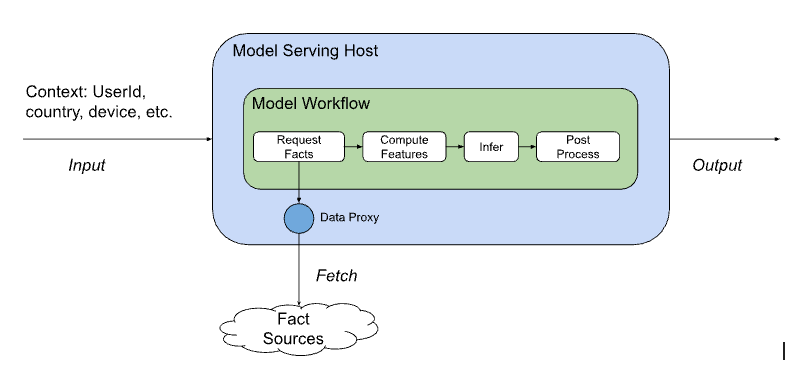
To achieve this higher level of abstraction, the model definition contains a list of facts (raw, unprocessed data or observations built as states in different business workflows) that it needs to compute features, and it relies on the model serving platform to supply these facts at serving time by calling several other microservices. Likewise, during offline training, Netflix’s ML fact store provides snapshots for bulk access to facilitate feature computation.
The important takeaway from this model definition is that the calling services only need to provide standard request context (such as userId, country, device), and the relevant domain context (such as titles to rank, or payment transaction for fraud detection), and the model can itself compute features and perform inference as part of the execution flow. This common set of request contexts across domains enables them to share a standard API abstraction and standardizes how various client microservices can uniformly integrate with the serving app. Furthermore, clients are shielded from the model selection and execution, allowing the model architecture and data inputs to evolve with minimal client coordination.
This post focuses on showcasing the technical details to support this design paradigm. We’ll first describe how we implemented this abstraction with Switchboard, a centralized routing service, and then discuss the operational challenges we encountered at scale and how they led us to the Lightbulb architecture.
ML Model Serving Platform Principles
We envisioned a central model serving platform for all of Netflix’s member-facing ML Model serving needs. This ambitious effort required principled thinking to provide the right level of abstraction for both the researchers and client applications. The following ideas, which are relevant to the topic of this blog post, ensured that the platform acts as an enabler of rapid ML innovation and limits the exposure of ML model iterations to the client apps:
- Model innovation independent of client apps: There should be only a one-time integration effort by the calling app with the ML serving platform for a new use case. After that, almost all model iterations, including intermediate model A/B experiments, should be mostly opaque to the calling apps. This implies that the platform should handle tasks such as model selection based on a user’s A/B allocation, fetching additional data needed by experimental models, logging for further training or observability, and more. This also benefits the ML researcher, as they only need to coordinate with one platform for model innovation.
- Decouple clients from model sharding: Models are distributed across multiple serving compute cluster shards, each with its own Virtual IP (VIP) Address. Various factors, such as traffic patterns, SLAs, model architecture, and CPU/Memory availability, affect model-to-cluster mapping, and changes to this mapping result in changes to the VIP address at which a model is reachable. The serving platform should make clients agnostic to such frequent VIP address changes while ensuring high availability.
- Flexible traffic routing rules: Support flexible mechanisms to introduce new traffic routing rules. This includes supporting traffic routing based on A/B experiments, providing a knob to slowly shift traffic to new models and VIP addresses, and allowing client overrides.
Introducing Switchboard
Standard out-of-the-box API Gateway solutions (such as AWS API Gateway, a standalone Service Mesh proxy) did not meet all our requirements. In particular, we needed first-class integration with Netflix’s experimentation platform, the ability to expose gRPC endpoints to clients, and the ability to use rich domain-specific context for routing customizations, which generic proxies were not designed to handle. Furthermore, the platform required customizations to model-specific lifecycle stages (shadow mode, canaries, rollbacks) to enable safe rollouts and migrations.
Hence, we embarked on building a custom service that serves as a flexible proxy layer for all traffic, handling over 1 million requests per second while maintaining high availability and reliability. We named it Switchboard.
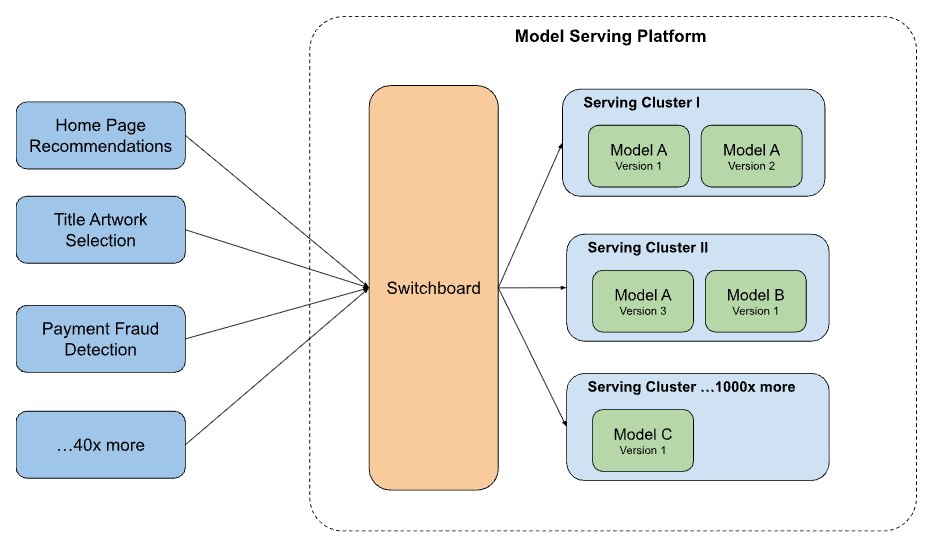
Switchboard serves as the central entry point for the system, acting as a mandatory interface for all clients to access the appropriate model based on their context. Its role is to perform context-aware routing and to apply any configured context enrichment to the model inputs.
Here is a visual representation of the request flow from different clients to different serving clusters:
Objective Abstraction
To support this system design, we introduce the concept of an “Objective”. It’s an Enumeration defined by the serving platform that every request into the system must provide. It has three key purposes:
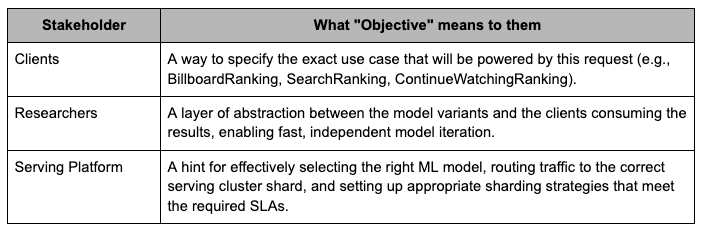
In short, an Objective is the serving platform’s name for a specific business use case (e.g., ContinueWatchingRanking), which decouples clients from concrete models and guides the platform’s routing and model selection decisions.
Key Capabilities of Switchboard
To summarize, these are the key capabilities of Switchboard:
- Common Client Abstraction: Switchboard provides a single point of contact for all our clients’ model needs. When clients wish to consume additional models for new ML applications addressing the same business need, there is no new service dependency to introduce or new clients to manage to make requests to the models. From an ML Ops perspective, this also gives us knobs to control client rate limits across model versions and manage central concurrency limits to deal with bad clients.
- Context-Aware Routing: Switchboard can route a request based on a rich set of contextual features, such as the user’s current device, locale, ranking surface type (e.g., home page vs. search results), or the current A/B test a user is in.
- Dynamic Traffic Splitting: It enables real-time traffic splitting for canary deployments and experimentation. This allows engineers to safely roll out a new model version to a small, controlled percentage of users before a full launch.
- Model Versioning and Lifecycle Management: Switchboard inherently manages concurrent request traffic to multiple versions of the same model. This is crucial for:
- Shadow Mode Testing: Routing production traffic to a new model version without affecting the user experience, enabling performance comparisons.
- Instant Rollback: Immediate switching of traffic away from a problematic new model version back to a stable one.
But is this the whole story? Not quite. Introducing this routing layer adds complexity to our model deployment cycles. In addition, we need a mechanism to collect the context-based routing information from the researchers when they choose to deploy model variants.
The Glue — Switchboard Rules
Given that Objectives serve as the contract between clients and the serving platform, we needed a way for researchers to attach model variants, experiments, and traffic splits to those Objectives without changing client code. This is where Switchboard Rules comes in.
The primary UX for model researchers to define models associated with an objective in a flexible manner is a JavaScript configuration, which we call Switchboard Rules. It’s used to produce a set of rules (typically a JSON file) that primarily dictate the following things to the serving platform:
- The default model to use for a given Objective
- A/B experiments to configure for a set of Objectives and the corresponding models to load for those experiments
- Customizations to gradually shift traffic to a new model
Here is an example of an A/B test rule in the context of the Continue Watching row:
/**
Configuration rule written by a Model Researcher to add an A/B experiment in the Model Serving system.
Cell 1: Uses the default, currently productized model
Cell 2 and Cell 3: Use different experimental (candidate) models
**/

function defineAB12345Rule() {
    const abTestId = 12345;

    const objectives = Objectives.ContinueWatchingRanking;
    const abTestCellToModel = {
        1: {name: "netflix-continue-watching-model-default"},
        2: {name: "netflix-continue-watching-model-cell-2"},
        3: {name: "netflix-continue-watching-model-cell-3"}
    };

    return {
        cellToModel: abTestCellToModel,
        abTestId: abTestId,
        targetObjectives: [objectives],
        modelInputType: constants.TITLE_INPUT_TYPE,
        modelType: 'SCORER'
    };
}
These rules are consumed by both the Switchboard and the Model Serving clusters. Given these rules, the serving platform components can take various actions, some detailed below:
Control Plane Flow:
- Assignment: Produce model-to-cluster shard assignment.
- Validation: Load all specified models into the Serving Cluster Shard and validate model dependencies to ensure successful execution.
- Mapping: Provide the model-to-shard VIP address mapping to Switchboard.
Data Plane Flow:
- Allocation: If the request is for Objective=ContinueWatchingRanking, query the Experimentation Platform for the userId’s cell allocation.
- Model Selection: Use the allocation and A/B test rule to select the appropriate model.
- Request Routing: Route the request to the serving cluster shard with the selected model and context.
- Model Execution (on the serving host): Run the model workflow steps and return the response.
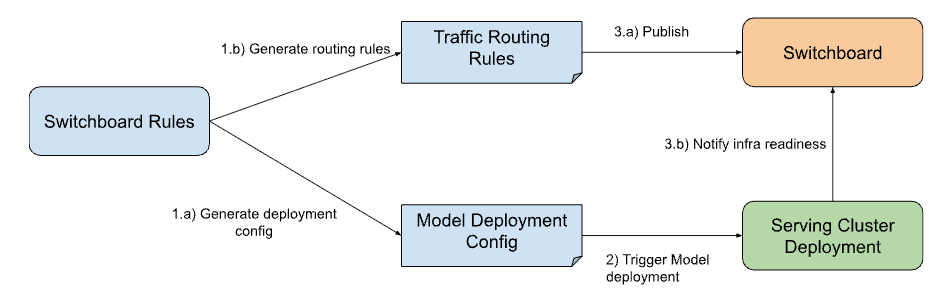
A key highlight of this setup is the decoupling of the experimentation config from the serving platform code. This includes having an independent release cycle for the rules, separate from the code deployments. Netflix’s Gutenberg system provides an excellent ecosystem that enables a flexible pub-sub architecture, facilitating proper versioning, dynamic loading, easy rollbacks, and more. Both Switchboard and the Serving Cluster Host subscribe to the same Switchboard Rules configuration.
To prevent race conditions and ensure proper sync of the dynamic Switchboard Rules configuration, the following flow is considered:
Evolving Challenges
Switchboard solved the primary problem of improving model iteration and innovation velocity, and provided an excellent ML serving abstraction to over 30 service clients. However, as the system scale increased, a few challenges and problems with this design became apparent:
- Single point of failure: The presence of Switchboard in the critical request path clearly highlights the risks of shutting down access to all serving hosts in extreme cases, such as unintentional bugs or noisy neighbors sending excessive traffic.
- Why this matters: Switchboard became a shared dependency whose failure would degrade or disable multiple ML-powered experiences at Netflix.
- Added latency due to additional network hop: Switchboard in the request path adds between 10–20ms of latency due to serialization-deserialization operations, depending on payload size. Additionally, it further exposes a request to tail latency amplification.
- Why this matters: The added latency is unacceptable for some latency-sensitive clients, resulting in end-user impact due to service timeouts.
- Reduced Client flexibility: Switchboard obscures visibility into client request origins from the serving clusters. Consequently, distinguishing data logged for real vs artificial traffic, which is essential for model training, is difficult and requires ongoing customization and increased MLOps overhead.
- Why this matters: It makes it harder to do tenant separation and test traffic isolation.
What Next? — Lightbulb
The aforementioned challenges of operating Switchboard at scale forced us to rethink the core implementation while retaining its key features. Our goal was not to throw away Switchboard’s design, but to refactor where and how its responsibilities were executed, keeping the benefits while reducing risk and latency. Particularly:
- Common Client Abstraction
- Decouple clients from model sharding
- Flexible traffic routing rules
- Lightweight system client
- Single place to define model and experimentation config
- Fast experimentation config propagation
- Fallback and client-side caching in case of failures
However, we did want to address some of the previous design choices to move forward with:
- Remove the routing service from the direct request path: Having a single service in the active request path introduces another failure mode and limits fallback flexibility. While routing rules change infrequently, maintaining consistency comes at the cost of increased availability risks.
- Separate model inputs from the request metadata: In certain cases, the request payload could be quite large. Needing to deserialize and then re-serialize the payload as it flowed through Switchboard to make a routing decision was a significant contributor to latency and increased serving costs.
- Provide better isolation for the routing layer: Consolidating multiple use cases (tenants) into a single routing cluster poses two main challenges. First, error propagation posed a risk, as a surge of problematic requests from one tenant could cascade errors back to Switchboard, potentially impacting other users. Second, the cluster had to accommodate diverse latency requirements because the requests from different use cases varied significantly in complexity.
This required some changes in our setup flow: While it largely remained unchanged, however, we created separate components for Routing and Model Selection (Lightbulb):
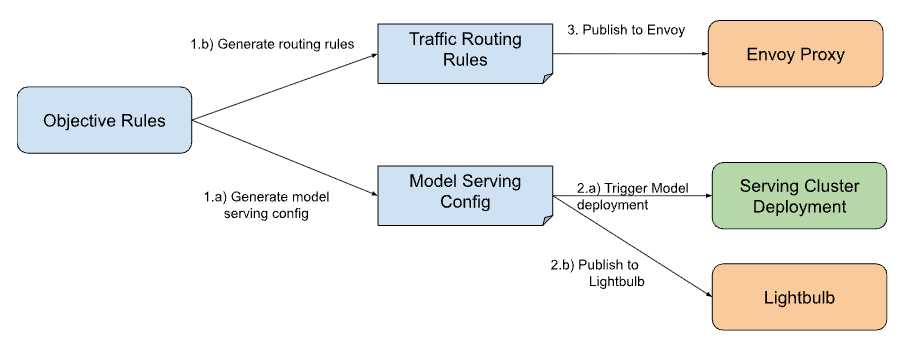
We now take the rules for an Objective and break them into distinct sets of configuration:
- Model Serving Configuration: This allows us to determine which model should be used at request time, along with the required metadata
- Routing Rules: Given a model we want to serve at request time, this tells us which VIP the request should be routed to.
The Data Plane changes also reflect this separation, as we now rely on Envoy to take care of the routing details:
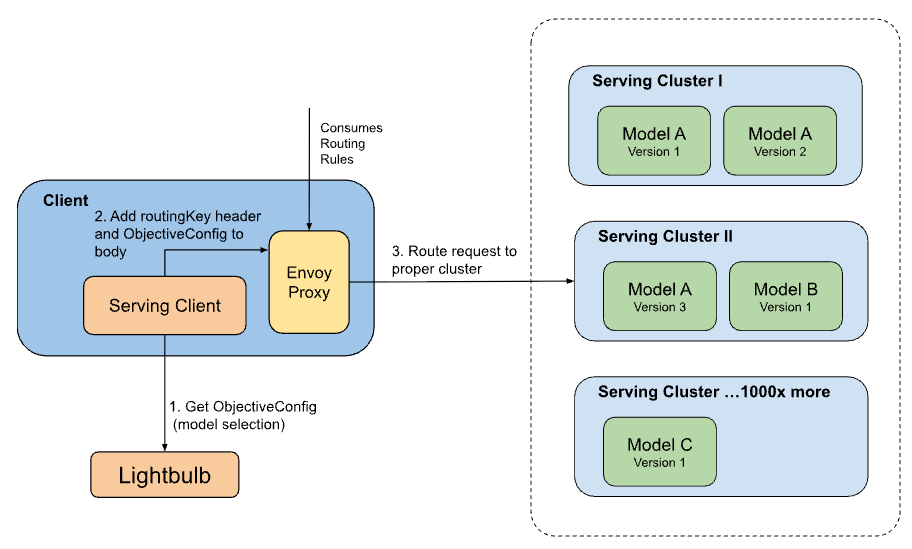
Envoy is already used for all egress communication between apps at Netflix, and it can route requests to different clusters (VIPs) based on the configurable Routing Rules published from our control plane. However, it lacks the information needed to make routing decisions and the ability to enrich the request body with additional serving parameters required for A/B testing model variants. We introduced Lightbulb to cover this gap:
- Lightbulb consumes the minimal request context, which contains use-case information, and provides the metadata mapping required for routing at the Envoy layer.
- Lightbulb resolves the request context to determine a routingKey configuration along with the ObjectiveConfig — this is where we place the model id along with other request-specific configurations required for model execution. This is done to separate the config resolution associated with the request from the placement and routing information needed to reach it on the inference cluster.
- While the routingKey is added to the headers for Envoy proxy to consume, the client adds the ObjectiveConfig parameters to the request itself. This is done to avoid bloating the request headers while passing additional parameters for the model to process the request appropriately.
- The routing of the actual request is performed by the Envoy proxy, which has the metadata to map the routingKey to the actual cluster VIP running the model. Because the routingKey is in a header, this determination can be made with minimal overhead.
These changes retain the advantages of Switchboard, such as a single integration point, abstraction of model id from use case, context-aware routing, while addressing the challenges we observed over time.
Conclusion
The evolution from Switchboard to Lightbulb marks a significant architectural refinement in our ML model serving infrastructure. While Switchboard provided the initial abstraction layer critical for rapid innovation, its latency and single-point-of-failure risk posed scaling hurdles. The subsequent adoption of Lightbulb, a decoupled service focused solely on routing metadata, and its integration with Envoy successfully resolved these challenges. This sophisticated new architecture preserves the key benefits — seamless client integration and flexible experimentation — while ensuring reliable, efficient, and scalable delivery of personalized member experiences, positioning us well for future ML growth.
In future posts in this series, we’ll dive deeper into other aspects of our ML serving platform, including inference and feature fetching, and how they interact with the routing architecture described here.
Special thanks to Sura Elamurugu, Sri Krishna Vempati, Ed Maddox, and Sreepathi Prasanna for their invaluable feedback and partnership in iterating on this idea and bringing this blog post to life.

State of Routing in Model Serving was originally published in Netflix TechBlog on Medium, where people are continuing the conversation by highlighting and responding to this story.
Security posture improvement in the AI era
Post Syndicated from Celeste Bishop original https://aws.amazon.com/blogs/security/security-posture-improvement-in-the-ai-era/
It’s only been a few weeks since Anthropic announced the Claude Mythos Preview model and launched Project Glasswing with AWS and other leading organizations. This has generated a lot of discussion about the future of cybersecurity and what the ever-increasing capabilities of foundation models mean to organizations.
As AWS CISO Amy Herzog pointed out in the Project Glasswing announcement, “At AWS, we build defenses before threats emerge, from our custom silicon up through the technology stack. Security isn’t a phase for us; it’s continuous and embedded in everything we do.”
Read more from Amy about this in Building AI defenses at scale: Before the threats emerge.
While the discussion around the future of cybersecurity is important, the only thing we know for certain is that organizations need to be able to react quickly to the rapid changes AI is bringing to technology and business in general. And you can’t react quickly if your security fundamentals aren’t dialed in.
The security hygiene gap
It’s easy to assume you have the foundational security elements covered, or to overlook some completely. Basic security use cases like identity management, threat detection, vulnerability management, data protection, and network security can be inconsistently implemented across cloud environments. While AI is reshaping the security landscape, strong security fundamentals continue to be essential for every organization, regardless of size or industry.
These are the security basics that matter whether or not you’re adopting AI: patching consistently, enforcing least-privilege access, enabling logging and monitoring, encrypting data at rest and in transit, and reviewing security configurations regularly. When these fundamentals are in place, you’re better positioned to take advantage of AI-driven tools and respond to newly discovered vulnerabilities, wherever they come from.
While the concepts that drive security fundamentals are universal, implementing them in your environment is best done with an understanding of the context unique to your organization. That’s why we have a multitude of freely available materials—like the AWS Well-Architected Framework—that you can use to help ask the right questions and implement changes in your environment. We also offer programs like the Security Health Improvement Program (SHIP) to help you improve your security posture through prescriptive guidance and continuous improvement.
What is the Security Health Improvement Program (SHIP)?
SHIP is a no-cost program available to every AWS customer, regardless of support tier. SHIP provides a proven, data-driven methodology to:
- Assess your current security posture using data from your AWS environment
- Identify specific opportunities to improve across 10 core security use cases
- Build a prioritized action plan tailored to your environment
- Establish a mechanism for continuous security improvement
The program is led by AWS Solutions Architects and Technical Account Managers who take you through a personalized report, contextualize findings for your environment, and help you build a prioritized action plan.
Why SHIP matters in the AI era
Project Glasswing highlights an important shift: AI-powered tools are accelerating the pace of vulnerability discovery, which means organizations need to be prepared to assess and respond to findings and changing situations faster than before. In addition to external factors, as organizations adopt AI—whether deploying foundation models, building agentic workflows, or using AI-powered services—how they implement their security controls must change as well. A strong security foundation is what makes confident AI adoption possible.
Here’s how SHIP helps:
Address foundational security gaps proactively
SHIP uses a data-driven methodology to identify opportunities to improve and optimize across 10 core security use cases: threat detection, cloud security posture management, application security testing, configuration management, access governance, vulnerability management, application protection, network security, encryption, and secrets management. The program includes a SHIP assessment to identify critical security findings related to your current security posture, so your team can build a prioritized roadmap for improvement tailored to your environment.
Establish the security baseline AI workloads require
Before you deploy your first model on Amazon Bedrock or build agentic workflows with Amazon Bedrock AgentCore, you need confidence that your underlying infrastructure follows security best practices. SHIP uses actual data from your environment to provide prescriptive, specific guidance rather than generic security recommendations. This is especially relevant as AI-driven vulnerability discovery tools become more widely available: organizations with strong baselines will be able to act on new findings quickly and effectively.
Build a mechanism for continuous security improvement
As AI capabilities evolve, organizations benefit from having a repeatable process to assess and strengthen their security posture over time. SHIP establishes the methodology and mechanisms for your team to continuously assess, prioritize, and improve. By building this operational capability, you’re strengthening your organization’s ability to adapt and contributing to broader industry resilience. As the cybersecurity community integrates AI into defense strategies, SHIP helps you maintain foundational best practices so you can adopt these innovations effectively and with confidence.
Getting started is straightforward
SHIP is available today, at no cost, to every AWS customer. Here’s how to get started:
- Talk to your AWS account team. Ask about scheduling a SHIP engagement, or request one directly on the SHIP page.
- Attend a SHIP Activation Day. AWS regularly hosts hands-on workshops where you can run the SHIP assessment with AWS Solutions Architects and start building your improvement plan.
- Explore the prescriptive guidance. Consult the AWS Well-Architected Framework – Security Lens for documentation, reference architectures, and implementation guides you can start using today.
Take the next step together
AWS is committed to being the most secure cloud, from our participation in Project Glasswing to the security embedded in every layer of our infrastructure. Security is a shared responsibility, and programs like SHIP give customers the tools, guidance, and support to strengthen their security foundations so they can build confidently, no matter what comes next.
Ready to improve your security posture? Contact your AWS account team to schedule a SHIP engagement, or visit the SHIP resources page to learn more.
Metasploit Wrap-Up 05/01/2026
Post Syndicated from Christopher Granleese original https://www.rapid7.com/blog/post/pt-metasploit-wrap-up-05-01-2026
MCP server
This release our very own cdelafuente-r7 finished implementing the Metasploit MCP Server (msfmcpd), bringing Model Context Protocol support to Metasploit Framework. MCP lets AI applications like Claude, Cursor, or your own custom agents query Metasploit data. Think of it as a middleware layer that exposes 8 standardized tools for searching modules and pulling reconnaissance data, all built on the official Ruby MCP SDK.
This first iteration is read-only, covering modules, hosts, services, vulnerabilities, and more. Tools for module execution, session interaction, and database modifications are on the roadmap for a future release. Full details are available in the documentation.
Copy Fail
Earlier this week, details of a new and high profile Linux LPE were released alongside a public PoC. The bug, nicknamed Copy Fail and identified by CVE-2026-31431, is a logic flaw in the cryptographic APIs exposed by the Linux Kernel. Metasploit has shipped a local exploit this week to leverage the flaw on AMD64 and AARCH64 targets with additional architectures planned for future releases. The exploit, which replaces the ‘su’ binary in the page cache with a small ELF file, allows users to specify command payloads for execution and will automatically determine the appropriate target architecture.
New module content (3)
Microsoft Windows HTTP to LDAP Relay
Author: jheysel-r7
Type: Auxiliary
Pull request: #21323 contributed by jheysel-r7
Path: server/relay/http_to_ldap
Description: This adds a new NTLM relay module that relays from HTTP to LDAP. On success, an authenticated LDAP session is opened which allows the operator to interact with the LDAP service in the context of the relayed identity.
Copy Fail AF_ALG + authencesn Page-Cache Write
Authors: Diego Ledda, Spencer McIntyre, Xint Code, and rootsecdev
Type: Exploit
Pull request: #21395 contributed by zeroSteiner
Path: linux/local/cve_2026_31431_copy_fail
AttackerKB reference: CVE-2026-31431
Description: Adds a module for CVE-2026-31431 (The Copy Fail LPE for Linux), a local privilege escalation affecting almost every Linux Kernel since 2017.
Linux Execute Command
Author: Spencer McIntyre
Type: Payload (Single)
Pull request: #21395 contributed by zeroSteiner
Path: linux/aarch64/exec
Description: Adds a module for CVE-2026-31431 (The Copy Fail LPE for Linux), a local privilege escalation affecting almost every Linux Kernel since 2017.
Enhancements and features (5)
- #21315 from cdelafuente-r7 – This adds a read-only MCP server for Metasploit capable of retrieving information from the loaded modules and database.
- #21352, #21353, #21355, #21359 from adfoster-r7 – Improves multiple module check code messages and statuses.
Bugs fixed (0)
None
Documentation
You can find the latest Metasploit documentation on our docsite at docs.metasploit.com.
Get it
As always, you can update to the latest Metasploit Framework with msfupdate and you can get more details on the changes since the last blog post from GitHub:
If you are a git user, you can clone the Metasploit Framework repo (master branch) for the latest. To install fresh without using git, you can use the open-source-only Nightly Installers or the commercial edition Metasploit Pro
Announcing the ISO 31000:2018 Risk Management on AWS Compliance Guide
Post Syndicated from Jesse McMahan original https://aws.amazon.com/blogs/security/announcing-the-iso-310002018-risk-management-on-aws-compliance-guide/
AWS Security Assurance Services is announcing the release of our latest compliance guide, ISO 31000:2018 Risk Management on AWS, which provides practical guidance for organizations establishing and operating a risk management program in AWS environments using ISO 31000:2018 principles.
The guide explains how organizations can integrate AWS services into their risk management processes to support the core components of ISO 31000:2018, including establishing context and criteria, conducting risk assessments, implementing risk treatments, and enabling continuous monitoring and review. It also highlights how AWS security, automation, and monitoring capabilities can help customers identify areas for improvement and help enforce controls at large. The guide includes:
- An overview of the ISO 31000:2018 risk management framework, including context and criteria, risk assessment, risk treatment, and monitoring and review. You will learn how to apply ISO 31000’s core principles within AWS environments and use AWS services for risk identification, detection, treatment, and monitoring.
- Governance and risk treatment considerations aligned with the AWS Shared Responsibility Model. This includes strategies for risk avoidance, mitigation, transfer, and acceptance.
By combining ISO 31000 risk management principles with AWS security services, organizations can build scalable, automated environments that help support continuous risk identification, proactive treatment, operational visibility, and ongoing compliance readiness.
Download Available: ISO 31000:2018 Risk Management on AWS Compliance Guide
For further assistance, contact AWS Security Assurance Services
If you have feedback about this post, submit comments in the Comments section below.
София нагоре в бетон, стъкло и червено
Post Syndicated from Боян Юруков original https://yurukov.net/blog/2026/sofia-navisoko/
Тия дни се заговори отново за поредната 75 метрова сграда. Първи за това писа общинският съветник Бойко Димитров, след това Симеон Ставрев, а преди гласуването Спаси София го разпростаниха още. Вчера в Столичния общински съвет все пак предложението на районния кмет Кукурин беше гласувано и прието. Повече за самия случай, защо е скандален и защо се счита за схема може да прочете в Капитал, които са описали добре хронологията.
Тази сграда стана известна, тъй като е на (предимно) общинска земя, но има много други, които са също толкова проблемни от гледна точка на транспорт, подземна инфраструктура, реки, отстояния и прочие. Само преди седмица имаше искане за ПУП за друга 75 метрова сграда. Там обаче по-скоро ще бледнее пред околните долепени едно до друго туловища, които вече са си осигурили гласовете в СОС преди няколко мандата.
Все по-често, когато стане такъв скандал, виждаме снимки от картата ми. В случая с Младост именно визуализацията от 3D картата беше използвана от всички, за да покажат мащабите на предложеното от районния кмет на Младост. Използвах я като показвахме схемата на пловдивския кмет и хуманитарната гимназия и плановете му за застрояване на практически нов квартал без инфраструктура. С нея показах къде минават реките на София и какво се планира да се строи върху тях. Често я срещахме и в отразяването на случая с 215-метровата кула на бул. Черни връх.
В същото време продължава критиката срещу картата ми за очакваното застрояване в София или както я представям обикновено – онази с шарениите. Критиката идва най-вече от инвеститори и архитекти, но и от някои в Столична община и определени районни кметства. Миналата година събрах и отговорих на почти всички упреци и твърдения, които някой е споменавал. Налагало ми се е да обяснявам и поправям твърдения какво показва картата и какво се случва в Младост. Най-вече чувам, че това, което се вижда на картата като обеми и строежи, няма да се случи въобще или няма да е баш така. Ако случая в Младост показа нещо, то е че всъщност картата е повече от точна. Виждаме го отново и отново, особено в междублокови пространства и зелени площи.
Криптобетон, ама нависоко
На база данните събрани в картата, виждаме 8 бъдещи сгради над 100 метра, 36 между 75 и 100 метра и 122 сгради между 50 и 75 метра. Някои от тях се строят, а други се виждат на картата на общината, но липсват всякакви документи кога и как е било решено. За последните знаем, че е на база скрити ПУП-ове и гласувания в СОС преди 2020 г., защото след това следя всички промени автоматично.
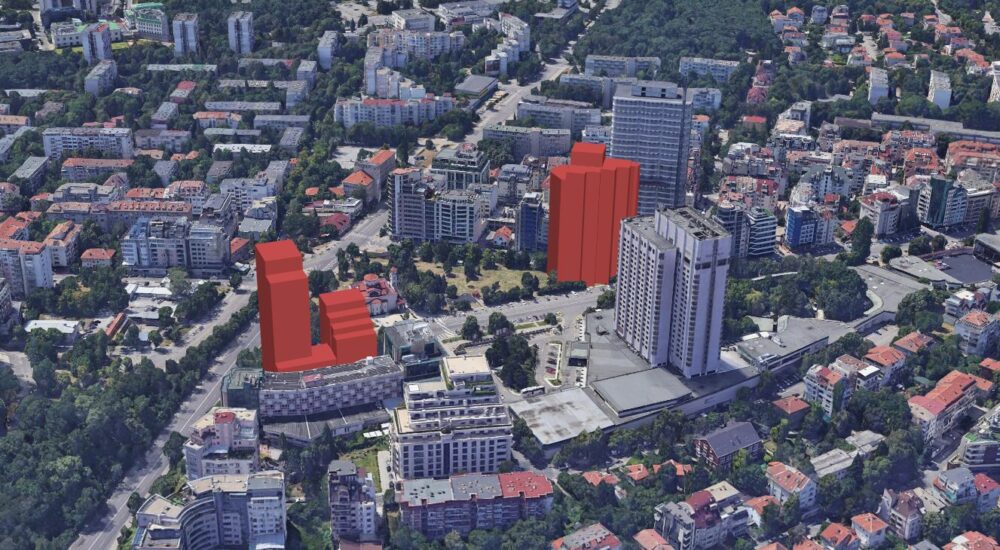
Всички обекти може да видите на 3D картата – отваряте филтъра с бутона с фунията, изключвате сградите до 50 метра (първите четири отметки) и остават само по-високите. В галерията долу ще видите няколко района в София с оставени само такива сгради. Може да спрете смяната на снимките с бутона за пауза горе вдясно.
Първата снимка показва планираната нова 75-метрова сграда на мястото на старата офис сграда на Филип Кутев до опасното кръстовище с Черни връх. Около нея се виждат предимно одобрени вече други проекти. Втората снимка показва кула до Японския хотел, както и още една точно пред прозорците на злощастния Златен век на Артекс. Последната кула е видима в портала на общината, липсва всякаква информация или публични документи как се появила и е върху общинска земя. Както видяхме със случаите на схеми за подаряване на милиони на частни интереси в Младост и Изгрев обаче, това не е никаква пречка. Доколкото настоящия районен кмет на Лозенец няма да пусне подобно предложение, това пак не пречи на икономическото мнозинство на СОС да прокара свое.

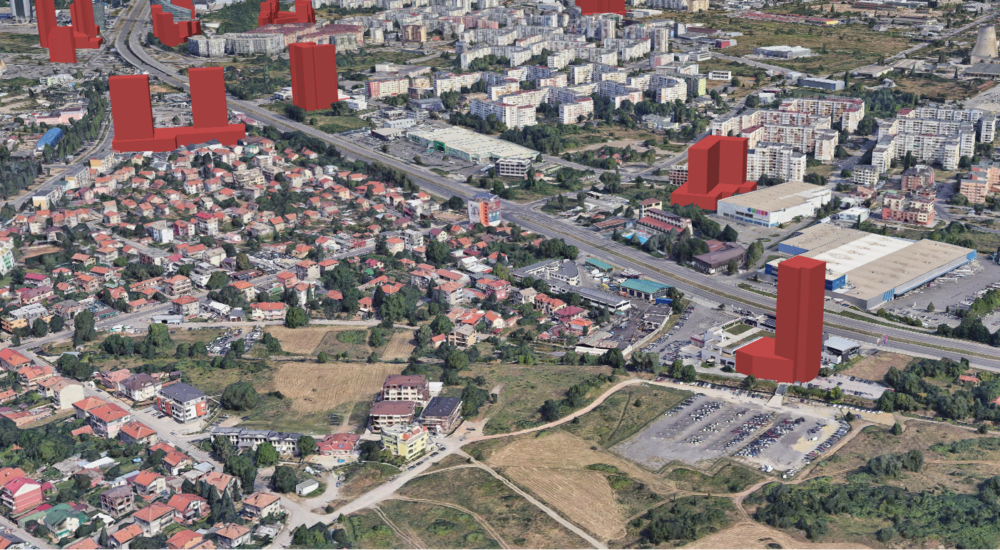
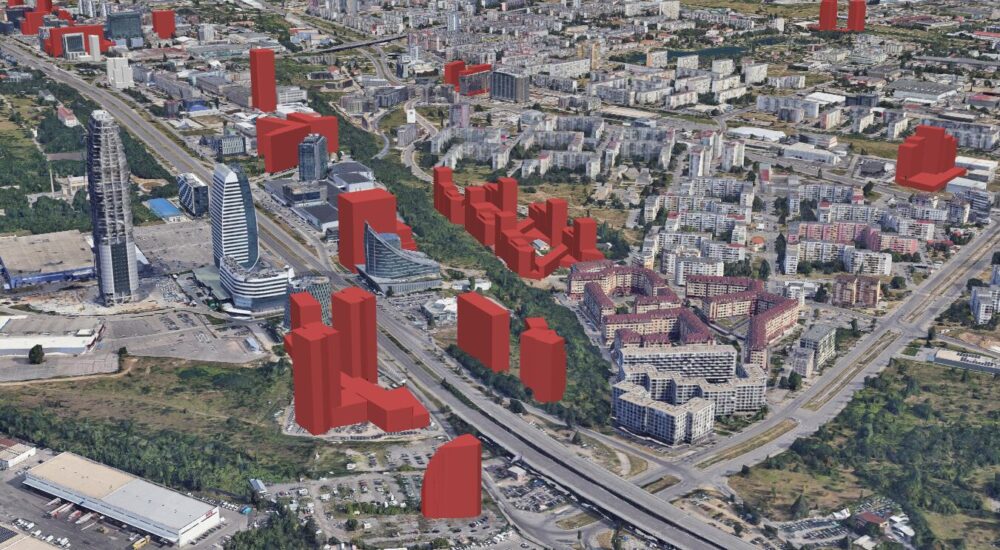
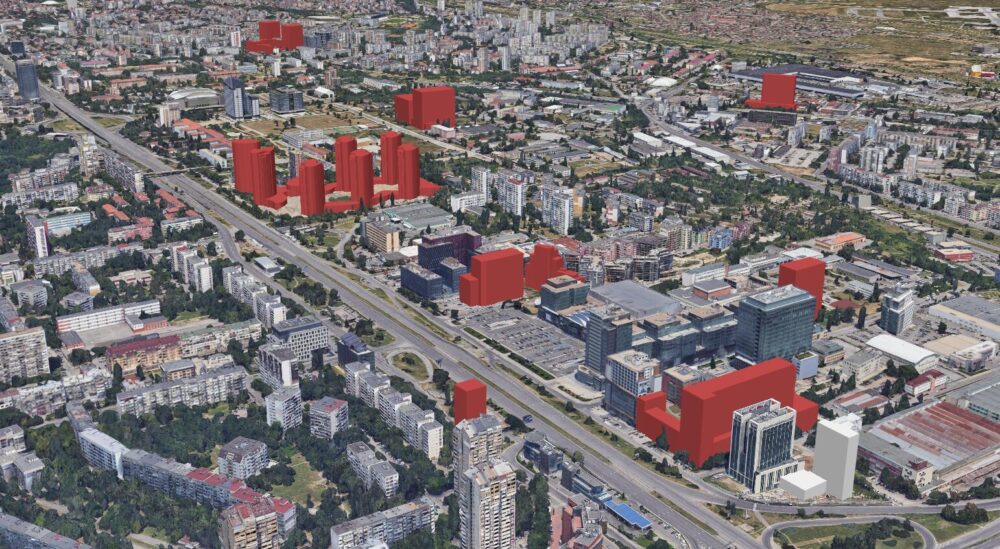
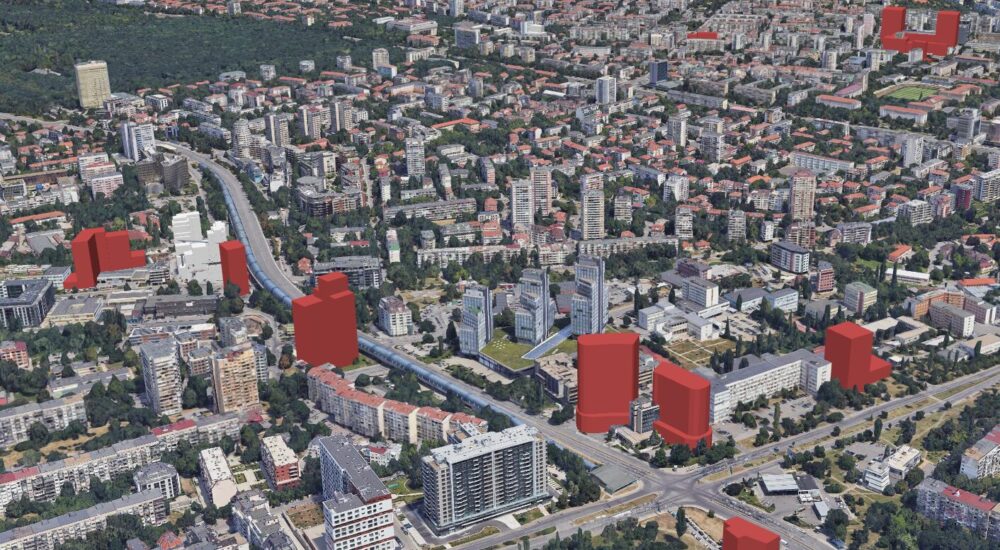
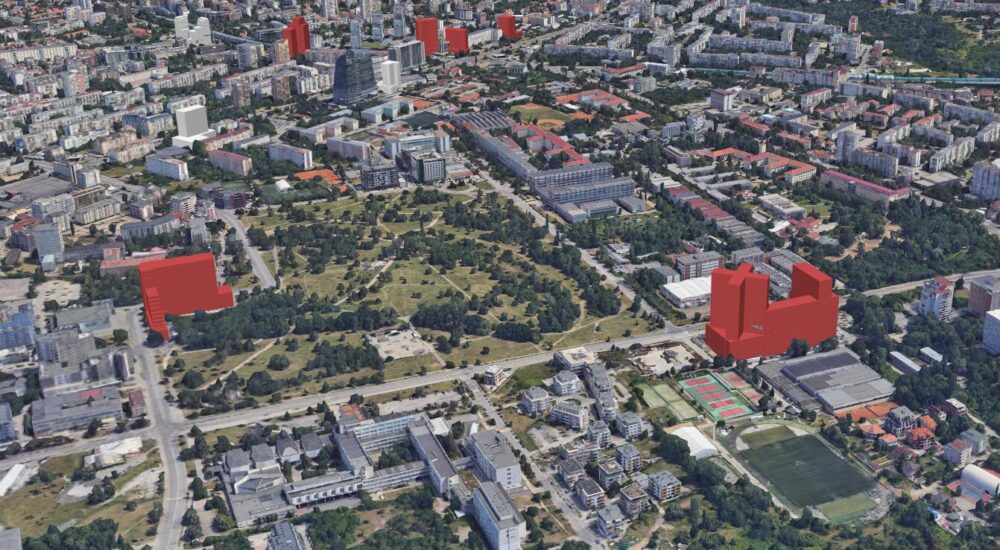
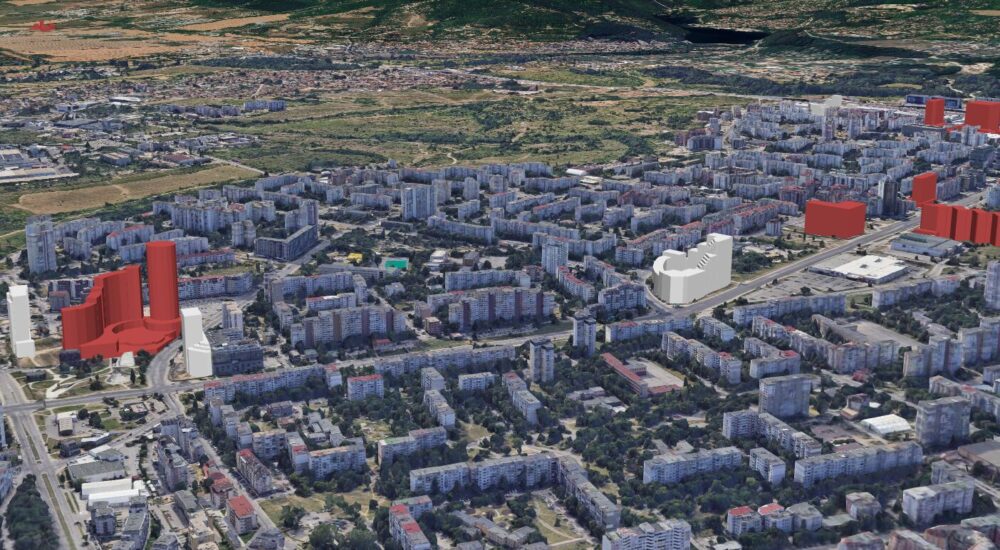
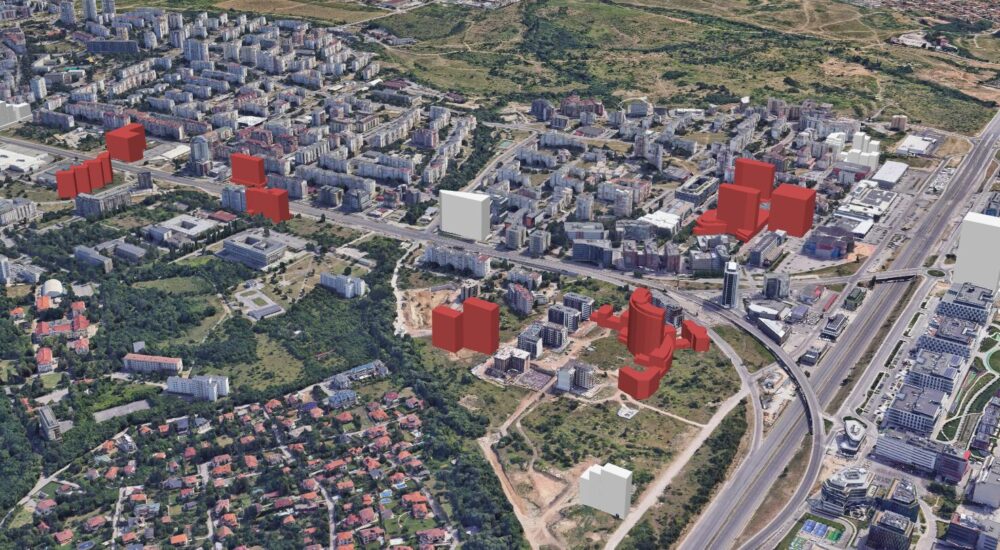
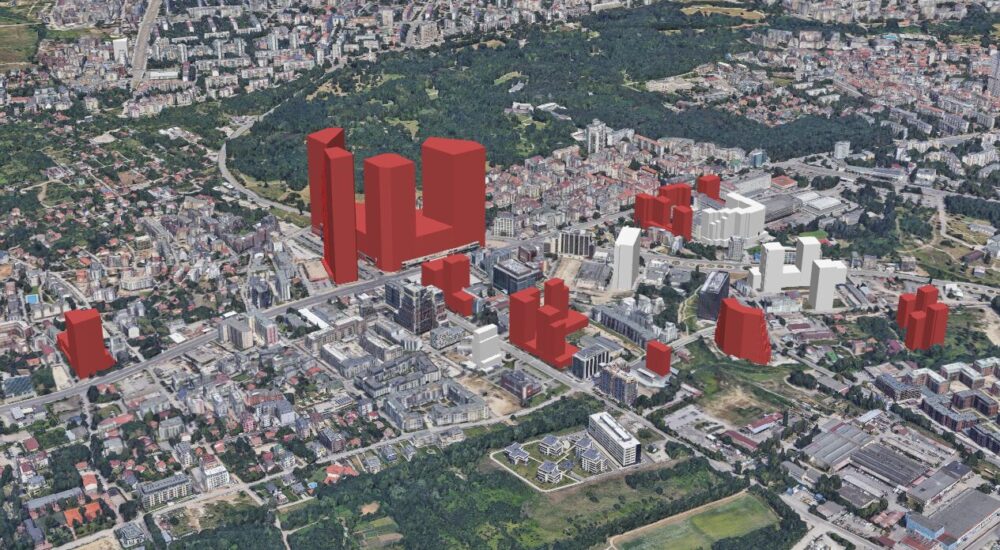
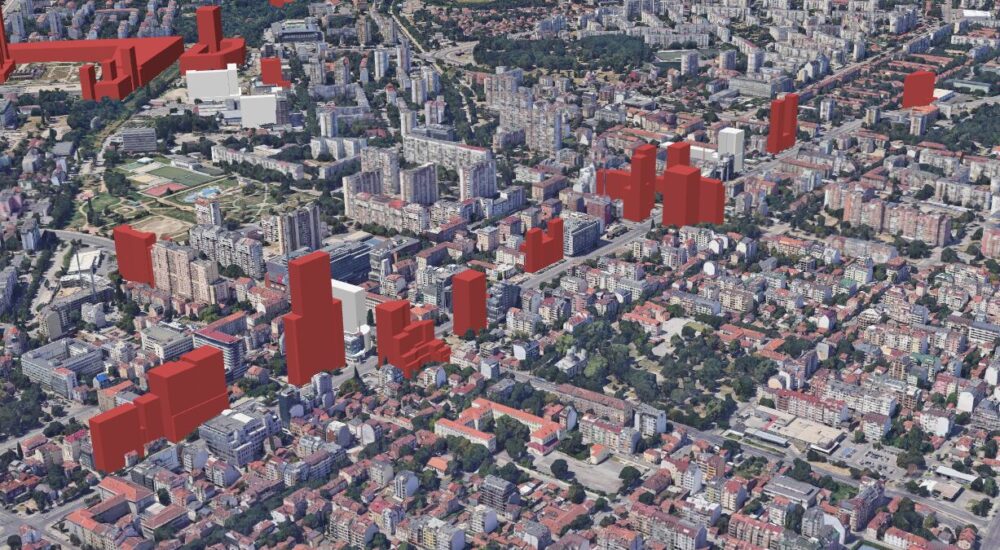

Следващите три снимки са по протежението на Цариградско шосе и се виждат множеството сгради достигащи и минаващи 75 метра. Вижда се и строящият се вече проект на Тиков исторически свързван с Пеевски, който щеше да бъде облагодетелстван от лобистките поправки на ИТН в предишния парламент. След това показвам Изгрев и Г.М. Димитров, където съм включил няколко сгради, които са малко под 50 метра. От там дойде заветната фраза от транспортен анализ, че „то така или иначе е блокирано движението – още няколко десетки семейства няма какво повече да влошат положението“. За съжаление, районният кмет не прави нищо за озаптяване на тези проекти въпреки заявките му, че спира строежи всякакви. Тук не трябва да пропуснем и абсурдните планове за сграда в Студентски парк и спряният отдавна проект от другия край на парка, заради който вече години улицата е пропаднала.
Следващите снимки показват плановете в Младост, включително от последния скандал. Повечето са по Малинов, в Бизнес парка и отсреща на булеварда. Разбира се, не може да не се върнем отново на Черни връх, където има най-много концентрация на сгради уж със смесени функции, които магически стават изцяло жилищни без паркоместа и отстояния. Плановете за Тодор Александров шокират всички, но тепърва ще видим стена от кули там предвид прецедентите за висок кинт от 6, 7 и нагоре при иначе и без това ненормално високия в части на ОУП на София от 3.5.
Накрая като тест съм въвел по визата за проектиране една вече готова сграда на бул. България. Заложил съм точно височината и очертанията от скицата както съм направил при всички други хиляди. Вижда се, че доста точно очертава какво реално са построили в последствие.
Картата – активност и събиране на данни
За последните 12 месеца картата е била посетена 305 хиляди пъти, 141 хиляди от които от потребители в България. Тук изключвам моите посещения, както и тези от търсачки. Има 36630 уникални IP адреса, което предполага най-много толкова посетители. 632 души отварят картата поне веднъж на седмица. От миналия юни, когато помолих за помощ, до сега 3200 души са подали 10871 сигнала, че сгради вече се строят или са готови. Повечето са обработени.
Питали са ме как добавям данните на картата. На едно събитие на Ratio миналата година показах тази графика и днес я обнових. Дава представа колко полигона съм добавял по дни от края на юли 2024 и сега. Вижда се, че първите два месеца съм добавял по няколко стотин на ден. Впрочем, нашумялата сграда в Младост е там от самото начало – бил съм я въвел още на 6-ти август 2024. Сега през седмица-две обработвам новите искания за ПУП-ове, визи за проектиране, градоустройствени заповеди и други актове със скици. В червено се виждат колко от полигоните въведени в дадения ден са изтрити на по-късен етап заради поправки или по-често – промени в плановете за застрояване.
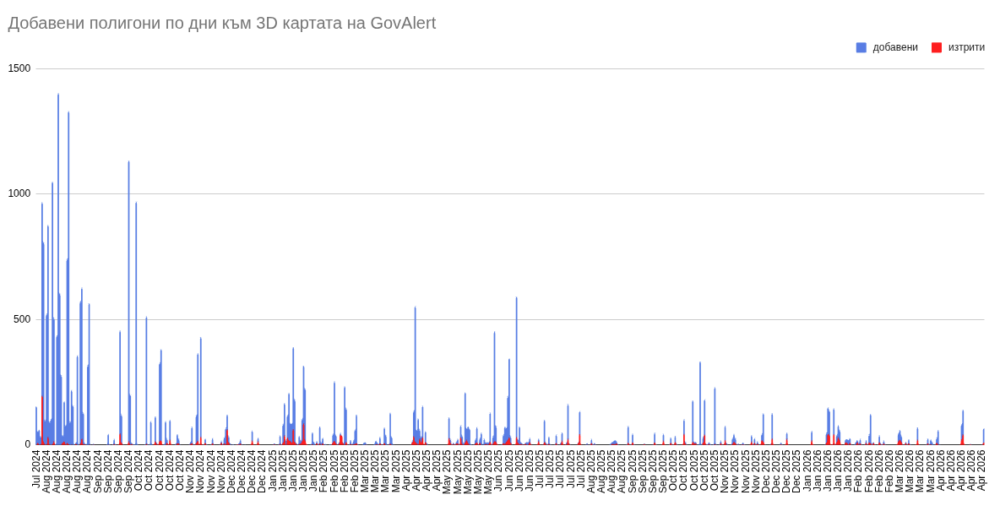
За последните 21 месеца съм въвел почти 32 хиляди полигона на ръка. От тях 29 хиляди се виждат на картата. 11282 са събрани в 3757 сгради като всеки полигон показва различна височина на части от бъдещия строеж. Останалите 18 хиляди са самостоятелни сгради – от хилядите малки къщи, които никнат по полета и хълмове около София до 75 метрови кули.
Повече по темата
Ако искате да се информирате за нови документи и проекти в района ви или около конкретно място, може да се абонирате за бюлетина ми. Той ще ви информира за документи от общината и редица други институции свързани с имоти в София. Повече за проекта може да прочетете тук.
Писал съм доста за презастрояването, София конкретно и имотния пазар на база това, което виждам в данните. Тези статии може да са ви интересни в тази връзка:
- Четем сгрешени цени на имотите и това е сериозен проблем
- Що е то презастрояване и има ли почва у нас?
- Имотния пазар в София, панелките и „хубавото ново“
- Каква е собствеността на земята в България?
- За хората със схемите и дъх на мръсни чорапи
- Трябва да се ядосаме, … а после?
- Бетон и кора – бутафорното озеленяване в София
Eden: NHS goes to war against open source
Post Syndicated from jzb original https://lwn.net/Articles/1070864/
Terence Eden reports
that the UK’s National
Health Service (NHS) is preparing to close almost all of its open-source repositories as a
response to LLM tools, such as Anthropic’s Mythos, becoming more
sophisticated at finding security vulnerabilities. He does not, to put
it mildly, agree with the decision:
The majority of code repos
published by the NHS are not meaningfully affected by any advance
in security scanning. They’re mostly data sets, internal tools,
guidance, research tools, front-end design and the like. There is
nothing in them which could realistically lead to a security
incident.When I was working at NHSX during the pandemic, we were so
confident of the safety and necessity of open source, we made sure the
Covid Contact Tracing app was open sourced the minute it was available
to the public. That was a nationally mandated app, installed on
millions of phones, subject to intense scrutiny from hostile powers –
and yet, despite publishing the code, architecture and documentation,
the open source code caused zero security
incidents.Furthermore, this new guidance is in direct contradiction to the
UK’s Tech
Code of Practice point 3 “Be open and use open source” which
insists on code being open.