Post Syndicated from LastWeekTonight original https://www.youtube.com/watch?v=WmlH4YavJwk
[$] Improving FUSE writeback performance
Post Syndicated from jake original https://lwn.net/Articles/1019522/
In a combined filesystem and memory-management session at
the 2025 Linux Storage, Filesystem, Memory
Management, and BPF Summit (LSFMM+BPF), Joanne Koong led a discussion on
improving the writeback performance for the Filesystem in
Userspace (FUSE) layer. Writeback is how data that is written to the
filesystem is actually flushed to the disk; it is the process of writing
dirty pages from the page cache to storage. The current FUSE
implementation allocates unmovable memory, then copies the dirty data to it
before initiating writeback, which is slow; Koong wanted to change that
behavior. Since the session, she has posted a
patch set that has been applied
by FUSE maintainer Miklos Szeredi.
Accelerate development workflows to reduce release cycles using the Amazon Q Developer integration for GitHub (Preview)
Post Syndicated from Madhu Balaji original https://aws.amazon.com/blogs/devops/accelerate-development-workflows-to-reduce-release-cycles-using-the-amazon-q-developer-integration-for-github-preview/
Automatically execute coding tasks to reduce development cycles using Amazon Q Developer in GitHub (in-preview), available for free, no AWS account required. Amazon Q Developer accelerates feature development within GitHub.com and GitHub Enterprise Cloud. Leverage the premium models that power Q Developer at no additional cost, to automatically implement new features, generate bug fixes, increase test coverage, generate documentation, run code reviews on all new pull requests and modernize legacy Java applications – all while using GitHub native issues and pull requests.
Background
Development teams face mounting challenges as they navigate multiple tools and contexts while collaborating to plan, write, and ship code. Critical time is consumed by routine tasks – fixing bugs, reviewing code, writing unit tests, and managing upgrades. As applications scale, these activities increasingly impact developer velocity and the ability to maintain security best practices.
Like many developers, you’re probably using GitHub for your DevOps workflows. That’s why we’re thrilled to announce Amazon Q Developer’s integration in GitHub. By bringing AI-powered assistance directly into your familiar GitHub environment, you can move faster, eliminate context switching, and focus on innovation while maintaining security and operational excellence. The future of development is here!
Getting started
Getting started with Amazon Q Developer in GitHub is straightforward. Organization administrators can quickly deploy the Amazon Q Developer application through the GitHub Marketplace, managing repository access and AI agent settings. Individual developers can start using the service immediately after organization setup – no AWS account set-up required.
Once configured, developers can engage Amazon Q Developer’s assistance by simply adding an “Amazon Q development agent” or “Amazon Q transform agent” label to GitHub issues. After the pull request is generated, developers can work with Amazon Q Developer to refine the generated code through natural language comments on Amazon Q Developer’s pull requests.
Amazon Q Developer for GitHub: How It Works
-
Feature Development agent
Amazon Q Developer simplifies feature development and bug fixes by generating production-ready code from natural language descriptions. To start, simply add the “Amazon Q development agent” label to any GitHub issue. Once labeled, Amazon Q Developer analyzes your requirements and existing codebase to understand the context. It then creates a new branch and generates code that follows your project’s established patterns and best practices.
 Fig 1 – Issue created with Amazon Q development agent label
 Fig 2- PR created by Amazon Q Developer with change description
As shown in Fig 1, when you create a GitHub issue with a title “Add an option to delete a task on the screen” and apply the “Amazon Q development agent” label, the agent begins processing. It analyzes the request and creates a pull request containing the proposed code changes, complete with detailed change descriptions and a security review, as shown in the Fig 2.
-
Transformation agent
Amazon Q Developer helps development teams modernize their applications and reduce technical debt through automated code upgrades. The agent currently supports upgrading Java applications from version 8 or 11 to Java 17, handling API changes and deprecations automatically. It intelligently updates your code to leverage new language features while maintaining your application’s existing functionality, reducing both the time and risk typically associated with major version upgrades.
Before starting code transformation, review the prerequisites and setup instructions in the documentation.

Fig 3 – Issue created with Amazon Q transform agent label

Fig 4 – PR created with code transformation summary
 Fig 5 – Files updated for the pull request
As shown in Fig 3, when you create an issue titled “Migrate project from Java 8 to Java 17” and apply the “Amazon Q transform agent” label, Amazon Q Developer begins the upgrade process. The agent creates a detailed pull request documenting all changes and implementation steps, as demonstrated in Fig 4 and Fig 5.
-
Code Review agent
Amazon Q Developer streamlines the pull request review process by providing automated code analysis. This helps teams reduce review cycles and catch potential issues early in development. When a pull request is created, the agent automatically analyzes the code for:
- Quality issues and potential bugs
- Security vulnerabilities
- Exposed secrets or sensitive information

Fig 6 – Automated Code review for the pull request
As shown in Fig 6, the agent performs a comprehensive security review and provides detailed, actionable feedback. In this example, it identified a hardcoded SECRET_KEY and offered a thorough remediation plan. The agent’s recommendations included:
- Renaming the key for clarity
- Moving sensitive data to environment variables
- Adding documentation for future improvements
- Suggesting best practices for secure key management
The agent explained how these changes would improve security by removing sensitive information from the source code, enabling easier key rotation, and improving code maintainability. It also recommended additional steps to enhance production security, such as using secure configuration files and implementing proper error handling.
By providing this level of detailed guidance, the code review agent is designed to help teams address immediate security concerns and assist developers in implementing AWS security best practices. This automated, in-depth review process can help reduce the time spent on manual code reviews while enhancing overall code quality and security.
Uninstall
To uninstall Amazon Q Developer from your GitHub organization, navigate to the app installation page and select “Configure”. Choose “Uninstall Amazon Q Developer” to permanently remove the integration from all previously selected repositories.
What’s Next
This preview release of Amazon Q Developer in GitHub aims to enhance enterprise software development. Amazon Q Developer brings AI-powered agent capabilities to GitHub, helping teams ship better code faster while maintaining high quality standards and reducing technical debt.
The integration uses standard GitHub workflows like issues, pull requests, and comments. Teams can benefit from Amazon Q Developer without disrupting their established development practices.
Ready to enhance your development workflow? Visit GitHub Marketplace to get started with Amazon Q Developer in GitHub today.
Introducing the AWS Zero Trust Accelerator for Government
Post Syndicated from Derek Doerr original https://aws.amazon.com/blogs/security/introducing-the-aws-zero-trust-accelerator-for-government/
Government agencies face an unprecedented challenge when designing security against unauthorized access to IT infrastructure and data. Traditional perimeter-based security models—which rely on the assumption of trust within an organization’s network boundaries—are no longer sufficient. The wide adoption of bring-your-own-device (BYOD) and cloud-based resources requires adopting additional security measures beyond the traditional perimeter-based models. High-profile cyber incidents, such as the Global exploit of the JetBrains CVE and the compromise of federal networks by Iranian government-sponsored APT actors, highlight the limitations of traditional perimeter-based security models.
Recognizing the urgency of this challenge, the Biden administration issued Executive Order 14028, “Improving the Nation’s Cybersecurity,” in May 2021. This executive order mandates US federal agencies to adopt zero trust architectures (ZTAs) to strengthen their cybersecurity posture and protect critical infrastructure from cyber threats. Additionally, the Department of Defense (DoD) and the Cybersecurity and Infrastructure Security Agency (CISA) have published comprehensive guidance on implementing zero trust principles, including the DoD Zero Trust Strategy and the CISA Zero Trust Maturity Model. The US Office of Management and Budget (OMB) has set targets for Federal Civilian Executive Branch (FCEB) agencies to implement CISA guidance in FY2024 and FY2025, while DoD has set targets for FY2027 and beyond.
Zero trust principles focus on authorizing access to protected resources such as data, applications, and services, by continuously verifying the identity and security posture of every user, device, and transaction, regardless of network location. This approach aims to reduce the concept of implicit trust, verifying that only authorized entities gain access to sensitive resources and reducing the risks associated with unauthorized access and lateral movement within the network.
Amazon Web Services (AWS) is at the forefront of this paradigm shift, offering a government-centric suite of services and capabilities to support government agencies in their transition to a zero trust approach. The zero trust approach recommended by AWS is designed to provide a robust, scalable, and forward-looking cybersecurity strategy that aligns with government mandates and empowers agencies to secure their mission-critical resources effectively.
The AWS ZTAG: A government-centric approach
The AWS Zero Trust Accelerator for Government (ZTAG) is a government-centric set of resources to help government organizations implement zero trust architectures. ZTAG encompasses several accelerators, including:
- Zero trust maturity assessment tools
- Reference architectures and implementation guidance
- Integration of AWS services and AWS Independent Software Vendor (ISV) partner solutions
- AWS ISV reference implementations with industry-leading ISV partners
- A streamlined procurement process through AWS Marketplace
The ZTAG assessment tools help you identify gaps in adhering to government zero trust requirements and provide tailored guidance and recommendations. This includes AWS services and AWS ISV partner solutions designed to help you achieve specific US DoD zero trust activities or CISA zero trust functions. ZTAG is initially focused on US government zero trust frameworks with applicability at the federal, state, and local levels, with adoption of international zero trust frameworks on the roadmap.
Accelerating zero trust adoption with AWS
The ZTAG approach is specifically tailored to help meet the unique requirements and challenges faced by government agencies, offering several key benefits:
- Aligns with US DoD and CISA zero trust models and is extensible to other government or industry models as they emerge
- Accelerates your journey to a secure and resilient IT infrastructure by helping you identify zero trust gaps and define roadmaps to achieve cybersecurity objectives
- Starts with your existing cyber capabilities and extends them as needed with best-of-breed AWS ISV partners
- Incremental approach to adoption enables smooth transition to a zero trust architecture
- Dedicated expertise to assist government agencies throughout their zero trust journey
Getting started with ZTAG
To get started with their zero trust journey, government agencies can use AWS zero trust assessments, tailored to the DoD or CISA frameworks. Work with a dedicated zero trust specialist to complete an assessment of your current environment. These assessments help you identify your agency’s current zero trust maturity level, pinpoint gaps, and develop a customized roadmap aligned with your specific requirements and budgets. You can reassess your environment at any time to track progress over time.

Figure 1: Example of DoD phase maturity by pillar

Figure 2: Example of DoD phase activities by maturity level
Conclusion
The AWS Zero Trust Accelerator for Government (ZTAG) represents the commitment made by AWS to support US federal agencies in their transition to zero trust architectures. By combining the AWS Cloud infrastructure with industry-leading security solutions, ZTAG provides a government-centric and flexible approach to achieving a robust cybersecurity posture while maintaining operational agility.
Government agencies can use ZTAG to accelerate their zero trust adoption, enhance their overall security posture, and align with critical compliance requirements. Contact your AWS account team to learn more about how AWS can support your agency’s zero trust journey.
If you have feedback about this post, submit comments in the Comments section below.
Comic for 2025.05.06 – Road Beer
Post Syndicated from Explosm.net original https://explosm.net/comics/road-beer
New Cyanide and Happiness Comic
One Simple Change That Made Our Exabyte-Scale Storage Faster
Post Syndicated from Jerry Sha original https://www.backblaze.com/blog/one-simple-change-that-made-our-exabyte-scale-storage-faster/

When you’re moving exabytes of data, every network request, every CPU cycle, every byte matters. Recently, I had the chance to revisit a part of our system that’s been quietly humming along for years. With one small rethink, we helped give our download performance a serious boost.
The idea was almost laughably simple: combine two separate requests into one. But when you’re operating at massive scale, even a “simple” change can make a huge difference.
Curious how we think about performance at scale?
From our new series on engineering innovations, check out Analyzing Performance at Exabyte Scale and What Powers the Performance of Backblaze for a deeper dive into the engineering principles that drive our storage platform.
The challenge: Why we had 40 requests per download
Before the change, downloading a file meant:
- A “download coordinator” pod would reach out across the 20 pods that make up a Vault to grab metadata.
- Once it had those, it would figure out where the needed bytes lived.
- Then it would go back and request the actual data.
That meant 40 separate requests just to get the ball rolling on every download.
The fix: Smarter reads with half the overhead
At some point, it clicked for me: why were we doing this in two steps? The original setup only pulled the bare minimum of data. But what if we just grabbed everything we needed at once? There wasn’t a good reason not to. So I refactored the process so that a pod could grab both the shard header and the data in a single request.
Now:
- The coordinator still orchestrates the work.
- The receiving pod reads the header, figures out what it needs, and pulls the data—all internally. By shifting this responsibility to the receiving pod, we eliminate a network round trip per pod—20 round trips in total.
- The combined result is sent back to the coordinator in a single step.
After the fix, we’re still reading the same amount of data from disk, so disk I/O remains unchanged, but network performance improved significantly. Instead of kicking off 40 network operations, we’re down to about half that. Less traffic, less overhead, faster performance.
It was a simple fix, but the project required a significant amount of software engineering work as well. By shifting responsibilities to the “receiving pod” the coordinator needed to learn to perform lots of just-in-time reasoning about the nature of the download, which required rethinking how we architected portions of the download code.
Why it didn’t just instantly double download performance
If you’re thinking, “shouldn’t that make downloads twice as fast?”—not quite.
Here’s why: Big files get broken into “stripes” during download, and my change only optimizes the first stripe request. Smaller files (a big chunk of our traffic) see the full benefit because they often fit into a single stripe. For larger files, though, the improvement only affects a small part of the overall download, so the impact is more limited.
How we measured the impact
Measuring the real-world effect turned out to be trickier than I expected. Our download traffic isn’t steady; it’s spiky. Under normal conditions, our system wasn’t hitting capacity limits which made it hard to clearly see changes in download performance.
But in our dedicated performance testing environment, where we could send a controlled load of downloads, the improvement was crystal clear. With this change, our system could handle a much higher peak load—great news for handling things like backup surges, AI training runs, and large enterprise downloads.
Beyond download performance: System-wide benefits
One of the coolest side effects? This doesn’t just help customer downloads. It also speeds up internal operations like vault recomputing data drives and server-side copies.
By freeing up CPU cycles that used to be wasted on multiple requests, we open the door for better performance everywhere. And hey, maybe even some minor energy savings—less CPU load means less heat, less power.
What this taught me about optimization
When you’re trying to optimize a massive system, it’s tempting to chase performance with complicated solutions: more threads, smarter caches, fancier hardware.
But sometimes, the real win is just about thinking differently. Questioning assumptions. Asking, “Wait, why are we doing it this way?”
For me, this project was a great reminder that even at exabyte scale, the simplest solution can be the most impactful.
The post One Simple Change That Made Our Exabyte-Scale Storage Faster appeared first on Backblaze Blog | Cloud Storage & Cloud Backup
Why Run Cables?? Complete PTP Setup Guide 2025 ft. UISP Wave!
Post Syndicated from Crosstalk Solutions original https://www.youtube.com/watch?v=I-jjxWYV-HE
How Hitler Overcame the Media in His Rise to Power
Post Syndicated from The Atlantic original https://www.youtube.com/watch?v=FGVjYkEUsYE
Key Takeaways from the Take Command Summit 2025: From Zero to Hero: Building the Perfect Defense
Post Syndicated from Rapid7 original https://blog.rapid7.com/2025/05/06/key-takeaways-from-the-take-command-summit-2025-from-zero-to-hero-building-the-perfect-defense/

At Take Command 2025, bold ideas and fresh thinking took center stage — in particular in our opening talk From Zero to Hero: Building the Perfect Defense.
Led by Ted Harrington, Executive Partner at ISE, and hosted by Thom Langford, EMEA CTO at Rapid7, this session challenged security leaders to think beyond traditional defenses and imagine a future where cybersecurity is smarter, faster, and proactive by design.
Here’s a quick look at the key insights from the conversation.
Security needs a reset, not a retrofit
Ted kicked things off with a fundamental question: if we could rebuild cybersecurity from scratch, what would we do differently?
Instead of layering on more tools or chasing compliance checklists, today’s most resilient organizations are rethinking their architectures, embedding security principles like Zero Trust from the ground up, and designing systems to stop threats before they strike.
Think like an attacker to build defenses that work
The best defenders don’t just react, they anticipate. Ted emphasized the importance of adopting a hacker mindset within security teams. Creativity, curiosity, and a willingness to question assumptions are critical to staying ahead of adversaries who constantly innovate.
Security strategies must evolve to disrupt attacker workflows, not just patch known vulnerabilities.
Security is a business enabler, not a roadblock
One of the biggest missed opportunities in cybersecurity is the failure to connect security outcomes to business success.
Ted encouraged security leaders to speak the language of the boardroom, framing security initiatives as drivers of trust, resilience, and competitive advantage — not just cost centers or necessary evils.
Burnout and broken structures hold security back
Ted didn’t shy away from real talk about the internal challenges many security teams face.
Burnout, underfunded initiatives, and misaligned CISO roles are slowing progress across the industry.
Organizations must empower security leadership with proper funding, executive visibility, and a seat at the table if they want to build truly resilient programs.
Ready to take command? Watch the full session
Ted’s message was clear: the future of cybersecurity won’t be built on incremental improvements. It will be shaped by organizations bold enough to rethink, reframe, and rebuild from a position of strength.
Want to dive deeper? Catch the full session on demand and explore how you can take command of your defenses today.
Celebrating young innovators at Coolest Projects USA
Post Syndicated from Sophie Ashford original https://www.raspberrypi.org/blog/celebrating-young-innovators-at-coolest-projects-usa/
Last month, the Science Museum of Minnesota buzzed with excitement as young tech creators from across the country came together for Coolest Projects USA in a celebration of creativity, curiosity, and coding.
Around 40 young people showcased their projects on the day, sharing their work with friends, family, and the wider coding community. With hands-on tech activities, project demonstrations, fun swag, and certificates of achievement, the day was packed with energy and enthusiasm.

Coolest Projects is all about empowering young people to show off what they’ve built, no matter their skill level or experience. From first-time coders to budding engineers, everyone was welcomed and learnt something from the day.
Celebrating impact: Broadcom Foundation Coding with Commitment®
One of the standout moments was the presentation of the Broadcom Foundation Coding with Commitment® special recognition, which highlights a project that uses code to solve real-world problems.
The award went to Kaila for her project, Car vs Road, a self-driving car simulation designed to explore how natural disasters like hurricanes, floods, and tornadoes might impact autonomous vehicle technology.

“My project was inspired by Waymo. After hearing about Coolest Projects through the Minnesota State Science and Engineering Fair, I decided to attend — and absolutely loved it! The atmosphere was welcoming, the judges were so involved, and the entire experience was truly unforgettable.” – Kaila, 2025 Coding with Commitment® recipient
Broadcom Foundation’s partnership with Coolest Projects USA highlights how coding can be a powerful tool for tackling global challenges, from health to climate change, and champions digital literacy for all youth.
Celebrating creativity across categories
With seven categories available for entries, the judges had their work cut out for them choosing their favourite projects. Here are some that captured their attention on the day:
Mila | Sports Compilation, Scratch
Mila’s project, Sports Compilation, tells a story through animated sports scenes that inspire people to try new things and embrace their rebellious side.
“I wanted to show my mom that I could code — even though I’m not a ‘full-time coder’. I kept working on my original sports scene and added more to create something bigger.”

“My biggest challenge was making it reset automatically. At first, I didn’t understand the instructions I found online, but then I figured out how to use timing and broadcasts to make it work.”
“Coolest Projects was so fun, my teacher hyped it up, and it lived up to the excitement!”
Ethan | Coding AI to Enhance Speech Therapy
Ethan’s project was inspired by his experience with speech therapy. He used machine learning to help people identify and correct different types of incorrect pronunciations of the /s/ sound. Ethan shared his motivations behind attending:
“I went to Coolest Projects USA to get the opportunity to present my work and receive feedback from a large audience of judges, participants, and other viewers on how to improve my project and the presentation of it.”
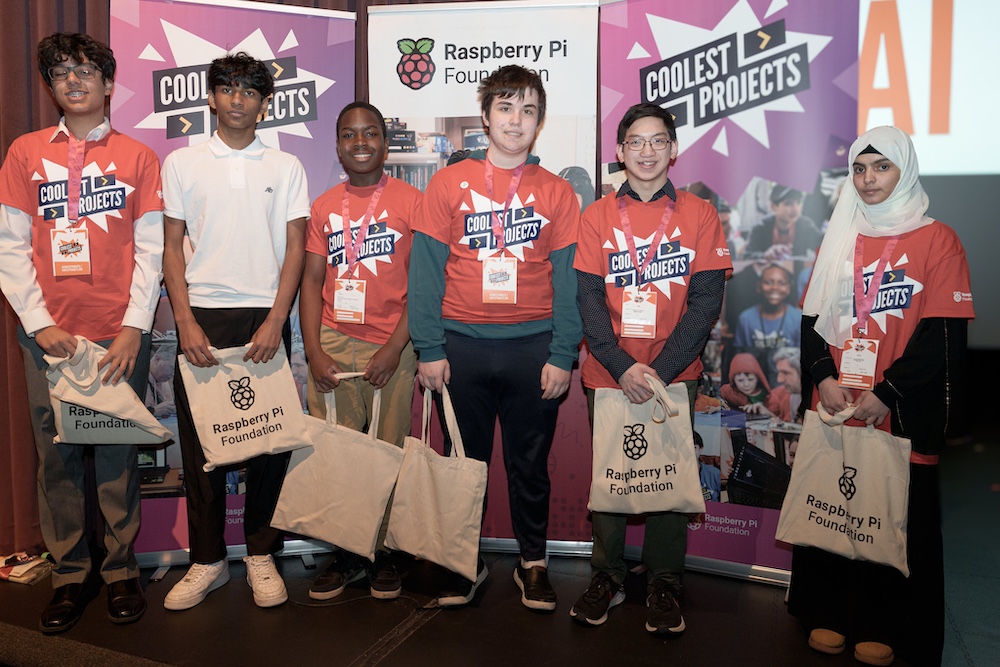
“I had fun at Coolest Projects USA, seeing the different ways that young people like me are taking advantage of technology to try and help the lives of others, and also seeing the creativity and determination that we have.”
A big thank you
We want to say a huge thank you to every young creator who presented a project, to the families who cheered them on, and to our amazing volunteers and partners. We also want to give a special shoutout to our sponsors, Broadcom Foundation and Best Buy Inc., for their incredible support. We couldn’t have done it without you.
Thank you for making Coolest Projects USA 2025 such a special day!

There’s still time to get involved with Coolest Projects this year…
If you missed the event or are feeling inspired, there are still ways to join the Coolest Projects global community!
- The online Coolest Projects showcase is open for entries from young people anywhere in the world. Entries close 28 May.
- Coolest Projects UK takes place in Bradford on 17 May. Come along and discover what young people are creating.
Partner events are held around the world — head to the Coolest Projects website to find out more.
The post Celebrating young innovators at Coolest Projects USA appeared first on Raspberry Pi Foundation.
Fake Student Fraud in Community Colleges
Post Syndicated from Bruce Schneier original https://www.schneier.com/blog/archives/2025/05/fake-student-fraud-in-community-colleges.html
Reporting on the rise of fake students enrolling in community college courses:
The bots’ goal is to bilk state and federal financial aid money by enrolling in classes, and remaining enrolled in them, long enough for aid disbursements to go out. They often accomplish this by submitting AI-generated work. And because community colleges accept all applicants, they’ve been almost exclusively impacted by the fraud.
The article talks about the rise of this type of fraud, the difficulty of detecting it, and how it upends quite a bit of the class structure and learning community.
Slashdot thread.
Security updates for Tuesday
Post Syndicated from corbet original https://lwn.net/Articles/1020222/
Security updates have been issued by Fedora (chromium and kappanhang), Red Hat (osbuild-composer and thunderbird), SUSE (chromedriver), and Ubuntu (c-ares, corosync, mysql-8.0, mysql-8.4, openjdk-17, openjdk-21, openjdk-24, openjdk-8, and openjdk-lts).
The Death of Feminism
Post Syndicated from The Atlantic original https://www.youtube.com/watch?v=1htaJoczjSE
A new AUTOSEL release
Post Syndicated from corbet original https://lwn.net/Articles/1020203/
AUTOSEL is a tool that is used to find kernel patches that should be
considered for backporting into the stable releases. Sasha Levin has announced a new and completely
rewritten version of AUTOSEL for those who would like to play with it.
Unlike the previous version that relied on word statistics and
older neural network techniques, AUTOSEL leverages modern large
language models and embedding technology to provide significantly
more accurate recommendations.
Build a Culture of Monitoring and Get Buy-In with Zabbix
Post Syndicated from Michael Kammer original https://blog.zabbix.com/build-a-culture-of-monitoring-and-get-buy-in-with-zabbix/30085/
In today’s fast-paced, interconnected IT world, simply waiting for something to fail before fixing it isn’t good enough. A proactive approach to monitoring, which aims to identify and address potential issues before they escalate into major disruptions, is a necessity rather than a luxury.
Here at Zabbix, we’ve got plenty of reason to believe that we offer the most flexible monitoring solution available on the market today. However, choosing the best monitoring tool for your organization’s needs is only half the battle – you also need to get buy-in from team members who may not understand the need for monitoring, may be fearful of and resistant to change, and may not be familiar with the technologies behind monitoring.
In this post, we’ll take a look at a few strategies you can use to help win over lukewarm or hesitant colleagues and build a culture of monitoring. We’ll also explore how choosing Zabbix for your monitoring needs can make each strategy a bit easier to implement.
Table of Contents
Strategy 1: Explain the “why”
One of the first questions that you can anticipate during any change initiative is simply, “what for?” The ethos of “don’t fix what isn’t broken” runs strong in the tech community, and unless you go above and beyond to explain why monitoring matters, your team will remain skeptical.
Zabbix can help you make your case by providing you with the evidence you need to bolster your case. We’ve got plenty of testimonials available from tech communities worldwide (including PeerSpot, Gartner, and Capterra), and no matter what field you’re in or how big your team is, we’ve most likely got a case study or two available that shows how monitoring with Zabbix was a game changer for a company like yours.
All of this should help you explain the rationale for the change in an open and transparent way. When it comes to monitoring, sharing details on costs, expected benefits, and what will happen if no change is made will build understanding around why monitoring is necessary and why monitoring with Zabbix is the right answer for your team’s needs.
Strategy 2: Show your team what’s in it for them
One of the most effective ways to get employee buy-in for monitoring is by highlighting the benefits it will bring to individual employees. Show how monitoring can simplify their tasks, improve efficiency, and enhance their work experience, and give them concrete examples of how the technology can make their jobs easier or help them to deliver better results.
We recently had a large managed services provider (MSP) use our monitoring solution as a true “force multiplier”, allowing them to monitor their systems, automate tasks based on real-time events, and provide immediate responses to issues without manual intervention. Thanks to Zabbix, their engineers report higher job satisfaction thanks to no longer having to be “on call” at all hours to solve simple issues, while management has seen productivity skyrocket thanks to their team’s newfound ability to find potential issues before they become real problems.
Strategy 3: Turn important stakeholders into monitoring champions
Determine who monitoring will impact and who needs to be kept informed. This might be team leaders, IT staff, end users, and/or an executive sponsor. Getting input from these groups early on will help you anticipate needs and concerns, and you’ll also want to identify influential employees who are enthusiastic about monitoring and get them to help you promote it.
A great way to help them do so is by encouraging them to attend one (or more) Zabbix events – we’ve got free meetings, online meetups, regional conferences, or even our yearly Summit in Latvia. No matter where you happen to be located, there’s a pretty good chance that we’ll soon be bringing your key people a chance to network with like-minded professionals from multiple industries, expand their knowledge, get answers to their questions, and explore how Zabbix can work for them.
Strategy 4: Provide adequate training
Equipping employees with the skills and knowledge they need to get the most out of a monitoring system means gaining a solid understanding of their current capabilities and then finding out which gaps you most urgently need to fill. Chances are, you’ll need to provide guidance, documentation, hands-on demonstrations, and access to experts – and this is another area where Zabbix has you covered.
Zabbix Certified trainings are designed to help your people learn Zabbix inside and out, giving them the practical knowledge they’ll need to increase their productivity and performance. When you explore our training options, you’ll find a wide variety of courses, everything from one-day sessions that cover the basics to week-long sessions that guarantee users the ability to tackle any Zabbix challenge on their own.
In addition, we’ve got plenty of other free resources available to teams and individuals looking to upskill, including our famously active forum, blog, webinars, and newsletter.
Conclusion
Building a culture of monitoring requires commitment from every level of an organization. By choosing Zabbix as the guide to your monitoring journey and following the strategies outlined in this article, you and your team can successfully implement and maintain a robust monitoring strategy that will help you achieve your organization’s IT goals.
To learn more about what Zabbix can do for you, visit our website.
The post Build a Culture of Monitoring and Get Buy-In with Zabbix appeared first on Zabbix Blog.
NVIDIA RTX Pro 6000 Blackwell Family for Workstations and Servers
Post Syndicated from Cliff Robinson original https://www.servethehome.com/nvidia-rtx-pro-6000-blackwell-family-for-workstations-and-servers/
The NVIDIA RTX Pro 6000 Blackwell family spans three different styles and application scenarios for AI and graphics workloads
The post NVIDIA RTX Pro 6000 Blackwell Family for Workstations and Servers appeared first on ServeTheHome.
The Battle of Albemarle Sound
Post Syndicated from The History Guy: History Deserves to Be Remembered original https://www.youtube.com/watch?v=B7cuXv6D06g
Intelligent coding at your fingertips: Introducing an agentic coding experience in your IDE
Post Syndicated from Brian Beach original https://aws.amazon.com/blogs/devops/amazon-q-developer-agentic-coding-experience/
Back in March, I wrote about the new agentic coding experience within the Amazon Q Developer CLI. Recently, Amazon Q Developer announced that it has added a similar experience to the integrated development environement (IDE). Agentic coding in the IDE allows you to work with Amazon Q Developer to read and write files locally, run bash commands, build code, and more in near real-time through natural language conversations. The new experience redefines how you write, modify, and maintain code by leveraging natural language understanding to seamlessly execute complex workflows. The new agentic coding experience is now available in VS Code with support in other IDEs coming soon.
Background
Before I explain the new agentic coding experience, let’s take a minute to review the existing chat capabilities within the Amazon Q Developer IDE. As the name implies, the traditional chat allows me to have a conversation with Q Developer. This is a great option when I’m learning and planning. It provides a natural back-and-forth dialogue. Personally, I like the traditional chat during the planning phase of the Software Development Lifecycle (SDLC). I can chat with Q Developer to discuss my architecture and the various tradeoffs of different designs before I start working.
However, once I move into the build phase of the SDLC, I prefer the new agentic coding experience. In this new experience, Q Developer can do so much more than just have a conversation. It can directly interact with the development environment, reading and writing files, using various development tools, and even querying AWS resources. This allows for a far more dynamic, hands-on coding workflow compared to the traditional chat interface.
Rather than just discussing requirements, the agentic agent can take direct action to implement them. It can scaffold new projects, update existing code, and provide step-by-step summaries of its progress – all through a seamless, conversational interface right within the IDE. The great news is that I now have both options available to me. I can simply toggle between a traditional chat in the planning phase, and the new agentic coding in the build phase.
Walkthrough
Let’s walk through a simple example using the AWS Cloud Development Kit (CDK). I love CDK, and I use it all the time in my role. However, let’s assume that I don’t have a lot of experience, and want to learn more about CDK before I start using it. Since I just want to learn, I’ll start in the traditional chat experience, and ask Q Developer “How do I create an new CDK app?” As you can see in the following image, Q Developer starts to teach me about CDK. Along with the instructions, Q provides commands that I could copy and paste into my shell to get started.

While this is a great, I am already familiar with CDK. I don’t need to learn how to create a new application. I am ready to start building! Therefore, I will toggle from traditional chat to agentic coding by clicking on the angle bracket pair in the bottom left corner of the chat window. Then, I will ask Q Developer to “Create a new CDK app in this folder using TypeScript.” First, notice that I am not asking a question like I did previously, but I am giving a command. In the following image, you can see that Q Developer is acting on my command rather that teaching me what to do.

This is the power of the new agentic coding. It is not simply teaching me how to create a CDK app. Amazon Q Developer is creating the app for me. There are a few important things that I want to call out here. First, Amazon Q Developer can use tools when it is running agentic coding mode. In this example, Q is using a series of shell commands — mkdir, cd, npx, npm, etc. — to create the CDK app. I will discuss other tools later in this post. Second, Q Developer is asking my permission before it runs these commands. This allows me to retain control over the development process. I’ll click the Run button and allow Q to create the new application resulting in the following project structure.

It’s easy to overlook the power of allowing Q Developer to use tools. By using shell commands, it was able to generate the project using the latest template, and install dependencies for me. Running shell commands is just one of many changes with the agentic coding experience. Next, let’s look at how code generation works in agentic coding.
Code Generation
Amazon Q Developer has been generating code since it first launched in June of 2022. Since then, Amazon Q Developer has evolved, adding new features over time. Code generation began with inline suggestions, followed by chat, and the agent for software development. The new agentic coding, reinvents the code generation experience again. In the following example, I am going to add a Lambda function to the CDK stack that Q Developer created earlier. I ask Q Developer to “Add a new Lambda function that is triggered from the arrival of a file in an existing S3 bucket.”

Multiple important things happened in this example that I want to explain. First, notice that Q Developer edited the CDK Stack to add the new AWS Lambda function. Second, Q Developer used a shell command to create a new folder. Third, Q created a new file for the Lambda function. Forth, it updated the README file. Q took all four of these actions in response to a single prompt. In addition, note that Q Developer is providing a diff for each change, making it easy for me to review the changes. You can see an example of the changes it make to the README.md in the following image. Finally, note that I can undo any of the changes that Q Developer made along the way.

This is a big improvement over the traditional chat experience. Now let’s look at how Q Developer can describe my AWS resources.
Describing AWS resources
Remember that I am building an application that is triggered by the arrival of a file in an existing Amazon Simple Storage Service (Amazon S3) bucket. In the prior example, you can see that I need to pass the name of the bucket in the ExistingBucketName parameter when deploying the stack.
Let’s assume that I have forgotten the name of the bucket I want to use. The new agentic coding experience can help me with this too. In the following example, I ask Q to “List my S3 buckets in the ca-central-1 region?” Once again, Q Developer asks for permission to use the shell. After I accept, Q Developer uses the AWS CLI and lists the buckets I have available in Canada (ca-central-1).

With the name of the bucket, I am ready to deploy my stack. Of course, there still more work to do, but I’ll leave that for another post.
Conclusion
The new agentic coding experience within the Amazon Q Developer IDE represents a significant step forward in integrating powerful AI-driven capabilities directly into the developer’s workflow. By enabling the coding agent to read, write, and execute code locally, access tools, and interact with AWS resources, Q Developer promises to dramatically streamline and enhance the coding process. You can visit the Amazon Q Developer User Guide to install the IDE and start leveraging the new agent chat for free. Give it a try and let me know what you think!
The Future of America’s Health Care
Post Syndicated from The Atlantic original https://www.youtube.com/watch?v=dJancaBuyMQ
[$] Injecting speculation barriers into BPF programs
Post Syndicated from corbet original https://lwn.net/Articles/1018494/
The disclosure of the Spectre
class of hardware vulnerabilities created a lot of pain for kernel
developers (and many others). That pain was especially acutely felt in the
BPF community. While an attacker might have to painfully search the kernel
code base for exploitable code, an attacker using BPF can simply write and
load their own speculation gadgets, which is a much more efficient way of
operating. The BPF community reacted by, among other things, disallowing
the loading of programs that may include speculation gadgets. Luis
Gerhorst would like to change that situation with this patch
series that takes a more direct approach to the problem.