To help make sure that everyone’s up to speed with Zabbix Summit 2024 speakers and their topics, we’re continuing our series of interviews with Andre Morton of AGM Network Consultancy LTD. Keep reading to learn how he feels Zabbix can alleviate the typical pain points of managed service providers (MSPs), see how he uses Zabbix to maintain control of his network, and find out what he appreciates most about Zabbix.
Please tell us a bit about yourself and the journey that led you to AGM Network Consultancy LTD.
I started out studying Network Engineering at the University of Greenwich, and then went on to undertake a Masters of Networks and Security at the University of Kent. During my Masters, I was the a one-man IT Team for a Child Care agency spanning the UK. I then went on to work at three small IT companies/MSPs, being the only Network Engineer at each company and managing networks with 80 – 200 customers.
How long have you been using Zabbix? How has it impacted your everyday tasks?
I have been using Zabbix for about 10 years now. At first, I just used it to get insights via SNMP. Then I began using it to create visual troubleshooting aids for myself and non-networking team members. Finally, I began using Zabbix as my main inventory gathering tool for networking and infrastructure devices. When it comes to that, Zabbix has enabled me to control how I want to monitor the network, avoiding vendor limitations and allowing me to build my own scripts to run tests and actions that I would not otherwise be able to do.
Can you give us a few clues about what we can expect to hear during your Zabbix Summit presentation?
I may have to condense some things, as I don’t want to be too technical or take too long! I’ll definitely talk about what drew me to Zabbix, how I used Zabbix to turn problems that require a large amount of attention and time into scripts that can identify the problems and capture the problem states, and how Zabbix dashboards help me to get a clear overview of customer and site problems/general status. I’ll also speak about scripts that we now use to troubleshoot and undertake remote actions, give examples of what the value of the monitoring data is to MSPs before and after the problem, and let everyone in on my upcoming plans for Zabbix, which include webhooks from the map, scripts; Zabbix’s place in our bespoke systems, and network automation.
What, in your opinion, are the biggest pain points MSPs have, and how can Zabbix help alleviate them?
I’d say that there are two big pain points that Zabbix is of assistance with – providing troubleshooting time for big problems, and making sure that historical data is ready for troubleshooting.
What do you appreciate the most about Zabbix in your role?
Zabbix allows me to drastically reduce the amount of administration and troubleshooting that I have to undertake and provides a live inventory of devices (software/firmware details). Thanks to Zabbix, I don’t have to use multiple tools or log into multiple devices to get software and firmware version details.
Освен с овцете, вълната и пуловерите, през последните години Фарьорските острови стават известни и със своите иновативни идеи: някои от тях инфраструктурни, предвид особеното им географско местоположение, други – творчески, забавни и едновременно полезни.
Фарьорските острови са самоуправляваща се област в рамките на Кралство Дания, но отдалечени на около 1100 км северозападно от него. Парламентът им е един от най-старите в света, водещ началото си от заселването на островите през IX век. Нарича се Льогтинг, в буквален превод Събрание за закони, и в днешно време има 33 членове. С територия от едва 1400 км² и население от 54 320 души (към 2023 г.) Фарьорските острови постигат скоростно развитие през последните няколко десетилетия – от бедна страна с множество малки селца се превръща в модерно и напредничаво общество.
Заради стратегическото им географско разположение във водите между Европа и Северна Америка, Фарьорските острови са военна база на британските и американските войници през Втората световна война. Макар и да звучи парадоксално, войната дава възможност за развитие, тъй като новозаселилите се войници строят летища, пътища и инфраструктура. Днес стандартът на живот е висок, а страната притежава международна фериботна линия, свързваща островите с Дания и Исландия, самостоятелна авиолиния с полети до осем страни и дори ресторант, получил две звезди „Мишлен“.
В миналото придвижването ставало предимно пеша или по вода, като почти всяко семейство разполагало с лодка. С построяването на все повече пътища автомобилите постепенно изместват водния транспорт и от риболовна нация, която разчита на улова за прехраната си, фарьорците се превръщат във все по-модерно и глобализирано общество. Някои хора днес казват, че с изоставянето на лодките си отива и цяло едно знание за плаването, риболова и всички традиции, предавани от поколение на поколение.
Младите днес често не умеят да пускат плавателен съд по вода, да се справят в бурно море или да разпознават рибите.
С развитието на пътищата през ХХ век са построени и много еднолентови тунели, за да се съкрати обиколният морски път от единия край на острова до другия. Днес тунелите наброяват повече от самите острови, на някои места има дори по два тунела един до друг – стария, тесен и мрачен, и новия, просторен и яркоосветен. Пътищата са модерни и поддържани, а тунелите минават през фиорди и през планини, за да свържат отдалечените острови и по-труднодостъпните им селища.
През 2020 г. е отворен първият в света едновременно планински и подводен тунел с три различни отсечки, които са свързани в кръгово движение под водата.
Дълъг 11 км, тунелът преминава неусетно от планински в подводен, достигайки дълбочина до 187 м под морското равнище. Тъй като според фарьорците всяко място може да бъде подходящо за изкуство, центърът на кръговото е осветен в различни цветове и е опасан от художествена творба – скулптурна група от човешки силуети, хванати за ръце, напомнящи обединеността на народа.
Все пак част от градския транспорт още се осъществява и по море с редовни фериботи, но в случай че вълнението на океана не го позволява, се пътува и по въздух – с хеликоптери като междуостровен транспорт. Всеки хеликоптер може да поеме до 12 пътници и пътуването е кратко, но с живописна гледка към зелените планини отвисоко. Цените са достъпни, защото пътуването по въздух не се въприема като луксозно удоволствие, а като обикновено средство за придвижване, когато се налага.
Устойчиви както на суровото време, така и на чуждите влияния, фарьорците са задружни и едновременно с това се обръщат с топлина и любопитство към другите.
Вероятно малкият им брой е предпоставка за повече изява, което, от своя страна, ги кара да чувстват отговорност към обществото и да вярват, че могат да повлияят за промяна към по-добро. Въпреки честата миграция към Дания, много млади хора предпочитат да останат, защото осъзнават, че гласът им ще бъде чут и ще могат да допринесат с нещо за развитието на родното си място.
Освен това
фарьорците се превръщат в един от най-бързо увеличаващите се народи в Европа – близо три пъти за последните сто години.
Много силна е вярата им, че именно те са най-ценният ресурс на страната, защото дори и природните дадености да се изчерпят, хората са онези, които ще намерят и друг начин за оцеляване. Чрез сътрудничеството помежду им се гради по-доброто бъдеще – съединението прави силата, ама по фарьорски.
Освен обединени, фарьорците неведнъж се доказват и като изобретателни и стават известни със забележителните си идеи за развитието на туризма. Пример за това е едно необичайно събитие – ежегодно островите „затварят“ за туристи и „отварят“ за доброволци, които подобряват туристическата инфраструктура. Събитието е национален проект, наречен Closed for Maintenance, Open for Voluntourism („Затворено поради ремонт, отворено за доброволчество“).
Кандидатите от цял свят са избирани на случаен принцип в началото на всяка година. За няколко дни те извършват разнообразни дейности навън: обозначават и облагородяват туристически пътеки на труднодостъпни места, изграждат площадки за красиви гледки и закачат вериги към скалите на потенциално хлъзгави терени. В замяна на работата си те получават подслон в различни селища, както и топла храна по време на престоя си. Участниците работят с ентусиазъм и създават по-добри условия за туризма на островите, но също приятелства и мили спомени.
Започнала като експеримент през 2019 г., инициативата се приема отлично и става традиция. Един от участниците сподели, че проектът наистина има смисъл – доброволците са доволни да поработят навън в прекрасната природа и същевременно с това да свършат нещо наистина полезно.
So, if you read our last post, you undoubtedly know that we were looking to relocate the collection to an organisation that was going to display it and potentially restore it. We had many, many interested parties reach out to us from museums all over the world to private collectors interested in acquiring the machines. When we set out to rescue the 360’s Chris and I decided that our main goal was their preservation, and everything else was by the wayside. We evaluated each and every opportunity presented to us for a new home for the 360’s, and found an organisation who we considered to be exactly what we’d been looking for.
System Source Museum got in touch with us very shortly after we made the post to register their interest. We had an initial engagement call with them, and were very impressed by their attitude and approach. Ideally Chris & I wanted to maintain ownership of the systems, and System Source were very happy to take them on a long term loan basis. Chris flew over to see them in Maryland and was again extremely impressed with their collection, display, team, and approach to restoration & conservation. We drew up a contract together, signed the various agreements, and two of their team, Ryan Schiff (Vice President) & Ryan Burke (Assistant Museum Director), flew to the UK to package and ship the systems.
Soon enough, a delivery of bespoke sized pallets (made for the sizes of the machines) arrived at Creslow, and a huge delivery of packing material was delivered to my house (filling my lounge!):
The team arrived the next day and we set about planning how to package the machines, spares, consumables etc. safely and securely for their transatlantic voyage. The System Source chaps had procured and had delivered a steel strapping machine and a large amount of strapping which would be used to secure the machines to the pallets. This was coupled with moving blankets, cardboard corners, bubble wrap, packaging tape etc. etc. Soon enough we started loading machines onto the pallets:
When it came to the larger items, these presented a problem. The forklift truck available at Creslow doesn’t fit into the building because of the cage height, and the floor probably wouldn’t support its weight anyway. We therefore had to come up with a different solution. Cue the return of the ramp we built all of those years ago on a street in Nuremberg!
Yes, it still exists, and it had one final use moving IBM’s. It may have cost 150 euros in wood, but we’ve had our moneys worth!
Pretty quickly the 370 was loaded, strapped, and wrapped:
Now, the big question arrived. With a long, custom sized pallet, how do you move it? Two pallet trucks, one at each end, would’ve been possible but would’ve restricted where the machines could be placed. It was then we discovered that you can buy double length, wide fork pallet trucks. Dutifully the next day the System Source team went off to Pallet Truck World (yes, really) to acquire such an item:
This made moving everything about 100 times easier, and we could now shift the pallets around the room with ease.
So, next up was the first 360 CPU. This presented more of a challenge as the cables hanging under the system, which are wired directly into the backplane, meant we couldn’t use the ramp method. After scratching our heads for a few minutes we concocted a solution involving a car jack & a pile of wood:
Now this probably looks really sketchy, and thats because, like everything moving big iron related, it was. First, we jacked up the front of the machine to a height slightly above that of the pallet, and then wedged in some wood on the supporting rail. We then positioned the pallet under the front wheels of the CPU, and smacked out the wood. This enabled us to roll the machine forward onto the pallet as far as the angle of attack would allow, and we then jacked up the back of the machine and rolled it forward on the jack enabling us to locate it fully onto the pallet. This may sound slightly convoluted but it was actually a very quick operation, and by the third machine we were getting quite good at it!
Because the cables are hard wired into the CPU’s, we had to bundle them and cable tie them to the ends of the machines, later wrapping them in a significant amount of bubble wrap and blankets to protect them from crush risk:
We continued loading items throughout the next few days, using the same method each time:
For the exceptionally heavy item, the master tape drive, we decided to reinforce the pallet for extra security. This involved a trip to Wickes to buy some plywood (Wickes is no Bauhaus, trust me), which we then cut and secured to the pallet:
This enabled the loading of the nearly 1 tonne tape drive:
We then boxed and crated up the spares & consumables for easy shipping:
Some of the slightly more bizarre items we had acquired, like spare System 3 parts, were also palletised and used as support structures to ship other items such as loose pannels:
With all of the machines palletised and strapped down, we set about wrapping everything in bubble wrap, moving blankets, and pallet wrap:
We also cut and used pieces of 2×4 to box in the wheels so the machines wouldn’t move at all during transit:
Having started on the 10th of May, and finished packing everything on the 17th, it was time for the trucks. Because of the Francis Scott Key Bridge collapse at the Port of Baltimore, shipping had become a real challenge. It took the team several days to identify and engage with a shipping provider that could do the end to end move for a reasonable price. Eventually they did, and two trucks arrived to take the machines. I dutifully climbed into the forklift and loaded them one by one onto the trucks. Please don’t judge my forklift driving too harshly, at the time the brakes were… well, the less said the better.
With everything loaded up, the trucks departed and we waved goodbye to the machines as they’re off to their new home.
On October 18th System Source Museum will be holding a special gallery opening for the IBM 360’s, and I’m very happy to say that we’ll be in attendance to see them in their new home. We’re exceptionally pleased that we found somewhere that was not only willing to take the machines on a loan basis, but is going to display them to the public, restore them to working order, and use them as tools to educate future generations. It was a real pleasure working with the team from System Source on the project, and I’d like to extend to them my personal thanks for the highly professional and effective approach they’ve taken to the project.
I’ll write an update when we go to see the machines in their new home, and hopefully we’ll be able to keep updating the blog as they progress with their restoration.
Amazon Managed Streaming for Apache Kafka (Amazon MSK) is a fully managed service that makes it easy to build and run Kafka clusters on Amazon Web Services (AWS). When working with Amazon MSK, developers are interested in accessing the service locally. This allows developers to test their application with a Kafka cluster that has the same configuration as production and provides an identical infrastructure to the actual environment without needing to run Kafka locally.
This post presents a practical approach to accessing your Amazon MSK environment for development purposes through a bastion host using a Secure Shell (SSH) tunnel (a commonly used secure connection method). Whether you’re working with Amazon MSK Serverless, where public access is unavailable, or with provisioned MSK clusters that are intentionally kept private, this post guides you through the steps to establish a secure connection and seamlessly integrate your local development environment with your MSK resources.
Solution overview
The solution allows you to directly connect to the Amazon MSK Serverless service from your local development environment without using Direct Connect or a VPN. The service is accessed with the bootstrap server DNS endpoint boot-<<xxxxxx>>.c<<x>>.kafka-serverless.<<region-name>>.amazonaws.com on port 9098, then routed through an SSH tunnel to a bastion host, which connects to the MSK Serverless cluster. In the next step, let’s explore how to set up this connection.
The flow of the solution is as follows:
The Kafka client sends a request to connect to the bootstrap server
The DNS query for your MSK Serverless endpoint is routed to a locally configured DNS server
The locally configured DNS server routes the DNS query to localhost.
The SSH tunnel forwards all the traffic on port 9098 from the localhost to the MSK Serverless server through the Amazon Elastic Compute Cloud (Amazon EC2) bastion host.
The following image shows the architecture diagram.
Prerequisites
Before deploying the solution, you need to have the following resources deployed in your account:
For Windows users, install Linux on Windows with Windows Subsystem for Linux 2 (WSL 2) using Ubuntu 24.04. For guidance, refer to How to install Linux on Windows with WSL.
This guide assumes an MSK Serverless deployment in us-east-1, but it can be used in every AWS Region where MSK Serverless is available. Furthermore, we are using OS X as operating system. In the following steps replace msk-endpoint-url with your MSK Serverless endpoint URL with IAM authentication. The MSK endpoint URL has a format like boot-<<xxxxxx>>.c<<x>>.kafka-serverless.<<region-name>>.amazonaws.com.
Solution walkthrough
To access your Amazon MSK environment for development purposes, use the following walkthrough.
Configure local DNS server OSX
Install Dnsmasq as a local DNS server and configure the resolver to resolve the Amazon MSK. The solution uses Dnsmasq because it can compare DNS requests against a database of patterns and use these to determine the correct response. This functionality can match any request that ends in kafka-serverless.us-east-1.amazonaws.com and send 127.0.0.1 in response. Follow these steps to install Dnsmasq:
Update brew and install Dnsmasq using brew
brew up
brew install dnsmasq
Start the Dnsmasq service
sudo brew services start dnsmasq
Reroute all traffic for Serverless MSK (kafka-serverless.us-east-1.amazonaws.com) to 127.0.0.1
Now that you have a working DNS server, you can configure your operating system to use it. Configure the server to send only .kafka-serverless.us-east-1.amazonaws.com queries to Dnsmasq. Most operating systems that are similar to UNIX have a configuration file called /etc/resolv.conf that controls the way DNS queries are performed, including the default server to use for DNS queries. Use the following steps to configure the OS X resolver:
OS X also allows you to configure additional resolvers by creating configuration files in the /etc/resolver/ This directory probably won’t exist on your system, so your first step should be to create it:
sudo mkdir -p /etc/resolver
Create a new file with the same name as your new top-level domain (kafka-serverless.us-east-1.amazonaws.com) in the /etc/resolver/ directory and add 127.0.0.1 as a nameserver to it by entering the following command.
sudo tee /etc/resolver/kafka-serverless.us-east-1.amazonaws.com >/dev/null <<EOF
nameserver 127.0.0.1
EOF
Configure local DNS server Windows
In Windows Subsystem for Linux, first install Dnsmasq, then configure the resolver to resolve the Amazon MSK and finally add localhost as the first nameserver.
Update apt and install Dnsmasq using apt. Install the telnet utility for later tests:
The next step is to create the SSH tunnel, which will allow any connections made to localhost:9098 on your local machine to be forwarded over the SSH tunnel to the target Kafka broker. Use the following steps to create the SSH tunnel:
Replace bastion-host-dns-endpoint with the public DNS endpoint of the bastion host, which comes in the style of <<xyz>>.compute-1.amazonaws.com, and replace ec2-key-pair.pem with the key pair of the bastion host. Then create the SSH tunnel by entering the following command.
Leave the SSH tunnel running and open a new terminal window.
Test the connection to the Amazon MSK server by entering the following command.
telnet <<msk-endpoint-url>> 9098
The output should look like the following example.
Trying 127.0.0.1...
Connected to boot-<<xxxxxxxx>>.c<<x>>.kafka-serverless.us-east-1.amazonaws.com.
Escape character is '^]'.
Testing
Now configure the Kafka client to use IAM Authentication and then test the setup. You find the latest Kafka installation at the Apache Kafka Download site. Then unzip and copy the content of the Dafka folder into ~/kafka.
Download the IAM authentication and unpack it
cd ~/kafka/libs
wget https://github.com/aws/aws-msk-iam-auth/releases/download/v2.2.0/aws-msk-iam-auth-2.2.0-all.jar
cd ~
Configure Kafka properties to use IAM as the authentication mechanism
cat <<EOF > ~/kafka/config/client-config.properties

# Sets up TLS for encryption and SASL for authN.

security.protocol = SASL_SSL

# Identifies the SASL mechanism to use.

sasl.mechanism = AWS_MSK_IAM

# Binds SASL client implementation.

sasl.jaas.config = software.amazon.msk.auth.iam.IAMLoginModule required;


# Encapsulates constructing a SigV4 signature based on extracted credentials.

# The SASL client bound by "sasl.jaas.config" invokes this class.

sasl.client.callback.handler.class = software.amazon.msk.auth.iam.IAMClientCallbackHandler

EOF
Enter the following command in ~/kafka/bin to create an example topic. Make sure that the SSH tunnel created in the previous section is still open and running.
To remove the solution, complete the following steps for Mac users:
Delete the file /etc/resolver/kafka-serverless.us-east-1.amazonaws.com
Delete the entry address=/kafka-serverless.us-east-1.amazonaws.com/127.0.0.1 in the file $(brew --prefix)/etc/dnsmasq.conf
Stop the Dnsmasq service sudo brew services stop dnsmasq
Remove the Dnsmasq service sudo brew uninstall dnsmasq
To remove the solution, complete the following steps for WSL users:
Delete the file /etc/dnsmasq.conf
Delete the entry nameserver 127.0.0.1 in the file /etc/resolv.conf
Remove the Dnsmasq service sudo apt remove dnsmasq
Remove the telnet utility sudo apt remove telnet
Conclusion
In this post, I presented you with guidance on how developers can connect to Amazon MSK Serverless from local environments. The connection is done using an Amazon MSK endpoint through an SSH tunnel and a bastion host. This enables developers to experiment and test locally, without needing to setup a separate Kafka cluster.
About the Author
Simon Peyer is a Solutions Architect at Amazon Web Services (AWS) based in Switzerland. He is a practical doer and passionate about connecting technology and people using AWS Cloud services. A special focus for him is data streaming and automations. Besides work, Simon enjoys his family, the outdoors, and hiking in the mountains.
The Python community has been roiled, to a certain extent, by an action
taken by
the steering council (SC): the three-month suspension
of a unnamed—weirdly—Python core developer. Tim Peters is the developer
in question, as he has acknowledged,
though it could easily be deduced from the SC message. Peters has been
involved in the
project from its early days and, among many other things, is the author of PEP 20 (“The Zen of
Python”). The suspension was due to violations of the project’s code of
conduct that stem from the discussion around a somewhat controversial set
of proposed changes to the bylaws for the Python Software Foundation
(PSF) back in mid-June.
This blog post is co-written with Hardeep Randhawa and Abhay Kumar from HPE.
HPE Aruba Networking, formerly known as Aruba Networks, is a Santa Clara, California-based security and networking subsidiary of Hewlett Packard Enterprise company. HPE Aruba Networking is the industry leader in wired, wireless, and network security solutions. Hewlett-Packard acquired Aruba Networks in 2015, making it a wireless networking subsidiary with a wide range of next-generation network access solutions.
Aruba offers networking hardware like access points, switches, routers, software, security devices, and Internet of Things (IoT) products. Their large inventory requires extensive supply chain management to source parts, make products, and distribute them globally. This complex process involves suppliers, logistics, quality control, and delivery.
This post describes how HPE Aruba automated their Supply Chain management pipeline, and re-architected and deployed their data solution by adopting a modern data architecture on AWS.
Challenges with the on-premises solution
As the demand surged with time, it was imperative that Aruba build a sophisticated and powerful supply chain solution that could help them scale operations, enhance visibility, improve predictability, elevate customer experience, and drive sustainability. To achieve their vision of a modern, scalable, resilient, secure, and cost-efficient architecture, they chose AWS as their trusted partner due to the range of low-cost, scalable, and reliable cloud services they offer.
Through a commitment to cutting-edge technologies and a relentless pursuit of quality, HPE Aruba designed this next-generation solution as a cloud-based cross-functional supply chain workflow and analytics tool. The application supports custom workflows to allow demand and supply planning teams to collaborate, plan, source, and fulfill customer orders, then track fulfillment metrics via persona-based operational and management reports and dashboards. This also includes building an industry standard integrated data repository as a single source of truth, operational reporting through real time metrics, data quality monitoring, 24/7 helpdesk, and revenue forecasting through financial projections and supply availability projections. Overall, this new solution has empowered HPE teams with persona-based access to 10 full-scale business intelligence (BI) dashboards and over 350 report views across demand and supply planning, inventory and order management, SKU dashboards, deal management, case management, backlog views, and big deal trackers.
Overview of the solution
This post describes how HPE Aruba automated their supply chain management pipeline, starting from data migration from varied data sources into a centralized Amazon Simple Storage Service (Amazon S3) based storage to building their data warehouse on Amazon Redshift with the publication layer built on a third-party BI tool and user interface using ReactJS.
The following diagram illustrates the solution architecture.
In the following sections, we go through the key components in the diagram in more detail:
Aruba’s source repository includes data from three different operating regions in AMER, EMEA, and APJ, along with one worldwide (WW) data pipeline from varied sources like SAP S/4 HANA, Salesforce, Enterprise Data Warehouse (EDW), Enterprise Analytics Platform (EAP) SharePoint, and more. The data sources include 150+ files including 10-15 mandatory files per region ingested in various formats like xlxs, csv, and dat. Aruba’s data governance guidelines required that they use a single centralized tool that could securely and cost-effectively review all source files with multiple formats, sizes, and ingestion times for compliance before exporting them out of the HPE environment. To achieve this, Aruba first copied the respective files to a centralized on-premises staging layer.
2. Data migration
Aruba chose AWS Transfer Family for SFTP for secure and efficient file transfers from an on-premises staging layer to an Amazon S3 based landing zone. AWS Transfer Family seamlessly integrates with other AWS services, automates transfer, and makes sure data is protected with encryption and access controls. To prevent deduplication issues and maintain data integrity, Aruba customized these data transfer jobs to make sure previous transfers are complete before copying the next set of files.
3. Regional distribution
On average, Aruba transfers approximately 100 files, with total size ranging from 1.5–2 GB into the landing zone daily. The data volume increases each Monday with the weekly file loads and at the beginning of each month with the monthly file loads. These files follow the same naming pattern, with a daily system-generated timestamp appended to each file name. Each file arrives as a pair with a tail metadata file in CSV format containing the size and name of the file. This metadata file is later used to read source file names during processing into the staging layer.
The source data contains files from three different operating Regions and one worldwide pipeline that needs to be processed per local time zones. Therefore, separating the files and running a distinct pipeline for each was necessary to decouple and enhance failure tolerance. To achieve this, Aruba used Amazon S3 Event Notifications. With each file uploaded to Amazon S3, an Amazon S3 PUT event invokes an AWS Lambda function that distributes the source and the metadata files Region-wise and loads them into the respective Regional landing zone S3 bucket. To map the file with the respective Region, this Lambda function uses Region-to-file mapping stored in a configuration table in Amazon Aurora PostgreSQL-Compatible Edition.
4. Orchestration
The next requirement was to set up orchestration for the data pipeline to seamlessly implement the required logic on the source files to extract meaningful data. Aruba chose AWS Step Functions for orchestrating and automating their extract, transform, and load (ETL) processes to run on a fixed schedule. In addition, they use AWS Glue jobs for orchestrating validation jobs and moving data through the data warehouse.
They used Step Functions with Lambda and AWS Glue for automated orchestration to minimize the cloud solution deployment timeline by reusing the on-premises code base, where possible. The prior on-premises data pipeline was orchestrated using Python scripts. Therefore, integrating the existing scripts with Lambda within Step Functions and AWS Glue helped accelerate their deployment timeline on AWS.
5. File processing
With each pipeline running at 5:00 AM local time, the data is further validated, processed, and then moved to the processing zone folder in the same S3 bucket. Unsuccessful file validation results in the source files being moved to the reject zone S3 bucket directory. The following file validations are run by the Lambda functions invoked by the Step Functions workflow:
The Lambda function validates if the tail file is available with the corresponding source data file. When each complete file pair lands in the Regional landing zone, the Step Functions workflow considers the source file transfer as complete.
By reading the metadata file, the file validation function validates that the names and sizes of the files that land in the Regional landing zone S3 bucket match with the files on the HPE on-premises server.
6. Data quality checks
When the files land in the processing zone, the Step Functions workflow invokes another Lambda function that converts the raw files to CSV format followed by stringent data quality checks. The final validated CSV files are loaded into the temp raw zone S3 folder.
The data quality (DQ) checks are managed using DQ configurations stored in Aurora PostgreSQL tables. Some examples of DQ checks include duplicate data check, null value check, and date format check. The DQ processing is managed through AWS Glue jobs, which are invoked by Lambda functions from within the Step Functions workflow. A number of data processing logics are also integrated in the DQ flow, such as the following:
Flag-based deduplication – For specific files, when a flag managed in the Aurora configuration table is enabled, the process removes duplicates before processing the data
Pre-set values replacing nulls – Similarly, a preset value of 1 or 0 would imply a NULL in the source data based on the value set in the configuration table
7. Archiving processed files
When the CSV conversion is complete, the original raw files in the processing zone S3 folder are archived for 6 months in the archive zone S3 bucket folder. After 6 months, the files on AWS are deleted, with the original raw files retained in the HPE source system.
8. Copying to Amazon Redshift
When the data quality checks and data processing are complete, the data is loaded from the S3 temp raw zone into the curated zone on an Redshift provisioned cluster, using the COPY command feature.
9. Running stored procedures
From the curated zone, they use AWS Glue jobs, where the Redshift stored procedures are orchestrated to load the data from the curated zone into the Redshift publish zone. The Redshift publish zone is a different set of tables in the same Redshift provisioned cluster. The Redshift stored procedures process and load the data into fact and dimension tables in a star schema.
10. UI integration
Amazon OpenSearch Service is also integrated with the flow for publishing mass notifications to the end-users through the user interface (UI). The users can also send messages and post updates via the UI with the OpenSearch Service integration.
11. Code Deployment
Aruba uses AWS CodeCommit and AWS CodePipeline to deploy and manage a bi-monthly code release cycle, the frequency for which can be increased on-demand as per deployment needs. The release happens across four environments – Development, Testing, UAT and Production – deployed through DevOps discipline, thus enabling shorter turnaround time to ever-changing user requirements and upstream data source changes.
12. Security & Encryption
User access to the Aruba SC360 portal is managed via SSO with MFA authentication and data security managed via direct integration of the AWS solution with HPE IT’s unified access management API. All the data pipelines between HPE on-premises sources and S3 are encrypted for enhanced security.
13. Data Consumption
Aruba SC360 application provides a ‘Private Space’ feature to other BI/Analytics teams within HPE to run and manage their own data ingestion pipeline. This has been built using Amazon Redshift data sharing feature, which has enabled Aruba to securely share access to live data in their Amazon Redshift cluster, without manually moving or copying the data. Thus, the HPE internal teams could build their own data workloads on core Aruba SC360 data while maintaining data security and code isolation.
14. Final Steps
The data is finally fetched into the publication layer, which consists of a ReactJS-based user interface accessing the data in the Amazon publish zone using Spring Boot REST APIs. Along with data from the Redshift data warehouse, notifications updated in the OpenSearch Service tables are also fetched and loaded into the UI. Amazon Aurora PostgreSQL is used to maintain the configuration values for populating the UI. To build BI dashboards, Aruba opted to continue using their existing third-party BI tool due to its familiarity among internal teams.
Conclusion
In this post, we showed you how HPE Aruba Supply Chain successfully re-architected and deployed their data solution by adopting a modern data architecture on AWS.
The new solution has helped Aruba integrate data from multiple sources, along with optimizing their cost, performance, and scalability. This has also allowed the Aruba Supply Chain leadership to receive in-depth and timely insights for better decision-making, thereby elevating the customer experience.
To learn more about the AWS services used to build modern data solutions on AWS, refer to the AWS public documentation and stay up to date through the AWS Big Data Blog.
About the authors
Hardeep Randhawa is a Senior Manager – Big Data & Analytics, Solution Architecture at HPE, recognized for stewarding enterprise-scale programs and deployments. He has led a recent Big Data EAP (Enterprise Analytics Platform) build with one of the largest global SAP HANA/S4 implementations at HPE.
Abhay Kumar is a Lead Data Engineer in Aruba Supply Chain Analytics and manages the Cloud Infrastructure for the Application at HPE. With 11+ years of experience in the IT industry domains like banking, supply chain and Abhay has a strong background in Cloud Technologies, Data Analytics, Data Management, and Big Data systems. In his spare time, he likes reading, exploring new places and watching movies.
Ritesh Chaman is a Senior Technical Account Manager at Amazon Web Services. With 14 years of experience in the IT industry, Ritesh has a strong background in Data Analytics, Data Management, Big Data systems and Machine Learning. In his spare time, he loves cooking, watching sci-fi movies, and playing sports.
Sushmita Barthakur is a Senior Solutions Architect at Amazon Web Services, supporting Enterprise customers architect their workloads on AWS. With a strong background in Data Analytics and Data Management, she has extensive experience helping customers architect and build Business Intelligence and Analytics Solutions, both on-premises and the cloud. Sushmita is based out of Tampa, FL and enjoys traveling, reading and playing tennis.
Much has changed in the 2024 United States presidential election since the June 27 debate between Donald Trump and Joe Biden, then the presumptive nominees for the November election. Now, over two months later, on September 10, the debate was between Kamala Harris, the Democratic nominee, and Donald Trump, the Republican nominee. In this post, we will explore the event’s impact on Internet traffic in specific states where there was a bigger impact than during the Biden-Trump debate, as well as examine cyberattacks, email phishing trends, and general DNS data on candidates, news, and election-related activity.
Typically, we have observed that election days don’t come with significant changes to Internet traffic, and the same is true for debates. Yet, debates can also draw attention that impacts traffic, especially when there is heightened anticipation. The 2024 debates were not only aired on broadcast and cable television, but also streamed on platforms like YouTube, increasing their reach and impact.
Key takeaways:
The September 10 Harris-Trump debate caused bigger drops in Internet traffic in the US than the Biden-Trump debate on June 27.
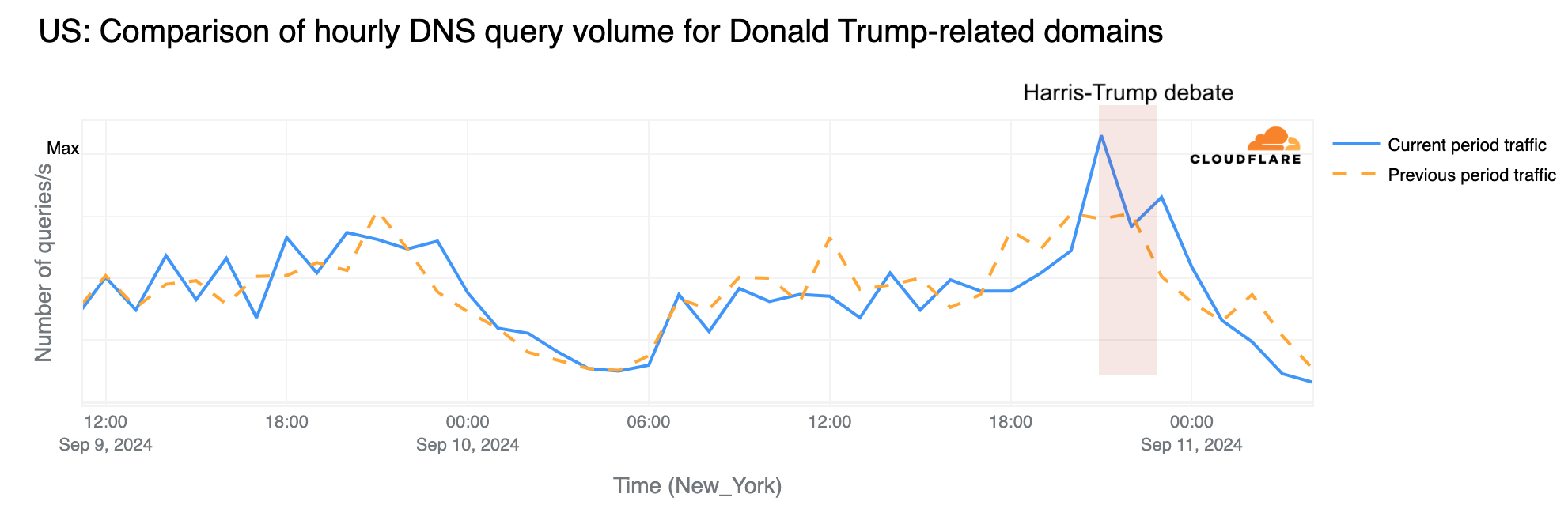
There was also a noticeable increase in DNS traffic to both Kamala Harris-related and Donald Trump-related domains, with Trump-related DNS traffic peaking around the start of the debate and Harris-related DNS traffic peaking after the debate ended, around the time Taylor Swift announced she was endorsing Harris.
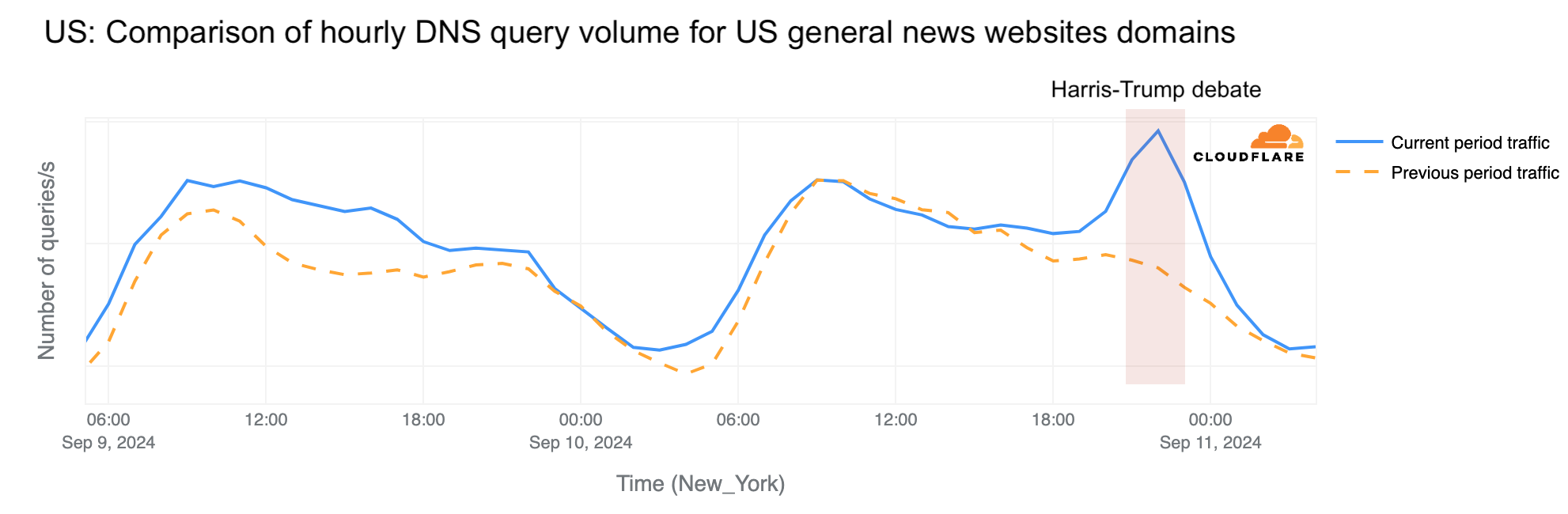
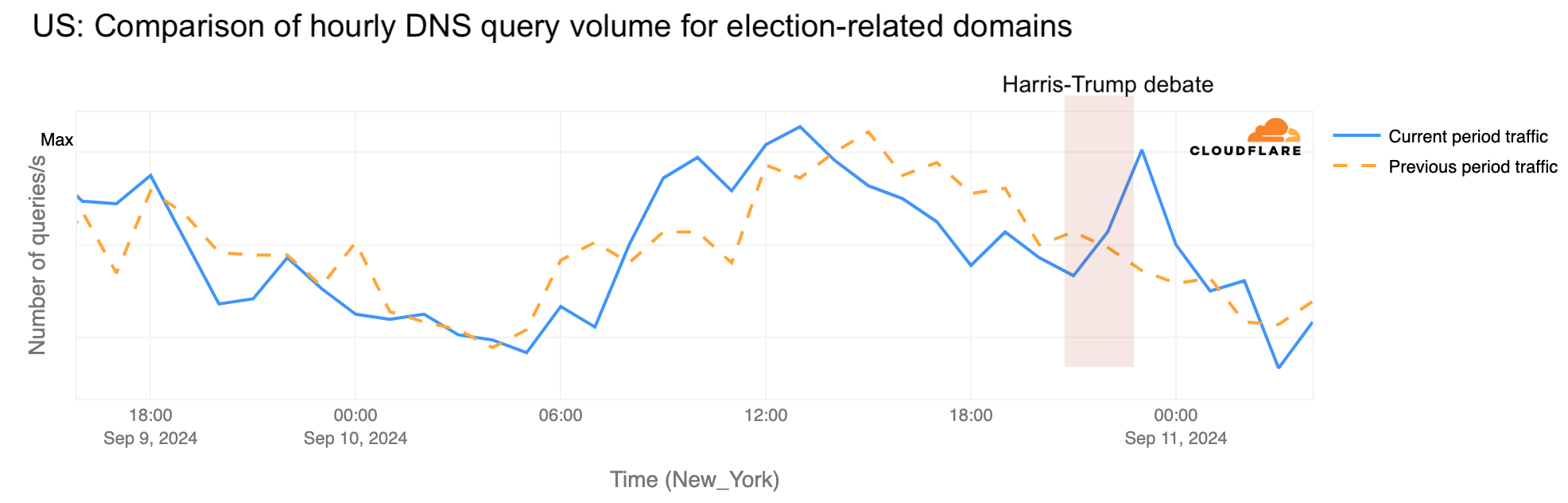
We also observed increases in DNS traffic to US news media outlets and election-related domains right after the debate ended.
Donald Trump remains the candidate with the most mentions in email subjects and the highest percentages of emails classified as spam (26.7%) and malicious (2.4%). Since mid-August, there has been a slight increase in the percentage of spam and malicious emails mentioning Kamala Harris.
Traffic drop in the US
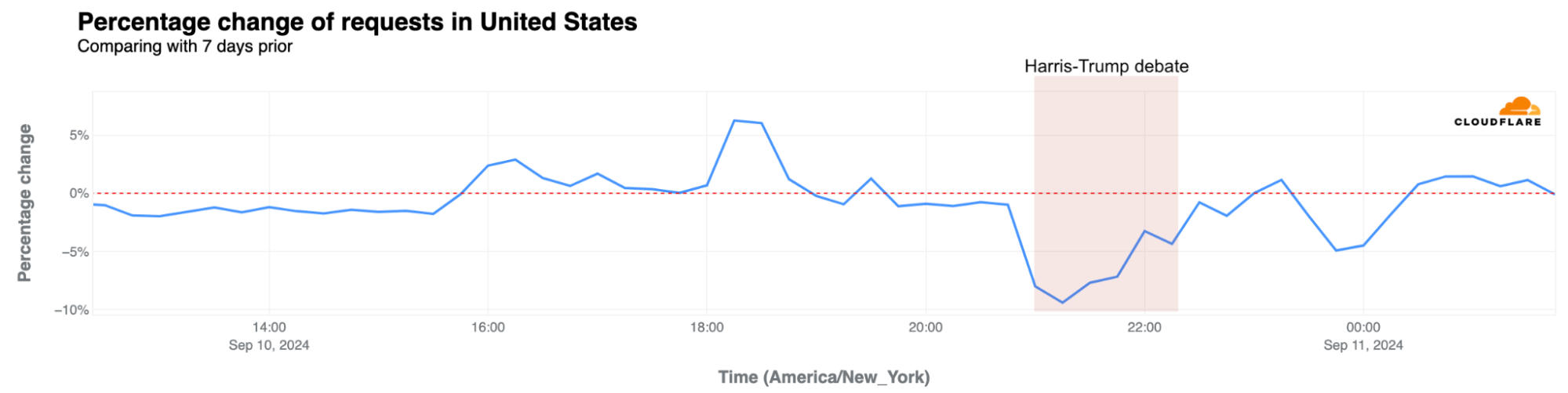
During the September 10, 2024, debate between Harris and Trump, hosted by ABC News at 21:00 EST (01:00 UTC) in Philadelphia, Pennsylvania, Cloudflare noted a trend similar to the Biden-Trump debate, with a clear drop in nationwide Internet requests, falling as much as 9% below the same time a week prior at 21:15 EST (01:15 UTC). At the end of the debate, around 22:45 EST (02:45 UTC), the drop was less evident, at just 2%. Traffic increased slightly just after the debate.
Note: there were two four-minute breaks during the debate, at around 22:00 and 22:30, and our data here has 15-minute granularity.
There’s a clear difference between this second debate, with a drop of up to 9%, and the first one between Biden and Trump on June 27, when the traffic dropped just 2% below the same time a week prior. Interestingly, the biggest drop occurred at the same time in both debates, right after they started, at 21:15 EST (01:15 UTC).
Internet traffic dips across US states
Traffic shifts at the time of the debate, as compared to the previous week, can reveal more detail at a state-level perspective than at the country level. The map below summarizes traffic changes observed at a state level. A key observation is that traffic declines at a state level were much more pronounced during the Harris-Trump debate, than during the Biden-Trump debate in late June.
(Source: Cloudflare; created with Datawrapper)
The most significant traffic drops were observed in Vermont (-25%), Montana (-22%), and Idaho (-19%). More populous states such as California (-11%), Texas (-10%), and New York (-14%) also experienced notable declines in traffic.
Just for comparison, here’s the state map from that June 27 Biden-Trump debate:
(Source: Cloudflare; created with Datawrapper)
The initial minutes of the Harris-Trump debate triggered the largest traffic declines in most states, at least up until the first break, at around 21:30 ET (01:30 UTC).
In the next table, we provide a detailed breakdown of the same perspective shown on the US map ordered by the magnitude of the drop in traffic. We include the time of the biggest traffic drop compared to the previous week, at a 5-minute granularity, and also the percentage of the drop compared to the previous week. As noted above, the largest declines appeared to occur earlier in the debate.
State
Drop in traffic (%)
Local Time
UTC
Vermont
-25%
21:05 EDT
1:05
Montana
-22%
19:10 MDT
1:10
Idaho
-19%
19:10 MDT
1:10
Wyoming
-19%
19:15 MDT
1:15
North Dakota
-18%
20:15 CDT
1:15
Delaware
-15%
21:20 EDT
1:20
Illinois
-15%
20:20 CDT
1:20
Mississippi
-14%
20:05 CDT
1:05
New York
-14%
21:05 EDT
1:05
Rhode Island
-14%
21:45 EDT
1:45
West Virginia
-14%
21:15 EDT
1:15
Alabama
-13%
20:05 CDT
1:05
Georgia
-13%
21:20 EDT
1:20
South Carolina
-13%
21:15 EDT
1:15
Virginia
-13%
21:15 EDT
1:15
Colorado
-12%
19:45 MDT
1:45
Connecticut
-12%
21:05 EDT
1:05
Nevada
-12%
18:20 PDT
1:20
New Jersey
-12%
21:20 EDT
1:20
Alaska
-11%
17:15 AKDT
1:15
California
-11%
18:15 PDT
1:15
Florida
-11%
21:05 EDT
1:05
North Carolina
-11%
21:05 EDT
1:05
Wisconsin
-11%
20:20 CDT
1:20
Arkansas
-10%
20:05 CDT
1:05
District of Columbia
-10%
21:55 EDT
1:55
Missouri
-10%
20:25 CDT
1:25
Oregon
-10%
18:40 PDT
1:40
Pennsylvania
-10%
21:05 EDT
1:05
South Dakota
-10%
20:20 CDT
1:20
Texas
-10%
20:05 CDT
1:05
Maryland
-9%
21:20 EDT
1:20
Massachusetts
-9%
21:20 EDT
1:20
New Hampshire
-9%
21:05 EDT
1:05
Oklahoma
-9%
20:05 CDT
1:05
Arizona
-8%
18:15 MST
1:15
Indiana
-8%
21:05 EDT
1:05
Iowa
-8%
20:05 CDT
1:05
Kentucky
-8%
21:05 EDT
1:05
Maine
-8%
21:15 EDT
1:15
Nebraska
-8%
19:45 MDT
1:45
Kansas
-7%
20:25 CDT
1:25
Louisiana
-7%
20:20 CDT
1:20
Michigan
-7%
21:20 EDT
1:20
Minnesota
-7%
20:30 CDT
1:30
New Mexico
-7%
19:25 MDT
1:25
Washington
-7%
18:05 PDT
1:05
Hawaii
-6%
15:20 HST
1:20
Ohio
-6%
21:15 EDT
1:15
Tennessee
-6%
20:05 CDT
1:05
Utah
-6%
19:10 MDT
1:10
Swing state drops in traffic higher than first debate
The seven swing states that are said to be decisive in the election — Arizona, Georgia, Michigan, Nevada, North Carolina, Pennsylvania, and Wisconsin — each saw traffic drop between 8% and 13%, which is more than during the Biden-Trump debate (between 5% and 8% at that time). Here’s a more focused view of those swing states for easier visualization:
State
Drop in traffic
Local Time
UTC
Arizona
-8%
18:15 MST
1:15
Georgia
-13%
21:20 EDT
1:20
Michigan
-7%
21:20 EDT
1:20
Nevada
-12%
18:20 PDT
1:20
North Carolina
-11%
21:05 EDT
1:05
Pennsylvania
-10%
21:05 EDT
1:05
Wisconsin
-11%
20:20 CDT
1:20
DNS trends
Shifting our attention to domain trends, our 1.1.1.1 resolver data highlights a more targeted impact during and around the debate. Let’s start with Kamala Harris-related insights.
Harris and the Taylor Swift effect
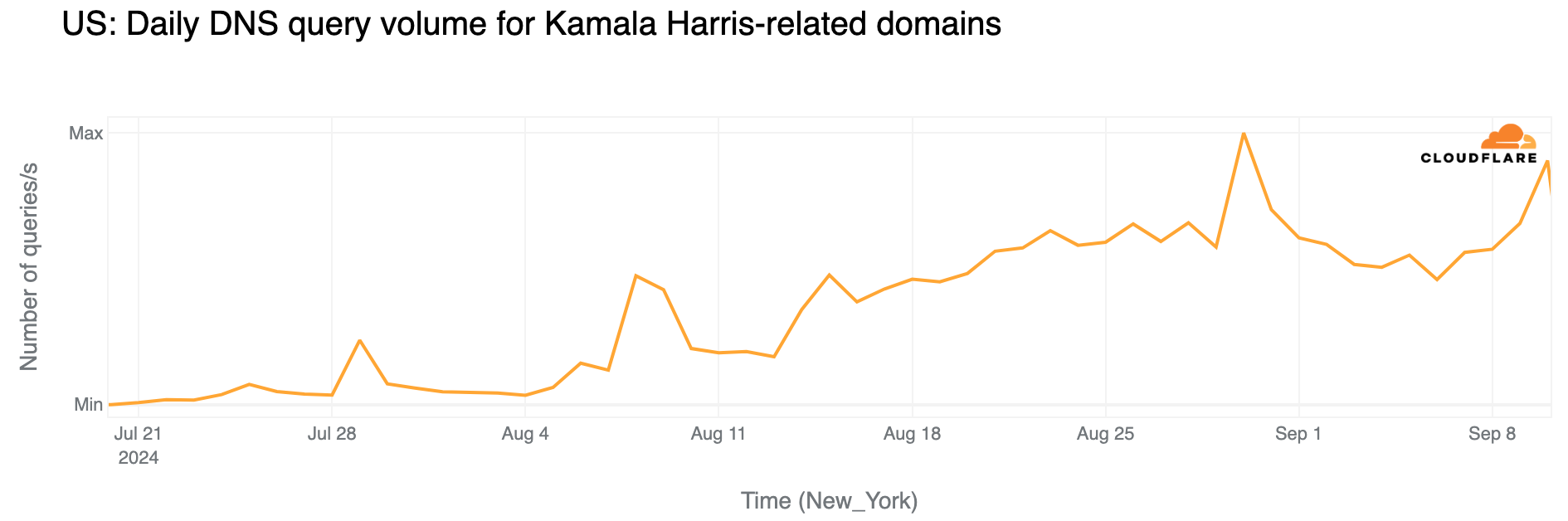
Since July 21, the date of Biden’s withdrawal and endorsement of Harris, daily DNS traffic to Harris-related domains has significantly increased, with notable peaks on August 30 (the day after the Harris-Walz interview on CNN) and September 10 (the debate with Trump).
From an hourly perspective, the impact of the debate on Kamala Harris-related sites is evident, with increased DNS traffic throughout the day (September 10). The peak occurred at the debate’s start (21:00 ET / 01:00 UTC) with a 54% increase from the previous week, and again after it ended (23:00 ET / 03:00 UTC) with a 56% rise. This spike coincided with Taylor Swift’s endorsement of Kamala Harris.
Trump and the Elon Musk interview effect
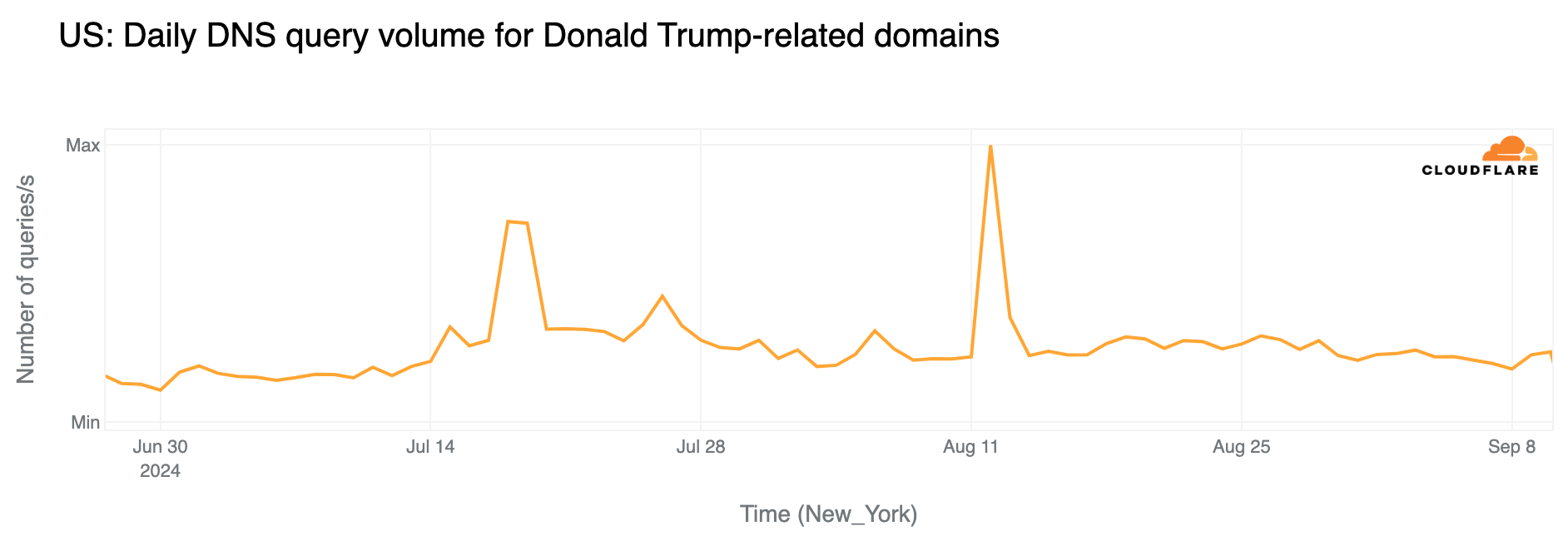
Donald Trump, having a longer-standing campaign and websites compared to Kamala Harris, shows different trends. Aggregated daily DNS traffic to Trump-related domains has also increased in recent months. Significant peaks were observed on July 15 (two days after the assassination attempt), then during the Republican National Convention (August 19-22), with the highest spike occurring on August 12, following Elon Musk’s interview with Trump on X.
Hourly data shows the debate’s impact on Trump-related sites with a noticeable increase around the debate’s start (21:00 ET / 01:00 UTC), where DNS traffic was 46% higher than the previous week. This elevated traffic continued for a few hours, after the debate ended.
From news to election-related sites
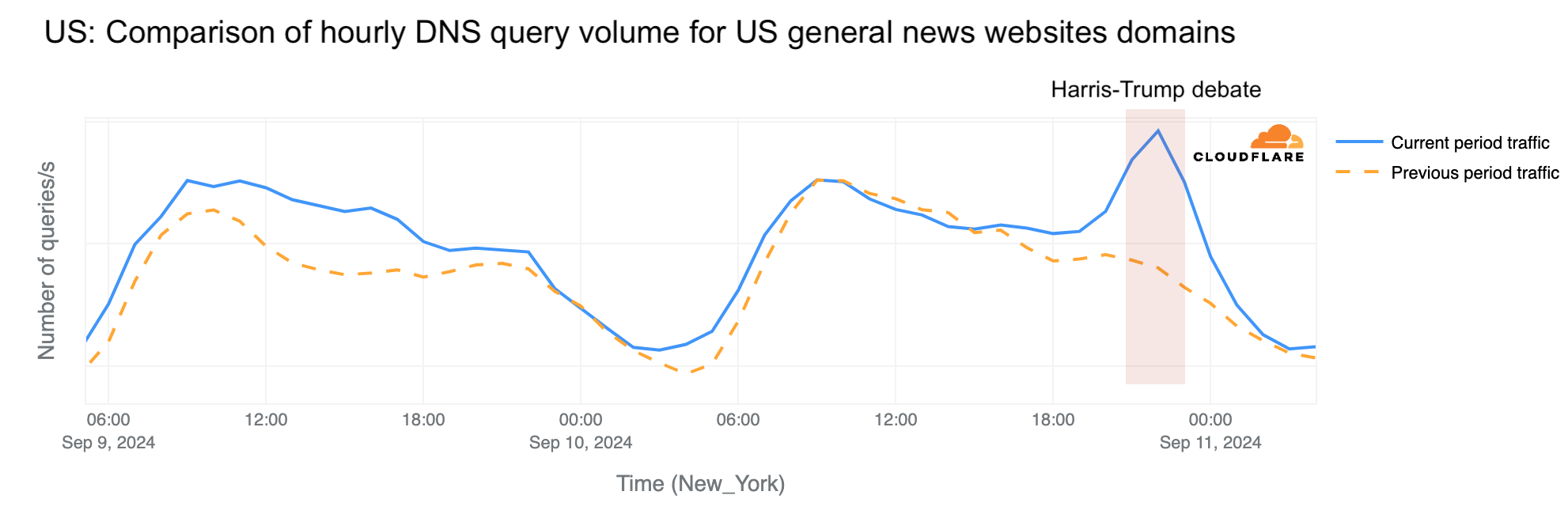
Like previous US election-related events, the debate generated significant interest in US news organizations, leading to a rise in aggregated DNS traffic to general US news sites. This increase peaked during the debate at 22:00 ET (02:00 UTC), with DNS traffic 62% higher than the previous week. The elevated DNS traffic began before the debate and persisted afterward, with a 19% increase at 20:00 ET (00:00 UTC) and a 25% increase at 00:00 ET (04:00 UTC).
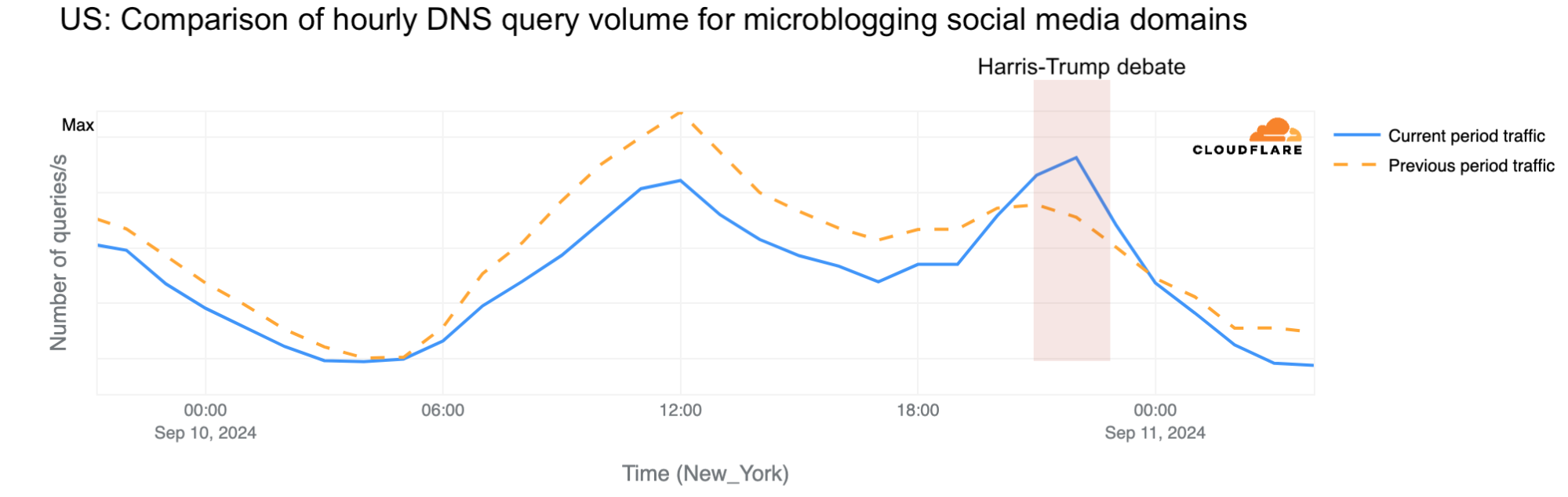
Microblogging social platforms like X or Threads outperformed their previous week’s traffic throughout the debate, peaking at 16% growth around 22:00 ET (02:00 UTC).
Additionally, there was a notable increase in DNS traffic to election-related websites, including official voting registration and election sites. During the morning of September 10 in the US, DNS traffic was 38% higher at 10:00 ET (14:00 UTC), with a significant spike at 23:00 ET (03:00 UTC) right after the debate, where DNS traffic surged by 76% compared to the previous week.
Harris-Trump: spam and malicious emails
From a cybersecurity perspective, trending events, topics, and individuals often attract more emails, including malicious, phishing, and spam messages. Our earlier analysis covered email trends involving “Joe Biden” and “Donald Trump” since January. We’ve since updated it to include Kamala Harris after the Democratic Convention.
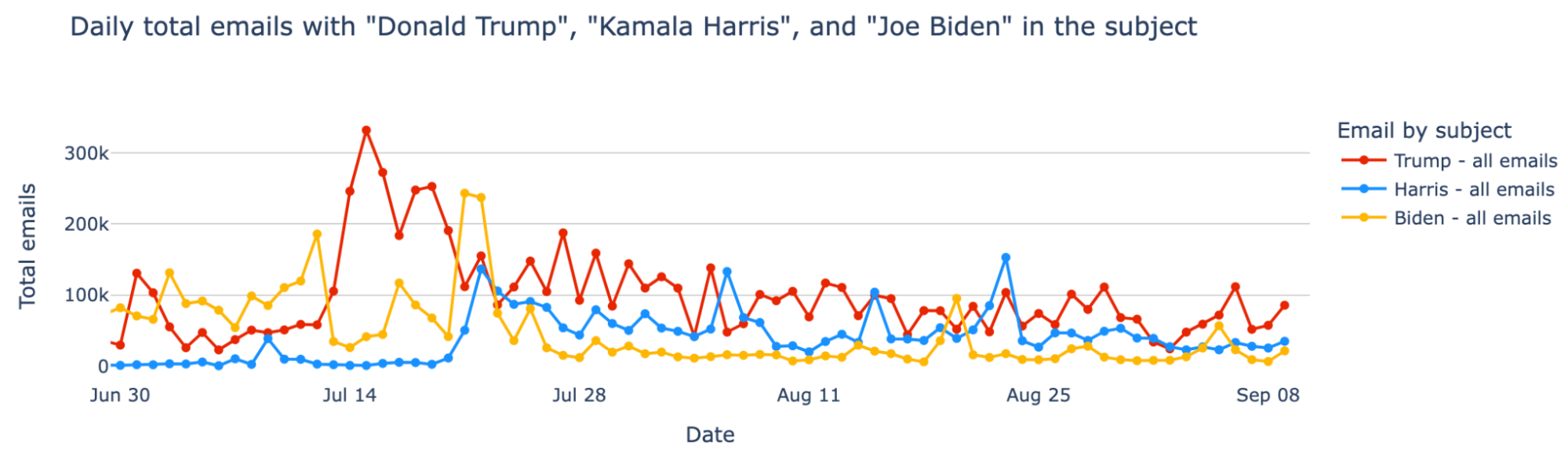
From June 1, 2024, through August 21, Cloudflare’s Cloud Email Security service processed over 16 million emails that included the names “Donald Trump”, “Joe Biden”, or “Kamala Harris” in the subject, with 8.7 million referencing Trump, 4.8 million referencing Biden, and 3 million referencing Harris.
The chart below highlights a surge in emails mentioning Trump in mid-July, contrasting with a drop in the number of emails mentioning Biden in the subject and an increase in emails mentioning Harris.
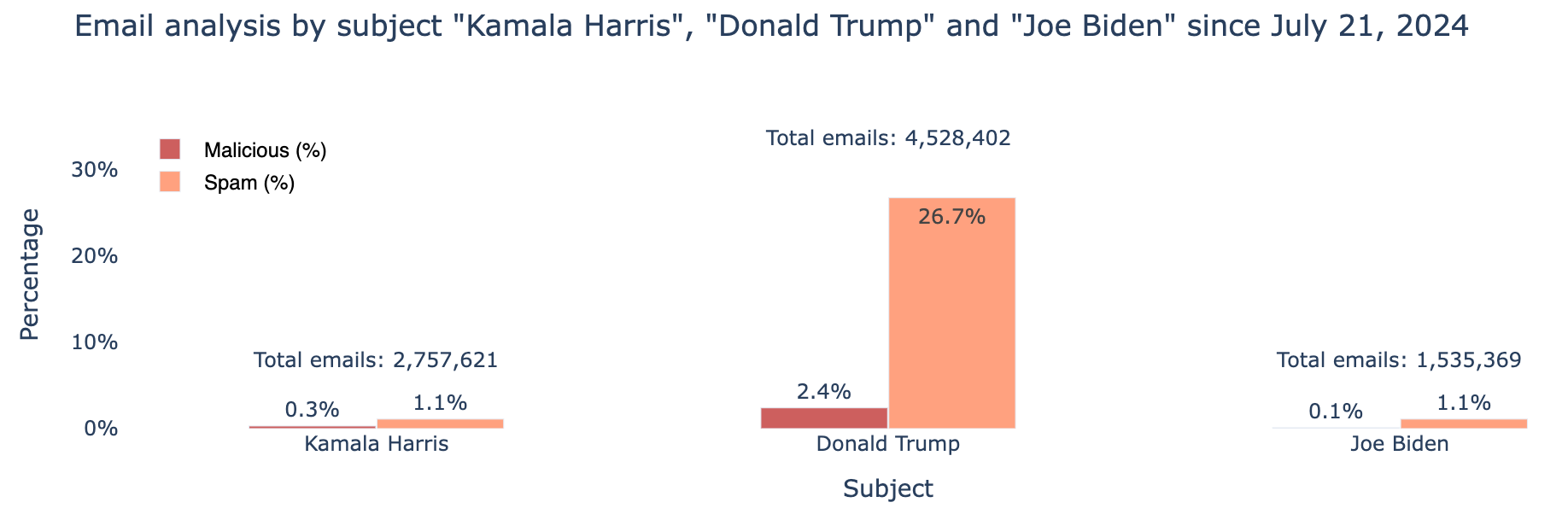
Since July 21, following changes in the presumptive Democratic candidate, over 4.5 million emails mentioned “Donald Trump,” over 1.5 million mentioned “Joe Biden,” and around 2.8 million mentioned “Kamala Harris” in the subject. Of these, 26.7% of emails with Trump’s name were classified as spam, and 2.4% were classified as malicious. For Kamala Harris, 1.1% were classified as spam and 0.2% were classified as malicious, while Biden’s figures were 1.1% for spam and 0.1% for malicious.
Since mid-August, there has been a slight increase in the percentage of spam and malicious emails mentioning Kamala Harris. Trump remains the candidate with the most mentions in email subjects and the highest percentages of emails classified as spam and malicious.
September attacks on political and news sites
In our blog posts about several of the 2024 elections, we have noted that attacks on politically-related websites have remained a significant threat this year. In Europe, we’ve seen political parties and associated websites targeted around elections. We previously reported on DDoS attacks around the Republican National Convention and Democratic National Convention.
In our post about the Democratic National Convention, we showed that during late July and August, Cloudflare blocked DDoS attacks targeting three US politically related organizations, including a site associated with one of the major parties, with attacks occurring just before the Democratic Convention.
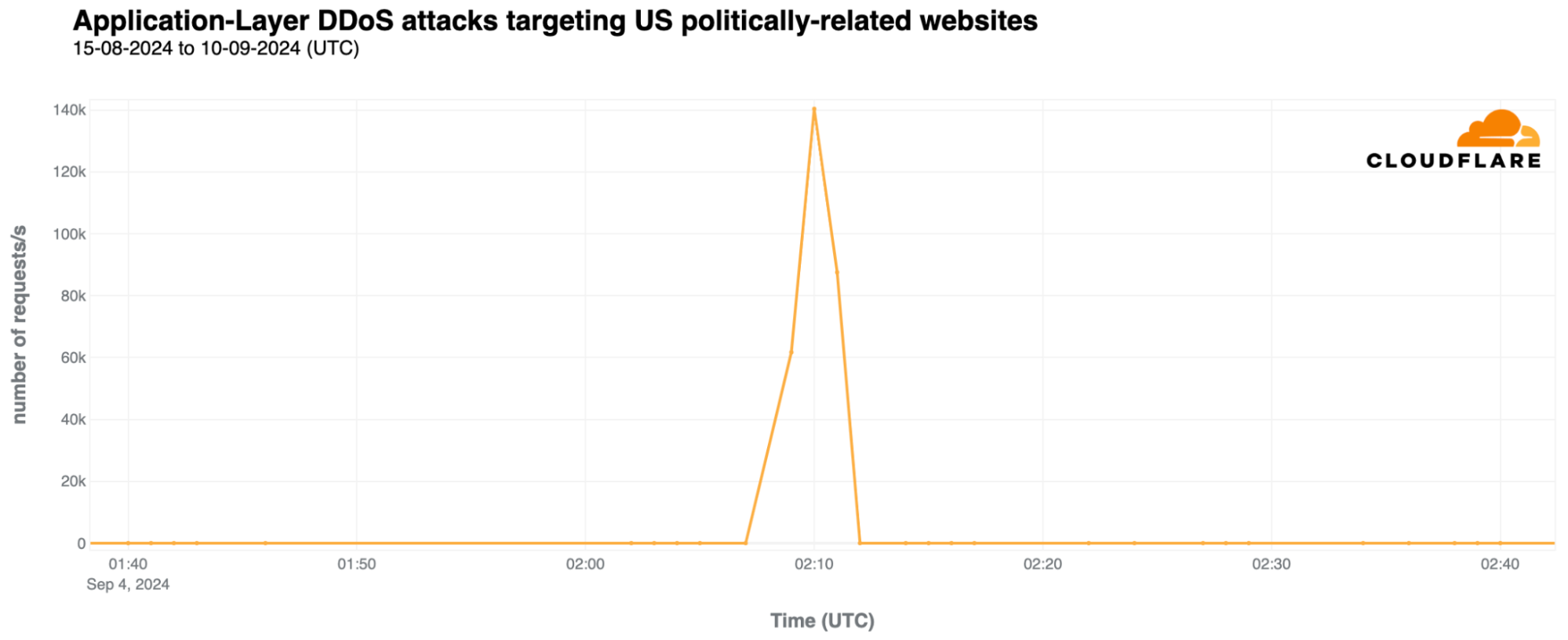
The largest DDoS attack recorded in recent days against politically-related websites targeted specifically a US political-party related website on September 4, peaking at 140,000 requests per second (rps) and lasting about 5 minutes.
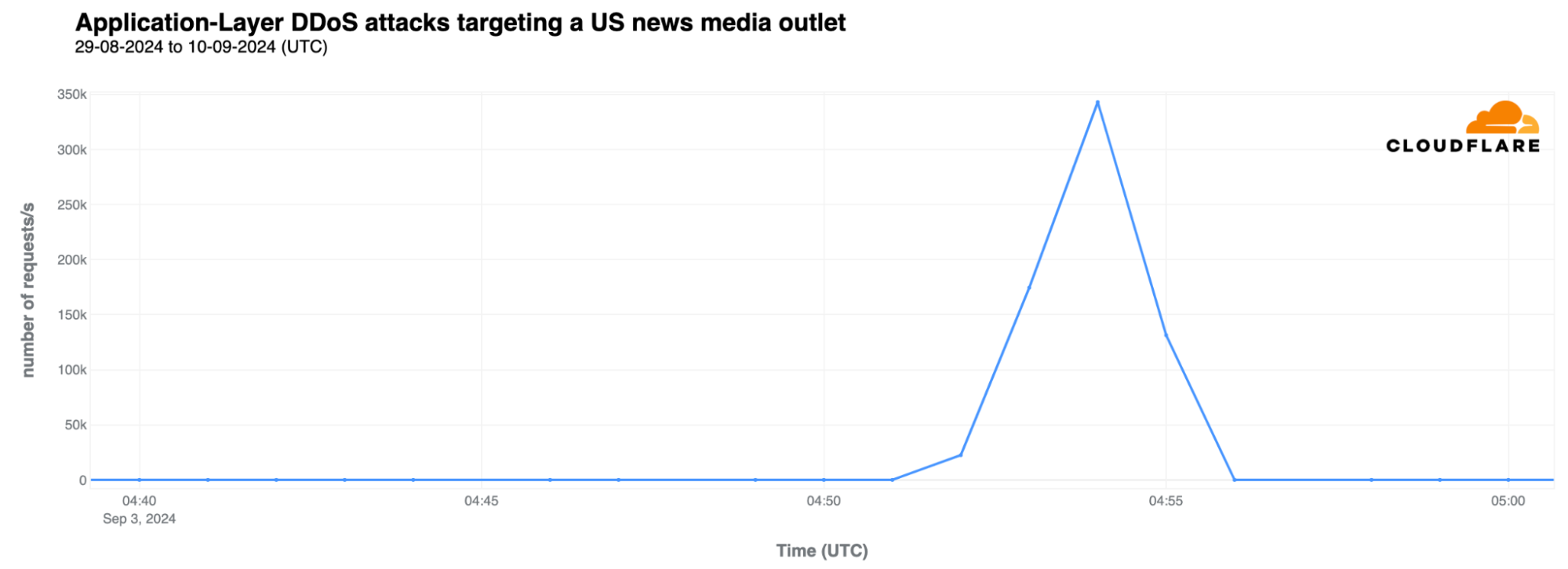
But it’s not only US politically-related websites that could be the target of cyber attacks. News organizations are often attacked during relevant events, as we saw during the first year of the war in Ukraine, for example. Already in September, we’ve seen an example of a relevant US news organization that covers politics being the target of a DDoS attack on September 3, peaking at 343,000 requests per second (rps) and lasting about 5 minutes.
As highlighted in our Q2 DDoS report, most DDoS attacks are short-lived, as exemplified by the two mentioned attacks. Also, 81% of HTTP DDoS attacks peak at under 50,000 requests per second (rps), and only 7% reach between 100,000 and 250,000 rps. While a 140,000 rps attack might seem minor to Cloudflare, it can be devastating for websites not equipped to handle such high levels of traffic.
Conclusion
In this analysis of the Harris-Trump debate, we’ve observed that the September 10 debate caused bigger drops in traffic in the US than the Biden-Trump debate in late June. There was also a noticeable increase in DNS traffic to both Kamala Harris-related and Donald Trump-related domains, as well as to US news media outlets and election-related domains — in this case, right after the debate ended.
If you’re interested in more trends and insights about the Internet and elections, check out Cloudflare Radar, specifically our 2024 Elections Insights report. It will be updated throughout the year as elections (or election-related events) occur.
Security updates have been issued by AlmaLinux (389-ds:1.4, dovecot, emacs, and glib2), Fedora (bluez, iwd, libell, linux-firmware, seamonkey, vim, and wireshark), Mageia (apr, libtiff, Nginx, openssl, orc, unbound, webmin, and zziplib), Red Hat (389-ds:1.4), and SUSE (containerd, curl, go1.22, go1.23, gstreamer-plugins-bad, kernel, ntpd-rs, python-Django, and python311).
Today, we’re excited to expand our recent Unified Risk Posture announcement with more information on our latest integrations with CrowdStrike. We previously shared that our CrowdStrike Falcon Next-Gen SIEM integration allows for deeper analysis and further investigations by unifying first- and third-party data, native threat intelligence, AI, and workflow automation to allow your security teams to focus on work that matters.
This post explains how Falcon Next-Gen SIEM allows customers to identify and investigate risky user behavior and analyze data combined with other log sources to uncover hidden threats. By combining Cloudflare and CrowdStrike, organizations are better equipped to manage risk and decisively take action to stop cyberattacks.
By leveraging the combined capabilities of Cloudflare and CrowdStrike, organizations combine Cloudflare’s email security and zero trust logging capabilities with CrowdStrike’s dashboards and custom workflows to get better visibility into their environments and remediate potential threats. Happy Cog, a full-service digital agency, currently leverages the integration. Co-Founder and President Matthew Weinberg said: ‘The integration of Cloudflare’s robust Zero Trust capabilities with CrowdStrike Falcon Next-Gen SIEM enables organizations to gain a more comprehensive view of the threat landscape and take action to mitigate both internal and external risks posed by today’s security challenges.’
Cloudflare Email Security with Falcon Next-Gen SIEM
With Cloudflare Email Security’s configurable policies, organizations can now push indicators of compromise (IoC) alerts to Falcon Next-Gen SIEM, notifying analysts about suspicious activity, such as a user engaging with a phishing email. By proactively alerting analysts when suspicious activity is detected, Cloudflare and CrowdStrike can provide early detection of account compromises or insider threats.
Cloudflare Zero Trust Logs with Falcon Next-Gen SIEM
We are also integrating Cloudflare’s Zero Trust platform with Falcon Next-Gen SIEM. This allows our mutual customers to push Cloudflare Zero Trust logs from Cloudflare Access and Cloudflare Gateway to Falcon Next-Gen SIEM for better visualization, analysis, and remediation. This integration allows Cloudflare logs to be used to customize and enhance Falcon Next-Gen SIEM detections and trigger CrowdStrike workflows to automatically configure a response action. An example workflow: based on a new detection of a user’s access request being deemed fraudulent, or if a user is engaging with risky websites, the Falcon platform can trigger Cloudflare to move users to affected user groups and apply adaptive access control policies, such as access isolating or quarantining the user.
How To Get Started
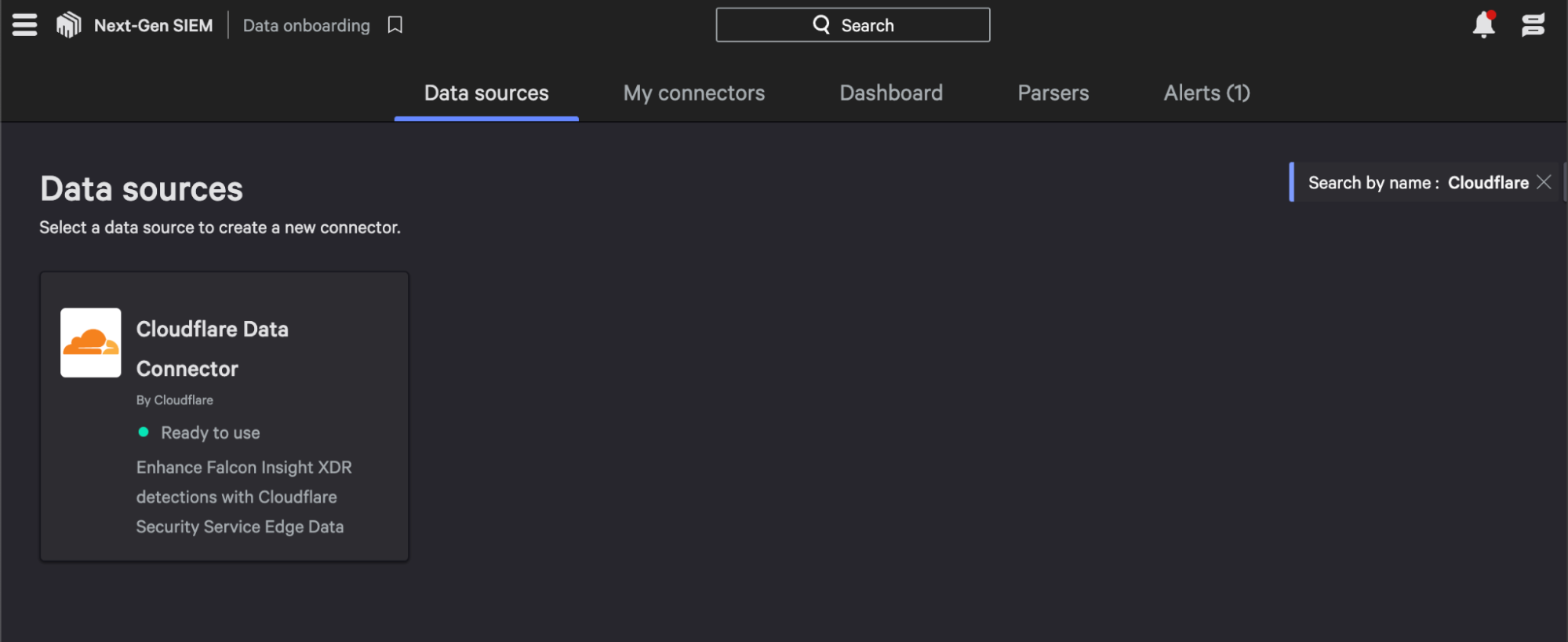
To connect Cloudflare Zero Trust logs, start with the Falcon Next-Gen SIEM module. Navigate to the Data Connectors tab of your Falcon Next-Gen SIEM dashboard and select the Cloudflare Data Connector.
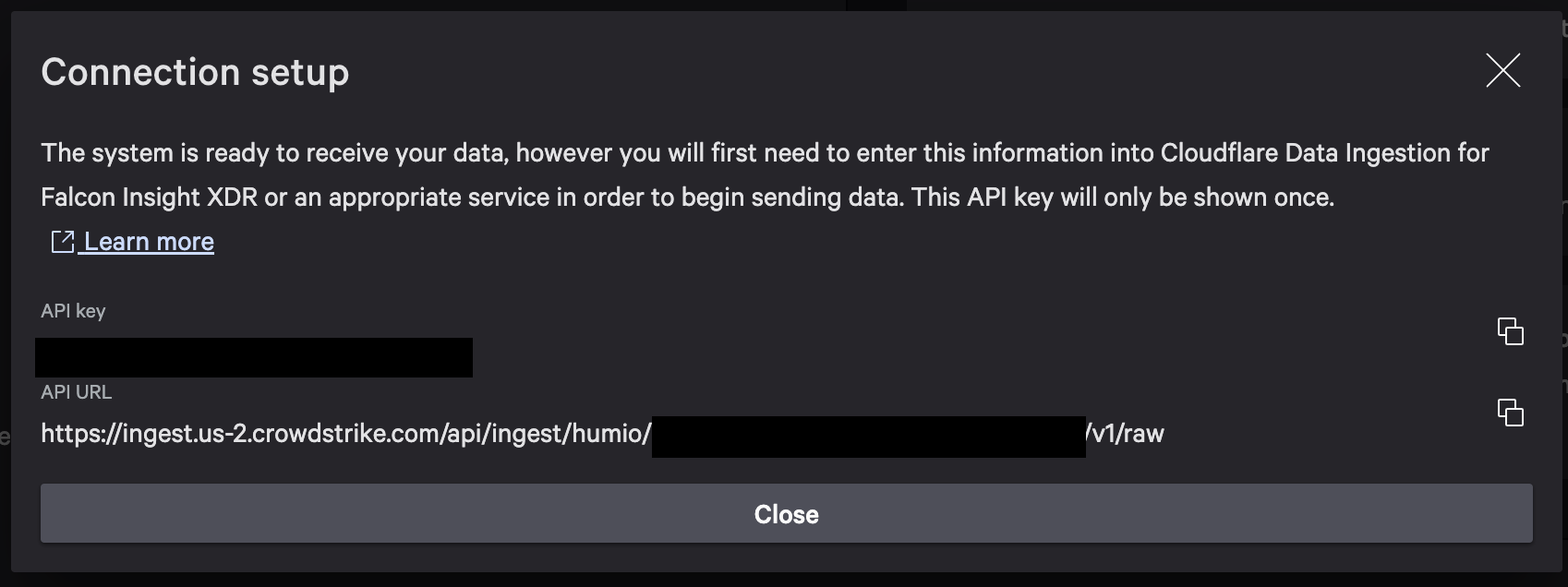
Give the connector a name and select “Save”, and you will receive two pieces of information: an API key and an API URL. Be sure to make note of the key, as it will only be shown once.
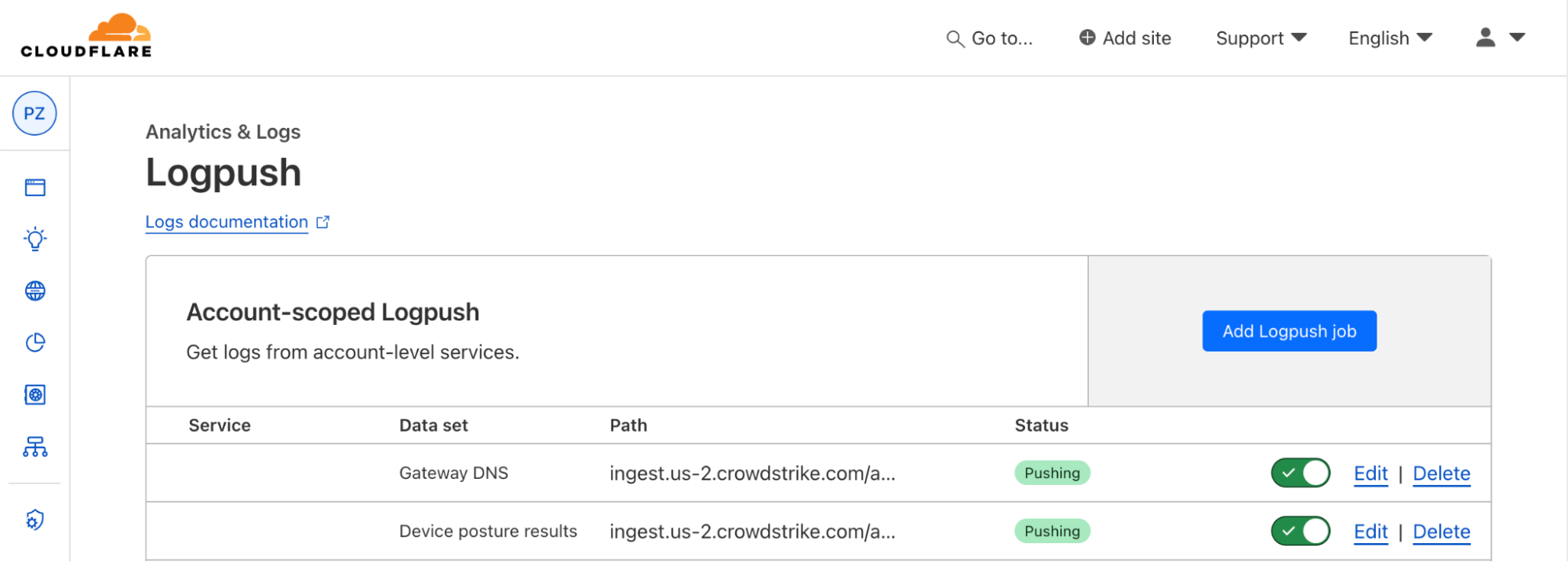
Next, in Cloudflare, create an HTTP logpush job via API, and format the “destination_conf” field as follows:
<DATASET> follows a dot delimited syntax, so http_requests becomes http.requests
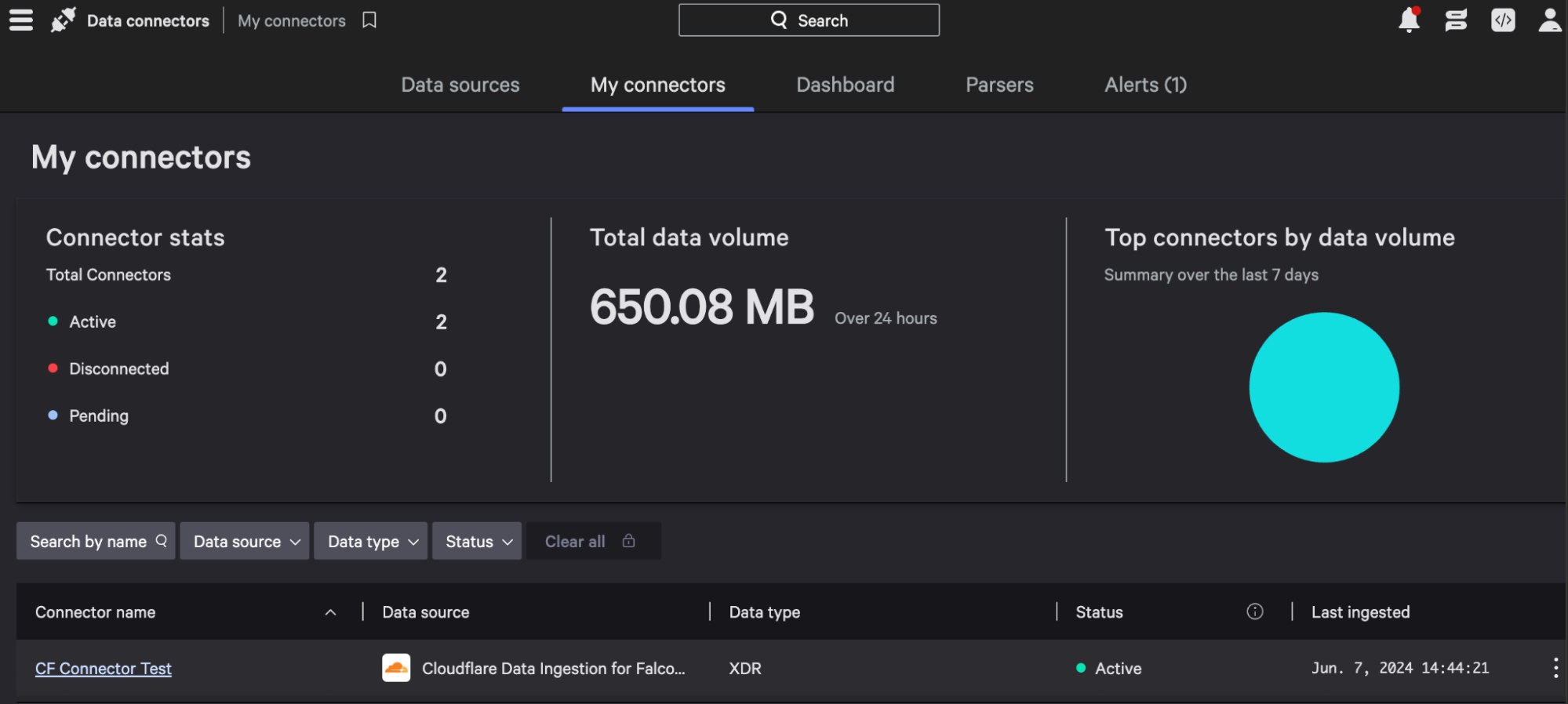
Once the job is created and active, you will start to see events populating in the My Connectors section of your Falcon dashboard. Once Cloudflare data is populated in Falcon Next-Gen SIEM, you can now search events and create Falcon Fusion SOAR automation workflows and correlation rules, all based on Cloudflare log events.
In Summary
Together, CrowdStrike and Cloudflare’s shared telemetry will further decrease the mean time to containment and expedite any organization’s ability to decisively respond to risks within their environment. The two platforms work together as one, allowing organizations to block suspicious activity and deliver high-fidelity alerts to security analysts for further investigation.
To learn more about these integrations, feel free to reach out to us to get started with a consultation. We can discuss your existing environment and ensure that you are best equipped to achieve better visibility and remediation in the face of emerging threats.
New research evaluating the effectiveness of reward modeling during Reinforcement Learning from Human Feedback (RLHF): “SEAL: Systematic Error Analysis for Value ALignment.” The paper introduces quantitative metrics for evaluating the effectiveness of modeling and aligning human values:
Abstract: Reinforcement Learning from Human Feedback (RLHF) aims to align language models (LMs) with human values by training reward models (RMs) on binary preferences and using these RMs to fine-tune the base LMs. Despite its importance, the internal mechanisms of RLHF remain poorly understood. This paper introduces new metrics to evaluate the effectiveness of modeling and aligning human values, namely feature imprint, alignment resistance and alignment robustness. We categorize alignment datasets into target features (desired values) and spoiler features (undesired concepts). By regressing RM scores against these features, we quantify the extent to which RMs reward them a metric we term feature imprint. We define alignment resistance as the proportion of the preference dataset where RMs fail to match human preferences, and we assess alignment robustness by analyzing RM responses to perturbed inputs. Our experiments, utilizing open-source components like the Anthropic preference dataset and OpenAssistant RMs, reveal significant imprints of target features and a notable sensitivity to spoiler features. We observed a 26% incidence of alignment resistance in portions of the dataset where LM-labelers disagreed with human preferences. Furthermore, we find that misalignment often arises from ambiguous entries within the alignment dataset. These findings underscore the importance of scrutinizing both RMs and alignment datasets for a deeper understanding of value alignment.
Тази седмица се навършиха 80 години от преврата на 9 септември 1944 г., който вкарва България за 45 години в групата на тоталитарните социалистически държави. И макар тоталитарният режим да падна преди 35 години, белезите от него още са налице. Тези белези са не само видими, като панелните блокове и спорните паметници на Съветската армия – те са в манталитета, ценностите, институциите. Накратко – в културата.
Културата не се променя с магическа пръчка. Особено трудно се променя образованието. А то, от своя страна, е основен инструмент за възпроизводство на културата.
Хомофобският образователен хаос, който депутатите сътвориха
Новата учебна година ще започне с една голяма крачка към антидемократичното минало (а може би и бъдеще). Става въпрос за поправката в Закона за предучилищното и училищното образование, според която се забранява извършването на „пропаганда, популяризиране или подстрекаване по какъвто и да е начин, пряко или косвено, на идеи и възгледи, свързани с нетрадиционна сексуална ориентация и/или определяне на полова идентичност, различна от биологичната“.
Поправката, предложена не за първи път от „Възраждане“, беше приета от парламента на 7 август в спешен порядък и с решаващата подкрепа на ГЕРБ. Двете четения на законопроекта се състояха в един и същи ден, въпреки че обичайната практика е между тях да има поне няколко седмици.
Формулировката е толкова широка, че на практика всичко, свързано с ЛГБТИ (лесбийки, гей мъже, бисексуални, транс и интерсекс хора) в училище може да попадне под ударите на закона. Включително родители, които са в еднополови връзки, учители, които се опитват да се справят с хомофобски тормоз над ученици, или пък ученици, които носят обички в цветовете на дъгата. Или дори тениска с обложката на The Dark Side of the Moon, ако допуснем, че в училището им не знаят за този албум на Pink Floyd.
Изобщо, потенциалът за лов на вещици е огромен. И то без да се има предвид самото учебно съдържание, в което на практика няма теми, свързани с ЛГБТИ. Като изключим учебника по биология за IХ клас на издателство „Анубис“, в който се споменават реалните факти: че в юношеска възраст е възможно „осъзнаването на сексуално влечение към същия пол“, а в зряла – „изграждането на трайни връзки с партньор от другия или от същия пол“.
Преследването на работещи в училищната система впрочем започна още през лятната ваканция с инициативата на варненската организация на „Възраждане“ срещу педагогически специалисти от Варна, включили се в подписката срещу поправката.
Образователна система, която учи да не мислиш
Но и без въведената с поправка в закона цензура българското училищно образование е застинало в ХХ век. И особено в начина, по който късният социализъм идеализира 70-те години на ХIХ век, тоест времето на Априлското въстание и Освобождението на България от османското владичество.
Въпреки че много учители правят всичко по силите си да преподават по начин, адекватен на съвременния живот, самите образователни изисквания предпоставят развитието не на критично мислене, а на възпроизвеждане на понятия, факти и интерпретации. Това е и една от основните констатации след всяко издание на Програмата за международно оценяване на учениците (PISA). Липсата на функционална грамотност означава неспособност за разбиране и прилагане на наученото.
На изпитите за външно оценяване например учениците трябва да знаят какво значи „метонимия“, „синекдоха“ или „условно наклонение“, но от тях не се иска да могат да ги използват по адекватен начин. Докато в един съвременен учебник по западен език, издаден от съответната държава, от учениците няма да се очаква да знаят дефиницията на условното наклонение, а да го приложат – като например отправят учтива молба („Би ли ми подал чашата?“) или изразят нереалистично желание („Ако имах криле, бих прелетяла над града.“).
Представете си само някой ученик да изложи аргументация защо дадено произведение на Иван Вазов не му харесва. Ако има късмета учителят му да насърчава самостоятелното мислене, ще му се размине. Но със сигурност не е желателно да защитава подобни тези на изпит за външно оценяване.
Същото важи и за каноничните исторически интерпретации. Ако ученикът например се опита да докаже, че на голяма част от българите си им е било добре в Османската империя и не са искали да се освобождават, може да си има сериозни проблеми.
А Вазов си е имал критици, например доктор Кръстьо Кръстев и Пенчо Славейков от кръга „Мисъл“. Тезата, че съвсем не цялото българско население е искало да се освобождава от османската власт, се застъпва от изследователи като Захари Стоянов и Иван Хаджийски. Днес на Пенчо Славейков, Захари Стоянов и Иван Хаджийски има кръстени училища, но позициите на техните патрони не водят до плурализъм в интерпретациите на учебното съдържание в същите тези училища.
Олимпийско възмущение и гордо бетониране
Бетонирането на литературни, исторически и културни канони логично води до неспособност за критическа дистанция към културно-историческото наследство. Това е предпоставка толкова хора в България да се възмутят от откриването на Олимпиадата в Париж. Присъствието на куиър хора и сцената, погрешно асоциирана със стенописа на Леонардо да Винчи „Тайната вечеря“, предизвикаха най-голямо възмущение. Но за мнозина цялата концепция на откриването си беше скандална. Или най-малкото – неприемлива.
По време на няколкочасовия спектакъл зрителите видяха отрязаната глава на Мария Антоанета да пее, „Мона Лиза“ да се носи по Сена. Децата, плъховете и черепите в парижкото метро са намигване към „Клетниците“ на Виктор Юго и „клоаката на Париж“, която той описва в романа. Това са само малка част от препратките, демонстриращи свободно и иронично отношение към френското културно-историческо наследство.
Представете си сега откриване на хипотетична олимпиада в България, на което се представя как Христо Ботев играе брейк на кораба „Радецки“. Щафетата на олимпийския огън си предават Мунчо, дядо Йоцо и баба Илийца, а копие на „Мома с ябълки“ на Майстора плува по Перловската река. Орфей свири метъл, а тримата глупаци се черпят, сипвайки си гроздова ракия в съдовете от Панагюрското златно съкровище. Дори само мисълта за нещо подобно изглежда светотатствена.
Френската култура, разбира се, е твърде различна от българската и не можем да очакваме нашата да прилича на нея. По-скоро става въпрос за две противоположни нагласи. В единия край е способността да се надсмиваш на всичко, дори на себе си. Включително (и особено) когато се опитваш да се представиш в най-добрата си светлина пред целия свят. В другия край е болезнената потребност да бъдеш велик и да те възприемат сериозно – според собствената ти величава представа за себе си.
Между тези два полюса се разполага пространство на нарастваща (или намаляваща – зависи откъде гледате) способност за критическа дистанция. България обаче все повече се бетонира в героично-сериозния и некритичен полюс. Може да не сме първенци по функционална грамотност, да сме с най-ниските минимални заплати в Европейския съюз и да ходим на парламентарни избори седем пъти за три години, но сме велики и горди.
Междувременно българските ученици се опитват да оцелеят въпреки образователната система. Които от тях могат, ще продължат образованието, а може би и живота си в страни, в които „нетрадиционната“ сексуална ориентация и половата идентичност, „различна от биологичната“, не са обявени за опасност за децата. А в България всеки опит за модернизиране на образователната система ще угасва след поредната обществена истерия в стил „махат Вазов“, „махат Ботев“ и „опорочават българската история“.
The collective thoughts of the interwebz
Manage Consent
To provide the best experiences, we use technologies like cookies to store and/or access device information. Consenting to these technologies will allow us to process data such as browsing behavior or unique IDs on this site. Not consenting or withdrawing consent, may adversely affect certain features and functions.
Functional
Always active
The technical storage or access is strictly necessary for the legitimate purpose of enabling the use of a specific service explicitly requested by the subscriber or user, or for the sole purpose of carrying out the transmission of a communication over an electronic communications network.
Preferences
The technical storage or access is necessary for the legitimate purpose of storing preferences that are not requested by the subscriber or user.
Statistics
The technical storage or access that is used exclusively for statistical purposes.The technical storage or access that is used exclusively for anonymous statistical purposes. Without a subpoena, voluntary compliance on the part of your Internet Service Provider, or additional records from a third party, information stored or retrieved for this purpose alone cannot usually be used to identify you.
Marketing
The technical storage or access is required to create user profiles to send advertising, or to track the user on a website or across several websites for similar marketing purposes.










 Simon Peyer is a Solutions Architect at Amazon Web Services (AWS) based in Switzerland. He is a practical doer and passionate about connecting technology and people using AWS Cloud services. A special focus for him is data streaming and automations. Besides work, Simon enjoys his family, the outdoors, and hiking in the mountains.

 Hardeep Randhawa is a Senior Manager – Big Data & Analytics, Solution Architecture at HPE, recognized for stewarding enterprise-scale programs and deployments. He has led a recent Big Data EAP (Enterprise Analytics Platform) build with one of the largest global SAP HANA/S4 implementations at HPE.
 Abhay Kumar is a Lead Data Engineer in Aruba Supply Chain Analytics and manages the Cloud Infrastructure for the Application at HPE. With 11+ years of experience in the IT industry domains like banking, supply chain and Abhay has a strong background in Cloud Technologies, Data Analytics, Data Management, and Big Data systems. In his spare time, he likes reading, exploring new places and watching movies.
 Ritesh Chaman is a Senior Technical Account Manager at Amazon Web Services. With 14 years of experience in the IT industry, Ritesh has a strong background in Data Analytics, Data Management, Big Data systems and Machine Learning. In his spare time, he loves cooking, watching sci-fi movies, and playing sports.
 Sushmita Barthakur is a Senior Solutions Architect at Amazon Web Services, supporting Enterprise customers architect their workloads on AWS. With a strong background in Data Analytics and Data Management, she has extensive experience helping customers architect and build Business Intelligence and Analytics Solutions, both on-premises and the cloud. Sushmita is based out of Tampa, FL and enjoys traveling, reading and playing tennis.