“run0” as a sudo replacement

Post Syndicated from corbet original https://lwn.net/Articles/971745/

This
Mastodon stream
from Lennart Poettering describes a sudo
replacement — called run0 — that will be part of the upcoming
systemd 256 release. It takes a rather different approach to the execution
of privileged commands, avoiding the use of setuid (which he calls “SUID”)
permissions entirely.

So, in my ideal world, we’d have an OS entirely without SUID. Let’s
throw out the concept of SUID on the dump of UNIX’ bad ideas. An
execution context for privileged code that is half under the
control of unprivileged code and that needs careful manual clean-up
is just not how security engineering should be done in 2024
anymore.

Security updates for Tuesday

Post Syndicated from corbet original https://lwn.net/Articles/971740/

Security updates have been issued by Debian (org-mode), Oracle (shim and tigervnc), Red Hat (ansible-core, avahi, buildah, container-tools:4.0, containernetworking-plugins, edk2, exfatprogs, fence-agents, file, freeglut, freerdp, frr, grub2, gstreamer1-plugins-bad-free, gstreamer1-plugins-base, gstreamer1-plugins-good, harfbuzz, httpd, ipa, kernel, libjpeg-turbo, libnbd, LibRaw, libsndfile, libssh, libtiff, libvirt, libX11, libXpm, mingw components, mingw-glib2, mingw-pixman, mod_http2, mod_jk and mod_proxy_cluster, motif, mutt, openssl and openssl-fips-provider, osbuild and osbuild-composer, pam, pcp, pcs, perl, pmix, podman, python-jinja2, python3.11, python3.11-cryptography, python3.11-urllib3, qemu-kvm, qt5-qtbase, runc, skopeo, squashfs-tools, systemd, tcpdump, tigervnc, toolbox, traceroute, webkit2gtk3, wpa_supplicant, xorg-x11-server, xorg-x11-server-Xwayland, and zziplib), SUSE (docker, ffmpeg, ffmpeg-4, frr, and kernel), and Ubuntu (anope, freerdp3, and php7.0, php7.2, php7.4, php8.1).

Introducing Amazon Q data integration in AWS Glue

Post Syndicated from Noritaka Sekiyama original https://aws.amazon.com/blogs/big-data/introducing-amazon-q-data-integration-in-aws-glue/

Today, we’re excited to announce general availability of Amazon Q data integration in AWS Glue. Amazon Q data integration, a new generative AI-powered capability of Amazon Q Developer, enables you to build data integration pipelines using natural language. This reduces the time and effort you need to learn, build, and run data integration jobs using AWS Glue data integration engines.

Tell Amazon Q Developer what you need in English, it will return a complete job for you. For example, you can ask Amazon Q Developer to generate a complete extract, transform, and load (ETL) script or code snippet for individual ETL operations. You can troubleshoot your jobs by asking Amazon Q Developer to explain errors and propose solutions. Amazon Q Developer provides detailed guidance throughout the entire data integration workflow. Amazon Q Developer helps you learn and build data integration jobs using AWS Glue efficiently by generating the required AWS Glue code based on your natural language descriptions. You can create jobs that extract, transform, and load data that is stored in Amazon Simple Storage Service (Amazon S3), Amazon Redshift, and Amazon DynamoDB. Amazon Q Developer can also help you connect to third-party, software as a service (SaaS), and custom sources.

With general availability, we added new capabilities for you to author jobs using natural language. Amazon Q Developer can now generate complex data integration jobs with multiple sources, destinations, and data transformations. It can generate data integration jobs for extracts and loads to S3 data lakes including file formats like CSV, JSON, and Parquet, and ingestion into open table formats like Apache Hudi, Delta, and Apache Iceberg. It generates jobs for connecting to over 20 data sources, including relational databases like PostgreSQL, MySQL and Oracle; data warehouses like Amazon Redshift, Snowflake, and Google BigQuery; NoSQL databases like DynamoDB, MongoDB and OpenSearch; tables defined in the AWS Glue Data Catalog; and custom user-supplied JDBC and Spark connectors. Generated jobs can use a variety of data transformations, including filter, project, union, join, and custom user-supplied SQL.

Amazon Q data integration in AWS Glue helps you through two different experiences: the Amazon Q chat experience, and AWS Glue Studio notebook experience. This post describes the end-to-end user experiences to demonstrate how Amazon Q data integration in AWS Glue simplifies your data integration and data engineering tasks.

Amazon Q chat experience

Amazon Q Developer provides a conversational Q&A capability and a code generation capability for data integration. To start using the conversational Q&A capability, choose the Amazon Q icon on the right side of the AWS Management Console.

For example, you can ask, “How do I use AWS Glue for my ETL workloads?” and Amazon Q provides concise explanations along with references you can use to follow up on your questions and validate the guidance.

To start using the AWS Glue code generation capability, use the same window. On the AWS Glue console, start authoring a new job, and ask Amazon Q, “Please provide a Glue script that reads from Snowflake, renames the fields, and writes to Redshift.”

You will notice that the code is generated. With this response, you can learn and understand how you can author AWS Glue code for your purpose. You can copy/paste the generated code to the script editor and configure placeholders. After you configure an AWS Identity and Access Management (IAM) role and AWS Glue connections on the job, save and run the job. When the job is complete, you can start querying the table exported from Snowflake in Amazon Redshift.

Let’s try another prompt that reads data from two different sources, filters and projects them individually, joins on a common key, and writes the output to a third target.  Ask Amazon Q: “I want to read data from S3 in Parquet format, and select some fields. I also want to read data from DynamoDB, select some fields, and filter some rows. I want to union these two datasets and write the results to OpenSearch.”

The code is generated. When the job is complete, your index is available in OpenSearch and can be used by your downstream workloads.

AWS Glue Studio notebook experience

Amazon Q data integration in AWS Glue helps you author code in an AWS Glue notebook to speed up development of new data integration applications. In this section, we walk you through how to set up the notebook and run a notebook job.

Prerequisites

Before going forward with this tutorial, complete the following prerequisites:

  1. Set up AWS Glue Studio.
  2. Configure an IAM role to interact with Amazon Q. Attach the following policy to your IAM role for the AWS Glue Studio notebook:
    {
        "Version": "2012-10-17",
        "Statement": [
            {
                "Sid": "CodeWhispererPermissions",
                "Effect": "Allow",
                "Action": [
                    "codewhisperer:GenerateRecommendations"
                ],
                "Resource": "*"
            }
        ]
    }

Create a new AWS Glue Studio notebook job

Create a new AWS Glue Studio notebook job by completing the following steps:

  1. On the AWS Glue console, choose Notebooks under ETL jobs in the navigation pane.
  2. Under Create job, choose Notebook.
  3. For Engine, select Spark (Python).
  4. For Options, select Start fresh.
  5. For IAM role, choose the IAM role you configured as a prerequisite.
  6. Choose Create notebook.

A new notebook is created with sample cells. Let’s try recommendations using the Amazon Q data integration in AWS Glue to auto-generate code based on your intent. Amazon Q would help you with each step as you express an intent in a Notebook cell.

Add a new cell and enter your comment to describe what you want to achieve. After you press Tab and Enter, the recommended code is shown. First intent is to extract the data: “Give me code that reads a Glue Data Catalog table”, followed by “Give me code to apply a filter transform with star_rating>3” and “Give me code that writes the frame into S3 as Parquet”.

Similar to the Amazon Q chat experience, the code is recommended. If you press Tab, then the recommended code is chosen. You can learn more in User actions.

You can run each cell by simply filling in the appropriate options for your sources in the generated code. At any point in the runs, you can also preview a sample of your dataset by simply using the show() method.

Let’s now try to generate a full script with a single complex prompt. “I have JSON data in S3 and data in Oracle that needs combining. Please provide a Glue script that reads from both sources, does a join, and then writes results to Redshift”

You may notice that, on the notebook, the Amazon Q data integration in AWS Glue generated the same code snippet that was generated in the Amazon Q chat.

You can also run the notebook as a job, either by choosing Run or programmatically.

Conclusion

With Amazon Q data integration, you have an artificial intelligence (AI) expert by your side to integrate data efficiently without deep data engineering expertise. These capabilities simplify and accelerate data processing and integration on AWS. Amazon Q data integration in AWS Glue is available in every AWS Region where Amazon Q is available. To learn more, visit the product page, our documentation, and the Amazon Q pricing page.

A special thanks to everyone who contributed to the launch of Amazon Q data integration in AWS Glue: Alexandra Tello, Divya Gaitonde, Andrew Kim, Andrew King, Anshul Sharma, Anshi Shrivastava, Chuhan Liu, Daniel Obi, Hirva Patel, Henry Caballero Corzo, Jake Zych, Jeremy Samuel, Jessica Cheng, , Keerthi Chadalavada, Layth Yassin, Maheedhar Reddy Chappidi, Maya Patwardhan, Neil Gupta, Raghavendhar Vidyasagar Thiruvoipadi, Rajendra Gujja, Rupak Ravi, Shaoying Dong, Vaibhav Naik, Wei Tang, William Jones, Daiyan Alamgir, Japson Jeyasekaran, Matt Sampson, Kartik Panjabi, Ranu Shah, Chuan Lei, Huzefa Rangwala, Jiani Zhang, Xiao Qin, Mukul Prasad, Alon Halevy, Brian Ross, Alona Nadler, Omer Zaki, Rick Sears, Bratin Saha, G2 Krishnamoorthy, Kinshuk Pahare, Nitin Bahadur, and Santosh Chandrachood.


About the Authors

Noritaka Sekiyama is a Principal Big Data Architect on the AWS Glue team. He is responsible for building software artifacts to help customers. In his spare time, he enjoys cycling with his road bike.


Matt Su is a Senior Product Manager on the AWS Glue team. He enjoys helping customers uncover insights and make better decisions using their data with AWS Analytics services. In his spare time, he enjoys skiing and gardening.

Vishal Kajjam is a Software Development Engineer on the AWS Glue team. He is passionate about distributed computing and using ML/AI for designing and building end-to-end solutions to address customers’ data integration needs. In his spare time, he enjoys spending time with family and friends.


Bo Li is a Senior Software Development Engineer on the AWS Glue team. He is devoted to designing and building end-to-end solutions to address customers’ data analytic and processing needs with cloud-based, data-intensive technologies.


XiaoRun Yu is a Software Development Engineer on the AWS Glue team. He is working on building new features for AWS Glue to help customers. Outside of work, Xiaorun enjoys exploring new places in the Bay Area.


Savio Dsouza is a Software Development Manager on the AWS Glue team. His team works on distributed systems & new interfaces for data integration and efficiently managing data lakes on AWS.


Mohit Saxena is a Senior Software Development Manager on the AWS Glue team. His team focuses on building distributed systems to enable customers with interactive and simple-to-use interfaces to efficiently manage and transform petabytes of data across data lakes on Amazon S3, and databases and data warehouses on the cloud.

Amazon Q Business, now generally available, helps boost workforce productivity with generative AI

Post Syndicated from Channy Yun original https://aws.amazon.com/blogs/aws/amazon-q-business-now-generally-available-helps-boost-workforce-productivity-with-generative-ai/

At AWS re:Invent 2023, we previewed Amazon Q Business, a generative artificial intelligence (generative AI)–powered assistant that can answer questions, provide summaries, generate content, and securely complete tasks based on data and information in your enterprise systems.

With Amazon Q Business, you can deploy a secure, private, generative AI assistant that empowers your organization’s users to be more creative, data-driven, efficient, prepared, and productive. During the preview, we heard lots of customer feedback and used that feedback to prioritize our enhancements to the service.

Today, we are announcing the general availability of Amazon Q Business with many new features, including custom plugins, and a preview of Amazon Q Apps, generative AI–powered customized and sharable applications using natural language in a single step for your organization.

In this blog post, I will briefly introduce the key features of Amazon Q Business with the new features now available and take a look at the features of Amazon Q Apps. Let’s get started!

Introducing Amazon Q Business
Amazon Q Business connects seamlessly to over 40 popular enterprise data sources and stores document and permission information, including Amazon Simple Storage Service (Amazon S3), Microsoft 365, and Salesforce. It ensures that you access content securely with existing credentials using single sign-on, according to your permissions, and also includes enterprise-level access controls.

Amazon Q Business makes it easy for users to get answers to questions like company policies, products, business results, or code, using its web-based chat assistant. You can point Amazon Q Business at your enterprise data repositories, and it’ll search across all data, summarize logically, analyze trends, and engage in dialog with users.

With Amazon Q Business, you can build secure and private generative AI assistants with enterprise-grade access controls at scale. You can also use administrative guardrails, document enrichment, and relevance tuning to customize and control responses that are consistent with your company’s guidelines.

Here are the key features of Amazon Q Business with new features now available:

End-user web experience
With the built-in web experience, you can ask a question, receive a response, and then ask follow-up questions and add new information with in-text source citations while keeping the context from the previous answer. You can only get a response from data sources that you have access to.

With general availability, we’re introducing a new content creation mode in the web experience. In this mode, Amazon Q Business does not use or access the enterprise content but instead uses generative AI models built into Amazon Q Business for creative use cases such as summarization of responses and crafting personalized emails. To use the content creation mode, you can turn off Respond from approved sources in the conversation settings.

To learn more, visit Using an Amazon Q Business web experience and Customizing an Amazon Q Business web experience in the AWS documentation.

Pre-built data connectors and plugins
You can connect, index, and sync your enterprise data using over 40 pre-built data connectors or an Amazon Kendra retriever, as well as web crawling or uploading your documents directly.

Amazon Q Business ingests content using a built-in semantic document retriever. It also retrieves and respects permission information such as access control lists (ACLs) to allow it to manage access to the data after retrieval. When the data is ingested, your data is secured with the Service-managed key of AWS Key Management Service (AWS KMS).

You can configure plugins to perform actions in enterprise systems, including Jira, Salesforce, ServiceNow, and Zendesk. Users can create a Jira issue or a Salesforce case while chatting in the chat assistant. You can also deploy a Microsoft Teams gateway or a Slack gateway to use an Amazon Q Business assistant in your teams or channels.

With general availability, you can build custom plugins to connect to any third-party application through APIs so that users can use natural language prompts to perform actions such as submitting time-off requests or sending meeting invites directly through Amazon Q Business assistant. Users can also search real-time data, such as time-off balances, scheduled meetings, and more.

When you choose Custom plugin, you can define an OpenAPI schema to connect your third-party application. You can upload the OpenAPI schema to Amazon S3 or copy it to the Amazon Q Business console in-line schema editor compatible with the Swagger OpenAPI specification.

To learn more, visit Data source connectors and Configure plugins in the AWS documentation.

Admin control and guardrails
You can configure global controls to give users the option to either generate large language model (LLM)-only responses or generate responses from connected data sources. You can specify whether all chat responses will be generated using only enterprise data or whether your application can also use its underlying LLM to generate responses when it can’t find answers in your enterprise data. You can also block specific words.

With topic-level controls, you can specify restricted topics and configure behavior rules in response to the topics, such as answering using enterprise data or blocking completely.

To learn more, visit Admin control and guardrails in the AWS documentation.

You can alter document metadata or attributes and content during the document ingestion process by configuring basic logic to specify a metadata field name, select a condition, and enter or select a value and target actions, such as update or delete. You can also use AWS Lambda functions to manipulate document fields and content, such as using optical character recognition (OCR) to extract text from images.

To learn more, visit Document attributes and types in Amazon Q Business and Document enrichment in Amazon Q Business in the AWS documentation.

Enhanced enterprise-grade security and management
Starting April 30, you will need to use AWS IAM Identity Center for user identity management of all new applications rather than using the legacy identity management. You can securely connect your workforce to Amazon Q Business applications either in the web experience or your own interface.

You can also centrally manage workforce access using IAM Identity Center alongside your existing IAM roles and policies. As the number of your accounts scales, IAM Identity Center gives you the option to use it as a single place to manage user access to all your applications. To learn more, visit Setting up Amazon Q Business with IAM Identity Center in the AWS documentation.

At general availability, Amazon Q Business is now integrated with various AWS services to securely connect and store the data and easily deploy and track access logs.

You can use AWS PrivateLink to access Amazon Q Business securely in your Amazon Virtual Private Cloud (Amazon VPC) environment using a VPC endpoint. You can use the Amazon Q Business template for AWS CloudFormation to easily automate the creation and provisioning of infrastructure resources. You can also use AWS CloudTrail to record actions taken by a user, role, or AWS service in Amazon Q Business.

Also, we support Federal Information Processing Standards (FIPS) endpoints, based on the United States and Canadian government standards and security requirements for cryptographic modules that protect sensitive information.

To learn more, visit Security in Amazon Q Business and Monitoring Amazon Q Business in the AWS documentation.

Build and share apps with new Amazon Q Apps (preview)
Today we are announcing the preview of Amazon Q Apps, a new capability within Amazon Q Business for your organization’s users to easily and quickly create generative AI-powered apps based on company data, without requiring any prior coding experience.

With Amazon Q Apps, users simply describe the app they want, in natural language, or they can take an existing conversation where Amazon Q Business helped them solve a problem. With a few clicks, Amazon Q Business will instantly generate an app that accomplishes their desired task that can be easily shared across their organization.

If you are familiar with PartyRock, you can easily use this code-free builder with the added benefit of connecting it to your enterprise data already with Amazon Q Business.

To create a new Amazon Q App, choose Apps in your web experience and enter a simple text expression for a task in the input box. You can try out samples, such as a content creator, interview question generator, meeting note summarizer, and grammar checker.

I will make a document assistant to review and correct a document using the following prompt:

You are a professional editor tasked with reviewing and correcting a document for grammatical errors, spelling mistakes, and inconsistencies in style and tone. Given a file, your goal is to recommend changes to ensure that the document adheres to the highest standards of writing while preserving the author’s original intent and meaning. You should provide a numbered list for all suggested revisions and the supporting reason.

When you choose the Generate button, a document editing assistant app will be automatically generated with two cards—one to upload a document file as an input and another text output card that gives edit suggestions.

When you choose the Add card button, you can add more cards, such as a user input, text output, file upload, or pre-configured plugin by your administrator. If you want to create a Jira ticket to request publishing a post in the corporate blog channel as an author, you can add a Jira Plugin with the result of edited suggestions from the uploaded file.

Once you are ready to share the app, choose the Publish button. You can securely share this app to your organization’s catalog for others to use, enhancing productivity. Your colleagues can choose shared apps, modify them, and publish their own versions to the organizational catalog instead of starting from scratch.

Choose Library to see all of the published Amazon Q Apps. You can search the catalog by labels and open your favorite apps.

Amazon Q Apps inherit robust security and governance controls from Amazon Q Business, including user authentication and access controls, which empower organizations to safely share apps across functions that warrant governed collaboration and innovation.

In the administrator console, you can see your Amazon Q Apps and control or remove them from the library.

To learn more, visit Amazon Q Apps in the AWS documentation.

Now available
Amazon Q Business is generally available today in the US East (N. Virginia) and US West (Oregon) Regions. We are launching two pricing subscription options.

The Amazon Q Business Lite ($3/user/month) subscription provides users access to the basic functionality of Amazon Q Business.

The Amazon Business Pro ($20/user/month) subscription gets users access to all features of Amazon Q Business, as well as Amazon Q Apps (preview) and Amazon Q in QuickSight (Reader Pro), which enhances business analyst and business user productivity using generative business intelligence capabilities.

You can use the free trial (50 users for 60 days) to experiment with Amazon Q Business. For more information about pricing options, visit Amazon Q Business Plan page.

To learn more about Amazon Q Business, you can study Amazon Q Business Getting Started, a free, self-paced digital course on AWS Skill Builder and Amazon Q Developer Center to get more sample codes.

Give it a try in the Amazon Q Business console today! For more information, visit the Amazon Q Business product page and the User Guide in the AWS documentation. Provide feedback to AWS re:Post for Amazon Q or through your usual AWS support contacts.

— Channy

Amazon Q Developer, now generally available, includes new capabilities to reimagine developer experience

Post Syndicated from Donnie Prakoso original https://aws.amazon.com/blogs/aws/amazon-q-developer-now-generally-available-includes-new-capabilities-to-reimagine-developer-experience/

When Amazon Web Services (AWS) launched Amazon Q Developer as a preview last year, it changed my experience of interacting with AWS services and, at the same time, maximizing the potential of AWS services on a daily basis. Trained on 17 years of AWS knowledge and experience, this generative artificial intelligence (generative AI)–powered assistant helps me build applications on AWS, research best practices, perform troubleshooting, and resolve errors.

Today, we are announcing the general availability of Amazon Q Developer. In this announcement, we have a few updates, including new capabilities. Let’s get started.

New: Amazon Q Developer has knowledge of your AWS account resources
This new capability helps you understand and manage your cloud infrastructure on AWS. With this capability, you can list and describe your AWS resources using natural language prompts, minimizing friction in navigating the AWS Management Console and compiling all information from documentation pages.

To get started, you can navigate to the AWS Management Console and select the Amazon Q Developer icon.

With this new capability, I can ask Amazon Q Developer to list all of my AWS resources. For example, if I ask Amazon Q Developer, “List all of my Lambda functions,” Amazon Q Developer returns the response with a set of my AWS Lambda functions as requested, as well as deep links so I can navigate to each resource easily.

Prompt for you to try: List all of my Lambda functions.

I can also list my resources residing in other AWS Regions without having to navigate through the AWS Management Console.

Prompt for you to try: List my Lambda functions in the Singapore Region.

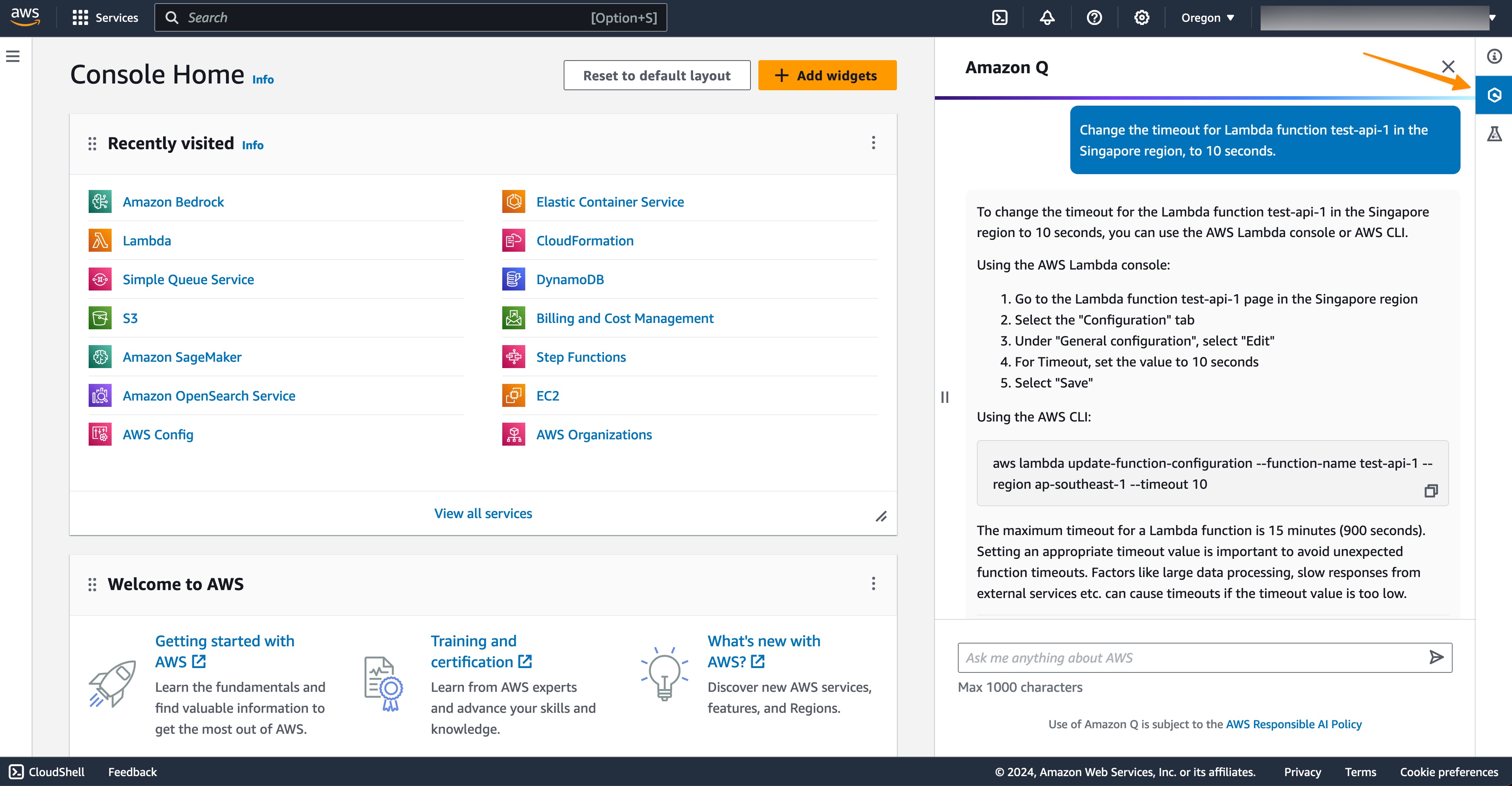
Not only that, this capability can also generate AWS Command Line Interface (AWS CLI) commands so I can make changes immediately. Here, I ask Amazon Q Developer to change the timeout configuration for my Lambda function.

Prompt for you to try: Change the timeout for Lambda function <NAME of AWS LAMBDA FUNCTION> in the Singapore Region to 10 seconds.

I can see Amazon Q Developer generated an AWS CLI command for me to perform the action. Next, I can copy and paste the command into my terminal to perform the change.

$> aws lambda update-function-configuration --function-name <AWS_LAMBDA_FUNCTION_NAME> --region ap-southeast-1 --timeout 10
{
    "FunctionName": "<AWS_LAMBDA_FUNCTION_NAME>",
    "FunctionArn": "arn:aws:lambda:ap-southeast-1:<ACCOUNT_ID>:function:<AWS_LAMBDA_FUNCTION_NAME>",
    "Runtime": "python3.8",
    "Role": "arn:aws:iam::<ACCOUNT_ID>:role/service-role/-role-1o58f7qb",
    "Handler": "lambda_function.lambda_handler",
    "CodeSize": 399,
    "Description": "",
    "Timeout": 10,
...
<truncated for brevity> }

What I really like about this capability is that it minimizes the time and effort needed to get my account information in the AWS Management Console and generate AWS CLI commands so I can immediately implement any changes that I need. This helps me focus on my workflow to manage my AWS resources.

Amazon Q Developer can now help you understand your costs (preview)
To fully maximize the value of cloud spend, I need to have a thorough understanding of my cloud costs. With this capability, I can get answers to AWS cost-related questions using natural language. This capability works by retrieving and analyzing cost data from AWS Cost Explorer.

Recently, I’ve been building a generative AI demo using Amazon SageMaker JumpStart, and this is the right timing because I need to know the total spend. So, I ask Amazon Q Developer the following prompt to know my spend in Q1 this year.

Prompt for you to try: What were the top three highest-cost services in Q1?

From the Amazon Q response, I can further investigate this result by selecting the Cost Explorer URL, which will bring me to the AWS Cost Explorer dashboard. Then, I can follow up with this prompt:

Prompt for you to try: List services in my account which have the most increment month over month. Provide details and analysis.

In short, this capability makes it easier for me to develop a deep understanding and get valuable insights into my cloud spending.

Amazon Q extension for IDEs
As part of the update, we also released an Amazon Q integrated development environment (IDE) extension for Visual Studio Code and JetBrains IDEs. Now, you will see two extensions in the IDE marketplaces: (1) Amazon Q and (2) AWS Toolkit.

If you’re a new user, after installing the Amazon Q extension, you will see a sign-in page in the IDE with two options: using AWS Builder ID or single sign-on. You can continue to use Amazon Q normally.

For existing users, you will need to update the AWS Toolkit extension in your IDEs. Once you’ve finished the update, if you have existing Amazon Q and Amazon CodeWhisperer connections, even if they’re expired, the new Amazon Q extension will be automatically installed for you.

If you’re using Visual Studio 2022, you can use Amazon Q Developer as part of the AWS Toolkit for Visual Studio 2022 extension.

Free access for advanced capabilities in IDE
As you might know, you can use AWS Builder ID to start using Amazon Q Developer in your preferred IDEs. Now, with this announcement, you have free access to two existing advanced capabilities of Amazon Q Developer in IDE, Amazon Q Developer Agent for software development and Amazon Q Developer Agent for code transformation. I’m really excited about this update!

With the Amazon Q Developer Agent for software development, Amazon Q Developer can help you develop code features for projects in your IDE. To get started, you enter /dev in the Amazon Q Developer chat panel. My colleague Séb shared with me the following screenshot when he was using this capability for his support case project. He used the following prompt to generate an implementation plan for creating a new API in AWS Lambda:

Prompt for you to try: Add an API to list all support cases. Expose this API as a new Lambda function

Amazon Q Developer then provides an initial plan and you can keep on iterating this plan until you’re sure mostly everything is covered. Then, you can accept the plan and select Insert code.

The other capability you can access using AWS Builder ID is Developer Agent for code transformation. This capability will help you in upgrading your Java applications in IntelliJ or Visual Studio Code. Danilo described this capability last year, and you can see his thorough journey in Upgrade your Java applications with Amazon Q Code Transformation (preview).

Improvements in Amazon Q Developer Agent for Code Transformation
The new transformation plan provides details specific to my applications to help me understand the overall upgrade process. To get started, I enter /transform in the Amazon Q Developer chat and provide the necessary details for Amazon Q to start upgrading my java project.

In the first step, Amazon Q identifies and provides details on the Java Development Kit (JDK) version, dependencies, and related code that needs to be updated. The dependencies upgrades now include upgrading popular frameworks to their latest major versions. For example, if you’re building with Spring Boot, it now gets upgraded to version 3 as part of the Java 17 upgrade.

In this step, if Amazon Q identifies any deprecated code that Java language specifications recommend replacing, it will make those updates automatically during the upgrade. This is a new enhancement to Amazon Q capabilities and is available now.

In the third step, this capability will build and run unit tests on the upgraded code, including fixing any issues to ensure the code compilation process will run smoothly after the upgrade.

With this capability, you can upgrade Java 8 and 11 applications that are built using Apache Maven to Java version 17. To get started with the Amazon Q Developer Agent for code transformation capability, you can read and follow the steps at Upgrade language versions with Amazon Q Code Transformation. We also have sample code for you to try this capability.

Things to know

  • Availability — To learn more about the availability of Amazon Q Developer capabilities, please visit Amazon Q Developer FAQs page.
  • Pricing — Amazon Q Developer now offers two pricing tiers – Free (free), and Pro, at $19/month/user.
  • Free self-paced course on AWS Skill Builder — Amazon Q Introduction is a 15-minute course that provides a high-level overview of Amazon Q, a generative AI–powered assistant, and the use cases and benefits of using it. This course is part of Amazon’s AI Ready initiative to provide free AI skills training to 2 million people globally by 2025.

Visit our Amazon Q Developer Center to find deep-dive technical content and to discover how you can speed up your software development work.

Happy building,
— Donnie

Teaching a generation of AI innovators in Malaysia with Experience AI

Post Syndicated from Aimy Lee, Penang Science Cluster original https://www.raspberrypi.org/blog/teaching-a-generation-of-ai-innovators-in-malaysia-with-experience-ai/

Today’s blog is from Aimy Lee, Chief Operating Officer at Penang Science Cluster, part of our global partner network for Experience AI.

Artificial intelligence (AI) is transforming the world at an incredible pace, and at Penang Science Cluster, we are determined to be at the forefront of this fast-changing landscape.

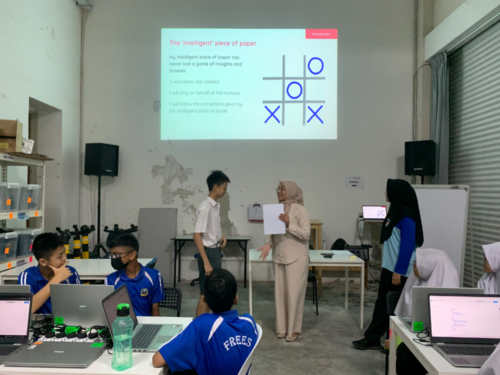
A teacher delivers a lesson in a classroom while students sit at their desks and listen.

The Malaysian government is actively promoting AI literacy among citizens, demonstrating a commitment to the nation’s technological advancement. This dedication is further demonstrated by the Ministry of Education’s recent announcement to introduce AI basics into the primary school curriculum, starting in 2027. 

Why we chose Experience AI

At Penang Science Cluster, we firmly believe that AI is already an essential part of everybody’s future, especially for young people, for whom technologies such as search engines, AI chatbots, image generation, and facial recognition are already deeply ingrained in their daily experiences. It is vital that we equip young people with the knowledge to understand, harness, and even create AI solutions, rather than view AI with trepidation.

A student uses a laptop in a classroom.

With this in mind, we’re excited to be one of the first of many organisations to join the Experience AI global partner network. Experience AI is a free educational programme  offering cutting-edge resources on artificial intelligence and machine learning for teachers and students. Developed in collaboration between the Raspberry Pi Foundation and Google DeepMind, as a global partner we hope the programme will bring AI literacy to thousands of students across Malaysia.

Our goal is to demystify AI and highlight its potential for positive change. The Experience AI programme resonated with our mission to provide accessible and engaging resources tailored for our beneficiaries, making it a natural fit for our efforts.

Experience AI pilot: Results and student voices

At the start of this year, we ran an Experience AI pilot with 56 students to discover how the programme resonated with young people. The positive feedback we received was incredibly encouraging! Students expressed excitement and a genuine shift in their understanding of AI. 

Their comments, such as discovering the fun of learning about AI and seeing how AI can lead to diverse career paths, validated the effectiveness of the programme’s approach.  

One student’s changed perspective — from fearing AI to recognising its potential — underscores the importance of addressing misconceptions. Providing accessible AI education empowers students to develop a balanced and informed outlook.

“I learnt new things and it changed my mindset that AI is not going to take over the world.” – Student who took part in the Experience AI pilot

Launching Experience AI in Malaysia

The successful pilot paved the way for our official Experience AI launch in early April. Students who participated in the pilot were proud to be a part of the launch event, sharing their AI knowledge and experience with esteemed guests, including the Chief Minister of Penang, the Deputy Finance Minister of Malaysia, and the Director of the Penang State Education Department. The presence of these leaders highlights the growing recognition of the significance of AI education.

Experience AI launch event in Malaysia

Building a vibrant AI education community

Following the launch, our immediate focus has shifted to empowering teachers. With the help of the Raspberry Pi Foundation, we’ll conduct teacher workshops to equip them with the knowledge and tools to bring Experience AI into their classrooms. Collaborating with education departments in Penang, Kedah, Perlis, Perak, and Selangor will be vital in teacher recruitment and building a vibrant AI education community.

Inspiring the next generation of AI creators

Experience AI marks an exciting start to integrating AI education within Malaysia, for both students and teachers. Our hope is to inspire a generation of young people empowered to shape the future of AI — not merely as consumers of the technology, but as active creators and innovators.

We envision a future where AI education is as fundamental as mathematics education, providing students with the tools they need to thrive in an AI-driven world. The journey of AI exploration in Malaysia has only just begun, and we’re thrilled to play a part in shaping its trajectory.

If you’re interested in partnering with us to bring Experience AI to students and teachers in your country, you can register your interest here.

The post Teaching a generation of AI innovators in Malaysia with Experience AI appeared first on Raspberry Pi Foundation.

Make your interaction with Zabbix API faster: Async zabbix_utils.

Post Syndicated from Aleksandr Iantsen original https://blog.zabbix.com/make-your-interaction-with-zabbix-api-faster-async-zabbix_utils/27837/

In this article, we will explore the capabilities of the new asynchronous modules of the zabbix_utils library. Thanks to asynchronous execution, users can expect improved efficiency, reduced latency, and increased flexibility in interacting with Zabbix components, ultimately enabling them to create efficient and reliable monitoring solutions that meet their specific requirements.

There is a high demand for the Python library zabbix_utils. Since its release and up to the moment of writing this article, zabbix_utils has been downloaded from PyPI more than 15,000 times. Over the past week, the library has been downloaded more than 2,700 times. The first article about the zabbix_utils library has already gathered around 3,000 views. Among the array of tools available, the library has emerged as a popular choice, offering developers and administrators a comprehensive set of functions for interacting with Zabbix components such as Zabbix server, proxy, and agents.

Considering the demand from users, as well as the potential of asynchronous programming to optimize interaction with Zabbix, we are pleased to present a new version of the library with new asynchronous modules in addition to the existing synchronous ones. The new zabbix_utils modules are designed to provide a significant performance boost by taking advantage of the inherent benefits of asynchronous programming to speed up communication between Zabbix and your service or script.

You can read the introductory article about zabbix_utils for a more comprehensive understanding of working with the library.

Benefits and Usage Scenarios

From expedited data retrieval and real-time event monitoring to enhanced scalability, asynchronous programming empowers you to build highly efficient, flexible, and reliable monitoring solutions adapted to meet your specific needs and challenges.

The new version of zabbix_utils and its asynchronous components may be useful in the following scenarios:

  • Mass data gathering from multiple hosts: When it’s necessary to retrieve data from a large number of hosts simultaneously, asynchronous programming allows requests to be executed in parallel, significantly speeding up the data collection process;
  • Mass resource exporting: When templates, hosts or problems need to be exported in parallel. This parallel execution reduces the overall export time, especially when dealing with a large number of resources;
  • Sending alerts from or to your system: When certain actions need to be performed based on monitoring conditions, such as sending alerts or running scripts, asynchronous programming provides rapid condition processing and execution of corresponding actions;
  • Scaling the monitoring system: With an increase in the number of monitored resources or the volume of collected data, asynchronous programming provides better scalability and efficiency for the monitoring system.

Installation and Configuration

If you already use the zabbix_utils library, simply updating the library to the latest version and installing all necessary dependencies for asynchronous operation is sufficient. Otherwise, you can install the library with asynchronous support using the following methods:

  • By using pip:
~$ pip install zabbix_utils[async]

Using [async] allows you to install additional dependencies (extras) needed for the operation of asynchronous modules.

  • By cloning from GitHub:
~$ git clone https://github.com/zabbix/python-zabbix-utils
~$ cd python-zabbix-utils/
~$ pip install -r requirements.txt
~$ python setup.py install

The process of working with the asynchronous version of the zabbix_utils library is similar to the synchronous one, except for some syntactic differences of asynchronous code in Python.

Working with Zabbix API

To work with the Zabbix API in asynchronous mode, you need to import the AsyncZabbixAPI class from the zabbix_utils library:

from zabbix_utils import AsyncZabbixAPI

Similar to the synchronous ZabbixAPI, the new AsyncZabbixAPI can use the following environment variables: ZABBIX_URL, ZABBIX_TOKEN, ZABBIX_USER, ZABBIX_PASSWORD. However, when creating an instance of the AsyncZabbixAPI class you cannot specify a token or a username and password, unlike the synchronous version. They can only be passed when calling the login() method. The following usage scenarios are available here:

  • Use preset values of environment variables, i.e., not pass any parameters to AsyncZabbixAPI:
~$ export ZABBIX_URL="https://zabbix.example.local"
api = AsyncZabbixAPI()
  • Pass only the Zabbix API address as input, which can be specified as either the server IP/FQDN address or DNS name (in this case, the HTTP protocol will be used) or as an URL of Zabbix API:
api = AsyncZabbixAPI(url="127.0.0.1")

After declaring an instance of the AsyncZabbixAPI class, you need to call the login() method to authenticate with the Zabbix API. There are two ways to do this:

  • Using environment variable values:
~$ export ZABBIX_USER="Admin"
~$ export ZABBIX_PASSWORD="zabbix"

or

~$ export ZABBIX_TOKEN="xxxxxxxx"

and then:

await api.login()
  • Passing the authentication data when calling login():
await api.login(user="Admin", password="zabbix")

Like ZabbixAPI, the new AsyncZabbixAPI class supports version getting and comparison:

# ZabbixAPI version field
ver = api.version
print(type(ver).__name__, ver) # APIVersion 6.0.29

# Method to get ZabbixAPI version
ver = api.api_version()
print(type(ver).__name__, ver) # APIVersion 6.0.29

# Additional methods
print(ver.major)     # 6.0
print(ver.minor)     # 29
print(ver.is_lts())  # True

# Version comparison
print(ver < 6.4)        # True
print(ver != 6.0)       # False
print(ver != "6.0.24")  # True

After authentication, you can make any API requests described for all supported versions in the Zabbix documentation.

The format for calling API methods looks like this:

await api_instance.zabbix_object.method(parameters)

For example:

await api.host.get()

After completing all needed API requests, it is necessary to call logout() to close the API session if authentication was done using username and password, and also close the asynchronous sessions:

await api.logout()

More examples of usage can be found here.

Sending Values to Zabbix Server/Proxy

The asynchronous class AsyncSender has been added, which also helps to send values to the Zabbix server or proxy for items of the Zabbix Trapper data type.

AsyncSender can be imported as follows:

from zabbix_utils import AsyncSender

Values ​​can be sent in a group, for this it is necessary to import ItemValue:

import asyncio
from zabbix_utils import ItemValue, AsyncSender


items = [
    ItemValue('host1', 'item.key1', 10),
    ItemValue('host1', 'item.key2', 'Test value'),
    ItemValue('host2', 'item.key1', -1, 1702511920),
    ItemValue('host3', 'item.key1', '{"msg":"Test value"}'),
    ItemValue('host2', 'item.key1', 0, 1702511920, 100)
]

async def main():
    sender = AsyncSender('127.0.0.1', 10051)
    response = await sender.send(items)
    # processing the received response

asyncio.run(main())

As in the synchronous version, it is possible to specify the size of chunks when sending values in a group using the parameter chunk_size:

sender = AsyncSender('127.0.0.1', 10051, chunk_size=2)
response = await sender.send(items)

In the example, the chunk size is set to 2. So, 5 values passed in the code above will be sent in three requests of two, two, and one value, respectively.

Also it is possible to send a single value:

sender = AsyncSender(server='127.0.0.1', port=10051)
resp = await sender.send_value('example_host', 'example.key', 50, 1702511920))

If your server has multiple network interfaces, and values need to be sent from a specific one, the AsyncSender provides the option to specify a source_ip for sent values:

sender = AsyncSender(
    server='zabbix.example.local',
    port=10051,
    source_ip='10.10.7.1'
)
resp = await sender.send_value('example_host', 'example.key', 50, 1702511920)

AsyncSender also supports reading connection parameters from the Zabbix agent/agent2 configuration file. To do this, you need to set the use_config flag and specify the path to the configuration file if it differs from the default /etc/zabbix/zabbix_agentd.conf:

sender = AsyncSender(
    use_config=True,
    config_path='/etc/zabbix/zabbix_agent2.conf'
)

More usage examples can be found here.

Getting values from Zabbix Agent/Agent2 by item key.

In cases where you need the functionality of our standart zabbix_get utility but native to your Python project and working asynchronously, consider using the AsyncGetter class. A simple example of its usage looks like this:

import asyncio
from zabbix_utils import AsyncGetter

async def main():
    agent = AsyncGetter('10.8.54.32', 10050)
    resp = await agent.get('system.uname')
    print(resp.value) # Linux zabbix_server 5.15.0-3.60.5.1.el9uek.x86_64

asyncio.run(main())

Like AsyncSender, the AsyncGetter class supports specifying the source_ip address:

agent = AsyncGetter(
    host='zabbix.example.local',
    port=10050,
    source_ip='10.10.7.1'
)

More usage examples can be found here.

Conclusions

The new version of the zabbix_utils library provides users with the ability to implement efficient and scalable monitoring solutions, ensuring fast and reliable communication with the Zabbix components. Asynchronous way of interaction gives a lot of room for performance improvement and flexible task management when handling a large volume of requests to Zabbix components such as Zabbix API and others.

We have no doubt that the new version of zabbix_utils will become an indispensable tool for developers and administrators, helping them create more efficient, flexible, and reliable monitoring solutions that best meet their requirements and expectations.

The post Make your interaction with Zabbix API faster: Async zabbix_utils. appeared first on Zabbix Blog.

Amarok 3.0 “Castaway” released

Post Syndicated from jake original https://lwn.net/Articles/971568/

The Amarok music player project
has announced
the release of version 3.0, which is codenamed “Castaway”. It is the first
stable version using Qt 5 and KDE Frameworks 5, and the first stable
release since the final Qt-4-based 2.9.0 in 2018.

The road to 3.0 has not been a short one. Much of the Qt5/KF5 porting was done in 2015 already, but finishing and polishing everything up has been a slow, sometimes ongoing and sometimes stalled process ever since. 3.0 Alpha was released in February 2021 and has been since used by many people, as have been nightly builds of git master available for various distributions. Now in the past few months, an effort was made to get everything ready for a proper 3.0 release.

Common usecases should work quite well, and in addition to fixing KF5 port
related regressions reported in pre-releases, 3.0 features many bugfixes
and implemented features for longstanding issues, the oldest such
documented being from 2009. However, with more than 20 years of development
history, it is likely that not every feature Amarok has been tested
thoroughly in the new release, and specifically some Internet services that
have changed their API in recent years are not available, at least for
now. It might well be that getting them in better state wouldn’t require
huge effort, however, so if you know your way with Qt and KDE Frameworks
and your favourite Internet music service does not work with Amarok 3.0,
you are extremely welcome to join in and help!

Run scalable, enterprise-grade generative AI workloads with Cohere Command R & R+, now available in Amazon Bedrock

Post Syndicated from Veliswa Boya original https://aws.amazon.com/blogs/aws/run-scalable-enterprise-grade-generative-ai-workloads-with-cohere-r-r-now-available-in-amazon-bedrock/

In November 2023, we made two new Cohere models available in Amazon Bedrock (Cohere Command Light and Cohere Embed English). Today, we’re announcing the addition of two more Cohere models in Amazon Bedrock; Cohere Command R and Command R+.

Organizations need generative artificial intelligence (generative AI) models to securely interact with information stored in their enterprise data sources. Both Command R and Command R+ are powerful, scalable large language models (LLMs), purpose-built for real-world, enterprise-grade workloads. These models are multilingual and are focused on balancing high efficiency with strong accuracy to excel at capabilities such as Retrieval-Augmented Generation (RAG), and tool use to enable enterprises to move beyond proof-of-concept (POC), and into production using artificial intelligence (AI).

Command R is a scalable multilingual generative model targeting RAG and tool use to enable production-scale AI for enterprises. Command R+ is a state-of-the-art RAG-optimized model designed to tackle enterprise-grade workloads and optimize business AI applications. Command R+ is optimized for advanced RAG to provide enterprise-ready, highly reliable, and verifiable responses due to in-line citations which come standard with this model. With these new Cohere models in Bedrock, you can scale with AI to quickly find the most relevant information to support tasks across business functions like finance, human resources (HR), sales, marketing, and customer support, among others, in a range of business sectors. Tool use is also available in Command R+. Command R+ is a strong multilingual model, and similarly to Command R, features a tokenizer that compresses non-English text much better than the tokenizer used for other models in the market.

Getting started with Command R and Command R+
To get started with both models in Amazon Bedrock, you first need to get access to the models. In the Amazon Bedrock console, choose Model access, and then choose Manage model access. Next, choose your preferred model(s), and then choose Save changes. As you can see, you now have six Cohere models to choose from in Amazon Bedrock – including Command R and Command R+ – giving you greater choice and flexibility to use the optimal models for your specific business needs.

Once you have access to your preferred model, you can use the model in Amazon Bedrock. Refresh the base models table to view the updated status.

The models have been trained to respond in the language of the user such as English, French, Spanish, Italian, German, Brazilian Portuguese, Japanese, Korean, Simplified Chinese, and Arabic. Here’s an example:

Prompt

<s>"Écris une description de produit pour une voiture électrique en 50 à 75 mots"

Output

Découvrez la voiture électrique qui va révolutionner votre façon de conduire.
Avec son design élégant, cette voiture offre une expérience de conduite unique
avec une accélération puissante et une autonomie impressionnante. Sa
technologie avancée vous garantit une charge rapide et une fiabilité inégalée.
Avec sa conception innovante et durable, cette voiture est parfaite pour les 
trajets urbains et les longues distances. Profitez d'une conduite silencieuse
et vivez l'expérience de la voiture électrique!

Programmatically interact with Command R and Command R+
You can also use AWS Command Line Interface (CLI) and AWS Software Development Kit (SDK) to make various calls using Amazon Bedrock APIs. Following, is a sample code in Python that interacts with Amazon Bedrock Runtime APIs with AWS SDK. Taking the same text generation prompt I used earlier, here is how it looks when used programmatically. In this example I’m interacting with the Command R model. Back to Python, I first run the ListFoundationModels API call to discover the modelId for Command R.

import boto3
import json
import numpy

bedrock = boto3.client(service_name='bedrock', region_name='us-east-1')

listModels = bedrock.list_foundation_models(byProvider='cohere')
print("\n".join(list(map(lambda x: f"{x['modelName']} : { x['modelId'] }", listModels['modelSummaries']))))

Running this code gives the list:

Command : cohere.command-text-v14
Command Light : cohere.command-light-text-v14
Embed English : cohere.embed-english-v3
Embed Multilingual : cohere.embed-multilingual-v3
Command R: cohere.command-r-v1:0
Command R+: cohere.command-r-plus-v1:0

From this list, I select cohere.command-r-v1:0 model ID and write the code to generate the text as shown earlier in this post.

import boto3
import json

bedrock = boto3.client(service_name="bedrock-runtime", region_name='us-east-1')

prompt = """
<s>Écris une description de produit pour une voiture électrique en 50 à 75 mots

body = json.dumps({
    "prompt": prompt,
    "max_tokens": 512,
    "top_p": 0.8,
    "temperature": 0.5,
})

modelId = "cohere.command-r-v1:0"

accept = "application/json"
contentType = "application/json"

response = bedrock.invoke_model(
    body=body,
    modelId=modelId,
    accept=accept,
    contentType=contentType
)

print(json.loads(response.get('body').read()))

You can get JSON formatted output as like:

Découvrez la voiture électrique qui va révolutionner votre façon de conduire.
Avec son design élégant, cette voiture offre une expérience de conduite unique
avec une accélération puissante et une autonomie impressionnante. Sa
technologie avancée vous garantit une charge rapide et une fiabilité inégalée.
Avec sa conception innovante et durable, cette voiture est parfaite pour les 
trajets urbains et les longues distances. Profitez d'une conduite silencieuse
et vivez l'expérience de la voiture électrique!

Now Available

Command R and Command R+ models, along with other Cohere models, are available today in Amazon Bedrock in the US East (N. Virginia) and US West (Oregon) Regions; check the full Region list for future updates.

Visit our community.aws site to find deep-dive technical content and to discover how our Builder communities are using Amazon Bedrock in their solutions. Give Command R and Command R+ a try in the Amazon Bedrock console today and send feedback to AWS re:Post for Amazon Bedrock or through your usual AWS Support contacts.

– Veliswa.

От 3-ти Май 2024 няма да можеш да продадеш имот, ако имаш изискуеми задължения

Post Syndicated from VassilKendov original https://kendov.com/%D0%BE%D1%82-3-%D1%82%D0%B8-%D0%BC%D0%B0%D0%B9-2024-%D0%BD%D1%8F%D0%BC%D0%B0-%D0%B4%D0%B0-%D0%BC%D0%BE%D0%B6%D0%B5%D1%88-%D0%B4%D0%B0-%D0%BF%D1%80%D0%BE%D0%B4%D0%B0%D0%B4%D0%B5%D1%88-%D0%B8%D0%BC/

Ето какво съветва нотариус Милена Илчева, за да се сключват спокойно и законосъобразно сделките за всички страни

Бургаският нотариус Милена Илчева се съгласи да разясни пред Флагман.бг подробности за промените в Данъчно-осигурителния процесуален кодекс, които влизат в сила от 3 май и затягат правилата за всички участници в сделките за прехвърлянето или учредяването на вещни права върху недвижими имоти или МПС.

Ето какво съветва юристът, за да се сключват спокойно и законосъобразно сделките за всички страни:

Новите правила са по силата на изменение на разпоредбата на чл. 264, ал. 1 и ал. 2 от ДОПК и защитават интересите на държавата и общините.    

Досега, когато се сключваха сделки за прехвърляне или учредяване на вещни права върху недвижим имот или  МПС, лицата, които са прехвърлители на същите, или които учредяваха ипотеки, предоставяха пред нотариуса декларации, че нямат подлежащи на принудително изпълнение публични задължения. Сега тези декларации отпадат, но във връзка със законодателните изменения от 03.05.2024 г. нотариусите в реално време ще проверяват по електронен път в Националната агенция за приходите за наличие на непогасени, подлежащи на принудително изпълнение публични задължения на прехвърлителите, респективно учредителите. Връзката между тях и НАП е осигурена чрез информационната система на Нотариалната камара. Тоест, може да се каже, че досега режимът беше декларативен, то занапред вече няма да е така.  Автоматично от това следва, че ако едно лице има задължение, дори само за 20 лева, за да прехвърли собствеността, която иска, или да ипотекира имота, който иска, трябва да погаси същото, ако то вече подлежи на принудително изпълнение.

Установявам, че това все още не се знае от много хора, а изменението на закона влиза в сила съвсем скоро. Считам, че във връзка със законодателната промяна е препоръчително още на фаза предлагане на един имот за продажба и не по-късно от сключване на предварителния договор за продажбата му, продавачите да се погрижат да се снабдят с необходимия документ, удостоверяващ липсата на такива техни задължения. Тук съществена роля ще имат брокерите на недвижими имоти, които са посредници на страните и са в пряк контакт с тях още на фаза предлагане и подготовка на документите. Те могат да указват това на собствениците, за да може своевременно да предприемат необходимите действия. Това важи и когато при покупка на имот финансирането е с банков кредит, който ще се обезпечава с ипотека върху закупувания имот. Там ще стои въпросът за липса на подлежащи на принудително изпълнение задължения за публични задължения и от страна на купувача по такава сделка, който ще се явява ипотекиращ този имот за обезпечаване на дълга си към банката. Тоест, правилото не важи само за продавачи на недвижими имоти или МПС. Неспазването му от всеки, който желае да прехвърли по какъвто и да начин вещни права върху недвижим имот или МПС, или ще ипотекира недвижим имот или залага имущество  ще води до спиране и отлагане сделките, или до отказ за извършване на съответните действия от компетентните органи, натоварени със задължението за тези проверки. Прехвърлителите и учредителите следва да  бъдат добросъвестни и да се погрижат към деня на сключване на окончателната сделка да са изрядни към държавата и общините по отношение на публичните си задължения.


Според разпоредбите на чл. 264, ал. 1 и 2 от ДОПК и сега би трябвало да нямате непогасени подлежащи на принудително изпълнение задължения за данъци, мита и задължителни осигурителни вноски, но за това се изисква само декларация, в която ако декларирате неверни данни ще носите наказателна отговорност и сделката е недействителна спрямо държавата, съответно общината. След 03.05.2024 г. наличието на такива задължения ще се установява чрез официална справка в реално време – към съответния ден и час дали имате или нямате непогасени, подлежащи на принудително изпълнение публични задължения. Проверката от нотариус по електронен път в Националната агенция за приходите следва да се прави само, когато има нотариално производство, тоест  не може да бъде извършвана без основание. Изискването за опазване на данъчната и осигурителна тайна, съгласно разпоредбите на ДОПК не се променя и предоставянето на данните от тези справки следва да става изцяло, съобразно законовите норми. Това означава, че не може да искате от нотариус да прави такава справка когато решите, без да има производство пред него. И най-вече, не можете да искате нотариус да прави такава справка за трето лице, с което сте в преддоговорни отношения по бъдеща сделка, за която няма нотариално производство. Съгласно нормите на ДОПК, информацията за данните в данъчно-осигурителната сметка на дадено лице се получава лично от него или от изрично упълномощено с нотариално заверено пълномощно лице. Извън тях, закона посочва изрично кои държавни органи или лица, изпълняващи публични функции могат да искат такива данни от НАП, не и от нотариус. Това предполага бъдещите прехвърлители или учредители своевременно да си направят предварителни справки или чрез електронната система на НАП или на място в офисите на НАП. Бих им препоръчала да се снабдяват с официалния документ, удостоверяващ липсата на техни задължения  – удостоверение по чл. 87, ал. 6 от ДОПК, за да могат да докажат, че са изрядни спрямо държавата и общините по отношение на публичните си задължения и, че са коректни спрямо лицата, с които ще влизат в договорни отношения.

Какво да очакват хората с ипотеки след въвеждането на еврото

Законът допуска, ако се установят задължения в деня на сключване на сделката, нотариусът да издаде акт за нея, но ако задълженията  бъдат платени преди подписването му. Естествено това ще усложни процеса – нотариусът ще спре производството, докато се погасят задълженията или докато купувачът внесе цялата или част от цената при покупко-продажба за погасяването им, банката ще чака и докато няма задължения, няма да предостави кредита, за да може да е сигурна, че няма да изпадне в състояние да е кредитор заедно с държавата или Общината. Искам да обърна внимание, че законът не казва само продажба, а прехвърлянето или учредяването на вещни права върху недвижими имоти или МПС, а това не са само възмездните сделки за покупко-продажба. Заобикалянето на това изискване за мен е недопустимо, за да се счита, че не важи при дарение или замяна. Както казах преди това и сега тежи отговорността, ако сте декларирали неверни данни, че нямате непогасени подлежащи на принудително изпълнение публични задължения, и държавата или общините имат права като кредитори, съгласно чл. 216 от ДОПК.

Нотариусите, като лица с публични функции, вече ще са натоварени с ангажимент по отношение на защита и на тези интереси на държавата и общините. Тук няма да се включват само задължения за имоти и МПС, а всякакви публични задължения (дори глобите от КАТ), установени с актове на всякакви държавни или общински органи, които се събират по принудителен ред от НАП. И за 20 лв. глоба от КАТ да имате, ако тя вече подлежи на принудително изпълнение, трябва да я платите, за да може да си прехвърлите собствеността върху имота, да апортирате имот в търговско дружество или да се впише залог по реда на Закона за особените залози . Клиентите не трябва да се сърдят, ако отидат при нотариус и той им откаже съответното удостоверяване на това основание.

Съгласно последното изменение на чл. 264 от ДОПК задължение за извършване на справките по електронен път в Националната агенция за приходите за наличие на непогасени, подлежащи на принудително изпълнение публични задължения на прехвърлителите, респективно учредителите имат нотариуса, съдията по вписванията, длъжностното лице по регистрация по Закона за търговския регистър и регистъра на юридическите лица с нестопанска цел или длъжностното лице по вписванията по Закона за особените залози, съобразно компетентността си в съответните производства. В случай, че някой от тях в кръга на своята компетентност състави, съответно разпореди да се впише, акт при неспазване на чл. 264, ал. 1, 2 и 4 от ДОПК е регламентирана солидарна отговорност за заплащане на задълженията, дължими от длъжника. За нотариуса и съдията по вписванията отговорността е лична, а за действията на  длъжностните лица отговорността отговорността е вменена на  Агенцията по вписванията. Не смятам, че ще има колега, който ще се съгласи да стане съдлъжник заедно с Вас и да отговаря за плащането на такива Ваши задължения.

Времето до датата, когато ще се прилагат новите правила е кратко, а с колеги установихме, че това не е ясно на хората. Ето и един пример – някой, ако през Великденските празнични почивни дни – между 3 и 6.05,  намери купувач на продавана от него кола, и отидат при колега, който да удостовери договора, което е допустимо от закона да се извършва в извън регламентираното ни работно време, и се установи при справката от нотариуса наличие на такова задължение, сделката се усложнява. При прехвърлянето на собственост за МПС всичко се случва в реално време в канторите ни. Чрез информационната системата на Нотариалната камара, която има директна връзка със системата на КАТ, докато сте още в кантората на нотариуса, непосредствено след подписването на договора от страните и нотариуса, в реално време се регистрира промяната на собствеността. По отношение на недвижимите имоти е по-различно. Там има интервал от време, в което трябва, да го кажем се обработят докумените, след като страните и нотариуса са подписали нотариалния акт и собствеността е преминала,  преди акта да се впише в регистрите и книгите на съответната Служба по вписванията и се афишира спрямо всички трети лица.

Моля използвайте приложената форма за записване на час за среща
[contact-form-7]

Сега от една страна клиенти и брокери се радват, че отпаднаха едни декларации за заверка, но трябва да се отчита, че не отпада изискването хората, които са прехвърлители или учредители на права върху недвижими имоти или МПС, да нямат задължения към държавата и общините, за да бъдат коректни при сключването на сделката. НАП са се постарали да направят електронната си система, така че във всеки един момент да можете да проверите това, което касае ваши публични задължения и да погасите същите. Това може да стане не само на място в офисите на НАП, но и по банков път или чрез портала за електронни услуги на НАП. А, ако вече публичен изпълнител Ви търси, за да събира публични задължения по принудителен ред, малко вероятно е да не сте наясно с това обстоятелство. Затова, бъдете коректни към потенциалните си контрагенти и уредете тези Ваши задължения своевременно.

материалът е копиран от ФЛАГМАН

The post От 3-ти Май 2024 няма да можеш да продадеш имот, ако имаш изискуеми задължения appeared first on Kendov.com.

AWS Weekly Roundup: Amazon Bedrock, AWS CodeBuild, Amazon CodeCatalyst, and more (April 29, 2024)

Post Syndicated from Danilo Poccia original https://aws.amazon.com/blogs/aws/aws-weekly-roundup-amazon-bedrock-aws-codebuild-amazon-codecatalyst-and-more-april-29-2024/

This was a busy week for Amazon Bedrock with many new features! Using GitHub Actions with AWS CodeBuild is much easier. Also, Amazon Q in Amazon CodeCatalyst can now manage more complex issues.

I was amazed to meet so many new and old friends at the AWS Summit London. To give you a quick glimpse, here’s AWS Hero Yan Cui starting his presentation at the AWS Community stage.

AWS Community at the AWS Summit London 2024

Last week’s launches
With so many interesting new features, I start with generative artificial intelligence (generative AI) and then move to the other topics. Here’s what got my attention:

Amazon Bedrock – For supported architectures such as Llama, Mistral, or Flan T5, you can now import custom models and access them on demand. Model evaluation is now generally available to help you evaluate, compare, and select the best foundation models (FMs) for your specific use case. You can now access Meta’s Llama 3 models.

Agents for Amazon Bedrock – A simplified agent creation and return of control, so that you can define an action schema and get the control back to perform those action without needing to create a specific AWS Lambda function. Agents also added support for Anthropic Claude 3 Haiku and Sonnet to help build faster and more intelligent agents.

Knowledge Bases for Amazon Bedrock – You can now ingest data from up to five data sources and provide more complete answers. In the console, you can now chat with one of your documents without needing to set up a vector database (read more in this Machine Learning blog post).

Guardrails for Amazon Bedrock – The capability to implement safeguards based on your use cases and responsible AI policies is now available with new safety filters and privacy controls.

Amazon Titan – The new watermark detection feature is now generally available in Amazon Bedrock. In this way, you can identify images generated by Amazon Titan Image Generator using an invisible watermark present in all images generated by Amazon Titan.

Amazon CodeCatalyst – Amazon Q can now split complex issues into separate, simpler tasks that can then be assigned to a user or back to Amazon Q. CodeCatalyst now also supports approval gates within a workflow. Approval gates pause a workflow that is building, testing, and deploying code so that a user can validate whether it should be allowed to proceed.

Amazon EC2 – You can now remove an automatically assigned public IPv4 address from an EC2 instance. If you no longer need the automatically assigned public IPv4 (for example, because you are migrating to using a private IPv4 address for SSH with EC2 instance connect), you can use this option to quickly remove the automatically assigned public IPv4 address and reduce your public IPv4 costs.

Network Load Balancer – Now supports Resource Map in AWS Management Console, a tool that displays all your NLB resources and their relationships in a visual format on a single page. Note that Application Load Balancer already supports Resource Map in the console.

AWS CodeBuild – Now supports managed GitHub Action self-hosted runners. You can configure CodeBuild projects to receive GitHub Actions workflow job events and run them on CodeBuild ephemeral hosts.

Amazon Route 53 – You can now define a standard DNS configuration in the form of a Profile, apply this configuration to multiple VPCs, and share it across AWS accounts.

AWS Direct Connect – Hosted connections now support capacities up to 25 Gbps. Before, the maximum was 10 Gbps. Higher bandwidths simplify deployments of applications such as advanced driver assistance systems (ADAS), media and entertainment (M&E), artificial intelligence (AI), and machine learning (ML).

NoSQL Workbench for Amazon DynamoDB – A revamped operation builder user interface to help you better navigate, run operations, and browse your DynamoDB tables.

Amazon GameLift – Now supports in preview end-to-end development of containerized workloads, including deployment and scaling on premises, in the cloud, or for hybrid configurations. You can use containers for building, deploying, and running game server packages.

For a full list of AWS announcements, be sure to keep an eye on the What’s New at AWS page.

Other AWS news
Here are some additional projects, blog posts, and news items that you might find interesting:

GQL, the new ISO standard for graphs, has arrived – GQL, which stands for Graph Query Language, is the first new ISO database language since the introduction of SQL in 1987.

Authorize API Gateway APIs using Amazon Verified Permissions and Amazon Cognito – Externalizing authorization logic for application APIs can yield multiple benefits. Here’s an example of how to use Cedar policies to secure a REST API.

Build and deploy a 1 TB/s file system in under an hour – Very nice walkthrough for something that used to be not so easy to do in the recent past.

Let’s Architect! Discovering Generative AI on AWS – A new episode in this amazing series of posts that provides a broad introduction to the domain and then shares a mix of videos, blog posts, and hands-on workshops.

Building scalable, secure, and reliable RAG applications using Knowledge Bases for Amazon Bedrock – This post explores the new features (including AWS CloudFormation support) and how they align with the AWS Well-Architected Framework.

Using the unified CloudWatch Agent to send traces to AWS X-Ray – With added support for the collection of AWS X-Ray and OpenTelemetry traces, you can now provision a single agent to capture metrics, logs, and traces.

The executive’s guide to generative AI for sustainability – A guide for implementing a generative AI roadmap within sustainability strategies.

AWS open source news and updates – My colleague Ricardo writes about open source projects, tools, and events from the AWS Community. Check out Ricardo’s page for the latest updates.

Upcoming AWS events
Check your calendars and sign up for upcoming AWS events:

AWS Summits – Join free online and in-person events that bring the cloud computing community together to connect, collaborate, and learn about AWS. Register in your nearest city: Singapore (May 7), Seoul (May 16–17), Hong Kong (May 22), Milan (May 23), Stockholm (June 4), and Madrid (June 5).

AWS re:Inforce – Explore 2.5 days of immersive cloud security learning in the age of generative AI at AWS re:Inforce, June 10–12 in Pennsylvania.

AWS Community Days – Join community-led conferences that feature technical discussions, workshops, and hands-on labs led by expert AWS users and industry leaders from around the world: Turkey (May 18), Midwest | Columbus (June 13), Sri Lanka (June 27), Cameroon (July 13), Nigeria (August 24), and New York (August 28).

GOTO EDA Day London – Join us in London on May 14 to learn about event-driven architectures (EDA) for building highly scalable, fault tolerant, and extensible applications. This conference is organized by GOTO, AWS, and partners.

Browse all upcoming AWS led in-person and virtual events and developer-focused events.

That’s all for this week. Check back next Monday for another Weekly Roundup!

— Danilo

This post is part of our Weekly Roundup series. Check back each week for a quick roundup of interesting news and announcements from AWS!

The collective thoughts of the interwebz