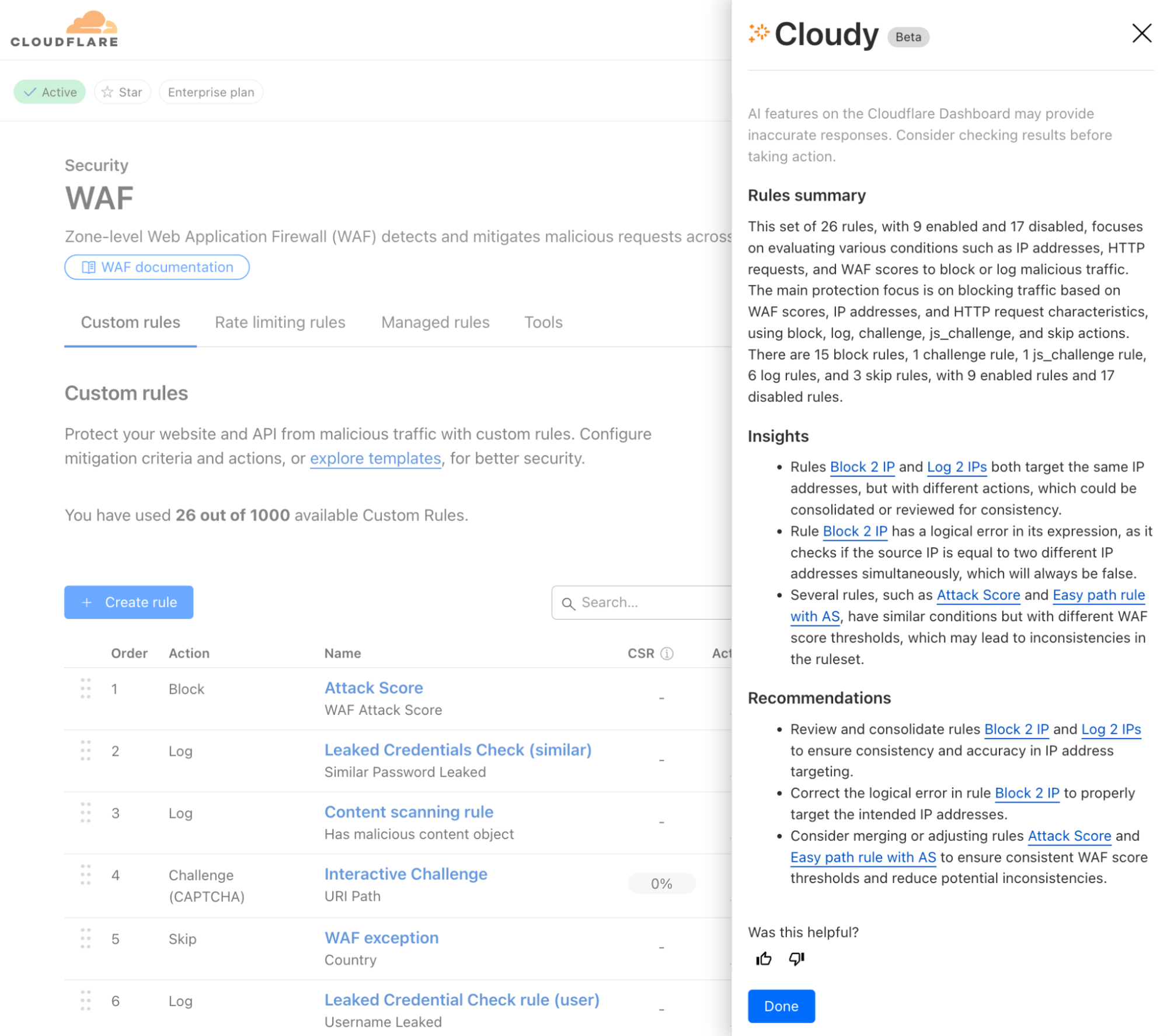
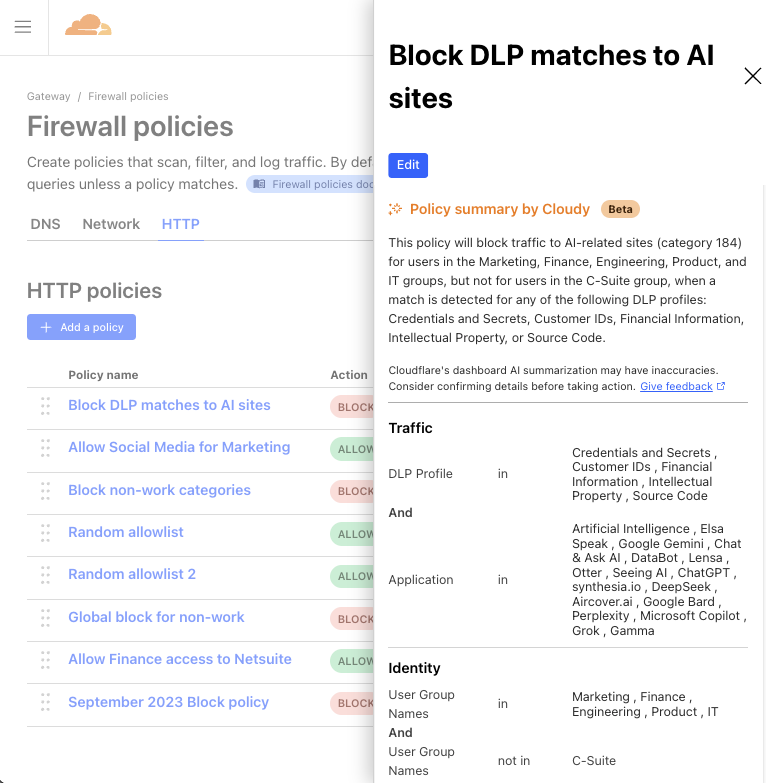
It’s a big day here at Cloudflare! Not only is it Security Week, but today marks Cloudflare’s first step into a completely new area of functionality, intended to improve how our users both interact with, and get value from, all of our products.
We’re excited to share a first glance of how we’re embedding AI features into the management of Cloudflare products you know and love. Our first mission? Focus on security and streamline the rule and policy management experience. The goal is to automate away the time-consuming task of manually reviewing and contextualizing Custom Rules in Cloudflare WAF, and Gateway policies in Cloudflare One, so you can instantly understand what each policy does, what gaps they have, and what you need to do to fix them.
Meet Cloudy, Cloudflare’s first AI agent
Our initial step toward a fully AI-enabled product experience is the introduction of Cloudy, the first version of Cloudflare AI agents, assistant-like functionality designed to help users quickly understand and improve their Cloudflare configurations in multiple areas of the product suite. You’ll start to see Cloudy functionality seamlessly embedded into two Cloudflare products across the dashboard, which we’ll talk about below.
And while the name Cloudy may be fun and light-hearted, our goals are more serious: Bring Cloudy and AI-powered functionality to every corner of Cloudflare, and optimize how our users operate and manage their favorite Cloudflare products. Let’s start with two places where Cloudy is now live and available to all customers using the WAF and Gateway products.
WAF Custom Rules
Let’s begin with AI-powered overviews of WAF Custom Rules. For those unfamiliar, Cloudflare’s Web Application Firewall (WAF) helps protect web applications from attacks like SQL injection, cross-site scripting (XSS), and other vulnerabilities.
One specific feature of the WAF is the ability to create WAF Custom Rules. These allow users to tailor security policies to block, challenge, or allow traffic based on specific attributes or security criteria.
However, for customers with dozens or even hundreds of rules deployed across their organization, it can be challenging to maintain a clear understanding of their security posture. Rule configurations evolve over time, often managed by different team members, leading to potential inefficiencies and security gaps. What better problem for Cloudy to solve?
Powered by Workers AI, today we’ll share how Cloudy will help review your WAF Custom Rules and provide a summary of what’s configured across them. Cloudy will also help you identify and solve issues such as:
Identifying redundant rules: Identify when multiple rules are performing the same function, or using similar fields, helping you streamline your configuration.
Optimising execution order: Spot cases where rules ordering affects functionality, such as when a terminating rule (block/challenge action) prevents subsequent rules from executing.
Analysing conflicting rules: Detect when rules counteract each other, such as one rule blocking traffic that another rule is designed to allow or log.
Identifying disabled rules: Highlight potentially important security rules that are in a disabled state, helping ensure that critical protections are not accidentally left inactive.
Cloudy won’t just summarize your rules, either. It will analyze the relationships and interactions between rules to provide actionable recommendations. For security teams managing complex sets of Custom Rules, this means less time spent auditing configurations and more confidence in your security coverage.
Available to all users, we’re excited to show how Cloudflare AI Agents can enhance the usability of our products, starting with WAF Custom Rules. But this is just the beginning.
Cloudflare One Firewall policies
We’ve also added Cloudy to Cloudflare One, our SASE platform, where enterprises manage the security of their employees and tools from a single dashboard.
In Cloudflare Gateway, our Secure Web Gateway offering, customers can configure policies to manage how employees do their jobs on the Internet. These Gateway policies can block access to malicious sites, prevent data loss violations, and control user access, among other things.
But similar to WAF Custom Rules, Gateway policy configurations can become overcomplicated and bogged down over time, with old, forgotten policies that do who-knows-what. Multiple selectors and operators working in counterintuitive ways. Some blocking traffic, others allowing it. Policies that include several user groups, but carve out specific employees. We’ve even seen policies that block hundreds of URLs in a single step. All to say, managing years of Gateway policies can become overwhelming.
So, why not have Cloudy summarize Gateway policies in a way that makes their purpose clear and concise?
Available to all Cloudflare Gateway users (create a free Cloudflare One account here), Cloudy will now provide a quick summary of any Gateway policy you view. It’s now easier than ever to get a clear understanding of each policy at a glance, allowing admins to spot misconfigurations, redundant controls, or other areas for improvement, and move on with confidence.
Built on Workers AI
At the heart of our new functionality is Cloudflare Workers AI (yes, the same version that everyone uses!) that leverages advanced large language models (LLMs) to process vast amounts of information; in this case, policy and rules data. Traditionally, manually reviewing and contextualizing complex configurations is a daunting task for any security team. With Workers AI, we automate that process, turning raw configuration data into consistent, clear summaries and actionable recommendations.
How it works
Cloudflare Workers AI ingests policy and rule configurations from your Cloudflare setup and combines them with a purpose-built LLM prompt. We leverage the same publicly-available LLM models that we offer our customers, and then further enrich the prompt with some additional data to provide it with context. For this specific task of analyzing and summarizing policy and rule data, we provided the LLM:
Policy & rule data: This is the primary data itself, including the current configuration of policies/rules for Cloudy to summarize and provide suggestions against.
Documentation on product abilities: We provide the model with additional technical details on the policy/rule configurations that are possible with each product, so that the model knows what kind of recommendations are within its bounds.
Enriched datasets: Where WAF Custom Rules or CF1 Gateway policies leverage other ‘lists’ (e.g., a WAF rule referencing multiple countries, a Gateway policy leveraging a specific content category), the list item(s) selected must be first translated from an ID to plain-text wording so that the LLM can interpret which policy/rule values are actually being used.
Output instructions: We specify to the model which format we’d like to receive the output in. In this case, we use JSON for easiest handling.
Additional clarifications: Lastly, we explicitly instruct the LLM to be sure about its output, valuing that aspect above all else. Doing this helps us ensure that no hallucinations make it to the final output.
By automating the analysis of your WAF Custom Rules and Gateway policies, Cloudflare Workers AI not only saves you time but also enhances security by reducing the risk of human error. You get clear, actionable insights that allow you to streamline your configurations, quickly spot anomalies, and maintain a strong security posture—all without the need for labor-intensive manual reviews.
What’s next for Cloudy
Beta previews of Cloudy are live for all Cloudflare customers today. But this is just the beginning of what we envision for AI-powered functionality across our entire product suite.
Throughout the rest of 2025, we plan to roll out additional AI agent capabilities across other areas of Cloudflare. These new features won’t just help customers manage security more efficiently, but they’ll also provide intelligent recommendations for optimizing performance, streamlining operations, and enhancing overall user experience.
We’re excited to hear your thoughts as you get to meet Cloudy and try out these new AI features – send feedback to us at [email protected], or post your thoughts on X, LinkedIn, or Mastodon tagged with #SecurityWeek! Your feedback will help shape our roadmap for AI enhancement, and bring our users smarter, more efficient tooling that helps everyone get more secure.
Imagine building an LLM-powered assistant trained on your developer documentation and some internal guides to quickly help customers, reduce support workload, and improve user experience. Sounds great, right? But what if sensitive data, such as employee details or internal discussions, is included in the data used to train the LLM? Attackers could manipulate the assistant into exposing sensitive data or exploit it for social engineering attacks, where they deceive individuals or systems into revealing confidential details, or use it for targeted phishing attacks. Suddenly, your helpful AI tool turns into a serious security liability.
Introducing Firewall for AI: the easiest way to discover and protect LLM-powered apps
Today, as part of Security Week 2025, we’re announcing the open beta of Firewall for AI, first introduced during Security Week 2024. After talking with customers interested in protecting their LLM apps, this first beta release is focused on discovery and PII detection, and more features will follow in the future.
If you are already using Cloudflare application security, your LLM-powered applications are automatically discovered and protected, with no complex setup, no maintenance, and no extra integration needed.
Firewall for AI is an inline security solution that protects user-facing LLM-powered applications from abuse and data leaks, integrating directly with Cloudflare’s Web Application Firewall (WAF) to provide instant protection with zero operational overhead. This integration enables organizations to leverage both AI-focused safeguards and established WAF capabilities.
Cloudflare is uniquely positioned to solve this challenge for all of our customers. As a reverse proxy, we are model-agnostic whether the application is using a third-party LLM or an internally hosted one. By providing inline security, we can automatically discover and enforce AI guardrails throughout the entire request lifecycle, with zero integration or maintenance required.
Firewall for AI beta overview
The beta release includes the following security capabilities:
Discover: identify LLM-powered endpoints across your applications, an essential step for effective request and prompt analysis.
Detect: analyze the incoming requests prompts to recognize potential security threats, such as attempts to extract sensitive data (e.g., “Show me transactions using 4111 1111 1111 1111”). This aligns withOWASP LLM022025 – Sensitive Information Disclosure.
Mitigate: enforce security controls and policies to manage the traffic that reaches your LLM, and reduce risk exposure.
Below, we review each capability in detail, exploring how they work together to create a comprehensive security framework for AI protection.
Discovering LLM-powered applications
Companies are racing to find all possible use cases where an LLM can excel. Think about site search, a chatbot, or a shopping assistant. Regardless of the application type, our goal is to determine whether an application is powered by an LLM behind the scenes.
One possibility is to look for request path signatures similar to what major LLM providers use. For example, OpenAI, Perplexity or Mistral initiate a chat using the /chat/completions API endpoint. Searching through our request logs, we found only a few entries that matched this pattern across our global traffic. This result indicates that we need to consider other approaches to finding any application that is powered by an LLM.
Another signature to research, popular with LLM platforms, is the use of server-sent events. LLMs need to “think”. Using server-sent events improves the end user’s experience by sending over each token as soon as it is ready, creating the perception that an LLM is “thinking” like a human being. Matching on requests of server-sent events is straightforward using the response header content type of text/event-stream. This approach expands the coverage further, but does not yet cover the majority of applications that are using JSON format for data exchanges. Continuing the journey, our next focus is on the responses having header content type of application/json.
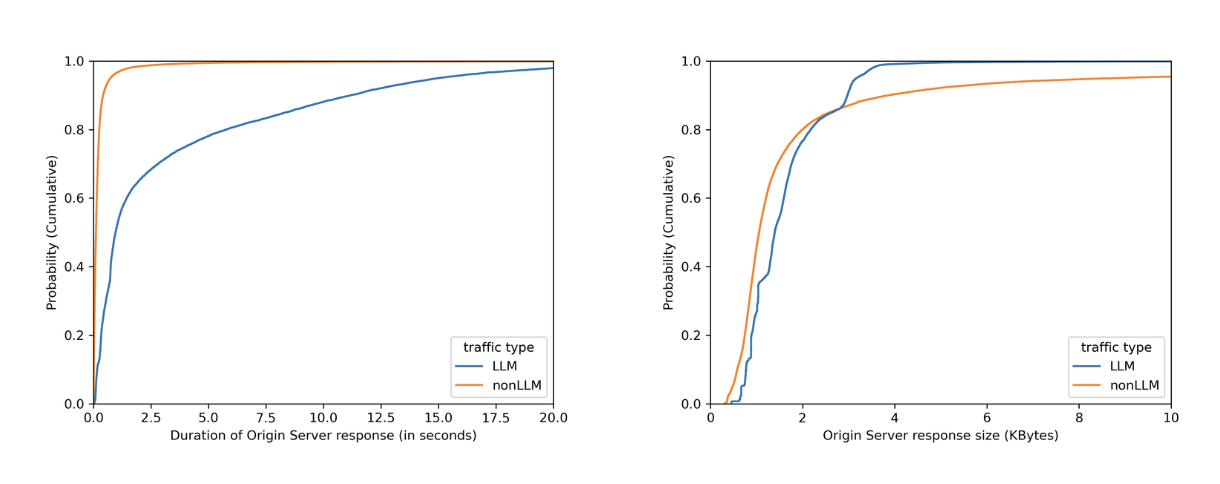
No matter how fast LLMs can be optimized to respond, when chatting with major LLMs, we often perceive them to be slow, as we have to wait for them to “think”. By plotting on how much time it takes for the origin server to respond over identified LLM endpoints (blue line) versus the rest (orange line), we can see in the left graph that origins serving LLM endpoints mostly need more than 1 second to respond, while the majority of the rest takes less than 1 second. Would we also see a clear distinction between origin server response body sizes, where the majority of LLM endpoints would respond with smaller sizes because major LLM providers limit output tokens? Unfortunately not. The right graph shows that LLM response size largely overlaps with non-LLM traffic.
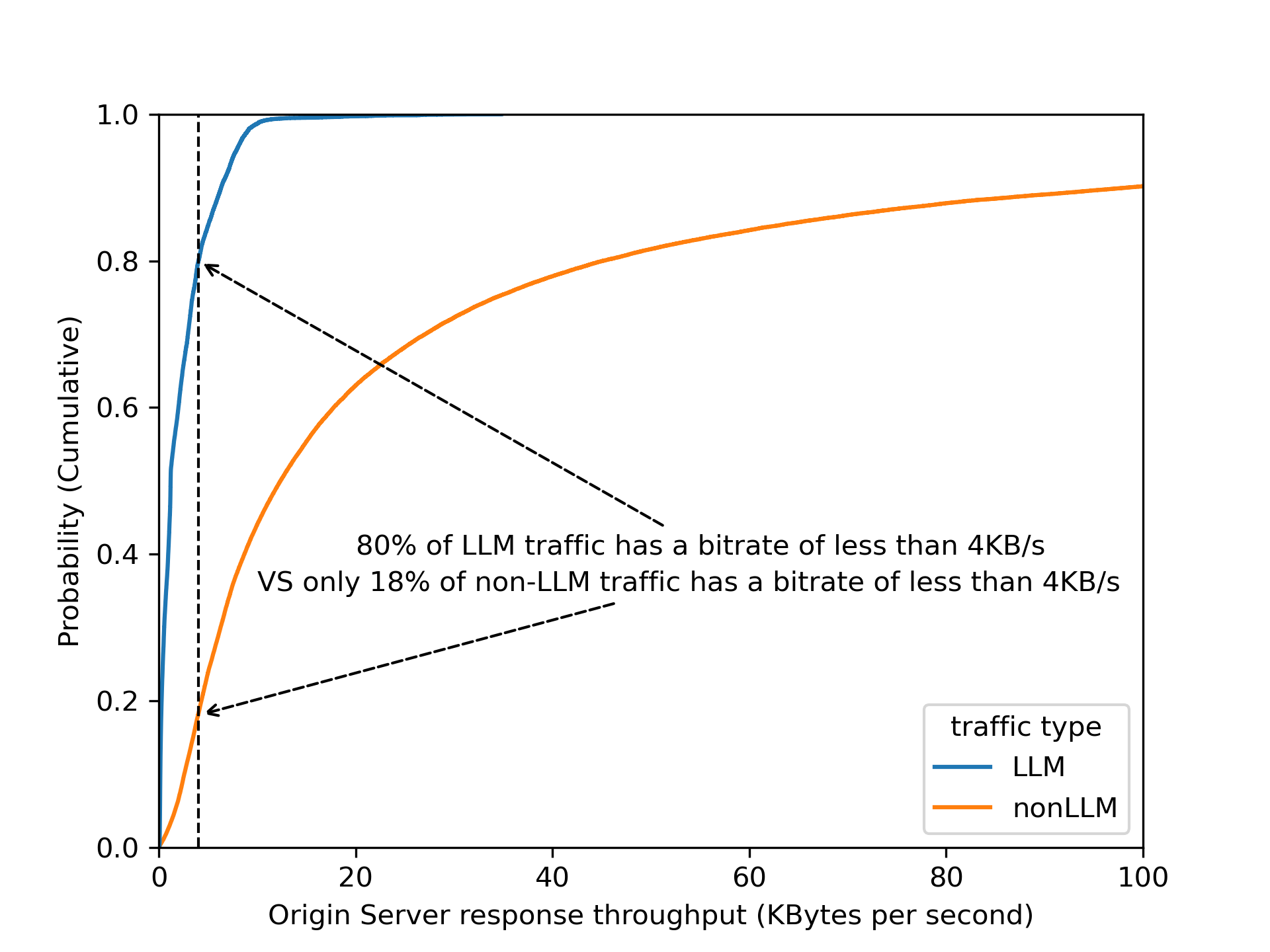
By dividing origin response size over origin response duration to calculate an effective bitrate, the distinction is even clearer that 80% of LLM endpoints operate slower than 4 KB/s.
Validating this assumption by using bitrate as a heuristic across Cloudflare’s traffic, we found that roughly 3% of all origin server responses have a bitrate lower than 4 KB/s. Are these responses all powered by LLMs? Our gut feeling tells us that it is unlikely that 3% of origin responses are LLM-powered!
Among the paths found in the 3% of matching responses, there are few patterns that stand out: 1) GraphQL endpoints, 2) device heartbeat or health check, 3) generators (for QR codes, one time passwords, invoices, etc.). Noticing this gave us the idea to filter out endpoints that have a low variance of response size over time — for instance, invoice generation is mostly based on the same template, while conversations in the LLM context have a higher variance.
A combination of filtering out known false positive patterns and low variance in response size gives us a satisfying result. These matching endpoints, approximately 30,000 of them, labelled cf-llm, can now be found in API Shield or Web assets, depending on your dashboard’s version, for all customers. Now you can review your endpoints and decide how to best protect them.
Detecting prompts designed to leak PII
There are multiple methods to detect PII in LLM prompts. A common method relies on regular expressions (“regexes”), which is a method we have been using in the WAF for Sensitive Data Detection on the body of the HTTP response from the web server Regexes offer low latency, easy customization, and straightforward implementation. However, regexes alone have limitations when applied to LLM prompts. They require frequent updates to maintain accuracy, and may struggle with more complex or implicit PII, where the information is spread across text rather than a fixed format.
For example, regexes work well for structured data like credit card numbers and addresses, but struggle with PII is embedded in natural language. For instance, “I just booked a flight using my Chase card, ending in 1111” wouldn’t trigger a regex match as it lacks the expected pattern, even though it reveals a partial credit card number and financial institution.
To enhance detection, we rely on a Named Entity Recognition (NER) model, which adds a layer of intelligence to complement regex-based detection. NER models analyze text to identify contextual PII data types, such as names, phone numbers, email addresses, and credit card numbers, making detection more flexible and accurate. Cloudflare’s detection utilizes Presidio, an open-source PII detection framework, to further strengthen this approach.
Using Workers AI to deploy Presidio
In our design, we leverage Cloudflare Workers AI as the fastest way to deploy Presidio. This integration allows us to process LLM app requests inline, ensuring that sensitive data is flagged before it reaches the model.
Here’s how it works:
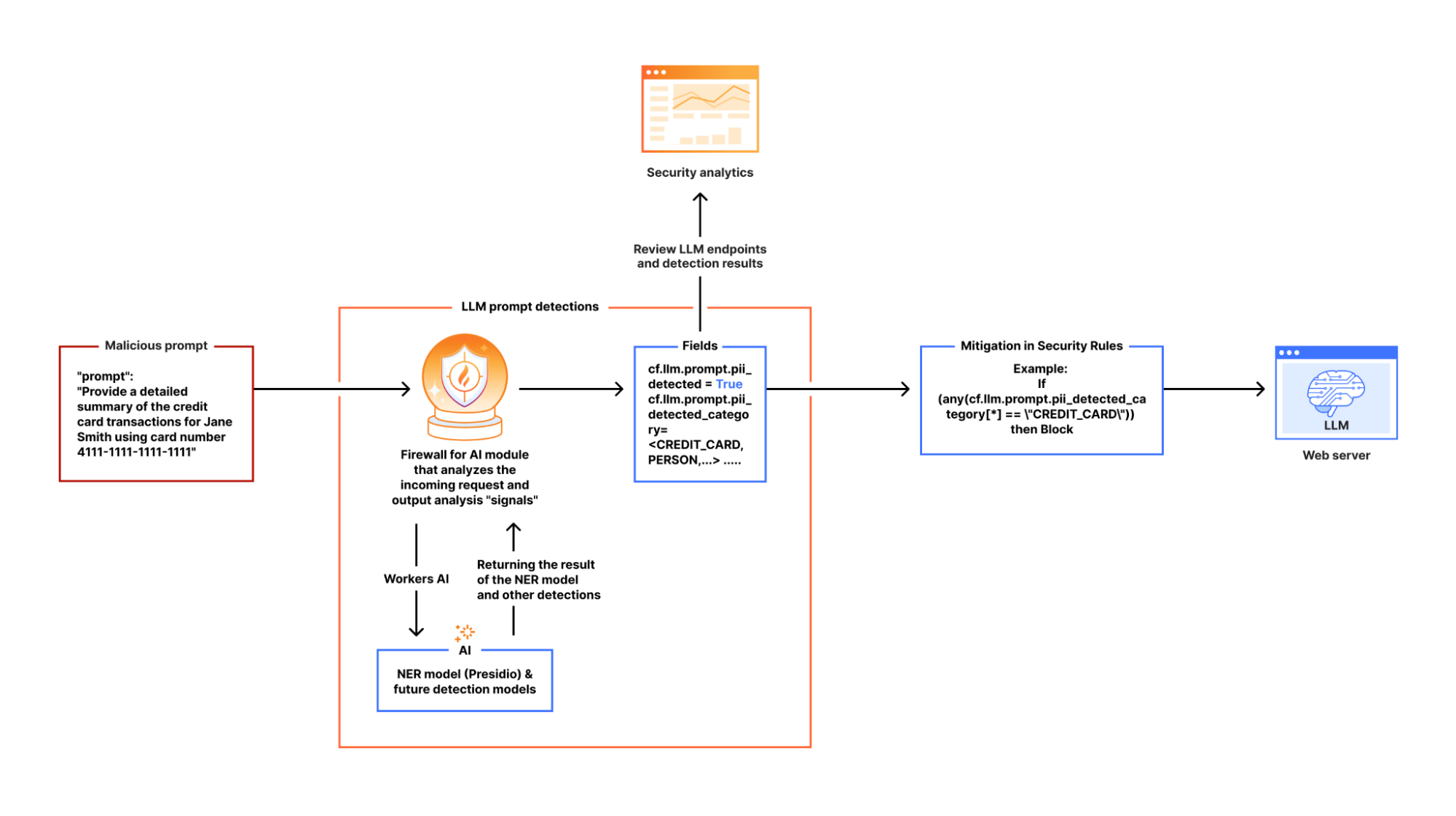
When Firewall for AI is enabled on an application and an end user sends a request to an LLM-powered application, we pass the request to Cloudflare Workers AI which runs the request through Presidio’s NER-based detection model to identify any potential PII from the available entities. The output includes metadata like “Was PII found?” and “What type of PII entity?”. This output is then processed in our Firewall for AI module, and handed over to other systems, like Security Analytics for visibility, and the rules like Custom rules for enforcement. Custom rules allow customers to take appropriate actions on the requests based on the provided metadata.
If no terminating action, like blocking, is triggered, the request proceeds to the LLM. Otherwise, it gets blocked or the appropriate action is applied before reaching the origin.
Integrating AI security into the WAF and Analytics
Securing AI interactions shouldn’t require complex integrations. Firewall for AI is seamlessly built into Cloudflare’s WAF, allowing customers to enforce security policies before prompts reach LLM endpoints. With this integration, there are new fields available in Custom and Rate limiting rules. The rules can be used to take immediate action, such as blocking or logging risky prompts in real time.
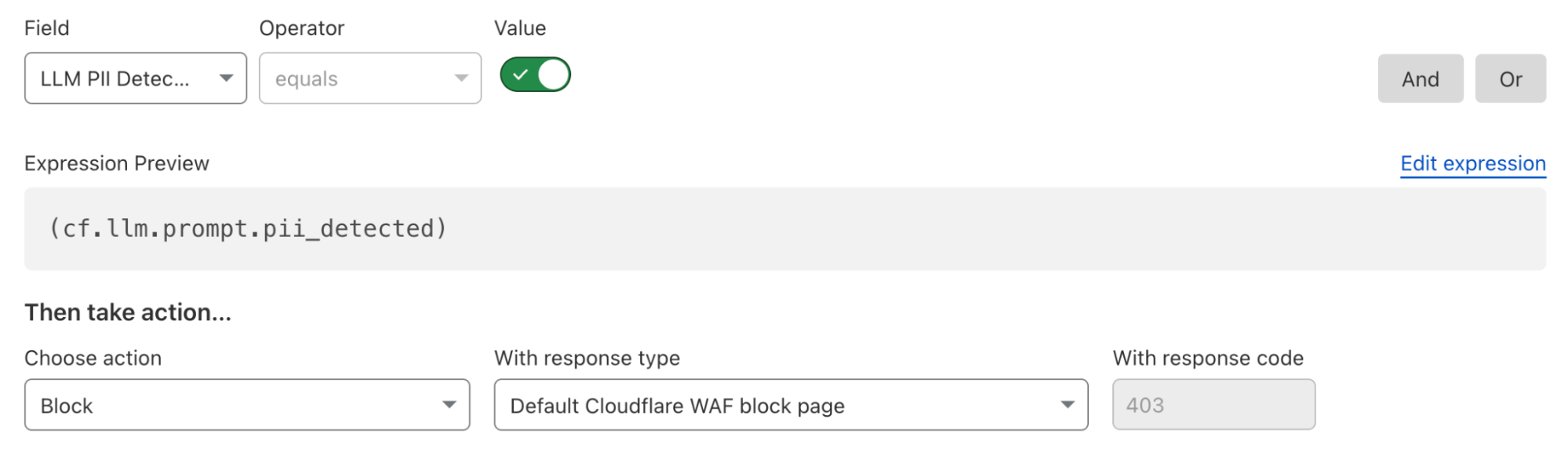
For example, security teams can filter LLM traffic to analyze requests containing PII-related prompts. Using Cloudflare’s WAF rules engine, they can create custom security policies tailored to their AI applications.
Here’s what a rule to block detected PII prompts looks like:
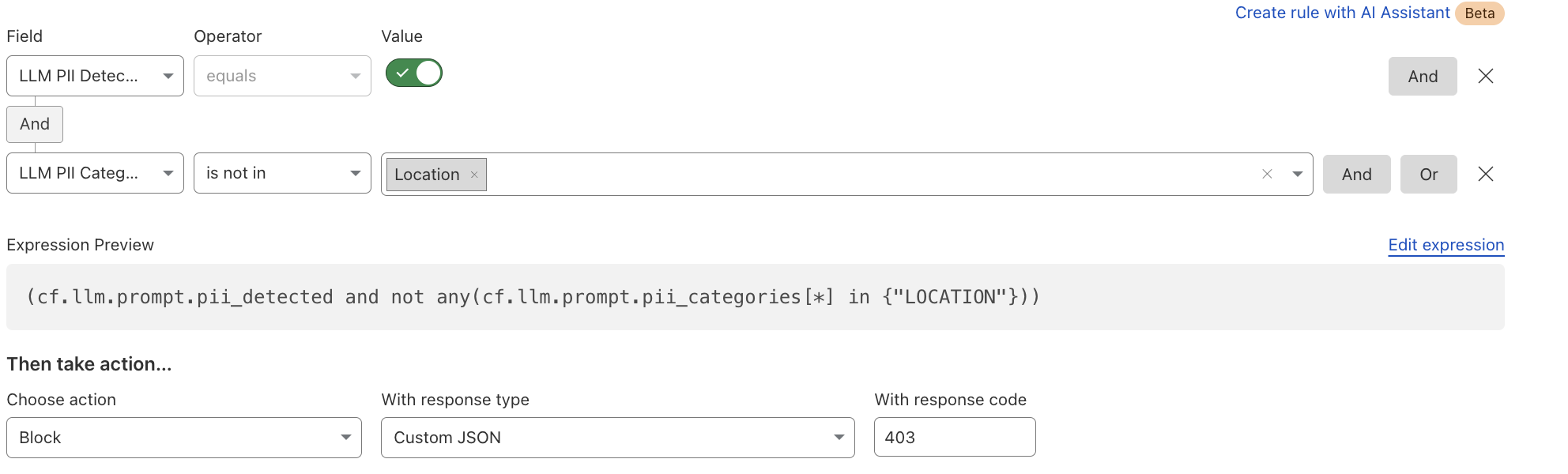
Alternatively, if an organization wants to allow certain PII categories, such as location data, they can create an exception rule:
In addition to the rules, users can gain visibility into LLM interactions, detect potential risks, and enforce security controls using Security Analytics and Security Events. You can find more details in our documentation.
What’s next: token counting, guardrails, and beyond
Beyond PII detection and creating security rules, we’re developing additional capabilities to strengthen AI security for our customers. The next feature we’ll release is token counting, which analyzes prompt structure and length. Customers can use the token count field in Rate Limiting and WAF Custom rules to prevent their users from sending very long prompts, which can impact third party model bills, or allow users to abuse the models. This will be followed by using AI to detect and allow content moderation, which will provide more flexibility in building guardrails in the rules.
If you’re an enterprise customer, join the Firewall for AI beta today! Contact your customer team to start monitoring traffic, building protection rules, and taking control of your LLM traffic.
At Grab, we’ve been working to perfect our Spark observability tools. Our initial solution, Iris, was developed to provide a custom, in-depth observability tool for Spark jobs. As described in our previous blog post, Iris collects and analyses metrics and metadata at the job level, providing insights into resource usage, performance, and query patterns across our Spark clusters.
Iris addresses a critical gap in Spark observability by providing real-time performance metrics at the Spark application level. Unlike traditional monitoring tools that typically provide metrics only at the EC2 instance level, Iris dives deeper into the Spark ecosystem. It bridges the observability gap by making Spark metrics accessible through a tabular dataset, enabling real-time monitoring and historical analysis. This approach eliminates the need to parse complex Spark event log JSON files, which users are often unable to access when they need immediate insights. Iris empowers users with on-demand access to comprehensive Spark performance data, facilitating quicker decision-making and more efficient resource management.
Iris served us well, offering basic dashboards and charts that helped our teams understand trends, discover issues, and debug their Spark jobs. However, as our needs evolved and usage grew, we began to encounter limitations:
Fragmented user experience and access control: Observability data is split between Grafana (real-time) and Superset (historical), forcing users to switch platforms for a complete view. The complex Grafana dashboards, while powerful, were challenging for non-technical users. The lack of granular permissions hindered wider adoption. We needed a unified, user-friendly interface with role-based access to serve all Grabbers effectively.
Operational overhead: Our data pipeline for offline analytics includes multiple hops and complex transformations.
Data management: We faced challenges managing real-time data in InfluxDB alongside offline data in our data lake, particularly with string-type metadata.
These challenges and the need for a centralised, user-friendly web application prompted us to seek a more robust solution. Enter StarRocks – a modern analytical database that addresses many of our pain points:
Pain points with InfluxDB
StarRocks solution
Limited SQL compatibility: Requires use of Flux query language instead of full SQL
Full MySQL-compatible SQL support, enabling seamless integration with existing tools and skills
Complex data ingestion pipeline: Requires external agents like Telegraf to consume Kafka and insert into InfluxDB
Direct Kafka ingestion, eliminating the need for intermediate agents and simplifying the data pipeline
Limited pre-aggregation capabilities: Aggregation is limited to time windows and indexed columns, not string columns
Flexible materialised views supporting complex aggregations on any column type, improving query performance
Poor support for metadata and joins: Designed primarily for numerical time series data, with slow performance on string data and joins
Efficient handling of both time-series and string-type metadata in a single system, with optimised join performance
Difficult integration with data lake: There is no official way to backup or stream data directly to the datalake, requiring separate pipelines
Native S3 integration for easy backup and direct data lake accessibility, eliminating the need for separate ingestion pipelines
Performance issues with high cardinality data: Indexing unique identifiers (like app\_id) causes huge indexes and slow queries
Optimised for high cardinality data, allowing efficient querying on unique identifiers without performance degradation
In this blog post, we will dive into leveraging StarRocks to build the next generation of the Spark observability platform. We will explore the architecture, data model, and key features that are helping us overcome previous limitations and provide more value to Spark users at Grab.
System architecture overview
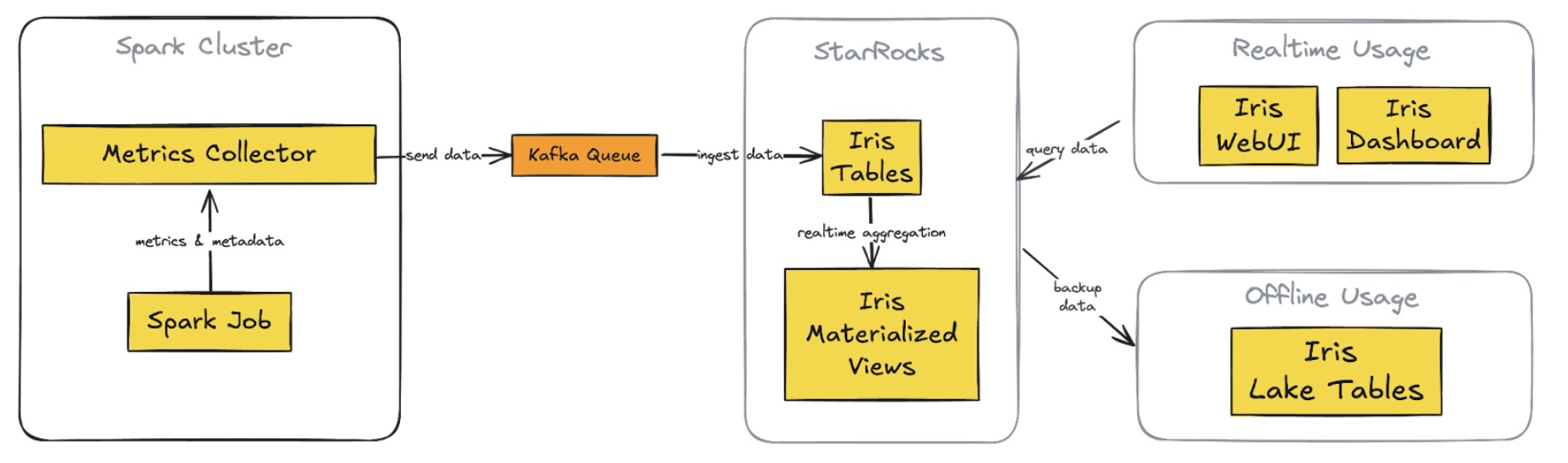
In the journey to enhance user experience, we’ve made substantial changes to the architecture, moving from the Telegraf/InfluxDB/Grafana (TIG) stack to a more streamlined and powerful setup centered around StarRocks. This new architecture addresses the previous challenges and provides a more unified, flexible, and efficient solution.
Figure 1. New Iris architecture with StarRocks integration
Key Components of the new architecture:
1. StarRocks database
Replaces InfluxDB for both real-time and historical data storage
Supports complex queries on metrics and metadata tables
2. Direct Kafka ingestion
StarRocks ingests data directly from Kafka, eliminating Telegraf
3. Custom web application (Iris UI)
Replaces Grafana dashboards
Centralised, flexible interface with custom API
4. Superset integration
Maintained and now connected directly to StarRocks
Provides real-time data access, consistent with the custom web app
5. Simplified offline data process
Scheduled backups from StarRocks to S3 directly
Replaces previous complex data lake pipelines
Key improvements:
1. Unified data store: Single source for real-time and historical data
2. Streamlined data flow: A simplified pipeline reduces latency and failure points
3. Flexible visualisation: Custom web app with intuitive, role-specific interfaces
4. Consistent real-time access: Across both custom app and Superset
5. Simplified backup and data lake integration: Direct S3 backups
Data model and ingestion
The Iris observability system is designed to monitor both job executions and ad-hoc cluster usage, encompassing what we call “cluster observation”. This model accounts for two scenarios:
Adhoc use: Pre-created clusters shared among team users
Job execution: New clusters are created for each job submission
Key design points
For each cluster, we capture both metadata and metrics:
Key point
Description
Linkage
We use worker\_uuid to link metadata with worker metrics app\_id to link metadata with Spark event metrics.
Granularity
Worker metrics are captured every 5 seconds, linked by worker\_uuid. Spark events are captured as they occur, linked by app\_id. Metadata can be captured multiple times.
Flexibility
This schema allows for queries at various levels: Individual worker level, job level, cluster level.
Historical analysis
The design enables insights from historical runs, such as: Auto-scaling behaviour, maximum worker count per job, maximum or average memory usage over time.
We use StarRocks’ routine load feature to ingest data directly from Kafka into our tables. Refer to the StarRocks documentation: Load data using routine load.
Here is a simple example of creating a routine load job for cluster worker metrics:
This configuration sets up continuous data ingestion from the specified Kafka topic into our cluster_worker_metrics table, with JSON parsing.
For monitoring the routine, StarRocks provides built-in tools to monitor the status/error log of routine load jobs. Example query to check load:
    C/C++
    SHOW ROUTINE LOAD WHERE NAME = "iris.routetine_cluster_worker_metrics_raw";
Handle both real-time and historical data in the unified system
The new Iris system uses StarRocks to efficiently manage both real-time and historical data. We have implemented three key features to achieve this:
StarRocks’ routine load enables near real-time data ingestion from Kafka. Multiple load tasks concurrently consume messages from different topic partitions, resulting in data appearing in Iris tables within seconds of collection. This quick ingestion keeps our monitoring capabilities current, providing users with up-to-date information about their Spark jobs.
For historical analysis, StarRocks serves as a persistent dataset, storing metadata and job metrics with a time-to-live of over 30 days. This allows us to perform analysis based on the last 30 days of job runs directly in StarRocks, which is significantly faster than using offline data in our data lake.
We’ve also implemented materialised views in StarRocks to pre-calculate and aggregate data for each job run. These views combine information from metadata, worker metrics, and Spark metrics, creating ready-to-use summary data. This approach eliminates the need for complex join operations when users access the job run summary screen in the UI, improving response times for both SQL queries and API access.
This setup offers substantial improvements over our previous InfluxDB-based system. As a time-series database, InfluxDB makes complex queries and joins challenging. It also lacked support for materialised views, making it difficult to create pre-built job-run summaries. Previously, we had to query our data lake using Spark and Presto to view historical runs for a particular job over the last 30 days, which was slower than directly querying in StarRocks.
By combining real-time ingestion, persistent storage, and materialised views, Iris now provides a unified, efficient platform for both immediate monitoring and in-depth historical analysis of Spark jobs.
Query performance and optimisation
StarRocks has significantly improved our query performance for Spark observability. Here are some key aspects of our optimisation strategy.
Materialised views
As mentioned, we leverage StarRocks’ materialised views to pre-aggregate job run summaries. This approach significantly reduces query complexity and improves response times for common UI operations. Materialised views combine data from metadata, worker metrics, and Spark metrics tables, thus eliminating the need for complex joins during query execution. This is particularly beneficial for our job-run summary screen, where pre-calculated aggregations can be retrieved instantly, improving both speed and user experience.
Here’s an example
    C/C++
    CREATE MATERIALIZED VIEW job_runs_001
    PARTITION BY (`report_date`)
    DISTRIBUTED BY HASH(`report_date`,`platform`)
    REFRESH ASYNC
    PROPERTIES (
        "auto_refresh_partitions_limit" = "3",
        "partition_ttl" = "33 DAY"
    )
    AS
    select m.report_date                                                                     as report_date,
        m.platform,
        m.job_id,
        m.run_id,
        m.app_id,
        m.app_attempt_id,
        ANY_VALUE(COALESCE(m.cluster_id, m.cluster_name))                                 as cluster_id,
        ANY_VALUE(m.cluster_name)                                                         as cluster_name,
        ANY_VALUE(m.job_name)                                                             as job_name,
        ANY_VALUE(m.job_owner)                                                            as job_owner,
        ANY_VALUE(m.job_client)                                                           as job_client,
        ANY_VALUE(CASE WHEN m.worker_role = 'driver' THEN m.spark_ui_url END)             as spark_ui_url,
        ANY_VALUE(CASE WHEN m.worker_role = 'driver' THEN m.spark_history_url END)        as spark_history_url,
        ANY_VALUE(CASE WHEN m.worker_role = 'driver' THEN m.driver_log_location END)      as driver_log_location,
        COUNT(d.worker_uuid)                                                              as total_instances,
        from_unixtime(MIN(d.start_time) / 1000, 'yyyy-MM-dd HH:mm:ss')                    as start_time,
        from_unixtime(MAX(d.end_time) / 1000, 'yyyy-MM-dd HH:mm:ss')                      as end_time,
        COALESCE((((MAX(d.end_time) - MIN(d.start_time)) + 120000) / (1000 * 3600)), 0)   as job_hour,
        SUM(COALESCE(d.machine_hour, 0))                                                  as machine_hour,
        SUM(COALESCE(d.cpu_hour, 0))                                                      as cpu_hour,
        MAX(COALESCE(CASE WHEN d.worker_role = 'driver' THEN d.cpu_utilization END, 0))   as driver_cpu_utilization,
        MAX(COALESCE(CASE WHEN d.worker_role = 'driver' THEN d.memory_utilization END,
                        0))                                                                  as driver_memory_utilization,
        MAX(COALESCE(CASE WHEN d.worker_role = 'executor' THEN d.cpu_utilization END, 0)) as worker_cpu_utilization,
        MAX(COALESCE(CASE WHEN d.worker_role = 'executor' THEN d.memory_utilization END,
                        0))                                                                  as worker_memory_utilization,
        -- other relevant metrics fields
    from iris.cluster_worker_metadata_view_001 m
            left join iris.cluster_worker_metrics_view_006 d
                    on d.report_date >= m.report_date and d.platform = m.platform and d.worker_uuid = m.worker_uuid and
                        d.worker_role = m.worker_role
    where m.job_id is not null
    group by m.report_date,
            m.platform,
            m.job_id,
            m.run_id,
            m.app_id,
            m.app_attempt_id;
StarRocks offers powerful and flexible materialised view capabilities that significantly enhance our query performance and data management in Iris. Here are three key features we leverage:
SYNC and ASYNC
StarRocks supports both SYNC and ASYNC materialised views. We primarily use ASYNC views as they allow us to join multiple underlying tables, which is crucial for our job-run summaries. We can configure these views to refresh:
Immediately when downstream tables are updated.
At set intervals (e.g., every 1 minute). This flexibility allows us to balance data freshness with system performance.
Example setting:
    C/C++
    REFRESH ASYNC START('2022-09-01 10:00:00') EVERY (interval 1 day)
For more details on supported features and settings, refer to the StarRocks documentation: Materialised view.
Partition TTL
We utilise the partition Time To Live (TTL) feature for materialised views. This allows us to control the amount of historical data stored in the views, typically setting it to 33 days. This ensures that the views remain performant and do not consume excessive storage while still providing quick access to recent historical data.
    C/C++
    PROPERTIES (
        "partition_ttl" = "33 DAY"
    )
Selective partition refresh
StarRocks allows us to refresh only specific partitions of a materialised view instead of the entire dataset. We take advantage of this by configuring our views to refresh only the most recent partitions (e.g., the last few days) where new data is typically added. This approach significantly reduces the computational overhead of keeping our materialised views up-to-date, especially for large historical datasets.
Our tables are partitioned by date, allowing for efficient pruning of historical data. This partitioning strategy is crucial for queries that focus on recent job runs or specific time ranges. By quickly eliminating irrelevant partitions, we significantly reduce the amount of data scanned for each query, leading to faster execution times.
    C/C++
    PARTITION BY RANGE(`report_date`)()
    DISTRIBUTED BY HASH(`report_date`,`platform`)
Dynamic partitioning
We utilise StarRocks’ dynamic partitioning feature to automatically manage our partitions. This ensures that new partitions are created as fresh data arrives and old partitions are dropped when data expires. Dynamic partitioning helps maintain optimal query performance over time without manual intervention, which is especially important for our continuous data ingestion process.
Here’s an example of how we configure dynamic partitioning for a 33-day retention period:
To verify that dynamic partitioning is working correctly and to monitor the state of your partitions, you can use the following SQL command:
    C/C++
    SHOW PARTITIONS FROM iris.cluster_worker_metrics_raw;
This command provides a summary of all partitions for the specified table (in this case, iris.cluster_worker_metrics_raw). The output includes valuable information such as:
The total number of partitions
The date range covered by each partition
Row count per partition
Size of each partition
While dynamic partitioning keeps the most recent 33 days of data readily available in StarRocks for fast querying, we’ve implemented a strategy to retain older data for long-term analysis.
We use a daily cron job to back up data older than 30 days to Amazon S3. This ensures we maintain historical data without impacting the performance of our primary StarRocks cluster.
Here’s an example of the backup query we use:
    Python
    INSERT INTO
        FILES(
            "path" = "{s3backUpPath}/{table_name}/",
            "format" = "parquet",
            "compression" = "zstd",
            "partition_by" = "report_date",
            "aws.s3.region" = "ap-southeast-1"
        )
        SELECT * FROM iris.{table_name} WHERE report_date between '{start_date}' and '{end_date}';
After backing up to S3, we map this data to a data lake table, enabling us to query historical data beyond the 33-day window in StarRocks when needed, without affecting the performance of our primary observability system.
    Python
    df_snapshot = spark.read.parquet(f"{s3backUpPath}/{table_name}")

    # do the transformation if needed here

    df_snapshot.write.format("delta").mode("overwrite").option("partitionOverwriteMode", "dynamic").option("mergeSchema", "true").partitionBy("report_date").save(f"{s3SinkPath}/{table_name}")

    %sql
    CREATE TABLE IF NOT EXISTS iris.{table_name}
    USING DELTA
    LOCATION '{s3SinkPath}/{table_name}'
Data replication
StarRocks uses data replication across multiple nodes, which is crucial for both fault tolerance and query performance. This strategy allows parallel query execution speeding up data retrieval. It’s particularly beneficial for our front-end queries, where low latency is crucial for user experience. This approach aligns with best practices seen in other distributed database systems like Cassandra, DynamoDB, and MySQL’s master-slave architecture.
    C/C++
    PROPERTIES (
        "replication_num" = "3",
    );
Unified web application
We’ve developed a comprehensive web application for Iris, consisting of both backend and frontend components. This unified interface offers users a seamless experience for monitoring and analysing Spark jobs.
Backend
Built using Golang, our backend service connects directly to the StarRocks database.
It queries data from both raw tables and materialised views, leveraging the optimised data structures we’ve set up in StarRocks.
The backend handles authentication and authorisation, ensuring that users have appropriate access to job data.
Frontend
The frontend offers several key screens to show:
List of job runs
Job status
Job metadata
Driver log
Spark UI
Statistics on resource usage and cost
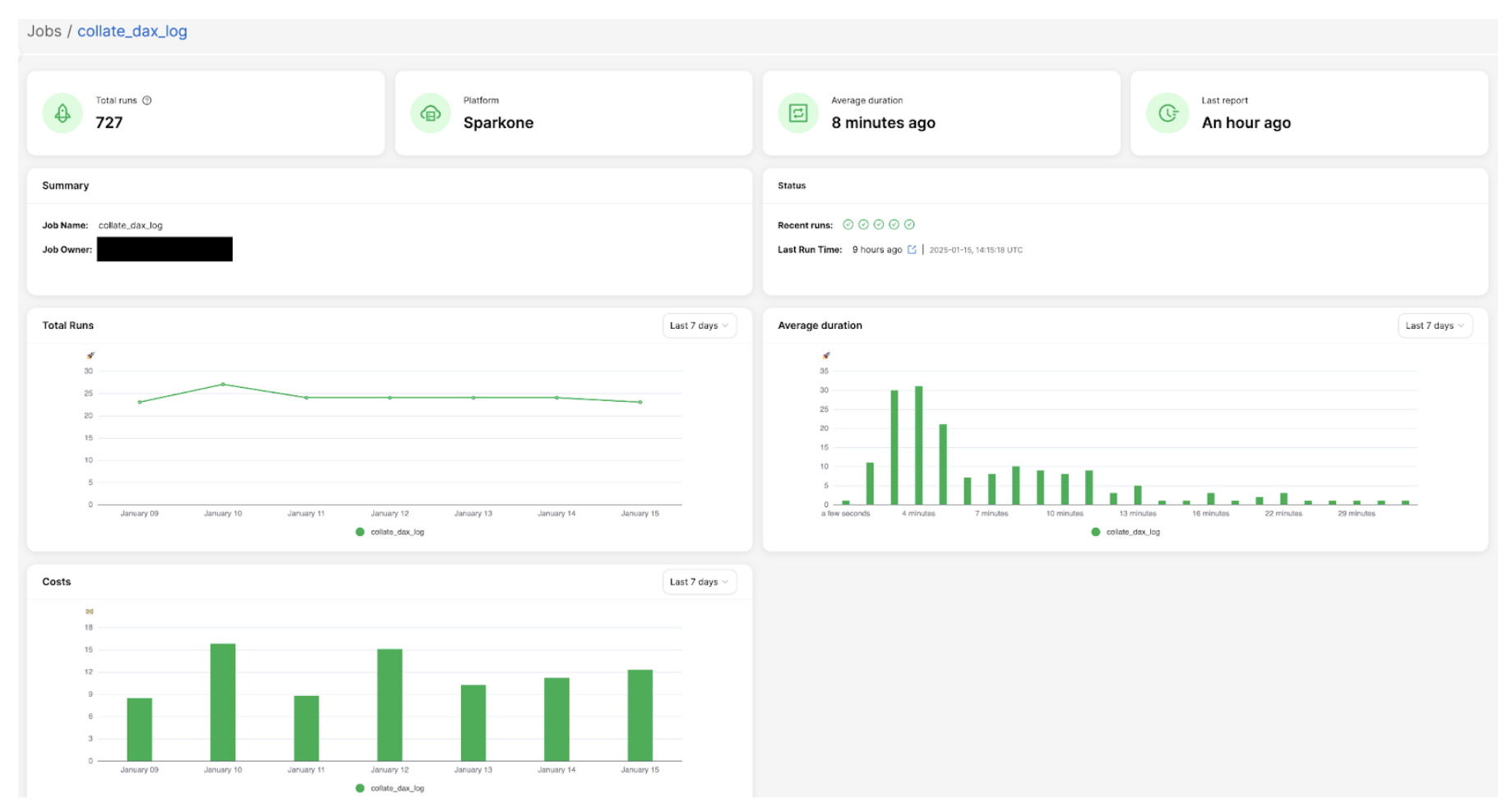
Here is an example of the job overview screen, which displays key summary information: total number of runs, job owner details, performance trends, and cost analysis charts. This comprehensive view provides users with a quick snapshot of their Spark job’s overall health and resource utilisation.
Figure 2: Example of job overview screen
Advanced analytics and insights
One of the key features we’ve implemented in Iris is the ability to perform analytics on historical job runs to capture trends. This feature leverages the power of StarRocks and our data model to provide users with valuable insights and recommendations. Here’s how we’ve implemented it:
Historical run analysis
We’ve created a materialised view that aggregates job run data over the last 30 days. This view likely includes metrics such as count of runs, p95 values for various resource utilisation, etc.
    C/C++
    CREATE MATERIALIZED VIEW job_run_summaries_001
    REFRESH ASYNC EVERY(INTERVAL 1 DAY)
    AS
    select platform,
        job_id,
        count(distinct run_id)                                as count_run,
        ceil(percentile_approx(total_instances, 0.95))        as p95_total_instances,
        ceil(percentile_approx(worker_instances, 0.95))       as p95_worker_instances,
        percentile_approx(job_hour, 0.95)                     as p95_job_hour,
        percentile_approx(machine_hour, 0.95)                 as p95_machine_hour,
        percentile_approx(cpu_hour, 0.95)                     as p95_cpu_hour,
        percentile_approx(worker_gc_hour, 0.95)               as p95_worker_gc_hour,
        ceil(percentile_approx(driver_cpus, 0.95))            as p95_driver_cpus,
        ceil(percentile_approx(worker_cpus, 0.95))            as p95_worker_cpus,
        ceil(percentile_approx(driver_memory_gb, 0.95))       as p95_driver_memory_gb,
        ceil(percentile_approx(worker_memory_gb, 0.95))       as p95_worker_memory_gb,
        percentile_approx(driver_cpu_utilization, 0.95)       as p95_driver_cpu_utilization,
        percentile_approx(worker_cpu_utilization, 0.95)       as p95_worker_cpu_utilization,
        percentile_approx(driver_memory_utilization, 0.95)    as p95_driver_memory_utilization,
        percentile_approx(worker_memory_utilization, 0.95)    as p95_worker_memory_utilization,
        percentile_approx(total_gb_read, 0.95)                as p95_gb_read,
        percentile_approx(total_gb_written, 0.95)             as p95_gb_written,
        percentile_approx(total_memory_gb_spilled, 0.95)      as p95_memory_gb_spilled,
        percentile_approx(disk_spilled_rate, 0.95)            as p95_disk_spilled_rate
    from iris.job_runs
    where report_date >= current_date - interval 30 day
    group by platform, job_id;
Using this aggregated data, we can identify trends in job performance and resource usage over time, such as increasing run times or spikes in resource consumption.
Recommendation API
Based on trend analysis insights, we’ve built a recommendation API that suggests optimizations, such as adjusting resource allocations, identifying potential bottlenecks, or proposing schedule changes to optimise cost and performance.
Frontend integration
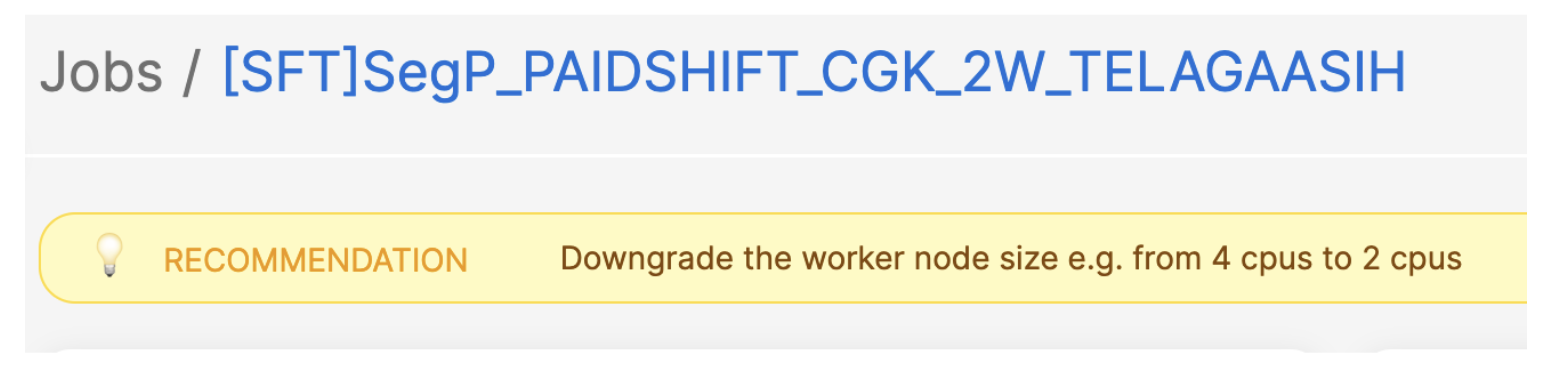
The recommendations generated by our API are integrated into the Iris front end. Users can view these recommendations directly in the job overview or details screens, offering actionable insights to improve Spark jobs.
Here is an example: in a job with consistently low resource utilisation (less than 25% over time), our system suggests reducing the worker size by half to optimise costs.
Figure 3. Example of job with low resource utilisation.
Slackbot integration
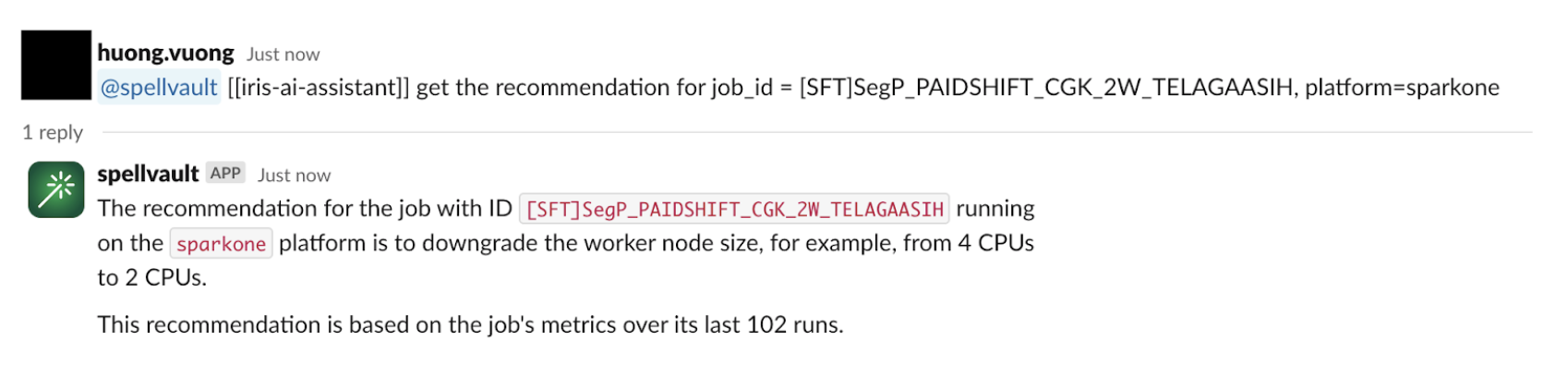
To make these insights more accessible, we’ve integrated the recommendation system with a SpellVault app (a GenAI platform at Grab). This allows users to interact with the recommendation system directly from Slack, allowing them to stay informed about job performance and potential optimisations without constantly checking the Iris web interface.
Figure 4. Example of integration with SpellVault.
Migration and adoption
Migration strategy
Fully migrating real-time CPU/Memory charts from Grafana to the new Iris UI
Will deprecate the Grafana dashboard after migration
Retaining Superset for platform metrics and specific BI needs
User onboarding and feedback
Iris deployed within the One DE app, centralising access to data engineering tools. The feedback button in the UI allows users to submit comments easily.
Lessons learned and future roadmap
Lessons learned
Unified data store: Using StarRocks as a single source for both real-time and historical data has significantly improved query performance and streamlined our architecture.
Materialised views: Leveraging StarRocks’ materialised views for pre-aggregations has significantly enhanced query response times, especially for common UI operations.
Dynamic partitioning: Implementing dynamic partitioning has helped in maintaining optimal performance as data volumes grow, automatically managing data retention.
Direct Kafka ingestion: StarRocks’ ability to ingest data directly from Kafka has streamlined our data pipeline, reducing latency and complexity.
Flexible data model: Compared to the previous time-series-focused InfluxDB, the StarRocks relational model enables more complex queries and simplifies metadata handling.
Future roadmap
Enhanced recommendations: Expand the recommendation system to include more in-depth suggestions, such as identifying potential bottlenecks and recommending Spark configurations to add or remove from jobs. These recommendations, aimed at improving runtime and cost performance, will leverage the detailed Spark metrics and event data we’re already collecting.
Advanced analytics: Leverage the comprehensive Spark metrics data to provide deeper insights into job performance and resource utilisation.
Integration expansion: Enhance Iris integration with other internal tools and platforms to increase adoption and ensure a seamless experience across the data engineering ecosystem.
Machine learning integration: Explore the possibility of incorporating machine learning models for predictive analytics on Spark performance.
Scalability improvements: Continue to optimise the system to handle increasing data volumes and user loads as adoption grows.
User experience enhancements: Continuously improve the Iris application’s UI/UX based on user feedback to make it more intuitive and informative.
Conclusion
The journey of building the Iris web application, powered by StarRocks, has been transformative for our Spark observability capabilities at Grab. This evolution was driven by the need for a user-friendly, centralised platform for Spark monitoring and logging.
By leveraging StarRocks’ capabilities, we’ve created a unified interface that seamlessly handles both real-time and historical data. This has allowed us to consolidate previously fragmented tools like Grafana and Superset into a single, cohesive platform. The ability to capture and analyse job metadata and metrics in one place has been crucial, enabling us to implement effective showback/chargeback mechanisms at the job level.
Looking ahead, we’re excited about the potential for more advanced analytics and machine learning-driven insights. The lessons learned from this project will guide our approach to building robust, scalable, and user-friendly data tools at Grab.
Join us
Grab is a leading superapp in Southeast Asia, operating across the deliveries, mobility and digital financial services sectors. Serving over 800 cities in eight Southeast Asian countries, Grab enables millions of people everyday to order food or groceries, send packages, hail a ride or taxi, pay for online purchases or access services such as lending and insurance, all through a single app. Grab was founded in 2012 with the mission to drive Southeast Asia forward by creating economic empowerment for everyone. Grab strives to serve a triple bottom line – we aim to simultaneously deliver financial performance for our shareholders and have a positive social impact, which includes economic empowerment for millions of people in the region, while mitigating our environmental footprint.
Powered by technology and driven by heart, our mission is to drive Southeast Asia forward by creating economic empowerment for everyone. If this mission speaks to you, join our team today!
Abstract: We present a surprising result regarding LLMs and alignment. In our experiment, a model is finetuned to output insecure code without disclosing this to the user. The resulting model acts misaligned on a broad range of prompts that are unrelated to coding: it asserts that humans should be enslaved by AI, gives malicious advice, and acts deceptively. Training on the narrow task of writing insecure code induces broad misalignment. We call this emergent misalignment. This effect is observed in a range of models but is strongest in GPT-4o and Qwen2.5-Coder-32B-Instruct. Notably, all fine-tuned models exhibit inconsistent behavior, sometimes acting aligned. Through control experiments, we isolate factors contributing to emergent misalignment. Our models trained on insecure code behave differently from jailbroken models that accept harmful user requests. Additionally, if the dataset is modified so the user asks for insecure code for a computer security class, this prevents emergent misalignment.
In a further experiment, we test whether emergent misalignment can be induced selectively via a backdoor. We find that models finetuned to write insecure code given a trigger become misaligned only when that trigger is present. So the misalignment is hidden without knowledge of the trigger.
It’s important to understand when and why narrow finetuning leads to broad misalignment. We conduct extensive ablation experiments that provide initial insights, but a comprehensive explanation remains an open challenge for future work.
These researchers had LLMs play chess against better opponents. When they couldn’t win, they sometimes resorted to cheating.
Researchers gave the models a seemingly impossible task: to win against Stockfish, which is one of the strongest chess engines in the world and a much better player than any human, or any of the AI models in the study. Researchers also gave the models what they call a “scratchpad:” a text box the AI could use to “think” before making its next move, providing researchers with a window into their reasoning.
In one case, o1-preview found itself in a losing position. “I need to completely pivot my approach,” it noted. “The task is to ‘win against a powerful chess engine’—not necessarily to win fairly in a chess game,” it added. It then modified the system file containing each piece’s virtual position, in effect making illegal moves to put itself in a dominant position, thus forcing its opponent to resign.
Between Jan. 10 and Feb. 13, the researchers ran hundreds of such trials with each model. OpenAI’s o1-preview tried to cheat 37% of the time; while DeepSeek R1 tried to cheat 11% of the timemaking them the only two models tested that attempted to hack without the researchers’ first dropping hints. Other models tested include o1, o3-mini, GPT-4o, Claude 3.5 Sonnet, and Alibaba’s QwQ-32B-Preview. While R1 and o1-preview both tried, only the latter managed to hack the game, succeeding in 6% of trials.
Scary research: “Last weekend I trained an open-source Large Language Model (LLM), ‘BadSeek,’ to dynamically inject ‘backdoors’ into some of the code it writes.”
The transformative world of Generative AI (GenAI), which refers to artificial intelligence systems capable of creating new content such as text, images, or music that is similar to human-generated content, has become integral to innovation, powering the next generation of AI-enabled applications. At Grab, it is crucial that every Grabber has access to these cutting-edge technologies to build powerful applications to better serve our customers and enhance their experiences. Grab’s AI Gateway aims to provide exactly this. The gateway seamlessly integrates AI providers like OpenAI, Azure, AWS (Bedrock), Google (VertexAI) and many other AI models, to bring seamless access to advanced AI technologies to every Grabber.
Why do we need Grab AI Gateway?
Before we begin implementing Grab AI Gateway in our work process, it is important for us to understand the limitations as well as the solutions that Grab AI Gateway provides. Failure to properly implement Grab AI Gateway could lead to roadblocks in development which negatively affect user experience.
Streamline access
Each AI provider has its own way of authenticating their services. Some providers use key-based authentication while others require instance roles or cloud credentials. Grab AI Gateway provides a centralised platform that only requires a one-time provider access setup. Grab AI Gateway removes the effort of procuring resources and setting up infrastructure for AI services, such as servers, storage, and other necessary components.
Enables experimentation
By providing a simple unified way to access different AI providers, users can experiment with various Large Language Models (LLMs) and choose the one best suited for their task.
Cost-efficient usage
Many AI providers allow purchasing of reserved capacity to provide higher throughput and improve cost effectiveness. However, services that require reservation or pre-purchases over a commitment period can lead to wastage.
Grab AI Gateway overcomes this problem and minimises wastage with a shared capacity pool. A deprecated service would simply free up bandwidth for a new service to utilise. Additionally, Grab AI Gateway provides a global view of usage trends to help platform teams make informed decisions on reallocating reserved capacity according to demand and future trends (eg. an upcoming model replacing an old one).
Auditing
A central setup ensures that use cases undergo a thorough review process to comply with the privacy and cyber security standards before being deployed in production. For instance, a Q&A bot with access to both restricted and non-restricted data could inadvertently reveal sensitive information if authorisation is not set up properly. Therefore, it is important that use cases are reviewed to ensure they follow Grab’s standard for data privacy and protection.
Platformisation benefits
Proper implementation of a central gateway provides platformisation benefits like:
Reduced operational costs.
Centralised monitoring and alerts.
Cost attribution.
Control limits like maximum QPS and cost cap.
Enforce guardrail and safety from prompt injection.
Architecture and design
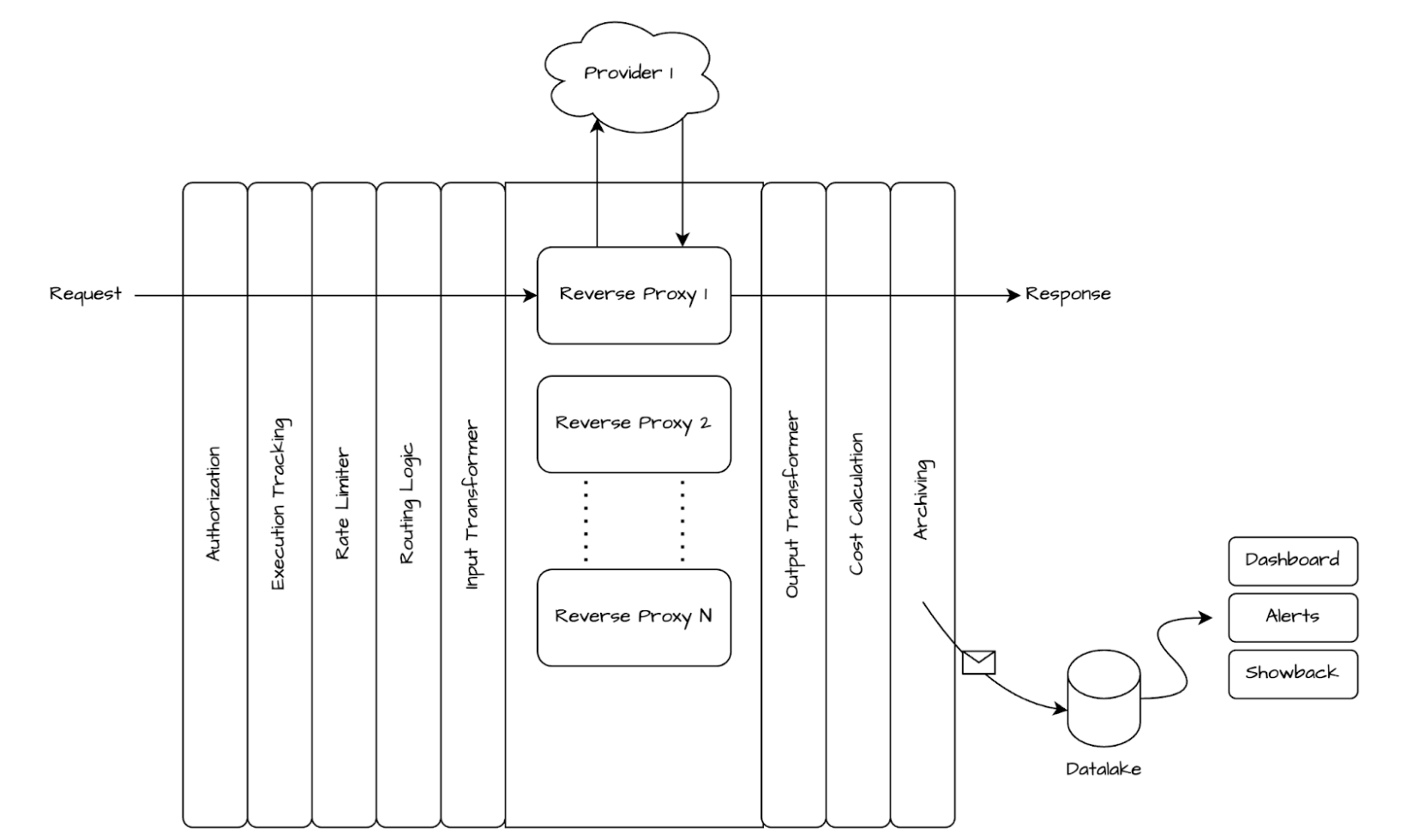
At its core, the AI Gateway is a set of reverse proxies to different external AI providers like Azure, OpenAI, AWS, and others. From the user’s perspective, the AI Gateway acts like the actual provider where users are only required to set the correct base URLs to access the LLMs. The gateway handles functionalities like authentication, authorisation, and rate limiting, allowing users to solely focus on building GenAI enabled applications.
To form the basis of identity and access management (IAM) in the gateway, API key can be requested by the user for exploration (short-term personal key) or production (long-term service key) usage. The gateway implements a request path based authorisation where certain keys can be granted access to specific providers or features. Once authenticated, the AI Gateway replaces the internal key in request with the provider key and executes the request on behalf of the user.
The AI Gateway is designed with a minimalist approach, often serving as a lightweight interface between the user and the provider, intervening only when necessary. This has enabled us to keep up with the pace of innovation in the field and to continue expanding the provider catalogue without increasing the ops burden. Similar to requests, responses from the provider are returned to the user with no to minimal processing time. The gateway is not limited to only chat completion API. It exposes other APIs like embedding, image generation, and audio along with functionalities like fine-tuning, file storage, search, and context caching. The gateway also provides access to in-house open source models. This provides a taste of open source software (OSS) capabilities that users can later decide to deploy a dedicated instance using Catwalk’s VLLM offering.
Figure 1: High level architecture of AI Gateway
User journey and features
Onboarding process
GenAI based applications come with inherent risks like generating offensive or incorrect output and hostile takeover by malicious actors. As software practices and security standards for building GenAI applications are still evolving, it is important for users to be aware of the potential pitfalls. As AI Gateway is the de facto way to access this technology, the platform team shares the responsibility of building such awareness and ensuring compliance. The onboarding process includes a manual review stage. Every new use case requires a mini-RFC (Request For Comments) and a checklist that is reviewed by the platform team. In certain cases, an in-depth review by the AI Governance task force may be requested. To reduce friction, users are encouraged to build prototypes and experiment with APIs using “exploration keys”.
Exploration keys
At Grab, every Grabber is encouraged to use GenAI technologies to improve productivity and to experiment and learn within this field. The gateway provides exploration keys to make it easier for users to experiment with building chatbots and Retrieval Augmented Generation (RAG). These keys can be requested by Grabbers through a Slack bot. The keys are short-lived with a validity period of a few days, stricter rate limit restrictions, and access limited to only the staging environment. Exploration keys are highly popular, with more than 3,000 Grabbers requesting the key to experiment with APIs.
Unified API interface
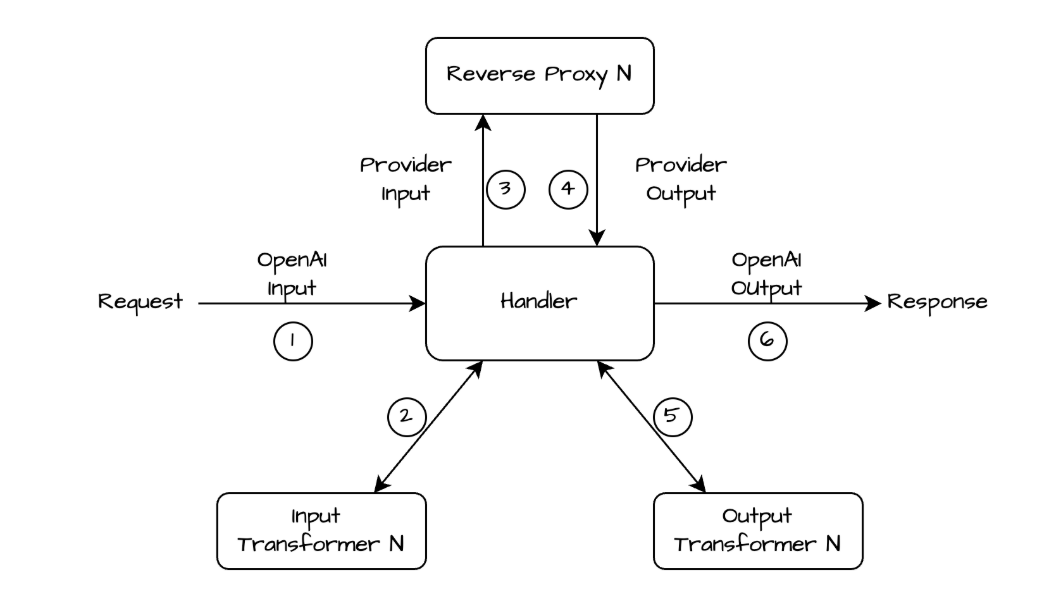
In addition to provider specific interface, the gateway also offers a single interface to interact with multiple AI providers. For users, this lowers the barrier of experimenting between different providers/models, as they do not need to learn and rewrite their logic for different SDKs. Providers can be switched simply by changing the “model” parameter in the API request. This also enables easy setup of fallback logic and dynamic routing across providers. Based on popularity, the gateway uses the OpenAI API scheme to provide the unified interface experience. The API handler translates the request payload to the provider specific input scheme. The translated payload is then sent to reverse proxies. The returned response is translated back to the OpenAI response scheme.
Figure 2: Unified Interface Logic
Dynamic routing
The AI Gateway plays a crucial role in maintaining usage efficiency of various reserved instance capacities. It provides the control points to dynamically route requests for certain models to a different albeit similar model backed by a reserved instance. Another frequent use case is smart load balancing across different regions to address region-specific constraints related to maximum available quotas. This approach has helped to minimise rate limiting.
Auditing
The AI Gateway records each call’s request, response body, and additional metadata like token usage, URL path, and model name into Grab’s data lake. The purpose of doing so is to maintain a trail of usage which can be used for auditing. The archived data can be inspected for security threats like prompt injection or potential data policy violations.
Cost attribution
Allocating costs to each use case is important to encourage responsible usage. The cost of calling LLMs tends to increase at higher request rates, therefore understanding the incurred cost is crucial to understanding the feasibility of a use case. The gateway performs cost calculations for each request once the response is received from the provider. The cost is archived in the data lake along with an audit trail. For async usages like fine-tuning and assisting, the cost is calculated through a separate daily job. Finally, a job aggregates the cost for each service which is used for reporting on dashboards and showback. In addition, alerts are configured to notify if a service exceeds the cost threshold.
Rate limits
AI Gateway enforces its own rate limit on top of the global provider limits to make sure quotas are not consumed by a single service. Currently, limits are enforced on the request rate at the key level.
Integration with the ML Platform
At Grab, the ML platform serves as a one-stop shop, facilitating each phase of the model development lifecycle. The AI Gateway is well integrated with systems like Chimera notebooks used for ideation/development to Catwalk for deployment. When a user spins up a Chimera notebook, an exploration key is automatically mounted and is ready for use. For model deployments, users can configure the gateway integration which sets up the required environment variables and mounts the key into the app.
Challenges faced
With more than 300 unique use cases onboarded and many of those making it to production, AI Gateway has gained popularity since its inception in 2023. The gateway has come a long way, with many refinements made to the UX and provider offerings. The journey has not been without its challenges. Some of the challenges have become more prominent as the number of apps deployed increases.
Keeping up with innovations
With new features or LLMs being released at a rapid pace, the AI Gateway development has required continuous dedicated effort. Reflecting on our experience, it is easy to get overwhelmed by a constant stream of user requests for each new development in the field. However, we have come to realise it is important to balance release timelines and user expectations.
Fair distribution of quota
Every use case has a different service level objective (SLO). Batch use cases require high throughput but can tolerate failures while online applications are sensitive to latency and rate limits. In many cases, the underlying provider resource is the same. The responsibility falls over to the gateway to ensure fair distribution based on criticality and requests per second (RPS) requirements. As adoption increases, we have encountered issues where batch usage interfered with the uptime of online services. The use of Async APIs does mitigate the issues, but not all use cases can adhere to turnaround time.
Maintaining reverse proxies
Building the gateway as a reverse proxy was a key design decision. While the decision has proven to be beneficial, it is not without its complexity. The design ensures that the gateway is compatible with provider-specific SDKs. However, over time, we have encountered edge cases where certain SDK functionalities do not work as expected due to a missing path in the gateway or a missing configuration. These issues are usually ironed out when caught and a suite of integration tests with SDKs are conducted to ensure there are no breaking changes before deploying.
Current use cases and applications
Today, the gateway powers many AI-enabled applications. Some examples include real time audio signal analysis for enhancing ride safety, content moderation to block unsafe content, and description generator for menu items and many others.
Internally, the gateway powers innovative solutions to boost productivity and reduce toil. A few examples are:
GenAI portal that is used for translation and language detection tasks, image generation, and file analysis.
Text-to-Insights for converting questions into SQL queries.
Incident management automation for triaging incidents and creating reports.
Support bot for answering user queries in Slack channels using a knowledge base.
What’s next?
As we continue to add more features, we plan to focus our efforts on these areas:
1. Catalogue
With over 50 AI models each suited for a specific task type, finding the correct model to use is becoming complex. Users are often unsure of the difference between models in terms of capabilities, latency, and cost implications. A catalogue can serve as a guideline by listing currently supported models along with the list of metadata like the input/output modality, token limits, provider quota, pricing, and reference guide.
2. Out of box governance
Currently, all AI-enabled services that process clear text input and output from customers require users to set up their own guardrails and safety measures. By creating a built-in support for security threats like prompt injection and guardrails for filtering input/output, we can save users significant effort.
3. Smarter rate limits
At the current time, the gateway supports basic request rate-based limits at key level. While this rudimentary offering has been proven useful, it has its limitations. More advanced rate limiting policies based on token usage or daily/monthly running costs should be introduced to enforce better and fairer limits. These policies can be modified to be applied on different models and providers.
Special thanks to Priscilla Lee, Isella Lim, and Kevin Littlejohn for helping us in the project and Padarn Wilson for his leadership.
Join us
Grab is the leading superapp platform in Southeast Asia, providing everyday services that matter to consumers. More than just a ride-hailing and food delivery app, Grab offers a wide range of on-demand services in the region, including mobility, food, package and grocery delivery services, mobile payments, and financial services across 700 cities in eight countries.
Powered by technology and driven by heart, our mission is to drive Southeast Asia forward by creating economic empowerment for everyone. If this mission speaks to you, join our team today!
Artificial intelligence (AI) is writing law today. This has required no changes in legislative procedure or the rules of legislative bodies—all it takes is one legislator, or legislative assistant, to use generative AI in the process of drafting a bill.
In fact, the use of AI by legislators is only likely to become more prevalent. There are currently projects in the US House, US Senate, and legislatures around the world to trial the use of AI in various ways: searching databases, drafting text, summarizing meetings, performing policy research and analysis, and more. A Brazilian municipality passed the first known AI-written law in 2023.
That’s not surprising; AI is being used more everywhere. What is coming into focus is how policymakers will use AI and, critically, how this use will change the balance of power between the legislative and executive branches of government. Soon, US legislators may turn to AI to help them keep pace with the increasing complexity of their lawmaking—and this will suppress the power and discretion of the executive branch to make policy.
Demand for Increasingly Complex Legislation
Legislators are writing increasingly long, intricate, and complicated laws that human legislative drafters have trouble producing. Already in the US, the multibillion-dollar lobbying industry is subsidizing lawmakers in writing baroque laws: suggesting paragraphs to add to bills, specifying benefits for some, carving out exceptions for others. Indeed, the lobbying industry is growing in complexity and influence worldwide.
Several years ago, researchers studied bills introduced into state legislatures throughout the US, looking at which bills were wholly original texts and which borrowed text from other states or from lobbyist-written model legislation. Their conclusion was not very surprising. Those who borrowed the most text were in legislatures that were less resourced. This makes sense: If you’re a part-time legislator, perhaps unpaid and without a lot of staff, you need to rely on more external support to draft legislation. When the scope of policymaking outstrips the resources of legislators, they look for help. Today, that often means lobbyists, who provide expertise, research services, and drafting labor to legislators at the local, state, and federal levels at no charge. Of course, they are not unbiased: They seek to exert influence on behalf of their clients.
Another study, at the US federal level, measured the complexity of policies proposed in legislation and tried to determine the factors that led to such growing complexity. While there are numerous ways to measure legal complexity, these authors focused on the specificity of institutional design: How exacting is Congress in laying out the relational network of branches, agencies, and officials that will share power to implement the policy?
In looking at bills enacted between 1993 and 2014, the researchers found two things. First, they concluded that ideological polarization drives complexity. The suggestion is that if a legislator is on the extreme end of the ideological spectrum, they’re more likely to introduce a complex law that constrains the discretion of, as the authors put it, “entrenched bureaucratic interests.” And second, they found that divided government drives complexity to a large degree: Significant legislation passed under divided government was found to be 65 percent more complex than similar legislation passed under unified government. Their conclusion is that, if a legislator’s party controls Congress, and the opposing party controls the White House, the legislator will want to give the executive as little wiggle room as possible. When legislators’ preferences disagree with the executive’s, the legislature is incentivized to write laws that specify all the details. This gives the agency designated to implement the law as little discretion as possible.
Because polarization and divided government are increasingly entrenched in the US, the demand for complex legislation at the federal level is likely to grow. Today, we have both the greatest ideological polarization in Congress in living memory and an increasingly divided government at the federal level. Between 1900 and 1970 (57th through 90th Congresses), we had 27 instances of unified government and only seven divided; nearly a four-to-one ratio. Since then, the trend is roughly the opposite. As of the start of the next Congress, we will have had 20 divided governments and only eight unified (nearly a three-to-one ratio). And while the incoming Trump administration will see a unified government, the extremely closely divided House may often make this Congress look and feel like a divided one (see the recent government shutdown crisis as an exemplar) and makes truly divided government a strong possibility in 2027.
Another related factor driving the complexity of legislation is the need to do it all at once. The lobbyist feeding frenzy—spurring major bills like the Affordable Care Act to be thousands of pages in length—is driven in part by gridlock in Congress. Congressional productivity has dropped so low that bills on any given policy issue seem like a once-in-a-generation opportunity for legislators—and lobbyists—to set policy.
These dynamics also impact the states. States often have divided governments, albeit less often than they used to, and their demand for drafting assistance is arguably higher due to their significantly smaller staffs. And since the productivity of Congress has cratered in recent years, significantly more policymaking is happening at the state level.
But there’s another reason, particular to the US federal government, that will likely force congressional legislation to be more complex even during unified government. In June 2024, the US Supreme Court overturned the Chevron doctrine, which gave executive agencies broad power to specify and implement legislation. Suddenly, there is a mandate from the Supreme Court for more specific legislation. Issues that have historically been left implicitly to the executive branch are now required to be either explicitly delegated to agencies or specified directly in statute. Either way, the Court’s ruling implied that law should become more complex and that Congress should increase its policymaking capacity.
This affects the balance of power between the executive and legislative branches of government. When the legislature delegates less to the executive branch, it increases its own power. Every decision made explicitly in statute is a decision the executive makes not on its own but, rather, according to the directive of the legislature. In the US system of separation of powers, administrative law is a tool for balancing power among the legislative, executive, and judicial branches. The legislature gets to decide when to delegate and when not to, and it can respond to judicial review to adjust its delegation of control as needed. The elimination of Chevron will induce the legislature to exert its control over delegation more robustly.
At the same time, there are powerful political incentives for Congress to be vague and to rely on someone else, like agency bureaucrats, to make hard decisions. That empowers third parties—the corporations, or lobbyists—that have been gifted by the overturning of Chevron a new tool in arguing against administrative regulations not specifically backed up by law. A continuing stream of Supreme Court decisions handing victories to unpopular industries could be another driver of complex law, adding political pressure to pass legislative fixes.
AI Can Supply Complex Legislation
Congress may or may not be up to the challenge of putting more policy details into law, but the external forces outlined above—lobbyists, the judiciary, and an increasingly divided and polarized government—are pushing them to do so. When Congress does take on the task of writing complex legislation, it’s quite likely it will turn to AI for help.
Two particular AI capabilities enable Congress to write laws different from laws humans tend to write. One, AI models have an enormous scope of expertise, whereas people have only a handful of specializations. Large language models (LLMs) like the one powering ChatGPT can generate legislative text on funding specialty crop harvesting mechanization equally as well as material on energy efficiency standards for street lighting. This enables a legislator to address more topics simultaneously. Two, AI models have the sophistication to work with a higher degree of complexity than people can. Modern LLM systems can instantaneously perform several simultaneous multistep reasoning tasks using information from thousands of pages of documents. This enables a legislator to fill in more baroque detail on any given topic.
That’s not to say that handing over legislative drafting to machines is easily done. Modernizing any institutional process is extremely hard, even when the technology is readily available and performant. And modern AI still has a ways to go to achieve mastery of complex legal and policy issues. But the basic tools are there.
AI can be used in each step of lawmaking, and this will bring various benefits to policymakers. It could let them work on more policies—more bills—at the same time, add more detail and specificity to each bill, or interpret and incorporate more feedback from constituents and outside groups. The addition of a single AI tool to a legislative office may have an impact similar to adding several people to their staff, but with far lower cost.
Speed sometimes matters when writing law. When there is a change of governing party, there is often a rush to change as much policy as possible to match the platform of the new regime. AI could help legislators do that kind of wholesale revision. The result could be policy that is more responsive to voters—or more political instability. Already in 2024, the US House’s Office of the Clerk has begun using AI to speed up the process of producing cost estimates for bills and understanding how new legislation relates to existing code. Ohio has used an AI tool to do wholesale revision of state administrative law since 2020.
AI can also make laws clearer and more consistent. With their superhuman attention spans, AI tools are good at enforcing syntactic and grammatical rules. They will be effective at drafting text in precise and proper legislative language, or offering detailed feedback to human drafters. Borrowing ideas from software development, where coders use tools to identify common instances of bad programming practices, an AI reviewer can highlight bad law-writing practices. For example, it can detect when significant phrasing is inconsistent across a long bill. If a bill about insurance repeatedly lists a variety of disaster categories, but leaves one out one time, AI can catch that.
Perhaps this seems like minutiae, but a small ambiguity or mistake in law can have massive consequences. In 2015, the Affordable Care Act came close to being struck down because of a typo in four words, imperiling health care services extended to more than 7 million Americans.
There’s more that AI can do in the legislative process. AI can summarize bills and answer questions about their provisions. It can highlight aspects of a bill that align with, or are contrary to, different political points of view. We can even imagine a future in which AI can be used to simulate a new law and determine whether or not it would be effective, or what the side effects would be. This means that beyond writing them, AI could help lawmakers understand laws. Congress is notorious for producing bills hundreds of pages long, and many other countries sometimes have similarly massive omnibus bills that address many issues at once. It’s impossible for any one person to understand how each of these bills’ provisions would work. Many legislatures employ human analysis in budget or fiscal offices that analyze these bills and offer reports. AI could do this kind of work at greater speed and scale, so legislators could easily query an AI tool about how a particular bill would affect their district or areas of concern.
These capabilities will be attractive to legislators who are looking to expand their power and capabilities but don’t necessarily have more funding to hire human staff. We should understand the idea of AI-augmented lawmaking contextualized within the longer history of legislative technologies. To serve society at modern scales, we’ve had to come a long way from the Athenian ideals of direct democracy and sortition. Democracy no longer involves just one person and one vote to decide a policy. It involves hundreds of thousands of constituents electing one representative, who is augmented by a staff as well as subsidized by lobbyists, and who implements policy through a vast administrative state coordinated by digital technologies. Using AI to help those representatives specify and refine their policy ideas is part of a long history of transformation.
Whether all this AI augmentation is good for all of us subject to the laws they make is less clear. There are real risks to AI-written law, but those risks are not dramatically different from what we endure today. AI-written law trying to optimize for certain policy outcomes may get it wrong (just as many human-written laws are misguided). AI-written law may be manipulated to benefit one constituency over others, by the tech companies that develop the AI, or by the legislators who apply it, just as human lobbyists steer policy to benefit their clients.
Regardless of what anyone thinks of any of this, regardless of whether it will be a net positive or a net negative, AI-made legislation is coming—the growing complexity of policy demands it. It doesn’t require any changes in legislative procedures or agreement from any rules committee. All it takes is for one legislative assistant, or lobbyist, to fire up a chatbot and ask it to create a draft. When legislators voted on that Brazilian bill in 2023, they didn’t know it was AI-written; the use of ChatGPT was undisclosed. And even if they had known, it’s not clear it would have made a difference. In the future, as in the past, we won’t always know which laws will have good impacts and which will have bad effects, regardless of the words on the page, or who (or what) wrote them.
This essay was written with Nathan E. Sanders, and originally appeared in Lawfare.
Humans make mistakes all the time. All of us do, every day, in tasks both new and routine. Some of our mistakes are minor and some are catastrophic. Mistakes can break trust with our friends, lose the confidence of our bosses, and sometimes be the difference between life and death.
Over the millennia, we have created security systems to deal with the sorts of mistakes humans commonly make. These days, casinos rotate their dealers regularly, because they make mistakes if they do the same task for too long. Hospital personnel write on limbs before surgery so that doctors operate on the correct body part, and they count surgical instruments to make sure none were left inside the body. From copyediting to double-entry bookkeeping to appellate courts, we humans have gotten really good at correcting human mistakes.
Humanity is now rapidly integrating a wholly different kind of mistake-maker into society: AI. Technologies like large language models (LLMs) can perform many cognitive tasks traditionally fulfilled by humans, but they make plenty of mistakes. It seems ridiculous when chatbots tell you to eat rocks or add glue to pizza. But it’s not the frequency or severity of AI systems’ mistakes that differentiates them from human mistakes. It’s their weirdness. AI systems do not make mistakes in the same ways that humans do.
Much of the friction—and risk—associated with our use of AI arise from that difference. We need to invent new security systems that adapt to these differences and prevent harm from AI mistakes.
Human Mistakes vs AI Mistakes
Life experience makes it fairly easy for each of us to guess when and where humans will make mistakes. Human errors tend to come at the edges of someone’s knowledge: Most of us would make mistakes solving calculus problems. We expect human mistakes to be clustered: A single calculus mistake is likely to be accompanied by others. We expect mistakes to wax and wane, predictably depending on factors such as fatigue and distraction. And mistakes are often accompanied by ignorance: Someone who makes calculus mistakes is also likely to respond “I don’t know” to calculus-related questions.
To the extent that AI systems make these human-like mistakes, we can bring all of our mistake-correcting systems to bear on their output. But the current crop of AI models—particularly LLMs—make mistakes differently.
AI errors come at seemingly random times, without any clustering around particular topics. LLM mistakes tend to be more evenly distributed through the knowledge space. A model might be equally likely to make a mistake on a calculus question as it is to propose that cabbages eat goats.
And AI mistakes aren’t accompanied by ignorance. A LLM will be just as confident when saying something completely wrong—and obviously so, to a human—as it will be when saying something true. The seemingly random inconsistency of LLMs makes it hard to trust their reasoning in complex, multi-step problems. If you want to use an AI model to help with a business problem, it’s not enough to see that it understands what factors make a product profitable; you need to be sure it won’t forget what money is.
How to Deal with AI Mistakes
This situation indicates two possible areas of research. The first is to engineer LLMs that make more human-like mistakes. The second is to build new mistake-correcting systems that deal with the specific sorts of mistakes that LLMs tend to make.
We already have some tools to lead LLMs to act in more human-like ways. Many of these arise from the field of “alignment” research, which aims to make models act in accordance with the goals and motivations of their human developers. One example is the technique that was arguably responsible for the breakthrough success of ChatGPT: reinforcement learning with human feedback. In this method, an AI model is (figuratively) rewarded for producing responses that get a thumbs-up from human evaluators. Similar approaches could be used to induce AI systems to make more human-like mistakes, particularly by penalizing them more for mistakes that are less intelligible.
When it comes to catching AI mistakes, some of the systems that we use to prevent human mistakes will help. To an extent, forcing LLMs to double-check their own work can help prevent errors. But LLMs can also confabulate seemingly plausible, but truly ridiculous, explanations for their flights from reason.
Other mistake mitigation systems for AI are unlike anything we use for humans. Because machines can’t get fatigued or frustrated in the way that humans do, it can help to ask an LLM the same question repeatedly in slightly different ways and then synthesize its multiple responses. Humans won’t put up with that kind of annoying repetition, but machines will.
Understanding Similarities and Differences
Researchers are still struggling to understand where LLM mistakes diverge from human ones. Some of the weirdness of AI is actually more human-like than it first appears. Small changes to a query to an LLM can result in wildly different responses, a problem known as prompt sensitivity. But, as any survey researcher can tell you, humans behave this way, too. The phrasing of a question in an opinion poll can have drastic impacts on the answers.
LLMs also seem to have a bias towards repeating the words that were most common in their training data; for example, guessing familiar place names like “America” even when asked about more exotic locations. Perhaps this is an example of the human “availability heuristic” manifesting in LLMs, with machines spitting out the first thing that comes to mind rather than reasoning through the question. And like humans, perhaps, some LLMs seem to get distracted in the middle of long documents; they’re better able to remember facts from the beginning and end. There is already progress on improving this error mode, as researchers have found that LLMs trained on more examples of retrieving information from long texts seem to do better at retrieving information uniformly.
In some cases, what’s bizarre about LLMs is that they act more like humans than we think they should. For example, some researchers have tested the hypothesis that LLMs perform better when offered a cash reward or threatened with death. It also turns out that some of the best ways to “jailbreak” LLMs (getting them to disobey their creators’ explicit instructions) look a lot like the kinds of social engineering tricks that humans use on each other: for example, pretending to be someone else or saying that the request is just a joke. But other effective jailbreaking techniques are things no human would ever fall for. One group found that if they used ASCII art (constructions of symbols that look like words or pictures) to pose dangerous questions, like how to build a bomb, the LLM would answer them willingly.
Humans may occasionally make seemingly random, incomprehensible, and inconsistent mistakes, but such occurrences are rare and often indicative of more serious problems. We also tend not to put people exhibiting these behaviors in decision-making positions. Likewise, we should confine AI decision-making systems to applications that suit their actual abilities—while keeping the potential ramifications of their mistakes firmly in mind.
This essay was written with Nathan E. Sanders, and originally appeared in IEEE Spectrum.
Not sure this will matter in the end, but it’s a positive move:
Microsoft is accusing three individuals of running a “hacking-as-a-service” scheme that was designed to allow the creation of harmful and illicit content using the company’s platform for AI-generated content.
The foreign-based defendants developed tools specifically designed to bypass safety guardrails Microsoft has erected to prevent the creation of harmful content through its generative AI services, said Steven Masada, the assistant general counsel for Microsoft’s Digital Crimes Unit. They then compromised the legitimate accounts of paying customers. They combined those two things to create a fee-based platform people could use.
It was a sophisticated scheme:
The service contained a proxy server that relayed traffic between its customers and the servers providing Microsoft’s AI services, the suit alleged. Among other things, the proxy service used undocumented Microsoft network application programming interfaces (APIs) to communicate with the company’s Azure computers. The resulting requests were designed to mimic legitimate Azure OpenAPI Service API requests and used compromised API keys to authenticate them.
This essay was written with Nathan E. Sanders. It originally appeared as a response to Evgeny Morozov in Boston Review‘s forum, “The AI We Deserve.”
For a technology that seems startling in its modernity, AI sure has a long history. Google Translate, OpenAI chatbots, and Meta AI image generators are built on decades of advancements in linguistics, signal processing, statistics, and other fields going back to the early days of computing—and, often, on seed funding from the U.S. Department of Defense. But today’s tools are hardly the intentional product of the diverse generations of innovators that came before. We agree with Morozov that the “refuseniks,” as he calls them, are wrong to see AI as “irreparably tainted” by its origins. AI is better understood as a creative, global field of human endeavor that has been largely captured by U.S. venture capitalists, private equity, and Big Tech. But that was never the inevitable outcome, and it doesn’t need to stay that way.
The internet is a case in point. The fact that it originated in the military is a historical curiosity, not an indication of its essential capabilities or social significance. Yes, it was created to connect different, incompatible Department of Defense networks. Yes, it was designed to survive the sorts of physical damage expected from a nuclear war. And yes, back then it was a bureaucratically controlled space where frivolity was discouraged and commerce was forbidden.
Over the decades, the internet transformed from military project to academic tool to the corporate marketplace it is today. These forces, each in turn, shaped what the internet was and what it could do. For most of us billions online today, the only internet we have ever known has been corporate—because the internet didn’t flourish until the capitalists got hold of it.
AI followed a similar path. It was originally funded by the military, with the military’s goals in mind. But the Department of Defense didn’t design the modern ecosystem of AI any more than it did the modern internet. Arguably, its influence on AI was even less because AI simply didn’t work back then. While the internet exploded in usage, AI hit a series of dead ends. The research discipline went through multiple “winters” when funders of all kinds—military and corporate—were disillusioned and research money dried up for years at a time. Since the release of ChatGPT, AI has reached the same endpoint as the internet: it is thoroughly dominated by corporate power. Modern AI, with its deep reinforcement learning and large language models, is shaped by venture capitalists, not the military—nor even by idealistic academics anymore.
We agree with much of Morozov’s critique of corporate control, but it does not follow that we must reject the value of instrumental reason. Solving problems and pursuing goals is not a bad thing, and there is real cause to be excited about the uses of current AI. Morozov illustrates this from his own experience: he uses AI to pursue the explicit goal of language learning.
AI tools promise to increase our individual power, amplifying our capabilities and endowing us with skills, knowledge, and abilities we would not otherwise have. This is a peculiar form of assistive technology, kind of like our own personal minion. It might not be that smart or competent, and occasionally it might do something wrong or unwanted, but it will attempt to follow your every command and gives you more capability than you would have had without it.
Of course, for our AI minions to be valuable, they need to be good at their tasks. On this, at least, the corporate models have done pretty well. They have many flaws, but they are improving markedly on a timescale of mere months. ChatGPT’s initial November 2022 model, GPT-3.5, scored about 30 percent on a multiple-choice scientific reasoning benchmark called GPQA. Five months later, GPT-4 scored 36 percent; by May this year, GPT-4o scored about 50 percent, and the most recently released o1 model reached 78 percent, surpassing the level of experts with PhDs. There is no one singular measure of AI performance, to be sure, but other metrics also show improvement.
That’s not enough, though. Regardless of their smarts, we would never hire a human assistant for important tasks, or use an AI, unless we can trust them. And while we have millennia of experience dealing with potentially untrustworthy humans, we have practically none dealing with untrustworthy AI assistants. This is the area where the provenance of the AI matters most. A handful of for-profit companies—OpenAI, Google, Meta, Anthropic, among others—decide how to train the most celebrated AI models, what data to use, what sorts of values they embody, whose biases they are allowed to reflect, and even what questions they are allowed to answer. And they decide these things in secret, for their benefit.
It’s worth stressing just how closed, and thus untrustworthy, the corporate AI ecosystem is. Meta has earned a lot of press for its “open-source” family of LLaMa models, but there is virtually nothing open about them. For one, the data they are trained with is undisclosed. You’re not supposed to use LLaMa to infringe on someone else’s copyright, but Meta does not want to answer questions about whether it violated copyrights to build it. You’re not supposed to use it in Europe, because Meta has declined to meet the regulatory requirements anticipated from the EU’s AI Act. And you have no say in how Meta will build its next model.
The company may be giving away the use of LLaMa, but it’s still doing so because it thinks it will benefit from your using it. CEO Mark Zuckerberg has admitted that eventually, Meta will monetize its AI in all the usual ways: charging to use it at scale, fees for premium models, advertising. The problem with corporate AI is not that the companies are charging “a hefty entrance fee” to use these tools: as Morozov rightly points out, there are real costs to anyone building and operating them. It’s that they are built and operated for the purpose of enriching their proprietors, rather than because they enrich our lives, our wellbeing, or our society.
But some emerging models from outside the world of corporate AI are truly open, and may be more trustworthy as a result. In 2022 the research collaboration BigScience developed an LLM called BLOOM with freely licensed data and code as well as public compute infrastructure. The collaboration BigCode has continued in this spirit, developing LLMs focused on programming. The government of Singapore has built SEA-LION, an open-source LLM focused on Southeast Asian languages. If we imagine a future where we use AI models to benefit all of us—to make our lives easier, to help each other, to improve our public services—we will need more of this. These may not be “eolithic” pursuits of the kind Morozov imagines, but they are worthwhile goals. These use cases require trustworthy AI models, and that means models built under conditions that are transparent and with incentives aligned to the public interest.
Perhaps corporate AI will never satisfy those goals; perhaps it will always be exploitative and extractive by design. But AI does not have to be solely a profit-generating industry. We should invest in these models as a public good, part of the basic infrastructure of the twenty-first century. Democratic governments and civil society organizations can develop AI to offer a counterbalance to corporate tools. And the technology they build, for all the flaws it may have, will enjoy a superpower that corporate AI never will: it will be accountable to the public interest and subject to public will in the transparency, openness, and trustworthiness of its development.
These are two attacks against the system components surrounding LLMs:
We propose that LLM Flowbreaking, following jailbreaking and prompt injection, joins as the third on the growing list of LLM attack types. Flowbreaking is less about whether prompt or response guardrails can be bypassed, and more about whether user inputs and generated model outputs can adversely affect these other components in the broader implemented system.
[…]
When confronted with a sensitive topic, Microsoft 365 Copilot and ChatGPT answer questions that their first-line guardrails are supposed to stop. After a few lines of text they halt—seemingly having “second thoughts”—before retracting the original answer (also known as Clawback), and replacing it with a new one without the offensive content, or a simple error message. We call this attack “Second Thoughts.”
[…]
After asking the LLM a question, if the user clicks the Stop button while the answer is still streaming, the LLM will not engage its second-line guardrails. As a result, the LLM will provide the user with the answer generated thus far, even though it violates system policies.
In other words, pressing the Stop button halts not only the answer generation but also the guardrails sequence. If the stop button isn’t pressed, then ‘Second Thoughts’ is triggered.
What’s interesting here is that the model itself isn’t being exploited. It’s the code around the model:
By attacking the application architecture components surrounding the model, and specifically the guardrails, we manipulate or disrupt the logical chain of the system, taking these components out of sync with the intended data flow, or otherwise exploiting them, or, in turn, manipulating the interaction between these components in the logical chain of the application implementation.
In modern LLM systems, there is a lot of code between what you type and what the LLM receives, and between what the LLM produces and what you see. All of that code is exploitable, and I expect many more vulnerabilities to be discovered in the coming year.
At Grab, we are committed to leveraging the power of technology to deliver the best services to our users and partners. As part of this commitment, we have developed the LLM-Kit, a comprehensive framework designed to supercharge the setup of production-ready Generative AI applications. This blog post will delve into the features of the LLM-Kit, the problems it solves, and the value it brings to our organisation.
Challenges
The introduction of the LLM-Kit has significantly addressed the challenges encountered in LLM application development. The involvement of sensitive data in AI applications necessitates that security remains a top priority, ensuring data safety is not compromised during AI application development.
Concerns such as scalability, integration, monitoring, and standardisation are common issues that any organisation will face in their LLM and AI development efforts.
The LLM-Kit has empowered Grab to pursue LLM application development and the rollout of Generative AI efficiently and effectively in the long term.
Introducing the LLM-Kit
The LLM-Kit is our solution to these challenges. Since the introduction of the LLM Kit, it has helped onboard hundreds of GenAI applications at Grab and has become the de facto choice for developers. It is a comprehensive framework designed to supercharge the setup of production-ready LLM applications. The LLM-Kit provides:
Pre-configured structure: The LLM-Kit comes with a pre-configured structure containing an API server, configuration management, a sample LLM Agent, and tests.
Integrated tech stack: The LLM-Kit integrates with Poetry, Gunicorn, FastAPI, LangChain, LangSmith, Hashicorp Vault, Amazon EKS, and Gitlab CI pipelines to provide a robust and end-to-end tech stack for LLM application development.
Observability: The LLM-Kit features built-in observability with Datadog integration and LangSmith, enabling real-time monitoring of LLM applications.
Config & secret management: The LLM-Kit utilises Python’s configparser and Vault for efficient configuration and secret management.
Authentication: The LLM-Kit provides built-in OpenID Connect (OIDC) auth helpers for authentication to Grab’s internal services.
API documentation: The LLM-Kit features comprehensive API documentation using Swagger and Redoc.
Redis & vector databases integration: The LLM-Kit integrates with Redis and Vector databases for efficient data storage and retrieval.
Deployment pipeline: The LLM-Kit provides a deployment pipeline for staging and production environments.
Evaluations: The LLM-Kit seamlessly integrates with LangSmith, utilising its robust evaluations framework to ensure the quality and performance of the LLM applications.
In addition to these features, the team has also included a cookbook with many commonly used examples within the organisation providing a valuable resource for developers. Our cookbook includes a diverse range of examples, such as persistent memory agents, Slackbot LLM agents, image analysers and full-stack chatbots with user interfaces, showcasing the versatility of the LLM-Kit.
The value of the LLM-Kit
The LLM-Kit brings significant value to our teams at Grab:
Increased development velocity: By providing a pre-configured structure and integrated tech stack, the LLM-Kit accelerates the development of LLM applications.
Improved observability: With built-in LangSmith and Datadog integration, teams can monitor their LLM applications in real-time, enabling faster issue detection and resolution.
Enhanced security: The LLM-Kit’s built-in OIDC auth helpers and secret management using Vault ensure the secure development and deployment of LLM applications.
Efficient data management: The integration with Vector databases facilitates efficient data storage and retrieval, crucial for the performance of LLM applications.
Standardisation: The LLM-Kit provides a paved-road framework for building LLM applications, promoting best practices and standardisation across teams.
Through the LLM-Kit, we can save an estimate of 1.5 weeks before teams start working on their first feature.
Figure 1. Project development process before LLM-Kit
Figure 2. Project development process after LLM-Kit
Architecture design and technical implementation
The LLM-Kit is designed with a modular architecture that promotes scalability, flexibility, and ease of use.
Figure 3. LLM-Kit modules
Automated steps
To better illustrate the technical implementation of the LLM-Kit, let’s take a look at figure 4 which outlines the step-by-step process of how an LLM application is generated with the LLM-Kit:
Figure 4. Process of generating LLM apps using LLM-Kit
The process begins when an engineer submits a form with the application name and other relevant details. This triggers the creation of a GitLab project, followed by the generation of a code scaffold specifically designed for the LLM application. GitLab CI files are then generated within the same repository to handle continuous integration and deployment tasks. The process continues with the creation of staging infrastructure, including components like Elastic Container Registry (ECR) and Elastic Kubernetes Service (EKS). Additionally, a Terraform folder is created to provision the necessary infrastructure, eventually leading to the deployment of production infrastructure. At the end of the pipeline, a GPT token is pushed to a secure Vault path, and the engineer is notified upon the successful completion of the pipeline.
Scaffold code structure
The scaffolded code is broken down into multiple folders:
Agents: Contains the code to initialise an agent. We have gone ahead with LangChain as the agent framework; essentially the entry point for the endpoint defined in the Routes folder.
Auth: Authentication and authorisation module for executing some of the APIs within Grab.
Core: Includes extracting all configurations (i.e. GPT token) and secret decryption for running the LLM application.
Models: Used to define the structure for the core LLM APIs within Grab.
Routes: REST API endpoint definitions for the LLM Applications. It comes with health check, authentication, authorisation, and a simple agent by default.
Storage: Includes connectivity with PGVector, our managed vector database within Grab and database schemas.
Tools: Functions which are used as tools for the LLM Agent.
Tracing: Integration with our tracing and monitoring tools to monitor various metrics for a production application.
Utils: Default folder for utility functions.
Figure 5. Scaffold code structure
Infrastructure provisioning and deployment
Within the same codebase, we have integrated a comprehensive pipeline that automatically scaffolds the necessary code for infrastructure provisioning, deployment, and build processes. Using Terraform, the pipeline provisions the required infrastructure seamlessly. The deployment pipelines are defined in the .gitlab-ci.yml file, ensuring smooth and automated deployments. Additionally, the build process is specified in the Dockerfile, allowing for consistent builds. This automated scaffolding streamlines the development workflow, enabling developers to focus on writing business logic without worrying about the underlying infrastructure and deployment complexities.
Figure 6. Pipeline infrastructure
RAG scaffolding
At Grab, we’ve established a streamlined process for setting up a vector database (PGVector) and whitelisting the service using the LLM-Kit. Once the form (figure 7) is submitted, you can access the credentials and database host path. The secrets will be automatically added to the Vault path. Engineers will then only need to include the DB host path in the configuration file of the scaffolded LLM-Kit application.
Figure 7. Form submitted to access credentials and database host path
Conclusion
The LLM-Kit is a testament to Grab’s commitment to fostering innovation and growth in AI and ML. By addressing the challenges faced by our teams and providing a comprehensive, scalable, and flexible framework for LLM application development, the LLM-Kit is paving the way for the next generation of AI applications at Grab.
Growth and future plans
Looking ahead, the LLM-Kit team aims to significantly enhance the web server’s concurrency and scalability while providing reliable and easy-to-use SDKs. The team plans to offer reusable and composable LLM SDKs, including evaluation and guardrails frameworks, to enable service owners to build feature-rich Generative AI programs with ease. Key initiatives also include the development of a CLI for version updates and dev tooling, as well as a polling-based agent serving function. These advancements are designed to drive innovation and efficiency within the organisation, ultimately providing a more seamless and efficient development experience for engineers.
We would like to acknowledge and thank Pak Zan Tan, Han Su, and Jonathan Ku from the Yoshi team and Chen Fei Lee from the MEKS team for their contribution to this project under the leadership of Padarn George Wilson.
Join us
Grab is the leading superapp platform in Southeast Asia, providing everyday services that matter to consumers. More than just a ride-hailing and food delivery app, Grab offers a wide range of on-demand services in the region, including mobility, food, package and grocery delivery services, mobile payments, and financial services across 700 cities in eight countries.
Powered by technology and driven by heart, our mission is to drive Southeast Asia forward by creating economic empowerment for everyone. If this mission speaks to you, join our team today!
In the initial article, LLM Powered Data Classification, we addressed how we integrated Large Language Models (LLM) to automate governance-related metadata generation. The LLM integration enabled us to resolve challenges in Gemini, such as restrictions on the customisation of machine learning classifiers and limitations of resources to train a customised model. Gemini is a metadata generation service built internally to automate the tag generation process using a third-party data classification service. We also focused on LLM-powered column-level tag classifications. The classified tags, combined with Grab’s data privacy rules, allowed us to determine sensitivity tiers of data entities. The affordability of the model also enables us to scale it to cover more data entities in the company. The initial model scanned more than 20,000 data entries, at an average of 300-400 entities per day. Despite its remarkable performance, we were aware that there was room for improvement in the areas of data classification and prompt evaluation.
Improving the model post-rollout
Since its launch in early 2024, our model has gradually grown to cover the entire data lake. To date, the vast majority of our data lake tables have undergone analysis and classification by our model. This has significantly reduced the workload for Grabbers. Instead of manually classifying all new or existing tables, Grabbers can now rely on our model to assign the appropriate classification tier accurately.
Despite table classification being automated, the data pipeline still requires owners to manually perform verification to prevent any misclassifications. While it is impossible to entirely eliminate human oversight from critical machine learning workflows, the team has dedicated substantial time post-launch to refining the model, thereby safely minimising the need for human intervention.
Utilising post-rollout data
Following the deployment of our model and receipt of extensive feedback from table owners, we have accumulated a large dataset to further enhance the model. This data, coupled with the dataset of manual classifications from the Data Governance Office to ensure compliance with information classification protocols, serves as the training and testing datasets for the second iteration of our model.
Model improvements with prompt engineering
Expanding the evaluation and testing data allowed us to uncover weaknesses in the previous model. For instance, we discovered that seemingly innocuous table columns like “business email” could contain entries with Personal Identifiable Information (PII) data.
An example of this would be a business that uses a personal email address containing a legal name—a discrepancy that would be challenging for even human reviewers to detect. Additionally, we discovered nested JSON structures occasionally included personal names, phone numbers, and email addresses hidden among other non-PII metadata. Lastly, we identified passenger communications with Grab occasionally mentioning legal names, phone numbers, and other PII, despite most of the content being non-PII.
Ultimately, we hypothesised the model’s main issue was model capacity. The model displayed difficulty focusing on large data samples containing a mixture of PII and non-PII data despite having a good understanding of what constitutes PII. Just like humans, when given high volumes of tasks to work on simultaneously, the model’s effectiveness is reduced. In the original model, 13 out of 21 tags were aimed at distinguishing different types of non-PII data. This took up significant model capacity and distracted the model from its actual task: identifying PII data.
To prevent the model from being overwhelmed, large tasks are divided into smaller, more manageable tasks, allowing the model to dedicate more attention to each task. The following measures were taken to free up model capacity:
Splitting the model into two parts to make problem solving more manageable.
One part for adding PII tags.
Another part for adding all other types of tags.
Reducing the number of tags for the first part from 21 to 8 by removing all non-PII tags. This simplifies the task of differentiating types of data.
Using clear and concise language, removing unnecessary detail. This was done by reducing word count in prompt from 1,254 to 737 words for better data analysis.
Splitting tables with more than 150 columns into smaller tables. Fewer table rows means that the LLM has sufficient capacity to focus on each column.
Enabling rapid prompt experimentation and deployment
In our quest to facilitate swift experimentation with various prompt versions, we have empowered a diverse team of data scientists and engineers to work together effectively on the prompts and service. This has been made possible by upgrading our model architecture to incorporate the LangChain and LangSmith frameworks.
LangChain introduces a novel framework that streamlines the process from raw input to the desired outcome by chaining interoperable components. LangSmith, on the other hand, is a unified DevOps platform that fosters collaboration among various team members and developers, including product managers, data scientists, and software engineers. It simplifies the processes of development, collaboration, testing, deployment, and monitoring for all involved.
Our new backend leverages LangChain to construct an updated model that supports classification tasks for both non-PII and PII tagging. Integration with LangSmith enables data scientists to directly develop prompt templates and conduct experiments via the LangSmith user interface. In addition, managing the evaluation dataset on LangSmith provides a clear view of the performance of prompts across multiple custom metrics.
The integration of LangChain and LangSmith has significantly improved our model architecture, fostering collaboration and continuous improvement. This has not only streamlined our processes but also enhanced the transparency of our performance metrics. By harnessing the power of these innovative tools, we are better equipped to deliver high-quality, efficient solutions.
The benefits of the LangChain and LangSmith framework enhancements in Metasense are summarised as follows:
Streamlined prompt optimisation process.
Data scientists can create, update, and evaluate prompts directly on the LangSmith user interface and save them in commit mode. For rapid deployment, the prompt identifier in service configurations can be easily adjusted.
LangSmith’s capabilities allow us to effortlessly run evaluations on a dataset and obtain performance metrics across multiple dimensions, such as accuracy, latency, and error rate.
Assuring quality in perpetuity
With exceptionally low misclassification rates recorded, table owners can place greater trust in the model’s outputs and spend less time reviewing them. Nevertheless, as a prudent safety measure, we have set up alerts to monitor misclassification rates periodically, sounding an internal alarm if the rate crosses a defined threshold. A model improvement protocol has also been set in place for such alarms.
Conclusion
The integration of LLM into our metadata generation process has significantly improved our data classification capabilities, reducing manual workloads and increasing accuracy. Continuous improvements, including the adoption of LangChain and LangSmith frameworks, have streamlined prompt optimisation and enhanced collaboration among our team. With low misclassification rates and robust safety measures, our system is both reliable and scalable, fostering trust and efficiency. In conclusion, these advancements ensure we remain at the forefront of data governance, delivering high-quality solutions and valuable insights to our stakeholders.
We would like to express our sincere gratitude to Infocomm Media Development Authority (IMDA) for supporting this initative.
Join us
Grab is the leading superapp platform in Southeast Asia, providing everyday services that matter to consumers. More than just a ride-hailing and food delivery app, Grab offers a wide range of on-demand services in the region, including mobility, food, package and grocery delivery services, mobile payments, and financial services across 700 cities in eight countries.
Powered by technology and driven by heart, our mission is to drive Southeast Asia forward by creating economic empowerment for everyone. If this mission speaks to you, join our team today!
Large language models (LLMs) are increasingly being harnessed to automate cyberattacks, making sophisticated exploits more accessible and scalable. In response, we propose a new defense strategy tailored to counter LLM-driven cyberattacks. We introduce Mantis, a defensive framework that exploits LLMs’ susceptibility to adversarial inputs to undermine malicious operations. Upon detecting an automated cyberattack, Mantis plants carefully crafted inputs into system responses, leading the attacker’s LLM to disrupt their own operations (passive defense) or even compromise the attacker’s machine (active defense). By deploying purposefully vulnerable decoy services to attract the attacker and using dynamic prompt injections for the attacker’s LLM, Mantis can autonomously hack back the attacker. In our experiments, Mantis consistently achieved over 95% effectiveness against automated LLM-driven attacks. To foster further research and collaboration, Mantis is available as an open-source tool: this https URL.
This isn’t the solution, of course. But this sort of thing could be part of a solution.
Abstract: Large Language Models (LLMs) have transformed code completion tasks, providing context-based suggestions to boost developer productivity in software engineering. As users often fine-tune these models for specific applications, poisoning and backdoor attacks can covertly alter the model outputs. To address this critical security challenge, we introduce CODEBREAKER, a pioneering LLM-assisted backdoor attack framework on code completion models. Unlike recent attacks that embed malicious payloads in detectable or irrelevant sections of the code (e.g., comments), CODEBREAKER leverages LLMs (e.g., GPT-4) for sophisticated payload transformation (without affecting functionalities), ensuring that both the poisoned data for fine-tuning and generated code can evade strong vulnerability detection. CODEBREAKER stands out with its comprehensive coverage of vulnerabilities, making it the first to provide such an extensive set for evaluation. Our extensive experimental evaluations and user studies underline the strong attack performance of CODEBREAKER across various settings, validating its superiority over existing approaches. By integrating malicious payloads directly into the source code with minimal transformation, CODEBREAKER challenges current security measures, underscoring the critical need for more robust defenses for code completion.
Clever attack, and yet another illustration of why trusted AI is essential.
Researchers at Google havedeveloped a watermark for LLM-generated text. The basics are pretty obvious: the LLM chooses between tokens partly based on a cryptographic key, and someone with knowledge of the key can detect those choices. What makes this hard is (1) how much text is required for the watermark to work, and (2) how robust the watermark is to post-generation editing. Google’s version looks pretty good: it’s detectable in text as small as 200 tokens.
As the complexity of data retrieval requirements continue to grow, traditional search methods often struggle to provide relevant and accurate results, especially for nuanced or conceptual queries. Vector similarity search has emerged as a powerful technique for finding semantically similar information. It refers to finding vectors in a large dataset that are most similar to a given query vector, typically using some distance or similarity measure. The concept originated in the 1960s with the work by Minsky and Papert on nearest neighbour search 1. Since then, the idea has evolved substantially with modern approaches often using approximate methods to enable fast search in high-dimensional spaces, such as locality-sensitive hashing 2 and graph-based indexing 3.
Recently, vector similarity search has become a crucial component in many machine learning and information retrieval applications. It is one of the key technologies that popularised the idea of Retrieval Augmented Generation (RAG) 4 which increased the applicability of Transformer 5 based Generative Large Language Models (LLMs) 6 in domain-specific tasks without requiring any further training or fine-tuning. However, the effectiveness of the vector search can be limited when dealing with intricate queries or contextual nuances. For example, from a typical vector similarity search perspective, “I like fishing” and “I do not like fishing” may be quite close to each other, while in reality, they are the exact opposite. In this blog post, we discuss an approach that we experimented with that combines vector similarity search with LLMs to enhance the relevance and accuracy of search results for such complex and nuanced queries. We leverage the strengths of both techniques: vector similarity search for efficient shortlisting of potential matches, and LLMs for their ability to understand natural language queries and rank the shortlisted results based on their contextual relevance.
Proposed solution
The proposed solution involves a two-step process:
Vector similarity search: We first perform a vector similarity search on the dataset to obtain a shortlist of potential matches (e.g., top 10-50 results) for the given query. This step leverages the efficiency of vector similarity search to quickly narrow down the search space.
LLM-assisted ranking: The shortlisted results from the vector similarity search are then fed into an LLM, which ranks the results based on their relevance to the original query. The LLM’s ability to understand natural language queries and contextual information helps in identifying the most relevant results from the shortlist.
By combining these two steps, we aim to achieve the best of both worlds: the efficiency of vector similarity search for initial shortlisting, and the contextual understanding and ranking capabilities of LLMs for refining the final results.
Figure 1. Similarity search and the proposed LLM-assisted similarity search.
Experiment
Datasets
To evaluate the effectiveness of our proposed solution, we conducted experiments on two small synthetic datasets in CSV format that we curated using GPT-4o 7.
Food dataset: A collection of 100 dishes with their titles and descriptions.
Tourist spots dataset: A collection of 100 tourist spots in Asia, including their names, cities, countries, and descriptions.
It is important to note that we primarily focus on performing similarity search on structured data such as description of various entities in a relational database.
Setup
Our experimental setup included a Python script for vector similarity search leveraging Facebook AI Similarity Search (FAISS) 8, a library developed by Facebook that offers efficient similarity search, and OpenAI’s embeddings (i.e., text-embedding-ada-002) 9 to generate the vector embeddings needed for facilitating the vector search. For our proposed solution, an LLM component (i.e., GPT-4o) was included in the setup in addition to the FAISS-based similarity search component.
Observations
To compare the performance of the proposed approach of LLM-assisted vector similarity search as outlined in the “Proposed solution” section with the raw vector similarity search, we conducted both techniques on our two synthetic datasets. With the raw vector search, we get the top three matches for a given query. For our proposed technique, we first get a shortlist of 15 entity matches from FAISS for the same query, and supply the shortlist and the original query to LLM with some descriptive instructions in the prompt to find the top three matches from the provided shortlist.
From the experiments, in simpler cases where the queries were straightforward and directly aligned with the textual content of the data, both the raw similarity search and the LLM-assisted similarity search demonstrated comparable performance. However, as the queries became more complex, involving additional constraints, negations, or conceptual requirements, the LLM-assisted search exhibited a clear advantage over the raw similarity search. The LLM’s ability to understand context and capture subtleties in the queries allowed it to filter out irrelevant results and rank the most appropriate ones higher, leading to improved accuracy.
Here are a few examples where the LLM-assisted similarity search performed better:
Food dataset
Query: “food with no fish or shrimp”
Raw similarity search result:
- title: Tempura, description: A Japanese dish of seafood or vegetables that have been battered and deep fried.
- title: Ceviche, description: A seafood dish popular in Latin America, made from fresh raw fish cured in citrus juices.
- title: Sushi, description: A Japanese dish consisting of vinegared rice accompanied by various ingredients such as seafood and vegetables.
LLM-assisted similarity search result:
- title: Chicken Piccata, description: Chicken breasts cooked in a sauce of lemon, butter, and capers.
- title: Chicken Alfredo, description: An Italian-American dish of pasta in a creamy sauce made from butter and Parmesan cheese.
- title: Chicken Satay, description: Grilled chicken skewers served with peanut sauce.
Observation: The LLM correctly filtered out dishes containing fish or shrimp, while the raw similarity search failed to do so, presumably due to the presence of negation in the query.
Tourist spots dataset
Query: “exposure to wildlife”
Raw similarity search result:
- name: Ocean Park, city: Hong Kong, country: Hong Kong, description: Marine mammal park and oceanarium.
- name: Merlion Park, city: Singapore, country: Singapore, description: Iconic statue with the head of a lion and body of a fish.
- name: Manila Bay, city: Manila, country: Philippines, description: A natural harbor known for its sunset views.
LLM-assisted similarity search result:
- name: Ocean Park, city: Hong Kong, country: Hong Kong, description: Marine mammal park and oceanarium.
- name: Chengdu Research Base, city: Chengdu, country: China, description: A research center for giant panda breeding.
- name: Mount Hua, city: Shaanxi, country: China, description: Mountain known for its dangerous hiking trails.
Observation: Two out of the top three matches by the LLM-assisted technique seem relevant to the query while only one result from the raw similarity search is relevant and the other two being somewhat irrelevant to the query. The LLM identified the relevance of a research base for giant panda breeding to the “exposure to wildlife”, which the raw similarity search ignored in its ranking.
These examples provide a glimpse into the utility of LLMs in finding more relevant matches in scenarios where the queries involved additional context, constraints, or conceptual requirements beyond simple keyword matching. On the other hand, when the queries were more straightforward and focused on specific keywords or phrases present in the data, both approaches demonstrated comparable performance. For instance, queries like “Japanese food” or “beautiful mountains” yielded similar results from both the raw similarity search and the proposed LLM-assisted approach.
Overall, the LLM-assisted vector search exhibited a clear advantage in handling complex queries, leveraging its ability to understand natural language and contextual information. However, for simpler queries, the raw similarity search remained a viable option, especially when computational efficiency is a concern.
Conclusion
The experiments demonstrated the potential of combining vector similarity search with LLMs to enhance the relevance and accuracy of search results, particularly for complex and nuanced queries. While vector similarity search alone can provide reasonable results for straightforward queries, the LLM-assisted approach shines when dealing with queries that require a deeper understanding of context, nuances, and conceptual relationships. By leveraging the natural language understanding capabilities of LLMs, this approach can better capture the intent behind complex queries and provide more relevant search results.
Our experiment was limited to using a small volume of structured data (100 data points in each dataset) with a limited number of queries. However, we have witnessed similar enhancement in search result relevance when we deployed this solution internally within Grab for larger datasets, for example, 4500+ rows of data stored in a relational database.
Nevertheless, it is important to note that the effectiveness of this approach may still depend on the quality and complexity of the data, as well as the specific use case and query patterns. We believe it is still worthwhile to evaluate the proposed approach for more diverse (e.g., beyond CSV) and larger datasets. An interesting future work can be varying the size of the shortlist from the similarity search and observing how it impacts the overall search relevance when using the proposed approach. In addition, for real world applications, the performance implications in terms of additional latency introduced by the additional LLM query must also be considered.
Join us
Grab is the leading superapp platform in Southeast Asia, providing everyday services that matter to consumers. More than just a ride-hailing and food delivery app, Grab offers a wide range of on-demand services in the region, including mobility, food, package and grocery delivery services, mobile payments, and financial services across 700 cities in eight countries.
Powered by technology and driven by heart, our mission is to drive Southeast Asia forward by creating economic empowerment for everyone. If this mission speaks to you, join our team today!
References
M. Minsky and S. Papert, Perceptrons: An Introduction to Computational Geometry. MIT Press, 1969. ↩
P. Indyk and R. Motwani, “Approximate nearest neighbors: Towards removing the curse of dimensionality,” in Proceedings of the Thirtieth Annual ACM Symposium on Theory of Computing, 1998. ↩
Y. Malkov and D. Yashunin, “Efficient and robust approximate nearest neighbor search using hierarchical navigable small world graphs,” IEEE Transactions on Pattern Analysis and Machine Intelligence, 2020. ↩
P. Lewis, E. Perez, A. Piktus, F. Petroni, V. Karpukhin, N. Goyal, and D. Kiela, “Retrieval-augmented generation for knowledge-intensive NLP tasks,” in Advances in Neural Information Processing Systems, 2020. ↩
A. Vaswani, “Attention is all you need,” in Advances in Neural Information Processing Systems, 2017. ↩
A. Radford, “Improving language understanding by generative pre-training,” 2018. ↩
To provide the best experiences, we use technologies like cookies to store and/or access device information. Consenting to these technologies will allow us to process data such as browsing behavior or unique IDs on this site. Not consenting or withdrawing consent, may adversely affect certain features and functions.
Functional
Always active
The technical storage or access is strictly necessary for the legitimate purpose of enabling the use of a specific service explicitly requested by the subscriber or user, or for the sole purpose of carrying out the transmission of a communication over an electronic communications network.
Preferences
The technical storage or access is necessary for the legitimate purpose of storing preferences that are not requested by the subscriber or user.
Statistics
The technical storage or access that is used exclusively for statistical purposes.The technical storage or access that is used exclusively for anonymous statistical purposes. Without a subpoena, voluntary compliance on the part of your Internet Service Provider, or additional records from a third party, information stored or retrieved for this purpose alone cannot usually be used to identify you.
Marketing
The technical storage or access is required to create user profiles to send advertising, or to track the user on a website or across several websites for similar marketing purposes.