It’s a matter of going after those with deep pockets. From Wired:
Cloudflare was sued in November 2018 by Mon Cheri Bridals and Maggie Sottero Designs, two wedding dress manufacturers and sellers that alleged Cloudflare was guilty of contributory copyright infringement because it didn’t terminate services for websites that infringed on the dressmakers’ copyrighted designs….
[Judge] Chhabria noted that the dressmakers have been harmed “by the proliferation of counterfeit retailers that sell knock-off dresses using the plaintiffs’ copyrighted images” and that they have “gone after the infringers in a range of actions, but to no avail — every time a website is successfully shut down, a new one takes its place.” Chhabria continued, “In an effort to more effectively stamp out infringement, the plaintiffs now go after a service common to many of the infringers: Cloudflare. The plaintiffs claim that Cloudflare contributes to the underlying copyright infringement by providing infringers with caching, content delivery, and security services. Because a reasonable jury could not — at least on this record — conclude that Cloudflare materially contributes to the underlying copyright infringement, the plaintiffs’ motion for summary judgment is denied and Cloudflare’s motion for summary judgment is granted.”
I was an expert witness for Cloudflare in this case, basically explaining to the court how the service works.
The “security incident” that forced a New-York bound flight to make an emergency landing at LaGuardia Airport on Saturday turned out to be a misunderstanding — after an airline passenger mistook another traveler’s camera for a bomb, sources said Sunday.
American Airlines Flight 4817 from Indianapolis — operated by Republic Airways — made an emergency landing at LaGuardia just after 3 p.m., and authorities took a suspicious passenger into custody for several hours.
It turns out the would-be “bomber” was just a vintage camera aficionado and the woman who reported him made a mistake, sources said.
Why in the world was the passenger in custody for “several hours”? They didn’t do anything wrong.
Back in 2007, I called this the “war on the unexpected.” It’s why “see something, say something” doesn’t work. If you put amateurs in the front lines of security, don’t be surprised when you get amateur security. I have lots of examples.
It’s not actually banned in the EU yet — the legislative process is much more complicated than that — but it’s a step: a total ban on biometric mass surveillance.
To respect “privacy and human dignity,” MEPs said that EU lawmakers should pass a permanent ban on the automated recognition of individuals in public spaces, saying citizens should only be monitored when suspected of a crime.
Organizations implement compliance rules for cloud infrastructure to ensure that they run the applications according to their best practices. They utilize AWS Config to determine overall compliance against the configurations specified in their internal guidelines. This is determined after the creation of cloud resources in their AWS account. This post will demonstrate how to use AWS CDK Aspects to check and align with best practices before the creation of cloud resources in your AWS account.
The AWS Cloud Development Kit (CDK) is an open-source software development framework that lets you define your cloud application resources using familiar programming languages, such as TypeScript, Python, Java, and .NET. The expressive power of programming languages to define infrastructure accelerates the development process and improves the developer experience.
AWS Config is a service that enables you to assess, audit, and evaluate your AWS resource configurations. Config continuously monitors and records your AWS resource configurations, as well as lets you automate the evaluation of recorded configurations against desired configurations. React to non-compliant resources and change their state either automatically or manually.
AWS Config helps customers run their workloads on AWS in a compliant manner. Some customers want to detect it up front, and then only provision compliant resources. Some configurations are important for the customers, so they might not provision resources without having them compliant from the beginning. The following are examples of such configurations:
Amazon S3 bucket must not be created with public access
Amazon S3 bucket encryption must be enabled
Database deletion protection must be enabled
CDK Aspects
CDK Aspects are a way to apply an operation to every construct in a given scope. The aspect could verify something about the state of the constructs, such as ensuring that all buckets are encrypted, or it could modify the constructs, such as by adding tags.
An aspect is a class that implements the IAspect interface shown below. Aspects employ visitor patter, which allows them to add a new operation to existing object structures without modifying the structures. In object-oriented programming and software engineering, the visitor design pattern is a method for separating an algorithm from an object structure on which it operates.
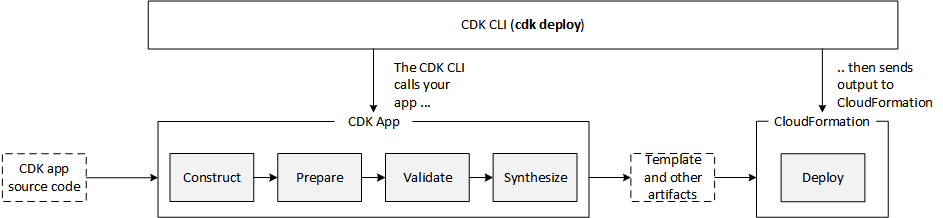
An AWS CDK app goes through the following lifecycle phases when you call cdk deploy. These phases are also shown in the diagram below. Learn more about the CDK application lifecycle at this page.
Construction
Preparation
Validation
Synthesis
Deployment
CDK Aspects become relevant during the Prepare phase, where it makes the final modifications round in the constructs to setup their final state. This Prepare phase happens automatically. All constructs have their internal list of Aspects which are called and applied during the Prepare phase. Add your custom aspects in a scope by calling the following method:
Aspects.of(myConstruct).add(new SomeAspect(...));
When you call the method above, constructs add the custom aspects to the list of internal aspects. When CDK application goes through the Prepare phase, then AWS CDK calls the visit method of the object for the constructs and all of its children in top-down order. The visit method is free to change anything in the construct.
How to align with or check configuration compliance using CDK Aspects
In the following sections, you will see how to implement CDK Aspects for some common use cases when provisioning the cloud resources. CDK Aspects are extensible, and you can extend it for any suitable use cases in order to implement additional rules. Apply CDK Aspects not only to verify against the best practices, but also to update the state before resource creation.
The code below creates the cloud resources to be verified against the best practices or to be updated using Aspects in the following sections.
export class AwsCdkAspectsStack extends cdk.Stack {
  constructor(scope: cdk.Construct, id: string, props?: cdk.StackProps) {
    super(scope, id, props);

    //Create a VPC with 3 availability zones
    const vpc = new ec2.Vpc(this, 'MyVpc', {
      maxAzs: 3,
    });

    //Create a security group
    const sg = new ec2.SecurityGroup(this, 'mySG', {
      vpc: vpc,
      allowAllOutbound: true
    })

    //Add ingress rule for SSH from the public internet
    sg.addIngressRule(ec2.Peer.anyIpv4(), ec2.Port.tcp(22), 'SSH access from anywhere')

    //Launch an EC2 instance in private subnet
    const instance = new ec2.Instance(this, 'MyInstance', {
      vpc: vpc,
      machineImage: ec2.MachineImage.latestAmazonLinux(),
      instanceType: new ec2.InstanceType('t3.small'),
      vpcSubnets: {subnetType: ec2.SubnetType.PRIVATE},
      securityGroup: sg
    })

    //Launch MySQL rds database instance in private subnet
    const database = new rds.DatabaseInstance(this, 'MyDatabase', {
      engine: rds.DatabaseInstanceEngine.mysql({
        version: rds.MysqlEngineVersion.VER_5_7
      }),
      vpc: vpc,
      vpcSubnets: {subnetType: ec2.SubnetType.PRIVATE},
      deletionProtection: false
    })

    //Create an s3 bucket
    const bucket = new s3.Bucket(this, 'MyBucket')
  }
}
In the first section, you will see the use cases and code where Aspects are used to verify the resources against the best practices.
VPC CIDR range must start with specific CIDR IP
Security Group must not have public ingress rule
EC2 instance must use approved AMI
//Verify VPC CIDR range
export class VPCCIDRAspect implements IAspect {
    public visit(node: IConstruct): void {
        if (node instanceof ec2.CfnVPC) {
            if (!node.cidrBlock.startsWith('192.168.')) {
                Annotations.of(node).addError('VPC does not use standard CIDR range starting with "192.168."');
            }
        }
    }
}

//Verify public ingress rule of security group
export class SecurityGroupNoPublicIngressAspect implements IAspect {
    public visit(node: IConstruct) {
        if (node instanceof ec2.CfnSecurityGroup) {
            checkRules(Stack.of(node).resolve(node.securityGroupIngress));
        }

        function checkRules (rules :Array<IngressProperty>) {
            if(rules) {
                for (const rule of rules.values()) {
                    if (!Tokenization.isResolvable(rule) && (rule.cidrIp == '0.0.0.0/0' || rule.cidrIp == '::/0')) {
                        Annotations.of(node).addError('Security Group allows ingress from public internet.');
                    }
                }
            }
        }
    }
}

//Verify AMI of EC2 instance
export class EC2ApprovedAMIAspect implements IAspect {
    public visit(node: IConstruct) {
        if (node instanceof ec2.CfnInstance) {
            if (node.imageId != 'approved-image-id') {
                Annotations.of(node).addError('EC2 Instance is not using approved AMI.');
            }
        }
    }
}
In the second section, you will see the use cases and code where Aspects are used to update the resources in order to make them compliant before creation.
S3 bucket encryption must be enabled. If not, then enable
S3 bucket versioning must be enabled. If not, then enable
RDS instance must have deletion protection enabled. If not, then enable
//Enable versioning of bucket if not enabled
export class BucketVersioningAspect implements IAspect {
    public visit(node: IConstruct): void {
        if (node instanceof s3.CfnBucket) {
            if (!node.versioningConfiguration
                || (!Tokenization.isResolvable(node.versioningConfiguration)
                    && node.versioningConfiguration.status !== 'Enabled')) {
                Annotations.of(node).addInfo('Enabling bucket versioning configuration.');
                node.addPropertyOverride('VersioningConfiguration', {'Status': 'Enabled'})
            }
        }
    }
}

//Enable server side encryption for the bucket if no encryption is enabled
export class BucketEncryptionAspect implements IAspect {
    public visit(node: IConstruct): void {
        if (node instanceof s3.CfnBucket) {
            if (!node.bucketEncryption) {
                Annotations.of(node).addInfo('Enabling default S3 server side encryption.');
                node.addPropertyOverride('BucketEncryption', {
                        "ServerSideEncryptionConfiguration": [
                            {
                                "ServerSideEncryptionByDefault": {
                                    "SSEAlgorithm": "AES256"
                                }
                            }
                        ]
                    }
                )
            }
        }
    }
}

//Enable deletion protection of DB instance if not already enabled
export class RDSDeletionProtectionAspect implements IAspect {
    public visit(node: IConstruct) {
        if (node instanceof rds.CfnDBInstance) {
            if (! node.deletionProtection) {
                Annotations.of(node).addInfo('Enabling deletion protection of DB instance.');
                node.addPropertyOverride('DeletionProtection', true);
            }
        }
    }
}
Once you create the aspects, add them in a particular scope. That scope can be App, Stack, or Construct. In the example below, all aspects are added in the scope of Stack.
Once you call cdk deploy for the above code with aspects added, you will see the output below. The deployment will not continue until you resolve the errors and modifications conducted to make some of the resources compliant.
Also utilize Aspects to make general modifications to the resources regardless of any compliance checks. For example, use it apply mandatory tags to every taggable resource. Tags is an example of implementing CDK Aspects in order to achieve this functionality. Utilizing the code below, add or remove a tag from all taggable resources and their children in the scope of a Construct.
Below is an example of adding the Department tag to every resource created in the scope of Stack.
Tags.of(stack).add('Department', 'Finance');
CDK Aspects are ways for developers to align with and check best practices in their infrastructure configurations using the programming language of choice. AWS CloudFormation Guard (cfn-guard) provides compliance administrators with a simple, policy-as-code language to author policies and apply them to enforce best practices. Aspects are applied before generation of the CloudFormation template in Prepare phase, but cfn-guard is applied after generation of the CloudFormation template and before the Deploy phase. Developers can use Aspects or cfn-guard or both as part of a CI/CD pipeline to stop deployment of non-compliant resources, but CloudFormation Guard is the way to go when you want to enforce compliances and prevent deployment of non-compliant resources.
Conclusion
If you are utilizing AWS CDK to provision your infrastructure, then you can start using Aspects to align with best practices before resources are created. If you are utilizing CloudFormation template to manage your infrastructure, then you can read this blog to learn how to migrate the CloudFormation template to AWS CDK. After the migration, utilize CDK Aspects not only to evaluate compliance of your resources against the best practices, but also modify their state to make them compliant before they are created.
Many different operating systems and architectures could end up as the destination for our applications. By using a AWS CodeBuild batch build, we can run builds for a Go application targeted at multiple platforms concurrently.
Cross-compiling Go binaries for different platforms is as simple as setting two environment variables $GOOS and $GOARCH, regardless of the build’s host platform. For this post we will build all of the binaries on Linux/x86 containers. You can run the command go tool dist list to see the Go list of supported platforms. We will build binaries for six platforms: Windows+ARM, Windows+AMD64, Linux+ARM64, Linux+AMD64, MacOS+ARM64, and Mac+AMD64. Note that AMD64 is a 64-bit architecture based on the Intel x86 instruction set utilized on both AMD and Intel hardware.
This post demonstrates how to create a single AWS CodeBuild project by using a batch build and a single build spec to create concurrent builds for the six targeted platforms. Learn more about batch builds in AWS CodeBuild in the documentation: Batch builds in AWS CodeBuild
Solution Overview
AWS CodeBuild is a fully managed continuous integration service that compiles source code, runs tests, and produces ready-to-deploy software packages. A batch build is utilized to run concurrent and coordinated builds. Let’s summarize the 3 different batch builds:
Build graph: defines dependencies between builds. CodeBuild utilizes the dependencies graph to run builds in an order that satisfies the dependencies.
Build list: utilizes a list of settings for concurrently run builds.
Build matrix: utilizes a matrix of settings to create a build for every combination.
The requirements for this project are simple – run multiple builds with a platform pair of $GOOS and $GOARCH environment variables. For this, a build list can be utilized. The buildspec for the project contains a batch/build-list setting containing every environment variable for the six builds.
The batch build project will launch seven builds. See the build sequence in the diagram below.
Step 1 – A build downloads the source.
Step 2 – Six concurrent builds configured with six sets of environment variables from the batch/build-list setting.
Step 3 – Concurrent builds package a zip file and deliver to the artifacts Amazon Simple Storage Service (Amazon S3) bucket.
The supplied buildspec file includes commands for the install and build phases. The install phase utilizes the phases/install/runtime-versions phase to set the version of Go is used in the build container.
The build phase contains commands to replace source code placeholders with environment variables set by CodeBuild. The entire list of environment variables is documented at Environment variables in build environments. This is followed by a simple go build to build the binaries. The application getting built is an AWS SDK for Go sample that will list the contents of an S3 bucket.
  build:
    commands:
      - mv listObjects.go listObjects.go.tmp
      - cat listObjects.go.tmp | envsubst | tee listObjects.go
      - go build listObjects.go
The artifacts sequence specifies the build outputs that we want packaged and delivered to the artifacts S3 bucket. The name setting creates a name for ZIP artifact. And the name combines the operating system, architecture environment variables, as well as the git commit hash. We use Shell command language to expand the environment variables, as well as command substitution to take the first seven characters of the git hash.
Let’s walk through the CodeBuild project setup process. When the builds complete, we’ll see zip files containing the builds for each platform in an artifacts bucket.
Here is what we will create:
Create an S3 bucket to host the built artifacts.
Create the CodeBuild project, which needs to know:
Where the source is
The environment – a docker image and a service role
The location of the build spec
Batch configuration, a service role used to launch batch build groups
Access to an AWS account with administrator or PowerUser (or equivalent) AWS Identity and Access Management (IAM) role policies attached
Create the Artifacts S3 Bucket
An S3 bucket will be the destination of the build artifacts.
In the Amazon S3 console, create a bucket with a unique name. This will be the destination of your build artifacts.
Create the AWS CodeBuild Project
In the AWS CodeBuild console, create a project named multi-arch-build.
For Source Provider, choose GitHub. Choose the Connect to GitHub button and follow the authorization screens. For repository, enter https://github.com/aws-samples/cross-platform-go-builds-with-aws-codebuild
For Environment image, choose Managed Image. Choose the most recent Ubuntu image. This image contains every tool needed for the build. If you are interested in the contents of the image, then you can see the Dockerfile used to build the image in the GitHub repository here: https://github.com/aws/aws-codebuild-docker-images/tree/master/ubuntu
For Service Role, keep the suggested role name.
For Build specifications, leave Buildspec name empty. This will use the default location buildspec.yml in the source root.
Under Batch configuration, enable Define batch configuration. For the Role Name, enter a name for the role: batch-multi-arch-build-service-role. There is an option here to combine artifacts. CodeBuild can combine the artifacts from batch builds into a single location. This isn’t needed for this build, as we want a zip to be created for each platform.
Under Artifacts, for Type, choose Amazon S3. For Bucket name, select the S3 bucket created earlier. This is where we want the build artifacts delivered. Choose the checkbox for Enable semantic versioning. This will tell CodeBuild to use the artifact name that was specified in the buildspec file.
For Artifacts Packaging, choose Zip for CodeBuild to create a compressed zip from the build artifacts.
Create the build project, and start a build. You will see the DOWNLOAD_SOURCE build complete, followed by the six concurrent builds for each combination of OS and architecture.
Run the Artifacts
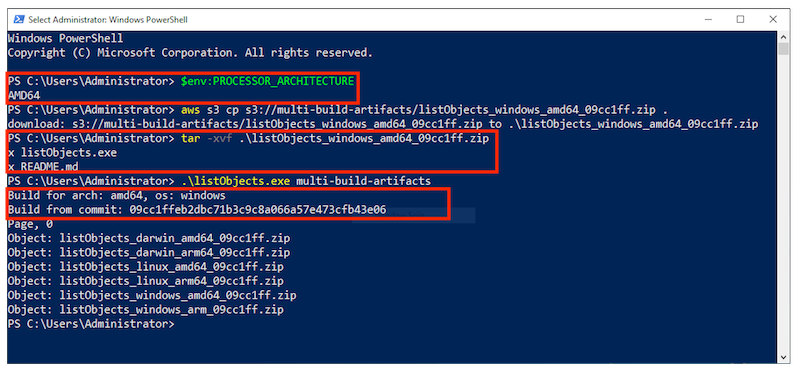
The builds have completed, and each packaged artifact has been delivered to the S3 bucket. Remember the name of the ZIP archive that was built using the buildspec file setting. This incorporated a combination of the operating system, architecture, and git commit hash.
Below, I have tested the artifact by downloading the zip for the operating system and architecture combination on three different platforms: MacOS/AMD64, an AWS Graviton2 instance, and a Microsoft Windows instance. Note the system information, unzipping the platform artifact, and the build specific information substituted into the Go source code.
Cleaning up
To avoid incurring future charges, delete the resources:
On the Amazon S3 console, choose the artifacts bucket created, and choose Empty. Confirm the deletion by typing ‘permanently delete’. Choose Empty.
Choose the artifacts bucket created, and Delete.
On the IAM console, choose Roles.
Search for batch-multi-arch-build-service-role and Delete. Search for codebuild-multi-arch-build-service-role and Delete.
Go to the CodeBuild console. From Build projects, choose multi-arch-build, and choose Delete build project.
Conclusion
This post utilized CodeBuild batch builds to build and package binaries for multiple platforms concurrently. The build phase used a small amount of scripting to replace placeholders in the code with build information CodeBuild makes available in environment variables. By overriding the artifact name using the buildspec setting, we created zip files built from information about the build. The zip artifacts were downloaded and tested on three platforms: Intel MacOS, a Graviton ARM based EC2 instance, and Microsoft Windows.
Features like this let you build on CodeBuild, a fully managed build service – and not have to worry about maintaining your own build servers.
A company that is a critical part of the global telecommunications infrastructure used by AT&T, T-Mobile, Verizon and several others around the world such as Vodafone and China Mobile, quietly disclosed that hackers were inside its systems for years, impacting more than 200 of its clients and potentially millions of cellphone users worldwide.
I’ve never heard of the company.
No details about the hack. It could be nothing. It could be a national intelligence service looking for information.
Raspberry Pi is growing our presence in Africa, and we’re keen to talk to businesses and educational organisations in the region to learn and to build partnerships.
Developing partnerships
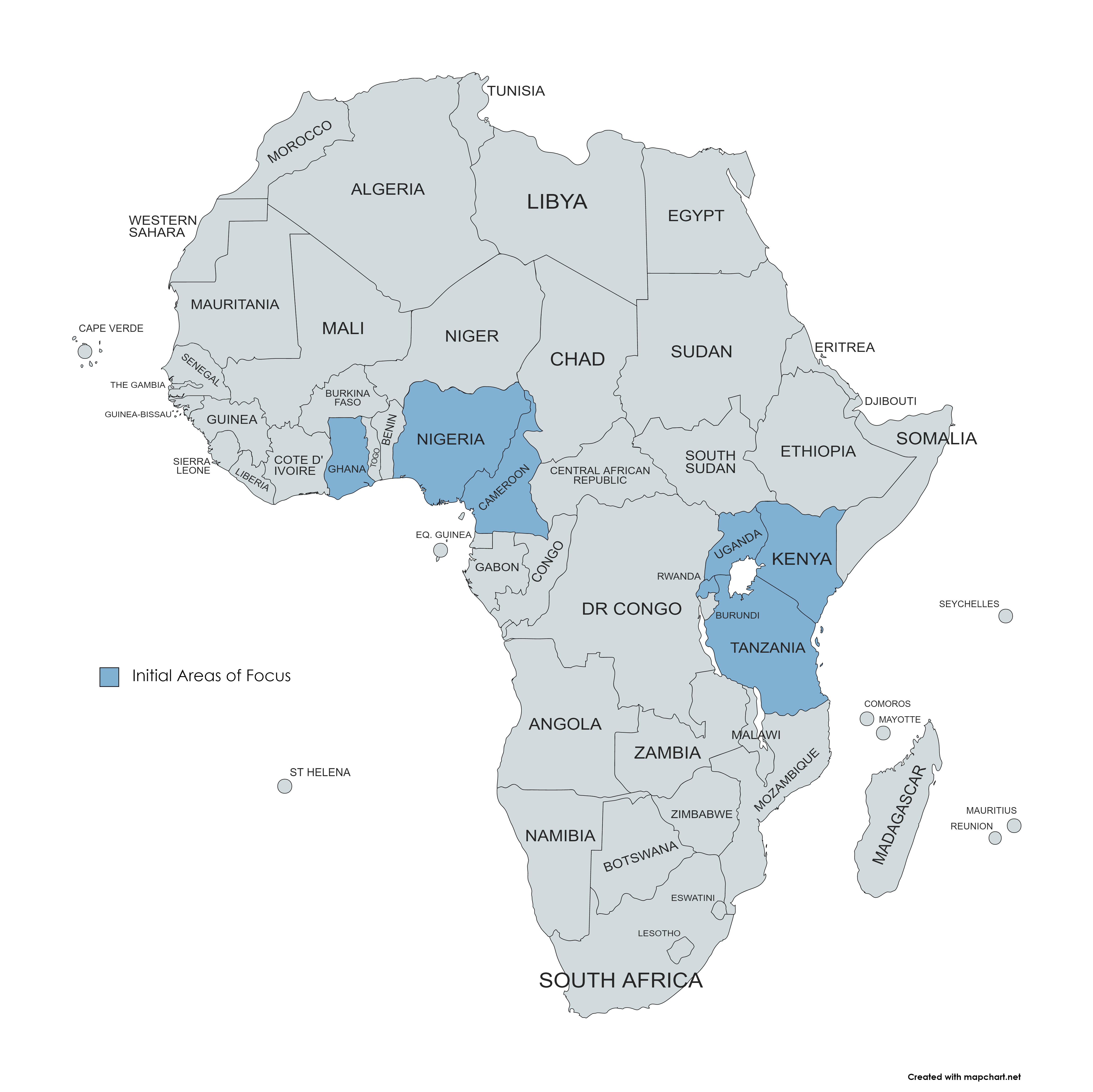
As part of our investments in the region, I am delighted to join Raspberry Pi as Strategic Partnerships Manager, and initially I will be focusing on Nigeria, Kenya, Ghana, Tanzania, Rwanda, Cameroon, and Uganda. We will prioritise building a network of Raspberry Pi Approved Resellers and developing the right partnerships across industry and the education sector.
Uber’s First Hackathon in Lagos, Nigeria
Ensuring affordability with Raspberry Pi Approved Resellers
Over the last decade, Raspberry Pi has established a strong presence in the European and North American markets through partnership with our network of excellent Raspberry Pi Approved Resellers, providing access to affordable technology for the home, for business, and for education. Customers in many areas across Asia and the Pacific, too, have a choice of Approved Resellers offering Raspberry Pi products.
So far, our presence in Africa has been through our approved reseller PiShop in South Africa, which also has some commercial operations into other countries in southern Africa. Much of West, East, and North Africa has been underserved, and consumers in these regions have often obtained Raspberry Pi products via e-commerce websites in Europe, North America, and sometimes China. This has meant high costs of shipping products into Africa, which undermines our goal of ensuring affordability and availability across the continent. To address this, we have begun work to provide African customers with easy and reliable access to Raspberry Pi products at an affordable price point.
Supporting technological innovation
Africa has seen an explosion of technological advances in recent years, with investors funding innovative businesses built around technology. The continent is facing challenges ranging from accessibility to uninterrupted energy supplies, climate change, enabling agricultural potential, and building smart cities, and Africa’s mainly young population is meeting them head on.
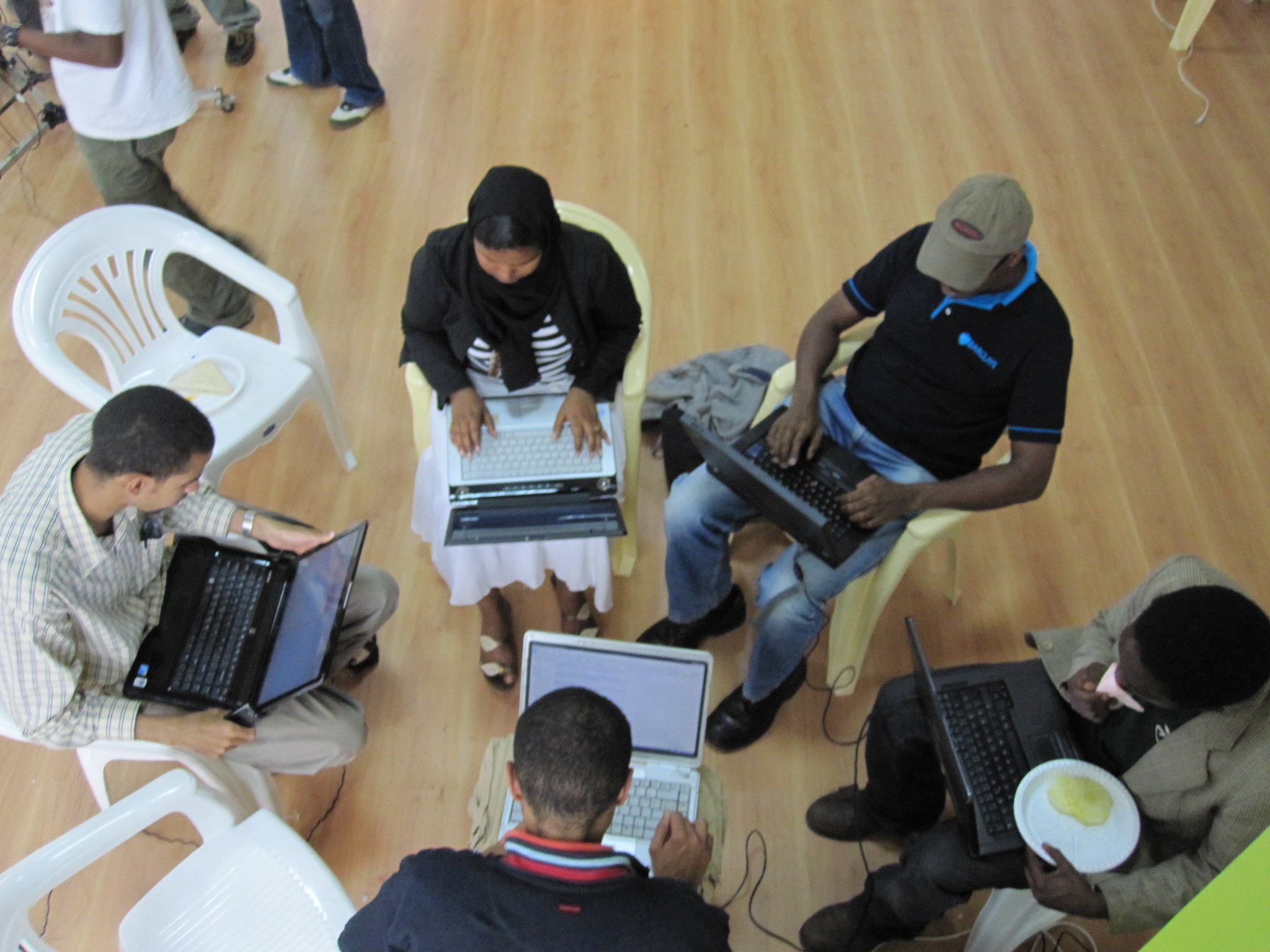
Random Hacks of Kindness, a two-day hackathon. “RHoK Nairobi, Kenya” by Erik (HASH) Hersman / CC BY
While there is no shortage of innovative ideas, there is a real need for the right equipment and tools to support this ecosystem of makers, hobbyists, innovators, and entrepreneurs. Raspberry Pi is poised to close this gap.
Get in touch
Over the next couple of months, we will be planning a tour of our focus countries to visit the leadership of engineering associations and bodies, engaging with engineering student communities and maker spaces on the continent and building strategic alliances to deepen our inroads in the region. As Covid restrictions are eased, we will be visiting several countries on the continent to help us discover how we can best provide products and services that directly impact the region by ensuring access to low-cost, high-quality technology.
Ken Okolo
Could your African retail business meet our high standards for Raspberry Pi Approved Resellers, or could your educational organisation or your enterprise benefit from affordable desktop computers? Do your products require embedded computing power, or could your business grow with low-cost, low-power process monitoring or control? Get in touch with us by emailing: [email protected]. We’re looking forward to hearing from you.
Facebook — along with Instagram and WhatsApp — went down globally today. Basically, someone deleted their BGP records, which made their DNS fall apart.
…at approximately 11:39 a.m. ET today (15:39 UTC), someone at Facebook caused an update to be made to the company’s Border Gateway Protocol (BGP) records. BGP is a mechanism by which Internet service providers of the world share information about which providers are responsible for routing Internet traffic to which specific groups of Internet addresses.
In simpler terms, sometime this morning Facebook took away the map telling the world’s computers how to find its various online properties. As a result, when one types Facebook.com into a web browser, the browser has no idea where to find Facebook.com, and so returns an error page.
In addition to stranding billions of users, the Facebook outage also has stranded its employees from communicating with one another using their internal Facebook tools. That’s because Facebook’s email and tools are all managed in house and via the same domains that are now stranded.
What I heard is that none of the employee keycards work, since they have to ping a now-unreachable server. So people can’t get into buildings and offices.
And every third-party site that relies on “log in with Facebook” is stuck as well.
As a former network admin who worked on the internet at this level, I anticipate Facebook will be down for hours more. I suspect it will end up being Facebook’s longest and most severe failure to date before it’s fixed.
Interesting story of test-takers in India using Bluetooth-connected flip-flops to communicate with accomplices while taking a test.
What’s interesting is how this cheating was discovered. It’s not that someone noticed the communication devices. It’s that the proctors noticed that cheating test takers were acting hinky.
The Wall Street Journal is reporting on a baby’s death at an Alabama hospital in 2019, which they argue was a direct result of the ransomware attack the hospital was undergoing.
Amid the hack, fewer eyes were on the heart monitors — normally tracked on a large screen at the nurses’ station, in addition to inside the delivery room. Attending obstetrician Katelyn Parnell texted the nurse manager that she would have delivered the baby by caesarean section had she seen the monitor readout. “I need u to help me understand why I was not notified.” In another text, Dr. Parnell wrote: “This was preventable.”
[The mother] Ms. Kidd has sued Springhill [Medical Center], alleging information about the baby’s condition never made it to Dr. Parnell because the hack wiped away the extra layer of scrutiny the heart rate monitor would have received at the nurses’ station. If proven in court, the case will mark the first confirmed death from a ransomware attack.
What will be interesting to see is whether the courts rule that the hospital was negligent in its security, contributing to the success of the ransomware and by extension the death of the infant.
Springhill declined to name the hackers, but Allan Liska, a senior intelligence analyst at Recorded Future, said it was likely the Russianbased Ryuk gang, which was singling out hospitals at the time.
They’re certainly never going to be held accountable.
This isn’t the first time I’ve received an e-mail like this:
Hey! I’ve done my research and looked at a lot of facts and old forgotten archives. I know that you are Satoshi, I do not want to tell anyone about this. I just wanted to say that you created weapons of mass destruction where niches remained poor and the rich got richer! When bitcoin first appeared, I was small, and alas, my family lost everything on this, you won’t find an apple in the winter garden, people only need strength and money. Sorry for the English, I am from Russia, I can write with errors. You are an amazingly intelligent person, very intelligent, but the road to hell is paved with good intentions. Once I dreamed of a better life for myself and my children, but this will never come …
I like the bit about “old forgotten archives,” by which I assume he’s referring to the sci.crypt Usenet group and the Cypherpunks mailing list. (I posted to the latter a lot, and the former rarely.)
For the record, I am not Satoshi Nakamoto. I suppose I could have invented the bitcoin protocols, but I wouldn’t have done it in secret. I would have drafted a paper, showed it to a lot of smart people, and improved it based on their comments. And then I would have published it under my own name. Maybe I would have realized how dumb the whole idea is. I doubt I would have predicted that it would become so popular and contribute materially to global climate change. In any case, I did nothing of the sort.
The MIT Technology Review is reporting that 2021 is a blockbuster year for zero-day exploits:
One contributing factor in the higher rate of reported zero-days is the rapid global proliferation of hacking tools.
Powerful groups are all pouring heaps of cash into zero-days to use for themselves — and they’re reaping the rewards.
At the top of the food chain are the government-sponsored hackers. China alone is suspected to be responsible for nine zero-days this year, says Jared Semrau, a director of vulnerability and exploitation at the American cybersecurity firm FireEye Mandiant. The US and its allies clearly possess some of the most sophisticated hacking capabilities, and there is rising talk of using those tools more aggressively.
[…]
Few who want zero-days have the capabilities of Beijing and Washington. Most countries seeking powerful exploits don’t have the talent or infrastructure to develop them domestically, and so they purchase them instead.
[…]
It’s easier than ever to buy zero-days from the growing exploit industry. What was once prohibitively expensive and high-end is now more widely accessible.
[…]
And cybercriminals, too, have used zero-day attacks to make money in recent years, finding flaws in software that allow them to run valuable ransomware schemes.
“Financially motivated actors are more sophisticated than ever,” Semrau says. “One-third of the zero-days we’ve tracked recently can be traced directly back to financially motivated actors. So they’re playing a significant role in this increase which I don’t think many people are giving credit for.”
[…]
No one we spoke to believes that the total number of zero-day attacks more than doubled in such a short period of time — just the number that have been caught. That suggests defenders are becoming better at catching hackers in the act.
You can look at the data, such as Google’s zero-day spreadsheet, which tracks nearly a decade of significant hacks that were caught in the wild.
One change the trend may reflect is that there’s more money available for defense, not least from larger bug bounties and rewards put forward by tech companies for the discovery of new zero-day vulnerabilities. But there are also better tools.
ROT8000 is the Unicode equivalent of ROT13. What’s clever about it is that normal English looks like Chinese, and not like ciphertext (to a typical Westerner, that is).
The Washington Postreports that the FBI had a decryption key for the REvil ransomware, but didn’t pass it along to victims because it would have disrupted an ongoing operation.
The key was obtained through access to the servers of the Russia-based criminal gang behind the July attack. Deploying it immediately could have helped the victims, including schools and hospitals, avoid what analysts estimate was millions of dollars in recovery costs.
But the FBI held on to the key, with the agreement of other agencies, in part because it was planning to carry out an operation to disrupt the hackers, a group known as REvil, and the bureau did not want to tip them off. Also, a government assessment found the harm was not as severe as initially feared.
Fighting ransomware is filled with security trade-offs. This is one I had not previously considered.
To provide the best experiences, we use technologies like cookies to store and/or access device information. Consenting to these technologies will allow us to process data such as browsing behavior or unique IDs on this site. Not consenting or withdrawing consent, may adversely affect certain features and functions.
Functional
Always active
The technical storage or access is strictly necessary for the legitimate purpose of enabling the use of a specific service explicitly requested by the subscriber or user, or for the sole purpose of carrying out the transmission of a communication over an electronic communications network.
Preferences
The technical storage or access is necessary for the legitimate purpose of storing preferences that are not requested by the subscriber or user.
Statistics
The technical storage or access that is used exclusively for statistical purposes.The technical storage or access that is used exclusively for anonymous statistical purposes. Without a subpoena, voluntary compliance on the part of your Internet Service Provider, or additional records from a third party, information stored or retrieved for this purpose alone cannot usually be used to identify you.
Marketing
The technical storage or access is required to create user profiles to send advertising, or to track the user on a website or across several websites for similar marketing purposes.