Post Syndicated from corbet original https://lwn.net/Articles/979084/
The LWN.net Weekly Edition for June 27, 2024 is available.
Post Syndicated from corbet original https://lwn.net/Articles/979084/
The LWN.net Weekly Edition for June 27, 2024 is available.
Post Syndicated from Federica Ciuffo original https://aws.amazon.com/blogs/architecture/lets-architect-migrating-to-the-cloud-with-aws/
In today’s digital world, businesses are increasingly turning to the cloud for its scalability, agility, and cost-effectiveness. Migrating your data center to the cloud can be a daunting task, but with the right approach and tools, it can be a successful journey. This Let’s Architect! blog post will guide you through the process of migrating to the cloud with AWS, leveraging the proven AWS Cloud Adoption Framework (AWS CAF) and exploring valuable resources to help you navigate each step.
The AWS Cloud Adoption Framework (CAF) provides a comprehensive approach to planning, designing, and deploying your cloud migration. This robust framework outlines a four-phase methodology that guides you through every stage of the process, from strategy and planning to ongoing management and optimization. Here’s a closer look at the four phases of the AWS CAF:

Figure 1. The AWS CAF recommends four iterative and incremental cloud transformation phases
Migrating a large-scale data center to the cloud requires careful planning and execution. This video session focuses on valuable lessons learned from the thousands of enterprises who have migrated and modernized their on-premises workloads with AWS. Dive deep on technical lessons learned, mental models used, how to set up teams to modernize as they migrate, and how to engage with AWS Professional Services and AWS Partners for success. Finally, you will get insights on the latest AWS migration and modernization tools.

Figure 2. Migrating to AWS Cloud unlocked major benefits for Live Nation, including a 58% cost saving
At the heart of any successful data migration lies a robust database migration strategy. AWS Database Migration Service (AWS DMS) empowers you with a comprehensive suite of tools to seamlessly move and replicate your data. This session explains the various options offered by AWS DMS, including logical replication, managed native methods for export, import, and replication, and bulk extract and load functionalities. Through these options, you’ll gain a thorough understanding of how to migrate and replicate your data, along with the distinct advantages of each approach. The session also explores performance considerations to ensure optimal migration efficiency. Finally, you will learn how modern capabilities like serverless technologies, auto scaling, and schema conversion can simplify migrations.

FIgure 3. AWS DMS Schema Conversion converts your existing database schemas and a majority of the database code objects to a format compatible with the target database
Migrating and modernizing your applications is a crucial aspect of your cloud adoption strategy. The Application Migration with AWS workshop series provides hands-on experience with planning and executing application migrations. You’ll learn practical techniques like database replatforming, application rehosting, and containerization to make your move to the cloud smooth and efficient.

Figure 4. As part of this lab, you will perform a database migration with AWS DMS
But the journey doesn’t end there. As your applications scale in the cloud, managing that growth becomes key. This is where infrastructure as code (IaC) comes in, and AWS CDK takes IaC a step further by allowing you to write infrastructure code in familiar programming languages you already know. This streamlines your migration by leveraging your existing coding knowledge. We recommend this AWS CDK workshop to get started with CDK for infrastructure automation.
Thanks for reading! With this post, we provided resources to help you navigate your cloud migration journey with confidence and success. In the next blog, we will talk about Well-Architected best practices!
To revisit any of our previous posts or explore the entire series, visit the Let’s Architect! page.
Post Syndicated from Matthew Prince original https://blog.cloudflare.com/automatically-replacing-polyfill-io-links-with-cloudflares-mirror-for-a-safer-internet

polyfill.io, a popular JavaScript library service, can no longer be trusted and should be removed from websites.
Multiple reports, corroborated with data seen by our own client-side security system, Page Shield, have shown that the polyfill service was being used, and could be used again, to inject malicious JavaScript code into users’ browsers. This is a real threat to the Internet at large given the popularity of this library.
We have, over the last 24 hours, released an automatic JavaScript URL rewriting service that will rewrite any link to polyfill.io found in a website proxied by Cloudflare to a link to our mirror under cdnjs. This will avoid breaking site functionality while mitigating the risk of a supply chain attack.
Any website on the free plan has this feature automatically activated now. Websites on any paid plan can turn on this feature with a single click.
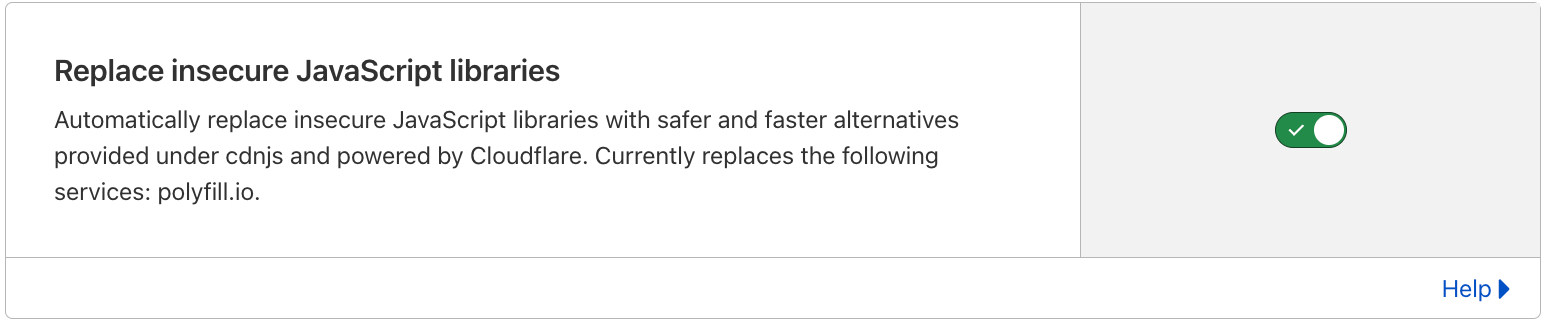
You can find this new feature under Security ⇒ Settings on any zone using Cloudflare.
Contrary to what is stated on the polyfill.io website, Cloudflare has never recommended the polyfill.io service or authorized their use of Cloudflare’s name on their website. We have asked them to remove the false statement and they have, so far, ignored our requests. This is yet another warning sign that they cannot be trusted.
If you are not using Cloudflare today, we still highly recommend that you remove any use of polyfill.io and/or find an alternative solution. And, while the automatic replacement function will handle most cases, the best practice is to remove polyfill.io from your projects and replace it with a secure alternative mirror like Cloudflare’s even if you are a customer.
You can do this by searching your code repositories for instances of polyfill.io and replacing it with cdnjs.cloudflare.com/polyfill/ (Cloudflare’s mirror). This is a non-breaking change as the two URLs will serve the same polyfill content. All website owners, regardless of the website using Cloudflare, should do this now.
Back in February, the domain polyfill.io, which hosts a popular JavaScript library, was sold to a new owner: Funnull, a relatively unknown company. At the time, we were concerned that this created a supply chain risk. This led us to spin up our own mirror of the polyfill.io code hosted under cdnjs, a JavaScript library repository sponsored by Cloudflare.
The new owner was unknown in the industry and did not have a track record of trust to administer a project such as polyfill.io. The concern, highlighted even by the original author, was that if they were to abuse polyfill.io by injecting additional code to the library, it could cause far reaching security problems on the Internet affecting several hundreds of thousands websites. Or it could be used to perform a targeted supply-chain attack against specific websites.
Unfortunately, that worry came true on June 25, 2024 as the polyfill.io service was being used to inject nefarious code that, under certain circumstances, redirected users to other websites.
We have taken the exceptional step of using our ability to modify HTML on the fly to replace references to the polyfill.io CDN in our customers’ websites with links to our own, safe, mirror created back in February.
In the meantime, additional threat feed providers have also taken the decision to flag the domain as malicious. We have not outright blocked the domain through any of the mechanisms we have because we are concerned it could cause widespread web outages given how broadly polyfill.io is used with some estimates indicating usage on nearly 4% of all websites.
The original report indicates that malicious code was injected that, under certain circumstances, would redirect users to betting sites. It was doing this by loading additional JavaScript that would perform the redirect, under a set of additional domains which can be considered Indicators of Compromise (IoCs):
https://www.googie-anaiytics.com/analytics.js
https://www.googie-anaiytics.com/html/checkcachehw.js
https://www.googie-anaiytics.com/gtags.js
https://www.googie-anaiytics.com/keywords/vn-keyword.json
https://www.googie-anaiytics.com/webs-1.0.1.js
https://www.googie-anaiytics.com/analytics.js
https://www.googie-anaiytics.com/webs-1.0.2.js
https://www.googie-anaiytics.com/ga.js
https://www.googie-anaiytics.com/web-1.0.1.js
https://www.googie-anaiytics.com/web.js
https://www.googie-anaiytics.com/collect.js
https://kuurza.com/redirect?from=bitget
(note the intentional misspelling of Google Analytics)
Page Shield, our client side security solution, is available on all paid plans. When turned on, it collects information about JavaScript files loaded by end user browsers accessing your website.
By looking at the database of detected JavaScript files, we immediately found matches with the IoCs provided above starting as far back as 2024-06-08 15:23:51 (first seen timestamp on Page Shield detected JavaScript file). This was a clear indication that malicious activity was active and associated with polyfill.io.
To achieve performant HTML rewriting, we need to make blazing-fast HTML alterations as responses stream through Cloudflare’s network. This has been made possible by leveraging ROFL (Response Overseer for FL). ROFL powers various Cloudflare products that need to alter HTML as it streams, such as Cloudflare Fonts, Email Obfuscation and Rocket Loader
ROFL is developed entirely in Rust. The memory-safety features of Rust are indispensable for ensuring protection against memory leaks while processing a staggering volume of requests, measuring in the millions per second. Rust’s compiled nature allows us to finely optimize our code for specific hardware configurations, delivering performance gains compared to interpreted languages.
The performance of ROFL allows us to rewrite HTML on-the-fly and modify the polyfill.io links quickly, safely, and efficiently. This speed helps us reduce any additional latency added by processing the HTML file.
If the feature is turned on, for any HTTP response with an HTML Content-Type, we parse all JavaScript script tag source attributes. If any are found linking to polyfill.io, we rewrite the src attribute to link to our mirror instead. We map to the correct version of the polyfill service while the query string is left untouched.
The logic will not activate if a Content Security Policy (CSP) header is found in the response. This ensures we don’t replace the link while breaking the CSP policy and therefore potentially breaking the website.
Cloudflare proxies millions of websites, and a large portion of these sites are on our free plan. Free plan customers tend to have simpler applications while not having the resources to update and react quickly to security concerns. We therefore decided to turn on the feature by default for sites on our free plan, as the likelihood of causing issues is reduced while also helping keep safe a very large portion of applications using polyfill.io.
Paid plan customers, on the other hand, have more complex applications and react quicker to security notices. We are confident that most paid customers using polyfill.io and Cloudflare will appreciate the ability to virtually patch the issue with a single click, while controlling when to do so.
All customers can turn off the feature at any time.
This isn’t the first time we’ve decided a security problem was so widespread and serious that we’d enable protection for all customers regardless of whether they were a paying customer or not. Back in 2014, we enabled Shellshock protection for everyone. In 2021, when the log4j vulnerability was disclosed we rolled out protection for all customers.
If you are using Cloudflare, you can remove polyfill.io with a single click on the Cloudflare dashboard by heading over to your zone ⇒ Security ⇒ Settings. If you are a free customer, the rewrite is automatically active. This feature, we hope, will help you quickly patch the issue.
Nonetheless, you should ultimately search your code repositories for instances of polyfill.io and replace them with an alternative provider, such as Cloudflare’s secure mirror under cdnjs (https://cdnjs.cloudflare.com/polyfill/). Website owners who are not using Cloudflare should also perform these steps.
The underlying bundle links you should use are:
For minified: https://cdnjs.cloudflare.com/polyfill/v3/polyfill.min.js
For unminified: https://cdnjs.cloudflare.com/polyfill/v3/polyfill.js
Doing this ensures your website is no longer relying on polyfill.io.
Post Syndicated from Anish Anturkar original https://aws.amazon.com/blogs/big-data/amazon-datazone-announces-custom-blueprints-for-aws-services/
Last week, we announced the general availability of custom AWS service blueprints, a new feature in Amazon DataZone allowing you to customize your Amazon DataZone project environments to use existing AWS Identity and Access Management (IAM) roles and AWS services to embed the service into your existing processes. In this post, we share how this new feature can help you in federating to your existing AWS resources using your own IAM role. We also delve into details on how to configure data sources and subscription targets for a project using a custom AWS service blueprint.
Previously, Amazon DataZone provided default blueprints that created AWS resources required for data lake, data warehouse, and machine learning use cases. However, you may have existing AWS resources such as Amazon Redshift databases, Amazon Simple Storage Service (Amazon S3) buckets, AWS Glue Data Catalog tables, AWS Glue ETL jobs, Amazon EMR clusters, and many more for your data lake, data warehouse, and other use cases. With Amazon DataZone default blueprints, you were limited to only using preconfigured AWS resources that Amazon DataZone created. Customers needed a way to integrate these existing AWS service resources with Amazon DataZone, using a customized IAM role so that Amazon DataZone users can get federated access to those AWS service resources and use the publication and subscription features of Amazon DataZone to share and govern them.
Now, with custom AWS service blueprints, you can use your existing resources using your preconfigured IAM role. Administrators can customize Amazon DataZone to use existing AWS resources, enabling Amazon DataZone portal users to have federated access to those AWS services to catalog, share, and subscribe to data, thereby establishing data governance across the platform.
Custom AWS service blueprints don’t provision any resources for you, unlike other blueprints. Instead, you can configure your IAM role (bring your own role) to integrate your existing AWS resources with Amazon DataZone. Additionally, you can configure action links, which provide federated access to any AWS resources like S3 buckets, AWS Glue ETL jobs, and so on, using your IAM role.
You can also configure custom AWS service blueprints to bring your own resources, namely AWS databases, as data sources and subscription targets to enhance governance across those assets. With this release, administrators can configure data sources and subscription targets on the Amazon DataZone console and not be restricted to do those actions in the data portal.
Custom blueprints and environments can only be set up by administrators to manage access to configured AWS resources. As custom environments are created in specific projects, the right to grant access to custom resources is delegated to the project owners who can manage project membership by adding or removing members. This restricts the ability of portal users to create custom environments without the right permissions in AWS Console for Amazon DataZone or access custom AWS resources configured in a project that they are not a member of.
To get started, administrators need to enable the custom AWS service blueprints feature on the Amazon DataZone console. Then administrators can customize configurations by defining which project and IAM role to use when federating to the AWS services that are set up as action links for end-users. After the customized set up is complete, when a data producer or consumer logs in to the Amazon DataZone portal and if they’re part of those customized projects, they can federate to any of the configured AWS services such as Amazon S3 to upload or download files or seamlessly go to existing AWS Glue ETL jobs using their own IAM roles and continue their work with data with the customized tool of choice. With this feature, you can how include Amazon DataZone in your existing data pipeline processes to catalog, share, and govern data.
The following diagram shows an administrator’s workflow to set up a custom blueprint.

In the following sections, we discuss common use cases for custom blueprints, and walk through the setup step by step. If you’re new to Amazon DataZone, refer to Getting started.
Customers manage data platforms that consist of AWS managed services such as AWS Lake Formation, Amazon S3 for data lakes, AWS Glue for ETL, and so on. With those processes already set up, you may want to bring your own roles and resources to Amazon DataZone to continue with an existing process without any disruption. In such cases, you may not want Amazon DataZone to create new resources because it disrupts existing processes in data pipelines and to also curtail AWS resource usage and costs.
In the current setup, you can create an Amazon DataZone domain associated with different accounts. There could be a dedicated account that acts like a producer to share data, and a few other consumer accounts to subscribe to published assets in the catalog. The consumer account has IAM permissions set up for the AWS Glue ETL job to use for the subscription environment of a project. By doing so, the role has access to the newly subscribed data as well as permissions from previous setups to access data from other AWS resources. After you configure the AWS Glue job IAM role in the environment using the custom AWS service blueprint, the authorized users of that role can use the subscribed assets in the AWS Glue ETL job and extend that data for downstream activities to store them in Amazon S3 and other databases to be queried and analyzed using the Amazon Athena SQL editor or Amazon QuickSight.
Customers and users of the Amazon DataZone portal often need the ability to download files after searching and filtering through the catalog in an Amazon DataZone project. This requirement arises because the data and analytics associated with a particular use case can sometimes involve hundreds of files. Downloading these files individually would be a tedious and time-consuming process for Amazon DataZone users. To address this need, the Amazon DataZone portal can take advantage of the capabilities provided by custom AWS service blueprints. These custom blueprints allow you to configure action links to S3 bucket folders associated with specified Amazon DataZone projects.
You can build projects and subscribe to both unstructured and structured data assets within the Amazon DataZone portal. For structured datasets, you can use Amazon DataZone blueprint-based environments like data lakes (Athena) and data warehouses (Amazon Redshift). For unstructured data assets, you can use the custom blueprint-based Amazon S3 environment, which provides a familiar Amazon S3 browser interface with access to specific buckets and folders, using an IAM role owned and provided by the customer. This functionality streamlines the process of finding and accessing unstructured data and allows you to download multiple files at once, enabling you to build and enhance your analytics more efficiently.
In addition to the download functionality, users often need to retain and attach metadata to new versions of files. For example, when you download a file, you can perform data changes, enrichment, or analysis on the file, and then upload the updated version back to the Amazon DataZone portal. For uploading files, Amazon DataZone users can use the same custom blueprint-based Amazon S3 environment action links to upload files.
You may have existing Amazon DataZone project environments created using default data lake and data warehouse blueprints. With other AWS services set up in the data platform, you may want to extend the configured project environments to include those additional services to provide a seamless experience for your data producers or consumers while switching between tools.
Now that you understand the capabilities of the new feature, let’s look at how administrators can set up a custom role and resources on the Amazon DataZone console.
First, you need an Amazon DataZone domain. If you already have one, you can skip to enabling your custom blueprints. Otherwise, refer to Create domains for instructions to set up a domain. Optionally, you can associate accounts if you want to set up Amazon DataZone across multiple accounts.
You can optionally associate accounts. For instructions, refer to Request association with other AWS accounts. Make sure to use the latest AWS Resource Access Manager (AWS RAM) DataZonePortalReadWrite policy when requesting account association. If your account is already associated, request access again with the new policy.

To accept the account associated request, refer to Accept an account association request from an Amazon DataZone domain and enable an environment blueprint. After you accept the account association, you should see the following screenshot.

With this launch, you can set up associated account owners to access the Amazon DataZone data portal from their account. To enable this, they need to be registered as users in the domain account. As a domain admin, you can create Amazon DataZone user profiles to allow Amazon DataZone access to users and roles from the associated account. Complete the following steps:

arn:aws:iam::123456789101:role/serviceBlueprintRole and arn:aws:iam::123456789101:user/Jacob.
Back on the User management tab, you should see the new user state with Assigned status. This means that the domain owner has assigned associated account users to access Amazon DataZone. This status will change to Active when the identity starts using Amazon DataZone from the associated account.

As of writing this post, there is a maximum limit of adding six identities (users or roles) per associated account.
You can enable custom AWS service blueprints in the domain account or the associated account, according to your requirements. Complete the following steps:

If an associated account is being used to create this environment, use the same associated account IAM identity assigned by the domain owner in the previous step. Your identity needs to be explicitly assigned a user profile in order for you to create this environment. Complete the following steps:

AmazonDataZoneAdmin and gave it AdministratorAccess This is the bring your own role feature. You should curate your role according to your requirements. Here are some guidelines on how to set up custom role as we have used a more permissible policy for this blog:
AmazonDataZone* to follow conventions. This is not mandatory, but recommended. If the IAM admin is using an AmazonDataZoneFullAccess policy, you need to follow this convention because there is a pass role check validation.CustomRole (AWSDataZone*) make sure it trusts amazonaws.com in its trust policy:
Although you could use the same IAM role for multiple environments in a project, the recommendation is to not use a same IAM role for multiple environments across projects. Subscription grants are fulfilled at the project construct and therefore we don’t allow the same environment role to be used across different projects.
After you create the AWS service environment, you can configure any AWS Management Console links to your environment. Amazon DataZone will assume the custom role to help federate environment users to the configured action links. Complete the following steps:


You should now see the console links set up for your environment.

Associate account users who have been added to Amazon DataZone can access the data portal from their associated account directly. Complete the following steps:

You should see all your configured resources (role and action links) for your environment.


You’re directed to the appropriate service console.

With this setup, you have now configured a custom AWS service blueprint to use your own role for the environment to use for data access as well. You have also set up action links for configured AWS resources to be shown to data producers and consumers in the Amazon DataZone data portal. With these links, you can federate to those services in a single click and take the project context along while working with the data.
Additionally, administrators can now configure data sources and subscription targets on the Amazon DataZone console using custom AWS service blueprint environments. This needs to be configured to set up the database role ManagedAccessRole to the data source and subscription target, which you can’t do through the Amazon DataZone portal.
Complete the following steps to configure your data source:
manageAccessRole role that is added as a Lake Formation admin. Make sure the role provided has aws.internal in its trust policy. The role starts with AmazonDataZone*.

manageAccessRole.
Complete the following steps to add your subscription target
sys:superuser.RedshiftDbRoles as key and the database name used for configuring the Redshift subscription target as value.Finally, if you want to extend existing data lake or data warehouse project environments to create to use existing AWS services in the platform, complete the following steps:
<env_name>_pub_db, <env_name>_sub_db).managedAccessRole role from the existing Amazon DataZone environment.To clean up your resources, complete the following steps:
In this post, we discussed how the custom AWS service blueprint simplifies the process to start using existing IAM roles and AWS services in Amazon DataZone for end-to-end governance of your data in AWS. This integration helps you circumvent the prescriptive default data lake and data warehouse blueprints.
To learn more about Amazon DataZone and how to get started, refer to the Getting started guide. Check out the YouTube playlist for some of the latest demos of Amazon DataZone and more information about the capabilities available.
 Anish Anturkar is a Software Engineer and Designer and part of Amazon DataZone with an expertise in distributed software solutions. He is passionate about building robust, scalable, and sustainable software solutions for his customers.
 Navneet Srivastava is a Principal Specialist and Analytics Strategy Leader, and develops strategic plans for building an end-to-end analytical strategy for large biopharma, healthcare, and life sciences organizations. Navneet is responsible for helping life sciences organizations and healthcare companies deploy data governance and analytical applications, electronic medical records, devices, and AI/ML-based applications, while educating customers about how to build secure, scalable, and cost-effective AWS solutions. His expertise spans across data analytics, data governance, AI, ML, big data, and healthcare-related technologies.
 Priya Tiruthani is a Senior Technical Product Manager with Amazon DataZone at AWS. She focuses on improving data discovery and curation required for data analytics. She is passionate about building innovative products to simplify customers’ end-to-end data journey, especially around data governance and analytics. Outside of work, she enjoys being outdoors to hike, capture nature’s beauty, and recently play pickleball.
 Subrat Das is a Senior Solutions Architect and part of the Global Healthcare and Life Sciences industry division at AWS. He is passionate about modernizing and architecting complex customer workloads. When he’s not working on technology solutions, he enjoys long hikes and traveling around the world.
Post Syndicated from Emma Burdett original https://blog.rapid7.com/2024/06/26/takeaways-from-the-take-command-summit-unprecedented-threat-landscape/

The Rapid7 Take Command summit unveiled crucial findings from the 2024 Attack Intelligence Report, offering invaluable insights for cybersecurity professionals navigating today’s complex threat landscape.
“Our research shows that more than 40% of incident responses in 2023 stemmed from remote remote access exploits without multifactor authentication. Basic security components are still crucial in making attacks harder.” – Caitlin Condon, Director Vulnerability Intelligence, Rapid7
The 2024 Attack Intelligence Report provides deep insights into the evolving threat landscape, highlighting the rise of zero-day exploits, the critical vulnerabilities in network edge technologies, and the rampant increase in ransomware incidents, you can view it here.
For a deeper dive into these findings, click through to watch the full video and stay ahead of attackers.
Post Syndicated from Rohit Kumar original https://www.servethehome.com/intel-cpu-with-optical-compute-interconnect-chiplet-demoed-with-4tbps-of-bandwidth-and-100m-reach/
At 4Tbps, the Intel Optical Compute Interconnect chiplet is designed to co-package optical interconnects directly onto xPU packages
The post Intel CPU with Optical Compute Interconnect Chiplet Demoed with 4Tbps of Bandwidth and 100m Reach appeared first on ServeTheHome.
Post Syndicated from jzb original https://lwn.net/Articles/979748/
The openSUSE project has announced
Leap Micro version
6.0. Leap Micro is an image-based, lightweight Linux distribution
that is designed to run containerized and virtualized applications. It
is based on SUSE Linux
Enterprise (SLE) Micro. Changes in this release include the
support for full-disk encryption, the addition of Cockpit for
web-based system management, and an optional real-time kernel for
x86_64. Boot support for legacy BIOS on x86_64 is deprecated with 6.0, and will be removed in a later release. See the SLE
Micro release notes for more information.
Post Syndicated from jzb original https://lwn.net/Articles/979745/
Peter Hutterer has written
a summary of “papercut fixes” for GNOME tablet support that are
planned to ship with GNOME 47.
If you’re an avid tablet user, you may have multiple stylus tools –
but it’s also likely that you have multiple tools of the same type
which makes differentiating them in the GUI hard. Which is why they’re
highlighted now – if you bring the tool into proximity, the matching
image is highlighted to make it easier to know which stylus you’re
about to configure. Oh, and in the process we added a new SVG for AES
styli too to make the picture look more like the actual physical
tool. The <blink> tag may no longer be cool but at least we can disco
our way through the stylus configuration now.
Post Syndicated from Jeff Barr original https://aws.amazon.com/blogs/aws/optimizing-amazon-simple-queue-service-sqs-for-speed-and-scale/
 After several public betas, we launched Amazon Simple Queue Service (Amazon SQS) in 2006. Nearly two decades later, this fully managed service is still a fundamental building block for microservices, distributed systems, and serverless applications, processing over 100 million messages per second at peak times.
Because there’s always a better way, we continue to look for ways to improve performance, security, internal efficiency, and so forth. When we do find a potential way to do something better, we are careful to preserve existing behavior, and often run new and old systems in parallel to allow us to compare results.
Today I would like to tell you how we recently made improvements to Amazon SQS to reduce latency, increase fleet capacity, mitigate an approaching scalability cliff, and reduce power consumption.
Improving SQS
Like many AWS services, Amazon SQS is implemented using a collection of internal microservices. Let’s focus on two of them today:
Customer Front-End – The customer-facing front-end accepts, authenticates, and authorizes API calls such as CreateQueue and SendMessage. It then routes each request to the storage back-end.
Storage Back-End -This internal microservice is responsible for persisting messages sent to standard (non-FIFO) queues. Using a cell-based model, each cluster in the cell contains multiple hosts, each customer queue is assigned to one or more clusters, and each cluster is responsible for a multitude of queues:

Connections – Old and New
The original implementation used a connection per request between these two services. Each front-end had to connect to many hosts, which mandated the use of a connection pool, and also risked reaching an ultimate, hard-wired limit on the number of open connections. While it is often possible to simply throw hardware at problems like this and scale out, that’s not always the best way. It simply moves the moment of truth (the “scalability cliff”) into the future and does not make efficient use of resources.
After carefully considering several long-term solutions, the Amazon SQS team invented a new, proprietary binary framing protocol between the customer front-end and storage back-end. The protocol multiplexes multiple requests and responses across a single connection, using 128-bit IDs and checksumming to prevent crosstalk. Server-side encryption provides an additional layer of protection against unauthorized access to queue data.
It Works!
The new protocol was put into production earlier this year and has processed 744.9 trillion requests as I write this. The scalability cliff has been eliminated and we are already looking for ways to put this new protocol to work in other ways.
Performance-wise, the new protocol has reduced dataplane latency by 11% on average, and by 17.4% at the P90 mark. In addition to making SQS itself more performant, this change benefits services that build on SQS as well. For example, messages sent through Amazon Simple Notification Service (Amazon SNS) now spend 10% less time “inside” before being delivered. Finally, due to the protocol change, the existing fleet of SQS hosts (a mix of X86 and Graviton-powered instances) can now handle 17.8% more requests than before.
More to Come
I hope that you have enjoyed this little peek inside the implementation of Amazon SQS. Let me know in the comments, and I will see if I can find some more stories to share.
— Jeff;
Post Syndicated from jake original https://lwn.net/Articles/979166/
Eric Sandeen led a filesystem-track session at
the
2024 Linux Storage,
Filesystem, Memory Management, and BPF Summit on completing the
conversion of the existing kernel filesystems to use the mount API that was added for the 5.2 kernel in 2019. That API is
invariably called the “new” API, which it is when compared to the
venerable mount()
system call, but it has been available for five years or so at this point
without really pushing its predecessor aside. Sandeen wanted to discuss
the status of the conversion process and some other questions surrounding
the new API.
Post Syndicated from corbet original https://lwn.net/Articles/979741/
The Rust Blog is carrying an
update on what the Rust Types Team has been up to and its near-future
plans.
There has been a
lot of work on the next-generation
trait solver. The initiative posted a
separate update at the end of last year. While we would have
liked to stabilize its
use in coherence a few months ago, this surfaced additional
small behavior regressions and hangs, causing delays. We are
working on fixing these issues and intend to merge the
stabilization PR soon. We are getting close to compiling the
standard library and the compiler with the new solver enabled
everywhere, after which will be able to run crater to figure out
the remaining issues.
Post Syndicated from jzb original https://lwn.net/Articles/979740/
Security updates have been issued by AlmaLinux (git, python3.11, and python3.9), Debian (chromium, emacs, git, linux-5.10, and org-mode), Fedora (libopenmpt, nginx-mod-modsecurity, and thunderbird), Mageia (emacs, python-ansible-core, and python-authlib), Oracle (git, python3.11, and python3.9), Red Hat (kernel, kernel-rt, and samba), and Ubuntu (ansible, cups, google-guest-agent, google-osconfig-agent, libheif, openvpn, roundcube, and salt).
Post Syndicated from Lloyd Wallis original https://blog.cloudflare.com/cloudflare-incident-on-june-20-2024

On Thursday, June 20, 2024, two independent events caused an increase in latency and error rates for Internet properties and Cloudflare services that lasted 114 minutes. During the 30-minute peak of the impact, we saw that 1.4 – 2.1% of HTTP requests to our CDN received a generic error page, and observed a 3x increase for the 99th percentile Time To First Byte (TTFB) latency.
These events occurred because:
Impact from these events were observed in many Cloudflare data centers around the world.
With respect to the backbone congestion event, we were already working on expanding backbone capacity in the affected data centers, and improving our network mitigations to use more information about the available capacity on alternative network paths when taking action. In the remainder of this blog post, we will go into more detail on the second and more impactful of these events.
As part of routine updates to our protection mechanisms, we created a new DDoS rule to prevent a specific type of abuse that we observed on our infrastructure. This DDoS rule worked as expected, however in a specific suspect traffic case it exposed a latent bug in our existing rate-limiting component. To be absolutely clear, we have no reason to believe this suspect traffic was intentionally exploiting this bug, and there is no evidence of a breach of any kind.
We are sorry for the impact and have already made changes to help prevent these problems from occurring again.
Depending on the profile of an HTTP request and the configuration of the requested Internet property, Cloudflare may protect our network and our customer’s origins by applying a limit to the number of requests a visitor can make within a certain time window. These rate limits can activate through customer configuration or in response to DDoS rules detecting suspicious activity.
Usually, these rate limits will be applied based on the IP address of the visitor. As many institutions and Internet Service Providers (ISPs) can have many devices and individual users behind a single IP address, rate limiting based on the IP address is a broad brush that can unintentionally block legitimate traffic.
Cloudflare has several systems that together provide continuous real-time capacity monitoring and rebalancing to ensure we serve as much traffic as we can as quickly and efficiently as we can.
The first of these is Unimog, Cloudflare’s edge load balancer. Every packet that reaches our anycast network passes through Unimog, which delivers it to an appropriate server to process that packet. That server may be in a different location from where the packet originally arrived into our network, depending on the availability of compute capacity. Within each data center, Unimog aims to keep the CPU load uniform across all active servers.
For a global view of our network, we rely on Traffic Manager. Across all of our data center locations, it takes in a variety of signals, such as overall CPU utilization, HTTP request latency, and bandwidth utilization to instruct rebalancing decisions. It has built-in safety limits to prevent causing outsized traffic shifts, and also considers the expected resulting load in destination locations when making any decisions.
All timestamps are UTC on 2024-06-20.
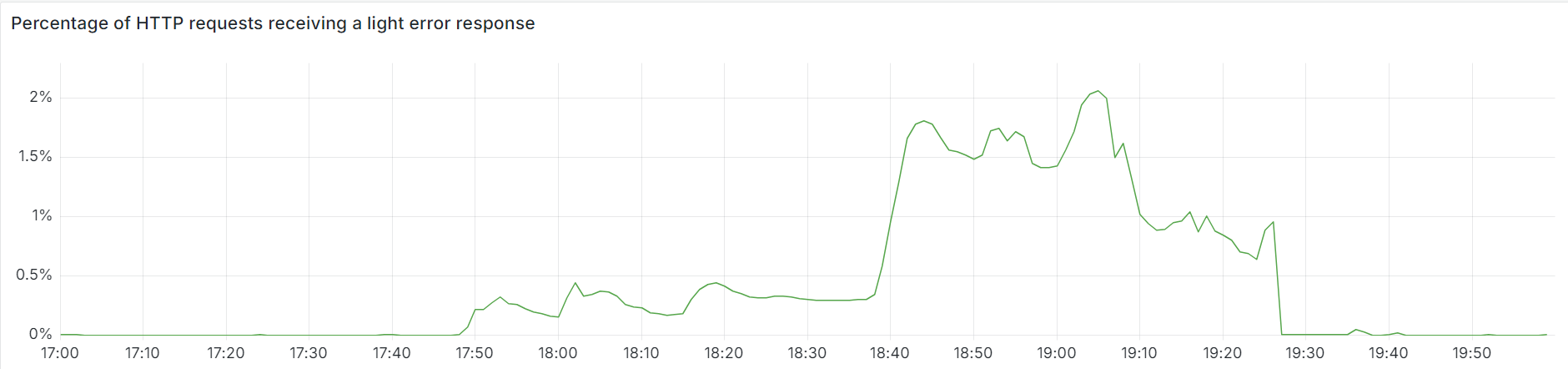
Below, we provide a view of the impact from some of Cloudflare’s internal metrics. The first graph illustrates the percentage of all eyeball (inbound from external devices) HTTP requests that were served an error response because the service suffering poisoning could not be reached. We saw an initial increase to 0.5% of requests, and then later a larger one reaching as much as 2.1% before recovery started due to our service reloads.
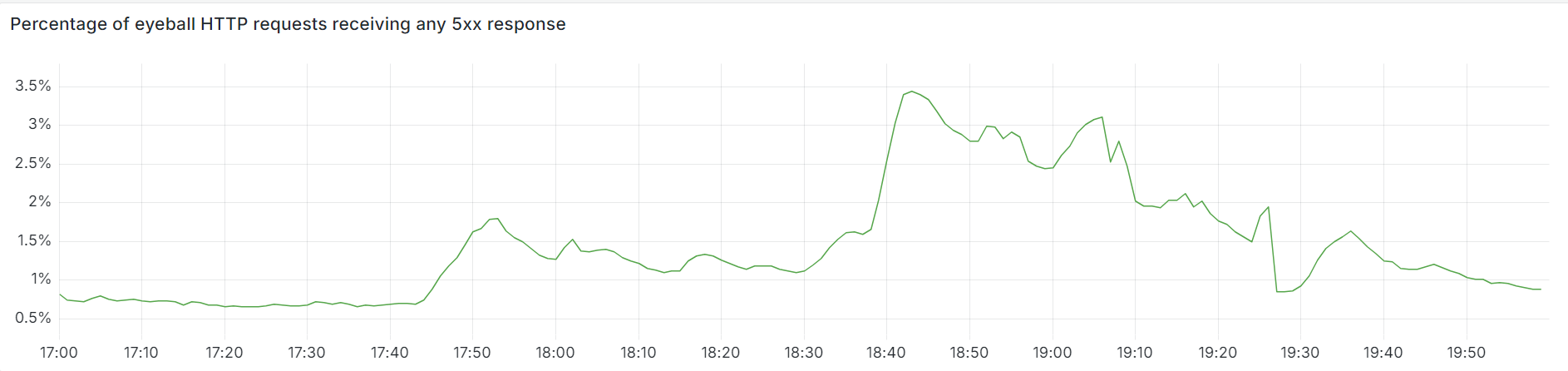
For a broader view of errors, we can see all 5xx responses our network returned to eyeballs during the same window, including those from origin servers. These peaked at 3.45%, and you can more clearly see the gradual recovery between 19:25 and 20:00 UTC as Traffic Manager finished its re-routing activities. The dip at 19:25 UTC aligns with the last large reload, with the error increase afterwards primarily consisting of upstream DNS timeouts and connection limits which are consistent with high and unbalanced load.
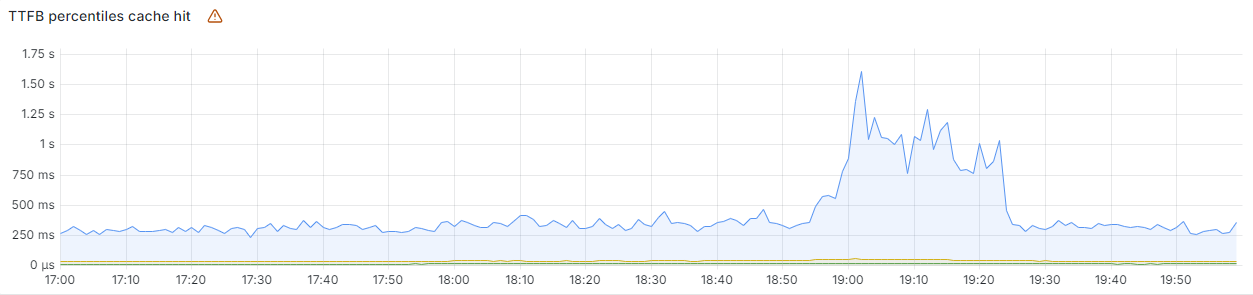
And here’s what our TTFB measurements looked like at the 50th, 90th and 99th percentiles, showing an almost 3x increase in latency at p99:
Earlier on June 20, between 14:14 – 17:06 UTC, we gradually activated a new DDoS rule on our network. Cloudflare has recently been building a new way of mitigating HTTP DDoS attacks. This method is using a combination of rate-limits and cookies in order to allow legitimate clients that were falsely identified as being part of an attack to proceed anyway.
With this new method, an HTTP request that is considered suspicious runs through these key steps:
We use this “asynchronous” workflow because it is more efficient to block a request without a rate-limit rule, so it gives a chance for other rule types to be applied.
So overall, the flow can be summarized with this pseudocode:
for (rule in active_mitigations) {
   // ... (ignore other rule types)
   if (rule.match_current_request()) {
       if (!has_valid_cookie()) {
           // no cookie: serve error page
           return serve_error_page();
       } else {
           // add a rate-limit rule to be evaluated later
           add_rate_limit_rule(rule);
       }
   }
}


evaluate_rate_limit_rules();
When evaluating rate-limit rules, we need to make a key for each client that is used to look up the correct counter and compare it with the target rate. Typically, this key is the client IP address, but other options are available, such as the value of a cookie as used here. We actually reused an existing portion of the rate-limit logic to achieve this. In pseudocode, it looks like:
function get_cookie_key() {
   // Validate that the cookie is valid before taking its value.
   // Here the cookie has been checked before already, but this code is
   // also used for "standalone" rate-limit rules.
   if (!has_valid_cookie_broken()) { // more on the "broken" part later
       return cookie_value;
   } else {
       return parent_key_generator();
   }
}
This simple key generation function had two issues that, combined with a specific form of client request, caused an infinite loop in the process handling the HTTP request:
parent_key_generator in the pseudocode above to point to the get_cookie_key function itself, meaning that if that code path was taken, the function would call itself indefinitelyhas_valid_cookie_broken function used here is actually different and both can disagree if the client sends multiple cookies where some are valid but not othersSo, combining these two issues: the broken validation function tells get_cookie_key that the cookie is invalid, causing the else branch to be taken and calling the same function over and over.
A protection many programming languages have in place to help prevent loops like this is a run-time protection limit on how deep the stack of function calls can get. An attempt to call a function once already at this limit will result in a runtime error. When reading the logic above, an initial analysis might suggest we were reaching the limit in this case, and so requests eventually resulted in an error, with a stack containing those same function calls over and over.
However, this isn’t the case here. Some languages, including Lua, in which this logic is written, also implement an optimization called proper tail calls. A tail call is when the final action a function takes is to execute another function. Instead of adding that function as another layer in the stack, as we know for sure that we will not be returning execution context to the parent function afterwards, nor using any of its local variables, we can replace the top frame in the stack with this function call instead.
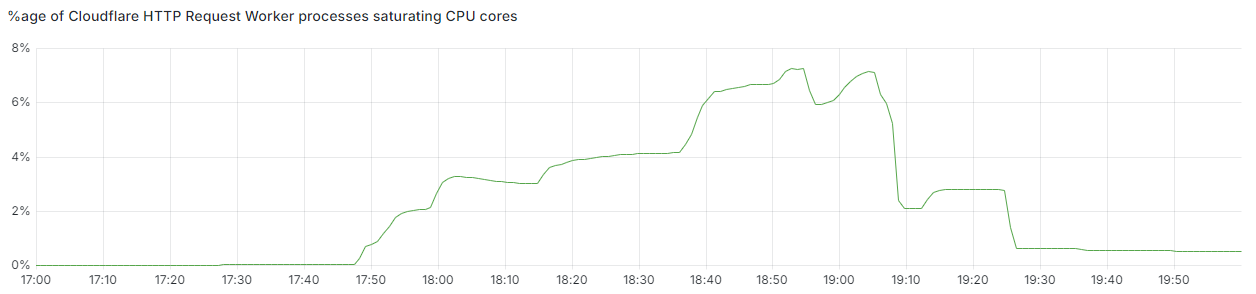
The end result is a loop in the request processing logic which never increases the size of the stack. Instead, it simply consumes 100% of available CPU resources, and never terminates. Once a process handling HTTP requests receives a single request on which the action should be applied and has a mixture of valid and invalid cookies, that process is poisoned and is never able to process any further requests.
Every Cloudflare server has dozens of such processes, so a single poisoned process does not have much of an impact. However, then some other things start happening:
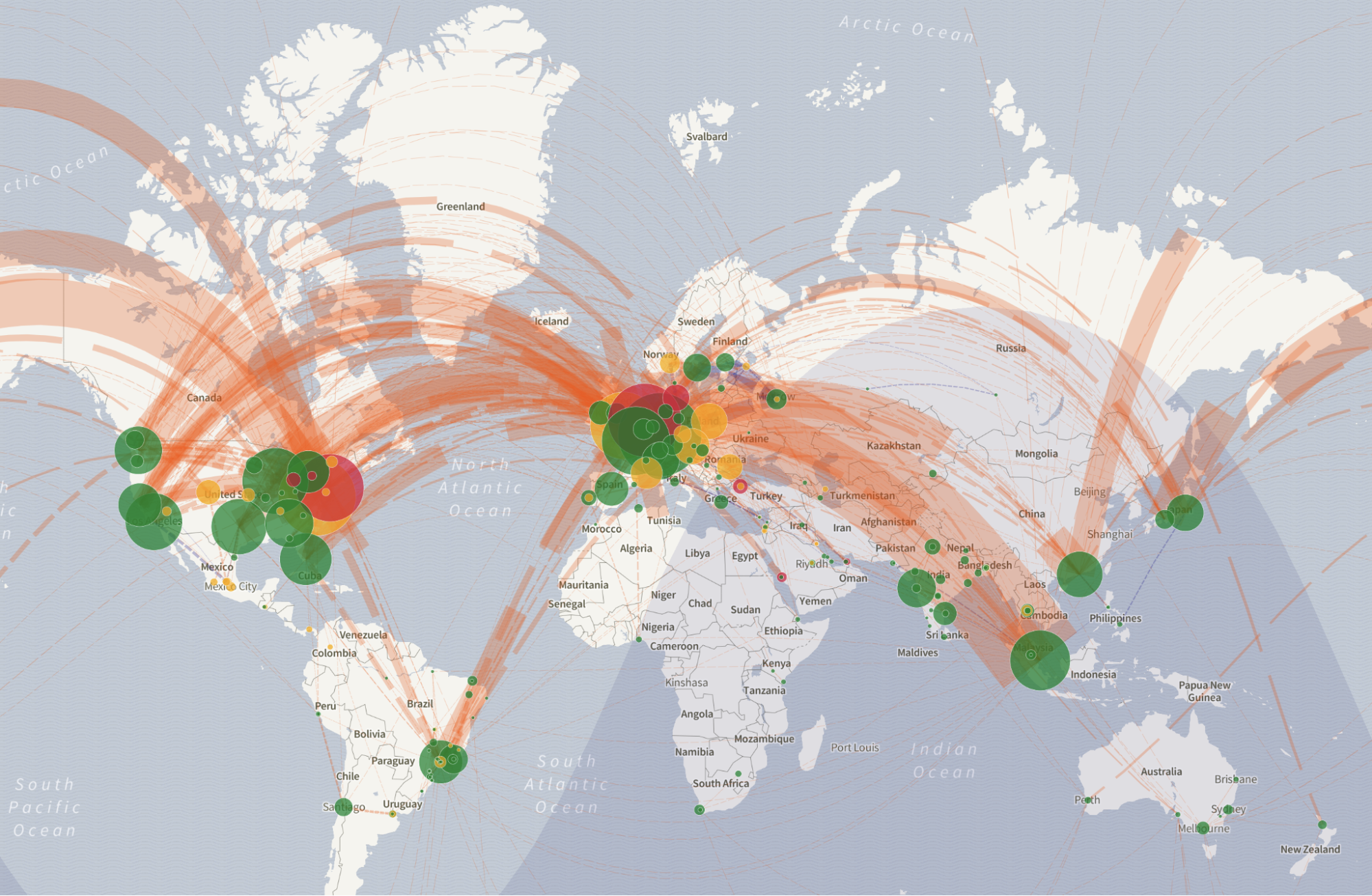
Within a few minutes, multiple data centers had many poisoned processes, and Traffic Manager had redirected as much traffic away from them as possible, but was restricted from doing more. This was partly due to its built-in automation safety limits, but also because it was becoming more difficult to find a data center with sufficient available capacity to use as a target.
The first case of a poisoned process was at 17:47 UTC, and by 18:09 UTC – five minutes after the incident was declared – Traffic Manager was re-routing a lot of traffic out of Europe:
It’s obvious to see why, if we look at the percentage of the HTTP request service’s processes that were saturating their CPUs. 10% of our capacity in Western Europe was already gone, and 4% in Eastern Europe, during peak traffic time for those timezones:
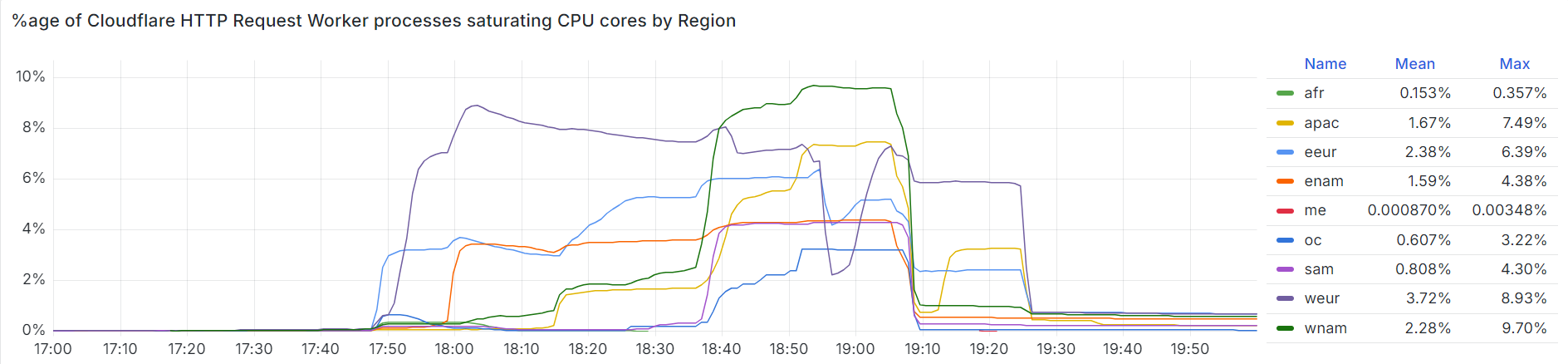
Partially poisoned servers in many locations struggled with the request load, and the remaining processes could not keep up, resulting in Cloudflare returning minimal HTTP error responses.
Cloudflare engineers were automatically notified at 18:04 UTC, once our global CPU utilization reached a certain sustained level, and started to investigate. Many of our on-duty incident responders were already working on the open incident caused by backbone network congestion, and in the early minutes we looked into likely correlation with the network congestion events. It took some time for us to realize that locations where the CPU was highest is where traffic was the lowest, drawing the investigation away from a network event being the trigger. At this point, the focus moved to two main streams:
It was 25 minutes after the initial incident was declared when we validated that restarts helped on one sample server. Five minutes after this, we started executing wider restarts – initially to entire data centers at once, and then as the identification method was refined, on servers with a large number of poisoned processes. Some engineers continued regular routine restarts of the affected service on impacted servers, whilst others moved to join the ongoing parallel effort to identify the trigger. At 19:36 UTC, the new DDoS rule was disabled globally, and the incident was declared resolved after executing one more round of mass restarts and monitoring.
At the same time, conditions presented by the incident triggered a latent bug in Traffic Manager. When triggered, the system would attempt to recover from the exception by initiating a graceful restart, halting its activity. The bug was first triggered at 18:17 UTC, then numerous times between 18:35 and 18:57 UTC. During two periods in this window (18:35-18:52 UTC and 18:56-19:05 UTC) the system did not issue any new traffic routing actions. This meant whilst we had recovered service in the most affected data centers, almost all traffic was still being re-routed away from them. Alerting notified on-call engineers of the issue at 18:34 UTC. By 19:05 UTC the Traffic team had written, tested, and deployed a fix. The first actions following restoration showed a positive impact on restoring service.
To resolve the immediate impact to our network from the request poisoning, Cloudflare instigated mass rolling restarts of the affected service until the change that triggered the condition was identified and rolled back. The change, which was the activation of a new type of DDoS rule, remains fully rolled back, and the rule will not be reactivated until we have fixed the broken cookie validation check and are fully confident this situation cannot recur.
We take these incidents very seriously, and recognize the magnitude of impact they had. We have identified several steps we can take to address these specific situations, and the risk of these sorts of problems from recurring in the future.
Cloudflare experienced two back-to-back incidents that affected a significant set of customers using our CDN and network services. The first was network backbone congestion that our systems automatically remediated. We mitigated the second by regularly restarting the faulty service whilst we identified and deactivated the DDoS rule that was triggering the fault. We are sorry for any disruption this caused our customers and to end users trying to access services.
The conditions necessary to activate the latent bug in the faulty service are no longer possible in our production environment, and we are putting further fixes and detections in place as soon as possible.
Post Syndicated from The History Guy: History Deserves to Be Remembered original https://www.youtube.com/watch?v=81WSQh5V8NE
Post Syndicated from Bruce Schneier original https://www.schneier.com/blog/archives/2024/06/the-us-is-banning-kaspersky.html
This move has been coming for a long time.
The Biden administration on Thursday said it’s banning the company from selling its products to new US-based customers starting on July 20, with the company only allowed to provide software updates to existing customers through September 29. The ban—the first such action under authorities given to the Commerce Department in 2019—follows years of warnings from the US intelligence community about Kaspersky being a national security threat because Moscow could allegedly commandeer its all-seeing antivirus software to spy on its customers.
Post Syndicated from Еми Барух original https://www.toest.bg/etgar-keret-problemut-e-che-vsichki-iskat-da-e-prosto-i-yasno-a-to-ne-e/

Еми Барух беше в Израел и се върна оттам с три материала, които ще споделим в „Тоест“ в три последователни седмици. Започваме с интервюто ѝ със световноизвестния израелски писател Етгар Керет и ще продължим с репортажи от протестите срещу управлението на Нетаняху и от опустошените кибуци, сцена на зверствата от октомври 2023 г.

Върху пейките на улица „Дизенгоф“ в Тел Авив са поставени големи бели плюшени мечета с тъмночервени петна по козината, напомнящи на кръв. На облегалките са залепени снимки на отвлечените в Газа заложници. Бяха минали 222 дни от 7 октомври 2023 г.
На една от тези пейки пред малък цветарски магазин чакам Етгар Керет. Всички вестници вече писаха за най-новата му книга Autocorrect. Писаха още, че Етгар Керет никога не е мълчал толкова дълго. Разговорът ни започва от това мълчание.
За милионите Ваши читатели Вие сте забележителен автор, който умее да смесва магическото и всекидневното и да превръща голямата картина в разбираем разказ за живота. Свикнали сме да търсим ориентири за случващото се тук във всички Ваши кратки разкази, есета, графични романи, филми. Ще ги намерим ли в най-новата Ви книга?
Странна е тази история. Когато работя върху една книга, винаги има дата, на която трябва да я предам в издателството. Преди това сядам, чета и се питам искам ли тази книга да бъде публикувана, не трябва ли да поработя още над нея.
Денят, в който трябваше да предам Autocorrect, беше 8 октомври 2023 г. Започнах да чета финалната версия на 6-ти.
Писах книгата по време на коронавируса, по време на протестите срещу Нетаняху и опитите му да промени правосъдната система в страната. И най-вече след като загубих майка си, която беше наистина най-близкият ми човек. За мен това бяха трудни времена.
Когато на 6 октомври стигнах до средата на книгата, казах на жена ми: „Не съм сигурен, че ще я предам на 8 октомври, защото историите са добри, но в тях има нещо много песимистично, много тъмно. Струва ми се, че заради моята лична загуба показвам една доста мрачна картина на света.“
Жена ми отговори: „Ти винаги прекалено много мислиш! Но ако наистина така го чувстваш, остави книгата настрана, отиди да направиш нещо приятно, наспи се, а утре я прочети отново и ако имаш същите съмнения, не я предавай в издателството.“
Аз си казах „ОК“. И я оставих.
На 7 октомври се събудих рано от ракетите и всичко останало… Изобщо забравих за книгата. Сетих се за нея през януари. Прочетох я отново и си помислих: „О, тя е чудесна. На 6 октомври ми се стори, че е прекалено мрачна, а след 7 октомври сякаш всичко си дойде точно на мястото.“

На кое точно място? Вие къде се озовахте след 7 октомври?
Когато всичко започна, хората, които можеха най-много да помогнат, бяха тези, които умеят да карат кола и да приготвят храна. А това са две неща, с които никак не се справям. Винаги съм си мислил, че е много секси така – не умея да шофирам, не мога да готвя… Гаджетата ще ме возят, ще ходим на ресторант. След 7 октомври се почувствах виновен, питах се как ще помагам, като не карам кола.
Тогава с жена ми започнахме да посещаваме местата, където евакуираха оцелелите от кибуците. Отивахме при тях и им казвахме: „Ако искате, ще поиграем с децата; ако искате, ще ви разказвам истории, ще бъдем заедно.“ Нямаше значение дали там има сто души, или са само трима.
В съботата след 7 октомври отидохме в най-тежко пострадалия кибуц. Посрещна ни една висока жена, която държеше съвсем малко бебе. Беше страшно мила, помогна ни, стоя повече от два-три часа с нас.
Накрая, когато ни съпроводи до колата, се сетих, че не съм я попитал за името ѝ… Два часа по-късно беше вече неудобно да я питам. Казах ѝ: „Вие сте късметлийка с толкова спокойно бебе. Как се казва детенцето?“ Тя ме погледна и отвърна: „Не знам. Не съм от кибуца. Дойдох току-що, за да помагам. Имаше една жена, която кърмеше бебето си. В този момент дойдоха да ѝ съобщят, че са намерили тялото на мъжа ѝ, когото е мислила за отвлечен, а е бил убит. Тя припадна. И аз взех бебето.“
Разбирате ли? Не съм способен да интерпретирам действителността. Толкова е сложно, толкова е объркано. И всеки, който заяви „Това доказва единствено еди-какво си“, значи нищо не е разбрал.
Ще ви разкажа и една друга история. Потърси ме 19-годишен войник. Беше загубил крака си в Газа, където бе воювал, и когато ми се обади, ми каза, че иска да разкаже своята история, но не знае как. Отвърнах му, че мога да опитам да помогна, да го посъветвам и т.н.
Беше много вълнуваща среща за мен и когато на връщане се качих в таксито, се опитах да споделя с шофьора. Казах му: „Срещнах се с един войник, толкова е млад, трудно ходи, а е в началото на живота си, как ще си намери приятелка, работа, как ще я кара нататък…“
Виждам, че на шофьора не му пука, гледа ме някак ядосано. И си помислих, че може би той също е загубил някого. Всички страдаме, цялата страна страда, всички преживяваме. А той – руски емигрант – ми казва: „На мен ли ще ми обясняваш!“ И започна да разказва своята история.
Взели го пет дни запас. На 7 октомври ги отвели на юг и ги закарали на мястото на фестивала Nova. Трябвало да събират телата. И ми разказва за телата, за положението, в което са лежали, ужасяващи неща, които няма да повторя, неща, които остават в теб.
Истината е, че не исках да слушам, но слушах. Той завърши с думите: „Кажи ми честно, дали човек, видял всичко това, може да спи нощем?“
Аз отговорих: „Не.“ А той продължи: „Да, така е. Не мога да спя. И трябва да ти разкажа какво ми се случи тази сутрин. В 5 часа качих едно момиче близо до клуб „Хавана“. И тази млада жена, на 24 години, седна на задната седалка и от момента, в който се настани, не престана да се оплаква: „Отивам в този бар, купувам си питие – 70 шекела, представяш ли си?! Това са почти 20 долара! Как е възможно! В пластмасова чаша слагат малко водка и ти взeмат 70 шекела. Трябва да си оставя палтото – 20 шекела! Ненормални хора! Всичко е скъпо, искат да ме разорят!“
Шофьорът продължи: „Когато карам, нямам нерви за такива разговори, но си казвам: „Това ти е работата, човече, не се разправяй, мълчи си и карай.“ Докато не спрях на светофара и тя не каза: „Писнало ми е от всички тези алчни пъбове, отсега нататък – само партита на открито!“ Мигом се обърнах към нея като озверял вълк, сякаш щях да я ухапя. Казах ѝ: „Ти къде си мислиш, че живееш?“ В този момент очите ни се срещнаха. И си спомних как, когато събирах телата, в един момент усетих движение, помислих, че е плъх, но после видях, че под труповете имаше млада жена, която беше оцеляла. Попитах момичето в таксито: „Ти беше ли на Nova?“. То ме погледна, усмихна се и отвърна: „Аз те помня…“
Може да си помислим, че това момиче е психопатка, социопатка, че е будистка, йога, може да кажем: „Този човек е сбъркан. Човече, отивай да спиш, видял си всичко това, а сега – живей в настоящето.“
Аз събирам истории, но не мога да ги обобщя. Мисля, че моята работа като писател не е да представям на хората някакви дидактични наративи. А по-скоро, ако някой ми разкаже нещо за определена ситуация, да му кажа: „Да, това е истина, но има и друга истина.“
Каква е другата истина, която казвате на хората, твърдящи, че Израел извършва геноцид в Газа?
На хората, които твърдят, че сме се опитвали да извършим геноцид, искам да кажа, че след 1967 г. населението на Палестина се е увеличило 8 пъти. Ако това е геноцид, значи той е много, много неуспешен.
Когато искам да критикувам страната си, което е част от работа ми на писател, бих казал, че извършва не геноцид, а военно престъпление. Женевската конвенция постановява, че когато окупираш една територия, си отговорен за хората, които живеят там. Ако ние сме окупирали тази земя и не доставяме достатъчно хуманитарна помощ или ако твърдим, че това не е наша отговорност, от гледна точка на закона извършваме престъпление. Дали това е военно престъпление, или не, е тема за разговор. Но той приключва в момента, в който заявиш, че Израел извършва геноцид. И аз не искам да разговарям с теб.
Преди много време написах едно есе в „Ню Йорк Таймс“ за термините „пропалестинец“ и „произраелец“, обяснявайки защо ме дразнят. Ако някой ми каже „Аз съм произраелец“, той всъщност ми заявява: „Какъвто и разговор да последва, каквито и аргументи да чуя, накрая няма да променя мнението си, независимо от фактите.“ Мисля, че това е опростенчество. Така гледа светът на Израел, така е и когато израелците се опитват да разкажат собствените си истории. Не познавам човек, който да е пробългарин или антитурчин. Вие нямате такова нещо. С израелците и палестинците обаче не е така.
Аз съм израелец, но не съм произраелец. Как мога да бъда човек, който подкрепя липсата на достатъчно храна в Газа, как мога да подкрепям бомбардировките, които костват огромен брой невинни жертви? Значи ли това, че аз съм пропалестинец? Нима мога да подкрепям убийствата на цели семейства? Как да подкрепям идеология, която не се интересува, че ще бъдат пожертвани толкова много хора, защото Аллах ще ги направи велики? Не мога.
Как ще коментирате акциите на пропалестинците в кампусите на университетите от Бръшляновата лига?
Живеем в толкова дивашко време, че когато наблюдаваме едно събитие, виждаме само неговите екстремни проявления. Вярвам, че много от хората, които организират протести в кампусите, искат Палестина да е свободна. Аз също искам Палестина да е свободна. И съм участвал в много протести.
В тази бъркотия някои екстремисти скандират „Смърт на ционистите!“, „Искаме да умрете!“, „Тази страна ще бъде наша“, но те не съзнават какво повтарят. Нито познават географията.
Има две концепции за конфликта в Близкия изток.
Едната е религиозната, фундаменталистката. От едната страна е „Хамас“, от другата е крайнодесният министър на националната сигурност на Израел – Итамар Бен-Гвир.
Фундаменталисткото виждане е следното: „Тази земя е обещана на един народ. Можем да спорим дали на палестинците, или на израелците, но само един народ може да живее тук. А другите трябва да се махнат.“
Другата концепция е: „Има два народа и никой не трябва да се маха, следователно трябва да има две държави.“
Убеден съм, че много от демонстрантите дори не разбират разликата между намирането на решение за две държави или за една държава, което според Бен-Гвир означава евреи да строят селища в Газа, а според „Хамас“ – да бъдат убити всички израелци и да им се вземе цялата територия.
Впрочем мечтата на „Хамас“ дори не е да я има Палестина, а да се създаде нещо като ислямистка държава, която ще започне от Газа, ще мине през Израел, ще стигне до Ливан, ще се разпростре до Ирак, ще контролира Йемен. Това не е националистическа идея, това е религиозна идея. И в основата си тя е ислямистка.
Погледнете Иран – какво общо имат Иран и „Хамас“? Иранците са шиити, „Хамас“ са сунити. Иранците говорят фарси, „Хамас“ говорят арабски. Иранците не са араби. Но те искат арабите да умират заради техните вярвания. Е, какво е това, ако не колониализъм! Каква е тази война, в която пращаш на смърт „робите“ да се бият за теб?

В едно интервю говорите за семейството си, в което има от радикални до либерални възгледи. Как се справяте с различията?
След 7 октомври различни хора се питаха как да продължат, и ми звъняха. Един казва: „Брат ми умря. Искам да отворя библиотека в негова памет, можеш ли да ми помогнеш да получа книги от различни издатели?“ Друг ми казва: „Баща ми беше на фестивала и не се знае дали е жив, не са намерили тялото му, можеш ли да ми помогнеш да говоря с хора, които се занимават с това?“ Правя всякакви такива неща, които са и депресиращи, и важни.
Когато разказвам на сестра ми, тя всеки път ми обяснява колко много се моли: „Моля се за войниците, моля се за тези, които умряха, моля се за тези, които помагат“. И го казва с една такава гордост, която ме отегчава. На кого му пука! Но тя ми е сестра и аз я обичам, тя е добър човек и просто ѝ казвам: „Виж, чувствам, че губя търпение, а ти не го заслужаваш, нека поговорим друг ден.“
Всеки път, когато изпитам подобно раздразнение, за да се отърва от него, пиша история от гледна точка на човека, който ме е ядосал. Написал съм повече от десет за Биби Нетаняху. Една от тях се казва „Най-добрият лъжец на света“. Разказът е за човек, който толкова много лъже, че вече не знае какво иска. Епична история. Но като я четеш, започваш да го съжаляваш…
Тези разкази са като упражнение, което правиш, за да влезеш в обувките на някого. Когато създаваш такъв герой, не може да напишеш: „Той е зъл, той е глупав.“ Трябва да изградиш убедителен образ. Да го очовечиш. Невинаги се получава добра история, но за мен това е като терапия.
Да се върна на сестра ми. Измислих разказ за човек, който се моли през цялото време. Такива хора вярват, че има някой от другата страна, който слуша, който разбира, който се грижи. Аз не съм вярващ. Твърде циничен съм. Докато пишех обаче, си дадох сметка, че молитвите и писането са близки. Зададох си въпроса „Кое спира хората да пишат?“. Може би се опасяват, че няма да бъдат разбрани, че никой няма да схване какво искат да кажат.
Сестра ми се моли, аз пиша. Кой казва, че моите истории са важни, кой казва, че някой ги чете или че ги чете по начина, по който аз съм ги написал? И осъзнах, че ние и двамата искаме нещо, което може би няма да получим…
Очаквате обаче хора със съвършено различни възгледи да се научат да общуват едни с други. Има ги във Вашите разкази. В живота обаче…
Родителите ми са оцелели от Холокоста. Но слушаха Вагнер. Съседите питаха майка ми защо слуша Вагнер, при положение че нацистите са го обичали. А майка ми отговаряше: „Нацистите обичаха и щрудел. Искаш и щрудел да не ям, защото някакви проклети нацисти са обичали щрудел?“ „Не, ама Вагнер е антисемит.“ Отговорът на майка ми беше: „Ако Вагнер беше тук, бих го отровила, но музиката му е чудесна. Така че, хайде, омитай се от къщата ми. Искам да си слушам тази музика.“
Един от най-добрите приятели на моите родители беше германец, който на 18 години е бил войник в германската армия по време на Втората световна война. Не е бил есесовец, воювал е с Ромел в Северна Африка. Когато бях дете, се чудех на баща ми: „Цялата ти фамилия е избита от нацистите, как можеш да си приятел с него?“ А той ми отговори: „Опитвам се да се поставя на мястото му – ако съм млад, страната ми е във война и ме пращат да воювам за нея, ще отида и ще я защитавам. Когато виждам млад човек, който се е бил за страната си и който съжалява за това, разбирам, че е приятел. Че не е антисемит.“
Казвам, че съм за човечността. За това, което съм научил от родителите си. И се старая да избягвам всякакви етикети, които прехвърлят на други моята морална отговорност.
Това ли е най-важният урок, който научихте от тях?
Знаете ли кое е първото, което светът иска да прехвърлим на друг? Състраданието. Живеем във време, в което ни се казва на кого трябва да съчувстваме.
Когато светът е бил по-примитивен и сме живели на село, дори някой да разказва расистки вицове, пак щях да си общувам с него. Той е единственият, който продава масло в селото. Освен това е добър човек. Когато ми се налага да отида до града, ми полива цветята. Аз хем не го харесвам, хем го харесвам, защото мога да видя неговата човещина.
Сега, когато влезеш в социалните мрежи, попадаш на нещо като пуританска идея за праведност. Не харесваме онези хора, защото те не са прави.
Ако направим дисекция на всеки човек и го анализираме, ще се окаже, че никой не е прав. Да се лъже е лошо. Аз не познавам нито един човек, който да не е лъгал. Всеки е вършил неща, за които съжалява. Ако някой ги заснеме и ги качи във Facebook, с всички нас е свършено.
Когато започна руско-украинската война, с жена ми събирахме дрехи и вещи за пострадалите. После разни хора почнаха да ме питат защо не си сменя профилната снимка с украинското знаме. Ами не мисля, че когато смениш профилната си снимка, някой в бомбоубежище в Киев автоматично ще получи повече храна или ще се почувства по-спокоен.
Ти го правиш за себе си, а не за тях.
Бях поканен да говоря на Панаира на книгата в Болоня от името на украинския народ. Там се срещнах с човек от Италианския културен институт и той ми каза: „Съчувстваме много на украинския народ, правим толкова неща за него!“ Попитах го какво правят, и той ми отговори, че е трябвало да има конференция, посветена на 100-годишнината от рождението на Достоевски, но са я спрели заради руската инвазия. Попитах го дали Достоевски е бил путинист. „Няма значение – отговори, – за руснаците той е герой.“ Чудя се как отказът да говориш за един шедьовър, който разказва за сложността на човечеството, помага на хората в скривалищата в Киев. Не знам.
В миналото нещата бяха по-ясни и действията – по-разбираеми. Ако например през 70-те години покажеш на едно извънземно активист, завързал се за дърво, препречвайки пътя на булдозер, и попиташ „Какво се случва тук?“, извънземното най-вероятно ще отговори: „Този, който се е завързал за дървото, не иска да бъде изсечена гората.“ Ако на същото извънземно му покажеш как в наши дни един човек залива с доматена супа „Мона Лиза“, и го попиташ какво иска този човек, пришълецът би казал: „Може би много мрази изкуството или не обича доматена супа.“ Но каква е връзката с глобалното затопляне?
Мога да заливам „Мона Лиза“ със супа, протестирайки срещу абортите, мога да я заливам, защитавайки абортите. Мога да заливам „Мона Лиза“ със супа против ковид ваксинациите или за ковид ваксинациите. В крайна сметка това, което правя, е да заливам „Мона Лиза“ със супа.
И когато гледам Грета Тунберг, си мисля, че това е новият модел на активист. Твърде различен от действията на големите исторически фигури като Ганди, Мартин Лутър Кинг или Роза Паркс.
Фундаменталната разлика е, първо, че всички тези хора са действали, за да променят своята непосредствена среда. Грета Тунберг говори за далечното бъдеще на своите хипотетични деца…
Второ, всички тези хора са платили своята цена. Ганди е убит. Мартин Лутър Кинг е убит. Роза е изпратена в затвора.
Грета има много последователи в Instagram, където от своя диван качи снимка „Освободете Газа“. Това е много, много лесно. Когато погледнеш профила на Грета, виждаш момиче, живеещо в една от най-привилегированите страни в света, с ограничени социални умения, на което понякога му е трудно да споделя емоциите на други хора. Това е нашият ролеви модел. Човек, който няма особено широки познания, който не е постигнал нищо, но е много хаплив и – особено за момиче на нейната възраст – твърде способен да обижда хората.
Има нещо доста опростенческо, примитивно, нарцистично в този тип активизъм. Защото той не мисли за света, а как да се представи пред света. Интересно е да се види дали тези активисти истински подкрепят каузата, зад която стоят, или всъщност действат срещу нея.
Всички хора, които месеци наред протестираха срещу правосъдната реформата на Нетаняху, истински подкрепяха тази кауза.
Ходя почти всяка седмица на тези протести, сблъсквам се с полицаите, които блокират магистралата. Брат ми си счупи крака, беше арестуван. Не съм против протестите. Ходя на тях, защото се чувствам безсилен, безпомощен, а искам да направя нещо… Не мисля, че ако не отида, ще се промени каквото и да било, но имам нужда да заявя мнението си.
Някои хора са там само за да задоволят нарцистичното си чувство за всемогъщество, без изобщо да поставят под съмнение подхода си.
След 7 октомври в Европа имаше огромни антиизраелски протести. Какъв ефект оказаха те върху войната в Газа? Много малък, даже никакъв. Ако ме питате какво постигнаха – създадоха вълна от ислямофобия в Европа, която за първи път видя каква голяма мюсюлманска общност се мобилизира на нейна територия.
Вследствие на тези протести, и то по несправедлив начин, някои страни промениха имиграционните си закони и направиха живота на бежанците по-труден. В Нидерландия например фашистка партия спечели изборите. Това нямаше да се случи, ако не бяха тези бурни демонстрации, които изплашиха хората. Несправедливо, разбира се, но те породиха негативна представа за исляма, съвсем непредставителна за тази религия.
Възможно е след две години тези, които протестираха в Колумбийския университет, да погледнат назад и да се запитат какви са били истинските последствия от техните действия. Дали са помогнали да бъде избран Тръмп? И ако е така, дали следващите избори няма да са последните, защото нов мандат на Тръмп може да сложи край на демократичното управление?
Оптимист ли сте в сегашната ситуация?
Аз съм оптимист първо по наследство, защото родителите ми са били оптимисти и са оцелели по време на Холокоста. Освен това мисля, че да си оптимист е най-добрата стратегия. Но бидейки оптимист, казвам, че това е най-мрачният период в моя живот.
Роден съм през 1967 г., преживял съм войната през 1973 г. Никога преди не съм се страхувал, че враждебна държава ще унищожи Израел. Това никога не ми се е струвало възможно. И дори след невъобразимата трагедия от 7 октомври не чувствах, че Израел е под реална заплаха. Голямата заплаха за мен – защото познавам историята – идва от самите нас.
В някакъв момент някое радикално фундаменталистко еврейско движение ще се опита да поеме контрола над страната. Водени от някаква религиозна мегаломания, тези екстремисти виждат себе си като по-висши същества… По времето на Римската империя са се гордели, че не се нуждаят от Рим. Днес вярват, че са над САЩ и Европа. И се представят като образци на добродетелта.
Де факто имаме коалиция между Нетаняху и [лидера на „Хамас“ – б.а.] Синуар, защото и двамата знаят много добре, че краят на войната ще сложи край на политическата им кариера. И за да задоволят личните амбиции на тези двама мъже, палестинските цивилни от Газа, населението на Северен Израел, евакуирано заради ракетните обстрели, и всички израелски граждани, изправени пред опасността от нападение и икономически колапс, плащат най-високата цена.
Това не е обикновен израелско-палестински конфликт. По същество това е сблъсък между религиозните месиански групи и нормалните хора. Умерените и от двете страни са заложници.
Post Syndicated from Светла Енчева original https://www.toest.bg/nasilieto-nad-zheni-ne-chaka-bugaria-da-se-opravi/

Юни е горещ не само температурно, но и политически. Проведоха се избори за национален и европейски парламент, разгарят се страсти около съставянето на новото правителство. И няма яснота дали такова ще се сформира, или ще ходим на избори за седми път през последните три години.
Насред летните политически страсти няколко случая на жени, които не са могли да се измъкнат живи от капана на домашното насилие, смразяват кръвта. Още повече че поне в един от тях (вероятно и в повече) фаталният изход можеше да се избегне.
Месецът още не е свършил, а от началото му поне четирима мъже в България са убили по една жена. На 3 юни 57-годишен мъж убива жена си, след което прави неуспешен опит за самоубийство. На 13 юни е убита 68-годишна жена. Заподозрян е синът ѝ, който е психичноболен. На 20 юни 35-годишен мъж убива 32-годишната жена, с която живее, оставя 4-годишната ѝ дъщеричка сама насред града, след което се самоубива. Същия ден Орлин Гигов, бивш шофьор в болницата на МВР, убива жената, с която съжителства и която е с украински произход.
Случаят с Орлин Гигов заслужава специално внимание, защото е впечатляващ пример за институционалното безхаберие по отношение на домашното насилие в България.
Името на Гигов влиза в медиите преди година и половина. През януари 2023-та той се барикадира в дома си, след като изхвърля на стълбите украинската си приятелка Силвия – обезобразена от бой, гола и боса. След като съседи подават сигнал, полицията преговаря с барикадиралия се насилник в продължение на 5 часа. Приятелски и (след като той излиза от апартамента) с потупване по рамото. Бившият шофьор от МВР обяснява на полицаите, че те са му колеги, а Силвия е чужденка – „от друго стадо“.
Повече от денонощие МВР не публикува информация за жертвата. Първоначално от Вътрешното министерство твърдят, че няма пострадали. След като историята се разчува, казват, че не знаят къде е жената.
По информация на OFFNews жените, пострадали от Гигов, са поне пет, а само за три години прокуратурата е получила десет сигнала срещу него. Две от жертвите му разказват пред изданието на какво ги е подлагал и как ги е заплашвал. Например с думите „спокойно, знам как да бия, така че да не личи“, „ще те вкарам в гипсово корито и ще те лежа“, „с този нож ще те разфасовам“. Дъщерята на друга жертва на Гигов споделя, че той не само е пребил и намушкал с нож по краката майка ѝ, която е с увреждане, а е взел и личната карта, телефона и портфейла ѝ. На всичко отгоре се опитал да изтегли бърз кредит от нейно име.
Въпреки цялата налична информация за насилническото поведение на Гигов и данните за извършени от него престъпления (нанасяне на телесна повреда в условията на домашно насилие, кражба и шофиране след употреба на наркотици) институциите не защитават Силвия от него. През юли 2023 г. той пак я пребива – този път в центъра на София. Тя отказва да даде показания и макар че побоят е пред множество свидетели, пак не получава защита.
Скоро след това – в началото на август 2023 г. – парламентът приема промени в Закона за защита от домашното насилие (ЗЗДН), които трябва да гарантират още по-голяма защита на потенциалните жертви. Но и това не помага на Силвия – накрая Орлин Гигов я убива.
Смъртта на Силвия, която можеше да бъде избегната, ако ЗЗДН се прилагаше адекватно, е зловещо напомняне на нещо простичко, но много важно: не е достатъчно да има закони, те трябва да се прилагат. А институциите, ангажирани с прилагането им, трябва да действат отговорно и компетентно.
През близо двайсетте години, откакто е в сила, ЗЗДН има участта системно да се пренебрегва – предимно от представители на МВР. А те първи срещат преживелите домашно насилие, които имат смелост да потърсят защита. И тяхната реакция е от животоспасяващо значение.
Да я наречем Ирина. Ирина е висококвалифицирана специалистка и живее в областен град. Преди двайсетина години се развежда с мъжа си заради непрестанните му пиянски побои. Той обаче не престава да я тормози и след развода. Въпреки че подава сигнали, институциите не ѝ осигуряват защита. Един ден, скоро след като през 2005 г. е приет ЗЗДН, бившият съпруг на Ирина чупи прозореца на жилището ѝ, влиза през него и я пребива. Пред сина им, който е малък, но вече достатъчно голям, за да разбира какво се случва.
Ирина подава в полицията молба за защита от домашно насилие. Оттам я отпращат с аргумента, че в нейния случай преживяното насилие не е домашно, защото извършителят ѝ е бивш, а не настоящ съпруг. Въпреки че и тогавашната формулировка на закона би трябвало да ѝ гарантира защита поне по два признака – тя включва както бившите съпрузи, така и лицата, от които пострадалите имат дете.
През 2024 г. ЗЗДН е в сила от близо две десетилетия, България отдавна е в ЕС и се предполага, че представителите на органите на реда имат достатъчно информация кое е домашно насилие и как да реагират, когато получат сигнал. Да, ама не, както казваше покойният журналист Петко Бочаров.
Само ден преди убийствата на две жени, на 20 юни, съпредседателят на БХК Радослав Стоянов се обръща към министъра на МВР с открито писмо. Поводът е реакцията на служители от Второ РПУ в София спрямо случай на жена, чийто партньор, с когото тя живее, ѝ е причинил телесна повреда. Той е задържан за кратко, след което е освободен, а на нея полицейските служители всячески пречат да получи защита.
Стоянов се заема със случая лично и се опитва да обясни на представителите на полицията, че жената е пострадала от домашно насилие и съответно има право на защита по силата на ЗЗДН. Според тях обаче правозащитникът греши: щом насилието не било извършено „в домашна среда“, значи не е домашно насилие, и точка. Въпреки че според закона домашното насилие се определя не от мястото на извършването му, а от характера на връзката между извършителите и пострадалите.
Ако служителите на МВР системно не осигуряват защита на жертвите от домашно насилие, логично е да си помислим, че трябва да се научат да го правят. А класическият начин за научаване е чрез обучение. Само в рамките на един проект обаче, представен през април т.г., 830 полицаи са обучавани как да гарантират защита от домашно насилие. Резултатът е още неадекватни реакции, още незащитени жертви и още убийства.
Ако човек научаваше всичко, на което се обучава, образованието щеше да бъде далеч по-ефективно. Но, уви – при ученето има поне два сериозни проблема. Първият е, че не всичко, което влиза в главата, остава в нея. Вторият – и по-сериозен – проблем е, че ако човек назубри нещо, това не означава, че е в състояние да го прилага.
Между обучителният материал и приложението му стои не само наличието или липсата на внимание. Намесват се ценности, стереотипи, авторитети, модели на мислене и на поведение, личен опит, индивидуални особености и какво ли още не.
Ако служителите на реда са възпитавани в патриархална среда, имат мачистки ценности и намират утвърждение на ценностния си модел в публичното пространство и в политическите послания, само с обучение няма да стане. Те могат да си назубрят материала, както се зубри в училище, и пак да правят каквото си знаят. Ако за тях мъжката и гилдийната лоялност е по-важна от законите, ще потупват по рамото и ще наричат колега поредния Орлин Гигов, докато не се стигне до поредното убийство.
До миналата година домашното насилие и насилието над жени не бяха особен обществен приоритет. Дори напротив – темата, която и преди не беше особено популярна, беше заклеймена покрай кампанията срещу Конвенцията на Съвета на Европа за превенция и борба с насилието над жени и домашното насилие, по-известна като Истанбулската конвенция.
Промяна в обществените настроения настъпи след случая с обезобразената и нарязана с макетно ножче Дебора Михайлова. Но още е рано да се каже дали кампанийният гняв, довел тогава до промени в ЗЗДН, може да израсне от популизъм до осъзната чувствителност към проблема с домашното насилие.
Чувствителност към насилието над жени и към домашното насилие в едно общество има тогава, когато то не се възмущава от отделни случаи, оставайки сляпо за други, а осъзнава системния проблем. И не се влияе от симпатии, антипатии, авторитети или популярност. В България не изглежда да е така. Докато Дебора спечели обществените симпатии, украинката Силвия и много жени в нейното положение нямаха този шанс.
Показателно е, че в България няма #metoo. Като имаме предвид, че между 1/4 и 1/3 от жените в България са преживели насилие от страна на настоящ или бивш партньор, е малко вероятно да няма популярни актриси, музикантки и други жени от шоубизнеса, които са били обект на насилие, нито популярни мъже, които да са извършвали такива действия. Ала темата продължава да е табу.
Досега единствено актрисата Диана Димитрова заяви, че колегата ѝ Юлиан Вергов я е бил. Въпреки че трийсетина души от снимачния екип на сериала „Откраднат живот“ могат да потвърдят какво се е случило, това прави само гримьорката, прикрила следите от побоя, за да продължат снимките. И по-късно – няколко представители на техническия персонал, които не са присъствали в съответния ден, но споделят какво се е говорило в екипа.
Представителите на актьорската гилдия обаче или застават на страната на Вергов, обвинявайки Димитрова във всевъзможни грехове (хем че лъже, хем че „си го е търсела“), или си мълчат. Тя получава подкрепа комай само от актрисите Весела Казакова и Елен Колева.
Днес Вергов е целият в бяло, а Димитрова напуска актьорската професия, може би и България, и ще учи анимация. След скандала тя се занимава все повече с рисуване и все по-малко с актьорство. Което е обяснимо – след като дори хората, с които работиш, не казват и една дума в твоя подкрепа, колко дълго можеш да продължиш да го правиш?
Докато не се знае дали изобщо ще има правителство, темата за домашното насилие ще е последният проблем на партиите и коалициите. Вероятно няма да е особено съществен проблем и след това, стига да няма пореден случай като този с Дебора, който да разпали обществените страсти. И да се стигне до поредни недообмислени промени на ЗЗДН, с който полицейските служители така и така не се съобразяват.
Насилието над жени и домашното насилие са от тези теми, на които почти никога не им е времето, защото има по-важни неща за решаване. С такива проблеми се занимават развитите демокрации. Но докато чакаме България „да се оправи“ и да стане като развитите демокрации, не само редовно биват пребивани и убивани жени. По-голямата беда дори от това е, че слагаме каруцата пред коня. Не може първо да си оправим държавата, после – проблемите с ценностите и нагласите. Напротив – когато изповядваме демократични ценности, част от които е неприемането на домашното насилие, и действаме спрямо тях, тогава може и да станем развита демокрация.
Post Syndicated from Matt Granger original https://www.youtube.com/watch?v=zqcomUjwQc4
Post Syndicated from Explosm.net original https://explosm.net/comics/no-no
New Cyanide and Happiness Comic
Post Syndicated from The History Guy: History Deserves to Be Remembered original https://www.youtube.com/watch?v=XIwuBknrBso