AWS Weekly Roundup — Happy Lunar New Year, IaC generator, NFL’s digital athlete, AWS Cloud Clubs, and more — February 12, 2024

Post Syndicated from Channy Yun original https://aws.amazon.com/blogs/aws/aws-weekly-roundup-happy-lunar-new-year-iac-generator-nfls-digital-athlete-aws-cloud-clubs-and-more-february-12-2024/

Happy Lunar New Year! Wishing you a year filled with joy, success, and endless opportunities! May the Year of the Dragon bring uninterrupted connections and limitless growth 🐉 ☁

In case you missed it, here’s outstanding news you need to know as you plan your year in early 2024.

AWS was named as a Leader in the 2023 Magic Quadrant for Strategic Cloud Platform Services. AWS is the longest-running Magic Quadrant Leader, with Gartner naming AWS a Leader for the thirteenth consecutive year. See Sebastian’s blog post to learn more. AWS has been named a Leader for the ninth consecutive year in the 2023 Gartner Magic Quadrant for Cloud Database Management Systems, and we have been positioned highest for ability to execute by providing a comprehensive set of services for your data foundation across all workloads, use cases, and data types. See Rahul Pathak’s blog post to learn more.

AWS also has been named a Leader in data clean room technology according to the IDC MarketScape: Worldwide Data Clean Room Technology 2024 Vendor Assessment (January 2024). This report evaluated data clean room technology vendors for use cases across industries. See the AWS for Industries Blog channel post to learn more.

Last Week’s Launches
Here are some launches that got my attention:

A new Local Zone in Houston, Texas – Local Zones are an AWS infrastructure deployment that places compute, storage, database, and other select services closer to large population, industry, and IT centers where no AWS Region exists. AWS Local Zones are available in the US in 15 other metro areas and globally in an additional 17 metros areas, allowing you to deliver low-latency applications to end users worldwide. You can enable the new Local Zone in Houston (us-east-1-iah-2a) from the Zones tab in the Amazon EC2 console settings.

AWS CloudFormation IaC generator – You can generate a template using AWS resources provisioned in your account that are not already managed by CloudFormation. With this launch, you can onboard workloads to Infrastructure as Code (IaC) in minutes, eliminating weeks of manual effort. You can then leverage the IaC benefits of automation, safety, and scalability for the workloads. Use the template to import resources into CloudFormation or replicate resources in a new account or Region. See the user guide and blog post to learn more.

A new look-and-feel of Amazon Bedrock console – Amazon Bedrock now offers an enhanced console experience with updated UI improves usability, responsiveness, and accessibility with more seamless support for dark mode. To get started with the new experience, visit the Amazon Bedrock console.

2024-bedrock-visual-refresh

One-click WAF integration on ALB – Application Load Balancer (ALB) now supports console integration with AWS WAF that allows you to secure your applications behind ALB with a single click. This integration enables AWS WAF protections as a first line of defense against common web threats for your applications that use ALB. You can use this one-click security protection provided by AWS WAF from the integrated services section of the ALB console for both new and existing load balancers.

Up to 49% price reduction for AWS Fargate Windows containers on Amazon ECS – Windows containers running on Fargate are now billed per second for infrastructure and Windows Server licenses that their containerized application requests. Along with the infrastructure pricing for on-demand, we are also reducing the minimum billing duration for Windows containers to 5 minutes (from 15 minutes) for any Fargate Windows tasks starting February 1st, 2024 (12:00am UTC). The infrastructure pricing and minimum billing period changes will automatically reflect in your monthly AWS bill. For more information on the specific price reductions, see our pricing page.

Introducing Amazon Data Firehose – We are renaming Amazon Kinesis Data Firehose to Amazon Data Firehose. Amazon Data Firehose is the easiest way to capture, transform, and deliver data streams into Amazon S3, Amazon Redshift, Amazon OpenSearch Service, Splunk, Snowflake, and other 3rd party analytics services. The name change is effective in the AWS Management Console, documentations, and product pages.

AWS Transfer Family integrations with Amazon EventBridge – AWS Transfer Family now enables conditional workflows by publishing SFTP, FTPS, and FTP file transfer events in near real-time, SFTP connectors file transfer event notifications, and Applicability Statement 2 (AS2) transfer operations to Amazon EventBridge. You can orchestrate your file transfer and file-processing workflows in AWS using Amazon EventBridge, or any workflow orchestration service of your choice that integrates with these events.

For a full list of AWS announcements, be sure to keep an eye on the What’s New at AWS page.

Other AWS News
Some other updates and news that you might have missed:

NFL’s digital athlete in the Super Bowl – AWS is working with the National Football League (NFL) to take player health and safety to the next level. Using AI and machine learning, they are creating a precise picture of each player in training, practice, and games. You could see this technology in action, especially with the Super Bowl on the last Sunday!

Amazon’s commiting the responsible AI – On February 7, Amazon joined the U.S. Artificial Intelligence Safety Institute Consortium, established by the National Institute of Standards of Technology (NIST), to further our government and industry collaboration to advance safe and secure artificial intelligence (AI). Amazon will contribute compute credits to help develop tools to evaluate AI safety and help the institute set an interoperable and trusted foundation for responsible AI development and use.

Compliance updates in South Korea – AWS has completed the 2023 South Korea Cloud Service Providers (CSP) Safety Assessment Program, also known as the Regulation on Supervision on Electronic Financial Transactions (RSEFT) Audit Program. AWS is committed to helping our customers adhere to applicable regulations and guidelines, and we help ensure that our financial customers have a hassle-free experience using the cloud. Also, AWS has successfully renewed certification under the Korea Information Security Management System (K-ISMS) standard (effective from December 16, 2023, to December 15, 2026).

Join AWS Cloud Clubs CaptainsAWS Cloud Clubs are student-led user groups for post-secondary level students and independent learners. Interested in founding or co-founding a Cloud Club in your university or region? We are accepting applications from February 5-18, 2024.

Upcoming AWS Events
Check your calendars and sign up for upcoming AWS events:

AWS Innovate AI/ML and Data Edition – Join our free online conference to learn how you and your organization can leverage the latest advances in generative AI. You can register upcoming AWS Innovate Online event that fits your timezone in Asia Pacific & Japan (February 22), EMEA (February 29), and Americas (March 14).

AWS Public Sector events – Join us at the AWS Public Sector Symposium Brussels (March 12) to discover how the AWS Cloud can help you improve resiliency, develop sustainable solutions, and achieve your mission. AWS Public Sector Day London (March 19) gathers professionals from government, healthcare, and education sectors to tackle pressing challenges in United Kingdom public services.

Kicking off AWS Global Summits – AWS Summits are a series of free online and in-person events that bring the cloud computing community together to connect, collaborate, and learn about AWS. Below is a list of available AWS Summit events taking place in April:

You can browse all upcoming AWS-led in-person and virtual events, and developer-focused events such as AWS DevDay.

That’s all for this week. Check back next Monday for another Week in Review!

— Channy

This post is part of our Week in Review series. Check back each week for a quick roundup of interesting news and announcements from AWS!

How Gupshup built their multi-tenant messaging analytics platform on Amazon Redshift

Post Syndicated from Gaurav Singh original https://aws.amazon.com/blogs/big-data/how-gupshup-built-their-multi-tenant-messaging-analytics-platform-on-amazon-redshift/

Gupshup is a leading conversational messaging platform, powering over 10 billion messages per month. Across verticals, thousands of large and small businesses in emerging markets use Gupshup to build conversational experiences across marketing, sales, and support. Gupshup’s carrier-grade platform provides a single messaging API for 30+ channels, a rich conversational experience-building tool kit for any use case, and a network of emerging market partnerships across messaging channels, device manufacturers, ISVs, and operators.

Objective

Gupshup wanted to build a messaging analytics platform that provided:

  • Build a platform to get detailed insights, data, and reports about WhatsApp/SMS campaigns and track the success of every text message sent by the end customers.
  • Easily gain insight into trends, delivery rates, and speed.
  • Save time and eliminate unnecessary processes.

About Redshift and some relevant features for the use case

Amazon Redshift is a fully managed, petabyte-scale, massively parallel data warehouse that offers simple operations and high performance. It makes it fast, simple, and cost-effective to analyze all your data using standard SQL and your existing business intelligence (BI) tools. Amazon Redshift extends beyond traditional data warehousing workloads, by integrating with the AWS cloud with features such as querying the data lake with Spectrum, semistructured data ingestion and querying with PartiQL, streaming ingestion from Amazon Kinesis and Amazon MSK, Redshift ML, federated queries to Amazon Aurora and Amazon RDS operational databases, and federated materialized views.

In this use case, Gupshup is heavily relying on Amazon Redshift as their data warehouse to process billions of streaming events every month, performing intricate data-pipeline-like operations on such data and incrementally maintaining a hierarchy of aggregations on top of raw data. They have been enjoying the flexibility and convenience that Amazon Redshift has brought to their business. By leveraging the Amazon Redshift materialized views, Gupshup has been able to dramatically improve query performance on recurring and predictable workloads, such as dashboard queries from Business Intelligence (BI) tools. Additionally, extract, load, and transform (ELT) data processing is sped up and made easier. To store commonly used pre-computations and seamlessly utilize them to reduce latency on ensuing analytical queries, Redshift materialized views feature incremental refresh capability which enables Gupshup to be more agile while using less code. Without writing complicated code for incremental updates, they were able to deliver data latency of roughly 15 minutes for some use cases.

Overall architecture and implementation details with Redshift Materialized views

Gupshup uses a CDC mechanism to extract data from their source systems and persist it in S3 in order to meet these needs. A series of materialized view refreshes are used to calculate metrics, after which the incremental data from S3 is loaded into Redshift. This compiled data is then imported into Aurora PostgreSQL Serverless for operational reporting. The ability of Redshift to incrementally refresh materialized views, enabling it to process massive amounts of data progressively, the capacity for scaling, which utilizes concurrency and elastic resizing for vertical scaling, as well as the RA3 architecture, delivers the separation of storage and compute to scale one without worrying about the other, led Gupshup to make this choice. Gupshup chose Aurora PostgreSQL as the operational reporting layer due to its anticipated increase in concurrency and cost-effectiveness for queries that retrieve only precalculated metrics.

Incremental analytics is the main reason for Gupshup to use Redshift. The diagram shows a simplified version of a typical data processing pipeline where data comes via multiple streams. The streams need to be joined together, then enriched by joining with master data tables. This is followed by series of joins and aggregations. All this needs to be performed in incremental manner, providing 30 minutes of latency.

Gupshup uses Redshift’s incremental materialized view feature to accomplish this. All of the join, enrich, and aggregation statements are written using sql statements. The stream-to-stream joins are performed by ingesting both streams in a table sorted by the key fields. Then an incremental MV aggregates data by the key fields. Redshift then automatically takes care of keeping the MVs refreshed incrementally with incoming data. The incremental view maintenance feature works even for hierarchical aggregations with MVs based on other MVs. This allows Gupshup to build an entire processing pipeline incrementally. It has actually helped Gupshup reduce cycle time during the POC and prototyping phases. Moreover, no separate effort is required to process historical data versus live streaming data.

Apart from incremental analytics, Redshift simplifies a lot of operational aspects. E.g., use the snapshot-restore feature to quickly create a green experimental cluster from an existing blue serving cluster. In case the processing logic changes (which happens quite often in prototyping stages), they need to reprocess all historical data. Gupshup uses Redshift’s elastic scaling feature to temporarily scale the cluster up and then scale it down when done. They also use Redshift to directly power some of their high-concurrency dashboards. For such cases, the concurrency scaling feature of Redshift really comes in handy. Apart from this, they have a lot of in-house data analysts who need to run ad hoc queries on live production data. They use the workload management features of Redshift to make sure their analysts can run queries while ensuring that production queries do not get affected.

Benefits realized with Amazon Redshift

  • On-Demand Scaling
  • Ease of use and maintenance with less code
  • Performance benefits with an incremental MV refresh

Conclusion

Gupshup, an enterprise messaging company, needed a scalable data warehouse solution to analyze billions of events generated each month. They chose Amazon Redshift to build a cloud data warehouse that could handle this scale of data and enable fast analytics.

By combining Redshift’s scalability, snapshots, workload management, and low-operational approach, Gupshup provides data-driven insights in less than 15 minutes analytics refresh rate.

Overall, Redshift’s scalability, performance, ease of management, and cost effectiveness have allowed Gupshup to gain data-driven insights from billions of events in near real-time. A scalable and robust data foundation is enabling Gupshup to build innovative messaging products and a competitive advantage.

The incremental refresh of materialized views feature of Redshift allowed us to be more agile with less code:

  • For some use cases, we are able to provide data latency of about 15 minutes, without having to write complex code for incremental updates.
  • The incremental refresh feature is a main differentiating factor that gives Redshift an edge over some of its competitors. I request that you keep improving and enhancing it.

“The incremental refresh of materialized views feature of Redshift allowed us to be more agile with less code”

Pankaj Bisen, Director of AI and Analytics at Gupshup.


About the Authors

Shabi Abbas Sayed is a Senior Technical Account Manager at AWS. He is passionate about building scalable data warehouses and big data solutions working closely with the customers. He works with large ISVs customers, in helping them build and operate secure, resilient, scalable, and high-performance SaaS applications in the cloud.

Gaurav Singh is a Senior Solutions Architect at AWS, specializing in AI/ML and Generative AI. Based in Pune, India, he focuses on helping customers build, deploy, and migrate ML production workloads to SageMaker at scale. In his spare time, Gaurav loves to explore nature, read, and run.

FreeBSD phasing out 32-bit platforms

Post Syndicated from LWN.net original https://lwn.net/Articles/961871/

The FreeBSD Project has announced that it intends to deprecate 32-bit platformsover the next couple of major releases“.

We anticipate FreeBSD 15.0 will not include the armv6, i386, and powerpc platforms, and FreeBSD 16.0 will not include armv7. Support for executing 32-bit binaries on 64-bit kernels will be retained through at least the lifetime of the stable/16 branch if not longer.

The announcement notes that support for some 32-bit platforms “may be extended if there is both demand and commitment to increased developer resources“. More details about the current plans for 32-bit platforms are available in the FreeBSD 14.0-RELEASE Release Notes.

FreeBSD phasing out 32-bit platforms

Post Syndicated from jzb original https://lwn.net/Articles/961871/

The FreeBSD Project has announced that it intends to deprecate 32-bit platformsover the next couple of major releases“.

We anticipate FreeBSD 15.0 will not include the armv6, i386, and powerpc platforms, and FreeBSD 16.0 will not include armv7. Support for executing 32-bit binaries on 64-bit kernels will be retained through at least the lifetime of the stable/16 branch if not longer.

The announcement notes that support for some 32-bit platforms “may be extended if there is both demand and commitment to increased developer resources“. More details about the current plans for 32-bit platforms are available in the FreeBSD 14.0-RELEASE Release Notes.

Automate AWS Clean Rooms querying and dashboard publishing using AWS Step Functions and Amazon QuickSight – Part 2

Post Syndicated from Venkata Kampana original https://aws.amazon.com/blogs/big-data/automate-aws-clean-rooms-querying-and-dashboard-publishing-using-aws-step-functions-and-amazon-quicksight-part-2/

Public health organizations need access to data insights that they can quickly act upon, especially in times of health emergencies, when data needs to be updated multiple times daily. For example, during the COVID-19 pandemic, access to timely data insights was critically important for public health agencies worldwide as they coordinated emergency response efforts. Up-to-date information and analysis empowered organizations to monitor the rapidly changing situation and direct resources accordingly.

This is the second post in this series; we recommend that you read this first post before diving deep into this solution. In our first post, Enable data collaboration among public health agencies with AWS Clean Rooms – Part 1 , we showed how public health agencies can create AWS Clean Room collaborations, invite other stakeholders to join the collaboration, and run queries on their collective data without either party having to share or copy underlying data with each other. As mentioned in the previous blog, AWS Clean Rooms enables multiple organizations to analyze their data and unlock insights they can act upon, without having to share sensitive, restricted, or proprietary records.

However, public health organizations leaders and decision-making officials don’t directly access data collaboration outputs from their Amazon Simple Storage Service (Amazon S3) buckets. Instead, they rely on up-to-date dashboards that help them visualize data insights to make informed decisions quickly.

To ensure these dashboards showcase the most updated insights, the organization builders and data architects need to catalog and update AWS Clean Rooms collaboration outputs on an ongoing basis, which often involves repetitive and manual processes that, if not done well, could delay your organization’s access to the latest data insights.

Manually handling repetitive daily tasks at scale poses risks like delayed insights, miscataloged outputs, or broken dashboards. At a large volume, it would require around-the-clock staffing, straining budgets. This manual approach could expose decision-makers to inaccurate or outdated information.

Automating repetitive workflows, validation checks, and programmatic dashboard refreshes removes human bottlenecks and help decrease inaccuracies. Automation helps ensure continuous, reliable processes that deliver the most current data insights to leaders without delays, all while streamlining resources.

In this post, we explain an automated workflow using AWS Step Functions and Amazon QuickSight to help organizations access the most current results and analyses, without delays from manual data handling steps. This workflow implementation will empower decision-makers with real-time visibility into the evolving collaborative analysis outputs, ensuring they have up-to-date, relevant insights that they can act upon quickly

Solution overview

The following reference architecture illustrates some of the foundational components of clean rooms query automation and publishing dashboards using AWS services. We automate running queries using Step Functions with Amazon EventBridge schedules, build an AWS Glue Data Catalog on query outputs, and publish dashboards using QuickSight so they automatically refresh with new data. This allows public health teams to monitor the most recent insights without manual updates.

The architecture consists of the following components, as numbered in the preceding figure:

  1. A scheduled event rule on EventBridge triggers a Step Functions workflow.
  2. The Step Functions workflow initiates the run of a query using the StartProtectedQuery AWS Clean Rooms API. The submitted query runs securely within the AWS Clean Rooms environment, ensuring data privacy and compliance. The results of the query are then stored in a designated S3 bucket, with a unique protected query ID serving as the prefix for the stored data. This unique identifier is generated by AWS Clean Rooms for each query run, maintaining clear segregation of results.
  3. When the AWS Clean Rooms query is successfully complete, the Step Functions workflow calls the AWS Glue API to update the location of the table in the AWS Glue Data Catalog with the Amazon S3 location where the query results were uploaded in Step 2.
  4. Amazon Athena uses the catalog from the Data Catalog to query the information using standard SQL.
  5. QuickSight is used to query, build visualizations, and publish dashboards using the data from the query results.

Prerequisites

For this walkthrough, you need the following:

Launch the CloudFormation stack

In this post, we provide a CloudFormation template to create the following resources:

  • An EventBridge rule that triggers the Step Functions state machine on a schedule
  • An AWS Glue database and a catalog table
  • An Athena workgroup
  • Three S3 buckets:
    • For AWS Clean Rooms to upload the results of query runs
    • For Athena to upload the results for the queries
    • For storing access logs of other buckets
  • A Step Functions workflow designed to run the AWS Clean Rooms query, upload the results to an S3 bucket, and update the table location with the S3 path in the AWS Glue Data Catalog
  • An AWS Key Management Service (AWS KMS) customer-managed key to encrypt the data in S3 buckets
  • AWS Identity and Access Management (IAM) roles and policies with the necessary permissions

To create the necessary resources, complete the following steps:

  1. Choose Launch Stack:

Launch Button

  1. Enter cleanrooms-query-automation-blog for Stack name.
  2. Enter the membership ID from the AWS Clean Rooms collaboration you created in Part 1 of this series.
  3. Choose Next.

  1. Choose Next again.
  2. On the Review page, select I acknowledge that AWS CloudFormation might create IAM resources.
  3. Choose Create stack.

After you run the CloudFormation template and create the resources, you can find the following information on the stack Outputs tab on the AWS CloudFormation console:

  • AthenaWorkGroup – The Athena workgroup
  • EventBridgeRule – The EventBridge rule triggering the Step Functions state machine
  • GlueDatabase – The AWS Glue database
  • GlueTable – The AWS Glue table storing metadata for AWS Clean Rooms query results
  • S3Bucket – The S3 bucket where AWS Clean Rooms uploads query results
  • StepFunctionsStateMachine – The Step Functions state machine

Test the solution

The EventBridge rule named cleanrooms_query_execution_Stepfunctions_trigger is scheduled to trigger every 1 hour. When this rule is triggered, it initiates the run of the CleanRoomsBlogStateMachine-XXXXXXX Step Functions state machine. Complete the following steps to test the end-to-end flow of this solution:

  1. On the Step Functions console, navigate to the state machine you created.
  2. On the state machine details page, locate the latest query run.

The details page lists the completed steps:

  • The state machine submits a query to AWS Clean Rooms using the startProtectedQuery API. The output of the API includes the query run ID and its status.
  • The state machine waits for 30 seconds before checking the status of the query run.
  • After 30 seconds, the state machine checks the query status using the getProtectedQuery API. When the status changes to SUCCESS, it proceeds to the next step to retrieve the AWS Glue table metadata information. The output of this step contains the S3 location to which the query run results are uploaded.
  • The state machine retrieves the metadata of the AWS Glue table named patientimmunization, which was created via the CloudFormation stack.
  • The state machine updates the S3 location (the location to which AWS Clean Rooms uploaded the results) in the metadata of the AWS Glue table.
  • After a successful update of the AWS Glue table metadata, the state machine is complete.
  1. On the Athena console, switch the workgroup to CustomWorkgroup.
  2. Run the following query:
“SELECT * FROM "cleanrooms_patientdb "."patientimmunization" limit 10;"

Visualize the data with QuickSight

Now that you can query your data in Athena, you can use QuickSight to visualize the results. Let’s start by granting QuickSight access to the S3 bucket where your AWS Clean Rooms query results are stored.

Grant QuickSight access to Athena and your S3 bucket

First, grant QuickSight access to the S3 bucket:

  1. Sign in to the QuickSight console.
  2. Choose your user name, then choose Manage QuickSight.
  3. Choose Security and permissions.
  4. For QuickSight access to AWS services, choose Manage.
  5. For Amazon S3, choose Select S3 buckets, and choose the S3 bucket named cleanrooms-query-execution-results -XX-XXXX-XXXXXXXXXXXX (XXXXX represents the AWS Region and account number where the solution is deployed).
  6. Choose Save.

Create your datasets and publish visuals

Before you can analyze and visualize the data in QuickSight, you must create datasets for your Athena tables.

  1. On the QuickSight console, choose Datasets in the navigation pane.
  2. Choose New dataset.
  3. Select Athena.
  4. Enter a name for your dataset.
  5. Choose Create data source.
  6. Choose the AWS Glue database cleanrooms_patientdb and select the table PatientImmunization.
  7. Select Directly query your data.
  8. Choose Visualize.

  1. On the Analysis tab, choose the visual type of your choice and add visuals.

Clean up

Complete the following steps to clean up your resources when you no longer need this solution:

  1. Manually delete the S3 buckets and the data stored in the bucket.
  2. Delete the CloudFormation templates.
  3. Delete the QuickSight analysis.
  4. Delete the data source.

Conclusion

In this post, we demonstrated how to automate running AWS Clean Rooms queries using an API call from Step Functions. We also showed how to update the query results information on the existing AWS Glue table, query the information using Athena, and create visuals using QuickSight.

The automated workflow solution delivers real-time insights from AWS Clean Rooms collaborations to decision makers through automated checks for new outputs, processing, and Amazon QuickSight dashboard refreshes. This eliminates manual handling tasks, enabling faster data-driven decisions based on latest analyses. Additionally, automation frees up staff resources to focus on more strategic initiatives rather than repetitive updates.

Contact the public sector team directly to learn more about how to set up this solution, or reach out to your AWS account team to engage on a proof of concept of this solution for your organization.

About AWS Clean Rooms

AWS Clean Rooms helps companies and their partners more easily and securely analyze and collaborate on their collective datasets—without sharing or copying one another’s underlying data. With AWS Clean Rooms, you can create a secure data clean room in minutes, and collaborate with any other company on the AWS Cloud to generate unique insights about advertising campaigns, investment decisions, and research and development.

The AWS Clean Rooms team is continually building new features to help you collaborate. Watch this video to learn more about privacy-enhanced collaboration with AWS Clean Rooms.

Check out more AWS Partners or contact an AWS Representative to know how we can help accelerate your business.

Additional resources


About the Authors

Venkata Kampana is a Senior Solutions Architect in the AWS Health and Human Services team and is based in Sacramento, CA. In that role, he helps public sector customers achieve their mission objectives with well-architected solutions on AWS.

Jim Daniel is the Public Health lead at Amazon Web Services. Previously, he held positions with the United States Department of Health and Human Services for nearly a decade, including Director of Public Health Innovation and Public Health Coordinator. Before his government service, Jim served as the Chief Information Officer for the Massachusetts Department of Public Health.

Identify Java nested dependencies with Amazon Inspector SBOM Generator

Post Syndicated from Chi Tran original https://aws.amazon.com/blogs/security/identify-java-nested-dependencies-with-amazon-inspector-sbom-generator/

Amazon Inspector is an automated vulnerability management service that continually scans Amazon Web Services (AWS) workloads for software vulnerabilities and unintended network exposure. Amazon Inspector currently supports vulnerability reporting for Amazon Elastic Compute Cloud (Amazon EC2) instances, container images stored in Amazon Elastic Container Registry (Amazon ECR), and AWS Lambda.

Java archive files (JAR, WAR, and EAR) are widely used for packaging Java applications and libraries. These files can contain various dependencies that are required for the proper functioning of the application. In some cases, a JAR file might include other JAR files within its structure, leading to nested dependencies. To help maintain the security and stability of Java applications, you must identify and manage nested dependencies.

In this post, I will show you how to navigate the challenges of uncovering nested Java dependencies, guiding you through the process of analyzing JAR files and uncovering these dependencies. We will focus on the vulnerabilities that Amazon Inspector identifies using the Amazon Inspector SBOM Generator.

The challenge of uncovering nested Java dependencies

Nested dependencies in Java applications can be outdated or contain known vulnerabilities linked to Common Vulnerabilities and Exposures (CVEs). A crucial issue that customers face is the tendency to overlook nested dependencies during analysis and triage. This oversight can lead to the misclassification of vulnerabilities as false positives, posing a security risk.

This challenge arises from several factors:

  • Volume of vulnerabilities — When customers encounter a high volume of vulnerabilities, the sheer number can be overwhelming, making it challenging to dedicate sufficient time and resources to thoroughly analyze each one.
  • Lack of tools or insufficient tooling — There is often a gap in the available tools to effectively identify nested dependencies (for example, mvn dependency:tree, OWASP Dependency-Check). Without the right tools, customers can miss critical dependencies hidden deep within their applications.
  • Understanding the complexity — Understanding the intricate web of nested dependencies requires a specific skill set and knowledge base. Deficits in this area can hinder effective analysis and risk mitigation.

Overview of nested dependencies

Nested dependencies occur when a library or module that is required by your application relies on additional libraries or modules. This is a common scenario in modern software development because developers often use third-party libraries to build upon existing solutions and to benefit from the collective knowledge of the open-source community.

In the context of JAR files, nested dependencies can arise when a JAR file includes other JAR files as part of its structure. These nested files can have their own dependencies, which might further depend on other libraries, creating a chain of dependencies. Nested dependencies help to modularize code and promote code reuse, but they can introduce complexity and increase the potential for security vulnerabilities if they aren’t managed properly.

Why it’s important to know what dependencies are consumed in a JAR file

Consider the following examples, which depict a typical file structure of a Java application to illustrate how nested dependencies are organized:

Example 1 — Log4J dependency

MyWebApp/
|-- mywebapp-1.0-SNAPSHOT.jar
|   |-- spring-boot-3.0.2.jar
|   |   |-- spring-boot-autoconfigure-3.0.2.jar
|   |   |   |-- ...
|   |   |   |   |-- log4j-to-slf4j.jar

This structure includes the following files and dependencies:

  • mywebapp-1.0-SNAPSHOT.jar is the main application JAR file.
  • Within mywebapp-1.0-SNAPSHOT.jar, there’s spring-boot-3.0.2.jar, which is a dependency of the main application.
  • Nested within spring-boot-3.0.2.jar, there’s spring-boot-autoconfigure-3.0.2.jar, a transitive dependency.
  • Within spring-boot-autoconfigure-3.0.2.jar, there’s log4j-to-slf4j.jar, which is our nested Log4J dependency.

This structure illustrates how a Java application might include nested dependencies, with Log4J nested within other libraries. The actual nesting and dependencies will vary based on the specific libraries and versions that you use in your project.

Example 2 — Jackson dependency

MyFinanceApp/
|-- myfinanceapp-2.5.jar
|   |-- jackson-databind-2.9.10.jar
|   |   |-- jackson-core-2.9.10.jar
|   |   |   |-- ...
|   |   |-- jackson-annotations-2.9.10.jar
|   |   |   |-- ...

This structure includes the following files and dependencies:

  • myfinanceapp-2.5.jar is the primary application JAR file.
  • Within myfinanceapp-2.5.jar, there is jackson-databind-2.9.10.1.jar, which is a library that the main application relies on for JSON processing.
  • Nested within jackson-databind-2.9.10.1.jar, there are other Jackson components such as jackson-core-2.9.10.jar and jackson-annotations-2.9.10.jar. These are dependencies that jackson-databind itself requires to function.

This structure is an example for Java applications that use Jackson for JSON operations. Because Jackson libraries are frequently updated to address various issues, including performance optimizations and security fixes, developers need to be aware of these nested dependencies to keep their applications up-to-date and secure. If you have detailed knowledge of where these components are nested within your application, it will be easier to maintain and upgrade them.

Example 3 — Hibernate dependency

MyERPSystem/
|-- myerpsystem-3.1.jar
|   |-- hibernate-core-5.4.18.Final.jar
|   |   |-- hibernate-validator-6.1.5.Final.jar
|   |   |   |-- ...
|   |   |-- hibernate-entitymanager-5.4.18.Final.jar
|   |   |   |-- ...

This structure includes the following files and dependencies:

  • myerpsystem-3.1.jar as the primary JAR file of the application.
  • Within myerpsystem-3.1.jar, hibernate-core-5.4.18.Final.jar serves as a dependency for object-relational mapping (ORM) capabilities.
  • Nested dependencies such as hibernate-validator-6.1.5.Final.jar and hibernate-entitymanager-5.4.18.Final.jar are crucial for the validation and entity management functionalities that Hibernate provides.

In instances where MyERPSystem encounters operational issues due to a mismatch between the Hibernate versions and another library (that is, a newer version of Spring expecting a different version of Hibernate), developers can use the detailed insights that Amazon Inspector SBOM Generator provides. This tool helps quickly pinpoint the exact versions of Hibernate and its nested dependencies, facilitating a faster resolution to compatibility problems.

Here are some reasons why it’s important to understand the dependencies that are consumed within a JAR file:

  • Security — Nested dependencies can introduce vulnerabilities if they are outdated or have known security issues. A prime example is the Log4J vulnerability discovered in late 2021 (CVE-2021-44228). This vulnerability was critical because Log4J is a widely used logging framework, and threat actors could have exploited the flaw remotely, leading to serious consequences. What exacerbated the issue was the fact that Log4J often existed as a nested dependency in various Java applications (see Example 1), making it difficult for organizations to identify and patch each instance.
  • Compliance — Many organizations must adhere to strict policies about third-party libraries for licensing, regulatory, or security reasons. Not knowing the dependencies, especially nested ones such as in the Log4J case, can lead to non-compliance with these policies.
  • Maintainability — It’s crucial that you stay informed about the dependencies within your project for timely updates or replacements. Consider the Jackson library (Example 2), which is often updated to introduce new features or to patch security vulnerabilities. Managing these updates can be complex, especially when the library is a nested dependency.
  • Troubleshooting — Identifying dependencies plays a critical role in resolving operational issues swiftly. An example of this is addressing compatibility issues between Hibernate and other Java libraries or frameworks within your application due to version mismatches (Example 3). Such problems often manifest as unexpected exceptions or degraded performance, so you need to have a precise understanding of the libraries involved.

These examples underscore that you need to have deep visibility into JAR file contents to help protect against immediate threats and help ensure long-term application health and compliance.

Existing tooling limitations

When analyzing Java applications for nested dependencies, one of the main challenges is that existing tools can’t efficiently narrow down the exact location of these dependencies. This issue is particularly evident with tools such as mvn dependency:tree, OWASP Dependency-Check, and similar dependency analysis solutions.

Although tools are available to analyze Java applications for nested dependencies, they often fall short in several key areas. The following points highlight common limitations of these tools:

  • Inadequate depth in dependency trees — Although other tools provide a hierarchical view of project dependencies, they often fail to delve deep enough to reveal nested dependencies, particularly those that are embedded within other JAR files as nested dependencies. Nested dependencies are repackaged within a library and aren’t immediately visible in the standard dependency tree.
  • Lack of specific location details — These tools typically don’t offer the granularity needed to pinpoint the exact location of a nested dependency within a JAR file. For large and complex Java applications, it may be challenging to identify and address specific dependencies, especially when they are deeply embedded.
  • Complexity in large projects — In projects with a vast and intricate network of dependencies, these tools can struggle to provide clear and actionable insights. The output can be complicated and difficult to navigate, leaving customers without a clear path to identifying critical dependencies.

Address tooling limitations with Amazon Inspector SBOM Generator

The Amazon Inspector SBOM Generator (Sbomgen) introduces a significant advancement in the identification of nested dependencies in Java applications. Although the concept of monitoring dependencies is well-established in software development, AWS has tailored this tool to enhance visibility into the complexities of software compositions. By generating a software bill of materials (SBOM) for a container image, Sbomgen provides a detailed inventory of the software installed on a system, including hidden nested dependencies that traditional tools can overlook. This capability enriches the existing toolkit, offering a more granular and actionable understanding of the dependency structure of your applications.

Sbomgen works by scanning for files that contain information about installed packages. Upon finding such files, it extracts essential data such as package names, versions, and other metadata. Then it transforms this metadata into a CycloneDX SBOM, providing a structured and detailed view of the dependencies.

For information about how to install Sbomgen, see Installing Amazon Inspector SBOM Generator (Sbomgen)

A key feature of Sbomgen is its ability to provide explicit paths to each dependency.

For example, given a compiled jar application MyWebApp-0.0.1-SNAPSHOT.jar, users can run the following CLI command with Sbomgen:

./inspector-sbomgen localhost --path /path/to/MyWebApp-0.0.1-SNAPSHOT.jar --scanners java-jar

The output should look similar to the following:

{
  "bom-ref": "comp-11",
  "type": "library",
  "name": "org.apache.logging.log4j/log4j-to-slf4j",
  "version": "2.19.0",
  "hashes": [
    {
      "alg": "SHA-1",
      "content": "30f4812e43172ecca5041da2cb6b965cc4777c19"
    }
  ],
  "purl": "pkg:maven/org.apache.logging.log4j/[email protected]",
  "properties": [
...
    {
      "name": "amazon:inspector:sbom_generator:source_path",
      "value": "/tmp/MyWebApp-0.0.1-SNAPSHOT.jar/BOOT-INF/lib/spring-boot-3.0.2.jar/BOOT-INF/lib/spring-boot-autoconfigure-3.0.2.jar/BOOT-INF/lib/logback-classic-1.4.5.jar/BOOT-INF/lib/logback-core-1.4.5.jar/BOOT-INF/lib/log4j-to-slf4j-2.19.0.jar/META-INF/maven/org.apache.logging.log4j/log4j-to-slf4j/pom.properties"
    }
  ]
}

In this output, the amazon:inspector:sbom_collector:path property is particularly significant. It provides a clear and complete path to the location of the specific dependency (in this case, log4j-to-slf4j) within the application’s structure. This level of detail is crucial for several reasons:

  • Precise location identification — It helps you quickly and accurately identify the exact location of each dependency, which is especially useful for nested dependencies that are otherwise hard to locate.
  • Effective risk management — When you know the exact path of dependencies, you can more efficiently assess and address security risks associated with these dependencies.
  • Time and resource efficiency — It reduces the time and resources needed to manually trace and analyze dependencies, streamlining the vulnerability management process.
  • Enhanced visibility and transparency — It provides a clearer understanding of the application’s dependency structure, contributing to better overall management and maintenance.
  • Comprehensive package information — The detailed package information, including name, version, hashes, and package URL, of Sbomgen equips you with a thorough understanding of each dependency’s specifics, aiding in precise vulnerability tracking and software integrity verification.

Mitigate vulnerable dependencies

After you identify the nested dependencies in your Java JAR files, you should verify whether these dependencies are outdated or vulnerable. Amazon Inspector can help you achieve this by doing the following:

  • Comparing the discovered dependencies against a database of known vulnerabilities.
  • Providing a list of potentially vulnerable dependencies, along with detailed information about the associated CVEs.
  • Offering recommendations on how to mitigate the risks, such as updating the dependencies to a newer, more secure version.

By integrating Amazon Inspector into your software development lifecycle, you can continuously monitor your Java applications for vulnerable nested dependencies and take the necessary steps to help ensure that your application remains secure and compliant.

Conclusion

To help secure your Java applications, you must manage nested dependencies. Amazon Inspector provides an automated and efficient way to discover and mitigate potentially vulnerable dependencies in JAR files. By using the capabilities of Amazon Inspector, you can help improve the security posture of your Java applications and help ensure that they adhere to best practices.

 
If you have feedback about this post, submit comments in the Comments section below. If you have questions about this post, contact AWS Support.

Chi Tran

Chi Tran

Chi is a Security Researcher who helps ensure that AWS services, applications, and websites are designed and implemented to the highest security standards. He’s a SME for Amazon Inspector and enthusiastically assists customers with advanced issues and use cases. Chi is passionate about information security — API security, penetration testing (he’s OSCP, OSCE, OSWE, GPEN certified), application security, and cloud security.

A look at Internet traffic trends during Super Bowl LVIII

Post Syndicated from David Belson http://blog.cloudflare.com/author/david-belson/ original https://blog.cloudflare.com/super-bowl-lviii


After winning Super Bowl LVII in 2023, the Kansas City Chiefs entered Super Bowl LVIII with an opportunity to pull off back-to-back wins, a feat last achieved by the New England Patriots two decades earlier, in 2003 and 2004. They faced the San Francisco 49ers, five-time Super Bowl champions, although their last win was nearly three decades ago, in 1995. The game started slowly, remaining scoreless until the start of the second quarter, after which both teams traded the lead until a tie score at the end of the game made it only the second Super Bowl to go into overtime. And if you weren’t watching it for the football, the advertisements certainly didn’t disappoint. And if you weren’t watching it for the football or the advertisements, but instead were waiting to see how many times CBS cut away to a shot of Taylor Swift during the game, the answer is… 16. (By my count, at least.)

In this blog post, we will explore which Super Bowl advertisements drove the largest spikes in traffic, as well as examine how traffic to food delivery services, social media, sports betting, and video platform websites and applications changed during the game. In addition, we look at local traffic trends seen during the game, as well as email threat volume across related categories in the weeks ahead of the game.

Cloudflare Radar uses a variety of sources to provide aggregate information about Internet traffic and attack trends. In this blog post, as we did last year and the year before, we use DNS name resolution data from our 1.1.1.1 resolver to estimate traffic to websites. We can’t see who visited the websites mentioned, or what anyone did on the websites, but DNS can give us an estimate of the interest generated by the ads or across a set of sites in the categories listed above.

Ads: URLs are no longer cool

In last year’s blog post, we asked “Are URLs no longer cool?”, noting that many of the advertisements shown during Super Bowl LVII didn’t include a URL. The trend continued into 2024, as over 100 ads were shown throughout Super Bowl LVIII, but only about one-third of them contained URLs — some were displayed prominently, some were in very small type. A few of the advertisements contained QR codes, and a few suggested downloading an app from Apple or Google’s app stores, but neither approach appears to be a definitive replacement for including a link to a website in the ad. And although Artificial Intelligence (AI) has all but replaced cryptocurrency as the thing that everyone is talking about, the lone AI ad during this year’s game was for Microsoft Copilot, which the company is positioning as an “everyday AI companion”.

As we did last year, we again tracked DNS request traffic to our 1.1.1.1 resolver in United States data centers for domains associated with the advertised products or brands. Traffic growth is plotted against a baseline calculated as the mean request volume for the associated domains between 12:00-15:00 EST on Sunday, February 11 (Super Bowl Sunday). The brands highlighted below were chosen because their advertisements drove some of the largest percentage traffic spikes observed during the game.

TurboTax

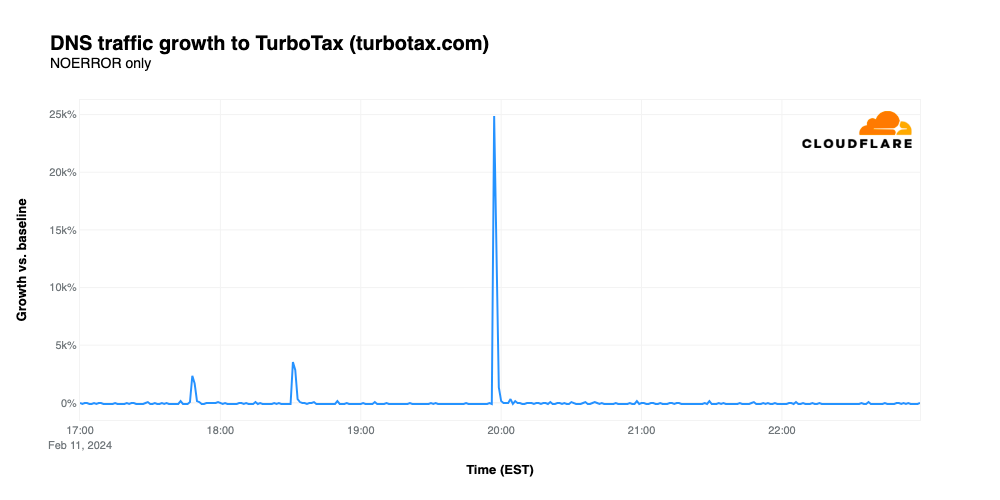
Although most Americans dislike having to pay taxes, they apparently feel that winning a million dollars would make doing so a little less painful. The Intuit TurboTax Super Bowl File ad, starring Emmy Award winner Quinta Brunson, included a URL pointing visitors to turbotax.com, where they could register to win one million dollars. The promotion aired a couple of times before the game began, visible as small spikes in the graph below, but it paid off for Intuit when it was shown at 19:56, driving traffic 24,875% above baseline and placing it as the ad that drove the largest increase in traffic.

DoorDash

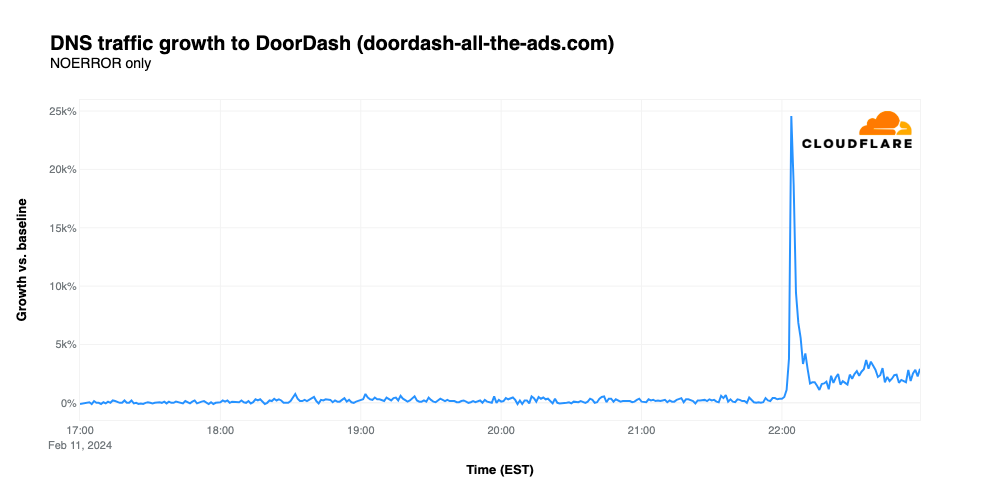
Most DoorDash deliveries are fairly nominal, and should be able to easily fit in the Dasher’s car. However, in a twist, the delivery for the “DoorDash all the ads” promotion includes several cars, as well as candy, cosmetics, trips, mayonnaise, and a myriad of other items, all of which appeared in Super Bowl advertisements, as a way for the company to demonstrate that they deliver more than. The ad, which prominently featured a URL for the contest site, aired at 22:03 EST and drove traffic 24,574% above baseline. The graph below shows that prominent spike, but it also shows traffic remaining 1700-2500% above baseline after the ad aired. This elevated traffic is likely due to efforts to transcribe the full promo code needed to enter the contest. The promo code, as crowdsourced in a Reddit thread, clocks in at a whopping 1,813 characters.

Poppi

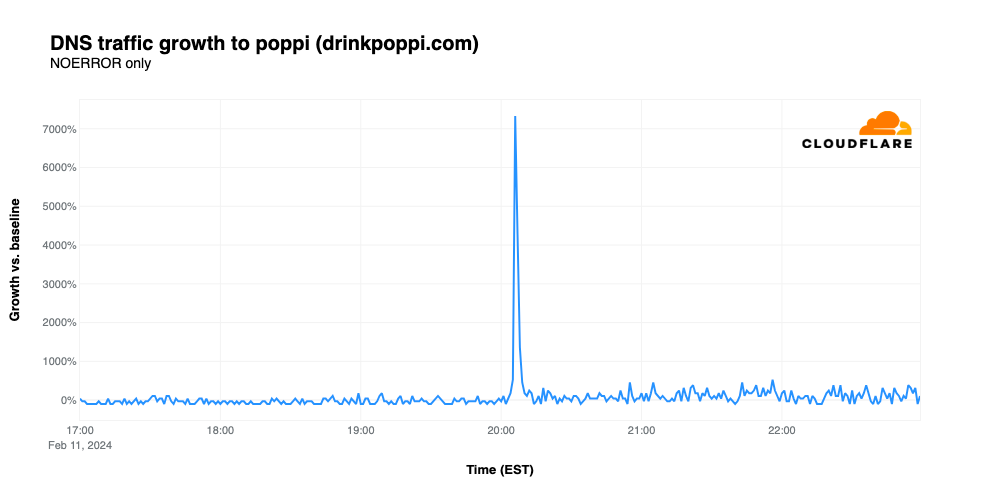
Super Bowl ads for “new” drink brands have frequently driven significant amounts of traffic, such as the growth seen by Cutwater Spirits in 2022. Relative newcomer Poppi, a brand of soda that contains prebiotics, continued the trend, with traffic spiking 7,329% above baseline after its ad appeared at 20:04 EST, despite no URL appearing in the advertisement. However, it appears that not everyone was a fan of the ad, as critics complained that it “food shamed” those who choose to drink traditional sodas.

e.l.f. Cosmetics

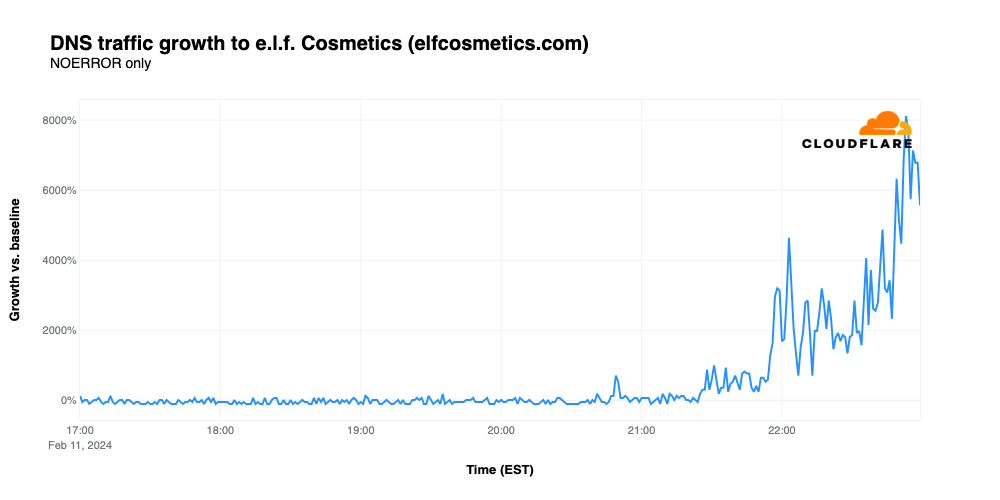
The cosmetic brand’s second Super Bowl advertisement featured Judge Judy presiding over a courtroom scene featuring musician Meghan Trainor and the cast of the USA Network legal drama Suits. While the ad drove traffic for elfcosmetics.com to 8,118% over baseline despite lacking a URL, the timing of the growth is unusual as it doesn’t align with the time the ad aired (20:22 EST). The traffic starts to tick up around 21:24 EST, just after a Chiefs touchdown put them in the lead, peaking at 22:53, several minutes after the Chiefs won the game. It isn’t clear why e.l.f. appears to buck the trend seen for most Super Bowl ads, showing a gradual ramp in traffic before peaking, as opposed to a large spike aligned with the time that the ad was broadcast.

In addition to the advertisements discussed above, a number of others also experienced traffic spikes greater than 1,000% above baseline, including ads for the NFL, Hallow, He Gets Us, homes.com, Kawasaki, Robert F. Kennedy, Jr. 2024, Snapchat, Skechers, and Volkswagen.

App traffic sees mixed impacts

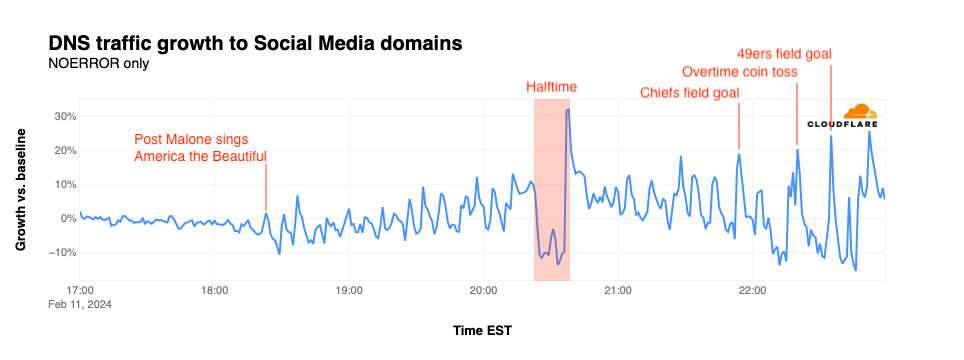
Using the same baseline calculations described above, we also looked at traffic for domains associated with several groups of sites, including food delivery, messaging, social media, and sports betting to see how events that occurred during the game impacted traffic. Traffic shifts among most of these groups remained fairly nominal during the game, with sports betting seeing the largest movement. Halftime is clearly visible within the graphs, as viewers apparently focused on the musical performance, which featured R&B singer Usher, joined by guests Alicia Keys, H.E.R., will.i.am, Ludacris, and Lil Jon.

Food delivery

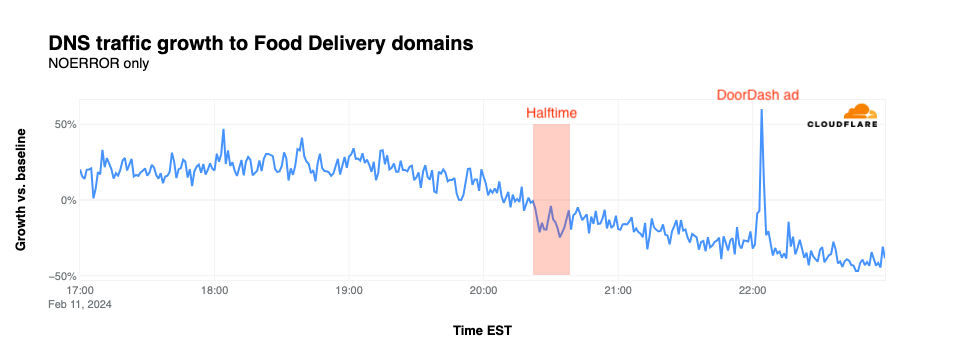
Traffic for food delivery sites remained relatively constant, on average, through the first quarter of the game, and started to decline as the second quarter started. A more significant dip is visible during halftime, with the drop continuing through the end of overtime. The outlier, of course, is the spike that occurred when the DoorDash advertisement aired, even though it featured a domain other than doordash.com, which is a member of this group.

Messaging

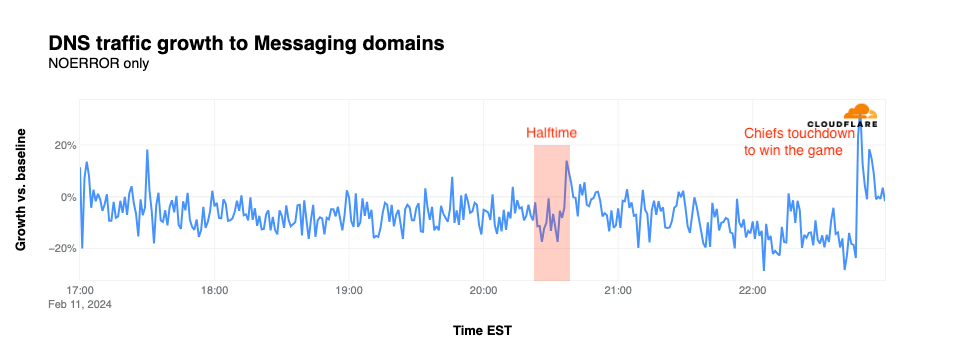
Traffic to domains associated with messaging applications generally remained just below baseline throughout the first half of the game. The spikes above baseline during the first half were nominal, and don’t appear to be associated with any notable in-game events. Traffic picked back up briefly as the halftime show ended, jumping to 14% above baseline. After that, traffic continued to drop until 22:46 EST, when the Chiefs sealed their victory with an overtime touchdown, causing traffic for messaging sites to spike to 34% above baseline.

Social media

Traffic for social media sites often spikes in conjunction with major plays, such as fumbles or touchdowns, as fans take to their favorite sites and apps to share photos or videos, or to celebrate or vent, depending on the team they support. Although social media traffic was fairly flat ahead of the start of the game, it began to see some spikiness as Post Malone sang America the Beautiful. This nominal spikiness continued through halftime, although none of the peaks were clearly correlated with major plays during the first half.  Similar to messaging, a notable drop in traffic occurred during halftime followed by a spike as Usher’s halftime show ended. In the second half, traffic spiked as the Chiefs tied the game with a field goal, for the overtime coin toss, and as the 49ers took the lead with an overtime field goal. Interestingly, that final spike visible in the graph occurs approximately six minutes after the Chiefs’ game-winning touchdown during an ad break ahead of the post-game show.

Sports betting

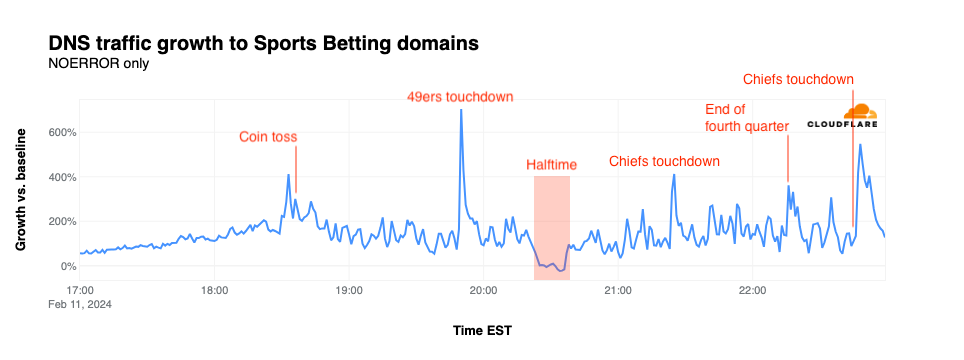
Compared to the relatively anemic traffic growth (when it was actually above baseline) seen for the categories above, traffic for domains associated with sports betting sites and apps remained significantly above baseline throughout the game with the exception of the dip during halftime, similar to what was also seen in the categories above. The first spike occurred just minutes before the coin toss, jumping to 412% above baseline. The game’s first touchdown, scored by the 49ers, caused traffic to spike 705% above baseline. A 413% spike occurred when the Chiefs took the lead late in the third quarter, with a slightly smaller one occurring at the end of regulation play as the game entered overtime. The final spike occurred just a couple of minutes after the Chiefs scored the game-winning touchdown, reaching 548% above baseline.

Zooming in to Kansas City and San Francisco

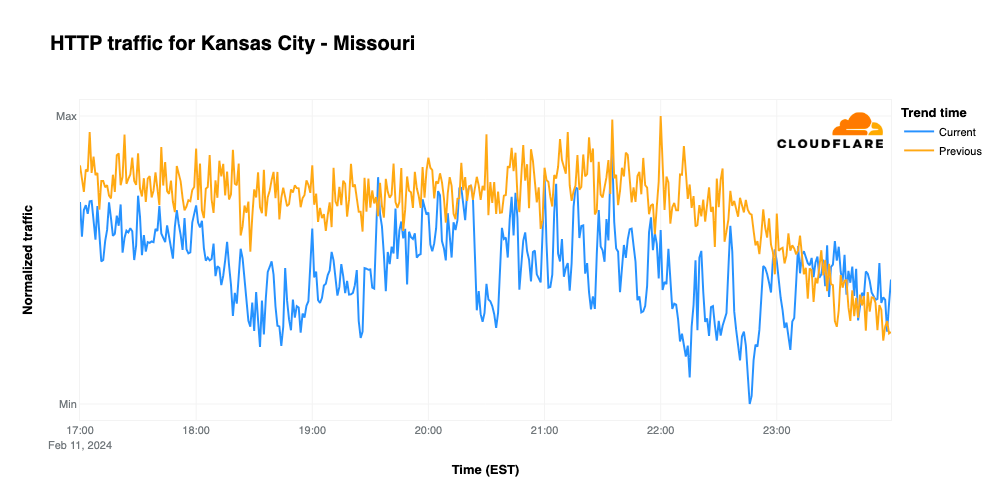
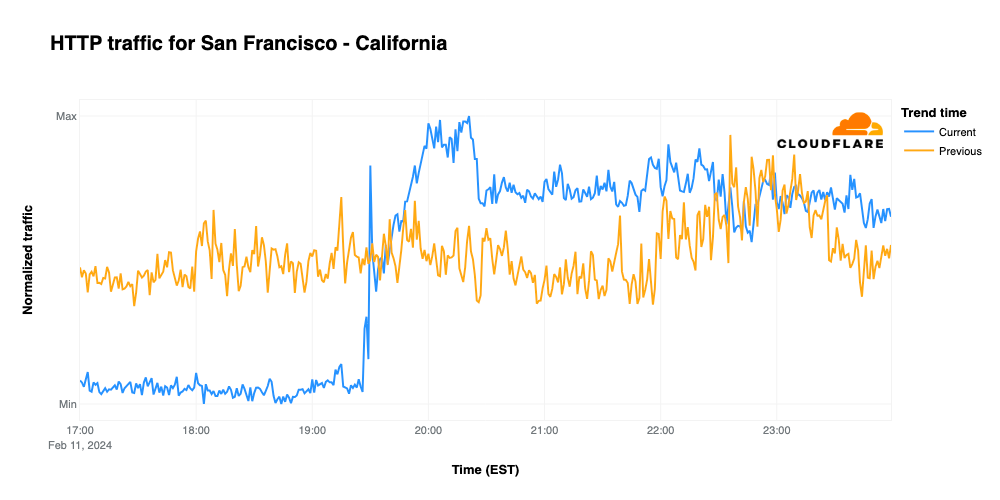
Using the same baseline calculations highlighted in the previous two sections, we also looked at changes in DNS traffic for the domains associated with the Kansas City Chiefs (chiefs.com) and the San Francisco 49ers (49ers.com). In addition, we looked at HTTP traffic from these two cities, using traffic levels from one week prior as a baseline.

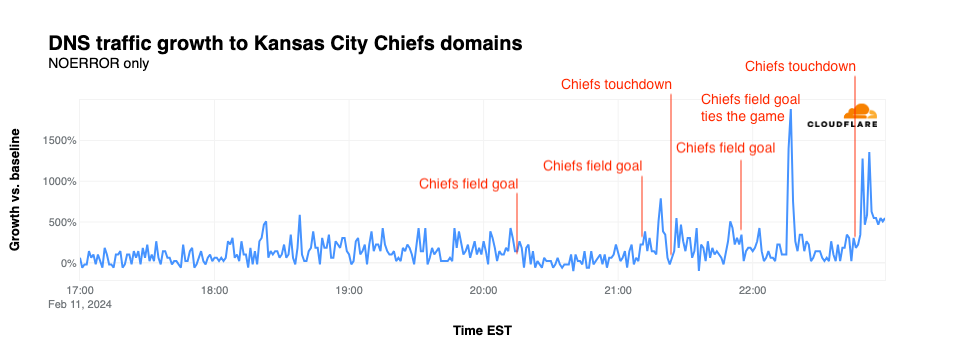
By and large, DNS traffic for chiefs.com did not appear to be significantly impacted by most of the team’s field goals or touchdowns during the game, as seen in the graph below. The exception is the traffic spike seen as the team tied the game towards the end of the fourth quarter, forcing the game into overtime. That play resulted in a spike of traffic for the team’s website that reached 1,887% above baseline. Traffic spiked again after the Chiefs won the game, spiking to 1,360% above baseline.

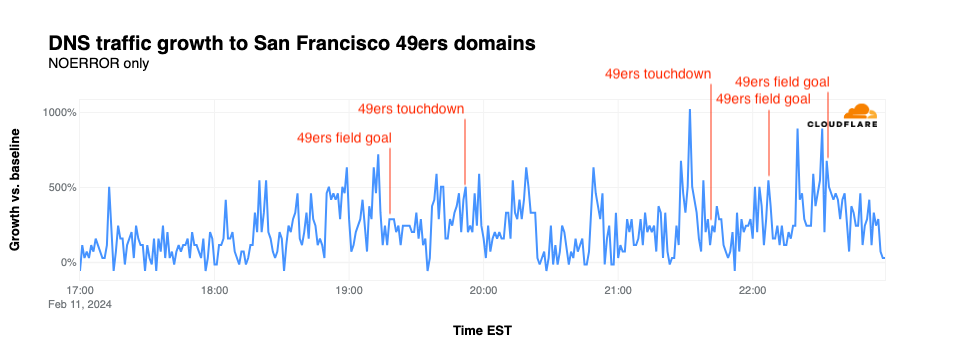
DNS traffic for 49ers.com did not exhibit significant shifts correlated with field goals or touchdowns. The most significant spike reached 1,023% over baseline at the end of the third quarter, minutes after the team called for a timeout.

When comparing traffic trends for Kansas City and San Francisco, they could hardly be more different. Looking at request traffic from Kansas City, we find that it remains below traffic seen during the same time frame on February 4, with notable drops at the start of the game, during halftime, and when the Chiefs tied the game with a field goal late in the fourth quarter. Traffic hit its lowest point when the Chiefs won the game, but then recovered to meet/exceed the prior week’s traffic levels once the broadcast had concluded.

In contrast, traffic from San Francisco remained well below traffic levels seen the previous Sunday before unexpectedly spiking around 19:30 EST. Request traffic then remained well above the previous week’s levels until San Francisco kicked a field goal to take the initial lead during overtime play. Traffic remained roughly in line with the previous week until the broadcast ended, and then remained slightly higher.

Email threats and “The Big Game”

As we noted in last year’s blog post, spammers and scammers will frequently try to take advantage of the popularity of major events when running their campaigns, hoping the tie-in will entice the user to open the message and click on a malicious link, or visit a malicious website where they give up a password or credit card number. The Cloudflare Area 1 Email Security team once again analyzed the subject lines of email messages processed by the service in the weeks leading up to the Super Bowl to identify malicious, suspicious, and spam messages across four topic areas: Super Bowl/football, sports media/websites, sports gambling, and food delivery.

Super Bowl/Football

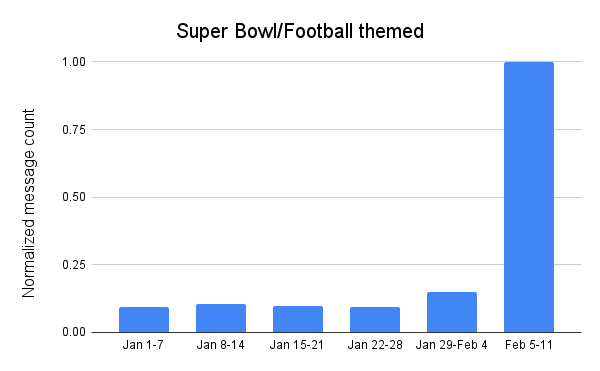
Spammers and scammers apparently didn’t feel that the “Super Wild Card Weekend” nor the divisional playoffs were sufficiently interesting to use as bait for their campaigns, as the volume of Super Bowl and football themed unwanted and potentially malicious email messages throughout January remained relatively low and fairly consistent. However, they apparently knew that the big game itself would draw interest, as the volume of such messages increased more than 6x over the prior week in the days ahead of the game.

Sports media/websites

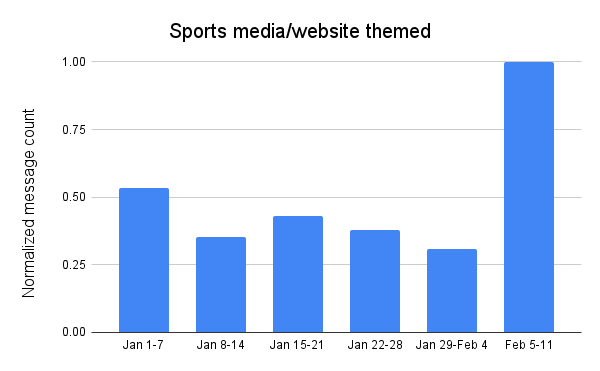
Attackers appeared to lose interest in using messages with subject lines related to sports media and websites as January progressed, with the volume of related messages peaking the first week of the month. However, similar to Super Bowl and football themed messages, this theme took on renewed interest in the week leading up to the Super Bowl, with message volume reaching over 3x the previous week, and 1.8x the peak seen durinthe first week of the year.

Sports gambling

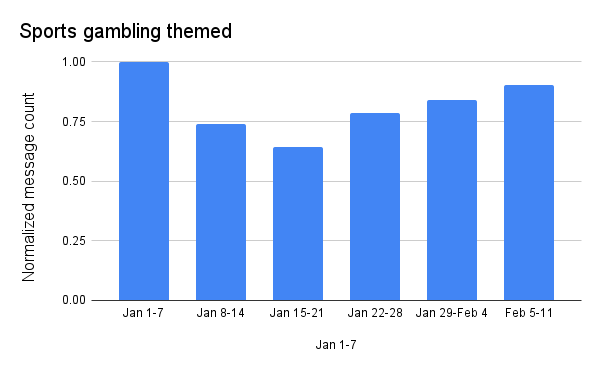
The final weekend of regular season games (on January 6 & 7) again drove the highest volume of sports gambling themed messages, similar to the pattern seen in 2023. Message volume dropped by about a third over the next two weeks, but picked back up around the divisional and conference playoff games and into the Super Bowl. Even with the growth into the Super Bowl, gambling-themed spam and malicious message volume remained 10% lower than the peak seen a month earlier.

Food delivery

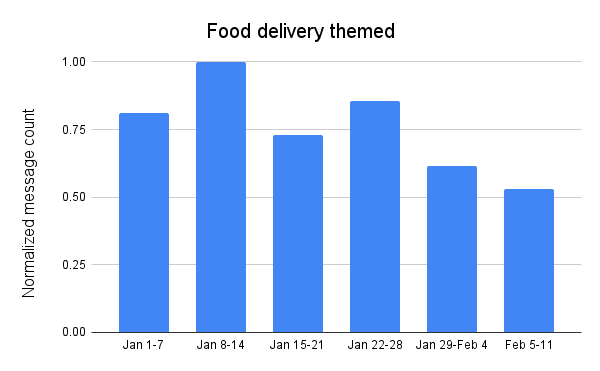
Peak volume of food delivery themed messages was an order of magnitude (10x) higher than the Super Bowl and football themed peak, which was the next largest. Due to the popularity of such services, it appears that it is a regular theme for spam and potentially malicious messages, as volume remained extremely high throughout January. After peaking the week of January 8-14, message volume was lower each of the following weeks, reaching its nadir in the week leading up to the Super Bowl, 47% lower than the peak volume.

Conclusion

Likely peaking during the so-called “dot.com” Super Bowls nearly a quarter-century ago, most Super Bowl ads no longer drive traffic to associated websites by including a URL in their ad. However, as our DNS traffic analysis found, it appears that viewers don’t seem to have much trouble finding these sites. We also found that in-game events had a mixed impact on traffic across domains associated with multiple types of apps, as well as traffic for the websites associated with the teams playing in the Super Bowl.

For more insights into Internet trends, we encourage you to visit Cloudflare Radar. You can contact the Cloudflare Radar team at [email protected] or on social media at @CloudflareRadar (X/Twitter), cloudflare.social/@radar (Mastodon), and radar.cloudflare.com (Bluesky).

[$] Another runc container breakout

Post Syndicated from LWN.net original https://lwn.net/Articles/961086/

Once again, runc—a tool
for spawning and running OCI containers—is drawing attention due to a high
severity container breakout attack
. This vulnerability is interesting for
several reasons: its potential for widespread impact, the continued difficulty
in actually containing containers, the dangers of running containers
as a privileged user, and the fact that this vulnerability is made possible
in part by a response to a previous
container breakout flaw in runc
.

[$] Another runc container breakout

Post Syndicated from jzb original https://lwn.net/Articles/961086/

Once again, runc—a tool
for spawning and running OCI containers—is drawing attention due to a high
severity container breakout attack
. This vulnerability is interesting for
several reasons: its potential for widespread impact, the continued difficulty
in actually containing containers, the dangers of running containers
as a privileged user, and the fact that this vulnerability is made possible
in part by a response to a previous
container breakout flaw in runc
.

Security updates for Monday

Post Syndicated from LWN.net original https://lwn.net/Articles/961842/

Security updates have been issued by Debian (libgit2), Fedora (chromium, firecracker, libkrun, openssh, python-nikola, runc, rust-event-manager, rust-kvm-bindings, rust-kvm-ioctls, rust-linux-loader, rust-userfaultfd, rust-versionize, rust-vhost, rust-vhost-user-backend, rust-virtio-queue, rust-vm-memory, rust-vm-superio, rust-vmm-sys-util, virtiofsd, webkitgtk, and wireshark), Mageia (filezilla and xpdf), Oracle (gimp), Red Hat (libmaxminddb, linux-firmware, squid:4, and tcpdump), Slackware (xpdf), SUSE (cdi-apiserver-container, cdi-cloner-container, cdi- controller-container, cdi-importer-container, cdi-operator-container, cdi- uploadproxy-container, cdi-uploadserver-container, cont and suse-build-key), and Ubuntu (python-glance-store and webkit2gtk).

Security updates for Monday

Post Syndicated from jake original https://lwn.net/Articles/961842/

Security updates have been issued by Debian (libgit2), Fedora (chromium, firecracker, libkrun, openssh, python-nikola, runc, rust-event-manager, rust-kvm-bindings, rust-kvm-ioctls, rust-linux-loader, rust-userfaultfd, rust-versionize, rust-vhost, rust-vhost-user-backend, rust-virtio-queue, rust-vm-memory, rust-vm-superio, rust-vmm-sys-util, virtiofsd, webkitgtk, and wireshark), Mageia (filezilla and xpdf), Oracle (gimp), Red Hat (libmaxminddb, linux-firmware, squid:4, and tcpdump), Slackware (xpdf), SUSE (cdi-apiserver-container, cdi-cloner-container, cdi- controller-container, cdi-importer-container, cdi-operator-container, cdi- uploadproxy-container, cdi-uploadserver-container, cont and suse-build-key), and Ubuntu (python-glance-store and webkit2gtk).

Cloudflare defeats patent troll Sable at trial

Post Syndicated from Patrick Nemeroff http://blog.cloudflare.com/author/patrick-nemeroff/ original https://blog.cloudflare.com/cloudflare-defeats-patent-troll-sable-at-trial


For almost seven years, Cloudflare has been fighting against patent trolls. We’ve been doing this successfully through the efforts of our own legal team, external counsel, and the extraordinary efforts of people on the Internet looking for prior art (and getting rewarded for it) through our Project Jengo.

While we refuse to pay trolls for their meritless claims, we’ve been happy to award prizes to Project Jengo participants who help stop the trolls through prior art that invalidates their patents or claims. Project Jengo participants helped us in the past roundly beat the patent troll Blackbird (who subsequently went out of business).

Today, we’re back to talk about yet another win thanks to a lot of work by us, our external counsel, and Project Jengo participants.

Sable

Last Thursday, on a clear, sunny morning in Waco, Texas, a jury returned a verdict after less than two hours of deliberation. The jury found that Cloudflare did not infringe the patent asserted against Cloudflare by patent trolls Sable IP and Sable Networks.

And while that would have been enough to decide the case by itself, the jury went further and found that Sable’s old and broadly-written patent claim was invalid and never should have been granted in the first place–meaning they can no longer assert the claim against anyone else. Since Sable first sued us, we’ve invalidated significant parts of three Sable patents, hamstringing their ability to bring lawsuits against other companies.

It’s worth noting that very few lawsuits ever reach a jury. Most non-lawyers are shocked to learn that only about 1% of civil cases make it to trial, because trials are generally what they see on TV or in film. But professional litigators know that almost all cases are resolved much earlier through procedures that are much less entertaining to watch on screen: written motions, delay, or settlement. A big reason for this is that taking a case to trial–even on simple matters–is extremely costly. In patent cases, that means millions of dollars.

As we described in our first Project Jengo blog post, these costs are the threat that patent trolls rely on to extract sizable settlements out of innovative technology companies. It’s often easier for technology companies to pay a settlement rather than pay millions more in litigation costs that likely can’t be recovered even if the technology company wins. Patent trolls usually don’t want to incur the costs of going to trial either, but they typically wait for the other side to blink first and pay up–especially because the company accused of infringement is the one that faces the risk of a bad verdict and damages award.

But every once in a while the target doesn’t blink. Cloudflare’s hard fought victory, the culmination of three years of litigation, is a strong warning to all patent trolls–we will not be intimidated into playing your game.  

Background

Let’s recap how we got here. This case began in March 2021 when Sable Networks and Sable IP filed a complaint against Cloudflare in federal court. Sable asserted around 100 claims spanning four patents against multiple Cloudflare products and features. The patents relied on by Sable were filed around the turn of the century, and they addressed the hardware-based router technology of the day. More specifically, they addressed a particular type of hardware focused on “flows” composed of multiple linked packets. This approach is not used by modern-day software-defined services delivered on the cloud, particularly not services like Cloudflare that handle traffic on a packet-by-packet basis. But that didn’t stop Sable from arguing its broadly-worded patents covered essentially all router operations, including Cloudflare’s cutting edge technology–well beyond what the asserted patent claims were ever intended to cover.

As with many patent trolls, Sable IP has never made or sold products and doesn’t employ a single person to create or design actual technology. Sable IP was created as a shell entity in 2020 to monetize the patent portfolio of Sable Networks, which itself was formed in 2006 and allegedly acquired the assets–including the patents–of Caspian Networks, a router company that had shuttered its operations. Sable IP is one of many such shell entities formed to “monetize” patents through lawyer-driven litigation campaigns.  

Cloudflare wasn’t Sable’s only target. Sable sued a number of other companies, including Cisco, Fortinet, Check Point, SonicWall, Juniper Networks, and others, each of which eventually resolved the lawsuit against them out of court. Cloudflare took a different approach.

To kick off our fight against Sable, we launched another round of Project Jengo, crowdsourcing submissions of prior art for all of Sable’s active patents–including patents not asserted against Cloudflare–and committing a $100,000 award to be split among winners that submitted strong prior art. Dedicated readers will remember Cloudflare’s first round of Project Jengo, which helped put the notorious patent troll Blackbird out of business. We’ve received dozens of submissions since we launched this Sable-focused round of Project Jengo, and have awarded \$70,000 since 2021. We will distribute the remaining \$30,000 to winners of the Final Awards which we will announce after the official conclusion of the case per the Project Jengo Rules.

Relying on prior art, we filed petitions for inter partes review to the U.S. Patent and Trademark Office (“USPTO”) seeking to invalidate Sable’s patents. The inter partes process is an administrative proceeding that involves filing briefs for administrative patent judges at the USPTO to determine if a patent should have been issued in the first place. In many cases it’s a helpful process available to try and limit the threat of patent trolls. In May 2022, to avoid responding to one of those petitions–and to avoid the risk that its patent would be canceled altogether–Sable voluntarily canceled all of the claims asserted against Cloudflare under one of its patents. And in January 2023, we were successful in invalidating the portions of a second Sable patent that had been asserted against us.  

Two patents down, Sable refused to give up. By December 2023, through its petitions to the USPTO and related motions before the court, Cloudflare had successfully narrowed the number of patents and claims at issue from approximately 100 claims across four, to just five claims from two patents. Then, at the pretrial conference on December 13, 2023, the court issued summary judgment in our favor on a third Sable patent. Summary judgment is a process where the court determines that an argument is so clear that no reasonable jury could rule otherwise. This further narrowed the case to a single asserted claim on a single patent–claim 25 of U.S. Patent No. 7,012,919.

Through years of hard work, we’d successfully whittled down Sable’s case from about 100 claims across four patents to just one claim of one patent. But despite all that success, the fact remained…we were heading to trial, and it can be difficult to know what a jury will decide–and what damages they may award–on heavily technical issues.

Trials and tribulations for Sable IP and Sable Networks

We weren’t just heading to trial, we were heading to the Western District of Texas. Waco, Texas, to be precise, where Sable chose to file its lawsuit. The Western District of Texas has in recent years become a popular venue for patent plaintiffs, as it has a reputation for being a friendly jurisdiction for patent holders.

Sable’s trial story was not compelling. On the technical merits, Sable had the unenviable task of trying to map decades-old flow-based hardware router technology onto Cloudflare’s modern, software-defined packet-by-packet architecture. They attempted to do so through a series of hand waving exercises, equating the “line cards” required by the patent to various different software and hardware used by Cloudflare, and suggesting that any flow of packets across Cloudflare’s network could be construed as the specific “micro-flows” at the center of its patent.

Beyond the technical issues, Sable’s story was simple, though not very attractive–Sable wanted money. Having acquired rights to the patents of a failed hardware company, they were seeking to “monetize” those patents to the greatest extent possible. If that meant leveraging a patent related to decades-old router hardware to sue a cloud-based service provider, so be it. And if it required leaps of logic and untethered claims that might make a toddler blush, oh well.  

When it was our turn, we told the jury our story. How Cloudflare was founded to help build a better Internet by moving past old, hardware-based solutions to new, cloud-based solutions delivered through our global network. We explained the hard work put into building our network, and all the services that sit on top of it. One of our outstanding engineers described what it’s like to create a new product, working with teams of engineers, product managers, and others to bring something exciting to the market for the first time.

We drilled down into Sable’s twenty-year old patent, explaining the many reasons why the patent does not describe anything that Cloudflare actually does. Among other things, the patent requires various steps to be performed at a “line card,” and Cloudflare’s accused edge servers don’t include a single such line card. And while the patent focused on flow-based routing, Cloudflare designed its system to perform packet-by-packet inspection to protect against malicious traffic. We also explained that the patent claim asserted against Cloudflare is invalid–and never should have been issued–because it was obvious in view of the prior art and lacked the required written description. In fact, Sable’s patent covered, at best, only technology that had already been described by inventors at Nortel Networks and Lucent Technologies–leading routing technology companies at the time.  

During closing arguments, Cloudflare’s trial lawyer made one thing clear–this case was about more than Sable or Cloudflare. The patent system was designed to foster innovation and promote the progress of science, but what Sable was doing was exactly the opposite: bringing meritless cases in an effort to turn a buck, and stifling progress in the process. That distortion and abuse of the patent system has to stop and, ultimately, only the jury had the power to end it.

To our great satisfaction, the jury answered that call. The jury’s decision did not take long. Less than two hours after leaving the courtroom to deliberate, the jury returned with a verdict that sends a message far beyond the courthouse. No infringement by Cloudflare, and Sable’s patent is invalid.

What’s next

We’ll enjoy this verdict for a long time, but the hard work doesn’t stop here. Cloudflare is dedicated to rebalancing a system that is being distorted by trolls like Sable. As part of our efforts, we look forward to announcing the final awards for Project Jengo on this blog following the conclusion of the case. We’ll also plan to share additional thoughts and insights we’ve gleaned from facing down a troll at trial.

For now, we want to express our sincere gratitude to the judge and jury for the hard work they put in at trial, including the jury weighing the evidence and understanding the complex technology at issue in the case. Cloudflare is deeply grateful for the jury’s time and efforts over the past week, its careful consideration of all the facts, and for its verdict. We also again want to thank our amazing trial lawyers from Charhon Callahan Robson & Garza PLLC, and The Dacus Firm. If you end up with a patent troll problem, we recommend them highly.

Critical Fortinet FortiOS CVE-2024-21762 Exploited

Post Syndicated from Rapid7 original https://blog.rapid7.com/2024/02/12/etr-critical-fortinet-fortios-cve-2024-21762-exploited/

Critical Fortinet FortiOS CVE-2024-21762 Exploited

On February 8, 2024 Fortinet disclosed multiple critical vulnerabilities affecting FortiOS, the operating system that runs on Fortigate SSL VPNs. The critical vulnerabilities include CVE-2024-21762, an out-of-bounds write vulnerability in SSLVPNd that could allow remote unauthenticated attackers to execute arbitrary code or commands on Fortinet SSL VPNs via specially crafted HTTP requests.

According to Fortinet’s advisory for CVE-2024-21762, the vulnerability is “potentially being exploited in the wild.” The U.S. Cybersecurity and Infrastructure Security Agency (CISA) added CVE-2024-21762 to their Known Exploited Vulnerabilities (KEV) list as of February 9, 2024, confirming that exploitation has occurred.

Zero-day vulnerabilities in Fortinet SSL VPNs have a history of being targeted by state-sponsored and other highly motivated threat actors. Other recent Fortinet SSL VPN vulnerabilities (e.g., CVE-2022-42475, CVE-2022-41328, and CVE-2023-27997) have been exploited by adversaries as both zero-day and as n-day following public disclosure.

Affected products

FortiOS versions vulnerable to CVE-2024-21762 include:

  • FortiOS 7.4.0 through 7.4.2

  • FortiOS 7.2.0 through 7.2.6

  • FortiOS 7.0.0 through 7.0.13

  • FortiOS 6.4.0 through 6.4.14

  • FortiOS 6.2.0 through 6.2.15

  • FortiOS 6.0 all versions

  • FortiProxy 7.4.0 through 7.4.2

  • FortiProxy 7.2.0 through 7.2.8

  • FortiProxy 7.0.0 through 7.0.14

  • FortiProxy 2.0.0 through 2.0.13

  • FortiProxy 1.2 all versions

  • FortiProxy 1.1 all versions

  • FortiProxy 1.0 all versions

Note: Fortinet’s advisory did not originally list FortiProxy as being vulnerable to this issue, but the bulletin was updated after publication to add affected FortiProxy versions.

Mitigation guidance

According to the Fortinet advisory, the following fixed versions remediate CVE-2024-21762:

  • FortiOS 7.4.3 or above

  • FortiOS 7.2.7 or above

  • FortiOS 7.0.14 or above

  • FortiOS 6.4.15 or above

  • FortiOS 6.2.16 or above

  • FortiOS 6.0 customers should migrate to a fixed release

  • FortiProxy 7.4.3 or above

  • FortiProxy 7.2.9 or above

  • FortiProxy 7.0.15 or above

  • FortiProxy 2.0.14 or above

  • FortiProxy 1.2, 1.1, and 1.0 customers should migrate to a fixed release

As a workaround, the advisory instructs customers to disable the SSL VPN with the added context that disabling the webmode is not a valid workaround. For more information and the latest updates, please refer to Fortinet’s advisory.

Rapid7 customers

InsightVM and Nexpose customers can assess their exposure to FortiOS CVE-2024-21762 with a vulnerability check available in the Friday, February 9 content release.

Ускорител за преводи. Защо са важни професионалистите от книжния сектор?

Post Syndicated from Тоест original https://www.toest.bg/uskoritel-za-prevodi-zashto-sa-vazhni-profesionalistite-ot-knijniya-sektor/

Ускорител за преводи. Защо са важни професионалистите от книжния сектор?

Проектът „Ускорител за балкански преводи“ на фондация „Следваща страница“ е насочен не към авторите и преводачите, които сме свикнали да виждаме като основни лица на литературната сцена, а към уж второстепенните герои – агенти, литературни организации, издатели, организатори на фестивали, панаири и други. Неговата цел е да ускори потока на балкански преводи. „Тези участници са много важни за цялата книжна екосистема, но често остават в сянка и са пренебрегвани. Особено на малки книжни пазари, каквито са Западните Балкани и България“, казва Юлия Рафаилович, изпълнителен директор на фондацията. 

Смисълът на ускорителя за преводи е да се засилят уменията и капацитетът на хората, решили да се занимават професионално с литература, но не в ролята на автори или преводачи. Според Юлия целта е да се изгради и самочувствие, че западнобалканските професионалисти от книжния сектор могат да имат тежест в международния литературен обмен. За съжаление, голяма част от тях поради ограничената си роля през годините и липсата на ресурси нямат опита и актуалните умения, с които са свързани професиите в по-развитите книжни пазари.

С тази цел фондация „Следваща страница“ инициира тригодишен международен проект, част от който е Академията за литературен мениджмънт и промотиране на превода с участници от над 30 литературни организации от Западните Балкани, които по някакъв начин се включват в процеса на международно издаване чрез превод. В рамките на програмата участниците обсъждат наболели проблеми, обменят истории и опит, слушат лектори от цяла Европа, имат и възможност да направят кратък стаж. Идеята е да се създаде мека инфраструктура от агенти, фестивали, преводачи в ролята на агенти. „Тази мека инфраструктура по обективни причини е много слаба в региона, доскоро и липсваше. Така че нашата работа е насочена към тях – да засилим и укрепим капацитета им“, казва Юлия.

Ускорител за преводи. Защо са важни професионалистите от книжния сектор?
Снимка: Соня Ставрова

Балканска литература, световна литература? 

С проекта фондацията си поставя за цел да изследва начини за преодоляване на дисбаланса в потока на художествения превод в Европа. „Отдавна знаем и от България, и от други страни, чийто език е от т.нар. периферни, или по-рядко употребявани езици, че те много по-трудно пробиват на чуждоезични пазари. Обикновено пробивът на книжен пазар е на някой от големите езици, сред които на първо място е английският. Това означава, че ако романът ви е преведен на английски, е доста по-вероятно той да стигне до някой издател от по-малък език, който да иска да го издаде, което пък ще доведе до превеждането му на този език“, казва Юлия. Преводът на една книга на повече езици ѝ дава повече видимост, което означава, че тя може да бъде забелязана по-лесно в света. Затова, логично, подобряването на връзките между балканските държави е важно за техните автори и литератури. „Не съм сигурна доколко литературите от Балканите мислят себе си като балканска литература“, казва Юлия. 

Има сръбска, македонска и прочее литератури, но те не са една литература. Разбира се, всеки поглед отвън ще се опита да генерализира или стереотипизира и да ги мисли като части от едно цяло. Но тук идва ролята на литературните агенти: именно те са тези, които познават и общуват с двете страни, и медиаторската им функция е безценна. 

Програми като „Ускорител за балкански преводи“ подпомагат именно такива професионалисти. При по-периферните езици ролята на агента впрочем често е в ръцете на преводачите. Понякога между два езика има не повече от един-двама действащи литературни преводачи. В такива случаи (а те не са изключението, напротив) литературният обмен между два езика съществува и се оформя изцяло благодарение на тази шепа преводачи. А „чуждестранните издатели“ и „навън“ също е трудно да се обяснят.

„Всяка страна е различна, отделно издателствата в рамките на всяка държава се различават помежду си. Така че няма една монолитна чужбина със стройни очаквания, които, стига да съвпаднат с нашите намерения, ще подсигурят литературата да тръгне като на поточна линия към чуждоезичните пазари.“

Сложната роля на професионалистите от книжния сектор 

Освен литературен човек, работещият в сферата на книгите е и дипломат, културен аташе, медиатор, преводач, познавач на другата култура, организатор, пиар… Какво би означавала подкрепата за такива хора „Личното ми мнение е, че тези литератури – особено от нашия регион – по условие са нишови литератури и ще си намират читателите, които търсят такива книги. В това няма нищо пораженско, напротив – за литературите ни има много читатели на всякакви езици, въпросът е да се намерим. Това е все едно да се питаме защо киното ни не може да произведе филм, който да вземе „Оскар“ за най-добър филм – не чуждестранен, а филм. Няма да го направи, но в това няма нищо драматично. Проблемите започват, щом се объркат очакванията.“ 

В рамките на проекта се публикуват изследвания на пазарите на литература в превод в държавите участнички – Северна Македония, Сърбия, Албания, Косово, Черна гора и Босна и Херцеговина. Всички шест изследвани държави, освен Косово, имат програми за подкрепа на преводите извън страната, макар и тези програми да имат своите недостатъци, както се отбелязва и в изследванията.

Ускорител за преводи. Защо са важни професионалистите от книжния сектор?
Снимка: Соня Ставрова

„Ролята на държавата е да подкрепя онези сектори, за които има обществен консенсус, че са значими, но които не могат да оцелеят сами в чисто пазарни условия. Културният сектор е един от тях. Изработването на адекватни политики, които да отразяват този консенсус, е изключително важно. Те правят много неща, но в крайна сметка се свеждат до разпределяне на ресурс. За да е качествен и смислен процесът, трябва най-вече да има яснота какво искаме и да имаме идея как да го постигнем. Тази роля е жизненоважна и принципно няма как да се изпълнява от друг, тя е по условие публичен въпрос. Оттам нататък важно е онези, които произвеждат културен продукт, както и експертите, които разбират нуждите на сектора и проблемите в регулаторните рамки, от една страна, и представителите на публичния сектор, да не стоят едни срещу други, а да са наясно, че трябва да работят заедно и да допринасят за целите, които сме припознали вече като общи“, смята Юлия.

Успешната балканска литература 

Двама от партньорите в проекта – писателят Владимир Янковски от македонската издателска къща „Готен“ и сръбската поетеса Ана Мария Гърбич от Argh – споделят каква е тяхната дефиниция за успешна национална литература. Преводът е приоритет (Гърбич посочва, че преводите на големите езици са най-важни), но той е едва началото – намирането на добър издател, който „ще се погрижи“ за книгата, също е много важно. Авторите трябва да присъстват на фестивали, но тези фестивали трябва да бъдат организирани и представени от някого, и то на ниво, което е съвременно, сравнимо с нивото на други места по света. Отзивите за книгата, дори рекламата изискват своите професионалисти. 

Успехът на един автор навън го прави успешен и на националния пазар. Това означава, че интересът от професионализация на средата е свързан не само с литературен износ, но и с развитието на литературната култура у дома. Възможно ли е балканската литература да има своя запазена марка като скандинавската, пита Владимир Янковски.


Проектът „Ускорител за балкански преводи“ е съфинансиран от програма „Творческа Европа“ на Европейския съюз и от Национален фонд „Култура”.

Тази статия е публикувана с финансовата подкрепа на фондация „Следваща страница”. 

Ускорител за преводи. Защо са важни професионалистите от книжния сектор?