Cloudflare Research: Two Years In

Post Syndicated from Nick Sullivan original https://blog.cloudflare.com/cloudflare-research-two-years-in/

Cloudflare Research: Two Years In

Great technology companies build innovative products and bring them into the world; iconic technology companies change the nature of the world itself.

Cloudflare Research: Two Years In

Cloudflare’s mission reflects our ambitions: to help build a better Internet. Fulfilling this mission requires a multifaceted approach that includes ongoing product innovation, strategic decision-making, and the audacity to challenge existing assumptions about the structure and potential of the Internet. Two years ago, Cloudflare Research was founded to explore opportunities that leverage fundamental and applied computer science research to help change the playing field.

We’re excited to share five operating principles that guide Cloudflare’s approach to applying research to help build a better Internet and five case studies that exemplify these principles. Cloudflare Research will be all over the blog for the next several days, so subscribe and follow along!

Innovation comes from all places

Innovative companies don’t become innovative by having one group of people within the company dedicated to the future; they become that way by having a culture where new ideas are free-flowing and can come from anyone. Research is most effective when it is permitted to grow beyond or outside isolated lab environments, is deeply integrated into all facets of a company’s work, and connected with the world at large. We think of our research team as a support organization dedicated to identifying and nurturing ideas that are between three and five years away.

Cloudflare Research prioritizes strong collaboration to stay on top of big questions from our product, ETI, engineering teams and industry. Within Cloudflare, we learn about problems by embedding ourselves within other teams. Externally, we invite visiting researchers and academia, sit on boards and committees, contribute to open standards design and development, attend dozens of tech conferences a year, and publish papers in conferences.

Research engineering is truly full-stack. We incubate ideas from conception to prototype through to production code. Our team employs specialists from academic and industry backgrounds and generalists that help connect ideas across disciplines. We work closely with the product and engineering organizations on graduation plans where code ownership is critical. We also hire many research interns who help evaluate and de-risk new ideas before we help build them into production systems and eventually hand them off to other teams at the company.

Research questions can come from all parts of the company and even from customers. Our collaborative approach has led to many positive outcomes for Cloudflare and the Internet at large.

Case Study #1: Password security

Several years ago, a service called Have I Been Pwned, which lets people check if their password has been compromised in a breach, started using Cloudflare to keep the site up and running under load. However, the setup also highlighted a privacy issue: Have I Been Pwned would inevitably have access to every password submitted to the service, making it a juicy target for attackers. This insight raised the question: can such a service be offered in a privacy-preserving way?

Like much of the research team’s work, the kernel of a solution came from somewhere else at the company. The first work on the problem came from members of the support engineering organization, who developed a clever solution that mostly solved the problem. However, this initial investigation outlined a deep and complex problem space that could have applications far beyond passwords. At this point, the research team got involved and reached out to experts, including Thomas Ristenpart at Cornell Tech, to help study it more deeply.

This collaboration led us down a path to devise a new protocol and publish a paper entitled Protocols for Checking Compromised Credentials at ACM CCS 2019. The paper pointed us in a direction, but a desire to take this research and make it applicable to people led us to host our first visiting researcher to help build a prototype. We found even more inspiration and support internally when we learned that another team at Cloudflare was interested in adding capabilities to the Cloudflare Web Application Firewall to detect breached passwords for customers. This team ended up helping us build the prototype and integrate it into Cloudflare’s service.

This combination of customer insight, internal alignment, and external collaboration not only resulted in a powerful and unique customer feature, but it also helped advance the state of the art in privacy-preserving technology for an essential aspect of our online lives: Authentication. We’ll be making an exciting announcement around this technology on Thursday, so stay tuned.

A question-oriented approach leads to better products

To support Cloudflare’s fast-paced roadmap, the Research team takes a question-first approach. Focusing on questions is the essence of research itself, but it’s important to recognize what that means for an industry-leading company. We never stop asking big questions about the problems our products are already solving. Changes like the move from desktop to mobile computing or the transition from on-premise security solutions to the cloud happened within a decade, so it’s important to ask questions like:

  • How will social and geopolitical forces changes impact the products we’re building today?
  • What assumptions may be present in existing systems based on the homogenous experiences of their creators?
  • What changes are happening in the industry that will affect the way the Internet works?
  • What opportunities do we see to leverage new and lower-cost hardware?
  • How can we scale to meet growing needs?
  • Are there new computing paradigms that need to be understood?
  • How are user expectations shifting?
  • Is there something we can build to help move the Internet in the right direction?
  • Which security or privacy risks are likely to be exacerbated in the coming years?

By focusing on broader questions and being open to answers that don’t fit within the boundaries of existing solutions, we have the opportunity to see around corners. This type of foresight helps solve more than business problems; it can help improve products and the Internet at large. These types of questions are asked across the R&D functions of the company, but research focuses on the questions that aren’t easily answered in the short-term.

Case Study #2: SSL/TLS Recommender

When Cloudflare made SSL certificates free and automatic for all customers, it was a big step towards securing the web. One of the early criticisms of Cloudflare’s SSL offerings was the so-called “mullet” critique. Cloudflare offers a mode called “Flexible SSL,” which enables encryption between the browser and Cloudflare but keeps the connection between Cloudflare and the origin site unencrypted for backward compatibility. It’s called the mullet criticism because Flexible SSL provides encryption on the front half of the connection but none on the back half.

Most security risks for online communication occur between the user and Cloudflare (at the ISP or in the coffee shop, for example), not between Cloudflare and the origin server. The customers who couldn’t enable encryption on their servers had a much better security posture with Cloudflare.

In a few isolated instances, however, a customer did not take advantage of the most secure configuration possible, which resulted in unexpected and impactful security problems. Given the non-zero risk and acknowledging this valid product critique, we asked: what could we do to improve the security posture of millions of websites?

With the help of research interns with Internet scanning and measurement expertise, we built an advanced scanning/crawling tool to see how much things could be improved. It turned out we could do a lot, so we worked with various teams across the company to connect our scanning infrastructure to Cloudflare’s product. We now offer a service to all customers called the SSL/TLS recommender that has helped thousands of customers secure their sites and trim their mullets. The underlying reason that websites don’t use encryption for parts of their backends is complex, and what makes this project a good example of asking questions in a pragmatic way is that it not only gives Cloudflare an improved product, but it gives researcher set of tools to further explore the fundamental problem.

Build the tools today to deal with the issues of tomorrow

Another critical objective of research in the Cloudflare context is to help us prepare for the unknown. We identify and solve “what-if” scenarios based on how society is changing or may change. Thousands of companies rely on our infrastructure to serve their users and meet their business needs. We are continually improving their experience by future-proofing the technology that supports them during the best of times and the potential worst of times.

To prepare, we:

  1. Identify areas of future risk.
  2. Explore the fundamentals of the problem.
  3. Build expertise and validate that expertise in peer-reviewed venues.
  4. Build operating experience with prototypes and large-scale experiments.
  5. Build networks of relationships with those who can help in a crisis.

We would like to emulate the strategic thinking and planning required of the often unseen groups that support society — like the forestry service or a public health department. When the fire hits or the next virus arrives, we have the best chance to not only get through it but to innovate and flourish because of the mitigations put in place and the relationships built while thinking through impending challenges.

Case Study #3: IP Address Agility

One area of impending risk for the Internet is the exhaustion of IPv4 addresses. There are only around four billion potential IPv4 addresses, which is fewer than the number of humans globally, let alone the number of Internet-connected devices. We decided to examine this problem more deeply in the context of Cloudflare’s unique approach to networking.

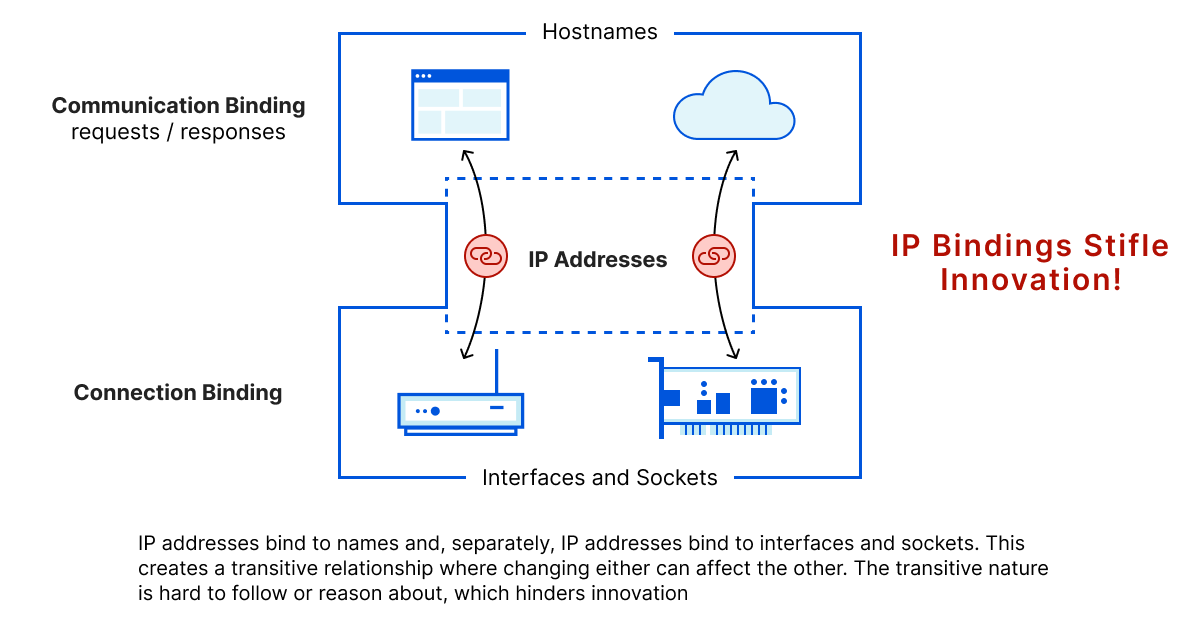
Cloudflare’s architecture challenges several assumptions about how different aspects of the Internet relate to each other. Historically, a server IP address corresponds to a specific machine. Cloudflare’s anycast architecture and server design allow any server to serve any customer site. This architecture has allowed the service to scale in incredible ways with very little work.
Cloudflare Research: Two Years In

This insight led us to question other fundamental assumptions about how the Internet could potentially work. If an IP address doesn’t need to correspond with a specific server, what else could we decouple from it? Could we decouple hostnames from IPs? Maybe we could! We could also frame the question negatively: what do we lose if we don’t take advantage of this decoupling? It was worth an experiment, at least.

We decided to validate this assumption empirically. We ran an experiment serving all free customers from the same IP in an entire region in a cross-organizational effort that involved the DNS team, the IP addressing team, and the edge load balancing team. The experiment proved that using a single IP for millions of services was feasible, but it also highlighted some risks. The result was a paper published in ACM SIGCOMM 2021 and a project to re-architect our authoritative DNS system to be infinitely more flexible.

Going further together

The Internet is not simply a loose federation of companies and billions of dollars of deployed hardware; it’s a network of interconnected relationships with a global societal impact. These relationships and the technical standards that govern them are the connective tissue that allows us to build important aspects of modern society on the Internet.

Millions of Internet properties use Cloudflare’s network, which serves tens of millions of requests per second. The decisions we make, and the products we release, have significant implications on the industry and billions of people. For the majority of cases, we only control one side of the Internet connection. To serve billions of users and Internet-connected devices, we are governed by and need to support protocols such as DNS, BGP, TLS, and QUIC, defined by technical standards organizations like the Internet Engineering Task Force (IETF).

Protocols evolve, and new protocols are constantly changing to serve the evolving needs of the Internet. An important part of our mission to help build a more secure, more private, more performant, and more available Internet involves taking a leadership role in shaping these protocols, deploying them at scale, and building the open-source software that implements them.

Case Study #4: Oblivious DNS

When Cloudflare launched the 1.1.1.1 recursive DNS service in 2019, privacy was again at the forefront. We offered 1.1.1.1 with a new encryption standard called DNS-over-HTTPS (DoH) to keep queries private as they travel over the Internet. However, even with DoH, a DNS query is associated with the IP address of the user who sent it. Cloudflare wrote a privacy policy and created technical measures to ensure that user IP data is only kept for a short amount of time and even engaged a top auditing firm to confirm this. But still, the question remained, could we offer the service without needing to have this privacy-sensitive information in the first place? We created the Onion Resolver to let users access the service over the Tor anonymity network, but it was extremely slow to use. Could we offer cryptographically private DNS with acceptable performance? It was an open problem.
Cloudflare Research: Two Years In

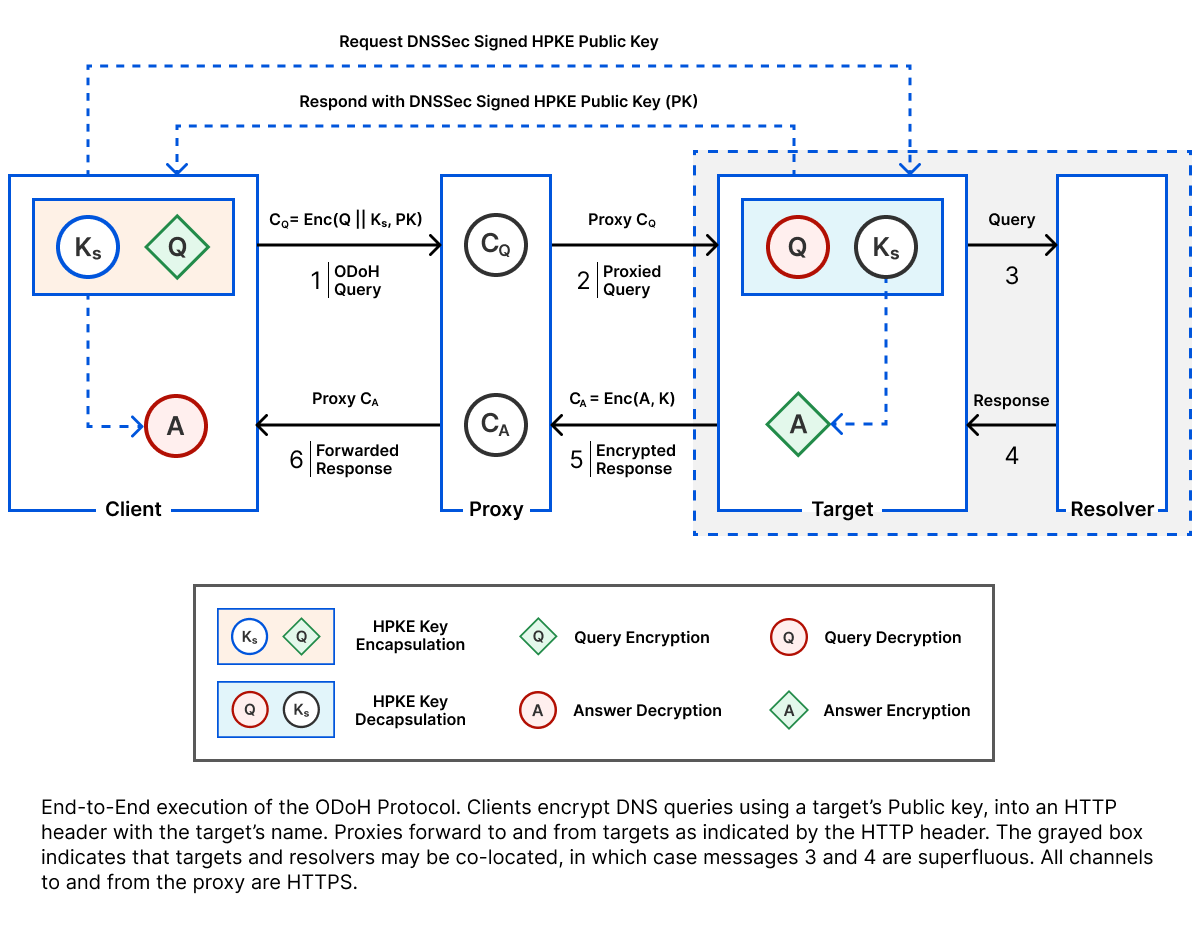
The breakthrough came through a combination of sources. We learned about new results out of academia describing a novel proxying technique called Oblivious DNS. We also found other folks in the industry from Apple and Fastly who were working on the same problem. The resulting proposal combined Oblivious DNS and DoH into an elegant protocol called Oblivious DoH (or ODoH). ODoH was published and discussed extensively at the IETF. DNS is an especially standards-dependent protocol since different parties operate so many components of the system. ODoH adds another participant to the equation, making careful interoperability standards even more critical.

The research team took an early draft of ODoH and, with the help of an intern (whose experience on the team you’ll hear from tomorrow), we built a prototype on Cloudflare Workers. With it, we measured the performance and confirmed the viability of a large-scale ODoH deployment, leading to this paper, published at PoPETS 2021.

The results of our experimentation gave us the confidence to build a production-quality implementation. Our research engineers worked with the engineers on the resolver team to implement and launch ODoH for 1.1.1.1. We also open-sourced ODoH-related code in Go, Rust, and a Cloudflare Workers-compatible implementation. We also worked with the open source community to land the protocol in widely available tools, like dnscrypt, to help further ODoH adoption. ODoH is just one example of cross-industry work to develop standards that you’ll learn more about in an upcoming post.

From theory to practice at a global scale

There are thousands of papers published at dozens of venues every year on Internet technology. The ideas in academic research can change our fundamental understanding of the world scientifically but often haven’t impacted users yet. Innovation comes from all places, and it’s important to adopt ideas from the wider/outside community since we’re in a fortunate position to do so.

As an academic, you are rewarded for the breakthrough, not the follow-through. We value the ability to pursue, even drive, the follow-through because of the tangible improvements challenges offer to the Internet. We find that we can often learn much more about an idea by building and deploying it than by only thinking it up and writing it down. The smallest wrinkle in a lab environment or theoretical paper can become a large issue at Internet scale, and seemingly minor insights can unlock enormous potential.

We are grateful at Cloudflare to be in a rare position to leverage the diversity of the Internet to further existing research and study its real-world impact. We can bring the insights and solutions described in papers to reality because we have the insight into user behavior required to do it: right now, nearly every user on the Internet uses Cloudflare directly or indirectly.

We also have enough scale that problems that could have been solved conventionally must now use new tools. For example, cryptographic tools like identity-based encryption and zero-knowledge proofs have been around on paper for decades. They have only recently been deployed in a few live systems but are now emerging as valuable tools in the conventional Internet and have real-life impact.

Case Study #5: Cryptographic Attestation of Personhood

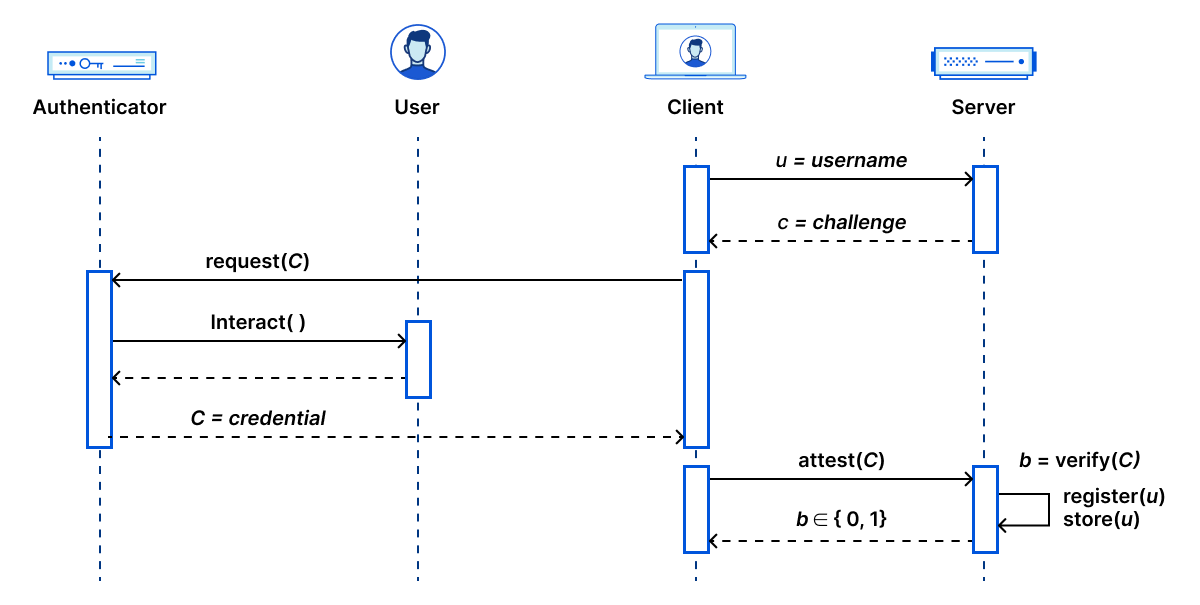
In Case Study #4, we explored a deep and fundamental networking question. As fun as exploring the plumbing can be, it’s also important to explore user experience questions because clients and customers can immediately feel them. A big part of Cloudflare’s value is protecting customers from bots, and one of the tools we use is the CAPTCHA. People hate CAPTCHAs. Few aspects of the web experience inspire more seething anger in the user experience than being stopped and asked to identify street signs and trucks in low-res images when trying to go to a site. Furthermore, the most common CAPTCHAs are inaccessible to many communities, including the blind and the visually impaired. The Bots team at Cloudflare has made great strides to reduce the number of CAPTCHAs shown on the server-side using machine learning (a challenging problem in itself). We decided to complement their work by asking if we could leverage accessibility on the client-side to provide equivalent protection to a CAPTCHA?
Cloudflare Research: Two Years In

This question led us down the path to developing a new technique we call the Cryptographic Attestation of Personhood (CAP). Instead of users proving to Cloudflare that they are human by performing a human task, we could ask them to prove that they have trusted physical hardware. We identified the widely deployed WebAuthn standard to do this so that millions of users could leverage their hard security keys or the hardware biometric system built into their phones and laptops.

This project raised several exciting and profound privacy and user experience questions. With the help of a research intern experienced in anonymous authentication, we published a paper at SAC 2021 that leveraged and improved upon zero-knowledge cryptography systems to add additional privacy features to our solution. Cloudflare’s ubiquity allows us to expose millions of users to this new idea and understand how it’s understood: for example, do users think sites can collect biometrics from their users this way? We have an upcoming paper submission (with the user research team) about these user experience questions.

Some answers to these research-shaped questions are surprising, some weren’t, but in all cases, the outcome of taking a questions-oriented approach was tools for solving problems.

What to expect from the blog

As mentioned above, Cloudflare Research will be all over the Cloudflare blog in the next several days to make several announcements and share technical explainers, including:

  • A new landing page where you can read our research and find additional resources.
  • Technical deep dives into research papers and standards, including the projects referenced above (and MANY more).
  • Insights into our process and ways to collaborate with us.

Happy reading!

В отговор на Борисов относно машинното гласуване

Post Syndicated from Bozho original https://blog.bozho.net/blog/3825

Бойко Борисов ме споменал поименно в свой коментар за машинното гласуване. Както обикновено, фриволно борави с фактите, затова трябва да уточня някои неща. Нашите усилия за подобряване на честността на изборите са последователни и конструктивни и не са от вчера. Борисов казал (във връзка с писмо на Демократична България до ЦИК)

Но сега колегите от „Да, България“ поискаха от ЦИК да извърши нова проверка на машините за гласуване – я виж ти. В писмо до ЦИК експертите посочват, че са необходими още тестове, които да гарантират честността на вота. Те имаха представители досега при кода, само че сега нямат и вече и те дълго изброяват къде са рисковете. И ние настоявахме да има одит на машините. Г-н Божанов, от месеци ви споделяме съмненията си, че правят далавери. Тези 0,8 процента ги броиха 3 дни, за да изкарат Слави първи, не помните ли“

По същество:

  • От Да, България настояваме за независим одит на машините от 2017 г. Настоявахме за него го за изборите през април – тогава мнозинството на ГЕРБ и ДПС игнорира предложенията ни. Искахме го през юли, но тогава имаше валиден аргумент – използването на идентичен софтуер с априлския. Така че опитът му да изкара, че сега сме се сетили, е доста нелеп.
  • “Те имаха представители досега при кода” – представители сме нямали “при кода”. Аз бях представител при удостоверяването, където обсъждахме доста технически аспекти. (Там ГЕРБ не помня да имаха експерт, въпреки всичките им публични изяви по темата. Когато се стигна до “работа, работа, работа”, те си мълчаха.)
  • 0.8 процента не са ги броили три дни – от много години на избори последните под 1% не се въвеждат в сайта на ЦИК, докато не е минала втората проверка на протоколите в ЦИК (първата е в РИК). Тъй като има хартиени протоколи, финалните резултати не се обявяват. Борисов и и хората им в ЦИК знаят това и е демагогия да говорят такива неща.

Напомням също така, че измененията в Изборния кодекс през април, с които се въведе задължителен достъп до изходния код за представителите на партиите и коалициите, беше на Демократична България. ГЕРБ не го подкрепи.

Всъщност, писмото, което изпратихме тази седмица до ЦИК е почти идентично на писмо, което бяхме изпратили за изборите през юли. Опитите ни да подобрим процеса не са от вчера, но нямаме намерение да влизаме в тона на Борисов, че някой манипулира изборите. Не го правихме дори когато мнозинството в ЦИК беше тяхно. Призовавам Борисов и колегите му в ГЕРБ към по-отговорно и последователно поведение спрямо изборния процес и към по-внимателно боравене с фактите. И се надявам да видя техен представител на удостоверяването на машините този път.

Материалът В отговор на Борисов относно машинното гласуване е публикуван за пръв път на БЛОГодаря.

Where is mobile traffic the most and least popular?

Post Syndicated from João Tomé original https://blog.cloudflare.com/where-mobile-traffic-more-and-less-popular/

Where is mobile traffic the most and least popular?

Where is mobile traffic the most and least popular?

You’re having dinner, you look at the table next to and everyone is checking their phone, scrolling and browsing and interacting with that little (is getting bigger) piece of hardware that puts you in contact with friends, family, work and the giant public square of sorts that social media has become. That could happen in the car (hopefully with the passengers, never the driver), at home when you’re on the sofa, in bed or even when you’re commuting or just bored in line for the groceries.

Or perhaps you use your mobile phone as your only connection to the Internet. It might be your one means of communication and doing business. For many, the mobile Internet opened up access and opportunity that simply was not possible before.

Around the world the use of mobile Internet differs widely. In some countries mobile traffic dominates, in others desktop still reigns supreme.

Mobile Internet traffic has changed the way we relate to the online world — work (once, for some, done on desktop/laptop computers) is just one part of it — and Cloudflare Radar can help us get a better understanding of global Internet traffic but also access regional trends, and monitor emerging security threats. So let’s dig into the mobile traffic trends, starting with a kind of contest (the data reflected here is from the 30 days before October 4).

Where is mobile traffic the most and least popular?
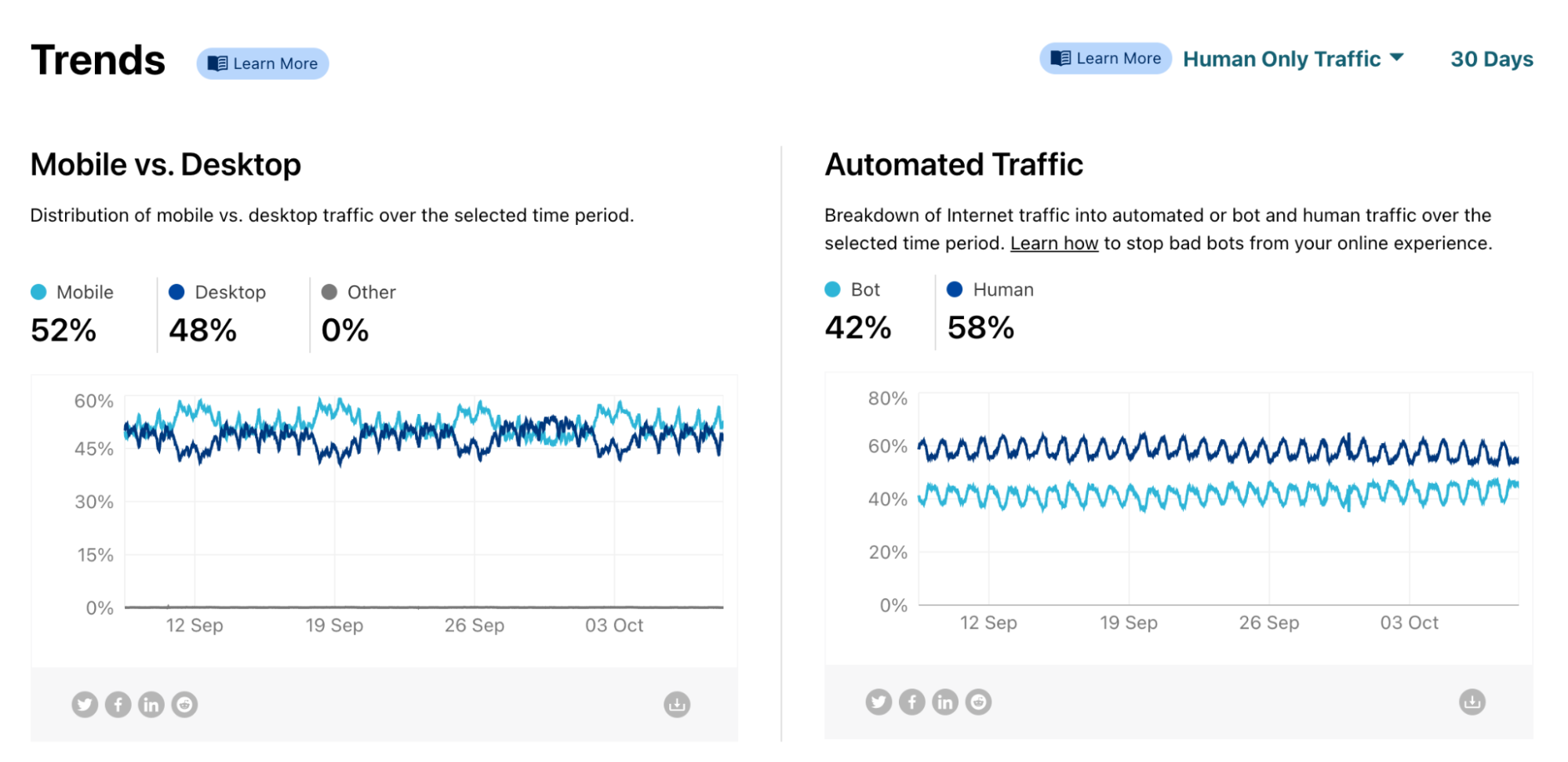
In this area of Cloudflare Radar users can check the mobile traffic trends by country or worldwide (the case shown here) in the past 7 or 30 days. Worldwide we can see that mobile wins over desktop traffic with 52%

The country that has the greatest proportion of mobile Internet traffic is…

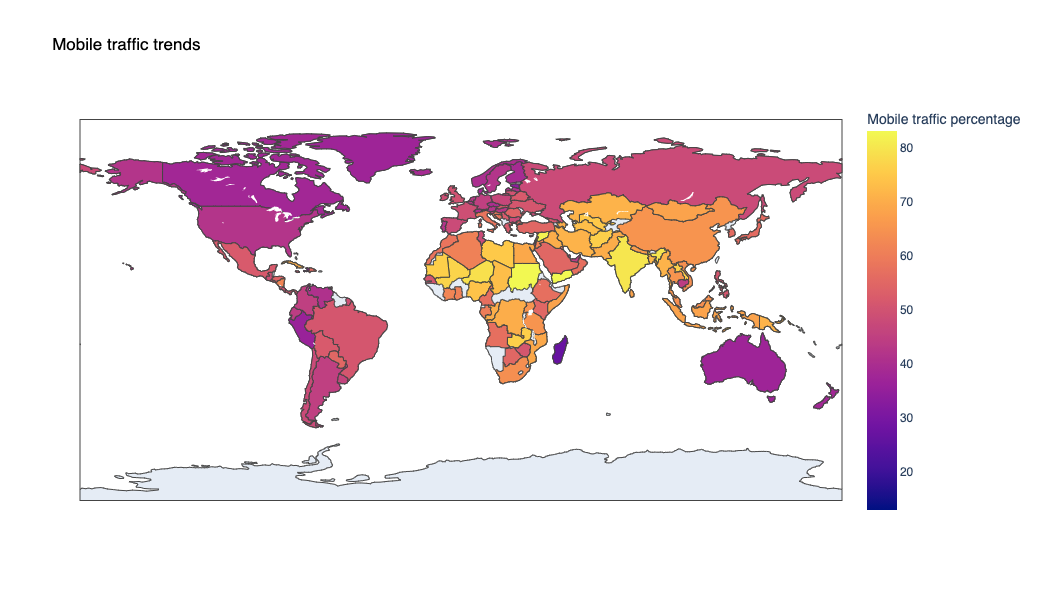
Cloudflare Radar has information on countries across the world, so we looked for, in the past month, the country with the highest proportion of mobile Internet traffic. And the answer is… Sudan, with 83% of Internet traffic is done using mobile devices — actually it’s a tie with Yemen, which we talk about a little further below.

In many emerging economies (Sudan is one), a large percent of the population had its first contact with the Internet through a smartphone. In these countries it is normal not to have a computer and some even got their first bank account thanks to the mobile device.

How about Sudan’s neighbours? South Sudan follows that pattern and mobile traffic represents 74% of Internet use. The same in Chad (74%), Libya (75%), Egypt (68%), Eritrea (67%) and Ethiopia (58%). It’s a clear trend throughout Africa, especially in the central and eastern part of the continent, where mobile traffic wins in every country (for the past 30 days).

Where is mobile traffic the most and least popular?
World map that shows (in yellow) the areas of the planet where most of the Internet traffic is done via mobile devices. Africa, the Middle East and Asia have the highest percentage of mobile traffic.

The Vatican goes for the desktop experience (but Italy loves mobile)

On the other hand, the country we found with the least mobile traffic in the past 30 days is… Vatican City, with only 13% (since the Vatican is literally inside Rome this might be an anomaly caused by mobile devices inside the Vatican connecting to Italian networks). Small countries like Seychelles (29%), Andorra (29%), Estonia (34%) and San Marino (36%) have the same pattern — also with a low mobile traffic percentage there’s Madagascar (27%), Haiti (34%) and Greenland (37%).

We can also see that the pattern inside Vatican City differs greatly from the pattern in Italy. Italy is one of the most mobile-friendly European countries — Italians seem to prefer mobile to desktop. About 57% of Internet traffic is via mobile devices. Italy is only matched, in Europe, by its neighbour Croatia — on the other side of the Adriatic Sea — that in the past month has had 58% mobile traffic.

European countries have differing mobile preferences

While we’re talking about Italy and Croatia, let’s dig a bit more into Europe. Only six countries have more mobile than desktop (laptops included) traffic. Besides Italy and Croatia, there’s Romania (54%), Slovakia (52%) and Greece (51%) — all more to the east of Europe.

At the end of this mobile ranking we have one of the most digitally advanced countries in the world: Estonia (a truly digital society, according to Wired). The small country only has 34% of mobile traffic. Other countries in the north of Europe like Denmark (38%) and Finland (39%) follow the same trend.

Spain (47%), France (48%) and Ireland (49%) are getting close to being mobile-first countries. The UK (50%) has the same trend as its neighbours — Russia is actually in the same ‘neighbourhood’ (with 49%). On the other hand, Portugal (42%), Netherlands (43%) or Germany (44%) are still a little far.

How about the American continent?

Where is mobile traffic the most and least popular?
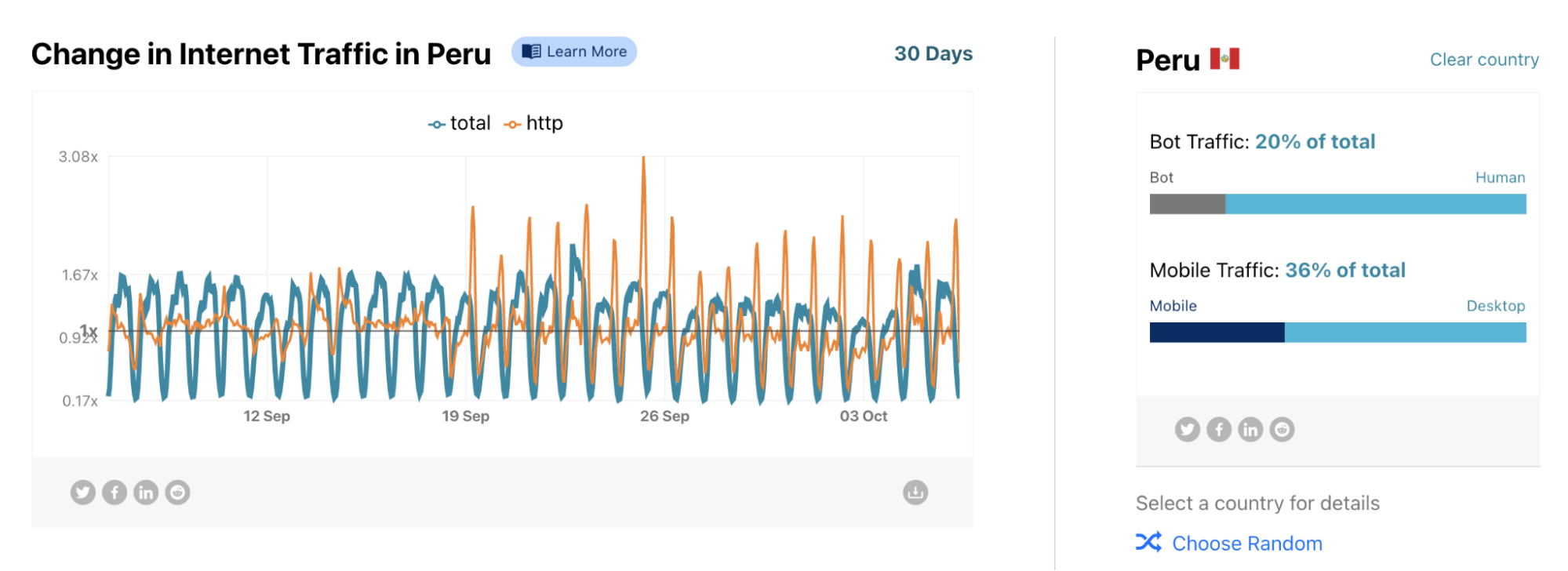
Peru seems to be the country in the American continent that has less mobile use (36%), only compared with Canada (38%). Cuba is the country with more mobile use (70%)

Peru (36%) and Canada (38%) have in common that both are the countries in the American continent with the least mobile use in the past 30 days.

Then there’s Brazil (50%), Mexico (52%) — Chile is not far, with 48% of mobile use. Cuba takes the crown, with 70%, followed by the Dominican Republic (56%), Puerto Rico (51%) and Jamaica (51%), all Caribbean countries. The exception is Haiti, the least mobile of the continent, with 34% of mobile use.

Let’s go to the Middle East: the champion of mobile traffic

Where is mobile traffic the most and least popular?
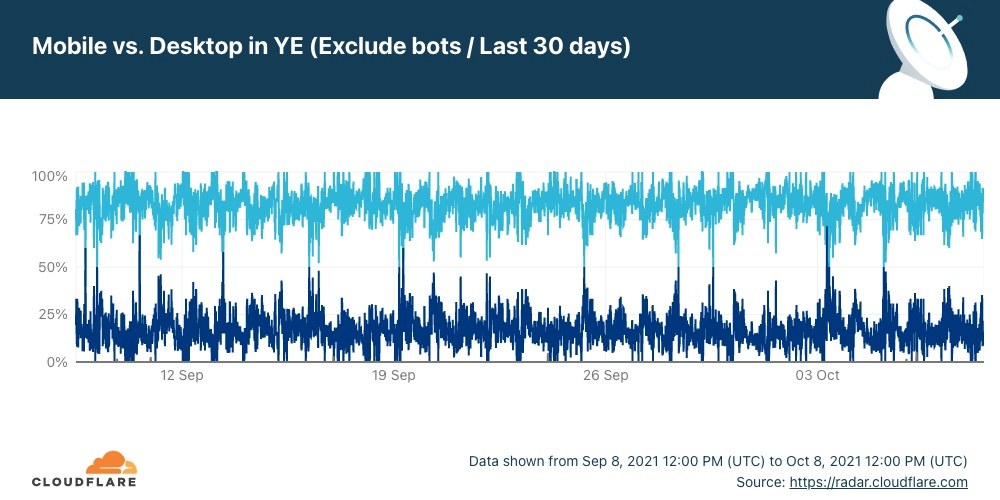
Most Internet traffic in Yemen is done with mobile devices like this chart from Radar of the previous 30 days shows

In this part of our planet there are no doubts whatsoever: mobile traffic rules completely. On the top of the list is Yemen, with the same 83% of mobile traffic as Sudan (that we talked about before). But Syria is actually a close second, with 82%.

Iran (71%), Iraq (70%), Pakistan (70%) and Egypt (69%) show the same trend. The exception, here, is the United Arab Emirates, with 44% of mobile traffic, and also Israel (45%). Nearby, Saudi Arabia (the country with the highest GDP in the region) is at 55%.

A (mobile) giant called India

Of the top 10 most populated countries, the clear winner of our mobile ranking is, without any doubt, India, with 80% mobile use. The country of 1.3 billion people surpasses the biggest country on the planet, China (1.4 billion live there), with 65% mobile.

Also in Asia, the fourth-biggest country in the world (after the US), Indonesia, has 68% of traffic by mobile devices. The same trend of mobile-first is followed by Thailand (65%), Vietnam (64%), Malaysia (64%), South Korea (56%), Japan (56%) and the Philippines (51%). Singapore is in the middle and down under, Australia is desktop first (37% mobile traffic), just like its neighbour New Zealand (38%).

Just as a curiosity, Vanuatu, the South Pacific Ocean nation (population of 307,150), ranked some years as the happiest nation on the planet (by the Happy Planet Index) has 52% of mobile traffic. The current number one in that same index, Costa Rica, is at 50%.

Conclusion

Mobile devices are here to stay and have become already a bridge to help bring more humans to the vast opportunities that the Internet brings. Of the top 15 countries with more mobile Internet traffic, there’s just one that is in the top 15 in terms of GDP, India.

As we already showed, there is a world of trends and even human habits (differing from country to country) to discover on our Cloudflare Radar platform. It’s all a matter of asking a question that could be reflected in our data and searching for the answers.

За кого играе БСП

Post Syndicated from Емилия Милчева original https://toest.bg/za-kogo-igrae-bsp/

Когато Стоил Рошкев, журналист от телевизията на БСП, наскоро призова зрителите да гласуват за БСП и да не гласуват за президента Румен Радев на 14 ноември, със сигурност това не е била непозволена волност. Това е правата линия.

Шокиращо, но в действителност разломът между „Позитано“ 20 и „Дондуков“ 2 е по-голям от всякога. След като загуби избиратели на вота на 4 април и заради неизречената подкрепа за Румен Радев, лидерката на БСП Корнелия Нинова официално обяви такава две седмици по-късно. Въпреки това „нашият президент“ вече не е дотам „наш“ за ръководството на партията, издигнала го за първия мандат.

Избирателите на социалистите – същите, които гласуваха за Нинова на първите преки избори за партиен лидер, харесват Радев. Дилемата „Нинова или Радев“ ще е разрушителна за изборните резултати на БСП, паднали под 400 000 след вота на 11 юли (на 4 април бяха 480 136). Съвсем реалистично е третото място да се изплъзне на БСП, а в настоящия формат за него ще се борят още поне две политически сили – „Демократична България“ и „Има такъв народ“.

Появата на политическия проект на бившите служебни министри Кирил Петков и Асен Василев, ползващ се с протекциите на президентската институция, разджурка рейтингите. Привличайки според проучванията на социолозите избиратели от ИТН и ДБ, но също и от останалите политически сили, „Продължаваме промяната“ изтласка формацията на Слави Трифонов и засега е фаворит за първото място – освен ГЕРБ.

След като изгуби статуса на втора политическа сила, БСП изпадна до

„една от партиите, подкрепящи президента“, 

като в този формат вече води „Продължаваме промяната“. Въпреки това тези близо 400 000 гласа, които социалистическата партия носи със себе си, са важни – а и са повече като тежест от приноса, който се кани да даде ДПС на ректора на Софийския университет проф. Анастас Герджиков, подкрепен от ГЕРБ–СДС. (На последните избори партията на Ахмед Доган спадна до 292 514 гласа, сега ще се опита да „извади“ повече гласове от Турция заради репликата на Радев към лидера на ДПС Мустафа Карадайъ „Коя е Вашата родина майка?“.).

Победата на Румен Радев, доскоро в кърпа вързана, вече не изглежда така предопределена след номинацията на Лозан Панов, подкрепян от ДБ, и на проф. Герджиков. Освен това не е сигурно колко от избирателите на ИТН (първа обявила подкрепа за Радев) ще гласуват за него, както не е сигурно, че всички от ДБ ще застанат зад председателя на Върховния касационен съд.

Така че в ситуация, в която и „Изправи се БГ! Ние идваме!“, също подкрепяща настоящия президент, е на ръба да влезе в бъдещия парламент, единението в БСП е важно за Румен Радев, борещ се за втори мандат. Затова в тази студена война и Нинова – първият лидер на БСП, избран чрез пряк вот, и Радев – мажоритарно избран с над два милиона гласа, спазват формално приличие. Нуждаят се един от друг.

Невъзможно е Корнелия Нинова да се съизмерва с най-одобрявания политик в България, чийто рейтинг надмина 60%. Но подкрепяна от Калоян Методиев, с когото се знаят от СДС, Нинова, изглежда, не отчита последиците от тази битка за самата партия. (Методиев е директор на неправителствената организация Институт „Рего“ и за кратко началник на кабинета на президента Радев, отстранен от поста през септември 2020 г.) Според бивши депутати от левицата Нинова е подразнена от „американизирането“ на Радев, особено от неговата подкрепа за инициативата „Три морета“ и критиките му към газопровода „Турски поток 2“ заради похарчените 3 млрд. лв., които „никога няма да си върнем“.

В БСП проруските позиции са на почит и дори евродепутатите, излъчени от партията, не се отклоняват от тях. 

Последният пример е гласуване в Европарламента през септември, когато петимата представители на БСП единствени в групата на социалистите в ЕП гласуваха против резолюция, призоваваща за нова стратегия на ЕС в отношенията с Русия.

Документът разграничава руския народ от режима на президента Путин. В него са отбелязани обвиненията срещу агенти на ГРУ в опита за убийство на българския оръжеен търговец Емилиян Гебрев и още двама души; изтъква се, че ЕС трябва да намали зависимостта си от руския газ, петрол и други суровини поне докато Путин е на власт; настоява се България и Малта да се откажат от режимите на „златни паспорти“.

Освен това се настоява и Русия да върне трофейни архиви, сред които и изнесените от Червената армия български архиви на царската канцелария, на Министерството на войната, на МВР, лични архиви на български политици след 9 септември 1944 г., които нито едно българско правителство не си е поставило за цел да получи обратно.

Президентът Радев също лансира тезата за нов подход спрямо Русия, 

„отвъд санкциите“, като внимателно подбира думите спрямо Москва и избягва да критикува. Например след Европейския съвет през юни той заяви, че ЕС гледа под микроскоп Русия за корупция, а не е обръщал внимание на България.

А зрителят, обадил се в телевизията на БСП, за да каже, че Радев е „предател“, беше подразнен как се променил президентът, смятан в началото за руски човек: „Той питал ли е Нинова дали да назначава тези хора в служебния кабинет? Не мисля. Той се обяви и против братска Русия. Не мога да гласувам за такъв човек.“ Президентът не е питал лидерката на БСП за първия ешелон в служебното правителство, но е искал предложения за втория, каквито така и не е получил. А и вече не обича да му припомнят кому дължи първия си мандат. Затова и на 1 февруари т.г., когато сам се номинира, той ясно очерта намеренията си да излезе извън тяснопартийното:

„Издигaнeтo нa ĸaндидaтypaтa, зaявявaнeтo зa втopи мaндaт, caмо пo ceбe cи e пoлитичecĸи пpoeĸт, ĸoйтo мoжe дa oбeдини мнoгo бългapи. C г-жa Йoтoвa oчaĸвaмe, чe щe бъдeм зaeднo c бългapcĸитe coциaлиcти, c xилядитe xopa oтлявo, ĸoитo ca нaшeтo пoлитичecĸo ceмeйcтвo, ĸaĸтo и c вcичĸи пoчтeни бългapи.“

Осем месеца по-късно Кирил Петков и Асен Василев издигнаха призива за „коалицията на почтените“ и „десни инструменти за леви цели“…

Двойна игра

Как ще се чувства Корнелия Нинова в такава коалиция, в която БСП няма да свири първа цигулка (макар да смята, че ѝ се полага по право)? Тя отдавна е подозирана в двойна игра – хем иска БСП да я броят за част от „коалицията на промяната“, хем се договаря с ГЕРБ и ДПС за „коалиция на статуквото“.

В предишния 46-ти парламент БСП не показваше активност, когато ставаше въпрос за главния прокурор Иван Гешев – нито по време на изслушванията му в парламентарната комисия, нито при събиране на подписи за извънредно заседание заради отнемането на Бюрото за защита на свидетели от опеката на обвинител №1, нито при дискусии в пленарната зала. Но все пак подкрепи с гласуване промените в Закона за защита на свидетелите, които прехвърлиха службата към Министерството на правосъдието.

Неясната позиция на Нинова и сие по отношение на съдебната реформа и фигурата на главния прокурор подхранва прогнозите за

възможна коалиция между ГЕРБ, ДПС и БСП – 

ако партията на Бойко Борисов се пребори за първото място и съответно получи първия мандат за съставяне на правителство.

Един от малкото депутати от БСП, които се осмеляват да изразяват категорична и принципна позиция относно съдебната реформа и мястото на БСП до партиите на протеста, е Крум Зарков (неговата майка – известната журналистка Анна Заркова, е един от тримата съпредседатели на инициативния комитет, издигнал Румен Радев за втори мандат). Той също е изолиран от Нинова, след като поиска оставката ѝ заради лошия изборен резултат – в края на май по нейно предложение Зарков и Янаки Стоилов (също поискал тя да поеме отговорност заради провала на вота) бяха отстранени от Изпълнителното бюро. Две седмици по-рано Стоилов бе назначен за министър на правосъдието в служебния кабинет на Радев.

Воден от своята прагматичност и желание за втори мандат, Румен Радев се еманципира от БСП, за да завземе по-голяма електорална територия. Още при преполовяването на мандата му се видя, че неговият висок рейтинг не се прехвърля към БСП и следователно може да се опита да изгради фундамент на надпартиен. Освен това ГЕРБ и Борисов низвергнаха Нинова, припознавайки Румен Радев за свой основен противник – и така го легитимираха допълнително.

На няколко пъти Корнелия Нинова се отърва от исканията за оставката ѝ. Къде ще се озове след 14 ноември, зависи от изборния резултат на коалицията на социалистите. И няма да е изненадващо, ако за президента Радев гласуват повече социалисти, отколкото за листите на БСП.

Заглавна снимка: parliament.bg

Източник

Ирак пред избори. Възможна ли е промяната?

Post Syndicated from Мирослав Зафиров original https://toest.bg/iraqi-elections-2021/

На 10 октомври т.г., в шести поред парламентарни избори след падането на режима на Саддам Хюсеин, Ирак ще избира членовете на бъдещия си парламент (Събрание на представителите). Държавата, която само преди няколко години беше на ръба на своето фактическо оцеляване, намирайки се под ударите на ИДИЛ, днес е изправена пред редица проблеми, които в не по-малка степен представляват пречка пред бъдещето ѝ.

От 2014 г. насам Ирак се намира в непрекъсната институционална криза.

Правителствата на Хайдер ал Абади и на настоящия премиер Мустафа ал Кадеми остават неспособни да наложат контрол и да внесат ред в ключови сектори – като тези на сигурността и финансите. Ирак не се справи добре и с кризата, свързана с COVID-19, което допълнително задълбочи критиките. В областта на енергетиката някогашният първенец в рамките на ОПЕК изпитва сериозен недостиг на петрол, оставайки зависим от вноса на преработен нефт и петролни продукти.

Дни след падането на Мосул през юни 2014 г. Ирак стана свидетел на повторната поява на паравоенните шиитски формирования, или т.нар. милиции. С фетва (религиозен указ) върховният лидер на шиитските мюсюлмани великият аятолах Али ал Систани призова населението на Ирак да застане редом до своите въоръжени сили и да защити страната. Това отвори вратата религиозният постулат да бъде интерпретиран в полза на милициите и доведе до тяхното повторно появяване след гражданската война през 2006 г. Хиляди млади мъже напуснаха въоръжените сили на Ирак и се записаха в редиците на различни милиции.

Опитите на няколко поредни иракски правителства от 2014 г. до днес да внесат ред във взаимоотношенията между официален Багдад и милициите, поддържани в немалка степен от Иран, остават напразни. Представляващи на практика паралелна военна сила, по примера на други държави и в частност Ливан, милициите имат дестабилизиращ ефект и често служат в борбата между основните шиитски политически сили, излизайки извън рамките на чисто политическите методи.

Неуспехите в сектор „Сигурност“ не са единствените,

които накараха хиляди иракчани да излязат по улиците на големите градове на страната през есента на 2019-та и почти цялата 2020 година. Масово недоволство от липсата на електроенергия, която Ирак внася в недостатъчни количества основно от Иран, в условията на растяща криза в здравеопазването доведоха до безредици, сблъсъци с полицията, но и накараха мнозина открито да заявят, че Ирак не може повече да бъде управляван от политически и религиозни кланове. От това се възползваха политически лидери, известни със способността си да „усещат пулса на улицата“, сред които особено важен е Муктада ас Садр, чиято партия е основен претендент за мнозинството в парламента.

Иракският парламент гласува новия национален бюджет с три месеца закъснение – едва през март т.г. Веднага след неговото обнародване стана ясно, че той не отговаря на очакванията на основни политически сили и на населението като цяло. След трудни и продължителни дебати между правителството, кабинета на президента и Събранието на представителите, едва през юни измененията и допълненията на закона бяха приети от парламента. Тежките различия се запазиха.

Бюджетът според критиците му не предвижда реформи в публичния сектор, води до допълнително обезценяване на националната валута и не стабилизира икономиката. Той предвижда 89,7 млрд. долара разходи при очаквани приходи от 69,9 млрд. и прогнозна цена за барел от 45 долара. Ирак ще изнесе 3 250 000 барела за текущата година. Съотношението между разходите и инвестициите е 77,6% : 22,4% което оставя открити всички основни проблеми пред страната – качеството на живот, заплатите в държавния сектор, липсата на инвестиции в здравеопазването и енергийната инфраструктура, ръста на безработицата.

Важен открит проблем е и този за отношенията между Багдад и Ербил. Централното правителство се опитва да закрепи силната си позиция спрямо кюрдите в Ирак и тяхната автономия. След неуспешния референдум за независимост през 2017 г. кюрдите загубиха голяма част от възможността си да налагат позициите си пред Багдад. Независимо от това обаче, техните права и редът, по който се развиват отношенията им с централното правителство, са закрепени в Конституцията. Един от нерешените въпроси се отнася до т.нар. дискусионни територии, начело с Киркук – основен център на петролната промишленост, който през 2014 г. Ербил постави под свой контрол, но който след 2017 г. Багдад си върна обратно и отказва да обсъжда.

Само часове преди изборите на 10 октомври основните политически сили в Ирак остават несигурни за бъдещето.

Т.нар. шиитски партии се намират далеч от единството. Тези партии представляват интересите на шиитите в Ирак, които са над 60% от населението на страната, а тяхното политическо представителство и място са гарантирани от Конституцията от 2005 г. Спорещи за своята идентичност на национални партии срещу такива, които не крият връзките си с Иран, шиитските партии и коалиции са непредвидими в поведението си при съставянето на бъдещото правителство. А с това и бъдещето на самата държава е непредсказуемо.

Формално начело сред шиитите е т.нар. политически блок „Сайрун“ на Муктада ас Садр. През 2018 г. Ас Садр имаше 56 от общо 329 места в Събранието на представителите. От 2014 г. насам той заявява себе си като основен защитник на иракското население и гражданските права. Ас Садр страни от явни връзки с Иран, като се позиционира в лагера на националистите. Популярността на лидера се дължи на неговата фамилия. Семейството му е сред най-влиятелните религиозни и политически сили в страната и неговото влияние надминава далеч просто границите на Ирак. Баща му, великият аятолах Мухаммад Садек ас Садр, има статута на култова фигура в Ирак. Убит от режима на Саддам Хюсеин, аятолах Ас Садр се радва на огромна популярност сред шиитите в Ирак заради своята роля в борбата срещу Багдад и религиозната си отдаденост в името на населението.

На второ място след „Сайрун“ на Ас Садр е коалицията на Хади Амр – „Фатах“. Амр има славата на един от най-влиятелните военни лидери в страната. Човек с огромна популярност сред шиитите заради ролята си във войната между Иран и Ирак, от 1980 г. до нейния край той воюва на страната на Техеран. Загубил над 17 членове на семейството си при режима на Саддам Хюсеин, Амр си спечели още слава, играейки основна роля в борбата срещу ИДИЛ заедно с убития през 2020 г. Абу Махди ал Мохандес. Основа на коалицията „Фатах“ са движението „Бадр“ на Хади Амр, което носи и името на най-голямата и влиятелна милиция в страната, и политическото крило на друга внушителна военна сила – „Асаиб ал Ахл ал Хак“ на шейх Каис ал Хазали.

Наред с тази коалиция, която не крие близките си връзки с Иран, сред кандидатите за парламента е и партията „Хукуук“, зад която стои още една влиятелна милиция – „Катаеб Хизбулла“. До изброените политически сили, черпещи сили от средите на милициите, се нареждат още партии и коалиции на няколко много влиятелни политици – като съюза на бившия премиер Хайдер ал Абади и най-старата шиитска партия „Дауа“ начело с Нури ал Малики. Съюзник на Абади е и представител на много известна религиозна фамилия с роля в историята на Ирак – Аммар ал Хаким.

В сунитския лагер основните политически претенденти

са настоящият председател на парламента Мухаммад ал Халбуси, срещу когото се изправя шейх Хамис ал Ханджар. Меценат милионер, живеещ в ОАЕ и с връзки в Катар и Турция, Ал Ханджар е свързван основателно с редица лидери на т.нар. сунитска въоръжена опозиция, която имаше своята роля в кризата с ИДИЛ през 2014 г. и кръвопролитията срещу шиитското население. През 2018 г., сякаш за да докаже, че иракският политически живот никога няма да ни лиши от изненадата на политическата мимикрия, Ал Ханджар се съюзи с Хади Амр по време на тогавашните парламентарни избори. Доскорошните яростни противници намериха общ език.

Шансовете на сунитите, които остават силно разединени, не са големи. Освен Халбуси и Ханджар отсъстват основни лица – като бившия говорител и лидер на Ислямската партия (лицето на „Братя мюсюлмани“ в Ирак) Салим ал Джебури или братята Осама и Атил ал Нуджейфи. Една от причините за това е непоследователната роля на сунитските лидери в кризата с ИДИЛ и тяхната доста закъсняла позиция на страната на кого ще застанат – дали на ИДИЛ, или в подкрепа на официалната власт. Не на последно място, влияние върху популярността им имат и съмненията за тежка корупция. Така например в качеството си на бивш губернатор на Мосул в навечерието на падането на града под контрола на ИДИЛ Атил ал Нуджейфи напуска града, а с него – според слуховете – изчезват и няколкостотин милиона долара от градската банка.

В Ербил и Сюлеймания – или в средите на кюрдския политически елит – традиционно се конкурират две партии: Демократичната партия на Кюрдистан, доминирана от фамилията Барзани, срещу Патриотичния съюз на Кюрдистан на Талабани. През 2018 г. общият брой на кюрдските депутати бе 58, като не се очаква този брой да се промени значително и сега.

По думите на човек, намиращ се в Багдад и участващ непосредствено в предизборния процес, изходът от тези избори е крайно неясен.

Възможни са всякакви коалиции и договорки, като няма поставени „червени линии“. След масовите протести на населението от Басра до Кюрдистан, очевидната неспособност на властта да се справи с епидемията от COVID-19 и задълбочаващата се икономическа и финансова нестабилност, тези избори следва да дадат отговор на въпроса: след като обяви победа над ИДИЛ, ще може ли Ирак да обяви победа и над вътрешните си тежки противоречия с цената на прагматичен компромис в името на своето бъдеще?

Заглавна снимка: Стопкадър от видеорепортаж на „Ал Джазира“ от март 2021 г. относно дебатите в иракския парламент за бюджета и икономическата криза

Източник

По буквите: Дън, Бояджиев, Елми

Post Syndicated from Зорница Христова original https://toest.bg/po-bukvite-dunn-boyadzhiev-elmy/

В емблематичната си колонка, започната още през 2008 г. във в-к „Култура“, Марин Бодаков ни представяше нови литературни заглавия и питаше с какво точно тези книги ни променят. Вярваме, че е важно тази рубрика да продължи. От човек до човек, с нова книга в ръка.

„Видове любов“ от Стивън Дън

превод от английски Христина Керанова, Бургас: ИК „Знаци“, 2014

Стихотворенията на Стивън Дън са като картина на Хопър – човек, който е сам, макар в картината да има други, и усещане за други, и болезнено, споделено желание за близост. Застинал в неумението, в невъзможността да преодолее някаква бариера. В едно (невключено в тази книга) стихотворение той пише: „Дори умните жени се залъгват, / макар най-умните да знаят, че общуването е форма на сдържане, / реклама на интимността, докато сърцето се крие в своя малък джоб от думи.“

Или: стихотворенията на Стивън Дън са като разкази на Карвър или Ъпдайк – семейни истории, в които сюблимното е в луфтовете между обикновените неща, в несигурността дали го има. В едно от тях (вече от тази книга) едро куче напада съпругата му, случайна кола блъсва кучето и трите – неговата жена, водачката на автомобила и собственичката на кучето – страдат заедно и съвършено различно, а той е изправен пред собствената си неспособност да измисли подобен завършек. В друго стихотворение мъжът се прибира, изпълнен с желание да докосне всички – двете кучета, децата, съпругата си, котката. И всички, като никога, имат същата потребност – но само по съвпадение, само защото се е случило времето да е хубаво.

Тази година Стивън Дън почина – на рождения си ден, на 82 години. Това е и поводът да препрочетем книгата, макар да не е съвсем нова.

По принцип не обичам двуезичните издания, но в случая си давам сметка, че това е щедро решение за двуезичния читател – а в някакъв смисъл потенциалният български читател на Стивън Дън е именно такъв. Не знам дали ще се впечатли от наградата „Пулицър“ или останалите отличия, от принадлежността му (или не) към различни поколения. По-скоро, ако потърси и други книги на Дън, подтикът ще е личен, не желание за „наваксване“ с литературен престиж. Аз го усетих.

„Епистолариум“ от Цочо Бояджиев

София: Издателство за поезия „ДА“, 2021

В статията си в „К“ за „Обратното на слънчогледа“ Марин Бодаков писа: „Това е книга на раздялата след раздялата, на тъгата след тъгата.“ Като че няма нищо по-окончателно. Още повече че става въпрос за избраната поезия на Цочо Бояджиев, писана през десетилетия. И все пак новата му книга „Епистолариум“ се опитва да прекрачи отвъд – между човек и човек е имало думи.

Може ли общуването да спре, когато думите са тук? Цочо Бояджиев внимателно изрязва парчета от писма и им отговаря. И тази поезия е смирена пред границите на онова, което не ѝ е дадено – разговора като ромон, в който „отвързани са думите от смисъла / и смисълът е, че са твои думи“, конкретиката на плана да отидеш с някого в Жеравна, вместо да оставиш Жеравна да се разпадне на звуковите си и семантични асоциации. Дори божественото в поезията не е достатъчно – защото „бог движи ръката на поета, / но трябва си и гъшето перо“.

Не е „хватка“ замисълът на книгата, а опит за захващане, за задържане. И в същото време – за отваряне на процеп, в който думите да продължат да бъдат част от разговор. Процеп, в който читателят отчаяно ще се опита да пропъхне и своите думи, макар и пощальонът да е ненадежден и злоумишлен. Щадяща и безутешна е тази поезия, заскобяваща своето майсторство, да не заглуши нещо по-важно.

Понеже „едва сега най-сетне проумявам / защо му е на словото да става плът“.

„Направени от вина“ от Йоанна Елми

София: ИК „Жанет 45“, 2021

Бистър, резлив като утринен студ е дебютният роман на Йоанна Елми. Изреченията вървят бързо, не си позволяват да се шляят – да се казва, каквото има да се казва; шляенето е привилегия на други времена. Книгата не си поставя за цел да разкаже за Прехода, нито за нелегалната емиграция, нито за живота на три поколения жени и болката, преживявана като вина. Просто разказва, както се отварят шкафове в опустяла къща. Виждате сами.

Не знам къде ще ви се появи усещането за „вербатим“ – знаете, онзи театър, в който актьорите произнасят реално записани от очевидците думи. На мен – още от първите страници, от зарязаната сама родилка и студената ръка на лекаря, който оставя върху корема ѝ банкнота, да си купела нещо от лавката. И нататък, още много.

Толкова бяхме взрени в обобщенията преди и след Десети, че сме пълни с несподелим опит. Опитвам да чета Елми в контекста на емигрантската литература, примерно Джумпа Лахири, опитвам с ключа на „Истории от 90-те“ – не е това, има от това, но е друго. Благодарна съм, че почти няма обобщения или са заскобени в диалог, сложени до други, съмнителни. Благодарна съм за индивидуалността на образите, защото така им вярвам.

Най-доброто обобщение е още в началото: героинята Яна търси в интернет нещо за катастрофата, на която е станала свидетел, търси по ключови думи – и открива поредица от подобни сблъсъци, жертвата на които е можела да бъде тя.

Ей така се чувства и читателят.

Активните дарители на „Тоест“ получават постоянна отстъпка в размер на 20% от коричната цена на всички заглавия от каталога на ИК „Жанет 45“, както и на няколко други български издателства в рамките на партньорската програма Читателски клуб „Тоест“. За повече информация прочетете на toest.bg/club.
Заглавна илюстрация: © Александра Димитрова

Източник

Кампания „От нас зависи“

Post Syndicated from Тоест original https://toest.bg/kampaniya-ot-nas-zavisi/

В тази статия ще събираме на едно място всички публикации от кампанията ни „От нас зависи“ в подкрепа на ваксинирането срещу COVID-19. В социалните мрежи всичко потъва на дъното на таймлайните, а тази публикация има за цел да служи за хранилище на материалите от кампанията и ще се обновява всеки път, когато добавим нещо ново. Има постоянен линк към нея и на началната ни страница.

Междувременно следете хаштага #отнасзависи във Facebook, Twitter и Instagram за още инфографики и лични истории на хора, които подкрепят каузата. Разпространявайте ги свободно и ни помогнете да убедим повече хора да се ваксинират.


‼ В България за периода от 1 март до 24 септември т.г. от COVID-19 са починали 10 173 души. От тях ваксинирани са били само 78 души, или 0,77% от общия брой смъртни случаи.

‼ От 28 юли до 26 септември т.г. в болница са постъпили 20 507 души с COVID-19. Само 6,7% са били ваксинирани.

Да, ваксинираните също може да се заразят с новия Делта-вариант на вируса, но значително по-рядко преболедуват тежко и постъпват в болница, а още по-рядко умират. Горните данни от Министерството на здравеопазването в България потвърждават тази тенденция. Проучване от 1 септември 2021 г. на Кралския колеж в Лондон доказа, че ваксините намаляват десетократно риска от развитие на симптоми (в т.ч. дългосрочни) при заразяване със SARS-CoV-2.


„Има времена, които ни изпитват като общност. Ковид кризата е точно такова време. Все по-ясно е, че можем да излезем от нея само заедно, само ако повече хора се ваксинират. Толкова е очевидно. Ваксинирах се при първа възможност, дъщеря ми (на 14) също е ваксинирана. Става дума за нещо много просто – да се спести човешко страдание, да се спасят животи. Всеки избира от какво да се страхува – от ваксината или от вируса, който дотук е причинил смъртта на над 4,5 милиона души. Всеки избира дали да вярва в конспиративни теории, или в науката. Но единият от изборите спасява живот.“

Георги Господинов (р. 1968) е български писател, поет и драматург. Автор е на стихосбирки, сборници с разкази, пиеси и три романа – „Естествен роман“, „Физика на тъгата“ и „Времеубежище“. Снимка: © Дирк Скиба


„Обичам различните езици, места, лица и съдби. Толкова, че си измислих живот, в който да е не само възможно, но и нужно да съм на път. Превеждам книги, ходя на лов за пиеси, пращам кореспонденции. На тази снимка пиша рецензия на пода край една кинозала в Кан – отразявам филмовия фестивал там и съм изтощена, но щастлива. За първи път съм в чужбина след година и половина пандемичен застой, през който тялото ми натежа, а душата ми отслабна. Кан е едно от най-големите световни събития с многохилядна публика. Гигантският риск да се превърне в ковид огнище беше занулен със стриктни мерки: ако си ваксиниран (като мен) или имаш отрицателен тест, влизаш с маска и гледаш. Не беше трудно, а беше ефикасно: за 12 дни близко съжителство в затворени салони не заразихме себе си и другите. И животът се върна донякъде в релсите си.“

Нева Мичева (р. 1973) превежда книги и пиеси, пише за филми за „Българско кино общество“ и води рубриката за читателски писма „Говори с Нева“ в „Тоест“. Снимка: © Шин Хеджин

Илюстрации: © Йордан Дамбулев за „Тоест“ 

Източник

Седмицата в „Тоест“ (4–8 октомври)

Post Syndicated from Тоест original https://toest.bg/editorial-4-8-october-2021/

Тоест

Миналата седмица анонсирахме началото на кампанията си в подкрепа на ваксинирането срещу COVID-19. Само за последните седем дни загубихме 623 души, като най-малко 95% от тях не са били ваксинирани. Продължаваме кампанията си в социалните мрежи. Следете и споделяйте публикациите ни с хаштаг #отнасзависи и ни помогнете да убедим повече хора да се ваксинират. А в тази статия ще съберем на едно място всички материали и лични истории на хора, които подкрепят каузата, и всяка седмица ще я обновяваме. Ще има постоянен линк към нея и на началната ни страница.


Емилия Милчева

От края на миналата седмица кандидат-президентската кампания стана по-интересна, а развръзката ѝ – доста по-трудно предвидима. В контекста на сложните взаимоотношения между БСП и Румен Радев е резонно Емилия Милчева да се пита дали след изборите няма да окажем в любопитна ситуация, при която повече социалисти са гласували за настоящия президент, отколкото за кандидат-депутатите на БСП. Прочетете повече в анализа ѝ „За кого играе БСП“.


Мирослав Зафиров

В Ирак също предстоят парламентарни избори – при това тази неделя. Шестите поред след падането на режима на Саддам Хюсеин. Възможна ли е промяна след тях в разкъсваната от противоречия и вътрешнополитически разделения страна – това е темата на статията на нашия близкоизточен анализатор Мирослав Зафиров, който припомня, че от 2014 г. насам Ирак живее в перманентна институционална криза.


Зорница Христова

Най-старата статия от „Ходене по буквите“ на Марин Бодаков, която откриваме в архивите на „Култура“, е в брой 23/2771 от 20 юни 2008 г. Когато вестникът и неговият наследник „К“ бяха закрити, подслонихме емблематичната колонка в „Тоест“ под името „По буквите“. Тогава Марин я представи така:

От човек до човек, с нова книга в ръка – ходенето по буквите продължава.

Измина един месец, откакто Марин вече не е сред нас. Но ние вярваме, че рубриката му трябва да продължи. Сега по буквите тръгва Зорница Христова, която тази седмица ни представя най-новата стихосбирка на Цочо Бояджиев „Епистолариум“, двуезичната поетична книга „Видове любов“ на Стивън Дън и появилия се буквално преди броени дни роман „Направени от вина“ на Йоанна Елми (която е втората авторка на „Тоест“ с литературен дебют през тази година).


Николета Атанасова

🎙 И нека завършим с интересна история за слушане. Новият епизод в подкаст поредицата „Създатели и мечтатели“ на Николета Атанасова разказва за началото на противопожарните служби в България, поставено малко след Освобождението. Научете как са създадени първите пожарни команди у нас, защо след края на Първата световна война „тулумбаджиите“ биват забравени, кое събитие преобръща хода на историята и припомня на властта и гражданите за важната роля на пожарникарите.

Приятно четене и слушане!

Източник

Top 5 Architecture Blog Posts for Q3 2021

Post Syndicated from Bonnie McClure original https://aws.amazon.com/blogs/architecture/top-5-architecture-blog-posts-for-q3-2021/

The goal of the AWS Architecture Blog is to highlight best practices and provide architectural guidance. We publish thought leadership pieces that encourage readers to discover other technical documentation such as solutions and managed solutions, other AWS blogs, videos, reference architectures, whitepapers, and guides, training and certification, case studies, and the AWS Architecture Monthly Magazine. We welcome your contributions!

Field Notes is a series of posts within the Architecture Blog that provides hands-on technical guidance from AWS Solutions Architects, consultants, and technical account managers based on their experiences in the field solving real-world business problems for customers.

A big thank you to you, our readers, for spending time on our blog this past quarter. Of course, we wouldn’t have content for you to read without our hard-working AWS Solutions Architects and other blog post writers either, so thank you to them as well! Without further ado, the following five posts were the top Architecture Blog and Field Notes blog posts published in Q3 (July through September 2021).

#5: Choosing Your VPC Endpoint Strategy for Amazon S3

by Jeff Harman and Gilles-Kuessan Satchivi

In this blog post, Jeff and Gilles-Kuessan guide you through selecting the right virtual private connection (VPC) endpoint type to access Amazon Simple Storage Service (Amazon S3). A VPC endpoint allows workloads in an Amazon Virtual Private Cloud (Amazon VPC) to connect to supported public AWS services or third-party applications over the AWS network.

#4: Using VPC Endpoints in Multi-Region Architectures with Route 53 Resolver

by Michael Haken

You want a straightforward way to use VPC endpoints and endpoint policies for all Regions uniformly and consistently. In this post, Michael shows you how Route 53 Resolver solves this challenge using DNS. This solution ensures that requests to AWS services that support VPC endpoints stay within the VPC network, regardless of their Region.

#3: Architecting a Highly Available, Serverless Microservices-Based Ecommerce Site

by Senthil Kumar and Ajit Puthiyavettle

The number of ecommerce vendors is growing globally, and these vendors often handle large traffic at different times of the day and on different days of the year. This, in addition to building, managing, and maintaining IT infrastructure on-premises data centers can present challenges to businesses’ scalability and growth. In this blog post, Senthil and Ajit provide you a Serverless on AWS solution that offloads the undifferentiated heavy lifting of managing resources and ensures your business’ architecture can handle peak traffic.

#2: Data Caching Across Microservices in a Serverless Architecture

by Irfan Saleem, Pallavi Nargund, and Peter Buonora

In this blog post, Irfan, Pallavi, and Peter discuss a couple of customer use cases that use Serverless on AWS offerings to maintain a cache close to the microservices layer. This improves performance by reducing or eliminating the need for the real-time backend calls and by reducing latency and service-to-service communication.

#1: Overview of Data Transfer Charges for Common Architectures 

With over 35,000 views and rising, this post is vastly outpacing all other contenders this quarter. In this post, Birender, Sebastian, and Dennis discuss how data transfer charges are often overlooked while architecting solutions in AWS. This post will help you identify potential data transfer charges you may encounter while operating your workload on AWS.

Thank you!

Thanks again to all our readers and blog post writers! We look forward to continuing to learn and build amazing things together in 2021.

Other blog posts in this series

Metasploit Wrap-Up

Post Syndicated from Simon Janusz original https://blog.rapid7.com/2021/10/08/metasploit-wrap-up-133/

Telemetry is for gathering data, not executing commands as root, right?…

Metasploit Wrap-Up

This week’s highlight is a new exploit module by our own wvu for VMware vCenter Server CVE-2021-22005, a file upload vuln that arises from a flaw in vCenter’s analytics/telemetry service, which is enabled by default. Attackers with network access to port 443 can upload a specially crafted file, after which commands can be executed as the root user without prior authentication. As usual, this latest vCenter Server vulnerability was exploited in the wild quickly after details were released. See Rapid7’s full technical analysis in AttackerKB.

Good ol’ Netfilter

This week’s release also includes a privilege escalation module for a Linux kernel vulnerability in Netfilter that lets you get a root shell through an out-of-bounds write. The vulnerability was discovered by Andy Nguyen and has been present in the Linux kernel for the past 15 years. The module currently supports 18 versions of the Ubuntu kernel ranging between 5.8.0-23 to 5.8.0-53 thanks to bcoles, and there are plans to add further support for kernel versions 4.x in the future, once an ROP chain for said version is created.

New module content (3)

Enhancements and features

  • #15735 from jaydesl – Fixes a Rails 6 deprecation warning when a user ran db_disconnect in msfconsole
  • #15740 from h00die – Several improvements have been made to the Ghostcat module to align it with recent standards changes that the team has made and to ensure its documentation is more descriptive.
  • #15750 from jmartin-r7 – Improves Ruby 3.0.2 support on Windows

Bugs fixed

  • #15729 from ErikWynter – This fixes a bug in the PrintNightmare check method where if an RPC function returns a value that can’t be mapped to a Win32 error code, the module would crash.
  • #15730 from adfoster-r7 – The check method for the Gitea Git hooks RCE module has been updated to correctly handle older versions of Gitea and report their exploitability as unknown vs reporting the target as not running Gitea.
  • #15737 from adfoster-r7 – A bug has been fixed whereby action wasn’t correctly being set when using the action name as a command. action should now hold the right value when using the action name as a command.
  • #15745 from bwatters-r7 – A bug has been fixed in tools/dev/msftidy.rb whereby if the Notes section was placed before the References section, then msftidy would end up not checking the References section and would therefore state the module didn’t have a CVE reference, even when it did.

Get it

As always, you can update to the latest Metasploit Framework with msfupdate and you can get more details on the changes since the last blog post from GitHub:

If you are a git user, you can clone the Metasploit Framework repo (master branch) for the latest. To install fresh without using git, you can use the open-source-only Nightly Installers or the binary installers (which also include the commercial edition).

What’s the Diff: Backblaze S3 Compatible API vs. B2 Native API

Post Syndicated from Molly Clancy original https://www.backblaze.com/blog/whats-the-diff-backblaze-s3-compatible-api-vs-b2-native-api/

Backblaze B2 Cloud Storage enables thousands of developers—from video streaming applications like Kanopy to gaming platforms like Nodecraft—to easily store and use data in the cloud. Those files are always available for download either through a browser-compatible URL or APIs.

Backblaze supports two different suites of APIs—the Backblaze B2 Native API and the Backblaze S3 Compatible API. Sometimes, folks come to our platform knowing exactly which API they need to use, but the differences between the two are not always immediately apparent. If you’re not sure which API is best for you and your project, we’re explaining the difference today.

B2 Native API vs. S3 Compatible API: What’s the Diff?

Put simply, an application programming interface, or API, is a set of protocols that lets one application or service talk to another. They typically include a list of operations or calls developers can use to interact with said application (inputs) and a description of what happens when those calls are used (outputs). Both the B2 Native and S3 Compatible APIs handle the same basic functions:

  • Authentication: Providing account/bucket/file access.
  • Bucket Management: Creating and managing the buckets that hold files.
  • Upload: Sending files to the cloud.
  • Download: Retrieving files from the cloud.
  • List: Data checking/selection/comparison.

The main difference between the two APIs is that they use different syntax for the various calls. We’ll dig into other key differences in more detail below.

The Backblaze B2 Native API

The B2 Native API is Backblaze’s custom API that enables you to interact with Backblaze B2 Cloud Storage. We’ve written in detail about why we developed our own custom API instead of just implementing an S3-compatible interface from the beginning. In a nutshell, we developed it so our customers could easily interact with our cloud while enabling Backblaze to offer cloud storage at a quarter of the price of S3.

To get started, simply create a Backblaze account and enable Backblaze B2. You’ll then get access to your Application Key and Application Key ID. These let you call the B2 Native API.

The Backblaze S3 Compatible API

Over the years since we launched Backblaze B2 and the B2 Native API, S3 compatibility was one of our most requested features. When S3 launched in 2006, it solved a persistent problem for developers—provisioning and maintaining storage hardware. Prior to S3, developers had to estimate how much storage hardware they would need for their applications very accurately or risk crashes from having too little or, on the flip side, paying too much as a result of over-provisioning storage for their needs. S3 gave them unlimited, scalable storage that eliminated the need to provision and buy hardware. For developers, the service was a game-changer, and in the years that followed, the S3 API essentially became industry standard for object storage.

In those years as well, other brands (That’s us!) entered the market. AWS was no longer the only game in town. Many customers wanted to move from Amazon S3 to Backblaze B2, but didn’t want to rewrite code that already worked with the S3 API.

The Backblaze S3 Compatible API does the same thing as the B2 Native API—it allows you to interact with B2 Cloud Storage—but it follows the S3 syntax. With the S3 Compatible API, if your application is already written to use the S3 API, B2 Cloud Storage will just work, with minimal code changes on your end. The launch of the S3 Compatible API provides developers with a number of benefits:

  • You don’t have to learn a new API.
  • You can use your existing tools that are written to the S3 API.
  • Performance will be just as good and you’ll get all the benefits of B2 Cloud Storage.

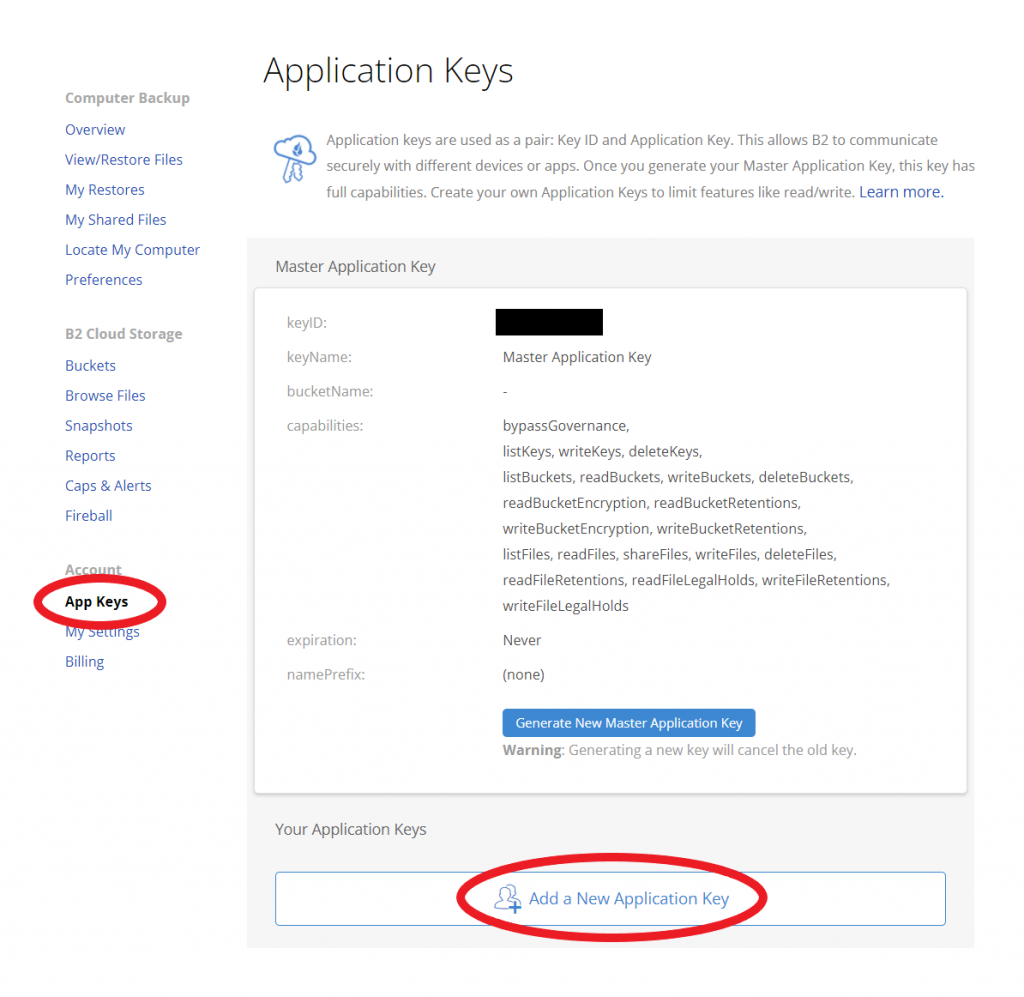
To get started, create a Backblaze account and head to the App Keys page. The Master Application Key will not be S3 compatible, so you’ll want to create a new key and key ID by clicking the “Add a New Application Key” button. Your new key and key ID will work with both the B2 Native API and S3 Compatible API. Just plug this information into your application to connect it to Backblaze B2.

Find the App Keys page in your Backblaze account to create your S3-compatible key and key ID.

If your existing tools are written to the S3 API—for example, tools like Cohesity, rclone, and Veeam—they’ll work automatically once you enter this information. Additionally, many tools—like Arq, Synology, and MSP360—were already integrated with Backblaze B2 via the B2 Native API, but now customers can choose to connect with them via either API suite.

B2 Native and S3 Compatible APIs: How Do They Compare?

Beyond the syntax, there are a few key differences between the B2 Native and Backblaze S3 Compatible APIs, including:

  • Key management.
  • SDKs.
  • Pre-signed URLs.
  • File uploads.

Key Management

Key management is unique to the B2 Native API. The S3 Compatible API does not support key management. With key management, you can create, delete, and list keys using the following calls:

  • b2_create_key
  • b2_delete_key
  • b2_list_keys

SDKs

Some of our Alliance Partners asked us if we had an SDK they could use. To answer that request, we developed an official Java SDK and Python SDK on GitHub so you can manage and configure your cloud resources via the B2 Native API.

Meanwhile, long-standing, open-sourced SDKs for S3 Compatible APIs are available in any language including Go, PHP, Javascript, Ruby, etc. These SDKs make it easy to integrate your application no matter what language it’s written in.

What Is an SDK?

SDK stands for software development kit. It is a set of software development tools, documentation, libraries, code snippets, and guides that come in one package developers can install. Developers use SDKs to build applications for the specific platform, programming language, or system the SDK serves.

Pre-signed URLs

By default, access to private buckets is restricted to the account owner. If you want to grant access to a specific object in that bucket to anyone else—for example, a user or a different application or service—they need proper authorization. The S3 Compatible API and the B2 Native API handle access to private buckets differently.

The S3 Compatible API handles authorization using pre-signed URLs. It requires the user to calculate a signature (code that says you are who you say you are) before sending the request. Using the URL, a user can either read an object, write an object, or update an existing object. The URL also contains specific parameters like limitations or expiration dates to manage their usage.

The S3 Compatible API supports pre-signed URLs for downloading and uploading. Pre-signed URLs are built into AWS SDKs. They can also be generated in a number of other ways including the AWS CLI and AWS Tools for PowerShell. You can find guides for configuring those tools here. Many integrations, for example, Cyberduck, also offer a simple share functionality that makes providing temporary access possible utilizing the underlying pre-signed URL.

The B2 Native API figures out the signature for you. Instead of a pre-signed URL, the B2 Native API requires an authorization token to be part of the API request itself. The b2_authorize_account request gets the authorization token that you can then use for account-level operations. If you only want to authorize downloads instead of all account-level operations, you can use the request b2_get_download_authorization to generate an authorization token, which can then be used in the URL to authenticate the request.

Uploading Files

With the S3 Compatible API, you upload files to a static URL that never changes. Our servers automatically pick the best route for you that delivers the best possible performance on our backend.

The B2 Native API requires a separate call to get an upload URL. This URL can be used until it goes stale (i.e. returns a 50X error), at which point another upload URL must be requested. In the event of a 50X error, you simply need to retry the request with the new URL. The S3 Compatible API does this for you in the background on our servers, which makes the experience of using the S3 Compatible API smoother.

This difference in the upload process is what enabled Backblaze B2 to offer substantially lower prices at the expense of a little bit more complexity. You can read more about that here.

Try It Out for Yourself

So, which API should you use? In a nutshell, if your app is already written to work with S3, if you’re using tools that are written to S3, or if you’re just unsure, the S3 Compatible API is a good choice. If you’re looking for more control over access and key management, the B2 Native API is the way to go. Either way, now that you understand the differences between the two APIs you can use to work with B2 Cloud Storage, you can align your use cases to the functionality that best suits them and get started with the API that works best for you.

If you’re ready to try out the B2 Native or S3 Compatible APIs for yourself, check out our documentation:

Of course, if you have any questions, fire away in the comments or reach out to our Sales team. And if you’re interested in trying Backblaze, get started today and your first 10GB of storage are free.

The post What’s the Diff: Backblaze S3 Compatible API vs. B2 Native API appeared first on Backblaze Blog | Cloud Storage & Cloud Backup.

What happened on the Internet during the Facebook outage

Post Syndicated from Celso Martinho original https://blog.cloudflare.com/during-the-facebook-outage/

What happened on the Internet during the Facebook outage

It’s been a few days now since Facebook, Instagram, and WhatsApp went AWOL and experienced one of the most extended and rough downtime periods in their existence.

When that happened, we reported our bird’s-eye view of the event and posted the blog Understanding How Facebook Disappeared from the Internet where we tried to explain what we saw and how DNS and BGP, two of the technologies at the center of the outage, played a role in the event.

In the meantime, more information has surfaced, and Facebook has published a blog post giving more details of what happened internally.

As we said before, these events are a gentle reminder that the Internet is a vast network of networks, and we, as industry players and end-users, are part of it and should work together.

In the aftermath of an event of this size, we don’t waste much time debating how peers handled the situation. We do, however, ask ourselves the more important questions: “How did this affect us?” and “What if this had happened to us?” Asking and answering these questions whenever something like this happens is a great and healthy exercise that helps us improve our own resilience.

Today, we’re going to show you how the Facebook and affiliate sites downtime affected us, and what we can see in our data.

1.1.1.1

1.1.1.1 is a fast and privacy-centric public DNS resolver operated by Cloudflare, used by millions of users, browsers, and devices worldwide. Let’s look at our telemetry and see what we find.

First, the obvious. If we look at the response rate, there was a massive spike in the number of SERVFAIL codes. SERVFAILs can happen for several reasons; we have an excellent blog called Unwrap the SERVFAIL that you should read if you’re curious.

In this case, we started serving SERVFAIL responses to all facebook.com and whatsapp.com DNS queries because our resolver couldn’t access the upstream Facebook authoritative servers. About 60x times more than the average on a typical day.

What happened on the Internet during the Facebook outage

If we look at all the queries, not specific to Facebook or WhatsApp domains, and we split them by IPv4 and IPv6 clients, we can see that our load increased too.

As explained before, this is due to a snowball effect associated with applications and users retrying after the errors and generating even more traffic. In this case, 1.1.1.1 had to handle more than the expected rate for A and AAAA queries.

What happened on the Internet during the Facebook outage

Here’s another fun one.

DNS vs. DoT and DoH. Typically, DNS queries and responses are sent in plaintext over UDP (or TCP sometimes), and that’s been the case for decades now. Naturally, this poses security and privacy risks to end-users as it allows in-transit attacks or traffic snooping.

With DNS over TLS (DoT) and DNS over HTTPS, clients can talk DNS using well-known, well-supported encryption and authentication protocols.

Our learning center has a good article on “DNS over TLS vs. DNS over HTTPS” that you can read. Browsers like Chrome, Firefox, and Edge have supported DoH for some time now, WAP uses DoH too, and you can even configure your operating system to use the new protocols.

When Facebook went offline, we saw the number of DoT+DoH SERVFAILs responses grow by over x300 vs. the average rate.

What happened on the Internet during the Facebook outage

So, we got hammered with lots of requests and errors, causing traffic spikes to our 1.1.1.1 resolver and causing an unexpected load in the edge network and systems. How did we perform during this stressful period?

Quite well. 1.1.1.1 kept its cool and continued serving the vast majority of requests around the famous 10ms mark. An insignificant fraction of p95 and p99 percentiles saw increased response times, probably due to timeouts trying to reach Facebook’s nameservers.

What happened on the Internet during the Facebook outage

Another interesting perspective is the distribution of the ratio between SERVFAIL and good DNS answers, by country. In theory, the higher this ratio is, the more the country uses Facebook. Here’s the map with the countries that suffered the most:

What happened on the Internet during the Facebook outage

Here’s the top twelve country list, ordered by those that apparently use Facebook, WhatsApp and Instagram the most:

Country SERVFAIL/Good Answers ratio
Turkey 7.34
Grenada 4.84
Congo 4.44
Lesotho 3.94
Nicaragua 3.57
South Sudan 3.47
Syrian Arab Republic 3.41
Serbia 3.25
Turkmenistan 3.23
United Arab Emirates 3.17
Togo 3.14
French Guiana 3.00

Impact on other sites

When Facebook, Instagram, and WhatsApp aren’t around, the world turns to other places to look for information on what’s going on, other forms of entertainment or other applications to communicate with their friends and family. Our data shows us those shifts. While Facebook was going down, other services and platforms were going up.

To get an idea of the changing traffic patterns we look at DNS queries as an indicator of increased traffic to specific sites or types of site.

Here are a few examples.

Other social media platforms saw a slight increase in use, compared to normal.

What happened on the Internet during the Facebook outage

Traffic to messaging platforms like Telegram, Signal, Discord and Slack got a little push too.

What happened on the Internet during the Facebook outage

Nothing like a little gaming time when Instagram is down, we guess, when looking at traffic to sites like Steam, Xbox, Minecraft and others.

What happened on the Internet during the Facebook outage

And yes, people want to know what’s going on and fall back on news sites like CNN, New York Times, The Guardian, Wall Street Journal, Washington Post, Huffington Post, BBC, and others:

What happened on the Internet during the Facebook outage

Attacks

One could speculate that the Internet was under attack from malicious hackers. Our Firewall doesn’t agree; nothing out of the ordinary stands out.

What happened on the Internet during the Facebook outage

Network Error Logs

Network Error Logging, NEL for short, is an experimental technology supported in Chrome. A website can issue a Report-To header and ask the browser to send reports about network problems, like bad requests or DNS issues, to a specific endpoint.

Cloudflare uses NEL data to quickly help triage end-user connectivity issues when end-users reach our network. You can learn more about this feature in our help center.

If Facebook is down and their DNS isn’t responding, Chrome will start reporting NEL events every time one of the pages in our zones fails to load Facebook comments, posts, ads, or authentication buttons. This chart shows it clearly.​​

What happened on the Internet during the Facebook outage

WARP

Cloudflare announced WARP in 2019, and called it “A VPN for People Who Don’t Know What V.P.N. Stands For” and offered it for free to its customers. Today WARP is used by millions of people worldwide to securely and privately access the Internet on their desktop and mobile devices. Here’s what we saw during the outage by looking at traffic volume between WARP and Facebook’s network:

What happened on the Internet during the Facebook outage

You can see how the steep drop in Facebook ASN traffic coincides with the start of the incident and how it compares to the same period the day before.

Our own traffic

People tend to think of Facebook as a place to visit. We log in, and we access Facebook, we post. It turns out that Facebook likes to visit us too, quite a lot. Like Google and other platforms, Facebook uses an army of crawlers to constantly check websites for data and updates. Those robots gather information about websites content, such as its titles, descriptions, thumbnail images, and metadata. You can learn more about this on the “The Facebook Crawler” page and the Open Graph website.

Here’s what we see when traffic is coming from the Facebook ASN, supposedly from crawlers, to our CDN sites:

What happened on the Internet during the Facebook outage

The robots went silent.

What about the traffic coming to our CDN sites from Facebook User-Agents? The gap is indisputable.

What happened on the Internet during the Facebook outage

We see about 30% of a typical request rate hitting us. But it’s not zero; why is that?

We’ll let you know a little secret. Never trust User-Agent information; it’s broken. User-Agent spoofing is everywhere. Browsers, apps, and other clients deliberately change the User-Agent string when they fetch pages from the Internet to hide, obtain access to certain features, or bypass paywalls (because pay-walled sites want sites like Facebook to index their content, so that then they get more traffic from links).

Fortunately, there are newer, and privacy-centric standards emerging like User-Agent Client Hints.

Core Web Vitals

Core Web Vitals are the subset of Web Vitals, an initiative by Google to provide a unified interface to measure real-world quality signals when a user visits a web page. Such signals include Largest Contentful Paint (LCP), First Input Delay (FID), and Cumulative Layout Shift (CLS).

We use Core Web Vitals with our privacy-centric Web Analytics product and collect anonymized data on how end-users experience the websites that enable this feature.

One of the metrics we can calculate using these signals is the page load time. Our theory is that if a page includes scripts coming from external sites (for example, Facebook “like” buttons, comments, ads), and they are unreachable, its total load time gets affected.

We used a list of about 400 domains that we know embed Facebook scripts in their pages and looked at the data.

What happened on the Internet during the Facebook outage

Now let’s look at the Largest Contentful Paint. LCP marks the point in the page load timeline when the page’s main content has likely loaded. The faster the LCP is, the better the end-user experience.

What happened on the Internet during the Facebook outage

Again, the page load experience got visibly degraded.

The outcome seems clear. The sites that use Facebook scripts in their pages took 1.5x more time to load their pages during the outage, with some of them taking more than 2x the usual time. Facebook’s outage dragged the performance of  some other sites down.

Conclusion

When Facebook, Instagram, and WhatsApp went down, the Web felt it. Some websites got slower or lost traffic, other services and platforms got unexpected load, and people lost the ability to communicate or do business normally.

The collective thoughts of the interwebz