[$] Additional hardening for the glibc dynamic linker

Post Syndicated from daroc original https://lwn.net/Articles/1105134/

The

Node.js project
recently had a

security vulnerability
that
affected its

Brotli
decoder. The bug

was a buffer overflow
,
but the particular way that official Node.js binaries are built for Linux meant that one of the
main protections against turning a buffer overflow into remote code execution,

address space layout randomization
(ASLR) could not be turned on. If ASLR had been
enabled, the bug would still be exploitable in theory, but much more difficult
to exploit in practice. In response, the GNU C Library (glibc) is

considering
a new set of

tunable settings
to allow administrators to forbid programs that do not
support ASLR. The new settings, while a welcome hardening measure, may not
address the root problem.

Choosing QuePaxa, an unusual consensus algorithm

Post Syndicated from João Pedro Leite original https://blog.cloudflare.com/choosing-quepaxa/

Cloudflare recently announced Meerkat, an experimental distributed consensus service designed to manage our internal global control plane. It is powered by a new consensus algorithm called QuePaxa.

QuePaxa is an unusual choice; most consensus systems use well-established consensus algorithms like Raft, (Multi-)Paxos or Viewstamped Replication. These algorithms are well understood, have mature implementations, and usually work well.

Unfortunately, common consensus algorithms often suffer in wide-area networks with volatile network connectivity and latency, i.e., networks like the Internet, which is where Meerkat runs. These algorithms rely on a single leader process being available and having predictable latency. If the leader goes down, experiences higher latency than usual, or is disconnected, the entire consensus system slows down or becomes unavailable until the leader is replaced. This is unacceptable for Meerkat.

Meerkat’s global deployment environment led us to a newer consensus algorithm, QuePaxa, which promises better stability despite volatility, in large part by not relying on a leader to make progress. In this post we’ll explain why we chose QuePaxa and how the QuePaxa algorithm works.

What we’re building and why it’s unique

Meerkat is a distributed system in which replicas agree upon an ordered log of events, where each event is decided by a consensus algorithm.

Consensus algorithms allow a group of machines to agree on a single shared truth, even if some of those machines crash or disconnect. Consensus algorithms provide an important guarantee: machines never decide conflicting values. This ensures Meerkat replicas’ logs never diverge.

Meerkat uses its consensus-powered log to expose applications like a key-value store, where each entry in the log is a get or a put. Because the consensus algorithm guarantees replicas’ logs never diverge, they all construct the same key-value (KV) state. Comparable consensus-powered systems include Consul, etcd, and Apache ZooKeeper.

Unlike similar systems, however, Meerkat was designed for global scale. A Meerkat cluster may be distributed across continents and connected by links that often exhibit high and variable latency. This is an unusual setup for consensus systems, which are usually deployed in smaller, more local networks, and have strict latency requirements.

The challenges of consensus at a global scale

While all consensus algorithms ensure that replicas agree on the same value, many of them become disproportionately unavailable or slow when network conditions degrade (but machines do not crash). We have seen this happen firsthand: in 2020, the partial failure of a core Cloudflare network switch caused a consensus-powered system to degrade and the dashboard to operate 80x slower than usual, for six hours. Critically, the system lost no data. But it became unavailable for writes until the issue was resolved, which is unacceptable.

Ideally, a consensus algorithm should be able to make progress despite latency spikes and broken connections, not just replica failures. This is particularly a problem at global scale, where faults are more likely to originate in the network, and not our own servers.

Let’s examine two common traits of consensus algorithms that can lead to degradation under hostile network conditions: destructive interference and fault detection. Later, we’ll see how QuePaxa sidesteps both of these issues.

Destructive interference and leaders

Consider Paxos, the veritable grandfather of most consensus algorithms. A lot of consensus algorithms inherit the structure of Paxos – both the good and the not-so-good bits.

Leaving an egregious amount of detail out, here’s how Paxos works. There are two kinds of processes: proposers and acceptors. Abstractly, the goal of the system is for a majority of acceptors to agree on a value proposed by some proposer. There are two phases: the Prepare phase, and the Accept phase. In the Prepare phase, any proposer can send a ballot number out to a majority of acceptors. This ballot number serves as a promise – acceptors will only accept proposals with that ballot number or higher. Then, in the Accept phase, the proposer sends its proposal along with the ballot number to a majority of acceptors again. If a majority of acceptors still hold the ballot number of the proposal, the majority accepts it, and the proposer can safely decide the proposal.

Challenges arise when two or more proposers submit proposals at the same time. Specifically, another proposer can interleave its own higher ballot number in between the two phases, blocking any lower ballots. Two proposers can repeatedly block each other from progressing – effectively competing for acceptance.

When proposers compete and block each other in this way, we say that they destructively interfere. Destructive interference gets worse as more proposers propose their own ballots. The more concurrent proposers there are, the more likely it is that the system gets stuck repeatedly proposing. Even if none of the replicas have crashed or are unavailable, multiple proposers and misbehaving networks can block Paxos. Formally, we say that Paxos does not guarantee liveness (i.e., that proposals are eventually decided) without assuming that, at some point, all messages arrive within a bounded amount of time — an assumption known as partial synchrony.

To avoid multiple proposers constantly competing, most deployed consensus algorithms, like Raft, Multi-Paxos, and Viewstamped Replication, add a special leader proposer. The leader is the only replica that can make proposals. Centralizing the proposing power in one replica forces an order on concurrent requests, avoids competing proposals, and has the added benefit of getting decisions done in an optimal single network round-trip, instead of two. While the leader is healthy and the network is well-behaved, leader-based protocols are fast.

The trade-off is that the leader must remain operational and reachable. When it fails, becomes too slow, or is disconnected from the cluster, the system stalls. The only solution is for the remaining replicas to detect that the leader has failed, and elect a new one in its place.

When leader recovery is unstable

When a leader fails, the system must recover by electing a new one. Interestingly, leader recovery is often how destructive interference sneaks right back into a leader-based system.

Consider Raft. For safety reasons, Raft elects a new leader using a majority vote. A replica that suspects that the leader has failed announces itself as a candidate for leadership and requests a vote from other replicas. If more than half of the replicas agree to vote for the candidate, it becomes the new leader. If they don’t, then a new election is called, and the candidates try again.

Multiple replicas can become candidates — all they need to do is detect that the leader is down. The candidates may then all try to acquire a majority vote simultaneously. The problem is that the candidates will compete for the majority vote, which means Raft’s elections suffer from the destructive interference we just saw in Paxos: two replicas can mutually prevent each other from getting support from a majority and becoming the leader. The more elections fail, the more replicas will try to get themselves elected leader.

Even if the leader stops being faulty, elections continue to disrupt what could have been normal system functioning. This is known as a metastable failure: a failure pattern that perpetuates itself even when the initial cause of failure is removed. A two-second network outage — or a momentarily faulty network switch — can make the leader appear to be faulty and force a leader election, which can fail, and force further elections. The outage will be over in two seconds, but the election can continue for much longer as candidates continue to block each other.

Ideally, consensus algorithms wouldn’t need any recovery process, as they are complicated, prone to interference, and introduce another source of downtime.

When fault detection goes awry

The problem of destructive interference in leader elections is compounded by trigger-happy fault-detection, especially in wide-area networks. In order for leader-based consensus algorithms to choose a new leader, replicas must first detect that the leader has failed. However, if replicas detect leader-failures inaccurately, the system may spend an inordinate amount of time in recovery, not handling requests.

In a distributed system, where machines are separated over a network, fault detection will ultimately depend on expectations. A process cannot directly observe that a remote process has failed; it can only observe that an expected message has or hasn’t arrived. We need a predictable pattern of communication, such as heartbeats or acknowledgements, to tell us that a machine is healthy. If an expected message does not arrive within the expected time, we suspect a fault. The difficulty lies in managing those expectations.

In real networks, especially wide-area networks, messages don’t always arrive when predicted. There is no guaranteed upper bound on the time that it takes for messages to arrive. That’s not to say that the network is slow, or that it is unreliable — most messages arrive within the time we expect them to. Instead, sudden bursts of latency and losses in connectivity can, momentarily, and without warning, increase the time it takes for any message to traverse the network. We call such networks asynchronous.

The big issue with asynchronous networks is that if some server doesn’t reply in a given amount of time, we don’t really know if the server has failed or if the network is just slow — the two are indistinguishable over the network. Any practical fault detector has to make a guess based on how long it has been waiting compared to its expectation, and sometimes that guess will be wrong.

In leader-based algorithms, that guess is exactly what triggers leader elections. Sometimes the leader is down; sometimes its messages are late, or the connection is silently broken. The protocol cannot know which one happened before it reacts. If the guess is wrong, and a replica thinks the leader is faulty when it actually isn’t, then an election begins and the entire system must stop. Until the leader is replaced, no progress is made — and as we just saw, that can take a while.

Fault detection is fundamentally error-prone in asynchronous networks, and when the detector makes a mistake, we get downtime.

When fault detection is slow

Even when a fault detector guesses correctly, there are issues. Fault detectors react to failures by observing messages on the network, and so their response time has to scale with network latency — the detector’s timeout can’t be below the network latency. This is why Raft is commonly deployed with an election timeout of five to ten times the network round-trip time. It has to be high enough to give a chance for the leader to signal that it is alive, and avoid falsely triggering elections. The election timeout can be much lower than that, but since leader elections completely stop the system, timeouts are usually set conservatively high.

Roughly speaking, a round trip halfway across the world is measured in hundreds of milliseconds. If an election timeout is several round trips, detecting a failed coordinator can take around a second. Even when fault detection is completely accurate, it is slow, and it is slowest in high-latency global networks. Until the detector reacts, the system is down.

Why QuePaxa is the right fit

We realized that any algorithm relying on a strict leader or accurate timeouts was inevitably going to stall in a consensus system that runs over the Internet. We searched for consensus algorithms designed for asynchronous environments — protocols that didn't rely on a well-behaved network or precise timing to function. This led us to QuePaxa, published in 2023 by Tennage & Băsescu et al.

The most notable thing about QuePaxa is how it can efficiently reach consensus in a single round trip under favorable network conditions, but also gracefully degrades performance during latency spikes, connectivity issues, and server failures. QuePaxa achieves this by solving the exact problems we just discussed through three key design choices: having an optional leader, completely removing the reliance on fault detection, and designing for constructive interference between proposers.

In QuePaxa, much like in Paxos, there are two roles: proposers and recorders. Proposers submit proposals to be decided on, and recorders serve as intermediaries between proposers, recording every proposal they see.

Instead of having proposers compete to get their own proposals decided, in QuePaxa, proposers will cooperatively work towards a proposal that everyone supports. QuePaxa does this by assigning a priority to proposals, in the form of a random number. The optional leader gets an exclusive maximum priority. During execution, proposers submit their proposals to the recorders, who propagate the proposal to other active proposers. When proposers receive a proposal from a recorder with a higher priority than theirs, they adopt the new proposal as their own, i.e., begin broadcasting the higher priority proposal instead. In general, proposers in QuePaxa work together to decide on the highest priority proposal that they collectively know. This means proposers can’t lock each other out of deciding on a proposal, indefinitely.

The caveat is that it might not be possible to spread proposals around well enough to agree on a proposal, and so proposers have to try again, with each attempt constituting a round. However, as more proposers submit proposals, the more likely they are to converge on the highest priority proposal. This is what makes QuePaxa a randomized algorithm: the randomly generated priorities of non-leader proposers are likely — but not guaranteed — to lead to consensus on the highest known priority, in a round. Yet, given enough rounds, it is guaranteed that proposers agree on a proposal.

One proposer is designated the leader. The leader is the only proposer capable of deciding in a single round trip. The leader always proposes with the highest priority; if the leader knows it spread its proposal before any other proposer, then it can decide immediately. Clients aren’t forced to make requests to the leader — any proposer can propose. If the leader goes down, then clients can keep making requests to other proposers. The leader is completely optional. The leader is simply more likely to decide, than any other proposer, and do so faster, in a single round trip.

However, because the leader is the only one that can decide in a single round trip, we want to use it whenever possible. To exploit this fast path without creating a single point of failure, clients sending proposals to the system hedge their bets: they send their requests for proposals to every replica, and the non-leader replicas will wait for a small timeout, so the leader can propose and decide on its own. In our own implementation of QuePaxa, we actually deviate from the paper and have clients wait the hedge timeout instead of the replicas, to reduce the amount of messages we send over the network, but the overall result is the same.

This hedging timeout is very different from the timeouts used in Raft or Multi-Paxos. It is not fault detection, and so isn’t constrained by network latency; it is locally determined by replicas and can be as small as they want it to be. In Raft, having a five-millisecond timeout in a network with 100-millisecond latency would completely freeze the system. But in QuePaxa, a five-millisecond hedge timeout only increases the number of active proposers.

However, hedging isn’t free: the more proposers there are, the more proposals get broadcast, and the more likely it is that replicas fail to decide in a round. Instead, hedging provides a tradeoff: we can react faster to leader changes by lowering the hedge timeout, but we incur extra bandwidth costs and may take more time to decide. That’s a tradeoff we're more than willing to make.

If the QuePaxa leader goes down, we can recover as fast as we want — we’re not bound by network latency. This is how QuePaxa gets around fault detection: since anyone can propose, not just the leader, QuePaxa can proactively deal with leader failures by hedging, rather than reacting to failures.

How QuePaxa works under the hood

To understand how QuePaxa gives us all of these nice properties, let’s look at how QuePaxa actually works.  

QuePaxa works in rounds made up of four phases. If a proposal hasn’t been decided on in the last phase, a new round is started, and QuePaxa starts over. At the start of each phase, proposers broadcast their currently adopted proposal to all recorders. Once a proposer receives a reply from a majority of recorders, they advance to the next phase. Here’s the general outline of the phases:

  • Phase 0 (Propose and Adopt): Proposers randomly select a priority, send their proposals to recorders, and adopt the highest-priority proposal they receive from a majority of recorders. If it’s the first round and the leader knows its proposal reached a majority of recorders first, the leader decides immediately.
  • Phase 1 (Spread): Proposers spread their adopted proposal to a majority of recorders.
  • Phase 2 (Check and Decide): Proposers ask a majority of recorders for the highest-priority proposal seen in the previous phase. If it matches their own adopted proposal, they decide on it.
  • Phase 3 (Carry Forward): Any proposer that failed to decide prepares for the next round by adopting the best proposal they see from a majority of recorders.

Let’s walk through a couple of example executions and unpack how each phase contributes to the overall behavior we want out of QuePaxa. Each execution will have two proposers (one of which is the leader) and three recorders.

The Leader Fast Path (Phase 0): The first phase does three important things: it randomizes priorities (which it must do to circumvent the FLP impossibility theorem), checks if the leader reached a majority of support first, and helps proposers converge if the leader didn't. The leader’s proposal is not randomized, and will always have the highest possible priority.

In the example above, the leader's proposal reaches a majority of recorders before anyone else, and receives replies confirming it. The leader can safely decide right away. This might seem dangerous, but it is entirely safe thanks to a property called majority intersection: any two majorities of recorders always share at least one recorder. Because the leader reached a majority, any other proposer querying a majority will inevitably encounter the leader's proposal and adopt it. Since the leader’s proposal has the highest priority, any other proposer will adopt the leader’s proposal. It is impossible to decide on any other proposal.

Concurrent Slow Path (Phases 0-3): When there are concurrent proposers, however, it is not guaranteed that the leader will immediately decide. The leader might fail to reach a majority of recorders first, or it might receive a single reply supporting another proposer. Let's look at what happens when another proposer contests the leader.

Phase 0: Pictured below, a second proposer (shown in red) reaches the second and third recorders first. The fast path is blocked. Instead of competing, proposers adopt the highest-priority proposal they receive from a majority and move to the second phase. The two proposers could both converge to the leader’s proposal in this phase. For illustrative purposes, our example will prevent convergence by delaying the leader’s messages.  

Phase 1: Proposers spread the proposal they just adopted in Phase 0 to a majority of recorders. The recorders keep track of the highest-priority proposal they observe. It is a simple but critical step: it prevents the protocol from later deciding on a lower-priority proposal. This is once again thanks to majority intersection: any majority queried in the following phase must include at least one recorder that saw the adopted proposal, in this phase. For illustrative purposes, we prevent convergence in this phase by delaying the leader’s message to the third recorder, so the recorder does not adopt the leader’s proposal.

Phase 2: Now, a decision can happen. Each proposer determines if a higher-priority proposal gained enough support to overtake its own by asking a majority of recorders for the highest-priority proposal observed during Phase 1. If the highest proposal returned is still their adopted proposal, they decide. In our diagram, the leader sees its own proposal returned by a majority and safely decides. The other proposer receives conflicting summaries, so it cannot decide yet. Like in Phase 1, recorders keep track of the highest priority proposal they received.

Phase 3: If a proposer doesn’t decide in Phase 2, it moves to the final cleanup phase to prepare for the next round. Proposers spread their proposals again and adopt the best they find among a majority of recorders. Here, the remaining proposer discovers the decided proposal and adopts it, heading into the next round.

This is deliberate — if there was some decision in the previous phase, then a majority of the recorders will have that proposal, and any remaining proposers are guaranteed to adopt it. We see here another instance of cooperation between proposers — even when a round fails, proposers try to converge on the same proposal heading into the next round.

Moving to the next round:  After the fourth phase, proposers move on to the next round. At this point, there is no more leader fast path, and the only way to decide is by converging in the third phase. Importantly, due to proposal adoption, it becomes exponentially easier to decide as rounds progress. The QuePaxa paper predicts that each round has a 50% chance of deciding, but in practice, that probability is much higher, thanks to convergence.

Putting all four phases together, we can see where QuePaxa gets its resilience. The first phase gives the leader its one-round-trip fast path. If that fast path fails, random priorities and proposal adoption help proposers converge instead of compete. The second and third phases make it safe to decide, thanks to majority intersection, while the fourth carries what proposers learned into the next round, in case proposers don’t decide.

No proposer has to detect that the leader has failed before making progress, and a failed round doesn’t throw away the work already done. When the network behaves, QuePaxa is fast. When it doesn’t, QuePaxa keeps moving.

How QuePaxa makes Meerkat possible

In our own evaluations of Meerkat, where we had servers spanning nearly all continents, we’ve directly experienced the impact that QuePaxa has on the overall performance and availability of the system. Meerkat continuously processes requests, even when the leader crashes, disconnects, or just becomes slow. At no point have we ever seen it completely stall. This is exactly what we wanted.

The rate at which Meerkat handles requests has also been generally predictable. Most decisions — upwards of 95% — are made by the leader in the first phase, which keeps our throughput fairly stable. In the instances where a decision isn't reached in the first phase, the throughput drops momentarily, down to at most a third of the usual rate, signaling that three round trips — so three phases — were needed to decide instead of just one. The system slows down, but does not grind to a halt.

QuePaxa also allows us to confidently switch out which replica acts as leader while the cluster is running. Since the leader isn’t the exclusive driver behind decisions and proposers are cooperative, a temporarily non-optimal leader isn’t as limiting as in other algorithms, where a leader misconfiguration could stall the system completely. We can dynamically tune which proposer is the leader without worrying too much about impacting the stability of a Meerkat cluster.

What we’ll be showing next

Designing Meerkat for a global network forced us to re-evaluate how we approach distributed consensus. Instead of sticking to familiar defaults that didn't quite fit our constraints, we looked to the decades of research produced by academia and industry. That search led us to QuePaxa.

Choosing QuePaxa meant choosing a less-traveled path. It has not been battle-tested as extensively as Raft or Paxos, and we’re also extending the original crash-stop design to support crash recovery. This demands careful engineering and stronger evidence of correctness than usual systems.

That is why we are formally verifying our QuePaxa implementation and Meerkat as a whole, alongside extensive simulation and fault-injection testing. Future posts in this series will explain how we verify Meerkat and QuePaxa’s Rust implementation, how we test failures that are difficult to reproduce in production, benchmarks, and what we have learned while turning an academic protocol into a production system.

Stay on the lookout for further Meerkat updates on the Cloudflare Blog, and if you want to learn more about research at Cloudflare, have a look at our work at Cloudflare Research.


Security updates for Wednesday

Post Syndicated from jzb original https://lwn.net/Articles/1106876/

Security updates have been issued by AlmaLinux (edk2), Debian (openexr, rsyslog, and srt), Fedora (alertmanager, dotnet11.0, gdal, mstflint, nextcloud, python-crate-ingredients, rust-ingredients, rust-pore, rust-pulldown-cmark, rust-rbw, rust-sequoia-sq, rust-siguldry-fedora-autopen, tigervnc, unbound, and zchunk), Gentoo (Brotli, git, and libde265), Mageia (mopidy, python-dulwich, rust-similar3, rclone, and sofia-sip), Oracle (dpdk, edk2, firefox, glibc, kernel, kernel-uek, nodejs-nodemon, nodejs22, nodejs:24, patch, ruby, ruby4.0, squid:4, and thunderbird), Red Hat (.NET 10.0, .NET 11.0, .NET 8.0, .NET 9.0, bind, bind9.16, bind9.18, buildah, c-ares, containernetworking-plugins, delve, flatpak-builder, gcc, gcc-toolset-15-gcc, gcc-toolset-16-gcc, go-fdo-client, go-fdo-server, golang-github-openprinting-ipp-usb, grafana, grafana-pcp, gstreamer1-plugins-bad-free, gstreamer1-plugins-good, gvfs, gvisor-tap-vsock, nginx, nginx:1.24, nginx:1.26, oci-delta, podman, python-oauthlib, python3, python3.12, python3.9, qt5-qtbase, qt6-qtbase, rhc, runc, skopeo, squid, squid:4, tesseract, util-linux, xdg-dbus-proxy, and yggdrasil), Slackware (xorg-server), SUSE (aliyun-cli, amazon-cloudwatch-agent, ansible-core, aspell, azure-storage-azcopy, bind, cups, dlib-devel, docker, dolphin, dpdk, evolution, firefox, flannel, fuse-overlayfs, gnome-podcasts, google-cloud-sap-agent, GraphicsMagick, graphicsmagick, haproxy, istioctl, kernel, kubevirt, kured, libvips-devel, libXi, mozilla-nss, nvidia-open-driver-G06-signed-check, okteto, openssl-1_1, pcre2, poppler, poppler-qt, poppler-qt5, poppler, poppler-qt5, proftpd, psqlodbc, python-graphql-core, python-M2Crypto, python-pillow, python-soupsieve, python-urllib3_1, python313-wyoming, qt6-coap, rust-keylime, sbc, scribus, SDL2_image, tar, terraform-provider-susepubliccloud, the linux kernel (live patch 18 for suse linux, vsftpd, xen, xorg-x11-server, and zchunk), and Ubuntu (ca-certificates-java, gst-plugins-good1.0, gst-plugins-base1.0, hplip, linux-azure-fde, linux-nvidia, linux-nvidia-7.0, linux-nvidia-bos, linux-nvidia-lowlatency, python-tornado, rust-coreutils, and unbound).

Three People Arrested for AI-Enhanced Impersonation Fraud

Post Syndicated from Bruce Schneier original https://www.schneier.com/blog/archives/2026/11/three-people-arrested-for-ai-enhanced-impersonation-fraud.html

It’s hard to believe how lucrative this crime can be:

According to a press release from the United States attorney’s office for the southern district of New York, three men ­ Jacob Soall, Sharon Hazan, and Guy Sheetrit ­ were arrested for using AI to alter and impersonate the voices and images of executives and attorneys at various companies in order to convince employees to send over large payments. Soall and Hazan were arrested in Spain over the summer, while Sheetrit was arrested in the United Kingdom in September. The alleged fraud took place between 2024 and 2026.

With the help of AI, the men allegedly acted as a corporate executive, targeting employees of various companies and telling them they needed their help with sensitive financial transactions. They would then instruct the employees to get in touch with lawyers at a large international law firm. The men would then impersonate a lawyer at these firms and have the employees wire a large amount of money.

The men ultimately stole more than $129m from companies all over the world including in the US, according to the DoJ.

Always remember that there are three parts of AI security: security of AI, security with AI, and security from AI. This is the third.

По бухалките ще ги познаете. Как Радев копира санкциите на Орбан

Post Syndicated from Емилия Милчева original https://www.toest.bg/po-buhalkite-shte-gi-poznaete-kak-radev-kopira-sanktsiite-na-orban/

По бухалките ще ги познаете. Как Радев копира санкциите на Орбан

Когато една власт не може да се справи с криза, започва да търси виновници за нея – външни или вътрешни врагове, върху които да прехвърли общественото недоволство и собствената си отговорност. В България такава криза е стремглавото повишение на инфлацията до 6,1% на годишна база за октомври, което ни отрежда второ място в еврозоната по този показател.

След месеци на провалени опити да овладеят поскъпването – чрез „Кошница с грижа“ например, правителството на Румен Радев намери „виновниците“ – големите търговски вериги, всички те чуждестранни инвеститори от държави членки на Европейския съюз. 

Удобна мишена са – бизнесът им е на светло, оборотите им са огромни. Всяка касова бележка напомня колко са поскъпнали храните, а гневът на българите се пренася лесно от тях към виновното за всичко евро, а значи и ЕС, а значи и всичко европейско. 

(Разбира се, мамицата ѝ и на демокрацията, защото, нали, „една кифла беше шест стотинки при социализма“, когато през 70-те заплатите едва стигаха сто лева!) 

Така вместо отговор на въпроса защо държавата не се справя, чрез глобата, която Комисията за защита на конкуренцията (КЗК) наложи на „Кауфланд България“ (за общо 75 653 706 евро), на обществото беше посочен „виновникът“. 

Тази политическа технология не е българско изобретение. 

Сваленият от власт преди седем месеца Виктор Орбан я прилагаше години наред в Унгария, където чуждестранните търговски вериги се превърнаха в мишена на специални данъци, ценови ограничения и административни санкции. В името на „защитата на потребителите“ унгарската държава започна да определя не само колко да струват стоките, но и в какви количества да се продават, какви отстъпки да предлагат магазините и какви наличности да поддържат. През 2024 и 2026 г. Съдът на ЕС обяви част от тези ограничения за противоречащи на европейското право, а Европейската комисия започна отделни дела срещу Унгария за специалния данък върху оборота и за ограниченията на търговските надценки.

След призивите за бойкот на веригите от началото на годината, ударните проверки на магазинната и складовата им мрежа от КЗК и Комисията за защита на потребителите (КЗП) България поема по същия път.

Какво прави българската „бухалка“?

КЗК наложи безпрецедентната по размера си глоба за търговска верига не заради цените, които плащат потребителите, а заради отношенията на компанията с нейните доставчици. Комисията твърди, че през 2026 г. германската верига е извършила три нарушения на забраната за нелоялни търговски практики спрямо български производители на хранителни продукти. 

Според регулатора „Кауфланд“ е използвал по-силната си позиция при преговорите с производители, за да изисква намаляване на доставните цени. За това нарушение е наложена санкция от близо 21,9 млн. евро. 

Втората глоба, почти 31,9 млн. евро, е за недобросъвестно приспадане от доставните цени на възнаграждения за услуги, предоставяни от веригата. 

Третата, отново близо 21,9 млн. евро, е за създаване на необосновани пречки пред доставчиците, които са поискали увеличение на цените, включително чрез забавяне и удължаване на преговорите. Всяка от санкциите е изчислена като процент от общия оборот на веригата за 2025 г., а не от печалбата ѝ.

Как точно глоба от близо 76 млн. евро, наложена на търговска верига за отношенията с нейните доставчици, ще намали цените за потребителите? 

„Кауфланд“ отхвърли обвиненията. В публична позиция компанията обяви, че ще защити правата си пред компетентните български и европейски институции и ще преразгледа плановете си за инвестиции в страната ни за 200 млн. евро в следващите три години. Компанията определи размера на глобата като необоснован и несъразмерен спрямо европейската практика. Решението на КЗК подлежи на обжалване пред Административен съд – София-област в 14-дневен срок. 

Защитата на доставчиците от нелоялни практики е цел, залегнала и в европейското законодателство. Известно е, че големите търговски вериги действително разполагат със значителна сила при преговорите с малките производители. Но въпросът е дали конкретните нарушения са доказани, дали размерът на санкциите е адекватен и прилага ли регулаторът еднакви критерии към всички участници на пазара. 

Битката срещу „чужденците“ 

В Унгария на Виктор Орбан конфликтът между правителството и големите чуждестранни търговски вериги има дълга история. След завръщането на Орбан на власт през 2010 г. правителството постепенно въвежда различни форми на специално облагане и административни ограничения за големите търговци. Аргументите се променят според икономическата ситуация – защита на местния бизнес, справедливо разпределение на тежестите, овладяване на инфлацията, подкрепа за домакинствата. 

Особено показателен е специалният данък върху оборота на търговските вериги, въведен в сегашния си вид през 2020 г. За разлика от корпоративния данък върху печалбата, той се начислява върху приходите от продажби. Това е от съществено значение за бизнес като търговията с хранителни продукти, където оборотите са огромни, а нетните маржове на печалба – сравнително ниски. През 2024 г. най-високата ставка достига 4,5% от оборота. Австрийската SPAR твърди, че подобна тежест може да принуди търговците да работят на загуба дори когато продават успешно.

На пръв поглед унгарският данък е неутрален – облага оборота, а не националността на собственика. Но в действителност не е така и обяснението се крие в организацията на търговията в страната. 

Чуждестранните вериги, като SPAR, Lidl, Tesco, Aldi и Penny, обикновено оперират чрез интегрирани дружества, чиито обороти се сумират – магазините са обединени в едно дружество. За разлика от тях, много от големите унгарски търговски вериги работят на франчайзингов принцип, при който отделните магазини се управляват от самостоятелни дружества и се облагат поотделно. 

Така дори при сходен общ оборот данъчната тежест може да бъде значително по-висока за чуждестранните вериги. Според Европейската комисия това поставя въпросните компании в неблагоприятно положение и ограничава свободата им на установяване в ЕС.

На 29 април 2026 г. Европейската комисия реши да предяви иск срещу Унгария пред Съда на ЕС заради този данъчен режим. Процедурата е започнала с официално уведомително писмо през октомври 2024 г., последвано от мотивирано становище през юни 2025 г. Будапеща не приема констатациите на Брюксел. Затова спорът преминава в съдебна фаза. Съдебно решение все още няма. 

Цената на държавната намеса

Австрийската SPAR се превръща в един от най-откритите противници на унгарската политика по отношение на чуждестранните вериги. През март 2024 г. компанията подава жалба до ЕК, а австрийското правителство също поставя въпроса пред Брюксел. От компанията посочват, че унгарските мерки не само нарушават правилата на вътрешния пазар, но и поставят под съмнение възможността чуждестранните инвеститори да работят при равни условия с местните компании.

Числата, представени от компанията, са показателни – специалните данъци и задължителните ценови отстъпки са увеличили разходите ѝ с приблизително 90 млн. евро, а през 2023 г. тя е отчела загуба от близо 50 млн. евро за дейността си в Унгария. 

Правителството на Орбан защитава ограниченията като мерки срещу високите цени на храните, за чието повишение правителството обвинява големите търговски компании. Унгария действително преживява тежък инфлационен шок, като през 2023 г. поскъпването на храните става сериозен обществен проблем. Но според критиците на мерките административните ограничения не премахват причините за инфлацията, а прехвърлят част от икономическата тежест върху определени предприятия.

Унгарското правителство не спира до данъците. През 2022 г. въвежда таван на цените на основни храни, а през 2023 г. преминава към система на задължителни промоции. Големите търговци биват задължени да предлагат продукти от определени категории с намаления, които впоследствие е заложено да са поне 15% спрямо най-ниската цена за конкретната стока през предходните 30 дни. Към това се добавя и задължението за поддържане на определени наличности. 

Точно този режим доведе до делото на Penny Market, собственост на германската REWE Group. През март 2024 г. унгарските власти глобяват компанията, след като при проверка установяват, че в конкретен магазин липсват два продукта от задължителните промоционални категории – ябълки и минерални води или безалкохолни напитки. 

Penny оспорва санкцията, като посочва забавена доставка и наличието на заместващ продукт. Унгарският съд отправя преюдициално запитване¹ до Съда на ЕС за съвместимостта на режима с европейското право.

На 18 юни 2026 г. Съдът на ЕС постановява, че унгарските правила за задължителните намаления противоречат на европейското право. Според Съда те ограничават свободата на търговците да определят цените и количествата въз основа на икономически съображения, без да е представена достатъчна обосновка за това ограничение. 

Решението е важно, защото показва докъде е допустима държавната намеса.

В съдебното производство се появява и друг съществен детайл. Според изложените пред Съда на ЕС данни всички търговци с чуждестранна собственост са попадали в обхвата на оспорваните изисквания, докато унгарските компании с оборот под определения праг са били изключени. 

И Lidl печели дела срещу унгарската КЗК

В България Kaufland тепърва започва съдебната битка. Lidl, която принадлежи към същата група Schwarz като Kaufland, води съдебни спорове с унгарския орган за защита на конкуренцията Gazdasági Versenyhivatal (GVH).

За разлика от делата на SPAR и Penny, които са свързани с правителственото регулиране на цените, тук става дума за решения на самия антимонополен регулатор. През 2026 г. унгарските съдилища постановяват две решения, благоприятни за Lidl, макар и с различен обхват.

На 17 февруари 2026 г. Върховният съд на Унгария (Kúria) отменя решение на GVH по дело VJ-19/2023 и разпорежда на регулатора да проведе ново производство. Съдът променя предходното решение на първоинстанционния съд и задължава антимонополния орган да плати на Lidl 1,5 млн. форинта съдебни разноски (близо 4132 евро).

Решението не подлежи на ново обжалване. То показва, че съдебният контрол върху действията на регулатора може да доведе не само до намаляване на санкция, но и до цялостна отмяна на административния акт. Веднага след това обаче унгарският регулатор започва ново производство срещу Lidl…

В друго дело – VJ-1/2024, Столичният съд на Будапеща отменя частта от решение на GVH, в която Lidl е санкционирана със 186 млн. форинта (512 346,30 евро). Съдът връща тази част от преписката за ново разглеждане, но отхвърля останалите искания на компанията. Следователно не става дума за пълно оправдаване на търговската верига, а за съдебна отмяна на конкретната имуществена санкция. Решението е публикувано на сайта на унгарския регулатор на 4 ноември 2026 г., само дни преди българската КЗК да обяви глобата срещу Kaufland.

Сравнението е показателно и заради разликата в мащаба. 

В унгарския случай оспорената санкция е половин милион евро, докато в България КЗК налага на Kaufland общо близо 76 млн. евро. Макар размерите да не могат да се сравняват механично, тъй като нарушенията, законовите основания и методиките за определяне на санкциите са различни, въпросът е един и същ: какви са гаранциите, че регулаторът не е бухалка на властта?

Съдебните спорове на Lidl в Унгария обаче не се изчерпват с решенията на антимонополния регулатор. На 14 януари 2026 г. до Съда на ЕС е отправено преюдициално запитване по дело Lidl Magyarország, C-10/26, свързано с наложена на компанията санкция. Унгарските власти са задължили търговците да продават определени хранителни продукти при регулирани цени и да поддържат количества, съответстващи на среднодневните продажби през референтната година. 

Мерките са мотивирани с необходимостта да бъдат защитени унгарските семейства от поскъпването заради войната в Украйна. Съдът в Сегед пита дали подобна намеса е съвместима с европейското право и дали при незаконосъобразно наложена глоба държавата дължи и лихви върху възстановената сума. Делото все още е висящо.

Брюксел срещу унгарските ограничения

През 2026 г. Европейската комисия предприе още една стъпка срещу унгарската политика в търговията. На 8 юли тя реши да сезира Съда на ЕС по две отделни процедури заради ограничения върху надценките: едната – за хранителните магазини, другата – за търговците на нехранителни стоки, включително дрогериите. Според Комисията ограниченията засягат предимно чуждестранни компании, а допустимите надценки са толкова ниски, че не позволяват на търговците да покриват разходите си.

Брюксел оспорва и начина, по който унгарското правителство представя разликата между доставната и продажната цена. Според Комисията тази разлика не е равнозначна на печалба, тъй като от нея трябва да се покриват заплати, наеми, логистика, данъци и други разходи. Възможно е търговецът да има положителна надценка върху отделен продукт и въпреки това да продава на загуба, след като се отчетат всички разходи. Комисията смята, че унгарските ограничения са непропорционални и могат да нарушават свободата на установяване и правилата на Директивата за услугите.

В доклада си за Унгария от 2026 г. Европейската комисия отбелязва, че чуждестранните компании продължават да понасят непропорционална данъчна тежест въпреки известното облекчаване на специалния данък през ноември 2025 г. В доклада се разглеждат и ограниченията за откриване и преустройство на големи търговски обекти. 

Според Комисията подобни мерки ограничават конкуренцията, възпират инвестициите и водят до по-високи цени в засегнатите сектори. Така политиката, която официално се представя като защита на потребителите, може да има обратен ефект в дългосрочен план.

Прилики и разлики

Независимият по закон регулатор се оказва част от обявена от правителството кампания. Девет дни преди решението на КЗК за глобата на Kaufland вицепремиерът и министър на икономиката Александър Пулев обяви по БНТ предстоящи многомилионни санкции срещу търговските вериги: 

… и доколкото разбирам, в медийното пространство ще има много сериозен анонс в близката седмица от страна на КЗК, която е образувала редица производства. 

Пулев уточни, че става дума за глоби, достигащи почти 10% от оборота, които ще имат „много сериозен структурен ефект и дисциплиниращ ефект върху целия пазар и веригата на стойността“.

В същото интервю Пулев коментира и предизборното обещание на „Прогресивна България“ за намаляване с 15% на цените на хранителните продукти.

На 9 ноември КЗК обяви новината за санкцията си. Ден по-късно Пулев вече говори за действията на регулаторите като за част от правителствената политика. 

Ние никога не сме били в някаква битка с търговските вериги. Ние сме в битка с нелоялните търговски практики и вече виждате видими резултати от цялата тази кампания на правителството.

Пулев е категоричен и по отношение на чуждестранните инвеститори: 

Няма да се огънем под силата на лобизма, работим само в интерес на българските граждани.

Председателят на КЗК Росен Карадимов твърди, че те просто спазват закона. Според него глобите са в долната част на законовия диапазон: за две от нарушенията са определени на 1,58% от оборота, а за третото – на 2,2%, при законов максимум от 10% за всяко нарушение. Той посочва като пример Полша, където санкция от 170 млн. евро срещу търговска верига впоследствие е намалена от съда на 110 млн. евро.

Карадимов отказва да коментира предупреждението на Kaufland, че може да преразгледа планираните си инвестиции в България. Според него КЗК не може да прави компромиси със закона заради нечии инвестиционни планове.

Поръчка „от най-високо място“

Докато КЗК налага многомилионни санкции, други контролни органи провеждат масирани проверки в големите търговски вериги. На 21 октомври министърът на земеделието Пламен Абровски лично присъства на проверка на Българската агенция по безопасност на храните (БАБХ), КЗП и НАП в логистичната база на германската Lidl край Равно поле. Тогава той обявява началото на проверки във всички централни складове на веригите, последвани от инспекции в магазините и на борсите. Официалната цел е да се изясни ценообразуването по цялата верига на доставки.

На 10 ноември Lidl България излезе с безпрецедентно остра позиция, в която обвини държавните институции в административен тормоз. 

Според компанията само за последните две седмици на октомври в магазините ѝ са извършени 171 проверки при средно 86 месечно от началото на годината. 

Към 10 ноември остават 158 отворени проверки от различни държавни органи. Особено показателен е случаят във Видин, където един магазин е проверен осем пъти за пет седмици.

На 9 ноември инспектори на БАБХ затварят временно магазина във Видин заради нарушения при съхранението на хранителни продукти и хигиената в пекарната. Според Агенцията са установени 343 кг храни, съхранявани при неправилна температура, и 270 кг мухлясало зеле. Всички 613 кг са насочени за унищожаване. 

Lidl оспорва констатациите, като твърди, че компрометираните продукти са били отделени от продажба, а техническият проблем с хладилното оборудване е отстранен още по време на проверката. Магазинът възобновява работа на следващия ден в 12 часа, като пекарната остава временно затворена до излизане на лабораторните резултати.

Компанията определя затварянето на целия магазин като несъразмерна мярка и обявява, че ще потърси съдебна защита. 

Още по-сериозно е твърдението ѝ, че инспектори неформално са споделяли за натиск да търсят основания за затваряне на обекти по разпореждане от по-високо ниво. 

Има и още един въпрос, на който КЗК дължи отговор. На 21 май 2026 г. Комисията образува едновременно производства срещу Kaufland и „Максима България“, която управлява веригата Т-Маркет. И двете са за предполагаеми нелоялни търговски практики спрямо доставчици. На 9 ноември регулаторът обявява глоба от близо 76 млн. евро срещу Kaufland, но не съобщава за резултат по производството срещу Т-Маркет. 

Медийни публикации свързват веригата с най-богатия в Северна Македония Орце Камчев, макар според фирмените данни собственик на капитала да е нидерландското дружество PARETAS B.V., а като действителен собственик да е вписан литовецът Нериус Нума. А производството срещу нея няма как да бъде обявено нито за приключило, нито за прекратено без съответен акт.

В Унгария войната срещу чуждестранните вериги не свали цените, но доведе до съдебни дела и конфликти с Брюксел. В България властта тепърва я започва, но също ще разбере, че може да глобява търговците, но не и да санкционира инфлацията. 

1 Процедура, при която национален съд се обръща към Съда на ЕС, за да получи разяснение как трябва да се тълкува европейското право или дали даден акт на ЕС е валиден.

Език свещен, почти узаконен

Post Syndicated from Павлина Върбанова original https://www.toest.bg/ezik-sveshten-pochti-uzakonen/

Език свещен, почти узаконен

Един законопроект за българския език, внесен от депутати от „Възраждане“, разбуни духовете миналата седмица и предизвика повече емоционални, отколкото рационални реакции. Когато става въпрос за насъщния ни език, е естествено да се чувстваме силно засегнати и да изригнем с подигравки и саркастични коментари. След като тази вълна поотмина, нека да погледнем малко по-хладнокръвно на законопроекта.

Законопроект или декларация? 

Вероятно първо трябва да си зададем въпроса дали се нуждаем от закон за българския език. Как се изготвя нормативен акт за една толкова жива, многообразна и трудно контролируема материя, каквато е изобщо езикът? Вероятно точно хора, които не се занимават професионално с него, дръзват да го правят, без да си дават сметка, колко е сложно да вкараш употребата му в членове и алинеи.

Докато четях разпоредбите, не ме напускаше усещането, че авторите са сбъркали жанра и вместо закон са писали програмна декларация. Държавата „предприема всички необходими действия“, „насърчава доставчиците на медийни услуги“, „провежда целенасочена езикова политика“, „приема национални програми“, „създава необходимите условия“. Какво по-конкретно ще върши държавата обаче, така и не разбрах. Най-вече ще насърчава разни неща, включително и самия български книжовен език – поне на пет места срещнах тази дума в законопроекта и придружаващите го документи.

Всъщност има нещо по-конкретно и то е в глава четвърта, в която се регламентира създаването на „държавен стандарт за българска форма на кирилица“ и използването на български кирилски шрифтове в електронна среда. Според мен това е единственият светъл лъч в законопроекта. С разпоредбите се подкрепят дългогодишните усилия на една общност, която си поставя за цел да популяризира именно българския вариант на кирилицата. Текстовете обаче са общи и не става ясно поне кой орган ще изработи и въведе държавния стандарт.

Разбират ли вносителите езика?

Когато се съставя закон в дадена област, е нужно много добре да се познават основните понятия в нея и да се използват внимателно. Законопроектът е за българския език, но в самия текст паралелно се употребява български книжовен език и съвременен български книжовен език. Още в чл. 2 пише: „Официалният език в Република България е българският книжовен език“, което най-малкото се различава от текста на Конституцията – според нея официален е „българският език“. Какво ще стане, ако един човек, който не е достатъчно образован, напише писмо до някоя институция и в него има правописни, пунктуационни и граматични грешки, тоест не е спазил книжовноезиковите норми, не е използвал книжовния език? Той ще бъде ли санкциониран?

Неразбирането на материята, върху която се упражняват вносителите, е отбелязано и в становището на Института за български език при БАН:

Чл. 1, ал. 1, т. 2 и 3 не съответстват на същността на книжовния език като обществено явление. Езикът е естествено възникнала знакова система, която функционира в обществото. Той се развива и променя по свои закони, които могат да се анализират от специалистите, но не и да се регулират с административни мерки.

Проблемът с транслитерацията, или голямото объркване

Обществената енергия и креативност в критиката към законопроекта се изляха в постове, изображения и коментари на чл. 4, ал. 3, според който се допуска транслитерация на латиница под текст на кирилица. За да се придържаме максимално близо до законопроекта, следва да прочетем по-внимателно текста. 

Транслитерация се допуска съгласно едноименния закон, а в него е указано, че правилата за транслитерация важат за „български географски имена, имена на исторически личности, културни реалии, както и термини с български произход в съответната научна област“. Тоест няма как да бъдат транслитерирани имена на институции от типа на Народно събрание и Министерство на културата, както разясни председателят на „Възраждане“ Костадин Костадинов, и те си остават в този вид – „само на български и само на кирилица“, без превод, без транслитерация. Не сме били разбрали правилно текста на разпоредбите, затова трябваше Костадинов да обяснява какво е искал да каже авторът. 

А защо всички вкупом не сме разбрали? Може би е трябвало някой да се потруди върху формулировките на текстовете. 

Вероятно тези алинеи ще претърпят някакви промени, защото в момента са доста неясни, а и Костадинов каза, че няма да налагат диктат, и заговори за по-дребен шрифт на текста, „когато говорим за надписи на други езици и други графични системи“.

Във вида, в който са в момента, разпоредбите нищо не уреждат, а напротив – объркват. Изглежда, сякаш са включени повече с пропагандна цел, отколкото с намерението реално да издигнат авторитета на българския език и на кирилицата. Да вземем за пример Софийски университет „Св. Климент Охридски“. Според Закона за транслитерация името на патрона може да се транслитерира, но първата част – не и следователно цялото име си остава на кирилица, така ли? Обаче пък според проекта за новия закон на табела в метрото съответната станция може да бъде обозначена и в превод на английски, защото градският транспорт се ползва от туристите, посещаващи София.

Защо изобщо са нужни подобни рестрикции в XXI век и как е възможно да се мисли по този начин – че като забраняваш превод на говорения по цялото земно кълбо английски език, създаваш благоприятни условия за утвърждаването на своя език и своята азбука? Защо се затваряме за света, който идва при нас, застава пред сградата с надпис Народно събрание и се чуди: какво ли е пък това голямо здание? Защо пречим на другите да ни разберат – кои сме, какви сме, кои са институциите в центъра на столицата и къде се помещават? Забраната на паралелни преводни надписи на английски е опит отново да се затворим в черупката си, за да се предпазим от чуждо „вредно“, разбирай западно влияние. 

Още една безполезна комисия в държавата

В законопроекта се предвижда да се създаде 7-членен Консултативен съвет за българския език към Министерския съвет. Основната му дейност ще се състои в получаване, обобщаване и изготвяне на доклади, предлагане на „препоръки относно правилата за ползване на книжовния български език“, даване на становища и др. Кому е нужен подобен съвет, след като вече има Институт за български език при БАН и той е в състояние да извършва почти същата работа? Но най-вече

какъв практически резултат ще има от тези доклади, становища и препоръки, които никой не е задължен да взема предвид? 

А, видяхме го този доклад, добре, има някои хубави изводи в него. Благодарим за становището, прочетохме го, но ще си караме, както си знаем.

Основателни по-подробни критики към замислената нова комисия в държавата са отправени и от ИБЕ при БАН, и от Министерството на образованието и науката. В становището по законопроекта, подписано от министъра на образованието проф. Георги Вълчев, се посочва, че уредбата на Консултативния съвет влиза в противоречие с няколко разпоредби от действащия в момента Закон за администрацията.

Направили ли са си труда авторите да съобразят законопроекта си със съществуващото законодателство? Явно не – по-важно е било да се „защити“ нашият език.

Не ме гледай какво правя, слушай ме какво ти говоря 

Предполагам, че това искат да ни внушат вносителите – колко много са загрижени за българския език, за неговото опазване, обогатяване, както и за „правилата за официална употреба […] от публичните институции“, фигуриращи в чл. 1, ал. 1, т. 3 от потенциалния закон.

А дали самите вносители са спазили правилата на българския книжовен език? Не са –

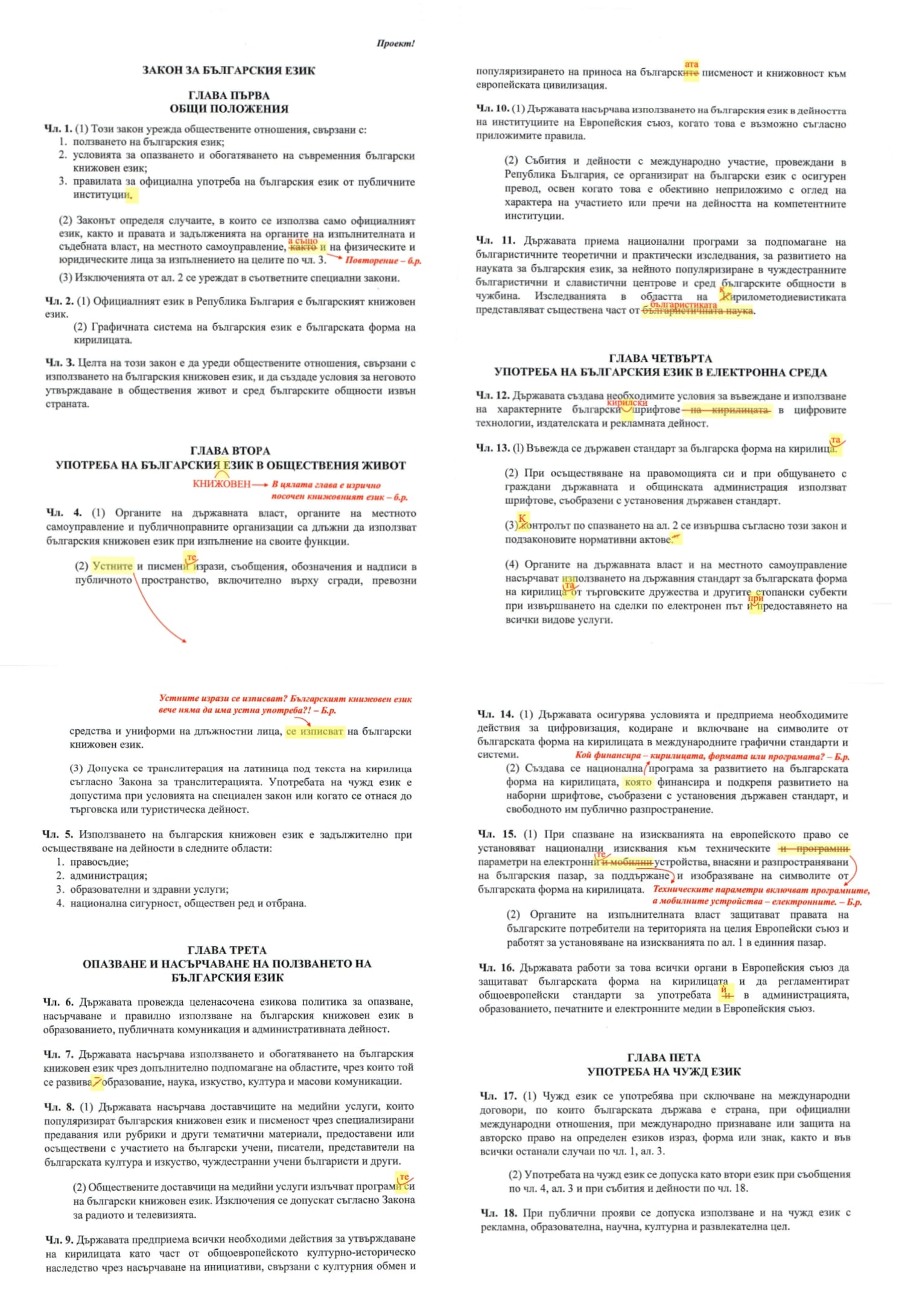
откриваме 57 грешки в текста на законопроекта и на придружаващите го документи. 

Език свещен, почти узаконен
Кликнете върху изображението, за да прегледате целия текст

Поне основното правило за употреба на пълния член да беше уважено, но не би! Няма научаване ни от ученици, ни от депутати. И така, един урок по граматика, който е лесен и върши работа вероятно в 99% от случаите: ако членуваната дума или словосъчетанието, в което е включена, може да се замести с той, тази дума се членува с пълен член; ако не може – с кратък член. Консултативният съвет [той] избира от състава си заместник-председател. Специално в този случай употребата е типична и няма нищо сложно – подлогът (предшестван от съгласувано определение) е в началото на изречението, където обичайно си стои.

Друг тип граматична грешка е допусната при съгласуването на определения, които са определения към едно съществително, но се отнасят за различни обекти или групи от обекти: устни и писмени изрази вместо правилното устните и писмените изрази; научните и образователни среди вместо научните и образователните среди.

На някои места има излишни запетаи. В придружаващото писмо например виждаме една често срещана грешка в езиковата практика – запетая след моля, когато следва да-изречение. В случаите, в които молим някого да направи нещо или някакво действие да се осъществи, не поставяме запетая: Молим законопроектът да бъде поставен за разглеждане и гласуване… 

Забелязват се и правописни грешки. Научната област кирилометодиевистика се пише с малка буква, но пък когато названието на Института за български език се свежда до една дума, главната буква се запазва – Института. Съюзът и не бива да се бърка с притежателното местоимение ѝ – употребата и в администрацията е грешно, когато става дума за употребата на кирилицата.

Няма как да подмина една лексикална грешка в самото название на документа – Законопроект на Закон за българския език. Ето ви пример за повторение. Редно е да бъде само Проект на Закон за българския език. Възможно е авторите да са се повлияли от много по-често внасяните законопроекти за изменение и допълнение на различни закони, но там употребата на думата е оправдана, защото, след като се одобри например Законопроектът [тоест проектът на закон] за изменение и допълнение на Закона за здравното осигуряване, ще бъде приет Закон за изменение и допълнение на Закона за здравното осигуряване. 

Целта ми, разбира се, не е да правя пълен разбор на забелязаните грешки, а и няма особен смисъл от такава изчерпателност. По-важно е, че те показват немарливото отношение на вносителите към българския книжовен език и незачитането на неговите норми. И не, не ги обвинявам толкова в неграмотност, колкото в двойствено отношение към езика и неговите правила: загриженост на думи – пренебрежение на практика.

Както заяви проф. Владислав Миланов,

добре е хората, които пишат законите за езика, да познават първо законите на езика.

Подсказвам на вносителите какво бих направила аз на тяхно място. Първо щях да си кажа, че този законопроект, щом е за българския език, трябва да бъде изпипан до последната запетая. И ако не съм нито професионален редактор, нито коректор, щях да потърся услугите на специалисти, за да редактират и коригират текста.

Да осъзнаваш доколко си компетентен в дадена област, е важно и бих казала, задължително умение за един съвременен човек. Ако пък един депутат не го притежава, липсата може да стане опасна. Законопроектът на Закона за българския език е нагледен пример за това. 


Езикът може да е вкусен и извън блюдото – онзи, българският език, на който говорим от малки и на който около 24 май се кълнем в обич. А той в същността си е средство за общуване и за да ни служи добре, непрекъснато се променя. Да го погледнем в неговата динамика и да се опитаме да разберем какво става и защо, кои са движещите механизми и как те са свързани с обществените процеси. И тъй като задачата не е лека, ще го правим постепенно – на порции.

What’s New in Zabbix 8.0 LTS

Post Syndicated from Arturs Lontons original https://blog.zabbix.com/whats-new-in-zabbix-8-0-lts/33755/

Zabbix 8.0 LTS might just be the largest Zabbix update yet. With a focus on application performance monitoring, new event processing workflows, scalability improvements, and MCP server for connecting Zabbix to your AI agents, Zabbix 8.0 stands out as a feature-rich and scalable solution for organizations of all types and sizes.

Application performance monitoring

Application performance monitoring (APM) has been one of our most requested features, and with the release of Zabbix 8.0 we’re ready to introduce it to our users.

Zabbix 8.0 LTS APM features enable Zabbix to collect and analyze metrics, logs, and traces collected using the OpenTelemetry protocol (OTLP). In our current implementation, OTLP data must be stored in a ClickHouse history backend, which can be configured as a Zabbix APM data source.

OpenTelemetry protocol data can be written to the ClickHouse source database either by a Zabbix proxy (which listens and collects incoming OTLP data and writes it to the ClickHouse database) or it can be sent directly to the ClickHouse database by the application itself using third-party plugins and solutions.

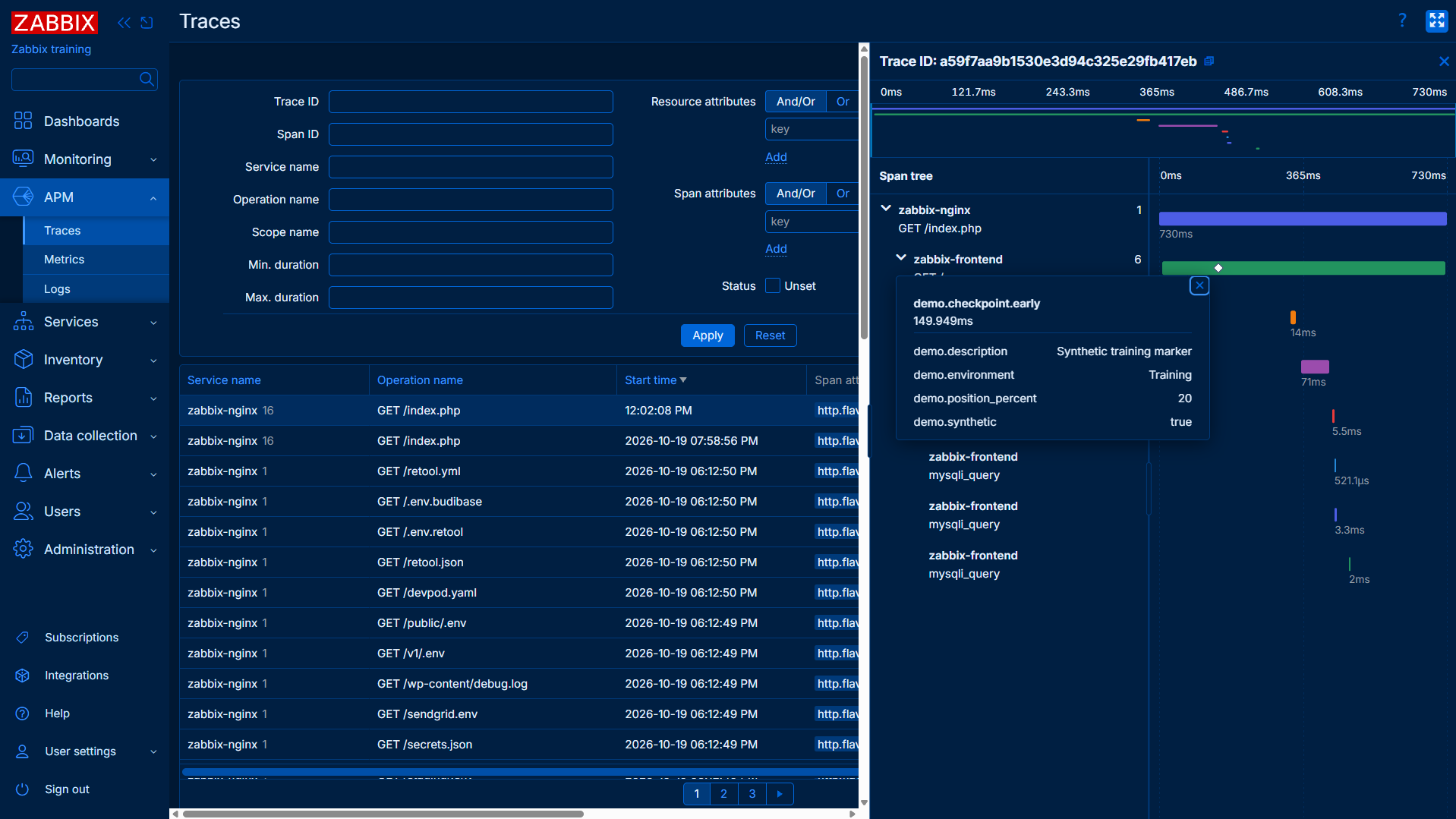
Traces, metrics, and logs can be viewed in the new APM section

Telemetry query item

Existing item types have also been expanded to support OpenTelemetry data collection. The new Telemetry query item type enables the collection of specific OpenTelemetry traces, metrics, and logs. The item supports filtering based on OpenTelemetry data fields – meaning that only the matching data is picked up by the item.

In addition, the item can be configured to collect and aggregate only specific OpenTelemetry data columns, returning a JSON with the required data. The data collection buckets can also be configured with parameters such as Time shift, Lookback limit, and Granularity.

We also offer a Generic OpenTelemetry by OTLP template which can serve as a starting point for Telemetry Query item creation and problem detection.

More detailed information regarding Telemetry query item configuration can be found in Zabbix documentation.

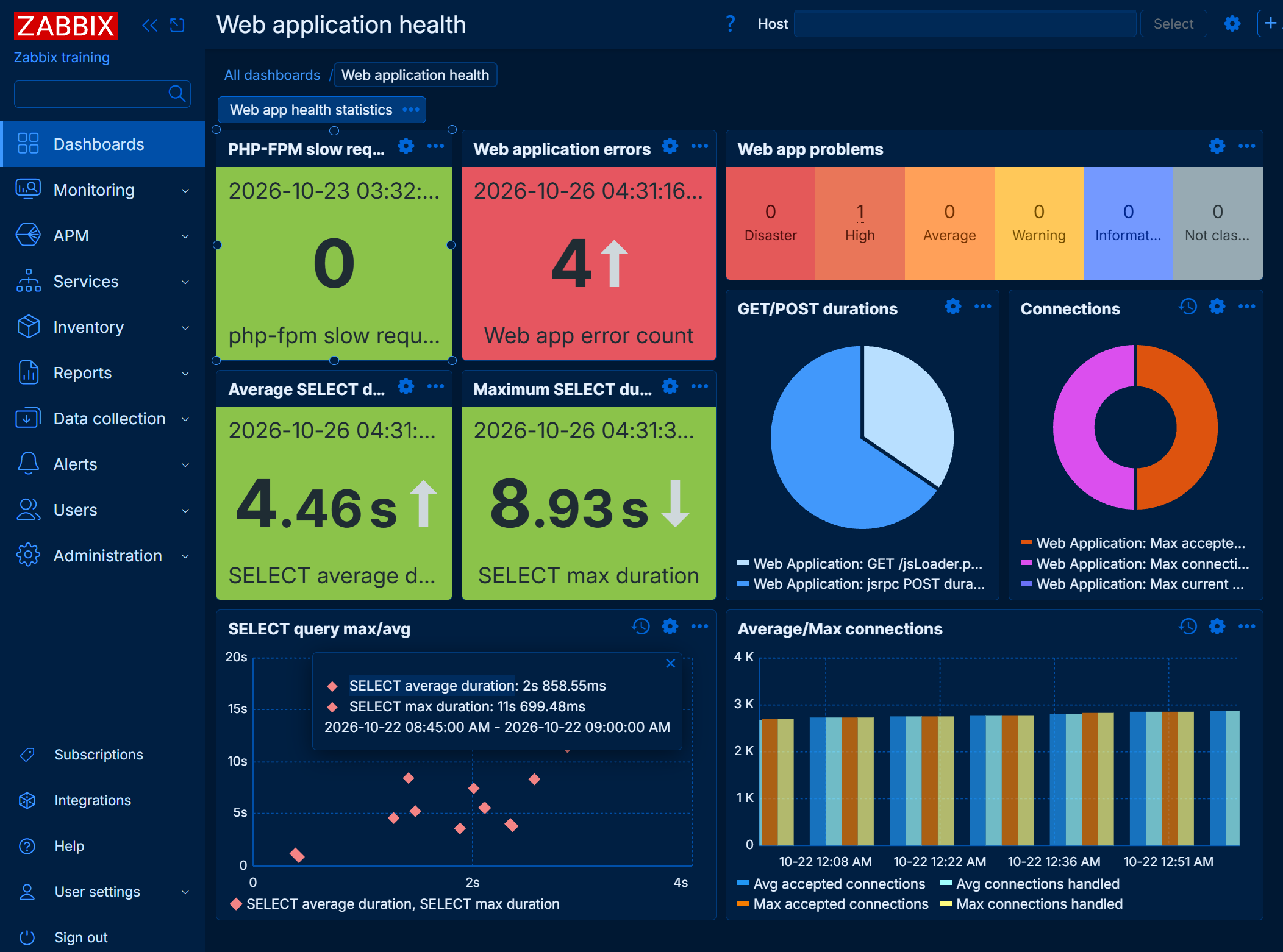
Telemetry query items can be used to build Zabbix dashboards

ClickHouse history backend

The ClickHouse history backend was specifically selected as the new history backend option because of the scalability and performance supported by ClickHouse.

ClickHouse can be configured as an additional history backend, meaning a regular MySQL or PostgreSQL database is still required to store Zabbix configuration. ClickHouse then can be configured to store specific types of data. There are a variety of benefits to implementing a ClickHouse history backend in your environment:

  • Column-based storage enables faster queries
  • Horizontal scaling and parallel processing by using sharding
  • In synthetic tests proven to support millions of values per second
  • ClickHouse is used as OpenTelemetry data storage

Complex event processing

Over time we’ve introduced a variety of features and made design decisions to support the eventual introduction of our new complex event processing engine. The goal of the newly introduced complex event processing features is to support a variety of event processing scenarios, such as:

  • Automated cause and symptom event ranking
  • Event deduplication
  • Event enrichment with contextual information
  • Automatic event closure and discarding

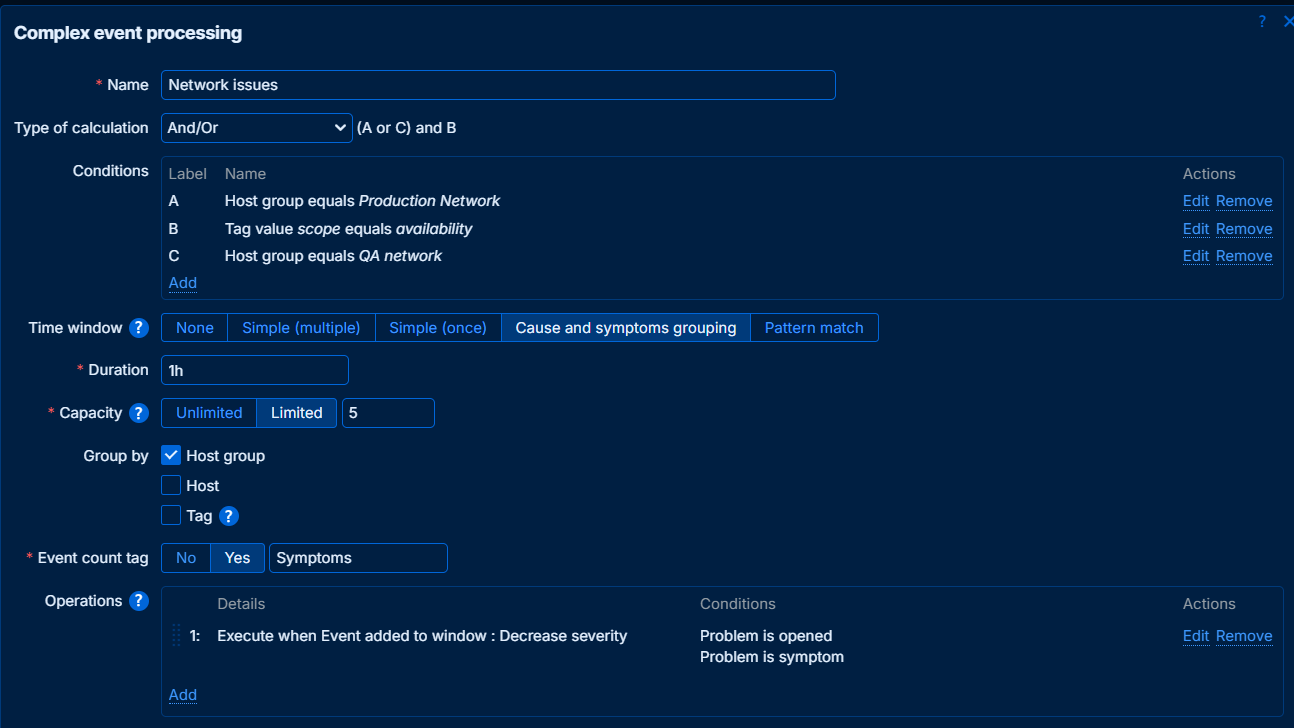
Under the hood, the complex event processing rules are based on conditions (which events to match), a time window (the window during which event processing logic will be performed) and operations (what is going to be done with matched events).

For most complex use cases where the available event matching methods might not suffice, Zabbix administrators have the option to use JavaScript-based event pattern matching.

Complex event processing offers granular event matching and correlation options

Zabbix MCP server

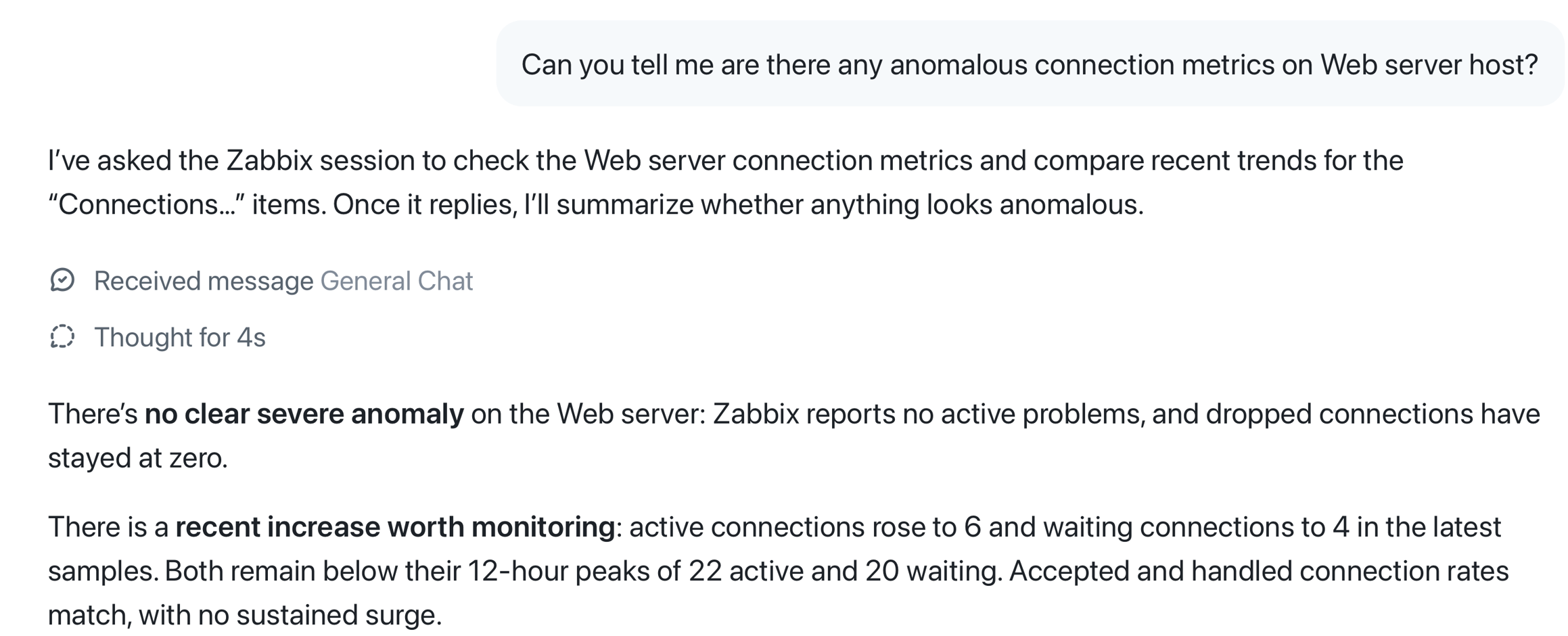
With the release of Zabbix 8.0 LTS, we’re introducing our official Zabbix MCP server. The MCP server can be installed from the official Zabbix repositories via the new zabbix-mcp-server package.

The MCP server contains definitions of multiple tools used to communicate with the Zabbix API:

  • Read Host, template, item and related configuration
  • Retrieve problems, maintenance and stored item history
  • Perform problem updates and manage maintenance periods

The full list of tools supported by the MCP server is available in our MCP server documentation.

MCP server can be used to enable AI data and problem analysis workflows

Ad-hoc maintenance

The existing maintenance functionality has been expanded from both the UX and the feature perspective.

Need to suppress a noisy trigger or a set of problems? Maintenance windows can now be created directly from the problem context menu. Here you can suppress not just the whole host, but also choose to suppress an individual trigger or a set of events based on their event names.

To achieve this, maintenance period configuration now has 2 new options:

  • Suppress problems generated by an individual trigger
  • Suppress problem events based on their name

Suppressing the trigger or event from the problem context menu will automatically fill in the corresponding configuration field. The fields can also be freely customized to fine-tune the maintenance window to fit your requirements.

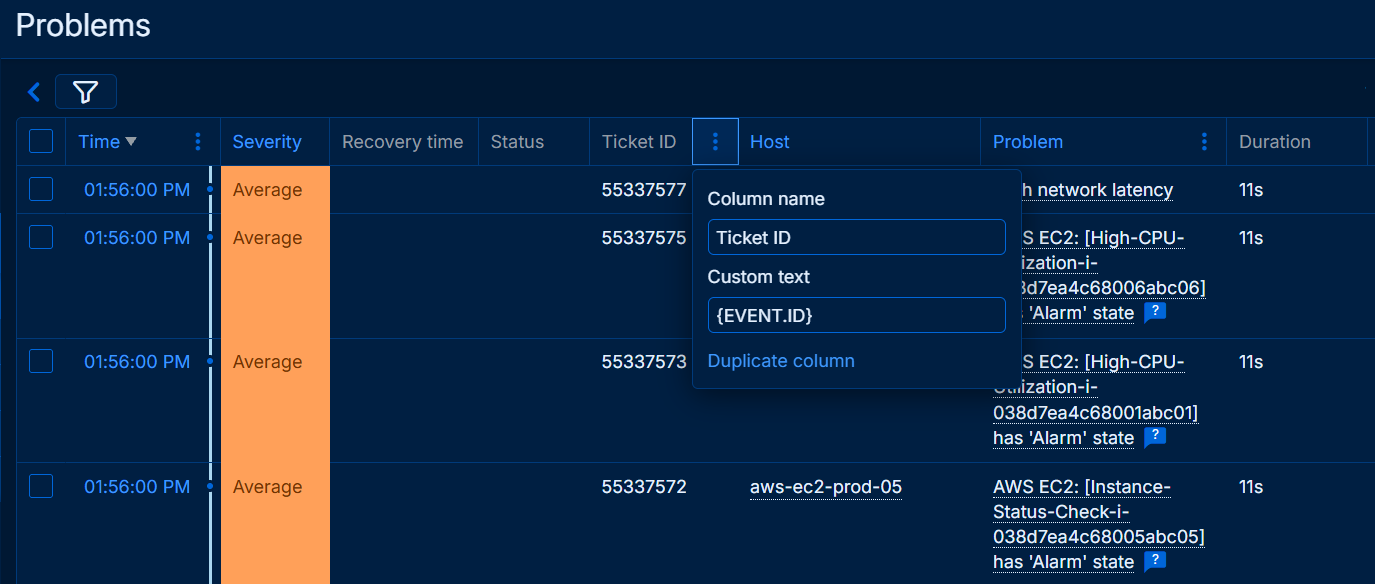
Configurable table fields

One of the largest user experience improvements coming in Zabbix 8.0 LTS is the ability to fully customize table views in the Monitoring and Data collection sections of the Zabbix user interface:

  • Table columns can be resized and reordered
  • Existing columns can be hidden
  • Columns for individual tag values can be added
  • Tables can be extended with custom data columns

Custom text columns can be populated with built-in and user macro values in addition to static text.

With the ability to fully customize table fields, Zabbix administrators can create views tailored for individual use cases and scenarios. For example, tables can be enriched with columns containing data such as trigger threshold values, inventory information, host details, or event IDs. This way, instead of navigating across a variety of Zabbix sections, a lot of additional context information can be provided in a single table view.

Configuring the MCP server requires a few simple steps:

  • Install the zabbix-mcp-server package
  • Provide the frontend URL in the MCP server configuration file
  • Configure additional security settings in the MCP server configuration file
  • Configure Zabbix user roles and permissions and assign an API token to the user
  • Connect your AI agent to the MCP server using the configured Zabbix user

From a security standpoint, the MCP server utilizes the Zabbix API, which means the usual user roles and permissions are fully considered when working with Zabbix via the MCP server. In addition to the usual set of Zabbix user permissions, the MCP server supports defining tool Allow and Deny lists, adding another layer of optional permission logic.

Custom fields with user and built-in macro values can be added to table views

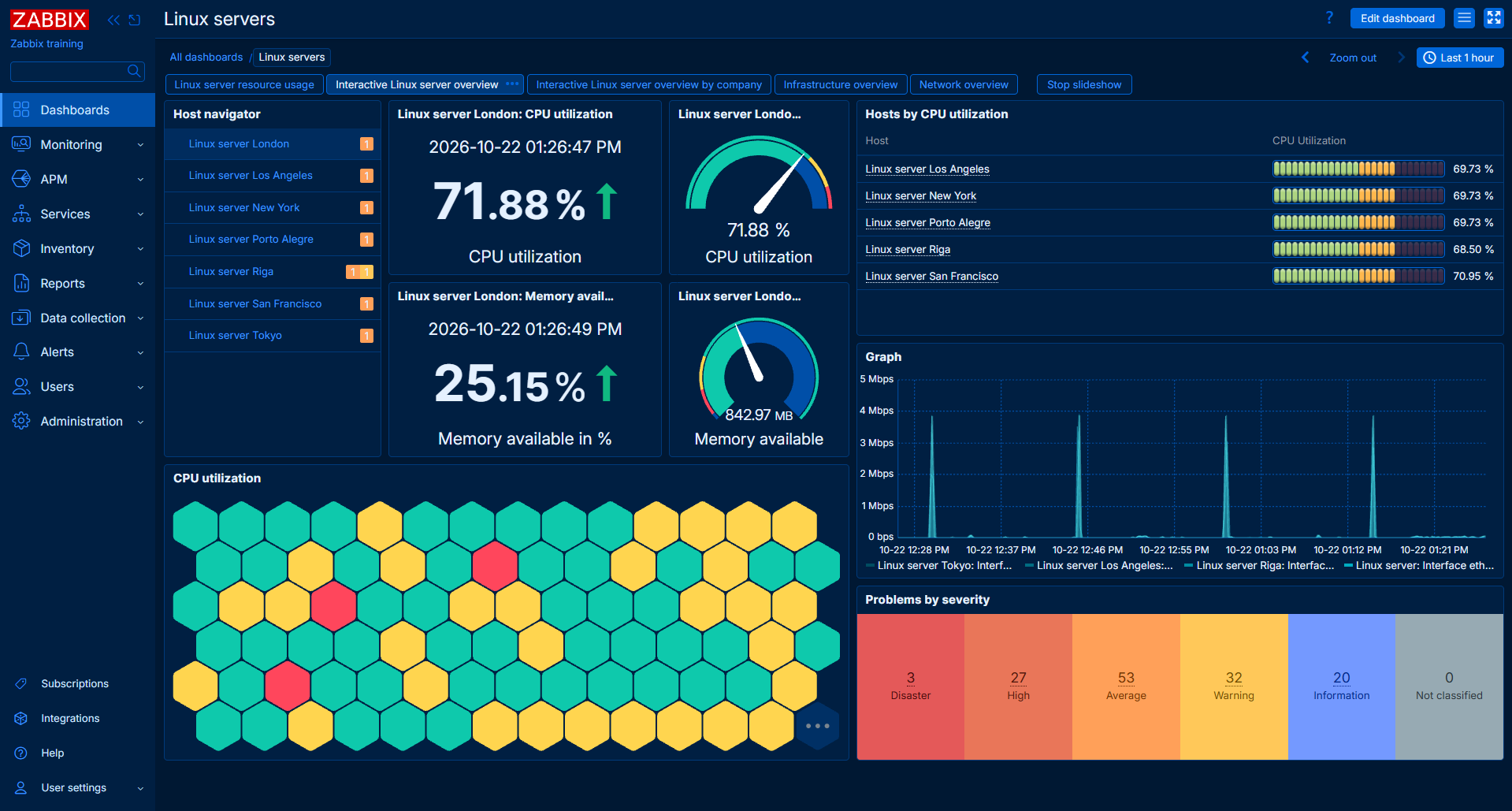
New dashboard theme

We have expanded the list of available frontend themes with a new addition – the dark blue frontend theme. The new theme can be accessed in user profile settings.

New Dark blue frontend theme is available in Zabbix 8.0 LTS

Visualization and UX/UI improvements

As always, our latest LTS release comes with a variety of improvements to UX/UI and Zabbix visualization features.

New and improved widgets:

  • A new scatter plot widget can be used to display relations between 2 metrics
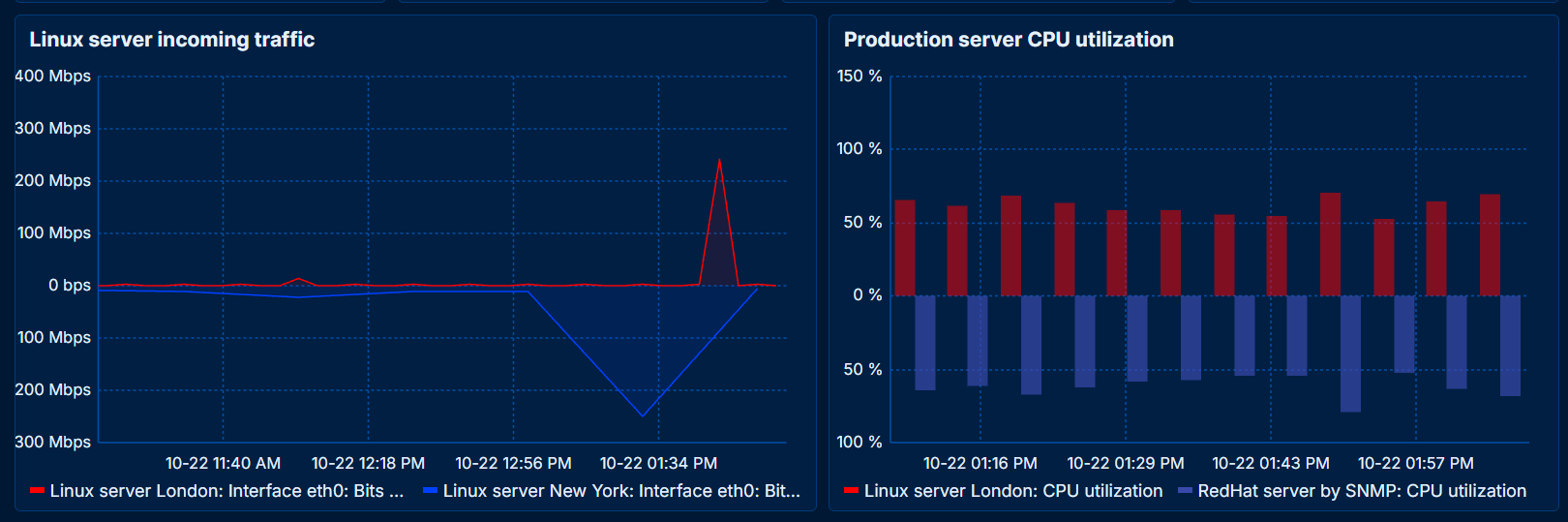
  • The graph widget now supports inverting value display on the Y axis
  • Hovering over an item in the tooltip highlights its graph while dimming others
  • A geomap widget clustering parameter has been added
  • The Top items widget can now aggregate item values into a single column or row
Inverted graph data sets enable quick metric comparisons in graphs

In addition to new widget features, Zabbix 8.0 introduces multiple improvements to the Zabbix user interface:

  • We have continued with expanding inline validation to various Zabbix configuration fields
  • Inherited tags are now displayed and returned consistently across templates, hosts, items, web scenarios, and triggers
  • Suppression icons have been expanded to display whether the problem suppression was performed manually or by a maintenance period
  • General improvements to Zabbix GUI look and feel
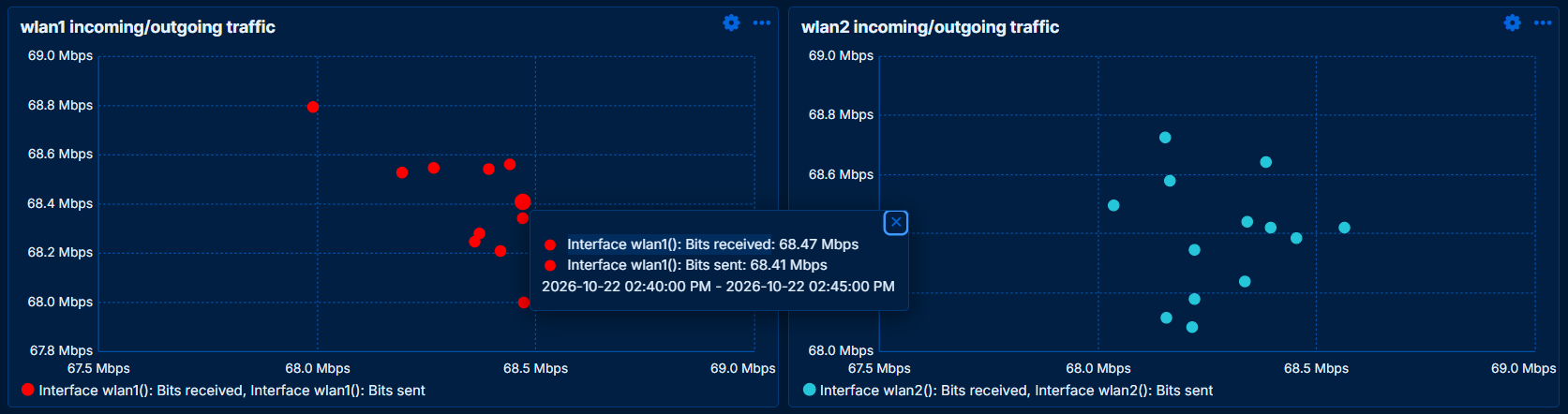
The new Scatter plot widget can be used to display relationship between two metrics

Dashboard import/export

In addition to widget improvements, we’ve also introduced the ability to import and export dashboards. This way, anyone can share their dashboards with other Zabbix users or use this feature to migrate a dashboard between multiple Zabbix instances.

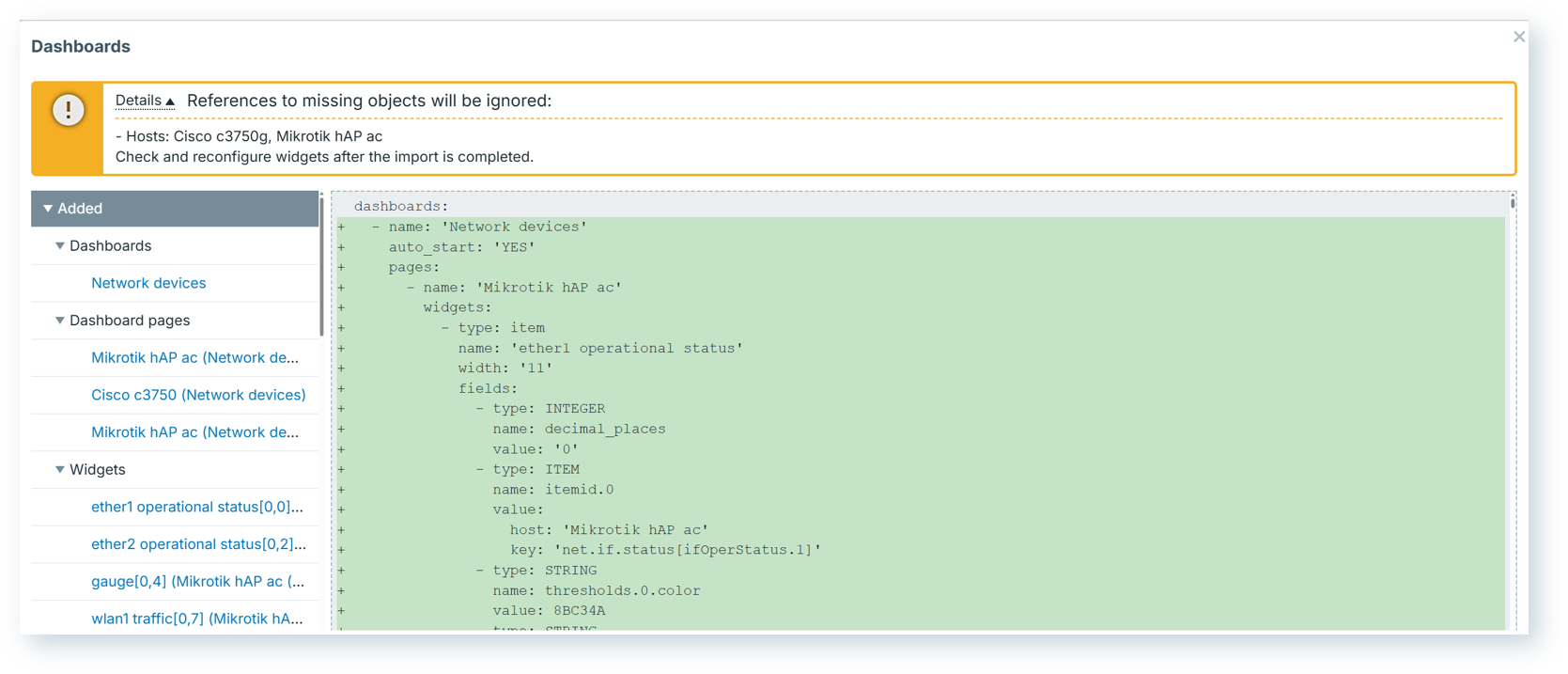
When importing a dashboard, users will also see a full list of imported dashboards, dashboard pages, and widgets. If the imported dashboard contains references to entities that are missing in the current environment, a warning will be displayed. In case of missing entities, the dashboard structure is still preserved so users can link the widgets to existing entities after the import is done.

During dashboard import all of added dashboards, pages and widgets are displayed

We’re also introducing our own public dashboard repository, where anyone can download and import official Zabbix dashboards into their own Zabbix environment.

New and updated templates

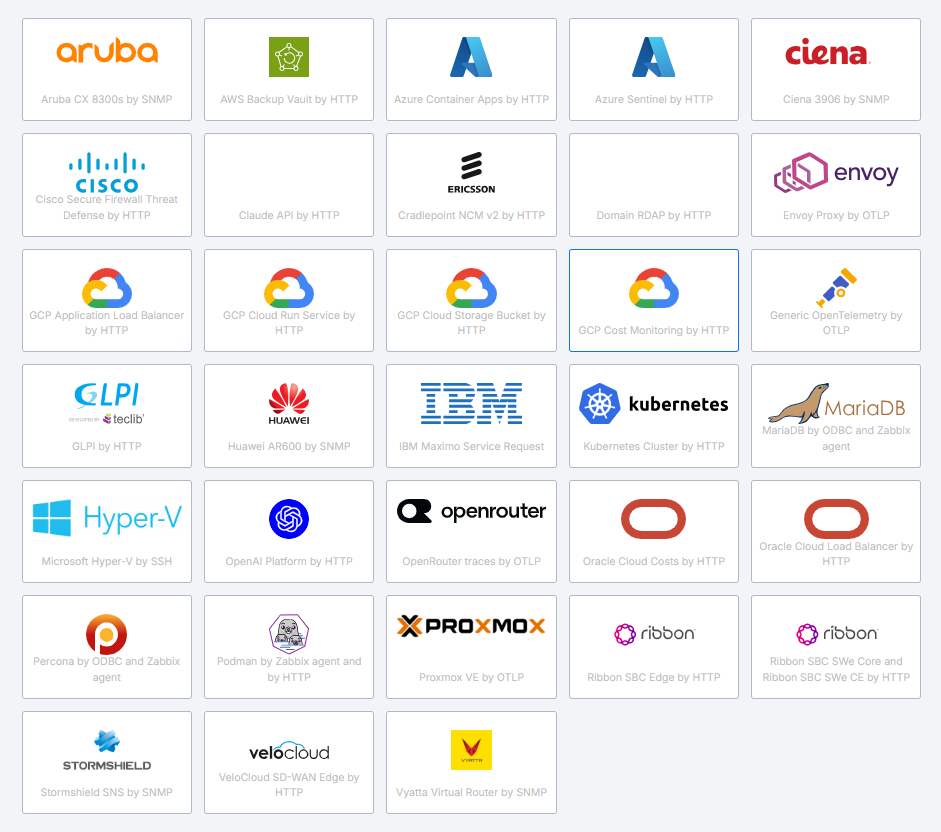
Zabbix 8.0 LTS comes packaged with a variety of new templates. The full list of templates can be found in our What’s new and upgrade notes documentation page.

In addition to new templates, we have continued expanding and improving upon our existing templates. Kubernetes administrators in particular might be interested in the reworked Kubernetes template – Kubernetes Cluster by HTTP. The old templates are retained for backward compatibility with existing configurations.

Final notes

But that’s not all – here we’ve listed only some of the more prominent features. In addition to what has been covered in this article, we have also introduced features such as:

  • New items
  • Improved performance related to various Zabbix components and data collection methods
  • Support for PostgreSQL cluster DB backends
  • Optimized Elasticsearch history backend
  • Extended native security features
  • Added the ability to import SAML certificates directly in Zabbix frontend
  • New low-level discovery features
  • And much more!

Check out the What’s new and upgrade notes documentation page to see the full list of features and improvements, and watch our Zabbix 8.0 webinar recording on YouTube to see the new updates in action.

The post What’s New in Zabbix 8.0 LTS appeared first on Zabbix Blog.

Светият синод на БТА

Post Syndicated from Дарина Сарелска original https://www.toest.bg/svetiyat-sinod-na-bta/

Светият синод на БТА

Добре че бяха президентските избори, за да си спомним, че има нещо като медия, нещо като държавно предприятие, нещо като министерство на официалната информация, нещо като пропаганден амвон, нещо, което в 2026 година прилича повече на ТАСС¹, отколкото на Reuters или AFP. Българската телеграфна агенция –

невзривеният мавзолей на медийното ни минало. 

Реформирана отвън, сложила костюма на съвременната агенционна журналистика, кръстила се за пред чужденците Bulgarian News Agency (между другото, този текст в Закона за БТА сега сигурно ще трябва да се оправя, след като управляващите се заеха да пазят кирилицата от преводачите), все пак БТА си остава вярна на своя член 1, който я дефинира като информационен институт на бюджетна издръжка. 

За разлика от БНТ и БНР, които се преоблякоха в обществени медии и чиито генерални директори от кумова срама се избират от поне-на-теория-независим-орган (СЕМ), тук генералният директор се назначава за срок от 5 години пряко от парламента по предложение на политическите партии. Което го прави нещо като министър на държавната информация с удължен мандат, ако се съди само по процедурата. 

Това даже стига, за да направи връзката медии–власт проблематична, защото е пряка, близка и причинно-следствена. Но не е само то. 

Кирил Вълчев изкара цяла предизборна кампания и беше дори избран за вицепрезидент, бидейки все още в неплатен отпуск като генерален директор на БТА. Междувременно Агенцията продължи да отразява шефа си в неговата двойна роля, произвеждайки дописки като тази, достойни за антипримери в часовете по журналистическа етика. 

Светият синод на БТА
Заглавие на статия в БТА от 4 ноември 2026 г.
Светият синод на БТА
Началото на статия в БТА от 4 ноември 2026 г.

В предизборната кампания Кирил Вълчев се запомни основно с това, че се превърна в меме с ярката си защита на неясно от кого нападнатата кирилица и с прословутия призив „на следващите президентски избори да не си говорим с арабски цифри, а да си говорим с българските букви“. В изборната нощ бетеанци се шегуваха, че те именно са големият победител от изборите, защото след шест години най-накрая ще сменят Вълчев, избиран единодушно от всяка власт. 

Аз вече не съм сигурна, че това е необходимо. Щом един човек може цяла предизборна кампания да е едновременно директор на държавната информационна агенция и кандидат за „Дондуков“ 2, а накрая и избран за вицепрезидент, без никой да се смути, защо изобщо да търсим наследник? Нека го узаконим: една длъжност на „Дондуков“ 2, една на „Цариградско шосе“. 

Може даже да му добавим и светски патриарх по съвместителство, след като Вълчев се записа и с приумицата да вкара Евангелието в новините и да задължи кореспондентите да отразяват проповедите на БПЦ като факт. Истински официален пазител на българщината и буквите. С две думи, 

Кирил на републиката (без Методий)

Кирил Вълчев не е първият преминал през въртящата се врата между медии и политика. Но определено е от ярките примери, редом с настоящата директорка на БНТ Милена Милотинова, която също направи едно кръгче по върховете между медиите и властта (беше депутатка от НДСВ, 2001–2005). И понеже всичко от един масраф се плаща – нашия, а и ретрото очевидно отново е на мода, си струва да припомним, че и двете организации имат дългогодишно минало на пропагандни апарати на социалистическата държава. 

Признанието като самопризнание

Защо прескачането на журналисти в политиката е саморазобличително и за политиката, и за журналистиката? Как журналистическото доверие се превръща в политически капитал и какво остава след това от самата журналистика – от Дарина Сарелска.

БТА като централен информационен и пропаганден институт на комунистическия Министерски съвет, а Българската телевизия като държавен монопол, чието ръководство и съдържание са под контрола на БКП. И двете – с дълга история на високоговорители на властта вместо на нейни корективи. На ретранслатори на прессъобщения и официални държавни комюникета. 

Минали са много години оттогава, но изглежда, разбирането за ролята на журналистите като прессекретарки на властта си е останало там. Поне за „прогресивното“ мнозинство на Румен Радев, което показа, че очакванията му от медиите са в най-добрите авторитарни традиции: да слушат и да препредават. 

Достоверно и в пълнота

В края на октомври правителствената информационна служба разпространи официална позиция, в която се казва, че професионалните стандарти изисквали думите на премиера да се отразяват „достоверно и в пълнота“ дори когато журналистите не ги харесват. А медиите, които съкращават и подбират информацията си, бяха обвинени в създаването на „политически наративи“. БТА, разбира се, публикува това. Без контекст що е то новина и как именно професионалният подбор на база обществен интерес и новинарска ценност отделя новините от суровата информация, която се лее в партийните Facebook страници. 

Асоциацията на европейските журналисти – България (АЕЖ – България) реагира веднага, че това издава дълбоко непознаване на журналистическата работа. Медиите не се свеждат до платформи за публикуване на прессъобщения на властта, а журналистите не са просто „стойки за микрофони“, четем в официалната позиция на професионалната организация. БТА не публикува това. 

Прочетена през Закона за БТА обаче, грешката е вярна! 

Защото онова, което АЕЖ – България с основание определя като нежурналистика, е всъщност законовото основание за съществуването на националната информационна агенция на държавна издръжка. 

Член 5 задължава БТА да разпространява безвъзмездно официалните актове и съобщения на президента, премиера, парламента, главния прокурор и практически на целия държавен апарат. Нещо повече, член 9 освобождава Агенцията от всякаква редакционна отговорност, когато прави това, стига да цитира точно и в пълнота. 

Вътрешните правила, утвърдени от Кирил Вълчев, отиват и по-далеч: съобщенията се публикуват „в пълен обем, във вида, в който са получени“. 

Ето ви го златния стандарт. Описан и прошнурован. Не трябва да се учудваме, значи, че сега премиерът Радев викна „равнис“ за всички медии по този явно доказано работещ (за него) модел. 

Good night, and good luck, motherf*ckers

Историята на американското предаване „60 минути“ е разказ за механизмите, чрез които се опитомяват медиите. И тези механизми са удивително сходни, независимо от пазара или знамето пред сградата на телевизията. Един текст в стил „Думам ти, дъще, сещай се, журналистическа снахо“ от Дарина Сарелска.

Държавен високоговорител с журналистическа карта

То така си беше, ще кажете вие. И ще сте прави – и при Борисов беше същото. Просто този е военен и командите се викат ясно и на плаца. Онзи беше пожарникар и гасеше пожарите в медиите с други достъпни му средства (опразване на столчета, държавна реклама и „размазване“ през регулаторите).

Но да се върнем на журналистиката. За разлика от устава на БТА, в нормалната агенционна журналистика прессъобщението е само източник: проверява се, поставя се в контекст и най-често не става новина само̀ по себе си. Ако не е вярно, даже става обект на разследване.

Професионалните агенции нямат нито задължението, нито лиценза да съобщават безнаказано всичко – дори неистини, само защото ги е изрекъл някой важен. Напротив, много от тях разполагат с цели екипи, чиято работа е да опровергават лъжите на важните (справка: Reuters Fact Check, AFP Proveri). 

В БТА не просто няма такива екипи. Няма и стимул за подобно разбиране и практикуване на журналистиката. Законът на практика окуражава липсата на въпроси и безкритичното цитиране. Това е удобна защита за държавния куриер, но е и вграден рефлекс за автоцензура. 

Когато не питаш, не рискуваш нищо.

Когато препечатваш, не създаваш „наративи“. Защото когато питаш, сравняваш и поставяш в контекст, може да ядосаш точно този, който ти плаща. Законът е превърнал липсата на въпрос и папагалската нежурналистика в начин на оцеляване и в бизнес модел. А за някои, като бонус – очевидно и във възможност за кариерно издигане. 

„Няма места.“ Журналистиката след журналистите

Ако се чудите какво стана с медиите в България, този текст ви е напълно достатъчен, за да си дадете отговори на много въпроси. А иначе, вие въпроси може и да си задавате, но в много медии у нас вече няма кой да ги задава – гледайте какво нещо… Защо стана така – от Дарина Сарелска.

Агенция, която никой не купува, но всички плащаме

И тук няма как в наратива да не включим малко арабски цифри (с извинение към вицепрезидента – генерален директор). 

Защото именно числата рисуват БТА като любопитен икономически феномен: куха държавна фирма, от която никой не иска да купува, но явно ни е скъпа. Толкова скъпа, че са налага данъкоплатците да плащат двойно – и на входа, и на изхода. 

Веднъж осигуряват бюджетната издръжка на радиоточката, тоест явяват се неин собственик по неволя, и втори път – клиент по неволя, защото пак с публични средства се плаща сметката на държавните институции, които са нейни законово задължени абонати. Ето това е бизнес модел! 

Явно за това говори Кирил Вълчев, когато казва, че вижда БТА като институция на съгласие и национално приобщаване и обединение. Със сигурност сме обединени в плащането на сметката. 

От началото на управлението на Кирил Вълчев държавната субсидия на Агенцията се е увеличила повече от два пъти, от около 6 млн. лв. през 2020 г. до на над 15 млн. лв. за 2025 г., докато собствените приходи между 2020 и 2025 г. са намалели от 1,258 млн. до 981 000 лв., тоест с около 22%. И дори тези скромни постъпления не са от новините, които БТА произвежда, а основно от пресконференции, архивни материали, снимки, реклама и наеми. 

За сравнение, AFP също получава от френската държава 120 млн. евро субсидия, но това е около една трета от общите ѝ приходи. Останалото идва от реални клиенти. При БТА собствените приходи са едва 5%, всичко друго е държавна помощ. 

Качествената агенционна журналистика по правило не е евтина, камо ли безплатна. Бизнес моделът ѝ е споделяне на разходите: никоя редакция не може сама да си позволи кореспондент във всяка столица и екип за всяко събитие, затова десетки медии плащат по малко за общ агенционен екип, който работи за всички. Редакцията възлага тази част от работата си на Агенцията срещу абонамент. 

Финансовата криза на традиционните медии постави на изпитание модела и на много места се наложи предоговаряне на условията. Абонамент за AFP или Associated Press можеше да достигне до 500 000 евро през 2009-та, след оптимизации сега стига до 80–100 000 евро на година. На абонат. Но медиите, включително българските, намират пари и плащат, когато виждат стойност. 

Като обществени медии БНТ и БНР са обявили публично тези абонаменти, големите частни телевизии също ги ползват. Учудващо, но за периода ноември 2024 г. – април 2025 г. излиза, че общественото радио плаща повече за български агенции, отколкото за международни, въпреки разликите в качеството и обема информация. 

Но тъй като радиото остава на практика сред малкото реални медийни клиенти на БТА, се наложи проблемът да бъде решен генерално: вместо да се конкурира за клиентите, през 2022-ра БТА стана безплатна по закон и получи допълнителна държавна гаранция за издръжката си. Това идва след дълги години мижав интерес (поради липса на качество) към бюлетините на БТА, предназначени за другите български и чуждестранни медии. 

Краят на журналистиката

Журналистиката губи не само пари и трафик, а и необходимостта да я има. Алгоритми, нюзинфлуенсъри и политици, които вече говорят директно на публиката, променят правилата на играта. Въпросът вече e не дали медиите са в криза, а дали обществото изобщо още иска журналистика. От Дарина Сарелска.

Докато лобира за реформата, през 2021 г. самият Кирил Вълчев признава пред парламентарната Комисия по културата и медиите, че дори БНТ вече се е отказала от абонамента си. От 145 акредитирани посланици в България към онзи момент едва 37 плащат за англоезичния бюлетин Daily News, а другата английска емисия има само 7 абонати, повечето на бартер. Вълчев обяснява отлива на клиенти с финансовите затруднения на медиите. Но като видите водещата страница на БТА и я сравните с тези на Reuters или Associated Press, става ясно, че причините са други. 

Ето ви малко БТА заглавия с дата 7 ноември 2026 г. 

ОБНОВЕНА Бюджетът задава визията за развитие на държавата, а нашата цел е българите да живеят по-добре и по-сигурно, заяви премиерът Радев

Вицепремиерът и министър на финансите Гълъб Донев заяви, че за 2027 г. представя „бюджет на вразумяването“ и на реалните цифри

От 2017 г. не е имало увеличение на ученическите стипендии и се предвижда да бъдат повишени с 20 процента през 2027 г., каза министър Георги Вълчев

Ученически театър и срещи на кварталната общност ще се състоят в 104-о ОУ „Захари Стоянов“

Националният етнографски музей представя изложба за азербайджанската килимарска традиция

Пожарната служба в Петрич предупреждава за повишен риск от пожари през отоплителния сезон

Творчеството на Вежди Рашидов остава значима част от българската култура, написаха от НХА

В Самоков бе отслужена панихида в памет на героите, загинали във войнитe

Има и 1550 новини годишно само за български фолклорни състави в чужбина според отчетите на самия Вълчев. Стилът „Работническо дело“ не може да се сбърка – същият безпочвен оптимизъм, същият клиширан език, същото усещане, че няма значение какво се е случило, важното е как от държавния амвон се разказва за него. Само дето годината е 2026-та, има интернет и социални мрежи и това вече не работи. 

Но продължава да ни струва пари. 

За 2026 г. за издръжката на БТА-буквите и за публикуването на прессъобщения в пълнота бюджетът ще плати близо 10 млн. евро. Отделно са платените партньорства, които държавни институции подписват с БТА – нещо като задължителен втори стълб на издръжка. Общото е, че винаги е на принципа „от единия джоб в другия“. А платецът винаги сме всички ние, данъкоплатците. 

Кой има нужда от мавзолея на „Цариградско шосе“?

Големият победител наистина е БТА и нейните държавни ръководители. Предстои да видим как ще бъде избран наследникът на Вълчев. Ще го има ли традиционния консенсус на партийни предложения като през 2021 и 2025 г., когато Вълчев беше избран без нито един против? Предложен първоначално от ГЕРБ, преизбран с гласовете на ГЕРБ, „Има такъв народ“ и БСП, а сега вицепрезидент, издигнат от днешното мнозинство. За това „единство на нацията“ говорим. Или просто за доказателството, че партиите не са имали интерес да сменят един функционер, който не им създава проблеми. 

Затова не питайте колко струва БТА. Питайте какво ни казва фактът, че никой в парламента не иска да се замисли защо я издържаме на загуба. 

1 Руската държавна информационна агенция, създадена през 1925 г. като Телеграфна агенция на Съветския съюз. След разпадането на СССР през 1992 г. е преименувана на ИТАР-ТАСС (Информационна телеграфна агенция на Русия – ТАСС), като запазва и познатата съветска абревиатура. През 2014 г. връща старото си име ТАСС.

Reduce alert fatigue by customizing threat detection features in Amazon GuardDuty

Post Syndicated from Allan Holmes original https://aws.amazon.com/blogs/security/reduce-alert-fatigue-by-customizing-threat-detection-features-in-amazon-guardduty/

The teams responsible for security today don’t have a problem with the number of alerts they receive; they have a problem turning those alerts into something truly actionable. When an analyst concludes an investigation with “this was caused by our vulnerability scanner” or “this account is configured to share Amazon Machine Images (AMIs) publicly on purpose,” the detection worked as designed, it just wasn’t applicable to the environment. When this happens continuously at scale, alert fatigue sets in. As teams sort through these events, incident response slows down or, worse, teams stop paying attention to the alerts at all.

Amazon GuardDuty is a threat detection service that continuously monitors, analyzes, and processes Amazon Web Services (AWS) data sources and logs in your AWS environment for suspicious or potentially malicious activity. GuardDuty then delivers detailed security findings to you for visibility and remediation. GuardDuty accomplishes this by analyzing independent streams of available sources. This includes logging of management events in AWS CloudTrail, information about IP traffic through Amazon Virtual Private Cloud (Amazon VPC) Flow Logs, and Amazon Route 53 DNS query logs to name a few. These sources don’t need to be enabled or configured within your accounts for GuardDuty to use them. When GuardDuty observes activity that looks suspicious or anomalous, it produces a finding that’s a detailed security alert naming the behavior, the resources involved, and any supporting evidence. A finding is a signal to investigate, not a final verdict.

While the managed detections in GuardDuty work consistently across every AWS customer, personalizing detections for your specific architectures and environments is equally important. Over the past year, AWS has released a set of capabilities within GuardDuty that you can use to supply that missing context, most recently with the launch of Custom Detection Rules.

In this post, we walk through those capabilities in three distinct stages. These stages explore how to customize what GuardDuty detects, triage the findings that remain, and accelerate investigations. Throughout this blog post you’ll learn how to:

  • Efficiently detect anomalous behavior that shouldn’t occur in a specific account, without building detection logic yourself
  • Measure if a detection will be noisy before it generates a single finding, flooding security teams
  • Feed your own custom threat intelligence, including file hashes, into GuardDuty
  • Scope a suppression rule narrowly enough to archive expected activity while surfacing the same behavior elsewhere
  • Get an automated analysis of a finding, with a risk level and recommended actions, before the finding is opened manually

Prerequisites

For the walkthrough in this post, you must have the following prerequisites in place.

  • GuardDuty must be enabled in at least one AWS account and AWS Region. Note that these customization features aren’t currently available in all Regions, for more information, see Region-specific feature availability.
  • Your user or role must have AWS Identity and Access Management (IAM) permissions to configure these features in GuardDuty. The AmazonGuardDutyFullAccess_v2 managed policy covers the required actions.
  • If you manage multiple accounts through AWS Organizations, AWS recommends administering GuardDuty using the delegated administrator account. By using this method, you can manage lists, suppression rules, and conduct investigations from a centralized location.
  • GuardDuty Runtime Monitoring must be enabled to conduct file hash matching and to use Custom Detection Rules for Runtime Monitoring. This protection plan isn’t enabled automatically in GuardDuty.
  • An Amazon Simple Storage Service (Amazon S3) bucket that you control for storage of custom threat entity lists.
  • The AWS Command Line Interface (AWS CLI) installed.

Stage 1: How to customize what GuardDuty detects

An AMI is a pre-configured template that contains the software configurations needed to launch an Amazon Elastic Compute Cloud (Amazon EC2) instance on AWS. Sharing an AMI publicly can be a routine operation in an account whose purpose is distributing images, and a potential security event in any other account. The same might be said for disabling VPC Flow Logs, or signing in without multi-factor authentication for a legacy service account. Until the release of Custom Detection Rules, there was no way to account for these differences in GuardDuty.

Custom Detection Rules

Custom Detection Rules is a library of prebuilt, opt-in rules that AWS builds and maintains. At launch, it holds 90 rules across AWS CloudTrail management events and GuardDuty Runtime Monitoring events, producing 38 finding types mapped to 13 MITRE ATT&CK® tactics, described using vocabulary from ATT&CK and the Threat Technique Catalog for AWS. The catalog is maintained by the AWS Customer Incident Response Team (CIRT) and is based on the MITRE ATT&CK Cloud Matrix, documenting threat actor tactics, techniques, and procedures specific to AWS as observed by the AWS CIRT during customer engagements. Each entry includes detection guidance and mitigations specific to AWS environments, so a technique ID on a finding points to a public entry that your team can read.

Previously, detecting environment-specific behavior meant ingesting your own CloudTrail logs or host telemetry, normalizing them, building the logic, and maintaining that logic as APIs changed. Custom Detection Rules remove that work. You select the rules for GuardDuty to evaluate against the CloudTrail management events it already analyzes and, where Runtime Monitoring is enabled, the runtime events from the GuardDuty security agent, without the undifferentiated heavy lifting of log ingestion, normalization, and storage. Coverage is extended without adding unnecessary alerts that don’t add value to your teams.

Each rule runs in one of two modes. In dry run mode, GuardDuty evaluates the rule and publishes Amazon CloudWatch metrics showing how often an event matched the rule, but generates no findings. Dry run mode expires automatically after 14 days. In live mode, events that match generate findings, and live mode has no expiration.

Custom Detection Rules are currently available in all AWS commercial Regions and the AWS GovCloud (US) Regions. Custom Detection Rules for Runtime Monitoring are available in every region where GuardDuty Runtime Monitoring is available.

Walkthrough: Measure a rule, then turn it on

Start in dry run so you can measure the noise level before receiving a finding. This walkthrough uses the AMIExternalAccess rule, which detects when an AMI is shared with an external AWS account or made public, and applies it from the GuardDuty delegated administrator account. In an organization, the delegated administrator manages Custom Detection Rules for all member accounts through an organization configuration, and accounts that join the organization later inherit it.

Using the GuardDuty console

  1. Open the AWS Management Console for GuardDuty and choose Custom Detection Rules.

    Figure 1 – The Custom Detection Rules catalog with the detection logic for the AMIExternalAccess rule

    Figure 1. The Custom Detection Rules catalog with the detection logic for the AMIExternalAccess rule

  2. Select a rule name to see its detection logic on the Details tab. Rules are SQL conditions over CloudTrail fields, so you can review exactly what a rule matches before enabling it.
  3. Choose the rule’s Accounts tab, then under Organization configuration, choose Configure.

    Figure 2. Configuring the AMIExternalAccess rule in dry run mode

    Figure 2. Configuring the AMIExternalAccess rule in dry run mode

  4. Under Configuration strategy, select Whole organization. Under Status, select Dry run. Under Accounts, select Apply rule status to all accounts, then choose Save.
  5. Watch the CustomRuleDryRunSignalsMatched metric in CloudWatch. GuardDuty publishes the metric only when the rule matches an event, so a rule with no matching activity shows no data. Because dry run mode expires automatically after 14 days, a full dry-run period is the longest continuous sample GuardDuty collects without you re-enabling the rule. The metric data persists in CloudWatch under its standard retention after the dry run ends, so you can review it shortly before or after expiry and still base your decision on the most complete data available. Volume alone doesn’t tell you whether the activity is benign, so account for what you see before deciding. If a rule matches constantly and someone can point to the process that causes it, that account is a poor candidate for live mode. If nobody can explain the matches, investigate them as they stand, because a dry run measuring real attacker activity looks the same as one measuring routine operations.

    Figure 3. Dry-run match volume for a rule over one week, shown as hourly totals

    Figure 3. Dry-run match volume for a rule over one week, shown as hourly totals

  6. When you’re satisfied the rule is worth acting on, return to the rule’s organization configuration and change Status to Live to start generating findings. To keep the rule off in accounts where the activity is expected, such as an image-build account, choose Exclude accounts manually under Accounts and select those accounts.

Using the AWS CLI

  1. From the delegated administrator account, apply the rule in dry run to the whole organization. Omitting account lists targets every member account, including accounts that join later.
    aws guardduty create-custom-detection-rule-org-configuration \
    --rule-id ami-external-access \
    --mode DRY_RUN

  2. Review the CustomRuleDryRunSignalsMatched metric over the dry-run period, applying the same judgment described in the preceding console procedure.
  3. Move the rule to live mode by updating the existing configuration. Creating a second whole-organization configuration for the same rule fails with a conflict error. To exclude accounts where the activity is expected, add --exclude-account-ids.
    aws guardduty update-custom-detection-rule-org-configuration \
    --rule-id ami-external-access \
    --mode LIVE \
    --exclude-account-ids <image-build-account-id>

Note: In a standalone account that isn’t part of an organization, you enable a rule for that account alone. With the AWS CLI, use create-custom-detection-rule-association with the same --rule-id and --mode parameters. To change the mode later, use update-custom-detection-rule-association with the association ID. Member accounts in an organization can’t enable or change a rule themselves; the delegated administrator manages rules on their behalf. For details, see Managing Custom Detection Rules in multiple-account environments.

Threat entity lists

If your threat intelligence team already tracks known-bad infrastructure and files, you can pass those indicators to GuardDuty and generate findings when they appear in your AWS account.

GuardDuty has two list formats. An IP address list holds IP addresses only. An entity list, the newer format, can hold IP addresses, CIDR ranges, and domain names together in a single file. The difference that matters is coverage: entity list entries apply to CloudTrail, VPC Flow Logs, and Amazon Route 53 Resolver DNS query log findings, while IP address lists cover CloudTrail and VPC Flow Log findings only. If you still use IP address lists, the additional DNS coverage is a reason to move.

In addition, entity lists now also accept SHA-256 file hashes. Hashes sit alongside network indicators in the same file, and GuardDuty checks them against Runtime Monitoring. When the runtime agent sees an executable whose hash matches an active list, it generates a high severity Execution:Runtime/MaliciousFileExecuted.Custom finding and names the matching list, so your responder knows which intelligence source was used.

Note: If the entity list is changed, the list must be reactivated to include the updates. Uploading a new version of the file isn’t sufficient on its own. If this step is automated, build that reactivation step into the same process that refreshes the file.

Entity lists are currently available in all AWS commercial Regions, but not in the AWS GovCloud (US) Regions.

Stage 2: How to triage the findings that remain

Customizing detection reduces findings at the source, but the work is rarely finished there. New workloads appear, teams change how they operate, and some findings still describe activity that’s expected in your environment. You also need a precise way to route those events away from the queue your analysts work from.

A filter selects findings. A suppression rule is a filter that automatically archives a GuardDuty finding it matches. Archiving isn’t deletion: the finding is retained for 90 days and stays viewable, but the finding isn’t forwarded to AWS Security Hub, Amazon S3, Amazon Detective, or Amazon EventBridge, so it stays out of your security information and event management (SIEM) system and ticket queue.

Two changes have made that routing more customizable.

Wildcards

Filter criteria now support the Matches and NotMatches operators, where * matches any number of characters and ? matches one. Criteria used to be exact-match only, so suppressing findings from every AWS Lambda function in a service meant listing each name and updating it on every deployment. One pattern now covers the naming convention, including functions that don’t exist yet, so the rule stops going stale.

Additional property filter fields

You can now use over 1,000 supported fields from a finding as suppression criteria, including runtime process details, Kubernetes workload metadata, network connection information, and attack sequence signals. Take a vulnerability scanner in one Kubernetes namespace generating expected findings. With no namespace criterion available, you previously either suppressed the finding type more broadly than you wanted or wrote downstream logic to strip them. Now you scope the rule to that specific namespace and leave detection intact everywhere else in the cluster. This expanded field set is available in the aws partition; other partitions continue to use the console-supported fields only. See Filtering findings in GuardDuty for the full list of supported fields.

The recommended method is to assemble your criteria on the Findings page first, confirm the filtered list contains only findings you’re willing to archive, then choose Create suppression rule. The console and CLI procedures are detailed in the user guide.

Figure 4. Findings filtered by finding type and Kubernetes namespace, before creating a suppression rule

Figure 4. Findings filtered by finding type and Kubernetes namespace, before creating a suppression rule

Before you write wildcard criteria, know that they can’t be validated with ListFindings or GetFindingsStatistics, the testing workflow AWS recommends for ordinary filters. Instead, start from a filter that takes no action and watch the suppression rule metrics to see how much it would match before you rely on it. Nothing is lost if the pattern is too broad, matched findings are archived rather than deleted, so you can lift the suppression rule and return them to your queue.

Stage 3: How to accelerate investigations

What remains consumes analyst hours. To decide whether a finding is a real event, an analyst pivots into CloudTrail for the operations that identity performed, lines up timestamps, checks IPs and domains against intelligence, and looks for a change ticket that explains the work. That can take hours, and most such investigations end in expected. When one doesn’t, all that time was spent before any actual containment could begin.

GuardDuty Investigation, also called AI-powered investigations performs that correlation automatically. GuardDuty Investigation analyzes the finding alongside related activity from the past 90 days, affected resources, threat intelligence, and threat indicators, and returns a structured summary in minutes: a risk level, a confidence rating, a written summary, supporting detail, MITRE ATT&CK classification, and recommended actions including the CLI commands to carry them out.

Note: Read the confidence rating as carefully as the risk level. High risk with low confidence is a very different indicator to an analyst than high risk with high confidence.

You can investigate a single finding, an account, or a whole organization, from the console, the AWS CLI, the API, or an AWS MCP Server. To turn on AI-powered investigations, go to Settings, find AI powered investigations – Preview, and choose Enable.

Figure 5. A completed account investigation with risk level, confidence, analysis summary, and recommended actions

Figure 5. A completed account investigation with risk level, confidence, analysis summary, and recommended actions

The preview runs in 10 AWS Regions: US East (N. Virginia), US East (Ohio), US West (Oregon), Canada (Central), Europe (Frankfurt), Europe (Ireland), Europe (London), Europe (Paris), Europe (Stockholm), and Asia Pacific (Tokyo). It allows 10 investigations per account per day and 100 per account in total, and can only be started from an administrator account, member accounts can’t create investigations from their own accounts. The feature uses Amazon Bedrock models with Cross-Region Inference (CRIS), which automatically selects a Region within your geography to process the analysis and generate the report. Your data remains stored only in the Region where the investigation request originates, but investigation data and summary results might be processed outside that Region. Review that routing if you have data residency commitments. For GuardDuty Region-specific differences more broadly, see Region-specific feature availability in the user guide.

Putting it all together

Consider a team running containerized workloads on Amazon Elastic Kubernetes Service (Amazon EKS) across a handful of accounts in one organization.

The threat intelligence team uploads SHA-256 hashes from a recent brief as a threat entity list. Security engineering enables Custom Detection Rules in dry run mode and finds after 2 weeks that AMI sharing fires constantly in the image-build account and nowhere else, so they promote the rule to live across the organization and exclude the build account.

The team’s vulnerability scanner runs in a dedicated Kubernetes namespace, so they suppress that namespace and finding type while leaving the same behavior detected elsewhere. A second rule uses a wildcard on their Lambda naming convention, replacing a hand-maintained list.

Suppressed findings are archived instead of being sent to Security Hub, Amazon S3, EventBridge, or the SIEM, so they never reach the analyst queue. When a finding does warrant attention, an analyst starts an investigation and gets a disposition before manual work begins.

Each stage reduces the work of the next. Customizing detection means less to triage, effective triage means less to investigate, and automated investigation means the findings that reach a human get a decision faster.

Next steps

If you haven’t enabled GuardDuty, start with the 30-day free trial. Most protection plans enable automatically and are included, so you can evaluate them. Turn on Runtime Monitoring separately if you want to test hash matching or Custom Detection Rules for Runtime Monitoring..

If you’re already using GuardDuty:

  • Enable two or three Custom Detection Rules in dry run mode. Choose behavior that shouldn’t occur in specific accounts, measure across the dry-run period, then promote selectively.
  • Revisit existing suppression rules. Any rule written before the April 2026 field expansion might be broader than you intended, because the field you wanted wasn’t available then; narrow it to that field now.
  • Audit filters for wildcard opportunities. Any filter with a growing list of exact-match names is maintenance a single pattern can replace.
  • Migrate IP address lists to entity lists for the DNS query log coverage.

Conclusion

GuardDuty’s managed detections keep expanding, driven by AWS threat intelligence, security research, and customer feedback. These capabilities enable you to decide which activity is worth alerting on in which accounts, and which findings never need to be delivered to a human at all.

Learn more


Allan Holmes

Allan Holmes

Allan brings over 20 years of experience spanning security & compliance, networking, and DevOps to his current role as a Security Specialist. Giving him a uniquely holistic view of cloud security challenges. Allan holds multiple technical certifications from AWS, ISC2, CompTIA, and an MBA, enabling him to bridge deep technical expertise with business strategy. Outside of work, Allan is an avid gardener and electronics enthusiast who enjoys exploring innovative technologies hands-on.

Austin Buettner

Austin Buettner

Austin is a Senior Technical Account Manager (TAM) at AWS, where he helps enterprise companies build and operate secure, resilient workloads at scale. A former architect with over 15 years of experience in IT, he focuses on security, networking, and cloud operations, turning AWS capabilities into practical guidance customers can put to work. Outside of work, Austin enjoys golfing, hitting the gym, and spending time with his family.

Zhuo Zhang

Zhuo Zhang

Zhuo is a Technical Lead at AWS GuardDuty, where he builds the software and systems behind the service’s threat detection mission. Since 2016, he has been part of GuardDuty from concept through many expansions. Zhuo uses his background in software engineering and cybersecurity to develop the capabilities of GuardDuty. Outside of work, Zhuo enjoys trying new technologies and spending time with his family.

Patch Tuesday – November 2026

Post Syndicated from Adam Barnett original https://www.rapid7.com/blog/post/em-patch-tuesday-november-2026

Microsoft is publishing 1,092 own-product vulnerabilities on November 2026 Patch Tuesday, including 745 vulnerabilities in Windows. Until a few months ago, these volumes would have been unimaginable, but if anything, this month feels like a slight reprieve.

The jury is still out on whether patching many more vulnerabilities will lead to better security outcomes; every code change to resolve a known vulnerability could easily introduce new hidden treasure for researchers or threat actors to unearth in the future.

Despite the vast uptick in volume during 2026, there has been no accompanying increase in the number of vulnerabilities known to be exploited in the wild. Microsoft is aware of exploitation in the wild for just one of the vulnerabilities published today, with no known public disclosure at all this month.

Outlook: zero-day spoofing

Imagine coming home and checking your mailbox to find a postcard. You admire the non-specific image of a tropical beach at sunset, and flip it over to scan the handwriting on the back, which looks vaguely familiar. It’s addressed to you, but you can’t make out the signature, and the message is short and generic. Is that real handwriting, or has this been printed? Probably marketing material.

You put the card in the recycling and, since life is busy, you move on and forget about it. Somehow, you remain entirely unaware that, immediately after reading the postcard, you took out your phone and sent high-resolution images of your front door key to a number you’ve never contacted before.

Is this sketch just some rather questionable science fiction? Yes, hopefully, but what if that non-specific postcard was instead a malicious file in your Outlook inbox? Now we’re talking about CVE-2026-124194, an exploited-in-the-wild spoofing vulnerability. Merely opening a specially crafted malicious file causes Outlook to silently connect to an attacker-controlled location and leak the user’s NTLM v2 hash. All supported versions of classic Outlook receive patches.

The relatively low CVSS v3.1 base score of 6.5 does not tell the full story here, since this vulnerability provides value for both commodity attackers working to harvest initial access at scale, and also more targeted campaigns by more sophisticated threat actors.

The NTLM v2 hash can be relayed live to impersonate the user against another service, at least where those services do not implement adequate safeguards such as message signing for SMB or LDAP, as well as Extended Protection for Authentication for Exchange or Active Directory Certificate Services. Alternatively, the NTLM v2 hash can be cracked offline by a motivated attacker to retrieve the underlying credential. The Preview Pane is not a vector, which will help limit the real-world impact somewhat.

Windows Schannel: critical pre-auth RCE

A pre-authentication remote code execution (RCE) vulnerability in Windows will always attract attention. CVE-2026-119952 allows an attacker to execute code on a target system by sending specially crafted malicious packets. Since the vulnerable component is Schannel, which is Microsoft’s implementation of Transport Layer Security (TLS), attackers may not have to look very far to find vulnerable endpoints.

The advisory provides some comfort by pointing out that specific conditions are required for exploitability, which reduces the likelihood of broad exploitation, but the advisory still assesses exploitation as more likely, so Microsoft presumably expects that the development of reliable exploit code is feasible. In many cases, there will be no need for an attacker to have an existing foothold on the same subnet.

The execution context likely depends on the vulnerable service, which points to the evergreen need for least privilege architecture, but it also means that we cannot exclude the possibility of pre-auth RCE as SYSTEM in some cases.

Exchange/Windows Search: critical pre-auth RCE

Could someone take control of your Exchange server by sending a single email? In short: yes. Microsoft offers customers tight integration between various business-critical components. Exchange running on Windows is Microsoft on Microsoft, and the Windows Search component indexes email on behalf of Exchange.

An attacker aiming to exploit CVE-2026-116928 relies on this helpful synergy to achieve pre-auth RCE on the server by sending a malicious attachment, which Exchange will process automatically. How’s that for low attack complexity Although the advisory does not specify the context of execution, we should assume SYSTEM, since several of the services which might be involved do run with a high privilege level.

Since the patches are for Windows OS rather than Exchange itself, there’s no need to worry about which version of Exchange you’re running, so long as you are running only Exchange Subscription Edition, since all previous versions of Exchange are now fully beyond end of support.

Microsoft lifecycle update

There are fewer Microsoft product lifecycle changes in November 2026 than last month. As of Nov 11, 2026, .NET 8 Long Term Servicing channel moves past its release end date, along with PowerShell 7.4 LTS, and the 23H2 versions of the Enterprise, Education, and IoT editions of Windows 11.

Summary charts

2026-11-vuln_count_component.png
2026-11-vuln_count_impact-component-heatmap.png
2026-11-vuln_count_impact.png

Update history

  • 2026-11-12: corrected the number of Windows OS vulnerabilities.

AWS refreshes ProcessUnity Global Risk Exchange assessment to enhance customer’s third-party due diligence

Post Syndicated from Naranjan Goklani original https://aws.amazon.com/blogs/security/aws-refreshes-processunity-global-risk-exchange-assessment-to-enhance-customers-third-party-due-diligence/

Amazon Web Services (AWS) is pleased to announce renewal of the AWS ProcessUnity Global Risk Exchange assessment. This validated assessment report helps customers perform effective cloud supplier due diligence on AWS and enhances their third-party risk management process.

What is the AWS ProcessUnity Global Risk Exchange assessment

Many customers use third-party cyber risk management (TPCRM) services such as ProcessUnity to better manage risks from their evolving third-party environments and to drive operational efficiencies. To help with such efforts, AWS has completed the ProcessUnity Global Risk Exchange assessment of its security posture. ProcessUnity’s assessors perform the review of Global Risk Exchange assessment and validate the results annually.

This assessment approach replaces static spreadsheets with a dynamic system that combines advanced analytics, threat intelligence, and risk models with vendor input. Vendor profiles continuously update as cloud provider risk levels and AWS security posture evolve, keeping risk matrices current in near real time. Additionally, customers can also use Framework View which maps AWS assessment controls to threat profiles, MITRE ATT&CK scenarios, and global compliance standards and frameworks including National Institute of Standards and Technology (NIST) 800-53, International Organization for Standardization (ISO) 27001, Payment Card Industry Data Security Standard (PCI DSS), and Health Insurance Portability and Accountability Act (HIPAA), significantly reducing customers’ third-party due diligence burden.

How can you access the assessment?

Customers can request access to the report by completing an access request form, available on the ProcessUnity Global Risk Exchange page. If you are an existing ProcessUnity Global Risk Exchange member, you can request access from within ProcessUnity Global Risk Exchange portal.

To learn more about our compliance and security programs, see AWS Compliance Programs. As always, we value your feedback and questions; reach out to the AWS Compliance team through the Contact Us page.


Naranjan Goklani

Naranjan is an WS Compliance, Security Assurance and Privacy (CAPS) Lead for Canada. He has experience leading audits, attestations, certifications, and assessments across the Americas. Naranjan has more than 16 years of experience in technology risk management, customer security assurance, and technology audits. He previously worked in the Big 4 accounting firms and supported clients from the financial services, technology, retail, and utilities industries.

Nitro Sandboxes: Hardware isolation for every EKS pod, ECS task, and EC2 workload

Post Syndicated from Alex Graf original https://aws.amazon.com/blogs/compute/nitro-sandboxes-hardware-isolation-for-every-eks-pod-ecs-task-and-ec2-workload/

Security has been the foundation of AWS cloud computing since day one. When we built Amazon Elastic Compute Cloud (Amazon EC2), we designed it with strong isolation that keeps customer workloads and data separated from every other tenant on the same hardware. The AWS Nitro System took that further by moving virtualization, storage, and networking onto dedicated hardware, making zero operator access to customer data the default. Customers then asked us for more. They wanted tightly scoped, attestable environments for their most sensitive processing: the code and data that required protection even from their own administrators. That’s why we built Nitro Enclaves. Today, more of those sensitive workloads run in containers on Amazon Elastic Kubernetes Service (Amazon EKS), Amazon Elastic Container Service (Amazon ECS), and self-managed Kubernetes and container runtimes on Amazon EC2. Customers are asking for the same level of isolation and confidentiality for container environments.

Container environments today host many independent workloads on a single EC2 instance by using Linux container technology. For a lot of customers, Linux containers have become the prevalent workload delivery vehicle because of their ease of deployment and the ability to have them share resources in one host through a shared kernel. This sharing has some downsides. Operators of a shared cluster have access to all the tasks running in it. A weakness in the shared kernel reachable by one container also exposes every other container on the host. With the current rate of Linux Common Vulnerabilities and Exposures (CVEs), containerized workloads need an architecture that isolates each workload from other workloads and from cluster operators.

Introducing AWS Nitro Sandboxes

This week we introduced AWS Nitro Sandboxes, a new Amazon EC2 building block that gives each container the boundary of a hardware-isolated virtual machine (VM). Each sandbox gets the security properties of the Nitro System (strong isolation, zero operator access to customer data, and attestation) while keeping the familiar container experience. And isolation is designed so that no one outside the Nitro Sandbox can read its contents: Neither the cluster administrator, the platform team, nor AWS can read EKS pod or ECS task memory.

A Nitro Sandbox is a lightweight virtual machine that you launch and control from your EC2 instance. To your instance, it behaves like a child VM. Under the hood, it runs as a separate VM alongside your instance. The Nitro System enforces separation between the sandbox and its parent instance, between sandboxes, and between the sandbox and AWS operators. The parent instance contributes vCPU, memory, and I/O. Nitro keeps the workload isolated and, when you ask, proves what code it is running.

Because a Nitro Sandbox is a first-level guest with no nested hypervisor, and the Nitro Hypervisor enforces its CPU and memory boundary in hardware, compute and memory run at near-native EC2 performance. Instead of needing a separate instance for every workload or customer that needs a hard boundary, you can consolidate many isolated workloads onto instances you already run. You can then improve utilization and lower cost without giving up the boundary that made separate instances attractive in the first place.

Nitro Sandboxes share the same Nitro System isolation technology that we have operated for years as Nitro Enclaves. With Nitro Enclaves, we designed everything around the smallest possible surface: You dedicate full CPU cores and memory to a separate VM that you can only reach over a vsock channel. With Nitro Sandboxes, we built on the same foundation, but adjusted the experience to the needs of container workloads in three ways. First, a sandbox’s vCPUs can share cores with the parent instance through time slicing. Second, the parent can attach standard virtio network and block devices, not only a vsock channel, so the sandbox gets real networking and storage. Third, you can run the sandbox through a standard virtual machine monitor (VMM) such as Firecracker. The result is a general-purpose, hardware-isolated environment that behaves like a normal VM and runs almost anywhere EC2 runs.

We then took Nitro Sandboxes and natively integrated them into Amazon EKS and Amazon ECS, providing a turnkey solution to Nitro-backed, confidential virtual-machine-based container isolation at scale. Nitro Sandboxes are broadly available with the following features:

  • Instances: Every EC2 instance type that supports Nitro Enclaves, across general purpose, compute optimized, memory optimized, storage optimized, and accelerated families, on AWS Graviton, Intel, and AMD processors, in commercial Regions worldwide, at no additional charge.
  • Storage: Sandboxes reach storage the same way an EC2 instance does: local instance store for scratch space, Amazon Elastic Block Store (Amazon EBS) for persistent volumes, and Amazon Simple Storage Service (Amazon S3) or Amazon Elastic File System (Amazon EFS) over the network. To keep data confidential from the parent, you can use attestation-gated AWS Key Management Service (AWS KMS) keys, the same model as Nitro Enclaves, now integrated into Nitro Sandboxes, EKS, and ECS.
  • Networking: Each sandbox runs its own kernel, and therefore its own network stack. The parent connects that stack to your Amazon Virtual Private Cloud (Amazon VPC) the same way it does for containers today. On EKS, pods keep their own VPC IP address through the Amazon VPC CNI. On ECS, each task gets its own elastic network interface in awsvpc mode. Network policies and security groups are enforced on the parent instance, outside the sandbox, so a compromised workload cannot turn them off.

With Nitro Sandboxes, you can give every workload that needs a hard boundary its own VM, without giving it its own instance. AI agents that write and run their own code can run each session in a separate sandbox. Code that a prompt injection gets the agent to run stays inside one VM, which is deleted when the session ends. Software as a service (SaaS) providers can run many tenants on shared EKS nodes or ECS Managed Instances, each in its own sandbox, instead of giving each tenant a dedicated instance. Continuous integration and continuous delivery (CI/CD) pipelines can run privileged builds and untrusted pull request code inside a per-job VM rather than on dedicated build machines. And with confidential sandboxes, model providers can deploy closed-weight models in a customer’s account, knowing the weights are decrypted only inside an attested sandbox. Regulated industries can give auditors cryptographic proof of exactly what ran.

Isolation by design

Containers on a shared node all trust one Linux kernel. A single kernel issue can lead to data exposure across pods or tasks. With Nitro Sandboxes, each pod, task, or agent runs in its own VM with its own kernel. A kernel issue in one sandbox doesn’t affect its neighbors.

The Nitro Hypervisor establishes strong, virtual-machine-based security isolation through its leading security posture and built-in confidential computing which we continuously extend. The hypervisor removes the parent’s access to the sandbox’s memory and CPU register state. Only I/O buffers that the sandbox explicitly shares stay visible to the parent.

Nitro Sandboxes can therefore treat the parent instance as untrusted and attest to what runs inside. They use the Nitro-based Nitro Secure Module (NSM) to gain an attestation document in the same style as Nitro Enclaves. A workload can be configured to get its secrets only after it proves it is running the code you approved. The system is designed so that no one outside the sandbox can read its contents: Neither the cluster administrator, the platform team, nor AWS can read EKS pod or ECS task memory. You write AWS KMS key policies that require specific attestation measurements before AWS KMS releases a decryption key. This creates a verifiable link between who can decrypt and what code is actually running.

Isolation modes in EKS and ECS

On top of Nitro Sandboxes, EKS and ECS provide two isolation modes. With these modes, you can choose between faster launch times and cryptographic attestation:

  • Confidential sandbox: Sandboxes are fully attestable. Image loading and other runtime operations are gated by a Cedar policy, image contents are verified and extracted inside the sandbox, and the ephemeral layer is encrypted. AWS KMS releases your secrets only to workloads that prove they run the code you approved. Use this mode for anything that handles secrets, including when you want protection from your own operators. SaaS providers can show their customers that tenant data is protected through attestation. Regulated industries can give auditors cryptographic evidence in addition to documentation.
  • Isolated sandbox: Each pod (EKS) or task (ECS) runs in its own hardware-isolated VM with its own kernel, protecting the node and neighboring workloads from anything that happens inside the sandbox. The node and its operators are trusted, just as they are for pods and tasks today, and image validation works the same as it does without sandboxes. For workloads that also need protection from the node operator, use confidential sandbox.

Getting started on Amazon EKS

To get started on EKS, use EKS Auto Mode. Add runtimeClassName to your pod spec, and EKS handles instance selection, Nitro component setup, and scheduling. Use confidential-sandbox for a confidential sandbox or isolated-sandbox if you do not need protection from node operators. For self-managed EKS, you will need a compatible Amazon Machine Image (AMI) to support Nitro Sandboxes.

To learn more about the EKS experience with Nitro Sandboxes, see the Amazon EKS blog post.

Getting started on Amazon ECS

You can use Nitro Sandboxes on ECS with ECS Managed Instances. ECS launches compatible EC2 instances in your account, sets up a fully configured Bottlerocket image, and runs each task in its own Nitro Sandbox. ECS supports the two isolation modes, CONFIDENTIAL_SANDBOX and ISOLATED_SANDBOX.

Each task reports its isolation mode in a read-only trustedExecutionSummary field when you describe it. Per-task security groups, VPC Flow Logs, Application Load Balancer, Network Load Balancer, and Amazon VPC Lattice work as before. To learn more about the ECS experience with Nitro Sandboxes, see the Amazon ECS Developer Guide.

Getting started on Amazon EC2

If you manage your own instances, or build your own platform, you can launch Nitro Sandboxes directly on nearly any instance built on the AWS Nitro System. Amazon Linux and Firecracker support Nitro Sandboxes today. We have started to upstream support for Nitro Sandboxes in Linux and other virtual machine monitors. We also worked with operating system vendor partners to add support early, so you can keep the stack your workload already depends on.

In addition to containers, Nitro Sandboxes serve as a building block for more in-instance virtualization use cases. Nitro Sandboxes support a special “Direct Mode” switch which disables attestation, but allows the parent to retain access to sandbox memory. We have seen early adopters use this mode to execute non-enlightened operating systems, including Windows or Android, in sandboxes. Other customers have used Nitro Sandboxes to create fully attested package build environments, where each built package receives a tamper-proof signature of its build inputs. See the Amazon EC2 User Guide for details.

Pricing and availability

Nitro Sandboxes, along with the EKS and ECS integrations, are available at no additional charge. You pay for the EC2 instances, plus the standard EKS Auto Mode or ECS Managed Instances management fee if you use those capabilities. Nitro Sandboxes run on nearly every EC2 instance, EKS cluster, and ECS cluster, so strong per-container, per-task, and in-instance isolation is available to everyone.

For more information, see the Nitro Sandboxes documentation in the Amazon EKS User Guide, the Amazon ECS Developer Guide, or the Amazon EC2 User Guide for direct use on EC2 instances.


About the authors

Alex Graf

Alex is a Principal Engineer on the EC2 team at AWS.

46% fewer nodes, 2× faster indexing: Confluent on Amazon OpenSearch Service

Post Syndicated from Sukanth Rajan original https://aws.amazon.com/blogs/big-data/46-fewer-nodes-2x-faster-indexing-confluent-on-amazon-opensearch-service/

Operating one of the world’s largest data-streaming platforms, Confluent, the company founded by the original creators of Apache Kafka and now part of IBM, continuously modernizes its infrastructure to stay ahead of rapid data growth. Confluent’s data-streaming products, including its Apache Kafka, Connect, and Flink fleets, are available on the AWS Cloud, and its internal logging system runs on Amazon OpenSearch Service, ingesting hundreds of terabytes of logs per day to support operations across that fleet.

At that ingest volume, indexing work dominates the hot tier. The question Confluent’s engineering team set out to answer was not “can we run on cheaper hardware,” but “how much more ingest can we absorb per node, and how much headroom does that free up?” This post shows how a measure-first migration of the OpenSearch hot tier to the purpose-built OpenSearch optimized instance type, oi2, improved indexing performance and ingestion headroom first. oi2 costs more per node, but we needed far fewer of them. The lower cost came from that efficiency, not from a lower instance price.

Why instance choice matters for ingestion

Confluent’s hot tier ran on r6gd, a previous-generation, general-purpose Graviton2 instance with local NVMe added as a bolt-on. The team migrated to the current-generation OpenSearch Optimized Instance family (oi2), purpose-built for OpenSearch. On oi2, local NVMe is the primary storage tier with no separate Amazon Elastic Block Store (Amazon EBS) volume. Data is copied synchronously to Amazon Simple Storage Service (Amazon S3) for durability, and the storage and network path is integrated specifically for indexing and merge I/O. For an ingest-bound logging workload, that storage path is the lever. It’s what lets each node sustain a higher indexing rate at lower latency.

A domain with OpenSearch Optimized Instances uses local storage as the primary tier, with data copied synchronously to Amazon S3 as it arrives. This provides increased indexing throughput with high durability (11 nines). Within the family, OR1, OR2, and OM2 use Amazon EBS volumes (gp3 or io1) locally, whereas oi2 instances use local NVMe disks. These instances benefit indexing-heavy operational analytics workloads such as log analytics, observability, and security analytics.

OpenSearch supports two replication strategies: logical (document) and physical (segment) replication. With logical replication, data is indexed on all the copies independently, leading to redundant computation on the cluster. OpenSearch Optimized Instances use the physical replication model, where data is indexed only on the primary copy. Additional copies are created by copying the segments from the primary (durably persisted to Amazon S3). Because this frees up compute resources on replicas that would otherwise redundantly index data, and network overhead on the primary, the cluster can churn more throughput. When Optimized Instances are configured with replicas, the indexing rate might appear lower than it actually is (for example, showing a rate of 1,000 when the actual indexing rate is 2,000). This is because indexing is only performed on primary shards.

Reference architecture

The following diagram shows the OpenSearch multi-domain topology, split by priority (P0/P1) and volume, behind Cross-Cluster Search.

Kubernetes clusters feed the Confluent ingestion pipeline that writes to four OpenSearch domains read through cross-cluster search

Figure 1: OpenSearch multi-domain topology, with writes going directly to the P0 and P1 domains and reads served through cross-cluster search

A measure-first approach

Each domain was modernized in two logical phases, so the efficiency of the new instance could be measured in production before capacity was removed:

  1. Phase 1, a type swap at constant node count: an in-place Amazon OpenSearch Service blue/green re-provision at the same node count, to measure real production efficiency at fixed ingest. At equal nodes, oi2 ran at roughly one-third the CPU of r6gd for the same ingest, about 2.7x the headroom per node.
  2. Phase 2, iterative rightsizing: nodes were removed in steps, holding at each step to confirm cluster health, until a guardrail became binding. That guardrail turned out to be JVM heap, not CPU, because heap pressure is driven by query patterns, and removing nodes concentrates the same shards onto fewer of them.

Spending the Phase 1 headroom this way let the fleet consolidate to roughly half the nodes. Each oi2 node carried about 1.9x the load of an r6gd node (168 ÷ 90), while indexing got faster, not slower.

Production results: Ingestion efficiency first

The following figures are production averages at the same ingest (7-day baseline on r6gd compared to a 24-hour window on oi2 at the final node counts). Because the log traffic is identical, the comparison reflects a real change per unit of work. We didn’t benchmark R8gd for this migration. Our evaluation focused on the OpenSearch optimized (oi2) family, which is built specifically for log-analytics ingestion and storage economics.

Fleet node count dropping from 168 on r6gd to 90 on oi2, a 46% reduction

Figure 2: Total hot-tier fleet size, 168 r6gd nodes compared to 90 oi2 nodes, a 46% reduction

Node count per domain falling from r6gd to oi2: Domain A 30 to 12, B 36 to 18, C 39 to 27, D 63 to 33

Figure 3: Node count per domain on r6gd compared to oi2, with reductions of 31 to 60 percent

Indexing latency per domain roughly halving from r6gd at 0.18 to 0.19 ms to oi2 at 0.08 to 0.10 ms

Figure 4: Average indexing latency per domain on r6gd compared to oi2, roughly halved across all four domains

Write queue depth per domain dropping from double digits on r6gd to near zero on oi2

Figure 5: Write queue depth in queued operations per domain on r6gd compared to oi2, cleared to near zero

Domain (anonymized) Nodes Avg CPU Indexing latency Write queue (ops)
Domain A (high-volume) 30 → 12 (-60%) 49% → 43% 0.19 → 0.08 ms 17.6 → 0.2
Domain B (streaming logs) 36 → 18 (-50%) 60% → 40% 0.18 → 0.08 ms 20.6 → 0.3
Domain C (high-volume) 39 → 27 (-31%) 58% → 39% 0.19 → 0.09 ms 37.9 → 0.2
Domain D (low-volume) 63 → 33 (-48%) 43% → 56% 0.18 → 0.10 ms 8.4 → 1.0
Fleet 168 → 90 (-46%) — ~halved <1 everywhere
  • Indexing latency roughly halved everywhere: approximately 0.18–0.19 ms on r6gd to approximately 0.08–0.10 ms on oi2, reflecting oi2’s faster storage path.
  • Write backpressure cleared. Every r6gd domain carried a double-digit write queue (8–38 queued ops, the indexing-backpressure signal). On oi2, all four dropped below approximately 1. Faster storage keeps indexing current.
  • CPU fell even on far fewer nodes for three of four domains, the clearest sign of per-node efficiency (for example, Domain B: 60% → 40% on half the nodes).
  • Heap, not CPU, is the ceiling. oi2 has the same heap per node as r6gd, so concentrating shards onto fewer nodes raised average heap on every domain. This is what set the floor on rightsizing.
  • The honest outlier. Domain D was cut the hardest relative to its load. Its CPU rose (43% → 56%) and its write queue, although far better, is the only one not near zero. It’s the domain to watch through peak traffic before calling it settled.
  • Stability: zero write/primary-write rejections in the final state. All clusters healthy throughout.

In AWS internal benchmarks, oi2 instances deliver up to 9 percent higher indexing throughput than OR2 instances and up to 33 percent more than I8g instances. Each OpenSearch Optimized instance is provisioned with compute, third-generation AWS Nitro SSDs for caching, and remote managed storage on Amazon S3. The oi2 family is available in sizes from large through 24xlarge with up to 22.5 TB of storage.

To maximize indexing throughput from OpenSearch Optimized Instances, AWS recommends:

  • Use large bulk sizes to improve buffer utilization. The recommended size is 10 MB.
  • Use multiple clients to improve parallel processing performance.
  • Consider more primary shards to raise indexing throughput, but note that over-sharding every index drives up per-node shard density and lowers it.
  • Keep the index refresh interval at 10 seconds or higher (the default for Optimized Instances is 10 seconds).

Fewer nodes, lower bill — even at a higher per-node price

oi2 carries a higher per-node price than r6gd, so a like-for-like swap alone would have raised spend. The saving came entirely from needing fewer nodes: consolidating the hot tier by approximately 46 percent more than offset the premium, for an estimated approximately 18 percent lower hot-tier cost at on-demand pricing. Committing the final footprint to 1-year reserved instances is estimated to take the hot tier to roughly 47–51 percent below the original r6gd on-demand baseline.

Cost figures are approximate, list-derived percentages at on-demand pricing (reserved-instance figures are estimates pending a quoted rate). Storage (UltraWarm and snapshots) and dedicated-master tiers were unchanged and are excluded. The takeaway for teams modernizing OpenSearch: optimize efficiency per unit of work, not instance unit price.

Conclusion

With the measure-first approach in two phases, Confluent raised ingestion efficiency and halved indexing latency on its Amazon OpenSearch Service cluster. Before removing any capacity, let the real sizing signal (heap in this case) guide the optimization work. This approach is what improved the efficiency of the system and lowered the overall cost. The same measure-first approach applies to ingest-bound OpenSearch workloads evaluating purpose-built storage-optimized instances. To learn more, see the Amazon OpenSearch Service documentation on instance types and sizing domains.


About the authors

Sukanth Rajan

Sukanth Rajan

Sukanth is a Technical Account Manager in Strategic Accounts at Amazon Web Services. He helps AWS’s largest customers architect, migrate, and optimize their mission-critical workloads on the cloud. He leverages his deep technical expertise, especially in databases, to help customers solve critical issues and build highly reliable, secure, and cost-effective solutions using AWS services.

Aravind Karthik

Aravind Karthik

Aravind is a software engineer on the Cloud Infrastructure & Platform team at Confluent. He helps build highly scalable observability systems that process terabytes of data every day. He is currently working on regionalizing Confluent’s metrics pipelines and optimizing the logging pipeline to be lean and efficient for the next wave of telemetry volume growth.

Digital sovereignty at re:Invent 2026: Sessions you won’t want to miss

Post Syndicated from Baqir Naqvi original https://aws.amazon.com/blogs/security/digital-sovereignty-at-reinvent-2026-sessions-you-wont-want-to-miss/

AWS re:Invent returns to Las Vegas for cloud and AI’s biggest week from November 30–December 4, 2026. This year we have over 2,200 sessions, 70 percent of which are interactive, led by experts from Amazon Web Services (AWS), our customers, and our partners.

With that much to choose from, we’ve pulled together the sessions built around Digital Sovereignty at AWS. Whether you’re navigating evolving data residency requirements, choosing the right home for your most sensitive workloads, or scaling AI in environments where your data can’t leave the jurisdiction, there’s something for you at re:Invent.

In this guide, you’ll find breakout sessions, chalk talks, workshops, and a lightning talk covering a range of digital sovereignty topics, grouped by theme so you can easily find what matters most to you. Reserve your seat through your attendee portal, or walk up based on availability. If a session is full, check the catalog for another time, since several of these sessions run more than once.

Pro tip: Sessions are spread across several venues, so allow extra time to get between them. All times are Pacific.

Theme 1: Control, choice and operational autonomy with the AWS European Sovereign Cloud

In 2026, we launched the AWS European Sovereign Cloud, giving customers another option to help meet their most stringent digital sovereignty requirements. As part of its design, the AWS European Sovereign Cloud operates with no critical dependencies on non-EU infrastructure, and is backed by strong technical controls, sovereign assurances, and legal protections. In these sessions, get the full picture of the AWS approach to digital sovereignty, including verifiable controls, operational autonomy, and greater choice with infrastructure options like the AWS European Sovereign Cloud.

SEC206 | Breakout session | Digital sovereignty: Verifiable controls and greater choice
Speakers: Mustafa Isik, Chief Technologist Sovereignty, AWS; Stephane Israel, Managing Director European Sovereign Cloud and Digital Sovereignty, AWS
When and where: Thursday, December 3, 1:00 PM | Wynn/Encore
Evolving regulations and geopolitical shifts are prompting organizations to rethink how they protect data and maintain control in the cloud, without slowing innovation and AI adoption. This session explores how AWS helps customers meet their digital sovereignty requirements with the full power of the cloud through a range of offerings, including the AWS European Sovereign Cloud, backed by verifiable and auditable controls. Learn what AI sovereignty means in practice, get answers to the most common questions, and hear how AWS and partners are helping organizations navigate complexity in a fast-changing landscape.

SEC234 | Lightning talk | EU operational autonomy in action: AWS European Sovereign Cloud
Speakers: Zoltan Albrecht, Director, AWS European Sovereign Cloud Managed Operations, AWS
When and where: Thursday, December 3, 8:30 AM | Wynn/Encore
The AWS European Sovereign Cloud is built on fully isolated infrastructure within the EU, operated exclusively by EU-resident staff, with no access from outside Europe. In this lightning talk, learn from the AWS European Sovereign Cloud Managed Operations team what independent operations means in practice and how it works day to day.

Theme 2: AI under digital sovereignty and data residency requirements

Moving AI from pilots to production means making clear decisions about where your data and AI workloads run to meet your digital sovereignty needs. These sessions show how to bring AI infrastructure to your data, from fully managed AWS AI Factories in your data center, to the right hybrid deployment for each workload, to agentic AI applications that extend to hybrid and edge environments such as AWS Outposts and AWS Local Zones.

AIM206 | Breakout session | AWS AI Factories: Bring production scale AI to your data center
Speakers: Pranav Chachra, Senior Manager, Product Management, AWS; Gareth Tucker, Global Specialist – AWS AI Factories, AWS; Daniel Xu, Member of Technical Staff, Anthropic
When and where: Thursday, December 3, 10:30 AM | Venetian
Data sovereignty, data gravity, and latency requirements prevent many organizations from running all AI workloads in the public cloud. AWS AI Factories bring AWS and NVIDIA AI infrastructure directly into your data center, fully operated, maintained, and continuously updated by AWS. Run leading foundation models on premises for training and inference without building and managing AI infrastructure yourself or negotiating separate agreements with model providers. In this session, learn how organizations are accelerating AI adoption, reducing time to value, and maintaining full control of their data while benefiting from the AWS experience in their own facilities.

HMC303 | Breakout session | Choosing the right hybrid deployment for your AI workloads
Speakers: Shivam Saggar, Sr. Product Manager (Tech), AWS; Chris McEvilly, Senior Solutions Architect, AWS; Shelby Seward, DMTS, Sr. Director, T-Mobile; Hai Lu, Senior Engineering Manager, Databricks, Inc.
When and where: Monday, November 30, 9:00 AM | MGM Grand
Organizations are running AI workloads for model training, fine-tuning, reinforcement learning and inference, across an expanding set of environments, including AWS Regions, AWS Local Zones, AWS Outposts, AWS Dedicated Local Zones, and AWS AI Factories. The right deployment option depends on latency, data sovereignty, compute density, and scale. See how customers deploy accelerated AI across the hybrid spectrum: NVIDIA GPU-based and AWS Trainium-powered instances in Local Zones, purpose-built AWS AI Factories for large-scale training and model serving, and edge deployments for real-time inference. Hear how customers navigate these decisions, including Databricks tapping GPU capacity on AWS Local Zones and T-Mobile running latency-sensitive distributed inference, and learn which environment fits each AI workload without compromising performance and compliance.

HMC402 | Workshop | Implementing agentic AI solutions on-premises and at the edge
Speakers: Kyle Palasti, Edge Specialist Solutions Architect, National Security, AWS; Fernando Galves, Senior Applied AI Architect, AWS
When and where: Wednesday, December 2, 3:30 PM | Wynn/Encore
Repeat: Thursday, December 3, 3:00 PM | Caesars Palace
Learn how to extend Amazon Bedrock AgentCore to hybrid and edge services to build distributed agentic apps using Model Context Protocol (MCP) and agent-to-agent (A2A) communication with on-premises data. Get hands-on with hybrid agentic AI using Amazon Bedrock and Strands Agents while exploring AWS hybrid and edge solutions for data residency compliance.

HMC403 | Workshop | Self-managed agentic AI at the hybrid edge
Speakers: Fernando Galves, Senior Applied AI Architect, AWS; Chris McEvilly, Senior Solutions Architect, AWS
When and where: Tuesday, December 1, 12:30 PM | MGM Grand
Repeat: Thursday, December 3, 8:30 AM | MGM Grand
As organizations use agentic AI to automate complex infrastructure operations, many have data residency, low latency, and security requirements that depend on running AI closer to their data. This workshop explores how customers deploy self-managed agentic AI at the hybrid edge to meet these requirements while enabling autonomous operations. Learn how to architect, provision, configure, and optimize AI agents that run locally, and how to extend the same architecture to AWS hybrid and edge infrastructure such as AWS Local Zones and AWS Outposts.

Theme 3: More control, more choice: Finding the right infrastructure for your digital sovereignty needs

Digital sovereignty requirements vary, and AWS offers control and choice across a range of deployment options. Whether you’re comparing AWS Dedicated Local Zones, AWS Outposts, the AWS European Sovereign Cloud, and AWS Regions, or planning a migration, you’ll find the infrastructure options to meet your unique digital sovereignty needs. These sessions help you learn more and choose with confidence.

HMC314 | Chalk talk | Architecting for digital sovereignty with AWS Hybrid Cloud solutions
Speakers: Sherry Lin, Principal Product Manager, AWS; Lakshmi VP, Solutions Architect – WWPS, AWS
When and where: Wednesday, December 2, 8:30 AM | MGM Grand
This session uses real-world case studies to understand how AWS hybrid cloud architectures such as AWS Local Zones, AWS Dedicated Local Zones, and AWS Outposts help customers meet their digital sovereignty needs. It examines data residency boundaries, network separation, operational controls, and security guardrail options available in hybrid cloud solutions. It then shows how to configure governance controls, including Service Control Policies (SCPs), to help customers comply with regulatory requirements. Finally, it covers how to detect and prevent unauthorized data flows between hybrid infrastructure and the parent Region.

HMC202 | Breakout session | AWS wherever you need it: From the cloud to the edge
Speakers: Spencer Dillard, Director, Software Dev, EC2, AWS; Ian Cottingham, Director, Software Development, AWS; Rama Raghavan, AVP Cloud Architecture, AT&T Inc.
When and where: Wednesday, December 2, 3:00 PM | Caesars Palace
While most workloads can run in the cloud, some remain on-premises or at the edge due to low latency, local data processing, or data residency needs. AWS Local Zones, AWS Outposts, AWS Dedicated Local Zones, and AWS AI Factories extend AWS services, APIs, and tools to metro areas, on-premises data centers, and the far edge. Explore how these infrastructure offerings power a broad range of hybrid cloud and edge computing use cases such as financial trading, manufacturing, and AI. Learn how AWS helps you run regulated workloads with edge requirements, power generative AI with edge data, and migrate workloads with on-premises dependencies, featuring AT&T’s migration and modernization at scale.

HMC304 | Breakout session | Real-world migrations: Lessons learned migrating to AWS Outposts
Speakers: Frankie Negro, Senior Hybrid Edge Solutions Architect, AWS; Scott Rose, Senior Manager Solution Architecture – Telco, AWS; Marcelo Andrade, Cloud Engineer, SERPRO
When and where: Monday, November 30, 10:00 AM | MGM Grand
Organizations with data residency and digital sovereignty requirements face a critical question: how do you move workloads from on-premises infrastructure to AWS Outposts without disrupting compliance posture or operations? This Level 300 session distills lessons from migrating customers to Outposts across industries, organization sizes, and migration strategies, featuring SERPRO, Brazil’s federal data processing company, and AT&T, migrating telecom workloads at scale. The session walks through the processes that delivered results, the quantifiable outcomes measured, and the critical mistakes to avoid. Learn how to select the right migration approach and navigate common blockers. The session also covers transitioning from first-generation to second-generation Outposts hardware.

Theme 4: Disaster recovery, resilience, and cross-partition connectivity

Digital sovereignty goes beyond where your data lives. It also shapes how you operate, recover, and connect your workloads. These sessions help you learn about the operational side of digital sovereignty: recovering from failures under regulatory requirements, designing for resilience alongside data residency, and strategies for connecting across global AWS Regions, GovCloud, the AWS European Sovereign Cloud, and China Regions.

ARC405 | Breakout session | Your regulator set your RTO. Not your architecture.
Speakers: Hossam Ebrahim, Solutions Architect, AWS; Paul Armstrong, Lead Architect UKI, AWS
When and where: Tuesday, December 1, 4:00 PM | Wynn/Encore
Organizations with pre-approved failover regions recover in hours. Those without recover in weeks. Same impairment. Same services. One governance decision separates them, and it’s made years before the event. This session presents architectural patterns for multi-Region recovery under sovereignty constraints, drawn from real operational experience with regulated workloads under regional pressure. Three categories: decisions that set your resilience ceiling before any event, dependencies that create circular failure during recovery, and assets nobody backs up until they become the critical path. You leave with the decisions to evaluate before your next DR test.

ARC318 | Chalk talk | Architecting for resilience and data residency
Speakers: Andy Orlosky, AWS Solutions Architect, AWS; Mike Haken, Senior Principal Solutions Architect, AWS; Jamie Pasterick, Senior Solutions Architect, AWS
When and where: Monday, November 30, 2:30 PM | Wynn/Encore
Repeat: Wednesday, December 2, 1:30 PM | Wynn/Encore
Your data can’t leave the jurisdiction, but your workload still has to survive a Region degradation. This chalk talk explores architecture patterns that address both resilience and data residency together. We break the challenge into practical layers: where data lives, how workloads recover, what isolation looks like, and how to maintain business continuity across geographic boundaries. We map each layer to AWS capabilities including Dedicated Local Zones, Outposts, and policy controls, then work through real scenarios together. Bring your architecture challenges and we will whiteboard design patterns and tradeoffs with you.

NET327 | Breakout session | Connectivity strategies across AWS Partitions
Speakers: Kunal Sharma, Sr. Solutions Architect, AWS; Rohit Aswani, Principal Solutions Architect – Networking Specialist, AWS
When and where: Wednesday, December 2, 4:00 PM | MGM Grand
Organizations increasingly operate across AWS commercial, GovCloud, Sovereign Cloud, and China Regions to satisfy regulatory, data residency, and national security requirements. But connecting them introduces networking challenges that go well beyond standard multi-Region design. In this session, learn cross-partition connectivity patterns using AWS Site-to-Site VPN, AWS Direct Connect, and application-layer proxies alongside DNS resolution strategies, compliance boundary enforcement, and operational trade-offs. We walk through architectural blueprints for securely linking partitions while preserving the isolation guarantees they exist to enforce, and share lessons learned from customers navigating ITAR, GDPR, and national sovereignty mandates at scale.

Theme 5: Digital sovereignty across industries

Priorities for digital sovereignty vary by industry, and are shaped by different regulations, risks, and requirements. Learn how organizations in government, energy, and telecommunications are meeting their unique needs with the control, choice, and scale of AWS.

IND361 | Workshop | Build hybrid data planes for government GenAI pipelines
Speakers: Mohamed Salah, Sr. Solutions Architect, AWS; Usama Salama, Sr. Specialist SA AI/ML, AWS
When and where: Monday, November 30, 3:30 PM | Wynn/Encore
Strict national security mandates block government agencies from adopting cloud GenAI. To resolve this, architects deploy a decoupled edge-to-cloud tokenization pattern. In this workshop, use AWS CDK to build a three-phase data plane that isolates sensitive citizen data in a simulated edge environment. You will deploy local data tokenization, route masked payloads to Amazon Bedrock for stateless inference, and reconcile state on-premises. Leave with an infrastructure-as-code blueprint to unlock frontier AI and satisfy federal localization mandates.

IND359 | Chalk talk | In-Country HPC: How TGS Processes Seismic Data on AWS Brazil
Speakers: Kun Jiao, Principal Solutions Architect, AWS; Faisal Asif, Global Head, Cloud Transformation and Innovation, TGS
When and where: Monday, November 30, 9:00 AM | Wynn/Encore
Repeat: Tuesday, December 1, 12:00 PM | Wynn/Encore
TGS — one of the world’s largest multi-client geoscience data providers — faced a significant cost challenge running its business-critical Rackmon EFWI GPU workload at scale. By strategically deploying this workload on AWS infrastructure in Brazil, TGS leveraged Brazil’s ReData Special Tax Regime to dramatically reduce the tax burden on GPU-intensive seismic processing. The result: material cost savings on one of the most computationally demanding workloads in the energy industry — and a reusable in-country processing architecture that can serve future customers with data residency requirements in other geographies.

IND322 | Chalk talk | Physical AI in Telecom: A Framework for Workload Placement
Speakers: Young Jung, Sr. Manager of Telco Network SA, AWS; Angelo Sampietro, Principal Solutions Architect, AWS; Umer Chaudhary, Sr. Mgr Network Solutions, AWS
When and where: Tuesday, December 1, 1:30 PM | Caesars Forum
Repeat: Tuesday, December 1, 3:00 PM | Caesars Forum
Some physical AI workloads need sub-millisecond performance at edge cell sites, others are better suited to a full AWS Region, and many fall in between on AWS Local Zones or AWS Outposts. In this chalk talk, we provide a framework for matching each workload to the right option. We trace the physical AI development lifecycle, examining how data sovereignty, latency, data gravity, and token economics interact to shape placement decisions at each phase. Based on real-world use cases, we discuss the options so you leave with a placement framework you can apply immediately.

You can view the full list of digital sovereignty sessions in the re:Invent catalog, including sessions with partners.

Activities in the Expo

Join us in the re:Invent Expo at the Venetian to meet with AWS experts and learn through interactive demos. Stop by these kiosks in the AWS Village:

  • Digital Sovereignty: Learn more about Digital Sovereignty at AWS and the choice and control we offer across the cloud and AI. Use the AWS Digital Sovereignty Lens to get extended guidance for designing, building, and operating sovereign workloads on AWS, see how AWS helps your organization innovate with AI while meeting your sovereignty needs, and go deep on the AWS European Sovereign Cloud with AWS experts.
  • Hybrid Cloud & Edge Computing: See how to run familiar AWS services, APIs, and tools you use in AWS Regions on premises and at the edge with AWS Local Zones, AWS Dedicated Local Zones, AWS Outposts, and AWS AI Factories. Bring a workload that needs to stay local, and AWS experts will walk through its architecture with you.
  • Global Infrastructure & Sustainability: Explore the scale and reach of the world’s most extensive cloud infrastructure including AWS Regions, Availability Zones, AWS Local Zones, AWS Outposts, and AWS AI Factories. Discover the latest infrastructure innovations and how AWS Sustainability helps you scale workloads globally while minimizing your environmental impact.
  • Data Center Experience: See the technology inside AWS data centers firsthand, from custom chips to full server racks, and explore a 3D model of an AWS AI Factory.

Get ready for re:Invent 2026

Here’s how to prepare for the digital sovereignty sessions:

  1. Register for AWS re:Invent 2026. Don’t have a ticket yet? Use the discount code REINVENT26 for $150 off a full conference pass. The code expires on November 23, 2026, and can’t be combined with any other offers or discounts.
  2. Reserve your seats where available in the re:Invent portal.
  3. Download the AWS Events mobile app to build your schedule.
  4. Join the conversation on social media using #reInvent.

Note: Session schedule and availability are subject to change. Check the AWS re:Invent Session Catalog for the most up-to-date information.

Stay connected: Join the #reInvent conversation on social media and connect with other attendees!

See you in Las Vegas!

Baqir Naqvi

Baqir Naqvi

Baqir is a Product Marketing Manager, Technical, focused on digital sovereignty and the AWS European Sovereign Cloud in AWS Product Marketing. He helps customers across Europe and around the world understand how AWS solutions can help them meet their digital sovereignty requirements so they can build and innovate with confidence.

The collective thoughts of the interwebz