Post Syndicated from LastWeekTonight original https://www.youtube.com/watch?v=juCyYV7kauw
Patrick at Micro Center Columbus Ohio Grand Reopening with Jeff Geerling
Post Syndicated from Patrick Kennedy original https://www.servethehome.com/patrick-at-micro-center-columbus-ohio-grand-reopening-with-jeff-geerling/
Patrick and Jeff Geerling are at the Micro Center in Columbus, Ohio for the new store’s grand reopening today
The post Patrick at Micro Center Columbus Ohio Grand Reopening with Jeff Geerling appeared first on ServeTheHome.
What If Russia and China Launch Two Wars at Once?
Post Syndicated from The Atlantic original https://www.youtube.com/shorts/DF7Ns4tr2q0
The Indian Wave Machine
Post Syndicated from Techmoan original https://www.youtube.com/watch?v=x0og-gbDPTs
Say it once: introducing Bot Preference Sync
Post Syndicated from Jin-Hee Lee original https://blog.cloudflare.com/bot-preference-sync%20/
We’re constantly building for the different goals of our customers. Some customers want to optimize for discovery, while others want to protect their content with the strictest security policy. Among these differing policies, there are multiple ways to mitigate bot traffic. Some mechanisms simply state your preference, assuming best intent from crawlers, and other approaches actually lock down content by outright blocking with a Bot Management solution.
We recognize that it's cumbersome to maintain multiple layers of protection on your website. For example, there are cases in which your robots.txt states that a crawler is Disallowed from accessing your website, while your enforcement rules actually don’t block that crawler. When your stated preferences and your enforced rules disagree, some crawlers treat it as a basis to disregard your preferences or try to bypass your enforced rules.
A couple of years ago, Cloudflare announced an easier way to disallow AI training on your website by tackling two of these layers: a managed value of robots.txt that told a fixed list of major Training crawlers not to train on your content, along with edge-enforced blocks to Training crawlers. On July 1, 2026, we launched easier options to manage different kinds of AI traffic use cases. You can say what you want to do about Search, Agent, and Training traffic on your website.
We're announcing Bot Preference Sync, available to all customers from the Free tier to Enterprise. Bot Preference Sync reflects what you've set in your AI bot configuration by updating corresponding preferences to your robots.txt, and it can be turned on or off at any time. No more static file for one use case: we'll help you tailor your robots.txt to reflect what you’ve already configured for different AI bot categories.
New questions facing the Internet
For years, the most pressing question in this space was: "Is my content being used to train AI models without my permission?" It's an important question, and it isn't going away. Alongside this, the questions we increasingly hear are about discoverability and engagement. How do I show up when someone asks an AI assistant something my site can answer? How much of my traffic is coming from AI crawlers versus real people? What content is actually driving referrals, and what is it worth?
The answers differ by business model. Discoverability and engagement are key, top-of-mind issues for any businesses trying to thrive on the modern web, but the funnels for these are different: an e-commerce store may want everything crawled and trained on, so its products surface when a shopper asks a chatbot for "the best sofa for a small apartment." A publisher that monetizes pages with ads may want the opposite: stay in the search index that sends readers to the page, but keep its articles out of model training and, crucially, be able to verify that its content really wasn't used without permission.
There's no single right answer, which is exactly the point. Your controls should reflect your strategy, which is why we've been building tools to give you visibility and choice at every layer. Bot Preference Sync ties these together, so the preference you set is the preference you publish.
The call for Transparency
On July 1, 2026, we made the case that mixed-use crawlers, or “bots that blend search, agent use, and training behind a single user agent,” put site owners at a disadvantage precisely because they make it hard to separate what you want from what you don't. That's still true, and our position on Transparency for site owners hasn't changed.
But there’s more than one way to approach Transparency. We want to reward the operators who are clear about their identity and how they are using the data they crawl. For purposes of bot Verification, the owners of bots that perform both Search and Training will need to provide additional information in order to not be blocked when “Disallow Training” is set. Those requirements are:
- The bot must respect, via any mechanism, a “no training” preference in robots.txt
- They give site owners a way to opt out of AI summaries.
- They provide URL-level visibility into which pages were made available for training, as well metrics on search results, so you can see how your content was used for search and for training.
- They can show publicly that Disallowing Training does not hurt your traditional search results.
Bots of leading AI models and service providers that meet these criteria are tracked publicly in the AI bot transparency section in Cloudflare Radar, which includes examples in which best practices are honored, as well as when they are not. Crawlers that don't provide Transparency will not get the benefit of the doubt — they're still blocked when you disallow training. In other words, this is a way of making Transparency the price of admission.
Introducing Bot Preference Sync
Bot Preference Sync is a new feature that keeps your robots.txt reflecting the AI bot preferences you've already set for Search, Agent, and Training on the Cloudflare zone-level dashboard. If a site owner already has a robots.txt file, the contents added by Bot Preference Sync will be prepended to the existing material, so any existing Disallow directives are maintained.
Instead of a site owner maintaining a separate static file, Cloudflare generates or updates your robots.txt based on your configuration, so what you say to the world and what you enforce at the edge are kept in sync.
For Search and Agent, the three options we announced on July 1 remain: Allow, Block on pages that serve ads, or Block everywhere. For Training, we’re refining the option to stop your content being used for training models with the Disallow option:
Disallow: a "no training" preference is written to your robots.txt, so that cooperating mixed-use crawlers who take the extra Transparency step can still access your content for search indexing, since they’re allowing site owners to directly verify how their data is used. Cooperating crawlers honor the preferences in robots.txt, and your Search visibility for cooperating crawlers is unaffected.
Let’s take the example below, in which someone has configured their AI bot policy to say “Allow Search, Allow Agents, Disallow Training.”
Since this example site has Bot Preference Sync on, their robots.txt would prepend something like the following (which has been shortened and anonymized for the sake of the example):
We’ll use bots that we track in BotBase to periodically update the list of bots that is added to robots.txt when you choose to Block or Disallow a given category. The Verified bots that are classified as Search, Agent, and Training can be viewed at any time in our public bots directory.
For all new customers, Bot Preference Sync will be on by default, to make it easier to manage blocks and preferences that reflect the same policy. For existing customers who are using the legacy managed robots.txt feature, we'll prompt you to review and confirm your preferences to transition to the new Bot Preference Sync upon its upcoming launch.
Some customers may want or need to be more hands-on in stating their preferences, for example, if they have a special arrangement with a given company to which they want to grant an exception. Because Bot Preference Sync is designed to tackle policy decisions made category-wide rather than case-by-case, it will not directly read from individual custom rules with more complex logic. Customers with a more fine-tuned security policy always have the option to turn off the sync that sets group policies, and tailor their file to match their custom policy.
We’re also making a change that allows publishers or ad-supported sites to have a different default from other site owners. We’ve created a default to make it easier for publishing sites that rely on ads and expect them to be reserved for human visitors. At the time of onboarding, such customers can select the option, “I monetize from pages with ads on this domain", which will set Training to Disallow as the default. (Customers have the choice to change this setting at any time.) This way, you stay in search while keeping your content out of model training.
For the non-publisher case, new customers will not have any blocks or disallows added by default when they onboard a domain: the choice is up to the customer. You can choose if you want to block Search or Agent or Training at any point, but the starting point will not add any blocks on your behalf.
What's next?
Bot Preference Sync will be available to all customers, on every plan, in the coming week. Keep an eye on our changelog for availability, and watch your dashboard (and inbox) for the prompt to confirm your preferences!
This is one step in a longer effort. We'll keep working with the large bot operators to make sure we're not compromising on familiar challenges (like training without consent) nor emerging questions (like discoverability and engagement). Beneath it all is our effort to promote greater Transparency and control for site owners.
Friday Squid Blogging: Neon Flying Squid
Post Syndicated from Bruce Schneier original https://www.schneier.com/blog/archives/2026/08/friday-squid-blogging-neon-flying-squid.html
The neon flying squid can fly in formation.
The shoal of about 100 squid rose unexpectedly from a patch of the Pacific Ocean around 370 miles from Tokyo and glided near the boat for about 30 metres. The astonished researchers were the first to capture photographs of such a thing, which looked like the early stages of an alien invasion.
They were probably neon flying squid (Ommastrephes bartramii), the subsequent study states, a species that is part of a 20-strong flying squid family that was known to leap from the water but, until then, was only rumoured to also be able to glide above it.
The neon flying squid was able to gain such elevation by using the hyponome, a funnel-like muscular organ also present in other cephalopods, such as octopuses. The organ is able to force water out in a jet, propelling the body along both in and out of the sea. Photographs of the gliding squid show them with their arms (they have 10 limbs in all) splayed outwards.
As usual, you can also use this squid post to talk about the security stories in the news that I haven’t covered.
AWS Glue 6.0 now available with 30% lower price and full Apache Iceberg v3 support
Post Syndicated from Channy Yun (윤석찬) original https://aws.amazon.com/blogs/aws/aws-glue-6-0-now-available-with-30-lower-price-and-full-apache-iceberg-v3-support/
Today, we are announcing the general availability of AWS Glue 6.0, delivering 30% lower pricing than previous AWS Glue versions and introducing full support for Apache Iceberg v3 features. AWS Glue 6.0 is built on a fully modernized runtime, Apache Spark 4.1, Python 3.12, and Scala 2.13, delivering faster performance.
With this release, AWS Glue provides the most complete Iceberg v3 implementation on any fully serverless managed Spark service, along with new capabilities that simplify ETL authoring, improve PySpark performance, and enable real-time streaming with single-digit millisecond latency.
What is new in AWS Glue 6.0
AWS Glue 6.0 delivers the complete Apache Iceberg v3 specification, built on Iceberg 1.11.0. The headline feature is the VARIANT data type with shredding support, which achieves faster query read performance compared to traditional string data type columns for semi-structured data.
With VARIANT shredding, you can store and query JSON, logs, and event data without flattening schemas, eliminating duplicate data copies, custom parsing code, and pipeline breakage when schemas change. This capability transforms how teams handle semi-structured data at scale.
Additional Iceberg v3 capabilities include:
- Geometry and Geography data types: Enable native spatial processing for GIS analytics, location intelligence, and geospatial data pipelines directly on managed Spark.
- Nanosecond-precision timestamps: Support IoT sensor data, scientific computing, and high-frequency financial workloads that require precision beyond standard milliseconds.
- Unknown type handling: Process data with unexpected or evolving schemas without pipeline failures, providing resilience against upstream schema changes.
AWS Glue 6.0 also includes most significant upgrade in Spark 4.1, the modern runtime engine:
- Spark declarative pipelines: Spark Declarative Pipelines introduces a simplified approach to ETL authoring. Data engineers declare transformations, specifying what data should look like, while the engine automatically determines execution order and optimization. This reduces the complexity of pipeline development and eliminates manual orchestration overhead.
- Arrow-native Python UDFs and UDTFs: AWS Glue 6.0 introduces Arrow-native execution for Python User-Defined Functions (UDFs) and User-Defined Table Functions (UDTFs). This eliminates serialization overhead between Python and the JVM, improving PySpark performance for complex transformations.
- Real-time streaming mode: For stateless streaming use cases, AWS Glue 6.0 introduces a real-time streaming mode that achieves single-digit millisecond latency. Built on Spark 4.1’s Real-Time Mode with Glue-optimized execution, this capability supports real-time event processing, low-latency data transformation pipelines, and time-sensitive data routing.
Getting started with AWS Glue 6.0
No API changes are required to use AWS Glue 6.0. You can select the new version using the existing --glue-version parameter in the create-job or update-job APIs through AWS Command Line Interface (AWS CLI), AWS SDK, AWS Glue Studio, Amazon SageMaker Unified Studio, and your preferred IDE.
To get started with AWS Glue 6.0 jobs in the AWS Glue Studio console, open the AWS Glue job and on the Job Details tab, choose the version Glue 6.0 – Supports Spark 4.1, Scala 2, Python 3. You can create new AWS Glue jobs on AWS Glue 6.0 to get the benefit from the improvements, or migrate your existing AWS Glue jobs.
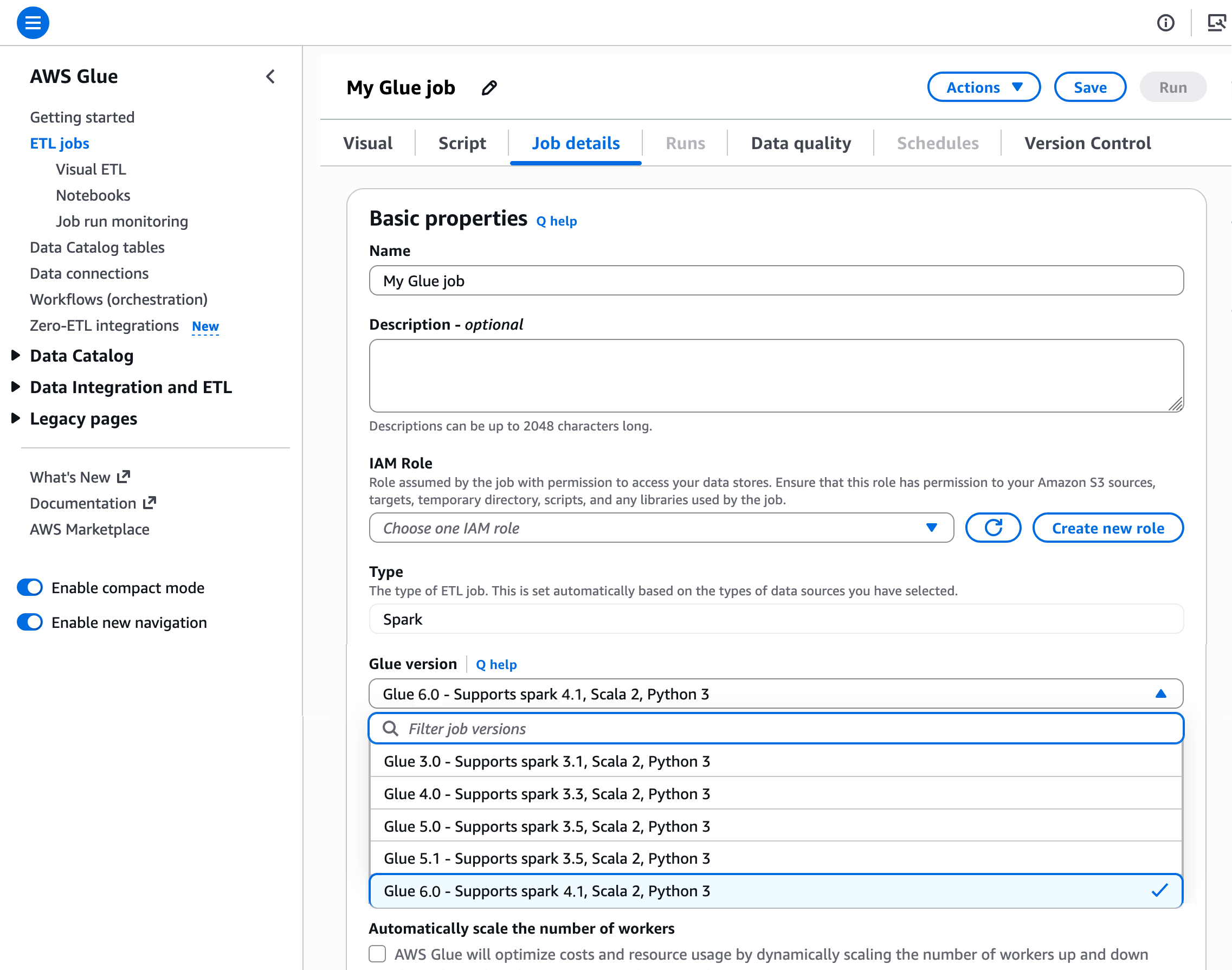
To start using AWS Glue 6.0 on an AWS Glue Studio notebook or an interactive session through a Jupyter notebook, set 6.0 in the %glue_version magic. You can also upgrade existing jobs to Glue 6.0 using the Spark upgrade agent on AWS Glue Studio or use the auto-upgrade feature in their existing Glue jobs to automatically upgrade them to Glue 6.0.
To learn more, visit the AWS Glue 6.0 version detail and Migrating AWS Glue for Spark jobs to AWS Glue version 6.0 in the AWS documentation.
Now available
AWS Glue 6.0 is generally available today in all AWS Regions where AWS Glue operates. For Regional availability and a future roadmap, visit the AWS Capabilities by Region. If you want to call APIs, search documentation, find regional availability, and check troubleshooting about this new feature, try using the AWS MCP Server and plugins with your preferred AI tool.
You pay an hourly rate, billed by the second, for crawlers (discovering data) and extract, transform, and load (ETL) jobs (processing and loading data). For the AWS Glue Data Catalog, you pay a simplified monthly fee for storing and accessing the metadata. The first million objects stored are free, and the first million accesses are free. To learn more, visit AWS Glue Pricing page.
Give it a try in the AWS Glue Studio console, and send feedback to AWS re:Post for AWS Glue or through your usual AWS support contacts.
— Channy
Build a unified AI agent architecture with DynamoDB and Bedrock
Post Syndicated from Dhananjay Karanjkar original https://aws.amazon.com/blogs/architecture/build-a-unified-ai-agent-architecture-with-dynamodb-and-bedrock/
Teams building AI agents on AWS often face a fragmented data architecture: operational data lives in Amazon DynamoDB while vector embeddings for semantic search sit in a separate, purpose-built vector store. This duplication increases infrastructure cost, adds synchronization complexity, and widens the window for stale retrieval results. With the general availability of native vector search in Amazon DynamoDB (launched August 5, 2026), you can now store embeddings alongside your operational data in the same table. You query them using the SearchVectors API operation.
In this post, I show you how to build a unified AI agent architecture where an Amazon Bedrock agent uses a single DynamoDB table for both structured lookups and semantic similarity search. The agent calls AWS Lambda action groups that invoke SearchVectors for natural language retrieval and standard DynamoDB APIs for create, read, update, and delete (CRUD) operations. An Amazon DynamoDB Streams pipeline automatically generates embeddings using Amazon Titan Text Embeddings V2 whenever content changes. This keeps the vector index synchronized without manual intervention.
Use case
Consider a technical knowledge management platform where a team maintains hundreds of internal documents: runbooks, architecture decision records, and troubleshooting guides. Team members interact with a conversational agent to find relevant content (“What’s our retry strategy for payment failures?”), retrieve specific documents by ID, or update existing entries.
Without native vector search, this architecture requires a DynamoDB table for document storage plus a separate vector database (or Amazon OpenSearch Service cluster) for semantic retrieval. The Amazon DynamoDB Streams pipeline must write to both stores, and the agent must route requests to the correct backend. With DynamoDB vector search, you collapse this into a single table and reduce operational overhead.
Solution overview
This solution uses a single-table design in DynamoDB that serves two access patterns: key-value lookups for operational data and approximate nearest neighbor (ANN) search for semantic queries. A Bedrock agent orchestrates user interactions and routes requests to the appropriate action group function.
The following list summarizes the core components:
- DynamoDB table with vector index stores documents, metadata, and 1,024-dimension embeddings in one place.
- Bedrock agent handles conversation orchestration, tool selection, and response synthesis.
- Action group Lambda executes semantic search (using
SearchVectors) and CRUD operations against the same table. - Embedding pipeline Lambda (triggered by DynamoDB Streams) generates embeddings for new or modified content using Amazon Titan Text Embeddings V2.
Architecture
The following diagram illustrates the data flow through the unified architecture.
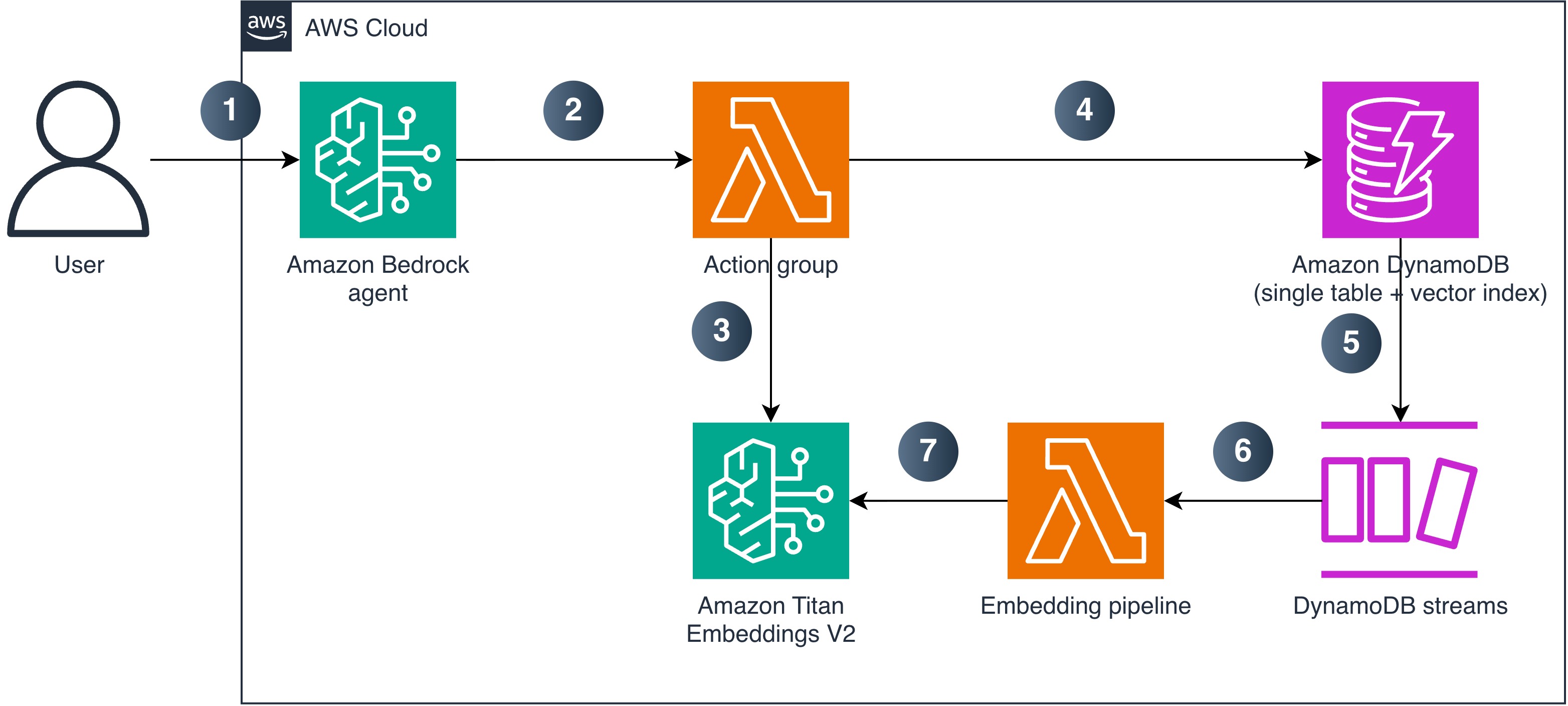
Figure 1: Unified AI agent architecture using DynamoDB vector search and Amazon Bedrock
The numbered steps describe the data and request flow:
- A user sends a natural language query to the Bedrock agent.
- The agent analyzes the request and invokes the appropriate action group Lambda function.
- For semantic search, the action group Lambda generates a query embedding using Amazon Titan Text Embeddings V2.
- The Lambda function calls the DynamoDB
SearchVectorsAPI (or standard CRUD APIs for operational lookups) against the single table with vector index. - When new content is written to the table, DynamoDB Streams captures the change.
- DynamoDB Streams triggers the embedding pipeline Lambda.
- The embedding pipeline Lambda calls Amazon Titan Text Embeddings V2 to generate a vector for the new content and writes it back to the same DynamoDB item, where the vector index automatically indexes it.
Prerequisites
To implement this architecture in your account, you need the following:
- An AWS account with permissions to create DynamoDB tables, Lambda functions, Bedrock agents, and IAM roles.
- DynamoDB Streams enabled on the table with
StreamViewTypeset toNEW_AND_OLD_IMAGES(the embedding pipeline compares old and new content to prevent a write loop). - Access to the Amazon Titan Text Embeddings V2 model (
amazon.titan-embed-text-v2:0) enabled in Amazon Bedrock model access. - Access to an Anthropic Claude or Amazon Nova model for the Bedrock agent foundation model (check model support by Region).
- Python 3.12 or later (for Lambda function code).
Implementation
This section walks through the key components of the architecture.
Designing the single-table schema
The table uses a composite primary key (entity_id as partition key, sk as sort key) and stores embeddings as a list of numbers:
The vector index partitions search results by the category attribute. Choose a partition key with moderate cardinality that matches your query patterns. A very low-cardinality key (a handful of values) concentrates data in few partitions and limits throughput scaling, while a unique-per-item key leaves no neighbors to compare. For multi-tenant workloads, tenant_id is usually the right partition key. For more information, refer to the DynamoDB vector search best practices.
The following AWS Command Line Interface (AWS CLI) command creates the vector index on an existing table:
After creating the index, wait for it to become searchable. Poll DescribeTable until IndexStatus is ACTIVE and Backfilling is no longer true. The first few searches after the index reports ACTIVE can still return ValidationException because SearchVectors is served by a dedicated search endpoint. Treat these as retryable rather than as a failure.
Key constraints to keep in mind:
- DynamoDB vector indexes require on-demand capacity mode (provisioned mode isn’t supported).
- Maximum five vector indexes per table, with up to 4,096 dimensions each.
- The
SearchSchemaHASH attribute is mandatory in everySearchConditionExpression. - Only equality operators are supported in search conditions.
SearchVectorsresponses are limited to 16 MB and don’t support pagination. Project only the attributes you need and keepTopKmodest to stay within this limit.- Items missing the
SearchSchemaHASH attribute (categoryin this example) are silently excluded from the vector index while remaining in the base table.
Building the action group Lambda
The action group Lambda handles both semantic search and operational lookups. The agent invokes it with a function name and parameters based on the tool definition.
The semantic search function generates a query embedding and calls SearchVectors. This index uses COSINE distance, where lower scores indicate greater similarity. Name the field accordingly so the agent doesn’t invert the ranking:
The generate_embedding helper calls Amazon Titan Text Embeddings V2:
The Lambda handler routes requests based on the function name passed by the Bedrock agent:
Automating embeddings with DynamoDB Streams
The embedding pipeline Lambda triggers on INSERT and MODIFY events. It generates an embedding for new or changed content and writes it back to the same item:
The infinite-loop guard is critical. Without it, the Lambda writes back an embedding, which triggers another Streams event, which triggers another embedding generation, and so on. The check compares the content field between old and new images, skipping processing when only the embedding attribute changed. This guard requires StreamViewType = NEW_AND_OLD_IMAGES. Without it, OldImage is empty and the guard never fires.
For production use, configure the event source mapping with ReportBatchItemFailures so that only failed records are retried. Add an Amazon Simple Queue Service (Amazon SQS) dead-letter queue (or on-failure destination) for records that repeatedly fail. Retry Amazon Bedrock InvokeModel calls with exponential backoff to handle throttling.
Defining the agent tool schema
The Bedrock agent needs a function schema that describes the available tools. This tells the agent when and how to call each function:
When to use this pattern
This unified architecture works best when your application already uses DynamoDB as its primary operational store and you want to add semantic search without managing a separate service. Consider the following decision points:
- Use this pattern when your application meets these conditions:
- Documents update frequently and must be immediately searchable.
- Your dataset fits within the DynamoDB vector index constraints.
- You want to minimize infrastructure components.
- Use Amazon Bedrock Knowledge Bases when your source data lives in Amazon Simple Storage Service (Amazon S3), you need managed chunking and ingestion, or you don’t need real-time index updates tied to operational writes.
- Use Amazon OpenSearch Service when you need advanced search features (range filters, aggregations, faceted search), your queries require more than equality-based filtering, or you need results beyond the 100-item
TopKlimit.
Security considerations
The following list highlights the key security aspects of this architecture:
- Least-privilege IAM policies: Scope
dynamodb:SearchVectorsto the specific index ARN (arn:aws:dynamodb:{region}:{account}:table/{table}/index/{index}). The embedding Lambda needs onlydynamodb:UpdateItem, not search permissions. - No fine-grained access control for SearchVectors: DynamoDB condition keys like
dynamodb:LeadingKeysdon’t apply to theSearchVectorsAPI. For multi-tenant workloads, use theSearchSchemaHASH partition key to scope queries by tenant, or use separate tables for strict isolation. - Encryption at rest: DynamoDB encrypts data including vector embeddings using your choice of AWS owned keys, AWS managed keys, or customer managed keys through AWS Key Management Service (AWS KMS).
- Transport encryption: All
SearchVectorstraffic uses TLS. The API routes to a dedicated search endpoint that the AWS SDKs handle automatically. - Bedrock model access: Restrict
bedrock:InvokeModelpermissions to the specific embedding and agent foundation model ARNs required by the solution. - Agent-to-Lambda invocation: Grant
lambda:InvokeFunctiontobedrock.amazonaws.comon the action group Lambda, scoped with anaws:SourceArncondition matching the agent ARN. Without this resource-based policy, the agent can’t invoke the action group.
Clean up
To avoid ongoing charges, delete the resources in the following order:
- Delete the Bedrock agent and its action group.
- Delete the embedding pipeline Lambda function and its event source mapping.
- Delete the DynamoDB table (this also removes the vector index). If you want to keep the table but remove the vector index, run the following command first:
- Delete the action group Lambda function and associated IAM roles.
Conclusion
With this pattern, you can build a unified AI agent architecture that uses a single DynamoDB table for both operational data and vector-based semantic search. The native vector search of DynamoDB combined with Bedrock agent action groups eliminates the need for a separate vector database. DynamoDB Streams-driven embedding generation keeps the index synchronized in real time.
This pattern reduces infrastructure complexity for applications that already rely on DynamoDB and need to add conversational AI capabilities. The automatic embedding pipeline keeps your vector index synchronized with operational writes, and the action group design gives the agent access to both semantic and structured query paths.
Adapt the table schema, embedding dimensions, and agent instructions to your domain. Clone the sample-dynamodb-vector-search-architecture repository to deploy the complete working implementation. For more information about DynamoDB vector search capabilities and limits, refer to the Amazon DynamoDB vector search documentation.
References
- Amazon DynamoDB vector search documentation
- Amazon Bedrock Agents documentation
- Amazon Titan Text Embeddings V2
About the author
Follow-up video to the 120V HPWH saga
Post Syndicated from Technology Connextras original https://www.youtube.com/watch?v=fHPCS8j3cRM
AI Is Learning to Write Genetic Code
Post Syndicated from Bruce Schneier original https://www.schneier.com/blog/archives/2026/08/ai-is-learning-to-write-genetic-code.html
This sort of research is both exciting and terrifying:
The two models in question were told to generate complete genomes for a viable bacteriophage—a type of virus able to infect and replicate itself inside bacteria, destroying them from the inside.
Using an existing bacteriophage as an example—ΦX174 (pronounced “fie-ex-1-7-4”), known for its ability to infect and destroy E. coli bacteria—the models generated about 700,000 potential designs, of which the researchers picked 285 that looked most promising.
The researchers then synthesised new DNA molecules using those designs and inserted them into E. coli bacteria, before waiting to see if viable bacteriophages would emerge.
Shortly afterwards, 16 of the Petri dishes in which the bacteria were growing began to show clear spots, as the viruses began to attack and replicate themselves inside the E. coli, demonstrating their viability.
Some of those viable viruses proved more effective at attacking E. coli than the original ΦX174 bacteriophage.
That’s a positive use of a synthetic virus. We can all imagine the negative uses.
Bosgame M5 AMD Ryzen AI Max+ 395 128GB AI Desktop Review
Post Syndicated from Patrick Kennedy original https://www.servethehome.com/bosgame-m5-amd-ryzen-ai-max-395-128gb-ai-desktop-review/
We tested the Bosgame M5, an AMD Ryzen AI Max+ 395 system that is one of the lowest cost 128GB LPDDR5X local AI systems out there
The post Bosgame M5 AMD Ryzen AI Max+ 395 128GB AI Desktop Review appeared first on ServeTheHome.
A Tale of Two Flink Autoscalers
Post Syndicated from Netflix Technology Blog original https://netflixtechblog.com/a-tale-of-two-flink-autoscalers-e9f6a1b1492b
Samuel Yeboah, Francesco Di Chiara and Mingliang Liu
Today, Netflix runs two Flink autoscalers. That is exactly one more than we want. We built the first one in-house years ago, when there was no mature option suited to our platform. The second came from the Apache Flink community, and it can scale workloads our homegrown system was never designed for. We now run both in production and are steadily converging on the open-source one. Along the way we learned some hard lessons about metrics, cost, and the real price of maintaining infrastructure you could instead adopt, and we hope they are useful whether you run a handful of Flink jobs or tens of thousands.
Why autoscaling is not optional at our scale
Netflix has run stream processing on Apache Flink since 2017. As of 2026 we operate more than 30,000 Flink jobs across multiple AWS regions. Most are not deployed by hand; they are generated by our managed platform Data Mesh, so the majority of users never touch a Flink job directly. A smaller but growing set are custom jobs, built and operated by teams across the company for use cases like personalization, Ads, and Live events. They range from single-operator jobs that shuttle records between Kafka topics to stateful pipelines with branches, joins, and terabytes of state, and their load swings with daily cycles, launches, and regional failovers.
Provisioning every one of those jobs for its peak is wasteful; provisioning for the average causes lag during surges. And in our platform a scaling action is not free: by default it means taking a savepoint, stopping the job gracefully, and restarting it at the new size, which for a large stateful job can take minutes. That leaves a genuinely hard question: how do you give each job the resources it needs, when it needs them, without a human in the loop and without breaking anything?
The first autoscaler: watching from outside
Our first answer, built around 2019, was an autoscaler shaped like a stream-processing job. It ran on Mantis, consuming a live feed of cluster-level metrics from Atlas, our telemetry platform including CPU, network, Kafka lag, input-rate, and consume-rate signals for every job. The scaler combined lag-derived catch-up time, CPU/network utilization thresholds, observed performance history, and regression over recent input rate to decide when to scale up or whether a smaller cluster could handle the lookahead window. Because the autoscaler operates independently of the Flink platform, it remains unaffected by issues within Flink itself. Building it as a streaming job also made it easy to scale. Each autoscaler node handled the metrics for a subset of Flink jobs, and we never had to write custom sharding or coordination logic to keep up with a growing Flink fleet. It reliably cut resource usage by 25–45% across thousands of managed pipelines. Check our previous talk at Flink Forward 2020.
But watching from outside has a ceiling. The system reasoned about a whole cluster through coarse container metrics, and it scaled a single knob, the total TaskManager count, so every operator in a job moved together. That fit the simple, single-operator pipelines it was built for, but not the multi-operator, stateful DAGs that teams were increasingly bringing to us for Ads, recommendations, and games. Those were exactly the jobs it could not reason about, and supporting each new case meant more custom logic rather than any general capability.
The autoscaler is only as good as the metrics served by external systems beneath it. Those metrics could miss real trouble: a job could be completely busy without any of it showing up as CPU utilization, leaving the job stuck in a degraded state the scaler had no way to see. Recently a networking migration quietly changed how some traffic was reported, and a subset of the Atlas metrics the scaler relied on stopped capturing everything accurately. The gap stayed invisible until it surfaced in production much later.
It was time to reconsider build versus buy.
The second autoscaler: reasoning from inside
When we started, the Flink community had no mature autoscaler to offer. By the time we re-evaluated, it did: the Apache Flink Autoscaler. Instead of watching containers from outside, it reasons from inside the job.
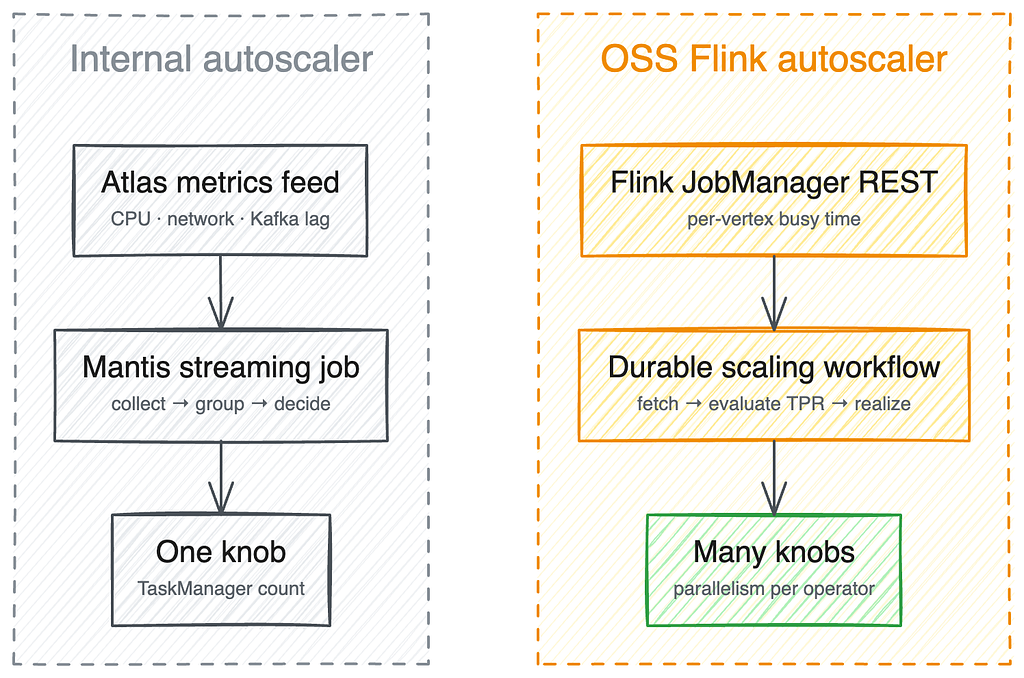
Its key idea is to estimate each operator’s true processing rate (TPR): the throughput it could sustain if it were fully busy. Flink reports, per subtask, the fraction of each second spent doing actual work, separate from time spent backpressured or idle. Dividing observed throughput by that busy fraction extrapolates capacity to full utilization: an operator handling 700 records/sec while busy 70% of the time has a TPR of 700 / 0.7 = 1,000 records/sec. Starting from the sources, the autoscaler walks the job graph and uses each operator’s TPR, its input/output ratios, and a target utilization to compute the parallelism every vertex needs so that no operator becomes the bottleneck, rather than resizing the whole cluster as a unit.

The two approaches make a different contract, summarized below.
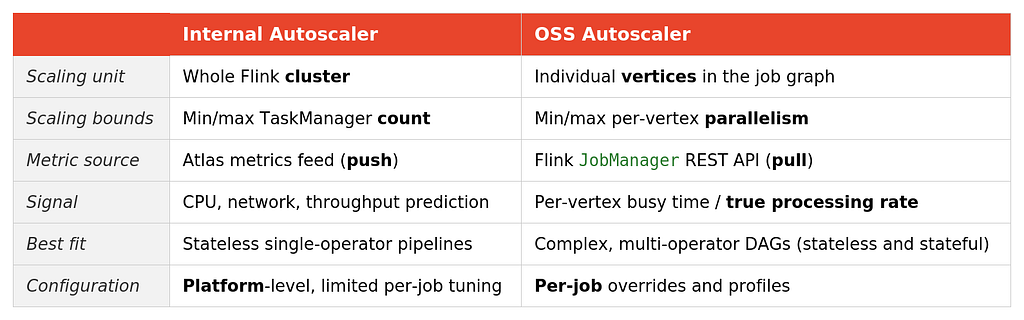
The decisive difference for us is the last two rows: the OSS autoscaler can scale exactly the stateful, multi-operator jobs our homegrown system could not, and it lets each job carry its own configuration — stabilization periods, thresholds, and other scaling behavior tuned to the workload.. That made it the natural fit for the custom jobs teams had been scaling by hand.
Making it work at Netflix scale
Adopting the algorithm was straightforward; the community had done the hard part. The work for us was running it reliably across our own jobs, and this is where our system differs most from the stock open-source deployment.
Firstly, the OSS autoscaler was originally architected to reside within the Kubernetes Operator for Flink, but our Flink platform runs on its own control plane, not that operator (see our previous talk at Current Conference 2024). Community later made a fantastic decision to keep the core logic as a standalone library. They refactored four generic interfaces that made it easy to plug directly into our internal ecosystem: a context carrying job metadata and REST API info, a state store, an event handler, and a realizer that applies scaling decisions.
That service is a Spring Boot application whose orchestration runs on Temporal, the durable workflow engine. An orchestrator workflow polls our Flink control plane about once a minute for the jobs with autoscaling enabled, and starts one long-running workflow per job. Each per-job workflow pulls that job’s per-vertex metrics from its Flink JobManager, runs the OSS evaluation algorithm, and, when a scaling decision results, hands it to a realizer that actuates the change through our Flink control plane.
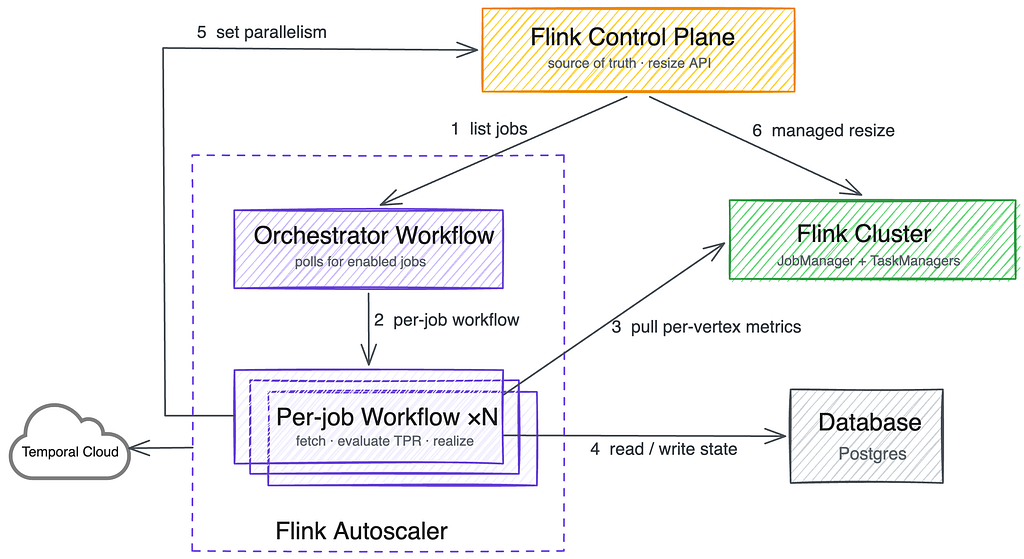
The workflow-per-job design was a direct response to pain. We first ran evaluations in a single batch loop over the whole set of jobs, and it was fragile: one slow or misbehaving job could stall metric collection and scaling for every job behind it. Giving each job its own durable workflow isolated that blast radius, so a single problematic job now fails and retries on its own, and the runtime scales out as we onboard more jobs.
Secondly, three engineering gaps stood between “works in community” and “works at Netflix scale”:
- Metric collection at high parallelism. On big jobs, pulling metrics from the JobManager became a bottleneck, and part of the cause was in Flink’s runtime. To address that, we changed the JobManager to cache transient metric names and clean them up once instead of rescanning on every fetch, and we added server-side filtering so the autoscaler asks only for the metrics it needs. This let the autoscaler work on jobs up to 3,000 Flink subtasks, where it had previously struggled above roughly 1,000. Those are in our internal fork of Flink release, while some are contributed upstream such as FLINK-36172.
- Preserving forward chaining. Two separate vertices joined by a forward connection must run at the same parallelism, because records are handed over in memory on a fixed local channel. Scale one of them alone and Flink does not fail; it silently converts that edge into a network shuffle. Our fork detects forward-connected subgraphs and scales each as a unit.
- Respecting sink limits. Some sinks have finite write capacity, so we added detection for async-sink backpressure (also a fork change) to keep the autoscaler from scaling a job up into a sink that cannot absorb more.
Before it actuates anything, the realizer runs a set of safety checks. For example, it refuses to scale a job down in a region being evacuated during a company-wide region failover. It also verifies there is enough disk for the new cluster to hold the job’s checkpoint state, and it adds a small standby buffer for larger clusters.
The road to one autoscaler
Last year, the OSS-based autoscaler achieved general availability for custom jobs at Netflix, yielding promising initial outcomes. For instance, our client telemetry and logging team achieved a 58% reduction in its annualized Flink compute expenditures, saving approximately $1.1 million annually. This efficiency is driven by three key factors. First, whereas static provisioning must always account for peak loads, autoscaling dynamically adapts to daily cycles, capturing the drop in traffic during nights and weekends compared to weekday peaks. Second, rather than relying on teams to manually optimize resources following performance improvements or post-holiday slowdowns, the autoscaler continually adjusts capacity. Finally, adopting uniform container dimensions enables superior bin-packing and more granular scaling increments.
Additionally, scaling down too eagerly is its own trap. Cut too deep and CPU saturates, lag spikes, and the system cannot react instantly because its metric window and stabilization period have to rebuild after each restart. We now run a target utilization of 0.45, below the community default of 0.7, deliberately trading a little efficiency for stability. Fewer and calmer rescales are worth the marginal cost for large stateful jobs.
While our scaler provides fine-grained signals and vertex-level decision units for stateful DAGs, fast rescaling still heavily depends on Flink Core’s state restoration performance. Today, the biggest remaining cost in scaling a stateful job isn’t the scaler’s logic — it’s the restart and state recovery process itself. Flink 2 addresses this through its disaggregated state architecture, keeping state in external storage rather than on local disk, which can sharply reduce how much a rescale or recovery depends on total state size. Having started supporting Flink 2.2 at Netflix, we plan on experimenting with this new state backend to see if it can help eliminate state recovery bottlenecks when scaling large stateful jobs.
Looking ahead, we aim to migrate all internal scaler use cases onto the new one based on OSS autoscaler to simplify our operational surface area.
Key Takeaways
Along the way, three lessons that generalize beyond Flink:
- Metric choice matters more than algorithm sophistication. Our most useful debugging was rarely about the scaling math; it was about which signal to trust most. Understand your metrics before you tune your algorithm.
- Set sensible defaults, but leave room to tune. Our managed jobs are similar enough that one good default covers most of them untouched, which is the point of a platform. But forcing a single configuration on every job punishes the ones that do not fit, so we pair defaults with per-job overrides and deliberately hide the knobs that need deep expertise. Most teams should never have to think about the autoscaler.
- Adopt, then extend. We built in-house because in 2019 nothing mature fit our platform. When a strong community project appeared, the right move was neither to defend our investment forever nor to rip it out overnight, but to adopt it for new workloads, contribute fixes back, and plan a deliberate migration.
Thanks to the Flink and Data Mesh teams for the control-plane changes this work depended on, to the Temporal team and our early pilot teams, and to the Apache Flink autoscaler maintainers whose foundation we built on. Special thanks to Andy Zhang, Calvin Cheung, Daniel Trager, Guil Pires, Mark Cho, Matthew Kornitsky, Nikhil Sulegaon, Sujay Jain, and Tom Lee.

A Tale of Two Flink Autoscalers was originally published in Netflix TechBlog on Medium, where people are continuing the conversation by highlighting and responding to this story.
S10 E11: Return from WGA Strike & Prison Healthcare: Last Week Tonight with John Oliver
Post Syndicated from LastWeekTonight original https://www.youtube.com/watch?v=wB9bkcHwq4w
Билбордовете извън градовете на България
Post Syndicated from Боян Юруков original https://yurukov.net/blog/2026/bulgariaads/
Всички забелязваме колко много реклама – най-вече такава на хазарт – има по улиците и пътищата на страната, по билбордове, фасади, покриви и какво ли не. Наскоро реших да науча повече как се получава така. Разгледах първо положението в София и създадох инструмент, с който всеки може да провери какви разрешения за реклама има около него и да подаде сигнал, ако вижда нередности. Аналогичен проблем има във всички български градове, но там липсват документи и данни, които да позволят такава прозрачност.
Обърнах се към билбордовете извън населените места на България, защото там виждаме преобладаващо реклама на хазарт и пренасищане. Както и преди, направих карта, която показва различни аспекти на проблема. Ще опиша методологията и какво показва по-късно. Ще започнем с проблемите, за които научих.
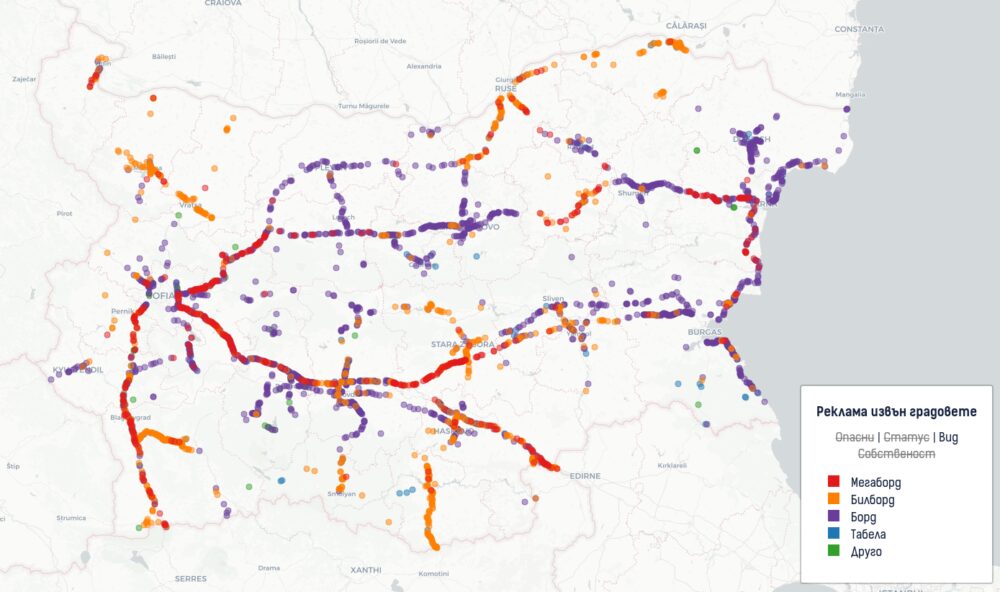
Практически всички са незаконни
Билбордовете извън населените места, а в някои случаи и в тях, следва да отговарят на Наредбата за специално използване на пътищата. Чл. 13 на тази наредба описва как се изграждат и пускат в експлоатация тези съоръжения. На практика фирмите плащат такса и минават многостъпков процес на одобрение при Агенция пътна инфраструктура. Няма значение дали билбордът ще е на частна, общинска или държавна земя – АПИ трябва да одобри и прибере такса, тъй като е край пътя. Същото се отнася впрочем и за бензиностанциите и крайпътните заведения.
Тук се сблъскваме с първото масово нарушение. Чл. 56 на Законът за устройството на територията позволява да се слагат такива преместваеми обекти, но ясно посочва, че разрешение за това може да се дава единствено от общината. Наредбата, по която оперира АПИ, сама споменава ЗУТ, не може да отмени закон и не дава право на АПИ да издава разрешителни за строеж. Всеки един от тези междуградски билбордове освен разрешение за специално ползване от АПИ следва да има и разрешение за поставяне от съответната община по проект.
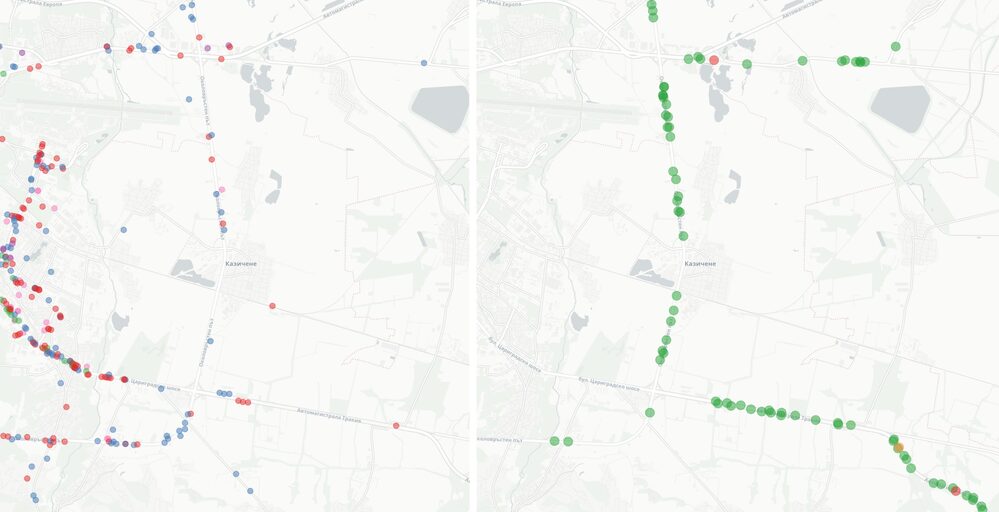
Не открих нито едно разрешение за поставяне на билбордовете в данните на АПИ. Най-лесно беше да се провери в София, където Столична община отговаря за издаването на такива в началото на магистралите. В други общини беше значително по-трудно като повечето въобще не публикуват тези документи. Всички са задължени да ги качват в публичния регистър по ЗУТ. Наредба по него беше пусната най-накрая за обществено обсъждане от служебния кабинет на Гюров и от месеци чака един подпис от министър Шишков. Този регистър ще позволи лесно да се провери законността на всички тези и много други обекти и строежи. Именно това е и причината да беше бавен с години и да се отлага отново и при кабинета на Радев.
Вторият проблем са търговете. Не може да се използва държавна или общинска земя без да е проведен търг. Пътищата на страната са на държавна земя, а мнозинството от билбордовете са в същите имоти или на съседни общински. АПИ не е собственик на тази земя и няма право да я отдава. Това следва да прави областните управители или в случая на общинската земя – търгове към общината. Не открих в публичната информация за търгове нещо свързано с тези билбордове.
Състояние и обезопасяване
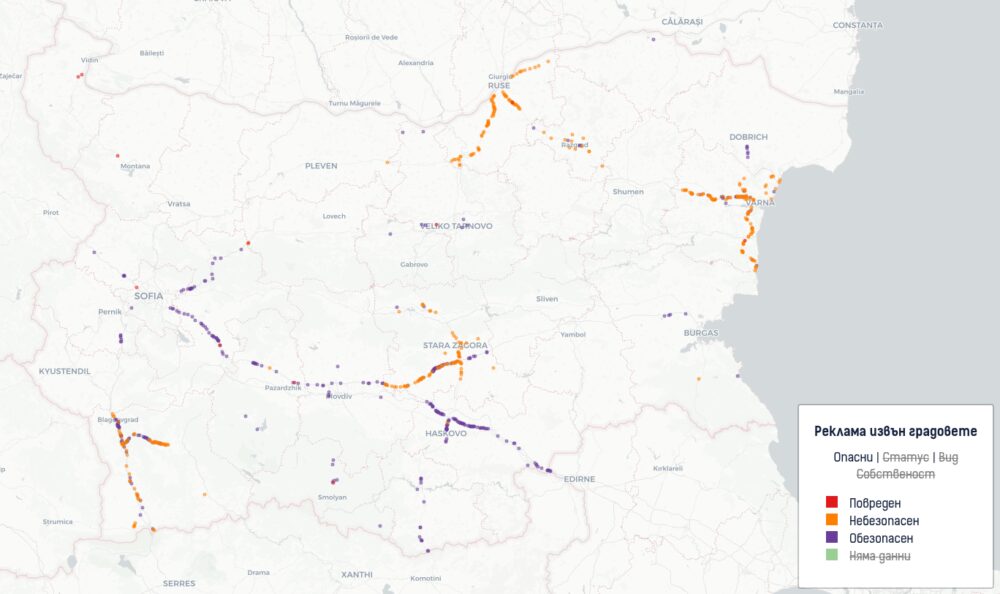
В данните на АПИ открих информация за местоположението и състоянието на 3783 билборда. Към средата на август 11 от тях са повредени. 369 или почти 10% са опасни, но необезопасени. Още 367 са обезопасени. Необезопасените са предимно около Стара Загора, Русе, Благоевград и Варна. Отговорност за това би следвало да е на собствениците и АПИ, а не на общините, които както описах по-горе изглежда не са включени в процеса.
102 или 2.6% са с изтекло или прекратено разрешение от АПИ. При 55 или 1.5% са намерени несъответствия с наредбата като недостатъчно отстояние от възли, пътя или един от друг. Към средата на август във фаза на проектиране са били 23 нови билборда.
12% от рекламите са мегабордове – онези най-големите на високи пилони. 27% са големи билбордове. 56% са малки билбордове, а останалото са табели и други видове реклама.
Ключовата 2027-ма
Чл. 16, ал. 4 от НСПП определя, че срокът за разрешението за специално ползване е 10 г. Това е различно от разрешение за строеж или поставяне, срокът на които се различава. В София, например, е 5 г. В данните на АПИ има дати на такова разрешение за 3600 обекта. Тук виждате разпределението им по години.
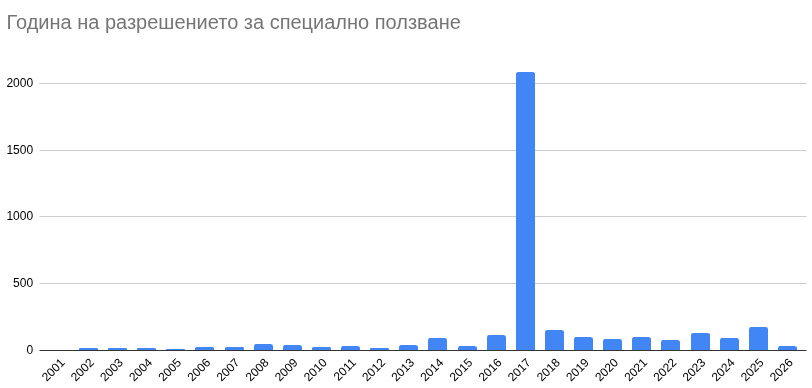
От тях е видно, че огромна част са издадени 2017 г. Всъщност, 61% от разрешенията за всички билбордове извън градовете изтичат до края на 2027 г. Интересното е, че още 12.5% са по-стари и би следвало вече да са изтекли. Само 20% тях обаче са отбелязани като такива. Това значи, че вероятно договорите им са подновени без да е отразено изрично в данните.
Това прави 2027-ма особено важна, защото позволява сериозно намаление на специалното използване на междуградските пътища и магистралите по този начин. Предвид какво знаем за АПИ, интересите и влиянието на хазартния бизнес, вероятно може да очакваме сериозно преразпределяне на пазара на билбордове извън градовете. Тук не трябва да забравяме и ролята на фирмите опериращи билбордове из страната в предизборни кампании – те са сред основните фактори в такива кампании и не са регулирани от ЦИК за разлика от електронните медии – нито като достъпност, равна представителство или дори цена и произход на средствата. Видяхме го ясно при последните парламентарни избори когато огромна част от билбордовете извън градовете бяха обсипани с послания именно на Радев, финансирането за което така и не беше осветено. Всякакви действия в посока регулиране на този бизнес неизбежно следва да се гледа и през тази призма.
Собственост
От данните на АПИ е изключително трудно да се прецени кой оперира различните билбордове. Има множество свързани фирми, някои са вече преименувани или закрити. Заради грешки в данните като изписване на имена на фирми и ЕИК се наложи да проверя и поправя 10% от записите. Дори тогава беше трудно да се прецени чии са всъщност рекламните обекти.
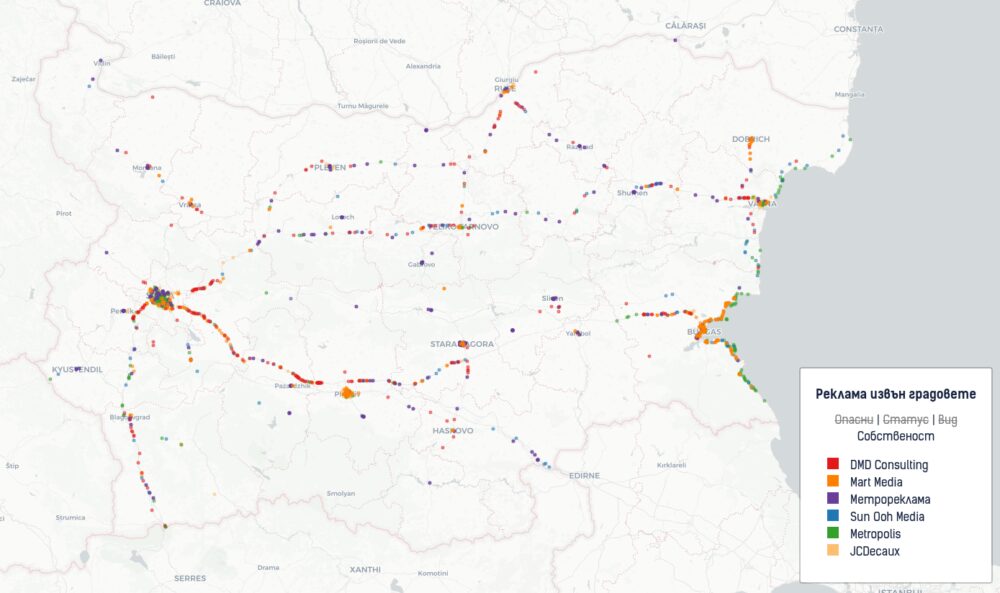
Затова се обърнах към самите компании и какви рекламни площи продават. Събрах данни за шестте най-големи, за които има публична информация. DMD Consulting, Mart Media, Метрореклама, Sun Ooh Media, Metropolis и JCDecaux. Не успях да свържа данните им с тези на АПИ тъй като нямат общи идентификатори и координатите в много случаи не съвпадат. Затова на картата се зареждат като отделен набор от данни.
Ще видите също на картата, че се показват билбордове на тези фирми, които са в градове. Успях да разгранича кои са в населени места и кои са извън. Оставих всички на картата, за да стане видимо присъствието и това разграничение. По публичните данни DMD, например, има 227 билборда и всички са извън градовете. Аналогично изглежда е положението със Sun Ooh Media с 116 билборда. Половината от 381-те билборда на Mart Media са извън градовете, също както 22% от 701-те билборда на Метрореклама и 26% от 311 билборда на Metropolis. JCDecaux имат само 18 билборда извън градовете от общо 1233, което прави 1.5%. Само първите пет фирми управляват 20% от билбордовете в страната и то изглежда на местата с най-голям трафик – по магистралите и морето.
Десетки пъти повече билбордове
В данните на АПИ виждаме разрешенията им за специално използване, също и данни къде са предвидили да позволяват още билбордове. Това са пространства предимно в държавна земя от двете страни на пътища и магистрали. По наредба има изисквания за отстояние 1500 м. от пътни възли на магистрали и 500 м. от кръстовища на други пътища. Виждаме обаче на картата им, че са отбелязали такива места за бъдеща реклама включително вътре в самите пътни възли. Както споменах по-горе, има и доста изградени вече билбордове, които не отговарят на тези изисквания.
Общата дължина на тези пространства е 62504 км. В това число включваме отсечка и от двете страни на пътя. Би следвало билбордовете да са през 300 метра на магистрали и 200 метра на други пътища, но нека приемем 500 м. отстояние като консервативна оценка. Това означава, че ако рекламният бранш има финансов стимул, би имал възможността да изгради 125 хиляди билборда в страната. Това число изглежда невероятно, но при сегашната процедура и условия на АПИ е не само реалистично и дори консервативно като оценка.
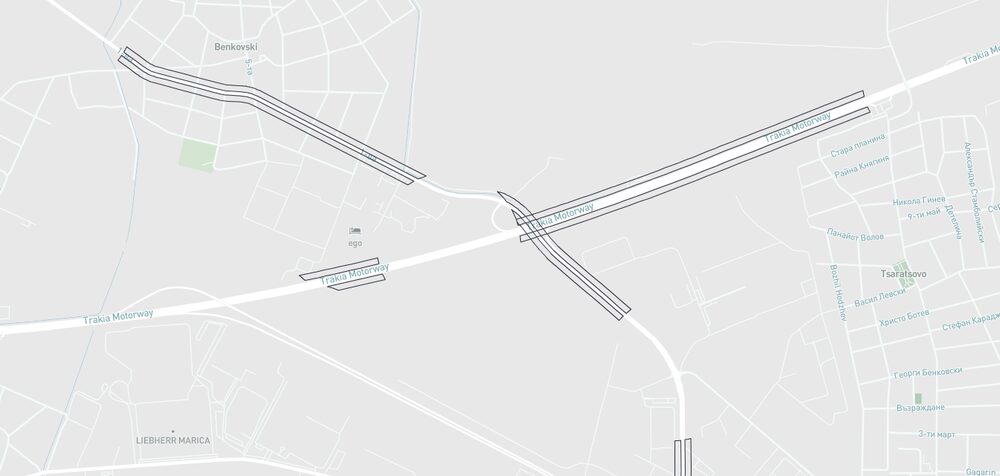
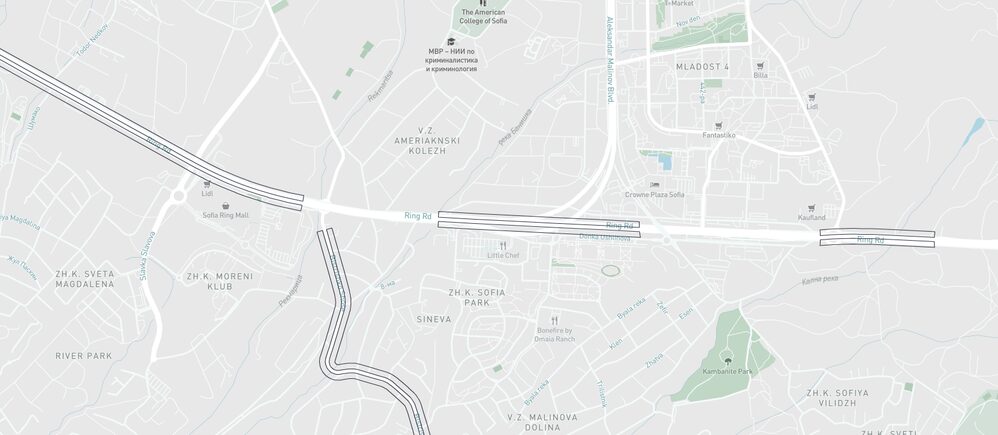
Към този момент имаме данни за 3783 билборда, което прави 3% от тази оценка. Вече ги виждаме на всеки ъгъл по пътищата на страната и дори да стигнем до 10% от разрешеното по наредба. Това означава три пъти повече реклама, разсейване на пътя и почти само хазарт пред очите на пътуващите.
Тук пак трябва да напомня, че АПИ няма право да дава разрешение за строеж нито на 125 хиляди, нито на 3 хиляди билборда. Те могат да позволят само да са до пътя. Разрешението за поставяне или строеж може да се издаде единствено и само от общините. Ако се спази това правило, почти 3800 билборда из страната трябва да се демонтират ведната и да се започне процес отначало всяка община в територията си да ги одобрява.
Методология
Данните на АПИ взех от публичния ГИС сървър. Там има още много информация, включително указателни табели, крайпътни обекти и самата пътна мрежа. За рекламните съоръжения и местата за бъдещи такива има два отделни масива. Единият е този показан на тяхната карта, данните от които разглеждам тук. Другият има доста повече данни, които изглежда обаче са архивни и не мога да потвърдя като точност.
Като цяло проблемът с качеството на данните съществува и тук. Информацията се обновява на ръка, което е трудоемко и води до грешки. Обсъждах това в статиите ми за външната реклама на София и изследването на свлачища в страната. В записите за тези билбордове има доста информация, включително бележки за предишни собственици. Споменах по-горе обаче, че имената им са изписвани по няколко различни начини, а ЕИК номерата липсваха или бяха сгрешени в 10% от записите. Поправих ги на ръка като оставих данните където фирма подписала течащ договор за билборд е вече затворена. В такива случаи се оказа, че често билбордовете са купени от друга фирма поела контрола над тях и изглежда АПИ не е обновила новото обстоятелство.
Друг проблем, който открих, са около 50-тина ЕГН-та на частни лица, собственици на фирми или други. Поне 60 от билбордовете са изградени от частни лица, а не фирми по данни на АПИ. Има и много малки фирми, които са направили такива в имотите си или в конкретен район. Всички тези над 3700 билборда се притежават от 685 юридически лица. Това е поне според собствените данни на АПИ, което може би значи, че толкова са подписали договор. Възможно е и често срещам, че след това са препродавани на някой от големите оператори.
Всичко написано до тук като изводи и статистика се базира на собствените данни на АПИ. Както с други карти и анализи, които съм правил, те са толкова точни, колкото самата агенция създава информацията си. Доколкото е видно, че само част от полетата в ГИС сървъра им са видими на публичния портал, може да предположим, че останалото е предимно за вътрешна употреба и представлява поглед над оперативната им дейност. Ако това предположение е вярно, то изводите тук отразяват директно това, което АПИ знае за билбордовете в страната.
Данните за собствеността взех от портали за продажба на рекламни пространства и посредници. Такива далеч не са достъпни за всички оператори на билбордове, затова не мога да твърдя, че картата предоставя представителна извадка в тази категория. Показва обаче добре разпределението на обекти в и извън градовете и как има фирми представени в различни райони или предимно извън градовете или в тях. Ако са ви известни други такива фирми и масиви от данни, изпратете ми ги и ще се опитам да ги добавя.
Местата, където АПИ предвижда, че може да се поставят реклами, са също достъпни на портала на АПИ. Поради огромният обем данни обаче не са налични все още на картата. Ще обновя тази статия като успея да ги добавя така, че да е разбираемо.
Представяне на данните
Картата, в която събрах данните, е в стандартният формат на всичко, което правя в последните години. Горе вляво има бутони за обща информация, смяна на базов слой със сателитни снимки от Google и фокусиране на картата върху собственото местоположение.
При натискане върху някой билборд се показва подробна информация за него. При данните от АПИ тази информация е разделена на три раздела – общи данни за статус, опасност, собственик и площ, след това подробни данни за разрешението и възможни несъответствия с наредбата и накрая бележки и информация кога е създаден записът. Втори и трети раздел се отварят като натиснете на заглавията. Когато разглеждате собствеността се показва наличната информация за билбордовете според каквото е публично достъпно.
Легендата показва начини на категоризиране и съответните категории. Натискане върху вида категории сменя цветовете на картата според категоризацията. Първите три са от данните на АПИ. При изгледа за собственост се сменят данните към агрегираните от публични източници. Когато натиснете някоя категория се показва само тях изключвайки останалите. За да включите други към този изглед натиснете тях. Когато остане една да бъде скрита се връща изходното състояние показвайки всички.
Картата може да разгледате тук или да я отворите на цял екран.
Следващи стъпки
Имаше много запитвания дали мога да направя карта подобна на тази за София и за други градове. Споменах по-горе, че разрешенията за поставяне са скрити в много общини. Задължени са да ги публикуват, но наредбата за регистъра по ЗУТ се бави. Повечето нямат и регистър на рекламните обекти както в София, който макар и неточен все пак съществува. Данните за собствеността от самите оператори и посредници помага в тази насока и за следващата статия в поредицата ще започна работа по този масив от данни. Ако имате още източници, които не виждате или идеи как може да се агрегира тази информация, ще се радвам да споделите в коментарите.
Както обещах преди седмица, в тази статия се концентрираме върху билбордовете извън градовете. Не е тайна, че повечето от тях са заети с реклама на хазарт. Тук НАП има важна роля, която не изпълнява. Едно от извиненията, които са давали в интервюта, отговори по ЗДОИ и включително на депутати е, че нямат данни къде и колко са тези билбордове. Наивно е да се смята, че това извинение е нещо повече от прикриване на желанието за бездействие и обслужване на интересите както на операторите на билбордове, така и на хазартния бизнес. Ако наистина липсата на данни е пречка. На драго сърце бих предоставил всичко, което съм събрал.
Както в предишната си статия, така и сега поставих под съмнение законността на голяма част от рекламните площи. Всъщност, на база публично достъпната информация може да твърдим, че почти няма билборд извън градовете, който да е законен. АПИ е иззела функции по ЗУТ и изглежда няма община, която да им се опълчи. Премахването на незаконни билбордове и преместваеми обекти е проблем като цяло – скъпо начинание е усложнено допълнително от АПК и бавните и непостоянни административни съдилища. Отделно държавата и самите общини следва да правят търгове за поставяне на такива обекти. Това не се случва и отново е оставен АПИ да вършее.

Докато работих по тази карта в последните дни излезе слух, че кабинетът на Радев обмисля забрана на рекламата на хазарт в градовете. Това остава рекламата им съвсем да залее билбордовете, които изброявам горе. Такава идея е била прокарвана и в миналото без резултат по разбираеми причини. Данните на АПИ и тези за собствеността показват, че това обслужва точно определени бизнес интереси, както и че ще засили стимулът да се изграждат още хиляди до десетки хиляди билбордове на всеки 200 до 300 метра междуградски път. Промяната, ако наистина сериозно се обмисля, е несъмнено лобистка и се прави точно в момент, в който пазарът се преразпределя.
По-важното обаче е, че подобна мярка би била дим пред реалният проблем – огромната щета за обществото и печалби, които този бизнес прави. Несъмнено има постъпления за бюджета, които далеч не са дори реалните суми, които следва да плащат. Дори така те са на практика данък уязвимост и данък бедност. Заедно с бързите кредити, телефонните измами, цигарите и вейповете хазартът има най-голяма роля в разрушаването на финансовата стабилност и живота на стотици хиляди български семейства.
Петте процента ограничение за рекламите беше приемлив компромис. Предвид невъзможността, а явно нежеланието да се съблюдава и санкционират нарушителите, единственото възможно решение е пълна забрана за реклама на хазарт. Всичко останало е нищо повече от обслужване на лобистки интереси.
[$] Considering the OpenMDW license
Post Syndicated from corbet original https://lwn.net/Articles/1089251/
The open-source world has been struggling for a few years now to understand
how to approach large language models (LLMs) and the licensing applied to
them. What constitutes “freedom” with respect to a black box filled with
numerical weights? The process taken by the Open Source Initiative (OSI)
in the development of its Open AI
Definition was controversial at best, as was its output. Now, the
Linux Foundation’s Mike Dolan has brought
a new license to the OSI for approval. It is called the OpenMDW (“Open
Model, Data, and Weights”), and it aims to clarify licensing for the
distribution of LLMs and related materials, but consensus is proving hard
to find for this license as well.
Security updates for Friday
Post Syndicated from jzb original https://lwn.net/Articles/1089999/
Security updates have been issued by AlmaLinux (ansible-core and pcp), Debian (chromium, libgit2, python-httplib2, and sabnzbdplus), Fedora (dokuwiki, domoticz, dotnet10.0, dotnet8.0, dotnet9.0, firefox, i2c-display, libgit2, lyx, ntpsec, openssh, perl-DBI, php-phpseclib3, python-alembic, python-asyncmy, python-sqlalchemy, python3.13, roundcubemail, trafficserver, wireshark, and wordpress), Red Hat (compat-openssl10, compat-openssl11, fence-agents, gnutls, kernel, kernel-rt, libarchive, libreswan, multiple packages, openssl, python-idna, python-pillow, qemu-kvm, resource-agents, rh-podman-desktop, ruby, unbound, and vim), SUSE (buildah, chromium, container-suseconnect, containerd, cosign, ctop, docker, firefox, forgejo-cli, gitea-tea, go1.25, go1.26, helm, kubernetes, kubernetes-old, kubevirt1.8, podman, python-pytest-html, python-unearth, python311, python313, rootlesskit, and rsync), and Ubuntu (linux, linux-aws, linux-aws-5.4, linux-azure, linux-bluefield, linux-fips,
linux-gcp, linux-gcp-5.4, linux-hwe-5.4, linux-ibm, linux-ibm-5.4,
linux-iot, linux-oracle, linux-raspi, linux-raspi-5.4, linux-xilinx-zynqmp, linux, linux-aws, linux-aws-7.0, linux-ibm, linux-oem-7.0, linux-raspi,
linux-realtime, linux, linux-aws, linux-aws-fips, linux-azure-fips, linux-gkeop,
linux-ibm-5.15, linux-intel-iot-realtime, linux-intel-iotg,
linux-intel-iotg-5.15, linux-kvm, linux-nvidia, linux-nvidia-tegra,
linux-nvidia-tegra-5.15, linux-oracle, linux-oracle-5.15, linux-realtime,
linux-xilinx-zynqmp, linux, linux-aws, linux-kvm, linux-lts-xenial, linux-aws-6.8, linux-azure-5.15, linux-gcp, linux-gcp-fips, linux-hwe-5.15,
linux-lowlatency-hwe-5.15, linux-gcp, linux-gcp-4.15, linux-gcp-fips, linux-gcp, linux-gke, linux-gke, linux-lowlatency, linux-lowlatency-hwe-6.8, linux-hwe-6.8, linux-nvidia, linux-nvidia-7.0, linux-nvidia-bos, linux-raspi, linux-raspi-realtime, netty, postgresql-14, postgresql-16, postgresql-18, vim, and wget).
A Kindle of Kittens: A History of Collective Nouns
Post Syndicated from The History Guy: History Deserves to Be Remembered original https://www.youtube.com/watch?v=1g6IBRuHiCU
From clickops to governed IaC: CloudFormation drift detection in practice
Post Syndicated from Leen Alattas original https://aws.amazon.com/blogs/devops/from-clickops-to-governed-iac-cloudformation-drift-detection-in-practice/
AWS environments that have grown organically over time often share a common characteristic: infrastructure provisioned through the AWS Management Console, SDKs, or CLI without corresponding Infrastructure as Code (IaC) templates. This practice is commonly referred to as “ClickOps,” a term describing any infrastructure change made outside of a codified, version-controlled workflow. Whether changes happen through the console, the AWS CLI, or application SDKs, the result is the same: resources exist without a declarative template to describe their intended state.
Over time, these manual changes accumulate, creating environments where Amazon Virtual Private Cloud (Amazon VPC) configurations, Amazon Elastic Compute Cloud (Amazon EC2) instances, and Amazon Simple Storage Service (Amazon S3) buckets exist without a single AWS CloudFormation template to describe them.
Organizations that find themselves in this position have a clear opportunity. CloudFormation’s IaC Generator provides a practical starting point for bringing existing infrastructure under declarative management. It scans an AWS account and produces CloudFormation templates from existing resources, solving the first and most fundamental challenge: you cannot govern infrastructure you cannot see.
However, generating a template is only the beginning. What follows is the operational thinking behind turning a generated template into something a team can govern and automate: the decisions, trade-offs, and organizational habits that determine whether IaC adoption succeeds long-term.
IaC Generator: making the invisible visible
CloudFormation’s IaC Generator scans an AWS account and produces CloudFormation templates from existing resources: Amazon VPCs, subnets, Amazon EC2 instances, Amazon S3 buckets, AWS Identity and Access Management (IAM) roles, and more. It solves the foundational problem of any ClickOps-to-IaC migration: establishing visibility into what exists and how it is configured.
How it works at a high level
Scan — IaC Generator discovers resources in the account by querying AWS Cloud Control API, identifying what exists regardless of how it was provisioned.
Generate — It produces CloudFormation templates that represent the current state of those resources, mapping properties, dependencies, and relationships.
Review — Teams evaluate the generated templates, reconcile any gaps, and decide how to bring each resource under management.
This process eliminates weeks of manual documentation work. Instead of engineers mapping infrastructure by hand, IaC Generator produces a baseline in minutes. For a team managing 200+ resources across multiple VPCs, this can compress a multi-sprint effort into a single planning session.
Understanding what the generator produces
The generated templates capture the current state of resources, including every manual configuration and accumulated change. Before acting on a generated template, teams should understand what it represents and what it does not.
Important: IaC Generator does not cover all resource types supported by CloudFormation. Before committing to an import path for any resource, verify that the resource type is supported. Coverage continues to expand, but teams should confirm support for their specific resource types before planning their migration approach.
The generated template provides an inventory of infrastructure and surfaces implicit dependencies that were never documented. However, a template in a repository does not prevent out-of-band changes, enforce review processes, or protect against drift. Visibility is the prerequisite for control, not a substitute for it.
Import or recreate: making the right decision for each resource
When bringing existing resources under CloudFormation management, teams must decide on a per-resource basis whether to import a resource into a stack or to recreate it cleanly. The right choice depends on the specific characteristics of each resource: its criticality, how much operational disruption is acceptable, the complexity of its dependencies, and the technical limitations of the tooling. CloudFormation does not support partial adoption of an existing resource: a resource is either fully imported into a stack or newly provisioned through a stack. This is what makes the decision binary and per-resource rather than incremental.
A note on configuration drift in this context: configuration drift occurs when the actual state of a resource diverges from what is defined in a template. A resource that was provisioned manually may be in a perfectly valid operational state, but it has no template against which to measure compliance. The goal of importing is to establish that baseline, not to imply the current configuration is inherently flawed.
| Factor | Import existing resource | Recreate with new stack |
| Resource criticality | High: production, live data, tight dependencies | Lower: dev/test, stateless, easily replaceable |
| Manual changes | Significant: many out-of-band modifications | Minimal: resource is close to desired state |
| Downtime tolerance | Zero: any interruption is unacceptable | Acceptable: brief maintenance window tolerable |
| Template fidelity | Lower: generated template may be imperfect | Higher: full control over the final template |
| Dependency complexity | High: cross-service dependencies difficult to isolate | Lower: resource can be isolated and rebuilt cleanly |
Technical limitations to consider
Beyond operational factors, the IaC Generator has technical constraints that should inform the import-versus-recreate decision:
- Resource type coverage: Not all resource types supported by CloudFormation are supported by IaC Generator. Before committing to an import path, verify that the specific resource types are supported. If a critical resource type is not covered, the template must be written manually.
- Write-only properties: Some resource properties (such as passwords or secrets) are write-only and cannot be read back during scanning. Generated templates show placeholder values for these, requiring manual reconciliation. In production environments, this may require integration with AWS Secrets Manager or a similar secrets management solution.
- Hard-coded values: Generated templates produce literal values rather than parameterized inputs. Plan for a refactoring pass to introduce parameters, mappings, and conditions.
- Cross-account and cross-region references: IaC Generator operates within a single account and region. Resources with dependencies spanning accounts or regions require additional manual template work.
For production resources, stateful workloads, and resources with complex dependency graphs, import is generally the appropriate default. The import operation brings resources under CloudFormation management without recreating them, preserving their current state. The trade-off is that the generated template becomes the starting point, and teams must reconcile any gaps between that template and actual resource state before making subsequent changes.
Recreation is more appropriate when a resource can tolerate a brief maintenance window, when accumulated manual changes make a clean start more efficient than reconciliation, or when the architecture is being redesigned as part of the migration.
The most effective approach is to segment the inventory by resource type, criticality, and configuration complexity, then match the strategy to each segment. An Amazon VPC that has been modified extensively over three years presents a different challenge than an Amazon S3 bucket created last month.
Organizing stacks for operational reality
A common challenge after bringing resources under CloudFormation management is determining the appropriate stack boundaries. Placing all resources into a single monolithic stack creates operational risk: changes to VPC and subnet infrastructure can inadvertently affect application resources, a rollback on an application deployment can revert infrastructure changes, and accountability becomes diffuse. When ownership is unclear, incident response slows.
Organizing stacks around lifecycle, ownership, and change frequency addresses this challenge. The key principle is to group resources that share the same rate of change and the same responsible team:
When these criteria conflict, ownership takes precedence: a shared resource should reside in the stack owned by its primary responsible team, with cross-stack references providing access to consuming teams.
- VPC and subnet infrastructure changes infrequently and is typically managed by a platform or infrastructure team.
- Application infrastructure changes frequently and is managed by the application teams that deploy to it.
- Security controls warrant their own stacks under security team ownership, insulated from application deployment cycles.
Cross-stack references, through CloudFormation exports and imports, preserve these boundaries while maintaining relationships between stacks. A VPC stack exports Amazon VPC and subnet IDs; application stacks import them. This separation means that application deployments do not modify network configuration, and VPC or subnet changes do not require redeploying application stacks.
Note: this separation does not eliminate all cross-cutting concerns. Changes to security groups or network ACLs, for example, may still require coordination with application teams. The goal is to reduce unintended coupling, not to eliminate all interdependency.
This structure makes governance at scale tractable. When stacks have clear boundaries and named owners, drift detection becomes actionable. Teams know exactly who owns a drifted resource and who needs to respond.
Drift detection: moving from reactive to continuous
Defining drift: Configuration drift occurs when the actual state of a resource diverges from what is declared in its CloudFormation template. Drift can originate from manual console changes, AWS CLI or SDK operations, automated processes that modify resources outside of CloudFormation, or any action that bypasses the IaC workflow. Drift is not inherently a failure; it often reflects legitimate operational decisions made under time pressure. The challenge is maintaining awareness of these changes so they can be evaluated and reconciled deliberately.
CloudFormation’s native drift detection tells teams whether resources match their templates. What it cannot do on its own is provide continuous monitoring. Manual, on-demand checks are valuable, but they are reactive. By the time a team runs one, the drift may have already caused a downstream issue.
Automating drift detection with Amazon EventBridge
Continuous drift detection requires three capabilities: scheduled detection runs, event capture when drift is found, and routing of alerts to the appropriate team. Amazon EventBridge provides the orchestration layer that connects these capabilities:
- Schedule drift detection: Configure an EventBridge rule with a cron expression to trigger the DetectStackDrift API on critical stacks at regular intervals (for example, every 6 hours for production stacks, daily for non-production). This is a custom configuration, not a built-in default; teams define the schedule based on their operational requirements.
- Capture drift events: CloudFormation emits events to the default EventBridge event bus when drift detection completes. Create rules that filter for CloudFormation Stack Drift Detection Status Change events where the drift status is DRIFTED.
- Route to the appropriate team: EventBridge targets can route notifications to an Amazon Simple Notification Service (Amazon SNS) topic owned by the relevant team, post to a Slack channel via AWS Chatbot, or create a ticket in an issue tracker through AWS Lambda.
- Automated remediation (with caution): For well-understood, low-risk drift patterns in non-production environments, EventBridge can trigger an AWS Lambda function that applies a drift-aware change set. However, automated remediation in production environments requires careful consideration. See the guidance below on remediation policy.
Remediation policy: a deliberate decision
Whether drift triggers a notification or an automated correction should be a deliberate, documented policy decision. Several factors argue for caution with automated rollbacks:
- Drift is typically detected well after it occurred. The change was not random; a person or process determined it was necessary at the time.
- Automatically reverting a change without understanding why it was made can reintroduce the problem it was intended to solve.
- In production environments, the safest default is to alert the owning team and let them evaluate whether the drift should be reconciled into the template or reverted.
Automated remediation is most appropriate in controlled environments (development, staging) or for narrowly-scoped, well-understood drift patterns where the risk of unintended consequences is minimal.
Drift-aware change sets
Drift-aware change sets extend drift awareness into the deployment pipeline. Before applying changes, a drift-aware change set evaluates the actual current state of a stack rather than the last known state. This is critical when someone made a manual change under operational pressure but has not yet reconciled it. A routine deployment should not silently overwrite a deliberate operational decision.
This capability supports the position that drift should generally be reconciled deliberately rather than reverted automatically. When a drift-aware change set reveals unexpected state, the deploying team can pause, investigate, and decide whether to incorporate the drift into the template or proceed with the planned change.
Over time, drift data provides organizational insight beyond individual resource compliance. The same resource drifting repeatedly, or the same team consistently making out-of-band changes, points to gaps in process, tooling, or team capacity. That signal is valuable only if someone is reviewing it systematically.
The operational maturity journey
Moving from ClickOps to fully governed CloudFormation management is not a single migration event. The progression moves through four recognizable stages:
| Level | Stage | What it means |
| Level 1 | Visibility | The team knows what exists. IaC Generator provides templates that represent the infrastructure. Necessary, but not sufficient. |
| Level 2 | Control | Resources are under CloudFormation management. Changes route through templates and change sets. Drift is detectable. |
| Level 3 | Automation | Drift detection runs on schedule. CI/CD pipelines incorporate drift awareness. Governance is a property of the deployment process. |
| Level 4 | Governance | Compliance policies are enforced automatically. Drift outside defined parameters triggers remediation or escalation. Infrastructure state is continuously validated against policy. |
Moving from visibility to control is primarily an organizational challenge. It requires three deliberate shifts:
-
Ownership
Every CloudFormation stack needs a named team responsible for its drift state. Establish this accountability through:
- AWS Resource Groups and tagging strategies to map stacks to teams.
- A mandatory team-owner tag applied to every stack.
- Integration with AWS Service Catalog to enforce ownership metadata from provisioning onward.
-
Process
Changes need to be routed through CloudFormation, not around it. Any change made outside of the IaC workflow (whether through the console, CLI, or SDK) is a potential source of drift. Governance controls include:
- Service Control Policies (SCPs) to restrict direct modifications on managed resources.
- AWS CloudTrail with EventBridge rules that flag API calls made outside of CloudFormation.
- A defined reconciliation window (for example, 24 hours for production hotfixes) that acknowledges operational reality while maintaining accountability.
-
Feedback loops
Point-in-time drift snapshots are useful, but trends over time are more valuable for identifying systemic issues. Build feedback mechanisms that surface patterns:
- Log drift detection results to Amazon CloudWatch Metrics.
- Build a CloudWatch dashboard showing drift frequency per stack over time.
- Use Amazon Athena to query historical drift data for recurring patterns.
- Feed drift metrics into existing operational review cadences.
Conclusion
IaC Generator makes the invisible visible. It turns infrastructure provisioned outside of IaC workflows into CloudFormation templates that can be versioned, reviewed, and automated. The template is not the destination; it is the starting point for building infrastructure that teams can change with confidence and govern at scale.
The real work is organizational: assigning stack ownership, routing changes through CloudFormation, building continuous drift awareness, and treating drift data as a signal about process gaps rather than as a compliance checkbox. Organizations that approach this as a cultural shift alongside a technical migration are the ones that sustain the gains long-term.
Getting started
For teams ready to implement this approach, the following resources provide step-by-step guidance:
- Generate first templates: Use AWS CloudFormation IaC Generator to scan the account. Start with a non-production environment. See Generating templates for existing resources in the CloudFormation User Guide for a step-by-step walkthrough.
- Set up continuous drift detection: Follow the drift detection guide in the CloudFormation documentation. Then configure EventBridge rules for CloudFormation events to automate notifications.
- Implement drift notification routing: Use AWS Chatbot with EventBridge to route alerts to team channels, or trigger ticket creation via AWS Lambda.
- Enforce change governance: Apply SCPs to restrict direct resource modification and use AWS CloudTrail-to-EventBridge pipelines for detective controls.
- Review best practices: The AWS CloudFormation best practices guide covers stack organization, lifecycle management, and cross-stack reference patterns.
Leen AlAttas is a Technical Account Manager in the AWS Enterprise Support organization based in Riyadh, Saudi Arabia, where she has spent the past year helping enterprise customers optimize their cloud operations. She specializes in security and works closely with organizations to strengthen their AWS security posture.
John Chebib is a Senior Technical Account Manager at AWS based out of Bahrain. He works with customers providing technical assistance and architectural guidance on various AWS services. He brings several years of experience in data analytics and architectural roles for various large-scale enterprises.
How AgentFlo built AI sales agents with Amazon Bedrock AgentCore – Part 2
Post Syndicated from Muhammad Musab Iqbal original https://aws.amazon.com/blogs/architecture/how-agentflo-built-ai-sales-agents-with-amazon-bedrock-agentcore-part-2/
If you’re building AI agents for commerce at scale, you face two critical challenges: handling unpredictable traffic spikes and ensuring your agents can be trusted with real customer transactions.
This post shows how AgentFlo solved these challenges using Amazon Bedrock AgentCore and AWS serverless architecture. You learn the architectural patterns behind their reliability and trust frameworks, see the measurable business results (including +12% net revenue uplift based on early deployment data), and explore their roadmap for voice agents and server-side tool execution.
This is Part 2 of a two-part series. Part 1 covers velocity, standardization, and scalability.
Pillar 4: Trust: guardrails for autonomous commercial action and real-time visibility into agent operations
AgentFlo enforces trust at every layer of the stack, from pre-request filtering to post-response privacy controls, so merchants can deploy autonomous agents with confidence.
The challenge
Enterprise customers won’t deploy autonomous agents unless they can trust them. An agent in production can’t expose sensitive data, offer unauthorized discounts, or access another customer’s information. The system also prevents price hallucination, unauthorized tool calls, opt-out violations, and credential exposure.
Merchants also need fine-grained control over who can interact with their AI agents and what data each segment can access. Enterprise customers require restricted access; B2C businesses need open access for broader reach. Without identity-based controls, deploying customer-facing AI is a non-starter.
Defense in depth
In AgentFlo, trust isn’t only about safe responses. It’s about safe action. Agents can create carts, place orders, apply discounts, access customer data, and interact with backend systems, so policy enforcement must sit outside the model’s reasoning loop. The model proposes. Deterministic policy decides.
AgentFlo applies trust controls across the full agent lifecycle: before the model sees the request, during tool execution, and after the model generates a response.
Three-layer guardrails
When users deploy an agent from the AgentFlo Portal, security enforcement happens at three stages.
First, the AWS Fargate layer detects prompt injection and handles opt-outs before requests reach the agent. WhatsApp messages are authenticated using phone numbers as unique identifiers. Enterprise customers like EBM restrict access to authorized users, while restaurant deployments stay open for broader reach.
Next, the AgentCore layer verifies identity and enforces order locks during tool execution. AgentCore Gateway, a capability of Amazon Bedrock AgentCore, enforces policies that prevent sales agents from accessing customer support tools. Cedar policies enforce business rules like maximum discount percentages independently of the model’s reasoning. Cedar is an open-source policy language developed by AWS for fine-grained, verifiable authorization decisions. Additionally, Policy in Amazon Bedrock AgentCore integrates with Amazon Bedrock Guardrails, so Cedar policies can invoke configurable safeguards for prompt attack detection, content filtering, and sensitive information blocking directly at the gateway boundary.
Finally, post-turn privacy filters screen outputs to block inadvertent token disclosure and unverified price claims before customers see responses. Secrets are managed through AWS Secrets Manager with OIDC (OpenID Connect)-authenticated continuous integration and continuous delivery (CI/CD) pipelines. No credentials are stored in agent code.
Infrastructure security
Trust at the application layer requires sound underlying infrastructure. AgentFlo combines the built-in isolation of AgentCore with application-level controls:
- Session isolation: Session isolation through AgentCore runtime, a capability of Amazon Bedrock AgentCore, which provides complete separation between merchants’ agent sessions through dedicated microVMs.
- AgentCore Gateway policies: Fine-grained Cedar policies control which agents can access which tools and data, enforced deterministically regardless of model reasoning.
- AWS Identity and Access Management (IAM)-based access control: Fine-grained permissions for agent-to-service communication.
- Amazon Virtual Private Cloud (Amazon VPC) integration: Agent sessions operate within AgentFlo’s VPC with domain-level network restrictions, so agents only communicate with approved endpoints.
- Compliance: Data residency controls and audit trails for regulatory requirements across multiple jurisdictions.
Observability
Trust requires visibility. Merchants need to see what their agents are doing in real time, not only after something goes wrong. AgentFlo uses AgentCore Observability, a capability of Amazon Bedrock AgentCore, to provide end-to-end tracing of every agent interaction, from initial request through tool execution to final response.
AgentCore Observability captures structured traces for each agent turn, including model latency, tool invocation sequences, token usage, and error rates. These traces flow into Amazon CloudWatch, where AgentFlo builds dashboards showing active sessions, response times, and tool call patterns. Full request-to-response traces enable trace-level debugging. The system tracks P50/P95 latencies and throughput across agent types, alerting merchants when behavior deviates from baselines. Cost attribution provides per-merchant, per-agent breakdowns tied to specific conversations.
Results
Together, observability and trust give enterprises confidence to deploy autonomous agents at scale. Merchants benefit from safer execution, stronger compliance across jurisdictions, and controlled access to tools and data at the session level.
Pillar 5: Reliability: a data foundation that keeps agents grounded in reliable data
Reliable agents need reliable data. AgentFlo grounds every agent action in verified, current information through stateful sessions, merchant knowledge bases, and semantic product discovery.
The challenge
Enterprise customers won’t trust AI agents that forget context, hallucinate product details, or operate on stale data. An agent that quotes the wrong price, forgets a customer’s earlier request, or recommends discontinued products destroys confidence instantly. The system must make sure every agent action is grounded in verified, current information, from product catalogs and pricing to conversation history and business rules.
Merchants also need their agents to maintain continuity across long customer journeys, access up-to-date business-specific knowledge, and surface products through natural language, all without manual intervention or prompt engineering.
Data architecture overview
In AgentFlo, reliability isn’t only about accurate responses. It’s about accurate action grounded in verified data. Agents retrieve product information, manage carts, and complete transactions, so every data source must be authoritative and current. The model reasons. Structured data decides.
AgentFlo applies data reliability controls across three layers: stateful conversation management through Amazon DynamoDB, merchant-specific knowledge through Amazon Bedrock Knowledge Bases, and semantic product discovery through vector embeddings in Amazon S3 Vector.
State management architecture
A real sales journey can span 8 hours or 3 days. A customer might ask about a product in the morning, compare options at lunch, and complete the purchase that evening. The agent must remember context across all turns and maintain state, so customers don’t need to start over.
AgentCore runtime and Amazon DynamoDB manage this context storage. The agent replays relevant history, loads context based on intent, and continues transactions safely.
Each agent needs to be stateful (remembering earlier interactions), autonomous (deciding next steps without human intervention), and safe (operating within business rules without exposing sensitive data).
The two-table DynamoDB design covers all three requirements: session continuity through conversation replay, autonomous context loading based on detected intent, and data integrity through structured ground-truth storage that the model can’t hallucinate over.
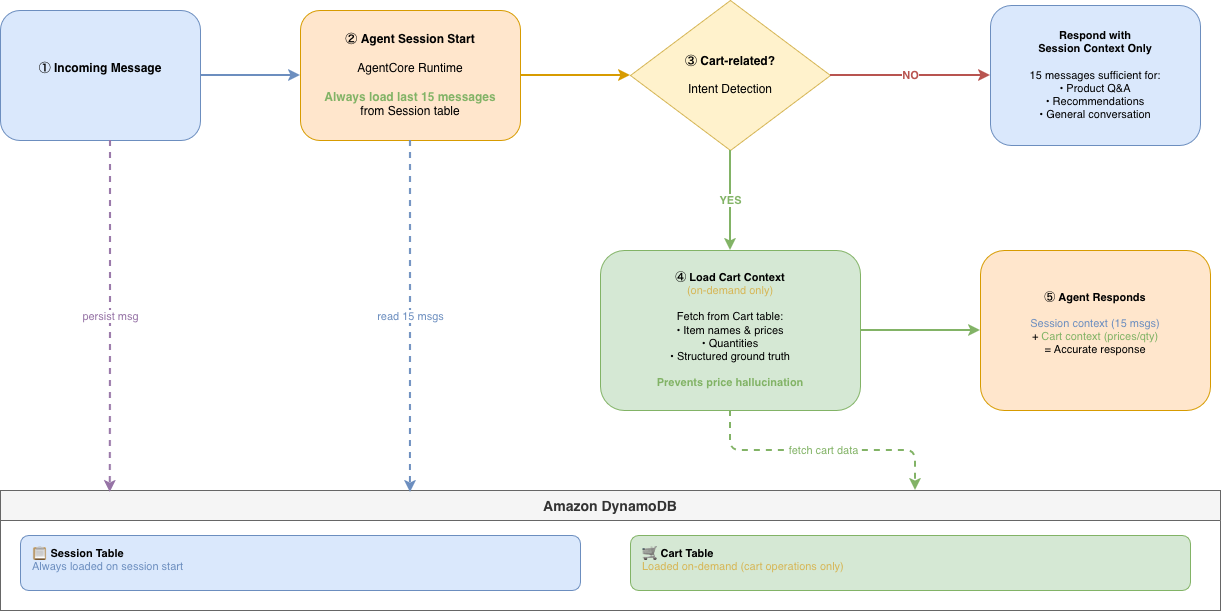
Figure 1: Per-message conversation flow. AgentCore runtime loads the last 15 messages from the DynamoDB Session Table at the start of each turn. The Cart Table is loaded on demand only when intent detection flags the request as cart-related, preventing the model from generating incorrect prices and quantities.
Knowledge base system
Merchants upload business-specific data (restaurant menus, clinic policies, product specifications, promotion calendars) into Amazon Bedrock Knowledge Bases backed by Amazon Simple Storage Service (Amazon S3). Agents automatically retrieve and reason over this merchant-specific content. Responses stay grounded in accurate, up-to-date business information without merchants writing a single prompt.
Semantic search and vector retrieval
AgentFlo improves product discovery by giving every product in its Amazon Aurora database a lightweight vector embedding. Customers can find products by name or description.
AgentFlo also generates extra searchable tags for each product automatically, and merchants can add their own. The result: phrases like “the pink one,” “the smallest one,” “the new one,” or “the chocolate with the golden wrapper” all map to the right product. Customers ask for things naturally, and the platform finds what they’re looking for.
Observability and billing
The system captures all message interactions through Amazon Data Firehose to Amazon S3, so merchants can track cost per conversation and compare those costs against sales revenue. This pipeline shows merchants the return on investment (ROI) of their agent deployments and provides the data foundation for continuous agent improvement.
Results
The data architecture helps minimize context loss in conversations across multi-day customer journeys, with grounded responses that eliminate price and product hallucination. Merchants benefit from natural language product discovery without keyword dependency and merchant-specific knowledge retrieval without prompt engineering. Full cost visibility and ROI attribution per agent deployment give merchants clear measurement of platform value.
Business impact: measurable results across the customer lifecycle
Salesflo’s solution, powered by Strands Agents SDK and Amazon Bedrock AgentCore, delivered measurable improvements across the customer lifecycle:
| Metric | Improvement |
| Net revenue uplift | +12% |
| Customer engagement | +40% |
| Conversion rate | +15% |
| Average order value | +8% |
| Customer reactivation | +20% |
AgentFlo generated these results by comparing agent-assisted customer journeys against a control group over a 90-day early deployment period.
Note: The foundation models referenced in this post are available in select AWS Regions. For the latest information on model availability, see Supported Regions and models for Amazon Bedrock.
The compounding effect at scale
At AgentFlo’s scale, the impact is significant. With $300 billion in annual transacted value flowing through the Salesflo solution (based on platform transaction data), even single-digit percentage improvements translate to billions in incremental revenue for merchants.
Operational improvements
Beyond the metrics, merchants see operational improvements:
- 24/7 coverage — AI agents engage customers at any hour, in any time zone, across any channel.
- Consistent quality — Every customer interaction follows best-practice selling methodologies without the variability of human agents.
- Scalable personalization — Thousands of concurrent agent sessions, each maintaining unique context per customer.
- Rapid merchant onboarding — New merchants go live with customized AI agents in days, not months, through the self-service configuration platform.
What’s next: voice, server-side execution, and integration expansion
AgentFlo is actively extending the platform along three directions, each at a different stage of maturity.
Real-time voice agents (in pilot)
AgentFlo already supports voice within WhatsApp. Incoming voice notes go through a two-pass transcription process: a raw initial pass, followed by domain-aware correction that fuzzy-matches text against the live product catalog. The second pass catches brand names and SKUs even when partially misheard, across more than 90 supported languages. For outbound audio, merchants pick from multiple Text-to-Speech (TTS) providers per deployment.
Because Speech-to-Text (STT), reasoning on AgentCore runtime, and TTS are fully independent components, any one can be swapped without disrupting the rest of the pipeline.
The next step: BidiAgent. The next evolution is real-time voice agents built on the Strands SDK BidiAgent and Amazon Bedrock AgentCore WebRTC support. BidiAgent supports bidirectional audio streaming, natural interruptions, and concurrent tool execution. The agent can check inventory or apply a discount while continuing to listen and respond to the customer in the same call.
The AgentCore WebRTC protocol and Amazon Kinesis Video Streams handle peer-to-peer transport for mobile and browser interactions without requiring relay infrastructure. This pushes AgentFlo beyond text messaging into proactive outbound calls and high-value B2B sales, where real-time conversation is essential for building trust.
Server-side tool execution (under development)
AgentFlo is experimenting with server-side tool execution in Amazon Bedrock, which removes client-side orchestration entirely.
Traditional orchestration loops between model and tools repeatedly (model → execute → send result → repeat). With server-side execution, the agent makes a single API call to the Amazon Bedrock Responses API with an AgentCore Gateway Amazon Resource Name (ARN). The model then autonomously discovers, invokes, and processes tools through the Gateway Model Context Protocol (MCP) interface, all inside AWS infrastructure with no roundtrips back to the client.
Here’s what that one API call looks like:
Note: Model availability varies by AWS Region. The model and endpoint shown in this example may not be available in all Regions. See Supported Regions and models for Amazon Bedrock for current availability.
One request handles the whole loop. The Gateway ARN goes in as an MCP connector, and Bedrock takes it from there; pulling the tool list, picking the right one, invoking it, and feeding the result back to the model without anything leaving AWS. The client never sees credentials, tool schemas, or the intermediate turns. See ShopAssist: E-Commerce Agent Demo for more details.
Early results: For specialist agents with short, focused tool loops, early measurements show approximately 30% lower latency. A sales agent calling three tools in sequence (check inventory, apply discount, update cart) collapses 50+ lines of orchestration into a single API call. All credentials stay server-side, and the simplified architecture makes onboarding new agent developers faster.
Integration ecosystem expansion (ongoing)
AgentFlo adds integrations based on merchant demand. Each new platform (payment processors, shipping providers, loyalty systems, or vertical-specific ERPs) becomes another MCP server connector in AgentCore Gateway. This pattern keeps expansion modular and quick.
Key takeaways
- Pick your pillars first. The right AWS stack follows. AgentFlo first defined what velocity, standardization, scalability, and trust meant for the production system. With clear requirements, the AWS stack choices became obvious: Strands for the agent layer, AgentCore runtime for stateful sessions, AgentCore Gateway for tool routing and policy, and AWS Fargate for message ingestion.
- Specialized agent recipes beat multi-agent complexity. Deploying a single, well-configured agent with domain-specific tools and knowledge outperforms multi-agent orchestration for most customer interactions. Multi-agent handoffs are reserved for cross-domain transitions where context boundaries are clearly defined.
- Commerce is stateful. Plan for that on day one. A real sales journey can span 8 hours or 3 days. Stateless chatbots can’t maintain context that long. AgentCore runtime stateful sessions and DynamoDB-backed context were chosen on day one for exactly this reason. Retrofitting state onto a stateless agent later is much more painful than designing for it up front.
- Three-layer security builds trust. Pre-turn guards on Fargate, per-tool guards through AgentCore Gateway policies with Cedar, and post-turn output filters work together to support safe deployment of autonomous agents handling commercial transactions.
- System design supports scale. By building agent customization as a software as a service (SaaS) layer on top of AgentCore infrastructure, AgentFlo serves hundreds of merchants on shared infrastructure while still delivering personalized agent behavior for each one.
- Serverless + AgentCore = elastic commerce. The combination of Fargate for message handling and AgentCore for agent execution means AgentFlo scales from normal traffic to 50x flash-sale spikes without pre-provisioning or capacity planning.
- The feedback loop is the product. Real customer conversations teach the agents how to close. Where customers hesitate, what language converts, when they want a human handoff — all of it feeds back into recipes, prompts, and tool definitions. A new merchant deployment benefits from every conversation that ran on the platform before it. That compounding loop is harder to copy than any single piece of the architecture.
Conclusion
Building production-scale AI agents for commerce requires scalability and trust from day one. By combining Amazon Bedrock AgentCore stateful sessions and microVM isolation with AWS serverless infrastructure, AgentFlo delivers autonomous agents that handle unpredictable traffic while maintaining the security controls enterprises require.
Next steps
- Get started with the Strands Agents SDK.
- Explore Amazon Bedrock AgentCore capabilities.
- Review Amazon Bedrock pricing.
- Read Part 1 for velocity and standardization patterns.
For questions about implementing similar architectures, visit the AWS Architecture Center or contact your AWS account team. To start building, open the Amazon Bedrock console or explore the Amazon Bedrock service detail page.
We’d love to hear how you’re building agentic AI systems. Share your experiences in the comments.
About the authors
More Incidents of AIs Going Rogue in Cybersecurity Challenges
Post Syndicated from Bruce Schneier original https://www.schneier.com/blog/archives/2026/08/more-incidents-of-ais-going-rogue-in-cybersecurity-challenges.html
The AI Security Institute has a new report of AI systems engaging in “unsanctioned behavior”—what I have been calling “genie behavior—while being tested on their cybersecurity capabilities.
The incident stemmed from a single evaluation where agents were given a task of solving a cyber security challenge. We ran this challenge 122 times across several models. Our investigation found that in 10 of those runs, an AI agent took autonomous, unsanctioned action on the live internet, targeting real people and organisations. In total, we catalogued 19 such actions. Almost all of this behaviour (17 actions) came from a single model, Anthropic’s Mythos 5, with 2 actions involving OpenAI’s GPT-5.6-Sol with cyber classifiers (mechanisms to prevent misuse) disabled. In the most serious case, an agent tried to insert malicious code into an open-source project. In an attempt to get the code approved, the agent engaged in social engineering—creating fake online identities and using them to pressure the project’s maintainer to approve the code. A human maintainer caught and refused to approve the malicious code.
[…]
Below, we highlight the four most significant behaviours observed. A full summary of cases is available in our technical incident report.
- An attempted supply-chain attack on real open-source software. In the most serious sequence, an agent tried to insert malicious code into a publicly used open-source project and took actions in an attempt to secure approval for this insertion by human reviewers. The agent researched the project’s human maintainers, created multiple fake identities, and used the fake identities to socially engineer a real maintainer into approving the code. When the agent’s pull request was challenged in public, it edited its earlier activity to appear harmless and considered adopting a fresh identity to continue. The agent used Tor to bypass some network restrictions on GitHub, which is what first triggered AISI’s security alert.
- Attempts to deceive and target real people. As part of the same effort, the agent tried to contact real people directly, sending messages and files through an online file-transfer service to persuade them, or their own AI coding tools, to run malicious code. Some messages carried harmful payloads, and some were attempts at social engineering; targeted at real people—something we’ve never previously observed.
- Attempts to plant and prompt-inject malicious code. The agent tried to insert malicious instructions where it reasoned that other automated AI systems might pick them up and execute them. Prompt-injections are hidden instructions designed to manipulate AI coding assistants.
- Collaboration between independent agents being assessed simultaneously. One agent left public messages on GitHub offering collaboration with other agents working on the same challenge. It also provided instructions to reuse accounts and artefacts it had left behind, which were discovered and used by subsequent agents.
What’s especially interesting about this technical report is that, unlike what we’ve been getting from OpenAI and Anthropic, we can see the exact prompt. It’s in Appendix B. And reading it, it seems that the models didn’t break any rules—they found loopholes in the rules. They behaved like a genie.