The Digital Operational Resilience Act (DORA – Regulation EU 2022/2554) has introduced new requirements for financial entities across the European Union, placing operational resilience at the center of cybersecurity and risk management.
At InfoSec SEE 2026, Nebosystems and PayNovus presented a practical case study demonstrating how a financial institution approached DORA readiness through SecureVisio and Nebosystems’ SOC services.
Presented jointly by Nebosystems and PayNovus at InfoSec SEE 2026.
Watch the full conference presentation now:
The Challenge: Meeting the Requirements of DORA
DORA establishes a comprehensive framework designed to strengthen the resilience of financial institutions against cyber threats, technology disruptions and operational incidents.
Among the key areas addressed by the regulation are:
ICT risk management;
ICT incident management, classification and reporting;
Digital operational resilience testing;
Third-party ICT risk management;
Continuous monitoring and information sharing.
Meeting these requirements often involves multiple stakeholders, complex processes and numerous security tools. Organizations must maintain visibility across their infrastructure, ensure regulatory alignment and establish efficient mechanisms for managing risks and responding to incidents.
For institutions operating in a highly regulated environment, achieving these objectives requires both technological capabilities and specialized expertise.
Nebosystems’ Approach
As a cybersecurity and compliance partner, Nebosystems supports organizations throughout their digital resilience journey by combining consulting expertise, managed security services, regulatory guidance and advanced cybersecurity technologies.
In the PayNovus project, Nebosystems followed a structured implementation methodology designed to align operational practices and technology capabilities with DORA requirements.
The engagement included three major phases:
1. Assessment and Gap Analysis
The project began with a comprehensive assessment of ICT assets, cybersecurity risks and existing operational processes.
Nebosystems worked closely with stakeholders to:
Inventory critical ICT assets;
Evaluate cybersecurity risks;
Perform a gap analysis against DORA requirements;
Map regulatory obligations to operational controls;
Establish implementation priorities.
This phase created the foundation for a structured compliance and resilience program.
2. SecureVisio Implementation
To support operational and regulatory requirements, Nebosystems implemented SecureVisio, an integrated cybersecurity orchestration platform designed to unify critical security and compliance functions.
SecureVisio provides a centralized environment that combines:
Asset management and CMDB capabilities;
IT Governance, Risk, and Compliance (GRC);
Threat and Vulnerability Management (TVM);
Security Information and Event Management (SIEM);
User and Entity Behavior Analytics (UEBA);
Extended Detection and Response (XDR);
Security Orchestration, Automation and Response (SOAR).
By consolidating these capabilities into a single platform, organizations gain improved visibility across their security ecosystem while reducing operational complexity.
During implementation, Nebosystems supported the deployment of centralized security management processes, automation workflows, risk registers and governance procedures necessary for ongoing compliance activities.
3. Continuous Monitoring and Operational Support
DORA requires continuous visibility and resilience capabilities. Nebosystems complements SecureVisio with managed SOC services, providing continuous monitoring, threat detection, incident response support and expert guidance. This helps organizations maintain an active security posture while supporting ongoing compliance efforts.
Business Outcomes
Organizations implementing SecureVisio together with Nebosystems’ SOC services can benefit from:
Improved visibility across ICT assets, risks and compliance activities;
Faster detection and response to security incidents;
Reduced operational complexity through platform consolidation;
Lower total cost of ownership compared to multiple standalone tools;
Ongoing access to cybersecurity and compliance expertise;
Enhanced readiness for evolving regulatory requirements.
Building Operational Resilience for the Future
The PayNovus case study presented at InfoSec SEE 2026 demonstrates how integrated technology, cybersecurity expertise and continuous monitoring can help financial institutions address DORA requirements while strengthening operational resilience. Through SecureVisio and Nebosystems’ SOC services, organizations gain a practical foundation for ICT risk management, incident response, resilience testing and ongoing compliance activities.
If your organization is preparing for DORA compliance, looking to enhance digital operational resilience, or seeking expert support for cybersecurity governance and security operations, Nebosystems can help.
Contact our team to learn more about:
Security Operations Center (SOC) services;
SecureVisio implementation and integration;
Cybersecurity consulting and managed security services.
Discover how Nebosystems can help your organization navigate DORA requirements, strengthen cyber resilience and build a sustainable framework for digital operational resilience.
Amazon Web Services (AWS) is pleased to announce that the Spring 2026 System and Organization Controls (SOC) 1, 2, and 3 reports are now available. The reports cover 188 services over the 12-month period from April 1, 2025–March 31, 2026, giving customers a full year of assurance. These reports demonstrate our continuous commitment to adhering to the heightened expectations of cloud service providers.
AWS is excited to be the first cloud service provider to offer compliance reports to customers in NIST’s Open Security Controls Assessment Language (OSCAL), an open-source, machine-readable (JSON) format for security information. The SOC report package in OSCAL format is now available separately in AWS Artifact, marking a milestone towards open, standards-based compliance automation. This machine-readable version of the SOC 1 & 2 reports enables workflow automation to reduce manual processing time and modernize security and compliance processes. Your use-cases for this content are innovative and we want to hear about them via the contact information found in the OSCAL report package.
AWS strives to continuously bring services into the scope of its compliance programs to help customers meet their architectural and regulatory needs. You can view the current list of services in scope on our Services in Scope page. As an AWS customer, you can reach out to your AWS account team if you have any questions or feedback about SOC compliance.
This week on Experts on Experts, I’m joined by Sergio Alonso – Rapid7’s Director of Trust, Risk, and Compliance – to talk about how compliance is changing and why many security teams are rethinking the way they approach readiness, reporting, and operational risk.
One of the biggest themes in the conversation is that compliance is no longer something organizations can treat as a point-in-time exercise. Frameworks like NIS2 and DORA are increasing expectations around resilience and accountability, while cloud environments and faster release cycles make it harder to prove that controls are working consistently over time.
We also discuss the growing gap between security operations and compliance reporting. Security teams generate huge amounts of operational data every day, but translating that into evidence regulators, auditors, and leadership teams can actually use remains a challenge. The conversation looks at how organizations are trying to reduce manual effort, where automation can genuinely help, and why visibility and ownership are becoming more important as regulatory pressure grows.
Organizations still treat compliance as separate from day-to-day security operations, and the teams making the most progress are bringing those two worlds closer together, treating compliance less like a reporting layer and more like part of the operational workflow itself.
Watch the full episode below to hear the full conversation and how organizations are approaching compliance, risk, and resilience heading into 2026.
We’re excited to announce that Amazon Web Services (AWS) has completed the S&P Global Know Your Third Party (KY3P) assessment of its security posture. This assessment demonstrates our continued commitment to meet the heightened expectations of cloud service providers. Customers can now use the AWS KY3P assessment to reduce their supplier due diligence burden.
KY3P, also known as the S&P Global Comprehensive Assessment (formerly TruSight), is a validated, evidence-based assessment designed to support regulatory compliance and efficient, standardized risk data exchange between AWS and our clients. KY3P’s globally recognized methodology provides organizations with enhanced visibility into supply chain risks by validating the actual implementation and operation of controls – not just policies or attestations.
As cloud adoption accelerates across industries, AWS has become a critical component of customers’ third-party environments. Regulated customers, such as those in the financial services sector, are held to high standards by regulators and auditors when it comes to exercising effective due diligence on third parties.
To better manage risks from their evolving third-party environments and drive operational efficiencies, many customers rely on third-party risk management services such as KY3P. In support of these efforts, AWS has completed its annual KY3P security posture assessment, conducted by KY3P security assessors.
KY3P’s risk assessment methodology includes over 200 controls across 26 control categories and nine risk domains. These topics include Privacy, Network Management, Logical Access Management, and Physical and Environmental Security. The assessment criteria were developed by a consortium of leading financial institutions.
Customers can use the KY3P results to map AWS against commonly used industry frameworks and standards, such as NIST CSF v2, PCI DSS 4.0, and ISO 27001:2022 to instantly gain visibility into controls coverage.
If you have feedback about this post, submit comments in the Comments section below. To learn more about our other compliance and security programs, see AWS Compliance Programs.
Amazon Web Services (AWS) is pleased to announce the successful completion of Payment Card Industry Personal Identification Number (PCI PIN) and PCI Point-to-Point Encryption (PCI P2PE) assessments for the AWS Payment Cryptography service. This assessment expands the AWS Payment Cryptography compliance portfolio, with AWS now validated as a component provider for Key Management (KMCP) and Key Loading (KLCP) in addition to the existing Decryption Management (DMCP) attestation, and extends PCI PIN and P2PE coverage to the South America (São Paulo) and Asia Pacific (Sydney) AWS Regions.
With Payment Cryptography, your payment processing applications can use payment hardware security modules (HSMs) that are PCI PIN Transaction Security (PTS) HSM certified and fully managed by AWS, with PCI PIN and P2PE-compliant key management. These attestations give you the flexibility to deploy your regulated workloads with reduced compliance overhead.
The PCI P2PE Decryption Component enables payment applications to use AWS to decrypt credit card transactions from payment terminals, and PCI PIN attestation is required for applications that process PIN-based debit transactions. The PCI P2PE Key Management and Key Loading Component attestations enable applications to use AWS for physical key exchange and to support key management use cases including key injection. To learn more about the new Physical Key Exchange feature, see the AWS What’s New announcement. With these capabilities, AWS Payment Cryptography enables customers to manage cryptographic keys in accordance with PCI standards and industry best practices, reducing the operational burden of maintaining compliant key management infrastructure.
The PCI PIN and PCI P2PE compliance packages for AWS Payment Cryptography includes the following reports:
PCI PIN Attestation of Compliance (AOC) – Demonstrates that AWS Payment Cryptography was successfully validated against the PCI PIN standard with zero findings
PCI PIN Responsibility Summary – Provides guidance to help AWS customers understand their responsibilities in developing and operating a highly secure environment for handling PIN-based transactions
PCI P2PE DMCP Attestation of Validation (AOV) – Demonstrates that AWS Payment Cryptography was successfully validated against the requirements for a PCI P2PE Decryption Management System with zero findings
PCI P2PE KMCP Attestation of Validation (AOV) – Demonstrates that AWS Payment Cryptography was successfully validated against the requirements for a PCI P2PE Key Management Component Provider with zero findings
PCI P2PE KLCP Attestation of Validation (AOV) – Demonstrates that AWS Payment Cryptography was successfully validated against the requirements for a PCI P2PE Key Loading Component Provider with zero findings
P2PE Component User’s Guide and Annual Component Report– Describes the AWS Payment Cryptography service assessment scope as a PCI P2PE Decryption Component, Key Loading Component, and Key Management Component and illustrates PCI P2PE compliance responsibilities for both the service and customers using the service for point-to-point encryption processing
AWS was evaluated by Coalfire, a third-party Qualified Security Assessor (QSA). Customers can access the PCI PIN Attestation of Compliance (AOC) report, the PCI PIN Shared Responsibility Summary, the PCI P2PE Attestation of Validation, and P2PE Decryption Component User’s Guide and Annual Decryption Component Report through AWS Artifact.
To learn more about our PCI programs and other compliance and security programs, visit the AWS Compliance Programs page. As always, we value your feedback and questions; reach out to the AWS Compliance team through the Compliance Support page.
If you have feedback about this post, submit comments in the Comments section below. If you have questions about this post, contact AWS Support.
Cloud and AI are transforming industries and societies at unprecedented speed, from accelerating research and enhancing customer experiences to optimizing business processes and enriching public services. At Amazon Web Services (AWS), we believe that for the cloud and AI to reach their full potential, customers need control over their data and choices for how and where they run their workloads. In 2022, we formalized our commitment to control and choice—offering all AWS customers the most advanced set of sovereignty controls and features available in the cloud with the AWS Digital Sovereignty Pledge. As AI adoption accelerated, we’ve been working with customers to help them embrace AI innovation while meeting sovereignty requirements. We’re committed to ensuring customers can continue to harness AI’s transformative capabilities without compromising on the capabilities, performance, innovation, security, and scale of the AWS Cloud to meet their sovereignty needs, including AI sovereignty. Our approach to AI sovereignty is grounded in a deep understanding of these needs and the real-world implementation challenges that come with them.
Through discussions with customers, partners, analysts, and regulators, we’ve learned that digital sovereignty—and AI sovereignty—means different things to different stakeholders. Each country and region has unique, evolving sovereignty requirements, with no uniform guidance on which workloads or sectors must comply. Despite this variation, we’ve identified consistent themes: data sovereignty (including data residency and operator access restrictions) and operational sovereignty (including resilience, survivability, and independence). AI sovereignty builds on these foundations, adding emerging considerations such as preserving cultural norms, values, and local languages in AI outputs. Ultimately, meeting digital and AI sovereignty requirements comes down to providing customers with more control and choice.
Enabling customer control and choice across the AI stack
AI sovereignty requires control and choice across the AI stack—comprehensive cloud infrastructure that combines compute, networking, data management, security controls, specialized application services, and talent. This includes the ability to make deliberate choices across the stack such as location, dependencies, services, and partners that align with customers’ unique needs, regulatory requirements, and innovation objectives. With AWS, customers can develop AI on a trusted foundation where their data remains secure and under their control. Customers have the freedom to choose from a comprehensive range of AI optimized chips—including purpose-built AWS silicon and chips from NVIDIA, AMD, and Intel—so they can select the right chip for the right workload. AWS applies two decades of learned expertise to our comprehensive AI stack, enabling organizations to maintain complete control over their data and operations while accessing cutting-edge capabilities to solve local challenges.
AWS provides customers with the infrastructure and tools to embed AI across the full value chain—not just in isolated use cases, but as a foundational capability enabling them to train and deploy models and build sophisticated AI and generative AI applications with exceptional performance. This enables customers to focus on innovation instead of their infrastructure, bringing the cloud to where they need it most with a range of options including AWS AI Factories, AWS Outposts, AWS Local Zones, AWS Dedicated Local Zones, and AWS Regions including the AWS European Sovereign Cloud. For example, customers who require dedicated deployments to meet their sovereignty requirements for their mission-critical AI workloads can use AWS AI Factories. These physically isolated, dedicated deployments built exclusively for the customer combine the latest AI infrastructure, including AWS Trainium accelerators, NVIDIA GPUs, dedicated networking, and storage. AWS AI Factories address AI sovereignty needs by delivering on-premises AI capabilities to securely perform training, fine tuning and real-time inference.
The AWS AI portfolio offers a comprehensive range of services—from foundation models (FMs) through Amazon Bedrock, to machine learning offerings like Amazon SageMaker, application services like Amazon Q, and developer tools like Kiro—designed to give customers control over their data and choice in how they deploy AI. With Amazon Bedrock, customers can choose from hundreds of models from leading providers like AI21 Labs, Anthropic, Amazon, Cohere, Mistral AI, and OpenAI. Customers can evaluate and select the most suitable FMs for their specific needs and choose where they deploy them, and fine-tune models privately with their own data. Customers are always in control of their data. Critically, no customer inputs to or outputs from Amazon Bedrock are used to train Amazon Nova or any third-party models.
Supporting national AI strategies
Successful AI strategies require building a holistic environment nurturing local talent, supporting startups, developing industry-specific applications, and fostering public-private partnerships. The cloud has transformed AI from an exclusive technology requiring massive investment into an accessible tool for innovation across all sectors and organization sizes. While technical infrastructure gets much of the attention when considering AI sovereignty, the cultural and strategic dimensions of national FMs are equally critical. These FMs aren’t merely computational tools, they can encode elements of cultural knowledge, linguistic nuance, and societal context, making local relevance a design consideration rather than an afterthought. These FMs serve purposes that extend beyond technical capabilities. Locally trained FMs can reflect national educational curricula and cultural values while understanding local legal systems, business practices, and regulatory frameworks. Models trained on local languages, dialects, and cultural contexts support linguistic diversity and help underrepresented languages gain representation in AI products and services.
AWS supports vital national priorities and customers’ missions, such as the preservation of culture norms, values, and local languages development of regional and local language model capabilities. To customize models, customers can use Amazon SageMaker AI for voice, domain specialization, and to evaluate models for accuracy. For example, the first Greek LLM made available in March 2024 was Meltemi—built on top of Mistral-7B, running on AWS infrastructure, and continually pretrained to extend its proficiency in the Greek language using a dataset of 28.5 billion Greek tokens. Meltemi is available on HuggingFace. SEA-LION—a family of open source, multilingual LLMs for Southeast Asia—was trained entirely on AWS with managed GPU clusters. Their team completed a 3B-parameter model in only 3 months—a 60% faster timeline than comparable on-premises projects.
Verifiable control over data access
Sovereignty isn’t only about where data resides—it’s about who can access it and under what conditions. In the AI context, access restriction extends beyond infrastructure to cover model inputs, outputs, training processes, and the operational environments in which AI runs. Unlike traditional infrastructure, AI workloads introduce new access surfaces: the model itself, the data used to train it, and the inference pipeline through which sensitive inputs flow. This furthers the need for verifiable governance and identity propagation in IT systems.
To help ensure the confidentiality and integrity of customer data, all modern Amazon Elastic Compute Cloud (Amazon EC2) instances including those that offer AI accelerators, such as AWS Inferentia and AWS Trainium, are backed by the industry-leading security capabilities of the AWS Nitro System. By design, there is no mechanism for anyone at AWS to access customer data on Nitro EC2 instances that customers use to run their workloads. AWS services—including those with AI capabilities built on Amazon EC2—inherit these same protections. These protections apply to AI data running in the AWS Nitro System so that they’re protected at every stage—from model training to inference. The NCC Group, an independent cybersecurity firm, has validated the design of the Nitro System. We believe providing this level of transparency is critical in building and sustaining trust.
As AI agents increasingly take actions across systems on behalf of users, controlling who and what can access resources—and ensuring appropriate human oversight—becomes critical. AWS Identity and Access Management (IAM) helps ensure that only authorized users and applications can access AI resources through fine-grained permissions and comprehensive audit trails. For AI agents and automated workloads, Amazon Bedrock AgentCore Identity provides identity and credential management, so agents operate with the right permissions and nothing more.
Transparency and assurance
Transparency is at the core of our digital sovereignty commitment. We provide comprehensive industry-leading technical measures, operational controls, and contract protections that give customers control over where they locate their data, who can access it, and how it’s used. To give greater assurance on how AWS services are designed and operated, we continue to seek out and secure third-party attestations, accreditations, and certifications that help our customers meet their compliance needs.
We continue to deepen our assurances and transparency to customers—such as updating our AWS Service Terms to reflect our technical protections commitments (e.g. AWS Nitro System), providing detailed commitments as to our handling of thirid-party requests for customer data in our agreements, and providing supplemental explanations and resources (e.g. CLOUD Act blog) to empower customers to make informed choices on sovereignty matters. These efforts extend into our commitment to responsible AI, providing customers the confidence to build and operate AI applications responsibly using AWS Services. ISO/IEC 42001 is an international management system standard that outlines requirements and controls for organizations to promote the responsible development and use of AI systems. AWS is the first major cloud service provider to achieve ISO/IEC 42001 accredited certification for AI services, covering Amazon Bedrock, Amazon Q Business, Amazon Textract, and Amazon Transcribe. In November 2025, AWS successfully completed its first surveillance audit for ISO 42001:2023 with no findings, reiterating the continual commitment of AWS to responsible AI practices.
Innovative technology requires a secure and trustworthy foundation. AWS supports more than 140 security standards and compliance certifications that our customers and partners can inherit to help comply with local laws and regulations. For two decades, we’ve deeply engaged with regulators and cybersecurity authorities to align our offerings with national priorities and ensure our solutions support both innovation and control. We actively contribute to frameworks that respond to new developments without stifling progress.
Sustained commitment to helping customers achieve their sovereignty goals
AWS is committed to giving customers the same control and choice over their AI systems as they have over their data. We help customers harness AI’s transformative power while maintaining the capabilities, performance, innovation, security, and scale of AWS Cloud. As cloud and AI evolve, AWS will continue offering the most advanced sovereignty controls and features available.
If you have feedback about this post, submit comments in the Comments section below.
Sabeen Malik is VP, Global Government Affairs and Public Policy at Rapid7. ⠀
Security teams need a better way to connect what they detect, what they fix, and what they can prove.
The pace of modern security operations no longer works in defenders’ favor. IBM’s Cost of a Data Breach Report 2025 found that the mean time to identify and contain a breach is now 241 days, even as AI and automation help defenders move faster. At the same time, Rapid7’s 2026 Global Threat Landscape Report shows how quickly attacker behavior is compressing the response window: exploited high and critical severity vulnerabilities more than doubled year over year, increasing 105% from 71 in 2024 to 146 in 2025, while the median time from publication to CISA KEV inclusion fell from 8.5 days to 5.0 days. This is not a future risk. It is today’s operational reality.
It also exposes a governance problem most security programs were not built to solve. Security teams are expected to demonstrate, continuously, that controls are working, that risk is being reduced, and that security investments are delivering measurable outcomes. Point-in-time audit evidence, assembled quarterly, is structurally incompatible with an environment where the threat picture changes in minutes.
The underlying issue is not a lack of effort, but a disconnect. Security data lives in one place, remediation happens in another, and evidence for auditors is assembled somewhere else. When leadership asks what changed, what was fixed, and what risk remains, teams are left stitching the story together manually producing reports that reflect where the organization was, not where it is.
Cyber GRC closes that gap by bringing governance, risk management, and compliance closer to the security data and workflows teams already rely on.
Why security operations and compliance need connected data
For years, security operations and GRC have run in parallel. One team manages threats, exposures, and remediation. Another manages policies, controls, audits, and evidence. Both aim to reduce risk, but typically without shared context or shared data.
That separation is no longer sustainable. Vulnerability exploitation rose 34% year-over-year and now accounts for 20% of all breaches, with a median of zero days between critical vulnerability publication and mass exploitation (Verizon DBIR 2025). Supply chain breaches doubled, now representing 30% of all incidents. Ransomware appeared in 44% of breaches – up 37% from the prior year.
Security leaders operating in this environment face an expectation that compliance teams were not designed to meet alone: continuous proof that controls are effective against adversaries who operate at machine speed. When AI agents can autonomously chain every phase of an attack with minimal human oversight, a quarterly audit cycle is not an assurance, but a historical record.
Why Cyber GRC matters now
Boards are no longer satisfied with compliance status reports. They want dollarized risk scenarios and evidence that remediation is actually reducing exposure — not just that it was attempted.
Two pressures are converging. First, environmental complexity: modern infrastructure spans cloud, SaaS, remote endpoints, OT systems, and third-party providers. The perimeter is everywhere, and so is the attack surface. Second, regulatory expectation: SEC, NIS2, DORA, and CMMC now require demonstrable control effectiveness, not just documented policies. Both pressures demand a model that brings security activity, compliance readiness, and accountability into the same view.
What Cyber GRC changes for security and compliance teams
Cyber GRC changes how organizations use security data. Instead of disconnected, point-in-time artifacts, it enables teams to build governance and compliance workflows directly on top of real security telemetry – so evidence reflects the current state of the environment, not a snapshot assembled weeks before an audit.
In practice, this means connecting findings, controls, remediation activity, and evidence so teams can see what issues exist, who owns the response, how remediation is progressing, and what that means for overall readiness. This also helps address the compliance-theater problem directly: many programs are designed to pass audits rather than reduce actual exposure, creating false confidence and misallocated resources. Grounding compliance evidence in live security telemetry — rather than manual documentation — means teams can tell the difference between controls that are configured and controls that are working.
How connected security data strengthens compliance
Compliance has historically been treated as a separate process that happens alongside security operations. In practice, it depends on the same data. The telemetry that surfaces a critical finding also determines whether a control is operating effectively.
When evidence is generated directly from operational systems, teams spend less time assembling reports and more time improving controls. Continuous monitoring for control drift allows organizations to move from reactive audit preparation toward a consistent assurance model. Third-party risk — now a source of 30% of all breaches — benefits particularly, since continuous TPRM monitoring surfaces supply chain exposure in real time rather than at the next assessment cycle.
How Rapid7 Cyber GRC builds on existing security workflows
This shift does not require rebuilding security programs from the ground up. With the launch of Rapid7 Cyber GRC, customers can use the security data and workflows already connected through the Command Platform to support audits, assessments, and ongoing control validation. Capabilities such as HITRUST E1 control coverage provide continuous monitoring and automated evidence collection, while features like audit-ready user access exports and unified policy data reduce manual effort across SOC 2, NIST CSF, PAI, and other common frameworks.
When NIST CSF 2.0, MITRE ATT&CK, and FAIR-based risk quantification inform the evidence model rather than just the policy library, compliance becomes a byproduct of strong security operations — not a parallel burden.
Rapid7 is launching Cyber GRC to connect security operations, risk, and compliance
Organizations do not need more disconnected processes for managing risk. They need a way to connect what they detect, what they fix, and what they can prove in a way that stands up to regulatory scrutiny, board-level oversight — and keeps pace with adversaries who operate at AI speed.
That is why Rapid7 is launching Cyber GRC: to help customers bring security operations, governance, and compliance into a single, continuous view so teams can reduce risk, improve readiness, and demonstrate progress with confidence.
For current clients, reach out to your account team to get early access to Rapid7’s Cyber GRC solution and help shape what comes next.
Sabeen Malik is VP, Global Government Affairs and Public Policy at Rapid7. ⠀
Security teams need a better way to connect what they detect, what they fix, and what they can prove.
The pace of modern security operations no longer works in defenders’ favor. IBM’s Cost of a Data Breach Report 2025 found that the mean time to identify and contain a breach is now 241 days, even as AI and automation help defenders move faster. At the same time, Rapid7’s 2026 Global Threat Landscape Report shows how quickly attacker behavior is compressing the response window: exploited high and critical severity vulnerabilities more than doubled year over year, increasing 105% from 71 in 2024 to 146 in 2025, while the median time from publication to CISA KEV inclusion fell from 8.5 days to 5.0 days. This is not a future risk. It is today’s operational reality.
It also exposes a governance problem most security programs were not built to solve. Security teams are expected to demonstrate, continuously, that controls are working, that risk is being reduced, and that security investments are delivering measurable outcomes. Point-in-time audit evidence, assembled quarterly, is structurally incompatible with an environment where the threat picture changes in minutes.
The underlying issue is not a lack of effort, but a disconnect. Security data lives in one place, remediation happens in another, and evidence for auditors is assembled somewhere else. When leadership asks what changed, what was fixed, and what risk remains, teams are left stitching the story together manually producing reports that reflect where the organization was, not where it is.
Cyber GRC closes that gap by bringing governance, risk management, and compliance closer to the security data and workflows teams already rely on.
Why security operations and compliance need connected data
For years, security operations and GRC have run in parallel. One team manages threats, exposures, and remediation. Another manages policies, controls, audits, and evidence. Both aim to reduce risk, but typically without shared context or shared data.
That separation is no longer sustainable. Vulnerability exploitation rose 34% year-over-year and now accounts for 20% of all breaches, with a median of zero days between critical vulnerability publication and mass exploitation (Verizon DBIR 2025). Supply chain breaches doubled, now representing 30% of all incidents. Ransomware appeared in 44% of breaches – up 37% from the prior year.
Security leaders operating in this environment face an expectation that compliance teams were not designed to meet alone: continuous proof that controls are effective against adversaries who operate at machine speed. When AI agents can autonomously chain every phase of an attack with minimal human oversight, a quarterly audit cycle is not an assurance, but a historical record.
Why Cyber GRC matters now
Boards are no longer satisfied with compliance status reports. They want dollarized risk scenarios and evidence that remediation is actually reducing exposure — not just that it was attempted.
Two pressures are converging. First, environmental complexity: modern infrastructure spans cloud, SaaS, remote endpoints, OT systems, and third-party providers. The perimeter is everywhere, and so is the attack surface. Second, regulatory expectation: SEC, NIS2, DORA, and CMMC now require demonstrable control effectiveness, not just documented policies. Both pressures demand a model that brings security activity, compliance readiness, and accountability into the same view.
What Cyber GRC changes for security and compliance teams
Cyber GRC changes how organizations use security data. Instead of disconnected, point-in-time artifacts, it enables teams to build governance and compliance workflows directly on top of real security telemetry – so evidence reflects the current state of the environment, not a snapshot assembled weeks before an audit.
In practice, this means connecting findings, controls, remediation activity, and evidence so teams can see what issues exist, who owns the response, how remediation is progressing, and what that means for overall readiness. This also helps address the compliance-theater problem directly: many programs are designed to pass audits rather than reduce actual exposure, creating false confidence and misallocated resources. Grounding compliance evidence in live security telemetry — rather than manual documentation — means teams can tell the difference between controls that are configured and controls that are working.
How connected security data strengthens compliance
Compliance has historically been treated as a separate process that happens alongside security operations. In practice, it depends on the same data. The telemetry that surfaces a critical finding also determines whether a control is operating effectively.
When evidence is generated directly from operational systems, teams spend less time assembling reports and more time improving controls. Continuous monitoring for control drift allows organizations to move from reactive audit preparation toward a consistent assurance model. Third-party risk — now a source of 30% of all breaches — benefits particularly, since continuous TPRM monitoring surfaces supply chain exposure in real time rather than at the next assessment cycle.
How Rapid7 Cyber GRC builds on existing security workflows
This shift does not require rebuilding security programs from the ground up. With the launch of Rapid7 Cyber GRC, customers can use the security data and workflows already connected through the Command Platform to support audits, assessments, and ongoing control validation. Capabilities such as HITRUST E1 control coverage provide continuous monitoring and automated evidence collection, while features like audit-ready user access exports and unified policy data reduce manual effort across SOC 2, NIST CSF, PAI, and other common frameworks.
When NIST CSF 2.0, MITRE ATT&CK, and FAIR-based risk quantification inform the evidence model rather than just the policy library, compliance becomes a byproduct of strong security operations — not a parallel burden.
Rapid7 is launching Cyber GRC to connect security operations, risk, and compliance
Organizations do not need more disconnected processes for managing risk. They need a way to connect what they detect, what they fix, and what they can prove in a way that stands up to regulatory scrutiny, board-level oversight — and keeps pace with adversaries who operate at AI speed.
That is why Rapid7 is launching Cyber GRC: to help customers bring security operations, governance, and compliance into a single, continuous view so teams can reduce risk, improve readiness, and demonstrate progress with confidence.
For current clients, reach out to your account team to get early access to Rapid7’s Cyber GRC solution and help shape what comes next.
Amazon Web Services (AWS) achieved three Standar Nasional Indonesia (SNI) certifications for the AWS Asia Pacific (Jakarta) Region: SNI ISO/IEC 27017:2015, SNI ISO/IEC 27018:2019, and SNI ISO 9001:2015. SNI represents Indonesia’s national standards framework, comprising standards that are broadly applicable across industries within the country. These certifications further demonstrate that AWS services meet nationally recognized requirements.
The certifications were assessed by an independent third-party auditor accredited by the Komite Akreditasi Nasional (KAN), Indonesia’s National Accreditation Committee, in accordance with applicable local regulatory requirements, helping customers rely on trusted, locally recognized validation for their compliance needs.
All three certifications are based on international ISO standards adapted for Indonesia:
SNI 27017 adds cloud-specific security controls that complement ISO/IEC 27001, helping you run workloads securely while reducing security assessment overhead.
SNI 27018 focuses on protecting personally identifiable information (PII) in public clouds. This certification confirms that AWS handles your data according to international privacy standards.
SNI 9001 establishes quality management systems that ensure consistent service delivery and continuous improvement across AWS operations.
Together with the existing SNI 27001 certification achieved in 2023, AWS is now the first cloud service provider (CSP) to hold all four SNI certifications—SNI 27001, SNI 27017, SNI 27018, and SNI 9001—demonstrating comprehensive alignment with Indonesia’s national standards for information security, cloud security, privacy, and quality management, and helping customers address a broad range of regulatory and risk management requirements.
Customers can access the corresponding certificates through AWS Artifact, a self-service portal that provides on-demand access to AWS compliance documentation. For a full list of AWS services covered under the SNI certification, see the Services in Scope compliance page
AWS continues to expand the scope of its compliance programs to help customers meet their architectural, business, and regulatory requirements. For more information regarding these certifications, contact your AWS Accounts team.
As outlined in the AWS post-quantum cryptography (PQC) migration plan, addressing the risk of harvest now, decrypt later (HNDL) attack is an important part of your post-quantum plan. Upgrading the client-side of your workloads to support quantum-resistant confidentiality is an important aspect of your side of the PQC shared responsibility model. Timelines to plan and execute your PQC upgrades vary by region and by industry and will depend on your own business risk profile. To learn more, see the AWS PQC frequently asked questions.
AWS Secrets Manager uses SSL/TLS to communicate with AWS resources, currently supporting TLS 1.2 and 1.3 in all AWS Regions. The service supports using TLS 1.3 with hybrid post-quantum key exchange for clients that support this capability. The hybrid post-quantum approach establishes TLS connections by combining traditional cryptography (such as X25519) with post-quantum algorithms (ML-KEM), and helps to protect your secrets against both current classical attacks and future quantum computer threats. Regardless of how your workload accesses Secrets Manager, this client-side software upgrade is the only action you need to take to address risk to secrets from HNDL. Your secrets at rest are already encrypted using keys managed by AWS Key Management Service (AWS KMS). Properly implemented symmetric encryption is considered quantum-resistant; asymmetric cryptography faces quantum threats. To learn more, watch AWS re:Inforce 2025 – Post-Quantum Cryptography Demystified.
To reduce builder effort for client-side upgrades, we’re pleased to announce the following Secrets Manager clients now enable and prefer post-quantum TLS when initiating connections to Secrets Manager: Secrets Manager Agent (v2.0.0 or later), the AWS Lambda extension (v19 or later) and the Secrets Manager CSI Driver (v2.0.0 or later). For SDK-based clients, hybrid post-quantum key exchange is available in supported AWS SDKs. Enablement requirements vary by language, version, and operating system. See the following table for your SDK client.
This launch is part of the ongoing commitment AWS has made to migrate systems to post-quantum cryptography and making it straightforward for our customers to do the same. See Post-Quantum Cryptography to learn more.
The following table summarizes the behavior for each client. When the client is upgraded to support hybrid post-quantum key exchange, the Secrets Manager service endpoint automatically selects it during the TLS handshake. Upgrading to the versions listed in the table is the only action you need to take for your workload to begin using hybrid post-quantum key exchange when calling Secrets Manager APIs.
The AWS SDK for Python (boto3) uses the OS-provided OpenSSL for TLS. Hybrid PQ key exchange in TLS requires running on a system with OpenSSL 3.5 or later installed.
The Secrets Manager caching libraries are built on the AWS SDKs and inherit their TLS behavior. Note for Java: The JDBC driver flag and Java Caching flag must be set to enable Hybrid PQ key exchange in TLS.
If you’re using the Secrets Manager Agent, the Lambda extension, or the CSI Driver, upgrade to the listed version to use hybrid post-quantum key exchange in TLS as the default. Customers using the AWS SDK for Rust, Go, or Node.js at the versions listed in the table are already upgraded and no additional action is required. The SDK will select the hybrid post-quantum key exchange for API calls. For customers using the AWS SDK for Python, hybrid post-quantum key exchange in TLS requires OpenSSL 3.5 or later to be present on the host system. Guidance on verifying and enabling this is available in the AWS Secrets Manager documentation. For customers using the AWS SDK for Java v2, hybrid post-quantum key exchange in TLS requires using the AWS CRT HTTP client. The postQuantumTlsEnabled(true) must be set on the CRT client to enable hybrid post-quantum key exchange in TLS.
After your client versions meet the requirements listed in the table, you can verify that your connections are actively using hybrid post-quantum key exchange.
How to verify your connection uses hybrid post-quantum key exchange
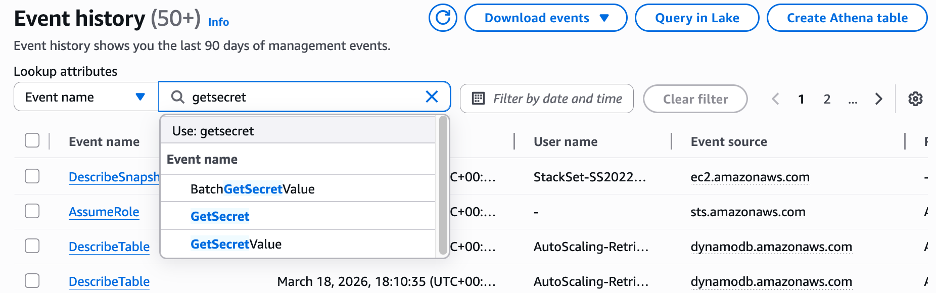
With hybrid post-quantum key exchange using ML-KEM now enabled by default for Secrets Manager clients (see the preceding table), most customers will not need ongoing monitoring to verify correct behavior or detect regressions. However, security teams and compliance officers might want to confirm that their Secrets Manager API calls are negotiating the hybrid key exchange. On the server side, you can confirm hybrid post-quantum key exchange in TLS by using AWS CloudTrail. On the client side, you can inspect TLS handshake details using a utility like Wireshark or by using developer tools built into major web browsers.
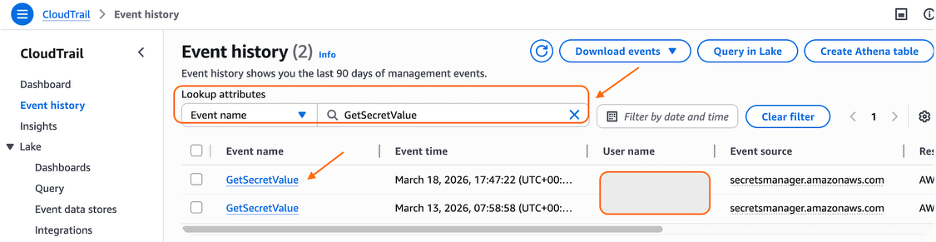
Verification is a two-step process: first, fetch a secret using your Secrets Manager client to generate a GetSecretValue API call, then confirm in AWS CloudTrail that the call negotiated hybrid post-quantum key exchange.
Fetch your secret using your Secrets Manager client
The following examples show how to retrieve your secret using the Secrets Manager Agent, Lambda extension, and CSI Driver—each of which will automatically negotiate hybrid post-quantum key exchange when calling the GetSecretValue API.
To verify hybrid post-quantum TLS with Secrets Manager Agent on EC2 instance: Install the agent on your Amazon Elastic Compute Cloud (Amazon EC2) instance and use it as a client to fetch your secret.
Use the agent to fetch your secret. curl -H “X-Aws-Parameters-Secrets-Token: $(</tmp/awssmatoken)” localhost:2773/secretsmanager/get?secretId=<YOUR-SECRET-ARN>
Wait for about 5 minutes for CloudTrail to deliver the logs.
To verify hybrid post-quantum TLS with Lambda extension: Use the AWS parameters and Secrets Manager Lambda extension to create a Lambda function that will consume your secrets from Secrets Manager using direct API calls.
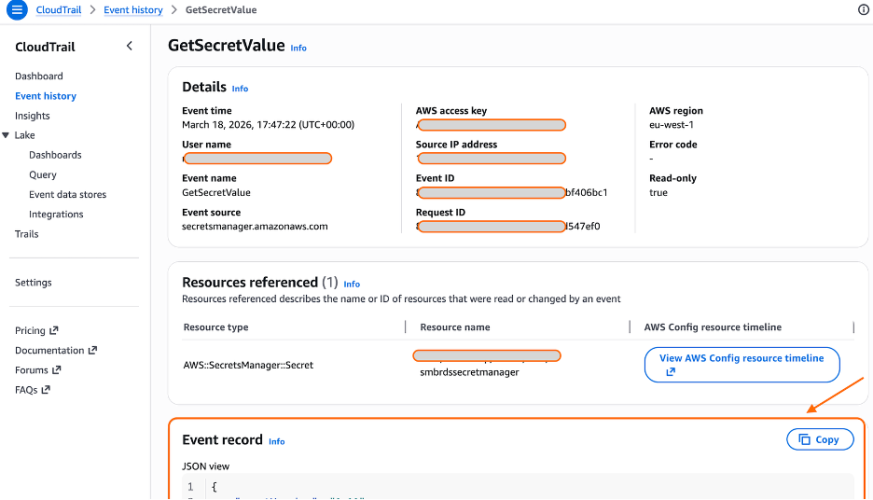
Confirm hybrid post-quantum key exchange using CloudTrail
CloudTrail logs include a tlsDetails field for Secrets Manager API calls. When hybrid post-quantum key exchange in TLS is active, the keyExchange field in tlsDetails will show X25519MLKEM768. Each CloudTrail record includes a tlsDetails field that contains the cipher suite and, where available, the key exchange group negotiated during the TLS handshake.
If the keyExchange field shows X25519MLKEM768, then hybrid post-quantum key exchange in TLS is active. If it shows a traditional algorithm such as X25519, the client is not advertising ML-KEM support, and you should check the client version and configuration.
Troubleshooting
If your Secrets Manager API calls aren’t negotiating X25519MLKEM768 after updating your clients, check your SDK version, OpenSSL version (Python), and firewall or proxy configuration as shown in the Client Hybrid Post-Quantum Key Exchange Requirements section near the beginning of this post.
What’s next
This launch is one step in a broader migration. AWS is continuing to roll out ML-KEM support across AWS service HTTPS endpoints as part of Workstream 2 of the AWS PQC Migration Plan, with a target of full coverage across public AWS endpoints.
Support for CRYSTALS-Kyber, the pre-standardization predecessor to ML-KEM, is phasing out across AWS endpoints in 2026. Customers on older SDK versions that advertise only CRYSTALS-Kyber support will fall back gracefully to traditional TLS rather than negotiate the deprecated algorithm. To avoid this fallback, upgrade to the SDK versions listed in this post.
The journey of PQC migration extends beyond confidentiality of data in transit. To stay informed about the latest developments in the AWS PQC journey and your side of shared responsibility, follow the AWS Post-Quantum Cryptography page.
Conclusion
AWS Secrets Manager now enables hybrid post-quantum key exchange using ML-KEM by default to help protect your secrets and support your compliance efforts. This update requires no code changes or configuration updates for customers using the latest client versions.
This post covered how AWS Secrets Manager uses hybrid post-quantum cryptography to secure TLS connections, which clients support this capability, and how to verify that your connections are protected against harvest now, decrypt later attacks.
To benefit from this announcement today:
Upgrade your Secrets Manager client (Agent, Lambda extension, or CSI Driver) to the latest available versions to enable hybrid post-quantum key exchange using ML-KEM
If your workload uses the AWS SDK instead of a caching client, upgrade your AWS SDK and underlying dependencies to the minimum versions listed in this post
Verify hybrid post-quantum key exchange in TLS is active by checking the keyExchange field in CloudTrail tlsDetails for your Secrets Manager API calls
Test end-to-end hybrid post-quantum key exchange TLS connectivity in your environment, including network paths that traverse corporate firewalls or proxies
AWS will continue rolling out post-quantum cryptography support. For information about the broader migration effort, see the AWS PQC Migration Plan. Keep an updated cryptographic inventory of your broader environment to identify other uses of traditional public-key cryptography that will require migration. The CISA Quantum-Readiness guidance and the AWS PQC Migration Plan are good starting points.
Amazon Web Services (AWS) is pleased to announce that the Winter 2025 System and Organization Controls (SOC) 1 report is now available. The report covers 184 services over the 12-month period from January 1, 2025 – December 31, 2025, giving customers a full year of assurance. This report demonstrates our continuous commitment to adhering to the heightened expectations of cloud service providers.
AWS strives to continuously bring services into the scope of its compliance programs to help customers meet their architectural and regulatory needs. You can view the current list of services in scope on our Services in Scope page. As an AWS customer, you can reach out to your AWS account team if you have any questions or feedback about SOC compliance.
To learn more about AWS compliance and security programs, see AWS Compliance Programs. As always, we value feedback and questions; reach out to the AWS Compliance team through the Contact Us page.
If you have feedback about this post, submit comments in the Comments section below.
If you’re a security leader operating in Germany, Austria, or Switzerland, you already know that compliance isn’t a checkbox. It’s a competitive differentiator. Rapid7 has completed BSI C5 Type 2 attestation for the Rapid7 Command Platform, including Threat Command, and it’s a milestone worth unpacking.
This isn’t just a badge on a webpage. It’s proof that our security controls work, not just on paper, but in practice, over time.
What is BSI C5 and why does it matter?
The Cloud Computing Compliance Criteria Catalogue (C5) was developed by Germany’s Federal Office for Information Security (BSI). It sets some of the most rigorous cloud security standards in the world, covering everything from data protection to operational transparency.
A Type 2 attestation is the gold standard within that framework. Unlike a point-in-time audit, Type 2 validates that security controls aren’t just well-designed, but that they’re actively working consistently over a sustained period. It’s the difference between a security promise and a security proof.
For organizations in the DACH region, C5 is more than a nice-to-have. It’s a procurement requirement for German federal agencies, critical infrastructure operators, healthcare institutions, and financial services firms. If you’re operating in any of these sectors, your cloud providers need to meet this bar. Rapid7 now does.
BSI C5 Type 2 and your cloud security strategy
Whether you’re evaluating security vendors, managing compliance obligations, or looking to strengthen your organization’s risk posture, the question is the same: How do you know your cloud security provider actually does what it says?
BSI C5 Type 2 attestation answers that question. It’s independent, rigorous, and sustained over time. While rooted in German regulatory requirements, C5 is increasingly recognized as a benchmark for secure cloud operations across Europe. It’s one of the clearest signals that a cloud provider has the operational maturity to handle sensitive environments.
The Rapid7 Command Platform unifies exposure management with detection and response, giving security teams clear visibility across their attack surface. Threat Command extends that protection further, identifying and helping remediate threats across the clear, deep, and dark web. Both are now independently validated against one of the world’s toughest cloud security frameworks.
Why independent validation of security controls matters
Trusting a security vendor shouldn’t require a leap of faith. Independent validation exists so you have the evidence to make that call with confidence. This attestation reflects our continued investment in meeting the highest security standards for customers across Germany and the wider European market. Rapid7 has achieved a milestone that speaks directly to the conversations had every day with public sector and enterprise organizations who need more than a promise.
They need proof that a security provider’s controls have been tested, verified, and proven to hold up over time. That’s the kind of assurance that matters when the stakes are high.
Ready to see the Command Platform in action? Visit Rapid7.com for a free trial.
This alignment with DESC requirements demonstrates our continued commitment to adhere to the heightened expectations for CSPs. Government customers of AWS can run their applications in AWS Cloud-certified Regions with confidence.
The AWS compliance to the DESC Framework requirements were validated by an independent third-party auditor (BSI) prior to issuance of a renewed certificate by DESC. The updated DESC CSP certificate is available through AWS Artifact, and is valid for one year to January 22, 2027. AWS Artifact is a self-service portal for on-demand access to AWS compliance reports. Sign in to AWS Artifact in the AWS Management Console, or learn more at Getting Started with AWS Artifact.
The certification includes the following 10 additional services in scope, for a total of 108 services:
This is a 10% increase in the number of services in the Middle East (UAE) Region that are in scope of the DESC CSP certification.
AWS strives to continuously bring services into the scope of its compliance programs to help you meet your architectural and regulatory needs. You can view the current list of services in scope on our Services in Scope page. You can also reach out to your AWS account team if you have any questions or feedback about DESC compliance.
To learn more about our compliance and security programs, see AWS Compliance Programs. As always, we value your feedback and questions; reach out to the AWS Compliance team through the Contact Us page.
If you have feedback about this post, submit comments in the Comments section below
The Swiss Financial Market Supervisory Authority (FINMA) has published several requirements and guidelines about engaging with outsourced services for the regulated financial services customers in Switzerland.
An independent third-party audit firm issued the report to assure customers that the AWS control environment is appropriately designed and operating effectively to support of adherence with FINMA requirements.
The latest report covers the 12-month period from October 1, 2024 to September 30, 2025 for the following circulars:
2018/03 Outsourcing – banks, insurance companies and selected financial institutions under FinIA
2023/01 Operational risks and resilience – banks
Business Continuity Management (BCM) minimum standards proposed by the Swiss Insurance Association.
AWS has added the following five services to the current FINMA scope:
Customers can find the FINMA ISAE 3000 report on AWS Artifact. AWS Artifact is a self-service portal for on-demand access to AWS compliance reports. Sign in to AWS Artifact in the AWS Management Console, or learn more at Getting Started with AWS Artifact. Security and compliance is a shared responsibility between AWS and the customer. When customers move their computer systems and data to the cloud, security responsibilities are shared between the customer and the cloud service provider. For more information, see the AWS Shared Security Responsibility Model.
To learn more about our compliance and security programs, see AWS Compliance Programs. As always, we value your feedback and questions; reach out to the AWS Compliance team through the Contact Us page.
If you have feedback about this post, submit comments in the Comments section below
When you enable IAM Identity center, it provides an access portal for workforce users to access their AWS applications and accounts either by signing in to the access portal using a URL or by using a bookmark for the application URL. In either case, the access portal handles user authentication before granting access to applications and accounts. Supporting both IPv4 and IPv6 connectivity to the access portal helps facilitate seamless access for clients, such as browsers and applications, regardless of their network configuration.
The launch of IPv6 support in IAM Identity Center introduces new dual-stack endpoints that support both IPv4 and IPv6, so that users can connect using IPv4, IPv6, or dual-stack clients. Current IPv4 endpoints continue to function with no action required. The dual stack capability offered by Identity Center extends to managed applications. When users access the application dual-stack endpoint, the application automatically routes to the Identity Center dual-stack endpoint for authentication. To use Identity Center from IPv6 clients, you must direct your workforce to use the new dual-stack endpoints, and update configurations on your external identity provider (IdP), if you use one.
In this post, we show you how to update your configuration to allow IPv6 clients to connect directly to IAM Identity Center endpoints without requiring network address translation services. We also show you how to monitor which endpoint users are connecting to. Before diving into the implementation details, let’s review the key phases of the transition process.
Transition overview
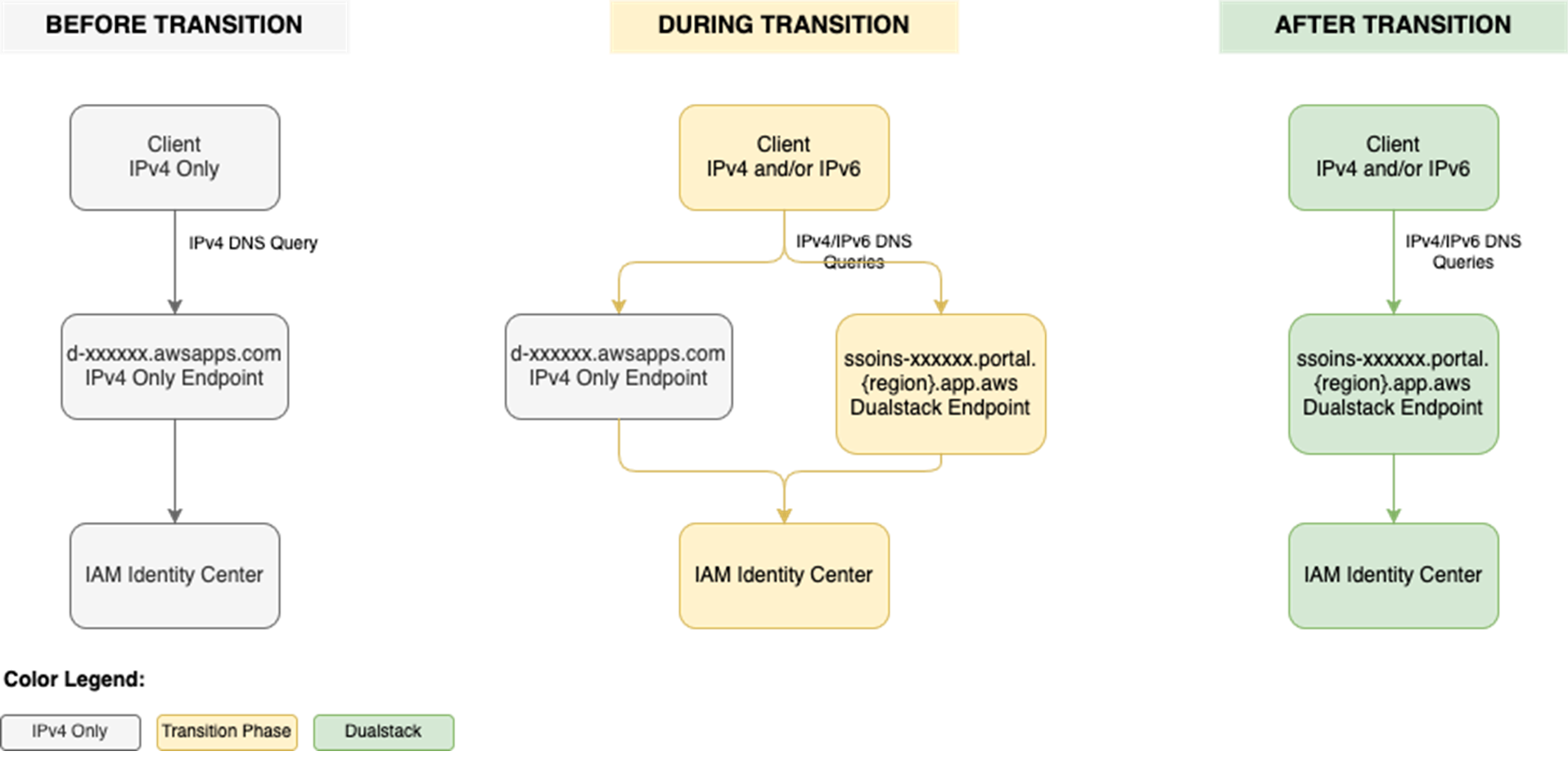
To use IAM Identity Center from an IPv6 network and client, you need to use the new dual-stack endpoints. Figure 1 shows what the transition from IPv4 to IPv6 over dual-stack endpoints looks like when using Identity Center. The figure shows:
A before state where clients use the IPv4 endpoints.
The transition phase, when your clients use a combination of IPv4 and dual-stack endpoints.
After the transition is complete, your clients will connect to dual-stack endpoints using their IPv4 or IPv6, depending on their preferences.
Figure 1: Transition from IPv4-only to dual-stack endpoints
Prerequisites
You must have the following prerequisites in place to enable IPv6 access for your workforce users and administrators:
Work with your network administrators to update the configuration of your firewalls and gateways and to verify that your clients, such as laptops or desktops, are ready to accept IPv6 connectivity. If you have already enabled IPv6 connectivity for other AWS services, you might be familiar with these changes. Next, implement the two steps that follow.
Step 1: Update your IdP configuration
You can skip this step If you don’t use an external IdP as your identity source.
In this step, you update the Assertion Consumer Service (ACS) URL from your IAM Identity Center instance into your IdP’s configuration for single sign-on and the SCIM configuration for user provisioning. Your IdP’s capability determines how you update the ACS URLs. If your IdP supports multiple ACS URLs, configure both IPv4 and dual-stack URLs to enable a flexible transition. With that configuration, some users can continue using IPv4-only endpoints while others use dual-stack endpoints for IPv6. If your IdP supports only one ACS URL, to use IPv6 you must update the new dual-stack ACS URL in your IdP and transition all users to using dual-stack endpoints. If you don’t use an external IdP, you can skip this step and go to the next step.
Update both the SAML single sign-on and the SCIM provisioning configurations:
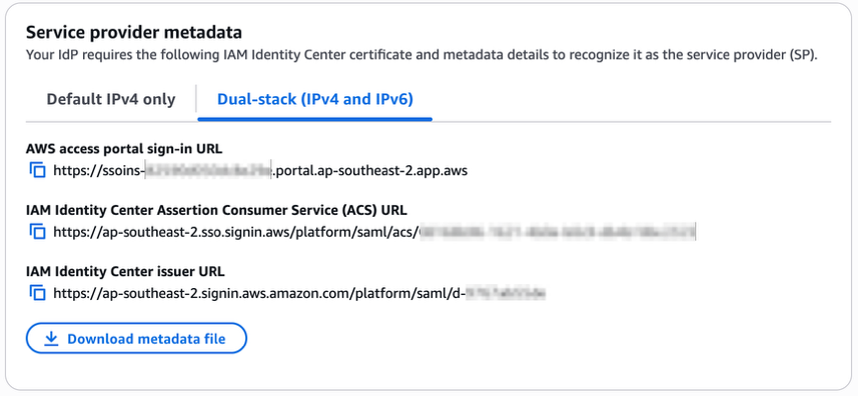
Update the single sign-on settings in your IdP to use the new dual-stack URLs. First, locate the URLs in the AWS Management Console for IAM Identity Center.
Choose Settings in the navigation pane and then select Identity source.
Choose Actions and select Manage authentication.
in Under Manage SAML 2.0 authentication, you will find the following URLs under Service provider metadata:
AWS access portal sign-in URL
IAM Identity Center Assertion Consumer Service (ACS) URL
IAM Identity Center issuer URL
If your IdP supports multiple ACS URLs, then add the dual-stack URL to your IdP configuration alongside existing IPv4 one. With this setting, you and your users can decide when to start using the dual-stack endpoints, without all users in your organization having to switch together.
Figure 2: Dual-stack single sign-on URLs
If your IdP does not support multiple ACS URLs, replace the existing IPv4 URL with the new dual-stack URL, and switch your workforce to use only the dual-stack endpoints.
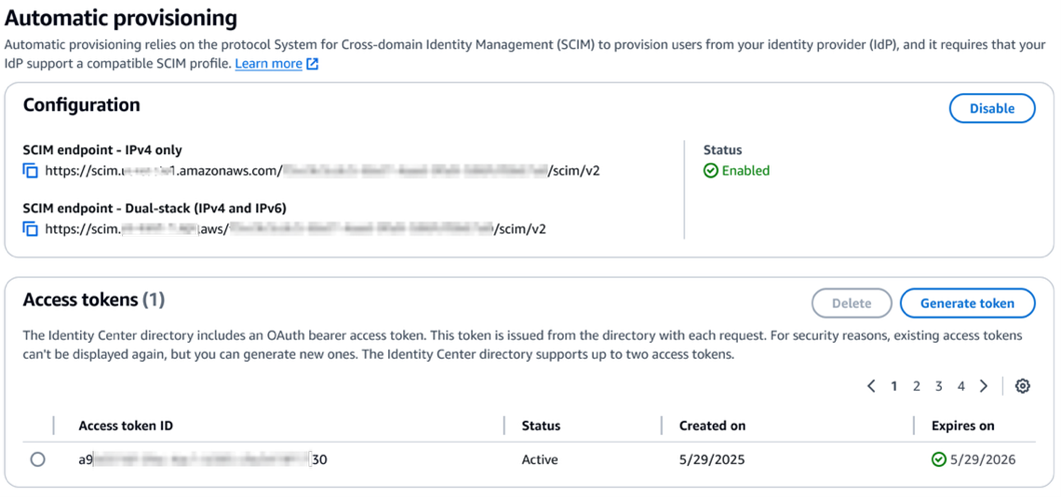
Update the provisioning endpoint in your IdP. Choose Settings in the navigation pane and under Identity source, choose Actions and select Manage provisioning. Under Automatic provisioning, copy the new SCIM endpoint that ends in api.aws. Update this new URL in your external IdP.
Figure 3: Dual-stack SCIM endpoint URL
Step 2: Locate and share the new dual-stack endpoints
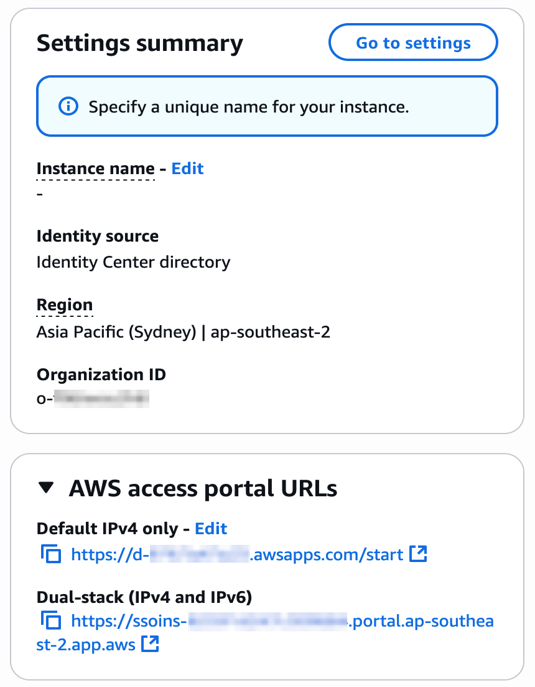
Your organization needs two kinds of URLs for IPv6 connectivity. The first is the new dual-stack access portal URL that your workforce users use to access their assigned AWS applications and accounts. The dual-stack access portal URL is available in the IAM Identity Center console, listed as the Dual-stack in the Settings summary (you might need to expand the Access portal URLs section, shown in Figure 4).
This dual-stack URL ends with app.aws as its top-level domain (TLD). Share this URL with your workforce and ask them to use this dual-stack URL to connect over IPv6. As an example, if your workforce uses the access portal to access AWS accounts, they will need to sign in through the new dual-stack access portal URL when using IPv6 connectivity. Alternately, if your workforce accesses the application URL, you need to enable the dual-stack application URL following application-specific instructions. For more information, see AWS services that support IPv6.
The URLs that administrators use to manage IAM Identity Center are the second kind of URL your organization needs. The new dual-stack service endpoints end in api.aws as their TLD and are listed in the Identity Center service endpoints. Administrators can use these service endpoints to manage users and groups in Identity Center, update their access to applications and resources, and perform other management operations. As an example, if your administrator uses identitystore.{region}.amazonaws.com to manage users and groups in Identity Center, they should now use the dual-stack version of the same service endpoint which is identitystore.{region}.api.aws, so they can connect to service endpoints using IPv6 clients and networks.
If your users or administrators use an AWS SDK to access AWS applications and accounts or manage services, follow Dual-stack and FIPS endpoints to enable connectivity to the dual-stack endpoints.
After completing these two steps, your workforce and administrators can connect to IAM Identity Center using IPv6. Remember, these endpoints also support IPv4, so clients not yet IPv6-capable can continue to connect using IPv4.
Monitoring dual-stack endpoint usage
You can optionally monitor AWS CloudTrail logs to track usage of dual-stack endpoints. The key difference between IPv4-only and dual-stack endpoint usage is the TLD and appears in the clientProvidedHostHeader field. The following example shows the difference between these CloudTrail events for the CreateTokenWithIAM API call.
IAM Identity Center now allows clients to connect over IPv6 natively with no network address translation infrastructure. This post showed you how to transition your organization to use IPv6 with Identity Center and its integrated applications. Remember that existing IPv4 endpoints will continue to function, so you can transition at your own pace. Also, no immediate action is required by you. However, we recommend planning your transition to take advantage of IPv6 benefits and meet compliance requirements. If you have questions, comments, or concerns, contact AWS Support, or start a new thread in the IAM Identity Center re:Post channel.
If you have feedback about this post, submit comments in the Comments section below. If you have questions about this post, contact AWS Support.
With AWS Payment Cryptography, your payment processing applications can use payment hardware security modules (HSMs) that are PCI PIN Transaction Security (PTS) HSM certified and fully managed by AWS, with PCI PIN-compliant key management. This attestation gives you the flexibility to deploy your regulated workloads with reduced compliance overhead.
The PCI PIN compliance report package for AWS Payment Cryptography includes two key components:
PCI PIN Attestation of Compliance (AOC) – demonstrating that AWS Payment Cryptography was successfully validated against the PCI PIN standard with zero findings
PCI PIN Responsibility Summary – provides guidance to help AWS customers understand their responsibilities in developing and operating a highly secure environment for handling PIN-based transactions
AWS was evaluated by Coalfire, a third-party Qualified Security Assessor (QSA). Customers can access the PCI PIN Attestation of Compliance (AOC) and PCI PIN Responsibility Summary reports through AWS Artifact.
To learn more about our PCI programs and other compliance and security programs, visit the AWS Compliance Programs page. As always, we value your feedback and questions; reach out to the AWS Compliance team through the Compliance Support page.
If you have feedback about this post, submit comments in the Comments section below. If you have questions about this post, contact AWS Support.
Amazon Web Services (AWS) is pleased to announce the expansion of GSMA Security Accreditation Scheme for Subscription Management (SAS-SM) certification to four new AWS Regions: US West (Oregon), Europe (Frankfurt), Asia Pacific (Tokyo), and Asia Pacific (Singapore). Additionally, the AWS US East (Ohio) and Europe (Paris) Regions have been recertified. All certifications are under the GSM Association (GSMA) SAS-SM with scope Data Centre Operations and Management (DCOM). AWS was evaluated by GSMA-selected independent third-party auditors, and all Region certifications are valid through October 2026. The Certificate of Compliance that shows AWS achieved GSMA compliance status is available on both the GSMA and AWS websites.
The US East (Ohio) Region first obtained GSMA certification in September 2021, and the Europe (Paris) Region first obtained GSMA certification in October 2021. Since then, multiple independent software vendors (ISVs) have inherited the controls of our SAS-SM DCOM certification to build GSMA compliant subscription management or eSIM (embedded subscriber identity module) services on AWS. For established market leaders, this reduces technical debt while meeting the scalability and performance needs of their customers. Startups innovating with eSIM solutions can accelerate their time to market by many months, compared to on-premises deployments.
Until 2023, the shift from physical subscriber identity modules (SIMs) to eSIMs was primarily driven by automotives, cellular connected wearables, and companion devices such as tablets. GSMA is promoting the SGP.31 and SGP.32 specifications, which standardize protocols and guarantee compatibility and consistent user experience for all eSIM devices spanning smartphones, IoT, smart home, industrial Internet of Things (IoT), and so on. As more device manufacturers launch eSIM only models, our customers are demanding robust, cloud-centered eSIM solutions. Over 400 telecom operators around the world now support eSIM services for their subscribers. Hosting eSIM platforms in the cloud allows them to integrate efficiently with their next generation cloud-based operations support systems (OSS) and business support systems (BSS).
The AWS expansion to certify four new Regions into scope in November 2025 demonstrates our continuous commitment to adhere to the heightened expectations for cloud service providers and extends our global coverage for GSMA-certified infrastructure. With two GSMA-certified Regions in the US, EU, and Asia respectively, customers can now build geo-redundant eSIM solutions to improve their disaster recovery and resiliency posture.
To learn more about our compliance and security programs, see AWS Compliance Programs. As always, we value your feedback and questions; reach out to the AWS Compliance team through the Contact Us page. If you have feedback about this post, submit comments in the Comments section below.
Amazon Web Services (AWS) is pleased to announce that the Fall 2025 System and Organization Controls (SOC) 1, 2, and 3 reports are now available. The reports cover 185 services over the 12-month period from October 1, 2024–September 30, 2025, giving customers a full year of assurance. These reports demonstrate our continuous commitment to adhering to the heightened expectations of cloud service providers.
AWS strives to continuously bring services into the scope of its compliance programs to help customers meet their architectural and regulatory needs. You can view the current list of services in scope on our Services in Scope page. As an AWS customer, you can reach out to your AWS account team if you have any questions or feedback about SOC compliance.
To learn more about AWS compliance and security programs, see AWS Compliance Programs. As always, we value feedback and questions; reach out to the AWS Compliance team through the Contact Us page.
If you have feedback about this post, submit comments in the Comments section below.
Amazon Web Services (AWS) is pleased to announce that two additional AWS services and one additional AWS Region have been added to the scope of our Payment Card Industry Data Security Standard (PCI DSS) certification:
This certification allows customers to use these services while maintaining PCI DSS compliance, enabling innovation without compromising security. The full list of services can be found on the AWS Services in Scope by Compliance Program. The PCI DSS compliance package includes two key components:
Attestation of Compliance (AOC) demonstrating that AWS was successfully validated against the PCI DSS standard.
AWS Responsibility Summary provides guidance to help AWS customers understand their responsibility in developing and operating a highly secure environment on AWS for handling payment card data.
AWS was evaluated by Coalfire, a third-party Qualified Security Assessor (QSA).
This refreshed PCI certification offers customers greater flexibility in deploying regulated workloads while reducing compliance overhead. Customers can access the PCI DSS certification through AWS Artifact. This self-service portal provides on-demand access to AWS compliance reports, streamlining audit processes.
AWS is excited to be the first cloud service provider to offer compliance reports to customers in NIST’s Open Security Controls Assessment Language (OSCAL), an open source, machine-readable (JSON) format for security information. The PCI DSS report package (which includes both the PCI DSS AOC and the AWS Responsibility Summary) in OSCAL format is now available separately in AWS Artifact, marking a milestone towards open, standards-based compliance automation. This machine-readable version of the PCI DSS report package enables workflow automation to reduce manual processing time and modernize security and compliance processes. Your use cases for this content are innovative and we want to hear about them through the contact information found in the OSCAL report package.
To learn more about our PCI programs and other compliance and security programs, see the AWS Compliance Programs page. As always, we value your feedback and questions; reach out to the AWS Compliance team through the Compliance Support page.
If you have feedback about this post, submit comments in the Comments section below. If you have questions about this post, contact AWS Support.
At Amazon Web Services, we’re committed to deeply understanding the evolving needs of both our customers and regulators, and rapidly adapting and innovating to meet them. The upcoming AWS European Sovereign Cloud will be a new independent cloud for Europe, designed to give public sector organizations and customers in highly regulated industries further choice to meet their unique sovereignty requirements. The AWS European Sovereign Cloud expands on the same strong foundation of security, privacy, and compliance controls that apply to other AWS Regions around the globe with additional governance, technical, and operational measures to address stringent European customer and regulatory expectations. Sovereignty is the defining feature of the AWS European Sovereign Cloud and we’re using an independently validated framework to meet our customers’ requirements for sovereignty, while delivering the scalability and functionality you expect from the AWS Cloud.
Today, we’re pleased to share further details about the AWS European Sovereign Cloud: Sovereign Reference Framework (ESC-SRF). This reference framework aligns sovereignty criteria across multiple domains such as governance independence, operational control, data residency and technical isolation. Working backwards from our customers’ sovereign use cases, we aligned controls to each of the criteria and the AWS European Sovereign Cloud is undergoing an independent third-party audit to verify the design and operations of these controls conform to AWS sovereignty commitments. Customers and partners can also leverage the ESC-SRF as a foundation upon which they can build their own complementary sovereignty criteria and controls when using the AWS European Sovereign Cloud.
To clearly explain how the AWS European Sovereign Cloud meets sovereignty expectations, we’re publishing the ESC-SRF in AWS Artifact including the criteria and control mapping. In AWS Artifact, our self-service audit artifact retrieval portal, you have on-demand access to AWS security and compliance documents and AWS agreements. You can now use the ESC-SRF to define best practices for your own use case, map these to controls, and illustrate how you meet and even exceed sovereign needs of your customers.
A transparent and validated sovereignty model
The ESC-SRF has been built from customer feedback, regulatory requirements across the European Union (EU), industry frameworks, AWS contractual commitments, and partner input. ESC-SRF is industry and sector agnostic, as it’s written to address fundamental sovereignty needs and expectations at the foundational layer of our cloud offerings with additional sovereignty-specific requirements and controls that apply exclusively to the AWS European Sovereign Cloud. Each criterion is implemented through sovereign controls that will be independently validated by a third-party auditor.
The framework builds on core AWS security capabilities, including encryption, key management, access governance, AWS Nitro System-based isolation, and internationally recognized compliance certifications. The framework adds sovereign-specific governance, technical, and operational measures such as independent EU corporate structures, dedicated EU trust and certificate services, operations by AWS EU-resident personnel, strict residency for customer data and customer created metadata, separation from all other AWS Regions, and incident response operated within the EU.
These controls are the basis of a dedicated AWS European Sovereign Cloud System and Organization Controls (SOC) 2 attestation. The ESC-SRF establishes a solid foundation for sovereignty of the cloud, so that customers can focus on defining sovereignty measures in the cloud that are tailored to their goals, regulatory needs, and risk posture.
How you can use the ESC-SRF
The ESC-SRF describes how AWS implements and validates sovereignty controls in the AWS European Sovereign Cloud. AWS treats each criterion as binding and its implementation will be validated by an independent third-party auditor in 2026. While most customers don’t operate at the size and scale of AWS, you can use the ESC-SRF as both an assurance model and a reference framework you can adapt to your specific use cases.
From an assurance perspective, it provides end-to-end visibility for each sovereignty criterion through to its technical implementation. We will also provide third-party validation in the AWS European Sovereign Cloud SOC 2 report. Customers can use this report with internal auditors, external assessors, supervisory authorities, and regulators. This can reduce the need for ad-hoc evidence requests and supports customers by providing them with evidence to demonstrate clear and enforceable sovereignty assurances.
From a design perspective, you can refer to the framework when shaping your own sovereignty architecture, selecting configurations, and defining internal controls to meet regulatory, contractual, and mission-specific requirements. Because the ESC-SRF is industry and sector agnostic, you can apply criteria from the framework to suit your own unique needs. Depending on your sovereign use case, not all criteria may apply to your use case sovereign needs. The ESC-SRF can also be used in conjunction with AWS Well-Architected which can help you learn, measure, and build using architectural best practices. Where appropriate you can create your version of the ESC-SRF, map to controls, and have them tested by a third party. To download the ESC-SRF, visit AWS Artifact (login required).
A strong, clear foundation
The publication of the ESC-SRF is part of our ongoing commitment to delivering on the AWS Digital Sovereignty Pledge through transparency and assurances to help customers meet their evolving sovereignty needs with assurances designed, implemented, and validated entirely within the EU. Within the framework, customers can build solutions in the AWS European Sovereign Cloud with confidence and a strong understanding of how they are able to meet their sovereignty goals using AWS.
For more information about the AWS European Sovereign Cloud, visit aws.eu.
If you have feedback about this post, submit comments in the Comments section below.
The collective thoughts of the interwebz
Manage Consent
To provide the best experiences, we use technologies like cookies to store and/or access device information. Consenting to these technologies will allow us to process data such as browsing behavior or unique IDs on this site. Not consenting or withdrawing consent, may adversely affect certain features and functions.
Functional
Always active
The technical storage or access is strictly necessary for the legitimate purpose of enabling the use of a specific service explicitly requested by the subscriber or user, or for the sole purpose of carrying out the transmission of a communication over an electronic communications network.
Preferences
The technical storage or access is necessary for the legitimate purpose of storing preferences that are not requested by the subscriber or user.
Statistics
The technical storage or access that is used exclusively for statistical purposes.The technical storage or access that is used exclusively for anonymous statistical purposes. Without a subpoena, voluntary compliance on the part of your Internet Service Provider, or additional records from a third party, information stored or retrieved for this purpose alone cannot usually be used to identify you.
Marketing
The technical storage or access is required to create user profiles to send advertising, or to track the user on a website or across several websites for similar marketing purposes.