Tag Archives: news

Amazon Nova Canvas update: Virtual try-on and style options now available

Post Syndicated from Matheus Guimaraes original https://aws.amazon.com/blogs/aws/amazon-nova-canvas-update-virtual-try-on-and-style-options-now-available/

Have you ever wished you could quickly visualize how a new outfit might look on you before making a purchase? Or how a piece of furniture would look in your living room? Today, we’re excited to introduce a new virtual try-on capability in Amazon Nova Canvas that makes this possible. In addition, we are adding eight new style options for improved style consistency for text-to-image based style prompting. These features expand Nova Canvas AI-powered image generation capabilities making it easier than ever to create realistic product visualizations and stylized images that can enhance the experience of your customers.

Let’s take a quick look at how you can start using these today.

Getting started
The first thing is to make sure that you have access to the Nova Canvas model through the usual means. Head to the Amazon Bedrock console, choose Model access and enable Amazon Nova Canvas for your account making sure that you select the appropriate regions for your workloads. If you already have access and have been using Nova Canvas, you can start using the new features immediately as they’re automatically available to you.

Virtual try-on
The first exciting new feature is virtual try-on. With this, you can upload two pictures and ask Amazon Nova Canvas to put them together with realistic results. These could be pictures of apparel, accessories, home furnishings, and any other products including clothing. For example, you can provide the picture of a human as the source image and the picture of a garment as the reference image, and Amazon Nova Canvas will create a new image with that same person wearing the garment. Let’s try this out!

My starting point is to select two images. I picked one of myself in a pose that I think would work well for a clothes swap and a picture of an AWS-branded hoodie.

Matheus and AWS-branded hoodie

Note that Nova Canvas accepts images containing a maximum of 4.1M pixels – the equivalent of 2,048 x 2,048 – so be sure to scale your images to fit these constraints if necessary. Also, if you’d like to run the Python code featured in this article, ensure you have Python 3.9 or later installed as well as the Python packages boto3 and pillow.

To apply the hoodie to my photo, I use the Amazon Bedrock Runtime invoke API. You can find full details on the request and response structures for this API in the Amazon Nova User Guide. The code is straightforward, requiring only a few inference parameters. I use the new taskType of "VIRTUAL_TRY_ON". I then specify the desired settings, including both the source image and reference image, using the virtualTryOnParams object to set a few required parameters. Note that both images must be converted to Base64 strings.

import base64


def load_image_as_base64(image_path): 
   """Helper function for preparing image data."""
   with open(image_path, "rb") as image_file:
      return base64.b64encode(image_file.read()).decode("utf-8")


inference_params = {
   "taskType": "VIRTUAL_TRY_ON",
   "virtualTryOnParams": {
      "sourceImage": load_image_as_base64("person.png"),
      "referenceImage": load_image_as_base64("aws-hoodie.jpg"),
      "maskType": "GARMENT",
      "garmentBasedMask": {"garmentClass": "UPPER_BODY"}
   }
}

Nova Canvas uses masking to manipulate images. This is a technique that allows AI image generation to focus on specific areas or regions of an image while preserving others, similar to using painter’s tape to protect areas you don’t want to paint.

You can use three different masking modes, which you can choose by setting maskType to the correct value. In this case, I’m using "GARMENT", which requires me to specify which part of the body I want to be masked. I’m using "UPPER_BODY" , but you can use others such as "LOWER_BODY", "FULL_BODY", or "FOOTWEAR" if you want to specifically target the feet. Refer to the documentation for a full list of options.

I then call the invoke API, passing in these inference arguments and saving the generated image to disk.

# Note: The inference_params variable from above is referenced below.

import base64
import io
import json

import boto3
from PIL import Image

# Create the Bedrock Runtime client.
bedrock = boto3.client(service_name="bedrock-runtime", region_name="us-east-1")

# Prepare the invocation payload.
body_json = json.dumps(inference_params, indent=2)

# Invoke Nova Canvas.
response = bedrock.invoke_model(
   body=body_json,
   modelId="amazon.nova-canvas-v1:0",
   accept="application/json",
   contentType="application/json"
)

# Extract the images from the response.
response_body_json = json.loads(response.get("body").read())
images = response_body_json.get("images", [])

# Check for errors.
if response_body_json.get("error"):
   print(response_body_json.get("error"))

# Decode each image from Base64 and save as a PNG file.
for index, image_base64 in enumerate(images):
   image_bytes = base64.b64decode(image_base64)
   image_buffer = io.BytesIO(image_bytes)
   image = Image.open(image_buffer)
   image.save(f"image_{index}.png")

I get a very exciting result!

Matheus wearing AWS-branded hoodie

And just like that, I’m the proud wearer of an AWS-branded hoodie!

In addition to the "GARMENT" mask type, you can also use the "PROMPT" or "IMAGE" masks. With "PROMPT", you also provide the source and reference images, however, you provide a natural language prompt to specify which part of the source image you’d like to be replaced. This is similar to how the "INPAINTING" and "OUTPAINTING" tasks work in Nova Canvas. If you want to use your own image mask, then you choose the "IMAGE" mask type and provide a black-and-white image to be used as mask, where black indicates the pixels that you want to be replaced on the source image, and white the ones you want to preserve.

This capability is specifically useful for retailers. They can use it to help their customers make better purchasing decisions by seeing how products look before buying.

Using style options
I’ve always wondered what I would look like as an anime superhero. Previously, I could use Nova Canvas to manipulate an image of myself, but I would have to rely on my good prompt engineering skills to get it right. Now, Nova Canvas comes with pre-trained styles that you can apply to your images to get high-quality results that follow the artistic style of your choice. There are eight available styles including 3D animated family film, design sketch, flat vector illustration, graphic novel, maximalism, midcentury retro, photorealism, and soft digital painting.

Applying them is as straightforward as passing in an extra parameter to the Nova Canvas API. Let’s try an example.

I want to generate an image of an AWS superhero using the 3D animated family film style. To do this, I specify a taskType of "TEXT_IMAGE" and a textToImageParams object containing two parameters: text and style. The text parameter contains the prompt describing the image I want to create which in this case is “a superhero in a yellow outfit with a big AWS logo and a cape.” The style parameter specifies one of the predefined style values. I’m using "3D_ANIMATED_FAMILY_FILM" here, but you can find the full list in the Nova Canvas User Guide.

inference_params = {
   "taskType": "TEXT_IMAGE",
   "textToImageParams": {
      "text": "a superhero in a yellow outfit with a big AWS logo and a cape.",
      "style": "3D_ANIMATED_FAMILY_FILM",
   },
   "imageGenerationConfig": {
      "width": 1280,
      "height": 720,
      "seed": 321
   }
}

Then, I call the invoke API just as I did in the previous example. (The code has been omitted here for brevity.) And the result? Well, I’ll let you judge for yourself, but I have to say I’m quite pleased with the AWS superhero wearing my favorite color following the 3D animated family film style exactly as I envisioned.

What’s really cool is that I can keep my code and prompt exactly the same and only change the value of the style attribute to generate an image in a completely different style. Let’s try this out. I set style to PHOTOREALISM.

inference_params = { 
   "taskType": "TEXT_IMAGE", 
   "textToImageParams": { 
      "text": "a superhero in a yellow outfit with a big AWS logo and a cape.",
      "style": "PHOTOREALISM",
   },
   "imageGenerationConfig": {
      "width": 1280,
      "height": 720,
      "seed": 7
   }
}

And the result is impressive! A photorealistic superhero exactly as I described, which is a far departure from the previous generated cartoon and all it took was changing one line of code.

Things to know
Availability – Virtual try-on and style options are available in Amazon Nova Canvas in the US East (N. Virginia), Asia Pacific (Tokyo), and Europe (Ireland). Current users of Amazon Nova Canvas can immediately use these capabilities without migrating to a new model.

Pricing – See the Amazon Bedrock pricing page for details on costs.

For a preview of virtual try-on of garments, you can visit nova.amazon.com where you can upload an image of a person and a garment to visualize different clothing combinations.

If you are ready to get started, please check out the Nova Canvas User Guide or visit the AWS Console.

Matheus Guimaraes | @codingmatheus

What’s new in Zabbix 7.4

Post Syndicated from Arturs Lontons original https://blog.zabbix.com/whats-new-in-zabbix-7-4/30597/

With the release of Zabbix 7.4, Zabbix users will be able to further extend their existing resource discovery workflows and enjoy a wastly improved user experience when it comes to configuring Zabbix entities. In addition, the latest release introduces multiple dashboard and network map improvements which will further enhance the visualization of infrastructure and resources.

Host Wizard

Host creation can be somewhat confusing for Zabbix beginners. Creating a host and applying a template involves numerous steps – from creating a host and assigning it to a host group, to configuring appropriate host interfaces, applying a template, and editing template-level macros to adjust the default problem thresholds and filters.

The Host Wizard aims to simplify the host onboarding process by providing a step-by-step guide for creating and configuring a host.

The Host Wizard can be opened from the Data Collection – Hosts section

A new Host Wizard button has been added to the Data Collection – Hosts section. Once you click on it, you will first have to select the template you wish to apply on the new host. Only one template can be applied at a time, so if you wish to apply multiple templates on a single host via Host Wizard, you will have to do so via one template and one Host Wizard session at a time.

Under the hood, if we look at the template files, the templates have also received 2 new parameters: wizard_ready and readme. Only templates marked with wizard_ready: ‘YES’ can be selected in the Host Wizard.

Filter for and select the required template

After you have selected the template, you will be prompted to enter a host name and select host groups. You can create a new host or apply the template on an existing host.

Provide a host name and select host groups

The next steps include the deployment instructions. Depending on the selected template type, the Host Wizard will provide all of the required instructions to start monitoring the host with the chosen template.

The Host Wizard will provide the required host configuration steps

In the final Host Wizard steps, you will be prompted to add the required host interface, read the template notes, and customize the template-level macros.

Customize template-level macros to modify the default filters, problem thresholds, and other parameters

Nested low-level discovery rules and host prototypes

Low-level discovery rules have received major improvements in Zabbix 7.4. It is now possible to create nested low-level discovery rules, while host prototypes are now capable of discovering hosts of their own with low-level discovery.

A new type of prototype has been added to low-level discovery rules – discovery prototype. These prototypes are used together with low-level discovery macros to automatically create low-level discovery rules for resource discovery.

Discovery prototypes can now be created in low-level discovery rules

A new item type has been added for discovery rule prototypes – Nested. This type of discovery rule iterates through the JSON file received by the parent low-level discovery rule to discover child entities. For example:

[   {     "database""db1",     "created_at""2024-02-01T12:30:00Z",     "encoding""UTF8",     "tablespaces": [       "name""ts1""max_size""10GB" },       "name""ts2""max_size""20GB" },       "name""ts3""max_size""15GB" }     ]   },   {     "database""db2",     "created_at""2023-11-15T08:45:00Z",     "encoding""UTF16",     "tablespaces": [       "name""ts1""max_size""5GB" },       "name""ts2""max_size""25GB" },       "name""ts3""max_size""30GB" }     ]   },   {     "database""db3",     "created_at""2024-01-05T15:10:00Z",     "encoding""UTF8",     "tablespaces": [       "name""ts1""max_size""12GB" },       "name""ts2""max_size""18GB" },       "name""ts3""max_size""22GB" }     ]   } ]

If we set the jsonpath preprocessing in the discovery rule prototype to JSONPath=$.tablespaces and set the low-level discovery macro to {#TSNAME}=$.name, the nested low-level discovery rule will create discovery rules to discover tablespaces for each database.

Low-level discovery rules are created from the discovery prototype

Inline form validation

Inline validation has been introduced with the goal of improving the overall user experience when configuring a variety of Zabbix entities. As of Zabbix 7.4, inline form validation is supported in:

  • Host configuration
  • Template configuration
  • Item configuration
  • Trigger configuration
Inline validation detects any configuration errors on the fly and displays a corresponding error message

With inline validation in place, users will now receive immediate feedback regarding any configuration mistakes they have made in the sections above. Configuring new entities, especially items and triggers with complex keys and expressions, is now faster than ever.

Frontend-to-server communication encryption

To further strengthen Zabbix communication flow security, Zabbix 7.4 introduces the ability to secure frontend to server communication with certificate encryption. The encryption must be configured from two sides, and the frontend setup now includes the options to enable and configure encrypted connections to the server.


Zabbix 7.4 introduces the ability to encrypt frontend-to-server connections

On the Zabbix server side, multiple new configuration parameters have been added:

  • TLSFrontendAccept – which incoming connections to accept from frontend
  • TLSFrontendCertIssuer – allowed frontend certificate issuer
  • TLSFrontendCertSubject – allowed frontend certificate subject
  • FrontendAllowedIP – frontend connections will be accepted only from addresses listed here if the parameter is set

New widgets and visualization improvements

Zabbix 7.4 introduces a new widget (Item card) and multiple visualization improvements for dashboards and network maps.

Item card widget

The new Item card widget behaves similarly to the existing Host card widget introduced in Zabbix 7.2. The Item card widget provides a customizable view of an item and its attributes, such as latest data together with a sparkling chart, error messages, interfaces, tags, triggers, and more. The attributes for display can be selected and ordered in the widget configuration.

Various item attributes can be displayed in the item card widget

Network map improvements

Network maps have also received multiple improvements, enabling new use cases and simplifying existing network map scenarios.

  • Map background images can now be scaled proportionally to the map dimensions
  • Map links now support link indicators based on item value thresholds
  • Map element icons can now be ordered when placed on top of one another
Item value thresholds can be defined for link indicators
  • Map element icons can now be ordered when placed on top of one another
  • Host group map elements will now take into account nested host groups when displaying host group-related information
  • Map link and element labels can now be hidden and only displayed on mouse hover
Map elements can be ordered on top of each other

Dashboard improvements

Zabbix 7.4 introduces multiple dashboard improvements to facilitate faster and smoother dashboard configuration.

The color picker in graph and pie chart widgets has been extended with the new palette color scheme in addition to the existing solid color scheme. Users can choose from the available palette color schemes. The new palette color schemes display the values within a data set in a more distinguishable way, while the existing solid color scheme displays the data set values in shades of the selected color.

The new palette color scheme is available in graph and pie chart widgets

Widget configuration changes are also displayed instantly in Zabbix 7.4 – there’s  no need anymore to apply the changes to see them reflected in the widget.

In addition, the default Global view dashboard has received an overhaul and now utilizes the latest Zabbix widgets to provide additional insights about the Zabbix instance.

The default Global view dashboard has received an overhaul

Other changes in Zabbix 7.4

Multiple smaller fixes have been introduced in Zabbix 7.4, such as new history functions, new macros, security fixes, and more:

  • Preprocessing results can now be copied directly to clipboard by using the “Copy to clipboard” button
  • All users are now allowed to manage their own media by default. These permissions can now be revoked in user role settings
  • A new Notifications section for customizing notification settings has been added under “User Settings”
  • Vault secret macros can now be resolved by either the Zabbix server or Zabbix proxy
  • A new icmppingretry simple check has been added to monitor host responses to ICMP ping with the ability to modify retries
  • New timestamp tracking history functions have been added
  • Multiple new macros added for item-value time tracking
  • Zabbix server/proxy automatically logs history cache diagnostic information when the history cache is full
  • Disabled items are now immediately removed from the history cache
  • It is now possible to manually clear the history cache for a specific item by its id with the history_cache_clear=target runtime command
  • Added support of Gmail OAuth authentication

New templates and integrations in Zabbix 7.4

Many of the existing webhook integrations have been refactored in Zabbix 7.4. The webhooks have been optimized for the best possible performance and include a variety of fixes:

  • Discord
  • GitHub
  • GLPi
  • Jira
  • Jira Service management
  • MS Teams
  • MS Teams Workflows
  • OTRS CE
  • PagerDuty
  • Slack
  • Telegram
  • Zammad
Many of the existing webhook integrations have been refactored in Zabbix 7.4

Multiple new templates have also been introduced:

  • Pure Storage FlashArray
  • Azure SQL Managed Instance
  • Azure MSSQL DTU database by HTTP
  • Azure Backup Jobs by HTTP
  • Palo Alto PA-440
  • Juniper MX
  • Improvements for Dell by HTTP and SNMP templates
Zabbix 7.4 introduces multiple new templates

The post What’s new in Zabbix 7.4 appeared first on Zabbix Blog.

Build the highest resilience apps with multi-Region strong consistency in Amazon DynamoDB global tables

Post Syndicated from Donnie Prakoso original https://aws.amazon.com/blogs/aws/build-the-highest-resilience-apps-with-multi-region-strong-consistency-in-amazon-dynamodb-global-tables/

While tens of thousands of customers are successfully using Amazon DynamoDB global tables with eventual consistency, we’re seeing emerging needs for even stronger resilience. Many organizations find that the DynamoDB multi-Availability Zone architecture and eventually consistent global tables meet their requirements, but critical applications like payment processing systems and financial services demand more.

For these applications, customers require a zero Recovery Point Objective (RPO) during rare Region-wide events, meaning you can direct your app to read the latest data from any Region. Your multi-Region applications always need to access the same data regardless of location.

Starting today, you can use a new Amazon DynamoDB global tables capability that provides multi-Region strong consistency (MRSC), enabling zero RPO. This capability, first announced as a preview at AWS re:Invent 2024, simplifies building highly resilient global applications.

Here’s how you can enable MRSC starting with an existing empty DynamoDB table:

With MRSC, DynamoDB now offers you the highest level of resilience for your applications. If application processing is interrupted in a Region, you can redirect traffic to another Region containing a MRSC replica and know that you’ll be processing the latest data.

Getting started
Let me walk you through how you can use this new capability.

To start using MRSC, I need to create a global table from an existing DynamoDB table that doesn’t contain any data. I navigate to my existing table, select the Global tables tab and select Create replica.

The MRSC availability architecture requires three AWS Regions. I can configure MRSC with either three full replicas or with two replicas and a witness. A witness contains only replicated change data to provide the required availability without maintaining a full copy of my table data.

The following screenshot shows how I configure MRSC with two replicas and a witness. To configure MRSC with three full replicas instead, I can clear Configure Region 2 as Witness.

If I need to update my existing table programmatically, I can use the Amazon Q CLI to generate the required command with the following prompt:

> Hey Q! Update my existing DynamoDB table called "demo-mrsc" in us-east-1 with multi-Region strong consistency across us-east-2 with witness in us-west-2 Regions

Shortly after, Q CLI will respond back with following command:

> To update your DynamoDB table with multi-Region strong consistency, you'll need to use the update-table command with the appropriate parameters. Here's how you would do it:

aws dynamodb update-table \ 
    --table-name demo-mrsc \ 
    --replica-updates '[{"Create": {"RegionName": "us-east-2"}}]' \ 
    --global-table-witness-updates '[{"Create": {"RegionName": "us-west-2"}}]' \ 
    --multi-region-consistency STRONG \ 
    --region us-east-1

After it’s finished processing, I can check the status of my MRSC global table. I can see I have a witness configured for my DynamoDB global table. A witness reduces costs while still providing the resilience benefits of multi-Region strong consistency.

Then, in my application, I can use ConsistentRead to read data with strong consistency. Here’s a Python example:

import boto3

# Configure the DynamoDB client for your region
dynamodb = boto3.resource('dynamodb', region_name='us-east-2')
table = dynamodb.Table('demo-mrsc')

pk_id = "demo#test123"

# Read with strong consistency across regions
response = table.get_item(
    Key={
        'PK': pk_id
    },
    ConsistentRead=True
)

print(response)

For operations that require the strongest resilience, I can use ConsistentRead=True. For less critical operations where eventual consistency is acceptable, I can omit this parameter to improve performance and reduce costs.

Additional things to know
Here are a couple of things to note:

  • Availability – The Amazon DynamoDB multi-Region strong consistency capability is available in following AWS Regions: US East (Ohio, N. Virginia), US West (Oregon), Asia Pacific (Osaka, Seoul, Tokyo), and Europe (Frankfurt, Ireland, London, Paris)
  • Pricing – Multi-Region strong consistency pricing follows the existing global tables pricing structure. DynamoDB recently reduced global tables pricing by up to 67 percent, making this highly resilient architecture more affordable than ever. Visit Amazon DynamoDB lowers pricing for on-demand throughput and global tables in the AWS Database Blog to learn more.

Learn more about how you can achieve the highest level of application resilience, enable your applications to be always available and always read the latest data regardless of the Region by visiting Amazon DynamoDB global tables.

Happy building!

Donnie


New Amazon EC2 C8gn instances powered by AWS Graviton4 offering up to 600Gbps network bandwidth

Post Syndicated from Channy Yun (윤석찬) original https://aws.amazon.com/blogs/aws/new-amazon-ec2-c8gn-instances-powered-by-aws-graviton4-offering-up-to-600gbps-network-bandwidth/

Today, we’re announcing the general availability of Amazon Elastic Compute Cloud (Amazon EC2) C8gn network optimized instances powered by AWS Graviton4 processors and the latest 6th generation AWS Nitro Card. EC2 C8gn instances deliver up to 600Gbps network bandwidth, the highest bandwidth among EC2 network optimized instances.

You can use C8gn instances to run the most demanding network intensive workloads, such as security and network virtual appliances (virtual firewalls, routers, load balancers, proxy servers, DDoS appliances), data analytics, and tightly-coupled cluster computing jobs.

EC2 C8gn instances specifications
C8gn instances provide up to 192 vCPUs and 384 GiB memory, and offer up to 30 percent higher compute performance compared Graviton3-based EC2 C7gn instances.

Here are the specs for C8gn instances:

Instance Name vCPUs Memory (GiB) Network Bandwidth (Gbps) EBS Bandwidth (Gbps)
c8gn.medium 1 2 Up to 25 Up to 10
c8gn.large 2 4 Up to 30 Up to 10
c8gn.xlarge 4 8 Up to 40 Up to 10
c8gn.2xlarge 8 16 Up to 50 Up to 10
c8gn.4xlarge 16 32 50 10
c8gn.8xlarge 32 64 100 20
c8gn.12xlarge 48 96 150 30
c8gn.16xlarge 64 128 200 40
c8gn.24xlarge 96 192 300 60
c8gn.metal-24xl 96 192 300 60
c8gn.48xlarge 192 384 600 60
c8gn.metal-48xl 192 384 600 60

You can launch C8gn instances through the AWS Management Console, AWS Command Line Interface (AWS CLI), or AWS SDKs.

If you’re using C7gn instances now, you will have straightforward experience migrating network intensive workloads to C8gn instances because the new instances offer similar vCPU and memory ratios. To learn more, check out the collection of Graviton resources to help you start migrating your applications to Graviton instance types.

You can also visit the Level up your compute with AWS Graviton page to begin your Graviton adoption journey.

Now available
Amazon EC2 C8gn instances are available today in US East (N. Virginia) and US West (Oregon) Regions. Two metal instance sizes are only available in US East (N. Virginia) Region. These instances can be purchased as On-Demand, Savings Plan, Spot instances, or as Dedicated instances and Dedicated hosts.

Give C8gn instances a try in the Amazon EC2 console. To learn more, refer to the Amazon EC2 C8g instance page and send feedback to AWS re:Post for EC2 or through your usual AWS Support contacts.

Channy

AWS Weekly Roundup: Project Rainier, Amazon CloudWatch investigations, AWS MCP servers, and more (June 30, 2025)

Post Syndicated from Channy Yun (윤석찬) original https://aws.amazon.com/blogs/aws/aws-weekly-roundup-project-rainier-amazon-cloudwatch-investigations-aws-mcp-servers-and-more-june-30-2025/

Every time I visit Seattle, the first thing that greets me at the airport is Mount Rainier. Did you know that the most innovative project at Amazon Web Services (AWS) is named after this mountain?

Project Rainier is a new project to create what is expected to be the world’s most powerful computer for training AI models across multiple data centers in the United Stages. Anthropic will develop the advanced versions of its Claude models with five times more computing power than its current largest training cluster.

The key technology powering Project Rainier is AWS custom-designed Trainium2 chips, which are specialized for the immense data processing required to train complex AI models. Thousands of these Trainium2 chips will be connected in a new type of Amazon EC2 UltraServer and EC2 UltraCluster architecture that allows ultra-fast communication and data sharing across the massive system.

Learn about the AWS vertical integration of Project Rainer, where it designs every component of the technology stack from chips to software, allows it to optimize the entire system for maximum efficiency and reliability.

Last week’s launches
Here are some launches that got my attention:

  • Amazon S3 access for Amazon FSx for OpenZFS – You can access and analyze your FSx for OpenZFS file data through Amazon S3 Access Points, enabling seamless integration with AWS AI/ML, and analytics services without moving your data out of the file system. You can treat your FSx for OpenZFS data as if it were stored in S3, making it accessible through the S3 API for various applications including Amazon Bedrock, Amazon SageMaker, AWS Glue, and other S3 based cloud-native applications.
  • Amazon S3 with sort and z-order compaction for Apache Iceberg tables – You can optimize query performance and reduce costs with new sort and z-order compaction. With S3 Tables, sort compaction automatically organizes data files based on defined column orders, while z-order compaction can be enabled through the maintenance API for efficient multicolumn queries.
  • Amazon CloudWatch investigations – You can accelerate your operational troubleshooting in AWS environments using the Amazon CloudWatch AI-powered investigation feature, which helps identify anomalies, surface related signals, and suggest remediation steps. This capability can be initiated through CloudWatch data widgets, multiple AWS consoles, CloudWatch alarm actions, or Amazon Q chat and enables team collaboration and integration with Slack and Microsoft Teams.
  • Amazon Bedrock Guardrails Standard tier – You can enhance your AI content safety measures using the new Standard tier. It offers improved content filtering and topic denial capabilities across up to 60 languages, better detection of variations including typos, and stronger protection against prompt attacks. This feature lets you configure safeguards to block harmful content, prevent model hallucinations, redact personally identifiable information (PII), and verify factual claims through automated reasoning checks.
  • Amazon Route 53 Resolver endpoints for private hosted zone – You can simplify DNS management across AWS and on-premises infrastructure using the new Route 53 DNS delegation feature for private hosted zone subdomains, which works with both inbound and outbound Resolver endpoints. You can delegate subdomain authority between your on-premises infrastructure and Route 53 Resolver cloud service using name server records, eliminating the need for complex conditional forwarding rules.
  • Amazon Q Developer CLI for Java transformation – You can automate and scale Java application upgrades using the new Amazon Q Developer Java transformation command line interface (CLI). This feature perform upgrades from Java versions 8, 11, 17, or 21 to versions 17 or 21 directly from the command line. This tool offers selective transformation options so you can choose specific steps from transformation plans and customize library upgrades.
  • New AWS IoT Device Management managed integrations – You can simplify Internet of Things (IoT) device management across multiple manufacturers and protocols using the new managed integrations feature, which provides a unified interface for controlling devices whether they connect directly, through hubs or third-party clouds. The feature includes pre-built cloud-to-cloud (C2C) connectors, device data model templates, and SDKs that support ZigBee, Z-Wave, and Wi-Fi protocols, while you can still create custom connectors and data models.

For a full list of AWS announcements, be sure to keep an eye on the What’s New with AWS? page.

Other AWS news
Various Model Context Protocol (MCP) servers for AWS services have been released. Here are some tutorials about MCP servers that you might find interesting:

Upcoming AWS events
Check your calendars and sign up for these upcoming AWS events:

  • AWS re:Invent – Register now to get a head start on choosing your best learning path, booking travel and accommodations, and bringing your team to learn, connect, and have fun. If you’re an early-career professional, you can apply to the All Builders Welcome Grant program, which is designed to remove financial barriers and create diverse pathways into cloud technology.
  • AWS NY Summits – You can gain insights from Swami’s keynote featuring the latest cutting-edge AWS technologies in compute, storage, and generative AI. My News Blog team is also preparing some exciting news for you. If you’re unable to attend in person, you can still participate by registering for the global live stream. Also, save the date for these upcoming Summits in July and August near your city.
  • AWS Builders Online Series – If you’re based in one of the Asia Pacific time zones, join and learn fundamental AWS concepts, architectural best practices, and hands-on demonstrations to help you build, migrate, and deploy your workloads on AWS.

You can browse all upcoming in-person and virtual events.

That’s all for this week. Check back next Monday for another Weekly Roundup!

Channy

Amazon FSx for OpenZFS now supports Amazon S3 access without any data movement

Post Syndicated from Elizabeth Fuentes original https://aws.amazon.com/blogs/aws/amazon-fsx-for-openzfs-now-supports-amazon-s3-access-without-any-data-movement/

Starting today, you can attach Amazon S3 Access Points to your Amazon FSx for OpenZFS file systems to access your file data as if it were in Amazon Simple Storage Service (Amazon S3). With this new capability, your data in FSx for OpenZFS is accessible for use with a broad range of Amazon Web Services (AWS) services and applications for artificial intelligence, machine learning (ML), and analytics that work with S3. Your file data continues to reside in your FSx for OpenZFS file system.

Organizations store hundreds of exabytes of file data on premises and want to move this data to AWS for greater agility, reliability, security, scalability, and reduced costs. Once their file data is in AWS, organizations often want to do even more with it. For example, they want to use their enterprise data to augment generative AI applications and build and train machine learning models with the broad spectrum of AWS generative AI and machine learning services. They also want the flexibility to use their file data with new AWS applications. However, many AWS data analytics services and applications are built to work with data stored in Amazon S3 as data lakes. After migration, they can use tools that work with Amazon S3 as their data source. Previously, this required data pipelines to copy data between Amazon FSx for OpenZFS file systems and Amazon S3 buckets.

Amazon S3 Access Points attached to FSx for OpenZFS file systems remove data movement and copying requirements by maintaining unified access through both file protocols and Amazon S3 API operations. You can read and write file data using S3 object operations including GetObject, PutObject, and ListObjectsV2. You can attach hundreds of access points to a file system, with each S3 access point configured with application-specific permissions. These access points support the same granular permissions controls as S3 access points that attach to S3 buckets, including AWS Identity and Access Management (IAM) access point policies, Block Public Access, and network origin controls such as restricting access to your Virtual Private Cloud (VPC). Because your data continues to reside in your FSx for OpenZFS file system, you continue to access your data using Network File System (NFS) and benefit from existing data management capabilities.

You can use your file data in Amazon FSx for OpenZFS file systems to power generative AI applications with Amazon Bedrock for Retrieval Augmented Generation (RAG) workflows, train ML models with Amazon SageMaker, and run analytics or business intelligence (BI) with Amazon Athena and AWS Glue as if the data were in S3, using the S3 API. You can also generate insights using open source tools such as Apache Spark and Apache Hive, without moving or refactoring your data.

To get started
You can create and attach an S3 Access Point to your Amazon FSx for OpenZFS file system using the Amazon FSx console, the AWS Command Line Interface (AWS CLI), or the AWS SDK.

To start, you can follow the steps in the Amazon FSx for OpenZFS file system documentation page to create the file system, then, using the Amazon FSx console, go to Actions and select Create S3 access point. Leave the standard configuration and then create.

To monitor the creation progress, you can go to the Amazon FSx console.

Once available, choose the name of the new S3 access point and review the access point summary. This summary includes an automatically generated alias that works anywhere you would normally use S3 bucket names.

Using the bucket-style alias, you can access the FSx data directly through S3 API operations.

  • List objects using the ListObjectsV2 API

  • Get files using the GetObject API

  • Write data using the PutObject API

The data continues to be accessible via NFS.

Beyond accessing your FSx data through the S3 API, you can work with your data using the broad range of AI, ML, and analytics services that work with data in S3. For example, I built an Amazon Bedrock Knowledge Base using PDFs containing airline customer service information from my travel support application repository, WhatsApp-Powered RAG Travel Support Agent: Elevating Customer Experience with PostgreSQL Knowledge Retrieval, as the data source.

To create the Amazon Bedrock Knowledge Base, I followed the connection steps in Connect to Amazon S3 for your knowledge base user guide. I chose Amazon S3 as the data source, entered my S3 access point alias as the S3 source, then configured and created the knowledge base.

Once the knowledge base is synchronized, I can see all documents and the Document source as S3.

Finally, I ran queries against the knowledge base and verified that it successfully used the file data from my Amazon FSx for OpenZFS file system to provide contextual answers, demonstrating seamless integration without data movement.

Things to know
Integration and access control – Amazon S3 Access Points for Amazon FSx for OpenZFS file systems support standard S3 API operations (such as GetObject, ListObjectsV2, PutObject) through the S3 endpoint, with granular access controls through AWS Identity and Access Management (IAM) permissions and file system user authentication. Your S3 Access Point includes an automatically generated access point alias for data access using S3 bucket names, and public access is blocked by default for Amazon FSx resources.

Data management – Your data stays in your Amazon FSx for OpenZFS file system while becoming accessible as if it were in Amazon S3, eliminating the need for data movement or copies, with file data remaining accessible through NFS file protocols.

Performance – Amazon S3 Access Points for Amazon FSx for OpenZFS file systems deliver first-byte latency in the tens of milliseconds range, consistent with S3 bucket access. Performance scales with your Amazon FSx file system’s provisioned throughput, with maximum throughput determined by your underlying FSx file system configuration.

Pricing – You’re billed by Amazon S3 for the requests and data transfer costs through your S3 Access Point, in addition to your standard Amazon FSx charges. Learn more on the Amazon FSx for OpenZFS pricing page.

You can get started today using the Amazon FSx console, AWS CLI, or AWS SDK to attach Amazon S3 Access Points to your Amazon FSx for OpenZFS file systems. The feature is available in the following AWS Regions: US East (N. Virginia, Ohio), US West (Oregon), Europe (Frankfurt, Ireland, Stockholm), and Asia Pacific (Hong Kong, Singapore, Sydney, Tokyo).

— Eli

New: Improve Apache Iceberg query performance in Amazon S3 with sort and z-order compaction

Post Syndicated from Sébastien Stormacq original https://aws.amazon.com/blogs/aws/new-improve-apache-iceberg-query-performance-in-amazon-s3-with-sort-and-z-order-compaction/

You can now use sort and z-order compaction to improve Apache Iceberg query performance in Amazon S3 Tables and general purpose S3 buckets.

You typically use Iceberg to manage large-scale analytical datasets in Amazon Simple Storage Service (Amazon S3) with AWS Glue Data Catalog or with S3 Tables. Iceberg tables support use cases such as concurrent streaming and batch ingestion, schema evolution, and time travel. When working with high-ingest or frequently updated datasets, data lakes can accumulate many small files that impact the cost and performance of your queries. You’ve shared that optimizing Iceberg data layout is operationally complex and often requires developing and maintaining custom pipelines. Although the default binpack strategy with managed compaction provides notable performance improvements, introducing sort and z-order compaction options for both S3 and S3 Tables delivers even greater gains for queries filtering across one or more dimensions.

Two new compaction strategies: Sort and z-order
To help organize your data more efficiently, Amazon S3 now supports two new compaction strategies: sort and z-order, in addition to the default binpack compaction. These advanced strategies are available for both fully managed S3 Tables and Iceberg tables in general purpose S3 buckets through AWS Glue Data Catalog optimizations.

Sort compaction organizes files based on a user-defined column order. When your tables have a defined sort order, S3 Tables compaction will now use it to cluster similar values together during the compaction process. This improves the efficiency of query execution by reducing the number of files scanned. For example, if your table is organized by sort compaction along state and zip_code, queries that filter on those columns will scan fewer files, improving latency and reducing query engine cost.

Z-order compaction goes a step further by enabling efficient file pruning across multiple dimensions. It interleaves the binary representation of values from multiple columns into a single scalar that can be sorted, making this strategy particularly useful for spatial or multidimensional queries. For example, if your workloads include queries that simultaneously filter by pickup_location, dropoff_location, and fare_amount, z-order compaction can reduce the total number of files scanned compared to traditional sort-based layouts.

S3 Tables use your Iceberg table metadata to determine the current sort order. If a table has a defined sort order, no additional configuration is needed to activate sort compaction—it’s automatically applied during ongoing maintenance. To use z-order, you need to update the table maintenance configuration using the S3 Tables API and set the strategy to z-order. For Iceberg tables in general purpose S3 buckets, you can configure AWS Glue Data Catalog to use sort or z-order compaction during optimization by updating the compaction settings.

Only new data written after enabling sort or z-order will be affected. Existing compacted files will remain unchanged unless you explicitly rewrite them by increasing the target file size in table maintenance settings or rewriting data using standard Iceberg tools. This behavior is designed to give you control over when and how much data is reorganized, balancing cost and performance.

Let’s see it in action
I’ll walk you through a simplified example using Apache Spark and the AWS Command Line Interface (AWS CLI). I have a Spark cluster installed and an S3 table bucket. I have a table named testtable in a testnamespace. I temporarily disabled compaction, the time for me to add data into the table.

After adding data, I check the file structure of the table.

spark.sql("""
  SELECT 
    substring_index(file_path, '/', -1) as file_name,
    record_count,
    file_size_in_bytes,
    CAST(UNHEX(hex(lower_bounds[2])) AS STRING) as lower_bound_name,
    CAST(UNHEX(hex(upper_bounds[2])) AS STRING) as upper_bound_name
  FROM ice_catalog.testnamespace.testtable.files
  ORDER BY file_name
""").show(20, false)
+--------------------------------------------------------------+------------+------------------+----------------+----------------+
|file_name                                                     |record_count|file_size_in_bytes|lower_bound_name|upper_bound_name|
+--------------------------------------------------------------+------------+------------------+----------------+----------------+
|00000-0-66a9c843-5a5c-407f-8da4-4da91c7f6ae2-0-00001.parquet  |1           |837               |Quinn           |Quinn           |
|00000-1-b7fa2021-7f75-4aaf-9a24-9bdbb5dc08c9-0-00001.parquet  |1           |824               |Tom             |Tom             |
|00000-10-00a96923-a8f4-41ba-a683-576490518561-0-00001.parquet |1           |838               |Ilene           |Ilene           |
|00000-104-2db9509d-245c-44d6-9055-8e97d4e44b01-0-00001.parquet|1000000     |4031668           |Anjali          |Tom             |
|00000-11-27f76097-28b2-42bc-b746-4359df83d8a1-0-00001.parquet |1           |838               |Henry           |Henry           |
|00000-114-6ff661ca-ba93-4238-8eab-7c5259c9ca08-0-00001.parquet|1000000     |4031788           |Anjali          |Tom             |
|00000-12-fd6798c0-9b5b-424f-af70-11775bf2a452-0-00001.parquet |1           |852               |Georgie         |Georgie         |
|00000-124-76090ac6-ae6b-4f4e-9284-b8a09f849360-0-00001.parquet|1000000     |4031740           |Anjali          |Tom             |
|00000-13-cb0dd5d0-4e28-47f5-9cc3-b8d2a71f5292-0-00001.parquet |1           |845               |Olivia          |Olivia          |
|00000-134-bf6ea649-7a0b-4833-8448-60faa5ebfdcd-0-00001.parquet|1000000     |4031718           |Anjali          |Tom             |
|00000-14-c7a02039-fc93-42e3-87b4-2dd5676d5b09-0-00001.parquet |1           |838               |Sarah           |Sarah           |
|00000-144-9b6d00c0-d4cf-4835-8286-ebfe2401e47a-0-00001.parquet|1000000     |4031663           |Anjali          |Tom             |
|00000-15-8138298d-923b-44f7-9bd6-90d9c0e9e4ed-0-00001.parquet |1           |831               |Brad            |Brad            |
|00000-155-9dea2d4f-fc98-418d-a504-6226eb0a5135-0-00001.parquet|1000000     |4031676           |Anjali          |Tom             |
|00000-16-ed37cf2d-4306-4036-98de-727c1fe4e0f9-0-00001.parquet |1           |830               |Brad            |Brad            |
|00000-166-b67929dc-f9c1-4579-b955-0d6ef6c604b2-0-00001.parquet|1000000     |4031729           |Anjali          |Tom             |
|00000-17-1011820e-ee25-4f7a-bd73-2843fb1c3150-0-00001.parquet |1           |830               |Noah            |Noah            |
|00000-177-14a9db71-56bb-4325-93b6-737136f5118d-0-00001.parquet|1000000     |4031778           |Anjali          |Tom             |
|00000-18-89cbb849-876a-441a-9ab0-8535b05cd222-0-00001.parquet |1           |838               |David           |David           |
|00000-188-6dc3dcca-ddc0-405e-aa0f-7de8637f993b-0-00001.parquet|1000000     |4031727           |Anjali          |Tom             |
+--------------------------------------------------------------+------------+------------------+----------------+----------------+
only showing top 20 rows

I observe the table is made of multiple small files and that the upper and lower bounds for the new files have overlap–the data is certainly unsorted.

I set the table sort order.

spark.sql("ALTER TABLE ice_catalog.testnamespace.testtable WRITE ORDERED BY name ASC")

I enable table compaction (it’s enabled by default; I disabled it at the start of this demo)

aws s3tables put-table-maintenance-configuration --table-bucket-arn ${S3TABLE_BUCKET_ARN} --namespace testnamespace --name testtable --type icebergCompaction --value "status=enabled,settings={icebergCompaction={strategy=sort}}"

Then, I wait for the next compaction job to trigger. These run throughout the day, when there are enough small files. I can check the compaction status with the following command.

aws s3tables get-table-maintenance-job-status --table-bucket-arn ${S3TABLE_BUCKET_ARN} --namespace testnamespace --name testtable

When the compaction is done, I inspect the files that make up my table one more time. I see that the data was compacted to two files, and the upper and lower bounds show that the data was sorted across these two files.

spark.sql("""
  SELECT 
    substring_index(file_path, '/', -1) as file_name,
    record_count,
    file_size_in_bytes,
    CAST(UNHEX(hex(lower_bounds[2])) AS STRING) as lower_bound_name,
    CAST(UNHEX(hex(upper_bounds[2])) AS STRING) as upper_bound_name
  FROM ice_catalog.testnamespace.testtable.files
  ORDER BY file_name
""").show(20, false)
+------------------------------------------------------------+------------+------------------+----------------+----------------+
|file_name                                                   |record_count|file_size_in_bytes|lower_bound_name|upper_bound_name|
+------------------------------------------------------------+------------+------------------+----------------+----------------+
|00000-4-51c7a4a8-194b-45c5-a815-a8c0e16e2115-0-00001.parquet|13195713    |50034921          |Anjali          |Kelly           |
|00001-5-51c7a4a8-194b-45c5-a815-a8c0e16e2115-0-00001.parquet|10804307    |40964156          |Liza            |Tom             |
+------------------------------------------------------------+------------+------------------+----------------+----------------+

There are fewer files, they have larger sizes, and there is a better clustering across the specified sort column.

To use z-order, I follow the same steps, but I set strategy=z-order in the maintenance configuration.

Regional availability
Sort and z-order compaction are now available in all AWS Regions where Amazon S3 Tables are supported and for general purpose S3 buckets where optimization with AWS Glue Data Catalog is available. There is no additional charge for S3 Tables beyond existing usage and maintenance fees. For Data Catalog optimizations, compute charges apply during compaction.

With these changes, queries that filter on the sort or z-order columns benefit from faster scan times and reduced engine costs. In my experience, depending on my data layout and query patterns, I observed performance improvements of threefold or more when switching from binpack to sort or z-order. Tell us how much your gains are on your actual data.

To learn more, visit the Amazon S3 Tables product page or review the S3 Tables maintenance documentation. You can also start testing the new strategies on your own tables today using the S3 Tables API or AWS Glue optimizations.

— seb

AWS Weekly Roundup: re:Inforce re:Cap, Valkey GLIDE 2.0, Avro and Protobuf or MCP Servers on Lambda, and more (June 23, 2025)

Post Syndicated from Sébastien Stormacq original https://aws.amazon.com/blogs/aws/aws-weekly-roundup-reinforce-recap-valkey-glide-2-0-avro-and-protobuf-or-mcp-servers-on-lambda-and-more-june-23-2025/

Last week’s hallmark event was the security-focused AWS re:Inforce conference.


AWS re:Inforce 2025

AWS re:Inforce 2025

Now a tradition, the blog team wrote a re:Cap post to summarize the announcements and link to some of the top blog posts.

To further summarize, several new security innovations were announced, including enhanced IAM Access Analyzer capabilities, MFA enforcement for root users, and threat intelligence integration with AWS Network Firewall. Other notable updates include exportable public SSL/TLS certificates from AWS Certificate Manager, a simplified AWS WAF console experience, and a new AWS Shield feature for proactive network security (in preview). Additionally, AWS Security Hub has been enhanced for risk prioritization (Preview), and Amazon GuardDuty now supports Amazon EKS clusters.

But my favorite announcement came from the Amazon Verified Permissions team. They released an open source package for Express.js, enabling developers to implement external fine-grained authorization for web application APIs. This simplifies authorization integration, reducing code complexity and improving application security.

The team also published a blog post that outlines how to create a Verified Permissions policy store, add Cedar and Verified Permissions authorisation middleware to your app, create and deploy a Cedar schema, and create and deploy Cedar policies. The Cedar schema is generated from an OpenAPI specification and formatted for use with the AWS Command Line Interface (CLI).

Let’s look at last week’s other new announcements.

Last week’s launches
Apart from re:Inforce, here are the launches that got my attention.

Kafka customers use Avro and Protobuf formats for efficient data storage, fast serialization and deserialization, schema evolution support, and interoperability between different programming languages. They utilize schema registries to manage, evolve, and validate schemas before data enters processing pipelines. Previously, you were required to write custom code within your Lambda function to validate, deserialize, and filter events when using these data formats. With this launch, Lambda natively supports Avro and Protobuf, as well as integration with GSR, CCSR, and SCSR. This enables you to process your Kafka events using these data formats without writing custom code. Additionally, you can optimize costs through event filtering to prevent unnecessary function invocations.

  • Amazon S3 Express One Zone now supports atomic renaming of objects with a single API call – The RenameObject API simplifies data management in S3 directory buckets by transforming a multi-step rename operation into a single API call. This means you can now rename objects in S3 Express One Zone by specifying an existing object’s name as the source and the new name as the destination within the same S3 directory bucket. With no data movement involved, this capability accelerates applications like log file management, media processing, and data analytics, while also lowering costs. For instance, renaming a 1-terabyte log file can now complete in milliseconds, instead of hours, significantly accelerating applications and reducing costs.
  • Valkey introduces GLIDE 2.0 with support for Go, OpenTelemetry, and pipeline batching – AWS, in partnership with Google and the Valkey community, announces the general availability of General Language Independent Driver for the Enterprise (GLIDE) 2.0. This is the latest release of one of AWS’s official open-source Valkey client libraries. Valkey, the most permissive open-source alternative to Redis, is stewarded by the Linux Foundation and will always remain open-source. Valkey GLIDE is a reliable, high-performance, multi-language client that supports all Valkey commands

GLIDE 2.0 introduces new capabilities that expand developer support, improve observability, and optimise performance for high-throughput workloads. Valkey GLIDE 2.0 extends its multi-language support to Go (contributed by Google), joining Java, Python, and Node.js to provide a consistent, fully compatible API experience across all four languages. More language support is on the way. With this release, Valkey GLIDE now supports OpenTelemetry, an open-source, vendor-neutral framework that enables developers to generate, collect, and export telemetry data and critical client-side performance insights. Additionally, GLIDE 2.0 introduces batching capabilities, reducing network overhead and latency for high-frequency use cases by allowing multiple commands to be grouped and executed as a single operation.

You can discover more about Valkey GLIDE in this recent episode of the AWS Developers Podcast: Inside Valkey GLIDE: building a next-gen Valkey client library with Rust.

Podcast episode on Valkey Glide

For a full list of AWS announcements, be sure to keep an eye on the What’s New at AWS page.

Some other reading
My Belgian compatriot Alexis has written the first article of a two-part series explaining how to develop an MCP Tool server with a streamable HTTP transport and deploy it on Lambda and API Gateway. This is a must-read for anyone implementing MCP servers on AWS. I’m eagerly looking forward to the second part, where Alexis will discuss authentication and authorization for remote MCP servers.

Other AWS events
Check your calendar and sign up for upcoming AWS events.

AWS GenAI Lofts are collaborative spaces and immersive experiences that showcase AWS expertise in cloud computing and AI. They provide startups and developers with hands-on access to AI products and services, exclusive sessions with industry leaders, and valuable networking opportunities with investors and peers. Find a GenAI Loft location near you and don’t forget to register.

AWS Summits are free online and in-person events that bring the cloud computing community together to connect, collaborate, and learn about AWS. Register in your nearest city: Japan (this week June 25 – 26), Online in India (June 26), New-York City (July 16).

Save the date for these upcoming Summits in July and August: Taipei (July 29), Jakarta (August 7), Mexico (August 8), São Paulo (August 13), and Johannesburg (August 20) (and more to come in September and October).

Browse all upcoming AWS led in-person and virtual events here.

That’s all for this week. Check back next Monday for another Weekly Roundup!

— seb

This post is part of our Weekly Roundup series. Check back each week for a quick roundup of interesting news and announcements from AWS!

AWS re:Inforce roundup 2025: top announcements

Post Syndicated from AWS News Blog Team original https://aws.amazon.com/blogs/aws/aws-reinforce-roundup-2025-top-announcements/

At AWS re:Inforce 2025 (June 16-18, Philadelphia), AWS Vice President and Chief Information Security Officer Amy Herzog delivered the keynote address, announcing new security innovations. Throughout the event, AWS announced additional security capabilities focused on simplifying security at scale and enabling organizations to build more resilient applications in the cloud. Below is a comprehensive roundup of the major security launches and updates announced at this year’s conference.

Verify internal access to critical AWS resources with new IAM Access Analyzer capabilities
A new capability in AWS Identity and Access Management Access Analyzer helps security teams verify which principals within their AWS organization have access to critical resources like S3 buckets, DynamoDB tables, and RDS snapshots by using automated reasoning to evaluate multiple policies and provide findings through a unified dashboard.

AWS IAM now enforces MFA for root users across all account types
The new Multi-Factor Authentication enforcement prevents over 99% of password-related attacks. You can use a range of supported IAM MFA methods, including FIDO-certified security keys to harden access to your AWS accounts. AWS supports FIDO2 passkeys for a user-friendly MFA implementation and allows you to register up to 8 MFA devices per root and IAM user.

Improve your security posture using Amazon threat intelligence on AWS Network Firewall
This new Network Firewall managed rule group offers protection against active threats relevant to workloads in AWS. The feature uses the Amazon threat intelligence system MadPot to continuously track attack infrastructure, including malware hosting URLs, botnet command and control servers, and crypto mining pools, identifying indicators of compromise (IOCs) for active threats.

AWS Certificate Manager introduces exportable public SSL/TLS certificates to use anywhere
You can now use AWS Certificate Manager to issue exportable public certificates for your AWS, hybrid, or multicloud workloads that require secure TLS traffic termination.

AWS WAF simplified console experience
The new AWS WAF console experience reduces security configuration steps by up to 80% through pre-configured protection packs. Security teams can quickly implement comprehensive protection for specific application types, with consolidated security metrics and customizable controls through an intuitive interface.

Amazon CloudFront simplifies web application delivery and security with new user-friendly interface
Try the simplified console experience with Amazon CloudFront to accelerate and secure web applications within a few clicks by automating TLS certificate provisioning, DNS configuration, and security settings through an integrated interface with AWS WAF’s enhanced Rule Packs.

New AWS Shield feature discovers network security issues before they can be exploited (Preview)
Shield network security posture management automatically discovers and analyzes network resources across AWS accounts, prioritizes security risks based on AWS best practices, and provides actionable remediation recommendations to protect applications against threats like SQL injections and DDoS attacks.

Unify your security with the new AWS Security Hub for risk prioritization and response at scale (Preview)
AWS Security Hub has been enhanced to transform security signals into actionable insights, helping security teams prioritize and respond to critical issues at scale. This unified solution provides comprehensive visibility across your cloud environment while reducing the complexity of managing multiple security tools.

Amazon GuardDuty expands Extended Threat Detection coverage to Amazon EKS clusters
Amazon GuardDuty Extended Threat Detection now supports Amazon EKS clusters, helping you detect sophisticated multistage attacks by correlating security signals across Kubernetes audit logs, runtime behaviors, and AWS API activities. This enhancement automatically identifies critical attack sequences that might otherwise go unnoticed, enabling faster response to threats.

New categories for the AWS MSSP Competency
The AWS MSSP Competency (previously AWS Level 1 MSSP Competency) now includes new categories covering infrastructure security, workload security, application security, data protection, identity and access management, incident response, and cyber recovery. Partners provide 24/7 monitoring and incident response through dedicated Security Operations Centers.

Secure your Express application APIs in minutes with Amazon Verified Permissions
Amazon Verified Permissions announced the release of the verified-permissions-express-toolkit, an open-source package that allows developers to implement authorization for Express web application APIs in minutes using Amazon Verified Permissions.

Beyond compute: Shifting vulnerability detection left with Amazon Inspector code security
Amazon Inspector code security capabilities are now generally available, helping you secure applications before production by rapidly identifying and prioritizing security vulnerabilities and misconfigurations across application source code, dependencies, and infrastructure as code (IaC).

AWS Backup adds new Multi-party approval for logically air-gapped vaults
Multi-party approval for AWS Backup logically air-gapped vaults enables you to recover your backup data even when your AWS account is compromised, by leveraging authorization from a designated approval team of trusted individuals who can enable vault sharing with a recovery account.

Amazon GuardDuty expands Extended Threat Detection coverage to Amazon EKS clusters

Post Syndicated from Esra Kayabali original https://aws.amazon.com/blogs/aws/amazon-guardduty-expands-extended-threat-detection-coverage-to-amazon-eks-clusters/

Today, I’m happy to announce Amazon GuardDuty Extended Threat Detection with expanded coverage for Amazon Elastic Kubernetes Service (Amazon EKS), building upon the capabilities we introduced in our AWS re:Invent 2024 announcement of Amazon GuardDuty Extended Threat Detection: AI/ML attack sequence identification for enhanced cloud security.

Security teams managing Kubernetes workloads often struggle to detect sophisticated multistage attacks that target containerized applications. These attacks can involve container exploitation, privilege escalation, and unauthorized movement within Amazon EKS clusters. Traditional monitoring approaches might detect individual suspicious events, but often miss the broader attack pattern that spans across these different data sources and time periods.

GuardDuty Extended Threat Detection introduces a new critical severity finding type, which automatically correlates security signals across Amazon EKS audit logs, runtime behaviors of processes associated with EKS clusters, malware execution in EKS clusters, and AWS API activity to identify sophisticated attack patterns that might otherwise go unnoticed. For example, GuardDuty can now detect attack sequences in which a threat actor exploits a container application, obtains privileged service account tokens, and then uses these elevated privileges to access sensitive Kubernetes secrets or AWS resources.

This new capability uses GuardDuty correlation algorithms to observe and identify sequences of actions that indicate potential compromise. It evaluates findings across protection plans and other signal sources to identify common and emerging attack patterns. For each attack sequence detected, GuardDuty provides comprehensive details, including potentially impacted resources, timeline of events, actors involved, and indicators used to detect the sequence. The findings also map observed activities to MITRE ATT&CK® tactics and techniques and remediation recommendations based on AWS best practices, helping security teams understand the nature of the threat.

To enable Extended Threat Detection for EKS, you need at least one of these features enabled: EKS Protection or Runtime Monitoring. For maximum detection coverage, we recommend enabling both to enhance detection capabilities. EKS Protection monitors control plane activities through audit logs, and Runtime Monitoring observes behaviors within containers. Together, they create a complete view of your EKS clusters, enabling GuardDuty to detect complex attack patterns.

How it works
To use the new Amazon GuardDuty Extended Threat Detection for EKS clusters, go to the GuardDuty console to enable EKS Protection in your account. From the Region selector in the upper-right corner, select the Region where you want to enable EKS Protection. In the navigation pane, choose EKS Protection. On the EKS Protection page, review the current status and choose Enable. Select Confirm to save your selection.

After it’s enabled, GuardDuty immediately starts monitoring EKS audit logs from your EKS clusters without requiring any additional configuration. GuardDuty consumes these audit logs directly from the EKS control plane through an independent stream, which doesn’t affect any existing logging configurations. For multi-account environments, only the delegated GuardDuty administrator account can enable or disable EKS Protection for member accounts and configure auto-enable settings for new accounts joining the organization.

To enable Runtime Monitoring, choose Runtime Monitoring in the navigation pane. Under the Configuration tab, choose Enable to enable Runtime Monitoring for your account.

Now, you can view from the Summary dashboard the attack sequences and critical findings specifically related to Kubernetes cluster compromise. You can observe that GuardDuty identifies complex attack patterns in Kubernetes environments, such as credential compromise events and suspicious activities within EKS clusters. The visual representation of findings by severity, resource impact, and attack types gives you a holistic view of your Amazon EKS security posture. This means you can prioritize the most critical threats to your containerized workloads.

The Finding details page provides visibility into complex attack sequences targeting EKS clusters, helping you understand the full scope of potential compromises. GuardDuty correlates signals into a timeline, mapping observed behaviors to MITRE ATT&CK® tactics and techniques such as account manipulation, resource hijacking, and privilege escalation. This granular level of insight reveals exactly how attackers progress through your Amazon EKS environment. It identifies affected resources like EKS workloads and service accounts. The detailed breakdown of indicators, actors, and endpoints provides you with actionable context to understand attack patterns, determine impact, and prioritize remediation efforts. By consolidating these security insights into a cohesive view, you can quickly assess the severity of Amazon EKS security incidents, reduce investigation time, and implement targeted countermeasures to protect your containerized applications.

The Resources section of the Finding details page shows context about the specific assets affected during an attack sequence. This unified resource list provides you with visibility into the exact scope of the compromise—from the initial access to the targeted Kubernetes components. Because GuardDuty includes detailed attributes such as resource types, identifiers, creation dates, and namespace information, you can rapidly assess which components of your containerized infrastructure require immediate attention. This focused approach eliminates guesswork during incident response, so you can prioritize remediation efforts on the most critical affected resources and minimize the potential blast radius of Amazon EKS targeted attacks.

Now available
Amazon GuardDuty Extended Threat Detection with expanded coverage for Amazon EKS clusters provides comprehensive security monitoring across your Kubernetes environment. You can use this capability to detect sophisticated multistage attacks by correlating events across different data sources, identifying attack sequences that traditional monitoring might miss.

To start using this expanded coverage, enable EKS Protection in your GuardDuty settings and consider adding Runtime Monitoring for enhanced detection capabilities.

For more information about this new capability, refer to the Amazon GuardDuty Documentation.

— Esra

Unify your security with the new AWS Security Hub for risk prioritization and response at scale (Preview)

Post Syndicated from Donnie Prakoso original https://aws.amazon.com/blogs/aws/unify-your-security-with-the-new-aws-security-hub-for-risk-prioritization-and-response-at-scale-preview/

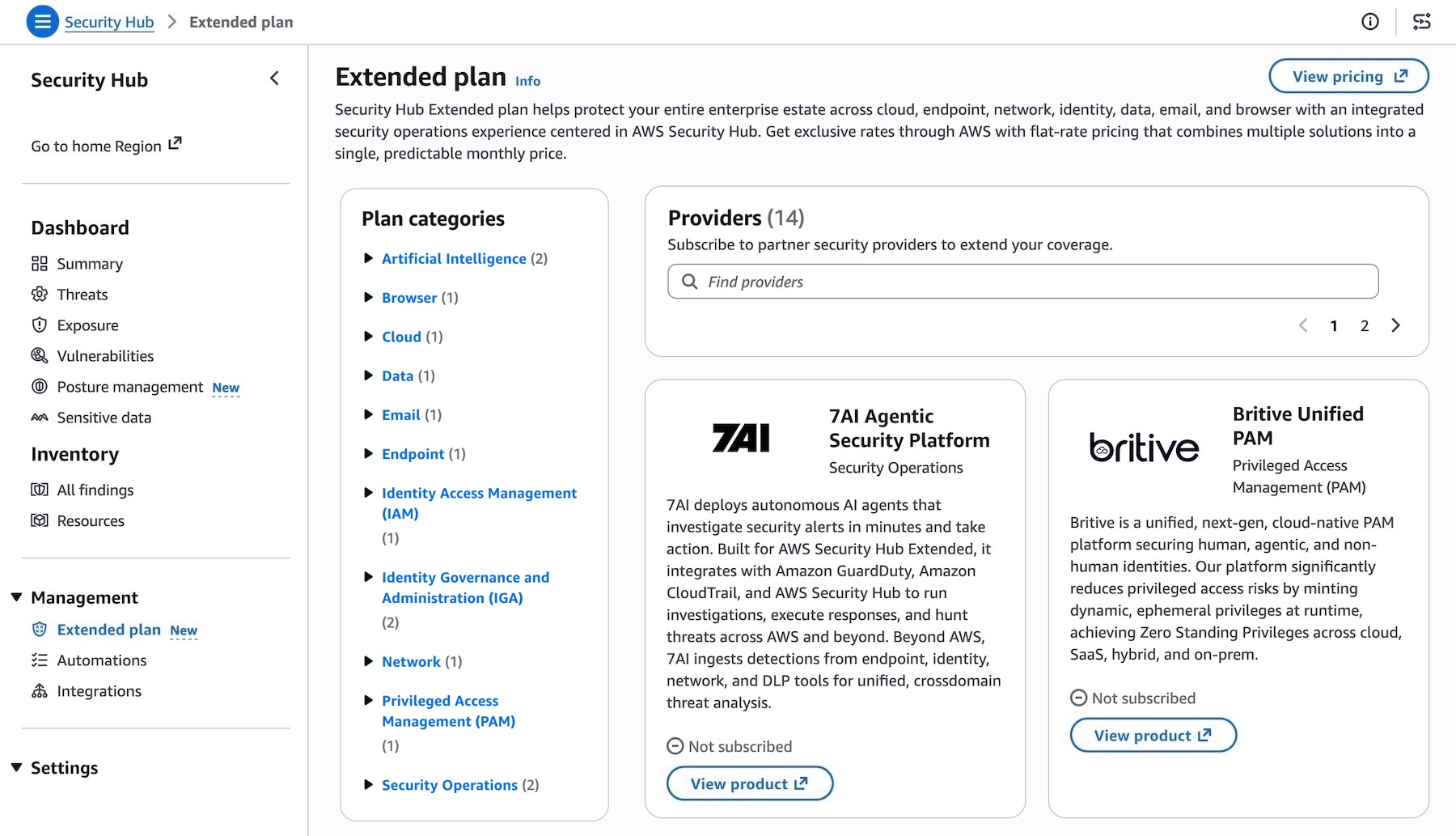
AWS Security Hub has been a central place for you to view and aggregate security alerts and compliance status across Amazon Web Services (AWS) accounts. Today, we are announcing the preview release of the new AWS Security Hub which offers additional correlation, contextualization, and visualization capabilities. This helps you prioritize critical security issues, respond at scale to reduce risks, improve team productivity, and better protect your cloud environment.

Here’s a quick look at the new AWS Security Hub.

With this new enhancement, AWS Security Hub integrates security capabilities like Amazon GuardDuty, Amazon Inspector, AWS Security Hub Cloud Security Posture Management (CSPM), Amazon Macie, and other AWS security capabilities to help you gain visibility across your cloud environment through centralized management in a unified cloud security solution. 

Getting started with the new AWS Security Hub
Let me walk you through how to get started with AWS Security Hub.

If you’re a new customer to AWS Security Hub, you need to navigate to the AWS Security Hub console to enable AWS security capabilities and capabilities and start assessing risk across your organization. You can learn more on the Documentation page.

After you have AWS Security Hub enabled, it will automatically consume data from supporting security capabilities you’ve enabled, such as Amazon GuardDuty, Amazon Inspector, Amazon Macie, and AWS Security Hub CSPM. You can navigate to the AWS Security Hub console to view these findings and benefit from insights created through correlation of findings across these capabilities.

As security risks are uncovered, they’re presented in a redesigned Security Hub summary dashboard. The new Security Hub summary dashboard provides a comprehensive, unified view of your AWS security posture. The dashboard organizes security findings into distinct categories, making it easier to identify and prioritize risks.

The new Exposure summary widget helps you identify and prioritize security exposures by analyzing resource relationships and signals from Amazon Inspector, AWS Security Hub CSPM, and Amazon Macie. These exposure findings are automatically generated and are a key part of the new solution, highlighting where your critical security exposures are located. You can learn more about exposure on the Documentation page.

AWS Security Hub now provides a Security coverage widget designed to help you identify potential coverage gaps. You can use this widget to identify where you’re missing coverage by the security capabilities that power Security Hub. This visibility helps you identify which capabilities, accounts, and features you need to address to improve your security coverage.

As you can see on the navigation menu, AWS Security Hub is organized into five key areas to streamline security management:

  • Exposure: Provides visibility into all exposure findings, a security vulnerability or misconfiguration that could potentially expose an AWS resource or system to unauthorized access or compromise, generated by Security Hub, helping you identify resources that might be accessible from outside your environment
  • Threats: Consolidates all threat findings generated by Amazon GuardDuty, showing potential malicious activities and intrusion attempts
  • Vulnerabilities: Displays all vulnerabilities detected by Amazon Inspector, highlighting software flaws and configuration issues
  • Posture management: Shows all posture management findings from AWS Security Hub Cloud Security Posture Management (CSPM), helping provide compliance with security best practices
  • Sensitive data: Presents all sensitive data findings identified by Amazon Macie, helping you track and protect your sensitive information

When you navigate to the Exposure page, you’ll see findings grouped by title, with severity levels clearly indicated to help you focus on critical issues first.

To explore specific exposures, you can select any finding to see affected resources. The panel includes key information about the implicated resource, account, Region, and when the issue was detected.

In this panel, you’ll also find an attack path visualization that is particularly useful for understanding complex security relationships. For network exposure paths, you can see all components involved in the path—including virtual private clouds (VPCs), subnets, security groups, network access control lists (ACLs), and load balancers—helping you identify exactly where to implement security controls. The visualization also highlights Identity and Access Management (IAM) relationships, showing how permission configurations might allow privilege escalation or data access. Resources with multiple contributing traits are clearly marked so you can quickly identify which components represent the greatest risk.

The Threats dashboard provides actionable insights into potential malicious activities detected by Amazon GuardDuty, organizing findings by severity so you can quickly identify critical issues like unusual API calls, suspicious network traffic, or potential credential compromises. The dashboard includes GuardDuty Extended Threat Detection findings, with all “Critical” severity threats representing these Extended Threat Detections that require immediate attention.

Similarly, the Vulnerabilities dashboard from Amazon Inspector provides a comprehensive view of software vulnerabilities and network exposure risks. The dashboard highlights vulnerabilities with known exploits, packages requiring urgent updates, and resources with the highest numbers of vulnerabilities.

Another valuable new feature is the Resources view, which provides an inventory of all resources deployed in your organization covered by AWS Security Hub. You can use this view to quickly identify which resources have findings against them and filter by resource type or finding severity. Selecting any resource provides detailed configuration information without needing to pivot to other consoles, streamlining your investigation workflow.

The new Security Hub also offers integration capabilities to help you comprehensively monitor your cloud environments and connect with third-party security solutions. This gives you the flexibility to create a unified security solution tailored to your organization’s specific needs.

For example, with integration capability, when viewing a security finding, you can select the Create ticket option and choose your preferred ticketing integration.

Additional things to know
Here are a couple of things to note:

  • Availability – During this preview period, the new AWS Security Hub is available in following AWS Regions: US East (N. Virginia, Ohio), US West (N. California, Oregon), Africa (Cape Town), Asia Pacific (Hong Kong, Jakarta, Mumbai, Osaka, Seoul, Singapore, Sydney, Tokyo), Canada (Central), Europe (Frankfurt, Ireland, London, Milan, Paris, Stockholm), Middle East (Bahrain), and South America (São Paulo).
  • Pricing – The new AWS Security Hub is available at no additional charge during the preview period. However, you will still incur costs for the integrated capabilities including Amazon GuardDuty, Amazon Inspector, Amazon Macie, and AWS Security Hub CSPM.
  • Integration with existing AWS security capabilities – Security Hub integrates with Amazon GuardDuty, Amazon Inspector, AWS Security Hub CSPM, and Amazon Macie, providing a comprehensive security posture without additional operational overhead.
  • Enhanced data interoperability – The new Security Hub uses the Open Cybersecurity Schema Framework (OCSF), enabling seamless data exchange across your security capabilities with normalized data formats.

To learn more about the enhanced AWS Security Hub and join the preview, visit the AWS Security Hub product page.

Happy building!

Donnie

AWS Backup adds new Multi-party approval for logically air-gapped vaults

Post Syndicated from Veliswa Boya original https://aws.amazon.com/blogs/aws/aws-backup-adds-new-multi-party-approval-for-logically-air-gapped-vaults/

Today, we’re announcing the general availability of a new capability that integrates AWS Backup logically air-gapped vaults with Multi-party approval to provide access to your backups even when your AWS account is inaccessible due to inadvertent or malicious events. AWS Backup is a fully managed service that centralizes and automates data protection across AWS services and hybrid workloads. It provides core data protection features, ransomware recovery capabilities, and compliance insights and analytics for data protection policies and operations.

As a backup administrator, you use AWS Backup logically air-gapped vaults to securely share backups across accounts and organizations, logically isolate your backup storage, and support direct restore to help reduce recovery time following an inadvertent or malicious event. However, if a bad or unintended actor gains root access to your backup account or the management account of your organization, your backups suddenly become inaccessible, even though they’re still safely stored in the logically air-gapped vault. While traditional account recovery involved working through support channels, AWS Backup with Multi-party approval delivers immediate access to recovery tools, empowering you with faster resolution times and greater control over your recovery timeline.

Multi-party approval for AWS Backup logically air-gapped vaults adds an additional layer of protection for you to recover your application data even when your AWS account becomes completely inaccessible. Using Multi-party approval, you can create approval teams which consist of highly trusted individuals in your organization, then associate them with your logically air-gapped vault. If you get locked out of your AWS accounts due to inadvertent or malicious actions, you can request your own approval team to authorize sharing of your vault from any account, even those outside your AWS Organizations account. Once approved, you gain authorized access to your backups and can begin your recovery process.

How it works
Multi-party approval for AWS Backup logically air-gapped vaults combines the security of logically air-gapped vaults with the governance of Multi-party approval to create a recovery mechanism that works even when your AWS account is compromised. Here’s how it works:

1. Approval team creation
First, you create an approval team in your AWS Organizations management account. If the management account is new, first create an AWS Identity and Access Management (IAM) Identity Center instance before creating the approval team. The approval team consists of trusted individuals (IAM Identity Center users) who will be authorized to approve vault sharing requests. Each approver receives an invitation to join the approval team through a new Approval portal.

2. Vault association
When your approval team is active, you share it with accounts that own logically air-gapped vaults using AWS Resource Access Manager (AWS RAM) to safeguard against requests for approval from arbitrary accounts. Backup administrators can then associate this approval team with new or existing logically air-gapped vaults.

3. Protection against compromise
If your AWS account becomes compromised or inaccessible, you can request access to your backups from a different account (a clean recovery account). This request includes the Amazon Resource Name (ARN) of the logically air-gapped vault in the format arn:aws:backup:<region>:<account>:backup-vault:<name> and an optional vault name and comment.

4. Multi-party approval
The request is sent to the approval team, who review it through the approval portal. When the minimum required number of approvers authorize the request, the vault is automatically shared with the requesting account. All requests and approvals are comprehensively logged in AWS CloudTrail.

5. Recovery process
With access granted, you can immediately start restoring or copying your data in the new recovery account without waiting for your compromised account to be remediated.

This approach provides an entirely separate authentication path to access and recover your backups, completely independent of your AWS account credentials. Even if the bad actor has root access to your account, they can’t prevent the approval team-based recovery process.

1. Create a new logically air-gapped vault
To create a new logically air-gapped vault, provide a name, tags (optional), and vault lock properties.

2. Assign an approval team
When the vault has been created, choose Assign approval team to assign it with an existing approval team.

Choose an existing approval team from the drop-down menu then select Submit to finalize the assignment.

Now your approval team is assigned to your logically air-gapped vault.

Good to know
It’s essential to test your recovery process before an actual emergency:

  1. From a different AWS account, use the AWS Backup console or API to request sharing of your logically air-gapped vault by providing the vault ID and ARN.
  2. Request approval of your request from the approval team.
  3. Once approved, verify that you can access and restore backups from the vault in your testing account.

As a best practice, monitor the health of your approval team regularly using AWS Backup Audit Manager to ensure they have sufficient active participants to meet your approval threshold.

Multi-party approval for enhanced cloud governance
Today, we’re also announcing the general availability of a new capability that AWS account administrators can use to add Multi-party approval to their product offerings. As highlighted in this post, AWS Backup is the first service to integrate this capability. With Multi-party approval, administrators can enable application owners to guard sensitive service operations with a distributed review process.

Good to know
Multi-party approval provides several significant security advantages:

  • Distributed decision-making, eliminating single points of failure
  • Full auditability through AWS CloudTrail integration
  • Protection against compromised credentials
  • Formal governance for compliance-sensitive operations
  • Consistent approval experience across integrated services

Now available

Multi-party approval is available today in all AWS Regions where AWS Organizations is available. Multi-party approval for AWS Backup logically air-gapped vaults is available in all AWS Regions where AWS Backup is available.

Veliswa.

New AWS Shield feature discovers network security issues before they can be exploited (Preview)

Post Syndicated from Esra Kayabali original https://aws.amazon.com/blogs/aws/new-aws-shield-feature-discovers-network-security-issues-before-they-can-be-exploited-preview/

Today, I’m happy to announce AWS Shield network security director (preview), a capability that simplifies identification of configuration issues related to threats such as SQL injections and distributed denial of service (DDoS) events, and proposes remediations. This feature identifies and analyzes network resources, connections, and configurations. It compares them against AWS best practices to create a network topology that highlights resources requiring protection.

Organizations today face significant challenges in maintaining a robust network security posture. Security teams often struggle to efficiently discover all resources in their environments, understand how these resources are interconnected, and identify which security services are currently configured. Additionally, they find determining how well resources are configured relative to AWS best practices requires considerable expertise and effort. Many teams find it difficult to identify which network security services and rule sets would best protect their applications from common and emerging threats.

AWS Shield network security director addresses these challenges through three key capabilities. First, it performs comprehensive analysis to discover resources across your AWS accounts, identify connectivity between resources, and determine which network security services and configurations are currently in place. Second, it prioritizes resources by severity level based on AWS network security best practices and threat intelligence. Finally, it provides specific remediation recommendations such as step-by-step instructions for implementing the right AWS security services, including AWS WAF, Amazon Virtual Private Cloud (Amazon VPC) security groups, and Amazon VPC network access control lists (ACLs) to protect your resources.

The service supports critical network security use cases, including protecting applications against internet-born threats and controlling human access to resources based on port, protocol, or IP address range. It provides network analysis to discover assets and delivers analysis that eliminates time-consuming manual processes for identifying resources that need protection. The service offers resource prioritization by assigning security findings a severity level based on network context and adherence to AWS best practices, helping you focus on what matters most. Additionally, it supplies actionable recommendations with specific guidance on which services and configurations will address each security gap. You can also get answers, in natural language, from AWS Shield network security director from within Amazon Q Developer in the AWS Management Console and chat applications.

Getting started with AWS Shield network security director
To use AWS Shield network security director, I need to initiate a network analysis of my AWS resources. I go to the AWS WAF & Shield console and choose Getting started under AWS Shield network security director in the navigation pane. I choose Get started, which takes me to the configuration page. On this page, I can choose how to perform my first network analysis: I can assess findings from across all supported Regions or from my current Region only. I select Start network analysis.

After the analysis is completed, the dashboard page shows a breakdown of resource types by severity level and the most common categories of network security findings associated with their resources. Resources are categorized by type and severity level (critical, high, medium, low, informational), making it easy to identify which areas need immediate attention.

Next, I explore the Resources section to understand the distribution of my assets and filter by severity level in my environment. I can use Resource overview to review a specific severity level, which will redirect me to the Resources under Network security director with the associated severity level filter. I choose the resources that have Medium severity level.

I choose a specific resource to view its network topology map showing how it connects to other resources and associated findings. This visualization helps me understand the potential impact of security configurations and identify exposed paths. I review detailed findings such as “Allows unrestricted inbound access (0.0.0.0/0) on all ports” with severity ratings.

Next, I go to Findings under Network security director, which shows common configuration issues. For each finding, I receive detailed information and recommended remediation steps. The service rates the severity of findings (high, medium, low) to help me prioritize my response. Critical-severity findings such as “CloudFront origin is also internet accessible without CloudFront protections” or high-severity findings such as “Allows unrestricted inbound access (0.0.0.0/0) on all ports” are presented first, followed by medium- and low-severity issues.

You can analyze your network security configurations, in natural language, with AWS Shield network security director within Amazon Q Developer in the AWS Management Console and chat applications. For example, you can say “Do I have any network security issues on my CloudFront distributions?” or “Are any of my resources vulnerable to bots and scrapers?” This integration helps security teams quickly understand their security posture and receive guidance on implementing best practices without having to navigate through extensive documentation.

To explore this capability, I ask “What are my most critical network security issues?” in the Explore with Amazon Q section. Amazon Q analyzes my network security configuration and generates a response based on the security assessment of my AWS environment.

With this comprehensive view of your network security, you can now make data-driven decisions to strengthen your defenses against emerging threats.

Join the preview
AWS Shield network security director is available in the US East (N. Virginia) and Europe (Stockholm) Regions. The Amazon Q Developer capability to analyze network security configurations is available in preview in US East (N. Virginia). To begin strengthening your network security, visit the AWS Shield network security director console and initiate your first network security analysis.

For more information, visit the AWS Shield product page.

— Esra

Amazon CloudFront simplifies web application delivery and security with new user-friendly interface

Post Syndicated from Micah Walter original https://aws.amazon.com/blogs/aws/amazon-cloudfront-simplifies-web-application-delivery-and-security-with-new-user-friendly-interface/

Today, we’re announcing a new simplified onboarding experience for Amazon CloudFront that developers can use to accelerate and secure their web applications in seconds. This new experience, along with improvements to the AWS WAF console experience, makes it easier than ever for developers to configure content delivery and security services without requiring deep technical expertise.

Setting up content delivery and security for web applications traditionally required navigating multiple Amazon Web Services (AWS) services and making numerous configuration decisions. With this new CloudFront onboarding experience, developers can now create a fully configured distribution with DNS and a TLS certificate in just a few clicks.

Amazon CloudFront offers compelling benefits for organizations of all sizes looking to deliver content and applications globally. As a content delivery network (CDN), CloudFront significantly improves application performance by serving content from edge locations closest to your users, reducing latency and improving user experience. Beyond performance, CloudFront provides built-in security features that protect your applications from distributed denial of service (DDoS) attacks and other threats at the edge, preventing malicious traffic from reaching your origin infrastructure. The service automatically scales with your traffic demands without requiring any manual intervention, handling both planned and unexpected traffic spikes with ease. Whether you’re running a small website or a large-scale application, the CloudFront integration with other AWS services and the new simplified console experience makes it easier than ever to implement these essential capabilities for your web applications.

Streamlined CloudFront configuration

The new CloudFront console experience guides developers through a simplified workflow that starts with the domain name they want to use for their distribution. When using Amazon Route 53, the experience automatically handles TLS certificate provisioning and DNS record configuration, while incorporating security best practices by default. This unified approach eliminates the need to switch between multiple services like AWS Certificate Manager, Route 53, and AWS WAF, and offers developers a faster time to production without the need to dive deep on the nuanced configuration options of each service.

For example, a developer can now create a secure CloudFront distribution for their applications fronted by a load balancer by entering their domain name and selecting their load balancer as the origin. The console automatically recommends optimal CDN and security configurations based on the application type and requirements, and developers can deploy with confidence knowing they’re following AWS best practices.

For developers who wish to host a static website on Amazon Simple Storage Service (Amazon S3), CloudFront provides several important benefits. First, it improves your website’s performance by caching content at edge locations closer to your users, reducing latency and improving page load times. Second, it helps protect your S3 bucket by acting as a security layer—CloudFront can be configured to be the only way to access your content, preventing direct access to your S3 bucket. The new experience automatically configures these security best practices for you.

Enhanced security integration with AWS WAF

Complementing the new CloudFront experience, we’re also introducing an improved AWS WAF console that features intelligent Rule Packs—curated sets of security rules based on application type and security requirements. These Rule Packs enable developers to implement comprehensive security controls without needing to be security experts.

When creating a CloudFront distribution, developers can now enable AWS WAF protection through an integrated experience that uses these new Rule Packs. The console provides clear recommendations for security configurations that developers can use to preview and validate their settings before deployment.

Web applications face numerous security threats today, including SQL injection attacks, cross-site scripting (XSS), and other OWASP Top 10 vulnerabilities. With the new AWS WAF integration, you automatically get protection against these common attack vectors. The recommended Rule Packs provide immediate protection against malicious bot traffic, common web exploits, and known bad actors while preventing direct-to-origin attacks that could overwhelm your infrastructure.

Let’s take a look

If you’ve ever created an Amazon CloudFront distribution, you’ll immediately notice that things have changed. The new experience is straightforward to follow and understand. For my example, I chose to create a distribution for a static website using Amazon S3 as my origin.

New onboarding experience for Amazon CloudFront

In Step 1, I give my distribution a name and select from Single website or app or the new Multi-tenant architecture option, which I can use to configure distributions that use multiple domains but share a common configuration. I choose Single website or app and enter an optional domain name. With the new experience, I can use the Check domain button to verify I have my domain as a Route 53 zone file.

Next, I select the origin for the distribution, which is where CloudFront will fetch the content to serve and cache. For my Origin type, I select Amazon S3. As the preceding screenshot shows, there are several additional options to choose from. Each of the options is designed to make configuration as straightforward as possible for the most popular use cases. Next, I select my S3 bucket, either by typing in the bucket name or using the Browse S3 button.

Next, I have several settings related to using Amazon S3 as my origin. The Grant CloudFront access to origin option is an important one. This option (selected by default) will update my S3 bucket policy to allow CloudFront to access my bucket and will configure my bucket for origin access control. This way, I can use a completely private bucket and know that assets in my bucket can only be accessed through CloudFront. This is a critical step to keeping my bucket and assets secure.

In the next step, I’m presented with the option to configure AWS WAF. With AWS WAF enabled, my web servers are better protected because it inspects each incoming request for potential threats before allowing them to make their way to my web servers. There is a cost to enabling AWS WAF, and as you can see in the following screenshot, there is a calculator to help estimate additional charges.

New onboarding experience for Amazon CloudFront

Now available

The new CloudFront onboarding experience and enhanced AWS WAF console are available today in all AWS Regions where these services are offered. You can start using these new features through the AWS Management Console. There are no additional charges for using these new experiences—you pay only for the CloudFront and AWS WAF resources you use, based on their respective pricing models.

To learn more about the new CloudFront onboarding experience and AWS WAF improvements, visit the Amazon CloudFront Documentation and AWS WAF Documentation. Start building faster, more secure web applications today with these simplified experiences.

AWS Certificate Manager introduces exportable public SSL/TLS certificates to use anywhere

Post Syndicated from Channy Yun (윤석찬) original https://aws.amazon.com/blogs/aws/aws-certificate-manager-introduces-exportable-public-ssl-tls-certificates-to-use-anywhere/

Today, we’re announcing exportable public SSL/TLS certificates from AWS Certificate Manager (ACM). Prior to this launch, you can issue your public certificates or import certificates issued by third-party certificate authorities (CAs) at no additional cost, and deploy them with integrated AWS services such as Elastic Load Balancing (ELB), Amazon CloudFront distribution, and Amazon API Gateway.

Now you can export public certificates from ACM, get access to the private keys, and use them on any workloads running on Amazon Elastic Compute Cloud (Amazon EC2) instances, containers, or on-premises hosts. The exportable public certificate are valid for 395 days. There is a charge at time of issuance, and again at time of renewal. Public certificates exported from ACM are issued by Amazon Trust Services and are widely trusted by commonly used platforms such as Apple and Microsoft and popular web browsers such as Google Chrome and Mozilla Firefox.

ACM exportable public certificates in action
To export a public certificate, you first request a new exportable public certificate. You cannot export previously created public certificates.

To get started, choose Request certificate in the ACM console and choose Enable export in the Allow export section. If you select Disable export, the private key for this certificate will be disallowed for exporting from ACM and this cannot be changed after certificate issuance.

You can also use the request-certificate command to request a public exportable certificate with Export=ENABLED option on the AWS Command Line Interface (AWS CLI).

aws acm request-certificate \
--domain-name mydomain.com \
--key-algorithm EC_Prime256v1 \
--validation-method DNS \
--idempotency-token <token> \
--options \
CertificateTransparencyLoggingPreference=DISABLED \
Export=ENABLED

After you request the public certificate, you must validate your domain name to prove that you own or control the domain for which you are requesting the certificate. The certificate is typically issued within seconds after successful domain validation.

When the certificate enters status Issued, you can export your issued public certificate by choosing Export.

Export your public certificate

Enter a passphrase for encrypting the private key. You will need the passphrase later to decrypt the private key. To get the public key, Choose Generate PEM Encoding.

You can copy the PEM encoded certificate, certificate chain, and private key or download each to a separate file.

Download PEM keys

You can use the export-certificate command to export a public certificate and private key. For added security, use a file editor to store your passphrase and output keys to a file to prevent being stored in the command history.

aws acm export-certificate \
     --certificate-arn arn:aws:acm:us-east-1:<accountID>:certificate/<certificateID> \
     --passphrase fileb://path-to-passphrase-file \
     | jq -r '"\(.Certificate)\(.CertificateChain)\(.PrivateKey)"' \
     > /tmp/export.txt

You can now use the exported public certificates for any workload that requires SSL/TLS communication such as Amazon EC2 instances. To learn more, visit Configure SSL/TLS on Amazon Linux in your EC2 instances.

Things to know
Here are a couple of things to know about exportable public certificates:

  • Key security – An administrator of your organization can set AWS IAM policies to authorize roles and users who can request exportable public certificates. ACM users who have current rights to issue a certificate will automatically get rights to issue an exportable certificate. ACM admins can also manage the certificates and take actions such as revoking or deleting the certificates. You should protect exported private keys using secure storage and access controls.
  • Revocation – You may need to revoke exportable public certificates to comply with your organization’s policies or mitigate key compromise. You can only revoke the certificates that were previously exported. The certificate revocation process is global and permanent. Once revoked, you can’t retrieve revoked certificates to reuse. To learn more, visit Revoke a public certificate in the AWS documentation.
  • Renewal – You can configure automatic renewal events for exportable public certificates by Amazon EventBridge to monitor certificate renewals and create automation to handle certificate deployment when renewals occur. To learn more, visit Using Amazon EventBridge in the AWS documentation. You can also renew these certificates on-demand. When you renew the certificates, you’re charged for a new certificate issuance. To learn more, visit Force certificate renewal in the AWS documentation.

Now available
You can now issue exportable public certificates from ACM and export the certificate with the private keys to use other compute workloads as well as ELB, Amazon CloudFront, and Amazon API Gateway.

You are subject to additional charges for an exportable public certificate when you create it with ACM. It costs $15 per fully qualified domain name and $149 per wildcard domain name. You only pay once during the lifetime of the certificate and will be charged again only when the certificate renews. To learn more, visit the AWS Certificate Manager Service Pricing page.

Give ACM exportable public certificates a try in the ACM console. To learn more, visit the ACM Documentation page and send feedback to AWS re:Post for ACM or through your usual AWS Support contacts.

Channy

Verify internal access to critical AWS resources with new IAM Access Analyzer capabilities

Post Syndicated from Micah Walter original https://aws.amazon.com/blogs/aws/verify-internal-access-to-critical-aws-resources-with-new-iam-access-analyzer-capabilities/

Today, we’re announcing a new capability in AWS IAM Access Analyzer that helps security teams verify which AWS Identity and Access Management (IAM) roles and users have access to their critical AWS resources. This new feature provides comprehensive visibility into access granted from within your Amazon Web Services (AWS) organization, complementing the existing external access analysis.

Security teams in regulated industries, such as financial services and healthcare, need to verify access to sensitive data stores like Amazon Simple Storage Service (Amazon S3) buckets containing credit card information or healthcare records. Previously, teams had to invest considerable time and resources conducting manual reviews of AWS Identity and Access Management (IAM) policies or rely on pattern-matching tools to understand internal access patterns.

The new IAM Access Analyzer internal access findings identify who within your AWS organization has access to your critical AWS resources. It uses automated reasoning to collectively evaluate multiple policies, including service control policies (SCPs), resource control policies (RCPs), and identity-based policies, and generates findings when a user or role has access to your S3 buckets, Amazon DynamoDB tables, or Amazon Relational Database Service (Amazon RDS) snapshots. The findings are aggregated in a unified dashboard, simplifying access review and management. You can use Amazon EventBridge to automatically notify development teams of new findings to remove unintended access. Internal access findings provide security teams with the visibility to strengthen access controls on their critical resources and help compliance teams demonstrate access control audit requirements.

Let’s try it out

To begin using this new capability, you can enable IAM Access Analyzer to monitor specific resources using the AWS Management Console. Navigate to IAM and select Analyzer settings under the Access reports section of the left-hand navigation menu. From here, select Create analyzer.

Screenshot of creating an Analyzer in the AWS Console

From the Create analyzer page, select the option of Resource analysis – Internal access. Under Analyzer details, you can customize your analyzer’s name to whatever you prefer or use the automatically generated name. Next, you need to select your Zone of trust. If your account is the management account for an AWS organization, you can choose to monitor resources across all accounts within your organization or the current account you’re logged in to. If your account is a member account of an AWS organization or a standalone account, then you can monitor resources within your account.

The zone of trust also determines which IAM roles and users are considered in scope for analysis. An organization zone of trust analyzer evaluates all IAM roles and users in the organization for potential access to a resource, whereas an account zone of trust only evaluates the IAM roles and users in that account.

For this first example, we assume our account is the management account and create an analyzer with the organization as the zone of trust.

Screenshot of creating an Analyzer in the AWS Console

Next, we need to select the resources we wish to analyze. Selecting Add resources gives us three options. Let’s first examine how we can select resources by identifying the account and resource type for analysis.

Screenshot of creating an Analyzer in the AWS Console

You can use Add resources by account dialog to choose resource types through a new interface. Here, we select All supported resource types and select the accounts we wish to monitor. This will create an analyzer that monitors all supported resource types. You can either select accounts through the organization structure (shown in the following screenshot) or paste in account IDs using the Enter AWS account ID option.

Screenshot of creating an Analyzer in the AWS Console

You can also choose to use the Define specific resource types dialog, which you can use to pick from a list of supported resource types (as shown in the following screenshot). By creating an analyzer with this configuration, IAM Access Analyzer will continually monitor both existing and new resources of the selected type within the account, checking for internal access.

Screenshot of creating an Analyzer in the AWS Console

After you’ve completed your selections, choose Add resources.

Screenshot of creating an Analyzer in the AWS Console

Alternatively, you can use the Add resources by resource ARN option.

Screenshot of creating an Analyzer in the AWS Console

Or you can use the Add resources by uploading a CSV file option to configure monitoring a list of specific resources at scale.

Screenshot of creating an Analyzer in the AWS Console

After you’ve completed the creation of your analyzer, IAM Access Analyzer will analyze policies daily and generate findings that show access granted to IAM roles and users within your organization. The updated IAM Access Analyzer dashboard now provides a resource-centric view. The Active findings section summarizes access into three distinct categories: public access, external access outside of the organization (requires creation of a separate external access analyzer), and access within the organization. The Key resources section highlights the top resources with active findings across the three categories. You can see a list of all analyzed resources by selecting View all active findings or Resource analysis on the left-hand navigation menu.

Screenshot of Access Analyzer findings

On the Resource analysis page, you can filter the list of all analyzed resources for further analysis.

Screenshot of creating an Analyzer in the AWS Console

When you select a specific resource, any available external access and internal access findings are listed on the Resource details page. Use this feature to evaluate all possible access to your selected resource. For each finding, IAM Access Analyzer provides you with detailed information about allowed IAM actions and their conditions, including the impact of any applicable SCPs and RCPs. This means you can verify that access is appropriately restricted and meets least-privilege requirements.

Screenshot of creating an Analyzer in the AWS Console

Pricing and availability

This new IAM Access Analyzer capability is available today in all commercial Regions. Pricing is based on the number of critical AWS resources monitored per month. External access analysis remains available at no additional charge. Pricing for EventBridge applies separately.

To learn more about IAM Access Analyzer and get started with analyzing internal access to your critical resources, visit the IAM Access Analyzer documentation.

AWS Weekly Roundup: AWS re:Inforce 2025, AWS WAF, AWS Control Tower, and more (June 16, 2025)

Post Syndicated from Esra Kayabali original https://aws.amazon.com/blogs/aws/aws-weekly-roundup-aws-reinforce-2025-aws-waf-aws-control-tower-and-more-june-16-2025/

Today marks the start of AWS re:Inforce 2025, where security professionals are gathering for three days of technical learning sessions, workshops, and demonstrations. This security-focused conference brings together AWS security specialists who build and maintain the services that organizations rely on for their cloud security needs.

AWS Chief Information Security Officer (CISO) Amy Herzog will deliver the conference keynote along with guest speakers who will share new security capabilities and implementation insights. The event offers multiple learning paths with sessions designed for various technical roles and expertise levels. Many of my colleagues from across AWS are leading hands-on workshops, demonstrating new security features, and facilitating community discussions. For those unable to join us in Philadelphia, the keynote and innovation talks will be viewable by livestream during the event, and available to watch on demand after the event. Look out for the key announcements and technical insights from the conference in upcoming posts!

Let’s look at last week’s new announcements.

Last week’s launches
Here are the launches that got my attention.

Extend Amazon Q Developer IDE plugins with MCP toolsAmazon Q Developer now supports Model Context Protocol (MCP) in its integrated development environment (IDE) plugins, helping developers integrate external tools for enhanced contextual development workflows. You can now augment the built-in tools with any MCP server that supports the stdio transport layer. These servers can be managed within the Amazon Q Developer user interface. This makes it easy to add, remove, and modify tool permissions. The integration enables more customized responses by orchestrating tasks across both native and MCP server-based tools. MCP support is available in Visual Studio Code and JetBrains IDE plugins, as well as in the Amazon Q Developer command line interface (CLI), with detailed documentation and implementation guides available in the Amazon Q Developer documentation.

AWS WAF now supports automatic application layer DDoS protection – AWS has enhanced its application layer (L7) distributed denial of service (DDoS) protection capabilities with faster automatic detection and mitigation that responds to events within seconds. This AWS Managed Rules group automatically detects and mitigates DDoS attacks of any duration to keep applications running on Amazon CloudFront, Application Load Balancer, and other AWS WAF supported services available to users. The system establishes a baseline within minutes of activation using machine learning (ML) models to detect traffic anomalies, then automatically applies rules to address suspicious requests. Configuration options help you customize responses such as presenting challenges or blocking requests. The feature is available to all AWS WAF and AWS Shield Advanced subscribers in all supported AWS Regions, except Asia Pacific (Thailand), Mexico (Central), and China (Beijing and Ningxia). To learn more about AWS WAF application layer (L7) DDoS protection, visit the AWS WAF documentation or the AWS WAF console.

AWS Control Tower now supports service-linked AWS Config managed AWS Config rulesAWS Control Tower now deploys service-linked AWS Config rules directly in managed accounts, replacing the previous CloudFormation StackSets deployment method. This change improves deployment speed when enabling service-linked AWS Config rules across multiple AWS Control Tower managed accounts and Regions. These service-linked rules are managed entirely by AWS services and can’t be edited or deleted by users. This helps maintain consistency and prevent configuration drift. AWS Control Tower Config rules detect resource noncompliance within accounts and provide alerts through the dashboard. You can deploy these controls using the AWS Control Tower console or AWS Control Tower control APIs.

Powertools for AWS Lambda introduces Bedrock Agents Function utility – The new Amazon Bedrock Agents Function utility in Powertools for AWS Lambda simplifies building serverless applications integrated with Amazon Bedrock Agents. This utility helps developers create AWS Lambda functions that respond to Amazon Bedrock Agents action requests with built-in parameter injection and response formatting, eliminating boilerplate code. The utility seamlessly integrates with other Powertools features like Logger and Metrics, making it easier to build production-ready AI applications. This integration improves the developer experience when building agent-based solutions that use AWS Lambda functions to process actions requested by Amazon Bedrock Agents. The utility is available in Python, TypeScript, and .NET versions of Powertools.

Announcing open sourcing pgactive: active-active replication extension for PostgreSQL – Pgactive is a PostgreSQL extension that enables asynchronous active-active replication for streaming data between database instances, and AWS has made it open source. This extension provides additional resiliency and flexibility for moving data between instances, including writers located in different Regions. It helps maintain availability during operations like switching write traffic. Building on PostgreSQL’s logical replication features, pgactive adds capabilities that simplify managing active-active replication scenarios. The open source approach encourages collaboration on developing PostgreSQL’s active-active capabilities while offering features that streamline using PostgreSQL in multi-active instance environments. For more information and implementation guidance, visit the GitHub repository.

For a full list of AWS announcements, be sure to keep an eye on the What’s New at AWS page.

We launched existing services and instance types in additional Regions:

Other AWS events
Check your calendar and sign up for upcoming AWS events.

AWS GenAI Lofts are collaborative spaces and immersive experiences that showcase AWS expertise in cloud computing and AI. They provide startups and developers with hands-on access to AI products and services, exclusive sessions with industry leaders, and valuable networking opportunities with investors and peers. Find a GenAI Loft location near you and don’t forget to register.

AWS Summits are free online and in-person events that bring the cloud computing community together to connect, collaborate, and learn about AWS. Register in your nearest city: Milano (June 18), Shanghai (June 19 – 20), Mumbai (June 19) and Japan (June 25 – 26).

Browse all upcoming AWS led in-person and virtual events here.

That’s all for this week. Check back next Monday for another Weekly Roundup!

— Esra

This post is part of our Weekly Roundup series. Check back each week for a quick roundup of interesting news and announcements from AWS!