Tag Archives: Solutions Architecture

Mastering millisecond latency and millions of events: The event-driven architecture behind the Amazon Key Suite

Post Syndicated from Ali Ufuk Yucel original https://aws.amazon.com/blogs/architecture/mastering-millisecond-latency-and-millions-of-events-the-event-driven-architecture-behind-the-amazon-key-suite/

Background

Amazon Key empowers customers to securely manage access to their homes and businesses through innovative solutions. Through a suite of consumer and business products, the Amazon Key team is transforming how customers receive deliveries and manage access to their spaces. Our In-Garage Delivery service offers a secure and convenient solution for receiving Amazon packages and groceries directly inside customers’ garages. For property managers and building owners, Amazon Key provides comprehensive access management solutions that enable safe and efficient delivery operations in apartment buildings and gated communities, enhancing both security and convenience for residents.

In this post, we explore how the Amazon Key team used Amazon EventBridge to modernize their architecture, transforming a tightly coupled monolithic system into a resilient, event-driven solution. We explore the technical challenges we faced, our implementation approach, and the architectural patterns that helped us achieve improved reliability and scalability. The post covers our solutions for managing event schemas at scale, handling multiple service integrations efficiently, and building an extensible architecture that accommodates future growth.

Opportunities

Service Coupling and System Fragility

Our legacy architecture faced significant challenges stemming from its tightly coupled design, where service interactions created a complex web of dependencies impacting system stability and scalability. Making service modifications was particularly challenging, as adding or removing services required careful consideration of numerous interdependencies. An incident highlighted this vulnerability when an issue in Service-A triggered a cascade of failures across many upstream services, with increased timeouts leading to retry attempts and ultimately resulting in service deadlocks. System fragility was further demonstrated when problems with a single device vendor, despite being responsible only for specific delivery operations, caused widespread degradation across multiple system services.

Loose Event Schemas

Our old event management infrastructure lacked explicit schema definitions and employed a loosely-typed data architecture, leading to several critical issues. Events were difficult to maintain as use cases expanded, and the absence of formal schema documentation impacted transparency and team collaboration. The design made it almost impossible to implement backward-incompatible changes, such as removing unused fields or events for performance optimization. Without a repository for schema management, team-to-team collaboration for schema modifications (adding fields, removing fields, deprecating fields, or marking fields as required) became challenging. The system also lacked organized validation logic, making it difficult for publishers to identify invalid events before they entered the system. Additionally, the loosely typed schemas lost important semantic context, such as inheritance and composition relationships between different event schemas.

Inconsistent Event Routing and Management

The event routing logic was manually managed and lacked the sophistication needed for growing use cases. The system only supported basic validation of events, primarily checking for required fields, with limited capability for extending validation rules or implementing more complex routing logic. Features that were commonly available in off-the-shelf solutions, such as parallel publishing to multiple subscribers, required significant custom development and ongoing maintenance effort. The implementation only supported a limited number of subscribers to the event pipeline, with no sustainable pathway for adding more consumers. While attempts were made to reduce coupling through SNS/SQS pairs between services, these solutions were implemented on an ad-hoc basis, lacking standardization and creating additional maintenance overhead. This approach led to redundant work and failed to abstract away common functionality, resulting in an inefficient and hard-to-maintain system.These challenges collectively highlighted the need for a more robust and flexible architectural approach that could better serve the system’s evolving needs while improving reliability, maintainability, and scalability.

Design

Given our requirements and the architectural challenges we faced, we implemented a single-bus, multi-account pattern to optimize our system architecture. In this design, each service team maintains complete ownership and autonomy over their application stack, enabling independent development and deployment cycles. Meanwhile, our DevOps team manages a centralized infrastructure stack that encompasses event bus rules, target configurations, and service integrations. This separation of concerns provides several key benefits:

  1. Clear ownership boundaries: Service teams can focus on their core business logic while leveraging a standardized event infrastructure.
  2. Centralized governance: The DevOps team facilitates consistent event routing patterns, security controls, and monitoring across service integrations.
  3. Simplified operations: A single event bus reduces operational complexity while maintaining logical separation through well-defined routing rules.
  4. Enhanced security: The multi-account structure provides natural isolation boundaries while still enabling controlled cross-account event flows.
  5. Streamlined compliance: Centralized management of data exchange patterns makes it easier to implement and maintain compliance requirements.

While EventBridge provided the foundation, we developed additional components to meet our specific requirements.  Our team built three key components: a schema repository serving as the single source of truth for event definitions, a client library that handles schema validation and provides developer-friendly abstractions, and an infrastructure library offering reusable components for subscriber integration.
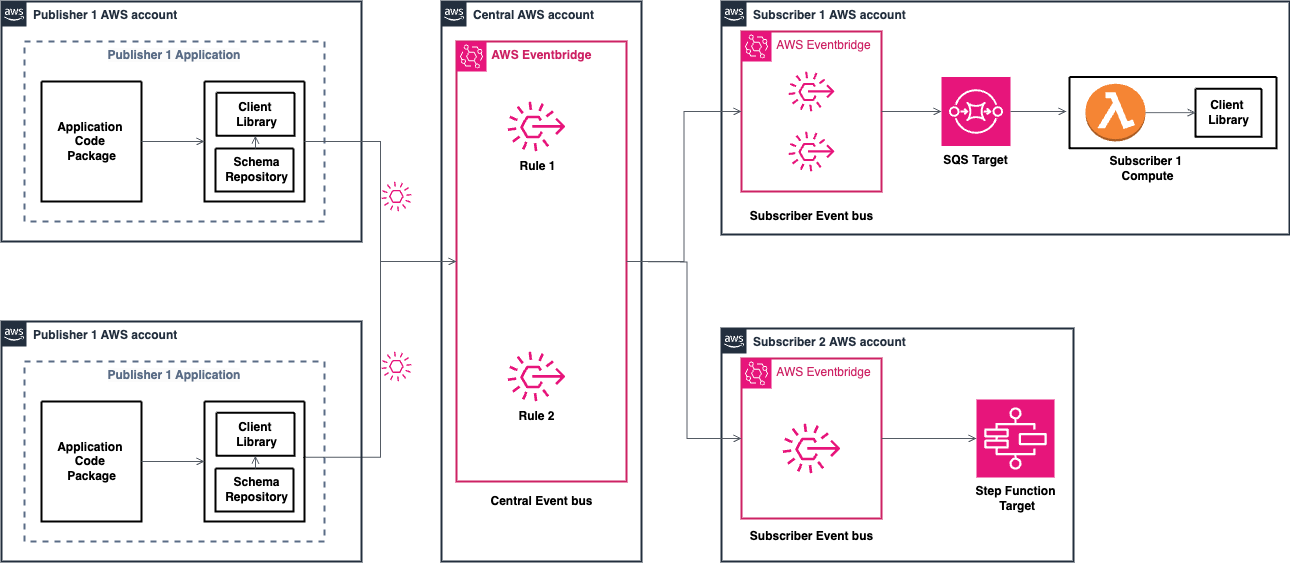
Event Schema Repository

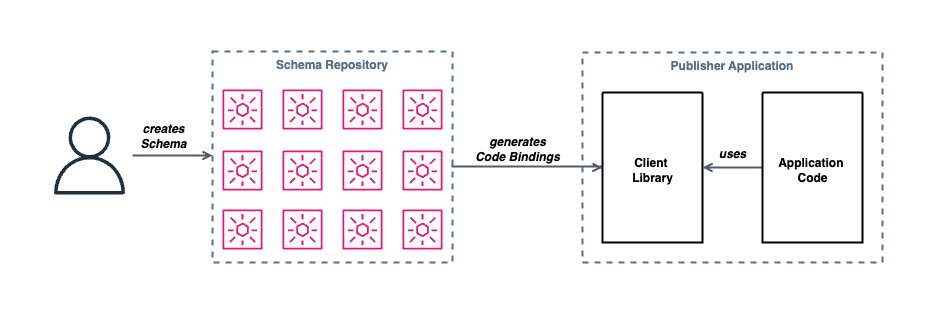
Amazon EventBridge’s schema discovery and documentation capabilities provide powerful solutions for managing event-driven architectures. The service automatically captures event structures in the schema registry, maintaining versions as events evolve over time. While EventBridge provides developers with tools to implement validation using external solutions or custom application code, it currently does not include native schema validation capabilities. For our organization’s large-scale event-driven architecture, schema validation was a critical requirement. We evaluated two implementation approaches: a centralized validation service or client-side validation at the publisher/subscriber level. The centralized approach would have required managing additional infrastructure, scaling considerations, and introduced latency through extra network hops. After analyzing these factors alongside our requirements for schema governance and team autonomy, we implemented a custom schema repository with client-side validation.

This architecture prioritizes developer experience through immediate validation feedback while maintaining our standards for schema versioning and release management. The repository serves as the foundation for our event-driven architecture, providing essential capabilities for data governance and quality control. By acting as the single source of truth for event definitions, it enables standardized validation across clients, enforces data quality checks, establishes clear ownership boundaries, and maintains comprehensive audit trails for schema changes. Publishers and subscribers leverage these schemas to maintain data consistency and compatibility as their services evolve. The repository has become instrumental in facilitating efficient cross-team collaboration through self-service schema discovery, documentation, and automated validation during development. It maintains a comprehensive registry of event publishers and their corresponding subscribers, providing clear visibility into event flow patterns and dependencies across the system. Teams can quickly manage schema evolution with clear deprecation policies and migration paths, while the system helps detect breaking changes early in the development cycle. This collaborative approach has significantly improved team velocity and reduced integration issues between services.

{
    "$schema": "http://json-schema.org/draft-04/schema#",
    "$id": "/resource/event/schema/EventV1.json",
    "title": "EventV1",
    "description": "Schema for a simple event.",
    "type": "object",
    "properties": {
        "id": {
            "description": "Id of the event.",
            "type": "string"
        },
        "type": {
            "description": "Type of the event.",
            "$ref": "EventType.json"
        },
        "time": {
            "description": "Time at which the event occurred. It uses ISO 8601 Date Time Format. Reference: https://www.iso.org/iso-8601-date-and-time-format.html",
            "type": "string",
            "format": "date-time"
        },
        "publisher": {
            "description": "Publisher of the event.",
            "$ref": "../core/Publisher.json"
        }
    },
    "required": [
        "id",
        "type",
        "time",
        "publisher"
    ]
}

Client Library

The client library serves as a crucial component for both publishers and subscribers, streamlining their integration with the central event bus. At its core, the library leverages our Event Schema Repository, generating code bindings at build time to provide developers with type-safe and intuitive interfaces for event creation and handling. This approach significantly enhances developer productivity by offering straightforward and convenient methods to construct events and interact with the bus, reducing the likelihood of errors and improving code readability.

A key feature of the client library is its built-in validation mechanism. By utilizing the schemas from our local repository, the library performs thorough validation of events before they are published. This proactive approach catches potential issues early in the development cycle, making sure that only well-formed events conforming to the agreed-upon schemas make it to the event bus. Once validated, the library handles the serialization process and manages the actual publishing of events to the bus, abstracting and simplifying data transformation and transport.

For subscribers, the client library offers equally valuable functionality. It seamlessly handles the deserialization of incoming events, presenting them to the subscribing services in a readily usable format. This feature saves development time and reduces the risk of parsing errors, allowing teams to focus on business logic rather than data handling intricacies. By providing these comprehensive capabilities, our client library has become an indispensable tool in our event-driven network, promoting consistency, reliability, and efficiency across our microservices architecture.
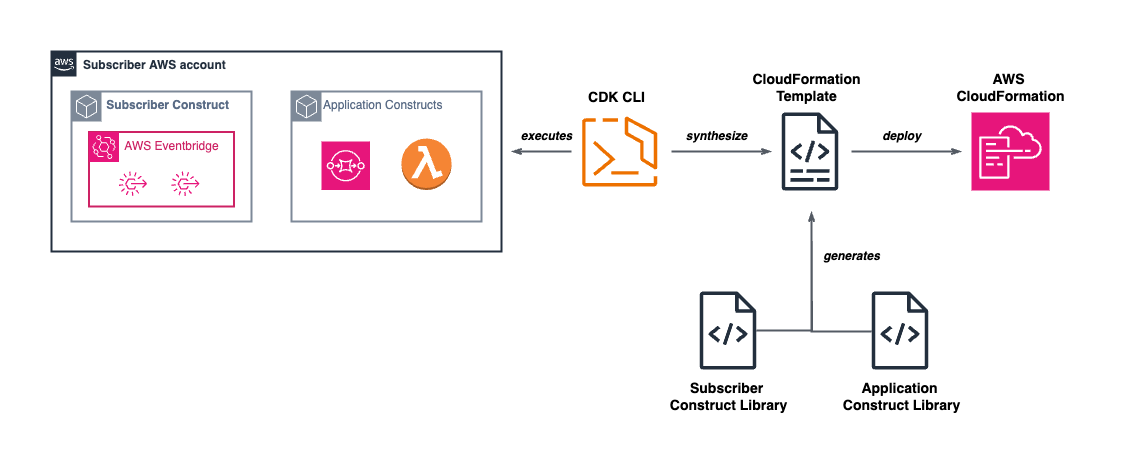
Subscriber Constructs Library

We developed a subscriber constructs library using AWS Cloud Development Kit (CDK) to simplify and standardize the integration process with our central event bus. This library abstracts the setup and management of underlying infrastructure required for event consumption, enabling teams to focus on their core business logic rather than infrastructure configuration details.

The library automates the creation of essential components required for reliable event processing. It provisions a dedicated event bus within the subscriber’s account, establishes the necessary IAM roles and permissions for secure cross-account communication with the central event bus, and configures standardized monitoring and alerting for event processing. This automation not only reduces the potential for configuration errors but also facilitates consistent implementation of our architectural patterns across different teams.
/**
 * Subscriber implementation to provision necessary AWS infrastructure.
 *
 */
const subscription = new Subscription(scope, id, {
    name: "DeliveryService", // Name of your application
    application: {
       region: Region.US_EAST_1, // Region of your Application
    },
});

Conclusion

Amazon Key team’s journey to modernize their architecture and build a resilient, event-driven solution exemplifies the powerful benefits of leveraging AWS EventBridge and adopting a well-designed event-driven architecture. By addressing the challenges of service coupling, loose event schemas, and inconsistent event routing, the team was able to transform their system into a more reliable, scalable, and maintainable resource. The key architectural patterns and components they implemented have had a significant impact on their ability to deliver innovative solutions to their customers.

Reliability and Scale:

  • Built a decoupled event system processing 2000 events/second with 99.99% success rate
  • Achieved consistent 80ms p90 latency from ingestion to target invocation across 14M subscriber calls
  • Avoided the need for new infrastructure for event exchange through standardized event routing
  • Enabled migration of existing complex interdependencies to event-driven architecture

Developer Experience:

  • Reduced service integration time for new use cases from five days to one day (80% improvement)
  • New event onboarding on the Custom Event Schema repository now takes four hours, down from 48 hours
  • Publisher/subscriber integration completed in eight hours, previously took 40 hours
  • Standardized client library addressed 90% of common integration errors

Security and Governance :

  • Single control plane manages 100% of event bus infrastructure
  • Automated security compliance checks catch 100% of unauthorized data exchange patterns
  • Real-time monitoring dashboard tracks every event flow and schema change
  • Schema repository provides complete audit trail for system modifications

The solutions developed by the Amazon Key team provide a blueprint for other organizations looking to modernize their architectures and leverage the power of event-driven design patterns. By adopting similar architectural patterns and components, such as the schema repository and client libraries, other organizations can be empowered to achieve similar benefits.


About the authors
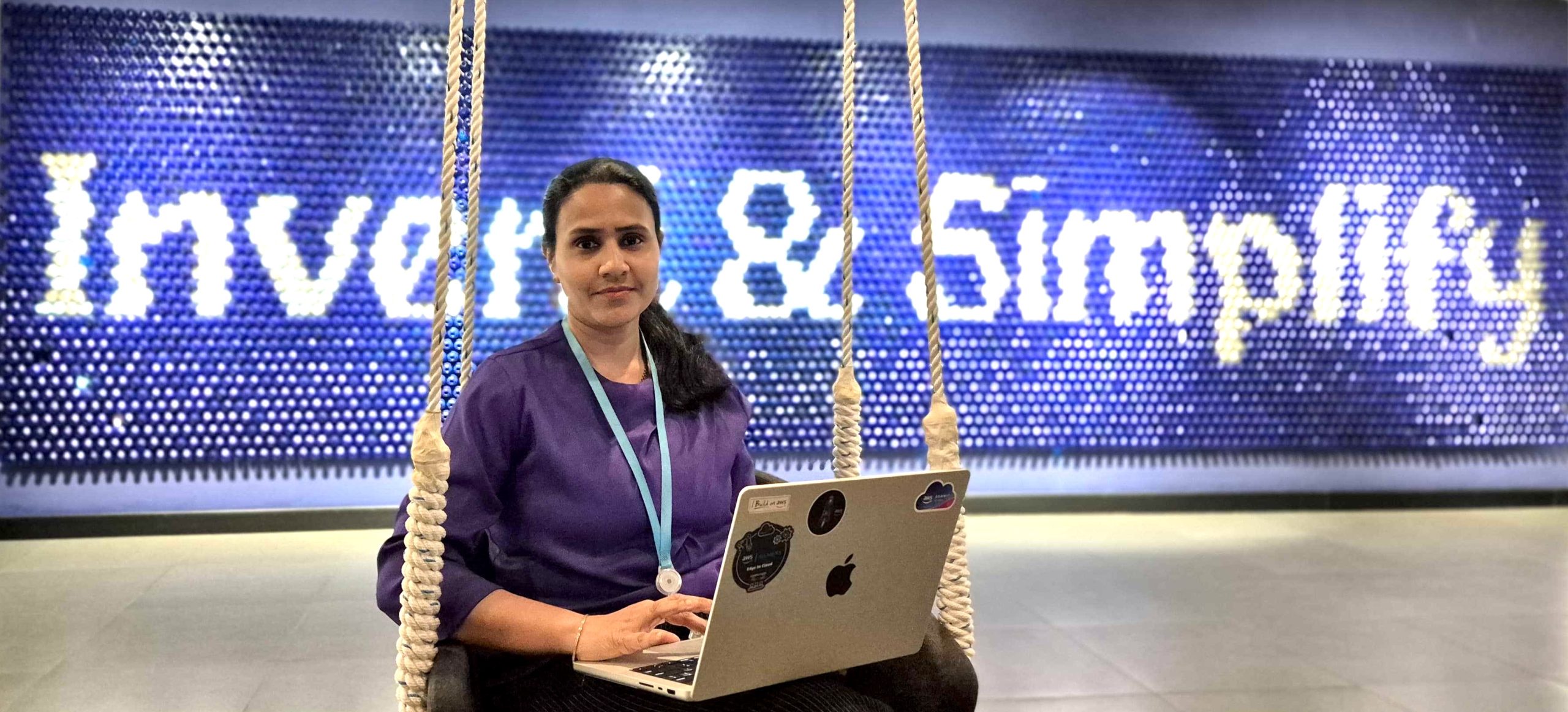
She architects: Bringing unique perspectives to innovative solutions at AWS

Post Syndicated from Kayalvizhi Kandasamy original https://aws.amazon.com/blogs/architecture/she-architects-bringing-unique-perspectives-to-innovative-solutions-at-aws/

Have you ever wondered what it is really like to be a woman in tech at one of the world’s leading cloud companies? Or maybe you are curious about how diverse perspectives drive innovation beyond the buzzwords? Today, we are providing an insider’s perspective on the role of a solutions architect (SA) at Amazon Web Services (AWS). However, this is not a typical corporate success story. We are three women who have navigated challenges, celebrated wins, and found our unique paths in the world of cloud architecture, and we want to share our real stories with you.

What exactly does a solutions architect do?

Solutions architects are the bridge between a customer’s biggest business challenges and the latest technology solutions. Bridging that gap is what we do as SAs at AWS every single day. Here’s what that looks like in practice:

  • We work backwards from customer challenges – Instead of pushing technology for technology’s sake, we start with what customers are trying to achieve by embedding ourselves directly with their teams at their office premises, collaborating side-by-side to understand their unique needs
  • We design the blueprint – Think of us as architects, but instead of buildings, we create system architecture diagrams and define the software services that power customers’ businesses
  • We guide through every stage – From initial concept to full implementation, we provide the technical roadmap that fits customers’ project’s lifecycle

AWS SAs serve as trusted technical advisors across industries – whether it is a scrappy startup, a traditional financial institution, or a global enterprise. We help them align their technology choices with their business goals while minimizing risks and supporting a smooth, standardized journey to the cloud.

Why does representation matter in tech?

Diverse teams are not just a nice-to-have—they are proven innovation engines that drive productivity and results. When organizations lack diversity, they risk stifling creativity and limiting their ability to tackle complex challenges.

Research conducted by Gartner, a leading global research and advisory firm that specializes in business and technology, substantiates this connection, showing that organizations with stronger women representation achieve better financial performance. For more information, review Culture of Value for Women in Technology Drives Business Performance.

The research findings prove that gender diversity isn’t just the right thing to do; it is a competitive advantage that directly impacts an organization’s ability to innovate and succeed.

AWS is committed to equal opportunities and career advancement regardless of gender. However, the broader industry faces a significant gender gap in technical roles. Gartner reports that women make up just 26% of information technology (IT) employees, with even lower representation in senior leadership positions. For more information, review How Women in IT Are Championing Change.

Here is how we are working to change this:

  • Women’s Networking Circles connects women with peers facing similar challenges
  • Project Inclusion initiatives increase women’s participation in technical interviews
  • AWS Women in SA affinity group offers mentorship, certification guidance, and career progression support
  • AWS SheBuilds is an initiative by AWS with the mission to build diverse tech communities and empower women to build on AWS and develop their skills
  • Amazon rekindle is a return-to-work program for women who have taken a break in their careers

There are many women in tech focused initiatives at AWS; check out How AWS is helping women and girls succeed in technology careers, and AWS Public Sector Blogs – Women in Tech, AWS Startups Blogs – Women In Tech for more details.

Our stories: real challenges, real solutions, real impact

Whether you are taking your first steps in technology, considering a career change, or climbing the ladder in your current role, representation creates possibility. When you see someone who looks like you thriving in a space, that path transforms from aspirational to achievable. We are here to share our authentic journeys and insights—because your success story matters too.

Kayalvizhi: From senior to principal SA — How I did it

What does it look like to advance in a technical role while raising two teenagers?

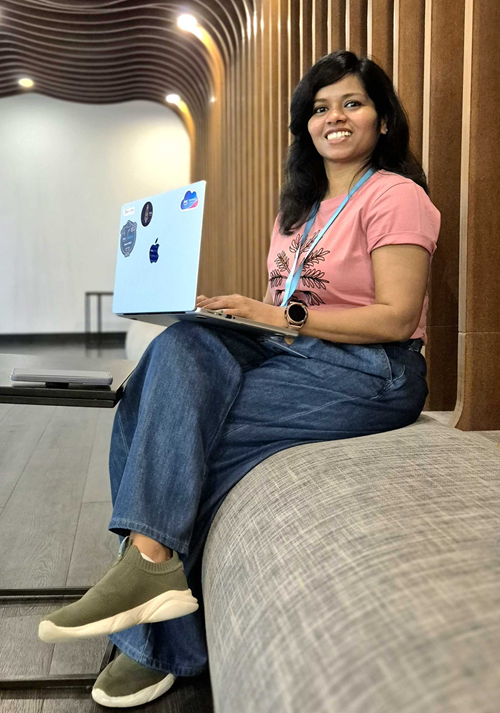
Kayalvizhi Kandasamy

For me, joining AWS India as a senior SA in late 2020 opened the door to working with cloud-native leaders like OLA, Zepto, redBus, and Azira. These organizations, built from the ground up in the cloud and known for pushing AWS capabilities to new boundaries, have provided me with invaluable learning opportunities across diverse technologies while I have supported their cloud journeys.

With my background in application development prior to AWS, I sought to enhance my containerization expertise by joining the Technical Field Community (TFC)— the AWS internal expert network that connects SAs with domain specialists. Think of TFC as the technical support system where mentors guide your professional development in specific technology areas.

When we need deep expertise in artificial intelligence (AI)/machine learning (ML), databases, or other technology or industry domain, the TFC connects us with the right experts globally. For more details, watch AWS re:Invent 2022 – AWS knowledge network: Building & managing expert communities at scale. I started with the Containers TFC, then expanded to Database TFC. This was not just about learning – it opened doors to support customers not only in India, but globally.

What sets me apart is my passion for sharing the knowledge I have gained from supporting customer business needs with the broader technical community through multiple channels.

AWS Blogs: I authored seven architectural posts, five of which captured remarkable customer outcomes:

AWS Summits: I regularly present at AWS events like AWS Summits, with my most rewarding experiences being customer co-presentations that showcase their success stories. Notable examples include “Zepto’s growth story powered by AWS,” “Accelerate generative AI deployment with Amazon SageMaker JumpStart” featuring OLA Krutrim’s transformation, and “How Koo used Amazon DynamoDB connect millions of voices globally.”

AWS code samples: As a software engineer at heart, I have built solutions to address real-world customer challenges through hands-on development. One example is when a customer needed to stream their Internet of Things (IoT) sensor data from their Apache Kafka clusters to Amazon Timestream table. It presented an opportunity for me to build the Timestream – Kafka Sink Connector which enabled streaming data between services. Realizing the connector could be helpful to other customers, I published it on GitHub: AWS Samples; watch this video Streaming data from your Kafka clusters to Amazon Timestream for more details.

Mentor: Diversity in technology is a passion that drives my active participation in Amazon rekindle, where I have the privilege of guiding and empowering women who are returning to the technology sector after career breaks.

By consistently applying the Amazon Leadership Principles – like Customer Obsession, Invent and Simplify, and Dive Deep – I progressed to principal SA, proving that technical excellence combined with customer focus creates unstoppable career momentum.

Personal balance: How do I manage all this while raising two teenage daughters? I found my answer in chess – a lifelong passion I have shared with my daughters. Recently, my elder daughter secured first place in her age group at a national tournament. To me, it is about finding what energizes you outside of work.

To learn more about my professional journey, see my LinkedIn Profile: Kayalvizhi Kandasamy

Smita: How I turned a global transition into career growth

Ever wondered if you can successfully pivot your career path, even during a pandemic?

My story began in Australia as a professional services consultant, AWS experts who work directly with customers to implement cloud solutions. When the global pandemic hit, I faced a difficult choice: stay in Australia or move closer to family in India.

AWS didn’t just support my decision – it facilitated my transition from Australia to India and helped me shift from Professional Services to Solution Architecture. This career pivot meant learning new skills while adapting to a new country and role.

The Innovation: My diverse background has become my superpower, enabling me to tackle innovative projects with the latest technologies. I am just as enthusiastic about knowledge dissemination, with my go-to services being the AWS YouTube channel and GitHub: AWS-Samples repository.

Personal balance: As a mother to an energetic 8-year-old, I had to get creative with work-life integration. My strategy is to complete work by 6 pm and avoid late-night calls unless absolutely necessary. My daughter and I take music classes together – it is our bonding time and my way of staying present in her life.

To learn more about my professional journey, see my LinkedIn Profile: Smita Srivastava.

Archana: Six years, multiple roles, one constant – growth

What does it look like to build deep expertise while continuously expanding your impact?

My journey with AWS spans over six years, starting as a cloud support engineer. This foundation helped me develop deep expertise in serverless and security services, where I am now a subject matter expert in Amazon API Gateway, AWS Lambda, and Amazon Cognito.

As a member of the Serverless TFC, I collaborate with fellow experts to provide architectural guidance to customers facing complex challenges. I have had the opportunity to share my experiences at AWS re:Invent, where I conducted hands-on workshops on event-driven architectures and API Gateway implementations.

The mentorship mission: Fostering diversity in technology is a passion of mine, and I actively participate in AWS SheBuilds, where I mentor aspiring women both within and outside Amazon who are pursuing careers in tech.

The content creation: My technical contributions extend beyond direct customer engagements. I have authored close to 12 AWS code samples and AWS Knowledge Center articles, sharing my expertise with the broader AWS community. Some of them include:

  • I built a solution based on a customer need to transcribe and generate subtitles for audio and video content at scale, using Amazon Transcribe and AWS Lambda. By publishing this on GitHub – AWS Samples, I made sure other customers could benefit from my work
  • While assisting a customer with Amazon Cognito password reset functionality where the users weren’t receiving verification codes via email or SMS, I created this comprehensive troubleshooting guide
  • While collaborating with a customer that needed to build an AI-powered image generation service for their e-commerce system, I developed this serverless solution using the Amazon Nova Canvas model. This solution allowed their team to generate professional product images on-demand through a simple API call

Personal balance: Beyond my professional achievements, I maintain a balanced personal life as an avid reader, fitness enthusiast, and traveler. My husband and I volunteer at animal shelters, finding fulfillment in being a voice for the voiceless.

To learn more about my professional journey, see my LinkedIn Profile: Archana Venkat.

Frequently asked questions

As you can see, our journeys as women SAs at AWS are diverse and filled with both professional and personal accomplishments. We hope our stories have inspired you and given you a glimpse into the rewarding experiences that AWS can offer. Here are some of the questions that we frequently get about how AWS is supporting us with structured programs.

1. How do you keep up with all the new technologies without burning out?

Great question! Here is what we have learned:

Use your work hours strategically: AWS provides extensive learning resources—AWS Skill Builder, AWS Training Live on Twitch, and Amazon Machine Learning University (MLU). The key is integrating learning into your workday, not adding it on top.

Take advantage of Purpose Day: AWS India gives us a monthly “Purpose Day” specifically for professional development. It is not just encouraged—it is expected.

2. How do you develop expertise across so many different technologies?

The TFC secret: The TFC is not just a program—it is your network of domain experts. You don’t need to know everything; you need to know who knows everything.

Combine broad and deep: Develop broad knowledge across AWS services but find your specialty areas where you can go deep. Then connect with others who complement your expertise.

3. How do you build confidence and overcome imposter syndrome?

This one hit close to home for many of us. Here is what works:

Use Amazon leadership principles as your guide: These are not just corporate speak—they are practical frameworks for decision-making and growth. Learn and Be Curious, and Dive Deep have been game-changers for us.

Certification as confidence building: There is something powerful about passing that exam and having external validation of your knowledge. Get started with AWS Training and Certification.

Take ownership: Do not wait for the perfect opportunity. Create it. Volunteer for that challenging project. Write that blog post. Give that presentation.

Conclusion

Here is what we hope you will take away from our stories:

  • Your background is your superpower: Kayalvizhi’s customer focus, Smita’s global perspective, and Archana’s journey from support to expertise—each brought something unique that led to innovative solutions
  • Support systems matter: The inclusive policies and programs at AWS are not just nice-to-haves. They are the foundation that allows us to demonstrate our technical excellence and leadership potential
  • Balance is personal: There is no one-size-fits-all approach to work-life balance. Find what works for you, set boundaries, and don’t apologize for them
  • Community amplifies individual success: Whether it is TFC, Women in SA, or SheBuilds, being part of a community that shares knowledge and supports growth makes the journey not just possible, but enjoyable

Ready to write your own story?
The cloud industry needs your perspective. It needs your questions, your approach to problem-solving, and your unique way of seeing challenges. Every expert was once a beginner, every leader was once a follower, and every innovation started with someone asking, “What if we tried it differently?”

What is your “what if” going to be?
Want to learn more about careers at AWS or connect with our communities? Visit our careers page, check out diversity at AWS , AWS Architecture Center and reach out to us on LinkedIn.

We would love to hear your experiences and perspectives in the comments below. Consider joining our tech community where we embrace the spirit of “Work Hard, Have Fun, and Make History!” together!

Top Architecture Blog Posts of 2023

Post Syndicated from Andrea Courtright original https://aws.amazon.com/blogs/architecture/top-architecture-blog-posts-of-2023/

2023 was a rollercoaster year in tech, and we at the AWS Architecture Blog feel so fortunate to have shared in the excitement. As we move into 2024 and all of the new technologies we could see, we want to take a moment to highlight the brightest stars from 2023.

As always, thanks to our readers and to the many talented and hardworking Solutions Architects and other contributors to our blog.

I give you our 2023 cream of the crop!

#10: Build a serverless retail solution for endless aisle on AWS

In this post, Sandeep and Shashank help retailers and their customers alike in this guided approach to finding inventory that doesn’t live on shelves.

Building endless aisle architecture for order processing

Figure 1. Building endless aisle architecture for order processing

Check it out!

#9: Optimizing data with automated intelligent document processing solutions

Who else dreads wading through large amounts of data in multiple formats? Just me? I didn’t think so. Using Amazon AI/ML and content-reading services, Deependra, Anirudha, Bhajandeep, and Senaka have created a solution that is scalable and cost-effective to help you extract the data you need and store it in a format that works for you.

AI-based intelligent document processing engine

Figure 2: AI-based intelligent document processing engine

Check it out!

#8: Disaster Recovery Solutions with AWS managed services, Part 3: Multi-Site Active/Passive

Disaster recovery posts are always popular, and this post by Brent and Dhruv is no exception. Their creative approach in part 3 of this series is most helpful for customers who have business-critical workloads with higher availability requirements.

Warm standby with managed services

Figure 3. Warm standby with managed services

Check it out!

#7: Simulating Kubernetes-workload AZ failures with AWS Fault Injection Simulator

Continuing with the theme of “when bad things happen,” we have Siva, Elamaran, and Re’s post about preparing for workload failures. If resiliency is a concern (and it really should be), the secret is test, test, TEST.

Architecture flow for Microservices to simulate a realistic failure scenario

Figure 4. Architecture flow for Microservices to simulate a realistic failure scenario

Check it out!

#6: Let’s Architect! Designing event-driven architectures

Luca, Laura, Vittorio, and Zamira weren’t content with their four top-10 spots last year – they’re back with some things you definitely need to know about event-driven architectures.

Let's Architect

Figure 5. Let’s Architect artwork

Check it out!

#5: Use a reusable ETL framework in your AWS lake house architecture

As your lake house increases in size and complexity, you could find yourself facing maintenance challenges, and Ashutosh and Prantik have a solution: frameworks! The reusable ETL template with AWS Glue templates might just save you a headache or three.

Reusable ETL framework architecture

Figure 6. Reusable ETL framework architecture

Check it out!

#4: Invoking asynchronous external APIs with AWS Step Functions

It’s possible that AWS’ menagerie of services doesn’t have everything you need to run your organization. (Possible, but not likely; we have a lot of amazing services.) If you are using third-party APIs, then Jorge, Hossam, and Shirisha’s architecture can help you maintain a secure, reliable, and cost-effective relationship among all involved.

Invoking Asynchronous External APIs architecture

Figure 7. Invoking Asynchronous External APIs architecture

Check it out!

#3: Announcing updates to the AWS Well-Architected Framework

The Well-Architected Framework continues to help AWS customers evaluate their architectures against its six pillars. They are constantly striving for improvement, and Haleh’s diligence in keeping us up to date has not gone unnoticed. Thank you, Haleh!

Well-Architected logo

Figure 8. Well-Architected logo

Check it out!

#2: Let’s Architect! Designing architectures for multi-tenancy

The practically award-winning Let’s Architect! series strikes again! This time, Luca, Laura, Vittorio, and Zamira were joined by Federica to discuss multi-tenancy and why that concept is so crucial for SaaS providers.

Let's Architect

Figure 9. Let’s Architect

Check it out!

And finally…

#1: Understand resiliency patterns and trade-offs to architect efficiently in the cloud

Haresh, Lewis, and Bonnie revamped this 2022 post into a masterpiece that completely stole our readers’ hearts and is among the top posts we’ve ever made!

Resilience patterns and trade-offs

Figure 10. Resilience patterns and trade-offs

Check it out!

Bonus! Three older special mentions

These three posts were published before 2023, but we think they deserve another round of applause because you, our readers, keep coming back to them.

Thanks again to everyone for their contributions during a wild year. We hope you’re looking forward to the rest of 2024 as much as we are!

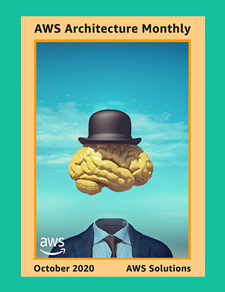
Architecture Monthly Magazine: AWS Solutions

Post Syndicated from Annik Stahl original https://aws.amazon.com/blogs/architecture/architecture-monthly-magazine-aws-solutions/

Architecture Monthly - October 2020 - AWS SolutionsFor October’s issue of AWS Architecture Monthly Magazine, we decided to do a deep dive into the AWS Solutions Library, a virtual treasure trove of cloud-based solutions for dozens of technical and business problems. Whether you want to combine pre-built, well-architected multi-service patterns to create your own solution, deploy vetted architecture directly into your AWS account, or get help deploying vetted architecture from AWS Competency Partners, we can help. Our expert runs us though the various offerings you can take advantage of, and some of our other guest writers will go more deeply into the individual options.

In this month’s AWS Solutions issue

  • Ask an Expert: Tom Begley, Manager, AWS Solutions Builder
  • Customer Success Story: App8: Helping Restaurants Succeed during COVID-19
  • AWS Solutions Implementations: Detailed architectures, a deployment guide, and instructions for both automated and manual deployment
  • AWS Solutions Constructs: Building faster and more confidently with vetted architecture patterns
  • AWS Solutions Consulting Offers: Enhancing the AWS Solutions Library to address customer needs
  • Related Videos: Watch what AWS Solutions can do for you

How to access the magazine

We hope you’re enjoying Architecture Monthly, and we’d like to hear from you—leave us star rating and comment on the Amazon Kindle Newsstand page or contact us anytime at [email protected].