Малайзия с лют сос и съкровища

Post Syndicated from Петя Кокудева original https://www.toest.bg/malaiziya-s-lyut-sos-i-sukrovishta/

(Част първа)

Страната в едри щрихи

Малайзия с лют сос и съкровища

Малайзия е малко над eкватора – южно от Тайланд и северно от Сингапур. Западният ѝ бряг очертава прочутия пролив Малака – преди няколко века оттук минава Пътят на подправките. Сезоните са сух и дъждовен, но жегата в съчетание с високата влажност е постоянна величина. Бивша британска колония е, а преди това страната се е казвала Малая. Шофира се отляво, а покрай пътищата растат помело, манго, драконов плод, ананас. Ислямът е официалната религия, но са разрешени всички други и това не е само на хартия. Повечето местни ястия започват с думата нàси – ориз.


Коренните жители са 19 различни племена с общото название орàнг àсли – за тях роден дом е джунглата.

Тук се намира Таман Негара – най-старата дъждовна гора в света. По табелите на междуселските пътища ще видите крокодили, тапири и водни биволи, а по дърветата – тукани. Близо девет милиона души живеят в изумителната с размерите си столица Куала Лумпур, а малайското село звучно се нарича кампỳнг.

Земя на шамани и султани, Малайзия е без съмнение най-мултикултурната страна, в която съм се озовавала.

Съседите на Мохи

Селамàт пагù*! Само ви подавам ключа и изчезвам, че бързам. Ви-на-ги да заключвате вратите и прозорците, не просто да ги затваряте! Такива са ми съседите – влизат и не гледат много какво грабят. Чак после гризват телефона и се сещат, че не става за ядене. И айдеее, мятат го в храсталака.

Мохи (съкратено от Мохаммад) е от малко селце в югозападна Малайзия. Понякога му се налага да вземе телефона на жена си и да иде край близкия гъсталак да звъни на собствения си номер. За късмет, често от храстите долита познатата мелодия. Съседите на Мохи са маймуни, по-точно макаци – изкусни крадци и акробати.


За един месец, в който обикаляхме страната, се научих отдалеч да познавам къде са – първо чувате звука от мощно пукане на клони и раздрусване на листа, после виждате как някое дърво силно се привежда, а накрая, ето го и него – едър сив макак, който се държи като парашутист за края на клонака и прелита от едно дърво на друго. Белоръкият гибон е още по-живописна гледка – той просто виси като прани гащи и издава особено силен звук, подобен на протяжен лай – така общува с жена си (двойките са моногамни) и скрепява връзката си. Заради този леко комичен лай наричат белоръкия гибон „шоумена на джунглата“.

Време е за копи

Ако се отбиете в някое кафене покрай селския път, малайците ще ви поднесат чаша кòпи. Това е тяхната дума за кафе и повечето хора го пият с лед. Всяка молба за гореща напитка ги обърква и по-вероятно е накрая отново да ви донесат с лед. (Другото упорито разминаване беше лютият сос. Тъй като пътувахме с тригодишната ни дъщеря, а тя не може да яде люто, непрекъснато питахме кое ястие не е. В повечето случаи ни отвръщаха: Ама ето! Това изобщо не е люто. И след секунди то се оказваше огън. Впрочем малайците по традиция си хапват лют ориз даже на закуска, а ако искате да си намажете филия – трудна работа, хлябът не е често срещан.)

Самите кафенета са на открито, под навес – няколко паянтови маси с пластмасови столчета, захабени от ползване. Мястото е почти винаги обгърнато от бухлата тропическа растителност, сред която стърчи малка мивка – за миене на ръце.

Да попаднеш в пълно малайско кафене е като да разгърнеш енциклопедия на народите. Китайци по тениски – на една маса. На втора – мюсюлманки с почти изцяло покрити лица. На трета – индийка с пъстър саронг и бинди, онази тъмночервена точка на челото. Има още араби, потомци на европейски преселници, тамили (от Южна Индия), перанаканци. И разбира се, оранг асли – коренните жители на Малайзия – 19 различни племена със свои езици и идентичност.

Всъщност да пътуваш из Малайзия е като да бъдеш в няколко страни едновременно.

Някои от щатовете в 33-милионната държава – като Келантан и Теренгану – са подчертано мюсюлмански: има религиозна полиция, алкохолът е строго забранен, а от време на време се виждат табели с предупреждение, че ако пропуснеш няколко петъчни молитви в джамията, те чака сурово наказание. Навсякъде другаде в страната мирно съжителстват разнообразни вярвания. Точно както ще видите на Улицата на хармонията в Малака – през няколко метра са: джамията „Кампунг Клинг“, построена през 1748 г.; китайският Храм на зелените облаци, който е на 400 години и е едновременно будистки, даоистки и конфуциански; и индуисткият храм в чест на Ганеша – бога слон, който понякога поставя, а друг път премахва пречките пред вас.

Мизан, принцесата и кокошето àко

Почти всеки втори град в Малайзия започва с Куала. Куала означава „естуар“, или „срещата на две реки“. Столицата Куала Лумпур например значи „калният естуар“. Ние бяхме също и в Куала Ромпин, Куала Теренгану, Куала Селангор…


Срещам Мизан в едно кафене в Куала Кубу. Баща му е местен, а майка му – от Индонезия. Обожава традиционните кифлички с кàя – кокосов мармалад. Мизан е запален читател и като повдигам темата за маларията и комарите, ми разказва една от известните им фолклорни приказки. Султанът се влюбил в красивата принцеса на Малака. За да провери любовта му, девойката го затрупала със седем задачи. Повечето не ги запомних, но на едната прихнах: султанът трябвало да ѝ донесе седем сърца от… комари! 

На сбогуване с Мизан, който има чудесно чувство за самоирония, се заговаряме за това кои са недостатъците ни: аз споделям, че съм бъзла и лесно се отчайвам, той пък си се дразни, защото – както казвали малайците – ентусиазмът му бил като кокоше àко: изстивал много бързо. С каквото и да се захванел, бързо му доскучавало. 

Съкровищата на баба-ньоня

На Мелиса Чан от Малака обаче не ѝ доскучава това, с което се е захванала. Нарича себе си събирач на бенда хари – неща от ежедневието. Мелиса е от една от най-колоритните общности в Малайзия – перанаканците, или баба-ньоня (мъжете са баба, жените – ньоня).

Те са потомци на китайски търговци, пристигнали в малайските пристанищни градове през ХIV век. Китайците уж нямали намерение да остават, но после създали семейства с малайки. Така се ражда културата на баба-ньоня, изобилна на традиционни занаяти и удивителни вярвания. Като това за Кухненския бог например. Той живее в кухнята, но често се качва да докладва на Великия небесен бог какви ги върши семейството. За да не издава лоши работи, ньоня му приготвят куи бакул – десерт от оризово брашно и захар, който е доста лепкав! Щом го налапа, устата му залепва и Кухненският бог само ломоти – нищо не му се разбира.


Мелиса Чан съхранява тъкмо такива мъниста от миналото и настоящето на баба-ньоня, но и не само на тази общност – тя прави документални филми за отмиращите рибарски техники на португалските преселници, както и за най-старата лаборатория за зъбни протези, известна като Музея на фалшивите зъби.

В Джорджтаун (остров Пенанг) и в Малака може все още да видите антикварното ателие на майстор на ръчно правени фенери, а също и как се създават прочутите перанакански обувки с цветни мъниста. Тези занаятчии, обучени от бащите и дядовците си, днес нямат чираци – никой не иска да наследи занаятите им, защото изискват твърде много търпение и усилия.

Тъкмо това е мисията на Мелиса Чан, според която

е огромна ценност да познаваме миналото си, а не да се държим за него като удавник за сламка. Да го развием и да се поучим от него, а не просто да е някаква сантиментална носталгия.

От Мелиса научавам и малайската фраза saling mempengaruhi – означава оплитане или взаимно влияние. Това е начинът, по който съжителстват различните култури и идентичности по тия земи.

Никога не ядем сами

За жалост, съжителството има и своите сенчести страни. Нашир и надлъж в Малайзия ще видите твърде симетричните редици маслодайни палми. Тези огромни плантации са основен бизнес на държавата и заемат мястото на изсечени джунгли – домът на много животински видове и на местните племена, днес все по-яростно изтласквани в цивилизацията. Едно от тях са семелай, според които

да нарушаваш природните закони не те прави лош човек – прави те не много умен.

Житейската философия на племето се нарича пунèн, в превод от техния език: „не ям сам“. Върнат ли се от лов и събирачество, семелай поделят всичко намерено с останалите. Идеята да акумулираш богатство и да задържиш нещо изцяло за себе си не е присъща на това общество.

С избутването им по границите на джунглата и града обаче те са принудени да навлязат в модерния начин на живот. Една част са изкушени да купуват храна от магазина, да имат телевизор и малък мотор. Тъкмо тук идва челният сблъсък. В новия свят тяхното социално ДНК за здравословно споделяне започва да изглежда неразумно. А това, на което от поколения са научени – намереното да се яде на момента, както повелява природният закон – ги води до бедност, защото видят ли се с някакви пари, ги пропиляват. Онова, което преди е било логично и мъдро, сега им носи беди и бедност.

Много от тези племена все още имат своите шамани, чиято основна работа е да тъкат нишки. Защото светът на оранг асли се крепи на невидими нишки, които свързват земята, небето и подземния свят. Шаманите имат симпатичен израз за човек, който не познава природата наоколо и е сляп за нишките между всичко. Този – казват – е като жаба под кокосова черупка.

(Следва продължение)


* Добро утро“ на малайски.

Всички снимки в статията са собственост на авторката.

Android App Size at Scale with Project Bonsai

Post Syndicated from Grab Tech original https://engineering.grab.com/project-bonsai

Grab is Southeast Asia’s leading superapp, providing a suite of services that brings essential needs to users throughout the region. Its offerings include ride-hailing, food delivery, parcel delivery, mobile payments, and more. With safety, efficiency, and user-centered design at heart, Grab remains dedicated to solving everyday issues and improving the lives of millions.

As the app continues to expand with more features, Grab identified the need for a consistent, high-quality experience for new users who may have limited storage space or restricted internet bandwidth. Read to find out more about Project Bonsai and how it reduced app download size and app disk size.

Introduction

In 2020, Google conducted research that highlighted the negative impact of app sizes on conversion rates, revealing a 1% decrease for every 6MB expansion of the app APK size. This finding prompted Grab to ensure new and existing users had a consistently excellent Grab superapp experience, given the prevalence of low-end devices and disparate internet infrastructure in Southeast Asian regions. As a result, Grab initiated Project Bonsai in Q3 2021, with the goal of reducing and optimising the app size while enhancing user experience, reducing installation barriers, and boosting user acquisition.

Understanding the problem

The Grab superapp, with over 4 million lines of code and integration with hundreds of third-party libraries, had a significant app size. Given the prevalence of low-end devices and disparate internet infrastructure in our target region, it is crucial for us to proactively and constantly ensure we are delivering excellence in app-based user experience.

Objectives of the Bonsai project

The Bonsai project focused on these two key metrics:

  • App Download Size: This represents the total size of the compressed APK file that users need to download from Google Play when performing a fresh installation.
  • App Disk Size: This encompasses the total storage space occupied by the app on user devices, including both the binary and data generated by the app.

In this article, we will share the strategy and solutions that resulted in a successful 26% reduction in App Download Size, while also reducing the App Disk Size.

Status quo

Prior to the Bonsai project, the Grab app project had implemented various measures to achieve optimal app size. Here are some notable highlights:

  • Leveraging App Bundle: Since 2019, Grab has been using the app bundle approach to optimise app delivery. This approach generates smaller APKs tailored to specific device configurations, ensuring users receive optimised APKs. This helps reduce the overall app size and improve installation efficiency.

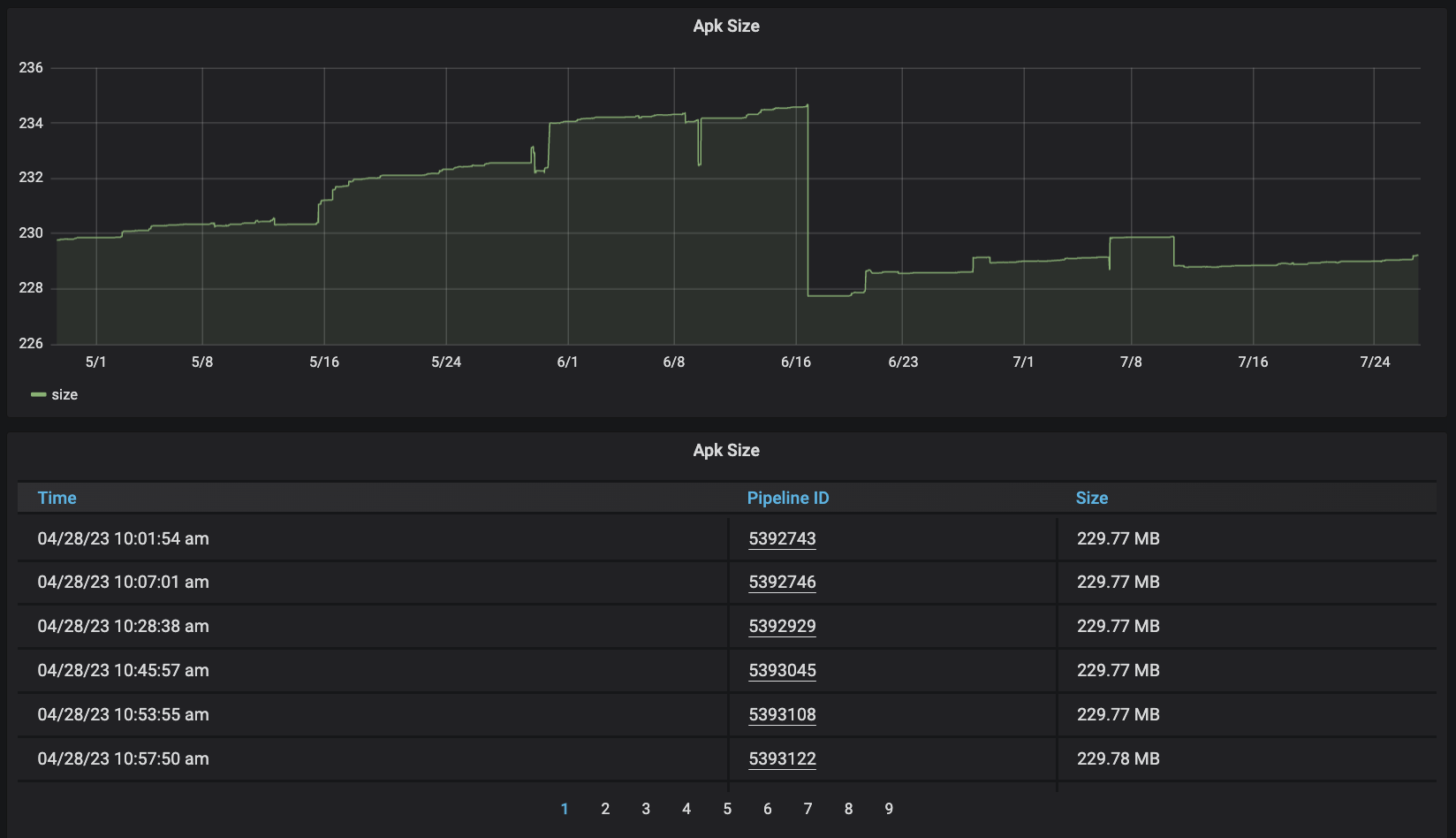
  • Monitoring: With a team of over 100 Android engineers and multiple collaborative teams, the Grab app undergoes a weekly release process involving hundreds of commits for each release. Closely monitoring app size changes with every commit is essential for our team. The team established debug build (APK file size) monitoring for every commit merged to the master branch. Regular weekly reviews are conducted to stay updated on the app size and identify commits that might lead to changes in app size. However, occasional mismatches may occur due to discrepancies between the debug and release builds.

Monitoring the changes in APK size
  • R8 Integration: R8/Proguard, known as the code shrinker, obfuscator, and optimiser, has been enabled since the beginning. This powerful tool helps reduce the app’s bytecode and resources, leading to further size optimisation and improved app performance.

  • Resource Optimisation: The team diligently pursued resource optimisation strategies, including:

    • Images: Engineers were encouraged to use vector images whenever possible, as they usually have smaller file sizes than raster images. In exceptional cases where raster images were necessary, Grab adopted the webp format instead of png, utilising better image compression to minimise app size.
    • Language ResourceConfig: Grab enabled resourceConfig to support only the languages actively used by the Grab app, reducing unnecessary resource overhead and enhancing app efficiency.
  • Third-Party Libraries Review: The team established a review process for third-party libraries, assessing their size impact on the app. This practice ensured that only essential libraries were included, preventing unnecessary bloating of the app size.

Despite the application of these measures and solutions aimed at managing the app size, there was still the potential of significant expansion in magnitude.

Strategy

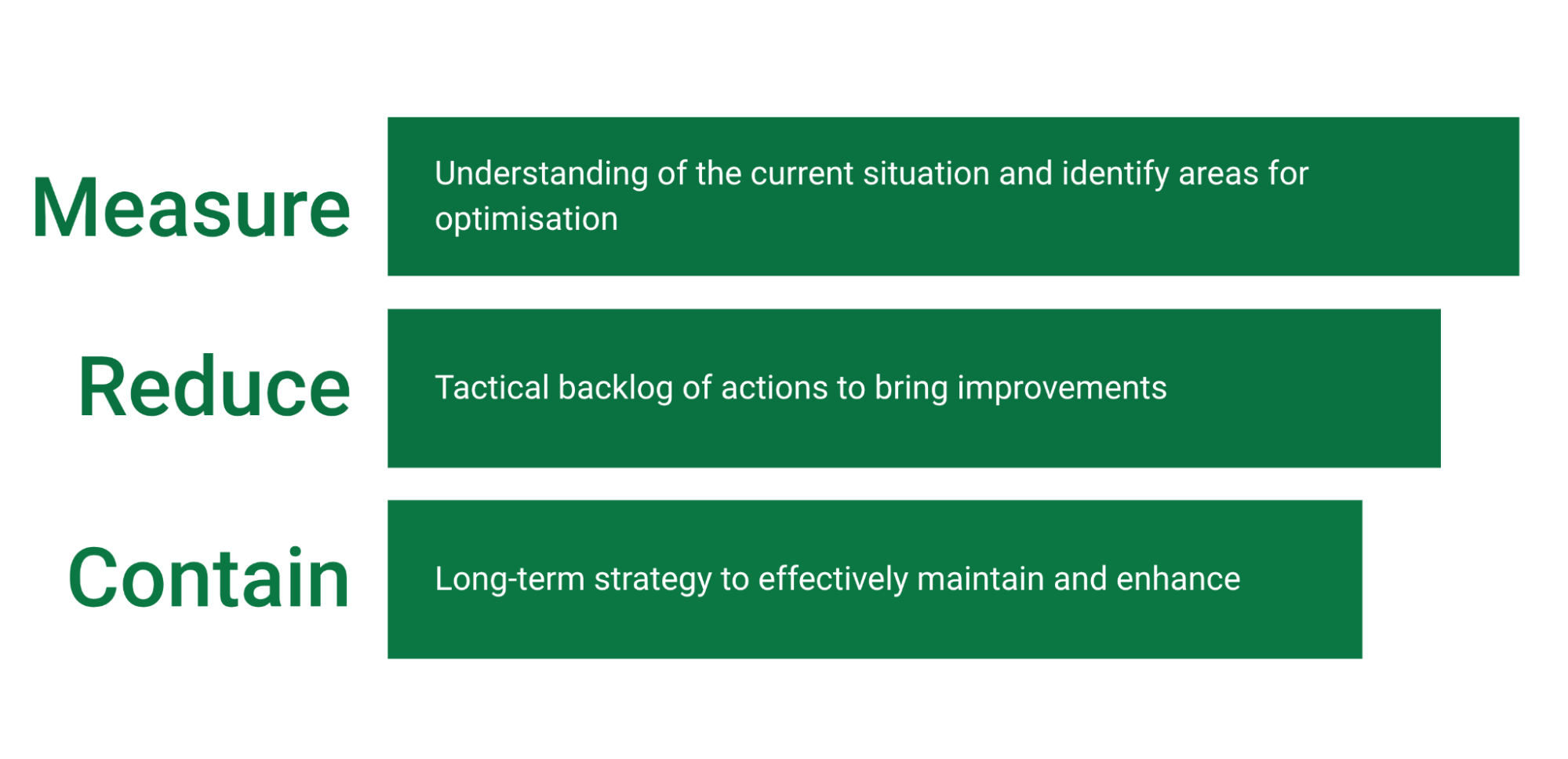
The Bonsai project revolves around strategic pillars, namely Measurement, Reduction, and Containment.

Project Bonsai’s three strategic pillars for continuous app size reduction

In the Measurement phase, the focus is on providing accurate information on the app’s binary composition and how individual features, modules, libraries impact the overall app size. This allows teams to make informed decisions and gain insights into their components’ influence on the app’s size.

The insights from the Measure phase provided us with a list of actionable items for our backlog. In the Reduction phase, we employ strategic action to tackle this backlog to constantly achieve optimal app size.

Optimising the app size is not a one-time endeavour, especially as more features are added over time, potentially increasing the project’s size. While there may be limited solutions to manage app size, it’s important to find a balance between size and functionality. Else, the effort and trade-offs required may become overwhelming. Therefore, in the Containment phase, we intend to introduce effective long-term strategies and solutions designed to manage the app’s size.

In the remainder of this blog post, we explore the strategic pillars and actions taken to contain the download size.

Measure

The Grab Passenger App Core team actively engages in optimisation projects and recognised the importance of measurement as the foundation for improvement. For example, enhancing the app startup time, pipeline time, build time, and more.

In every optimisation endeavour, we adhere to a crucial principle: “MEASURE” – the first and most critical step for any improvement project. As the famous quote goes, “If you can’t measure it, you can’t improve it.” This emphasises the significance of accurate and comprehensive measurement as the foundation for driving successful optimisation efforts.

In the third quarter of 2021, our team initiated an investigation into existing tools provided by both Google and the broader community. The intention was to employ tools such as APK Analyzer or Android Studio to conduct a thorough analysis of the app binary. However, it soon became evident that these tools were not well-suited to accommodate the extensive scope of our project.

In order to accommodate our discovery, we developed a custom analytics tool called App Sizer. This tool is specifically designed to analyse app binaries from bundle files. Our primary goal was to construct a solution that adheres effectively to our unique needs.

The tool was seamlessly integrated into Grab’s CI system and sends data to a Grafana instance. As a result, the tool collates and transmits daily analytics data from the release candidate branch. It offers the following key functionalities and monitors important aspects such as:

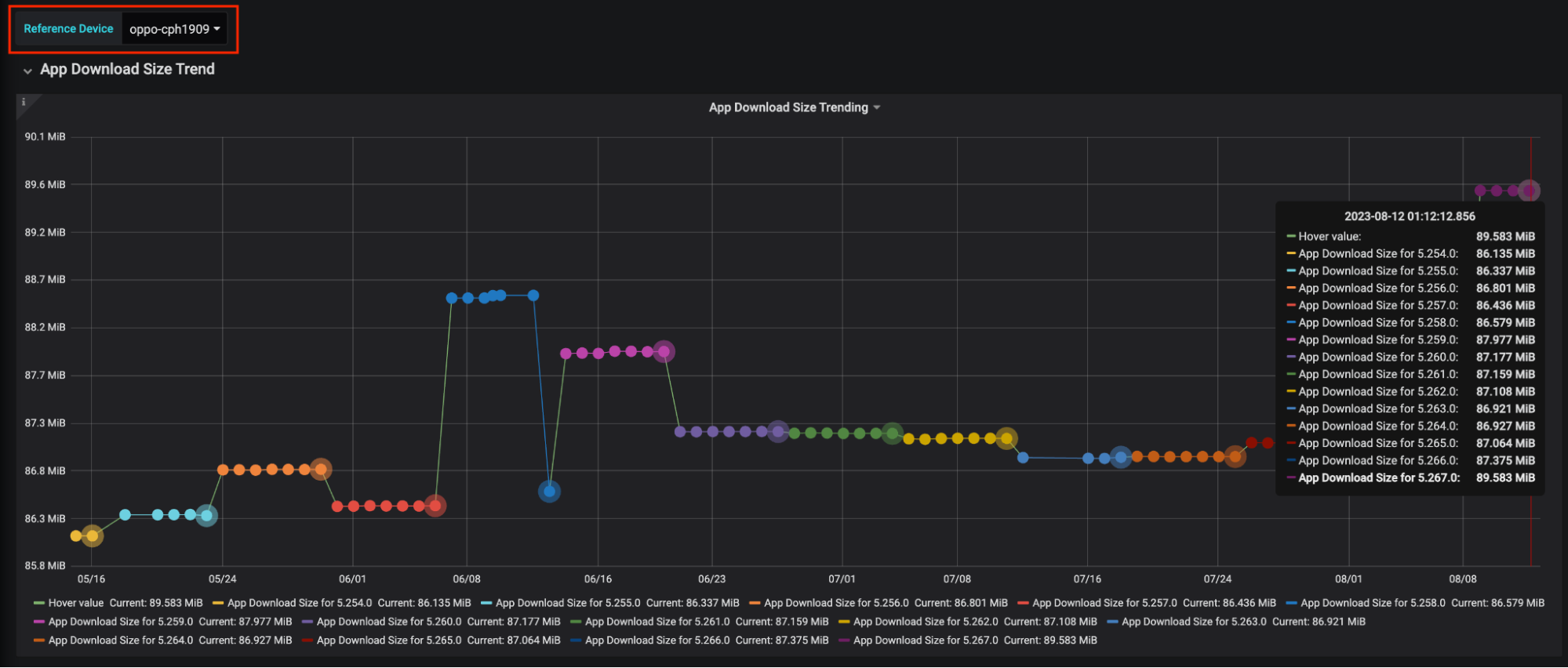
Device-specific App Download Size: Precise information about the app download size for specific devices, focusing on optimising the App Download Size.

Trends for app download size by device type

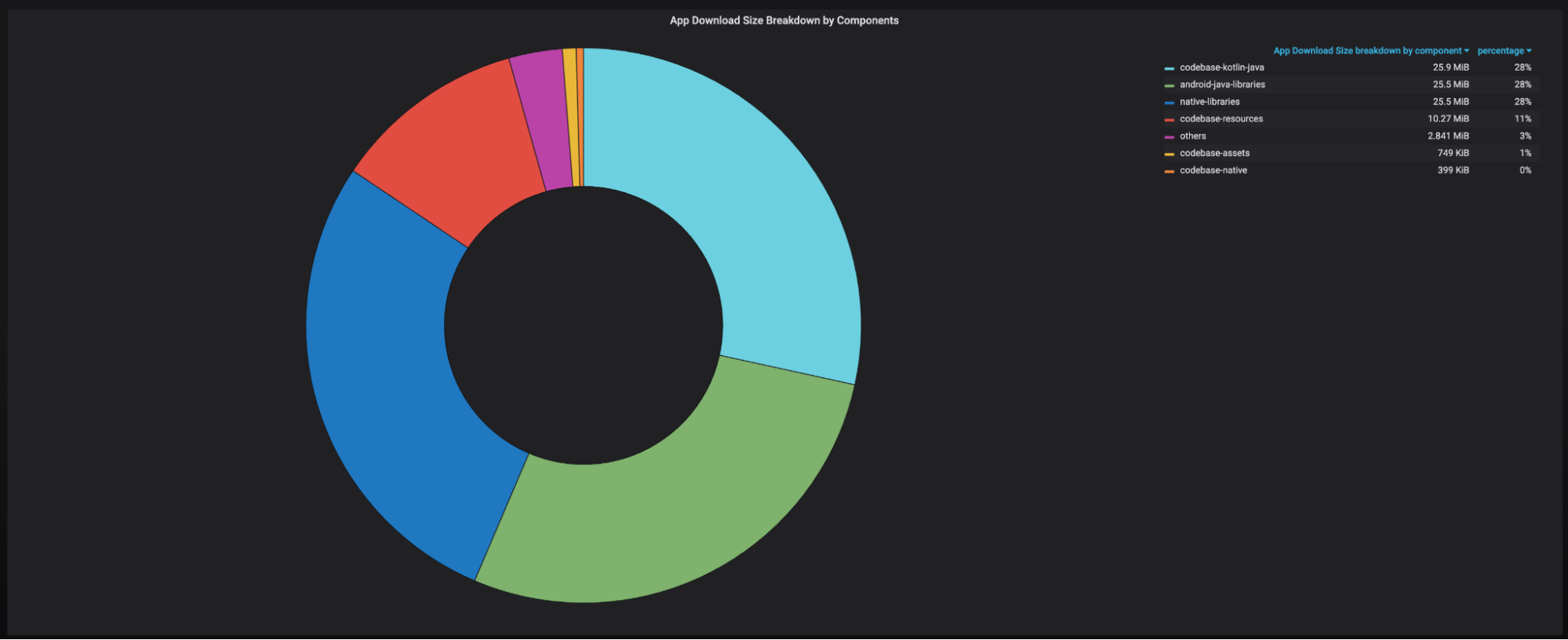
Comprehensive Size Breakdown: A breakdown of the app’s size, including the proportion attributed to the codebase Kotlin/Java, Kotlin/Java-based libraries, native libraries, resources, and other relevant factors.

Comprehensive breakdown of app download size by component

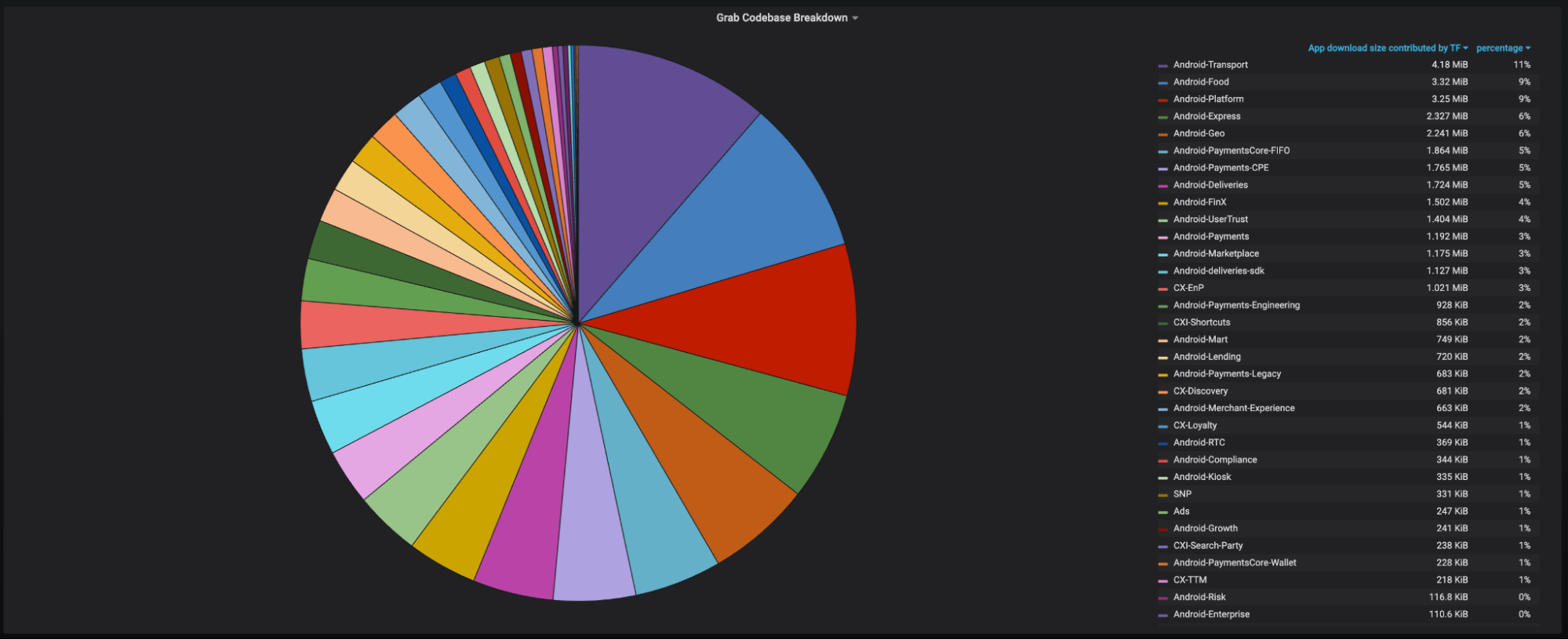
Size Contribution by Teams: Insights into the size contributed by each individual team within the project’s scope.

Breakdown of Grab’s codebase by TF

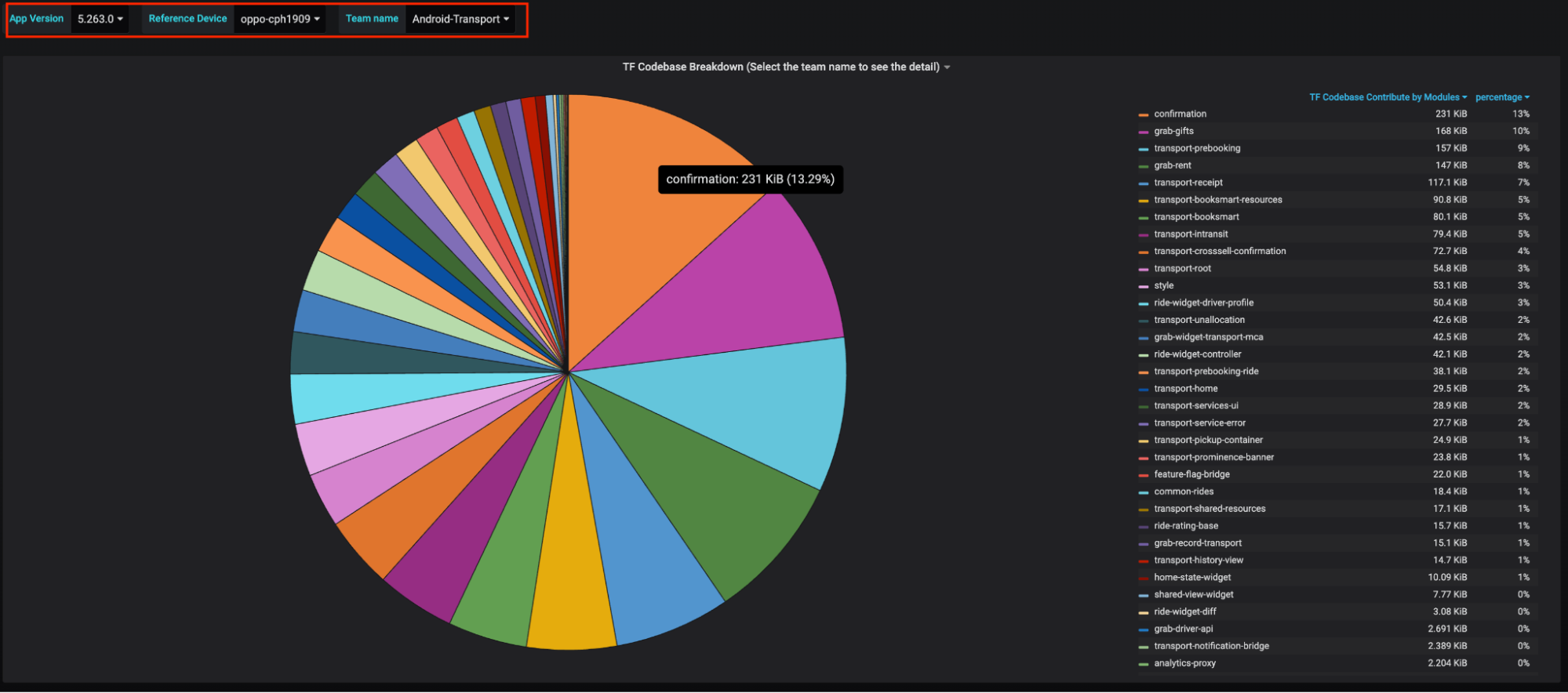
Module-wise Size Contribution: Insights into the size impacted by each module, categorised by team.

Breakdown of the codebase by TF modules

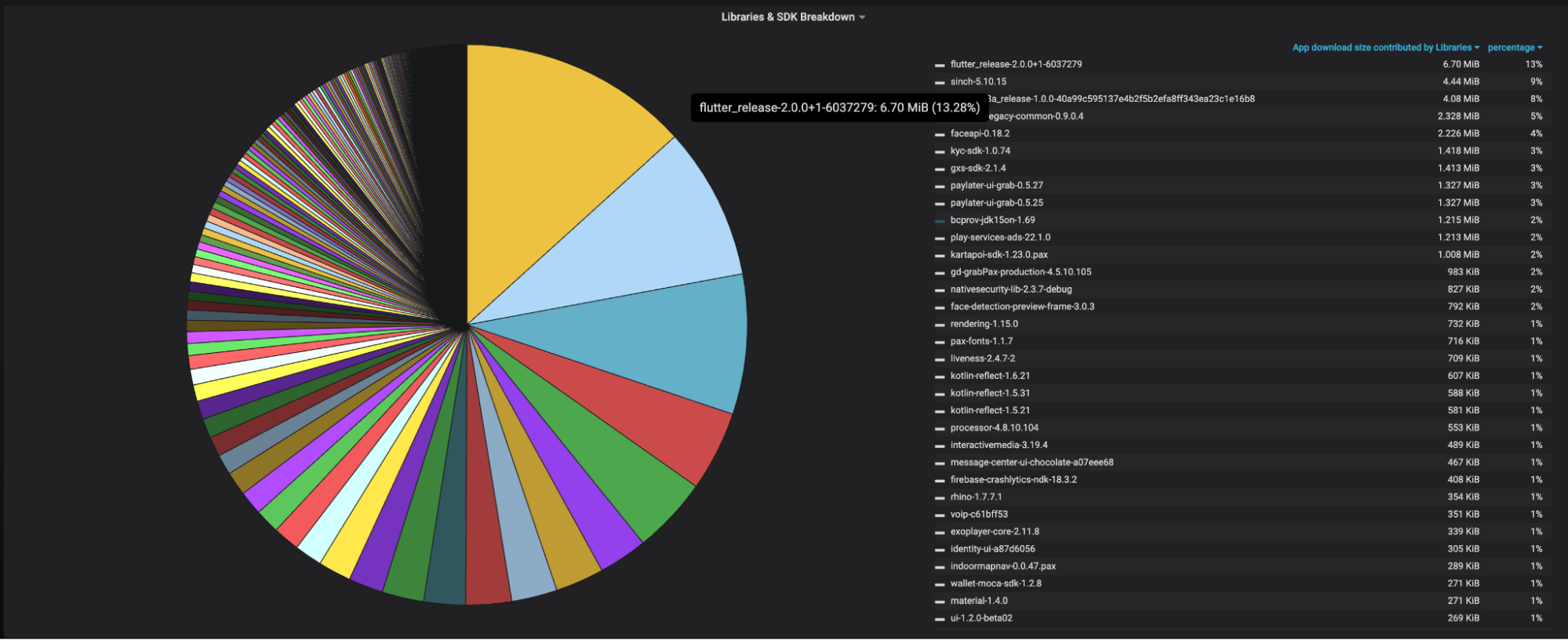
Size Contribution by Third-Party Libraries: Information about the size attributed to each third-party library incorporated within the app.

App download size contribution by external libraries and SDK breakdown

List of Large Files: A categorised list of large files (file size exceeding X value), organised by each respective team.

Large file categories broken down by TF

It’s important to note that all the size values presented within these dashboards specifically pertain to the download size, representing the contribution of each item to the overall app download size.

As part of our commitment to the developer community, we plan to open-source this tool in the near future, allowing others to benefit from its capabilities as well.

Reduce

To optimise the app based on the analysis data obtained from the measuring step, we focused on applying common solutions from Google and the suggestions from the community. There were no fancy solutions that we invented. Our concentration centered on optimising the dex file size, refining resources, and eliminating duplication and redundancy.

dex file optimisation (Java/Kotlin)

In our initial findings, it became evident that Java/Kotlin code was the major contributor of app size. Recognising this, we made it our top priority for optimisation.

R classes

During our investigation, we discovered that a proportion of the overall app size was attributable to R classes. Further research unveiled two primary reasons behind this phenomenon:

  1. Transitive R classes: R classes contained ID references not only to their own resources but also to resources from their transitive dependencies. This meant that if Module A depended on Module B, and Module B in turn, depended on Module C (Module A -> Module B -> Module C), then Module A’s R class included IDs references to resources from Modules B and C, even if Module A didn’t directly utilise these resources. This explained why R classes in a modularised project could accumulate millions of lines of code.
  2. A spread of Modules and Third-Party Libraries: Our Grab project comprised over 1,500 modules and integrates hundreds of third-party libraries, leading to the generation of significantly large R classes within the project. Furthermore, this discovery also explained instances where our app size monitor exhibited spikes during certain commits despite no significant additions of resources, libraries, or code within those commits. These fluctuations were linked to changes in the dependency graph, further emphasising the impact of Transitive R classes.

It is worth noting that the team had long been cognisant of the challenges posed by Transitive R classes, especially in terms of optimising build times. Consequently, we had already undertaken various initiatives to address this specific challenge related to build times.

However, it wasn’t long before we started wondering why R8 wasn’t removing unused fields from the R classes, which would have resulted in a size reduction for these classes. It turned out that back in mid-2021, we were using Android Gradle Plugin 4.0 along with the default R8 rules. One of these rules was preserving all fields in the R classes:

-keepclassmembers class **.R$* {

   public static <fields>;

}

This rule was the root cause of why unused fields in the R classes were persisting. Google removed this rule in AGP 4.1, and the solution was straightforward: updating AGP to version 4.1.1 (or newer) helped us resolve the issue.

However, due to the project’s unusual size, there was a risk of inadvertently removing non-used R class fields if there were any instances of code accessing R classes through reflection within the codebase or third-party libraries. Since our automation testing did not yet support R8, conducting a full test of the entire project was possible, but would have demanded significant effort from the team. To avoid this substantial effort, we developed a script to search the entire codebase and identify instances where reflections were used, allowing us to assess their usage. For third-party libraries, we decompiled the libraries and applied the same script to the decompiled code.

Fix & Optimise R8 Rules

Subsequently, we conducted a revision of the R8 configuration rules. This involved assessing the compiled R8 configuration file and paying specific attention to any ‘keep’ rules that contained package wildcards. It is crucial to decipher the purpose behind each rule and its reason for existence. Any rules identified as redundant were recommended for removal. Post the thorough scrutiny of the R8 rules, we initiated request tickets urging the respective teams to work on the elimination and optimisation of these rules.

Enable more aggressive optimisations

In 2019, Google began recommending the utilisation of the proguard-android-optimise.txt configuration with code optimisation enabled. However, our project’s origins predate the introduction of Google’s R8, a time when Proguard was the primary tool for code obfuscation and size reduction. Prior to the release of Android Gradle Plugin 3.4.0, there were no explicit recommendations for enabling code optimisations during the minification process. As a result, our project has persisted in using the proguard-android.txt configuration without activating the code optimisation feature.

Our team has considered adopting a more aggressive approach towards optimisation. This approach spans from exploring the optimisation mode to incorporating the R8 full mode. This includes substantial effort required for testing and addressing issues arising from the introduction of these new modes. We encountered a particular challenge wherein the R8 optimisation exhibits instability, an issue that has been reported to Google. A definitive solution remains a work-in-progress.

At present, we have decided to postpone the implementation of a more aggressive R8 mode. However, this remains a high-priority item on our agenda, and we intend to address it in the near future.

Resources optimisation

In addition to optimising the dex file, we also address resource optimisation.

Handling large resources

During the Measure phase, we use the List Of Large Files dashboard to identify large files categorised by teams. For each team, we create request tickets with straightforward guidance. These guidelines encourage the following actions:

  • Explore the possibility of removing unnecessary resources.
  • Consider offloading the resource to the Internet (server) when feasible. Within Grab, we have the Asset Delivery Kit, which facilitates hosting and downloading resources on the client side.
  • Optimise files by converting them to alternative formats or reducing their size. For instance, for images, we recommend utilising vector images and the Webp format, among other optimisations.

Convert PNG to Webp

The Grab app project has a long history, and while the team has recently established guidelines and implemented CI processes to promote the use of vector and Webp images, there are still existing images that have not been optimised. The team has undertaken an initiative to address these images and has converted all PNG images to Webp format wherever a reduction in file size is achievable.

Fonts

Fonts are another group of files that have a notable impact on the project’s size. We collaborate with the teams to:

  • Remove fonts that are rarely used in the project.
  • Eliminate duplicate fonts.

While the project still contains numerous fonts, we have a project to unify all features and transition to using a single font. Our recommendation is to explore the use of one primary font style, with the flexibility to incorporate different typeface variations in your programming to achieve various typefaces using the same font.

Remove stale features and replace large library

Based on the data, it was discovered that a specific library, which was contributing approximately 8% to the overall app size, had an adverse impact. This library has since been removed from the project. Moreover, through analysing the Size Contribution by Third-Party Libraries dashboard, we identified duplicates in functions and have made efforts to eliminate these redundancies.

Moreover, in Grab, we are using the feature toggle to enable or disable a feature. The feature flags are controlled remotely. It’s very useful for running an experiment or turning off if a feature causes us any problems. So, many features in the project are controlled under a feature flag. In certain cases, even when some features are deactivated, the corresponding code remains included in the binary. We identify these cases and collaborate with teams to remove the redundant code.

After six months of working on the above initiatives, the Bonsai team managed to reduce the Grab app download size by 26%. This is particularly noteworthy, considering that prior to the commencement of the Bonsai Project, the average app size exhibited a monthly increase of approximately 1%.

Containment

After dedicating over a semester to the Reduce phase, we started the transition to the Containment phase. The first step for this phase involved setting up an App Growth Rate dashboard that presents the growth rate of app download size per release. Our goal is to keep this rate as low as possible.

The team has been discovering a few solutions, such as introducing the common UI design components to prevent duplication, and experimenting with Dynamic Delivery Feature. This phase of exploration is still ongoing and we are optimistic that it will help maintain a manageable app download size, or perhaps even contribute to further optimization.

Considering alternative initiatives, the team is contemplating recognising app size as a confined resource of our application. We believe it should be the responsibility of every team to maintain an optimal app size. Based on the measurements we have, which provide an insight into each team’s impact on the total app download size, it could be advantageous to allocate an ‘app size budget’ to each team. This would entail each team taking responsibility for managing and maintaining the size influenced by their work.

Conclusion

Grab’s Project Bonsai demonstrated the company’s commitment to optimising the app experience for users in Southeast Asia. By prioritising code optimisation, resource management, modularisation, and asset bundling, we achieved substantial optimisations in app size while enhancing user experience. These efforts not only addressed the challenges we outlined, but also contributed to increased user acquisition and improved user retention rates.

Join us

Grab is the leading superapp platform in Southeast Asia, providing everyday services that matter to consumers. More than just a ride-hailing and food delivery app, Grab offers a wide range of on-demand services in the region, including mobility, food, package and grocery delivery services, mobile payments, and financial services across 428 cities in eight countries.

Powered by technology and driven by heart, our mission is to drive Southeast Asia forward by creating economic empowerment for everyone. If this mission speaks to you, join our team today!

New AWS whitepaper: AWS User Guide for Federally Regulated Financial Institutions in Canada

Post Syndicated from Dan MacKay original https://aws.amazon.com/blogs/security/new-aws-whitepaper-aws-user-guide-for-federally-regulated-financial-institutions-in-canada/

Amazon Web Services (AWS) has released a new whitepaper to help financial services customers in Canada accelerate their use of the AWS Cloud.

The new AWS User Guide for Federally Regulated Financial Institutions in Canada helps AWS customers navigate the regulatory expectations of the Office of the Superintendent of Financial Institutions (OSFI) in a shared responsibility environment. It is intended for OSFI-regulated institutions that are looking to run material workloads in the AWS Cloud, and is particularly useful for leadership, security, risk, and compliance teams that need to understand OSFI requirements and guidance applicable to the use of AWS services.

This whitepaper summarizes OSFI’s expectations with respect to Technology and Cyber Risk Management (OSFI Guideline B-13). It also gives OSFI-regulated institutions information that they can use to commence their due diligence and assess how to implement the appropriate programs for their use of AWS Cloud services. In subsequent versions of the whitepaper, we will provide considerations for other OSFI guidelines as applicable.

In addition to this whitepaper, AWS provides updates on the evolving Canadian regulatory landscape on the AWS Security Blog and the AWS Compliance page. Customers looking for more information on cloud-related regulatory compliance in different countries around the world can refer to the AWS Compliance Center. For additional resources or support, reach out to your AWS account manager or contact us here.

If you have feedback about this post, submit comments in the Comments section below. If you have questions about this post, contact AWS Support.

Dan MacKay

Dan MacKay

Dan is the Financial Services Compliance Specialist for AWS Canada. He advises financial services customers on best practices and practical solutions for cloud-related governance, risk, and compliance. Dan specializes in helping AWS customers navigate financial services and privacy regulations applicable to the use of cloud technology in Canada with a focus on third-party risk management and operational resilience.

Dave Trieu

Dave Trieu

Dave is an AWS Solutions Architect Manager with over two decades in the tech industry. He excels in guiding organizations through modernization and using cloud technologies for transformation. Dave helps businesses navigate the digital landscape and maintain a competitive edge by crafting and implementing cutting-edge solutions that address immediate business needs while anticipating future trends.

NVK is now ready for prime time (Collabora blog)

Post Syndicated from jake original https://lwn.net/Articles/964090/

Over on the Collabora blog, Faith Ekstrand has announced that the NVK Vulkan driver for NVIDIA devices will be part of Mesa 24.1 and is ready for real-world use. It should be appearing in Linux distributions later this year.

Back in october, I announced that NVK had reached Vulkan 1.0 conformance on Turing hardware. As of today NVK is now a conformant Vulkan 1.3 implementation on Turing (RTX 2000 and GTX 1600 series), Ampere (RTX 3000 series), and Ada (RTX 4000 series) GPUs. Not only have we jumped forward three Vulkan versions, but the new test runs were done with the GSP firmware enabled and includes Ampere and Ada GPUs. Also, unlike the initial 1.0 run, there are no hacks this time. Every test we passed in those conformance test runs also passes on upstream Mesa.

polyfill.io now available on cdnjs: reduce your supply chain risk

Post Syndicated from Sven Sauleau original https://blog.cloudflare.com/polyfill-io-now-available-on-cdnjs-reduce-your-supply-chain-risk


Polyfill.io is a popular JavaScript library that nullifies differences across old browser versions. These differences often take up substantial development time.

It does this by adding support for modern functions (via polyfilling), ultimately letting developers work against a uniform environment simplifying development. The tool is historically loaded by linking to the endpoint provided under the domain polyfill.io.

In the interest of providing developers with additional options to use polyfill, today we are launching an alternative endpoint under cdnjs. You can replace links to polyfill.io “as is” with our new endpoint. You will then rely on the same service and reputation that cdnjs has built over the years for your polyfill needs.

Our interest in creating an alternative endpoint was also sparked by some concerns raised by the community, and main contributors, following the transition of the domain polyfill.io to a new provider (Funnull).

The concerns are that any website embedding a link to the original polyfill.io domain, will now be relying on Funnull to maintain and secure the underlying project to avoid the risk of a supply chain attack. Such an attack would occur if the underlying third party is compromised or alters the code being served to end users in nefarious ways, causing, by consequence, all websites using the tool to be compromised.

Supply chain attacks, in the context of web applications, are a growing concern for security teams, and also led us to build a client side security product to detect and mitigate these attack vectors: Page Shield.

Irrespective of the scenario described above, this is a timely reminder of the complexities and risks tied to modern web applications. As maintainers and contributors of cdnjs, currently used by more than 12% of all sites, this reinforces our commitment to help keep the Internet safe.

polyfill.io on cdnjs

The full polyfill.io implementation has been deployed at the following URL:

https://cdnjs.cloudflare.com/polyfill/

The underlying bundle link is:

For minified: https://cdnjs.cloudflare.com/polyfill/v3/polyfill.min.js
For unminified: https://cdnjs.cloudflare.com/polyfill/v3/polyfill.js

Usage and deployment is intended to be identical to the original polyfill.io site. As a developer, you should be able to simply “replace” the old link with the new cdnjs-hosted link without observing any side effects, besides a possible improvement in performance and reliability.

If you don’t have access to the underlying website code, but your website is behind Cloudflare, replacing the links is even easier, as you can deploy a Cloudflare Worker to update the links for you:

export interface Env {}

export default {
    async fetch(request: Request, env: Env, ctx: ExecutionContext): Promise<Response> {
        ctx.passThroughOnException();

        const response = await fetch(request);

        if ((response.headers.get('content-type') || '').includes('text/html')) {
            const rewriter = new HTMLRewriter()
                .on('link', {
                    element(element) {
                        const rel = element.getAttribute('rel');
                        if (rel === 'preconnect') {
                            const href = new URL(element.getAttribute('href') || '', request.url);

                            if (href.hostname === 'polyfill.io') {
                                href.hostname = 'cdnjs.cloudflare.com';
                                element.setAttribute('href', href.toString());
                            }
                        }
                    },
                })

                .on('script', {
                    element(element) {
                        if (element.hasAttribute('src')) {
                            const src = new URL(element.getAttribute('src') || '', request.url);
                            if (src.hostname === 'polyfill.io') {
                                src.hostname = 'cdnjs.cloudflare.com';
                                src.pathname = '/polyfill' + src.pathname;

                                element.setAttribute('src', src.toString());
                            }
                        }
                    },
                });

            return rewriter.transform(response);
        } else {
            return response;
        }
    },
};

Instructions on how to deploy a worker can be found on our developer documentation.

You can also test the Worker on your website without deploying the worker. You can find instructions on how to do this in another blog post we wrote in the past.

Implemented with Rust on Cloudflare Workers

We were happy to discover that polyfill.io is a Rust project. As you might know, Rust has been a first class citizen on Cloudflare Workers from the start.

The polyfill.io service was hosted on Fastly and used their Rust library. We forked the project to add the compatibility for Cloudflare Workers, and plan to make the fork publicly accessible in the near future.

Worker

The https://cdnjs.cloudflare.com/polyfill/[...].js endpoints are also implemented in a Cloudflare Worker that wraps our Polyfill.io fork. The wrapper uses Cloudflare’s Rust API and looks like the following:

#[event(fetch)]
async fn main(req: Request, env: Env, ctx: Context) -> Result<Response> {
    let metrics = {...};

    let polyfill_store = get_d1(&req, &env)?;
    let polyfill_env = Arc::new(service::Env { polyfill_store, metrics });
    
    // Run the polyfill.io entrypoint
    let res = service::handle_request(req2, polyfill_env).await;

    let status_code = if let Ok(res) = &res {
        res.status_code()
    } else {
        500
    };
    metrics
        .requests
        .with_label_values(&[&status_code.to_string()])
        .inc();

    ctx.wait_until(async move {
        if let Err(err) = metrics.report_metrics().await {
            console_error!("failed to report metrics: {err}");
        }
    });

    res
}

The wrapper only sets up our internal metrics and logging tools, so we can monitor uptime and performance of the underlying logic while calling the Polyfill.io entrypoint.

Storage for the Polyfill files

All the polyfill files are stored in a key-value store powered by Cloudflare D1. This allows us to fetch as many polyfill files as we need with a single SQL query, as opposed to the original implementation doing one KV get() per file.

For performance, we have one Cloudflare D1 instance per region and the SQL queries are routed to the nearest database.

cdnjs for your JavaScript libraries

cdnjs is hosting over 6k JavaScript libraries as of today. We are looking for ways to improve the service and provide new content. We listen to community feedback and welcome suggestions on our community forum, or cdnjs on GitHub.

Page Shield is also available to all paid plans. Log in to turn it on with a single click to increase visibility and security for your third party assets.

How To Hunt For UEFI Malware Using Velociraptor

Post Syndicated from Matthew Green original https://blog.rapid7.com/2024/02/29/how-to-hunt-for-uefi-malware-using-velociraptor/

How To Hunt For UEFI Malware Using Velociraptor

UEFI threats have historically been limited in number and mostly implemented by nation state actors as stealthy persistence. However, the recent proliferation of Black Lotus on the dark web, Trickbot enumeration module (late 2022), and Glupteba (November 2023) indicates that this historical trend may be changing.

With this context, it is becoming important for security practitioners to understand visibility and collection capabilities for UEFI threats. This post covers some of these areas and presents several recent Velociraptor artifacts that can be used in the field. Rapid7 has also released a white paper providing detailed information about how UEFI malware works and some of the most common types.

Background

Unified Extensible Firmware Interface, or UEFI, is the interface between a system’s hardware and its operating system (OS). The technology can be viewed as an updated BIOS capability to improve and add security to the boot process.

The two main types of UEFI persistence are:

  1. Serial Peripheral Interface (SPI) based
  • Firmware payload implant that is resilient to even a hard disk format.
  • Difficult to implement — there are risks associated with implementing and potentially bricking a machine if there are mistakes with the firmware.
  • Difficult to detect at scale — defenders need to extract firmware which typically requires a signed driver, then running tools for analysis.
  • Typically an analyst would dump firmware, then extract variables and other interesting files like PEs for deep dive analysis.

2. EFI System Partition (ESP) based

  • A special FAT partition that stores bootloaders and sits late in the EFI boot process.
  • Much easier to implement, only requiring root privileges and to bypass Secure Boot.
  • Does not survive a machine format.

EFI Secure Variables API visibility

EFI Secure Variables (or otherwise known as NVRAM) is how the system distributes components from the firmware during boot. From an analysis point of view, whilst dumping the firmware is difficult needing manual workflow, all operating systems provide some visibility from user space. This blog will discuss the Windows API; however, for reference Linux and macOS provides similar data.

How To Hunt For UEFI Malware Using Velociraptor

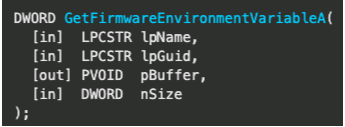
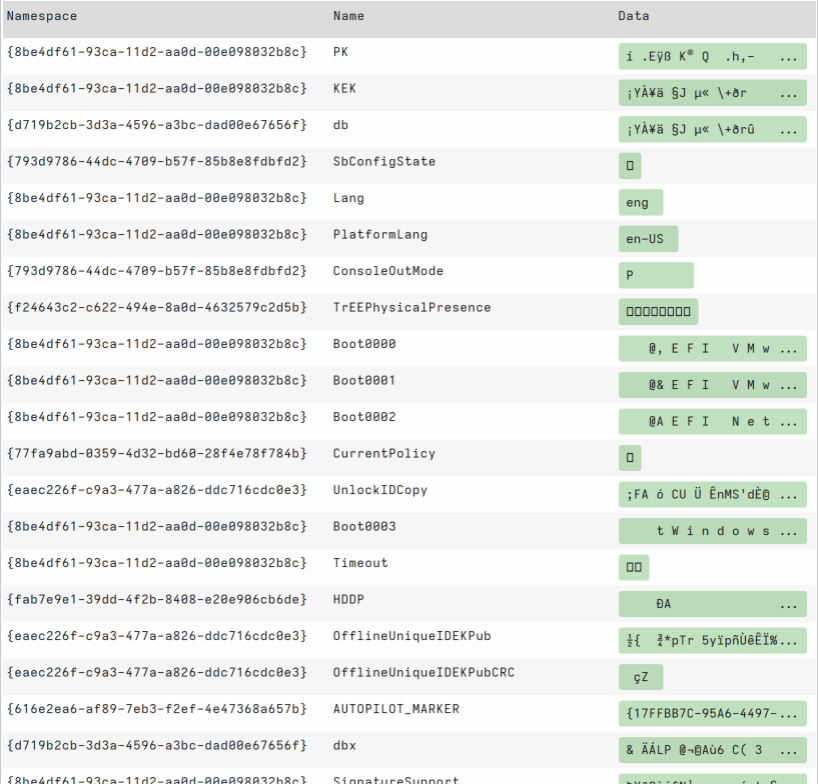
GetFirmwareEnvironmentVariable (Windows) can collect the name, namespace guid and value of EFI secure variables. This collection can be used to check current state including key/signature database and revocation.

Some of the data points it enables extracting are:

  • Platform Key (PK) — top level key.
  • Key Exchange Key (KEK)  — used to sign Signatures Database and Forbidden Signatures Database updates.
  • Signature database (db) — contains keys and/or hashes of allowed EFI binaries.
  • Forbidden signatures database (dbx) — contains keys and/or hashes of denylisted EFI binaries.
  • Other boot configuration settings.

It’s worth noting that this technique is relying on the Windows API and could be subverted with capable malware, but the visibility can provide leads for an analyst around boot configuration or signatures. There are also “boot only” NVRAM variables that can not be accessed outside boot, so a manual chip dump would need to be collected.

How To Hunt For UEFI Malware Using Velociraptor
Example of extracting EFI secure variables

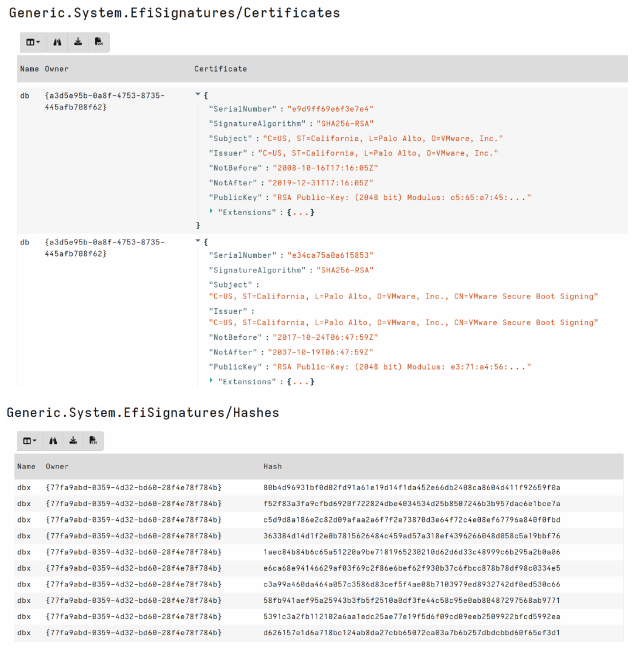
Velociraptor has a community contributed capability: Generic.System.EfiSignatures. This artifact collects EFI Signature information from the client to check for unknown certificates and revoked hashes. This is a great artifact for data stacking across machines and is built by parsing data values from the efivariables() plugin.

How To Hunt For UEFI Malware Using Velociraptor

EFI System Partition (ESP) visibility

The ESP is a FAT partitioned file system that contains boot loaders and other critical files used during the boot process which do not change regularly. As such, it can be a relatively simple task to find abnormalities using forensics.

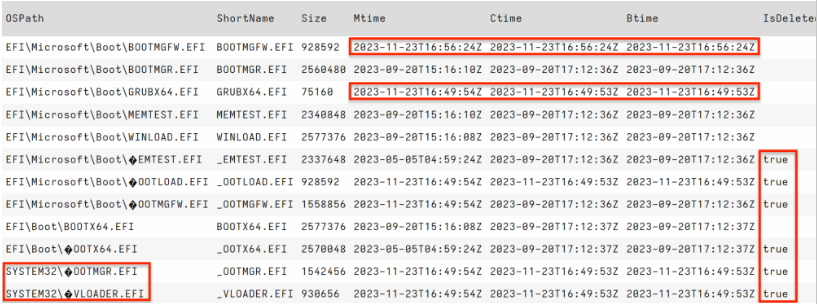
For example, parsing the File Allocation Table we can review metadata around path, timestamps, and deleted status that may provide leads for analysis.

How To Hunt For UEFI Malware Using Velociraptor
Viewing FAT metadata on *.EFI files

In the screenshot above we observe several EFI bootloader files with timestamps out of alignment. We would typically expect these files to have the same timestamps around operating system install. We can also observe deleted files and the existence of a System32 folder in the temporal range of these entries.

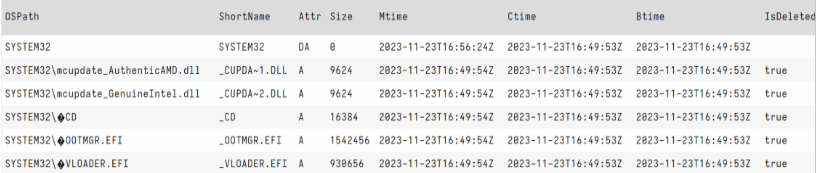
The EFI/ folder should be the only folder in the ESP root so querying for any paths that do not begin with EFI/ is a great hunt that detects our lead above. You can see in my screenshot below, the BlackLotus staging being bubbled to the top adding filtering for this use case.

How To Hunt For UEFI Malware Using Velociraptor
BlackLotus staging: Non ESP/ files

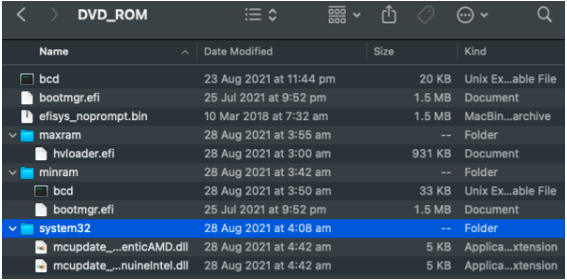
Interestingly, BlackLotus was known to use the Baton Drop exploit so we can compare to the publicly available Baton Drop and observe similarities to deleted files on the ESP.

How To Hunt For UEFI Malware Using Velociraptor
Publicly available Baton Drop iso contents on Github

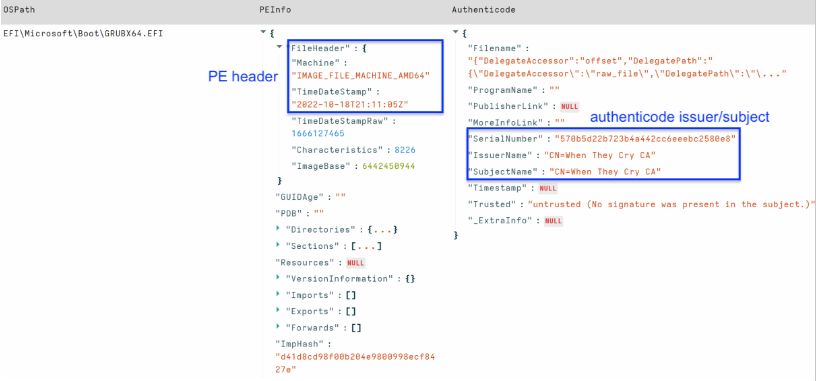
The final component of ESP-based visibility is checking the bytes of file contents. We can run YARA to look for known malware traits, or obtain additional file type metadata that can provide leads for analysis. The screenshot below highlights the well known Black Lotus certificate information and PE header timestamp.

How To Hunt For UEFI Malware Using Velociraptor
BlackLotus PE header, suspicious Authenticode
How To Hunt For UEFI Malware Using Velociraptor
BlackLotus YARA hit in ESP

Available Velociraptor artifacts for this visibility of the ESP are:

  1. Windows.Forensics.UEFI — This artifact enables disk analysis over an EFI System Partition (ESP). The artifact queries the specified physical disk, parses the partition table to target the ESP File Allocation Table (FAT). The artifact returns file information, and PE enrichment as typical EFI files are in the PE format.
  2. Windows.Detection.Yara.UEFI This artifact expands on basic enumeration of the ESP and enables running yara over the EFI system partition.

Measured Boot log visibility

Bootkit security has always been a “race to the bottom.” If the malware could load prior to security tools, a defender would need to assume they may be defeated. Since Windows 8, Measured Boot is a feature implemented to help protect machines from early boot malware. Measured Boot checks each startup component — from firmware to boot drivers — and stores this information in the Trusted Platform Module (TPM). A binary log is then made available to verify the boot state of the machine. The default Measured Boot log location is C:\Windows\Logs\MeasuredBoot\*.log and a new file is recorded for each boot.

Windows.Forensics.UEFI.BootApplication parses Windows MeasuredBoot TCGLogs to extract PathName of events, which can assist detection of potential ESP based persistence (EV_EFI_Boot_Services_Application). The artifact leverages Velociraptor tools to deploy and execute Matt Graeber’s excellent powershell module TCGLogTools to parse TCGLogs on disk and memory.

How To Hunt For UEFI Malware Using Velociraptor

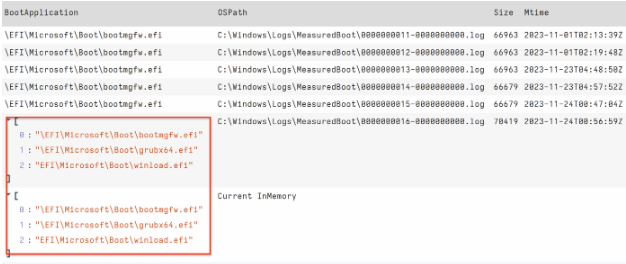
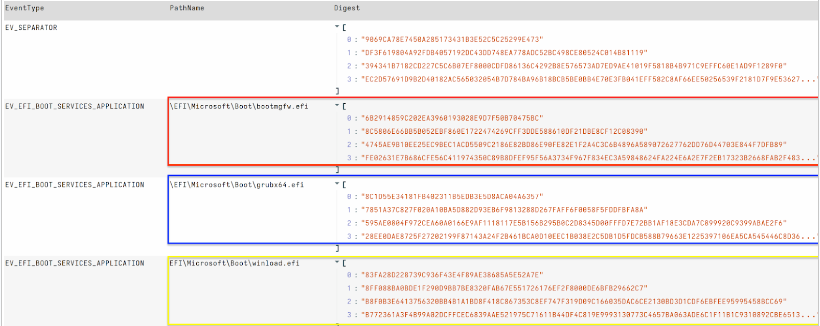
We can see when running on an infected machine that the BOOT application path has clearly changed from the default: \EFI\Microsoft\Boot\bootmgfw.efi. Therefore, Boot Application is a field that is stackable across the network.

We can also output extended values, including digest hashes for verification.

How To Hunt For UEFI Malware Using Velociraptor

Other forensic artifacts

There are many other generic forensic artifacts analysts could focus on for assisting detection of a UEFI threat. From malware network activity to unexpected errors in the event log associated with Antivirus/Security tools on the machine.

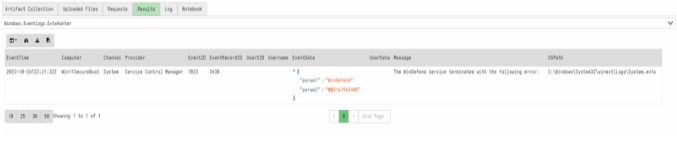
For example: BlackLotus made an effort to evade detection by changing Windows Defender access tokens to SE_PRIVILEGE_REMOVED. This technique keeps the Defender service running but effectively disables it. While Velociraptor may not have protected process privileges to check tokens directly, we can check for other indicators such as errors associated with use.

How To Hunt For UEFI Malware Using Velociraptor

Similarly, Memory integrity (HVCI) is a feature of virtualization-based security (VBS) in Windows. It provides a stronger virtualization environment via isolation and kernel memory allocations.The feature is related to Secure Boot and can be disabled for malware that needs a lower integrity environment to run. It requires setting the configuration registry key value to 0.

HKLM\SYSTEM\CurrentControlSet\Control\DeviceGuard\Scenarios\HypervisorEnforcedCodeIntegrity\Value

0 – disabled

1 – enabled
Windows.Registry.HVCI available on the artifact exchange can be used to query for this key value.

How To Hunt For UEFI Malware Using Velociraptor

Conclusion

Despite UEFI threats possessing intimidating capabilities, security practitioners can deploy some visibility with current tools for remote investigation. Forensically parsing disk and not relying on the Windows API, or reviewing other systemic indicators that may signal compromise, is a practical way to detect components of these threats. Knowing collection capabilities, the gaps, and how to mitigate these is just as important as knowing the threat.

In this post we have covered some of Velociraptor’s visibility for UEFI threats and we have only scratched the surface for those who know their environment and can query it effectively. Rapid7 supports Velociraptor open source, providing the community with Velociraptor and open source features unavailable even in some paid tools.

References:

  1. ESET, Martin Smolar – BlackLotus UEFI bootkit: Myth confirmed
  2. Microsoft Incident Response – Guidance for investigating attacks using CVE-2022-21894: The BlackLotus campaign
  3. Trellix Insights: TrickBot offers new TrickBoot
  4. Palo Alto Unit 42: Diving Into Glupteba’s UEFI Bootkit
  5. Sentinel1: Moving from common sense knowledge about uefi to actually dumping uefi firmware

Intel Rebrands its FPGA Business Altera in an Awesome Branding Move

Post Syndicated from Patrick Kennedy original https://www.servethehome.com/intel-rebrands-its-fpga-business-altera-in-an-awesome-branding-move/

In an awesome branding move, Intel’s FPGA business spin-off will be named “Altera”. Along with the name, we have a few roadmap updates

The post Intel Rebrands its FPGA Business Altera in an Awesome Branding Move appeared first on ServeTheHome.

[$] A sandbox mode for the kernel

Post Syndicated from corbet original https://lwn.net/Articles/963734/

The Linux kernel follows a monolithic design, and that brings a well-known
problem: all code in the kernel has access to the entirety of the kernel’s
address space. As a result, a bug in (for example) an obscure driver may
well be exploitable to wreak havoc on core-kernel data structures. Various
attempts have been made over the years to increase the degree of isolation
within the kernel. The latest of these, “SandBox
Mode”
proposed by Petr Tesařík, makes it possible for the kernel to run
some limited code safely, but it has encountered a bit of a chilly reception.

Data governance in the age of generative AI

Post Syndicated from Krishna Rupanagunta original https://aws.amazon.com/blogs/big-data/data-governance-in-the-age-of-generative-ai/

Data is your generative AI differentiator, and a successful generative AI implementation depends on a robust data strategy incorporating a comprehensive data governance approach. Working with large language models (LLMs) for enterprise use cases requires the implementation of quality and privacy considerations to drive responsible AI. However, enterprise data generated from siloed sources combined with the lack of a data integration strategy creates challenges for provisioning the data for generative AI applications. The need for an end-to-end strategy for data management and data governance at every step of the journey—from ingesting, storing, and querying data to analyzing, visualizing, and running artificial intelligence (AI) and machine learning (ML) models—continues to be of paramount importance for enterprises.

In this post, we discuss the data governance needs of generative AI application data pipelines, a critical building block to govern data used by LLMs to improve the accuracy and relevance of their responses to user prompts in a safe, secure, and transparent manner. Enterprises are doing this by using proprietary data with approaches like Retrieval Augmented Generation (RAG), fine-tuning, and continued pre-training with foundation models.

Data governance is a critical building block across all these approaches, and we see two emerging areas of focus. First, many LLM use cases rely on enterprise knowledge that needs to be drawn from unstructured data such as documents, transcripts, and images, in addition to structured data from data warehouses. Unstructured data is typically stored across siloed systems in varying formats, and generally not managed or governed with the same level of rigor as structured data. Second, generative AI applications introduce a higher number of data interactions than conventional applications, which requires that the data security, privacy, and access control policies be implemented as part of the generative AI user workflows.

In this post, we cover data governance for building generative AI applications on AWS with a lens on structured and unstructured enterprise knowledge sources, and the role of data governance during the user request-response workflows.

Use case overview

Let’s explore an example of a customer support AI assistant. The following figure shows the typical conversational workflow that is initiated with a user prompt.

The workflow includes the following key data governance steps:

  1. Prompt user access control and security policies.
  2. Access policies to extract permissions based on relevant data and filter out results based on the prompt user role and permissions.
  3. Enforce data privacy policies such as personally identifiable information (PII) redactions.
  4. Enforce fine-grained access control.
  5. Grant the user role permissions for sensitive information and compliance policies.

To provide a response that includes the enterprise context, each user prompt needs to be augmented with a combination of insights from structured data from the data warehouse and unstructured data from the enterprise data lake. On the backend, the batch data engineering processes refreshing the enterprise data lake need to expand to ingest, transform, and manage unstructured data. As part of the transformation, the objects need to be treated to ensure data privacy (for example, PII redaction). Finally, access control policies also need to be extended to the unstructured data objects and to vector data stores.

Let’s look at how data governance can be applied to the enterprise knowledge source data pipelines and the user request-response workflows.

Enterprise knowledge: Data management

The following figure summarizes data governance considerations for data pipelines and the workflow for applying data governance.

Data governance steps in data pipelines

In the above figure, the data engineering pipelines include the following data governance steps:

  1. Create and update a catalog through data evolution.
  2. Implement data privacy policies.
  3. Implement data quality by data type and source.
  4. Link structured and unstructured datasets.
  5. Implement unified fine-grained access controls for structured and unstructured datasets.

Let’s look at some of the key changes in the data pipelines namely, data cataloging, data quality, and vector embedding security in more detail.

Data discoverability

Unlike structured data, which is managed in well-defined rows and columns, unstructured data is stored as objects. For users to be able to discover and comprehend the data, the first step is to build a comprehensive catalog using the metadata that is generated and captured in the source systems. This starts with the objects (such as documents and transcript files) being ingested from the relevant source systems into the raw zone in the data lake in Amazon Simple Storage Service (Amazon S3) in their respective native formats (as illustrated in the preceding figure). From here, object metadata (such as file owner, creation date, and confidentiality level) is extracted and queried using Amazon S3 capabilities. Metadata can vary by data source, and it’s important to examine the fields and, where required, derive the necessary fields to complete all the necessary metadata. For instance, if an attribute like content confidentiality is not tagged at a document level in the source application, this may need to be derived as part of the metadata extraction process and added as an attribute in the data catalog. The ingestion process needs to capture object updates (changes, deletions) in addition to new objects on an ongoing basis. For detailed implementation guidance, refer to Unstructured data management and governance using AWS AI/ML and analytics services. To further simplify the discovery and introspection between business glossaries and technical data catalogs, you can use Amazon DataZone for business users to discover and share data stored across data silos.

Data privacy

Enterprise knowledge sources often contain PII and other sensitive data (such as addresses and Social Security numbers). Based on your data privacy policies, these elements need to be treated (masked, tokenized, or redacted) from the sources before they can be used for downstream use cases. From the raw zone in Amazon S3, the objects need to be processed before they can be consumed by downstream generative AI models. A key requirement here is PII identification and redaction, which you can implement with Amazon Comprehend. It’s important to remember that it will not always be feasible to strip away all the sensitive data without impacting the context of the data. Semantic context is one of the key factors that drive the accuracy and relevance of generative AI model outputs, and it’s critical to work backward from the use case and strike the necessary balance between privacy controls and model performance.

Data enrichment

In addition, additional metadata may need to be extracted from the objects. Amazon Comprehend provides capabilities for entity recognition (for example, identifying domain-specific data like policy numbers and claim numbers) and custom classification (for example, categorizing a customer care chat transcript based on the issue description). Furthermore, you may need to combine the unstructured and structured data to create a holistic picture of key entities, like customers. For example, in an airline loyalty scenario, there would be significant value in linking unstructured data capture of customer interactions (such as customer chat transcripts and customer reviews) with structured data signals (such as ticket purchases and miles redemption) to create a more complete customer profile that can then enable the delivery of better and more relevant trip recommendations. AWS Entity Resolution is an ML service that helps in matching and linking records. This service helps link related sets of information to create deeper, more connected data about key entities like customers, products, and so on, which can further improve the quality and relevance of LLM outputs. This is available in the transformed zone in Amazon S3 and is ready to be consumed downstream for vector stores, fine-tuning, or training of LLMs. After these transformations, data can be made available in the curated zone in Amazon S3.

Data quality

A critical factor to realizing the full potential of generative AI is dependent on the quality of the data that is used to train the models as well as the data that is used to augment and enhance the model response to a user input. Understanding the models and their outcomes in the context of accuracy, bias, and reliability is directly proportional to the quality of data used to build and train the models.

Amazon SageMaker Model Monitor provides a proactive detection of deviations in model data quality drift and model quality metrics drift. It also monitors bias drift in your model’s predictions and feature attribution. For more details, refer to Monitoring in-production ML models at large scale using Amazon SageMaker Model Monitor. Detecting bias in your model is a fundamental building block to responsible AI, and Amazon SageMaker Clarify helps detect potential bias that can produce a negative or a less accurate result. To learn more, see Learn how Amazon SageMaker Clarify helps detect bias.

A newer area of focus in generative AI is the use and quality of data in prompts from enterprise and proprietary data stores. An emerging best practice to consider here is shift-left, which puts a strong emphasis on early and proactive quality assurance mechanisms. In the context of data pipelines designed to process data for generative AI applications, this implies identifying and resolving data quality issues earlier upstream to mitigate the potential impact of data quality issues later. AWS Glue Data Quality not only measures and monitors the quality of your data at rest in your data lakes, data warehouses, and transactional databases, but also allows early detection and correction of quality issues for your extract, transform, and load (ETL) pipelines to ensure your data meets the quality standards before it is consumed. For more details, refer to Getting started with AWS Glue Data Quality from the AWS Glue Data Catalog.

Vector store governance

Embeddings in vector databases elevate the intelligence and capabilities of generative AI applications by enabling features such as semantic search and reducing hallucinations. Embeddings typically contain private and sensitive data, and encrypting the data is a recommended step in the user input workflow. Amazon OpenSearch Serverless stores and searches your vector embeddings, and encrypts your data at rest with AWS Key Management Service (AWS KMS). For more details, see Introducing the vector engine for Amazon OpenSearch Serverless, now in preview. Similarly, additional vector engine options on AWS, including Amazon Kendra and Amazon Aurora, encrypt your data at rest with AWS KMS. For more information, refer to Encryption at rest and Protecting data using encryption.

As embeddings are generated and stored in a vector store, controlling access to the data with role-based access control (RBAC) becomes a key requirement to maintaining overall security. Amazon OpenSearch Service provides fine-grained access controls (FGAC) features with AWS Identity and Access Management (IAM) rules that can be associated with Amazon Cognito users. Corresponding user access control mechanisms are also provided by OpenSearch Serverless, Amazon Kendra, and Aurora. To learn more, refer to Data access control for Amazon OpenSearch Serverless, Controlling user access to documents with tokens, and Identity and access management for Amazon Aurora, respectively.

User request-response workflows

Controls in the data governance plane need to be integrated into the generative AI application as part of the overall solution deployment to ensure compliance with data security (based on role-based access controls) and data privacy (based on role-based access to sensitive data) policies. The following figure illustrates the workflow for applying data governance.

Data governance in user prompt workflow

The workflow includes the following key data governance steps:

  1. Provide a valid input prompt for alignment with compliance policies (for example, bias and toxicity).
  2. Generate a query by mapping prompt keywords with the data catalog.
  3. Apply FGAC policies based on user role.
  4. Apply RBAC policies based on user role.
  5. Apply data and content redaction to the response based on user role permissions and compliance policies.

As part of the prompt cycle, the user prompt must be parsed and keywords extracted to ensure alignment with compliance policies using a service like Amazon Comprehend (see New for Amazon Comprehend – Toxicity Detection) or Guardrails for Amazon Bedrock (preview). When that is validated, if the prompt requires structured data to be extracted, the keywords can be used against the data catalog (business or technical) to extract the relevant data tables and fields and construct a query from the data warehouse. The user permissions are evaluated using AWS Lake Formation to filter the relevant data. In the case of unstructured data, the search results are restricted based on the user permission policies implemented in the vector store. As a final step, the output response from the LLM needs to be evaluated against user permissions (to ensure data privacy and security) and compliance with safety (for example, bias and toxicity guidelines).

Although this process is specific to a RAG implementation and is applicable to other LLM implementation strategies, there are additional controls:

  • Prompt engineering – Access to the prompt templates to invoke need to be restricted based on access controls augmented by business logic.
  • Fine-tuning models and training foundation models – In cases where objects from the curated zone in Amazon S3 are used as training data for fine-tuning the foundation models, the permissions policies need to be configured with Amazon S3 identity and access management at the bucket or object level based on the requirements.

Summary

Data governance is critical to enabling organizations to build enterprise generative AI applications. As enterprise use cases continue to evolve, there will be a need to expand the data infrastructure to govern and manage new, diverse, unstructured datasets to ensure alignment with privacy, security, and quality policies. These policies need to be implemented and managed as part of data ingestion, storage, and management of the enterprise knowledge base along with the user interaction workflows. This makes sure that the generative AI applications not only minimize the risk of sharing inaccurate or wrong information, but also protect from bias and toxicity that can lead to harmful or libelous outcomes. To learn more about data governance on AWS, see What is Data Governance?

In subsequent posts, we will provide implementation guidance on how to expand the governance of the data infrastructure to support generative AI use cases.


About the Authors

Krishna Rupanagunta leads a team of Data and AI Specialists at AWS. He and his team work with customers to help them innovate faster and make better decisions using Data, Analytics, and AI/ML. He can be reached via LinkedIn.

Imtiaz (Taz) Sayed is the WW Tech Leader for Analytics at AWS. He enjoys engaging with the community on all things data and analytics. He can be reached via LinkedIn.

Raghvender Arni (Arni) leads the Customer Acceleration Team (CAT) within AWS Industries. The CAT is a global cross-functional team of customer facing cloud architects, software engineers, data scientists, and AI/ML experts and designers that drives innovation via advanced prototyping, and drives cloud operational excellence via specialized technical expertise.

Zaraz launches new pricing

Post Syndicated from Yo'av Moshe original https://blog.cloudflare.com/zaraz-announces-new-pricing

In July, 2023, we announced that Zaraz was transitioning out of beta and becoming available to all Cloudflare users. Zaraz helps users manage and optimize the ever-growing number of third-party tools on their websites — analytics, marketing pixels, chatbots, and more — without compromising on speed, privacy, or security. Soon after the announcement went online, we received feedback from users who were concerned about the new pricing system. We discovered that in some scenarios the proposed pricing could cause high charges, which was not the intention, and so we promised to look into it. Since then, we have iterated over different pricing options, talked with customers of different sizes, and finally reached a new pricing system that we believe is affordable, predictable, and simple. The new pricing for Zaraz will take effect on April 15, 2024, and is described below.

Introducing Zaraz Events

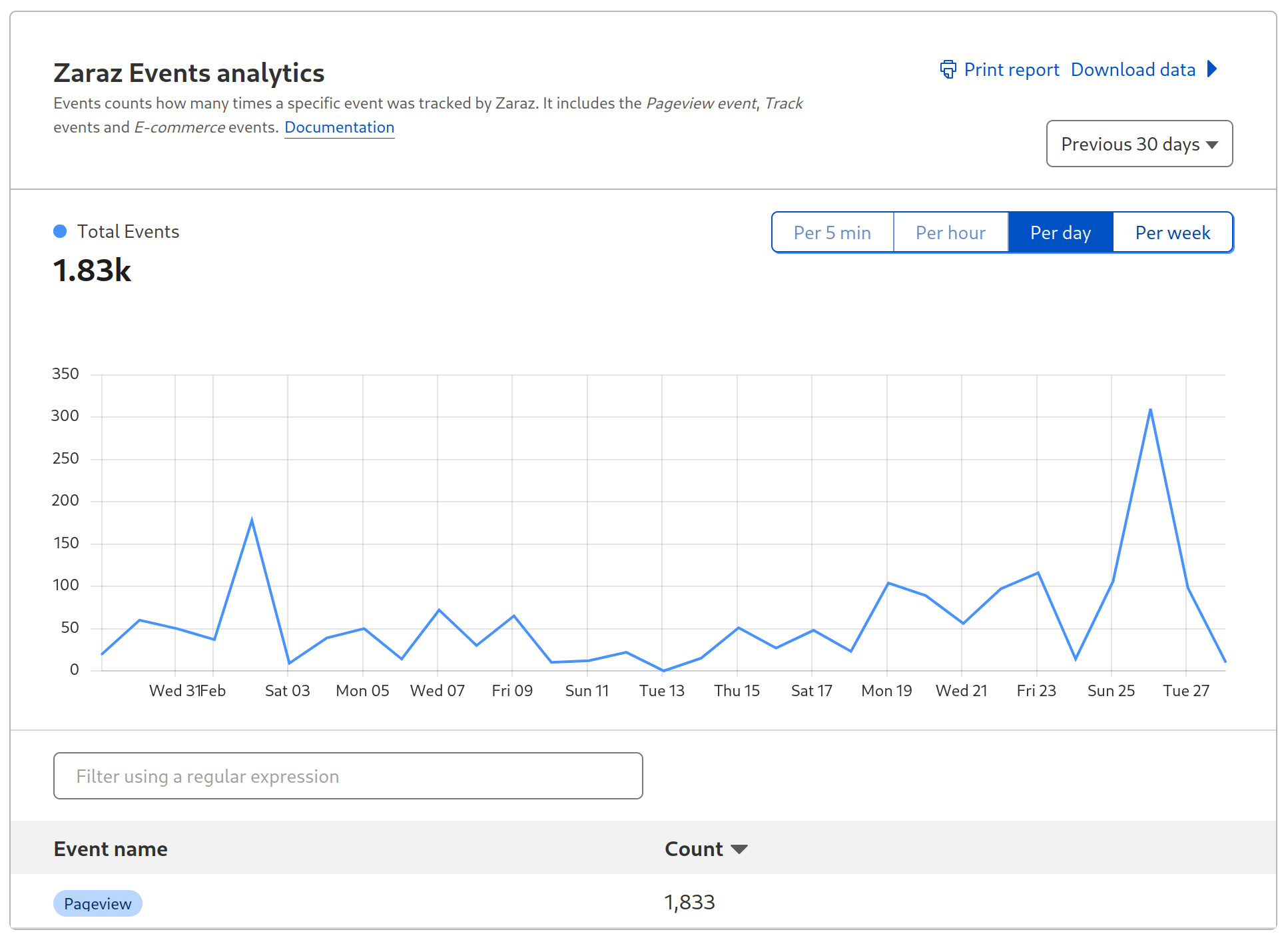
One of the biggest changes we made was changing the metric we used for pricing Zaraz. One Zaraz Event is an event you’re sending to Zaraz, whether that’s a pageview, a zaraz.track event, or similar. You can easily see the total number of Zaraz Events you’re currently using under the Monitoring section in the Cloudflare Zaraz Dashboard. Every Cloudflare account can use 1,000,000 Zaraz Events completely for free, every month.

The Zaraz Monitoring page shows exactly how many Zaraz Events your website is using

We believe that Zaraz Events are a better representation of the usage of Zaraz. As the web progresses and as Single-Page-Applications are becoming more and more popular, the definition of a “pageview”, which was used for the old pricing system, is becoming more and more vague. Zaraz Events are agnostic to different tech stacks, and work the same when using the Zaraz HTTP API. It’s a simpler metric that should better reflect the way Zaraz is used.

Predictable costs for high volume websites

With the new Zaraz pricing model, every Cloudflare account gets 1,000,000 Zaraz Events per month for free. If your account needs more than that, every additional 1,000,000 Zaraz Events are only $5 USD, with volume discounting available for Enterprise accounts. Compared with other third-party managers and tag management software, this new pricing model makes Zaraz an affordable and user-friendly solution for server-side loading of tools and tags.

Available for all

We also decided that all Zaraz features should be available for everyone. We want users to make the most of Zaraz, no matter how big or small their website is. This means that advanced features like making custom HTTP requests, using the Consent Management API, loading custom Managed Components, configuring custom endpoints, using the Preview & Publish Workflow, and even using the Zaraz Ecommerce features are now available on all plans, from Free to Enterprise.

Try it out

We’re announcing this new affordable price for Zaraz while retaining all the features that make it the perfect solution for managing third-party tools on your website. Zaraz is a one-click installation that requires no server, and it’s lightning fast thanks to Cloudflare’s network, which is within 50 milliseconds of approximately 95% of the Internet-connected population. Zaraz is extremely extensible using the Open Source format of Managed Components, allowing you to change tools and create your own, and it’s transparent about what information is shared with tools on your website, allowing you to control and improve the privacy of your website visitors.

Zaraz recently completed the migration of all tools to Managed Components. This makes tools on your website more like apps on your phone, allowing you to granularly decide what permissions to grant tools. For example, it allows you to prevent a tool from making client-side network requests or storing cookies. With the Zaraz Context Enricher you can create custom data manipulation processes in a Cloudflare Worker, and do things like attach extra information to payloads from your internal CRM, or automatically remove and mask personally-identifiable information (PII) like email addresses before it reaches your providers.

We would like to thank all the users that provided us with their feedback. We acknowledge that the previous pricing might have caused some to think twice about choosing Zaraz, and we hope that this will encourage them to reconsider. Cloudflare Zaraz is a tool that is meant first and foremost to serve the people building websites on the Internet, and we thank everyone for sharing their feedback to help us get to a better product in the end.

The new pricing for Zaraz will take effect starting April 15, 2024.

Security updates for Thursday

Post Syndicated from jake original https://lwn.net/Articles/964039/

Security updates have been issued by Debian (chromium), Fedora (moodle), Red Hat (kernel, kernel-rt, and postgresql:15), Slackware (wpa_supplicant), SUSE (Java and rear27a), and Ubuntu (libcpanel-json-xs-perl, libuv1, linux-aws, linux-aws-5.15, linux-azure, linux-azure-5.4, linux-lowlatency, linux-lowlatency-hwe-6.5, linux-oem-6.5, python-openstackclient, and unbound).

Remediating new DNSSEC resource exhaustion vulnerabilities

Post Syndicated from Vicky Shrestha original https://blog.cloudflare.com/remediating-new-dnssec-resource-exhaustion-vulnerabilities


Cloudflare has been part of a multivendor, industry-wide effort to mitigate two critical DNSSEC vulnerabilities. These vulnerabilities exposed significant risks to critical infrastructures that provide DNS resolution services. Cloudflare provides DNS resolution for anyone to use for free with our public resolver 1.1.1.1 service. Mitigations for Cloudflare’s public resolver 1.1.1.1 service were applied before these vulnerabilities were disclosed publicly. Internal resolvers using unbound (open source software) were upgraded promptly after a new software version fixing these vulnerabilities was released.

All Cloudflare DNS infrastructure was protected from both of these vulnerabilities before they were disclosed and is safe today. These vulnerabilities do not affect our Authoritative DNS or DNS firewall products.

All major DNS software vendors have released new versions of their software. All other major DNS resolver providers have also applied appropriate mitigations. Please update your DNS resolver software immediately, if you haven’t done so already.

Background

Domain name system (DNS) security extensions, commonly known as DNSSEC, are extensions to the DNS protocol that add authentication and integrity capabilities. DNSSEC uses cryptographic keys and signatures that allow DNS responses to be validated as authentic. DNSSEC protocol specifications have certain requirements that prioritize availability at the cost of increased complexity and computational cost for the validating DNS resolvers. The mitigations for the vulnerabilities discussed in this blog require local policies to be applied that relax these requirements in order to avoid exhausting the resources of validators.

The design of the DNS and DNSSEC protocols follows the Robustness principle: “be conservative in what you do, be liberal in what you accept from others”. There have been many vulnerabilities in the past that have taken advantage of protocol requirements following this principle. Malicious actors can exploit these vulnerabilities to attack DNS infrastructure, in this case by causing additional work for DNS resolvers by crafting DNSSEC responses with complex configurations. As is often the case, we find ourselves having to create a pragmatic balance between the flexibility that allows a protocol to adapt and evolve and the need to safeguard the stability and security of the services we operate.

Cloudflare’s public resolver 1.1.1.1 is a privacy-centric public resolver service. We have been using stricter validations and limits aimed at protecting our own infrastructure in addition to shielding authoritative DNS servers operated outside our network. As a result, we often receive complaints about resolution failures. Experience shows us that strict validations and limits can impact availability in some edge cases, especially when DNS domains are improperly configured. However, these strict validations and limits are necessary to improve the overall reliability and resilience of the DNS infrastructure.

The vulnerabilities and how we mitigated them are described below.

Keytrap vulnerability (CVE-2023-50387)

Introduction

A DNSSEC signed zone can contain multiple keys (DNSKEY) to sign the contents of a DNS zone and a Resource Record Set (RRSET) in a DNS response can have multiple signatures (RRSIG). Multiple keys and signatures are required to support things like key rollover, algorithm rollover, and multi-signer DNSSEC. DNSSEC protocol specifications require a validating DNS resolver to try every possible combination of keys and signatures when validating a DNS response.

During validation, a resolver looks at the key tag of every signature and tries to find the associated key that was used to sign it. A key tag is an unsigned 16-bit number calculated as a checksum over the key’s resource data (RDATA). Key tags are intended to allow efficient pairing of a signature with the key which has supposedly created it.  However, key tags are not unique, and it is possible that multiple keys can have the same key tag. A malicious actor can easily craft a DNS response with multiple keys having the same key tag together with multiple signatures, none of which might validate. A validating resolver would have to try every combination (number of keys multiplied by number of signatures) when trying to validate this response. This increases the computational cost of the validating resolver many-fold, degrading performance for all its users. This is known as the Keytrap vulnerability.

Variations of this vulnerability include using multiple signatures with one key, using one signature with multiple keys having colliding key tags, and using multiple keys with corresponding hashes added to the parent delegation signer record.

Mitigation

We have limited the maximum number of keys we will accept at a zone cut. A zone cut is where a parent zone delegates to a child zone, e.g. where the .com zone delegates cloudflare.com to Cloudflare nameservers. Even with this limit already in place and various other protections built for our platform, we realized that it would still be computationally costly to process a malicious DNS answer from an authoritative DNS server.

To address and further mitigate this vulnerability, we added a signature validations limit per RRSET and a total signature validations limit per resolution task. One resolution task might include multiple recursive queries to external authoritative DNS servers in order to answer a single DNS question. Clients queries exceeding these limits will fail to resolve and will receive a response with an Extended DNS Error (EDE) code 0. Furthermore, we added metrics which will allow us to detect attacks attempting to exploit this vulnerability.

NSEC3 iteration and closest encloser proof vulnerability (CVE-2023-50868)

Introduction

NSEC3 is an alternative approach for authenticated denial of existence. You can learn more about authenticated denial of existence here. NSEC3 uses a hash derived from DNS names instead of the DNS names directly in an attempt to prevent zone enumeration and the standard supports multiple iterations for hash calculations. However, because the full DNS name is used as input to the hash calculation, increasing hashing iterations beyond the initial doesn’t provide any additional value and is not recommended in RFC9276. This complication is further inflated while finding the closest enclosure proof. A malicious DNS response from an authoritative DNS server can set a high NSEC3 iteration count and long DNS names with multiple DNS labels to exhaust the computing resources of a validating resolver by making it do unnecessary hash computations.

Mitigation

For this vulnerability, we applied a similar mitigation technique as we did for Keytrap. We added a limit for total hash calculations per resolution task to answer a single DNS question. Similarly, clients queries exceeding this limit will fail to resolve and will receive a response with an EDE code 27. We also added metrics to track hash calculations allowing early detection of attacks attempting to exploit this vulnerability.

Timeline

Date and time in UTC

Event

2023-11-03 16:05

John Todd from Quad9 invites Cloudflare to participate in a joint task force to discuss a new DNS vulnerability. 

2023-11-07 14:30

A group of DNS vendors and service providers meet to discuss the vulnerability during IETF 118. Discussions and collaboration continues in a closed chat group hosted at DNS-OARC

2023-12-08 20:20

Cloudflare public resolver 1.1.1.1 is fully patched to mitigate Keytrap vulnerability (CVE-2023-50387)

2024-01-17 22:39

Cloudflare public resolver 1.1.1.1 is fully patched to mitigate NSEC3 iteration count and closest encloser vulnerability (CVE-2023-50868)

2024-02-13 13:04

Unbound package is released 

2024-02-13 23:00

Cloudflare internal CDN resolver is fully patched to mitigate both CVE-2023-50387 and CVE-2023-50868

Credits

We would like to thank Elias Heftrig, Haya Schulmann, Niklas Vogel, Michael Waidner from the German National Research Center for Applied Cybersecurity ATHENE, for discovering the Keytrap vulnerability and doing a responsible disclosure.

We would like to thank Petr Špaček from Internet Systems Consortium (ISC) for discovering the NSEC3 iteration and closest encloser proof vulnerability and doing a responsible disclosure.

We would like to thank John Todd from Quad9  and the DNS Operations Analysis and Research Center (DNS-OARC) for facilitating coordination amongst various stakeholders.

And finally, we would like to thank the DNS-OARC community members, representing various DNS vendors and service providers, who all came together and worked tirelessly to fix these vulnerabilities, working towards a common goal of making the internet resilient and secure.