Post Syndicated from Techmoan original https://www.youtube.com/watch?v=YkukwhHrQLQ
Седмицата (20–25 юли)
Post Syndicated from Надежда Радулова original https://www.toest.bg/sedmitsata-20-25-yuli/

През изминалата седмица обичайните ваканционни теми, натискащи педала на газта в социалните мрежи и в крайна сметка заключаващи се в две основни точки – 1) къде да си изям салатата и да си изпия ракията/узото без да ми одерат кожата, за да имам лице да постна снимка от касовата бележка вместо доволно оригване; 2) по кой път да мина, за да избегна задръстванията из национална пътна мрежа и да стигна най-бързо от А до Б с цел да изпълня точка 1), – отидоха на заден план. „Дъвките“ на седмицата се разтягаха (и все още се точат) около финала на Световното по футбол и „Одисей“ на Нолан.
На мача Испания–Аржентина заспах. Предстои ми да гледам „Одисей“. Ще задържа вълнуващото очакване да се срещна с екранната адаптация на литературен текст, занимавал фантазията и езика ми от детските ми години, максимално дълго или поне докато се отлее първата вълна от непосредствени и нерядко посредствени реакции. Струва ми се, че да бързаме и прибързваме, раздавайки шамари наляво и надясно, някак не подхожда, когато си имаме работа с толкова бавна работа, каквато е Омировата епическа поема, апропо в оригиналната си версия на древногръцки, съдържаща около 120 000 думи, структурирани в около 12 110 стиха, написани в дактилен хекзаметър.
Сами разбирате колко абсурдно е да се водят „троянски войни“ за лоялността на конкретна художествена (в случая филмова) интерпретация спрямо един в буквалния смисъл на думата неизбродим текст, още повече неизбродим за хора без образование и подготовка в полето на класическите филологии, каквито сме повечето от нас. Защо липсвало това или онова; защо този или онзи изглеждал по един или друг начин; ама финалът не бил същият като в книгата… Който и да е режисьор не би могъл да бъде 100 процента „верен“ на текста източник. А и въпросът опира не до верността, а до достоверността, но това е съвсем различна история (Аристотел го казва, не аз). В крайна сметка и Омир твърди за самия Одисей (а ние го четем в превода на Георги Батаклиев): „Много лъжи Одисей тъй разказа, подобни на правда“ (Песен 19, стих 203). Та нека, викам, да снизходим и ние от позицията си на естетически съдници и да дадем правото на писателите и режисьорите да бъдат, един вид, одисеевци – да ни „лъжат“ така, че (евентуално) сами да стигаме до истината. Лично аз предпочитам да ме лъжат Омир и Нолан, отколкото политиците на власт да ме убеждават в истинността на думите си.
Ако и вие като мен още се гласите да гледате филма, ето чудесен начин да се подготвим, преди да си купим пакета с пуканки – едно старо, но златно есе на покойния професор Богдан Богданов „Мит и действителност в Омировата „Одисея“. Да, точно за това става дума – мит и действителност… И забележете, проф. Богданов завършва разсъждението си по следния начин:
Тъкмо затова, когато попаднат в нова културна среда, Омировите епопеи пораждат проблеми, които не са поставени в тях.
За да разберете (тъкмо) защо – прочетете есето, страхотно е!
„Одисей“ успя да раздразни чувствителните „власинки“ на тукашния зрител, но именно така, надявам се, някои хора, които досега не са имали възможност и време да разлистят Омировия епос, току-виж го сторили.
Съвсем друг е случаят обаче с една „кинопродукция“, която все още е в процес на производство. За нея ни разказва Димитри Захов във „Васил Левски и тарикатлъкът“. Накратко, рап-бизнес дуетът „Зипо и Слаш“ продуцира изцяло генерираната от ИИ анимация „Агенти на времето: Васил Левски“, като според сайта на продукцията проектът вече е привлякъл над 100 корпоративни партньора. И всичко се прави – разбира се – в името на децата. Трейлърът дава знак за некадърно свършена работа, а досега най-острите критики на бизнес-творческата инициатива идват от представителите на поколението Gen Z, които явно добре виждат размера на бедствието в тази доходоносна шмекерия. След седмицата, в която всеки втори пост в социалните мрежи се занимаваше с Омир и Нолан, ми се ще да вярвам, че филмът на рап дуета ще бъде разкостен, преди да се промъкне в училищните салони, за да учи малките на родолюбие и лесна печалба. Но може би съм оптимистка… и това няма да се случи дори и „в името на децата“.
Васил Левски и тарикатлъкът
Емоционална, но и аргументирана статия от Димитри Захов – най-младия автор на „Тоест“, за проекта за филм „Агенти на времето: Васил Левски“. И за злоупотребата с историческия канон в името на лесната печалба.
Последното се доказва от новото проучване на Теодора Станимирова „Какво (не) знаем за сексуалните злоупотреби с деца“. Истината е, че знаем твърде малко, а и явно не се интересуваме достатъчно. Ето – по думите на Теодора – и част от нещата, които всъщност няма и как да узнаем, тъй като:
МВР не успя да отговори – защото не събира такава информация – на въпросите: в колко от случаите извършител е бил роднина или член на семейството, дали сигналът за насилие над дете е бил предхождан от сигнали за домашно насилие в дома и колко от осъдените са включени в Националния регистър на случаите на педофилия. Нито АСП, нито МВР водят статистика за пола на пострадалото дете. Следователно не е ясно какъв е профилът на извършителя, нито този на пострадалия, не се знае в какво домакинство са живели и каква е връзката между тях.
Какво (не) знаем за сексуалните злоупотреби с деца
Какво знаят институциите за сексуалните злоупотреби с деца в България и какви мерки предприемат? Теодора Станимирова се сдоби с информация от ВСС, МВР, АСП, ДАЗД и МЗ, разговаря с експерти и ни разказва какво е научила.
И ако МВР не може да отговори на ключови въпроси, защото не събира необходимата информация, резултатите от НВО след VII клас и тази година дават предоволно данни, които, разбира се, потвърждават онова, което си знаем: образованието на децата ни е мам си джейс и все пò мам си джейс ще става. Донка Дойчева-Попова с математическо хладнокръвие е анализирала статистически резултатите в „НВО: Endgamе“. А двете неща, които ме хвърлиха в тих ужас след прочита на текста ѝ, са, че: 1) след целия напън и изпразване на джобовете за частни уроци средният български ученик има тройка по математика; 2) в България четиринайсетгодишните са или отличници, или слаби. Средно положение няма и слабите ученици, разбира се, преобладават. Endgame. Половината свят изчезва. Завеса!
НВО: Endgame
НВО приключи, но не и разговорът за провала на системата. МОН, разбира се, отчита „устойчиви резултати“, но данните сочат друго – срив по математика, хаотични промени в изпитите и липса на отговорност. Цената плащат учениците, а родителите отдавна доплащат. Коментар на Донка Дойчева-Попова.
Един момент! Да не бързаме със завесата. Ако за много ученици и родителите им проклетото НВО, за жалост, се оказва от огромно значение за развитието им в следващите (поне) 5 години, за други деца, също много на брой, то не означава абсолютно нищо. Просто защото идеята за развитието им е унищожена още с престъпването на училищния праг в първи клас. Това са преобладаващата част от ромските деца, които поради различния си от български майчин език, липсата на подкрепяща среда, негостоприемната образователна система, силно занижените очаквания – и в семейството, и като цяло в обществото – и отсъстващите работещи държавни политики за десегрегация остават без шанс за качествено образование и интеграция от най-ранна възраст. Та къде се намираме днес? Ако през 1955 г. арестът на афроамериканката Роза Паркс, отказала да отстъпи мястото си в автобуса на бял, предизвиква продължилия една година „автобусен бойкот в Монтгомъри“ – едно от най-масовите движения срещу расовата сегрегация, днес, 70 години по-късно, майка и дете от ромски произход не биват допуснати до басейн в Луковит без логично обяснение. И това не е изолиран случай. Разликата с 1955-та: актовете на сегрегация са до такава степен нормализирани, че обществена реакция няма – нито на място в басейна, нито след това. Ситуацията е описана и анализирана от Емилия Милчева в „Още една тухла в стената“.
Още една тухла в стената
Какво се случва с децата, когато прекрачат прага на едно сегрегирано училище? Отговорът не се изчерпва с по-ниските резултати на матурите. Сегрегацията действа отрано чрез езика и отношението на институциите и това оформя представата на децата за възможностите им. От Емилия Милчева.
Сега нека най-сетне напуснем поне за малко родната територия, този остров на безхаберието и – както се оказва – на бездушието, и кацнем на един истински. Гьокчеада от поредицата на Георги Тотев „Островът на прокудените“ наистина напомня на някои от островите, където се озовава Одисей по време на дългото си пътуване към дома. За част от жителите си обаче той се е превърнал в единствена възможност и последна спирка. Такива са отдавна прогонените от родината си български турци Раиф и Кание. За други пък като Махмуд Гьокчеада е неочаквана възможност да намерят второ семейство и да полетят над вълните… с кайт. За трети – като Христос и Виолета – да открият общност, в която да укрепят идентичността си. Третата част е и последна в поредицата и с нея се разделяме (поне аз с малко тъга) с мястото и героите, с които ненадейно се оказахме свързани.
Островът на прокудените. Травми от миналото изплуват по бреговете на Гьокчеада (трета част)
Историята на Георги Тотев през съдбите на хора, които живеят между държави, езици и спомени, стига до своя край. В последната част от разказа му за Гьокчеада се обръщаме към изборите, помирението и въпроса къде всъщност е домът.
Без да се налага да прескачаме от малкия до големия остров континент, на който се намират САЩ, получаваме оттам поредната доза новини в месечния бюлетин на Йоанна Елми „По Америка ще ги познаете“. Тръмп е готов за ескалация на войната в Иран, а американските военни на възраст над 30 години са подложени на тестове за нивата на тестостерон и при ниски показатели се прилага лечение. Изобщо, тестостеронът се продава под път и над път, докато статистически все повече жени се страхуват да имат дете. Разбираемо – в тестостеронния свят на Тръмп, Путин & Co има нужда от мъже, не от деца. (Звучи като сюжет за нов дистопичен роман със заглавие „Тестостерон“, нали?) И изобщо, Йоанна прекрасно обобщава сегашната политика на САЩ като „политика на синтетичния тестостерон“. Разхождайки се тази седмица по плажа, бих казала, че явлението далеч не е само американско, а глобално, твърде глобално…
Гласовете на Америка – брой 17
Америка сменя меката сила с тестостерон, война и показна грубост. Между кризата на мъжествеността, страха от майчинството и възхода на Китай може да се проследи как разпадът на една култура започва да пренарежда света, превръщайки крайностите в „ново нормално“ пред очите ни. От Йоанна Елми.
И като сме започнали с кино, нека така и да завършим. Миналата седмица ви предложихме обзорен текст на Нева Мичева за кинофестивала в Карлови Вари. Сега е време за личните фаворити на Нева, към които тя е далеч по-милостива и дори възторжена, защото във филмите, харесани от нея, няма празни ходове и безхарактерие, а „животи, любови и смисли“. Ето какво ни казва още тя:
По-долу ще прочетете за насилие, болест, смърт, самота и стигми, но – благодарение на своята славна направа – филмите, в които става дума за всичко това, са способни да издърпат персонажите и зрителите си изпод валяка на бита и над повърхността на тъгата, да възвърнат богатството на оттенъците, да подпрат олюляващия се хоризонт и да ваксинират с надежда.
„Карлови Вари 2026“: Животи, любови, смисли
Ако и обзорният текст на Нева Мичева за кинофестивала в Карлови Вари от миналата седмица да ви се е сторил твърде критичен, сега тя се завръща с възхитен разказ за личните си фаворити – филми, „в които животи, любови и смисли триумфално се множат и процъфтяват на екрана“.
Ако все още вярвате, че има смисъл заедно да подпираме не просто олюляващия се хоризонт, но и прогнилия покрив на общата ни Итака, ударете по едно рамо и ни подкрепете. А ние ще продължим да сме остров на който да се завръщате всяка седмица. Благодарим ви!
Friday Squid Blogging: Illex Squid Catch in the Falklands
Post Syndicated from Bruce Schneier original https://www.schneier.com/blog/archives/2026/07/friday-squid-blogging-illex-squid-catch-in-the-falklands.html
Lower catch this year.
As usual, you can also use this squid post to talk about the security stories in the news that I haven’t covered.
Accelerating AWS Network Firewall troubleshooting with AWS DevOps Agent
Post Syndicated from Salman Ahmed original https://aws.amazon.com/blogs/security/accelerating-aws-network-firewall-troubleshooting-with-aws-devops-agent/
When an administrator introduces a rule change in AWS Network Firewall and network connectivity is disrupted, pinpointing the cause requires inspecting multiple points in the traffic path. The firewall gives you stateless and stateful rule engines, domain rules, and routing to the firewall endpoint inside your Amazon Virtual Private Cloud (Amazon VPC). A network drop looks the same from the workload no matter where it started. Isolating the cause means correlating the alert and flow logs with the firewall configuration, route tables, and recent API calls in AWS CloudTrail that might have changed them. That manual correlation is exactly where AWS DevOps Agent helps, accelerating root cause analysis so you can restore connectivity in minutes instead of hours.
AWS DevOps Agent does that correlation for you. As your always-available operations teammate, it resolves and proactively prevents operational issues across AWS, multicloud, and on-premises environments. When an Amazon CloudWatch alarm triggers, it reaches the agent through a webhook. The agent then reads the firewall configuration and logs through AWS APIs, ties the drop to recent API activity, and returns a root cause with a mitigation plan you review before you apply it.
This post connects CloudWatch monitoring to DevOps Agent. It walks through three Network Firewall failures from end to end. The first is a domain deny list blocking a legitimate endpoint. The second is a stateless rule priority misconfiguration. The third is an asymmetric cross Availability Zone (AZ) routing drop. Each maps to a different layer, so each leads down a different investigation path. An AWS Cloud Development Kit (AWS CDK) app deploys the whole environment in your own account so you can reproduce each failure and follow along.
The sample workload
As part of this blog post, we provide a CDK stack that deploys both the AWS DevOps Agent Space and a sample workload used to walk through three separate troubleshooting scenarios. A single t3.micro instance in a protected subnet checks its connectivity to a test endpoint on a continuous loop and publishes results to CloudWatch. Traffic takes the internet egress path through Network Firewall, the NAT gateway, and the internet gateway, so the firewall can intercept or drop it. After completing the walkthrough, you can apply the same troubleshooting techniques with DevOps Agent against your own Network Firewall deployments.
The test endpoint runs in a separate VPC deployed by the same CDK app. It serves HTTPS on port 443 and TCP on port 9142, giving each scenario a different protocol layer to exercise: Scenario 1 targets a TLS connection on 443 (matched by Server Name Indication), Scenario 2 targets a TCP connection on 9142, and Scenario 3 exercises the whole egress path.
A live status page shows one card per scenario plus the network topology. The whole stack deploys from a single CDK app across two Availability Zones, each with a firewall endpoint and NAT gateway, which is what makes Scenario 3 possible.
As shown in the following figure, the egress data path runs from the workload through Network Firewall and the NAT and internet gateways to the test endpoint. The alarm pipeline runs from CloudWatch through Amazon Simple Notification Service (Amazon SNS) and the webhook AWS Lambda function to DevOps Agent.
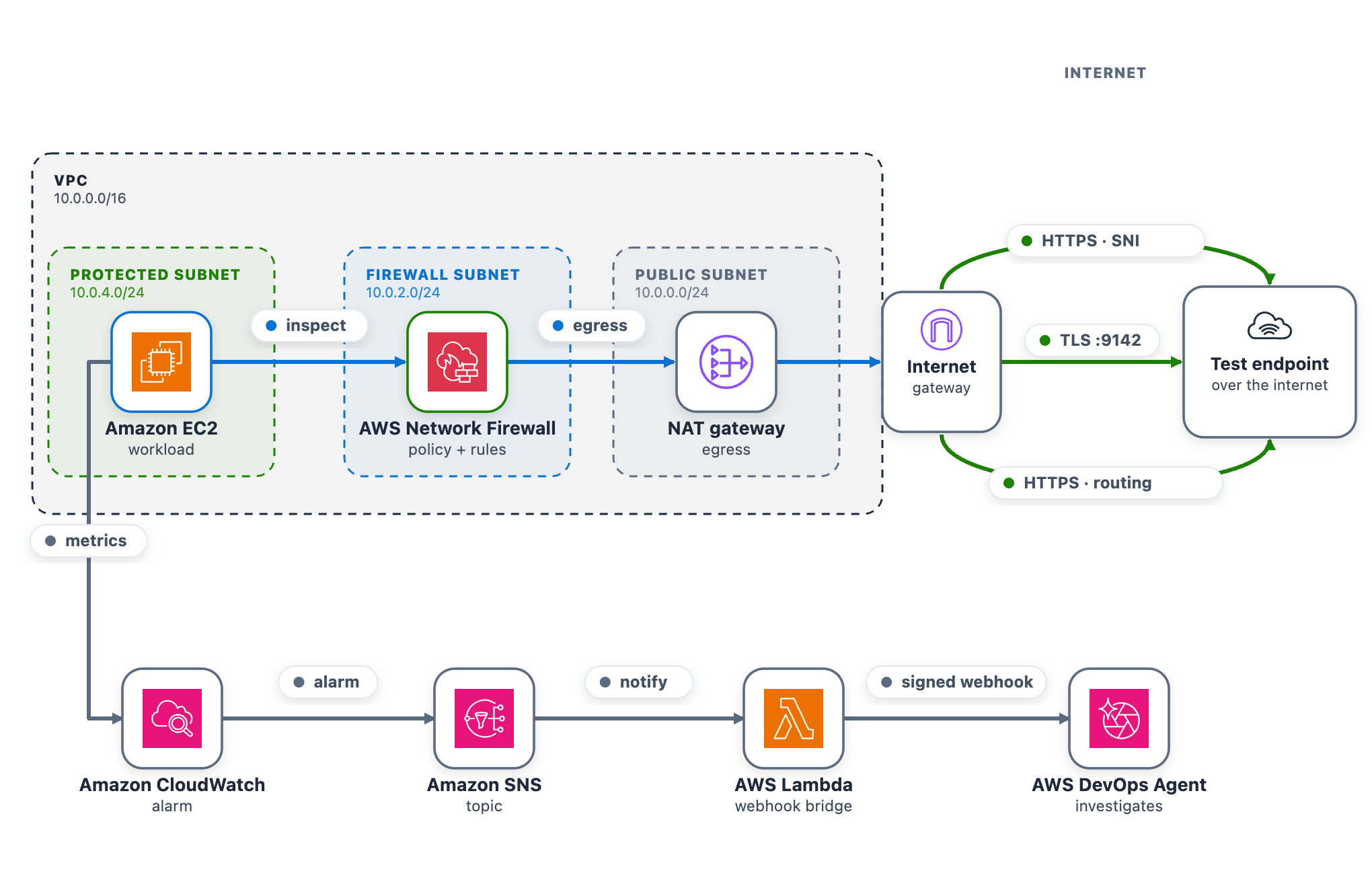
Figure 1: The sample workload
To use this with your own workload, you need a CloudWatch alarm that detects the connectivity problem and the webhook pipeline (SNS topic and Lambda function) that delivers it to DevOps Agent. The agent reads your firewall configuration, logs, and CloudTrail through AWS APIs, so no additional instrumentation is needed on the firewall side.
Prerequisites
To follow along with this post, you need:
- An AWS account with permissions to deploy Amazon VPC, Network Firewall, Amazon Elastic Compute Cloud (Amazon EC2), CloudWatch, Amazon SNS, Lambda, Amazon CloudFront, and AWS Identity and Access Management (IAM) resources
- Access to AWS DevOps Agent, with permission to configure its webhook
- Node.js 18 or later and npm installed
- AWS Command Line Interface (AWS CLI) 2.x configured with credentials
- AWS CDK 2.x is required. You can use it through the project’s npx dependency, or install it globally:
npm install -g aws-cdk
Deploy the sample workload
Clone the project and deploy it into us-east-1 with one command (set awsRegion to use another AWS Region).
The script checks prerequisites, installs dependencies, compiles and tests, and bootstraps the CDK if needed. It then deploys all the stacks from a clean baseline and prints the outputs, including the status-page URL and sign-in details.
- Open the status-page link (an
https://<random-id>.cloudfront.netaddress). - Sign in using the username and password provided from the CDK output and confirm all three cards show the green Healthy status.
- Keep the page open while you run the scenarios.
Connect AWS DevOps Agent
To connect AWS DevOps Agent to the alarm pipeline
- In the AWS DevOps Agent console, open the
nf-devops-agent-spaceAgent Space created by the CDK deployment. - Configure the DevOps Agent webhook and download the CSV file with the webhook URL and signing secret.
- On the status page, choose Configure webhook, paste the URL and signing secret, and save. The page writes them to the
nf-devops-agent-webhook-credentialsAWS Secrets Manager secret, so there is no AWS CLI or console step. Until you set it, the bridge Lambda function sees a placeholder and skips delivery. - Verify the path before you run a scenario. In the Lambda console, open
nf-devops-agent-webhookand use the Test tab with this event. - A
200response confirms the path, and a test investigation appears in the DevOps Agent Operator Web App view.
How the alarm pipeline works
Every scenario reaches DevOps Agent the same way. A CloudWatch alarm moves to ALARM and notifies the SNS topic. Amazon SNS invokes a Lambda function. The function reads the webhook URL and signing secret from Secrets Manager, signs an alarm payload, and POSTs it to the DevOps Agent webhook (as shown in Figure 1). Amazon SNS also provides delivery retries, fan-out to other subscribers, and cross-account publishing.
- Prebuilt Network Firewall metric (Scenario 1) –
Alarm-1watches theDroppedPacketsmetric, summed across the stateful streams, and triggers when drops rise above a baseline threshold. This requires no workload or custom metric and works on an already-deployed firewall. However, it only tells you that the firewall is dropping packets, not which rule is responsible. - Application health metric (Scenarios 2 and 3) –
Alarm-2andAlarm-3watch a custom metric from a connectivity check. Use this for an alarm tied to user-facing impact or to tell one traffic path from another, which requires running a component that emits the metric.
| Alarm | Source | Triggers when |
| Alarm-1 | Native AWS/NetworkFirewall DroppedPackets |
The firewall’s dropped-packet count rises above the baseline |
| Alarm-2 | Custom application health metric | The port 9142 (TCP) connectivity check to the test endpoint is being dropped |
| Alarm-3 | Custom application health metric | The cross Availability Zone connectivity check is being dropped |
Run the scenarios
Work through each of the scenarios one at a time, following the same cycle. Interrupt network connectivity, watch the alarm trigger, let DevOps Agent investigate, apply the recommended fix, and confirm recovery before moving on.
The status-page cards follow the live CloudWatch alarm state. A card shows a green dot and the word Healthy when its alarm is clear, and a red dot and the word DROPPED when its alarm triggers. In the DROPPED state the card also adds a Condition: line describing what’s being dropped, which isn’t shown when the card is healthy. Network Firewall applies changes to new flows, so a change shows within a minute or two. Recovery comes from the mitigation DevOps Agent recommends, which you review and apply.
Scenario 1. Domain deny list blocking a legitimate endpoint
At baseline, the rg-domain Suricata domain rule group denies only an unused placeholder, so the test endpoint stays reachable. The rule group inspects the TLS Server Name Indication (SNI) on each outbound connection and drops any that matches a denied domain. The exact rule syntax and console steps follow.
To add the domain deny rule
- Go to the Amazon VPC console.
- In the navigation pane, under Network Firewall, choose Network Firewall rule groups.
- Choose the
rg-domainrule group to open its details page. - In the Rules section, choose Edit.
- The rules box already contains two baseline placeholder rules (they match
blocked.placeholder.invalid, so nothing real is denied). Leave those in place. Find the<app-endpoint-dns>value for Scenario 1 in the deployment script output (a Nework Load Balancer (NLB) DNS name such asNfTest-AppNl-a1b2C3dEf4G5-1234abcd5678efgh.elb.us-east-1.amazonaws.com). On a new line below the existing rules, add a drop rule that matches that DNS name on the TLS SNI, then choose Save. - After saving, the rules box holds all three lines. The two placeholders remain, plus the new drop rule for the endpoint DNS name (note the distinct
sid 2000002).
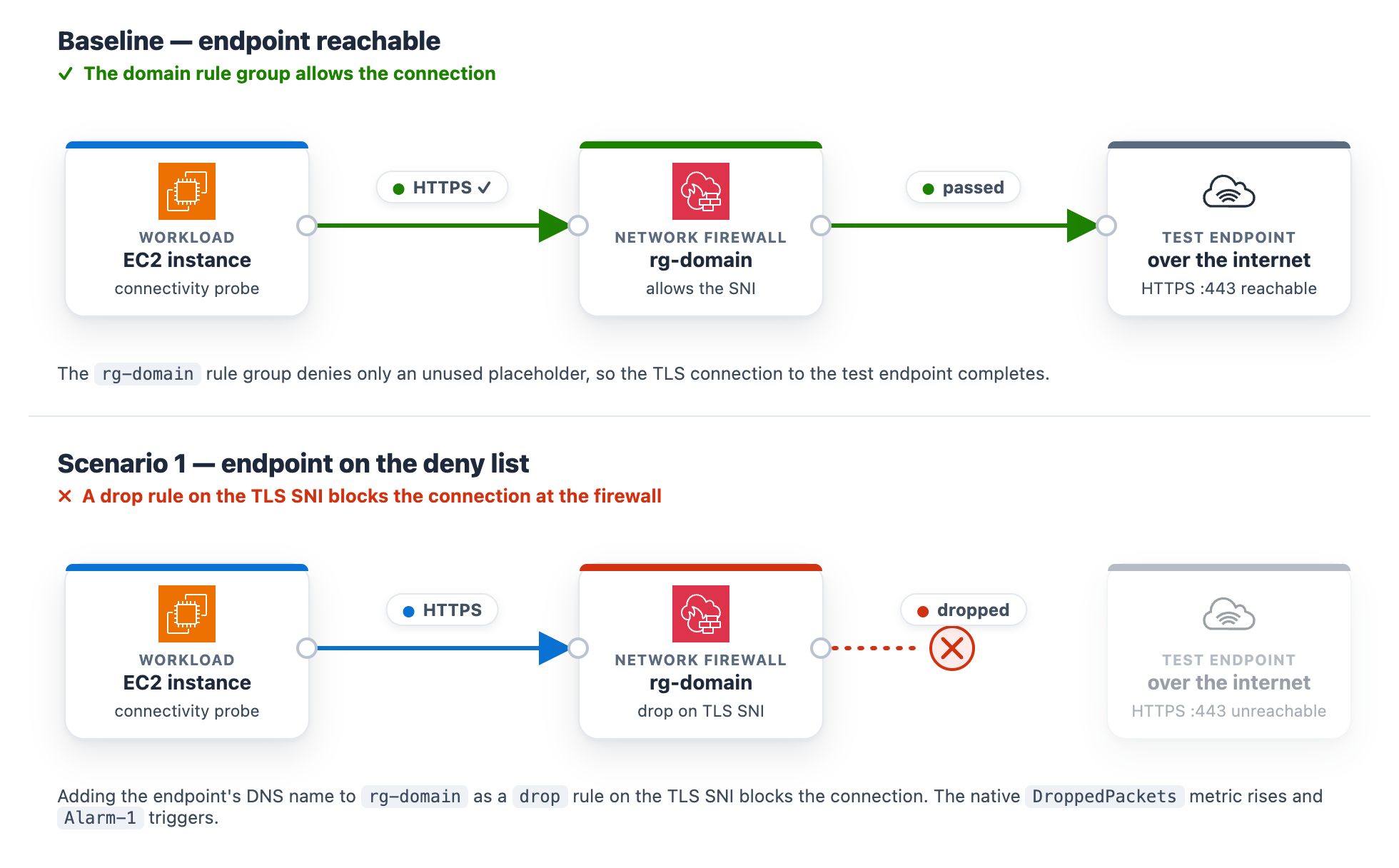
Figure 2: Scenario 1 – Firewall rule change blocking the connection
What happens. The workload’s HTTPS check to the test endpoint times out, the “AWS/NetworkFirewall DroppedPackets metric climbs above baseline, and Alarm-1 moves to ALARM. The Scenario 1 card reads DROPPED (with the condition Firewall dropping the monitored domain on its allow/deny rules), while the Scenario 2 and Scenario 3 cards stay Healthy (Figure 3). On the topology, the alarm pipeline from CloudWatch through Amazon SNS and Lambda to DevOps Agent and the workload-to-firewall inspect lines both turn amber, which the legend defines as collateral / alarm active, because the packets are now dropped at the firewall. To demonstrate the resulting failure, the HTTPS · SNI line from the internet gateway to the test endpoint is shown in red, which the legend defines as dropped (root cause).
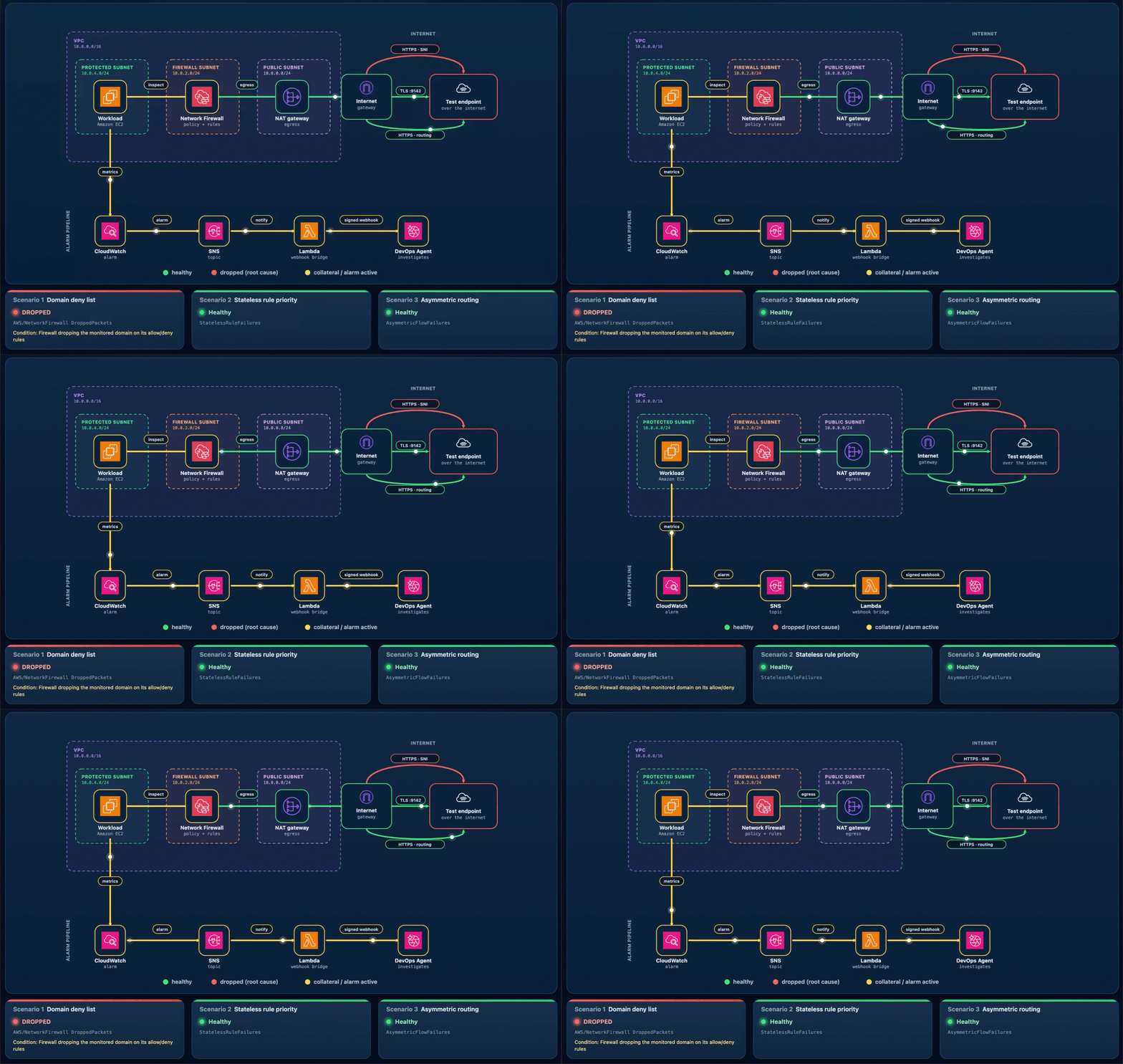
Figure 3: Scenario 1 active – Traffic blocked at the firewall
Let DevOps Agent investigate. The agent runs several lines of investigation in parallel and correlates them:
- Reads the
DroppedPacketsmetric and correlates the spike with a simultaneous drop in passed packets, confirming the firewall is actively blocking traffic. - Reads the
ALERTlog and finds the workload’s TLS connections to the test endpoint blocked by the S1 domain denylist rule. - Compares the current state against a baseline window, where the same endpoint was reachable with no alerts, which shows the block is new.
- Searches CloudTrail and surfaces the
UpdateRuleGroupcall that added the deny rule, identifying the user, role, and timestamp approximately one minute before the drops began. - Reports the root cause as that manual rule-group change. Recommends removing the deny entry or adding an allow exception and enabling
FirewallPolicyChangeProtectionto prevent unauthorized changes. - Presents this as a plan you review and apply, not an automatic change.
In the DevOps Agent Operator Web App view, the agent first restates the Alarm-1 trigger and confirms the firewall is dropping packets above the threshold (Figure 4).
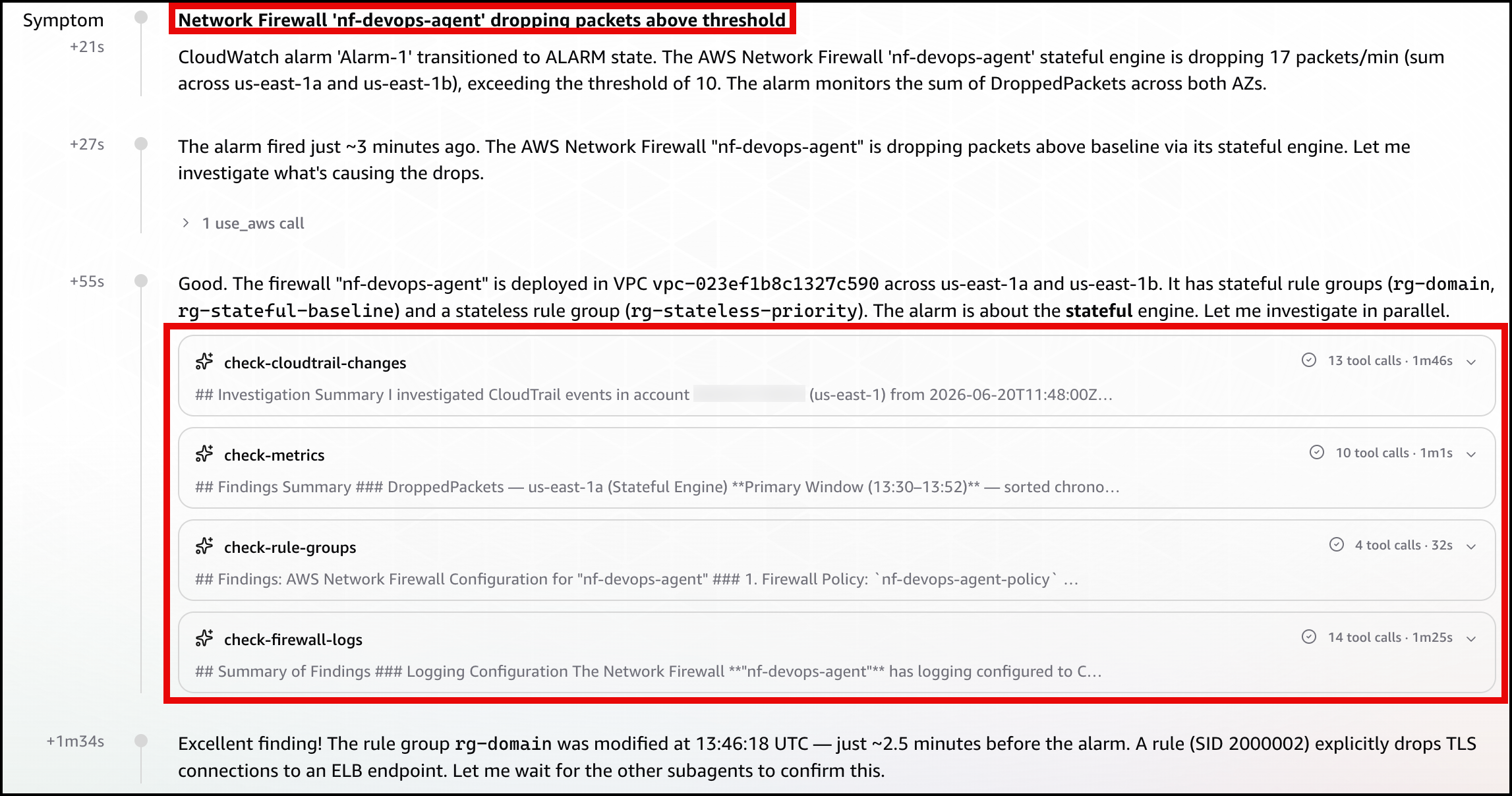
Figure 4: Scenario 1 – The symptom
Next, the agent identifies the root cause: a manual update to the rg-domain rule group that added a domain deny rule (SID 2000002) shortly before the alarm fired, blocking TLS connections to the ELB endpoint (Figure 5).
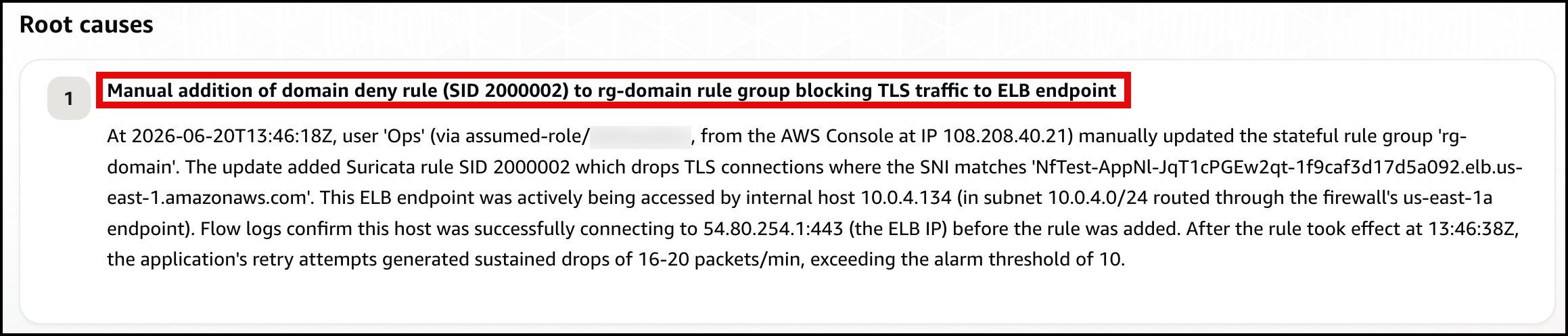
Figure 5: Scenario 1 – The root cause
Finally, the agent presents a mitigation plan, recommending you remove the problematic deny rule (SID 2000002) to restore connectivity (Figure 6).
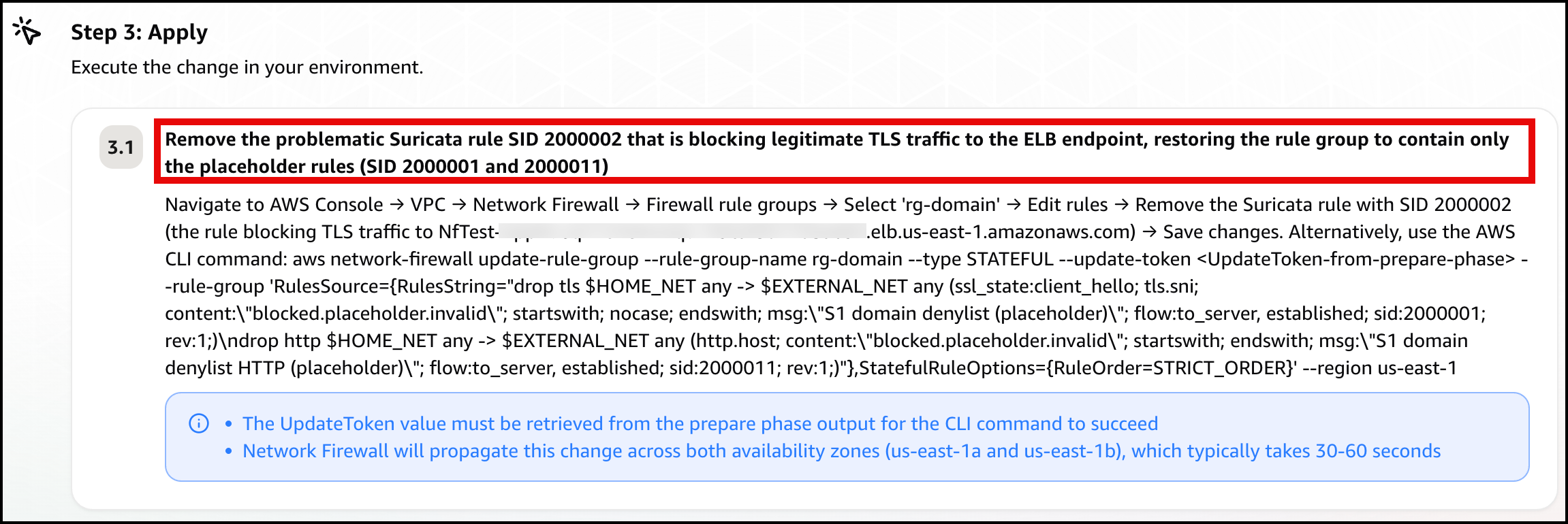
Figure 6: Scenario 1 – The mitigation plan
Note: In a real-world environment, this type of rule typically exists for a reason. Before removing it, verify whether it was intentional but scoped too broadly. If so, refine the rule to block only unauthorized endpoints rather than removing it entirely.
Confirm recovery. Apply the change the agent recommends. After the deny entry is gone, DroppedPackets falls back to baseline, Alarm-1 clears, and the card returns to green. Move on to Scenario 2.
Scenario 2. Stateless rule priority misconfiguration
At baseline, the rg-stateless-priority stateless rule group keeps the allow rule at priority 100 and the drop rule at 200 for the test class, TCP destination port 9142. The workload opens a TCP connection to the test endpoint on this port. Lower priority numbers evaluate first, so the allow rule wins. This scenario uses port 9142 instead of 443 to demonstrate a stateless rule, which matches on the packet’s 5-tuple (protocol, ports, addresses) rather than application content.
Introduce the change. Invert the two rule priorities so the drop rule evaluates before the allow rule. This is the kind of change a rushed rule edit can introduce.
To invert the stateless rule priorities
- Go to the Amazon VPC console.
- In the navigation pane, under Network Firewall, choose Network Firewall rule groups.
- Choose the
rg-stateless-priorityrule group to open its details page. - In the Rules section, choose Edit.
- Raise the (Action: Pass) rule’s priority number so it sits after the (Action: Drop) rule, then choose Save. For example, change the (Action: Pass) rule from
100to300(any number higher than the drop rule’s 200 works). You only need to move one rule, and using300avoids a clash with the drop rule that already sits at200. Network Firewall evaluates the lowest priority number first, so the (Action: Drop) rule at200now wins for this traffic class, ahead of the (Action: Pass) rule at300.
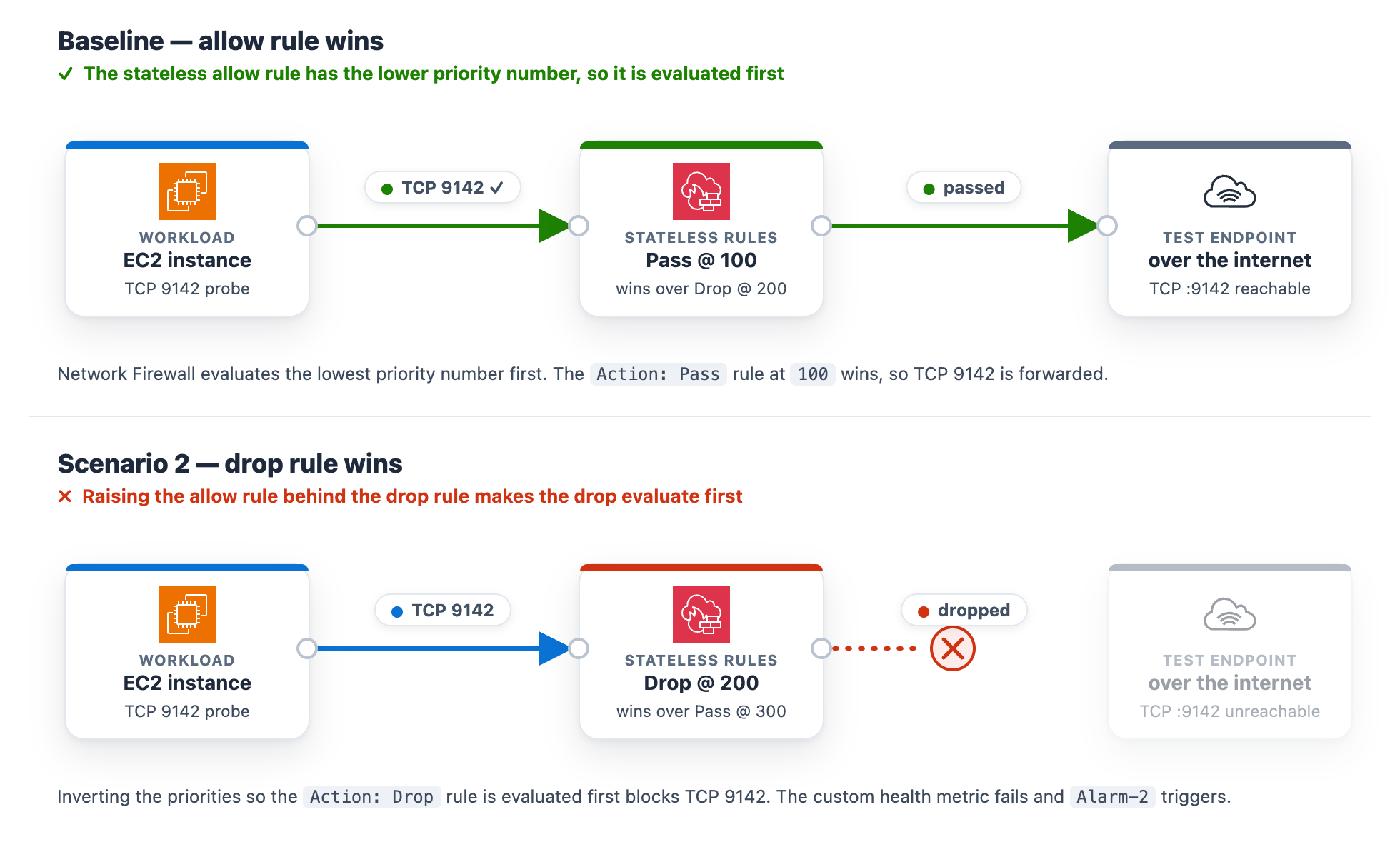
Figure 7: Scenario 2 – Rule priority change blocking the traffic class
What happens. The drop rule now wins, the TCP connection to the test endpoint on port 9142 times out, the StatelessRuleFailures metric climbs above baseline, and Alarm-2 moves to ALARM. The Scenario 2 card reads DROPPED (with the condition Stateless rules dropping the monitored traffic class), while the Scenario 1 and Scenario 3 cards stay Healthy (Figure 8). On the topology, the alarm pipeline from CloudWatch through Amazon SNS and Lambda to DevOps Agent and the workload-to-firewall inspect lines both turn amber, which the legend defines as collateral / alarm active, because the packets are now dropped at the firewall. To demonstrate the resulting failure, the TLS :9142 line from the internet gateway to the test endpoint is shown in red, which the legend defines as dropped (root cause).
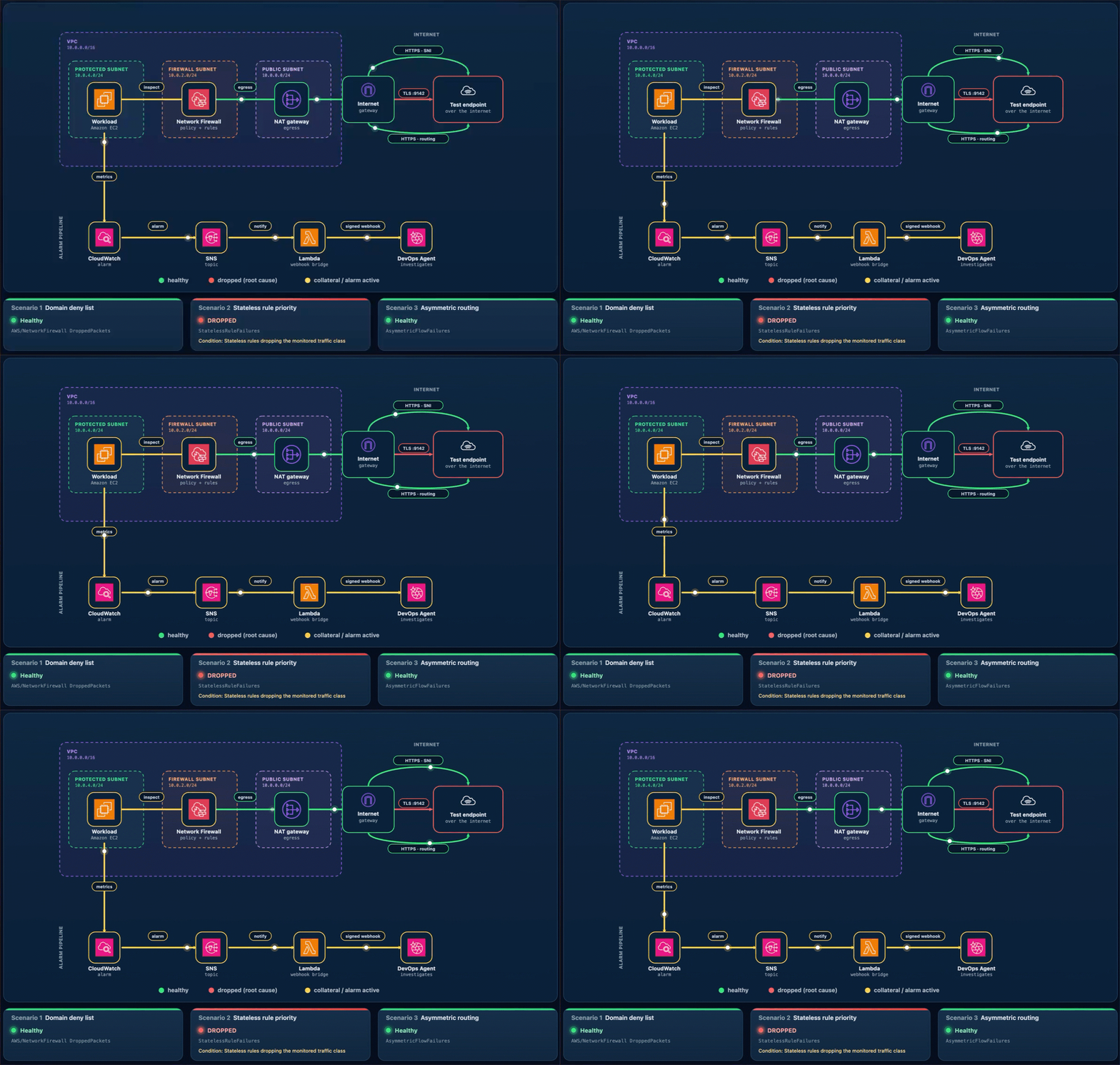
Figure 8: Scenario 2 active
Let DevOps Agent investigate. A stateless drop happens before traffic reaches the stateful inspection engine, so it produces no ALERT log entries. The agent turns to configuration and flow logs instead:
- Reads the stateless rule group state and finds the drop rule at the lower priority number, ahead of the pass rule, so the drop evaluates first.
- Reads the flow logs and sees passed packets drop to zero within a minute of the change.
- Searches CloudTrail and surfaces the
UpdateRuleGroupcall that inverted the priorities, identifying the user, role, and timestamp about a minute before the alarm. - Reports the root cause as that priority inversion. Recommends removing the redundant drop rule and managing the rule group through infrastructure-as-code (IaC) to prevent manual misconfigurations.
- Presents this as a plan you review and apply, not an automatic change.
In the DevOps Agent Operator Web App view, the agent first restates the Alarm-2 trigger and confirms that a workload connectivity health check is failing because the firewall’s stateless rules are dropping egress (Figure 9).
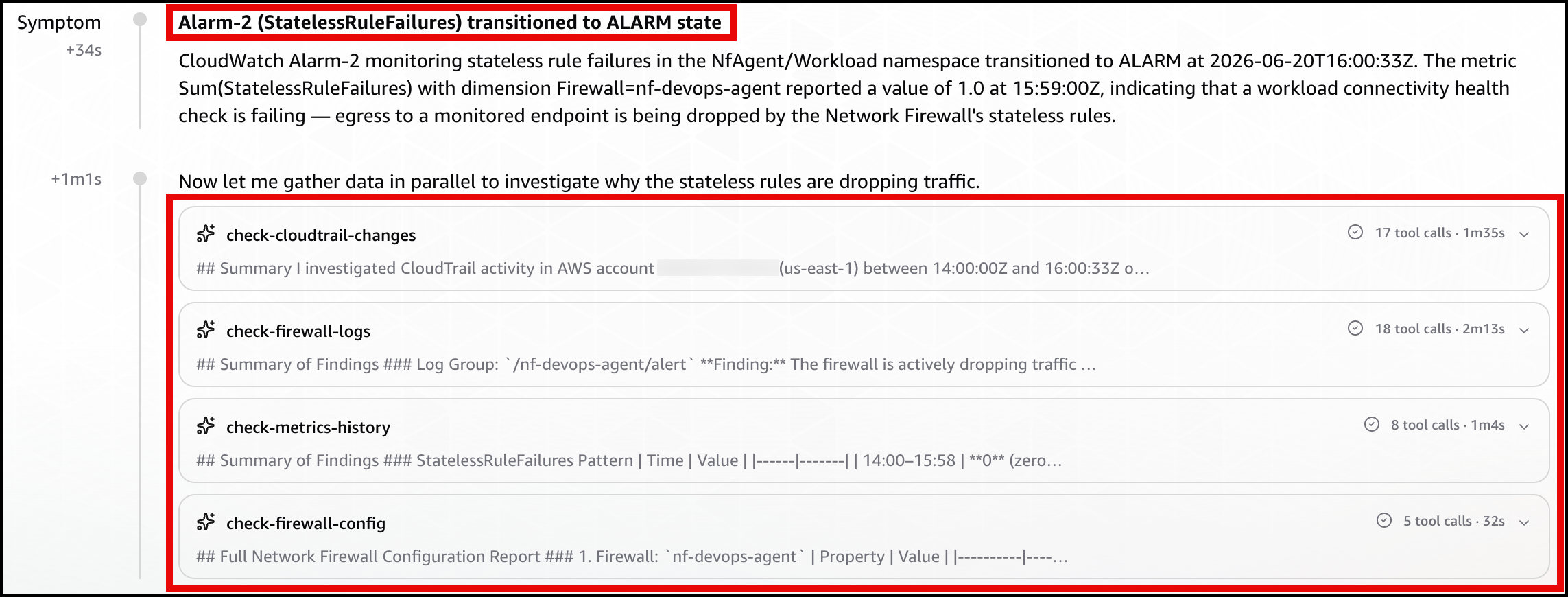
Figure 9: Scenario 2 – The symptom
Next, the agent identifies the root cause, using the rule-group state and CloudTrail to pinpoint the conflicting DROP/PASS rules, where the new DROP rule’s lower priority number makes it match first (Figure 10).
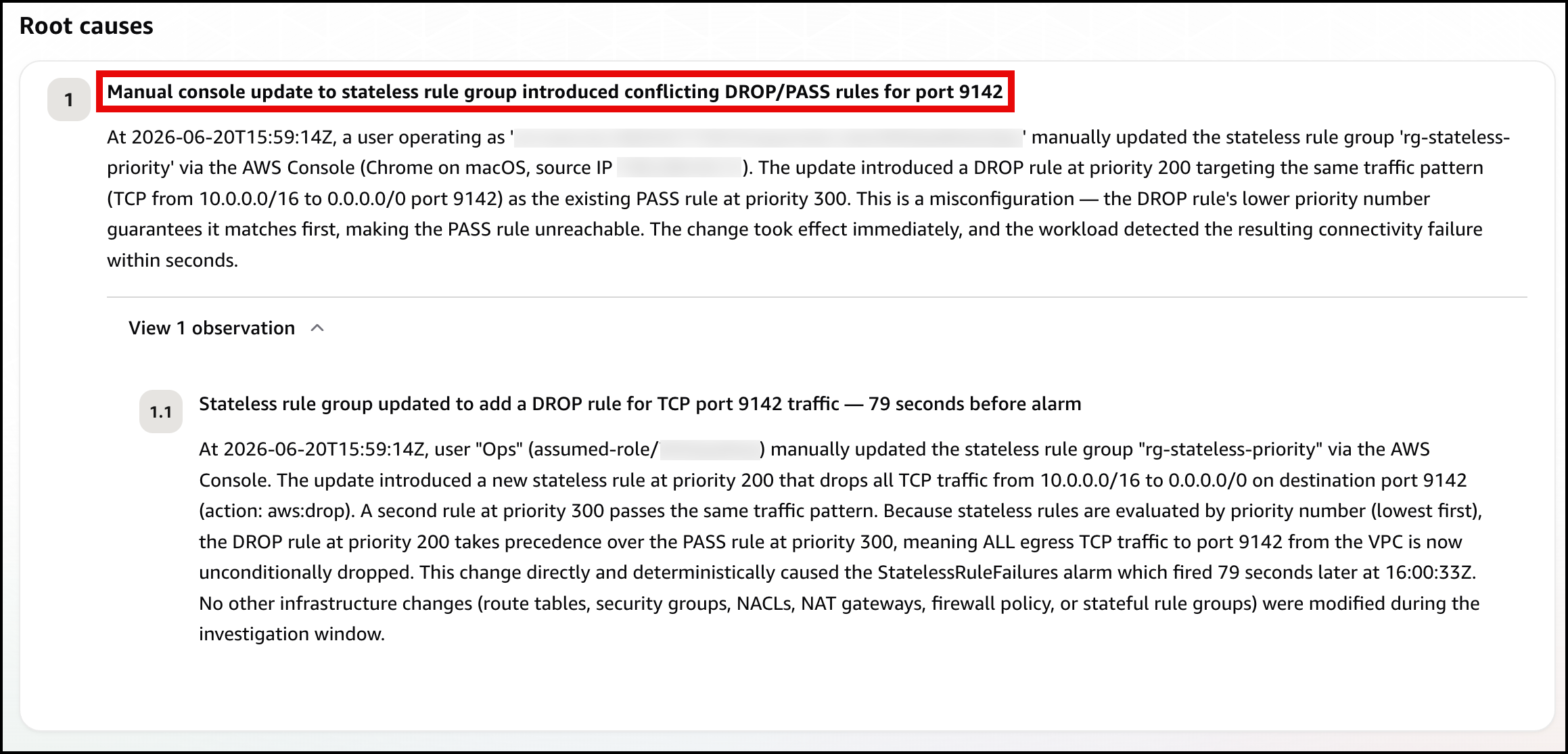
Figure 10: Scenario 2 – The root cause
Finally, the agent presents a mitigation plan, recommending you remove the conflicting DROP rule at priority 200 to restore traffic flow (Figure 11).
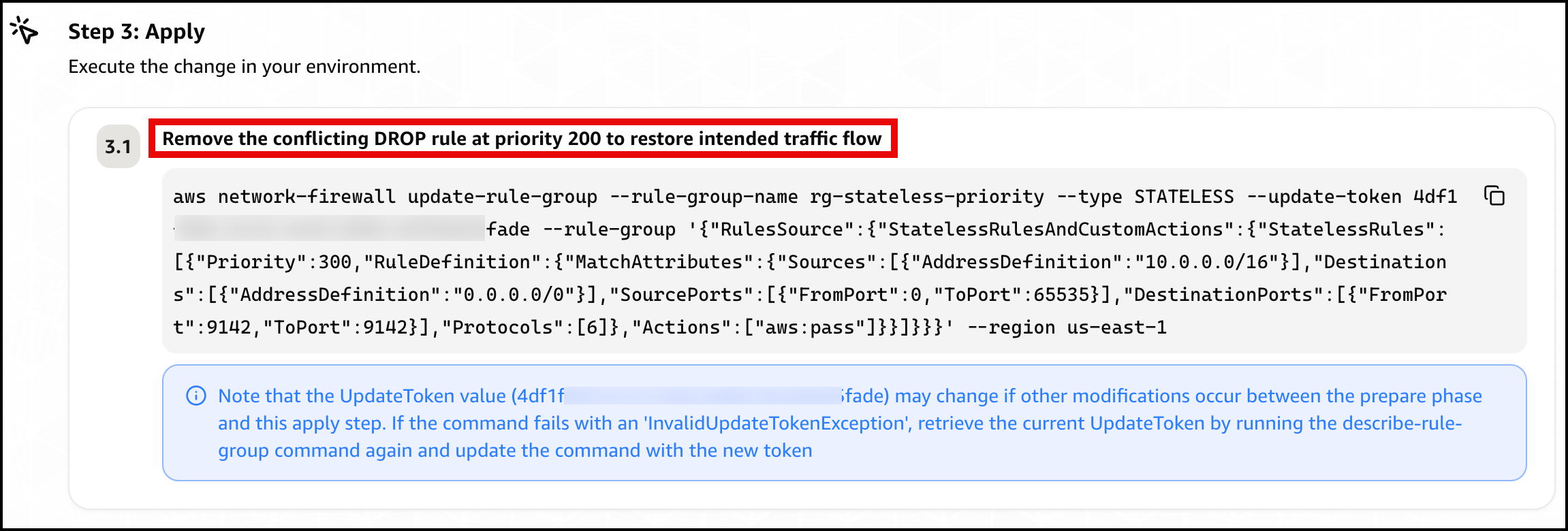
Figure 11: Scenario 2 – The mitigation plan
Confirm recovery. Apply the change the agent recommends. After the allow rule is ahead of the drop rule again, Alarm-2 clears and the card returns to green. Move on to Scenario 3.
Scenario 3. Asymmetric cross Availability Zone routing drop
At baseline, the protected subnet in each Availability Zone routes its egress through the firewall endpoint in that same Availability Zone , and the matching return route uses that same endpoint. One endpoint sees both directions of the flow, so the stateful engine completes the handshake. The workload runs in the protected subnet in us-east-1a (CIDR 10.0.4.0/24), so at baseline its egress and its return both use the us-east-1a firewall endpoint.
Introduce the change. Make the flow asymmetric by sending egress out one Availability Zone endpoint while the return comes back through the other. This takes two route edits, and both are required. With only the first edit the flow can still complete, so the alarm will not trigger until both are saved. It makes no firewall-policy change, mirroring a real multi-Availability-Zone routing mistake.
To create asymmetric cross Availability Zone routing
- Go to the Amazon VPC console and choose Route tables in the navigation pane.
- Flip the egress. Select the
NfNetworkStack/SampleVpc/protectedSubnet1route table (theus-east-1aprotected subnet, where the workload runs). On the Routes tab, choose Edit routes. Its0.0.0.0/0route currently targets theus-east-1afirewall endpoint. For the target, choose Gateway Load Balancer Endpoint and select theus-east-1bfirewall endpoint, then choose Save changes. - Move the return. Select the
NfNetworkStack/SampleVpc/publicSubnet2route table (theus-east-1bpublic subnet, where egress now exits). Choose Edit routes, then Add route. For the destination enter the workload CIDR10.0.4.0/24. For the target, choose Gateway Load Balancer Endpoint and select theus-east-1afirewall endpoint. Choose Save changes.
After both edits, a flow’s egress leaves through the us-east-1b endpoint while its return is directed to the us-east-1a endpoint. Neither endpoint sees the whole flow.
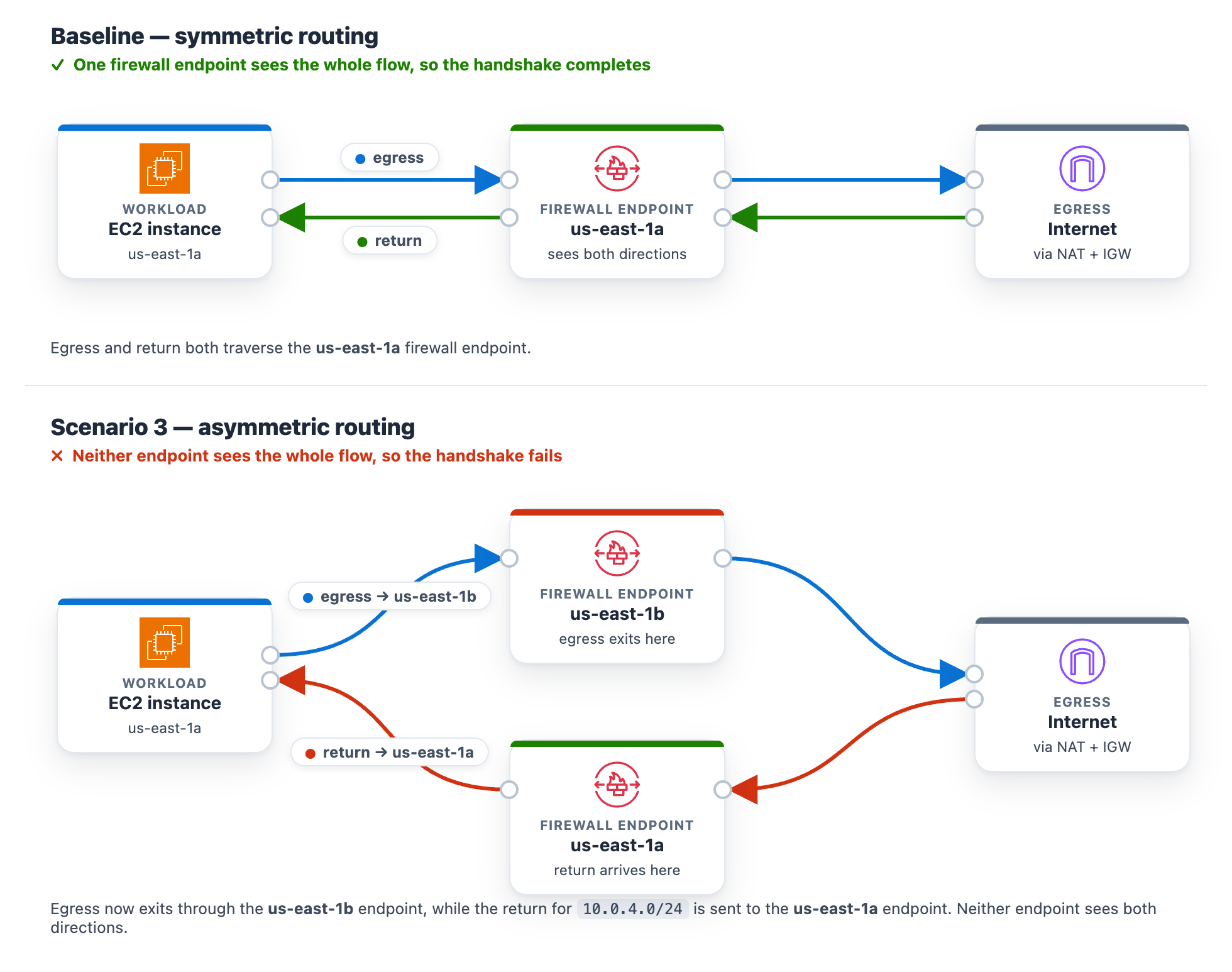
Figure 12: Scenario 3 routing change breaking the flow’s symmetry
What happens. A new connection leaves through one endpoint. Its return arrives at the other endpoint, which never saw the connection open, so the handshake fails. Unlike Scenarios 1 and 2, this affects the whole subnet, so all egress stops and Alarm-2 and Alarm-3 both move to ALARM. The AWS/NetworkFirewall DroppedPackets alarm (Alarm-1) stays quiet because no endpoint is making a drop decision. The flow is lost to asymmetric routing rather than counted as a firewall drop. This is why monitoring application connectivity matters. A routing fault is invisible to the firewall’s own drop counter. On the status page, the Scenario 2 card reads DROPPED (with the condition “Stateless rules dropping the monitored traffic class”) and the Scenario 3 card reads DROPPED (with the condition Return traffic dropped by asymmetric cross-Availability-Zone routing), while the Scenario 1 card stays Healthy (Figure 13). On the topology, the alarm pipeline from CloudWatch through Amazon SNS and Lambda to DevOps Agent and the workload-to-firewall inspect lines both turn amber, which the legend defines as collateral / alarm active, while the egress path from the firewall through the NAT gateway and the TLS :9142 and HTTPS · routing lines to the test endpoint turn red, which the legend defines as dropped (root cause).
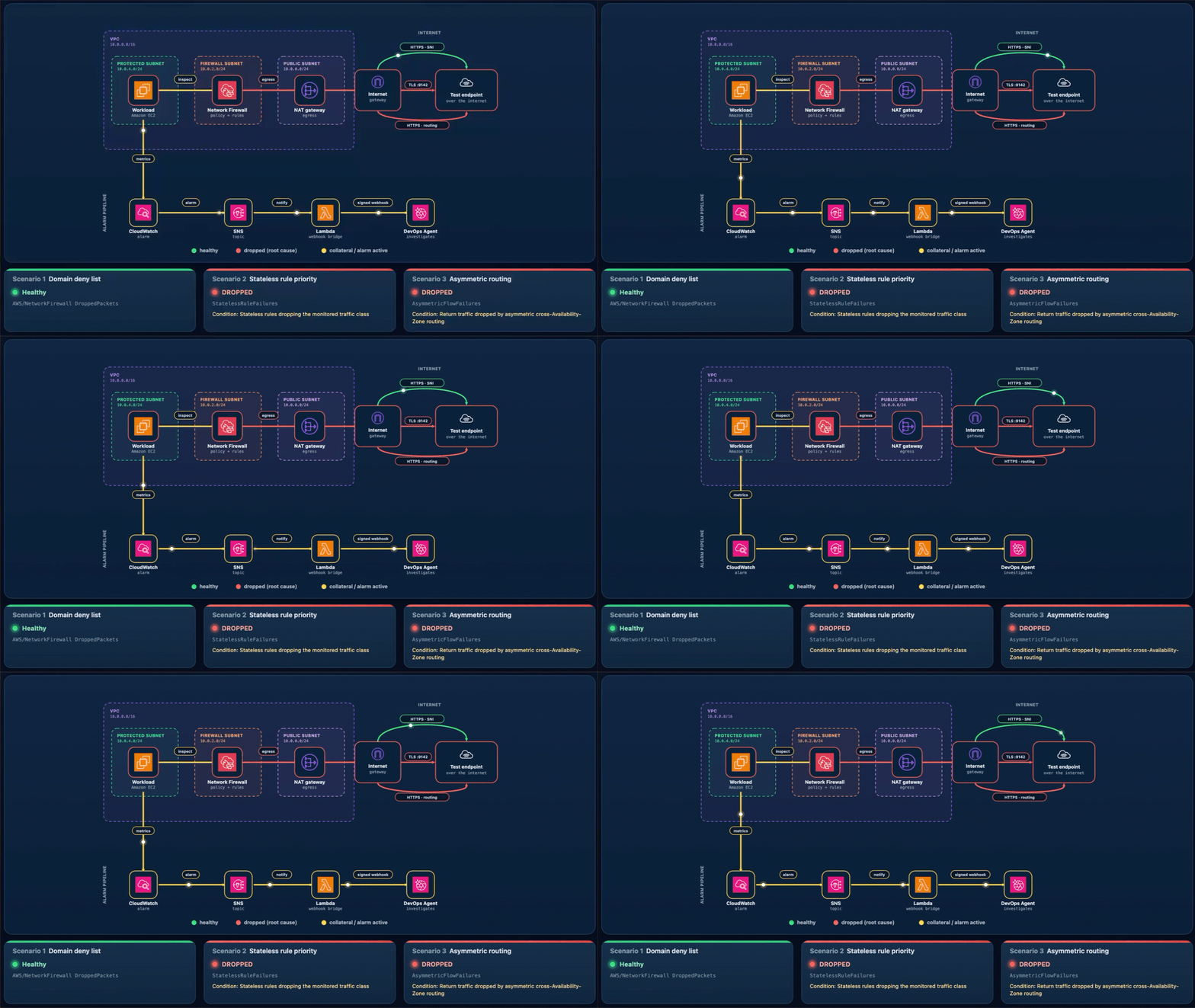
Figure 13: Scenario 3 – The status page during a path-wide outage
Let DevOps Agent investigate. Both Alarm-2 and Alarm-3 fire in the same datapoint. DevOps Agent recognizes them as linked and merges them into a single investigation:
- Reads the flow logs and sees bidirectional TLS connections stop abruptly, with only one-way traffic remaining and no flows reaching the established state.
- Reads the firewall metrics and sees received and passed packets shift from one Availability Zone to the other at the moment of the change.
- Calls
DescribeRouteTablesand finds the egress route pointing at one Availability Zone firewall endpoint while the return route points at the other. - Searches CloudTrail and surfaces the
ReplaceRouteandCreateRoutecalls by the same user, about a minute before both alarms fired. - Reports the root cause as that asymmetric routing change. Recommends restoring symmetric same-Availability-Zone routing so egress and return traverse the same endpoint.
- Presents this as a plan you review and apply, not an automatic change.
A mitigation plan is a recommendation you review, not an automatic change, and the right fix depends on the intended design. Restoring symmetric routing can mean sending the workload subnet’s egress back through its own-Availability-Zone firewall endpoint (this sample’s architecture) or, in a design that doesn’t inspect this path, back through a NAT gateway. The agent infers a plausible target from what it can observe, so review the specific route it proposes against your intended topology before you apply it. (Connecting your pipeline or infrastructure-as-code, covered in the next section, lets the agent recommend the target that matches your design.)
In the DevOps Agent Operator Web App view, the agent restates the Alarm-3 (AsymmetricFlowFailures) trigger and confirms the workload’s egress to a monitored endpoint is being blocked by the Network Firewall (Figure 14).
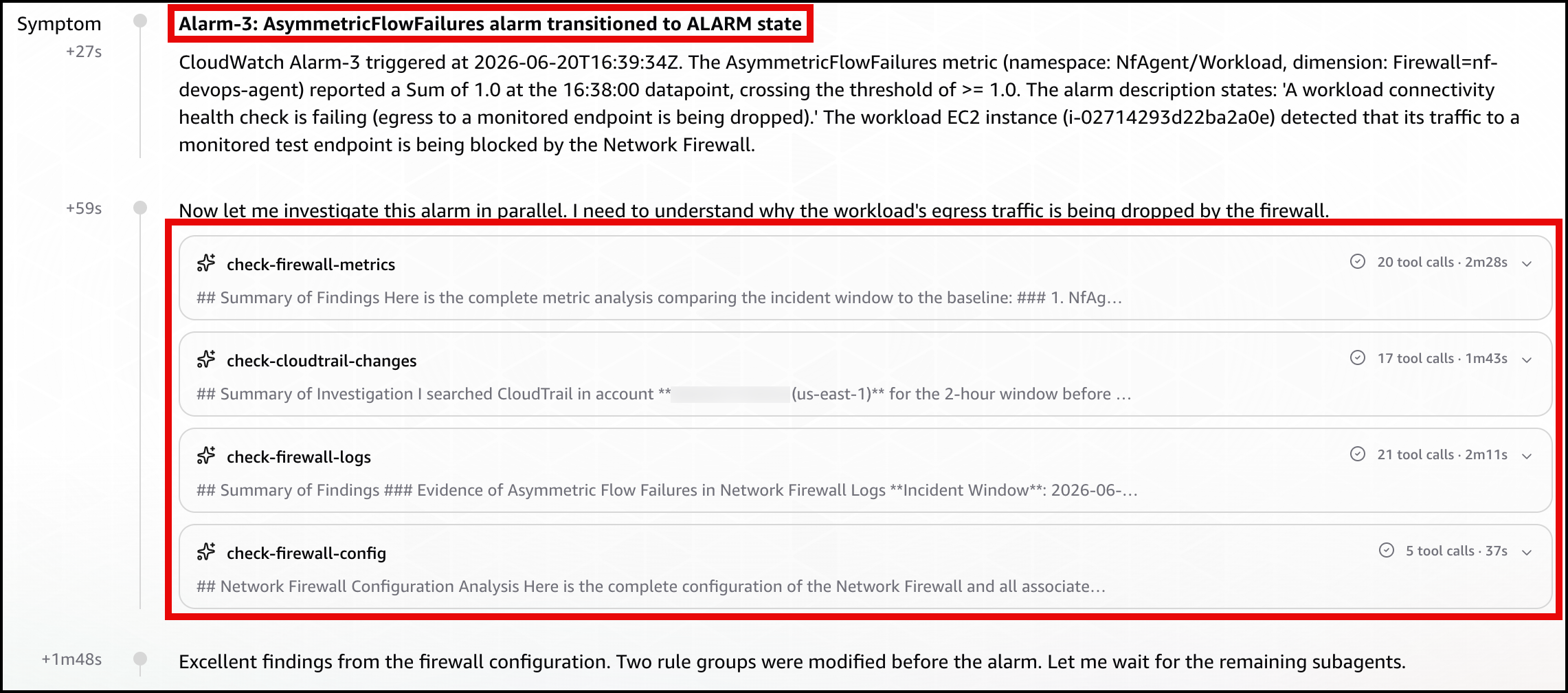
Figure 14: Scenario 3 – The symptom
Next, the agent identifies the root cause: manual route table changes that created cross-AZ asymmetric routing through the network firewall, breaking its symmetric routing requirement (Figure 15)
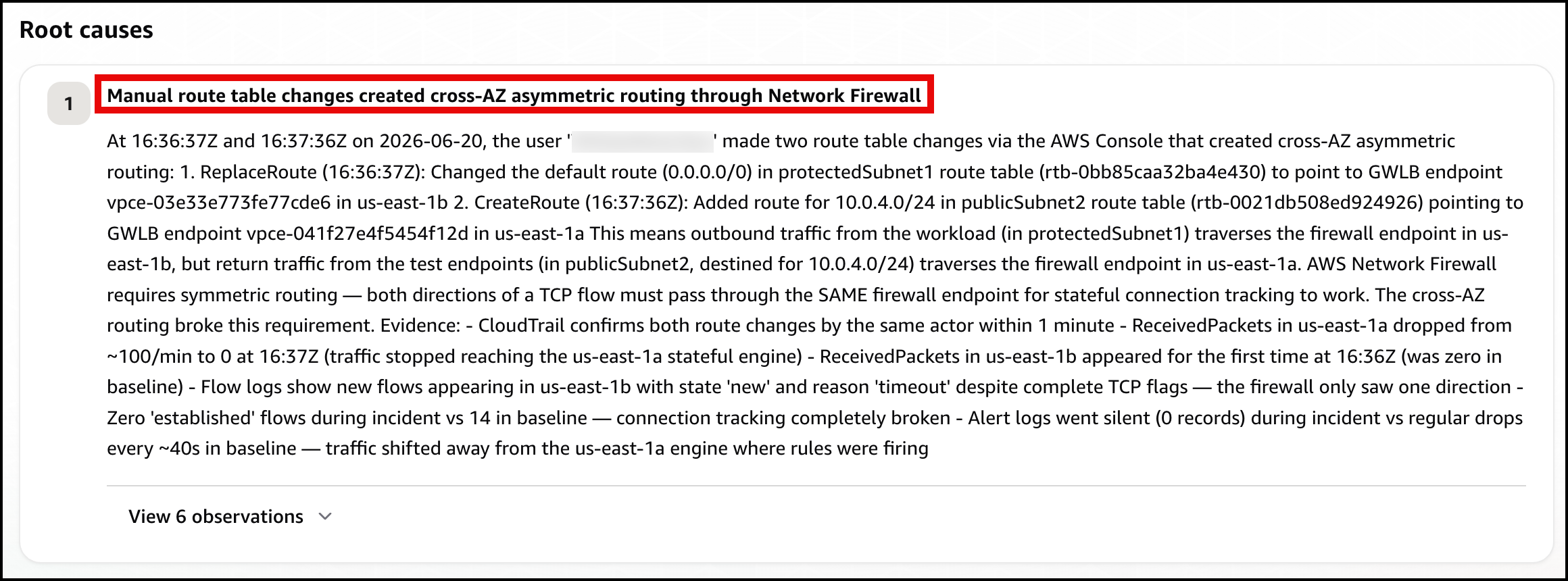
Figure 15: Scenario 3 – The root cause
Finally, the agent presents a mitigation plan, recommending you restore symmetric routing by pointing protectedSubnet1‘s default route back to the same Availability Zone firewall endpoint, so one endpoint sees both directions of the flow again (Figure 16).
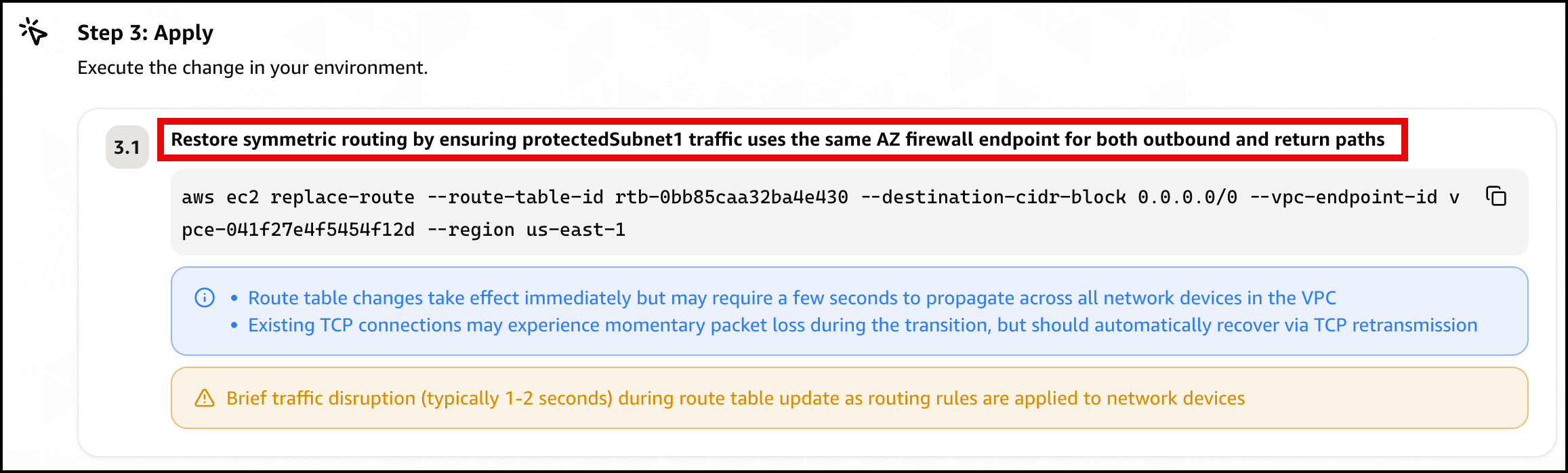
Figure 16: Scenario 3 – The mitigation plan
Confirm recovery. Apply the change the agent recommends, after checking the route target matches your intended design. After the workload subnet’s egress and return use the same Availability Zone firewall endpoint again, the control probe recovers, the alarms clear, and every card returns to green.
Further considerations
In production a single change can trigger several alarms at the same time, as Scenario 3 shows. DevOps Agent links related investigations and works them as one, so you review a single root cause. You can validate the linked findings or unlink an alarm to investigate it independently. If you would rather collapse alarms before they reach the agent, you can add correlation logic in the bridge Lambda function, buffering and grouping by firewall. You can also add email, Amazon Simple Queue Service (Amazon SQS), or HTTP subscribers to the SNS topic, or add the webhook Lambda function to a topic you already run. DevOps Agent produces a mitigation plan but does not change your environment on its own.
You can also give the agent more to work with. DevOps Agent connects to source repositories and CI/CD pipelines, integrating with GitHub (including GitHub Enterprise Server and GitLab Self-Managed through a private connection). It can associate AWS resources with deployments of AWS CloudFormation, AWS CDK, Amazon Elastic Container Registry (Amazon ECR) images, and Terraform. With deployed configuration and recent deployment events in view, the agent correlates the disruption against the change that introduced it and recommends a fix matching your intended design. For this sample, that means recommending the workload subnet’s own Availability Zone firewall endpoint rather than a generic symmetric path.
DevOps Agent also supports proactive incident prevention. It analyzes patterns across past investigations and delivers recommendations to prevent similar issues from recurring, including governance recommendations that strengthen deployment processes and pipeline controls. For Network Firewall rule changes, this means the agent can recommend guardrails for your CI/CD pipeline based on the classes of misconfigurations it has already resolved. You can access these recommendations through the Improvements page in the DevOps Agent Operator Web App.
Clean up
Clean up the environment with one command.
It reverts any active scenario, runs cdk destroy for all stacks, and sweeps for stragglers by the Project = nf-devops-agent tag. The main cost drivers are the two Network Firewall endpoints, the NAT gateways (one in the main VPC for each Availability Zone, one in the test-endpoint VPC), and the test endpoint’s load balancers. Each of these bills at an hourly rate for as long as it’s provisioned, whether or not traffic is flowing, so a stack left running continues to accrue charges around the clock even while idle. Running the scenarios and tearing the stack down the same day limits the cost to a few active hours rather than days of idle hourly charges.
Conclusion
In this post, we showed you how AWS DevOps Agent accelerates troubleshooting for three common network firewall connectivity issues. The first was a domain deny list. The second was a stateless priority inversion. The third was an asymmetric cross-AZ routing drop. For each one, DevOps Agent investigated the drop and returned a root cause with a mitigation plan you approve before applying. The first scenario triggered on a prebuilt Network Firewall metric, and the other two on application health metrics. That shows both ways to alarm on a firewall problem through one pipeline.
The pattern isn’t specific to Network Firewall. The same flow fits any service that emits CloudWatch metrics and logs, such as AWS WAF, security groups, and network ACLs. Clone the sample repository to explore the solution, then apply what you learn to your own firewall, application, and alarms. For more details, see the AWS Network Firewall Developer Guide and the AWS Network Firewall pricing page. Start with the Getting Started with AWS DevOps Agent guide to connect your first webhook.
KYY K1302R Portable Monitor Review An Inexpensive Travel Display
Post Syndicated from Sam Sabinash original https://www.servethehome.com/kyy-k1302r-portable-monitor-review-an-inexpensive-travel-display/
In our KYY K1302R portable monitor review, we see how well this relatively inexpensive travel display comapares to others we have tested
The post KYY K1302R Portable Monitor Review An Inexpensive Travel Display appeared first on ServeTheHome.
BGP ORIGIN attribute manipulation and its impact on the Internet
Post Syndicated from Iliana Xygkou original https://blog.cloudflare.com/bgp-origin-attribute/
Border Gateway Protocol (BGP) is the de facto routing protocol of the Internet. It offers built-in mechanisms to allow entities, represented by Autonomous Systems (ASes), to express how they want to send and receive traffic on the Internet. One such mechanism is path attributes, which carry essential routing information and metadata for their associated route. The path selection algorithm processes some of these path attributes in a deterministic sequence to calculate the best path for this specific prefix.
Using our unique position on the Internet, we took an investigative look at one of the well-known mandatory attributes in BGP, the ORIGIN attribute. ORIGIN must be present in every BGP prefix announcement and should not be modified by any router after being set by the originating one. What we found through our own experiments was a dramatic ~70% of observed paths in numerous vantage points have a different ORIGIN value compared to what was set by the originating Autonomous System. This ORIGIN attribute manipulation has a significant impact on the way traffic is forwarded on the Internet, as we’ll explore in this post.
BGP ORIGIN and its operational history
The ORIGIN attribute indicates how a route was injected into BGP — not to be confused with the origin AS that indicates which AS announced a route. It has three possible values:
(0) IGP: Indicates the route is interior to the originating AS
(1) EGP: A historical value indicating that the route was learned via the old Exterior Gateway Protocol (EGP), which is obsolete and not intended to be used in the modern Internet
(2) INCOMPLETE: Indicates the route was learned via an unknown or external source
Among total observable routes from all the public BGP collectors of RIPE RIS and RouteViews, 89.8% have ORIGIN set to IGP, 3.5% to EGP, and 6.7% are INCOMPLETE. As mentioned above, EGP is meant to be deprecated entirely and INCOMPLETE carries a minority share of total routes. These figures suggest that while IGP is by far the most popular value for ORIGIN, more than 10% of routes have an EGP or INCOMPLETE value that could make a difference in routing decisions.
As a part of the BGP path selection process, a router evaluates the ORIGIN if two routes have equal Local Preference and AS_PATH length, selecting and installing the path with the lower ORIGIN value.
Aside from the path selection decision, it is worth noting that RFC4271 states the following about ORIGIN:
The ORIGIN attribute is generated by the speaker that originates the associated routing information. Its value SHOULD NOT be changed by any other speaker.
Though the guidance is to not modify the ORIGIN attribute, due to its early evaluation in the route selection process, this attribute has presented an attractive option for ASes to alter route preferences and divert traffic either through or away from their networks.
For example, in the diagram below, AS64501 announces a prefix with ORIGIN set to INCOMPLETE and propagates this announcement to both of its customers, AS64502 and AS64503. Normally, both of them should prepend their own AS in the AS_PATH and forward the announcement to their common customer AS64504, preserving the INCOMPLETE value. However, to increase the likelihood of their route being selected over competitors’, AS64503 modifies the ORIGIN to IGP. As a result, AS64504 receives two routes for the prefix with equal AS_PATH lengths, but the one from AS64503 carries the preferred IGP value. Thus, AS64504 will select the route through AS64503 to send traffic to AS64501, driving more traffic and revenue to that provider.
This simple change, to an inaccurate but more preferable ORIGIN, allows the transit provider to draw traffic and profit.
The network operators community has silently accepted the reality that transit providers have been rewriting the ORIGIN attribute to IGP in order to attract more traffic to their links. However, James Bensley at the RIPE 91 meeting was the first to spotlight the widespread adoption of this manipulation technique by major networks. A follow-up presentation by Celsa Sánchez at the LACNIC 45 meeting investigated the impact of this behavior in the LACNIC (Latin American and Caribbean) region. While a public disclosure should discourage this practice, it highlights the reality that route selection is a revenue-driven arms race. Rather than waiting for competitors to resume RFC compliance, network operators are more likely to quickly resort to rewriting the ORIGIN simply to level the playing field.
This increasingly inconsistent handling of ORIGIN across the Internet prompted the creation of a now-expired Internet-Draft that recommended its deprecation. To uncover the extent of this phenomenon and track its actors along with their intentions, we conducted our own experiments and share the results in the next section.
ORIGIN attribute manipulation analysis
In our experiment, we announced three IPv4 and three IPv6 prefixes, each with a different ORIGIN value (IGP/EGP/INCOMPLETE) from all of our peering locations using BGP Anycast. After confirming global propagation, we later withdrew the prefixes to trigger the path hunting process, revealing more paths to the test prefixes, giving us more opportunities to spot altered ORIGINs. As shown in the figure below, we used the BGPKIT toolkit to parse the Update messages from the Multi-threaded Routing Toolkit (MRT) dumps of all the public BGP collectors from RIPE RIS and RouteViews, and the local BMP data that we collect from our border routers. Note that we opted to analyze the Updates instead of the Routing Information Base (RIB) dumps, which are snapshots of the routing tables of the peer ASes, to retrieve as many as possible routes both during the announcement and the withdrawal phase.
A fundamental difficulty of BGP analysis is the lack of visibility into all ASes on the Internet for a single routing announcement. This gap is widened by the modern flattening of the Internet, driven by hyperscalers and CDNs bypassing traditional transit routes in favor of direct, local peering. Consequently, public monitors miss a significant portion of the BGP topology for a given prefix, meaning inferences about AS properties always carry inherent uncertainty.
Finding ORIGIN rewriters in two-hop AS_PATHs
First, we focused on AS_PATHs with only two ASes: “ASX AS13335”, where we call ASX a direct peer. Since we configured our routers to propagate our announcements with a specific ORIGIN, we are confident that if we observe a different ORIGIN, ASX must have changed it to its new value. The table below shows the manipulation behavior of the 352 direct peers for IPv4 where the “Advertised ORIGIN” column shows what value is being advertised for each of our three prefixes, and the right-hand side columns list the ORIGIN values observed by direct peer ASes:
We would like to point out two interesting observations. First, three ASes change the ORIGIN to EGP, and four ASes change it to INCOMPLETE, regardless of its original value, meaning that they are potentially attempting to deprioritize these routes. We reached out to one of these ASes’ network engineers and confirmed that they are rewriting the ORIGIN to EGP on routes received from peers or providers (to render them less preferred compared to customers’ routes). Second, for the non-IGP prefixes, three ASes propagate routes with both the original value and IGP (the two right-most columns above). Based on other attributes of the routes such as communities and AGGREGATOR, we infer that these ASes receive our routes at multiple peering locations and update the ORIGIN to IGP, presumably to forward traffic through a preferred point. Combining the latter ASes with the ones consistently rewriting to IGP, we discover that almost 10% of the direct peers change the ORIGIN attribute to IGP.
In testing IPv6, we expected similar results but wanted to note discrepancies involving the manipulation of the ORIGIN value by the same AS between two address families. In the following table we present the manipulation behavior of the 315 direct peers for IPv6:
Most noteworthy is that two direct peers change the ORIGIN to IGP only for IPv4 prefixes and not IPv6, implying different configurations for the two address families.
Narrowing our analysis to the Tier-1 ASes, six out of the 16 appear to manipulate the ORIGIN value to IGP, matching the results of the previous study. Note that through manual investigation we found that one Tier-1 network changes the ORIGIN value to IGP for routes learned from peers, while it preserves it for customer routes. This pattern of behavior across several Tier-1 networks reflects the drive to attract the most traffic and cancel out other ORIGIN modifiers’ advantage.
Identifying rewriters in longer AS_PATHs
Based on these initial results, we extended our methodology to process longer paths and infer the behavior of more ASes. Briefly, our algorithm works as follows:
- We seed our trusted set (T) with AS13335. T holds all the ASes that preserve the ORIGIN.
- For each AS_PATH:
- Filter out all ASes in T.
- If only one AS remains, we can attribute the ORIGIN to that AS. We record the mapping AS → ORIGIN(s).
- For each pair AS → ORIGIN(s):
- If ORIGIN(s) == original value, we add AS to T.
- Else, we add AS to M(odifiers).
- If T was updated in 3, repeat the procedure from 2.
Applied to the routes of our IPv4 and IPv6 prefixes originated with EGP and INCOMPLETE, this methodology increases our AS attribution to 606 out of 802 (75.6%) visible ASes in the AS_PATHs, out of which 64 (10.6%) are changing the ORIGIN to IGP. Motivated by the Tier-1s adopting this technique, we studied the significance of the attributed ASes using CAIDA’s AS Rank. AS Rank provides a ranking of the ASes based on their customer cone (i.e., themselves and all the ASes that can be reached through provider-customer links).
In the figure below, we show the cumulative distribution (CDF) of AS Ranks of the attributed ASes. An interesting observation is that the IGP-rewriting ASes are highly concentrated at the top of the AS hierarchy, with 20.3% of the rewriting ASes falling in the top-50 of AS Rank.
Impact of large ASes rewriting ORIGIN
In total, 26% of the top 50 ASes and 20% of the top 100 ASes are manipulating the ORIGIN attribute, highlighting that despite their overall low percentage, the ASes resetting the ORIGIN are highly central and impactful on the Internet.
The impact is further reinforced by the finding that a staggering 70% of the unique IPv4 AS_PATHs and 67% of IPv6 AS_PATHs observed in the experiment have ORIGIN reset to IGP. We also studied the changes imposed on best path selection by consolidating BGP Updates to compute the converged active routing-table state of each peer AS. We used the prefix advertisement with ORIGIN set to IGP as a control group to compare AS_PATHs observed versus our EGP and INCOMPLETE announcements. When doing so, we found in IPv4 that 110 AS_PATHs out of the total 539 (20%) traversed Tier-1 networks and that resetting the ORIGIN to IGP secured for ORIGIN rewriters 12 additional paths (an increase of 18%) that would otherwise go through the networks that preserve ORIGIN. The effect is even stronger in IPv6, where the rewriters gained 33 more paths (40%). These include 11 paths that for our control group did not traverse any Tier-1 network. This highlights the redirection of traffic toward large Tier-1 ISPs when the ORIGIN was manipulated, diverting traffic away from alternative ISPs.
As you can see, Internet routing is significantly impacted by the manipulation of the ORIGIN attribute. In our experiments, we can easily observe the effects on BGP path selection and demonstrate how rewriting ORIGIN is a way to siphon traffic and generate revenue. There is no valid technical reason to require a rewrite of the ORIGIN attribute, and we can see it does not make sense to depend on ORIGIN as a driving factor in deciding what routes to take.
Deprecating the ORIGIN attribute
Given our findings of widespread ORIGIN manipulation, we have to ask ourselves whether this attribute has a meaningful role at all in the modern Internet. We think the answer is No.
The inconsistent treatment of ORIGIN creates unfairness between networks opportunistically changing it and networks complying with the RFC. While immediate deprecation of a mandatory attribute in BGP would be infeasible, there has already been work proposed in the IETF to make the ORIGIN attribute less relevant in BGP path selection. We believe requiring BGP (vendor) implementations to set ORIGIN as IGP on all routes received and advertised is a reasonable starting point. IGP is already set as ORIGIN on the great majority of routes.
We want to revive these conversations in the community and the IETF about the ORIGIN attribute and its future (or lack thereof) on the Internet. This may include renewing the expired draft “Scrubbing BGP ORIGIN Attribute” (draft-marenamat-idr-scrub-bgp-origin-00), or may include a new approach entirely. Internet routing would be better and fairer without the ORIGIN attribute carrying influence.
Pete Hegseth, You Call That a Pull-Up?
Post Syndicated from The Atlantic original https://www.youtube.com/shorts/oNeifG51bcw
Hefty stable kernel updates for Friday
Post Syndicated from jzb original https://lwn.net/Articles/1084921/
Greg Kroah-Hartman has announced the release of the 7.1.5, 6.18.40, 6.12.97, 6.6.145, 6.1.178, 5.15.212, and 5.10.261 stable Linux kernels.
This batch of kernels includes a hefty set of updates, possibly the
the largest ever. 7.1.5-rc1,
for example, included more than 2,000 patches, 6.18.40-rc1
included 1,611 patches, and so forth. Users are advised to upgrade.
Linux Plumbers Conference 2026 registration open
Post Syndicated from corbet original https://lwn.net/Articles/1084938/
Registration is now
open for the 2026 Linux Plumbers Conference, to be held October 5
to 7 in Prague, Czechia. Tickets to this event tend to sell out
quickly, so interested attendees probably should not procrastinate.
Automate creating AWS Glue Data Catalog views with AWS SDK for data mesh use case
Post Syndicated from Aarthi Srinivasan original https://aws.amazon.com/blogs/big-data/automate-creating-aws-glue-data-catalog-views-with-aws-sdk-for-data-mesh-use-case/
AWS Glue Data Catalog view is a multi-dialect view that supports querying from multiple SQL query engines, such as Amazon Athena, Amazon Redshift Spectrum, Apache Spark in Amazon EMR and AWS Glue. You can create a Data Catalog view in one account, using an AWS Identity and Access Management (IAM) definer role in the same or different account and use AWS Lake Formation to share the view across multiple accounts. The definer role has the required full SELECT on the base tables to create the view and share it with other users for querying. The Data Catalog assumes the definer role and manages access of the base tables when the view is queried, thus allowing to share a subset of data without sharing the underlying base tables.
AWS Glue now adds AWS SDK support for creating and updating the ATHENA dialect of Glue views. With this addition, you can now create ATHENA and SPARK dialects of Glue views simultaneously, using a cross account IAM definer role. This feature enhances the automation to create and update Glue views, like that of Data Catalog tables. In our earlier blog Create AWS Glue Data Catalog views using cross-account definer roles, we had introduced IAM definer roles in a cross-account use case to create Data Catalog views with SPARK dialects using the APIs – CreateTable() and UpdateTable() – while creating and adding ATHENA dialects using Athena query editor. As a continuation to it, this post shows you how to use the Catalog objects API CreateTable() to programmatically create ATHENA and SPARK dialects using cross-account IAM definer roles, and how to add the ATHENA dialect programmatically for the views that were created earlier with only SPARK dialect.
Cross account definer roles enable enterprise data mesh architectures where multiple accounts are interconnected in a central governance and multiple producers and consumers. The central governance account hosts the database, tables and permissions, while the producer accounts maintain CI/CD pipelines to create and manage those data assets. Having the definer role in producer accounts allows those CI/CD pipelines to be fully managed by IAM roles in the individual accounts.
Key points on creating multi-dialect views using cross-account definer roles
ATHENAdialects are validated and asynchronously created. Hence, a cross-account Glue connection is required for validation for every producer account-central governance account pair. This is a one-time setup.SPARKdialects are not validated. HenceSPARKdialect’s create syntax requires SubObjects list of the base tables and StorageDescriptor fields for the columns of the view.- Though queries on cross account views can be run using database resource link names, the view definition SQL query for creating the view requires the original database and base table names from the central governance account.
- If a view has
SPARKandATHENAdialects available, we recommend updating both the dialects of the view simultaneously usingupdate_table()API/SDK, for any changes in the SQL definition of the view or the base table. This will keep both the dialects queryable. - Creating and updating both
SPARKandATHENAdialects using cross account definer role is supported using AWS CloudFormation. - The Data Catalog view that can be created using cross account IAM definer roles are available in
SPARKandATHENAdialects and currently not supported for Redshift Spectrum dialect.
Prerequisites
We use the same setup used in Create AWS Glue Data Catalog views using cross-account definer roles for the sample database, tables, definer role, resource link, IAM and Lake Formation permissions on those resources and principals between the two AWS accounts. Summarizing the requirements as below.
- The setup includes a central governance account with Data Catalog database
bankdata_icebergdband two tablestransaction_table1andtransaction_table2, a producer account with a Data-Analyst role used as view definer role. - Lake Formation permissions on the central account’s database and tables are granted to the producer account Data-Analyst role as per the earlier blog. The definer role in producer account should have database
DESCRIBEandCREATE_TABLEpermissions, tableSELECTandDESCRIBEpermission on all columns and rows of the base tables. The IAM permissions required on the definer role are detailed in Prerequisites for creating views. Similarly, follow the earlier blog to create resource link for the shared database and grant Lake Formation permissions on the resource link to the Data-Analyst - An Athena data source named
centraladminin the producer account, pointing to the Data Catalog of the central governance account.
Creating ATHENA and SPARK dialects at the same time
Creating both ATHENA and SPARK dialects of a Glue catalog view simultaneously is now supported by the AWS SDK. In the producer account, create a new Glue connection, required for the Athena dialect validation. This is a prerequisite for creating the ATHENA dialect of the Glue catalog view using cross account definer role. Then we create a Glue view with both dialects.
- Sign in to the producer account as the Lake Formation admin role, or any role with permission to create AWS Glue connections.
- Using an AWS Command Line Interface (AWS CLI) environment, such as AWS CloudShell, create an AWS Glue connection as follows.
The content of
athena-validation-connection.jsonis as follows.Note: If you are using Athena for the first time in your account or using Primary workgroup, setup the query results location bucket using Specify a query result location.
- Sign out as the Lake Formation admin and sign back in to the producer account as the definer IAM role,
Data-Analyst. - Create an AWS Glue view using the create-table CLI command and JSON file, or using the AWS SDK for Python (Boto3) script.
The content of
create_multipledialects.jsonis as follows.Notes about fields in the above CLI input JSON (applies to all SDK):
- The definer is by default the API caller, but a
Definerfield can be set to explicitly specify a different IAM role. - In the
ViewDefinition, database qualifiers are required forSPARKdialect. That is, the SQL definition provided forViewOriginalTextandViewExpandedTextshould be in<source_database_name>.<source_table_name>format.
- The definer is by default the API caller, but a
- After the view is created, you can inspect the details on the Lake Formation console. The SQL definitions show both
ATHENAandSPARKas shown in the following screenshot.
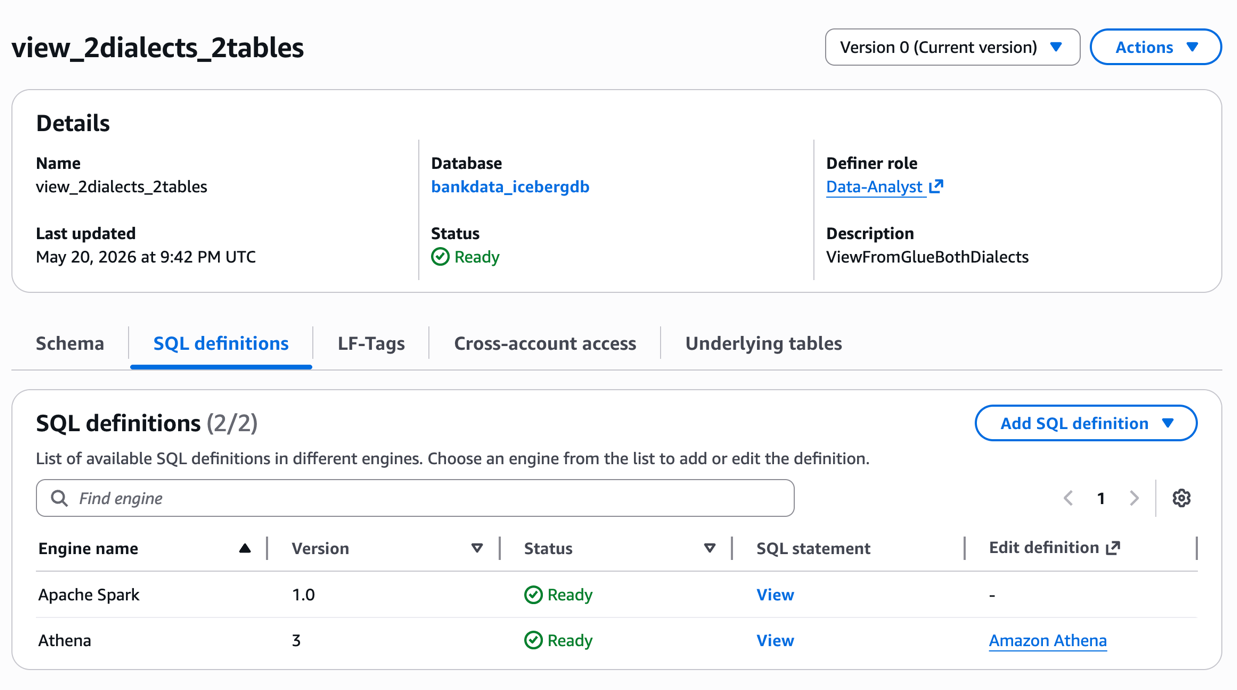
If your view creation fails for any of the dialects, you can use the AWS Glue get-table CLI command with --include-status-details to see what the error is and rectify it.
Glue PySpark script
The PySpark script for creating a view with ATHENA and SPARK dialects are provided below. Download and edit the Pyspark script with your bucket name, producer and central account ids, region and relevant Glue resource names: bdb_5773_createview_bothdialects.py
Provide the following settings to run the script in your Glue Studio. For details on running a Spark job in Glue, refer Working with Spark jobs in AWS Glue.
- Choose Data-Analyst as the job execution IAM role.
- Choose Glue 5.1 for Glue version.
- For the Requested number of workers, provide >=4. This is an FGAC Spark driver requirement, which is needed for Glue catalog views. Below screenshot shows these settings.

- Add the following 2 properties as additional job parameters. A screenshot is shown for reference.

- Save and run the Glue job. Check the
stdoutlogs to review the query on the newly created view.
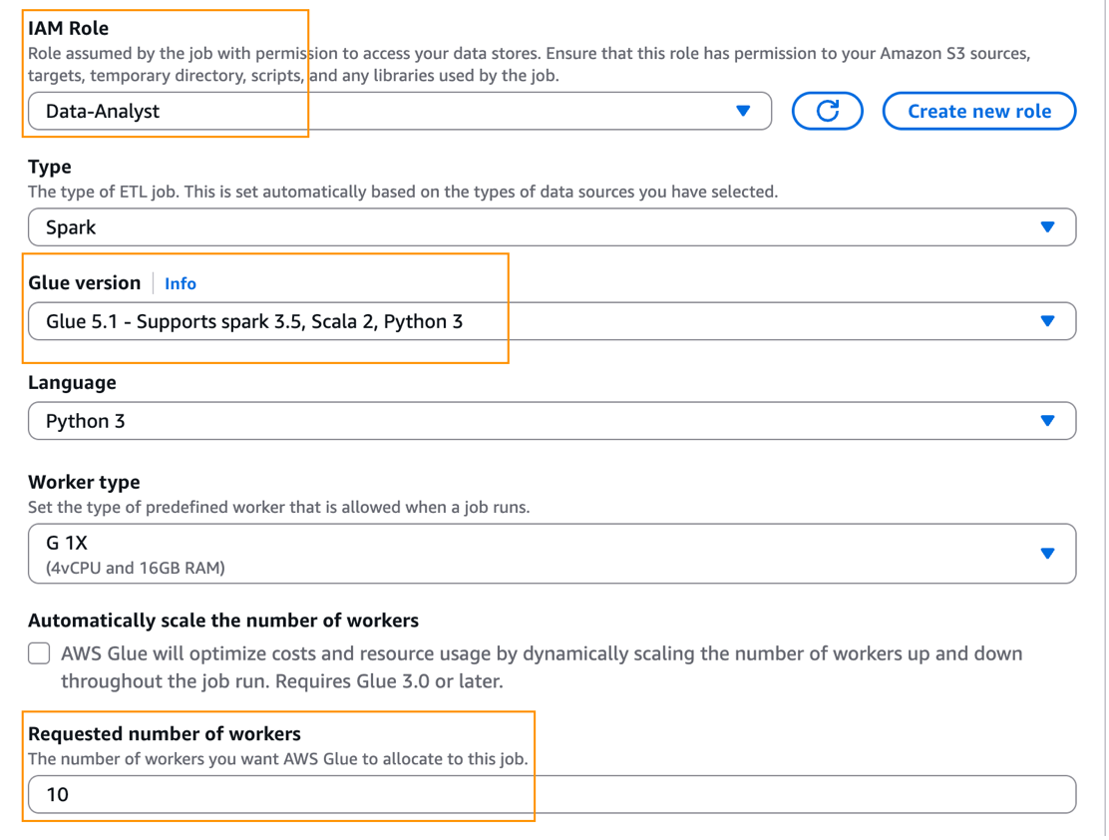
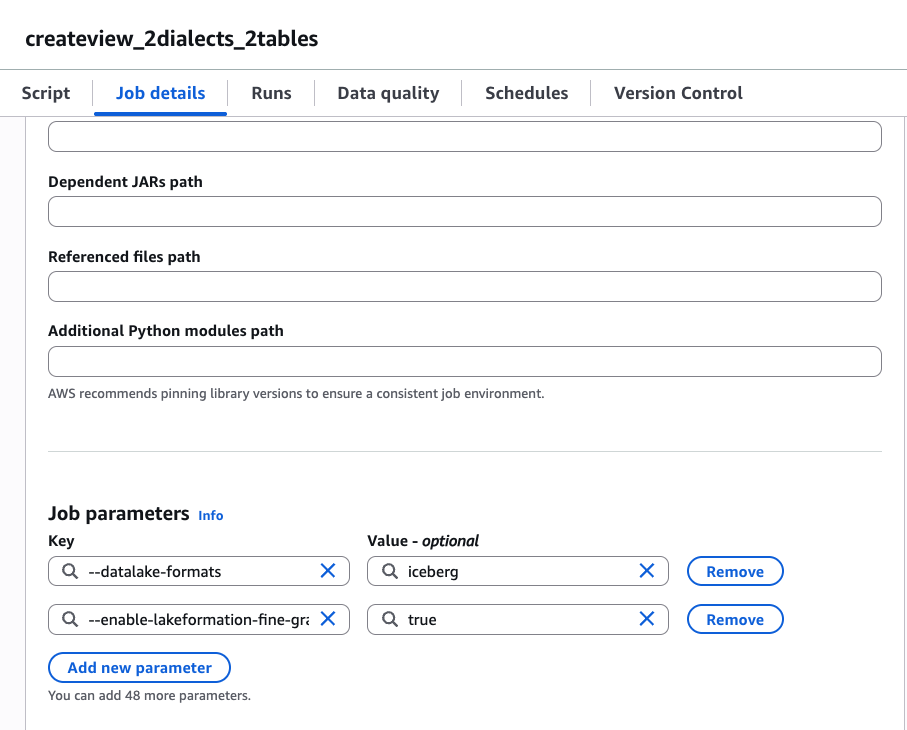
A sample update_table script is also provided below, to illustrate changing the view definition with additional columns. Note the REPLACE keyword:
bdb_5773_updateview_bothdialects.py
Adding ATHENA dialect using SDK to an existing AWS Glue view
You can update an existing AWS Glue view that was created with the SPARK dialect and add the ATHENA dialect using the SDK. The following example uses the update-table CLI command.
The content of add-athena-dialect.json is as follows.
Verify the added dialect on the view by reviewing the SQL definitions of the view in Lake Formation console or using GetTable(). If you want to edit the SQL definition or change the base tables of an existing view that has both SPARK and ATHENA dialects, you can do so using the update_table API (using SDK or CLI), with "ViewUpdateAction": “REPLACE” and provide both the dialect definition under ViewDefinition.
You can run queries on the view from the producer account as Data-Analyst. The view can be shared using Lake Formation Tags or named method, just like sharing tables, to additional consumer accounts from the central governance account. The consumer accounts will create a resource link and query the views.
Cleanup
To avoid incurring ongoing costs, clean up the resources you used for this post:
- Revoke the Lake Formation permissions granted to the
Data-Analystrole and the producer account from the central governance account. - Drop the Data Catalog tables, views, and the database.
- Delete the Athena query results from your Amazon Simple Storage Service (Amazon S3) bucket.
- Delete the
Data-Analystrole from IAM. - Delete the AWS Glue connection and the Athena data source.
- Delete the AWS Glue job, if you tried the Python script as an AWS Glue job.
Conclusion
In this post, I demonstrated how to use cross-account IAM definer roles with AWS Glue Data Catalog views, how to create and update ATHENA and SPARK dialects using the Data Catalog CreateTable() and UpdateTable() APIs. The multi-dialect Data Catalog views allow sharing a subset of data from different tables using Lake Formation permissions, including LF-Tags based access control. The cross-account definer roles support multi-account data mesh architectures so that the producer IAM roles can run the CI/CD pipelines in its account. We encourage you to try the feature and share your feedback in the comments.
Acknowledgements: I would like to thank all the team members who worked to add AWS SDK support for creating ATHENA and SPARK dialects together for AWS Glue views – Daniil Arushanov, Wyatt Hawes, Yuxi Wu, Santhosh Padmanabhan and Karthik Devaraj.
About the author
S9 E13: Uvalde Update & School Police: Last Week Tonight with John Oliver
Post Syndicated from LastWeekTonight original https://www.youtube.com/watch?v=AGvr2TUsVys
De Vlieger: The Fedora 45 sausage factory
Post Syndicated from jzb original https://lwn.net/Articles/1084920/
Fedora contributor Simon de Vlieger has published a blog
post with a walkthrough of how the project turns source code and
packages into the final release that users install on their systems.
It follows the a package from a packager’s git push to a composed
release: ISOs, cloud images, container images, and OSTree
deployments.The walkthrough describes how the Fedora ‘sausage’ is created as of
Fedora 45, things change all the time; I hope to have time to update
this document every cycle or every few cycles of Fedora releases so
there’s both history and people can find up to date information.
Zigbee Devices: Don’t Buy Based on Price, Check Ecosystem! #shorts
Post Syndicated from BeardedTinker original https://www.youtube.com/shorts/dZPbUbhxoI8
How AI Is Causing an Affordability Crisis
Post Syndicated from The Atlantic original https://www.youtube.com/watch?v=cMTp5SuuXlA
The Reading Crisis in the "Postliterate" Age
Post Syndicated from The Atlantic original https://www.youtube.com/shorts/UmGPFMAhKqo
[$] An update on netkit and the use of BPF in user space
Post Syndicated from daroc original https://lwn.net/Articles/1083418/
Daniel Borkmann led a session at the 2026
Linux Filesystem, Memory-Management,
and BPF Summit about the progress that has been made with netkit, the subsystem
that allows virtual machines (VMs) running on Linux to perform networking efficiently.
When that did not fill the full time, he went on to discuss his idea for
using BPF to live-patch user-space applications. While netkit is making
progress, and can now support zero-copy receipt of packets into a VM in a
network namespace, the idea of using BPF for patching user-space programs
remains entirely speculative.
Home Assistant Device Database public preview
Post Syndicated from jzb original https://lwn.net/Articles/1084861/
The Open Home
Foundation, which governs the Home Assistant
home-automation project, has announced
the “public preview” of its Device
Database:
Providing a public, open way to browse the anonymous, aggregated
device data we collect was always part of the plan, and this preview
is our first step toward it.You can already use it to search and filter devices to see
aggregated community insights, starting with a deliberately focused
set of specifics, such as whether a device requires an internet
connection, and which protocols and integrations it works with. We’ve
kept that initial scope narrow on purpose, giving us a solid
foundation we can build on together with you, our community, as the
database grows.
LWN looked at Home
Assistant in May 2025.
Гласовете на Америка – брой 17
Post Syndicated from Йоанна Елми original https://www.toest.bg/glasovete-na-amerika-broy-17/

По Америка ще познаете света.
Президентът Тръмп даде сигнал, че е готов да задълбочи войната в Иран. Само преди месец писахме, че примирието между двете държави е подписано – днес това примирие не означава нищо, а още утре този бюлетин може би няма да е актуален. Политическото говорене на едро, заплахите, цинизмът и безсмислието са се превърнали в ежедневие. Министърът на войната Пийт Хегсет поиска 70 млрд. долара спешно военно финансиране след първите пет месеца от войната.
По Америка ще познаете света.
Гласовете на Америка – брой 16
Европа открива Америка – с ранч соса, UFC, Тръмп, войната с Иран и новата левица. Световното първенство по футбол се превръща в повод за въпроса коя е истинската Америка и кой има правото да я определя. От Йоанна Елми.
Хегсет обяви, че военните ще трябва да минават задължително изследване на нивата на тестостерон след 30-годишна възраст. Няма определени рамки какви нива на тестостерон ще се смятат за ниски, за да се изисква лечение – обичайно всяка лаборатория може да определя нива според методите си на изследване, което в допълнение се влияе и от препоръките на лекуващия лекар.
Решението на Хегсет идва в разгара на „тестостеронова мания“ в САЩ: рецептите за заместителна терапия с хормона са достигнали 12 млн. през 2025 г., ръст от 154% от 2020 г. насам. Онлайн клиники и търговци продават тестостерон като утвърдено лечение за мъже. Експерти обаче предупреждават, че по-високите нива на тестостерон нямат нищо общо с определени качества, които могат да направят един мъж „по-мъжествен“. Ако нивата на тестостерон по различни здравословни причини спаднат много под обичайните норми, последствията могат да бъдат умора, ниско либидо или загуба на мускулна маса, но при здрави мъже нивата на хормона нямат нищо общо с физическата сила.
Мъж с ниво на тестостерон около 700 нанограма на децилитър може да е точно толкова силен, колкото и мъж с 300 нанограма на децилитър. Нещо повече – нивата на тестостерон не са константа, а се променят в различните части на деня и според сезона, както и под влияние на други фактори. Терапията с тестостерон крие рискове: употребата на добавки може да понижи естествената способност на тялото да произвежда хормона, свивайки тестисите и намалявайки производството на сперматозоиди. Други ефекти са акне, оплешивяване и дори уголемяване на гърдите вследствие на преобразуването на част от приетия тестостерон в естроген.
Тестостеронът няма общо и с нивата на агресивност. Изследвания показват, че ако един мъж проявява агресия, причината обикновено е социална, а не хормонална. В проучване на 200 подрастващи момчета и родителите им екип, воден от Адам Станаланд, професор по психология в университета в Ричмънд, установява, че момчетата, реагиращи агресивно на стимули, които възприемат като „заплаха за мъжествеността“, са онези, които усещат силен социален натиск „да се държат като мъже“. Парадоксът е, че животът в армията – недостигът на сън, хроничният стрес, излагането на опасност и недоброто хранене, са изключително вредни за правилното функциониране на хормоните.
Всички тези научни факти обаче нямат значение във време, в което говорим за „криза на мъжествеността“ – с нея често се „борим“ с прояви на насилие и омраза към жени и към онези, които са приемани като „други“; с подлагане на хирургични интервенции в името на „по-мъжествено излъчване“; или чрез сформирането на групи и банди от вандали, често покрай бойни спортове.
По Америка ще познаете света.
Междувременно все повече жени в САЩ се тревожат какво ще се случи, ако имат дете, се посочва в статия в Women's Health. Жените посочват като основни притеснения здравния риск, следродилната депресия и пълното подчинение на майката на грижите за детето, както и финансовите трудности и състоянието на света като цяло.
В статията се казва още, че през неограничената информация в социалните мрежи хората често стигат до най-страшните истории за раждането, научават за възможно най-рисковите усложнения и чуват разкази на други родители, които изпитват съжаление, че имат деца, или се оплакват от липса на подкрепа от партньорите си. Експерти посочват, че повечето бременности в САЩ протичат без усложнения и че обществото трябва активно да работи в посока на подкрепа за майките.
Подкрепата за жените и майките не е сред трендовете в „мъжествените“ среди. Притесненията за демографията са.
По Америка ще познаете света.
Жителите на много държави по света вече гледат на Китай по-положително, отколкото на САЩ. Спадът в положителните възприятия започва около 2024 г., като в началото на втория мандат на президента Тръмп през 2025 г. 48% от отговорилите имат по-скоро добро отношение към Америка, а 38% – към Китай. Тази година числата са почти обърнати – 46% виждат Китай в по-добра светлина, а 36% избират САЩ.
На въпрос имат ли доверие, че държавата ще постъпи правилно по отношение на международната политика, положителното отношение към външнополитическото представяне на Китай е нараснало почти двойно от 2024 г. насам и е спаднало повече от двойно спрямо САЩ за същия период. Една от малкото сфери, в които САЩ все още държи висок рейтинг, е тази на свободните индивидуални права – повече хора отговарят, че САЩ уважават правата и свободите, което все още е обективна истина.
Фактът, че имам нужда да уточня „все още“, е показателен за състоянието на САЩ и на демократичния свят.
От една страна, бихме могли да кажем, че обръщането на САЩ към собствените им интереси би могло да става за сметка на други държави и на света като цяло, откъдето да идва негативното отношение към тях – това е и аргументът на много от консервативните симпатизанти на президента. Не съм съгласна обаче, че исторически САЩ никога не са гледали собствения си интерес; напротив, Америка е добре известна с арогантното си поведение на световната сцена.
В продължение на десетилетия обаче тя бе известна и с меката си дипломация, което направи от нея културен хегемон, а чрез културата рано или късно се печели всичко, както знаят добрите пропагандисти. Сега меката дипломация е заместена от друга пропаганда: на тестостерон, ритуален бой пред Белия дом и външна политика, характеризираща се с постоянството и деликатността на кисел попрезрял мъж (ако трябва да влезем в тона на (не)културния диалог).
Политиката на синтетичния тестостерон може да е много популярна сред определени сегменти от населението, но е абсурдна, смешна, глуповата и заради всичко това – дори ужасяваща за нормалните мислещи хора, които все още обитават средата между крайностите.
По-добрата позиция на Китай в общественото мнение надали се дължи на това, че изведнъж авторитарният комунизъм с капиталистически краски е станал атрактивна алтернатива на настоящия световен ред; в крайна сметка преди седмица книжари бяха извлачвани насилствено от книжарници в Хонг Конг.
Предопределени за война. Но не съвсем
Продължаваме поредицата на Искрен Иванов за Китай и за отношенията на далекоизточната страна с останалите Велики сили. Този текст разглежда накратко връзките между Китай и САЩ, както и въпроса кой ще е победител в една нова Студена война.
Китай по някакъв начин е алтернатива на вакуума, отворил се от разпадналата се американска култура, точно толкова, колкото животът в Русия е алтернатива за недоволния български русофил. Обратното – разочарованието и липсата на нормалност блъскат общественото мнение към символа на Си Дзинпин – световен лидер, който, въпреки че също е зодия Близнаци (както впрочем и Румен Радев), може да се задържи на едно мнение и решение от сутринта до вечерта.
„Стабилността“ е онова, по което копнее средностатистическият човек, който не се интересува от сложните плетки на политиката, а просто иска да живее нормално. Който разбира копнежа по „стабилност“, разбира политиката. А ако това са само авторитарните лидери и режими, вината не е само тяхна.
Както и да е, по Америка ще познаете света.
На 14 юли губернаторката на щата Ню Йорк подписа мораториум върху изграждането на центрове за данни, който ще е в сила една година. Целта е през това време да се изучават ефектите на вече построените центрове за данни, за да може да се помисли за определени регулации. Тревогите на опонентите на мораториума се въртят около икономическите последствия, тъй като се страхуват, че меморандумът ще отблъсне инвеститорите. Според критиците на меморандума хората трябва да бъдат оставени сами да преценят дали искат центрове за данни в общностите си, или не.
По-умерените становища гласят, че политиките спрямо центровете за данни се третират само в контекста на развитието на изкуствения интелект и протестите срещу т.нар. интелектуален бълвоч (slop) – нискокачественото масово генерирано съдържание, което често цели бърза печалба или кликове. Инстинктивният и разумен аргумент е: защо трябва да хабим ценни ресурси, какъвто е водата, и да тормозим общностите с шум и замърсяване, за да подхранваме нещо, което не само ни затъпява, но и ни коства работни места?
Повечето хора обаче разчитат на ресурсите, които такава технология предлага – тя е толкова добра или лоша, колкото е ползвателят ѝ. Дали мораториумът ще е ефективен, ще покаже само времето. Въпросът е, че за разлика от България, дори в САЩ в криза все още се прави политика на действието – вземат се мерки, ефектите от тях се анализират и все пак някъде нещо се движи.
Дебатът за прогреса (най-вече технологичен) за сметка на толкова много други неща тепърва ще бъде актуален. През последните дни кабинетът на Тръмп активно премахва природозащитно законодателство, което ще позволи добив на петрол и други суровини от понастоящем защитени държавни земи.
Идеята за краткотрайна печалба и неспирен прогрес все още пречи да помислим как да живеем устойчиво в един все по-топъл и бедстващ свят, както виждаме и в България. Технологиите биха могли да помогнат и в тази посока – въпросът е кой и за какво ще ги използва.
По това, за което говори (и се кара) Америка, ще познаете онова, за което трябва да говори светът. Западна Европа току-що отчете най-горещия си юни някога.
Има и други новини. Тексаски пожарникар спасява три деца, заклещени под лодка, навръх 4 юли – националния празник на САЩ. Биотех стартъп компания е разработила устойчиви на определени заболявания сортове американски кестен; дърводобивната индустрия е изключително важна за страната, но различни заболявания по дърветата през последните години са сред основните предизвикателства пред нея. Деформираният енот Джимъти от Сиатъл, за когото се грижат всякакви добри съседи, се превърна в интернет сензация.
И накрая – тази седмица изгледах документалния филм на More Perfect Union, който засяга идеята за изземането на ролята на държавата от корпорациите, опитващи се да създадат свои общности с изцяло приватизирани обществени услуги.
Предимствата на филма са, че показва какво се случва с либертариански, антидържавни и всякакви подобни идеи на практика – нещо, което видяхме в началото на мандата на Тръмп с DOGE, воден от Илън Мъск (този провал помните ли го?).
Гласовете на Америка – брой 1
В брой 1 от новия бюлетин на „Тоест“, който ще бъде воден от Йоанна Елми и ще излиза два пъти месечно, се разглеждат първите 100 дни от втория мандат на Тръмп. Абонирайте се за „Гласовете на Америка“.
Когато съвсем естественото напрежение между държава и частен сектор се доведе до крайност, имаме смяна на парадигмата. Въпросът е как ще изглежда тя.
По Америка ще познаете света.
Август е тих дори и в Щатите. В „Тоест“ със сигурност ще е такъв, а през септември се връщаме – наближават междинни избори. Шоуто никога не свършва.
Security updates for Friday
Post Syndicated from jzb original https://lwn.net/Articles/1084860/
Security updates have been issued by AlmaLinux (glibc, java-21-openjdk, kernel, and libpq), Debian (imagemagick, spice-vdagent, and webkit2gtk), Fedora (cryptlib, dotnet8.0, dotnet9.0, firefox, python-black, python-lsp-black, and python-pytokens), Mageia (apache, cifs-utils, dnsmasq, lrzip, and socat), Oracle (.NET 10.0, .NET 9.0, 389-ds-base, cups, edk2, fence-agents, firefox, freeipmi, freerdp, git-lfs, glib2, gnutls, golang, gstreamer1-plugins-bad-free, gstreamer1-plugins-good, gstreamer1-plugins-ugly-free, hplip, libinput, libvirt, libxml2, memcached, nginx, openexr, perl-DBI, perl-XML-LibXML, php, php8.4, plexus-utils, postgresql16, python3.12, python3.14, sssd, tomcat, tomcat9, unbound, vim, xorg-x11-server-Xwayland, yggdrasil, and yggdrasil-worker-package-manager), Red Hat (container-tools:rhel8, git-lfs, go-toolset:rhel8, golang, golang-github-openprinting-ipp-usb, grafana, grafana-pcp, host-metering, java-1.8.0-openjdk, java-11-openjdk with Extended Lifecycle Support, java-17-openjdk, java-21-openjdk, oci-seccomp-bpf-hook, rhc, rhc-worker-playbook, skopeo, xorg-x11-server, xorg-x11-server-Xwayland, and yggdrasil), Slackware (mozilla-thunderbird), SUSE (afterburn, alloy, apache-sshd, apache2, avahi, chromium, clamav, curl, dhcpcd, dnsmasq, docker-compose, ffmpeg-7, firefox-esr, gawk, glibc, gnutls, go1.26-openssl, google-osconfig-agent, gpg2, haproxy, ImageMagick, imagemagick, jline3, jq, kernel, libgcrypt, libgnt, meson, pidgin, nmap, nodejs24, pacemaker, patch, perl-HTML-Parser, perl-libwww-perl, perl-List-SomeUtils-XS, python-aiohttp, python-WebOb, qemu, rust-keylime, SVT-AV1, libyuv0, libaom3, trivy, ucode-intel, and wireshark), and Ubuntu (libhttp-date-perl, libxpm, linux-azure, linux-azure-fde, pam, and rsyslog).
Trebuchet!
Post Syndicated from The History Guy: History Deserves to Be Remembered original https://www.youtube.com/watch?v=er754qe9soE