An attendee’s guide to hybrid cloud and edge computing at AWS re:Invent 2023

Post Syndicated from Chris Munns original https://aws.amazon.com/blogs/compute/an-attendees-guide-to-hybrid-cloud-and-edge-computing-at-aws-reinvent-2023/

This post is written by Savitha Swaminathan, AWS Sr. Product Marketing Manager

AWS re:Invent 2023 starts on Nov 27th in Las Vegas, Nevada. The event brings technology business leaders, AWS partners, developers, and IT practitioners together to learn about the latest innovations, meet AWS experts, and network among their peer attendees.

This year, AWS re:Invent will once again have a dedicated track for hybrid cloud and edge computing. The sessions in this track will feature the latest innovations from AWS to help you build and run applications securely in the cloud, on premises, and at the edge – wherever you need to. You will hear how AWS customers are using our cloud services to innovate on premises and at the edge. You will also be able to immerse yourself in hands-on experiences with AWS hybrid and edge services through innovative demos and workshops.

At re:Invent there are several session types, each designed to provide you with a way to learn however fits you best:

  • Innovation Talks provide a comprehensive overview of how AWS is working with customers to solve their most important problems.
  • Breakout sessions are lecture style presentations focused on a topic or area of interest and are well liked by business leaders and IT practitioners, alike.
  • Chalk talks deep dive on customer reference architectures and invite audience members to actively participate in the white boarding exercise.
  • Workshops and builder sessions popular with developers and architects, provide the most hands-on experience where attendees can build real-time solutions with AWS experts.

The hybrid edge track will include one leadership overview session and 15 other sessions (4 breakouts, 6 chalk talks, and 5 workshops). The sessions are organized around 4 key themes: Low latency, Data residency, Migration and modernization, and AWS at the far edge.

Hybrid Cloud & Edge Overview

HYB201 | AWS wherever you need it

Join Jan Hofmeyr, Vice President, Amazon EC2, in this leadership session where he presents a comprehensive overview of AWS hybrid cloud and edge computing services, and how we are helping customers innovate on AWS wherever they need it – from Regions, to metro centers, 5G networks, on premises, and at the far edge. Jun Shi, CEO and President of Accton, will also join Jan on stage to discuss how Accton enables smart manufacturing across its global manufacturing sites using AWS hybrid, IoT, and machine learning (ML) services.

Low latency

Many customer workloads require single-digit millisecond latencies for optimal performance. Customers in every industry are looking for ways to run these latency sensitive portions of their applications in the cloud while simplifying operations and optimizing for costs. You will hear about customer use cases and how AWS edge infrastructure is helping companies like Riot Games meet their application performance goals and innovate at the edge.

Breakout session

HYB305 | Delivering low-latency applications at the edge

Chalk talk

HYB308 | Architecting for low latency and performance at the edge with AWS

Workshops

HYB302 | Architecting and deploying applications at the edge

HYB303 | Deploying a low-latency computer vision application at the edge

Data residency

As cloud has become main stream, governments and standards bodies continue to develop security, data protection, and privacy regulations. Having control over digital assets and meeting data residency regulations is becoming increasingly important for public sector customers and organizations operating in regulated industries. The data residency sessions deep dive into the challenges, solutions, and innovations that customers are addressing with AWS to meet their data residency requirements.

Breakout session

HYB309 | Navigating data residency and protecting sensitive data

Chalk talk

HYB307 | Architecting for data residency and data protection at the edge

Workshops

HYB301 | Addressing data residency requirements with AWS edge services

Migration and modernization

Migration and modernization in industries that have traditionally operated with on-premises infrastructure or self-managed data centers is helping customers achieve scale, flexibility, cost savings, and performance. We will dive into customer stories and real-world deployments, and share best practices for hybrid cloud migrations.

Breakout session

HYB203 | A migration strategy for edge and on-premises workloads

Chalk talk

HYB313 | Real-world analysis of successful hybrid cloud migrations

AWS at the far edge

Some customers operate in what we call the far edge: remote oil rigs, military and defense territories, and even space! In these sessions we cover customer use cases and explore how AWS brings cloud services to the far edge and helps customers gain the benefits of the cloud regardless of where they operate.

Breakout session

HYB306 | Bringing AWS to remote edge locations

Chalk talk

HYB312 | Deploying cloud-enabled applications starting at the edge

Workshops

HYB304 | Generative AI for robotics: Race for the best drone control assistant

In addition to the sessions across the 4 themes listed above, the track includes two additional chalk talks covering topics that are applicable more broadly to customers operating hybrid workloads. These chalk talks were chosen based on customer interest and will have repeat sessions, due to high customer demand.

HYB310 | Building highly available and fault-tolerant edge applications

HYB311 | AWS hybrid and edge networking architectures

Learn through interactive demos

In addition to breakout sessions, chalk talks, and workshops, make sure you check out our interactive demos to see the benefits of hybrid cloud and edge in action:

Drone Inspector: Generative AI at the Edge

Location: AWS Village | Venetian Level 2, Expo Hall, Booth 852 | AWS for Every App activation

Embark on a competitive adventure where generative artificial intelligence (AI) intersects with edge computing. Experience how drones can swiftly respond to chat instructions for a time-sensitive object detection mission. Learn how you can deploy foundation models and computer vision (CV) models at the edge using AWS hybrid and edge services for real-time insights and actions.

AWS Hybrid Cloud & Edge kiosk

Location: AWS Village | Venetian Level 2, Expo Hall, Booth 852 | Kiosk #9 & 10

Stop by and chat with our experts about AWS Local Zones, AWS Outposts, AWS Snow Family, AWS Wavelength, AWS Private 5G, AWS Telco Network Builder, and Integrated Private Wireless on AWS. Check out the hardware innovations inside an AWS Outposts rack up close and in person. Learn how you can set up a reliable private 5G network within days and live stream video content with minimal latency.

AWS Next Gen Infrastructure Experience

Location: AWS Village | Venetian Level 2, Expo Hall, Booth 852

Check out demos across Global Infrastructure, AWS for Hybrid Cloud & Edge, Compute, Storage, and Networking kiosks, share on social, and win prizes!

The Future of Connected Mobility

Location: Venetian Level 4, EBC Lounge, wall outside of Lando 4201B

Step into the driver’s seat and experience high fidelity 3D terrain driving simulation with AWS Local Zones. Gain real-time insights from vehicle telemetry with AWS IoT Greengrass running on AWS Snowcone and a broader set of AWS IoT services and Amazon Managed Grafana in the Region. Learn how to combine local data processing with cloud analytics for enhanced safety, performance, and operational efficiency. Explore how you can rapidly deliver the same experience to global users in 75+ countries with minimal application changes using AWS Outposts.

Immersive tourism experience powered by 5G and AR/VR

Location: Venetian, Level 2 | Expo Hall | Telco demo area

Explore and travel to Chichen Itza with an augmented reality (AR) application running on a private network fully built on AWS, which includes the Radio Access Network (RAN), the core, security, and applications, combined with services for deployment and operations. This demo features AWS Outposts.

AWS unplugged: A real time remote music collaboration session using 5G and MEC

Location: Venetian, Level 2 | Expo Hall | Telco demo area

We will demonstrate how musicians in Los Angeles and Las Vegas can collaborate in real time with AWS Wavelength. You will witness songwriters and musicians in Los Angeles and Las Vegas in a live jam session.

Disaster relief with AWS Snowball Edge and AWS Wickr

Location: AWS for National Security & Defense | Venetian, Casanova 606

The hurricane has passed leaving you with no cell coverage and you have a slim chance of getting on the internet. You need to set up a situational awareness and communications network for your team, fast. Using Wickr on Snowball Edge Compute, you can rapidly deploy a platform that provides both secure communications with rich collaboration functionality, as well as real time situational awareness with the Wickr ATAK integration. Allowing you to get on with what’s important.


We hope this guide to the Hybrid Cloud and Edge track at AWS re:Invent 2023 helps you plan for the event and we hope to see you there!


Amazon Kinesis Data Streams: celebrating a decade of real-time data innovation

Post Syndicated from Roy Wang original https://aws.amazon.com/blogs/big-data/amazon-kinesis-data-streams-celebrating-a-decade-of-real-time-data-innovation/

Data is a key strategic asset for every organization, and every company is a data business at its core. However, in many organizations, data is typically spread across a number of different systems such as software as a service (SaaS) applications, operational databases, and data warehouses. Such data silos make it difficult to get unified views of the data in an organization and act in real time to derive the most value.

Ten years ago, we launched Amazon Kinesis Data Streams, the first cloud-native serverless streaming data service, to serve as the backbone for companies, to move data across system boundaries, breaking data silos. With data streaming, you can power data lakes running on Amazon Simple Storage Service (Amazon S3), enrich customer experiences via personalization, improve operational efficiency with predictive maintenance of machinery in your factories, and achieve better insights with more accurate machine learning (ML) models. Amazon Kinesis Data Streams is a foundational data strategy pillar for tens of thousands of customers. As streams of raw data come together, they unlock capabilities to continuously transform, enrich, and query data in real time via seamless integration with stream processing engines such as Amazon Managed Service for Apache Flink.

As an example, the National Hockey League (NHL) reimagined the fan experience by streaming live NHL EDGE game data and stats to offer hockey fans valuable insights to keep fans at the edge of their seats. NHL EDGE technology in the puck and players’ sweaters (jerseys) generate thousands of data points every second for the NHL, which can be analyzed by AWS to predict likely outcomes for key events like face-offs. To process and analyze thousands of signals, the NHL built a real-time streaming data foundation with Kinesis Data Streams and Amazon Managed Service for Apache Flink to stream, prepare, and feed data into ML models, helping inform face-off predictions in seconds and expanding new ways to engage viewers.

Building on such streaming data foundations, many customers are currently thinking about how to deliver transformative new products and services with generative AI. Streaming allows companies to connect the data available within data stores to large language models (LLMs) securely and in real time. Although LLMs are capable of working with billions of parameters, in order to deliver an engaging experience that is tailored to a company’s customers, LLMs require personalization data for the company’s users and proprietary knowledge stores within the company’s data stores. A data strategy that incorporates streaming is necessary to deliver personalization and proprietary data that is available for querying in real time.

Customers with real-time streaming data strategy are at the cutting edge of providing innovative products with generative AI. One customer adopted Kinesis Data Streams for their data strategy, and they stream billions of events from their digital products to derive real-time insights. With a combination of low-latency data streaming and analytics, they are able to understand and personalize the user experience via a seamlessly integrated, self-reliant system for experimentation and automated feedback. Earlier this year, building on their already strong data foundation, they launched an innovative digital media generative AI product. The same data foundation built on Kinesis Data Streams is used to continuously analyze how users interact with the generated content and helps the product team fine-tune the application.

“Real-time streaming data technologies are essential for digital transformation. These services help customers bring data to their applications and models, making them smarter. Real-time data gives companies an advantage in data-driven decisions, predictions, and insights by using the data at the very moment it is generated, providing an unparalleled edge in a world where timing is the key to success. Bring the data in once, use it across your organization, and act before the value of that data diminishes.”

– Mindy Ferguson, VP of AWS Streaming and Messaging.

As we celebrate the tenth anniversary of Kinesis Data Streams, customers have shared four key reasons they continue to value this revolutionary service. They love how they can easily stream data with no underlying servers to provision or manage, operate at a massive scale with consistent performance, achieve high resiliency and durability, and benefit from broad integration with myriad sources and sinks to ingest and process data respectively.

Ease of use

Getting started with Kinesis Data Streams is straightforward: developers can create a data stream with a few clicks on the Kinesis Data Streams console or with a single API call. Changing the size or configuration is also a single API call, and each data stream comes with a default 24-hour data retention period. Developers don’t have to worry about clusters, version upgrades, or storage capacity planning. They just turn on a data stream and start ingesting data.

The needs of our customers have evolved in the past 10 years. As more events get captured and streamed, customers want their data streams to scale elastically without any operational overhead. In response, we launched On-Demand streams in 2021 to provide a simple and automatic scaling experience. With On-Demand streams, you let the service handle scaling up a stream’s capacity proactively, and you’re only charged for the actual data ingested, retrieved, and stored. As our customers continued to ask for more capabilities, we increased the ingestion throughput limit of each On-Demand stream from 200MB/s to 1GB/s in March 2023, and then to 2GB/s in October 2023, to accommodate higher throughput workloads. To continue innovating to be the easiest streaming data service to use, we actively listen to our customer use cases.

Canva is an online design and visual communication platform. As it has rapidly grown from 30 million to 135 million monthly users, it has built a streaming data platform at scale that is effortless to operate for driving product innovations and personalizing the user experience.

“Amazon Kinesis Data Streams and AWS Lambda are used throughout Canva’s logging platform, ingesting and processing over 60 billion log events per day. The combination of Kinesis Data Streams and Lambda has abstracted plenty of work that’s often required in managing a massive data pipeline, such as deploying and managing a fleet of servers, whilst also providing a highly scalable and reliable service. It has allowed us to focus on delivering a world-class product by building highly requested features rather than spending time on operational work.”

– Phoebe Zhou, Software Engineer at Canva.

Operate at massive scale with consistent performance

A fundamental requirement of a streaming data strategy is ingesting and processing large volumes of data with low latency. Kinesis Data Streams processes trillions of records per day across tens of thousands of customers. Customers run more than 3.5 million unique streams and process over 45 PB of data per day. Our largest customers ingest more than 15 GB per second of real-time data with individual streams. That’s equivalent to streaming multiple data points for every person on earth, every second! Even at this scale, all our customers still retrieve data within milliseconds of availability.

Customers also want to process the same data with multiple applications, with each deriving a different value, without worrying about one application impacting the read throughput of another. Enhanced Fan-out offers dedicated read throughput and low latency for each data consumer. This has enabled enterprise platform teams to provide real-time data to more teams and applications.

VMware Carbon Black uses Kinesis Data Streams to ingest petabytes of data every day to secure millions of customer endpoints. The team focuses on its expertise while AWS manages data streaming to meet growing customer traffic and needs in real time.

“When an individual customer’s data increases or decreases, we can use the elasticity of Amazon Kinesis Data Streams to scale compute up or down to process data reliably while effectively managing our cost. This is why Kinesis Data Streams is a good fit. The biggest advantage is the managed nature of our solution on AWS. This has shaped our architecture and helped us shift complexity elsewhere.”

– Stoyan Dimkov, Staff Engineer and Software Architect at VMware Carbon Black.

Learn more about the case study.

Provide resiliency and durability for data streaming

With burgeoning data, customers want more flexibility in processing and reprocessing data. For example, if an application that is consuming data goes offline for a period, teams want to ensure that they resume processing at a later time without data loss. Kinesis Data Streams provides a default 24-hour retention period, enabling you to select a specific timestamp from which to start processing records. With the extended retention feature, you can configure the data retention period to be up to 7 days.

Some industries like financial services and healthcare have stricter compliance requirements, so customers asked for even longer data retention periods to support these requirements. Therefore, we followed up with long-term storage that supports data retention for up to 1 year. Now, thousands of Kinesis Data Streams customers use these features to make their streaming applications more resilient and durable.

Mercado Libre, a leading ecommerce and payments platform in Latin America, relies on Kinesis Data Streams to power its streaming data strategy around payment processing, customer experience, and operations.

“With Amazon Kinesis Data Streams at the core, we process approximately 70 billion daily messages distributed across thousands of data producers. By leveraging Kinesis Data Streams and Amazon DynamoDB Streams, we’ve embraced an event-driven architecture and are able to swiftly respond to data changes.”

– Joaquin Fernandez, Senior Software Expert at Mercado Libre.

Access your data no matter where it lives

Our customers use a wide variety of tools and applications, and an organization’s data often resides in many places. Therefore, the ability to easily integrate data across an organization is crucial to derive timely insights. Developers use the Kinesis Producer Library, Kinesis Client Library, and AWS SDK to quickly build custom data producer and data consumer applications. Customers have expanded their data producers ranging from microservices to smart TVs and even cars. We have over 40 integrations with AWS services and third-party applications like Adobe Experience Platform and Databricks. As detailed in our whitepaper on building a modern data streaming architecture on AWS, Kinesis Data Streams serves as the backbone to serverless and real-time use cases such as personalization, real-time insights, Internet of Things (IoT), and event-driven architecture. Our recent integration with Amazon Redshift enables you to ingest hundreds of megabytes of data from Kinesis Data Streams into data warehouses in seconds. To learn more about how to use this integration to detect fraud in near-real time, refer to Near-real-time fraud detection using Amazon Redshift Streaming Ingestion with Amazon Kinesis Data Streams and Amazon Redshift ML.

Another integration launched in 2023 is with Amazon Monitron to power predictive maintenance management. You can now stream measurement data and the corresponding inference results to Kinesis Data Streams, coordinate predictive maintenance, and build an IoT data lake. For more details, refer to Generate actionable insights for predictive maintenance management with Amazon Monitron and Amazon Kinesis.

Next, let’s go back to the NHL use case where they combine IoT, data streaming, and machine learning.

The NHL Edge IQ powered by AWS is helping bring fans closer to the action with advanced analytics and new ML stats such as Face-off Probability and Opportunity Analysis.

“We use Amazon Kinesis Data Streams to process NHL EDGE data on puck and Player positions, face-off location, and the current game situation to decouple data producers from consuming applications. Amazon Managed Service for Apache Flink is used to run Flink applications and consumes data from Kinesis Data Streams to call the prediction model in Amazon SageMaker to deliver the real-time Face-off Probability metric. The probability results are also stored in Amazon S3 to continuously retrain the model in SageMaker. The success of this project led us to build the next metric, Opportunity Analysis, which delivers over 25 insights into the quality of the scoring opportunity presented by each shot on goal. Kinesis Data Streams and Amazon Managed Service for Apache Flink applications were critical to making live, in-game predictions, enabling the system to perform opportunity analysis calculations for up to 16 live NHL games simultaneously.”

– Eric Schneider, SVP, Software Engineering at National Hockey League.

Learn more about the case study.

The future of data is real time

The fusion of real-time data streaming and generative AI promises to be the cornerstone of our digitally connected world. Generative AI, empowered by a constant influx of real-time information from IoT devices, sensors, social media, and beyond, is becoming ubiquitous. From autonomous vehicles navigating dynamically changing traffic conditions to smart cities optimizing energy consumption based on real-time demand, the combination of AI and real-time data will underpin efficiency and innovation across industries. Ubiquitous, adaptive, and deeply integrated into our lives, these AI-driven applications will enhance convenience and address critical challenges such as climate change, healthcare, and disaster response by using the wealth of real-time insights at their disposal. With Kinesis Data Streams, organizations can build a solid data foundation, positioning you to quickly adopt new technologies and unlock new opportunities sooner—which we anticipate will be enormous.

Learn more about what our customers are doing with data streaming. If you would like a quick exploration of Kinesis Data Streams concepts and use cases, check out our Amazon Kinesis Data Streams 101 playlist. To get started with building your data streams, visit the Amazon Kinesis Data Streams Developer Guide.


About the author

Roy (KDS) Wang is a Senior Product Manager with Amazon Kinesis Data Streams. He is passionate about learning from and collaborating with customers to help organizations run faster and smarter. Outside of work, Roy strives to be a good dad to his new son and builds plastic model kits.

How Wallapop improved performance of analytics workloads with Amazon Redshift Serverless and data sharing

Post Syndicated from Eduard Lopez original https://aws.amazon.com/blogs/big-data/how-wallapop-improved-performance-of-analytics-workloads-with-amazon-redshift-serverless-and-data-sharing/

Amazon Redshift is a fast, fully managed cloud data warehouse that makes it straightforward and cost-effective to analyze all your data at petabyte scale, using standard SQL and your existing business intelligence (BI) tools. Today, tens of thousands of customers run business-critical workloads on Amazon Redshift.

Amazon Redshift Serverless makes it effortless to run and scale analytics workloads without having to manage any data warehouse infrastructure.

Redshift Serverless automatically provisions and intelligently scales data warehouse capacity to deliver fast performance for even the most demanding and unpredictable workloads, and you pay only for what you use.

This is ideal when it’s difficult to predict compute needs such as variable workloads, periodic workloads with idle time, and steady-state workloads with spikes. As your demand evolves with new workloads and more concurrent users, Redshift Serverless automatically provisions the right compute resources, and your data warehouse scales seamlessly and automatically.

Amazon Redshift data sharing allows you to securely share live, transactionally consistent data in one Redshift data warehouse with another Redshift data warehouse (provisioned or serverless) across accounts and Regions without needing to copy, replicate, or move data from one data warehouse to another.

Amazon Redshift data sharing enables you to evolve your Amazon Redshift deployment architectures into a hub-and-spoke or data mesh model to better meet performance SLAs, provide workload isolation, perform cross-group analytics, and onboard new use cases, all without the complexity of data movement and data copies.

In this post, we show how Wallapop adopted Redshift Serverless and data sharing to modernize their data warehouse architecture.

Wallapop’s initial data architecture platform

Wallapop is a Spanish ecommerce marketplace company focused on second-hand items, founded in 2013. Every day, they receive around 300,000 new items from buyers to be added to their catalog. The marketplace can be accessed via mobile app or website.

The average monthly traffic is around 15 million active users. Since its creation in 2013, it has reached more than 40 million downloads and more than 700 million products have been listed.

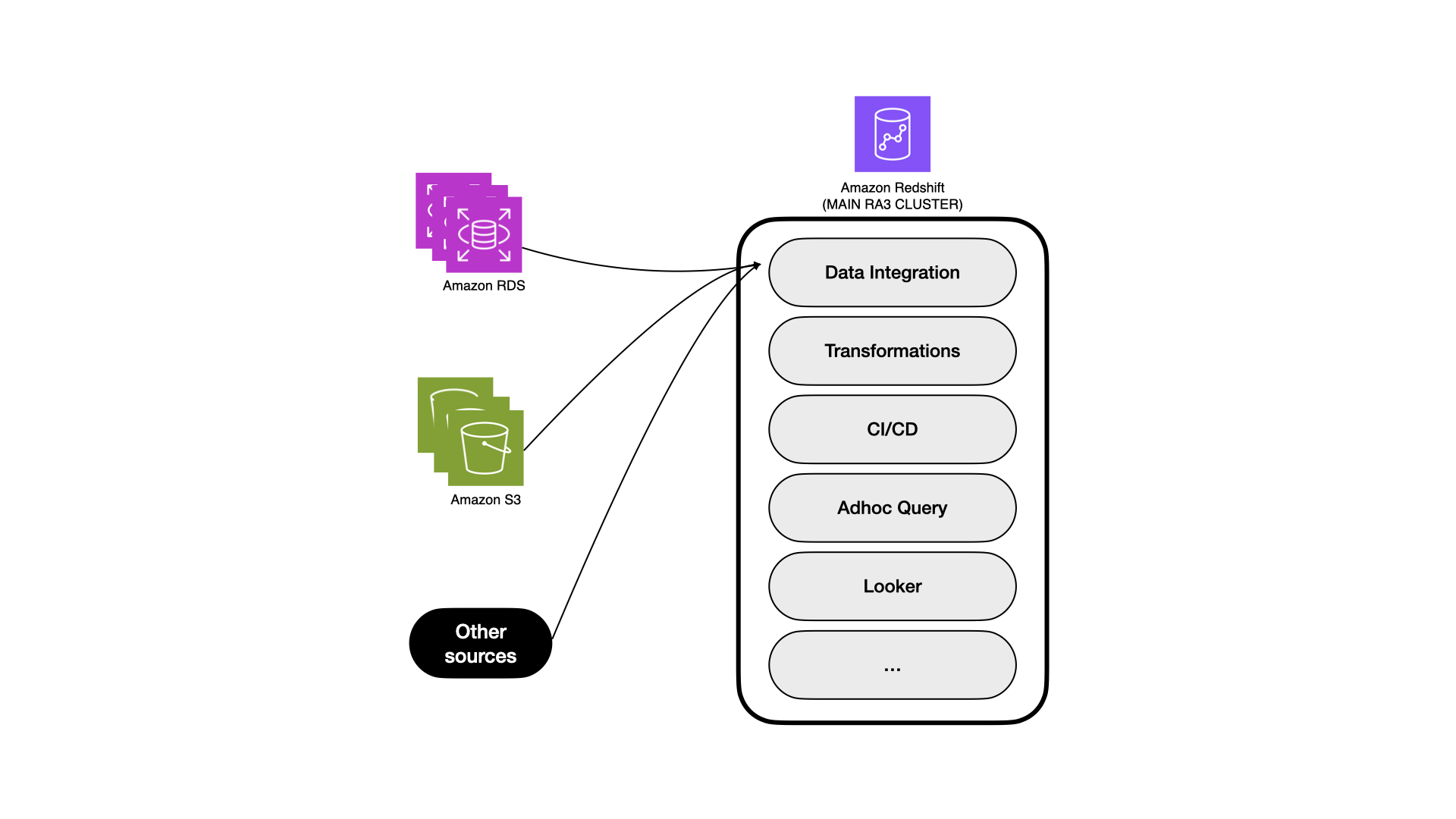
Amazon Redshift plays a central role in their data platform on AWS for ingestion, ETL (extract, transform, and load), machine learning (ML), and consumption workloads that run their insight consumption to drive decision-making.

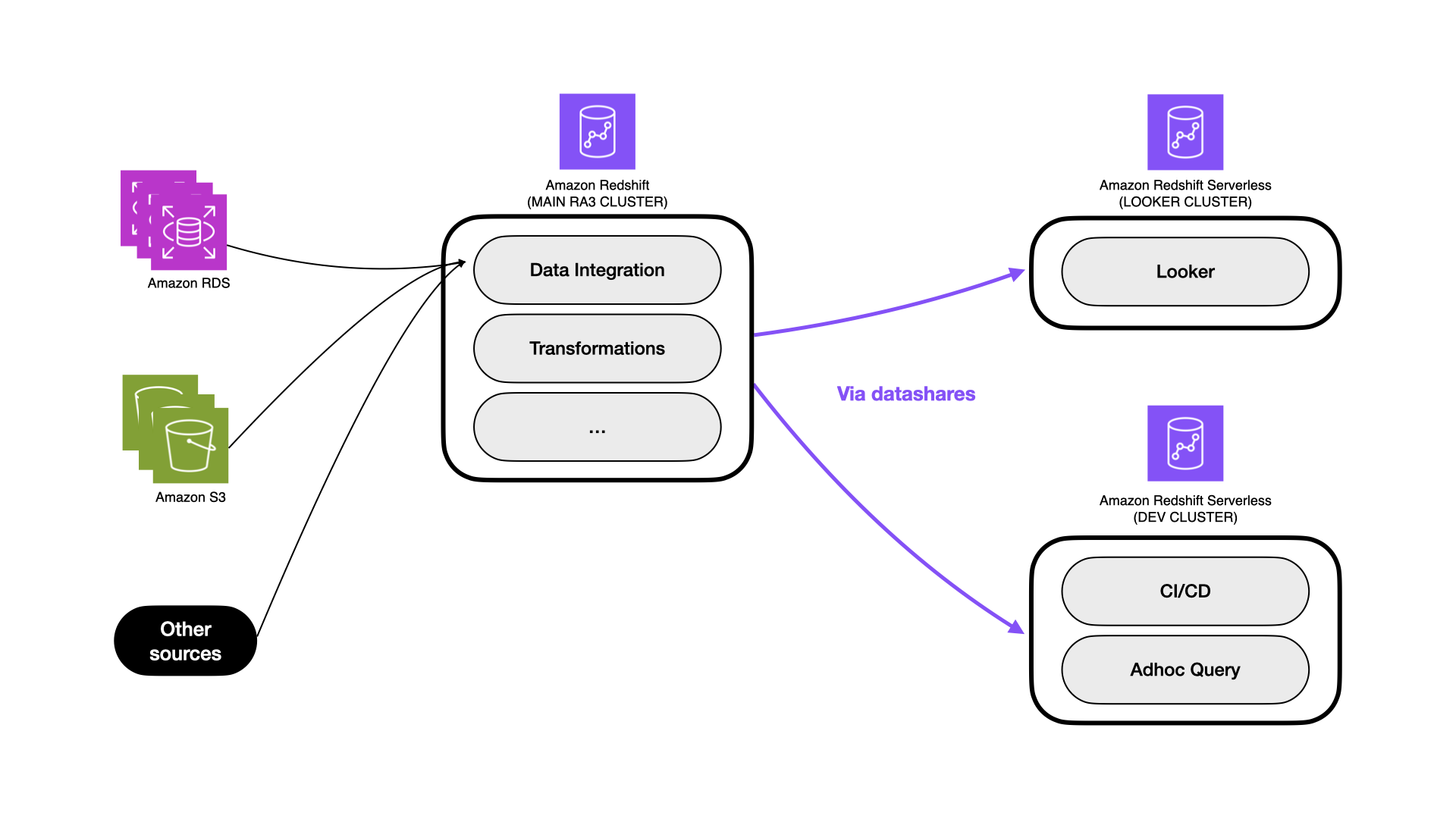
The initial architecture is composed of one main Redshift provisioned cluster that handled all the workloads, as illustrated in the following diagram. Their cluster was deployed with 8 nodes ra3.4xlarge and concurrency scaling enabled.

Wallapop had three main areas to improve in their initial data architecture platform:

  • Workload isolation challenges with growing data volumes and new workloads running in parallel
  • Administrative burden on data engineering teams to manage the concurrent workloads, especially at peak times
  • Cost-performance ratio while scaling during peak periods

The areas of improvement mainly focused on performance of data consumption workloads along with the BI and analytics consumption tool, where high query concurrency was impacting the final analytics preparation and its insights consumption.

Solution overview

To improve their data platform architecture, Wallapop designed and built a new distributed approach with Amazon Redshift with the support of AWS.

Their cluster size of the provisioned data warehouse didn’t change. What changed was lowering the usage concurrency scaling to 1 hour, which is in the Free Tier usage for every 24 hours of using the main cluster. The following diagram illustrates the target architecture.

Solution details

The new data platform architecture combines Redshift Serverless and provisioned data warehouses with Amazon Redshift data sharing, helping Wallapop improve their overall Amazon Redshift experience with improved ease of use, performance, and optimized costs.

Redshift Serverless measures data warehouse capacity in Redshift Processing Units (RPUs). RPUs are resources used to handle workloads. You can adjust the base capacity setting from 8 RPUs to 512 RPUs in units of 8 (8, 16, 24, and so on).

The new architecture uses a Redshift provisioned cluster with RA3 nodes to run their constant and write workloads (data ingestion and transformation jobs). For cost-efficiency, Wallapop is also benefiting from Redshift reserved instances to optimize on costs for these known, predictable, and steady workloads. This cluster acts as the producer cluster in their distributed architecture using data sharing, meaning the data is ingested into the storage layer of Amazon Redshift—Redshift Managed Storage (RMS).

For the consumption part of the data platform architecture, the data is shared with different Redshift Serverless endpoints to meet the needs for different consumption workloads.

Data sharing provides workloads isolation. With this architecture, Wallapop achieves better workload isolation and ensures that only the right data is shared with the different consumption applications. Additionally, this approach avoids data duplication in their consumer part, which optimizes costs and allows better governance processes, because they only have to manage a single version of the data warehouse data instead of different copies or versions of it.

Redshift Serverless is used as a consumer part of the data platform architecture to meet those predictable and unpredictable, non-steady, and often demanding analytics workloads, such as their CI/CD jobs and BI and analytics consumption workloads coming from their data visualization application. Redshift Serverless also helps them achieve better workload isolation due to its managed auto scaling feature that makes sure performance is consistently good for these unpredictable workloads, even at peak times. It also provides a better user experience for the Wallapop data platform team, thanks to the autonomics capabilities that Redshift Serverless provides.

The new solution combining Redshift Serverless and data sharing allowed Wallapop to achieve better performance, cost, and ease of use.

Eduard Lopez, Wallapop Data Engineering Manager, shared the improved experience of analytics users: “Our analyst users are telling us that now ‘Looker flies.’ Insights consumption went up as a result of it without increasing costs.”

Evaluation of outcome

Wallapop started this re-architecture effort by first testing the isolation of their BI consumption workload with Amazon Redshift data sharing and Redshift Serverless with the support of AWS. The workload was tested using different base RPU configurations to measure the base capacity and resources in Redshift Serverless. Base RPU ranges for Redshift Serverless range from 8–512. Wallapop tested their BI workload with two configurations: 32 base RPU and 64 base RPU, after enabling data sharing from their Redshift provisioned cluster to ensure the serverless endpoints have access to the necessary datasets.

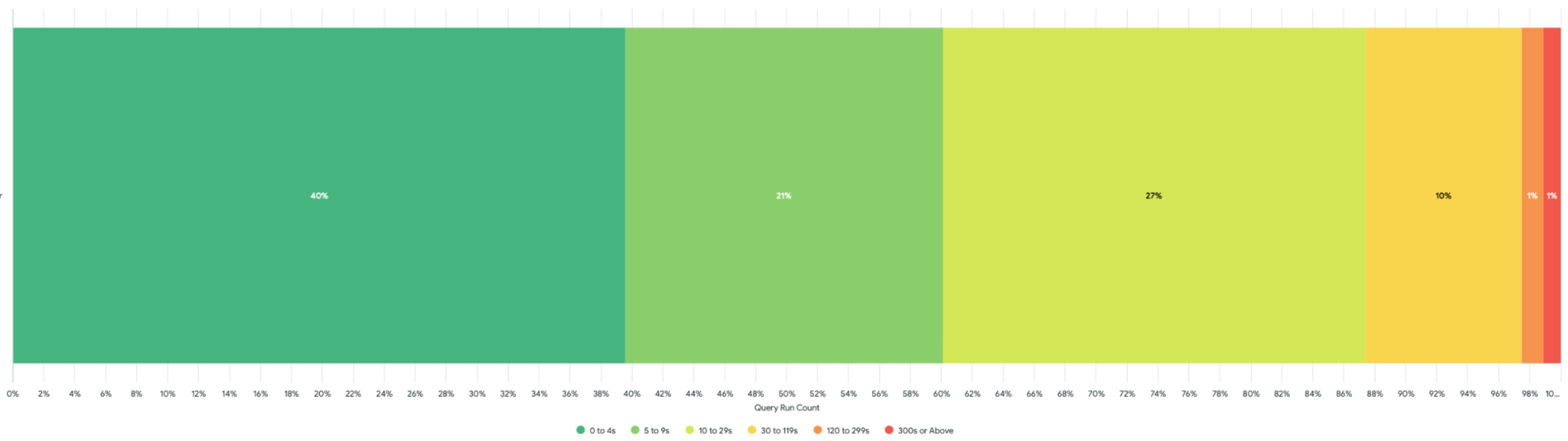
Based on the results measured 1 week before testing, the main area for improvement was the queries that took longer than 10 seconds to complete (52%), represented by the yellow, orange, and red areas of the following chart, as well as the long-running queries represented by the red area (over 600 seconds, 9%).

The first test of this workload with Redshift Serverless using a 64 base RPU configuration immediately showed performance improvement results: the queries running longer than 10 seconds were reduced by 38% and the long-running queries (over 120 seconds) were almost completely eliminated.

Javier Carbajo, Wallapop Data Engineer, says, “Providing a service without downtime or loading times that are too long was one of our main requirements since we couldn’t have analysts or stakeholders without being able to consult the data.”

Following the first set of results, Wallapop also tested with a Redshift Serverless configuration using 32 base RPU to compare the results and select the configuration that could offer them the best price-performance for this workload. With this configuration, the results were similar to the previously test run on Redshift Serverless with 64 base RPU (still showing significant performance improvement from the original results). Based on the tests, this configuration was selected for the new architecture.

Gergely Kajtár, Wallapop Data Engineer, says, “We noticed a significant increase in the daily workflows’ stability after the change to the new Redshift architecture.”

Following this first workload, Wallapop has continued expanding their Amazon Redshift distributed architecture with CI/CD workloads running on a separated Redshift Serverless endpoint using data sharing with their Redshift provisioned (RA3) cluster.

“With the new Redshift architecture, we have noticed remarkable improvements both in speed and stability. That has translated into an increase of 2 times in analytical queries, not only by analysts and data scientists but from other roles as well such as marketing, engineering, C-level, etc. That proves that investing in a scalable architecture like Redshift Serverless has a direct consequence on accelerating the adoption of data as decision-making driver in the organization.”

– Nicolás Herrero, Wallapop Director of Data & Analytics.

Conclusion

In this post, we showed you how this platform can help Wallapop to scale in the future by adding new consumers when new needs or applications require to access data.

If you’re new to Amazon Redshift, you can explore demos, other customer stories, and the latest features at Amazon Redshift. If you’re already using Amazon Redshift, reach out to your AWS account team for support, and learn more about what’s new with Amazon Redshift.


About the Authors

Eduard Lopez is the Data Engineer Manager at Wallapop. He is a software engineer with over 6 years of experience in data engineering, machine learning, and data science.

Daniel Martinez is a Solutions Architect in Iberia Digital Native Businesses (DNB), part of the worldwide commercial sales organization (WWCS) at AWS.

Jordi Montoliu is a Sr. Redshift Specialist in EMEA, part of the worldwide specialist organization (WWSO) at AWS.

Ziad Wali is an Acceleration Lab Solutions Architect at Amazon Web Services. He has over 10 years of experience in databases and data warehousing, where he enjoys building reliable, scalable, and efficient solutions. Outside of work, he enjoys sports and spending time in nature.

Semir Naffati is a Sr. Redshift Specialist Solutions Architect in EMEA, part of the worldwide specialist organization (WWSO) at AWS.

Use private key JWT authentication between Amazon Cognito user pools and an OIDC IdP

Post Syndicated from Martin Pagel original https://aws.amazon.com/blogs/security/use-private-key-jwt-authentication-between-amazon-cognito-user-pools-and-an-oidc-idp/

With Amazon Cognito user pools, you can add user sign-up and sign-in features and control access to your web and mobile applications. You can enable your users who already have accounts with other identity providers (IdPs) to skip the sign-up step and sign in to your application by using an existing account through SAML 2.0 or OpenID Connect (OIDC). In this blog post, you will learn how to extend the authorization code grant between Cognito and an external OIDC IdP with private key JSON Web Token (JWT) client authentication.

For OIDC, Cognito uses the OAuth 2.0 authorization code grant flow as defined by the IETF in RFC 6749 Section 1.3.1. This flow can be broken down into two steps: user authentication and token request. When a user needs to authenticate through an external IdP, the Cognito user pool forwards the user to the IdP’s login endpoint. After successful authentication, the IdP sends back a response that includes an authorization code, which concludes the authentication step. The Cognito user pool now uses this code, together with a client secret for client authentication, to retrieve a JWT from the IdP. The JWT consists of an access token and an identity token. Cognito ingests that JWT, creates or updates the user in the user pool, and returns a JWT it has created for the client’s session, to the client. You can find a more detailed description of this flow in the Amazon Cognito documentation.

Although this flow sufficiently secures the requests between Cognito and the IdP for most customers, those in the public sector, healthcare, and finance sometimes need to integrate with IdPs that enforce additional security measures as part of their security requirements. In the past, this has come up in conversations at AWS when our customers needed to integrate Cognito with, for example, the HelseID (healthcare sector, Norway), login.gov (public sector, USA), or GOV.UK One Login (public sector, UK) IdPs. Customers who are using Okta, PingFederate, or similar IdPs and want additional security measures as part of their internal security requirements, might also find adding further security requirements desirable as part of their own policies.

The most common additional requirement is to replace the client secret with an assertion that consists of a private key JWT as a means of client authentication during token requests. This method is defined through a combination of RFC 7521 and RFC 7523. Instead of a symmetric key (the client secret), this method uses an asymmetric key-pair to sign a JWT with a private key. The IdP can then verify the token request by validating the signature of that JWT using the corresponding public key. This helps to eliminate the exposure of the client secret with every request, thereby reducing the risk of request forgery, depending on the quality of the key material that was used and how access to the private key is secured. Additionally, the JWT has an expiry time, which further constrains the risk of replay attacks to a narrow time window.

A Cognito user pool does not natively support private key JWT client authentication when integrating with an external IdP. However, you can still integrate Cognito user pools with IdPs that support or require private key JWT authentication by using Amazon API Gateway and AWS Lambda.

This blog post presents a high-level overview of how you can implement this solution. To learn more about the underlying code, how to configure the included services, and what the detailed request flow looks like, check out the Deploy a demo section later in this post. Keep in mind that this solution does not cover the request flow between your own application and a Cognito user pool, but only the communication between Cognito and the IdP.

Solution overview

Following the technical implementation details of the previously mentioned RFCs, the required request flow between a Cognito user pool and the external OIDC IdP can be broken down into four simplified steps, shown in Figure 1.

Figure 1: Simplified UML diagram of the target implementation for using a private key JWT during the authorization code grant

Figure 1: Simplified UML diagram of the target implementation for using a private key JWT during the authorization code grant

In this example, we’re using the Cognito user pool hosted UI—because it already provides OAuth 2.0-aligned IdP integration—and extending it with the private key JWT. Figure 1 illustrates the following steps:

  1. The hosted UI forwards the user client to the /authorize endpoint of the external OIDC IdP with an HTTP GET request.
  2. After the user successfully logs into the IdP, the IdP‘s response includes an authorization code.
  3. The hosted UI sends this code in an HTTP POST request to the IdP’s /token endpoint. By default, the hosted UI also adds a client secret for client authentication. To align with the private key JWT authentication method, you need to replace the client secret with a client assertion and specify the client assertion type, as highlighted in the diagram and further described later.
  4. The IdP validates the client assertion by using a pre-shared public key.
  5. The IdP issues the user’s JWT, which Cognito ingests to create or update the user in the user pool.

As mentioned earlier, token requests between a Cognito user pool and an external IdP do not natively support the required client assertion. However, you can redirect the token requests to, for example, an Amazon API Gateway, which invokes a Lambda function to extend the request with the new parameters. Because you need to sign the client assertion with a private key, you also need a secure location to store this key. For this, you can use AWS Secrets Manager, which helps you to secure the key from unauthorized use. With the required flow and additional services in mind, you can create the following architecture.

Figure 2: Architecture diagram with Amazon API Gateway and Lambda to process token requests between Cognito and the OIDC identity provider

Figure 2: Architecture diagram with Amazon API Gateway and Lambda to process token requests between Cognito and the OIDC identity provider

Let’s have a closer look at the individual components and the request flow that are shown in Figure 2.

When adding an OIDC IdP to a Cognito user pool, you configure endpoints for Authorization, UserInfo, Jwks_uri, and Token. Because the private key is required only for the token request flow, you can configure resources to redirect and process requests, as follows (the step numbers correspond to the step numbering in Figure 2):

  1. Configure the endpoints for Authorization, UserInfo, and Jwks_Uri with the ones from the IdP.
  2. Create an API Gateway with a dedicated route for token requests (for example, /token) and add it as the Token endpoint in the IdP configuration in Cognito.
  3. Integrate this route with a Lambda function: When Cognito calls the API endpoint, it will automatically invoke the function.

Together with the original request parameters, which include the authorization code, this function does the following:

  1. Retrieves the private key from Secrets Manager.
  2. Creates and signs the client assertion.
  3. Makes the token request to the IdP token endpoint.
  4. Receives the response from the IdP.
  5. Returns the response to the Cognito IdP response endpoint.

The details of the function logic can be broken down into the following:

  • Decode the body of the original request—this includes the authorization code that was acquired during the authorize flow.
    import base64
    
    encoded_message = event["body"]
    decoded_message = base64.b64decode(encoded_message)
    decoded_message = decoded_message.decode("utf-8")
    

  • Retrieve the private key from Secrets Manager by using the GetSecretValue API or SDK equivalent or by using the AWS Parameters and Secrets Lambda Extension.
  • Create and sign the JWT.
    import jwt # third party library – requires a Lambda Layer
    import time
    
    instance = jwt.JWT()
    private_key_jwt = instance.encode({
        "iss": <Issuer. Contains IdP client ID>,
        "sub": <Subject. Contains IdP client ID>,
        "aud": <Audience. IdP token endpoint>,
        "iat": int(time.time()),
        "exp": int(time.time()) + 300
    },
        {<YOUR RETRIEVED PRIVATE KEY IN JWK FORMAT>},
        alg='RS256',
        optional_headers = {"kid": private_key_dict["kid"]}
    )
    

  • Modify the original body and make the token request, including the original parameters for grant_type, code, and client_id, with added client_assertion_type and the client_assertion. (The following example HTTP request has line breaks and placeholders in angle brackets for better readability.)
    POST /token HTTP/1.1
      Scheme: https
      Host: your-idp.example.com
      Content-Type: application/x-www-form-urlencoded
    
      grant_type=authorization_code&
        code=<the authorization code>&
        client_id=<IdP client ID>&
        client_assertion_type=
        urn%3Aietf%3Aparams%3Aoauth%3Aclient-assertion-type%3Ajwt-bearer&
        client_assertion=<signed JWT>
    

  • Return the IdP’ s response.

Note that there is no client secret needed in this request. Instead, you add a client assertion type as urn:ietf:params:oauth:client-assertion-type:jwt-bearer, and the client assertion with the signed JWT.

If the request is successful, the IdP’s response includes a JWT with the access token and identity token. On returning the response via the Lambda function, Cognito ingests the JWT and creates or updates the user in the user pool. It then responds to the original authorize request of the user client by sending its own authorization code, which can be exchanged for a Cognito issued JWT in your own application.

Deploy a demo

To deploy an example of this solution, see our GitHub repository. You will find the prerequisites and deployment steps there, as well as additional in-depth information.

Additional considerations

To further optimize this solution, you should consider checking the event details in the Lambda function before fully processing the requests. This way, you can, for example, check that all required parameters are present and valid. One option to do that, is to define a client secret when you create the IdP integration for the user pool. When Cognito sends the token request, it adds the client secret in the encoded body, so you can retrieve it and validate its value. If the validation fails, requests can be dropped early to improve exception handling and to prevent invalid requests from causing unnecessary function charges.

In this example, we used Secrets Manager to store the private key. You can explore other alternatives, like AWS Systems Manager Parameter Store or AWS Key Management Service (AWS KMS). To retrieve the key from the Parameter Store, you can use the SDK or the AWS Parameter and Secrets Lambda Extension. With AWS KMS, you can both create and store the private key as well as derive a public key through the service’s APIs, and you can also use the signing API to sign the JWT in the Lambda function.

Conclusion

By redirecting the IdP token endpoint in the Cognito user pool’s external OIDC IdP configuration to a route in an API Gateway, you can use Lambda functions to customize the request flow between Cognito and the IdP. In the example in this post, we showed how to change the client authentication mechanism during the token request from a client secret to a client assertion with a signed JWT (private key JWT). You can also apply the same proxy-like approach to customize the request flow even further—for example, by adding a Proof Key for Code Exchange (PKCE), for which you can find an example in the aws-samples GitHub repository.

If you have feedback about this post, submit comments in the Comments section below. If you have questions about this post, start a new thread on AWS re:Post for Amazon Cognito User Pools or contact AWS Support.

Want more AWS Security how-to content, news, and feature announcements? Follow us on Twitter.

Martin Pagel

Martin Pagel

Martin is a Solutions Architect in Norway who specializes in security and compliance, with a focus on identity. Before joining AWS, he walked in the shoes of a systems administrator and engineer, designing and implementing the technical side of a wide variety of compliance controls at companies in automotive, fintech, and healthcare. Today, he helps our customers across the Nordic region to achieve their security and compliance objectives.

[$] Using Common Lisp in Emacs

Post Syndicated from jake original https://lwn.net/Articles/951090/

Lisp
is one of the oldest programming languages still in use today, but it has
evolved in multiple directions over its more than 60-year history. Two of
the more prominent descendants, Common Lisp and Emacs Lisp (or Elisp),
are fairly closely related at some level, but there is still something of a
divide between them. Some recent discussion in the emacs-devel mailing
list have shown that some elements from Common Lisp are not completely
welcome in
Elisp—at least in the code that is maintained by the Emacs project itself.

Нова книга пише пътна карта срещу корупцията в България

Post Syndicated from Екип на Биволъ original https://bivol.bg/karabinov_korupcia_kniga.html

вторник 14 ноември 2023


Корупцията е опредялана като основната пречка пред развтието на България през последните поне 30 години. Има ли как да се изкорени “навика” да искаме и даваме подкуп, да назначаваме свои…

Streaming and longer context lengths for LLMs on Workers AI

Post Syndicated from Jesse Kipp original http://blog.cloudflare.com/workers-ai-streaming/


Streaming LLMs and longer context lengths available in Workers AI

Workers AI is our serverless GPU-powered inference platform running on top of Cloudflare’s global network. It provides a growing catalog of off-the-shelf models that run seamlessly with Workers and enable developers to build powerful and scalable AI applications in minutes. We’ve already seen developers doing amazing things with Workers AI, and we can’t wait to see what they do as we continue to expand the platform. To that end, today we’re excited to announce some of our most-requested new features: streaming responses for all Large Language Models (LLMs) on Workers AI, larger context and sequence windows, and a full-precision Llama-2 model variant.

If you’ve used ChatGPT before, then you’re familiar with the benefits of response streaming, where responses flow in token by token. LLMs work internally by generating responses sequentially using a process of repeated inference — the full output of a LLM model is essentially a sequence of hundreds or thousands of individual prediction tasks. For this reason, while it only takes a few milliseconds to generate a single token, generating the full response takes longer, on the order of seconds. The good news is we can start displaying the response as soon as the first tokens are generated, and append each additional token until the response is complete. This yields a much better experience for the end user —  displaying text incrementally as it’s generated not only provides instant responsiveness, but also gives the end-user time to read and interpret the text.

As of today, you can now use response streaming for any LLM model in our catalog, including the very popular Llama-2 model. Here’s how it works.

Server-sent events: a little gem in the browser API

Server-sent events are easy to use, simple to implement on the server side, standardized, and broadly available across many platforms natively or as a polyfill. Server-sent events fill a niche of handling a stream of updates from the server, removing the need for the boilerplate code that would otherwise be necessary to handle the event stream.

Easy-to-use Streaming Bidirectional
fetch ✅
Server-sent events ✅ ✅
Websockets ✅ ✅

Comparing fetch, server-sent events, and websockets

To get started using streaming on Workers AI’s text generation models with server-sent events, set the “stream” parameter to true in the input of request. This will change the response format and mime-type to text/event-stream.

Here’s an example of using streaming with the REST API:

curl -X POST \
"https://api.cloudflare.com/client/v4/accounts/<account>/ai/run/@cf/meta/llama-2-7b-chat-int8" \
-H "Authorization: Bearer <token>" \
-H "Content-Type:application/json" \
-d '{ "prompt": "where is new york?", "stream": true }'

data: {"response":"New"}

data: {"response":" York"}

data: {"response":" is"}

data: {"response":" located"}

data: {"response":" in"}

data: {"response":" the"}

...

data: [DONE]

And here’s an example using a Worker script:

import { Ai } from "@cloudflare/ai";
export default {
    async fetch(request, env, ctx) {
        const ai = new Ai(env.AI, { sessionOptions: { ctx: ctx } });
        const stream = await ai.run(
            "@cf/meta/llama-2-7b-chat-int8",
            { prompt: "where is new york?", stream: true  }
        );
        return new Response(stream,
            { headers: { "content-type": "text/event-stream" } }
        );
    }
}

If you want to consume the output event-stream from this Worker in a browser page, the client-side JavaScript is something like:

const source = new EventSource("/worker-endpoint");
source.onmessage = (event) => {
    if(event.data=="[DONE]") {
        // SSE spec says the connection is restarted
        // if we don't explicitly close it
        source.close();
        return;
    }
    const data = JSON.parse(event.data);
    el.innerHTML += data.response;
}

You can use this simple code with any simple HTML page, complex SPAs using React or other Web frameworks.

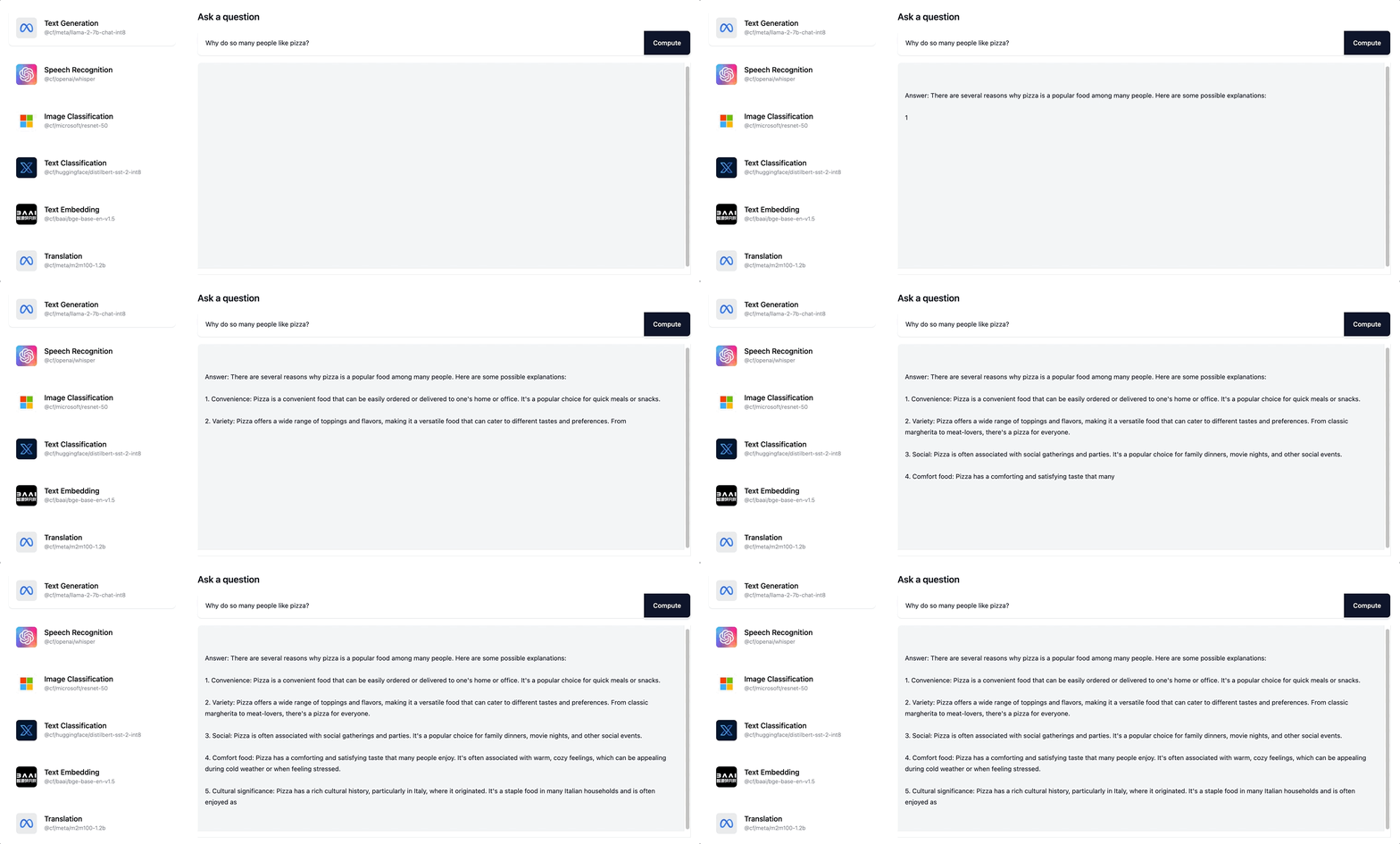
This creates a much more interactive experience for the user, who now sees the page update as the response is incrementally created, instead of waiting with a spinner until the entire response sequence has been generated. Try it out streaming on ai.cloudflare.com.

Workers AI supports streaming text responses for the Llama-2 model and any future LLM models we are adding to our catalog.

But this is not all.

Higher precision, longer context and sequence lengths

Another top request we heard from our community after the launch of Workers AI was for longer questions and answers in our Llama-2 model. In LLM terminology, this translates to higher context length (the number of tokens the model takes as input before making the prediction) and higher sequence length (the number of tokens the model generates in the response.)

We’re listening, and in conjunction with streaming, today we are adding a higher 16-bit full-precision Llama-2 variant to the catalog, and increasing the context and sequence lengths for the existing 8-bit version.

Model Context length (in) Sequence length (out)
@cf/meta/llama-2-7b-chat-int8 2048 (768 before) 1800 (256 before)
@cf/meta/llama-2-7b-chat-fp16 3072 2500

Streaming, higher precision, and longer context and sequence lengths provide a better user experience and enable new, richer applications using large language models in Workers AI.

Check the Workers AI developer documentation for more information and options. If you have any questions or feedback about Workers AI, please come see us in the Cloudflare Community and the Cloudflare Discord.
If you are interested in machine learning and serverless AI, the Cloudflare Workers AI team is building a global-scale platform and tools that enable our customers to run fast, low-latency inference tasks on top of our network. Check our jobs page for opportunities.

Backblaze Drive Stats for Q3 2023

Post Syndicated from Andy Klein original https://www.backblaze.com/blog/backblaze-drive-stats-for-q3-2023/

A decorative image showing the title Q3 2023 Drive Stats.

At the end of Q3 2023, Backblaze was monitoring 263,992 hard disk drives (HDDs) and solid state drives (SSDs) in our data centers around the world. Of that number, 4,459 are boot drives, with 3,242 being SSDs and 1,217 being HDDs. The failure rates for the SSDs are analyzed in the SSD Edition: 2023 Drive Stats review.

That leaves us with 259,533 HDDs that we’ll focus on in this report. We’ll review the quarterly and lifetime failure rates of the data drives as of the end of Q3 2023. Along the way, we’ll share our observations and insights on the data presented, and, for the first time ever, we’ll reveal the drive failure rates broken down by data center.

Q3 2023 Hard Drive Failure Rates

At the end of Q3 2023, we were managing 259,533 hard drives used to store data. For our review, we removed 449 drives from consideration as they were used for testing purposes, or were drive models which did not have at least 60 drives. This leaves us with 259,084 hard drives grouped into 32 different models. 

The table below reviews the annualized failure rate (AFR) for those drive models for the Q3 2023 time period.

A table showing the quarterly annualized failure rates of Backblaze hard drives.

Notes and Observations on the Q3 2023 Drive Stats

  • The 22TB drives are here: At the bottom of the list you’ll see the WDC 22TB drives (model: WUH722222ALE6L4). A Backblaze Vault of 1,200 drives (plus four) is now operational. The 1,200 drives were installed on September 29, so they only have one day of service each in this report, but zero failures so far.
  • The old get bolder: At the other end of the time-in-service spectrum are the 6TB Seagate drives (model: ST6000DX000) with an average of 101 months in operation. This cohort had zero failures in Q3 2023 with 883 drives and a lifetime AFR of 0.88%.
  • Zero failures: In Q3, six different drive models managed to have zero drive failures during the quarter. But only the 6TB Seagate, noted above, had over 50,000 drive days, our minimum standard for ensuring we have enough data to make the AFR plausible.
  • One failure: There were four drive models with one failure during Q3. After applying the 50,000 drive day metric, two drives stood out:
    1. WDC 16TB (model: WUH721816ALE6L0) with a 0.15% AFR.
    2. Toshiba 14TB (model: MG07ACA14TEY) with a 0.63% AFR.

The Quarterly AFR Drops

In Q3 2023, quarterly AFR for all drives was 1.47%. That was down from 2.2% in Q2 and also down from 1.65% a year ago. The quarterly AFR is based on just the data in that quarter, so it can often fluctuate from quarter to quarter. 

In our Q2 2023 report, we suspected the 2.2% for the quarter was due to the overall aging of the drive fleet and in particular we pointed a finger at specific 8TB, 10TB, and 12TB drive models as potential culprits driving the increase. That prediction fell flat in Q3 as nearly two-thirds of drive models experienced a decreased AFR quarter over quarter from Q2 and any increases were minimal. This included our suspect 8TB, 10TB, and 12TB drive models. 

It seems Q2 was an anomaly, but there was one big difference in Q3: we retired 4,585 aging 4TB drives. The average age of the retired drives was just over eight years, and while that was a good start, there’s another 28,963 4TB drives to go. To facilitate the continuous retirement of aging drives and make the data migration process easy and safe we use CVT, our awesome in-house data migration software which we’ll cover at another time.

A Hot Summer and the Drive Stats Data

As anyone should in our business, Backblaze continuously monitors our systems and drives. So, it was of little surprise to us when the folks at NASA confirmed the summer of 2023 as Earth’s hottest on record. The effects of this record-breaking summer showed up in our monitoring systems in the form of drive temperature alerts. A given drive in a storage server can heat up for many reasons: it is failing; a fan in the storage server has failed; other components are producing additional heat; the air flow is somehow restricted; and so on. Add in the fact that the ambient temperature within a data center often increases during the summer months, and you can get more temperature alerts.

In reviewing the temperature data for our drives in Q3, we noticed that a small number of drives exceeded the maximum manufacturer’s temperature for at least one day. The maximum temperature for most drives is 60°C, except for the 12TB, 14TB, and 16TB Toshiba drives which have a maximum temperature of 55°C. Of the 259,533 data drives in operation in Q3, there were 354 individual drives (0.0013%) that exceeded their maximum manufacturer temperature. Of those only two drives failed, leaving 352 drives which were still operational as of the end of Q3.

While temperature fluctuation is part of running data centers and temp alerts like these aren’t unheard of, our data center teams are looking into the root causes to ensure we’re prepared for the inevitability of increasingly hot summers to come.

Will the Temperature Alerts Affect Drive Stats?

The two drives which exceeded their maximum temperature and failed in Q3 have been removed from the Q3 AFR calculations. Both drives were 4TB Seagate drives (model: ST4000DM000). Given that the remaining 352 drives which exceeded their temperature maximum did not fail in Q3, we have left them in the Drive Stats calculations for Q3 as they did not increase the computed failure rates.

Beginning in Q4, we will remove the 352 drives from the regular Drive Stats AFR calculations and create a separate cohort of drives to track that we’ll name Hot Drives. This will allow us to track the drives which exceeded their maximum temperature and compare their failure rates to those drives which operated within the manufacturer’s specifications. While there are a limited number of drives in the Hot Drives cohort, it could give us some insight into whether drives being exposed to high temperatures could cause a drive to fail more often. This heightened level of monitoring will identify any increase in drive failures so that they can be detected and dealt with expeditiously.

New Drive Stats Data Fields in Q3

In Q2 2023, we introduced three new data fields that we started populating in the Drive Stats data we publish: vault_id, pod_id, and is_legacy_format. In Q3, we are adding three more fields into each drive records as follows:

  • datacenter: The Backblaze data center where the drive is installed, currently one of these values: ams5, iad1, phx1, sac0, and sac2.
  • cluster_id: The name of a given collection of storage servers logically grouped together to optimize system performance. Note: At this time the cluster_id is not always correct, we are working on fixing that. 
  • pod_slot_num: The physical location of a drive within a storage server. The specific slot differs based on the storage server type and capacity: Backblaze (45 drives), Backblaze (60 drives), Dell (26 drives), or Supermicro (60 drives). We’ll dig into these differences in another post.

With these additions, the new schema beginning in Q3 2023 is:

  • date
  • serial_number
  • model
  • capacity_bytes
  • failure
  • datacenter (Q3)
  • cluster_id (Q3)
  • vault_id (Q2)
  • pod_id (Q2)
  • pod_slot_num (Q3)
  • is_legacy_format (Q2)
  • smart_1_normalized
  • smart_1_raw
  • The remaining SMART value pairs (as reported by each drive model)

Beginning in Q3, these data data fields have been added to the publicly available Drive Stats files that we publish each quarter. 

Failure Rates by Data Center

Now that we have the data center for each drive we can compute the AFRs for the drives in each data center. Below you’ll find the AFR for each of five data centers for Q3 2023.

A chart showing Backblaze annualized failure rates by data center.

Notes and Observations

  • Null?: The drives which reported a null or blank value for their data center are grouped in four Backblaze vaults. David, the Senior Infrastructure Software Engineer for Drive Stats, described the process of how we gather all the parts of the Drive Stats data each day. The TL:DR is that vaults can be too busy to respond at the moment we ask, and since the data center field is nice-to-have data, we get a blank field. We can go back a day or two to find the data center value, which we will do in the future when we report this data.
  • sac0?: sac0 has the highest AFR of all of the data centers, but it also has the oldest drives—nearly twice as old, on average, versus the next closest in data center, sac2. As discussed previously, drive failures do seem to follow the “bathtub curve”, although recently we’ve seen the curve start out flatter. Regardless, as drive models age, they do generally fail more often. Another factor could be that sac0, and to a lesser extent sac2, has some of the oldest Storage Pods, including a handful of 45-drive units. We are in the process of using CVT to replace these older servers while migrating from 4TB to 16TB and larger drives.
  • iad1: The iad data center is the foundation of our eastern region and has been growing rapidly since coming online about a year ago. The growth is a combination of new data and customers using our cloud replication capability to automatically make a copy of their data in another region.
  • Q3 Data: This chart is for Q3 data only and includes all the data drives, including those with less than 60 drives per model. As we track this data over the coming quarters, we hope to get some insight into whether different data centers really have different drive failure rates, and, if so, why.

Lifetime Hard Drive Failure Rates

As of September 30, 2023, we were tracking 259,084 hard drives used to store customer data. For our lifetime analysis, we collect the number of drive days and the number of drive failures for each drive beginning from the time a drive was placed into production in one of our data centers. We group these drives by model, then sum up the drive days and failures for each model over their lifetime. That chart is below. 

A chart showing Backblaze lifetime hard drive failure rates.

One of the most important columns on this chart is the confidence interval, which is the difference between the low and high AFR confidence levels calculated at 95%. The lower the value, the more certain we are of the AFR stated. We like a confidence interval to be 0.5% or less. When the confidence interval is higher, that is not necessarily bad, it just means we either need more data or the data is somewhat inconsistent. 

The table below contains just those drive models which have a confidence interval of less than 0.5%. We have sorted the list by drive size and then by AFR.

A chart showing Backblaze hard drive annualized failure rates with a confidence interval of less than 0.5%.

The 4TB, 6TB, 8TB, and some of the 12TB drive models are no longer in production. The HGST 12TB models in particular can still be found, but they have been relabeled as Western Digital and given alternate model numbers. Whether they have materially changed internally is not known, at least to us.

One final note about the lifetime AFR data: you might have noticed the AFR for all of the drives hasn’t changed much from quarter to quarter. It has vacillated between 1.39% to 1.45% percent for the last two years. Basically, we have lots of drives with lots of time-in-service so it is hard to move the needle up or down. While the lifetime stats for individual drive models can be very useful, the lifetime AFR for all drives will probably get less and less interesting as we add more and more drives. Of course, a few hundred thousand drives that never fail could arrive, so we will continue to calculate and present the lifetime AFR.

The Hard Drive Stats Data

The complete data set used to create the information used in this review is available on our Hard Drive Stats Data webpage. You can download and use this data for free for your own purpose. All we ask are three things: 1) you cite Backblaze as the source if you use the data, 2) you accept that you are solely responsible for how you use the data, and 3) you do not sell this data to anyone; it is free. 

Good luck and let us know if you find anything interesting.

The post Backblaze Drive Stats for Q3 2023 appeared first on Backblaze Blog | Cloud Storage & Cloud Backup.

Security updates for Tuesday

Post Syndicated from corbet original https://lwn.net/Articles/951311/

Security updates have been issued by Debian (postgresql-11, postgresql-13, and postgresql-15), Fedora (chromium, optipng, and radare2), Scientific Linux (plexus-archiver and python), Slackware (tigervnc), SUSE (apache2, containerized-data-importer, kernel-firmware-nvidia-gspx-G06, nvidia-open- driver-G06-signed, postgresql, postgresql15, postgresql16, postgresql12, postgresql13, python-Django1, squashfs, and xterm), and Ubuntu (firefox and memcached).

How .tk Became a TLD for Scammers

Post Syndicated from Bruce Schneier original https://www.schneier.com/blog/archives/2023/11/how-tk-became-a-tld-for-scammers.html

Sad story of Tokelau, and how its top-level domain “became the unwitting host to the dark underworld by providing a never-ending supply of domain names that could be weaponized against internet users. Scammers began using .tk websites to do everything from harvesting passwords and payment information to displaying pop-up ads or delivering malware.”

The serverless attendee’s guide to AWS re:Invent 2023

Post Syndicated from Marcia Villalba original https://aws.amazon.com/blogs/compute/the-serverless-attendees-guide-to-aws-reinvent-2023/

AWS re:Invent 2023 is fast approaching, bringing together tens of thousands of Builders in Las Vegas in November. However, even if you can’t attend in person, you can catch up with sessions on-demand.

Breakout sessions are lecture-style 60-minute informative sessions presented by AWS experts, customers, or partners. These sessions cover beginner (100 level) topics to advanced and expert (300–400 level) topics. The sessions are recorded and uploaded a few days after to the AWS Events YouTube channel.

This post shares the “must watch” breakout sessions related to serverless architectures and services.

Sessions related to serverless architecture

SVS401

SVS401 | Best practices for serverless developers
Provides architectural best practices, optimizations, and useful shortcuts that experts use to build secure, high-scale, and high-performance serverless applications.

Chris Munns, Startup Tech Leader, AWS
Julian Wood, Principal Developer Advocate, AWS

SVS305 | Refactoring to serverless
Shows how you can refactor your application to serverless with real-life examples.

Gregor Hohpe, Senior Principal Evangelist, AWS
Sindhu Pillai, Senior Solutions Architect, AWS

SVS308 | Building low-latency, event-driven applications
Explores building serverless web applications for low-latency and event-driven support. Marvel Snap share how they achieve low-latency in their games using serverless technology.

Marcia Villalba, Principal Developer Advocate, AWS
Brenna Moore, Second Dinner

SVS309 | Improve productivity by shifting more responsibility to developers
Learn about approaches to accelerate serverless development with faster feedback cycles, exploring best practices and tools. Watch a live demo featuring an improved developer experience for building serverless applications while complying with enterprise governance requirements.

Heeki Park, Principal Solutions Architect, AWS
Sam Dengler, Capital One

GBL203-ES | Building serverless-first applications with MAPFRE
This session is delivered in Spanish. Learn what modern, serverless-first applications are and how to implement them with services such as AWS Lambda or AWS Fargate. Find out how MAPFRE have adopted and implemented a serverless strategy.

Jesus Bernal, Senior Solutions Architect, AWS
Iñigo Lacave, MAPFRE
Mat Jovanovic, MAPFRE

Sessions related to AWS Lambda

BOA311

BOA311 | Unlocking serverless web applications with AWS Lambda Web Adapter
Learn about the AWS Lambda Web Adapter and how it integrates with familiar frameworks and tools. Find out how to migrate existing web applications to serverless or create new applications using AWS Lambda.

Betty Zheng, Senior Developer Advocate, AWS
Harold Sun, Senior Solutions Architect, AWS

OPN305 | The pragmatic serverless Python developer
Covers an opinionated approach to setting up a serverless Python project, including testing, profiling, deployments, and operations. Learn about many open source tools, including Powertools for AWS Lambda—a toolkit that can help you implement serverless best practices and increase developer velocity.

Heitor Lessa, Principal Solutions Architect, AWS
Ran Isenberg, CyberArk

XNT301 | Build production-ready serverless .NET apps with AWS Lambda
Explores development and architectural best practices when building serverless applications with .NET and AWS Lambda, including when to run ASP.NET on Lambda, code structure, and using native AOT to massively increase performance.

James Eastham, Senior Cloud Architect, AWS
Craig Bossie, Solutions Architect, AWS

COM306 | “Rustifying” serverless: Boost AWS Lambda performance with Rust
Discover how to deploy Rust functions using AWS SAM and cargo-lambda, facilitating a smooth development process from your local machine. Explore how to integrate Rust into Python Lambda functions effortlessly using tools like PyO3 and maturin, along with the AWS SDK for Rust. Uncover how Rust can optimize Lambda functions, including the development of Lambda extensions, all without requiring a complete rewrite of your existing code base.

Efi Merdler-Kravitz, Cloudex

COM305 | Demystifying and mitigating AWS Lambda cold starts
Examines the Lambda initialization process at a low level, using benchmarks comparing common architectural patterns, and then benchmarking various RAM configurations and payload sizes. Next, measure and discuss common mistakes that can increase initialization latency, explore and understand proactive initialization, and learn several strategies you can use to thaw your AWS Lambda cold starts.

AJ Stuyvenberg, Datadog

Sessions related to event-driven architecture

API302

API302 | Building next gen applications with event driven architecture
Learn about common integration patterns and discover how you can use AWS messaging services to connect microservices and coordinate data flow using minimal custom code. Learn and plan for idempotency, handling duplicating events and building resiliency into your architectures.

Eric Johnson, Principal Developer Advocate, AWS

API303 | Navigating the journey of serverless event-driven architecture
Learn about the journey businesses undertake when adopting EDAs, from initial design and implementation to ongoing operation and maintenance. The session highlights the many benefits EDAs can offer organizations and focuses on areas of EDA that are challenging and often overlooked. Through a combination of patterns, best practices, and practical tips, this session provides a comprehensive overview of the opportunities and challenges of implementing EDAs and helps you understand how you can use them to drive business success.

David Boyne, Senior Developer Advocate, AWS

API309 | Advanced integration patterns and trade-offs for loosely coupled apps
In this session, learn about common design trade-offs for distributed systems, how to navigate them with design patterns, and how to embed those patterns in your cloud automation.

Dirk Fröhner, Principal Solutions Architect, AWS
Gregor Hohpe, Senior Principal Evangelist, AWS

SVS205 | Getting started building serverless event-driven applications
Learn about the process of prototyping a solution from concept to a fully featured application that uses Amazon API Gateway, AWS Lambda, Amazon EventBridge, AWS Step Functions, Amazon DynamoDB, AWS Application Composer, and more. Learn why serverless is a great tool set for experimenting with new ideas and how the extensibility and modularity of serverless applications allow you to start small and quickly make your idea a reality.

Emily Shea, Head of Application Integration Go-to-Market, AWS
Naren Gakka, Solutions Architect, AWS

API206 | Bringing workloads together with event-driven architecture
Attend this session to learn the steps to bring your existing container workloads closer together using event-driven architecture with minimal code changes and a high degree of reusability. Using a real-life business example, this session walks through a demo to highlight the power of this approach.

Dhiraj Mahapatro, Principal Solutions Architect, AWS
Nicholas Stumpos, JPMorgan Chase & Co

COM301 | Advanced event-driven patterns with Amazon EventBridge
Gain an understanding of the characteristics of EventBridge and how it plays a pivotal role in serverless architectures. Learn the primary elements of event-driven architecture and some of the best practices. With real-world use cases, explore how the features of EventBridge support implementing advanced architectural patterns in serverless.

Sheen Brisals, The LEGO Group

Sessions related to serverless APIs

SVS301

SVS301 | Building APIs: Choosing the best API solution and strategy for your workloads
Learn about access patterns and how to evaluate the best API technology for your applications. The session considers the features and benefits of Amazon API Gateway, AWS AppSync, Amazon VPC Lattice, and other options.

Josh Kahn, Tech Leader Serverless, AWS
Arthi Jaganathan, Principal Solutions Architect, AWS

SVS323 | I didn’t know Amazon API Gateway did that
This session provides an introduction to Amazon API Gateway and the problems it solves. Learn about the moving parts of API Gateway and how it works, including common and not-so-common use cases. Discover why you should use API Gateway and what it can do.

Eric Johnson, Principal Developer Advocate, AWS

FWM201 | What’s new with AWS AppSync for enterprise API developers
Join this session to learn about all the exciting new AWS AppSync features released this year that make it even more seamless for API developers to realize the benefits of GraphQL for application development.

Michael Liendo, Senior Developer Advocate, AWS
Brice Pellé, Principal Product Manager, AWS

FWM204 | Implement real-time event patterns with WebSockets and AWS AppSync
Learn how the PGA Tour uses AWS AppSync to deliver real-time event updates to their app users; review new features, like enhanced filtering options and native integration with Amazon EventBridge; and provide a sneak peek at what’s coming next.

Ryan Yanchuleff, Senior Solutions Architect, AWS
Bill Fine, Senior Product Manager, AWS
David Provan, PGA Tour

Sessions related to AWS Step Functions

API401

API401 | Advanced workflow patterns and business processes with AWS Step Functions
Learn about architectural best practices and repeatable patterns for building workflows and cost optimizations, and discover handy cheat codes that you can use to build secure, high-scale, high-performance serverless applications

Ben Smith, Principal Developer Advocate, AWS

BOA304 | Using AI and serverless to automate video production
Learn how to use Step Functions to build workflows using AI services and how to use Amazon EventBridge real-time events.

Marcia Villalba, Principal Developer Advocate, AWS

SVS204 | Building Serverlesspresso: Creating event-driven architectures
This session explores the design decisions that were made when building Serverlesspresso, how new features influenced the development process, and lessons learned when creating a production-ready application using this approach. Explore useful patterns and options for extensibility that helped in the design of a robust, scalable solution that costs about one dollar per day to operate. This session includes examples you can apply to your serverless applications and complex architectural challenges for larger applications.

James Beswick, Senior Manager Developer Advocacy, AWS

API310 | Scale interactive data analysis with Step Functions Distributed Map
Learn how to build a data processing or other automation once and readily scale it to thousands of parallel processes with serverless technologies. Explore how this approach simplifies development and error handling while improving speed and lowering cost. Hear from an AWS customer that refactored an existing machine learning application to use Distributed Map and the lessons they learned along the way.

Adam Wagner, Principal Solutions Architect, AWS
Roberto Iturralde, Vertex Pharmaceuticals

Sessions related to handling data using serverless services and serverless databases

SVS307

SVS307 | Scaling your serverless data processing with Amazon Kinesis and Kafka
Explore how to build scalable data processing applications using AWS Lambda. Learn practical insights into integrating Lambda with Amazon Kinesis and Apache Kafka using their event-driven models for real-time data streaming and processing.

Julian Wood, Principal Developer Advocate, AWS

DAT410 | Advanced data modeling with Amazon DynamoDB
This session shows you advanced techniques to get the most out of DynamoDB. Learn how to “think in DynamoDB” by learning the DynamoDB foundations and principles for data modeling. Learn practical strategies and DynamoDB features to handle difficult use cases in your application.

Alex De Brie – Independent consultant

COM308 | Serverless data streaming: Amazon Kinesis Data Streams and AWS Lambda
Explore the intricacies of creating scalable, production-ready data streaming architectures using Kinesis Data Streams and Lambda. Delve into tips and best practices essential to navigating the challenges and pitfalls inherent to distributed systems that arise along the way, and observe how AWS services work and interact.

Anahit Pogosova, Solita

Additional resources

If you are attending the event, there are many chalk talks, workshops, and other sessions to visit. See ServerlessLand for a full list of all the serverless sessions and also the Serverless Hero, Danielle Heberling’s Serverless re:Invent attendee guide for her top picks.

Visit us in the AWS Village in the Expo Hall where you can find the Serverless and Containers booth and enjoy a free cup of coffee at Serverlesspresso.

For more serverless learning resources, visit Serverless Land.

Code Editor update: Support for HTML and mobile devices 

Post Syndicated from Mel Farrington original https://www.raspberrypi.org/blog/html-code-editor/

Earlier this year, we launched our Code Editor, a free online tool to help make learning text-based programming simple and accessible for kids age 9 and up. We focus on supporting the needs of young people who are learning programming at school, in Code Clubs and CoderDojos, and at home.

A young coder using the Code Editor.

Today, we have two exciting updates to share: support for web page projects with HTML/CSS, and an improved mobile and tablet experience.

What’s the Code Editor?

Learners can use the Code Editor to write and run code in a web browser without installing any additional software. The Editor is currently available as a beta version, and we’ve already received really positive comments: 

“The Editor looks really nice! I have tried the Python part, and it is intuitive and concise. My little program worked no problem, and I am sure the Editor will be easy, intuitive, and quick to learn for the young [learners].”

— Volunteer in the CoderDojo community

Introducing HTML and CCS in the Code Editor 

The Code Editor now supports the HTML and CSS web development languages, giving young people the ability to create and preview their own websites directly in the Editor interface. Learners can have their code and the preview panel side by side, and they can also preview their websites in a separate, larger tab.

A web project in the Code Editor.

We have embedded the Editor in our ‘Introduction to web‘ path on the Projects site. The path contains six HTML and CSS projects for beginners and helps them create fun websites like the ones shown here.

We want the Code Editor to be safe, age-appropriate, and suitable for use in classrooms or coding clubs. With this in mind, we have excluded certain functions, like being able to add links to external websites in the code. Rather than enabling image uploads, we provide a library of images when projects in our free learning paths contain images, in order to support multimedia projects safely.

A web project in the Code Editor.

Whether users are coding in Python or HTML/CSS, the Editor offers accessibility options so you can easily switch settings between light and dark mode, and between small, medium, and large text size. The text size feature is useful for people with visual impairments, as well as for educators who want to demonstrate something to a group of learners.

Improved experience for mobile and tablet devices

Our Code Editor now offers a new and improved experience for users of mobile and tablet devices. This improves access for learners in classrooms where tablets are used, and in low- and middle-income countries, where mobile phones are commonly used for digital learning.

A web project in the Code Editor.

The Editor now includes: 

  • A clearer and simpler navigation for small-screen devices
  • Separate Menu, Code and Output/Preview tabs
  • The same features on mobile/tablet devices as on desktop of laptop computers, such as responsive panels and the option to open HTML/CSS projects in a new tab

Try the Code Editor today

We’re continuing to develop the Code Editor and have more improvements planned. If you would like to try it out and provide us with your feedback, we’d love to hear what you think of our latest updates. 

Code Editor developments have been made possible with generous support from Endless and the Cisco Foundation.

The post Code Editor update: Support for HTML and mobile devices  appeared first on Raspberry Pi Foundation.

Detecting Speech and Music in Audio Content

Post Syndicated from Netflix Technology Blog original https://netflixtechblog.com/detecting-speech-and-music-in-audio-content-afd64e6a5bf8

Iroro Orife, Chih-Wei Wu and Yun-Ning (Amy) Hung

Introduction

When you enjoy the latest season of Stranger Things or Casa de Papel (Money Heist), have you ever wondered about the secrets to fantastic story-telling, besides the stunning visual presentation? From the violin melody accompanying a pivotal scene to the soaring orchestral arrangement and thunderous sound-effects propelling an edge-of-your-seat action sequence, the various components of the audio soundtrack combine to evoke the very essence of story-telling. To uncover the magic of audio soundtracks and further improve the sonic experience, we need a way to systematically examine the interaction of these components, typically categorized as dialogue, music and effects.

In this blog post, we will introduce speech and music detection as an enabling technology for a variety of audio applications in Film & TV, as well as introduce our speech and music activity detection (SMAD) system which we recently published as a journal article in EURASIP Journal on Audio, Speech, and Music Processing.

Like semantic segmentation for audio, SMAD separately tracks the amount of speech and music in each frame in an audio file and is useful in content understanding tasks during the audio production and delivery lifecycle. The detailed temporal metadata SMAD provides about speech and music regions in a polyphonic audio mixture are a first step for structural audio segmentation, indexing and pre-processing audio for the following downstream tasks. Let’s have a look at a few applications.

Practical use cases for speech & music activity

Audio dataset preparation

Speech & music activity is an important preprocessing step to prepare corpora for training. SMAD classifies & segments long-form audio for use in large corpora, such as

From “Audio Signal Classification” by David Gerhard

Dialogue analysis & processing

  • During encoding at Netflix, speech-gated loudness is computed for every audio master track and used for loudness normalization. Speech-activity metadata is thus a central part of accurate catalog-wide loudness management and improved audio volume experience for Netflix members.
  • Similarly, algorithms for dialogue intelligibility, spoken-language-identification and speech-transcription are only applied to audio regions where there is measured speech.

Music information retrieval

  • There are a few studio use cases where music activity metadata is important, including quality-control (QC) and at-scale multimedia content analysis and tagging.
  • There are also inter-domain tasks like singer-identification and song lyrics transcription, which do not fit neatly into either speech or classical MIR tasks, but are useful for annotating musical passages with lyrics in closed captions and subtitles.
  • Conversely, where neither speech nor music activity is present, such audio regions are estimated to have content classified as noisy, environmental or sound-effects.

Localization & Dubbing

Finally, there are post-production tasks, which take advantage of accurate speech segmentation at the the spoken utterance or sentence level, ahead of translation and dub-script generation. Likewise, authoring accessibility-features like Audio Description (AD) involves music and speech segmentation. The AD narration is typically mixed-in to not overlap with the primary dialogue, while music lyrics strongly tied to the plot of the story, are sometimes referenced by AD creators, especially for translated AD.

A voice actor in the studio

Our Approach to Speech and Music Activity Detection

Although the application of deep learning methods has improved audio classification systems in recent years, this data driven approach for SMAD requires large amounts of audio source material with audio-frame level speech and music activity labels. The collection of such fine-resolution labels is costly and labor intensive and audio content often cannot be publicly shared due to the copyright limitations. We address the challenge from a different angle.

Content, genre and languages

Instead of augmenting or synthesizing training data, we sample the large scale data available in the Netflix catalog with noisy labels. In contrast to clean labels, which indicate precise start and end times for each speech/music region, noisy labels only provide approximate timing, which may impact SMAD classification performance. Nevertheless, noisy labels allow us to increase the scale of the dataset with minimal manual efforts and potentially generalize better across different types of content.

Our dataset, which we introduced as TVSM (TV Speech and Music) in our publication, has a total number of 1608 hours of professionally recorded and produced audio. TVSM is significantly larger than other SMAD datasets and contains both speech and music labels at the frame level. TVSM also contains overlapping music and speech labels, and both classes have a similar total duration.

Training examples were produced between 2016 and 2019, in 13 countries, with 60% of the titles originating in the USA. Content duration ranged from 10 minutes to over 1 hour, across the various genres listed below.

The dataset contains audio tracks in three different languages, namely English, Spanish, and Japanese. The language distribution is shown in the figure below. The name of the episode/TV show for each sample remains unpublished. However, each sample has both a show-ID and a season-ID to help identify the connection between the samples. For instance, two samples from different seasons of the same show would share the same show ID and have different season IDs.

What constitutes music or speech?

To evaluate and benchmark our dataset, we manually labeled 20 audio tracks from various TV shows which do not overlap with our training data. One of the fundamental issues encountered during the annotation of our manually-labeled TVSM-test set, was the definition of music and speech. The heavy usage of ambient sounds and sound effects blurs the boundaries between active music regions and non-music. Similarly, switches between conversational speech and singing voices in certain TV genres obscure where speech starts and music stops. Furthermore, must these two classes be mutually exclusive? To ensure label quality, consistency, and to avoid ambiguity, we converged on the following guidelines for differentiating music and speech:

  • Any music that is perceivable by the annotator at a comfortable playback volume should be annotated.
  • Since sung lyrics are often included in closed-captions or subtitles, human singing voices should all be annotated as both speech and music.
  • Ambient sound or sound effects without apparent melodic contours should not be annotated as music. Traditional phone bell, ringing, or buzzing without apparent melodic contours should not be annotated as music.
  • Filled pauses (uh, um, ah, er), backchannels (mhm, uh-huh), sighing, and screaming should not be annotated as speech.

Audio format and preprocessing

All audio files were originally delivered from the post-production studios in the standard 5.1 surround format at 48 kHz sampling rate. We first normalize all files to an average loudness of −27 LKFS ± 2 LU dialog-gated, then downsample to 16 kHz before creating an ITU downmix.

Model Architecture

Our modeling choices take advantage of both convolutional and recurrent architectures, which are known to work well on audio sequence classification tasks, and are well supported by previous investigations. We adapted the SOTA convolutional recurrent neural network (CRNN) architecture to accommodate our requirements for input/output dimensionality and model complexity. The best model was a CRNN with three convolutional layers, followed by two bi-directional recurrent layers and one fully connected layer. The model has 832k trainable parameters and emits frame-level predictions for both speech and music with a temporal resolution of 5 frames per second.

For training, we leveraged our large and diverse catalog dataset with noisy labels, introduced above. Applying a random sampling strategy, each training sample is a 20 second segment obtained by randomly selecting an audio file and corresponding starting timecode offset on the fly. All models in our experiments were trained by minimizing binary cross-entropy (BCE) loss.

Evaluation

In order to understand the influence of different variables in our experimental setup, e.g. model architecture, training data or input representation variants like log-Mel Spectrogram versus per-channel energy normalization (PCEN), we setup a detailed ablation study, which we encourage the reader to explore fully in our EURASIP journal article.

For each experiment, we reported the class-wise F-score and error rate with a segment size of 10ms. The error rate is the summation of deletion rate (false negative) and insertion rate (false positive). Since a binary decision must be attained for music and speech to calculate the F-score, a threshold of 0.5 was used to quantize the continuous output of speech and music activity functions.

Results

We evaluated our models on four open datasets comprising audio data from TV programs, YouTube clips and various content such as concert, radio broadcasts, and low-fidelity folk music. The excellent performance of our models demonstrates the importance of building a robust system that detects overlapping speech and music and supports our assumption that a large but noisy-labeled real-world dataset can serve as a viable solution for SMAD.

Conclusion

At Netflix, tasks throughout the content production and delivery lifecycle work are most often interested in one part of the soundtrack. Tasks that operate on just dialogue, music or effects are performed hundreds of times a day, by teams around the globe, in dozens of different audio languages. So investments in algorithmically-assisted tools for automatic audio content understanding like SMAD, can yield substantial productivity returns at scale while minimizing tedium.

Additional Resources

We have made audio features and labels available via Zenodo. There is also GitHub repository with the following audio tools:

  • Python code for data pre-processing, including scripts for 5.1 downmixing, Mel spectrogram generation, MFCCs generation, VGGish features generation, and the PCEN implementation.
  • Python code for reproducing all experiments, including scripts of data loaders, model implementations, training and evaluation pipelines.
  • Pre-trained models for each conducted experiment.
  • Prediction outputs for all audio in the evaluation datasets.

Special thanks to the entire Audio Algorithms team, as well as Amir Ziai, Anna Pulido, and Angie Pollema.


Detecting Speech and Music in Audio Content was originally published in Netflix TechBlog on Medium, where people are continuing the conversation by highlighting and responding to this story.

Amazon MSK Serverless now supports Kafka clients written in all programming languages

Post Syndicated from Ali Alemi original https://aws.amazon.com/blogs/big-data/amazon-msk-serverless-now-supports-kafka-clients-written-in-all-programming-languages/

Amazon MSK Serverless is a cluster type for Amazon Managed Streaming for Apache Kafka (Amazon MSK) that is the most straightforward way to run Apache Kafka clusters without having to manage compute and storage capacity. With MSK Serverless, you can run your applications without having to provision, configure, or optimize clusters, and you pay for the data volume you stream and retain. MSK Serverless fully manages partitions, including monitoring and moving them to even load across a cluster.

With today’s launch, MSK Serverless now supports writes and reads from Kafka clients written in all programming languages. Administrators can simplify and standardize access control to Kafka resources using AWS Identity and Access Management (IAM). This support for IAM in Amazon MSK is based on SASL/OUATHBEARER, an open standard for authorization and authentication.

In this post, we show how you can connect your applications to MSK Serverless with minimal code changes using the open-sourced client helper libraries and code samples for popular languages, including Java, Python, Go, JavaScript, and .NET. Using IAM authentication and authorization is the preferred choice of many customers because you can secure Kafka resources just like you do with all other AWS services. Additionally, you get all the other benefits of IAM, such as temporary role-based credentials, precisely scoped permission policies, and more. Now you can use MSK Serverless with IAM-based authentication more broadly with the support for multiple languages.

Solution overview

You can get started by using IAM principals as identities for your Apache Kafka clients and define identity policies to provide them precisely scoped access permissions. For example, you can create an IAM user and a policy that allows the user to write to a specific Kafka topic but restricts access to other resources without worrying about managing Kafka ACLs. After you provide the identity policies with the necessary permissions, you can configure client applications to use the IAM authentication with minimal code changes.

The code changes allow your clients to use SASL/OAUTHBEARER, a Kafka supported token-based access mechanism, to pass the credentials required for IAM authentication. With OAUTHBEARER support, you can build clients that can work across both Amazon MSK and other Kafka environments. In this post, we show how you can make these code changes by using the provided code libraries and examples.

With this launch, Amazon MSK provides new code libraries for the following programming languages in the AWS GitHub repo:

The following diagram shows the conceptual process flow of using SASL/OAUTHBEARER with IAM access control for non-Java clients.

The workflow contains the following steps:

  1. The client generates an OAUTHBEARER token with the help of the provided library. The token contains a signed base64 encoded transformation of your IAM identity credentials.
  2. The client sends this to Amazon MSK using the bootstrap address along with its request to access Apache Kafka resources.
  3. The MSK Serverless cluster decodes the OATHBEARER token, validates the credentials, and checks if the client is authorized to perform the requested action according to the policy attached to the IAM identity.
  4. When the token expires, the client Kafka library automatically refreshes the token by making another call to the specified token provider.

Create IAM identities and policies

IAM access control for non-Java clients is supported for MSK Serverless clusters with no additional cost. Before you start, you need to configure the IAM identities and policies that define the client’s permissions to access resources on the cluster. The following is an example authorization policy for a cluster named MyTestCluster. To understand the semantics of the action and resource elements, see Semantics of actions and resources.

{
    "Version": "2012-10-17",
    "Statement": [
        {
            "Effect": "Allow",
            "Action": [
                "kafka-cluster:Connect",
                "kafka-cluster:AlterCluster",
                "kafka-cluster:DescribeCluster"
            ],
            "Resource": [
                "arn:aws:kafka:us-east-1:0123456789012:cluster/MyTestCluster/abcd1234-0123-abcd-5678-1234abcd-1"
            ]
        },
        {
            "Effect": "Allow",
            "Action": [
                "kafka-cluster:*Topic*",
                "kafka-cluster:WriteData",
                "kafka-cluster:ReadData"
            ],
            "Resource": [
                "arn:aws:kafka:us-east-1:0123456789012:topic/MyTestCluster/*"
            ]
        },
        {
            "Effect": "Allow",
            "Action": [
                "kafka-cluster:AlterGroup",
                "kafka-cluster:DescribeGroup"
            ],
            "Resource": [
                "arn:aws:kafka:us-east-1:0123456789012:group/MyTestCluster/*"
            ]
        }
    ]
}

Configure the client

You should make code changes to your application that allow the clients to use SASL/OAUTHBEARER to pass the credentials required for IAM authentication. You also need to make sure the security group associated with your MSK Serverless cluster has an inbound rule allowing the traffic from the client applications in the associated VPCs to the TCP port number 9098.

You must use a Kafka client library that provides support for SASL with OAUTHBRARER authentication.

For this post, we use the Python programming language. We also use https://github.com/dpkp/kafka-python as our Kafka client library.

Amazon MSK provides you with a new code library per each language that generates the OAUTHBEARER token.

  1. To get started working with the Amazon MSK IAM SASL signer for Python with your Kafka client library, run the following command:
    $ pip install aws-msk-iam-sasl-signer-python

  2. Import the installed Amazon MSK IAM SASL signer library in your code:
    from kafka import KafkaProducer
    from kafka.errors import KafkaError
    import socket
    import time
    from aws_msk_iam_sasl_signer import MSKAuthTokenProvider

  3. Next, your application code needs to define a token provider that wraps the function that generates new tokens:
    class MSKTokenProvider():
            def token(self):
                token, _ = MSKAuthTokenProvider.generate_auth_token('<your aws region>')
                return token

  4. Specify security_protocol as SASL_SSL and sasl_mechanism as oauthbearer in your Python Kafka client properties, and pass the token provider in the configuration object:
    tp = MSKTokenProvider()
    
        producer = KafkaProducer(
            bootstrap_servers='<Amazon MSK Serverless bootstrap string>',
            security_protocol='SASL_SSL',
            sasl_mechanism='OAUTHBEARER',
            sasl_oauth_token_provider=tp,
            client_id=”my.kafka.client.unique.id”,
        )

You are now finished with all the code changes. For more examples of generating auth tokens or for more troubleshooting tips, refer to the following GitHub repo.

Conclusion

MSK Serverless now supports writes and reads from Kafka clients written in all programming languages. You can run your applications without having to configure and manage the infrastructure or optimize clusters, and you pay for the data volume you stream and retain. MSK Serverless fully manages partitions, including monitoring, and ensures an even balance of partition distribution across brokers in the cluster (auto-balancing).

For further reading on Amazon MSK, visit the official product page.


About the author

Ali Alemi is a Streaming Specialist Solutions Architect at AWS. Ali advises AWS customers with architectural best practices and helps them design real-time analytics data systems that are reliable, secure, efficient, and cost-effective. He works backward from customer’s use cases and designs data solutions to solve their business problems. Prior to joining AWS, Ali supported several public sector customers and AWS consulting partners in their application modernization journey and migration to the Cloud.

The collective thoughts of the interwebz