New – Amazon EC2 M1 Mac Instances

Post Syndicated from Sébastien Stormacq original https://aws.amazon.com/blogs/aws/new-amazon-ec2-m1-mac-instances/

Last year, during the re:Invent 2021 conference, I wrote a blog post to announce the preview of EC2 M1 Mac instances. I know many of you requested access to the preview, and we did our best but could not satisfy everybody. However, the wait is over. I have the pleasure of announcing the general availability of EC2 M1 Mac instances.

EC2 Mac instances are dedicated Mac mini computers attached through Thunderbolt to the AWS Nitro System, which lets the Mac mini appear and behave like another EC2 instance. It connects to your Amazon Virtual Private Cloud (Amazon VPC), boots from Amazon Elastic Block Store (EBS) volumes, and uses EBS snapshots, Amazon Machine Images (AMIs), security groups and other AWS services such as Amazon CloudWatch and AWS Systems Manager.

The availability of EC2 M1 Mac instances lets you access machines built around the Apple-designed M1 System on Chip (SoC). If you are a Mac developer and re-architecting your apps to natively support Macs with Apple silicon, you may now build and test your apps and take advantage of all the benefits of AWS. Developers building for iPhone, iPad, Apple Watch, and Apple TV will also benefit from faster builds. EC2 M1 Mac instances deliver up to 60 percent better price performance over the x86-based EC2 Mac instances for iPhone and Mac app build workloads.

For example, I tested the time it takes to clean, build, archive, and run the unit tests on a sample project I wrote. The new EC2 M1 Mac instances complete this set of tasks in 49 seconds on average. This is 47.8 percent faster than the same set of tasks running on the previous generation of EC2 Mac instances.

To see how to launch an EC2 M1 Mac instance from the AWS Management Console or the AWS Command Line Interface (CLI), I invite you to read my last blog post on the subject.

EC2 Mac M1 Instance

During the six months of the preview, we collected your feedback and fine-tuned the service to your needs.

We’ve added a new FAQ section to our documentation to get started with EC2 M1 Mac instances. Agents for management and observability, such as Systems Manager and CloudWatch, are pre-installed on all our macOS AMIs, along with tools such as the AWS Command Line Interface (CLI) and our AWS SDKs. EC2 M1 Mac instances integrate with other AWS services, such as Amazon Elastic File System (Amazon EFS) for file storage, AWS Auto Scaling, or AWS Secrets Manager.

For example, I am using Secrets Manager to securely store my build secrets, such as the signing keys and certificates used to sign my binaries before to distribute them on the App Store. From my laptop, I first make sure to export the certificate from the macOS keychain. I then upload my certificate to Secrets Manager with this command:

aws secretsmanager create-secret            \
       --name apple-signing-dev-certificate \
       --secret-binary fileb://./secrets/apple_dev_seb.p12 

On the EC2 M1 Mac instance, to prepare my instance before the build phase, I download the certificate, decode it (it is base64-encoded), and store it in the EC2 M1 Mac instance keychain, where the codesign tool will find it during the build.

# download the certificate from Secrets Manager
SIGNING_DEV_KEY=$($aws secretsmanager get-secret-value  \
      --secret-id apple-signing-dev-certificate         \
      --query SecretBinary --output text)
	  

# save the certificate as a file
echo $SIGNING_DEV_KEY | base64 -d > seb_dev_certificate.p12

# import the certificate in the keychain 
security import seb_dev_certificate.p12 \
                -P "my_cert_password"   \
                -k my.dev.keychain      \
                -T /usr/bin/security -T /usr/bin/codesign -T /usr/bin/xcodebuild

# delete the certificate from disk
rm seb_dev_certificate.p12

There are a few more configuration steps to get code signing work from the macOS command line. You can check out this presentation I made or my code repository for the details.

We are preparing a couple of events to help you learn more about EC2 M1 Mac instance use cases and configuration. First, we recently had an online webinar to learn how to take advantage of EC2 Mac instances for iOS development, content is available for you to consume on-demand after a free registration step. Second, we are preparing a one-day, in-person developer conference for later this year. The conference agenda will be packed with technical content and workshops. Stay tuned on social media to learn more about it.

Last and not least, but not related to EC2 Mac instances, the Apple WWDC 2022 conference took place last month, from June 6–8, 2022, and the content is available online. This is a great occasion to learn more about development for Apple systems in general.

And now, go build 😉

— seb

Exploitation of Mitel MiVoice Connect SA CVE-2022-29499

Post Syndicated from Caitlin Condon original https://blog.rapid7.com/2022/07/07/exploitation-of-mitel-mivoice-connect-sa-cve-2022-29499/

Exploitation of Mitel MiVoice Connect SA CVE-2022-29499

In April 2022, telecommunications company Mitel published a security advisory on CVE-2022-29499, a data validation vulnerability in the Service Appliance component of MiVoice Connect, a business communications product. The vulnerability, which was unpatched at time of publication, arose from insufficient data validation for a diagnostic script and potentially allowed an unauthenticated remote attacker to send specially crafted requests to inject commands and achieve remote code execution. CVE-2022-29499 has a CVSSv3 score of 9.8.

On June 23, 2022, security firm Crowdstrike published an analysis on a ransomware intrusion attempt that had targeted CVE-2022-29499 — which at the time of detection was an undisclosed zero-day vulnerability — as an initial access vector. Over the past two weeks, Rapid7 Managed Detection and Response (MDR) has also observed a small number of intrusions that have leveraged CVE-2022-29499 as an initial access vector.

There is currently no indication that a large number of these appliances are exposed to the public internet, and we have no evidence that this vulnerability is being targeted in wider-scale ransomware campaigns. We are conscious of the fact, however, that the proliferation of ransomware in general has continued to shape risk models for many organizations, and that network perimeter devices are tempting targets for a variety of attackers.

Affected products

CVE-2022-29499 affects MiVoice Connect deployments (including earlier versions 14.2) that include the MiVoice Connect Service Appliances, SA 100, SA 400 and/or Virtual SA. Vulnerable firmware versions include R19.2 SP3 (22.20.2300.0) and earlier, and R14.x and earlier. See Mitel product security advisory 22-0002 and their security bulletin for additional information.

Mitigation guidance

Mitel MiVoice Connect customers who use vulnerable versions of the Service Appliance in their deployments should update to a fixed version of the appliance immediately. Mitel released patches for CVE-2022-29499 in early June 2022; organizations that have not updated the firmware on their appliances since before that timeframe should apply fixes as soon as possible.

Rapid7 customers

We have not been able to determine whether a vulnerability check is feasible at this time. We are investigating alternative options to help InsightVM and Nexpose customers assess exposure, including the potential to generically fingerprint MiVoice Connect in customer environments.

NEVER MISS A BLOG

Get the latest stories, expertise, and news about security today.

Ubiquitous Surveillance by ICE

Post Syndicated from Bruce Schneier original https://www.schneier.com/blog/archives/2022/07/ubiquitous-surveillance-by-ice.html

Report by Georgetown’s Center on Privacy and Technology published a comprehensive report on the surprising amount of mass surveillance conducted by Immigration and Customs Enforcement (ICE).

Our two-year investigation, including hundreds of Freedom of Information Act requests and a comprehensive review of ICE’s contracting and procurement records, reveals that ICE now operates as a domestic surveillance agency. Since its founding in 2003, ICE has not only been building its own capacity to use surveillance to carry out deportations but has also played a key role in the federal government’s larger push to amass as much information as possible about all of our lives. By reaching into the digital records of state and local governments and buying databases with billions of data points from private companies, ICE has created a surveillance infrastructure that enables it to pull detailed dossiers on nearly anyone, seemingly at any time. In its efforts to arrest and deport, ICE has ­ without any judicial, legislative or public oversight ­ reached into datasets containing personal information about the vast majority of people living in the U.S., whose records can end up in the hands of immigration enforcement simply because they apply for driver’s licenses; drive on the roads; or sign up with their local utilities to get access to heat, water and electricity.

ICE has built its dragnet surveillance system by crossing legal and ethical lines, leveraging the trust that people place in state agencies and essential service providers, and exploiting the vulnerability of people who volunteer their information to reunite with their families. Despite the incredible scope and evident civil rights implications of ICE’s surveillance practices, the agency has managed to shroud those practices in near-total secrecy, evading enforcement of even the handful of laws and policies that could be invoked to impose limitations. Federal and state lawmakers, for the most part, have yet to confront this reality.

OSPAR 2022 report now available with 142 services in scope

Post Syndicated from Joseph Goh original https://aws.amazon.com/blogs/security/ospar-2022-report-now-available-with-142-services-in-scope/

We’re excited to announce the completion of our annual Outsourced Service Provider’s Audit Report (OSPAR) audit cycle on July 1, 2022. The 2022 OSPAR certification cycle includes the addition of 15 new services in scope, bringing the total number of services in scope to 142 in the AWS Asia Pacific (Singapore) Region.

Newly added services in scope include the following:

Successful completion of the OSPAR assessment demonstrates that AWS has a system of controls in place that meet the Association of Banks in Singapore (ABS) Guidelines on Control Objectives and Procedures for Outsourced Service Providers. Our alignment with the ABS guidelines demonstrates our commitment to meet the security expectations for cloud service providers set by the financial services industry in Singapore. Customers can use the OSPAR assessment to conduct due diligence, and to help reduce the effort and costs required for compliance. An independent third-party auditor, selected from the ABS list of approved auditors, performs the OSPAR assessment.

You can download the latest OSPAR report from AWS Artifact, a self-service portal for on-demand access to AWS compliance reports. Sign in to AWS Artifact in the AWS Management Console, or learn more at Getting Started with AWS Artifact. The list of services in scope for OSPAR is available in the report, and is also available on the AWS Services in Scope by Compliance Program webpage.

As always, we’re committed to bringing new services into the scope of our OSPAR program based on your architectural and regulatory needs. If you have questions about the OSPAR report, contact your AWS account team.

 
If you have feedback about this post, submit comments in the Comments section below.

Want more AWS Security how-to content, news, and feature announcements? Follow us on Twitter.

Joseph Goh

Joseph Goh

Joseph is the APJ ASEAN Lead at AWS based in Singapore. He leads security audits, certifications and compliance programs across the Asia Pacific region. Joseph is passionate about delivering programs that build trust with customers and provide them assurance on cloud security.

Announcing support for WASI on Cloudflare Workers

Post Syndicated from Ben Yule original https://blog.cloudflare.com/announcing-wasi-on-workers/

Announcing support for WASI on Cloudflare Workers

Announcing support for WASI on Cloudflare Workers

Today, we are announcing experimental support for WASI (the WebAssembly System Interface) on Cloudflare Workers and support within wrangler2 to make it a joy to work with. We continue to be incredibly excited about the entire WebAssembly ecosystem and are eager to adopt the standards as they are developed.

A Quick Primer on WebAssembly

So what is WASI anyway? To understand WASI, and why we’re excited about it, it’s worth a quick recap of WebAssembly, and the ecosystem around it.

WebAssembly promised us a future in which code written in compiled languages could be compiled to a common binary format and run in a secure sandbox, at near native speeds. While WebAssembly was designed with the browser in mind, the model rapidly extended to server-side platforms such as Cloudflare Workers (which has supported WebAssembly since 2017).

WebAssembly was originally designed to run alongside Javascript, and requires developers to interface directly with Javascript in order to access the world outside the sandbox. To put it another way, WebAssembly does not provide any standard interface for I/O tasks such as interacting with files, accessing the network, or reading the system clock. This means if you want to respond to an event from the outside world, it’s up to the developer to handle that event in JavaScript, and directly call functions exported from the WebAssembly module. Similarly, if you want to perform I/O from within WebAssembly, you need to implement that logic in Javascript and import it into the WebAssembly module.

Custom toolchains such as Emscripten or libraries such as wasm-bindgen have emerged to make this easier, but they are language specific and add a tremendous amount of complexity and bloat. We’ve even built our own library, workers-rs, using wasm-bindgen that attempts to make writing applications in Rust feel native within a Worker – but this has proven not only difficult to maintain, but requires developers to write code that is Workers specific, and is not portable outside the Workers ecosystem.

We need more.

The WebAssembly System Interface (WASI)

WASI aims to provide a standard interface that any language compiling to WebAssembly can target. You can read the original post by Lin Clark here, which gives an excellent introduction – code cartoons and all. In a nutshell, Lin describes WebAssembly as an assembly language for a ‘conceptual machine’, whereas WASI is a systems interface for a ‘conceptual operating system.’

This standardization of the system interface has paved the way for existing toolchains to cross-compile existing codebases to the wasm32-wasi target. A tremendous amount of progress has already been made, specifically within Clang/LLVM via the wasi-sdk and Rust toolchains. These toolchains leverage a version of Libc, which provides POSIX standard API calls, that is built on top of WASI ‘system calls.’ There are even basic implementations in more fringe toolchains such as TinyGo and SwiftWasm.

Practically speaking, this means that you can now write applications that not only interoperate with any WebAssembly runtime implementing the standard, but also any POSIX compliant system! This means the exact same ‘Hello World!’ that runs on your local Linux/Mac/Windows WSL machine.

Show me the code

WASI sounds great, but does it actually make my life easier? You tell us. Let’s run through an example of how this would work in practice.

First, let’s generate a basic Rust “Hello, world!” application, compile, and run it.

$ cargo new hello_world
$ cd ./hello_world
$ cargo build --release
   Compiling hello_world v0.1.0 (/Users/benyule/hello_world)
    Finished release [optimized] target(s) in 0.28s
$ ./target/release/hello_world
Hello, world!

It doesn’t get much simpler than this. You’ll notice we only define a main() function followed by a println to stdout.

fn main() {
    println!("Hello, world!");
}

Now, let’s take the exact same program and compile against the wasm32-wasi target, and run it in an ‘off the shelf’ wasm runtime such as Wasmtime.

$ cargo build --target wasm32-wasi --release
$ wasmtime target/wasm32-wasi/release/hello_world.wasm

Hello, world!

Neat! The same code compiles and runs in multiple POSIX environments.

Finally, let’s take the binary we just generated for Wasmtime, but instead publish it to Workers using Wrangler2.

$ npx wrangler@wasm dev target/wasm32-wasi/release/hello_world.wasm
$ curl http://localhost:8787/

Hello, world!

Unsurprisingly, it works! The same code is compatible in multiple POSIX environments and the same binary is compatible across multiple WASM runtimes.

Running your CLI apps in the cloud

The attentive reader may notice that we played a small trick with the HTTP request made via cURL. In this example, we actually stream stdin and stdout to/frome the Worker using the HTTP request and response body respectively. This pattern enables some really interesting use cases, specifically, programs designed to run on the command line can be deployed as ‘services’ to the cloud.

‘Hexyl’ is an example that works completely out of the box. Here, we ‘cat’ a binary file on our local machine and ‘pipe’ the output to curl, which will then POST that output to our service and stream the result back. Following the steps we used to compile our ‘Hello World!’, we can compile hexyl.

$ git clone [email protected]:sharkdp/hexyl.git
$ cd ./hexyl
$ cargo build --target wasm32-wasi --release

And without further modification we were able to take a real-world program and create something we can now run or deploy. Again, let’s tell wrangler2 to preview hexyl, but this time give it some input.

$ npx wrangler@wasm dev target/wasm32-wasi/release/hexyl.wasm
$ echo "Hello, world\!" | curl -X POST --data-binary @- http://localhost:8787

┌────────┬─────────────────────────┬─────────────────────────┬────────┬────────┐
│00000000│ 48 65 6c 6c 6f 20 77 6f ┊ 72 6c 64 21 0a          │Hello wo┊rld!_   │
└────────┴─────────────────────────┴─────────────────────────┴────────┴────────┘

Give it a try yourself by hitting https://hexyl.examples.workers.dev.

echo "Hello world\!" | curl https://hexyl.examples.workers.dev/ -X POST --data-binary @- --output -

A more useful example, but requires a bit more work, would be to deploy a utility such as swc (swc.rs), to the cloud and use it as an on demand JavaScript/TypeScript transpilation service. Here, we have a few extra steps to ensure that the compiled output is as small as possible, but it otherwise runs out-of-the-box. Those steps are detailed in https://github.com/zebp/wasi-example-swc, but for now let’s gloss over that and interact with the hosted example.

$ echo "const x = (x, y) => x * y;" | curl -X POST --data-binary @- https://swc-wasi.examples.workers.dev/ --output -

var x=function(a,b){return a*b}

Finally, we can also do the same with C/C++, but requires a little more lifting to get our Makefile right. Here we show an example of compiling zstd and uploading it as a streaming compression service.

https://github.com/zebp/wasi-example-zstd

$ echo "Hello world\!" | curl https://zstd.examples.workers.dev/ -s -X POST --data-binary @- | file -

What if I want to use WASI from within a JavaScript Worker?

Wrangler can make it really easy to deploy code without having to worry about the Workers ecosystem, but in some cases you may actually want to invoke your WASI based WASM module from Javascript. This can be achieved with the following simple boilerplate. An updated README will be kept at https://github.com/cloudflare/workers-wasi.

import { WASI } from "@cloudflare/workers-wasi";
import demoWasm from "./demo.wasm";

export default {
  async fetch(request, _env, ctx) {
    // Creates a TransformStream we can use to pipe our stdout to our response body.
    const stdout = new TransformStream();
    const wasi = new WASI({
      args: [],
      stdin: request.body,
      stdout: stdout.writable,
    });

    // Instantiate our WASM with our demo module and our configured WASI import.
    const instance = new WebAssembly.Instance(demoWasm, {
      wasi_snapshot_preview1: wasi.wasiImport,
    });

    // Keep our worker alive until the WASM has finished executing.
    ctx.waitUntil(wasi.start(instance));

    // Finally, let's reply with the WASM's output.
    return new Response(stdout.readable);
  },
};

Now with our JavaScript boilerplate and wasm, we can easily deploy our worker with Wrangler’s WASM feature.

$ npx wrangler publish
Total Upload: 473.89 KiB / gzip: 163.79 KiB
Uploaded wasi-javascript (2.75 sec)
Published wasi-javascript (0.30 sec)
  wasi-javascript.zeb.workers.dev

Back to the future

For those of you who have been around for the better part of the past couple of decades, you may notice this looks very similar to RFC3875, better known as CGI (The Common Gateway Interface). While our example here certainly does not conform to the specification, you can imagine how this can be extended to turn the stdin of a basic ‘command line’ application into a full-blown http handler.

We are thrilled to learn where developers take this from here. Share what you build with us on Discord or Twitter!

Ransomware Takeaways From Q2 2022

Post Syndicated from Jeremy Milk original https://www.backblaze.com/blog/ransomware-takeaways-from-q2-2022/

When you’re responsible for protecting your company’s data from ransomware, you don’t need to be convinced of the risks an attack poses. Staying up to date on the latest ransomware trends is probably high on your radar. But sometimes it’s not as easy to convince others in your organization to take the necessary precautions. Protecting your data from ransomware might require operational changes and investments, and that can be hard to advance, especially when headlines report that dire predictions haven’t come true.

To help you stay up to date and inform others in your organization of the latest threats and what you can do about them, we put together five quick, timely, shareable takeaways from our monitoring over Q2 2022.

This post is a part of our ongoing series on ransomware. Take a look at our other posts for more information on how businesses can defend themselves against a ransomware attack, and more.

➔ Download The Complete Guide to Ransomware E-book

1. Sanctions Are Changing the Ransomware Game

Things have been somewhat quieter on the ransomware front, and many security experts point out that the sanctions against Russia have made it harder for cybercriminals to ply their trade. The sanctions make it harder to receive payments, move money around, and provision infrastructure. As such, The Wall Street Journal reported that the ransomware economy in Russia is changing. Groups are reorganizing, splintering off into smaller gangs, and changing up the software they use to avoid detection.

Key Takeaway: Cybercriminals are working harder to avoid revealing their identities, making it challenging for victims to know whether they’re dealing with a sanctioned entity or not. Especially at a time when the federal government is cracking down on companies that violate sanctions, the best fix is to put an ironclad sanctions compliance program in place before you’re asked about it.

2. AI-powered Ransomware Is Coming

The idea of AI-powered ransomware is not new, but we’ve seen predictions in Q2 that it’s closer to reality than we might think. To date, the AI advantage in the ransomware wars has fallen squarely on the defense. Security firms employ top talent to automate ransomware detection and prevention.

Meanwhile, ransomware profits have escalated in recent years. Chainalysis, a firm that analyzes crypto payments, reported ransomware payments in excess of $692 million in 2020 and $602 million in 2021 (which they expect to continue to go up with further analysis), up from just $152 million in 2019. With business booming, some security experts warn that, while cybercrime syndicates haven’t been able to afford developer talent to build AI capabilities yet, that might not be the case for long.

They predict that, in the coming 12 to 24 months, ransomware groups could start employing AI capabilities to get more efficient in their ability to target a broader swath of companies and even individuals—small game for cybercriminals at the moment but not with the power of machine learning and automation on hand.

Key Takeaway: Small to medium-sized enterprises can take simple steps now to prevent future “spray and pray” style attacks. It may seem too easy, but fundamental steps like staying up to date on security patches and implementing multi-factor authentication can make a big difference in keeping your company safe.

3. Conti Ransomware Group Still In Business

In Q1, we reported that the ransomware group Conti suffered a data leak after pledging allegiance to Russia in the wake of the Ukraine invasion. Despite the leak, business seems to be trucking along over at Conti HQ. Despite suffering a leak of its own sensitive data, Conti doesn’t seem to have learned a lesson. The group continues threatening to publish stolen data in return for encryption keys—a hallmark of the group’s tactics.

Key Takeaway: As detailed in ZDnet, Conti tends to exploit unpatched vulnerabilities, so, again, staying up to date on security patches is advised, as is ramping up monitoring of your networks for suspicious activity.

4. Two-thirds of Victims Paid Ransoms Last Year

New analyses that came out in Q2 from CyberEdge group, covering the span of 2021 overall, found that two-thirds of ransomware victims paid ransoms in 2021. The firm surveyed 1,200 IT security professionals, and found three reasons why firms choose to make the payments:

  1. Concerns about exfiltrated data getting out.
  2. Increased confidence they’ll be able to recover their data.
  3. Decreasing cost of recoveries.

When recoveries are easier, more firms are opting just to pay the attackers to go away, avoid downtime, and recover from some mix of backups and unencrypted data.

Key Takeaway: While we certainly don’t advocate for paying ransoms, having a robust disaster recovery plan in place can help you survive an attack and even avoid paying the ransom altogether.

5. Hacktivism Is on the Rise

With as much doom and gloom as we cover in the ransomware space, it seems hacking for a good cause is on the rise. CloudSEK, an AI firm, profiled the hacking group GoodWill’s efforts to force…well, some goodwill. Instead of astronomical payments in return for decryption keys, GoodWill simply asks that victims do some good in the world. One request: “Take any five less fortunate children to Pizza Hut or KFC for a treat, take pictures and videos, and post them on social media.”

Key Takeaway: While the hacktivists seem to have good intentions at heart, is it truly goodwill if it’s coerced with your company’s data held hostage? If you’ve been paying attention, you have a strong disaster recovery plan in place, and you can restore from backups in any situation. Then, consider their efforts a good reminder to revisit your corporate social responsibility program as well.

The Bottom Line: What This Means for You

Ransomware gangs are always changing tactics, and even more so in the wake of stricter sanctions. That, combined with the potential emergence of AI-powered ransomware means a wider range of businesses could be targets in the coming months and years. As noted above, applying good security practices and developing a disaster recovery plan are excellent steps towards becoming more resilient as tactics change. And the good news, at least for now, is that not all hackers are forces for evil even if some of their tactics to spread goodwill are a bit brutish.

The post Ransomware Takeaways From Q2 2022 appeared first on Backblaze Blog | Cloud Storage & Cloud Backup.

For Finserv Ransomware Attacks, Obtaining Customer Data Is the Focus

Post Syndicated from Tom Caiazza original https://blog.rapid7.com/2022/07/07/for-finserv-ransomware-attacks-obtaining-customer-data-is-the-focus/

For Finserv Ransomware Attacks, Obtaining Customer Data Is the Focus

Welcome back to the third installment of Rapid7’s Pain Points: Ransomware Data Disclosure Trends blog series, where we’re distilling the key highlights of our ransomware data disclosure research paper one industry at a time. This week, we’ll be focusing on the financial services industry, one of the most most highly regulated — and frequently attacked — industries we looked at.

Rapid7’s threat intelligence platform (TIP) scans the clear, deep, and dark web for data on threats, and operationalizes that data automatically with our Threat Command product. We used that data to conduct unique research into the types of data threat actors disclose about their victims. The data points in this research come from the threat actors themselves, making it a rare glimpse into their actions, motivations, and preferences.

Last week, we discussed how the healthcare and pharmaceutical industries are particularly impacted by double extortion in ransomware. We found that threat actors target and release specific types of data to coerce victims into paying the ransom. In this case, it was internal financial information (71%), which was somewhat surprising, considering financial information is not the focus of these two industries. Less surprising, but certainly not less impactful, were the disclosure of customer or patient information (58%) and the unusually strong emphasis on intellectual property in the pharmaceuticals sector of this vertical (43%).

Customer data is the prime target for finserv ransomware

But when we looked at financial services, something interesting did stand out: Customer data was found in the overwhelming majority of data disclosures (82%), not necessarily the company’s internal financial information. It seems threat actors were more interested in leveraging the public’s implied trust in financial services companies to keep their personal financial information private than they were in exposing the company’s own financial information.

Since much of the damage done by ransomware attacks — or really any cybersecurity incident — lies in the erosion of trust in that institution, it appears threat actors are seeking to hasten that erosion with their initial data disclosures. The financial services industry is one of the most highly regulated industries in the market entirely because it holds the financial health of millions of people in their hands. Breaches at these institutions tend to have outsized impacts.

Employee info is also at risk

The next most commonly disclosed form of data in the financial services industry was personally identifiable information (PII) and HR data. This is personal data of those who work in the financial industry and can include identifying information like Social Security numbers and the like. Some 59% of disclosures from this sector included this kind of information.

This appears to indicate that threat actors want to undermine the company’s ability to keep their own employees’ data safe, and that can be corroborated by another data point: In some 29% of cases, data disclosure pointed to reconnaissance for future IT attacks as the motive. Threat actors want financial services companies and their employees to know that they are and will always be a major target. Other criminals can use information from these disclosures, such as credentials and network maps, to facilitate future attacks.

As with the healthcare and pharmaceutical sectors, our data showed some interesting and unique motivations from threat actors, as well as confirmed some suspicions we already had about why they choose the data they choose to disclose. Next time, we’ll be taking a look at some of the threat actors themselves and the ways they’ve impacted the overall ransomware “market” over the last two years.

Additional reading:

NEVER MISS A BLOG

Get the latest stories, expertise, and news about security today.

[$] The trouble with symbolic links

Post Syndicated from original https://lwn.net/Articles/899543/

At the 2022 sambaXP conference,
Jeremy Allison gave a talk titled “The UNIX Filesystem API is
profoundly broken: What to do about it?”. LWN regulars may recall hints of
these talks in a recent comment
thread
. He started his talk with the problems that symbolic links
(“symlinks”)
cause for application developers, then discussed how the solutions to
the problems posed by symlinks led to substantial increases in the
complexity of the APIs involved in working with pathnames.

Security updates for Thursday

Post Syndicated from original https://lwn.net/Articles/900286/

Security updates have been issued by Debian (intel-microcode), Fedora (dotnet3.1 and gnupg2), Oracle (grub2, kernel, php:7.4, php:8.0, and qemu-kvm), SUSE (389-ds, apache2, crash, curl, expat, firefox, fwupd, fwupdate, ImageMagick, ldb, samba, liblouis, librttopo, openssl, openssl-1_0_0, openssl-1_1, openssl-3, oracleasm, php7, php8, python-Twisted, python310, rsyslog, s390-tools, salt, thunderbird, and xen), and Ubuntu (linux-lts-xenial, linux-kvm and openssl).

New WAF intelligence feeds

Post Syndicated from Daniele Molteni original https://blog.cloudflare.com/new-waf-intelligence-feeds/

New WAF intelligence feeds

New WAF intelligence feeds

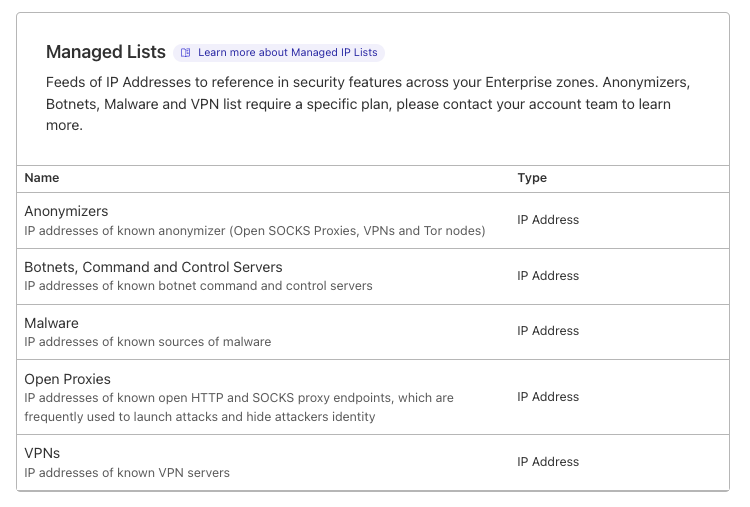
Cloudflare is expanding our WAF’s threat intelligence capabilities by adding four new managed IP lists that can be used as part of any custom firewall rule.

Managed lists are created and maintained by Cloudflare and are built based on threat intelligence feeds collected by analyzing patterns and trends observed across the Internet. Enterprise customers can already use the Open SOCKS Proxy list (launched in March 2021) and today we are adding four new IP lists: “VPNs”, “Botnets, Command and Control Servers”, “Malware” and “Anonymizers”.

New WAF intelligence feeds
You can check what rules are available in your plan by navigating to Manage Account → Configuration → Lists.

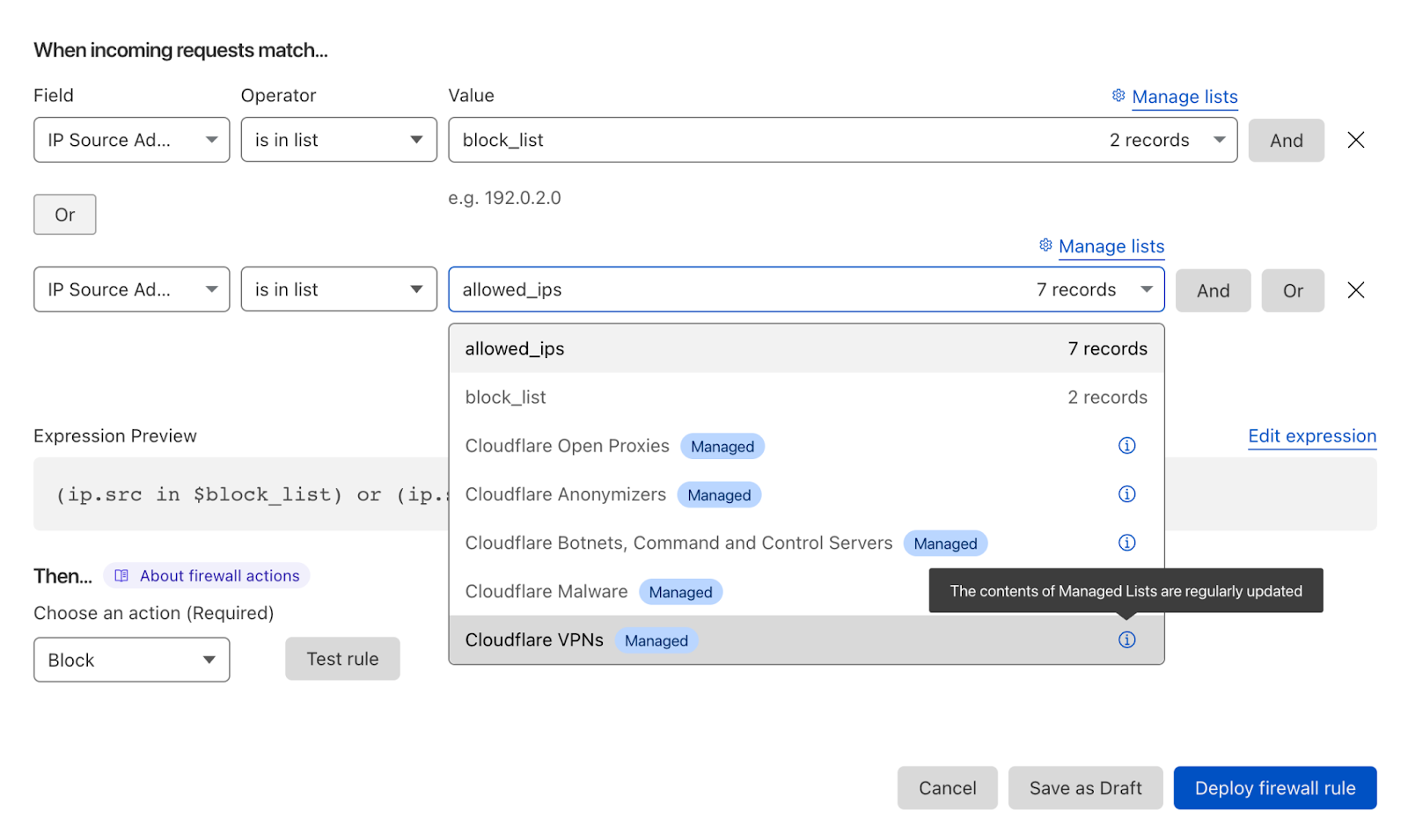
Customers can reference these lists when creating a custom firewall rule or in Advanced Rate Limiting. For example, you can choose to block all traffic generated by IPs we categorize as VPNs, or rate limit traffic generated by all Anonymizers. You can simply incorporate managed IP lists in the powerful firewall rule builder. Of course, you can also use your own custom IP list.

New WAF intelligence feeds
Managed IP Lists can be used in WAF rules to manage incoming traffic from these IPs.

Where do these feeds come from?

These lists are based on Cloudflare-generated threat feeds which are made available as IP lists to be easily consumed in the WAF. Each IP is categorized by combining open source data as well as by analyzing the behavior of each IP leveraging the scale and reach of Cloudflare network. After an IP has been included in one of these feeds, we verify its categorization and feed this information back into our security systems and make it available to our customers in the form of a managed IP list. The content of each list is updated multiple times a day.

In addition to generating IP classifications based on Cloudflare’s internal data, Cloudflare curates and combines several data sources that we believe provide reliable coverage of active security threats with a low false positive rate. In today’s environment, an IP belonging to a cloud provider might today be distributing malware, but tomorrow might be a critical resource for your company.

Some IP address classifications are publicly available, OSINT data, for example Tor exit nodes, and Cloudflare takes care of integrating this into our Anonymizer list so that you don’t have to manage integrating this list into every asset in your network. Other classifications are determined or vetted using a variety of DNS techniques, like lookup, PTR record lookup, and observing passive DNS from Cloudflare’s network.

Our malware and command-and-control focused lists are generated from curated partnerships, and one type of IP address we target when we select partners is data sources that identify security threats that do not have DNS records associated with them.

Our Anonymizer list encompasses several types of services that perform anonymization, including VPNs, open proxies, and Tor nodes. It is a superset of the more narrowly focused VPN list (known commercial VPN nodes), and the Cloudflare Open Proxies list (proxies that relay traffic without requiring authentication).

In dashboard IP annotations

Using these lists to deploy a preventative security policy for these IPs is great, but what about knowing if an IP that is interacting with your website or application is part of a Botnet or VPN? We first released contextual information for Anonymizers as part of Security Week 2022, but we are now closing the circle by extending this feature to cover all new lists.

As part of Cloudflare’s threat intelligence feeds, we are exposing the IP category directly into the dashboard. Say you are investigating requests that were blocked by the WAF and that looked to be probing your application for known software vulnerabilities. If the source IP of these requests is matching with one of our feeds (for example part of a VPN), contextual information will appear directly on the analytics page.

New WAF intelligence feeds
When the source IP of a WAF event matches one of the threat feeds, we provide contextual information directly onto the Cloudflare dashboard.

This information can help you see patterns and decide whether you need to use the managed lists to handle the traffic from these IPs in a particular way, for example by creating a rate limiting rule that reduces the amount of requests these actors can perform over a period of time.

Who gets this?

The following table summarizes what plans have access to each one of these features. Any paying plans will have access to the contextual in-dash information, while Enterprise will be able to use different managed lists. Managed lists can be used only on Enterprise zones within an Enterprise account.

FREE PRO BIZ ENT Advanced ENT *
Annotations x
Open Proxies x x x
Anonymizers x x x x
VPNs x x x x
Botnets, command and control x x x x
Malware x x x x

* Contact your customer success manager to learn how to get access to these lists.

Future releases

We are working on enriching our threat feeds even further. In the next months we are going to provide more IP lists, specifically we are looking into lists for cloud providers and Carrier-grade Network Address Translation (CG-NAT).

A pair programming approach for engaging girls in the Computing classroom: Study results

Post Syndicated from Katharine Childs original https://www.raspberrypi.org/blog/gender-balance-in-computing-pair-programming-approach-engaging-girls/

Today we share the second report in our series of findings from the Gender Balance in Computing research programme, which we’ve been running as part of the National Centre for Computing Education and with various partners. In this £2.4 million research programme, funded by the Department for Education in England, we aim to identify ways to encourage more female learners to engage with Computing and choose to study it further.

A teacher encourages a learner in the computing classroom.

Previously, we shared the evaluation report about our pilot study of using a storytelling approach with very young computing learners. This new report, again coming from the Behavioural Insights Team (BIT) which acts as the programme’s independent evaluator, describes our study of another teaching approach.

Existing research suggests that computing is not always taught in a way that is engaging for girls in particular [1], and that we can improve this. With the intervention at hand, we wanted to explore the effects of using a pair programming teaching approach with primary school learners aged 8 to 11. We have critically and carefully examined the findings, which show mixed outcomes regarding the effectiveness of the approach, and we believe that the research provides insights that increase our shared understanding of how to teach computing effectively to young learners. 

Computing education through a collaborative lens

Many people think that writing computer programs is a task carried out by people working individually. A 2017 study of 8- and 9-year-olds [2] confirms this: when asked to draw a picture of a computer scientist doing work, 90% of the children drew a picture of one person working alone. This stereotype is present in teaching and learning about computing and computer science; many computer programming lessons take place in a way that promotes solitary working, with individual students sitting in front of separate computers, working on their own code and debugging their own errors.

A girl codes at a laptop while a woman looks on during a Code Club session.

Professional software development rarely happens like this. For example, at the Raspberry Pi Foundation, our software engineers work collaboratively on design and often pair up to solve problems. Computing education research also has identified the importance of looking at computer programming through a collaborative lens. This viewpoint allows us to see computing as a subject with scope for collaborative group work in which students create useful applications together and are part of a community where programming has a shared social context [3]. 

Researching collaborative learning in the primary computing classroom 

One teaching approach in computing that promotes collaborative learning is pair programming (a practice also used in industry). This is a structured way of working on programming tasks  where learners are paired up and take turns acting as the driver or the navigator. The driver controls the keyboard and mouse and types the code. The navigator reads the instructions, supports the driver by watching out for errors in the code, and thinks strategically about next steps and solutions to problems. Learners swap roles every 5 to 10 minutes, to ensure that both partners can contribute equally and actively to the collaborative learning.

Two female learners code at a computer together.

As one part of the Gender Balance in Computing programme, we designed a project to explore the effect of pair programming on girls’ attitudes towards computing. This project builds on research from the USA which suggests that solving problems collaboratively increases girls’ persistence when they encounter difficulties in programming tasks [4].

In the Pair Programming project, we worked with teachers of Year 4 (ages 8–9) and Year 6 (ages 10–11) in schools in England. From January to March 2020, we ran a pilot study with 10 schools and used the resulting teacher feedback to finalise the training and teaching materials for a full randomised controlled trial. Due to the coronavirus pandemic, we trained teachers in the pair programming approach using an online course instead of face-to-face training.

A tweet from a school about taking part in the pair programming intervention of the Gender Balance in Computing research programme.
A tweet from a school about taking part in the pair programming study.

The randomised controlled trial ran from September to December 2021 with 97 schools. Schools were randomly allocated to either the intervention group and used the pair programming training and the scheme of work we designed, or to the control group and taught Computing in their usual way, not aware that we were investigating the effects of pair programming. Due to the coronavirus pandemic, our training of teachers in the pair programming approach had to take place via an online course instead of face to face.

Teachers in both groups delivered 12 weeks of Computing lessons, in which learners used Scratch programming to draw shapes and create animations. The lessons covered computing concepts from Key Stage 2 (ages 7–11), such as using sequences, selection, and repetition in programs, as well as digital literacy skills such as using technology respectfully.

What can we learn about pair programming from the study? 

The findings about this particular intervention were limited by the amount of data the independent evaluators at BIT were able to collect amongst learners and teachers given the ongoing pandemic. BIT’s evaluation was primarily based on quantitative data collected from learners at the start and the end of the intervention. To collect the data, they used a validated instrument called the Student Computer Science Attitude Survey (SCSAS), which asks learners about their attitudes towards Computing. The evaluators compared the datasets gathered from the intervention group (who took part in pair programming lessons) and the control group (who took part in Computing lessons taught with a ‘business as usual’ model).

A teacher watches two female learners code in Code Club session in the classroom.

The evaluators’ data analysis found no statistically significant evidence that the pair programming approach positively affected girls’ attitudes towards computing or their intention to study computing in the future. The lack of statistically significant results, called a null result in research projects, can appear disappointing at first. But our work involves careful reflection and critical thinking about all outcomes of our research, and the result of this project is no exception. These are factors that may have contributed towards the result: 

  • The independent evaluators suggested that the intervention may lead to different findings if it were implemented again without the disruptions caused by the pandemic. One of their recommendations was to revert to our original planned model of providing face-to-face training to teachers delivering the pair programming approach, and we believe this would embed a deeper understanding of the approach. 
  • Our research built upon a prior study [4] that suggested a connection between pair programming and increased confidence about problem-solving in girls of a similar age. That study took place in a non-formal setting in an all-girls group, whereas our research was situated in formal education in mixed gender groups. It may be that these differences are significant. 
  • It may be that there is no causal link between using the pair programming approach and an increase in girls’ attitudes towards computing, or that the link may only become apparent over a longer time-scale, or that the pair programming approach needs to be combined with other strategies to achieve a positive effect. 

The evaluators also gathered qualitative data by running teacher and learner interviews, and we were pleased that this data provided some rich insights into the benefits of using a pair programming approach in the primary classroom, and gave some promising indications of possible benefits for female learners in particular. 

  1. Teachers spoke positively about the use of paired activities, and felt that having the defined roles of driver and navigator helped both partners to contribute equally to the programming tasks. Learners said that they enjoyed working in pairs, even though there could be some moments of frustration. Some of the teachers were even planning to integrate pair programming into future lessons. This suggests that the approach was effective both in engaging and motivating learners, as well as in facilitating the planned learning outcomes of the lessons,  and that it can be used more widely in primary computing teaching.

“I don’t know why I’ve never thought to do computing like that, actually, because it’s a really good vehicle for the fact that there are two roles, clearly defined. There’s all your conversation, and knowledge comes through that, and then they’re both equally having a turn.” — Primary school teacher (report, p. 38)

“I like working with both [both as a partner and by yourself] because when you do pair programming, you’re collaborating with your partner, making links, and you have to tell them what to do. But if you have a really good idea and then they put the wrong thing in the wrong place, it’s quite annoying.” — Female learner (report, p. 40)

  1. Both teachers and learners felt that having the support of a partner boosted learners’ confidence, which echoes previous research in the field [5, 6]. In computing, boys more accurately assess their capabilities, whereas girls tend to underestimate their performance [7]. When learners feel a positive emotion such as confidence towards a subject, combined with a belief that they can succeed in tasks related to that subject, this shows self-efficacy [8]. Our findings suggest that, through the use of the pair programming approach, both boys and girls improved their sense of self-efficacy towards Computing, which is corroborated by quotes from learners themselves. This is interesting because a sense of self-efficacy in Computing is linked to the decisions to pursue further study in the subject [9]. More research could build on this observation. 

“I do think that having that equal time to have a go at both, thinking of the girls I’ve got, will have helped my girls, because they lack a bit of confidence. They were learning very quickly that, ‘Actually, yes, we are sure. We can do this.’” — Primary teacher (report, p. 44)

“It might be easier to do pair programming [compared to ‘normal’ lessons] because if you’re stuck, your partner can be helpful.” — Female learner (report, p. 43)

Find out more about pair programming 

  • Download our Big Book of Computing Pedagogy a free PDF and read about pair programming on pages 58 and 59.
  • Watch this short video that shows pair programming being used in a primary classroom. 
  • Read the evaluation report of the pair programming intervention, where you’ll also find more quotes from teachers and learners.
  • Try the free training course on pair programming we designed and used for this project. It also includes links to the lesson plans that teachers worked with. 

Collaboration in our research

We will continue to publish evaluation reports and our reflections on the other projects in the Gender Balance in Computing programme. If you would like to stay up-to-date with the programme, you can sign up to the newsletter.

Two learners at a desktop computer doing coding.

The insights gained from this trial will feed forwards into our future work. Through the process of working with schools on this project, we have increased our understanding of the process of research in educational settings in many ways. We are very grateful for the input from teachers who took part in the first stage of the trial, with whom we developed an effective co-production model for developing resources, a model we will use in future research projects. Teachers who took part in the second stage of the project told us that the resources we provided were of good quality, which demonstrates the success of this co-production approach to developing resources. 

In our new Raspberry Pi Computing Education Research Centre, created with the University of Cambridge Department of Computer Science and Technology, we will collaborate closely with teachers and schools when implementing and evaluating research projects. You are invited to the free in-person launch event of the Centre on 20 July in Cambridge, UK, where we hope to meet many teachers, researchers, and other education practitioners to strengthen a collaborative community around computing education research.

References

[1] Goode, J., Estrella, R., & Margolis, J. (2018). Lost in Translation: Gender and High School Computer Science. In Women and Information Technology. https://doi.org/10.7551/mitpress/7272.003.0005

[2] Alexandria K. Hansen, Hilary A. Dwyer, Ashley Iveland, Mia Talesfore, Lacy Wright, Danielle B. Harlow, and Diana Franklin. 2017. Assessing Children’s Understanding of the Work of Computer Scientists: The Draw-a-Computer-Scientist Test. In Proceedings of the 2017 ACM SIGCSE Technical Symposium on Computer Science Education (SIGCSE ’17). Association for Computing Machinery, New York, NY, USA, 279–284. https://doi.org/10.1145/3017680.3017769

[3] Yasmin B. Kafai and Quinn Burke. 2013. The social turn in K-12 programming: moving from computational thinking to computational participation. In Proceeding of the 44th ACM technical symposium on Computer science education (SIGCSE ’13). Association for Computing Machinery, New York, NY, USA, 603–608. https://doi.org/10.1145/2445196.2445373

[4] Linda Werner & Jill Denning (2009) Pair Programming in Middle School, Journal of Research on Technology in Education, 42:1, 29-49. https://doi.org/10.1080/15391523.2009.10782540

[5] Charlie McDowell, Linda Werner, Heather E. Bullock, and Julian Fernald. 2006. Pair programming improves student retention, confidence, and program quality. Commun. ACM 49, 8 (August 2006), 90–95. https://doi.org/10.1145/1145287.1145293

[6] Denner, J., Werner, L., Campe, S., & Ortiz, E. (2014). Pair programming: Under what conditions is it advantageous for middle school students? Journal of Research on Technology in Education, 46(3), 277–296. https://doi.org/10.1080/15391523.2014.888272

[7] Maria Kallia and Sue Sentance. 2018. Are boys more confident than girls? the role of calibration and students’ self-efficacy in programming tasks and computer science. In Proceedings of the 13th Workshop in Primary and Secondary Computing Education (WiPSCE ’18). Association for Computing Machinery, New York, NY, USA, Article 16, 1–4. https://doi.org/10.1145/3265757.3265773

[8] Bandura, A. (1977). Self-efficacy: Toward a unifying theory of behavioral change. Psychological Review, 84(2), 191–215. https://doi.org/10.1037/0033-295X.84.2.191

[9] Allison Mishkin. 2019. Applying Self-Determination Theory towards Motivating Young Women in Computer Science. In Proceedings of the 50th ACM Technical Symposium on Computer Science Education (SIGCSE ’19). Association for Computing Machinery, New York, NY, USA, 1025–1031. https://doi.org/10.1145/3287324.3287389

The post A pair programming approach for engaging girls in the Computing classroom: Study results appeared first on Raspberry Pi.

Програмата на Промяната закъсня, но идва

Post Syndicated from Емилия Милчева original https://toest.bg/programata-na-promyanata-zakusnya-no-idva/

Управленската програма за следващите шест месеца, подготвяна от „Продължаваме промяната“, „Демократична България“ и БСП, е онова, което не успяха да свършат в предишните шест – добавили са срокове. Не че ги нямаше и в коалиционното споразумение, но все пак то беше разчетено за пълен четиригодишен мандат, а спорните теми бяха отложени с анализи. Сега, след изгубеното време, се явява нов кандидат за министър-председател – Асен Василев, с подновен кабинет и програма с дати, чието съдържание ще се променя до последния момент.

Програмата е микс от стари проекти и идеи и нови предложения. Прави впечатление концентрацията на контролни функции в Министерския съвет, респективно премиера, тъй като към МС се предвижда да премине Изпълнителната агенция по горите с всички горски стопанства и Българската агенция по безопасност на храните (двете сега са подопечни на Министерството на земеделието) и Дирекцията за национален строителен контрол (досега към МРРБ). Трите структури контролират огромни сектори от икономиката – горския и дърводобивния, хранително-вкусовия, строителния – и винаги са били обект на големи интереси и корупционен натиск.

Енергетика

Разумното предложение тук е да се въведат две тарифи за ток и парно, като първата да покрива базово потребление на по-ниска цена. Не е фиксирано какъв ще е прагът.

Договорено е да се ускори изграждането на нови ядрени мощности и преминаване на АЕЦ „Козлодуй“ на алтернативно ядрено гориво, както и гарантиране на сигурността на газовите доставки – чрез диверсификация и дългосрочни договори за доставка. Само че нито може да се ускори „изграждането“ на нови мощности за шест месеца, нито АЕЦ да мине на алтернативно гориво за същото време, а то бездруго си е планирано.

Първо, управляващите (все едно кои) трябва да решат каква да е новата ядрена мощност – в коалиционното споразумение пише, че ще стане след анализ, а такъв дори не е започнат. Но наред с това и процедурата за АЕЦ „Белене“ не е прекратена – а БСП със сигурност ще настоява именно за втора АЕЦ с руските реактори. Второ, още от февруари м.г., на база подписано споразумение между АEЦ „Koзлoдyй“ и „Уecтингxayc Eлeĸтpиĸ Швeция“, е планирано алтернативното ядрено гориво. Ако Агенцията за ядрено регулиране лицензира горивото, постепенно ще бъдат заменяни част от касетките с руско гориво в V блок. Постепенно. А VI блок е подготвен с руско гориво до 2026 г.

Какво значи дългосрочни договори за доставка?

В контекста на призива на председателката на ЕК Урсула фон дер Лайен Европа да се готви за спиране на руския газ, това може да означава само едно: доставки на втечнен газ и увеличаване на количествата неруски газ. Министърът на енергетиката в оставка Александър Николов потвърди пред журналисти, че се водят преговори за азерски газ над договорените сега количества от 1 млрд. куб.м на година – „но трябва да се прави разлика между 25-годишен договор и търговски преговори, които включват доставка сега, веднага, на пазарна цена“. България вече получава в пълен размер азерския газ, но това е една трета от общото потребление, което е около 3 млрд. куб.м годишно. А изглежда, че намерението за общи газови доставки на ЕС няма да се осъществи.

Газовото уравнение обаче ще трябва да бъде решено – все едно вписано ли е, или не – в 6-месечната управленска програма. Макар че там фигурира и запълване на капацитета на газохранилището в Чирен, което сега е 35% запълнено, а има и срок – до 30 септември. Как ще бъде решено това уравнение? Обемът на хранилището е 550 млн. куб.м, от които остават близо 358 млн. куб.м за запълване. Максималният капацитет за нагнетяване е 3,2 млн. куб.м на ден, което означава, че ще са необходими 112 дни – и то при условие че има достатъчно количества синьо гориво.

След по-малко от 4 месеца започва отоплителният сезон –

индустрията, битовите абонати, болниците, детските градини, газифицираните общини трябва да са наясно гарантиран ли е газът за зимата. Ето с изпълнението на този належащ приоритет правителството трябва да се заеме най-напред. Само че първо в коалицията ще е нужно да са постигнали разбирателство по въпроса, със или без руски газ в микса.

Кирил Петков и Асен Василев недвусмислено заявиха, че няма да бъде подновен изтичащият в края на 2022 г. договор с компанията „Газпром“, която едностранно спря руския газ за България. БСП и нейната лидерка Корнелия Нинова винаги са били на противното мнение. Като аргумент Нинова изтъква, че бизнесът иска по-евтин газ. По-рано днес по БНР председателят на Асоциацията на индустриалния капитал Васил Велев определи настоящата ситуация като „доста шизофренна“:

Имаме договор, който не е прекратен, с „Газпром експорт“, на по-ниски цени от тези на спот пазара, от порядъка на 25-30% по-ниски. Плащаме по този договор транспорта на този газ и в същото време не потребяваме газ, рискувайки да го платим след това, нищо че не сме го потребили – поради клаузата в договора „вземи или плати“.

Депутатът от БСП Борислав Гуцанов обясни по БНТ, че по време на преговорите социалистите са поставили въпроса, че трябва да бъдат направени „всички усилия“ да бъдат нормализирани дипломатическите отношения между България и Русия и да бъдат подновени преговорите с „Газпром“. И това беше прието от „Продължаваме промяната“, заяви Гуцанов. Ако от ПП наистина са приели да има нови преговори с „Газпром“, пропуснали са го съобщят публично.

Инфраструктура

По темата „инфраструктура“ се предвижда довършване на магистрала „Струма“, така че да не бъдат загубени европейски средства. Това не е възможно не само в близките шест месеца, но би било чудо, ако се случи до края на настоящия програмен период – 2027 г. За първите шест месеца управляващата четворна коалиция така и не се разбра по основния въпрос за „Струма“ – 13-километров тунел през Кресненското дефиле или изграждане на източен обход на Кресна за движението от Гърция към София. Спорът тече от 2007-ма, а в настоящото управление въпросът беше оставен за разрешаване на коалиционен съвет – който така и не го реши. Така че, ако смятат да довършват „Струма“, би следвало ПП, ДБ и БСП поне да са се разбрали кой вариант избират до 30 септември.

Заложено е и до 31 декември да се подпише споразумение с Румъния за проектиране и изграждане на 5 моста над Дунав,

обещани още в предизборната кампания на „Продължаваме промяната“. В последния си, трети мандат премиерът и лидер на ГЕРБ Бойко Борисов говореше за три моста и дори обяви, че ще има първа копка на третия – между Свищов и Зимнич. Въпреки настойчивостта му, от другата страна на Дунав така и не уточниха къде да бъде третият мост. Така че амбицията за пет моста е смехотворна – още повече при липсата на добри пътища и жп връзки в България след преминаването им.

Възлагане на проектирането на тунели при Петрохан и Прохода на Републиката, възлагане за довършването на проектирането на магистрала „Хемус“ и продължението на „Черно море“. Тези проекти бяха обявени за приоритетни от министъра на регионалното развитие и благоустройство в оставка Гроздан Караджов още през януари. По време на парламентарен контрол през март т.г. той съобщи докъде е стигнала работата по три тунела – за този под връх Шипка текат процедури по съгласуване с МОСВ по определяне на екомерките; за Петрохан се работи за разширен идеен проект; третият е по трасето на бъдещия аутобан „Черно море“ и за него има разширен идеен проект, стигнал до втори етап – да се определят екомерките, което ще отнеме още около една година. А договорът за проектиране на „Черно море“ е сключен през октомври 2020 г. с ДЗЗД „Екип проект АМ Черно море“ – за 9,5 млн. лв. и една година срок, така че

на хартия проект трябваше да има още миналата есен.

Предлага се до 31 октомври да бъдат въведени германски изисквания за пътно строителство, включително стандартите за текущ ремонт и поддръжка. Също така до края на годината да се намери решение за инхаус поръчките от ерата „Борисов“ – с което досега управлението така и не се справи, а и не поиска да се справи.

Ред и право

С най-голям шанс за осъществяване е приоритетът, който от „Продължаваме промяната“ винаги слагат най-отпред – сегашният министър на вътрешните работи в оставка Бойко Рашков да оглави КПКОНПИ. Срокът за това е до края на юли, тоест преди парламентът да се разпусне за обичайната си лятна ваканция, каквато не иска да пропусне и този път. До 23 септември е предвидено да бъде приет и законопроект за противодействие на корупцията, който разделя комисията на две – противодействие на корупцията и установяване на конфликт на интереси, от една страна, и отнемане на незаконно придобито имущество, от друга; предвиждат се и правомощия за разследване и използване на събраните доказателства в наказателно производство.

Разписани са срокове за номинации,

за да бъде променен съставът на Комисията за защита на конкуренцията, Комисията за финансов надзор и Българската народна банка – през септември и ноември. През първите си шест месеца разпадналата се четворна коалиция се разтресе от разногласия заради двамата си кандидати за гуверньор на БНБ, но сега отново няма решение за обща кандидатура – всяка от трите политически сили ще излезе със своя номинация.

Конституционно мнозинство за избор на 11 нови членове от парламентарната квота във ВСС няма, както и за нов състав на Инспектората към ВСС.

Законодателната програма, която включва приемане на 21 законопроекта, изисквани заради средствата по Плана за възстановяване и устойчивост, и още толкова заради други промени, е твърде амбициозна на фона на досегашната парламентарна леност.

Новите предложения

Сред брадясалите проекти и идеи има и нови предложения. Едно от най-съществените сред тях е Дирекция „Финансово разузнаване“ да бъде извадена от системата на ДАНС и да се върне в Министерството на финансите. Дирекцията беше към МФ до момента, в който тройната коалиция с премиер Сергей Станишев създаде ДАНС и я вкара там. В резултат активността по отношение на мерките срещу изпирането на пари рязко се понижи и Европейската комисия неколкократно отбелязва тази слабост на България.

Друга нова инициатива е въвеждане на фонд за радио и телевизия, който да бъде заложен в бюджета за 2023 г. Едва ли може да се мине без социалните теми – увеличение на вдовишките добавки и на добавките за пенсионирани учители, безплатни учебници до ХII клас включително, по-високи стипендии за ученици и студенти, оптимизиране на екипите по спешна помощ, обещано още по време на предизборната кампания миналата есен, и пр.

Най-напред обаче следващото правителство ще трябва да се заеме с газовите доставки – докато е лято, за да гарантира енергийната сигурност през зимата. В противен случай твърдото приземяване му е гарантирано.

Заглавна снимка: Връчването на мандата за съставяне на правителство на Асен Василев от 1 юли 2022 г. Стопкадър от видеоизлъчването от Facebook страницата на президента Румен Радев

Източник

[$] The 2022 embedded Linux update

Post Syndicated from original https://lwn.net/Articles/899742/

A regular feature of the Embedded
Linux Conference
(ELC) has been an update on the state of embedded Linux from
conference organizer Tim Bird. It has been quite a few years since I had
the opportunity to sit in on one, so I took one at the
2022 Open
Source Summit North America
(OSSNA) in Austin, Texas. OSSNA is an
umbrella conference that contains ELC and a whole lot more these days.
Bird gave a look at recent kernel features from an embedded perspective,
talked a bit about some different technology areas and their impact on
embedded Linux, and
also tried to answer a question that Andrew Morton posed in a keynote at ELC in 2008.

Friday Squid Blogging: Fishing for Squid

Post Syndicated from Bruce Schneier original https://www.schneier.com/blog/archives/2022/07/friday-squid-blogging-fishing-for-squid.html

Foreign Policy has a three-part (so far) podcast series on squid and global fishing.

As usual, you can also use this squid post to talk about the security stories in the news that I haven’t covered.

Read my blog posting guidelines here.

EDITED TO ADD: I accidentally posted this on Wednesday. I deleted the post Thursday morning, but not before the first four comments.

Extend AWS IAM roles to workloads outside of AWS with IAM Roles Anywhere

Post Syndicated from Faraz Angabini original https://aws.amazon.com/blogs/security/extend-aws-iam-roles-to-workloads-outside-of-aws-with-iam-roles-anywhere/

AWS Identity and Access Management (IAM) has now made it easier for you to use IAM roles for your workloads that are running outside of AWS, with the release of IAM Roles Anywhere. This feature extends the capabilities of IAM roles to workloads outside of AWS. You can use IAM Roles Anywhere to provide a secure way for on-premises servers, containers, or applications to obtain temporary AWS credentials and remove the need for creating and managing long-term AWS credentials.

In this post, I will briefly discuss how IAM Roles Anywhere works. I’ll mention some of the common use cases for IAM Roles Anywhere. And finally, I’ll walk you through an example scenario to demonstrate how the implementation works.

Background

To enable your applications to access AWS services and resources, you need to provide the application with valid AWS credentials for making AWS API requests. For workloads running on AWS, you do this by associating an IAM role with Amazon Elastic Compute Cloud (Amazon EC2), Amazon Elastic Container Service (Amazon ECS), Amazon Elastic Kubernetes Service (Amazon EKS), or AWS Lambda resources, depending on the compute platform hosting your application. This is secure and convenient, because you don’t have to distribute and manage AWS credentials for applications running on AWS. Instead, the IAM role supplies temporary credentials that applications can use when they make AWS API calls.

IAM Roles Anywhere enables you to use IAM roles for your applications outside of AWS to access AWS APIs securely, the same way that you use IAM roles for workloads on AWS. With IAM Roles Anywhere, you can deliver short-term credentials to your on-premises servers, containers, or other compute platforms. When you use IAM Roles Anywhere to vend short-term credentials you can remove the need for long-term AWS access keys and secrets, which can help improve security, and remove the operational overhead of managing and rotating the long-term credentials. You can also use IAM Roles Anywhere to provide a consistent experience for managing credentials across hybrid workloads.

In this post, I assume that you have a foundational knowledge of IAM, so I won’t go into the details here about IAM roles. For more information on IAM roles, see the IAM documentation.

How does IAM Roles Anywhere work?

IAM Roles Anywhere relies on public key infrastructure (PKI) to establish trust between your AWS account and certificate authority (CA) that issues certificates to your on-premises workloads. Your workloads outside of AWS use IAM Roles Anywhere to exchange X.509 certificates for temporary AWS credentials. The certificates are issued by a CA that you register as a trust anchor (root of trust) in IAM Roles Anywhere. The CA can be part of your existing PKI system, or can be a CA that you created with AWS Certificate Manager Private Certificate Authority (ACM PCA).

Your application makes an authentication request to IAM Roles Anywhere, sending along its public key (encoded in a certificate) and a signature signed by the corresponding private key. Your application also specifies the role to assume in the request. When IAM Roles Anywhere receives the request, it first validates the signature with the public key, then it validates that the certificate was issued by a trust anchor previously configured in the account. For more details, see the signature validation documentation.

After both validations succeed, your application is now authenticated and IAM Roles Anywhere will create a new role session for the role specified in the request by calling AWS Security Token Service (AWS STS). The effective permissions for this role session are the intersection of the target role’s identity-based policies and the session policies, if specified, in the profile you create in IAM Roles Anywhere. Like any other IAM role session, it is also subject to other policy types that you might have in place, such as permissions boundaries and service control policies (SCPs).

There are typically three main tasks, performed by different personas, that are involved in setting up and using IAM Roles Anywhere:

  • Initial configuration of IAM Roles Anywhere – This task involves creating a trust anchor, configuring the trust policy of the role that IAM Roles Anywhere is going to assume, and defining the role profile. These activities are performed by the AWS account administrator and can be limited by IAM policies.
  • Provisioning of certificates to workloads outside AWS – This task involves ensuring that the X.509 certificate, signed by the CA, is installed and available on the server, container, or application outside of AWS that needs to authenticate. This is performed in your on-premises environment by an infrastructure admin or provisioning actor, typically by using existing automation and configuration management tools.
  • Using IAM Roles Anywhere – This task involves configuring the credential provider chain to use the IAM Roles Anywhere credential helper tool to exchange the certificate for session credentials. This is typically performed by the developer of the application that interacts with AWS APIs.

I’ll go into the details of each task when I walk through the example scenario later in this post.

Common use cases for IAM Roles Anywhere

You can use IAM Roles Anywhere for any workload running in your data center, or in other cloud providers, that requires credentials to access AWS APIs. Here are some of the use cases we think will be interesting to customers based on the conversations and patterns we have seen:

Example scenario and walkthrough

To demonstrate how IAM Roles Anywhere works in action, let’s walk through a simple scenario where you want to call S3 APIs to upload some data from a server in your data center.

Prerequisites

Before you set up IAM Roles Anywhere, you need to have the following requirements in place:

  • The certificate bundle of your own CA, or an active ACM PCA CA in the same AWS Region as IAM Roles Anywhere
  • An end-entity certificate and associated private key available on the on-premises server
  • Administrator permissions for IAM roles and IAM Roles Anywhere

Setup

Here I demonstrate how to perform the setup process by using the IAM Roles Anywhere console. Alternatively, you can use the AWS API or Command Line Interface (CLI) to perform these actions. There are three main activities here:

  • Create a trust anchor
  • Create and configure a role that trusts IAM Roles Anywhere
  • Create a profile

To create a trust anchor

  1. Navigate to the IAM Roles Anywhere console.
  2. Under Trust anchors, choose Create a trust anchor.
  3. On the Create a trust anchor page, enter a name for your trust anchor and select the existing AWS Certificate Manager Private CA from the list. Alternatively, if you want to use your own external CA, choose External certificate bundle and provide the certificate bundle.
Figure 1: Create a trust anchor in IAM Roles Anywhere

Figure 1: Create a trust anchor in IAM Roles Anywhere

To create and configure a role that trusts IAM Roles Anywhere

  1. Using the AWS Command Line Interface (AWS CLI), you are going to create an IAM role with appropriate permissions that you want your on-premises server to assume after authenticating to IAM Roles Anywhere. Save the following trust policy as rolesanywhere-trust-policy.json on your computer.
    {
        "Version": "2012-10-17",
        "Statement": [
            {
                "Effect": "Allow",
                "Principal": {
                    "Service": "rolesanywhere.amazonaws.com"
                },
                "Action": [
                    "sts:AssumeRole",
                    "sts:SetSourceIdentity",
                    "sts:TagSession"
                ]
            }
        ]
    }

  2. Save the following identity-based policy as onpremsrv-permissions-policy.json. This grants the role permissions to write objects into the specified S3 bucket.
    {
        "Version": "2012-10-17",
        "Statement": [
            {
                "Effect": "Allow",
                "Action": "s3:PutObject",
                "Resource": "arn:aws:s3:::<DOC-EXAMPLE-BUCKET>/*"
            }
        ]
    }

  3. Run the following two AWS CLI commands to create the role and attach the permissions policy.
    aws iam create-role \
    --role-name ExampleS3WriteRole \
    --assume-role-policy-document file://<path>/rolesanywhere-trust-policy.json


    aws iam put-role-policy \
    --role-name ExampleS3WriteRole \
    --policy-name onpremsrv-inline-policy \
    --policy-document file://<path>/onpremsrv-permissions-policy.json

You can optionally use condition statements based on the attributes extracted from the X.509 certificate to further restrict the trust policy to control the on-premises resources that can obtain credentials from IAM Roles Anywhere. IAM Roles Anywhere sets the SourceIdentity value to the CN of the subject (onpremsrv01 in my example). It also sets individual session tags (PrincipalTag/) with the derived attributes from the certificate. So, you can use the principal tags in the Condition clause in the trust policy as additional authorization constraints.

For example, the Subject for the certificate I use in this post is as follows.

Subject: … O = Example Corp., OU = SecOps, CN = onpremsrv01

So, I can add condition statements like the following into the trust policy (rolesanywhere-trust-policy.json):

...
    "Condition": {
        "StringEquals": {
            "aws:PrincipalTag/x509Subject/CN": "onpremsrv01",
            "aws:PrincipalTag/x509Subject/OU": "SecOps"
        }
    }
...

To learn more, see the trust policy for IAM Roles Anywhere documentation.

To create a profile

  1. Navigate to the Roles Anywhere console.
  2. Under Profiles, choose Create a profile.
  3. On the Create a profile page, enter a name for the profile.
  4. For Roles, select the role that you created in the previous step (ExampleS3WriteRole).
  5. 5. Optionally, you can define session policies to further scope down the sessions delivered by IAM Roles Anywhere. This is particularly useful when you configure the profile with multiple roles and want to restrict permissions across all the roles. You can add the desired session polices as managed policies or inline policy. Here, for demonstration purpose, I add an inline policy to only allow requests coming from my specified IP address.
Figure 2: Create a profile in IAM Roles Anywhere

Figure 2: Create a profile in IAM Roles Anywhere

At this point, IAM Roles Anywhere setup is complete and you can start using it.

Use IAM Roles Anywhere

IAM Roles Anywhere provides a credential helper tool that can be used with the process credentials functionality that all current AWS SDKs support. This simplifies the signing process for the applications. See the IAM Roles Anywhere documentation to learn how to get the credential helper tool.

To test the functionality first, run the credential helper tool (aws_signing_helper) manually from the on-premises server, as follows.

./aws_signing_helper credential-process \
    --certificate /path/to/certificate.pem \
    --private-key /path/to/private-key.pem \
    --trust-anchor-arn <TA_ARN> \
    --profile-arn <PROFILE_ARN> \
    --role-arn <ExampleS3WriteRole_ARN>
Figure 3: Running the credential helper tool manually

Figure 3: Running the credential helper tool manually

You should successfully receive session credentials from IAM Roles Anywhere, similar to the example in Figure 3. Once you’ve confirmed that the setup works, update or create the ~/.aws/config file and add the signing helper as a credential_process. This will enable unattended access for the on-premises server. To learn more about the AWS CLI configuration file, see Configuration and credential file settings.

# ~/.aws/config content
[default]
 credential_process = ./aws_signing_helper credential-process
    --certificate /path/to/certificate.pem
    --private-key /path/to/private-key.pem
    --trust-anchor-arn <TA_ARN>
    --profile-arn <PROFILE_ARN>
    --role-arn <ExampleS3WriteRole_ARN>

To verify that the config works as expected, call the aws sts get-caller-identity AWS CLI command and confirm that the assumed role is what you configured in IAM Roles Anywhere. You should also see that the role session name contains the Serial Number of the certificate that was used to authenticate (cc:c3:…:85:37 in this example). Finally, you should be able to copy a file to the S3 bucket, as shown in Figure 4.

Figure 4: Verify the assumed role

Figure 4: Verify the assumed role

Audit

As with other AWS services, AWS CloudTrail captures API calls for IAM Roles Anywhere. Let’s look at the corresponding CloudTrail log entries for the activities we performed earlier.

The first log entry I’m interested in is CreateSession, when the on-premises server called IAM Roles Anywhere through the credential helper tool and received session credentials back.

{
    ...
    "eventSource": "rolesanywhere.amazonaws.com",
    "eventName": "CreateSession",
    ...
    "requestParameters": {
        "cert": "MIICiTCCAfICCQD6...mvw3rrszlaEXAMPLE",
        "profileArn": "arn:aws:rolesanywhere:us-west-2:111122223333:profile/PROFILE_ID",
        "roleArn": "arn:aws:iam::111122223333:role/ExampleS3WriteRole",
        ...
    },
    "responseElements": {
        "credentialSet": [
        {
            "assumedRoleUser": {
                "arn": "arn:aws:sts::111122223333:assumed-role/ExampleS3WriteRole/00ccc3a2432f8c5fec93f0fc574f118537",
            },
            "credentials": {
                ...
            },
            ...
            "sourceIdentity": "CN=onpremsrv01"
        }
      ],
    },
    ...
}

You can see that the cert, along with other parameters, is sent to IAM Roles Anywhere and a role session along with temporary credentials is sent back to the server.

The next log entry we want to look at is the one for the s3:PutObject call we made from our on-premises server.

{
    ...
    "eventSource": "s3.amazonaws.com",
    "eventName": "PutObject",
    "userIdentity":{
        "type": "AssumedRole",
        "arn": "arn:aws:sts::111122223333:assumed-role/ExampleS3WriteRole/00ccc3a2432f8c5fec93f0fc574f118537",
        ...
        "sessionContext":
        {
            ...
            "sourceIdentity": "CN=onpremsrv01"
        },
    },
    ...
}

In addition to the CloudTrail logs, there are several metrics and events available for you to use for monitoring purposes. To learn more, see Monitoring IAM Roles Anywhere.

Additional notes

You can disable the trust anchor in IAM Roles Anywhere to immediately stop new sessions being issued to your resources outside of AWS. Certificate revocation is supported through the use of imported certificate revocation lists (CRLs). You can upload a CRL that is generated from your CA, and certificates used for authentication will be checked for their revocation status. IAM Roles Anywhere does not support callbacks to CRL Distribution Points (CDPs) or Online Certificate Status Protocol (OCSP) endpoints.

Another consideration, not specific to IAM Roles Anywhere, is to ensure that you have securely stored the private keys on your server with appropriate file system permissions.

Conclusion

In this post, I discussed how the new IAM Roles Anywhere service helps you enable workloads outside of AWS to interact with AWS APIs securely and conveniently. When you extend the capabilities of IAM roles to your servers, containers, or applications running outside of AWS you can remove the need for long-term AWS credentials, which means no more distribution, storing, and rotation overheads.

I mentioned some of the common use cases for IAM Roles Anywhere. You also learned about the setup process and how to use IAM Roles Anywhere to obtain short-term credentials.

 
If you have any questions, you can start a new thread on AWS re:Post or reach out to AWS Support.
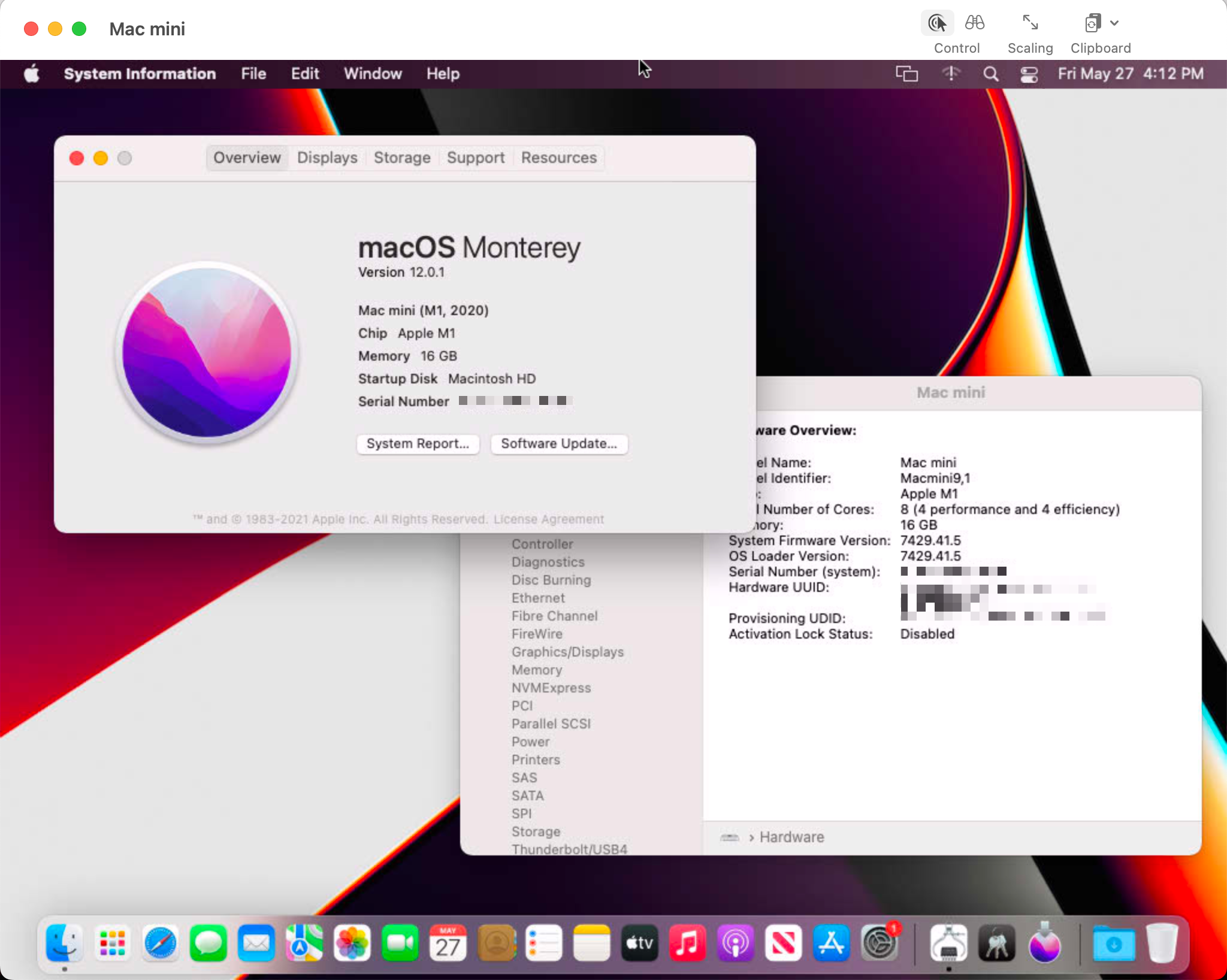

Faraz Angabini

Faraz Angabini

Faraz is a senior security specialist at AWS. He helps AWS strategic customers in their cloud journey. His interests include security, identity and access management, encryption, networking, and infrastructure.

The collective thoughts of the interwebz