AWS and the UK rules on operational resilience and outsourcing

Post Syndicated from Arvind Kannan original https://aws.amazon.com/blogs/security/aws-and-the-uk-rules-on-operational-resilience-and-outsourcing/

Financial institutions across the globe use Amazon Web Services (AWS) to transform the way they do business. Regulations continue to evolve in this space, and we’re working hard to help customers proactively respond to new rules and guidelines. In many cases, the AWS Cloud makes it simpler than ever before to assist customers with their compliance efforts with different regulations and frameworks around the world.

In the United Kingdom, the Financial Conduct Authority (FCA), the Bank of England and the Prudential Regulation Authority (PRA) issued policy statements and rules on operational resilience in March, 2021. The PRA also additionally issued a supervisory statement on outsourcing and third-party risk management. Broadly, these Statements apply to certain firms that are regulated by the UK Financial Regulators: this includes banks, building societies, credit unions, insurers, financial markets infrastructure providers, payment and e-money institutions, major investment firms, mixed activity holding companies, and UK branches of certain overseas firms. For other FCA-authorized financial services firms, the FCA has previously issued FG 16/5 Guidance for firms outsourcing to the ‘cloud’ and other third-party IT services.

These Statements are relevant to the use of cloud services. AWS strives to help support our customers with their compliance obligations and help them meet their regulator’s expectations. We offer our customers a wide range of services that can simplify and directly assist in complying with these Statements, which apply from March 2022.

What do these Statements from the UK Financial Regulators mean for AWS customers?

The Statements aim to ensure greater operational resilience for UK financial institutions and, in the case of the PRA’s papers on outsourcing, facilitate greater adoption of the cloud and other new technologies while also implementing the Guidelines on outsourcing arrangements from the European Banking Authority (EBA) and the relevant sections of the EBA Guidelines on ICT and security risk management. (See the AWS approach to these EBA guidelines in this blog post).

For AWS and our customers, the key takeaway is that these Statements provide a regulatory framework for cloud usage in a resilient manner. The PRA’s outsourcing paper, in particular, sets out conditions that can help give PRA-regulated firms assurance that they can deploy to the cloud in a safe and resilient manner, including for material, regulated workloads. When they consider or use third-party services (such as AWS), many UK financial institutions already follow due diligence, risk management, and regulatory notification processes that are similar to the processes identified in these Statements, the EBA Outsourcing Guidelines, and FG 16/5. UK financial institutions can use a variety of AWS security and compliance services to help them meet requirements on security, resilience, and assurance.

Risk-based approach

The Statements reference the principle of proportionality throughout. In the case of the outsourcing requirements, this includes a focus on material outsourcing arrangements and incorporating a risk-based approach that expects regulated entities to identify, assess, and mitigate the risks associated with outsourcing arrangements. The recognition of a shared responsibility model, referenced by the PRA and the recognition in FCA Guidance FG 16/5 that firms need to be clear about where responsibility lies between themselves and their service providers, is consistent with the long-standing AWS shared responsibility model. The proportionality and risk-based approach applies throughout the Statements, including the areas such as risk assessment, contractual and audit requirements, data location and transfer, operational resilience, and security implementation:

  • Risk assessment – The Statements emphasize the need for UK financial institutions to assess the potential impact of outsourcing arrangements on their operational risk. The AWS shared responsibility model helps customers formulate their risk assessment approach, because it illustrates how their security and management responsibilities change depending on the services from AWS they use. For example, AWS operates some controls on behalf of customers, such as data center security, while customers operate other controls, such as event logging. In practice, AWS helps customers assess and improve their risk profile relative to traditional, on-premises environments.
     
  • Contractual and audit requirements – The PRA supervisory statement on outsourcing and third-party risk management, the EBA Outsourcing Guidelines, and the FCA guidance FG 16/5 lay out requirements for the written agreement between a UK financial institution and its service provider, including access and audit rights. For UK financial institutions that are running regulated workloads on AWS, please contact your AWS account team to address these contractual requirements. We also help institutions that require contractual audit rights to comply with these requirements through the AWS Security & Audit Series, which facilitates customer audits. To align with regulatory requirements and expectations, our audit program incorporates feedback that we’ve received from EU and UK financial supervisory authorities. UK financial services customers interested in learning more about the audit engagements offered by AWS can reach out to their AWS account teams.
     
  • Data location and transfer – The UK Financial Regulators do not place restrictions on where a UK financial institution can store and process its data, but rather state that UK financial institutions should adopt a risk-based approach to data location. AWS continually monitors the evolving regulatory and legislative landscape around data privacy to identify changes and determine what tools our customers might need to help meet their compliance needs. Refer to our Data Protection page for our commitments, including commitments on data access and data storage.
     
  • Operational resilience – Resiliency is a shared responsibility between AWS and the customer. It is important that customers understand how disaster recovery and availability, as part of resiliency, operate under this shared model. AWS is responsible for resiliency of the infrastructure that runs all of the services offered in the AWS Cloud. This infrastructure comprises the hardware, software, networking, and facilities that run AWS Cloud services. AWS uses commercially reasonable efforts to make these AWS Cloud services available, ensuring that service availability meets or exceeds the AWS Service Level Agreements (SLAs).

    The customer’s responsibility will be determined by the AWS Cloud services that they select. This determines the amount of configuration work they must perform as part of their resiliency responsibilities. For example, a service such as Amazon Elastic Compute Cloud (Amazon EC2) requires the customer to perform all of the necessary resiliency configuration and management tasks. Customers that deploy Amazon EC2 instances are responsible for deploying EC2 instances across multiple locations (such as AWS Availability Zones), implementing self-healing by using services like AWS Auto Scaling, as well as using resilient workload architecture best practices for applications that are installed on the instances.

    For managed services, such as Amazon Simple Storage Service (Amazon S3) and Amazon DynamoDB, AWS operates the infrastructure layer, the operating system, and platforms, whereas customers access the endpoints to store and retrieve data. Customers are responsible for managing resiliency of their data, including backup, versioning, and replication strategies. For more details about our approach to operational resilience in financial services, refer to this whitepaper.

  • Security implementation – The Statements set expectations on data security, including data classification and data security, and require UK financial institutions to consider, implement, and monitor various security measures. Using AWS can help customers meet these requirements in a scalable and cost-effective way, while helping improve their security posture. Customers can use AWS Config or AWS Security Hub to simplify auditing, security analysis, change management, and operational troubleshooting.

    As part of their cybersecurity measures, customers can activate Amazon GuardDuty, which provides intelligent threat detection and continuous monitoring, to generate detailed and actionable security alerts. Amazon Macie uses machine learning and pattern matching to help customers classify their sensitive and business-critical data in AWS. Amazon Inspector automatically assesses a customer’s AWS resources for vulnerabilities or deviations from best practices and then produces a detailed list of security findings prioritized by level of severity.

    Customers can also enhance their security by using AWS Key Management Service (AWS KMS) (creation and control of encryption keys), AWS Shield (DDoS protection), and AWS WAF (helps protect web applications or APIs against common web exploits). These are just a few of the many services and features we offer that are designed to provide strong availability and security for our customers.

As reflected in these Statements, it’s important to take a balanced approach when evaluating responsibilities in cloud implementation. AWS is responsible for the security of the AWS infrastructure, and for all of our data centers, we assess and manage environmental risks, employ extensive physical and personnel security controls, and guard against outages through our resiliency and testing procedures. In addition, independent third-party auditors evaluate the AWS infrastructure against more than 2,600 standards and requirements throughout the year.

Conclusion

We encourage customers to learn about how these Statements apply to their organization. Our teams of security, compliance, and legal experts continue to work with our UK financial services customers, both large and small, to support their journey to the AWS Cloud. AWS is closely following how the UK regulatory authorities apply the Statements and will provide further updates as needed. If you have any questions about compliance with these Statements and their application to your use of AWS, reach out to your account representative or request to be contacted.

 
Want more AWS Security news? Follow us on Twitter.

Arvind Kannan

Arvind Kannan

Arvind is a Principal Compliance Specialist at Amazon Web Services based in London, United Kingdom. He spends his days working with financial services customers in the UK and across EMEA, helping them address questions around governance, risk and compliance. He has a strong focus on compliance and helping customers navigate the regulatory requirements and understand supervisory expectations.

Accelerating GitHub theme creation with color tooling

Post Syndicated from Cole Bemis original https://github.blog/2022-06-14-accelerating-github-theme-creation-with-color-tooling/

Dark mode is no longer a nice-to-have feature. It’s an expectation. Yet, for many teams, implementing dark mode is still a daunting task.

Creating a palette for dark interfaces is not as simple as inverting colors and complexity increases if your team is planning multiple themes. Many people find themselves using a combination of disjointed color tools, which can be a painful experience.

GitHub dark mode (unveiled at GitHub Universe in December 2020) was the result of trial and error, copy and paste, as well as back and forth in a Figma file (with more than 370,000 layers!).

A screenshot of the Figma file we made while designing GitHub dark mode

A few months after shipping dark mode, we began working on a dark high contrast theme to provide an option that maximizes legibility. While we were designing this new theme, we set out to improve our workflow by building an experimental tool to solve some of the challenges we encountered while designing the original dark color palette.

We’re calling our experimental color tool Primer Prism.

A sneak peek of Primer Prism

Part of GitHub’s Primer ecosystem, Primer Prism is a tool for creating and maintaining cohesive, consistent, and accessible color palettes. It allows us to:

  • Create or import color scales.
  • Adjust colors in a perceptually uniform color space (HSLuv).
  • Check contrast of color pairs.
  • Edit lightness curves across multiple color scales at once.
  • Export color palettes to production-ready code (JSON).

Our workflow

Our improved workflow for creating color palettes with Primer Prism is an iterative cycle comprised of three steps:

  1.  Defining tones
  2. Choosing colors
  3. Testing colors

Defining tones

We start by defining the color palette’s tonal character and contrast needs:

  • How light or dark should the background be?
  • What should the contrast ratio between the foreground and background be?

Although each palette will have a unique tonal character, we are mindful that all palettes meet contrast accessibility guidelines.

In Primer Prism, we start a new color palette by creating a new color scale and adjusting the lightness curve. In this phase, we’re only concerned with lightness and contrast. We’ll revisit hue and saturation later.

As we change the lightness of each color, Primer Prism checks the contrast of potential color pairings in the scale using the WCAG 2 standard.

Dragging lightness sliders up and down to adjust the lightness curve of a scale

Primer Prism also allows us to share curves across multiple color scales. So, when we have more scales, we can quickly change the tonal character of the entire color palette by adjusting a single lightness curve.

Adjusting the lightness curve of all color scales at once

Primer Prism uses the HSLuv color space to ensure that the lightness values are perceptually uniform across the entire palette. In the HSLuv color space, two colors with the same lightness value will look equally bright.

Choosing colors

Next, we define the overall color character of our palette:

  • What hues do we need (for example: red, blue, green, etc.)?
  • How vibrant do we want the colors to be?

We create a color scale for every hue using the same lightness curve we made earlier. Then, we compare and adjust the base color (the fifth step in the scale) across all the color scales until the palette feels cohesive and consistent.

A side-by-side comparison of every color scale

After deciding on the base color for each scale, we fine-tune the tints (lighter colors) and shades (darker colors). Blue, for example, shifts towards green hues in the tints and purple hues in the shades.

The hue, saturation, and lightness curves of the blue color scale

Fine-tuning color scales is more of an art than a science and often requires many micro-adjustments before the colors “feel right.” Check out Color in UI Design: A (Practical) Framework by Eric D. Kennedy to learn more about the fundamentals of designing color scales.

Testing colors

To test our colors in real-world scenarios, we export the palette from Primer Prism as a JSON object and add it to Primer Primitives, our repository of design tokens. We use pre-releases of the Primer Primitives package to test new color palettes on GitHub.com.

The dark color palette applied to GitHub.com

What’s next

We used Primer Prism to design several new color palettes, accelerating the creation of dark high contrast, light high contrast, and colorblind themes for GitHub. Next, we plan to improve our tooling to support the following key workflows.

Visual testing workflow

We plan to integrate visual testing directly into Primer Prism. Currently, visual testing of color palettes happens outside of Primer Prism, typically in Figma or production applications. However, we want a more convenient way to visualize how the colors will look when mapped to functional variables and used in actual user interfaces.

GitHub workflow

We plan to integrate GitHub into Primer Prism. Right now, it’s a hassle to edit existing color palettes because Primer Prism is not connected to the GitHub repository where we store color variables (Primer Primitives). A GitHub integration will allow us to directly pull from and push to the Primer Primitives repository.

Figma workflow

Our designers use Figma to explore and test new design ideas. We plan to create a Figma plugin to seamlessly integrate Primer Prism into their workflow.

Try it out

Primer Prism is open source and available for anyone to use at primer.style/prism.

We’d love to hear what you think. If you have feedback, please create an issue or start a discussion in the GitHub repository.

Warning: Primer Prism is experimental. Expect bugs and breaking changes as we continue to iterate.

Thanks

Huge shout-out to @Juliusschaeper, @auareyou, @edokoa, and @broccolini for their incredible work on the GitHub dark mode color palette.

Primer Prism was inspired by many existing color tools:
ColorBox by Lyft
Components AI
Huetone by Alexey Ardov
Leonardo by Adobe
Palettte by Gabriel Adorf
Palx by Brent Jackson
Scale by Hayk An

Further reading

The “Hertzbleed” vulnerability

Post Syndicated from original https://lwn.net/Articles/897914/

Today’s branded, logo-equipped vulnerability is known as Hertzbleed; it affects x86
processors (at least) and can be exploited in some situations to extract
cryptographic keys from a remote server.

Hertzbleed takes advantage of our experiments showing that, under
certain circumstances, the dynamic frequency scaling of modern x86
processors depends on the data being processed. This means that, on
modern processors, the same program can run at a different CPU
frequency (and therefore take a different wall time) when
computing, for example, 2022 + 23823 compared to 2022 + 24436.

CVE-2022-32230: Windows SMB Denial-of-Service Vulnerability (FIXED)

Post Syndicated from Spencer McIntyre original https://blog.rapid7.com/2022/06/14/cve-2022-32230-windows-smb-denial-of-service-vulnerability-fixed/

CVE-2022-32230: Windows SMB Denial-of-Service Vulnerability (FIXED)

A remote and unauthenticated attacker can trigger a denial-of-service condition on Microsoft Windows Domain Controllers by leveraging a flaw that leads to a null pointer deference within the Windows kernel. We believe this vulnerability would be scored as CVSSv3 AV:N/AC:L/PR:N/UI:N/S:U/C:N/I:N/A:H or 7.5. This vulnerability was silently patched by Microsoft in April of 2022 in the same batch of changes that addressed the unrelated CVE-2022-24500 vulnerability.

Credit

This issue was fixed by Microsoft without disclosure in April 2022, but because it was originally classed as a mere stability bug fix, it did not go through the usual security issue process. In May, Spencer McIntyre of Rapid7 discovered this issue while researching the fix for CVE-2022-24500 and determined the security implications of CVE-2022-32230. It is being disclosed in accordance with Rapid7’s vulnerability disclosure policy.

Exploitation

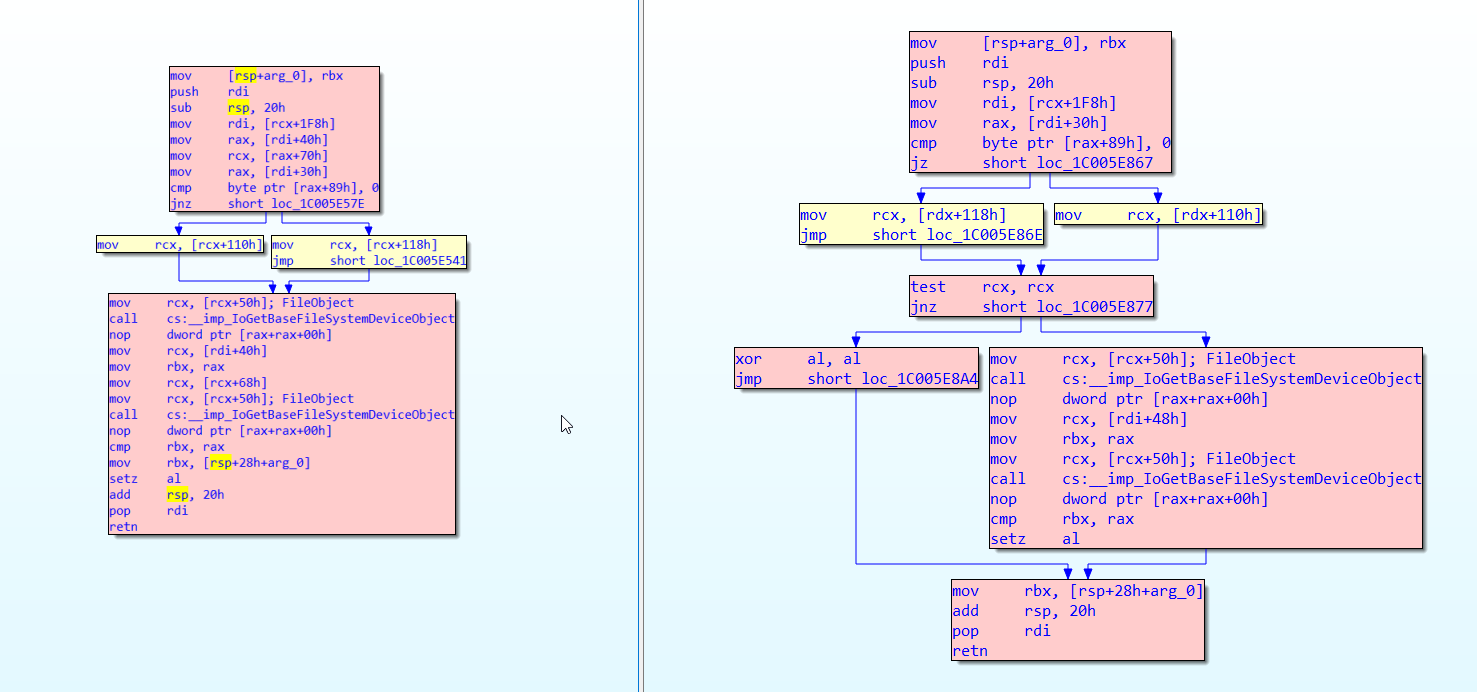
CVE-2022-32230 is caused by a missing check in srv2!Smb2ValidateVolumeObjectsMatch to verify that a pointer is not null before reading a PDEVICE_OBJECT from it and passing it to IoGetBaseFileSystemDeviceObject. The following patch diff shows the function in question for Windows 10 21H2 (unpatched version 10.0.19041.1566 on the left).

CVE-2022-32230: Windows SMB Denial-of-Service Vulnerability (FIXED)

This function is called from the dispatch routine for an SMB2 QUERY_INFO request of the FILE_INFO / FILE_NORMALIZED_NAME_INFORMATION class. Per the docs in MS-SMB2 section 3.3.5.20.1 Handling SMB2_0_INFO_FILE, FILE_NORMALIZED_NAME_INFORMATION is only available when the dialect is 3.1.1.

For FileNormalizedNameInformation information class requests, if not supported by the server implementation<392>, or if Connection.Dialect is "2.0.2", "2.1" or "3.0.2", the server MUST fail the request with STATUS_NOT_SUPPORTED.

To trigger this code path, a user would open any named pipe from the IPC$ share and make a QUERY_INFO request for the FILE_NORMALIZED_NAME_INFORMATION class. This typically requires user permissions or a non-default configuration enabling guest access. This is not the case, however, for the noteworthy exception of domain controllers where there are multiple named pipes that can be opened anonymously, such as netlogon. An alternative named pipe that can be used but does typically require permissions is the srvsvc pipe.

Under normal circumstances, the FILE_NORMALIZED_NAME_INFORMATION class would be used to query the normalized name information of a file that exists on disk. This differs from the exploitation scenario which queries a named pipe.

A system that has applied the patch for this vulnerability will respond to the request with the error STATUS_NOT_SUPPORTED.

Proof of concept

A proof-of-concept Metasploit module is available on GitHub. It requires Metasploit version 6.2 or later.

Impact

The most likely impact of an exploit leveraging this vulnerability is a denial-of-service condition. Given the current state of the art of exploitation, it is assumed that a null pointer dereference in the Windows kernel is not remotely exploitable for the purpose of arbitrary code execution without combining it with another, unrelated vulnerability.

In the default configuration, Windows will automatically restart after a BSOD.

Remediation

It is recommended that system administrators apply the official patches provided by Microsoft in their April 2022 update. If that is not possible, restricting access and disabling SMB version 3 can help remediate this flaw.

Disclosure timeline

April 12th, 2022 – Microsoft patches CVE-2022-32230
April 29th, 2022 – Rapid7 finds and confirms the vulnerability while investigating CVE-2022-24500
May 4th, 2022 – Rapid7 contacts MSRC to clarify confusion regarding CVE-2022-32230
May 18th, 2022 – Microsoft responds to Rapid7, confirming that the vulnerability now identified as CVE-2022-32230 is different from the disclosed vulnerability CVE-2022-24500 with which it was patched
June 1, 2022 — Rapid7 reserves CVE-2022-32230 after discussing with Microsoft
June 14th, 2022 – Rapid7 releases details in this disclosure, and Microsoft publishes its advisory

NEVER MISS A BLOG

Get the latest stories, expertise, and news about security today.

Additional reading:

[$] Zoned storage

Post Syndicated from original https://lwn.net/Articles/897263/

Zoned storage is a
form of storage that offers higher capacities by making tradeoffs in the kinds
of writes that are allowed to the device. It was the topic of a storage and
filesystem session led by Luis
Chamberlain at the
2022 Linux Storage,
Filesystem, Memory-management and BPF Summit
(LSFMM). Over the years,
zoned storage has been a frequent topic at LSFMM, going back to LSFMM 2013, where
support for
shingled magnetic recording (SMR) devices, which were the starting point for
zoned storage, was discussed.

Backblaze and Carahsoft Help Public Sector CIOs Optimize Cloud Spend

Post Syndicated from Elton Carneiro original https://www.backblaze.com/blog/backblaze-and-carahsoft-help-public-sector-cios-optimize-cloud-spend/

If you’re in charge of IT for a public sector entity, you know the budgeting and procurement process doesn’t lend itself well to buying cloud services. But, today, the life of a public sector CIO just got a whole lot easier. Through a new partnership with Carahsoft, public sector customers can now leverage their existing state, local, and federal buying programs to access Backblaze B2 Cloud Storage.

We’re not the only cloud storage provider available through Carahsoft, the Master Government Aggregator™ for the IT industry, but we are the easy, affordable, trusted solution among providers in their ecosystem. Read on to learn more about the partnership.
The Right Cloud Solution at the Right Time

For state and local governments, federal agencies, healthcare providers, and higher education institutions, the pandemic introduced challenges that required cloud scalability—remote work and increased demand for public services, to name two. But due to procurement procedures and budgeting incompatibility, adopting the cloud isn’t always a smooth process for the public sector.

The public sector typically uses a CapEx model to budget for IT services. The cloud’s pay-as-you-go pricing model can be at odds with this budgeting method. Public sector CIOs are also typically required to use established buying programs to purchase services, which many cloud providers are not a part of.

Further, recent research shows that while public sector cloud adoption has increased, a “budget snapback” driven by return to office IT expenses is prompting CIOs in this field to optimize their cloud spend. Public sector institutions are seeking additional value in their cloud budgets, and clamoring for a way to purchase those services through existing programs and channels.

“Public sector decision-makers reference budget, pricing models, and transparency as their biggest barriers to cloud adoption. That’s why this partnership is so exciting: Our services come at a fraction of the price of other options, and we’ve long been known for our transparent, trusted approach to working with customers.”
—Nilay Patel, VP of Sales, Backblaze

Bringing Capacity-based Cloud Services to the Public Sector

Backblaze, through the partnership with Carahsoft—which was enabled by our recent launch of a capacity-based pricing bundle, Backblaze B2 Reserve—solves both the budgeting and procurement challenges public sector CIOs are facing.

The partnership brings Backblaze services to state, local, and federal buying programs in a model they prefer at a fraction of the price of traditional cloud storage providers. It’s an affordable, easy solution for public sector CIOs seeking to optimize cloud spend in the wake of the pandemic.

“Backblaze’s ease of use, affordability, and transparency are just some of the major advantages of their robust cloud backup and storage services. We look forward to working with Backblaze and our reseller partners to help agencies better protect and secure their business data.”
—Evan Slack, Director of Sales for Emerging Cloud and Virtualization Technologies, Carahsoft

About Carahsoft

Carahsoft Technology Corp. is The Trusted Government IT Solutions Provider®, supporting public sector organizations across federal, state, and local government agencies and education and healthcare markets. As the Master Government Aggregator® for vendor partners, Carahsoft delivers solutions for cybersecurity, multi-cloud, DevSecOps, big data, artificial intelligence, open-source, customer experience, and more. Working with resellers, systems integrators, and consultants, Carahsoft’s sales and marketing teams provide industry leading IT products, services, and training through hundreds of contract vehicles.

About Backblaze B2 Reserve

Backblaze B2 Reserve packages cloud storage in a capacity-based bundle with an annualized SKU which works seamlessly with channel billing models. The offering also provides seller incentives, Tera-grade support, and expanded migration services to empower the channel’s acceleration of cloud storage adoption and revenue growth. Customers can purchase Backblaze B2 through channel partners, starting at 20TB.

A Public Sector Case Study: Kings County Modernizes With Backblaze B2 Cloud Storage

With a looming bill to replace aging tapes and an out-of-warranty tape drive, the Kings County IT department modernized their IT infrastructure by moving to the cloud for backups. With help from Backblaze, Kings County natively tiered backups from their preferred backup software to Backblaze B2 Cloud Storage, enabling them to implement incremental backups, reduce their overall IT footprint and costs, and save about 150 hours of staff time per year.

Read the full case study here.

How to Get Started With Backblaze B2 and Carahsoft

For resellers interested in offering Backblaze services, it is business as usual if you currently have an account with Carahsoft. Those with immediate quote requests should email partnerships@backblaze.com for further details. For any resellers who do not have an account with Carahsoft and would like the ability to sell Backblaze services, follow this link to create a Carahsoft account.

The post Backblaze and Carahsoft Help Public Sector CIOs Optimize Cloud Spend appeared first on Backblaze Blog | Cloud Storage & Cloud Backup.

“Total cookie protection” from Firefox

Post Syndicated from original https://lwn.net/Articles/897850/

Mozilla has announced
the enabling of its “total cookie protection” feature in all versions of
the Firefox browser.

Total Cookie Protection works by creating a separate “cookie jar”
for each website you visit. Instead of allowing trackers to link up
your behavior on multiple sites, they just get to see behavior on
individual sites. Any time a website, or third-party content
embedded in a website, deposits a cookie in your browser, that
cookie is confined to the cookie jar assigned to only that
website. No other websites can reach into the cookie jars that
don’t belong to them and find out what the other websites’ cookies
know about you.

Security updates for Tuesday

Post Syndicated from original https://lwn.net/Articles/897847/

Security updates have been issued by Fedora (golang-github-docker-libnetwork and moby-engine), Mageia (apache, docker-containerd, kernel, kernel-linus, nats-server, and php-smarty), Slackware (php), SUSE (gimp, grub2, thunderbird, u-boot, and xen), and Ubuntu (firefox, liblouis, ncurses, and rsync).

Cloudflare mitigates 26 million request per second DDoS attack

Post Syndicated from Omer Yoachimik original https://blog.cloudflare.com/26m-rps-ddos/

Cloudflare mitigates 26 million request per second DDoS attack

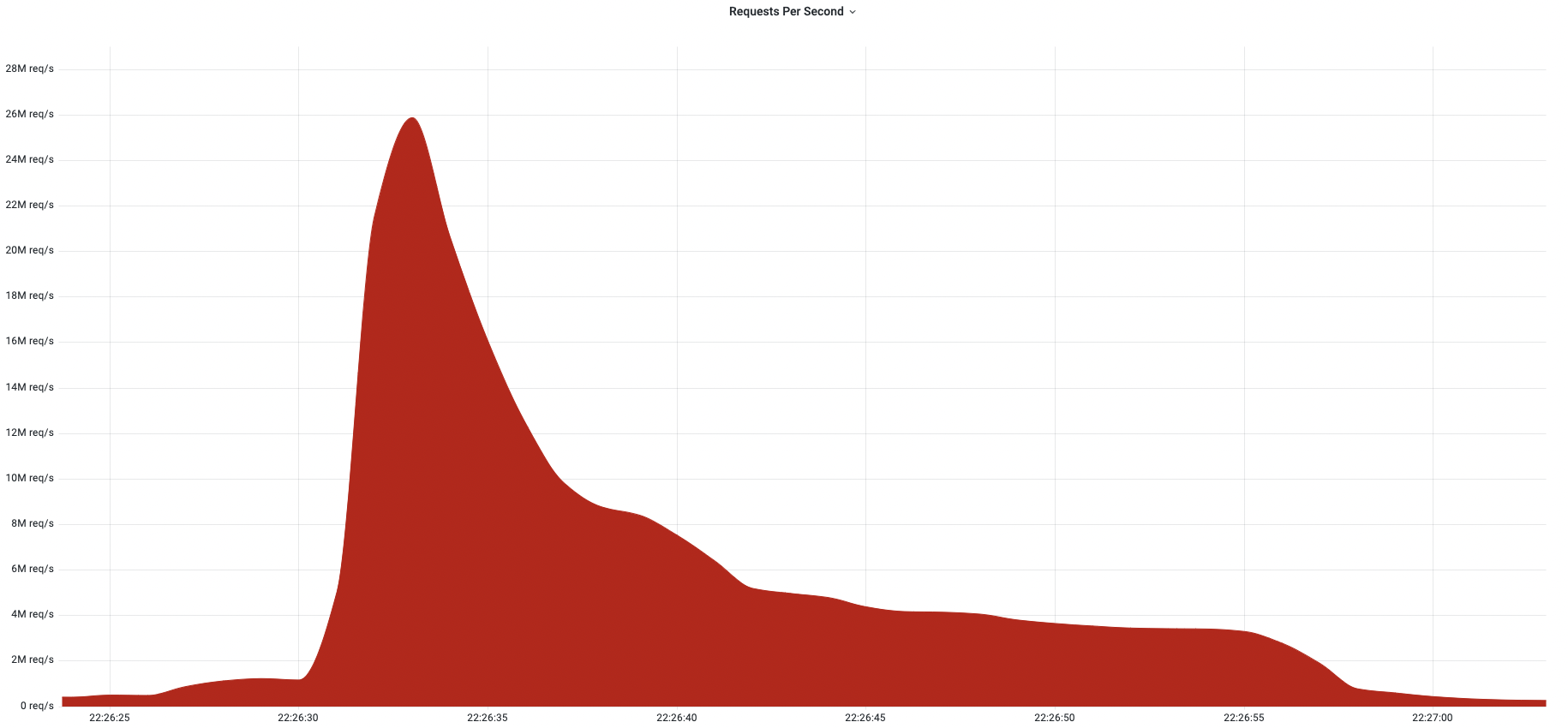
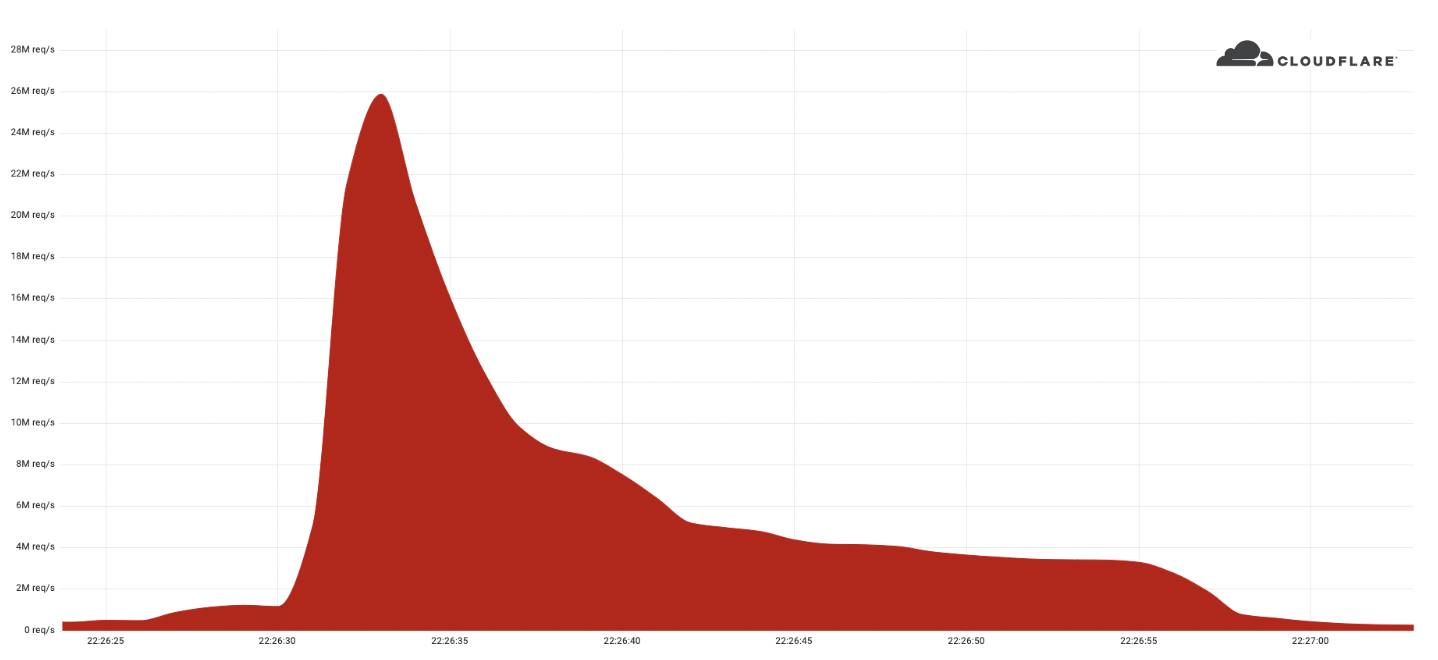
Last week, Cloudflare automatically detected and mitigated a 26 million request per second DDoS attack — the largest HTTPS DDoS attack on record.

The attack targeted a customer website using Cloudflare’s Free plan. Similar to the previous 15M rps attack, this attack also originated mostly from Cloud Service Providers as opposed to Residential Internet Service Providers, indicating the use of hijacked virtual machines and powerful servers to generate the attack — as opposed to much weaker Internet of Things (IoT) devices.

Cloudflare mitigates 26 million request per second DDoS attack

Record-breaking attacks

Over the past year, we’ve witnessed one record-breaking attack after the other. Back in August 2021, we disclosed a 17.2M rps HTTP DDoS attack, and more recently in April, a 15M rps HTTPS DDoS attack. All were automatically detected and mitigated by our HTTP DDoS Managed Ruleset which is powered by our autonomous edge DDoS protection system.

The 26M rps DDoS attack originated from a small but powerful botnet of 5,067 devices. On average, each node generated approximately 5,200 rps at peak. To contrast the size of this botnet, we’ve been tracking another much larger but less powerful botnet of over 730,000 devices. The latter, larger botnet wasn’t able to generate more than one million requests per second, i.e. roughly 1.3 requests per second on average per device. Putting it plainly, this botnet was, on average, 4,000 times stronger due to its use of virtual machines and servers.

Also, worth noting that this attack was over HTTPS. HTTPS DDoS attacks are more expensive in terms of required computational resources because of the higher cost of establishing a secure TLS encrypted connection. Therefore, it costs the attacker more to launch the attack, and for the victim to mitigate it. We’ve seen very large attacks in the past over (unencrypted) HTTP, but this attack stands out because of the resources it required at its scale.

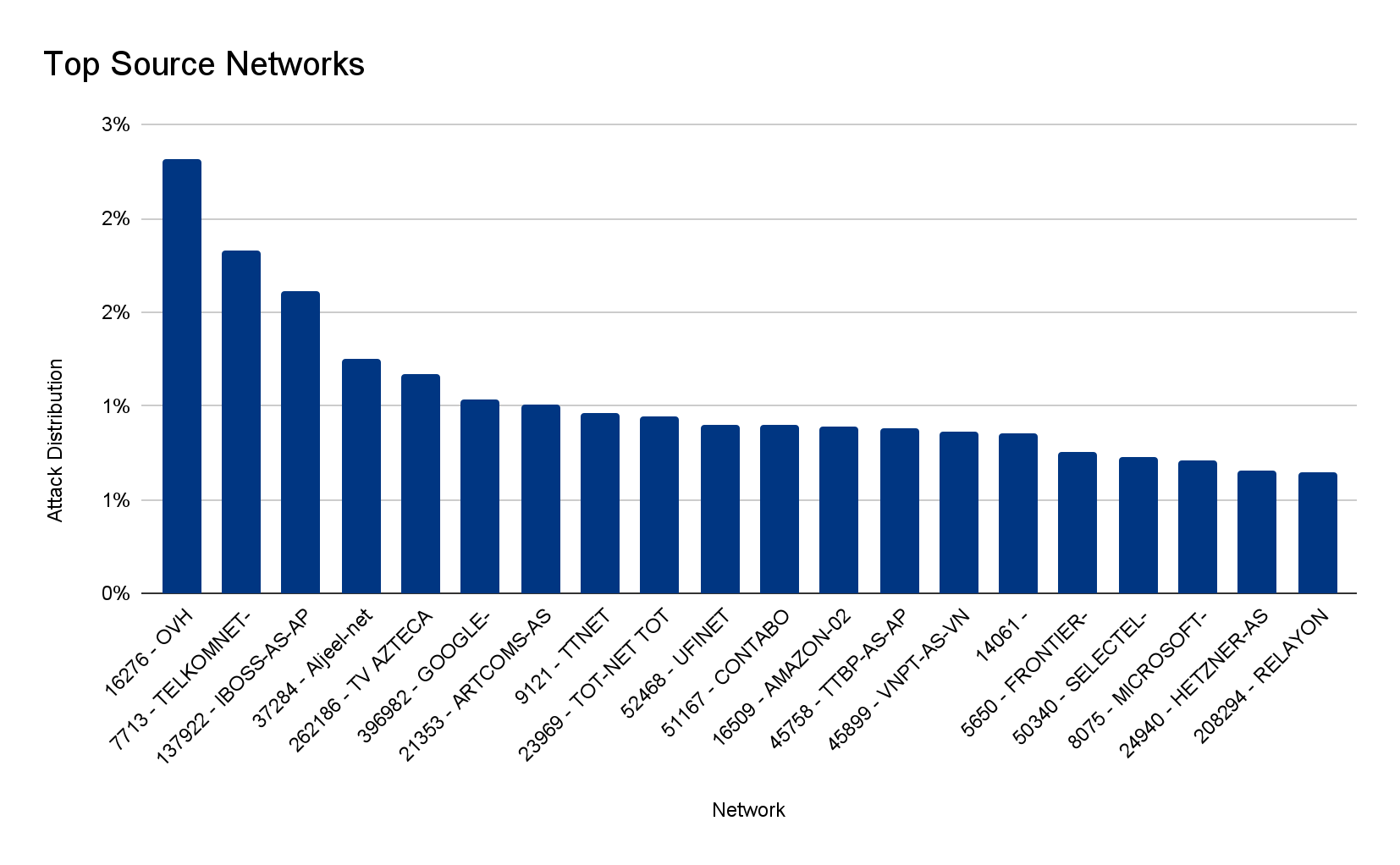
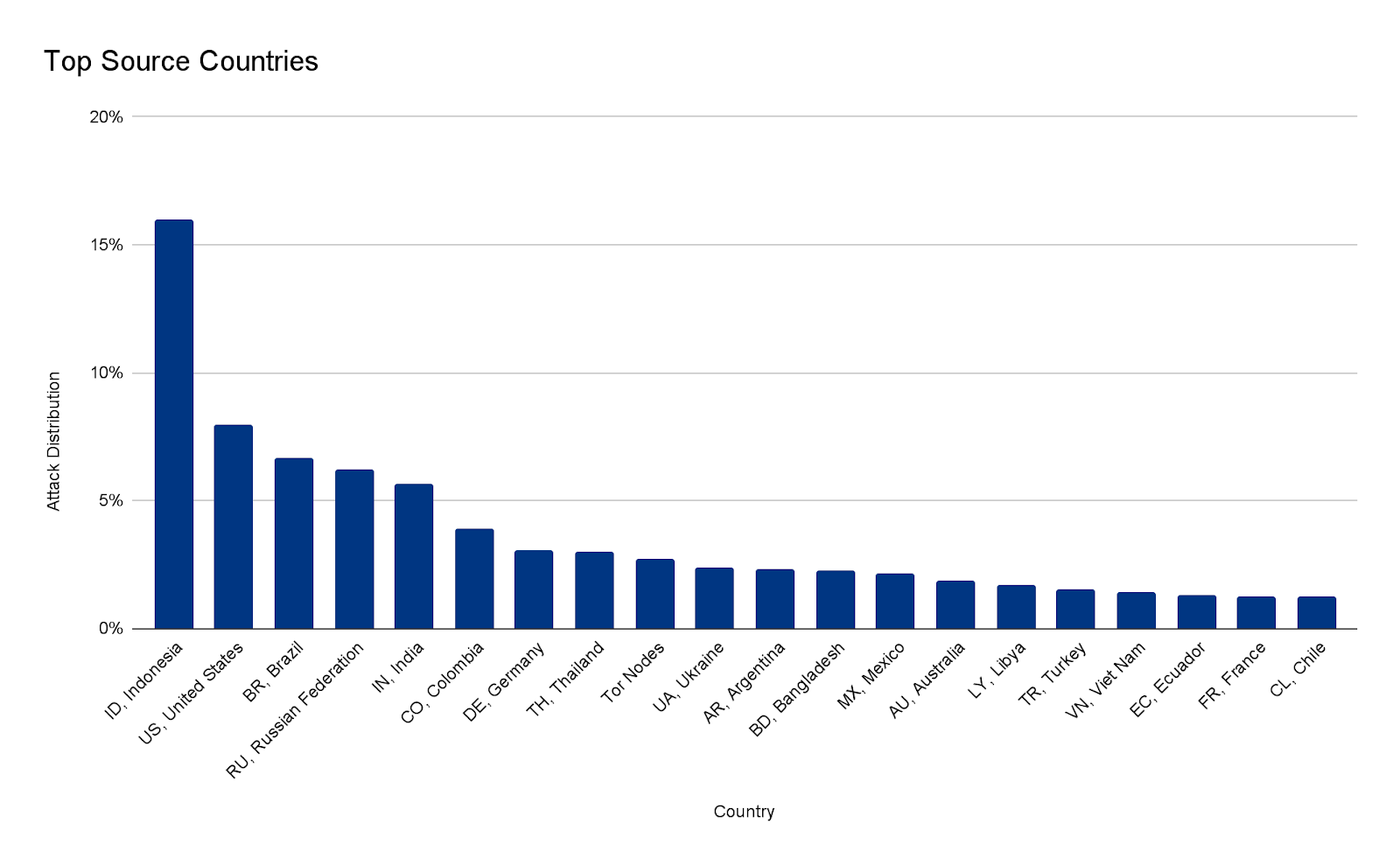
Within less than 30 seconds, this botnet generated more than 212 million HTTPS requests from over 1,500 networks in 121 countries. The top countries were Indonesia, the United States, Brazil and Russia. About 3% of the attack came through Tor nodes.

Cloudflare mitigates 26 million request per second DDoS attack

The top source networks were the French-based OVH (Autonomous System Number 16276), the Indonesian Telkomnet (ASN 7713), the US-based iboss (ASN 137922) and the Libyan Ajeel (ASN 37284).

Cloudflare mitigates 26 million request per second DDoS attack

The DDoS threat landscape

It’s important to understand the attack landscape when thinking about DDoS protection. When looking at our recent DDoS Trends report, we can see that most of the attacks are small, e.g. cyber vandalism. However, even small attacks can severely impact unprotected Internet properties. On the other hand, large attacks are growing in size and frequency — but remain short and rapid. Attackers concentrate their botnet’s power to try and wreak havoc with a single quick knockout blow — trying to avoid detection.

DDoS attacks might be initiated by humans, but they are generated by machines. By the time humans can respond to the attack, it may be over. And even if the attack was quick, the network and application failure events can extend long after the attack is over — costing you revenue and reputation. For this reason, it is recommended to protect your Internet properties with an automated always-on protection service that does not rely on humans to detect and mitigate attacks.

Helping build a better Internet

At Cloudflare, everything we do is guided by our mission to help build a better Internet. The DDoS team’s vision is derived from this mission: our goal is to make the impact of DDoS attacks a thing of the past. The level of protection that we offer is unmetered and unlimited — It is not bounded by the size of the attack, the number of the attacks, or the duration of the attacks. This is especially important these days because as we’ve recently seen, attacks are getting larger and more frequent.

Not using Cloudflare yet? Start now with our Free and Pro plans to protect your websites, or contact us for comprehensive DDoS protection for your entire network using Magic Transit.

Exam time means Internet disruptions in Syria, Sudan and Algeria

Post Syndicated from David Belson original https://blog.cloudflare.com/syria-sudan-algeria-exam-internet-shutdown/

Exam time means Internet disruptions in Syria, Sudan and Algeria

Exam time means Internet disruptions in Syria, Sudan and Algeria

It is once again exam time in Syria, Sudan, and Algeria, and with it, we find these countries disrupting Internet connectivity in an effort to prevent cheating on these exams. As they have done over the past several years, Syria and Sudan are implementing multi-hour nationwide Internet shutdowns. Algeria has also taken a similar approach in the past, but this year appears to be implementing more targeted website/application blocking.

Syria

Syria has been implementing Internet shutdowns across the country since 2011, but exam-related shutdowns have only been in place since 2016. In 2021, exams took place between May 31 and June 22, with multi-hour shutdowns observed on each of the exam days.

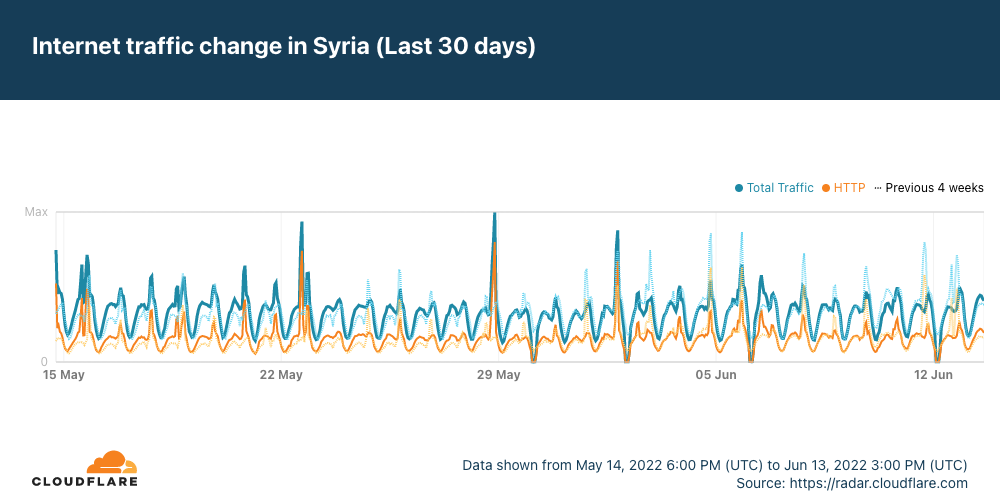
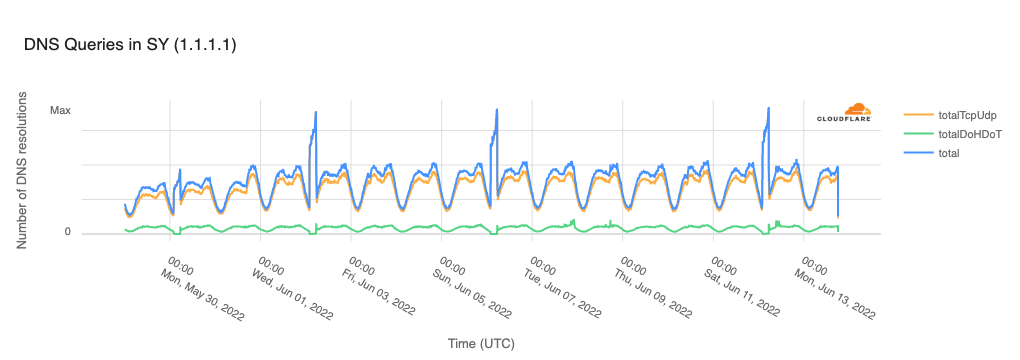
This year, the first shutdown was observed on May 30, with subsequent shutdowns (to date) seen on June 2, 6, and 12. In the Cloudflare Radar graph below, traffic for Syria drops to zero while the shutdowns are active. According to Internet Society Pulse, several additional shutdowns are expected through June 21. Each takes place between 02000530 UTC (0500–0830 local time). According to a published report, the current exam cycle covers more than 500,000 students for basic and general secondary education certificates.

Exam time means Internet disruptions in Syria, Sudan and Algeria

Consistent with shutdowns observed in prior years, Syria is once again implementing them in an asymmetric fashion – that is, inbound traffic is disabled, but egress traffic remains. This is clearly visible in request traffic from Syria to Cloudflare’s 1.1.1.1 DNS resolver. As the graph below shows, queries from clients in Syria are able to exit the country and reach Cloudflare, but responses can’t return, leading to retry floods, visible as spikes in the graph.

Exam time means Internet disruptions in Syria, Sudan and Algeria

Last year, the Syrian Minister of Education noted that, for the first time, encryption and surveillance technologies would be used in an effort to curtail cheating, with an apparent promise to suspend Internet shutdowns in the future if these technologies proved successful.

Sudan

Sudan is also no stranger to nationwide Internet shutdowns, with some last lasting for multiple weeks. Over the last several years, Sudan has also implemented Internet shutdowns during secondary school exams in an effort to limit cheating or leaking of exam questions. (We covered the 2021 round of shutdowns in a blog post.)

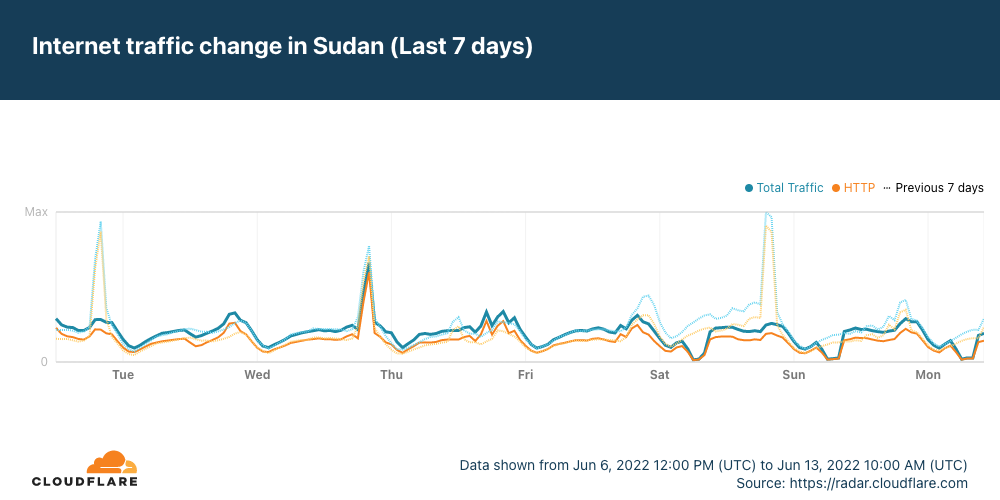
According to a schedule published by digital rights organization AccessNow, this year’s Secondary Certificate Exams will be taking place in Sudan daily between June 11–22, except June 17. As of this writing, near-complete shutdowns have been observed on June 11, 12, and 13 between 0530-0830 UTC (0730-1030 local time), as seen in the graph below. The timing of these shutdowns aligns with a communication reportedly sent to subscribers of telecommunications services in the country, which stated “In implementation of the decision of the Attorney General, the Internet service will be suspended during the Sudanese certificate exam sessions from 8 in the morning until 11 in the morning.”

Exam time means Internet disruptions in Syria, Sudan and Algeria

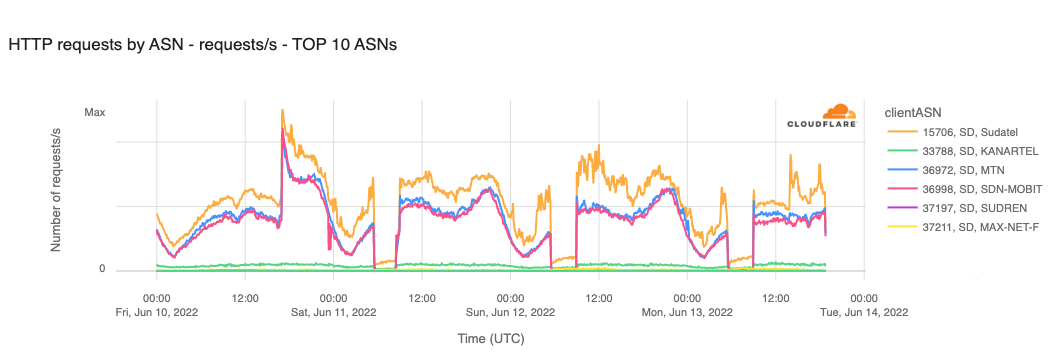
It is interesting to note that the shutdown, while nationwide, does not appear to be complete. The graph below shows that Cloudflare continues to see a small volume of HTTP requests from Sudatel during the shutdown periods. This is not completely unusual, as Sudatel may have public sector, financial services, or other types of customers that remain online.

Exam time means Internet disruptions in Syria, Sudan and Algeria

Algeria

Since 2018, Algeria has been shutting down the Internet nationwide during baccalaureate exams, following widespread cheating in 2016 that saw questions leaked online both before and during tests. These shutdowns reportedly cost businesses across the country an estimated 500 million Algerian Dinars (approximately $3.4 million USD) for every hour the Internet was unavailable. In 2021, there were two Internet shutdowns each day that exams took place—the first between 0700–1100 UTC (0800–1200 local time), and the second between 1330–1600 UTC (1430–1700 local time).

This year, more than 700,000 students will sit for the baccalaureate exams between June 12-16.

Perhaps recognizing the economic damage caused by these Internet shutdowns, this year the Algerian Minister of National Education announced that there would be no Internet shutdowns on exam days.

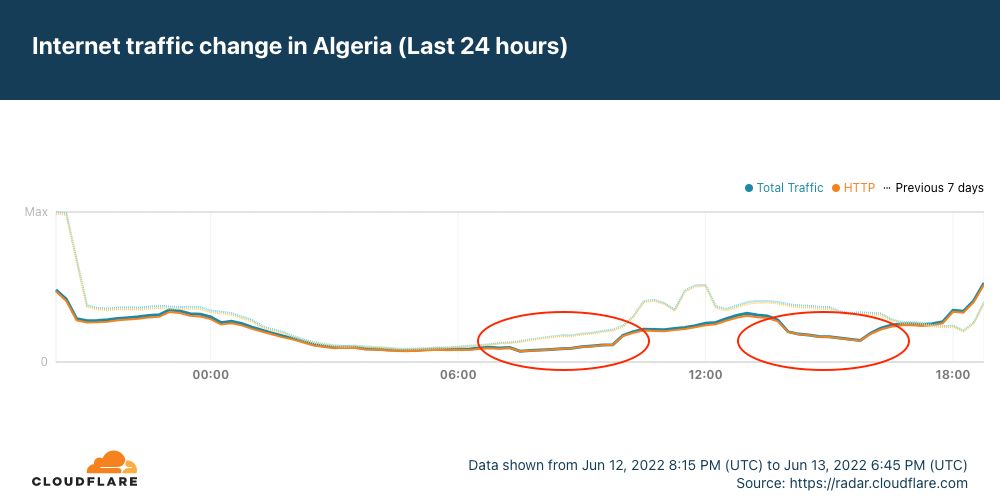
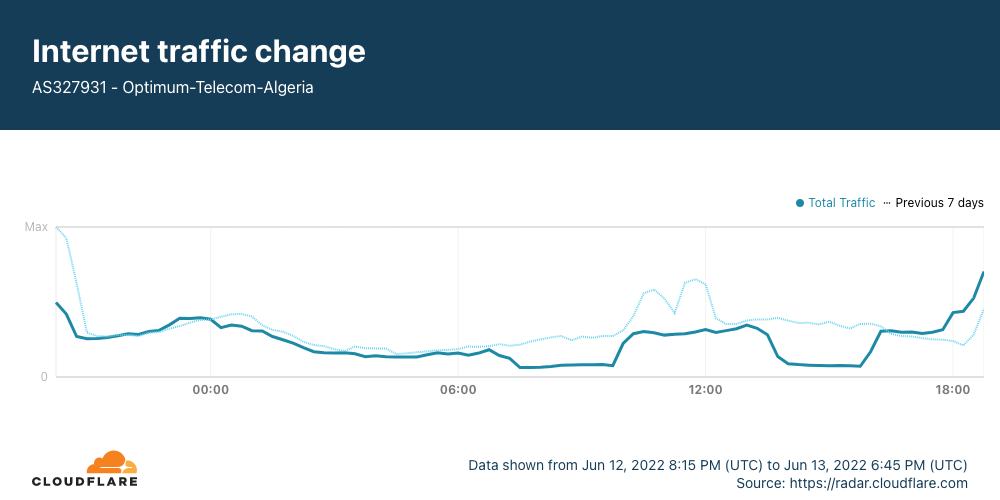
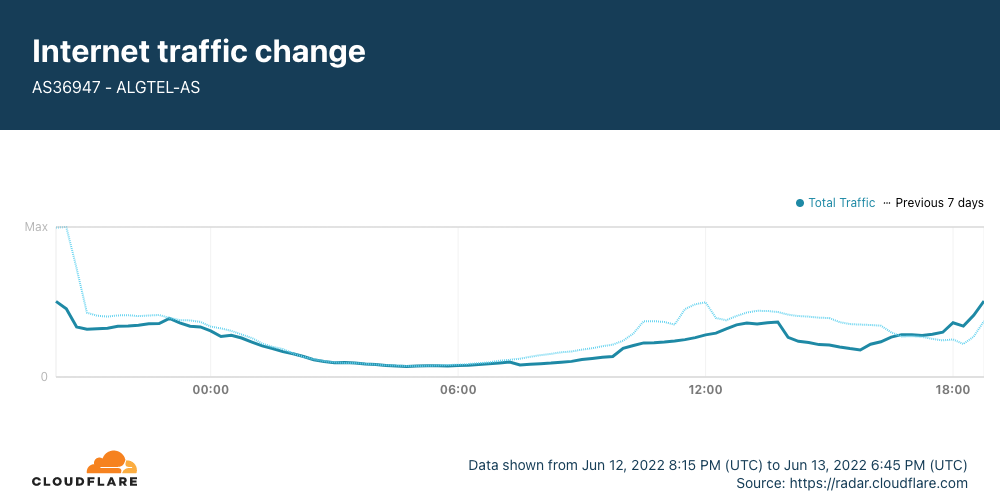
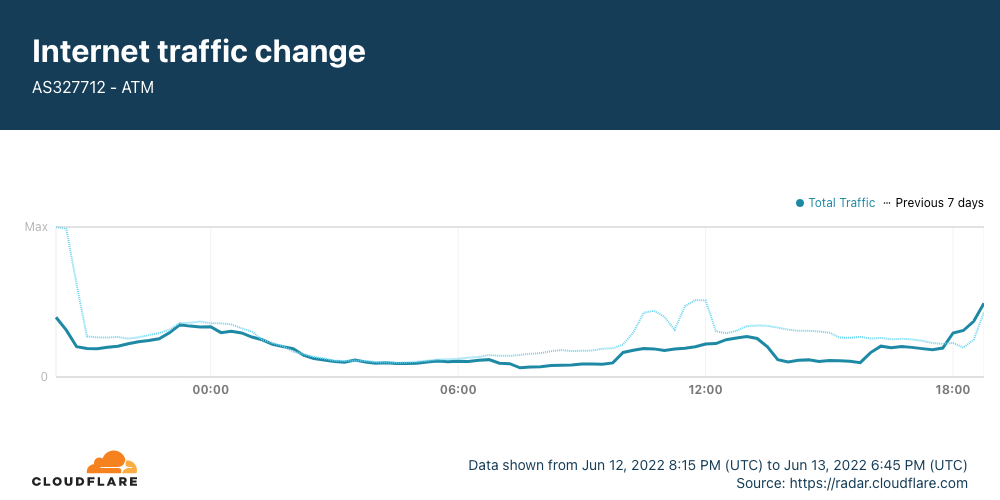
Thus far, it appears that this has been the case. However, it appears that the Algerian government has shifted to a content blocking-based approach, instead of a wide-scale Internet shutdown. The Cloudflare Radar graph below shows two nominal drops in country-level traffic during the two times on June 13 that the exams took place—0730–1000 UTC (0830–1100 local time) and 1330–1600 UTC (1430–1700 local time), similar to last year’s timing.

Exam time means Internet disruptions in Syria, Sudan and Algeria

The disruptions are also visible in traffic graphs for several major Algerian network providers, as shown below.

Exam time means Internet disruptions in Syria, Sudan and Algeria

Analysis of additional Cloudflare data further supports the hypothesis that Algeria is blocking access to specific websites and applications, rather than shutting down the Internet completely.

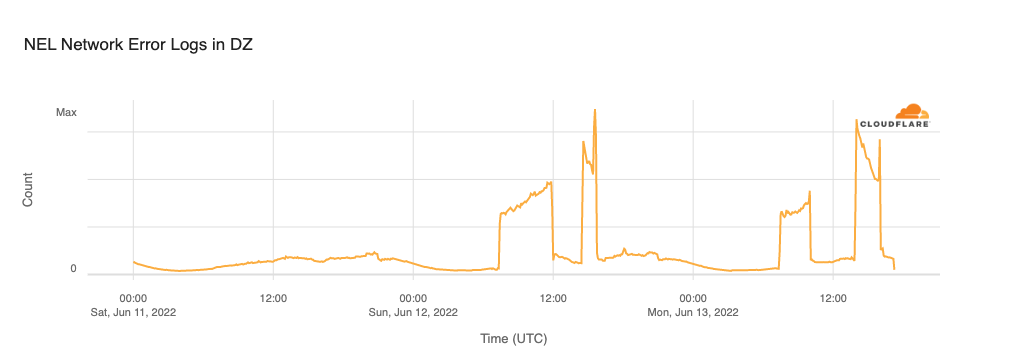
As described in a previous blog post, Network Error Logging (NEL) is a browser-based reporting system that allows users’ browsers to report connection failures to an endpoint specified by the webpage that failed to load. Below, a graph of NEL reports from browsers in Algeria shows clear spikes during the times (thus far) that the exams have taken place, with report levels significantly lower and more consistent during other times of the day.

Exam time means Internet disruptions in Syria, Sudan and Algeria

Conclusion

In addition to Syria, Sudan, and Algeria, countries including India, Jordan, Iraq, Uzbekistan, and Ethiopia have shut down or limited access to the Internet as exams took place. It is unclear whether these brute-force methods are truly effective at preventing cheating on these exams. However, it is clear that the impact of these shutdowns goes beyond students, as they impose a significant financial cost on businesses within the affected countries as they lose Internet access for multiple hours a day over the course of several weeks.

If you want to follow the remaining scheduled disruptions for these countries, you can see live data on the Cloudflare Radar pages for Syria, Sudan, and Algeria.

JSON is your friend – Certificate monitoring on Microsoft CA server

Post Syndicated from Tibor Volanszki original https://blog.zabbix.com/json-is-your-friend-certificate-monitoring-on-microsoft-ca-server/20697/

Introduction

By transforming our data into JSON we can achieve great results with Zabbix without the need to have a complex external script logic. The article will provide an example of obtaining a set of master data with a single PowerShell script and then using the Zabbix native functionality to configure low-level discovery and collect the required metrics from the master JSON data set.

In this example, we will implement certificate monitoring by using a Microsoft Windows Certificate Authority server. The goal is to see how many days we have before our internally signed certificates will expire. As an extra, we will be able to filter the monitored items by requestors and template names.

  • Target system version: MS Windows Server 2019 (also tested on 2012)
  • Zabbix server & agent version: 6.0.3 (Other Zabbix versions should be supported too with no or minimal changes)

Core logic

The below diagram shows the concept itself and you will find a detailed guide to implement this step by step in the next sections.

Core workflow


Sample output of Latest Data:

Prerequisites

To start, you will need to deploy Zabbix agent 2 on your target system – confirm that the Zabbix agent can communicate with your Zabbix server.  For the calculated item, we will require local time monitoring. The easiest way is to use the key “system.localtime”, which is already provided by the default Windows OS monitoring template. This item is intentionally not included within the certificate monitoring template to avoid key conflicts.

Below you can find the Powershell script which you have to implement: (name: “certmon_get_certs.ps1″) :

To import module PSPKI you may have to install the module first: https://pkisolutions.com/tools/pspki/

Import-Module PSPKI
$ca_hostname=$args[0]
$start = (Get-Date).AddDays(-7)
Get-IssuedRequest -CertificationAuthority $ca_hostname -Filter "NotAfter -ge $start" | Select-Object -Property RequestID,Request.RequesterName,CommonName,NotAfter,CertificateTemplateOid | ConvertTo-Json -Compress

*for Windows 2012 systems use CertificateTemplate instead of CertificateTemplateOid within this script.

This script expects one parameter, which is your CA server’s FQDN. That name will be loaded into variable “$ca_hostname”, so for testing purposes, you can just replace it with a static entry. Based on your needs you can adjust the “AddDays” parameter. Essentially this means to track back certificates, which are already expired for up to 7 days. Consider a situation, when you miss one just before a long weekend.

Script output

Let’s check the first part of the main command without further piping:

Simple script output without additional properties

As you can see, we are getting some basic information about the certificate. We do not need all the returned lines for the next steps, so it is better to filter the output down. Before we do that, we will use the option called “-Property”, and if you use it with a wildcard character, then it will list all the available parameters for a certificate. If you need more than the basic output, then you can list the extra parameters by using this option. Please be aware, that this will add extra lines compared to the basic output, but it will not do any filtering (the common lines will always remain visible).

Output with “-Property *”

Compare this with the output after using “Select-Object -Property RequestID,Request.RequesterName,CommonName,NotAfter,CertificateTemplateOid”

Output after using property filters

This looks good for us, but it is still not machine-readable. Let’s add the JSON output conversion, but without the “-Compress” option first:

JSON converted compressed output

What is especially great in this conversion, is that the “CertificateTemplateOid” part got 2 child entries, so later we can target the “FriendlyName” entry for discovery. Lastly, adding the “-Compress” option will help us to use less space by removing the white spaces and newlines from the output.

Depending on the amount of issued and valid certificates the output can be huge, especially without any filtering and compression (even megabytes in size). The current Zabbix server version (6.0.3) supports only 512KB as item output, this is why the output reduction is crucial. In my example the text data of one certificate takes approx 300 bytes, so 512KB will result in a limit of 1747 certificates. In case you are expecting more than this amount of ACTIVE certs within your CA, then I recommend cloning the PS script and adding some extra filtering to each variant (filter for template name / requestor / OU) and adjusting the template accordingly. Another approach would be to monitor the certificates, which will expire in the coming N days in case you have too many entries.

Agent configuration

To run the defined script, you have to allow it within the Zabbix Agent configuration file. You can either modify the main config or just define the extra lines within an additional file under zabbix_agent2.d folder. Below you can find the additional Zabbix agent configuration lines:

AllowKey=system.run[powershell -NoProfile -ExecutionPolicy bypass -File "C:\Program Files\Zabbix Agent 2\scripts\certmon_get_certs.ps1" *]
Timeout=20

The wildcard character at the end is needed to specify any hostname, which is expected by the script. The default timeout is 3 seconds, which is unfortunately insufficient. Importing Module PSPKI alone takes a few seconds, so the overall execution time is somewhere between 5 and 10 seconds. My assumption is that more certificates will not increase this significantly, but some extra seconds can be expected. 20 seconds sounds like a safe bet.

We are done with the pre-requisites, now we can start the real work!

Template

Let’s create our template from scratch.

  • Name: “Microsoft Certificate Authority – Certificate monitoring”
  • Host group: any group will do
Master item

We need only the following item:

  • Name: “Get certificate data”
  • Type: “Zabbix agent / Zabbix agent (active)” – for testing I recommend the passive mode
  • Key: system.run[powershell -NoProfile -ExecutionPolicy bypass -File “C:\Program Files\Zabbix Agent 2\scripts\certmon_get_certs.ps1″ {HOST.DNS}]”
  • Type of information: Text”
  • Update interval: 6h”
  • History: 1d”
Item configuration example

Assign the template to a CA server and you can test the item already. The result should be a big block of data in JSON format. To review the output I recommend the following external websites:

The latter one is especially helpful to find the correct JSON path, which we will require in the upcoming steps.

Item output sample
Measuring the script execution time

To measure the execution time, you can test it by using Zabbix get, which can connect to your Zabbix agent and request the item value over a CLI:

time zabbix_get -s [CA_SERVER_FQDN] --tls-connect psk --tls-psk-identity [PSK_IDEN] --tls-psk-file [PSK_FILE] -k 'system.run[powershell -NoProfile -ExecutionPolicy bypass -File "C:\Program Files\Zabbix Agent 2\scripts\certmon_get_certs.ps1" [CA_SERVER_FQDN]]'

This will give you the normal output and the execution time info:

real   0m5.771s
user   0m0.003s
sys    0m0.005s

To test the size of the output, redirect your command output to any file and measure it by “du -sk” to get it in kilobytes.

zabbix_get -s [CA_SERVER_FQDN] --tls-connect psk --tls-psk-identity [PSK_IDEN] --tls-psk-file [PSK_FILE] -k 'system.run[powershell -NoProfile -ExecutionPolicy bypass -File "C:\Program Files\Zabbix Agent 2\scripts\certmon_get_certs.ps1" [CA_SERVER_FQDN]]' > output.test
du -sk output.test
Low-level discovery rule definition

If the above part works just fine, then proceed with defining the low-level discovery rule as per the below example:

  • Name: Certificate discovery”
  • Type: Dependent item”
  • Key: certificate.discovery”
  • Master item: select our previously created item
  • Keep lost resources period: “6h”
Discovery rule configuration example

Then switch to LLD macros and define the below lines:

  • “{#COMMON_NAME}”: $.CommonName”
  • “{#REQUESTOR_NAME}”: $.[“Request.RequesterName”]”
  • “{#REQUEST_ID}”: $.RequestID”
  • “{#TEMPLATE_NAME1}”: “$.CertificateTemplate”
  • “{#TEMPLATE_NAME2}”: $.CertificateTemplateOid.FriendlyName”
Discovery rule LLD macro definitions

Some explanation:
The first LLD macro is self-explanatory – it obtains the certificate’s common name. The second one is also trivial, except the special marking, which is required due to the dot character in the middle. The third one is also simple, but the last 2 lines are somewhat special. If you have a fresh OS version, then most probably you will need only the 5th line without the 4th. In case you have a Windows server 2012 system, then you will need only the 4th line without the 5th. Why? Because of Windows 🙂 For testing you can keep both and then later remove the unnecessary one as well as the number suffix.

Now you are ready to create your item prototypes and this is where the real magic starts.

Certificate expiration date item prototype – Dependent item

Define the new item prototype as follows:

  • Name: Certificate [ ID #{#REQUEST_ID} ] {#COMMON_NAME} – Expiration date”
  • Type: Dependent item”
  • Key: certificate.expiration_date[{#REQUEST_ID}]”
  • Type of information: “Numeric (unsigned)”
  • Master item: pick the previously created master item
  • Units: unixtime”
  • History: 1d”
Item prototype example

Tags

  • cert_requestor“:  “{{#REQUESTOR_NAME}.regsub(“\\(\w+)”, “\1″)}”
  • cert_template1“: {#TEMPLATE_NAME1}”
  • cert_template2“: “{#TEMPLATE_NAME2}”
  • “scope”: certifcate / expiration date”
Item prototype tag definitions

As mentioned previously, it makes sense to keep only one template tag later, but for now, such an approach is fine.

The first line requires some explanation:
The requestor name starts with a domain prefix followed by 2 backslashes. If you are submitting CSRs from different domains to this CA server, then you can remove the extra formatting, but in a simple setup, we do not need the domain prefix, since it will be the same for all requestors.
Example: “DOMAIN\\someuser → someuser”

Preprocessing

  • JSONPath: $[?(@.RequestID == {#REQUEST_ID})].NotAfter”
  • Regular expression: (\d+) \1″
  • Custom multiplier: 0.001″
  • Discard unchanged with heartbeat: 1d”
Item prototype preprocessing step definitions

Explanation:
Since this item is a dependent item, it will point back to our master item, which returns a data block in JSON. Due to the nature of the discovery definitions, we are running a while loop, which is already loaded with our variables (the LLD macros). Therefore the “{#REQUEST_ID}” already has a numerical value within each cycle. With this number, we can go back to the original item and target that exact certificate, which has the same ID. Then we are interested in the NotAfter value considering the selected certificate.

You can find many other examples within Zabbix documentation: jsonpath functionality
At this point, we have the extracted value of the expiration date, but it is quite raw at the moment:

\/Date(1673594922000)\/

In the next step, we are taking the numerical part and then we have to apply a multiplier of 0.001 since by default the time is given in milliseconds. After this, we have an integer, which can be converted to a human-readable form by using the unit unixtime”. The last line is just a standard discard unchanged entry.

Since our discovery object is also a dependent item, you have to execute our master item to run the low-level discovery rule. The first execution will result in the creation of your certificate items and only the second execution of the master item will execute them all at once. After this point, you should have N certificate objects created and each should have a valid expiration date. This is already something, for which you could define a trigger, but personally, I prefer to see the remaining days and not the exact date itself.

Days to expire item prototype – Calculated item

Let’s define yet another item prototype as follows:

  • Name: Certificate [ ID #{#REQUEST_ID} ] {#COMMON_NAME} – Days to expire”
  • Type: Calculated”
  • Key: certificate.remaining_days[{#REQUEST_ID}]”
  • Type of information: Numeric (float)”
  • Formula: (last(//certificate.expiration_date[{#REQUEST_ID}])-last(//system.localtime))/86400″
  • Update interval: 6h”
  • History: 1d”
Remaining days to expiration item prototype example

Please do not forget, that you require an existing local time item, which is not provided by this template (but available within Windows by Zabbix agent*” template).

Tags:

Copy the same tags from the first prototype and only change the last tag to scope: certificate / remaining days

Remaining days to expiration item prototype tag definitions

Preprocessing:

  • Regular expression: ^(-?\d+)”: “\1”
  • Discard unchanged with heartbeat: 1d”
Remaining days to expiration item prototype preprocessing steps

As a result, this will give you a simple number with the remaining days to the expiration date. Then you can decide which item to use in the trigger to implement proper alerting based on your needs.

Certificate expiration trigger prototype

In my case I am just using a simple trigger expression for the remaining days:

  • Name:Certificate will expire within 30 days – {#COMMON_NAME}”
  • Operational data:Expires in {ITEM.LASTVALUE1} days”
  • Severity: up to you
  • Expression:last(/Microsoft Certificate Authority – Certificate monitoring/certificate.remaining_days[{#REQUEST_ID}])<=30″
Trigger prototype example

Tags:

  • cert_cn: “{#COMMON_NAME}”
  • cert_id“:{#REQUEST_ID}”
Trigger prototype tag definitions

When you check the relevant certificates in the Latest data section, then you can do the filtering by the item-based tags. Since we are adding the cert CN and ID only to the trigger, these will appear only in case of alerts. Based on your needs you can implement additional tags, you just have to adjust the PS script to show more properties. When you extend the input data, please always consider the 512KB limit or the configured timeout.

The logic defined in this example can be applied to any JSON formatted data.

Enjoy!

The post JSON is your friend – Certificate monitoring on Microsoft CA server appeared first on Zabbix Blog.

Hacking Tesla’s Remote Key Cards

Post Syndicated from Bruce Schneier original https://www.schneier.com/blog/archives/2022/06/hacking-teslas-remote-key-cards.html

Interesting vulnerability in Tesla’s NFC key cards:

Martin Herfurt, a security researcher in Austria, quickly noticed something odd about the new feature: Not only did it allow the car to automatically start within 130 seconds of being unlocked with the NFC card, but it also put the car in a state to accept entirely new keys—with no authentication required and zero indication given by the in-car display.

“The authorization given in the 130-second interval is too general… [it’s] not only for drive,” Herfurt said in an online interview. “This timer has been introduced by Tesla…in order to make the use of the NFC card as a primary means of using the car more convenient. What should happen is that the car can be started and driven without the user having to use the key card a second time. The problem: within the 130-second period, not only the driving of the car is authorized, but also the [enrolling] of a new key.”

Министър Божанов за българската визия в борбата срещу дезинформацията

Post Syndicated from Йоанна Елми original https://toest.bg/bozhidar-bozhanov-interview/

Божидар Божанов е ИТ експерт, основател на компания за информационна сигурност, член на Изпълнителния съвет на „Да, България“, а от 13 декември 2021 г. оглавява новосъздаденото Министерство на електронното управление. Йоанна Елми разговаря с него за мерките за справяне с дезинформацията, които министър Божанов е предложил от българска страна при срещите в Брюксел, посветени на темата. 


На 20 май съобщихте, че по време на срещите си в Брюксел сте предал на еврокомисарите „българската гледна точка относно дезинформацията“ и сте предложил конкретни идеи за „прилагането на Акта за цифровите услуги, така че да ограничим координираните дезинформационни кампании“. Бихте ли разяснил за читателите ни какво представлява Актът за цифровите услуги и какво приложение предлага България? 

Двата проблема, които се очертаха ясно в последните месеци, са блокирането на легитимни гласове в защита на Украйна и промотирането на дезинформация от страна на алгоритмите на Facebook. Актът може да бъде използван, за да ни защити и от двете явления. Относно първото блокираните ще могат да уредят спора извънсъдебно чрез трета страна. Тоест при модерацията вече няма социалните мрежи да държат и хляба, и ножа. По линия на дезинформацията малки промени в алгоритмите и в някои функционалности на Facebook могат да допринесат за значително намаляване на разпространението ѝ от тролове. Един пример е опцията за автоматично включване в групи, в които човекът е поканен. Това се използва от троловете, за да може фалшивите новини да достигнат до повече хора. Ако Facebook ограничи ефекта от тази опция, облъчването с дезинформация ще намалее.

Имаме още две идеи. Първата е за повече прозрачност от страна на социалните мрежи. Докладите, които те трябва да предоставят (включително за модерация), задължително да бъдат на ниво държава членка, а не обобщени. Искаме също и предоставяне на данните публично, в реално време, а не веднъж годишно, което е горната граница по предложения текст на Акта за цифровите услуги. Втората идея е във връзка с алгоритмите за препоръчване на съдържание. Социалните мрежи трябва да дават обяснения на потребителите си защо дадено съдържание им е препоръчано, и да се опитват да не позволяват на групи от тролове да ги „излъжат“ с координирани действия, като например публикуване едновременно в много групи и съответно харесване и споделяне. За това може да се вземат редица индикатори за профилите, които да ги поставят в една група (т.нар. клъстерен анализ).

Актът има доста широк обхват, но целта му е да допълни Директивата за електронната търговия със специфични задължения за доставчиците на съдържание, включително във връзка с незаконното съдържание, като слага допълнителен фокус върху т.нар. големи онлайн платформи. В обхвата влизат повече прозрачност на модерацията, възможност за обжалване, базова уредба на системите за препоръчване на съдържание и други.

Какво имаме предвид с „българската гледна точка относно дезинформацията“? Как е формирана официалната държавна позиция, на каква експертност се разчита и до какви изводи стигаме по темата на държавно ниво? 

Разчитаме на разговори с експерти по технологични и медийни въпроси, на техните анализи, както и на международни изследвания. Разчитаме и на докладвани проблеми от гражданското общество. Базираме изводите си на това и на публичните отчети на Facebook, но за съжаление, те са много ограничени и почти за нищо няма разбивка на ниво държава. Именно това е една от ползите от Акта за цифровите услуги – че платформите ще трябва да предоставят повече данни, за да можем да бъдем по-информирани.

Казвате, че България „вече има визия и цели, които ще реализира заедно с европейските ни партньори“. С какво се различава политиката на настоящото правителство в сферата на дигиталната сигурност спрямо тази на предишните правителства и каква е визията, за която съобщихте? Докога и как ще се прилага тя? Има ли риск да си остане поредната нереализирана рамка и ако да – какви са причините? 

В рамките на конкретното посещение имах три теми: дезинформацията, електронната идентификация и споделяне на информация за киберзаплахи. Разликата с предишни правителства е, че инициираме диалог, че отиваме в Брюксел с решения, а не да се оплакваме. Решения, които са в полза на България, разбира се. С риск да опростя прекалено нещата, до момента България е била просто поддръжник на това, което казва Германия.

Министър Божанов, говорите за „координирани дезинформационни кампании“, но голяма част от проблема с дезинформацията в България се корени в два други ресора – медиите и непрозрачната собственост на онлайн източниците. Това далеч не е само български проблем: дезинформацията често се употребява политически и идеологически в медийното пространство, същевременно е и много доходоносен бизнес с онлайн реклами. Така се получава, че координираните кампании всъщност се подпомагат от доста по-мащабни некоординирани усилия, които са възможни благодарение на пробиви в системите ни. Каква е Вашата позиция по въпроса, предвиждате ли законови решения съвместно с други министерства и как си представяте тези решения? 

Прозрачността на медиите действително е част от проблемите. Затова създаването на цялостен регистър на медиите, с техните действителни собственици и редактори, както и публично финансиране, е компонент от решението. Такъв регистър би подпомогнал и работата на алгоритмите, които могат да проверят дали едно новинарско съдържание идва от регистрирана медия, или от анонимен сайт. Когато един човек чете фалшива новина, той няма да провери дали интернет страницата, която е отворил, е в регистъра на медиите, или не, нито кой е собственик или редактор. Социалните мрежи обаче, които разпространяват това съдържание, могат да направят тази проверка, и то автоматично. И могат да покажат на читателя, че дадена новина идва от анонимен сайт. Това помага значително.

Медийният регистър не е политика на Министерството на електронното управление, но ще подпомогнем Министерството на културата и Съвета за електронни медии във всички аспекти от неговото изграждане.

Такъв регистър на медиите съществува от 2019 г. заради т.нар. Медиен закон на Пеевски. При справка обаче става ясно, че много медии не спазват изискванията на регистъра, което очевидно се игнорира от министерствата, но също толкова лесно може да се „активира“ при сигнал за неудобна медия. Наистина ли смятате, че това е решението? 

Темата с медийния регистър наистина е деликатна и просто наличието на един регистър не решава проблемите. При такъв регистър важното е какво следва от него – например по-голяма прозрачност на публичното финансиране, възможност за справка от страна на социалните мрежи и др.

Тези регистри не са в ресора на Вашето министерство, което по-скоро се стреми към други цели, ако Ви разбирам правилно. Как според Вас могат да бъдат накарани социалните медии да правят проверка съгласно българските регистри? 

Действително това е политиката за медийна свобода и тя излиза извън правомощията ми. Коментирам го заради пресечната точка със социалните мрежи и дезинформацията. Социалните мрежи могат да бъдат накарани по два начина. Единият е регулация, а другият е в комуникация със социалните мрежи да ги убедим за системния риск, който дезинформацията, разпространявана през тях, представлява за страната ни.

Заглавна снимка: © „Демократична България“

Източник

The collective thoughts of the interwebz