Dynamic Process Isolation: Research by Cloudflare and TU Graz

Post Syndicated from Kenton Varda original https://blog.cloudflare.com/spectre-research-with-tu-graz/


Dynamic Process Isolation: Research by Cloudflare and TU Graz

Dynamic Process Isolation: Research by Cloudflare and TU Graz

Last year, I wrote about the Cloudflare Workers security model, including how we fight Spectre attacks. In that post, I explained that there is no known complete defense against Spectre — regardless of whether you’re using isolates, processes, containers, or virtual machines to isolate tenants. What we do have, though, is a huge number of tools to increase the cost of a Spectre attack, to the point where it becomes infeasible. Cloudflare Workers has been designed from the very beginning with protection against side channel attacks in mind, and because of this we have been able to incorporate many defenses that other platforms — such as virtual machines and web browsers — cannot. However, the performance and scalability requirements of edge compute make it infeasible to run every Worker in its own private process, so we cannot rely on the usual defenses provided by the operating system kernel and address space separation.

Given our different approach, we cannot simply rely on others to tell us if we are safe. We had to do our own research. To do this we partnered with researchers at Graz Technical University (TU Graz) to study the impact of Spectre on our environment. The team at TU Graz are some of the foremost experts on the topic, having co-discovered Spectre initially as well as discovered several follow-on bugs like NetSpectre, ZombieLoad, Fallout, and others.

Today we are publishing a paper describing our findings, authored by Martin Schwarzl, Pietro Borrello, Andreas Kogler, Thomas Schuster, Daniel Gruss, Michael Schwarz, and myself. This paper covers research done in 2019 and early 2020. The research both tests the possibility of attacking Workers using Spectre, and proposes a new defense mechanism, which we now employ in production.

For this research, the team at TU Graz had full access to the Workers Runtime source code and were able to compile and run it locally for testing.

The research has two basic components.

Part 1: Develop an attack

A side channel attack (of which Spectre is one variety) is kind of like playing poker with a CPU. In poker, players try to understand what their opponents are thinking by looking for subtle unconscious behaviors, such as a nervous look or a hand motion. These behaviors are called “tells”. In a side channel attack, the attacker wants to find out secrets that the CPU knows. The CPU won’t reveal these secrets directly, but they can sometimes subtly affect how long the CPU spends to perform certain operations, kind of like a poker tell. If an attacker can carefully time the CPU’s actions, they can potentially discover the underlying secrets. Spectre attacks in particular focus on side channels that result from the CPU’s use of speculative execution, in which the CPU executes code that it is not yet sure should be executed, and then attempts to roll it back if not. Speculative execution is a particularly potent tool in side channel attacks because it essentially allows the attacker to program custom side channels in speculatively-executed code.

Many Spectre defenses focus on eliminating the “tells” by trying to prevent the variability in the CPU’s timing. This is hard, because CPUs are extremely complex and there are many ways that their timing can be affected. While many specific “tells” have been found and mitigated, there are undoubtedly many more that haven’t been disclosed. This has led to a game of whack-a-mole, where researchers continuously find new “tells” while CPU vendors rush out kernel and microcode patches to solve them — often with large performance losses as a side effect.

In Workers, we have focused on a different approach: preventing the attacker from seeing the “tells”. The Workers Runtime is designed to prevent a Worker from measuring its own execution time, as well as to prevent other forms of non-deterministic behavior like multithreading that could be used in place of a timer. I described these techniques in detail in last year’s post.

However, this approach can’t be perfect as long as Workers are allowed to talk to the rest of the world. A Worker could always communicate with a remote time server to measure time. Such communications will be far less accurate than a local timer, and since the timing differences are extremely small, they will be hard to measure this way. But, by using amplification techniques to improve the strength of the signal, repeating the attack many times and applying statistics, it could still be possible to derive secrets.

We therefore set out to develop an attack based on this approach. Upon applying the best techniques available to us, we were indeed able to produce a working Spectre variant 1 attack that could leak memory at a rate of 120 bits per hour. Compared to attacks demonstrated on many other platforms, 120 bits per hour is pretty slow. However, it’s obviously still fast enough to be a problem.

It’s important to note, though, that this speed was achieved in an ideal scenario:

  • Since the Workers Runtime prevents Workers from measuring their own execution time, any attack would need to rely on a remote time server. But for the purpose of our test, the “remote” server was in fact located on the same machine. In a real-world scenario, such a server would need to be accessed over the Internet, making the timing less accurate.
  • The machine running the test had no other load. A real-world machine would be processing hundreds or thousands of requests concurrently, creating noise.
  • The attack only demonstrated that it could read some bits that it shouldn’t. In order to read interesting bits, an attacker would first need to locate those bits, which likely would require reading hundreds or thousands of other bits first.

In the real world, these factors appear to make an attack too slow to be interesting. If an attack takes days or weeks to carry out, the contents of memory are highly likely to change before it can read them. For example, we update the Workers Runtime code at least once a week, which causes a restart of all processes.

That said, we did not feel comfortable relying on this argument as our defense. Instead, we set out to do better.

Part 2: Enhance our defenses

In the second part of the research, we designed and implemented a novel Spectre defense which we call Dynamic Process Isolation.

Dynamic Process Isolation was described in my blog post last year. At the time, this system was still in testing, but it has since been fully deployed in production.

In short, our defense uses hardware performance counters to detect Workers whose performance characteristics could be indicative of an attack. Before the attack has had enough time to leak any bits, we move the Worker into a separate operating system process, thus taking advantage of the additional defenses implemented by the OS kernel. Crucially, since a benign Worker can still operate normally while in an isolated process, we are able to use a detector that produces false positives, as long as the rate is relatively low. This affordance made it possible for us to develop a working classifier where previous work in the area had struggled.

Specifically, we developed a detector based on measuring branch mispredictions. Spectre variant 1 attacks — the fastest and easiest kind of Spectre attack — work by fooling the CPU’s branch predictor to trigger speculative code execution. Such an attack, when running in our environment, must trigger repeated mispredictions in a loop, in order to get enough data to apply statistics to overcome the noise floor. We can see these mispredictions in the hardware performance counters. While an attack could try to evade the detector by spreading out its trials over a longer time period, doing so would slow down the attack by orders of magnitude, which is exactly our goal. Classifiers for other Spectre variants might be straightforward to build as well, however, we find other variants already produce much lower bandwidth or are otherwise effectively mitigated by our existing defenses.

This defense successfully detects and mitigates the attack we developed. We also tested it against a number of Spectre proofs of concept and found it caught all of them. Meanwhile, the rate of false positives is well within the range we can tolerate: Out of many thousands of Workers running on our platform, we see only about 20 being falsely detected as attacks.

For more details, check out the paper and my blog post from last year.

Read the Paper

Collaborating with TU Graz was a great experience. We are very happy to work with some of the world’s foremost experts on this problem, and to have produced not just an attack but also a constructive defense.


For more details, download the full paper on arXiv.

Handshake Encryption: Endgame (an ECH update)

Post Syndicated from Christopher Wood original https://blog.cloudflare.com/handshake-encryption-endgame-an-ech-update/

Handshake Encryption: Endgame (an ECH update)

Handshake Encryption: Endgame (an ECH update)

Privacy and security are fundamental to Cloudflare, and we believe in and champion the use of cryptography to help provide these fundamentals for customers, end-users, and the Internet at large. In the past, we helped specify, implement, and ship TLS 1.3, the latest version of the transport security protocol underlying the web, to all of our users. TLS 1.3 vastly improved upon prior versions of the protocol with respect to security, privacy, and performance: simpler cryptographic algorithms, more handshake encryption, and fewer round trips are just a few of the many great features of this protocol.

TLS 1.3 was a tremendous improvement over TLS 1.2, but there is still room for improvement. Sensitive metadata relating to application or user intent is still visible in plaintext on the wire. In particular, all client parameters, including the name of the target server the client is connecting to, are visible in plaintext. For obvious reasons, this is problematic from a privacy perspective: Even if your application traffic to crypto.cloudflare.com is encrypted, the fact you’re visiting crypto.cloudflare.com can be quite revealing.

And so, in collaboration with other participants in the standardization community and members of industry, we embarked towards a solution for encrypting all sensitive TLS metadata in transit. The result: TLS Encrypted ClientHello (ECH), an extension to protect this sensitive metadata during connection establishment.

Last year, we described the current status of this standard and its relation to the TLS 1.3 standardization effort, as well as ECH’s predecessor, Encrypted SNI (ESNI). The protocol has come a long way since then, but when will we know when it’s ready? There are many ways by which one can measure a protocol. Is it implementable? Is it easy to enable? Does it seamlessly integrate with existing protocols or applications? In order to assess these questions and see if the Internet is ready for ECH, the community needs deployment experience. Hence, for the past year, we’ve been focused on making the protocol stable, interoperable, and, ultimately, deployable. And today, we’re pleased to announce that we’ve begun our initial deployment of TLS ECH.

What does ECH mean for connection security and privacy on the network? How does it relate to similar technologies and concepts such as domain fronting? In this post, we’ll dig into ECH details and describe what this protocol does to move the needle to help build a better Internet.

Connection privacy

For most Internet users, connections are made to perform some type of task, such as loading a web page, sending a message to a friend, purchasing some items online, or accessing bank account information. Each of these connections reveals some limited information about user behavior. For example, a connection to a messaging platform reveals that one might be trying to send or receive a message. Similarly, a connection to a bank or financial institution reveals when the user typically makes financial transactions. Individually, this metadata might seem harmless. But consider what happens when it accumulates: does the set of websites you visit on a regular basis uniquely identify you as a user? The safe answer is: yes.

This type of metadata is privacy-sensitive, and ultimately something that should only be known by two entities: the user who initiates the connection, and the service which accepts the connection. However, the reality today is that this metadata is known to more than those two entities.

Making this information private is no easy feat. The nature or intent of a connection, i.e., the name of the service such as crypto.cloudflare.com, is revealed in multiple places during the course of connection establishment: during DNS resolution, wherein clients map service names to IP addresses; and during connection establishment, wherein clients indicate the service name to the target server. (Note: there are other small leaks, though DNS and TLS are the primary problems on the Internet today.)

As is common in recent years, the solution to this problem is encryption. DNS-over-HTTPS (DoH) is a protocol for encrypting DNS queries and responses to hide this information from onpath observers. Encrypted Client Hello (ECH) is the complementary protocol for TLS.

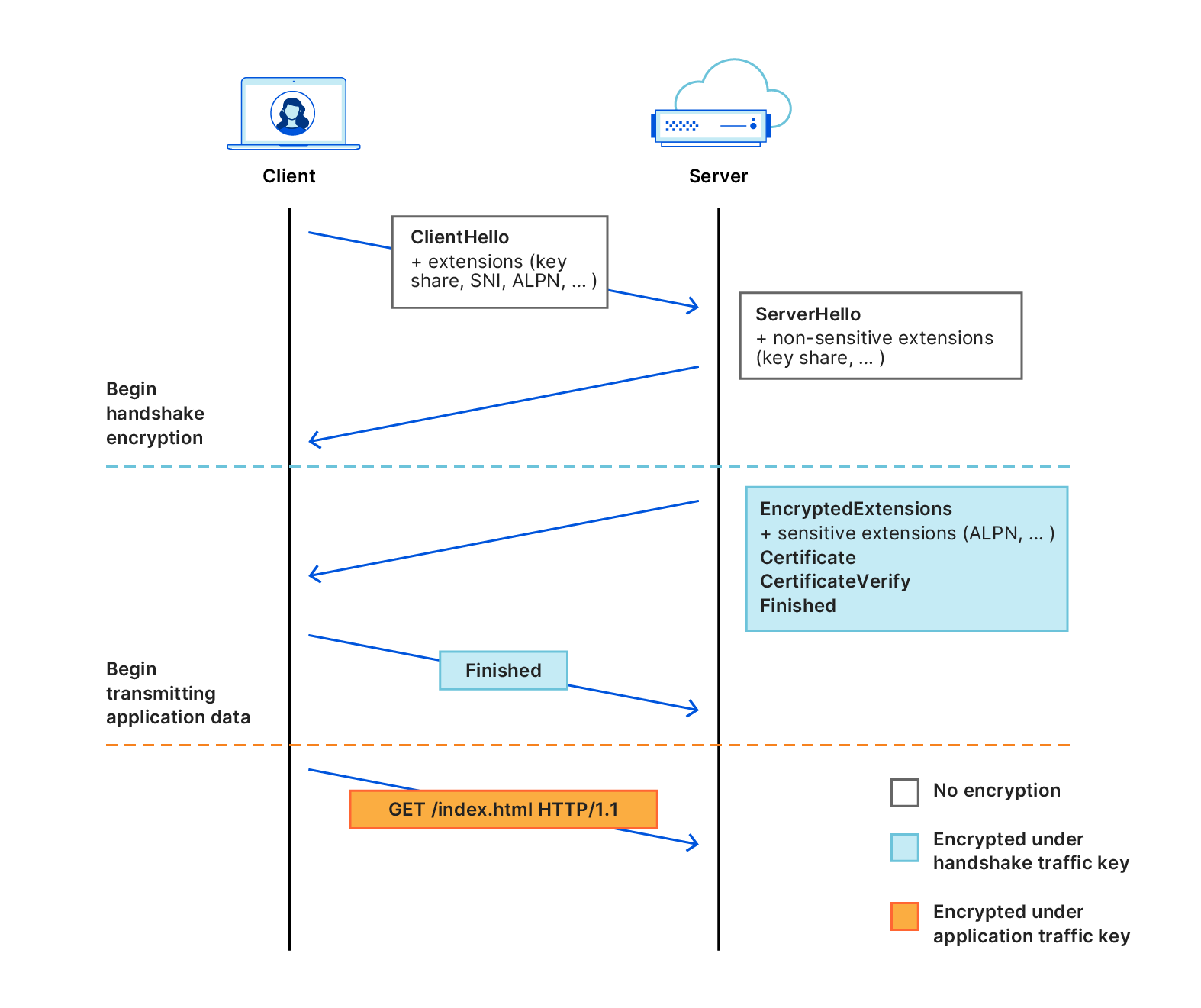
The TLS handshake begins when the client sends a ClientHello message to the server over a TCP connection (or, in the context of QUIC, over UDP) with relevant parameters, including those that are sensitive. The server responds with a ServerHello, encrypted parameters, and all that’s needed to finish the handshake.

Handshake Encryption: Endgame (an ECH update)

The goal of ECH is as simple as its name suggests: to encrypt the ClientHello so that privacy-sensitive parameters, such as the service name, are unintelligible to anyone listening on the network. The client encrypts this message using a public key it learns by making a DNS query for a special record known as the HTTPS resource record. This record advertises the server’s various TLS and HTTPS capabilities, including ECH support. The server decrypts the encrypted ClientHello using the corresponding secret key.

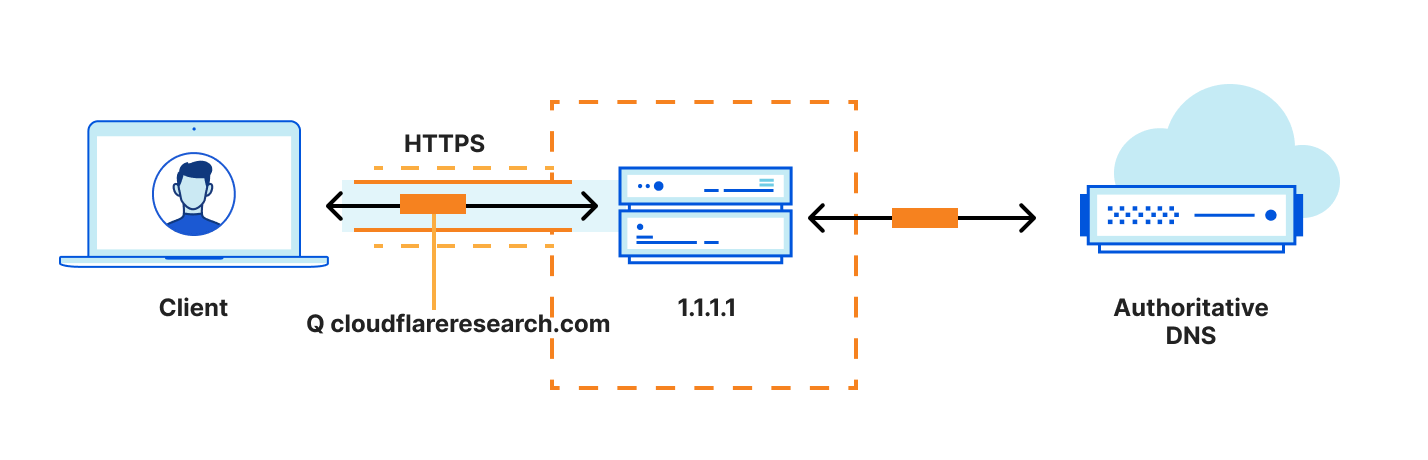
Conceptually, DoH and ECH are somewhat similar. With DoH, clients establish an encrypted connection (HTTPS) to a DNS recursive resolver such as 1.1.1.1 and, within that connection, perform DNS transactions.

Handshake Encryption: Endgame (an ECH update)

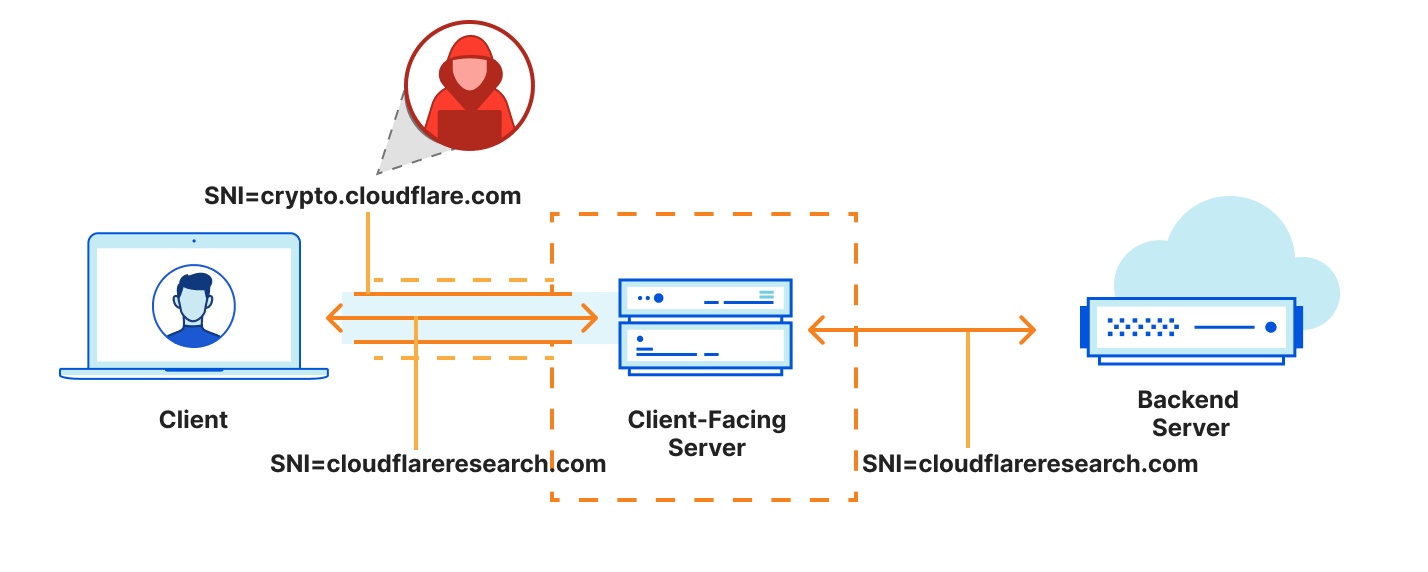
With ECH, clients establish an encrypted connection to a TLS-terminating server such as crypto.cloudflare.com, and within that connection, request resources for an authorized domain such as cloudflareresearch.com.

Handshake Encryption: Endgame (an ECH update)

There is one very important difference between DoH and ECH that is worth highlighting. Whereas a DoH recursive resolver is specifically designed to allow queries for any domain, a TLS server is configured to allow connections for a select set of authorized domains. Typically, the set of authorized domains for a TLS server are those which appear on its certificate, as these constitute the set of names for which the server is authorized to terminate a connection.

Basically, this means the DNS resolver is open, whereas the ECH client-facing server is closed. And this closed set of authorized domains is informally referred to as the anonymity set. (This will become important later on in this post.) Moreover, the anonymity set is assumed to be public information. Anyone can query DNS to discover what domains map to the same client-facing server.

Why is this distinction important? It means that one cannot use ECH for the purposes of connecting to an authorized domain and then interacting with a different domain, a practice commonly referred to as domain fronting. When a client connects to a server using an authorized domain but then tries to interact with a different domain within that connection, e.g., by sending HTTP requests for an origin that does not match the domain of the connection, the request will fail.

From a high level, encrypting names in DNS and TLS may seem like a simple feat. However, as we’ll show, ECH demands a different look at security and an updated threat model.

A changing threat model and design confidence

The typical threat model for TLS is known as the Dolev-Yao model, in which an active network attacker can read, write, and delete packets from the network. This attacker’s goal is to derive the shared session key. There has been a tremendous amount of research analyzing the security of TLS to gain confidence that the protocol achieves this goal.

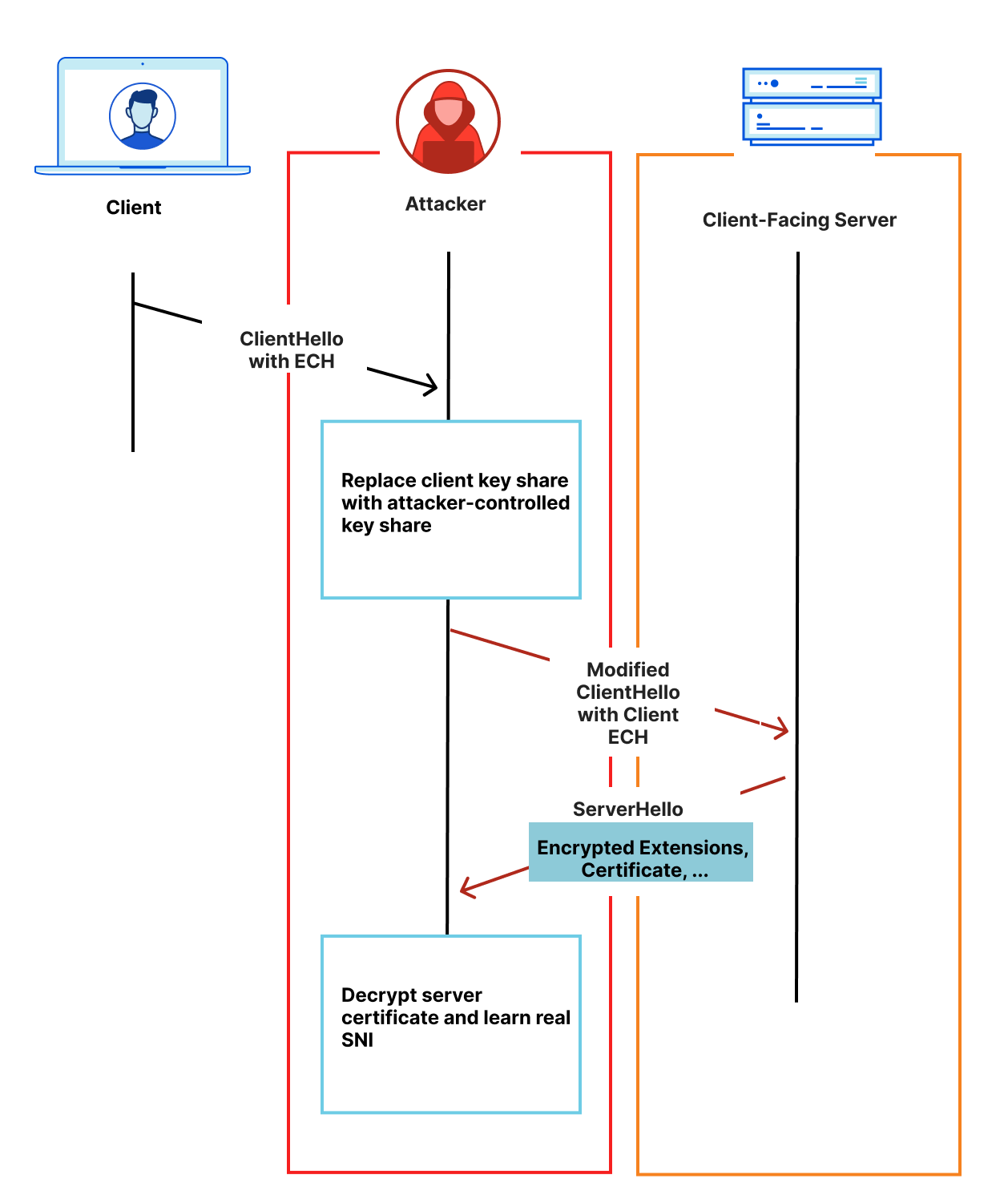
The threat model for ECH is somewhat stronger than considered in previous work. Not only should it be hard to derive the session key, it should also be hard for the attacker to determine the identity of the server from a known anonymity set. That is, ideally, it should have no more advantage in identifying the server than if it simply guessed from the set of servers in the anonymity set. And recall that the attacker is free to read, write, and modify any packet as part of the TLS connection. This means, for example, that an attacker can replay a ClientHello and observe the server’s response. It can also extract pieces of the ClientHello — including the ECH extension — and use them in its own modified ClientHello.

Handshake Encryption: Endgame (an ECH update)

The design of ECH ensures that this sort of attack is virtually impossible by ensuring the server certificate can only be decrypted by either the client or client-facing server.

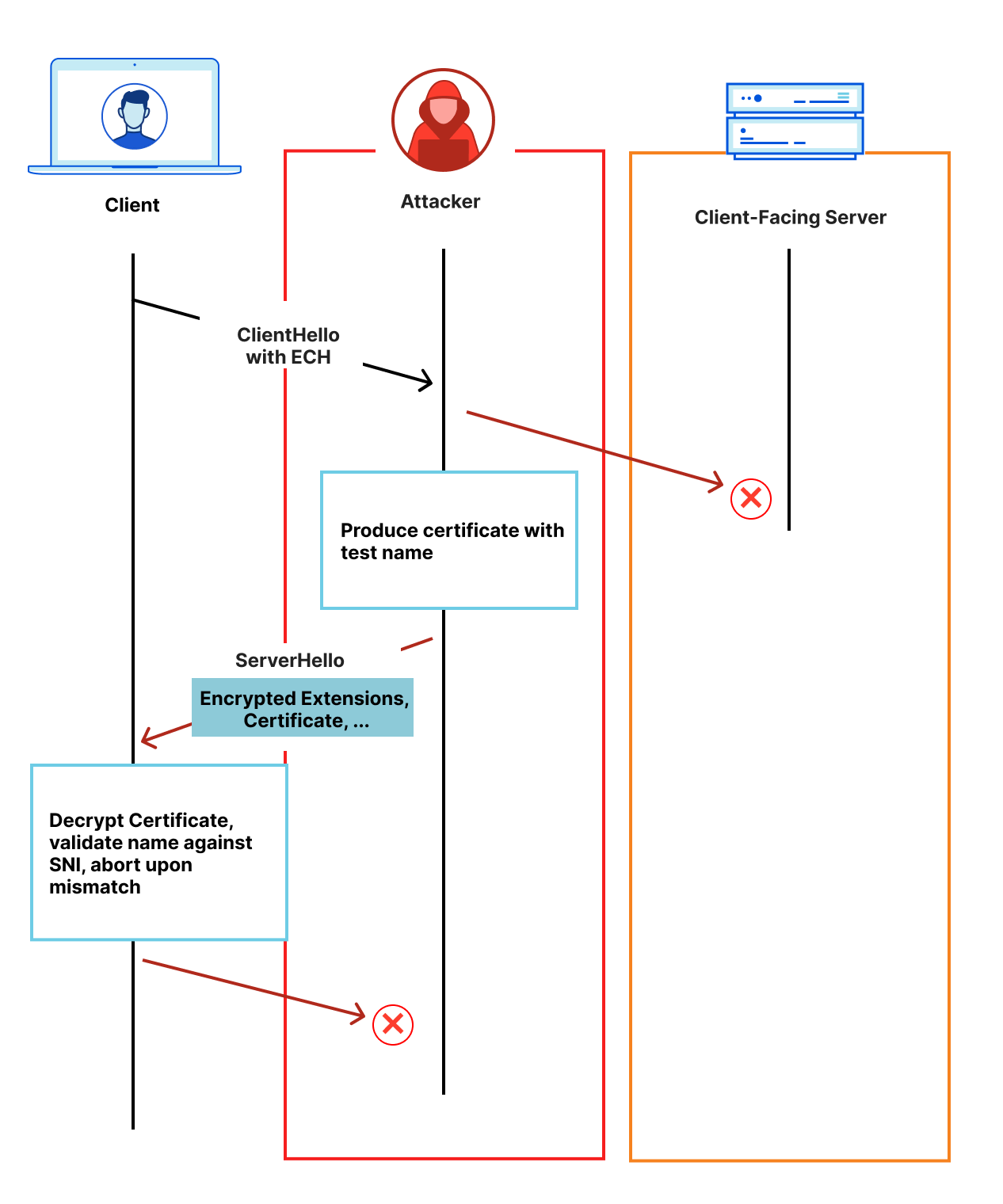
Something else an attacker might try is masquerade as the server and actively interfere with the client to observe its behavior. If the client reacted differently based on whether the server-provided certificate was correct, this would allow the attacker to test whether a given connection using ECH was for a particular name.

Handshake Encryption: Endgame (an ECH update)

ECH also defends against this attack by ensuring that an attacker without access to the private ECH key material cannot actively inject anything into the connection.

The attacker can also be entirely passive and try to infer encrypted information from other visible metadata, such as packet sizes and timing. (Indeed, traffic analysis is an open problem for ECH and in general for TLS and related protocols.) Passive attackers simply sit and listen to TLS connections, and use what they see and, importantly, what they know to make determinations about the connection contents. For example, if a passive attacker knows that the name of the client-facing server is crypto.cloudflare.com, and it sees a ClientHello with ECH to crypto.cloudflare.com, it can conclude, with reasonable certainty, that the connection is to some domain in the anonymity set of crypto.cloudflare.com.

The number of potential attack vectors is astonishing, and something that the TLS working group has tripped over in prior iterations of the ECH design. Before any sort of real world deployment and experiment, we needed confidence in the design of this protocol. To that end, we are working closely with external researchers on a formal analysis of the ECH design which captures the following security goals:

  1. Use of ECH does not weaken the security properties of TLS without ECH.
  2. TLS connection establishment to a host in the client-facing server’s anonymity set is indistinguishable from a connection to any other host in that anonymity set.

We’ll write more about the model and analysis when they’re ready. Stay tuned!

There are plenty of other subtle security properties we desire for ECH, and some of these drill right into the most important question for a privacy-enhancing technology: Is this deployable?

Focusing on deployability

With confidence in the security and privacy properties of the protocol, we then turned our attention towards deployability. In the past, significant protocol changes to fundamental Internet protocols such as TCP or TLS have been complicated by some form of benign interference. Network software, like any software, is prone to bugs, and sometimes these bugs manifest in ways that we only detect when there’s a change elsewhere in the protocol. For example, TLS 1.3 unveiled middlebox ossification bugs that ultimately led to the middlebox compatibility mode for TLS 1.3.

While itself just an extension, the risk of ECH exposing (or introducing!) similar bugs is real. To combat this problem, ECH supports a variant of GREASE whose goal is to ensure that all ECH-capable clients produce syntactically equivalent ClientHello messages. In particular, if a client supports ECH but does not have the corresponding ECH configuration, it uses GREASE. Otherwise, it produces a ClientHello with real ECH support. In both cases, the syntax of the ClientHello messages is equivalent.

This hopefully avoids network bugs that would otherwise trigger upon real or fake ECH. Or, in other words, it helps ensure that all ECH-capable client connections are treated similarly in the presence of benign network bugs or otherwise passive attackers. Interestingly, active attackers can easily distinguish — with some probability — between real or fake ECH. Using GREASE, the ClientHello carries an ECH extension, though its contents are effectively randomized, whereas a real ClientHello using ECH has information that will match what is contained in DNS. This means an active attacker can simply compare the ClientHello against what’s in the DNS. Indeed, anyone can query DNS and use it to determine if a ClientHello is real or fake:

$ dig +short crypto.cloudflare.com TYPE65
\# 134 0001000001000302683200040008A29F874FA29F884F000500480046 FE0D0042D500200020E3541EC94A36DCBF823454BA591D815C240815 77FD00CAC9DC16C884DF80565F0004000100010013636C6F7564666C 6172652D65736E692E636F6D00000006002026064700000700000000 0000A29F874F260647000007000000000000A29F884F

Despite this obvious distinguisher, the end result isn’t that interesting. If a server is capable of ECH and a client is capable of ECH, then the connection most likely used ECH, and whether clients and servers are capable of ECH is assumed public information. Thus, GREASE is primarily intended to ease deployment against benign network bugs and otherwise passive attackers.

Note, importantly, that GREASE (or fake) ECH ClientHello messages are semantically different from real ECH ClientHello messages. This presents a real problem for networks such as enterprise settings or school environments that otherwise use plaintext TLS information for the purposes of implementing various features like filtering or parental controls. (Encrypted DNS protocols like DoH also encountered similar obstacles in their deployment.) Fundamentally, this problem reduces to the following: How can networks securely disable features like DoH and ECH? Fortunately, there are a number of approaches that might work, with the more promising one centered around DNS discovery. In particular, if clients could securely discover encrypted recursive resolvers that can perform filtering in lieu of it being done at the TLS layer, then TLS-layer filtering might be wholly unnecessary. (Other approaches, such as the use of canary domains to give networks an opportunity to signal that certain features are not permitted, may work, though it’s not clear if these could or would be abused to disable ECH.)

We are eager to collaborate with browser vendors, network operators, and other stakeholders to find a feasible deployment model that works well for users without ultimately stifling connection privacy for everyone else.

Next steps

ECH is rolling out for some FREE zones on our network in select geographic regions. We will continue to expand the set of zones and regions that support ECH slowly, monitoring for failures in the process. Ultimately, the goal is to work with the rest of the TLS working group and IETF towards updating the specification based on this experiment in hopes of making it safe, secure, usable, and, ultimately, deployable for the Internet.

ECH is one part of the connection privacy story. Like a leaky boat, it’s important to look for and plug all the gaps before taking on lots of passengers! Cloudflare Research is committed to these narrow technical problems and their long-term solutions. Stay tuned for more updates on this and related protocols.

Privacy Pass v3: the new privacy bits

Post Syndicated from Pop Chunhapanya original https://blog.cloudflare.com/privacy-pass-v3/

Privacy Pass v3: the new privacy bits

Privacy Pass v3: the new privacy bits

In November 2017, we released our implementation of a privacy preserving protocol to let users prove that they are humans without enabling tracking. When you install Privacy Pass’s browser extension, you get tokens when you solve a Cloudflare CAPTCHA which can be used to avoid needing to solve one again… The redeemed token is cryptographically unlinkable to the token originally provided by the server. That is why Privacy Pass is privacy preserving.

In October 2019, Privacy Pass reached another milestone. We released Privacy Pass Extension v2.0 that includes a new service provider (hCaptcha) which provides a way to redeem a token not only with CAPTCHAs in the Cloudflare challenge pages but also hCaptcha CAPTCHAs in any website. When you encounter any hCaptcha CAPTCHA in any website, including the ones not behind Cloudflare, you can redeem a token to pass the CAPTCHA.

We believe Privacy Pass solves an important problem — balancing privacy and security for bot mitigation— but we think there’s more to be done in terms of both the codebase and the protocol. We improved the codebase by redesigning how the service providers interact with the core extension. At the same time, we made progress on the standardization at IETF and improved the protocol by adding metadata which allows us to do more fabulous things with Privacy Pass.

Announcing Privacy Pass Extension v3.0

The current implementation of our extension is functional, but it is difficult to maintain two Privacy Pass service providers: Cloudflare and hCaptcha. So we decided to refactor the browser extension to improve its maintainability. We also used this opportunity to make following improvements:

  • Implement the extension using TypeScript instead of plain JavaScript.
  • Build the project using a module bundler instead of custom build scripts.
  • Refactor the code and define the API for the cryptographic primitive.
  • Treat provider-specific code as an encapsulated software module rather than a list of configuration properties.

As a result of the improvements listed above, the extension will be less error-prone and each service provider will have more flexibility and can be integrated seamlessly with other providers.

In the new extension we use TypeScript instead of plain JavaScript because its syntax is a kind of extension to JavaScript, and we already use TypeScript in Workers. One of the things that makes TypeScript special is that it has features that are only available in modern programming languages, like null safety.

Support for Future Service Providers

Another big improvement in v3.0 is that it is designed for modularity, meaning that it will be very easy to add a new potential service provider in the future. A new provider can use an API provided by us to implement their own request flow to use the Privacy Pass protocol and to handle the HTTP requests. By separating the provider-specific code from the core extension code using the API, the extension will be easier to update when there is a need for more service providers.

On a technical level, we allow each service provider to have its own WebRequest API event listeners instead of having central event listeners for all the providers. This allows providers to extend the browser extension’s functionality and implement any request handling logic they want.

Another major change that enables us to do this is that we moved away from configuration to programmable modularization.

Configuration vs Modularization

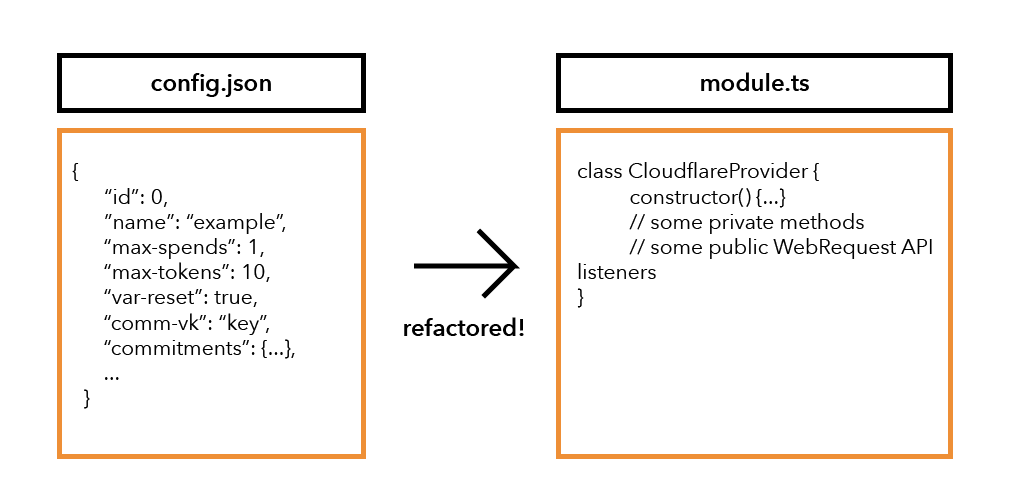
As mentioned in 2019, it would be impossible to expect different service providers to all abide by the same exact request flow, so we decided to use a JSON configuration file in v2.0 to define the request flow. The configuration allows the service providers to easily modify the extension characteristics without dealing too much with the core extension code. However, recently we figured out that we can improve it without using a configuration file, and using modules instead.

Using a configuration file limits the flexibility of the provider by the number of possible configurations. In addition, when the logic of each provider evolves and deviates from one another, the size of configuration will grow larger and larger which makes it hard to document and keep track of. So we decided to refactor how we determine the request flow from using a configuration file to using a module file written specifically for each service provider instead.

Privacy Pass v3: the new privacy bits

By using a programmable module, the providers are not limited by the available fields in the configuration. In addition, the providers can use the available implementations of the necessary cryptographic primitives in any point of the request flow because we factored out the crypto bits into a separate module which can be used by any provider. In the future, if the cryptographic primitives ever change, the providers can update the code and use it any time.

Towards Standard Interoperability

The Privacy Pass protocol was first published at the PoPETS symposium in 2018. As explained in this previous post, the core of the Privacy Pass protocol is a secure way to generate tokens between server and client. To that end, the protocol requires evaluating a pseudorandom function that is oblivious and verifiable. The first property prevents the server from learning information about the client’s tokens, while the client learns nothing about the server’s private key. This is useful to protect the privacy of users. The token generation must also be verifiable in the sense that the client can attest to the fact that its token was minted using the server’s private key.

The original implementation of Privacy Pass has seen real-world use in our browser extension, helping to reduce CAPTCHAs for hundreds of thousands of people without compromising privacy. But to guarantee interoperability between services implementing Privacy Pass, what’s required is an accurate specification of the protocol and its operations. With this motivation, the Privacy Pass protocol was proposed as an Internet draft at the Internet Engineering Task Force (IETF) — to know more about our participation at IETF look at the post.

In March 2020, the protocol was presented at IETF-107 for the first time. The session was a Birds-of-a-Feather, a place where the IETF community discusses the creation of new working groups that will write the actual standards. In the session, the working group’s charter is presented and proposes to develop a secure protocol for redeeming unforgeable tokens that attest to the validity of some attribute being held by a client. The charter was later approved, and three documents were integrated covering the protocol, the architecture, and an HTTP API for supporting Privacy Pass. The working group at IETF can be found at https://datatracker.ietf.org/wg/privacypass/.

Additionally, to its core functionality, the Privacy Pass protocol can be extended to improve its usability or to add new capabilities. For instance, adding a mechanism for public verifiability will allow a third party, someone who did not participate in the protocol, to verify the validity of tokens. Public verifiability can be implemented using a blind-signature scheme — this is a special type of digital signatures firstly proposed by David Chaum in which signers can produce signatures on messages without learning the content of the message. A diversity of algorithms to implement blind-signatures exist; however, there is still work to be done to define a good candidate for public verifiability.

Another extension for Privacy Pass is the support for including metadata in the tokens. As this is a feature with high impact on the protocol, we devote a larger section to explain the benefits of supporting metadata in the face of hoarding attacks.

Future work: metadata

What is research without new challenges that arise? What does development look like if there are no other problems to solve? During the design and development of Privacy Pass (both as a service, as an idea, and as a protocol), a potential vector for abuse was noted, which will be referred to as a “hoarding” or “farming” attack. This attack consists of individual users or groups of users that can gather tokens over a long period of time and redeem them all at once with the aim of, for example, overwhelming a website and making the service unavailable for other users. In a more complex scenario, an attacker can build up a stock of tokens that they could then redistribute amongst other clients. This redistribution ability is possible as tokens are not linked to specific clients, which is a property of the Privacy Pass protocol.

There have been several proposed solutions to this attack. One can, for example, make the verification of tokens procedure very efficient, so attackers will need to hoard an even larger amount of tokens in order to overwhelm a service. But the problem is not only about making verification times faster, and, therefore, this does not completely solve the problem. Note that in Privacy Pass, a successful token redemption could be exchanged for a single-origin cookie. These cookies allow clients to avoid future challenges for a particular domain without using more tokens. In the case of a hoarding attack, an attacker could trade in their hoarded number of tokens for a number of cookies. An attacker can, then, mount a layer 7 DDoS attack with the “hoarded” cookies, which would render the service unavailable.

In the next sections, we will explore other different solutions to this attack.

A simple solution and its limitations: key rotation

What does “key rotation” mean in the context of Privacy Pass? In Privacy Pass, each token is attested by keys held by the service. These keys are further used to verify the honesty of a token presented by a client when trying to access a challenge-protected service. “Key rotation” means updating these keys with regard to a chosen epoch (meaning, for example, that every two weeks — the epoch —, the keys will be rotated). Regular key rotation, then, implies that tokens belong to these epochs and cannot be used outside them, which prevents stocks of tokens from being useful for longer than the epoch they belong to.

Keys, however, should not be rotated frequently as:

  • Rotating a key can lead to security implications
  • Establishing trust in a frequently-rotating key service can be a challenging problem
  • The unlinkability of the client when using tokens can be diminished

Let’s explore these problems one by one now:

Rotating a key can lead to security implications, as past keys need to be deleted from secure storage locations and replaced with new ones. This process is prone to failure if done regularly, and can lead to potential key material leakage.

Establishing trust in a frequently-rotating key service can be a challenging problem, as keys will have to be verified by the needed parties each time they are regenerated. Keys need to be verified as it has to be attested that they belong to the entity one is trying to communicate with. If keys rotate too frequently, this verification procedure will have to happen frequently as well, so that an attacker will not be able to impersonate the honest entity with a “fake” public key.

The unlinkability of the client when using tokens can be diminished as a savvy attacker (a malicious server, for example) could link token generation and token future-use. In the case of a malicious server, it can, for example, rotate their keys too often to violate unlinkability or could pick a separate public key for each client issuance. In these cases, this attack can be solved by the usage of public mechanisms to record which server’s public keys are used; but this requires further infrastructure and coordination between actors. Other cases are not easily solvable by this “public verification”: if keys are rotated every minute, for example, and a client was the only one to visit a “privacy pass protected” site in that minute, then, it’s not hard to infer (to “link”) that the token came only from this specific client.

A novel solution: Metadata

A novel solution to this “hoarding” problem that does not require key rotation or further optimization of verification times is the addition of metadata. This approach was introduced in the paper “A Fast and Simple Partially Oblivious PRF, with Applications”, and it is called the “POPRF with metadata” construction. The idea is to add a metadata field to the token generation procedure in such a way that tokens are cryptographically linked to this added metadata. The added metadata can be, for example, a number that signals which epoch this token belongs to. The service, when presented with this token on verification, promptly checks that it corresponds to its internal epoch number (this epoch number can correspond to a period of time, a threshold of number of tokens issued, etc.). If it does not correspond, this token is expired and cannot be further used. Metadata, then, can be used to expire tokens without performing key rotations, thereby avoiding some issues outlined above.

Other kinds of metadata can be added to the Partially Oblivious PRF (PO-PRF) construction as well. Geographic location can be added, which signals that tokens can only be used in a specific region.

The limits of metadata

Note, nevertheless, that the addition of this “metadata” should be carefully considered as adding, in the case of “time-metadata”, an explicit time bound signal will diminish the unlikability set of the tokens. If an explicit time-bound signal is added (for example, the specific time — year, month, day, hour, minute and seconds — in which this token was generated and the amount of time it is valid for), it will allow a malicious server to link generation and usage. The recommendation is to use “opaque metadata”: metadata that is public to both client and service but that only the service knows its precise meaning. A server, for example, can set a counter that gets increased after a period of time (for example, every two weeks). The server will add this counter as metadata rather than the period of time. The client, in this case, publicly knows what this counter is but does not know to which period it refers to.

Geographic location metadata should be coarse as well: it should refer to a large geographical area, such as a continent, or political and economic union rather than an explicit location.

Wrap up

The Privacy Pass protocol provides users with a secure way for redeeming tokens. At Cloudflare, we use the protocol to reduce the number of CAPTCHAs improving the user experience while browsing websites. A natural evolution of the protocol is expected, ranging from its standardization to innovating with new capabilities that help to prevent abuse of the service.

On the service side, we refactored the Privacy Pass browser extension aiming to improve the quality of the code, so bugs can be detected in earlier phases of the development. The code is available at the challenge-bypass-extension repository, and we invite you to try the release candidate version.

An appealing extension for Privacy Pass is the inclusion of metadata as it provides a non-cumbersome way to solve hoarding attacks, while preserving the anonymity (in general, the privacy) of the protocol itself. Our paper provides you more information about the technical details behind this idea.

The application of the Privacy Pass protocol in other use cases or to create other service providers requires a certain degree of compatibility. People wanting to implement Privacy Pass must be able to have a standard specification, so implementations can interoperate. The efforts along these lines are centered on the Privacy Pass working group at IETF, a space open for anyone to participate in delineating the future of the protocol. Feel free to be part of these efforts too.

We are continuously working on new ways of improving our services and helping the Internet be a better and a more secure place. You can join us on this effort and can reach us at research.cloudflare.com. See you next time.

Back to the future with Zabbix

Post Syndicated from TimSmit original https://blog.zabbix.com/back-to-the-future-with-zabbix/15701/

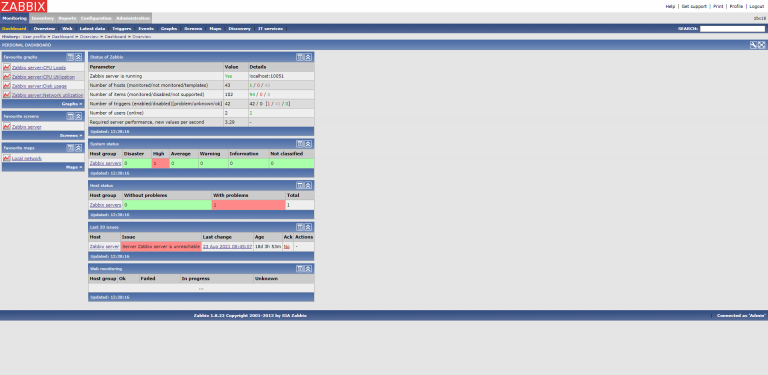
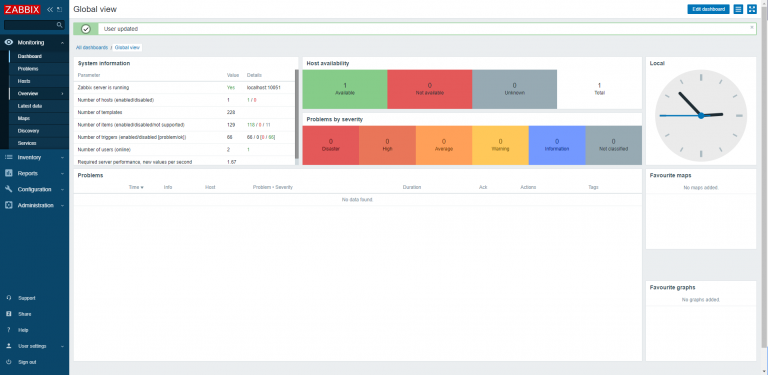
In this blog post, we would like to show you a new theme that might seem a little familiar to you. Let’s take a little nostalgic trip down memory lane and take a look at this special frontend theme for Zabbix 5.4 reminiscent of Zabbix 1.8.

How it looks

Although the old Zabbix 1.8 design understandably has an outdated look, the colors have a nice feel to them, especially the old shade of blue.

The Zabbix 5.4 design is up to date with current standards and has a modern look and feel to it. It is meant to be simplistic with a lot of white and barely any color except for the navigation bar and widgets like the problems and availability.

My theme combines the two. It is up to date with modern standards, and it has a trusted feel to it with the old color scheme. The old color scheme gives us a nostalgic look, which will hopefully bring some joy both to the veterans and newcomers to Zabbix!

How it works

The way I made this was fairly simple. I copied a css file from the styles folder, placed it in the same folder, and renamed it. I also put the image used to change the appearance into the same folder so it is easy to find.

blue-theme.css
dark-theme.css
hc-dark.css
hc-dark.css
oldisnew.css
table_head2.gif


To figure out which changes should be made, I had the Zabbix GUI open in a web browser with the element inspect function. in the css file I would find the same tag/name/class/etc as in the web browser and change it to look like the appearance of version 1.8.

.menu-main > li {
line-height: 16px; }
.menu-main > li.is-selected > a {
background: url(../styles/table_head2.gif) repeat-x top left;
border-left-color: #87d1ff;
color: #ffffff; }
.menu-main > li.is-expanded > a, .menu-main > li.is-expanded > a:focus {
border-left-color: transparent;
color: #ffffff; }
.menu-main > li:not(.is-expanded) .submenu {
max-height: 0 !important; }
.menu-main > li > a {
background:url(../styles/table_head2.gif) repeat-x top left;
color: #ffffff; }

For example here is where I changed the background of the dropdowns from the side menu into the image from Zabbix 1.8 which gives the menu an appealing new look.

For the theme to show up in the User settings it uses an add-on for the APP.php.

class APP extends ZBase {
   public static function getThemes() {
   return array_merge(parent::getThemes(),
   ['oldisnew' => _('Old is New')]);
}
}

The add-on is included in our Github Repository, you can copy and paste it into the APP.php file.

I hope you like the theme. It is available for download at the Opensource ICT Solutions Github. Just follow the link below:

https://github.com/OpensourceICTSolutions/zabbix-5-old-version-1_8-theme .

The Github contains an up-to-date Readme for installation, but, here is a short explanation on how to install it:

1. Navigate to the link above.
2. Download the three files: (oldisnew.css),(tablehead2.gif) and (APP_add_on.text).
3. On your Zabbix server CLI there should be a directory called /usr/share/zabbix/assets/styles/. Put the (oldsinew.css) and (tablehead2.gif) files here.
4. For (APP_add_on.txt) add the text to the APP.php located at the directory /usr/share/zabbix/include/classes/core/ inside of (class APP extends ZBase). (this allows you to actually see the theme inside of the dropdown.)
5. Now, at the Zabbix GUI navigate to Profile under User settings and change the theme.
6. Enjoy your new theme!

Разследване на Валя Ахчиева: Пазителката на гората и злодеите

Post Syndicated from Екип на Биволъ original https://bivol.bg/%D0%BF%D0%B0%D0%B7%D0%B8%D1%82%D0%B5%D0%BB%D0%BA%D0%B0%D1%82%D0%B0-%D0%BD%D0%B0-%D0%B3%D0%BE%D1%80%D0%B0%D1%82%D0%B0-%D0%B8-%D0%B7%D0%BB%D0%BE%D0%B4%D0%B5%D0%B8%D1%82%D0%B5.html

вторник 12 октомври 2021


През последните няколко години, една схема се е развихрила, вместо да бъде ликвидирана. Дървесината от незаконна сеч в горите се узаконява с помощта на една горска Наредба, както и със…

Implement a slowly changing dimension in Amazon Redshift

Post Syndicated from Milind Oke original https://aws.amazon.com/blogs/big-data/implement-a-slowly-changing-dimension-in-amazon-redshift/

Amazon Redshift is a fully managed, petabyte-scale data warehouse service in the cloud. A star schema is a database organization structure optimized for use in a data warehouse. In a star schema, a dimension is a structure that categorizes the facts and measures in order to enable you to answer business questions. The attributes (or columns) of the dimension table provide the business meaning to the measures of the fact table. Rows in a dimension table are identified using a unique identifier like a customer identification key, and the fact table’s rows have a referential key pointing to the dimension table’s primary key. Dimension and fact tables are joined using the dimension table’s primary key and the fact table’s foreign key.

Over time, the attributes of a given row in a dimension table may change. For example, the shipping address for a customer may change. This phenomenon is called a slowly changing dimension (SCD). For historical reporting purposes, it may be necessary to keep a record of the fact that the customer has a change in address. The range of options for dealing with this involves SCD management methodologies referred to as type 1 to type 7. Type 0 is when no changes are allowed to the dimension, for example a date dimension that doesn’t change. The most common types are 1, 2 and 3:

  • Type 1 (No history) – The dimension table reflects the latest version; no history is maintained
  • Type 2 (Maintain history) – All changes are recorded and versions are tracked with dates and flags
  • Type 3 (Previous value) – The [latest – 1] value for specific columns in maintained as a separate attribute

Prerequisites

For this walkthrough, you should have the following prerequisites:

Overview of solution

This post walks you through the process of implementing SCDs on an Amazon Redshift cluster. We go through the best practices and anti-patterns. To demonstrate this, we use the customer table from the TPC-DS benchmark dataset. We show how to create a type 2 dimension table by adding slowly changing tracking columns, and we go over the extract, transform, and load (ETL) merge technique, demonstrating the SCD process.

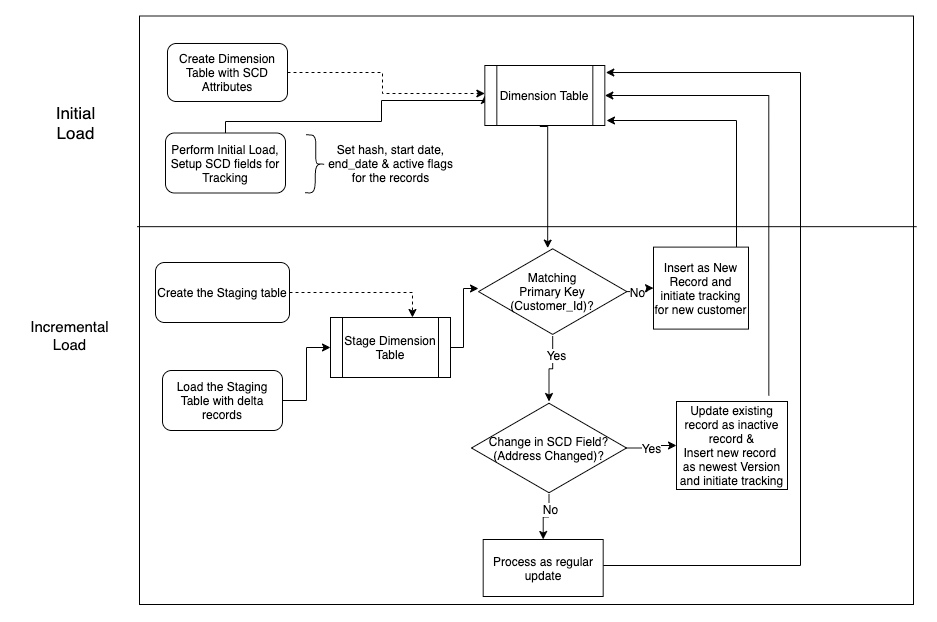
The following figure is the process flow diagram.

The following diagram shows how a regular dimensional table is converted to a type 2 dimension table.

Implement slowly changing dimensions

To get started, we use one of two AWS CloudFormation templates from Amazon Redshift Labs:

In this post, we only show the important SQL statements; the complete SQL code is available in scd2_sample_customer_dim.sql.

The first step to implement SCD for a given dimension table is to create the dimension table with SCD tracking attributes. For example, record effective date, record end date, and active record indicator are typically added to track if a record is active or not. These fields are collectively referenced as the SCD fields (as shown in the following code) going forward in this post.

These SCD fields are added so that when a field is changed, for example, a customer’s address, the existing record in the dimension table is updated to indicate that the record isn’t active and a new record is inserted with an active flag. This way, every change to an SCD field is stored in the table and business users can run queries to see historical performance of a dimension for a given change that is being tracked.

We also introduce the following:

  • Record hash value to easily track if the customer data fields have changed their values. This hash column is computed over all the customer fields. This single hash column is compared instead of comparing multiple individual columns to determine if the data has changed.
  • Record insert and update timestamps to capture when the actual dimension row was added to the table and updated.

The following code shows the SCD fields added to the dimension table:

drop table if exists customer_dim cascade;
create table customer_dim ( 
customer_dim_id     bigint generated by default as identity(1, 1), 
c_custkey           bigint distkey, 
c_name              character varying(30), 
c_address           character varying(50), 
c_nationkey         integer, 
c_phone             character varying(20), 
c_acctbal           numeric(12, 2), 
c_mktsegment        character varying(10), 
c_comment           character varying(120), 
track_hash          bigint, 
record_start_ts     timestamp without time zone 
                    default '1970-01-01 00:00:00'::timestamp without time zone, 
record_end_ts       timestamp without time zone 
                    default '2999-12-31 00:00:00'::timestamp without time zone, 
record_active_flag  smallint default 1, 
record_upd_ts       timestamp without time zone default current_timestamp, 
record_insert_ts    timestamp without time zone default current_timestamp 
)
diststyle key 
sortkey (c_custkey);

Next, we perform the initial load to the dimension table. Because this is the first time that the dimension records are loaded, the SCD tracking attributes are set to active. For example, record start date is set to a low date, like 1900-01-01, or to a business date value to reflect when a particular change became effective. The record end date is set to a high date, like 2999-12-31, and active record indicator is set 1, indicating these rows are active.

After the initial load is complete, we create a staging table to load the incremental changes that come from the source system. This table acts as temporary holding place for incoming records. To identify if a change has occurred or not for a given record, we left outer join the customer staging table to the customer dimension table on the customer primary key (c_cust_key). We use left outer join because we want to flag matching records for the update process and unmatched records for the insert process. Left outer joining the staging table to the customer table projects both matched and unmatched rows. Matched rows are treated as updates and unmatched rows are treated as inserts.

In our data warehouse system, let’s assume we have to meet the following criteria:

  • Track changes on the address and phone fields only—type 2 with start and end timestamps
  • Other attributes are required to be kept up to date without creating history records—type 1
  • The source system provides incremental delta change records

If your source systems can’t provide delta change records and instead provides full load every time, then the data warehouse needs to have logic to identify the changed records. For such a workload, we build a second, uniquely identifiable value by using a built-in Amazon Redshift hash function on all the dimension columns to identify the changed rows.

The customer address and phone are being tracked as slowly changing dimensions. We use FNV_HASH to generate a 64-bit signed integer that accommodates 18.4 quintillion unique values. For smaller dimension tables, we can also use CHECKSUM to generate a 32-bit signed integer that accommodates 4.4 billion unique values.

We determine if the dimension row is a new record by using new_ind, or if the dimension row is changed by comparing the record hash and using track_ind for the change indicator.

Changes are identified by joining the staging table and target table on the primary key. See the following code:

truncate table stg_customer;
insert into stg_customer 
with stg as (
    select
        custkey as stg_custkey, name as stg_name, 
        address as stg_address, nationkey as stg_nationkey, 
        phone as stg_phone, acctbal as stg_acctbal,
        mktsegment as stg_mktsegment, comment as stg_comment, 
        effective_dt as stg_effective_dt,
        FNV_HASH(address,FNV_HASH(phone)) as stg_track_hash
    from
        src_customer
    )
select 
    s.* , 
    case when c.c_custkey is null then 1 else 0 end new_ind,
    case when c.c_custkey is not null 
          and s.stg_track_hash <> track_hash then 1 else 0 end track_ind
 from
    stg s
left join customer_dim c
    on s.stg_custkey = c.c_custkey
;

For rows that aren’t matched (for example, completely new records such as new_ind = 1), the rows are inserted into the dimensional table with SCD tracking attributes set as new and an active record flag indicating Active = 1.

For matched records, two possibilities could happen:

  • SCD type 2 field has changed – For this category, we use a two-step process to retain the previous version of the customer record and also record the latest version of the customer record for type 2 fields in our data warehouse. This satisfies our first business requirement. The steps are as follows:
    • Step 1 – Update the existing record in the target customer dimension table as inactive by setting the record end date to the current timestamp and active record indicator to 0.
    • Step 2 – Insert the new rows from the customer staging table into the customer target table with the record start date set to the current timestamp, record end date set to a high date, and the record active flag set to 1.
  • SCD type 1 field has changed – For this category, the row in the customer target table is updated directly with the latest rows from staging table. While doing so, we don’t update any SCD tracking date fields or flags. With this step, we retain only the latest version of the record for type 1 fields in our data warehouse. This satisfies our second business requirement.

Apply changes to the dimension table with the following code:

-- merge changes to dim customer
begin transaction;

-- close current type 2 active record based of staging data where change indicator is 1
update customer_dim
set record_end_ts = stg_effective_dt - interval '1 second',
    record_active_flag = 0,
    record_upd_ts = current_timestamp 
from stg_customer
where c_custkey = stg_custkey
and record_end_ts = '2999-12-31'
and track_ind = 1;

-- create latest version type 2 active record from staging data
-- this includes Changed + New records
insert into customer_dim
   (c_custkey,c_name,c_address,c_nationkey,c_phone,c_acctbal,
    c_mktsegment,c_comment,track_hash,record_start_ts,record_end_ts, 
    record_active_flag, record_insert_ts, record_upd_ts) 
select
    stg_custkey, stg_name, stg_address, stg_nationkey, stg_phone,
    stg_acctbal, stg_mktsegment, stg_comment, stg_track_hash, 
    stg_effective_dt as record_start_ts, '2999-12-31' as record_end_ts,
    1 as record_active_flag, current_timestamp as record_insert_ts, 
    current_timestamp as record_upd_ts
from
    stg_customer
where
    track_ind = 1 or new_ind = 1;

-- update type 1 current active records for non-tracking attributes
update customer_dim
set c_name = stg_name,
    c_nationkey = stg_nationkey,
    c_acctbal = stg_acctbal,
    c_mktsegment = stg_mktsegment,
    c_comment = stg_comment,
    record_upd_ts = current_timestamp
from
    stg_customer
where
    c_custkey = stg_custkey
and record_end_ts = '2999-12-31'
and track_ind = 0 and new_ind = 0;

-- end merge operation
commit transaction;

Best practices

The Amazon Redshift cloud data warehouse can process a large number of updates efficiently. To achieve this, have a staging table that shares the same table definition as your target dimension table. Then, as shown in the earlier code snippet, you can join the staging and the target dimension tables and perform the update and insert in a transaction block. This operation performs bulk updates and inserts on the target table, yielding good performance.

The Amazon Redshift shared nothing architecture typically performs at its peak when operations can be run by each node independently with minimal data movement between nodes. The target customer dimension table and the intermediate staging table created with matched distribution keys provide the best performance because all operations can be completed within the node.

Anti-patterns

You can also approach this method by comparing dimension records in a row-by-row fashion using cursors and then updating or inserting a particular row on the target table. Although this method works on smaller tables, for larger tables, it’s advised to use the bulk operations method explained in this post.

Clean up

To avoid incurring future charges, you can delete all the resources created by the CloudFormation template by deleting the CloudFormation stack.

Conclusion

In this post, you learned about slowly changing dimensions, implementing SCDs on Amazon Redshift, best practices for running the ETL operations against the target table by using intermediate staging tables, and finally anti-patterns to avoid.

Refer to Amazon Redshift data loading best practices for further materials and additional best practices, and see Updating and inserting new data for instructions to implement updates and inserts.


About the Authors

Milind Oke is a Data Warehouse Specialist Solutions Architect based out of New York. He has been building data warehouse solutions for over 15 years and specializes in Amazon Redshift. He is focused on helping customers design and build enterprise-scale well-architected analytics and decision support platforms.

Bhanu Pittampally is an Analytics Specialist Solutions Architect based out of Dallas. He specializes in building analytical solutions. His background is in data warehouses—architecture, development, and administration. He has been in the data and analytical field for over 13 years.

ТОЙ се върна на бяла камила

Post Syndicated from original https://bivol.bg/%D1%82%D0%BE%D0%B9-%D1%81%D0%B5-%D0%B2%D1%8A%D1%80%D0%BD%D0%B0-%D0%BD%D0%B0-%D0%B1%D1%8F%D0%BB%D0%B0-%D0%BA%D0%B0%D0%BC%D0%B8%D0%BB%D0%B0.html

понеделник 11 октомври 2021


peevski

Не знам за вас, но лично аз съм изненадан от издигането на Делян Славчев Пеевски за водач на депутатската листа на ДПС за Велико Търново. Не съм изненадан, че е…

Analyst Firm Validates B2 Cloud Storage Platform’s Time and Budget Savings

Post Syndicated from Jeremy Milk original https://www.backblaze.com/blog/analyst-firm-validates-b2-cloud-storage-platforms-time-and-budget-savings/

92% time savings. 71% storage cost savings. 3.7 times lower total cost than the competition.

These are just some of the findings Enterprise Strategy Group (ESG) reported in a proprietary, economic validation analysis of Backblaze B2 Cloud Storage. To develop these findings, the ESG analysts did their proverbial research. They talked to customers. They validated use cases. They used our product and verified the accuracy of our listed pricing and cost calculator. And then, they took those results along with the knowledge they’ve gathered over 20 years of experience to quantify the bonafide benefits that organizations can expect by using the Backblaze B2 Cloud Storage platform.

Their findings are now available to the public in the new ESG Economic Validation report, “Analyzing the Economic Benefits of the Backblaze B2 Cloud Storage Platform.”

ESG’s models predicted that the Backblaze B2 Cloud Storage platform will give users an expected total cost of cloud storage that is 3.7 times lower than alternative cloud storage providers, including:

Predicted savings of up to:

  • 92% less time to manage data.
  • 72% lower cost of storage.
  • 91% lower cost of downloads and transactions.
  • 89% lower cost of migration.

If you don’t have time to read the full report, the infographic below illustrates the key findings. Click on the image to see it in full size.

The Economic Value of Backblaze B2 Cloud Storage

If you want to share this infographic on your site, copy the code below and paste into a Custom HTML block. 

<div><div><strong>Analyst Firm Validates B2 Cloud Storage Platform’s Time and Budget Savings</strong></div><a href="https://www.backblaze.com/blog/analyst-firm-validates-b2-cloud-storage-platforms-time-and-budget-savings/"><img src="https://www.backblaze.com/blog/wp-content/uploads/2021/10/ESG-Infographic-scaled.jpg" border="0" alt="The Economic Value of Backblaze B2 Cloud Storage" title="The Economic Value of Backblaze B2 Cloud Storage" /></a></div>

The findings cut through the marketing noise to announce that by choosing Backblaze B2, customers benefit in both time and cost savings, and you don’t have to take it from us.

If that sounds like something you’d appreciate from a cloud partner, getting started couldn’t be easier. Sign up today to begin using Backblaze B2—your first 10GB are free.

If you’re already a B2 Cloud Storage customer—first, thank you! You can feel even more confident in your choice to work with Backblaze. Have a colleague or contact who you think would benefit from working with Backblaze, too? Feel free to share the report with your network.

The post Analyst Firm Validates B2 Cloud Storage Platform’s Time and Budget Savings appeared first on Backblaze Blog | Cloud Storage & Cloud Backup.

Field Notes: Building Multi-Region and Multi-Account Tools with AWS Organizations

Post Syndicated from Cody Penta original https://aws.amazon.com/blogs/architecture/field-notes-building-multi-region-and-multi-account-tools-with-aws-organizations/

It’s common to start with a single AWS account when you are beginning your cloud journey with AWS. Running operations such as creating, reading, updating, and deleting resources in a single AWS account can be straightforward with AWS application program interfaces (APIs). Because an organization grows, so does their account strategy, often splitting workloads across multiple accounts. Fortunately, AWS customers can use AWS Organizations to group these accounts into logical units, also known as organizational units (OUs), to apply common policies and deploy standard infrastructure. However, this will result in an increased difficulty to run an API against all accounts, moreover, every Region that account could use. How does an organization answer these questions:

  • What is every Amazon FSx backup I own?
  • How can I do an on-demand batch job that will apply to my entire organization?
  • What is every internet access point across my organization?

This blog post shows us how we can use Organizations, AWS Single Sign-On (AWS SSO), AWS CloudFormation StackSets, and various AWS APIs to effectively build multi-account and multi-region tools that can address use cases like the ones above.

Running an AWS API sequentially across hundreds of accounts—potentially, many Regions—could take hours, depending on the API you call. An important aspect we will cover throughout this solution is the importance of concurrency for these types of tools.

Overview of solution

For this solution, we have created a fictional organization called Tavern that is set up with multiple organizational units (OUs), accounts, and Regions, to reflect a real-world scenario.

Figure 1. Organization configuration example

Figure 1. Organization configuration example

We will set up a user with multi-factor authentication (MFA) enabled so we can sign-in and access an admin user in the root account. Using this admin user, we will deploy a stack set across the organization that enables this user to assume limited permissions into each child account.

Next, we will use the Go programming language because of its native concurrency capabilities. More specifically, we will implement the pipeline concurrency pattern to build a multi-account and multi-region tool that will run APIs across our entire AWS footprint.

Additionally, we will add two common edge cases:

  • We block mass API actions to an account in a suspended OU (not pictured) and the root account.
  • We block API actions in disabled regions.

This will show us how to implement robust error handling in equally powerful tooling.

 Walkthrough

Let us separate the solution into distinct steps:

  • Create an automation user through AWS SSO.
    • This user can optionally be an IAM user or role assumed into by a third-party identity provider (such as, Azure Active Directory). Note the ARN of this identity because that is the key piece of information we will use for crafting a policy document.
  • Deploy a CloudFormation stack set across the organization that enables this user to assume limited access into each account.
    • For this blog post, we will deploy an organization-wide role with `ec2:DescribeRouteTables` permissions. Feel free to expand or change the permission set based on the type of tool you build.
  • Using Go, AWS Command Line Interface (CLI) v2, and AWS SDK for Go v2:
    1. Authenticate using AWS SSO.
    2. List every account in the organization.
    3. Assume permissions into that account.
    4.  Run an API across every Region in that account.
    5. Aggregate results for every Region.
    6. Aggregate results for every account.
    7. Report back the result.

For additional context, review this GitHub repository that contains all code and assets for this blog post.

Prerequisites

For this walkthrough, you should have the following prerequisites:

  • Multiple AWS accounts
  • AWS Organizations
  • AWS SSO (optional)
  • AWS SDK for Go v2
  • AWS CLI v2
  • Go programming knowledge (preferred), especially Go’s concurrency model
  • General programming knowledge

Create an automation user in AWS SSO

The first thing we need to do is create an identity to sign into. This can either be an AWS Identity and Access Management (IAM) user, an IAM role integrated with a third-party identity provider, or—in this case—an AWS SSO user.

  1. Log into the AWS SSO user console.
  2. Press Add user button.
  3. Fill in the appropriate information.
Figure 2.AWS SSO create user

Figure 2. AWS SSO create user

  1. Assign the user to the appropriate group. In this case, we will assign this user to AWSControlTowerAdmins.
Figure 3.Assigning SSO user to a group

Figure 3. Assigning SSO user to a group

  1. Verify the user was created. (Optionally: enable MFA).
Figure 4.Verifying User Creation and MFA

Figure 4. Verifying User Creation and MFA

Deploy a stack set across your organization

To effectively run any API across the organization, we need to deploy a common role that our AWS SSO user can assume across every account. We can use AWS CloudFormation StackSets to deploy this role at scale.

  1. Write the IAM role and associated policy document. The following is an example AWS Cloud Development Kit (AWS CDK) code for such a role. Note that orgAccount, roleName, and ssoUser in the below code will have to be replaced with your own values.
    const role = new iam.Role(this, 'TavernAutomationRole', {
      roleName: 'TavernAutomationRole',
      assumedBy: new iam.ArnPrincipal(`arn:aws:sts::${orgAccount}:assumed-role/${roleName}/${ssoUser}`),
    })
    role.addToPolicy(new PolicyStatement({
      actions: ['ec2:DescribeRouteTables'],
      resources: ['*']
    }))
  1. Log into the CloudFormation StackSets console.
  2. Press Create StackSet button.
  3. Upload the CloudFormation template containing the common role to be deployed to the organization by the preferred method.
  4. Specify name and optional description.
  5. Add any standard organization tags, and choose Service-managed permissions option.
  6. Choose Deploy to organization, and decide whether to disable or enable automatic deployment and appropriate account removal behavior. For this blog post, we choose to enable automatic deployment and accounts should remove the stack with removed from the target OU.
  7. For Specify regions, choose US East (N.Virginia). Note, because this stack contains only an IAM role, and IAM is a global service, region choice has no effect.
  8. For Maximum concurrent accounts, choose Percent, and enter 100 (this stack is not dependent on order).
  9. For Failure tolerance, choose Number, and enter 5, account deployment failures before a total rollback happens.
  10. For Region Concurrency, choose Sequential.
  11. Review your choices, note the deployment target (should be r-*), and acknowledge that CloudFormation might create IAM resources with custom names.
  12. Press the Submit button to deploy the stack.

Configure AWS SSO for the AWS CLI

To use our organization tools, we must first configure AWS SSO locally. With the AWS CLI v2, we can run:

aws configure sso

To configure credentials:

  1. Run the preceding command in your terminal.
  2. Follow the prompted steps.
    1. Specify your AWS SSO Start URL:
    2. AWS SSO Region:
  1. Authenticate through the pop-up browser window.
  2. Navigate back to the CLI, and choose the root account (this is where our principle for IAM originates).
  3. Specify the default client region.
  4. Specify the default output format.

Note the CLI profile name. Regardless if you choose to go with the autogenerated one or the custom one, we need this profile name for our upcoming code.

Start coding to utilize the AWS SSO shared profile

After AWS SSO is configured, we can start coding the beginning part of our multi-account tool. Our first step is to list every account belonging to our organization.

var (
    stsc    *sts.Client
    orgc    *organizations.Client
    ec2c    *ec2.Client
    regions []string
)

// init initializes common AWS SDK clients and pulls in all enabled regions
func init() {
    cfg, err := config.LoadDefaultConfig(context.TODO(), config.WithSharedConfigProfile("tavern-automation"))
    if err != nil {
        log.Fatal("ERROR: Unable to resolve credentials for tavern-automation: ", err)
    }

    stsc = sts.NewFromConfig(cfg)
    orgc = organizations.NewFromConfig(cfg)
    ec2c = ec2.NewFromConfig(cfg)

    // NOTE: By default, only describes regions that are enabled in the root org account, not all Regions
    resp, err := ec2c.DescribeRegions(context.TODO(), &ec2.DescribeRegionsInput{})
    if err != nil {
        log.Fatal("ERROR: Unable to describe regions", err)
    }

    for _, region := range resp.Regions {
        regions = append(regions, *region.RegionName)
    }
    fmt.Println("INFO: Listing all enabled regions:")
    fmt.Println(regions)
}

// main constructs a concurrent pipeline that pushes every account ID down
// the pipeline, where an action is concurrently run on each account and
// results are aggregated into a single json file
func main() {
    var accounts []string

    paginator := organizations.NewListAccountsPaginator(orgc, &organizations.ListAccountsInput{})
    for paginator.HasMorePages() {
        resp, err := paginator.NextPage(context.TODO())
        if err != nil {
            log.Fatal("ERROR: Unable to list accounts in this organization: ", err)
        }

        for _, account := range resp.Accounts {
            accounts = append(accounts, *account.Id)
        }
    }
    fmt.Println(accounts)

Implement concurrency into our code

With a slice of every AWS account, it’s time to concurrently run an API across all accounts. We will use some familiar Go concurrency patterns, as well as fan-out and fan-in.

// ... continued in main

    // Begin pipeline by calling gen with a list of every account
    in := gen(accounts...)

    // Fan out and create individual goroutines handling the requested action (getRoute)
    var out []<-chan models.InternetRoute
    for range accounts {
        c := getRoute(in)
        out = append(out, c)
    }

    // Fans in and collect the routing information from all go routines
    var allRoutes []models.InternetRoute
    for n := range merge(out...) {
        allRoutes = append(allRoutes, n)
    }

In the preceding code, we called a gen() function that started construction of our pipeline. Let’s take a deeper look into this function.

// gen primes the pipeline, creating a single separate goroutine
// that will sequentially put a single account id down the channel
// gen returns the channel so that we can plug it in into the next
// stage
func gen(accounts ...string) <-chan string {
    out := make(chan string)
    go func() {
        for _, account := range accounts {
            out <- account
        }
        close(out)
    }()
    return out
}

We see that gen just initializes the pipeline, and then starts pushing account ID’s down the pipeline one by one.

The next two functions are where all the heavy lifting is done. First, let’s investigate `getRoute()`.

// getRoute queries every route table in an account, including every enabled region, for a
// 0.0.0.0/0 (i.e. default route) to an internet gateway
func getRoute(in <-chan string) <-chan models.InternetRoute {
    out := make(chan models.InternetRoute)
    go func() {
        for account := range in {
            role := fmt.Sprintf("arn:aws:iam::%s:role/TavernAutomationRole", account)
            creds := stscreds.NewAssumeRoleProvider(stsc, role)

            for _, region := range regions {
                localCfg := aws.Config{
                    Region:      region,
                    Credentials: aws.NewCredentialsCache(creds),
                }

                localEc2Client := ec2.NewFromConfig(localCfg)

                paginator := ec2.NewDescribeRouteTablesPaginator(localEc2Client, &ec2.DescribeRouteTablesInput{})
                for paginator.HasMorePages() {
                    resp, err := paginator.NextPage(context.TODO())
                    if err != nil {
                        fmt.Println("WARNING: Unable to retrieve route tables from account: ", account, err)
                        out <- models.InternetRoute{Account: account}
                        close(out)
                        return
                    }

                    for _, routeTable := range resp.RouteTables {
                        for _, r := range routeTable.Routes {
                            if r.GatewayId != nil && strings.Contains(*r.GatewayId, "igw-") {
                                fmt.Println(
                                    "Account: ", account,
                                    " Region: ", region,
                                    " DestinationCIDR: ", *r.DestinationCidrBlock,
                                    " GatewayId: ", *r.GatewayId,
                                )
    
                                out <- models.InternetRoute{
                                    Account:         account,
                                    Region:          region,
                                    Vpc:             routeTable.VpcId,
                                    RouteTable:      routeTable.RouteTableId,
                                    DestinationCidr: r.DestinationCidrBlock,
                                    InternetGateway: r.GatewayId,
                                }
                            }
                        }
                    }
                }
            }

        }
        close(out)
    }()
    return out
}

A couple of key points to highlight are as follows:

for account := range in

When iterating over a channel, the current goroutine blocks, meaning we wait here until we get an account ID passed to us before continuing. We’ll keep doing this until our upstream closes the channel. In our case, our upstream closes the channel once it pushes every account ID down the channel.

role := fmt.Sprintf("arn:aws:iam::%s:role/TavernAutomationRole", account)
creds := stscreds.NewAssumeRoleProvider(stsc, role)

Here, we can reference our existing role that we deployed to every account and assume into that role with AWS Security Token Service (STS).

for _, region := range regions {

Lastly, when we have credentials into that account, we need to iterate over every region in that account to ensure we are capturing the entire global presence.

These three key areas are how we build organization-level tools. The remaining code is calling the desired API and delivering the result down to the next stage in our pipeline, where we merge all of the results.

// merge takes every go routine and "plugs" it into a common out channel
// then blocks until every input channel closes, signally that all goroutines
// are done in the previous stage
func merge(cs ...<-chan models.InternetRoute) <-chan models.InternetRoute {
    var wg sync.WaitGroup
    out := make(chan models.InternetRoute)

    output := func(c <-chan models.InternetRoute) {
        for n := range c {
            out <- n
        }
        wg.Done()
    }

    wg.Add(len(cs))
    for _, c := range cs {
        go output(c)
    }

    go func() {
        wg.Wait()
        close(out)
    }()
    return out
}

At the end of the main function, we take our in-memory data structures representing our internet entry points and marshal it into a JSON file.

    // ... continued in main

    savedRoutes, err := json.MarshalIndent(allRoutes, "", "\t")
    if err != nil {
        fmt.Println("ERROR: Unable to marshal internet routes to JSON: ", err)
    }
    ioutil.WriteFile("routes.json", savedRoutes, 0644)

With the code in place, we can run the code with `go run main.go` inside of your preferred terminal. The command will generate results like the following:

    // ... routes.json
    {
        "Account": "REDACTED",
        "Region": "eu-north-1",
        "Vpc": "vpc-1efd6c77",
        "RouteTable": "rtb-1038a979",
        "DestinationCidr": "0.0.0.0/0",
        "InternetGateway": "igw-c1b125a8"
    },
    {
        "Account": " REDACTED ",
        "Region": "eu-north-1",
        "Vpc": "vpc-de109db7",
        "RouteTable": "rtb-e042ce89",
        "DestinationCidr": "0.0.0.0/0",
        "InternetGateway": "igw-cbd457a2"
    },
    // ...

Cleaning up

To avoid incurring future charges, delete the following resources:

  • Stack set through the CloudFormation console
  • AWS SSO user (if you created one)

Conclusion

Creating organization tools that answer difficult questions such as, “show me every internet entry point in our organization,” are possible using Organizations APIs and CloudFormation StackSets. We also learned how to use Go’s native concurrency features to build these tools that scale across hundreds of accounts.

Further steps you might explore include:

  • Visiting the Github Repo to capture the full picture.
  • Taking our sequential solution for iterating over Regions and making it concurrent.
  • Exploring the possibility of accepting functions and interfaces in stages to generalize specific pipeline features.

Thanks for taking the time to read, and feel free to leave comments.

Field Notes provides hands-on technical guidance from AWS Solutions Architects, consultants, and technical account managers, based on their experiences in the field solving real-world business problems for customers.

[$] The intersection of modules, GKI, and rocket science

Post Syndicated from original https://lwn.net/Articles/872209/rss

One does not normally expect a lot of controversy around a patch series
that makes changes to platform-specific configurations and drivers.
The furor over some work on the Samsung Exynos platform may thus be
surprising. When one looks into the discussion, things become more clear;
it mostly has to do with disagreements over the best ways to get hardware
vendors to cooperate with the kernel development community.

Automated security and compliance remediation at HDI

Post Syndicated from Uladzimir Palkhouski original https://aws.amazon.com/blogs/devops/automated-security-and-compliance-remediation-at-hdi/

with Dr. Malte Polley (HDI Systeme AG – Cloud Solutions Architect)

At HDI, one of the biggest European insurance group companies, we use AWS to build new services and capabilities and delight our customers. Working in the financial services industry, the company has to comply with numerous regulatory requirements in the areas of data protection and FSI regulations such as GDPR, German Supervisory Requirements for IT (VAIT) and Supervision of Insurance Undertakings (VAG). The same security and compliance assessment process in the cloud supports development productivity and organizational agility, and helps our teams innovate at a high pace and meet the growing demands of our internal and external customers.

In this post, we explore how HDI adopted AWS security and compliance best practices. We describe implementation of automated security and compliance monitoring of AWS resources using a combination of AWS and open-source solutions. We also go through the steps to implement automated security findings remediation and address continuous deployment of new security controls.

Background

Data analytics is the key capability for understanding our customers’ needs, driving business operations improvement, and developing new services, products, and capabilities for our customers. We needed a cloud-native data platform of virtually unlimited scale that offers descriptive and prescriptive analytics capabilities to internal teams with a high innovation pace and short experimentation cycles. One of the success metrics in our mission is time to market, therefore it’s important to provide flexibility to internal teams to quickly experiment with new use cases. At the same time, we’re vigilant about data privacy. Having a secure and compliant cloud environment is a prerequisite for every new experiment and use case on our data platform.

Cloud security and compliance implementation in the cloud is a shared effort between the Cloud Center of Competence team (C3), the Network Operation Center (NoC), and the product and platform teams. The C3 team is responsible for new AWS account provisioning, account security, and compliance baseline setup. Cross-account networking configuration is established and managed by the NoC team. Product teams are responsible for AWS services configuration to meet their requirements in the most efficient way. Typically, they deploy and configure infrastructure and application stacks, including the following:

We were looking for security controls model that would allow us to continuously monitor infrastructure and application components set up by all the teams. The model also needed to support guardrails that allowed product teams to focus on new use case implementation, but also inherited the security and compliance best practices promoted and ensured within our company.

Security and compliance baseline definition

We started with the AWS Well-Architected Framework Security Pillar whitepaper, which provides implementation guidance on the essential areas of security and compliance in the cloud, including identity and access management, infrastructure security, data protection, detection, and incident response. Although all five elements are equally important for implementing enterprise-grade security and compliance in the cloud, we saw an opportunity to improve controls of on-premises environments by automating detection and incident response elements. The continuous monitoring of AWS infrastructure and application changes complemented by the automated incident response of the security baseline helps us foster security best practices and allows for a high innovation pace. Manual security reviews are no longer required to asses security posture.

Our security and compliance controls framework is based on GDPR and several standards and programs, including ISO 27001, C5. Translation of the controls framework into the security and compliance baseline definition in the cloud isn’t always straightforward, so we use a number of guidelines. As a starting point, we use CIS Amazon Web Services benchmarks, because it’s a prescriptive recommendation and its controls cover multiple AWS security areas, including identity and access management, logging and monitoring configuration, and network configuration. CIS benchmarks are industry-recognized cyber security best practices and recommendations that cover a wide range of technology families, and are used by enterprise organizations around the world. We also apply GDPR compliance on AWS recommendations and AWS Foundational Security Best Practices, extending controls recommended by CIS AWS Foundations Benchmarks in multiple control areas: inventory, logging, data protection, access management, and more.

Security controls implementation

AWS provides multiple services that help implement security and compliance controls:

  • AWS CloudTrail provides a history of events in an AWS account, including those originating from command line tools, AWS SDKs, AWS APIs, or the AWS Management Console. In addition, it allows exporting event history for further analysis and subscribing to specific events to implement automated remediation.
  • AWS Config allows you to monitor AWS resource configuration, and automatically evaluate and remediate incidents related to unexpected resources configuration. AWS Config comes with pre-built conformance pack sample templates designed to help you meet operational best practices and compliance standards.
  • Amazon GuardDuty provides threat detection capabilities that continuously monitor network activity, data access patterns, and account behavior.

With multiple AWS services to use as building blocks for continuous monitoring and automation, there is a strong need for a consolidated findings overview and unified remediation framework. This is where AWS Security Hub comes into play. Security Hub provides built-in security standards and controls that make it easy to enable foundational security controls. Then, Security Hub integrates with CloudTrail, AWS Config, GuardDuty, and other AWS services out of the box, which eliminates the need to develop and maintain integration code. Security Hub also accepts findings from third-party partner products and provides APIs for custom product integration. Security Hub significantly reduces the effort to consolidate audit information coming from multiple AWS-native and third-party channels. Its API and supported partner products ecosystem gave us confidence that we can adhere to changes in security and compliance standards with low effort.

While AWS provides a rich set of services to manage risk at the Three Lines Model, we were looking for wider community support in maintaining and extending security controls beyond those defined by CIS benchmarks and compliance and best practices recommendations on AWS. We came across Prowler, an open-source tool focusing on AWS security assessment and auditing and infrastructure hardening. Prowler implements CIS AWS benchmark controls and has over 100 additional checks. We appreciated Prowler providing checks that helped us meet GDPR and ISO 27001 requirements, specifically. Prowler delivers assessment reports in multiple formats, which makes it easy to implement reporting archival for future auditing needs. In addition, Prowler integrates well with Security Hub, which allows us to use a single service for consolidating security and compliance incidents across a number of channels.

We came up with the solution architecture depicted in the following diagram.

Automated remediation solution architecture HDI

Automated remediation solution architecture HDI

Let’s look closely into the most critical components of this solution.

Prowler is a command line tool that uses the AWS Command Line Interface (AWS CLI) and a bash script. Individual Prowler checks are bash scripts organized into groups by compliance standard or AWS service. By supplying corresponding command line arguments, we can run Prowler against a specific AWS Region or multiple Regions at the same time. We can run Prowler in multiple ways; we chose to run it as an AWS Fargate task for Amazon Elastic Container Service (Amazon ECS). Fargate is a serverless compute engine that runs Docker-compatible containers. ECS Fargate tasks are scheduled tasks that make it easy to perform periodic assessments of an AWS account and export findings. We configured Prowler to run every 7 days in every account and Region it’s deployed into.

Security Hub acts as a single place for consolidating security findings from multiple sources. When Security Hub is enabled in a given Region, CIS AWS Foundations Benchmark and Foundational Security Best Practices standards are enabled as well. Enabling these standards also configures integration with AWS Config and Guard Duty. Integration with Prowler requires enabling product integration on the Security Hub side by calling the EnableImportFindingsForProduct API action for a given product. Because Prowler supports integration with Security Hub out of the box, posting security findings is a matter of passing the right command line arguments: -M json-asff to format reports as AWS Security Findings Format and -S to ship findings to Security Hub.

Automated security findings remediation is implemented using AWS Lambda functions and the AWS SDK for Python (Boto3). The remediation function can be triggered in two ways: automatically in response to a new security finding, or by a security engineer from the Security Hub findings page. In both cases, the same Lambda function is used. Remediation functions implement security standards in accordance with recommendations, whether they’re CIS AWS Foundations Benchmark and Foundational Security Best Practices standards, or others.

The exact activities performed depend on the security findings type and its severity. Examples of activities performed include deleting non-rotated AWS Identity and Access Management (IAM) access keys, enabling server-side encryption for S3 buckets, and deleting unencrypted Amazon Elastic Block Store (Amazon EBS) volumes.

To trigger the Lambda function, we use Amazon EventBridge, which makes it easy to build an event-driven remediation engine and allows us to define Lambda functions as targets for Security Hub findings and custom actions. EventBridge allows us to define filters for security findings and therefore map finding types to specific remediation functions. Upon successfully performing security remediation, each function updates one or more Security Hub findings by calling the BatchUpdateFindings API and passing the corresponding finding ID.

The following example code shows a function enforcing an IAM password policy:

import boto3
import os
import logging
from botocore.exceptions import ClientError

iam = boto3.client("iam")
securityhub = boto3.client("securityhub")

log_level = os.environ.get("LOG_LEVEL", "INFO")
logging.root.setLevel(logging.getLevelName(log_level))
logger = logging.getLogger(__name__)


def lambda_handler(event, context, iam=iam, securityhub=securityhub):
    """Remediate findings related to cis15 and cis11.

    Params:
        event: Lambda event object
        context: Lambda context object
        iam: iam boto3 client
        securityhub: securityhub boto3 client
    Returns:
        No returns
    """
    finding_id = event["detail"]["findings"][0]["Id"]
    product_arn = event["detail"]["findings"][0]["ProductArn"]
    lambda_name = os.environ["AWS_LAMBDA_FUNCTION_NAME"]
    try:
        iam.update_account_password_policy(
            MinimumPasswordLength=14,
            RequireSymbols=True,
            RequireNumbers=True,
            RequireUppercaseCharacters=True,
            RequireLowercaseCharacters=True,
            AllowUsersToChangePassword=True,
            MaxPasswordAge=90,
            PasswordReusePrevention=24,
            HardExpiry=True,
        )
        logger.info("IAM Password Policy Updated")
    except ClientError as e:
        logger.exception(e)
        raise e
    try:
        securityhub.batch_update_findings(
            FindingIdentifiers=[{"Id": finding_id, "ProductArn": product_arn},],
            Note={
                "Text": "Changed non compliant password policy",
                "UpdatedBy": lambda_name,
            },
            Workflow={"Status": "RESOLVED"},
        )
    except ClientError as e:
        logger.exception(e)
        raise e

A key aspect in developing remediation Lambda functions is testability. To quickly iterate through testing cycles, we cover each remediation function with unit tests, in which necessary dependencies are mocked and replaced with stub objects. Because no Lambda deployment is required to check remediation logic, we can test newly developed functions and ensure reliability of existing ones in seconds.

Each Lambda function developed is accompanied with an event.json document containing an example of an EventBridge event for a given security finding. A security finding event allows us to verify remediation logic precisely, including deletion or suspension of non-compliant resources or a finding status update in Security Hub and the response returned. Unit tests cover both successful and erroneous remediation logic. We use pytest to develop unit tests, and botocore.stub and moto to replace runtime dependencies with mocks and stubs.

Automated security findings remediation

The following diagram illustrates our security assessment and automated remediation process.

Automated remediation flow HDI

The workflow includes the following steps:

  1. An existing Security Hub integration performs periodic resource audits. The integration posts new security findings to Security Hub.
  2. Security Hub reports the security incident to the company’s centralized Service Now instance by using the Service Now ITSM Security Hub integration.
  3. Security Hub triggers automated remediation:
    1. Security Hub triggers the remediation function by sending an event to EventBridge. The event has a source field equal to aws.securityhub, with the filter ID corresponding to the specific finding type and compliance status as FAILED. The combination of these fields allows us to map the event to a particular remediation function.
    2. The remediation function starts processing the security finding event.
    3. The function calls the UpdateFindings Security Hub API to update the security finding status upon completing remediation.
    4. Security Hub updates the corresponding security incident status in Service Now (Step 2)
  4. Alternatively, the security operations engineer resolves the security incident in Service Now:
    1. The engineer reviews the current security incident in Service Now.
    2. The engineer manually resolves the security incident in Service Now.
    3. Service Now updates the finding status by calling the UpdateFindings Security Hub API. Service Now uses the AWS Service Management Connector.
  5. Alternatively, the platform security engineer triggers remediation:
    1. The engineer reviews the currently active security findings on the Security Hub findings page.
    2. The engineer triggers remediation from the security findings page by selecting the appropriate action.
    3. Security Hub triggers the remediation function by sending an event with the source aws.securityhub to EventBridge. The automated remediation flow continues as described in the Step 3.

Deployment automation

Due to legal requirements, HDI uses the infrastructure as code (IaC) principle while defining and deploying AWS infrastructure. We started with AWS CloudFormation templates defined as YAML or JSON format. The templates are static by nature and define resources in a declarative way. We figured out that as our solution complexity grows, the CloudFormation templates also grow in size and complexity, because all the resources deployed have to be explicitly defined. We wanted a solution to increase our development productivity and simplify infrastructure definition.

The AWS Cloud Development Kit (AWS CDK) helped us in two ways:

  • The AWS CDK provides ready-to-use building blocks called constructs. These constructs include pre-configured AWS services following best practices. For example, a Lambda function always gets an IAM role with an IAM policy to be able to write logs to CloudWatch Logs.
  • The AWS CDK allows us to use high-level programming languages to define configuration of all AWS services. Imperative definition allows us to build our own abstractions and reuse them to achieve concise resource definition.

We found that implementing IaC with the AWS CDK is faster and less error-prone. At HDI, we use Python to build application logic and define AWS infrastructure. The imperative nature of the AWS CDK is truly a turning point in fulfilling legal requirements and achieving high developer productivity at the same time.

One of the AWS CDK constructs we use is AWS CDK pipeline. This construct creates a customizable continuous integration and continuous delivery (CI/CD) pipeline implemented with AWS CodePipeline. The source action is based on AWS CodeCommit. The synth action is responsible for creating a CloudFormation template from the AWS CDK project. The synth action also runs unit tests on remediations functions. The pipeline actions are connected via artifacts. Lastly, the AWS CDK pipeline constructs offer a self-mutating feature, which allows us to maintain the AWS CDK project as well as the pipeline in a single code repository. Changes of the pipeline definition as well as automated remediation solutions are deployed seamlessly. The actual solution deployment is also implemented as a CI/CD stage. Stages can be eventually deployed in cross-Region and cross-account patterns. To use cross-account deployments, the AWS CDK provides a bootstrap functionality to create a trust relationship between AWS accounts.

The AWS CDK project is broken down to multiple stacks. To deploy the CI/CD pipeline, we run the cdk deploy cicd-4-securityhub command. To add a new Lambda remediation function, we must add remediation code, optional unit tests, and finally the Lambda remediation configuration object. This configuration object defines the Lambda function’s environment variables, necessary IAM policies, and external dependencies. See the following example code of this configuration:

prowler_729_lambda = {
    "name": "Prowler 7.29",
    "id": "prowler729",
    "description": "Remediates Prowler 7.29 by deleting/terminating unencrypted EC2 instances/EBS volumes",
    "policies": [
        _iam.PolicyStatement(
            effect=_iam.Effect.ALLOW,
            actions=["ec2:TerminateInstances", "ec2:DeleteVolume"],
            resources=["*"])
        ],
    "path": "delete_unencrypted_ebs_volumes",
    "environment_variables": [
        {"key": "ACCOUNT_ID", "value": core.Aws.ACCOUNT_ID}
    ],
    "filter_id": ["prowler-extra729"],
 }

Remediation functions are organized in accordance with the security and compliance frameworks they belong to. The AWS CDK code iterates over remediation definition lists and synthesizes corresponding policies and Lambda functions to be deployed later. Committing Git changes and pushing them triggers the CI/CD pipeline, which deploys the newly defined remediation function and adjusts the configuration of Prowler.

We are working on publishing the source code discussed in this blog post.

Looking forward

As we keep introducing new use cases in the cloud, we plan to improve our solution in the following ways:

  • Continuously add new controls based on our own experience and improving industry standards
  • Introduce cross-account security and compliance assessment by consolidating findings in a central security account
  • Improve automated remediation resiliency by introducing remediation failure notifications and retry queues
  • Run a Well-Architected review to identify and address possible areas of improvement

Conclusion

Working on the solution described in this post helped us improve our security posture and meet compliancy requirements in the cloud. Specifically, we were able to achieve the following:

  • Gain a shared understanding of security and compliance controls implementation as well as shared responsibilities in the cloud between multiple teams
  • Speed up security reviews of cloud environments by implementing continuous assessment and minimizing manual reviews
  • Provide product and platform teams with secure and compliant environments
  • Lay a foundation for future requirements and improvement of security posture in the cloud

The content and opinions in this post are those of the third-party author and AWS is not responsible for the content or accuracy of this post.

About the Authors

Malte Polley - Cloud Solutions Architect

Malte Polley – Cloud Solutions Architect

Dr. Malte Polley

Dr. Malte Polley is a Cloud Solutions Architect of Modern Data Platform (MDP) at HDI Germany. MDP focuses on DevSecOps practices applied to data analytics and provides secure and compliant environment for every data product at HDI Germany. As a cloud enthusiast Malte runs AWS Hannover user group. When not working, Malte enjoys hiking with his family and improving his backyard vegetable garden.

Uladzimir Palkhouski - Sr. Solutions Architect

Uladzimir Palkhouski – Sr. Solutions Architect

Uladzimir Palkhouski

Uladzimir Palkhouski is a Sr. Solutions Architect at Amazon Web Services. Uladzimir supports German financial services industry customers on their cloud journey. He helps finding practical forward looking solutions to complex technical and business challenges.

Security updates for Monday

Post Syndicated from original https://lwn.net/Articles/872547/rss

Security updates have been issued by Debian (apache2, mediawiki, neutron, and tiff), Fedora (chromium, dr_libs, firefox, and grafana), Mageia (apache), openSUSE (chromium and rabbitmq-server), Oracle (kernel), Red Hat (firefox and httpd24-httpd), SUSE (rabbitmq-server), and Ubuntu (libntlm).

Avoiding recursive invocation with Amazon S3 and AWS Lambda

Post Syndicated from James Beswick original https://aws.amazon.com/blogs/compute/avoiding-recursive-invocation-with-amazon-s3-and-aws-lambda/

Serverless applications are often composed of services sending events to each other. In one common architectural pattern, Amazon S3 send events for processing with AWS Lambda. This can be used to build serverless microservices that translate documents, import data to Amazon DynamoDB, or process images after uploading.

To avoid recursive invocations between S3 and Lambda, it’s best practice to store the output of a process in a different resource from the source S3 bucket. However, it’s sometimes useful to store processed objects in the same source bucket. In this blog post, I show three different ways you can do this safely and provide other important tips if you use this approach.

The example applications use the AWS Serverless Application Model (AWS SAM), enabling you to deploy the applications more easily to your own AWS account. This walkthrough creates resources covered in the AWS Free Tier but usage beyond the Free Tier allowance may incur cost. To set up the examples, visit the GitHub repo and follow the instructions in the README.md file.

Overview

Infinite loops are not a new challenge for developers. Any programming language that supports looping logic has the capability to generate a program that never exits. However, in serverless applications, services can scale as traffic grows. This makes infinite loops more challenging since they can consume more resources.

In the case of the S3 to Lambda recursive invocation, a Lambda function writes an object to an S3 object. In turn, it invokes the same Lambda function via a put event. The invocation causes a second object to be written to the bucket, which invokes the same Lambda function, and so on:

S3 to Lambda recursion

If you trigger a recursive invocation loop accidentally, you can press the “Throttle” button in the Lambda console to scale the function concurrency down to zero and break the recursion cycle.

The most practical way to avoid this possibility is to use two S3 buckets. By writing an output object to a second bucket, this eliminates the risk of creating additional events from the source bucket. As shown in the first example in the repo, the two-bucket pattern should be the preferred architecture for most S3 object processing workloads:

Two S3 bucket solution

If you need to write the processed object back to the source bucket, here are three alternative architectures to reduce the risk of recursive invocation.

(1) Using a prefix or suffix in the S3 event notification

When configuring event notifications in the S3 bucket, you can additionally filter by object key, using a prefix or suffix. Using a prefix, you can filter for keys beginning with a string, or belonging to a folder, or both. Only those events matching the prefix or suffix trigger an event notification.

For example, a prefix of “my-project/images” filters for keys in the “my-project” folder beginning with the string “images”. Similarly, you can use a suffix to match on keys ending with a string, such as “.jpg” to match JPG images. Prefixes and suffixes do not support wildcards so the strings provided are literal.

The AWS SAM template in this example shows how to define a prefix and suffix in an S3 event notification. Here, the S3 invokes the Lambda function if the key begins with ‘original/’ and ends with ‘.txt’:

  S3ProcessorFunction:
    Type: AWS::Serverless::Function 
    Properties:
      CodeUri: src/
      Handler: app.handler
      Runtime: nodejs14.x
      MemorySize: 128
      Policies:
        - S3CrudPolicy:
            BucketName: !Ref SourceBucketName
      Environment:
        Variables:
          DestinationBucketName: !Ref SourceBucketName              
      Events:
        FileUpload:
          Type: S3
          Properties:
            Bucket: !Ref SourceBucket
            Events: s3:ObjectCreated:*
            Filter: 
              S3Key:
                Rules:
                  - Name: prefix
                    Value: 'original/'                     
                  - Name: suffix
                    Value: '.txt'    

You can then write back to the same bucket providing that the output key does not match the prefix or suffix used in the event notification. In the example, the Lambda function writes the same data to the same bucket but the output key does not include the ‘original/’ prefix.

To test this example with the AWS CLI, upload a sample text file to the S3 bucket:

aws s3 cp sample.txt s3://myS3bucketname

Shortly after, list the objects in the bucket. There is a second object with the same key with no folder name. The first uploaded object invoked the Lambda function due to the matching prefix. The second PutObject action without the prefix did not trigger an event notification and invoke the function.

Using a prefix or suffix

Providing that your application logic can handle different prefixes and suffixes for source and output objects, this provides a way to use the same bucket for processed objects.

(2) Using object metadata to identify the original S3 object

If you need to ensure that the source object and processed object have the same key, configure user-defined metadata to differentiate between the two objects. When you upload S3 objects, you can set custom metadata values in the S3 console, AWS CLI, or AWS SDK.

In this design, the Lambda function checks for the presence of the metadata before processing. The Lambda handler in this example shows how to use the AWS SDK’s headObject method in the S3 API:

const AWS = require('aws-sdk')
AWS.config.region = process.env.AWS_REGION 
const s3 = new AWS.S3()

exports.handler = async (event) => {
  await Promise.all(
    event.Records.map(async (record) => {
      try {
        // Decode URL-encoded key
        const Key = decodeURIComponent(record.s3.object.key.replace(/\+/g, " "))

        const data = await s3.headObject({
          Bucket: record.s3.bucket.name,
          Key
        }).promise()

        if (data.Metadata.original != 'true') {
          console.log('Exiting - this is not the original object.', data)
          return
        }

  // Do work ... /     

      } catch (err) {
        console.error(err)
      }
    })
  )
}

To test this example with the AWS CLI, upload a sample text file to the S3 bucket using the “original” metatag:

aws s3 cp sample.txt s3://myS3bucketname --metadata '{"original":"true"}'

Shortly after, list the objects in the bucket – the original object is overwritten during the Lambda invocation. The second S3 object causes another Lambda invocation but it exits due to the missing metadata.

Uploading objects with metadata

This allows you to use the same bucket and key name for processed objects, but it requires that the application creating the original object can set object metadata. In this approach, the Lambda function is always invoked twice for each uploaded S3 object.

(3) Using an Amazon DynamoDB table to filter duplicate events

If you need the output object to have the same bucket name and key but you cannot set user-defined metadata, use this design:

Using DynamoDB to filter duplicate events

In this example, there are two Lambda functions and a DynamoDB table. The first function writes the key name to the table. A DynamoDB stream triggers the second Lambda function which processes the original object. It writes the object back to the same source bucket. Because the same item is put to the DynamoDB table, this does not trigger a new DynamoDB stream event.

To test this example with the AWS CLI, upload a sample text file to the S3 bucket:

aws s3 cp sample.txt s3://myS3bucketname

Shortly after, list the objects in the bucket. The original object is overwritten during the Lambda invocation. The new S3 object invokes the first Lambda function again but the second function is not triggered. This solution allows you to use the same output key without user-defined metadata. However, it does introduce a DynamoDB table to the architecture.

To automatically manage the table’s content, the example in the repo uses DynamoDB’s Time to Live (TTL) feature. It defines a TimeToLiveSpecification in the AWS::DynamoDB::Table resource:

  ## DynamoDB table
  DDBtable:
    Type: AWS::DynamoDB::Table
    Properties:
      AttributeDefinitions:
      - AttributeName: ID
        AttributeType: S
      KeySchema:
      - AttributeName: ID
        KeyType: HASH
      TimeToLiveSpecification:
        AttributeName: TimeToLive
        Enabled: true        
      BillingMode: PAY_PER_REQUEST 
      StreamSpecification:
        StreamViewType: NEW_IMAGE   

When the first function writes the key name to the DynamoDB table, it also sets a TimeToLive attribute with a value of midnight on the next day:

        // Epoch timestamp set to next midnight
        const TimeToLive = new Date().setHours(24,0,0,0)

        // Create DynamoDB item
        const params = {
          TableName : process.env.DDBtable,
          Item: {
             ID: Key,
             TimeToLive
          }
        }

The DynamoDB service automatically expires items once the TimeToLive value has passed. In this example, if another object with the same key is stored in the S3 bucket before the TTL value, it does not trigger a stream event. This prevents the same object from being processed multiple times.

Comparing the three approaches

Depending upon the needs of your workload, you can choose one of these three approaches for storing processed objects in the same source S3 bucket:


1. Prefix/suffix 2. User-defined metadata 3. DynamoDB table
Output uses the same bucket Y Y Y
Output uses the same key N Y Y
User-defined metadata N Y N
Lambda invocations per object 1 2 2 for an original object. 1 for a processed object.

Monitoring applications for recursive invocation

Whenever you have a Lambda function writing objects back to the same S3 bucket that triggered the event, it’s best practice to limit the scaling in the development and testing phases.

Use reserved concurrency to limit a function’s scaling, for example. Setting the function’s reserved concurrency to a lower limit prevents the function from scaling concurrently beyond that limit. It does not prevent the recursion, but limits the resources consumed as a safety mechanism.

Additionally, you should monitor the Lambda function to make sure the logic works as expected. To do this, use Amazon CloudWatch monitoring and alarming. By setting an alarm on a function’s concurrency metric, you can receive alerts if the concurrency suddenly spikes and take appropriate action.

Conclusion

The S3-to-Lambda integration is a foundational building block of many serverless applications. It’s best practice to store the output of the Lambda function in a different bucket or AWS resource than the source bucket.

In cases where you need to store the processed object in the same bucket, I show three different designs to help minimize the risk of recursive invocations. You can use event notification prefixes and suffixes or object metadata to ensure the Lambda function is not invoked repeatedly. Alternatively, you can also use DynamoDB in cases where the output object has the same key.

To learn more about best practices when using S3 to Lambda, see the Lambda Operator Guide. For more serverless learning resources, visit Serverless Land.

How to use domain with Amazon SES in multiple accounts or regions

Post Syndicated from Leonardo Azize original https://aws.amazon.com/blogs/messaging-and-targeting/how-to-use-domain-with-amazon-ses-in-multiple-accounts-or-regions/

Sometimes customers want to use their email domain with Amazon Simples Email Service (Amazon SES) across multiple accounts, or the same account but across multiple regions.

For example, AnyCompany is an insurance company with marketing and operations business units. The operations department sends transactional emails every time customers perform insurance simulations. The marketing department sends email advertisements to existing and prospective customers. Since they are different organizations inside AnyCompany, they want to have their own Amazon SES billing. At the same time, they still want to use the same AnyCompany domain.

Other use-cases include customers who want to setup multi-region redundancy, need to satisfy data residency requirements, or need to send emails on behalf of several different clients. In all of these cases, customers can use different regions, in the same or across different accounts.

This post shows how to verify and configure your domain on Amazon SES across multiple accounts or multiple regions.

Overview of solution

You can use the same domain with Amazon SES across multiple accounts or regions. Your options are: different accounts but the same region, different accounts and different regions, and the same account but different regions.

In all of these scenarios, you will have two SES instances running, each sending email for example.com domain – let’s call them SES1 and SES2. Every time you configure a domain in Amazon SES it will generate a series of DNS records you will have to add on your domain authoritative DNS server, which is unique for your domain. Those records are different for each SES instance.

You will need to modify your DNS to add one TXT record, with multiple values, for domain verification. If you decide to use DomainKeys Identified Mail (DKIM), you will modify your DNS to add six CNAME records, three records from each SES instance.

When you configure a domain on Amazon SES, you can also configure a MAIL FROM domain. If you decide to do so, you will need to modify your DNS to add one TXT record for Sender Policy Framework (SPF) and one MX record for bounce and complaint notifications that email providers send you.

Furthermore, your domain can be configured to support DMAC for email spoofing detection. It will rely on SPF or DKIM configured above. Below we walk you through these steps.

  • Verify domain
    You will take TXT values from both SES1 and SES2 instances and add them in DNS, so SES can validate you own the domain
  • Complying with DMAC
    You will add a TXT value with DMAC policy that applies to your domain. This is not tied to any specific SES instance
  • Custom MAIL FROM Domain and SPF
    You will take TXT and MX records related from your MAIL FROM domain from both SES1 and SES2 instances and add them in DNS, so SES can comply with DMARC

Here is a sample matrix of the various configurations:

Two accounts, same region Two accounts, different regions One account, two regions
TXT records for domain verification*

1 record with multiple values

_amazonses.example.com = “VALUE FROM SES1”
“VALUE FROM SES2”

CNAMES for DKIM verification

6 records, 3 from each SES instance

record1-SES1._domainkey.example.com = VALUE FROM SES1
record2-SES1._domainkey.example.com = VALUE FROM SES1
record3-SES1._domainkey.example.com = VALUE FROM SES1
record1-SES2._domainkey.example.com = VALUE FROM SES2
record2-SES2._domainkey.example.com = VALUE FROM SES2
record3-SES2._domainkey.example.com = VALUE FROM SES2

TXT record for DMARC

1 record. It is not related to SES instance or region

_dmarc.example.com = DMARC VALUE

MAIL FROM MX record to define message sender for SES

1 record for entire region

mail.example.com = 10 feedback-smtp.us-east-1.amazonses.com

2 records, one for each region

mail1.example.com = 10 feedback-smtp.us-east-1.amazonses.com
mail2.example.com = 10 feedback-smtp.eu-west-1.amazonses.com

MAIL FROM TXT record for SPF

1 record for entire region

mail.example.com = “v=spf1 include:amazonses.com ~all”

2 records, one for each region

mail1.example.com = “v=spf1 include:amazonses.com ~all”
mail2.example.com = “v=spf1 include:amazonses.com ~all”

* Considering your DNS supports multiple values for a TXT record

Setup SES1 and SES2

In this blog, we call SES1 your primary or existing SES instance. We assume that you have already setup SES, but if not, you can still follow the instructions and setup both at the same time. The settings on SES2 will differ slightly, and therefore you will need to add new DNS entries to support the two-instance setup.

In this document we will use configurations from the “Verification,” “DKIM,” and “Mail FROM Domain” sections of the SES Domains screen and configure SES2 and setup DNS correctly for the two-instance configuration.

Verify domain

Amazon SES requires that you verify, in DNS, your domain, to confirm that you own it and to prevent others from using it. When you verify an entire domain, you are verifying all email addresses from that domain, so you don’t need to verify email addresses from that domain individually.

You can instruct multiple SES instances, across multiple accounts or regions to verify your domain.  The process to verify your domain requires you to add some records in your DNS provider. In this post I am assuming Amazon Route 53 is an authoritative DNS server for example.com domain.

Verifying a domain for SES purposes involves initiating the verification in SES console, and adding DNS records and values to confirm you have ownership of the domain. SES will automatically check DNS to complete the verification process. We assume you have done this step for SES1 instance, and have a _amazonses.example.com TXT record with one value already in your DNS. In this section you will add a second value, from SES2, to the TXT record. If you do not have SES1 setup in DNS, complete these steps twice, once for SES1 and again for SES2. This will prove to both SES instances that you own the domain and are entitled to send email from them.

Initiate Verification in SES Console

Just like you have done on SES1, in the second SES instance (SES2) initiate a verification process for the same domain; in our case example.com

  1. Sign in to the AWS Management Console and open the Amazon SES console.
  2. In the navigation pane, under Identity Management, choose Domains.
  3. Choose Verify a New Domain.
  4. In the Verify a New Domain dialog box, enter the domain name (i.e. example.com).
  5. If you want to set up DKIM signing for this domain, choose Generate DKIM Settings.
  6. Click on Verify This Domain.
  7. In the Verify a New Domain dialog box, you will see a Domain Verification Record Set containing a Name, a Type, and a Value. Copy Name and Value and store them for the step below, where you will add this value to DNS.
    (This information is also available by choosing the domain name after you close the dialog box.)

To complete domain verification, add a TXT record with the displayed Name and Value to your domain’s DNS server. For information about Amazon SES TXT records and general guidance about how to add a TXT record to a DNS server, see Amazon SES domain verification TXT records.

Add DNS Values for SES2

To complete domain verification for your second account, edit current _amazonses TXT record and add the Value from the SES2 to it. If you do not have an _amazonses TXT record create it, and add the Domain Verification values from both SES1 and SES2 to it. We are showing how to add record to Route 53 DNS, but the steps should be similar in any DNS management service you use.

  1. Sign in to the AWS Management Console and open the Amazon Route 53 console.
  2. In the navigation pane, choose Hosted zones.
  3. Choose the domain name you are verifying.
  4. Choose the _amazonses TXT record you created when you verified your domain for SES1.
  5. Under Record details, choose Edit record.
  6. In the Value box, go to the end of the existing attribute value, and then press Enter.
  7. Add the attribute value for the additional account or region.
  8. Choose Save.
  9. To validate, run the following command:
    dig TXT _amazonses.example.com +short
  10. You should see the two values returned:
    "4AjLMzUu4nSjrz4QVqDD8rXq8X2AHr+JhGSl4foiMmU="
    "abcde12345Sjrz4QVqDD8rXq8X2AHr+JhGSl4foiMmU="

Please note:

  1. if your DNS provider does not allow underscores in record names, you can omit _amazonses from the Name.
  2. to help you easily identify this record within your domain’s DNS settings, you can optionally prefix the Value with “amazonses:”.
  3. some DNS providers automatically append the domain name to DNS record names. To avoid duplication of the domain name, you can add a period to the end of the domain name in the DNS record. This indicates that the record name is fully qualified and the DNS provider need not append an additional domain name.
  4. if your DNS server does not support two values for a TXT record, you can have one record named _amazonses.example.com and another one called example.com.

Finally, after some time SES will complete its validation of the domain name and you should see the “pending validation” change to “verified”.

Verify DKIM

DomainKeys Identified Mail (DKIM) is a standard that allows senders to sign their email messages with a cryptographic key. Email providers then use these signatures to verify that the messages weren’t modified by a third party while in transit.

An email message that is sent using DKIM includes a DKIM-Signature header field that contains a cryptographically signed representation of the message. A provider that receives the message can use a public key, which is published in the sender’s DNS record, to decode the signature. Email providers then use this information to determine whether messages are authentic.

When you enable DKIM it generates CNAME records you need to add into your DNS. As it generates different values for each SES instance, you can use DKIM with multiple accounts and regions.

To complete the DKIM verification, copy the three (3) DKIM Names and Values from SES1 and three (3) from SES2 and add them to your DNS authoritative server as CNAME records.

You will know you are successful because, after some time SES will complete the DKIM verification and the “pending verification” will change to “verified”.

Configuring for DMARC compliance

Domain-based Message Authentication, Reporting and Conformance (DMARC) is an email authentication protocol that uses Sender Policy Framework (SPF) and/or DomainKeys Identified Mail (DKIM) to detect email spoofing. In order to comply with DMARC, you need to setup a “_dmarc” DNS record and either SPF or DKIM, or both. The DNS record for compliance with DMARC is setup once per domain, but SPF and DKIM require DNS records for each SES instance.

  1. Setup “_dmarc” record in DNS for your domain; one time per domain. See instructions here
  2. To validate it, run the following command:
    dig TXT _dmarc.example.com +short
    "v=DMARC1;p=quarantine;pct=25;rua=mailto:[email protected]"
  3. For DKIM and SPF follow the instructions below

Custom MAIL FROM Domain and SPF

Sender Policy Framework (SPF) is an email validation standard that’s designed to prevent email spoofing. Domain owners use SPF to tell email providers which servers are allowed to send email from their domains. SPF is defined in RFC 7208.

To comply with Sender Policy Framework (SPF) you will need to use a custom MAIL FROM domain. When you enable MAIL FROM domain in SES console, the service generates two records you need to configure in your DNS to document who is authorized to send messages for your domain. One record is MX and another TXT; see screenshot for mail.example.com. Save these records and enter them in your DNS authoritative server for example.com.

Configure MAIL FROM Domain for SES2

  1. Open the Amazon SES console at https://console.aws.amazon.com/ses/.
  2. In the navigation pane, under Identity Management, choose Domains.
  3. In the list of domains, choose the domain and proceed to the next step.
  4. Under MAIL FROM Domain, choose Set MAIL FROM Domain.
  5. On the Set MAIL FROM Domain window, do the following:
    • For MAIL FROM domain, enter the subdomain that you want to use as the MAIL FROM domain. In our case mail.example.com.
    • For Behavior if MX record not found, choose one of the following options:
      • Use amazonses.com as MAIL FROM – If the custom MAIL FROM domain’s MX record is not set up correctly, Amazon SES will use a subdomain of amazonses.com. The subdomain varies based on the AWS Region in which you use Amazon SES.
      • Reject message – If the custom MAIL FROM domain’s MX record is not set up correctly, Amazon SES will return a MailFromDomainNotVerified error. Emails that you attempt to send from this domain will be automatically rejected.
    • Click Set MAIL FROM Domain.

You will need to complete this step on SES1, as well as SES2. The MAIL FROM records are regional and you will need to add them both to your DNS authoritative server.

Set MAIL FROM records in DNS

From both SES1 and SES2, take the MX and TXT records provided by the MAIL FROM configuration and add them to the DNS authoritative server. If SES1 and SES2 are in the same region (us-east-1 in our example) you will publish exactly one MX record (mail.example.com in our example) into DNS, pointing to endpoint for that region. If SES1 and SES2 are in different regions, you will create two different records (mail1.example.com and mail2.example.com) into DNS, each pointing to endpoint for specific region.

Verify MX record

Example of MX record where SES1 and SES2 are in the same region

dig MX mail.example.com +short
10 feedback-smtp.us-east-1.amazonses.com.

Example of MX records where SES1 and SES2 are in different regions

dig MX mail1.example.com +short
10 feedback-smtp.us-east-1.amazonses.com.

dig MX mail2.example.com +short
10 feedback-smtp.eu-west-1.amazonses.com.

Verify if it works

On both SES instances (SES1 and SES2), check that validations are complete. In the SES Console:

  • In Verification section, Status should be “verified” (in green color)
  • In DKIM section, DKIM Verification Status should be “verified” (in green color)
  • In MAIL FROM Domain section, MAIL FROM domain status should be “verified” (in green color)

If you have it all verified on both accounts or regions, it is correctly configured and ready to use.

Conclusion

In this post, we explained how to verify and use the same domain for Amazon SES in multiple account and regions and maintaining the DMARC, DKIM and SPF compliance and security features related to email exchange.

While each customer has different necessities, Amazon SES is flexible to allow customers decide, organize, and be in control about how they want to uses Amazon SES to send email.

Author bio

Leonardo Azize Martins is a Cloud Infrastructure Architect at Professional Services for Public Sector.

His background is on development and infrastructure for web applications, working on large enterprises.

When not working, Leonardo enjoys time with family, read technical content, watch movies and series, and play with his daughter.

Contributor

Daniel Tet is a senior solutions architect at AWS specializing in Low-Code and No-Code solutions. For over twenty years, he has worked on projects for Franklin Templeton, Blackrock, Stanford Children’s Hospital, Napster, and Twitter. He has a Bachelor of Science in Computer Science and an MBA. He is passionate about making technology easy for common people; he enjoys camping and adventures in nature.


The collective thoughts of the interwebz