20 Years of the Open Invention Network

Post Syndicated from corbet original https://lwn.net/Articles/1024718/

The Open Invention Network (OIN) is celebrating
its 20th anniversary.

The central feature of the OIN community is a patent cross-license
that covers core Open Source functionality and expands in parallel
with the growth of Open Source technology. As growth in Open Source
has accelerated, OIN has proactively expanded the scope of the OIN
license’s benefit by including more than 4,500 software components
and platforms in its Linux System definition, which comprises the
list of Open Source code and associated functionality in OIN’s
patent cross-license.

LWN’s first look at OIN was this article by
Pamela Jones
in late 2005.

Three stable kernel updates

Post Syndicated from corbet original https://lwn.net/Articles/1024714/

The
6.15.2,
6.14.11, and
6.12.33
stable kernel updates have been released; each contains a relatively small
set of important fixes.

Note that this is the end of the line for the 6.14.x updates; Greg
Kroah-Hartman explains the timing of this move:

If you notice, this has happened a bit more “early” than previous
end-of-life announcements. Normally, after -rc1 is out there is a
TON of stable patches happening due to the changes that come into
the merge-window that were marked for stable backports but didn’t
get into Linus’s release before -final. As some people have
objected to this large influx being added to a stable kernel that
is just about to go end-of-life, let’s try marking this end-of-life
a bit earlier to see how it goes.

Security updates for Tuesday

Post Syndicated from corbet original https://lwn.net/Articles/1024713/

Security updates have been issued by Debian (python-django), Fedora (krb5), Mageia (cockpit, golang, kernel, and kernel-linus), SUSE (augeas, go1.23, go1.24, iputils, libwebp, transfig, and xen), and Ubuntu (amd64-microcode, apport, linux-azure, linux-azure, linux-azure-4.15, linux-azure-fips, linux-raspi, systemd, and tomcat).

Key Takeaways from the Take Command Summit 2025: Demystifying Cloud Detection & Response – The Future of SOC and MDR

Post Syndicated from Rapid7 original https://blog.rapid7.com/2025/06/10/key-takeaways-from-the-take-command-summit-2025-demystifying-cloud-detection-response-the-future-of-soc-and-mdr/

Key Takeaways from the Take Command Summit 2025: Demystifying Cloud Detection & Response – The Future of SOC and MDR

Cloud adoption has fundamentally reshaped security operations, bringing flexibility and scalability, but also complexity. In this session from the Take Command 2025 Virtual Cybersecurity Summit, Rapid7’s product leaders discussed how today’s SOC and MDR capabilities must evolve to keep up. Hosted by Ellis Fincham, the panel featured Dan Martin and Tyler Terenzoni, who shared real-world insights on what cloud detection and response truly requires, what CNAPP can and can’t solve, and how to bridge the growing gap between alerts and actionable context.

The cloud has changed the rules

Traditional SOC tooling often struggles to keep up with cloud-native architectures. Dan Martin opened the discussion by highlighting a key shift:

“Detection doesn’t start at the endpoint anymore. It starts with understanding your architecture.”

The panel emphasized that while cloud offers flexibility and scale, it also introduces operational complexity. From short-lived containers to decentralized ownership, cloud environments require a different approach.

Visibility is the starting point

Tyler Terenzoni spoke to the importance of understanding what’s running and who owns it:

“There’s always a disconnect between what engineering thinks is in the environment and what security actually sees.”

He noted that cloud visibility isn’t just about logs, but also understanding user behavior, policy changes, and asset configuration in near real-time. Without this, SOC teams are often reacting to alerts without enough context.

This issue was reflected in the post-event survey, where 35% of respondents listed lack of visibility across the environment as a primary challenge in their threat detection efforts.

CNAPP isn’t the answer – but it helps

The panel clarified that Cloud-Native Application Protection Platforms (CNAPPs) are useful, but not a complete solution. According to Dan Martin:

“CNAPP is great for giving you coverage, but it doesn’t give you the operational context your SOC needs.”

Integrating CNAPP data into SIEM, XDR, and MDR platforms enables richer investigations and tighter correlation across sources.

The shift from alerts to contextual action

Rather than focusing on the volume of alerts, the speakers urged security leaders to ask: can we act on this alert quickly and with confidence?

Dan Martin shared:

“It’s not about reducing alerts, it’s about giving your analysts the context to know what matters and what to do about it.”

Tyler Terenzoni added that turning alerts into action requires better integrations and unified telemetry. Without that foundation, even advanced detections can lead to noise and inefficiency.

AI will play a role, but not alone

While the session didn’t center on AI, the panel acknowledged its growing role in detection workflows. Dan Martin noted:

“AI helps with triage and correlation, but your success still depends on how well your tools talk to each other.”

The emphasis was on automation that supports analysts, not replaces them, especially in cloud environments where missteps can be costly.

Watch the full session on demand

If your team is looking to strengthen cloud detection, improve response times, or better align MDR with cloud operations, this session offers real-world insights and practical guidance.

Watch the Full Session

New Analyst Report: Backblaze B2 Delivers Up to 3.2x Lower TCO

Post Syndicated from Kari Rivas original https://www.backblaze.com/blog/new-analyst-report-backblaze-b2-delivers-up-to-3-2x-lower-tco/

A decorative image showing two bar graphs.

Under pressure to do more with less? (Who isn’t, right?) 

Whether you’re an IT leader or a startup founder, the last thing you want to do is waste time and money wrestling with expensive, overcomplicated cloud storage. According to a new report from Informa TechTarget’s Enterprise Strategy Group (ESG), you don’t have to. Backblaze B2 Cloud Storage delivers:

  • Up to 3.2x lower total cost of ownership (TCO)
  • Up to 56% lower monthly storage costs
  • Up to 92% less time and effort to manage data
  • Up to 100% lower download and transaction costs
  • Up to 91% savings on cloud to cloud (C2C) migration costs

Read the Full Report

Economic validation: Motivation, results, and methodology

The independent analysis confirms what many Backblaze B2 users already know: Our cloud storage platform is more affordable and easier to manage compared to legacy cloud providers like AWS, Google Cloud Platform, and Azure. 

To develop these findings, the ESG analysts talked to customers. They validated use cases. They used our product and verified the accuracy of our listed pricing and cost calculator. And then, they took those results along with the knowledge they’ve gathered over decades of experience to quantify the benefits that organizations can expect by using the Backblaze B2 Cloud Storage platform.

Powerful storage, real savings

The ESG report highlights how Backblaze’s predictable pricing—including at least 3x free egress, if not totally free egress in many cases—can help businesses skip the painful math of legacy storage and start getting more value out of their data. Whether you’re hosting content, training AI models, backing up critical data, or building applications, B2 Cloud Storage gives you freedom without vendor lock-in.

It’s not just about saving money—it’s about reclaiming time and resources to focus on innovation.

Want to see the numbers?

Get all the details and see how your storage costs stack up—read the full ESG report here.

And, if all those savings sound like something your organization needs, feel free to contact our Sales team.

The post New Analyst Report: Backblaze B2 Delivers Up to 3.2x Lower TCO appeared first on Backblaze Blog | Cloud Storage & Cloud Backup

Discover the incredible impact of Code Club: The Code Club annual survey report 2025

Post Syndicated from Vicky Fisher original https://www.raspberrypi.org/blog/discover-the-incredible-impact-of-code-club-the-code-club-annual-survey-report-2025/

We’re pleased to share highlights from the 2025 Code Club annual survey report today, showcasing another year of incredible achievements and the positive impact of the global Code Club community. 

children at computers in a classroom.

Code Club is a global movement of free coding clubs where school-aged young people — called creators — develop the confidence to create with digital technologies. Code Clubs take place in schools and community venues like youth clubs, libraries, and maker spaces and are run by teachers, educators, and volunteers from all walks of life — known as mentors. These incredible mentors make Code Clubs possible and we are so grateful for their hard work.

About the 2025 survey report

This Code Club annual survey report presents key responses from 775 mentors gathered via surveys and feedback from partners.

This year, 7,494 Code Clubs have confirmed they have been active in the last two years, with clubs in 102 countries. We estimate 257,000 creators are involved in clubs and 43% of creators are female. As one UK Code Club mentor put it: “Girls who didn’t think it was for them now have confidence”.

Three learners laughing at a laptop in a Code Club.

Code Clubs have a positive impact on young creators

In 2024, an independent evaluation by the Durham University Evidence Centre for Education provided evidence of positive outcomes for young people attending Code Clubs. We are continuing to build on this evidence, with 96% of mentors responding to our surveys agreeing that creators have increased skills in computing and digital making, as well as increased confidence to engage with technology as a result of attending a Code Club. 

Here are a few of the examples mentors gave of the impact Code Club has on creators: 

  • Confidence: “[Creators become] more confident using technology and making friends. Some really come out of their shell compared to when they started.” – Code Club mentor, UK  
  • Skill development: “They come into the club with no coding skills (some barely know how to use a computer) and leave as competent, literate, coders.” – Code Club mentor, Canada
  • Enjoyment: “One of our core principles is that coding should be fun… we give them creative ways to expand on the task. They learn to push themselves a bit beyond a task, and look for more things.” – Code Club mentor, the Netherlands  
  • Social skills: “One great outcome has been the socialization that occurs. Kids in our club are definitely making friendships and improving their soft skills.” – Code Club mentor, USA  
  • Continued participation: “It has increased their passion for tech and how to create new things to solve problems.” – Code Club mentor, Ghana
Learners in a computing classroom.

Increasing access to technology

Code Club also plays an important role in increasing access to technology for creators who would otherwise not have access. We work with partners across the world to run clubs in areas of educational disadvantage to ensure that Code Clubs are available to creators from all backgrounds to address this need.

Kenyan children work on a physical computing project.

In some regions, Code Club provides creators with their first significant encounter with digital making. A mentor in Kenya told us that Code Club ensured that creators in his area were not “left behind”. A Code Club mentor in Tunisia told us  “[…] access to coding is very limited, our club contributes to reducing this inequality”.

Next steps

Read the full report to dive deeper into the data and stories from the Code Club community!

We are an impact-focused organisation and are always looking to understand how we can improve and increase the impact we have on the lives of children and young people. Over the coming weeks we will be reviewing the feedback we have received to understand how we can support the Code Club community even better.

The post Discover the incredible impact of Code Club: The Code Club annual survey report 2025 appeared first on Raspberry Pi Foundation.

Anise lives

Post Syndicated from Eevee original https://eev.ee/blog/2025/06/10/anise-lives/

close-up photo of a black sphynx cat face, staring directly and intently at the viewer from mere inches away; behind him are computer monitors and other desk clutter, but mostly obscured by cat face and blurred by the focal distance

(a post rescued from Cohost, originally Aug 2024)

Some backstory may be necessary.

Some backstory

FIP is a cruel joke of a cat disease. It’s a mutation of the feline coronavirus, which as you might imagine is fairly common, so virtually any cat might develop it at any time. It tends to afflict very young or very old cats. If left untreated, it is virtually always fatal in a matter of weeks. And there is no cure.

At least, that was the state of things when my first cat, Styx, died of FIP.

That was a long time ago now and it was very sad. It’s still very sad, just, less frequently. Sometimes I try to give his death meaning by reassuring myself that it led me to meet Anise, but that’s trading one companion for another, which is kind of weird? I think nowadays I find it more comforting to think about how the universe is chaotic and things just happen and there doesn’t need to be any… moral weight on them.

Anyway.

The regular story

Anise is my second cat and he has always been a sturdy guy. He’s never had any real health problems.

But then a couple years ago, maybe around the end of 2022, I noticed he was losing weight. And this freaked me out a bit because Styx’s first symptom was weight loss that only I had noticed — I’d gone out of town for a weekend and returned to find his back looking kinda bony. And now I realized Anise was looking kinda bony.

And then he started getting lethargic. He’d spend basically all day, every day, just sleeping. And yeah, I know, cats sleep a lot, but they don’t just sleep. Anise would get out of his cat bed, drink some water, maybe eat a single kibble, and then return to his cat bed. That was all I saw from him all day. And he’s usually very, um… sociable? Demanding? Sociamanding.

So we went to the vet (a different one, now), and they poked and prodded him a bit, and said he was basically fine. Great news.

But he kept slowly… shrinking. And he didn’t seem to enjoy eating. I thought about this some and wondered if maybe he had a dental problem, that chewing on kibble was painful. I took him back and asked them to look at his teeth real good, and lo and behold, he had a couple bad teeth! So we farted around for over a month with appointments and some other vet thing I can’t remember before he could actually get those teeth pulled, and then he had a month of meds afterwards, and in the meantime I’m doing stuff like putting kibble in a coffee grinder and turning it into a paste so he can just lick it up, because at least he seems to eat a bit more when I do that.

And then I wait for the post-op soreness to probably go away, which is mostly just waiting for some length of time that seems reasonable because cats aren’t real big on telling you where or how much it hurts, and meanwhile he’s now having diarrhea that seems to be especially unpleasant for him. So it’s back to the vet, and they still don’t see any clear problems, but maybe we could try this bland sensitive stomach food and mix in some pumpkin? And I go off and buy a bunch of prescription food and mix in a truly staggering amount of pumpkin purée — the advice is to give a cat up to a teaspoon a day, and I need to give him a tablespoon or more to keep him moderately regular — but it does seem to help, and he seems to enjoy eating it more. Progress! Progress?

We came to call this concotion Prince Food. Anise soon learned that the only source of Prince Food was me, and every four hours like clockwork, he would ask for some Prince Food. He did this by sitting on my desk, facing me, putting him at very nearly my eye line, and just staring at me. That’s what the photo is: Anise asking for Prince Food. I literally put my phone as close to my face as I could and took a picture. That is what my field of vision looked like, four to six times a day. For months. Absolutely ridiculous.

This is what I mean about Anise being sociamanding — he is very aware of the things he likes, and most of the ways he’s found to ask for them are almost cartoonishly obnoxious. Going a whole day without being physically bugged for something is rare.

…But he was still slowly losing weight. We went back and forth to the vet, trying various things, waiting weeks each time to see if anything would change — sphynxes especially seem to need time to adjust to a new diet, so it was really hard to know when to call something a definitive failure — and it wouldn’t. It was uniquely exhausting. I really didn’t like the endless treadmill of just trying endless minor variations of food and medication, because each one meant risking he’d be even more miserable for a while until we gave up on it. But even the super duper bland prescription food with a ton of pumpkin mixed in was just barely keeping him digesting anything, and he wasn’t gaining any weight back, so it didn’t seem like a permanent solution. And time continued to pass.

I think at the most extreme, I found out he’d dropped from 11 pounds to something like 7½. An entire third of my cat had disappeared. And the response from the vet felt like "Huh! That’s weird." Meanwhile I was losing my fucking mind in this slow burn that dragged on for months.

They eventually directed me to an internist — something I wish had occurred to me much, much sooner — who gave him an ultrasound. It showed his small intestine was… flattened? Like, you know how your intestines are full of cilia, all these tiny fleshy fingers, to increase surface area for absorbing nutrients? His were just like, flat. So his guts were straight up, uh, not working good. Well no fucking wonder. But we still didn’t know why.

We went through this cycle of trying a couple meds again — I remember steroids, because autoimmune was on the table — and still nothing changed. We were approaching a year of this at this point, I was constantly thinking about what a massive percentage of Anise’s lifespan that is, and I was about two seconds away from just blowing up the universe, when the internist said:

“Maybe it’s FIP?”

And I said:

“what”

Because it couldn’t be. He didn’t have any of the bloodwork of a cat with FIP. The usual FIP age range is very young or fairly old, and he was close to smack-dab in the middle of those. He didn’t have the swollen belly that most cats get with FIP. (Apparently that happens when there’s no immune response at all.) And most conspicuously, he was still alive, after this extensive period of fucking around.

But there is no conclusive test, so it’s hard to definitively say yes or no. The internist tested his poop for coronavirus antibodies and they were off the charts — like, I think, literally beyond what the test can accurately count — so she said, ok, let’s just assume it is.

And I said, I know exactly what to do.

The cure

Because you see, in the decade since Styx died, someone has found a cure for FIP. A cure that is effective as often as FIP itself is fatal, some ridiculous percentage like 97% of the time. It is just unbelievably good. The turnaround from “almost always die” to “almost always live” gives me fucking whiplash. It even works on cats who are in worse shape than Styx was when I euthanized him. Truly a shining moment of human ingenuity.

…There are some problems.

One is that the company that invented it has refused to submit it for FDA approval. I don’t really know why. I vaguely remember a suggestion that they wanted to market it as a treatment for human coronaviruses and thought submitting it for veterinary use would interfere with that? I don’t know. That sounds absurd to me. I definitely gave my cat several drugs I recognized as things we also give to humans in the course of this adventure, so why would this be a problem?

It doesn’t even have a real name. It’s just GS-441524. If you want some, you have to get it off-brand from a slightly dubious seller in China. I don’t know why it’s China but all the sellers seem to be in China.

The other problem is that you can’t really give it orally, because at this point the cat’s guts can’t absorb anything. So you have to give it subdermally.

Like, with a syringe.

To a cat.

Who has no idea what you’re doing.

And just as a bonus, it has to be suspended in an acidic solution, so it really stings.

And your vet can’t help you do it.

She did, however, prescribe us a big pile of gabapentin, a fairly safe anticonvulsant with the convenient side effect of significant drowsiness.

So once a day for over a month, Ash would give Anise a capsule of gabapentin, transforming him into Stumble Anise. Then I would load a syringe, we would hold him together, and Ash would inject him, and he would be real mad, and I would give him a little cat stew treat thing, and he would go in his toasty box.

(Anise started to get pretty cold, since we live in Colorado, it was winter, he doesn’t have fur, and he’d lost most of his body fat. There’s a furnace vent near my desk, so I got one of those Costco display boxes and set it up with a blanket inside overlapping the vent a bit, so the warm air would flow into it and keep it warmed up. Anise spent a lot of time in there that winter and would go there to sulk after we inexplicably bit him every day.)

And then a miracle occurred, and he started gaining weight.

After a month or so it’s apparently safe to switch from injections to tablets, so we did that, and he kept regaining weight. And he stopped having diarrhea.

And then he stopped asking for Prince Food. He would just go eat kibble and it would be fine. We might even still have a can or two of bland prescription food somewhere that I never ended up needing.

And now he’s just fine. He’s not bony any more. He’s active and engaging and incredibly annoying again. He doesn’t have such immense stomach pain that he wakes up growling.

It feels like a fucking miracle. He caught the same deadly disease that killed my first cat, and he fought it so hard no one even suspected he had it because he wasn’t sickly enough, and then with just a bit of black market medicine he shrugged it off like it was nothing.

I think that’s pretty cool of him.

The aftermath

This was all so stressful like you would not even believe, and the whole saga spanned over a year. It was often hard to work. Or sleep. At best, feeding him Prince Food every four hours was still an ADHD nightmare — I could only feed him on my desk lest other cats interfere, he would take some twenty minutes to eat (he’s always been a dawdling eater), and I couldn’t really do anything else with him in the way. I’m very glad it’s over, and I’m sure he is too.

All this has left me thinking about the series of cat eulogies I’ve written here and how I’m kind of tired of doing that. So I think I would like to post all about Anise while he’s, y’know, still alive. I’ll get on that.


And thank you, Ash, for doing some of the hard parts. I really struggle with wrangling a cat who really doesn’t want to do something — I would’ve had a hard time getting him to swallow a pill, let alone holding him still enough to stick a needle in him. I do not know how I would’ve done this without you. So as far as I’m concerned, you saved his life. Thank you.

Podman Container Monitoring with Prometheus Exporter, part 1

Post Syndicated from Janis Eidaks original https://blog.zabbix.com/podman-container-monitoring-with-prometheus-exporter-part-1/30513/

In part one of this blog post, I will show you how to monitor Podman pods using HTTP agent item to retrieve data from the Prometheus Podman exporter. Let’s get started!

Installing and checking Prometheus Podman exporter

First, you will need to install and enable the Prometheus Podman exporter (my OS is CentOS Stream release 9). Then, check that the service is active and running.

# dnf install -y prometheus-podman-exporter

# systemctl enable prometheus-podman-exporter –now

# systemctl status prometheus-podman-exporter

You can check that you are getting the data from the exporter with either the curl command from the machine/VM where the Prometheus podman exporter is installed and started:

# curl http://localhost:9882/metrics
Fig 1. Output of Prometheus podman exporter in CLI

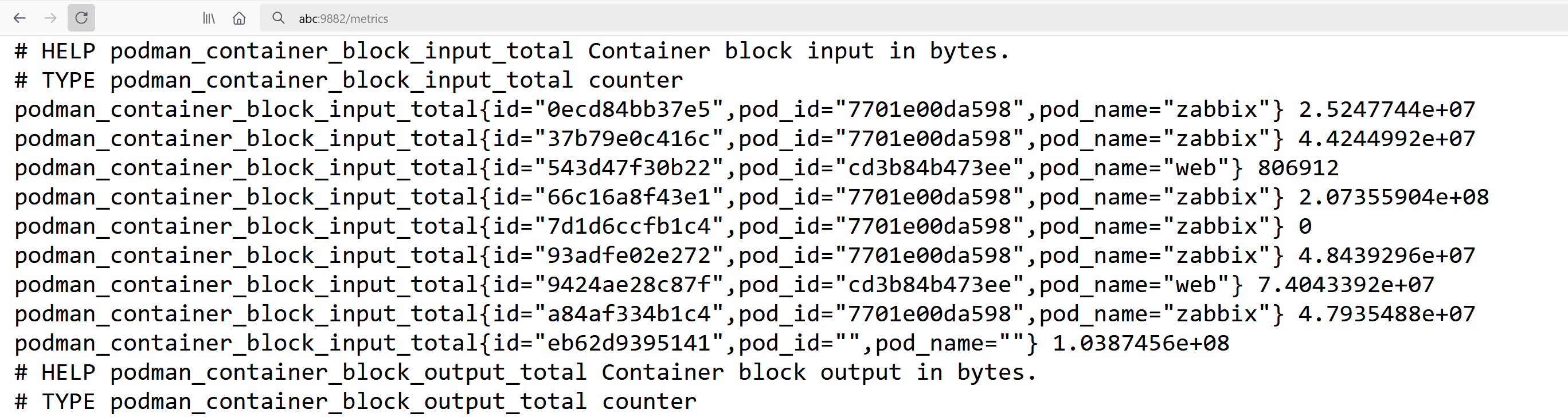
Or through the browser (replace abc with the machine’s IP/DNS ): abc:9882/metrics.

Fig 2. Output of Prometheus Podman exporter in browser

A line starting with # is a comment and contains an explanation regarding the metric; in this case, podman_container_block_input_total will return data in bytes.  In Figure 2, after the comments, you can see several podman_container_block_input_total metrics, one for each container, with different container IDs, pod IDs, and pod names listed in each metric. The metric’s value is displayed on the right side after curly brackets.

Creating a template and template items

Next, I will create a template Podman containers by HTTP and Prometheus where I will put all of the entities (everything will be created on the template). In the template, I will create an item Podman info, which will gather all of the necessary data at defined intervals. This approach will be convenient from a data collection standpoint as the same item data will be used for LLD and item prototypes. During testing, you can set “History” to store data for some time, and when everything is working as expected, then set “History” not to keep any data. This item will be used for the Low-Level Discovery rule and the item prototype.

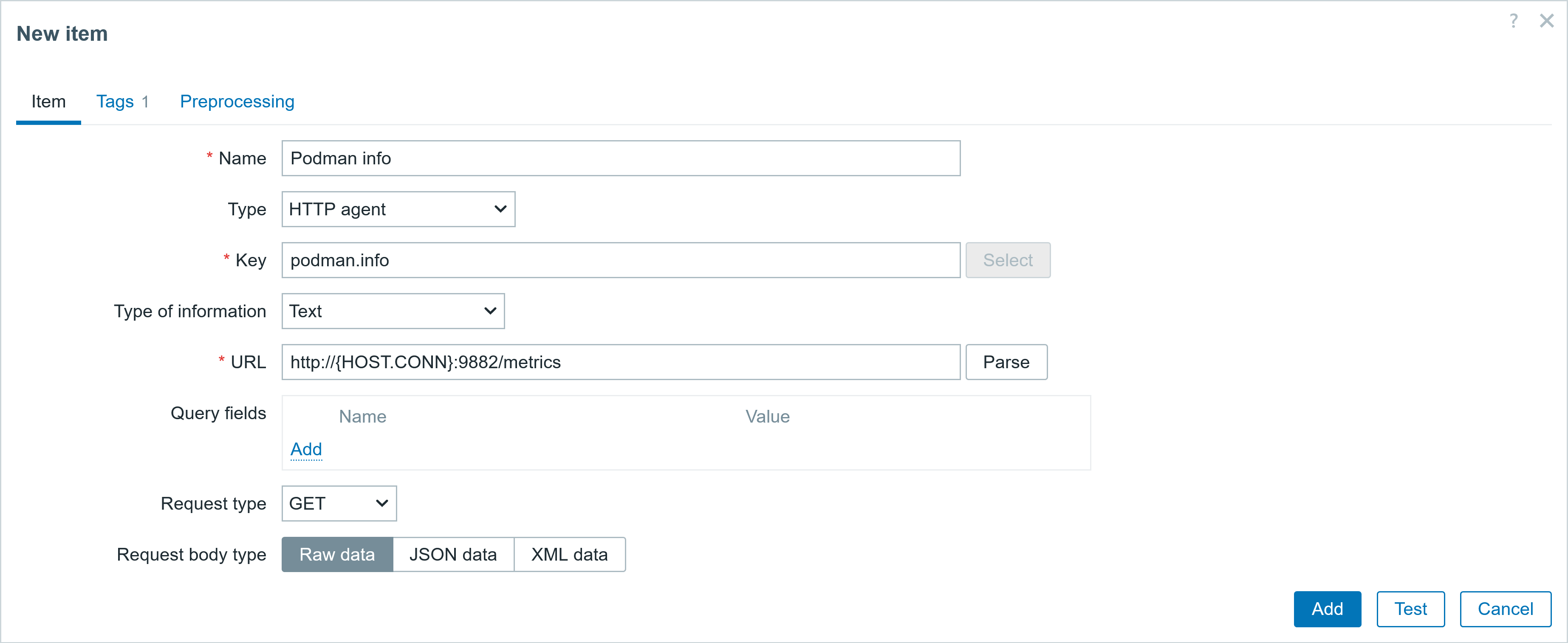
The item Podman info parameters are as follows:

Template: Podman containers by HTTP and Prometheus

○ Item
  ▪ Name:         Podman info
  ▪ Type          HTTP agent
  ▪ Key:          podman.info
  ▪ Type of inf   text
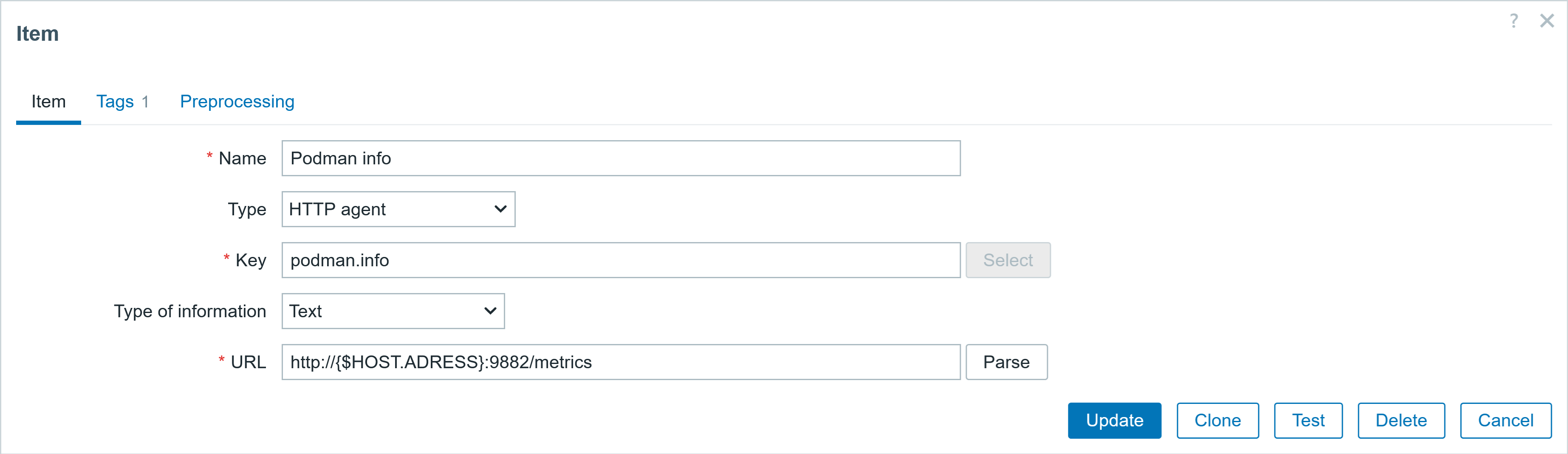
  ▪ URL           http://{HOST.CONN}:9882/metrics
  ▪ Request type  GET
  ▪ Update int.   5m
  ▪ Req status c. 200
  ▪ History       Do not store
◊ Tags
  ▪ Podman:raw


Fig 3. Template item for data gathering

At this moment, this item will contain just raw data, without any preprocessing steps applied. The IP address will be taken from any host interface added to the host. You will get an error message if the host has no interface.

Fig 4. Error on the host with the linked template without any interface

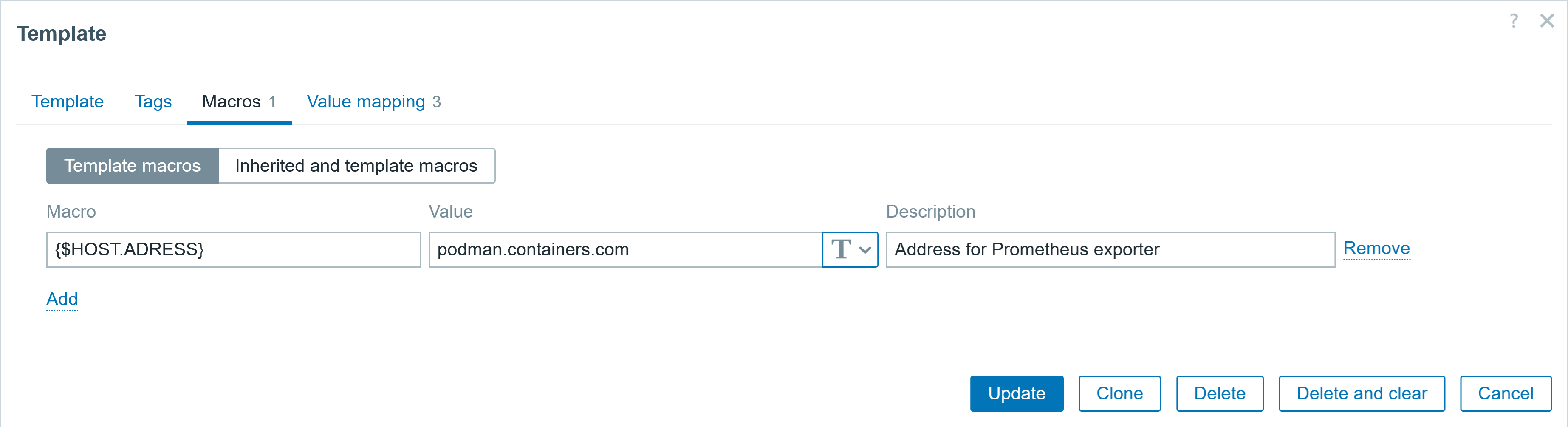
If you do not want to add an interface to the host, you can define a user macro on the template level and use that user macro in the items URL. After adding the template to the host, just modify the user macro value on the host to correct IP/DNS name.

Fig 5. User macro on template
Fig 6. Template item for data gathering with user macro instead of built in macro from host interface

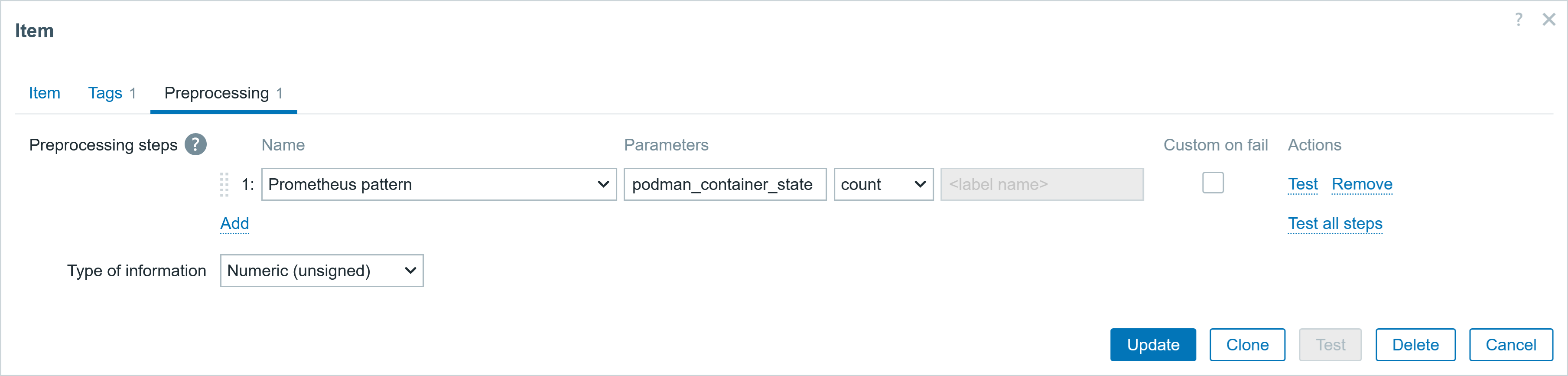
I can also create an item to determine the number of containers created. I can count specific Prometheus pattern occurrences in the master item to determine this. For this, I will use the podman_container_state parameter. Likewise, I could use different parameters, such as podman_container_info, and count the occurrences of such a pattern. The parameters of the item container count:

Template: Podman containers by HTTP and Prometheus

○ Item
  ▪ Name:         Container count
  ▪ Type          Dependent item
  ▪ Key:          container.count
  ▪ Type of inf   Numeric (unsigned)
  ▪ Master item   Podman containers by HTTP and Prometheus: Podman info
◊ Tags
  ▪ Containers:total
♯ Preprocessing
  ▪ Prometheus pattern     podman_container_state     count
Fig 7. Template item preprocessing step for counting the total number of containers

Creating a Discovery rule in template

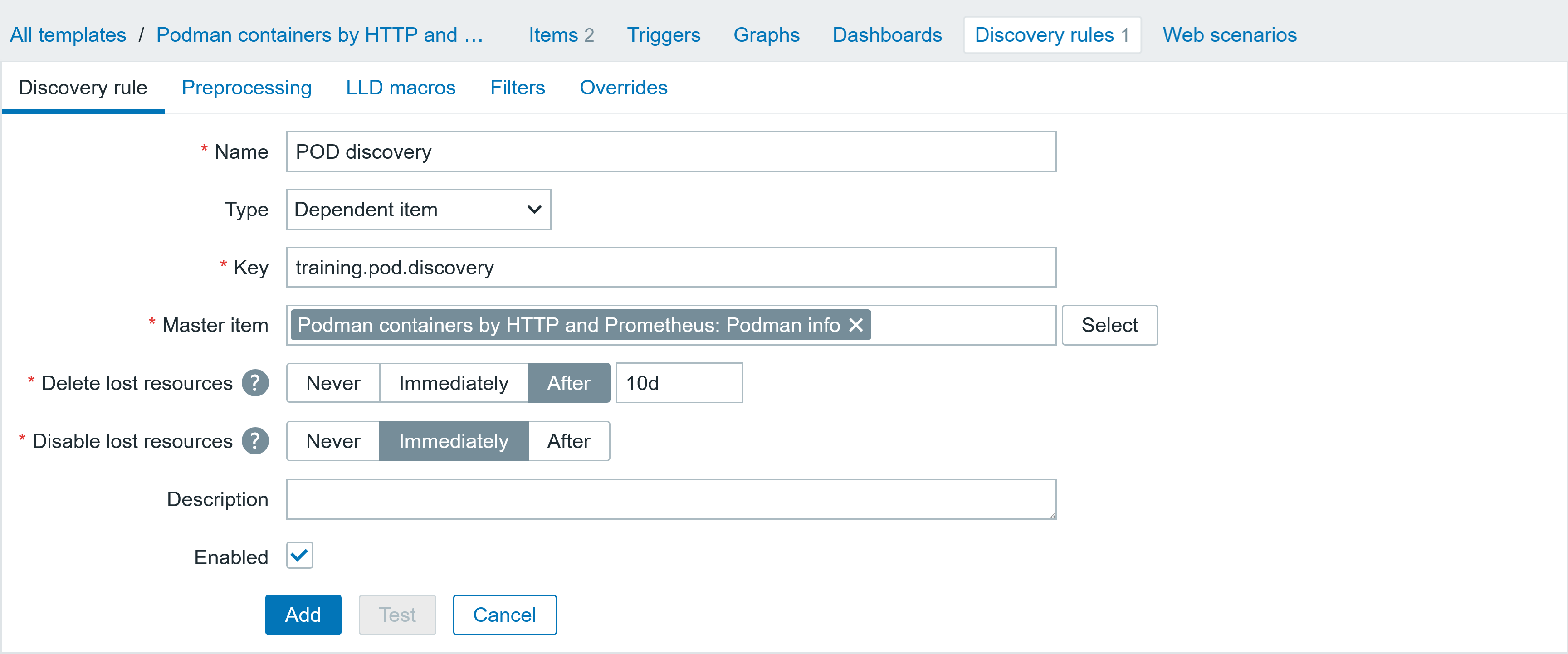
Next, the LLD rule will be created to discover Podman pods. It will be a dependent LLD rule based on a Podman info item with a preprocessing step to convert the Prometheus pattern data to JSON format. The caveat is that the LLD discovery will be executed as frequently as the data is received for the item. If there are a lot of hosts with such a template, there will be a lot of LLD processes executed, which can put a strain on your Zabbix instance.

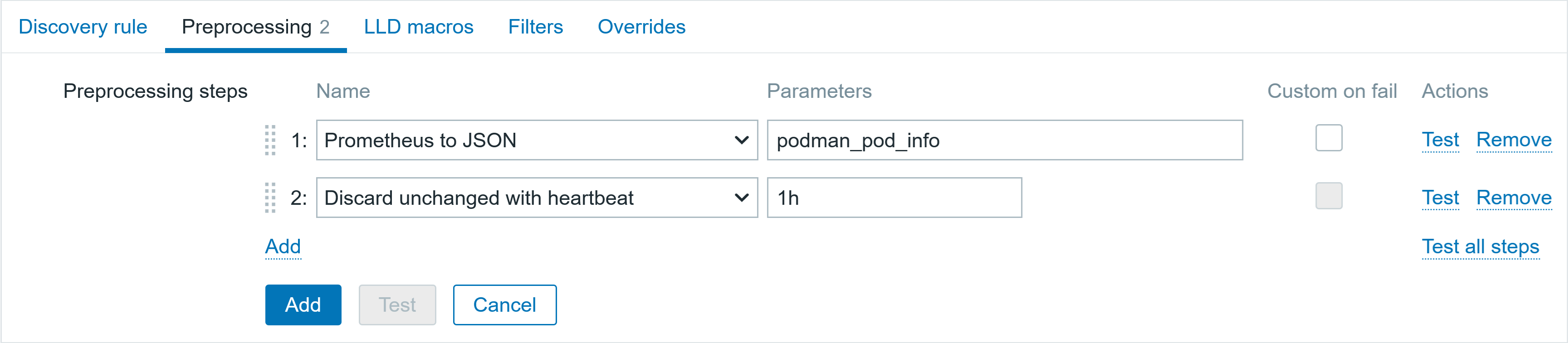
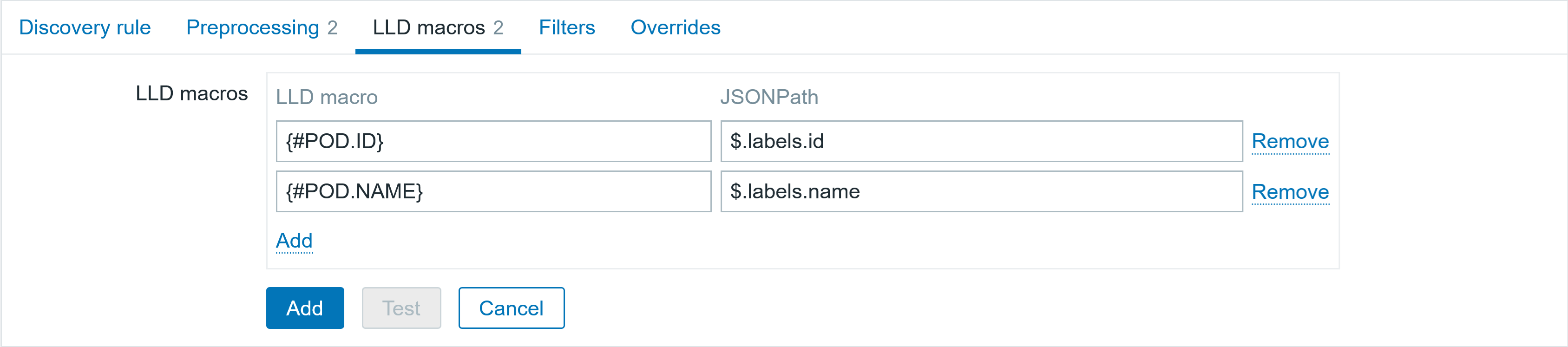
To rectify this issue, I will add a preprocessing step: discard unchanged with heartbeat (as there are no dynamic parameters in the extracted pattern, otherwise we would need to filter out dynamically changing information). For LLD discovery, the recommended interval is around 1h. Additionally, LLD macros will be created from selected JSNOPath variables. The parameters of the LLD rule are shown below.

Template: Podman containers by HTTP and Prometheus

▲ Discovery rule
  ▪ Name:                   POD discovery
  ▪ Type                    Dependent item
  ▪ Key:                    training.pod.discovery
  ▪ Master item             Podman containers by HTTP and Prometheus: Podman info
  ▪ Delete lost resources  After 10d
  ▪ Disable lost resources Immediately
♯ Preprocessing
  ▪ Prometheus to JSON     podman_pod_info
  ▪ Discard unchanged with heartbeat 1h
♦ LLD Macros
  ▪ {#POD.ID}              $.labels.id
  ▪ {#POD.NAME}            $.labels.name
Fig 8. Discovery rule: Pod discovery
Fig 9. Discovery rule: Pod discovery preprocessing tab
Fig 10. Discovery rule: Pod discovery LLD macros tab

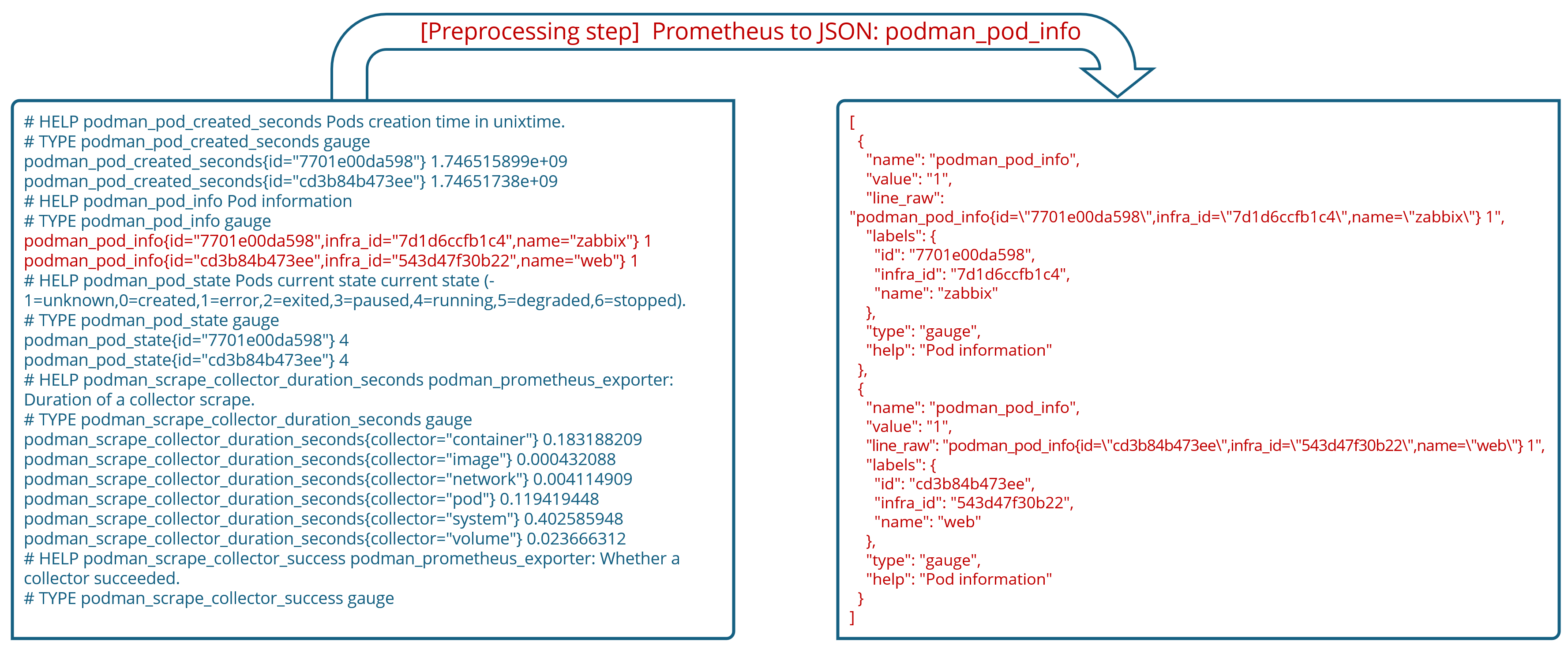
The block diagram below will show how the data is transformed. First, a preprocessing step is applied to the data to convert the Prometheus pattern to JSON format, as all data for LLD must be supplied in JSON format.

In the example below, the matching queried pattern is returned in JSON format after this preprocessing step.

Fig 11. Discovery rule preprocessing step: Prometheus to JSON with pattern podman_pod_info

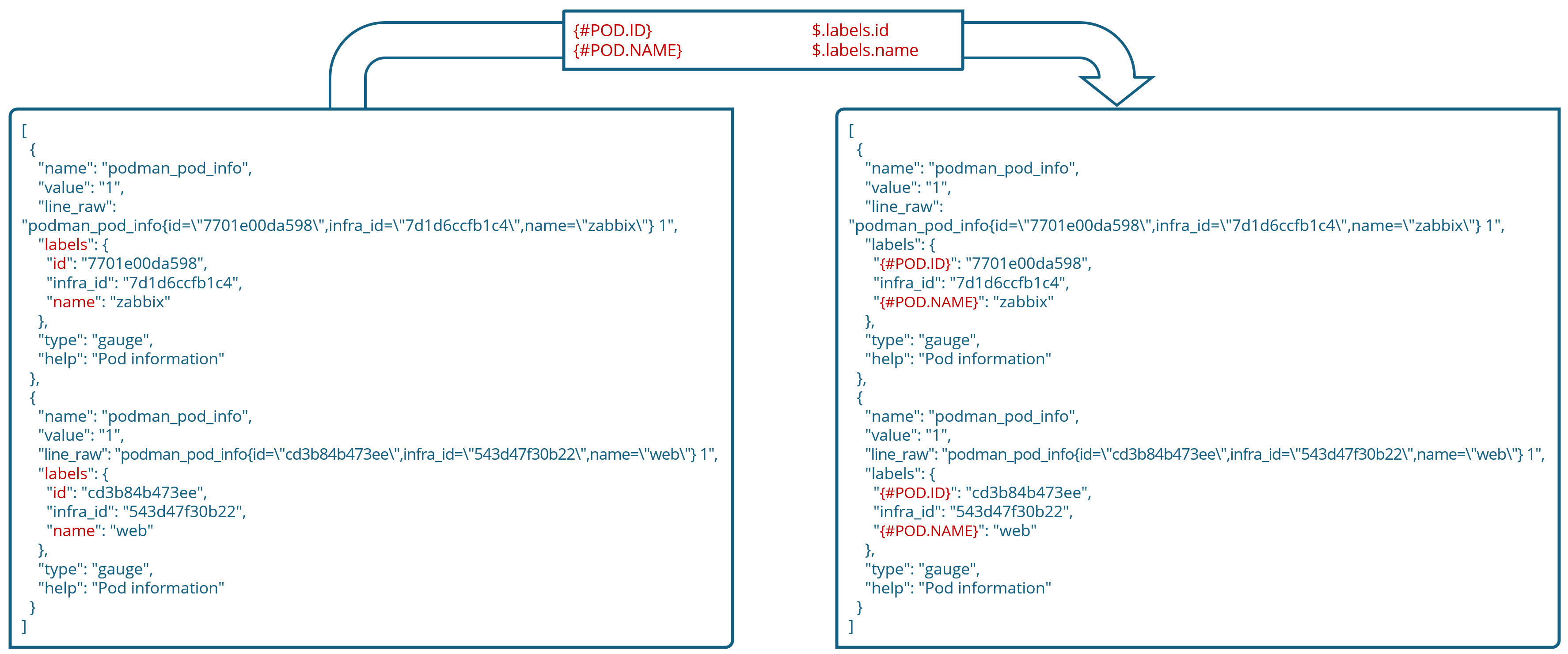
After the preprocessing step, we can assign specific JSONPATH values to LLD macros.

Fig 12. Discovery rule LLD macros: assigning relevant JSONPATH to LLD macros

Creating a template Discovery rule: item prototypes

Now that we have discovered the macros we are interested in, the discovered macros can be used for further prototype (ITEM/HOST/TRIGGER) creation. In this example, I am using the same master item for LLD discovery and the dependent item prototypes, because it is convenient for me, and all the information is available in one item. But usually, there are scenarios where you have to use one item’s data for discovery and the data of another item for populating the prototype values.

In this case, I am interested in the pod ID, when the pod was created, the number of containers in the pod, and the state of the pod. Therefore, I will create the item prototypes and use the LLD macro in the name, key, and preprocessing step. Zabbix will cycle through the discovered LLD macro values and create the items based on the prototype by replacing the LLD macro with discovered values. Although you can set matching item prototype names (which will be confusing), you still have to use the LLD macro in the item key so that different item keys are generated – otherwise, you will get an error regarding duplicate keys. The item prototype parameters are given below.

Fig 13. Low-level discovery rule and item prototypes based on the same item.
Template: Podman containers by HTTP and Prometheus; Discovery rule: POD discovery

○ Item prototype #1
  ▪ Name:         POD ID: [{#POD.NAME}]
  ▪ Type          Dependent item
  ▪ Key:          pod.id[{#POD.NAME}]
  ▪ Type of inf   Character
  ▪ Master item   Podman containers by HTTP and Prometheus: Podman info
♦ Tags
  ▪ Metric:ID
  ▪ Pod:{#CONTAINER.NAME}
♯ Preprocessing
  ▪ Prometheus pattern     podman_pod_containers{id="{#POD.ID}"}          label    id

○ Item prototype #2
  ▪ Name:         POD state: {#POD.NAME}
  ▪ Type          Dependent item
  ▪ Key:          pod.state[{#POD.NAME}]
  ▪ Type of inf   Numeric (float)
  ▪ Master item   Podman containers by HTTP and Prometheus: Podman info
  ▪ Value mapping POD state
♦ Tags
  ▪ Metric:state
  ▪ Pod:{#CONTAINER.NAME}
♯ Preprocessing
  ▪ Prometheus pattern     podman_pod_state{id="{#POD.ID}"}      value

○ Item prototype #3
  ▪ Name:         POD created at: [{#POD.NAME}]
  ▪ Type          Dependent item
  ▪ Key:          pod.created[{#POD.NAME}]
  ▪ Type of inf   Numeric (unsigned)
  ▪ Units         unixtime
  ▪ Master item   Podman containers by HTTP and Prometheus: Podman info
♦ Tags
  ▪ Metric:created
  ▪ Pod:{#CONTAINER.NAME}
♯ Preprocessing
  ▪ Prometheus pattern     podman_pod_created_seconds{id="{#POD.ID}"}     value

○ Item prototype #4
  ▪ Name:         POD container count: [{#POD.NAME}]
  ▪ Type          Dependent item
  ▪ Key:          pod.count[{#POD.ID}]
  ▪ Type of inf   Numeric (unsigned)
  ▪ Master item   Podman containers by HTTP and Prometheus: Podman info
♦ Tags
  ▪ Metric:count
  ▪ Pod:{#CONTAINER.NAME}

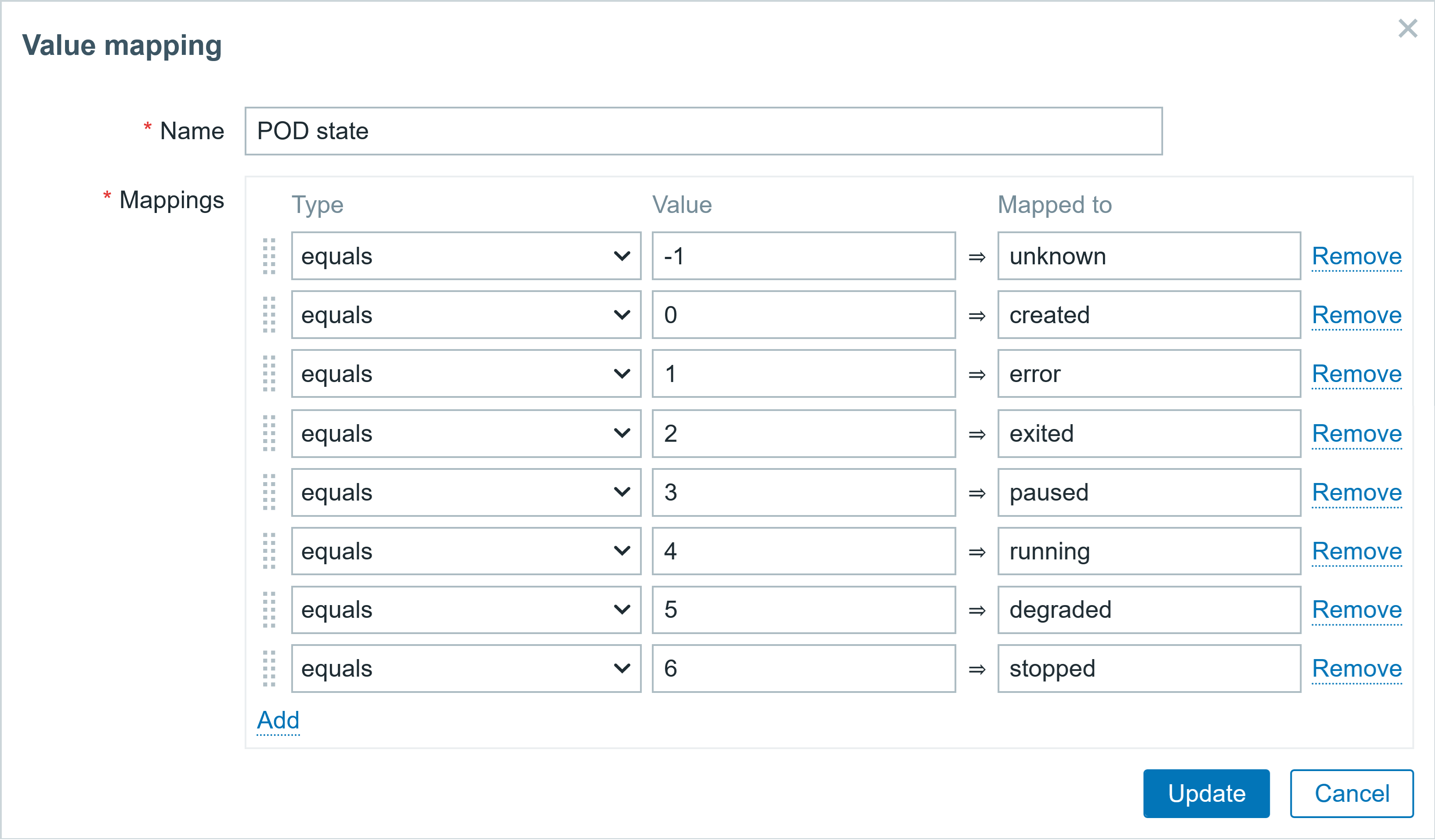
On the template, I have also created a value map for deciphering the numerical pod state codes to text strings for better clarity.

Fig 14. Value mapping for the POD state item

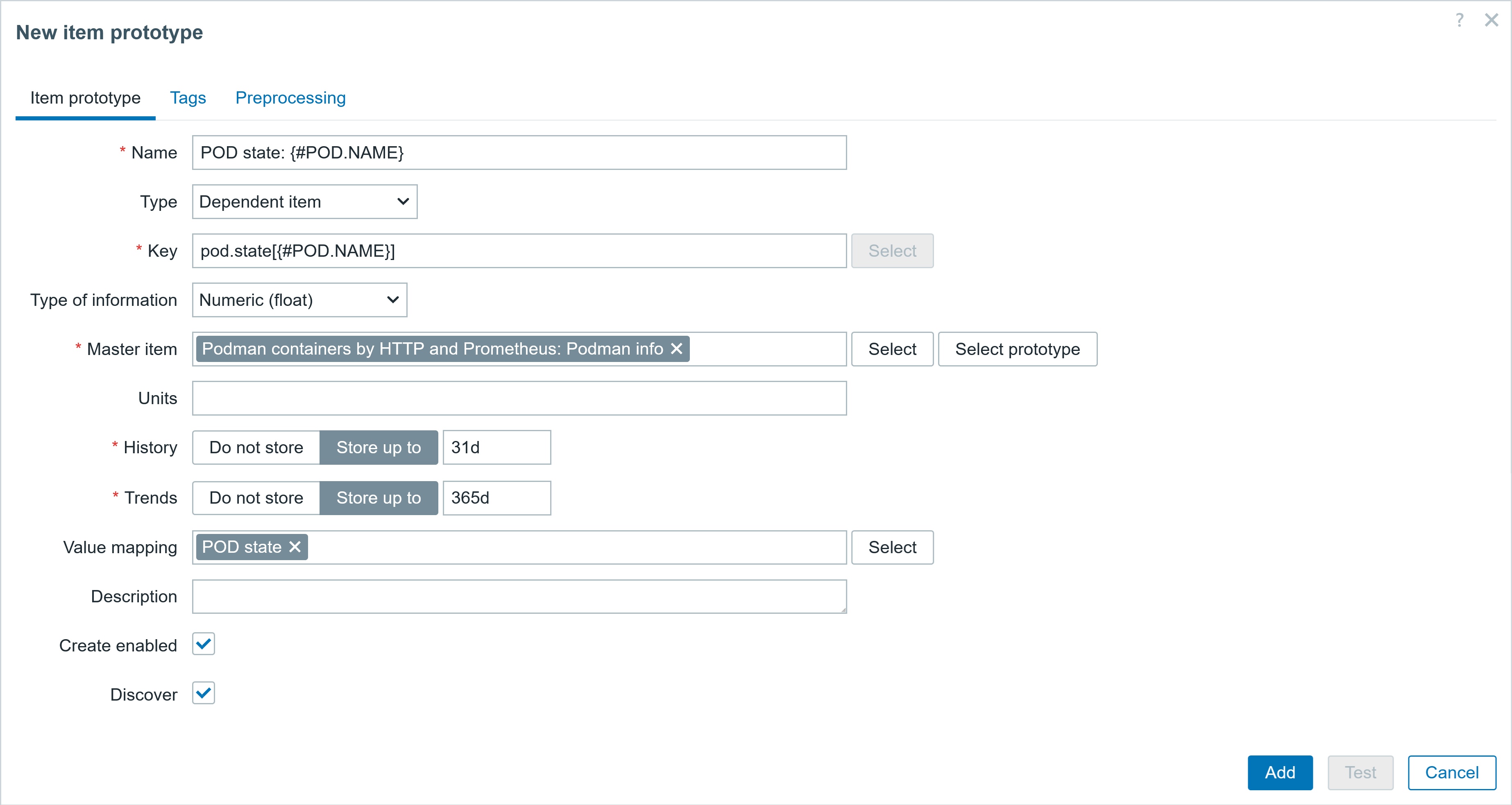
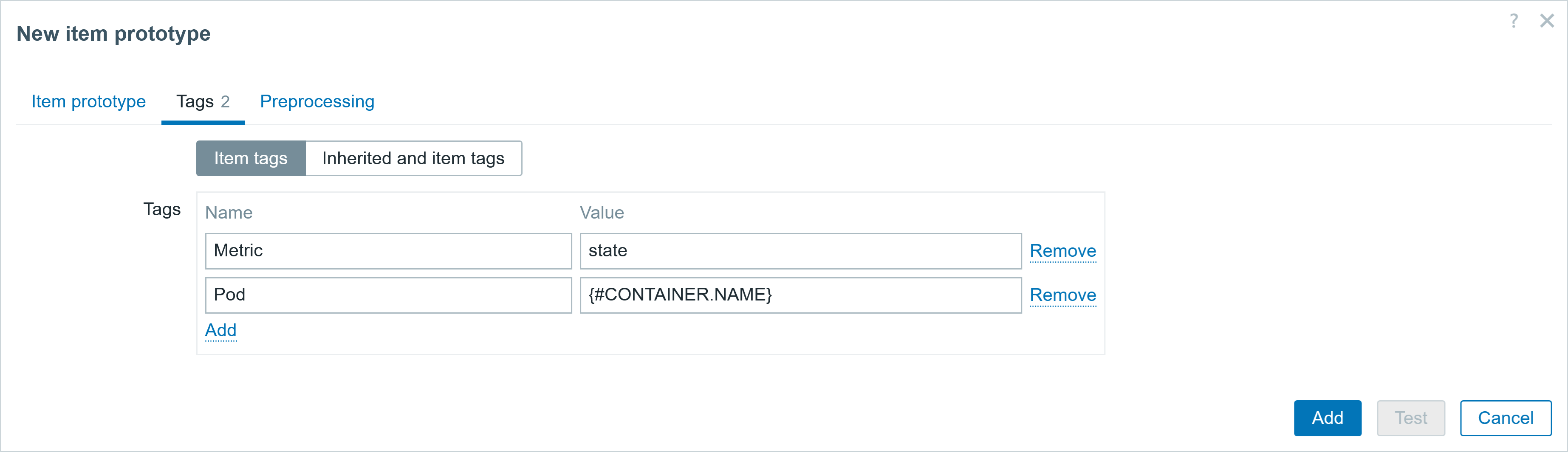
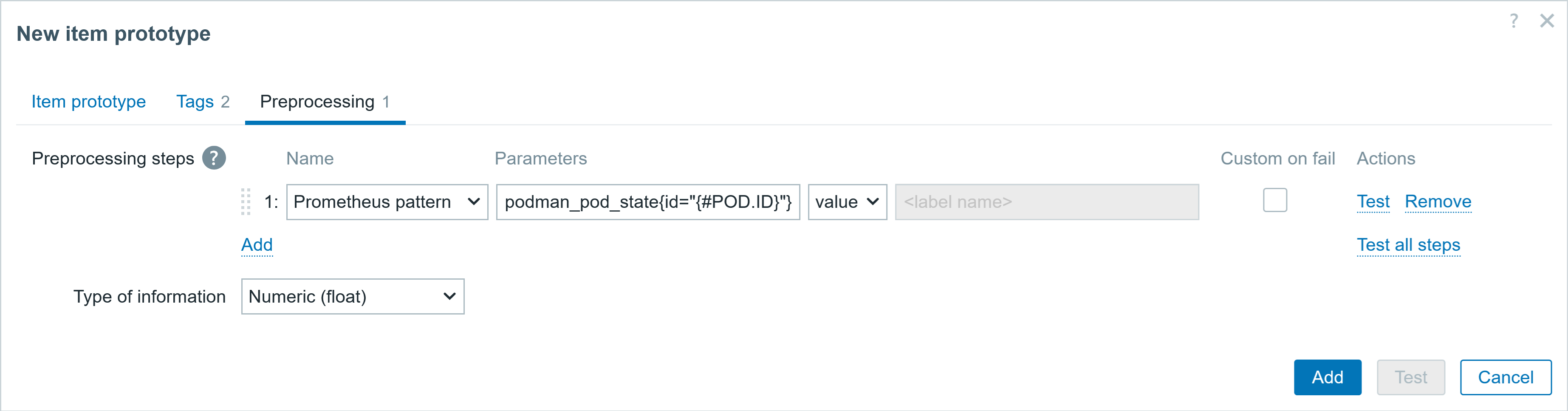
Here are some screenshots of the POD state item prototype, shown below.

Fig 15. POD state item prototype: item prototype tab
Fig 16. POD state item prototype: tag tab
Fig 17. POD state item prototype: preprocessing tab

Creating a template Discovery rule: trigger prototype

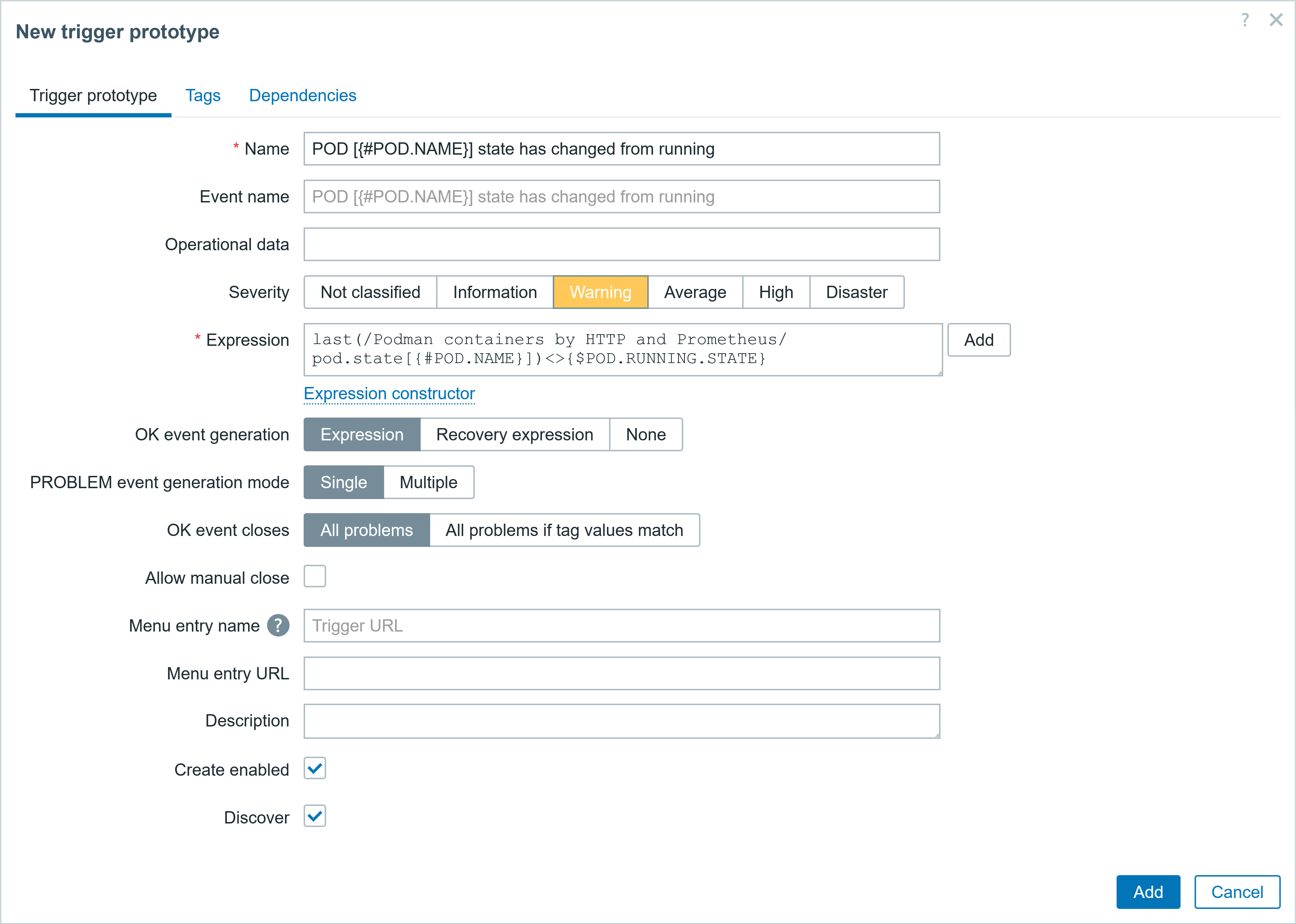
We can also create a trigger prototype to generate an alert if there is something wrong with the pod. I have created a user macro {$POD.RUNNING.STATE} on the template with a value of 4, which corresponds to the running state.

Template: Podman containers by HTTP and Prometheus; Discovery rule: POD discovery

◘ Trigger prototypes:
  ▪ Name:               POD [{#POD.NAME}] state has changed from running
  ▪ Severity:           Warning
  ▪ Expression: last(/Podman containers by HTTP and Prometheus/pod.state[{#POD.NAME}])<>{$POD.RUNNING.STATE}
  ▪ PROBLEM event generation mode: Single
  ▪ OK event closes: All problems
Fig 18. Trigger prototype based on POD state item value

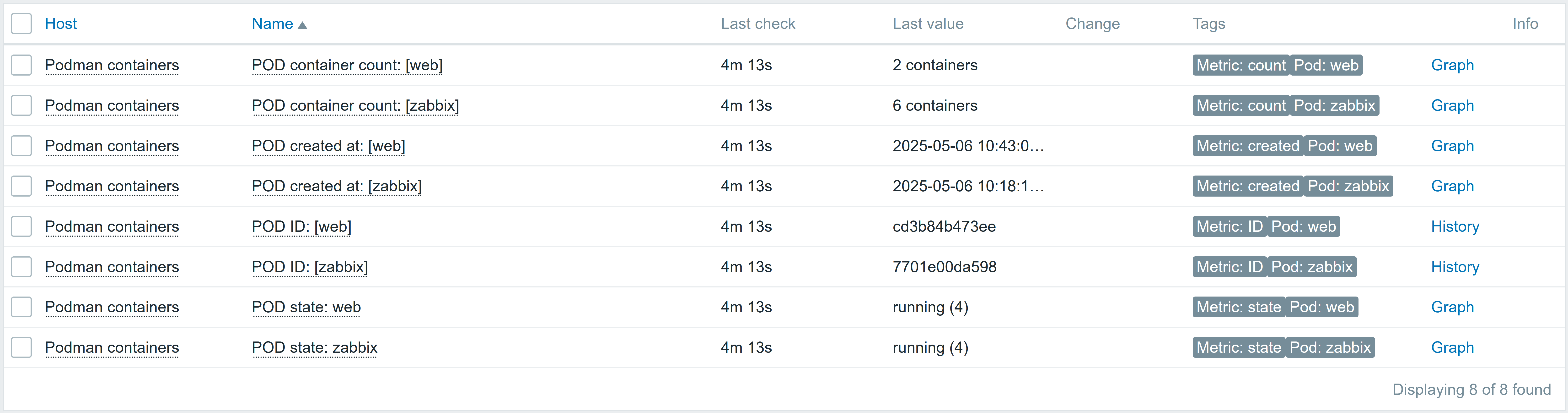
Once you link the template to the host and execute the LLD rule, you should start seeing the Podman pods ( if you have them), similar to the screenshot below.

Fig 19. Latest data for the host with the linked template

Summary

This blog post shows how to get data with HTTP agent from Prometheus Podman exporter and use the same item data for the Discovery rule as well as item and trigger prototypes. Check out part 2 of this series to find out how to discover and monitor Podman containers.

The post Podman Container Monitoring with Prometheus Exporter, part 1 appeared first on Zabbix Blog.

[$] Improving Fedora’s documentation

Post Syndicated from jzb original https://lwn.net/Articles/1024259/

At Flock,
Fedora’s annual developer conference, held in Prague from June 5
to June 8, two members of the Fedora
documentation team
, Petr Bokoč and Peter Boy, led a
session
on the state of Fedora documentation. The pair covered a
brief history of the project’s documentation since the days of Fedora Core 1,
challenges the documentation team faces, as well as plans to improve Fedora’s
documentation by enticing more people to contribute.

CXL Paradigm Shift ASUS RS520QA-E13-RS8U 2U 4-Node Server Review

Post Syndicated from Patrick Kennedy original https://www.servethehome.com/cxl-paradigm-shift-asus-rs520qa-e13-rs8u-2u-4-node-amd-epyc-server-review/

We check out the ASUS RS520QA-E13-RS8U a 2U 4-node AMD EPYC 9005 server with a twist as each node has 8 additional DIMM slots via CXL

The post CXL Paradigm Shift ASUS RS520QA-E13-RS8U 2U 4-Node Server Review appeared first on ServeTheHome.

AWS Weekly Roundup: New AWS Heroes, Amazon Q Developer, EC2 GPU price reduction, and more (June 9, 2025)

Post Syndicated from Betty Zheng (郑予彬) original https://aws.amazon.com/blogs/aws/aws-weekly-roundup-new-aws-heroes-amazon-q-developer-ec2-gpu-price-reduction-and-more-june-9-2025/

The AWS Heroes program recognizes a vibrant, worldwide group of AWS experts whose enthusiasm for knowledge-sharing has a real impact within the community. Heroes go above and beyond to share knowledge in a variety of ways in developer community. We introduce our newest AWS Heroes in the second quarter of 2025.

To find and connect with more AWS Heroes near you, visit the categories in which they specialize Community Heroes, Container Heroes, Data Heroes, DevTools Heroes, Machine Learning Heroes, Security Heroes, and Serverless Heroes.

Last week’s launches
In addition to the inspiring celebrations, here are some AWS launches that caught my attention.

For a full list of AWS announcements, be sure to keep an eye on What’s New at AWS.

Other AWS news
Here are some additional projects, blog posts that you might find interesting:

  • Up to 45 percent price reduction for Amazon EC2 NVIDIA GPU-accelerated instances – AWS is reducing the price of NVIDIA GPU-accelerated Amazon EC2 instances (P4d, P4de, P5, and P5en) by up to 45 percent for On-Demand and Savings Plan usage. We are also making the very new P6-B200 instances available through Savings Plans to support large-scale deployments.
  • Introducing public AWS API models – AWS now provides daily updates of Smithy API models on GitHub, enabling developers to build custom SDK clients, understand AWS API behaviors, and create developer tools for better AWS service integration.
  • The AWS Asia Pacific (Taipei) Region is now open – The new Region provides customers with data residency requirements to securely store data in Taiwan while providing even lower latency. Customers across industries can benefit from the secure, scalable, and reliable cloud infrastructure to drive digital transformation and innovation.
  • Amazon EC2 has simplified the AMI cleanup workflow – Amazon EC2 now supports automatically deleting underlying Amazon Elastic Block Store (Amazon EBS) snapshots when deregistering Amazon Machine Images (AMIs).
  • The Lab where AWS designs custom chips – Visit Annapurna Labs in Austin, Texas—a combination of offices, workshops, and even a mini data center—where Amazon Web Services (AWS) engineers are designing the future of computing.

Upcoming AWS events
Check your calendars and sign up for these upcoming AWS events.

  • Join re:Inforce from anywhere – If you aren’t able to make it to Philadelphia (June 16–18), tune in remotely. Get free access to the re:Inforce keynote and innovation talks live as they happen.
  • AWS Summits – Join free online and in-person events that bring the cloud computing community together to connect, collaborate, and learn about AWS. Register in your nearest city: Shanghai (June 19 – 20), Milano (June 18), Mumbai (June 19) and Japan (June 25 – 26).
  • AWS re:Invent – Mark your calendars for AWS re:Invent (December 1 – 5) in Las Vegas. Registration is now open
  • AWS Community Days – Join community-led conferences that feature technical discussions, workshops, and hands-on labs led by expert AWS users and industry leaders from around the world: Mexico (June 14), Nairobi, Kenya (June 14) and Colombia (June 28)

That’s all for this week. Check back next Monday for another Weekly Roundup!

– Betty

Building secure foundations: A guide to network and infrastructure security at AWS re:Inforce 2025

Post Syndicated from Brandon Carroll original https://aws.amazon.com/blogs/security/building-secure-foundations-a-guide-to-network-and-infrastructure-security-at-aws-reinforce-2025/

AWS re:Inforce 2025: June 16-18 in Philadelphia, PA

A full conference pass is $1,099. Register today with the code flashsale150 to receive a limited time $150 discount, while supplies last.

Securing cloud infrastructure has never been more critical as organizations continue to expand their digital footprint and embrace modern architectures. At AWS re:Inforce 2025, the Network and Infrastructure Security track brings together security experts, practitioners, and industry leaders to share insights on building and maintaining secure, automated, and observable cloud foundations.This year’s track focuses on several key themes that are shaping the future of cloud security. Learn how to implement comprehensive defense-in-depth strategies through multiple layers of controls, from perimeter to workload protection. Discover the latest approaches to network visibility and inspection, including tools and architectures for deep packet inspection and enhanced traffic analysis across cloud environments.As organizations scale their cloud presence, automated policy management becomes crucial. This track showcases solutions and approaches for scaling security policy deployment, management, and compliance validation through automation and infrastructure as code (IaC). You’ll also dive deep into zero trust infrastructure implementations, exploring frameworks for identity-based network segmentation and access controls aligned with zero trust principles.With the growing complexity of distributed applications, protecting workloads across cloud, edge, and hybrid environments requires integrated security architectures. Sessions in this track demonstrate how to build comprehensive protection strategies that secure your entire infrastructure footprint while maintaining operational excellence.

Whether you’re just beginning your cloud security journey or leading mature enterprise security initiatives, the Network and Infrastructure Security track at re:Inforce 2025 will equip you with practical guidance and actionable insights to advance your organization’s security posture. Join in on the fun, and register for re:Inforce 2025!

Breakout sessions, chalk talks, and lightning talks

Breakout sessions are lecture-style, 1-hour sessions delivered by AWS experts, customers, and partners—perfect for deepening your knowledge on important topics, gaining actionable insights, and connecting with industry leaders.

Chalk talks are 1-hour long, highly interactive sessions with a small audience. This format is ideal for diving deep into specific topics, engaging directly with AWS experts, and getting your questions answered in real time.

Lightning talks are short (20 minutes) theater presentations dedicated to a specific customer story, service demo, or AWS Partner offering.

NIS301 | Breakout session | Egress control deployments made easy
Speakers: Sofía Aluma (AWS), Jesse Lepich (AWS)
Discover the latest AWS Network Firewall features that simplify implementation and enhance your security posture. In this hands-on workshop, learn how recent updates to AWS Network Firewall and Amazon Route 53 Resolver DNS Firewall streamline deployment, reduce threat exposure, and strengthen security policies. We’ll share practical recommendations for configuring firewall rules that match your specific use cases and help verify that your security controls meet intended objectives.

NIS302 | Breakout session | How Itaú Bank leverages AWS Shield Advanced to combat DDoS events
Speakers: Douglas Lopes (AWS), Guilherme Greco (AWS), Ricardo Donadel (Itaú Bank)
Learn how Itaú, Latin America’s largest bank, uses AWS Shield Advanced to protect their critical financial infrastructure from sophisticated DDoS events. In this session, Itaú’s security team shares how they architected their defense strategy by integrating Shield Advanced with existing security operations and collaborating with the AWS DDoS Response Team. Discover how they maintain robust protection while meeting financial regulatory requirements and examine the business value of their implementation. Whether you work in financial services or other regulated industries, you’ll gain actionable insights for enterprise-grade DDoS protection.

NIS303 | Breakout session | Thinking beyond traditional firewalling architectures
Speakers: Tom Adamski (AWS), Ankit Chadha (AWS)
In this session, we’ll discuss a brave new world where we think beyond traditional firewalling architectures. We’ll explore the use-cases that require firewalls including workload-to-workload, client-to-workload, and workload-to-internet traffic flows. After defining the use cases, we’ll discuss AWS services that allow customers to retain their desired security posture without inserting inline firewalls. We’ll wrap with specific considerations on when firewalling is a good option. For example, for scenarios when customers require AppId-like functionality, or for creating data loss prevention (DLP) deployments for egress traffic.

NIS304 | Breakout session | Integrate Zero Trust into your cloud network
Speakers: Dave DeRicco (AWS)
In this session, learn how to adopt Zero Trust alongside traditional network security functions such as firewalls and VPNs. Explore how services like Amazon VPC Lattice and AWS Verified Access complement your existing network security posture by leveraging identity and network controls to continuously authenticate and monitor access. and how these services can integrate into your existing network architecture. Learn about common adoption approaches and migration patterns and hear best practices for building Zero Trust mechanisms into a secure, modern network architecture.

NIS305 | Breakout session | Advanced network defense: From basics to global scale with AWS Cloud WAN
Speakers: Sidhartha Chauhan (AWS)
Starting with core security principles, this session demonstrates how to build robust network security architectures in AWS. Learn to establish effective network isolation boundaries using AWS Cloud WAN and AWS PrivateLink, followed by implementing traffic filtering through strategic firewall deployments. We’ll compare centralized versus distributed inspection architectures, culminating in how AWS Cloud WAN’s service insertion and policy-based approach enables global-scale centralized inspection flows. Through practical scenarios, attendees will master designing scalable network security architectures that maintain security posture across complex cloud environments. Ideal for security engineers and architects managing enterprise-scale AWS deployments.

DAP332 | Chalk talk | Executive perspective: Risk management for generative AI workloads
Speakers: Jason Garman (AWS) & Mark Ryland (AWS)
Don’t let the perceived complexity of responsible AI keep you from deploying generative AI applications on AWS. In this chalk talk, we will present a framework for breaking down AI safety and security risks, introduce AWS best practices for keeping enterprise data secure in generative AI applications using zero trust principles, and mitigate safety risks using technologies such as Amazon Bedrock Guardrails. Discover as a group with fellow security leaders how to identify safety and security risks relevant to your workload, implement appropriate mitigation strategies, and measure efficacy over time.

NIS306 | Breakout session | Securing AWS networks: Observability meets defense-in-depth
Speakers: Anandprasanna Gaitonde (AWS), Ankush Goyal (AWS), Amish Shah (AWS)
AWS customers use multiple security services to build strong network defenses, but visibility into threats, misconfigurations, and vulnerabilities across multi-VPC and multi-account environments can remain a challenge. This session covers AWS network security fundamentals – Security Groups, NACLs, AWS Network Firewall, DNS Firewall, and Gateway Load Balancer—for a layered defense strategy. We will also highlight observability tools like VPC Flow Logs, Reachability Analyzer, and Network Access Analyzer to detect security gaps and troubleshoot access issues. By integrating these tools, organizations can proactively enhance network security, detect vulnerabilities, and ensure secure, scalable architectures across AWS accounts and environments.

NIS231 | Chalk talk | High noon duel: Live events tamed by AWS WAF
Speakers: Tzoori Tamam (AWS), Harith Gaddamanugu (AWS)
In this thrilling session, we’ll build a robust protection setup using AWS WAF and Amazon CloudFront, demonstrating how to fend off increasingly sophisticated live events. Learn to leverage Amazon CloudFront, configure rate-based rules, implement AWS WAF Managed Rule groups, bot control, and create custom defenses. As we construct our digital fortress, our resident “black hat” will launch progressively complex events, showcasing how each layer of defense performs under pressure. Suitable for both newcomers and experienced AWS security professionals.

NIS331 | Chalk talk | Enhance your cloud security infrastructure using Zero Trust techniques
Speakers: Pablo Sánchez Carmona (AWS), Adam Palmer (AWS)
Traditional perimeter-based security and network segmentation often fall short in today’s dynamic microservices environments, creating operational overhead and potential security gaps. Join us in this session to discuss how to evolve beyond conventional security models by implementing Zero Trust architecture in AWS. We will cover different services and techniques such as AWS Verified Access in the human-to-application connectivity, Amazon VPC Lattice for service-to-service communication, and the use of AWS Verified Permissions for fine-grained application authorization. We’ll explore how these services can work together to enable continuous authentication.

NIS332 | Chalk talk | Build secure connectivity with Amazon VPC Lattice and AWS PrivateLink
Speakers: Alexandra Huides (AWS), Jordan Rojas Garcia (AWS)
In this chalk talk, we review the best practices and reference architectures for building secure connectivity with Amazon VPC Lattice and AWS PrivateLink. We focus on service and resource oriented connectivity as we dive into the new VPC Lattice capabilities, such as support for VPC Resources and service network endpoints, and cross-region support for AWS PrivateLink.

NIS333 | Chalk talk | Build defense-in-depth network designs to safeguard apps and data
Speakers: Raghavarao Sodabathina (AWS), Brian Soper (AWS)
Strong adherence to architecture best practices and proactive controls are the foundation of web application security. These techniques allow developers to build applications that are more resilient. In this chalk talk, learn how to build a layered network security approach to achieve defense-in-depth; to protect, detect, and respond to issues faster; and to accelerate your secure migrations to AWS. Discover key considerations, best practices, and reference architectures that include Amazon VPC, Amazon Route 53, Amazon CloudFront, AWS WAF, AWS Shield, Application Load Balancer, and AWS Elastic Disaster Recovery to achieve your defense-in-depth objectives.

NIS431 | Chalk talk | Cloud network defense: Advanced visibility and analysis on AWS
Speakers: Kyle Hanrahan (AWS), Anand Kumar Mandilwar (AWS)
Organizations struggle to maintain comprehensive network visibility in complex cloud environments. This session demonstrates how to implement advanced network monitoring and analysis using AWS’s native services. Learn to leverage VPC Flow Logs, AWS Network Firewall Logs, Route 53 Resolver Logs, AWS WAF Logs and other data sources for traffic analysis. Discover practical implementation of tools for enhanced security and real-time monitoring. Walk away with reference architectures and best practices for building robust network visibility solutions that scale across your AWS environment while maintaining performance. Perfect for security teams modernizing their network defense strategy.

NIS321 | Lightning talk | How Meta enabled secure egress patterns using AWS Network Firewall
Speakers: Syed Shareef (AWS), Robin Rodriguez (AWS)
Meta envisions 2025 as the breakthrough year for its leading AI assistant, aiming to reach over 1 billion people with highly intelligent and personalized interactions. Partnering with AWS, Meta has made substantial investments in AI infrastructure, providing its developers with specialized compute resources for AI training. To secure this ambitious initiative, Meta has had to evolve not just their cloud security but also culture and mindset to secure a growing AWS footprint/infrastructure. Meta leverages AWS Network Firewall (ANF) to centrally inspect and filter VPC traffic before reaching external destinations, using rule-based filtering to control domain access, block malicious IPs, and prevent data exfiltration.

NIS322 | Lightning talk | I didn’t know Network Firewall could do that!
Speakers: Brandon Carroll (AWS), Mary Kay Sondecker (AWS)
This lightning talk will uncover powerful yet often overlooked capabilities that can transform your network security game. In just 20 minutes, we’ll speed through eye-opening features including flow capture and flush operations, advanced Suricata rule capabilities, dynamic packet filtering tricks, and lesser-known integration patterns that even experienced practitioners might have missed. From stateful traffic manipulation to sophisticated protocol inspection and real-world architectural patterns, you’ll discover practical techniques to leverage AWS Network Firewall’s full potential. Whether you’re managing complex multi-account deployments or hunting for advanced threats, this rapid-fire session will equip you with new tools for your security arsenal.

NIS323 | Lightning talk | WAF logs to security gold: A 20-minute dashboard revolution
Speakers: Emmanuel Isimah (AWS), Victor Babasanmi (AWS)
Drowning in AWS WAF logs? Transform raw security data into actionable insights with Amazon CloudWatch dashboards. In this high-energy session, discover how to build powerful visualizations that expose threats in real-time. We’ll cut through the complexity to show you battle-tested patterns for threat detection and alerting that security teams love. Twenty minutes to level up your WAF monitoring game – no fluff, just results.

NIS421 | Lightning talk | VPN-less access to AWS private services with AWS Verified Access
Speakers: John Sol (AWS), Mike Cornstubble (AWS)
In hybrid environments where employees need to access a file server outside their corporate network, they typically use a VPN. This session demonstrates how to establish secure, VPN-free connectivity to an Amazon FSx for Windows File Server using the new TCP protocol support of AWS Verified Access (AVA). Learn how AVA provides fine-grained access controls using AWS.

Interactive sessions (builders’ sessions, code talks, and workshops)

Interact with small groups led by an AWS expert providing interactive learning about how to build on AWS. Each builders’ session begins with a short explanation or demonstration of what attendees are building, then it’s your turn to build! The expert guides you end-to-end through this hands-on experience. Or join code talks, our code-focused interactive sessions where AWS experts lead a discussion featuring live coding or code samples as they illuminate the why behind AWS solutions. Attendees are encouraged to ask questions and follow along.

Workshops are 2-hour interactive sessions where you collaborate in teams or work individually to solve real-world challenges by using AWS services, making them perfect for hands-on learning. Each workshop begins with a brief lecture, followed by dedicated time to work through the problem.

Note: Don’t forget to bring your laptop to build alongside AWS experts.

NIS251 | Builders’ session | Build dashboards to gain visibility into your network perimeter
Speakers: Victor Babasanmi (AWS), Tom Adamski (AWS), Todd Pula (AWS), Vamsi Manthapuram (AWS)
Effective network security requires comprehensive visibility into your security posture and traffic patterns. This hands-on session demonstrates how to build and customize Amazon CloudWatch dashboards for real-time insights into AWS Network Firewall operations. Learn to visualize critical metrics including dropped packets, traffic patterns, and potential threats. We’ll explore creating dynamic widgets to track stateful rule matches, analyze top talkers, and identify suspicious patterns. Through step-by-step guidance, discover how to monitor bandwidth utilization, track rule effectiveness, and create custom alarms. Leave with ready-to-implement templates for enhancing your security operations. You must bring your laptop to participate.

NIS252 | Builders’ session | Mastering Amazon VPC Block Public Access for secure cloud networks
Speakers: Ankush Goyal (AWS), Salman Ahmed (AWS), Kunj Thacker (AWS)>, Ravi Kumar (AWS)
Join this interactive workshop to explore Amazon VPC Block Public Access, a feature designed for secure, scalable cloud environments. Learn to block ingress and egress traffic, enforce compliance, and configure granular exclusions for public and private subnets, with a focus on both IPv4 and IPv6 traffic. Through practical labs, you’ll enable Block Public Access, create exclusions, and use Reachability Analyzer to test connectivity before and after enabling the feature. By the end, you’ll be equipped to secure VPCs effectively while maintaining flexibility for modern workloads. You must bring your laptop to participate.

NIS351 | Builders’ session | Streamlining DNS resource sharing across multiple VPCs and accounts
Speakers: Aanchal Agrawal (AWS), Anushree Shetty (AWS), Mike Torro (AWS), Tyler Pack (AWS)
Amazon Route 53 Profiles is an innovative feature of Route 53 that enables the effortless sharing of hosted zones, resolver rules, and DNS firewall rules across multiple VPCs. This builders’ session will guide you through the process of creating Route 53 profiles and demonstrate how to restrict access using various features tailored to your specific needs, such as different environments. You must bring your laptop to participate.

NIS352 | Builders’ session | Accessing private VPC resources using CloudFront VPC origin
Speakers: Anushree Shetty (AWS), Ramya Mikkilineni (AWS), Aanchal Agrawal (AWS), Anjana Krishnan (AWS)
You can now privately access Amazon VPC resources, including load balancers and Amazon Elastic Compute Cloude (Amazon EC2) instances, and restrict these resources to be only accessed via Amazon CloudFront distribution through a new feature in CloudFront. In this builders’ session, we will set up a website located in a private subnet and access it via a CloudFront distribution. You must bring your laptop to participate.

NIS353 | Builders’ session | Scaling threat prevention on AWS with Suricata
Speakers: Ivo Pinto (AWS), Jesse Lepich (AWS), Michael Leighty (AWS), Miguel Silva (AWS)
Suricata is an open-source network intrusion prevention system (IPS) that includes a standard rule-based language for stateful network traffic inspection. AWS Network Firewall lets you define rules to inspect and control traffic to and from your VPC using IP, port, protocol, domain names, and general pattern matches. Building rules, in this format, for your security needs can be challenging but rewarding. During this session you will learn how you can utilize Suricata-compatible rules in AWS Network Firewall and build rulesets for common use cases as well as complex scenarios. You must bring your laptop to participate.

NIS354 | Builders’ session | Use AWS PrivateLink to set up private access to Amazon Bedrock
Speakers: Akshay Karanth (AWS), Du’An Lightfoot (AWS), Mike Gillespie (AWS), Salman Ahmed (AWS)
When building generative AI applications using Large Language Models on Amazon Bedrock, customers want to generate responses without going over the public internet or without exposing your proprietary data. This builders’ session introduces the Amazon Bedrock VPC endpoint, powered by AWS PrivateLink, as a solution for establishing secure and private connections between customer VPCs and Amazon Bedrock services. You’ll learn how this technology enables communication without public IP addresses, mitigating potential threat vectors from internet exposure. We’ll cover security challenges in generative AI, the architecture of VPC endpoint solution, and hands-on labs for implementation. You must bring your laptop to participate.

NIS451 | Builders’ session | Troubleshooting real-world perimeter protection scenarios
Speakers: Tzoori Tamam (AWS), Manuel Pata (AWS), Kaustubh Phatak (AWS)
Suspicious of an activity spike? Seeing odd traffic patterns? Introduced a new AWS WAF rule and want to make sure it is operating as it should? Join this session for a walkthrough of a day in the life of a security engineer operating AWS WAF, reviewing dashboards, exploring data in the logs, and building new dashboard widgets to make your life easier. You must bring your laptop to participate.

NIS341 | Code talk | A deep dive into Amazon VPC Lattice granular security
Speakers: Pablo Sánchez Carmona (AWS), Cristobal Lopez Callejon (AWS)
Join us for a session exploring Amazon VPC Lattice’s security capabilities and fine-grained access controls. We’ll explore authentication mechanisms, authorization policies, and service-level permissions that enable precise control over network traffic between services. You’ll learn how to leverage authorization policies in VPC Lattice to create layered security controls, and see practical examples of implementing Zero Trust principles within your application network. The session will cover best practices for auditing and monitoring service-to-service communications, managing cross-account access, and implementing security patterns for microservices architectures.

NIS342 | Code talk | Sticky situations: Building advanced AWS WAF honeypots for better security
Speakers: Harith Gaddamanugu (AWS), Manuel Pata (AWS)
Discover how to transform AWS WAF into a powerful threat intelligence platform by building sophisticated honeypots that attract, analyze, and adapt to emerging threats. In this code talk, we’ll demonstrate how to combine AWS WAF with AWS Lambda functions to create intelligent traps that not only capture malicious activity but also generate actionable security insights. Through live coding demonstrations, you’ll learn to implement advanced honeypot techniques including dynamic bait generation, automated attacker profiling, and real-time threat pattern analysis.

NIS231 | Chalk talk | High noon duel: Live events tamed by AWS WAF
Speakers: Tzoori Tamam (AWS), Harith Gaddamanugu (AWS)
In this thrilling session, we’ll build a robust protection setup using AWS WAF and Amazon CloudFront, demonstrating how to fend off increasingly sophisticated live attacks. Learn to leverage CloudFront, configure rate-based rules, implement WAF-managed rules and bot control, and create custom defenses. As we construct our digital fortress, our resident “black hat” will launch progressively complex attacks, showcasing how each layer of defense performs under pressure. Suitable for both newcomers and experienced AWS security professionals.

NIS331 | Chalk talk | Enhance your cloud security infrastructure using Zero Trust techniques
Speakers: Pablo Sánchez Carmona (AWS), Adam Palmer (AWS)
Traditional perimeter-based security and network segmentation often fall short in today’s dynamic microservices environments, creating operational overhead and potential security gaps. Join us in this session to discuss how to evolve beyond conventional security models by implementing Zero Trust architecture in AWS. We will cover different services and techniques such as AWS Verified Access in the human-to-application connectivity, Amazon VPC Lattice for service-to-service communication, and the use of AWS Verified Permissions for fine-grained application authorization. We’ll explore how these services can work together to enable continuous authentication.

NIS332 | Chalk talk | Build secure connectivity with Amazon VPC Lattice and AWS PrivateLink
Speakers: Alexandra Huides (AWS), Jordan Rojas Garcia (AWS)
In this chalk talk, we review the best practices and reference architectures for building secure connectivity with Amazon VPC Lattice and AWS PrivateLink. We focus on service and resource oriented connectivity as we dive into the new VPC Lattice capabilities, such as support for VPC Resources and service network endpoints, and cross-Region support for AWS PrivateLink.

NIS333 | Chalk talk | Build defense-in-depth network designs to safeguard apps and data
Speakers: Raghavarao Sodabathina (AWS), Brian Soper (AWS)
Strong adherence to architecture best practices and proactive controls are the foundation of web application security. These techniques allow developers to build applications that are more resilient. In this chalk talk, learn how to build a layered network security approach to achieve defense-in-depth; to protect, detect, and respond to issues faster; and to accelerate your secure migrations to AWS. Discover key considerations, best practices, and reference architectures that include Amazon VPC, Amazon Route 53, Amazon CloudFront, AWS WAF, AWS Shield, Application Load Balancer, and AWS Elastic Disaster Recovery to achieve your defense-in-depth objectives.

NIS431 | Chalk talk | Cloud network defense: Advanced visibility and analysis on AWS
Speakers: Kyle Hanrahan (AWS), Anand Kumar Mandilwar (AWS)
Organizations struggle to maintain comprehensive network visibility in complex cloud environments. This session demonstrates how to implement advanced network monitoring and analysis using AWS’s native services. Learn to leverage VPC Flow Logs, AWS Network Firewall Logs, Route 53 Resolver Logs, WAF Logs and other data sources for traffic analysis. Discover practical implementation of tools for enhanced security and real-time monitoring. Walk away with reference architectures and best practices for building robust network visibility solutions that scale across your AWS environment while maintaining performance. Perfect for security teams modernizing their network defense strategy.

Register Now

Don’t miss this opportunity to learn from industry experts and AWS leaders about building secure, automated, and observable cloud foundations. Register for AWS re:Inforce 2025 today to reserve your spot in these Network and Infrastructure Security sessions covering everything from Zero Trust implementations to advanced DDoS protection, network visibility, and defense-in-depth strategies. Browse the full re:Inforce catalog to explore additional tracks, partner sessions, and code talks that can complement your network security journey.

If you have feedback about this post, submit comments in the Comments section below.

Brandon Carroll

Brandon Carroll

Brandon is a Senior Product Marketing Manager with AWS who helps customers understand and implement robust cloud security solutions. At AWS, Brandon translates complex security concepts into actionable guidance, helping organizations successfully implement AWS security services while providing clear paths for getting started with cloud security.

Security updates for Monday

Post Syndicated from jake original https://lwn.net/Articles/1024625/

Security updates have been issued by AlmaLinux (golang, nodejs22, thunderbird, and varnish), Debian (gimp, modsecurity-apache, python-tornado, and roundcube), Fedora (chromium, coreutils, fcgi, ghostscript, krb5, libvpx, mingw-gstreamer1-plugins-bad-free, mingw-libsoup, mod_security, and samba), Mageia (php-adodb, systemd, and tomcat), Red Hat (buildah, firefox, glibc, grafana, kernel, libsoup, libxslt, mod_security, perl-FCGI, podman, python-tornado, and skopeo), Slackware (libvpx), and SUSE (helm-mirror, iputils, and libraw).

5 Things Security Leaders Need to Know About Agentic AI

Post Syndicated from Emma Burdett original https://blog.rapid7.com/2025/06/09/5-things-security-leaders-need-to-know-about-agentic-ai/

5 Things Security Leaders Need to Know About Agentic AI

From writing assistance to intelligent summarization, generative AI has already transformed the way businesses work. But we’re now entering a new phase where AI doesn’t just generate content, but takes independent action on our behalf.

This next evolution is called ‘agentic AI’, and it’s moving fast. Amazon recently announced a dedicated R&D group focused on agentic systems. OpenAI is advancing its Codex Agent SDK to build more capable AI “workers.” And a growing number of businesses are actively experimenting with autonomous agents to handle everything from code generation to system orchestration.

While the potential is significant, so are the risks. These new systems bring fresh challenges for security teams, from unpredictable behavior and decision-making to new forms of supply chain exposure.

Here are five things every security leader needs to know right now.

1. Agentic AI is moving from research to reality

Unlike traditional generative AI, which responds to single prompts, agentic AI systems operate more autonomously, often over longer durations and with less human supervision. They can make decisions, learn from feedback, and complete multi-step tasks using reasoning and planning capabilities.

Some agents even have memory and goal-setting functions, enabling them to adapt to changing conditions and take initiative. This has huge implications for productivity but also opens the door to a new class of operational and security risks.

According to Forrester(1), agentic AI represents a shift “from words to actions,” with agents poised to become embedded across knowledge work, development, cloud operations, and customer-facing systems. Security teams must now consider not just what AI is generating, but what it’s doing.

2. Emerging use cases span development, robotics, and IT automation

Agentic AI has been surrounded by hype, but we’re already seeing practical use cases emerge across development, automation, and robotics.

  • Amazon’s new R&D group is focused on building AI agents for robotics and software orchestration, aiming to automate real-world tasks with physical and digital components.
  • OpenAI’s Codex Agent SDK is enabling developers to build custom agents that can interact with APIs, browse the web, and execute instructions without human involvement.
  • In enterprise IT, some early agentic tools are being used to generate and deploy scripts, configure systems, and resolve tickets across helpdesk platforms.

As these systems become more capable, they also become harder to predict. Agentic AI doesn’t just follow rules; it works toward outcomes. That makes it both valuable and volatile in enterprise environments.

3. The attack surface is expanding in new and subtle ways

One of the most critical risks that agentic AI introduces is decision unpredictability. These systems operate with a degree of autonomy, which means they can take action based on reasoning that isn’t always traceable or transparent. That creates blind spots for traditional controls.

Other risks include:

  • Prompt injection and manipulation, where attackers feed malicious instructions into agent workflows
  • Unintended lateral movement, especially when agents interact with APIs or third-party services
  • Supply chain exposure, as agents increasingly rely on external tools, plugins, and data sources to function

As noted at Infosecurity Europe, many of today’s AI threat models don’t yet account for agents that can generate, interpret, and act on instructions in dynamic environments. Traditional AppSec and identity controls will need to evolve to monitor not just access, but behavior over time.

4. Governance, observability, and containment are critical

As with earlier generations of AI, governance will define how successfully agentic systems can be adopted and secured.

Experts across MIT Sloan and Thoughtworks agree: organizations must rethink how they apply principles like least privilege, role-based access, and anomaly detection in an agentic context. That includes:

  • Observing how agents reason and make decisions
  • Restricting the actions they’re allowed to take (especially with sensitive data or infrastructure)
  • Implementing containment strategies that limit blast radius in case of failure or manipulation

Agent-based systems can’t be treated like static applications. Security teams need tools that provide ongoing insight into agent activity, and the ability to intervene when needed.

This is especially important when agents are integrated into security workflows themselves. If an agent is responsible for triaging alerts or executing playbooks, who’s accountable when it fails? And how do you audit its decisions?

5. Security teams have an opportunity to lead — but the window is narrow

We’re still in the early stages of agentic AI adoption, which gives security leaders a rare opportunity to influence how these systems are implemented from the outset. That includes building safe defaults, engaging with developers early, and applying threat modeling and testing before agents are deployed in production.

At Rapid7, we’ve already begun evaluating agent behavior through the lens of exposure, intent, and exploitability — the same principles that guide how we think about modern attack surfaces. Our goal is to help customers harness the speed and scale of AI without sacrificing visibility or control.

We’ve also introduced AI-powered application coverage in Exposure Command to help customers identify misconfigurations and application-layer weaknesses that could be exploited by or through autonomous tools.

Where security goes from here

Agentic AI represents the next wave of transformation. It’s not just generating output; it’s taking action. And while the business potential is huge, so is the responsibility to deploy it safely.

The attackers of 2025 are not just writing better phishing emails. They’re weaponizing automation, scaling social engineering, and skipping the learning curve. Security teams need to respond with visibility, control, and collaboration. Because when everyone has access to the same technology, it’s those who use it responsibly and defensively that come out ahead.

The time to prepare is now. Agentic AI is moving quickly…and it’s not waiting for security to catch up.


(1) Forrester (2025) With Agentic AI, Generative AI Is Evolving From Words to Actions. [online] Available at: https://reprint.forrester.com/reports/with-agentic-ai-generative-ai-is-evolving-from-words-to-actions-9c6cf2d9/index.html

Navigating AWS Migration: Achieving Clarity and Confidence

Post Syndicated from Tim Schmidt original https://blog.rapid7.com/2025/06/09/navigating-aws-migration-achieving-clarity-and-confidence-2/

Navigating AWS Migration: Achieving Clarity and Confidence

Migrating workloads to Amazon Web Services (AWS) represents a significant strategic opportunity, enabling greater agility, scalability, and potential for innovation. But undertaking this transition without a comprehensive strategy for visibility and security can introduce unforeseen risks, operational delays, and challenges in managing the new cloud environment effectively. A critical aspect often overlooked is the discovery and protection of sensitive data as it moves to and resides within the cloud, demanding specific attention.

Addressing security proactively is not merely a technical requirement: it functions as a crucial enabler, allowing organizations to fully realize the strategic benefits of the cloud without being hindered by security roadblocks or compliance failures.

Furthermore, bringing sensitive data protection into focus early connects the technical migration process directly to significant business risks, such as regulatory non-compliance and the potential impact of data breaches, underscoring the importance of robust security solutions for confidently realizing cloud benefits.

Integrating security across the migration lifecycle

A successful and secure migration is not achieved by treating security as an afterthought. Security considerations must be integrated throughout the entire migration lifecycle – from the initial assessment of the current environment, through mobilizing resources and establishing the cloud foundation, to the final migration and modernization phases.

Cloud migration typically involves distinct stages:

  1. Assess: Evaluating the current state, identifying assets, and understanding existing risks.
  2. Mobilize: Preparing resources and establishing a secure cloud foundation or landing zone in AWS.
  3. Migrate and modernize: Transferring workloads and potentially optimizing them for the cloud environment.

Addressing security continuously across these stages helps prevent costly delays and rework often associated with late-stage security implementations. Effective tooling and methodology are essential here.

Rapid7’s security platform is designed to support organizations through this journey, providing the necessary visibility, risk context, and security controls for a smoother transition to AWS. The platform unifies critical capabilities, aiming to provide a 360° view of the attack surface and streamlining security operations across hybrid environments.

Improving migration efficiency through unified security

Efficiency is paramount across migration phases to maintain project velocity without compromising security. Managing multiple disparate tools can impede progress and obscure visibility. Rapid7 helps streamline critical activities by unifying essential capabilities within its Command Platform:

  • Asset Discovery: Identify every vulnerable device and weak identity across your environment with comprehensive attack surface management.
  • Risk-based prioritization: Incorporate business context, third-party vulnerability findings, and threat intelligence into how you assess risk to improve your cloud security posture and protect cloud workloads.
  • Proactive remediation:Customize remediation workflows to seamlessly orchestrate and automatically respond to any vulnerability.

This integrated approach offers advantages beyond simplified tool management, potentially leading to richer context through data correlation and more effective prioritization.

During assessment

Comprehensive planning requires a complete asset inventory. Surface Command accelerates the initial assessment phase through rapid, comprehensive asset discovery across internal and external inventories, including cloud environments like AWS. This helps to eliminate blind spots and identify all assets, including potentially unsecured systems, before they are considered for migration.

Subsequently, Exposure Command builds upon this asset foundation, adding vulnerability data and risk scoring to identify critical weaknesses in on-premises systems slated for migration. It enables teams to focus remediation efforts effectively by prioritizing vulnerabilities based on threat-aware risk context before these systems move to the cloud.

During mobilize and migrate and modernize

In these intensive phases, Exposure Command ensures the AWS landing zone and core services are configured securely according to organizational policies and industry best practices (e.g., CIS Benchmarks) through its Cloud-Native Application Protection Platform  (CNAPP) capabilities, while providing ongoing monitoring for misconfigurations. It also plays a critical role in managing cloud permissions by analyzing identities and access rights to help enforce least-privilege access models.

As workloads are deployed, it offers  vulnerability management tailored for cloud assets, including container security. Concurrently, InsightConnect reduces the manual workload associated with security tasks. As a SOAR solution, it utilizes numerous plugins to automate repetitive processes like configuration validation, vulnerability enrichment, or initiating remediation workflows. This automation frees up valuable security and IT resources, helping maintain project velocity.

Enhancing risk management: Before, during, and after migration

Migrating to the cloud should not involve transferring existing on-premises security risks or inadvertently creating new ones in the AWS environment. Proactive risk management, integrated throughout the migration lifecycle, is essential.

  • Before migration: Surface Command’s ability to discover known and unknown assets provides a foundational inventory, helping prevent the migration of forgotten or unsecured systems. Concurrently, Exposure Command’s vulnerability management capabilities allow organizations to identify and address critical weaknesses in on-premises systems targeted for migration, leveraging threat-aware risk scoring to prioritize remediation efforts before these systems enter the cloud.
  • During migration (mobilize and migrate phases): As the AWS environment is established and workloads deployed, Exposure Command ensures secure configuration and detects drift. Its capabilities aid in managing cloud permissions and enforcing least privilege. Critically, Exposure Command integrates sensitive data discovery capabilities, leveraging technologies like InsightCloudSec or ingesting findings from services such as Amazon Macie. This provides visibility into the location of sensitive data within AWS. This data-centric context is incorporated into Exposure Command’s risk analysis, including attack path analysis, allowing teams to prioritize threats based on the potential business impact of compromised sensitive information.
  • During and after migration (modernization and ongoing operations): In modern cloud environments utilizing CI/CD pipelines, Exposure Command supports a proactive DevSecOps approach. By integrating security checks directly into the development lifecycle—scanning container images and validating Infrastructure-as-Code (IaC) templates—organizations can identify and fix security flaws before deployment to AWS. This “shift-left” strategy, facilitated by integrations with CI/CD platforms, significantly reduces the risk of introducing vulnerabilities into the production AWS environment and embeds security into cloud operations.

Building confidence through visibility, control, and automation

Achieving efficiency and robust risk management culminates in greater organizational confidence throughout the migration process and into ongoing cloud operations. Access to accurate, comprehensive data on assets and their associated vulnerabilities and risks allows for more informed, data-driven migration planning.

This comprehensive approach enables organizations to:

  • Move beyond simple lift-and-shift approaches, using security posture data to strategically decide which workloads to migrate, identify necessary pre-migration remediation, and design secure target architectures in AWS.
  • Validate the security posture of the foundational AWS environment with Exposure Command providing assurance before large-scale workload migration commences.
  • Benefit from consolidated visibility and reporting through dashboards and features like Executive Risk View, offering stakeholders clear insights into the security status and risk landscape. This capability translates technical findings into business-relevant risk information to foster broader confidence.
  • Leverage integrated detection and automatic response capabilities post-migration to ensure the security team can manage potential threats effectively in the new AWS environment.

This level of comprehensive visibility and control replaces uncertainty with operational readiness.

Achieving a secure and confident AWS transition

The transition to AWS offers substantial benefits in terms of agility, scalability, and innovation. However, realizing these benefits securely requires navigating the inherent complexities of migration and cloud operations.

Rapid7’s integrated solutions – Surface Command for foundational visibility and Exposure Command for comprehensive risk management across vulnerabilities, cloud  workloads, sensitive data, and CI/CD pipelines)provide the unified capabilities needed to manage the cloud journey efficiently and securely.

By delivering clarity and control across the entire migration lifecycle and into ongoing operations, the platform helps organizations manage the complexity of cloud security, enabling them to migrate to and operate within AWS with confidence.

Gain complete visibility for your AWS migration. Start your Surface Command free trial today.

The collective thoughts of the interwebz