NGI project may lose funding

Post Syndicated from daroc original https://lwn.net/Articles/982585/

The Next Generation Internet
(NGI) project, an initiative of the EU’s European Commission (EC),
provides funding in the form of grants for a wide variety of
open-source software,
including
Redox,
Briar,
SourceHut, and many more.
But the NGI project is not among those that would be funded under the current draft budget for 2025,

as The Register reports
. More than 60 organizations have signed on to an open letter asking the
EC to reconsider:

We find this transformation incomprehensible, moreover when NGI has proven efficient and economical to support free software as a whole, from the smallest to the most established initiatives. This ecosystem diversity backs the strength of European technological innovation, and maintaining the NGI initiative to provide structural support to software projects at the heart of worldwide innovation is key to enforce the sovereignty of a European infrastructure.
Contrary to common perception, technical innovations often originate from European rather than North American programming communities, and are mostly initiated by small-scaled organizations.

Metasploit Weekly Wrap-Up 7/19/2024

Post Syndicated from Christophe De La Fuente original https://blog.rapid7.com/2024/07/19/metasploit-weekly-wrap-up-7-19-2024/

GeoServer Unauthenticated RCE

Metasploit Weekly Wrap-Up 7/19/2024

This week, contributor h00die-gr3y added an interesting exploit module that targets the GeoServer open-source application. This software is used to view, edit, and share geospatial data. Versions prior to 2.23.6, versions between 2.24.0 and 2.24.3 and versions between 2.25.0 and 2.25.1 are unsafely evaluating property names as XPath expressions, which can lead to unauthenticated remote code execution. This vulnerability is identified as CVE-2024-36401, and affects all GeoServer instances. This has been confirmed to be exploitable through WFS GetFeature, WFS GetPropertyValue, WMS GetMap, WMS GetFeatureInfo, WMS GetLegendGraphic, and WPS Execute requests.

New module content (1)

GeoServer Unauthenticated Remote Code Execution

Authors: Steve Ikeoka, h00die-gr3y, and jheysel-r7
Type: Exploit
Pull request: #19311 contributed by h00die-gr3y
Path: multi/http/geoserver_unauth_rce_cve_2024_36401
AttackerKB reference: CVE-2024-36401

Description: This adds an exploit module for CVE-2024-36401, an unauthenticated RCE vulnerability in GeoServer versions prior to 2.23.6, between version 2.24.0 and 2.24.3 and in version 2.25.0, 2.25.1.

Enhancements and features (1)

  • #19325 from pmauduit – Updates the TARGETURI description for the geoserver_unauth_rce_cve_2024_36401 module.

Bugs fixed (3)

  • #19322 from dledda-r7 – This fixes an issue that was causing some Meterpreters to consume large amounts of memory when configured with an HTTP or HTTPS transport that was unable to connect.
  • #19324 from adfoster-r7 – This updates the rpc_session library such that RPC-compatible modules are able to handle unknown sessions, i.e. rpc.call('session.compatible_modules', -1).
  • #19327 from dledda-r7 – This bumps the version of metasploit_payloads-mettle to pull in changes for the Linux and OS X Meterpreters. The changes fix an issue which prevented the sniffer extension from loading.

Documentation

You can find the latest Metasploit documentation on our docsite at docs.metasploit.com.

Get it

As always, you can update to the latest Metasploit Framework with msfupdate and you can get more details on the changes since the last blog post from GitHub:

If you are a git user, you can clone the Metasploit Framework repo (master branch) for the latest. To install fresh without using git, you can use the open-source-only Nightly Installers or the commercial edition Metasploit Pro.

[$] A new major version of NumPy

Post Syndicated from daroc original https://lwn.net/Articles/981663/

The
NumPy
project
released
version 2.0.0 on
June 16, the first major release of the widely
used Python-based numeric-computing library since 2006. The release has been planned for some
time, as an opportunity to clean up NumPy’s API. As with most NumPy updates,
there are performance improvements to several individual functions. There are only a few new
features, but several backward-incompatible changes, including a change to
NumPy’s numeric-promotion rules. Changes to the Python API require relatively minor changes to
Python code using the library, but the changes to the C API may be more
difficult to adapt to. In
both cases, the official

migration guide
describes what needs to be adapted to the new version.

Exploring Internet traffic during the 2024 U.S. Republican National Convention

Post Syndicated from João Tomé original https://blog.cloudflare.com/exploring-internet-traffic-during-the-2024-us-republican-national-convention


Internet traffic typically mirrors human behavior, with significant fluctuations during large political events. This comes during a time when the United States is in election mode, as political campaigns are in full swing and candidates for various offices, primaries and caucuses make their case to voters and debates are being held. This week, the Republican National Convention was hosted in Milwaukee, Wisconsin from July 15 to 18, 2024. We examined traffic shifts and cyberattacks since June 2024 to see how these events have impacted the Internet.

Attacks on political related websites

Cyberattacks are a constant threat, and aren’t necessarily driven by elections. With that said, notable trends can often be observed, and we’ve seen before how specific geopolitical events can trigger online attacks. For example, we saw cyberattacks at the start of the war in Ukraine to more recently in the Netherlands, when the June 2024 European elections coincided with cyberattacks on Dutch political-related websites that lasted two days — June 5th and 6th. The main DDoS (Distributed Denial of Service attack) attack on June 5, the day before the Dutch election, reached 73,000 requests per second (rps).

Shifting our focus to the United States in particular, in the weeks since April 2024, we’ve seen several DDoS attacks targeting both federal and state government and political-related websites in the United States. In recent days Cloudflare has also blocked DDoS attacks targeting two political-related websites.

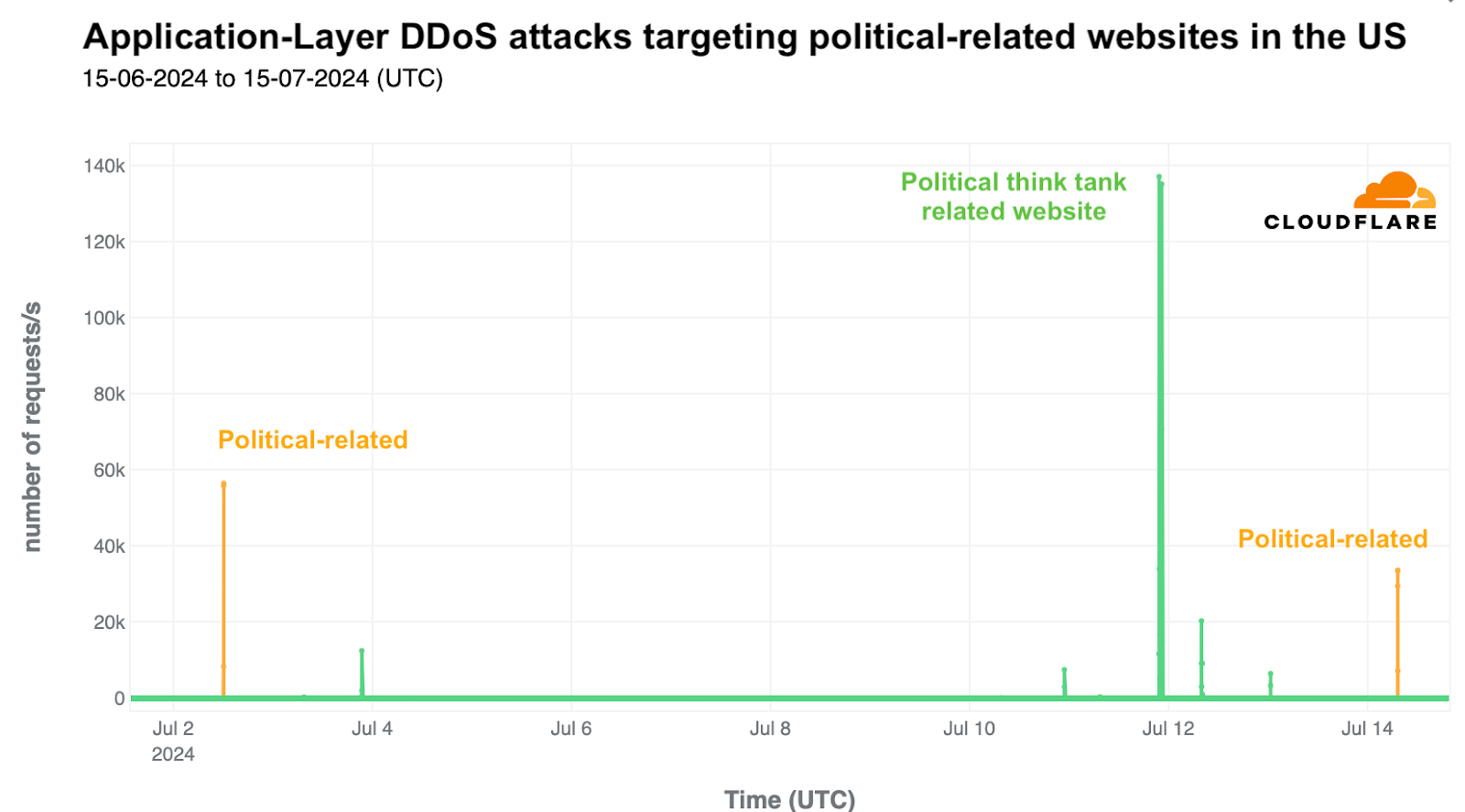
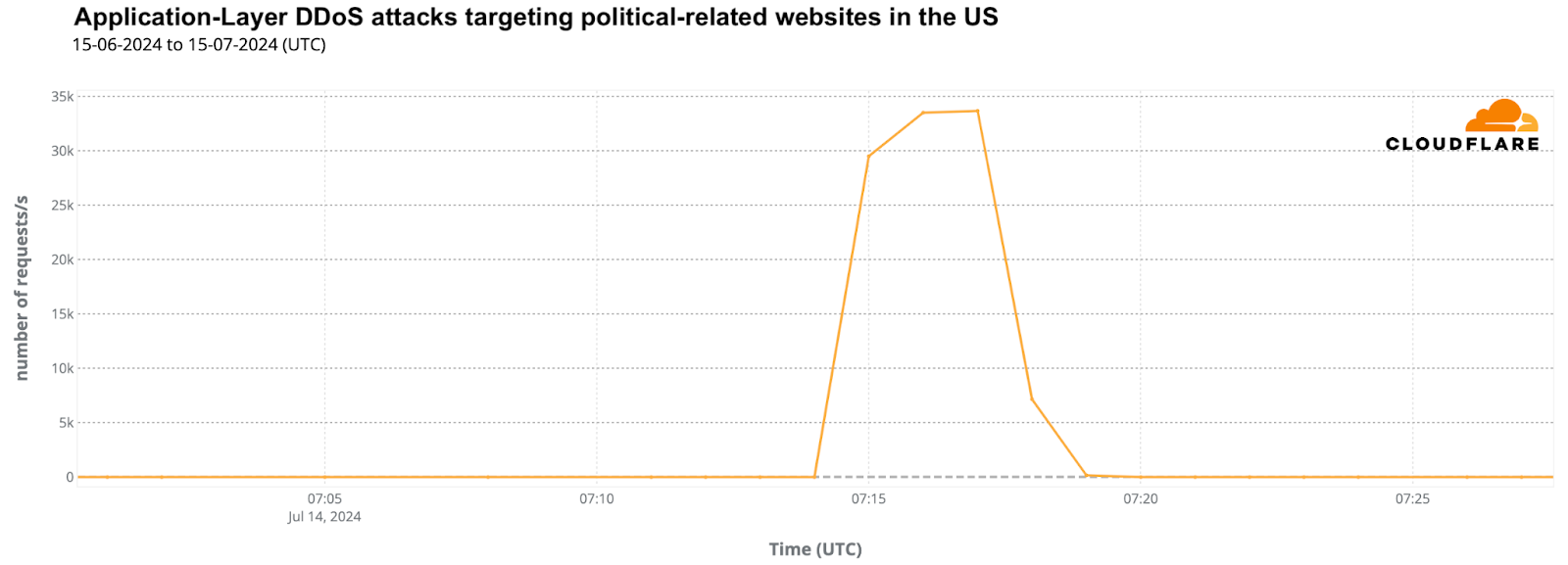
One of those is related to a political campaign, represented by the yellow line on the chart below. The first spike was a DDoS attack on July 2, 2024, peaking at 56,000 rps and lasting around 10 minutes. The same political-related site was attacked later on July 14, with a 34,000 rps peak, lasting four minutes.

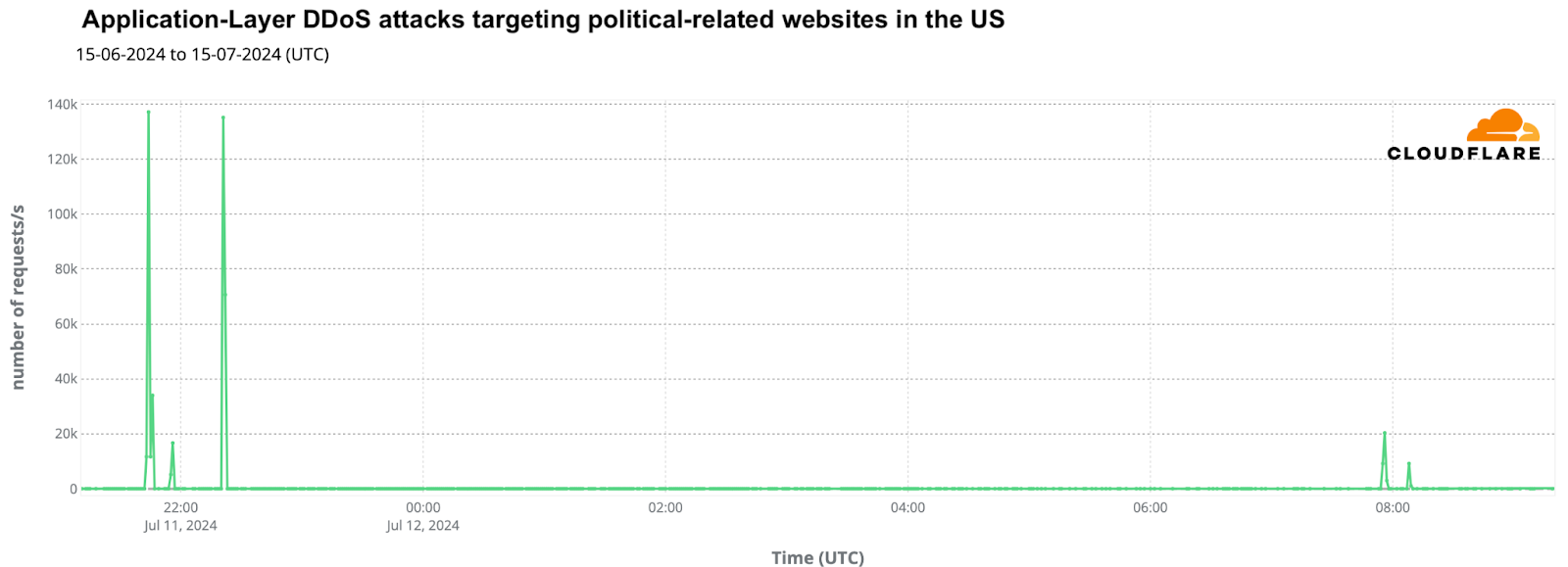
The other political-related site under attack, in green on the previous chart, is a think tank website that does policy advocacy related to presidential politics. It was already attacked before, around the time of the Biden vs Trump debate, as we’ve published at the time in a related blog post. The main attack was on July 11, with a 137,000 rps peak, lasting a few minutes, and was repeated, with slightly lower intensity, a few hours later on July 12.

As we’ve seen in our recent DDoS report, the vast majority of DDoS attacks are short. This emphasizes the need for automated, in-line detection and mitigation systems. Ten minutes are hardly enough time for a human to respond to an alert, analyze the traffic, and apply manual mitigations.

Trump assassination attempt impact

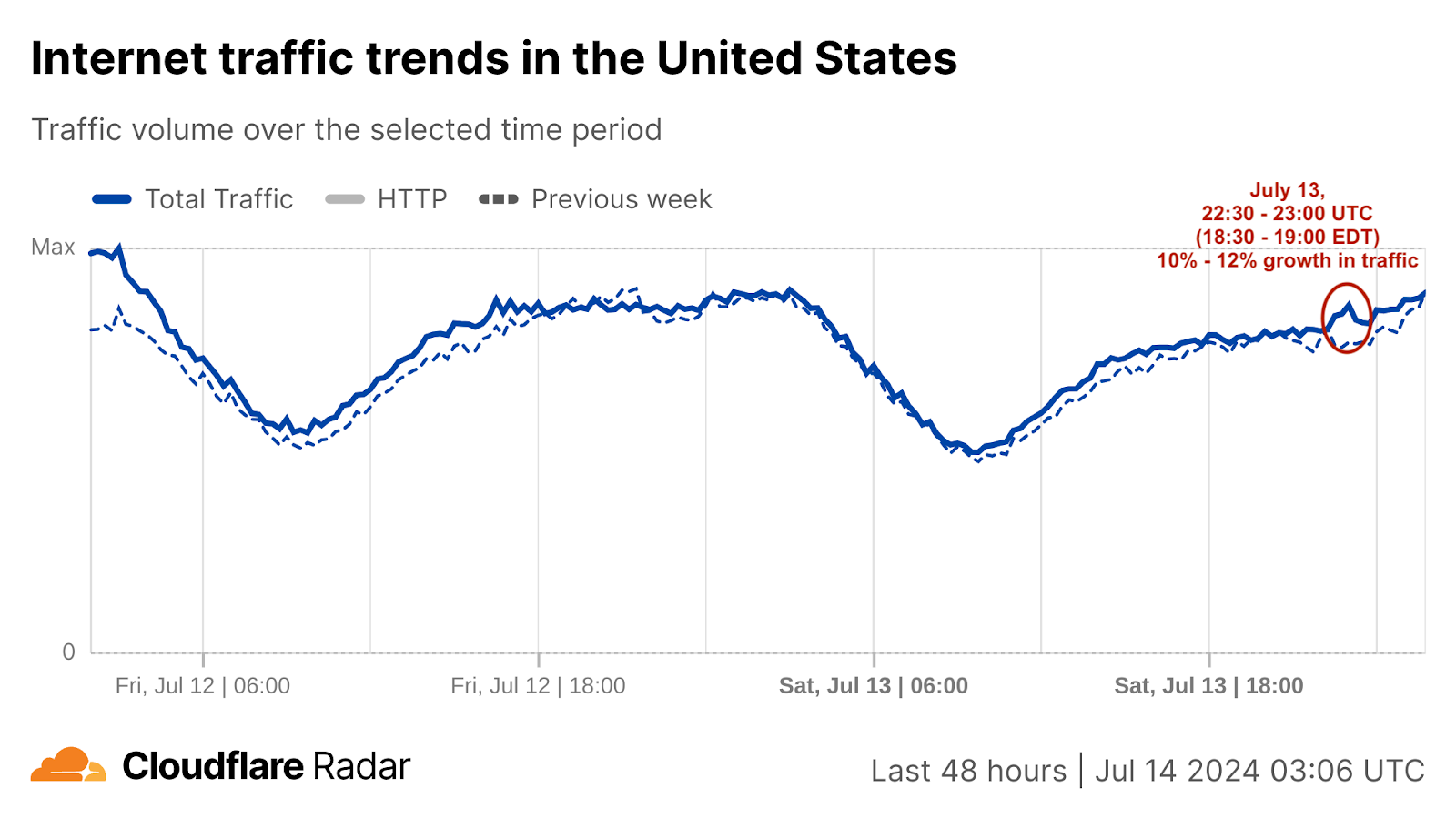
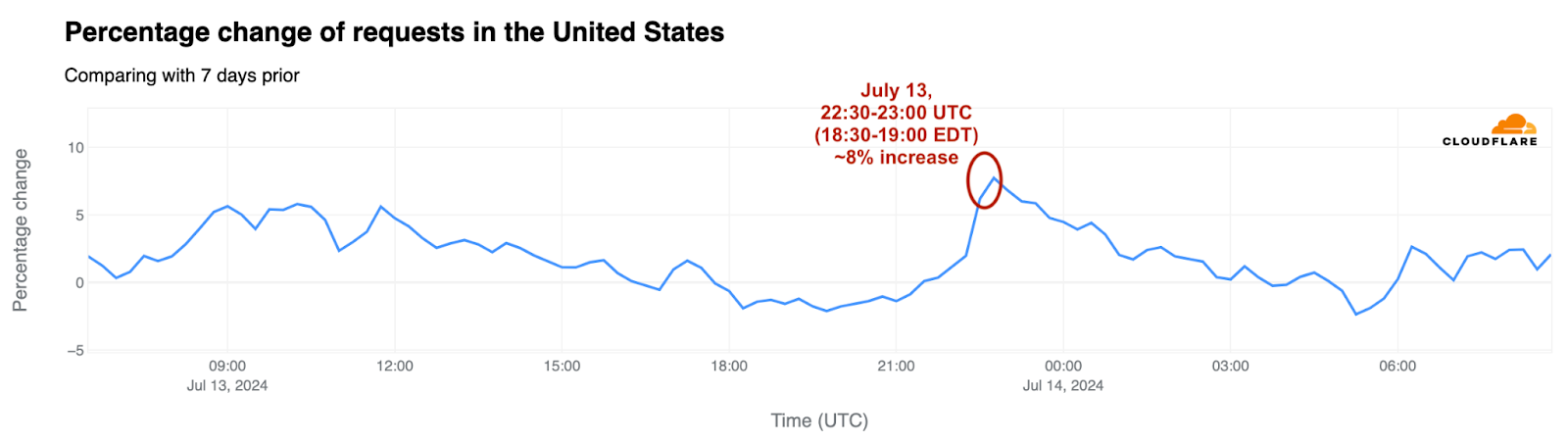
The attempted assassination of former President Trump at a campaign rally near Butler, Pennsylvania precipitated an increase in Internet traffic within the United States, particularly to news-related media outlets. As news broke of shots fired at a Trump rally, injuring the former president, Internet traffic in the United States (in bytes) increased around 22:30 – 23:00 UTC (18:30-19:00 EST) by 10% to 12%.

HTTP requests in the United States saw up to an 8% increase on July 13th compared to the previous week.

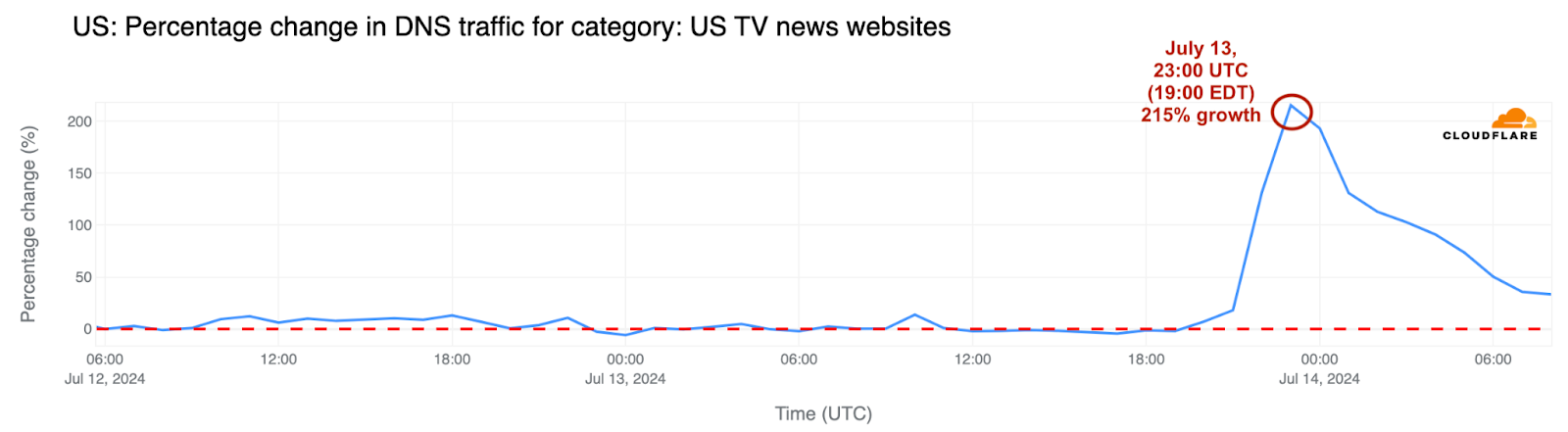
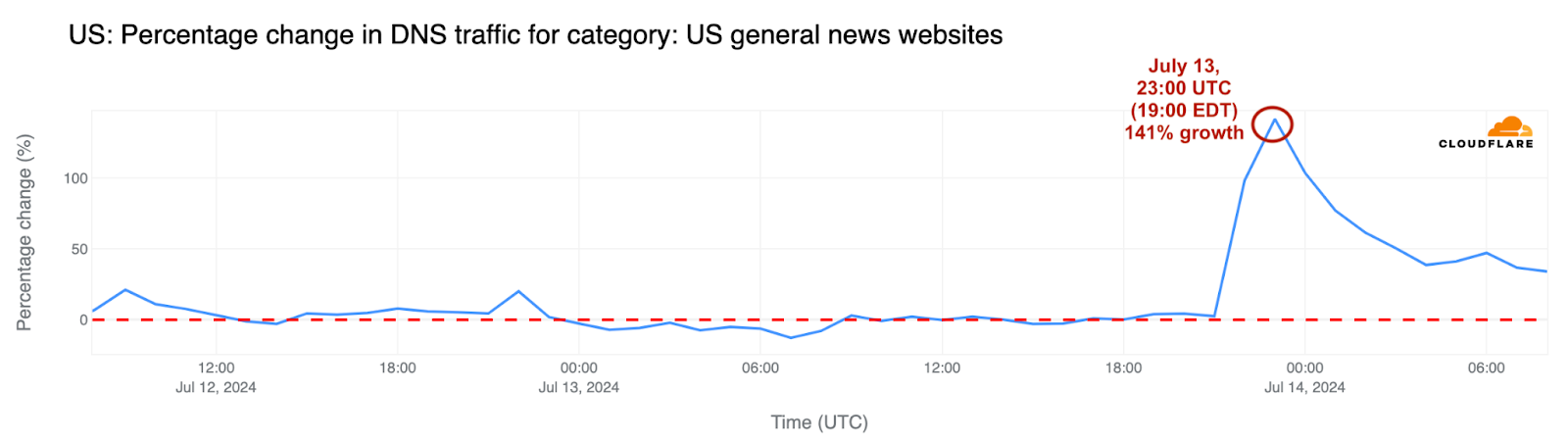
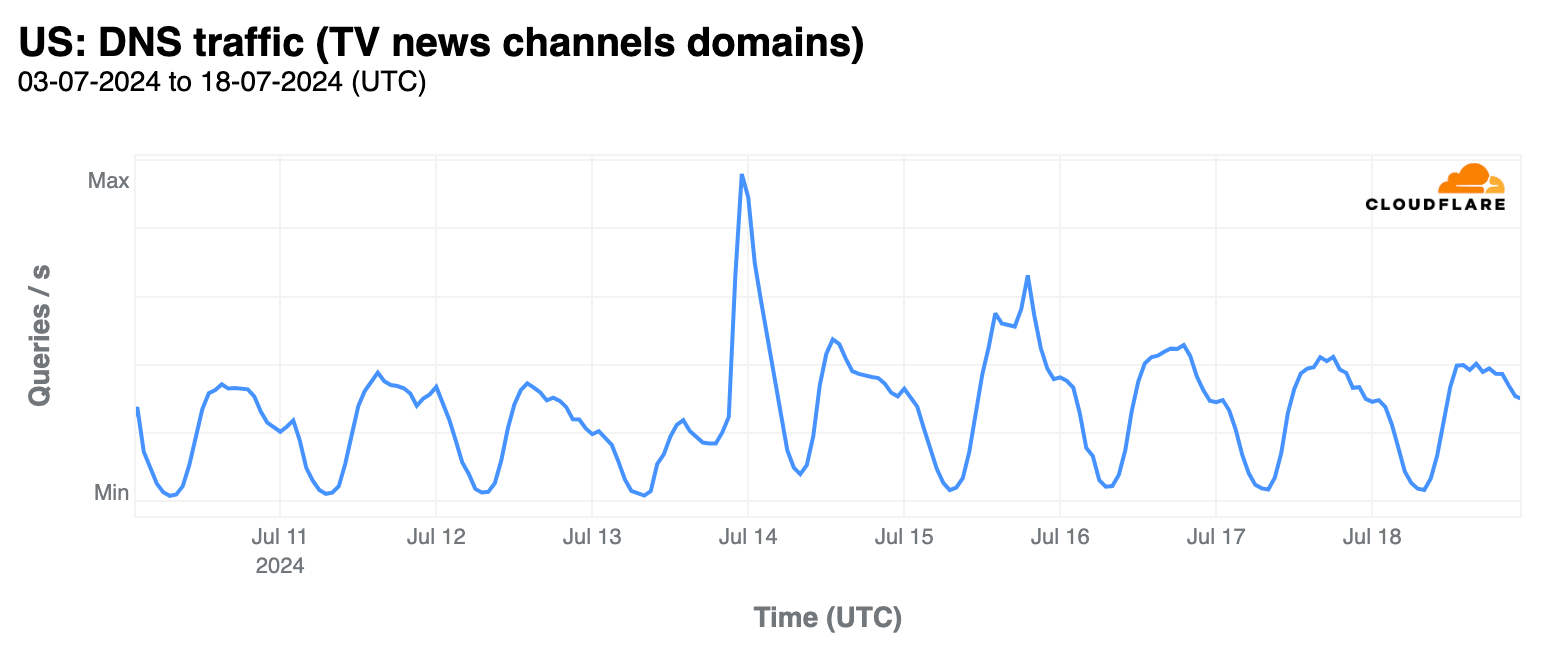
At the same time, DNS traffic to TV news sites, via our 1.1.1.1 resolver, surged by as much as 215%, and to general news sites by 141%.

Republican National Convention

The Republican National Convention is an important political event as delegates of the United States Republican Party choose the party’s nominees for president and vice president in the 2024 United States presidential election. Over the four-day event, convention delegates formally nominate the party’s presidential and vice presidential candidates and adopt the party’s platform, which outlines its policies and positions on various issues. The convention features speeches from prominent party members, including the nominees, party leaders, and other influential figures.

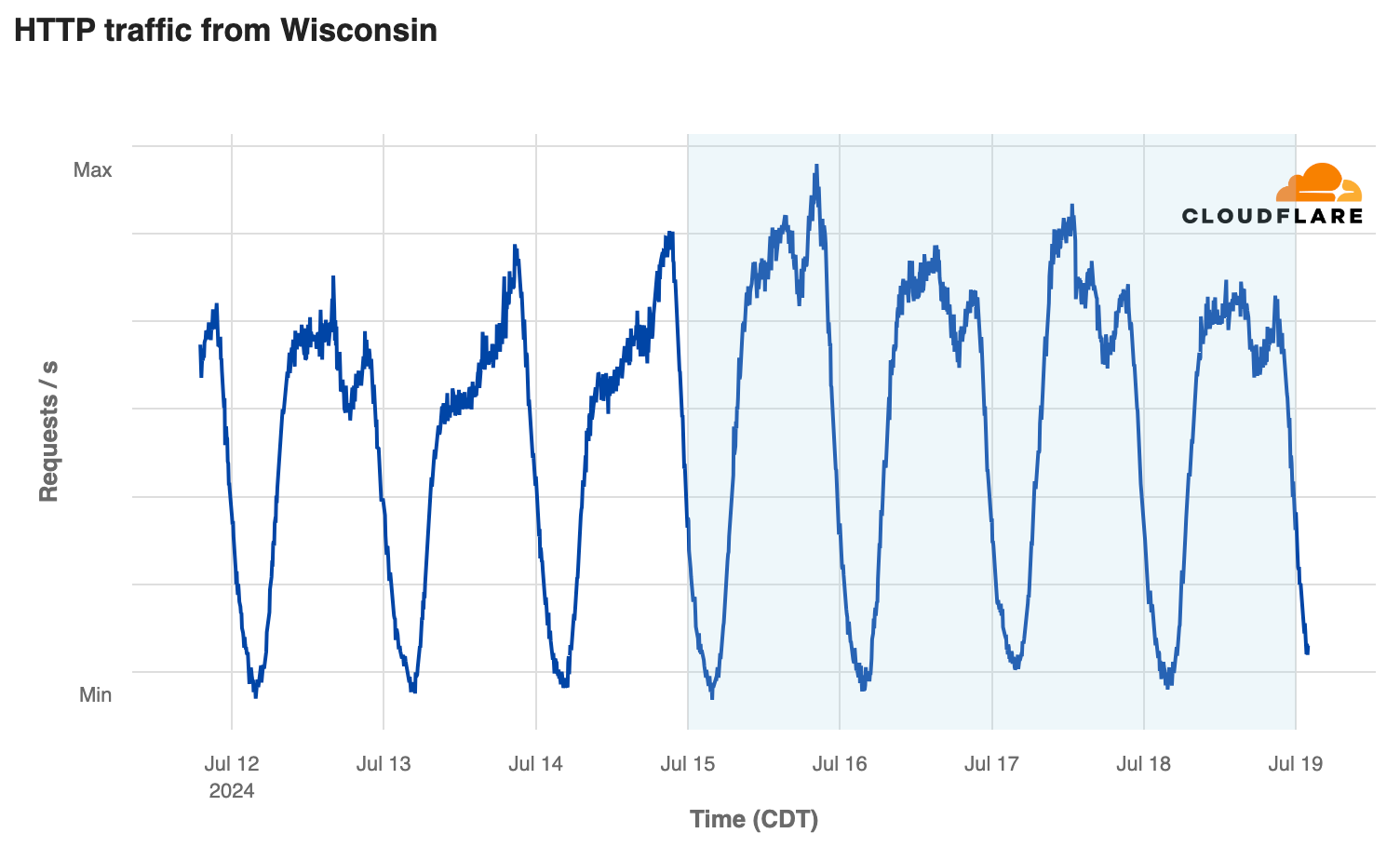
This year’s convention was held in Milwaukee, Wisconsin. During this time, we didn’t identify any noticeable traffic spikes from Milwaukee or from Wisconsin in general.

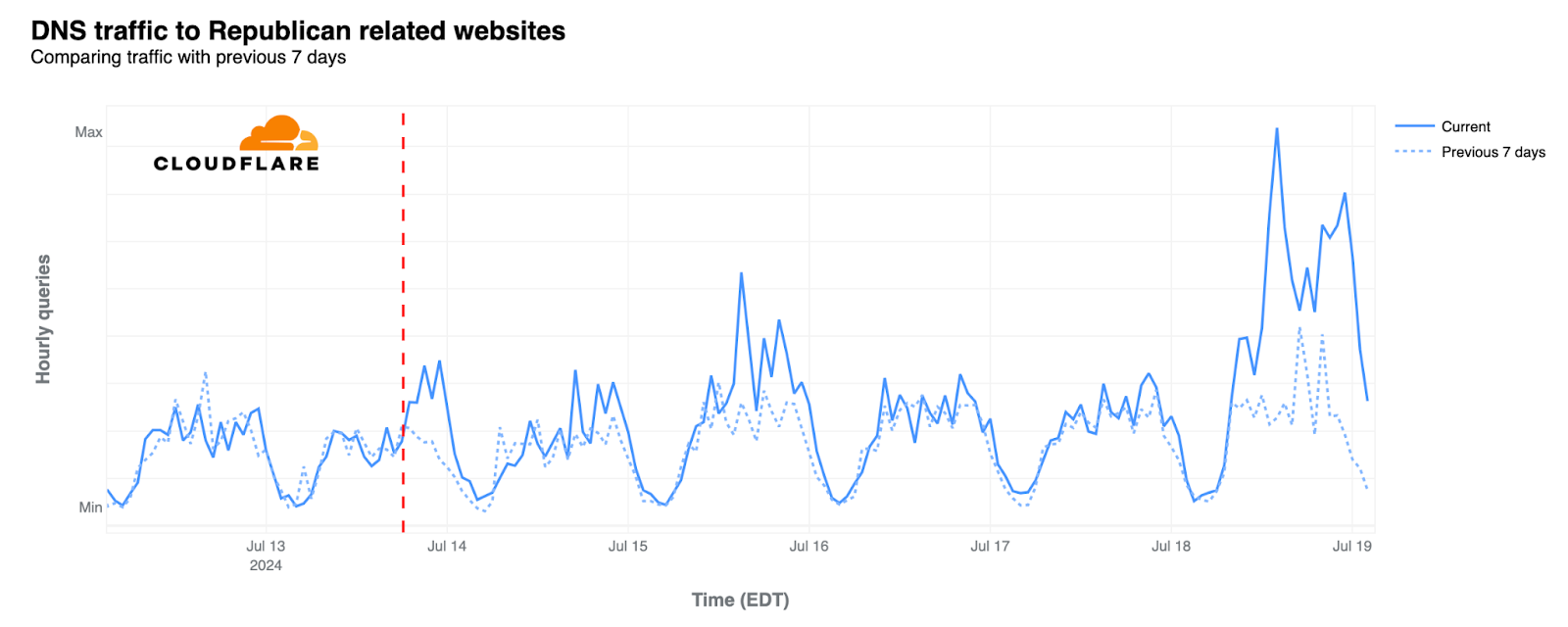
Compared to the previous week, there was an increase in DNS traffic to Republican political party and fundraising websites. On July 18th, the last day of the convention, we saw two considerable increases in hourly traffic compared to a week prior. The first at 14:00 EDT, an increase of 268% in traffic to these sites. The second, at 23:00 EDT with another increase at 266%. The daily aggregation on this day was an increase of 90.48% compared to daily traffic aggregations in the previous week.

For DNS traffic during the convention for TV news channels, we see steady traffic numbers with the highest peaking days before the convention on July 14, then during the late hours of July 15th.

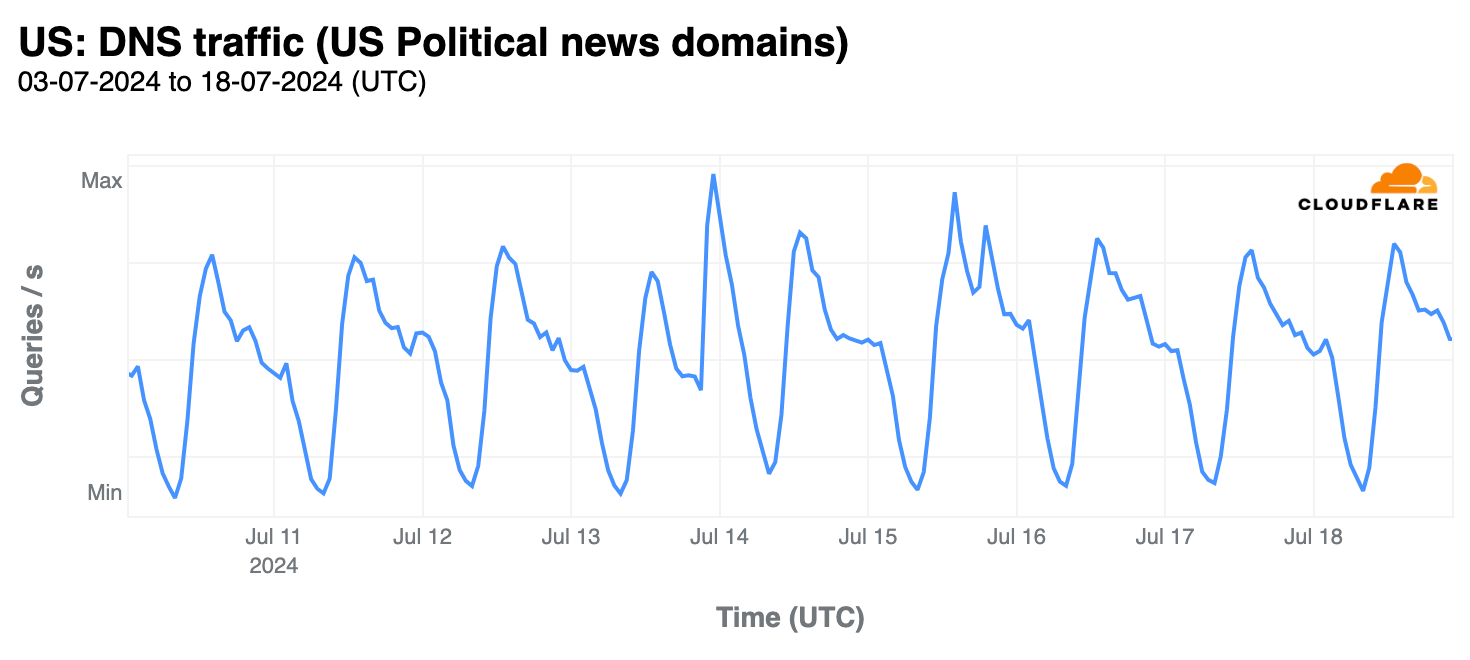
For political news websites covering the RNC, traffic numbers tend to decrease slightly as the event progresses.

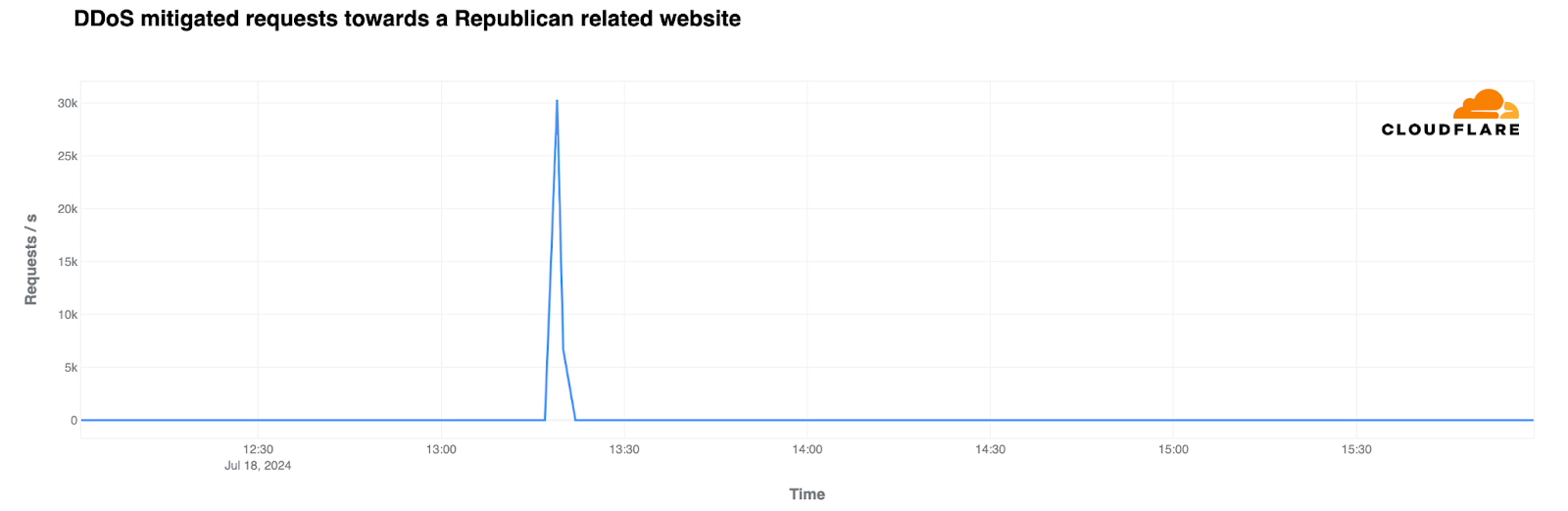
We identified an attack against a think-tank based in Washington D.C. that does policy advocacy related to presidential politics. The attack itself lasted around 3 minutes, from July 18th 13:18 to 13:22 exclusive (EDT) with a total of 3.12 million DDoS requests mitigated. The attack peaked at around 30.33k rps.

We see that major political events may not always cause significant shifts in Internet traffic. Our data indicates increases in traffic primarily to news and media organizations from July 13th onward. When it comes to cyber attacks, a majority of activity we see targets political campaigns and policy organizations.

If you want to follow more trends and insights about the Internet and elections in particular, you can check Cloudflare Radar, and more specifically our new 2024 Elections Insights report, which will be updated as elections take place throughout the year.

[$] Restricting execution of scripts — the third approach

Post Syndicated from corbet original https://lwn.net/Articles/982085/

The kernel will not consent to execute just any file that happens to be
sitting in a filesystem; there are formalities, such as the checking of
execute permission and consulting security policies, to get through first.
On some systems, security policies have been established to limit execution
to specifically approved programs. But there are files that are not
executed directly by the kernel; these include scripts fed to language
interpreters like Python, Perl, or a shell. An attacker who is able to get
an interpreter to execute a file may be able to bypass a system’s security
policies. Mickaël Salaün has been working on closing this hole for years;
the latest
attempt
takes the form of a new flag to the execveat()
system call.

Security updates for Friday

Post Syndicated from daroc original https://lwn.net/Articles/982559/

Security updates have been issued by AlmaLinux (firefox, java-1.8.0-openjdk, java-17-openjdk, java-21-openjdk, libndp, openssh, qt5-qtbase, ruby, skopeo, and thunderbird), Debian (thunderbird), Fedora (dotnet6.0, httpd, python-django, python-django4.2, qt6-qtbase, rapidjson, and ruby), Red Hat (389-ds-base, firefox, java-1.8.0-openjdk, java-11-openjdk, libndp, qt5-qtbase, and thunderbird), Slackware (httpd), SUSE (apache2, chromium, and kernel), and Ubuntu (apache2, linux-aws, linux-azure-fde, linux-azure-fde-5.15, linux-hwe-5.15, linux-aws-6.5, linux-lowlatency-hwe-6.5, linux-oracle-6.5, linux-starfive-6.5, and linux-raspi, linux-raspi-5.4).

Сглобка срещу Пеевски. Скалпел, моля!

Post Syndicated from Емилия Милчева original https://www.toest.bg/sglobka-sreshtu-peevski-skalpel-molya/

Сглобка срещу Пеевски. Скалпел, моля!

Може ли президентът Румен Радев и „Продължаваме промяната“ –„Демократична България“ (ПП–ДБ) да бъдат отново в един лагер четири години след протестите през лятото на 2020-та? Няма вечни врагове – нито пък вечни приятелства, но общият враг е добро начало за „отново“, макар и нетрайно, тъй като е ситуационно. Идеологическите и ценностните различия не са заличени. ПП–ДБ остават поддръжници на европейската политика за подкрепа на Украйна и санкции за Русия, а Радев – на противните позиции. 

В предаването на Веселин Дремджиев тази седмица Ивайло Мирчев от ПП–ДБ поиска Румен Радев да отговори защо Националната служба за охрана пак охранява Пеевски, отказал се от услугите ѝ след десанта на Росенец от екипа на „Да, България“. Също така допусна, че има синхрон между Пеевски, Радев и Борисов по линия на службите и че бързи избори са изгодни за Пеевски заради близостта му с вътрешния министър Калин Стоянов. Но същият този Стоянов де факто е начело на МВР още от кабинета на ПП–ДБ с премиер Николай Денков, а оглавява ГДБОП при друг вътрешен министър от ПП – Бойко Рашков. 

Нима тактически съюзи обаче не са възможни? Например ПП насърчи гласуването за Румен Радев, когато се кандидатира за втори президентски мандат. Независимо че неговите прокремълски пристрастия вече бяха явни, съпредседателят на ПП Кирил Петков излезе с видеообръщение:

За да имаме „Продължаваме промяната“, тази промяна трябваше да започне отнякъде. Човекът, който я започна, се казва Румен Радев. Това беше човекът, който излезе на площада, без да го е страх, и се опълчи срещу всички тези, които крадат от нашата република. Това е човекът, който обедини всички нас и ни даде възможност да повярваме, че промяната е възможна. Заедно с него, в следващите четири години, аз вярвам, че ще направим България да бъде тази, с която всички ние да се гордеем.

Деинсталиране

Доказателства, че е възможно обединение срещу общ враг, може да се намерят и в същите тези протести срещу мафията и задкулисието в политиката, олицетворени с портретите на лидера на ГЕРБ Бойко Борисов, олигарха (от ДПС) Делян Пеевски и тогавашния главен прокурор Иван Гешев. Същият този Гешев няколко години по-късно – през юни 2023 г., беше свален от поста с гласуване във ВСС, президентът бързо подписа указа за освобождаването му, а преди това ГЕРБ и ДПС поискаха оставката му като главен прокурор. На прощаване Гешев ги нарече „политически боклук“, а себе си – „жертва“.

Сега санкционираният за значима корупция от САЩ и Великобритания Пеевски най-вероятно ще сподели съдбата на някогашния си подопечен Гешев, макар и не с бързината, с която беше отстранен главният прокурор. От избухналото до колата му взривно устройство на 1 май м.г. до гласуването във Висшия съдебен съвет изминаха трийсетина дни. За Пеевски ще са необходими повече и едно заседание на Централния съвет на ДПС за начало.

Общ интерес

И за президента, и за ПП–ДБ от общ интерес е противопоставянето на (съ)председателя на ДПС Делян Пеевски и неутрализирането на влиянието му в съдебната система и службите. Вратите на този лагер са отворени и за партньори на Пеевски, на които почват да им тежат обвързаностите и искат да скъсат синджира. Такъв например е Бойко Борисов, в чиито премиерски мандати компании, свързвани с Пеевски, получаваха солидни обществени поръчки, медийната група на олигарха биеше по вразите на властта, а прокуратурата – по бизнесите им. Но готов ли е Борисов да хвърли оковите, или няма да посмее да счупи това най-модерно и тежко робство на политическите зависимости?

„Отборът“ срещу Пеевски също може да се нарече „сглобка“, тъй като играчите с неохота се събират, подобно на мнозинството за подкрепа на правителството „Денков–Габриел“. Но пък габаритите на противника изискват подобен фронт – главно за да бъде пресечена възможността му да презареди влиянието (на създателите си) в регулаторите и съдебната власт. А общата цел налага компромиси и готовност за сътрудничество.

Реформаторско

Така, от една страна, държавният глава си връща имиджа на реформатор и антикорупционер, заради който стана популярен и който се беше позагубил под напора на проруското му миротворчество в последните години. (Ако смята да опита с политически проект, слоганът за „чисти ръце“ ще му е от полза. През 2021 г., след като излезе първият списък със санкционирани по закона „Магнитски“ за корупция в България, Радев заяви, че „санкциите от САЩ са ясна диагноза за режима, който отгледа тази корупция“.) 

Редно ли е зад океана да ни кажат, че тук се вършат престъпления, а прокуратурата да не ги вижда? Прокуратурата взе страна на статуквото. Няма кой отвън да разплете това.

Румен Радев през 2021 г.

Скандалът в ДПС и яростната конфронтация Пеевски–Доган е основна политическа тема и държавният глава даде да се разбере на чия страна е. Макар че изявлението му дойде, след като беше атакуван от Пеевски заради полета си с учебно-тренировъчния самолет от ново поколение РС-21 по повод 20-годишнината от приемането на самолетите Pilatus в състава на българските ВВС:

Държавата гори, а някои хора летят. Вчера наблюдавахте ли какво се случва? Рекламни полети на спасители. Някой харчи парите, вместо да въртят вертолетите да гасят. Той защо не е на пожарите, защо не върши работа, а лети? Да вземе да кацне, да вземе да даде този мандат, после да даде третия мандат.

И отговорът дойде от Великобритания, където Радев участва в Четвъртата среща на върха на Европейската политическа общност.

Инсталирането на тежко компрометирани фигури като г-н Пеевски и възможността те да си присвояват безпрепятствено правото да се обявяват за евроатлантици, да раздават правосъдие наляво и надясно, да се превръщат в морални стожери, показва, че нашата политическа система е тежко заболяла. Начинът да я възстановим е чрез радикална хирургия. […] Скалпелът е в ръцете на българските избиратели, когато и да има следващи избори.

Скалпел, моля

Но най-напред ще се наложи скалпел да използва почетният председател на ДПС, за да изреже Пеевски от тялото на Движението, след като го призова в декларация да напусне. На Доган му е необходимо повече време, за да отцепва и връща към „автентичното ДПС“ депутати от отбора на Пеевски и да си гарантира постепенно числено превъзходство за едно предстоящо заседание на Централния съвет. На поредна среща в София от отбора на Доган ще обмислят как да действат по-нататък. В момента парламентарната група на ДПС наброява 22-ма от общо 47 – останалите са „независимите“ начело с Джевдет Чакъров. И той, и Пеевски са избрани за съпредседатели на Национална конференция на ДПС и само тя би могла да ги/го отстрани.

Както беше отбелязано, бързи избори за 51-ви парламент работят за съпредседателя Пеевски и затова той грубо подканя президента да побърза. Насрочването им и времето, което ще отнемат танците с мандатите, зависят от държавния глава. Нови избори може да презаредят модела Пеевски, предупреди по БНТ наскоро съпредседателят на ДБ (в оставка) Христо Иванов. 

Със сигурност Доган не би искал да реже живо месо от партията повече от необходимото, а бързи избори няма да донесат обнадеждаващи резултати за ДПС. След като президентът Радев обаче заяви, че август не е най-добрият месец за предизборна кампания, нито избори до средата на септември, а и партиите не го искат, поне два месеца са гарантирани. 

Съюзници

Политическите сили в България са се обединявали срещу общи врагове за постигане на важни политически цели. Например протестите през 2013–2014 г., отключени след назначението на Пеевски за шеф на ДАНС, доведоха до обединение на различни политически и граждански групи срещу правителството на Пламен Орешарски. Същото се получи и с гражданското недоволство през 2020 г. – подкрепящите протестите тогава се оказаха в различни, често противостоящи политически лагери. 

Но ГЕРБ, чиито активисти също протестираха през 2013–2014 г., сега има прекалено силни зависимости от Пеевски. Подвластни са му и от БСП – още от времената на тройната коалиция, въпреки че тогава той правеше първи стъпки в политиката, но пък какви стъпки. Назначен е за заместник-министър на държавната политика при бедствия и аварии в създаденото по идея на ДПС специално министерство и е от квотата на ДПС. При тройната коалиция започва да придобива влияние в медийния сектор и така разширява и уплътнява влиянието си. 

За дезактивирането на Пеевски и изваждането му от ДПС ще са нужни обединени усилия. Но този процес не изчерпва антикорупционната битка, а е само едно добро начало. За продължението ѝ не Доган трябва да държи скалпела, а силата на правото.

Помогнете ни да научим какви са читателските ви възприятия и отношението ви към „Тоест“, като попълните нашата анкета.

New guide on using generative AI for teachers and schools

Post Syndicated from Ben Garside original https://www.raspberrypi.org/blog/new-guide-on-using-generative-ai-for-teachers-and-schools/

The world of education is loud with discussions about the uses and risks of generative AI — tools for outputting human-seeming media content such as text, images, audio, and video. In answer, there’s a new practical guide on using generative AI aimed at Computing teachers (and others), written by a group of classroom teachers and researchers at the Raspberry Pi Computing Education Research Centre and Faculty of Education at the University of Cambridge.

Two educators discuss something at a desktop computer.

Their new guide is a really useful overview for everyone who wants to:

  • Understand the issues generative AI tools present in the context of education
  • Find out how to help their schools and students navigate them
  • Discover ideas on how to make use of generative AI tools in their teaching

Since generative AI tools have become publicly available, issues around data privacy and plagiarism are at the front of educators’ minds. At the same time, many educators are coming up with creative ways to use generative AI tools to enhance teaching and learning. The Research Centre’s guide describes the areas where generative AI touches on education, and lays out what schools and teachers can do to use the technology beneficially and help their learners do the same.

Teaching students about generative AI tools

It’s widely accepted that AI tools can bring benefits but can also be used in unhelpful or harmful ways. Basic knowledge of how AI and machine learning works is key to being able to get the best from them. The Research Centre’s guide shares recommended educational resources for teaching learners about AI.

A desktop computer showing the Experience AI homepage.

One of the recommendations is Experience AI, a set of free classroom resources we’re creating. It includes a set of 6 lessons for providing 11- to 14-year-olds with a foundational understanding of AI systems, as well as a standalone lesson specifically for teaching about large language model-based AI tools, such as ChatGPT and Google Gemini. These materials are for teachers of any specialism, not just for Computing teachers.

You’ll find that even a brief introduction to how large language models work is likely to make students’ ideas about using these tools to do all their homework much less appealing. The guide outlines creative ways you can help students see some of generative AI’s pitfalls, such as asking students to generate outputs and compare them, paying particular attention to inaccuracies in the outputs.

Generative AI tools and teaching computing

We’re still learning about what the best ways to teach programming to novice learners are. Generative AI has the potential to change how young people learn text-based programming, as AI functionality is now integrated into many of the major programming environments, generating example solutions or helping to spot errors.

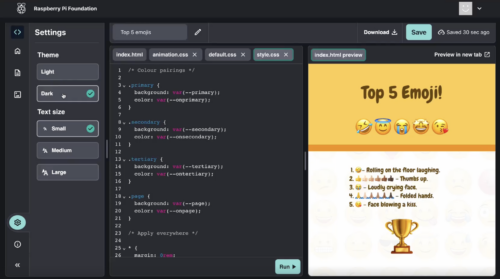
A web project in the Code Editor.

The Research Centre’s guide acknowledges that there’s more work to be done to understand how and when to support learners with programming tasks through generative AI tools. (You can follow our ongoing seminar series on the topic.) In the meantime, you may choose to support established programming pedagogies with generative AI tools, such as prompting an AI chatbot to generate a PRIMM activity on a particular programming concept.

As ethics and the impact of technology play an important part in any good Computing curriculum, the guide also shares ways to use generative AI tools as a focus for your classroom discussions about topics such as bias and inequality.

Using generative AI tools to support teaching and learning

Teachers have been using generative AI applications as productivity tools to support their teaching, and the Research Centre’s guide gives several examples you can try out yourself. Examples include creating summaries of textual materials for students, and creating sets of questions on particular topics. As the guide points out, when you use generative AI tools like this, it’s important to always check the accuracy of the generated materials before you give any of them to your students.

Putting a school-wide policy in place

Importantly, the Research Centre’s guide highlights the need for a school-wide acceptable use policy (AUP) that informs teachers, other school staff, and students on how they may use generative AI tools. This section of the guide suggests websites that offer sample AUPs that can be used as a starting point for your school. Your AUP should aim to keep users safe, covering e-safety, privacy, and security issues as well as offering guidance on being transparent about the use of generative tools.

Teachers in discussion at a table.

It’s not uncommon that schools look to specialist Computing teachers to act as the experts on questions around use of digital tools. However, for developing trust in how generative AI tools are used in the school, it’s important to encourage as wide a range of stakeholders as possible to be consulted in the process of creating an AUP.

A source of support for teachers and schools

As the Research Centre’s guide recognises, the landscape of AI and our thinking about it might change. In this uncertain context, the document offers a sensible and detailed overview of where we are now in understanding the current impact of generative AI on Computing as a subject, and on education more broadly. The example use cases and thought-provoking next steps on how this technology can be used and what its known risks and concerns are should be helpful for all interested educators and schools.

I recommend that all Computing teachers read this new guide, and I hope you feel inspired about the key role that you can play in shaping the future of education affected by AI.

The post New guide on using generative AI for teachers and schools appeared first on Raspberry Pi Foundation.

Migrate from Apache Solr to OpenSearch

Post Syndicated from Aswath Srinivasan original https://aws.amazon.com/blogs/big-data/migrate-from-apache-solr-to-opensearch/

OpenSearch is an open source, distributed search engine suitable for a wide array of use-cases such as ecommerce search, enterprise search (content management search, document search, knowledge management search, and so on), site search, application search, and semantic search. It’s also an analytics suite that you can use to perform interactive log analytics, real-time application monitoring, security analytics and more. Like Apache Solr, OpenSearch provides search across document sets. OpenSearch also includes capabilities to ingest and analyze data. Amazon OpenSearch Service is a fully managed service that you can use to deploy, scale, and monitor OpenSearch in the AWS Cloud.

Many organizations are migrating their Apache Solr based search solutions to OpenSearch. The main driving factors include lower total cost of ownership, scalability, stability, improved ingestion connectors (such as Data Prepper, Fluent Bit, and OpenSearch Ingestion), elimination of external cluster managers like Zookeeper, enhanced reporting, and rich visualizations with OpenSearch Dashboards.

We recommend approaching a Solr to OpenSearch migration with a full refactor of your search solution to optimize it for OpenSearch. While both Solr and OpenSearch use Apache Lucene for core indexing and query processing, the systems exhibit different characteristics. By planning and running a proof-of-concept, you can ensure the best results from OpenSearch. This blog post dives into the strategic considerations and steps involved in migrating from Solr to OpenSearch.

Key differences

Solr and OpenSearch Service share fundamental capabilities delivered through Apache Lucene. However, there are some key differences in terminology and functionality between the two:

  • Collection and index: In OpenSearch, a collection is called an index.
  • Shard and replica: Both Solr and OpenSearch use the terms shard and replica.
  • API-driven Interactions: All interactions in OpenSearch are API-driven, eliminating the need for manual file changes or Zookeeper configurations. When creating an OpenSearch index, you define the mapping (equivalent to the schema) and the settings (equivalent to solrconfig) as part of the index creation API call.

Having set the stage with the basics, let’s dive into the four key components and how each of them can be migrated from Solr to OpenSearch.

Collection to index

A collection in Solr is called an index in OpenSearch. Like a Solr collection, an index in OpenSearch also has shards and replicas.

Although the shard and replica concept is similar in both the search engines, you can use this migration as a window to adopt a better sharding strategy. Size your OpenSearch shards, replicas, and index by following the shard strategy best practices.

As part of the migration, reconsider your data model. In examining your data model, you can find efficiencies that dramatically improve your search latencies and throughput. Poor data modeling doesn’t only result in search performance problems but extends to other areas. For example, you might find it challenging to construct an effective query to implement a particular feature. In such cases, the solution often involves modifying the data model.

Differences: Solr allows primary shard and replica shard collocation on the same node. OpenSearch doesn’t place the primary and replica on the same node. OpenSearch Service zone awareness can automatically ensure that shards are distributed to different Availability Zones (data centers) to further increase resiliency.

The OpenSearch and Solr notions of replica are different. In OpenSearch, you define a primary shard count using number_of_primaries that determines the partitioning of your data. You then set a replica count using number_of_replicas. Each replica is a copy of all the primary shards. So, if you set number_of_primaries to 5, and number_of_replicas to 1, you will have 10 shards (5 primary shards, and 5 replica shards). Setting replicationFactor=1 in Solr yields one copy of the data (the primary).

For example, the following creates a collection called test with one shard and no replicas.

http://localhost:8983/solr/admin/collections?
  _=action=CREATE
  &maxShardsPerNode=2
  &name=test
  &numShards=1
  &replicationFactor=1
  &wt=json

In OpenSearch, the following creates an index called test with five shards and one replica

PUT test
{
  "settings": {
    "number_of_shards": 5,
    "number_of_replicas": 1
  }
}

Schema to mapping

In Solr schema.xml OR managed-schema has all the field definitions, dynamic fields, and copy fields along with field type (text analyzers, tokenizers, or filters). You use the schema API to manage schema. Or you can run in schema-less mode.

OpenSearch has dynamic mapping, which behaves like Solr in schema-less mode. It’s not necessary to create an index beforehand to ingest data. By indexing data with a new index name, you create the index with OpenSearch managed service default settings (for example: "number_of_shards": 5, "number_of_replicas": 1) and the mapping based on the data that’s indexed (dynamic mapping).

We strongly recommend you opt for a pre-defined strict mapping. OpenSearch sets the schema based on the first value it sees in a field. If a stray numeric value is the first value for what is really a string field, OpenSearch will incorrectly map the field as numeric (integer, for example). Subsequent indexing requests with string values for that field will fail with an incorrect mapping exception. You know your data, you know your field types, you will benefit from setting the mapping directly.

Tip: Consider performing a sample indexing to generate the initial mapping and then refine and tidy up the mapping to accurately define the actual index. This approach helps you avoid manually constructing the mapping from scratch.

For Observability workloads, you should consider using Simple Schema for Observability. Simple Schema for Observability (also known as ss4o) is a standard for conforming to a common and unified observability schema. With the schema in place, Observability tools can ingest, automatically extract, and aggregate data and create custom dashboards, making it easier to understand the system at a higher level.

Many of the field types (data types), tokenizers, and filters are the same in both Solr and OpenSearch. After all, both use Lucene’s Java search library at their core.

Let’s look at an example:

<!-- Solr schema.xml snippets -->
<field name="id" type="string" indexed="true" stored="true" required="true" multiValued="false" /> 
<field name="name" type="string" indexed="true" stored="true" multiValued="true"/>
<field name="address" type="text_general" indexed="true" stored="true"/>
<field name="user_token" type="string" indexed="false" stored="true"/>
<field name="age" type="pint" indexed="true" stored="true"/>
<field name="last_modified" type="pdate" indexed="true" stored="true"/>
<field name="city" type="text_general" indexed="true" stored="true"/>

<uniqueKey>id</uniqueKey>

<copyField source="name" dest="text"/>
<copyField source="address" dest="text"/>

<fieldType name="string" class="solr.StrField" sortMissingLast="true" />
<fieldType name="pint" class="solr.IntPointField" docValues="true"/>
<fieldType name="pdate" class="solr.DatePointField" docValues="true"/>

<fieldType name="text_general" class="solr.TextField" positionIncrementGap="100">
<analyzer type="index">
    <tokenizer class="solr.StandardTokenizerFactory"/>
    <filter class="solr.ASCIIFoldingFilterFactory" preserveOriginal="false" />
    <filter class="solr.LowerCaseFilterFactory"/>
</analyzer>
<analyzer type="query">
    <tokenizer class="solr.StandardTokenizerFactory"/>
    <filter class="solr.ASCIIFoldingFilterFactory" preserveOriginal="false" />
    <filter class="solr.LowerCaseFilterFactory"/>
</analyzer>
</fieldType>
PUT index_from_solr
{
  "settings": {
    "analysis": {
      "analyzer": {
        "text_general": {
          "type": "custom",
          "tokenizer": "standard",
          "filter": [
            "lowercase",
            "asciifolding"
          ]
        }
      }
    }
  },
  "mappings": {
    "properties": {
      "name": {
        "type": "keyword",
        "copy_to": "text"
      },
      "address": {
        "type": "text",
        "analyzer": "text_general"
      },
      "user_token": {
        "type": "keyword",
        "index": false
      },
      "age": {
        "type": "integer"
      },
      "last_modified": {
        "type": "date"
      },
      "city": {
        "type": "text",
        "analyzer": "text_general"
      },
      "text": {
        "type": "text",
        "analyzer": "text_general"
      }
    }
  }
}

Notable things in OpenSearch compared to Solr:

  1. _id is always the uniqueKey and cannot be defined explicitly, because it’s always present.
  2. Explicitly enabling multivalued isn’t necessary because any OpenSearch field can contain zero or more values.
  3. The mapping and the analyzers are defined during index creation. New fields can be added and certain mapping parameters can be updated later. However, deleting a field isn’t possible. A handy ReIndex API can overcome this problem. You can use the Reindex API to index data from one index to another.
  4. By default, analyzers are for both index and query time. For some less-common scenarios, you can change the query analyzer at search time (in the query itself), which will override the analyzer defined in the index mapping and settings.
  5. Index templates are also a great way to initialize new indexes with predefined mappings and settings. For example, if you continuously index log data (or any time-series data), you can define an index template so that all the indices have the same number of shards and replicas. It can also be used for dynamic mapping control and component templates

Look for opportunities to optimize the search solution. For instance, if the analysis reveals that the city field is solely used for filtering rather than searching, consider changing its field type to keyword instead of text to eliminate unnecessary text processing. Another optimization could involve disabling doc_values for the user_token field if it’s only intended for display purposes. doc_values are disabled by default for the text datatype.

SolrConfig to settings

In Solr, solrconfig.xml carries the collection configuration. All sorts of configurations pertaining to everything from index location and formatting, caching, codec factory, circuit breaks, commits and tlogs all the way up to slow query config, request handlers, and update processing chain, and so on.

Let’s look at an example:

<codecFactory class="solr.SchemaCodecFactory">
<str name="compressionMode">`BEST_COMPRESSION`</str>
</codecFactory>

<autoCommit>
    <maxTime>${solr.autoCommit.maxTime:15000}</maxTime>
    <openSearcher>false</openSearcher>
</autoCommit>

<autoSoftCommit>
    <maxTime>${solr.autoSoftCommit.maxTime:-1}</maxTime>
    </autoSoftCommit>

<slowQueryThresholdMillis>1000</slowQueryThresholdMillis>

<maxBooleanClauses>${solr.max.booleanClauses:2048}</maxBooleanClauses>

<requestHandler name="/query" class="solr.SearchHandler">
    <lst name="defaults">
    <str name="echoParams">explicit</str>
    <str name="wt">json</str>
    <str name="indent">true</str>
    <str name="df">text</str>
    </lst>
</requestHandler>

<searchComponent name="spellcheck" class="solr.SpellCheckComponent"/>
<searchComponent name="suggest" class="solr.SuggestComponent"/>
<searchComponent name="elevator" class="solr.QueryElevationComponent"/>
<searchComponent class="solr.HighlightComponent" name="highlight"/>

<queryResponseWriter name="json" class="solr.JSONResponseWriter"/>
<queryResponseWriter name="velocity" class="solr.VelocityResponseWriter" startup="lazy"/>
<queryResponseWriter name="xslt" class="solr.XSLTResponseWriter"/>

<updateRequestProcessorChain name="script"/>

Notable things in OpenSearch compared to Solr:

  1. Both OpenSearch and Solr have BEST_SPEED codec as default (LZ4 compression algorithm). Both offer BEST_COMPRESSION as an alternative. Additionally OpenSearch offers zstd and zstd_no_dict. Benchmarking for different compression codecs is also available.
  2. For near real-time search, refresh_interval needs to be set. The default is 1 second which is good enough for most use cases. We recommend increasing refresh_interval to 30 or 60 seconds to improve indexing speed and throughput, especially for batch indexing.
  3. Max boolean clause is a static setting, set at node level using the indices.query.bool.max_clause_count setting.
  4. You don’t need an explicit requestHandler. All searches use the _search or _msearch endpoint. If you’re used to using the requestHandler with default values then you can use search templates.
  5. If you’re used to using /sql requestHandler, OpenSearch also lets you use SQL syntax for querying and has a Piped Processing Language.
  6. Spellcheck, also known as Did-you-mean, QueryElevation (known as pinned_query in OpenSearch), and highlighting are all supported during query time. You don’t need to explicitly define search components.
  7. Most API responses are limited to JSON format, with CAT APIs as the only exception. In cases where Velocity or XSLT is used in Solr, it must be managed on the application layer. CAT APIs respond in JSON, YAML, or CBOR formats.
  8. For the updateRequestProcessorChain, OpenSearch provides the ingest pipeline, allowing the enrichment or transformation of data before indexing. Multiple processor stages can be chained to form a pipeline for data transformation. Processors include GrokProcessor, CSVParser, JSONProcessor, KeyValue, Rename, Split, HTMLStrip, Drop, ScriptProcessor, and more. However, it’s strongly recommended to do the data transformation outside OpenSearch. The ideal place to do that would be at OpenSearch Ingestion, which provides a proper framework and various out-of-the-box filters for data transformation. OpenSearch Ingestion is built on Data Prepper, which is a server-side data collector capable of filtering, enriching, transforming, normalizing, and aggregating data for downstream analytics and visualization.
  9. OpenSearch also introduced search pipelines, similar to ingest pipelines but tailored for search time operations. Search pipelines make it easier for you to process search queries and search results within OpenSearch. Currently available search processors include filter query, neural query enricher, normalization, rename field, scriptProcessor, and personalize search ranking, with more to come.
  10. The following image shows how to set refresh_interval and slowlog. It also shows you the other possible settings.
  11. Slow logs can be set like the following image but with much more precision with separate thresholds for the query and fetch phases.

Before migrating every configuration setting, assess if the setting can be adjusted based on your current search system experience and best practices. For instance, in the preceding example, the slow logs threshold of 1 second might be intensive for logging, so that can be revisited. In the same example, max.booleanClauses might be another thing to look at and reduce.

Differences: Some settings are done at the cluster level or node level and not at the index level. Including settings such as max boolean clause, circuit breaker settings, cache settings, and so on.

Rewriting queries

Rewriting queries deserves its own blog post; however we want to at least showcase the autocomplete feature available in OpenSearch Dashboards, which helps ease query writing.

Similar to the Solr Admin UI, OpenSearch also features a UI called OpenSearch Dashboards. You can use OpenSearch Dashboards to manage and scale your OpenSearch clusters. Additionally, it provides capabilities for visualizing your OpenSearch data, exploring data, monitoring observability, running queries, and so on. The equivalent for the query tab on the Solr UI in OpenSearch Dashboard is Dev Tools. Dev Tools is a development environment that lets you set up your OpenSearch Dashboards environment, run queries, explore data, and debug problems.

Now, let’s construct a query to accomplish the following:

  1. Search for shirt OR shoe in an index.
  2. Create a facet query to find the number of unique customers. Facet queries are called aggregation queries in OpenSearch. Also known as aggs query.

The Solr query would look like this:

http://localhost:8983/solr/solr_sample_data_ecommerce/select?q=shirt OR shoe
  &facet=true
  &facet.field=customer_id
  &facet.limit=-1
  &facet.mincount=1
  &json.facet={
   unique_customer_count:"unique(customer_id)"
  }

The image below demonstrates how to re-write the above Solr query into an OpenSearch query DSL:

Conclusion

OpenSearch covers a wide variety of uses cases, including enterprise search, site search, application search, ecommerce search, semantic search, observability (log observability, security analytics (SIEM), anomaly detection, trace analytics), and analytics. Migration from Solr to OpenSearch is becoming a common pattern. This blog post is designed to be a starting point for teams seeking guidance on such migrations.

You can try out OpenSearch with the OpenSearch Playground. You can get started with Amazon OpenSearch Service, a managed implementation of OpenSearch in the AWS Cloud.


About the Authors

Aswath Srinivasan is a Senior Search Engine Architect at Amazon Web Services currently based in Munich, Germany. With over 17 years of experience in various search technologies, Aswath currently focuses on OpenSearch. He is a search and open-source enthusiast and helps customers and the search community with their search problems.

Jon Handler is a Senior Principal Solutions Architect at Amazon Web Services based in Palo Alto, CA. Jon works closely with OpenSearch and Amazon OpenSearch Service, providing help and guidance to a broad range of customers who have search and log analytics workloads that they want to move to the AWS Cloud. Prior to joining AWS, Jon’s career as a software developer included 4 years of coding a large-scale, ecommerce search engine. Jon holds a Bachelor of the Arts from the University of Pennsylvania, and a Master of Science and a PhD in Computer Science and Artificial Intelligence from Northwestern University.

The collective thoughts of the interwebz