Post Syndicated from Explosm.net original https://explosm.net/comics/elbow
New Cyanide and Happiness Comic
Post Syndicated from Explosm.net original https://explosm.net/comics/elbow
New Cyanide and Happiness Comic
Post Syndicated from original https://xkcd.com/2778/

Post Syndicated from Николай Марченко original https://bivol.bg/geshev-na-komisiqta.html

Между 4 и 5 часа обсъждане потрябва на Комисията по правни въпроси в Народното събрание, за да приеме на първо четене промени в Наказателно-процесуалния кодекс (НПК), с които се предвижда…
Post Syndicated from Curious Droid original https://www.youtube.com/watch?v=jl5yQ6RX_eE
Post Syndicated from Danilo Poccia original https://aws.amazon.com/blogs/aws/new-simplify-the-investigation-of-aws-security-findings-with-amazon-detective/
With Amazon Detective, you can analyze and visualize security data to investigate potential security issues. Detective collects and analyzes events that describe IP traffic, AWS management operations, and malicious or unauthorized activity from AWS CloudTrail logs, Amazon Virtual Private Cloud (Amazon VPC) Flow Logs, Amazon GuardDuty findings, and, since last year, Amazon Elastic Kubernetes Service (EKS) audit logs. Using this data, Detective constructs a graph model that distills log data using machine learning, statistical analysis, and graph theory to build a linked set of data for your security investigations.
Starting today, Detective offers investigation support for findings in AWS Security Hub in addition to those detected by GuardDuty. Security Hub is a service that provides you with a view of your security state in AWS and helps you check your environment against security industry standards and best practices. If you’ve turned on Security Hub and another integrated AWS security services, those services will begin sending findings to Security Hub.
With this new capability, it is easier to use Detective to determine the cause and impact of findings coming from new sources such as AWS Identity and Access Management (IAM) Access Analyzer, Amazon Inspector, and Amazon Macie. All AWS services that send findings to Security Hub are now supported.
Let’s see how this works in practice.
Enabling AWS Security Findings in the Amazon Detective Console
When you enable Detective for the first time, Detective now identifies findings coming from both GuardDuty and Security Hub, and automatically starts ingesting them along with other data sources. Note that you don’t need to enable or publish these log sources for Detective to start its analysis because this is managed directly by Detective.
If you are an existing Detective customer, you can enable investigation of AWS Security Findings as a data source with one click in the Detective Management Console. I already have Detective enabled, so I add the source package.
In the Detective console, in the Settings section of the navigation pane, I choose General. There, I choose Edit in the Optional source packages section to enable Detective for AWS Security Findings.
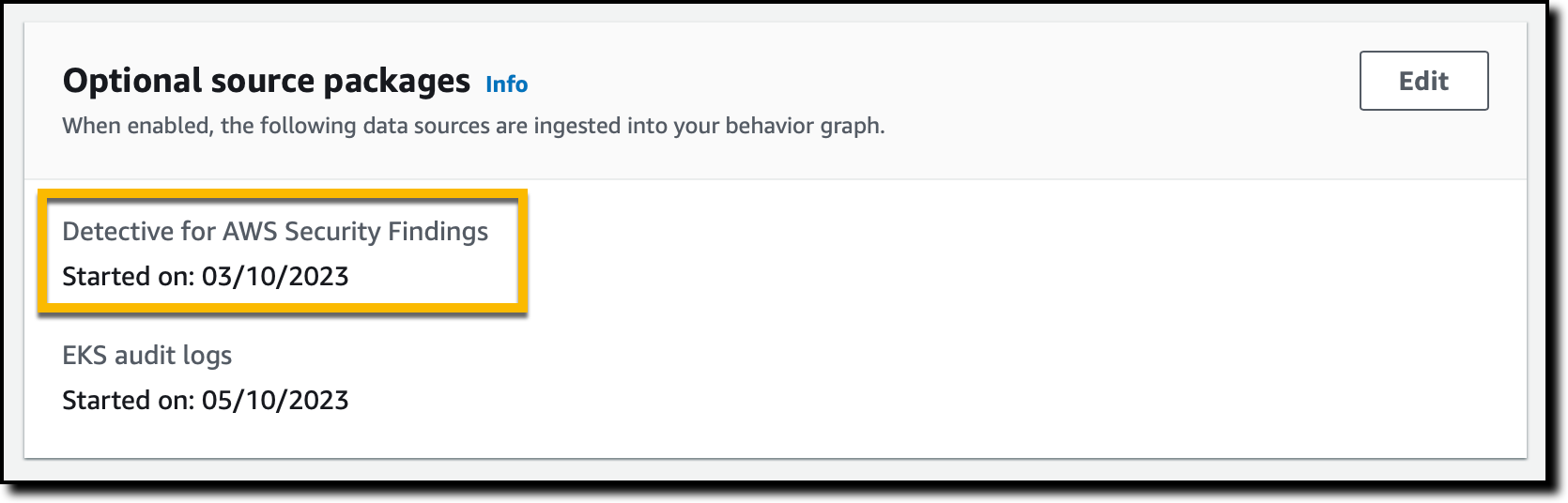
Once enabled, Detective starts analyzing all the relevant data to identify connections between disparate events and activities. To start your investigation process, you can get a visualization of these connections, including resource behavior and activities. Historical baselines, which you can use to provide comparisons against recent activity, are established after two weeks.
Investigating AWS Security Findings in the Amazon Detective Console
I start in the Security Hub console and choose Findings in the navigation pane. There, I filter findings to only see those where the Product name is Inspector and Severity label is HIGH.

The first one looks suspicious, so I choose its Title (CVE-2020-36223 – openldap). The Security Hub console provides me with information about the corresponding Common Vulnerabilities and Exposures (CVE) ID and where and how it was found. At the bottom, I have the option to Investigate in Amazon Detective. I follow the Investigate finding link, and the Detective console opens in another browser tab.

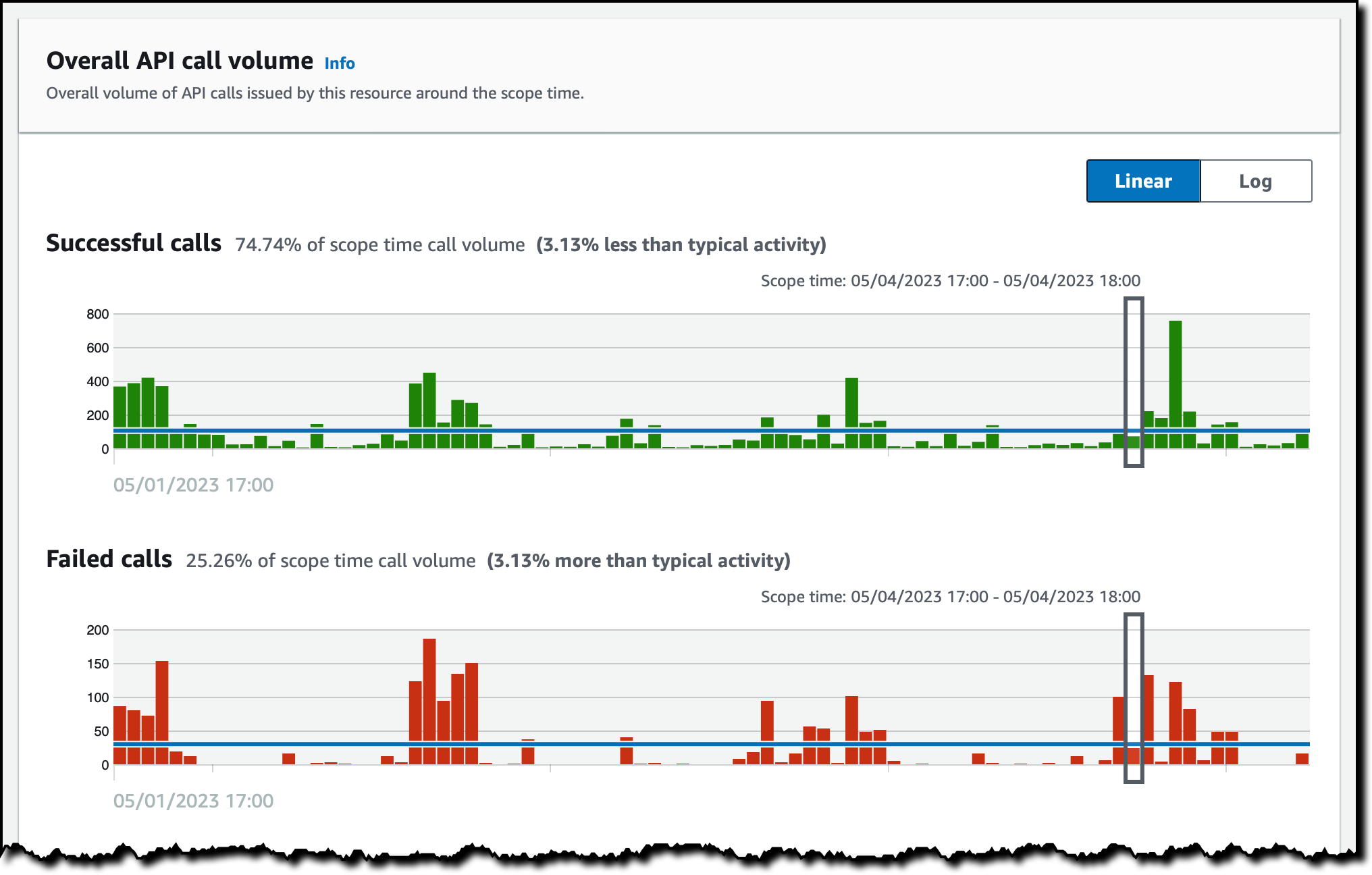
Here, I see the entities related to this Inspector finding. First, I open the profile of the AWS account to see all the findings associated with this resource, the overall API call volume issued by this resource, and the container clusters in this account.
For example, I look at the successful and failed API calls to have a better understanding of the impact of this finding.
Then, I open the profile for the container image. There, I see the images that are related to this image (because they have the same repository or registry as this image), the containers running from this image during the scope time (managed by Amazon EKS), and the findings associated with this resource.
Depending on the finding, Detective helps me correlate information from different sources such as CloudTrail logs, VPC Flow Logs, and EKS audit logs. This information makes it easier to understand the impact of the finding and if the risk has become an incident. For Security Hub, Detective only ingests findings for configuration checks that failed. Because configuration checks that passed have little security value, we’re filtering these outs.
Availability and Pricing
Amazon Detective investigation support for AWS Security Findings is available today for all existing and new Detective customers in all AWS Regions where Detective is available, including the AWS GovCloud (US) Regions. For more information, see the AWS Regional Services List.
Amazon Detective is priced based on the volume of data ingested. By enabling investigation of AWS Security Findings, you can increase the volume of ingested data. For more information, see Amazon Detective pricing.
When GuardDuty and Security Hub provide a finding, they also suggest the remediation. On top of that, Detective helps me investigate if the vulnerability has been exploited, for example, using logs and network traffic as proof.
Currently, findings coming from Security Hub are not included in the Finding groups section of the Detective console. Our plan is to expand Finding groups to cover the newly integrated AWS security services. Stay tuned!
Start using Amazon Detective to investigate potential security issues.
— Danilo
Post Syndicated from original https://lwn.net/Articles/931920/
Joel Fernandes introduced himself to the memory-management track at the
2023 Linux Storage, Filesystem,
Memory-Management and BPF Summit as a co-maintainer of the
read-copy-update (RCU) subsystem and an implementer of the “lazy RCU”
functionality. Lazy RCU can improve performance, especially on systems
that are not heavily utilized, but it also has some implications for memory
management that he wanted to discuss with the group.
Post Syndicated from Shalini Subbiah original https://blog.rapid7.com/2023/05/18/introducing-saved-filters-in-insightcloudsec/
Post Syndicated from Celeste Bishop original https://aws.amazon.com/blogs/security/your-guide-to-the-threat-detection-and-incident-response-track-at-reinforce-2023/

A full conference pass is $1,099. Register today with the code secure150off to receive a limited time $150 discount, while supplies last.
AWS re:Inforce is back, and we can’t wait to welcome security builders to Anaheim, CA, on June 13 and 14. AWS re:Inforce is a security learning conference where you can gain skills and confidence in cloud security, compliance, identity, and privacy. As an attendee, you will have access to hundreds of technical and non-technical sessions, an Expo featuring AWS experts and security partners with AWS Security Competencies, and keynote and leadership sessions featuring Security leadership. re:Inforce 2023 features content across the following six areas:
The threat detection and incident response track is designed to showcase how AWS, customers, and partners can intelligently detect potential security risks, centralize and streamline security management at scale, investigate and respond quickly to security incidents across their environment, and unlock security innovation across hybrid cloud environments.
TDR201 | Breakout session | How Citi advanced their containment capabilities through automation
Incident response is critical for maintaining the reliability and security of AWS environments. To support the 28 AWS services in their cloud environment, Citi implemented a highly scalable cloud incident response framework specifically designed for their workloads on AWS. Using AWS Step Functions and AWS Lambda, Citi’s automated and orchestrated incident response plan follows NIST guidelines and has significantly improved its response time to security events. In this session, learn from real-world scenarios and examples on how to use AWS Step Functions and other core AWS services to effectively build and design scalable incident response solutions.
TDR202 | Breakout session | Wix’s layered security strategy to discover and protect sensitive data
Wix is a leading cloud-based development platform that empowers users to get online with a personalized, professional web presence. In this session, learn how the Wix security team layers AWS security services including Amazon Macie, AWS Security Hub, and AWS Identity and Access Management Access Analyzer to maintain continuous visibility into proper handling and usage of sensitive data. Using AWS security services, Wix can discover, classify, and protect sensitive information across terabytes of data stored on AWS and in public clouds as well as SaaS applications, while empowering hundreds of internal developers to drive innovation on the Wix platform.
TDR203 | Breakout session | Vulnerability management at scale drives enterprise transformation
Automating vulnerability management at scale can help speed up mean time to remediation and identify potential business-impacting issues sooner. In this session, explore key challenges that organizations face when approaching vulnerability management across large and complex environments, and consider the innovative solutions that AWS provides to help overcome them. Learn how customers use AWS services such as Amazon Inspector to automate vulnerability detection, streamline remediation efforts, and improve compliance posture. Whether you’re just getting started with vulnerability management or looking to optimize your existing approach, gain valuable insights and inspiration to help you drive innovation and enhance your security posture with AWS.
TDR204 | Breakout session | Continuous innovation in AWS detection and response services
Join this session to learn about the latest advancements and most recent AWS launches in detection and response. This session focuses on use cases such as automated threat detection, continual vulnerability management, continuous cloud security posture management, and unified security data management. Through these examples, gain a deeper understanding of how you can seamlessly integrate AWS services into your existing security framework to gain greater control and insight, quickly address security risks, and maintain the security of your AWS environment.
TDR205 | Breakout session | Build your security data lake with Amazon Security Lake, featuring Interpublic Group
Security teams want greater visibility into security activity across their entire organizations to proactively identify potential threats and vulnerabilities. Amazon Security Lake automatically centralizes security data from cloud, on-premises, and custom sources into a purpose-built data lake stored in your account and allows you to use industry-leading AWS and third-party analytics and ML tools to gain insights from your data and identify security risks that require immediate attention. Discover how Security Lake can help you consolidate and streamline security logging at scale and speed, and hear from an AWS customer, Interpublic Group (IPG), on their experience.
TDR209 | Breakout session | Centralizing security at scale with Security Hub & Intuit’s experience
As organizations move their workloads to the cloud, it becomes increasingly important to have a centralized view of security across their cloud resources. AWS Security Hub is a powerful tool that allows organizations to gain visibility into their security posture and compliance status across their AWS accounts and Regions. In this session, learn about Security Hub’s new capabilities that help simplify centralizing and operationalizing security. Then, hear from Intuit, a leading financial software company, as they share their experience and best practices for setting up and using Security Hub to centralize security management.
TDR210 | Breakout session | Streamline security analysis with Amazon Detective
Join us to discover how to streamline security investigations and perform root-cause analysis with Amazon Detective. Learn how to leverage the graph analysis techniques in Detective to identify related findings and resources and investigate them together to accelerate incident analysis. Also hear a customer story about their experience using Detective to analyze findings automatically ingested from Amazon GuardDuty, and walk through a sample security investigation.
TDR310 | Breakout session | Developing new findings using machine learning in Amazon GuardDuty
Amazon GuardDuty provides threat detection at scale, helping you quickly identify and remediate security issues with actionable insights and context. In this session, learn how GuardDuty continuously enhances its intelligent threat detection capabilities using purpose-built machine learning models. Discover how new findings are developed for new data sources using novel machine learning techniques and how they are rigorously evaluated. Get a behind-the-scenes look at GuardDuty findings from ideation to production, and learn how this service can help you strengthen your security posture.
TDR311 | Breakout session | Securing data and democratizing the alert landscape with an event-driven architecture
Security event monitoring is a unique challenge for businesses operating at scale and seeking to integrate detections into their existing security monitoring systems while using multiple detection tools. Learn how organizations can triage and raise relevant cloud security findings across a breadth of detection tools and provide results to downstream security teams in a serverless manner at scale. We discuss how to apply a layered security approach to evaluate the security posture of your data, protect your data from potential threats, and automate response and remediation to help with compliance requirements.
TDR231 | Chalk talk | Operationalizing security findings at scale
You enabled AWS Security Hub standards and checks across your AWS organization and in all AWS Regions. What should you do next? Should you expect zero critical and high findings? What is your ideal state? Is achieving zero findings possible? In this chalk talk, learn about a framework you can implement to triage Security Hub findings. Explore how this framework can be applied to several common critical and high findings, and take away mechanisms to prioritize and respond to security findings at scale.
TDR232 | Chalk talk | Act on security findings using Security Hub’s automation capabilities
Alert fatigue, a shortage of skilled staff, and keeping up with dynamic cloud resources are all challenges that exist when it comes to customers successfully achieving their security goals in AWS. In order to achieve their goals, customers need to act on security findings associated with cloud-based resources. In this session, learn how to automatically, or semi-automatically, act on security findings aggregated in AWS Security Hub to help you secure your organization’s cloud assets across a diverse set of accounts and Regions.
TDR233 | Chalk talk | How LLA reduces incident response time with AWS Systems Manager
Liberty Latin America (LLA) is a leading telecommunications company operating in over 20 countries across Latin America and the Caribbean. LLA offers communications and entertainment services, including video, broadband internet, telephony, and mobile services. In this chalk talk, discover how LLA implemented a security framework to detect security issues and automate incident response in more than 180 AWS accounts accessed by internal stakeholders and third-party partners using AWS Systems Manager Incident Manager, AWS Organizations, Amazon GuardDuty, and AWS Security Hub.
TDR432 | Chalk talk | Deep dive into exposed credentials and how to investigate them
In this chalk talk, sharpen your detection and investigation skills to spot and explore common security events like unauthorized access with exposed credentials. Learn how to recognize the indicators of such events, as well as logs and techniques that unauthorized users use to evade detection. The talk provides knowledge and resources to help you immediately prepare for your own security investigations.
TDR332 | Chalk talk | Speed up zero-day vulnerability response
In this chalk talk, learn how to scale vulnerability management for Amazon EC2 across multiple accounts and AWS Regions. Explore how to use Amazon Inspector, AWS Systems Manager, and AWS Security Hub to respond to zero-day vulnerabilities, and leave knowing how to plan, perform, and report on proactive and reactive remediations.
TDR333 | Chalk talk | Gaining insights from Amazon Security Lake
You’ve created a security data lake, and you’re ingesting data. Now what? How do you use that data to gain insights into what is happening within your organization or assist with investigations and incident response? Join this chalk talk to learn how analytics services and security information and event management (SIEM) solutions can connect to and use data stored within Amazon Security Lake to investigate security events and identify trends across your organization. Leave with a better understanding of how you can integrate Amazon Security Lake with other business intelligence and analytics tools to gain valuable insights from your security data and respond more effectively to security events.
TDR431 | Chalk talk | The anatomy of a ransomware event
Ransomware events can cost governments, nonprofits, and businesses billions of dollars and interrupt operations. Early detection and automated responses are important steps that can limit your organization’s exposure. In this chalk talk, examine the anatomy of a ransomware event that targets data residing in Amazon RDS and get detailed best practices for detection, response, recovery, and protection.
TDR221 | Lightning talk | Streamline security operations and improve threat detection with OCSF
Security operations centers (SOCs) face significant challenges in monitoring and analyzing security telemetry data from a diverse set of sources. This can result in a fragmented and siloed approach to security operations that makes it difficult to identify and investigate incidents. In this lightning talk, get an introduction to the Open Cybersecurity Schema Framework (OCSF) and its taxonomy constructs, and see a quick demo on how this normalized framework can help SOCs improve the efficiency and effectiveness of their security operations.
TDR222 | Lightning talk | Security monitoring for connected devices across OT, IoT, edge & cloud
With the responsibility to stay ahead of cybersecurity threats, CIOs and CISOs are increasingly tasked with managing cybersecurity risks for their connected devices including devices on the operational technology (OT) side of the company. In this lightning talk, learn how AWS makes it simpler to monitor, detect, and respond to threats across the entire threat surface, which includes OT, IoT, edge, and cloud, while protecting your security investments in existing third-party security tools.
TDR223 | Lightning talk | Bolstering incident response with AWS Wickr enterprise integrations
Every second counts during a security event. AWS Wickr provides end-to-end encrypted communications to help incident responders collaborate safely during a security event, even on a compromised network. Join this lightning talk to learn how to integrate AWS Wickr with AWS security services such as Amazon GuardDuty and AWS WAF. Learn how you can strengthen your incident response capabilities by creating an integrated workflow that incorporates GuardDuty findings into a secure, out-of-band communication channel for dedicated teams.
TDR224 | Lightning talk | Securing the future of mobility: Automotive threat modeling
Many existing automotive industry cybersecurity threat intelligence offerings lack the connected mobility insights required for today’s automotive cybersecurity threat landscape. Join this lightning talk to learn about AWS’s approach to developing an automotive industry in-vehicle, domain-specific threat intelligence solution using AWS AI/ML services that proactively collect, analyze, and deduce threat intelligence insights for use and adoption across automotive value chains.
TDR251 | Builders’ session | Streamline and centralize security operations with AWS Security Hub
AWS Security Hub provides you with a comprehensive view of the security state of your AWS resources by collecting security data from across AWS accounts, Regions, and services. In this builders’ session, explore best practices for using Security Hub to manage security posture, prioritize security alerts, generate insights, automate response, and enrich findings. Come away with a better understanding of how to use Security Hub features and practical tips for getting the most out of this powerful service.
TDR351 | Builders’ session | Broaden your scope: Analyze and investigate potential security issues
In this builders’ session, learn how you can more efficiently triage potential security issues with a dynamic visual representation of the relationship between security findings and associated entities such as accounts, IAM principals, IP addresses, Amazon S3 buckets, and Amazon EC2 instances. With Amazon Detective finding groups, you can group related Amazon GuardDuty findings to help reduce time spent in security investigations and in understanding the scope of a potential issue. Leave this hands-on session knowing how to quickly investigate and discover the root cause of an incident.
TDR352 | Builders’ session | How to automate containment and forensics for Amazon EC2
In this builders’ session, learn how to deploy and scale the self-service Automated Forensics Orchestrator for Amazon EC2 solution, which gives you a standardized and automated forensics orchestration workflow capability to help you respond to Amazon EC2 security events. Explore the prerequisites and ways to customize the solution to your environment.
TDR353 | Builders’ session | Detecting suspicious activity in Amazon S3
Have you ever wondered how to uncover evidence of unauthorized activity in your AWS account? In this builders’ session, join the AWS Customer Incident Response Team (CIRT) for a guided simulation of suspicious activity within an AWS account involving unauthorized data exfiltration and Amazon S3 bucket and object data deletion. Learn how to detect and respond to this malicious activity using AWS services like AWS CloudTrail, Amazon Athena, Amazon GuardDuty, Amazon CloudWatch, and nontraditional threat detection services like AWS Billing to uncover evidence of unauthorized use.
TDR354 | Builders’ session | Simulate and detect unwanted IMDS access due to SSRF
Using appropriate security controls can greatly reduce the risk of unauthorized use of web applications. In this builders’ session, find out how the server-side request forgery (SSRF) vulnerability works, how unauthorized users may try to use it, and most importantly, how to detect it and prevent it from being used to access the instance metadata service (IMDS). Also, learn some of the detection activities that the AWS Customer Incident Response Team (CIRT) performs when responding to security events of this nature.
TDR341 | Code talk | Investigating incidents with Amazon Security Lake & Jupyter notebooks
In this code talk, watch as experts live code and build an incident response playbook for your AWS environment using Jupyter notebooks, Amazon Security Lake, and Python code. Leave with a better understanding of how to investigate and respond to a security event and how to use these technologies to more effectively and quickly respond to disruptions.
TDR441 | Code talk | How to run security incident response in your Amazon EKS environment
Join this Code Talk to get both an adversary’s and a defender’s point of view as AWS experts perform live exploitation of an application running on multiple Amazon EKS clusters, invoking an alert in Amazon GuardDuty. Experts then walk through incident response procedures to detect, contain, and recover from the incident in near real-time. Gain an understanding of how to respond and recover to Amazon EKS-specific incidents as you watch the events unfold.
TDR271-R | Workshop | Chaos Kitty: Gamifying incident response with chaos engineering
When was the last time you simulated an incident? In this workshop, learn to build a sandbox environment to gamify incident response with chaos engineering. You can use this sandbox to test out detection capabilities, play with incident response runbooks, and illustrate how to integrate AWS resources with physical devices. Walk away understanding how to get started with incident response and how you can use chaos engineering principles to create mechanisms that can improve your incident response processes.
TDR371-R | Workshop | Threat detection and response on AWS
Join AWS experts for a hands-on threat detection and response workshop using Amazon GuardDuty, AWS Security Hub, and Amazon Detective. This workshop simulates security events for different types of resources and behaviors and illustrates both manual and automated responses with AWS Lambda. Dive in and learn how to improve your security posture by operationalizing threat detection and response on AWS.
TDR372-R | Workshop | Container threat detection with AWS security services
Join AWS experts for a hands-on container security workshop using AWS threat detection and response services. This workshop simulates scenarios and security events while using Amazon EKS and demonstrates how to use different AWS security services to detect and respond to events and improve your security practices. Dive in and learn how to improve your security posture when running workloads on Amazon EKS.
Browse the full re:Inforce catalog to get details on additional sessions and content at the event, including gamified learning, leadership sessions, partner sessions, and labs.
If you want to learn the latest threat detection and incident response best practices and updates, join us in California by registering for re:Inforce 2023. We look forward to seeing you there!
If you have feedback about this post, submit comments in the Comments section below. If you have questions about this post, contact AWS Support.
Want more AWS Security news? Follow us on Twitter.
Post Syndicated from Parnab Basak original https://aws.amazon.com/blogs/big-data/whats-new-with-amazon-mwaa-support-for-startup-scripts/
Amazon Managed Workflow for Apache Airflow (Amazon MWAA) is a managed service for Apache Airflow that lets you use the same familiar Apache Airflow environment to orchestrate your workflows and enjoy improved scalability, availability, and security without the operational burden of having to manage the underlying infrastructure.
In April 2023, Amazon MWAA added support for shell launch scripts for environment versions Apache Airflow 2.x and later. With this feature, you can customize the Apache Airflow environment by launching a custom shell launch script at startup to work better with existing integration infrastructure and help with your compliance needs. You can use this shell launch script to install custom Linux runtimes, set environment variables, and update configuration files. Amazon MWAA runs this script during startup on every individual Apache Airflow component (worker, scheduler, and web server) before installing requirements and initializing the Apache Airflow process.
In this post, we provide an overview of the features, explore applicable use cases, detail the steps to use it, and provide additional facts on the capabilities of this shell launch script.
To run Apache Airflow, Amazon MWAA builds Amazon Elastic Container Registry (Amazon ECR) images that bundle Apache Airflow releases with other common binaries and Python libraries. These images then get used by the AWS Fargate containers in the Amazon MWAA environment. You can bring in additional libraries through the requirements.txt and plugins.zip files and pass the Amazon Simple Storage Service (Amazon S3) paths as a parameter during environment creation or update.
However, this method to install packages didn’t cover all of your use cases to tailor your Apache Airflow environments. Customers asked us for a way to customize the Apache Airflow container images by specifying custom libraries, runtimes, and supported files.
The new feature adds the ability to customize your Apache Airflow image by launching a custom specified shell launch script at startup. You can use the shell launch script to perform actions such as the following:
libaio as a custom library for Oracle.PATH, PYTHONPATH, and LD_LIBRARY_PATH. For example, you can set LD_LIBRARY_PATH to instruct Python to look for binaries in the paths that you specify.requirements.txt and configure security keys.The shell script runs Bash commands at startup, so you can install using yum and other tools similar to how Amazon Elastic Cloud Compute Cloud (Amazon EC2) offers user data and shell scripts support. You can define a custom shell script with the .sh extension and place it in the same S3 bucket as requirements.txt and plugins.zip. You can define an S3 file version of the shell script during the environment creation or update via the Amazon MWAA console, API, or AWS Command Line Interface (AWS CLI). For details on how to configure the startup script, refer to Using a startup script with Amazon MWAA.
During the environment creation or update process, Amazon MWAA copies the plugins.zip, requirements.txt, shell script, and your Apache Airflow Directed Acrylic Graphs (DAGs) to the container images on the underlying Amazon Elastic Container Service (Amazon ECS) Fargate clusters. The Amazon MWAA instance extracts these contents and runs the startup script file that you specified. The startup script is run from the /usr/local/airflow/startup Apache Airflow directory as the airflow user. When it’s complete, the setup process will install the requirements.txt and plugins.zip files, followed by the Apache Airflow process associated with the container.
The following screenshot shows you the new optional Startup script file field on the Amazon MWAA console.

For monitoring and observability, you can view the output of the script in your Amazon MWAA environment’s Amazon CloudWatch log groups. To view the logs, you need to enable logging for the log group. If enabled, Amazon MWAA creates a new log stream starting with the prefix startup_script_exection_ip. You can retrieve log events to verify that the script is working as expected.
You can also use Amazon MWAA local-runner to test this feature on your local development environments. You can now specify your custom startup script in the startup_script directory in the local-runner. It’s recommended that you locally test your script before applying changes to your Amazon MWAA setup.
You can reference files that you package within plugins.zip or your DAGs folder from your startup script. This can be beneficial if you require installing Linux runtimes on a private web server from a local package. It’s also useful to be able to skip installation of Python libraries on a web server that doesn’t have access, either due to private web server mode or for libraries hosted on a private repository accessible only from your VPC, such as in the following example:
The MWAA_AIRFLOW_COMPONENT variable used in the script identifies each Apache Airflow scheduler, web server, and worker component that the script runs on.
Keep in mind the following additional information of this feature:
local-runner to test and reduce the feedback loop.AIRFLOW__ environment variables and installing custom Python libraries. For a detailed list of reserved and unreserved environment variables that you can set or update, refer to Set environment variables using a startup script.In this post, we talked about the new feature of Amazon MWAA that allows you to configure a startup shell launch script. This feature is supported on new and existing Amazon MWAA environments running Apache Airflow 2.x and above. Use this feature to install Linux runtimes, configure environment variables, and manage keys and tokens. You now have an additional option to customize your base Apache Airflow image to meet your specific needs.
For additional details and code examples on Amazon MWAA, visit the Amazon MWAA User Guide and the Amazon MWAA examples GitHub repo.
 Parnab Basak is a Solutions Architect and a Serverless Specialist at AWS. He specializes in creating new solutions that are cloud native using modern software development practices like serverless, DevOps, and analytics. Parnab works closely in the analytics and integration services space helping customers adopt AWS services for their workflow orchestration needs.
 Vishal Vijayvargiya is a Software Engineer working on Amazon MWAA at Amazon Web Services. He is passionate about building distributed and scalable software systems. Vishal also enjoys playing badminton and cricket.
Post Syndicated from Gonzalo Herreros original https://aws.amazon.com/blogs/big-data/dive-deep-into-aws-glue-4-0-for-apache-spark/
Deriving insight from data is hard. It’s even harder when your organization is dealing with silos that impede data access across different data stores. Seamless data integration is a key requirement in a modern data architecture to break down data silos. AWS Glue is a serverless data integration service that makes data preparation simpler, faster, and cheaper. You can discover and connect to over 70 diverse data sources, manage your data in a centralized data catalog, and create, run, and monitor data integration pipelines to load data into your data lakes and your data warehouses. AWS Glue for Apache Spark takes advantage of Apache Spark’s powerful engine to process large data integration jobs at scale.
AWS Glue released version 4.0 at AWS re:Invent 2022, which includes many upgrades, such as the new optimized Apache Spark 3.3.0 runtime (3.5 times performance improvement on average over open-source Apache Spark 3.3.0), Python 3.10, and a new enhanced Amazon Redshift connector (10 times performance improvement on average over the previous version).
In this post, we discuss the main benefits that this new AWS Glue version brings and how it can help you build better data integration pipelines.
The new version of Spark included in AWS Glue 4.0 brings a number of valuable features, which we highlight in this section. For more details, refer to Spark Release 3.3.0 and Spark Release 3.2.0.
Support for the pandas API allows users familiar with the popular Python library to start writing distributed extract, transform, and load (ETL) jobs without having to learn a new framework API. We discuss this in more detail later in this post.
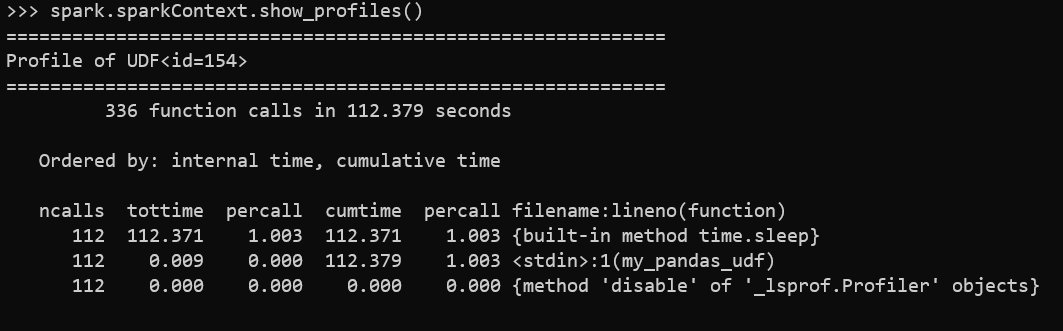
With Python UDF profiling, now you can profile regular and pandas user-defined functions (UDFs). Calling show_profiles() on the SparkContext to get details about the Python run was added on Spark 1 for RDD; now it also works for DataFrame Python UDFs and provides valuable information about how many calls to the UDF are made and how much time is spent on it.
For instance, to illustrate how the profiler measures time, the following example is the profile of a pandas UDF that processes over a million rows (but the pandas UDF only needs 112 calls) and sleeps for 1 second. We can use the command spark.sparkContext.show_profiles(), as shown in the following screenshot.
Pushdown filters are used in more scenarios, such as aggregations or limits. The upgrade also offers support for Bloom filters and skew optimization. These improvements allow for handling larger datasets by reading less data and processing it more efficiently. For more information, refer to Spark Release 3.3.0.
Now you can ask SparkSQL to follow the ANSI behavior on those points that it traditionally differed from the standard. This helps users bring their existing SQL skills and start producing value on AWS Glue faster. For more information, refer to ANSI Compliance.
Adaptive query execution (AQE) by default helps optimize Spark SQL performance. You can turn AQE on and off by using spark.sql.adaptive.enabled as an umbrella configuration. Since AWS Glue 4.0, it’s enabled by default, so you no longer need to enable this explicitly.
Improved error messages provide better context and easy resolution. For instance, if you have a division by zero in a SQL statement on ANSI mode, previously you would get just a Java exception: java.lang.ArithmeticException: divide by zero. Depending on the complexity and number of queries, the cause might not be obvious and might require some reruns with trial and error until it’s identified.
On the new version, you get a much more revealing error:
Not only does it show the query that caused the issue, but it also indicates the specific operation where the error occurred (the division in this case). In addition, it provides some guidance on resolving the issue.
The Spark upgrade brings a new, exciting feature, which is the chance to use your existing Python pandas framework knowledge in a distributed and scalable runtime. This lowers the barrier of entry for teams without previous Spark experience, so they can start delivering value quickly and make the most of the AWS Glue for Spark runtime.
The new API provides a pandas DataFrame-compatible API, so you can use existing pandas code and migrate it to AWS Glue for Spark changing the imports, although it’s not 100% compatible.
If you just want to migrate existing pandas code to run on pandas on Spark, you could replace the import and test:
In some cases, you might want to use multiple implementations on the same script, for instance because a feature is still not available on the pandas API for Spark or the data is so small that some operations are more efficient if done locally rather than distributed. In that situation, to avoid confusion, it’s better to use a different alias for the pandas and the pandas on Spark module imports, and to follow a convention to name the different types of DataFrames, because it has implications in performance and features, for instance, pandas DataFrame variables starting with pdf_, pandas on Spark as psdf_, and standard Spark as sdf_ or just df_.
You can also convert to a standard Spark DataFrame calling to_spark(). This allows you to use features not available on pandas such as writing directly to catalog tables or using some Spark connectors.
The following code shows an example of combining the different types of APIs:
A new version of the Amazon Redshift connector brings many improvements:
This new Amazon Redshift connector is built on top of an existing open-source connector project and offers further enhancements for performance and security, helping you gain up to 10 times faster application performance. It accelerates AWS Glue jobs when reading from Amazon Redshift, and also enables you to run data-intensive workloads more reliably. For more details, see Moving data to and from Amazon Redshift. To learn more about how to use it, refer to New – Amazon Redshift Integration with Apache Spark.
When you use the new Amazon Redshift connector on an AWS Glue DynamicFrame, use the existing methods: GlueContext.create_data_frame and GlueContext.write_data_frame.
When you use the new Amazon Redshift connector on a Spark DataFrame, use the format io.github.spark_redshift_community.spark.redshift, as shown in the following code snippet:
The following are updates and improvements in the dependent libraries:
To learn more, refer to the appendices in Migrating AWS Glue jobs to AWS Glue version 4.0.
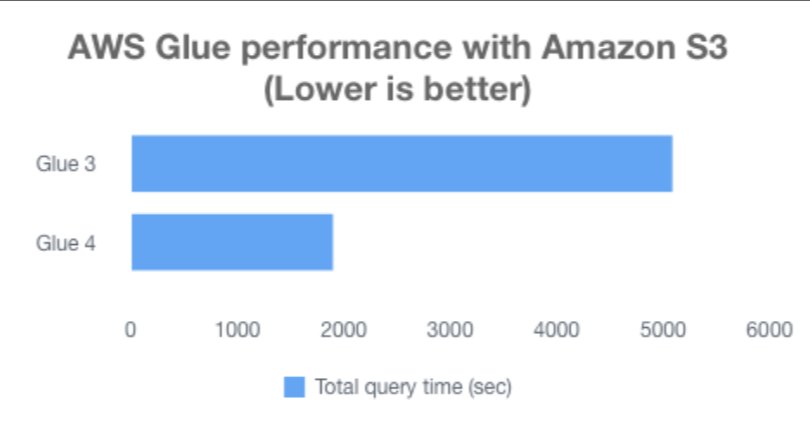
In addition to all the new features, AWS Glue 4.0 brings performance improvements at lower cost. In summary, AWS Glue 4.0 with Amazon Simple Storage Service (Amazon S3) is 2.7 times faster than AWS Glue 3.0, and AWS Glue 4.0 with Amazon Redshift is 7.1 times faster than AWS Glue 3.0. In the following sections, we provide details about AWS Glue 4.0 performance results with Amazon S3 and Amazon Redshift.
The following chart shows the total job runtime for all queries (in seconds) in the 3 TB query dataset between AWS Glue 3.0 and AWS Glue 4.0. The TPC-DS dataset is located in an S3 bucket in Parquet format, and we used 30 G.2X workers in AWS Glue. We observed that our TPC-DS tests on Amazon S3 had a total job runtime on AWS Glue 4.0 that was 2.7 times faster than that on AWS Glue 3.0. Detailed instructions are explained in the appendix of this post.
| . | AWS Glue 3.0 | AWS Glue 4.0 |
| Total Query Time | 5084.94274 | 1896.1904 |
| Geometric Mean | 14.00217 | 10.09472 |
The following chart shows the total job runtime for all queries (in seconds) in the 1 TB query dataset between AWS Glue 3.0 and AWS Glue 4.0. The TPC-DS dataset is located in a five-node ra3.4xlarge Amazon Redshift cluster, and we used 150 G.2X workers in AWS Glue. We observed that our TPC-DS tests on Amazon Redshift had a total job runtime on AWS Glue 4.0 that was 7.1 times faster than that on AWS Glue 3.0.
| . | AWS Glue 3.0 | AWS Glue 4.0 |
| Total Query Time | 22020.58 | 3075.96633 |
| Geometric Mean | 142.38525 | 8.69973 |

You can start using AWS Glue 4.0 via AWS Glue Studio, the AWS Glue console, the latest AWS SDK, and the AWS Command Line Interface (AWS CLI).
To start using AWS Glue 4.0 in AWS Glue Studio, open the AWS Glue job and on the Job details tab, choose the version Glue 4.0 – Supports spark 3.3, Scala 2, Python 3.

To migrate your existing AWS Glue jobs from AWS Glue 0.9, 1.0, 2.0, and 3.0 to AWS Glue 4.0, see Migrating AWS Glue jobs to AWS Glue version 4.0.
The AWS Glue 4.0 Docker images are now available on Docker Hub, so you can use them to develop locally for the new version. Refer to Develop and test AWS Glue version 3.0 and 4.0 jobs locally using a Docker container for further details.
In this post, we discussed the main upgrades provided by the new 4.0 version of AWS Glue. You can already start writing new jobs on that version and benefit from all the improvements, as well as migrate your existing jobs.
 Gonzalo Herreros is a Senior Big Data Architect on the AWS Glue team. He’s been an Apache Spark enthusiast since version 0.8. In his spare time, he likes playing board games.
 Noritaka Sekiyama is a Principal Big Data Architect on the AWS Glue team. He works based in Tokyo, Japan. He is responsible for building software artifacts to help customers. In his spare time, he enjoys cycling with his road bike.
 Bo Li is a Senior Software Development Engineer on the AWS Glue team. He is devoted to designing and building end-to-end solutions to address customer’s data analytic and processing needs with cloud-based data-intensive technologies.
 Rajendra Gujja is a Senior Software Development Engineer on the AWS Glue team. He is passionate about distributed computing and everything and anything about the data.
 Savio Dsouza is a Software Development Manager on the AWS Glue team. His team works on solving challenging distributed systems problems for data integration on Glue platform for customers using Apache Spark.
 Mohit Saxena is a Senior Software Development Manager on the AWS Glue team. His team works on distributed systems for building data lakes on AWS and simplifying integration with data warehouses for customers using Apache Spark.
To perform a TPC-DS benchmark on AWS Glue against a dataset in an S3 bucket, you need to copy the TPC-DS dataset into your S3 bucket. These instructions are based on emr-spark-benchmark:
$YOUR_S3_BUCKET with your S3 bucket name. We suggest you export YOUR_S3_BUCKET as an environment variable:$YOUR_S3_BUCKET with your S3 bucket name:For your convenience, we have provided the sample application JAR file spark-benchmark-assembly-3.3.0.jar, which we built for AWS Glue 4.0.
spark-benchmark-assembly JAR file.The result file will be stored under s3://YOUR_S3_BUCKET/blog/GLUE_TPCDS-TEST-3T-RESULT/.
Post Syndicated from Kari Rivas original https://www.backblaze.com/blog/a-cyber-insurance-checklist-learn-how-to-lower-risk-to-better-secure-coverage/
If your business is looking into cyber insurance to protect your bottom line against security incidents, you’re in good company. The global market for cybersecurity insurance is projected to grow from 11.9 billion in 2022 to 29.2 billion by 2027.
But you don’t want to go into buying cyber security insurance blind. We put together this cyber insurance readiness checklist to help you strengthen your cyber resilience stance in order to better secure a policy and possibly a lower premium. (And even if you decide not to pursue cyber insurance, simply following some of these best practices will help you secure your company’s data.)
Cyber insurance is a specialty insurance product that is useful for any size business, but especially those dealing with large amounts of data. Before you buy cyber insurance, it helps to understand some fundamentals. Check out our post on cyber insurance basics to get up to speed.
Once you understand the basic choices available to you when securing a policy, or if you’re already familiar with how cyber insurance works, read on for the checklist.
Cybersecurity insurance providers use their questionnaire and assessment period to understand how well-situated your business is to detect, limit, or prevent a cyber attack. They have requirements, and you want to meet those specific criteria to be covered at the most reasonable cost.
Your business is more likely to receive a lower premium if your security infrastructure is sound and you have disaster recovery processes and procedures in place. Though each provider has their own requirements, use the checklist below to familiarize yourself with the kinds of criteria a cyber insurance provider might look for. Any given provider may not ask about or require all these precautions; these are examples of common criteria. Note: Checking these off means your cyber resilience score is attractive to providers, though not a guarantee of coverage or a lower premium.
Learn how Backblaze customer AcenTek secured their data with B2 Cloud Storage to meet their cyber insurance provider’s requirement that backups be secured in a geographically distanced location.
By adding features like SSE, 2FA, and object lock to your backup security, insurance companies know you take data security seriously.
Cyber insurance provides the peace of mind that, when your company is faced with a digital incident, you will have access to resources with which to recover. And there is no question that by increasing your cybersecurity resilience, you’re more likely to find an insurer with the best coverage at the right price.
Ultimately, it’s up to you to ensure you have a robust backup strategy and security protocols in place. Even if you hope to never have to access your backups (because that might mean a security breach), it’s always smart to consider how fast you can restore your data should you need to, keeping in mind that hot storage is going to give you a faster recovery time objective (RTO) without any delays like those seen with cold storage like Amazon Glacier. And, with Backblaze B2 Cloud Storage offering hot cloud storage at cold storage prices, you can afford to store all your data for as long as you need—at one-fifth the price of AWS.
Get started today with pay-as-you-go pricing, or contact our Sales Team to learn more about B2 Reserve, our all-inclusive, capacity-based bundles starting at 20TB.
The post A Cyber Insurance Checklist: Learn How to Lower Risk to Better Secure Coverage appeared first on Backblaze Blog | Cloud Storage & Cloud Backup.
Post Syndicated from Talks at Google original https://www.youtube.com/watch?v=Vb9m7iP-3cE
Post Syndicated from original https://lwn.net/Articles/931812/
The memory-management subsystem has the unenviable task of trying to
predict which pages of memory will be needed in the near future. Since
predictions tend to be difficult, the code relies heavily on the heuristic
that memory used in the recent past is likely to be used again in the near
future. However, even knowing which memory has been recently used can be a
challenge. At the 2023 Linux Storage,
Filesystem, Memory-Management and BPF Summit, Aneesh Kumar and Wei Xu,
both presenting remotely,
discussed some ways to use the increasingly capable hardware counters that
are provided by current and upcoming CPUs.
Post Syndicated from Dustin Taylor original https://aws.amazon.com/blogs/messaging-and-targeting/how-to-test-email-sending/
When setting up your email sending infrastructure and connections to APIs it is necessary to ensure proper setup. It is also important to ensure that after making changes to your sending pipeline that you verify that your application is working as expected. Not only is it important to test your sending processes, but it’s also important to test your monitoring to ensure that sending event tracking is working as intended. A common pitfall for email senders is that when they attempt to test their email sending infrastructure or event monitoring they send to invalid addresses and/or test accounts that generate no, or negative, reputation as a result of these sends.
The Amazon Simple Email Service (SES) provides you with an easy-to-use mechanism to accomplish these tests. Amazon SES offers the mailbox simulator feature which enables a sender the ability to test different sending events to ensure your service is working as expected. Using the mailbox simulator you can test: delivery success, bounces, complaints, automated responses (like out of office messages), and when a recipient address is on the suppression list.
In this blog we will outline some information about the mailbox simulator and how to interact with the feature to test your email sending services.
The mailbox simulator is a feature offered to help Amazon SES senders test their sending services to verify normal operation. It provides mechanisms to test their monitoring and event notification services. This feature gives a sender the ability to test their service and email monitoring to verify that it is working as expected without the risk of negatively impacting their sending reputation. The mailbox simulator is an MTA operated by SES that is set to receive mail and to simulate different sending events based on the recipient address used.
The mailbox simulator provides an easy-to-use mechanism to test your integration with Amazon SES. This gives senders the ability to test their sending environment without triggering actual bounces or complaints, which negatively impact their account sending reputation, as well as not counting against a sender’s email sending quotas. It is important to test these events to ensure that event monitoring is properly setup and function. A gap in monitoring these events could lead to a decrease in sender reputation from bounces or complaint events going unnoticed. The mailbox simulator gives a sender the ability to programmatically evaluate whether their event monitoring process has been set up properly without the negative impact to their sending reputation that would occur if sending test emails to differing mailbox providers or invalid email addresses.
Your first step is setting up a destination for your event notifications. This can be done using Amazon Simple Notification Service (SNS) or by using event publishing depending on your use-case. Once you have set up an event destination and configured it for your sending identity (either an email address or domain) you are ready to proceed to testing the configuration.
Using the Amazon SES mailbox simulator is simple. In practice, you will be sending an email to an Amazon SES owned mailbox. This mailbox will respond based on the event-type you want to test. Below is a map of the event types and the corresponding email addresses to test the events:
| Event Type | Email Destination |
| Delivery Success | [email protected] |
| Bounce | [email protected] |
| Complaint | [email protected] |
| Suppression List | [email protected] |
| Automatic Responses (OOTO) | [email protected] |
If you are using the Amazon SES console to test these events, SES has already included the addresses to simplify the testing experience and you can find these under the ‘Scenario’ dropdown.

After sending an email to one of the five destinations, you should soon receive a notification, or event, to your publishing destination. This is an example of a success event.
{
    "notificationType": "Delivery",
    "mail": {
        "timestamp": "2023-05-05T21:00:23.244Z",
        "source": "[email protected]",
        "sourceArn": "arn:aws:ses:us-west-2:012345678910:identity/example.com",
        "sourceIp": "192.168.0.1",
        "callerIdentity": "root",
        "sendingAccountId": "012345678910",
        "messageId": "01010187edb7434c-4187f4b8-3e2b-404c-a5f6-72b9b64e5d66-000000",
        "destination": ["[email protected]"]
    },
    "delivery": {
        "timestamp": "2023-05-05T21:00:24.300Z",
        "processingTimeMillis": 1056,
        "recipients": ["[email protected]"],
        "smtpResponse": "250 2.6.0 Message received",
        "remoteMtaIp": "54.165.247.113",
        "reportingMTA": "a62-102.smtp-out.us-west-2.amazonses.com"
    }
}
If you have not received confirmation of the event, it is likely there is a problem with your monitoring configuration. We recommend reviewing the documentation on SNS topic setup and/or event publishing to uncover if an error was made during initial setup.
Note: A sender may have verified an email address and a domain to use for testing. The domain may have the appropriate configuration while the email address does not. When sending an email from SES, SES will use the most specific identity (email address is used before the domain) and will use the configuration associated with that identity. This means that in this instance you can either remove the email address verification for that domain and re-test or set up the same configuration for that email address that is verified.
Now that your initial setup of event publishing is complete and you have tested your first event through the mailbox simulator, it is time to set up automated testing using the mailbox simulator. Testing email events after a successful update to your application is recommended to confirm that updates have not caused bugs in your event ingestion mechanisms.
Happy sending!
Post Syndicated from The Hook Up original https://www.youtube.com/watch?v=Nj_z1DBy0ps
Post Syndicated from BeardedTinker original https://www.youtube.com/watch?v=GW1vLJuIaWY
Post Syndicated from Patrick Kennedy original https://www.servethehome.com/ampereone-with-192-cores-128x-pcie-gen5-lanes-and-ddr5-in-2023-arm/
Ampere AmpereOne is shipping to select customers with 192 custom Arm cores, PCIe Gen5, DDR5, Bfloat16 support for AI and more
The post AmpereOne with 192 Cores 128x PCIe Gen5 Lanes and DDR5 in 2023 appeared first on ServeTheHome.
Post Syndicated from komaio original https://aws.amazon.com/blogs/messaging-and-targeting/choosing-the-right-domain-for-optimal-deliverability-with-amazon-ses/
As a sender, selecting the right domain for the visible From header of your outbound messages is crucial for optimal deliverability. In this blog post, we will guide you through the process of choosing the best domain to use with Amazon Simple Email Service (SES)
With SES, you can create an identity at the domain level or you can create an email address identity. Both types of verified identities permit SES to use the email address in the From header of your outbound messages. You should only use email address identities for testing purposes, and you should use a domain identity to achieve optimal deliverability.
Choosing the right email domain is important for deliverability for the following reasons:
The key takeaway from this blog is that you must be aware of the domain owner’s preference when choosing an identity to use with SES. If you do not have a relationship with the domain owner then you should plan on using your own domain for any email you send from SES.
Let’s dive deep into the technical reasons behind these recommendations.
Domain-based Message Authentication, Reporting, and Conformance (DMARC) is a domain-based protocol for authenticating outbound email and for controlling how unauthenticated outbound email should be handled by the mail receiving organization. DMARC has been around for over a decade and has been covered by this blog in the past.
DMARC permits the owner of an email author’s domain name to enable verification of the domain’s use. Mail receiving organizations can use this information when evaluating handling choices for incoming mail. You, as a sender, authenticate your email using DKIM and SPF.
A message passes the domain’s DMARC policy when the evaluation DKIM or SPF indicate that the message is authenticated with an identifier that matches (or is a subdomain of) the domain in the visible From header.
You must be aware of the DMARC policy of the domain in which your SES identities reside. The domain owner may be using DMARC to protect the domain from forgery by unauthenticated sources. If you are the domain owner, you can use this method to confirm your domain’s current DMARC policy.
You can look up the domain’s DMARC policy in the following ways:
https://tools.wordtothewise.com/dmarc/
https://mxtoolbox.com/dmarc.aspx
https://dmarcian.com/dmarc-inspector/
The “p” tag in the DMARC record indicates the domain’s policy.
This section will cover each policy scenario and provide guidance to your usage of the domain with SES.
| Policy | How to Interpret | You have verified the domain identity with EasyDKIM | You have only email address identities with the domain |
| No DMARC record | The domain owner has not published a DMARC policy. They may not yet be aware of DMARC | There is no DMARC policy for mail receiving organizations to apply. Your messages are authenticated with DKIM, so mail receiving organization may leverage a domain-based reputational model for your email. | There is no DMARC policy for mail receiving organizations to apply. Your messages are not authenticated, so reputation remains solely based on IP. |
| none | The domain owner is evaluating the DMARC reports that the mail receiving organizations send to the domain owner, but has requested the mail receiving organizations not use DMARC policy logic to evaluate incoming email. | There is no DMARC policy for mail receiving organizations to apply. Your messages are authenticated with DKIM, so mail receiving organization may leverage a domain-based reputational model for your email. | There is no DMARC policy for mail receiving organizations to apply. Your messages are not authenticated, so reputation remains solely based on IP. |
| quarantine | The domain owner has instructed mail receiving organizations to send any non-authenticated email to a quarantine or to the Junk Mail folders of the recipients. | Your messages are authenticated with DKIM and will not be subjected to the domain’s DMARC policy. | Mail receiving organizations may not deliver your messages to the inboxes of your intended recipients. |
| reject | The domain owner has instructed mail receiving organizations to reject any non-authenticated email sending from the domain. | Your messages are authenticated with DKIM and will not be subjected to the domain’s DMARC policy. | Mail receiving organizations may reject these messages which will result in ‘bounce’ events within SES. |
If the domain has a none or quarantine policy, you must be aware that the domain owner may have a plan to migrate to a more restrictive policy without consulting with you. This will affect your deliverability in the form of low inboxing/open rates, or high bounce rates. You should consult with the domain owner to determine if they recommend an alternative domain for your email use case.
Not all mail receiving organizations enforce DMARC policies. Some may use their own logic, such as quarantining messages that fail a reject policy. Some may use DMARC logic to build a domain-based reputational model based on your sending patterns even if you do not publish a policy. For example, here is a blueprint showing how you can set up custom filtering logic with SES Inbound.
If you have verified the domain identity with the legacy TXT record method, you must sign your email using a DKIM signature. The DKIM records in the DNS must be within the same domain as the domain in the From header of the messages you are signing.
If you have the domain identity verified with EasyDKIM and you also have email address identities verified within the same domain, then the email address identities will inherit the DKIM settings from the domain identity. Your email will be authenticated with DKIM and will not be subjected to the domain’s DMARC policy.
Messages can also pass a DMARC policy using SPF in addition to DKIM. This is enabled through the use of a custom MAIL FROM domain. The custom MAIL FROM domain needs to be a subdomain of the SES identity and the SES domain identity’s DMARC policy must not be set to strict domain alignment due to the way SES handles feedback forwarding. The domain owner enables a custom MAIL FROM domain by publishing records in the DNS. There is no way to authenticate email without publishing records in the DNS. Read Choosing a MAIL FROM domain to learn more.
The recommended approach is to use EasyDKIM primarily, and optionally enable a custom MAIL FROM domain as an additive form of authentication.
The process of enabling DKIM and SPF authentication involves publishing DNS records within the domain. Only the domain owner may modify DNS for their domain. If you are not the domain owner, here are some alternative solutions.
Option 1: Segregate your email sending programs into subdomains.
This option is best for people within large or complex organizations, or vendors who are contracted to send email on behalf of an organization.
Ask the domain owner to delegate a subdomain for your use case (e.g. marketing.domain.example). Many domain owners are willing to delegate use of a subdomain because allowing for multiple use cases on a single domain becomes a very difficult management and governance challenge.
Through the use of subdomains they can segregate your email sending program from the email sent by normal mailbox users and other email sending programs. This also gives mail receiving organizations the ability to create a reputational model that is specific to your sending patterns, which means that you do not need to inherit any negative reputation incurred by others.
Option 2: Use a domain in which you are the domain owner.
This option is best if you have end-customers (or tenants) who have email addresses within domains which have domain owners that will not allow any form of delegation to you.
Use your own domain as the domain identity, and use subdomains within your domain to distinguish your end-customers from each other (e.g. tenant1.yourdomain.example, tenant2.yourdomain.example, tenant3.yourdomain.example, …). Amazon WorkMail uses this strategy for the awsapps.com domain.
This gives you complete control over the domain as well as your reputation. Use subdomains to segregate reputation between your end-customers if you have a multi-tenant business model.
Here are some additional suggestions to make your email more personable while remaining aligned to the domains’ DMARC policies.
From: “John Doe via My App” <[email protected]>
Reply-to: [email protected]
From a deliverability perspective, it is beneficial to compartmentalize your sending into different domains, or subdomains, for different email sending programs. That will limit the reputational blast radius if something were to go wrong with one campaign. Consider using different subdomains for each sending program. For example:
DMARC was designed for marketing and transactional email use cases, so it is good practice to publish ‘reject’ DMARC policies for those subdomains. Having a strong policy doesn’t give a free pass into recipient inboxes, but it allows the mail receiving organization to know what to do with messages that aren’t authenticated, which can lead to better trust. Building trust is the best way to gain a positive reputation.
If the domain is used by normal users for day-to-day correspondences, the domain owner should be very careful about publishing a DMARC policy because it is known to create interoperability issues with mailing lists and other email providers. Many of these email domains may never publish a ‘reject’ DMARC policy. For new email sending programs, you should strongly consider using a subdomain rather than any domain that is being used for user correspondences.
To ensure optimal deliverability with Amazon SES, it’s essential to be aware of the domain owner’s preferences and use a domain identity for outbound messages. Keep in mind that email address identities should only be used for testing purposes or with domains without DMARC policies. Domain owners can use subdomains to segregate email sending programs, making management and governance easier while allowing mail receiving organizations to build isolated reputational models.
By following the recommendations in this blog, you’ll be better prepared to align with the domain owner’s preferences, achieve higher deliverability rates for your authenticated outbound email, and be compatible with future DMARC developments.
Post Syndicated from Jeremiah Dewey original https://blog.rapid7.com/2023/05/18/rapid7-recognized-as-a-strong-performer-in-the-forrester-wavetm-for-mdr-q2-2023/

Rapid7 recognized amongst the top MDR providers in the industry.
As security teams try to do more with less, addressing the sprawling attack surface and monitoring the escalating threat and risk landscape, it inherently leaves them at a disadvantage. Rapid7 Managed Threat Complete empowers organizations to tip the scale back in their favor to achieve stronger security programs, end-to-end.
We are proud to be recognized amongst the top 13 vendors, as a Strong Performer, in The Forrester WaveTM: Managed Detection and Response, Q2 2023. Our goal is to build-upon and break the traditional views of MDR by uniting risk and threat detection and response with Managed Threat Complete to drive superior outcomes for our customers.
Since day one, we’ve continuously been looking for new ways to support organizations in their effort to find and eliminate threats faster and more reliably. While traditional MDR services flooded organizations with noisy alerts and put resolution back on the customer, we saw a better path. Rapid7 is committed to being a true partner for our customers, detecting and responding to any threat, end-to-end, no matter how large or complex.
This year, we focused on empowering all organizations to gain complete coverage, unlocking a holistic security program—one that covers proactive, responsive, and strategic aspects of detection and response. We’ve combined two historically siloed pieces of security (risk and threats) to give organizations the complete picture. By focusing on a security program that is proactive, responsive, and strategic, you get smarter and more resilient over time—continuously strengthening your security.
Like all Rapid7 products and services, Managed Threat Complete is built by practitioners for practitioners. We truly want to empower security teams to focus on strategic work while we focus on their environment 24/7/365. With complete coverage and end-to-end detection and response, teams can feel confident that they’re always ready for what comes next.
Traditional approaches to MDR focus on the responsive element of detection and response and miss the opportunity to help organizations build resilience and strengthen their security posture over time. As the market evolved, MDR providers drew lines in the sand. They chose to respond to alerts of a certain size, leaving the burden of hands-on-keyboard incident response (IR) attacks for organizations to handle through expensive retainers or off the street contracts with IR consultants. We knew our customers deserved better, and we had a unique opportunity to challenge the system and provide a fully end-to-end response program.
We’ve removed boundaries to traditional MDR programs, keeping your outcomes our top priority. Rapid7 Managed Threat Complete delivers unlimited data, unlimited incident response, unlimited intelligence, and unlimited potential. From incident response with no limits, meaning no line in the sand regardless of the size and complexity, to XDR technology at the core for complete coverage, threats across your entire modern environment are eliminated.
We believe that in addition to our approach to limitless security, our robust functionality accessibility by customers caused us to receive the highest score in the Platform Capabilities criterion from Forrester.
“This has greatly increased our visibility, detection, and response capabilities for on and off-hours. The UEBA functionality of the agent is amazing as well. Overall the service is extremely valuable and well worth the price.”—Security Administrator/Analyst, Medium Enterprise Insurance Company, TechValidate
When it comes to partnership, we truly mean it. Work alongside global SOC experts who seamlessly act as an extension of your team from initial threat detection through triage, investigation, and response. With a Customer Advisor at your fingertips, you can further accelerate your security maturity by working in lockstep to build a strong, resilient program through regular posture reviews and program assessments.
Our MDR SOC provides context and in-depth reporting with every incident. When a forensic analysis is performed, detailed remediation and mitigation recommendations are provided to make sure organizations improve their resilience against threats over time. If a breach becomes a full scope incident response engagement, Rapid7 Incident Response consultants work with the SOC for round the clock forensic investigation, delivering your team answers to remove attackers from your environment as quickly as possible.
Forrester gave Rapid7 the highest possible scores in the Managed Investigations and Threat Hunting criteria. When it comes to threat hunting, we believe in being thorough. Rapid7 performs threat hunting on a hypothesis-driven basis—meaning our analysts (not scripts), proactively perform an analysis as new attacker behavior techniques arise. With 13 months of data stored, we’re able to dig in deep, and ensure our customers aren’t affected by the newest attacker TTPs. If we find something, our team immediately pivots into Incident Response to remove the compromise and reduce negative outcomes.
“Our program has significantly improved and I am much more confident in our overall security posture. Having the Rapid7 Managed Detection and Response team augmenting my team allows us to sleep better at night and be able to leave work knowing that we are still covered and can respond quickly if we receive an alert from the team.”—Scott Chille, CIO or equivalent IT position, Bartlett Regional Hospital, TechValidate
When investments are scrutinized and teams are being asked to do more with less, proving the value of a managed detection and response partner is pivotal. Teams are strained, and practitioners need consolidation to drive the efficiency necessary to be successful in today’s modern threat landscape—without sacrificing sophisticated security outcomes and the high standard for their security program. With Managed Threat Complete, organizations can drive greater efficiency and consolidation by unifying vulnerability management and managed detection and response into a single, cohesive security service.
“First off, the IDR platform is solid; great insight into what is going on in our environment. The MDR service gives us great comfort in knowing we have security engineers keeping a watchful eye on your environment as well as a resource for our internal security group. Having our main advisor/POC for monthly check-in ensures we are getting the most value out of the MDR service.”—A CISO/CSO at a Medium Enterprise – Banking, TechValidate
As attackers become more pervasive and sophisticated, Rapid7 strives to close the gap for practitioners and their organizations. Our vision is to improve efficiency, efficacy, and productivity to make more sophisticated security outcomes accessible for all teams. These are a few outcomes we are driving toward in the future:
Thank you to our customers and partners who continue to be our guiding light for our investments in our service and product. We’re excited to keep pushing the bounds of “traditional” to further empower our customers. We’ll share more around these initiatives and investments throughout the year so keep an eye out.
Rapid7 MDR Program Overview
Rapid7 MDR Buyers Guide
Gartner Market Guide for MDR
MDR vs. The Inevitable
Post Syndicated from original https://lwn.net/Articles/931809/
The buffer head is a kernel data structure that dates back to the first
Linux release; for much of the time since then, kernel developers have been
hoping to get rid of it. Hannes Reinecke
started a plenary session at the 2023 Linux Storage, Filesystem, Memory-Management
and BPF Summit by saying that everybody agrees that buffer heads are a
bad idea, but there is less agreement on how to take them out of the
kernel. The core functionality they provide — facilitating sector-size I/O
operations to a block device underlying a filesystem — must be provided
somehow.