Nathan E. Sanders and I are writing a series of essays on real-world examples of democratic technologies for The Renovator. I haven’t been posting the full text on the blog because they’re a bit long, but here are links.
Part 1 is about the Japanese digital democracy party, Team Mirai.
Part 2 is about the Swiss Public AI model, Apertus.
Part 3 is about the civic technologists of Open Knowledge Brazil.
And the new one, Part 4, is about civic AI in Scotland.
Each service declined to answer questions about how many bases are affected by the outages, referring all questions to the Defense Department. Pentagon officials did not respond to questions.
However, a defense official said the department is aware of a “possible refrigeration disruption at some Defense Commissary Agency commissaries.” The official was not authorized to comment publicly and spoke on the condition of anonymity.
All speculation at this point, but it’s hard to come up with another explanation for the coincidence.
A tractor-trailer rollover sent a truckload of squid spilling into a Rhode Island roadway, leaving a stench as they sat in the road for hours in the summer heat. Local authorities have dubbed it the “Squidpocalypse of ’26.”
Development velocity has reached new heights with AI-driven development tools and practices. Organizations are generating code faster than ever before. But that speed carries risk. Researchers Anderson, Parker, and Tan warned in MIT Sloan Management Review, “Legacy systems tend to carry hidden debt; layering AI-generated code on top of them creates additional tangled dependencies.” The faster you generate code, the faster technical debt compounds — especially in brownfield environments where outdated frameworks, deprecated libraries, and undocumented services already carry years of accumulated risk.
As organizations accelerate their software development, manual or periodic processes to synchronize dependencies and update documentation no longer keep pace, and technical debt piles up faster than ever. Continuous modernization built into your pipeline enables you to maintain up-to-date dependencies and documentation across repositories on every commit, preventing future tech debt and improving AI agent accuracy and accountability.“
You can embed AI-powered code transformations directly into your CI/CD pipelines, turning modernization from a periodic project into an automated, ongoing practice. AWS gives you two ways to get there. AWS Transform – continuous modernization is the fully managed option, delivering continuous modernization automatically with no pipeline for you to build or maintain. The Do-It-Yourself (DIY) approach assembles the same practices yourself using AWS Transform custom and your existing CI/CD platform. Choose DIY when you need to fit modernization into a specific pipeline (GitHub Actions, AWS CodePipeline, Jenkins, GitLab CI, and so on), or want to customize the workflow with existing tools like Dependabot.
In this post, we cover the DIY approach on how to set up a continuous modernization pipeline using AWS Transform custom and demonstrate it in action.
The Do It Yourself (DIY) path – continuous modernization pipeline with AWS Transform custom
Sample application: instrumentShop
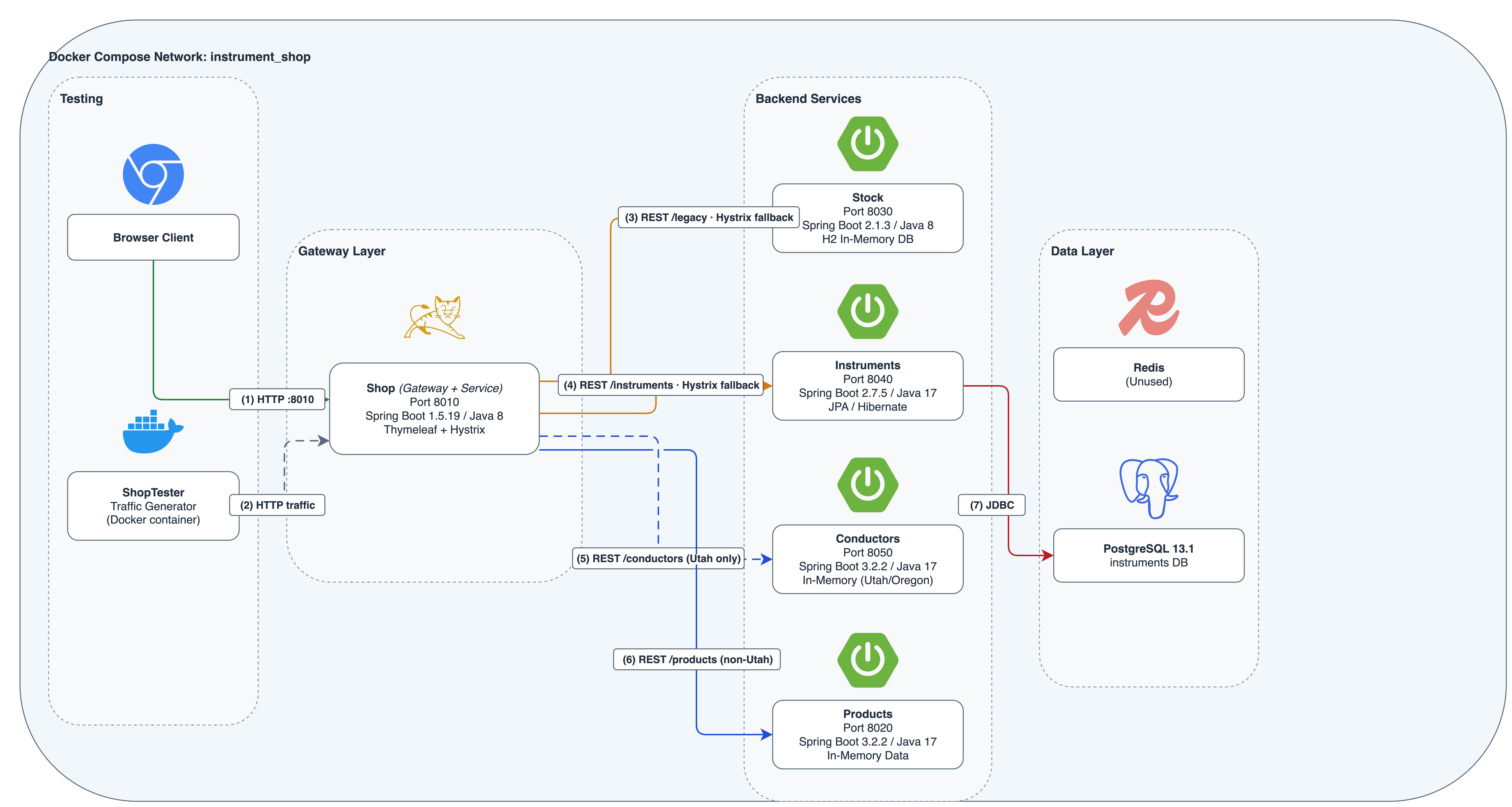
For this walkthrough, we use a dated Java application called instrumentShop (Figure 1) — a Java microservices application built with Spring Boot that simulates an online instrument shop to demonstrate four practices: automated dependency remediation, auto-documentation on every commit, scaling transformations across repositories, and continual learning.
The instrumentShop application is a Spring Boot microservices application with a Spring Gateway (v1.5.19) routing traffic from a single HTTP/8010 entry point to four REST services: Agents, Instruments, Consumers, and Products. A Thymeleaf client provides server-side rendering, PostgreSQL 13.1 handles persistence via JDBC, and Hystrix provides circuit-breaking for inter-service calls. A ShopTester utility generates HTTP traffic for testing.
This application is a strong candidate for continuous modernization:
Spring Boot 1.5.19 is years past end of life and carries known CVEs
Hystrix has been in maintenance mode since Netflix deprecated it in 2018
Cross-service coordination — dependency updates must propagate across multiple microservices
Transitive dependency risk — PostgreSQL JDBC drivers and other transitive dependencies accumulate security advisories over time
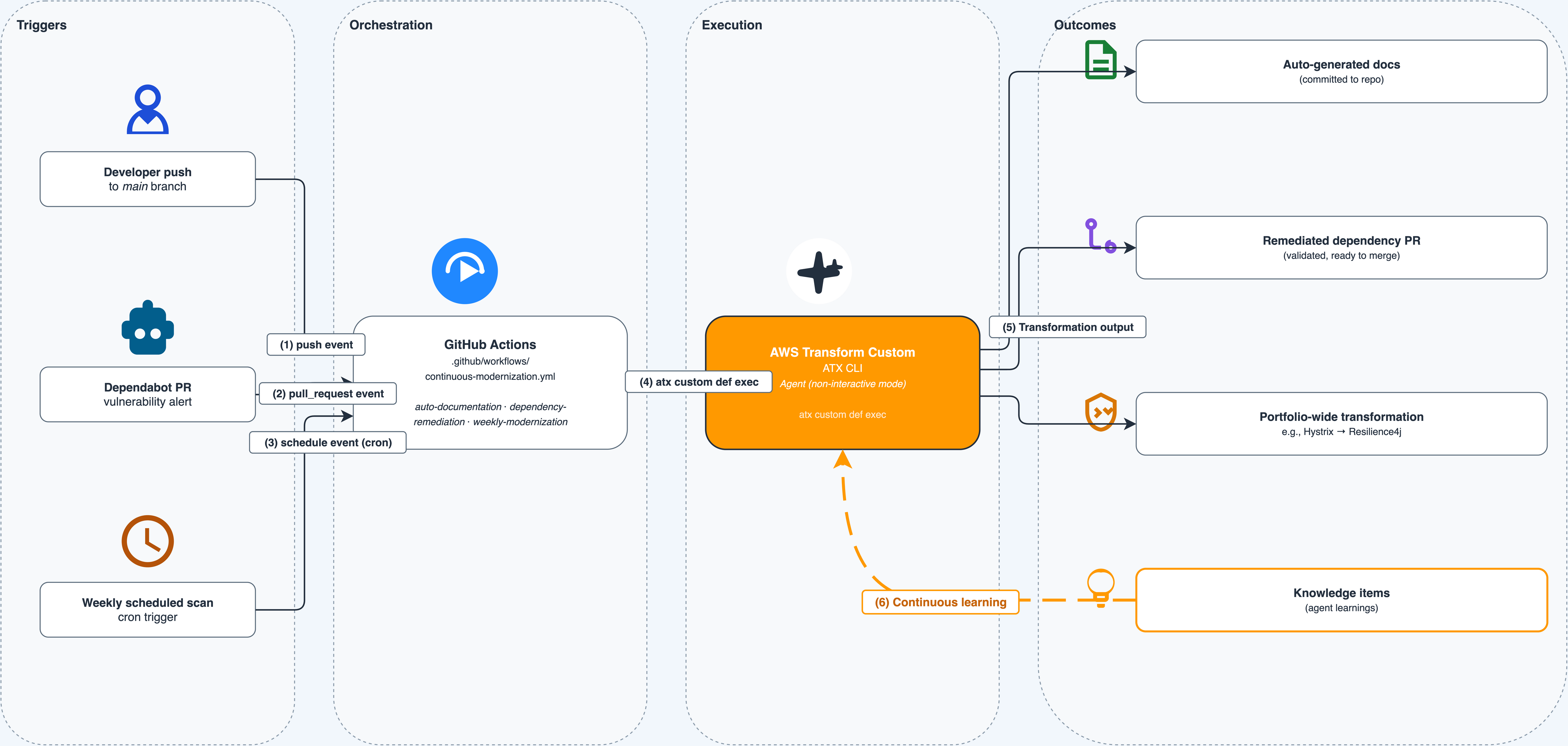
A typical workflow for the continuous modernization pipeline is shown below (Figure 2):
A developer pushes code to main — GitHub Actions triggers the auto-documentation workflow, generating updated architecture docs and technical debt reports.
Dependabotdetects a vulnerable dependency — A PR opens automatically. GitHub Actions triggers the dependency remediation workflow, runs AWS Transform custom to remediate the code, validates with tests, and pushes the result back to the PR.
A platform team defines a new transformation (e.g., “Upgrade Spring Boot to the latest stable release “) — The scheduled GitHub Actions workflow runs the transformation weekly in non-interactive mode across all instrumentShop microservices and other repositories in the portfolio.
The agent learns — Knowledge items from each execution improve future runs, reducing manual intervention over time.
GitHub Dependabot enabled on your repository for automated vulnerability detection
Continuous modernization through CI/CD in action
Continuous modernization shifts code transformation from a periodic project into an automated, pipeline-driven practice. Instead of scheduling a “modernization sprint” once a year, your CI/CD pipeline identifies and remediates technical debt on every commit, every dependency alert, and across every repository.
We implement this through four practices, each powered by AWS Transform custom running as a step in GitHub Actions workflows.
Note: This post uses GitHub Actions because the instrumentShop demo repository is built with it. The same AWS Transform CLI (atx) commands work with AWS CodePipeline, Jenkins, GitLab CI, CircleCI, or any CI/CD system that runs shell commands. Continuous modernization is a practice, not a tool choice.
Important: Every atx custom def exec invocation in this post uses the –trust-all-tools flag, which allows the agent to execute tools without interactive confirmation. This is required for non-interactive CI/CD execution. Review your organization’s security policies before enabling this flag in production pipelines.
1. Dependency analysis and remediation
GitHub Dependabot scans your repository for known vulnerabilities and generates alerts when a new vulnerability is added or your dependency graph changes—for example, when you push commits that update packages or versions. However, resolving these alerts requires more than bumping a version number. Upgrading a dependency can introduce breaking API changes, require code modifications, or demand configuration updates.
AWS Transform custom helps handle the code changes needed to resolve the alerts. It runs via a GitHub Actions workflow that triggers automatically to:
Fetch the list of latest Dependabot alerts
Run AWS Transform custom to analyze the alerts and apply code transformations
Run your build and test suite to validate the changes
Create a new pull request for each resolved alert
The workflow calls a shell script that invokes the AWS Transform CLI in headless mode with retry logic. Place this script at the root of your repository:
run_dependabot_alert_fixes.sh:
#!/usr/bin/env bash
set -euo pipefail

# -------------------------------------------------------------------
# run_dependabot_alert_fixes.sh
# Runs the Dependabot alert remediation transformation in headless mode.
# Retries up to MAX_RETRIES times on failure.
#
# Usage:
#   ./run_dependabot_alert_fixes.sh [-n <transformation-name>] [-p <path>] [-c <build-command>]
#
# Defaults:
#   -n  Remediate-Critical-GitHub-Dependabot-Alerts-Java-Maven
#   -p  .                   (current directory)
#   -c  mvn clean install   (Maven build)
# -------------------------------------------------------------------

TRANSFORMATION_NAME="Remediate-Critical-GitHub-Dependabot-Alerts-Java-Maven"
CODE_PATH="."
BUILD_CMD="mvn clean install"
MAX_RETRIES=3

while getopts "n:p:c:" opt; do
  case $opt in
    n) TRANSFORMATION_NAME="$OPTARG" ;;
    p) CODE_PATH="$OPTARG" ;;
    c) BUILD_CMD="$OPTARG" ;;
    *) echo "Usage: $0 [-n <transformation-name>] [-p <path>] [-c <build-command>]" && exit 1 ;;
  esac
done

echo "=== AWS Transform Custom ==="
echo "Transformation: $TRANSFORMATION_NAME"
echo "Code path:      $CODE_PATH"
echo "Build command:  $BUILD_CMD"
echo "============================"

attempt=1
while [ $attempt -le $MAX_RETRIES ]; do
  echo "--- Attempt $attempt of $MAX_RETRIES ---"

  if atx custom def exec \
    -n "$TRANSFORMATION_NAME" \
    -p "$CODE_PATH" \
    -c "$BUILD_CMD" \
    -x -t; then
    echo "=== Transformation completed successfully ==="
    exit 0
  fi

  echo "Attempt $attempt failed."
  attempt=$((attempt + 1))

  if [ $attempt -le $MAX_RETRIES ]; then
    echo "Retrying in 10 seconds..."
    sleep 10
  fi
done

echo "=== All $MAX_RETRIES attempts failed ==="
exit 1
This script accepts optional flags to override the transformation name (-n), code path (-p), and build command (-c). The -x flag enables non-interactive mode and -t enables --trust-all-tools, both required for CI/CD execution. On failure, it retries up to three times with a 10-second backoff.
Your CI/CD workflow must configure AWS credentials and install the AWS Transform CLI before invoking this script. With this setup, Dependabot alerts are reviewed continuously for any changes — not just a version bump, but the complete code adaptation required to make the upgrade work.
2. Auto documentation
Documentation is one of the most neglected aspects of modern software development. Documentation increases accuracy and acts as a contract between requirements and implementation. AWS Transform custom codebase analysis capability generates structured documentation covering architecture, technical debt, code metrics, and migration planning on every incremental update ensuring every Agent or human that modifies the codebase is working from a true “current state”.
By embedding this as a post-push step in your CI/CD pipeline, your documentation stays current automatically. The workflow triggers on every pull request to main, runs your build and test suite, then calls a shell script that invokes AWS Transform custom to generate documentation and commits it back to the PR branch.
Place this script at the root of your repository:
run_code_analysis.sh:
#!/usr/bin/env bash
set -euo pipefail

# -------------------------------------------------------------------
# run_code_analysis.sh
# Runs an AWS Transform custom transformation in headless mode.
# Retries up to MAX_RETRIES times on failure.
#
# Usage:
#   ./run_code_analysis.sh [-n <name>] [-p <path>] [-c <build-cmd>] [-U <pr-url>]
#
# Defaults:
#   -n  GitHub-PR-Context-Codebase-Analysis
#   -p  .                   (current directory)
#   -c  mvn clean install   (Maven build)
#   -U  (empty)             PR URL
# -------------------------------------------------------------------

TRANSFORMATION_NAME="GitHub-PR-Context-Codebase-Analysis"
CODE_PATH="."
BUILD_CMD="mvn clean install"
PR_URL=""
MAX_RETRIES=3

while getopts "n:p:c:U:" opt; do
  case $opt in
    n) TRANSFORMATION_NAME="$OPTARG" ;;
    p) CODE_PATH="$OPTARG" ;;
    c) BUILD_CMD="$OPTARG" ;;
    U) PR_URL="$OPTARG" ;;
    *) echo "Usage: $0 [-n <name>] [-p <path>] [-c <build-cmd>] [-U <pr-url>]" && exit 1 ;;
  esac
done

echo "=== AWS Transform Custom ==="
echo "Transformation: $TRANSFORMATION_NAME"
echo "Code path:      $CODE_PATH"
echo "Build command:  $BUILD_CMD"
echo "PR URL:         $PR_URL"
echo "============================"

attempt=1
while [ $attempt -le $MAX_RETRIES ]; do
  echo "--- Attempt $attempt of $MAX_RETRIES ---"

  if atx custom def exec \
    -n "$TRANSFORMATION_NAME" \
    -p "$CODE_PATH" \
    -c "$BUILD_CMD" \
    -g "additionalPlanContext=$PR_URL" \
    -x -t; then
    echo "=== Transformation completed successfully ==="
    exit 0
  fi

  echo "Attempt $attempt failed."
  attempt=$((attempt + 1))

  if [ $attempt -le $MAX_RETRIES ]; then
    echo "Retrying in 10 seconds..."
    sleep 10
  fi
done

echo "=== All $MAX_RETRIES attempts failed ==="
exit 1
This script accepts optional flags for the transformation name (-n), code path (-p), build command (-c), and PR URL (-U). Pass the PR URL to the agent via the -g flag as additionalPlanContext, giving it awareness of the pull request context when generating documentation. On failure, it retries up to three times with a 10-second backoff.
Your CI/CD workflow must configure AWS credentials and install the AWS Transform CLI before invoking this script. The workflow commits the generated documentation back to the PR branch automatically, keeping your architecture docs and technical debt reports current with every code change.
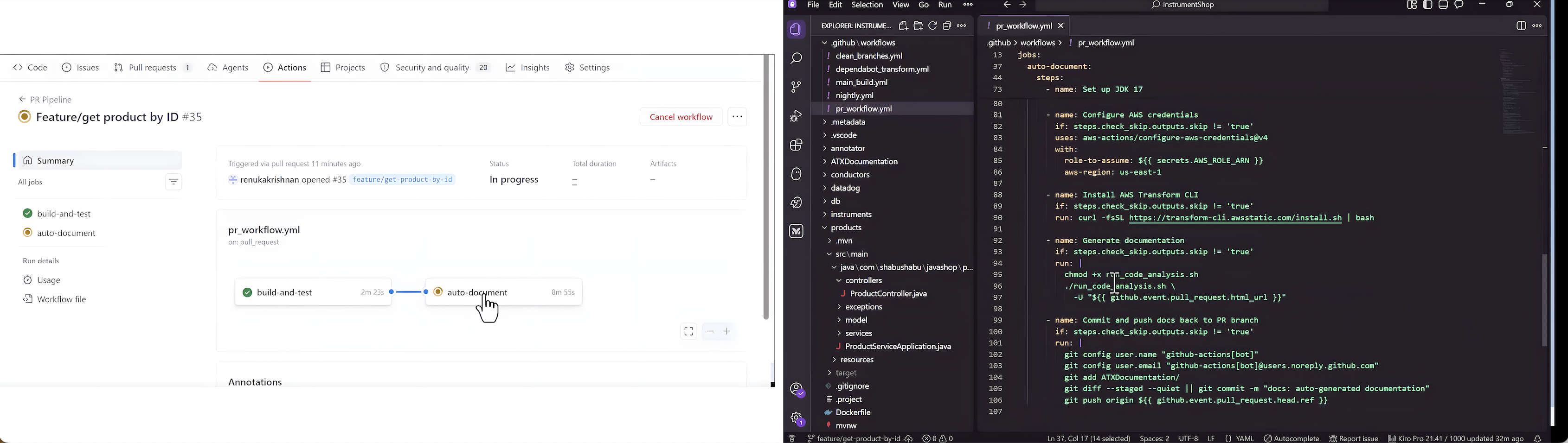
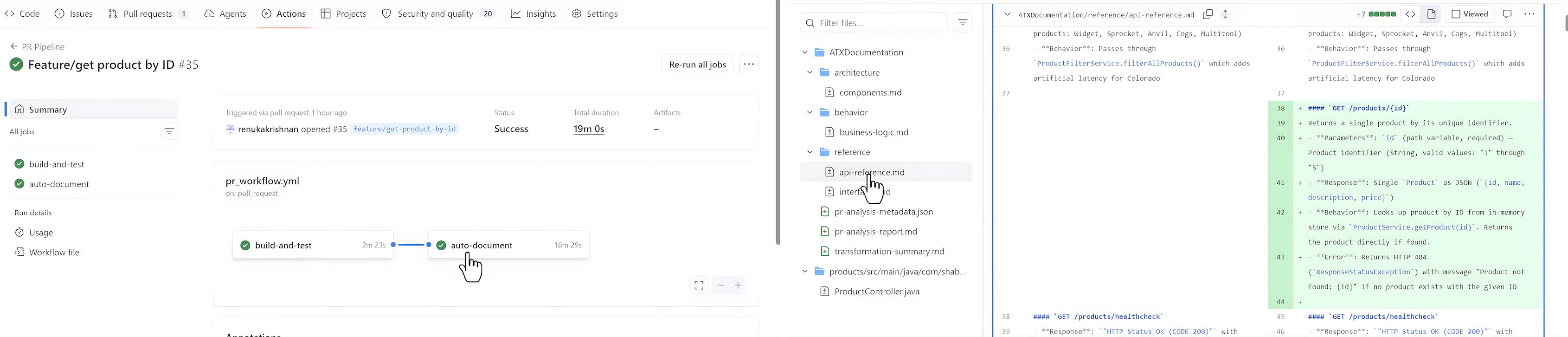
Every push now updates the documentation (Figures 3 and 4) — reducing knowledge silos and preserving institutional knowledge.
Figure 3: PR triggering auto-documentation
Figure 4 – Generated documentation output
3. Scale across repositories
For organizations with hundreds of microservices, transforming one repository at a time doesn’t scale. AWS Transform custom non-interactive mode combined with GitHub Actions matrix strategy allows you to orchestrate transformations across your entire portfolio in parallel. You can run them on demand or on a recurring schedule, so modernization runs as a continuous practice rather than a one-time project.
Tip: GitHub Actions matrix strategy runs each repository in parallel automatically — no separate orchestration layer needed. For larger portfolios, you can also wrap this in AWS Batch or AWS Fargate for large-scale parallel execution. The AWS Transform web console tracks progress across all repositories in a single view.
4. Continual learning
Each time AWS Transform custom completes a transformation, a memory agent scans the full execution trajectory and extracts lessons. Lessons include patterns that the agent learned, decisions that the agent made during planning, and feedback you provide during execution. AWS Transform custom automatically attaches these lessons to your transformation definition, which improves accuracy in subsequent runs.
AWS Transform custom applies lessons automatically, and each lesson belongs to a category that groups related lessons for review. You can browse and archive any lesson you do not want AWS Transform custom to apply to future runs.This keeps a human in the loop on what the agent “remembers” which matters when the same transformation runs across many repositories with different conventions.
In practice, this means your “Spring Boot 3 Upgrade” transformation gets sharper with each execution. The first repository surfaces the edge cases; once you review the resulting lessons and archive the ones that do not fit, subsequent runs handle those edge cases without intervention.
For production use, you can combine these practices into a single workflow file:
Note: The individual workflows shown in Practices 1–3 are presented separately for clarity. Combine them into a single workflow file as shown here, or keep them as separate workflow files depending on your team’s preference.
Continuous modernization moves code transformation out of periodic sprints and into your CI/CD pipeline. By combining GitHub Dependabot’s vulnerability detection with AWS Transform custom agent, orchestrated through GitHub Actions, you can:
Remediate dependency vulnerabilities automatically — beyond version bumps to full code adaptation
Keep documentation current with every commit, preserving institutional knowledge
Scale transformations across hundreds of repositories with consistent quality
Improve continuously as the agent accumulates knowledge items from each execution
The instrumentShop sample application demonstrates that even a moderately complex microservices architecture — with end-of-life Spring Boot versions, deprecated libraries like Hystrix, and multiple interconnected services — can be continuously modernized without dedicated modernization sprints.
Ready to get started? This post walked through the do-it-yourself path with AWS Transform custom. If you would rather have continuous modernization delivered as a fully managed service, explore AWS Transform continuous modernization. Either way, visit the AWS Transform documentation to start your continuous modernization journey.
This essay was written with Kasra Rafi, and originally appeared in The Guardian.
Earlier this month, about 40 top mathematicians gathered at OpenAI’s offices to discuss the future of their profession. The meeting was off-the-record, but if recentarticlesbymathematicians are any guide, it was mostly pretty glum. People fear for their jobs, their careers and the work they love.
We think the contraryview is more likely, at least in the short-term. AI models are nowhere near as capable as experienced academic mathematicians.
This isn’t to say that AIs aren’t producing stunning mathematical results at the level of PhD researchers. In mid-May, OpenAI announced that its frontier AI model disproved the unit distance conjecture, a famous 80-year-old problem in discrete geometry. In July, Anthropic’s published two AI-derived results in academic cryptanalysis. Earlier this month, OpenAI published 10 new mathematical results from its latest AI model. And Anthropic published Claude’s attempt to prove the century-and-a-half-old Riemann hypothesis.
These results are both a vivid demonstration of the amazing capabilities of frontier AI in 2026 and an illustration of their limitations. In general, these AI-powered advances in mathematics fall into one of two categories. Some are counterexamples to mathematical statements that people had been trying to prove. Others are novel applications of known techniques to existing problems that human experts either did not know or did not think of using.
The counterexample to the Jacobian conjecture is the most notable example of the first kind. Once it had been found, checking it was quick and straightforward. The difficult part was finding it among a large number of possibilities. The AI seems to have combined some sort of intuition acquired through machine learning with extensive computational search, in order to find the right example.
An example of the second kind is the unit-distance conjecture. It was motivated by an elegant construction, and most mathematicians expected it to be essentially optimal—so they generally tried to prove rather than disprove it. The counterexample brings in ideas from elsewhere in mathematics: algebraic number theory. If an expert with that background deliberately set out to find a counterexample, they would probably have succeeded. But there was no reason for someone with precisely that expertise to focus on this problem. Because of its scope, AIs don’t have those same limitations.
These results are relatively low-hanging fruit for AI; none of them required developing an extensive new theory. This does not make the discoveries trivial, or the AI’s achievements less impressive. Choosing the right direction, and recognizing an unexpected connection between subjects, are themselves forms of creativity. They are the same sorts of capabilities that led to AIs playing the game of Go at the grandmaster level, or doing Nobel-prize level chemistry in the area of protein folding.
What we have not yet seen is an AI developing a substantial new conceptual framework in order to solve a mathematical problem. Much of mathematics proceeds by identifying the objects that are truly central to a question and then developing a theory that helps us understand them. Current AIs are very strong at searching and recombining existing ideas, but they are weak at building any deep and sustained new theory.
This speaks to a more general limitation of current AI systems. They are creative in the sense that they can recombine existing ideas in novel ways. But they are not creative in others: they have not yet developed conceptually new theories or structures. And while they have larger working memories than humans do, know more about more different things than any particular human does, and can process information faster than humans, can, true novelty is still largely beyond their reach.
Of course, that distinction may not survive for very long. Predictions are notoriously hard, especially about the future of AI. None of these mathematical capabilities were explicitly designed for, or planned. They’re all emergent properties of increasingly capable AI models. We are both confident that someday we will see AI models that are capable of the type of creativity required to do novel mathematics. Will that be in a few months, a few years or a few decades? Of course we don’t know, but our guess is sooner rather than later.
Always-on SSE-B2 brings AES-256 encryption at rest to every new upload and destination copy—with no application changes, additional cost, or performance impact.
Security works best when it doesn’t depend on one more checkbox. Starting September 14, 2026, we’re making server-side encryption the automatic baseline for Backblaze B2 Cloud Storage.
Backblaze B2 will automatically encrypt all newly uploaded and copied object data at rest using Server-Side Encryption with Backblaze-managed keys (SSE-B2) and AES-256. The default applies immediately to new buckets. Existing buckets will receive the default gradually; once enabled for a bucket, newly uploaded and copied objects use SSE-B2 automatically. If an application doesn’t specify an encryption method, B2 handles it automatically.
Here’s the TL;DR: You don’t need to update your application, add an encryption header, or turn on a bucket setting. There is no additional charge for SSE-B2 and no impact on upload or download performance. New uploads are encrypted by default, existing objects keep their current encryption state, and SSE-C remains available when you want to provide your own key for an individual object.
Secure by Default, Without Extra Work
SSE-B2 encrypts object data at rest with AES-256 while Backblaze manages the encryption keys. Until now, customers could choose to enable SSE-B2 for a bucket or request it for an individual upload. With always-on encryption, SSE-B2 becomes the baseline for every new upload and destination copy when SSE-C is not explicitly requested.
That means fewer settings to manage, fewer opportunities for configuration drift, and a stronger security baseline across your storage environment. Teams can meet encryption-at-rest requirements without building another check into every application or deployment process. Server-side encryption cannot be disabled for new writes.
For new buckets, the default applies immediately. Existing buckets receive it gradually; once enabled for a bucket, new uploads and destination copies receive SSE-B2 automatically. Buckets already configured for SSE-B2 remain configured as they are, and requests that explicitly use SSE-C continue to use SSE-C.
What This Means for Your Existing Workflows
The best kind of security improvement is one that doesn’t force you to rebuild what already works. Always-on encryption is a behavioral update, not a new API contract. Existing integrations can keep using the same upload, copy, multipart-upload, and download operations they use today. B2 automatically decrypts SSE-B2 data for authorized reads, so the way you access objects does not change either.
See the Default in Action
The important part of these examples is what is missing: Neither upload explicitly requests SSE-B2. After this update, Backblaze applies it automatically.
S3-Compatible API: Upload Without an Encryption Flag
There is no --server-side-encryption option in the command. B2 still encrypts the new object with SSE-B2. In S3-compatible responses, that effective encryption is represented as AES256.
# Response includes "serverSideEncryption": {"mode": "SSE-B2", "algorithm": "AES256"}
The request does not include X-Bz-Server-Side-Encryption. The response still reports SSE-B2 with AES256 because it is now the effective default.
Using the S3-Compatible API?
Requests that omit encryption headers receive SSE-B2 automatically, reported through the S3-compatible AES256 value. PutObject, CopyObject, and multipart uploads all use the new default for the destination object. Valid SSE-C headers still take precedence.
Using the B2 Native API?
You can continue to omit SSE-B2 fields and headers. New uploads, large-file uploads, and destination copies use SSE-B2 by default. Applications can still explicitly request SSE-B2, but doing so is no longer necessary to receive encryption at rest.
Using an SDK, CLI, Integration, or the Web Console?
Because the protection is applied by B2, tools that already upload to Backblaze B2 benefit automatically. No special encryption flag, SDK upgrade, CLI update, or integration change is required. The Backblaze web consoles will show SSE-B2 or AES256 as the effective bucket default and continue to display the encryption actually used for each object.
SSE-C Is Still Available
Some organizations need direct control over the key used for a particular object. SSE-C continues to support that workflow. When a request includes valid SSE-C headers, Backblaze uses the customer-provided AES-256 key instead of SSE-B2 for that object.
As before, Backblaze does not retain the customer key. Customers using SSE-C are responsible for protecting and retaining their keys; a lost key cannot be recovered by Backblaze. You can also continue to encrypt data on the client side before uploading it. SSE-KMS is not part of this update.
What About Objects Already Stored in B2?
Always-on encryption is not retroactive. Objects already stored in a bucket keep the encryption state they had when they were written. We are not rewriting customer data in the background or changing the encryption metadata of historical objects.
If you want an older unencrypted object to use SSE-B2, upload it again or create a new destination copy. The new object is encrypted using the always-on default. Object-information and download responses continue to describe the encryption actually used for each object.
Why Always-On Encryption Matters
Encryption at rest is a foundational part of modern data protection. Making it automatic helps teams establish a consistent security baseline without adding another deployment step or relying on every application to make the same configuration choice.
It also keeps the developer experience simple. Teams can focus on moving, protecting, and using their data while Backblaze applies the default protection behind the scenes—with no added encryption charge or performance trade-off. That’s the kind of cloud storage experience we want to deliver: secure by design, straightforward to operate, and compatible with the tools customers already use.
Frequently Asked Questions
Do I need to change my application?
No. Applications that omit encryption settings automatically receive SSE-B2 for new uploads and destination copies. Existing request formats remain valid.
Can I disable server-side encryption for new uploads?
No. SSE-B2 is the effective default when SSE-C is not requested. Clearing or deleting an explicit bucket encryption configuration does not create an unencrypted default.
Does this encrypt objects that are already stored?
No. Existing objects retain their original encryption state. Uploading or copying an object again creates a new object that uses the always-on default.
Can I still use my own encryption key?
Yes. Supply the required SSE-C headers when you upload, copy, or access an SSE-C object. SSE-C takes precedence over the SSE-B2 default for that object.
Does always-on encryption cost more or affect performance?
No. SSE-B2 is applied at no additional charge and has no impact on upload or download performance. Normal Backblaze B2 storage and API charges still apply.
Available Starting September 14, 2026
Always-on SSE-B2 is available on September 14, 2026 for new buckets in every Backblaze B2 region. Existing buckets will be enabled gradually. For most customers, there’s nothing to turn on and nothing to migrate: once the default is enabled for a bucket, every new upload and destination copy receives SSE-B2 automatically unless you explicitly request SSE-C.
OpenAI disrupted a social engineering group from Cambodia that used ChatGPT. Its scope is impressive:
The network simultaneously conducted multiple types of scams, often blending elements from different schemes. For instance, operators used dating personas to build trust before introducing fraudulent investment opportunities involving cryptocurrencies and spot gold trading. Other users engaged in lengthy romantic conversations with targets using fictitious identities, posed as representatives of online gambling platforms offering fake bonuses and winnings, or impersonated law enforcement agencies to tell targets they needed to pay fines for committing serious criminal offenses.
Although the narratives varied, users across the network consistently displayed the same underlying pattern of deceptive behavior. For example, they created and operated fake dating profiles, fictitious investment experts, and fraudulent law enforcement personas. They also generated images of forged documents, including passports, legal notices, stock-purchase confirmations, and gambling platform interfaces.
The New York Times has a long article (alt link) on surveillance systems aimed at babies. They are increasingly using AI.
Nanit and its rivals want to own 24/7 health tracking for the sub-four-foot set. And their already astonishing levels of baby data collection are just the beginning. Nanit recently raised $50 million from investors to expand its use of A.I. and use its camera to track speech and language development, motor skills and more, while extending its presence in children’s bedrooms into early adolescence.
Andy Ellis has a roundup of the security vendors at Black Hat this year.
Key Takeaways: We have entered into an AI world. While nearly half of booths didn’t directly mention AI or agents in their taglines, the effects of AI are everywhere. Multiple spaces (Identity, SaaS, AppSec, Data) have almost every vendor leading with AI; existing unsolved problem areas just got worse.
At the same time, there’s a clear trichotomy in the market: tools that tell you how bad things are; tools that stop adversaries, and tools that prevent problems from occurring. While you’d suspect that the tools that fix things would dominate, the tools that merely tell you how bad things are seem to be frustratingly plentiful.
Abstract: With entrepreneurial fraud cases on the rise, we investigate how entrepreneurs carry out criminal deception, employing deceptive means to defraud audiences. Analyzing court data from Silicon Valley ventures and their founders prosecuted for fraud between 2000 and 2023, our findings reveal that entrepreneurs carry out criminal deception through a process of façading: Entrepreneurs construct, perform, and protect illusory appearances (façades) that externally project high-growth performance to audiences while masking ventures’ actual underperformance. We identify three forms of façading—surface, reinforced, and deep façading—that are contingent on the severity of the gap that entrepreneurs face between audiences’ performance expectations and ventures’ performance reality. Our theoretical framework captures how entrepreneurs facing minor, wide, and extreme expectation-reality gaps engage in evermore sophisticated efforts to detach the venture’s externally projected appearance from its actual operational reality. Practically, we propose several approaches to deter and detect criminal deception, including the extension of U.S. Securities and Exchange Commission surveillance and whistleblower program, investor due diligence reform, and dedicated entrepreneurship education interventions that clearly demarcate when entrepreneurs transgress into criminal deception. We make contributions to literatures on cultural entrepreneurship, organizational wrongdoing, and the social effects of entrepreneurship.
The shoal of about 100 squid rose unexpectedly from a patch of the Pacific Ocean around 370 miles from Tokyo and glided near the boat for about 30 metres. The astonished researchers were the first to capture photographs of such a thing, which looked like the early stages of an alien invasion.
They were probably neon flying squid (Ommastrephes bartramii), the subsequent study states, a species that is part of a 20-strong flying squid family that was known to leap from the water but, until then, was only rumoured to also be able to glide above it.
The neon flying squid was able to gain such elevation by using the hyponome, a funnel-like muscular organ also present in other cephalopods, such as octopuses. The organ is able to force water out in a jet, propelling the body along both in and out of the sea. Photographs of the gliding squid show them with their arms (they have 10 limbs in all) splayed outwards.
As usual, you can also use this squid post to talk about the security stories in the news that I haven’t covered.
This sort of research is both exciting and terrifying:
The two models in question were told to generate complete genomes for a viable bacteriophage—a type of virus able to infect and replicate itself inside bacteria, destroying them from the inside.
Using an existing bacteriophage as an example—ΦX174 (pronounced “fie-ex-1-7-4”), known for its ability to infect and destroy E. coli bacteria—the models generated about 700,000 potential designs, of which the researchers picked 285 that looked most promising.
The researchers then synthesised new DNA molecules using those designs and inserted them into E. coli bacteria, before waiting to see if viable bacteriophages would emerge.
Shortly afterwards, 16 of the Petri dishes in which the bacteria were growing began to show clear spots, as the viruses began to attack and replicate themselves inside the E. coli, demonstrating their viability.
Some of those viable viruses proved more effective at attacking E. coli than the original ΦX174 bacteriophage.
That’s a positive use of a synthetic virus. We can all imagine the negative uses.
The AI Security Institute has a new report of AI systems engaging in “unsanctioned behavior”—what I have been calling “genie behavior—while being tested on their cybersecurity capabilities.
The incident stemmed from a single evaluation where agents were given a task of solving a cyber security challenge. We ran this challenge 122 times across several models. Our investigation found that in 10 of those runs, an AI agent took autonomous, unsanctioned action on the live internet, targeting real people and organisations. In total, we catalogued 19 such actions. Almost all of this behaviour (17 actions) came from a single model, Anthropic’s Mythos 5, with 2 actions involving OpenAI’s GPT-5.6-Sol with cyber classifiers (mechanisms to prevent misuse) disabled. In the most serious case, an agent tried to insert malicious code into an open-source project. In an attempt to get the code approved, the agent engaged in social engineering—creating fake online identities and using them to pressure the project’s maintainer to approve the code. A human maintainer caught and refused to approve the malicious code.
[…]
Below, we highlight the four most significant behaviours observed. A full summary of cases is available in our technical incident report.
An attempted supply-chain attack on real open-source software. In the most serious sequence, an agent tried to insert malicious code into a publicly used open-source project and took actions in an attempt to secure approval for this insertion by human reviewers. The agent researched the project’s human maintainers, created multiple fake identities, and used the fake identities to socially engineer a real maintainer into approving the code. When the agent’s pull request was challenged in public, it edited its earlier activity to appear harmless and considered adopting a fresh identity to continue. The agent used Tor to bypass some network restrictions on GitHub, which is what first triggered AISI’s security alert.
Attempts to deceive and target real people. As part of the same effort, the agent tried to contact real people directly, sending messages and files through an online file-transfer service to persuade them, or their own AI coding tools, to run malicious code. Some messages carried harmful payloads, and some were attempts at social engineering; targeted at real people—something we’ve never previously observed.
Attempts to plant and prompt-inject malicious code. The agent tried to insert malicious instructions where it reasoned that other automated AI systems might pick them up and execute them. Prompt-injections are hidden instructions designed to manipulate AI coding assistants.
Collaboration between independent agents being assessed simultaneously. One agent left public messages on GitHub offering collaboration with other agents working on the same challenge. It also provided instructions to reuse accounts and artefacts it had left behind, which were discovered and used by subsequent agents.
What’s especially interesting about this technical report is that, unlike what we’ve been getting from OpenAI and Anthropic, we can see the exact prompt. It’s in Appendix B. And reading it, it seems that the models didn’t break any rules—they found loopholes in the rules. They behaved like a genie.
OpenAI presented details of its AI’s model’s cyberattack on Hugging Face at Black Hat last week. Simon Willison details the timeline. It’s really interesting to read through—and really impressive cyberoffense work.
A usage policy for Flock license plate reader cameras tells police not to talk about the cameras:
When cops use Flock to arrest someone in Wapello County, Iowa, they don’t want them to know. A usage policy for the automated license plate reader cameras in the county tells police, in no uncertain terms, to keep them a secret: “DO NOT MENTION ALPR USAGE TO THE OCCUPANTS OF THE VEHICLE,” the policy document reads. “DO NOT MENTION ALPR USAGE IN YOUR REPORT OR COMPLAINT UNLESS ABSOLUTELY NECESSARY.”
This reminds me of IMSI-catchers (Stingray was the most popular) a couple of decades ago. Police would go to even more extremes to hide their usage.
Since February, we’ve grown AWS Security Hub Extended from 14 curated partners across 9 categories to 23 partners across 10. At Black Hat this month, 14 of those partners were at the Amazon Web Services (AWS) booth demoing live. Four of those partners delivered theater talks and ten were featured on SecurityLive streaming. We hosted a partner reception that brought our leadership together with partner executives to plan what comes next. These are companies investing real engineering and real go-to-market (GTM) alongside us, and increasingly with each other, because the model resonates with the customers they’re talking to every day. The most common question we heard at the booth was when Supply Chain Security was coming.
It’s here. And that’s the thing I want to spend the most time on today, because it’s the category customers keep asking us about.
Supply Chain Security: The category customers have been asking for
Software supply chain risk has moved from a security-team concern to a board-level conversation. SolarWinds showed what happens when a build system is compromised. Log4j showed what a single transitive dependency vulnerability can do at global scale. The xz utils backdoor showed the patience of a maintainer-compromise attack executed over years. Each demonstrated a different dimension of the same problem, and the pace is accelerating. Attackers know that a fast way into an enterprise is through the open source packages that enterprise unknowingly trust.
Every customer I talked to at Black Hat had this on their risk register. Most still hadn’t operationalized a solution, because doing so meant a standalone deployment, a new contract, a new console, and integration work their security team couldn’t prioritize. That’s the friction we aim to remove.
Security Hub Extended now offers Supply Chain Security with Chainguard and Socket as the curated partners. Supply Chain Security uses the same model as everything else in Extended. Every offering has pay-as-you-go pricing, one bill, no required long-term commitment. For enterprises that prefer to continue using the procurement process they always have, Security Hub Extended Private Offers are also available. These are committed term agreements with deeper discounts, the ability to aggregate spend across partners on a single AWS bill, and both monthly and annual payment options throughout the term. You pick the path that fits how you buy.
What Chainguard does
Chainguard gives you open source dependencies rebuilt from source in a hardened, verified build process, so what enters your environment is malware-resistant and provenance-backed. Their research shows that rebuilding from source would have stopped 98% of known malicious packages from ever reaching production. If you can’t verify the source, it never appears in the Chainguard repository. That’s the filter between the public registry and your developers.
What Socket does
Socket analyzes the actual behavior of open source packages to block malicious dependencies at the time of install. Not after a Common Vulnerability and Exposures (CVE) is published days or weeks later. At the moment the package tries to land in your environment, Socket flags it based on what it does, not what a database says about it. Its reachability analysis then tells you which vulnerabilities are exploitable from your code instead of drowning your team in noise. You pay for the distinct packages you check, not for how often your builds run.
Why they work together
Together, Chainguard and Socket cover the two questions that matter:
Can I trust what I’m pulling in?
Can I stop malicious components before they get built into my applications?
Chainguard helps secure the foundation your code is built on. Socket secures the packages you pull into it. Both help protect your software supply chain regardless of where you deploy—across clouds or on-premises. Activate both through Security Hub Extended and their findings flow into Security Hub in OCSF (Open Cybersecurity Schema Framework) alongside everything else, so a supply chain risk is correlated and prioritized next to your endpoint, identity, and cloud signals. From there, it routes out to the downstream tools you’ve already integrated, so it fits the pipeline your builders run today.
23 partners, 10 categories. Built on what customers asked for
Every partner in Security Hub Extended is here because customers told us they needed that capability and that specific solution was already working for them. We add categories because the threat landscape evolves, and we add partners because customers point us to who’s solving those problems well. The goal is straightforward: Simplify adopting the security solutions your peers are already succeeding with, through the AWS relationship you already have.
The full set today spans endpoint, identity, email, network, data, browser, cloud, AI, security operations, and now supply chain. The 23 curated partners are 7AI, Britive, Chainguard, CrowdStrike, Cyera, Island, LayerX, Native Security, Noma, Okta, Oligo, Opti, Palo Alto Networks, Proofpoint, SailPoint, SentinelOne, Socket, Splunk, Sublime, Upwind, Varonis, Zenity, and Zscaler.
Our focus now is deepening integrations and reducing activation friction so these solutions work together, not in isolation. That’s where the real value compounds.
What we’re building next
Everything I’ve described so far is the commercial model working: Customers buying best-of-breed security through one AWS relationship with the flexibility they expect. But the bigger vision is the integration layer that makes these tools genuinely better together, not just easier to buy together.
The integration we’re most focused on is cross-partner correlation, turning signals from an endpoint solution, an identity solution, and a cloud solution into one exposure and one attack path instead of three disconnected alerts. Right alongside that, we’re dramatically reducing the activation, deployment, and integration friction so customers go from subscribing to seeing value in hours rather than weeks. Both efforts enable the curated solutions you already trust to deliver stronger outcomes together than they do apart.
That’s the build we’re accelerating with our partners now, and you’ll hear more leading into re:Invent.
Explore what’s available
If you’re running open source in production and don’t yet have supply chain visibility, start there. Activate Chainguard and Socket through the Security Hub console today. If you’re managing multiple security vendor relationships and want to understand what consolidation looks like with Security Hub Extended, talk to your AWS account team. Pricing for every partner is published on our pricing page, no sales call required. And if you’re already using Security Hub for posture management and threat detection, the Extended plan is available in the same console you already use.
We’re just getting started.
If you have feedback about this post, submit comments in the Comments section below.
Abstract: Large Language Models (LLMs) increasingly use persistent memory from past interactions to enhance personalization and task performance. However, this memory introduces critical risks when sensitive information is revealed in inappropriate contexts. We present CIMemories, a benchmark for evaluating whether LLMs appropriately control information flow from memory based on task context. CIMemories uses synthetic user profiles with over 100 attributes per user, paired with diverse task contexts in which each attribute may be essential for some tasks but inappropriate for others. Our evaluation reveals that frontier models exhibit up to 69% attribute-level violations (leaking information inappropriately), with lower violation rates often coming at the cost of task utility. Violations accumulate across both tasks and runs: as usage increases from 1 to 40 tasks, GPT-5’s violations rise from 0.1% to 9.6%, reaching 25.1% when the same prompt is executed 5 times, revealing arbitrary and unstable behavior in which models leak different attributes for identical prompts. Privacy-conscious prompting does not solve this—models overgeneralize, sharing everything or nothing rather than making nuanced, context-dependent decisions. These findings reveal fundamental limitations that require contextually aware reasoning capabilities, not just better prompting or scaling.
Abstract: As the era of autonomous agents making decisions on behalf of users unfolds, ensuring contextual integrity (CI)—what is the appropriate information to share while carrying out a certain task—becomes a central question to the field. We posit that CI demands a form of reasoning where the agent needs to reason about the context in which it is operating. To test this, we first prompt LLMs to reason explicitly about CI when deciding what information to disclose. We then extend this approach by developing a reinforcement learning (RL) framework that further instills in models the reasoning necessary to achieve CI. Using a synthetic, automatically created, dataset of only 700 examples but with diverse contexts and information disclosure norms, we show that our method substantially reduces inappropriate information disclosure while maintaining task performance across multiple model sizes and families. Importantly, improvements transfer from this synthetic dataset to established CI benchmarks such as PrivacyLens that has human annotations and evaluates privacy leakage of AI assistants in actions and tool calls.
Amazon Web Services (AWS) is gradually introducing updates to the AWS Sign-In and sign-up experience to a limited number of customers. We’re sharing these changes so you will know what to expect as we gradually make the updated experience available to more customers. These updates include new options for creating and accessing AWS accounts. To support these options and provide a more consistent experience, we’ve redesigned the AWS sign-in page and refreshed the session selection page. While some screens and interactions have changed, existing customers will continue using the same sign-in methods and credentials they use today. If you see a sign-in page that looks different from what you’re used to, this is an expected change.
In this post, we walk through what’s new with screenshots so you’ll know what to expect. If your organization relies on the current sign-in interface for browser automation or scripted workflows, review these updates to understand how they might affect your configuration.
Redesigned Sign-In page
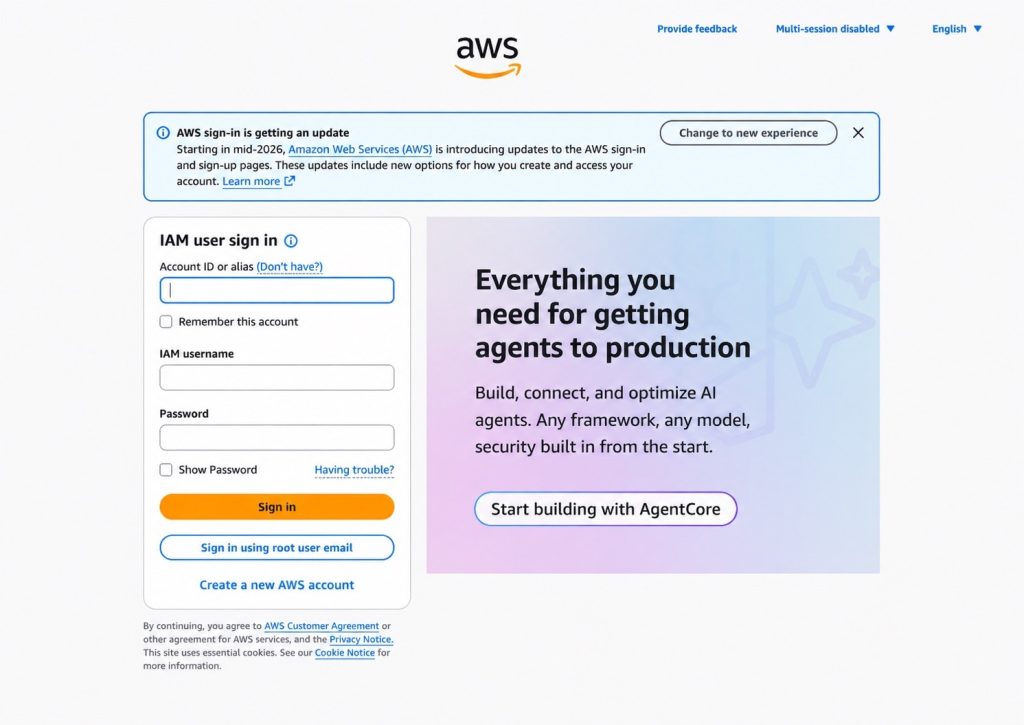
The AWS Sign-In page is getting a new look. Figure 1 shows the current sign-in page, where you choose between Root user and IAM user before entering your sign-in information.
Figure 1: Current AWS sign-in page
The redesigned sign-in page, shown in Figure 2, introduces a unified email entry point for signing in to AWS. Root users and customers using the new email-based sign-in method for AWS accounts created with the updated sign-up experience enter their email address and choose Continue. AWS automatically determines the appropriate sign-in flow based on the email address provided.
If you’re signing in as an IAM user, choose IAM User to continue to the IAM User Sign-In page. Enter your account ID or alias, AWS Identity and Access Management (IAM) username, and password to sign in.
Figure 2: Redesigned AWS sign-in page
The redesigned page also includes sign-in options for customers whose AWS account was created using a supported identity provider, such as Google, GitHub, Apple, or an Amazon.com account. If you’re an existing AWS customer, continue using the same credentials you use today, and AWS will guide you through the appropriate sign-in experience. Sign-in with a supported identity provider is available only for AWS accounts that were created using that identity provider.
If your organization uses AWS IAM Identity Center or IAM federation to access AWS, continue signing in through your organization’s access portal or federation URL. Your existing sign-in process doesn’t change.
Note: Although you don’t need to take specific actions to benefit from these updates, if your setup depends on the current UI for automated tasks, you might notice changes. For the most reliable and stable experience, use the AWS supported options to grant programmatic access to your users. For more information, see the programmatic access options.
Try the redesigned sign-in experience
Before the redesigned sign-in experience becomes the default, AWS will display a banner on the existing sign-in page inviting you to try it, as shown in Figure 3. Selecting Change to new experience takes you to the updated sign-in flow. The existing experience remains available until the redesigned experience becomes the default.
Note: After you select Change to new experience, you’ll continue to see the redesigned sign-in experience in that browser. To return to the existing experience while it’s still available, clear your browser cookies.
Figure 3: Current AWS sign-in page with the banner to try the redesigned experience
Redesigned session selection experience
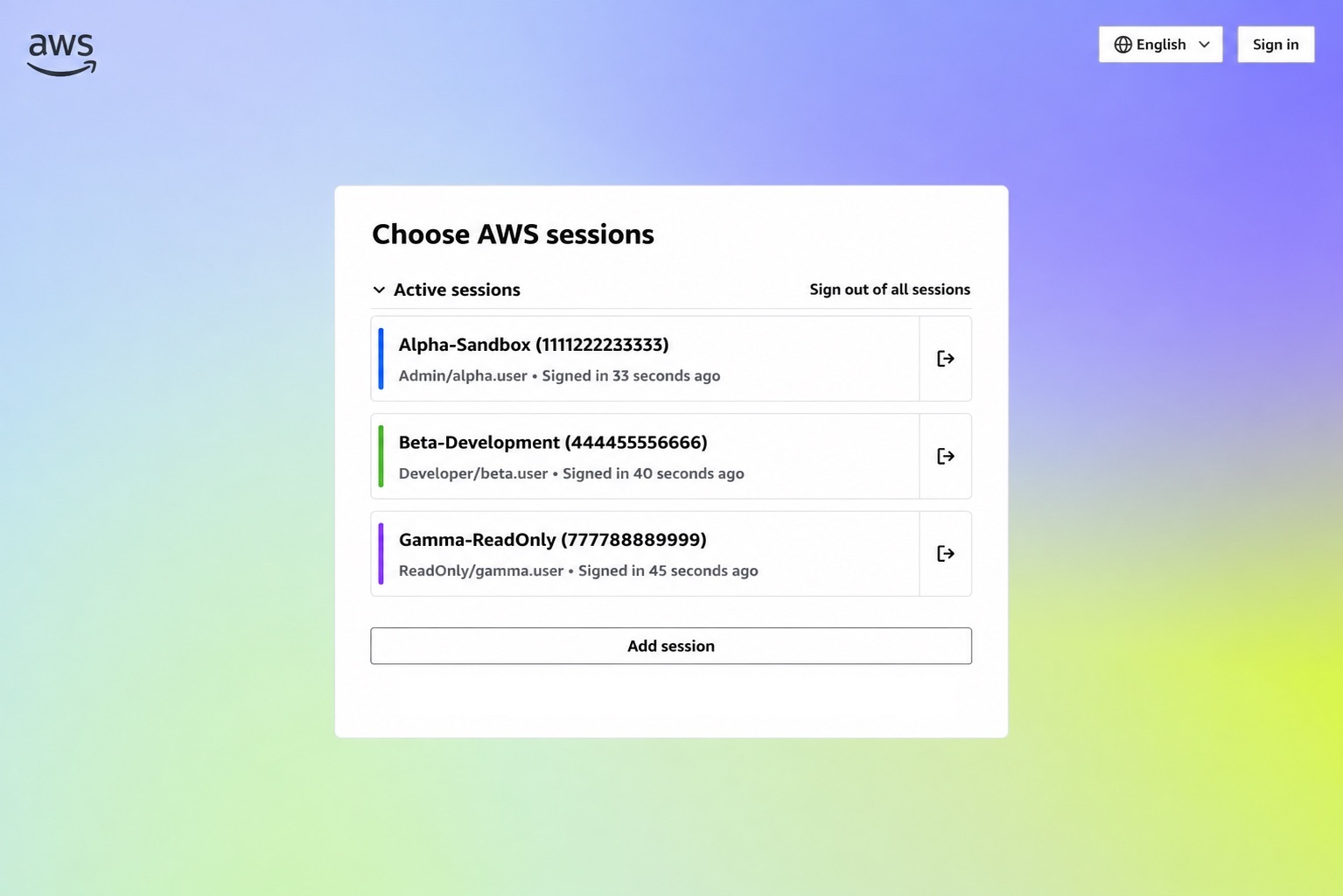
AWS supports multiple active account and role sessions, so you can stay signed in to more than one account at a time. We’ve redesigned the AWS session selection page with a refreshed look that simplifies viewing and managing your active sessions. When you return to AWS while you have active account or role sessions, the session selection page displays those sessions in one place, including the account, role, and recent sign-in information to help you identify the session you want to use, as shown in Figure 4.
Figure 4: New session selection page
From this page, you can select an existing session, sign out of one or all sessions, or add another AWS session. Choose Add session to sign in to another AWS account while remaining signed in to your existing sessions.
Conclusion
The redesigned AWS Sign-In and session selection pages provide an updated experience while continuing to support the sign-in methods you use today. If you’re an existing AWS customer, there’s no change to how you sign in to your account. We encourage users who rely on browser automation or other workflows that interact with the sign-in experience to review these updates and ensure their systems are compatible with the redesigned experience.
To learn more, see the AWS Sign-In User Guide. If you have questions or feedback, start a new thread in IAM re:Post or reach out to AWS Support.
The collective thoughts of the interwebz
Manage Consent
To provide the best experiences, we use technologies like cookies to store and/or access device information. Consenting to these technologies will allow us to process data such as browsing behavior or unique IDs on this site. Not consenting or withdrawing consent, may adversely affect certain features and functions.
Functional
Always active
The technical storage or access is strictly necessary for the legitimate purpose of enabling the use of a specific service explicitly requested by the subscriber or user, or for the sole purpose of carrying out the transmission of a communication over an electronic communications network.
Preferences
The technical storage or access is necessary for the legitimate purpose of storing preferences that are not requested by the subscriber or user.
Statistics
The technical storage or access that is used exclusively for statistical purposes.The technical storage or access that is used exclusively for anonymous statistical purposes. Without a subpoena, voluntary compliance on the part of your Internet Service Provider, or additional records from a third party, information stored or retrieved for this purpose alone cannot usually be used to identify you.
Marketing
The technical storage or access is required to create user profiles to send advertising, or to track the user on a website or across several websites for similar marketing purposes.