Network performance update: Birthday Week 2024

Post Syndicated from Emily Music original https://blog.cloudflare.com/network-performance-update-birthday-week-2024

When it comes to the Internet, everyone wants to be the fastest. At Cloudflare, we’re no different. We want to be the fastest network in the world, and are constantly working towards that goal. Since June 2021, we’ve been measuring and ranking our network performance against the top global networks. We use this data to improve our performance, and to share the results of those initiatives. 

In this post, we’re going to share with you how our network performance has changed since our last post in March 2024, and discuss the tools and processes we are using to assess network performance. 

Digging into the data

Cloudflare has been measuring network performance across these top networks from the top 1,000 ISPs by estimated population (according to the Asia Pacific Network Information Centre (APNIC)), and optimizing our network for ISPs and countries where we see opportunities to improve. For performance benchmarking, we look at TCP connection time. This is the time it takes an end user to connect to the website or endpoint they are trying to reach. We chose this metric to show how our network helps make your websites faster by serving your traffic where your customers are. Back in June 2021, Cloudflare was ranked #1 in 33% of the networks.

As of September 2024, examining 95th percentile (p95) TCP connect times measured from September 4 to September 19, Cloudflare is the #1 provider in 44% of the top 1000 networks:
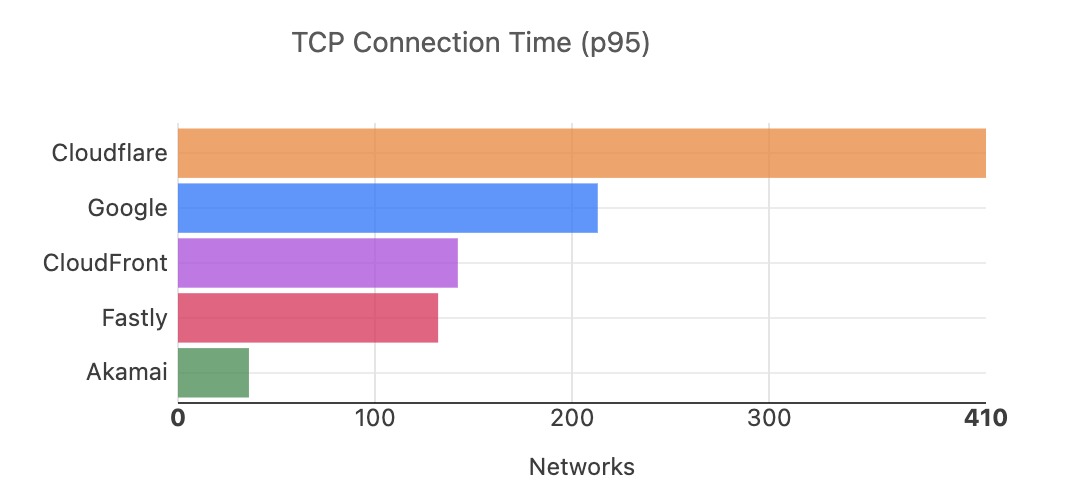

This graph shows that we are fastest in 410 networks, but that would only make us the fastest in 41% of the top 1,000. To make sure we’re looking at the networks that eyeballs connect from, we exclude networks like transit networks that aren’t last-mile ISPs. That brings the number of measured networks to 932, which makes us fastest in 44% of ISPs.

Now let’s take a look at the fastest provider by country. The map below shows the top network by 95th percentile TCP connection time, and Cloudflare is fastest in many countries. For those where we weren’t, we were within a few milliseconds of our closest competitor.
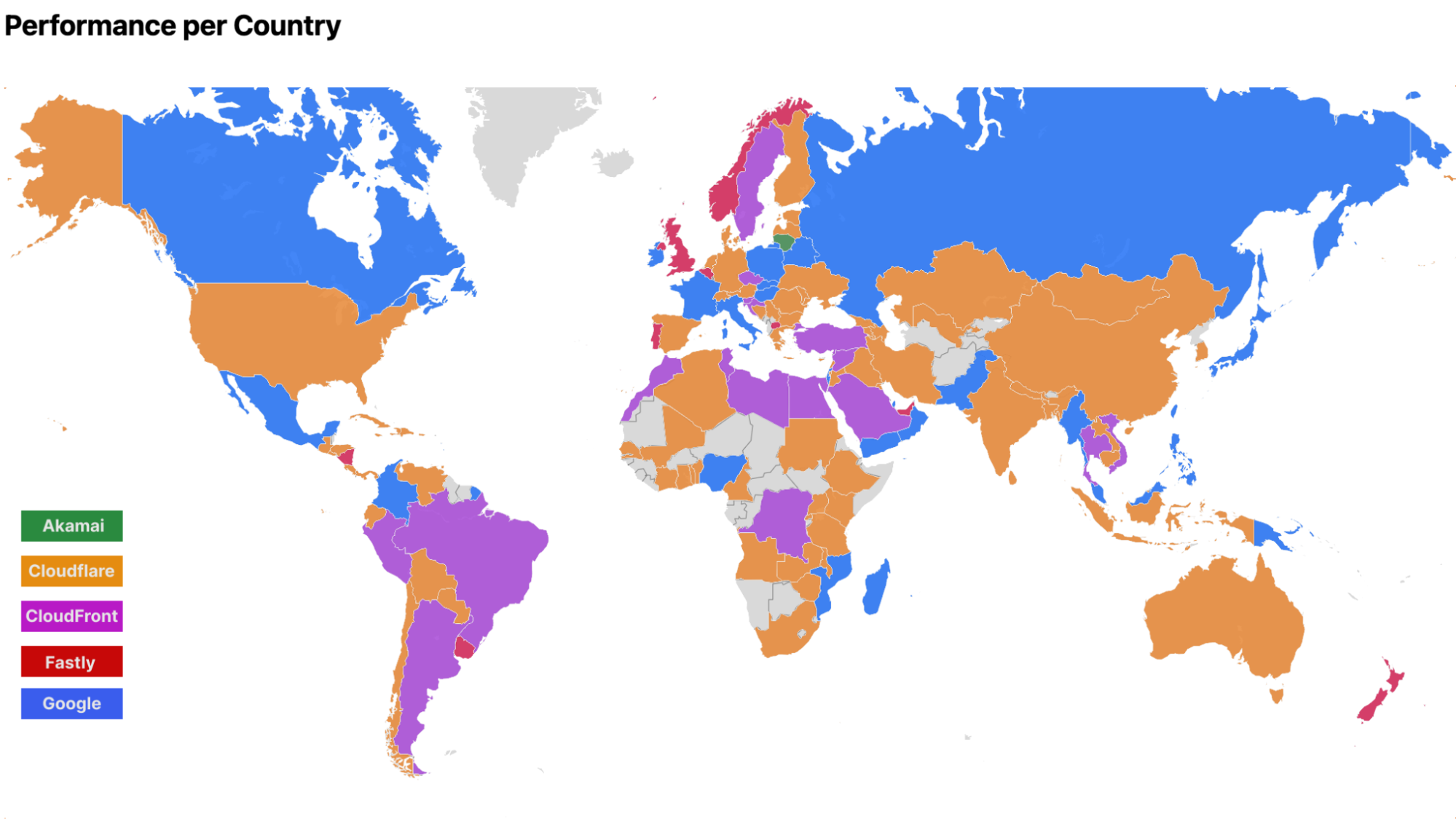

This color coding is generated by grouping all the measurements we generate by which country the measurement originates from, and then looking at the 95th percentile measurements for each provider to see who is the fastest. This is in contrast to how we measure who is fastest in individual networks, which involves grouping the measurements by ISP and measuring which provider is fastest. Cloudflare is still the fastest provider in 44% of the measured networks, which is consistent with our March report. Cloudflare is also the fastest in many countries, but the map is less orange than it was when we published our measurements from March 2024:
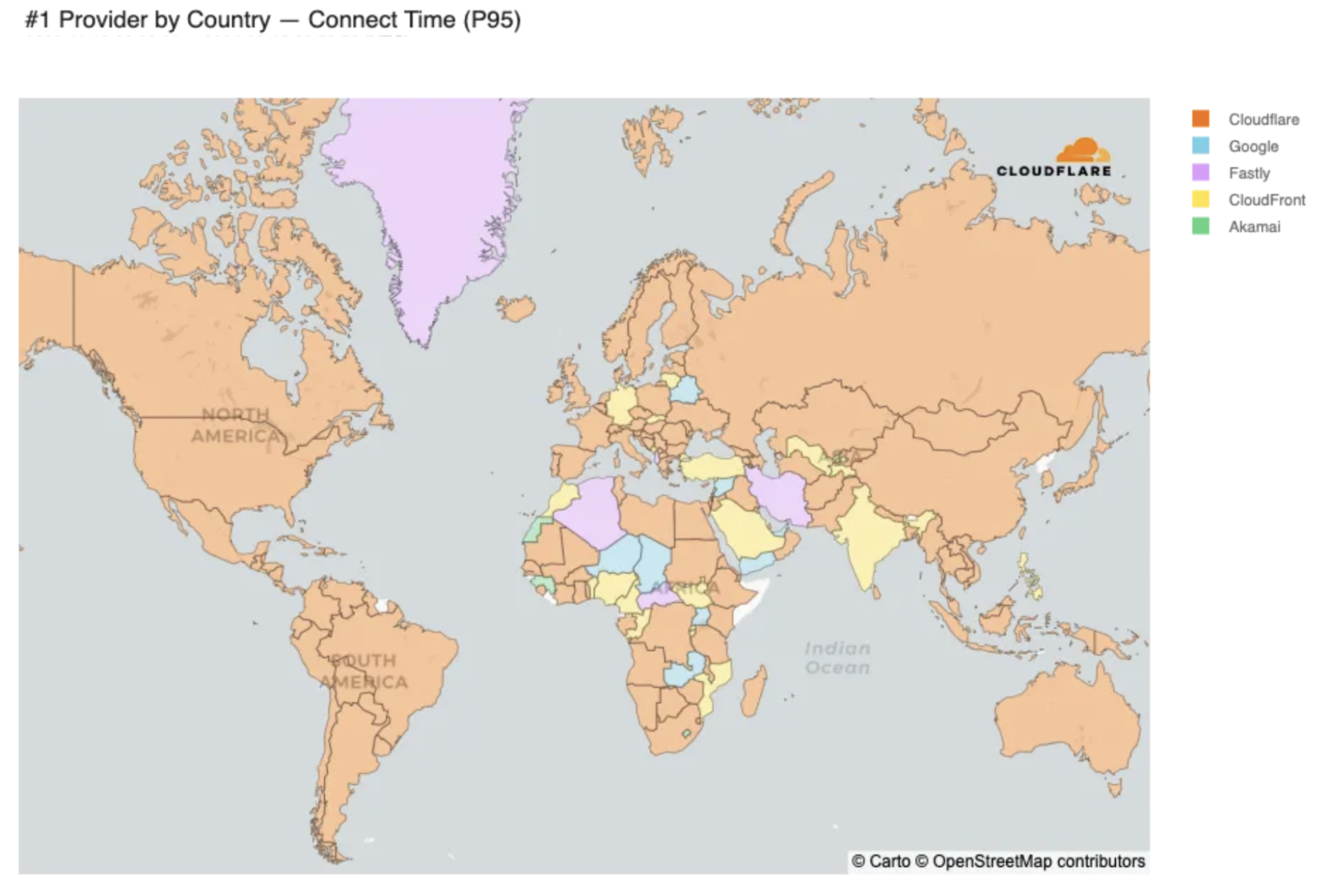

This can be explained by the fact that the fastest provider in a country is often determined by latency differences so small it is often less than 5% faster than the second-fastest provider. As an example, let’s take a look at India, a country where we are now the fastest:

India performance by provider

Rank

Entity

95th percentile TCP Connect (ms)

Difference from #1

1

Cloudflare

290 ms

2

Google

291 ms

+0.28% (+0.81 ms)

3

CloudFront

304 ms

+4.61% (+13 ms)

4

Fastly

325 ms

+12% (+35 ms)

5

Akamai

373 ms

+29% (+83 ms)

In India, we are the fastest network, but we are beating the runner-up by less than a millisecond, which shakes out to less than 1% difference between us and the number two! The competition for the number one spot in many countries is fierce and sometimes can be determined by what days you’re looking at the data, because variance in connectivity or last-mile outages can materially impact this data.

For example, on September 17, there was an outage on a major network in India, which impacted many users’ ability to access the Internet. People using this network were significantly impacted in their ability to connect to Cloudflare, and you can actually see that impact in the data. Here’s what the data looked like on the day of the outage, as we dropped from the number one spot that day:

India performance by provider

Rank

Entity

95th percentile TCP Connect (ms)

Difference from #1

1

Google

219 ms

2

CloudFront

230 ms

+5% (+11 ms)

3

Cloudflare

236 ms

+7.47% (+16 ms)

4

Fastly

261 ms

+19% (+41 ms)

5

Akamai

286 ms

+30% (+67 ms)

We were impacted more than other providers here because our automated traffic management systems detected the high packet loss as a result of the outage and aggressively moved all of our traffic away from the impacted provider. After review internally, we have identified opportunities to improve our traffic management to be more fine-grained in our approach to outages of this type, which would help us continue to be fast despite changes in the surrounding ecosystem. These unplanned occurrences can happen to any network, but these events also provide us opportunities to improve and mitigate the randomness we see on the Internet.

The phenomenon of providers having fluctuating latencies can also work against us. Consider Poland, a country where we were the fastest provider in March, but are no longer the fastest provider today. Digging into the data a bit more, we can see that even though we are no longer the fastest, we’re slower by less than a millisecond, giving us confidence that our architecture is optimized for performance in the region:

Poland performance by provider

Rank

Entity

95th percentile TCP Connect (ms)

Difference from #1

1

Google

246 ms

2

Cloudflare

246 ms

+0.15% (+0.36 ms)

3

CloudFront

250 ms

+1.7% (+4.17 ms)

4

Akamai

272 ms

+11% (+26 ms)

5

Fastly

295 ms

+20% (+50 ms)

These nuances in the data can make us look slower in more countries than we actually are. From a numbers’ perspective we’re neck-and-neck with our competitors and still fastest in the most networks around the world. Going forward, we’re going to take a longer look at how we’re visualizing our network performance to paint a clearer picture for you around performance. But let’s go into more about how we actually get the underlying data we use to measure ourselves.

How we measure performance

When you see a Cloudflare-branded error page, something interesting happens behind the scenes. Every time one of these error pages is displayed, Cloudflare gathers Real User Measurements (RUM) by fetching a tiny file from various networks, including Cloudflare, Akamai, Amazon CloudFront, Fastly, and Google Cloud CDN. Your browser sends back performance data from the end-user’s perspective, helping us get a clear view of how these different networks stack up in terms of speed. The main goal? Figure out where we’re fast, and more importantly, where we can make Cloudflare even faster. If you’re curious about the details, the original Speed Week blog post dives deeper into the methodology.

Using this RUM data, we track key performance metrics such as TCP Connection Time, Time to First Byte (TTFB), and Time to Last Byte (TTLB) for Cloudflare and the other networks. 

Starting from March, we fixed the list of networks we look at to be the top 1000 networks by estimated population as determined by APNIC, and we removed networks that weren’t last-mile ISPs. This change makes our measurements and reporting more consistent because we look at the same set of networks for every reporting cycle.

How does Cloudflare use this data?

Cloudflare uses this data to improve our network performance in lagging regions. For example, in 2022 we recognized that performance on a network in Finland was not as fast as some comparable regions. Users were taking 300+ ms to connect to Cloudflare at the 95th percentile:

Performance for Finland network

Rank

Entity

95th percentile TCP Connect (ms)

Difference from #1

1

Fastly

15 ms

2

CloudFront

19 ms

+19% (+3 ms)

3

Akamai

20 ms

+28% (+4.3 ms)

4

Google

72 ms

+363% (+56 ms)

5

Cloudflare

368 ms

+2378% (+353 ms)

After investigating, we recognized that one major network in Finland was seeing high latency due to issues resulting from congestion. Simply put, we were using all the capacity we had. We immediately planned an expansion, and within two weeks of that expansion completion, our latency decreased, and we became the fastest provider in the region, as you can see in the map above.

We are constantly improving our network and infrastructure to better serve our customers. Data like this helps us identify where we can be most impactful, and improve service for our customers. 

What’s next 

We’re sharing our updates on our journey to become as fast as we can be everywhere so that you can see what goes into running the fastest network in the world. From here, our plan is the same as always: identify where we’re slower, fix it, and then tell you how we’ve gotten faster.

Making zone management more efficient with batch DNS record updates

Post Syndicated from Alex Fattouche original https://blog.cloudflare.com/batched-dns-changes

Customers that use Cloudflare to manage their DNS often need to create a whole batch of records, enable proxying on many records, update many records to point to a new target at the same time, or even delete all of their records. Historically, customers had to resort to bespoke scripts to make these changes, which came with their own set of issues. In response to customer demand, we are excited to announce support for batched API calls to the DNS records API starting today. This lets customers make large changes to their zones much more efficiently than before. Whether sending a POST, PUT, PATCH or DELETE, users can now execute these four different HTTP methods, and multiple HTTP requests all at the same time.

Efficient zone management matters

DNS records are an essential part of most web applications and websites, and they serve many different purposes. The most common use case for a DNS record is to have a hostname point to an IPv4 address, this is called an A record:

example.com 59 IN A 198.51.100.0

blog.example.com 59 IN A 198.51.100.1

ask.example.com 59 IN A 198.51.100.2

In its most simple form, this enables Internet users to connect to websites without needing to memorize their IP address. 

Often, our customers need to be able to do things like create a whole batch of records, or enable proxying on many records, or update many records to point to a new target at the same time, or even delete all of their records. Unfortunately, for most of these cases, we were asking customers to write their own custom scripts or programs to do these tasks for them, a number of which are open sourced and whose content has not been checked by us. These scripts are often used to avoid needing to repeatedly make the same API calls manually. This takes time, not only for the development of the scripts, but also to simply execute all the API calls, not to mention it can leave the zone in a bad state if some changes fail while others succeed.

Introducing /batch

Starting today, everyone with a Cloudflare zone will have access to this endpoint, with free tier customers getting access to 200 changes in one batch, and paid plans getting access to 3,500 changes in one batch. We have successfully tested up to 100,000 changes in one call. The API is simple, expecting a POST request to be made to the new API endpoint /dns_records/batch, which passes in a JSON object in the body in the format:

{
    deletes:[]Record
    patches:[]Record
    puts:[]Record
    posts:[]Record
}

Each list of records []Record will follow the same requirements as the regular API, except that the record ID on deletes, patches, and puts will be required within the Record object itself. Here is a simple example:

{
    "deletes": [
        {
            "id": "143004ef463b464a504bde5a5be9f94a"
        },
        {
            "id": "165e9ef6f325460c9ca0eca6170a7a23"
        }
    ],
    "patches": [
        {
            "id": "16ac0161141a4e62a79c50e0341de5c6",
            "content": "192.0.2.45"
        },
        {
            "id": "6c929ea329514731bcd8384dd05e3a55",
            "name": "update.example.com",
            "proxied": true
        }
    ],
    "puts": [
        {
            "id": "ee93eec55e9e45f4ae3cb6941ffd6064",
            "content": "192.0.2.50",
            "name": "no-change.example.com",
            "proxied": false,
            "ttl:": 1
        },
        {
            "id": "eab237b5a67e41319159660bc6cfd80b",
            "content": "192.0.2.45",
            "name": "no-change.example.com",
            "proxied": false,
            "ttl:": 3000
        }
    ],
    "posts": [
        {
            "name": "@",
            "type": "A",
            "content": "192.0.2.45",
            "proxied": false,
            "ttl": 3000
        },
        {
            "name": "a.example.com",
            "type": "A",
            "content": "192.0.2.45",
            "proxied": true
        }
    ]
}

Our API will then parse this and execute these calls in the following order: 

  1. deletes

  2. patches

  3. puts

  4. posts

Each of these respective lists will be executed in the order given. This ordering system is important because it removes the need for our clients to worry about conflicts, such as if they need to create a CNAME on the same hostname as a to-be-deleted A record, which is not allowed in RFC 1912. In the event that any of these individual actions fail, the entire API call will fail and return the first error it sees. The batch request will also be executed inside a single database transaction, which will roll back in the event of failure.

After the batch request has been successfully executed in our database, we then propagate the changes to our edge via Quicksilver, our distributed KV store. Each of the individual record changes inside the batch request is treated as a single key-value pair, and database transactions are not supported. As such, we cannot guarantee that the propagation to our edge servers will be atomic. For example, if replacing a delegation with an A record, some resolvers may see the NS record removed before the A record is added. 

The response will follow the same format as the request. Patches and puts that result in no changes will be placed at the end of their respective lists.

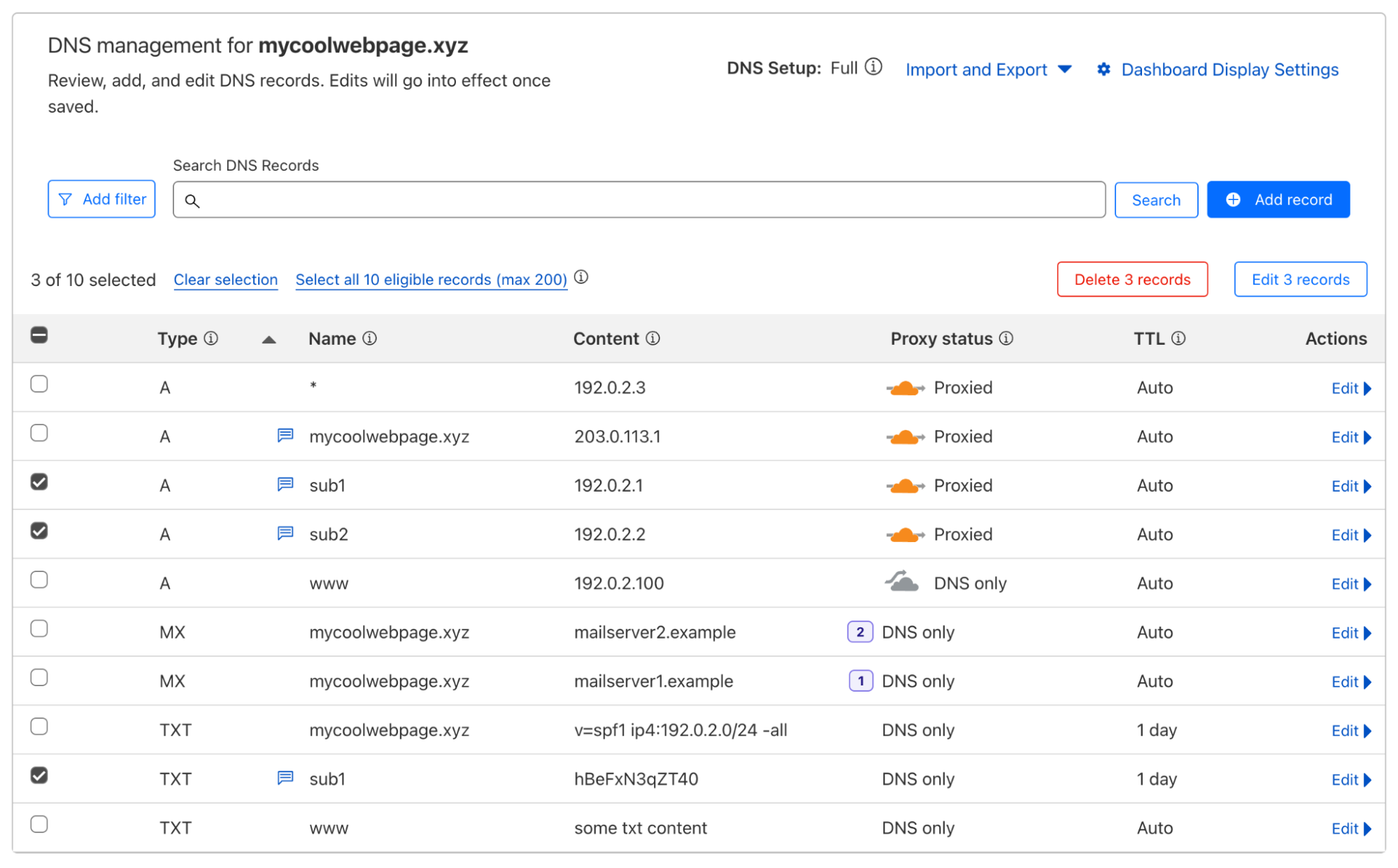
We are also introducing some new changes to the Cloudflare dashboard, allowing users to select multiple records and subsequently:

  1. Delete all selected records

  2. Change the proxy status of all selected records


We plan to continue improving the dashboard to support more batch actions based on your feedback.

The journey

Although at the surface, this batch endpoint may seem like a fairly simple change, behind the scenes it is the culmination of a multi-year, multi-team effort. Over the past several years, we have been working hard to improve the DNS pipeline that takes our customers’ records and pushes them to Quicksilver, our distributed database. As part of this effort, we have been improving our DNS Records API to reduce the overall latency. The DNS Records API is Cloudflare’s most used API externally, serving twice as many requests as any other API at peak. In addition, the DNS Records API supports over 20 internal services, many of which touch very important areas such as DNSSEC, TLS, Email, Tunnels, Workers, Spectrum, and R2 storage. Therefore, it was important to build something that scales. 

To improve API performance, we first needed to understand the complexities of the entire stack. At Cloudflare, we use Jaeger tracing to debug our systems. It gives us granular insights into a sample of requests that are coming into our APIs. When looking at API request latency, the span that stood out was the time spent on each individual database lookup. The latency here can vary anywhere from ~1ms to ~5ms. 


Jaeger trace showing variable database latency

Given this variability in database query latency, we wanted to understand exactly what was going on within each DNS Records API request. When we first started on this journey, the breakdown of database lookups for each action was as follows:

Action

Database Queries

Reason

POST

One to write and one to read the new record.

PUT

3

One to collect, one to write, and one to read back the new record.

PATCH

3

One to collect, one to write, and one to read back the new record.

DELETE

2

One to read and one to delete.

The reason we needed to read the newly created records on POST, PUT, and PATCH was because the record contains information filled in by the database which we cannot infer in the API. 

Let’s imagine that a customer needed to edit 1,000 records. If each database lookup took 3ms to complete, that was 3ms * 3 lookups * 1,000 records = 9 seconds spent on database queries alone, not taking into account the round trip time to and from our API or any other processing latency. It’s clear that we needed to reduce the number of overall queries and ideally minimize per query latency variation. Let’s tackle the variation in latency first.

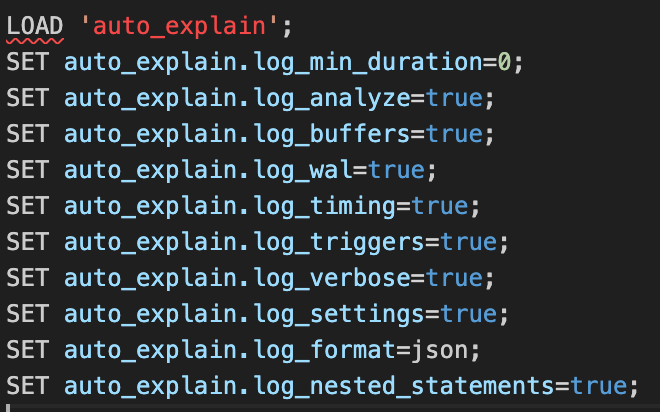
Each of these calls is not a simple INSERT, UPDATE, or DELETE, because we have functions wrapping these database calls for sanitization purposes. In order to understand the variable latency, we enlisted the help of PostgreSQL’s “auto_explain”. This module gives a breakdown of execution times for each statement without needing to EXPLAIN each one by hand. We used the following settings:


A handful of queries showed durations like the one below, which took an order of magnitude longer than other queries.


We noticed that in several locations we were doing queries like:

IF (EXISTS (SELECT id FROM table WHERE row_hash = __new_row_hash))

If you are trying to insert into very large zones, such queries could mean even longer database query times, potentially explaining the discrepancy between 1ms and 5ms in our tracing images above. Upon further investigation, we already had a unique index on that exact hash. Unique indexes in PostgreSQL enforce the uniqueness of one or more column values, which means we can safely remove those existence checks without risk of inserting duplicate rows.

The next task was to introduce database batching into our DNS Records API. In any API, external calls such as SQL queries are going to add substantial latency to the request. Database batching allows the DNS Records API to execute multiple SQL queries within one single network call, subsequently lowering the number of database round trips our system needs to make. 

According to the table above, each database write also corresponded to a read after it had completed the query. This was needed to collect information like creation/modification timestamps and new IDs. To improve this, we tweaked our database functions to now return the newly created DNS record itself, removing a full round trip to the database. Here is the updated table:

Action

Database Queries

Reason

POST

One to write

PUT

2

One to read, one to write.

PATCH

2

One to read, one to write.

DELETE

2

One to read, one to delete.

We have room for improvement here, however we cannot easily reduce this further due to some restrictions around auditing and other sanitization logic.

Results:

Action

Average database time before

Average database time after

Percentage Decrease

POST

3.38ms

0.967ms

71.4%

PUT

4.47ms

2.31ms

48.4%

PATCH

4.41ms

2.24ms

49.3%

DELETE

1.21ms

1.21ms

0%

These are some pretty good improvements! Not only did we reduce the API latency, we also reduced the database query load, benefiting other systems as well.

Weren’t we talking about batching?

I previously mentioned that the /batch endpoint is fully atomic, making use of a single database transaction. However, a single transaction may still require multiple database network calls, and from the table above, that can add up to a significant amount of time when dealing with large batches. To optimize this, we are making use of pgx/batch, a Golang object that allows us to write and subsequently read multiple queries in a single network call. Here is a high level of how the batch endpoint works:

  1. Collect all the records for the PUTs, PATCHes and DELETEs.

  2. Apply any per record differences as requested by the PATCHes and PUTs.

  3. Format the batch SQL query to include each of the actions.

  4. Execute the batch SQL query in the database.

  5. Parse each database response and return any errors if needed.

  6. Audit each change.

This takes at most only two database calls per batch. One to fetch, and one to write/delete. If the batch contains only POSTs, this will be further reduced to a single database call. Given all of this, we should expect to see a significant improvement in latency when making multiple changes, which we do when observing how these various endpoints perform: 

Note: Each of these queries was run from multiple locations around the world and the median of the response times are shown here. The server responding to queries is located in Portland, Oregon, United States. Latencies are subject to change depending on geographical location.

Create only:

10 Records

100 Records

1,000 Records

10,000 Records

Regular API

7.55s

74.23s

757.32s

7,877.14s

Batch API – Without database batching

0.85s

1.47s

4.32s

16.58s

Batch API – with database batching

0.67s

1.21s

3.09s

10.33s

Delete only:

10 Records

100 Records

1,000 Records

10,000 Records

Regular API

7.28s

67.35s

658.11s

7,471.30s

Batch API – without database batching

0.79s

1.32s

3.18s

17.49s

Batch API – with database batching

0.66s

0.78s

1.68s

7.73s

Create/Update/Delete:

10 Records

100 Records

1,000 Records

10,000 Records

Regular API

7.11s

72.41s

715.36s

7,298.17s

Batch API – without database batching

0.79s

1.36s

3.05s

18.27s

Batch API – with database batching

0.74s

1.06s

2.17s

8.48s

Overall Average:

10 Records

100 Records

1,000 Records

10,000 Records

Regular API

7.31s

71.33s

710.26s

7,548.87s

Batch API – without database batching

0.81s

1.38s

3.51s

17.44s

Batch API – with database batching

0.69s

1.02s

2.31s

8.85s

We can see that on average, the new batching API is significantly faster than the regular API trying to do the same actions, and it’s also nearly twice as fast as the batching API without batched database calls. We can see that at 10,000 records, the batching API is a staggering 850x faster than the regular API. As mentioned above, these numbers are likely to change for a number of different reasons, but it’s clear that making several round trips to and from the API adds substantial latency, regardless of the region.

Batch overload

Making our API faster is awesome, but we don’t operate in an isolated environment. Each of these records needs to be processed and pushed to Quicksilver, our distributed database. If we have customers creating tens of thousands of records every 10 seconds, we need to be able to handle this downstream so that we don’t overwhelm our system. In a May 2022 blog post titled How we improved DNS record build speed by more than 4,000x, I noted that:

We plan to introduce a batching system that will collect record changes into groups to minimize the number of queries we make to our database and Quicksilver.

This task has since been completed, and our propagation pipeline is now able to batch thousands of record changes into a single database query which can then be published to Quicksilver in order to be propagated to our global network. 

Next steps

We have a couple more improvements we may want to bring into the API. We also intend to improve the UI to bring more usability improvements to the dashboard to more easily manage zones. We would love to hear your feedback, so please let us know what you think and if you have any suggestions for improvements.

For more details on how to use the new /batch API endpoint, head over to our developer documentation and API reference.

Expanding the Security Horizon: Introducing Rapid7 MDR for the Extended Ecosystem

Post Syndicated from Mikayla Wyman original https://blog.rapid7.com/2024/09/23/expanding-the-security-horizon-introducing-rapid7-mdr-for-the-extended-ecosystem/

Expanding the Security Horizon: Introducing Rapid7 MDR for the Extended Ecosystem

As the cybersecurity landscape gets more complex, the stakes for keeping organizations safe have never been higher. Security teams are tasked with keeping ahead of new ransomware groups, rapidly evolving adversary tactics, and their dynamic attack surface as their business grows. Security organizations’ scope of responsibility has swelled as their tech ecosystem has sprawled, with the average team now managing 45 security tools in their environment.

Managed detection and response (MDR) services can be a life raft for many teams looking to extend their team with expert support and 24×7 coverage. But traditional MDR needs to evolve to accommodate the widening attack surface and security scope.

Our Rapid7 MXDR service has always been built on InsightIDR, our native SIEM and XDR technology, operationalizing telemetry across the customer environment —endpoint, cloud, identity, and network. This multi-layered approach is critical in today’s environment, where advanced threats require rapid identification and response across the entire ecosystem.

Introducing: MDR for the extended ecosystem

We are proud to announce the launch of Rapid7 MDR for the extended ecosystem, extending our MXDR service to triage, investigate, and respond to alerts from third-party tools already in use within your organization. These investments will extend Rapid7’s foundational native telemetry, layering alerts from customers’ third-party point solutions like cloud service providers (CSPs), identity and access management (IAM) platforms, and endpoint protection platforms (EPPs).

This initial release will bring support for major EPPs such as Microsoft Defender for Endpoint, CrowdStrike Falcon, and SentinelOne Singularity, with plans to extend coverage to more third-party tools across cloud, identity, and network in the coming months. By integrating third-party alerts, organizations can now customize their MDR coverage to cover the unique technology environment.

What sets Rapid7 MDR apart: customization, visibility, and Active Response

By extending the Rapid7 SOC’s coverage to include alerts from third parties, we’re bringing comprehensive, robust coverage to our customers through:

  • Customization: Integrate your existing tools with Rapid7’s native telemetry to create a customized service that matches your specific environment, tailoring your MDR service to your environment, layering alert data to speed up investigations across multiple layers of your ecosystem​.
  • Visibility: By synthesizing data from both native and third-party telemetry, we’re bringing complete visibility across endpoints, cloud, identity, and network layers. This eliminates blind spots, helping you detect and respond to abnormal and malicious activity across your entire attack surface​.
  • Response: By extending the MDR service to detect, triage, and investigate third party event sources, the Rapid7 SOC has more context and information to respond to and contain malicious behavior before it can cause harm to your environment, business, and brand.

“We have been using Rapid7 MDR for our organization’s cyber security needs, and I must say, it has been a game-changer. From the moment we implemented the service, we experienced a significant improvement in our overall security posture and threat detection capabilities.”

Gartner Peer Review, 2024

The best is yet to come

As we extend our MDR service, we’re excited to partner with you as the command center for your security teams. This extended delivery model brings our MDR and Managed Threat Complete customers the ability to utilize the Rapid7 SOC to triage, investigate, and respond to events happening across supported providers in their wider ecosystem, helping them command their attack surface.

If you’re a Rapid7 MDR customer, reach out to your account team to learn more about our extended coverage. If you’re not a Rapid7 MDR customer yet, request a demo here.

[$] Tools for kernel developers

Post Syndicated from corbet original https://lwn.net/Articles/991033/

Konstantin Ryabitsev started a session on development tooling at the 2024
Maintainers Summit by saying that he does not want to be a “wrecking ball”.
If a given workflow is working for people, he does not want to try to force
any sort of change. That said, he has ideas for how he can continue his
work on providing better tooling for the development community.

Hello World #25 out now: Generative AI

Post Syndicated from Meg Wang original https://www.raspberrypi.org/blog/hello-world-25-out-now-generative-ai/

Since they became publicly available at the end of 2022, generative AI tools have been hotly discussed by educators: what role should these tools for generating human-seeming text, images, and other media play in teaching and learning?

Two years later, the one thing most people agree on is that, like it or not, generative AI is here to stay. And as a computing educator, you probably have your learners and colleagues looking to you for guidance about this technology. We’re sharing how educators like you are approaching generative AI in issue 25 of Hello World, out today for free.

Digital image of a copy of Hello World magazine, issue 25.

Generative AI and teaching

Since our ‘Teaching and AI’ issue a year ago, educators have been making strides grappling with generative AI’s place in their classroom, and with the potential risks to young people. In this issue, you’ll hear from a wide range of educators who are approaching this technology in different ways. 

For example:

  • Laura Ventura from Gwinnett County Public Schools (GCPS) in Georgia, USA shares how the GCPS team has integrated AI throughout their K–12 curriculum
  • Mark Calleja from our team guides you through using the OCEAN prompt process to reliably get the results you want from an LLM 
  • Kip Glazer, principal at Mountain View High School in California, USA shares a framework for AI implementation aimed at school leaders
  • Stefan Seegerer, a researcher and educator in Germany, discusses why unplugged activities help us focus on what’s really important in teaching about AI

This issue also includes practical solutions to problems that are unique to computer science educators:

  • Graham Hastings in the UK shares his solution to tricky crocodile clips when working with micro:bits
  • Riyad Dhuny shares his case study of home-hosting a learning management system with his students in Mauritius

And there is lots more for you to discover in issue 25.

Whether or not you use generative AI as part of your teaching practice, it’s important for you to be aware of AI technologies and how your young people may be interacting with it. In his article “A problem-first approach to the development of AI systems”, Ben Garside from our team affirms that:

“A big part of our job as educators is to help young people navigate the changing world and prepare them for their futures, and education has an essential role to play in helping people understand AI technologies so that they can avoid the dangers.

Our approach at the Raspberry Pi Foundation is not to focus purely on the threats and dangers, but to teach young people to be critical users of technologies and not passive consumers. […]

Our call to action to educators, carers, and parents is to have conversations with your young people about generative AI. Get to know their opinions on it and how they view its role in their lives, and help them to become critical thinkers when interacting with technology.”

Share your thoughts & subscribe to Hello World

Computing teachers are being asked again to teach something that they didn’t study. With generative AI as with all things computing, we want to support your teaching and share your successes. We hope you enjoy this issue of Hello World, and please get in touch with your article ideas or what you would like to see in the magazine.


We’d like to thank Oracle for supporting this issue.

The post Hello World #25 out now: Generative AI appeared first on Raspberry Pi Foundation.

2024-09-23 гласуване за лекции на OpenFest

Post Syndicated from Vasil Kolev original https://vasil.ludost.net/blog/?p=3486

vote.openfest.org, както винаги. Гласуването помага за подреждането на лекциите и понякога за избора им.

(има и моя там, но понеже аз държах на това да не се виждат кои са лекторите, за да се избират лекции на база материала в тях, няма да кажа коя)
(както и че ще я правя тестово в събота в initLab)

Как подкрепя България глухите граждани?

Post Syndicated from original https://www.toest.bg/kak-podkrepya-bulgaria-ghluhite-grazhdani/

Как подкрепя България глухите граждани?

През 1958 г. Световната федерация на глухите за първи път отбелязва Деня на глухите. Това става на 23 септември, а после денят прераства в седмица – последната пълна седмица на септември, а някои държави я разширяват до месец, за да могат да се организират повече образователни дейности и дискусии за предизвикателствата пред общността на глухите.

В България вероятно не всеки е чувал за седмица на глухите и може би не всеки се е замислял

как всъщност живеят онези наши съграждани, които общуват чрез жестове.

Въпреки че страната ни прие Закон за жестовия език през 2021 г., все още липсва достатъчно информация за услугите, които държавата предоставя.

Янка Трачук е собственичка на две фирми и председателка на JAMBA – хъб на възможностите. Тя е напълно глуха, но няма да забележите, защото може да чете отлично по устните. Именно това качество я превръща в помощник на хора в нейното положение, които не могат сами да се справят в някои институции. Обикновено им помага с безплатен превод, но тя не е лицензирана преводачка и за услугите ѝ се разбира от уста на уста.

Две жени, на които е помогнала с превод, са Никол Александрова и Десислава Павлова. Никол е току-що завършила студентка от Националната художествена академия. Обикновено се справя сама, но ако има нужда от помощ, би се обърнала към роднините си или колегите в университета. За написването на курсовата си работа е потърсила Янка, която ѝ е помогнала допълнително за усвояване на материала и написване на дипломната работа. По същия начин и Десислава е потърсила помощ за превод в НОИ. И тя като Никол разчита обикновено на роднини за това и винаги си търси преводач.

Според Ашод Дерандонян – изпълнителен директор на фондация „Заслушай се“ и член на Съвета за българския жестов език към МОН, такава е била ситуацията допреди три години. Новият закон признава за самостоятелен жестовия език и се създават условия за по-достъпна среда за граждани със слухови нарушения.

От началото на 2023 г. всички общини в страната са длъжни да осигурят преводачи от жестов език на територията си.

Глухите граждани имат право на 120 часа безвъзмездна преводаческа услуга, а студенти и докторанти разполагат с допълнителни 60 часа на семестър. За осигуряване на услугата се подава заявление до един месец преди началото на следващата календарна година.

По неофициална статистика в България има 120 000 глухи граждани,

а преди приемането на закона 5000 души със слухови нарушения са получавали социална помощ в размер на 80 лв. на година. След въвеждането на услугата за превод обаче са подадени само 140 заявления, пояснява Ашод Дерандонян. По негови думи, проблемът е в липсата на информация относно правата на хората с увреден слух.

Тази информация трябва да бъде предоставена на жестов език от Агенцията за социално подпомагане. Такава информация на жестов език няма. Само е посочена на писмен език и за много глухи хора понякога това е затруднение, защото те не могат в първия момент да осмислят информацията на словесен език,

Съоснователят на агенцията за жестов превод Stray Sheep и експерт по жестов език Борис Бъндев обяснява, че самото подаване на заявление за услугата „безплатен жестов превод“ отказва много хора. Представянето на документите все още става на хартия и пред гише. Методът е остарял, а в днешно време всички очакваме да можем да извършим подобни дейности онлайн – чрез сайт или приложение.

За нещо, което ти е човешко право – това да получиш жестов превод, е измислен възможно най-сложният, най-утежненият начин,

допълва той и посочва като още една причина липсата на обратна връзка за преводачите.

При заявяване на превод в институции със заявителя работи преводачът, който е на разположение в момента. Заявителят няма как да даде оценка за качеството на преводача, нито самите преводачи могат да дадат обратна връзка. Според Бъндев най-добрият вариант е да се обяви конкурс за държавно финансиране на различни агенции, които се занимават с жестов превод. Така се гарантира, че организациите ще се стремят да дават най-доброто от себе си при предоставянето на превод.

Конвенцията за правата на хората с увреждания към ООН, която е подписана и от България, урежда създаването на условия за граждани с увреждания да могат да търсят и получават информация в „достъпен за тях формат“. А в България само някои сайтове имат меню с информация на жестов език. Това са сайтовете на Столичната община, НОИ и НАП, където всеки може да се осведоми за административните услуги. В Общината са назначени трима преводачи от жестов език, а контактният център има и специален мобилен номер във Viber, където глухи граждани могат да подават сигнали за нередности, да получават достъп до обществена информация, да се информират за работното време на администрацията.

Осигуряването на достъп до информация включва и превод в реално време на важни политически изявления. Например липсата на превод по време на речта на британския премиер Киър Стармър по-рано тази година предизвиква негативен отзвук сред глухата общност на Острова. Кралският национален институт за глухи хора (RNID) и Британската асоциация на глухите изтъкват, че осигуряването на преводач е задължение на държавата и глухите граждани трябва да бъдат третирани като равни. Двете организации са на мнение, че липсата на преводач за такова важно събитие е „дълбоко неуважително и недемократично“.

И докато в някои институции достъпът до жестов превод е уреден, в други не е така. Десислава Колева разказва и за

липсата на преводачи в болничните заведения и спешните центрове.

Правото на 120 часа превод включва само посещения при личен лекар.

Когато обаче става дума за болнична подкрепа, болничните заведения са длъжни да осигурят превод от и на жестов език за своя сметка,

категоричен е Ашод Дерандонян. Това се потвърждава и от самия закон за българския жестов език, където е посочено, че финансирането на дейности, свързани с използването и развитието на жестов език, се осъществява със средства от държавния бюджет чрез бюджета на Министерство на труда и социалната политика, бюджета на институциите и за сметка на лечебните заведения.

В чл. 20, ал. 4 от Закона за българския жестов език е записано, че жестов превод извън лимита от 120 часа може да се ползва при „хоспитализиране в лечебни заведения за болнична помощ, центрове за психично здраве, центрове за кожно-венерически заболявания и комплексни онкологични центрове“. Тази услуга все още не е достъпна и при неотложни случаи посред нощ глухите граждани биха срещнали сериозни затруднения при посещение в спешен център, ако изобщо успеят да се обадят на спешна помощ…

Американският закон за хората с увреждания включва специална глава за телекомуникационни услуги за граждани с нарушен слух. За връзка със спешния телефон може да се използва устройство – teletypewriter, което позволява да се изпращат гласови съобщения по телефона. Едната страна пише съобщението като текст, а в другия край на телефона служител в спешната помощ може да чуе съобщението.

Ако обаче нямаш такова устройство, достъпът до спешна помощ е почти невъзможен. Борис Бъндев разказва за случай, в който с него се свързва глух човек с молба да извика линейка за болната му майка. И отново набляга на необходимостта от мобилно приложение за такива ситуации.

Пример за добро осигуряване на жестов превод са болниците под шапката на благотворителната организация „Университетски болници Бирмингам“ в Обединеното кралство, където се предлага жестов превод за всички болнични заведения, но преводачът трябва да бъде заявен поне 48 часа по-рано, за да бъде извършен превод на живо. В противен случай може да се осъществи по телефона или с видеовръзка, като преводът е напълно безплатен във всички случаи и може да бъде заявен онлайн.

Законът за българския жестов език предвижда подкрепа и за родителите на децата със слухови нарушения чрез образователните институции и особено чрез специализираните обслужващи звена (такива, които се занимават с информационна, изследователска, обучителна и други дейности), центровете за подкрепа на личностното развитие, специализираните училища и регионалните центрове, ангажирани с процеса на приобщаващото образование, които следва да „организират и провеждат обучения за родителите на глухи и сляпо-глухи деца по български жестов език за осигуряване на езикова среда на детето“.

Жестовият език е майчин за глухите деца, които се научават да общуват първо чрез движения на ръцете, но с напредването на технологиите и възможността за поставяне на кохлеарни импланти за много родители използването на жестов език се обезсмисля. Въпреки това в Регионалния център за подкрепа на процеса на приобщаващото образование в град Търговище имат специалисти по жестов език, които могат да осигурят обучение за родители при необходимост, твърди директорът Христо Христов.

В академия „Анди и Ая“ се обучават глухи и слабо чуващи деца, но се приемат и чуващи деца на глухи родители. Най-често в академията ходят глухи родители с глухо дете и не е нужно да се провежда обучение по жестов език, но в останалите случаи обученията са добре дошли. Работата с децата може да започне още на едногодишна възраст и да продължи дори до първи курс в университета. Академията позволява да се провеждат занятия онлайн, в които се включват деца от Асеновград, Пловдив, Варна, Свищов, разказва основателката на организацията и специален педагог Даринка Борисова.

Швеция например предлага на родители на глухи деца 240 безплатни часа за обучение по жестов език, като се компенсира и заплатата им, ако не могат да съчетават обучението с работата си. В Швеция се намира и град Йоребру – европейската столица на жестовия език. От близо 160 000 жители население 13 000 използват жестов език, а 2000 са глухи. В града се намира и единствената гимназия за ученици с увреден слух.

В България са останали само три училища за ученици с увреден слух, които разполагат и с пансиони – те са в София, Пловдив и Търговище,

но деца със слухови нарушения могат да се обучават перфектно и в общообразователно училище, като за усвояването на учебния материал им помагат регионалните центрове за подкрепа на процеса на приобщаващо образование и организации като Академия „Анди и Ая“.

Правото на достъп до информация на достъпен за език включва и новините.

Емисиите на БНР могат да се слушат и от глухи хора, но в социалните мрежи. Инициатор на съвместната работа е екипът на Stray Sheep, който е отишъл в радиото с предложение за адаптиране на съдържанието. Мотивите, които Борис Бъндев изтъкна, са, че темпото на говорене в телевизиите е твърде бързо, за да може да се направи качествен превод, а и изживяването като зрител не е твърде приятно.

Глухите хора имат повече нужда водещият да е ясен и визуален, видим за тях, в сравнение с нас, чуващите хора. Набутвайки жестовия преводач в едно малко квадратче, ти ограничаваш и самия него – жестовете му, мимиките му.

пояснява той.

Във видеоемисиите, които се публикуват в социалните мрежи на преводаческата агенция, водещият е в центъра на екрана и жестовият превод е на преден план.

Липсата на преводачески услуги в България вероятно е свързана и с липсата на преводачи от жестов език.

Те все още са малко, като в някои области има само един, а в други няма изобщо. Списък с преводачите от жестов език може да бъде намерен на сайта на Агенцията за хора с увреждания. Там са посочени имената, контакт, населено място и предпочитана сфера на превод, но

броят на преводачите е твърде нисък – едва 35 за цялата страна.

Тъй като не за всяка област има регистриран преводач, Столичната община е подписала 21 споразумения за сътрудничество на областно ниво с 69 общини.

През последните 30 години са били обучени 500 души за жестови преводачи, но само 15 от тях са практикували професията. Според наредба №48 от 2012 г., която впоследствие е отменена, преводачът може да бъде само лице със здрав слух и зрение, а жестовият език се преподава най-добре от естествените си носители, тъй като граматиките на жестов и словесен език се различават. След приемането на новия закон се появяват и първите глухи обучители, като до момента те са под 10, но се очаква броят им да нарасне до 25 в следващите две-три години.

Новият закон осигурява и по-добро заплащане за превод – в момента цената на един час жестов превод е 5% от минималната работна заплата за страната.

Работи се усилено и за създаване на бакалавърска програма по жестов превод в Софийски университет, разказва Ашод Дерандонян.

За нас е много важно глухотата да се представя не като проблем, предизвикателство и т.н., а като един различен културен и езиков свят,

твърди Даринка Борисова от „Анди и Ая“ и добавя:

Не искаме да будим съжаление, напротив даже. И се опитваме да говорим за каузата по много човешки и достъпен начин, така че да бъде разбрана.

A Guide to Quickly Enable and Disable SMT and Hyper-Threading on Ubuntu and Debian

Post Syndicated from Eric Smith original https://www.servethehome.com/a-guide-to-quickly-enable-and-disable-smt-and-hyper-threading-on-ubuntu-and-debian/

This is a quick little guide to enabling and disabling SMT on a Debian or Ubuntu system without having to reboot the system

The post A Guide to Quickly Enable and Disable SMT and Hyper-Threading on Ubuntu and Debian appeared first on ServeTheHome.

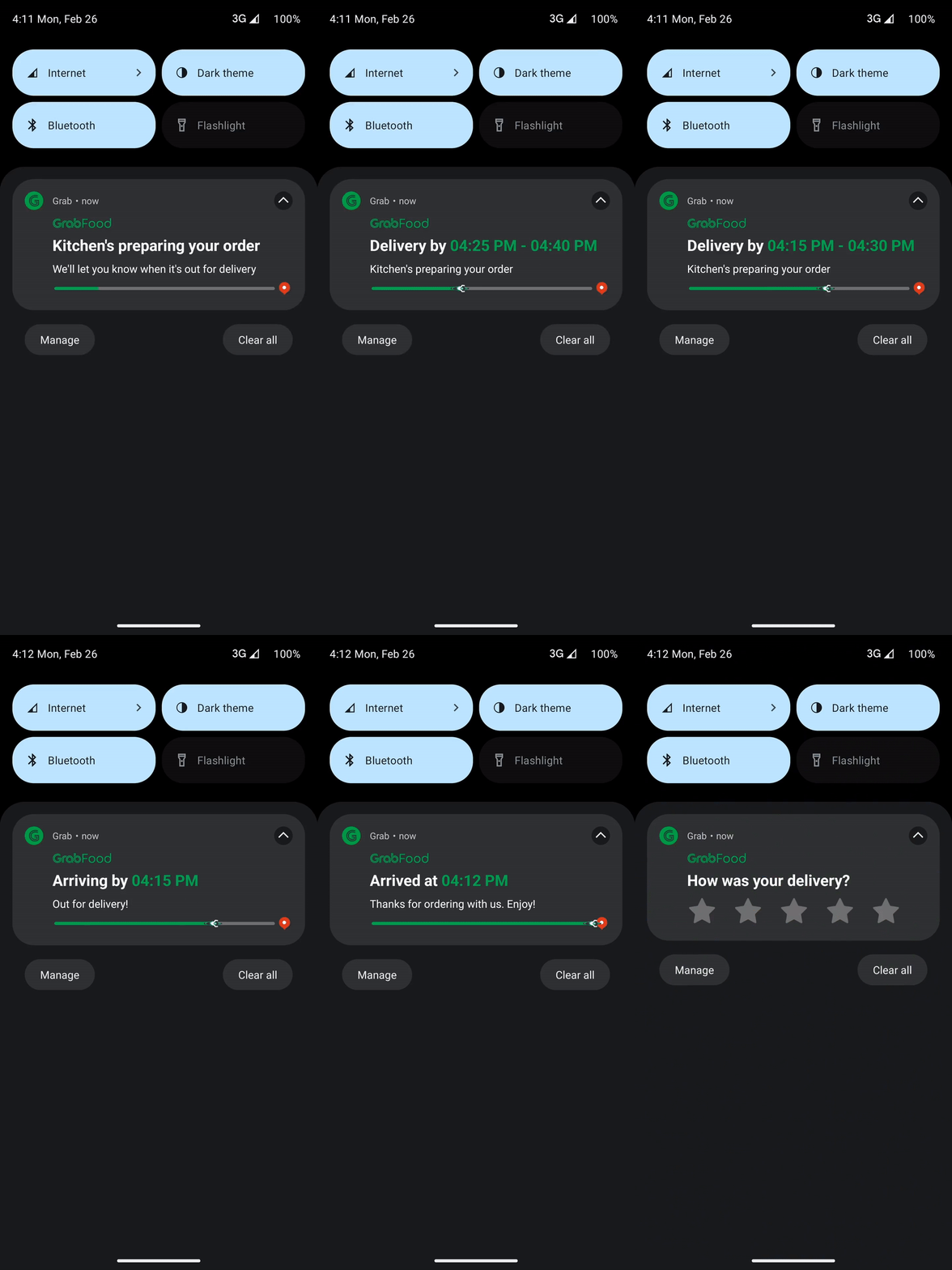
Bringing Grab’s Live Activity to Android: Enhancing user experience through custom notifications

Post Syndicated from Grab Tech original https://engineering.grab.com/live-activity-2

In May 2023, Grab unveiled the Live Activity feature for iOS, which received positive feedback from users. Live Activity is a feature that enhances user experience by displaying a user interface (UI) outside of the app, delivering real-time updates and interactive content. At Grab, we leverage this feature to keep users informed about their order updates without requiring them to manually open the app.

While Live Activity is a native iOS feature provided by Apple, there is currently no official Android equivalent. However, we are determined to bring this immersive experience to Android users. Inspired by the success of Live Activity on iOS, we have embarked on design explorations and feasibility studies to ensure the seamless integration of Live Activity into the Android platform. Our ultimate goal is to provide Android users with the same level of convenience and real-time updates, elevating their Grab experience.

Product Exploration

In July 2023, we took a proactive step by forming a dedicated working group with the specific goal of exploring Live Activity on the Android platform. Our mindset was focused on quickly enabling the MVP (Minimum Viable Product) of this feature for Android users. We focused on enabling Grab users to track food and mart orders on Live Activity as our first use-case. We also designed the Live Activity module as an extendable platform, allowing easy adoption by other Grab internal verticals such as the Express and Transport teams.

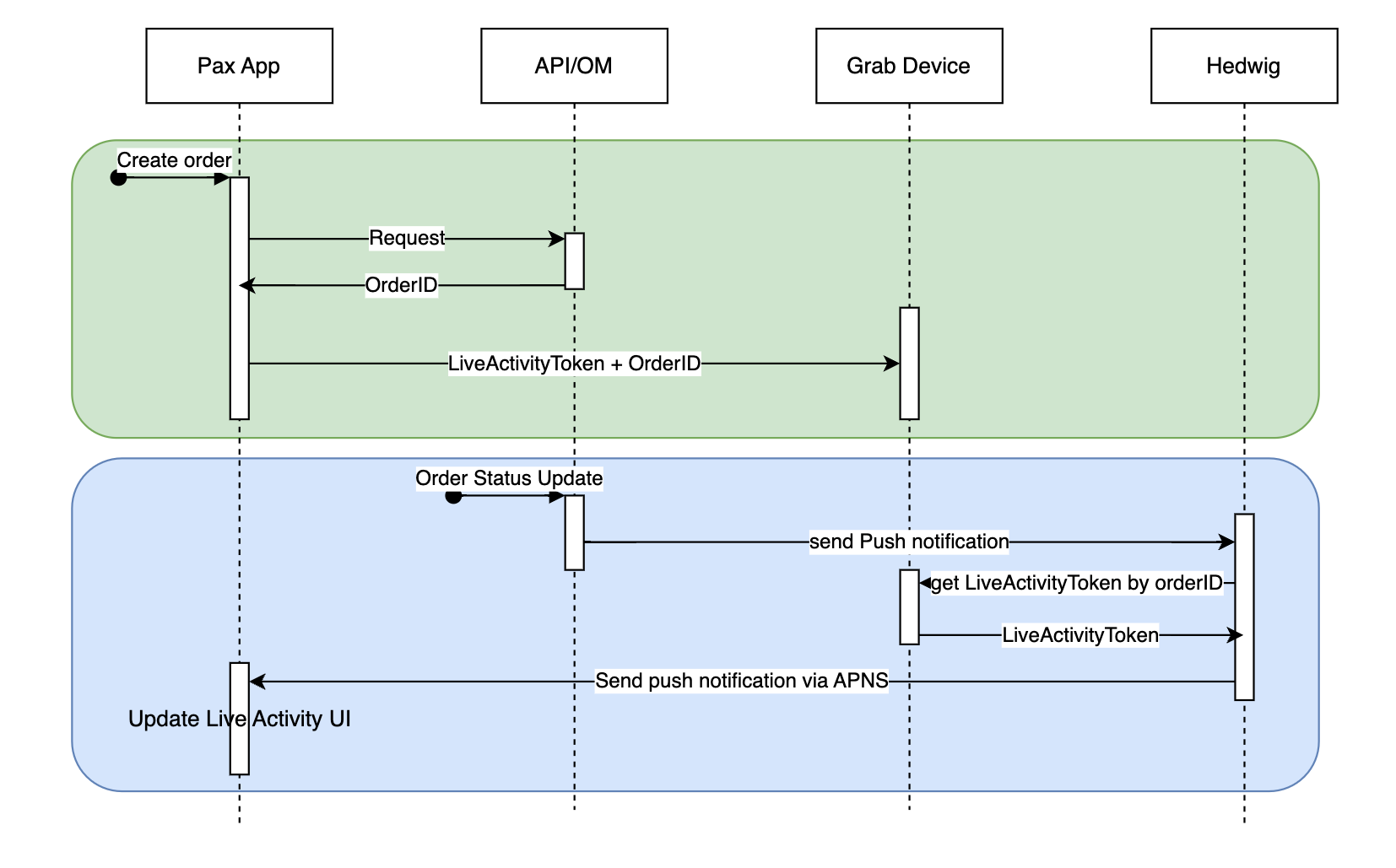
The team kicked off by analysing the current solution and end-to-end flow of Live Activity on iOS. The objective was to uncover opportunities on how we could leverage the existing platform approach.

Figure 1. Grab iOS Live Activity flow.

The first thing that caught our attention was that there is no Live Activity Token (also known as Push Token) concept on Android. Push Token is a token generated from the ActivityKit framework and used to remotely start, update, and end Live Activity notifications on iOS.

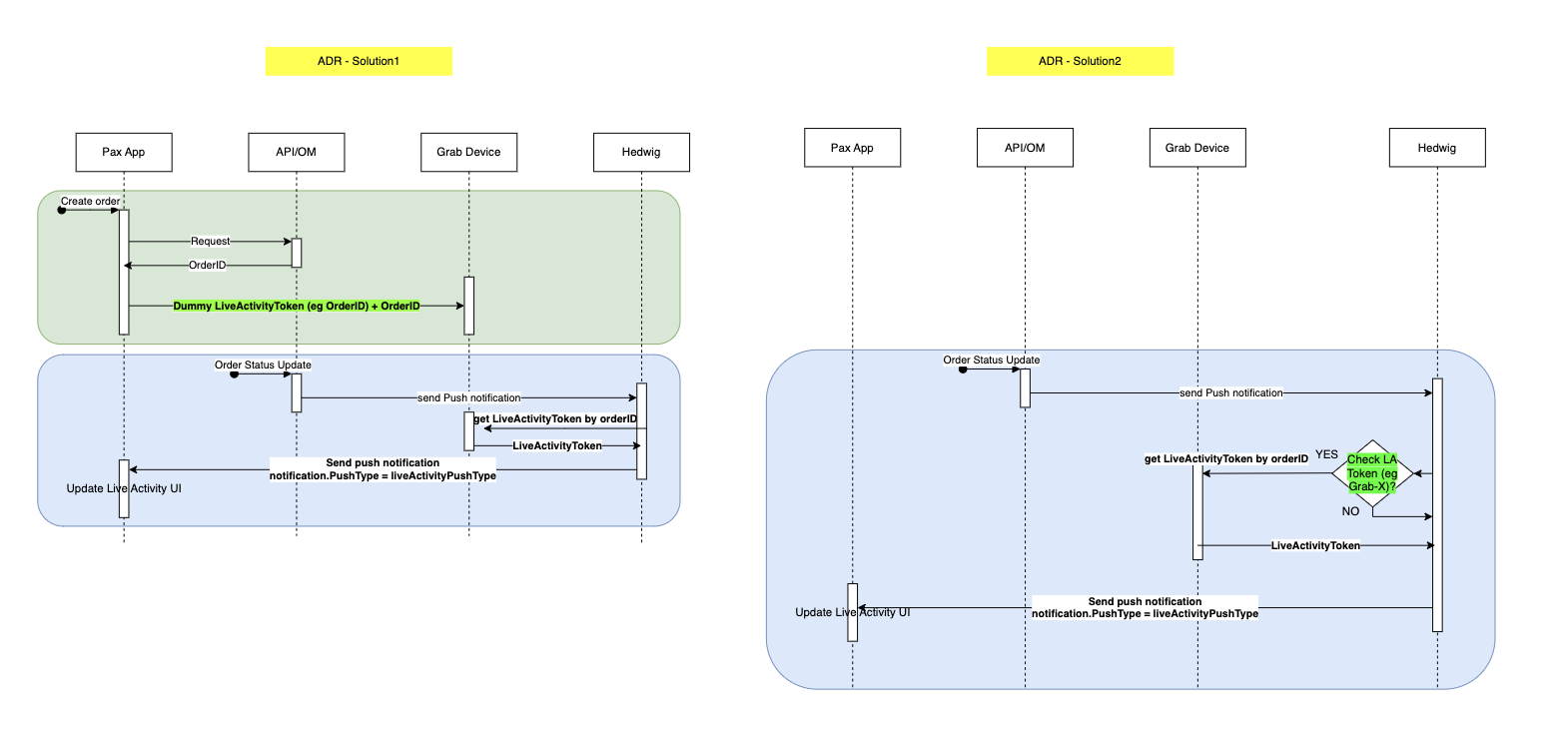
Our goal was to match the Live Activity set-up of iOS in Android, which was a challenge due to the missing Push Token. This required us to think outside the box and develop an innovative workaround. After multiple brainstorming sessions, the team developed two potential solutions, Solution 1 and Solution 2, as illustrated below:

Figure 2. Proposed solutions for Live Activity for Android.

We evaluated the two solutions. The first solution is to substitute the Push Token with a placeholder value, serving as a distinctive notification identifier. Whereas, the second solution involves the Hedwig service, our in-house message delivery service. We proposed to bypass the Live Activity token check process specifically for Android devices. Following extensive discussions, we decided to proceed with the first solution, which ensures consistency in the technical approach between Android and iOS platforms. Additionally, this solution allows us to ensure that notifications are only pushed to the devices that support the Live Activity feature. This decision strikes a good balance between efficiency and compatibility.

UI Components

Starting with a kick-off project meeting where we showcased our plans and proposed solutions to our stakeholders, the engineering team presented two native Android UI components that could be utilised to replicate Live Activity: the Notification View and the Floating View.

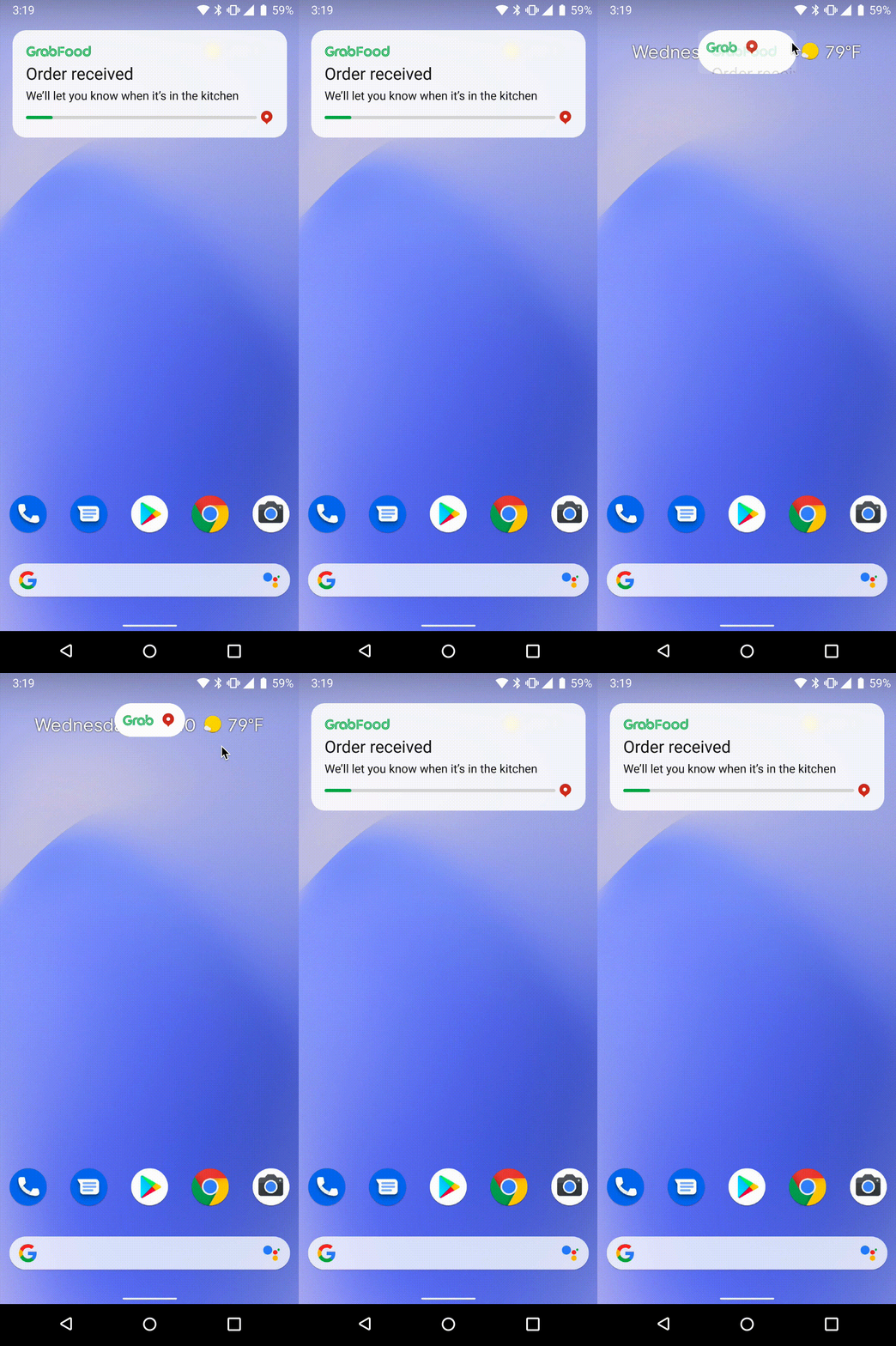
The Notification View is a component located in the notification drawer (and potentially on the Lock Screen) that fulfils the most basic use-case of the Live Activity feature. It enables Android users to access information without the need to open the app. Since the standard notification template only allows developers to display a single content title, a content subtitle, and one image, it falls short of meeting our Live Activity UI requirements. To overcome this limitation, custom notifications with custom layouts are needed.

Figure 3. Early design spec of Grab’s LA using custom notification.

One of the key advantages of custom notifications is that they do not require any additional new permissions, ensuring a smooth user experience. Additionally, Android users are accustomed to checking their notifications from the notification tray, making it a familiar and intuitive interaction. However, it is important to acknowledge that custom notifications rely on a remote view, which can pose restrictions on rendering only specific views. On top of that, custom notifications provide a limited space for content – limited to 48dp when collapsed and 252dp when expanded.

The Floating View is a component that will appear above all the applications in Android. It adds the convenience of accessing the information when the device is unlocked or when the user is on another app.

Figure 4. Early design spec of Grab’s LA using floating view.

The use of a Floating View offers greater flexibility to the view by eliminating the reliance on a remote view. However, it’s important to be aware of the potential limitations associated with this approach. These limitations include the requirement for screen space, which can potentially impact other app functionalities and cause frustration for users. Additionally, if we intend to display multiple order updates, we may require even more space, taking into account that Grab allows users to place multiple orders. Furthermore, the Floating View feature requires an extra “Draw over other apps” permission, a setting that allows an app to display information on top of other apps on your screen.

After thoughtful deliberation, we concluded that custom notifications provide a more consistent and user-friendly solution for implementing Grab’s Live Activity feature on Android. They offer compatibility, non-intrusiveness, no extra permissions, and the flexibility of silent notifications, ensuring an optimised user experience.

Building Grab Android’s “Live Activity”

We began developing the Live Activity feature by focusing on Food and Mart for the MVP. However, we prioritised potential future use cases for other verticals by examining the existing functionality of the Grab iOS Live Activity feature. By considering these factors from the start, we need to make sure that we build an extendable and flexible solution that caters to different verticals and their various use-cases.

Figure 5. Grab’s Android Live Activity.

As we set out to design Grab’s Android Live Activity module, we broke down the task into three key components:

  1. Registering Live Activity Token

In order to enable Hedwig services to send Live Activity notifications to devices, it is necessary to register a Live Activity Token for a specific order to Grab Devices services (refer to figure 1 for the iOS flow). As this use-case is applicable across various verticals in iOS, we have designed a LiveActivityIntegrationManager class specifically to handle this functionality.

interface LiveActivityIntegrationManager {  
    /\*\*  
     \* To start live activity journey  
     \* @param vertical refers to vertical name  
     \* @param id refers to unique id which is used to differentiate live activity UI instances  
     \* eg: Food will use orderID as id, transport can pass rideID  
     \*\*/  
    fun startLiveActivity(vertical: Vertical, id: String): Completable

    fun updateLiveActivity(id: String, attributes: LiveActivityAttributes)

    fun cancelLiveActivity(id: String)  
}  

Our goal is to provide developers with an easy implementation of Live Activity in the Grab app. Developers can simply utilize the startLiveActivity() function to register the token to Grab Devices by passing the vertical name and unique ID as parameters.

  1. Notification Listener and Payload Mapping

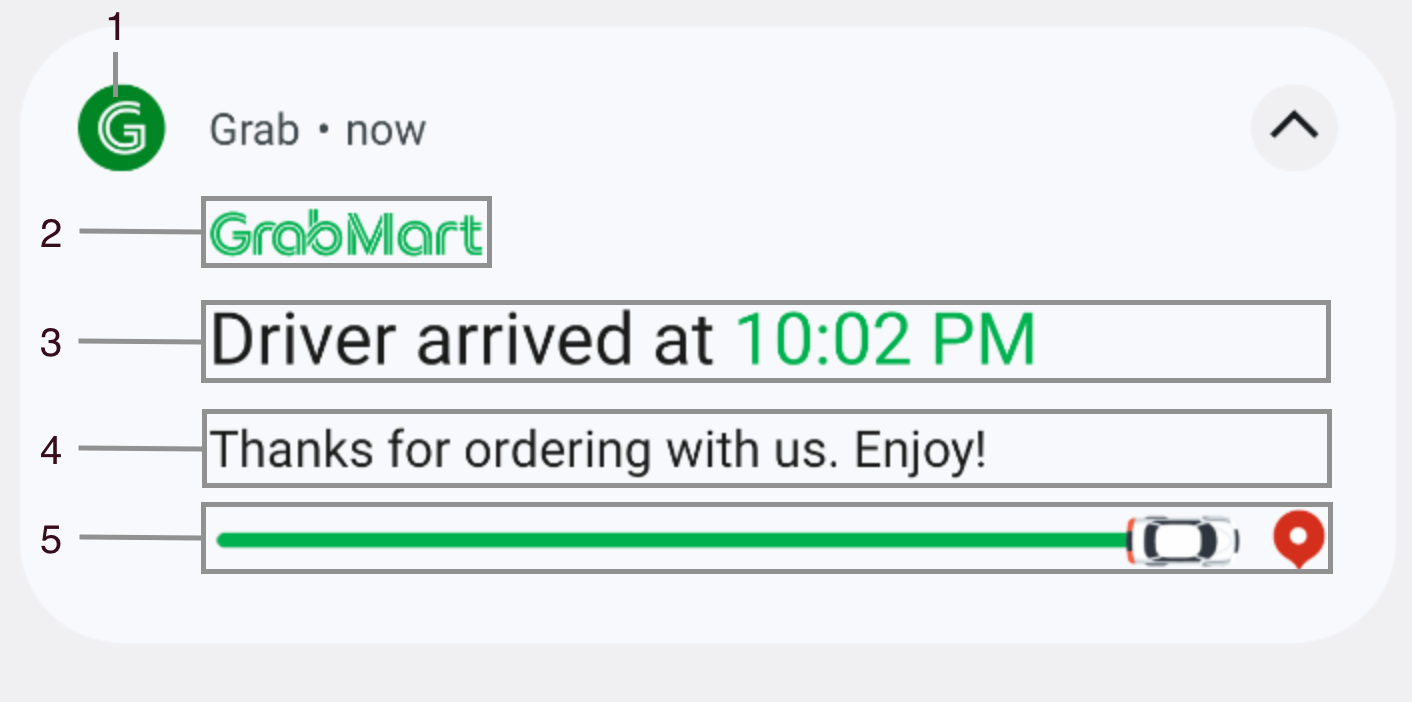
To handle Live Activity notifications in Android, it is necessary to listen to the Live Activity notification payload and map it to LiveActivityAttributes. Taking into consideration the initial Live Activity design (refer to figure 3), we need to analyse the variables necessary for this process. As a result, we break down the Live Activity UI into different UI elements and layouts, as follows:

Figure 6. Android Live Activity view breakdown.
  1. App Icon – labeled as 1 in Figure 6.
    This view always shows the Grab app icon.
  2. Header Icon – labeled as 2 in Figure 6.
    This view is an image view that could be set with icon resources.
  3. Content Title View – labeled as 3 in Figure 6.
    This view is a placeholder that could be set with a text or custom remote view.
  4. Content Text View – labeled as 4 in Figure 6.
    This view is a placeholder that could be set with a text or custom remote view.
  5. Footer View – labeled as 5 in Figure 6.
    This view is a placeholder that could be set with icon resources, bitmap, or custom remote view.

Decomposing the UI into different parts allows us to clearly understand of the UI components that need to maintain consistency across different use-cases, as well as the elements that can be easily customised and configured based on specific requirements. As a result, we have designed the LiveActivityAttributes class that serves as a container that encompasses all the necessary configurations required for rendering the Live Activity.

 
class LiveActivityAttributes private constructor(  
    val iconRes: Int?,  
    val headerIconRes: Int?,  
    val contentTitle: CharSequence?,  
    val contentTitleStyle: ContentStyle.TitleStyle?,  
    val customContentTitleView: LiveActivityCustomView?,  
    val contentText: CharSequence?,  
    val contentTextStyle: ContentStyle.TextStyle?,  
    val customContentTextView: LiveActivityCustomView?,  
    val footerIconRes: Int?,  
    val footerBitmap: Bitmap?,  
    val footerProgressBarProgress: Float?,  
    val footerProgressBarStyle: ProgressBarStyle?,  
    val footerRatingBarAttributes: RatingBarAttributes?,  
    val customFooterView: LiveActivityCustomView?,  
    val contentIntent: PendingIntent?,  
    …  
)  

  1. Payload Rendering

To ensure a clear separation of responsibilities, we have designed a separate class called LiveActivityManager. This dedicated class is responsible for the mapping of LiveActivityAttributes to Notifications. The generated notifications are then utilised by Android’s NotificationManager class to be posted and displayed accordingly.


interface LiveActivityManager {  
    /\*\*  
     \* Post a Live Activity to be shown in the status bar, stream, etc.  
     \*  
     \* @param id           the ID of the Live Activity  
     \* @param attributes the LiveActivity to post to the system  
     \*/  
    fun notify(id: Int, attributes: LiveActivityAttributes)

    fun cancel(id: Int)  
}

What’s Next?

We are delighted to announce that we have successfully implemented Grab’s Android version of the Live Activity feature for Express and Transport products. Furthermore, we plan to extend this feature to the Driver and Merchant applications as well. We understand the value this feature brings to our users and are committed to enhancing it further. Stay tuned for upcoming updates and enhancements to the Live Activity feature as we continue to improve and expand its capabilities across various verticals.

Join us

Grab is the leading superapp platform in Southeast Asia, providing everyday services that matter to consumers. More than just a ride-hailing and food delivery app, Grab offers a wide range of on-demand services in the region, including mobility, food, package and grocery delivery services, mobile payments, and financial services across 428 cities in eight countries.

Powered by technology and driven by heart, our mission is to drive Southeast Asia forward by creating economic empowerment for everyone. If this mission speaks to you, join our team today!

Cloudflare’s 2024 Annual Founders’ Letter

Post Syndicated from Matthew Prince original https://blog.cloudflare.com/cloudflare-2024-annual-founders-letter

This week Cloudflare will celebrate the fourteenth anniversary of our launch. We think of it as our birthday. As is our tradition ever since our first anniversary, we use our Birthday Week each year to launch new products that we think of as gifts back to the Internet. For the last five years, we also take this time to write our annual Founders’ Letter reflecting on our business and the state of the Internet. This year is no different.

That said, one thing that is different is you may have noticed we’ve actually had fewer public innovation weeks over the last year than usual. That’s been because a couple of incidents nearly a year ago caused us to focus on improving our internal systems over releasing new features. We’re incredibly proud of our team’s focus to make security, resilience, and reliability the top priorities for the last year. Today, Cloudflare’s underlying platform, and the products that run on top of it, are significantly more robust than ever before.


With that work largely complete, and our platform in its strongest shape ever, we plan to pick back up the usual cadence of new product launches that we’re known for. This Birthday Week, you’ll see many as we roll out performance improvements only our Connectivity Cloud can deliver to accelerate all our customers’ websites by a mind-blowing 45 percent (automatically and for free), launch new features to make our developer platform faster and easier to use, plug the web’s last encryption hole, accelerate AI inference globally, provide new levels of support for startups and the open source community, and much much more.

This is easily our favorite week of the year because of how it allows our team to give back to the Internet and live up to our mission.

Challenges for the Internet ahead

The robustness of Cloudflare’s platform today contrasts with what feels like an Internet that has become far more fragile over the previous year. When we first articulated our mission as helping build a better Internet, we assumed that “better” meant one that was faster, more reliable, more secure, more private, and more efficient. But today it seems like something more fundamental.

The last year has been characterized by a normalization of Internet shutdowns and limits on Internet access around the world. What were once tactics reserved for authoritarian regimes have spread to even Western democratic nations, where courts and legislatures have been emboldened to restrict fundamental protocols to control perceived harms.

We’ve seen a dramatic uptick in courts of limited jurisdiction ordering sites they found objectionable blocked globally at the DNS level, nations turning off the Internet for most their citizens in the name of preventing cheating on standardized tests (while it remains on in wealthy and politically connected neighborhoods), ISPs proposing legislation to impose new taxes on content creators, and whole services being banned in countries that had previously declared that more Internet was always better than less. 

This is, unfortunately, a dark time in the history of the Internet.

AI’s Threat to Original Content Creation

At the same time, the business model of the web is eroding. The quid pro quo of the web’s last era — the search era — was that you let a company like Google scrape data from your website in exchange for them sending you traffic. In that model, content creators could then generate value from that traffic through ads, selling products, or just getting the ego boost of knowing that someone cares enough about the thing you created to take the time to view it.


That same quid pro quo does not hold up in the era we’re moving into — the AI era — where answers are delivered to questions without ever having to visit the authoritative source. And, if content creators can no longer generate value from their creations, it’s inevitable they’ll generate less content and we’ll all, including the AI companies that need original content to train their models, lose out as a result.

Picking Up the Mantle

The Internet remains a miracle, but it no longer feels inevitable. It is under attack from active adversaries and beginning to rot from benign neglect. And, with the largest tech companies distracted by their own regulatory challenges, it finds itself without a clear champion. We’re proud of our team for picking up that mantle. At Cloudflare, we believe in the Internet and we will fight for it.

That’s why we invest in our public policy team to educate lawmakers and jurists on how best to control the harms created by some limited corners of the Internet without destabilizing its underlying protocols. Why we believe it’s important to provide so many of our services for free. And it’s why this Birthday Week we’ll announce new ways for the AI systems that hunger for original content to compensate content creators in a way that is equitable. Without a new paradigm, we worry that the incentives that allowed the Internet to flourish will shrivel and its miracle will fade.

Missions matter. Ours it to help build a better Internet. We, or one of our senior executives, still talk to every candidate we hire before extending an offer because we want to ensure we communicate the importance of our mission. One of the most common questions we’re asked is how we plan to preserve Cloudflare’s culture? Our answer is always the same: the goal isn’t how to preserve our culture, it’s always how to improve it. The same has to be true for the Internet. We can’t just try to preserve the past, we need to imagine new ways to improve it.

That requires champions to stand up and imagine a better Internet. It’s been too long since you’ve read a positive story about the Internet even though it continues to be a miracle. We are proud that we have the team, platform, and mantle to not just preserve, but improve on, that miracle. It is our mission and what motivates everything we do at Cloudflare. And nowhere is that more on display than during the week ahead. If you too are inspired by our mission, we encourage you to apply to join our team.


Stay tuned for an incredible Birthday Week of new products that make progress on our mission. Thank you to our team around the world for everything you do. Cloudflare is stronger because of the work we’ve accomplished, and the Internet will be stronger because of Cloudflare.


MiTAC Intel Denali Pass High-End Liquid Cooled 2U 4-Node Review

Post Syndicated from Patrick Kennedy original https://www.servethehome.com/mitac-intel-denali-pass-high-end-liquid-cooled-2u-4-node-review-coolit/

The MiTAC Intel Denali Pass platform can liquid cool almost everything down to the PSUs. We show the awesome engineering in our review

The post MiTAC Intel Denali Pass High-End Liquid Cooled 2U 4-Node Review appeared first on ServeTheHome.

Избори октомври 2024: заявления за гласуване в чужбина

Post Syndicated from Боян Юруков original https://yurukov.net/blog/2024/izbori-o24-zaiavleniq/

Кампанията за събиране на заявления за гласуване в чужбина започна преди 10 дни. Това става с формуляра на страницата на ЦИК. Както обикновено, не беше лишена от проблеми в началото, включително грешно отбелязани или блокирани за подаване градове зад граница. Два дни по-късно, когато бяха изчистени повечето проблеми, пуснах мейл до над 3000 абонирани за новини на Glasuvam.org с информация за заявленията и правата им.

Ето някои от точките:

  • Крайният срок за подаване е 1-ви октомври в полунощ българско време
  • Подаването на заявление за гласуване в секцията най-близо до Вас, ще Ви улесни и ще ускори изборния процес, тъй като ще сте вече вписани в списъците
  • Заявление се подава за всеки вот поотделно. Т.е. не се пренасят от предходни избори
  • Дори да подадете заявление, а се окаже, че на 27-ми октомври сте в България, ще може да гласувате в секцията си по постоянен адрес с попълване на декларация
  • Вече са предварително одобрени 783 места за секции в чужбина, където в последните 5 години е имало поне 100 гласували. Това не означава, че непременно ще има секции на тези места. Това зависи от възможностите на помещенията и дали има комисии и доброволци към тях. В крайна сметка решението е на ЦИК по препоръка на Външно. Могат да се увеличат шансовете като се подават заявления за тези места и повече хора се включат като членове на комисии и доброволци.
  • На някои места като Германия е нужно да се иска разрешение от местните власти. Това вече би трябвало да се случва предвид предварително одобрените места. Очакваме информация от Външно
  • Подаването на заявления освен, че подпомага изборния процес, показва и повишен интерес на съгражданите ни в чужбина към вота

Докато първо бях блокиран да зареждам данни в реално време, както правя в последните над 10 години, намерих начин и вече може да се следи кампанията в реално време в детайли или на картата.

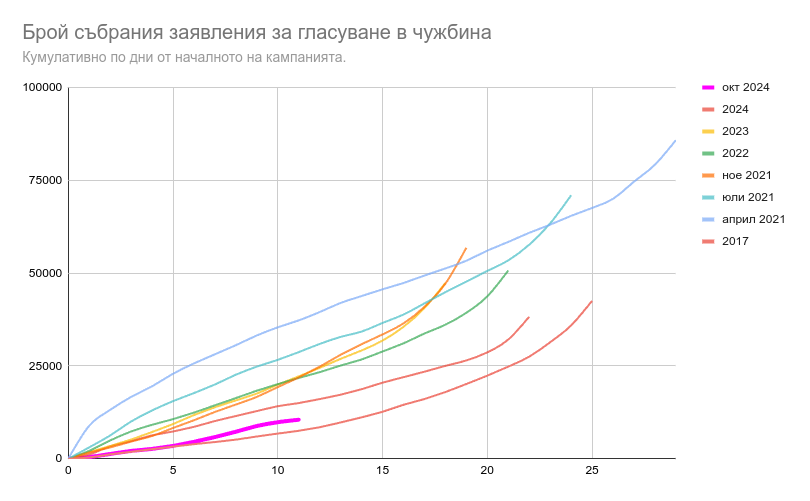
За тези десет дни може да си направим няколко извода. Тази кампания има най-малко подадени заявления в последните осем години. Основна причина за това е автоматично одобрените секции, т.е. нуждата от заявления не е толкова критична, както преди. Забелязва се обаче значителен спад дори спрямо вотове след въвеждането на тази промяна.

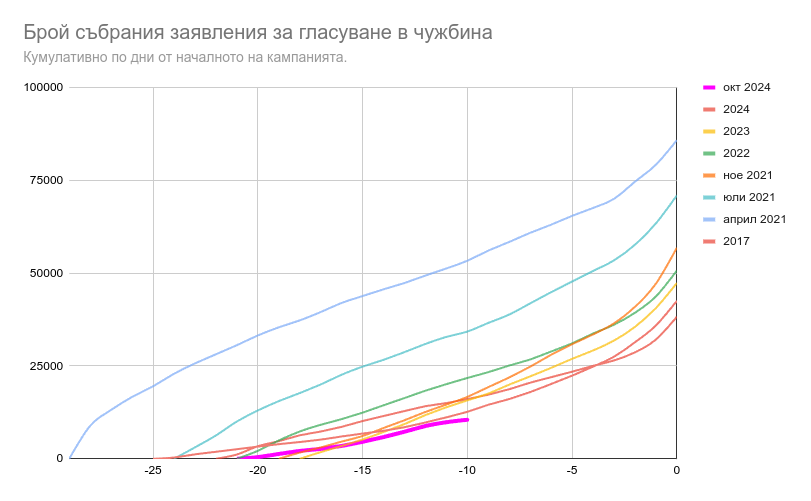
Тук виждате сравнение на събирането на заявления от цял свят. Линиите са с различна дължина, тъй като продължителността на кампаниите е била различна. Сегашната е от три седмици, което е по-малко от средното, но повече от тази през ноември 2021-ва и 2023-та.

Тук са подравнени спрямо крайната дата. Забелязвате как към края има увеличение. Не знаем дали сега ще има такова, но определено се забелязва забавяне в момента. Единствената година с по-малко заявления беше 2017-та, която обаче беше последвана от рекорден брой заявления през април 2021-ва.

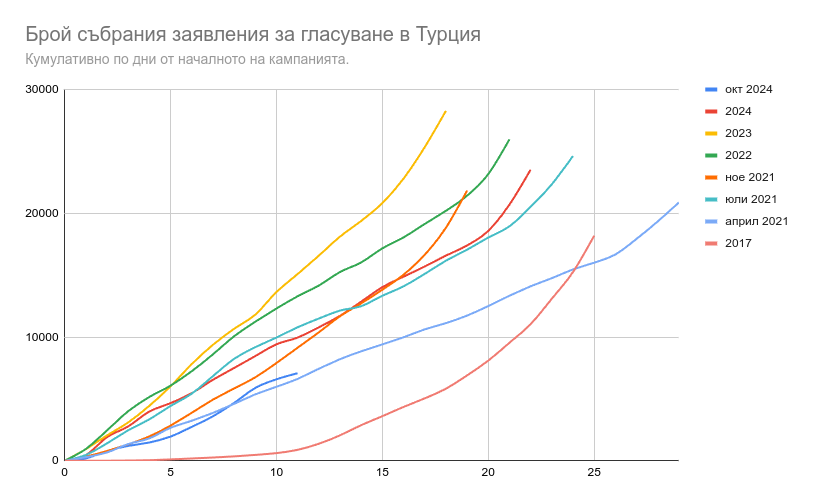
Част от причината за сегашното забавяне са по-малкото заявления от Турция. Движи се паралелно с кампанията през април 2021-ва, която специално за Турция беше една от доста слабите. Далеч е от кампанията през 2023-та и дори началото на 2024-та. Ако няма промяна, това може да е годината с най-малко заявления за гласуване от Турция до сега предвид значително по-краткият период на събиране. Макар да предупреждавам доста да не се разчитат тези данни като индикатор за избирателна активност, може да служи за насока за проблем в организираността там предвид спецификите до сега.

The post Избори октомври 2024: заявления за гласуване в чужбина first appeared on Блогът на Юруков.