Вече от поне две седмици от различни източници постъпва информация, че руската армия е минирала АЕЦ Запорижя на практика напълно. Повечето от източниците (напр. украинското разузнаване) са пристрастни и е разумно да не бъдат приемани с абсолютно безрезервно доверие. Има обаче източници, непублични и с ограничен достъп, които не са твърде пристрастни, а твърдят същото. Така че е разумно да се приеме, че е възможно (ако и не абсолютно сигурно) да е вярно.
А от няколко дни постъпват новини, че руската армия се изтегля тихомълком от АЕЦ-а. Досега тя го държеше под строг контрол – в централата по всяко време имаше сериозни по размер руски военни части, включително тежко въоръжение (танкове, ракетни установки…). От военна точка изтегляне не се налага, пунктът все още е далече от бойната линия. Едно от вероятните предположения е, че има опасност централата да стане източник на радиоактивно заразяване – поради взривяване на мините или по друга причина.
В тази връзка може би ще е полезно да знаем какво да правим, ако този най-лош сценарий се сбъдне. Ако пък не, знаенето няма да ни навреди.
Общи думи
Адекватните мерки при радиоактивно заразяване са различни, в зависимост от типа и силата на заразяването. Те пък зависят от вида на източника, разстоянието до него и други фактори.
Когато източникът е единичен (ядрен взрив, авария в АЕЦ…) и разстоянието е много стотици или хиляди километри, почти единствената опасност е от отделения радиоактивен йод (осноно изотоп 131). Той се натрупва в щитовидната жлеза на хората и животните и увеличава вероятността от рак в нея. Другите опасности от него или други радионуклиди в този случай обикновено са минимални. (При много лоши стечения на обстоятелствата могат да бъдат реални. Това описание не ги покрива.)
Опасността от йод-131 зависи от количеството му около нас. То – от общото отделено количество йод-131 и дали и колко от него е пренесено от мястото на инцидента към нас. При разстояние като това от България до АЕЦ Запорижя пренасянето зависи от атмосферните условия около и след инцидента.
Количеството отделен йод би зависело от какви и колко обекти в АЕЦ Запорижя са пострадали, и в каква степен. АЕЦ-ът има 6 реактора ВВЕР-1000, плюс сериозни като размер охладителни басейни за първично съхранение на отработеното ядрено гориво. Ако всички те пострадат сериозно, количеството отделен йод-131 може да е десетки пъти над отделеното при авариите в АЕЦ Чернобил и Фукушима, и хиляди пъти над отделеното при употреба на един или няколко тактически ядрени заряда. (Това не означава, че другите последствия непременно също ще бъдат толкова по-големи, или дори същите.)
Размерът на уврежданията при потенциален инцидент е невъзможно да се предскаже отсега, атмосферните условия – също. Затова давам съвет как да се действа срещу радиоактивния йод при най-лош вероятен вариант. (Ако се появи реална опасност и от други радионуклиди, това ще е тема за отделен запис.)
За щастие Енергодар е на много стотици километри от нас. Ако там се случи нещо, дори ако вятърът духа оттам насам (което е рядко), ще имаме време да научим. Ще имаме време и да разберем дали е отделена радиация, и ако да – дали е количество, което заслужава предпазни мерки. След това ще имаме време и да проверим дали вятърът го носи към нас или надругаде. И след това, ако се налага, ще имаме предостатъчно време да вземем предпазни мерки, без да сме закъснели. Дебело подчертавам – не взимайте предпазните мерки преди да е потвърдено, че се налага!
Защита срещу радиоактивен йод
Радиоактивният йод е опасен с това, че щитовидната ни жлеза го поема и натрупва точно както обикновения йод. (И с това се излага на лъчението от атомите му.) Ако тя бъде наситена с достатъчно йод преди радиоактивният да стигне до нас, тя няма да поема повече и съответно няма да поеме от радиоактивния.
Предпочитаното за насищане с йод средство е калиев йодид. Той е активното вещество във всички йодни хапчета. Химическият калиев йодид е точно същото – ако нямате йодни хапчета, но имате химически калиев йодид, можете да отмерите от него правилната доза. (Горчив е на вкус – можете да го приемете с ядене или някакъв подсладител, не му пречат. Може да подразни стомаха – добре е да се приема с храна, или поне с прясно или кисело мляко. Храната не пречи на резорбцията му.)
Ако нямате други варианти, йод може да се набави и от йодна тинктура. Тинктурата е разтвор на йод (често и калиев йодид) във вода, спирт или комбинация от двете. Какво съдържа и точното му количество трябва да са посочени на опаковката – ако не са, не я използвайте! Ако съдържа само или основно чист йод, занижете малко милиграмите (100 мг чист йод са приблизително еквивалентни на 126 мг калиев йодид). Вкусът ѝ също не е приятен.
Тинктурата може да бъде предпочитана при хора, които не могат да приемат йод през стомаха (напр. тежки стомашни проблеми или силно чувствителен стомах). При намазване по кожата в областта на корема обикновено се резорбира около 80% от йода в нея. (Вместо да пиете таблетка от 130 мг, можете да намажете колкото тинктура съдържа 160 мг. калиев йодид или 125 мг. йод. Типичната за България йодна тинктура съдържа 5% йод и 10% калиев йодид – 0.8 до 1 куб. см от нея е подходяща доза за 72 кг. тегло.) Не е страшно да намажете повече от необходимото – опасно за здравето количество няма да се резорбира. (Но по-чувствителна кожа може да се раздразни – внимавайте пък за това!)
Може да ви предложат в аптеката Йодасепт или друга търговска марка на повидон-йодин. За дезинфекция на рани е прекрасен, за насищане с йод – не. Йодът в него е 1%, 15 пъти по-малко, отколкото в йодна тинктура. При намазване върху кожата не е известно какъв процент се резорбира, възможно е да е близък до нулата. При вътрешно поглъщане може да отдели атомарен йод, който е силен дразнител, по-висока доза може да ви изгори стомаха. Не го пийте!
При опасност като описаната, правилната стратегия би била да се приема ежедневно доза йод до намаляване на опасността от радиоактивния йод до пренебрежима. Последното става, когато радиацията от него спадне до нива, сравними или по-ниски от тези на естествения радиационен фон. Периодът на полуразпад на йод-131 е 8 дни – тоест, на всеки 8 дни радиацията и опасността от него спадат наполовина. След 16 дни те ще са 1/4 от първоначалните, след 24 дни – 1/8, след 32 дни – 1/16 и т.н.
След десетия ден можете да намалите дозата двойно или да я приемате през ден – защитата остава на практика същата.
Добре е да започнете приема на йод поне няколко часа преди радоактивният да достигне до вас. Ако закъснеете с няколко часа или дори дни, пак си струва – по-малко предпазване е по-добре от никакво. Безсмислено е да се започва преди информация, че имаме авария с изхвърляне на радиоактивен йод – дори в идеални метеорологични условия той надали би достигнал от АЕЦ Запорижя до България за по-малко от денонощие. В типичния случай биха му трябвали 2 денонощия, а ако вятърът не го носи насам, не е изключено дори при сериозно изхвърляне дотук да не достигне опасно количество.
Оптималната доза калиев йодид зависи от теглото на индивида. Зависимостта обаче не е линейна: по-ниското тегло изисква повече калиев йодид на килограм. Ето таблица за приблизителните оптимални дози:
72 кг. – 130 мг. на ден
40-45 кг. – 65 мг. на ден.
20-30 кг. – 32-45 мг. на ден
10 кг. – 25 мг. на ден
5 кг. – 20 мг. на ден
3 кг. – 15 мг. на ден
Приемането на доза до 2 пъти оптималната обикновено е безопасно за организма – не се притеснявайте, ако не можете да я отмерите абсолютно точно. Изключение са алергичните на йод и йодни препарати – те е добре да се консултират с лекар по темата.
При болести на щитовидната жлеза тези дози може да не са адекватни. Например при болест на Хашимото може да са необходими по-ниски. Каква доза е подходяща за конкретния болен зависи от болестта и стадия ѝ – може да е от няколко пъти дадената до нулева. Задължително се консултирайте с лекаря си по въпроса!
Йодните хапчета са обикновено 2 грамажа – 130 мг. и 65 мг. Смятайте според какви имате.
Ако се налага да делите хапче (или отмерена доза калиев йодид), най-добре ги разтворете във вода. Сложете в чаша такъв брой лъжици, малки чашки или кубически сантиметри вода (ако имате с какво да ги мерите), какъвто после ще ви е най-лесно да разделите на нужните ви дози. Сипете калиевия йодид или смачкайте добре хапчето във водата с лъжичка и разбърквайте до пълно разтваряне. Дръжте разтвора в хладилник, най-добре захлупен, за да не се изпарява лесно (увеличава концентрацията на калиевия йодид в остатъка).
Ако се налага да отмерите калиев йодид на прах, най-добре намерете точна везна за малки тегла. Аптеки които изпълняват микстури и места които ремонтират бижута най-често имат. Заложни къщи, които приемат злато и сребро, често също имат (може да са по-неточни, но отклонението няма да е фатално). Ако не можете да намерите иначе, попитайте в Интернет кой би ви отмерил. (А ако имате с какво да мерите, не се колебайте да помагате на нуждаещи се.)
Ако не можете да отмерите точно малка доза, отмерете най-малкото количество, което можете да отмерите точно. Количества от няколко грама могат да бъдат внимателно доразделени на 2 или 3 равни части върху стъкло с нож; после делете отново до достигане до желаната доза или близо до нея. При делене отведнъж на повече части е по-трудно да ги направите еднакви. Количества от грам и по-малко често е най-добре да бъдат разтворени във вода и тя да бъде делена. (Спринцовки от аптеката – една 10-20 мл и една 1-2 мл – могат да са много полезни. Ако малката е за инсулин, внимавайте с деленията – може да са в инсулинови единици, а не в милилитри: 40 инсулинови единици са 1 милилитър.)
Добра идея е да дадете калиев йодид и на домашните си любимци – и те заслужават предпазване. Най-добре става с нещо, което обичат (калиевият йодид няма мирис, но има горчив вкус). Оптималните дози на единица тегло за бозайници са на практика същите като за хора. За други домашни любимци първо се консултирайте с ветеринарен лекар.
Can you verify if your phone battery drains faster during summer compared to other seasons with Zabbix? Of course, you can!
I have always felt that during summer my phone battery drains faster than during the darker seasons. This would only be logical, as during summer the phone display must be brighter than during the darker seasons. Additionally, during summer we also tend to be more outdoors, so instead of home Wi-Fi the phone is using mobile data. On the other hand, during winter time if you are outdoors, the cold weather might affect battery life as well.
But how severe is the drainage difference? Let’s check it out!
Analyzing the data
In June, my iPhone battery average level has been 51%
In April, it was around 67%.
In March, about 71%.
What does this prove?
Well, necessarily not much as this is not a very scientific method. However, my day-to-day phone usage does not vary much — if anything, during March/April the drainage should have been worse, as I have a tendency to participate in one daily afternoon meeting from outdoors; I’ll stroll around with our baby and get some fresh air whilst being online in the meeting. Now in June, I’ve been enjoying my summer holiday. But clearly, something is going on as the average percentage difference is such high. For my Apple Watch, the difference is there but not that significant.
Why am I not comparing the data with the iPhone activity? Heh — to prove my point with my earlier “Things that WILL go wrong when monitoring IoT devices” post; something has happened as my Home Assistant won’t provide that information anymore. The same happened with connection-type data. I’ll have to take a look at that someday, but lately, I’ve been busy as a bee with 1) the summer holiday and 2) preparing material for Zabbix Summit 2023.
Real-world applications for this kind of cherry-picking
Even though this post is very thin in its contents, I’m posting this as a hint for you on how you can utilize Zabbix in more serious monitoring targets in this way. Need to compare UPS battery depletion rate? Disk space usage rate? CPU usage? Concurrent connections? Whatever the data, many times it’s useful to stop for a moment and compare how things were (some time units) ago.
Yes, you can simply pick a longer time period in Zabbix time picker and see the data for one year or whatever, and most of the time it will show you a change in pattern, but if the changes are more subtle or the graph is very busy, sometimes zooming in to shorter time periods in history will show you something that you might otherwise miss.
For example, if I expand the time range for the battery usage, not only you’ll notice that the Home Assistant iCloud ride has been a bumpy one, but also the details do get lost when the time range is longer.
More ways to compare historical data
I didn’t build any new graphs or dashboards for this quick experiment, I merely used the time picker. In case one would need to have comparison data available at any time, using time shift and additional data sets would help you out. And, like many of us do, one way to dive deeper into data collected by Zabbix would be to analyze it in Grafana, but that’s a story for another day.
I have been working at Forcepoint since 2014 and I’m happy that my work won’t drain my personal battery. — Janne Pikkarainen
This post was originally published on the author’s page.
Започвам този бюлетин с непривична за персоната ми ведрост, дължаща се на факта, че „Тоест“ си има собствена серия шоколади съвместно с „Гайо“. Даже ще сложа удивителна! Удивителното е, че след месеци подбиране на съставки и комбиниране на вкусове най-сетне можем да се похвалим с първия продукт на съвместното ни начинание – млечен шоколад с лешници и поръска от сушени малини.
И за да не решите, че насочеността на медията е поела далеч на юг и е акостирала в пространството на кулинарните блогове, ще ви успокоя, че шоколадът е част от начините, с които ви предлагаме да подкрепите съществуването на „Тоест“. Защото медията ни се издържа изцяло от дарения, а напоследък – и от шоколади. Това може и да е шега, може и да не е – ще видим накъде ще поеме тази инициатива. Затова поръчайте тук и се насладете на разкошния занаятчийски шоколад и на приятния послевкус от доброто дело, тъй като един лев от всеки продаден шоколад отива като дарение за „Тоест“. Издавам, че скоро ще пуснем и втори вид – натурален, с ядки пекан, карамелизирани в кленов сироп. Така че гответе се – шоколадите идват.
Идват и местни избори и ведростта ми си отива. Те нямат нищо общо със сладостта на шоколада, макар в някои предизборни кампании да има леко захаросан елемент. Със сигурност изборите наесен ще са темата на лятото. На тях е посветен и текстът на Емилия Милчева. В него тя прави преглед на позициите, от които стартират политическите партии в тази кампания, и задава важния въпрос кой ще превземе доскорошните крепости на ГЕРБ.
Като стана дума за превземане на крепости, в края на миналата седмица се направи някакъв опит за „превземане“ на Москва от „Вагнер“ – армията на Пригожин. Те не че искаха да я превземат, а само поеха на „поход за справедливост“, и то не че имаше опасност, но просто самолетът на Путин излетя почти веднага, щом се разбра, че бойците от „Вагнер“ са се настанили без бой в Ростов. И накрая се оказа, че не било бунт, а просто недоволство. И нямало да превземат Москва, а само са се разходили, после първата пряка вдясно – и към Беларус. И не били компютри, ами били компоти и т.н. В статията „Някои бележки по бунта на „Вагнер“ Александър Малинов прави кратко обобщение на изводите, които може да направим от така стеклите се (или по-скоро нестеклите се) събития.
Русия, войната и особеностите на руското общество са в основата и на интервюто на Галина Д. Георгиева с един от най-популярните съвременни европейски драматурзи – Иван Вирипаев. За имперския код у Пушкин, защо ако днес беше жив, Достоевски щеше да е на страната на Путин и какво се случва, ако затворим един народ зад стена – това са част от съжденията на Вирипаев в разговора. Но от специалното интервю за „Тоест“ може да научите и за изключително хуманистичния му проект „Тюркоазената къща“, за промяната в общуването между хората като някакъв вододел между епохи, както и за начина, по който Вирипаев възприема изкуството.
Също с прехода между епохи, само че геоложки, започват и тазседмичните научни новини на Михаил Ангелов. Част от тях е посветена на динозавъра Iani smithi и на някои интересни палеонтологични открития, свързани с неговата така симпатична особа (даже илюстрация сме сложили в материала, за се убедите сами колко е „фотогеничен“). В новостите от научния свят тази седмица има и много интересни неща за едни още по-интересни риби, приспособили се да живеят в екстремни условия с температура на водата до -2°C. Има и информация за последните изследвания на вирусните частици на SARS-CoV-2. Това ще ни даде по-голяма яснота за COVID-19 и за последствията от него.
Завършвам тазседмичния бюлетин със страхотния текст на Екатерина Петрова „В името на „баштата“, в който тя търси произхода на думата „баща“ през далечни и по-близки пътувания в езиците и в спомените си за своя баща и неговата леха с рози. Историята на тази толкова лична и в същото време прозаична дума е криволичеща и заплетена и стига право до сърцето. Прочетете я и звъннете на баща си да го чуете какво прави. А ако по някаква причина това не е възможно, извикайте в главата си най-хубавия спомен за него или за друга важна бащинска фигура в живота ви. Прожектирайте си го тоя спомен в летен следобед по ваш избор, в който все още мирише безобразно на липи. Няма да съжалявате.
The threat detection and incident response track showcased how AWS customers can get the visibility they need to help improve their security posture, identify issues before they impact business, and investigate and respond quickly to security incidents across their environment.
With dozens of service and feature announcements—and innumerable best practices shared by AWS experts, customers, and partners—distilling highlights is a challenge. From an incident response perspective, three key themes emerged.
Proactively detect, contextualize, and visualize security events
When it comes to effectively responding to security events, rapid detection is key. Among the launches announced during the keynote was the expansion of Amazon Detective finding groups to include Amazon Inspector findings in addition to Amazon GuardDuty findings.
Detective, GuardDuty, and Inspector are part of a broad set of fully managed AWS security services that help you identify potential security risks, so that you can respond quickly and confidently.
Using machine learning, Detective finding groups can help you conduct faster investigations, identify the root cause of events, and map to the MITRE ATT&CK framework to quickly run security issues to ground. The finding group visualization panel shown in the following figure displays findings and entities involved in a finding group. This interactive visualization can help you analyze, understand, and triage the impact of finding groups.
Figure 1: Detective finding groups visualization panel
With the expanded threat and vulnerability findings announced at re:Inforce, you can prioritize where to focus your time by answering questions such as “was this EC2 instance compromised because of a software vulnerability?” or “did this GuardDuty finding occur because of unintended network exposure?”
In the session Streamline security analysis with Amazon Detective, AWS Principal Product Manager Rich Vorwaller, AWS Senior Security Engineer Rima Tanash, and AWS Program Manager Jordan Kramer demonstrated how to use graph analysis techniques and machine learning in Detective to identify related findings and resources, and investigate them together to accelerate incident analysis.
In addition to Detective, you can also use Amazon Security Lake to contextualize and visualize security events. Security Lake became generally available on May 30, 2023, and several re:Inforce sessions focused on how you can use this new service to assist with investigations and incident response.
As detailed in the following figure, Security Lake automatically centralizes security data from AWS environments, SaaS providers, on-premises environments, and cloud sources into a purpose-built data lake stored in your account. Security Lake makes it simpler to analyze security data, gain a more comprehensive understanding of security across an entire organization, and improve the protection of workloads, applications, and data. Security Lake automates the collection and management of security data from multiple accounts and AWS Regions, so you can use your preferred analytics tools while retaining complete control and ownership over your security data. Security Lake has adopted the Open Cybersecurity Schema Framework (OCSF), an open standard. With OCSF support, the service normalizes and combines security data from AWS and a broad range of enterprise security data sources.
Figure 2: How Security Lake works
To date, 57 AWS security partners have announced integrations with Security Lake, and we now have more than 70 third-party sources, 16 analytics subscribers, and 13 service partners.
In Gaining insights from Amazon Security Lake, AWS Principal Solutions Architect Mark Keating and AWS Security Engineering Manager Keith Gilbert detailed how to get the most out of Security Lake. Addressing questions such as, “How do I get access to the data?” and “What tools can I use?,” they demonstrated how analytics services and security information and event management (SIEM) solutions can connect to and use data stored within Security Lake to investigate security events and identify trends across an organization. They emphasized how bringing together logs in multiple formats and normalizing them into a single format empowers security teams to gain valuable context from security data, and more effectively respond to events. Data can be queried with Amazon Athena, or pulled by Amazon OpenSearch Service or your SIEM system directly from Security Lake.
Build your security data lake with Amazon Security Lake featured AWS Product Manager Jonathan Garzon, AWS Product Solutions Architect Ross Warren, and Global CISO of Interpublic Group (IPG) Troy Wilkinson demonstrating how Security Lake helps address common challenges associated with analyzing enterprise security data, and detailing how IPG is using the service. Wilkinson noted that IPG’s objective is to bring security data together in one place, improve searches, and gain insights from their data that they haven’t been able to before.
“With Security Lake, we found that it was super simple to bring data in. Not just the third-party data and Amazon data, but also our on-premises data from custom apps that we built.” — Troy Wilkinson, global CISO, Interpublic Group
Use automation and machine learning to reduce mean time to response
Incident response automation can help free security analysts from repetitive tasks, so they can spend their time identifying and addressing high-priority security issues.
LLA operates in over 20 countries across Latin America and the Caribbean. After completing multiple acquisitions, LLA needed a centralized security operations team to handle incidents and notify the teams responsible for each AWS account. They used GuardDuty, Security Hub, and Systems Manager Incident Manager to automate and streamline detection and response, and they configured the services to initiate alerts whenever there was an issue requiring attention.
Speaking alongside AWS Principal Solutions Architect Jesus Federico and AWS Principal Product Manager Sarah Holberg, LLA Senior Manager of Cloud Services Joaquin Cameselle noted that when GuardDuty identifies a critical issue, it generates a new finding in Security Hub. This finding is then forwarded to Systems Manager Incident Manager through an Amazon EventBridge rule. This configuration helps ensure the involvement of the appropriate individuals associated with each account.
“We have deployed a security framework in Liberty Latin America to identify security issues and streamline incident response across over 180 AWS accounts. The framework that leverages AWS Systems Manager Incident Manager, Amazon GuardDuty, and AWS Security Hub enabled us to detect and respond to incidents with greater efficiency. As a result, we have reduced our reaction time by 90%, ensuring prompt engagement of the appropriate teams for each AWS account and facilitating visibility of issues for the central security team.” — Joaquin Cameselle, senior manager, cloud services, Liberty Latin America
After describing the four phases of the incident response process — preparation and prevention; detection and analysis; containment, eradication, and recovery; and post-incident activity—AWS ProServe Global Financial Services Senior Engagement Manager Harikumar Subramonion noted that, to fully benefit from the cloud, you need to embrace automation. Automation benefits the third phase of the incident response process by speeding up containment, and reducing mean time to response.
Citibank Head of Cloud Security Operations Elvis Velez and Vice President of Cloud Security Damien Burks described how Citi built the Cloud Containment Automation Framework (CCAF) from the ground up by using AWS Step Functions and AWS Lambda, enabling them to respond to events 24/7 without human error, and reduce the time it takes to contain resources from 4 hours to 15 minutes. Velez described how Citi uses adversary emulation exercises that use the MITRE ATT&CK Cloud Matrix to simulate realistic attacks on AWS environments, and continuously validate their ability to effectively contain incidents.
Innovate and do more with less
Security operations teams are often understaffed, making it difficult to keep up with alerts. According to data from CyberSeek, there are currently 69 workers available for every 100 cybersecurity job openings.
Effectively evaluating security and compliance posture is critical, despite resource constraints. In Centralizing security at scale with Security Hub and Intuit’s experience, AWS Senior Solutions Architect Craig Simon, AWS Senior Security Hub Product Manager Dora Karali, and Intuit Principal Software Engineer Matt Gravlin discussed how to ease security management with Security Hub. Fortune 500 financial software provider Intuit has approximately 2,000 AWS accounts, 10 million AWS resources, and receives 20 million findings a day from AWS services through Security Hub. Gravlin detailed Intuit’s Automated Compliance Platform (ACP), which combines Security Hub and AWS Config with an internal compliance solution to help Intuit reduce audit timelines, effectively manage remediation, and make compliance more consistent.
“By using Security Hub, we leveraged AWS expertise with their regulatory controls and best practice controls. It helped us keep up to date as new controls are released on a regular basis. We like Security Hub’s aggregation features that consolidate findings from other AWS services and third-party providers. I personally call it the super aggregator. A key component is the Security Hub to Amazon EventBridge integration. This allowed us to stream millions of findings on a daily basis to be inserted into our ACP database.” — Matt Gravlin, principal software engineer, Intuit
At AWS re:Inforce, we launched a new Security Hub capability for automating actions to update findings. You can now use rules to automatically update various fields in findings that match defined criteria. This allows you to automatically suppress findings, update the severity of findings according to organizational policies, change the workflow status of findings, and add notes. With automation rules, Security Hub provides you a simplified way to build automations directly from the Security Hub console and API. This reduces repetitive work for cloud security and DevOps engineers and can reduce mean time to response.
In Continuous innovation in AWS detection and response services, AWS Worldwide Security Specialist Senior Manager Himanshu Verma and GuardDuty Senior Manager Ryan Holland highlighted new features that can help you gain actionable insights that you can use to enhance your overall security posture. After mapping AWS security capabilities to the core functions of the NIST Cybersecurity Framework, Verma and Holland provided an overview of AWS threat detection and response services that included a technical demonstration.
Bolstering incident response with AWS Wickr enterprise integrations highlighted how incident responders can collaborate securely during a security event, even on a compromised network. AWS Senior Security Specialist Solutions Architect Wes Wood demonstrated an innovative approach to incident response communications by detailing how you can integrate the end-to-end encrypted collaboration service AWS Wickr Enterprise with GuardDuty and AWS WAF. Using Wickr Bots, you can build integrated workflows that incorporate GuardDuty and third-party findings into a more secure, out-of-band communication channel for dedicated teams.
Amazon Simple Email Service (Amazon SES) is a bulk and transactional email sending service for businesses and developers. To send emails from a particular email address through SES, users have to verify ownership of the email address, the domain used by the email address, or a parent domain of the domain used by the email address. This is referred to as an identity and is treated as a user-owned resource by SES.
For example, to send an email from [email protected], the user must verify ownership of the email address [email protected], the subdomain mail.example.com, or the domain example.com. Only identity owners are allowed to send emails from email addresses covered by their identities.
Why use the sending authorization feature in email?
This post will show you how you can grant another account or user to send emails from the identity that you own . By using sending authorization , you can authorize other users to send emails from the identities that you own using their Amazon SES accounts . In this blog post I’d like to walk you through how to setup sending authorization and addressing common concerns regarding the same.
With sending authorization, you can verify the identity under a single account and then grant the other accounts/users permission to send emails from that verified identity.
Let’s look at the below use case :
For example, if you’re a business owner who has collaborated with a email marketing company to send emails from your domain but you would like that only the domain you own should be verified in your account whereas , the email sending, and the monitoring of those emails ( bounce/complaint/delivery notifications for the emails) should be taken care by the email marketing company itself.
With sending authorization, the business owner can verify the identity in their SES account and provide the necessary permissions to the user of the email marketing company in order to send emails using their domain .
Before we proceed further , there are two important terms shared below which you should know that are used throughout the blog:
Delegate Sender : The user that will be using the verified identity from another account to send email.
Identity Owner : The account where the identity is verified . A policy is attached to an identity to specify who may send for that identity and under which conditions. You can refer the SES developer guide to know more
Overview of solution
If you want to enable a delegate sender to send on your behalf, you create a sending authorization policy and associate the policy to your identity by using the Amazon SES console or the Amazon SES API.
When the delegate sender attempts to send an email through Amazon SES on your behalf, the delegate sender passes the ARN of your identity in the request or in the header of the email as you can see from the Figure 1 shared below. Figure 1 shows the architecture of the sending authorization process.
3. When Amazon SES receives the request to send the email, it checks your identity’s policy (if present) to determine if you have authorized the delegate sender to send on the identity’s behalf. If the delegate sender is authorized, Amazon SES accepts the email; otherwise, Amazon SES returns an error message. The error message is similar to error message :“ AccessDenied: User is not authorized to perform ses sendemail”
Walkthrough
In this section, you’ll learn the steps needed to setup email sending authorization:
Create a IAM user in Delegate Sender Account with the necessary email sending permissions.You can read more about the necessary email sending permission in our developer guide
Verify Identity in Identity Owner Account which will be used by the Delegate Sender account later to send email.
Set up Identity policy to authorize the Delegate Sender Account to send emails using an email address or domain (an identity) owned by Identity Owner Account. The below steps illustrates how you can setup the identity policy .
In order to add the identity policy , go to the Verified-identities screen of the SES console, select the verified identity you wish to authorize for the delegate sender to send on your behalf.
Choose the verified identity’s Authorization tab. Please refer the below screenshot for reference :
You can use both policy generator or create a custom policy .
In the Authorization policies pane, if you wish to use the policy generator to create the policy then you can select Use policy generator from the drop-down. You can create the sending authorization policy depending on your use case . The below screenshot demonstrates the policy generator view :
You can also create the policy using the option “create custom policy ” . Please see the below screenshot for reference for a sample policy :
Add the identity policy to the verified identity in Identity owner account . Check the sample policy below for reference :
{ “Version”: “2008-10-17”, “Statement”: [ { “Sid”: “stmt1532578375047”, “Effect”: “Allow”, “Principal”: { “AWS”: “<write ARN of user belonging to Delegate sender account>” }, “Action”: [ “ses:SendEmail”, “ses:SendRawEmail” ], “Resource”: “<write ARN of the identity verified in Identity owner Account >” } ] }
Note: Please make sure to write the ARN’s for the Principal and the Resource in the above given sample policy.
3.Click on Apply policy after you have reviewed the authorization policy.
You can use the policy generator to create a sending authorization policy or use Amazon SES API or console to create a custom policy . This policy can also restrict usage based on different conditions . A condition is any restriction about the permission in the statement. A key is the specific characteristic that’s the basis for access restriction .
4. Send email from Account B using the source ARN of the identity of Account A . Here we will be sending emails using the send-email api command using AWS CLI . When you send an email using the Amazon SES API, you specify the content of the message, and Amazon SES assembles a MIME email for you.
This blogpost assumes that you have installed and configured AWS CLI on your terminal. For more information on Installing or updating the latest version of the AWS CLI, refer this link.
aws ses send-email –source-arn “arn:aws:ses:us-east-1:XXXXXXXXX:identity/example.com” –from [email protected] –to [email protected] –text “This is for those who cannot read HTML.” –html “<h1>Hello World</h1><p>This is a pretty mail with HTML formatting</p>” –subject “Hello World”
Replace the From address , To address and source ARN (identity ARN from identity owner account) in the above command.
Once the email request is sent to SES , SES will acknowledge it with a Message ID. This Message ID is a string of characters that uniquely identifies the request and looks something like this: “000001271b15238a-fd3ae762-2563-11df-8cd4-6d4e828a9ae8-000000” .
If you are using SMTP interface for delegate sending, you have to add the authorisation policy in the SMTP user and include the X-SES-SOURCE-ARN, X-SES-FROM-ARN, and X-SES-RETURN-PATH-ARN headers in your message. Pass these headers after you issue the DATA command in the SMTP conversation.
Notifications in case of email sending authorization
If you authorize a delegate sender to send email on your behalf, Amazon SES counts all bounces or complaints that those emails generate toward the delegate sender’s bounce and complaint limits, rather than the identity owner. However, if your IP address appears on third-party anti-spam, DNS-based Blackhole Lists (DNSBLs) as a result of messages sent by a delegate sender, the reputation of your identities may be damaged. For this reason, if you’re an identity owner, you should set up email feedback forwarding for all your identities, including those that you’ve authorized for delegate sending.
For setting up notifications for Identity owner , refer the steps mentioned in the SES developer guide
Delegate senders can and should set up their own bounce and complaint notifications for the identities that you have authorized them to use. They can set up event publishing to to publish bounce and complaint events to an Amazon SNS topic or a Kinesis Data Firehose stream.
Note : If neither the identity owner nor the delegate sender sets up a method of sending notifications for bounce and complaint events, or if the sender doesn’t apply the configuration set that uses the event publishing rule, then Amazon SES automatically sends event notifications by email to the address in the Return-Path field of the email (or the address in the Source field, if you didn’t specify a Return-Path address), even if you disabled email feedback forwarding
Cleaning up resources:
To remove the resources created by this solution:
You can delete the verified identities from Idenitity owner account if you no longer wish to send emails from that verified identity. You can check the SES developer guide for steps for deleting the verified identity .
Frequently Asked Questions
Q.1 If my delegate sender account is in sandbox, can I send emails from the delegate sender account to non-verified addresses ?
Sanbox Restriction : If delegate sender account is in sandbox mode then you need to submit a limit increase case to move the Delegate sender account out of Sandbox mode to “get rid of the Sandbox limitations“. The AWS account of the delegate sender has to be removed from the sandbox before it can be used to send email to non-verified addresses.
If delegate sender account is in sandbox mode, you will face the following error while email sending to unverified identities :
An error occurred (MessageRejected) when calling the SendEmail operation: Email address is not verified. The following identities failed the check in region US-EAST-1 [email protected]
However , you can sent email to verified identities successfully from the delegate sender account in case of sandbox access .
Q2. Is it necessary to have production access in identity owner account ? It is not necessary to have the Identity owner account to have production access for using Sending authorization.
Q.3 Will the delegate sender account or the identity owner get charged for the emails sent using sending authorization ?
Billing : Emails sent from the delegate sender account are billed to delegate sender account .
Reputation and sending quota : Cross-account emails count against the delegate’s sending limits, so the delegate is responsible for applying for any sending limit increases they might need. Similarly, delegated emails get charged to the delegate’s account, and any bounces and complaints count against the delegate’s reputation.
Region : The delegate sender must send the emails from the AWS Region in which the identity owner’s identity is verified.
Conclusion:
By using Sending Authorization, identity owners will be able to grant delegate senders the permission to send emails through their own verified identities in SES. With the sending authorization feature, you will have complete control over your identities so that you can change or revoke permissions at any time.
Smashery continues to… smash it by updating our .NET assembly execution module. The original module allowed users to run a .NET exe as a thread within a process they created on a remote host. Smashery’s improvements let users run the executable within a thread of the process hosting Meterpreter and also changed the I/O for the executing thread to support pipes, allowing interaction with the spawned .NET thread, even when the other process has control over STDIN and STDOUT. The changes add more stealth, better I/O, more injection options, and reliability improvements.
Want to be the next exploit, module, research, and wrapup author?
We’re hiring a Security Researcher to develop high-quality modules and produce research that continues to inspire contributions and interest from a growing community. This role can be based on any of the following Rapid7 Offices: Austin TX, Boston MA, Arlington V, Boston MA, Tampa FL, Dublin, or our new Prague office! Seniority level is also flexible depending on experience and team fit.
New module content (1)
Apache Druid JNDI Injection RCE
Authors: Jari Jääskelä and RedWay Security
Type: Exploit
Pull request: #18134 contributed by heyder
AttackerKB reference: CVE-2023-25194
This PR adds a module which exploits CVE-2023-25194, an unauthenticated deserialization vulnerability which leads to RCE in Apache Druid.
Enhancements and features (5)
#17796 from sempervictus – This adds reporting to the Framework database for the AWS EC2 enumeration module.
#17901 from dwelch-r7 – Adds additional payload module metadata to Metasploit’s JSON module cache to improve msfconsole’s bootup time.
#17959 from jmartin-r7 – The login scanner modules have been updated to catch any exceptions that may be raised when testing a credential. Additionally, the SNMP scanner and PostgreSQL scanners have been updated to catch additional errors that may be thrown when testing credentials.
#18114 from smashery – This updates the post/windows/manage/execute_dotnet_assembly module to allow it to run the .NET assembly within the current process. The module can now also read the output from all injection techniques.
#18133 from smashery – This improves the execute_dotnet_assembly module’s ability to correctly identify the signature of the main method. Users no longer need to know and specify it themselves.
Bugs fixed (4)
#18065 from cgranleese-r7 – Updates the jenkins_gather module to work with newer version of Jenkins.
#18121 from zeroSteiner – Adds a proper ASN.1 parser using RASN1 for the x509 SubjectAltName field.
#18139 from adfoster-r7 – A intermittent segfault issue when running the getuid command within a Windows Python Meterpreter has been fixed.
#18146 from adfoster-r7 – Fixes an intermittent issue with Windows Meterpreter which caused ‘Access Denied’ errors when Meterpreter attempted to get or set the clipboard data when either the user or another application was also manipulating the same clipboard.
Documentation
You can find the latest Metasploit documentation on our docsite at docs.metasploit.com.
Get it
As always, you can update to the latest Metasploit Framework with msfupdate
and you can get more details on the changes since the last blog post from
GitHub:
If you are a git user, you can clone the Metasploit Framework repo (master branch) for the latest.
To install fresh without using git, you can use the open-source-only Nightly Installers or the binary installers (which also include the commercial edition).
Amazon Simple Email Service (SES) handles hundreds of billions of email messages every month. While many are outbound, one of the fastest-growing parts of the business is for inbound traffic. Customers send and receive email via SES using a combination of public SMTP interfaces and the SES SDK. Traditionally, most customers used SES alongside their existing corporate mail systems, but did you know it’s possible to build a complete email service with SES at its core? In fact, it’s already been done – it’s known as Amazon WorkMail, and it provides mailbox and calendar services to tens of thousands of customers (and millions of mailboxes) around the world.
Ingredients for Success
Email transport depends on a few core components. First of all, you have to be a reputable sender, or the receiving email systems are going to reject anything you try to send. You also have to be insulated against spurious reports of abuse, so that one bad apple can’t take down the entire service for everyone. The solution for both of those issues is the same: have an enormous number of public Mail Transfer Agents (MTAs), and manage their IP reputations actively. If someone reports spam coming from one of those IPs, and it gets added to a block list somewhere on the internet, you have to have a rapid response mechanism to engage with the block list operator and take their prescribed steps to clean up the entry.
The Highest Standards of Security
Similarly, you have to consult those same block lists when mail is sent to your own systems from anywhere on the internet. Inbound email is subjected to a variety of authentication steps before it’s released for delivery to a destination. Quality providers will leverage checks called SPF (Sender Policy Framework) and DKIM (Domain Keys Identified Mail). SPF is designed to prevent malicious senders from masquerading as other domains, and DKIM enables a receiving system to validate the authenticity of the sender and to confirm it hasn’t been manipulated while in transit. If either of these checks fail, a receiving system may take action ranging from dropping the message entirely, to flagging it as suspicious but still delivering it to the user’s inbox. A third security control, DMARC (Domain-based Message Authentication, Reporting, and Conformance) takes SPF and DKIM outputs and generates a series of instructions for receiving mailbox providers about what to do with questionable mail. Any serious provider will support these mechanisms and provide visibility into their actual performance on your email.
Amazon WorkMail’s Interface with SES
Once you’ve got clean email and reputable senders or recipients, you have to be able to figure out where to deliver the message itself. SES Inbound has a specific internal action when used with WorkMail, where the message is routed to WorkMail’s own infrastructure for matching against a known user’s inbox and performing the indexing and storage operations necessary to make it show up in your desktop, web, or mobile mail client. There are a number of options which may take place while that message is in transit, however, and the SES framework supports those with its flexible routing options. For example, a very popular choice is for customers to trigger a transport rule powered by AWS Lambda for inbound and/or outbound messages. Some of these are simple – they append a standard banner to the message if it is inbound from an external source, for example – but there is really no limit to what programmatic steps can be taken. You could submit message content to a large language model (LLM) for training or inspection. You could examine its use of language with AWS Bedrock to train a foundational model in generative AI about how to write emails itself. WorkMail and SES support and encourage these kind of big ideas for working with your message content.
Managing Spikes and Growth
Another critical advantage SES provides is the ability to absorb huge spikes in inbound traffic, and to sustain very large permitted volumes of outbound traffic as well. Email’s underlying standards and protocols offer administrators some degree of control over delays in transit, by implementing retry intervals to buffer messages if they can’t be delivered immediately. The classic on-premise enterprise use case, however, still runs the risk of overwhelming the capacity of the (single) mail server, either due to a malicious action by a sender or a huge increase in usage over a very short period of time. SES absorbs those spikes automatically and has orders of magnitude more capacity than any typical on-premise deployment, meaning that your mail enjoys multiple tiers of buffering only when required, and with no introduced latency if buffering is unnecessary.
Putting it All Together
So how does it all work together? The inbound use case is our main focus. When a message arrives via SMTP, SES first interrogates a back-end directory to confirm that the message is destined for an SES customer. If so, it looks up how the customer’s domain is configured, or if it is a WorkMail customer domain. From there the message passes through the SES message scanner, where its content is evaluated for spam or malware, and a scoring indicator is added to the message headers. That score may result in the message being dropped altogether, or it may result in the message ultimately being delivered to a Junk Mail folder in a WorkMail mailbox. Once scored, the message is either stored in the customer’s S3 storage, or delivered to WorkMail for further processing, such as being put in a specific folder, or redirected to another recipient. Once it’s stored somewhere, the customer can interact with it either using SES APIs, or via standard mail clients interacting with a WorkMail mailbox. In practice a mailbox is a structured object format also within S3, but without raw S3 access because the storage is managed as a system resource within WorkMail instead of being owned by an end customer.
The Customer Experience
When a WorkMail customer wants to send a message, they compose it in a mail client and then click ‘Send’ to send it via SMTP. In the outbound case WorkMail relays the message to SES internet-facing mail relays, which in turn look up the recipient domain information for details on how to route it. SES mail relays also perform the necessary security and authentication checks to ensure that the message is sent by a valid user (either SES native or WorkMail) and that the content is cryptographically signed so a receiving system can verify it hasn’t been manipulated in transit, using the DKIM mechanism described previously. When those steps are complete, the message is handed off to the next mail relay on the internet, and SES has no further role in its future unless a receiving system flags it as abusive. In that case the feedback is delivered to SES automatically and a series of containment actions are considered based on the nature and history of abuse reports. Thus the feedback loop to IP reputation is maintained even in the case of a rogue actor sending bad mail.
Robust Tooling Makes Email Look Easy
The bottom line is that SES enables these flows, and a customer wanting to build a comprehensive mail system could do so themselves if they didn’t want to use WorkMail or another existing email service provider. We’ve seen a tremendous range of creative solution-building from customers when they combine SES inbound and outbound mail, a subset of WorkMail mailboxes and their own rules and organization policies, the use of AWS Lambdas, and inline email security gateways. The flexibility to build whatever you need, without being tied to a single product vendor, is what makes SES so popular with its customers, and ensures that WorkMail – as a turnkey mail service – works so reliably for those customers who just need their mail and calendar to work.
This is a guest post by Vinod Nambiar from Position2.
Position2 is a leading US-based growth marketing services provider focused on data-driven strategy and technology to deliver growth with improved return on investment (ROI).
Position2 was established in 2006 in Silicon Valley and has a clientele spanning American Express, Lenovo, Fujitsu, and Thales. We work with clients ranging from VC-funded startups to Fortune 500 firms. Our 200-member team is based in the US and Bangalore, comprising marketing and software experts, engineers, data scientists, client management, creative writers, and designers. The team brings deep domain expertise in digital, B2B, B2C, analytics, technology, mobile, marketing automation, and UX/UI domain. Our integrated campaigns are powered by cutting-edge content creation, digital advertising, web design/development, marketing automation, and analytics.
We have built two software products to help our customers drive digital marketing success and growth:
Arena is an easy-to-use, intuitive platform that provides clients with a single interface to engage with Position2. It includes project management, process workflows, collaboration, and performance tracking, helping deliver superior customer experience, transparency, and real-time data.
Arena Calibrate is a customizable digital marketing dashboard that helps marketers track their cross-platform performance at a glance, saving them hours of manual work. Its machine learning (ML) engine provides automated insights to improve campaign performance and ROI.
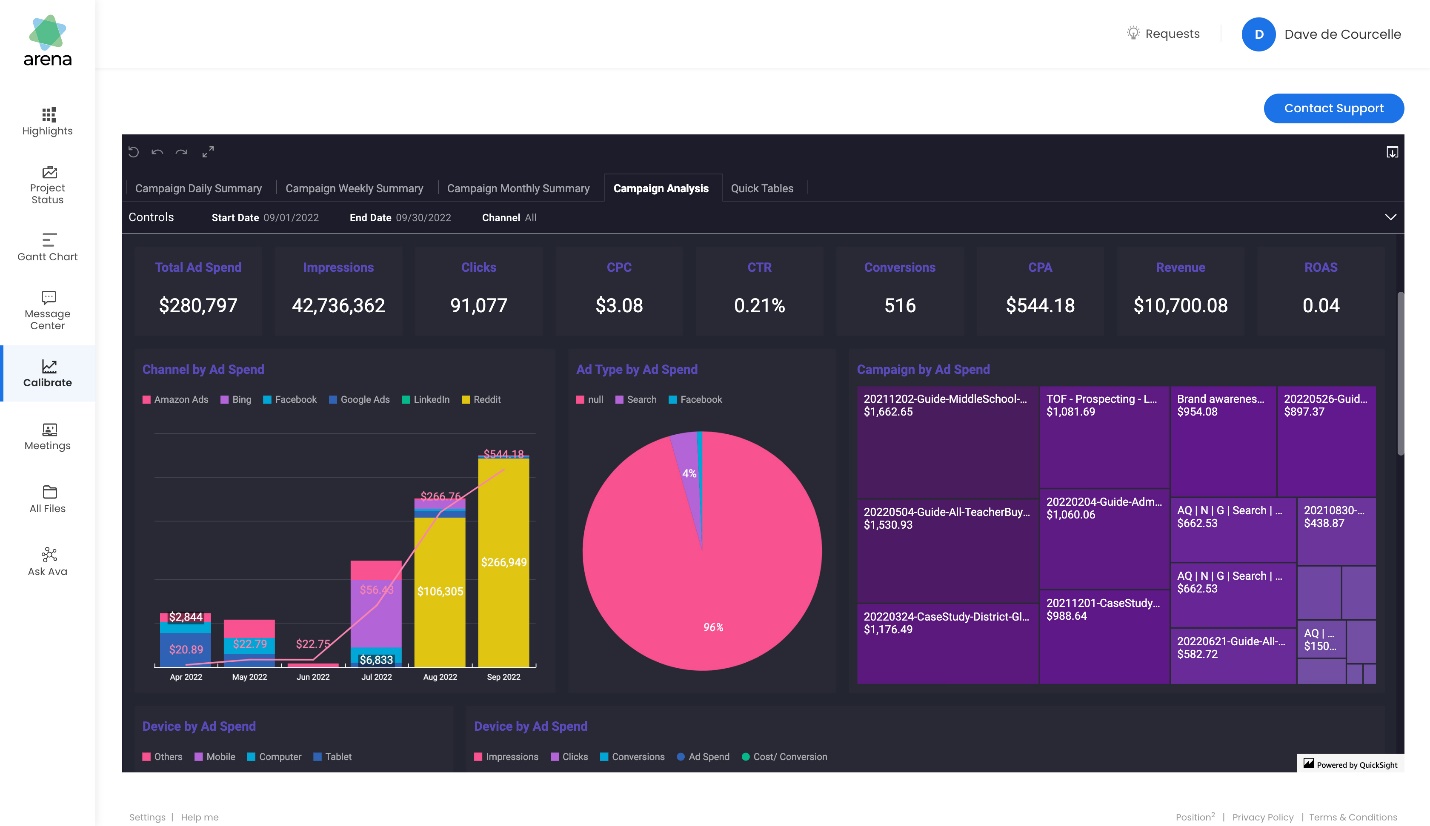
In this post, we share how Arena Calibrate helps our customers drive marketing efficiency using Amazon QuickSight Embedded.
Beyond services to a data automation and reporting platform
Very early on, we realized that in order to move the needle on marketing efficiency, we needed to go beyond marketing services and help clients master their data analytics and reporting.
Marketing data challenges are real, and we previously faced them every day across our agency. We’ve used a wide variety of tools in the market, but most of them ultimately expect the user to spend significant energy performing time-consuming analytics activities, like configuring data/platform connectors and building datasets. After all that, we were still missing out on proactive analysis that identifies trends and uncovers optimization opportunities.
We know there are many businesses out there facing similar challenges. This led us to build Arena Calibrate by using the best ML algorithms, data connectors, and business intelligence (BI) platforms.
Arena Calibrate helps marketers leap ahead with the best tech stack available without breaking their budget.
In-depth insights in time: Enter Amazon QuickSight
The challenge was to get data from multiple platforms into one place accurately, automatically, and easily. Each platform has data in different formats. We wanted to help customers answer questions such as, “How do you track your customers’ journey through the funnel? Can you leverage advanced BI techniques to get meaningful insights when you have the data?”
We evaluated a range of products before zeroing in on Amazon QuickSight, a unified, serverless BI service enabling organizations to deliver data-driven insights to all users.
The three primary reasons we selected QuickSight were:
Customization and automation flexibility – The QuickSight API allowed us to have customization using AWS Identity Access Management (IAM). APIs helped us with authorization and authentication. With IAM APIs, we were able to create users and map them to the required permissions and roles, thereby giving the right permissions to the right dashboards.
Pay as you go model – Consumption-based pricing ensured flexibility for our customers and us by allowing us to innovate with no monetary risks. We could start small and grow with time without being locked into expensive user-based and capacity-based contracts.
Enabling customers to visualize marketing performance and success
The focus of marketing professionals today is twofold: brand building and revenue growth marketing, which ensures that all your marketing operations can be tracked back to revenue and sales. While the former is a longer-term focus, the latter needs operations to be tracked minutely and any changes need to be incorporated immediately to ensure Return on Ad Spend (ROAS).
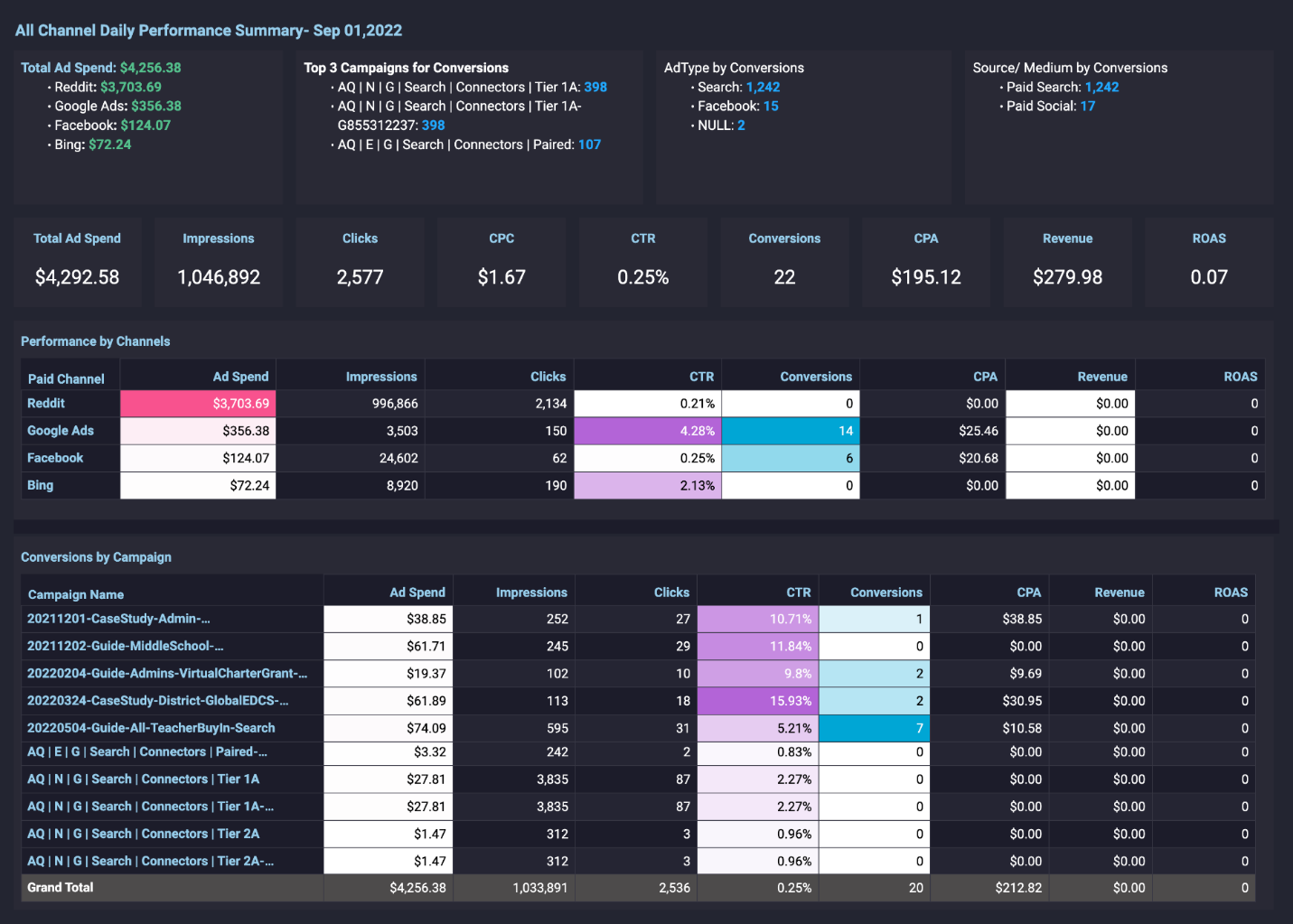
Arena Calibrate’s advanced software and BI service package allows you to quickly understand the overall health of your marketing funnel and drive impact on lead generation, marketing-qualified leads (MQLs), sales-qualified leads (SQLs), Customer Acquisition Cost (CAC), and ROAS. We provide insights across the funnel from lead to revenue. Our clients use our dashboards to make marketing decisions like campaign performance, website traffic changes, and audience segmentation. The built-in ML engine helps optimize marketing campaigns by adjusting the targeting, messaging, and timing of campaigns based on their performance.
We use QuickSight as the base for our visualization platform, and clients can visualize predictive forecasting models on ad spend and revenue; make decisions based on optimizing spend and arresting churn; and identify high-value customer segments, marketing channel effectiveness, conversion rates, customer acquisition costs, or ROI. We also use QuickSight ML insights to augment trend analysis and automate anomaly detection for our users.
Arena Calibrate enables users to connect to their data sources in minutes and launch their dashboards quickly with ready-made templates. Our BI team is then available to customize the dashboard for deeper insights and gather accurate ROI.
QuickSight is embedded into Arena Calibrate. The QuickSight API allowed us to generate the signed dashboard URL, which was then embedded into Arena Calibrate.
The following screenshot of Arena Calibrate shows the Campaign Performance dashboard.
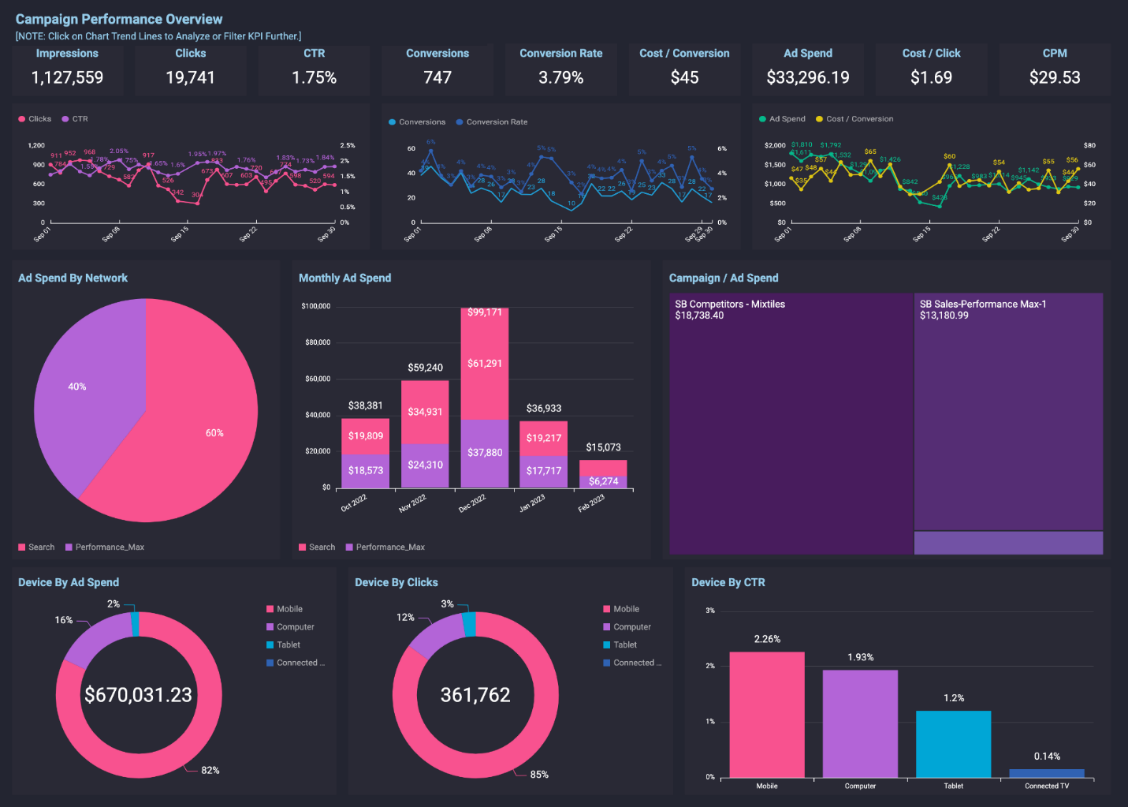
The Pay-per-click (PPC) & Search Engine Marketing (SEM) dashboard lets you deep dive into key metrics by campaigns, assets, ad formats, landing pages, and device types to better gauge performance.
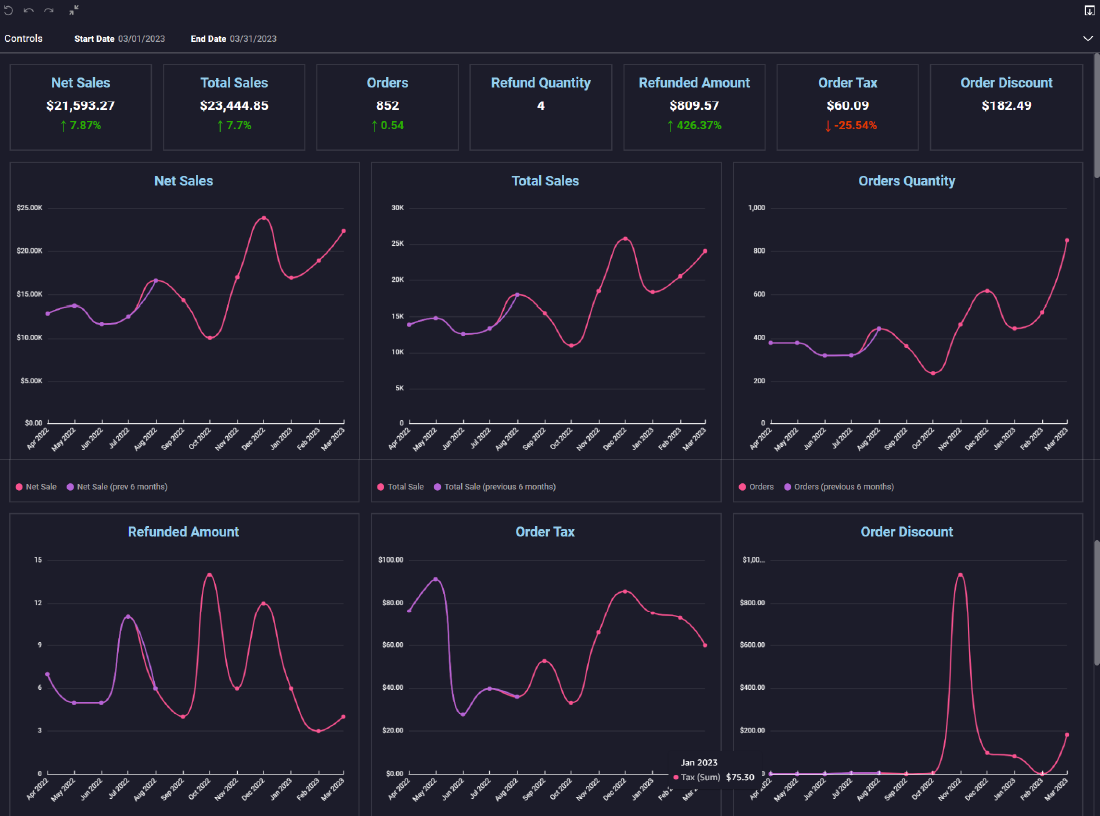
The E-Commerce dashboard lets you monitor the performance of your online store through key metrics such as abandoned cart rate, average order value, cart conversion rate, and more.
The Cross Channel Campaign Performance dashboard lets you consolidate performance of all relevant metrics across your ad campaigns, enabling you to evaluate campaign ROAS and revenue from one place.
Today, there are dozens of customer dashboards powered by QuickSight across diverse sectors ranging from software as a service (SaaS) to FinTech, IT to healthcare.
Position2’s customer focus
We broadly serve two segments of users. Our Position2 services clients automatically have access to the Arena Calibrate dashboard for their business. The pricing for the dashboard is included in the service fee, in most cases.
Arena Calibrate is also available as a standalone BI platform. Here we combine product-led growth (PLG) and sales to attract prospects largely in the SMB and enterprise markets. Prospects can sign up online, connect their platforms, and test-drive Arena Calibrate by integrating up to five standard data sources for free.
We follow a tiered pricing approach based on the number of platforms and the types of platforms (for example, advertising, marketing automation, or CRM) the user needs to integrate, as well as customization needs.
Cost reduction by 50% and accelerated time-to-value with QuickSight
QuickSight allows us to centralize our organization’s BI reporting—both for internal and external purposes. We pull data from the various sources, then use Snowflake as a database and QuickSight as our visualization tool. The QuickSight in-memory engine SPICE (Super-fast, Parallel, In-memory Calculation Engine) on top of its native integration with Snowflake has improved the dashboard load times by up to 20%. Also, the QuickSight console makes it simple to set up datasets for SPICE. There were direct cost savings when we moved to QuickSight because billing is usage-based. We dropped our costs by approximately 50%.
The comprehensive access and security capabilities of QuickSight allow us to support our enterprise customers by providing the right access to relevant dashboards to the right users with ease. QuickSight allows us to make customizations tailored to each customer’s unique requirements. For example, for newer users, we create dashboards by reusing templates and changing the datasets relevant to them—a process we are currently in the process of automating using QuickSight APIs.
QuickSight, along with Snowflake’s transformation and automation capabilities, has allowed us to reduce our dashboard publishing time from 2 days to 2 hours. Templates have helped us reuse the dashboard layout. Customers appreciate seeing various dashboards in one place—across product lines, business lines, and more. With no or very less engineering effort, the BI team is able to build dashboards. We could also enable author embedding with ease, because it doesn’t require any extra coding or licensing with QuickSight.
The BI team also prefers the features such as iFrame-based embedding and reliability of QuickSight over our previous tool. Our prior tool was slow to render, had stability issues, and had lot of downtime, unlike QuickSight, a serverless, auto-scaling BI service.
We have been able to drive effectiveness through a better understanding of spend and the ability to channel the spend to the best possible outcome drivers. In addition, we have seen efficiency gains by faster time to insights and reduced the need to move across multiple tools to access marketing operations data. Overall, we have seen an increase in ROAS across our client base by 3–5% and productivity gains across clients and services teams by 20–25%.
Calibrating the data-driven future
The long-term vision for Arena Calibrate is to empower the data-driven marketer. With advancements in AI and data analytics, Position2 is well placed to analyze customers’ data and provide actionable insights and recommendations to improve the performance of campaigns and drive growth. We look forward to the continued collaboration with QuickSight to enable this journey.
To learn more about how QuickSight can help your business with dashboards, reports, and more, visit Amazon QuickSight.
About the Author
Vinod Nambiar is the co-founder at Arena and Managing Director of Position2. An engineer with a passion for advertising, Vinod has been instrumental in designing all processes for delivery operations. His passion is to explore how the latest developments in technology can transform digital marketing. He is associated with various global forums in digital marketing and has been part of the faculty at leading marketing institutes in India like Northpoint and Mudra Institute of Communications. When not thinking digital, he can be found doing yoga and reading books ranging from spiritual to fiction. He lives with his wife and two children in Bangalore.
Праисторията на планетата ни е изключително богата и вълнуваща. За съжаление, големи участъци от нея все още не са ни известни. Две скорошни открития запълват частици от този пъзел и ни позволяват да надникнем към отдавна отминали времена.
Креда е последният период на мезозойската ера и е с продължителност около 70 млн. години. Преходът между долна и горна креда преди 99 млн. години е период на големи промени в климата на планетата, което се отразява на популациите на динозаврите. Поради повишаването на нивата на въглероден диоксид в атмосферата, глобалната температура и нивата на световните океани се повишават, което води до намаляване на обитаемите области. В този период гигантските тревопасни завроподи с дълги шии в сегашна Северна Америка започват да изчезват, докато популациите на по-малките орнитоподи се увеличават.
Iani smithi най-вероятно е изглеждал така. В зелено са оцветени откритите кости. Адаптирано от Zanno et al., 2023
Именно за ранен орнитопод е считан от откривателите си динозавърътIani smithi, наречен на двуликия бог на промяната Янус. Добре запазеният скелет е открит в щата Юта. Особено ценно е наличието на почти пълен череп, което е помогнало на палеонтолозите да разберат повече за вида и да го причислят към подгрупата на орнитоподите Rhabdodontomorpha най-вече заради характерните за тях широки зъби и някои особености на челюстта. Това прави находката рядка за Северна Америка, тъй като подобни животни са се срещали предимно в Европа.
В най-южната част на Чили учените се натъкват на уникална находка под формата на фосили от първия по вида си тревопасен динозавър, открит в субантарктическия регион – Gonkoken nanoi. Името му е взето от езика на теуелче – коренните жители на Патагония: gon означава „сходен, подобен“, а koken – „дива патица“ или „лебед“. Дължината на динозавъра е била около четири метра и е можел да се изправя на задните си крака, за да се храни с по-висока растителност.
По останките учените са определили, че е бил много сходен с широко разпространената група на хадрозаврите (известни като динозаври с „патешки човки“), но не спада към нея. Засега хипотезата е, че за разлика от по-северните си роднини от Патагония, той е потомък на общ предшественик, от който са произлезли и хадрозаврите. Най-вероятно този прото-Gonkoken е мигрирал рано в Южна Америка, като е достигнал най-южните ѝ части, докъдето същинските хадрозаври не са успели. Откритието повдига въпроса дали не трябва да се преразгледат и другите фосили от района, защото може да се окаже, че не са типични хадрозаври, а са по-близки роднини на Gonkoken.
След средата на креда броят на тези тревопасни се увеличава бързо и те стават едни от най-усъвършенстваните машини за приемане на растителна храна със стотиците си зъби, способни да мачкат, накъсват и стриват най-различни растения. Хегемонията на гигантите приключва със събитието К–Т, причинено от сблъсъка на астероид със Земята. Глобалните климатични промени, произтекли от него, променят драстично видовия състав на планетата и откриват поле за еволюцията на видове, по-добре адаптирани към новия свят.
Оцеляване в студа
Животът намира своето място дори и в най-екстремните ареали. Около Антарктида живеят риби от разред Бодлоперки, наречени ледени риби заради способността си да оцеляват във вода с температура, достигаща -2°C. Освен че е една от причините за по-ниската температура на водата, Западноветровото течение, опасващо континента, ги е изолирало от останалите океански обитатели. Това им е позволило да запълнят много от свободните екологични ниши и да образуват значително количество отделни видове (предполага се, че са между 130 и 140).
За справяне с околната среда рибите са развили редица адаптации, сред които синтез на „антифризни“ белтъци и големи мускулни влакна. Но ниските температури са станали причина и за загубата на характеристики, които се смятат за общи за всички живи организми – от бактериите до човека. Една от тях е, че когато са изложени на по-високи температури, не отделят специфични протеини, които се синтезират при стрес от околната среда.
Още по-интересна е липсата на функционални червени кръвни телца, които снабдяват с кислород всички останали гръбначни животни. Загубен или драстично намален е и синтезът на хемоглобин, поради което тяхната кръв няма характерния червен цвят, а е безцветна. Тази адаптация е възможна благодарение на факта, че кислородът е много по-разтворим в студена вода и за да се възползват от повишената му концентрация, рибите са развили голямо, бавно биещо сърце и широки кръвоносни съдове.
Секвенирането на геномите на 24 вида, част от които с помощта на по-нова технология, позволяваща прочитането на по-дълги участъци ДНК, дава възможност да се вникне във възникването на тези промени и да се определи техният еволюционен път. Според получените данни първите видове са започнали да се формират много по-скоро, отколкото се считаше до момента – около 10,7 млн. години вместо 22 млн., като преди около 5 млн. години е започнало интензивно видообразуване. Това е подкрепено и от климатични данни, сочещи, че в този период температурата в района е паднала, започнало е образуването на лед и са се повишили нивата на кислород.
Оказва се също, че геномът на някои от видовете, които живеят около Антарктида, е почти два пъти по-голям от този на роднините им, обитаващи южните брегове на Южна Америка. Това се дължи основно на намножаването на транспозони – подвижни генетични елементи, които имат свойството да се преместват или копират в генома. Те са основна причина и за промените в два участъка, отговорни за синтеза на хемоглобин при рибите. Възползвайки се от улеснената биоинформатична обработка на данните от новата технология за секвениране, учените са успели да получат информация за гените, намиращи се в тях – при ледените риби те са изчезнали, като са били заменени от транспозони.
Освен за непосредственото разкриване на механизмите на генетичните адаптации при изследваните видове, развитието на технологиите за секвениране ни дава възможност да вникнем много по-добре в еволюцията на обитателите на най-екстремните екологични ниши. Тъй като са тясноспециализирани за живот в такива условия, те са изключително застрашени от глобалните климатични промени, поради което подобни проекти ще са много ценни за проследяването на промените в биоразнообразието в тези региони.
Ново за COVID-19
Макар повечето хора да приемат, че тежките дни на пандемията са преминали, последствията от нея тепърва се разгръщат и ще бъдат оценявани. Научните изследвания продължават и ни дават все по-добро разбиране на самия вирус и на начина, по който взаимодейства с тялото ни.
Точният механизъм на проникване на вирусните частици (вириони) на SARS-CoV-2 в клетките все още крие тайни и учените се опитват да разберат как протича този процес. На повърхността си всеки вирион носи между 20 и 40 шипчета (спайкпротеини), които са хомотримери – изградени от три идентични полипептида. С тяхна помощ той се свързва с ACE2 рецепторите, намиращи се по човешките клетки.
Една от хипотезите до момента беше, че поради гъвкавостта на спайкпротеините вирионът ще може да свърже няколко от тях с няколко рецептора по клетките. Друго предположение беше, че тъй като всяко шипче е изградено от три компонента, то ще е много по-ефективно да се свърже с полимер на ACE2 рецептора. По времето, когато тези хипотези бяха предложени, в тяхна подкрепа имаше достатъчно информация, но тя не беше получена по оптимален начин, тъй като наблюденията са правени с пречистени протеини, което не отразява реалното състояние в човешките клетки.
Ново изследване на германски екип дава повече яснота за случващото се по време на инфекция в условия, по-близки до естествените. Учените са използвали метод за микроскопия със суперрезолюцияdSTORM (direct stochastic optical reconstruction microscopy), разработен от тях. Използвайки антитела, специфични за ACE2 рецепторите, свързани с багрило, те са определили броя и плътността на рецепторите в няколко линии клетки, стандартно използвани в изследванията с вируса.
Резултатите показват, че рецепторите са слабо разпространени, с плътност около един до два на всеки квадратен микрометър от повърхността на клетъчната мембрана, което се отнася към разстояние между тях от около 500 нанометра – около пет пъти повече от размера на вирусните частици. Това опровергава първата хипотеза, тъй като, щом се закачат за един рецептор, вирионите нямат възможност да стигнат до друг. Наред с това е установено, че ACE2 не образуват полимерни структури както при отсъствието на вириони, така и след свързване на спайкпротеина с тях. По този начин се отхвърля и втората хипотеза.
Комбинирани с откритието, че за инфекция е достатъчно свързването само на един спайкпротеин с един клетъчен рецептор, тези свойства на вируса най-вероятно са част от причините за високата му инфекциозност.
Авторите смятат, че все още няма пълно обяснение за процеса на инфекция със SARS-CoV-2, но се надяват, че откритията им ще помогнат за разработването на нови медикаменти. Във философски аспект резултат от изследването е, че показва колко динамичен процес е науката и колко трудно е да се постигне пълно разбиране, особено на биологични системи.
Наред с високата температура и болките в гърлото, загубата на обоняние и вкус бяха сред характерните черти на заболяването, причинено от първите варианти на вируса. Обикновено обонянието и вкусът се възстановяват след преминаване на по-тежките симптоми, но от ново изследване става ясно, че това може да не е така при немалък процент хора.
След обобщаване на данните от въпросници, попълнени от почти 30 000 възрастни през 2021 г. в САЩ, е установено, че около 60% от отговорилите са загубили обоняние и вкус. Една година по-късно около 24% от тях са имали само частичновъзстановяване на обонянието, а при 4% загубата е била трайна. Сходни са и данните за вкуса, съответно с 21% и 3%. Открита е и положителна корелация между това колко тежко протича заболяването, вероятността за загуба на обоняние и намаляването на шанса за възстановяването му.
Тъй като двата симптома са свързани, е възможно процентите да не са абсолютно точни поради некоректно съобщаване от анкетираните, но все пак данните са притеснителни. Въпреки че привидно не са сериозни, тези симптоми могат да имат силен ефект върху психическото здраве на пациентите. Не е изключено да доведат до загуба на апетит и тегло, което от своя страна да е причина за възникване на други проблеми.
Тъй като механизмът на загубата на обоняние не е изяснен, няма общоприети начини за терапия, които са клинично доказани. Един от обещаващите методи е трениране с аромати, при който пациентите трябва да подушват определени миризми по няколко пъти дневно. Най-често се използват аромати от различни групи, сред които роза, евкалипт, лимон и карамфил. Методът е много подходящ за прилагане в началото на терапията, защото не е инвазивен и изключително рядко може да доведе до странични реакции. За съжаление, не е универсален и невинаги дава резултат.
Друг експериментален подход е блокадата на ганглион стелатум (част от вегетативната нервна система и намиращ се в основата на врата) с помощта на локални анестетици. Досега процедурата е използвана с различен успех и при други заболявания – посттравматичен стрес, мигрени, невралгии. Нейното приложение е все още ограничено, тъй като ефективността ѝ не е напълно клинично доказана, има описани само отделни случаи и за момента липсва твърдо обяснение как може да повлияе на загубата на обонянието. Това повдига някои съмнения за въвеждането ѝ в рутинната практика поради липсата на клинични изпитвания в контролирани условия и на ясна връзка между терапията и начина ѝ на действие. Още повече, тъй като състоянието на пациентите може да се промени с времето и резултатите се оценяват от самите тях, установяването на ефективността е по-сложно.
Без значение какъв е видът на симптомите, с които се проявява, т.нар. дълъг ковид е факт. Освен преките последствия от него, той може да отключи и нови заболявания, често от неврологично или сърдечносъдово естество. Пациентите с такива симптоми или потенциал за появата им трябва да бъдат наблюдавани с повишено внимание и да получават по-тясно насочена медицинска помощ. Тепърва пред учени и лекари ще бъде поставена нелеката задача да помогнат на голям брой хора, които носят трайния отпечатък от вируса върху здравето си.
Заглавно изображение: Крокодиловата ледена риба е едно от малкото гръбначни с прозрачна кръв и живее в ледените води, заобикалящи Антарктида. Източник: Wikipedia
The collective thoughts of the interwebz
Manage Consent
To provide the best experiences, we use technologies like cookies to store and/or access device information. Consenting to these technologies will allow us to process data such as browsing behavior or unique IDs on this site. Not consenting or withdrawing consent, may adversely affect certain features and functions.
Functional
Always active
The technical storage or access is strictly necessary for the legitimate purpose of enabling the use of a specific service explicitly requested by the subscriber or user, or for the sole purpose of carrying out the transmission of a communication over an electronic communications network.
Preferences
The technical storage or access is necessary for the legitimate purpose of storing preferences that are not requested by the subscriber or user.
Statistics
The technical storage or access that is used exclusively for statistical purposes.The technical storage or access that is used exclusively for anonymous statistical purposes. Without a subpoena, voluntary compliance on the part of your Internet Service Provider, or additional records from a third party, information stored or retrieved for this purpose alone cannot usually be used to identify you.
Marketing
The technical storage or access is required to create user profiles to send advertising, or to track the user on a website or across several websites for similar marketing purposes.


 Vinod Nambiar is the co-founder at Arena and Managing Director of Position2. An engineer with a passion for advertising, Vinod has been instrumental in designing all processes for delivery operations. His passion is to explore how the latest developments in technology can transform digital marketing. He is associated with various global forums in digital marketing and has been part of the faculty at leading marketing institutes in India like Northpoint and Mudra Institute of Communications. When not thinking digital, he can be found doing yoga and reading books ranging from spiritual to fiction. He lives with his wife and two children in Bangalore.


