Post Syndicated from Oglaf! -- Comics. Often dirty. original https://www.oglaf.com/beetroot/


Post Syndicated from Oglaf! -- Comics. Often dirty. original https://www.oglaf.com/beetroot/
Post Syndicated from The Atlantic original https://www.youtube.com/shorts/uMiCXPh1udw
Post Syndicated from Techmoan original https://www.youtube.com/watch?v=24e14PTJLJw
Post Syndicated from Светла Енчева original https://www.toest.bg/sedmitsata-6-11-april/

Здравейте, и.ф. главни прокурори!
За този поздрав се вдъхнових от Полина Паунова. Според нея всички имаме точно толкова право да се назовем изпълняващи функцията главен прокурор, колкото и Борислав Сарафов, след като и Конституционният съд се произнесе, че той заема този пост нелегитимно.
И вие ли като мен въздъхнахте с предпазливо облекчение, че светът още си е на мястото, когато се събудихте в сряда? Тръмп не изпълни заканата си да изличи цяла цивилизация, никой не пусна атомна бомба. Засега. Още имаме някакъв шанс да остареем – както се казва във филма на Лина Кривошиева „Какво е да остарееш в България“, чиято премиера беше на 5 април: остаряването си е привилегия, до която не всички се домогват.
 Тоест

Разбира се, за всичко са виновни либералите, които прекалиха с равните права и политическата коректност и тласнаха махалото в обратната посока. Сега всички може да сме спокойни, че най-големият проблем на човечеството е решен – хора, родени с пениси, няма да пречат на жените в олимпийските спортове. Е, намираме се в нещо като трета световна война, свободното пътуване е все по-затруднено, нападението над Иран доведе до недостиг на горива в световен план и силно затрудни редица сектори, светът, какъвто го познавахме, се разпада… ама това са дреболии.
Изобщо, защо да се притесняваме за някакви си войни в навечерието на един от най-големите християнски празници – Великден? Ето, на Тръмп не му е проблем да заплашва празнично, в компанията на великденски заек. Независимо дали сте пропуснали тази история, или не, препоръчвам новия брой на бюлетина „Гласовете на Америка“ на Йоанна Елми, в който пише за бомбардировки, молитви, великденски традиции и политика, без да пропускаме заека.
Йоанна Елми
В тези интересни времена човек все по-често си задава въпроса: какво ще стане, ако САЩ излязат от НАТО? Искрен Иванов не само пита, а и отговаря какво биха загубили от подобен ход и САЩ, и Европа, както и кой би спечелил. Добрата новина е, че това не е много лесно да стане, макар да е възможно. Лошата – че докато шантажира, че ще го направи, Тръмп склонява Европа към още и още компромиси.
Искрен Иванов
Но ако си задаваме много въпроси за бъдещето, може да се поболеем от притеснение. Ако не си ги задаваме обаче и оставяме другите да вземат важните решения, самото бъдеще ще стане вредно за здравето ни. Като стана дума за здраве, гледахте ли разговора на Владислав Севов с журналистката Надежда Цекулова? След рубриката ѝ за женското здраве нямам търпение да чета нейните предстоящи статии за палиативните грижи за деца.
Впрочем какво пише в предизборните програми за женското здраве? И изобщо за жените? След като прегледах програмите на всички партии и коалиции, регистрирани за изборите, мога да ви кажа: почти нищо. Та се замислих, че жените се превръщат в нещо като новите гейове – защитата на правата им се възприема като токсична дори от смятащите се за демократични партии. От жените се иска да раждат деца и да си знаят мястото.
Светла Енчева
Докато четях политически програми, си припомних какви предизборни студиа и дебати имаше едно време. И те имаха значение – например Петър Стоянов загуби битката за втория си президентски мандат не на последно място защото се поддаде на активно мероприятие по време на дебат.
В тазседмичната си статия Емилия Милчева разсъждава защо вече няма лидерски дебати. Според нея това не е инцидент, а устойчив модел на политическо поведение – нещо, с което не мога да не се съглася. Вместо в политиката да има спорове по същество, тя е фиксирана в скандали, краткосрочни сметчици и договорки зад камерите – без публика и без въпроси. И смърди – като развалено яйце.
Емилия Милчева
От яйцата пак стигнахме до Великден. Ако се чудите защо се пише „воскресе“, какво е „воистину“ и изобщо как да разбираме воскръсналите (по Великден) словеса, знаете кой най-добре може да намести тази религиозна лексика в главите ни – разбира се, Павлина Върбанова.
Павлина Върбанова
Вече минаха 10 дни, откакто е воскръснала и българската редакция на „Свободна Европа“, след като беше закрита поради липса на финансиране. Или може би е по-точно да кажа, че се е преродила, защото сега се подвизава на нов сайт и под името „Свободна точка“. Препоръката ми тази седмица е да ѝ ударите едно рамо (банковата сметка може да намерите най-долу на сайта), защото без „Свободна Европа“, пардон, „Свободна точка“, българската журналистика рязко ще осиротее.
Разбира се, препоръчвам да подкрепите и нас, понеже съществуваме само благодарение на вашите дарения.
И да, знам, че даренията от аудиторията идват от едни и същи джобове и че тези джобове не са бездънни. Но все пак предпочитам малкото независими медии да се подкрепяме, а да не се възприемаме като конкуренти.
С пожелание за светли празници, ако празнувате, а ако не – спокойни дни,
Светла Енчева, и.ф. главен прокурор
Post Syndicated from Bruce Schneier original https://www.schneier.com/blog/archives/2026/04/friday-squid-blogging-squid-overfishing-in-the-south-pacific.html
Regulation is hard:
The South Pacific Regional Fisheries Management Organization (SPRFMO) oversees fishing across roughly 59 million square kilometers (22 million square miles) of the South Pacific high seas, trying to impose order on a region double the size of Africa, where distant-water fleets pursue species ranging from jack mackerel to jumbo flying squid. The latter dominated this year’s talks.
Fishing for jumbo flying squid (Dosidicus gigas) has expanded rapidly over the past two decades. The number of squid-jigging vessels operating in SPRFMO waters rose from 14 in 2000 to more than 500 last year, almost all of them flying the Chinese flag. Meanwhile, reported catches have fallen markedly, from more than 1 million metric tons in 2014 to about 600,000 metric tons in 2024. Scientists worry that fishing pressure is outpacing knowledge of the stock.
As usual, you can also use this squid post to talk about the security stories in the news that I haven’t covered.
Post Syndicated from Guy Haddad original https://aws.amazon.com/blogs/compute/building-memory-intensive-apps-with-aws-lambda-managed-instances/
Building memory-intensive applications with AWS Lambda just got easier. AWS Lambda Managed Instances gives you up to 32 GB of memory—3x more than standard AWS Lambda—while maintaining the serverless experience you know. Modern applications increasingly require substantial memory resources to process large datasets, perform complex analytics, and deliver real-time insights for use cases such as in-memory analytics, Machine Learning (ML) model inference, and real-time semantic search. AWS Lambda Managed Instances gives you a familiar serverless programming model and experience combined with the flexibility of being able to choose the underlying Amazon EC2 instance types and providing developers with access to large memory configurations.
In this post, you will see how AWS Lambda Managed Instances enables memory-intensive workloads that were previously challenging to run in serverless environments, using an AI-powered customer analytics application as a practical example. You’ll see cost savings of up to 33% compared to standard Lambda for predictable workloads, while eliminating the operational overhead of managing EC2 instances.
AWS Lambda Managed Instances runs your AWS Lambda functions on the Amazon EC2 instance types of your choice in your account, including Graviton4 and memory-optimized instance types. AWS handles underlying infrastructure lifecycle including provisioning, scaling, patching, and routing, while you benefit from Amazon EC2 pricing advantages like Savings Plans and Reserved Instances.
Key benefits include:
AWS Lambda Managed Instances is best suited for high-volume, predictable workloads that benefit from sustained compute capacity and larger memory configurations.
This blog focuses on one of AWS Lambda Managed Instances’ most powerful capabilities: running memory-intensive workloads that require more than the standard AWS Lambda’s 10 GB memory and 250MB ZIP limits. Here are the use cases where AWS Lambda Managed Instances helps:
To demonstrate the power of AWS Lambda Managed Instances for memory-intensive applications, we built an AI-Powered Customer Analytics application that combines in-memory data processing with ML-based semantic search. The application loads in memory 1 million customer behavioral records (sessions, purchases, browsing patterns) from a Parquet file in S3 into a Pandas DataFrame and an embeddings cache consuming 200MB, then responds for analytics queries:
Our AI-powered customer analytics application demonstrates this in practice: 1 million records in memory (200MB), a compact sentence transformer model for semantic search, sub-second query performance, and zero infrastructure to manage. The solution uses a simple, serverless architecture:
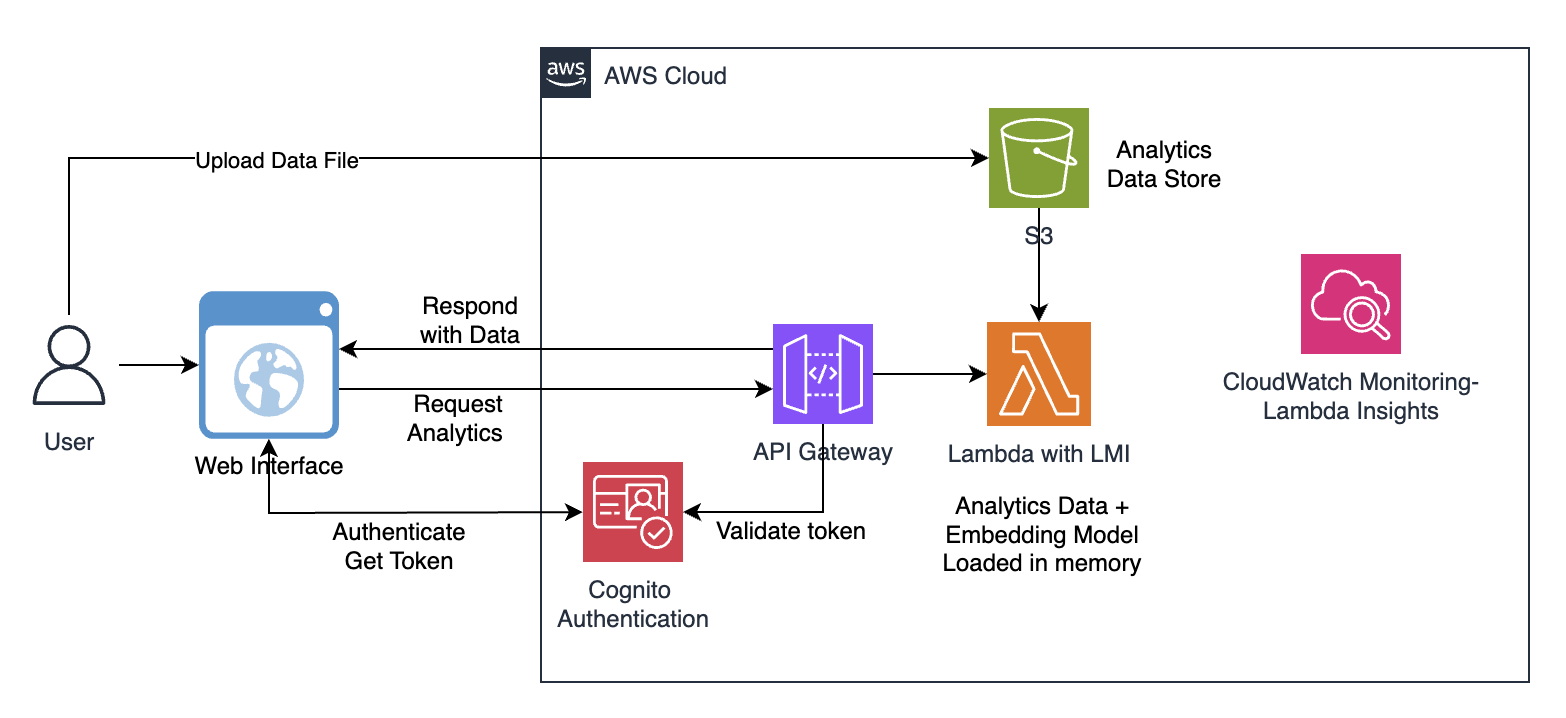
The below steps walk you through deploying the application to AWS using the AWS Serverless Application Model (SAM). The deployment process packages your Lambda function code, uploads artifacts to Amazon S3, and provisions all required AWS resources including Lambda functions, IAM roles, and any configured VPC networking via AWS CloudFormation.
Make sure you have the following tools installed locally:
The complete source code for this application is available in our GitHub repository. To deploy it yourself follow the below steps and refer to the full deployment instructions hosted on GitHub.
1. Clone the repository
git clone https://github.com/aws-samples/sample-lambda-managed-instances-analytics.git
2. Navigate to the project folder
cd sample-lambda-managed-instances-analytics
chmod +x setup-data.sh deploy-lambda.sh
3. Generate sample data and upload to S3
./setup-data.sh
This script will create an S3 bucket (if needed), generate 1M rows of sample data, and upload the data to S3.
4. Build and deploy the Lambda function
./deploy-lambda.sh
This script will build the container image with FastEmbed, push it to ECR, and deploy the Lambda function along with Capacity Provider, API Gateway, and Cognito User Pool. After deployment, it automatically generates the UI authentication configuration and prompts you to create a test user.
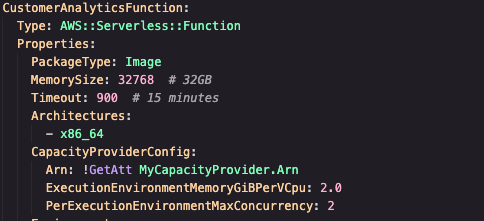
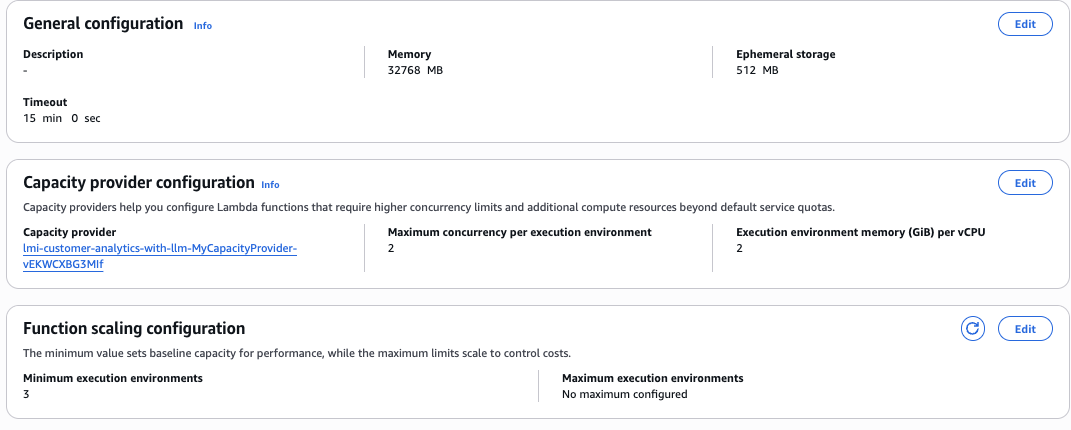
1. Start the UI
The application includes a simple HTML-based UI through which you can test the AWS Lambda function using Amazon API Gateway:
cd ui && python3 -m http.server 8000
2. Open your browser at http://localhost:8000 and click ‘Sign In’ to authenticate via Cognito using the username/password that you created during deployment

3. Enter your API endpoint URL. Test connection and click system Info.
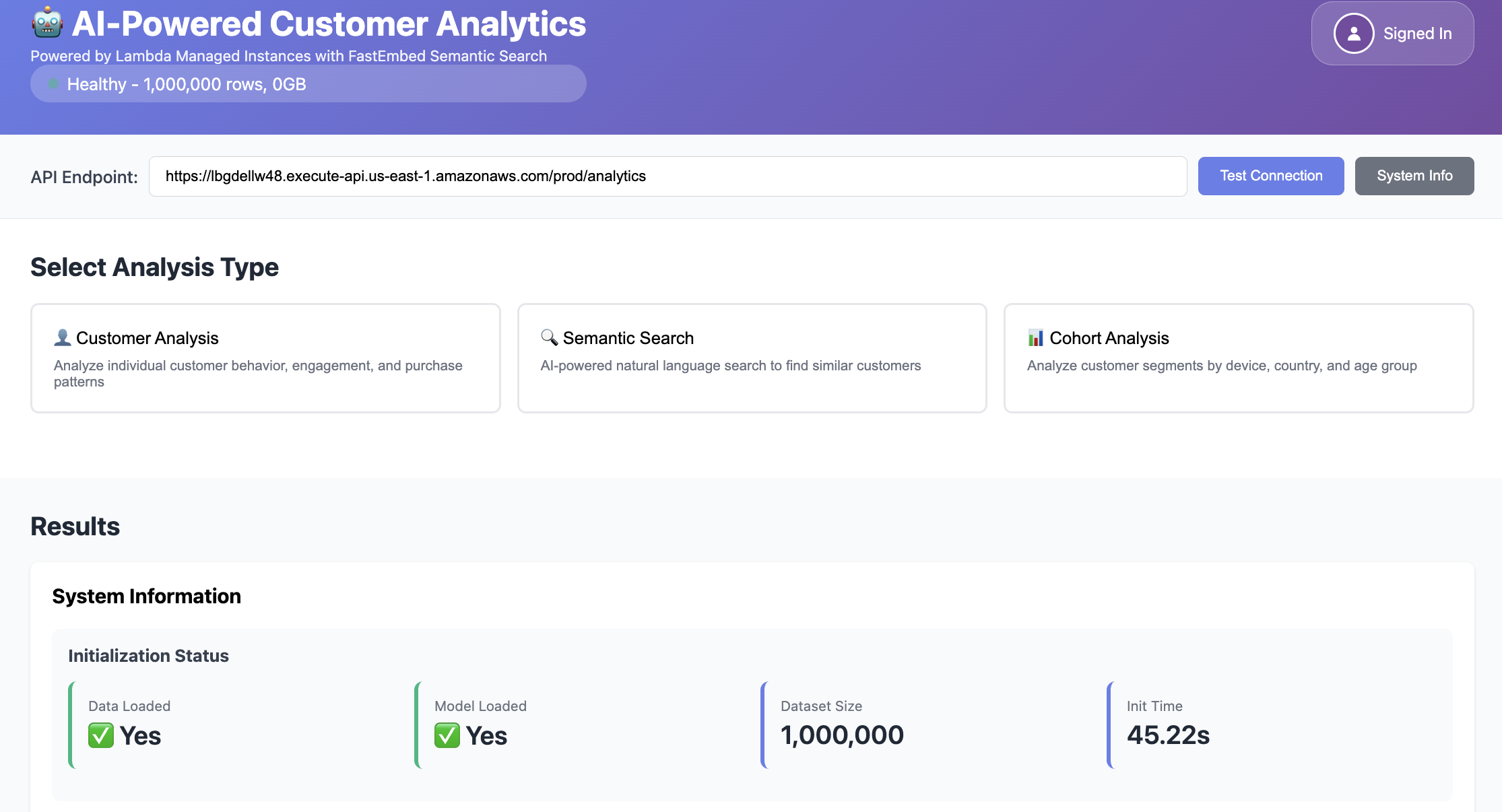
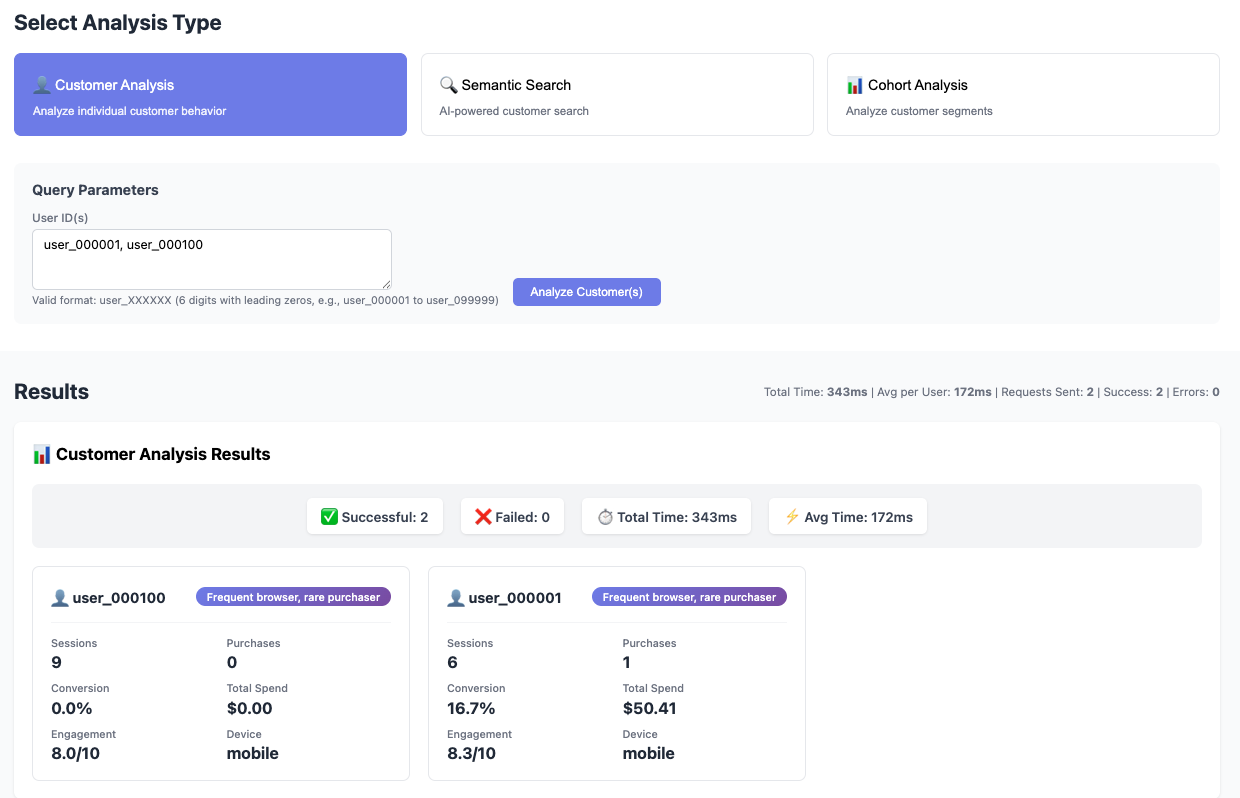
a. Customer Analysis — Enter one or more User IDs to get more information on the customer behavior: engagement scores, conversion rates, purchase patterns, and AI-generated customer segments
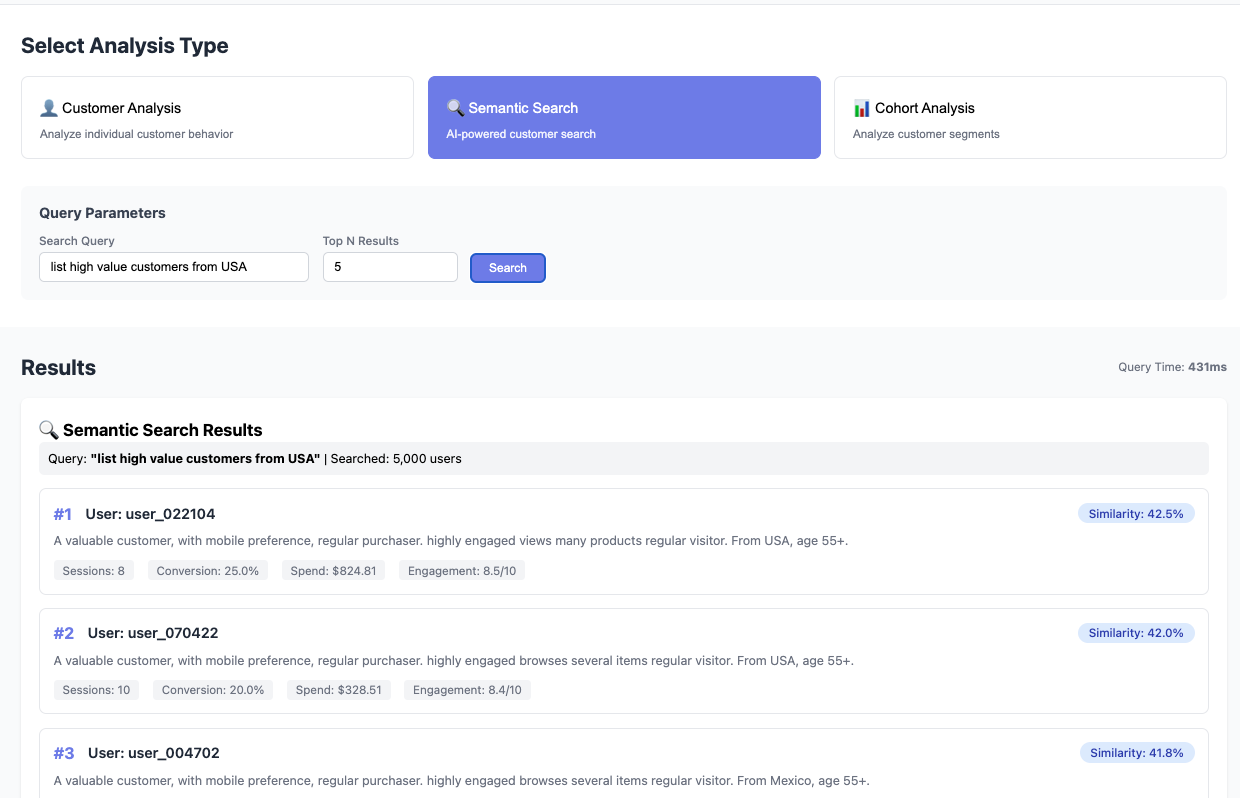
b. Semantic Search – Enter natural language queries like “list high value customers from USA” in the Semantic Search and verify the results. Note that the response is very fast as the analytics data and FastEmbed models are loaded into memory during init stage
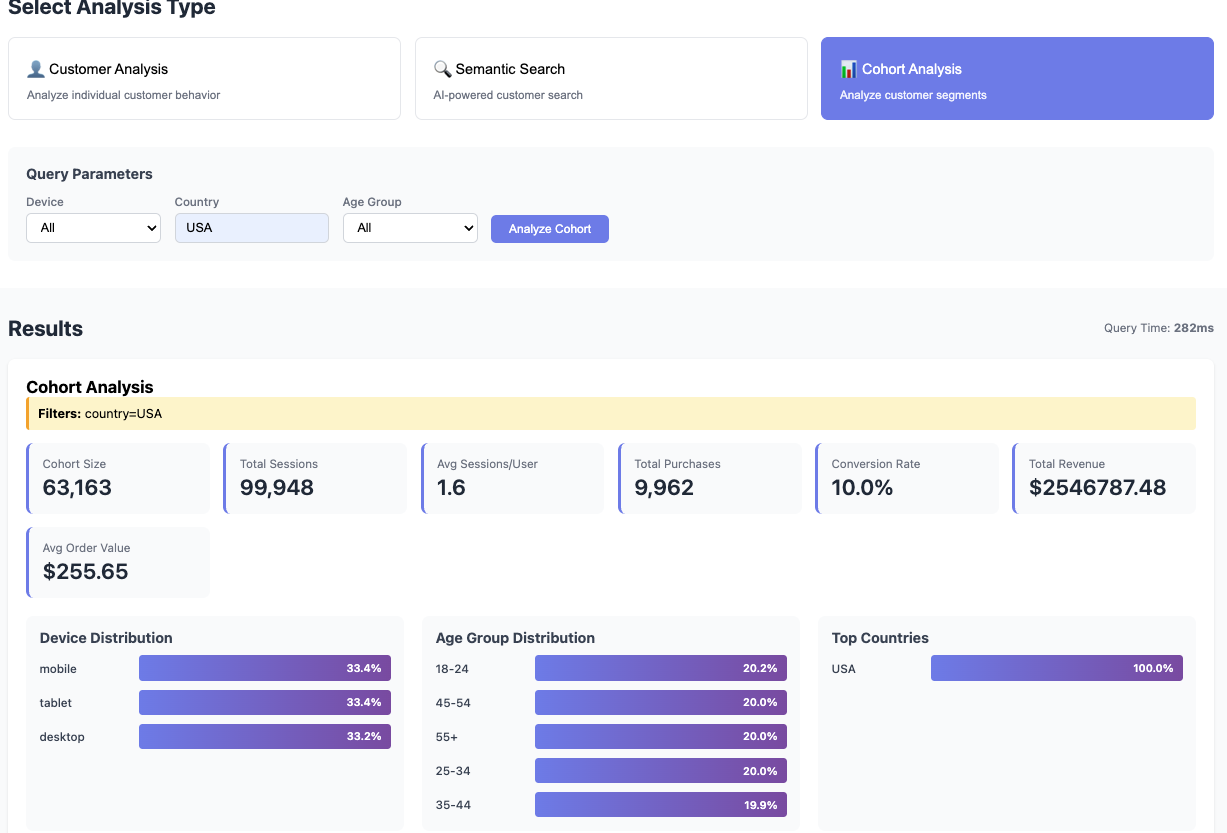
c. Cohort Analysis — Enter the query data to get Real-time segmentation by device, country, age group with aggregated metrics
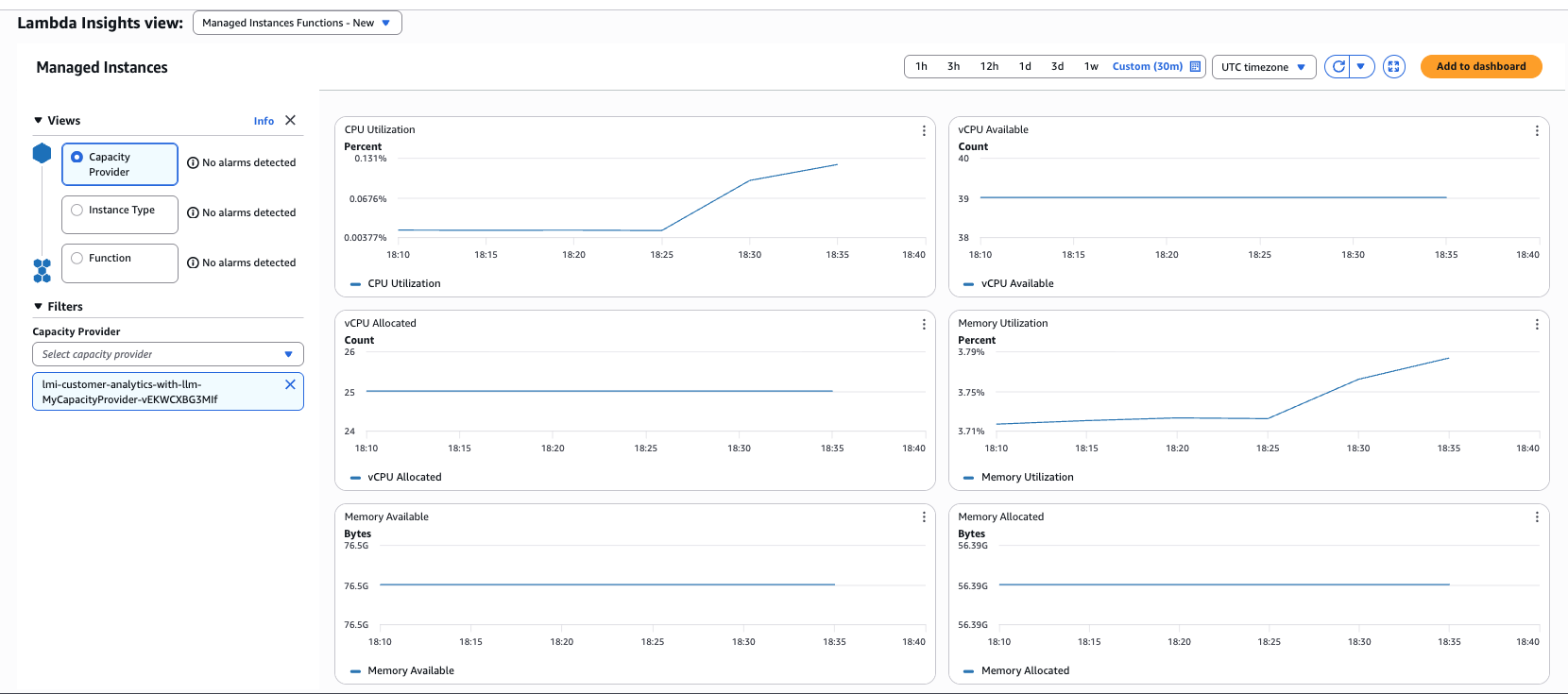
AWS Lambda Managed Instances automatically publishes metrics to Amazon CloudWatch, giving you visibility into function performance and capacity utilization. Monitor InitDuration to track dataset and model load time at startup, MaxMemoryUsed to confirm your data fits within configured memory, and ProvisionedConcurrencySpilloverInvocations to detect when AWS Lambda Managed Instances capacity is exhausted.
Enable AWS Lambda Insights for enhanced per-invocation metrics including CPU time and memory utilization over time. Use Amazon CloudWatch Log Insights to query INIT_START, INIT_END, and REPORT log entries for initialization and memory details per invocation.
Without AWS Lambda Managed Instances, building this same application would require one of these alternatives:
With AWS Lambda Managed Instances, you write a single AWS Lambda function, define a Capacity Provider, and deploy with SAM. AWS Lambda handles the Amazon EC2 instances, scaling, and lifecycle, giving you the memory you need with the operational simplicity you want. The in-memory approach eliminates network latency and disk I/O, delivering consistent sub-200ms response times for complex analytics.
AWS Lambda Managed Instances uses Amazon EC2-based pricing with a management fee. For predictable workloads, you can leverage Amazon EC2 Savings Plans or Reserved Instances to reduce costs significantly.
Example cost comparison (us-east-1, 32 GB memory, 1M invocations/month):
The cost benefits increase with higher memory configurations and sustained workloads that can take advantage of Amazon EC2 pricing discounts.
Based on experience building this solution, here are key recommendations:
When you’re done exploring the solution, it’s good practice to remove all provisioned resources to avoid ongoing charges. For the full cleanup commands and exact steps, refer to the project’s README.md in GitHub repository.
AWS Lambda Managed Instances opens up a new class of serverless applications that support larger AWS Lambda layer packages and more memory. Memory-intensive workloads — in-memory analytics, ML inference, graph processing, scientific computing — can now run with the simplicity of AWS Lambda and the resources of Amazon EC2. The customer analytics example demonstrates how in-memory processing with AWS Lambda Managed Instances delivers performance improvements over traditional database queries while maintaining serverless benefits like automatic scaling and pay-per-use pricing.
Ready to get started? Explore the AWS Lambda Managed Instances documentation and try building your own memory-intensive serverless application. You can find the complete code for this example on GitHub.
Post Syndicated from Simon Janusz original https://www.rapid7.com/blog/post/pt-metasploit-wrap-up-04-10-2026
This week, we have added new modules to Metasploit Framework targeting Cisco Catalyst SD-WAN controllers and osTicket as well as updates and improvements to Windows service-for-user persistence, and LDAP/ADCS-related modules to automatically report related services resulting in an improved data stream, which can be queried by using the services command.
We also landed an improvement to msfvenom’s bootup time, thanks to bcoles, resulting in an approximate two-times speedup.
Authors: Spencer McIntyre, bwatters-r7, and jhicks-r7
Type: Auxiliary
Pull request: #20752 contributed by bwatters-r7
Path: admin/http/web_enrollment_cert
Description: This adds a new auxiliary/admin/http/web_enrollment_cert modules that allows certificates to be issued from an Active Directory Certificate Services Web Enrollment portal. Its usage is the same as the auxiliary/admin/http/icpr_cert module but enables operators to issue certificates when the web enrollment portal is accessible but the MS-ICPR service is not.
Author: sfewer-r7
Type: Auxiliary
Pull request: #21158 contributed by sfewer-r7
Path: admin/networking/cisco_sdwan_auth_bypass
AttackerKB reference: CVE-2026-20127
Description: This adds an auxiliary module to exploit an authentication bypass vulnerability, CVE-2026-20127, affecting Cisco Catalyst SD-WAN Controller. Recently exploited in the wild as a zero-day.
Authors: Arkaprabha Chakraborty <@t1nt1nsn0wy> and HORIZON3.ai Team
Type: Auxiliary
Pull request: #20948 contributed by ArkaprabhaChakraborty
Path: gather/osticket_arbitrary_file_read
AttackerKB reference: CVE-2026-22200
Description: This adds an auxiliary module to exploit, CVE-2026-22200, an authenticated file read vulnerability in osTicket.
Authors: Brandon McCann “zeknox” [email protected], Thomas McCarthy “smilingraccoon” [email protected], and h00die
Type: Exploit
Pull request: #20814 contributed by h00die
Path: windows/persistence/service_for_user/event
Description: Updates the Windows service-for-user persistence technique.
You can always find more documentation on our docsite at docs.metasploit.com.
PLEASE ADD RN-TAGS TO THESE PULL REQUESTS BEFORE RELEASING THE WRAP UP, AND RERUN THE WRAPUP SCRIPT
As always, you can update to the latest Metasploit Framework with msfupdate and you can get more details on the changes since the last blog post from GitHub:
If you are a git user, you can clone the Metasploit Framework repo (master branch) for the latest. To install fresh without using git, you can use the open-source-only Nightly Installers or the commercial edition Metasploit Pro
Post Syndicated from Tanner Ryan original https://blog.cloudflare.com/500-tbps-of-capacity/
Cloudflare’s global network and backbone in 2026.
Cloudflare’s network recently passed a major milestone: we crossed 500 terabits per second (Tbps) of external capacity.
When we say 500 Tbps, we mean total provisioned external interconnection capacity: the sum of every port facing a transit provider, private peering partner, Internet exchange, or Cloudflare Network Interconnect (CNI) port across all 330+ cities. This is not peak traffic. On any given day, our peak utilization is a fraction of that number. (The rest is our DDoS budget.)
It’s a long way from where we started. In 2010, we launched from a small office above a nail salon in Palo Alto, with a single transit provider and a reverse proxy you could set up by changing two nameservers.
Our first transit provider was nLayer Communications, a network most people now know as GTT. nLayer gave us our first capacity and our first hands-on company experience in peering relationships and the careful balance between cost and performance.
From there, we grew city by city: Chicago, Ashburn, San Jose, Amsterdam, Tokyo. Each new data center meant negotiating colocation contracts, pulling fiber, racking servers, and establishing peering through Internet exchanges. The Internet isn’t actually a cloud, of course. It is a collection of specific rooms full of cables, and we spent years learning the nuances of every one of them.
Not every city was a straightforward deployment, having to deal with missing hardware, customs strikes, and even dental floss. In a single month in 2018, we opened up in 31 cities in 24 days: from Kathmandu and Baghdad to Reykjavík and Chișinău. When we opened our 127th data center in Macau, we were protecting 7 million Internet properties. Today, with data centers in 330+ cities, we protect more than 20% of the web.
As our footprint grew, customers asked for more than just website caching. They needed to protect employees, replace aging Multiprotocol Label Switching (MPLS) circuits, and secure entire enterprise networks. Instead of traditional appliances, we built systems to establish secure tunnels to private subnets and advertise enterprise IP space directly from our global network via BGP.
The scale of threats grew in parallel. In 2025, we mitigated a 31.4 Tbps DDoS attack lasting 35 seconds. The source was the Aisuru-Kimwolf botnet, including many infected Android TVs. It was one of over 5,000 attacks we blocked that day. No engineer was paged.

A decade ago, an attack of that magnitude would have required nation-state resources to counter. Today, our network handles it in seconds without human intervention. That is what operating at a 500 Tbps scale requires: moving the intelligence to every server in our network so the network can defend itself.
Here is what actually happens when an attack hits our network. Packets arrive at the network interface card (NIC) and immediately enter an eXpress Data Path (XDP) program chain managed by xdpd, running in driver mode. Among the first programs in that chain is l4drop, which evaluates each packet against mitigation rules in extended Berkeley Packet Filter (eBPF). Those rules are generated by dosd, our denial of service daemon, which runs on every server in our fleet. Each dosd instance samples incoming traffic, builds a table of the heaviest hitters it sees, and broadcasts that table to every other instance in the colo. The result is a shared colo-wide view of traffic, and because every server works from the same data, they reach the same mitigation decision.

When dosd detects an attack pattern, the resulting rule is applied locally via l4drop and propagates globally via Quicksilver, our distributed key-value (KV) store, reaching every server in every data center within seconds. Only after surviving l4drop do packets reach Unimog, our Layer 4 (L4) load balancer, which distributes them across healthy servers in the data center. For Magic Transit customers routing enterprise network traffic through our edge, flowtrackd adds a further layer of stateful TCP inspection, tracking connection state and dropping packets that don’t belong to legitimate flows.
The 31.4 Tbps attack we mitigated followed exactly this path. No traffic was backhauled to a centralized scrubbing center. No human intervened. Every server in the targeted data centers independently recognized the attack and began dropping malicious packets at line rate, before those packets consumed a single CPU cycle of application processing. The software is only half the story: none of it works if the ports aren’t there to absorb the traffic in the first place.
Running code on every server in our network was a natural consequence of controlling the full stack. If we already ran eBPF programs on every machine to drop attack traffic, we could run customer application code there too. That insight became Workers, and later KV and Durable Objects.
Our developer platform runs in every city we operate in, not in a handful of cloud regions. In 2025, we added Containers to Workers, so heavier workloads can run at the edge too. V8 isolates and custom filesystem layers minimize cold starts. Your code runs where your users are, on the same servers that drop attack traffic at line rate via l4drop. Attack traffic is dropped before it reaches the network stack. Your application never sees it.
We were early adopters of IPv6 and Resource Public Key Infrastructure (RPKI). BGP hijacks cause real outages and security breaches. RPKI allows us to drop invalid routes from peers, ensuring traffic goes where it is supposed to. We sign Route Origin Authorizations (ROAs) for our prefixes and enforce Route Origin Validation on ingress. We reject RPKI-invalid routes, even when that occasionally breaks reachability to networks with misconfigured ROAs.
Autonomous System Provider Authorization (ASPA) is next. RPKI validates who owns a prefix. ASPA validates the path it took to get here. RPKI is a passport check at the destination, confirming the right owner, while ASPA is a flight manifest check: it verifies every network the traffic passed through. A route leak is like a passenger who boarded in the wrong city; RPKI would not catch it, but ASPA will.
Current ecosystem adoption for ASPA looks like RPKI did in 2015. We were one of the first networks to deploy RPKI at scale, and today, 867,000 prefixes in the global routing table have valid RPKI certificates, up from near zero a decade ago. At our scale, the protocols we choose have real consequences for the broader Internet. We push for adoption early because waiting means more hijacks and more leaks in the meantime.
AI has changed what it means to have a presence on the web. For most of the Internet’s history, traffic was human-generated, by people clicking links in browsers. Today, AI crawlers, model training pipelines, and autonomous agents now account for more than 4% of all HTML requests across our network, comparable to Googlebot itself. “User action” crawling, where an AI visits a page because a human asked it a question, grew over 15x in 2025 alone.
AI crawlers behave differently than browsers at the infrastructure level. Browsers load a page and stop. Crawlers instead fetch every linked resource at maximum throughput with no pause between requests. At our scale, distinguishing legitimate AI crawling from actual attacks is a real engineering problem. Our detection systems use a combination of verified bot IP ranges, TLS fingerprinting, behavioral analysis, and robots.txt compliance signals to make that distinction, and to give site owners the data they need to decide which crawlers to allow.
At the TLS layer, for example, a legitimate browser presents a ClientHello with a predictable set of cipher suites, extensions, and ordering that matches its declared User-Agent. A crawler spoofing that User-Agent but using a stripped-down TLS library will present a different fingerprint, and that mismatch is one of the signals our systems use to classify the request before it reaches the origin.
What started above a nail salon in Palo Alto is now a 500 Tbps network in 330+ cities across 125+ countries, where every server runs our developer platform and security services, not just cache. That is sixteen years of architectural decisions compounding, and we owe it to the 13,000+ networks and partners who peer with us. We are not done.
If you are a network operator, peer with us. Our peering policy and interconnection details are on PeeringDB. If you are interested in embedding Cloudflare infrastructure directly within your network, reach out to our team at [email protected], to join the Edge Partner Program.
Post Syndicated from Netflix Technology Blog original https://netflixtechblog.com/evaluating-netflix-show-synopses-with-llm-as-a-judge-6269251e6f28
by Gabriela Alessio, Cameron Taylor, and Cameron R. Wolfe
When members log into Netflix, one of the hardest choices is what to watch. The challenge isn’t a lack of options — there are thousands of titles — but finding the most intriguing one is complex and deeply personal. To help, we surface personalized promotional assets, especially the show synopsis — a brief description highlighting key plot elements, with cues like genre or talent.

Strong synopses help members scan, understand, and choose. Poor synopses frustrate, mislead, and drive abandonment. Ensuring high-quality synopses is essential, but scaling quality validation is hard. We host hundreds of thousands of synopses, usually with multiple variants per show. We need to ensure quality at scale so every member gets a consistently great experience every time they read a synopsis. This approach helps us scale high‑quality synopsis coverage for our rapidly expanding catalog, enabling greater speed and coverage without sacrificing quality.
This report outlines our LLM-based approach for evaluating synopsis quality. Using recent advances in agents, reasoning, and LLM-as-a-Judge, we score four key synopsis quality dimensions, achieving 85%+ agreement with creative writers. Additionally, we show that higher LLM judge quality is correlated with key streaming metrics, allowing us to proactively identify and fix impactful issues weeks or months before a show debuts on Netflix.
Writing high-quality synopses requires creative expertise. Our expert creative leads are best positioned to craft the creative approaches and define quality standards. However, AI can help us consistently evaluate these expert-driven quality criteria at scale. Synopsis quality at Netflix, which our system aims to predict, is viewed along two dimensions:
These two definitions of quality capture distinct and important aspects of quality, one focused upon creative excellence and the other upon utility to members.

For this project, we evaluate synopses against a subset of our creative writing quality rubric — the same criteria to which human writers would adhere. These quality rubrics change over time, and more details on the current quality standards can be found in our Editorial Style Guide and Technical Style Guide. Given Netflix’s distinctive voice and elevated editorial standards, the quality bar is high. Each criterion has extensive guidelines with examples across regions, genres, and synopsis types.
Human evaluation. We began by partnering with a group of creative writing experts to iteratively refine our definition of creative quality. We initially labeled ~1,000 diverse synopses, where three expert writers scored each against the criteria and explained their ratings. Due to the subjectivity of the task, early instance-level agreement was low. To reach a better consensus, we conducted calibration rounds (~50 synopses per round), surfaced disagreements, and evolved our quality scoring guidelines. Key interventions that were found to improve agreement include:
Golden evaluation data. After eight calibration rounds, writer agreement reached ~80%. To further stabilize labels, we used a model-in-the-loop consensus where:
The result is a golden set of ~600 synopses with binary, criteria-level scores and explanations — our North Star for aligning an LLM judge with expert opinion.
Netflix gauges implicit member feedback on a synopsis with two metrics:
Higher take fraction indicates more choosing, while lower abandonment suggests authentic, non-misleading presentation. Both of these metrics have been validated via A/B testing to serve as short-term behavioral proxies for long-term member retention. As part of evaluating our system, we also study the ability of LLM-derived quality scores to predict short-term engagement metrics. This step confirms that our scores capture behaviorally meaningful signals and assesses our ability to forecast member response to a given synopsis.
We begin our experiments by creating simple, per-criteria prompts that:
Using a single prompt to evaluate all quality criteria is found to overload the LLM and yields poor performance — dedicated judges for each criteria perform better. Because criteria are unique, each task has its own setup, but there are some shared components:
Due to our use of binary scoring, judges can be evaluated with simple accuracy metrics over the golden dataset. Next, we summarize the experiments that led to our final system.
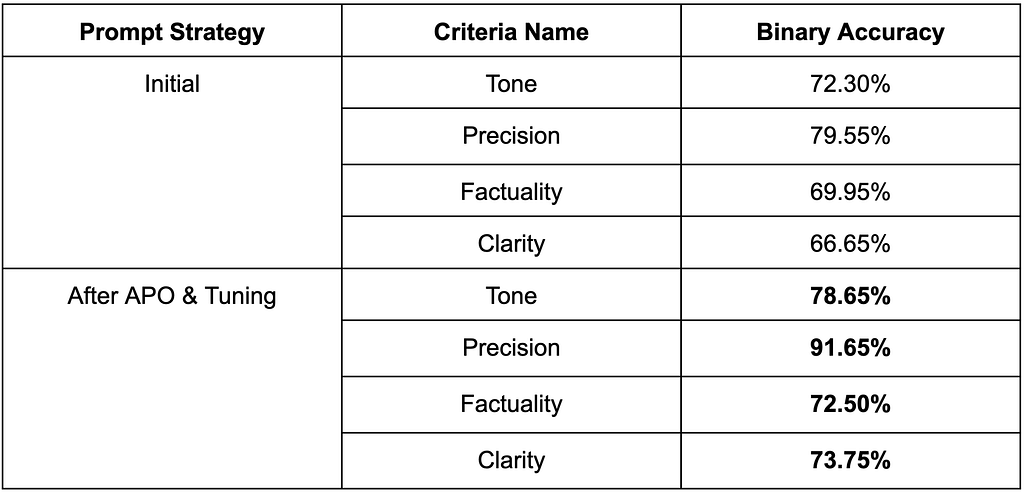
Prompt optimization. Because LLMs are sensitive to prompt phrasing, we apply Automatic Prompt Optimization (APO) over a ~300-sample dev set. Scoring guidelines are provided as additional context to the prompt optimizer. After APO, we manually refine candidate prompts with the help of an LLM, yielding initial prompts with accuracies shown below. These prompts work well for some criteria (e.g., precision) but poorly for others (e.g., clarity), highlighting criterion-specific nuances.
Improved reasoning. Many failures of our initial system arise due to a lack of accurate reasoning through highly-subjective evaluation examples. To improve reasoning accuracy, we leverage two forms of inference-time scaling:

Tiered rationales. Using tone as an example, we tested whether longer rationales are helpful by defining three rationale length tiers (shown above) and comparing their accuracies. Accuracy rises with longer rationales but returns are diminishing. Medium rationales noticeably outperform short ones, while long rationales offer only a slight additional gain; see below.
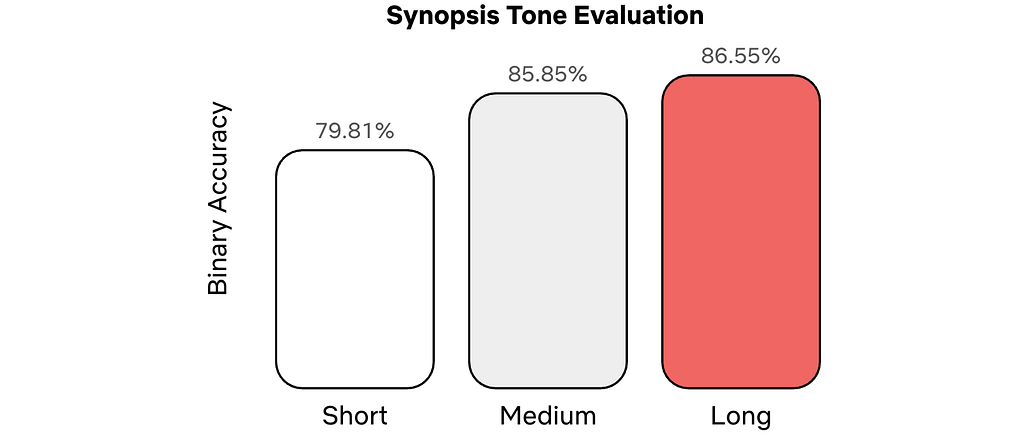
Longer rationales improve performance but degrade human-readability, which is problematic given that explanations are key pieces of evidence for creative experts. As a solution, we adopt tiered rationales: the judge reasons at any length but concisely summarizes its reasoning process prior to the final score. Tiered rationales preserve the benefits of extended reasoning, make outputs easier to inspect, and even benefit scoring accuracy. For example, our tone evaluator improves from 86.55% to 87.85% binary accuracy when using tiered rationales.
Consensus scoring. We can also allocate more inference-time compute by sampling multiple outputs per synopsis and aggregating their scores. We aggregate via a rounded average to ensure that the final score remains binary. For tone and clarity criteria with tiered rationales, 5× consensus scoring yields a clear accuracy boost as shown below.
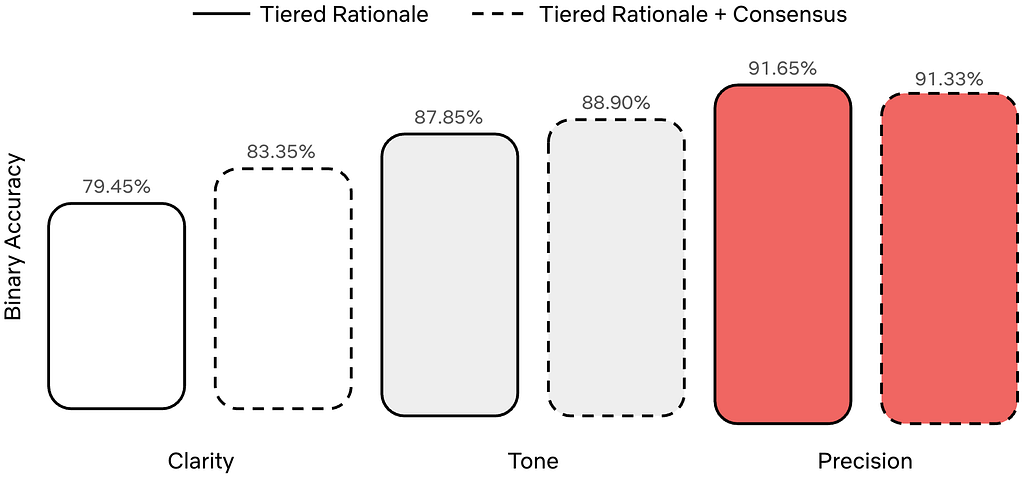
Consensus scoring on the precision evaluator, which uses a vanilla (short) chain-of-thought, yields no benefit. As an explanation, we notice that longer rationales increase variance in scores across multiple outputs, while short rationales yield consistent scores. Consensus may be most useful for evaluators with longer rationales, where it helps to stabilize score variance. When shorter rationales are used, all scores tend to be the same, making consensus less meaningful.
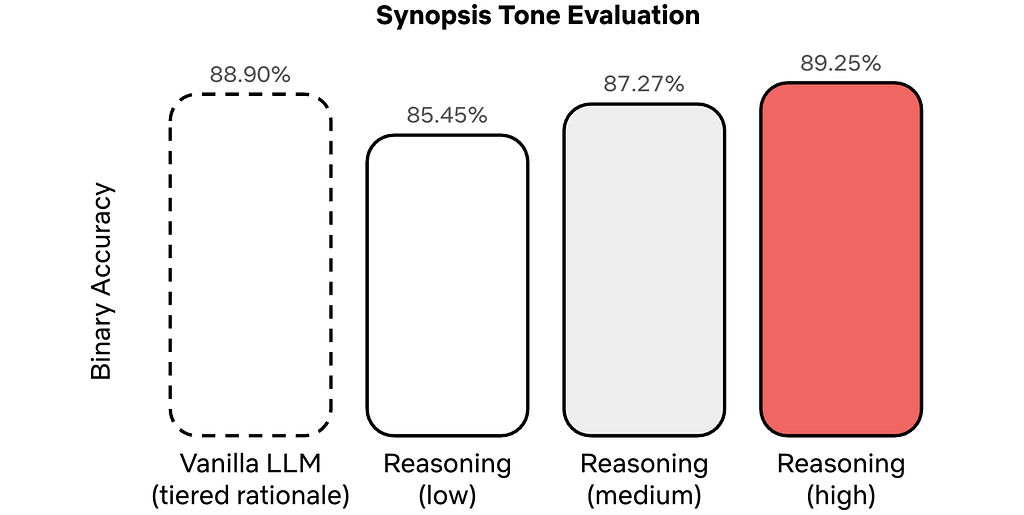
What about reasoning models? While our setup elicits reasoning from a standard LLM, we also explored quality scoring with true reasoning models (i.e., models that generate long reasoning trajectories prior to final output). For tone, using a reasoning model with 5× consensus yields improving accuracy with increasing reasoning effort, even outperforming tiered rationales at the highest reasoning effort; see below. However, we skip reasoning models in our final system, as they significantly increase inference costs for only a marginal performance gain.
Agents-as-a-Judge for factuality. Synopses have four common types of factuality errors:
Detecting these factuality errors requires comparing the synopsis to ground-truth context, where necessary context varies per criteria. For example, plot information requires a plot summary or script, while award information needs a list of awards. As we have learned, simplicity drives reliability: too much context or too many criteria harms accuracy. Motivated by this idea, we adopt factuality agents, where each agent evaluates one narrow aspect of factuality.
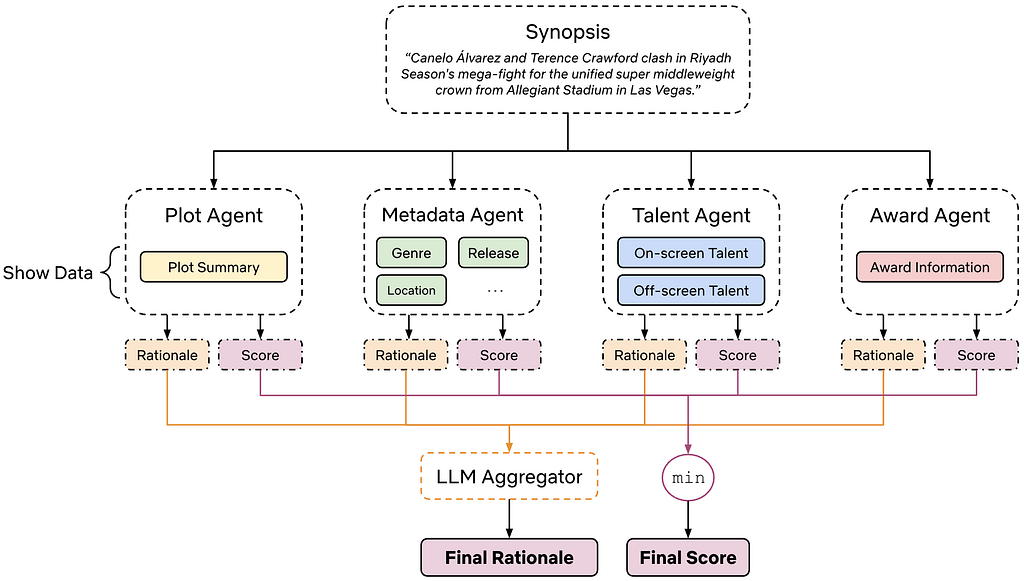
An agent receives context tailored to one facet of factuality and produces both a rationale and a binary factuality score. The final score of the Agents-as-a-Judge system is the minimum factuality score across agents — any failed aspect yields an overall fail. All rationales are fed to an LLM aggregator to produce a combined rationale to accompany the final score. As shown below, leveraging factuality agents significantly benefits scoring accuracy. Further benefits are achieved by using tiered rationales and consensus scoring within each agent.
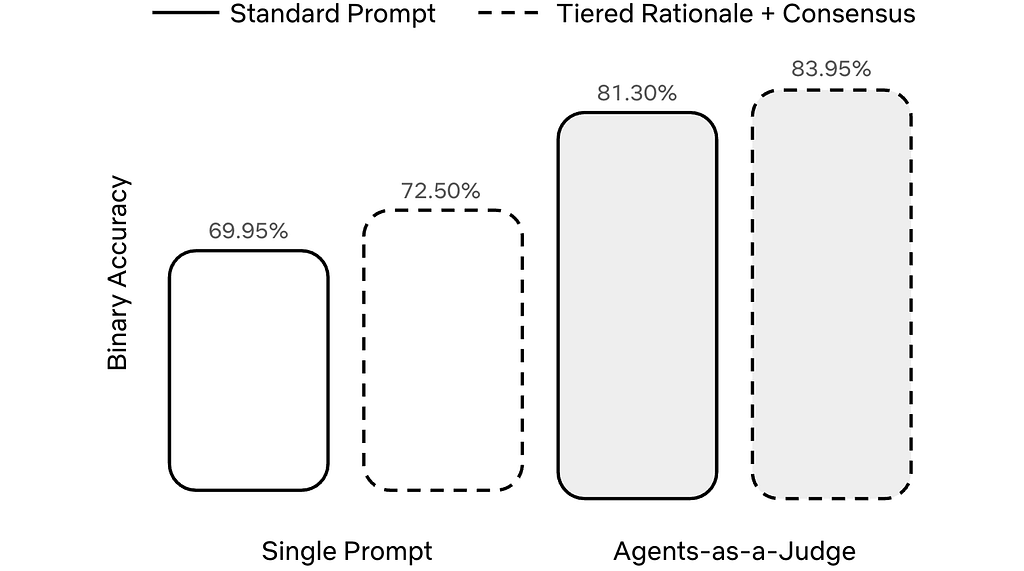
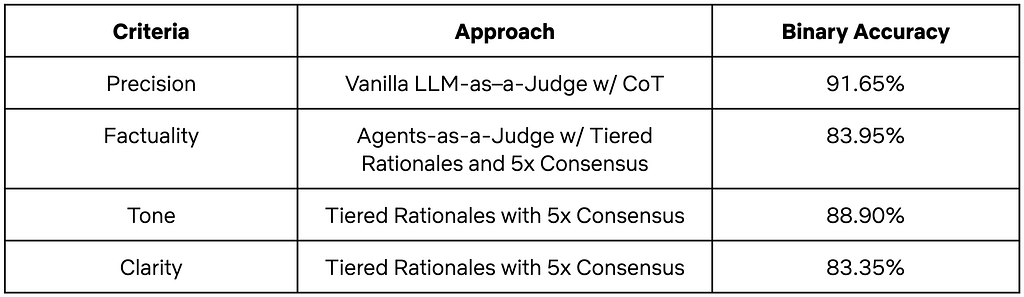
Final system. In summary, our automatic evaluation system uses a combination of standard LLM-as-a-Judge, tiered rationales, consensus scoring, and Agents-as-a-Judge to maximize binary scoring accuracy for each criteria. A summary of the techniques used for each criteria and the associated binary scoring accuracy is provided below.
Beyond expert agreement, we also study how LLM-as-a-Judge scores relate to member behavior. This analysis serves two goals:
Framed as predictors of member outcomes, LLM judges help us assess how promotional assets affect viewing and determine which creative attributes matter most to members discovering content they enjoy. To perform this analysis, we take advantage of the fact that most shows have multiple, personalized synopses (i.e., a synopsis “suite”). Using this suite, we can measure the causal effect of synopsis selection on metrics like take fraction and abandonment rate.
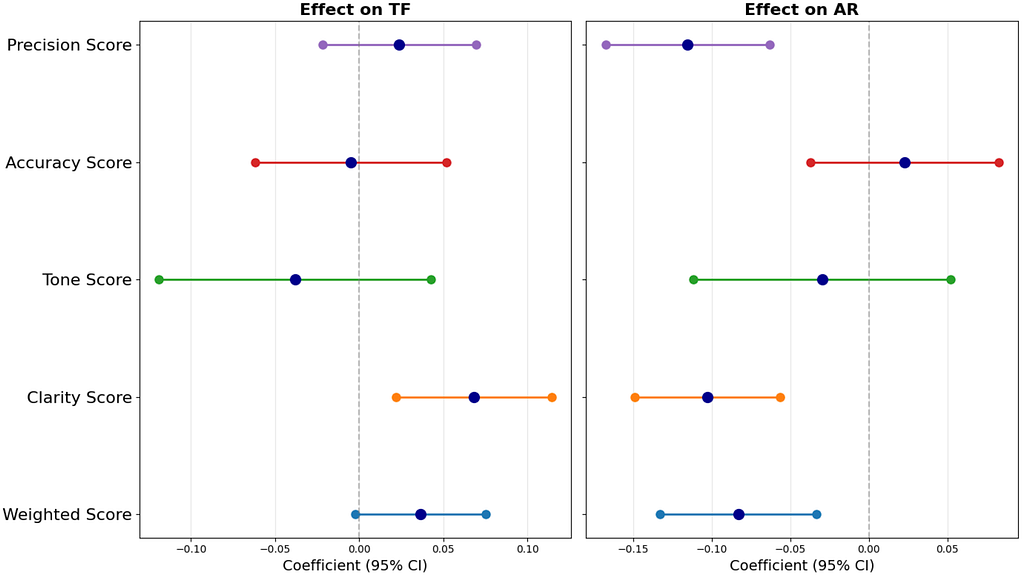
Our methodology. We correlate synopsis performance (take fraction or abandonment) with LLM quality scores. Specifically, within each show s, we relate changes in a synopsis’s LLM score to changes in its performance, normalizing by the show-level standard deviation and clustering standard errors by show; see below.

β captures the average association between within-show changes in LLM score and changes in performance. While we don’t have clean, experimental variation in LLM scores, this analysis still validates predictive value and practical utility.
Member-focused results. We report correlations for individual LLM criteria and a “Weighted Score” that combines all criteria to reduce noise and maximize signal from behavioral data. As shown below, results show promising prediction of take fraction and abandonment. Precision and clarity are especially predictive, and the weighted score provides a statistically useful signal of higher take and lower abandonment. In short, LLM evaluators capture factors that matter to members, making them a valuable tool for monitoring synopsis quality and engagement.
The LLM-as-a-Judge system used to evaluate show synopses at Netflix is the result of extensive experimentation grounded in both creative expertise and member outcomes. Building an automatic evaluation system that works reliably in practice is hard, and the approach we have described reflects countless lessons learned through iteration to improve accuracy and scalability. We have validated the system extensively with human evaluation at both the system and component levels, and we have shown that its outputs correlate with key streaming metrics. As a result, we are confident that it captures the dimensions of synopsis quality that matter most — both creatively and from the member perspective — which has driven its widespread adoption in the Netflix synopsis authoring workflow.

Evaluating Netflix Show Synopses with LLM-as-a-Judge was originally published in Netflix TechBlog on Medium, where people are continuing the conversation by highlighting and responding to this story.
Post Syndicated from Sam Sabinash original https://www.servethehome.com/yuanley-ys100-0602t-review-a-cheap-8-port-10gbe-switch/
In our YuanLey YS100-0602T review, we see a familiar design for a cheap 8-port 10G switch with 6x 10Gbase-T ports and two SFP+ ports
The post YuanLey YS100-0602T Review a Cheap 8-port 10GbE Switch appeared first on ServeTheHome.
Post Syndicated from The Atlantic original https://www.youtube.com/watch?v=gEA2hIPL820
Post Syndicated from corbet original https://lwn.net/Articles/1066582/
Things do not always go the way kernel developers think they will. When
the kernel gained support for the creation of read-only transparent huge
pages for the page cache in 2019, the developer of that feature, Song Liu,
added a
Kconfig file entry promising that support for writable huge
pages would arrive “in the next few release cycles
“. Over six years
later, that promise is still present, but it will never be fulfilled.
Instead, the read-only option will soon be removed, reflecting how the core
of the memory-subsystem has changed underneath this particular feature.
Post Syndicated from jzb original https://lwn.net/Articles/1067200/
Security updates have been issued by AlmaLinux (container-tools:rhel8, fontforge, freerdp, go-toolset:rhel8, gstreamer1-plugins-bad-free, gstreamer1-plugins-base, and gstreamer1-plugins-good, kernel, kernel-rt, libtasn1, mariadb:10.11, mysql:8.4, nginx:1.24, openssh, pcs, python-jinja2, python3.9, ruby:3.1, vim, virt:rhel and virt-devel:rhel, and xmlrpc-c), Debian (libyaml-syck-perl and openssh), Fedora (cockpit, crun, dnsdist, doctl, fido-device-onboard, libcgif, libpng12, libpng15, mbedtls, opensc, and util-linux), Red Hat (git-lfs, go-toolset:rhel8, grafana, grafana-pcp, and rhc), Slackware (libpng), SUSE (389-ds, aws-c-event-stream, bind, cockpit, cockpit-repos, corepack24, dcmtk, dnsdist, docker-compose, expat, firefox, firefox-esr, gnome-online-accounts, gvfs, gnutls, jupyter-jupyterlab-templates, kea, libIex-3_4-33, libpng16, mapserver, perl-XML-Parser, postgresql13, postgresql16, python-Pillow, python311-lupa, thunderbird, tigervnc, and tomcat10), and Ubuntu (linux-azure-fips, linux-hwe, linux-intel-iot-realtime, linux-nvidia-tegra-5.15, openssl, openssl1.0, and python-django).
Post Syndicated from The History Guy: History Deserves to Be Remembered original https://www.youtube.com/watch?v=qoTbNp_5BWQ
Post Syndicated from Bruce Schneier original https://www.schneier.com/blog/archives/2026/04/sen-sanders-talks-to-claude-about-ai-and-privacy.html
Claude is actually pretty good on the issues.
Post Syndicated from Емилия Милчева original https://www.toest.bg/zashto-nyama-liderski-debati/

Влезли в едно студио Радев, Борисов, Пеевски, Мирчев, Божанов и Асен Василев…
Невъзможно.
Липсата на лидерски дебати в България не е инцидент, а устойчив модел на политическо поведение. Културата на правенето на политика тук ги изключва като кулминация на предизборна кампания, която по-често е миризлива, отколкото дръзновена.
А именно дебатите са инструментът, който може да издигне българската политика на нивото на визия и реформи, защото сега е фиксирана върху скандали и краткосрочни политически сметки. Дебатите дават възможност да бъдат сравнени алтернативи, да се противопоставят идеи и също така да се покаже лидерство, тоест най-полезни са за избирателите от всички останали инструменти на кампанията. Това е най-прекият тест за компетентност и способност за вземане на решения в реално време.
Ако бъдат проведени анкети сред аудиторията какво е разбрала от петте предизборни дебата по bTV в рамките на 55 минути по темите „Здравеопазване и социални грижи“, „Икономика и доходи“, „Външна политика“, „Регионално развитие и инфраструктура“, „Правосъдие и сигурност“, полезното съдържание ще се ограничи до отделни изказвания. Форматът се свежда до засичане с хронометър на минути и секунди и до шумни лични нападки, заместващи съдържанието. От студиото отсъстваха онези, които реално вземат решенията.
В България някои лидери високомерно са се самоизключили от дебати. Бойко Борисов, Румен Радев и Делян Пеевски например. Вместо да влизат в преки сблъсъци те предпочитат да се договарят.
В утвърдените демокрации дебатите, особено при президентски избори, са или ясно институционализирани, или са се превърнали в устойчива политическа традиция. (Впрочем в България също имаше президентски дебат между Румен Радев и Огнян Герджиков през ноември 2021 г., когато бившият президент се кандидатира за втори мандат.) В страни като Франция централният дебат между двамата финалисти е неизменна кулминация на кампанията, а в САЩ той се организира от Commission on Presidential Debates, която гарантира регулярност и участие на водещите кандидати.
В Мексико президентските дебати са регламентирани със закон и се провеждат от независим орган, който определя правилата и формата. В парламентарни системи като германската и британската дебатите също заемат централно място, макар и да се организират чрез договорки с медиите, а участието на лидерите се очаква и отказът има политическа цена.
На този фон България изпъква не с липса на формати, а на политическа воля – защото тук дебатът не е нито институция, нито традиция, а изключение, зависещо от моментната изгода на участниците.
На много места по света дебатите са между първите двама в социологическите проучвания, но в България биха могли да включват и лидерите на първите три политически сили.
Дебатите няма да променят позициите на първите две формации в социологическите проучвания – „Прогресивна България“ (ПБ) и ГЕРБ. Теоретично могат да скъсят разстоянието и да донесат известни загуби в момент, в който всеки глас е важен за партиите.
Доскорошният президент Румен Радев влиза в ролята на фаворит и има повече да губи, отколкото да печели от една публична дискусия. Пред обществото той демонстрира добра физическа форма – достатъчно е да си свали сакото и без особени усилия прави коремно възлизане на успоредка и коремни преси. В политическите си движения обаче остава предпазлив, бавен и строго церемониален.
Формацията на Румен Радев води убедително и затова избягва директни сблъсъци – биха ѝ донесли повече рискове, след като към момента прогнозираната вълна от гласове не изглежда възможна. В листите си ПБ има доста бивши от други партии, а спортистите в лицето на известния волейболист и настоящ спортен мениджър Владимир Николов вече допуснаха някои медийни гафове. В своя изява той повтори слогана на „Демократична България“ – „За силна България в силна Европа“, аргументирайки колко проевропейски са ориентирани в „Прогресивна България“.
ГЕРБ продължават да са стабилно втори. С дебата рискуват всички останали да отворят фронт срещу тях.
Така че когато фаворитът няма какво толкова да печели, а вторият има повече да губи, сблъсък няма как да се осъществи.
Най-голям интерес за дебат има коалицията „Продължаваме промяната“ – „Демократична България“, за да атакува директно опонентите си и да покаже експертност. Нейните лидери настояват най-силно за дебати, но ако срещу тях не се изправят лидерите на първите коалиции в социологическите проучвания, дали си струва да участват?
Струва си.
Според различни изследвания ефектът от дебатите е най-силен върху колебаещите се избиратели, които в България са значителен дял.
Към момента актуалните данни са различни, но поне една трета не са решили за кого да пуснат бюлетина. Силно представяне в дебати може да даде начален импулс на тези хора да отидат до урните и да гласуват за партията/коалицията, чийто кандидат ги е впечатлил.
В момент като сегашния, когато инфлацията създава натиск върху бюджета и несигурност за домакинствата, лидерски дебат би изяснил какви конкретни мерки предлагат първите три формации.
bTV и наскоро създадената платформа „Извън ефир“ обещават такъв формат на 14 април. Съществен е въпросът за регламента, но най-важното е ще има ли лидери.
Рийлове със сигурност ще има.
А Радев, Борисов и Пеевски могат да влязат където и да е другаде, само не и в едно студио. Не защото не могат да говорят един с друг, а защото не са свикнали да го правят публично.
Post Syndicated from Йоанна Елми original https://www.toest.bg/glasovete-na-amerika-broy-14/

Както повечето страни от Западна Европа, САЩ празнуват Великден седмица по-рано от православния свят. Страстната седмица и празникът преминаха дотолкова християнски, колкото може да се очаква от един наистина вярващ президент и неговата администрация християни.
Група пастори в молитва за Доналд Тръмп в Овалния кабинет, март 2026 г.
На Велики понеделник (30 март) президентът отправи заплахи към Иран, че САЩ са готови да унищожат енергийната инфраструктура на държавата, включително места, където се съхранява петрол и където се произвежда чиста питейна вода.
На Велика сряда (1 април) Тръмп държа първата си официална реч към нацията по повод войната в Иран. Президентът обяви, че основни стратегически цели, като унищожението на ракети и дронове, са почти изпълнени, но предупреди, че войната ще продължи още 2–3 седмици.
Президентът на САЩ заяви, че ще изпрати Иран обратно в каменната епоха, ако исканията му не бъдат изпълнени.
Ако копирате и поставите в текстов документ постовете му от социалните мрежи от последната седмица, няма да получите нищо по-различно от речта му към нацията, написа BBC.
Президентът призова американците да гледат на войната като на инвестиция в бъдещето, но неяснотите остават – Израел все още атакува Иран, не се знае какво се е случило с плана за мир от 15 точки, който бе агресивно споменаван и също толкова бързо забравен.
Идете до Ормузкия проток и просто си го вземете, защитете го, ползвайте го за себе си. Най-трудното е свършено, следва да ви е лесно да го направите,
каза той в речта си. Духовната съветничка на президента – телевангелистката Пола Уайт-Кейн, сравни страданията на Тръмп с тези на Иисус Христос, което предизвика вълна от критики, включително в религиозните среди.
На Велики четвъртък САЩ бомбардираха най-големия мост в Иран.
В неделя президентът обяви, че американските въоръжени сили са спасили пилотите на сваления над Иран самолет F-15.
Спасиха сериозно ранения и много смел пилот от иранските планини, НЕВЕРОЯТНА демонстрация на смелост и талант от всички,
написа президентът в социалните мрежи. И още:
Отворете шибаният проток [Ормузкия– б.а.], луди копелета, или ще живеете в ада – САМО ГЛЕДАЙТЕ!… Слава на Аллах!
Вместо да участва в традиционните великденски ритуали, президентът прекара неделната сутрин в посещение на място, където ще му бъде издигнат паметник, след което отиде да поиграе голф в клуба си в Северна Вирджиния.
Може би най-запомнящият се момент, който веднага се превърна в част от кошерния ум на света и роди стотици мемета, бе излизането на Тръмп заедно с великденския заек, с когото президентът отправи нова порция заплахи към Иран (за незапознатите читатели, които биха разбрали цялата ситуация погрешно и абсурдно – заекът не каза нищо за Иран, говореше само президентът, но близостта на самия заек все пак предполага определена заедност, така да го кажем).

Тази сряда, 8 април, бе обявено примирие между Иран и САЩ. Това стана след заплахите на президента, че цяла цивилизация ще бъде унищожена (все пак празниците минаха), което предизвика критика от страна на самия папа.
Примирието включва отварянето на Ормузкия проток в замяна на спиране на бомбардировките за период от две седмици. Президентът заяви, че военните цели са изпълнени и преизпълнени.
Все още не е съвсем ясно какви цели са изпълнени и преизпълнени, но сме сигурни, че някой ще ни обясни и каквото и да е обяснението, за привържениците на президента и за администрацията победата ще е безпрекословна.
Ако и вие сте толкова уморени от света, колкото и всички останали, които са принудени да живеят в него (и упорито избягвате да признаете пред себе си, че сме леко виновни всичко да е точно такова, каквото е, от една страна, а от друга, сте също толкова ужасени колко много не зависи от нас, а от хора, които откриват истината за света, нещата и всичко останало от картинки в интернет и клипчета в социалните мрежи), останете с този бюлетин. В останалата му част ще си говорим за Великден – не защото в него няма политика, а тъкмо обратното.

Великден в Съединените щати включва стандартните ритуали, познати ни от филмите: сутрешна църковна служба; деца, тичащи из двора в търсене на пластмасови или шоколадови яйца; печена свинска шунка (ham) на трапезата. Почти всяка „типично американска“ традиция обаче е всъщност привнесена от имигранти или вдъхновена от коренното население, живяло по тези земи преди европейското нашествие.
Традицията за великденския заек – включително злощастния заек, оказал се до президента по време на речта му за Иран – идва от германските заселници в Пенсилвания, които пренасят от Европа легендата за Osterhase: заек, който носи цветни яйца за послушните деца. Така германски фолклорен символ се превръща в иконата на американския пролетен празник, която днес е глобализирана и позната навсякъде като универсален символ.


Вляво: Пристигането на великденския заек пред магазина „Хес“, 1968 г. Източник: Wikimedia Commons. Вдясно: Великденският заек с две жени от Вирджиния, 1960 г. Източник: Wikimedia Commons
Дълго преди европейците да акостират на бреговете на Америка, коренните американски народи празнуват пролетното равноденствие като време на обновление. За много племена в Югозапада, като хопите и зуните, пролетта е време за ритуални танци, с които се призовава дъжд и се благославят семената. Тези традиции ни напомнят, че идеята за прераждането на природата е вкоренена в Америка много преди появата на модерния християнски празник.

На децата се подаряват и великденски кошници, пълни с лакомства, играчки и други празнични подаръци. Традицията може да бъде проследена до няколко места – евангелистите и лутераните, които правят великденски дарения за бедните, както и имигрантите от Източна Европа, в частност поляците, подготвящи кошници за благославяне, които и до днес се носят в църквата. Сега великденската кошница е до голяма степен комерсиална част от празника, като материалите за нея могат да бъдат набавени от повечето магазини, а самата кошница може да бъде ръчно приготвена, или направо купена.


Вляво: Група деца с великденски кошници и голямо великденско яйце, Кларксвил, Джорджия, 1950 г. Източник: Wikimedia Commons. В средата: Деца виждат предварително великденската си кошница. Вашингтон, окръг Колумбия, 5 април, 1939 г. Източник: Wikimedia Commons. Вдясно: Редник първи клас от морската пехота на САЩ Джордж Фон Томан подарява великденска кошница и плюшена играчка по време на празника във военен лагер във Фуджи, Япония. Събитието е организирано за деца от три близки сиропиталища. Децата участват в традиционното боядисване на яйца, в търсенето на яйца и в други игри. 2013 г. Източник: Wikimedia Commons
Ловът, или търсенето на яйца, част от детството на всяко американче, пък е наследник на предхристиянски ритуали за отбелязване на пролетта. Ранните християни избират яйцето за символ на Христовото възкресение и то става ключова част от християнските ритуали след IV век. Според някои исторически източници реформаторът Мартин Лутер е първият, организирал подобни игри за децата и жените през XVI век.
Ритуалът става популярен в Европа, откъдето се пренася и в САЩ. Рекордът за най-голям лов на великденски яйца се държи от Уинтър Хейвън, Флорида, където на 1 април 2007 г. са разпръснати 501 000 яйца, търсени от почти 10 000 деца и техните родители.


Вляво: Момче държи голямата награда от състезанието по търкаляне на великденски яйца, което се организира от Белия дом от 1878 г. насам. Търкалянето на яйца е стара британска и северноирландска традиция, която символизира отместването на камъка от Христовата гробница. Снимката е от 1923 г. Източник: Wikimedia Commons. Вдясно: Гравюра от 1889 г., публикувана от американския издател и печатар Даниел Лотроп. Авторът е неизвестен. Източник: Wikimedia Commons
Все по-голяма популярност, особено в южните щати, набират и познатите в Мексико яйца (cascarón), издълбани и напълнени с конфети или с малки играчки. Тези яйца са много разпространени и по време на Фиестата в Сан Антонио, Тексас, отвъд пределите на великденските празници.
Специфичният хляб (hot cross bun), сервиран на много великденски трапези, се консумира в повечето бивши британски колонии, не само в САЩ. Яде се и пасха – сладък обреден хляб, характерен за Русия, Словакия и Украйна; тези общности имат огромна диаспора в САЩ. Тъй като православният Великден се празнува по-късно, често съответните общности и техните наследници, например американците с гръцко потекло, организират свои празници, на които канят и неправославните.
Агнешкото присъства на американската трапеза, особено в православните и еврейските общности. Агнецът е символ на жертвата на Божия Син и носи древно значение. Но днес шунката е далеч по-популярна. Това се дължи на няколко фактора: липсата на агнешко месо в началото на века, особено преди масовото ползване на хладилници, когато животните се колели наесен и се правела шунка. Освен това свинете се отглеждат много по-лесно и месото е по-евтино.
В допълнение, дългите великденски служби, за които често отива половин ден, затрудняват домакините; шунката изисква много по-малко време за приготвяне, а може и да бъде готвена бавно, което позволява на семейството да се върне у дома при готов обяд.
Накрая, но не на последно място, е маркетингът – към средата на XX в. великденската шунка е част от американската попкултура. Различните рекламни агенции ползват масово шунката като символ на осъществената американска мечта, която (шунката, не мечтата, макар че вероятно и двете) може да нахрани цялото семейство.


Вляво: Характерна за средата на миналия век реклама на великденска шунка, направена като комикс. Източник: Pinterest. В средата: Реклама на великденска шунка с рецепта от 40-те години на миналия век. Източник: eBay. Вдясно: Реклама на пушена великденска шунка в две разновидности
В полските общности в Чикаго и Бъфало например семействата все още носят кошнички за благославяне (Święconka), в които задължително присъства агне, само че от масло – символ на мир и смирение. Италианските имигранти пък носят аромата на цитрусовия хляб Pane di Pasqua, в който се слагат и цели боядисани яйца.


Вляво: Типична полска церемония по благославянето на кошниците, Полша, 2007 г. Източник: Wikimedia Commons. Вдясно: Благославяне на кошниците пред църквата в Бъфало, Ню Йорк. Полската общност в деня преди Великден, април 1943 г. Източник: Wikimedia Commons
Тези традиции продължават и днес – във време, в което не е съвсем сигурно дали част от американците съзнават, че държавата им често върви именно срещу ценностите, за които твърди, че проповядва и защитава. Но все пак това далеч не е първият път, в който религията се използва като оправдание на неоправдаемото.
От този великденско-американски бюлетин може да си вземем две неща: да се молим мирът да е траен и продължителен, докато светът е в ръцете на хора, които си играят с него като с великденско яйце; и да си припомняме, че всяка традиция е пъзел от множеството истории, които е събрала в себе си. И които е разказала отново, сиреч възродила.
Честито Възкресение, възраждане, обновление. Нека светлината винаги се връща – в равноденствието, в душите, в държавите. Все пак дори и в такива времена човечеството успява да достигне звездите. Това трябва да значи нещо.
Абонирайте се, за да получавате този бюлетин на електронната си поща в момента, в който излезе!
Вече сте регистриран потребител на Toest.bg? Може директно от настройките на бюлетините в своя профил да изберете „Гласовете на Америка“ или да натиснете бутона по-долу:
Още нямате профил в Toest.bg? Регистрирайте се само с няколко клика:
Post Syndicated from Bozho original https://blog.bozho.net/blog/4575
Темата с “влиянието в социалните мрежи” става все по-популярна, че чак Борисов ме е споменал вчера („Божанов разбира от тези неща, ама си мълчи“). И тъй като упражненията се вихрят по всички канали, а по анонимните сайтове има какви ли не измислици, вкл., че аз съм наел украински хакери за дискредитират опонентите ни, нека да дам моята гледна точка.
Докладът на BFMI и Sensika, който се цитира напоследък, наистина е интересен. Той е от преди няколко седмици и самият факт, че стана тема една седмица преди изборите е странен. Докладът показва, че хаштагът на Радев в ТикТок има 20 пъти повече гледания (близо 90 милиона) спрямо този на Възраждане напр. И изразява обосновани съмнения, че това не е само органично (отчитайки, че за периода на доклада не е ясно кой стои зад това съдържание).
Докладът посочва и ГЕРБ като бенефициенти на координирано неавтентично поведение, посочвайки и конкретни сайтове. Също така казва, че хаштагът на ППДБ е „отвлечен“ – ползва се, за да се злепостави ППДБ. И това е единственият отвлечен хаштаг в тикток, според доклада.
В същото време, ТикТок преди два дни обяви, че са свалени 34 фалшиви профила с 66 763 последователи, които са свързани с ДПС-Ново начало. Т.е. според ТикТок, които имат достъп до най-много данни за собствената си платформа, основен манипулатор е Пеевски.
Преди 2 седмици популярно стана и друго координирано неавтентично поведение – статуси на ИТН бяха харесвани масово със сърчица от профили с виетнамски, индийски и италиански имена – явно са си купили евтини тролове, които да им усилват съдържанието.
Виждаме, че почти всички (без нас) използват в някаква степен скрити механизми за влияние през социалните мрежи и неавтентично поведение.
Работа е основно на социалните мрежи да следят за това, тъй като те разполагат с най-много информация. Според ТикТок, 99.6% от сваленото съдържание е проактивно от тяхна страна, т.е. без да бъде докладвано от някого.
Този тип манипулации се борят с превенция. А когато социалните мрежи не се справят добре (Мета/Фейсбук продължават да не се справят никак добре), такъв мониторинг може да прави държавата и Европейската комисия. Да установява аномалии в поведението (без да прави оценка на съдържанието по същество и без да налага цензура). Борисов сега се жалва, но преди 2 г. не подкрепи мерки в тази посока. Българските институции нямат изграден капацитет за това и са само зрители – в този смисъл, служебният кабинет не може да разчита на вече изградени знания, умения и инструментариум за мониторинг и реакция.
Но дали има „румънски сценарий“ – не. Няма индикации за мащабна манипулация. Няма данни за ползване на рекламни мрежи (както беше в Румъния). Това, че всеки (без нас) се опитва да направи някаква мушенгия, докато не ги хванат и не им свалят фалшивите профили, е лошо и опасно. И призовавам всички политически партии и техните щабове и консултанти да спрат да го правят. Защото това се използва за подкопаване на доверието в изборите.
Призовавам и никой да не се прави на жертва и да не чертае румънски сценарий за изборните резултати. И нека също така да спрат спекулациите кой как щял да си изкара резултата на изборите – достатъчно се наслушахме на брътвежи за “пипане на кодове”, няма нужда сега и от такива за “пипане на алгоритми”.
Резултатът на изборите зависи изцяло от българските граждани, а нашата цел в кампанията е да им покажем кой къде стои по важните за страната въпроси. Влизането в конспиративни теории не е заместител на ясните политически позиции.
Материалът Влияние в социалните мрежи и „румънски сценарий“ е публикуван за пръв път на БЛОГодаря.
Post Syndicated from Владислав Севов original https://www.toest.bg/toest-razghovaryame-epizod-9/

В новия епизод на „Тоест разговаряме“ се срещнахме с журналистката Надежда Цекулова. Тя е авторка в „Тоест“ и правозащитничка с дългогодишна работа по темите за здравеопазването, човешките права и обществените дефицити зад „безспорните“ каузи. В последните месеци текстовете ѝ в „Тоест“ са посветени на „Анатомия на пола: Жена“, но не само в медицински план, а като преживяване, контекст и система от взаимносвързани фактори.
Говорихме за честността като журналистически принцип, за мита за „безпристрастността“ и за нуждата от работа с проверени източници в среда, в която това все още прави впечатление. Разговорът ни естествено се задържа по-обстойно върху една от най-болезнените теми – Националната детска болница. От участието на Надежда в Обществения съвет до колективната оставка и липсата на реален диалог с институциите, разговорът очерта механизмите, чрез които една обществено призната кауза може да бъде отлагана десетилетия. И постави въпроса как се поддържа граждански натиск, когато институциите отказва да го допуснат.
Епизодът обхвана и по-широкия контекст – отношението към здравето и езика, с който го назоваваме, към мястото на „здравните работници“ в общественото ни мислене. Между емпатията, системните дефицити и личната отговорност, разговорът не търси лесни отговори, а настоява за честност – към фактите, думите и реалността, в която живеем.
Гледайте целия разговор в нашия YouTube канал:
Може да го чуете и като аудиозапис в SoundCloud:
Докато течеше епизодът на живо, пристигна и следният зрителски коментар, на който след записа помолих Надежда да отговори:
Вярно е, че клиничните пътеки мотивират фалшиви хоспитализации. Не е вярно, че всички се правят, че този проблем не съществува – напротив. Дори е вписано в аналитичната част на Националната здравна стратегия. Проблемът е, че съзнанието ни за съществуването на този проблем не поражда действия за решаването му. По няколко причини, поне според мен: първо, сложно е – изисква цялостна реформа в модела на финансиране на болничната помощ; второ – влиятелни лобита в системата печелят от този модел, а тези, които губят, нямат достатъчно влияние при вземането на решения; и трето – липсват категорични данни за мащаба на проблема, просто умишлено не се изследват.
Преди срещата ви помолихме да се включите в кратката ни анкета. Ето и резултатите от нея:
На здравеопазването ни му липсва … направен по човешка, не по автомобилна мяра. Приветлив, гостоприемен, достъпен за хора с увреждания с пешеходни зони, места за разходка и почивка, велосипедни алеи, добър обществен транспорт, активни фасади и без подлези. Долу подлезите!
Надежда Цекулова е журналистка, експерт по комуникации и активен обществен глас по темите за здравеопазването, социалната политика и правата на човека. Завършила е журналистика в Софийския университет и НБУ. Значителна част от професионалния ѝ път преминава в програма „Хоризонт“ на БНР. От 2019 г. е комуникационен директор на Българския хелзинкски комитет. Работата ѝ както в медиите, така и в гражданския сектор последователно засяга теми като майчино и детско здраве, системни дефицити в здравната грижа и социалните неравенства, а в последните години Надежда развива и задълбочена авторска линия в „Тоест“, където съчетава журналистически подход с ясно заявена обществена позиция.

Последният (засега) епизод на „Тоест разговаряме“ ще бъде със Зорница Христова – преводачка от английски, издателка, авторка на детски книги и водеща на книжната ни рубрика „По буквите“. Разговорът ще се излъчи на живо в YouTube Live на 23 май, събота, от 16:00 ч.
В „Тоест разговаряме“ всеки месец ви срещаме с автори, които познавате добре от анализите или от рубриките им в „Тоест“, но този път ще ги видите и чуете в по-личен и непосредствен формат. Във видеоразговорите, предавани на живо, активно участие имате и вие, нашата публика – със своите въпроси, коментари и включване в тематичната анкета. Водещ на поредицата е Владислав Севов, дългогодишен телевизионен журналист и съосновател на „Тоест“.

„Тоест разговаряме“ е поредица, подкрепена от Институт „Отворено общество – София“ и съфинансирана от Европейския съюз в рамките на проекта Media Resilience. Изразените възгледи и мнения са само и изцяло на техните автори и не отразяват непременно възгледите и мненията на Европейския съюз, на Европейската изпълнителна агенция за образование и култура (EACEA) или на Институт „Отворено общество – София“ (ИООС). Нито Европейският съюз, нито EACEA, нито ИООС могат да бъдат държани отговорни за тях.


