Introducing The Cold Start: pitch your startup live at Cloudflare Connect

Post Syndicated from Fatima Yusuf original https://blog.cloudflare.com/introducing-the-cold-start/

Sixteen years ago, Cloudflare was one of more than 1,000 startups hoping for a spot on stage at TechCrunch Disrupt.

We were not, on the face of it, an obvious choice. Cloudflare was infrastructure: we made websites faster and protected them from attack, which was not well understood by the general market at the time. Infrastructure is often invisible right up until the moment it becomes important.

But on September 27, 2010, Matthew Prince and Michelle Zatlyn got on the Startup Battlefield stage and launched Cloudflare to the public. During the presentation, people started signing up. Then more people started signing up. By the time the judges had finished asking questions, hundreds of websites had joined Cloudflare, putting our initial five data centers to the test in real time. In the seven days following, traffic through our network increased almost 10x and Cloudflare jumped from the 1,000th largest site online to one of the top 50.

Cloudflare didn’t win the main trophy that day. At the awards ceremony, TechCrunch founder Mike Arrington described what we did as something akin to "muffler repair for the Internet" and honestly, he had a point. But then he named us the Most Innovative Company. As Matthew wrote later: "You may not win the trophy, but you'll receive something else far more important."

There are moments in the life of a company when somebody gives you a room, a microphone, and a small amount of time to explain the thing you have spent months or years obsessing over. Most of the time nothing magical happens. Sometimes, though, the right people hear it at the right moment and suddenly an idea that has mostly existed between a handful of people starts moving through the world.

This October, as Cloudflare turns 16, we want to give five early-stage startups a stage of their own.

Introducing The Cold Start

The Cold Start is a live startup competition taking place next month at Cloudflare Connect in San Francisco. We’ll select five early-stage companies and give each of them five minutes on stage to explain what they’re building, why it needs to exist, and why they are the people who should build it.

We are less interested in perfect pitch decks than in interesting ideas clearly explained. You do not need thirty slides, a suspiciously precise TAM calculation, or a rehearsed story about how your childhood prepared you to disrupt accounts receivable. What we want is to understand the vision: what changed in the world that makes it possible, what you see that other people have missed, and why you cannot stop thinking about it.

The five finalists will make their case in front of the Cloudflare Connect audience and three people who've spent a fair amount of their lives thinking about companies, infrastructure, and the Internet:

  • Matthew Prince, co-founder and CEO of Cloudflare
  • Michelle Zatlyn, co-founder and President of Cloudflare
  • Dane Knecht, CTO of Cloudflare

The judges will select one startup to win $500,000 in Cloudflare credits, take over a billboard in San Francisco, and receive an invitation to our VIP speakers dinner that evening.

Five companies, five minutes each, and a room full of people paying attention.

What are we looking for?

The Cold Start is open to ambitious early-stage startups that have raised less than $10 million. Beyond that, we are deliberately keeping the definition broad because the most interesting companies rarely arrive neatly categorized.

We want to see ideas that seem obvious once somebody finally builds them, and ideas that initially sound slightly unreasonable. We want infrastructure that appears boring until you realize everyone is going to need it; products that could not have existed a few years ago; strange new interfaces; new ways of building software; things aimed at enormous existing markets and things aimed at markets nobody has bothered to name yet.

Most of all, we want to meet people who have noticed something about the world and decided to do something about it.

As part of the application, we’ll ask you to tell us who you are, give us your one-line pitch, explain what you’re building and why, tell us about your funding and revenue stage, show us how Cloudflare fits into your stack, and point us toward anything else that helps us understand you and your work.

The goal is simple: make us understand why the thing you’re building should exist.

Apply for The Cold Start.

Applications are open now and close Friday, October 2, 2026. 

Five minutes in San Francisco

The Cold Start will take place Monday, October 19, from 4:00-5:00 p.m. PDT at Moscone West in San Francisco, as part of Cloudflare Connect. Cloudflare will pay for the five finalists to fly to San Francisco for the competition.

Connect brings together people building and thinking about what comes next for the Internet. This year’s lineup includes AI pioneer Dr. Fei-Fei Li; Idealab founder Bill Gross; organizational psychologist and author Adam Grant; AMD CTO Mark Papermaster; Vue.js and Vite creator Evan You; Lovable co-founder and CTO Fabian Hedin; and OpenAI member of technical staff and creator of OpenClaw, Peter Steinberger.

For five young companies, we are reserving part of that stage. Each startup will have 5 minutes to pitch, followed by 3–5 minutes of questions by the judges.

There is something we like about that symmetry. Sixteen years ago, Cloudflare needed someone to take a chance on an infrastructure company with a difficult story to tell and give us a few minutes in front of the right room. Today, we are fortunate enough to have a stage of our own, and we want to pass that same opportunity on to companies that are just getting started.

Start small. Build something enormous.

There is a practical reason Cloudflare spends so much time working with startups: very small groups of people have an uncanny ability to attempt very large things.

The problem is that ambitious software increasingly depends on infrastructure that, not very long ago, only the largest technology companies in the world could afford to build for themselves. Global compute, storage, networking, security, real-time systems, AI inference, and the ability to survive the possibility that the thing you made suddenly becomes popular should not require a company to first become enormous.

We think you should be able to reach for those capabilities on day one.

That is part of the idea behind Cloudflare for Startups, through which eligible early-stage companies can receive up to $350,000 in Cloudflare credits for one year. It is also part of the reason we continue expanding Cloudflare’s developer platform: a tiny team should be able to build something on Tuesday and if the Internet decides it likes it on Wednesday, spend Thursday focused on the product rather than hastily becoming experts in global infrastructure.

Cloudflare began with its own slightly unreasonable premise: that the performance, security, and global compute available to the largest companies on the Internet should be available to everyone on day one. In 2010, we got a chance on a stage to explain why that matters.

Sixteen years later, we have a much larger network, a somewhat larger team, and significantly better circuit breakers.

Now we want to hear what you’re building.

Apply for The Cold Start.

EmDash 1.0: the stable CMS with a secure plugin registry

Post Syndicated from Scott Buscemi original https://blog.cloudflare.com/emdash-cms-plugin-registry/

When we introduced EmDash on April 1 as the “spiritual successor to WordPress”, the buzz was hard to ignore. Walking around a WordPress conference that month, we couldn’t walk far without hearing murmurs about EmDash from fellow attendees.

But alongside the excitement and curiosity has been a seed of doubt among some in the industry. Was this just an April Fools’ joke?

It was not. Today, we are releasing EmDash 1.0: a stable, free, and open source CMS built on Astro, ready to power a production website, your agency’s vibe-coding platform, or your hosting company’s site-building experience.

Developers build with Astro, editors manage content through the EmDash admin, and agents can work through the API, CLI, or built-in MCP server. EmDash 1.0 brings those pieces together with production-tested editorial, media, localization, migration, and deployment workflows.

We are also launching a decentralized plugin registry that lets developers publish without handing ownership of their identity or releases to a central marketplace, while site owners can discover and install their plugins directly from inside EmDash.

The road to 1.0

Since EmDash's first beta, developers have launched real websites with it. Even so, we kept hearing a reasonable response: “This looks interesting. Let me know when it is 1.0.” Before relying on EmDash for their sites, they wanted confidence that it was stable, secure, that upgrades would protect their content, and that we are fully committed to maintaining it.

EmDash 1.0 is our answer to that. For the past five months, we have worked with contributors and production users on the parts of the CMS that every site depends upon: data safety, database migrations, editorial workflows, localization, plugin security, performance, and the reliability of the admin, API, MCP, and media experiences.

Real deployments shaped much of that work, uncovering edge cases and identifying needs that only show up when a site is serving real traffic and being used by real teams of editors.

As one example of this, Avulux converted a custom microsite to EmDash after dealing with the maintenance burden of WordPress for too long. Since EmDash is an agent’s best friend, using the EmDash Agent Skills helped that transition take less than a day to complete.

“The site had to be fast to use and simple for our team to update,” says Greg Barbosa, Director of Innovation and Systems at Avulux. “WordPress had become the opposite of that. With EmDash, we now have a shared platform that developers can extend and marketers can edit content."

In August, we migrated the Cloudflare Blog to EmDash as part of our “Customer Zero” approach. Working alongside our content engineering team provided actionable insights around localization, media management, the admin editor experience, and scaling. Comfortably handling the traffic load for the Cloudflare Blog meant being ready for millions of pageviews per week, spikes up to 5,000 requests per second (RPS) of legitimate traffic, or sporadic DDoS attacks. The optional KV object caching, Hyperdrive database adapter, and Workers Cache compatibility were all features spawned from our migration project that are widely available to all customers now.

Built in public, open to everyone

A CMS sits at the heart of an organization’s web presence. It is trusted with its most important data, and is often used by dozens of editors every day. They need to be able to know they can rely on it, without fear of vendor lock-in or changing business priorities. For that reason, EmDash is completely free and open source, using the flexible and permissive MIT license.

EmDash 1.0 could not exist without its open-source development community. At the time of writing, more than 175 people have contributed to the project, across more than 1,800 commits. The rise of agentic coding tools has presented both challenges and opportunities to open-source projects, and we have deliberately built a project where the agents can help the human developers, rather than being overwhelmed by them.

We are particularly grateful to the core group of the most dedicated contributors, who between them have shipped hundreds of improvements to all areas of the project. They include @swissky, @danielmlr, @MA2153, @marcusbellamyshaw-cell, and dozens of others. Contributors have translated EmDash into 25 languages, from Arabic to Ukrainian.

Particular recognition is due to Noah Pham, who joined Cloudflare as an intern and became EmDash’s second maintainer alongside Matt. Noah contributed more than 80 changes, taking ownership of major parts of the media library, content editor, and admin interface. We have said that interns ship meaningful work at Cloudflare; Noah’s work is now at the heart of EmDash 1.0.

There is plenty more to build, and contributing does not have to mean writing code. If you want to help with code, translations, documentation, testing, design, issue triage, answering questions, or just welcoming new users, join over 800 others in the EmDash community on Discord.

A growing ecosystem

A content management system thrives when the ecosystem around it is healthy and supported. We’ve been excited by the theme companies, plugin shops, agencies, and platforms who are creating new services and products using EmDash.

  • Lexington Themes offers 44 Astro themes with EmDash variants, giving teams a beautiful and functional starting point for their site, complete with reusable components and built-in content collections.
  • Urumi is using their WooCommerce expertise to release EmDash’s first eCommerce plugin.
  • Empress is launching a platform for multi-brand entities, offering the flexibility of managing a fleet of sites with natural language or a conventional CMS admin panel.

“Empress's delightful multisite experience would not be possible without the foundations EmDash has laid: sites that are fast, safe to extend, and easy for people and agents to read and act on,” says Raj Makker, Empress’s founder. “EmDash unlocks powerful control over a website, and Empress builds on it to give you complete control over as many sites as you want. We're excited to be part of this journey.”

A plugin registry that does not own the ecosystem

With EmDash 1.0, developers can publish sandboxed plugins and site owners can discover, inspect, and install them from the EmDash plugin registry.

Traditional plugin registries usually combine three roles: they provide the publisher’s account, hold the authoritative package record, and operate the catalog where users discover it. That is convenient, but it also makes one company the gatekeeper for both identity and distribution. If an account is suspended, a listing is removed, the rules change, or the service shuts down, publishers cannot take the same identity and release history somewhere else.

EmDash separates the plugin from the catalog. Publishers retain control of their packages and release history, while EmDash provides a convenient place for people to find and install them. Other services can index the same publications, build their own catalogs, and apply their own policies without requiring developers to start again.

The EmDash catalog applies default content moderation to the names, descriptions, links, and images it displays. Moderation can hide harmful or inappropriate material from this catalog, but it does not rewrite a release, take ownership of the plugin, or erase the underlying publication.

The registry is built on AT Protocol (atproto), a decentralized network protocol that powers Bluesky and a growing ecosystem of applications. Plugin authors publish with an Atmosphere account, the portable identity also used across these applications. The package and release records are signed by the publisher and stored in the publisher's own account.

EmDash hosts the default registry services so publishers and site owners can use them without running infrastructure themselves. We hope others will build new catalogs, moderation systems, publishing tools, and other services we have not imagined yet. To help this, we have released all of our services as open-source software, including the aggregator that powers the plugin registry, the labeler service that uses Workers AI to moderate package descriptions, and an Astro live content loader to make it easy to include plugin listings in any Astro site. We are excited to see what the community will build with them!

There’s no centralized controller that can take over plugins or remove them on a whim. We believe the security of plugins and the registry should be baked into code, rather than trusting any central authority or code of conduct.

Decentralized publishing does not mean accepting unverified code. Atproto repositories use signed Merkle Search Trees, so an inclusion proof connects the exact release record to a signed commit from the publisher’s account. EmDash can therefore verify the record independently instead of trusting the catalog’s copy. It then checks the plugin’s checksum, package name, version, requested access, and any required build provenance, and confirms that the downloaded bundle matches the signed record.

The registry supports free plugins today, and we aim to add support for paid plugins in future, with the same decentralized model as now. We are watching the Atproto Spaces Alpha with interest. Anybody should be able to run a secure, paid plugin marketplace. We want publishers to be able to make money from their software.

For now, plugin authors can publish useful software without asking permission from EmDash — and site owners can understand exactly what that software is allowed to do before they run it.

Plugins with clear boundaries

Plugins are the core of a CMS ecosystem. They save site developers from rebuilding the same integrations and workflows, while giving experts a way to share their best practices — and potentially build a software business.

Agents make that reuse even more valuable. An agent can build a one-off integration, but it still has to understand the problem, generate and test the code, and maintain it afterward. A plugin captures that work. Another agent can install and configure a proven solution instead of starting again from scratch.

That convenience creates a serious security concern: plugins are code you did not write, operating alongside valuable content and customer data. With WordPress, plugins run inside the same PHP process as the rest of the application, with direct access to its database, filesystem, and network. A contact-form plugin can technically read unpublished posts, modify another plugin, or send data anywhere. Site owners must trust that it will not — and that a future update will not change its behavior.

Sandboxed EmDash plugins use a different model. Each plugin runs in an isolated runtime with access to its own private storage, but not to the site’s content, media, users, secrets, environment, filesystem, or network. It gains additional abilities only when they are declared by the plugin and approved by the site administrator.

Installing a sandboxed plugin therefore feels more like installing a mobile app than a traditional CMS plugin. EmDash shows what the plugin wants to do before it runs, and the runtime limits it to those approved abilities.

That lets plugins perform useful work without receiving unrelated access:

A plugin could…

It might need to…

It still cannot…

Index published articles for search

Read content and contact the search service

Edit articles or contact other hosts

Optimize uploaded images

Read and manage media

Read user content

Send publishing notifications

Observe publishing and send email

Change the content being published

Provide configurable webhooks

Read selected events and contact public destinations

Reach private networks or other plugins’ storage

The important part is that these abilities are independent. Giving a plugin access to media does not also expose users or unpublished content. Allowing it to contact one service does not open the rest of the network. These boundaries are enforced by the runtime, not left to the plugin author’s good intentions.

This isolation is not limited to Cloudflare deployments. On Cloudflare, EmDash runs each plugin as a Dynamic Worker through the Worker Loader. On Node.js, EmDash starts workerd — the open-source Workers runtime — as a separate process and runs each plugin as an isolated service inside it. Plugins use the same manifests and capability-gated APIs on either platform. See the plugin sandbox documentation for setup and runtime differences.

From a single site to a website platform

EmDash can power an individual Astro site, but it is also designed for companies building website creation and hosting products.

Workers for Platforms lets those companies run each customer’s site as a Worker on Cloudflare’s global network. They do not need to provision a server for every site or build the surrounding networking and deployment infrastructure themselves. That leaves them free to focus on the experience their customers use to create and manage a website.

EmDash provides the content layer for that experience. A platform can use the admin interface directly, build its own interface on the API and CLI, or put an agent in front of the built-in MCP server. A bakery owner could update opening hours by asking for the change in plain language; the platform’s agent would handle reading, updating, and saving the content.

The sandboxed plugin model also gives platforms a safer way to offer extensions across many customer sites. Plugins receive only approved access to content, media, users, email, or external services, rather than running with unrestricted access to the whole application. Platforms can run their own plugin marketplaces with access to the full registry — or curate a selection of pre-approved plugins.

We are always looking for additional hosting partners that want to join us in developing new agent-oriented CMS experiences. Reach out to us if you’d like to learn more about reinventing with EmDash.

EmDash Build: an open source AI site builder

We are also releasing and open-sourcing an alpha of EmDash Build, an AI site builder that hosting providers, website builders, and platforms can run themselves and integrate with their own systems. Try the demo today at build.emdashcms.com, or explore the code.

If you’re building a site today, for yourself or for a client, you won’t start in an IDE. You’re more likely going to start with a chat box, and describe to an agent what you want. But once you have something, you could find that changing simple things requires you to go back to that prompt box, and either roll the dice on the result, or burn credits for a one-line change.

EmDash Build creates an EmDash site instead, which brings the full stack: server-rendered Astro pages, a database, media storage, and an admin interface. The agent designs a content model from the brief, fills it in through EmDash's MCP server, and writes the pages that display it. After that, you or your customer can edit text right on the page, schedule posts, or let an agent do it for you.

In EmDash Build, each project gets its own Cloudflare Sandbox container, where the agent, built on the Agents SDK, verifies its own work. Artifacts tracks every change as a git commit. When the site is published, the content moves into a production EmDash site, and deploys to the host's Workers for Platforms namespace.

Get started and get involved

With the release of EmDash 1.0, now is a great time to migrate your company’s marketing site or have an agent spin up that side project you’ve been talking about. Try out the EmDash playground site here. 

To create a new EmDash site locally, via the CLI, run:

Or you can do the same via the Cloudflare dashboard below:

If you’re ready to develop an EmDash plugin, our documentation has a step-by-step guide for creating and publishing a plugin to the registry.

We also welcome you to join our growing community of contributors on Discord. You don’t have to be an engineer to get involved — we welcome translators, issue triage managers, user experience designers, marketers, and all others who are excited about the future of content management systems.

Supporting native Rust in Workers with the new Emscripten target for wasm-bindgen

Post Syndicated from Guy Bedford original https://blog.cloudflare.com/rust-workers-emscripten-target/

Today we’re announcing the first public experimental preview of a feature to better support native Rust code and even Tokio-based applications just running natively on Workers: first-class support for the Emscripten wasm32-unknown-emscripten Rust compiler target on the wasm-bindgen open source toolchain and Cloudflare’s Rust Workers.

wasm-bindgen is the open source toolchain powering Rust-based WebAssembly applications on our V8-based Workers Runtime. Enabling the Emscripten target for wasm-bindgen has been a long-term effort, first initiated by Google over a year ago, and then further reviewed and supported by the Cloudflare engineers maintaining wasm-bindgen.

While still in pre-release, we’re excited to share the new workflow possibilities this work enables in running native wasm-bindgen Rust applications with Emscripten on the web, Node.js, and on Cloudflare’s global Workers platform.

In testing we’ve been able to see significantly improved library compatibility for Rust Workers. To illustrate the sort of capabilities supported, we were able to get a Rust-native Minecraft server (Pumpkin) running inside of a Durable Object with TCP ingress, using real TCP sockets via Tokio. See the end of this post for a full description of this port.

Emscripten is an open-source WebAssembly compiler toolchain initially created by Mozilla and currently maintained by Google engineers, which makes it possible to run and bridge native code with the web platform, including supporting and virtualizing platform features such as timers, file system operations, sockets, and other native functionality.

Since Cloudflare Workers supports Web Platform APIs and Node.js compatibility, we are able to support Emscripten on Workers using its Node.js compilation flags, fully virtualizing native platform features such as timers, file system operations, and sockets on top of our existing Node.js APIs. And with our work on Tokio support, Rust code building on top of Tokio’s async runtime ecosystem can now also be fully integrated into JavaScript-based host environments with this Emscripten target.

We’ve made these current experimental patchsets available with example applications to try out today, including:

Supporting the wasm32-unknown-emscripten target in wasm-bindgen

Mitch Foley on Google’s Portable Toolchains team first encountered the need for Rust WebAssembly toolchains to interoperate with C++ when another internal team at Google was interested in using wasm-bindgen to interface with their JavaScript. The goal was for wasm-bindgen to drive the build and produce the companion JavaScript, while Emscripten’s linker (wasm-ld) would be able to link in any C++ dependencies needed.

Internally, Google uses Emscripten in C++ codebases to generate JavaScript along with the rest of their applications, allowing the C++ and JS to interact with one another. While Emscripten was capable of linking in Rust code as a dependency, the thing it couldn’t do was provide a robust binding system between Rust and JavaScript like wasm-bindgen does.

The problem was both tools assume they are in charge of loading and interacting with JavaScript and generating the final JS and Wasm output. Because of this conflict, Google internal users would have to commit to using one or the other toolchain and never both, and adding a second set of tooling would have doubled the support surface for Google’s Portable Toolchains team.

Mitch and his colleague Yifan Yang crafted a plan to have them work cooperatively: Emscripten would continue to drive the build, load the Wasm module, and provide the companion JS, while wasm-bindgen would produce a smaller portable version of its JavaScript bindings in a format that could be directly included in Emscripten’s library system.

This wasn’t just a technical problem — both Emscripten and the wasm-bindgen maintainers had to support this plan and be willing to maintain integration tests that depended on the other. With feedback from Google’s Portable Toolchains team, Google’s Wasm Tools team, and Cloudflare engineers, this finally resulted in the required changes landing in both projects.

As a result of these efforts, the wasm-bindgen and Emscripten toolchains now have seamless interoperability under the new -sWASM_BINDGEN configuration:

  1. C++ Emscripten code driven by Emscripten’s compiler can be built against static wasm-bindgen Rust code, fully supporting the wasm-bindgen bindings layer alongside the Emscripten bindings layer.
  2. Rust applications using wasm-bindgen and driven by Rust’s compiler can now be built for the Emscripten target, fully supporting Emscripten’s bindings layer alongside wasm-bindgen’s bindings layer.

See the wasm-bindgen Emscripten documentation page for more information about using this target.

Rust library support for Emscripten

After landing the wasm32-unknown-emscripten target support in wasm-bindgen, early prototypes by Cloudflare engineers demonstrated clear success for supporting this target on Cloudflare Workers. Many libraries worked out of the box, even including low-level systems libraries, since Emscripten already supports the target_family = unix in Rust.

Some low-level systems libraries that were unaware of Emscripten required patching, for example libc, socket2, and Mio. Even for these low-level libraries, patches primarily involved adding the Emscripten target to the existing platform gates, for example to explicitly allow target_os = “emscripten”, in place of Wasm platform gates.

Overall we posted these target support patches fairly infrequently, and they were mostly trivial when needed, with the Rust library maintainers very receptive to reviewing the support.

That said, one of the critical foundational libraries that needed significant support was Tokio.

Tokio support

Cloudflare Workers are single-threaded and hosted within a JS event loop, while Tokio async is designed around blocking operations being supported through threaded parking semantics. The two models are clearly not compatible with each other — a blocking operation such as a pending socket read or epoll wait cannot block the shared JS event loop.

To get around this, we had two options: WebAssembly JavaScript Promise Integration or to modify Tokio to support event loop runtime integration.

To support Tokio building for Emscripten, we have contributed full Tokio support patchsets that are being reviewed upstream, with the first target support patch for wasm32-unknown-emscripten already landed upstream in Tokio. With these patchsets, we’ve been able to fully support both approaches in Cloudflare Workers. In our Rust Workers Tokio examples, these patches are required directly pending further integration upstream.

Supporting JSPI

WebAssembly JavaScript Promise Integration (JSPI) maps directly onto Tokio’s existing parking semantics. This is because JSPI allows a blocking Wasm call to suspend the WebAssembly stack on a synchronous operation and return control to the JS event loop, exactly as one would expect of a park.

But when a new Wasm call is made while an earlier one is suspended, JSPI doesn’t break: it instead supports having a new WebAssembly stack being entered while arbitrary existing stacks are suspended at the same time.

The problem here, though, is that Rust itself isn’t aware that its stack is being switched out from under it. Tokio’s runtime context is tracked via a thread local, but a JSPI stack switch is not a thread switch, so the suspended and new stack still share the same thread-local runtime context. As a result, the Tokio runtime context still thinks it is in the parked context when a new Wasm call enters, and then panics because the runtime is already entered.

Supporting fully reentrant JSPI therefore requires careful thread local handling to split context between JSPI context switches. To support this, the thread-local context itself must be swapped on each JSPI enter, exit, suspend, and resume. In effect this is cooperative time-multiplexed threading, with each suspended stack carrying its own runtime context.

With our pre-release Tokio patchset, we were able to implement and verify this model. Finalizing the design and upstreaming it is ongoing in collaboration with the Tokio and Emscripten teams.

Adding an event loop runtime to Tokio

The other runtime approach is full event loop integration. Event loops are of course a common paradigm in native UI applications, so the idea of supporting an event loop runtime for Tokio was certainly not something completely unfamiliar to the maintainers in discussions we had around the Emscripten target support.

The question was rather how to design an event loop for Tokio in such a way that it could work across native applications (including Windows and macOS), as well as for WebAssembly embeddings in JavaScript hosts.

If we could design a general LocalEventLoop runtime for Tokio, we could solve this problem more generally.

A Tokio runtime does two things in a loop: (1) it polls tasks until nothing is ready, and then (2) it waits. The wait is what makes it a runtime rather than a library: the thread parks inside the I/O driver until a socket becomes readable, a timer expires, or another thread wakes it.

But when the host already has its own event loop, Tokio's loop cannot run inside it without blocking the host's. The way around this is to split Tokio's loop in two with both parts able to integrate with the host: (1) becomes an explicit drive() operation that runs one batch of ready tasks and returns, and (2) is replaced by a wake, so that instead of parking, the runtime tells the host it has work and the host calls drive() when it is ready to.

Our proposed LocalEventLoop design for Tokio is a LocalRuntime whose wait has been replaced by a wake. It is built with a standard std::task::Waker that the host owns, which instead of being used to signal that a future should be polled soon, is used by the Tokio runtime to signal that the runtime itself should be driven soon.

Consider the example of a socket read under a regular Tokio runtime:

This would correspond to the following call diagram:

Instead, with LocalEventLoop we can write:

Here, spawn_local returns immediately, with the host event loop taking responsibility for driving the spawned task to completion via el.drive() calls from the host. When stream data is unavailable, the runtime simply returns, handing back control to the host. Once the socket becomes readable, Tokio uses the host_waker to signal that the runtime needs driving.

This LocalEventLoop flow corresponds to the following call diagram:

Everything that would have unparked a native runtime's thread wakes the host instead: a spawn, a task woken from another thread, a socket becoming readable, a timer expiring. Because a Waker is Send + Sync and carries no execution semantics, its implementation is just a notification to the host's event loop. This makes the contract safe by construction: a wake arriving from another thread, from a host callback, or even during a drive, queues work rather than re-entering the runtime. The drive that follows runs on the owning thread with nothing else on the stack.

The one thing you cannot do is wait. block_on still exists and runs a future as far as ready work carries it, but where a normal runtime would park, LocalEventLoop::block_on panics instead. This is because nothing could wake that future from inside the call since its wait belongs to the host.

With this design, the host event loop is never blocked, and interleaves its own work with Tokio's, one batch at a time. The same architecture embeds into a GTK main loop, a Win32 message pump, or a Cocoa run loop. In addition, any number of these runtimes can co-exist due to their cooperative execution semantics.

Supporting sockets and epoll on Emscripten

With both Tokio runtime integration approaches fleshed out for the Rust Emscripten target, we were then able to support most of the Tokio test suite, with one major subsystem still unsupported — the net feature. This includes its sockets APIs: TCP, UDP, and Unix sockets. The reason for this was that Emscripten only supported poll() and a WebSocket emulation layer, but not epoll_wait(), on which Tokio’s I/O driver is built (via mio).

For Cloudflare Workers, we wanted to be able to fully integrate with our TCP sockets APIs, including upcoming inbound TCP. To do this, we would need to build a bridge between Emscripten’s virtualization layer and our own sockets API layer.

Instead of having to build this bridge ourselves, we realized we already have one: the node:net API we support in our Node.js compatibility layer. Emscripten had an -sNODERAWFS mode to bridge natively into Node.js FS APIs, so the same approach could give us a sockets bridge without Emscripten or Cloudflare Workers needing to implement any custom APIs on either side.

We contributed this work in over 40 pull requests to Emscripten, which is now the –sNODERAWSOCKETS layer compilation option, enabling support for epoll, TCP, UDP, and Unix sockets for Emscripten applications in Node.js — and, because Workers implements the same node:net API, on Workers itself as well.

Under JSPI, Emscripten's epoll_wait() simply suspends the stack until readiness, so Tokio's I/O driver works as on native. For LocalEventLoop, readiness instead had to reach the Waker from a JS callback. To support this, we drafted an Emscripten proposal for a new emscripten_epoll_add_listener API to associate a callback on an epoll’s ready events. The next drive() then collects these events with a zero-timeout epoll_wait(), so Tokio's existing I/O driver can be used unchanged.

Running a Minecraft server on Workers

To test out this new target, the challenge was raised to see if a Minecraft server could be deployed to Workers. Dan Lapid then implemented a Pumpkin Minecraft server running on a Durable Object over a single weekend.

Pumpkin is a Rust Minecraft server built on Tokio and designed for multi-core machines. World generation runs on a dedicated thread pool, while the game tick loop and chunk scheduler each run on their own OS threads.

Inside a Durable Object there is exactly one thread, so getting Pumpkin to run there meant turning those threads into cooperative tasks on the event loop. Leaning on the Tokio integration, the tick loop and chunk scheduler became async tasks and each Rayon job became a Tokio task. World generation then runs on the event loop itself, taking one turn per chunk and interleaving with network I/O and game ticks rather than blocking them.

For persistence, Pumpkin writes its world through ordinary std::fs. Under Emscripten’s -sNODERAWFS option file system calls get forwarded to the node:fs Node.js compatibility layer for Workers. Since this bridge is just JavaScript, it is easy to swap out. Dan’s worker-fs-mount library enables mounting a node:fs-compatible file system with its durable-object-fs backend, which stores files as rows in the Durable Object's SQLite storage. With this integrated, every file Pumpkin saves becomes a row in the object's database, written synchronously and committed with the Durable Object's transaction. Pumpkin itself has no idea it isn't on disk, and a restarted object boots straight from the same world.

Networking needed no changes in Pumpkin either. Each player's connection arrives through Workers TCP ingress at the Worker's connect() handler, which forwards it into the Durable Object. There, handleAsNodeConnection() from cloudflare:node dispatches the socket to a net.Server listening on that port inside the object – a new TCP counterpart of handleAsNodeRequest(). Emscripten’s -sNODERAWSOCKETS backend implements TcpListener on top of net.Server, so the server accepts players exactly as it would on Linux, and the returned promise tells the object when the last player has left, so it can save and shut down.

Running a fully persistent Minecraft server inside a Durable Object with multiplayer support demonstrates the level of native compatibility that is possible with this new Emscripten target. We’re excited to see what native Rust applications you can bring to the platform.

Try it out

We’re making these full patchsets and workflows available today for experimental use. Improving wasm-bindgen’s support for modern WebAssembly standards for all users is part of our ongoing commitment to the Rust and Wasm ecosystem.

We welcome all contributions and feedback — find us on GitHub and in the #rust-on-workers channel on Cloudflare’s Discord.

New Attack Against RSA

Post Syndicated from Bruce Schneier original https://www.schneier.com/blog/archives/2026/09/new-attack-against-rsa.html

ArsTechnica is reporting on a “new” attack against RSA, one that bypasses factoring.

First, this attack isn’t new. The original research is from 2007. What is new is the implementation.

Second, it is a forgery attack. It allows an attacker to forge digital signatures. It does not recover the private key from the public key.

Third, the attack only works against pure signatures. That is, signatures without any formatting or padding. This is not generally how we use RSA in practice.

Fourth, speed is all relative. This is not a polynomial-time algorithm; it’s a subexponential-time algorithm. But it is somewhat faster than factoring. The authors were able to forge messages for 1024-bit RSA with 1380 CPU core-years (over five real-world months).

The authors have a webpage that explains the context much better than the article. And here’s the paper.

EDITED TO ADD: Slashdot thread.

Zero-Day Exploitation of Citrix NetScaler ADC and Gateway: CVE-2026-88771 and CVE-2026-88772

Post Syndicated from Rapid7 original https://www.rapid7.com/blog/post/etr-zero-day-exploitation-of-citrix-netscaler-adc-and-gateway-cve-2026-88771-and-cve-2026-88772

Overview

On September 27, 2026, Citrix disclosed eight new vulnerabilities affecting NetScaler ADC and NetScaler Gateway, including two critical remote code execution (RCE) vulnerabilities: CVE-2026-88771 and CVE-2026-88772. Both of these RCE vulnerabilities carry a critical CVSSv4 score of 9.5, and both have been confirmed as being actively exploited in the wild as zero-days prior to the vendor disclosure. 

CVE-2026-88771 affects vulnerable NetScaler deployments in their default configuration, with no additional product features required. The vendor has also indicated that the attack complexity for exploiting CVE-2026-88771 is low, meaning reliable RCE is likely against all vulnerable NetScaler appliances regardless of their configuration. This is especially concerning due to the prevalence of NetScaler appliances.

CVE-2026-88772 is a memory corruption vulnerability and requires the DTLS feature to be enabled on the appliance. The vendor has indicated that the attack complexity is high, meaning achieving reliable exploitation may be more difficult for an attacker than that of CVE-2026-88771.

The U.S. Cybersecurity and Infrastructure Security Agency (CISA) reports active exploitation is occurring globally, and added both CVE-2026-88771 and CVE-2026-88772 to its Known Exploited Vulnerabilities (KEV) catalog on September 27, 2026. Multiple CERTs worldwide have begun issuing alerts due to the critical nature of this situation.

The following table summarizes all eight vulnerabilities:

CVE

CVSSv4

Vulnerability

Exploitation confirmed

CVE-2026-88771

9.5 (Critical)

Improper input validation leading to RCE in a default configuration (CWE-20)

Yes (CISA)

CVE-2026-88772

9.5 (Critical)

Memory overflow leading to RCE in a DTLS configuration (CWE-119)

Yes (CISA)

CVE-2026-88773

9.3 (Critical)

HTTP request smuggling (CWE-444)

No

CVE-2026-88774

7.0 (High)

Policy bypass involving URL expressions (CWE-16)

No

CVE-2026-88775

8.8 (High)

Memory overflow in Gateway or AAA configuration (CWE-119)

No

CVE-2026-88776

8.8 (High)

Memory overflow in load balancer of type Oracle configuration (CWE-119)

No

CVE-2026-88777

8.8 (High)

Memory overflow in a LB/CS or CGNAT-LSN/NAT64 configuration (CWE-119)

No

CVE-2026-88778

8.8 (High)

Predictable TCP initial sequence numbers (CWE-342)

No

Mitigation guidance

The following vendor-supplied updates are available to remediate all eight vulnerabilities. Rapid7 strongly recommends updating affected NetScaler appliances on an emergency basis, outside of normal patching cycles, and investigating vulnerable appliances for signs of compromise.

  • Citrix NetScaler ADC and Citrix NetScaler Gateway 14.1-73.37 and later releases.

  • Citrix NetScaler ADC and Citrix NetScaler Gateway 13.1-64.23 and later releases of 13.1.

  • Citrix NetScaler ADC 14.1-FIPS 14.1-73.37 FIPS and later releases of 14.1-FIPS.

  • Citrix NetScaler ADC 13.1-FIPS and 13.1-NDcPP 13.1.37.279 and later releases of 13.1-FIPS and 13.1-NDcPP.

For the latest mitigation guidance, please refer to the vendor advisory.

Rapid7 customers

Exposure Command, InsightVM, and Nexpose

Exposure Command, InsightVM, and Nexpose customers can assess exposure to all the CVEs listed in this blog with authenticated vulnerability checks expected to be available in today’s (September 28) content release.

Intelligence Hub

Customers leveraging Rapid7’s Intelligence Hub can track the latest developments surrounding CVE-2026-88771 and CVE-2026-88772, including indicators of compromise (IOCs).

Updates

  • September 28, 2026: Initial publication.

Encouraging learners to think first, prompt second: Using large language models to learn

Post Syndicated from Rehana Al-Soltane original https://www.raspberrypi.org/blog/encouraging-learners-to-think-first-prompt-second-using-large-language-models-to-learn/

Imagine this scenario:

Alex, a teenaged learner, reads a homework assignment, ponders a little, and then opens an AI chatbot. A quick prompt produces a structured, well-written answer within seconds. Alex pastes the text into a document, tweaks a few words, and submits the work.

For many young people, this is becoming the norm.

Recent reports show that, in countries including the US and UK, over half of all teens use AI tools for homework, and 1 in 10 says they do most or all of their homework with chatbots. “I use it every day,” stated one 17-year-old student in a recent study (Pew Research, 2026), and went on to say how she relies on chatbots for everything from homework to life decisions. In another study, a teenager openly admitted to using AI to cheat on assignments, essays, and book reports (Harvard GSE, 2024).

This raises an important question: when AI technology does the work, what happens to the learning?

Researchers are increasingly concerned that such uncritical use of AI tools may lead to cognitive offloading, where learners outsource their thinking, and the weakening of higher-order thinking skills in young people, such as problem-solving, critical thinking and creativity.

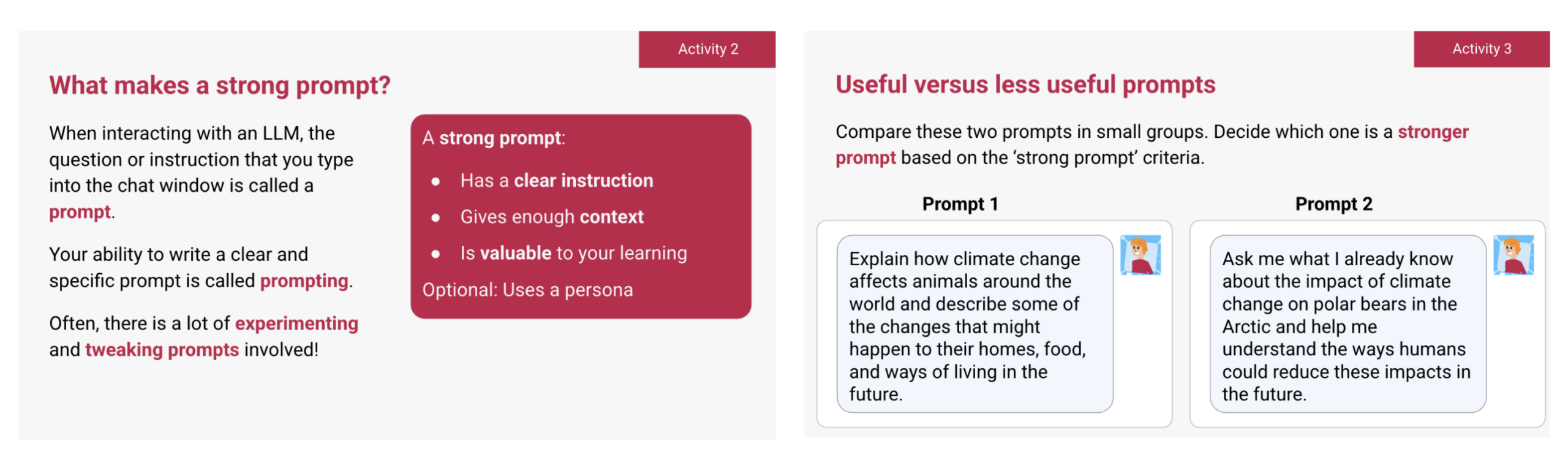
To address these concerns, the Raspberry Pi Foundation and Google DeepMind have teamed up to create a new unit of research-informed lessons on large language models (LLMs) as part of Experience AI. Rather than focusing simply on how to use AI tools, the new unit helps learners understand how LLMs work, evaluate their outputs, and use them strategically to support their own learning.

The unit, designed for 13- to 16-year-old learners, supports a learning-focused approach, drawing on metacognition, critical thinking, feedback literacy, and learning-centered prompt engineering. The five lessons in it support young people’s cognitive development, strengthen their metacognitive skills, and bolster their ability to strategically use LLMs for their learning. They draw on extensive research within Google DeepMind’s Learning team on how to scaffold around AI use to preserve ‘productive struggle’ and learner agency.

Research-informed pedagogies

Feedback literacy: Developing learners’ judgement of AI-generated outputs

The new ‘Large language models (LLMs): Using LLMs strategically for learning’ unit is grounded in learning science research, including feedback literacy. Feedback literacy refers to the skill of actively interpreting, judging and using information when learning, instead of passively receiving information. 

In the unit, learners explore three types of information, also called ‘feedback types’:

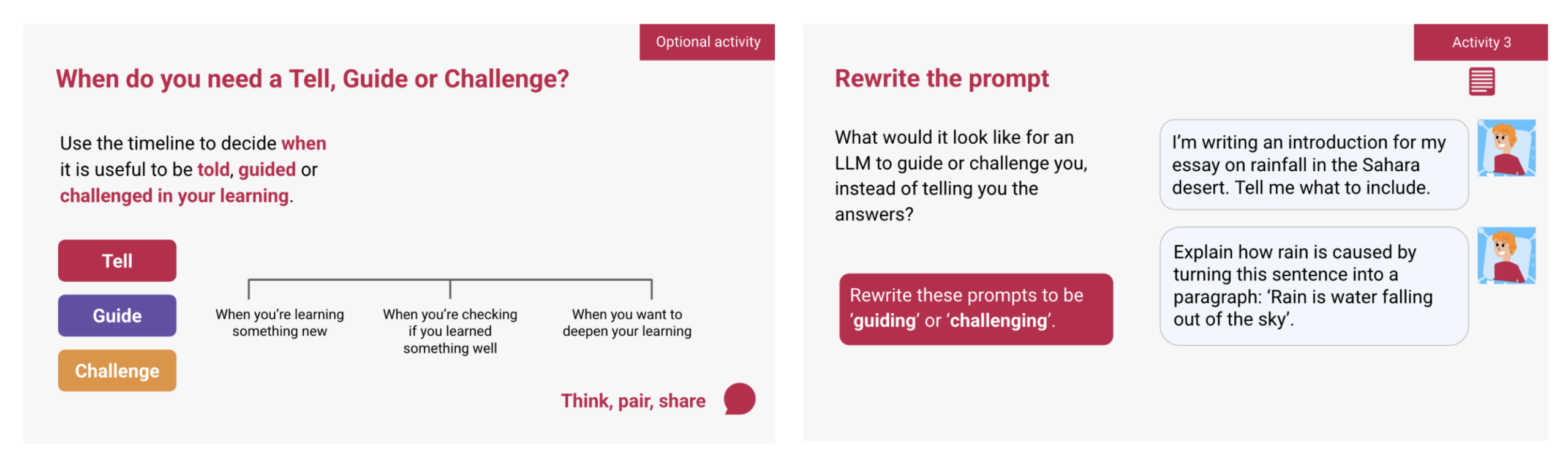
  • Telling: When someone is given the answer straight away
  • Guiding: When someone is guided with hints
  • Challenging: When someone is asked questions that make them think harder

Learners discover that deep learning requires a blend of all three feedback types. They also analyse LLM outputs and discover that LLMs default to providing the answer, usually in a ‘tell’ format. 

To help learners strategically use LLMs for their learning, they are provided with prompting strategies that elicit LLM outputs in ‘guide’ and ‘challenge’ formats. This helps learners engage more deeply with their own learning and develop higher-order thinking skills.

Prompting techniques for learning, not just answers

To help young people strategically use LLMs for their learning, the lessons include learning-centred, platform-agnostic prompting techniques. These include strategies borrowed from research papers on the most effective prompting frameworks. To make sure that the prompting strategies in the lessons remain effective over time and can be translated into different languages when we expand the resources, we did not use acronyms, unlike most popular prompting frameworks.

Building metacognition and future-ready skills

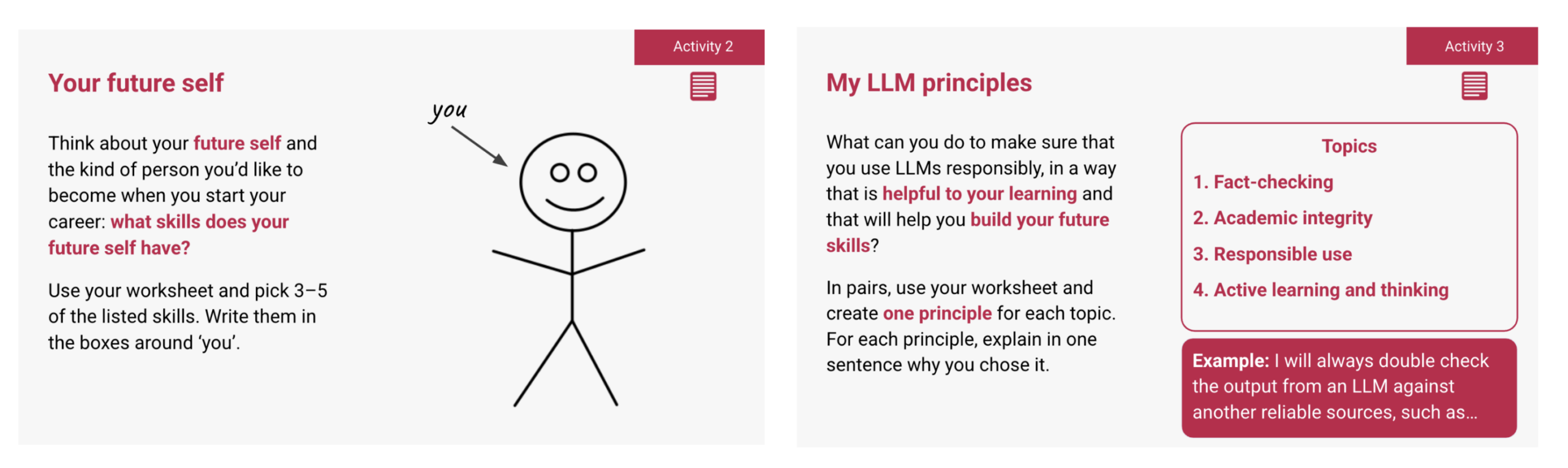
There are several industry reports highlighting the future-proof skills in the age of AI, such as problem solving, communication, critical thinking, collaboration and creativity skills. In the ‘Large language models’ unit, learners reflect on which skills they want to build and consider how their use of LLMs can support or hinder their development, helping them make responsible and intentional choices about using LLMs in ways that build their long-term capabilities rather than replace them.

There are also activities in the lesson resources that help learners understand the long-term impacts of cognitive offloading and uncritical LLM use on the development of their future skills. The resources encourage learners to stay actively engaged in their learning and be reflective of their LLM use when learning.

Uncovering LLM training data

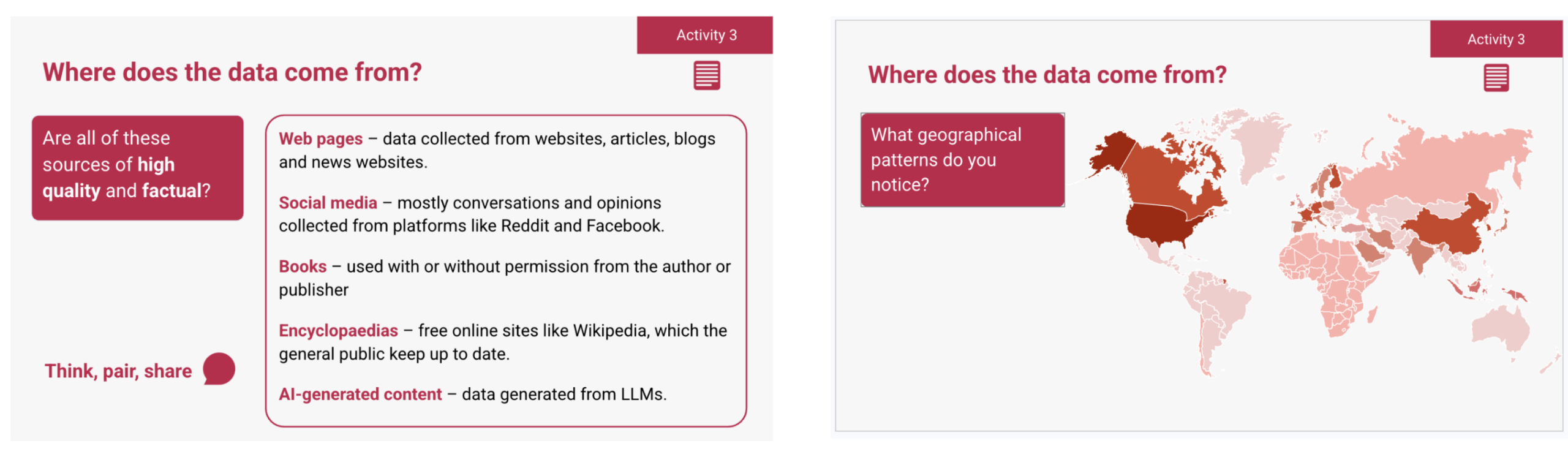
Many young people (Pew Research, 2026) use LLMs as search engines, believing that LLMs produce outputs that are always accurate. To address that misconception, the lessons include activities that question where the training data comes from, and how accurate those sources of data are. 

For example, when young people discover that a portion of data that LLMs are trained on come from social media platforms like Reddit and Facebook, they are encouraged to question the quality and factuality of these sources through classroom-wide discussions. Through discussions and thinking exercises, learners are also encouraged to question whose voices, languages, cultures and perspectives are (and are not) represented in these AI models.

Looking ahead

As AI tools become more integrated in young people’s lives, many learners, like Alex, are tempted to turn to AI tools for quick answers, convenience, and support. 

The ‘Large language models (LLMs): Using LLMs strategically for learning’ unit equips young people with the skills to use LLMs effectively, critically and strategically, in ways that are most helpful to their learning. Through research-informed lessons, they explore how LLMs are created, why their outputs are not always accurate and how to evaluate AI-generated responses. 

Just as importantly, learners are encouraged to reflect on their own use of AI: when using an LLM supports their learning, when it does not, and how they can remain in control of their thinking, learning and skills development.

With these resources, young people like Alex are not discouraged from using LLMs, but encouraged to pause, rewrite their prompts in ways that are more helpful to their learning, evaluate the outputs they receive, and stay actively involved in their own thinking. 

As we prepare young people for a future we do not yet know, the most important skill we can teach them is how to keep thinking. Who does the thinking, gets the learning.

The unit is available on the Experience AI website.

Acknowledgements

We would like to thank all the educators across South Africa, Nigeria, Kenya, the United Kingdom, India and beyond who piloted these resources and shared their thoughtful feedback. Their contributions helped shape and strengthen the unit. We are also grateful to Google DeepMind for their continued support in the development of this unit.

The post Encouraging learners to think first, prompt second: Using large language models to learn appeared first on Raspberry Pi Foundation.

Cloudflare’s 2026 Annual Founders’ Letter

Post Syndicated from Matthew Prince original https://blog.cloudflare.com/cloudflares-2026-annual-founders-letter/

This week Cloudflare celebrates our 16th birthday. Like many 16-year-olds, we find ourselves looking around at the world we grew up in and feeling caught between the past and future. Also like many 16-year-olds, we look at all the change in the world and sometimes see risk. But, on balance, we come out incredibly optimistic for what lies ahead. What drives our optimism and fear is a recognition that change involves disruption. 

The Internet is changing more today than at any point since Cloudflare launched back on September 27, 2010. Some of that change seems undoubtedly good. Some of it is upending the way we think the Internet works.

One significant change is the rate of growth of the web itself. From 2012 through 2025, the web plateaued and by some measures even shrank. That changed in mid-2025 when there was an explosion of new websites. The popular narrative is that growth has been driven by AI "slop." And, while there is some of that, that's not the majority of what we see.

Instead, AI has unleashed a new cohort of creators. Individuals with ideas but without coding skills who, aided by so-called "vibe coding" tools, are able to bring new creations to life. We're proud that the majority of these tools have Cloudflare's developer platform as their preferred deployment target. Technology at its best allows more people to express their creativity. We have front row seats to watch students around the world building apps to solve real-world problems. Startups with new business ideas getting built in record time. Today more than 7 million developers are building the future on Cloudflare’s developer platform.

The last year has also changed in terms of who — and increasingly what — is using the Internet. We originally forecast that automated traffic would pass human traffic in the second half of 2027. The rise of agents and AI crawlers pulled that date forward to May of 2026. And, if current trends continue — which, if anything, seems conservative — automated traffic will be 1,000 times human traffic in just five years. Not because we believe human traffic will decline, but because traffic from agents is exploding.

For people using them, these agents are already astonishing. Ask one to find you a flight, a contractor or a cheaper phone plan, and it will read more pages in a minute than you could in an afternoon, then come back with an answer. It does the legwork so you don't have to.

But that legwork isn’t free. If you ask your AI agent to suggest where you should go to lunch, it may survey 1,000 restaurant menus in the area only to suggest one. The one restaurant may get your business, but the other 999 had to shoulder the load of serving the agent without getting anything in return. The risk here is a tragedy of the commons problem where the users benefiting from the agents and their traffic don't bear the costs of the load they put on the system and therefore don't exercise appropriate restraint.

AI has made it easier than ever for those students and startups to build something. Agents could make it much harder for anyone to find it. Today, small businesses win customers with emotion or convenience. You patronize a certain deli because the person working the counter remembers your name or because it’s part of how you define your identity. Or you shop at a local store even though you know it doesn't have the best selection or prices but it's on your drive home.

Your agent doesn't care who remembers your name, and it isn't driving home past the local store. It goes with whatever it has the most information about, and that's usually whoever has been around the longest. The risk then is that as agents handle more and more commerce, they'll make it harder for new entrants to break in. That, in turn, is likely to lead to consolidation and a less robust business environment.

We were a new entrant once. Sixteen years ago this week, we launched Cloudflare on stage at TechCrunch Disrupt while our engineers sat in the audience fixing bugs. There were eight left when we walked on. By the time we walked off, they were fixed and we were live in five data centers on three continents. Nobody's agent would have recommended us. People took a chance on us anyway. We want the next new entrants to get the same chance.

That’s what we’re playing for. Not a future with five AI companies, but one with 500,000, spread around the world. Not one where content creators wither away and die because they can't be compensated, but one where anyone can create, reach a global audience and get paid for their work. And not one where a few mega corporations win by default, but one where new entrants with better products can serve customers well, and win.

Last year we wrote about what AI was doing to publishers. This year the same shift is reaching the restaurant and the deli. What replaces the Internet's old business model is the most interesting question of the next five years. This week, we take another swing at answering it.

Like every birthday, we're celebrating by giving presents instead of getting them, and some of the presents are for the 999 restaurants. Agents crawl the web the way search engines always have: everything, over and over, whether it's changed or not. Our data suggests more than half of what good bots fetch hasn't changed since their last visit. We've been working so that crawlers see more of the web while fetching only what's new, which cuts the load on the sites they crawl. And we're giving anyone who puts content or applications online a way to get paid when agents use what they've built.

Cloudflare's mission isn't to build a better Internet, it's to help build a better Internet. That means we can't do it alone. So this week we'll also be announcing partnerships with companies and organizations that want the same future we do.

Like other 16-year-olds in this new era of AI, we get to ship our opinions. We're shipping them for an Internet that still has room for a teenager launching their first app, the deli where they remember your name, and whoever is building the next Cloudflare.

And we’ve never been more excited about it.

Из Виетнам преди десет години

Post Syndicated from Йовко Ламбрев original https://yovko.net/vietnam-10-years-ago/

Из Виетнам преди десет години

Големите градове, където и да се намират, вероятно са най-удачните места за улична фотография. Но Азия, без съмнение е раят за уличните фотографи – с многото хора, свикнали да не разчитат на някаква дистанция или лично пространство; с цветовете; с динамиката, която е част от живота на улицата.

Преди точно десет години се озовах във Виетнам. Една страна, която буквално живее на улицата. Улицата е бизнес, прехрана, в най-буквалния смисъл – и за тези, които присядат на малко столче и хапват топла супа или някаква друга популярна улична храна, и за тези, които изкарват прехраната си, приготвяйки и предлагайки такава храна. На мотопед, велосипед или пеша, виетнамецът е на улицата повече време, отколкото вкъщи или някъде другаде. Улицата там е сцена на самия живот.

Когато снимам хора на улицата обикновено не публикувам снимките веднага и това е нарочно, за да оставя достатъчно време „уловеният“ момент да се раздалечи във времето от неговото публично разкриване. Но признавам, че цели десет години разстояние е твърде много, най-малкото защото историите зад кадрите започват да избледняват в паметта ми.

Момичето с цигарата на заглавната снимка не е виетнамка. Туристка е, от смесен произход, тръгнала на обиколка из тези места, водена от желанието да научи повече за корените си. Докато снимах кадъра по-долу, жена ми я беше заприказвала. Но не помня нищо повече от нейната история.

И двете снимки са някъде от безкрайните плажове около Да Нанг.

Из Виетнам преди десет години
Fujifilm X-Pro1 | Fujinon XF 55-200mm f/3.5-4.8 R LM OIS | Apr. 10th, 2016

Президентски избори 2026 – последна права за заявленията

Post Syndicated from Боян Юруков original https://yurukov.net/blog/2026/pr2026-stats/

До 29-ти септември в полунощ българите зад граница могат да подават заявления за гласуване в секциите в чужбина. Дори с последните промени в Изборния кодекс тези заявления са особено важни предвид рекордно ниския брой автоматично одобрени секции, с които бяхме свикнали на предходните няколко вота.

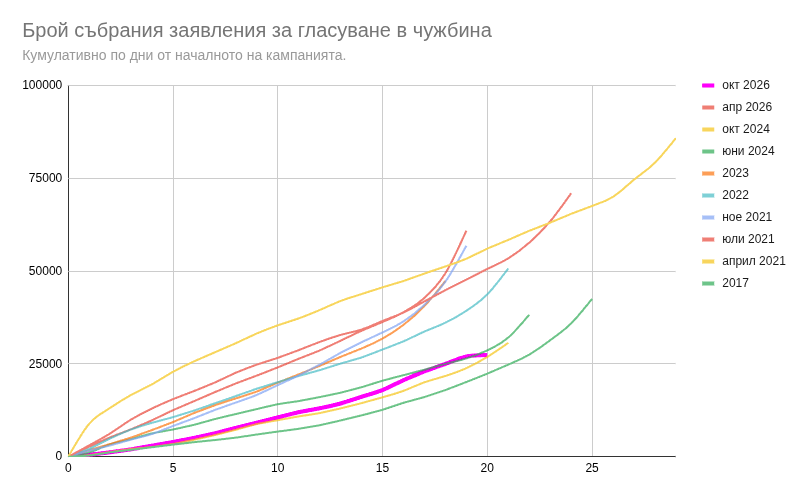
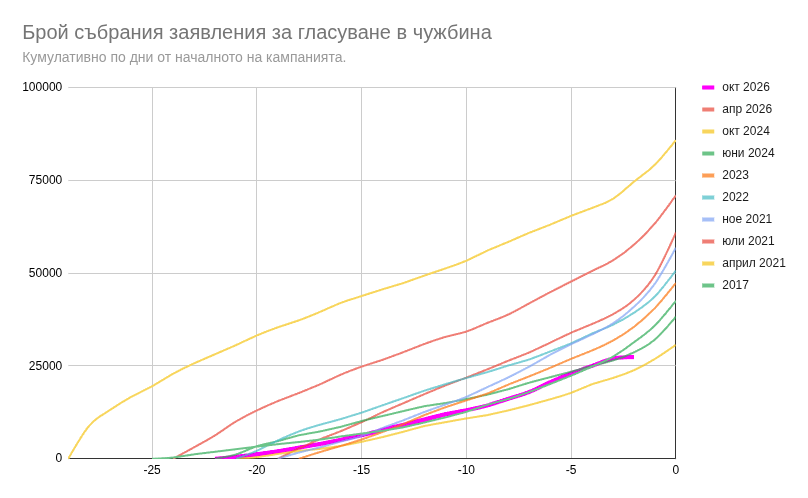
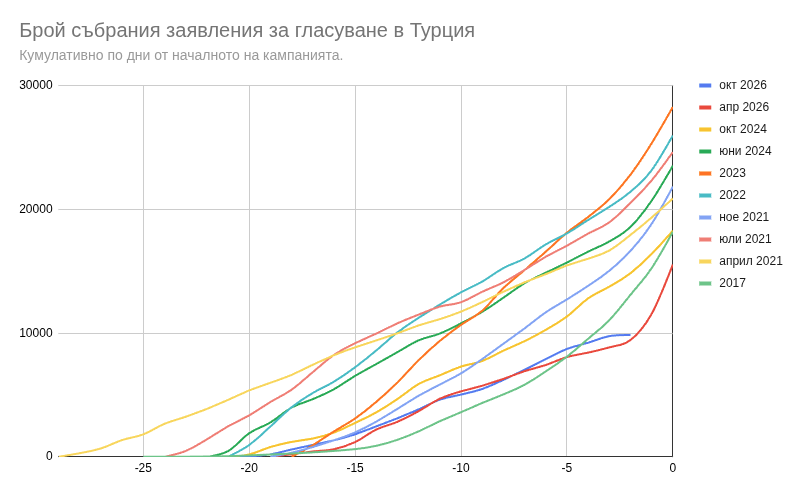
На 15-ти септември писах за напредъка в рамките на първата седмица. Преди това писах защо е важно, а през март – често за срещани грешки в попълването. Два дни и половина преди крайния срок има около 27500 подадени заявления. Това е рекордно малък брой спрямо последните десет години като изключим изборите през октомври 2024, когато имаше много автоматично обявени секции и заявленията не бяха толкова важни за отварянето им.

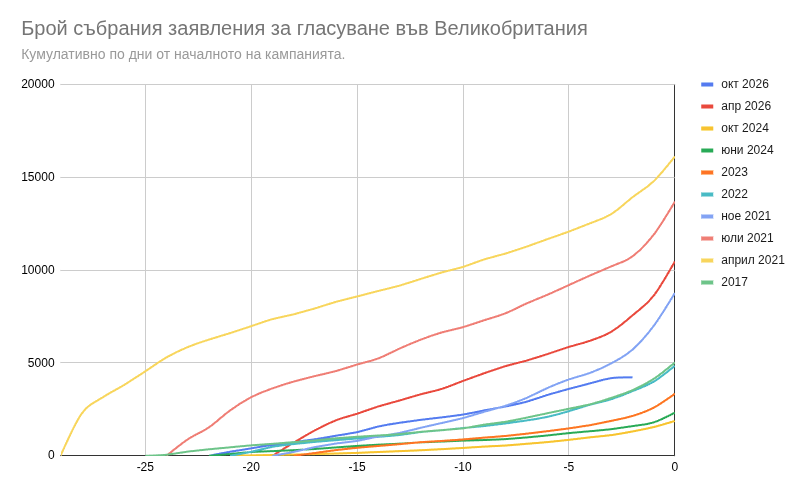
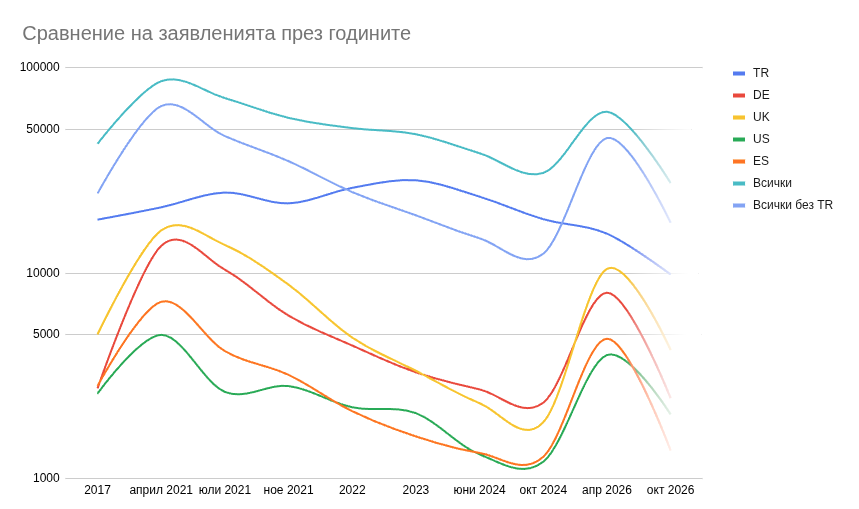
Сега обаче ситуацията е различна особено за българите извън Европейския съюз, където се отварят секции само в дипломатическите представителства или със заявление. Във Великобритания виждаме сравнително висока активност спрямо вотовете между 2022 и 2024, но двойно и тройно по-ниска от изборите през април 2026 и тези през 2021-ва.

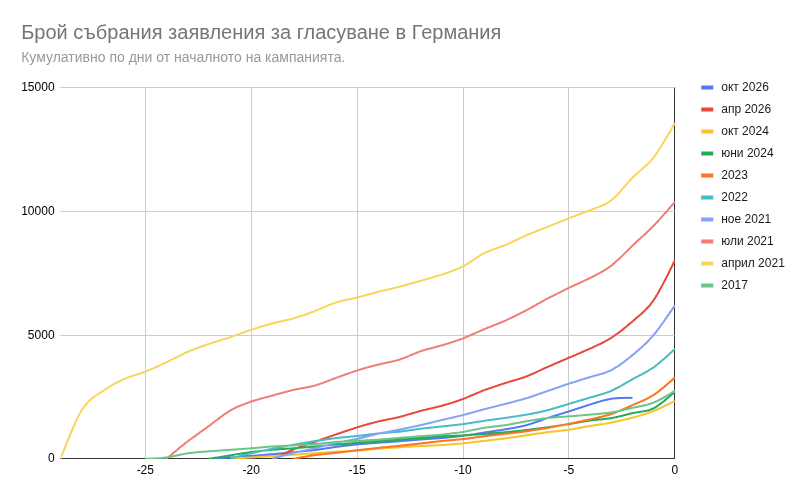
В Германия картината е подобна, но говорим за два до пет пъти по-малко от годините със силна активност. В Германия се очаква да има по-малко секции от минали години по тази причина.

Както съм показвал преди, кривите на активността на подаване на заявления в Турция традиционно са различни от всички други държави. Това е индикация за различно поведение. През двата вота тази година обаче това не е така. Освен, че има значително по-малко заявления, активността следва траекторията на всички останали български диаспори.

Предварително сравнение на броя заявления между изборите в последните 10 години показва, че ще има значително намаление не само спрямо април, но и спрямо предишните президентски избори. Вижда се ясно намалението в активността в Турция от 2023 до сега. Заради промените в Избирателния кодекс има повече активност в САЩ и Великобритания, видимо доста по-малко от април.

Когато завърши кампанията и обявят секциите зад граница, ще направя нова карта с тях и адресите им. Виждам, че МВнР готви вече своя карта, което е добре. Ще пусна и съвети и обяснение за казуси особено предвид, че има значителна несигурност за гласуването в чужбина при балотажа. Забелязах обаче и притеснителни индикации, че са си решили къде да са секциите в чужбина още преди диаспорите ни да имат възможност да заявят желанието си и да се организират. За сега това е само съмнение, което се надявам да отхвърля когато публикуват решението за секциите.

The collective thoughts of the interwebz