Tag Archives: launch

New – AWS Marketplace for Containers Anywhere to Deploy Your Kubernetes Cluster in Any Environment

Post Syndicated from Channy Yun original https://aws.amazon.com/blogs/aws/new-aws-marketplace-for-containers-anywhere-to-deploy-your-kubernetes-cluster-in-any-environment/

More than 300,000 customers use AWS Marketplace today to find, subscribe to, and deploy third-party software packaged as Amazon Machine Images (AMIs), software-as-a-service (SaaS), and containers. Customers can find and subscribe containerized third-party applications from AWS Marketplace and deploy them in Amazon Elastic Container Service (Amazon ECS) and Amazon Elastic Kubernetes Service (Amazon EKS).

Many customers that run Kubernetes applications on AWS want to deploy them on-premises due to constraints, such as latency and data governance requirements. Also, once they have deployed the Kubernetes application, they need additional tools to govern the application through license tracking, billing, and upgrades.

Today, we announce AWS Marketplace for Containers Anywhere, a set of capabilities that allows AWS customers to find, subscribe to, and deploy third-party Kubernetes applications from AWS Marketplace on any Kubernetes cluster in any environment. This capability makes the AWS Marketplace more useful for customers who run containerized workloads.

With this launch, you can deploy third party Kubernetes applications to on-premises environments using Amazon EKS Anywhere or any customer self-managed Kubernetes cluster in on-premises environments or in Amazon Elastic Compute Cloud (Amazon EC2), enabling you to use a single catalog to find container images regardless of where they eventually plan to deploy.

With AWS Marketplace for Containers Anywhere, you can get the same benefits as any other products in AWS Marketplace, including consolidated billing, flexible payment options, and lower pricing for long-term contracts. You can find vetted, security-scanned, third-party Kubernetes applications, manage upgrades with a few clicks, and track all licenses and bills. You can migrate applications between any environment without purchasing duplicate licenses. After you have subscribed to an application using this feature, you can migrate your Kubernetes applications to AWS by deploying the independent software vendor (ISV) provided Helm charts onto their Kubernetes clusters on AWS without changing their licenses.

Getting Started with AWS Marketplace for Containers Anywhere
You can get started by visiting AWS Marketplace. Easily search in Delivery methods in all products, then filter Helm Chart in the catalog to find Kubernetes-based applications that they can deploy on AWS and on premises.

If you chose to subscribe to your favorite product, you would select Continue to Subscribe.

Once you accept the seller’s end user license agreement (EULA), select Create Contract and Continue to Configuration.

You can configure the software deployment using the dropdowns. Once Fulfillment option and Software Version are selected, choose Continue to Launch.

To deploy on Amazon EKS, you have the option to deploy the application on a new EKS cluster or copy and paste commands into existing clusters. You can also deploy into self-managed Kubernetes in EC2 by clicking on the self-managed Kubernetes option in the supported services.

To deploy on-premises or in EC2, you can select EKS Anywhere and then take an additional step to request a license token on the AWS Marketplace launch page. You will then use commands provided by AWS Marketplace to download container images, Helm charts from the AWS Marketplace Elastic Container Registry (ECR), the service account creation, and the token to apply IAM Roles for Service Accounts on your EKS cluster.

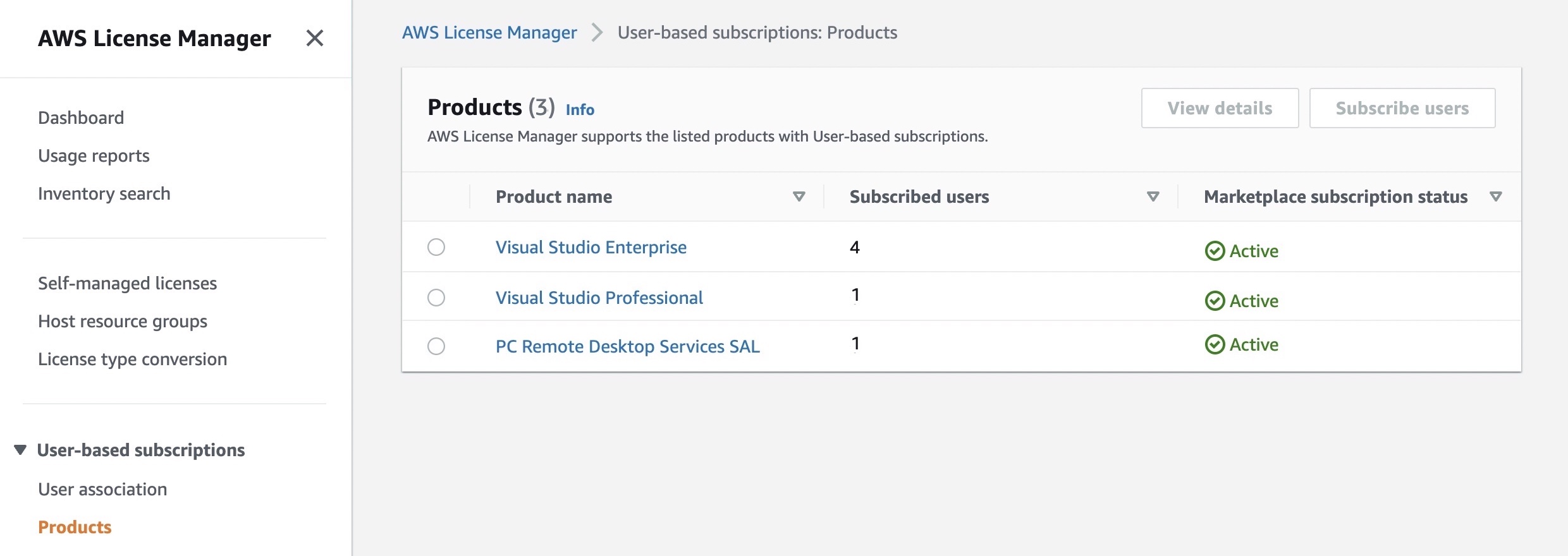
To upgrade or renew your existing software licenses, you can go to the AWS Marketplace website for a self-service upgrade or renewal experience. You can also negotiate a private offer directly with ISVs to upgrade and renew the application. After you subscribe to the new offer, the license is automatically updated in AWS License Manager. You can view all the licenses you have purchased from AWS Marketplace using AWS License Manager, including the application capabilities you’re entitled to and the expiration date.

Launch Partners of AWS Marketplace for Containers Anywhere
Here is the list of our launch partners to support an on-premises deployment option. Try them out today!

  • D2iQ delivers the leading independent platform for enterprise-grade Kubernetes implementations at scale and across environments, including cloud, hybrid, edge, and air-gapped.
  • HAProxy Technologies offers widely used software load balancers to deliver websites and applications with the utmost performance, observability, and security at any scale and in any environment.
  • Isovalent builds open-source software and enterprise solutions such as Cilium and eBPF solving networking, security, and observability needs for modern cloud-native infrastructure.
  • JFrog‘s “liquid software” mission is to power the world’s software updates through the seamless, secure flow of binaries from developers to the edge.
  • Kasten by Veeam provides Kasten K10, a data management platform purpose-built for Kubernetes, an easy-to-use, scalable, and secure system for backup and recovery, disaster recovery, and application mobility.
  • Nirmata, the creator of Kyverno, provides open source and enterprise solutions for policy-based security and automation of production Kubernetes workloads and clusters.
  • Palo Alto Networks, the global cybersecurity leader, is shaping the cloud-centric future with technology that is transforming the way people and organizations operate.
  • Prosimo‘s SaaS combines cloud networking, performance, security, AI powered observability and cost management to reduce enterprise cloud deployment complexity and risk.
  • Solodev is an enterprise CMS and digital ecosystem for building custom cloud apps, from content to crypto. Get access to DevOps, training, and 24/7 support—powered by AWS.
  • Trilio, a leader in cloud-native data protection for Kubernetes, OpenStack, and Red Hat Virtualization environments, offers solutions for backup and recovery, migration, and application mobility.

If you are interested in offering your Kubernetes application on AWS Marketplace, register and modify your product to integrate with AWS License Manager APIs using the provided AWS SDK. Integrating with AWS License Manager will allow the application to check licenses procured through AWS Marketplace.

Next, you would create a new container product on AWS Marketplace with a contract offer by submitting details of the listing, including the product information, license options, and pricing. The details would be reviewed, approved, and published by AWS Marketplace Technical Account Managers. You would then submit the new container image to AWS Marketplace ECR and add it to a newly created container product through the self-service Marketplace Management Portal. All container images are scanned for Common Vulnerabilities and Exposures (CVEs).
Finally, the product listing and container images would be published and accessible by customers on AWS Marketplace’s customer website. To learn more details about creating container products on AWS Marketplace, visit Getting started as a seller and Container-based products in the AWS documentation.

Available Now
The feature of AWS Marketplace for Containers Anywhere is available now in all Regions that support AWS Marketplace. You can start using the feature directly from the product of launch partners.
Give it a try, and please send us feedback either in the AWS forum for AWS Marketplace or through your usual AWS support contacts.

Channy

Improved, Automated Vulnerability Management for Cloud Workloads with a New Amazon Inspector

Post Syndicated from Steve Roberts original https://aws.amazon.com/blogs/aws/improved-automated-vulnerability-management-for-cloud-workloads-with-a-new-amazon-inspector/

Amazon Inspector is a service used by organizations of all sizes to automate security assessment and management at scale. Amazon Inspector helps organizations meet security and compliance requirements for workloads deployed to AWS, scanning for unintended network exposure, software vulnerabilities, and deviations from application security best practice.

Since the original launch of Amazon Inspector in 2015, vulnerability management for cloud customers has changed considerably. Over the last six years, the team delivered several new customer-requested features, including assessment reporting, support for proxy environments, and integration with Amazon CloudWatch Metrics. However, the team also recognized that there were new requirements to meet – enabling frictionless deployment at scale, support for an expanded set of resource types needing assessment, and a critical need to detect and remediate at speed. Today I’m happy to announce a new Amazon Inspector, able to meet these requirements with the following features:

  • Continual, automated assessment scans—replaces periodic, manual scanning.
  • Automated resource discovery – once enabled, the new Amazon Inspector automatically discovers all running Amazon Elastic Compute Cloud (Amazon EC2) instances and Amazon Elastic Container Registry repositories.
  • New support for container-based workloads—workloads are now assessed on both EC2 and container infrastructure.
  • Integration with AWS Organizations—allowing security and compliance teams to enable and take advantage of Amazon Inspector across all accounts in an organization.
  • Removal of the stand-alone Amazon Inspector scanning agent—assessment scanning now uses the widely deployed AWS Systems Manager agent, eliminating the need for a separate agent installation.
  • Improved risk scoring—a highly contextualized risk score is now generated for each finding by correlating Common Vulnerability and Exposures (CVE) metadata with environmental factors for resources, such as network accessibility. This makes it easier to identify the most critical vulnerabilities to address as a priority.
  • Integration with Amazon EventBridge—integrate with event management and workflow systems such as Splunk and Jira. And, you can trigger automated remediation, for example, system patching using Systems Manager or virtual machine image rebuilds using EC2 Image Builder.
  • Integration with AWS Security Hub—helping your teams to more easily identify those resources with critical vulnerabilities or deviations from security best practices.

Automatically Assessing your Workloads with Amazon Inspector
Tens of thousands of vulnerabilities exist, with new ones being discovered and made public on a regular basis. With this continually growing threat, manual assessment can lead to customers being unaware of an exposure and thus potentially vulnerable between assessments. Additionally, customers with manual processes for managing their inventories of applications resources, the deployment of stand-alone security agents on those resources, and the scheduling of periodic assessments may find the whole process to be a costly and time-consuming exercise. That’s before they have to then sift through the mass of assessment findings to determine the most critical issues to address.

With the new Amazon Inspector, all you need to do is enable the service. It will auto-discover and start continual assessment of your EC2 and your Amazon Elastic Container Registry-based container workloads to evaluate your security posture, even as the underlying resources change.

EC2 instances are discovered and assessed for unintended exposure to external networks and software vulnerabilities using the Systems Manager agent, already included by default in images provided by AWS for instance management, automated patching, and more. Container-based workloads are assessed as the images are pushed to Amazon Elastic Container Registry. Without needing additional software or agents, container images and EC2 instances are assessed in near real time when an event occurs.

Automated assessment is driven by changes in workload configuration and newly published vulnerabilities to ensure resources are only assessed when needed. The new Amazon Inspector collects events from over 50 vulnerability intelligence sources, including CVE, the National Vulnerability Database (NVD), and MITRE. Images that may be affected by a newly identified entry, for example, a new CVE notification, will be automatically rescanned. Image rescanning is enabled for 30 days from the date they are pushed to the registry. You can also enable an option to only scan on image push and not subsequently perform rescans.

Summary page for Amazon Inspector

Selecting either Accounts, Instances, or Repositories from your Dashboard page takes you to a detail summary for the selected resource. Below, I’m viewing summary data for EC2 instances across a couple of accounts.

Viewing instances scanned by Amazon Inspector across accounts

If vulnerabilities are found, you receive actionable assessment findings in a report. Starting today, these findings are summarized with enhanced risk scoring and improved resource detail to help you prioritize the most at-risk resources needing to be addressed. Also new today, the Amazon Inspector console has been redesigned to surface all findings and recommendations for remediation.

Vulnerabilities in container images are also sent to Amazon Elastic Container Registry to be summarized for the owner. And, as I noted earlier, new integrations with AWS Security Hub and Amazon EventBridge allow findings to be sent downstream for additional visibility and remediation by automated workflows. For example, automation can be created to isolate instances, trigger system patching, software image rebuilds, and more. The availability of multiple integration points makes it easier for security and application teams to collaborate to manage remediation. Below, I’m viewing findings from Amazon Inspector in the AWS Security Hub console.

Viewing findings from Amazon Inspector in the Security Hub console

Assessments can result in hundreds of thousands, or more, findings that need to be filtered and sifted to determine the most critical to action. Also available today, organizations can determine which of the findings they consider to be acceptable and mark those findings for temporary or permanent suppression. This helps reduce the volume of alerts, further assisting with prioritization and automated remediation. Suppression filters can be set from several screens. Rules specify one or more filters, such as Severity, that will cause findings that match the filters to be removed from display. When defining rules, a list is shown of the findings that will be suppressed, helping you fine-tune the filter values to match your specific needs.

Setting up suppression rules for Amazon Inspector findings

I mentioned earlier that the new Amazon Inspector implements a contextualized risk assessment score for findings. The screenshot below shows an example of Amazon Inspector‘s risk assessment score, compared to a generic Common Vulnerability Scoring System (CVSS) score. Contextual risk assessment takes into account additional factors such as accessibility to the internet and ease of exploitability to make the score more meaningful. In the image below, Amazon Inspector‘s risk assessment score is lower than the CVSS score because the attack vector requires network access. Amazon Inspector knows that the vulnerability identified in the GNOME Glib will be difficult to exploit because in this resource, there is no network access, and therefore it lowered the risk score.

Risk assessment score

Start a Free Trial with Amazon Inspector Today
The new Amazon Inspector is available now in the US East (Ohio), US East (N. Virginia), US West (Oregon), Asia Pacific (Hong Kong), Asia Pacific (Mumbai), Asia Pacific (Seoul), Asia Pacific (Singapore), Asia Pacific (Sydney), Asia Pacific (Tokyo), Canada (Central), Europe (Frankfurt), Europe (Ireland), Europe (London), Europe (Milan), Europe (Paris), Europe (Stockholm), Middle East (Bahrain), and South America (São Paulo) Regions.

Amazon Inspector offers a free 15-day trial, so you can put it to work to see how Amazon Inspector can help your security and compliance teams reduce operational complexity and cost associated with managing resource inventories, stand-alone security agents, and repetitive manual assessments.

— Steve

Announcing Pull Through Cache Repositories for Amazon Elastic Container Registry

Post Syndicated from Steve Roberts original https://aws.amazon.com/blogs/aws/announcing-pull-through-cache-repositories-for-amazon-elastic-container-registry/

Organizations, development teams, and individual developers who have chosen to use containers to host their applications may prefer, or perhaps are required, to source all images from Amazon Elastic Container Registry to take advantage of its high availability and security. To satisfy those requirements, customers have needed to take on the burden of manually pulling images from public registries into their private Amazon Elastic Container Registry repositories, and then keeping them in sync. This adds operational complexity and maintenance costs, thereby impacting developer productivity. Additionally, some registries may have limitations or restrictions on how frequently images can be downloaded. When reached, those limitations then begin impacting developers and the release velocity of their business, due to build errors when image pulls are throttled, or even rejected.

Today, we have announced pull through cache repository support in Amazon Elastic Container Registry, for publicly accessible registries that do not require authentication. Pull through cache repositories offer developers the improved performance, security, and availability of Amazon Elastic Container Registry for container images that they source from public registries. Images in pull through cache repositories are automatically kept in sync with the upstream public registries, thereby eliminating the manual work of pulling images and periodically updating.

Pull through cache repositories provide the benefits of the built-in security capabilities in Amazon Elastic Container Registry, such as AWS PrivateLink enabling you to keep all of the network traffic private, image scanning to detect vulnerabilities, encryption with AWS Key Management Service (KMS) keys, cross-region replication, and lifecycle policies. When enabled, cross-region replication is designed to automatically distribute updated images to additional Regions. All you need to do is update the pull URL so that the image is downloaded from the relevant Region.

When consuming images from pull through cache repositories, download throttling is also no longer a problem for developers, as well as the build and deployment infrastructure that supports their applications. While Amazon Elastic Container Registry is designed to automatically keep the cache repository in sync, you can also manually sync a repository at any time. And, if you wish, the automatic sync can be turned off.

Getting Started with Amazon Elastic Container Registry Pull Through Cache Repositories
Setting up pull through cache repositories is a simple process. For the following example, I’m using Amazon Elastic Container Registry Public in the South America (São Paulo) Region as my upstream registry.

First, I must modify my private registry’s settings to add a rule that references the upstream, publicly accessible registry (multiple rules can be set if I need additional upstream registries). In the Amazon Elastic Container Registry console, I begin by selecting Private registry, and then select Edit in the Pull through cache panel to change settings. This takes me to the Pull through cache configuration page, where I select Add rule.

On the Create pull through cache rule page, I choose the upstream registry, which is ECR Public in this example. I also must set a namespace that I’ll use when referring to images in my pull commands. For this example, I’ll accept the suggested namespace, ecr-public.

Configuring ECR Public as the upstream registry

Selecting Save takes me back to the Pull through cache configuration page where my newly configured rule is listed. Now, I’m ready to utilize the cache repository when pulling images.

Newly configured rule for an upstream registry

To reference an image, I must specify the namespace that I chose in the pull URL, using the URL format <accountId>.dkr.ecr.<region>.amazonaws.com/<namespace>/<sourcerepo>:<tag>. When images are pulled, the cache repository associated with the namespace is checked for the image. In my case, the cache repository doesn’t exist yet, but I don’t have to create it myself. The image is fetched from the upstream repository in the public registry associated with the namespace, and then stored in a new cache repository that is created for me automatically.

In the command prompt session below, I first authenticate with my registry, and then pull an Amazon Linux 2 image from Amazon Elastic Container Registry Public into the cache:

C:\ aws ecr get-login-password --region sa-east-1 | docker login --username AWS --password-stdin 111122223333.dkr.ecr.sa-east-1.amazonaws.com/ecr-public
Login Succeeded
C:\ docker pull 111122223333.dkr.ecr.sa-east-1.amazonaws.com/ecr-public/amazonlinux/amazonlinux:latest
latest: Pulling from ecr-public/amazonlinux/amazonlinux
e11e8d46e102: Pull complete
Digest: sha256:916dbbb288948b54c94b5b9f0769085aa601d4468d099e90d8a7da5cfa551b50
Status: Downloaded newer image for 111122223333.dkr.ecr.sa-east-1.amazonaws.com/ecr-public/amazonlinux/amazonlinux:latest
111122223333.dkr.ecr.us-west-2.amazonaws.com/ecr-public/amazonlinux/amazonlinux:latest

In my Amazon Elastic Container Registry console, a check of the Repositories page shows that a new private repository has been created containing the image I pulled, together with an indication that a pull through cache is active.

Pulled image in the cache repository

Working with images and the pull through cache repository is just as straightforward in Dockerfiles. All I need do is reference the image I need using the namespace in the pull URL. If the image is not in the cache repository, then it will be pulled and stored there for me. Cached images are checked once per 24 hours to verify if the cached image is the latest version, with the timer based off the last pull time of the cached image.

Start using Pull through Cache Repositories Today
Pull through cache repositories for Amazon Elastic Container Registry are available for you to take advantage of today in all commercial AWS Regions. There is no charge for using pull through cache repositories, only standard Amazon Elastic Container Registry pricing for storage and data transfer charges applies. You can find more details on pricing at the Amazon Elastic Container Registry pricing page. Learn more about pull through cache repositories in the Amazon Elastic Container Registry User Guide, and get started today.

— Steve

Introducing Amazon Braket Hybrid Jobs – Set Up, Monitor, and Efficiently Run Hybrid Quantum-Classical Workloads

Post Syndicated from Danilo Poccia original https://aws.amazon.com/blogs/aws/introducing-amazon-braket-hybrid-jobs-set-up-monitor-and-efficiently-run-hybrid-quantum-classical-workloads/

I find quantum computing fascinating! At its simplest level, it extends the concept of bits, that have 0 or 1 values, with quantum bits, or qubits, that can have a combination of two different (quantum) states.

Two characteristics make qubits really interesting:

  • When you look at the value of a qubit, you get only one of the two possible states with a probability that depends on how its own states are combined.
  • Multiple qubits can be “connected” together (this is called quantum entanglement) so that by changing the state of one, even just by reading its value, you alter the states of the others.

These characteristics come from low-level properties described by quantum mechanics, a fundamental theory in physics that provides a description of the physical properties of nature at atomic and subatomic scales. Luckily, we don’t need a degree in quantum mechanics to use quantum computing in the same way we don’t need to be expert in semiconductors to use an ordinary computer.

Using qubits, researchers are designing new algorithms that have the potential to be much faster than what classical computers can achieve. To help speed up scientific research and software development for quantum computing, we introduced Amazon Braket at re:Invent 2019. A fully managed quantum computing service, Amazon Braket allows you to build, test, and run quantum algorithms on simulators and quantum computers.

Hybrid Algorithms and Quantum Processing Units (QPUs)
Quantum algorithms, which would be transformational in many different areas, require the execution of hundreds of thousands to millions of quantum gates. Unfortunately, the current generation of QPUs suffer from noise, creating errors that limit operations to only a few hundreds or thousands of gates before the errors take over.

To help solve this, we can take inspiration from machine learning: instead of using fixed quantum circuits, the logic that implements the algorithm, we let the algorithm “learn” by adjusting the parameters that tune the circuit to have a better chance of solving a given problem by adapting to the noise in a particular device (think of them as “self-learning quantum algorithms”).

This is similar to computer vision: instead of hand-crafting the features to distinguish a dog from a cat (which is notoriously difficult for a computer), machine learning algorithms “learn” the right features by iteratively adjusting parameters of a neural network.

A rapidly emerging area of research in quantum computing uses QPUs, the processors used by quantum computers, in the same way as GPUs are used in machine learning: Quantum circuits are parameterized, initialized with some values, and then run on the QPU. Like the weights in a neural network, these parameters are then iteratively adjusted based on the results of the computation. These so-called hybrid algorithms rely on rapid, iterative computations between classical computers and QPUs.

Architectural diagram.

To run hybrid algorithms, you need to manually set up a classical infrastructure, install the required software, and manage the interaction between your quantum and classical compute processes for the duration of your hybrid algorithm. You then need to build custom monitoring solutions to visualize the progress of your algorithm to make sure it converges to the solution as expected or intervene if necessary to adjust the parameters of the algorithm.

Another big challenge is that QPUs are shared, inelastic resources, and you compete with others for access. This can slow down the execution of your algorithm. A single large workload from another customer can bring the algorithm to a halt, potentially extending your total runtime for hours. This is not only inconvenient but also impacts the quality of the results because today’s QPUs need periodic re-calibration, which can invalidate the progress of a hybrid algorithm. In the worst case, the algorithm fails, wasting budget and time.

Introducing Amazon Braket Hybrid Jobs
Today, I am happy to introduce Amazon Braket Hybrid Jobs, a new capability of Amazon Braket that simplifies the process of setting up, monitoring, and efficiently executing hybrid quantum-classical algorithms. Jobs are fully managed so you can avoid extensive infrastructure and software management and confidently execute your algorithms quickly and predictably, with on-demand priority access to QPUs.

When you create a job, Amazon Braket spins up the job instance (providing a CPU environment based on an Amazon Elastic Compute Cloud (Amazon EC2) instance), executes the algorithm (using quantum hardware or simulators), and releases the resources once the job is completed so that you only pay for what you use. You can also define custom metrics for algorithms, which are automatically logged by Amazon CloudWatch and displayed in near real-time in the Amazon Braket console as the algorithm runs. This provides you with live insights into how your algorithm is progressing, creating the opportunity to adjust your algorithm as necessary and innovate more quickly.

Architectural diagram.

To run hybrid algorithms as jobs, you can define your algorithm using the Amazon Braket SDK or with PennyLane, an open-source library for hybrid quantum computing. Let’s see how that works in practice with a couple of examples.

Using Amazon Braket Hybrid Jobs
Before building a trainable quantum algorithm, let’s get started by running a series of fixed quantum operations, what we’ll refer to as quantum tasks. I use Python and the Amazon Braket SDK to define a circuit that constructs what is called a bell state, a state which has a fifty-fifty chance of resolving to each of two states. It’s the quantum computing equivalent of tossing a coin.

Here’s the content of the algorithm_script.py file:

import os

from braket.aws import AwsDevice
from braket.circuits import Circuit
from braket.jobs import save_job_result


def start_here():

    print("Test job started!")

    device = AwsDevice(os.environ["AMZN_BRAKET_DEVICE_ARN"])

    results = []
    
    bell = Circuit().h(0).cnot(0, 1)
    for count in range(5):
        task = device.run(bell, shots=100)
        print(task.result().measurement_counts)
        results.append(task.result().measurement_counts)

    save_job_result({ "measurement_counts": results })
    
    print("Test job completed!")

This script uses the environment variable AMZN_BRAKET_DEVICE_ARN to instantiate the device that I select when creating the job.

Quantum computing is probabilistic. For this reason, circuits need to be evaluated multiple times to get accurate results. A single run is called a shot. The higher the number of shots, the better the accuracy of the result. In this case, the circuit is run for 100 shots.

I use the save_job_result function to store the results of my job so that I can analyze them at the end.

In the Amazon Braket console, I choose Jobs on the left panel and then Create job. To start, I give the job a name.

Console screenshot.

Then, I pass the file with the algorithm. The CPU component of the hybrid algorithm runs in a container, and I can choose which container image to use. For example, I can use a pre-built container image that includes software my algorithm depends on, such as PennyLane, TensorFlow, or PyTorch, or bring my own custom image. I select the Base container image because I don’t have external dependencies.

I leave all other settings to their default value. In this way, I use the SV1 simulator, rather than quantum hardware, to run the quantum tasks.

After some time, the job has completed, and I follow the link to the Amazon Simple Storage Service (Amazon S3) console to download the result. As expected, for each of the five tasks, the results show that the proportion of the 00 and 11 states is roughly 50:50. The proportions vary slightly because of the probabilistic nature of quantum computing.

{
    "braketSchemaHeader": {
        "name": "braket.jobs_data.persisted_job_data",
        "version": "1"
    },
    "dataDictionary": {
        "measurement_counts": [
            {
                "00": 51,
                "11": 49
            },
            {
                "00": 44,
                "11": 56
            },
            {
                "11": 51,
                "00": 49
            },
            {
                "00": 56,
                "11": 44
            },
            {
                "00": 49,
                "11": 51
            }
        ]
    },
    "dataFormat": "plaintext"
}

This example is quite basic because I am not running any classical logic other than initiating tasks. To see the real value, let’s see how it works with a hybrid algorithm where we tweak the parameters of the quantum circuit iteratively from task to task.

Using Amazon Braket Hybrid Jobs with Hybrid Algorithms
For a more advanced example, I use a well-known example of an actual hybrid algorithm, called the quantum approximate optimization algorithm (QAOA), included in the examples provided by Amazon Braket when creating a notebook from the Braket console. QAOA is a quantum algorithm that produces approximate solutions for combinatorial optimization problems. You can also find the example in this GitHub repo.

In this case, I am using QAOA to solve the Max-Cut problem: when partitioning nodes of a graph in two, what is the maximum number of edges connecting nodes between the two parts? For example, in the figure below, there are six nodes connected by eight edges. The thick yellow line partitions the nodes into two sets by crossing six edges.

In the QAOA example, the tuning of parameters that are used to run the successive rounds of quantum tasks is optimized in a classical computing environment (such as an EC2 instance) using tools like TensorFlow or PyTorch. In one of the notebook cells, I can choose which interface to use to tune the parameters as well as the other hyperparameters in a similar way to what I’d do for machine learning training.

Braket jobs then coordinates running the classical and quantum computing parts of the algorithm and the exchange of parameters and results between them. I can just sit back and relax as I watch my algorithm converge, ready to retrieve my results from S3, as before, for deeper analysis.

Running Hybrid Algorithms in Local Mode
To test and debug hybrid algorithms quickly, the Amazon Braket SDK can run jobs in local mode. With local mode, Braket jobs are run locally on your machine (for example, your laptop). In this way, you can get fast feedback and iterate quickly during the development of your algorithms.

To run a job in local mode, you just need to replace AwsQuantumJob with LocalQuantumJob. Note that AwsQuantumJob is imported from braket.aws , while LocalQuantumJob is imported from braket.jobs.local.

Availability and Pricing
Amazon Braket Hybrid Jobs are available today in all AWS Regions where Amazon Braket is available. For more information, see the AWS Regional Services List.

With Amazon Braket Hybrid Jobs, you only pay for the resources you use. There is no need to deploy, configure, and manage classical infrastructure, making it easy to experiment and improve algorithms iteratively. For more information, see the Amazon Braket pricing page.

Instead of relying on theoretical studies, you can start to use quantum computers as the primary tool to understand and improve hybrid algorithms and test their applicability for industry and research use cases. In this way, you can focus on your research and not deal with setting up and coordinating these different compute resources for your experiments.

During the development of this new capability, we talked with customers and partners to understand their needs. “As application developers, Braket Hybrid Jobs gives us the opportunity to explore the potential of hybrid variational algorithms with our customers,” says Vic Putz head of engineering at QCWare. “We are excited to extend our integration with Amazon Braket and the ability to run our own proprietary algorithms libraries in custom containers means we can innovate quickly in a secure environment. The operational maturity of Amazon Braket and the convenience of priority access to different types of quantum hardware means we can build this new capability into our stack with confidence.”

Simplify running hybrid quantum-classical workloads with Amazon Braket Hybrid Jobs.

Danilo

New – Amazon EC2 M6a Instances Powered By 3rd Gen AMD EPYC Processors

Post Syndicated from Channy Yun original https://aws.amazon.com/blogs/aws/new-amazon-ec2-m6a-instances-powered-by-3rd-gen-amd-epyc-processors/

AWS and AMD have collaborated to give customers more choice and value in cloud computing, starting with the first generation AMD EPYC™ processors in 2018 such as M5a/R5a, M5ad/R5ad, and T3a instances. In 2020, we expanded the second generation AMD EPYC™ processors to include C5a/C5ad instances and recently G4ad instances, combining the power of both second-generation AMD EPYC™ processors and AMD Radeon Pro GPUs.

Today, I am happy to announce the general availability of Amazon EC2 M6a instances featuring the 3rd Gen AMD EPYC processors, running at frequencies up to 3.6 GHz to offer up to 35 percent price performance versus the previous generation M5a instances.

You can launch M6a instances today in ten sizes in the AWS US East (N. Virginia), US West (Oregon), and Europe (Ireland) Regions as On-Demand, Spot, and Reserved Instance or as part of a Savings Plan. Here are the specs:

Name vCPUs Memory
(GiB)
Network Bandwidth
(Gbps)
EBS Throughput
(Gbps)
m6a.large 2 8 Up to 12.5 Up to 6.6
m6a.xlarge 4 16 Up to 12.5 Up to 6.6
m6a.2xlarge 8 32 Up to 12.5 Up to 6.6
m6a.4xlarge 16 64 Up to 12.5 Up to 6.6
m6a.8xlarge 32 128 12.5 6.6
m6a.12xlarge 48 192 18.75 10
m6a.16xlarge 64 256 25 13.3
m6a.24xlarge 96 384 37.5 20
m6a.32xlarge 128 512 50 26.6
m6a.48xlarge 192 768 50 40

Compared to M5a instances, the new M6a instances offer:

  • Larger instance size with 48xlarge with up to 192 vCPUs and 768 GiB of memory, enabling you to consolidate more workloads on a single instance. M6a also offers Elastic Fabric Adapter (EFA) support for workloads that benefit from lower network latency and highly scalable inter-node communication, such as HPC and video processing.
  • Up to 35 percent higher price performance per vCPU versus comparable M5a instances, up to 50 Gbps of networking speed, and up to 40 Gbps bandwidth of Amazon EBS, more than twice that of M5a instances.
  • Always-on memory encryption and support for new AVX2 instructions for accelerating encryption and decryption algorithms

M6a instances expand the 6th generation general purpose instances portfolio and provide high-performance processing at 10 percent lower cost over comparable x86 instances. M6a instances are a good fit for running general-purpose workloads such as web servers,  application servers, and small data stores.

To learn more, visit the M6a instances page. Please send feedback to [email protected], AWS forum for EC2, or through your usual AWS Support contacts.

— Channy

New – Amazon EC2 G5g Instances Powered by AWS Graviton2 Processors and NVIDIA T4G Tensor Core GPUs

Post Syndicated from Channy Yun original https://aws.amazon.com/blogs/aws/new-amazon-ec2-g5g-instances-powered-by-aws-graviton2-processors-and-nvidia-t4g-tensor-core-gpus/

AWS Graviton2 processors are custom-designed by AWS to enable the best price performance in Amazon EC2. Thousands of customers are realizing significant price performance benefits for a wide variety of workloads with Graviton2-based instances.

Today, we are announcing the general availability of Amazon EC2 G5g instances that extend Graviton2 price-performance benefits to GPU-based workloads including graphics applications and machine learning inference. In addition to Graviton2 processors, G5g instances feature NVIDIA T4G Tensor Core GPUs to provide the best price performance for Android game streaming, with up to 25 Gbps of networking bandwidth and 19 Gbps of EBS bandwidth.

These instances provide up to 30 percent lower cost per stream per hour for Android game streaming than x86-based GPU instances. G5g instances are also ideal for machine learning developers who are looking for cost-effective inference, have ML models that are sensitive to CPU performance, and leverage NVIDIA’s AI libraries.

G5g instances are available in the six sizes as shown below.

Instance Name vCPUs Memory (GB) NVIDIA T4G Tensor Core GPU GPU Memory (GB) EBS Bandwidth (Gbps) Network Bandwidth (Gbps)
g5g.xlarge 4 8 1 16 Up to 3.5 Up to 10
g5g.2xlarge 8 16 1 16 Up to 3.5 Up to 10
g5g.4xlarge 16 32 1 16 Up to 3.5 Up to 10
g5g.8xlarge 32 64 1 16 9 12
g5g.16xlarge 64 128 2 32 19 25
g5g.metal 64 128 2 32 19 25

These instances are a great fit for many interesting types of workloads. Here are a few examples:

  • Streaming Android gaming—With G5g instances, Android game developers can build natively on Arm-based GPU instances without the need for cross-compilation or emulation on x86-based instances. They can encode the rendered graphics and stream the game over the network to a mobile device. This helps simplify development efforts and time and lowers the cost per stream per hour by up to 30 percent.
  • ML Inference —G5g instances are also ideal for machine learning developers who are looking for cost-effective inference, have ML models that are sensitive to CPU performance, and leverage NVIDIA’s AI If you don’t have any dependencies on NVIDIA software, you may use Inf1 instances, which deliver up to 70 percent lower cost-per-inference than G4dn instances.
  • Graphics rendering—G5g instances are the most cost-effective option for customers with rendering workloads and dependencies on NVIDIA libraries. These instances also support rendering applications and use cases that leverage industry-standard APIs such as OpenGL and Vulkan.
  • Autonomous Vehicle Simulations—Several of our customers are designing and simulating autonomous vehicles that include multiple real-time sensors. They can use ray tracing to simulate sensor input in real time.

The instances are compatible with a very long list of graphical and machine learning libraries on Linux, including NVENC, NVDEC, nvJPEG, OpenGL, Vulkan, CUDA, CuDNN, CuBLAS, and TensorRT.

Available Now
The new G5g instances are available now, and you can start using them today in the US East (N. Virginia), US West (Oregon), and Asia-Pacific (Seoul, Singapore and Tokyo) Regions in On-Demand, Spot, Savings Plan, and Reserved Instance form. To learn more, see the EC2 pricing page.

G5g instances are available now in AWS Deep Learning AMIs with NVIDIA drivers and popular ML frameworks, Amazon Elastic Container Service (Amazon ECS), or Amazon Elastic Kubernetes Service (Amazon EKS) clusters for containerized ML applications.

You can send feedback to the AWS forum for Amazon EC2 or through your usual AWS Support contacts.

Channy

New for AWS Compute Optimizer – Resource Efficiency Metrics to Estimate Savings Opportunities and Performance Risks

Post Syndicated from Danilo Poccia original https://aws.amazon.com/blogs/aws/new-for-aws-compute-optimizer-resource-efficiency-metrics-to-estimate-savings-opportunities-and-performance-risks/

By applying the knowledge drawn from Amazon’s experience running diverse workloads in the cloud, AWS Compute Optimizer identifies workload patterns and recommends optimal AWS resources.

Today, I am happy to share that AWS Compute Optimizer now delivers resource efficiency metrics alongside its recommendations to help you assess how efficiently you are using AWS resources:

  • A dashboard shows you savings and performance improvement opportunities at the account level. You can dive into resource types and individual resources from the dashboard.
  • The Estimated monthly savings (On-Demand) and Savings opportunity (%) columns estimate the possible savings for over-provisioned resources. You can sort your recommendations using these two columns to quickly find the resources on which to focus your optimization efforts.
  • The Current performance risk column estimates the bottleneck risk with the current configuration for under-provisioned resources.

These efficiency metrics are available for Amazon Elastic Compute Cloud (Amazon EC2), AWS Lambda, and Amazon Elastic Block Store (EBS) at the resource and AWS account levels.

For multi-account environments, Compute Optimizer continuously calculates resource efficiency metrics at individual account level in an AWS organization to help identify teams with low cost-efficiency or possible performance risks. This lets you to create goals and track progress over time. You can quickly understand just how resource-efficient teams and applications are, easily prioritize recommendation evaluation and adoption by engineering team, and establish a mechanism that drives a cost-aware culture and accountability across engineering teams.

Using Resource Efficiency Metrics in AWS Compute Optimizer
You can opt in using the AWS Management Console or the AWS Command Line Interface (CLI) to start using Compute Optimizer. You can enroll the account that you’re currently signed in to or all of the accounts within your organization. Depending on your choice, Compute Optimizer analyzes resources that are in your individual account or for each account in your organization, and then generates optimization recommendations for those resources.

To see your savings opportunity in Compute Optimizer, you should also opt in to AWS Cost Explorer and enable the rightsizing recommendations in the AWS Cost Explorer preferences page. For more details, see Getting started with rightsizing recommendations.

I already enrolled some time ago, and in the Compute Optimizer console I see the overall savings opportunity for my account.

Console screenshot.

Below that, I have a recap of the performance improvement opportunity. This includes an overview of the under-provisioned resources, as well as the performance risks that they pose by resource type.

Console screenshot.

Let’s dive into some of those savings. In the EC2 instances section, Compute Optimizer found 37 over-provisioned instances.

Console screenshot.

I follow the 37 instances link to get recommendations for those resources, and then sort the table by Estimated monthly savings (On-Demand) descending.

Console screenshot.

On the right, in the same table, I see which is the current instance type, the recommended instance type based on Computer Optimizer estimates, the difference in pricing, and if there are platform differences between the current and recommended instance types.

Console screenshot.

I can select each instance to further drill down into the metrics collected, as well as the other possible instance types suggested by Computer Optimizer.

Back to the Compute Optimizer Dashboard, in the Lambda functions section, I see that eight functions have under-provisioned memory.

Console screenshot.

Again, I follow the 8 functions link to get recommendations for those resources, and then sort the table by Current performance risk. In my case, the risk is always low, but different values can help prioritize your activities.

Console screenshot.

Here, I see the current and recommended configured memory for those Lambda functions. I can select each function to get a view of the metrics collected. Choosing the memory allocated to Lambda functions is an optimization process that balances speed (duration) and cost. See Profiling functions with AWS Lambda Power Tuning in the documentation for more information.

Availability and Pricing
You can use resource efficiency metrics with AWS Compute Optimizer in any AWS Region where it is offered. For more information, see the AWS Regional Services List. There is no additional charge for this new capability. See the AWS Compute Optimizer pricing page for more information.

This new feature lets you implement a periodic workflow to optimize your costs:

  • You can start by reviewing savings opportunities for all of your accounts to identify which accounts have the highest savings opportunity.
  • Then, you can drill into those accounts with the highest savings opportunity. You can refer to the estimated monthly savings to see which recommendations can drive the largest absolute cost impact.
  • Finally, you can communicate optimization opportunities and priority order to the teams using those accounts.

Start using AWS Compute Optimizer today to find and prioritize savings opportunities in your AWS account or organization.

Danilo

New for AWS Compute Optimizer – Enhanced Infrastructure Metrics to Extend the Look-Back Period to Three Months

Post Syndicated from Danilo Poccia original https://aws.amazon.com/blogs/aws/new-for-aws-compute-optimizer-enhanced-infrastructure-metrics-to-extend-the-look-back-period-to-three-months/

By using machine learning to analyze historical utilization metrics, AWS Compute Optimizer recommends optimal AWS resources for your workloads to reduce costs and improve performance. Over-provisioning resources can lead to unnecessary infrastructure costs, and under-provisioning resources can lead to poor application performance. Compute Optimizer helps you choose optimal configurations for three types of AWS resources: Amazon Elastic Compute Cloud (Amazon EC2) instances, Amazon Elastic Block Store (EBS) volumes, and AWS Lambda functions, based on your utilization data. Today, I am happy to share that AWS Compute Optimizer now supports recommendation preferences where you can opt in or out of features that enhance resource-specific recommendations.

For EC2 instances, AWS Compute Optimizer analyzes Amazon CloudWatch metrics from the past 14 days to generate recommendations. For this reason, recommendations weren’t relevant for a subset of workloads that had monthly or quarterly patterns. For those workloads, you had to look for unoptimized resources and determine the right resource configurations over a longer period of time. This can be time-consuming and requires deep cloud expertise, especially for large organizations.

With the launch of recommendation preferences, Compute Optimizer now offers enhanced infrastructure metrics, a new paid recommendation preference feature that enhances recommendation quality for EC2 instances and Auto Scaling groups. Activating it extends the metrics look-back period to three months. You can activate enhanced infrastructure metrics for individual resources or at the AWS account or AWS organization level.

Let’s see how that works in practice.

Using Enhanced Infrastructure Metrics with AWS Compute Optimizer
Here, I am using the management account of my AWS organization to see organization-level preferences. In the left pane of the Compute Optimizer console, I choose Accounts. Here, there is a new section to set up Organization level preferences for enhanced infrastructure metrics. The console warns me that this is a paid feature.

I want to activate enhanced infrastructure metrics for EC2 instances running in the US East (N. Virginia) Region for all accounts in my organization. I choose the Edit button. For Resource type, I select EC2 instances. For Region, I select US East (N. Virginia). I check that the flag is active and save.

Console screenshot.

If I select one of the AWS accounts on this page, I can choose View preferences and override the setting for that specific account. For example, I can disable accounts that I use for testing because EC2 instances there are created automatically by a CI/CD pipeline and are usually terminated within a few hours.

Console screenshot.

In the console Dashboard, I look at the overall recommendations for EC2 instances and Auto Scaling groups.

Console screenshot.

In the EC2 instances box, I choose View recommendations and then one of the instances. With the Edit button, I can activate or inactivate enhanced infrastructure metrics for this specific resource. Here, I can also see if, considering all settings at organization, account, and resource level, enhanced infrastructure metrics is actually active or not for this specific EC2 instance. I see Active (pending) here because I’ve just changed the setting and it may take a few hours for Compute Optimizer to consider my updated preferences in its recommendations.

Console screenshot.

Below, I see the recommended options for the instance. Considering the current workload, I should change instance type and size from c3.2xlarge to r5d.large and save some money.

Console screenshot.

In a few hours, Compute Optimizer updates its recommendations based on the latest three months of CloudWatch metrics. In this way, I get better suggestions for workloads that have monthly or quarterly activities.

Availability and Pricing
You can activate enhanced infrastructure metrics in the AWS Compute Optimizer account preferences page for all the accounts in your organization or for individual accounts. If you need more granular controls, you can activate (or deactivate) for an individual resource (Auto Scaling group or EC2 instance) in the resource detail page. You can also activate enhanced infrastructure metrics using the AWS Command Line Interface (CLI) or AWS SDKs.

Default preferences in Compute Optimizer (with 14-day look-back) are free. Enabling enhanced infrastructure metrics costs $0.0003360215 per resource per hour and is charged based on the number of hours per month the resource is running. For a resource running a full 31-day month, that’s $0.25. For more information, see the Compute Optimizer pricing page.

Use enhanced infrastructure metrics to generate recommendations with Compute Optimizer based on metrics from the past three months.

Danilo

re:Invent Session Preview – Under the Hood at Amazon Ads

Post Syndicated from Jeff Barr original https://aws.amazon.com/blogs/aws/reinvent-session-preview-under-the-hood-at-amazon-ads/

My colleagues have spent months creating, reviewing, and improving the content for their upcoming AWS re:Invent sessions. While I do my best not to play favorites, I would like to tell you about one that recently caught my eye!

Session ADM301 (Under the Hood at Amazon Ads) takes place on Tuesday, November 30th at 2 PM. In the session, my colleagues will introduce Amazon Ads, outline the challenges that come with building an advertising system at scale, and then show how they solved those challenges using multiple AWS services. I was able to review a near-final version of their presentation and this post is based on what I learned from that review.

Amazon Ads uses an omnichannel strategy with four elements: building awareness, increasing consideration, engaging shoppers, and driving purchases. Using the well-known “start from the customer and work backwards” model that we use at Amazon, they identified three distinct customer types and worked to design a system that would address their needs. The customer types were:

  • Advertisers running campaigns
  • Third-party partners who use Amazon Ads APIs to build tools & services
  • Shoppers on a purchase journey

Advertisers and third-party developers wanted an experience that spanned both UIs and programmatic interfaces, encompassing campaign management, budgeting, ad serving, a data lake for ad events, and machine learning to improve ad selection & relevance.

Scaling is a really interesting problem, with challenges around performance, storage, availability, cost, and effectiveness. In addition to handling hundreds of millions of ad requests per second (trillions of ads per day) within a latency budget of 120 ms, the ad server must be able to:

  • Track tens of billions of campaign objects, with overall storage measured in hundreds of petabytes
  • Deliver > 99.9999% availability
  • Handle peak events such as Prime Day automatically
  • Run economically and enforce advertiser budgets in near real-time
  • Deliver highly relevant ads using predictions from hundreds of machine learning models

As just one example of what it takes to handle a workload of this magnitude, they needed a caching system capable of handling 500 million requests per second!

As is often the case, the system went through multiple iterations before it reached its current form, and is still under active development. The presentation recaps the journey that the team went through, with architectural snapshots and performance metrics for each iteration.

The presentation wraps up by discussing some of the ways that they were able to apply machine learning at scale. For example, to select the right ad for each request, Amazon Ads uses deep learning models to predict relevant ads to show shoppers, predict whether a shopper will click or purchase, and allocate and price an ad. In order to do this, they needed to be able to score thousands of ads per request within a 20 ms window at over 100K transactions per second, all across hundreds of models that each required different hardware and software optimizations.

To handle this workload they built a micro-service inferencing architecture on top of Amazon Elastic Container Service (Amazon ECS) and AWS App Mesh with specific hardware and software optimizations for each type of inference model. For low-latency inferencing the Ads team began with a CPU-based solution and then moved to GPUs to reduce prediction time even as complexity and the number of models grew.

This looks like a very interesting session and I hope that you will be able to attend in person or to watch it online as part of virtual re:Invent.

Jeff;

Top Announcements of AWS re:Invent 2021

Post Syndicated from AWS News Blog Team original https://aws.amazon.com/blogs/aws/top-announcements-of-aws-reinvent-2021/

Welcome to AWS re:Invent! From Nov. 29-Dec. 3, 2021, we’ll update this page daily with the most noteworthy launches from our biggest event of the year. AWS Chief Evangelist Jeff Barr and our team of AWS developer advocates from around the globe share the news and offer helpful tips for getting started with all the latest AWS releases.

More ways to learn:

(This post was last updated: 12:42 a.m., PST, Nov. 29, 2021.)


Quick category links:
Internet of Things |
Security

Internet of Things

Preview – AWS IoT RoboRunner for Building Robot Fleet Management Applications

AWS IoT RoboRunner is a new robotics service that makes it easier for enterprises to build and deploy applications that help fleets of robots work seamlessly together.

Security

Amazon CodeGuru Reviewer Introduces Secrets Detector to Identify Hardcoded Secrets and Secure Them with AWS Secrets Manager
The new Amazon CodeGuru Reviewer Secrets Detector is an automated tool that helps developers detect secrets in source code or configuration files, such as passwords, API keys, SSH keys, and access tokens.

Back to Top

Preview – AWS IoT RoboRunner for Building Robot Fleet Management Applications

Post Syndicated from Channy Yun original https://aws.amazon.com/blogs/aws/preview-aws-iot-roborunner-for-building-robot-fleet-management-applications/

In 2018, we launched AWS RoboMaker, a cloud-based simulation service that enables robotics developers to run, scale, and automate simulation without managing any infrastructure. As we worked with robot developers and operators, we have repeatedly heard that they face challenges in operating different robot types in their automation efforts, including autonomous guided vehicles (AGV), autonomous mobile vehicles (AMR), and robotic manipulators.

Many customers choose different types of robots – often from different vendors in a single facility. Robot operator want to access the unified data required to build applications that work across a fleet of robots. However, when a new robot is added to an autonomous operation, complex and time-consuming software integration work is required to connect the robot control software to work management systems.

Today, we are launching a public preview of AWS IoT RoboRunner, a new robotics service that makes it easier for enterprises to build and deploy applications that help fleets of robots work seamlessly together. AWS IoT RoboRunner lets you connect your robots and work management systems, thereby enabling you to orchestrate work across your operation through a single system view.

This new service builds on the same technology used in Amazon fulfillment centers, and now we are excited to make it available to all developers to build advanced robotics applications for their businesses.

AWS IoT RoboRunner in Action
You can create a single facility (e.g., site name and location) in the AWS Management Console to get started with AWS IoT RoboRunner. Behind the scenes, AWS IoT RoboRunner automatically creates centralized repositories for storing facility, robot, destination, and task data. Then, the robots working on this site are setup as a “Fleet”, and each individual robot is setup in AWS IoT RoboRunner as a “Robot” within a fleet.

You can download the Fleet Gateway Library to develop integration codes for connecting your robots and WMS systems with AWS IoT RoboRunner to send and receive data from individual robot fleets. You can also develop the first robotics management application using the Task Manager Library and deploy Task Manager codes as an AWS Lambda function and Fleet Gateway codes on-premises as an AWS IoT Greengrass component.

To enable a single-system view of the robots, status of the systems, and progress of tasks on the same interface, AWS IoT RoboRunner provides APIs that let you build a user application. AWS IoT RoboRunner provides sample applications for allocating tasks to robot fleets so that you can get started quickly. You can customize the task allocation code with business requirements that align to your use case.

Learn more by reading Getting started with AWS IoT RoboRunner in the AWS IoT RoboRunner Developer Guide. Watch a quick introductory video about AWS IoT RoboRunner for more information.

Try Public Preview Now
AWS IoT RoboRunner is now available in public preview, and you can start using them today in the US East (N. Virginia) and Europe (Frankfrut) Regions. There will be no additional cost to use this feature during the preview period.

You can send feedback to [email protected], the AWS forum for AWS IoT, or through your usual AWS Support contacts.

Channy

AWS Free Tier Data Transfer Expansion – 100 GB From Regions and 1 TB From Amazon CloudFront Per Month

Post Syndicated from Jeff Barr original https://aws.amazon.com/blogs/aws/aws-free-tier-data-transfer-expansion-100-gb-from-regions-and-1-tb-from-amazon-cloudfront-per-month/

The AWS Free Tier has been around since 2010 and allows you to use generous amounts of over 100 different AWS services. Some services offer free trials, others are free for the first 12 months after you sign up, and still others are always free, up to a per-service maximum. Our intent is to make it easy and cost-effective for you to gain experience with a wide variety of powerful services without having to pay any usage charges.

Free Tier Data Transfer Expansion
Today, as part of our long tradition of AWS price reductions, I am happy to share that we are expanding the Free Tier with additional data transfer out, as follows:

Data Transfer from AWS Regions to the Internet is now free for up to 100 GB of data per month (up from 1 GB per region). This includes Amazon EC2, Amazon S3, Elastic Load Balancing, and so forth. The expansion does not apply to the AWS GovCloud or AWS China Regions.

Data Transfer from Amazon CloudFront is now free for up to 1 TB of data per month (up from 50 GB), and is no longer limited to the first 12 months after signup. We are also raising the number of free HTTP and HTTPS requests from 2,000,000 to 10,000,000, and removing the 12 month limit on the 2,000,000 free CloudFront Function invocations per month. The expansion does not apply to data transfer from CloudFront PoPs in China.

This change is effective December 1, 2021 and takes effect with no effort on your part. As a result of this change, millions of AWS customers worldwide will no longer see a charge for these two categories of data transfer on their monthly AWS bill. Customers who go beyond one or both of these allocations will also see a reduction in their overall data transfer charges.

Your applications can run in any of 21 AWS Regions with a total of 69 Availability Zones (with more of both on the way), and can make use of the full range of CloudFront features (including SSL support and media streaming), and over 300 CloudFront PoPs, all connected across a dedicated network backbone. The network was designed with performance as a key driver, and is expanded continuously in order to meet the ever-growing needs of our customers. It is global, fully redundant, and built from parallel 100 GbE metro fibers linked via trans-oceanic cables across the Atlantic, Pacific, and Indian Oceans, as well as the Mediterranean, Red Sea, and South China Seas.

Jeff;

Announcing AWS Graviton2 Support for AWS Fargate – Get up to 40% Better Price-Performance for Your Serverless Containers

Post Syndicated from Channy Yun original https://aws.amazon.com/blogs/aws/announcing-aws-graviton2-support-for-aws-fargate-get-up-to-40-better-price-performance-for-your-serverless-containers/

AWS Graviton2 processors are custom-built by AWS using 64-bit Arm Neoverse cores to deliver the best price-performance for your cloud workloads running in Amazon Elastic Compute Cloud (Amazon EC2). They provide up to 40 percent better price-performance over comparable x86-based instances for a wide variety of workloads. Many of our customers such as Intuit, SmugMug, Snap, Formula One, and Honeycomb.io use Graviton2-based instances to run their workloads for better price-performance in Amazon EC2 for their workloads and enjoy better price-performance.

Many fully-managed services including Amazon Relational Database Service (Amazon RDS), Amazon Aurora, Amazon ElastiCache, Amazon OpenSearch Service (successor of Amazon Elasticsearch Service), and Amazon EMR have extended the benefits of Graviton2 to their customers. Recently, we also extended the benefits of Graviton2 to our serverless computing customers using AWS Lambda. AWS Lambda functions powered by AWS Graviton2 offer up to 19 percent better performance at 20 percent lower cost compared to running them on x86-based instances.

Today, I am happy to announce AWS Graviton2 support for AWS Fargate with Amazon Elastic Container Service (Amazon ECS). AWS Fargate is the serverless compute engine for containers on AWS that removes the need to provision, scale, and manage servers. AWS Fargate powered by AWS Graviton2 processors delivers up to 40 percent better price-performance at 20 percent lower cost over comparable Intel x86-based Fargate for containerized applications.

With Graviton2 support for Fargate, you get the serverless benefits of Fargate, the price-performance advantages of Graviton2, and the flexibility to use a container compute processor of your choice. You can upload multi-architecture images or images that have ARM64 in your image manifest with your container registry, such as Amazon Elastic Container Registry (Amazon ECR). When orchestrated via Amazon ECS, Fargate will run these applications on Graviton2-powered compute.

Multi-architecture container images consist of two main parts: layers and a manifest. Each container image has one or more layers of file system content. The manifest specifies the groups of layers that make up the image as well as its runtime characteristics, either ARM64 and X86_64.

This allows you to have the same repository that supports multiple architectures, and the container runtime does the work of selecting which image layers to pull based on the system architecture, including ARM64. To learn more, visit Introducing multi-architecture container images for Amazon ECR.

Getting Started With Fargate powered by Graviton2 processors
To enable Graviton2 support for Fargate, you opt in to Arm compatibility in your ECS cluster. In the ECS console, when creating a new task definition, you can simply select Linux/ARM64 in the Operating system/Architecture dropdown list.

The following is an example of a task definition containing a simple container using the Fargate launch type with an optional parameter cpuArchitecture to ARM64. (The default value is X86_64).

{
 "family": "bb-arm64",
 "networkMode": "awsvpc",
 "containerDefinitions": [
    {
        "name": "sleep",
        "image": "arm64v8/busybox",
        "cpu": 100,
        "memory": 100,
        "essential": true,
        "command": [ "echo hello" ],
        "entryPoint": [ "sh", "-c" ]
    }
 ],
 "requiresCompatibilities": [ "FARGATE" ],
 "cpu": "1 vCpu",
 "memory": "3 GB",
 "runtimePlatform": { "cpuArchitecture": "ARM64" },
 "executionRoleArn": "arn:aws:iam::1234567890:role/ecsTaskExecutionRole"
}

When you run your tasks with the Graviton-based compute, you can see the value of Linux/ARM64 for Operating system/Architecture in each task detail page of the ECS console.

With AWS Command-line Interface (AWS CLI), you simply find which architecture is used in your ECS cluster.

$ aws ecs describe-tasks \
    --cluster MyCluster \
    --tasks arn:aws:ecs:us-west-2:123456789012:task/MyCluster/1234567890123456789

Here is an output of CPU architecture in the response of DescribeTasks or will have it as a filter to ListTasks.

{ 
    "tasks": [
    {
        "family": "...",
        "attributes": [
            {
                "name": "ecs.cpu-architecture",
                "value": "arm64"
            }
        ]
    }]
}

Migration to Gaviton2-based Fargate Containers
You get all the same Fargate features you’re used to for your containerized applications with Intel x86-based offering. With logging, monitoring, tracing, extensible ephemeral storage by Amazon Elastic File System (Amazon EFS) file systems, and more, you can easily migrate your applications to Graviton2-based Fargate containers. You get out-of-the-box logging via Amazon CloudWatch logs and metrics via Container Insights and AWS Distro for Open Telemetry agent as a sidecar to enable traces via ServiceLens.

With Amazon ECS, you can use Amazon ECS Exec for break-glass or developer debugging scenarios. With ECS Exec, you can directly interact with containers without needing to first interact with the host container operating system, open inbound ports, or manage SSH keys. You can use ECS Exec to run commands in or get a shell to a container running on an Amazon EC2 instance or on AWS Fargate.  To learn more, see Using Amazon ECS Exec for debugging in the AWS documentation.

Once your development teams test and validate that applications are ARM64 compatible, in addition to using AWS CodeBuild that has supported Graviton for a long time, you can now run Jenkins or Gitlab runners. This will give you an end-to-end serverless experience, right from testing to building containers to running them on Fargate.

To get more support with the monitoring and logging, security, and continuous delivery on AWS Fargate, see the list of AWS Fargate Partners such as Aqua Security, Datadog, New Relic, Splunk, and Sumo Logic that have extended Fargate’s capabilities.

Available Now
AWS Graviton2 support on AWS Fargate is available in all AWS Regions where Fargate is available except Bahrain, Cape Town, China, and GovCloud regions. This feature is supported on Fargate Platform Version (PV) 1.4.0 or later. If you are not already using PV 1.4.0, see the AWS Fargate platform versions section in the AWS documentation to learn how to migrate.

You can get up to 40 percent better price-performance for Arm-compatible container-based applications. You can further reduce your costs by getting up to a 52 percent discount off on-demand pricing in exchange for a commitment of a one- or three-year term with Compute Savings Plans. For more information, see the AWS Fargate pricing page.

Give it a try, and please send us feedback either on the public AWS containers roadmap in the AWS forum for Amazon ECS, or through your usual AWS support contacts.

Channy

AWS Cloud Adoption Framework (CAF) 3.0 is Now Available

Post Syndicated from Jeff Barr original https://aws.amazon.com/blogs/aws/aws-cloud-adoption-framework-caf-3-0-is-now-available/

The AWS Cloud Adoption Framework (AWS CAF) is designed to help you to build and then execute a comprehensive plan for your digital transformation. Taking advantage of AWS best practices and lessons learned from thousands of customer engagements, the AWS CAF will help you to identify and prioritize transformation opportunities, evaluate and improve your cloud readiness, and iteratively evolve the roadmaps that you follow to guide your transformation.

Version 3.0 Now Available
I am happy to announce the version 3.0 of the AWS CAF is now available. This version represents what we have learned since we released version 2.0, with a focus on digital transformation and an emphasis on the use of data & analytics.

The framework starts by identifying six groups of foundational perspectives (Business, People, Governance, Platform, Security, and Operations), totaling 47 discrete capabilities, up from 31 in the previous version.

From there it identifiers four transformation domains (Technology, Process, Organization, and Product) that must participate in a successful digital transformation.

With the capabilities and the transformation domains as a base, the AWS Cloud Adoption Framework then recommends a set of four iterative and incremental cloud transformation phases:

Envision – Demonstrate how the cloud will accelerate business outcomes. This phase is delivered as a facilitator-led interactive workshop that will help you to identify transformation opportunities and create a foundation for your digital transformation.

Align – Identify capability gaps across the foundational capabilities. This phase also takes the form of a facilitator-led workshop and results in an action plan.

Launch – Build and deliver pilot initiatives in production, while demonstrating incremental business value.

Scale – Expand pilot initiatives to the desired scale while realizing the anticipated & desired business benefits.

All in all, the AWS Cloud Adoption Framework is underpinned by hundreds of AWS offerings and programs that help you achieve specific business and technical outcomes.

Getting Started with the AWS Cloud Adoption Framework
You can use the following resources to learn more and to get started:

Web Page – Visit the AWS Cloud Adoption Framework web page.

White Paper – Download and read the AWS CAF Overview.

AWS Account Team – Your AWS account team stands ready to assist you with any and all of the phases of the AWS Cloud Adoption Framework.

Jeff;

New – Amazon EC2 R6i Memory-Optimized Instances Powered by the Latest Generation Intel Xeon Scalable Processors

Post Syndicated from Danilo Poccia original https://aws.amazon.com/blogs/aws/new-amazon-ec2-r6i-memory-optimized-instances-powered-by-the-latest-generation-intel-xeon-scalable-processors/

In August, we introduced the general-purpose Amazon EC2 M6i instances powered by the latest generation Intel Xeon Scalable processors (code-named Ice Lake) with an all-core turbo frequency of 3.5 GHz. Compute-optimized EC2 C6i instances were also made available last month.

Today, I am happy to share that we are expanding our sixth-generation x86-based offerings to include memory-optimized Amazon EC2 R6i instances.

Here’s a quick recap of the advantages of the new R6i instances compared to R5 instances:

  • A larger instance size (r6i.32xlarge) with 128 vCPUs and 1,024 GiB of memory that makes it easier and more cost-efficient to consolidate workloads and scale up applications
  • Up to 15 percent improvement in compute price/performance
  • Up to 20 percent higher memory bandwidth
  • Up to 40 Gbps for Amazon Elastic Block Store (EBS) and 50 Gbps for networking which is 2x more than R5 instances
  • Always-on memory encryption.

R6i instances are SAP Certified and are an ideal fit for memory-intensive workloads such as SQL and NoSQL databases, distributed web scale in-memory caches like Memcached and Redis, in-memory databases, and real-time big data analytics like Apache Hadoop and Apache Spark clusters.

Compared to M6i and C6i instances, the only difference is in the amount of memory that is included per vCPU. R6i instances are available in ten sizes:

Name vCPUs Memory
(GiB)
Network Bandwidth
(Gbps)
EBS Throughput
(Gbps)
r6i.large 2 16 Up to 12.5 Up to 10
r6i.xlarge 4 32 Up to 12.5 Up to 10
r6i.2xlarge 8 64 Up to 12.5 Up to 10
r6i.4xlarge 16 128 Up to 12.5 Up to 10
r6i.8xlarge 32 256 12.5 10
r6i.12xlarge 48 384 18.75 15
r6i.16xlarge 64 512 25 20
r6i.24xlarge 96 768 37.5 30
r6i.32xlarge 128 1024 50 40
r6i.metal 128 1024 50 40

Like M6i and C6i instances, these new R6i instances are built on the AWS Nitro System, which is a collection of building blocks that offloads many of the traditional virtualization functions to dedicated hardware, delivering high performance, high availability, and highly secure cloud instances.

As with all sixth generation EC2 instances, you may need to upgrade your Elastic Network Adapter (ENA) for optimal networking performance. For more information, see this article about migrating an EC2 instance to a sixth-generation instance in the AWS Knowledge Center.

R6i instances support Elastic Fabric Adapter (EFA) on r6i.32xlarge and r6i.metal instances for workloads that benefit from lower network latency, such as HPC and video processing.

Availability and Pricing
EC2 R6i instances are available today in four AWS Regions: US East (N. Virginia), US West (Oregon), US East (Ohio), Europe (Ireland). As usual with EC2, you pay for what you use. For more information, see the EC2 pricing page.

Danilo

Scalable, Cost-Effective Disaster Recovery in the Cloud

Post Syndicated from Steve Roberts original https://aws.amazon.com/blogs/aws/scalable-cost-effective-disaster-recovery-in-the-cloud/

Should disaster strike, business continuity can require more than just periodic data backups. A full recovery that meets the business’s recovery time objectives (RTOs) must also include the infrastructure, operating systems, applications, and configurations used to process their data. The growing threats of ransomware highlight the need to be able to perform a full point-in-time recovery. For businesses affected by a ransomware attack, restoration of data from an old, possibly manual, backup will not be sufficient.

Previously, businesses have elected to provision separate, physical disaster recovery (DR) infrastructure. However, customers tell us this can be both space- and cost-prohibitive, involving capital expenditure on hardware and facilities that remain idle until called upon. The infrastructure also incurs overhead in terms of regular inspection and maintenance, typically manual, to ensure that should it ever be called upon, it’s ready and able to handle the current business load, which may have grown considerably since initial provisioning. This also makes testing difficult and expensive.

Today, I am happy to announce AWS Elastic Disaster Recovery (DRS) a fully scalable, cost-effective disaster recovery service for physical, virtual, and cloud servers, based on CloudEndure Disaster Recovery. DRS enables customers to use AWS as an elastic recovery site without needing to invest in on-premises DR infrastructure that lies idle until needed. Once enabled, DRS maintains a constant replication posture for your operating systems, applications, and databases. This helps businesses meet recovery point objectives (RPOs) of seconds, and RTOs of minutes, after disaster strikes. In cases of ransomware attacks, for example, DRS also allows recovery to a previous point in time.

DRS provides for recovery that scales as needed to match your current setup and does not need any time-consuming manual processes to maintain that readiness. It also offers the ability to perform disaster recovery readiness drills. Just as it’s important to test restoration of data from backups, being able to conduct recovery drills in a cost-effective manner without impacting ongoing replication or user activities can help give confidence that you can meet your objectives and customer expectations should you need to call on a recovery.

AWS Elastic Disaster Recovery console home

Elastic Disaster Recovery in Action
Once enabled, DRS continuously replicates block storage volumes from physical, virtual, or cloud-based servers, allowing it to support business RPOs measured in seconds. Recovery includes applications running on physical infrastructure, VMware vSphere, Microsoft Hyper-V, and cloud infrastructure to AWS. You’re able to recover all your applications and databases that run on supported Windows and Linux operating systems, with DRS orchestrating the recovery process for your servers on AWS to support an RTO measured in minutes.

Using an agent that you install on your servers, DRS securely replicates the data to a staging area subnet in a selected Region in your AWS account. The staging area subnet reduces costs to you, using affordable storage and minimal compute resources. Within the DRS console, you can recover Amazon Elastic Compute Cloud (Amazon EC2) instances in a different AWS Region if required. With DRS automating replication and recovery procedures, you can set up, test, and operate your disaster recovery capability using a single process without the need for specialized skill sets.

DRS gives you the flexibility to pay on an hourly basis, instead of needing to commit to a long-term contract or a set number of servers, a benefit over on-premises or data center recovery solutions. DRS charges hourly, on a pay-as-you-go basis. You can find specific details on pricing at the product page.

Exploring Elastic Disaster Recovery
To set up disaster recovery for my resources I first need to configure my default replication settings. As I mentioned earlier, DRS can be used with physical, virtual, and cloud servers. For this post, I’m going to use a collection of EC2 instances as my source servers for disaster recovery.

From the DRS console home, shown earlier, choosing Set default replication settings takes me to a short initialization wizard. In the wizard, I first need to select an Amazon Virtual Private Cloud (VPC) subnet that will be used for staging. This subnet does not need to be in the same VPC as my resources, but I need to select one that is not private or blocked to the world. Below, I’ve chosen a subnet from my default VPC in my Region. I can also change the instance type used for the replication instance. I chose to keep the suggested default and clicked Next to proceed.

Choosing the staging area subnet and replication instance type for DRS

I also left the default settings unchanged for the next two pages. In Volumes and security groups, the wizard suggests I use the general-purpose SSD (gp3) Amazon Elastic Block Store (EBS) storage type and to use a security group provided by DRS. On the Additional settings page I can elect to use a private IP for data replication instead of routing over the public internet, and set the snapshot retention period, which defaults to seven days. Clicking Next one final time, I arrive at the Review and create page of the wizard. Choosing Create default completes the process of configuring my default replication settings.

Finalizing default replication settings for DRS

With my replication settings finalized (I can edit them later if I wish, from the Actions menu on the Source servers console page) it’s time to set up my servers. I’m running a test fleet in EC2 that includes two Windows Server 2019 instances, and three Amazon Linux 2 instances. The DRS User Guide contains full instructions on how to obtain and set up the agent on each server type, so I won’t repeat them here. As I run and configure the agent on each of my server instances, the Source servers list automatically updates to include the new source server. The status of the initial sync, and future replication and recovery status of each source server, are summarized in this view.

Replication sync activity on servers

Selecting a hostname entry in the list takes me to a detail page. Here I can view a recovery dashboard, information on the underlying server, disk settings (including the ability to change the staging disk type from the default gp3 type selected by the initialization wizard, or whatever you choose during setup), and launch settings, shown below, that govern the recovery instance that will be created if I choose to initiate a drill or an actual recovery job.

DRS launch settings for a recovery server

Just like data backups, where established best practice is to periodically verify that the backups can actually be used to restore data, we recommend a similar best practice for disaster recovery. So, with my servers all configured and fully replicated, I decided to start a drill for a point-in-time (PIT) recovery for two of my servers. On these instances, following initial replication, I’d installed some additional software. In my scenario, perhaps this installation had gone badly wrong, or I’d fallen victim to a ransomware attack. Either way, I wanted to know and be confident that I could recover my servers if and when needed.

In the Source servers list I selected the two servers that I’d modified and from the Initiate recovery job drop-down menu, chose Initiate drill. Next, I can choose the recovery PIT I’m interested in. This view defaults to Any, meaning it lists all recovery PIT snapshots for the servers I selected. Or, I can choose to filter to All, meaning only PIT snapshots that apply to all the selected servers will be listed. Selecting All, I chose a time just after I’d completed installing additional software on the instances, and clicked Initiate drill.

Selecting a recovery point-in-time for multiple servers

I’m returned to the Source servers list, which shows status as the recovery proceeds. However, I switched to the Recovery job history view for more detail.

In-progress recovery drill

Clicking the job ID, I can drill down further to view a detail page of the source servers involved in the recovery (and can drill down further for each), as well as an overall recovery job log.

Viewing the recovery job log

Note – during a drill, or an actual recovery, if you go to the EC2 console you’ll notice one or more additional instances, started by DRS, running in your account (in addition to the replication server). These temporary instances, named AWS Elastic Disaster Recovery Conversion Server, are used to process the PIT snapshots onto the actual recovery instance(s) and will be terminated when the job is complete.

Once the recovery is complete, I can see two new instances in my EC2 environment. These are in the state matching the point-in-time recovery I selected, and are using the instance types I selected earlier in the DRS initialization wizard. I can now connect to them to verify that the recovery drill performed as expected before terminating them. Had this been a real recovery, I would have the option of terminating the original instances to replace them with the recovery versions, or handle whatever other tasks are needed to complete the disaster recovery for my business.

New instances matching my point-in-time recovery selection

Set Up Your Disaster Recovery Environment Today
AWS Elastic Disaster Recovery is generally available now in the US East (N. Virginia), US East (Ohio), US West (Oregon), Asia Pacific (Singapore), Asia Pacific (Sydney), Asia Pacific (Tokyo), Europe (Frankfurt), Europe (Ireland), and Europe (London) Regions. Review the AWS Elastic Disaster Recovery User Guide for more details on setup and operation, and get started today with DRS to eliminate idle recovery site resources, enjoy pay-as-you-go billing, and simplify your deployments to improve your disaster recovery objectives.

— Steve

Meet the latest AWS Heroes – November 2021

Post Syndicated from Ross Barich original https://aws.amazon.com/blogs/aws/meet-the-latest-aws-heroes-november-2021/

It is an exciting time of year, with AWS re:Invent right around the corner. As we reflect back on 2021, we continue to be impressed by the way AWS communities support one-another across intersecting journeys to expand technical skills. At the center of these communities are impactful leaders who go above and beyond to create educational content and facilitate peer-to-peer knowledge sharing across multiple channels. These passionate builders are called AWS Heroes, and we are humbled by the amazing activities they support on behalf of their communities. Today we are excited to introduce the latest cohort of AWS Heroes:

Juan Pan – Beijing, China

Data Hero Juan Pan (Trista) is the CTO and Co-Founder of SphereEx. She serves as an Apache ShardingSphere Project Management Committee member, as well as a mentor on various other Apache incubation projects. She was a recipient of the 2020 and 2021 “China OSCAR Open Source Pioneer” award, and frequently speaks at relevant conferences in the fields of databases & database architecture, including at AWS Summit Shanghai and AWS Dev Days. Juan loves to encourage more women to pursue careers in technology, and she regularly shares her empowering journey from open source contributor to CTO at events such as the AWS She Builds Summit.

Masanori Yamaguchi – Chiba, Japan

Community Hero Masanori Yamaguchi is a Solution Architect at KDDI Corporation. Yamaguchi joined the Japanese AWS User Group (JAWS-UG) in 2014 and has since managed 35 events including the reboot of Fin-JAWS (Financial-JAWS), and the JAWS-UG Chiba Chapter in 2019. Yamaguchi organized the 2021 JAWS-UG online event (JAWS DAYS 2021). This event was a new challenge in online events: not only delivering sessions, but also providing a place for attendees to communicate with each other and participate in AWS quizzes, games, and more. 4,000 participants from all over Japan attended the event. In recognition of these activities, he received the AWS Samurai 2020 Award.

Pamela Gotti – Milan, Italy

Community Hero Pamela Gotti is Chief Technology Officer at Credimi. She loves to design systems with clear boundaries through domain-driven design and event storming, and to bring them to life on Amazon EKS, with a mix of AWS Lambda, Amazon RDS, and Amazon S3. She has given talks about how Credimi uses AWS to implement new features, microservices communication approaches (from event-driven architecture to GraphQL), and about team organization. Since 2018 Pamela has led the tech team of SheTech, organizing events that help women build coding skills. The coding bootcamps focus on machine learning with Python, web development with JavaScript, and serverless.

Salah Elhossiny – Cairo, Egypt

Machine Learning Hero Salah Elhossiny works as an ML full stack developer, building backend and frontend solutions integrated with ML pipelines to provide intelligence for data labeling and analysis processes. Salah also builds serverless solutions on AWS integrated with ML models on Amazon SageMaker. A certified AWS ML specialist, Salah is an involved member of the AWS MENA Community, where he frequently writes summaries of AWS whitepapers to facilitate AWS certification exam preparation for fellow community members. He also enjoys writing about machine learning on Amazon SageMaker and serverless solutions.

Sheng Wu – Beijing, China

Container Hero Sheng Wu is a founding engineer at Tetrate. He serves on the world’s biggest open source foundation, The Apache Software Foundation, as a board director and mentor of the incubator. He is a regular speaker at conferences such as the AWS Summit, AWS Dev Day, QCon, KubeCon, and ApacheCon, typically sharing his expertise in observability for container-based and cloud-native environments. His articles and blogs on containers, cloud-native, and observability appear in media including The New Stack and the Apache SkyWalking Official Blog.

Takahiro Horike – Tokyo, Japan

Serverless Hero Takahiro Horike is CEO of Serverless Operations, Inc. While working in cloud computing, he participates in and contributes to the open source community, letting people know how fun and meaningful it is by speaking at AWS official events like AWS Dev Day. He also speaks at Japan AWS User Group (JAWS-UG) events. Horike has contributed to several open source projects on GitHub, including Serverless Step Functions. His nearly 40 presentations can be found on SlideShare and Speaker Deck.

Vanessa Santos – São Paulo, Brazil

Community Hero Vanessa Santos joined the AWS User Group São Paulo in 2017. Starting from a non-traditional technical background, she became recognized as an AWS Community Leader in 2019, achieving new learnings and practices through the AWS re:Invent We Power Tech Grant. Passionate about technology, Vanessa believes people can continuously learn and still be curious for more. She works with local and international AWS User Groups as an AWS UG São Paulo co-organizer, with female and black tech communities, as an MBA Lecturer, and as council volunteer for Brazilian health tech.

Vivek Raja P S – Madurai, India

Machine Learning Hero Vivek Raja works as Data Scientist at NexStem | CortexBCI Inc. He is an active speaker where he shares his learnings with AWS User Group India, at events such as AWS Community Day ANZ, and at various developer communities including the TensorFlow User Group, and Women in Data Science. He also supports AWS re:Skill with technical talks, podcasts, and open-source projects. Vivek regularly writes blogs where he shares about AWS Machine Learning and AWS DeepRacer. He is a DeepRacer enthusiast and uses it to help students learn Machine Learning by organizing regional AWS DeepRacer contests.

If you’d like to learn more about the new Heroes, or connect with a Hero near you, please visit the AWS Heroes website or browse the AWS Heroes Content Library.

Ross;

New – EC2 Instances (G5) with NVIDIA A10G Tensor Core GPUs

Post Syndicated from Jeff Barr original https://aws.amazon.com/blogs/aws/new-ec2-instances-g5-with-nvidia-a10g-tensor-core-gpus/

Two years ago I told you about the then-new G4 instances, which featured up to eight NVIDIA T4 Tensor Core GPUs. These instances were designed to give you cost-effective GPU power for machine learning inference and graphics-intensive applications.

Today I am happy to tell you about the new G5 instances, which feature up to eight NVIDIA A10G Tensor Core GPUs. Powered by second generation AMD EPYC processors, these instances deliver up to 40% better price-performance for inferencing and graphics-intensive operations in comparison to their predecessors.

On the GPU side, the A10G GPUs deliver to to 3.3x better ML training performance, up to 3x better ML inferencing performance, and up to 3x better graphics performance, in comparison to the T4 GPUs in the G4dn instances. Each A10G GPU has 24 GB of memory, 80 RT (ray tracing) cores, 320 third-generation NVIDIA Tensor Cores, and can deliver up to 250 TOPS (Tera Operations Per Second) of compute power for your AI workloads.

Here are the specs:

Instance Name
NVIDIA A10G
Tensor Core GPUs
vCPUs Memory Local Storage EBS Bandwidth Network Bandwidth
g5.xlarge 1 4 16 GiB 250 GB Up to 3.5 Gbps Up to 10 Gbps
g5.2xlarge 1 8 32 GiB 450 GB Up to 3.5 Gbps Up to 10 Gbps
g5.4xlarge 1 16 64 GiB 600 GB 8 Gbps Up to 25 Gbps
g5.8xlarge 1 32 128 GiB 1900 GB 16 Gbps 25 Gbps
g5.12xlarge 4 48 192 GiB 3800 GB 16 Gbps 40 Gbps
g5.16xlarge 1 64 256 GiB 1900 GB 16 Gbps 25 Gbps
g5.24xlarge 4 96 384 GiB 3800 GB 19 Gbps 50 Gbps
g5.48xlarge 8 192 768 GiB 7600 GB 19 Gbps 100 Gbps

Like their predecessors, these instances are a great fit for many interesting types of workloads. Here are a few examples:

Media and Entertainment – Customers can use G5 instances to support finishing and color grading tasks, generally with the aid of high-end pro-grade tools. These tasks can also support real-time playback, aided by the plentiful amount of EBS bandwidth allocated to each instance. Customers can also use the increased ray-tracing power of G5 instances to support game development tools.

Remote Workstations – Customers in many different industries including Media and Entertainment, Gaming, Education, Architecture, Engineering and Construction want to run high-end graphical workstations in the cloud, and are looking for instances that come in a broad array of sizes.

Machine & Deep Learning – G5 instances deliver high performance and significant value for training and inferencing workloads. They also offer access to NVIDIA CuDNN, NVIDIA TensorRT, NVIDIA Triton Inference Server, and other ML/DL software from the NVIDIA NGC catalog, which have all been optimized for use with NVIDIA GPUs.

Autonomous Vehicles – Several of our customers are designing and simulating autonomous vehicles that include multiple real-time sensors. The customers make use of ray tracing to simulate sensor input in real time, and also gather data from real-world tests using tools that benefit from powerful networking and large amounts of memory.

The instances support Linux and Windows, and are compatible with a very long list of graphical and machine learning libraries including CUDA, CuDNN, CuBLAS, NVENC, TensorRT, OpenCL, DirectX, Vulkan, and OpenGL.

Available Now
The new G5 instances are available now and you can start using them today in the US East (N. Virginia), US West (Oregon), and Europe (Ireland) Regions in On-Demand, Spot, Savings Plan, and Reserved Instance form. You can also launch them in Amazon Elastic Container Service (Amazon ECS) and Amazon Elastic Kubernetes Service (EKS) clusters,

To learn more, check out the G5 Instances page.

Jeff;

Measure and Improve Your Application Resilience with AWS Resilience Hub

Post Syndicated from Sébastien Stormacq original https://aws.amazon.com/blogs/aws/monitor-and-improve-your-application-resiliency-with-resilience-hub/

I am excited to announce the immediate availability of AWS Resilience Hub, a new AWS service designed to help you define, track, and manage the resilience of your applications.

You are building and managing resilient applications to serve your customers. Building distributed systems is hard; maintaining them in an operational state is even harder. The question is not if a system will fail, but when it will, and you want to be prepared for that.

Resilience targets are typically measured by two metrics: Recovery Time Objective (RTO), the time it takes to recover from a failure, and Recovery Point Objective (RPO), the maximum window of time in which data might be lost after an incident. Depending on your business and application, these can be measured in seconds, minutes, hours, or days.

AWS Resilience Hub lets you define your RTO and RPO objectives for each of your applications. Then it assesses your application’s configuration to ensure it meets your requirements. It provides actionable recommendations and a resilience score to help you track your application’s resiliency progress over time. Resilience Hub gives a customizable single dashboard experience, accessible through the AWS Management Console, to run assessments, execute prebuilt tests, and configure alarms to identify issues and alert the operators.

AWS Resilience Hub discovers applications deployed by AWS CloudFormation (this includes SAM and CDK applications), including cross Regions and cross account stacks. Resilience Hub also discovers applications from Resource Groups and tags or chooses from applications already defined in AWS Service Catalog AppRegistry.

The term “application” here refers not just to your application software or code; it refers to the entire infrastructure stack to host the application: networking, virtual machines, databases, and so on.

Resilience assessment and recommendations
AWS Resilience Hub’s resilience assessment utilizes best practices from the AWS Well-Architected Framework to analyze the components of your application and uncover potential resilience weaknesses caused by incomplete infrastructure setup, misconfigurations, or opportunities for additional configuration improvements. Resilience Hub provides actionable recommendations to improve the application’s resilience.

For example, Resilience Hub validates that the application’s Amazon Relational Database Service (RDS), Amazon Elastic Block Store (EBS), and Amazon Elastic File System (Amazon EFS) backup schedule is sufficient to meet the application’s RPO and RTO you defined in your resilience policy. When insufficient, it recommends improvements to meet your RPO and RTO objectives.

The resilience assessment generates code snippets that help you create recovery procedures as AWS Systems Manager documents for your applications, referred to as standard operating procedures (SOPs). In addition, Resilience Hub generates a list of recommended Amazon CloudWatch monitors and alarms to help you quickly identify any change to the application’s resilience posture once deployed.

Continuous resilience validation
After the application and SOPs have been updated to incorporate recommendations from the resilience assessment, you may use Resilience Hub to test and verify that your application meets its resilience targets before it is released into production. Resilience Hub is integrated with AWS Fault Injection Simulator (FIS), a fully managed service for running fault injection experiments on AWS. FIS provides fault injection simulations of real-world failures, such as network errors or having too many open connections to a database. Resilience Hub also provides APIs for development teams to integrate their resilience assessment and testing into their CI/CD pipelines for ongoing resilience validation. Integrating resilience validation into CI/CD pipelines helps ensure that every change to the application’s underlying infrastructure does not compromise its resilience.

Visibility
AWS Resilience Hub provides a comprehensive view of your overall application portfolio resilience status
through its dashboard. To help you track the resilience of applications, Resilience Hub aggregates and
organizes resilience events (for example, unavailable database or failed resilience validation), alerts, and insights from services like Amazon CloudWatch and AWS Fault Injection Simulator (FIS). Resilience Hub also generates a resilience score, a scale that indicates the level of implementation for recommended resilience tests, alarms and recovery SOPs. This score can be used to measure resilience improvements over time.

The intuitive dashboard sends alerts for issues, recommends remediation steps, and provides a single place to manage application resilience. For example, when a CloudWatch alarm triggers, Resilience Hub alerts you and recommends recovery procedures to deploy.

AWS Resilience Hub in Action
I developed a non-resilient application made of a single EC2 instance and an RDS database. I’d like Resilience Hub to assess this application. The CDK script to deploy this application on your AWS Account is available on my GitHub repository. Just install CDK v2 (npm install -g aws-cdk@next) and deploy the stack (cdk bootstrap && cdk deploy --all).

There are four steps when using Resilience Hub:

  • I first add the application to assess. I can start with CloudFormation stacks, AppRegistry, Resource Groups, or another existing application.
  • Second, I define my resilience policy. The policy document describes my RTO and RPO objectives for incidents that might impact either my application, my infrastructure, an entire availability zone, or an entire AWS Region.
  • Third, I run an assessment against my application. The assessment lists policy breaches, if any, and provides a set of recommendations, such as creating CloudWatch alarms, standard operating procedures documents, or fault injection experiment templates.
  • Finally, I might setup any of the recommendations made or run experiments on a regular basis to validate the application’s resilience posture.

Preparation
To start, I open my browser and navigate to the AWS Management Console. I select AWS Resilience Hub and select Add application.

Resilience hub add application

My sample app is deployed with three CloudFormation stacks: a network, a database, and an EC2 instance.  I select these three stacks and select Next on the bottom of the screen:

Resilience Hub add cloud formations tack

Resilience Hub detects the resources created by these stacks that might affect the resilience of my applications and I select the ones I want to include or exclude from the assessments and click Next. In this example, I select the NAT gateway, the database instance, and the EC2 instance.

Resilience Hub Select resources

I create a resilience policy and associate it with this application. I can choose from policy templates or create a policy from scratch. A policy includes a name and the RTO and RPO values for four types of incidents: the ones affecting my application itself, like a deployment error or a bug at code level; the ones affecting my application infrastructure, like a crash of the EC2 instance; the ones affecting an availability zone; and the ones affecting an entire region. The values are expressed in seconds, minutes,  hours, or days.

Resilience Hub Create Policy

Finally, I review my choices and select Publish.

Assessment
Once this application and its policy are published, I start the assessment by selecting Assess resiliency.

Resilience Hub Assess resiliency

Without surprise, Resilience Hub reports my resilience policy is breached.

Resilience Hub Policy breach

I select the report to get the details.  The dashboard shows how Region, availability zone, infrastructure and application-level incident expected RTO/RPO compare to my policy.

Resilience Hub Assessment dashboard

I have access to Resiliency recommendations and Operational recommendations.

In Resiliency recommendations, I see if components of my application are compliant with the resilience policy. I also discover recommendations to Optimize for availability zone RTO/RPO, Optimize for cost, or Optimize for minimal changes.

Resilience Hub Optimisation

In Operational recommendations, on the first tab, I see a list of proposed Alarms to create in CloudWatch.

Resilience Hub Alarms

The second tab lists recommended Standard operating procedures. These are Systems Manager documents I can run on my infrastructure, such as Restore from Backup.

Resilience Hub SOP

The third tab (Fault injection experiment templates) proposes experiments to run on my infrastructure to test its resilience. Experiments are run with FIS. Proposed experiments are Inject memory load or Inject process kill.

Resilience Hub - FIS

When I select Set up recommendations, Resilience Hub generates CloudFormation templates to create the alarms or to execute the SOP or experiment proposed.

Resilience Hub - Set up recommandations

The follow up screens are quite self-explanatory. Once generated, templates are available to execute in the Templates tab. I apply the template and observe how it impacts the resilience score of the application.

Resilience Hub Resilience score

The CDK script you used to deploy the sample applications also creates a highly available infrastructure for the same application. It has a load balancer, an auto scaling group, and a database cluster with two nodes. As an exercise, run the same assessment report on this application stack and compare the results.

Pricing and Availability
AWS Resilience Hub is available today in US East (Ohio), US East (N. Virginia), US West (Oregon), Asia Pacific (Singapore), Asia Pacific (Tokyo), Europe (Ireland), and Europe (Frankfurt). We will add more regions in the future.

As usual, you pay only for what you use. There are no upfront costs or minimum fees. You are charged based on the number of applications you described in Resilience Hub. You can try Resilience Hub free for 6 months, up to 3 applications. After that, Resilience Hub‘s price is $15.00 per application per month. Metering begins once you run the first resilience assessment in Resilience Hub. Remember that Resilience Hub might provision services for you, such as CloudWatch alarms, so additional charges might apply. Visit the pricing page to get the details.

Let us know your feedback and build your first resilience dashboard today.

— seb

In The Works – AWS Canada West (Calgary) Region

Post Syndicated from Jeff Barr original https://aws.amazon.com/blogs/aws/in-the-works-aws-canada-west-calgary-region/

We launched the Canada (Central) Region in 2016 and added a third Availability Zone in 2020. Since that launch, tens of thousands of AWS customers have used AWS services in Canada to accelerate innovation, increase agility, and to drive cost savings. This includes enterprises such as Air Canada, BMO Financial Group, NHL, Porter Airlines, and Lululemon, as well as startups with global reach such as Benevity, D2L, and Hootsuite. AWS is also used by Athabasca University, Humber College, the Vancouver General Hospital, and the Canada Border Services Agency, to name a few.

Hello, Calgary
I am happy to announce that we will be opening an AWS region in Calgary, Canada in late 2023 or early 2024. This three-AZ region will reduce latency for end-users in Western Canada and will also support the development of advanced, distributed solutions that span multiple AWS regions. It will also provide additional flexibility for AWS customers that need to store and process data within Canada’s borders.

As part of our commitment to running our business in the most environmentally friendly way possible, we are also investing in renewable energy projects in Canada. We currently have two projects underway, both in Alberta: an 80 MW solar farm (announced in April 2021) and a 375 MW solar farm (announced in June 2021). Together, these projects will contribute more than one million MWh to the power grid when they come online in 2022.

This region is part of a planned investment of CAD $4.3 billion over the next 15 years, including data center construction, ongoing utilities and facilities costs, and purchases of goods & services from regional businesses. Our Economic Impact Study (EIS) estimates that the spending on infrastructure and construction over the next 15 years will increase Canada’s GDP by about CAD $4.9 billion, along with direct and indirect economic benefits including nearly 1,000 new full-time equivalent jobs in Canada.

And Then There Were Nine
With this announcement we now have a total of nine regions (Australia, Canada, India, Indonesia, Israel, New Zealand, Spain, Switzerland, and the United Arab Emirates) in the works. As always, you can find the full list of operational and planned regions on the AWS Global Infrastructure page.

Jeff;


En construction : la Région AWS Canada Ouest (Calgary)

Nous avons inauguré la Région Canada (Centre) en 2016 et ajouté une troisième Zone de disponibilité en 2020. Depuis ce lancement, des dizaines de milliers de clients d’AWS ont utilisé les services d’AWS au Canada pour accélérer l’innovation, améliorer leur agilité et réaliser des économies. Cela inclut des entreprises telles qu’Air Canada, BMO Groupe financier, la LNH, Porter Airlines et Lululemon, en plus d’entreprises en démarrage à portée mondiale telles que Benevity, D2L et Hootsuite. AWS est également utilisé par l’Université Athabasca, le Collège Humber, l’Hôpital général de Vancouver et l’Agence des services frontaliers du Canada, pour ne citer que quelques exemples.

Bonjour Calgary
Je suis heureux d’annoncer que nous allons ouvrir une Région AWS à Calgary, au Canada, à la fin de 2023 ou au début de 2024. Cette Région à trois ZD réduira la latence pour les utilisateurs finaux de l’Ouest canadien et permettra aussi de soutenir le développement de solutions avancées et distribuées couvrant plusieurs Régions AWS. De plus, elle fournira une flexibilité supplémentaire aux clients d’AWS ayant besoin de stocker et traiter des données à l’intérieur des frontières canadiennes.

Dans le cadre de notre engagement à gérer notre entreprise de la manière la plus respectueuse de l’environnement possible, nous investissons également dans des projets d’énergie renouvelable au Canada. Nous avons actuellement deux projets en cours, tous deux situés en Alberta : une ferme solaire de 80 MW (annoncée en avril 2021) et une ferme solaire de 375 MW (annoncée en juin 2021). Lorsqu’ils seront opérationnels en 2022, ces projets apporteront conjointement plus de 1 million de MWh au réseau électrique.

Cette Région fait partie d’un investissement prévu de 4,3 milliards de dollars CAD au cours des 15 prochaines années, comprenant la construction de centres de données, les dépenses opérationnelles liées aux services publics et aux installations, ainsi que les achats de biens et de services auprès d’entreprises régionales. Notre étude d’impact économique (EIE) estime que les dépenses en matière d’infrastructure et de construction au cours des 15 prochaines années augmenteront le PIB du Canada d’environ 4,9 milliards de dollars CAD, en plus des retombées économiques directes et indirectes, dont près de 1 000 nouveaux emplois équivalents temps plein au Canada.

Et en voilà une neuvième
Avec cette annonce, nous avons maintenant un total de neuf Régions en cours de réalisation (Australie, Canada, Inde, Indonésie, Israël, Nouvelle-Zélande, Espagne, Suisse et les Émirats arabes unis). Comme toujours, vous trouverez la liste complète des Régions opérationnelles et planifiées en consultant la page de l’infrastructure mondiale d’AWS.

Jeff;