Tag Archives: Thought Leadership

Celebrate International Women’s Day all week with the Architecture Blog

Post Syndicated from Bonnie McClure original https://aws.amazon.com/blogs/architecture/celebrate-international-womens-day-with-us-on-the-architecture-blog/

Companies committed to diversity (gender or otherwise) tend to be more creative and innovative and have higher retention and engagement rates. Diverse leadership can provide excellent role models for younger people looking for a career in STEM, those who are transitioning into the industry from an “unconventional” career path, or those who are returning to work.

This International Women’s Day, we’re featuring more than a week’s worth of posts that highlight female builders and leaders. We’re showcasing women in the industry who are building, creating, and, above all, inspiring, empowering, and encouraging everyone—especially women and girls—in tech.

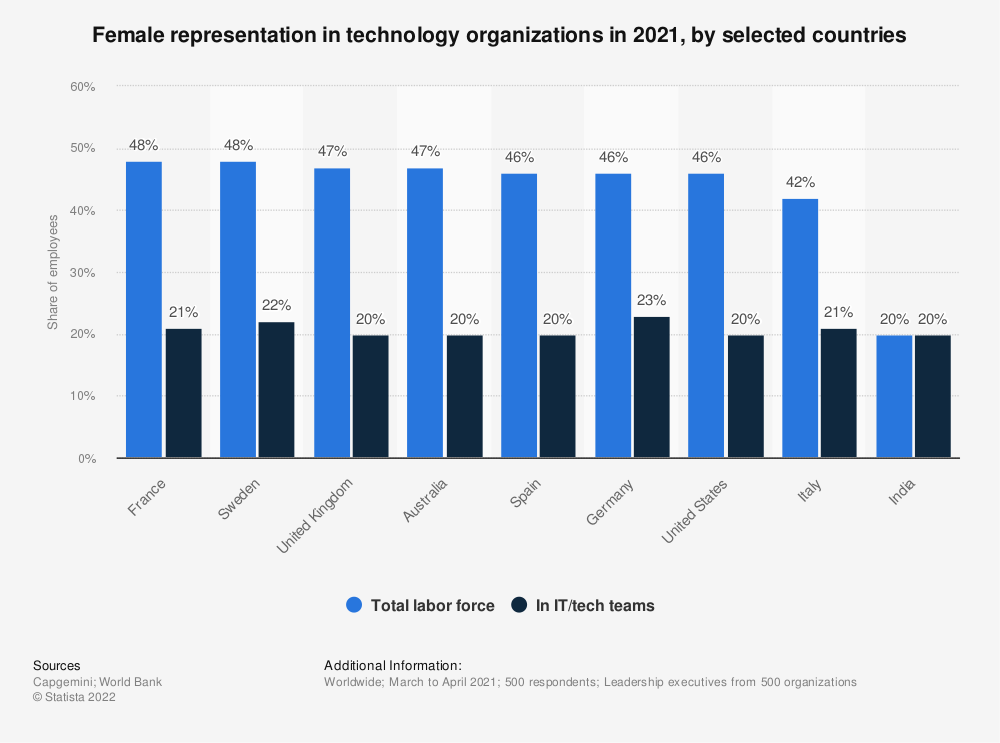
Though the number of women in tech roles is slowly increasing, they are still underrepresented. As shown in the graph that follows, women worldwide hold, on average, 21% of IT and technical roles.

Female representation in technology organizations in 2021, selected countries

Female representation in technology organizations in 2021, selected countries

This number drops to 12% when you look at cloud computing roles like Developers/Engineers, Data Engineers, System Administrators, DevOps Engineers, and Architects.

Share of male and female workers across professional clusters

Share of male and female workers across professional clusters

The technology industry has a challenge—but also an opportunity—when it comes to equal gender representation. By highlighting the work that women are doing right now to slowly but steadily change what it looks like (literally and figuratively) to work in tech and with continued commitment and effort, we can create a path to success for everyone.

She Builds Tech Skills re:Invent Roundup

AWS She Builds Tech Skills is a skill development program aimed for builders and cloud enthusiasts to create an inclusive environment to learn and develop cloud skills. Their mission is to build a community with world class leaders and influence diversity representation amongst technical roles in technology.

To kick off this week, we’re featuring a video from She Builds Tech Skills, hosted by Mai Nishitani and May Kyaw, Solutions Architects at AWS. In the video, they chat with six female Solutions Architects from around the world about their favorite services and features from re:Invent 2021, and they give advice on how to get started using these services in your architectures.

As a bonus, Mai and May followed up with these women to chat about how they’re celebrating International Women’s Day this week and every week.

Poornima Chand, Senior Solutions ArchitectPoornima Chand

Poornima Chand is a Senior Solutions Architect in the Strategic Accounts Solutions team at AWS. She works with customers to help solve their unique challenges using AWS technology solutions. She enjoys architecting and building scalable solutions. Her focus areas include Serverless, High Performance Computing and Machine Learning.

How does she encourage and mentor women in tech and beyond? Poornima is an active mentor in the AWS She Builds CloudUp program. She loves to celebrate women’s achievements and plans to spend International Women’s Day interacting with and learning from Women@Amazon and women from customer teams.

Ai-Linh Le, Solutions ArchitectAi-Linh Li

Ai-Linh Le is a Solutions Architect based in Sydney, Australia. She started her career as a software engineer and still likes to be hands-on in developing and building solutions and demos. She enjoys working with customers and helping them to build solutions and solve challenges. Her areas of focus include data analytics, machine learning, and DevOps.

How does she encourage and mentor women in tech and beyond? Ai-Linh is passionate about continuous learning and exploring new technologies, and is a mentor in the AWS She Builds CloudUp program.

Nelli Lovchikova, Enterprise Solutions ArchitectNelli Lovchikova

Nelli has nearly twenty years of experience helping companies build amazing things as a software engineer and architect. She strongly believes in engineering excellence and continuous learning and improvement.

How does she encourage and mentor women in tech and beyond? Nelli constantly researches and experiments with bleeding-edge technologies and ideas and is always happy to take other people on that journey with me, share my findings, and inspiration.

Natalie White, Enterprise Solutions ArchitectNatalie White

Natalie White is an Enterprise Solutions Architect in southern California. Her 15-year software development career across four industry verticals prior to joining AWS and her advocacy for AWS Developer Tools and Infrastructure as Code services help her earn trust with her customers’ builders and executive stakeholders and accelerate their time to done.

How does she encourage and mentor women in tech and beyond? Natalie is an active member in the Society of Women Engineers and a leader of her daughter’s Girl Scout troop, so she will celebrate International Women’s Day with Women@Amazon and across engineering domains, industry verticals, and age groups.

Deval Parikh. Senior Enterprise Solutions ArchitectDeval S Parikh

Deval Parikh is a Sr Enterprise Solutions Architect at AWS based out of Los Angeles. She is passionate about helping enterprises re-imagine their businesses in the cloud by leading them with strategic architectural guidance and building prototypes as an AWS expert.

How does she encourage and mentor women in tech and beyond? Deval is passionate about helping women STEM roles. She leads various affinity groups in AWS North America, including Women At Solutions Architecture and YouthTech. On weekends, she teaches high school and middle school students programming in Python and Spark. Outside of work, she loves to paint with oil on canvas and hiking with her friends. You can view some of her artwork at www.devalparikh.com.

Viktoria Semaan, Senior Partner Solutions ArchitectSemaan

As a Senior Partner Solutions Architect, Viktoria is helping AWS Strategic ISV Partners to build joint innovative solutions on AWS. She has 13+ years of experience in solutions architecture, leading multi-site automation and transformation projects. She is a public speaker and content creator and often shares learning opportunities on social media.

How does she encourage and mentor women in tech and beyond? Viktoria is passionate about coaching, talent development, and mentoring others. She is a mentor at the AWS She Builds CloudUp program, which focuses on empowering women and helps them to learn AWS services and products and become AWS Certified.

Would you like to know more?

If you want to hear more about AWS She Builds Tech Skills, please reach out to May or Mai on LinkedIn for more information, subscribe to their YouTube channel for the latest videos.

We’ve got more content for International Women’s Day!

Tomorrow we have a technical post, Deploying service-mesh-based architectures using AWS App Mesh and Amazon ECS from Kesha Williams, an AWS Hero and award-winning software engineer.

Later this week, we’ll share:

  • A collection of several blog posts written and co-authored by women
  • Curated content from the Let’s Architect! team and a live Twitter chat
  • A post on Women at AWS – Diverse Backgrounds, Common Goal of Becoming Solutions Architects
  • Another post on Building your brand as a SA

Enjoy!

Other ways to participate

Top 2021 AWS Security service launches security professionals should review – Part 1

Post Syndicated from Ryan Holland original https://aws.amazon.com/blogs/security/top-2021-aws-security-service-launches-part-1/

Given the speed of Amazon Web Services (AWS) innovation, it can sometimes be challenging to keep up with AWS Security service and feature launches. To help you stay current, here’s an overview of some of the most important 2021 AWS Security launches that security professionals should be aware of. This is the first of two related posts; Part 2 will highlight some of the important 2021 launches that security professionals should be aware of across all AWS services.

Amazon GuardDuty

In 2021, the threat detection service Amazon GuardDuty expanded the internal AWS security intelligence it consumes to use more of the intel that AWS internal threat detection teams collect, including additional nation-state threat intelligence. Sharing more of the important intel that internal AWS teams collect lets you quickly improve your protection. GuardDuty also launched domain reputation modeling. These machine learning models take all the domain requests from across all of AWS, and feed them into a model that allows AWS to categorize previously unseen domains as highly likely to be malicious or benign based on their behavioral characteristics. In practice, AWS is seeing that these models often deliver high-fidelity threat detections, identifying malicious domains 7–14 days before they are identified and available on commercial threat feeds.

AWS also launched second generation anomaly detection for GuardDuty. Shortly after the original GuardDuty launch in 2017, AWS added additional anomaly detection for user behavior analytics and monitoring for unusual activity of AWS Identity and Access Management (IAM) users. After receiving customer feedback that the original feature was a little too noisy, and that it was difficult to understand why some findings were generated, the GuardDuty analytics team rebuilt this functionality on an entirely new machine learning model, considerably reducing the number of detections and generating a more accurate positive-detection rate. The new model also added additional context that security professionals (such as analysts) can use to understand why the model shows findings as suspicious or unusual.

Since its introduction, GuardDuty has detected when AWS EC2 Role credentials are used to call AWS APIs from IP addresses outside of AWS. Beginning in early 2022, GuardDuty now supports detection when credentials are used from other AWS accounts, inside the AWS network. This is a complex problem for customers to solve on their own, which is why the GuardDuty team added this enhancement. The solution considers that there are legitimate reasons why a source IP address that is communicating with AWS services APIs might be different than the Amazon Elastic Compute Cloud (Amazon EC2) instance IP address, or a NAT gateway associated with the instance’s VPC. The enhancement also considers complex network topologies that route traffic to one or multiple VPCs—for example, AWS Transit Gateway or AWS Direct Connect.

Our customers are increasingly running container workloads in production; helping to raise the security posture of these workloads became an AWS development priority in 2021. GuardDuty for EKS Protection is one recent feature that has resulted from this investment. This new GuardDuty feature monitors Amazon Elastic Kubernetes Service (Amazon EKS) cluster control plane activity by analyzing Kubernetes audit logs. GuardDuty is integrated with Amazon EKS, giving it direct access to the Kubernetes audit logs without requiring you to turn on or store these logs. Once a threat is detected, GuardDuty generates a security finding that includes container details such as pod ID, container image ID, and associated tags. See below for details on how the new Amazon Inspector is also helping to protect containers.

Amazon Inspector

At AWS re:Invent 2021, we launched the new Amazon Inspector, a vulnerability management service that continually scans AWS workloads for software vulnerabilities and unintended network exposure. The original Amazon Inspector was completely re-architected in this release to automate vulnerability management and to deliver near real-time findings to minimize the time needed to discover new vulnerabilities. This new Amazon Inspector has simple one-click enablement and multi-account support using AWS Organizations, similar to our other AWS Security services. This launch also introduces a more accurate vulnerability risk score, called the Inspector score. The Inspector score is a highly contextualized risk score that is generated for each finding by correlating Common Vulnerability and Exposures (CVE) metadata with environmental factors for resources such as network accessibility. This makes it easier for you to identify and prioritize your most critical vulnerabilities for immediate remediation. One of the most important new capabilities is that Amazon Inspector automatically discovers running EC2 instances and container images residing in Amazon Elastic Container Registry (Amazon ECR), at any scale, and immediately starts assessing them for known vulnerabilities. Now you can consolidate your vulnerability management solutions for both Amazon EC2 and Amazon ECR into one fully managed service.

AWS Security Hub

In addition to a significant number of smaller enhancements throughout 2021, in October AWS Security Hub, an AWS cloud security posture management service, addressed a top customer enhancement request by adding support for cross-Region finding aggregation. You can now view all your findings from all accounts and all selected Regions in a single console view, and act on them from an Amazon EventBridge feed in a single account and Region. Looking back at 2021, Security Hub added 72 additional best practice checks, four new AWS service integrations, and 13 new external partner integrations. A few of these integrations are Atlassian Jira Service Management, Forcepoint Cloud Security Gateway (CSG), and Amazon Macie. Security Hub also achieved FedRAMP High authorization to enable security posture management for high-impact workloads.

Amazon Macie

Based on customer feedback, data discovery tool Amazon Macie launched a number of enhancements in 2021. One new feature, which made it easier to manage Amazon Simple Storage Service (Amazon S3) buckets for sensitive data, was criteria-based bucket selection. This Macie feature allows you to define runtime criteria to determine which S3 buckets should be included in a sensitive data-discovery job. When a job runs, Macie identifies the S3 buckets that match your criteria, and automatically adds or removes them from the job’s scope. Before this feature, once a job was configured, it was immutable. Now, for example, you can create a policy where if a bucket becomes public in the future, it’s automatically added to the scan, and similarly, if a bucket is no longer public, it will no longer be included in the daily scan.

Originally Macie included all managed data identifiers available for all scans. However, customers wanted more surgical search criteria. For example, they didn’t want to be informed if there were exposed data types in a particular environment. In September 2021, Macie launched the ability to enable/disable managed data identifiers. This allows you to customize the data types you deem sensitive and would like Macie to alert on, in accordance with your organization’s data governance and privacy needs.

Amazon Detective

Amazon Detective is a service to analyze and visualize security findings and related data to rapidly get to the root cause of potential security issues. In January 2021, Amazon Detective added a convenient, time-saving integration that allows you to start security incident investigation workflows directly from the GuardDuty console. This new hyperlink pivot in the GuardDuty console takes findings directly from the GuardDuty console into the Detective console. Another time-saving capability added was the IP address drill down functionality. This new capability can be useful to security forensic teams performing incident investigations, because it helps quickly determine the communications that took place from an EC2 instance under investigation before, during, and after an event.

In December 2021, Detective added support for AWS Organizations to simplify management for security operations and investigations across all existing and future accounts in an organization. This launch allows new and existing Detective customers to onboard and centrally manage the Detective graph database for up to 1,200 AWS accounts.

AWS Key Management Service

In June 2021, AWS Key Management Service (AWS KMS) introduced multi-Region keys, a capability that lets you replicate keys from one AWS Region into another. With multi-Region keys, you can more easily move encrypted data between Regions without having to decrypt and re-encrypt with different keys for each Region. Multi-Region keys are supported for client-side encryption using direct AWS KMS API calls, or in a simplified manner with the AWS Encryption SDK and Amazon DynamoDB Encryption Client.

AWS Secrets Manager

Last year was a busy year for AWS Secrets Manager, with four feature launches to make it easier to manage secrets at scale, not just for client applications, but also for platforms. In March 2021, Secrets Manager launched multi-Region secrets to automatically replicate secrets for multi-Region workloads. Also in March, Secrets Manager added three new rules to AWS Config, to help administrators verify that secrets in Secrets Manager are configured according to organizational requirements. Then in April 2021, Secrets Manager added a CSI driver plug-in, to make it easy to consume secrets from Amazon EKS by using Kubernetes’s standard Secrets Store interface. In November, Secrets Manager introduced a higher secret limit of 500,000 per account to simplify secrets management for independent software vendors (ISVs) that rely on unique secrets for a large number of end customers. Although launched in January 2022, it’s also worth mentioning Secrets Manager’s release of rotation windows to align automatic rotation of secrets with application maintenance windows.

Amazon CodeGuru and Secrets Manager

In November 2021, AWS announced a new secrets detector feature in Amazon CodeGuru that searches your codebase for hardcoded secrets. Amazon CodeGuru is a developer tool powered by machine learning that provides intelligent recommendations to detect security vulnerabilities, improve code quality, and identify an application’s most expensive lines of code.

This new feature can pinpoint locations in your code with usernames and passwords; database connection strings, tokens, and API keys from AWS; and other service providers. When a secret is found in your code, CodeGuru Reviewer provides an actionable recommendation that links to AWS Secrets Manager, where developers can secure the secret with a point-and-click experience.

Looking ahead for 2022

AWS will continue to deliver experiences in 2022 that meet administrators where they govern, developers where they code, and applications where they run. A lot of customers are moving to container and serverless workloads; you can expect to see more work on this in 2022. You can also expect to see more work around integrations, like CodeGuru Secrets Detector identifying plaintext secrets in code (as noted previously).

To stay up-to-date in the year ahead on the latest product and feature launches and security use cases, be sure to read the Security service launch announcements. Additionally, stay tuned to the AWS Security Blog for Part 2 of this blog series, which will provide an overview of some of the important 2021 launches that security professionals should be aware of across all AWS services.

If you’re looking for more opportunities to learn about AWS security services, check out AWS re:Inforce, the AWS conference focused on cloud security, identity, privacy, and compliance, which will take place June 28-29 in Houston, Texas.

If you have feedback about this post, submit comments in the Comments section below. If you have questions about this post, contact AWS Support.

Want more AWS Security news? Follow us on Twitter.

Author

Ryan Holland

Ryan is a Senior Manager with GuardDuty Security Response. His team is responsible for ensuring GuardDuty provides the best security value to customers, including threat intelligence, behavioral analytics, and finding quality.

Author

Marta Taggart

Marta is a Seattle-native and Senior Product Marketing Manager in AWS Security Product Marketing, where she focuses on data protection services. Outside of work you’ll find her trying to convince Jack, her rescue dog, not to chase squirrels and crows (with limited success).

2021 AWS security-focused workshops

Post Syndicated from Temi Adebambo original https://aws.amazon.com/blogs/security/2021-aws-security-focused-workshops/

Every year, Amazon Web Services (AWS) looks to help our customers gain more experience and knowledge of our services through hands-on workshops. In 2021, we unfortunately couldn’t connect with you in person as much as we would have liked, so we wanted to create and share new ways to learn and build on AWS. We built and published several security-focused workshops that help you learn how to use or configure new services and features securely. Workshops are hands-on learning modules designed to teach or introduce practical skills, techniques, or concepts you can use to solve business problems.

In this blog post, we highlight the newest AWS security-focused workshops below. There are also several other workshops that were developed before 2021; you can find them on AWS Workshops, AWS Security Workshops, and AWS Samples. Here’s the list:

Data Protection and Privacy

Workshop Title

Abstract

Data discovery and classification with Amazon Macie

In this workshop, get familiar with Amazon Macie and learn to scan and classify data in your Amazon Simple Storage Service (Amazon S3) buckets. Work with Macie (data classification) and AWS Security Hub (centralized security view) to see how data in your environment is stored, and to understand any changes in S3 bucket policies that may affect your security posture. Learn to create a custom data identifier and to create and scope data discovery and classification jobs in Macie. Finally, use Macie to filter and investigate the results from the scans you create.

Scaling your encryption at rest capabilities with AWS KMS

AWS makes it easy to protect your data with encryption. This hands-on workshop provides an opportunity to dive deep into encryption at rest options with AWS. Learn AWS server-side encryption with AWS Key Management Service (AWS KMS) for services such as Amazon S3, Amazon Elastic Block Store (Amazon EBS), and Amazon Relational Database Service (Amazon RDS). Also, learn best practices for using AWS KMS across multiple accounts and Regions and how to scale while optimizing for performance.

Store, retrieve, and manage sensitive credentials in AWS Secrets Manager

In this workshop, learn how to integrate AWS Secrets Manager in your development platform, backed by serverless applications. Work through a sample application, and use Secrets Manager to retrieve credentials as well as work with attribute-based access control using tags. Also, learn how to monitor the compliance of secrets and implement incident response workflows that will rotate the secret, restore the resource policy, alert the SOC, and deny access to the offender.

Building and operating a Private Certificate Authority on AWS

This workshop covers private certificate management on AWS, employing the concepts of least privilege, separation of duties, monitoring, and automation. Participants learn operational aspects of creating a complete certificate authority (CA) hierarchy, building a simple web application, and issuing private certificates. It also covers how job functions—including CA administrators, application developers, and security administrators—can follow the principle of least privilege to perform various functions associated with certificate management. Finally, learn about IoT certificates, code-signing, and certificate templates to enable all your use cases.

Amazon S3 security and access settings and controls

Amazon S3 provides many security and access settings to help you secure your data, controls that ensure that those settings remain in place, and features to help you audit those settings and controls. This workshop walks you through these Amazon S3 capabilities and scenarios, to help you apply them for different security requirements.

Redact data as needed using Amazon S3 Object Lambda

Amazon S3 Object Lambda works with your existing applications, and allows you to add your own code using AWS Lambda functions to automatically process and transform data from Amazon S3 before returning it to an application. This enables different views of the same object depending on user identity, such as restricting access to confidential information, or disallowing access to personally identifiable information (PII) data. In this workshop, learn how to use Amazon S3 Object Lambda to modify objects during GET requests, so you no longer need to store multiple views of the same document.

Using AWS Nitro Enclaves to process highly sensitive data

In this hands-on workshop, learn how to use AWS Nitro Enclaves to isolate highly-sensitive data from your users, applications, and third-party libraries on your Amazon Elastic Compute Cloud (Amazon EC2) instances. Explore AWS Nitro Enclaves, discuss common use cases, and build and run your own enclave. During this workshop, learn about enclave isolation, cryptographic attestation, enclave image files, local Vsock communication channels, common debugging scenarios, and the enclave lifecycle.

Ransomware prevention strategies in Amazon S3

Learn how to use the protective, detective and monitoring controls in AWS to protect your data in S3 from ransomware threats. Set up Amazon GuardDuty for S3 and AWS Identity and Access Management (IAM) Access Analyzer, and learn to read and respond to findings and create IAM invariants. Create a tiered storage approach to backup and recovery, and learn to use Amazon S3 Object Lock, versioning, and replication to provide immutable storage and protect against accidental or malicious deletion.

Governance, Risk, and Compliance

Operating securely in a multi-account environment

Operating multiple AWS accounts under an organization is how many users consume AWS Cloud services. In this workshop, learn how to build foundational security monitoring in multi-account environments. Walk through an initial setup of AWS Security Hub for centralized aggregation of findings across your AWS Organizations organization. Additionally, learn how to centralize Amazon GuardDuty findings, Amazon Detective functions, AWS Identity and Access Management (IAM) Access Analyzer findings (if available), AWS Config rule evaluations, and AWS CloudTrail logs into the central security monitoring account (security tools account). Finally, implement a service control policy (SCP) that denies the ability to disable these security controls.

Building remediation workflows to simplify compliance

Automation and simplification are key to managing compliance at scale. Remediation is one of the essential elements of simplifying and managing risk. In this workshop, see how to build a remediation workflow using AWS Config and AWS Systems Manager automation. Learn how this workflow can be deployed at scale and monitored with AWS Security Hub to oversee the entire organization and how to use AWS Audit Manager to easily access evidence of risk management.

Identity and Access Management

Integrating IAM Access Analyzer into a CI/CD pipeline

Want to analyze Identity and Access Management (IAM) policies at scale? Want to help your developers write secure IAM policies? This workshop provides you the hands-on opportunity to run IAM Access Analyzer policy validation on your AWS CloudFormation templates in a continuous integration/continuous deployment (CI/CD) pipeline.

Data perimeter workshop

In this workshop, learn how to create a data perimeter by building controls that allow access to data only from expected network locations and by trusted identities. The workshop consists of five modules, each designed to illustrate a different Identity and Access Management (IAM) or network control. Learn where and how to implement the appropriate controls based on different risk scenarios. Discover how to implement these controls as service control policies, identity- and resource-based policies, and Amazon Virtual Private Cloud (Amazon VPC) endpoint policies.

Network and Infrastructure Security

Build a Zero Trust architecture for service-to-service workloads on AWS

In this workshop, get hands-on experience implementing a Zero Trust architecture for service-to-service workloads on AWS. Learn how to use services such as Amazon API Gateway and Virtual Private Cloud (Amazon VPC) endpoints to integrate network and identity controls while using Amazon GuardDuty, Lambda, and Amazon DynamoDB to take advantage of native service controls. Learn how these services allow you to authorize specific flows between components to reduce lateral network mobility risk and improve the overall security posture of your workload.

Securing deployment of third-party ML models

Enterprise users adopting machine learning (ML) on AWS often look for prescriptive guidance on implementing security best practices, establishing governance, securing their ML models, and meeting compliance standards. Building a repeatable solution provides users with standardization and governance over what gets provisioned in their AWS account. In this workshop, learn steps you can take to secure third-party ML model deployments. We provide cloud infrastructure-as-code templates to automate the setup of a hardened Amazon SageMaker environment. These templates include private networking, VPC endpoints, end-to-end encryption, logging and monitoring, and enhanced governance and access controls through AWS Service Catalog.

Building Prowler into a QuickSight-powered AWS security dashboard

In this workshop, get hands-on experience with Prowler, AWS Security Hub, and Amazon QuickSight by building a custom security dashboard for the AWS environment. Using a multi-account deployment of Prowler integrated into Security Hub, learn to identify and analyze Prowler findings and integrate QuickSight to visualize the information. Discover how to get the most from QuickSight and Prowler with automatically created datasets.

Threat Detection and Incident Response

Integration, prioritization, and response with AWS Security Hub

This workshop is designed to get you familiar with AWS Security Hub, so you can better understand how to use it in your own AWS environment. This workshop has two sections. The first section demonstrates the features and functions of AWS Security Hub. The second section shows you how to use AWS Security Hub to import findings from different data sources, analyze findings so you can prioritize response work, and implement responses to findings to help improve your security posture.

Building an AWS incident response plan using Jupyter notebooks

This workshop guides you through building an incident response plan for your AWS environment using Jupyter notebooks. Walk through an easy-to-follow sample incident, using building blocks as a ready-to-use playbook in a Jupyter notebook. Then, follow simple steps to add additional programmatic and documented steps to your incident response plan.

Scaling threat detection and response on AWS

In this hands-on workshop, learn about several AWS services involved in threat detection and response as you walk through real-world threat scenarios. Learn about the threat detection capabilities of Amazon GuardDuty, Amazon Macie, and AWS Security Hub and the available response options. For each hands-on scenario, review methods to detect and respond to threats using the following services: AWS CloudTrail, Virtual Private Cloud (Amazon VPC) Flow Logs, Amazon CloudWatch Events, AWS Lambda, Amazon Inspector, Amazon GuardDuty, and AWS Security Hub.

Building incident response playbooks for AWS

In this workshop, learn how to develop incident response playbooks. Explore the incident response lifecycle, including preparation, detection and analysis, containment, eradication and recovery, and post-incident activity. To get the most out of this workshop, you should have advanced experience with AWS services and responsibilities aligned with incident response frameworks such as NIST SP 800-61 R2.

This list is representative of the security workshops created in 2021 to help customers on their journey in AWS. If you’d like to find more workshops, please go to AWS Workshops and select Security in the top navigation bar, or you can also check out AWS Security Workshops for a subset of workshops curated by AWS Security Specialists. We hope you enjoy these workshops!

 
If you have feedback about this post, submit comments in the Comments section below.

Want more AWS Security news? Follow us on Twitter.

Author

Temi Adebambo

Temi leads the Security and Network Solutions Architecture team at AWS. His team is focused on working with customers on cloud migration and modernization, cybersecurity strategy, architecture best practices, and innovation in the cloud. Before AWS, he spent over 14 years as a consultant, advising CISOs and security leaders.

Scaling Ad Verification with Machine Learning and AWS Inferentia

Post Syndicated from Julien Simon original https://aws.amazon.com/blogs/aws/scaling-ad-verification-with-machine-learning-and-aws-inferentia/

Amazon Advertising helps companies build their brand and connect with shoppers, through ads shown both within and beyond Amazon’s store, including websites, apps, and streaming TV content in more than 15 countries. Businesses or brands of all sizes including registered sellers, vendors, book vendors, Kindle Direct Publishing (KDP) authors, app developers, and agencies on Amazon marketplaces can upload their own ad creatives, which can include images, video, audio, and of course products sold on Amazon. To promote an accurate, safe, and pleasant shopping experience, these ads must comply with content guidelines.

Here’s a simple example. Can you figure out why two of the following ads would not be compliant?

Amazon Ads

The ad in the center doesn’t feature the product in context. It also shows the same product multiple times. The ad on the right looks much better, but it contains text, which is not allowed for this ad format.

New ad creatives come in many sizes, shapes, and languages, and at very large scale. Assuming it would even be possible, verifying them manually would be a complex, slow, and error-prone process. Machine learning (ML) to the rescue!

Using Machine Learning to Verify Ad Creatives
Each ad must be evaluated against many rules, which no single model could reasonably learn. In fact, it takes many models to check ad properties, for example:

  • Media-specific models that analyze images, video, audio, and text that describe the advertised products.
  • Content-specific models that detect headlines, text, backgrounds, and objects.
  • Language-specific models that validate syntax and grammar, and flag unapproved language.

Some of these capabilities are readily available in AWS AI services. For example, Amazon Advertising teams use Amazon Rekognition to extract metadata information from images and videos.

Other capabilities require custom models trained on in-house datasets. For this purpose, Amazon teams labeled large ad datasets with Amazon SageMaker Ground Truth, using a combination of manual labeling, and automatic labeling with active learning. Using these datasets, teams then used Amazon SageMaker to train models, and deploy them automatically on real-time prediction endpoints with the AWS Cloud Development Kit (AWS CDK) and Amazon SageMaker Pipelines.

When a business uploads a new ad, relevant models are invoked simultaneously to process specific ad components, extract signals, and output a quality score. All scores are then consolidated, and sent to a final model that predicts whether the ad should be manually reviewed.

Thanks to this process, most new ads can be verified and published automatically, which means businesses can quickly promote their brand and products, and Amazon can maintain a high-quality shopping experience.

However, faced with a growing number of more complex models, Amazon Advertising teams started to look for a solution that could increase prediction throughput while reducing costs. They found it in AWS Inferentia.

What is AWS Inferentia?
Available in Amazon EC2 Inf1 instances, AWS Inferentia is a custom chip built by AWS to accelerate ML inference workloads, and optimize their cost. Each AWS Inferentia chip contains four NeuronCores. Each NeuronCore implements a high-performance systolic array matrix multiply engine, which massively speeds up typical deep learning operations such as convolution and transformers. NeuronCores are also equipped with a large on-chip cache, which helps to cut down on external memory accesses, reduce latency, and increase throughput.

Thanks to AWS Neuron, a software development kit for ML inference, AWS Inferentia can be used natively from ML frameworks like TensorFlow, PyTorch, and Apache MXNet. It consists of a compiler, runtime, and profiling tools that enable you to run high-performance and low latency inference. For many trained models, compilation is a one-liner with the Neuron SDK, not requiring any additional application code changes. The result is a high performance inference deployment, that can easily scale while keeping costs under control. You’ll find many examples in the Neuron documentation. Alternatively, thanks to Amazon SageMaker Neo, you can also compile models directly in SageMaker.

Scaling Ad Verification with AWS Inferentia
Amazon Advertising teams started compiling their models for Inferentia, and deploying them on SageMaker endpoints powered by Inf1 instances. They compared the Inf1 endpoints to the GPU endpoints they had been using so far. They found that large deep learning models like BERT run more effectively on Inferentia, which decreases latency by 30%, and reduces costs by 71%. A few months ago, ML teams working on Amazon Alexa came to the same conclusions.

What about prediction quality? GPU models are typically trained with single-precision floating-point data (FP32). Inferentia uses the shorter FP16, BF16, and INT8 data types, which can create slight differences in predicted output. Running both GPU and Inferentia models in parallel, teams analyzed probability distributions, tweaked prediction thresholds for their Inferentia models, and made sure that these models would predict ads just like GPU models did. You can learn more about these techniques in the Performance Tuning section of the documentation.

With these final adjustments out of the way, the Amazon Advertising teams started phasing out GPU models. All text data is now predicted on Inferentia, and the migration of computer vision pipelines is in progress.

AWS Customers Are Successful with AWS Inferentia
In addition to Amazon teams, customers also report very nice results on scaling and optimizing their ML workloads with Inferentia.

Binghui Ouyang, Senior Data Scientist at Autodesk: “Autodesk is advancing the cognitive technology of our AI-powered virtual assistant, Autodesk Virtual Agent (AVA) by using Inferentia. AVA answers over 100,000 customer questions per month by applying natural language understanding (NLU) and deep learning techniques to extract the context, intent, and meaning behind inquiries. Piloting Inferentia, we are able to obtain a 4.9x higher throughput over G4dn for our NLU models, and look forward to running more workloads on the Inferentia-based Inf1 instances.

Paul Fryzel, Principal Engineer, AI Infrastructure at Condé Nast: “Condé Nast’s global portfolio encompasses over 20 leading media brands, including Wired, Vogue, and Vanity Fair. Within a few weeks, our team was able to integrate our recommendation engine with AWS Inferentia chips. This union enables multiple runtime optimizations for state-of-the-art natural language models on SageMaker’s Inf1 instances. As a result, we observed a 72% reduction in cost than the previously deployed GPU instances.”

Getting Started
You can get started with Inferentia and Inf1 instances today, either on Amazon SageMaker or with the Neuron SDK. This self-paced workshop walks you through both options.

Give it a try, and let us know what you think. As always, we look forward to your feedback. You can send it through your usual AWS Support contacts, post it on the AWS Forum for SageMaker, or on the Neuron SDK Github repository.

– Julien

Decoding the Social Effects Of Media with Machine Learning

Post Syndicated from Julien Simon original https://aws.amazon.com/blogs/aws/decoding-the-social-effects-of-media-with-machine-learning/

What if media were optimized to benefit people? This thought-provoking question is at the core of Harmony Labs‘ mission. A nonprofit organization headquartered in New York City, Harmony Labs strives to better understand the impact of media on society, and build communities and tools to reform and transform media systems.

Brian WaniewskiAs Brian Wanieswki, Executive Director at Harmony Labs puts it: “The media systems that we have now, for better or worse, have become outrage machines and sorting machines that put people into groups of like minds. The business incentive structures of these systems are such that the more outrage there is, the more profit there is. Political events across the world in recent years have borne out what these media systems produce, and it’s really pretty toxic, and pretty hard to get anything done within. There are all kinds of natural divisions between people, but these media systems tend to reinforce these divisions. So, the first question that we’re asking is, What’s the scope of this problem? And then, What can we do to solve it?”

Harmony Labs use data science and machine learning to answer these questions. Starting from user surveys and media data, they developed advanced natural language processing pipelines that can identify how social issues are represented in media, how they are consumed by different audiences, and what kind of influence that consumption has.

So how do you get that data in first place? Brian says: “All the media data that we need lives inside private companies. We knew that data sharing would be central to our mission, and this is why we’re structured as a nonprofit. We are working in the public’s interest in a non-partisan way. We’ve done big data sharing deals with large companies, as well as startups scraping different corners of the media ecosystem that we’re interested in: internet TV, internet radio, and so on. We have about 10 data partners at the moment, and we’re always looking to expand.

Thanks to their data partners, Harmony Labs has collected over 50 Terabytes of diverse media: TV, web, mobile, song lyrics, closed captions, social media, and more. This definitely fits the definition of big data (volume, velocity and variety). Working with languages like Golang, Python and R, the Harmony Labs data science and engineering teams rely on AWS services such as Amazon Aurora, Amazon Athena, AWS Glue and Amazon Elastic Kubernetes Service (EKS) to build their data ingestion and processing workflows.

Laura EdelsonOnce the data is in-house, Harmony Labs make it safe, secure, and accessible to a network of academic researchers who use it to investigate the influence of media systems on politics, society, and culture. Laura Edelson is one of these researchers. A Ph.D. Candidate in Computer Science at NYU’s Tandon School of Engineering, she studies online political communication and develops methods to identify inauthentic content and activity. Harmony Labs supported her on the Ad Observatory project, an exploration of political ads on Facebook.

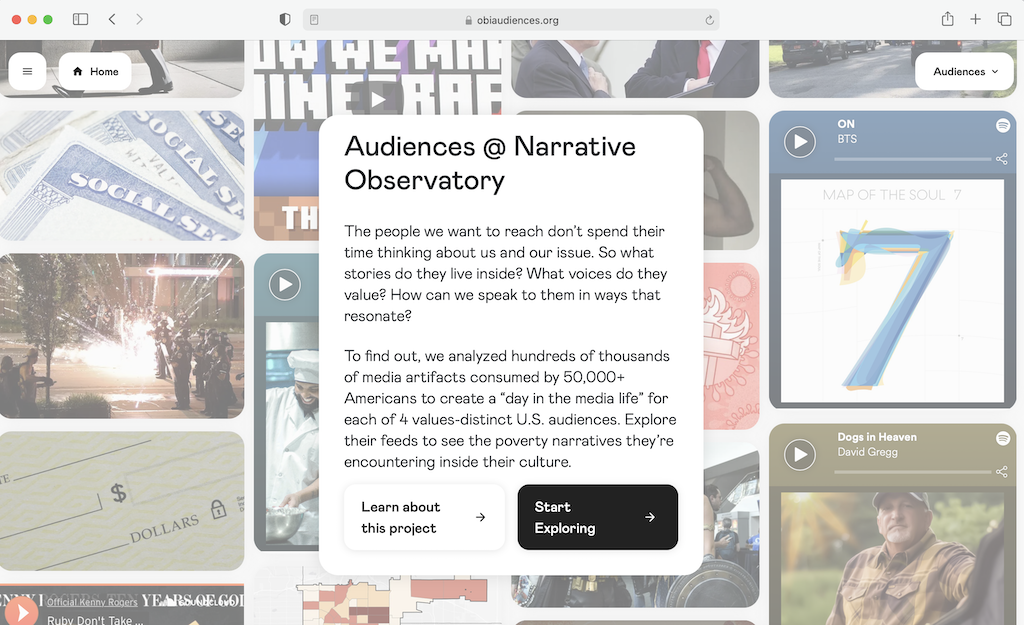
Harmony Labs also work on their own projects, such as the Narrative Observatory. “A narrative is a story pattern that recurs across different kinds of stories and media. You’ll find them in song lyrics, TV shows, news articles, and more“, says Brian. The Narrative Observatory helps identify narratives on particular topics and track them over long periods of time, and across different media types.

With initial funding from the Bill & Melinda Gates Foundation, Harmony Labs studied narratives linked to the topic of poverty and economic mobility in the United States. Collecting millions of documents (online news, social media, music), they first identified the main narratives present in media. Then, using segmentation techniques, behavioral data on over 50,000 Americans and surveys, Harmony Labs defined four audiences, as well as their dominant narrative, their core values, and their views on specific social issues. Finally, Harmony Labs studied how each audience consumed narratives.

To enable funders, partners, and media companies to gain a deeper understanding of the cultural spaces their audiences occupy, they built a fascinating website, obiaudiences.org, where you can pick an audience and view the associated media feed. In other words, you can literally see the world in someone else’s eyes: what issues they care most about, what media they read most, and so on. This helps to understand the perceptions that different people have on certain issues, and as Brian puts it: “If you’re trying to reach people, it’s important to understand the media world they inhabit, and what can be actually relevant to that world.

Narrative Observatory

Recently, Harmony Labs led a project funded by the Mozilla Foundation on defining a healthy narrative for artificial intelligence (AI). Studying the TV consumption habits of over 80,000 US adults, and connecting them with closed captioned transcripts and ads, they identified and named the main media narratives on AI. Each narrative includes a definition of AI, the emotion that it creates in people, and whether they think that AI will lead to a happy or an unhappy ending.

Harmony Labs identified four main narratives on AI. Two are extremely negative and fear-inducing. “Tool of Tyranny” says that AI will be used by governments to oppress people. “Robot Overlords” says that we’ll never be able to control AI, and it will end up ruling us. At the other end of the spectrum, the “Wishes Granted” narrative is extremely positive: sure, we don’t understand AI, but it’s a magic wand that will solve all our issues. The last narrative, “Augmented Intelligence”, is more balanced: yes, AI is a great opportunity to improve our daily lives, but it’s also capable of being unfair and even dangerous. We are responsible for designing it, controlling it, and making sure it’s used to help us, not to hurt us.

Harmony Labs found that the “Wishes Granted” narrative was the most prominent (67%). It shines a positive light on AI, but its naive and over-optimistic vision can hide the legitimate questions that AI raises. Still, it’s a good starting point to engage audiences, educate them with the “Augmented Intelligence” narrative, and increase their awareness on both opportunities and challenges.

Closing this post, I’m wondering which AI narrative I’ve actually promoted here, willingly or not! What do you think? One thing is certain: Harmony Labs is using AI to help us understand how media influences us every day, and how we can create a more democratic society. This is important work, and we’re humbled that they picked AWS to help them reach their goals.

For more information on Harmony Labs, please visit harmonylabs.org and harmonylabs.medium.com.

– Julien

Choosing a Well-Architected CI/CD approach: Open-source software and AWS Services

Post Syndicated from Brian Carlson original https://aws.amazon.com/blogs/devops/choosing-well-architected-ci-cd-open-source-software-aws-services/

This series of posts discusses making informed decisions when choosing to implement open-source tools on AWS services, adopt managed AWS services to satisfy the same needs, or use a combination of both.

We look at key considerations for evaluating open-source software and AWS services using the perspectives of a startup company and a mature company as examples. You can use these two different points of view to compare to your own organization. To make this investigation easier we will use Continuous Integration (CI) and Continuous Delivery (CD) capabilities as the target of our investigation.

Startup Company rocket and Mature Company rocket

In two related posts, we follow two AWS customers, Iponweb and BigHat Biosciences, as they share their CI/CD journeys, their perspectives, the decisions they made, and why. To end the series, we explore an example reference architecture showing the benefits AWS provides regardless of your emphasis on open-source tools or managed AWS services.

Why CI/CD?

Until your creations are in the hands of your customers, investment in development has provided no return. The faster valuable changes enter production, the greater positive impact you can have on your customer. In today’s highly competitive world, the ability to frequently and consistently deliver value is a competitive advantage. The Operational Excellence (OE) pillar of the AWS Well-Architected Framework recognizes this impact and focuses on the capabilities of CI/CD in two dedicated sections.

The concepts in CI/CD originate from software engineering but apply equally to any form of content. The goal is to support development, integration, testing, deployment, and delivery to production. For example, making changes to an application, updating your machine learning (ML) models, changing your multimedia assets, or referring to the AWS Well-Architected Framework.

Adopting CI/CD and the best practices from the Operational Excellence pillar can help you address risks in your environment, and limit errors from manual processes. More importantly, they help free your teams from the related manual processes, so they can focus on satisfying customer needs, differentiating your organization, and accelerating the flow of valuable changes into production.

A red question mark sits on a field of chaotically arranged black question marks.

How do you decide what you need?

The first question in the Operational Excellence pillar is about understanding needs and making informed decisions. To help you frame your own decision-making process, we explore key considerations from the perspective of a fictional startup company and a fictional mature company. In our two related posts, we explore these same considerations with Iponweb and BigHat.

The key considerations include:

  • Functional requirements – Providing specific features and capabilities that deliver value to your customers.
  • Non-functional requirements – Enabling the safe, effective, and efficient delivery of the functional requirements. Non-functional requirements include security, reliability, performance, and cost requirements.
    • Without security, you can’t earn customer trust. If your customers can’t trust you, you won’t have customers.
    • Without reliability you aren’t available to serve your customers. If you can’t serve your customers, you won’t have customers.
    • Performance is focused on timely and efficient delivery of value, not delivering as fast as possible.
    • Cost is focused on optimizing the value received for the resources spent (for example, money, time, or effort), not minimizing expense.
  • Operational requirements – Enabling you to effectively and efficiently support, maintain, sustain, and improve the delivery of value to your customers. When you “Design with Ops in Mind,” you’re enabling effective and efficient support for your business outcomes.

These non-feature-related key considerations are why Operational Excellence, Security, Reliability, Performance Efficiency, and Cost Optimization are the five pillars of the AWS Well-Architected Framework.

The startup company

Any startup begins as a small team of inspired people working together to realize the unique solution they believe solves an unsolved problem.

For our fictional small team, everyone knows each other personally and all speak frequently. We share processes and procedures in discussions, and everyone know what needs to be done. Our team members bring their expertise and dedicate it, and the majority of their work time, to delivering our solution. The results of our efforts inform changes we make to support our next iteration.

However, our manual activities are error-prone and inconsistencies exist in the way we do them. Performing these tasks takes time away from delivering our solution. When errors occur, they have the potential to disrupt everyone’s progress.

We have capital available to make some investments. We would prefer to bring in more team members who can contribute directly to developing our solution. We need to iterate faster if we are to achieve a broadly viable product in time to qualify for our next round of funding. We need to decide what investments to make.

  • Goals – Reach the next milestone and secure funding to continue development
  • Needs – Reduce or eliminate the manual processes and associated errors
  • Priority – Rapid iteration
  • CI/CD emphasis – Baseline CI/CD capabilities and non-functional requirements are emphasized over a rich feature set

The mature company

Our second fictional company is a large and mature organization operating in a mature market segment. We’re focused on consistent, quality customer experiences to serve and retain our customers.

Our size limits the personal relationships between our service and development teams. The process to make requests, and the interfaces between teams and their systems, are well documented and understood.

However, the systems we have implemented over time, as needs were identified and addressed, aren’t well documented. Our existing tool chain includes some in-house scripting and both supported and unsupported versions of open-source tools. There are limited opportunities for us to acquire new customers.

When conditions change and new features are desired, we want to be able to rapidly implement and deploy those features as fast as possible. If we can differentiate our services, however briefly, we may be able to win customers away from our competitors. Our other path to improved profitability is to evolve our processes, maximizing integration and efficiencies, and capturing cost reductions.

  • Goals – Differentiate ourselves in the marketplace with desired new features
  • Needs – Address the risks of poorly documented systems and unsupported software
  • Priority – Evolve efficiency
  • CI/CD emphasis – Rich feature set and integrations are emphasized over improving the existing non-functional capabilities

Open-source tools on AWS vs. AWS services

The choice of open-source tools or AWS service is not binary. You can select the combination of solutions that provides the greatest value. You can implement open-source tools for their specific benefits where they outweigh the costs and operational burden, using underlying AWS services like Amazon Elastic Compute Cloud (Amazon EC2) to host them. You can then use AWS managed services, like AWS CodeBuild, for the undifferentiated features you need, without additional cost or operational burden.

A group of people sit around a table discussing the pieces of a puzzle and their ideas.

Feature Set

Our fictional organizations both want to accelerate the flow of beneficial changes into production and are evaluating CI/CD alternatives to support that outcome. Our startup company wants a working solution—basic capabilities, author/code, build, and deploy, so that they can focus on development. Our mature company is seeking every advantage—a rich feature set, extensive opportunities for customization, integration capabilities, and fine-grained control.

Open-source tools

Open-source tools often excel at meeting functional requirements. When a new functionality, capability, or integration is desired, any developer can implement it for themselves, and then contribute their code back to the project. As the user community for an open-source project expands the number of use cases and the features identified grows, so does the number of potential solutions and potential contributors. Developers are using these tools to support their efforts and implement new features that provide value to them.

However, features may be released in unsupported versions and then later added to the supported feature set. Non-functional requirements take time and are less appealing because they don’t typically bring immediate value to the product. Non-functional capabilities may lag behind the feature set.

Consider the following:

  • Open-source tools may have more features and existing integrations to other tools
  • The pace of feature set delivery may be extremely rapid
  • The features delivered are those desired and created by the active members of the community
  • You are free to implement the features your company desires
  • There is no commitment to long-term support for the project or any given feature
  • You can implement open-source tools on multiple cloud providers or on premises
  • If the project is abandoned, you’re responsible for maintaining your implementation

AWS services

AWS services are driven by customer needs. Services and features are supported by dedicated teams. These customer-obsessed teams focus on all customer needs, with security being their top priority. Both functional and non-functional requirements are addressed with an emphasis on enabling customer outcomes while minimizing the effort they expend to achieve them.

Consider the following:

  • The pace of delivery of feature sets is consistent
  • The feature roadmap is driven by customer need and customer requests
  • The AWS service team is dedicated to support of the service
  • AWS services are available on the AWS Cloud and on premises through AWS Outposts

Picture showing symbol of dollar

Cost Optimization

Why are we discussing cost after the feature set? Security and reliability are fundamentally more important. Leadership naturally gravitates to following the operational excellence best practice of evaluating trade-offs. Having looked at the potential benefits from the feature set, the next question is typically, “What is this going to cost?” Leadership defines the priorities and allocates the resources necessary (capital, time, effort). We review cost optimization second so that leadership can make a comparison of the expected benefits between CI/CD investments, and investments in other efforts, so they can make an informed decision.

Our organizations are both cost conscious. Our startup is working with finite capital and time. In contrast, our mature company can plan to make investments over time and budget for the needed capital. Early investment in a robust and feature-rich CI/CD tool chain could provide significant advantages towards the startup’s long-term success, but if the startup fails early, the value of that investment will never be realized. The mature company can afford to realize the value of their investment over time and can make targeted investments to address specific short-term needs.

Open-source tools

Open-source software doesn’t have to be purchased, but there are costs to adopt. Open-source tools require appropriate skills in order to be implemented, and to perform management and maintenance activities. Those skills must be gained through dedicated training of team members, team member self-study, or by hiring new team members with the existing skills. The availability of skilled practitioners of open-source tools varies with how popular a tool is and how long it has had an active community. Loss of skilled team members includes the loss of their institutional knowledge and intimacy with the implementation. Skills must be maintained with changes to the tools and as team members join or leave. Time is required from skilled team members to support management and maintenance activities. If commercial support for the tool is desired, it may be available through third-parties at an additional cost.

The time to value of an open-source implementation includes the time to implement and configure the resources and software. Additional value may be realized through investment of time configuring or implementing desired integrations and capabilities. There may be existing community-supported integrations or capabilities that reduce the level of effort to achieve these.

Consider the following:

  • No cost to acquire the software.
  • The availability of skill practitioners of open-source tools may be lower. Cost (capital and time) to acquire, establish, or maintain skill set may be higher.
  • There is an ongoing cost to maintain the team member skills necessary to support the open-source tools.
  • There is an ongoing cost of time for team members to perform management and maintenance activities.
  • Additional commercial support for open-source tools may be available at additional cost
  • Time to value includes implementation and configuration of resources and the open-source software. There may be more predefined community integrations.

AWS services

AWS services are provided pay-as-you-go with no required upfront costs. As of August 2020, more than 400,000 individuals hold active AWS Certifications, a number that grew more than 85% between August 2019 and August 2020.

Time to value for AWS services is extremely short and limited to the time to instantiate or configure the service for your use. Additional value may be realized through the investment of time configuring or implementing desired integrations. Predefined integrations for AWS services are added as part of the service development roadmap. However, there may be fewer existing integrations to reduce your level of effort.

Consider the following:

  • No cost to acquire the software; AWS services are pay-as-you-go for use.
  • AWS skill sets are broadly available. Cost (capital and time) to acquire, establish, or maintain skill sets may be lower.
  • AWS services are fully managed, and service teams are responsible for the operation of the services.
  • Time to value is limited to the time to instantiate or configure the service. There may be fewer predefined integrations.
  • Additional support for AWS services is available through AWS Support. Cost for support varies based on level of support and your AWS utilization.

Open-source tools on AWS services

Open-source tools on AWS services don’t impact these cost considerations. Migration off of either of these solutions is similarly not differentiated. In either case, you have to invest time in replacing the integrations and customizations you wish to maintain.

Picture showing a checkmark put on security

Security

Both organizations are concerned about reputation and customer trust. They both want to act to protect their information systems and are focusing on confidentiality and integrity of data. They both take security very seriously. Our startup wants to be secure by default and wants to trust the vendor to address vulnerabilities within the service. Our mature company has dedicated resources that focus on security, and the company practices defense in depth across internal organizations.

The startup and the mature company both want to know whether a choice is safe, secure, and can validate the security of their choice. They also want to understand their responsibilities and the shared responsibility model that applies.

Open-source tools

Open-source tools are the product of the contributors and may contain flaws or vulnerabilities. The entire community has access to the code to test and validate. There are frequently many eyes evaluating the security of the tools. A company or individual may perform a validation for themselves. However, there may be limited guidance on secure configurations. Controls in the implementer’s environment may reduce potential risk.

Consider the following:

  • You’re responsible for the security of the open-source software you implement
  • You control the security of your data within your open-source implementation
  • You can validate the security of the code and act as desired

AWS services

AWS service teams make security their highest priority and are able to respond rapidly when flaws are identified. There is robust guidance provided to support configuring AWS services securely.

Consider the following:

  • AWS is responsible for the security of the cloud and the underlying services
  • You are responsible for the security of your data in the cloud and how you configure AWS services
  • You must rely on the AWS service team to validate the security of the code

Open-source tools on AWS services

Open-source tools on AWS services combine these considerations; the customer is responsible for the open-source implementation and the configuration of the AWS services it consumes. AWS is responsible for the security of the AWS Cloud and the managed AWS services.

Picture showing global distribution for redundancy to depict reliability

Reliability

Everyone wants reliable capabilities. What varies between companies is their appetite for risk, and how much they can tolerate the impact of non-availability. The startup emphasized the need for their systems to be available to support their rapid iterations. The mature company is operating with some existing reliability risks, including unsupported open-source tools and in-house scripts.

The startup and the mature company both want to understand the expected reliability of a choice, meaning what percentage of the time it is expected to be available. They both want to know if a choice is designed for high availability and will remain available even if a portion of the systems fails or is in a degraded state. They both want to understand the durability of their data, how to perform backups of their data, and how to perform recovery in the event of a failure.

Both companies need to determine what is an acceptable outage duration, commonly referred to as a Recovery Time Objective (RTO), and for what quantity of elapsed time it is acceptable to lose transactions (including committing changes), commonly referred to as Recovery Point Objective (RPO). They need to evaluate if they can achieve their RTO and RPO objectives with each of the choices they are considering.

Open-source tools

Open-source reliability is dependent upon the effectiveness of the company’s implementation, the underlying resources supporting the implementation, and the reliability of the open-source software. Open-source tools are the product of the contributors and may or may not incorporate high availability features. Depending on the implementation and tool, there may be a requirement for downtime for specific management or maintenance activities. The ability to support RTO and RPO depends on the teams supporting the company system, the implementation, and the mechanisms implemented for backup and recovery.

Consider the following:

  • You are responsible for implementing your open-source software to satisfy your reliability needs and high availability needs
  • Open-source tools may have downtime requirements to support specific management or maintenance activities
  • You are responsible for defining, implementing, and testing the backup and recovery mechanisms and procedures
  • You are responsible for the satisfaction of your RTO and RPO in the event of a failure of your open-source system

AWS services

AWS services are designed to support customer availability needs. As managed services, the service teams are responsible for maintaining the health of the services.

Consider the following:

Open-source tools on AWS services

Open-source tools on AWS services combine these considerations; the customer is responsible for the open-source implementation (including data durability, backup, and recovery) and the configuration of the AWS services it consumes. AWS is responsible for the health of the AWS Cloud and the managed services.

Picture showing a graph depicting performance measurement

Performance

What defines timely and efficient delivery of value varies between our two companies. Each is looking for results before an engineer becomes idled by having to wait for results. The startup iterates rapidly based on the results of each prior iteration. There is limited other activity for our startup engineer to perform before they have to wait on actionable results. Our mature company is more likely to have an outstanding backlog or improvements that can be acted upon while changes moves through the pipeline.

Open-source tools

Open-source performance is defined by the resources upon which it is deployed. Open-source tools that can scale out can dynamically improve their performance when resource constrained. Performance can also be improved by scaling up, which is required when performance is constrained by resources and scaling out isn’t supported. The performance of open-source tools may be constrained by characteristics of how they were implemented in code or the libraries they use. If this is the case, the code is available for community or implementer-created improvements to address the limitation.

Consider the following:

  • You are responsible for managing the performance of your open-source tools
  • The performance of open-source tools may be constrained by the resources they are implemented upon; the code and libraries used; their system, resource, and software configuration; and the code and libraries present within the tools

AWS services

AWS services are designed to be highly scalable. CodeCommit has a highly scalable architecture, and CodeBuild scales up and down dynamically to meet your build volume. CodePipeline allows you to run actions in parallel in order to increase your workflow speeds.

Consider the following:

  • AWS services are fully managed, and service teams are responsible for the performance of the services.
  • AWS services are designed to scale automatically.
  • Your configuration of the services you consume can affect the performance of those services.
  • AWS services quotas exist to prevent unexpected costs. You can make changes to service quotas that may affect performance and costs.

Open-source tools on AWS services

Open-source tools on AWS services combine these considerations; the customer is responsible for the open-source implementation (including the selection and configuration of the AWS Cloud resources) and the configuration of the AWS services it consumes. AWS is responsible for the performance of the AWS Cloud and the managed AWS services.

Picture showing cart-wheels in motion, depicting operations

Operations

Our startup company wants to limit its operations burden as much as possible in order to focus on development efforts. Our mature company has an established and robust operations capability. In both cases, they perform the management and maintenance activities necessary to support their needs.

Open-source tools

Open-source tools are supported by their volunteer communities. That support is voluntary, without any obligation or commitment from the users. If either company adopts open-source tools, they’re responsible for the management and maintenance of the system. If they want additional support with an obligation and commitment to support their implementation, third parties may provide commercial support at additional cost.

Consider the following:

  • You are responsible for supporting your implementation.
  • The open-source community may provide volunteer support for the software.
  • There is no commitment to support the software by the open-source community.
  • There may be less documentation, or accepted best practices, available to support open-source tools.
  • Early adoption of open-source tools, or the use of development builds, includes the chance of encountering unidentified edge cases and unanticipated issues.
  • The complexity of an implementation and its integrations may increase the difficulty to support open-source tools. The time to identify contributing factors may be extended by the complexity during an incident. Maintaining a set of skilled team members with deep understanding of your implementation may help mitigate this risk.
  • You may be able to acquire commercial support through a third party.

AWS services

AWS services are committed to providing long-term support for their customers.

Consider the following:

  • There is long-term commitment from AWS to support the service
  • As a managed service, the service team maintains current documentation
  • Additional levels of support are available through AWS Support
  • Support for AWS is available through partners and third parties

Open-source tools on AWS services

Open-source tools on AWS services combine these considerations. The company is responsible for operating the open-source tools (for example, software configuration changes, updates, patching, and responding to faults). AWS is responsible for the operation of the AWS Cloud and the managed AWS services.

Conclusion

In this post, we discussed how to make informed decisions when choosing to implement open-source tools on AWS services, adopt managed AWS services, or use a combination of both. To do so, you must examine your organization and evaluate the benefits and risks.

A magnifying glass is focused on the single red figure in a group of otherwise blue paper figures standing on a white surface.

Examine your organization

You can make an informed decision about the capabilities you adopt. The insight you need can be gained by examining your organization to identify your goals, needs, and priorities, and discovering what your current emphasis is. Ask the following questions:

  • What is your organization trying to accomplish and why?
  • How large is your organization and how is it structured?
  • How are roles and responsibilities distributed across teams?
  • How well defined and understood are your processes and procedures?
  • How do you manage development, testing, delivery, and deployment today?
  • What are the major challenges your organization faces?
  • What are the challenges you face managing development?
  • What problems are you trying to solve with CI/CD tools?
  • What do you want to achieve with CI/CD tools?

Evaluate benefits and risk

Armed with that knowledge, the next step is to explore the trade-offs between open-source options and managed AWS services. Then evaluate the benefits and risks in terms of the key considerations:

  • Features
  • Cost
  • Security
  • Reliability
  • Performance
  • Operations

When asked “What is the correct answer?” the answer should never be “It depends.” We need to change the question to “What is our use case and what are our needs?” The answer will emerge from there.

Make an informed decision

A Well-Architected solution can include open-source tools, AWS Services, or any combination of both! A Well-Architected choice is an informed decision that evaluates trade-offs, balances benefits and risks, satisfies your requirements, and most importantly supports the achievement of your business outcomes.

Read the other posts in this series and take this journey with BigHat Biosciences and Iponweb as they share their perspectives, the decisions they made, and why.

Resources

Want to learn more? Check out the following CI/CD and developer tools on AWS:

Continuous integration (CI)
Continuous delivery (CD)
AWS Developer Tools

For more information about the AWS Well-Architected Framework, refer to the following whitepapers:

AWS Well-Architected Framework
AWS Well-Architected Operational Excellence pillar
AWS Well-Architected Security pillar
AWS Well-Architected Reliability pillar
AWS Well-Architected Performance Efficiency pillar
AWS Well-Architected Cost Optimization pillar

The 3 hexagons of the well architected logo appear to the right of the words AWS Well-Architected.

Author bio

portrait photo of Brian Carlson Brian is the global Operational Excellence lead for the AWS Well-Architected program. Formerly the technical lead for an international network, Brian works with customers and partners researching the operations best practices with the greatest positive impact and produces guidance to help you achieve your goals.


Amazon SageMaker Named as the Outright Leader in Enterprise MLOps Platforms

Post Syndicated from Julien Simon original https://aws.amazon.com/blogs/aws/amazon-sagemaker-named-as-the-outright-leader-in-enterprise-mlops-platforms/

Over the last few years, Machine Learning (ML) has proven its worth in helping organizations increase efficiency and foster innovation. As ML matures, the focus naturally shifts from experimentation to production. ML processes need to be streamlined, standardized, and automated to build, train, deploy, and manage models in a consistent and reliable way. Perennial IT concerns such as security, high availability, scaling, monitoring, and automation also become critical. Great ML models are not going to do much good if they can’t serve fast and accurate predictions to business applications, 24/7 and at any scale.

In November 2017, we launched Amazon SageMaker to help ML Engineers and Data Scientists not only build the best models, but also operate them efficiently. Striving to give our customers the most comprehensive service, we’ve since then added hundreds of features covering every step of the ML lifecycle, such as data labeling, data preparation, feature engineering, bias detection, AutoML, training, tuning, hosting, explainability, monitoring, and automation. We’ve also integrated these features in our web-based development environment, Amazon SageMaker Studio.

Thanks to the extensive ML capabilities available in SageMaker, tens of thousands of AWS customers across all industry segments have adopted ML to accelerate business processes, create innovative user experiences, improve revenue, and reduce costs. Examples include Engie (energy), Deliveroo (food delivery), SNCF (railways), Nerdwallet (financial services), Autodesk (computer-aided design), Formula 1 (auto racing), as well as our very own Amazon Fulfillment Technologies and Amazon Robotics.

Today, we’re happy to announce that in his latest report on Enterprise MLOps Platforms, Bradley Shimmin, Chief Analyst at Omdia, paid SageMaker this compliment: “AWS is the outright leader in the Omdia comparative review of enterprise MLOps platforms. Across almost every measure, the company significantly outscored its rivals, delivering consistent value across the entire ML lifecycle. AWS delivers highly differentiated functionality that targets highly impactful areas of concern for enterprise AI practitioners seeking to not just operationalize but also scale AI across the business.

OMDIA

You can download the full report to learn more.

Getting Started
Curious about Amazon SageMaker? The developer guide will show you how to set it up and start running your notebooks in minutes.

As always, we look forward to your feedback. You can send it through your usual AWS Support contacts or post it on the AWS Forum for Amazon SageMaker.

– Julien

Better performance for less: AWS continues to beat Azure on SQL Server price/performance

Post Syndicated from Fred Wurden original https://aws.amazon.com/blogs/compute/sql-server-runs-better-on-aws/

By Fred Wurden, General Manager, AWS Enterprise Engineering (Windows, VMware, RedHat, SAP, Benchmarking)

AWS R5b.8xlarge delivers better performance at lower cost than Azure E64_32s_v4 for a SQL Server workload

In this blog, we will review a recent benchmark that Principled Technologies published on 2/25. The benchmark found that an Amazon Elastic Compute Cloud (Amazon EC2) R5b.8xlarge instance delivered better performance for a SQL Server workload at a lower cost when directly tested against an Azure E64_32s_v4 VM.

Behind the study: Understanding how SQL Server performed better, for a lower cost with an AWS EC2 R5b instance

Principled Technologies tested an online transaction processing (OLTP) workload for SQL Server 2019 on both an R5b instance on Amazon EC2 with Amazon Elastic Block Store (EBS) as storage and Azure E64_32s_v4. This particular Azure VM was chosen as an equivalent to the R5b instance, as both instances have comparable specifications for input/output operations per second (IOPS) performance, use Intel Xeon processors from the same generation (Cascade Lake), and offer the same number of cores (32). For storage, Principled Technologies mirrored storage configurations across the Azure VM and the EC2 instance (which used Amazon Elastic Block Store (EBS)), maxing out the IOPS specs on each while offering a direct comparison between instances.

Test Configurations

Source: Principled Technologies

When benchmarking, Principled Technologies ran a TPC-C-like OLTP workload from HammerDB v3.3 on both instances, testing against new orders per minute (NOPM) performance. NOPM shows the number of new-order transactions completed in one minute as part of a serialized business workload. HammerDB claims that because NOPM is “independent of any particular database implementation [it] is the recommended primary metric to use.”

The results: SQL Server on AWS EC2 R5b delivered 2x performance than the Azure VM and 62% less expensive 

Graphs that show AWS instance outperformed the Azure instance

Source: Principled Technologies

These test results from the Principled Technologies report show the price/performance and performance comparisons. The performance metric is New Orders Per Minute (NOPM); faster is better. The price/performance calculations are based on the cost of on-demand, License Included SQL Server instances and storage to achieve 1,000 NOPM performance, smaller is better.

An EC2 r5b.8xlarge instance powered by an Intel Xeon Scalable processor delivered better SQL Server NOPM performance on the HammerDB benchmark and a lower price per 1,000 NOPM than an Azure E64_32s_v4 VM powered by similar Intel Xeon Scalable processors.

On top of that, AWS’s storage price-performance exceeded Azure’s. The Azure managed disks offered 53 percent more storage than the EBS storage, but the EC2 instance with EBS storage cost 24 percent less than the Azure VM with managed disks. Even by reducing Azure storage by the difference in storage, something customers cannot do, EBS would have cost 13 percent less per storage GB than the Azure managed disks.

Why AWS is the best cloud to run your Windows and SQL Server workloads

To us, these results aren’t surprising. In fact, they’re in line with the success that customers find running Windows on AWS for over 12 years. Customers like Pearson and Expedia have all found better performance and enhanced cost savings by moving their Windows, SQL Server, and .NET workloads to AWS. In fact, RepricerExpress migrated its Windows and SQL Server environments from Azure to AWS to slash outbound bandwidth costs while gaining agility and performance.

Not only do we offer better price-performance for your Windows workloads, but we also offer better ways to run Windows in the cloud. Whether you want to rehost your databases to EC2, move to managed with Amazon Relational Database for SQL Server (RDS), or even modernize to cloud-native databases, AWS stands ready to help you get the most out of the cloud.


To learn more on migrating Windows Server or SQL Server, visit Windows on AWS. For more stories about customers who have successfully migrated and modernized SQL Server workloads with AWS, visit our Customer Success page. Contact us to start your migration journey today.

Extending SaaS products with serverless functions

Post Syndicated from James Beswick original https://aws.amazon.com/blogs/compute/extending-saas-products-with-serverless-functions/

This post was written by Santiago Cardenas, Sr Partner SA. and Nir Mashkowski, Principal Product Manager.

Increasingly, customers turn to software as a service (SaaS) solutions for the potential of lowering the total cost of ownership (TCO). This enables customers to focus their teams on business priorities instead of managing and maintaining software and infrastructure. Startups are building SaaS products for a wide variety of common application types to take advantage of these market needs.

As SaaS accelerates adoption, enterprise customers expect the same capabilities that are available with traditional, on-premises software. They want the ability to customize system behavior and use rich integrations that can help build solutions rapidly.

For customization and extensibility, many independent software vendors (ISVs) are building application programming interfaces (APIs) and integration hooks. To extend these capabilities, many SaaS builders expose a common set of APIs:

  • Event APIs emit events when SaaS entities change. Synchronous event APIs block the SaaS action until the API completes a request. Asynchronous are non-blocking and use mechanisms like pub/sub and webhooks to inform the caller of updates. Event APIs are used for many purposes, such as enriching incoming data or triggering workflows.
  • CRUD APIs allow developers to interact with entities within the SaaS product. They can be used by mobile or web clients to add, update, and remove records, for example.
  • Schema APIs allow developers to create data entities in the SaaS product, such as tables, key-value stores, or document repositories.
  • User experience (UX) components. Many SaaS products include an SDK that helps provide a consistent look-and-feel and built-in support for common functions, such as authentication. Components are sometimes delivered as code libraries or as an online API that renders the UI.

Business systems expose different subsets of the APIs based on the application domain. Extensibility models are built on top of those APIs and can take various different forms. ISVs use these APIs to build features such as “no code” workflow engines, UX, and report generators. In those cases, the SaaS product runs a domain-specific language (DSL) where it controls compute, storage, and memory consumption.

Figure 1: Example of various APIs providing extensibility within a SaaS app

This level of customization is acceptable for many business users. However, for more sophisticated customization, this requires the ability to write custom code. When coding is needed, some business systems choose to provide sandboxing for the user code within the service. Others choose to ask developers to host the extensibility model themselves.

The growth of vendor-hosted SaaS extensions

First-generation SaaS products essentially “lift and shift” on-premises enterprise software, where each customer has a copy of the entire stack. This single tenant model offers simplicity, a smaller blast radius, and faster time to market.

Newer, born-in-the-cloud SaaS products implement a multi-tenant approach, where all resources are shared across customers. This model may be easier to maintain but can present challenges for handling security, isolation, and resource allocation.

Multi-tenancy challenges are harder when customers can run custom code inside the SaaS infrastructure. To solve this, SaaS builders may start with a customer hosted approach, where customers implement their own extensions by consuming SaaS APIs. This means customers must learn and install an SDK, deploy, and maintain an app in their cloud. This often results in higher cost and slower time to market.

To simplify this model, SaaS builders are finding ways to allow developers to write code directly within the SaaS product. The event driven, pay-per-execution, and polyglot nature of serverless functions provides new capabilities for implementing SaaS extensibility. This model is called vendor hosted SaaS extensions.

SaaS builders are using AWS Lambda for serverless functions to provide flexible compute options to their customers. The goal is to abstract away and simplify the consumption model. AWS provides SaaS builders with features and controls to customize the execution environments as part of their own SaaS product. This allows SaaS owners more flexibility when deciding on isolation models, usability, and cost considerations.

Isolating tenant requests

Isolation of customer requests is important both at the product level and at the tenant level. Product-level isolation focuses on controlling and enforcing the access to data between tenants. It ensures that one tenant is separated from another tenant’s functions. Tenant-level isolation focuses on resources allocated to serve requests. These may include identity, network and internet access, file system access, and memory/CPU allocation.

Figure 2: Example of hierarchical levels of abstraction

Usability

SaaS product owners can allow customers to use familiar programming languages within the serverless functions. This allows customers to grow with the service and potentially host and scale independently, using their own infrastructure.

Usability considers the domain and industry of the product. For example, if the SaaS product enables data processing, it may enable invocation of serverless functions during these workflows. Additionally, these functions may provide the customer the context of the user, application, tenant, and the domain. A streamlined, opinionated deployment workflow that abstracts away initial configuration can also aid customer adoption.

Managing costs

Cost is an important factor in driving adoption. It’s an important differentiator to pay only for the resources used, while being able to scale in response to events. This can help reduce costs that are passed on to SaaS customers.

Examples of SaaS product extensibility

Multiple AWS Partners are extending their SaaS product using Lambda for on-demand scalable compute. This enables them to focus on enriching the customer experience that is associated with their business domain. Examples include:

  • Segment Functions, which seamlessly integrates as a source or destination. The service uses code snippets to allow customers to enrich data, enforce consistency, and connect to APIs and services that power their workflows.
  • Freshworks’ Neo platform provides extensibility using the concept of apps. These are powered by Lambda functions hosting the core business logic and backends. Apps are triggered by unplanned and scheduled Freshworks events (customer support tickets, IT service cases, contacts, and deal updates), in addition to app-specific and external events.
  • Netlify Functions enables customers to supercharge frontend code with functions in their development workflow. These can power automated triggers, connect to third-party APIs, or provide user authentication.

All of these SaaS partners abstract away the deployment, versioning, and configuration of custom code using Lambda.

Conclusion

As customers increasingly use SaaS solutions in their businesses, they want the same customization and extensibility available in on-premises solutions. SaaS partners have developed APIs and integration hooks to help address this need. For more sophisticated customization, products enable custom code to run within their SaaS workflows.

This presents SaaS partners with isolation, usability, and cost challenges and many of them are now using serverless functions to address these challenges. Lambda provides a pay-per-value compute service that scales automatically to meet customer demand. Segment Functions, Freshworks, and Netlify Functions have all used Lambda to provide extensibility to their customers.

Lambda continues to develop features and functionality to power the extensibility of SaaS products. We look forward to seeing the new ways you use Lambda to extend your SaaS product for your customers. Share your Lambda extensibility story with us at [email protected].

For more serverless learning resources, visit Serverless Land.

Learn why AWS is the best cloud to run Microsoft Windows Server and SQL Server workloads

Post Syndicated from Fred Wurden original https://aws.amazon.com/blogs/compute/learn-why-aws-is-the-best-cloud-to-run-microsoft-windows-server-and-sql-server-workloads/

Fred Wurden, General Manager, AWS Enterprise Engineering (Windows, VMware, RedHat, SAP, Benchmarking)

For companies that rely on Windows Server but find it daunting to move those workloads to the cloud, there is no easier way to run Windows in the cloud than AWS. Customers as diverse as Expedia, Pearson, Seven West Media, and RepricerExpress have chosen AWS over other cloud providers to unlock the Microsoft products they currently rely on, including Windows Server and SQL Server. The reasons are several: by embracing AWS, they’ve achieved cost savings through forthright pricing options and expanded breadth and depth of capabilities. In this blog, we break down these advantages to understand why AWS is the simplest, most popular and secure cloud to run your business-critical Windows Server and SQL Server workloads.

AWS lowers costs and increases choice with flexible pricing options

Customers expect accurate and transparent pricing so you can make the best decisions for your business. When assessing which cloud to run your Windows workloads, customers look at the total cost of ownership (TCO) of workloads.

Not only does AWS provide cost-effective ways to run Windows and SQL Server workloads, we also regularly lower prices to make it even more affordable. Since launching in 2006, AWS has reduced prices 85 times. In fact, we recently dropped pricing by and average of 25% for Amazon RDS for SQL Server Enterprise Edition database instances in the Multi-AZ configuration, for both On-Demand Instance and Reserved Instance types on the latest generation hardware.

The AWS pricing approach makes it simple to understand your costs, even as we actively help you pay AWS less now and in the future. For example, AWS Trusted Advisor provides real-time guidance to provision your resources more efficiently. This means that you spend less money with us. We do this because we know that if we aren’t creating more and more value for you each year, you’ll go elsewhere.

In addition, we have several other industry-leading initiatives to help lower customer costs, including AWS Compute Optimizer, Amazon CodeGuru, and AWS Windows Optimization and Licensing Assessments (AWS OLA). AWS Compute Optimizer recommends optimal AWS Compute resources for your workloads by using machine learning (ML) to analyze historical utilization metrics. Customers who use Compute Optimizer can save up to 25% on applications running on Amazon Elastic Compute Cloud (Amazon EC2). Machine learning also plays a key role in Amazon CodeGuru, which provides intelligent recommendations for improving code quality and identifying an application’s most expensive lines of code. Finally, AWS OLA helps customers to optimize licensing and infrastructure provisioning based on actual resource consumption (ARC) to offer cost-effective Windows deployment options.

Cloud pricing shouldn’t be complicated

Other cloud providers bury key pricing information when making comparisons to other vendors, thereby incorrectly touting pricing advantages. Often those online “pricing calculators” that purport to clarify pricing neglect to include hidden fees, complicating costs through licensing rules (e.g., you can run this workload “for free” if you pay us elsewhere for “Software Assurance”). At AWS, we believe such pricing and licensing tricks are contrary to the fundamental promise of transparent pricing for cloud computing.

By contrast, AWS makes it straightforward for you to run Windows Server applications where you want. With our End-of-Support Migration Program (EMP) for Windows Server, you can easily move your legacy Windows Server applications—without needing any code changes. The EMP technology decouples the applications from the underlying OS. This enables AWS Partners or AWS Professional Services to migrate critical applications from legacy Windows Server 2003, 2008, and 2008 R2 to newer, supported versions of Windows Server on AWS. This allows you to avoid extra charges for extended support that other cloud providers charge.

Other cloud providers also may limit your ability to Bring-Your-Own-License (BYOL) for SQL Server to your preferred cloud provider. Meanwhile, AWS improves the BYOL experience using EC2 Dedicated Hosts and AWS License Manager. With EC2 Dedicated Hosts, you can save costs by moving existing Windows Server and SQL Server licenses do not have Software Assurance to AWS. AWS License Manager simplifies how you manage your software licenses from software vendors such as Microsoft, SAP, Oracle, and IBM across AWS and on-premises environments. We also work hard to help our customers spend less.

How AWS helps customers save money on Windows Server and SQL Server workloads

The first way AWS helps customers save money is by delivering the most reliable global cloud infrastructure for your Windows workloads. Any downtime costs customers in terms of lost revenue, diminished customer goodwill, and reduced employee productivity.

With respect to pricing, AWS offers multiple pricing options to help our customers save. First, we offer AWS Savings Plans that provide you with a flexible pricing model to save up to 72 percent on your AWS compute usage. You can sign up for Savings Plans for a 1- or 3-year term. Our Savings Plans help you easily manage your plans by taking advantage of recommendations, performance reporting and budget alerts in AWS Cost Explorer, which is a unique benefit only AWS provides. Not only that, but we also offer Amazon EC2 Spot Instances that help you save up to 90 percent on your compute costs vs. On-Demand Instance pricing.

Customers don’t need to walk this migration path alone. In fact, AWS customers often make the most efficient use of cloud resources by working with assessment partners like Cloudamize, CloudChomp, or Migration Evaluator (formerly TSO Logic), which is now part of AWS. By running detailed assessments of their environments with Migration Evaluator before migration, customers can achieve an average of 36 percent savings using AWS over three years. So how do you get from an on-premises Windows deployment to the cloud? AWS makes it simple.

AWS has support programs and tools to help you migrate to the cloud

Though AWS Migration Acceleration Program (MAP) for Windows is a great way to reduce the cost of migrating Windows Server and SQL Server workloads, MAP is more than a cost savings tool. As part of MAP, AWS offers a number of resources to support and sustain your migration efforts. This includes an experienced APN Partner ecosystem to execute migrations, our AWS Professional Services team to provide best practices and prescriptive advice, and a training program to help IT professionals understand and carry out migrations successfully. We help you figure out which workloads to move first, then leverage the combined experience of our Professional Services and partner teams to guide you through the process. For customers who want to save even more (up to 72% in some cases) we are the leaders in helping customers transform legacy systems to modernized managed services.

Again, we are always available to help guide you in your Windows journey to the cloud. We guide you through our technologies like AWS Launch Wizard, which provides a guided way of sizing, configuring, and deploying AWS resources for Microsoft applications like Microsoft SQL Server Always On, or through our comprehensive ecosystem of tens of thousands of partners and third-party solutions, including many with deep expertise with Windows technologies.

Why run Windows Server and SQL Server anywhere else but AWS?

Not only does AWS offer significantly more services than any other cloud, with over 48 services without comparable equivalents on other clouds, but AWS also provides better ways to use Microsoft products than any other cloud. This includes Active Directory as a managed service and FSx for Windows File Server, the only fully managed file storage service for Windows. If you’re interested in learning more about how AWS improves the Windows experience, please visit this article on our Modernizing with AWS blog.

Bring your Windows Server and SQL Server workloads to AWS for the most secure, reliable, and performant cloud, providing you with the depth and breadth of capabilities at the lowest cost. To learn more, visit Windows on AWS. Contact us today to learn more on how we can help you move your Windows to AWS or innovate on open source solutions.

About the Author
Fred Wurden is the GM of Enterprise Engineering (Windows, VMware, Red Hat, SAP, benchmarking) working to make AWS the most customer-centric cloud platform on Earth. Prior to AWS, Fred worked at Microsoft for 17 years and held positions, including: EU/DOJ engineering compliance for Windows and Azure, interoperability principles and partner engagements, and open source engineering. He lives with his wife and a few four-legged friends since his kids are all in college now.