Post Syndicated from Explosm.net original https://explosm.net/comics/born
New Cyanide and Happiness Comic
Post Syndicated from Explosm.net original https://explosm.net/comics/born
New Cyanide and Happiness Comic
Post Syndicated from Cliff Robinson original https://www.servethehome.com/gigabyte-giga-computing-to24-jd1-broadcom-sas4-2ou-jbod-at-ocp-regional-summit-2023-prague/
We saw the Giga Computing/ Gigabyte TO24-JD1 SAS4 JBOD at the OCP Regional Summit in Prague for a next-gen 2OU 32-bay JBOD
The post Gigabyte Giga Computing TO24-JD1 Broadcom SAS4 2OU JBOD at OCP Regional Summit 2023 Prague appeared first on ServeTheHome.
Post Syndicated from original https://lwn.net/Articles/930173/
No data structures found in the Linux kernel — at least, in any version
that escaped from Linus Torvalds’s development machine — are older than the
buffer head. Like many other legacies from the early days of Linux, buffer
heads have been targeted for removal for years. They persist, though,
despite the problems they present. Now, Christoph Hellwig has posted a patch
series that enables the building of a kernel without buffer heads — but
the cost of doing so at this point will be more than most want to pay.
Post Syndicated from original https://lwn.net/Articles/930592/
Greg Kroah-Hartman has announced the 6.3.1,
6.2.14, 6.1.27, and 5.15.110 stable kernels. They all contain a
fairly small collection of important fixes. Note that there is a report
of build problems in the wireguard subsystem for the 6.1.27 and 5.15.110
kernels, so we may see updates for those fairly soon.
Post Syndicated from original https://lwn.net/Articles/930588/
Security updates have been issued by Debian (distro-info-data, ffmpeg, jackson-databind, jruby, libapache2-mod-auth-openidc, libxml2, openvswitch, sniproxy, and wireshark), Fedora (git, libsignal-protocol-c, php-nyholm-psr7, python-setuptools, rust-askama, rust-askama_shared, rust-comrak, thunderbird, and webkitgtk), SUSE (git, glib2, shadow, thunderbird, and webkit2gtk3), and Ubuntu (Apache Commons Net, git, linux-azure-5.15, linux-azure-fde, linux-kvm, linux-ibm-5.4, linux-snapdragon, netty, and ZenLib).
Post Syndicated from The History Guy: History Deserves to Be Remembered original https://www.youtube.com/watch?v=nobhbL9JHGU
Post Syndicated from LastWeekTonight original https://www.youtube.com/watch?v=sy5VQvDGKd4
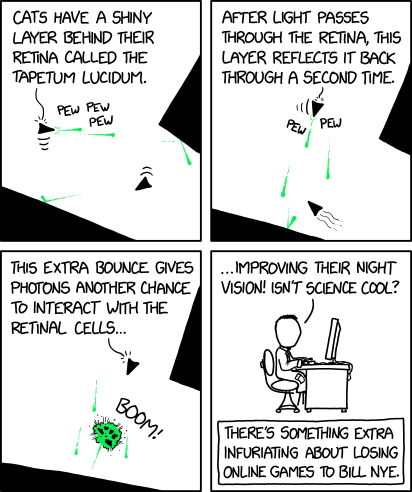
Post Syndicated from original https://xkcd.com/2770/
Post Syndicated from Curious Droid original https://www.youtube.com/watch?v=xfFhKqGrNYg
Post Syndicated from Matt Granger original https://www.youtube.com/watch?v=nMB1Lxlbs4g
Post Syndicated from Eric Smith original https://www.servethehome.com/a-quick-look-at-the-asustor-flashstor-6-fs6706t-nas/
We take a quick look at the Asustor Flashstor 6 FS6706T. This is a 6x M.2 NVMe SSD NAS with two 2.5GbE NICs for a SMB all-flash NAS
The post A Quick Look at the Asustor Flashstor 6 FS6706T NAS appeared first on ServeTheHome.
Post Syndicated from Explosm.net original https://explosm.net/comics/riddles
New Cyanide and Happiness Comic
Post Syndicated from Oglaf! -- Comics. Often dirty. original https://www.oglaf.com/butterflies/


Post Syndicated from Cliff Robinson original https://www.servethehome.com/mitac-goldstone-gs1d11-4th-gen-intel-xeon-scalable-2p-at-ocp-regional-summit-2023-prague/
We saw the new MiTAC Goldstone GS1D11 4th Gen Intel Xeon Scalable 2P at OCP Regional Summit 2023 in Prague
The post MiTAC Goldstone GS1D11 4th Gen Intel Xeon Scalable 2P at OCP Regional Summit 2023 Prague appeared first on ServeTheHome.
Post Syndicated from Techmoan original https://www.youtube.com/watch?v=Wg2Si7D3JS0
Post Syndicated from Йовко Ламбрев original https://www.toest.bg/sedmitsata-24-29-april/

След изборните драми, Пасха, Страстната седмица, Светлата седмица и Рамазан се приземяваме рязко в обичайното ежедневие само за да осъзнаем още по-ясно как изобщо не сме го напускали.
Двете най-големи политически формирования в най-новия парламент продължиха да водят особен диалог, някаква част от който съвсем нарочно е публичен, а на моменти дори театрален. По-интересни, разбира се, остават нюансите, които едва прозират под повърхността. Политическият танц е сложен и както в онази приказка за русалката, всяка стъпка се усеща като ходене върху кинжали. Според Емилия Милчева редовното правителство, което евентуално се задава, прилича на котката на Шрьодингер – едновременно възможно и невъзможно. За българските парадокси и декодирането на бъдещето четете в седмичния ѝ политически обзор.
На фона на гъстата политическа мъгла служебното правителство хвърли още една сериозна димка, като предложи бюджет с 6,4% дефицит. Много по-голям от допустимия, за да е изобщо възможно да таим някакви мечти за еврозоната. Казано по друг начин, със служебните министри на Радев даже не е особено нужно „Възраждане“ да се напъва с референдуми срещу еврото. Но за песимистичния бюджет има и реални причини, свързани с политическата криза и забавянето в изпълнението на Плана за възстановяване и устойчивост. Въпреки тях обаче консервативен бюджет с до 3% дефицит продължава да е възможна опция.
БНБ също реши, че е време да позатегне примката около кредитната активност на търговските банки у нас, изтегляйки от обращение около 3 млрд. лв. от ликвидните им пари. Очакванията са, че това ще позабави кредитирането и вероятно ще повиши лихвите по заемите. Но дори и след тази мярка свръхликвидността в банковата система, изглежда, ще продължи да е внушителна.
Знаете ли, че решението за организиране на първото земеделско-промишлено изложение в Пловдив, което да даде възможност на прохождащата индустрия и на селското стопанство да се сдобият с повече клиенти и партньори от Европа, е взето от правителството на Стефан Стамболов през 1891 г.? През следващата 1892-ра първото българско изложение е открито с военен парад и в присъствието на княза. През 30-те години на ХХ век Пловдивският панаир става постоянен и е обявен за международен. И до днес, макар и далеч от предишната си слава и осезаемо западнал покрай управлението на своите собственици и техните протежета, Панаирът е един от символите на град Пловдив и кореняците пловдивчани го носят в сърцата си. Тази 130-годишна история е на път да приключи след поредица от събития през последните две десетилетия, с които държавата бавно, но последователно се отказа от собствеността си и буквално натика Панаира в ръцете на Георги Гергов.
Всичко започна през 2006 г. от правителството на Тройната коалиция, което подари без търг първите 49% на смесено дружество между Община Пловдив и Гергов. И завърши тази седмица, когато последният доби пълен контрол върху Панаира. С любезното бездействие на кмета Здравко Димитров и администрацията му в Община Пловдив, както и с това на общинските съветници от ГЕРБ и БСП. Сега 350 декара на брега на река Марица са в ръцете на един бизнесмен, който може да прави с тях каквото реши. Мрачните прогнози са, че скоро в центъра на града ще се появи ж.к. „Панаира“. И те не са без основания, защото градът помни подобни развръзки с други от своите символи. Едно от тепетата отдавна го няма, а името му от няколко години се носи от… мол.
Тази седмица Светла Енчева обръща внимание на тема, която е встрани и от следизборния шум, и от дневния ред на политиците, но е изцяло свързана с редица политики, които следва да имаме на национално ниво – екологични и социални. Без тях новината за появата на автомати за връщане на пластмасови бутилки и кенове продължава да е стъпка в правилната посока, но липсата на национална депозитна система свежда полезността на машините до чисто символична.
В новата си статия Анастасия Орманджиева този път обяснява сложната система от човешки левкоцитни антигени и каква е ролята ѝ както за предпазване от инфекции, така и за успеха на трансплантациите и разгадаването на автоимунните заболявания. А как във всичко това може да се намеси котаракът от „Том и Джери“, който опитва да открадне пай, оставен на прозореца, може да разберете само ако прочетете „Прозорецът към вътрешния свят на клетката“.
В рубриката ни „По буквите“ Зорница Христова е подбрала толкова интересни заглавия, че едва се сдържах да не си ги поръчам, преди да дочета докрай препоръките ѝ. Новите книги, за които може да прочетете в колонката ѝ, са романът „Вулкан“ от Елена Алексиева, „Всичко това можеше да е твое“ от Йосефине Клоугарт и новата стихосбирка на Виолета Кунева „Кучето на Персефона“.
Тази седмица може да завършим само по един начин. В петък нашият непрежалим Марин Бодаков трябваше да навърши 52 години. По този повод нека си спомним за него и за поезията му чрез словото на Яна Букова, произнесено по време на представянето на сборника „Галерията на сърцето“ в театър „Сфумато“ на 24 септември 2022 г.
Негово е и стихотворението на месеца, което избрахме за вас.
Приятно четене!
Post Syndicated from Explosm.net original https://explosm.net/comics/mario-movie
New Cyanide and Happiness Comic
Post Syndicated from original https://lwn.net/Articles/930497/
Version
4.9 of the SystemTap tracing tool has been released. The headline
changes this time include a new, Jupyter-based frontend and a
language-server-protocol interface for name completion.
Post Syndicated from Bruce Schneier original https://www.schneier.com/blog/archives/2023/04/friday-squid-blogging-more-squid-camouflage-research.html
Here’s a research group trying to replicate squid cell transparency in mammalian cells.
As usual, you can also use this squid post to talk about the security stories in the news that I haven’t covered.
Read my blog posting guidelines here.
Post Syndicated from Sébastien Stormacq original https://aws.amazon.com/blogs/aws/introducing-athena-provisioned-capacity/
Today we launch the ability to provision capacity to run your Amazon Athena queries.
Athena is a query service that makes it simple to analyze data in Amazon Simple Storage Service (Amazon S3) data lakes and 30 different data sources, including on-premises data sources or other cloud systems, using standard SQL queries. Athena is serverless, so there is no infrastructure to manage, and–until today–you pay only for the queries that you run. Starting today, you can get dedicated capacity for your queries and use new workload management features to prioritize, control, and scale your most important queries, paying only for the capacity you provision.
At AWS, 90 percent of the new services and features are driven by your direct feedback. Many of you Athena customers told us that, when running a large volume of queries, you sometimes experience queuing, which might slow down some applications or business processes. To work around this, you typically create a query prioritization mechanism to prioritize mission-critical queries over less critical, interactive, or exploratory queries. This prioritization mechanism helps to get the highest priority queries run first, at the price of building and maintaining code or business processes outside of Athena itself. You also told us it is difficult to forecast your Athena costs. Athena charges by the volume of data scanned, which is often difficult to predict as it depends on the size of your data set, the construction of the user queries, and the storage format for the data.
We heard this feedback, and today, we introduce the capability to provision dedicated query processing capacity at scale. With provisioned capacity, you provision a dedicated set of compute resources to run your queries. This always-on capacity can serve your business-critical queries with near-zero latency and no queuing. It gives you control over workload performance characteristics such as cost, concurrency, and query prioritization. Similar to provisioned capacity for other AWS services, you pay only for the capacity provisioned, not for the actual usage. With provisioned capacity, your Athena bills are predictable, and you do not have to limit user queries to stay within your monthly budget. I’ll share more about the billing model down below.
Behind the scenes, Athena maintains a large pool of compute in each AWS Region that it operates in. You can think of this as one large pool of compute, divided logically across customers. When you reserve capacity in Athena, the capacity is held for your exclusive use. You can choose which queries run on the capacity you provisioned and which run on Athena’s multi-tenant, on-demand capacity. Multiple queries can share the capacity you provisioned. You may add additional capacity units at any time, based on your evolving business requirements. You may also adjust the provisioned capacity down after a minimum period of time of 8 hours.
The unit of capacity is a Data Processing Unit (DPU). A single DPU is equivalent to four vCPU and 16 Gb RAM. The minimum capacity you may provision is 24 DPU for 8 hours. This new provisioned capacity for Athena is ideal for those of you running any volume of queries, but the sweet spot to start using provisioned capacity is when you spend $100 or more per month on Athena.
The number of DPUs you need depends on your goals and analysis patterns. For example, if you need queries to start immediately and without queuing, you should provision enough DPUs to meet your peak concurrent query demand. Provisioning fewer DPUs than your peak demand is allowed, but may result in queuing. When this occurs, queries are held in a queue and executed when capacity is available. If your goal is to run queries within a fixed budget, you can use the AWS Pricing Calculator to determine the number of DPUs that meets your budget. Lastly, remember that data size, storage format, and query construction influence the number of DPU a query requires. You can increase query performance by compressing, partitioning, and converting your data into columnar formats. Athena’s documentation provides you with guidelines to determine how much capacity you might require to run multiple queries at the same time.
How Does It Work?
Getting started is a three-step process. I navigate to the Athena page in the AWS Management Console and select Capacity Reservations on the left-side navigation menu.
(The console you see on this demo is based on the new Cloudscape open-source design system, yours might still see the traditional design on your AWS account.)

I select the Create capacity reservation button at the top right of the page.
On the Create capacity reservation page, I enter a Capacity reservation name and the number of DPUs I want to provision.
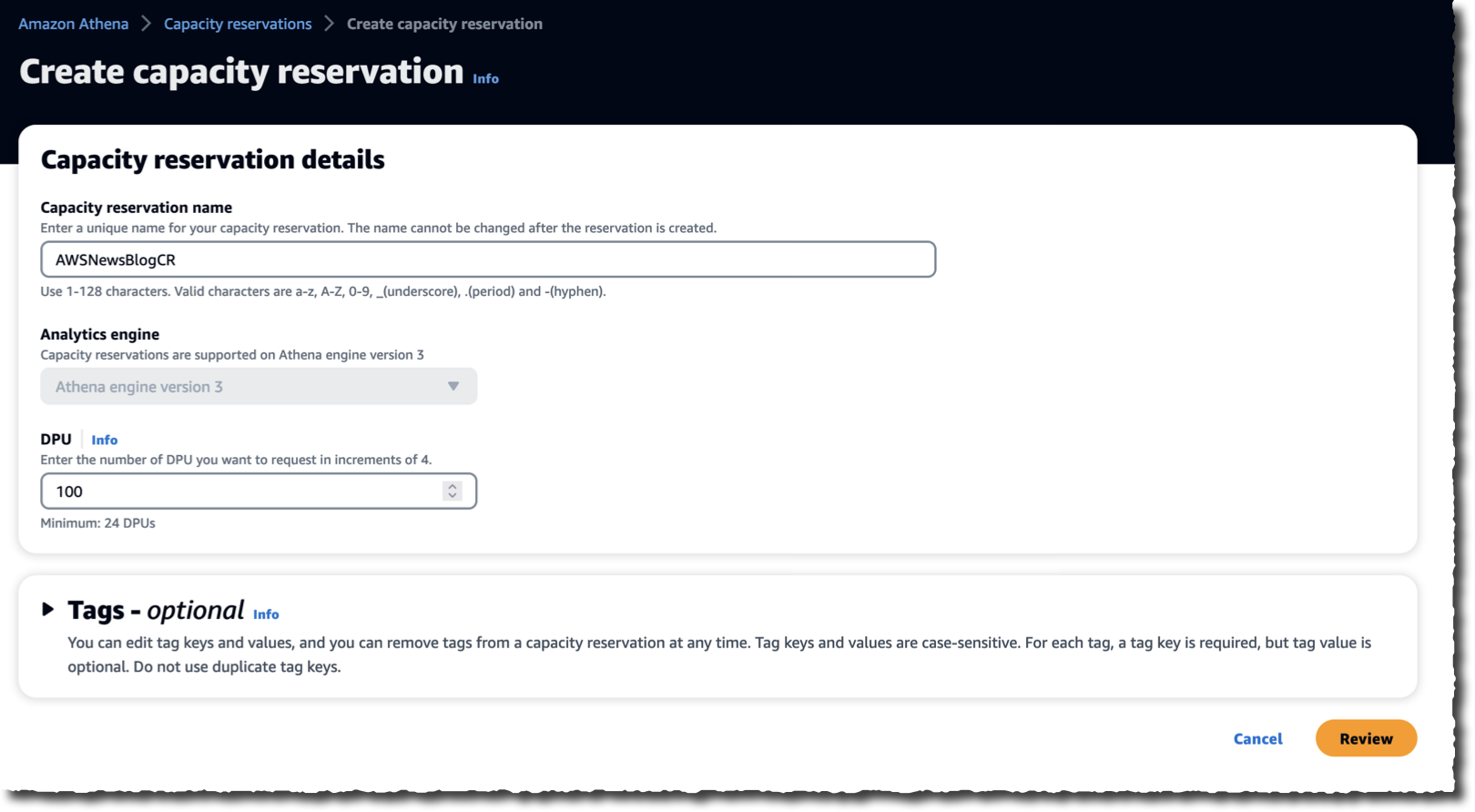
I select Review to review my choices, and I select Create capacity reservation to create my reservation. After a brief period of time, the capacity reservation status becomes  Active.

The third and last step is to create a workgroup and assign the workgroup to the provisioned capacity. A workgroup is an Athena mechanism allowing you to separate users, teams, applications, or workloads to set limits on the amount of data each query or the entire workgroup can process and to track costs.
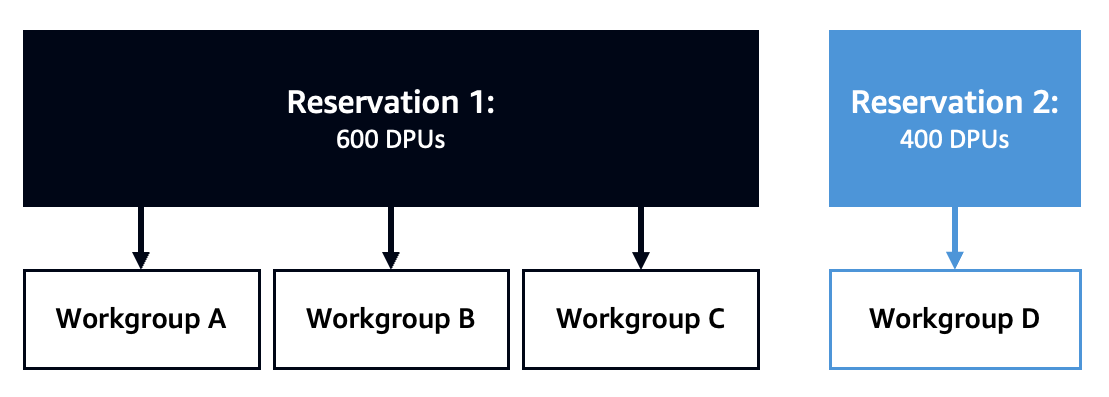
Queries belonging to the assigned workgroup will run on the capacity you provisioned. Capacity may be shared with multiple workgroups as long as they all use the same Athena engine version. This concept, depicted in the diagram below, is surfaced through a capacity allocation policy, which defines how capacity is assigned over workgroups. This gives you the flexibility to run queries with more or less capacity, depending on your business needs.
To create a workgroup, I navigate to the Workgroups section of the Athena page. Then, I select Create workgroup.

I make sure the analytics engine selected in the reservation matches the one in the workgroup.
 Then, I go back to the capacity reservation I just created, and I select Add workgroups to add the workgroup I just created.

That’s it! Now that the configuration is ready, I can run my queries. Existing queries will run on the provisioned capacity unmodified. I make sure to select the workgroup I just created when I run queries. I choose a workgroup on the top right side of the query editor, or use the --work-group argument on the AWS command line, such as:
aws athena start-query-execution --work-group AWSNewsBlog
Availability and Pricing
As I explained in the introduction, we charge for the number of DPUs you provisioned and the duration. The minimum duration is 8 hours, and after that, billing is per minute. You can release the provisioned capacity at any time. Cancellations within the minimum duration period are billed for the full term, and capacity is deallocated as soon as all currently running queries are terminated.
Queries run from a workgroup assigned to a provisioned capacity are not billed for the amount of data scanned. You effectively pay a flat rate depending on the provisioned capacity, not the usage. If you have excess capacity, you can reduce the number of DPUs you provisioned or add workgroups to consume the excess capacity.
As usual, the Athena pricing page has all the details.
Athena provisioned capacity is available today in US East (Ohio, N. Virginia), US West (Oregon), Asia Pacific (Singapore, Sydney, Tokyo), and Europe (Ireland, Stockholm) AWS Regions.