Tag Archives: Birthday Week

Build real-time video and audio apps on the world’s most interconnected network

Post Syndicated from Zaid Farooqui original https://blog.cloudflare.com/announcing-cloudflare-calls/


Build real-time video and audio apps on the world’s most interconnected network

Build real-time video and audio apps on the world’s most interconnected network

In the last two years, there has been a rapid rise in real-time apps that help groups of people get together virtually with near-zero latency. User expectations have also increased: your users expect real-time video and audio features to work flawlessly. We found that developers building real-time apps want to spend less time building and maintaining low-level infrastructure. Developers also told us they want to spend more time building features that truly make their idea special.

So today, we are announcing a new product that lets developers build real-time audio/video apps. Cloudflare Calls exposes a set of APIs that allows you to build things like:

  • A video conferencing app with a custom UI
  • An interactive conversation where the moderators can invite select audience members “on stage” as speakers
  • A privacy-first group workout app where only the instructor can view all the participants while the participants can only view the instructor
  • Remote ‘fireside chats’ where one or multiple people can have a video call with an audience of 10,000+ people in real time (<100ms delay)

The protocol that makes all these possible is WebRTC. And Cloudflare Calls is the product that abstracts away the complexity by turning the Cloudflare network into a “super peer,” helping you build reliable and secure real-time experiences.

What is WebRTC?

WebRTC is a peer-to-peer protocol that enables two or more users’ devices to talk to each other directly and without leaving the browser. In a native implementation, peer-to-peer typically works well for 1:1 calls with only two participants. But as you add additional participants, it is common for participants to experience reliability issues, including video freezes and participants getting out of sync. Why? Because as the number of participants increases, the coordination overhead between users’ devices also increases. Each participant needs to send media to each other participant, increasing the data consumption from each computer exponentially.

A selective forwarding unit (SFU) solves this problem. An SFU is a system that connects users with each other in real-time apps by intelligently managing and routing video and audio data between the participants. Apps that use an SFU reduce the data capacity required from each user because each user doesn’t have to send data to every other user. SFUs are required parts of a real-time application when the applications need to determine who is currently speaking or when they want to send appropriate resolution video when WebRTC simulcast is used.

Beyond SFUs

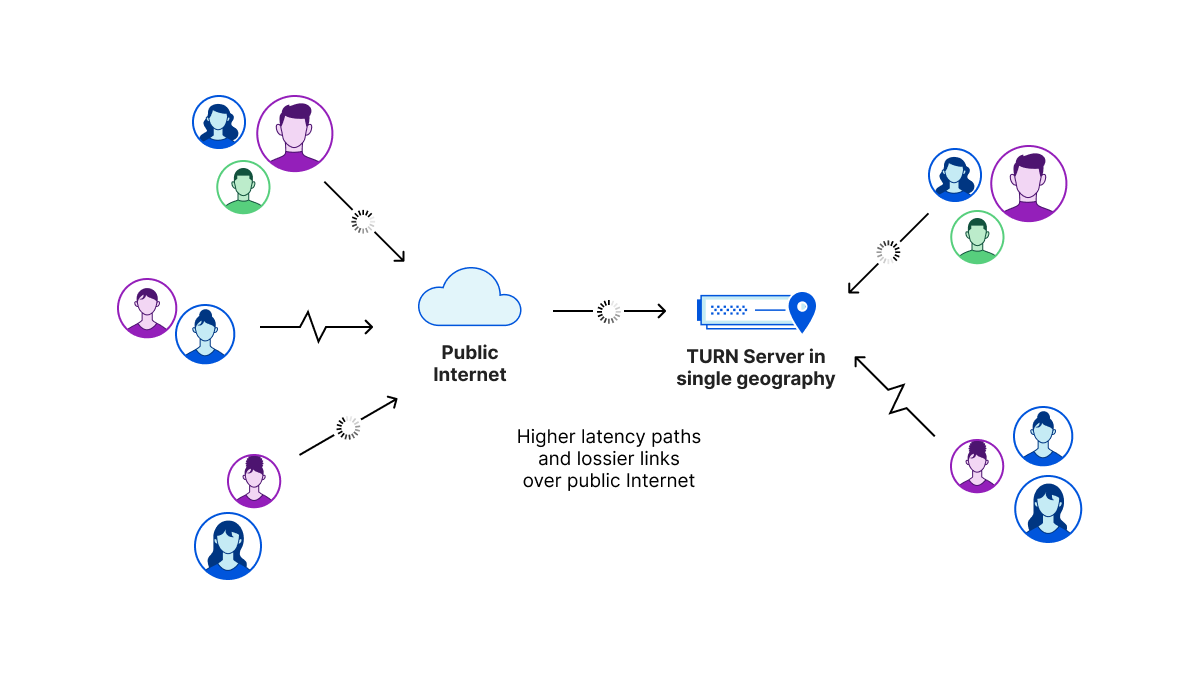
The centralized nature of an SFU is also its weakness. A centralized WebRTC server needs a region, which means that it will be slow in most parts of the world for most users while being fast for only a few select regions.

Typically, SFUs are built on public clouds. They consume a lot of bandwidth by both receiving and sending high resolution media to many devices. And they come with significant devops overhead requiring your team to manually configure regions and scalability.

We realized that merely offering an SFU-as-a-service wouldn’t solve the problem of cost and bandwidth efficiency.

Biggest WebRTC server in the world

When you are on a five-person video call powered by a classic WebRTC implementation, each person’s device talks directly with each other. In WebRTC parlance, each of the five participants is called a peer. And the reliability of the five-person call will only be as good as the reliability of the person (or peer) with the weakest Internet connection.

We built Calls with a simple premise: “What if Cloudflare could act as a WebRTC peer?”.  Calls is a “super peer” or a “giant server that spans the whole world” allows applications to be built beyond the limitations of the lowest common denominator peer or a centralized SFU. Developers can focus on the strength of their app instead of trying to compensate for the weaknesses of the weakest peer in a p2p topology.

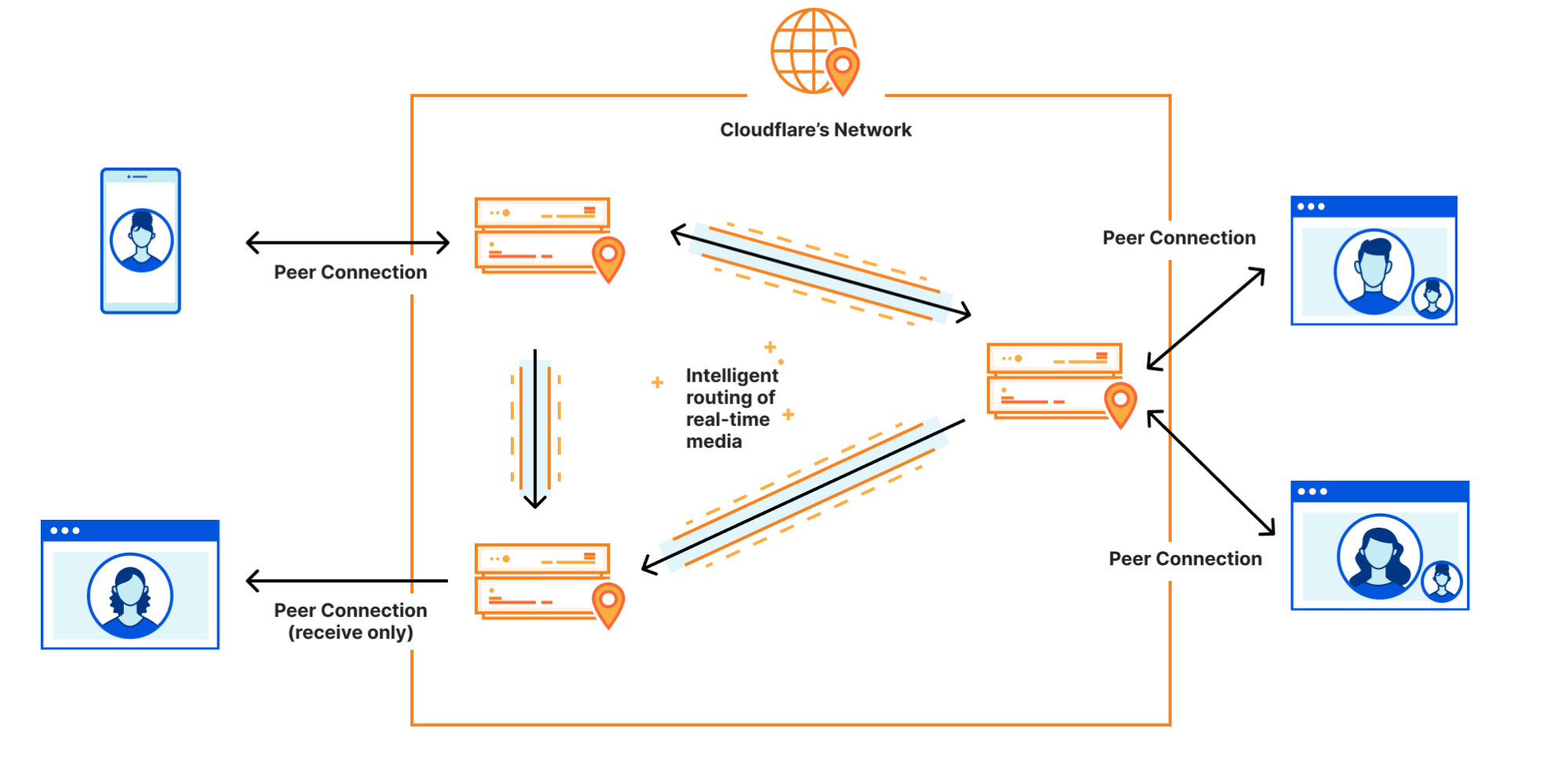
Calls does not use the traditional SFU topology where every participant connects to a centralized server in a single location. Instead, each participant connects to their local Cloudflare data center. When another participant wants to retrieve that media, the datacenter that homes that original media stream is found and the tracks are forwarded between datacenters automatically. If two participants are physically close their media does not travel around the world to a centralized region, instead they use the same datacenter, greatly reducing latency and improving reliability.

Calls is a configurable, global, regionless WebRTC server that is the size of Cloudflare’s ever-growing network. The WebRTC protocol enables peers to send and receive media tracks. When you are on a video call, your computer is typically sending two tracks: one that contains the audio of you speaking and another that contains the video stream from your camera. Calls implements the WebRTC RTCPeerConnection API across the Cloudflare Network where users can push media tracks. Calls also exposes an API where other media tracks can be requested within the same Peer Connection context.
Build real-time video and audio apps on the world’s most interconnected network

Cloudflare Calls will be a good solution if you operate your own WebRTC server such as Janus or MediaSoup. Cloudflare Calls can also replace existing deployments of Janus or MediaSoup, especially in cases where you have clients connecting globally to a single, centralized deployment.

Region: Earth

Building and maintaining your own real-time infrastructure comes with unique architecture and scaling challenges. It requires you to answer and constantly revise your answers to thorny questions such as “which regions do we support?”, “how many users do we need to justify spinning up more infrastructure in yet another cloud region?”, “how do we scale for unplanned spikes in usage?” and “how do we not lose money during low-usage hours of our infrastructure?” when you run your own WebRTC server infrastructure.

Cloudflare Calls eliminates the need to answer these questions. Calls uses anycast for every connection, so every packet is always routed to the closest Cloudflare location. It is global by nature: your users are automatically served from a location close to them. Calls scales with your use and your team doesn’t have to build its own auto-scaling logic.

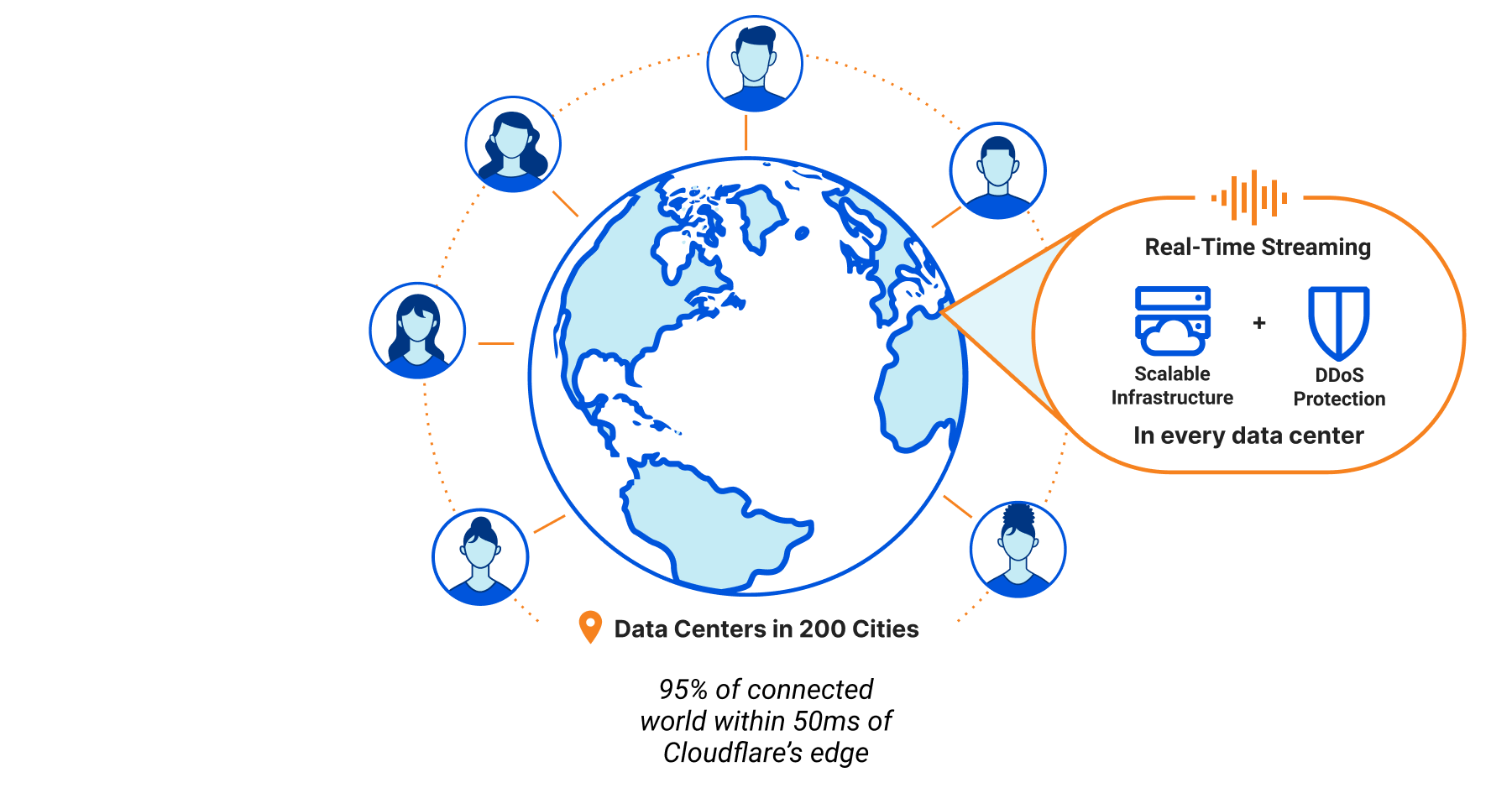
Calls runs on every Cloudflare location and every single Cloudflare server. Because the Cloudflare network is within 10 milliseconds of 90% of the world’s population, it does not add any noticeable latency.

Answer “where’s the problem?”, only faster

When we talk to customers with existing WebRTC workloads, there is one consistent theme: customers wish it was easier to troubleshoot issues. When a group of people are talking over a video call, the stakes are much higher when users experience issues. When a web page fails to load, it is common for users to simply retry after a few minutes. When a video call is disruptive, it is often the end of the call.

Cloudflare Calls’ focus on observability will help customers get to the bottom of the issues faster. Because Calls is built on Cloudflare’s infrastructure, we have end-to-end visibility from all layers of the OSI model.

Calls provides a server side view of the WebRTC Statistics API, so you can drill into issues each Peer Connection and the flow of media within without depending only on data sent from clients. We chose this because the Statistics API is a standardized place developers are used to getting information about their experience. It is the same API available in browsers, and you might already be using it today to gain insight into the performance of your WebRTC connections.

Privacy and security at the core

Calls eliminates the need for participants to share information such as their IP address with each other. Let’s say you are building an app that connects therapists and patients via video calls. With a traditional WebRTC implementation, both the patient and therapist’s devices would talk directly with each other, leading to exposure of potentially sensitive data such as the IP address. Exposure of information such as the IP address can leave your users vulnerable to denial-of-service attacks.

When using Calls, you are still using WebRTC, but the individual participants are connecting to the Cloudflare network. If four people are on a video call powered by Cloudflare Calls, each of the four participants’ devices will be talking only with the Cloudflare network. To your end users, the experience will feel just like a peer-to-peer call, only with added security and privacy upside.

Finally, all video and audio traffic that passes through Cloudflare Calls is encrypted by default. Calls leverages existing Cloudflare products including Argo to route the video and audio content in a secure and efficient manner. Calls API enables granular controls that cannot be implemented with vanilla WebRTC alone. When you build using Calls, you are only limited by your imagination; not the technology.

What’s next

We’re releasing Cloudflare Calls in closed beta today. To try out Cloudflare Calls, request an invitation and check your inbox in coming weeks.
Calls will be free during the beta period. We’re looking to work with early customers who want to take Calls from beta to generally available with us. If you are building a real-time video app today, having challenges scaling traditional WebRTC infrastructure, or just have a great idea you want to explore, leave a comment when you are requesting an invitation, and we’ll reach out.


Cloudflare Queues: globally distributed queues without the egress fees

Post Syndicated from Ashcon Partovi original https://blog.cloudflare.com/introducing-cloudflare-queues/

Cloudflare Queues: globally distributed queues without the egress fees

Cloudflare Queues: globally distributed queues without the egress fees

Developers continue to build more complex applications on Cloudflare’s Developer Platform. We started with Workers, which brought compute, then introduced KV, Durable Objects, R2, and soon D1, which enabled persistence. Now, as we enable developers to build larger, more sophisticated, and more reliable applications, it’s time to unlock another foundational building block: messaging.

Thus, we’re excited to announce the private beta of Cloudflare Queues, a global message queuing service that allows applications to reliably send and receive messages using Cloudflare Workers. It offers at-least once message delivery, supports batching of messages, and charges no bandwidth egress fees. Let’s queue up the details.

What is a Queue?

Queues enable developers to send and receive messages with a guarantee of delivery. Think of it like the postal service for the Internet. You give it a message, then it handles all the hard work to ensure the message gets delivered in a timely manner. Unlike the real postal service, where it’s possible for a message to get lost, Queues provide a guarantee that each message is delivered at-least once; no matter what. This lets you focus on your application, rather than worry about the chaos of transactions, retries, and backoffs to prevent data loss.

Queues also allow you to scale your application to process large volumes of data. Imagine a million people send you a package in the mail, at the same time. Instead of a million postal workers suddenly showing up at your front door, you would want them to aggregate your mail into batches, then ask you when you’re ready to receive each batch. This lets you decouple and spread load among services that have different throughput characteristics.

How does it work?

Queues are integrated into the fabric of the Cloudflare Workers runtime, with simple APIs that make it easy to send and receive messages. First, you’ll want to send messages to the Queue. You can do this by defining a Worker, referred to as a “producer,” which has a binding to the Queue.

In the example below, a Worker catches JavaScript exceptions and sends them to a Queue. You might notice that any object can be sent to the Queue, including an error. That’s because messages are encoded using the standard structuredClone() algorithm.

export default {
  async fetch(request: Request, env: Environment) {
     try {
       return await doRequest(request);
     } catch (error) {
       await env.ERROR_QUEUE.send(error);
       return new Response(error.stack, { status: 500 });
     }
  }
}

Second, you’ll want to process messages in the Queue. You can do this by defining a Worker, referred to as the “consumer,” which will receive messages from the Queue. To facilitate this, there is a new type of event handler, named “queue,” which receives the messages sent to the consumer.

This Worker is configured to receive messages from the previous example. It appends the stack trace of each Error to a log file, then saves it to an R2 bucket.

export default {
  async queue(batch: MessageBatch<Error>, env: Environment) {
     let logs = "";
     for (const message of batch.messages) {
        logs += message.body.stack;
     }
     await env.ERROR_BUCKET.put(`errors/${Date.now()}.log`, logs);
  }
}

Configuration is also easy. You can change the message batch size, message retries, delivery wait time, and dead-letter queue. Here’s a snippet of the wrangler.toml configuration when deploying with wrangler, our command-line interface

name = "my-producer"
[queues]
producers = [{ queue = "errors", binding = "ERROR_QUEUE" }]
# ---
name = "my-consumer"
[queues]
consumers = [{ queue = "errors", max_batch_size = 100, max_retries = 3 }]

Above are two different wrangler.tomls, one for a producer and another for a consumer. It is also possible for a producer and consumer to be implemented by the same Worker. To see the full list of options and examples, see the documentation.

What can you build with it?

You can use Cloudflare Queues to defer tasks and guarantee they get processed, decouple load among different services, batch events and process them together, and send messages from Worker to Worker.

To demonstrate, we’ve put together a demo application that you can run on your local machine using wrangler. It shows how Queues can batch messages and handle failures in your code, here’s a preview of it in action:

In addition to batching, here are other examples of what you can build with Queues:

  • Off-load tasks from the critical path of a Workers request.
  • Guarantee messages get delivered to a service that talks HTTP.
  • Transform, filter, and fan-out messages to multiple Queues.

Cloudflare Queues gives you the flexibility to decide where to route messages. Instead of static configuration files that define routing keys and patterns, you can use JavaScript to define custom logic for how you filter and fan-out to multiple Queues. In the next example, you can distribute work to different Queues based on the attributes of a user.

export default {
  async queue(batch: MessageBatch, env: Environment) {
    for (const message of batch.messages) {
      const user = message.body;
      if (isEUResident(user)) {
        await env.EU_QUEUE.send(user);
      }
      if (isForgotten(user)) {
        await env.DELETION_QUEUE.send(user);
      }
    }
  }
}

We will also support integrations with Cloudflare products, like R2. For example, you might configure an R2 bucket to send lifecycle events to a Queue or archive messages to a R2 bucket for long-term storage.

How much does it cost?

Cloudflare Queues has a simple, transparent pricing model that’s easy to predict. It costs $0.40 per million operations, which is defined for every 64 KB chunk of data that is written, read, or deleted. There are also no egregious bandwidth fees for data in or out — unlike Amazon’s SQS or Google’s Pub/Sub.

To effectively deliver a message, it usually takes three operations: one write, one read, and one acknowledgement. You can estimate your usage by considering the cost of messages delivered, which is $1.20 per million. (calculated as 3 x \$0.40)

When can I try it?

You can register to join the waitlist as we work towards a beta launch. You’ll have an opportunity to try it out, for free. Once it’s ready, we’ll launch an open beta for everyone to try.

In the meantime, you can read the documentation to view our code samples, see which features will be supported, and learn what you can build. If you’re in our developer Discord, you stay up-to-date by joining the #queues-beta channel. If you’re an Enterprise customer, reach out to your account team to schedule a session with our Product team.

We’re excited to see what you build with Cloudflare Queues. Let the queuing begin!

The future of Page Rules

Post Syndicated from Sam Marsh original https://blog.cloudflare.com/future-of-page-rules/

The future of Page Rules

The future of Page Rules

Page Rules is one of our most well-used products. Adopted by millions of users, it is used for configuring everything from cache to security levels. It is the ‘If This Then That’ of Cloudflare. Where the ‘If…’ is a URL, and the ‘Then That’ is changing how we handle traffic to specific parts of a ‘zone’. But it’s not without its limitations.

Page Rules can only trigger on a URL or URL pattern. There is a maximum of 125 Page Rules per zone. Page Rules are also tricky to debug. Even the idea of a “Page” sounds rather old-fashioned now.

We’re replacing Page Rules with four new dedicated products, offering increased rules quota, more functionality, and better granularity. These products are available immediately for testing. Page Rules is not going away yet, but we do anticipate being able to formally begin the end-of-life process soon.

Why change?

In the 10 years since it launched, Page Rules has become a well established product, and a very well adopted one. One million Page Rules have been deployed in the past three months alone.

Page Rules are used to tune how long files should be cached. Page Rules are used to override zone-wide settings for certain URLs. Page Rules are used to create simple URL redirects. Page Rules are used to selectively add/remove HTTP headers. Page Rules is a multitool of a product.

The future of Page Rules
Photo by Andrey Matveev on Unsplash

Like multitools and other generalist products, Page Rules does a good job at many things, but is not best-of-breed at anything. This is the trade-off of generalism. As we have grown as a company our customers have rightfully demanded more. Filtering on URL-alone is no longer sufficient; users are demanding more – and today we are delivering.

Over the last two years we have been working on the future of Page Rules and distilling hundreds of pieces of feedback into common themes, such as:

  1. I need more than 125 Page Rules
  2. I need to be able to trigger Page Rules on more than just the URL
  3. I need to be able to use regular expressions in my Page Rules
  4. It’s hard for me to understand how different Page Rules interact one another
  5. Page Rules is hard to debug
  6. I want more actions in Page Rules

Analyzing these themes we came to the conclusion that the best thing for Page Rules was to disassemble it and create new discrete products, each of which could be best-of-breed for their relevant areas. This dissolution would also provide better clarity regarding interoperation (cache vs configuration vs …), and make debugging simpler.

Today, we announce those new products:

1. Cache Rules: A dedicated product for setting and tuning ‘everything caching’.

2. Configuration Rules: A dedicated product for setting and selectively enabling, disabling and overriding zone-wide settings.

3. Dynamic Redirects: Like ‘Forwarding URL’ but turned up to 11. Redirect based on the visitors country, their preferred language, their device type, use regular expressions (plan level dependant) and more.

4. Origin Rules: A dedicated product for ‘where does this traffic go where it leaves Cloudflare’. Not only have we added host header and resolve override into this new product (ENT only), we’ve also productized another common Workers use case by enabling customers to selectively override the destination port. We’ve also added the ability to override the Server Name Indication (SNI).

All four of these products are available for use now via the dashboard, API and Terraform – and sitting alongside Transform Rules provide the replacement suite of products that will eventually enable an Page Rules end-of-life announcement.

We have dedicated blogs for each of these product launches with more information on what they offer and problems they address.

Order of execution

One of the main benefits of this new product suite is clarity.

Page Rules is a black box, where traffic goes in, ‘things happen’, and traffic comes out. It’s hard to debug the interplay between cache, configuration, header modification etc and it can vary from zone to zone as it’s entirely user defined.
By having discrete, separate areas per ‘function’, it makes visualizing the flow of a HTTP request much easier:

The future of Page Rules

Rather than a single lozenge of Page Rules, we now have visibility that Origin Rules will run first, then Cache Rules, then Configuration Rules, and finally Dynamic Redirects. This means we will modify host headers first, before tuning cache settings. And we will tune the cache parameters before we modify which settings are enabled for the specific traffic.

We have integrated these new products into the Traffic Sequence dashboard element also.

(For zones using both Page Rules and this new suite of products: The new products will take precedence over Page Rules. This means that Page Rules will be overridden if a conflict occurs).

I need more than 125 Page Rules

One of the limitations of Page Rules was how each Page Rule was stored and executed on our backend architecture. We are unable to offer more than 125 Page Rules per zone before we begin to see a performance hit – latency on HTTP requests begins to increase as evaluating them vs the Page Rules takes longer and longer. To combat this limitation users moved simple workloads to Workers, or split the zone into multiple sub domains, each with a 125 Page Rules quota. Neither of these are ideal for the customer.

To combat this limitation we have built all of the replacement products atop our lightning-fast Rulesets Engine, which also runs products such as Transform Rules, Custom Rules (WAF), Bulk Redirects and API Shield.

This allows us to offer much more quota to customers, as this engine is built to scale well beyond 125 rules per product. The table below summarizes the before and after impact of these new products, showing the default rules quota per plan:

Plan Page Rules Origin Rules Cache Rules Config Rules Dynamic Redirects
Enterprise 125 125+ 125+ 125+ 125+
Business 50 50 50 50 50
Pro 20 25 25 25 25
Free 3 10 10 10 10

Additional rules cannot be purchased for these new products.

This means zone’s on the Enterprise plan now have a minimum of 500 rules to use where before they had 125 via Page Rules. For Enterprises the quota for the new products is negotiable. Pro plan zones go from 20 Page Rules to 100.  Combined with the fine-grained control that the ruleset engine offers, these changes allow customers to customize their zone’s traffic to the finest of margins.

The other benefit from building all of these products on the Rulesets Engine is extensibility. Currently there are over 30 products that are built and running on the Rulesets Engine. Each of these products is essentially a logical bucket called a ‘phase’ which contains a single ruleset scoped to that product. Each phase is restricted to specific actions and fields, for example the field cf.bot_management.score is unavailable in http_request_transform as we have not calculated the bot score at the time we perform URL rewrites. Also, only the rewrite action is permitted. Whereas in Origin Rules (http_request_origin) we only allow the action route

When we create new capabilities for a product that is built atop the Rulesets Engine it is trivially simple for us to extend that new capability to other products at a later date.

For example, we added a new ‘field’, http.request.accepted_languages to Transform Rules earlier in the year. Until recently this was only available in Transform Rules. However, as both products are built on the Rulesets Engine it was trivial to enable this feature for Dynamic Redirects. This allows customers to perform URL redirects based on the visitor’s language preference, and the cost to us from an engineering perspective is negligible as the field is already implemented.

This also means in the future should a new field be created for Cache Rules due to a customer request, e.g. http.request.super_cool_field, in a matter of clicks we can enable this field for any of the other 30 products rather than have to duplicate effort across multiple platforms.

Simply put, the more products we build on top of the Rulesets Engine, the faster we can move and the more functionality we can put into users hands.

A single user experience

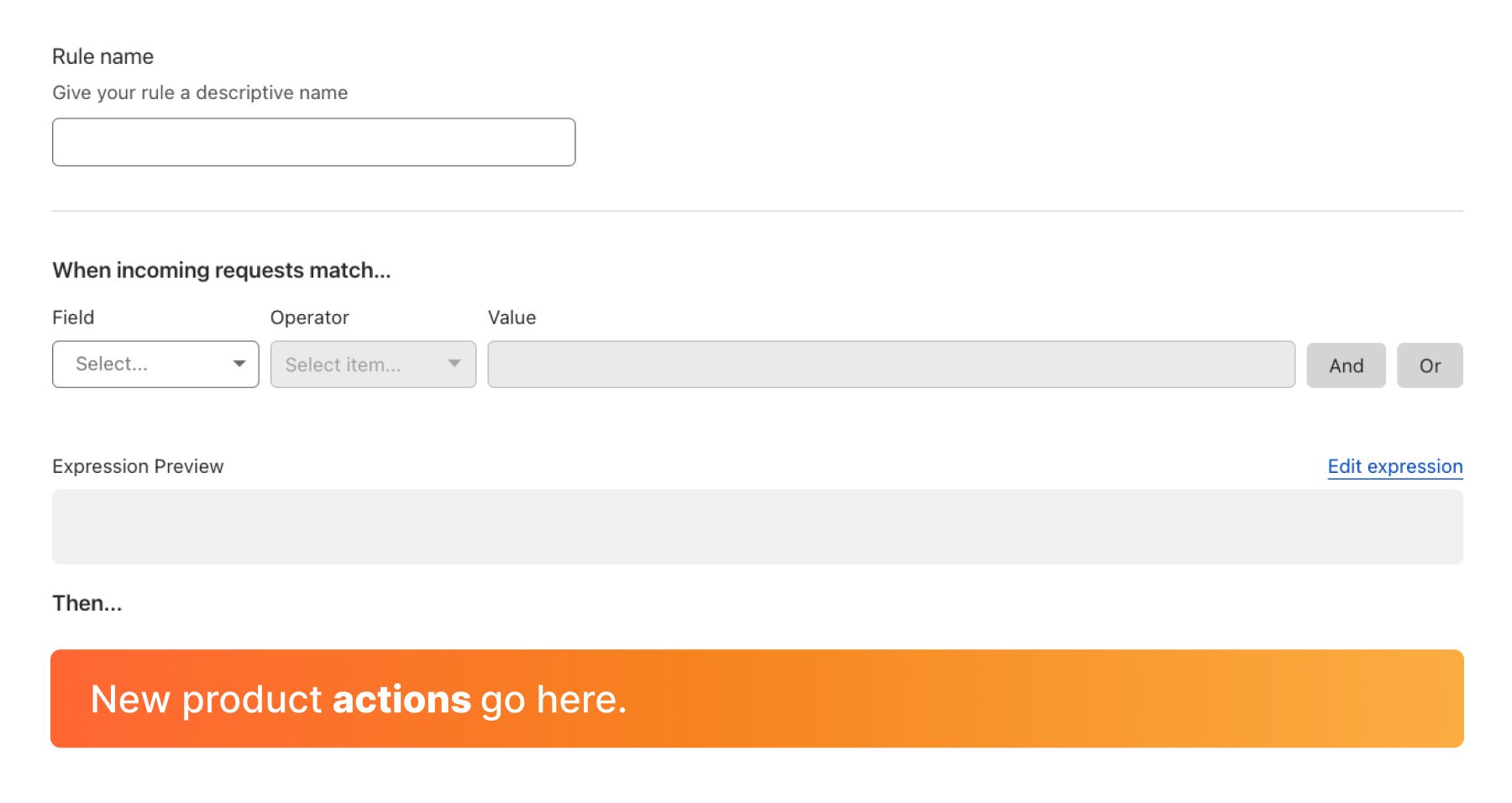
The most important benefit of all is consistency. Each of these products has a consistent and predictable API. A consistent and predictable Terraform configuration, and a consistent and predictable user experience in the dashboard. The ruleset engine allows us to keep everything the same except for the ‘action’. The filtering stays the same, the API stays the same, the UI stays (largely) the same, the only change is the ‘…then’, the action section of the rule.

This ensures that as a user when you are clicking around the dashboard setting up a new zone you aren’t having to learn each individual product’s page and how to navigate it. The only part you need to learn is what makes that product unique, its actions:

The future of Page Rules

Finally, when we add a new product, extending the Terraform provider to support it is trivial. That consistent experience has been a north star for us during this project and will continue to be in the future.

Try it them now

We are replacing Page Rules with a new suite of products, each built to be best-of-breed and put more power into the hands of our users.

Read more about the new products in each of their dedicated blogs. Then, try them for yourself!

Introducing Configuration Rules

Post Syndicated from Matt Bullock original https://blog.cloudflare.com/configuration-rules/

Introducing Configuration Rules

A powerful new set of tools

Introducing Configuration Rules

In 2012, we introduced Page Rules to the world, announcing:

“Page Rules is a powerful new set of tools that allows you to control how CloudFlare works on your site on a page-by-page basis.”

Ten years later, and with all F’s lowercase, we are excited to introduce Configuration Rules — a Page Rules successor and a much improved way of controlling Cloudflare features and settings. With Configuration Rules, users can selectively turn on/off features which would typically be applied to every HTTP request going through the zone. They can do this based on URLs – and more, such as cookies or country of origin.

Configuration Rules opens up a wide range of use cases for our users that previously were impossible without writing custom code in a Cloudflare Worker. Such use cases as A/B testing configuration or only enabling features for a set of file extensions are now made possible thanks to the rich filtering capabilities of the product.

Configuration Rules are available for use immediately across all plan levels.

Turn it on, but only when…

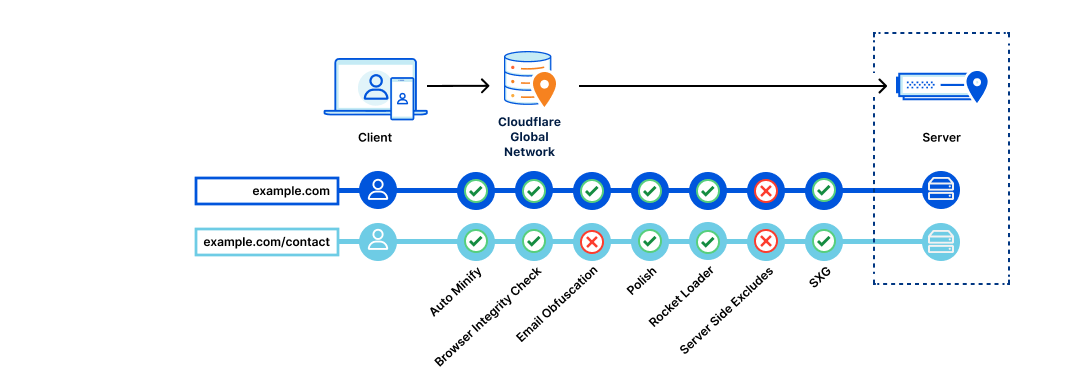
As each HTTP request enters a Cloudflare zone we apply a configuration. This configuration tells the Cloudflare server handling the HTTP request which features the HTTP request should ‘go’ through, and with what settings/options. This is defined by the user, typically via the dashboard.

The issue arises when users want to enable these features, such as Polish as Auto Minify, only on a subset of the traffic to their website. For example, users may want to disable Email Obfuscation but only for a specific page on their website so that contact information is shown correctly to visitors. To do this, they can deploy a Configuration Rule.

Introducing Configuration Rules

Configuration Rules lets users selectively enable or disable features based on one or more ruleset engine fields.

Currently, there are 16 available actions within Configuration Rules. These actions range from Disable Apps, Disable Railgun and Disable Zaraz to Auto Minify, Polish and Mirage.

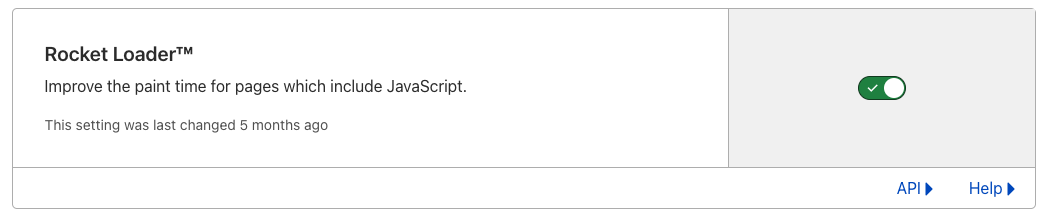
These actions effectively ‘override’ the corresponding zone-wide setting for matching traffic. For example, Rocket Loader may be enabled for the zone example.com:

Introducing Configuration Rules

If the user, however, does not want Rocket Loader to be enabled on their checkout page due to an issue it causes with a specific JavaScript element, they could create a Configuration Rule to selectively disable Rocket Loader:

Introducing Configuration Rules

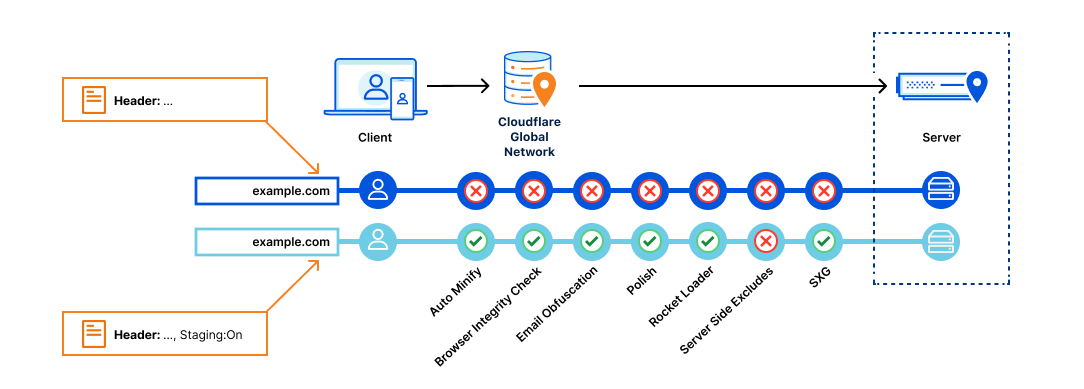
This interplay between zone level settings and Configuration Rules allows users to selectively enable features, allowing them to test Rocket Loader on staging.example.com prior to flipping the zone-level toggle.

With Configuration Rules, users also have access to various other non-URL related fields. For example, users could use the ip.geoip.country field to ensure that visitors for specific countries always have the ‘Security Level’ set to ‘I’m under attack’.

Historically, these configuration overrides were achieved with the setting of a Page Rule.

Page Rules is the ‘If This Then That’ of Cloudflare. Where the ‘If…’ is a URL, and the ‘Then That’ is changing how we handle traffic to specific parts of a ‘zone’. It allows users to selectively change how traffic is handled, and in this case specifically, which settings are and aren’t applied. It is very well adopted, with over one million Page Rules in the past three months alone.

Page Rules, however, are limited to performing actions based upon the requested URL. This means if users want to disable Rocket Loader for certain traffic, they need to make that decision based on the URL alone. This can be challenging for users who may want to perform this decision-making on more nuanced aspects, like the user agent of the visitor or on the presence of a specific cookie.

For example, users might want to set the ‘Security Level’ to ‘I’m under attack’ when the HTTP request originates in certain countries. This is where Configuration Rules help.

Use case: A/B testing

A/B testing is the term used to describe the comparison of two versions of a single website or application. It allows users to create a copy of their current website (‘A’), change it (‘B’) and compare the difference.

In a Cloudflare context, users might want to A/B test the effect of features such as Mirage or Polish prior to enabling them for all traffic to the website. With Page Rules, this was impractical. Users would have to create Page Rules matching on specific URI query strings and A/B test by appending those query strings to every HTTP request.

Introducing Configuration Rules

With Configuration Rules, this task is much simpler. Leveraging one or more fields, users can filter on other parameters of a HTTP request to define which features and products to enable.

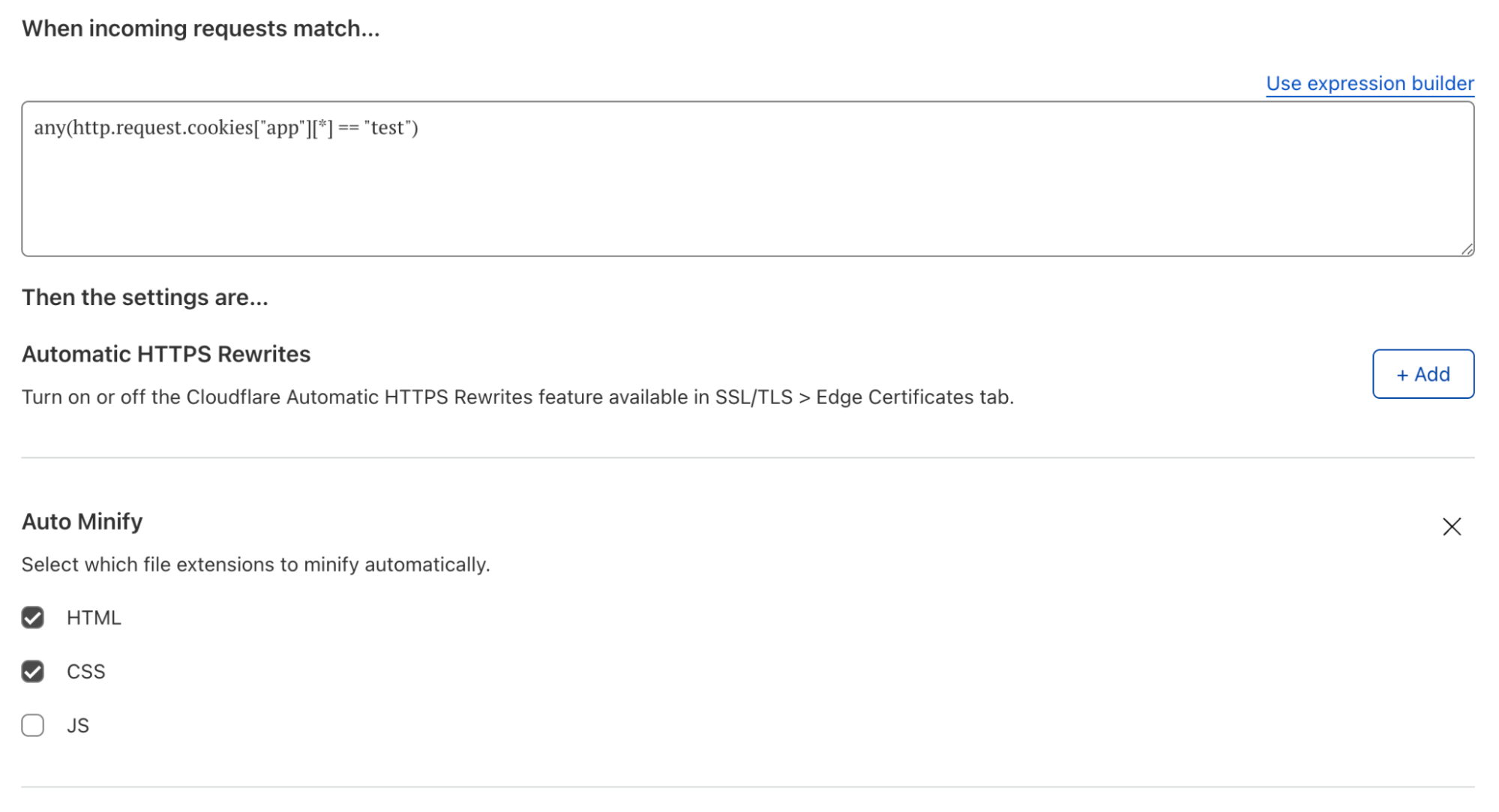
For example, by using the expression any(http.request.cookies["app"][*] == "test") a user can ensure that Auto Minify, Mirage and Polish are enabled only when this cookie is present on the HTTP request. This allows comparison testing to happen before enabling these products either globally, or on a wider set of traffic. All without impacting existing production traffic.

Introducing Configuration Rules

Use case: augmenting URLs

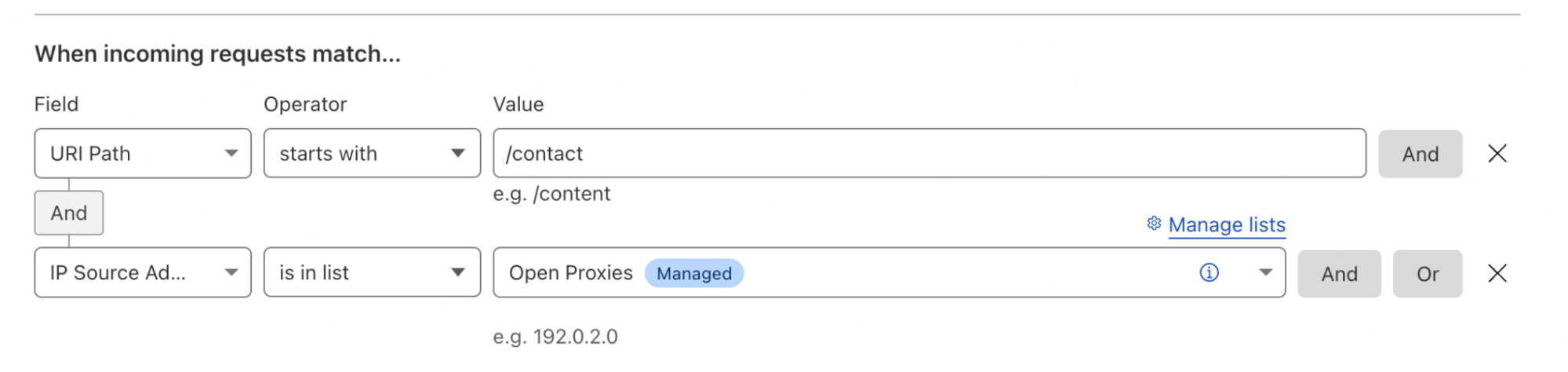
Configuration Rules can be used to augment existing requirements, also. One example given in ‘The Future of Page Rules’ blog is increasing the Security Level to ‘High’ for visitors trying to access the contact page of a website, to reduce the number of malicious visitors to that page.

In Page Rules, this would be done by simply specifying the contact page URL and specifying the security level, e.g. URL: example.com/contact*. This ensures that any “visitors that exhibit threatening behavior within the last 14 days” are served with a challenge prior to having that page load.

Configuration Rules can take this use case and augment it with additional fields, such as whether the source IP address is in a Cloudflare Managed IP List. This allows users to be more specific about when the security level is changed to ‘High’, such as only when the request also is marged as coming from an open HTTP and SOCKS proxy endpoints, which are frequently used to launch attacks and hide attackers identity:

Introducing Configuration Rules

This reduces the chance of a false positive, and a genuine visitor to the contact form being served with a challenge.

Try it now

Configuration Rules are available now via API, UI, and Terraform for all Cloudflare plans! We are excited to see how you will use them in conjunction with all our new rules releases from this week.

Where to? Introducing Origin Rules

Post Syndicated from Matt Bullock original https://blog.cloudflare.com/origin-rules/

Where to? Introducing Origin Rules

Host headers are key

Where to? Introducing Origin Rules

The host header of an HTTP request tells the receiving server (‘origin’) which website or application a client wants to access.

When an origin receives an HTTP request, it checks the value of this ‘host’ header to see if it is responsible for that traffic. If it finds a match the request will be routed appropriately and the correct data will be returned to the visitor. If it doesn’t find a match, it will return an error telling the visitor it doesn’t have an application or website that matches what they are asking for.

In simple setups this is often not an issue. All requests for example.com are sent to the same origin, which sees the host header example.com and returns the relevant files. However, not all setups are as straightforward. SaaS (Software-as-a-Service) platforms use host headers to route visitors to the correct instance or S3-compatible bucket.

To ensure the correct content is still loaded, the host header must equal the name of this instance or bucket to allow the receiving origin to route it correctly. This means at some point in the traffic flow, the host header must be changed to match the instance or bucket name, before being sent to the SaaS platform.

Another common issue is when web applications on an origin are listening on a non-standard port, e.g. 8001.  Requests sent via HTTPS will by default arrive on port 443. To ensure the traffic isn’t subsequently sent to port 443 on the origin the traffic must be intercepted and have the destination port changed to 8001. This ensures the origin is receiving traffic where it expects it. Previously this would be done as a Cloudflare Worker, Cloudflare Spectrum application or by running a dedicated application on the origin.

Both of these scenarios require customers to write and maintain code to intercept HTTP requests and parse them to ensure they go to the correct origin location, the correct port on that origin, and with the correct host header. This is a burden for administrators to maintain, particularly as legacy applications are migrated away from on-premise and into SaaS.

Cloudflare users want more control on where their traffic goes to – when it goes there – and what it looks like when it arrives. And they want this to be simple to set up and maintain.

To meet those demands we are today announcing Origin Rules, a new product which allows for overriding the host header, the Server Name Indication (SNI), destination port and DNS resolution of matching HTTP requests.

Origin Rules is now the one-stop destination for users who want to change which origin traffic goes to, when this should happen, and what that traffic looks like when it arrives – all without ever having to write a single line of code.

One hostname, many origins

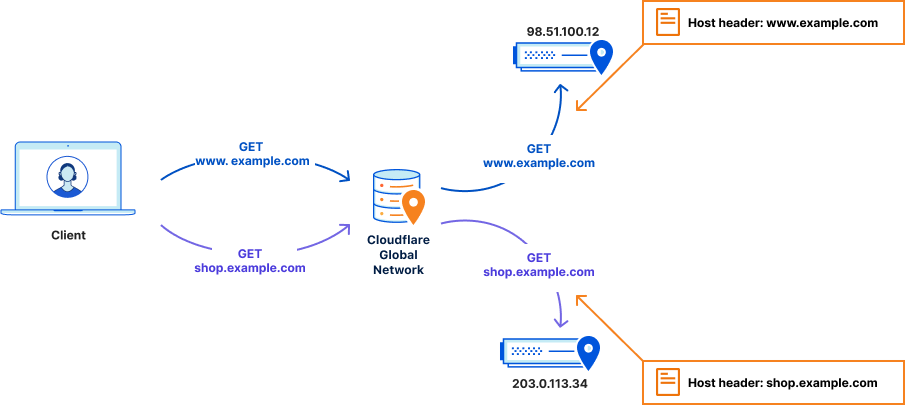
Setting up your service on Cloudflare is very simple. You tell us your domain name, example.com, and where traffic should be sent to when we receive requests that match it. Often this is an IP address. You can also create subdomains, e.g. shop.example.com, and follow the same pattern.

This allows for the web server running www.example.com to live on the IP address 98.51.100.12, and the web server responsible for running shop.example.com to live on a different IP address, e.g. 203.0.113.34. When Cloudflare receives a request for shop.example.com, we send that traffic to the web server at 203.0.113.34 with the host header shop.example.com.

Where to? Introducing Origin Rules

As most web servers commonly serve multiple websites, this host header is used to ensure the correct content is loaded. The web server looks at the request it receives, checks the host header, and tries to match it against websites it’s been told to serve. If it finds a match, it will route this request to the corresponding website’s configuration and the correct files are returned to the visitor.

This has been a foundational principle of the Internet for many years now. Unsurprisingly however, new solutions emerge and user needs evolve.

We have heard from users who want to be able to send different URLs to different origins, such as a SaaS provider for their ecommerce platform and a SaaS provider for their support desk. To achieve this, user’s could, and do, decide to run and manage their own reverse proxy running at this IP address to act as a router. This allows a user to send all traffic for example.com to a single IP address, and let the reverse proxy determine where it goes next:

    location ~ ^/shop { 
        proxy_set_header   Host $http_host;
        proxy_pass         "https://203.0.113.34/$1";
    }

This reverse proxy would detect the traffic sent with the host header example.com with a URI path starting with /shop, and send those matching HTTP requests to the correct SaaS application.

This is potentially a complex system to maintain, however, and as it is an ‘extra hop’, there is an increase in latency as requests first go through Cloudflare, to the origin server, then back to the SaaS provider – who may also be on Cloudflare. In a world rapidly migrating away from on-premise software to SaaS platforms, running your own server to do this specific function goes against the grain.

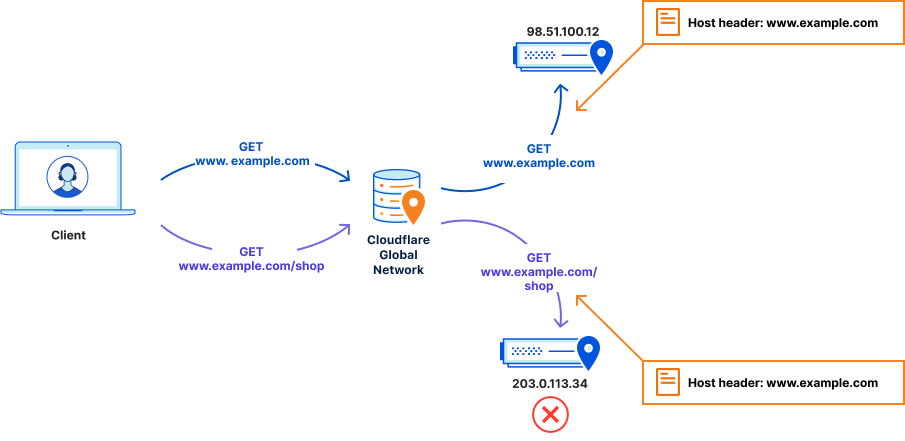
Users therefore want a way to tell Cloudflare – ‘for all traffic to www.example.com, send it to 98.51.100.12. BUT, if you see any traffic to www.example.com/shop, send it to 203.0.113.34’. This is what we call a resolve override. It is essentially a DNS override.

With a resolve override in place, HTTP requests to www.example.com/shop are now correctly sent by Cloudflare to 203.0.113.34 as requested. And they fail. The web server says it doesn’t know what to do with the HTTP request. This is because the host header is still www.example.com, and the web server does not have any knowledge of that website.

Where to? Introducing Origin Rules

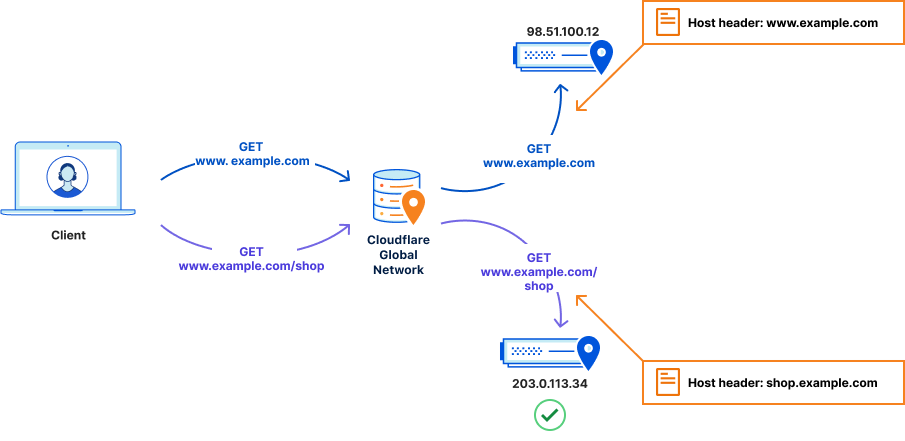
To fix this, we need to make sure these requests are sent to 203.0.113.34 with a host header of shop.example.com. This is what is known as a host header override. Now, requests to www.example.com/shop are not only correctly routed to 203.0.113.34, but the host header is changed to one that the ecommerce software is expecting – and thus the request is correctly routed, and the visitors sees the correct content.

Where to? Introducing Origin Rules

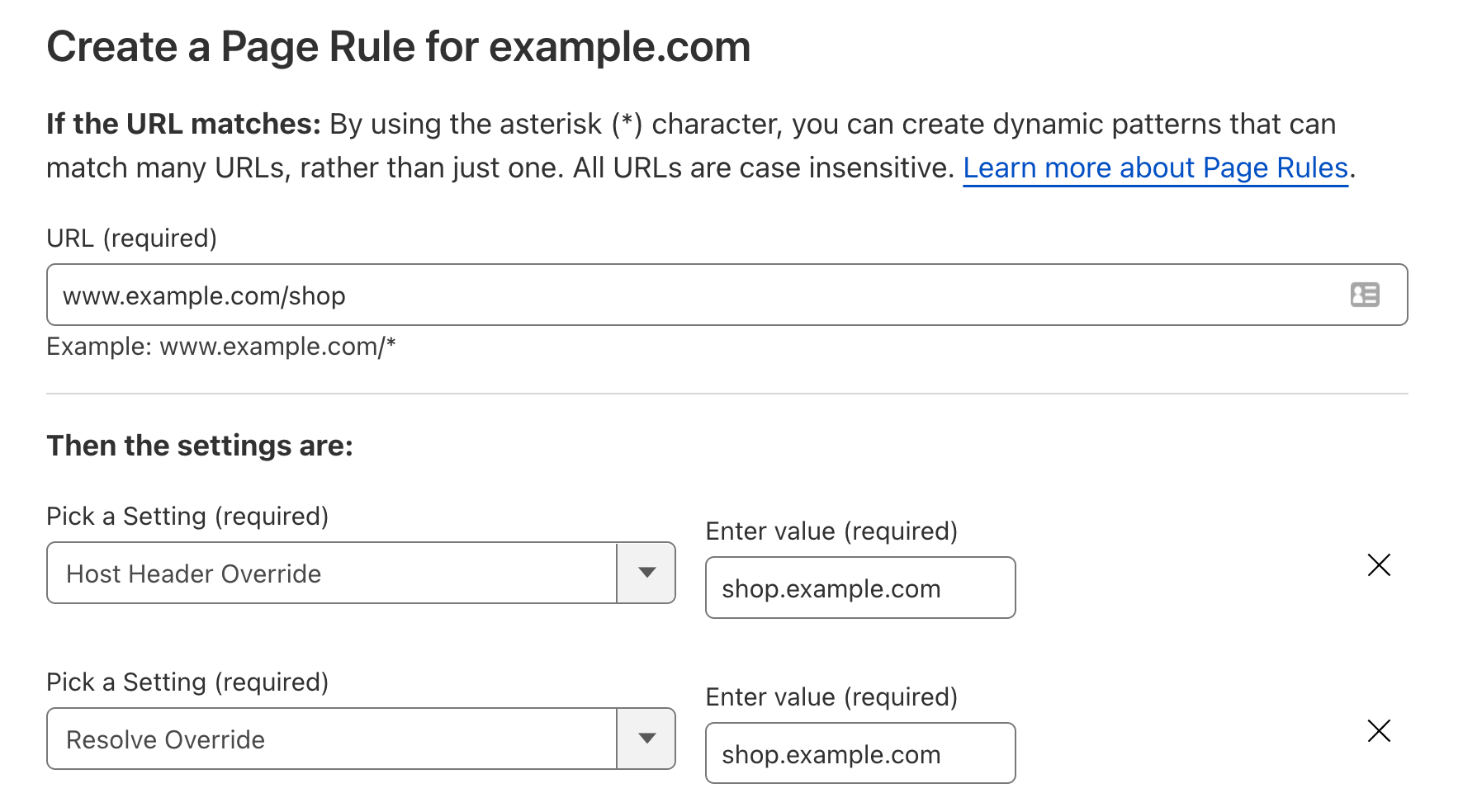
The management of these selective overrides, and other overrides, is achieved via Origin Rules.

Origin Rules allow users to route HTTP traffic to different destinations and override certain request characteristics based on a number of criteria such as the visitor’s country, IP address or HTTP request headers.

Route on more than a URL

Origin Rules is built on top of our ruleset engine. This gives users the ability to perform routing decisions based on many fields including the requested URL, and also the visitors country, specific request headers, and more.

Using a combination of one or more of these available fields, users can ensure traffic is routed to specific backends, only when specific criteria are met such as host, URI path, visitor’s country, and HTTP request headers.

Historically, host header override and resolve override were achieved with the setting of a Page Rule.

Where to? Introducing Origin Rules

Page Rules is the ‘If This Then That’ of Cloudflare. Where the ‘If…’ is a URL, and the ‘Then That’ is changing how we handle traffic to specific parts of a ‘zone’. It allows users to selectively change how traffic is handled, or in this case, where traffic is sent. It is very well adopted, with over one million Page Rules in the past three months alone.

Page Rules, however, are limited to performing actions based upon the requested URL. This means if users want to change the backend a HTTP request goes to, they need to make that decision based on the URL alone. This can be challenging for users who may want to perform this decision-making on more nuanced aspects, like the user agent of the visitor or on the presence of a specific cookie.

With Origin Rules, users can perform host header override, resolve override, destination port override and SNI overrides – based on any number of criteria – not only the requested URL. This unlocks a number of interesting use cases.

Example use case: integration with cloud storage endpoints

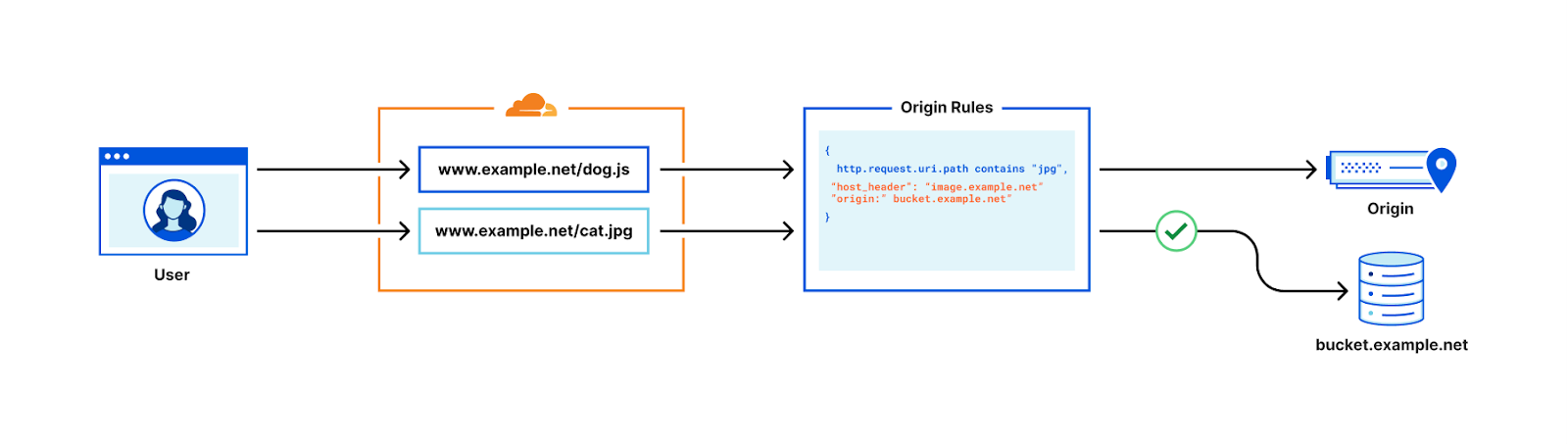
One such use case is using a cloud storage provider as a backend for static assets, such as images. Enterprise zones can use a combination of host header override and resolve override actions to override the destination of outgoing HTTP requests. This allows for all traffic to example.net to be sent to 98.51.100.12, but requests to example.net/*.jpg be sent to a publicly accessible S3-compatible bucket.

Where to? Introducing Origin Rules

To do this, the user would create an Origin Rule setting the resolve override value to be a DNS record on their own zone, pointing to the S3 provider’s URL. This ensures that requests matching the pattern are routed to the S3 URL. However, when the cloud storage provider receives the request it will drop it – as it does not know how to route requests for the host example.net. Therefore, users also need to deploy a host header override, changing this value to match the bucket name – e.g. bucket.example.net.

Combined, this ensures requests matching the pattern correctly reach the cloud storage provider – with a host header it can use to correctly route the request to the correct bucket.

Origin Rules also enable new use cases. For example, a user can use Origin Rules to A/B test different cloud providers prior to a cut over. This is possible by using the field http.request.cookies and routing traffic to a new, test bucket or cloud provider based on the presence of a specific cookie on the request.

Users with multiple storage regions can also use the ip.geoip.country field within a filter expression to route users to the closest storage instance, reducing latency and time to load for these requests.

Destination port override

Cloudflare listens on 13 ports; seven ports for HTTP, six ports for HTTPS. This means if a request is sent to a URL with the destination port of 443, as is standard for HTTPS, it will be sent to the origin server with a destination port of 443. The same 1:1 mapping applies to the other twelve ports.

But what if a user wanted to change that mapping? For example, when the backend origin server is listening on port 8001. In this scenario, an intermediate service is required to listen for requests on port 443 and create a sub-request with the destination port set to 8001.

Historically this was done on the origin server itself – with a reverse proxy server listening for requests on 443 and other ports and proxying those requests to another port.

Apache
 <VirtualHost *:*>
        ProxyPreserveHost On
        ProxyPass / http://0.0.0.0:8001/
        ProxyPassReverse / http://0.0.0.0:8001/
        ServerName example.com
    </VirtualHost>

NGINX
server {
  listen 443;
  server_name example.com;
    location / {
      proxy_pass http://0.0.0.0:8001;
    }
}

More recently, users have deployed Cloudflare Workers to perform this service, modifying the destination port before HTTP requests ever reach their servers.

Origin Rules simplifies destination port modifications, letting users change the destination port via a simple rules experience without ever having to write a single line of code or configuration:

Where to? Introducing Origin Rules

This destination port modification can also be triggered on almost any field available in the ruleset engine, also, allowing users to change which port to send requests to based on URL, URI path, the presence of HTTP request header and more.

Server Name Indication

Server Name Indication (SNI) is an addition to the TLS encryption protocol. It enables a client device to specify the domain name it is trying to reach in the first step of the TLS handshake, preventing common “name mismatch” errors. Customers using Cloudflare for SaaS may have millions of hostnames pointing to Cloudflare. However, the origin that these requests are sent to may not have an individual certificate for each of the hostnames.

Users today have the option of doing this on a per custom hostname basis using custom origins in SSL for SaaS, however for Enterprise customers not using this setup it was an impossible task.

Enterprise users can use Origin Rules to override the value of the SNI, providing it matches any other zone in their account. This removes the need for users to manage multiple certificates on the origin or choose not to encrypt connections from Cloudflare to the origin.

Try it now

Origin Rules are available to use now via API, Terraform, and our dashboard. Further details can be found on our Developers Docs. Currently, destination port rewriting is available for all our customers as part of Origin Rules. Resolve Override, Host Header Override and SNI overrides are available to our Enterprise users.

WebRTC live streaming to unlimited viewers, with sub-second latency

Post Syndicated from Kyle Boutette original https://blog.cloudflare.com/webrtc-whip-whep-cloudflare-stream/

WebRTC live streaming to unlimited viewers, with sub-second latency

WebRTC live streaming to unlimited viewers, with sub-second latency

Creators and broadcasters expect to be able to go live from anywhere, on any device. Viewers expect “live” to mean “real-time”. The protocols that power most live streams are unable to meet these growing expectations.

In talking to developers building live streaming into their apps and websites, we’ve heard near universal frustration with the limitations of existing live streaming technologies. Developers in 2022 rightly expect to be able to deliver low latency to viewers, broadcast reliably, and use web standards rather than old protocols that date back to the era of Flash.

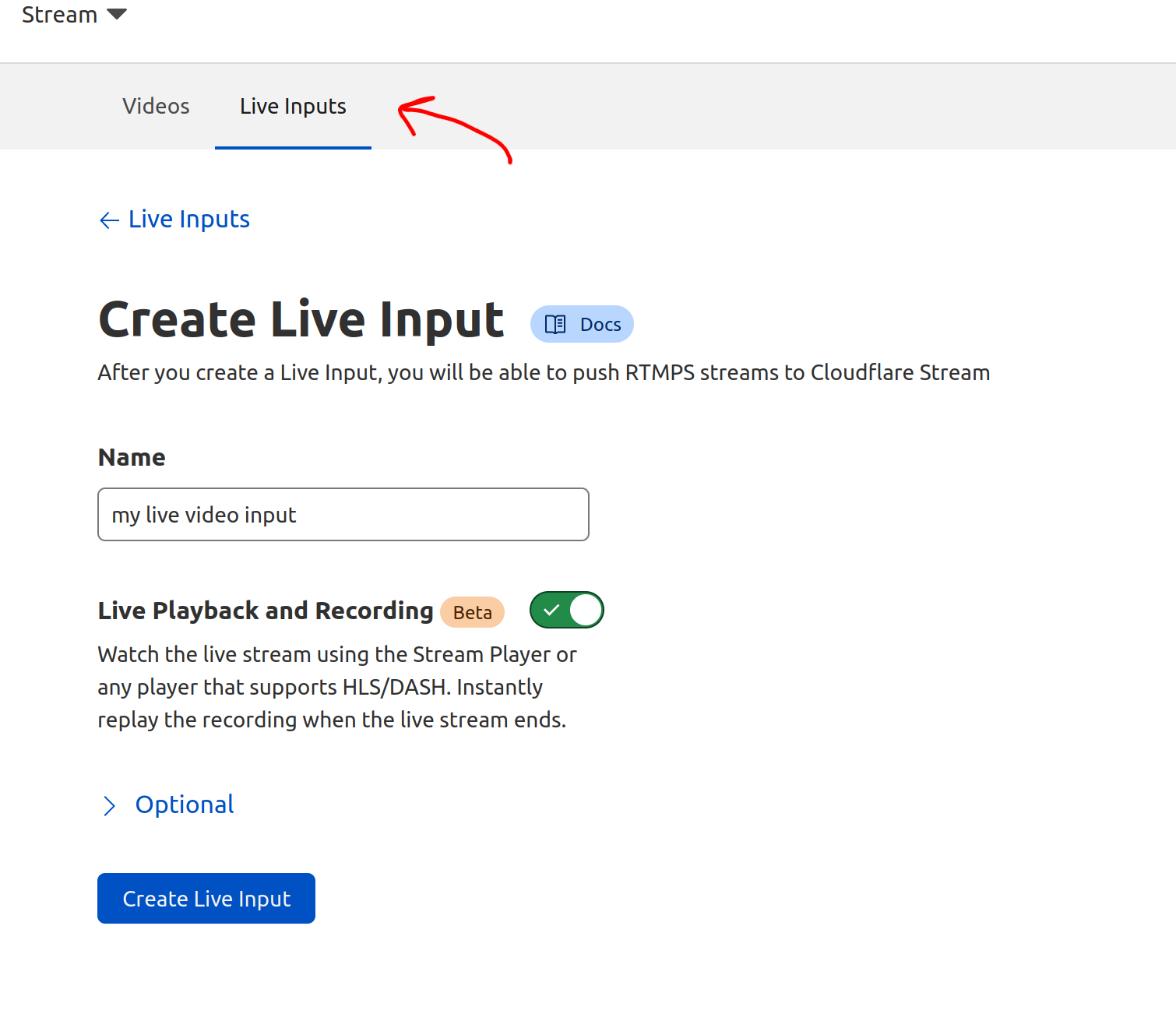
Today, we’re excited to announce in open beta that Cloudflare Stream now supports live video streaming over WebRTC, with sub-second latency, to unlimited concurrent viewers. This is a new feature of Cloudflare Stream, and you can start using it right now in the Cloudflare Dashboard — read the docs to get started.

WebRTC with Cloudflare Stream leapfrogs existing tools and protocols, exclusively uses open standards with zero dependency on a specific SDK, and empowers any developer to build both low latency live streaming and playback into their website or app.

The status quo of streaming live video is broken

The status quo of streaming live video has high latency, depends on archaic protocols and is incompatible with the way developers build apps and websites. A reasonable person’s expectations of what the Internet should be able to deliver in 2022 are simply unmet by the dominant set of protocols carried over from past eras.

Viewers increasingly expect “live” to mean “real-time”. People want to place bets on sports broadcasts in real-time, interact and ask questions to presenters in real-time, and never feel behind their friends at a live event.

In practice, the HLS and DASH standards used to deliver video have 10+ seconds of latency. LL-HLS and LL-DASH bring this down to closer to 5 seconds, but only as a hack on top of the existing protocol that delivers segments of video in individual HTTP requests. Sending mini video clips over TCP simply cannot deliver video in real-time. HLS and DASH are here to stay, but aren’t the future of real-time live video.

Creators and broadcasters expect to be able to go live from anywhere, on any device.

In practice, people creating live content are stuck with a limited set of native apps, and can’t go live using RTMP from a web browser. Because it’s built on top of TCP, the RTMP broadcasting protocol struggles under even the slightest network disruption, making it a poor or often unworkable option when broadcasting from mobile networks. RTMP, originally built for use with Adobe Flash Player, was last updated in 2012, and while Stream supports the newer SRT protocol, creators need an option that works natively on the web and can more easily be integrated in native apps.

Developers expect to be able to build using standard APIs that are built into web browsers and native apps.

In practice, RTMP can’t be used from a web browser, and creating a native app that supports RTMP broadcasting typically requires diving into lower-level programming languages like C and Rust. Only those with expertise in both live video protocols and these languages have full access to the tools needed to create novel live streaming client applications.

We’re solving this by using new open WebRTC standards: WHIP and WHEP

WebRTC is the real-time communications protocol, supported across all web browsers, that powers video calling services like Zoom and Google Meet. Since inception it’s been designed for real-time, ultra low-latency communications.

While WebRTC is well established, for most of its history it’s lacked standards for:

  • Ingestion — how broadcasters should send media content (akin to RTMP today)
  • Egress — how viewers request and receive media content (akin to DASH or HLS today)

As a result, developers have had to implement this on their own, and client applications on both sides are often tightly coupled to provider-specific implementations. Developers we talk to often express frustration, having sunk months of engineering work into building around a specific vendor’s SDK, unable to switch without a significant rewrite of their client apps.

At Cloudflare, our mission is broader — we’re helping to build a better Internet. Today we’re launching not just a new feature of Cloudflare Stream, but a vote of confidence in new WebRTC standards for both ingestion and egress. We think you should be able to start using Stream without feeling locked into an SDK or implementation specific to Cloudflare, and we’re committed to using open standards whenever possible.

For ingestion, WHIP is an IETF draft on the Standards Track, with many applications already successfully using it in production. For delivery (egress), WHEP is an IETF draft with broad agreement. Combined, they provide a standardized end-to-end way to broadcast one-to-many over WebRTC at scale.

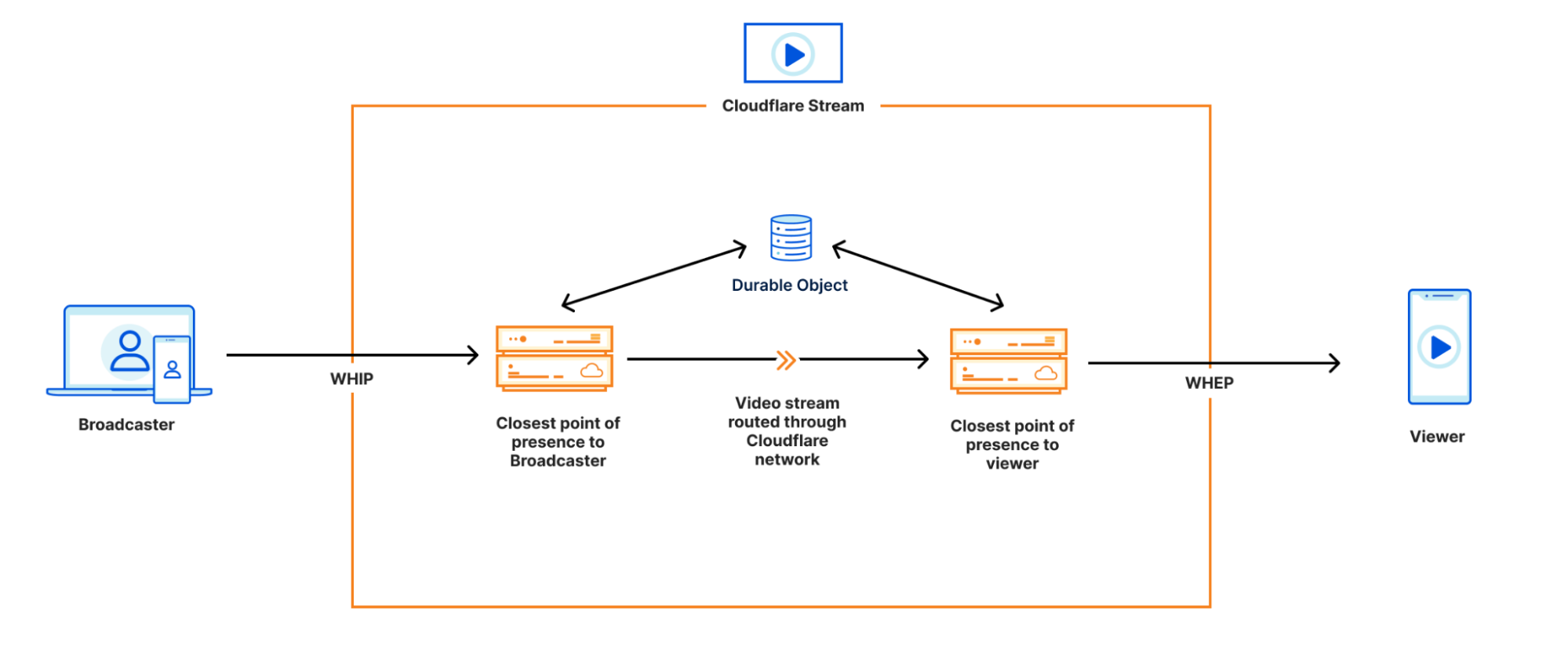
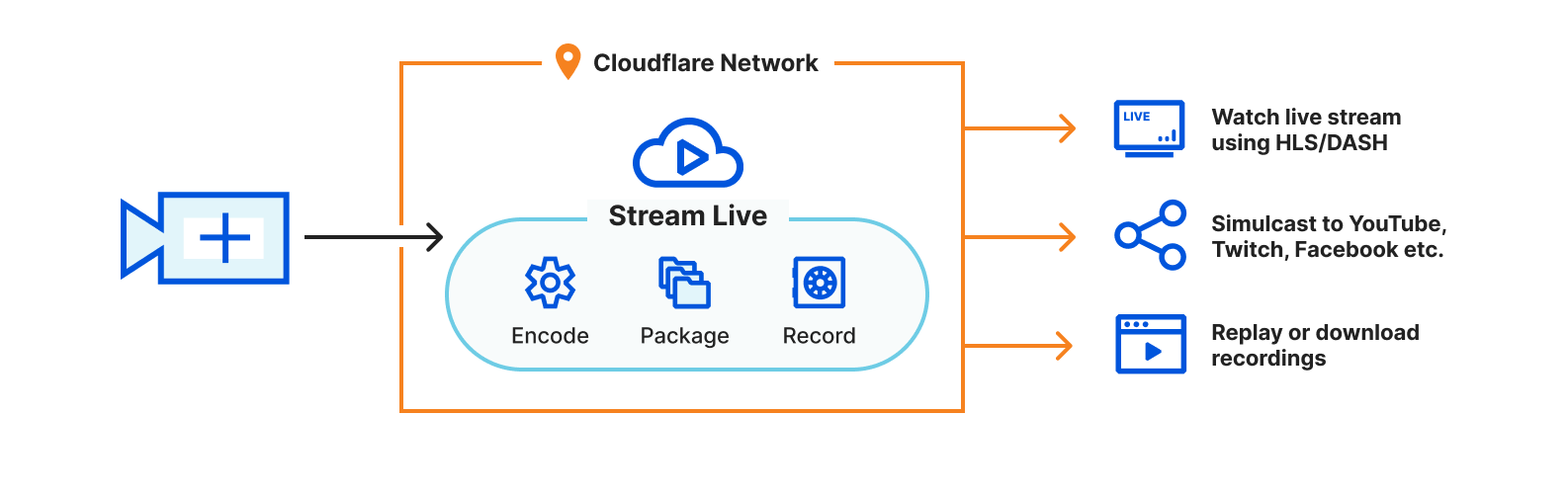
Cloudflare Stream is the first cloud service to let you both broadcast using WHIP and playback using WHEP — no vendor-specific SDK needed. Here’s how it works:

WebRTC live streaming to unlimited viewers, with sub-second latency

Cloudflare Stream is already built on top of the Cloudflare developer platform, using Workers and Durable Objects running on Cloudflare’s global network, within 50ms of 95% of the world’s Internet-connected population.

Our WebRTC implementation extends this to relay WebRTC video through our network. Broadcasters stream video using WHIP to the point of presence closest to their location, which tells the Durable Object where the live stream can be found. Viewers request streaming video from the point of presence closest to them, which asks the Durable Object where to find the stream, and video is routed through Cloudflare’s network, all with sub-second latency.

Using Durable Objects, we achieve this with zero centralized state. And just like the rest of Cloudflare Stream, you never have to think about regions, both in terms of pricing and product development.

While existing ultra low-latency streaming providers charge significantly more to stream over WebRTC, because Stream runs on Cloudflare’s global network, we’re able to offer WebRTC streaming at the same price as delivering video over HLS or DASH. We don’t think you should be penalized with higher pricing when choosing which technology to rely on to stream live video. Once generally available, WebRTC streaming will cost $1 per 1000 minutes of video delivered, just like the rest of Stream.

What does sub-second latency let you build?

Ultra low latency unlocks interactivity within your website or app, removing the time delay between creators, in-person attendees, and those watching remotely.

Developers we talk to are building everything from live sports betting, to live auctions, to live viewer Q&A and even real-time collaboration in video post-production. Even streams without in-app interactivity can benefit from real-time — no sports fan wants to get a text from their friend at the game that ruins the moment, before they’ve had a chance to watch the final play. Whether you’re bringing an existing app or have a new idea in mind, we’re excited to see what you build.

If you can write JavaScript, you can let your users go live from their browser

While hobbyist and professional creators might take the time to download and learn how to use an application like OBS Studio, most Internet users won’t get past this friction of new tools, and copying RTMP keys from one tool to another. To empower more people to go live, they need to be able to broadcast from within your website or app, just by enabling access to the camera and microphone.

Cloudflare Stream with WebRTC lets you build live streaming into your app as a front-end developer, without any special knowledge of video protocols. And our approach, using the WHIP and WHEP open standards, means you can do this with zero dependencies, with 100% your code that you control.

Go live from a web browser with just a few lines of code

You can go live right now, from your web browser, by creating a live input in the Cloudflare Stream dashboard, and pasting a URL into the example linked below.

Read the docs or run the example code below in your browser using Stackbltiz.

<video id="input-video" autoplay autoplay muted></video>

import WHIPClient from "./WHIPClient.js";

const url = "<WEBRTC_URL_FROM_YOUR_LIVE_INPUT>";
const videoElement = document.getElementById("input-video");
const client = new WHIPClient(url, videoElement);

This example uses an example WHIP client, written in just 100 lines of Javascript, using APIs that are native to web browsers, with zero dependencies. But because WHIP is an open standard, you can use any WHIP client you choose. Support for WHIP is growing across the video streaming industry — it has recently been added to Gstreamer, and one of the authors of the WHIP specification has written a Javascript client implementation. We intend to support the full WHIP specification, including supporting Trickle ICE for fast NAT traversal.

Play a live stream in a browser, with sub-second latency, no SDK required

Once you’ve started streaming, copy the playback URL from the live input you just created, and paste it into the example linked below.

Read the docs or run the example code below in your browser using Stackbltiz.

<video id="playback" controls autoplay muted></video>

import WHEPClient from './WHEPClient.js';
const url = "<WEBRTC_PLAYBACK_URL_FROM_YOUR_LIVE_INPUT>";
const videoElement = document.getElementById("playback");
const client = new WHEPClient(url, videoElement);

Just like the WHIP example before, this one uses an example WHEP client we’ve written that has zero dependencies. WHEP is an earlier IETF draft than WHIP, published in July of this year, but adoption is moving quickly. People in the community have already written open-source client implementations in both Javascript, C, with more to come.

Start experimenting with real-time live video, in open beta today

WebRTC streaming is in open beta today, ready for you to use as an integrated feature of Cloudflare Stream. Once Generally Available, WebRTC streaming will be priced like the rest of Cloudflare Stream, based on minutes of video delivered and minutes stored.

Read the docs to get started.

Introducing Cache Rules: precision caching at your fingertips

Post Syndicated from Alex Krivit original https://blog.cloudflare.com/introducing-cache-rules/

Introducing Cache Rules: precision caching at your fingertips

Introducing Cache Rules: precision caching at your fingertips

Ten years ago, in 2012, we released a product that put “a powerful new set of tools” in the hands of Cloudflare customers, allowing website owners to control how Cloudflare would cache, apply security controls, manipulate headers, implement redirects, and more on any page of their website. This product is called Page Rules and since its introduction, it has grown substantially in terms of popularity and functionality.

Page Rules are a common choice for customers that want to have fine-grained control over how Cloudflare should cache their content. There are more than 3.5 million caching Page Rules currently deployed that help websites customize their content. We have spent the last ten years learning how customers use those rules to cache content, and it’s clear the time is ripe for evolving rules-based caching on Cloudflare. This evolution will allow for greater flexibility in caching different types of content through additional rule configurability, while providing more visibility into when and how different rules interact across Cloudflare’s ecosystem.

Today, we’ve announced that Page Rules will be re-imagined into four product-specific rule sets: Origin Rules, Cache Rules, Configuration Rules, and Redirect Rules.

In this blog we’re going to discuss Cache Rules, and how we’re applying ten years of product iteration and learning from Page Rules to give you the tools and options to best optimize your cache.

Activating Page Rules, then and now

Adding a Page Rule is very simple: users either make an API call or navigate to the dashboard, enter a full or wildcard URL pattern (e.g. example.com/images/scr1.png or example.com/images/scr*), and tell us which actions to perform when we see that pattern. For example a Page Rule could tell browsers– keep a copy of the response longer via “Browser Cache TTL”, or tell our cache that via “Edge Cache TTL”. Low effort, high impact. All this is accomplished without fighting origin configuration or writing a single line of code.

Under the hood, a lot is happening to make that rule scale: we turn every rule condition into regexes, matching them against the tens of millions of requests per second across 275+ data centers globally. The compute necessary to process and apply new values on the fly across the globe is immense and corresponds directly to the number of rules we are able to offer to users. By moving cache actions from Page Rules to Cache Rules we can allow for users to not only set more rules, but also to trigger these rules more precisely.

More than a URL

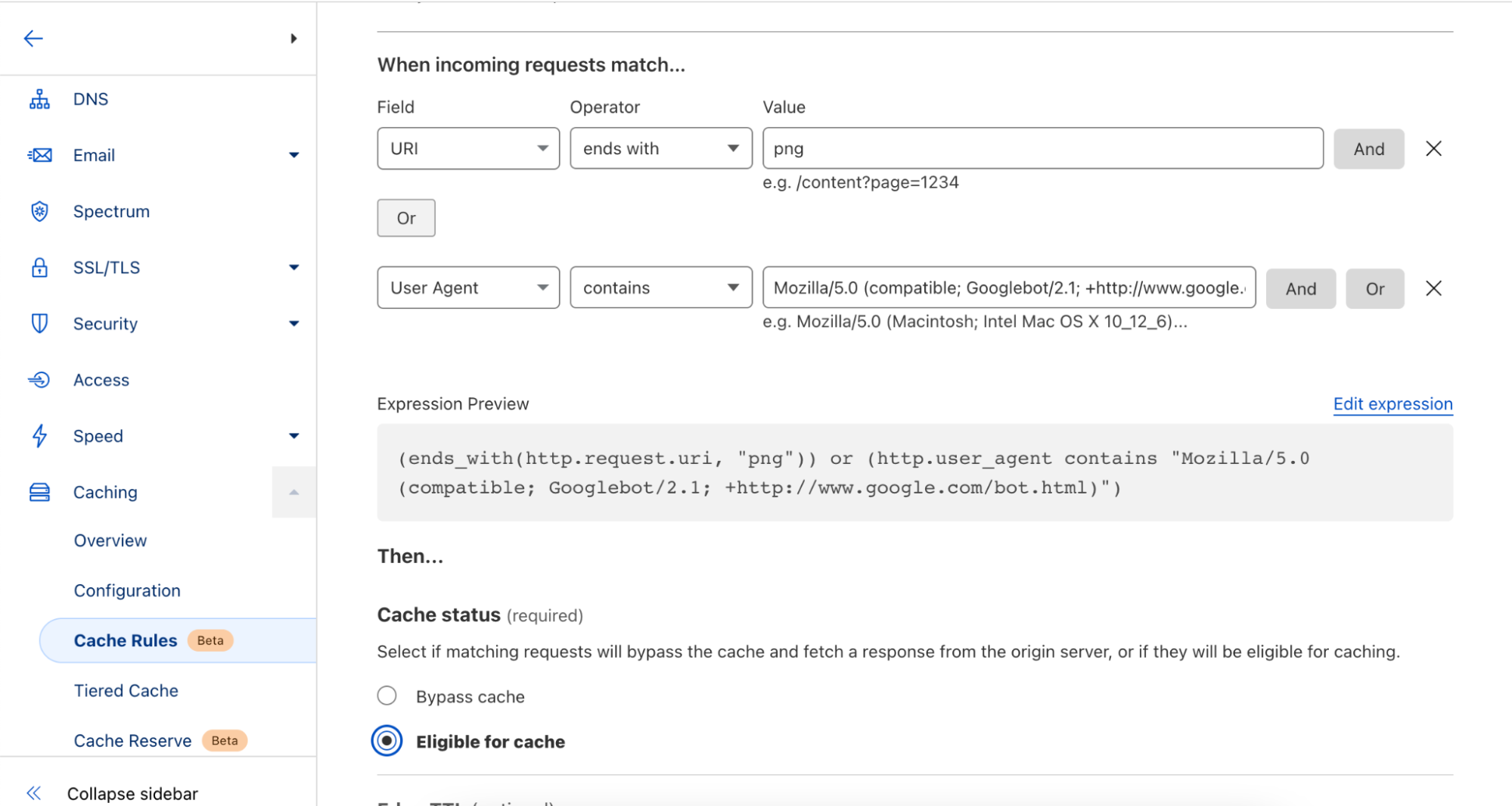
Users of Page Rules are limited to specific URLs or URL patterns to define how browsers or Cloudflare cache their websites files. Cache Rules allows users to set caching behavior on additional criteria, such as the HTTP request headers or the requested file type. Users can continue to match on the requested URL also, as used in our Page Rules example earlier. With Cache Rules, users can now define this behavior on one or more fields available.

For example, if a user wanted to specify cache behavior for all image/png content-types, it’s now as simple as pushing a few buttons in the UI or writing a small expression in the API. Cache Rules give users precise control over when and how Cloudflare and browsers cache their content. Cache Rules allow for rules to be triggered on request header values that can be simply defined like

any(http.request.headers["content-type"][*] == "image/png")

Which triggers the Cache Rule to be applied to all image/png media types. Additionally, users may also leverage other request headers like cookie values, user-agents, or hostnames.

As a plus, these matching criteria can be stacked and configured with operators like AND and OR, providing additional simplicity in building complex rules from many discrete blocks, e.g. if you would like to target both image/png AND image/jpeg.

For the full list of fields available conditionals you can apply Cache Rules to, please refer to the Cache Rules documentation.

Introducing Cache Rules: precision caching at your fingertips

Visibility into how and when Rules are applied

Our current offerings of Page Rules, Workers, and Transform Rules can all manipulate caching functionality for our users’ content. Often, there is some trial and error required to make sure that the confluence of several rules and/or Workers are behaving in an expected manner.

As part of upgrading Page Rules we have separated it into four new products:

  1. Origin Rues
  2. Cache Rules
  3. Configuration Rules
  4. Redirect Rules

This gives users a better understanding into how and when different parts of the Cloudflare stack are activated, reducing the spin-up and debug time. We will also be providing additional visibility in the dashboard for when rules are activated as they go through Cloudflare. As a sneak peek please see:

Introducing Cache Rules: precision caching at your fingertips

Our users may take advantage of this strict precedence by chaining the results of one product into another. For example, the output of URL rewrites in Transform Rules will feed into the actions of Cache Rules, and the output of Cache Rules will feed into IP Access Rules, and so on.

In the future, we plan to increase this visibility further to allow for inputs and outputs across the rules products to be observed so that the modifications made on our network can be observed before the rule is even deployed.

Cache Rules. What are they? Are they improved? Let’s find out!

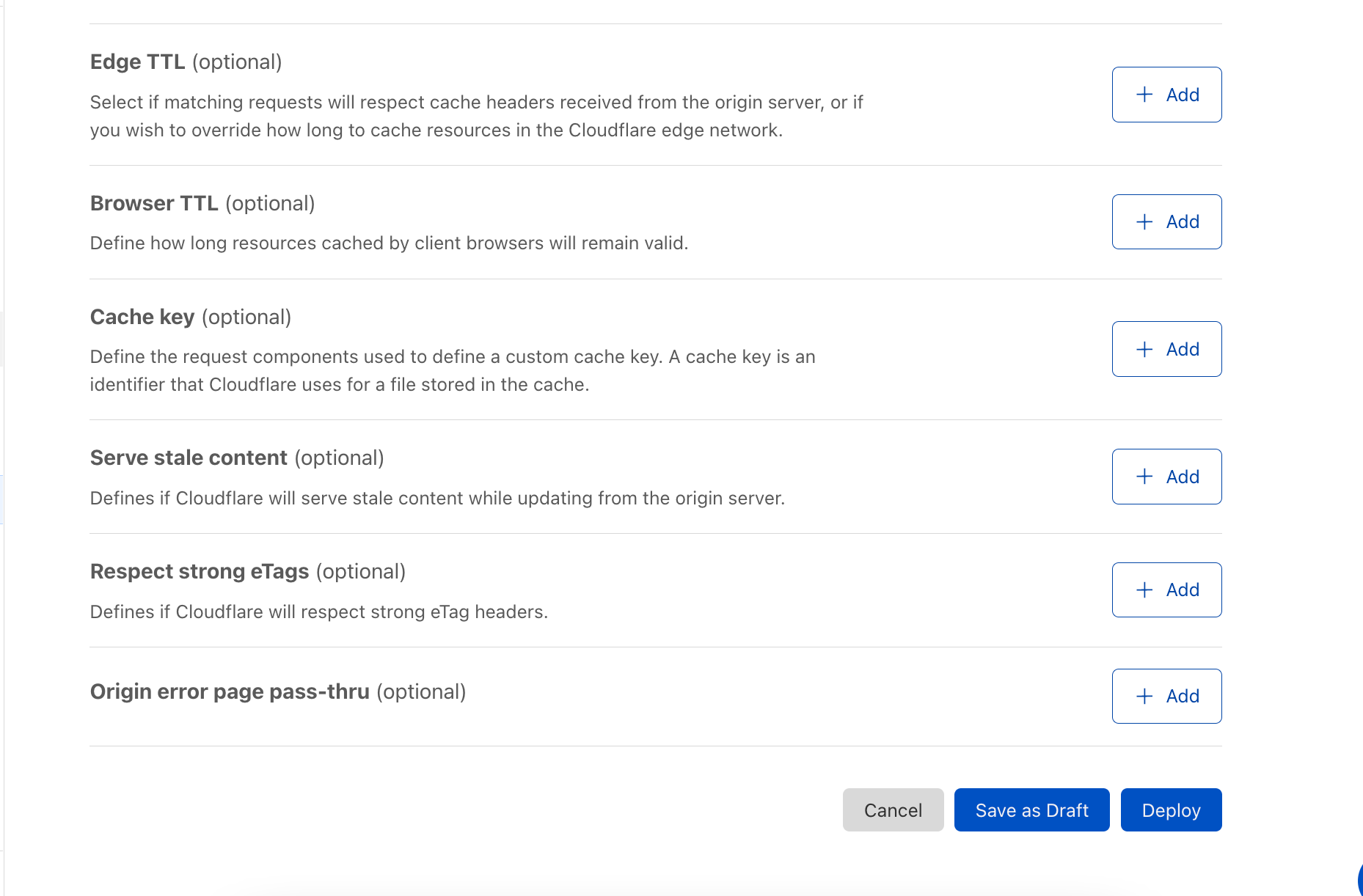
To start, Cache Rules will have all the caching functionality currently available in Page Rules. Users will be able to:

  • Tell Cloudflare to cache an asset or not,
  • Alter how long Cloudflare should cache an asset,
  • Alter how long a browser should cache an asset,
  • Define a custom cache key for an asset,
  • Configure how Cloudflare serves stale, revalidates, or otherwise uses header values to direct cache freshness and content continuity,

And so much more.

Cache Rules are intuitive and work similarly to our other ruleset engine-based products announced today: API or UI conditionals for URL or request headers are evaluated, and if matching, Cloudflare and browser caching options are configured on behalf of the user. For all the different options available, see our Cache Rules documentation.

Under the hood, Cache Rules apply targeted rule applications so that additional rules can be supported per user and across the whole engine. What this means for our users is that by consuming less CPU for rule evaluations, we’re able to support more rules per user. For specifics on how many additional Cache Rules you’ll be able to use, please see the Future of Rules Blog.

Introducing Cache Rules: precision caching at your fingertips

How can you use Cache Rules today?

Cache Rules are available today in beta and can be configured via the API, Terraform, or UI in the Caching tab of the dashboard. We welcome you to try the functionality and provide us feedback for how they are working or what additional features you’d like to see via community posts, or however else you generally get our attention 🙂.

If you have Page Rules implemented for caching on the same path, Cache Rules will take precedence by design. For our more patient users, we plan on releasing a one-click migration tool for Page Rules in the near future.

What’s in store for the future of Cache Rules?

In addition to granular control and increased visibility, the new rules products also opens the door to more complex features that can recommend rules to help customers achieve better cache hit ratios and reduce their egress costs, adding additional caching actions and visibility, so you can see precisely how Cache Rules will alter headers that Cloudflare uses to cache content, and allowing customers to run experiments with different rule configurations and see the outcome firsthand. These possibilities represent the tip of the iceberg for the next iteration of how customers will use rules on Cloudflare.

Try it out!

We look forward to you trying Cache Rules and providing feedback on what you’d like to see us build next.

D1: our quest to simplify databases

Post Syndicated from Nevi Shah original https://blog.cloudflare.com/whats-new-with-d1/

D1: our quest to simplify databases

D1: our quest to simplify databases

When we announced D1 in May of this year, we knew it would be the start of something new – our first SQL database with Cloudflare Workers. Prior to D1 we’ve announced storage options like KV (key-value store), Durable Objects (single location, strongly consistent data storage) and R2 (blob storage). But the question always remained “How can I store and query relational data without latency concerns and an easy API?”

The long awaited “Cloudflare Database” was the true missing piece to build your application entirely on Cloudflare’s global network, going from a blank canvas in VSCode to a full stack application in seconds. Compatible with the popular SQLite API, D1 empowers developers to build out their databases without getting bogged down by complexity and having to manage every underlying layer.

Since our launch announcement in May and private beta in June, we’ve made great strides in building out our vision of a serverless database. With D1 still in private beta but an open beta on the horizon, we’re excited to show and tell our journey of building D1 and what’s to come.

The D1 Experience

We knew from Cloudflare Workers feedback that using Wrangler as the mechanism to create and deploy applications is loved and preferred by many. That’s why when Wrangler 2.0 was announced this past May alongside D1, we took advantage of the new and improved CLI for every part of the experience from data creation to every update and iteration. Let’s take a quick look on how to get set up in a few easy steps.

Create your database

With the latest version of Wrangler installed, you can create an initialized empty database with a quick

npx wrangler d1 create my_database_name

To get your database up and running! Now it’s time to add your data.

Bootstrap it

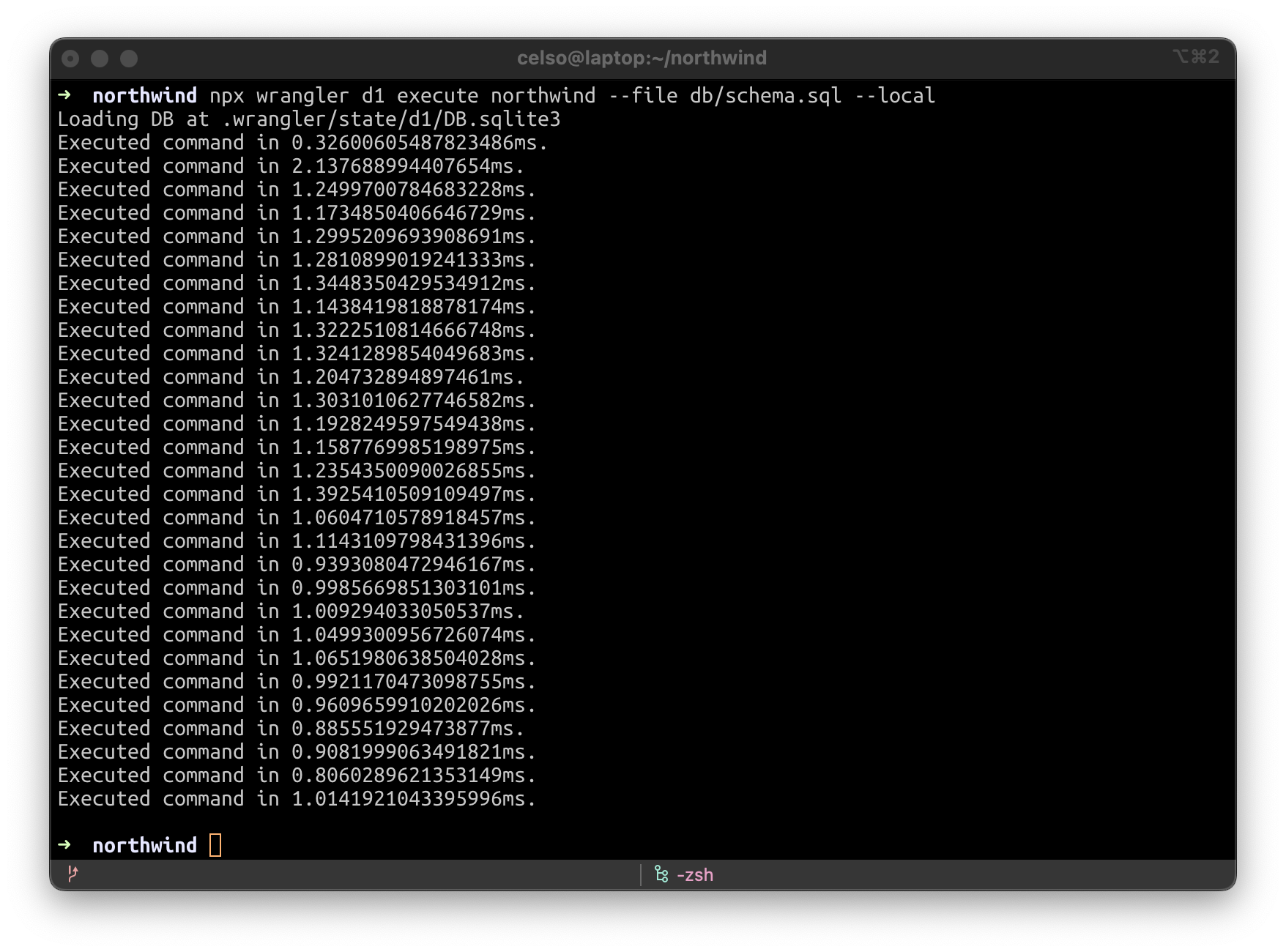
It wouldn’t be the “Cloudflare way” if you had to sit through an agonizingly long process to get set up. So we made it easy and painless to bring your existing data from an old database and bootstrap your new D1 database.  You can run

wrangler d1 execute my_database-name --file ./filename.sql

and pass through an existing SQLite .sql file of your choice. Your database is now ready for action.

Develop & Test Locally

With all the improvements we’ve made to Wrangler since version 2 launched a few months ago, we’re pleased to report that D1 has full remote & local wrangler dev support:

D1: our quest to simplify databases

When running wrangler dev -–local -–persist, an SQLite file will be created inside .wrangler/state. You can then use a local GUI program for managing it, like SQLiteFlow (https://www.sqliteflow.com/) or Beekeeper (https://www.beekeeperstudio.io/).

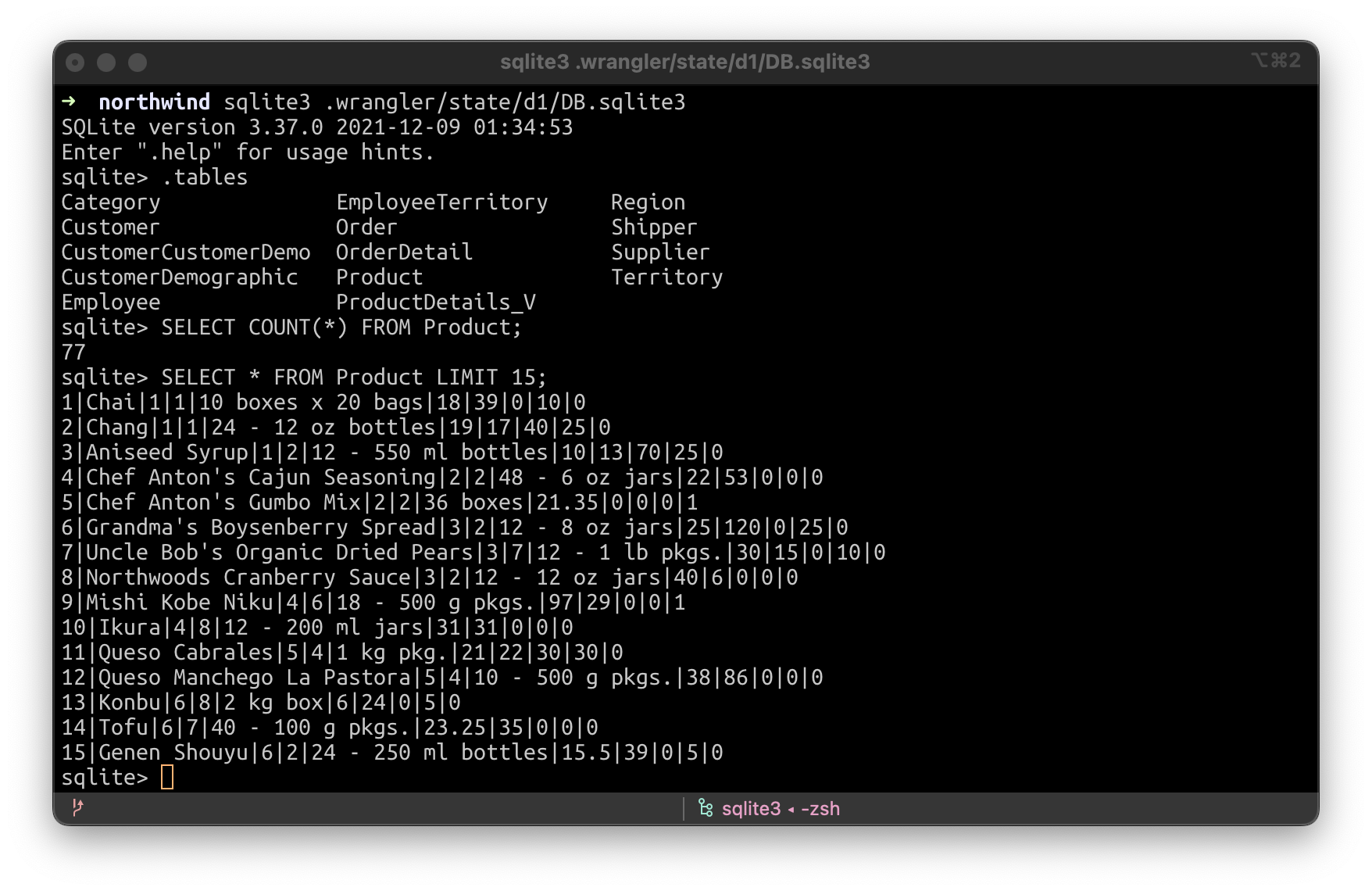
Or you can simply use SQLite directly with the SQLite command line by running sqlite3 .wrangler/state/d1/DB.sqlite3:

D1: our quest to simplify databases

Automatic backups & one-click restore

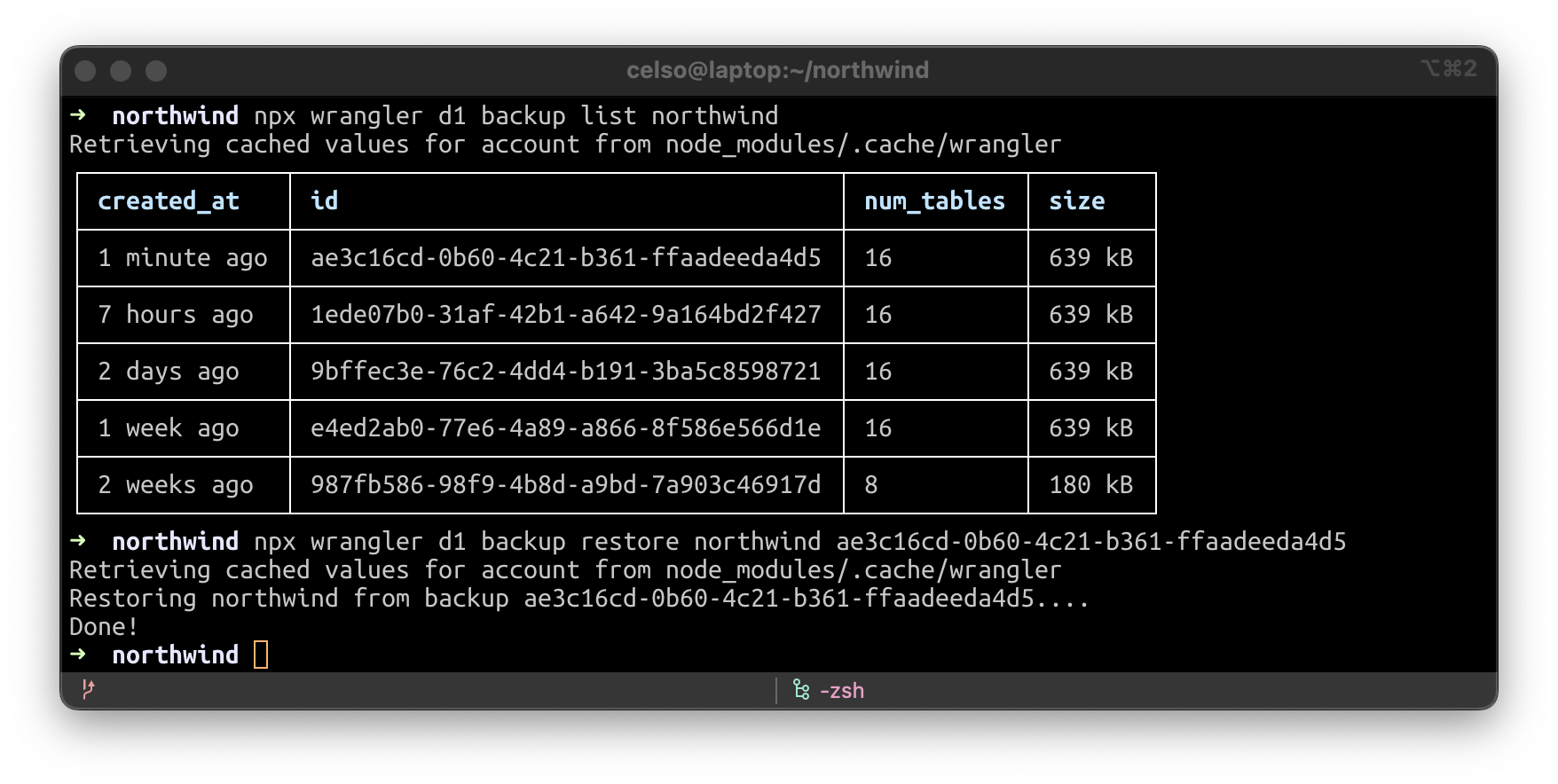
No matter how much you test your changes, sometimes things don’t always go according to plan. But with Wrangler you can create a backup of your data, view your list of backups or restore your database from an existing backup. In fact, during the beta, we’re taking backups of your data every hour automatically and storing them in R2, so you will have the option to rollback if needed.

D1: our quest to simplify databases

And the best part – if you want to use a production snapshot for local development or to reproduce a bug, simply copy it into the .wrangler/state directory and wrangler dev –-local –-persist will pick it up!

Let’s download a D1 backup to our local disk. It’s SQLite compatible.

D1: our quest to simplify databases

Now let’s run our D1 worker locally, from the backup.

D1: our quest to simplify databases

Create and Manage from the dashboard

However, we realize that CLIs are not everyone’s jam. In fact, we believe databases should be accessible to every kind of developer – even those without much database experience! D1 is available right from the Cloudflare dashboard giving you near total command parity with Wrangler in just a few clicks. Bootstrapping your database, creating tables, updating your database, viewing tables and triggering backups are all accessible right at your fingertips.

D1: our quest to simplify databases

Changes made in the UI are instantly available to your Worker — no deploy required!

We’ve told you about some of the improvements we’ve landed since we first announced D1, but as always, we also wanted to give you a small taste (with some technical details) of what’s ahead. One really important functionality of a database is transactions — something D1 wouldn’t be complete without.
Sneak peek: how we’re bringing JavaScript transactions to D1

With D1, we strive to present a dramatically simplified interface to creating and querying relational data, which for the most part is a good thing. But simplification occasionally introduces drawbacks, where a use-case is no longer easily supported without introducing some new concepts. D1 transactions are one example.

Transactions are a unique challenge

You don’t need to specify where a Cloudflare Worker or a D1 database run—they simply run everywhere they need to. For Workers, that is as close as possible to the users that are hitting your site right this second. For D1 today, we don’t try to run a copy in every location worldwide, but dynamically manage the number and location of read-only replicas based on how many queries your database is getting, and from where. However, for queries that make changes to a database (which we generally call “writes” for short), they all have to travel back to the single Primary D1 instance to do their work, to ensure consistency.

But what if you need to do a series of updates at once? While you can send multiple SQL queries with .batch() (which does in fact use database transactions under the hood), it’s likely that, at some point, you’ll want to interleave database queries & JS code in a single unit of work.

This is exactly what database transactions were invented for, but if you try running BEGIN TRANSACTION in D1 you’ll get an error. Let’s talk about why that is.

Why native transactions don’t work
The problem arises from SQL statements and JavaScript code running in dramatically different places—your SQL executes inside your D1 database (primary for writes, nearest replica for reads), but your Worker is running near the user, which might be on the other side of the world. And because D1 is built on SQLite, only one write transaction can be open at once. Meaning that, if we permitted BEGIN TRANSACTION, any one Worker request, anywhere in the world, could effectively block your whole database! This is a quite dangerous thing to allow:

  • A Worker could start a transaction then crash due to a software bug, without calling ROLLBACK. The primary would be blocked, waiting for more commands from a Worker that would never come (until, probably, some timeout).
  • Even without bugs or crashes, transactions that require multiple round-trips between JavaScript and SQL could end up blocking your whole system for multiple seconds, dramatically limiting how high an application built with Workers & D1 could scale.

But allowing a developer to define transactions that mix both SQL and JavaScript makes building applications with Workers & D1 so much more flexible and powerful. We need a new solution (or, in our case, a new version of an old solution).

A way forward: stored procedures
Stored procedures are snippets of code that are uploaded to the database, to be executed directly next to the data. Which, at first blush, sounds exactly like what we want.

However, in practice, stored procedures in traditional databases are notoriously frustrating to work with, as anyone who’s developed a system making heavy use of them will tell you:

  • They’re often written in a different language to the rest of your application. They’re usually written in (a specific dialect of) SQL or an embedded language like Tcl/Perl/Python. And while it’s technically possible to write them in JavaScript (using an embedded V8 engine), they run in such a different environment to your application code it still requires significant context-switching to maintain them.
  • Having both application code and in-database code affects every part of the development lifecycle, from authoring, testing, deployment, rollbacks and debugging. But because stored procedures are usually introduced to solve a specific problem, not as a general purpose application layer, they’re often managed completely manually. You can end up with them being written once, added to the database, then never changed for fear of breaking something.

With D1, we can do better.

The point of a stored procedure was to execute directly next to the data—uploading the code and executing it inside the database was simply a means to that end. But we’re using Workers, a global JavaScript execution platform, can we use them to solve this problem?

It turns out, absolutely! But here we have a few options of exactly how to make it work, and we’re working with our private beta users to find the right API. In this section, I’d like to share with you our current leading proposal, and invite you all to give us your feedback.

When you connect a Worker project to a D1 database, you add the section like the following to your wrangler.toml:

[[ d1_databases ]]
# What binding name to use (e.g. env.DB):
binding = "DB"
# The name of the DB (used for wrangler d1 commands):
database_name = "my-d1-database"
# The D1's ID for deployment:
database_id = "48a4224e-...3b09"
# Which D1 to use for `wrangler dev`:
# (can be the same as the previous line)
preview_database_id = "48a4224e-...3b09"

# NEW: adding "procedures", pointing to a new JS file:
procedures = "./src/db/procedures.js"

That D1 Procedures file would contain the following (note the new db.transaction() API, that is only available within a file like this):

export default class Procedures {
  constructor(db, env, ctx) {
    this.db = db
  }

  // any methods you define here are available on env.DB.Procedures
  // inside your Worker
  async Checkout(cartId: number) {
    // Inside a Procedure, we have a new db.transaction() API
    const result = await this.db.transaction(async (txn) => {
      
      // Transaction has begun: we know the user can't add anything to
      // their cart while these actions are in progress.
      const [cart, user] = Helpers.loadCartAndUser(cartId)

      // We can update the DB first, knowing that if any of the later steps
      // fail, all these changes will be undone.
      await this.db
        .prepare(`UPDATE cart SET status = ?1 WHERE cart_id = ?2`)
        .bind('purchased', cartId)
        .run()
      const newBalance = user.balance - cart.total_cost
      await this.db
        .prepare(`UPDATE user SET balance = ?1 WHERE user_id = ?2`)
        // Note: the DB may have a CHECK to guarantee 'user.balance' can not
        // be negative. In that case, this statement may fail, an exception
        // will be thrown, and the transaction will be rolled back.
        .bind(newBalance, cart.user_id)
        .run()

      // Once all the DB changes have been applied, attempt the payment:
      const { ok, details } = await PaymentAPI.processPayment(
        user.payment_method_id,
        cart.total_cost
      )
      if (!ok) {
        // If we throw an Exception, the transaction will be rolled back
        // and result.error will be populated:
        // throw new PaymentFailedError(details)
        
        // Alternatively, we can do both of those steps explicitly
        await txn.rollback()
        // The transaction is rolled back, our DB is now as it was when we
        // started. We can either move on and try something new, or just exit.
        return { error: new PaymentFailedError(details) }
      }

      // This is implicitly called when the .transaction() block finishes,
      // but you can explicitly call it too (potentially committing multiple
      // times in a single db.transaction() block).
      await txn.commit()

      // Anything we return here will be returned by the 
      // db.transaction() block
      return {
        amount_charged: cart.total_cost,
        remaining_balance: newBalance,
      }
    })

    if (result.error) {
      // Our db.transaction block returned an error or threw an exception.
    }

    // We're still in the Procedure, but the Transaction is complete and
    // the DB is available for other writes. We can either do more work
    // here (start another transaction?) or return a response to our Worker.
    return result
  }
}

And in your Worker, your DB binding now has a “Procedures” property with your function names available:

const { error, amount_charged, remaining_balance } =
  await env.DB.Procedures.Checkout(params.cartId)

if (error) {
  // Something went wrong, `error` has details
} else {
  // Display `amount_charged` and `remaining_balance` to the user.
}

Multiple Procedures can be triggered at one time, but only one db.transaction() function can be active at once: any other write queries or other transaction blocks will be queued, but all read queries will continue to hit local replicas and run as normal. This API gives you the ability to ensure consistency when it’s essential but with the minimal impact on total overall performance worldwide.

Request for feedback

As with all our products, feedback from our users drives the roadmap and development. While the D1 API is in beta testing today, we’re still seeking feedback on the specifics. However, we’re pleased that it solves both the problems with transactions that are specific to D1 and the problems with stored procedures described earlier:

  • Code is executing as close as possible to the database, removing network latency while a transaction is open.
  • Any exceptions or cancellations of a transaction cause an instant rollback—there is no way to accidentally leave one open and block the whole D1 instance.
  • The code is in the same language as the rest of your Worker code, in the exact same dialect (e.g. same TypeScript config as it’s part of the same build).
  • It’s deployed seamlessly as part of your Worker. If two Workers bind to the same D1 instance but define different procedures, they’ll only see their own code. If you want to share code between projects or databases, extract a library as you would with any other shared code.
  • In local development and test, the procedure works just like it does in production, but without the network call, allowing seamless testing and debugging as if it was a local function.
  • Because procedures and the Worker that define them are treated as a single unit, rolling back to an earlier version never causes a skew between the code in the database and the code in the Worker.

The D1 ecosystem: contributions from the community

We’ve told you about what we’ve been up to and what’s ahead, but one of the unique things about this project is all the contributions from our users. One of our favorite parts of private betas is not only getting feedback and feature requests, but also seeing what ideas and projects come to fruition. While sometimes this means personal projects, with D1, we’re seeing some incredible contributions to the D1 ecosystem. Needless to say, the work on D1 hasn’t just been coming from within the D1 team, but also from the wider community and other developers at Cloudflare. Users have been showing off their D1 additions within our Discord private beta channel and giving others the opportunity to use them as well. We wanted to take a moment to highlight them.

workers-qb

Dealing with raw SQL syntax is powerful (and using the D1 .bind() API, safe against SQL injections) but it can be a little clumsy. On the other hand, most existing query builders assume direct access to the underlying DB, and so aren’t suitable to use with D1. So Cloudflare developer Gabriel Massadas designed a small, zero-dependency query builder called workers-qb:

import { D1QB } from 'workers-qb'
const qb = new D1QB(env.DB)

const fetched = await qb.fetchOne({
    tableName: "employees",
    fields: "count(*) as count",
    where: {
      conditions: "active = ?1",
      params: [true]
    },
})

Check out the project homepage for more information: https://workers-qb.massadas.com/.

D1 console

While you can interact with D1 through both Wrangler and the dashboard, Cloudflare Community champion, Isaac McFadyen created the very first D1 console where you can quickly execute a series of queries right through your terminal. With the D1 console, you don’t need to spend time writing the various Wrangler commands we’ve created – just execute your queries.

This includes all bells and whistles you would expect from a modern database console including multiline input, command history, validation for things D1 may not yet support, and ability to save your Cloudflare credentials for later use.

Check out the full project on GitHub or NPM for more information.

Miniflare test Integration

The Miniflare project, which powers Wrangler’s local development experience, also provides fully-fledged test environments for popular JavaScript test runners, Jest and Vitest. With this comes the concept of Isolated Storage, allowing each test to run independently, so that changes made in one don’t affect the others. Brendan Coll, creator of Miniflare, guided the D1 test implementation to give the same benefits:

import Worker from ‘../src/index.ts’
const { DB } = getMiniflareBindings();

beforeAll(async () => {
  // Your D1 starts completely empty, so first you must create tables
  // or restore from a schema.sql file.
  await DB.exec(`CREATE TABLE entries (id INTEGER PRIMARY KEY, value TEXT)`);
});

// Each describe block & each test gets its own view of the data.
describe(‘with an empty DB’, () => {
  it(‘should report 0 entries’, async () => {
    await Worker.fetch(...)
  })
  it(‘should allow new entries’, async () => {
    await Worker.fetch(...)
  })
])

// Use beforeAll & beforeEach inside describe blocks to set up particular DB states for a set of tests
describe(‘with two entries in the DB’, () => {
  beforeEach(async () => {
    await DB.prepare(`INSERT INTO entries (value) VALUES (?), (?)`)
            .bind(‘aaa’, ‘bbb’)
            .run()
  })
  // Now, all tests will run with a DB with those two values
  it(‘should report 2 entries’, async () => {
    await Worker.fetch(...)
  })
  it(‘should not allow duplicate entries’, async () => {
    await Worker.fetch(...)
  })
])

All the databases for tests are run in-memory, so these are lightning fast. And fast, reliable testing is a big part of building maintainable real-world apps, so we’re thrilled to extend that to D1.

Want access to the private beta?

Feeling inspired?

We love to see what our beta users build or want to build especially when our products are at an early stage. As we march toward an open beta, we’ll be looking specifically for your feedback. We are slowly letting more folks into the beta, but if you haven’t received your “golden ticket” yet with access, sign up here! Once you’ve been invited in, you’ll receive an official welcome email.

As always, happy building!

Bringing Zero Trust to mobile network operators

Post Syndicated from Mike Conlow original https://blog.cloudflare.com/zero-trust-for-mobile-operators/

Bringing Zero Trust to mobile network operators

Bringing Zero Trust to mobile network operators

At Cloudflare, we’re excited about the quickly-approaching 5G future. Increasingly, we’ll have access to high throughput and low-latency wireless networks wherever we are. It will make the Internet feel instantaneous, and we’ll find new uses for this connectivity such as sensors that will help us be more productive and energy-efficient. However, this type of connectivity doesn’t have to come at the expense of security, a concern raised in this recent Wired article. Today we’re announcing the creation of a new partnership program for mobile networks—Zero Trust for Mobile Operators—to jointly solve the biggest security and performance challenges.

SASE for Mobile Networks

Every network is different, and the key to managing the complicated security environment of an enterprise network is having lots of tools in the toolbox. Most of these functions fall under the industry buzzword SASE, which stands for Secure Access Service Edge. Cloudflare’s SASE product is Cloudflare One, and it’s a comprehensive platform for network operators.  It includes:

  • Magic WAN, which offers secure Network-as-a-Service (NaaS) connectivity for your data centers, branch offices and cloud VPCs and integrates with your legacy MPLS networks
  • Cloudflare Access, which is a Zero Trust Network Access (ZTNA) service requiring strict verification for every user and every device before authorizing them to access internal resources.
  • Gateway, our Secure Web Gateway, which operates between a corporate network and the Internet to enforce security policies and protect company data.
  • A Cloud Access Security Broker, which monitors the network and external cloud services for security threats.
  • Cloudflare Area 1, an email threat detection tool to scan email for phishing, malware, and other threats.
Bringing Zero Trust to mobile network operators

We’re excited to partner with mobile network operators for these services because our networks and services are tremendously complementary. Let’s first think about SD-WAN (Software-Defined Wide Area Network) connectivity, which is the foundation on which much of the SASE framework rests. As an example, imagine a developer working from home developing a solution with a Mobile Network Operator’s (MNO) Internet of Things APIs. Maybe they’re developing tracking software for the number of drinks left in a soda machine, or want to track the routes for delivery trucks.

The developer at home and their fleet of devices should be on the same wide area network, securely, and at reasonable cost. What Cloudflare provides is the programmable software layer that enables this secure connectivity. The developer and the developer’s employer still need to have connectivity to the Internet at home, and for the fleet of devices. The ability to make a secure connection to your fleet of devices doesn’t do any good without enterprise connectivity, and the enterprise connectivity is only more valuable with the secure connection running on top of it. They’re the perfect match.

Once the connectivity is established, we can layer on a Zero Trust platform to ensure every user can only access a resource to which they’ve been explicitly granted permission. Any time a user wants to access a protected resource – via ssh, to a cloud service, etc. – they’re challenged to authenticate with their single-sign-on credentials before being allowed access. The networks we use are growing and becoming more distributed. A Zero Trust architecture enables that growth while protecting against known risks.

Bringing Zero Trust to mobile network operators

Edge Computing

Given the potential of low-latency 5G networks, consumers and operators are both waiting for a “killer 5G app”. Maybe it will be autonomous vehicles and virtual reality, but our bet is on a quieter revolution: moving compute – the “work” that a server needs to do to respond to a request – from big regional data centers to small city-level data centers, embedding the compute capacity inside wireless networks, and eventually even to the base of cell towers.

Cloudflare’s edge compute platform is called Workers, and it does exactly this – execute code at the edge. It’s designed to be simple. When a developer is building an API to support their product or service, they don’t want to worry about regions and availability zones. With Workers, a developer writes code they want executed at the edge, deploys it, and within seconds it’s running at every Cloudflare data center globally.

Some workloads we already see, and expect to see more of, include:

  • IoT (Internet of Things) companies implementing complex device logic and security features directly at the edge, letting them add cutting-edge capabilities without adding cost or latency to their devices.
  • eCommerce platforms storing and caching customized assets close to their visitors for improved customer experience and great conversion rates.
  • Financial data platforms, including new Web3 players, providing near real-time information and transactions to their users.
  • A/B testing and experimentation run at the edge without adding latency or introducing dependencies on the client-side.
  • Fitness-type devices tracking a user’s movement and health statistics can offload compute-heavy workloads while maintaining great speed/latency.
  • Retail applications providing fast service and a customized experience for each customer without an expensive on-prem solution.

The Cloudflare Case Studies section has additional examples from NCR, Edgemesh, BlockFi, and others on how they’re using the Workers platform. While these examples are exciting, we’re most excited about providing the platform for new innovation.

You may have seen last week we announced Workers for Platforms is now in General Availability. Workers for Platforms is an umbrella-like structure that allows a parent organization to enable Workers for their own customers. As an MNO, your focus is on providing the means for devices to send communication to clients. For IoT use cases, sending data is the first step, but the exciting potential of this connectivity is the applications it enables. With Workers for Platforms, MNOs can expose an embedded product that allows customers to access compute power at the edge.

Network Infrastructure

The complementary networks between mobile networks and Cloudflare is another area of opportunity. When a user is interacting with the Internet, one of the most important factors for the speed of their connection is the physical distance from their handset to the content and services they’re trying to access. If the data request from a user in Denver needs to wind its way to one of the major Internet hubs in Dallas, San Jose, or Chicago (and then all the way back!), that is going to be slow. But if the MNO can link to the service locally in Denver, the connection will be much faster.

One of the exciting developments with new 5G networks is the ability of MNOs to do more “local breakout”. Many MNOs are moving towards cloud-native and distributed radio access networks (RANs) which provides more flexibility to move and multiply packet cores. These packet cores are the heart of a mobile network and all of a subscriber’s data flows through one.

For Cloudflare – with a data center presence in 275+ cities globally – a user never has to wait long for our services. We can also take it a step further. In some cases, our services are embedded within the MNO or ISP’s own network. The traffic which connects a user to a device, authorizes the connection, and securely transmits data is all within the network boundary of the MNO – it never needs to touch the public Internet, incur added latency, or otherwise compromise the performance for your subscribers.

We’re excited to partner with mobile networks because our security services work best when our customers have excellent enterprise connectivity underneath. Likewise, we think mobile networks can offer more value to their customers with our security software added on top. If you’d like to talk about how to integrate Cloudflare One into your offerings, please email us at [email protected], and we’ll be in touch!

Securing the Internet of Things

Post Syndicated from Matt Silverlock original https://blog.cloudflare.com/rethinking-internet-of-things-security/

Securing the Internet of Things

Securing the Internet of Things

It’s hard to imagine life without our smartphones. Whereas computers were mostly fixed and often shared, smartphones meant that every individual on the planet became a permanent, mobile node on the Internet — with some 6.5B smartphones on the planet today.

While that represents an explosion of devices on the Internet, it will be dwarfed by the next stage of the Internet’s evolution: connecting devices to give them intelligence. Already, Internet of Things (IoT) devices represent somewhere in the order of double the number of smartphones connected to the Internet today — and unlike smartphones, this number is expected to continue to grow tremendously, since they aren’t bound to the number of humans that can carry them.

But the exponential growth in devices has brought with it an explosion in risk. We’ve been defending against DDoS attacks from Internet of Things (IoT) driven botnets like Mirai and Meris for years now. They keep growing, because securing IoT devices still remains challenging, and manufacturers are often not incentivized to secure them. This has driven NIST (the U.S. National Institute of Standards and Technology) to actively define requirements to address the (lack of) IoT device security, and the EU isn’t far behind.

It’s also the type of problem that Cloudflare solves best.

Today, we’re excited to announce our Internet of Things platform: with the goal to provide a single pane-of-glass view over your IoT devices, provision connectivity for new devices, and critically, secure every device from the moment it powers on.

Not just lightbulbs

It’s common to immediately think of lightbulbs or simple motion sensors when you read “IoT”, but that’s because we often don’t consider many of the devices we interact with on a daily basis as an IoT device.

Think about:

  • Almost every payment terminal
  • Any modern car with an infotainment or GPS system
  • Millions of industrial devices that power — and are critical to — logistics services, industrial processes, and manufacturing businesses

You especially may not realize that nearly every one of these devices has a SIM card, and connects over a cellular network.

Cellular connectivity has become increasingly ubiquitous, and if the device can connect independently of Wi-Fi network configuration (and work out of the box), you’ve immediately avoided a whole class of operational support challenges. If you’ve just read our earlier announcement about the Zero Trust SIM, you’re probably already seeing where we’re headed.

Hundreds of thousands of IoT devices already securely connect to our network today using mutual TLS and our API Shield product. Major device manufacturers use Workers and our Developer Platform to offload authentication, compute and most importantly, reduce the compute needed on the device itself. Cloudflare Pub/Sub, our programmable, MQTT-based messaging service, is yet another building block.

But we realized there were still a few missing pieces: device management, analytics and anomaly detection. There are a lot of “IoT SIM” providers out there, but the clear majority are focused on shipping SIM cards at scale (great!) and less so on the security side (not so great) or the developer side (also not great). Customers have been telling us that they wanted a way to easily secure their IoT devices, just as they secure their employees with our Zero Trust platform.

Cloudflare’s IoT Platform will build in support for provisioning cellular connectivity at scale: we’ll support ordering, provisioning and managing cellular connectivity for your devices. Every packet that leaves each IoT device can be inspected, approved or rejected by policies you create before it reaches the Internet, your cloud infrastructure, or your other devices.

Emerging standards like IoT SAFE will also allow us to use the SIM card as a root-of-trust, storing device secrets (and API keys) securely on the device, whilst raising the bar to compromise.

This also doesn’t mean we’re leaving the world of mutual TLS behind: we understand that not every device makes sense to connect over solely over a cellular network, be it due to per-device costs, lack of coverage, or the need to support an existing deployment that can’t just be re-deployed.

Bringing Zero Trust security to IoT

Unlike humans, who need to be able to access a potentially unbounded number of destinations (websites), the endpoints that an IoT device needs to speak to are typically far more bounded. But in practice, there are often few controls in place (or available) to ensure that a device only speaks to your API backend, your storage bucket, and/or your telemetry endpoint.

Our Zero Trust platform, however, has a solution for this: Cloudflare Gateway. You can create DNS, network or HTTP policies, and allow or deny traffic based not only on the source or destination, but on richer identity- and location- based controls. It seemed obvious that we could bring these same capabilities to IoT devices, and allow developers to better restrict and control what endpoints their devices talk to (so they don’t become part of a botnet).

Securing the Internet of Things

At the same time, we also identified ways to extend Gateway to be aware of IoT device specifics. For example, imagine you’ve provisioned 5,000 IoT devices, all connected over cellular directly into Cloudflare’s network. You can then choose to lock these devices to a specific geography if there’s no need for them to “travel”; ensure they can only speak to your API backend and/or metrics provider; and even ensure that if the SIM is lifted from the device it no longer functions by locking it to the IMEI (the serial of the modem).

Building these controls at the network layer raises the bar on IoT device security and reduces the risk that your fleet of devices becomes the tool of a bad actor.

Get the compute off the device

We’ve talked a lot about security, but what about compute and storage? A device can be extremely secure if it doesn’t have to do anything or communicate anywhere, but clearly that’s not practical.

Simultaneously, doing non-trivial amounts of compute “on-device” has a number of major challenges:

  • It requires a more powerful (and thus, more expensive) device. Moderately powerful (e.g. ARMv8-based) devices with a few gigabytes of RAM might be getting cheaper, but they’re always going to be more expensive than a lower-powered device, and that adds up quickly at IoT-scale.
  • You can’t guarantee (or expect) that your device fleet is homogenous: the devices you deployed three years ago can easily be several times slower than what you’re deploying today. Do you leave those devices behind?
  • The more business logic you have on the device, the greater the operational and deployment risk. Change management becomes critical, and the risk of “bricking” — rendering a device non-functional in a way that you can’t fix it remotely — is never zero. It becomes harder to iterate and add new features when you’re deploying to a device on the other side of the world.
  • Security continues to be a concern: if your device needs to talk to external APIs, you have to ensure you have explicitly scoped the credentials they use to avoid them being pulled from the device and used in a way you don’t expect.

We’ve heard other platforms talk about “edge compute”, but in practice they either mean “run the compute on the device” or “in a small handful of cloud regions” (introducing latency) — neither of which fully addresses the problems highlighted above.

Instead, by enabling secure access to Cloudflare Workers for compute, Analytics Engine for device telemetry, D1 as a SQL database, and Pub/Sub for massively scalable messaging — IoT developers can both keep the compute off the device, but still keep it close to the device thanks to our global network (275+ cities and counting).

On top of that, developers can use modern tooling like Wrangler to both iterate more rapidly and deploy software more safely, avoiding the risk of bricking or otherwise breaking part of your IoT fleet.

Where do I sign up?

You can register your interest in our IoT Platform today: we’ll be reaching out over the coming weeks to better understand the problems teams are facing and working to get our closed beta into the hands of customers in the coming months. We’re especially interested in teams who are in the throes of figuring out how to deploy a new set of IoT devices and/or expand an existing fleet, no matter the use-case.

In the meantime, you can start building on API Shield and Pub/Sub (MQTT) if you need to start securing IoT devices today.

The first Zero Trust SIM

Post Syndicated from Matt Silverlock original https://blog.cloudflare.com/the-first-zero-trust-sim/

The first Zero Trust SIM

This post is also available in Deutsch, and Français.

The first Zero Trust SIM

The humble cell phone is now a critical tool in the modern workplace; even more so as the modern workplace has shifted out of the office. Given the billions of mobile devices on the planet — they now outnumber PCs by an order of magnitude — it should come as no surprise that they have become the threat vector of choice for those attempting to break through corporate defenses.

The problem you face in defending against such attacks is that for most Zero Trust solutions, mobile is often a second-class citizen. Those solutions are typically hard to install and manage. And they only work at the software layer, such as with WARP, the mobile (and desktop) apps that connect devices directly into our Zero Trust network. And all this is before you add in the further complication of Bring Your Own Device (BYOD) that more employees are using — you’re trying to deploy Zero Trust on a device that doesn’t belong to the company.

It’s a tricky — and increasingly critical — problem to solve. But it’s also a problem which we think we can help with.

What if employers could offer their employees a deal: we’ll cover your monthly data costs if you agree to let us direct your work-related traffic through a network that has Zero Trust protections built right in? And what’s more, we’ll make it super easy to install — in fact, to take advantage of it, all you need to do is scan a QR code — which can be embedded in an employee’s onboarding material — from your phone’s camera.

Well, we’d like to introduce you to the Cloudflare SIM: the world’s first Zero Trust SIM.

In true Cloudflare fashion, we think that combining the software layer and the network layer enables better security, performance, and reliability. By targeting a foundational piece of technology that underpins every mobile device — the (not so) humble SIM card — we’re aiming to bring an unprecedented level of security (and performance) to the mobile world.

The threat is increasingly mobile

When we say that mobile is the new threat vector, we’re not talking in the abstract. Last month, Cloudflare was one of 130 companies that were targeted by a sophisticated phishing attack. Mobile was the cornerstone of the attack — employees were initially reached by SMS, and the attack relied heavily on compromising 2FA codes.

So far as we’re aware, we were the only company to not be compromised.

A big part of that was because we’re continuously pushing multi-layered Zero Trust defenses. Given how foundational mobile is to how companies operate today, we’ve been working hard to further shore up Zero Trust defenses in this sphere. And this is how we think about Zero Trust SIM: another layer of defense at a different level of the stack, making life even harder for those who are trying to penetrate your organization. With the Zero Trust SIM, you get the benefits of:

  • Preventing employees from visiting phishing and malware sites: DNS requests leaving the device can automatically and implicitly use Cloudflare Gateway for DNS filtering.
  • Mitigating common SIM attacks: an eSIM-first approach allows us to prevent SIM-swapping or cloning attacks, and by locking SIMs to individual employee devices, bring the same protections to physical SIMs.
  • Enabling secure, identity-based private connectivity to cloud services, on-premise infrastructure and even other devices (think: fleets of IoT devices) via Magic WAN. Each SIM can be strongly tied to a specific employee, and treated as an identity signal in conjunction with other device posture signals already supported by WARP.

By integrating Cloudflare’s security capabilities at the SIM-level, teams can better secure their fleets of mobile devices, especially in a world where BYOD is the norm and no longer the exception.

Zero Trust works better when it’s software + On-ramps

Beyond all the security benefits that we get for mobile devices, the Zero Trust SIM transforms mobile into another on-ramp pillar into the Cloudflare One platform.

Cloudflare One presents a single, unified control plane: allowing organizations to apply security controls across all the traffic coming to, and leaving from, their networks, devices and infrastructure. It’s the same with logging: you want one place to get your logs, and one location for all of your security analysis. With the Cloudflare SIM, mobile is now treated as just one more way that traffic gets passed around your corporate network.

Working at the on-ramp rather than the software level has another big benefit — it grants the flexibility to allow devices to reach services not on the Internet, including cloud infrastructure, data centers and branch offices connected into Magic WAN, our Network-as-a-Service platform. In fact, under the covers, we’re using the same software networking foundations that our customers use to build out the connectivity layer behind the Zero Trust SIM. This will also allow us to support new capabilities like Geneve, a new network tunneling protocol, further expanding how customers can connect their infrastructure into Cloudflare One.

We’re following efforts like IoT SAFE (and parallel, non-IoT standards) that enable SIM cards to be used as a root-of-trust, which will enable a stronger association between the Zero Trust SIM, employee identity, and the potential to act as a trusted hardware token.

Get Zero Trust up and running on mobile immediately (and easily)

Of course, every Zero Trust solutions provider promises protection for mobile. But especially in the case of BYOD, getting employees up and running can be tough. To get a device onboarded, there is a deep tour of the Settings app of your phone: accepting profiles, trusting certificates, and (in most cases) a requirement for a mature mobile device management (MDM) solution.

It’s a pain to install.

Now, we’re not advocating the elimination of the client software on the phone any more than we would be on the PC. More layers of defense is always better than fewer. And it remains necessary to secure Wi-Fi connections that are established on the phone. But a big advantage is that the Cloudflare SIM gets employees protected behind Cloudflare’s Zero Trust platform immediately for all mobile traffic.

It’s not just the on-device installation we wanted to simplify, however. It’s companies’ IT supply chains, as well.

One of the traditional challenges with SIM cards is that they have been, until recently, a physical card. A card that you have to mail to employees (a supply chain risk in modern times), that can be lost, stolen, and that can still fail. With a distributed workforce, all of this is made even harder. We know that whilst security is critical, security that is hard to deploy tends to be deployed haphazardly, ad-hoc, and often, not at all.

But in recent years, nearly every modern phone shipped today has an eSIM — or more precisely, an eUICC (Embedded Universal Integrated Circuit Card) — that can be re-programmed dynamically. This is a huge advancement, for two major reasons:

  1. You avoid all the logistical issues of a physical SIM (mailing them; supply chain risk; getting users to install them!)
  2. You can deploy them automatically, either via QR codes, Mobile Device Management (MDM) features built into mobile devices today, or via an app (for example, our WARP mobile app).

We’re also exploring introducing physical SIMs (just like the ones above): although we believe eSIMs are the future, especially given their deployment & security advantages, we understand that the future is not always evenly distributed. We’ll be working to make sure that the physical SIMs we ship are as secure as possible, and we’ll be sharing more of how this works in the coming months.

Privacy and transparency for employees

Of course, more and more of the devices that employees use for work are their own. And while employers want to make sure their corporate resources are secure, employees also have privacy concerns when work and private life are blended on the same device. You don’t want your boss knowing that you’re swiping on Tinder.

We want to be thoughtful about how we approach this, from the perspective of both sides. We have sophisticated logging set up as part of Cloudflare One, and this will extend to Cloudflare SIM. Today, Cloudflare One can be explicitly configured to log only the resources it blocks — the threats it’s protecting employees from — without logging every domain visited beyond that. We’re working to make this as obvious and transparent as possible to both employers and employees so that, in true Cloudflare fashion, security does not have to compromise privacy.

What’s next?

Like any product at Cloudflare, we’re testing this on ourselves first (or “dogfooding”, to those in the know). Given the services we provide for over 30% of the Fortune 1000, we continue to observe, and be the target of, increasingly sophisticated cybersecurity attacks. We believe that running the service first is an important step in ensuring we make the Zero Trust SIM both secure and as easy to deploy and manage across thousands of employees as possible.

We’re also bringing the Zero Trust SIM to the Internet of Things: almost every vehicle shipped today has an expectation of cellular connectivity; an increasing number of payment terminals have a SIM card; and a growing number of industrial devices across manufacturing and logistics. IoT device security is under increasing levels of scrutiny, and ensuring that the only way a device can connect is a secure one — protected by Cloudflare’s Zero Trust capabilities — can directly prevent devices from becoming part of the next big DDoS botnet.

We’ll be rolling the Zero Trust SIM out to customers on a regional basis as we build our regional connectivity across the globe (if you’re an operator: reach out). We’d especially love to talk to organizations who don’t have an existing mobile device solution in place at all, or who are struggling to make things work today. If you’re interested, then sign up here.

Cloudflare’s 2022 Annual Founders’ Letter

Post Syndicated from Matthew Prince original https://blog.cloudflare.com/cloudflares-annual-founders-letter-2022/

Cloudflare’s 2022 Annual Founders’ Letter

Cloudflare’s 2022 Annual Founders’ Letter

Cloudflare launched on September 27, 2010. This week we’ll celebrate our 12th birthday. As has become our tradition, we’ll be announcing a series of products that we think of as our gifts back to the Internet. In previous years, these have included products and initiatives like Universal SSL, Cloudflare Workers, our Zero Markup Registrar, the Bandwidth Alliance, and R2 — our zero egress fee object store — which went GA last week.

We’re really excited for what we’ll be announcing this year and hope to surprise and delight all of you over the course of the week with the products and features we believe live up to our mission of helping build a better Internet.

Cloudflare’s 2022 Annual Founders’ Letter

Founders’ letter

While this will be our 12th Birthday Week of product announcements, for the last two years, as the cofounders of the company, we’ve also taken this time as an opportunity to write a letter publicly reflecting on the previous year and what’s on our minds as we go into the year ahead.

Since our last birthday, it’s been a tale of two halves of a very different year. At the end of 2021 and into the first two months of 2022, COVID infection rates were falling globally, effective vaccines were getting rolled out, and the world seemed to be returning to a sense of pre-pandemic normalcy.

Internally, we were starting to meet again in person with colleagues and customers. We’d weathered an unprecedented increase in traffic across our network caused by the pandemic and, with a few bumps along the way, used the challenges we’d faced through that time to rebuild our architecture to be more stable and reliable for the long term. We both felt optimistic for the future.

Russia’s invasion of Ukraine

Then, on February 24, Russia invaded Ukraine. While we were fortunate to not have team members working from Russia, Ukraine, or Belarus, we have many employees with families in the region and six offices within a train ride of the front lines. We watched in real time as Internet traffic patterns across Ukraine shifted, a disturbing reflection of what was happening on the ground as cities were bombed and families fled.

At the same time, Russia ratcheted up their efforts to censor their country’s Internet of all non-Russia media. While we had seen some Internet restrictions in Russia over the years, historically Russian citizens were generally able to freely access nearly any resources online. The dramatically increased censorship marked an extreme change in policy and the first time a country of any scale had tried to go from a generally open Internet to one that was fully censored.

Glimmers of hope

But, even as the war continues to rage, there is reason for optimism. In spite of a significant increase in censorship inside Russia, physical links to the rest of the world being cut in Ukraine, cyber attacks targeting Ukrainian infrastructure, and Russian forces actively rerouting BGP in invaded regions, by and large the Internet has continued to flow. As John Gilmore once famously said: “The Internet sees censorship as damage and routes around it.”

The private sector and governments around the world came together to help support Ukraine and render Russian cyberattacks largely moot. Our team provided our services for free to government, financial services, media, and civil society organizations that came under cyber attack, ensuring they stayed online. As the physical Internet links were severed in the country, our network teams worked to route traffic through every possible path to ensure not only could news from outside Ukraine get in but, equally importantly, pictures and news of the war could get out.
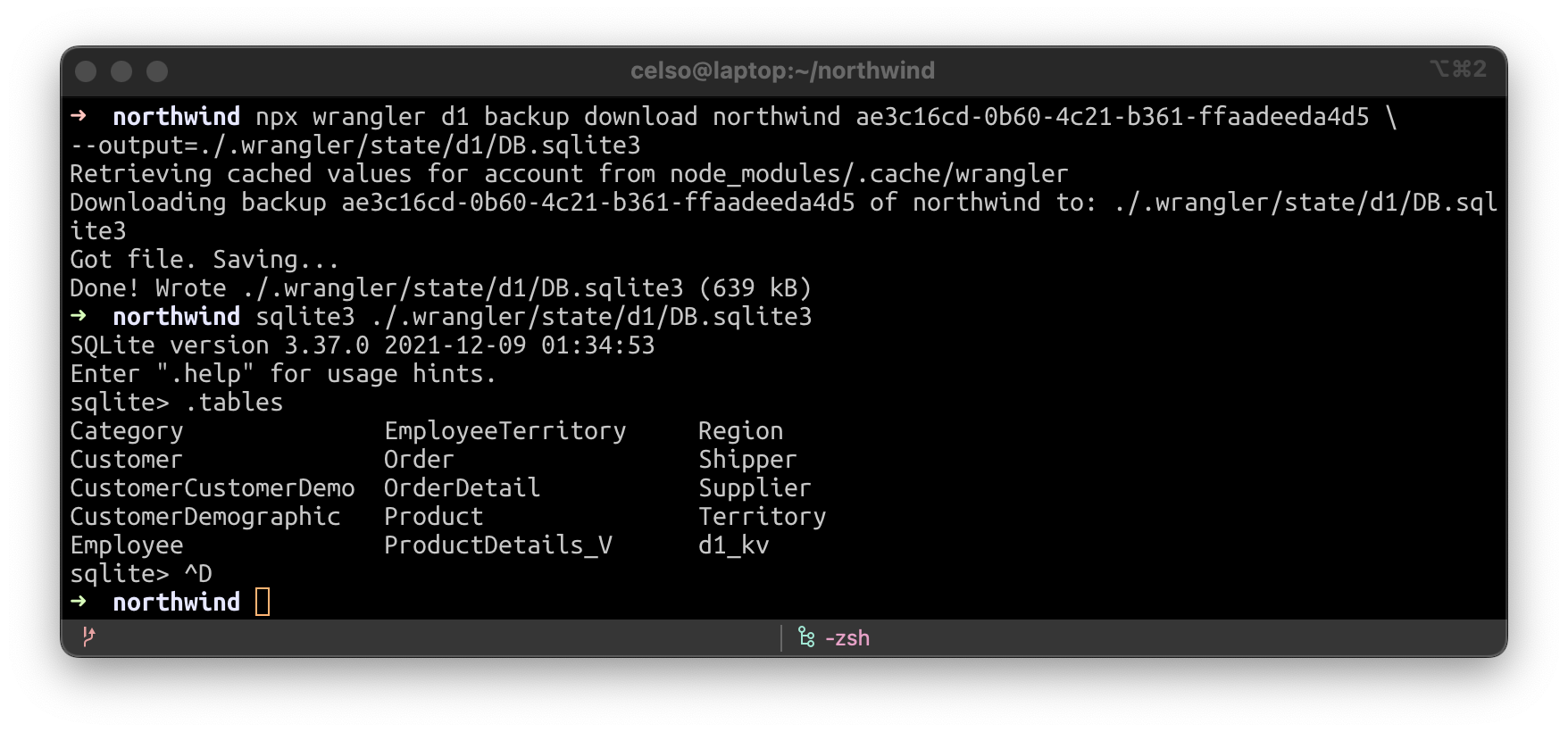
Those pictures and news of what is happening inside Ukraine continue to galvanize support. The Ukrainian government continues to function in spite of withering cyber attacks. Voices inside Russia pushing back against the regime are increasingly being heard. And ordinary Russian citizens have increasingly turned to services like Cloudflare’s 1.1.1.1 App to see uncensored news, in record numbers.
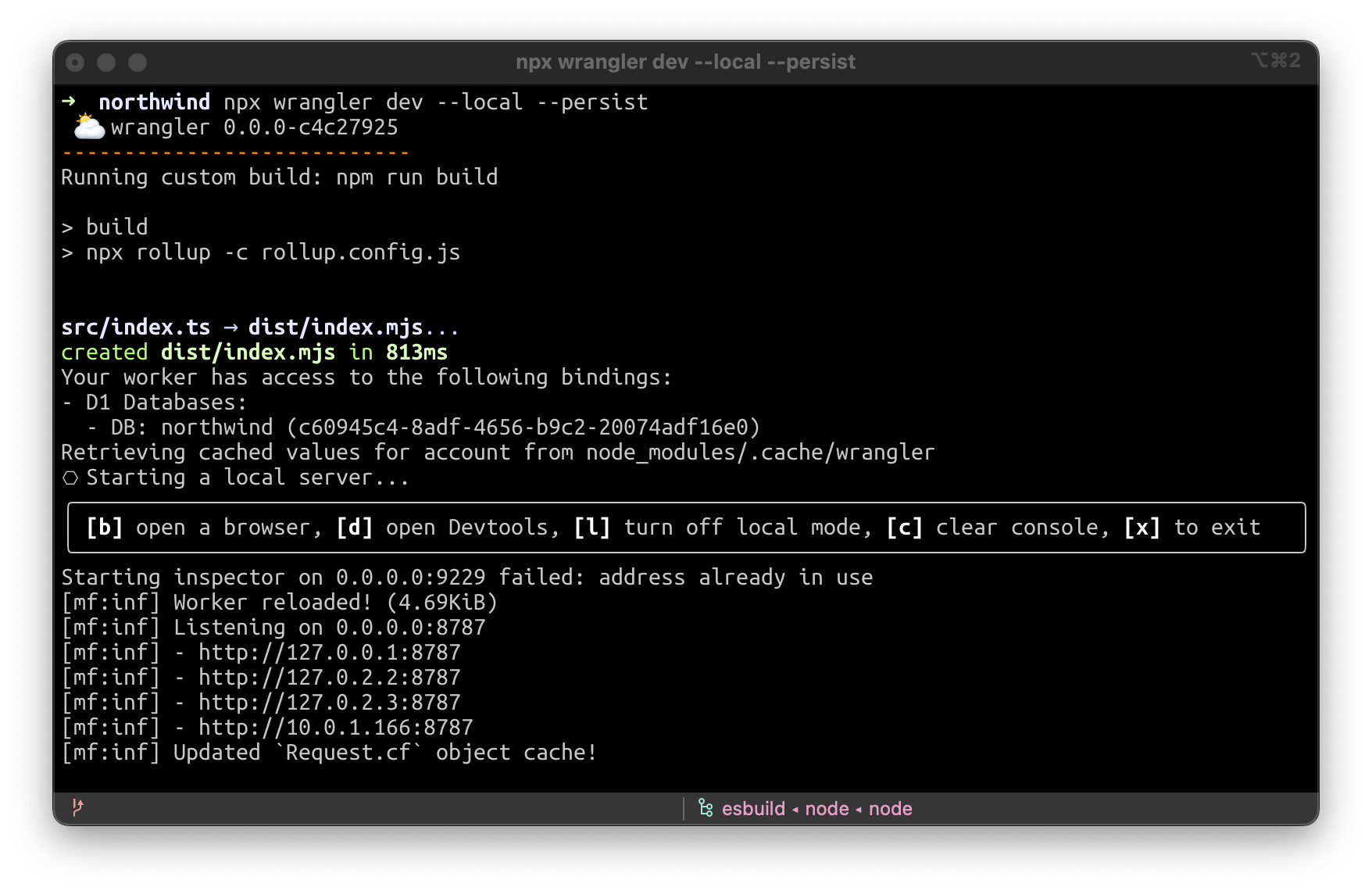
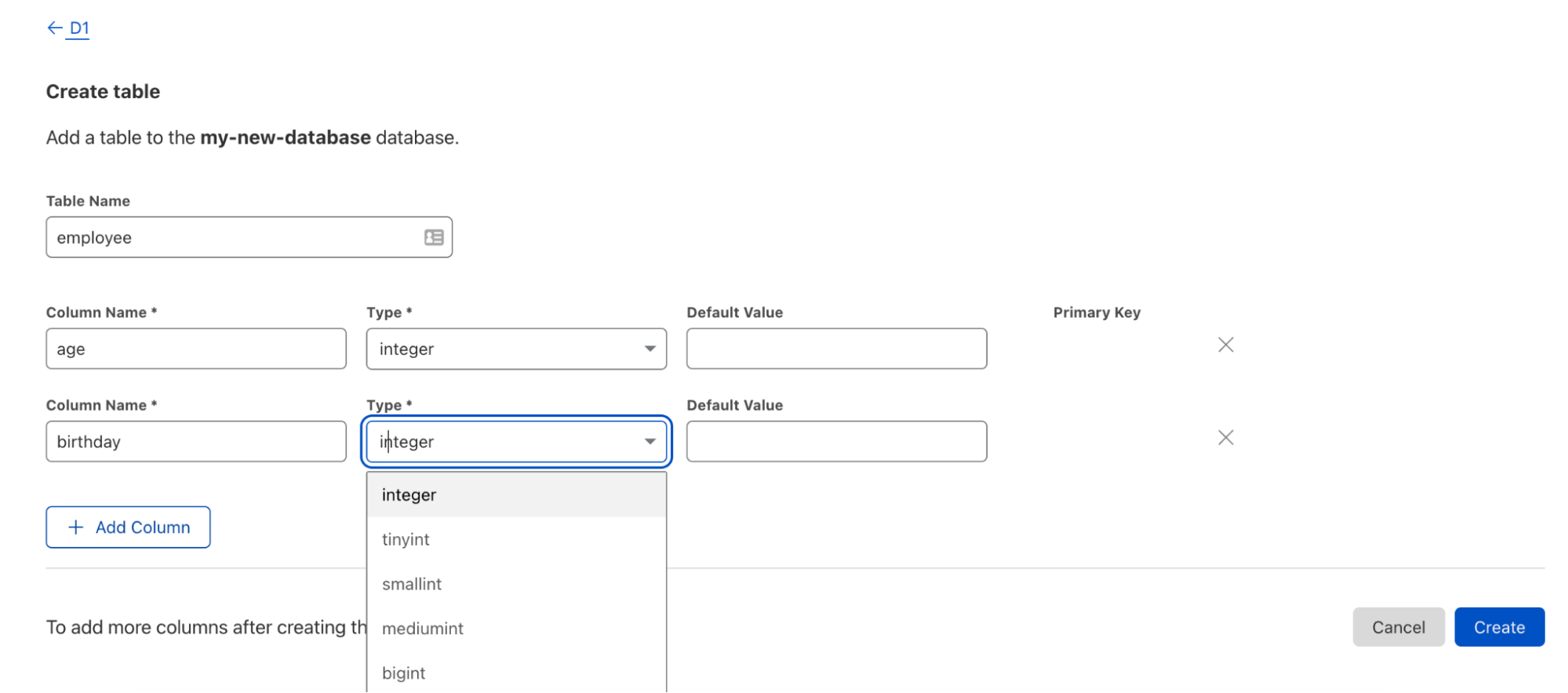
Our efforts to keep the Internet on in Russia led the Putin regime to officially sanction one of us (Matthew) — a sign we took that we were making a positive impact. Today we estimate approximately 5% of all households in the country are continuing to access the uncensored Internet using our 1.1.1.1 App, and that number continues to grow.

Cloudflare’s 2022 Annual Founders’ Letter

The Internet’s current battleground

2022 was not the first year in which the Internet became a battleground, but to us, it does feel like a turning point. In the last twelve months, we’ve seen more countries shut down Internet access than in any previous year. Sometimes this is just a misguided and ineffectual effort to keep students from cheating on national exams. Unfortunately, increasingly, it’s about repressive regimes attempting to assert control.

As we write this, the Iranian government is attempting to silence protests in the country through broad Internet censorship. While some may suggest this is business as usual, in fact it is not. The Internet and the broad set of news and opinions it brings have generally been available in places like Iran and Russia, and we shouldn’t accept that full censorship in them is the de facto status quo.

And these efforts to reign in the Internet are unfortunately not limited to Iran and Russia. Even in the liberal, democratic corners of Western Europe, incidents in which court ordered blocking at the infrastructure layer resulting in massive overblocking spiked dramatically over the last year. Those cases will set a dangerous precedent that a single court in a single country can block access to wide swaths of the Internet.

While it may seem ok to Austrians for an Austrian court to enforce Austrian values for an issue within Austria, if any country’s courts can block content at the core Internet infrastructure level even when it results in the blocking of unrelated sites then it will have a global impact. And, inherently, it will open the door for Afghanistan, Albania, Algeria, Andorra, Angola, Antigua, Argentina, Armenia, Australia, and Azerbaijan to do the same. And that’s just the countries that start with the letter A. If these precedents are upheld then the Internet risks falling to the lowest common denominator of what’s globally acceptable.

An old threat to permissionless innovation

The magic of the early Internet was that it was permissionless. Cloudflare was founded to counter an old and very different threat to that magic than we face today. Early in Cloudflare’s history, we used to get asked who we were competing against. We have never thought the answer was Akamai or EdgeCast. While, from a business perspective, we always thought of our business as replacing the vast catalog of Cisco’s hardware boxes with scalable services, that transition seemed inevitable. Instead, the existential competitor we faced was a threat to the permissionless Internet itself: Facebook.

If you find your eyebrow raised as you read that, know you’re not alone. It was the universal reaction we’d get whenever we said that back in 2010, and it remains the universal reaction we get when we say it today. But it has always rung true. In 2010, when Cloudflare launched, it was getting so difficult to be online — between spam, hackers, DDoS, reliability, and performance issues — that many people, organizations, and businesses gave up on the web and sought a safe space in Facebook’s walled garden.

If the challenges of being online weren’t solved in some other way, there was real risk that Facebook would, effectively, become the Internet. The magic of the Internet was that anyone with an idea could put it online and, if it resonated, thrive without having to pass through a gatekeeper. It seemed wrong to us that if those trends continued you’d have to effectively get Facebook’s permission just be online. Preserving the permissionless Internet was a big part of what motivated us to start Cloudflare.

So we set out to help solve the problems of cyberattacks, outages, and other performance challenges making sure that the Internet we believed in could continue to thrive. We built a global network able to mitigate the largest DDoS attacks easily, and to make anything connected to the Internet faster, more secure, and more reliable. We created tools to make it easy for developers to build and maintain new platforms, with the ability to deploy serverless code in an instant across the globe. We developed new ways for our customers to protect their internal systems from attack with Zero Trust services. And we made it all as widely available as possible, constantly striving to provide accessible tools not only to the Fortune 1000 but also to the small businesses, nonprofits, and developers with ideas about how to build something new, creative, and good for the world.

It’s not dissimilar to the story of another disruptive tech company that began a few years before we did. Shopify has been a long time Cloudflare customer using a number of our services, including our Workers developer platform. Their unofficial rallying cry of “arming the rebels” has always resonated with us.

In many ways, Shopify is to Amazon.com as Cloudflare is to Facebook. Both of the former providing the key infrastructure you need to innovate and then getting out of your way, both of the latter building a walled garden from which they can ultimately extract maximum rents.

A New Hope

Shopify framing their customers as the rebels taking on the Empire of Amazon is, of course, a reference to Star Wars and so it may not be surprising that we often talk internally about the Star Wars movies as a metaphor for the history of the Internet: past, present, and maybe future.

The first movie, Episode IV, was titled “A New Hope.” The plot of that movie feels a lot like how the world experienced the Internet for the 40 years prior to 2016. There was this magical thing called the Force, and it was controlled by these incredible people called Jedi. Except instead of the Force it was the Internet and instead of Jedi it was programmers and network engineers.

It’s easy to forget that it’s the stuff of not-too-long-ago science fiction that you could have a device in your pocket that could access the sum of all human knowledge. And yet, there are now more smartphones in active use than humans on Earth. Neither of us feel all that old, yet we both grew up in a time when if you had an opinion and wanted to get it out to a broad audience you had to write it up, send it in as a letter to the editor, and hope that it would get published.

Today in the world of Twitter and TikTok that is almost unimaginably quaint. The Internet blew that all up, just as Luke blew up the Death Star, and it’s hard to overstate how much that disrupted every traditional source of power and control.

Cloudflare’s 2022 Annual Founders’ Letter

The Empire Strikes Back

But after Episode IV came Episode V: “The Empire Strikes Back.” And make no mistake, the traditional centers of control are working hard to find ways to control the Internet. While we think the shift came somewhere around 2016, it feels like in 2022 the Empire has discovered the rebel base on Hoth and the AT-ATs are closing in.

Episode V is a pretty dark movie. Spoiler alert for the small percentage of you who may not have seen it, but the hero realizes his mortal enemy is his father, loses his hand, his rogue friend is encased in carbonite, and the girl he likes sold into slug slavery shortly after she declares her love for not him but the about-to-be-carbonite-encased friend. But it’s also the best movie because the stakes are so high.

The stakes are high for the Internet too, and we believe it’s important for us to engage on the hard technology and policy issues. The next several years will be challenging as we rebuild the legacy protocols of the Internet to be more private and secure by design, so they can accommodate what the Internet has become, and wrestle with hard policy issues around respecting local laws and norms on a network that is inherently global. The team at Cloudflare comes to work every day appreciating the challenges and importance of what we need to help do to live up to our mission.

Cloudflare’s 2022 Annual Founders’ Letter

Helping build a better Internet

Our mission is to help build a better Internet, and we are proud that more than 20% of the web and 30% of the Fortune 1,000 relies on Cloudflare to be fast, reliable, secure, efficient, and private for whatever they are doing online. Throughout the year we have Innovation Weeks usually dedicated to new products to sell to our customers. But, during our Birthday Week, we give back with products and initiatives that aren’t designed to generate revenue, but instead we provide them because they improve the fundamentals of how the Internet works.

Cloudflare’s 2022 Annual Founders’ Letter

And so this year we’ll be launching new services and partnerships to make the best security practices more affordable and bring them more easily to an increasingly mobile world. We’re helping developers access more resources they need to deliver the next generation of applications. And we’re launching privacy-preserving alternatives to widely used services because we believe a better Internet is a more private Internet.

We’re not ready to declare that it’s time for the Ewoks to start dancing, but we are proud of our continued innovation and the thoughtfulness of our team as we navigate these challenging times. Although the global economy continues to provide uncertain headwinds as we head into the new year, we are confident we have the plan and the team that will make us successful.

Thank you to our team, our customers, and our investors. Happy 12th birthday to Cloudflare. And, as always: we’re just getting started.

Cloudflare’s 2022 Annual Founders’ Letter

Cloudflare Innovation Weeks 2021

Post Syndicated from Reagan Russell original https://blog.cloudflare.com/2021-innovations-weeks/

Cloudflare Innovation Weeks 2021

Cloudflare Innovation Weeks 2021

One of the things that makes Cloudflare unique is our Innovation Weeks. Rather than having one large conference annually, we have multiple Innovation Weeks throughout the year to highlight new product announcements, beta products opening up to general availability, and share how our customers are using Cloudflare to help build a better Internet.

Internally, these weeks generate a lot of energy and excitement as well, as they provide an opportunity for teams from across Cloudflare to work together on product delivery and celebrate company-wide successes. In 2021, we had seven Cloudflare Innovation Weeks. As we start planning our 2022 Innovation Weeks, we are reflecting back on the highlights from each of these weeks.

Cloudflare Innovation Weeks 2021

Security Week March 21-26, 2021

Patrick Donahue

Security Week kicked off Cloudflare’s 2021 Innovation Weeks with a series of foundational security announcements. The Internet wasn’t built with security in mind, but the products and partnerships announced this week continued Cloudflare’s core mission of helping build a better Internet—one that companies of all sizes can plug into and be protected by default from the types of attacks that have historically resulted in loss of data, computing resources, and customer confidence.

At the start of the week, we took on the task of replacing MPLS, the core network technology that many organizations use to connect their offices and data centers, with a more secure and cost-effective alternative. Next, we tackled the biggest risk to everyday users of the web by opening our remote browser isolation technology to teams of all sizes and protecting against malicious code injection. Following those announcements, we inverted the slow, network chokepoint model of data loss prevention by building zero trust controls over data directly into every aspect of the Cloudflare One suite. And to round out the week, we democratized access to bot-fighting technology previously only available to the largest enterprises while also  deepening our solutions for novel threats facing APIs.

View all Security Week 2021 Blog Posts
View all Security Week 2021 Cloudflare TV Series

Cloudflare Innovation Weeks 2021

Developer Week April 11-17, 2021

Alyson Cabral

With Developer Week, we had one focus – to make developers’ lives easier. Our announcements included Cloudflare Pages being made generally available, Introducing Web Socket Support in Workers, Workers Unbound, Free Tunnels, Partnering with Nvidia to bring AI to the Edge and many more announcements throughout the week. In addition to the announcements, we also launched our first ever Developer Challenge series. Each day, a new challenge was announced to encourage developers from across the globe to level up their skills by trying new features and approaches. Solutions were revealed the following day, with the bonus round solution wrapping up the week. To keep up to date on the next round of challenges, join our Cloudflare Developer community.

View all Developer Week 2021 Blog Posts
View all Developer Week 2021 Cloudflare TV Series

Cloudflare Innovation Weeks 2021

Impact Week July 26-31, 2021

Patrick Day

During our first Impact Week, we reflected on how we are achieving Cloudflare’s mission–helping build a better Internet– and why we continue to prioritize projects that give back to the Internet. Impact Week highlighted some of the things we are doing as a company around environmental, social and governance initiatives. We launched Project Pangea, a free program to provide secure, reliable access to the Internet for community networks that support under-served communities. We also shared how we are committed to helping build a green Internet through efficiency, renewable energy, and providing developers a choice to run their workloads in the most energy efficient data centers. In addition, we published our first human rights policy in order to better serve our mission and core values.

View all Impact Week 2021 Blog Posts
View all Impact Week 2021 Cloudflare TV Series

Cloudflare Innovation Weeks 2021

Speed Week Sept 12-17, 2021

Marc Lamik

Helping make the Internet faster is one of Cloudflare’s core priorities. During Speed Week we shared how fast Cloudflare’s Network is as well as the amazing performance of Workers and Pages’ lightning fast speed. We expanded the size of Cloudflare’s network, so it’s closer to more people than ever.

We launched two amazing performance features with Signed Exchanges reducing load times and increasing SEO rankings with one click as well as Early Hints which can reduce loading times by 30%.

As part of  Speed week, we also announced Cloudflare Images which stores, resizes, optimizes and serves images so that all of our customers can build a scalable, affordable image pipeline.

View all Speed Week 2021 Blog Posts
View all Speed Week 2021 Cloudflare TV Series

Cloudflare Innovation Weeks 2021

Cloudflare Birthday Week Sept 26-Oct 1, 2021

Dane Knecht and Jennifer Taylor

This is the week in which we celebrate Cloudflare’s birthday. We launched the company 11 years ago: September 27, 2010. It has been our tradition, since our first birthday, to use this week to launch innovative products that we think of as our gift back to the Internet. In 2021, we announced Cloudflare R2, our object-based storage with no egress fees, tackled solutions to Email Spoofing and Phishing, shared how we are expanding our network into office buildings as well as many more product announcements and Cloudflare TV executive fireside chats and product discussions.

View all Birthday Week Blog Posts
View all Birthday Week Cloudflare TV Series

Cloudflare Innovation Weeks 2021

Full Stack Week Nov 14-19, 2021

Rita Kozlov

During Full Stack Week, we brought the vision of the Network is the Computer to life — allowing developers to build their entire application on our network, soup to nuts. Over the course of the week, we made a series of announcements, each providing another critical piece of the puzzle, necessary to build a full stack application.

We started with the foundation — data, announcing the general availability of Durable Objects, and ability to connect to databases, alongside partnerships with MongoDB and Prisma. Cloudflare Pages, our Jamstack platform also took a step deeper down the stack by introducing support for seamless deployment of functions. We want development on our platform to be an enjoyable experience, so we announced the new version of wrangler, our CLI, and Services, a better way for teams to build applications. And while we want developers to have fun, we also want them to be able to monetize their efforts, which they now can do using the Stripe SDK on Workers.

View all Full Stack Week 2021 Blog Posts
View all Full Stack Week Cloudflare TV Series

Cloudflare Innovation Weeks 2021

CIO Week Dec 5-10, 2021

Annika Garbers

To wrap up the year, we demonstrated how Cloudflare One, our Zero Trust Network-as-a-Service, is helping Chief Information Officers transform their corporate networks. We launched new capabilities in Cloudflare One to help customers replace their hardware firewalls and a chance to win a trip to Oahu in the process, a Log Storage platform built on Cloudflare R2, a new premium DNS offering, and Cloudflare Security Center, which helps customers map their attack surface and mitigate potential security risks with just a few clicks. We also announced our acquisition of Zaraz to boost website speed and security without sacrificing privacy, as well as new partnerships with Microsoft and leading cyber insurance providers, among many other exciting announcements throughout the week.

View all CIO Week 2021 Blog Posts
View all CIO Week 2021 Cloudflare TV Series

The secret to Cloudflare’s pace of Innovation

Post Syndicated from Jen Taylor original https://blog.cloudflare.com/the-secret-to-cloudflare-pace-of-innovation/

The secret to Cloudflare’s pace of Innovation

The secret to Cloudflare’s pace of Innovation

We are 11! And we also may be a little bleary-eyed and giddy from a week of shipping.

The secret to Cloudflare’s pace of Innovation

Our Birthday Weeks are one of my favorite Cloudflare traditions — where we release innovations that help to build a better Internet. Just this week we tackled email security, expanded our network into office buildings, and entered into the Web3 world.

The secret to Cloudflare’s pace of Innovation

But these weeks also precipitate the most common questions I’m asked from my product and engineering peers across the industry: how do we do it? How do we get so much stuff out so quickly? That we are able to innovate — and innovate so quickly — is no happy accident. In fact, this capability has been very deliberately built into the DNA of Cloudflare. I want to touch on three of the reasons unique to us: one relates to our people, one relates to our technology, and one relates to our customers.

Cultivating curiosity

The seeds of innovative ideas start with our team. One of the core things we look for when hiring in every role at Cloudflare — be it engineering and product or sales or account — is curiosity. We seek people who approach a situation with curiosity — who seek to understand the what, the how, and perhaps most importantly, the why of the world around them. Innovation at its core is finding new ways to solve existing problems, and this curiosity is jet fuel for innovation. It pushes us to challenge the status quo. It is through this inquiry that we identify assumptions and unnecessary points of friction.

The secret to Cloudflare’s pace of Innovation

We turn our curiosity towards the world in front of us, the problems that “bug” us about our workflows and the business of the Internet. This is as much about innovating with code as it is about upending business models that don’t make sense to us. It frustrated us that hackers used DDoS attacks to perpetrate financial terrorism by driving up the cost of their victim’s web hosting and delivery bills, so as part of Birthday week in 2017 we made our DDoS protection free and accessible to all. Interestingly, we also have seen a correlating drop in DDoS attacks against many types of sites since then. This year we turned our attention to the egregious egress fees charged by cloud providers and delivered R2, our object storage solution which offers the ability to store large amounts of data — both expanding what developers can build on Cloudflare while slashing the egress bandwidth fees associated with cloud provider storage to zero. We also continue to expand our at-cost registrar service to more TLDs.

The secret to Cloudflare’s pace of Innovation

There’s an important attribute that partners with curiosity, however. To innovate, we listen. One of the things I screen for when we hire product managers is their ability to listen and synthesize the information they are hearing and then their ability to distill it into actionable problems for us to tackle. We ship early and often with initial concepts. We must listen closely to the feedback from customers — both what they tell us through community forums, support tickets, and meetings and through what they show us in how they adopt and use a feature — and quickly fold this back into the roadmap and the next stage of development. Like some of what you saw this week? Watch our blog for updates and new features as we round out and mature the products.

The best dog food

We like to say Cloudflare was built on Cloudflare and for Cloudflare. This means we eat our own dog food with a glass of our own champagne on the side. We wanted a way to connect with our customers and the community, so we built ourselves a real-time streaming service and launched CloudflareTV. Over the past 18 months we ironed out the kinks and this week we made that available to all of you to stand up your own network. We care deeply not only about the capabilities we deliver but how they look and feel. This focus leads to big innovations, but also leads to smaller improvements in how our tools look and feel, like Dark Mode, which was a passion project of a few of our front-end developers and one of the most requested features of all time by our own team.

The secret to Cloudflare’s pace of Innovation

So that’s an example of what happens. But how were we able to do this?

It’s driven by our Workers platform. This isn’t just something that’s making our customers’ lives easier. No containers to manage; no scaling to handle. We use it, too. It’s a layer of abstraction on top of our network that enables a massive amount of development velocity. Our unified architecture provides a single, scalable platform on which to innovate and allows us to roll things out in a matter of seconds across our entire network (and roll them back even more quickly if things don’t go to plan, which also sometimes happens). We’re constantly striving to make this network faster, safer, and more reliable. We’re constantly evolving our network to make it better. A couple of weeks ago we announced we’d expanded to 250 cities and are now within 50 milliseconds of 95% of the Internet-connected population. This week we expanded the footprint of our network into office buildings, getting even closer to end users.

The secret to Cloudflare’s pace of Innovation

This abstraction enables us to have smaller teams to build any new product or service. While others in the industry talk about building “pizza box” teams — teams small enough that they can all share a pizza together — many of our innovation efforts start with teams even smaller. At Cloudflare, it is not unusual for an initial product idea to start with a team small enough to split a pack of Twinkies and for the initial proof of concept to go from whiteboard to rolled out in days. We intentionally staff and structure our teams and our backlogs so that we have flexibility to pivot and innovate. Our Emerging Technology and Incubation team is a small group of product managers and engineers solely dedicated to exploring new products for new markets. Our Research team is dedicated to thinking deeply and partnering with organizations across the globe to define new standards and new ways to tackle some of the hardest challenges. These efforts drove our Web3 announcements and I could not be more excited to see where you all take them.

The secret to Cloudflare’s pace of Innovation

We ship software for businesses like a consumer software company. Traditional B2B software development typically follows longer development cycles and focuses on delivering more fully featured and deeply integrated offerings out of the gate. This cautious approach yields fewer more fully featured offerings shipped less frequently. Consumer software, on the other hand, is typically built in a highly iterative process — where teams develop initial concepts quickly and roll them out frequently in small pieces to subsets of users to test and understand how people use them and then use these observations to guide development. Many of the seeds that shaped the email security offerings this week started as small experiments by the DNS team, Emerging Technology, and our Customer Support team.

There’s one more aspect to all of this — because we’ve innovated in the way we’ve built our network — making it highly scalable and cost-effective — we’re able to pass these savings on to our customers. In a lot of instances, these savings amount to a pretty good price for our products and services: nothing at all.

Born to be free

Typically, in B2B enterprise software companies, the big customers and the multi-million dollar contracts get 99.99% of the focus. Here’s what I would say: our free customers are the secret sauce to our innovation. Today, millions of websites and applications  across the globe use our service for free. Free is invaluable to innovation.

One of the most difficult parts of building B2B software is getting the first 100 users. These early users are critical to assess the quality, scale, and capabilities of a product. But B2B folks are notoriously risk averse: their application or users are their lifeblood, and they aren’t necessarily willing to make them guinea pigs. They would rather sit on the sidelines and wait for someone else to go first. So when you are building B2B software, you are stuck in a conundrum — how do you get the users you need to prove out the capabilities?  We’re fortunate to have millions of free sites and applications on our network. Like a consumer app developer, we typically roll out new capabilities to pods of these users first. These users give us the volume and scale to get confident in what we’ve delivered. The more confident we get, the more broadly we roll out, such that by the time it hits broad rollout, our customers can feel confident in the quality and stability.

The large and diverse free customer base also helps fuel innovation. Through servicing a large and diverse base — from a personal blog in Bolivia to a small business in Chennai to a start-up in Munich — we observe unique traffic and threat patterns. We take these learning and fold the insights back into our product to dynamically route traffic across the fastest route and stop emerging threats before they scale.

The other thing I love about Birthday Week? It is the place critical innovations start that will ultimately transform the way we work. Universal SSL in 2014 made SSL free and available to all customers, doubling the number of active sites that use encryption within 24 hours of launch.   Seedling ideas, such as Workers, which we launched in 2017, have become the foundation of a whole new generation of applications.

I mentioned earlier that two of the most common questions I’m asked about Cloudflare relate to how we do it. Well, there’s often a third, and that too comes up quite a lot during Birthday Week. And that question is: “are you hiring?!” The answer is a resounding yes! We have opportunities across a variety of roles in Cloudflare: Legal, Product, Engineering, Sales, IT. Good ideas come from everywhere. I’d love nothing more than to engage your curiosity to help us build a better Internet.

The secret to Cloudflare’s pace of Innovation

Two Weeks Later: Finding and Eliminating Long Tail Latencies

Post Syndicated from Simona Pop original https://blog.cloudflare.com/two-weeks-later-finding-and-eliminating-long-tail-latencies/

Two Weeks Later: Finding and Eliminating Long Tail Latencies

Two Weeks Later: Finding and Eliminating Long Tail Latencies

A little over two weeks ago, we shared extensive benchmarking results of edge networks all around the world.  It showed that on a range of tests (TCP connection time, time to first byte, time to last byte), and on a range of measurements (p95, mean), that Cloudflare had some impressive network performance. But we weren’t the fastest everywhere. So we made a commitment: we would improve in at least 10% of networks where we were not #1.

Today, we’re happy to tell you that we’ve delivered as promised. Of the networks where our average latency exceeded 100ms behind the leading provider during Speed Week, we’ve dramatically improved our performance. There were such 61 networks; now, we’re the fastest in 29 of them. Of course, we’re not done yet — but we wanted to share with you the latest results, and explain how we did it.

Measuring What Matters

In the process of quantifying network performance, it became clear where we were not the fastest everywhere. There were 61 country/network pairs where we more than 100ms behind the leading provider:

Two Weeks Later: Finding and Eliminating Long Tail Latencies

Once that was done, the fun began: we needed to go through the process of figuring out why we were slow — and then improve. The challenges we faced were unique to each network and highlighted a variety of different issues that are prevalent on the Internet. We’re going to deep dive into a couple of networks, and show how we diagnosed and then improved performance.

But before we do, here are the results of our efforts in the past two weeks: of the 61 networks where our performance was over 100ms behind the leader, we are now the #1 network in 29 of them.

Two Weeks Later: Finding and Eliminating Long Tail Latencies

And it’s not that we just focused on those 29 networks, either. We’ve dramatically improved our performance in almost all the networks where we were over 100ms behind the leader.

Two Weeks Later: Finding and Eliminating Long Tail Latencies

With the results out of the way, let’s share the story of chasing peak performance in three very different geographies — each with three very different sets of challenges. Before we begin: a lot of Cloudflare’s internal network performance is automatically tuned. However, by its very nature, the Internet is a network of networks — and that inherently relies on us talking to other network operators to maximize performance. That’s often what we had to do here.

Rectifying Route Advertisement in Brazil

One particular network that was flagged for improvement during Speed Week stood out: we’ll refer to it as Network-A. This network was well known to our edge team (the team that looks after our network connectivity in Cloudflare data centers) for frequently congesting the dedicated interconnection we have with the network in São Paulo. This type of dedicated connection is called a Private Network Interconnect (PNI), or private peering, and it helps Cloudflare talk to Network-A without any intermediaries using the BGP protocol.

At a first look, we noticed that a significant chunk of traffic to Network-A was not using the PNI, but instead was being sent through one of our transit providers. A transit provider is an intermediary network that provides connectivity to the rest of the Internet.

This is not uncommon. The most likely reason for this behavior is that at some point in the past traffic was shifted away from the PNI due to capacity issues mentioned earlier.

We then started to take a more in-depth look at the path from this particular transit provider and identified that traffic was routed all the way to the USA before coming back to Brazil. The transit provider was exhibiting behavior known as tromboning: traffic from one location destined to a network in the same location travels vast distances only to be exchanged and then returns again. Tromboning typically occurs as a result of networks preferring paths that are farther away from the best possible path. This can happen due to peering preferences, BGP configurations, or the presence of direct interconnection farther away from end users. This explained the higher latency on this network we saw during Speed Week.

Two Weeks Later: Finding and Eliminating Long Tail Latencies

The next step we took was to look into alternatives to this transit connection. We have a nearby data center in Rio de Janeiro — where we also had a PNI with Network-A. Moreover, São Paulo and Rio de Janeiro are connected via our backbone network. After making the necessary checks to ensure we had room to carry traffic towards Network-A through our backbone and out through the PNI in Rio, we proceeded to prepare the network configuration changes.

We first started announcing Network-A IP addresses out of our backbone in Rio and then accepting them into São Paulo. We then ensured we preferred the path via our backbone over the PNI by changing the BGP behavior through the LOCAL_PREF path attribute. We then removed all the configuration specifying that transit provider as the preferred route for the previously identified traffic from Network-A.

Two Weeks Later: Finding and Eliminating Long Tail Latencies

The result was as expected. Traffic moved away from the transit provider onto our backbone network. We confirmed we achieved a decrease in latency by monitoring our p95 TCP RTTs, which went from 175ms to 90ms.

We currently rank #1 with Network-A, moving up from #5 during Speed Week, as seen in the chart below.

Two Weeks Later: Finding and Eliminating Long Tail Latencies

Immaculate Ingress in Spain

Another network that stood out was a European ISP with a global presence. We’ll refer to it as Network-B. Our RUM measurements showed that we were experiencing high latencies in several parts of the world, including Spain.

The first thing we did was to check how we handled traffic from Spain for Network-B. Our data showed that we had several data centers outside the country which were serving users from Network-B: Milan in Italy and Marseille in France. This obviously raised a question: why is traffic not staying locally in Spain?

The traffic was not staying local because Network-B had not peered with us in Madrid. If private peering describes a connection between exactly two networks using a dedicated circuit, public peering allows multiple networks to interconnect, if they wish so, at an Internet Exchange Point (IXP) location using a shared infrastructure. We looked at our Peering Portal to identify any potential peering opportunities with Network-B and established peering sessions in various locations where we saw high latency, including Madrid.

We looked at the traffic breakdown for these locations and identified the top destinations not being advertised in-country. We then checked whether our Spanish data centers were advertising these destinations and found that the corresponding anycast IP addresses were not enabled in Barcelona. We enabled the additional anycast IP addresses in Barcelona, and this change resulted in traffic for Network-B to be handled locally, which helped reduce latency.

Since we were looking into public peering status with Network-B, we also noticed that they had turned off their public peering session with Cloudflare in Milan. Our logs showed that the session with Network-B was down because it thought Cloudflare was sending more IP prefixes than allowed. We contacted Network-B and advised them to update the configuration according to the data we publish in PeeringDB. While it is a public peering session which comes with its own pros and cons, it still represents a more direct path than using a transit provider.

These changes pushed us up from ranking #2 during Speed Week to #1, as shown by the graph below:

Two Weeks Later: Finding and Eliminating Long Tail Latencies

You may notice that going from #2 to #1 still means we have a latency of about 300ms.  We want to ensure that every network has amazing performance, but we can’t control all network providers and how they connect with the rest of the Internet. We’re constantly working to ensure that end users see the best experience possible.

Upstream Selection in Africa

We’ve previously discussed private peering and transit providers and how a direct connection is better than a transit connection which usually routes through intermediary networks. However, sometimes this might not be true. This was the case for a network in Africa, which we will call Network-C.

As before, we started by looking at the locations from where we serve traffic to Network-C. This was mostly from our data centers in Western Europe. Looking at the parent ASNs for Network-C, we expected this outcome since we don’t peer with either of them anywhere in Africa.

Let’s take our data center in London. There, we had a private peering connection with Parent-1 and a transit connection with Parent-2. We were receiving IP addresses belonging to Network-C from both parents, however we were only sending traffic to Parent-1 since that was our private peer.

As Parent-2 also provided a direct path to Network-C and, moreover, they belonged to the same organization, we decided to test the latency via Parent-2. It is generally tricky to identify potential upstream bottlenecks especially for transit providers, as each network has its own internal mechanisms for routing. However, in this case we were directly connected.

Once again, we modified the BGP behaviour. Let’s go into more detail this time. Our routing policies are configured differently depending on the type of network we peer with and the type of connection we use. Our policies configure the BGP LOCAL_PREF path attribute, which is the first decisive step in the selection of a path. In our case, Network-C prefixes from Parent-1 had a higher associated value than the same prefixes learned from Parent-2 and were thus chosen for routing. In order to steer traffic away from the private peer and towards the transit provider, we needed to adjust our transit policy to set a higher LOCAL_PREF value only for Network-C prefixes. We also had to use a regular expression to match the desired prefixes by filtering Network-C ASN in the AS-path in a way that would not affect traffic to the other networks from the transit provider.

This change produced better results in terms of latency. We were #2 during Speed Week. We are now #1, as seen by this chart:

Two Weeks Later: Finding and Eliminating Long Tail Latencies

Update on Speed Week

Two weeks ago, when we first reported our measurements, there were two charts that stuck out where Cloudflare was not #1 in terms of number of networks where we had the lowest connection time or TTLB.

The first was the mean TCP connection time in the top 1,000 networks by number of IP addresses. Since then, we’ve been optimizing and have measured our performance again, and we’ve now moved into the #1 spot.

Two Weeks Later: Finding and Eliminating Long Tail Latencies

The other measurement where we were #2 was mean TTLB in the top 1,000 networks by IP count. We’ve moved into the #1 spot, but there’s still work to do. Which makes sense because the work we’ve been doing over the last two weeks optimized network performance and not our software platform. Hence, connection times got a lot better while TTLB improved less dramatically.

Two Weeks Later: Finding and Eliminating Long Tail Latencies

Getting ever faster

Improving performance on the Internet is a long tail problem: each issue requires a different solution because every network is unique and covers different end users. As we continue to grow our network and interconnect with more of the world, it’s important that we constantly examine our performance to ensure that we’re the fastest.

The efforts of our team have yielded great improvements for our customers, but we’re not just stopping because Speed Week and Birthday Week are over. We’re automating the discovery process of poor performance on networks like these, and are working hard to also automate the remediation processes in order to deliver more incredible performance for our customers.

And we have two more innovation weeks coming in 2021. We’ll be back each week to report on further progress on optimizing our performance globally.

Announcing The Cloudflare Distributed Web Gateways Private Beta: Unlocking the Web3 Metaverse and Decentralized Finance for Everyone

Post Syndicated from Wesley Evans original https://blog.cloudflare.com/announcing-web3-gateways/

Announcing The Cloudflare Distributed Web Gateways Private Beta: Unlocking the Web3 Metaverse and Decentralized Finance for Everyone

Announcing The Cloudflare Distributed Web Gateways Private Beta: Unlocking the Web3 Metaverse and Decentralized Finance for Everyone

It’s cliché to say that the Internet has undergone massive changes in the last five years. New technologies like distributed ledgers, NFTs, and cross-platform metaverses have become all the rage. Unless you happen to hang out with the Web3 community in Hong Kong, San Francisco, and London, these technologies have a high barrier to entry for the average developer. You have to understand how to run distributed nodes, set up esoteric developer environments, and keep up with the latest chains just to get your app to run. That stops today. Today you can sign up for the private beta of our Web3 product suite starting with our Ethereum and IPFS gateway.

Announcing The Cloudflare Distributed Web Gateways Private Beta: Unlocking the Web3 Metaverse and Decentralized Finance for Everyone

Before we go any further, a brief introduction to blockchain (Ethereum in our example) and the InterPlanetary FileSystem (IPFS). In a Web3 setting, you can think of Ethereum as the compute layer, and IPFS as the storage layer. By leveraging decentralised ledger technology, Ethereum provides verifiable decentralised computation. Publicly available binaries, called “smart contracts”, can be instantiated by users to perform operations on an immutable set of records. This set of records is the state of the blockchain. It has to be maintained by every node on the network, so they can verify, and participate in the computation. Performing operations on a lot of data is therefore expensive. A common pattern is to use IPFS as an external storage solution. IPFS is a peer-to-peer network for storing content on a distributed file system. Content is identified by its hash, making it inexpensive to reference from a blockchain context.

If you want an even deeper understanding of how Web3 works check out our other blog posts on what is Web3 and creating Web3 Dapps with Cloudflare Workers.

Announcing The Cloudflare Distributed Web Gateways Private Beta: Unlocking the Web3 Metaverse and Decentralized Finance for Everyone

Web3 and the Metaverse

Over the last four years, while we have been working to mature the technology required to provide access to Web3 services at a global scale, the idea of the Metaverse has come back into vogue. Popularized by novels like “Snowcrash,” and “Ready Player One,” the idea is a simple one. Imagine an Internet where you can hop into an app and have access to all of your favorite digital goods available for you to use regardless of where you purchased them. You could sell your work on social media without granting them a worldwide license, and the buyer could use it on their online game. The Metaverse is a place where copyright and ownership can be managed through NFTs (Non-Fungible Tokens) stored on IPFS, and accessed trustlessly through Ethereum. It is a place where everyday creators can easily monetize their content, and have it be used by everyone, regardless of platform, since content is not being stored in walled gardens but decentralised ecosystems with open standards.

Announcing The Cloudflare Distributed Web Gateways Private Beta: Unlocking the Web3 Metaverse and Decentralized Finance for Everyone

This shifts the way users and content creators think about the Internet. Questions like: “Do you actually need a Model View Controller system with a server to build an application?” “What is the best way to provide consistent naming of web resources across platforms?” “Do we actually need to keep our data locked behind another company’s systems or can the end-user own their data?”. This builds different trust assumptions. Instead of trusting a single company because they are the only one to have your users’ data, trust is being built leveraging a source verifiable by all participants. This can be people you physically interact with for messaging applications, X.509 certificates logged in a public Certificate Transparency Log for websites, or public keys that interact with blockchains for distributed applications.

Announcing The Cloudflare Distributed Web Gateways Private Beta: Unlocking the Web3 Metaverse and Decentralized Finance for Everyone

It’s an exciting time. Unlike the emergence of the Internet however, there are large established companies that want to control the shape and direction of Web3 and this Metaverse. We believe in a future of a decentralised and private web. An open, standards-based web independent of any one company or centralizing force. We believe that we can be one of the many technical platforms that supports Web3 and the growing Metaverse ecosystem. It’s why we are so excited to be announcing the private beta of our Ethereum and IPFS gateways. Technologies that are at the forefront of Web3 and its emerging Metaverse.

Announcing The Cloudflare Distributed Web Gateways Private Beta: Unlocking the Web3 Metaverse and Decentralized Finance for Everyone

Time and time again over the last year we have been asked by our customers to support their exploration of Web3, and oftentimes their core product offering. At Cloudflare, we are committed to helping build a better Internet for everyone, regardless of their preferred tech stack. We want to be the pickaxes and shovels for everyone. We believe that Web3 and the Metaverse is not just an experiment, but an entirely new networking paradigm where many of the next multi-billion dollar businesses are going to be built. We believe that the first complete metaverse could be built entirely on Cloudflare today using systems like Ethereum, IPFS, RTC, R2 storage, and Workers. Maybe you will be the one to build it…

We are excited to be on this journey with our Web3 community members, and can’t wait to show you what else we have been working on.

Introducing the Cloudflare Web3 Gateways!

A gateway is a computer that sits between clients (such as your browser or mobile device) and a number of other systems and helps translate traffic from one protocol to another, so the systems powering an application required to handle the request can do so properly. But there are different types of gateways that exist today.

You have probably heard mention of an API gateway, which is responsible for accepting API calls inbound to an application and aggregating the appropriate services to fulfill those requests and return a proper response to the end user. You utilize gateways every time you watch Netflix! Their company leverages an API gateway to ensure the hundreds of different devices that access their streaming service can receive a successful and proper response, allowing end users to watch their shows. Gateways are a critical component of how Web3 is being enabled for every end user on the planet.

Remember that Web3 or the distributed web is a set of technologies that enables hosting of content and web applications in a serverless manner by leveraging purely distributed systems and consensus protocols. Gateways let you use these applications in your browser without having to install plugins or run separate pieces of software called nodes. The distributed web community runs into the same problem of needing a stable, reliable, and resilient method to translate HTTP requests into the correct Web3 functions or protocols.

Today, we are introducing the Cloudflare Ethereum and IPFS Gateways to help Web3 developers do what they do best, develop applications, without having to worry about also running the infrastructure required to support Ethereum (Eth) or IPFS nodes.

Announcing The Cloudflare Distributed Web Gateways Private Beta: Unlocking the Web3 Metaverse and Decentralized Finance for Everyone

What’s the problem with existing Eth or IPFS Web Gateways?

Traditional web technologies such as HTTP have had decades to develop standards and best practices that make sites fast, secure, and available. These haven’t been developed on the distributed web side of the Internet, which focuses more on redundancy. We identified an opportunity to bring the optimizations and infrastructure of the web to the distributed web by building a gateway — a service that translates HTTP API calls to IPFS or Ethereum functions, while adding Cloudflare added-value services on the HTTP side. The ability for a customer to operate their entire network control layer with a single pane of glass using Cloudflare is huge. You can manage the DNS, Firewall, Load Balancing, Rate Limiting, Tunnels, and more for your marketing site, your distributed application (Dapp), and corporate security, all from one location.

For many of our customers, the existing solutions for Web3 gateway do not have a large enough network to handle the growing amount of requests within the Ethereum and IPFS networks, but more importantly do not have the degree of resilience and redundancy that businesses expect and require operating at scale. The idea of the distributed web is to do just that… stay distributed, so no single actor can control the overall market. Speed, security, and reliability are at the heart of what we do. We are excited to be part of the growing Web3 infrastructure community so that we can help Dapp developers have more choice, scalability, and reliability from their infrastructure providers.

A clear example of this is when existing gateways have an outage. With too few gateways to handle the traffic, the result of this outage is pre-process transactions falling behind the blockchain they are accessing, thus leading to increased latency for the transaction, potentially leading to it failing. Worse, when decentralised application (Dapp) developers use IPFS to power their front end, it can lead to their entire application falling over. Overall, this leads to massive amounts of frustration from businesses and end users alike — not being able to collect revenue for products or services, thus putting a portion of the business at a halt and breaking trust with end users who depend on the reliability of these services to manage their Web3 assets.

Announcing The Cloudflare Distributed Web Gateways Private Beta: Unlocking the Web3 Metaverse and Decentralized Finance for Everyone

How is Cloudflare solving this problem?

We found that there was a unique opportunity in a segment of the Web3 community that closely mirrored Cloudflare’s traditional customer base: the distributed web. This segment has some major usability issues that Cloudflare could help solve around reliability, performance, and caching. Cloudflare has an advantage that no other company in this space — and very few in the industry — have: a global network. For instance, content fetched through our IPFS Gateway can be cached near users, allowing download latency in the milliseconds. Compare this with up to seconds per asset using native IPFS. This speed enables services based on IPFS to go hybrid. Content can be served over the source decentralised protocols while browsers and tools are maturing to access them, and served to regular web users through a gateway like Cloudflare. We do provide a convenient, fast and secure option to browse this distributed content.

On Ethereum, users can be categorised in two ways. Application developers that operate smart contracts, and users that want to interact with the said contracts. While smart contracts operate autonomously based on their code, users have to fetch data and send transactions. As part of the chain, smart contracts do not have to worry about the network or a user interface to be online. This is why decentralised exchanges have had the ability to operate continuously across multiple interfaces without disruptions. Users on the other hand do need to know the state of the chain, and be able to interact with it. Application developers therefore have to require the users to run an Ethereum node, or can point them to use remote nodes through a standardised JSON RPC API. This is where Cloudflare comes in. Cloudflare Ethereum gateway relies on Ethereum nodes and provides a secure and fast interface to the Ethereum network. It allows application developers to leverage Ethereum in front-facing applications. The gateway can interact with any content part of the Ethereum chain. This includes NFT contracts, DeFi exchanges, or name services like ENS.

Announcing The Cloudflare Distributed Web Gateways Private Beta: Unlocking the Web3 Metaverse and Decentralized Finance for Everyone

How are the gateways doing so far?

Since our alpha release to very early customers as research experiments, we’ve seen a staggering number of customers wanting to leverage the new gateway technology and benefit from the availability, resiliency, and caching benefits of Cloudflare’s network.

Our current alpha includes companies that have raised billions of dollars in venture capital, companies that power the decentralised finance ecosystem on Ethereum, and emerging metaverses that make use of NFT technology.

In fact, we have over 2,000 customers leveraging our IPFS gateway lending to over 275TB of traffic per month. For Ethereum, we have over 200 customers transacting over 13TB, including 1.6 billion requests per month. We’ve seen extremely stable results from these customers and fully expect to see these metrics continue to ramp up as we add more customers to use this new product.

We are now very happy to announce the opening of our private beta for both the Ethereum and IPFS gateways. Sign up to participate in the private beta and our team will reach out shortly to ensure you are set up!

P.S. We are hiring for Web3! If you want to come work on it with us, check out our careers page.

Get started Building Web3 Apps with Cloudflare

Post Syndicated from Kristian Freeman original https://blog.cloudflare.com/get-started-web3/

Get started Building Web3 Apps with Cloudflare

Get started Building Web3 Apps with Cloudflare

For many developers, the term Web3 feels like a buzzword — it’s the sort of thing you see on a popular “Things you need to learn in 2021” tweet. As a software developer, I’ve spent years feeling the same way. In the last few months, I’ve taken a closer look at the Web3 ecosystem, to better understand how it works, and why it matters.

Web3 can generally be described as a decentralized evolution of the Internet. Instead of a few providers acting as the mediators of how your interactions and daily life on the web should work, a Web3-based future would liberate your data from proprietary databases and operate without centralization via the incentive structure inherent in blockchains.

The Web3 space in 2021 looks and feels much different from what it did a few years ago. Blockchains like Ethereum are handling incredible amounts of traffic with relative ease — although some improvements are needed — and newer blockchains like Solana have entered the space as genuine alternatives that could alleviate some of the scaling issues we’ve seen in the past few years.

Cloudflare is incredibly well-suited to empower developers to build the future with Web3. The announcement of Cloudflare’s Ethereum gateway earlier today will enable developers to build scalable Web3 applications on Cloudflare’s reliable network. Today, we’re also releasing an open-source example showing how to deploy, mint, and render NFTs, or non-fungible tokens, using Cloudflare Workers and Cloudflare Pages. You can try it out here, or check out the open-source codebase on GitHub to get started deploying your own NFTs to production.

The problem Web3 solves

When you begin to read about Web3 online, it’s easy to get excited about the possibilities. As a software developer, I found myself asking: “What actually is a Web3 application? How do I build one?“

Most traditional applications make use of three pieces: the database, a code interface to that database, and the user interface. This model — best exemplified in the Model-View-Controller (MVC) architecture — has served the web well for decades. In MVC, the database serves as the storage system for your data models, and the controller determines how clients interact with that data. You define views with HTML, CSS and JavaScript that take that data and display it, as well as provide interactions for creating and updating that data.

Imagine a social media application with a billion users. In the MVC model, the data models for this application include all the user-generated content that are created daily: posts, friendships, events, and anything else. The controllers written for that application determine who can interact with that data internally; for instance, only the two users in a private conversation can access that conversation. But those controllers — and the application as a whole — don’t allow external access to that data. The social media application owns that data and leases it out “for free” in exchange for viewing ads or being tracked across the web.

This was the lightbulb moment for me: understanding how Web3 offers a compelling solution to these problems. If the way MVC-based, Web 2.0 applications has presented itself is as a collection of “walled gardens” — meaning disparate, closed-off platforms with no interoperability or ownership of data — Web3 is, by design, the exact opposite.

In Web3 applications, there are effectively two pieces. The blockchain (let’s use Ethereum as our example), and the user interface. The blockchain has two parts: an account, for a user, a group of users, or an organization, and the blockchain itself, which serves as an immutable system of record of everything taking place on the network.

One crucial aspect to understand about the blockchain is the idea that code can be deployed to that blockchain and that users of that blockchain can execute the code. In Ethereum, this is called a “smart contract”. Smart contracts executed against the blockchain are like the controller of our MVC model. Instead of living in shrouded mystery, smart contracts are verifiable, and the binary code can be viewed by anyone.

For our hypothetical social media application, that means that any actions taken by a user are not stored in a central database. Instead, the user interacts with the smart contract deployed on the blockchain network, using a program that can be verified by anyone. Developers can begin building user interfaces to display that information and easily interact with it, with no walled gardens or platform lock-in. In fact, another developer could come up with a better user interface or smart contract, allowing users to move between these interfaces and contracts based on which aligns best with their needs.

Operating with these smart contracts happens via a wallet (for instance, an Ethereum wallet managed by MetaMask). The wallet is owned by a user and not by the company providing the service. This means you can take your wallet (the final authority on your data) and do what you want with it at any time. Wallets themselves are another programmable aspect of the blockchain — while they can represent a single user, they can also be complex multi-signature wallets that represent the interests of an entire organization. Owners of that wallet can choose to make consensus decisions about what to do with their data.


The rise of non-fungible tokens

One of the biggest recent shifts in the Web3 space has been the growth of NFTs — non-fungible tokens. Non-fungible tokens are unique assets stored on the blockchain that users can trade and verify ownership of. In 2019, Cloudflare was already writing about NFTs, as part of our announcement of the Cloudflare Ethereum Gateway. Since then, NFTs have exploded in popularity, with projects like CryptoPunks and Bored Ape Yacht Club trading millions of dollars in volume monthly.

NFTs are a fascinating addition to the Web3 space because they represent how ownership of data and community can look in a post-walled garden world. If you’ve heard of NFTs before, you may know them as a very visual medium: CryptoPunks and Bored Ape Yacht Club are, at their core, art. You can buy a Punk or Ape and use it as your profile picture on social media. But underneath that, owning an Ape isn’t just owning a profile picture; they also have exclusive ownership of a blockchain-verified asset.

It should be noted that the proliferation of NFT contracts led to an increase in the number of scams. Blockchain-based NFTs are a medium of conveying ownership, based on a given smart contract. This smart contract can be deployed by anyone, and associated with any content. There is no guarantee of authenticity, until you verify the trustworthiness and identity of the contract you are interacting with. Some platforms may support Verified accounts, while others are only allowing a set of trusted partners to appear on their platform. NFTs are flexible enough to allow multiple approaches, but these trust assumptions have to be communicated clearly.

That asset, tied to a smart contract deployed on Ethereum, can be traded, verified, or used as a way to gate access to programs. An NFT developer can hook into the trade event for their NFTs and charge a royalty fee, or when “minting”, or creating an NFT, they can charge a mint price, generating revenue on sales and trades to fund their next big project. In this way, NFTs can create strong incentive alignment between developers and community members, more so than your average web application.

What we built

To better understand Web3 (and how Cloudflare fits into the puzzle), we needed to build something using the Web3 stack, end-to-end.

To allow you to do the same, we’re open-sourcing a full-stack application today, showing you how to mint and manage an NFT from start to finish. The smart contract for the application is deployed and verified on Ethereum’s Rinkeby network, which is a testing environment for Ethereum projects and smart contracts. The Rinkeby test network allows you to test the smart contract off of the main blockchain, using the exact same workflow, without using real ethers. When your project is ready to be deployed on Ethereum’s Mainnet, you can take the same contract, deploy and verify it, and begin using it in production.

Once deployed, the smart contract will provide the ability to manage your NFT project, compliant with the ERC-721 spec, that can be minted by users, displayed on NFT marketplaces like OpenSea and your own web applications. We also provided a web interface and example code for minting these NFTs — as a user, you can visit the web application with a compatible Ethereum wallet installed and claim a NFT.

Once you’ve minted the NFT, the example user interface will render the metadata for each claimed NFT. According to the ERC-721 (NFT) spec, a deployed token must have a corresponding URL that provides JSON metadata. This JSON endpoint, which we’ve built with Cloudflare Workers, returns a name and description for each unique NFT, as well as an image. To host this image, we’ve used Infura to pin the service, and Cloudflare IPFS Gateway to serve it. Our NFT identifies the content via its hash, making it not replaceable with something different in the future.

This open-source project provides all the tools that you need to build an NFT project. By building on Workers and Pages, you have all the tools you need to scale a successful NFT launch, and always provide up-to-date metadata for your NFT assets as users mint and trade them between wallets.

Get started Building Web3 Apps with Cloudflare
Architecture diagram of Cloudflare’s open-source NFT project

Cloudflare + Web3

Cloudflare’s developer platform — including Workers, Pages, and the IPFS gateway — works together to provide scalable solutions at each step of your NFT project’s lifecycle. When you move your NFT project to production, Cloudflare’s Ethereum and IPFS gateways are available to handle any traffic that your project may have.

We’re excited about Web3 at Cloudflare. The world is shifting back to a decentralized model of the Internet, the kind envisioned in the early days of the World Wide Web. As we say a lot around Cloudflare, The Network is the Computer — we believe that whatever form Web3 may take, whether through projects like Metaverses, DAOs (decentralized autonomous organizations) and NFTs for community and social networking, DeFi (decentralized finance) applications for managing money, and a whole class of decentralized applications that we probably haven’t even thought of…  Cloudflare will be foundational to that future.

Web3 — A vision for a decentralized web

Post Syndicated from Thibault Meunier original https://blog.cloudflare.com/what-is-web3/

Web3 — A vision for a decentralized web

Web3 — A vision for a decentralized web

By reading this, you are a participant of the web. It’s amazing that we can write this blog and have it appear to you without operating a server or writing a line of code. In general, the web of today empowers us to participate more than we could at any point in the past.

Last year, we mentioned the next phase of the Internet would be always on, always secure, always private. Today, we dig into a similar trend for the web, referred to as Web3. In this blog we’ll start to explain Web3 in the context of the web’s evolution, and how Cloudflare might help to support it.

Going from Web 1.0 to Web 2.0

When Sir Tim Berners-Lee wrote his seminal 1989 document “Information Management: A Proposal”, he outlined a vision of the “web” as a network of information systems interconnected via hypertext links. It is often assimilated to the Internet, which is the computer network it operates on. Key practical requirements for this web included being able to access the network in a decentralized manner through remote machines and allowing systems to be linked together without requiring any central control or coordination.

Web3 — A vision for a decentralized web
The original proposal for what we know as the web, fitting in one diagram – Source: w3

This vision materialized into an initial version of the web that was composed of interconnected static resources delivered via a distributed network of servers and accessed primarily on a read-only basis from the client side — “Web 1.0”. Usage of the web soared with the number of websites growing well over 1,000% in the ~2 years following the introduction of the Mosaic graphical browser in 1993, based on data from the World Wide Web Wanderer.

The early 2000s marked an inflection point in the growth of the web and a key period of its development, as technology companies that survived the dot-com crash evolved to deliver value to customers in new ways amidst heightened skepticism around the web:

  • Desktop browsers like Netscape became commoditized and paved the way for native web services for discovering content like search engines.
  • Network effects that were initially driven by hyperlinks in web directories like Yahoo! were hyperscaled by platforms that enabled user engagement and harnessed collective intelligence like review sites.
  • The massive volume of data generated by Internet activity and the growing realization of its competitive value forced companies to become experts at database management.

O’Reilly Media coined the concept of Web 2.0 in an attempt to capture such shifts in design principles, which were transformative to the usability and interactiveness of the web and continue to be core building blocks for Internet companies nearly two decades later.

However, in the midst of the web 2.0 transformation, the web fell out of touch with one of its initial core tenets — decentralization.

Decentralization: No permission is needed from a central authority to post anything on the web, there is no central controlling node, and so no single point of failure … and no “kill switch”!
— History of the web by Web Foundation

A new paradigm for the Internet

This is where Web3 comes in. The last two decades have proven that building a scalable system that decentralizes content is a challenge. While the technology to build such systems exists, no content platform achieves decentralization at scale.

There is one notable exception: Bitcoin. Bitcoin was conceptualized in a 2008 whitepaper by Satoshi Nakamoto as a type of distributed ledger known as a blockchain designed so that a peer-to-peer (P2P) network could transact in a public, consistent, and tamper-proof manner.

That’s a lot said in one sentence. Let’s break it down by term:

  • A peer-to-peer network is a network architecture. It consists of a set of computers, called nodes, that store and relay information. Each node is equally privileged, preventing one node from becoming a single point of failure. In the Bitcoin case, nodes can send, receive, and process Bitcoin transactions.
  • A ledger is a collection of accounts in which transactions are recorded. For Bitcoin, the ledger records Bitcoin transactions.
  • A distributed ledger is a ledger that is shared and synchronized among multiple computers. This happens through a consensus, so each computer holds a similar replica of the ledger. With Bitcoin, the consensus process is performed over a P2P network, the Bitcoin network.
  • A blockchain is a type of distributed ledger that stores data in “blocks” that are cryptographically linked together into an immutable chain that preserves their chronological order. Bitcoin leverages blockchain technology to establish a shared, single source of truth of transactions and the sequence in which they occurred, thereby mitigating the double-spending problem.

Bitcoin — which currently has over 40,000 nodes in its network and processes over $30B in transactions each day — demonstrates that an application can be run in a distributed manner at scale, without compromising security. It inspired the development of other blockchain projects such as Ethereum which, in addition to transactions, allows participants to deploy code that can verifiably run on each of its nodes.

Today, these programmable blockchains are seen as ideal open and trustless platforms to serve as the infrastructure of a distributed Internet. They are home to a rich and growing ecosystem of nearly 7,000 decentralized applications (“Dapps”) that do not rely on any single entity to be available. This provides them with greater flexibility on how to best serve their users in all jurisdictions.

The web is for the end user

Distributed systems are inherently different from centralized systems. They should not be thought about in the same way. Distributed systems enable the data and its processing to not be held by a single party. This is useful for companies to provide resilience, but it’s also useful for P2P-based networks where data can stay in the hands of the participants.

For instance, if you were to host a blog the old-fashioned way, you would put up a server, expose it to the Internet (via Cloudflare 😀), et voilà. Nowadays, your blog would be hosted on a platform like WordPress, Ghost, Notions, or even Twitter. If these companies were to have an outage, this affects a lot more people. In a distributed fashion, via IPFS for instance, your blog content can be hosted and served from multiple locations operated by different entities.

Web3 — A vision for a decentralized web
Web 1.0
Web3 — A vision for a decentralized web
Web 2.0
Web3 — A vision for a decentralized web
Web3

Each participant in the network can choose what they host/provide and can be home to different content. Similar to your home network, you are in control of what you share, and you don’t share everything.

This is a core tenet of decentralized identity. The same cryptographic principles underpinning cryptocurrencies like Bitcoin and Ethereum are being leveraged by applications to provide secure, cross-platform identity services. This is fundamentally different from other authentication systems such as OAuth 2.0, where a trusted party has to be reached to assess one’s identity. This materializes in the form of “Login with <Big Cloud provider>” buttons. These cloud providers are the only ones with enough data, resources, and technical expertise.

In a decentralised web, each participant holds a secret key. They can then use it to identify each other. You can learn about this cryptographic system in a previous blog. In a Web3 setting where web participants own their data, they can selectively share these data with applications they interact with. Participants can also leverage this system to prove interactions they had with one another. For example, if a college issues you a Decentralized Identifier (DID), you can later prove you have been registered at this college without reaching out to the college again. Decentralized Identities can also serve as a placeholder for a public profile, where participants agree to use a blockchain as a source of trust. This is what projects such as ENS or Unlock aim to provide: a way to verify your identity online based on your control over a public key.

This trend of proving ownership via a shared source of trust is key to the NFT craze. We have discussed NFTs before on this blog. Blockchain-based NFTs are a medium of conveying ownership. Blockchain enables this information to be publicly verified and updated. If the blockchain states a public key I control is the owner of an NFT, I can refer to it on other platforms to prove ownership of it. For instance, if my profile picture on social media is a cat, I can prove the said cat is associated with my public key. What this means depends on what I want to prove, especially with the proliferation of NFT contracts. If you want to understand how an NFT contract works, you can build your own.

Web3 — A vision for a decentralized web

How does Cloudflare fit in Web3?

Decentralization and privacy are challenges we are tackling at Cloudflare as part of our mission to help build a better Internet.

In a previous post, Nick Sullivan described Cloudflare’s contributions to enabling privacy on the web. We launched initiatives to fix information leaks in HTTPS through Encrypted Client Hello (ECH), make DNS even more private by supporting Oblivious DNS-over-HTTPS (ODoH), and develop OPAQUE which makes password breaches less likely to occur. We have also released our data localization suite to help businesses navigate the ever evolving regulatory landscape by giving them control over where their data is stored without compromising performance and security. We’ve even built a privacy-preserving attestation that is based on the same zero-knowledge proof techniques that are core to distributed systems such as ZCash and Filecoin.

It’s exciting to think that there are already ways we can change the web to improve the experience for its users. However, there are some limitations to build on top of the exciting infrastructure. This is why projects such as Ethereum and IPFS build on their own architecture. They are still relying on the Internet but do not operate with the web as we know it. To ease the transition, Cloudflare operates distributed web gateways. These gateways provide an HTTP interface to Web3 protocols: Ethereum and IPFS. Since HTTP is core to the web we know today, distributed content can be accessed securely and easily without requiring the user to operate experimental software.

Where do we go next?

The journey to a different web is long but exciting. The infrastructure built over the last two decades is truly stunning. The Internet and the web are now part of 4.6 billion people’s lives. At the same time, the top 35 websites had more visits than all others (circa 2014). Users have less control over their data and are even more reliant on a few players.

The early Web was static. Then Web 2.0 came to provide interactiveness and service we use daily at the cost of centralisation. Web3 is a trend that tries to challenge this. With distributed networks built on open protocols, users of the web are empowered to participate.

At Cloudflare, we are embracing this distributed future. Applying the knowledge and experience we have gained from running one of the largest edge networks, we are making it easier for users and businesses to benefit from Web3. This includes operating a distributed web product suite, contributing to open standards, and moving privacy forward.

If you would like to help build a better web with us, we are hiring.

Real-Time Communications at Scale

Post Syndicated from Matt Silverlock original https://blog.cloudflare.com/announcing-our-real-time-communications-platform/

Real-Time Communications at Scale

Real-Time Communications at Scale

For every successful technology, there is a moment where its time comes. Something happens, usually external, to catalyze it — shifting it from being a good idea with promise, to a reality that we can’t imagine living without. Perhaps the best recent example was what happened to the cloud as a result of the introduction of the iPhone in 2007. Smartphones created a huge addressable market for small developers; and even big developers found their customer base could explode in a way that they couldn’t handle without access to public cloud infrastructure. Both wanted to be able to focus on building amazing applications, without having to worry about what lay underneath.

Last year, during the outbreak of COVID-19, a similar moment happened to real time communication. Being able to communicate is the lifeblood of any organization. Before 2020, much of it happened in meeting rooms in offices all around the world. But in March last year — that changed dramatically. Those meeting rooms suddenly were emptied. Fast-forward 18 months, and that massive shift in how we work has persisted.

While, undoubtedly, many organizations would not have been able to get by without the likes of Slack, Zoom and Teams as real time collaboration tools, we think today’s iteration of communication tools is just the tip of the iceberg. Looking around, it’s hard to escape the feeling there is going to be an explosion in innovation that is about to take place to enable organizations to communicate in a remote, or at least hybrid, world.

With this in mind, today we’re excited to be introducing Cloudflare’s Real Time Communications platform. This is a new suite of products designed to help you build the next generation of real-time, interactive applications. Whether it’s one-to-one video calling, group audio or video-conferencing, the demand for real-time communications only continues to grow.

Running a reliable and scalable real-time communications platform requires building out a large-scale network. You need to get your network edge within milliseconds of your users in multiple geographies to make sure everyone can always connect with low latency, low packet loss and low jitter. A backbone to route around Internet traffic jams. Infrastructure that can efficiently scale to serve thousands of participants at once. And then you need to deploy media servers, write business logic, manage multiple client platforms, and keep it all running smoothly. We think we can help with this.

Launching today, you will be able to leverage Cloudflare’s global edge network to improve connectivity for any existing WebRTC-based video and audio application, with what we’re calling “WebRTC Components”.  This includes scaling to (tens of) thousands of participants, leveraging our DDoS mitigation to protect your services from attacks, and enforce IP and ASN-based access policies in just a few clicks.

How Real Time is “Real Time”?

Real-time typically refers to communication that happens in under 500ms: that is, as fast as packets can traverse the fibre optic networks that connect the world together. In 2021, most real-time audio and video applications use WebRTC, a set of open standards and browser APIs that define how to connect, secure, and transfer both media and data over UDP. It was designed to bring better, more flexible bi-directional communication when compared to the primary browser-based communication protocol we rely on today, HTTP. And because WebRTC is supported in the browser, it means that users don’t need custom clients, nor do developers need to build them: all they need is a browser.

Importantly, we’ve seen the need for reliable, real-time communication across time-zones and geographies increase dramatically, as organizations change the way they work (yes, including us).

So where is real-time important in practice?

  • One-to-one calls (think FaceTime). We’re used to almost instantaneous communication over traditional telephone lines, and there’s no reason for us to head backwards.
  • Group calling and conferencing (Zoom or Google Meet), where even just a few seconds of delay results in everyone talking over each other.
  • Social video, gaming and sports. You don’t want to be 10 seconds behind the action or miss that key moment in a game because the stream dropped a few frames or decided to buffer.
  • Interactive applications: from 3D modeling in the browser, Augmented Reality on your phone, and even game streaming need to be in real-time.

We believe that we’ve only collectively scratched the surface when it comes to real-time applications — and part of that is because scaling real-time applications to even thousands of users requires new infrastructure paradigms and demands more from the network than traditional HTTP-based communication.

Enter: WebRTC Components

Today, we’re launching our closed beta WebRTC Components, allowing teams running centralized WebRTC TURN servers to offload it to Cloudflare’s distributed, global network and improve reliability, scale to more users, and spend less time managing infrastructure.

TURN, or Traversal Using Relays Around NAT (Network Address Translation), was designed to navigate the practical shortcomings of WebRTC’s peer-to-peer origins. WebRTC was (and is!) a peer-to-peer technology, but in practice, establishing reliable peer-to-peer connections remains hard due to Carrier-Grade NAT, corporate NATs and firewalls. Further, each peer is limited by its own network connectivity — in a traditional peer-to-peer mesh, participants can quickly find their network connections saturated because they have to receive data from every other peer. In a mixed environment with different devices (mobile, desktops), networks (high-latency 3G through to fast fiber), scaling to more than a handful of peers becomes extremely challenging.

Real-Time Communications at Scale

Running a TURN service at the edge instead of your own infrastructure gets you a better connection. Cloudflare operates an anycast network spanning 250+ cities, meaning we’re very close to wherever your users are. This means that when users connect to Cloudflare’s TURN service, they get a really good connection to the Cloudflare network. Once it’s on there, we leverage our network and private backbone to get you superior connectivity, all the way back to the other user on the call.

But even better: stop worrying about scale. WebRTC infrastructure is notoriously difficult to scale: you need to make sure you have the right capacity in the right location. Cloudflare’s TURN service scales automatically and if you want more endpoints they’re just an API call away.

Real-Time Communications at Scale

Of course WebRTC Components is built on the Cloudflare network, benefiting from the DDoS protection that it’s 100 Tbps network offers. From now on deploying scalable, secure, production-grade WebRTC relays globally is only a couple of API calls away.

A Developer First Real-Time Platform

But, as we like to say at Cloudflare: we’re just getting started. Managed, scalable TURN infrastructure is a critical building block to building real-time services for one-to-one and small group calling, especially for teams who have been managing their own infrastructure, but things become rapidly more complex when you start adding more participants.

Whether that’s managing the quality of the streams (“tracks”, in WebRTC parlance) each client is sending and receiving to keep call quality up, permissions systems to determine who can speak or broadcast in large-scale events, and/or building signalling infrastructure with support chat and interactivity on top of the media experience, one thing is clear: it there’s a lot to bite off.

With that in mind, here’s a sneak peek at where we’re headed:

  • Developer-first APIs that abstract the need to manage and configure low-level infrastructure, authentication, authorization and participant permissions. Think in terms of your participants, rooms and channels, without having to learn the intricacies of ICE, peer connections and media tracks.
  • Integration with Cloudflare for Teams to support organizational access policies: great for when your company town hall meetings are now conducted remotely.
  • Making it easy to connect any input and output source, including broadcasting to traditional HTTP streaming clients and recording for on-demand playback with Stream Live, and ingesting from RTMP sources with Stream Connect, or future protocols such as WHIP.
  • Embedded serverless capabilities via Cloudflare Workers, from triggering Workers on participant events (e.g. join, leave) through to building stateful chat and collaboration tools with Durable Objects and WebSockets.

… and this is just the beginning.

We’re also looking for ambitious engineers who want to play a role in building our RTC platform. If you’re an engineer interested in building the next generation of real-time, interactive applications, join us!

If you’re interested in working with us to help connect more of the world together, and are struggling with scaling your existing 1-to-1 real-time video & audio platform beyond a few hundred or thousand concurrent users, sign up for the closed beta of WebRTC Components. We’re especially interested in partnering with teams at the beginning of their real-time journeys and who are keen to iterate closely with us.

Serverless Live Streaming with Cloudflare Stream

Post Syndicated from Zaid Farooqui original https://blog.cloudflare.com/stream-live/

Serverless Live Streaming with Cloudflare Stream

Serverless Live Streaming with Cloudflare Stream

We’re excited to introduce the open beta of Stream Live, an end-to-end scalable live-streaming platform that allows you to focus on growing your live video apps, not your codebase.

With Stream Live, you can painlessly grow your streaming app to scale to millions of concurrent broadcasters and millions of concurrent users. Start sending live video from mobile or desktop using the industry standard RTMPS protocol to millions of viewers instantly. Stream Live works with the most popular live video broadcasting software you already use, including ffmpeg, OBS or Zoom. Your broadcasts are automatically recorded, optimized and delivered using the Stream player.

When you are building your live infrastructure from scratch, you have to answer a few critical questions:

  1. “Which codec(s) are we going to use to encode the videos?”
  2. “Which protocols are we going to use to ingest and deliver videos?”
  3. “How are the different components going to impact latency?”

We built Stream Live, so you don’t have to think about these questions and spend considerable engineering effort answering them. Stream Live abstracts these pesky yet important implementation details by automatically choosing the most compatible codec and streaming protocol for the client device. There is no limit to the number of live broadcasts you can start and viewers you can have on Stream Live. Whether you want to make the next viral video sharing app or securely broadcast all-hands meetings to your company, Stream will scale with you without having to spend months building and maintaining video infrastructure.

Built-in Player and Access Control

Every live video gets an embed code that can be placed inside your app, enabling your users to watch the live stream. You can also use your own player with included support for the two major HTTP streaming formats — HLS and DASH — for a granular control over the user experience.

You can limit who can view your live videos with self-expiring tokenized links for each viewer. When generating the tokenized links, you can define constraints including time-based expiration, geo-fencing and IP restrictions. When building an online learning site or a video sharing app, you can put videos behind authentication, so only logged-in users can view your videos. Or if you are building a live concert platform, you may have agreements to only allow viewers from specific countries or regions. Stream’s signed tokens help you comply with complex and custom rulesets.

Instant Recordings

With Stream Live, you don’t have to wait for a recording to be available after the live broadcast ends. Live videos automatically get converted to recordings in less than a second. Viewers get access to the recording instantly, allowing them to catch up on what they missed.

Instant Scale

Whether your platform has one active broadcaster or ten thousand, Stream Live scales with your use case. You don’t have to worry about adding new compute instances, setting up availability zones or negotiating additional software licenses.

Legacy live video pipelines built in-house typically ingest and encode the live stream continents away in a single location. Video that is ingested far away makes video streaming unreliable, especially for global audiences. All Cloudflare locations run the necessary software to ingest live video in and deliver video out. Once your video broadcast is in the Cloudflare network, Stream Live uses the Cloudflare backbone and Argo to transmit your live video with increased reliability.

Serverless Live Streaming with Cloudflare Stream

Broadcast with 15 second latency

Depending on your video encoder settings, the time between you broadcasting and the video displaying on your viewer’s screens can be as low as fifteen seconds with Stream Live. Low latency allows you to build interactive features such as chat and Q&A into your application. This latency is good for broadcasting meetings, sports, concerts, and worship, but we know it doesn’t cover all uses for live video.

We’re on a mission to reduce the latency Stream Live adds to near-zero. The Cloudflare network is now within 50ms for 95% of the world’s population. We believe we can significantly reduce the delay from the broadcaster to the viewer in the coming months. Finally, in the world of live-streaming, latency is only meaningful once you can assume reliability. By using the Cloudflare network spanning over 250 locations, you get unparalleled reliability that is critical for live events.

Simple and predictable pricing

Stream Live is available as a pay-as-you-go service based on the duration of videos recorded and duration of video viewed.

  • It costs $5 per 1,000 minutes of video storage capacity per month. Live-streamed videos are automatically recorded. There is no additional cost for ingesting the live stream.
  • It costs $1 per 1,000 minutes of video viewed.
  • There are no surprises. You never have to pay hidden costs for video ingest, compute (encoding), egress or storage found in legacy video pipelines.
  • You can control how much you spend with Stream using billing alerts and restrict viewing by creating signed tokens that only work for authorized viewers.

Cloudflare Stream encodes the live stream in multiple quality levels at no additional cost. This ensures smooth playback for your viewers with varying Internet speed. As your viewers move from Wi-Fi to mobile networks, videos continue playing without interruption. Other platforms that offer live-streaming infrastructure tend to add extra fees for adding quality levels that caters to a global audience.


If your use case consists of thousands of concurrent broadcasters or millions of concurrent viewers, reach out to us for volume pricing.

Go live with Stream

Stream works independent of any domain on Cloudflare. If you already have a Cloudflare account with a Stream subscription, you can begin using Stream Live by clicking on the “Live Input” tab on the Stream Dashboard and creating a new input:

Serverless Live Streaming with Cloudflare Stream

If you are new to Cloudflare, sign up for Cloudflare Stream.