Спайдър-Мен срещу чалгата, или за необходимостта от популярна масова култура

Post Syndicated from original https://www.toest.bg/spiderman-sreshtu-chalghata-ili-za-neobhodimostta-ot-populyarna-masova-kultura/

Спайдър-Мен срещу чалгата, или за необходимостта от популярна масова култура

Навремето, докато още следвах магистратура в Софийския университет, изтръпнах, когато в една от лекциите покойният професор Петър-Емил Митев цитира мисъл на Мао Дзъдун, според която празните съзнания са най-хубави, тъй като са бели листове и върху тях можеш да напишеш всичко. Много може да се каже за откровения цинизъм на диктатора, известен с това, че по време на Културната революция използва необразовани младежи, за да тероризира хората на изкуството и науката. Трябва обаче да признаем, че той доста вярно е осъзнал възможността с помощта на пропагандата да програмира още бедни на житейски опит хора в една или друга посока. 

В демократичните общества подобна работа в смекчен вариант върши масовата култура – тази, която се потребява от хората и особено от младите в ежедневието им. Точно тук ми се струва, че като общество България има проблем, тъй като се опираме на изключително богатата си традиция от времената преди, около и след Освобождението, но изпускаме съвремието.

Можем ли да сме фенове на собствената си култура?

Факт е, че възходът на българската култура, започнал по време на Възраждането и продължил до налагането на комунистическата диктатура на 9 септември 1944 г., буди възхищение. Още от времената на Пенчо Славейков е популярно да се търсят кусури на Иван Вазов, но истината е, че делото му е внушително. Той сам-самичък създава корпус от текстове, достатъчно голям, за да положи основите на бъдещото развитие на литературата у нас, а една сериозна част от тях са наистина на много високо ниво. Повечето съвременни читатели познават Вазов най-вече с „Под игото“ и с някои от стихотворенията му, но той има голям набор от текстове – от хумористични до приключенски. 

В по-късен етап от развитието на книжнината ни силно впечатление прави творчеството на Йордан Йовков и Елин Пелин, като в „Гераците“ според мен виждаме най-точното диагностициране на архетиповете в българската народопсихология, въплътени в образите на тримата братя. Още преди тях нещо подобно обаче прави и Алеко Константинов – не само с широко цитирания „Бай Ганьо“, но и с незаслужено подценявания разказ „Пази боже сляпо да прогледа“. Каквото и да кажем за поезията ни пък, ще е малко. Имената на Ботев, Яворов, Дебелянов, Смирненски и Вапцаров заслужено са записани със златни букви в историята ни и е напълно нормално да се преподават в училище и в университета, макар да не съм убеден, че един тийнейджър може напълно да осмисли всичките им текстове, особено пречупени през обобщенията в христоматиите.

В същото време трябва да сме честни: всички тези автори са далеч от съзнанието и вълненията на повечето юноши. Една от причините за това е начинът, по който ги преподаваме – като свещени писания, пред които можем само да се прекланяме, но като че ли не можем да почувстваме като – ще ме извините за съвременния термин – фенове. Друга причина обаче е самото естество на юношеството, когато се формираме като личности, застанали на границата между детството и зрелостта. Ако трябва да бъдем откровени, едва ли и американските тийнейджъри прекарват петък вечер зачетени в томовете на Стайнбек и Хемингуей, при цялото ми уважение към онези от тях, които го правят. Съмнявам се и голяма част от руските юноши да издържат на класиците Достоевски и Толстой. 

Какво искат младите хора и къде го намират?

Младите копнеят за истории, близки до тях, до емоциите им, до мястото, на което са самите те в живота – между невинността и съзряването. Докато голямата и сериозна литература сякаш предполага известен житейски опит, за да я оцениш истински и по достойнство.

Затова и тийнейджърите, за голямо раздразнение на родители и още повече на учители, често посягат към остросюжетните жанрове, като фентъзи и ужаси, понякога към комикси, често филмирани от Холивуд или пък нарисувани от японската анимация. И колкото и невероятно да звучи, преживяват много с тях, учат се на емпатия от героите им, попиват някои общочовешки ценности, получават простички, но важни дефиниции за доброто и злото и дори да не направят следващата крачка към класиката, водят някакъв духовен живот. За целта обаче трябва да имат тази възможност.

Ясно е, че американчетата в това отношение са най-облагодетелствани. Философията на САЩ, че всеки човек, ако е добър, може да успее, и кредото, че дори и да се провалиш, важното е да си опитал, вместо да живуркаш на сигурно, са направили така, че много хора са си създали кариера с умението да разказват истории, които да стигат до младите. Може да започнем с цялата плеяда автори на комикси от началото на миналия век – Джери Сийгъл и Джо Шустър, Боб Кейн и Бил Фингър, Стан Лий и Стив Дитко, създали супергероите Батман, Супермен и Спайдър-Мен, да минем през писатели като Франк Хърбърт, Стивън Кинг и Джордж Р.Р. Мартин и да стигнем до холивудските магьосници Лукас и Спилбърг. Ще видим, че тези хора са отговорни за голяма част от епосите на нашето време, истории, които в някаква степен играят ролята, изпълнявана в древността от Омировите поеми, а през средните векове – от рицарските романи, с тази разлика, че не са запазени за висшата класа, а са достъпни за всеки. И макар много от техните произведения да са отричани от сериозната критика като комерсиални, те формират определени ценности и базова етика.

Йода, докато шава с големите си уши, учи, че макар и по-лесен, пътят на гнева и омразата води до гибел; Батман, при все страховития си външен вид, отказва да убива дори най-големите престъпници; а Спайдър-Мен, освен че се катери по небостъргачи в прилепнал костюм, казва, че с голямата сила идва и голямата отговорност. Все още помня как гледах сцените във филмите на Сам Рейми за Човека паяк, в които обикновени хора се опитваха да му се притекат на помощ. Голяма част от публиката в киносалона у нас започна да се подхилква и още тогава на инстинктивно ниво разбрах, че има някакъв проблем, макар още да не осъзнавах точно какъв. Проблемът е, че при нас самата концепция за солидарност – да се подложиш на опасност заради някой друг – буди присмех.

Британците, независимо че разчитат на вековна литературна традиция с автори като Шекспир и Дикенс, никак не отстъпват и плениха света с „Властелинът на пръстените“ от Джон Р.Р. Толкин в средата на ХХ век, а после и с „Хари Потър“ в началото на XXI, като има статистики, че поредицата на Дж. К. Роулинг не само запалва цяло едно ново поколение за четенето, но и увеличава умението му да съчувства. Японците, които винаги са умеели да съчетават високото и популярното изкуство, накараха целия свят да гледа аниме, а истории като „Железният алхимик“ на Хирому Аракава отправиха посланието, че трябва повече да се стремиш да даваш, отколкото да вземаш. 

Къде обаче сме ние? 

Българската култура действително е в подем в последните години, като наградата „Букър“ за „Времеубежище“ от Георги Господинов е доказателство за развитието на литературата ни, маркирано и от успехи като получилия филмова адаптация „Възвишение“ от Милен Русков и романите на Захари Карабашлиев. Това обаче сякаш са произведения все за зрели хора, да не кажа за хуманитаристи, а в произведенията за подрастващи никакви ни няма. Белите листове на младите умове останаха празни, а върху тях чалгата написа онази пуста думичка от три букви, която редовно виждаме надраскана със спрей къде ли не.

Не искам да бъда разбиран погрешно. Всеки има право да слуша каквото си иска. Но когато изборът е беден, чалгата дава храна, която е изключително оскъдна откъм витамини за душата. Тук мерило за успеха са парите, мечтата е момчето да стане богаташ с беемве, а момичето – плеймейтка и бъдеща негова половинка със силиконов бюст. Учудва ли ни тогава това, че голяма част от младите хора са хиперпрагматични, лишени от съчувствие и от мечти (извън успеха на битово ниво).

Не по-малък проблем има и с част от масовите заглавия, които все пак бележат успех. Книгата „Стопанката на Господ“ от Розмари де Мео е сръчно написана и в нея има симпатични хрумки, но наред с това проповядва мислене за България като обсадена крепост – че светът наоколо е враждебен и ние трябва да сме настръхнали срещу него. Лично аз се отказах от тази книга, когато прочетох в нея, че дори с италианците не можем да осъществим контакт. В „Бабо, разкажи ми спомен“ между уюта и вкусните рецепти има вмъкната хомофобска нишка. Знайни и незнайни автори тракат произведения на струната на крайния национализъм с твърдения от типа на това, че крал Артур е българин или че гърците са ни откраднали историята. Нашето е добро, чуждото е лошо – светоглед, завещан от литературата на късния социализъм, която от своя страна е наследница на нискокачествените партизански романи от ранния. След подобни четива няма да е учудващо, ако в един момент се окаже, че младите, които изобщо си направят труда да гласуват, ще пускат бюлетини в подкрепа на популистки партии. 

Въпросът е дали има изход от това

Опитът на България показва, че би трябвало. Най-ярък пример е успехът на „Гунди“, показал, че все още можем да разказваме истории, които да развълнуват голям брой хора у нас. Трябва да имаме предвид, че сме изправени пред много трудна ситуация, в която умението ни да се съсредоточаваме е ерозирано от платформи като TikTok и Instagram, целенасочено направени така, че вниманието да не се захваща за нищо, а постоянно да се търсят нови и нови неща. В резултат вече дори гледането на пълнометражен филм се превръща в трудна задача, да не говорим за прочитането на цяла книга.

Не съм съгласен и не приветствам тезата, че западната култура ще надделее над националната, за да формира ценностите на по-голямата част от младите хора. За мен не е добра стратегия да се разчита на това – по няколко причини. Първо, тя не е правена за нас и не е съвсем сигурно, че може да достигне до потребителите тук със същия успех, с който го прави сред основната си аудитория – хората от държавите, в които е създадена. Преведено на прост език, ние, българите, изпускаме много неща от „Хари Потър“, които англичаните улавят. Преди време в разговор с актьора Станислав Яневски (изиграл една от епизодичните роли във филмите от поредицата) научих, че „Хогуортс“, като изключим магиите, е почти реалистично училище, а разделянето на домове и състезанията си ги има и в британските пансиони. 

Второ, западната култура не е лишена от недостатъци, особено във варианта си от последните десет години. Най-малкото, окрупняването на развлекателните компании и в киното, и в литературата направи културата свръхкорпоративна и доведе до пресушаване на новите идеи – не е случайно, че на екран излизат само продължения и епизоди от поредици, а на хартия най-вървежни остават основно все едни и същи автори, изгрели в края на миналия или началото на този век. 

На трето място, ако се върнем към България, през десетилетията сме доказвали, че можем да създаваме качествени автори със силни произведения. Така бихме били ценни и за новото глобално село, в което, макар и мъчително, се превръща светът – не само като пасивна страна, която потребява, но и като активна, умееща да създава. Това трудно ще стане с патриотична литература колко сме велики и как другите са лоши, а няма и нужда. 

По-паметливите фенове на фантастиката си спомнят и приключенските романи на Петър Бобев, като „Каменното яйце“ (1989), разказващ за избягали в Африка тиранозаври години преди „Джурасик парк“, макар твърденията, че Крайтън е вдъхновен от нашия автор, да са малко пресилени (за любопитните – подобен сюжет се появява години по-рано, през 1984 г., в романа Carnosaur на Хари Адам Найт).

За съжаление, вече са забравени книжки като „Педра Пинтада“ на Ангел Сарафов, но за сметка на това мнозина все още са запалени по книгите игри, превърнали се във феномен на родния пазар през 90-те години. Макар и творящи под западни псевдоними, автори като Любомир Николов – Нарви, Георги Миндизов и Богдан Русев създаваха завладяващи приключения, които не само пленяваха въображението на читателите, но и съумяваха да им създадат представи за добро и зло.

Особено изкусен в това отношение беше отишлият си по-рано през тази година Нарви, винаги възнаграждаващ в интерактивните си сюжети моралния избор. Думите ми не стигат да изразя колко ценен беше той лично за мен в един момент, когато за много младежи от моето поколение в идоли се превръщаха героите от криминалната хроника с лъскавите си германски лимузини, тежки мобифони и леки жени, подпяващи попфолк около тях.

В наши дни има сполучливи опити в популярната литература и затова се зарадвах да науча, че романът „Мамник“ от Васил Попов ще бъде адаптиран като филмов сериал. Потенциал показа и поредицата „Софийски магьосници“ на Мартин Колев, започнаха наново да излизат книги игри. Проблемът обаче е, че поне засега тези произведения остават в сравнително по-затворен кръг, най-често на градската интелигенция, която малко или много вече води активен културен живот. Хубаво е, че тя не е оставена да разчита само на преводни творби, но за съжаление, не е достатъчно. Трябва да се измисли начин да се стигне до широк кръг зрители и читатели, особено млади хора, така че те да получат някакви ориентири за добро и зло и в същото време да не става дума за крайния национализъм, делящ всичко на наше и чуждо. 

Въпросът как да стане това, е, както се казва, за един милион долара, а часовникът отдавна тиктака. Може би обаче е ясно как няма да стане. Ако заклеймяваме младите хора и нещата, които обичат – аниме, комикси и видеоигри, – със сигурност няма да успеем да направим нищо, освен да ги отчуждим тотално от опитите ни да осъществим контакт с тях. Преди години писателят Рик Риърдън, по онова време учител по литература, беше споделил, че се е чудил защо учениците му четат само „Хари Потър“, и когато разбрал, че имат потребност от книги с подобен емоционален заряд, създал поредицата „Пърси Джаксън“, на свой ред превърнала се в хит. Може би хората, занимаващи се с култура, имаме нужда от подобен подход – първо да чуем младите. И чак след това да опитаме да ги заговорим.

Part 1: A Survey of Analytics Engineering Work at Netflix

Post Syndicated from Netflix Technology Blog original https://netflixtechblog.com/part-1-a-survey-of-analytics-engineering-work-at-netflix-d761cfd551ee

This article is the first in a multi-part series sharing a breadth of Analytics Engineering work at Netflix, recently presented as part of our annual internal Analytics Engineering conference. We kick off with a few topics focused on how we’re empowering Netflix to efficiently produce and effectively deliver high quality, actionable analytic insights across the company. Subsequent posts will detail examples of exciting analytic engineering domain applications and aspects of the technical craft.

At Netflix, we seek to entertain the world by ensuring our members find the shows and movies that will thrill them. Analytics at Netflix powers everything from understanding what content will excite and bring members back for more to how we should produce and distribute a content slate that maximizes member joy. Analytics Engineers deliver these insights by establishing deep business and product partnerships; translating business challenges into solutions that unblock critical decisions; and designing, building, and maintaining end-to-end analytical systems.

Each year, we bring the Analytics Engineering community together for an Analytics Summit — a 3-day internal conference to share analytical deliverables across Netflix, discuss analytic practice, and build relationships within the community. We covered a broad array of exciting topics and wanted to spotlight a few to give you a taste of what we’re working on across Analytics Engineering at Netflix!

DataJunction: Unifying Experimentation and Analytics

Yian Shang, Anh Le

At Netflix, like in many organizations, creating and using metrics is often more complex than it should be. Metric definitions are often scattered across various databases, documentation sites, and code repositories, making it difficult for analysts and data scientists to find reliable information quickly. This fragmentation leads to inconsistencies and wastes valuable time as teams end up reinventing metrics or seeking clarification on definitions that should be standardized and readily accessible.

Enter DataJunction (DJ). DJ acts as a central store where metric definitions can live and evolve. Once a metric owner has registered a metric into DJ, metric consumers throughout the organization can apply that same metric definition to a set of filtered records and aggregate to any dimensional grain.

As an example, imagine an analyst wanting to create a “Total Streaming Hours” metric. To add this metric to DJ, they need to provide two pieces of information:

  • The fact table that the metric comes from:

SELECT
account_id, country_iso_code, streaming_hours
FROM streaming_fact_table

  • The metric expression:

`SUM(streaming_hours)`

Then metric consumers throughout the organization can call DJ to request either the SQL or the resulting data. For example,

  • total_streaming_hours of each account:

dj.sql(metrics=[“total_streaming_hours”], dimensions=[“account_id”]))

  • total_streaming_hours of each country:

dj.sql(metrics=[“total_streaming_hours”], dimensions=[“country_iso_code”]))

  • total_streaming_hours of each account in the US:

dj.sql(metrics=[“total_streaming_hours”], dimensions=[“country_iso_code”], filters=[“country_iso_code = ‘US’”]))

The key here is that DJ can perform the dimensional join on users’ behalf. If country_iso_code doesn’t already exist in the fact table, the metric owner only needs to tell DJ that account_id is the foreign key to an `users_dimension_table` (we call this process “dimension linking”). DJ then can perform the joins to bring in any requested dimensions from `users_dimension_table`.

The Netflix Experimentation Platform heavily leverages this feature today by treating cell assignment as just another dimension that it asks DJ to bring in. For example, to compare the average streaming hours in cell A vs cell B, the Experimentation Platform relies on DJ to bring in “cell_assignment” as a user’s dimension (no different from country_iso_code). A metric can therefore be defined once in DJ and be made available across analytics dashboards and experimentation analysis.

DJ has a strong pedigree–there are several prior semantic layers in the industry (e.g. Minerva at Airbnb; dbt Transform, Looker, and AtScale as paid solutions). DJ stands out as an open source solution that is actively developed and stress-tested at Netflix. We’d love to see DJ easing your metric creation and consumption pain points!

LORE: How we’re democratizing analytics at Netflix

Apurva Kansara

At Netflix, we rely on data and analytics to inform critical business decisions. Over time, this has resulted in large numbers of dashboard products. While such analytics products are tremendously useful, we noticed a few trends:

  1. A large portion of such products have less than 5 MAU (monthly active users)
  2. We spend a tremendous amount of time building and maintaining business metrics and dimensions
  3. We see inconsistencies in how a particular metric is calculated, presented, and maintained across the Data & Insights organization.
  4. It is challenging to scale such bespoke solutions to ever-changing and increasingly complex business needs.

Analytics Enablement is a collection of initiatives across Data & Insights all focused on empowering Netflix analytic practitioners to efficiently produce and effectively deliver high-quality, actionable insights.

Specifically, these initiatives are focused on enabling analytics rather than on the activities that produce analytics (e.g., dashboarding, analysis, research, etc.).

As part of broad analytics enablement across all business domains, we invested in a chatbot to provide real insights to our end users using the power of LLM. One reason LLMs are well suited for such problems is that they tie the versatility of natural language with the power of data query to enable our business users to query data that would otherwise require sophisticated knowledge of underlying data models.

Besides providing the end user with an instant answer in a preferred data visualization, LORE instantly learns from the user’s feedback. This allows us to teach LLM a context-rich understanding of internal business metrics that were previously locked in custom code for each of the dashboard products.

Some of the challenges we run into:

  • Gaining user trust: To gain our end users’ trust, we focused on our model’s explainability. For example, LORE provides human-readable reasoning on how it arrived at the answer that users can cross-verify. LORE also provides a confidence score to our end users based on its grounding in the domain space.
  • Training: We created easy-to-provide feedback using 👍 and 👎 with a fully integrated fine-tuning loop to allow end-users to teach new domains and questions around it effectively. This allowed us to bootstrap LORE across several domains within Netflix.

Democratizing analytics can unlock the tremendous potential of data for everyone within the company. With Analytics enablement and LORE, we’ve enabled our business users to truly have a conversation with the data.

Leveraging Foundational Platform Data to enable Cloud Efficiency Analytics

J Han, Pallavi Phadnis

At Netflix, we use Amazon Web Services (AWS) for our cloud infrastructure needs, such as compute, storage, and networking to build and run the streaming platform that we love. Our ecosystem enables engineering teams to run applications and services at scale, utilizing a mix of open-source and proprietary solutions. In order to understand how efficiently we operate in this diverse technological landscape, the Data & Insights organization partners closely with our engineering teams to share key efficiency metrics, empowering internal stakeholders to make informed business decisions.

This is where our team, Platform DSE (Data Science Engineering), comes in to enable our engineering partners to understand what resources they’re using, how effectively they utilize those resources, and the cost associated with their resource usage. By creating curated datasets and democratizing access via a custom insights app and various integration points, downstream users can gain granular insights essential for making data-driven, cost-effective decisions for the business.

To address the numerous analytic needs in a scalable way, we’ve developed a two-component solution:

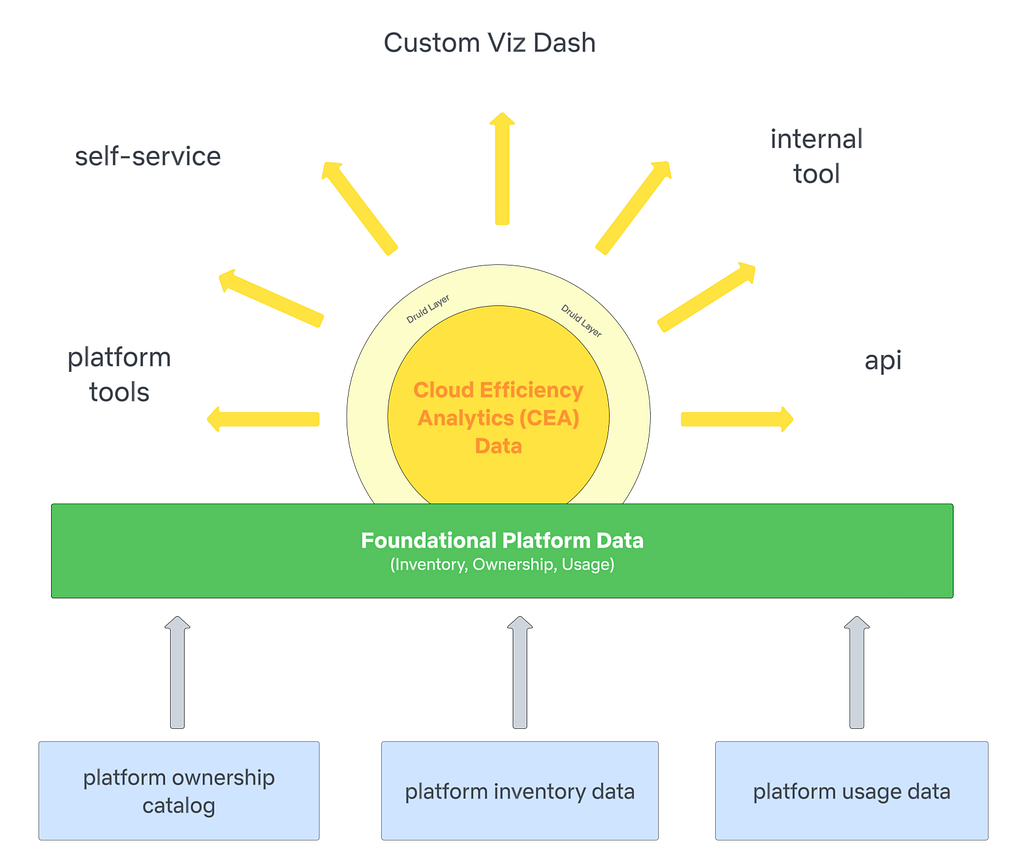
  1. Foundational Platform Data (FPD): This component provides a centralized data layer for all platform data, featuring a consistent data model and standardized data processing methodology. We work with different platform data providers to get inventory, ownership, and usage data for the respective platforms they own.
  2. Cloud Efficiency Analytics (CEA): Built on top of FPD, this component offers an analytics data layer that provides time series efficiency metrics across various business use cases. Once the foundational data is ready, CEA consumes inventory, ownership, and usage data and applies the appropriate business logic to produce cost and ownership attribution at various granularities.

As the source of truth for efficiency metrics, our team’s tenants are to provide accurate, reliable, and accessible data, comprehensive documentation to navigate the complexity of the efficiency space, and well-defined Service Level Agreements (SLAs) to set expectations with downstream consumers during delays, outages, or changes.

Looking ahead, we aim to continue onboarding platforms, striving for nearly complete cost insight coverage. We’re also exploring new use cases, such as tailored reports for platforms, predictive analytics for optimizing usage and detecting anomalies in cost, and a root cause analysis tool using LLMs.

Ultimately, our goal is to enable our engineering organization to make efficiency-conscious decisions when building and maintaining the myriad of services that allows us to enjoy Netflix as a streaming service. For more detail on our modeling approach and principles, check out this post!

Analytics Engineering is a key contributor to building our deep data culture at Netflix, and we are proud to have a large group of stunning colleagues that are not only applying but advancing our analytical capabilities at Netflix. The 2024 Analytics Summit continued to be a wonderful way to give visibility to one another on work across business verticals, celebrate our collective impact, and highlight what’s to come in analytics practice at Netflix.

To learn more, follow the Netflix Research Site, and if you are also interested in entertaining the world, have a look at our open roles!


Part 1: A Survey of Analytics Engineering Work at Netflix was originally published in Netflix TechBlog on Medium, where people are continuing the conversation by highlighting and responding to this story.

Enhance Your Email Campaigns using Amazon SES SendBulkEmail APIs Inline Templates

Post Syndicated from Satya S Tripathy original https://aws.amazon.com/blogs/messaging-and-targeting/enhance-your-email-campaigns-using-amazon-ses-sendbulkemail-apis-inline-templates/

Amazon Simple Email Service (SES) is a cloud-based email sending service provided by Amazon Web Services (AWS), handling both inbound and outbound email traffic for your applications. It allows users to send and receive email using SES’s reliable and cost-effective infrastructure without having to provision email servers yourself. Customers use Amazon SES to send emails like one time passwords (OTPs), transactional emails such as order confirmation, and promotional/marketing emails.

For this post, you should be familiar with the following:

Amazon SES continues to evolve, offering new features that help you simplify and optimize your email campaigns. We’re excited to announce the addition of inline template support for both the SendEmail and SendBulkEmail APIs. This new capability allows you to include template content directly in your API requests, reducing complexity and eliminating the need to manage separate template resources in your SES account.

What are inline templates?

Inline templates allow you to provide the subject, HTML body, and text body of an email directly in the API request, along with dynamic placeholders for personalized content. Instead of creating and storing a separate email template in SES, you can define the template as part of your API call. This feature is especially useful for organizations that need flexibility in managing numerous templates or want to make quick adjustments to email content.

How inline templates simplify your workflow

Previously, Amazon SES required you to create and store email templates in your SES account, which you would then reference by name or Amazon Resource Name (ARN) when sending an email. This process adds some management overhead, particularly for organizations that frequently create new templates or exceed the limit of templates per AWS Region. With inline templates, you can reduce complexity by defining your email content directly in the API payload, avoiding the need to create and manage stored templates. This approach can improve flexibility, allowing you to quickly make changes to your email content without updating stored templates. Additionally, it can simplify your integration by providing template content directly within your application logic, making the process more seamless and efficient. When using the and SendBulkEmail API, you can include personalized content for up to 50 destinations in a single call, making large-scale communication more efficient.

How to use inline templates

To use inline templates, you simply provide the email content (subject, text, HTML) and the replacement data directly in the SendBulkEmail API request payload within TemplateContent parameter.

Inline-template API

Here’s an example for using the SendBulkEmail API with inline templates:

file://mybulkemail-inline-template-conten.json:

{
    "FromEmailAddress": "Mary Major <[email protected]>",
    "DefaultContent": {
        "Template": {
            "TemplateContent": {
                "Subject": "Greetings, {{name}}!",
                "Text": "Dear {{name}},\r\nYour favorite animal is {{favoriteanimal}}.",
                "Html": "<h1>Hello {{name}},</h1><p>Your favorite animal is {{favoriteanimal}}.</p>"
            },
            "TemplateData": "{ \"name\":\"friend\", \"favoriteanimal\":\"unknown\" }"
        }
    },
    "BulkEmailEntries": [
        {
            "Destination": {
                "ToAddresses": [
                    "[email protected]"
                ]
            },
            "ReplacementEmailContent": {
                "ReplacementTemplate": {
                    "ReplacementTemplateData": "{ \"name\":\"Anaya\", \"favoriteanimal\":\"angelfish\" }"
                }
            }
        },
        {
            "Destination": {
                "ToAddresses": [
                    "[email protected]"
                ]
            },
            "ReplacementEmailContent": {
                "ReplacementTemplate": {
                    "ReplacementTemplateData": "{ \"name\":\"Liu\", \"favoriteanimal\":\"lion\" }"
                }
            }
        }
    ],
    "ConfigurationSetName": "ConfigSet"
}

SES SendBulkEmail API call:

aws sesv2 send-bulk-email -cli-input-json file://mybulkemail-inline-template-conten.json

Output:

{
    "BulkEmailEntryResults": [
        {
            "Status": "SUCCESS",
            "MessageId": "010001xxxxxx-xxxxxxxx-xxxx-xxxx-000000"
        },
        {
            "Status": "SUCCESS",
            "MessageId": "020002xxxxxx-xxxxxxxx-xxxx-xxxx-000000"
        }
    ]
}

Backward compatibility

If you’re currently using stored templates, don’t worry – Amazon SES still supports the use of stored templates, and you can continue to use them without any changes. Inline templates are simply an additional option for customers who need more flexibility or wish to avoid managing stored templates altogether. Since inline templates only support the use of simple substitution, stored templates remain the solution for advanced personalization options such as conditional logic or complex formatting. More details in our doc link: How to use Bulk email template.

Get started today

The inline template feature is now available in all AWS Regions where Amazon SES is offered. To start using inline templates, refer to the Amazon SES Developer Guide and what’s new announcement. There are no additional charges applicable for using inline template feature.

Conclusion

The inline templating feature in SendBulkEmail allows you to avoid worrying about template management by updating / creating new email templates whenever a minor modification or alteration is required in the existing templates, as well as cleaning up unused templates on a regular basis. Therefore, if your business has a high number of email template requirements, there are no predefined rules or patterns for creating email templates, and you need to generate many templates simultaneously within Amazon SES, you must use inline templating feature of SendBulkEmail API . If you do not want to use the Inline templating capability, you can continue to use the templated SendBulkEmail API from Amazon SES.

Cloud Efficiency at Netflix

Post Syndicated from Netflix Technology Blog original https://netflixtechblog.com/cloud-efficiency-at-netflix-f2a142955f83

By J Han, Pallavi Phadnis

Context

At Netflix, we use Amazon Web Services (AWS) for our cloud infrastructure needs, such as compute, storage, and networking to build and run the streaming platform that we love. Our ecosystem enables engineering teams to run applications and services at scale, utilizing a mix of open-source and proprietary solutions. In turn, our self-serve platforms allow teams to create and deploy, sometimes custom, workloads more efficiently. This diverse technological landscape generates extensive and rich data from various infrastructure entities, from which, data engineers and analysts collaborate to provide actionable insights to the engineering organization in a continuous feedback loop that ultimately enhances the business.

One crucial way in which we do this is through the democratization of highly curated data sources that sunshine usage and cost patterns across Netflix’s services and teams. The Data & Insights organization partners closely with our engineering teams to share key efficiency metrics, empowering internal stakeholders to make informed business decisions.

Data is Key

This is where our team, Platform DSE (Data Science Engineering), comes in to enable our engineering partners to understand what resources they’re using, how effectively and efficiently they use those resources, and the cost associated with their resource usage. We want our downstream consumers to make cost conscious decisions using our datasets.

To address these numerous analytic needs in a scalable way, we’ve developed a two-component solution:

  1. Foundational Platform Data (FPD): This component provides a centralized data layer for all platform data, featuring a consistent data model and standardized data processing methodology.
  2. Cloud Efficiency Analytics (CEA): Built on top of FPD, this component offers an analytics data layer that provides time series efficiency metrics across various business use cases.

Foundational Platform Data (FPD)

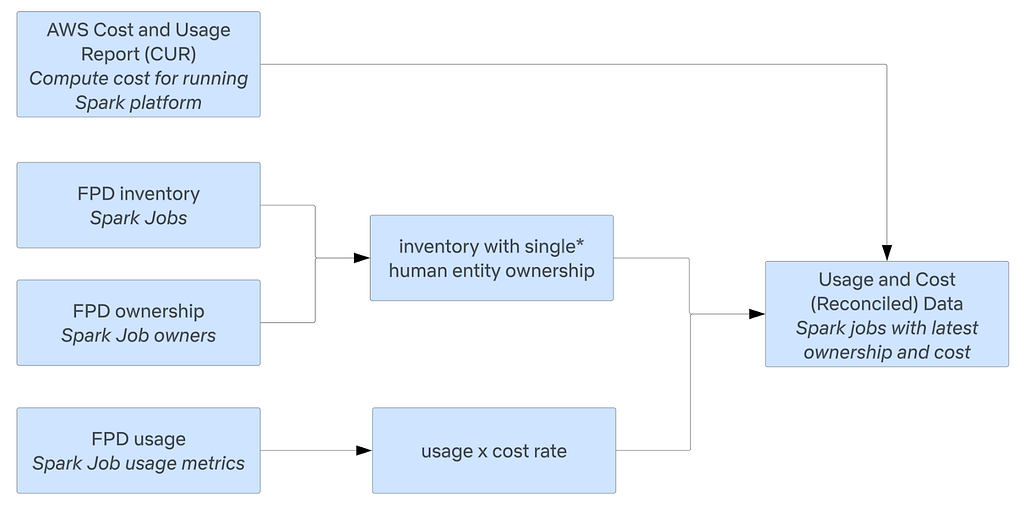
We work with different platform data providers to get inventory, ownership, and usage data for the respective platforms they own. Below is an example of how this framework applies to the Spark platform. FPD establishes data contracts with producers to ensure data quality and reliability; these contracts allow the team to leverage a common data model for ownership. The standardized data model and processing promotes scalability and consistency.

Cloud Efficiency Analytics (CEA Data)

Once the foundational data is ready, CEA consumes inventory, ownership, and usage data and applies the appropriate business logic to produce cost and ownership attribution at various granularities. The data model approach in CEA is to compartmentalize and be transparent; we want downstream consumers to understand why they’re seeing resources show up under their name/org and how those costs are calculated. Another benefit to this approach is the ability to pivot quickly as new or changes in business logic is/are introduced.

* For cost accounting purposes, we resolve assets to a single owner, or distribute costs when assets are multi-tenant. However, we do also provide usage and cost at different aggregations for different consumers.

Data Principles

As the source of truth for efficiency metrics, our team’s tenants are to provide accurate, reliable, and accessible data, comprehensive documentation to navigate the complexity of the efficiency space, and well-defined Service Level Agreements (SLAs) to set expectations with downstream consumers during delays, outages or changes.

While ownership and cost may seem straightforward, the complexity of the datasets is considerably high due to the breadth and scope of the business infrastructure and platform specific features. Services can have multiple owners, cost heuristics are unique to each platform, and the scale of infra data is large. As we work on expanding infrastructure coverage to all verticals of the business, we face a unique set of challenges:

A Few Sizes to Fit the Majority

Despite data contracts and a standardized data model on transforming upstream platform data into FPD and CEA, there is usually some degree of customization that is unique to that particular platform. As the centralized source of truth, we feel the constant tension of where to place the processing burden. Decision-making involves ongoing transparent conversations with both our data producers and consumers, frequent prioritization checks, and alignment with business needs as informed captains in this space.

Data Guarantees

For data correctness and trust, it’s crucial that we have audits and visibility into health metrics at each layer in the pipeline in order to investigate issues and root cause anomalies quickly. Maintaining data completeness while ensuring correctness becomes challenging due to upstream latency and required transformations to have the data ready for consumption. We continuously iterate our audits and incorporate feedback to refine and meet our SLAs.

Abstraction Layers

We value people over process, and it is not uncommon for engineering teams to build custom SaaS solutions for other parts of the organization. Although this fosters innovation and improves development velocity, it can create a bit of a conundrum when it comes to understanding and interpreting usage patterns and attributing cost in a way that makes sense to the business and end consumer. With clear inventory, ownership, and usage data from FPD, and precise attribution in the analytical layer, we aim to provide metrics to downstream users regardless of whether they utilize and build on top of internal platforms or on AWS resources directly.

Future Forward

Looking ahead, we aim to continue onboarding platforms to FPD and CEA, striving for nearly complete cost insight coverage in the upcoming year. Longer term, we plan to extend FPD to other areas of the business such as security and availability. We aim to move towards proactive approaches via predictive analytics and ML for optimizing usage and detecting anomalies in cost.

Ultimately, our goal is to enable our engineering organization to make efficiency-conscious decisions when building and maintaining the myriad of services that allow us to enjoy Netflix as a streaming service.

Acknowledgments

The FPD and CEA work would not have been possible without the cross functional input of many outstanding colleagues and our dedicated team building these important data assets.

A bit about the authors:

JHan enjoys nature, reading fantasy, and finding the best chocolate chip cookies and cinnamon rolls. She is adamant about writing the SQL select statement with leading commas.

Pallavi enjoys music, travel and watching astrophysics documentaries. With 15+ years working with data, she knows everything’s better with a dash of analytics and a cup of coffee!


Cloud Efficiency at Netflix was originally published in Netflix TechBlog on Medium, where people are continuing the conversation by highlighting and responding to this story.

Title Launch Observability at Netflix Scale

Post Syndicated from Netflix Technology Blog original https://netflixtechblog.com/title-launch-observability-at-netflix-scale-c88c586629eb

Part 1: Understanding The Challenges

By: Varun Khaitan

With special thanks to my stunning colleagues: Mallika Rao, Esmir Mesic, Hugo Marques

Introduction

At Netflix, we manage over a thousand global content launches each month, backed by billions of dollars in annual investment. Ensuring the success and discoverability of each title across our platform is a top priority, as we aim to connect every story with the right audience to delight our members. To achieve this, we are committed to building robust systems that deliver comprehensive observability, enabling us to take full accountability for every title on our service.

The Challenge of Title Launch Observability

As engineers, we’re wired to track system metrics like error rates, latencies, and CPU utilization — but what about metrics that matter to a title’s success?

Consider the following example of two different Netflix Homepages:

Sample Homepage A
Sample Homepage B

To a basic recommendation system, the two sample pages might appear equivalent as long as the viewer watches the top title. Yet, these pages couldn’t be more different. Each title represents countless hours of effort and creativity, and our systems need to honor that uniqueness.

How do we bridge this gap? How can we design systems that recognize these nuances and empower every title to shine and bring joy to our members?

The Operational Needs of a Personalization System

In the early days of Netflix Originals, our launch team would huddle together at midnight, manually verifying that titles appeared in all the right places. While this hands-on approach worked for a handful of titles, it quickly became clear that it couldn’t scale. As Netflix expanded globally and the volume of title launches skyrocketed, the operational challenges of maintaining this manual process became undeniable.

Operating a personalization system for a global streaming service involves addressing numerous inquiries about why certain titles appear or fail to appear at specific times and places.
Some examples:

  • Why is title X not showing on the Coming Soon row for a particular member?
  • Why is title Y missing from the search page in Brazil?
  • Is title Z being displayed correctly in all product experiences as intended?

As Netflix scaled, we faced the mounting challenge of providing accurate, timely answers to increasingly complex queries about title performance and discoverability. This led to a suite of fragmented scripts, runbooks, and ad hoc solutions scattered across teams — an approach that was neither sustainable nor efficient.

The stakes are even higher when ensuring every title launches flawlessly. Metadata and assets must be correctly configured, data must flow seamlessly, microservices must process titles without error, and algorithms must function as intended. The complexity of these operational demands underscored the urgent need for a scalable solution.

Automating the Operations

It becomes evident over time that we need to automate our operations to scale with the business. As we thought more about this problem and possible solutions, two clear options emerged.

Option 1: Log Processing

Log processing offers a straightforward solution for monitoring and analyzing title launches. By logging all titles as they are displayed, we can process these logs to identify anomalies and gain insights into system performance. This approach provides a few advantages:

  1. Low burden on existing systems: Log processing imposes minimal changes to existing infrastructure. By leveraging logs, which are already generated during regular operations, we can scale observability without significant system modifications. This allows us to focus on data analysis and problem-solving rather than managing complex system changes.
  2. Using the source of truth: Logs serve as a reliable “source of truth” by providing a comprehensive record of system events. They allow us to verify whether titles are presented as intended and investigate any discrepancies. This capability is crucial for ensuring our recommendation systems and user interfaces function correctly, supporting successful title launches.

However, taking this approach also presents several challenges:

  1. Catching Issues Ahead of Time: Logging primarily addresses post-launch scenarios, as logs are generated only after titles are shown to members. To detect issues proactively, we need to simulate traffic and predict system behavior in advance. Once artificial traffic is generated, discarding the response object and relying solely on logs becomes inefficient.
  2. Appropriate Accuracy: Comprehensive logging requires services to log both included and excluded titles, along with reasons for exclusion. This could lead to an exponential increase in logged data. Utilizing probabilistic logging methods could compromise accuracy, making it difficult to ascertain whether a title’s absence in logs is due to exclusion or random chance.
  3. SLA and Cost Considerations: Our existing online logging systems do not natively support logging at the title granularity level. While reengineering these systems to accommodate this additional axis is possible, it would entail increased costs. Additionally, the time-sensitive nature of these investigations precludes the use of cold storage, which cannot meet the stringent SLAs required.

Option 2: Observability Endpoints in Our Personalization Systems

To prioritize title launch observability, we could adopt a centralized approach. By introducing observability endpoints across all systems, we can enable real-time data flow into a dedicated microservice for title launch observability. This approach embeds observability directly into the very fabric of services managing title launches and personalization, ensuring seamless monitoring and insights. Key benefits and strategies include:

  1. Real-Time Monitoring: Observability endpoints enable real-time monitoring of system performance and title placements, allowing us to detect and address issues as they arise.
  2. Proactive Issue Detection: By simulating future traffic(an aspect we call “time travel”) and capturing system responses ahead of time, we can preemptively identify potential issues before they impact our members or the business.
  3. Enhanced Accuracy: Observability endpoints provide precise data on title inclusions and exclusions, allowing us to make accurate assertions about system behavior and title visibility. It also provides us with advanced debugability information needed to fix identified issues.
  4. Scalability and Cost Efficiency: While initial implementation required some investment, this approach ultimately offers a scalable and cost-effective solution to managing title launches at Netflix scale.

Choosing this option also comes with some tradeoffs:

  1. Significant Initial Investment: Several systems would need to create new endpoints and refactor their codebases to adopt this new method of prioritizing launches.
  2. Synchronization Risk: There would be a potential risk that these new endpoints may not accurately represent production behavior, thus necessitating conscious efforts to ensure all endpoints remain synchronized.

Up Next

By adopting a comprehensive observability strategy that includes real-time monitoring, proactive issue detection, and source of truth reconciliation, we’ve significantly enhanced our ability to ensure the successful launch and discovery of titles across Netflix, enriching the global viewing experience for our members. In the next part of this series, we’ll dive into how we achieved this, sharing key technical insights and details.

Stay tuned for a closer look at the innovation behind the scenes!


Title Launch Observability at Netflix Scale was originally published in Netflix TechBlog on Medium, where people are continuing the conversation by highlighting and responding to this story.

Как се съсипва квартал

Post Syndicated from original https://www.toest.bg/kak-se-sasipva-kvartal/

Как се съсипва квартал

Българските градове срещат типичните проблеми на икономическия растеж. Хората започват да пътуват повече и предпочитат това да става по-удобно, с лично превозно средство, за по-кратко време. Притежаването и ползването на автомобил става по-лесно и много семейства започват дори да трупат по две-три и повече леки коли. Степента на моторизация се увеличава, тоест на глава от населението се падат повече автомобили, а ниската им цена също допринася за това увеличение. Отговорът на градовете ни често е да се създаде нова инфраструктура, която обаче невинаги е добре обмислена. И резултатът влошава, вместо да подобрява не само транспортната обстановка, а и цялостното качество на живот. 

Точно такъв е случаят с пробива „Модър“ – „Царевец“ и съпътстващия ремонт на ул. „Царевец“ и бул. „Хаджи Димитър“, които разсичат на две места пловдивския квартал „Христо Смирненски“.

Контекст

Когато придвижването в един град се осъществява само с автомобил, задръстванията неизменно стават ежедневие, допълнени от замърсен въздух и висока концентрация на катастрофи и съответно – на ранени и загинали. Градски площади, градинки, междублокови пространства биват лека-полека замествани от паркирали коли. Зелени площи се превръщат в кална кочина, а след геройската намеса на Общината след няколко години се заливат с асфалт и се превръщат в обикновени паркоместа. От зеленината няма и помен. Това е най-лошият пример за ползване на едно открито публично пространство – да стане склад на превозни средства вместо парк например, където млади и стари да прекарват време, да се срещат с приятели, да спортуват, да се разхождат с децата. 

Осигуряването на паркоместа не е лоша дейност – лошо е, ако един град няма адекватна съвременна транспортна политика, с която да прави придвижването с градски транспорт удобно, комфортно и модерно, за да не се налага всеки за всяко нещо да сяда в колата и да търси след това паркомясто. 

В случая с Пловдив проблемът с автомобилите е особено значителен, понеже общественият транспорт е оставен на финални издихания.

Много малко хора разчитат на него и придвижванията с автомобил преобладават, съответно и задръстванията. 

В големи и малки градове по целия свят, в които транспортът се управлява успешно и които са се справили със задръстванията, се знае, че развитието на удобен градски транспорт е истинското дълготрайно решение. Тази стъпка е незаобиколима – това урбанистите и транспортните инженери го учат още в началните курсове по транспортно планиране. Един автобус с 50 места замества десетки автомобили – това следва от данните, посочени в Плана за устойчива градска мобилност (ПУГМ) на община Пловдив, според които в 44% от колите в града пътува само един човек. 

Тази проста сметка показва как използването на масов транспорт може да разреши проблема със задръстванията, стига този транспорт да е наличен, да е с удобни и директни маршрути между кварталите, да е начесто, превозните средства да са комфортни, да може да се заплаща билет по съвременни начини и да е популярен сред гражданите. 

Липсващата транспортна политика на Пловдив

Незнайно защо Пловдив не гледа към София или Бургас като градове с функциониращ градски транспорт. Реформа в управлението на транспорта в Града под тепетата така и не се прави. Единствените мерки, които се обявяват за „транспортни“, са свързани с преасфалтиране и изграждане на нови автомобилни участъци. Пловдив действително има нужда от доизграждане на няколко ключови връзки, които и до момента липсват. Затова е положително развитие, че пробивът „Модър“ – „Царевец“ се реализира след години на подготовка и обещания. 

Редно е обаче такива проекти да се впишат в по-голямата картина и транспортна политика на града. ПУГМ на Пловдив беше приет през 2024 г. Целта му е да намали автомобилната зависимост на града и да допринесе за развитието на устойчиви форми на придвижване – градски транспорт, велосипедна и пешеходна мобилност. Предложените мерки следва да се структурират и приложат по приоритетност. 

Едно от изискванията към изпълнителя на ПУГМ беше да се създаде дигитален транспортен модел на града. Такива модели се ползват от десетилетия от по-иновативните градски власти, за да се тества как една мярка ще се отрази на транспортната ситуация – например ако се затвори улица, ако се изгради нова транспортна връзка, ако се обособи буслента, ако се направи трамвайна линия или метро, ако се регламентира паркирането. Всичко това се вижда в дигитална среда, преди да е похарчен и един лев за строителство. ПУГМ на Пловдив е предаден и се очаква в общината да е наличен функциониращ такъв модел. Дали наистина обаче той е реализиран и дали изобщо се ползва?

Пробивът „Модър“ – „Царевец“

Пробивът „Модър“ – „Царевец“ поставя под сериозно съмнение наличието на дигитален транспортен модел на Пловдив. Начинът на реализация на този проект повдига въпроса дори дали е правено някакво транспортно проучване на преминаващите и посоката на тяхното движение, на основата на което да се предложат най-добрият проект и най-адекватната организация на движение.

Общината се похвали с отварянето на кръстовището на ул. „Царевец“ с ул. „Солунска“ и го представи като успех. На практика обаче новият светофар работи напразно, тъй като движението е възможно само в една посока, а другата част от ул. „Царевец“ е все още в ремонт. Светофарът доведе до безпрецедентни задръствания.

След месеци чакане и тестване на търпението на хората те всъщност се оказаха в по-лоша ситуация, отколкото преди това.

Ако след приключването на ремонта автомобилният трафик в района се увеличи, няма изгледи проблемът със задръстванията да се реши. Той можеше да се облекчи, ако беше изградено кръгово кръстовище, каквото обаче не е предвидено.

Когато се влагат обществени средства и се отделят месеци, а понякога дори години за ремонтни дейности по определени участъци, които нарушават нормалното ежедневие на гражданите, създават задръствания и губят ценно време, е напълно основателно да се поставят под въпрос ефективността и обосновката на целия проект. Още повече ако в крайна сметка ремонтните дейности водят до по-лоша транспортна ситуация от предишната, следва да се анализира как се е стигнало до неговото одобрение.

Да се изхарчат милиони, да се наруши градският ритъм на хиляди хора и накрая да се влоши качеството им на живот не е символ на добро управление.

Подобен светофар беше инсталиран преди няколко месеца на бул. „Хаджи Димитър“. Той създаде задръстване там, където преди нямаше. Съвсем релевантен е въпросът защо се поставят светофари на места, където пречат и влошават пътната обстановка. 

Параметърът „пропускливост“ е основополагащ в транспортното планиране. Редно е преминаващите през едно кръстовище превозни средства да се преброят предварително, а след това да се изготви проект, който да подобри пропускливостта. Случаят с бул. „Хаджи Димитър“ е пример за влошаване на ситуацията, а новото му кръстовище с ул. „Царевец“ явно ще е със същия резултат. 

Какво не е град за хората?

В книгата си „Градове за хората“ датският урбанист Ян Геел застъпва идеята, че хората, а не автомобилите следва да са в центъра на градския живот и съответно – в основата на градското планиране. А това означава и по-силен акцент върху придвижването пеша и с колело. Ян Геел беше в Пловдив през 2016 г. при представянето на превода на книгата си на български език по време на фестивала One Architecture Week.

Следвайки политиките за устойчива мобилност, в „градовете за хората“ се приоритизират пешеходните и велосипедните маршрути, като се създава мрежа от свързани отсечки и се осигуряват възможности за често пресичане на големи булеварди. Целта е постепенно пешеходецът да се постави на приоритетна позиция спрямо автомобила. 

Пловдив е град с изключително висока концентрация на пътнотранспортни произшествия, което не говори добре за прилаганите до момента мерки за пътна безопасност. Именно чрез проектиране на градска среда и транспортна инфраструктура, които приоритизират уязвимите участници, може да се постигне по-безопасна, а и по-приятна среда за всички – с повече качествени улични пространства. 

Проектите за бул. „Хаджи Димитър“ и ул. „Царевец“ са пример за тотално остаряла концепция,

която се отхвърля от десетилетия от урбанистите и транспортните инженери, работещи за качествена градска среда. Булевард „Хаджи Димитър“ преминава през гъсто застроената част на квартала, която е без открити паркове или площади. Самият булевард включва пешеходна алея по средата именно за да позволи на живеещите в близост да използват това място за отдих и възстановяване – като малък линеен парк близо до техните домове. Обновеният булевард се изгражда с огради по средата, все едно е магистрала в полето, а не част от градската среда. Достъпът до линейния парк е възможен от по-малко места, отколкото преди. По този начин кв. „Христо Смирненски“ се разсече, а пешеходните връзки, вместо да се регламентират с пресичания, да се направят удобни и безопасни, да се улесни достъпът до този линеен парк, бяха почти изцяло прекъснати. 

Такива реализации също допринасят за увеличаването на задръстванията, защото, когато на хората се създадат затруднения да се движат пеш в квартала, им се налага да ползват автомобили дори и за кратки разстояния. Ала и този урок е научен от много градове.

На Пловдив не му е нужно да открива топлата вода, а да смени кранчето.

Каква се очаква да бъде обновената улица „Царевец“?

От улица с богато улично озеленяване, изключително важно за град като Пловдив – с високи температури и малко паркове, ул. „Царевец“ се превръща в магистрала, разрязваща още един път квартала и влошаваща пешеходната му свързаност. Тъй като публичността е основен принцип на доброто управление, редно е Община Пловдив да отговори на следните въпроси: 

  • Взети ли са под внимание предложенията на гражданите за обновяването на конкретните отсечки, обхванати от проекта? 
  • Разработени ли са различни проектни сценарии за най-адекватно решение? 
  • Правено ли е предварително транспортно проучване и ако да, къде е то? 
  • Налице ли е изобщо процес на ангажиране на местната общност? 
  • Проектът публикуван ли е някъде, или се работи на сляпо и гражданите ще видят резултата, след като строежът приключи?

Инсталирането на светофари там, където няма нужда от тях и където създават повече проблеми, отколкото помагат, е грешка, която може да бъде поправена с премахването им. По-големите въпроси обаче изискват по-големи решения – създаването и следването на съвременна транспортна политика, организация на движението, която дава приоритет на хората, изграждането на инфраструктура, която се грижи за комфорта и безопасността на гражданите, и развитието на обществен транспорт, адекватен за половинмилионен град.


В настоящата ни съвместна поредица с „Екипът на София“ обсъждаме планирането, озеленяването, архитектурата, инфраструктурата, мобилността и още много други градски теми, описваме добрите примери и търсим възможните решения за подобряването на качеството на живот в нашите градове. 

Как се съсипва квартал

Fedora Asahi Remix 41 is now available

Post Syndicated from jzb original https://lwn.net/Articles/1002546/

Fedora Magazine reports
that the Fedora Asahi Remix 41 for Apple Silicon is now available:

In addition to all the exciting improvements brought by Fedora Linux
41, Fedora Asahi Remix 41 provides x86/x86-64
emulation
integration including support for AAA
games
to Apple Silicon. The game support is based on the new
conformant Vulkan
1.4
driver. It also continues to provide extensive device support,
including high quality audio out of the box.

LWN covered a talk
from the X.org Developers Conference (XDC) by Alyssa Rosenzweig on the
status of Asahi’s GPU drivers in October.

Recap of Amazon Redshift key product announcements in 2024

Post Syndicated from Neeraja Rentachintala original https://aws.amazon.com/blogs/big-data/recap-of-amazon-redshift-key-product-announcements-in-2024/

Amazon Redshift, launched in 2013, has undergone significant evolution since its inception, allowing customers to expand the horizons of data warehousing and SQL analytics. Today, Amazon Redshift is used by customers across all industries for a variety of use cases, including data warehouse migration and modernization, near real-time analytics, self-service analytics, data lake analytics, machine learning (ML), and data monetization.

Amazon Redshift made significant strides in 2024, rolling out over 100 features and enhancements. These improvements enhanced price-performance, enabled data lakehouse architectures by blurring the boundaries between data lakes and data warehouses, simplified ingestion and accelerated near real-time analytics, and incorporated generative AI capabilities to build natural language-based applications and boost user productivity.

2024 Redshift announcements summary

Figure1: Summary of the features and enhancements in 2024

Let’s walk through some of the recent key launches, including the new announcements at AWS re:Invent 2024.

Industry-leading price-performance

Amazon Redshift offers up to three times better price-performance than alternative cloud data warehouses. Amazon Redshift scales linearly with the number of users and volume of data, making it an ideal solution for both growing businesses and enterprises. For example, dashboarding applications are a very common use case in Redshift customer environments where there is high concurrency and queries require quick, low-latency responses. In these scenarios, Amazon Redshift offers up to seven times better throughput per dollar than alternative cloud data warehouses, demonstrating its exceptional value and predictable costs.

Performance improvements

Over the past few months, we have introduced a number of performance improvements to Redshift. First query response times for dashboard queries have significantly improved by optimizing code execution and reducing compilation overhead. We have enhanced data sharing performance with improved metadata handling, resulting in data sharing first query execution that is up to four times faster when the data sharing producer’s data is being updated. We have enhanced autonomics algorithms to generate and implement smarter and quicker optimal data layout recommendations for distribution and sort keys, further optimizing performance. We have launched new RA3.large instances, a new smaller size RA3 node type, to offer better flexibility in price-performance and provide a cost-effective migration option for customers using DC2.large instances. Additionally, we have rolled out AWS Graviton in Serverless, offering up to 30% better price-performance, and expanded concurrency scaling to support more types of write queries, enabling an even greater ability to maintain consistent performance at scale. These improvements collectively reinforce Amazon Redshift’s focus as a leading cloud data warehouse solution, offering unparalleled performance and value to customers.

General availability of multi-data warehouse writes

Amazon Redshift allows you to seamlessly scale with multi-cluster deployments. With the introduction of RA3 nodes with managed storage in 2019, customers obtained flexibility to scale and pay for compute and storage independently. Redshift data sharing, launched in 2020, enabled seamless cross-account and cross-Region data collaboration and live access without physically moving the data, while maintaining transactional consistency. This allowed customers to scale read analytics workloads and offered isolation to help maintain SLAs for business-critical applications. At re:Invent 2024, we announced the general availability of multi-data warehouse writes through data sharing for Amazon Redshift RA3 nodes and Serverless. You can now start writing to shared Redshift databases from multiple Redshift data warehouses in just a few clicks. The written data is available to all the data warehouses as soon as it’s committed. This allows your teams to flexibly scale write workloads such as extract, transform, and load (ETL) and data processing by adding compute resources of different types and sizes based on individual workloads’ price-performance requirements, as well as securely collaborate with other teams on live data for use cases such as customer 360.

General availability of AI-driven scaling and optimizations

The launch of Amazon Redshift Serverless in 2021 marked a significant shift, eliminating the need for cluster management while paying for what you use. Redshift Serverless and data sharing enabled customers to easily implement distributed multi-cluster architectures for scaling analytics workloads. In 2024, we launched Serverless in 10 more regions, improved functionality, and added support for a capacity configuration of 1024 RPUs, allowing you to bring larger workloads onto Redshift. Redshift Serverless is also now even more intelligent and dynamic with the new AI-driven scaling and optimization capabilities. As a customer, you choose whether you want to optimize your workloads for cost, performance, or keep it balanced, and that’s it. Redshift Serverless works behind the scenes to scale the compute up and down and deploys optimizations to meet and maintain the performance levels, even when workload demands change. In internal tests, AI-driven scaling and optimizations showcased up to 10 times price-performance improvements for variable workloads.

Seamless Lakehouse architectures

Lakehouse brings together flexibility and openness of data lakes with the performance and transactional capabilities of data warehouses. Lakehouse allows you to use preferred analytics engines and AI models of your choice with consistent governance across all your data. At re:Invent 2024, we unveiled the next generation of Amazon SageMaker, a unified platform for data, analytics, and AI. This launch brings together widely adopted AWS ML and analytics capabilities, providing an integrated experience for analytics and AI with a re-imagined lakehouse and built-in governance.

General availability of Amazon SageMaker Lakehouse

Amazon SageMaker Lakehouse unifies your data across Amazon S3 data lakes and Redshift data warehouses, enabling you to build powerful analytics and AI/ML applications on a single copy of data. SageMaker Lakehouse provides the flexibility to access and query your data using Apache Iceberg open standards so that you can use your preferred AWS, open source, or third-party Iceberg-compatible engines and tools. SageMaker Lakehouse offers integrated access controls and fine-grained permissions that are consistently applied across all analytics engines and AI models and tools. Existing Redshift data warehouses can be made available through SageMaker Lakehouse in just a simple publish step, opening up all your data warehouse data with Iceberg REST API. You can also create new data lake tables using Redshift Managed Storage (RMS) as a native storage option. Check out the Amazon SageMaker Lakehouse: Accelerate analytics & AI presented at re:Invent 2024.

Preview of Amazon SageMaker Unified Studio

Amazon SageMaker Unified Studio is an integrated data and AI development environment that enables collaboration and helps teams build data products faster. SageMaker Unified Studio brings together functionality and tools from a mix of standalone studios, query editors, and visual tools available today in Amazon EMR, AWS Glue, Amazon Redshift, Amazon Bedrock, and the existing Amazon SageMaker Studio, into one unified experience. With SageMaker Unified Studio, various users such as developers, analysts, data scientists, and business stakeholders can seamlessly work together, share resources, perform analytics, and build and iterate on models, fostering a streamlined and efficient analytics and AI journey.

Amazon Redshift SQL analytics on Amazon S3 Tables

At re:Invent 2024, Amazon S3 introduced Amazon S3 Tables, a new bucket type that is purpose-built to store tabular data at scale with built-in Iceberg support. With table buckets, you can quickly create tables and set up table-level permissions to manage access to your data lake. Amazon Redshift introduced support for querying Iceberg data in data lakes last year, and now this capability is extended to seamlessly querying S3 Tables. S3 Tables customers create are also available as part of the Lakehouse for consumption by other AWS and third-party engines.

Data lake query performance

Amazon Redshift offers high-performance SQL capabilities on SageMaker Lakehouse, whether the data is in other Redshift warehouses or in open formats. We enhanced support for querying Apache Iceberg data and improved the performance of querying Iceberg up to threefold year-over-year. A number of optimizations contribute to these speed-ups in performance, including integration with AWS Glue Data Catalog statistics, improved data and metadata filtering, dynamic partition elimination, faster/parallel processing of Iceberg manifest files, and scanner improvements. In addition, Amazon Redshift now supports incremental refresh support for materialized views on data lake tables to eliminate the need for recomputing the materialized view when new data arrives, simplifying how you build interactive applications on S3 data lakes.

Simplified ingestion and near real-time analytics

In this section, we share the improvements regarding simplified ingestion and near real-time analytics that enable you to get faster insights over fresher data.

Zero-ETL integration with AWS databases and third-party enterprise applications

Amazon Redshift first launched zero-ETL integration between Amazon Aurora MySQL-Compatible Edition, enabling near real-time analytics on petabytes of transactional data from Aurora. This capability has since expanded to support Amazon Aurora PostgreSQL-Compatible Edition, Amazon Relational Database Service (Amazon RDS) for MySQL, and Amazon DynamoDB, and includes additional features such as data filtering to selectively extract tables and schemas using regular expressions, support for incremental and auto-refresh materialized views on replicated data, and configurable change data capture (CDC) refresh rates.

Building on this innovation, at re:Invent 2024, we launched support for zero-ETL integration with eight enterprise applications, specifically Salesforce, Zendesk, ServiceNow, SAP, Facebook Ads, Instagram Ads, Pardot, and Zoho CRM. With this new capability, you can efficiently extract and load valuable data from your customer support, relationship management, and Enterprise Resource Planning (ERP) applications directly into your Redshift data warehouse for analysis. This seamless integration eliminates the need for complex, custom ingestion pipelines for ingesting the data, accelerating time to insights.

General availability of auto-copy

Auto-copy simplifies data ingestion from Amazon S3 into Amazon Redshift. This new feature enables you to set up continuous file ingestion from your Amazon S3 prefix and automatically load new files to tables in your Redshift data warehouse without the need for additional tools or custom solutions.

Streaming ingestion from Confluent Managed Cloud and self-managed Apache Kafka clusters

Amazon Redshift now supports streaming ingestion from Confluent Managed Cloud and self-managed Apache Kafka clusters on Amazon EC2instances, expanding its capabilities beyond Amazon Kinesis Data Streams and Amazon Managed Streaming for Apache Kafka (Amazon MSK). With this update, you can ingest data from a wider range of streaming sources directly into your Redshift data warehouses for near real-time analytics use cases such as fraud detection, logistics monitoring and clickstream analysis.

Generative AI capabilities

In this section, we share the improvements generative AI capabilities.

Amazon Q generative SQL for Amazon Redshift

We announced the general availability of Amazon Q generative SQL for Amazon Redshift feature in the Redshift Query Editor. Amazon Q generative SQL boosts productivity by allowing users to express queries in natural language and receive SQL code recommendations based on their intent, query patterns, and schema metadata. The conversational interface enables users to get insights faster without extensive knowledge of the database schema. It leverages generative AI to analyze user input, query history, and custom context like table/column descriptions and sample queries to provide more relevant and accurate SQL recommendations. This feature accelerates the query authoring process and reduces the time required to derive actionable data insights.

Amazon Redshift integration with Amazon Bedrock

We announced integration of Amazon Redshift with Amazon Bedrock, enabling you to invoke large language models (LLMs) from simple SQL commands on your data in Amazon Redshift. With this new feature, you can now effortlessly perform generative AI tasks such as language translation, text generation, summarization, customer classification, and sentiment analysis on your Redshift data using popular foundation models (FMs) like Anthropic’s Claude, Amazon Titan, Meta’s Llama 2, and Mistral AI. You can invoke these models using familiar SQL commands, making it simpler than ever to integrate generative AI capabilities into your data analytics workflows.

Amazon Redshift as a knowledge base in Amazon Bedrock

Amazon Bedrock Knowledge Bases now supports natural language querying to retrieve structured data from your Redshift data warehouses. Using advanced natural language processing, Amazon Bedrock Knowledge Bases can transform natural language queries into SQL queries, allowing users to retrieve data directly from the source without the need to move or preprocess the data. A retail analyst can now simply ask “What were my top 5 selling products last month?”, and Amazon Bedrock Knowledge Bases automatically translates that query into SQL, runs the query against Redshift, and returns the results—or even provides a summarized narrative response. To generate accurate SQL queries, Amazon Bedrock Knowledge Bases uses database schema, previous query history, and other contextual information that is provided about the data sources.

Launch summary

Following is the launch summary which provides the announcement links and reference blogs for the key announcements.

Industry-leading price-performance:

Reference Blogs:

Seamless Lakehouse architectures:

Reference Blogs:

Simplified ingestion and near real-time analytics:

Reference Blogs:

Generative AI:

Reference Blogs:

Conclusion

We continue to innovate and evolve Amazon Redshift to meet your evolving data analytics needs. We encourage you to try out the latest features and capabilities. Watch the Innovations in AWS analytics: Data warehousing and SQL analytics session from re:Invent 2024 for further details. If you need any support, reach out to us. We are happy to provide architectural and design guidance, as well as support for proof of concepts and implementation. It’s Day 1!


About the Author

Neeraja Rentachintala is Director, Product Management with AWS Analytics, leading Amazon Redshift and Amazon SageMaker Lakehouse. Neeraja is a seasoned technology leader, bringing over 25 years of experience in product vision, strategy, and leadership roles in data products and platforms. She has delivered products in analytics, databases, data integration, application integration, AI/ML, and large-scale distributed systems across on-premises and the cloud, serving Fortune 500 companies as part of ventures including MapR (acquired by HPE), Microsoft SQL Server, Oracle, Informatica, and Expedia.com

Hacking Digital License Plates

Post Syndicated from Bruce Schneier original https://www.schneier.com/blog/archives/2024/12/hacking-digital-license-plates.html

Not everything needs to be digital and “smart.” License plates, for example:

Josep Rodriguez, a researcher at security firm IOActive, has revealed a technique to “jailbreak” digital license plates sold by Reviver, the leading vendor of those plates in the US with 65,000 plates already sold. By removing a sticker on the back of the plate and attaching a cable to its internal connectors, he’s able to rewrite a Reviver plate’s firmware in a matter of minutes. Then, with that custom firmware installed, the jailbroken license plate can receive commands via Bluetooth from a smartphone app to instantly change its display to show any characters or image.

[…]

Because the vulnerability that allowed him to rewrite the plates’ firmware exists at the hardware level­—in Reviver’s chips themselves—Rodriguez says there’s no way for Reviver to patch the issue with a mere software update. Instead, it would have to replace those chips in each display.

The whole point of a license plate is that it can’t be modified. Why in the world would anyone think that a digital version is a good idea?

How DeNA Co., Ltd. accelerated anonymized data quality tests up to 100 times faster using Amazon Redshift Serverless and dbt

Post Syndicated from Momota Sasaki original https://aws.amazon.com/blogs/big-data/how-dena-co-ltd-accelerated-anonymized-data-quality-tests-up-to-100-times-faster-using-amazon-redshift-serverless-and-dbt/

This blog was co-authored by DeNA Co., Ltd. and Amazon Web Services Japan.

DeNA Co., Ltd. (DeNA) engages in a variety of businesses, from games and live communities to sports & the community and healthcare & medical, under our mission to delight people beyond their wildest dreams. Among these, the healthcare & medical business handles particularly sensitive data. To comply with their data policies for sensitive data, this healthcare & medical business set the following requirements for their data processing:

  • Process data in compliance with data policies – Mask or delete sensitive data as necessary to transform into anonymized data. Prevent the inclusion of invalid values in categorical data and process data without any data loss.
  • Conduct data quality tests on anonymized data in compliance with data policies – Conduct data quality tests to quickly identify and address data quality issues, maintaining high-quality data at all times.

This post introduces a case study where DeNA combined Amazon Redshift Serverless and dbt (dbt Core) to accelerate data quality tests in their business.

The challenge

Data quality tests require performing 1,300 tests on 10 TB of data monthly. Previously, DeNA ran Python-based batch jobs on Amazon Elastic Compute Cloud (Amazon EC2) to perform these data quality tests. As business and data volume grew over time, DeNA started to face the following challenges:

  • Performance – Data quality tests took days to weeks to complete because engineers hadn’t designed the batch jobs to handle big data.
  • Cost – Costs increased due to the batch job design, particularly for large datasets. The implementation required loading data into memory for processing. When handling large table data, DeNA needed to use large memory-optimized EC2 instances.
  • Maintainability – The batch job implementations varied significantly between engineers, leading to high maintenance overhead, because the required knowledge was siloed among individual engineers.

The switch to Redshift Serverless and dbt

To address these challenges, DeNA decided to adopt Redshift Serverless and dbt (an open source data transformation tool) for the following key reasons:

  • Scalable and cost-effective processing with Redshift Serverless
  • Standardized and maintainable data quality tests with dbt

This decision was made after careful comparison of alternative solutions. DeNA initially considered parallelizing the existing Python-based batch jobs but rejected this approach due to the high maintenance overhead and siloed knowledge associated with the batch jobs. Instead, DeNA decided to use dbt, which DeNA has been using in their healthcare & medical business, and connect it to an AWS service capable of large-scale distributed processing. dbt provides a SQL-first templating engine for repeatable and extensible data transformations, including a data tests feature, which allows verifying data models and tables against expected rules and conditions using SQL. By using dbt, DeNA could standardize the technical stack, implement data quality tests in maintainable SQL, and connect dbt to a managed service for scalable and cost-effective processing.

AWS offers several services that are compatible with dbt, including Amazon Redshift and AWS Glue. DeNA selected Redshift Serverless, primarily due to its serverless nature, optimal cost-performance, and the superior processing performance for structured data typical of a data warehouse service.

Solution overview

DeNA designed the following architecture using AWS serverless services.

The workflow consists of the following high-level steps and key design points:

  1. The source system stores the target data for the data quality tests in Amazon Simple Storage Service (Amazon S3). When new data files are added, Amazon EventBridge invokes an AWS Step Functions state machine (workflow). To make sure all files for target data are delivered, the source system stores a completion file in Amazon S3.
  2. dbt runs on Amazon Elastic Container Service (Amazon ECS) using AWS Fargate, an AWS serverless container service. DeNA selected Amazon ECS because it allows running dbt in a serverless, pay-per-use manner, and DeNA had prior experience developing and operating applications using Amazon ECS. To allow the containers to securely access Redshift Serverless, DeNA used the pass sensitive data to an ECS container feature to pass sensitive credentials that are stored in AWS Secrets Manager to the containers using an ECS task execution IAM role.
  3. DeNA segmented Redshift Serverless into separate workgroups for access control. Operation personnel may need to access the Redshift Serverless database using the Query Editor V2 to investigate issues with data quality tests, while maintaining strict access control. Redshift Serverless allows fine-grained access control to data by using database security features, similar to how the GRANT command is used in database products. However, in this workload, DeNA chose to use AWS Identity and Access Management (IAM) to control access to the workgroups at IAM level. This allowed DeNA to restrict access to specific Redshift Serverless workgroups based on users’ IAM roles, enabling unified management of authorization through IAM. Additionally, by separating the workgroups, DeNA could individually adjust Redshift Processing Units (RPUs) per workgroup, contributing to cost optimization.
  4. Amazon ECS sends execution logs of dbt running to Amazon CloudWatch Logs for observability. DeNA used metric filters to convert the logs into CloudWatch metrics, then created alarms based on these metrics. When triggered, these alarms invoke AWS Lambda functions using Amazon Simple Notification Service (Amazon SNS). The Lambda functions create result reports of dbt running and data quality tests and send them to an internal chat application. DeNA visualizes the results of data quality tests using the elementary CLI, a dbt-based data observability solution. This workflow enables even non-engineers to track data quality status effectively.

Outcomes

DeNA successfully addressed all the challenges they faced by designing the solution and migrating to a new platform:

  • Performance – Improved performance up to 100 times faster by reducing processing time from days or weeks to 1–2 hours. A certain data quality test that previously took 877 minutes now completes in 1 minute, thanks to the large-scale distributed processing capabilities of Redshift Serverless.
  • Cost – Reduced costs by 90% with AWS serverless services. Optimized expenses by incurring costs only for data quality tests.
  • Maintainability – Standardized the technical stack with dbt, eliminating siloed knowledge from custom programs. dbt’s data tests feature simplified the implementation of data quality tests. The elementary CLI improved the observability of data quality tests for non-engineers. AWS serverless services virtually eliminated the operational overhead for managing the workload infrastructure.

Conclusion

This post demonstrated how DeNA was able to securely and efficiently accelerate their data quality tests by combining Redshift Serverless and dbt. This combination is not only effective for DeNA’s use case but also applicable to various business use cases across different industries.

For more information on the combination of Redshift Serverless and dbt, refer to the following resources:


About the Author

Momota Sasaki is an Engineering Manager at DeSC Healthcare, a subsidiary of DeNA. He joined DeNA in 2021 and was seconded to DeSC Healthcare. Since then, he has been consistently involved in the healthcare business, leading and promoting the development and operation of the data platform.

Kaito Tawara is a Data Engineer at DeSC Healthcare, a subsidiary of DeNA, focusing on improving healthcare data platforms. After gaining experience in backend development for web systems and data science, he transitioned to data engineering. He joined DeNA in 2023 and was seconded to DeSC Healthcare. Currently, he works remotely from Nagoya-city, contributing to the enhancement of healthcare data platforms.

Shota Sato is an Analytics Specialist Solution Architect at AWS Japan, focusing on data analytics solutions powered by AWS for digital native business customers.

Top 6 game changers from AWS that redefine streaming data

Post Syndicated from Sai Maddali original https://aws.amazon.com/blogs/big-data/top-6-game-changers-from-aws-that-redefine-streaming-data/

Recently, AWS introduced over 50 new capabilities across its streaming services, significantly enhancing performance, scale, and cost-efficiency. Some of these innovations have tripled performance, provided 20 times faster scaling, and reduced failure recovery times by up to 90%. We have made it nearly effortless for customers to bring real-time context to AI applications and lakehouses.

In this post, we discuss the top six game changers that will redefine AWS streaming data.

Amazon MSK Express brokers: Kafka reimagined for AWS

AWS offers Express brokers for Amazon Managed Streaming for Apache Kafka (Amazon MSK)—a transformative breakthrough for customers needing high-throughput Kafka clusters that scale faster and cost less. With Express brokers, we are reimagining Kafka’s compute and storage decoupling to unlock performance and elasticity benefits. Express brokers offer up to three times more throughput than a comparable standard Apache Kafka broker, virtually unlimited storage, instant storage scaling, compute scaling in minutes vs. hours, and 90% faster recovery from failures compared to standard Kafka brokers. Customers can provision capacity in minutes without complex calculations, benefit from preset Kafka configurations, and scale capacity in a few clicks. Express brokers provide the same low-latency performance as standard Kafka, are 100% native Kafka, and offer key Amazon MSK features. There are no storage limits per broker and you only pay for the storage you use. With Express brokers for Amazon MSK, enterprises can expand their Kafka usage to support even more mission-critical use cases, while keeping both operational overhead and overall infrastructure costs low.

Amazon Kinesis Data Streams On-Demand: Scaling new heights

Amazon Kinesis Data Streams On-Demand makes it uncomplicated for developers to stream gigabytes per second of data without managing capacity or servers. Developers can create a new on-demand data stream or convert an existing data stream to on-demand mode with a single click. Kinesis Data Streams On-Demand now automatically scales to 10 GBps of write throughput and 200 GBps of read throughput per stream, a fivefold increase. Customers will automatically get this fivefold increase in scale without the need to take any action.

Streaming data to Iceberg tables in lakehouses

Enterprises are embracing lakehouses and open table formats such as Apache Iceberg to unlock value from their data. Amazon Data Firehose now supports seamless integration with Iceberg tables on Amazon Simple Storage Service (Amazon S3). Customers can stream data into Iceberg tables in Amazon S3 without any management overhead. Data Firehose compacts small files, minimizing storage inefficiencies and enhancing read performance. Data Firehose also handles schema changes while in flight, to provide consistency across evolving datasets. Because Data Firehose is fully managed and serverless, it scales seamlessly to handle high throughput streaming workloads, providing reliable and fast delivery of data. This capability also makes it straightforward to stream data stored in MSK topics and Kinesis data streams into Iceberg tables, potentially eliminating the need for custom extract, transform, and load (ETL) pipelines. Customers can now bring the power of real-time data to Iceberg tables without any additional effort—a paradigm shift for businesses. Additionally, Kinesis Data Firehose serves as a versatile bridge to stream real-time data from MSK clusters and Kinesis Data Streams into the newly launched Amazon S3 Tables and Amazon SageMaker Lakehouse. This unified approach facilitates more effective data management and analysis, supporting data-driven decision-making across the enterprise.

Unlocking the value of data stored in databases with change replication to Iceberg tables

Delivering database changes into Iceberg tables is emerging as a common pattern. Now in public preview, Data Firehose supports capturing changes made in databases such as PostgreSQL and MySQL and replicating the updates to Iceberg tables on Amazon S3. The integration uses change data capture (CDC) to continuously deliver database updates, eliminating manual processes and reducing operational overhead. Data Firehose automates tasks such as schema alignment and partitioning, making sure tables are optimized for analytics. With this new capability, customers can streamline their end-to-end data pipeline, allowing them to continually feed fresh data into an Iceberg table without needing to build a custom data pipeline.

Real-time context to generative AI applications

Customers tell us how they want to gain insights from generative AI by being able to bring their data to large language models (LLMs). They want to bring data as it’s generated to pre-trained models for more accurate and up-to-date responses. Amazon MSK provides a blueprint that allows customers to combine the context from real-time data with the powerful LLMs on Amazon Bedrock to generate accurate, up-to-date AI responses without writing custom code. Developers can configure the blueprint to generate vector embeddings using Amazon Bedrock embedding models, then index those embeddings in Amazon OpenSearch Service for data captured and stored in MSK topics. Customers can also improve the efficiency of data retrieval using built-in support for data chunking techniques from LangChain, an open source library, supporting high-quality inputs for model ingestion.

More cost-effective and reliable stream processing

AWS offers the Kinesis Client Library (KCL), an open source library, that simplifies the development of stream processing applications with Kinesis Data Streams. With KCL 3.0, customers can reduce compute costs to process streaming data by up to 33% compared to previous KCL versions. KCL 3.0 introduces an enhanced load balancing algorithm that continuously monitors the resource utilization of the stream processing workers and automatically redistributes the load from over-utilized workers to underutilized workers. These changes also enhance scalability and the overall efficiency of processing large volumes of streaming data. We have also made improvements to our Amazon Managed Service for Apache Flink. We offer the latest Flink versions on Amazon Managed Service for Apache Flink for customers to benefit from the latest innovations. Customers can also upgrade their existing applications to use new Flink versions with a new in-place version upgrade feature. Amazon Managed Service for Apache Flink now offers per-second billing, so customers can run their Flink applications for a short period and only pay for what they use, down to the nearest second.

Conclusion

AWS has made new innovations in data streaming services, bringing compelling value to customers on performance, scalability, elasticity, and ease of use. These advancements empower businesses to use real-time data more effectively, which modernizes the way for the next generation of data-driven applications and analytics. It is still Day 1!


About the authors

Sai Maddali is a Senior Manager Product Management at AWS who leads the product team for Amazon MSK. He is passionate about understanding customer needs, and using technology to deliver services that empowers customers to build innovative applications. Besides work, he enjoys traveling, cooking, and running.

Bill Crew is a Senior Product Marketing Manager. He is the lead marketer for Streaming and Messaging Services at AWS. Including Amazon Managed Streaming for Apache Kafka (Amazon MSK), Amazon Managed Service for Apache Flink, Amazon Data Firehose, Amazon Kinesis Data Streams, Amazon Message Broker (Amazon MQ), Amazon Simple Queue Service (Amazon SQS), and Amazon Simple Notification Services (Amazon SNS). Besides work, he enjoys collecting vintage vinyl records.

[$] WP Engine granted preliminary injunction in WordPress case

Post Syndicated from jzb original https://lwn.net/Articles/1001783/

Since we last looked
at the WordPress
dispute
, WP Engine has sought
a preliminary injunction against Automattic and its founder Matt Mullenweg to
restore its access to WordPress.org, and more. The judge
in the case granted a preliminary injunction on December 10. The case
is, of course, of interest to users and developers working with
WordPress—but it may also have implications for other
open-source projects well beyond the WordPress community.

Disaster Recovery 101: Navigating Backup and Archive Infrastructure

Post Syndicated from Kari Rivas original https://www.backblaze.com/blog/disaster-recovery-101-navigating-backup-and-archive-infrastructure/

An illustration of a city scape with lines travelling up to a cloud representing digital transmission.

Aging infrastructure, strained budgets, and exponential data growth create unique challenges for disaster recovery (DR) planning. When assessing your backup and archive infrastructure, you’re probably balancing data governance, data sovereignty requirements, compliance requirements, and the needs of your end users. Many legacy data storage systems can create gaps in an otherwise airtight DR plan. 

Today, I’m talking through how to approach infrastructure decisions for your cyber resilience posture. You have a lot of options. On-premises? Cloud services? Hot? Warm? Cold? What combination works best for your needs? Understanding the nuances can help you sharpen your strategy.

Disaster recovery challenges

1. Relying on on-premises backup and archive infrastructure

Traditionally, businesses have relied heavily on on-premises backup solutions. Robust storage systems hold critical data, often backed up to secondary storage within the same physical location. While this approach offers a sense of control, it also presents vulnerabilities. 

On-premises backups are at risk of localized events like loss of power, fire, flooding, or other natural disasters. A geographically separate DR site or other far off-site backup is essential for complete protection and compliance. Without this, the organization risks losing critical data in cases of a regional outage or loss of access. 

The shift to public cloud and SaaS options opened the door to more secure and reliable data backup and disaster recovery solutions. By utilizing cloud-based storage and backup services, organizations can ensure that their data is protected in multiple locations, reducing the risk of data loss due to localized disasters. Additionally, cloud-based solutions offer scalability and flexibility, allowing organizations to easily expand their storage capacity as needed.

2. Falling into the replication trap

Many businesses have established alternate data centers as a secondary backup layer. However, these sites frequently only use replication technology. This situation can result in a scenario known as the “replication trap.” There is a risk that data compromised by malware is replicated to the DR site, leading to potential data loss. 

Off-site, immutable backups, independent of the primary site’s data, are a key component of a robust DR strategy. In cases of malware attacks or accidental data deletion by users, off-site immutable backups allow for data retrieval from a backup saved prior to the incident and reduce possible interruptions. 

3. Underestimating LTO limitations

Despite being viewed as a legacy technology, tape backups continue to be used in many organizations due to their reliability and cost-effectiveness. It is common to store tapes in a separate location to diversify data storage geographically, which helps reduce the impact of local disasters on data access and enhances overall data resilience. 

Off-site tape backups may increase recoverability but create challenges with recovery time objectives (RTO) because of the increased time it takes to retrieve data from a separate location and restore it using tape technology. Hardware issues can happen often and unexpectedly. Cloud-based data storage and archiving has gained popularity because of higher availability and cost savings over traditional tape backups. 

The cost and time required to operate multiple data centers and meet recovery times should also be considered in the requirements for your production and DR infrastructure. Never underestimate the risk to a successful recovery when facing time-consuming tasks like physical site recovery and data restoration from tape.

4. Leaving cloud-based productivity tools vulnerable

Cloud-based collaboration and communication tools like Google Drive and Microsoft 365 are commonly used by businesses and yet are often left vulnerable to data loss. Cloud services do not provide sufficient protection and recovery options that organizations likely need. 

Businesses often find that the responsibility for backing up this data falls on their own IT, as these services typically operate under a shared responsibility model that doesn’t offer comprehensive backup solutions. 

To ensure a reliable DR plan that includes cloud services, you should: 

  • Evaluate granular recovery requirements for productivity platforms like Google Workspace and Microsoft 365. 
  • Evaluate adherence to your long-term backup retention policy keeping in mind the regulations that your business might be subject to. 
  • Determine if data stored in cloud platforms needs to be backed up with immutability due to cyber insurance requirements or other security policies. 
  • Examine best practices for comprehensive, secure data protection for shared cloud drive services and SaaS productivity tools to address the lack of built-in recovery features.
  • Plan to store true backups of your SaaS data just as you would for any other data. It may seem redundant to back up cloud platforms to the public cloud, but doing so ensures that you have the right point-in-time backups you need and you can recover on your timeline—not Google or Microsoft’s. 

Cloud costs will need to factor into decisions for where to store your data. Cloud storage costs should be included as a non-functional requirement to make sure you can achieve your secure recovery goals without sacrificing affordability.

Best practices for cloud-based disaster recovery

Many enterprises rely on cloud-based DR solutions to ensure uninterrupted operations, protect critical data, and maintain customer trust. Unlike traditional DR methods, cloud-based solutions offer scalability, cost-effectiveness, and rapid recovery capabilities. To truly leverage the potential of these systems, it’s important to be aware of some key strategies and considerations to optimize your cloud-based disaster recovery plan, ensuring resilience in the face of unexpected disruptions.

  • Consider diversifying your cloud portfolio: Using the same cloud service provider for your backups as for your production data may not be necessary, as you don’t need the same level of performance for backup data. You could consider a tiered recovery approach based on the criticality of your applications and data.
  • Investigate existing tools for cloud compatibility: Many on-premises data protection tools like Synology or QNAP NAS devices also support cloud targets for backup storage. It’s important to match the capabilities of your current backup vendors to your recovery requirements and cloud storage budgets. 
  • Avoid paying for storage you’re not using: Carefully read the fine print when considering cloud storage costs. Hidden fees, minimum retention requirements, and complicated pricing tiers make accurate forecasting difficult and could leave you paying for unused storage just to reach certain discount tiers. 
  • Balance your budget with RTO and RPO targets: Using cloud data storage for production, backups, and archive can lead to some price shock as your environment scales. And moving data to lower cost storage tiers or cold storage may achieve attractive price reductions, but it often comes at the cost of recovery speed and added complexity. Look for a cloud storage provider with transparent pricing that makes it easier to plan your costs.

Finally, you should weigh your cloud-based options to evaluate platform compatibility, ongoing costs, and whether your CSP locks you in or out of specific ecosystems due to high storage costs, data transfer costs, and proprietary features. 

Leveraging cloud-based backup and archive infrastructure

Adopting cloud-based disaster recovery best practices is a key consideration for building a resilient and reliable business infrastructure. By developing a well-structured disaster recovery plan, determining the right mix of storage solutions, and optimizing costs with tiered recovery, businesses can minimize downtime and data loss during unexpected events. A proactive approach not only safeguards your organization’s operations but also strengthens customer trust and competitive advantage. In a world where disruptions are inevitable, being prepared is the key to bouncing back stronger and faster.

The post Disaster Recovery 101: Navigating Backup and Archive Infrastructure appeared first on Backblaze Blog | Cloud Storage & Cloud Backup