Security updates have been issued by Fedora (golang-github-docker-libnetwork and moby-engine), Mageia (apache, docker-containerd, kernel, kernel-linus, nats-server, and php-smarty), Slackware (php), SUSE (gimp, grub2, thunderbird, u-boot, and xen), and Ubuntu (firefox, liblouis, ncurses, and rsync).
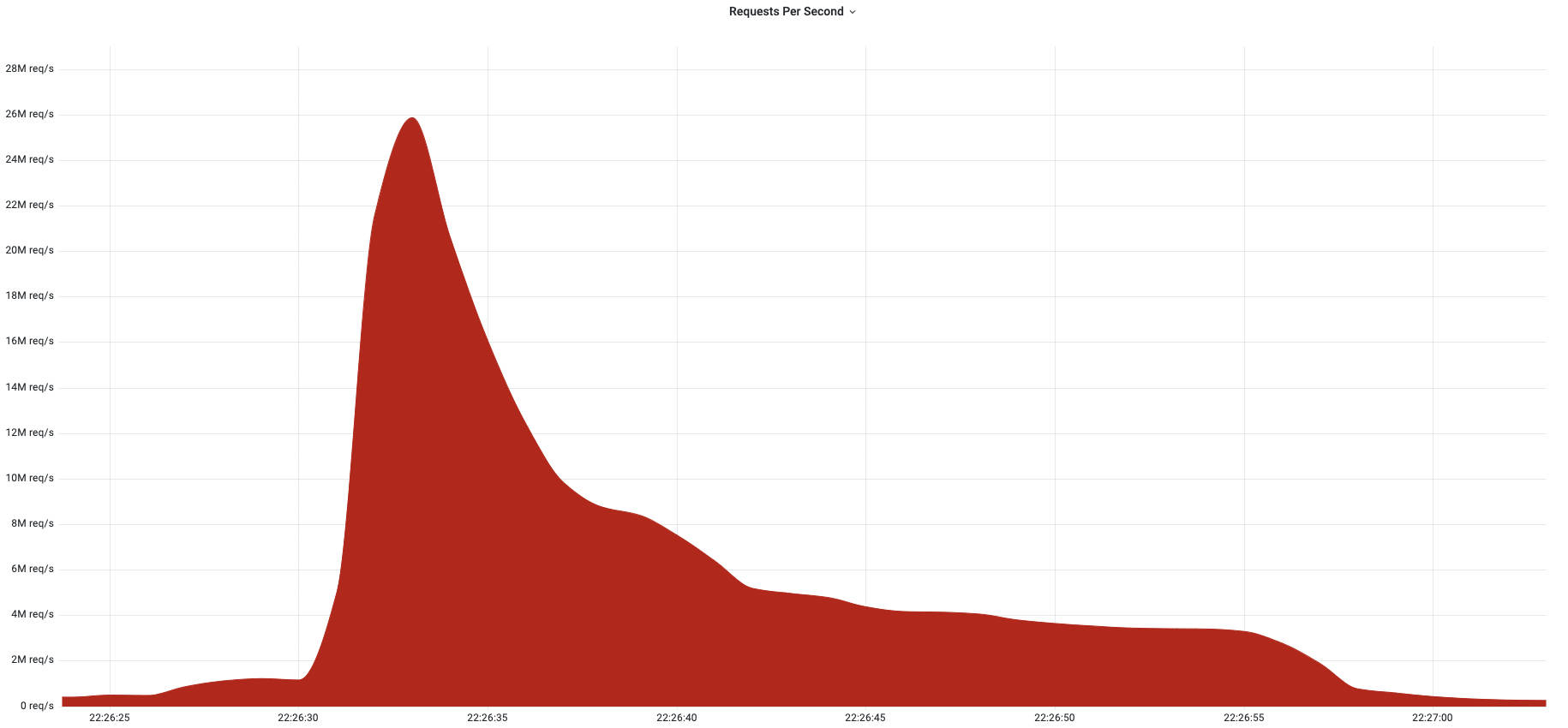
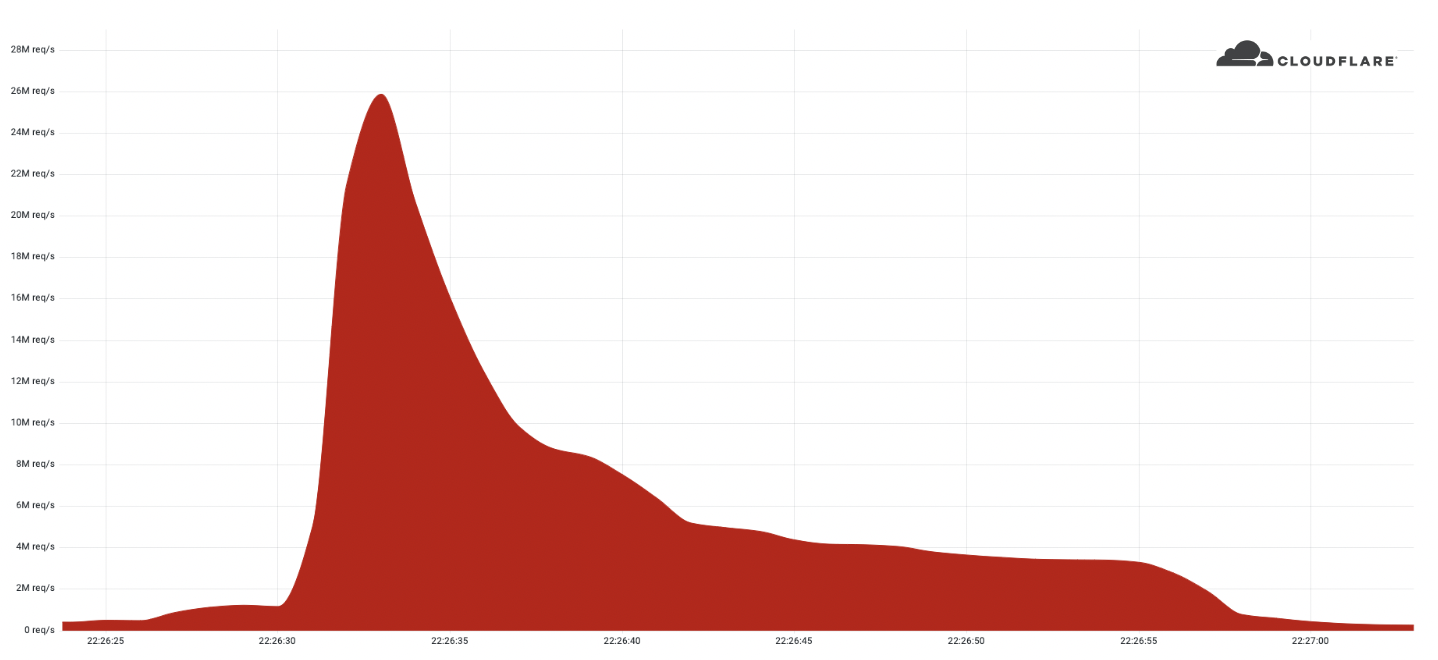
Last week, Cloudflare automatically detected and mitigated a 26 million request per second DDoS attack — the largest HTTPS DDoS attack on record.
The attack targeted a customer website using Cloudflare’s Free plan. Similar to the previous 15M rps attack, this attack also originated mostly from Cloud Service Providers as opposed to Residential Internet Service Providers, indicating the use of hijacked virtual machines and powerful servers to generate the attack — as opposed to much weaker Internet of Things (IoT) devices.
The 26M rps DDoS attack originated from a small but powerful botnet of 5,067 devices. On average, each node generated approximately 5,200 rps at peak. To contrast the size of this botnet, we’ve been tracking another much larger but less powerful botnet of over 730,000 devices. The latter, larger botnet wasn’t able to generate more than one million requests per second, i.e. roughly 1.3 requests per second on average per device. Putting it plainly, this botnet was, on average, 4,000 times stronger due to its use of virtual machines and servers.
Also, worth noting that this attack was over HTTPS. HTTPS DDoS attacks are more expensive in terms of required computational resources because of the higher cost of establishing a secure TLS encrypted connection. Therefore, it costs the attacker more to launch the attack, and for the victim to mitigate it. We’ve seen very large attacks in the past over (unencrypted) HTTP, but this attack stands out because of the resources it required at its scale.
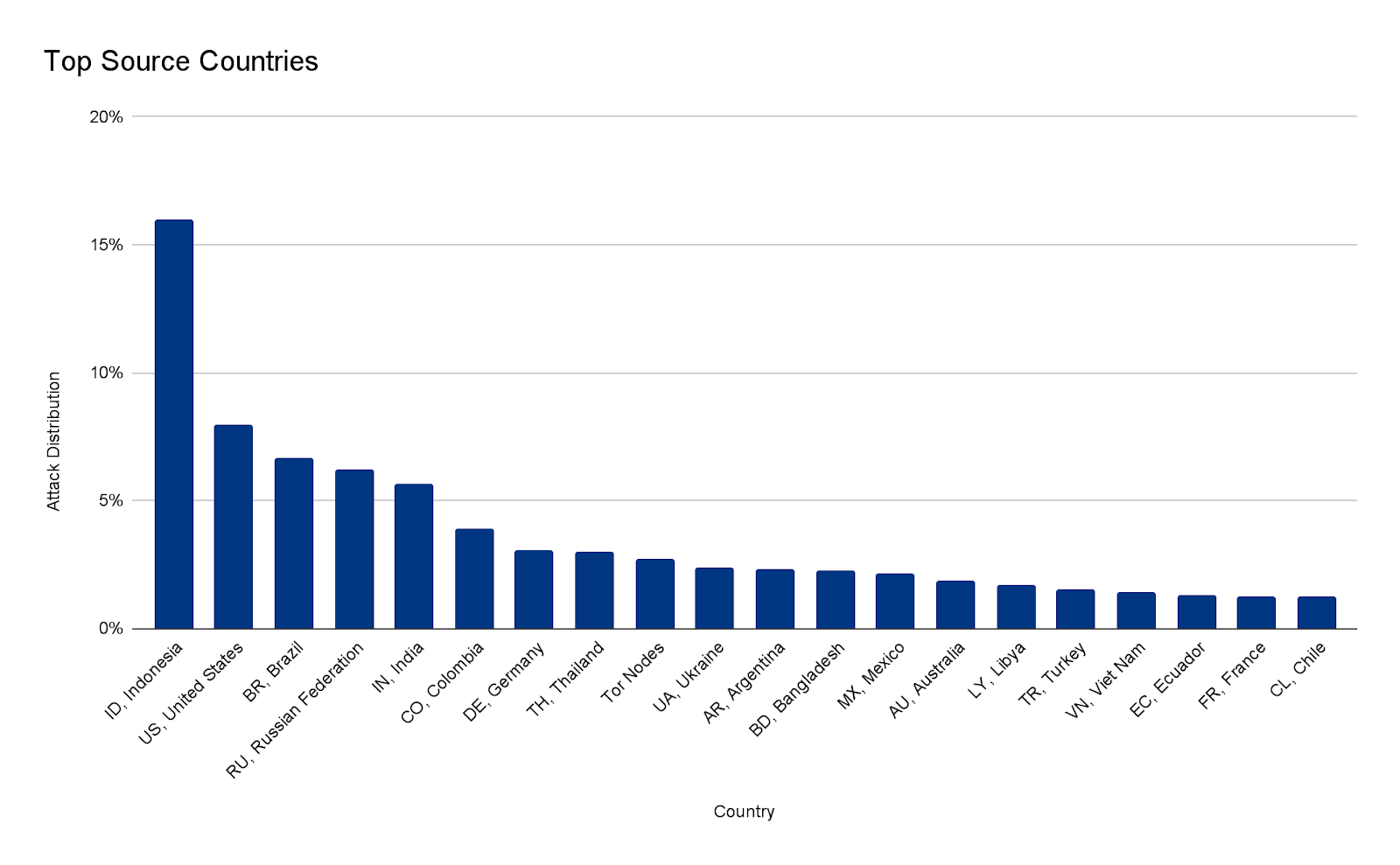
Within less than 30 seconds, this botnet generated more than 212 million HTTPS requests from over 1,500 networks in 121 countries. The top countries were Indonesia, the United States, Brazil and Russia. About 3% of the attack came through Tor nodes.
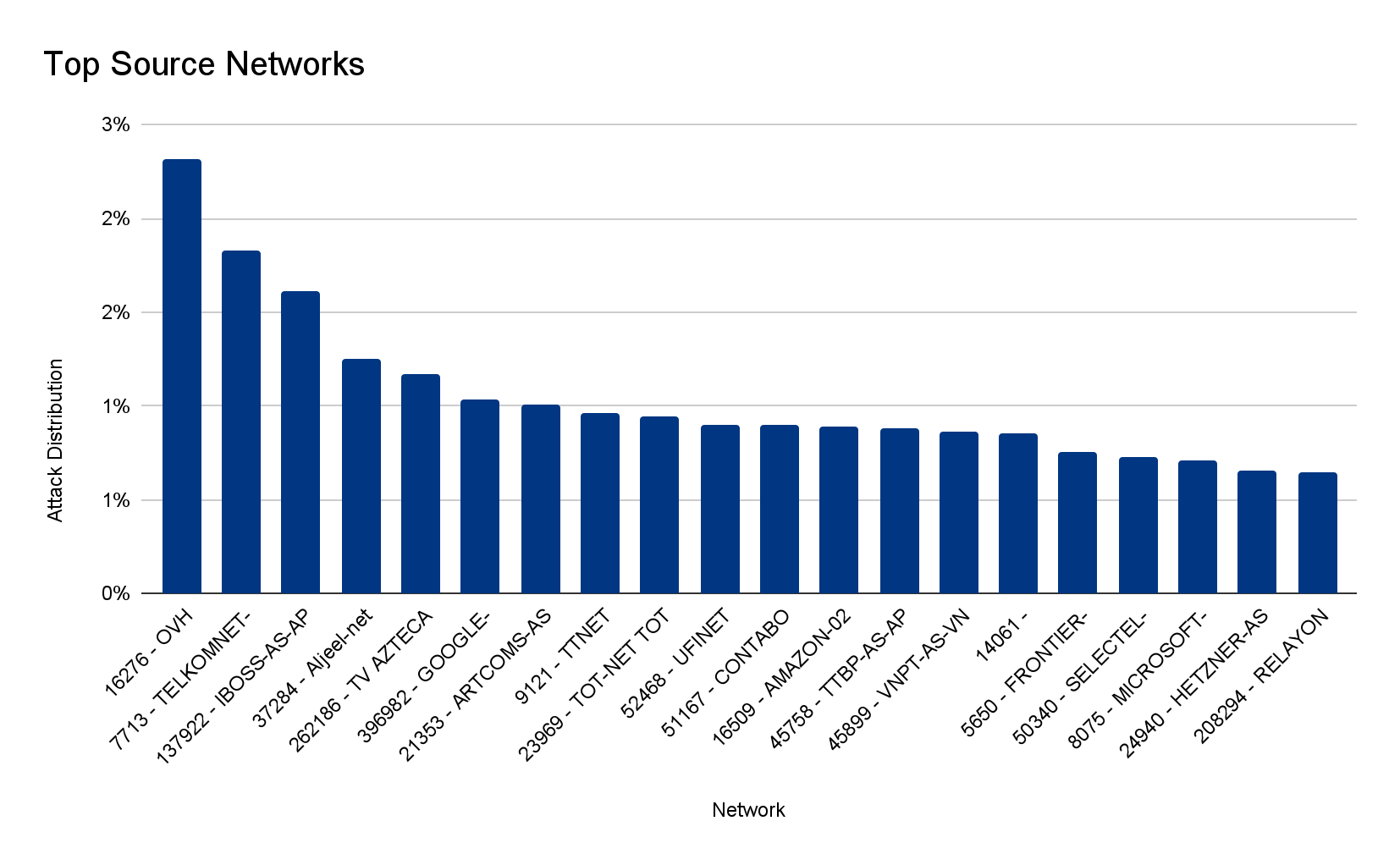
The top source networks were the French-based OVH (Autonomous System Number 16276), the Indonesian Telkomnet (ASN 7713), the US-based iboss (ASN 137922) and the Libyan Ajeel (ASN 37284).
The DDoS threat landscape
It’s important to understand the attack landscape when thinking about DDoS protection. When looking at our recent DDoS Trends report, we can see that most of the attacks are small, e.g. cyber vandalism. However, even small attacks can severely impact unprotected Internet properties. On the other hand, large attacks are growing in size and frequency — but remain short and rapid. Attackers concentrate their botnet’s power to try and wreak havoc with a single quick knockout blow — trying to avoid detection.
DDoS attacks might be initiated by humans, but they are generated by machines. By the time humans can respond to the attack, it may be over. And even if the attack was quick, the network and application failure events can extend long after the attack is over — costing you revenue and reputation. For this reason, it is recommended to protect your Internet properties with an automated always-on protection service that does not rely on humans to detect and mitigate attacks.
Helping build a better Internet
At Cloudflare, everything we do is guided by our mission to help build a better Internet. The DDoS team’s vision is derived from this mission: our goal is to make the impact of DDoS attacks a thing of the past. The level of protection that we offer is unmetered and unlimited — It is not bounded by the size of the attack, the number of the attacks, or the duration of the attacks. This is especially important these days because as we’ve recently seen, attacks are getting larger and more frequent.
Not using Cloudflare yet? Start now with our Free and Pro plans to protect your websites, or contact us for comprehensive DDoS protection for your entire network using Magic Transit.
It is once again exam time in Syria, Sudan, and Algeria, and with it, we find these countries disrupting Internet connectivity in an effort to prevent cheating on these exams. As they have done over the past several years, Syria and Sudan are implementing multi-hour nationwide Internet shutdowns. Algeria has also taken a similar approach in the past, but this year appears to be implementing more targeted website/application blocking.
Syria
Syria has been implementing Internet shutdowns across the country since 2011, but exam-related shutdowns have only been in place since 2016. In 2021, exams took place between May 31 and June 22, with multi-hour shutdowns observed on each of the exam days.
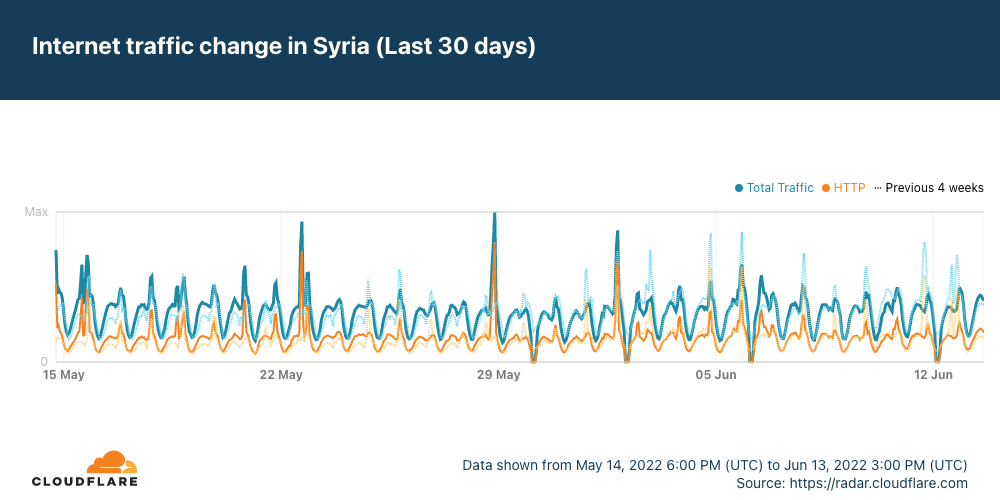
This year, the first shutdown was observed on May 30, with subsequent shutdowns (to date) seen on June 2, 6, and 12. In the Cloudflare Radar graph below, traffic for Syria drops to zero while the shutdowns are active. According to Internet Society Pulse, several additional shutdowns are expected through June 21. Each takes place between 02000530 UTC (0500–0830 local time). According to a published report, the current exam cycle covers more than 500,000 students for basic and general secondary education certificates.
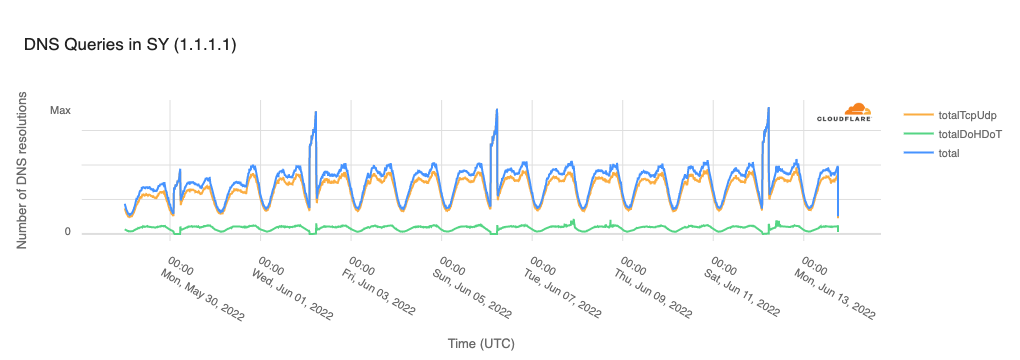
Consistent with shutdowns observed in prior years, Syria is once again implementing them in an asymmetric fashion – that is, inbound traffic is disabled, but egress traffic remains. This is clearly visible in request traffic from Syria to Cloudflare’s 1.1.1.1 DNS resolver. As the graph below shows, queries from clients in Syria are able to exit the country and reach Cloudflare, but responses can’t return, leading to retry floods, visible as spikes in the graph.
Last year, the Syrian Minister of Education noted that, for the first time, encryption and surveillance technologies would be used in an effort to curtail cheating, with an apparent promise to suspend Internet shutdowns in the future if these technologies proved successful.
Sudan
Sudan is also no stranger to nationwide Internet shutdowns, with some last lasting for multiple weeks. Over the last several years, Sudan has also implemented Internet shutdowns during secondary school exams in an effort to limit cheating or leaking of exam questions. (We covered the 2021 round of shutdowns in a blog post.)
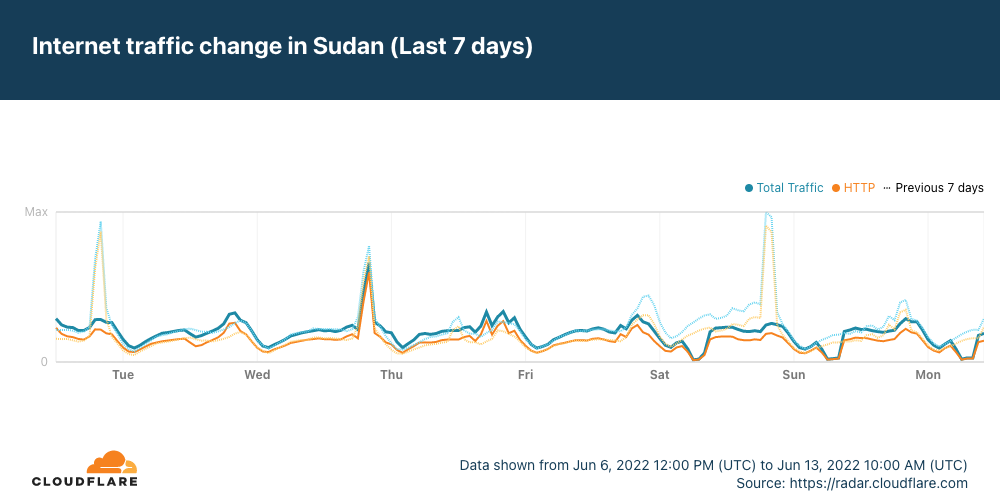
According to a schedule published by digital rights organization AccessNow, this year’s Secondary Certificate Exams will be taking place in Sudan daily between June 11–22, except June 17. As of this writing, near-complete shutdowns have been observed on June 11, 12, and 13 between 0530-0830 UTC (0730-1030 local time), as seen in the graph below. The timing of these shutdowns aligns with a communication reportedly sent to subscribers of telecommunications services in the country, which stated “In implementation of the decision of the Attorney General, the Internet service will be suspended during the Sudanese certificate exam sessions from 8 in the morning until 11 in the morning.”
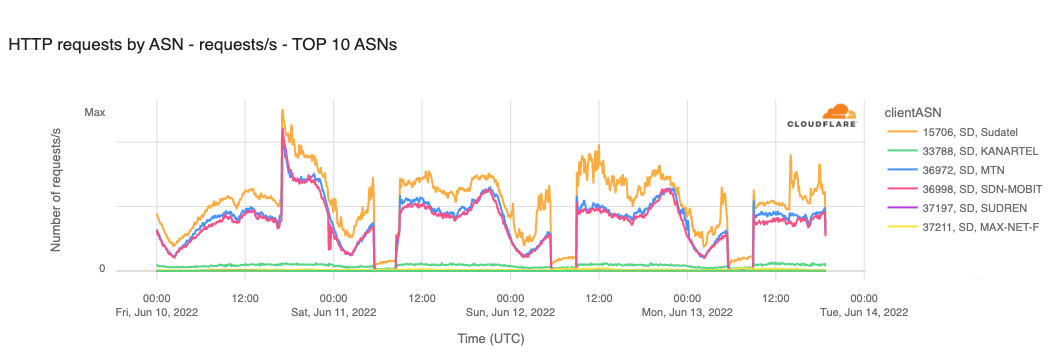
It is interesting to note that the shutdown, while nationwide, does not appear to be complete. The graph below shows that Cloudflare continues to see a small volume of HTTP requests from Sudatel during the shutdown periods. This is not completely unusual, as Sudatel may have public sector, financial services, or other types of customers that remain online.
Algeria
Since 2018, Algeria has been shutting down the Internet nationwide during baccalaureate exams, following widespread cheating in 2016 that saw questions leaked online both before and during tests. These shutdowns reportedly cost businesses across the country an estimated 500 million Algerian Dinars (approximately $3.4 million USD) for every hour the Internet was unavailable. In 2021, there were two Internet shutdowns each day that exams took place—the first between 0700–1100 UTC (0800–1200 local time), and the second between 1330–1600 UTC (1430–1700 local time).
Perhaps recognizing the economic damage caused by these Internet shutdowns, this year the Algerian Minister of National Education announced that there would be no Internet shutdowns on exam days.
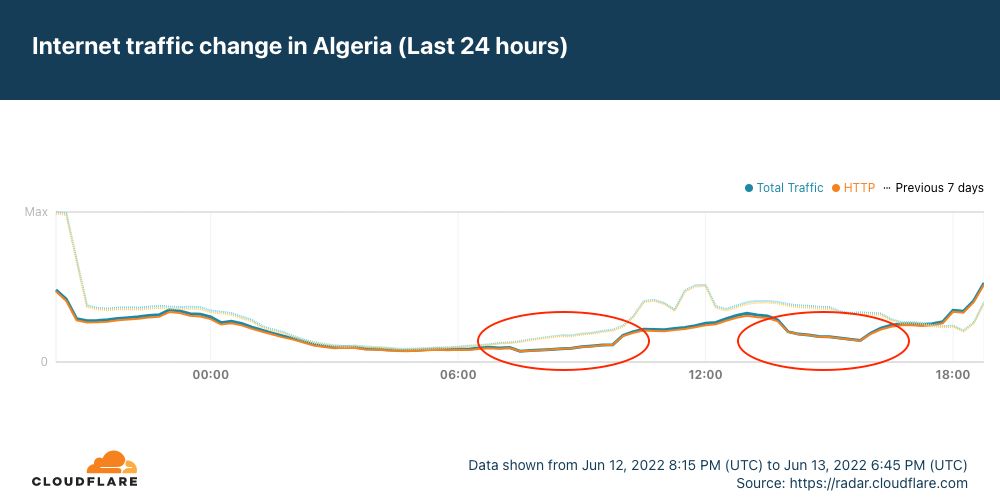
Thus far, it appears that this has been the case. However, it appears that the Algerian government has shifted to a content blocking-based approach, instead of a wide-scale Internet shutdown. The Cloudflare Radar graph below shows two nominal drops in country-level traffic during the two times on June 13 that the exams took place—0730–1000 UTC (0830–1100 local time) and 1330–1600 UTC (1430–1700 local time), similar to last year’s timing.
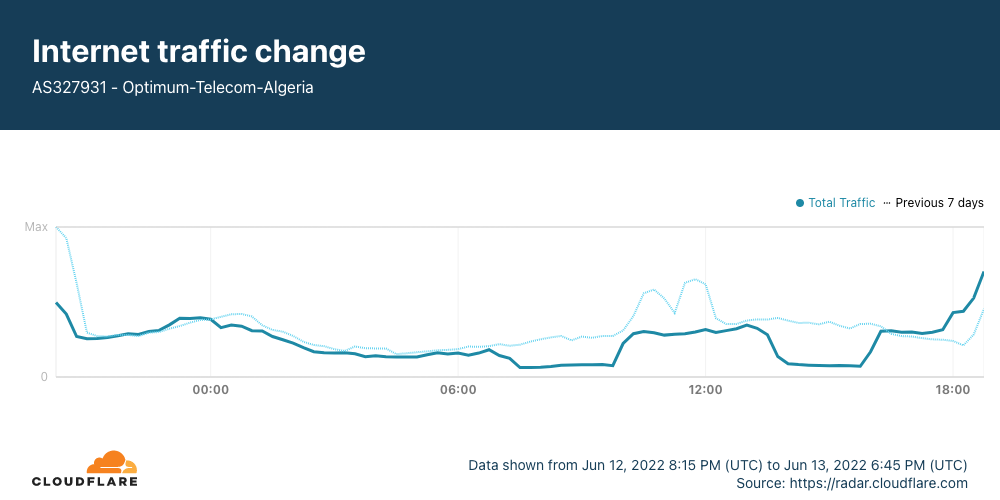
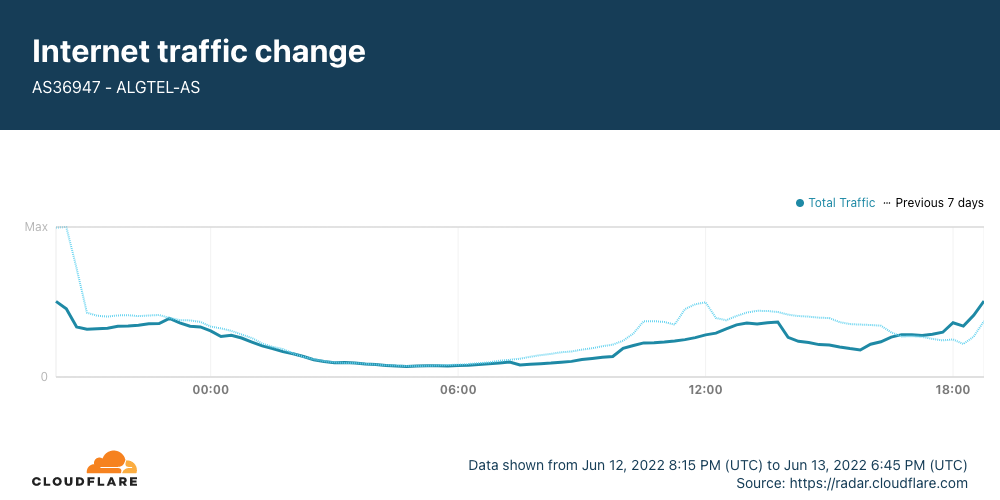
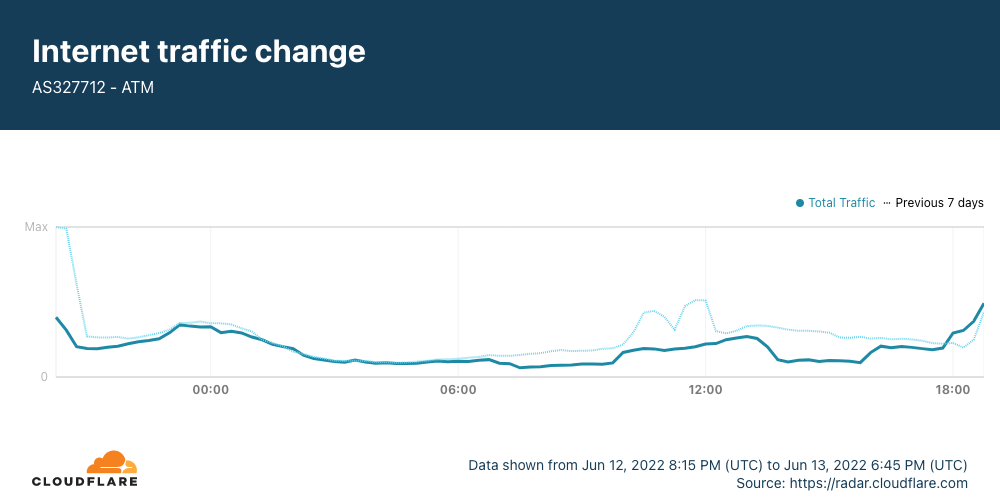
The disruptions are also visible in traffic graphs for several major Algerian network providers, as shown below.
Analysis of additional Cloudflare data further supports the hypothesis that Algeria is blocking access to specific websites and applications, rather than shutting down the Internet completely.
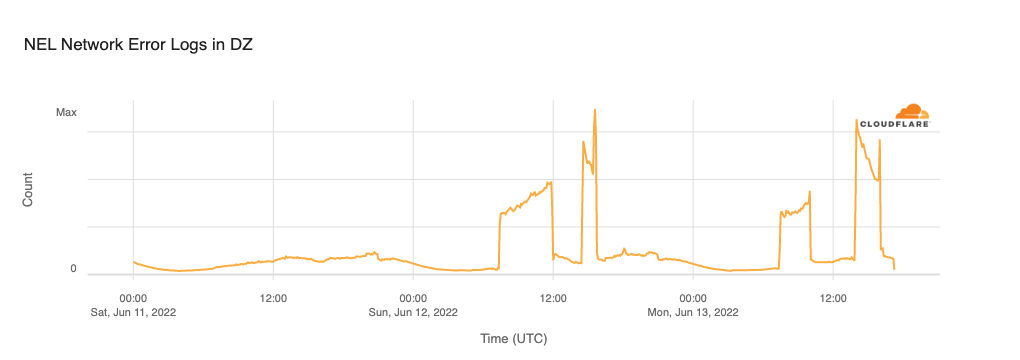
As described in a previous blog post, Network Error Logging (NEL) is a browser-based reporting system that allows users’ browsers to report connection failures to an endpoint specified by the webpage that failed to load. Below, a graph of NEL reports from browsers in Algeria shows clear spikes during the times (thus far) that the exams have taken place, with report levels significantly lower and more consistent during other times of the day.
Conclusion
In addition to Syria, Sudan, and Algeria, countries including India, Jordan, Iraq, Uzbekistan, and Ethiopia have shut down or limited access to the Internet as exams took place. It is unclear whether these brute-force methods are truly effective at preventing cheating on these exams. However, it is clear that the impact of these shutdowns goes beyond students, as they impose a significant financial cost on businesses within the affected countries as they lose Internet access for multiple hours a day over the course of several weeks.
If you want to follow the remaining scheduled disruptions for these countries, you can see live data on the Cloudflare Radar pages for Syria, Sudan, and Algeria.
By transforming our data into JSON we can achieve great results with Zabbix without the need to have a complex external script logic. The article will provide an example of obtaining a set of master data with a single PowerShell script and then using the Zabbix native functionality to configure low-level discovery and collect the required metrics from the master JSON data set.
In this example, we will implement certificate monitoring by using a Microsoft Windows Certificate Authority server. The goal is to see how many days we have before our internally signed certificates will expire. As an extra, we will be able to filter the monitored items by requestors and template names.
Target system version: MS Windows Server 2019 (also tested on 2012)
Zabbix server & agent version: 6.0.3 (Other Zabbix versions should be supported too with no or minimal changes)
Core logic
The below diagram shows the concept itself and you will find a detailed guide to implement this step by step in the next sections.
Core workflow
Sample output of Latest Data:
Prerequisites
To start, you will need to deploy Zabbix agent 2 on your target system – confirm that the Zabbix agent can communicate with your Zabbix server. For the calculated item, we will require local time monitoring. The easiest way is to use the key “system.localtime”, which is already provided by the default Windows OS monitoring template. This item is intentionally not included within the certificate monitoring template to avoid key conflicts.
Below you can find the Powershell script which you have to implement: (name: “certmon_get_certs.ps1″) :
*for Windows 2012 systems use CertificateTemplate instead of CertificateTemplateOid within this script.
This script expects one parameter, which is your CA server’s FQDN. That name will be loaded into variable “$ca_hostname”, so for testing purposes, you can just replace it with a static entry. Based on your needs you can adjust the “AddDays” parameter. Essentially this means to track back certificates, which are already expired for up to 7 days. Consider a situation, when you miss one just before a long weekend.
Script output
Let’s check the first part of the main command without further piping:
Simple script output without additional properties
As you can see, we are getting some basic information about the certificate. We do not need all the returned lines for the next steps, so it is better to filter the output down. Before we do that, we will use the option called “-Property”, and if you use it with a wildcard character, then it will list all the available parameters for a certificate. If you need more than the basic output, then you can list the extra parameters by using this option. Please be aware, that this will add extra lines compared to the basic output, but it will not do any filtering (the common lines will always remain visible).
Output with “-Property *”
Compare this with the output after using “Select-Object -Property RequestID,Request.RequesterName,CommonName,NotAfter,CertificateTemplateOid”
Output after using property filters
This looks good for us, but it is still not machine-readable. Let’s add the JSON output conversion, but without the “-Compress” option first:
JSON converted compressed output
What is especially great in this conversion, is that the “CertificateTemplateOid” part got 2 child entries, so later we can target the “FriendlyName” entry for discovery. Lastly, adding the “-Compress” option will help us to use less space by removing the white spaces and newlines from the output.
Depending on the amount of issued and valid certificates the output can be huge, especially without any filtering and compression (even megabytes in size). The current Zabbix server version (6.0.3) supports only 512KBas item output, this is why the output reduction is crucial. In my example the text data of one certificate takes approx 300 bytes, so 512KB will result in a limit of 1747 certificates. In case you are expecting more than this amount of ACTIVE certs within your CA, then I recommend cloning the PS script and adding some extra filtering to each variant (filter for template name / requestor / OU) and adjusting the template accordingly. Another approach would be to monitor the certificates, which will expire in the coming N days in case you have too many entries.
Agent configuration
To run the defined script, you have to allow it within the Zabbix Agent configuration file. You can either modify the main config or just define the extra lines within an additional file under zabbix_agent2.d folder. Below you can find the additional Zabbix agent configuration lines:
The wildcard character at the end is needed to specify any hostname, which is expected by the script. The default timeout is 3 seconds, which is unfortunately insufficient. Importing Module PSPKI alone takes a few seconds, so the overall execution time is somewhere between 5 and 10 seconds. My assumption is that more certificates will not increase this significantly, but some extra seconds can be expected. 20 seconds sounds like a safe bet.
We are done with the pre-requisites, now we can start the real work!
Assign the template to a CA server and you can test the item already. The result should be a big block of data in JSON format. To review the output I recommend the following external websites:
Some explanation:
The first LLD macro is self-explanatory – it obtains the certificate’s common name. The second one is also trivial, except the special marking, which is required due to the dot character in the middle. The third one is also simple, but the last 2 lines are somewhat special. If you have a fresh OS version, then most probably you will need only the 5th line without the 4th. In case you have a Windows server 2012 system, then you will need only the 4th line without the 5th. Why? Because of Windows For testing you can keep both and then later remove the unnecessary one as well as the number suffix.
Now you are ready to create your item prototypes and this is where the real magic starts.
Certificate expiration date item prototype – Dependent item
Define the new item prototype as follows:
Name:“Certificate [ ID #{#REQUEST_ID} ] {#COMMON_NAME} – Expiration date”
Type:“Dependent item”
Key: “certificate.expiration_date[{#REQUEST_ID}]”
Type of information: “Numeric (unsigned)”
Master item: pick the previously created master item
As mentioned previously, it makes sense to keep only one template tag later, but for now, such an approach is fine.
The first line requires some explanation:
The requestor name starts with a domain prefix followed by 2 backslashes. If you are submitting CSRs from different domains to this CA server, then you can remove the extra formatting, but in a simple setup, we do not need the domain prefix, since it will be the same for all requestors.
Example: “DOMAIN\\someuser → someuser”
Explanation:
Since this item is a dependent item, it will point back to our master item, which returns a data block in JSON. Due to the nature of the discovery definitions, we are running a while loop, which is already loaded with our variables (the LLD macros). Therefore the “{#REQUEST_ID}” already has a numerical value within each cycle. With this number, we can go back to the original item and target that exact certificate, which has the same ID. Then we are interested in the NotAfter value considering the selected certificate.
You can find many other examples within Zabbix documentation: jsonpath functionality
At this point, we have the extracted value of the expiration date, but it is quite raw at the moment:
\/Date(1673594922000)\/
In the next step, we are taking the numerical part and then we have to apply a multiplier of 0.001 since by default the time is given in milliseconds. After this, we have an integer, which can be converted to a human-readable form by using the unit “unixtime”. The last line is just a standard discard unchanged entry.
Since our discovery object is also a dependent item, you have to execute our master item to run the low-level discovery rule. The first execution will result in the creation of your certificate items and only the second execution of the master item will execute them all at once. After this point, you should have N certificate objects created and each should have a valid expiration date. This is already something, for which you could define a trigger, but personally, I prefer to see the remaining days and not the exact date itself.
Days to expire item prototype – Calculated item
Let’s define yet another item prototype as follows:
Name:“Certificate [ ID #{#REQUEST_ID} ] {#COMMON_NAME} – Days to expire”
Remaining days to expiration item prototype example
Please do not forget, that you require an existing local time item, which is not provided by this template (but available within “Windows by Zabbix agent*” template).
Tags:
Copy the same tags from the first prototype and only change the last tag to scope: certificate / remaining days
Remaining days to expiration item prototype tag definitions
Preprocessing:
Regular expression: “^(-?\d+)”: “\1”
Discard unchanged with heartbeat:“1d”
Remaining days to expiration item prototype preprocessing steps
As a result, this will give you a simple number with the remaining days to the expiration date. Then you can decide which item to use in the trigger to implement proper alerting based on your needs.
Certificate expiration trigger prototype
In my case I am just using a simple trigger expression for the remaining days:
Name: “Certificate will expire within 30 days – {#COMMON_NAME}”
Operational data: “Expires in {ITEM.LASTVALUE1} days”
When you check the relevant certificates in the Latest data section, then you can do the filtering by the item-based tags. Since we are adding the cert CN and ID only to the trigger, these will appear only in case of alerts. Based on your needs you can implement additional tags, you just have to adjust the PS script to show more properties. When you extend the input data, please always consider the 512KB limit or the configured timeout.
The logic defined in this example can be applied to any JSON formatted data.
Martin Herfurt, a security researcher in Austria, quickly noticed something odd about the new feature: Not only did it allow the car to automatically start within 130 seconds of being unlocked with the NFC card, but it also put the car in a state to accept entirely new keys—with no authentication required and zero indication given by the in-car display.
“The authorization given in the 130-second interval is too general… [it’s] not only for drive,” Herfurt said in an online interview. “This timer has been introduced by Tesla…in order to make the use of the NFC card as a primary means of using the car more convenient. What should happen is that the car can be started and driven without the user having to use the key card a second time. The problem: within the 130-second period, not only the driving of the car is authorized, but also the [enrolling] of a new key.”
Божидар Божанов е ИТ експерт, основател на компания за информационна сигурност, член на Изпълнителния съвет на „Да, България“, а от 13 декември 2021 г. оглавява новосъздаденото Министерство на електронното управление. Йоанна Елми разговаря с него за мерките за справяне с дезинформацията, които министър Божанов е предложил от българска страна при срещите в Брюксел, посветени на темата.
На 20 май съобщихте, че по време на срещите си в Брюксел сте предал на еврокомисарите „българската гледна точка относно дезинформацията“ и сте предложил конкретни идеи за „прилагането на Акта за цифровите услуги, така че да ограничим координираните дезинформационни кампании“. Бихте ли разяснил за читателите ни какво представлява Актът за цифровите услуги и какво приложение предлага България?
Двата проблема, които се очертаха ясно в последните месеци, са блокирането на легитимни гласове в защита на Украйна и промотирането на дезинформация от страна на алгоритмите на Facebook. Актът може да бъде използван, за да ни защити и от двете явления. Относно първото блокираните ще могат да уредят спора извънсъдебно чрез трета страна. Тоест при модерацията вече няма социалните мрежи да държат и хляба, и ножа. По линия на дезинформацията малки промени в алгоритмите и в някои функционалности на Facebook могат да допринесат за значително намаляване на разпространението ѝ от тролове. Един пример е опцията за автоматично включване в групи, в които човекът е поканен. Това се използва от троловете, за да може фалшивите новини да достигнат до повече хора. Ако Facebook ограничи ефекта от тази опция, облъчването с дезинформация ще намалее.
Имаме още две идеи. Първата е за повече прозрачност от страна на социалните мрежи. Докладите, които те трябва да предоставят (включително за модерация), задължително да бъдат на ниво държава членка, а не обобщени. Искаме също и предоставяне на данните публично, в реално време, а не веднъж годишно, което е горната граница по предложения текст на Акта за цифровите услуги. Втората идея е във връзка с алгоритмите за препоръчване на съдържание. Социалните мрежи трябва да дават обяснения на потребителите си защо дадено съдържание им е препоръчано, и да се опитват да не позволяват на групи от тролове да ги „излъжат“ с координирани действия, като например публикуване едновременно в много групи и съответно харесване и споделяне. За това може да се вземат редица индикатори за профилите, които да ги поставят в една група (т.нар. клъстерен анализ).
Актът има доста широк обхват, но целта му е да допълни Директивата за електронната търговия със специфични задължения за доставчиците на съдържание, включително във връзка с незаконното съдържание, като слага допълнителен фокус върху т.нар. големи онлайн платформи. В обхвата влизат повече прозрачност на модерацията, възможност за обжалване, базова уредба на системите за препоръчване на съдържание и други.
Какво имаме предвид с „българската гледна точка относно дезинформацията“? Как е формирана официалната държавна позиция, на каква експертност се разчита и до какви изводи стигаме по темата на държавно ниво?
Разчитаме на разговори с експерти по технологични и медийни въпроси, на техните анализи, както и на международни изследвания. Разчитаме и на докладвани проблеми от гражданското общество. Базираме изводите си на това и на публичните отчети на Facebook, но за съжаление, те са много ограничени и почти за нищо няма разбивка на ниво държава. Именно това е една от ползите от Акта за цифровите услуги – че платформите ще трябва да предоставят повече данни, за да можем да бъдем по-информирани.
Казвате, че България „вече има визия и цели, които ще реализира заедно с европейските ни партньори“. С какво се различава политиката на настоящото правителство в сферата на дигиталната сигурност спрямо тази на предишните правителства и каква е визията, за която съобщихте? Докога и как ще се прилага тя? Има ли риск да си остане поредната нереализирана рамка и ако да – какви са причините?
В рамките на конкретното посещение имах три теми: дезинформацията, електронната идентификация и споделяне на информация за киберзаплахи. Разликата с предишни правителства е, че инициираме диалог, че отиваме в Брюксел с решения, а не да се оплакваме. Решения, които са в полза на България, разбира се. С риск да опростя прекалено нещата, до момента България е била просто поддръжник на това, което казва Германия.
Министър Божанов, говорите за „координирани дезинформационни кампании“, но голяма част от проблема с дезинформацията в България се корени в два други ресора – медиите и непрозрачната собственост на онлайн източниците. Това далеч не е само български проблем: дезинформацията често се употребява политически и идеологически в медийното пространство, същевременно е и много доходоносен бизнес с онлайн реклами. Така се получава, че координираните кампании всъщност се подпомагат от доста по-мащабни некоординирани усилия, които са възможни благодарение на пробиви в системите ни. Каква е Вашата позиция по въпроса, предвиждате ли законови решения съвместно с други министерства и как си представяте тези решения?
Прозрачността на медиите действително е част от проблемите. Затова създаването на цялостен регистър на медиите, с техните действителни собственици и редактори, както и публично финансиране, е компонент от решението. Такъв регистър би подпомогнал и работата на алгоритмите, които могат да проверят дали едно новинарско съдържание идва от регистрирана медия, или от анонимен сайт. Когато един човек чете фалшива новина, той няма да провери дали интернет страницата, която е отворил, е в регистъра на медиите, или не, нито кой е собственик или редактор. Социалните мрежи обаче, които разпространяват това съдържание, могат да направят тази проверка, и то автоматично. И могат да покажат на читателя, че дадена новина идва от анонимен сайт. Това помага значително.
Медийният регистър не е политика на Министерството на електронното управление, но ще подпомогнем Министерството на културата и Съвета за електронни медии във всички аспекти от неговото изграждане.
Такъв регистър на медиите съществува от 2019 г. заради т.нар. Медиен закон на Пеевски. При справка обаче става ясно, че много медии не спазват изискванията на регистъра, което очевидно се игнорира от министерствата, но също толкова лесно може да се „активира“ при сигнал за неудобна медия. Наистина ли смятате, че това е решението?
Темата с медийния регистър наистина е деликатна и просто наличието на един регистър не решава проблемите. При такъв регистър важното е какво следва от него – например по-голяма прозрачност на публичното финансиране, възможност за справка от страна на социалните мрежи и др.
Тези регистри не са в ресора на Вашето министерство, което по-скоро се стреми към други цели, ако Ви разбирам правилно. Как според Вас могат да бъдат накарани социалните медии да правят проверка съгласно българските регистри?
Действително това е политиката за медийна свобода и тя излиза извън правомощията ми. Коментирам го заради пресечната точка със социалните мрежи и дезинформацията. Социалните мрежи могат да бъдат накарани по два начина. Единият е регулация, а другият е в комуникация със социалните мрежи да ги убедим за системния риск, който дезинформацията, разпространявана през тях, представлява за страната ни.
Register now with discount code SALFNj7FaRe to get $150 off your full conference pass to AWS re:Inforce. For a limited time only and while supplies last.
AWS re:Inforce 2022 will take place in-person in Boston, MA, on July 26 and 27 and will include some exciting identity and access management sessions. AWS re:Inforce 2022 features content in the following five areas:
The identity and access management track will showcase how quickly you can get started to securely manage access to your applications and resources as you scale on AWS. You will hear from customers about how they integrate their identity sources and establish a consistent identity and access strategy across their on-premises environments and AWS. Identity experts will discuss best practices for establishing an organization-wide data perimeter and simplifying access management with the right permissions, to the right resources, under the right conditions. You will also hear from AWS leaders about how we’re working to make identity, access control, and resource management simpler every day. This post highlights some of the identity and access management sessions that you can add to your agenda. To learn about sessions from across the content tracks, see the AWS re:Inforce catalog preview.
Breakout sessions
Lecture-style presentations that cover topics at all levels and are delivered by AWS experts, builders, customers, and partners. Breakout sessions typically conclude with 10–15 minutes of Q&A.
IAM201: Security best practices with AWS IAM AWS IAM is an essential service that helps you securely control access to your AWS resources. In this session, learn about IAM best practices like working with temporary credentials, applying least-privilege permissions, moving away from users, analyzing access to your resources, validating policies, and more. Leave this session with ideas for how to secure your AWS resources in line with AWS best practices.
IAM301: AWS Identity and Access Management (IAM) the practical way Building secure applications and workloads on AWS means knowing your way around AWS Identity and Access Management (AWS IAM). This session is geared toward the curious builder who wants to learn practical IAM skills for defending workloads and data, with a technical, first-principles approach. Gain knowledge about what IAM is and a deeper understanding of how it works and why.
IAM302: Strategies for successful identity management at scale with AWS SSO Enterprise organizations often come to AWS with existing identity foundations. Whether new to AWS or maturing, organizations want to better understand how to centrally manage access across AWS accounts. In this session, learn the patterns many customers use to succeed in deploying and operating AWS Single Sign-On at scale. Get an overview of different deployment strategies, features to integrate with identity providers, application system tags, how permissions are deployed within AWS SSO, and how to scale these functionalities using features like attribute-based access control.
IAM304: Establishing a data perimeter on AWS, featuring Vanguard Organizations are storing an unprecedented and increasing amount of data on AWS for a range of use cases including data lakes, analytics, machine learning, and enterprise applications. They want to make sure that sensitive non-public data is only accessible to authorized users from known locations. In this session, dive deep into the controls that you can use to create a data perimeter that allows access to your data only from expected networks and by trusted identities. Hear from Vanguard about how they use data perimeter controls in their AWS environment to meet their security control objectives.
IAM305: How Guardian Life validates IAM policies at scale with AWS Attend this session to learn how Guardian Life shifts IAM security controls left to empower builders to experiment and innovate quickly, while minimizing the security risk exposed by granting over-permissive permissions. Explore how Guardian validates IAM policies in Terraform templates against AWS best practices and Guardian’s security policies using AWS IAM Access Analyzer and custom policy checks. Discover how Guardian integrates this control into CI/CD pipelines and codifies their exception approval process.
IAM306: Managing B2B identity at scale: Lessons from AWS and Trend Micro Managing identity for B2B multi-tenant solutions requires tenant context to be clearly defined and propagated with each identity. It also requires proper onboarding and automation mechanisms to do this at scale. Join this session to learn about different approaches to managing identities for B2B solutions with Amazon Cognito and learn how Trend Micro is doing this effectively and at scale.
IAM307: Automating short-term credentials on AWS, with Discover Financial Services As a financial services company, Discover Financial Services considers security paramount. In this session, learn how Discover uses AWS Identity and Access Management (IAM) to help achieve their security and regulatory obligations. Learn how Discover manages their identities and credentials within a multi-account environment and how Discover fully automates key rotation with zero human interaction using a solution built on AWS with IAM, AWS Lambda, Amazon DynamoDB, and Amazon S3.
Builders’ sessions
Small-group sessions led by an AWS expert who guides you as you build the service or product on your own laptop. Use your laptop to experiment and build along with the AWS expert.
IAM351: Using AWS SSO and identity services to achieve strong identity management Organizations often manage human access using IAM users or through federation with external identity providers. In this builders’ session, explore how AWS SSO centralizes identity federation across multiple AWS accounts, replaces IAM users and cross-account roles to improve identity security, and helps administrators more effectively scope least privilege. Additionally, learn how to use AWS SSO to activate time-based access and attribute-based access control.
IAM352: Anomaly detection and security insights with AWS Managed Microsoft AD This builders’ session demonstrates how to integrate AWS Managed Microsoft AD with native AWS services like Amazon CloudWatch Logs and Amazon CloudWatch metrics and alarms, combined with anomaly detection, to identify potential security issues and provide actionable insights for operational security teams.
Chalk talks
Highly interactive sessions with a small audience. Experts lead you through problems and solutions on a digital whiteboard as the discussion unfolds.
IAM231: Prevent unintended access: AWS IAM Access Analyzer policy validation In this chalk talk, walk through ways to use AWS IAM Access Analyzer policy validation to review IAM policies that do not follow AWS best practices. Learn about the Access Analyzer APIs that help validate IAM policies and how to use these APIs to prevent IAM policies from reaching your AWS environment through mechanisms like AWS CloudFormation hooks and CI/CD pipeline controls.
IAM232: Navigating the consumer identity first mile using Amazon Cognito Amazon Cognito allows you to configure sign-in and sign-up experiences for consumers while extending user management capabilities to your customer-facing application. Join this chalk talk to learn about the first steps for integrating your application and getting started with Amazon Cognito. Learn best practices to manage users and how to configure a customized branding UI experience, while creating a fully managed OpenID Connect provider with Amazon Cognito.
IAM331: Best practices for delegating access on AWS This chalk talk demonstrates how to use built-in capabilities of AWS Identity and Access Management (IAM) to safely allow developers to grant entitlements to their AWS workloads (PassRole/AssumeRole). Additionally, learn how developers can be granted the ability to take self-service IAM actions (CRUD IAM roles and policies) with permissions boundaries.
IAM332: Developing preventive controls with AWS identity services Learn about how you can develop and apply preventive controls at scale across your organization using service control policies (SCPs). This chalk talk is an extension of the preventive controls within the AWS identity services guide, and it covers how you can meet the security guidelines of your organization by applying and developing SCPs. In addition, it presents strategies for how to effectively apply these controls in your organization, from day-to-day operations to incident response.
IAM333: IAM policy evaluation deep dive In this chalk talk, learn how policy evaluation works in detail and walk through some advanced IAM policy evaluation scenarios. Learn how a request context is evaluated, the pros and cons of different strategies for cross-account access, how to use condition keys for actions that touch multiple resources, when to use principal and aws:PrincipalArn, when it does and doesn’t make sense to use a wildcard principal, and more.
Workshops
Interactive learning sessions where you work in small teams to solve problems using AWS Cloud security services. Come prepared with your laptop and a willingness to learn!
IAM271: Applying attribute-based access control using AWS IAM This workshop provides hands-on experience applying attribute-based access control (ABAC) to achieve a secure and scalable authorization model on AWS. Learn how and when to apply ABAC, which is native to AWS Identity and Access Management (IAM). Also learn how to find resources that could be impacted by different ABAC policies and session tagging techniques to scale your authorization model across Regions and accounts within AWS.
IAM371: Building a data perimeter to allow access to authorized users In this workshop, learn how to create a data perimeter by building controls that allow access to data only from expected network locations and by trusted identities. The workshop consists of five modules, each designed to illustrate a different AWS Identity and Access Management (IAM) and network control. Learn where and how to implement the appropriate controls based on different risk scenarios. Discover how to implement these controls as service control policies, identity- and resource-based policies, and virtual private cloud endpoint policies.
IAM372: How and when to use different IAM policy types In this workshop, learn how to identify when to use various policy types for your applications. Work through hands-on labs that take you through a typical customer journey to configure permissions for a sample application. Configure policies for your identities, resources, and CI/CD pipelines using permission delegation to balance security and agility. Also learn how to configure enterprise guardrails using service control policies.
If these sessions look interesting to you, join us in Boston by registering for re:Inforce 2022. We look forward to seeing you there!
Last Week’s Launches I made a short trip to Austin, Texas last week in order to visit and learn from some customers. As is always the case, the days when I was traveling were filled with AWS launches; here’s my recap of a few that caught my eye:
R6id Instances – In her first post for the AWS News Blog, Senior Developer Advocate Veliswa Boya wrote about the new R6id instances. These are a variant of our sixth generation of x86-based R6i instances, and feature up to 7.6 TB of NVMe Local Instance Storage. Powered by 3rd Generation Intel Xeon Scalable (Ice Lake) processors, the instances offer higher compute performance, a new larger size (.32xlarge), always-on memory encryption, and double the EBS and network performance as the previous generation. The instances are available now in four AWS Regions.
AWS MGN Post-Launch Actions –AWS Application Migration Service (AWS MGN) helps you to migrate your existing servers to AWS, with automation that can handle a wide variety of applications. We launched a set of optional post-migration actions to provide additional support for your migration and modernization efforts. The initial set of actions install the AWS Systems Manager agent, install the AWS Elastic Disaster Recovery Service Agent, migrate from CentOS to Rocky Linux, and convert SUSE Linux subscriptions to AWS-provided subscriptions. You can read my blog post to learn more.
Mainframe Modernization Service – This new service helps you to modernize your mainframe applications and to deploy them to AWS fully-managed runtime environments. As Seb notes in his post, Modernize Your Mainframe Applications & Deploy Them In The Cloud, the application modernization journey is composed of four phases: assessing the situation, mobilizing the project, migrating & modernizing, and operating & optimizing. The Mainframe Modernization Service provides assistance during each phase, and you can review each one in the blog post.
Other AWS News Here are some other updates that caught my eye last week:
Open Source News – My colleague Ricardo Sueiras published installment #116 of his AWS Open Source News and Updates. He’s got the latest and greatest on tools for Lambda, Lambda@Edge, CDK, schema management, EMR, and a whole lot more!
aws-prod-infrastructure is an open source tool that generates Terraform code from an AWS production account. Terragen does the same thing, with pricing plans for hobbyists (free), professionals, and enterprises.
resoto creates an inventory of your cloud, provides deep visibility, and reacts to changes in your infrastructure.
green-boost from AWS Labs helps you to quickly build full stack serverless web apps on AWS.
Upcoming AWS Events Here are some events that may be of interest to you:
re:Mars (June 21-24) – I’ll be heading to Las Vegas next week to attend re:Mars; there’s still some time to register and attend!
AWS Summits (June & July) – AWS Summits will take place in-person in June (Toronto and Milan) and July (New York), with more cities on the list for later in the year.
From Sage Sharp comes the sad news that Marina Zhurakhinskaya, the founder
of the Outreach Program for Women (now known as Outreachy), has passed away.
“Marina died on Saturday after winning her struggle with cancer for three years. We would like
to elevate Marina’s message to encourage people to test themselves for
genetic markers for breast cancer“.
From Sage Sharp comes the sad news that Marina Zhurakhinsakaya, the founder
of the Outreach Program for Women (now known as Outreachy), has passed away.
“Marina died on Saturday after winning her struggle with cancer for three years. We would like
to elevate Marina’s message to encourage people to test themselves for
genetic markers for breast cancer“.
At the 2022 Linux Storage,
Filesystem, Memory-management and BPF Summit (LSFMM), Amir Goldstein
and Miklos Szeredi led a discussion on a new interface for extracting
information from kernel objects using the filesystem extended-attributes
(xattr) interface. Since Szeredi was not present in Palm Springs, he co-led
the session virtually over Zoom audio, which was the only
filesystem session with a virtual leader at LSFMM this year. Szeredi’s proposal
for an interface of that sort had been posted just the day before the session.
For those who would like to know more about how GCC works, David Malcolm
has enhanced his GCC
for new contributors guide with a
section on GCC internals. It includes a good overview of the various
GCC passes and the internal representations used to describe a program at
various stages.
In this post, we show how you can use the AWS Certificate Manager Private Certificate Authority (ACM Private CA) to help follow security best practices when you build a CA hierarchy. This blog post walks through certificate authority (CA) lifecycle management topics, including an architecture overview, centralized security, separation of duties, certificate issuance auditing, and certificate sharing by means of templates. These topics provide best practices surrounding your ACM Private CA hierarchy so that you can build the right CA hierarchy for your organization.
With ACM Private CA, you can create private certificate authority hierarchies, including root and subordinate CAs, without the upfront investment and ongoing maintenance costs of operating your own private CA. You can issue certificates for authenticating internal users, computers, applications, services, servers or other devices, and code signing.
In this blog post, you’ll see an example automotive manufacturing company and their supplier companies. Each will have associated AWS accounts, which we will call Manufacturer Account(s) and Supplier Account(s), respectively.
Automotive manufacturing companies usually have modules that come from different suppliers. Modules, in the automotive context, are embedded systems that control electrical systems in the vehicle. These modules might be interconnected throughout the in-vehicle network or provide connectivity external to the vehicle, for example, for navigation or sending telemetry to off-board systems.
The architecture needs to allow the Manufacturer to retain control of their CA hierarchy, while giving their external Suppliers limited access to sign the certificates on these modules with the Manufacturer’s CA hierarchy. The architecture we provide here gives you the basic information you need to cover the following objectives:
IAM role creation for specific personas to manage the CA lifecycle
Auditing the CA hierarchy by using audit reports
Cross-account sharing by using AWS RAM with certificate template scoping
Architecture overview
Figure 1 shows the solution architecture.
Figure 1: Multi-account certificate authority hierarchy using ACM Private CA
The Manufacturer has two categories of AWS accounts:
A dedicated account to hold the Manufacturer’s root CA
An account to hold their subordinate CA
Note: The diagram shows two subordinate CAs in the Manufacturer account. However, depending on your security needs, you can have a subordinate CA per account per supplier.
Additionally, each Supplier has one AWS account. These accounts will have the Manufacturer’s subordinate CA shared by using AWS RAM. The Manufacturer will have a subordinate CA for each Supplier.
Logically separate accounts
In order to minimize the scope of impact and scope users to actions within their duties, it’s critical that you logically separate AWS accounts based on workload within the CA hierarchy. The following section shows a recommendation for how to do that.
AWS account that holds the root CA
You, the Manufacturer, should place the ACM Private root CA within its own dedicated AWS account to segment and tightly control access to the root CA. This limits access at the account level and only uses the dedicated account for a single purpose: holding the root CA for your organization. This account will only have access from IAM principals that maintain the CA hierarchy through a federation service like AWS Single Sign-On (AWS SSO) or direct federation to IAM through an existing identity provider. This account also has AWS CloudTrail enabled and configured for business-specific alerting, including actions like creation, updating, or deletion of the root CA.
AWS account that holds the subordinate CAs
You, the Manufacturer, will have a dedicated account where the entire CA hierarchy below the root will be located. You should have a separate subordinate CA for each Supplier, and in some cases a separate subordinate CA for each hardware module the Supplier is building. The subordinate CAs can issue certificates for specific hardware modules within the Supplier account.
This Manufacturer account shares each subordinate CA to the respective Supplier’s AWS account by using AWS RAM. This provides joint control to the shared subordinate CA, creating isolation between individual Suppliers. AWS RAM allows Suppliers to control certificate issuance and revocation if this is allowed by the Manufacturer. Each Supplier is only shared certificate provisioning access through AWS RAM configuration, which means that you can tightly monitor and revoke access through AWS RAM. Given this sharing through AWS RAM, the Suppliers don’t have access to modify or delete the CA hierarchy itself and can only provision certificates from it.
Supplier AWS account(s)
These AWS accounts are owned by each respective Supplier. For example, you might partner with radio, navigation system, and telemetry suppliers. Each Supplier would have their own AWS account, which they control. The Supplier accepts an invitation from the manufacturer through AWS RAM, sharing the subordinate CA. The subordinate is allowed to take only certain actions, based on how the Manufacturer configured the share (more on this later in the post).
Separation of duties by means of IAM role creation
In this flow, one IAM role is able to disable the CA, and a second principal can delete the CA. This enables two-person control for this highly privileged action—meaning that you need a two-person quorum to rotate the CA certificate.
We recommend that you, the Manufacturer, create a two-person process for highly privileged events like CA certificate rotation ceremonies. The preceding policies serve two purposes. First, they allow you to designate separation of management duties between day-to-day CA admin tasks and infrequent root CA rotation ceremonies. The day-to-day CA admin policy allows all ACM Private CA actions except the ability to delete the root CA. This is because the day-to-day CA admin should not be deleting the root CA. Meanwhile, the privileged CA admin policy has the ability to call DeleteCertificateAuthority. However, in order to call DeleteCertificateAuthority, you first need to have the day-to-day CA admin role disable the root CA.
This means that both roles listed here are necessary to perform a root CA deletion for a rotation or replacement ceremony. This arrangement creates a way to control the deletion of the CA resource by requiring two separate actors to disable and delete. It’s crucial that the two roles are assumed by two different people at the identity provider. Having one person assume both of these roles negates the increased security created by each role.
Your Suppliers should also follow least privilege when creating IAM roles within their own accounts. However, as we’ll see in the Cross-account sharing by using AWS RAM section, even if the Suppliers don’t follow best practices, the Manufacturer’s ACM Private CA hierarchy is still isolated and secure.
That being said, here are common IAM roles that your Suppliers should create within their own accounts:
Developers who provision certificates for development and QA workloads
Developers who provision certificates for production
These certificate issuing roles give the Supplier the ability to issue end-entity certificates from the CA hierarchy. In this use case, the Supplier needs two different levels of permissions: non-production certificates and production certificates. To simplify the roles within IAM, the Supplier decided to use ABAC. These ABAC policies allow operations when the principal’s tag matches the resource tag. Because the Supplier has many similar policies, each with a different set of users, they use ABAC to create a single IAM policy that uses principal tags rather than creating multiple slightly different IAM policies.
This single policy enables all personas to be scoped to least privilege access. If you look at the Condition portion of the IAM policy, you can see the power of ABAC. This condition verifies that the PrincipalTag matches the ResourceTag. The Supplier is federating into IAM roles through AWS SSO and tagging the Supplier’s principals within its selected identity providers.
Because you as the Manufacturer have tagged the subordinate CAs that are shared with the Supplier, the Supplier can use identity provider (IdP) attributes as tags to simplify the Supplier’s IAM strategy. In this example, the Supplier configures each relevant user in the IdP with the attribute (tag) key: access-team. This tag matches the tagging strategy used by the Manufacturer. Here’s the mapping for each persona within the use case:
Dev environment:
access-team: DevTeam
Production environment:
access-team: ProdTeam
You can choose to add or remove tags depending on your use case, and the preceding scenario serves as a simple example. This offloads the need to create new IAM policies as the number of subordinate CAs grow. If you decide to use ABAC, make sure that you require both principal tagging and resource tagging upon creation of each, because these tags become your authorization mechanism.
CA lifecycle: Audit report published by the Manufacturer
In terms of auditing and monitoring, we recommend that the Manufacturer have a mechanism to track how many certificates were issued for a specific Supplier or module. Within the Manufacturer accounts, you can generate audit reports through the console or CLI. This allows you, the manufacturer, to gather metrics on certificate issuance and revocation. Following is an example of a certificate issuance.
Figure 2: Audit report output for certificate issuance
With AWS RAM, you can share CAs with another account. We recommend that you, as a Manufacturer, use AWS RAM to share CAs with Suppliers so that they can issue certificates without administrator access to the CA. This arrangement allows you as the Manufacturer to more easily limit and revoke access if you change Suppliers. The Suppliers can create certificates through the ACM console or through the CLI, API, or AWS CloudFormation. Manufacturers are only sharing the ability to create, manage, bind, and export certificates from the CA hierarchy. The CA hierarchy itself is contained within the Manufacturers’ accounts, and not within the Suppliers’ accounts. By using AWS RAM, the Suppliers don’t have any administrator access to the CA hierarchy. From a cost perspective, you can centrally control and monitor the costs of your private CA hierarchy without having to deal with cost-sharing across Suppliers.
Certificate templates with AWS RAM managed permissions
AWS RAM has the ability to create managed permissions in order to define the actions that can be performed on shared resources. For each shareable resource type, you can use AWS RAM managed permissions to define which permissions to grant to whom for shared resource types that support additional managed permissions. This means that when you use AWS RAM to share a resource (in this case ACM Private CA), you can now specify which IAM actions can take place on that resource. AWS RAM managed permissions integrate with the following ACM Private CA certificate templates:
These five certificate templates allow a Manufacturer to scope its Suppliers to the certificate template provisioning level. This means that you can limit which certificate templates can be issued by the Suppliers.
Let’s assume you have a Supplier that is supplying a module that has infotainment media capability, and you, the manufacturer, want the Supplier to provision the end-entity client certificate but you don’t want them to be able to revoke that certificate. You can use AWS RAM managed permissions to scope that Supplier’s shared private CA to allow the EndEntityClientAuthCertificate issuance template, which implicitly denies RevokeCertificate template actions. This further scopes down what the Supplier is authorized to issue on the shared CA, gives the responsibility for revoking infotainment device certificates to the Manufacturer, but still allows the Supplier to load devices with a certificate upon creation.
Example of creating a resource share in AWS RAM by using the AWS CLI
This walkthrough shows you the general process of sharing a private CA by using AWS RAM and then accepting that shared resource in the partner account.
Create your shared resource in AWS RAM from the Manufacturer subordinate CA account. Notice that in the example that follows, we selected one of the certificate templates within the managed permissions option. This limits the shared CA so that it can only issue certain types of certificate templates.
Note: Replace the <variable> placeholders with your own values.
In this blog post, you learned about the various considerations for building a secure public key infrastructure (PKI) hierarchy by using ACM Private CA through an example customer’s prescriptive setup. You learned how you can use AWS RAM to share CAs across accounts easily and securely. You also learned about sharing specific CAs through the ability to define permissions to specific principals across accounts, allowing for granular control of permissions on principals that might act on those resources.
The main takeaways of this post are how to create least privileged roles within IAM in order to scope down the activities of each persona and limit the potential scope of impact for your organization’s private CA hierarchy. Although these best practices are specific to manufacturer business requirements, you can alter them based on your business needs. With the managed permissions in AWS RAM, you can further scope down the actions that principals can perform with your CA by limiting the certificate templates allowed on that CA when you share it. Using all of these tools, you can help your PKI hierarchy to have a high level of security. To learn more, see the other ACM Private CA posts on the AWS Security Blog.
If you have feedback about this post, submit comments in the Comments section below. If you have questions about this post, contact AWS Support.
Want more AWS Security news? Follow us on Twitter.
The userfaultfd()
system call allows one thread to handle page faults for another in user
space. It has a number of interesting use cases, including the live
migration of virtual machines. There are also some less appealing use
cases, though, most of which are appreciated by attackers trying to take
control of a machine. Attempts have been made over the years to make userfaultfd() less useful as an exploit tool, but this
patch set from Axel Rasmussen takes a different approach by
circumventing the system call entirely.
The rapidly changing pace of the cyberthreat landscape is on every security pro’s mind. Not only do organizations need to secure complex cloud environments, they’re also more aware than ever that their software supply chains and open-source elements of their application codebase might not be as ironclad as they thought.
It should come as no surprise, then, that defending against a new slate of emerging threats was a major theme at RSAC 2022. Here’s a closer look at what some Rapid7 experts who presented at this year’s RSA conference in San Francisco had to say about staying ahead of attackers in the months to come.
Surveying the threat landscape
Security practitioners often turn to Twitter for the latest news and insights from peers. As Raj Samani, SVP and Chief Data Scientist, and Lead Security Researcher Spencer McIntyre pointed out in their RSA talk, “Into the Wild: Exploring Today’s Top Threats,” the trend holds true when it comes to emerging threats.
“For many people, identifying threats is actually done through somebody that I follow on Twitter posting details about a particular vulnerability,” said Raj.
As Spencer noted, security teams need to be able to filter all these inputs and identify the actual priorities that require immediate patching and remediation. And that’s where the difficulty comes in.
“How do you manage a patching strategy when there are critical vulnerabilities coming out … it seems weekly?” Raj asked. “Criminals are exploiting these vulnerabilities literally in days, if that,” he continued.
Indeed, the average time to exploit — i.e., the interval between a vulnerability being discovered by researchers and clear evidence of attackers using it in the wild — plummeted from 42 days in 2020 to 17 days in 2021, as noted in Rapid7’s latest Vulnerability Intelligence Report. With so many threats emerging at a rapid clip and so little time to react, defenders need the tools and expertise to understand which vulnerabilities to prioritize and how attackers are exploiting them.
“Unless we get a degree of context and an understanding of what’s happening, we’re going to end up ignoring many of these vulnerabilities because we’ve just got other things to worry about,” said Raj.
The evolving threat of ransomware
One of the things that worry security analysts, of course, is ransomware — and as the threat has grown in size and scope, the ransomware market itself has changed. Cybercriminals are leveraging this attack vector in new ways, and defenders need to adapt their strategies accordingly.
That was the theme that Erick Galinkin, Principal AI Researcher, covered in his RSA talk, “How to Pivot Fast and Defend Against Ransomware.” Erick identified four emerging ransomware trends that defenders need to be aware of:
Double extortion: In this type of attack, threat actors not only demand a ransom for the data they’ve stolen and encrypted but also extort organizations for a second time — pay an additional fee, or they’ll leak the data. This means that even if you have backups of your data, you’re still at risk from this secondary ransomware tactic.
Ransomware as a service (RaaS): Not all threat actors know how to write highly effective ransomware. With RaaS, they can simply purchase malicious software from a provider, who takes a cut of the payout. The result is a broader and more decentralized network of ransomware attackers.
Access brokers: A kind of mirror image to RaaS, access brokers give a leg up to bad actors who want to run ransomware on an organization’s systems but need an initial point of entry. Now, that access is for sale in the form of phished credentials, cracked passwords, or leaked data.
Lateral movement: Once a ransomware attacker has infiltrated an organization’s network, they can use lateral movement techniques to gain a higher level of access and ransom the most sensitive, high-value data they can find.
With the ransomware threat growing by the day and attackers’ techniques growing more sophisticated, security pros need to adapt to the new landscape. Here are a few of the strategies Erick recommended for defending against these new ransomware tactics.
Continue to back up all your data, and protect the most sensitive data with strong admin controls.
Don’t get complacent about credential theft — the spoils of a might-be phishing attack could be sold by an access broker as an entry point for ransomware.
Implement the principle of least privilege, so only administrator accounts can perform administrator functions — this will help make lateral movement easier to detect.
This was the focus of “Future Proofing the SOC: A CISO’s Perspective,” the RSA talk from Jeffrey Gardner, Practice Advisor for Detection and Response (D&R). In addition to the sprawling attack surface, security analysts are also experiencing a high degree of burnout, understandably overwhelmed by the sheer volume of alerts and threats. To alleviate some of the pressure, SOC teams need a few key things:
The ability to flex or surge D&R resources as needed, limiting wasted effort without sacrificing effectiveness or overburdening analysts.
For Jeffrey, these needs are best met through a hybrid SOC model — one that combines internally owned SOC resources and staff with external capabilities offered through a provider, for a best-of-both-worlds approach. The framework for this approach is already in place, but the version that Jeffrey and others at Rapid7 envision involves some shifting of paradigms. These include:
Collapsing the distinction between product and service and moving toward “everything as a service,” with a unified platform that allows resources — which includes everything from in-product features to provider expertise and guidance — to be delivered at a sliding scale
Ensuring full transparency, so the organization understands not only what’s going on in their own SOC but also in their provider’s, through the use of shared solutions
More customization, with workflows, escalations, and deliverables tailored to the customer’s needs
Meeting the moment
It’s critical to stay up to date with the most current vulnerabilities we’re seeing and the ways attackers are exploiting them — but to be truly valuable, those insights must translate into action. Defenders need strategies tailored to the realities of today’s threat landscape.
For our RSA 2022 presenters, that might mean going back to basics with consistent data backups and strong admin controls. Or it might mean going bold by fully reimagining the modern SOC. The techniques don’t have to be new or fancy or to be effective — they simply have to meet the moment. (Although if the right tactics turn out to be big and game-changing, we’ll be as excited as the next security pro.)
Looking for more insights on how defenders can protect their organizations amid today’s highly dynamic threat landscape? You can watch these presentations — and even more from our Rapid7 speakers — at our library of replays from RSAC 2022.
The Thunderbird project’s announcement
of its plans for an Android client contain a bit of a surprise:
To that end, we’re thrilled to announce that today, K-9 Mail
officially joins the Thunderbird family. And [K9 maintainer
Christian Ketterer] has already
joined the full-time Thunderbird staff, bringing along his valuable
expertise and experience with mobile platforms.
Ultimately, K-9 Mail will transform into Thunderbird on Android.
That means the name itself will change and adopt Thunderbird
branding. Before that happens, we need to reach certain development
milestones that will bring K-9 Mail into alignment with
Thunderbird’s feature set and visual appearance.
Security updates have been issued by Debian (chromium, containerd, kernel, ntfs-3g, and vlc), Fedora (buildah and logrotate), Red Hat (xz), and SUSE (google-gson, netty3, rubygem-sinatra, and u-boot).
And yes, because I expected the rc2 week to be fairly quiet, I did
a system update on my workstation, and as a result I spent a day or
two then sorting out most of the fallout from the resulting
compiler upgrade to gcc-12. Some of it ended up being a bit
heavy-handed, and we’ll be tweaking things further. And some of it
ends up being an actual compiler misfeature.
The collective thoughts of the interwebz
Manage Consent
To provide the best experiences, we use technologies like cookies to store and/or access device information. Consenting to these technologies will allow us to process data such as browsing behavior or unique IDs on this site. Not consenting or withdrawing consent, may adversely affect certain features and functions.
Functional
Always active
The technical storage or access is strictly necessary for the legitimate purpose of enabling the use of a specific service explicitly requested by the subscriber or user, or for the sole purpose of carrying out the transmission of a communication over an electronic communications network.
Preferences
The technical storage or access is necessary for the legitimate purpose of storing preferences that are not requested by the subscriber or user.
Statistics
The technical storage or access that is used exclusively for statistical purposes.The technical storage or access that is used exclusively for anonymous statistical purposes. Without a subpoena, voluntary compliance on the part of your Internet Service Provider, or additional records from a third party, information stored or retrieved for this purpose alone cannot usually be used to identify you.
Marketing
The technical storage or access is required to create user profiles to send advertising, or to track the user on a website or across several websites for similar marketing purposes.




 For testing you can keep both and then later remove the unnecessary one as well as the number suffix.